EP1341098A2 - Getpage - Workload based Index Optimizer - Google Patents
Getpage - Workload based Index Optimizer Download PDFInfo
- Publication number
- EP1341098A2 EP1341098A2 EP03002348A EP03002348A EP1341098A2 EP 1341098 A2 EP1341098 A2 EP 1341098A2 EP 03002348 A EP03002348 A EP 03002348A EP 03002348 A EP03002348 A EP 03002348A EP 1341098 A2 EP1341098 A2 EP 1341098A2
- Authority
- EP
- European Patent Office
- Prior art keywords
- activity
- queries
- read
- index
- database
- Prior art date
- Legal status (The legal status is an assumption and is not a legal conclusion. Google has not performed a legal analysis and makes no representation as to the accuracy of the status listed.)
- Withdrawn
Links
Images





Classifications
-
- G—PHYSICS
- G06—COMPUTING OR CALCULATING; COUNTING
- G06F—ELECTRIC DIGITAL DATA PROCESSING
- G06F16/00—Information retrieval; Database structures therefor; File system structures therefor
- G06F16/20—Information retrieval; Database structures therefor; File system structures therefor of structured data, e.g. relational data
- G06F16/28—Databases characterised by their database models, e.g. relational or object models
- G06F16/284—Relational databases
-
- G—PHYSICS
- G06—COMPUTING OR CALCULATING; COUNTING
- G06F—ELECTRIC DIGITAL DATA PROCESSING
- G06F16/00—Information retrieval; Database structures therefor; File system structures therefor
- G06F16/20—Information retrieval; Database structures therefor; File system structures therefor of structured data, e.g. relational data
- G06F16/22—Indexing; Data structures therefor; Storage structures
- G06F16/2228—Indexing structures
-
- Y—GENERAL TAGGING OF NEW TECHNOLOGICAL DEVELOPMENTS; GENERAL TAGGING OF CROSS-SECTIONAL TECHNOLOGIES SPANNING OVER SEVERAL SECTIONS OF THE IPC; TECHNICAL SUBJECTS COVERED BY FORMER USPC CROSS-REFERENCE ART COLLECTIONS [XRACs] AND DIGESTS
- Y10—TECHNICAL SUBJECTS COVERED BY FORMER USPC
- Y10S—TECHNICAL SUBJECTS COVERED BY FORMER USPC CROSS-REFERENCE ART COLLECTIONS [XRACs] AND DIGESTS
- Y10S707/00—Data processing: database and file management or data structures
- Y10S707/99931—Database or file accessing
- Y10S707/99932—Access augmentation or optimizing
-
- Y—GENERAL TAGGING OF NEW TECHNOLOGICAL DEVELOPMENTS; GENERAL TAGGING OF CROSS-SECTIONAL TECHNOLOGIES SPANNING OVER SEVERAL SECTIONS OF THE IPC; TECHNICAL SUBJECTS COVERED BY FORMER USPC CROSS-REFERENCE ART COLLECTIONS [XRACs] AND DIGESTS
- Y10—TECHNICAL SUBJECTS COVERED BY FORMER USPC
- Y10S—TECHNICAL SUBJECTS COVERED BY FORMER USPC CROSS-REFERENCE ART COLLECTIONS [XRACs] AND DIGESTS
- Y10S707/00—Data processing: database and file management or data structures
- Y10S707/99941—Database schema or data structure
- Y10S707/99943—Generating database or data structure, e.g. via user interface
Definitions
- the present invention relates to a method for selecting optimized indexes for a relational database.
- the present invention relates to an index optimization (XOP) for IBM mainframe DB2 database servers and the like. More specifically, , the invention relates to an index recommendation program that is based on relevant SQL statements and their getpage activity as monitored by a DB2 trace for a representative period of time.
- XOP index optimization
- the invention relates to an index recommendation program that is based on relevant SQL statements and their getpage activity as monitored by a DB2 trace for a representative period of time.
- a DB2 database on an IBM mainframe server is a relational database management system.
- data is stored in one or more tables, each containing a specific number of rows.
- the rows of a table are divided into columns. Rows can be retrieved and manipulated at the column level.
- the language for DB2 data retrieval and manipulation is SQL (Structured Query Language). Instructions to the database for either retrieval or manipulation are hereafter referred to as SQL statements or more generally, as queries.
- the major SQL operations commands are SELECT, INSERT, UPDATE, and DELETE.
- the performance of SQL statements can be enhanced through the use of indexes to and in accessing the rows in the DB2 tables more efficiently.
- An index is an ordered set of pointers to the data in the table i.e., it orders the values of columns in a table. Indexes are stored separately from the data.
- the decision on whether and how to use an existing index for a given SQL statement that retrieves/manipulates table data is made internally by the IBM DB2 optimizer. This decision is called the access path of an SQL statement.
- the access path and the performance of an SQL statement are directly related to index design. In large-scale production environments, thousands of tables may exist.
- index design is a manual process that includes estimates rather than actual production activity. The manual process of index design in such an environment is both inefficient and slow. To allow an easy and fast access to the physically stored dada, it is appropriate to have an optimized index.
- An optimized index reduces the time for accessing the data and thus increases the physical computational performance.
- An SQL statement is internally subdivided into one or more query blocks by the IBM DB2 optimizer. Every query block has its own access path with one or more tables and may use one or more indexes, e.g., the query SELECT * FROM TAB1 UNION SELECT * FROM TAB2 consists of 2 query blocks SELECT * FROM TAB1 and SELECT * FROM TAB2. Other examples of query blocks are VIEW or SUBSELECT MATERIALIZATION.
- the query blocks and their selected access paths of SQL statements can be analysed using the EXPLAIN interface of DB2.
- the DB2 catalog is an internal set of tables of data about a DB2 database including information on tables, columns, indexes, key columns, and SQL statements.
- Buffer pools also known as virtual buffer pools, are areas of virtual storage in which DB2 temporarily stores pages of data from tables and indexes.
- the DB2 data manager retrieves the pages containing the rows of the table from the DB2 buffer pool manager.
- the number of pages retrieved for a table or index to satisfy an SQL statement is the "getpages" for the table or index.
- getpages measured in the' buffers of the DB2 database server are always the same for an SQL statement and a given set of indexes on the tables referenced by the SQL statement, regardless of the state of the DB2 database server and the machine. In this regard, getpages are different from disk I/Os which may vary for the same SQL statement at different times.
- Predicates are located in the WHERE, HAVING and ON clauses of SQL statements and describe attributes of table data.
- the IBM DB2 optimizer internally uses predicate filter factors to determine which index is best. Each such index can serve one or more columns of a table.
- a filter factor is a floating value between 0 and 1 that describes the proportion of rows in a table for which the predicate is true. It is supplied by the IBM DB2 optimizer EXPLAIN interface and stays the same regardless of the indexes deployed, i.e., filter factors are static for the predicates of a given query.
- a predicate with a small filter factor, i.e., close to zero is very effective because it selects only a few rows out of all rows in a table.
- a predicate with a high filter factor, i.e., close to 1, is very ineffective since it encompasses most rows in the table.
- indexing n such as P n , should be understood as a generic placeholder that differs for each table, index and query block.
- the present invention describes an index recommendation XOP program that computes new and improved performance indexes based on the getpage workload of a given set of SQL statements.
- getpage workload of an SQL statement is defined as the read/change activity (measured in getpages) on each table and each index currently used for all invocations of an SQL statement.
- the results of the XOP program are pure computations; the XOP program itself does not use the DB2 optimizer to determine the usefulness of potential indexes.
- optimized indexes the number of and time for read/change activities can be decreased. Thus, the hardware requirements for fast data access can be reduced.
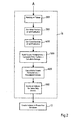
- Fig. 1 is the first page of the flowchart of the overall processing by the XOP program.
- Fig. 2 is the second page of the flowchart of the overall processing by the XOP program.
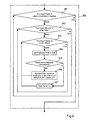
- Fig. 3 is a flowchart of the table ranking for index recommendation.
- Fig. 4 is a flowchart showing the retrieval of the filter factors of the SQL statement predicates.
- Fig. 5 is a flowchart showing the retrieval of the concatenations of the SQL statement predicates.
- Fig. 6 is a flowchart showing the process of building column sets.
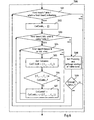
- Fig. 7 is a flowchart of the recommendation of new indexes.
- Fig. 8 is a flowchart of column set pruning and the calculation of the total savings in getpages on the table level for each column set permutation.
- Fig. 9 is a flowchart of building column permutations and calculating their filter factors and savings in getpages on query block level.
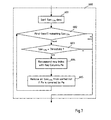
- Fig. 10 is a flowchart showing the decision taking path for index recommendations that support index only access.
- Fig. 11 is a flowchart of building the best column combinations to be added to existing indexes for index only access.
- Fig. 12 is a flowchart of column combination pruning.
- Fig. 13 is a flowchart of building indexes for index only access.
- Fig 1 & 2 form a high level flowchart of the XOP program.
- the programs major objective is to recommend new or improved performance indexes based on their ability to minimize the overall SQL statement getpage workload i.e., the read/change activity on each table and each index currently used for all invocations of an SQL statement.
- the initial step in running the XOP program is to extract production statistics from the existing database.
- a conventional DB2 trace is run in the production environment 10. This captures SQL statements and their getpage activities on the tables and index levels for a representative time interval.
- the trace data is expanded with static SQL from the database's catalog 11 and condensed to give the SQL frequency and to allow assignment of getpage counts to the SQL 12.
- the test environment consist of corresponding tables and indexes to those in the production environment, but no data is required to be in the tables.
- the trace data is reloaded into the test environment 13.
- Production catalog statistics must be simulated in order to do a one time EXPLAIN of the relefant SQL statements.
- the EXPLAIN function of DB2 is used to provide the access path for each query block, the predicate filter factors, and the tables and indexes used by the relevant SQL statements. As a direct result, a comparison of indexes that exist with the ones being used, allows identification of the indexes currently not used 15.
- the program identifies the indexable predicates in each SQL, it then assigns a getpage count to each table in the SQL 14 .
- indexes to be used in the production database is done through a series of steps 200-800 which will determine the XOP selection process 16. As more fully discussed below, the tables are ranked 200, filter factors are obtained for all predicates 300, concatanation for all predicates as obtained 400, column permutations and filter factors and savings are calculated 500, column permutations are consolidated and indexes recommended 600, indexes for index only access are selected 800. Upon completion the recommended indexes are used to create indexes in the production database 17.
- Fig. 3 illustrates the process of ranking tables. This ranking identifies the tables most likely to benefit as a result of new performance indexes.
- a set of tables TAB is introduced in the first step and initialized to empty 201. Then each table T 202 is checked whether its read activity Getp T exceeds the change activity Chng T by a predefined threshold percentage 203. A table T with a high volume of changed data is not considered for further processing because additional indexes on table T increase the change activity Chng T to an amount that is higher than the savings in read activity Getp T . Otherwise, table T is added to the set of tables TAB 204 which collects all tables for ranking.
- the read activity Getp T of a table T is defined as the total sum of getpage requests of all SQL statement invocations for this table T:
- the change activity Chng T of a table T is the total sum of pages changed of all UPDATE, DELETE and INSERT statement invocations for this table T:
- the flowchart of Fig. 4 shows the process of retrieving filter factors of all predicates.
- FIG. 5 illustrates the retrieval of the predicate concatenations, i.e., the boolean operators AND and OR.
- the objective is to build column sets that are input to the calculation of the total savings in getpages at table level for each column set permutation in a later step.
- the program verifies whether there is enough read activity Getp T left over for all tables T not yet processed. If the remaining read activity is sufficient according to a predefined threshold, the process of building column sets and the calculation of the total savings in getpages on table level for each column set permutation continues for the next table T 501.
- the savings Sav T,Q,B,Pe for each permutation Pe and query block B inside every SQL statement Q using table T are known 704.
- the total saving Sav T,Pe for table T and each permutation Pe (705) can be computed 706 as:
- the program verifies new indexes are recommended based on the calculated savings Sav T,Pe for all processed tables T as shown in the flow diagram of Fig. 7.
- the savings Sav T,Pe for all permutations Pe and all tables T are sorted in descending order 601, so that the permutations Pe with the highest savings in getpages are first.
- MIN and MAX the index key columns E 1 ,...,E n are put in either ascending or descending order.
- the sorted list is searched for elements Sav T,Px of the same table T where the permutation Px is covered by the index key (E 1 , ..., E n ) just recommended. Such elements Sav T,Px are ignored for further processing and removed from the sorted list 602.
- the flowchart 508 of Fig. 8 shows returning the savings Sav T,Q,B,Pe for each permutation Pe and query block B inside every SQL statement Q using table T 704 Fig. 7:
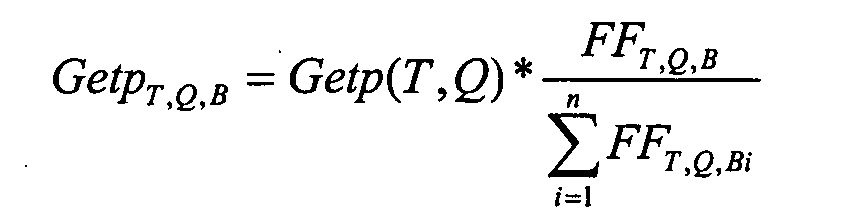
- the overall filter factor FF T,Q,B is calculated using the following boolean AND and OR rule:
- the number of getpages Getp T,Q,B for table T and query block B in SQL statement Q is computed as: where Bi are the query blocks in SQL statement Q.
- the savings Sav T ,Q,B,Pe for permutation Pe is calculated in one of the following three ways:
- Index only access means that SQL statements are solely processed by retrieving index pages. No pages have to be read on the table level because all SQL statement columns are part of the index.
- each table T being processed in ranking order 801 is checked whether its read activity Getp T exceeds the total read activity of all tables by a predefined threshold percentage 802. If this threshold is not reached, this table T and all tables that follow table T in ranking order are not considered any further and processing continues with flowchart Fig. 13 809. Otherwise, if the read activity on table T is still sufficient, there should be no index recommendation already made for this table T by the XOP program 803. If this is true, all existing indexes I for table T are retrieved (804) and sets AddCol T,I are initialized to "empty" for table T and all indexes I.
- a set AddCol T,I will store elements (B, ⁇ C 1 , ..., C n ⁇ , Getp T,Q,B ) which represent the column combination ⁇ C 1 ,...,C n ⁇ and its savings Getp T,Q,B in getpages for a query block B 805 inside SQL statements Q using table T (806) that is to be added to index I for index only access.
- the construction of AddCol T,I is illustrated in flowchart Fig. 11 where all indexes 810 are investigated for query block B which columns ⁇ C1, ..., C n ⁇ are to be added 811 to the index key for index only access.
- the read activity Getp d is added to the overall savings Getp T,I,B that an index I on table T will have if columns ⁇ C 1 ,...,C n ⁇ are added to its index key 824.
- the overall savings Getp T,I,B is initially set to Getp 822.
- the element (B, ⁇ C 1 , ..., C n ⁇ , Getp) with the maximum Getp T,I,B finally remains in AddCol T,I 825 and all AddCol T,I elements for other query blocks B d covered by ⁇ C 1 ,...,C n ⁇ are removed from AddCol T,I . Furthermore, all elements for query blocks B and B d are removed from the sets AddCol T,Ix for any other Index Ix 826.
- Processing returns to flowchart Fig. 10 at 808 if all indexes I on table T are checked 820 or the sum of getpages in the remaining query blocks is below a predefined threshold 827.
- a new index should be built with a key containing the columns copied from the existing index I plus the columns ⁇ C 1 , ..., C n ⁇ 833 or whether the columns ⁇ C 1 ,...,C n ⁇ should be just added to the existing index I 834.
- the recommendation for a new index is always made if the existing index is unique or clustering 832. Otherwise, recommendations are made to modify the existing index 834.
- the recommendations can then be used to create a indexes in the production database 17 which are accordingly optimized based on getpage work load.
Landscapes
- Engineering & Computer Science (AREA)
- Databases & Information Systems (AREA)
- Theoretical Computer Science (AREA)
- Data Mining & Analysis (AREA)
- Physics & Mathematics (AREA)
- General Engineering & Computer Science (AREA)
- General Physics & Mathematics (AREA)
- Software Systems (AREA)
- Information Retrieval, Db Structures And Fs Structures Therefor (AREA)
Abstract
Description
- Q
- SQL statement
- T
- Table
- B
- Query block
- P
- Predicate
- FF
- Filter factor of a predicate
- Getp(T,Q)
- Number of getpages (equates to number of pages read) for table T for all invocations of SQL statement Q (regardless whether Q is a SELECT, UPDATE, INSERT or DELETE statement)
- Getp(I,Q)
- Number of getpages (equates to number of pages read) for index I for all invocations of SQL statement Q (regardless whether Q is a SELECT, UPDATE, INSERT or DELETE statement)
- Update(T,Q)
- Number of pages changed in table T by all invocations of an UPDATE statement Q
- Insert(T,Q)
- Number of pages changed in table T by all invocations of an INSERT statement Q
- Delete(T,Q)
- Number of pages changed in table T by all invocations of a DELETE statement Q
- Col(T,Q,B)
- = {C1, ..., Cn} is the set of columns within table T and SQL statement Q and query block B
- Pred(T,Q,B)
- = {P1, ..., Pn} is the set of predicates in SQL statement Q and query block B with a column in table T



- Filter factors of predicates that are concatenated with an AND will be multiplied.
- Filter factors of predicates that are concatenated with an OR will be added and the product of both filter factors is subtracted.
- Filter factors of predicate expressions in inner brackets are computed first.
| Index: | I1 | I2 | I3 |
| Key: | (B, C) | (D, G) | (E) |

Claims (25)
- A method for selecting optimized indexes for a relational database, comprising:(a) collecting data about all database queries in a representative time interval;(b) determining database tables which have been queried during the representative time period so as to have triggered activity above a'predetermined amount;(c) computing an optimized index set based on table read/change activity; and(d) recommending the optimized index set to a user.
- The method of claim 1, wherein the data about the database queries is determined by running a trace on all database queries in said representative time interval, the trace includes determining the frequency of execution and the read/change activity on each table and each index for each query traced.
- The method of claim 1 or 2, wherein the queries comprise SQL queries.
- The method of any one of the preceding claims,
wherein the read/change activity comprises getpage workload activity. - The method of any one of the preceding claims,
wherein the optimized index set is determined by computing the potential savings in read activity of potential index column combination for all query invocations on each table having a read activity above a predetermined level. - The method of any one of the preceding claims,
wherein tables with a high change activity are not considered for index recommendation if the potential index overhead exceeds the benefits in table read activity savings. - The method of one of claims 2 to 6, wherein the potential indeces are computed for each such table including the following factors:(a) the table read/change activity of all queries accessing this table;(b) the filter factors of the predicates of all queries accessing this table;(c) the predicate properties of being indexable for all queries accessing this table; and(d) the query access paths of all queries accessing this table.
- The method of any one of the preceding claims,
wherein indexes are expanded for index only access to eliminate table read activity. - The method of any one of the preceding claims,
wherein the database comprises a DB2 database. - An apparatus for determining an optimized index set for a database, comprising:(a) one or more processors; and(b) a memory coupled to the one or more processors and containing one or more sequences of one or more instructions which, when executed by the one or more processors, cause the one or more processors to perform the steps of:(i) collecting data about all database queries in a representative time interval;(ii) determining database tables which have been queried during the representative time period as so to have triggered activity above a predetermined amount;(iii) computing an optimized index set based on table read/change activity; and(iv) recommending the optimized index set to a user.
- The apparatus of claim 10, wherein the data about the database queries is determined by running a trace on all database queries in said representative time interval, the trace includes determining the frequency of execution and the read/change activity on each table and each index for each query traced.
- The apparatus of claim 10 or 11, wherein the queries comprise SQL queries.
- The apparatus of any one of claims 10 to 12, wherein the read/change activity comprises getpage workload activity.
- The apparatus of any one of claims 10 to 13, wherein the optimized index set is determined by computing the potential savings in read activity of potential index column combination for all query invocations on each table having a read activity above a predetermined level.
- The apparatus of any one of claims 10 to 14, wherein the potential indexes are computed for each such table including the following factors:(e) the table read/change activity of all queries accessing this table;(f) the filter factors of the predicates of all queries accessing this table;(g) the predicate properties of being indexable for all queries accessing this table; and(h) the query access paths of all queries accessing this table.
- The apparatus of any one of claims 10 to 15, wherein indexes are expanded for index only access to eliminate table read activity.
- The apparatus of any one of claims 10 to 16, wherein the database comprises a DB2 database.
- A computer-readable medium carrying one or more sequences of one or more instructions for determining, in a relational database management system, an/optimized set of database indexes, the one or more sequences of one or more instructions including instructions which, when executed by one or more processors, cause the one or more processors to perform the steps of:(i) collecting data about all database queries in a representative time interval;(ii) determining database tables which have been queried during the representative time period so as to have triggered activity above a predetermined amount;(iii) computing an optimized index set based on table read/change activity; and(iv) recommending the optimized index set to a user.
- The medium of claim 18, wherein the data about the database queries is determined by running a trace on all database queries in said representative time interval, the trace includes determining the frequency of execution and the read/change activity on each table and each index for each query traced.
- The medium of claim 18 or 19, wherein the queries comprise SQL queries.
- The medium of any one of claims 18 to 20, wherein the read/change activity comprises getpage workload activity.
- The medium of any one of claims 18 to 21, wherein the optimized index set is determined by computing the potential savings in read activity of potential index column combination for all query invocations on each table having a read activity above a predetermined level.
- The medium of any one of claims 18 to 22, wherein the potential indexes are computed for each such table including the following factors:(i) the table read/change activity of all queries accessing this table;(j) the filter factors of the predicates of all queries accessing this table;(k) the predicate properties of being indexable for all queries accessing this table; and(1) the query access paths of all queries accessing this table.
- The medium of any one of claims 18 to 23, wherein the indexes are expanded for index only access to eliminate table read activity.
- The medium of any one of claims 18 to 24, wherein the database comprises a DB2 database.
Priority Applications (3)
| Application Number | Priority Date | Filing Date | Title |
|---|---|---|---|
| PCT/EP2003/002129 WO2003075174A2 (en) | 2002-03-01 | 2003-02-28 | Getpage - workload based index optimizer |
| CA002477580A CA2477580A1 (en) | 2002-03-01 | 2003-02-28 | Getpage - workload based index optimizer |
| AU2003210396A AU2003210396A1 (en) | 2002-03-01 | 2003-02-28 | Getpage - workload based index optimizer |
Applications Claiming Priority (4)
| Application Number | Priority Date | Filing Date | Title |
|---|---|---|---|
| US36091102P | 2002-03-01 | 2002-03-01 | |
| US360911P | 2002-03-01 | ||
| US10/273,976 US7047231B2 (en) | 2002-03-01 | 2002-10-18 | Getpage-workload based index optimizer |
| US273976 | 2002-10-18 |
Publications (2)
| Publication Number | Publication Date |
|---|---|
| EP1341098A2 true EP1341098A2 (en) | 2003-09-03 |
| EP1341098A3 EP1341098A3 (en) | 2004-03-17 |
Family
ID=27737183
Family Applications (1)
| Application Number | Title | Priority Date | Filing Date |
|---|---|---|---|
| EP03002348A Withdrawn EP1341098A3 (en) | 2002-03-01 | 2003-02-04 | Getpage - Workload based Index Optimizer |
Country Status (2)
| Country | Link |
|---|---|
| US (1) | US7047231B2 (en) |
| EP (1) | EP1341098A3 (en) |
Cited By (1)
| Publication number | Priority date | Publication date | Assignee | Title |
|---|---|---|---|---|
| CN105653575A (en) * | 2015-12-04 | 2016-06-08 | 重庆川仪自动化股份有限公司 | Data checking method and reporting system employed by same |
Families Citing this family (20)
| Publication number | Priority date | Publication date | Assignee | Title |
|---|---|---|---|---|
| US7664730B2 (en) | 2003-09-06 | 2010-02-16 | Oracle International Corporation | Method and system for implementing a SQL profile |
| US7406477B2 (en) * | 2004-03-12 | 2008-07-29 | Sybase, Inc. | Database system with methodology for automated determination and selection of optimal indexes |
| US7769744B2 (en) | 2005-12-02 | 2010-08-03 | Microsoft Cororation | Missing index analysis and index useage statistics |
| US7761445B2 (en) * | 2006-12-15 | 2010-07-20 | Teradata Us, Inc. | Automated system for identifying and dropping marginal database indexes |
| US20080183764A1 (en) * | 2007-01-31 | 2008-07-31 | Microsoft Corporation | Continuous physical design tuning |
| US8150790B2 (en) * | 2007-01-31 | 2012-04-03 | Microsoft Corporation | Lightweight physical design alerter |
| US8055646B2 (en) * | 2008-08-05 | 2011-11-08 | International Business Machines Corporation | Prevention of redundant indexes in a database management system |
| US20100262593A1 (en) * | 2009-04-08 | 2010-10-14 | Microsoft Corporation | Automated filtered index recommendations |
| US8376465B2 (en) * | 2009-07-07 | 2013-02-19 | Lear Corporation | Adjustable head restraint assembly for vehicle seats |
| US8204901B2 (en) | 2009-09-02 | 2012-06-19 | International Business Machines Corporation | Generating query predicates for processing multidimensional data |
| CN102651010A (en) | 2011-02-28 | 2012-08-29 | 国际商业机器公司 | Method, equipment and system for unloading database |
| CN104714984A (en) * | 2013-12-17 | 2015-06-17 | 中国移动通信集团湖南有限公司 | Database optimization method and device |
| US10860237B2 (en) | 2014-06-24 | 2020-12-08 | Oracle International Corporation | Storage integrated snapshot cloning for database |
| US10606833B2 (en) | 2014-11-18 | 2020-03-31 | Oracle International Corporation | Context sensitive indexes |
| US10061678B2 (en) | 2015-06-26 | 2018-08-28 | Microsoft Technology Licensing, Llc | Automated validation of database index creation |
| US11068437B2 (en) | 2015-10-23 | 2021-07-20 | Oracle Interntional Corporation | Periodic snapshots of a pluggable database in a container database |
| US11468073B2 (en) | 2018-08-06 | 2022-10-11 | Oracle International Corporation | Techniques for maintaining statistics in a database system |
| US11068460B2 (en) | 2018-08-06 | 2021-07-20 | Oracle International Corporation | Automated real-time index management |
| US11113110B2 (en) | 2018-10-19 | 2021-09-07 | Oracle International Corporation | Intelligent pooling of isolated hierarchical runtimes for cloud scale databases in a multi-tenant environment |
| KR102639897B1 (en) * | 2021-03-11 | 2024-02-22 | 김기창 | Data architecture management system |
Family Cites Families (10)
| Publication number | Priority date | Publication date | Assignee | Title |
|---|---|---|---|---|
| US5404510A (en) * | 1992-05-21 | 1995-04-04 | Oracle Corporation | Database index design based upon request importance and the reuse and modification of similar existing indexes |
| GB9526096D0 (en) * | 1995-12-20 | 1996-02-21 | British Telecomm | Specifying indexes for relational databases |
| US6314420B1 (en) * | 1996-04-04 | 2001-11-06 | Lycos, Inc. | Collaborative/adaptive search engine |
| US6006232A (en) * | 1997-10-21 | 1999-12-21 | At&T Corp. | System and method for multirecord compression in a relational database |
| GB9915465D0 (en) * | 1999-07-02 | 1999-09-01 | Lenzie Robert S | Identified preferred indexes for databases |
| US20020156792A1 (en) * | 2000-12-06 | 2002-10-24 | Biosentients, Inc. | Intelligent object handling device and method for intelligent object data in heterogeneous data environments with high data density and dynamic application needs |
| US6842753B2 (en) * | 2001-01-12 | 2005-01-11 | Microsoft Corporation | Sampling for aggregation queries |
| US6662175B1 (en) * | 2001-05-08 | 2003-12-09 | Ncr Corporation | Semantic query optimization using value correlation |
| US7499907B2 (en) * | 2001-10-12 | 2009-03-03 | Teradata Us, Inc. | Index selection in a database system |
| US8140568B2 (en) * | 2001-12-13 | 2012-03-20 | International Business Machines Corporation | Estimation and use of access plan statistics |
-
2002
- 2002-10-18 US US10/273,976 patent/US7047231B2/en not_active Expired - Fee Related
-
2003
- 2003-02-04 EP EP03002348A patent/EP1341098A3/en not_active Withdrawn
Cited By (1)
| Publication number | Priority date | Publication date | Assignee | Title |
|---|---|---|---|---|
| CN105653575A (en) * | 2015-12-04 | 2016-06-08 | 重庆川仪自动化股份有限公司 | Data checking method and reporting system employed by same |
Also Published As
| Publication number | Publication date |
|---|---|
| US7047231B2 (en) | 2006-05-16 |
| EP1341098A3 (en) | 2004-03-17 |
| US20030167255A1 (en) | 2003-09-04 |
Similar Documents
| Publication | Publication Date | Title |
|---|---|---|
| US7047231B2 (en) | Getpage-workload based index optimizer | |
| Lan et al. | A survey on advancing the dbms query optimizer: Cardinality estimation, cost model, and plan enumeration | |
| Papadias et al. | An optimal and progressive algorithm for skyline queries | |
| US7272589B1 (en) | Database index validation mechanism | |
| US5924088A (en) | Index selection for an index access path | |
| US6801903B2 (en) | Collecting statistics in a database system | |
| AU2010200478B2 (en) | Multiple index based information retrieval system | |
| US5758144A (en) | Database execution cost and system performance estimator | |
| US5043872A (en) | Access path optimization using degrees of clustering | |
| US9805077B2 (en) | Method and system for optimizing data access in a database using multi-class objects | |
| US5778353A (en) | Computer program product for optimizing data retrieval using index scanning | |
| US7562090B2 (en) | System and method for automating data partitioning in a parallel database | |
| EP1360616B1 (en) | Database system and query optimiser | |
| US20100114976A1 (en) | Method For Database Design | |
| Jindal et al. | Relax and let the database do the partitioning online | |
| EP2746970A1 (en) | Timeline index for managing temporal data | |
| US20110113026A1 (en) | Scalable Computation of Data | |
| US20070239673A1 (en) | Removing nodes from a query tree based on a result set | |
| US6999967B1 (en) | Semantically reducing the number of partitions involved in a join | |
| RU2433467C1 (en) | Method of forming aggregated data structure and method of searching for data through aggregated data structure in data base management system | |
| US6694324B1 (en) | Determination of records with a specified number of largest or smallest values in a parallel database system | |
| Li et al. | Set predicates in sql: Enabling set-level comparisons for dynamically formed groups | |
| WO2003075174A2 (en) | Getpage - workload based index optimizer | |
| Budalakoti et al. | Automated clustering recommendation with database zone maps | |
| Kim et al. | Optimally leveraging density and locality to support limit queries |
Legal Events
| Date | Code | Title | Description |
|---|---|---|---|
| PUAI | Public reference made under article 153(3) epc to a published international application that has entered the european phase |
Free format text: ORIGINAL CODE: 0009012 |
|
| AK | Designated contracting states |
Kind code of ref document: A2 Designated state(s): AT BE BG CH CY CZ DE DK EE ES FI FR GB GR HU IE IT LI LU MC NL PT SE SI SK TR |
|
| AX | Request for extension of the european patent |
Extension state: AL LT LV MK RO |
|
| PUAL | Search report despatched |
Free format text: ORIGINAL CODE: 0009013 |
|
| AK | Designated contracting states |
Kind code of ref document: A3 Designated state(s): AT BE BG CH CY CZ DE DK EE ES FI FR GB GR HU IE IT LI LU MC NL PT SE SI SK TR |
|
| AX | Request for extension of the european patent |
Extension state: AL LT LV MK RO |
|
| AKX | Designation fees paid | ||
| 17P | Request for examination filed |
Effective date: 20040915 |
|
| RBV | Designated contracting states (corrected) |
Designated state(s): AT BE BG CH CY CZ DE DK EE ES FI FR GB GR HU IE IT LI LU MC NL PT SE SI SK TR |
|
| REG | Reference to a national code |
Ref country code: DE Ref legal event code: 8566 |
|
| STAA | Information on the status of an ep patent application or granted ep patent |
Free format text: STATUS: THE APPLICATION IS DEEMED TO BE WITHDRAWN |
|
| 18D | Application deemed to be withdrawn |
Effective date: 20080901 |