EP1341050A2 - Dispersing agent for pigment, pigment-dispersion composition, toner, and toner production process - Google Patents
Dispersing agent for pigment, pigment-dispersion composition, toner, and toner production process Download PDFInfo
- Publication number
- EP1341050A2 EP1341050A2 EP03000886A EP03000886A EP1341050A2 EP 1341050 A2 EP1341050 A2 EP 1341050A2 EP 03000886 A EP03000886 A EP 03000886A EP 03000886 A EP03000886 A EP 03000886A EP 1341050 A2 EP1341050 A2 EP 1341050A2
- Authority
- EP
- European Patent Office
- Prior art keywords
- pigment
- toner
- dispersing agent
- polymerizable monomer
- weight
- Prior art date
- Legal status (The legal status is an assumption and is not a legal conclusion. Google has not performed a legal analysis and makes no representation as to the accuracy of the status listed.)
- Granted
Links
Classifications
-
- G—PHYSICS
- G03—PHOTOGRAPHY; CINEMATOGRAPHY; ANALOGOUS TECHNIQUES USING WAVES OTHER THAN OPTICAL WAVES; ELECTROGRAPHY; HOLOGRAPHY
- G03G—ELECTROGRAPHY; ELECTROPHOTOGRAPHY; MAGNETOGRAPHY
- G03G9/00—Developers
- G03G9/08—Developers with toner particles
-
- G—PHYSICS
- G03—PHOTOGRAPHY; CINEMATOGRAPHY; ANALOGOUS TECHNIQUES USING WAVES OTHER THAN OPTICAL WAVES; ELECTROGRAPHY; HOLOGRAPHY
- G03G—ELECTROGRAPHY; ELECTROPHOTOGRAPHY; MAGNETOGRAPHY
- G03G9/00—Developers
- G03G9/08—Developers with toner particles
- G03G9/09—Colouring agents for toner particles
- G03G9/0906—Organic dyes
- G03G9/0918—Phthalocyanine dyes
-
- C—CHEMISTRY; METALLURGY
- C09—DYES; PAINTS; POLISHES; NATURAL RESINS; ADHESIVES; COMPOSITIONS NOT OTHERWISE PROVIDED FOR; APPLICATIONS OF MATERIALS NOT OTHERWISE PROVIDED FOR
- C09B—ORGANIC DYES OR CLOSELY-RELATED COMPOUNDS FOR PRODUCING DYES, e.g. PIGMENTS; MORDANTS; LAKES
- C09B47/00—Porphines; Azaporphines
-
- C—CHEMISTRY; METALLURGY
- C09—DYES; PAINTS; POLISHES; NATURAL RESINS; ADHESIVES; COMPOSITIONS NOT OTHERWISE PROVIDED FOR; APPLICATIONS OF MATERIALS NOT OTHERWISE PROVIDED FOR
- C09B—ORGANIC DYES OR CLOSELY-RELATED COMPOUNDS FOR PRODUCING DYES, e.g. PIGMENTS; MORDANTS; LAKES
- C09B67/00—Influencing the physical, e.g. the dyeing or printing properties of dyestuffs without chemical reactions, e.g. by treating with solvents grinding or grinding assistants, coating of pigments or dyes; Process features in the making of dyestuff preparations; Dyestuff preparations of a special physical nature, e.g. tablets, films
- C09B67/0033—Blends of pigments; Mixtured crystals; Solid solutions
- C09B67/0034—Mixtures of two or more pigments or dyes of the same type
- C09B67/0035—Mixtures of phthalocyanines
-
- C—CHEMISTRY; METALLURGY
- C09—DYES; PAINTS; POLISHES; NATURAL RESINS; ADHESIVES; COMPOSITIONS NOT OTHERWISE PROVIDED FOR; APPLICATIONS OF MATERIALS NOT OTHERWISE PROVIDED FOR
- C09D—COATING COMPOSITIONS, e.g. PAINTS, VARNISHES OR LACQUERS; FILLING PASTES; CHEMICAL PAINT OR INK REMOVERS; INKS; CORRECTING FLUIDS; WOODSTAINS; PASTES OR SOLIDS FOR COLOURING OR PRINTING; USE OF MATERIALS THEREFOR
- C09D17/00—Pigment pastes, e.g. for mixing in paints
-
- C—CHEMISTRY; METALLURGY
- C09—DYES; PAINTS; POLISHES; NATURAL RESINS; ADHESIVES; COMPOSITIONS NOT OTHERWISE PROVIDED FOR; APPLICATIONS OF MATERIALS NOT OTHERWISE PROVIDED FOR
- C09K—MATERIALS FOR MISCELLANEOUS APPLICATIONS, NOT PROVIDED FOR ELSEWHERE
- C09K23/00—Use of substances as emulsifying, wetting, dispersing, or foam-producing agents
- C09K23/32—Heterocyclic compounds
Definitions
- the present invention relates to a dispersing agent for a pigment (hereinafter often "pigment-dispersing agent”) which is to improve dispersibility of pigments, and a pigment-dispersion composition incorporating the same.
- the present invention also relates to a toner for developing electrostatic images for image-forming methods, e.g., electrophotography and electrostatic printing, or for forming toner images in a toner-jet type image-forming method, and to a process for producing the same.
- the present invention relates to a toner for fixing images formed by the toner on a transfer medium under heating and pressure, and to a process for producing the same.
- a pigment-dispersing agent In processes for producing products, e.g., coating material, ink, toner and formed resin article, a pigment-dispersing agent has been effectively utilized as an additive for finely dividing a pigment and thereby sufficiently realizing its colorant performances (e.g., coloring capacity, transparency and gloss).
- a pigment-dispersing agent should satisfy various requirements to fully exhibit its functions, e.g., chemical structure which fast adsorbs a pigment in the molecule, affinity for a solvent and resin which are used to disperse the pigment, and chemical structure which provides steric hindrance to prevent re-agglomeration of the pigment.
- a phthalocyanine-based pigment and carbon black incorporate a phthalocyanine-based colorant derivative.
- One type of known pigment-dispersing agents is prepared by mixing a material which can adsorb a pigment with a resin which has affinity for the solvent and resin and can provide steric hindrance, and bonding them to each other by acid-base interactions, in order to make the pigment commonly applicable to a variety of solvents and resins (disclosed in, e.g., Japanese Patent Application Laid-Open No. 06-122835, Japanese Patent Application No. 09-5989 and National Publication No. 2002-514263).
- Toners for printers and copying machines are composed of toner particles with a binder resin, colorant (e.g., magnetic particles, carbon black, dye or pigment) and wax as the main ingredients, and the toner particles generally have a weight-average particle diameter of 4 to 20 ⁇ m.
- the toner particles are prepared by melting a mixture of a thermoplastic resin and a colorant to uniformly disperse the colorant in the resin, finely dividing the mixture after it is cooled, and classifying the resultant particles to produce particles of a desired particle diameter.
- the colorant is uniformly dispersed in the thermoplastic resin by, e.g., kneading or flushing, where a pigment-dispersing agent is expected to increase dispersibility of the pigment, when mixed with the colorant and the thermoplastic resin.
- a pigment-dispersing agent may adversely affect electrification characteristics of the toner particles, because it must be incorporated at 20 to 50% by weight based on the pigment.
- Suspension polymerization which involves no crushing of particles, is proposed for production of toner particles (disclosed in, e.g., Japanese Patent Application Laid-Open No. 05-197193).
- This process comprises the steps of dissolving or dispersing a colorant, charge control agent and wax in a polymerizable monomer to prepare a polymerizable monomer composition; dispersing the composition in an aqueous solvent containing a dispersion stabilizer with a dispersion apparatus to form polymerizable monomer composition particles in the aqueous solvent; and polymerizing and solidifying the polymerizable monomer in the polymerizable monomer composition to produce toner particles of intended particle diameter and composition.
- This process involving no particle crushing step, is expected to bring favorable effects, e.g., energy saving, improved process yield and reduced cost.
- the pigment particles even when finely dispersed in the polymerizable monomer, may re-agglomerate with each other in the polymerization step, to possibly deteriorate colorant capacity and transparency of the fixed images.
- Use of a pigment-dispersing agent for the process is considered. However, it tends to adversely affect electrification characteristics of the toner particles, because it must be incorporated at 20 to 50% by weight based on the pigment.
- One of the pigment-dispersing agents proposed to solve the above problems has a pigment-adsorbing segment covalently bonded, to a resin material segment which has affinity for the solvent and resin and provides steric hindrance (disclosed in, e.g., Japanese Patent Application Laid-Open No. 2002-226727).
- a compound in which a Cu-phthalocyanine skeleton is grafted in a polymer is employed as a dispersing agent, it can exhibit the dispersion effect even in a trace quantity in the pigment, and successfully prevents re-agglomeration of the pigment particles in the polymerization step and keeps electrification characteristics of the toner.
- production of such a pigment-dispersing agent needs a multi-staged synthesis route. Therefore, there are great demands for pigment-dispersing agents which can be produced in high productivity.
- Zn-phthalocyanine is also proposed to control a color tone of a cyan pigment (disclosed in, e.g., Japanese Patent Application Laid-Open No. 2000-302993).
- Zn-phthalocyanine when present alone, can neither prevent re-agglomeration of pigment particles nor improve their affinity for a dispersion medium, even when it is adsorbed on the pigment particle surface. Accordingly, it will bring no effect of dispersing the pigment.
- Japanese Patent Application Laid-Open No. 2000-302993 also describes that a dispersing agent is incorporated preferably at 5 to 80% by weight based on a pigment.
- pigment-dispersing agents exhibiting the effect in a smaller quantity are in demand.
- the present invention relates to a dispersing agent for a pigment comprising at least a metallic compound having a structure represented by the general formula (I):
- X 1 to X 4 are each independently a nitrogen atom or C-R (R is a hydrogen atom, or an alkyl group of 1 to 12 carbon atoms, which may have a substituent, or an aromatic hydrocarbon group, which may be substituted)
- Y 1 to Y 8 are each independently a hydrogen atom or an alkyl group of 1 to 12 carbon atoms, which may be substituted; or Y 1 and Y 2 , Y 3 and Y 4 , Y 5 and Y 6 and/or Y 7 and Y 8 constitute an aromatic hydrocarbon ring which may have a substituent
- M is a metal capable of taking a penta-coordinated structure
- an n-electron-donating compound capable of being coordinated with the central metal of the metallic compound.
- the present invention also relates to a pigment-dispersion composition
- a pigment-dispersion composition comprising at least a dispersing agent for a pigment which comprises at least a metallic compound having a structure represented by the general formula (I):
- X 1 to X 4 are each independently a nitrogen atom or C-R (R is hydrogen atom, or an alkyl group of 1 to 12 carbon atoms, which may have a substituent, or an aromatic hydrocarbon group, which may be substituted)
- Y 1 to Y 8 are each independently a hydrogen atom or an alkyl group of 1 to 12 carbon atoms, which may be substituted; or Y 1 and Y 2 , Y 3 and Y 4 , Y 5 and Y 6 and/or Y 7 and Y 8 constitute an aromatic hydrocarbon ring which may have a substituent
- M is a metal capable of taking a penta-coordinated structure
- an n-electron-donating compound capable of being coordinated with the central metal of the
- the present invention also relates to a toner containing toner particles comprising at least a dispersing agent for a pigment which comprises at least a metallic compound having a structure represented by the general formula (I):
- X 1 to X 4 are each independently a nitrogen atom or C-R (R is hydrogen atom, or an alkyl group of 1 to 12 carbon atoms, which may have a substituent, or an aromatic hydrocarbon group, which may be substituted)
- Y 1 to Y 8 are each independently a hydrogen atom or an alkyl group of 1 to 12 carbon atoms, which may be substituted; or Y 1 and Y 2 , Y 3 and Y 4 , Y 5 and Y 6 and/or Y 7 and Y 8 constitute an aromatic hydrocarbon ring which may have a substituent
- M is a metal capable of taking a penta-coordinated structure
- an n-electron-donating compound capable of being coordinated with the central metal of the metallic compound, a pigment, and
- the present invention also relates to a process for producing a toner comprising a step of mixing a dispersing agent for a pigment which comprises at least a metallic compound having a structure represented by the general formula (I):
- X 1 to X 4 are each independently a nitrogen atom or C-R (R is hydrogen atom, or an alkyl group of 1 to 12 carbon atoms, which may have a substituent, or an aromatic hydrocarbon group, which may be substituted)
- Y 1 to Y 8 are each independently a hydrogen atom or an alkyl group of 1 to 12 carbon atoms, which may be substituted; or Y 1 and Y 2 , Y 3 and Y 4 , Y 5 and Y 6 and/or Y 7 and Y 8 constitute an aromatic hydrocarbon ring which may have a substituent
- M is a metal capable of taking a penta-coordinated structure
- an n-electron-donating compound capable of being coordinated with the central metal of the metallic compound, and a
- the inventors of the present invention have found, after having extensively studied, that a dispersing agent for a pigment comprising a metallic compound of specific structure and a compound capable of being coordination-bonded at the central metal of the metallic compound can easily disperse a pigment finely in a dispersion medium, achieving the present invention.
- the pigment-dispersing agent of the present invention can be used in processes for producing products, e.g., coating material, ink, toner and formed resin article, as a pigment-treating agent to improve dispersibility of the pigment.
- the pigment-dispersing agent of the present invention is characterized by comprising a metallic compound of specific structure which allows the central metal to take a penta-coordinated structure and an n-electron-donating compound capable of being coordinated with the central metal of the metallic compound.
- the pigment-dispersing agent of the present invention comprises a metallic compound whose central metal, which is to be adsorbed on the pigment, is coordination-bonded to an n-electron-donating compound having a prevention of re-agglomeration of pigments and a dispersing effect, produced by mixing and dispersing these components.
- the n-electron-donating compound which can work as a ligand, has affinity for the dispersion medium to produce an excellent dispersion effect.
- the metallic compound has a structure represented by the general formula (I): (wherein, X 1 to X 4 are each independently a nitrogen atom or C-R (R is hydrogen atom, or an alkyl group of 1 to 12 carbon atoms, which may have a substituent, or an aromatic hydrocarbon group, which may be substituted); Y 1 to Y 8 are each independently a hydrogen atom or an alkyl group of 1 to 12 carbon atoms, which may be substituted; or Y 1 and Y 2 , Y 3 and Y 4 , Y 5 and Y 6 and/or Y 7 and Y 8 constitute an aromatic hydrocarbon ring which may have a substituent; and M is a metal capable of taking a penta-coordinated structure).
- the substituent is not limited.
- the examples include those having a carboxylic, sulfonic, aromatic-based, aliphatic-based, ether or alcohol group introduced.
- those hindering adsorptivity with the pigment or easy inclusion of a ligand for coordination in the axial direction are not desirable.
- Undesirable substituents include functional groups whose amine by itself can become a ligand, and those having a side chain which may cause steric hindrance on the plane on which the pigment is to be adsorbed.
- the metallic compound preferably has a phthalocyanine skeleton represented by the general formula (I) with X 1 to X 4 being each independently a nitrogen atom, and each of combinations of Y 1 and Y 2 , Y 3 and Y 4 , Y 5 and Y 6 , and Y 7 and Y 8 constitutes an aromatic hydrocarbon ring which may have a substituent.
- the metal as the central metal M in the metallic compound is aluminum, silicon, titanium, vanadium, chromium, manganese, iron, cobalt, nickel, zinc, germanium, palladium, cadmium, indium, tin, platinum or lead, in consideration of the ligand to be coordinated in the axial direction.
- the penta-coordinated structure is particularly preferable in a presence of a ligand, because it can be coordination-bonded to the plane on which the pigment is adsorbed. Of the above metals, zinc takes the penta-coordinated structure more easily than the others.
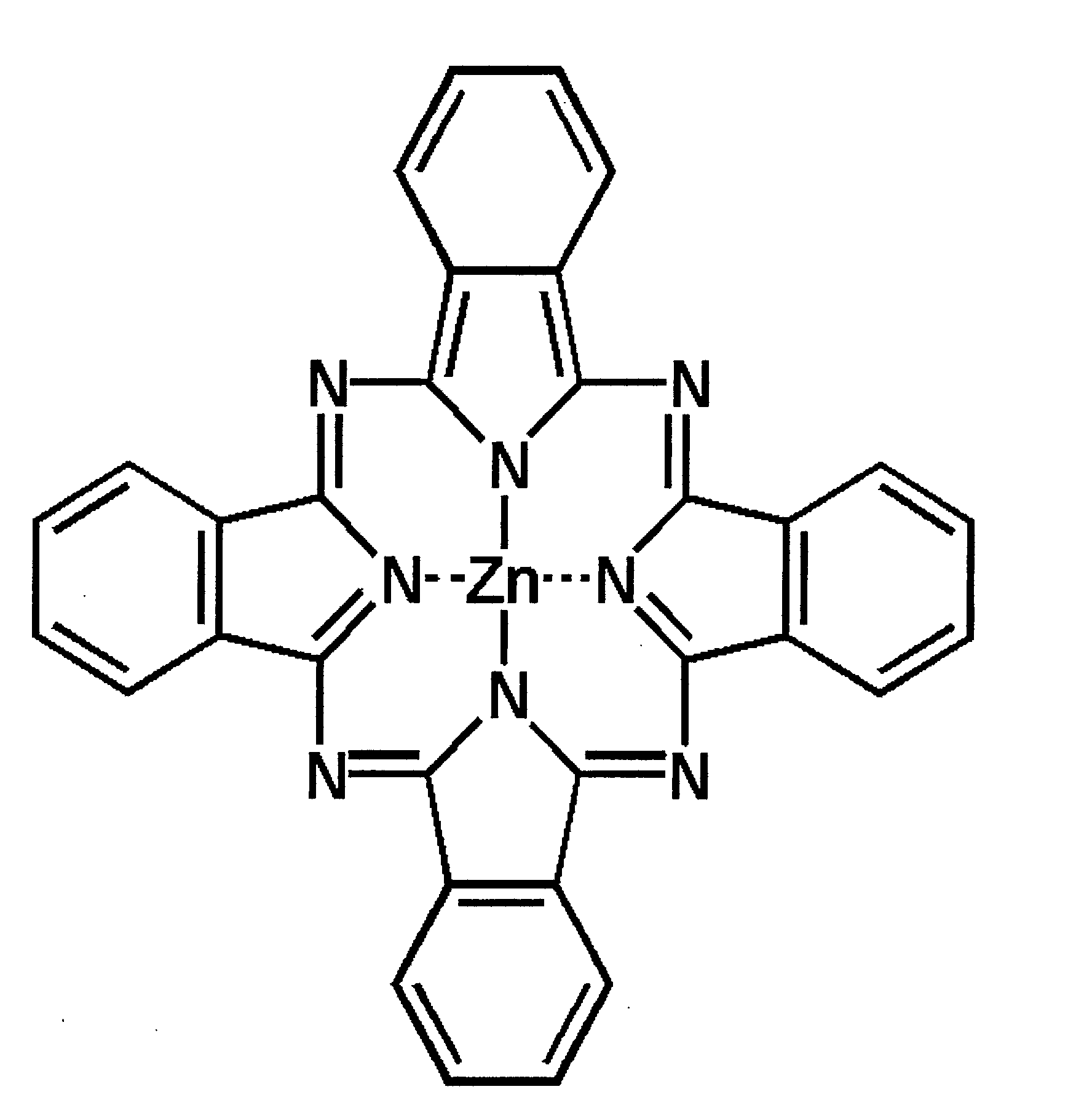
- zinc-phthalocyanine represented by the following formula is most preferable, in consideration of its fastness as a pigment-dispersing agent and adsorptivity with a phthalocyanine pigment:
- zinc-phthalocyanine is contained as the pigment-adsorbing segment in the pigment-dispersing agent, and can achieve its role at a very low content, sufficiently exhibiting its effect at 5% by weight or less. The effect of adjusting color tone which zinc-phthalocyanine itself has is in a negligible range.
- the n-electron-donating compound capable of being coordinated with the central metal of the metallic compound is not limited.
- the compound having an excellent n-electron-donating property preferably has at least one skeleton selected from the group consisting of primary to tertiary amines, imines, primary to tertiary amides, imides, aromatic imides (e.g., pyridine), thiols, thioesters, thionyl, sulfide and sulfoxide.
- the unshared electron pair in the nitrogen or sulfur atom in these skeletons shows excellent coordination capacity, and can be easily designed as the ligand.
- the n-electron-donating compound is preferably an oligomer or polymer, because of its affinity for the dispersion medium and steric hindrance it provides against the pigment to make it dispersible.
- the oligomers or polymers useful for the present invention include styrene copolymers of a styrene monomer and an n-electron donative monomer, copolymers of an acrylic monomer and an n-electron donative monomer and copolymers of a methacrylic monomer and an n-electron donative monomer; copolymers of an ester-based monomer and an n-electron donative monomer; copolymers of an ether-based monomer and an n-electron donative monomer; copolymers of a vinyl alcohol monomer and an n-electron donative monomer; and copolymers of a vinyl butyral monomer and an n-electron donative monomer.
- the pigment for the present invention may be selected from known ones.
- the pigment-dispersing agent of the present invention can be effectively utilized for colored pigments, e.g., phthalocyanine-based pigment, and carbon black.
- Cu-phthalocyanine As phthalocyanine-based pigments, copper-phthalocyanine (Cu-phthalocyanine) represented by the following formula is preferable.
- the dispersion medium for the present invention is selected depending on specific purposes of the pigment-dispersion composition, and is not limited. More specifically, the media useful for the present invention include water; alcohols, e.g., methyl alcohol, ethyl alcohol, modified ethyl alcohol, isopropyl alcohol, n-butyl alcohol, isobutyl alcohol, tert-butyl alcohol, sec-butyl alcohol, tert-amyl alcohol, 3-pentanol, octyl alcohol, benzyl alcohol and cyclohexanol; ether alcohols, e.g., methyl cellosolve, cellosolve, isopropyl cellosolve, butyl cellosolve, diethylene glycol and monobutyl ether; ketones, e.g., acetone, methylethylketone and methylisobutylketone; esters, e.g., ethyl acetate, butyl
- the dispersion medium may be a resin.
- the resins useful for the present invention include polystyrene and styrene copolymer; polyacrylic acid, polymethacrylic acid, polyacrylate, polymethacrylate, acrylate copolymer and methacrylate copolymer; polyester; polyvinyl ether and polyvinyl methyl ether; and polyvinyl alcohol and polyvinyl butyral. Still more, polyurethane and polypeptide are also useful for the present invention. These dispersion media may be used either individually or in combination.
- the polymerizable monomer useful as the dispersion medium for the present invention is for addition or condensation polymerization, that for the former being more preferable. More specifically, the polymerizable monomers useful for the present invention include styrene; styrene derivatives, e.g., o-methyl styrene, m-methyl styrene, p-methyl styrene, p-methoxystyrene, p-phenyl styrene, p-chlorostyrene, 3,4-dichlorostyrene, p-ethyl styrene, 2,4-dimethyl styrene, p-n-butyl styrene, p-tert-butyl styrene, p-n-hexyl styrene, p-n-octyl styrene, p-n-nonyl
- the pigment-dispersing agent of the present invention comprises a metallic compound of specific structure, whose central metal can take a penta-coordinated structure, and n-electron-donating compound capable of being coordinated with the central metal of the metallic compound. It can be produced by separately charging the metallic compound and n-electron-donating compound working as the ligand in the dispersion medium, before the pigment is dispersed in the medium by utilizing the coordination bond.
- the metallic compound segment as the pigment-adsorbing segment and ligand segment for providing dispersibility can be individually prepared, thereby facilitating synthesis of the pigment-dispersing agent of the present invention.
- the pigment-dispersion composition of the present invention comprises at least a dispersion medium, pigment and the pigment-dispersing agent of the present invention.
- a known pigment and dispersion medium can be suitably used for the pigment-dispersion composition of the present invention.
- the pigment-dispersing agent and, as required, a resin are dissolved in a dispersion medium, to which a powdered pigment is added little by little with stirring to be sufficiently compatible with the medium.
- the pigment-dispersing agent can be adsorbed on the pigment particle surfaces under a mechanical shear force by a disperser, e.g., ball mill, paint shaker, dissolver, attritor, sand mill or high-speed mill, to finely re-disperse the pigment in the form of stably uniform, fine particles in the medium.
- the toner of the present invention is for developing electrostatic images, or for forming toner images in a toner-jet type image-forming method.
- it is suitable for an image-forming method involving fixation of the toner images on a transfer medium under heating and pressure.
- the toner of the present invention is characterized by comprising at least the pigment-dispersing agent of the present invention.
- the process of the present invention for forming the toner uses the pigment-dispersing agent of the present invention in the pigment dispersing step.
- the pigment-dispersing agent of the present invention When the toner is produced by a crushing process, the pigment-dispersing agent of the present invention, a pigment, binder resin as the dispersion medium and one or more additives are sufficiently mixed with each other by a mixer, e.g., Henschel mixer or ball mill. The mixture is then melt-kneaded by a kneader operating at elevated temperature, e.g., kneader or extruder, where it is subjected to heat and mechanical shear force to melt the resin. In this stage, the pigment particles are surface-treated with the pigment-dispersing agent and, at the same time, finely dispersed in the molten material. The molten/kneaded mixture is cooled for solidification, and preliminary crushed and then finely pulverized. The resultant fine particles pulverized are classified to obtain the toner particles.
- a mixer e.g., Henschel mixer or ball mill.
- the mixture is then melt-kn
- the particles of the toner of the present invention can be produced by a polymerization process involving the polymerization step in which the polymerizable monomer composition, comprising at least a polymerizable monomer for forming the binder resin, pigment and the pigment-dispersing agent of the present invention, is polymerized with the aid of radical polymerization initiator, light or heat, and are especially preferable because they allow the pigment-dispersing agent of the present invention to exhibit its effect more efficiently.
- the pigment-dispersion composition incorporating a polymerizable monomer as the dispersion medium is treated by a disperser, to prepare the pigment-dispersed paste comprising the polymerizable monomer, pigment and pigment-dispersing agent.
- the resultant paste is further treated by an agitator together with the polymerizable monomer, a polymerization initiator, wax and, as required, one or more other additives to prepare the polymerizable monomer composition in the form of uniform mixture or dispersion.
- the polymerizable monomer composition thus obtained is incorporated in the dispersion medium (preferably aqueous medium) containing a dispersion stabilizer, and finely dispersed to the toner particle size by an agitator, e.g., high-speed agitator or high-speed disperser, e.g., ultrasonic disperser (granulation step).
- the toner particles can be produced by polymerizing the polymerizable monomer finely dispersed in the polymerizable monomer composition in polymerization step with the aid of a radical polymerization initiator, light and/or heat.
- an additive may be externally added in the toner particles during the production process.
- the polymerizable monomer contained in the toner particles to form the binder resin may be the one similar to the polymerizable monomer described above.
- the pigment for the toner of the present invention may be selected from known pigments.
- a colored pigment e.g., phthalocyanine-based one or carbon black, is suitable for the present invention. It is incorporated preferably at 3 to 20 parts by weight based on 100 parts by weight of the polymerizable monomer.
- the pigment contained in the toner of the present invention is surface-treated with the pigment-dispersing agent of the present invention, described above.
- the pigment-dispersion paste containing the pigment surface-treated with the pigment-dispersing agent of the present invention can be produced by treating the pigment-dispersion composition of the present invention by a varying pigment disperser.
- the optimum content of the pigment-dispersing agent depends on the desired particle size of the dispersed pigment. It is incorporated preferably at 0.3 parts by weight or more based on 100 parts by weight of the pigment, in order to sufficiently adsorb the metallic compound serving as the pigment-adsorbing segment on the pigment particle surfaces. At an excessively high content, the metallic compound itself develops a color to affect color phase of the pigment.
- the metallic compound as one of the components of the pigment-dispersing agent contained in the toner is incorporated preferably at 0.01 to 2.5% by weight, more preferably 0.01 to 1.0% by weight, based on the weight of the toner.
- the n-electron-donating compound which is coordinated with the central metal of the metallic compound to provide steric hindrance and thereby to prevent re-agglomeration of the pigment particles with each other, is preferably a polymer in the toner.
- the polymer preferably has a weight-average molecular weight Mw of 2,000 to 100,000 to produce the dispersion effect while causing no damage on the toner's fixing performance.
- Increasing content of the n-electron-donating compound is preferable, viewed from efficiency of its coordination with the metallic compound. However, an excessively high content is undesirable in consideration of its effects on the toner properties. Based on these considerations, the n-electron-donating compound is incorporated preferably at 0.05 to 10% by weight based on the weight of the toner.
- the n-electron-donating compound preferably has at least one type of the polymerizable monomer unit which constitutes the binder resin and n-electron donative, polymerizable monomer unit, because it produces an excellent pigment dispersion effect by its affinity for the dispersion medium, and keeps the pigment well dispersed in the polymerization step.
- the binder resin is a styrene/butyl acrylate copolymer
- a styrene/vinyl pyridine copolymer is cited as a preferable polymer serving as the n-electron-donating compound.
- it can bring the n-electron-donating compound's properties close to those of the binder resin, thereby controlling the adverse effects on the toner's properties.
- Increasing number of the functional groups capable of being coordinated is preferable, viewed from the considerations including coordination efficiency.
- the n-electron-donating compound is preferably a polymer which contains the n-electron donative, polymerizable monomer unit at 0.1 to 30% by weight, more preferably 1.0 to 10% by weight, when it is to be used for toner.
- the toner containing the pigment surface-treated with the pigment-dispersing agent of the present invention can be produced by suspension polymerization, where the pigment-dispersion paste containing the pigment-dispersing agent of the present invention is mixed with a polymerizable monomer, polymerization initiator and one or more other additives, and the resultant polymerizable monomer composition is dispersed in an aqueous dispersion medium.
- aqueous dispersion medium useful for the process involving suspension polymerization for production of the toner of the present invention is selected mainly according to the polymerizable monomer used and solubility of the resultant polymer. More specifically, those media useful for the present invention include water; alcohols, e.g., methyl alcohol, ethyl alcohol, modified ethyl alcohol, isopropyl alcohol, n-butyl alcohol, isobutyl alcohol, tert-butyl alcohol, sec-butyl alcohol, tert-amyl alcohol, 3-pentanol, octyl alcohol, benzyl alcohol and cyclohexanol; ether alcohols, e.g., methyl cellosolve, cellosolve, isopropyl cellosolve, butyl cellosolve, diethylene glycol and monobutyl ether; ketones, e.g., acetone, methylethylketone and methylisobutylket
- the dispersion stabilizer for the toner particles may be selected from the known ones. More specifically, these stabilizers include inorganic compounds, e.g., calcium phosphate, magnesium phosphate, aluminum phosphate, zinc phosphate, calcium carbonate, magnesium carbonate, calcium hydroxide, magnesium hydroxide, aluminum hydroxide, calcium metasilicate, calcium sulfate, barium sulfate, bentonite, silica and alumina; and organic compounds, e.g., polyvinyl alcohol, gelatin, methyl cellulose, methylhydroxypropyl cellulose, ethyl cellulose, sodium salt of carboxymethyl cellulose; polyacrylic acid and its salt; and starch.
- the dispersion stabilizer is incorporated preferably at 0.2 to 20% by weight based on 100% by weight of the polymerizable monomer.
- the polymerization initiator used in the process for producing the toner of the present invention may include known polymerization initiators. Stated specifically, it may include azo compounds such as 2,2'-azobisisobutyronitrile, 2,2'-azobis-(2,4-dimethylvaleronitrile), 2,2'-azobis(2-methylbutyronitrile), 1,1'-azobis-(cyclohexane-1-carbonitrile), dimethyl-2,2'-azobisisobutyrate, 4,4'-azobis-4-cyanovaleronitrile and 2,2'-azobis(4-methoxy-2,4-dimethylvaleronitrile); peroxides such as benzoyl peroxide, and methyl ethyl ketone peroxide; nucleophilic reagents such as alkali metals, metal hydroxides and Grignard reagents; and protonic acid, metal halides and stabilized carbonium ions.
- the polymerization initiator may preferably be in a
- a chain transfer agent may be used, which may include known chain transfer agents.
- toner additives as shown below may further be used in order to provide the toner with various properties.
- a charge control agent may be incorporated in the toner particles.
- a charge control agent having a high toner charging speed and capable of maintaining a constant charge quantity stably.
- charge control agents having no polymerization inhibitory action are particularly preferred.
- positive charge control agents preferred are quaternary ammonium salts, polymer type compounds having such a quaternary ammonium salt in the side chain, guanidine compounds, and imidazole compounds. Any of these charge control agents may preferably be added in a amount of from 0.5 to 10 parts by weight based on 100 parts by weight of the binder resin.
- Additives such as a fluidity-providing agent, an abrasive, a lubricant and charge controlling particles may also externally be added to the toner particles.
- metal oxides such as silicon oxide, aluminum oxide and titanium oxide may preferably be used. These may more preferably be those having been subjected to hydrophobic treatment.
- metal oxides such as cerium oxide, aluminum oxide, magnesium oxide and chromium oxide, nitrides such as silicon nitride, carbides such as silicon carbide, and metal salts such as strontium titanate, calcium sulfate, barium sulfate and calcium carbonate may preferably be used.
- fluorine resin powders such as vinylidene fluoride and polytetrafluoroethylene, and fatty acid metal salts such as zinc stearate and calcium stearate may preferably be used.
- charge controlling particles metal oxides such as tin oxide, titanium oxide, zinc oxide, silicon oxide and aluminum oxide, and carbon black may preferably be used.
- any of these external additives may be used in an amount of from 0.1 part to 10 parts by weight, and preferably from 0.1 part to 5 parts by weight, based on 100 parts by weight of the toner particles. These additives may be used alone or in combination of two or more types.
- the toner of the present invention may be used as an one-component developer, or may be blended with a carrier so as to be used as a two-component developer.
- the toner and the carrier are placed in 100 ml container made of polyethylene and are blended in a suitable blend quantity (2 to 15% by weight) when made into a developer, and are blended with a Turbula mixer for 180 seconds.
- This blended powder (developer) is put in a container made of a metal at the bottom of which a conductive screen of 635 meshes is provided, and then sucked by means of a suction device.
- the triboelectric charge quantity of the toner is determined from the difference in weight before and after the suction and from the potential accumulated in a capacitor connected to the container.
- suction pressure is set at 250 mmHg.
- the triboelectric charge quantity (Q) is calculated according to the following expression.
- Q ( ⁇ C/g) (C ⁇ V)/(W1 - W2) wherein W1 is the weight before suction, W2 is the weight after suction, C is the capacity of the capacitor, and V is the potential accumulated in the capacitor.
- Copolymer B Sixty-two grams of Copolymer B was prepared in the same manner as in n-electron-donating compound Production Example 1, except that the quantity of the 4-vinyl pyridine was reduced from 3g to 1.5g. Copolymer B was found to have a styrene/4-vinyl pyridine copolymer ratio of 98/2 by weight, and a number-average molecular weight (Mn) of 2,340 and weight-average molecular weight (Mw) of 5,470, determined by the IR spectral analysis, elementary analysis and molecular weight analysis.
- Mn number-average molecular weight
- Mw weight-average molecular weight
- styrene-(4-acryloylmorpholine) copolymer Fifty-six and a half grams of styrene-(4-acryloylmorpholine) copolymer was prepared in the same manner as in n-electron-donating compound Production Example 1, except that 3g of 4-vinyl pyridine was replaced by 1.5g of 4-acryloylmorpholine.
- the styrene-(4-acryloylmorpholine) copolymer was found to have a styrene/4-acryloylmorpholine copolymer ratio of 98/2 by weight, and a number-average molecular weight (Mn) of 2,170 and weight-average molecular weight (Mw) of 5,360, determined by the IR spectral analysis, elementary analysis and molecular weight analysis.
- the resultant powder was dried at 30°C under a vacuum for 24 hours, to prepare 48.3g of (2-hydroxyethyl methacrylate)-(4-vinyl pyridine) copolymer.
- the copolymer was found to have a 2-hydroxyethyl methacrylate/4-vinyl pyridine copolymer ratio of 98/2 by weight, and a number-average molecular weight (Mn) of 2,620 and weight-average molecular weight (Mw) of 5,630, determined by the IR spectral analysis, elementary analysis and molecular weight analysis.
- Zinc phthalocyanine 0.225 part Styrene-(4-vinylpyridine) copolymer A 2.25 parts Styrene monomer 100 parts Copper phthalocyanine pigment (Pigment Blue 15:3) 15 parts Glass beads (diameter: 1 mm) 150 parts
- the above materials were mixed in a glass bottle, followed by shaking for 10 hours by means of a paint shaker with air-cooling. Thereafter, the glass beads were removed with a nylon mesh to obtain a pigment-dispersion paste (a).
- the pigment-dispersion paste (a) thus obtained was uniformly coated on a glass plate using a wire bar.
- the coating formed was naturally dried and thereafter its glossiness was measured with a glossmeter (incident angle: 75°; PG-3D, manufactured by Nippon Denshoku K.K.) to find that it was 112, showing a good smoothness.
- a coating formed on aluminum foil in the same way was observed by scanning electron microscopy (SEM) to find that the pigment was about 50 nm in particle diameter and stood finely uniformly dispersed.
- the above materials were mixed in a glass bottle, followed by shaking for 10 hours by means of a paint shaker with air-cooling. Thereafter, the glass beads were removed with a nylon mesh to obtain a pigment-dispersion paste (b).
- the pigment-dispersion paste (b) thus obtained was uniformly coated on a glass plate using a wire bar. The coating formed was naturally dried and thereafter its glossiness was measured to find that it was 134, showing a good smoothness. Also, a coating formed on aluminum foil in the same way was observed by SEM to find that the pigment was about 50 nm in particle diameter and stood finely uniformly dispersed.
- a pigment-dispersion paste (c) was prepared in the same manner as in Example 1 except for changing 0.225 part of zinc phthalocyanine used to 0.225 part of zinc (5,10,15,20-tetraphenyl-21H, 23H-porphine) (Zn TPP).
- the pigment-dispersion paste (c) thus obtained was uniformly coated on a glass plate using a wire bar.
- the coating formed was naturally dried and thereafter its glossiness was measured to find that it was 110, showing a good smoothness. Also, a coating formed on aluminum foil in the same way was observed by SEM to find that the pigment was about 50 nm in particle diameter and stood finely uniformly dispersed.
- a pigment-dispersion paste (d) was prepared in the same manner as in Example 2 except for changing 0.18 part of zinc phthalocyanine used to 0.18 part of Zn TPP.
- the pigment-dispersion paste (d) thus obtained was uniformly coated on a glass plate using a wire bar.
- the coating formed was naturally dried and thereafter its glossiness was measured to find that it was 131, showing a good smoothness.
- a coating formed on aluminum foil in the same way was observed by SEM to find that the pigment was about 50 nm in particle diameter and stood finely uniformly dispersed.
- a pigment-dispersion paste (e) was prepared in the same manner as in Example 2 except for changing 1.8 parts of styrene-(4-vinylpyridine) copolymer B used to 1.8 parts of styrene-(4-acryloylmorpholine) copolymer.
- the pigment-dispersion paste (e) thus obtained was uniformly coated on a glass plate using a wire bar.
- the coating formed was naturally dried and thereafter its glossiness was measured to find that it was 132, showing a good smoothness.
- a coating formed on aluminum foil in the same way was observed by SEM to find that the pigment was about 50 nm in particle diameter and stood finely uniformly dispersed.
- Zinc phthalocyanine 0.5 part Styrene-(4-vinylpyridine) copolymer A 10 parts Styrene-butylacrylate-divinylbenzene (monomer polymerization weight ratio 80.0/19.0/1.0; Weight average molecular weight: 30,000) 100 parts Carbon Black 20 parts
- the above materials were well mixed by means of a Henschel mixer (FM-75 type; manufactured by Mitsui Miike Engineering Corporation). Thereafter, the mixture obtained was kneaded by means of a twin-screw kneader (PCM-30 type; manufactured by Ikegai Tekko Corporation) set at 150°C. The kneaded product obtained was cooled, and then crushed using a hammer mill to obtain coarse pulverized particles of particle diameter of not more than 1 mm. Ultra-thin slices of the coarse pulverized particles obtained were observed by transmission electron microscopy (TEM) to find that the pigment particles with about 50 nm in particle diameter stood finely uniformly dispersed.
- TEM transmission electron microscopy
- the above materials were mixed in a glass bottle, followed by shaking for 10 hours by means of a paint shaker with air-cooling. Thereafter, the glass beads were removed with a nylon mesh to obtain a pigment-dispersion paste (f).
- the pigment-dispersion paste (f) thus obtained was uniformly coated on a glass plate using a wire bar.
- the coating formed was naturally dried and thereafter its glossiness was measured with a glossmeter (incident angle: 75°; PG-3D, manufactured by Nippon Denshoku K.K.) to find that it was 106, showing a good smoothness.
- a coating formed on aluminum foil in the same way was observed by scanning electron microscopy (SEM) to find that the pigment was about 50 nm in particle diameter and stood finely uniformly dispersed.
- the above materials were mixed in a glass bottle, followed by shaking for 10 hours by means of a paint shaker with air-cooling. Thereafter, the glass beads were removed with a nylon mesh to obtain a pigment-dispersion paste (g).
- the pigment-dispersion paste (g) thus obtained was uniformly coated on a glass plate using a wire bar. The coating formed was naturally dried and thereafter its glossiness was measured by means of the same procedure of Example 1 to find that it was 72, showing a poor smoothness.
- pigment particles were constituted of a mixture of i) particles of about 50 nm in diameter which were considered to be primary particles and ii) coarse particles of 100 to 200 nm in diameter as agglomerates of the primary particles.
- the above materials were mixed in a glass bottle, followed by shaking for 10 hours by means of a paint shaker with air-cooling. Thereafter, the glass beads were removed with a nylon mesh to obtain a pigment-dispersion paste (h).
- the pigment-dispersion paste (h) thus obtained was uniformly coated on a glass plate using a wire bar. The coating formed was naturally dried and thereafter its glossiness was measured by means of the same procedure of Example 1 to find that it was 74, showing a poor smoothness.
- pigment particles were constituted of a mixture of i) particles of about 50 nm in diameter which were considered to be primary particles and ii) coarse particles of 100 to 200 nm in diameter as agglomerates of the primary particles.
- Pigment-dispersing agent SOLSPERSE 5000 (available from ABISHIA Co.)) 0.5 part Pigment-dispersing agent (SOLSPERSE 17000 (ditto)) 2 parts Styrene 100 parts Copper phthalocyanine pigment (Pigment Blue 15:3) 15 parts Glass beads (diameter: 1 mm) 150 parts
- the above materials were mixed in a glass bottle, followed by shaking for 10 hours by means of a paint shaker with air-cooling. Thereafter, the glass beads were removed with a nylon mesh to obtain a pigment-dispersion paste (i).
- the pigment-dispersion paste (i) thus obtained was uniformly coated on a glass plate using a wire bar.
- the coating formed was naturally dried and thereafter its glossiness was measured by means of the same procedure of Example 1 to find that it was 115, showing a good smoothness. Also, a coating formed on aluminum foil in the same way was observed by SEM to find that the pigment was about 50 nm in particle diameter and stood finely uniformly dispersed.
- Pigment-dispersion Composition (paste) (j) Preparation Example: Styrene monomer 340 parts Zinc phthalocyanine 0.3 part Styrene-(4-vinylpyridine) copolymer A 3 parts Copper phthalocyanine (Pigment Blue 15:3) 20 parts
- the above materials were well premixed in a container. Thereafter, keeping the resultant mixture at 20°C or below, this was dispersed for about 4 hours by means of a bead mill to prepare a pigment-dispersion composition (paste) (j).
- the pigment-dispersion paste (j) thus obtained was uniformly coated on a glass plate using a wire bar.
- the coating formed was naturally dried and thereafter its glossiness was measured by means of the same procedure of Example 1 to find that it was 113, showing a good smoothness. Also, a coating formed on aluminum foil in the same way was observed by SEM to find that the pigment was about 50 nm in particle diameter and stood finely uniformly dispersed.
- aqueous 0.1M-Na 3 PO 4 solution Into 710 parts of ion-exchanged water, 450 parts of an aqueous 0.1M-Na 3 PO 4 solution was introduced, and the mixture obtained was heated to 60°C, followed by stirring at 11,000 rpm by means of TK-type homomixer (manufactured by Tokushu Kika Kogyo). Then, 70 parts of an aqueous 1.0M-CaCl 2 solution was slowly added thereto to obtain an aqueous dispersion medium containing Ca 3 (PO 4 ) 2 .
- TK-type homomixer manufactured by Tokushu Kika Kogyo
- Pigment-dispersion paste 182 parts 2-Ethylhexyl acrylate 30 parts Paraffin wax (m.p.: 75°C) 60 parts Styrene-methacrylic acid-methyl methacrylate copolymer 5 parts Di-tert-butylsalicylic acid metal compound 3 parts
- the above materials were heated to 60°C, and dissolved and dispersed to form a monomer mixture. Keeping the resultant mixture at 60°C, 10 parts by weight of a polymerization initiator 2,2'-azobisisobutyronitrile was further added and dissolved to prepare a polymerizable monomer composition.
- This polymerizable monomer composition was introduced into the aqueous dispersion medium prepared in a 2-liter flask of the above homomixer. These were then stirred at 10,000 rpm for 20 minutes by means of the TK-type homomixer at 60°C in an atmosphere of nitrogen to granulate the polymerizable monomer composition in the aqueous dispersion medium.
- reaction was carried out at 60°C for 3 hours with stirring using a paddle stirring blade, and thereafter polymerization was carried out at 80°C for 10 hours.
- the reaction product was cooled, and hydrochloric acid was added to dissolve the Ca 3 (PO 4 ) 2 , followed by filtration, water washing, and then drying to obtain cyan-color polymerization toner particles 1.
- the particle diameter of the toner particles 1 obtained was measured with a Coulter counter to reveal that the toner particles 1 had a weight average particle diameter of 8.0 ⁇ m. Toner particle surfaces were observed by scanning electron microscopy (SEM). As the result, any pigment particles were not observable. Cross sections of the toner particles 1 were further observed by transmission electron microscopy (TEM) according to the dyed ultra-thin slice method to ascertain that the particles each stood separated into a shell composed chiefly of styrene-acrylic copolymer and a core composed chiefly of wax, to have a capsule structure. It was also ascertained that pigment particles of about 50 nm in diameter were finely dispersed in the styrene-acrylic copolymer layer.
- toner particles 1 To 100 parts of the toner particles 1 obtained, 0.7 part of hydrophobic fine silica powder having a specific surface area of 200 m 2 /g as measured by the BET method was externally added to obtain a toner 1. Then, 7 parts of the resultant toner 1 and 93 parts of a ferrite carrier having been surface-coated with a styrene-methyl methacrylate copolymer and having an average particle diameter of 45 ⁇ m were blended to obtain a developer 1. Sampling 1 g of the developer 1 thus obtained, the triboelectric charge quantity of the toner was measured by the blow-off method to find that it was -19.2 ⁇ C/g.
- a full-color copying machine CLC-500, manufactured by CANON INC. was modified to have the developing device and photosensitive drum set apart at 400 ⁇ m; developing sleeve and photosensitive drum running in a circumferential speed ratio of 1.3:1; developing device working at a magnetic field intensity of 1,000 oersted around the electrode, alternating electrical field of 2,000 Vpp and frequency of 3,000 Hz; and developing sleeve and photosensitive drum set apart at 500 ⁇ m, as described in the specification of Japanese Patent Application Laid-Open No. 6-301242.
- the glossiness of the pigment-dispersion paste (k) thus obtained was measured by means of the same procedure of Example 1 to find that it was 135, showing a good smoothness. Also, a coating formed on aluminum foil in the same way as in Example 8 was observed by SEM to find that the pigment was about 50 nm in particle diameter and stood finely uniformly dispersed.
- aqueous dispersion medium containing Ca 3 (PO 4 ) 2 was obtained in the same manner as in Example 8.
- Pigment-dispersion paste (k) 212 parts Paraffin wax (m.p.: 75°C) 60 parts Styrene-methacrylic acid copolymer (95:5; Mw: 50,000) 5 parts Di-tert-butylsalicylic acid metal compound 3 parts
- Example 8 The above materials were heated to 60°C, and dissolved and dispersed to form a polymerizable monomer mixture. Subsequently, in the same manner as in Example 8, a polymerization initiator was added and granulation and polymerization were carried out, followed by filtration, washing, and then drying in the same manner as in Example 8 to obtain a polymerization toner particles 2.
- the particle diameter of the toner particles 2 obtained was measured with a Coulter counter to reveal that the toner particles 2 had a weight average particle diameter of 8.2 ⁇ m.
- Toner particle surfaces were observed by SEM in the same manner as in Example 8. As the result, any pigment particles were not observable like those in Example 8.
- Cross sections of the toner particles 2 were further observed by TEM in the same manner as in Example 8 to ascertain that the particles had the same capsule structure as those in Example 8, and also to ascertain that pigment particles of about 50 nm in diameter were uniformally finely dispersed in the styrene-acrylic resin layer.
- a developer 2 was prepared in the same manner as in Example 8, where the triboelectric charge quantity of the toner was found to be -25.8 ⁇ C/g.
- image reproduction was tested in the same manner as in Example 8 on the remodeled machine of a full-color copying machine CLC-500, manufactured by CANON INC.
- the images obtained were in an appropriate toner laid-on quantity, in a high density and in a good fine-line reproduction, thus high-quality images were obtained.
- the like evaluation was also made in an environment of low temperature and low humidity (15°C/15%RH) and an environment of high temperature and high humidity (30°C/75%RH). As the result, in every environment any fog did not occur, thus the toner proved to have a good charging performance.
- Pigment-dispersion Composition (paste) (I) Preparation Example: Styrene monomer 320 parts n-Butyl acrylate 80 parts Copper phthalocyanine (Pigment Blue 15:3) 20 parts
- the glossiness of the pigment-dispersion paste (I) thus obtained was measured in the same manner as in Example 1 to find that it was 68, and no smoothness was achievable. Also, a coating formed on aluminum foil in the same way as in Example 8 was observed by SEM to find that coarse particles of about 200 nm in diameter and up to fine particles of about 50 nm in diameter were present, showing a great scattering of particle size distribution because of agglomeration of the pigment.
- aqueous dispersion medium containing Ca 3 (PO 4 ) 2 was obtained in the same manner as in Example 8.
- Pigment-dispersion paste (I) 212 parts Paraffin wax (m.p.: 75°C) 60 parts Styrene-methacrylic acid copolymer (95:5; Mw: 50,000) 5 parts Di-tert-butylsalicylic acid metal compound 3 parts
- Example 8 The above materials were heated to 60°C, and dissolved and dispersed to prepare a polymerizable monomer mixture. Subsequently, in the same manner as in Example 8, a polymerization initiator was added and granulation and polymerization were carried out, followed by filtration, washing, and then drying to obtain a polymerization toner particles 3.
- the particle diameter of the toner particles 3 obtained was measured with a Coulter counter to reveal that the toner particles had a weight average particle diameter of 8.2 ⁇ m.
- Toner particle surfaces were observed by SEM in the same manner as in Example 8. As the result, any pigment particles were not observable like those in Example 8.
- Cross sections of the toner particles 3 were further observed by TEM in the same manner as in Example 8 to ascertain that the particles had the same capsule structure as those in Example 8 except that acicular pigment particles of about 50 to 200 nm in diameter were dispersed in the styrene-acrylic resin layer. Also, many pigment particles were seen to be deposited at the boundaries between the wax and the styrene-acrylic resin.
- a developer 3 was prepared in the same manner as in Example 8, where the triboelectric charge quantity of the toner was found to be -21.4 ⁇ C/g. Using this developer 3, image reproduction was tested in the same manner as in Example 8 on the remodeled machine of a full-color copying machine CLC-500, manufactured by CANON INC. The images obtained were in an appropriate toner laid-on quantity and in a good fine-line reproduction. In the evaluation also made in an environment of low temperature and low humidity (15°C/15%RH) and an environment of high temperature and high humidity (30°C/75%RH), any fog did not occur in every environment, thus the toner proved to have a good charging performance. However, when images were reproduced on OHP sheets in the same way and were projected using an OHP, projected images having a transparency slightly inferior to those in Example 8 were formed, and chroma was not so high as that in Example 8.
- the glossiness of the pigment-dispersion paste (m) thus obtained was measured in the same manner as in Example 1 to find that it was 114, showing a good smoothness. Also, a coating formed on aluminum foil in the same way as in Example 8 was observed by SEM to find that the pigment was about 50 nm in particle diameter and stood finely uniformly dispersed.
- An aqueous dispersion medium containing Ca 3 (PO 4 ) 2 was obtained in the same manner as in Example 8.
- Pigment-dispersion paste m
- Paraffin wax m.p.: 75°C
- Styrene-methacrylic acid copolymer 95:5; Mw: 50,000
- Di-tert-butylsalicylic acid metal compound 3 parts
- Example 8 The above materials were heated to 60°C, and dissolved and dispersed to prepare a polymerizable monomer mixture. Subsequently, in the same manner as in Example 8, a polymerization initiator was added and granulation and polymerization were carried out, followed by filtration, washing, and then drying to obtain a polymerization toner particles 4.
- the particle diameter of the toner particles 4 obtained was measured with a Coulter counter to reveal that the toner had a weight average particle diameter of 8.0 ⁇ m.
- Toner particle surfaces were observed by SEM in the same manner as in Example 8. As the result, many pigment particles having a particle diameter of about 50 nm were observed.
- Cross sections of the toner particles 4 were further observed by TEM in the same manner as in Example 8 to ascertain that pigment particles of about 50 nm in diameter were randomly dispersed in slight coagulation state in the styrene-acrylic resin layer, and to also ascertain that a part of wax was deposited on the toner surface.
- a developer 4 was prepared in the same manner as in Example 8, where the triboelectric charge quantity of the toner was found to be -15.2 ⁇ C/g. Using this developer 4, image reproduction was tested in the same manner as in Example 8 on the remodeled machine of a full-color copying machine CLC-500, manufactured by CANON INC. The images obtained were in an appropriate toner laid-on quantity, but fog occurred a little. The same evaluation was carried out in an environment of low temperature and low humidity (15° C/15%RH) and an environment of high temperature and high humidity (30°C/75%RH).
- the present invention provides a dispersing agent for a pigment comprising at least a metallic compound having a specific structure with a central metal capable of taking a penta-coordinated structure, and n-electron-donating compound having affinity for the dispersion medium and capable of being coordinated with the central metal of the metallic compound.
Landscapes
- Chemical & Material Sciences (AREA)
- Organic Chemistry (AREA)
- Engineering & Computer Science (AREA)
- Materials Engineering (AREA)
- Physics & Mathematics (AREA)
- General Physics & Mathematics (AREA)
- Life Sciences & Earth Sciences (AREA)
- Wood Science & Technology (AREA)
- Chemical Kinetics & Catalysis (AREA)
- Developing Agents For Electrophotography (AREA)
- Emulsifying, Dispersing, Foam-Producing Or Wetting Agents (AREA)
Abstract
Description
a metallic compound having a structure represented by the general formula (I):

an n-electron-donating compound capable of being coordinated with the central metal of the metallic compound.
a dispersing agent for a pigment which comprises at least a metallic compound having a structure represented by the general formula (I):

a pigment, and
a dispersion medium.
a dispersing agent for a pigment which comprises at least a metallic compound having a structure represented by the general formula (I):

a pigment, and
a binder resin.
a dispersing agent for a pigment which comprises at least a metallic compound having a structure represented by the general formula (I):

a pigment.


Increasing number of the functional groups capable of being coordinated is preferable, viewed from the considerations including coordination efficiency. Based on these considerations, the n-electron-donating compound is preferably a polymer which contains the n-electron donative, polymerizable monomer unit at 0.1 to 30% by weight, more preferably 1.0 to 10% by weight, when it is to be used for toner.
| Zinc phthalocyanine | 0.225 part |
| Styrene-(4-vinylpyridine) copolymer A | 2.25 parts |
| Styrene monomer | 100 parts |
| Copper phthalocyanine pigment (Pigment Blue 15:3) | 15 parts |
| Glass beads (diameter: 1 mm) | 150 parts |
| Zinc phthalocyanine | 0.18 part |
| Styrene-(4-vinylpyridine) copolymer B | 1.8 parts |
| Styrene | 100 parts |
| Carbon Black | 15 parts |
| Glass beads (diameter: 1 mm) | 150 parts |
| Zinc phthalocyanine | 0.5 part |
| Styrene-(4-vinylpyridine) copolymer A | 10 parts |
| Styrene-butylacrylate-divinylbenzene (monomer polymerization weight ratio 80.0/19.0/1.0; Weight average molecular weight: 30,000) | 100 parts |
| Carbon Black | 20 parts |
| Zinc phthalocyanine (2-Hydroxyethylmethacrylate)-(4-vinylpyridine) |
0.3 part |
| copolymer | 5 parts |
| Methanol | 100 parts |
| Copper phthalocyanine pigment (Pigment Blue 15:3) | 15 parts |
| Glass beads (diameter: 1 mm) | 150 parts |
| Styrene | 100 parts |
| Copper phthalocyanine pigment (Pigment Blue 15:3) | 15 parts |
| Glass beads (diameter: 1 mm) | 150 parts |
| Zinc phthalocyanine | 0.225 part |
| Styrene | 100 parts |
| Copper phthalocyanine pigment (Pigment Blue 15:3) | 15 parts |
| Glass beads (diameter: 1 mm) | 150 parts |
| Pigment-dispersing agent (SOLSPERSE 5000 (available from ABISHIA Co.)) | 0.5 part |
| Pigment-dispersing agent (SOLSPERSE 17000 (ditto)) | 2 parts |
| Styrene | 100 parts |
| Copper phthalocyanine pigment (Pigment Blue 15:3) | 15 parts |
| Glass beads (diameter: 1 mm) | 150 parts |
| Pigment-dispersion Composition (paste) (j) | |
| Preparation Example: | |
| Styrene monomer | 340 parts |
| Zinc phthalocyanine | 0.3 part |
| Styrene-(4-vinylpyridine) copolymer A | 3 parts |
| Copper phthalocyanine (Pigment Blue 15:3) | 20 parts |
| Pigment-dispersion paste (j) | 182 parts |
| 2-Ethylhexyl acrylate | 30 parts |
| Paraffin wax (m.p.: 75°C) | 60 parts |
| Styrene-methacrylic acid-methyl methacrylate copolymer | 5 parts |
| Di-tert-butylsalicylic acid metal compound | 3 parts |
| Pigment-dispersion Composition (paste) (k) | |
| Preparation Example: | |
| Styrene monomer | 320 parts |
| n-Butyl acrylate | 80 parts |
| Zinc phthalocyanine | 0.24 part |
| Styrene-(4-vinylpyridine) copolymer B | 2.4 parts |
| Carbon Black | 20 parts |
| Pigment-dispersion paste (k) | 212 parts |
| Paraffin wax (m.p.: 75°C) | 60 parts |
| Styrene-methacrylic acid copolymer (95:5; Mw: 50,000) | 5 parts |
| Di-tert-butylsalicylic acid metal compound | 3 parts |
| Pigment-dispersion Composition (paste) (I) | |
| Preparation Example: | |
| Styrene monomer | 320 parts |
| n-Butyl acrylate | 80 parts |
| Copper phthalocyanine (Pigment Blue 15:3) | 20 parts |
| Pigment-dispersion paste (I) | 212 parts |
| Paraffin wax (m.p.: 75°C) | 60 parts |
| Styrene-methacrylic acid copolymer (95:5; Mw: 50,000) | 5 parts |
| Di-tert-butylsalicylic acid metal compound | 3 parts |
| Pigment-dispersion Composition (paste) (m) | |
| Preparation Example: | |
| SOLSPERSE 5000 (available from ABISHIA Co.) | 0.5 part |
| SOLSPERSE 17000 (ditto) | 2 parts |
| Styrene monomer | 320 parts |
| n-Butyl acrylate | 80 parts |
| Copper phthalocyanine (Pigment Blue 15:3) | 20 parts |
| Pigment-dispersion paste (m) | 212 parts |
| Paraffin wax (m.p.: 75°C) | 60 parts |
| Styrene-methacrylic acid copolymer (95:5; Mw: 50,000) | 5 parts |
| Di-tert-butylsalicylic acid metal compound | 3 parts |
Claims (18)
- A dispersing agent for a pigment comprising at least
a metallic compound having a structure represented by the general formula (I):wherein X1 to X4 are each independently a nitrogen atom or C-R wherein R is hydrogen atom, an alkyl group of 1 to 12 carbon atoms, which may have a substituent, or an aromatic hydrocarbon group, which may be substituted; Y1 to Y8 are each independently a hydrogen atom or an alkyl group of 1 to 12 carbon atoms, which may be substituted; or Y1 and Y2, Y3 and Y4, Y5 and Y6 and/or Y7 and Y8 constitute an aromatic hydrocarbon ring which may have a substituent; and M is a metal capable of taking a penta-coordinated structure and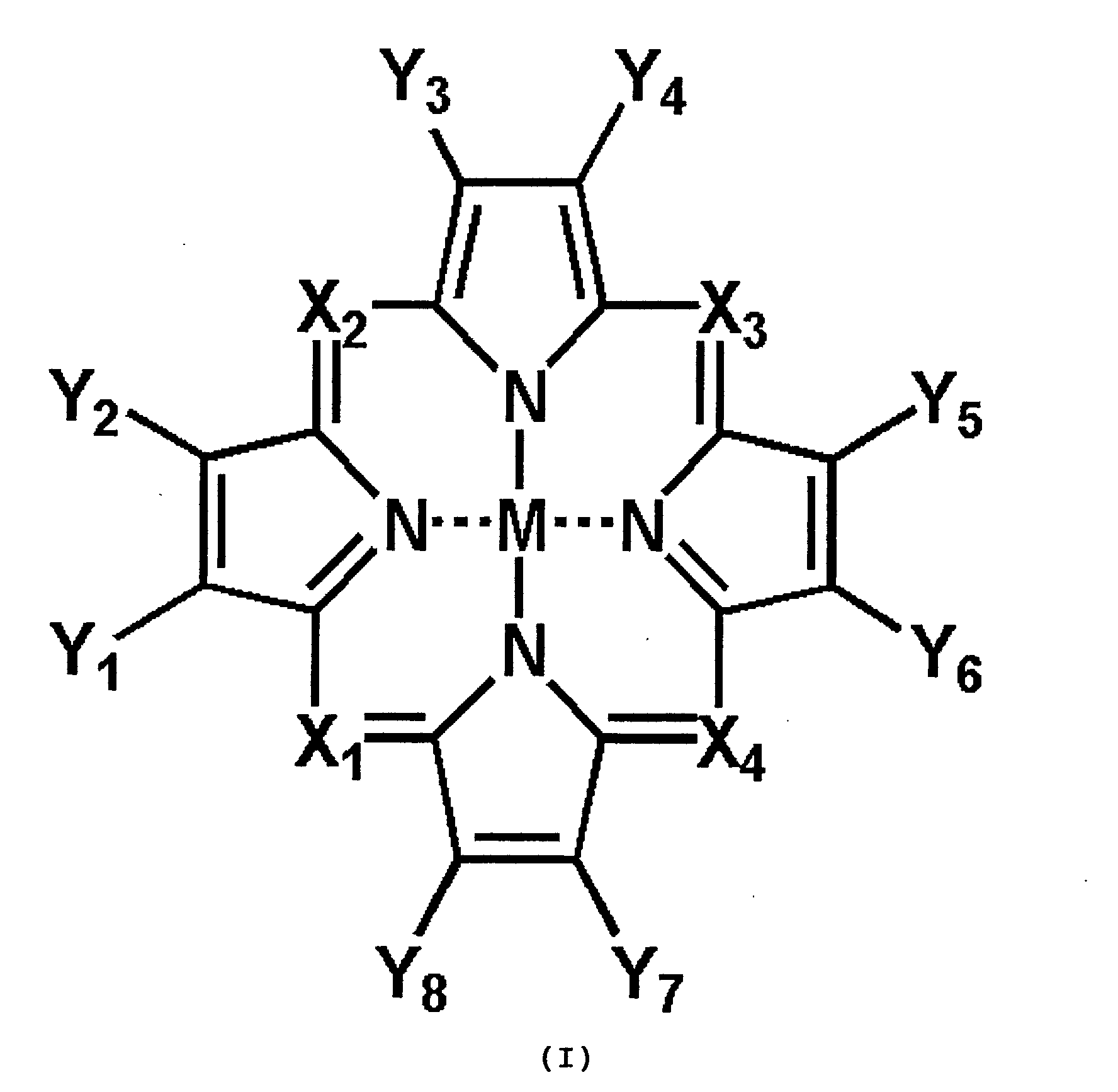
an n-electron-donating compound capable of being coordinated with the central metal of the metallic compound. - The dispersing agent for a pigment according to Claim 1, wherein said metallic compound has a phthalocyanine skeleton wherein X1 to X4 in the general formula (I) are each independently a nitrogen atom, and each of combinations of Y1 and Y2, Y3 and Y4, Y5 and Y6 and/or Y7 and Y8 constitutes an aromatic hydrocarbon ring which may have a substituent.
- The dispersing agent for a pigment according to Claim 1 or 2, wherein the central metal in said metallic compound is zinc.
- The dispersing agent for a pigment according to Claim 3, wherein said metallic compound is zinc-phthalocyanine.
- The dispersing agent for a pigment according to any one of Claims 1 to 4, wherein said n-electron-donating compound is a molecule, oligomer or polymer having at least one skeleton selected from the group consisting of primary amines, secondary amines, tertiary amines, imines, primary amides, secondary amides, tertiary amides, imides, aromatic imides, thiols, thioesters, thionyls, sulfides and sulfoxides.
- A pigment-dispersion composition comprising at least a pigment, a dispersion medium, and the dispersing agent for a pigment according to any one of Claims 1 to 5.
- The pigment-dispersion composition according to Claim 6, wherein said dispersion medium comprises at least a polymerizable monomer.
- A toner containing toner particles which comprise at least a binder resin, a pigment, and the dispersing agent for a pigment according to any one of Claims 1 to 5.
- The toner according to Claim 8, wherein said toner particles are produced in an aqueous medium.
- The toner according to Claim 8 or 9, wherein said toner particles are produced by suspension polymerization.
- The toner according to any one of Claims 8 to 10, wherein the metallic compound is contained in an amount of 0.01% by weight to 2.5% by weight based on the weight of the toner.
- The toner according to any one of Claims 8 to 11, wherein the n-electron-donating compound has a weight-average molecular weight (Mw) of 2,000 to 100,000.
- The toner according to any one of Claims 8 to 12, wherein the n-electron-donating compound is contained in an amount of 0.05% by weight to 10% by weight based on the weight of the toner.
- The toner according to any one of Claims 8 to 13, wherein the n-electron-donating compound is a copolymer comprising at least one type of a polymerizable monomer unit from which the polymer constituting said binder resin for the toner is produced and a polymer unit for a polymerizable monomer unit for the n-electron-donating compound.
- The toner according to any one of Claims 8 to 14, wherein the n-electron-donating compound is contained in an amount of 0.1% by weight to 30% by weight as the n-electron donative polymerizable monomer unit.
- A process for producing a toner, comprising a step of mixing a pigment with the dispersing agent for a pigment according to any one of Claims 1 to 5.
- The process for producing a toner according to Claim 16, comprising a step of preparing a polymerizable monomer composition containing at least a polymerizable monomer, a pigment and the dispersing agent for a pigment according to any one of Claims 1 to 5, and another step of polymerizing the polymerizable monomer in the polymerizable monomer composition to produce toner particles.
- The process for producing a toner according to Claim 17, comprising a step of granulating said polymerizable monomer composition in an aqueous medium, and another step of polymerizing said polymerizable monomer in said polymerizable monomer composition to produce the toner particles.
Applications Claiming Priority (4)
| Application Number | Priority Date | Filing Date | Title |
|---|---|---|---|
| JP2002008536 | 2002-01-17 | ||
| JP2002008536 | 2002-01-17 | ||
| JP2002370047A JP4366073B2 (en) | 2002-01-17 | 2002-12-20 | Pigment dispersant, pigment dispersion composition, toner and method for producing toner |
| JP2002370047 | 2002-12-20 |
Publications (3)
| Publication Number | Publication Date |
|---|---|
| EP1341050A2 true EP1341050A2 (en) | 2003-09-03 |
| EP1341050A3 EP1341050A3 (en) | 2004-11-17 |
| EP1341050B1 EP1341050B1 (en) | 2009-12-30 |
Family
ID=27667405
Family Applications (1)
| Application Number | Title | Priority Date | Filing Date |
|---|---|---|---|
| EP03000886A Expired - Lifetime EP1341050B1 (en) | 2002-01-17 | 2003-01-15 | Dispersing agent for pigment, pigment-dispersion composition, toner, and toner production process |
Country Status (6)
| Country | Link |
|---|---|
| US (1) | US6790576B2 (en) |
| EP (1) | EP1341050B1 (en) |
| JP (1) | JP4366073B2 (en) |
| KR (1) | KR100511235B1 (en) |
| CN (1) | CN1230422C (en) |
| DE (1) | DE60330725D1 (en) |
Cited By (1)
| Publication number | Priority date | Publication date | Assignee | Title |
|---|---|---|---|---|
| EP2634633A1 (en) * | 2012-02-29 | 2013-09-04 | Canon Kabushiki Kaisha | Cyan toner containing compound having azo skeleton |
Families Citing this family (20)
| Publication number | Priority date | Publication date | Assignee | Title |
|---|---|---|---|---|
| JP4510687B2 (en) * | 2005-04-20 | 2010-07-28 | キヤノン株式会社 | Method for producing toner particles |
| JP2008065299A (en) * | 2006-08-07 | 2008-03-21 | Ricoh Co Ltd | Toner for developing electrostatic latent image, image forming method, and evaluation method of the toner |
| JP4992680B2 (en) * | 2007-11-27 | 2012-08-08 | コニカミノルタビジネステクノロジーズ株式会社 | Cyan toner for electrostatic image development |
| JP2009155505A (en) * | 2007-12-27 | 2009-07-16 | Konica Minolta Business Technologies Inc | Powder composed of colored resin particle and method for producing the same |
| JP5274039B2 (en) * | 2008-02-06 | 2013-08-28 | キヤノン株式会社 | Toner production method |
| JP5344551B2 (en) * | 2008-08-28 | 2013-11-20 | キヤノン株式会社 | Magenta toner |
| JP5274157B2 (en) * | 2008-08-28 | 2013-08-28 | キヤノン株式会社 | Magenta toner |
| JP2010250087A (en) * | 2009-04-16 | 2010-11-04 | Canon Inc | toner |
| KR101384363B1 (en) * | 2009-06-25 | 2014-04-14 | 토요잉크Sc홀딩스주식회사 | Colorant composition for a color filter, color filter using the same, and liquid crystal display device |
| JP5441677B2 (en) * | 2009-12-28 | 2014-03-12 | キヤノン株式会社 | toner |
| JP5658550B2 (en) * | 2009-12-28 | 2015-01-28 | キヤノン株式会社 | toner |
| US8574801B2 (en) | 2011-05-18 | 2013-11-05 | Canon Kabushiki Kaisha | Toner |
| US8609312B2 (en) | 2011-05-18 | 2013-12-17 | Canon Kabushiki Kaisha | Toner |
| JP5737147B2 (en) * | 2011-11-14 | 2015-06-17 | コニカミノルタ株式会社 | Liquid developer |
| JP2014189614A (en) * | 2013-03-27 | 2014-10-06 | Toyo Ink Sc Holdings Co Ltd | Pigment composition and color filter |
| JP6855289B2 (en) | 2016-03-18 | 2021-04-07 | キヤノン株式会社 | Toner and toner manufacturing method |
| JP6900209B2 (en) | 2016-03-18 | 2021-07-07 | キヤノン株式会社 | Toner and toner manufacturing method |
| JP6808542B2 (en) | 2016-03-18 | 2021-01-06 | キヤノン株式会社 | Toner and toner manufacturing method |
| JP6727872B2 (en) | 2016-03-18 | 2020-07-22 | キヤノン株式会社 | Toner and toner manufacturing method |
| US11702398B2 (en) * | 2019-02-14 | 2023-07-18 | Konica Minolta, Inc. | Photoresponsive low-molecular weight material, adhesive, toner, and image forming method |
Family Cites Families (11)
| Publication number | Priority date | Publication date | Assignee | Title |
|---|---|---|---|---|
| GB1258957A (en) * | 1969-08-13 | 1972-01-05 | ||
| US4032339A (en) * | 1976-05-24 | 1977-06-28 | Xerox Corporation | Photosensitive composition containing vanadyl phthalocyanine for photoelectrophoretic imaging systems |
| US4382033A (en) * | 1980-10-06 | 1983-05-03 | Eastman Kodak Company | Novel phthalocyanine pigments |
| JP2917283B2 (en) * | 1989-01-18 | 1999-07-12 | 日本電気株式会社 | Electrophotographic organic photoreceptor |
| US5200481A (en) * | 1991-07-15 | 1993-04-06 | Hoechst Celanese Corp. | Tetraazaporphyrin monomers and polymers |
| JP2996785B2 (en) * | 1991-09-12 | 2000-01-11 | コニカ株式会社 | Suspension polymerization monomer composition and method for producing suspension polymerization toner |
| ES2095002T3 (en) * | 1992-02-11 | 1997-02-01 | Zeneca Ltd | DISPERSION. |
| JPH095989A (en) | 1995-06-21 | 1997-01-10 | Fuji Photo Film Co Ltd | Pigment-dispersed composition, forming method of color image using the composition, and color image |
| JP2002514263A (en) | 1997-06-30 | 2002-05-14 | チバ スペシャルティ ケミカルズ ホールディング インコーポレーテッド | Method for producing fine pigment dispersion |
| JP4289802B2 (en) | 2001-02-06 | 2009-07-01 | キヤノン株式会社 | Toner and toner production method |
| JP2002302993A (en) | 2001-04-09 | 2002-10-18 | Norio Otsuga | Connecting structure of manhole and sewage main pipe |
-
2002
- 2002-12-20 JP JP2002370047A patent/JP4366073B2/en not_active Expired - Fee Related
-
2003
- 2003-01-10 US US10/339,524 patent/US6790576B2/en not_active Expired - Lifetime
- 2003-01-15 EP EP03000886A patent/EP1341050B1/en not_active Expired - Lifetime
- 2003-01-15 CN CNB031004822A patent/CN1230422C/en not_active Expired - Fee Related
- 2003-01-15 DE DE60330725T patent/DE60330725D1/en not_active Expired - Lifetime
- 2003-01-16 KR KR10-2003-0003000A patent/KR100511235B1/en not_active Expired - Fee Related
Cited By (2)
| Publication number | Priority date | Publication date | Assignee | Title |
|---|---|---|---|---|
| EP2634633A1 (en) * | 2012-02-29 | 2013-09-04 | Canon Kabushiki Kaisha | Cyan toner containing compound having azo skeleton |
| US8927187B2 (en) | 2012-02-29 | 2015-01-06 | Canon Kabushiki Kaisha | Cyan toner containing compound having azo skeleton |
Also Published As
| Publication number | Publication date |
|---|---|
| US20030181551A1 (en) | 2003-09-25 |
| US6790576B2 (en) | 2004-09-14 |
| KR20030063166A (en) | 2003-07-28 |
| CN1230422C (en) | 2005-12-07 |
| JP2003277643A (en) | 2003-10-02 |
| JP4366073B2 (en) | 2009-11-18 |
| EP1341050B1 (en) | 2009-12-30 |
| EP1341050A3 (en) | 2004-11-17 |
| CN1432568A (en) | 2003-07-30 |
| KR100511235B1 (en) | 2005-08-31 |
| DE60330725D1 (en) | 2010-02-11 |
Similar Documents
| Publication | Publication Date | Title |
|---|---|---|
| US6790576B2 (en) | Dispersing agent for pigment, pigment-dispersion composition, toner, and toner production process | |
| US6689525B2 (en) | Dispersing agent for pigment, pigment-dispersion composition, toner, and toner production process | |
| KR101045739B1 (en) | Toner Resins and Toner | |
| JP5963491B2 (en) | Pigment dispersion and method for producing yellow toner | |
| EP1426830A1 (en) | Charge control agent and toner for electrostatic image development | |
| JP3984840B2 (en) | Toner production method | |
| JP2014029520A (en) | Yellow toner | |
| CN100561362C (en) | Color toner and developer composition and methods of making and using the same | |
| JP5939911B2 (en) | Method for producing toner particles | |
| JP4481579B2 (en) | Pigment dispersant, composition, toner, and method for producing toner | |
| JP3336862B2 (en) | Method for producing polymerized toner | |
| JP2003202697A (en) | Toner and method for producing toner | |
| JP5882603B2 (en) | Pigment dispersion, yellow toner | |
| JP2011075704A (en) | Toner for developing electrostatic charge image | |
| JP3817432B2 (en) | Toner and image forming method | |
| JPH06282103A (en) | Production of toner for developing electrostatic charge image and developer | |
| JP2765937B2 (en) | Colored fine particles and toner for developing electrostatic images using the same | |
| JP2007133218A (en) | Resin for toner, toner and two-component developer | |
| JP2568252B2 (en) | Method for producing toner for developing electrostatic image | |
| JP4115495B2 (en) | Toner and toner production method | |
| JP2507779B2 (en) | Method for manufacturing toner for developing electrostatic image | |
| JP6614913B2 (en) | Method for producing toner particles | |
| JPH086284A (en) | Electrophotographic toner and electrophotographic developer | |
| JP2001034013A (en) | Positively chargeable toner | |
| JP2004341084A (en) | Manufacturing method of toner |
Legal Events
| Date | Code | Title | Description |
|---|---|---|---|
| PUAI | Public reference made under article 153(3) epc to a published international application that has entered the european phase |
Free format text: ORIGINAL CODE: 0009012 |
|
| AK | Designated contracting states |
Kind code of ref document: A2 Designated state(s): AT BE BG CH CY CZ DE DK EE ES FI FR GB GR HU IE IT LI LU MC NL PT SE SI SK TR |
|
| AX | Request for extension of the european patent |
Extension state: AL LT LV MK RO |
|
| PUAL | Search report despatched |
Free format text: ORIGINAL CODE: 0009013 |
|
| RIC1 | Information provided on ipc code assigned before grant |
Ipc: 7C 09B 67/00 B Ipc: 7B 01F 17/00 B Ipc: 7C 09D 17/00 B Ipc: 7G 03G 9/09 A |
|
| AK | Designated contracting states |
Kind code of ref document: A3 Designated state(s): AT BE BG CH CY CZ DE DK EE ES FI FR GB GR HU IE IT LI LU MC NL PT SE SI SK TR |
|
| AX | Request for extension of the european patent |
Extension state: AL LT LV MK RO |
|
| 17P | Request for examination filed |
Effective date: 20050329 |
|
| AKX | Designation fees paid |
Designated state(s): DE FR GB IT |
|
| GRAP | Despatch of communication of intention to grant a patent |
Free format text: ORIGINAL CODE: EPIDOSNIGR1 |
|
| GRAS | Grant fee paid |
Free format text: ORIGINAL CODE: EPIDOSNIGR3 |
|
| GRAA | (expected) grant |
Free format text: ORIGINAL CODE: 0009210 |
|
| AK | Designated contracting states |
Kind code of ref document: B1 Designated state(s): DE FR GB IT |
|
| REG | Reference to a national code |
Ref country code: GB Ref legal event code: FG4D |
|
| REF | Corresponds to: |
Ref document number: 60330725 Country of ref document: DE Date of ref document: 20100211 Kind code of ref document: P |
|
| PLBE | No opposition filed within time limit |
Free format text: ORIGINAL CODE: 0009261 |
|
| STAA | Information on the status of an ep patent application or granted ep patent |
Free format text: STATUS: NO OPPOSITION FILED WITHIN TIME LIMIT |
|
| 26N | No opposition filed |
Effective date: 20101001 |
|
| REG | Reference to a national code |
Ref country code: FR Ref legal event code: PLFP Year of fee payment: 14 |
|
| PGFP | Annual fee paid to national office [announced via postgrant information from national office to epo] |
Ref country code: IT Payment date: 20160105 Year of fee payment: 14 |
|
| PGFP | Annual fee paid to national office [announced via postgrant information from national office to epo] |
Ref country code: GB Payment date: 20160127 Year of fee payment: 14 Ref country code: FR Payment date: 20160126 Year of fee payment: 14 |
|
| GBPC | Gb: european patent ceased through non-payment of renewal fee |
Effective date: 20170115 |
|
| REG | Reference to a national code |
Ref country code: FR Ref legal event code: ST Effective date: 20170929 |
|
| PG25 | Lapsed in a contracting state [announced via postgrant information from national office to epo] |
Ref country code: FR Free format text: LAPSE BECAUSE OF NON-PAYMENT OF DUE FEES Effective date: 20170131 |
|
| PG25 | Lapsed in a contracting state [announced via postgrant information from national office to epo] |
Ref country code: GB Free format text: LAPSE BECAUSE OF NON-PAYMENT OF DUE FEES Effective date: 20170115 |
|
| PG25 | Lapsed in a contracting state [announced via postgrant information from national office to epo] |
Ref country code: IT Free format text: LAPSE BECAUSE OF NON-PAYMENT OF DUE FEES Effective date: 20170115 |
|
| PGFP | Annual fee paid to national office [announced via postgrant information from national office to epo] |
Ref country code: DE Payment date: 20201217 Year of fee payment: 19 |
|
| REG | Reference to a national code |
Ref country code: DE Ref legal event code: R119 Ref document number: 60330725 Country of ref document: DE |
|
| PG25 | Lapsed in a contracting state [announced via postgrant information from national office to epo] |
Ref country code: DE Free format text: LAPSE BECAUSE OF NON-PAYMENT OF DUE FEES Effective date: 20220802 |