EP1340771A1 - Nitro-derivatives of low molecular weight heparin - Google Patents
Nitro-derivatives of low molecular weight heparin Download PDFInfo
- Publication number
- EP1340771A1 EP1340771A1 EP02290490A EP02290490A EP1340771A1 EP 1340771 A1 EP1340771 A1 EP 1340771A1 EP 02290490 A EP02290490 A EP 02290490A EP 02290490 A EP02290490 A EP 02290490A EP 1340771 A1 EP1340771 A1 EP 1340771A1
- Authority
- EP
- European Patent Office
- Prior art keywords
- heparin
- heparin according
- molecular weight
- nitro
- low molecular
- Prior art date
- Legal status (The legal status is an assumption and is not a legal conclusion. Google has not performed a legal analysis and makes no representation as to the accuracy of the status listed.)
- Withdrawn
Links
- 239000003055 low molecular weight heparin Substances 0.000 title claims abstract description 7
- 229940127215 low-molecular weight heparin Drugs 0.000 title claims abstract description 7
- 150000002828 nitro derivatives Chemical class 0.000 title description 4
- 125000000449 nitro group Chemical group [O-][N+](*)=O 0.000 claims abstract description 18
- 238000011282 treatment Methods 0.000 claims abstract description 9
- 239000003814 drug Substances 0.000 claims abstract description 5
- 230000004064 dysfunction Effects 0.000 claims abstract description 5
- 229910004679 ONO2 Inorganic materials 0.000 claims abstract description 4
- 230000007170 pathology Effects 0.000 claims abstract description 4
- 229940030225 antihemorrhagics Drugs 0.000 claims abstract description 3
- 210000000748 cardiovascular system Anatomy 0.000 claims abstract description 3
- 230000000025 haemostatic effect Effects 0.000 claims abstract description 3
- 239000008194 pharmaceutical composition Chemical group 0.000 claims abstract description 3
- 230000002265 prevention Effects 0.000 claims abstract description 3
- 229960002897 heparin Drugs 0.000 claims description 42
- 229920000669 heparin Polymers 0.000 claims description 42
- MWUXSHHQAYIFBG-UHFFFAOYSA-N Nitric oxide Chemical compound O=[N] MWUXSHHQAYIFBG-UHFFFAOYSA-N 0.000 claims description 31
- HTTJABKRGRZYRN-UHFFFAOYSA-N Heparin Chemical compound OC1C(NC(=O)C)C(O)OC(COS(O)(=O)=O)C1OC1C(OS(O)(=O)=O)C(O)C(OC2C(C(OS(O)(=O)=O)C(OC3C(C(O)C(O)C(O3)C(O)=O)OS(O)(=O)=O)C(CO)O2)NS(O)(=O)=O)C(C(O)=O)O1 HTTJABKRGRZYRN-UHFFFAOYSA-N 0.000 claims description 27
- 239000000203 mixture Substances 0.000 claims description 24
- 150000001875 compounds Chemical class 0.000 claims description 16
- 150000001720 carbohydrates Chemical group 0.000 claims description 14
- 238000006243 chemical reaction Methods 0.000 claims description 12
- 239000002253 acid Substances 0.000 claims description 10
- 238000002360 preparation method Methods 0.000 claims description 10
- 150000008273 hexosamines Chemical class 0.000 claims description 9
- 238000006396 nitration reaction Methods 0.000 claims description 8
- MSWZFWKMSRAUBD-UHFFFAOYSA-N 2-Amino-2-Deoxy-Hexose Chemical compound NC1C(O)OC(CO)C(O)C1O MSWZFWKMSRAUBD-UHFFFAOYSA-N 0.000 claims description 5
- 239000003146 anticoagulant agent Substances 0.000 claims description 5
- 238000000034 method Methods 0.000 claims description 5
- 230000000802 nitrating effect Effects 0.000 claims description 5
- 239000013543 active substance Substances 0.000 claims description 4
- 239000005557 antagonist Substances 0.000 claims description 4
- 125000006850 spacer group Chemical group 0.000 claims description 4
- 108090000190 Thrombin Proteins 0.000 claims description 3
- 210000004369 blood Anatomy 0.000 claims description 3
- 239000008280 blood Substances 0.000 claims description 3
- 125000003178 carboxy group Chemical group [H]OC(*)=O 0.000 claims description 3
- 230000001112 coagulating effect Effects 0.000 claims description 3
- 239000000126 substance Substances 0.000 claims description 3
- 239000000758 substrate Substances 0.000 claims description 3
- 229960004072 thrombin Drugs 0.000 claims description 3
- 230000001732 thrombotic effect Effects 0.000 claims description 3
- 102000008299 Nitric Oxide Synthase Human genes 0.000 claims description 2
- 108010021487 Nitric Oxide Synthase Proteins 0.000 claims description 2
- 108010035030 Platelet Membrane Glycoprotein IIb Proteins 0.000 claims description 2
- 229940127218 antiplatelet drug Drugs 0.000 claims description 2
- 150000004945 aromatic hydrocarbons Chemical class 0.000 claims description 2
- 229940079593 drug Drugs 0.000 claims description 2
- 239000003937 drug carrier Substances 0.000 claims description 2
- 230000002255 enzymatic effect Effects 0.000 claims description 2
- 239000000106 platelet aggregation inhibitor Substances 0.000 claims description 2
- 229920000570 polyether Polymers 0.000 claims description 2
- 229920000642 polymer Polymers 0.000 claims description 2
- RTZKZFJDLAIYFH-UHFFFAOYSA-N Diethyl ether Chemical compound CCOCC RTZKZFJDLAIYFH-UHFFFAOYSA-N 0.000 claims 2
- 239000004721 Polyphenylene oxide Substances 0.000 claims 1
- 150000001732 carboxylic acid derivatives Chemical class 0.000 claims 1
- 125000000837 carbohydrate group Chemical group 0.000 abstract 1
- WFDIJRYMOXRFFG-UHFFFAOYSA-N Acetic anhydride Chemical compound CC(=O)OC(C)=O WFDIJRYMOXRFFG-UHFFFAOYSA-N 0.000 description 6
- CSCPPACGZOOCGX-UHFFFAOYSA-N Acetone Chemical compound CC(C)=O CSCPPACGZOOCGX-UHFFFAOYSA-N 0.000 description 6
- 239000002634 heparin fragment Substances 0.000 description 6
- 229910052740 iodine Inorganic materials 0.000 description 5
- ZCYVEMRRCGMTRW-UHFFFAOYSA-N 7553-56-2 Chemical group [I] ZCYVEMRRCGMTRW-UHFFFAOYSA-N 0.000 description 4
- NLIZFJSBNTXDBL-UHFFFAOYSA-N acetyl acetate;nitric acid Chemical compound O[N+]([O-])=O.CC(=O)OC(C)=O NLIZFJSBNTXDBL-UHFFFAOYSA-N 0.000 description 4
- 125000003277 amino group Chemical group 0.000 description 4
- 230000002785 anti-thrombosis Effects 0.000 description 4
- 229910052794 bromium Inorganic materials 0.000 description 4
- -1 heparin ester Chemical class 0.000 description 4
- 238000012360 testing method Methods 0.000 description 4
- RBNSZWOCWHGHMR-UHFFFAOYSA-N (2-iodoacetyl) 2-iodoacetate Chemical compound ICC(=O)OC(=O)CI RBNSZWOCWHGHMR-UHFFFAOYSA-N 0.000 description 3
- HEMHJVSKTPXQMS-UHFFFAOYSA-M Sodium hydroxide Chemical compound [OH-].[Na+] HEMHJVSKTPXQMS-UHFFFAOYSA-M 0.000 description 3
- 108060008682 Tumor Necrosis Factor Proteins 0.000 description 3
- 102000000852 Tumor Necrosis Factor-alpha Human genes 0.000 description 3
- 230000002429 anti-coagulating effect Effects 0.000 description 3
- 230000015572 biosynthetic process Effects 0.000 description 3
- GDTBXPJZTBHREO-UHFFFAOYSA-N bromine Substances BrBr GDTBXPJZTBHREO-UHFFFAOYSA-N 0.000 description 3
- 239000000460 chlorine Substances 0.000 description 3
- 229910052801 chlorine Inorganic materials 0.000 description 3
- 150000004676 glycans Chemical class 0.000 description 3
- 239000011630 iodine Substances 0.000 description 3
- 229920001282 polysaccharide Polymers 0.000 description 3
- 239000005017 polysaccharide Substances 0.000 description 3
- 150000003254 radicals Chemical class 0.000 description 3
- SQGYOTSLMSWVJD-UHFFFAOYSA-N silver(1+) nitrate Chemical compound [Ag+].[O-]N(=O)=O SQGYOTSLMSWVJD-UHFFFAOYSA-N 0.000 description 3
- YXIWHUQXZSMYRE-UHFFFAOYSA-N 1,3-benzothiazole-2-thiol Chemical group C1=CC=C2SC(S)=NC2=C1 YXIWHUQXZSMYRE-UHFFFAOYSA-N 0.000 description 2
- 208000030507 AIDS Diseases 0.000 description 2
- 201000001320 Atherosclerosis Diseases 0.000 description 2
- WKBOTKDWSSQWDR-UHFFFAOYSA-N Bromine atom Chemical compound [Br] WKBOTKDWSSQWDR-UHFFFAOYSA-N 0.000 description 2
- 229920001661 Chitosan Polymers 0.000 description 2
- 206010053567 Coagulopathies Diseases 0.000 description 2
- VEXZGXHMUGYJMC-UHFFFAOYSA-N Hydrochloric acid Chemical compound Cl VEXZGXHMUGYJMC-UHFFFAOYSA-N 0.000 description 2
- 229910002651 NO3 Inorganic materials 0.000 description 2
- GRYLNZFGIOXLOG-UHFFFAOYSA-N Nitric acid Chemical compound O[N+]([O-])=O GRYLNZFGIOXLOG-UHFFFAOYSA-N 0.000 description 2
- KEJOCWOXCDWNID-UHFFFAOYSA-N Nitrilooxonium Chemical compound [O+]#N KEJOCWOXCDWNID-UHFFFAOYSA-N 0.000 description 2
- IOVCWXUNBOPUCH-UHFFFAOYSA-N Nitrous acid Chemical compound ON=O IOVCWXUNBOPUCH-UHFFFAOYSA-N 0.000 description 2
- 0 O=NC1(*COC=*C2CC2)CCC1 Chemical compound O=NC1(*COC=*C2CC2)CCC1 0.000 description 2
- QAOWNCQODCNURD-UHFFFAOYSA-N Sulfuric acid Chemical compound OS(O)(=O)=O QAOWNCQODCNURD-UHFFFAOYSA-N 0.000 description 2
- 150000007513 acids Chemical class 0.000 description 2
- 150000008064 anhydrides Chemical class 0.000 description 2
- 230000010261 cell growth Effects 0.000 description 2
- 239000003795 chemical substances by application Substances 0.000 description 2
- 125000001309 chloro group Chemical group Cl* 0.000 description 2
- 230000035602 clotting Effects 0.000 description 2
- 238000012691 depolymerization reaction Methods 0.000 description 2
- 206010012601 diabetes mellitus Diseases 0.000 description 2
- 238000000502 dialysis Methods 0.000 description 2
- 231100000673 dose–response relationship Toxicity 0.000 description 2
- 230000000694 effects Effects 0.000 description 2
- 238000000921 elemental analysis Methods 0.000 description 2
- 210000003038 endothelium Anatomy 0.000 description 2
- 125000003700 epoxy group Chemical group 0.000 description 2
- 239000002565 heparin fraction Substances 0.000 description 2
- CBOIHMRHGLHBPB-UHFFFAOYSA-N hydroxymethyl Chemical compound O[CH2] CBOIHMRHGLHBPB-UHFFFAOYSA-N 0.000 description 2
- 229910052500 inorganic mineral Inorganic materials 0.000 description 2
- 239000011707 mineral Substances 0.000 description 2
- 230000014508 negative regulation of coagulation Effects 0.000 description 2
- 229910017604 nitric acid Inorganic materials 0.000 description 2
- ZODDGFAZWTZOSI-UHFFFAOYSA-N nitric acid;sulfuric acid Chemical compound O[N+]([O-])=O.OS(O)(=O)=O ZODDGFAZWTZOSI-UHFFFAOYSA-N 0.000 description 2
- 125000001893 nitrooxy group Chemical group [O-][N+](=O)O* 0.000 description 2
- 229920001542 oligosaccharide Polymers 0.000 description 2
- 150000002482 oligosaccharides Chemical class 0.000 description 2
- 210000004623 platelet-rich plasma Anatomy 0.000 description 2
- SCVFZCLFOSHCOH-UHFFFAOYSA-M potassium acetate Chemical compound [K+].CC([O-])=O SCVFZCLFOSHCOH-UHFFFAOYSA-M 0.000 description 2
- 239000000047 product Substances 0.000 description 2
- LPXPTNMVRIOKMN-UHFFFAOYSA-M sodium nitrite Chemical compound [Na+].[O-]N=O LPXPTNMVRIOKMN-UHFFFAOYSA-M 0.000 description 2
- 239000000243 solution Substances 0.000 description 2
- 239000002904 solvent Substances 0.000 description 2
- 241000894007 species Species 0.000 description 2
- 238000003756 stirring Methods 0.000 description 2
- 238000003786 synthesis reaction Methods 0.000 description 2
- 210000001519 tissue Anatomy 0.000 description 2
- XLYOFNOQVPJJNP-UHFFFAOYSA-N water Substances O XLYOFNOQVPJJNP-UHFFFAOYSA-N 0.000 description 2
- PGOHTUIFYSHAQG-LJSDBVFPSA-N (2S)-6-amino-2-[[(2S)-5-amino-2-[[(2S)-2-[[(2S)-2-[[(2S)-2-[[(2S)-4-amino-2-[[(2S)-2-[[(2S)-2-[[(2S)-2-[[(2S)-2-[[(2S)-5-amino-2-[[(2S)-5-amino-2-[[(2S)-2-[[(2S)-2-[[(2S)-2-[[(2S,3R)-2-[[(2S)-5-amino-2-[[(2S)-2-[[(2S)-2-[[(2S,3R)-2-[[(2S)-2-[[(2S)-2-[[(2S)-2-[[(2S)-2-[[(2S)-5-amino-2-[[(2S)-1-[(2S,3R)-2-[[(2S)-2-[[(2S)-2-[[(2R)-2-[[(2S)-2-[[(2S)-2-[[2-[[(2S)-2-[[(2S)-2-[[(2S)-2-[[(2S)-1-[(2S)-2-[[(2S)-2-[[(2S)-2-[[(2S)-2-amino-4-methylsulfanylbutanoyl]amino]-3-(1H-indol-3-yl)propanoyl]amino]-5-carbamimidamidopentanoyl]amino]propanoyl]pyrrolidine-2-carbonyl]amino]-3-methylbutanoyl]amino]-4-methylpentanoyl]amino]-4-methylpentanoyl]amino]acetyl]amino]-3-hydroxypropanoyl]amino]-4-methylpentanoyl]amino]-3-sulfanylpropanoyl]amino]-4-methylsulfanylbutanoyl]amino]-5-carbamimidamidopentanoyl]amino]-3-hydroxybutanoyl]pyrrolidine-2-carbonyl]amino]-5-oxopentanoyl]amino]-3-hydroxypropanoyl]amino]-3-hydroxypropanoyl]amino]-3-(1H-imidazol-5-yl)propanoyl]amino]-4-methylpentanoyl]amino]-3-hydroxybutanoyl]amino]-3-(1H-indol-3-yl)propanoyl]amino]-5-carbamimidamidopentanoyl]amino]-5-oxopentanoyl]amino]-3-hydroxybutanoyl]amino]-3-hydroxypropanoyl]amino]-3-carboxypropanoyl]amino]-3-hydroxypropanoyl]amino]-5-oxopentanoyl]amino]-5-oxopentanoyl]amino]-3-phenylpropanoyl]amino]-5-carbamimidamidopentanoyl]amino]-3-methylbutanoyl]amino]-4-methylpentanoyl]amino]-4-oxobutanoyl]amino]-5-carbamimidamidopentanoyl]amino]-3-(1H-indol-3-yl)propanoyl]amino]-4-carboxybutanoyl]amino]-5-oxopentanoyl]amino]hexanoic acid Chemical compound CSCC[C@H](N)C(=O)N[C@@H](Cc1c[nH]c2ccccc12)C(=O)N[C@@H](CCCNC(N)=N)C(=O)N[C@@H](C)C(=O)N1CCC[C@H]1C(=O)N[C@@H](C(C)C)C(=O)N[C@@H](CC(C)C)C(=O)N[C@@H](CC(C)C)C(=O)NCC(=O)N[C@@H](CO)C(=O)N[C@@H](CC(C)C)C(=O)N[C@@H](CS)C(=O)N[C@@H](CCSC)C(=O)N[C@@H](CCCNC(N)=N)C(=O)N[C@@H]([C@@H](C)O)C(=O)N1CCC[C@H]1C(=O)N[C@@H](CCC(N)=O)C(=O)N[C@@H](CO)C(=O)N[C@@H](CO)C(=O)N[C@@H](Cc1cnc[nH]1)C(=O)N[C@@H](CC(C)C)C(=O)N[C@@H]([C@@H](C)O)C(=O)N[C@@H](Cc1c[nH]c2ccccc12)C(=O)N[C@@H](CCCNC(N)=N)C(=O)N[C@@H](CCC(N)=O)C(=O)N[C@@H]([C@@H](C)O)C(=O)N[C@@H](CO)C(=O)N[C@@H](CC(O)=O)C(=O)N[C@@H](CO)C(=O)N[C@@H](CCC(N)=O)C(=O)N[C@@H](CCC(N)=O)C(=O)N[C@@H](Cc1ccccc1)C(=O)N[C@@H](CCCNC(N)=N)C(=O)N[C@@H](C(C)C)C(=O)N[C@@H](CC(C)C)C(=O)N[C@@H](CC(N)=O)C(=O)N[C@@H](CCCNC(N)=N)C(=O)N[C@@H](Cc1c[nH]c2ccccc12)C(=O)N[C@@H](CCC(O)=O)C(=O)N[C@@H](CCC(N)=O)C(=O)N[C@@H](CCCCN)C(O)=O PGOHTUIFYSHAQG-LJSDBVFPSA-N 0.000 description 1
- KIUKXJAPPMFGSW-DNGZLQJQSA-N (2S,3S,4S,5R,6R)-6-[(2S,3R,4R,5S,6R)-3-Acetamido-2-[(2S,3S,4R,5R,6R)-6-[(2R,3R,4R,5S,6R)-3-acetamido-2,5-dihydroxy-6-(hydroxymethyl)oxan-4-yl]oxy-2-carboxy-4,5-dihydroxyoxan-3-yl]oxy-5-hydroxy-6-(hydroxymethyl)oxan-4-yl]oxy-3,4,5-trihydroxyoxane-2-carboxylic acid Chemical compound CC(=O)N[C@H]1[C@H](O)O[C@H](CO)[C@@H](O)[C@@H]1O[C@H]1[C@H](O)[C@@H](O)[C@H](O[C@H]2[C@@H]([C@@H](O[C@H]3[C@@H]([C@@H](O)[C@H](O)[C@H](O3)C(O)=O)O)[C@H](O)[C@@H](CO)O2)NC(C)=O)[C@@H](C(O)=O)O1 KIUKXJAPPMFGSW-DNGZLQJQSA-N 0.000 description 1
- AOAGVPIEEAAAOL-RXSVEWSESA-N (2r)-2-[(1s)-1,2-dihydroxyethyl]-3,4-dihydroxy-2h-furan-5-one;hydrogen peroxide Chemical compound OO.OC[C@H](O)[C@H]1OC(=O)C(O)=C1O AOAGVPIEEAAAOL-RXSVEWSESA-N 0.000 description 1
- ODIGIKRIUKFKHP-UHFFFAOYSA-N (n-propan-2-yloxycarbonylanilino) acetate Chemical compound CC(C)OC(=O)N(OC(C)=O)C1=CC=CC=C1 ODIGIKRIUKFKHP-UHFFFAOYSA-N 0.000 description 1
- WFIYPADYPQQLNN-UHFFFAOYSA-N 2-[2-(4-bromopyrazol-1-yl)ethyl]isoindole-1,3-dione Chemical compound C1=C(Br)C=NN1CCN1C(=O)C2=CC=CC=C2C1=O WFIYPADYPQQLNN-UHFFFAOYSA-N 0.000 description 1
- IOJUJUOXKXMJNF-UHFFFAOYSA-N 2-acetyloxybenzoic acid [3-(nitrooxymethyl)phenyl] ester Chemical compound CC(=O)OC1=CC=CC=C1C(=O)OC1=CC=CC(CO[N+]([O-])=O)=C1 IOJUJUOXKXMJNF-UHFFFAOYSA-N 0.000 description 1
- FBPINGSGHKXIQA-UHFFFAOYSA-N 2-amino-3-(2-carboxyethylsulfanyl)propanoic acid Chemical compound OC(=O)C(N)CSCCC(O)=O FBPINGSGHKXIQA-UHFFFAOYSA-N 0.000 description 1
- FLFWJIBUZQARMD-UHFFFAOYSA-N 2-mercapto-1,3-benzoxazole Chemical group C1=CC=C2OC(S)=NC2=C1 FLFWJIBUZQARMD-UHFFFAOYSA-N 0.000 description 1
- OCVLSHAVSIYKLI-UHFFFAOYSA-N 3h-1,3-thiazole-2-thione Chemical group SC1=NC=CS1 OCVLSHAVSIYKLI-UHFFFAOYSA-N 0.000 description 1
- BTJIUGUIPKRLHP-UHFFFAOYSA-N 4-nitrophenol Chemical group OC1=CC=C([N+]([O-])=O)C=C1 BTJIUGUIPKRLHP-UHFFFAOYSA-N 0.000 description 1
- 206010002388 Angina unstable Diseases 0.000 description 1
- BSYNRYMUTXBXSQ-UHFFFAOYSA-N Aspirin Chemical compound CC(=O)OC1=CC=CC=C1C(O)=O BSYNRYMUTXBXSQ-UHFFFAOYSA-N 0.000 description 1
- 208000023275 Autoimmune disease Diseases 0.000 description 1
- 239000005528 B01AC05 - Ticlopidine Substances 0.000 description 1
- 208000035143 Bacterial infection Diseases 0.000 description 1
- OKTJSMMVPCPJKN-UHFFFAOYSA-N Carbon Chemical compound [C] OKTJSMMVPCPJKN-UHFFFAOYSA-N 0.000 description 1
- 241000283153 Cetacea Species 0.000 description 1
- 229920001287 Chondroitin sulfate Polymers 0.000 description 1
- 101710095468 Cyclase Proteins 0.000 description 1
- 206010051055 Deep vein thrombosis Diseases 0.000 description 1
- 229920000045 Dermatan sulfate Polymers 0.000 description 1
- 206010014513 Embolism arterial Diseases 0.000 description 1
- 206010014522 Embolism venous Diseases 0.000 description 1
- 206010048554 Endothelial dysfunction Diseases 0.000 description 1
- 108090000790 Enzymes Proteins 0.000 description 1
- 102000004190 Enzymes Human genes 0.000 description 1
- 108010074860 Factor Xa Proteins 0.000 description 1
- 229920002683 Glycosaminoglycan Polymers 0.000 description 1
- 229920002971 Heparan sulfate Polymers 0.000 description 1
- 108010022901 Heparin Lyase Proteins 0.000 description 1
- 108090000604 Hydrolases Proteins 0.000 description 1
- 206010020751 Hypersensitivity Diseases 0.000 description 1
- 206010020772 Hypertension Diseases 0.000 description 1
- 206010061218 Inflammation Diseases 0.000 description 1
- 208000022559 Inflammatory bowel disease Diseases 0.000 description 1
- 208000032382 Ischaemic stroke Diseases 0.000 description 1
- NHNBFGGVMKEFGY-UHFFFAOYSA-N Nitrate Chemical compound [O-][N+]([O-])=O NHNBFGGVMKEFGY-UHFFFAOYSA-N 0.000 description 1
- 208000037273 Pathologic Processes Diseases 0.000 description 1
- 241001494479 Pecora Species 0.000 description 1
- 208000010378 Pulmonary Embolism Diseases 0.000 description 1
- 208000025747 Rheumatic disease Diseases 0.000 description 1
- 210000001744 T-lymphocyte Anatomy 0.000 description 1
- 108010000499 Thromboplastin Proteins 0.000 description 1
- 102000002262 Thromboplastin Human genes 0.000 description 1
- 208000007536 Thrombosis Diseases 0.000 description 1
- 208000007814 Unstable Angina Diseases 0.000 description 1
- 206010046851 Uveitis Diseases 0.000 description 1
- 206010047115 Vasculitis Diseases 0.000 description 1
- 206010047249 Venous thrombosis Diseases 0.000 description 1
- 208000036142 Viral infection Diseases 0.000 description 1
- MZUJJYPDPVMHNP-UHFFFAOYSA-N [O-][N+]#N.OS(O)(=O)=O Chemical compound [O-][N+]#N.OS(O)(=O)=O MZUJJYPDPVMHNP-UHFFFAOYSA-N 0.000 description 1
- 239000003070 absorption delaying agent Substances 0.000 description 1
- 229960001138 acetylsalicylic acid Drugs 0.000 description 1
- 208000026935 allergic disease Diseases 0.000 description 1
- 230000007815 allergy Effects 0.000 description 1
- 150000001408 amides Chemical group 0.000 description 1
- 239000000908 ammonium hydroxide Substances 0.000 description 1
- BFNBIHQBYMNNAN-UHFFFAOYSA-N ammonium sulfate Chemical compound N.N.OS(O)(=O)=O BFNBIHQBYMNNAN-UHFFFAOYSA-N 0.000 description 1
- 229910052921 ammonium sulfate Inorganic materials 0.000 description 1
- 235000011130 ammonium sulphate Nutrition 0.000 description 1
- 238000004458 analytical method Methods 0.000 description 1
- 239000003242 anti bacterial agent Substances 0.000 description 1
- 230000001858 anti-Xa Effects 0.000 description 1
- 230000000844 anti-bacterial effect Effects 0.000 description 1
- 230000000702 anti-platelet effect Effects 0.000 description 1
- 229940127219 anticoagulant drug Drugs 0.000 description 1
- 229940121375 antifungal agent Drugs 0.000 description 1
- 239000003429 antifungal agent Substances 0.000 description 1
- 239000007864 aqueous solution Substances 0.000 description 1
- 238000003556 assay Methods 0.000 description 1
- 238000003149 assay kit Methods 0.000 description 1
- 125000004429 atom Chemical group 0.000 description 1
- 230000001580 bacterial effect Effects 0.000 description 1
- 208000022362 bacterial infectious disease Diseases 0.000 description 1
- 235000015278 beef Nutrition 0.000 description 1
- 238000007068 beta-elimination reaction Methods 0.000 description 1
- 239000013060 biological fluid Substances 0.000 description 1
- 230000000740 bleeding effect Effects 0.000 description 1
- 210000001772 blood platelet Anatomy 0.000 description 1
- 125000001246 bromo group Chemical group Br* 0.000 description 1
- 159000000007 calcium salts Chemical class 0.000 description 1
- 229910052799 carbon Inorganic materials 0.000 description 1
- 150000001735 carboxylic acids Chemical class 0.000 description 1
- 239000000969 carrier Substances 0.000 description 1
- 239000003054 catalyst Substances 0.000 description 1
- 239000013043 chemical agent Substances 0.000 description 1
- 238000007385 chemical modification Methods 0.000 description 1
- 239000003153 chemical reaction reagent Substances 0.000 description 1
- 229940107200 chondroitin sulfates Drugs 0.000 description 1
- 208000020832 chronic kidney disease Diseases 0.000 description 1
- 238000000576 coating method Methods 0.000 description 1
- 230000024203 complement activation Effects 0.000 description 1
- 238000007887 coronary angioplasty Methods 0.000 description 1
- 239000003085 diluting agent Substances 0.000 description 1
- 150000002016 disaccharides Chemical class 0.000 description 1
- 208000037265 diseases, disorders, signs and symptoms Diseases 0.000 description 1
- 208000035475 disorder Diseases 0.000 description 1
- 239000002612 dispersion medium Substances 0.000 description 1
- 230000008694 endothelial dysfunction Effects 0.000 description 1
- 230000007071 enzymatic hydrolysis Effects 0.000 description 1
- 238000006047 enzymatic hydrolysis reaction Methods 0.000 description 1
- 229940088598 enzyme Drugs 0.000 description 1
- 150000002170 ethers Chemical class 0.000 description 1
- ZKQFHRVKCYFVCN-UHFFFAOYSA-N ethoxyethane;hexane Chemical compound CCOCC.CCCCCC ZKQFHRVKCYFVCN-UHFFFAOYSA-N 0.000 description 1
- 238000001704 evaporation Methods 0.000 description 1
- 230000008020 evaporation Effects 0.000 description 1
- 238000002474 experimental method Methods 0.000 description 1
- 238000000605 extraction Methods 0.000 description 1
- 239000000945 filler Substances 0.000 description 1
- 238000009472 formulation Methods 0.000 description 1
- 238000005194 fractionation Methods 0.000 description 1
- 239000012634 fragment Substances 0.000 description 1
- 125000000524 functional group Chemical group 0.000 description 1
- 238000002523 gelfiltration Methods 0.000 description 1
- 239000003102 growth factor Substances 0.000 description 1
- 229910052736 halogen Inorganic materials 0.000 description 1
- 150000002367 halogens Chemical class 0.000 description 1
- 230000002008 hemorrhagic effect Effects 0.000 description 1
- 229940095529 heparin calcium Drugs 0.000 description 1
- 229920002674 hyaluronan Polymers 0.000 description 1
- 229960003160 hyaluronic acid Drugs 0.000 description 1
- 229910052739 hydrogen Inorganic materials 0.000 description 1
- 239000001257 hydrogen Substances 0.000 description 1
- 238000001727 in vivo Methods 0.000 description 1
- 230000006698 induction Effects 0.000 description 1
- 208000027866 inflammatory disease Diseases 0.000 description 1
- 230000002757 inflammatory effect Effects 0.000 description 1
- 230000004054 inflammatory process Effects 0.000 description 1
- 239000003112 inhibitor Substances 0.000 description 1
- 230000002401 inhibitory effect Effects 0.000 description 1
- 201000004332 intermediate coronary syndrome Diseases 0.000 description 1
- 239000007951 isotonicity adjuster Substances 0.000 description 1
- 210000000265 leukocyte Anatomy 0.000 description 1
- 210000002540 macrophage Anatomy 0.000 description 1
- 238000004519 manufacturing process Methods 0.000 description 1
- 208000005264 motor neuron disease Diseases 0.000 description 1
- 201000006417 multiple sclerosis Diseases 0.000 description 1
- 208000010125 myocardial infarction Diseases 0.000 description 1
- PBMIETCUUSQZCG-UHFFFAOYSA-N n'-cyclohexylmethanediimine Chemical compound N=C=NC1CCCCC1 PBMIETCUUSQZCG-UHFFFAOYSA-N 0.000 description 1
- 230000007935 neutral effect Effects 0.000 description 1
- 150000002823 nitrates Chemical class 0.000 description 1
- VXAPDXVBDZRZKP-UHFFFAOYSA-N nitric acid phosphoric acid Chemical compound O[N+]([O-])=O.OP(O)(O)=O VXAPDXVBDZRZKP-UHFFFAOYSA-N 0.000 description 1
- 239000002840 nitric oxide donor Substances 0.000 description 1
- ODUCDPQEXGNKDN-UHFFFAOYSA-N nitroxyl Chemical compound O=N ODUCDPQEXGNKDN-UHFFFAOYSA-N 0.000 description 1
- 239000000041 non-steroidal anti-inflammatory agent Substances 0.000 description 1
- 229940021182 non-steroidal anti-inflammatory drug Drugs 0.000 description 1
- 230000009054 pathological process Effects 0.000 description 1
- KHIWWQKSHDUIBK-UHFFFAOYSA-N periodic acid Chemical compound OI(=O)(=O)=O KHIWWQKSHDUIBK-UHFFFAOYSA-N 0.000 description 1
- 208000028169 periodontal disease Diseases 0.000 description 1
- 150000002978 peroxides Chemical class 0.000 description 1
- 150000004965 peroxy acids Chemical class 0.000 description 1
- 230000000144 pharmacologic effect Effects 0.000 description 1
- 210000002381 plasma Anatomy 0.000 description 1
- 235000011056 potassium acetate Nutrition 0.000 description 1
- 239000002244 precipitate Substances 0.000 description 1
- 230000000328 pro-aggregatory effect Effects 0.000 description 1
- 238000011321 prophylaxis Methods 0.000 description 1
- 125000001453 quaternary ammonium group Chemical group 0.000 description 1
- 150000003242 quaternary ammonium salts Chemical class 0.000 description 1
- 230000001105 regulatory effect Effects 0.000 description 1
- 230000002040 relaxant effect Effects 0.000 description 1
- 230000004044 response Effects 0.000 description 1
- 230000028327 secretion Effects 0.000 description 1
- 238000000926 separation method Methods 0.000 description 1
- 239000007787 solid Substances 0.000 description 1
- 239000007858 starting material Substances 0.000 description 1
- QAOWNCQODCNURD-UHFFFAOYSA-L sulfate group Chemical group S(=O)(=O)([O-])[O-] QAOWNCQODCNURD-UHFFFAOYSA-L 0.000 description 1
- XTHPWXDJESJLNJ-UHFFFAOYSA-N sulfurochloridic acid Chemical class OS(Cl)(=O)=O XTHPWXDJESJLNJ-UHFFFAOYSA-N 0.000 description 1
- 230000001225 therapeutic effect Effects 0.000 description 1
- PHWBOXQYWZNQIN-UHFFFAOYSA-N ticlopidine Chemical compound ClC1=CC=CC=C1CN1CC(C=CS2)=C2CC1 PHWBOXQYWZNQIN-UHFFFAOYSA-N 0.000 description 1
- 229960005001 ticlopidine Drugs 0.000 description 1
- 125000002088 tosyl group Chemical group [H]C1=C([H])C(=C([H])C([H])=C1C([H])([H])[H])S(*)(=O)=O 0.000 description 1
- 239000003981 vehicle Substances 0.000 description 1
- 208000004043 venous thromboembolism Diseases 0.000 description 1
- 230000009385 viral infection Effects 0.000 description 1
Classifications
-
- C—CHEMISTRY; METALLURGY
- C08—ORGANIC MACROMOLECULAR COMPOUNDS; THEIR PREPARATION OR CHEMICAL WORKING-UP; COMPOSITIONS BASED THEREON
- C08B—POLYSACCHARIDES; DERIVATIVES THEREOF
- C08B37/00—Preparation of polysaccharides not provided for in groups C08B1/00 - C08B35/00; Derivatives thereof
- C08B37/006—Heteroglycans, i.e. polysaccharides having more than one sugar residue in the main chain in either alternating or less regular sequence; Gellans; Succinoglycans; Arabinogalactans; Tragacanth or gum tragacanth or traganth from Astragalus; Gum Karaya from Sterculia urens; Gum Ghatti from Anogeissus latifolia; Derivatives thereof
- C08B37/0063—Glycosaminoglycans or mucopolysaccharides, e.g. keratan sulfate; Derivatives thereof, e.g. fucoidan
- C08B37/0075—Heparin; Heparan sulfate; Derivatives thereof, e.g. heparosan; Purification or extraction methods thereof
- C08B37/0078—Degradation products
Definitions
- the present invention concerns Nitro-Derivatives of Low Molecular Weight Heparin, a process for its preparation and the use thereof as a medicament.
- Heparin is a mucopolysaccharide comprising repeating units formed of an uronic acid and a hexosamine residue. It can be obtained by extraction from beef, porcine, sheep, whale or other mammalian tissue with a solution of potassium acetate, alkaline ammonium sulfate and the like.
- the heparins have valuable anticoagulant and antithrombotic properties; however the marked anticoagulant activity of natural heparins can cause bleeding which is one of the major limitations to extent their effective use.
- heparin has average molecular weight by weight ranging from about 10,000 to about 25,000 Da and are known, in the state of the art, different ways to achieve heparin fractions varying in molecular weight and pharmaceutical properties by physical separation, enzymatic or chemical depolymerization.
- Heparin fragments may be obtained by depolimerization with heparinase as described in US 4,847,338 or by depolimerization with nitrous acid which results in the formation of terminal units of anhydromannose (US 4,500,519 and US 4,351,938).
- WO 86/06729 discloses oligosaccharides, obtained by radical depolymerization of heparins, heparan sulfates, dermatan sulfates, chondroitin sulfates and hyaluronic acid generated from a peracid or a peroxide in the presence of a catalyst selected from the group consisting of Cu ++ , Fe ++ , Cr +++ and Cr 2 -O 7 -- .
- heparin depolymerization organic or mineral bases providing beta-elimination from a heparin ester (EP 0 040 144 and US 5,389,618), periodate (US 4,990,502), ascorbic acid-hydrogen peroxide mixture (US 4,533,549), ascorbic acid-hydrogen peroxide-copper acetate mixture (US 4,629,699) and quaternary ammonium hydroxide for the depolymerization of quaternary ammonium salt of heparin.
- organic or mineral bases providing beta-elimination from a heparin ester (EP 0 040 144 and US 5,389,618), periodate (US 4,990,502), ascorbic acid-hydrogen peroxide mixture (US 4,533,549), ascorbic acid-hydrogen peroxide-copper acetate mixture (US 4,629,699) and quaternary ammonium hydroxide for the depolymerization of quaternary ammonium
- US 4,987,222 describes a process for the controlled preparation of low molecular weight glucosaminoglycans, by treating conventional high molecular weight glucosaminoglycans with gamma rays.
- FR 2440376 and US 4692435 disclose the preparation of heparin fragments by solvent fractionation.
- LMW Low Molecular Weight
- heparin fragments with Mw comprised between 3,000 and 6,500 Da and they are mainly used in the prophylaxis and treatment of thromboses.
- WO 86/06729 describes a heparin with low molecular weight, ranging between 3,500 and 8,000 Da, having marked antithrombotic activity with no or scarce anticoagulant effect.
- WO 00/35462 describes the use of heparins of molecular weight ranging from 1,000 to 10,000 Da, preferably from 1,500 to 6,000 Da, more preferably from 4,000 to 5,000 Da, for preventing and/or treating motor neuron diseases.
- US 4,990,502 teaches heparin possessing a MW between 4,800 and 9,000 Da which are effective in inhibiting cell growth, complement activation or inflammatory reactions, or regulating cell growth factors.
- US 5,908,837 discloses heparin having a molecular weight ranging from 3,000 to 6,000 Da able to inhibit the ability of T cells and macrophages to secrete TNF- ⁇ (Tumor Necrosis Factor alpha), consequently, to prevent or treat all disorders linked to pathological processes involving the induction of TNF- ⁇ secretion such as those related to autoimmune diseases, allergy, inflammatory diseases (in particular, inflammatory bowel disease) or acquired immunodeficiency syndrome (AIDS). Also they are useful in the treatment of diabetes type I, periodontal disease, uveitis, rheumatic diseases, atherosclerosis vasculitis or multiple sclerosis.
- EP 0 710 483 teaches the use of heparins having a MW equal to 4,500 ⁇ 1,000 Da in the treatment of patients suffering chronic renal insufficiency submitted to peritoneal dialysis.
- US 6,261,594 discloses the preparation of chitosan-based polymeric nitric oxide donors obtained by introduction of a NONO group directly bonded to the backbone of the chitosan polymer.
- the present invention provides Low Molecular Weight-heparin containing nitro groups covalently bonded to the saccharide structure.
- LMW Low Molecular Weight
- these compounds are able to release NO in biological fluids/tissues at levels that are therapeutically effective.
- heparin fragments indicates a polysaccharide prevalently formed of disaccharide repeating units formed of uronic acid and hexosamine, as indicated in Formula I
- the compounds according to the present invention are useful in the treatment and in the prevention of pathologies associated with dysfunctions of the haemostatic and cardiovascular systems, such as arterial thromboembolism, venous thromboembolism, post surgical deep-vein thrombosis, pulmonary embolism, ischemic stroke, myocardial infarction and unstable angina, percutaneous transluminal coronary angioplasty (PCTA), atherosclerosis, endothelial dysfunctions of inflammatory nature such as flebites, and occurring with major pathologies such as diabetes or hypertension or caused by bacterial and viral infections.
- pathologies associated with dysfunctions of the haemostatic and cardiovascular systems such as arterial thromboembolism, venous thromboembolism, post surgical deep-vein thrombosis, pulmonary embolism, ischemic stroke, myocardial infarction and unstable angina, percutaneous transluminal coronary angioplasty (PCTA), atherosclerosis, endothelial dysfunctions of inflammatory nature such as
- the LMW nitroheparin according to the invention can be prepared according to different routes.
- LMW-heparin is prepared by depolymerization of natural heparin and then subjected to nitration.
- the depolymerization reaction can also take place without modifying the hexosamine ring, for example by enzymatic hydrolysis with liase or hydrolase, by chemical depolymerization with mineral acids (e.g. sulfuric acid or hydrochloric acid), by demolition reaction of Smith or induced by gamma rays.
- the chemically depolymerization reaction by using nitrous acid results in the introduction of new functional groups: di- and oligosaccharides are obtained that present a terminal CHO which, by further reaction, gives rise to a new CH 2 OH or a new amino group:
- LMW-nitroheparin in another embodiment, can be chemically modified according to techniques well known in the art.
- N-sulfate groups of the hexosamino residue can be transformed into amino groups through desulfation reaction; the free amino groups can be N-acetylated; the sulfate groups of uronic acids can give rise to epoxy-groups through desulfation reaction; free amino groups and epoxy groups can be used to fix the polysaccharide to a polymeric support, as described in WO 99/27976 (Baxter).
- LMW-heparins and their derivatives obtained according to the above mentioned methods show a very high affinity, amongst others, towards endothelium, platelets and leukocytes.
- Their use as a carrier of a group capable of releasing NO such as a nitro group allows a selective use and, consequently, a reduced dosing of the active principle.
- the nitration can take place in different positions of the saccharide units of heparin fragments.
- the preferred positions for the introduction of the nitro-containing groups are the following: CH 2 OH in 6 of desulfated hexosamine, CHOH in 3 of hexosamine and of uronic acid, carboxy group in 6 of uronic acid, CHOH in 2 of desulfated uronic acid and NH 2 of desulfated hexosamine.
- the nitro group can be covalently bonded to the saccharide structure either directly (e.g. through nitration of a carbon of the saccharide unit) or through a divalent radical acting as a spacer between the saccharide unit and the nitro group.
- Suitable spacers are divalent radicals derived from C 2 -C 20 aliphatic or aromatic hydrocarbons, ethers, polyethers, carboxylic acids or their derivatives, and the like.
- the LMW-nitroheparins according to the invention can optionally be used in combination with a compound that donates, transfers or releases nitric oxide as a charges specie, i.e. nitrosonium (NO+) or nitroxyl (NO - ), or as the neutral specie, nitric oxide (NO) and/or a compound that stimulates endogenous production of NO or EDRF (Endothelium Derived Relaxing Farctor) in vivo.
- a compound that donates, transfers or releases nitric oxide as a charges specie, i.e. nitrosonium (NO+) or nitroxyl (NO - ), or as the neutral specie, nitric oxide (NO) and/or a compound that stimulates endogenous production of NO or EDRF (Endothelium Derived Relaxing Farctor) in vivo.
- NO+ nitrosonium
- NO - nitroxyl
- NO nitric oxide
- a first path to the preparation of LMW-nitroheparins according to the invention is by direct nitration by means of a nitrating mixture.
- the reaction is preferably carried out by first preparing the nitrating mixture, wherein the previously dried LMW-heparin is added in small amounts under stirring.
- nitrating mixtures are sulfuric acid-nitric acid, phosphoric acid-nitric acid, acetic anhydride-nitric acid, nitrous oxide-sulfuric acid.
- Preferred mixtures are the mixture sulfuric acid-nitric acid, also called sulfo-nitric mixture and the mixture acetic anhydride-nitric acid. More preferred mixture is the mixture acetic anhydride-nitric acid.
- the molar ratio between acetic anhydride and nitric acid can vary in a broad range and is preferably comprised between 1:1 and 1:2, more preferably between 1:1.4 and 1:1.6.
- the amount of nitro groups per saccharide unit also varies considerably, and the ratio in equivalents between saccharide units and nitro groups is preferably comprised between 0.1 and 1.25, more preferably comprised between 0.2 and 1.10, most preferably between 0.3 and 1.00.
- Another synthetic path for the synthesis of LMW-nitroheparin according to the invention is by haloacylation followed by nitration.
- N-desulfated hexosamine is then reacted with a halo-anhydride such as iodoacetic anhydride, obtaining the corresponding amide in position 2 of the hexosamine.
- a halo-anhydride such as iodoacetic anhydride
- the iodine atom is then substituted with a nitro group by reaction with a suitable nitrate.
- nitrates examples include AgNO 3 and NBu 4 NO 3 .
- anhydrides different from iodoacetic anhydride such as the anhydride of a ⁇ -halocarboxylic acid, obtaining in this way LMW-nitroheparin having a different spacer group.
- Preferred halogens are iodine and bromine. More preferred is iodine.
- acylate the position 6 of desulfated hexosamine it is preferable to use compounds of formula X-(CH 2 ) n -COY wherein X is chlorine, bromine, iodine or tosyl; preferably X is bromine; Y is chlorine, mercaptothiazole, mercaptobenzothiazole, mercaptobenzoxazole, p-nitrophenol.
- X chlorine, bromine, iodine or tosyl
- Y is chlorine, mercaptothiazole, mercaptobenzothiazole, mercaptobenzoxazole, p-nitrophenol.
- nitro-derivatives of LMW heparin according to the invention can optionally be used in combination with a compound that donates, transfers or releases nitric oxide elevates endogenous levels of nitric oxide, or is a substrate for nitric oxide synthase.
- the compounds according to the present invention can also be used in combination with active substances normally used in the treatment of dysfunctions of the blood coagulating system and thrombotic system such as thrombolitic drugs, anticoagulant drugs, anti-platelet drugs, glycoprotein GP IIb/IIIa complex antagonists, thrombin antagonists.
- active substance normally used in the treatment of disfunctions of blood coagulating system and thrombotic system can be those known in the art including for example aspirin, dypiridamole, ticlopidine, clopidsrogrel, hirudine or new nitrooxyderivatives of NSAIDs, for example 2-(acetyloxy)benzoic acid-3-(nitroxymethyl)phenyl ester described in EP 759 899.
- the compounds according to the invention can be used in the preparation of pharmaceutical compositions in combination with the appropriate inert carrier, for topic, parenteral and oral use.
- Suitable pharmaceutically acceptable carriers and/or diluents include any and all conventional solvents, dispersion media, fillers, solid carriers, aqueous solutions, coatings, antibacterial and antifungal agents, isotonic and absorption delaying agents, and the like.
- the use of such media and agents for pharmaceutically active substances is well known in the art, and it is described, by way of example, in Remington's 5 Pharmaceutical Sciences, 18th Edition, Mack Publishing Company, Pennsylvania, US.
- Nitroacetic mixture was prepared by dropping, over 45 minutes, 48 ml of cold acetic anhydride in 72 ml of nitric acid (90%) kept under stirring and cooled at -20°C in an N 2 /acetone bath. At the end, 300 mg of LMW-heparin were added. When the temperature was stabilized, N 2 /acetone bath was changed with an ice bath; the mixture was stirred 3.5 hours at 0° C. The mixture was poured into 200 ml of a mixture diethyl ether - n-hexane 1:1 at -70°C in an N 2 /acetone bath. After 1 hour the sample was filtered, the precipitate dissolved in water, neutralized with a solution of diluted NaOH.
- the sample was dialyzed in dialysis tubes with a 1,000 Da cut-off against water for 48 hours. At the end, the sample was concentrated through evaporation at a reduced pressure and at a low temperature. The product was purified by gel filtration on Sephadex G10.
- Activated Partial Thromboplastin Time (aPTT) and Thrombin clotting Time (TT) were performed using plasma samples of 300 ul incubated with different concentration of compounds. Test were run automatically by the coagulometer. Data were plotted on computer to obtain concentration response curves or histogram plots, comparing control (vehicle treated), standard (reference compound) and treated (compound in this invention) samples.
- anti-Xa The activity against the factor Xa (anti-Xa), a specific test intended to evaluate anti thrombotic activity was done as chromogenic test using the instrument and specific assay kits as above.
- the anti platelet activity was explored by aggregometric assays on a Chrono-Log VS 560 instrument, using the nephelometric tecnique. Briefly, platelet rich plasma (PRP) was incubated with different concentrations of the compounds to analyse complete concentration response curves and then stimulated with a proaggregating agent (such as ADP).
- PRP platelet rich plasma
Landscapes
- Chemical & Material Sciences (AREA)
- Life Sciences & Earth Sciences (AREA)
- Health & Medical Sciences (AREA)
- Biochemistry (AREA)
- Molecular Biology (AREA)
- Engineering & Computer Science (AREA)
- General Health & Medical Sciences (AREA)
- Materials Engineering (AREA)
- Chemical Kinetics & Catalysis (AREA)
- Medicinal Chemistry (AREA)
- Polymers & Plastics (AREA)
- Organic Chemistry (AREA)
- Pharmaceuticals Containing Other Organic And Inorganic Compounds (AREA)
- Polysaccharides And Polysaccharide Derivatives (AREA)
Abstract
The invention concerns Low Molecular Weight Heparin having an average molecular
weight by weight comprised between 3,000 and 6,500 D and containing nitro groups
-ONO2 covalently bonded to the saccharide structure, and pharmaceutical compositions
comprising it.
The Low Molecular Weight Heparin according to the invention is disclosed for use as a
medicament, more specifically for use in the treatment and prevention of pathologies
associated with dysfunctions of haemostatic and cardiovascular systems.
Description
- The present invention concerns Nitro-Derivatives of Low Molecular Weight Heparin, a process for its preparation and the use thereof as a medicament.
- Heparin is a mucopolysaccharide comprising repeating units formed of an uronic acid and a hexosamine residue. It can be obtained by extraction from beef, porcine, sheep, whale or other mammalian tissue with a solution of potassium acetate, alkaline ammonium sulfate and the like.
- The heparins have valuable anticoagulant and antithrombotic properties; however the marked anticoagulant activity of natural heparins can cause bleeding which is one of the major limitations to extent their effective use.
- Approximately 25 years ago, it has become clear that different heparin fractions have different anticoagulant effects; consequently the ratio between the antithrombotic and hemorrhagic properties of heparins can vary considerably from fraction to fraction. Hence, it has been necessary to fragment the native heparins into molecules of lower average molecular weights.
- Commercial heparin has average molecular weight by weight ranging from about 10,000 to about 25,000 Da and are known, in the state of the art, different ways to achieve heparin fractions varying in molecular weight and pharmaceutical properties by physical separation, enzymatic or chemical depolymerization.
- Heparin fragments may be obtained by depolimerization with heparinase as described in US 4,847,338 or by depolimerization with nitrous acid which results in the formation of terminal units of anhydromannose (US 4,500,519 and US 4,351,938).
- WO 86/06729 discloses oligosaccharides, obtained by radical depolymerization of heparins, heparan sulfates, dermatan sulfates, chondroitin sulfates and hyaluronic acid generated from a peracid or a peroxide in the presence of a catalyst selected from the group consisting of Cu++, Fe++, Cr+++ and Cr2-O7 --.
- Other chemical agents employed for the heparin depolymerization are: organic or mineral bases providing beta-elimination from a heparin ester (EP 0 040 144 and US 5,389,618), periodate (US 4,990,502), ascorbic acid-hydrogen peroxide mixture (US 4,533,549), ascorbic acid-hydrogen peroxide-copper acetate mixture (US 4,629,699) and quaternary ammonium hydroxide for the depolymerization of quaternary ammonium salt of heparin.
- US 4,987,222 describes a process for the controlled preparation of low molecular weight glucosaminoglycans, by treating conventional high molecular weight glucosaminoglycans with gamma rays.
- FR 2440376 and US 4692435 disclose the preparation of heparin fragments by solvent fractionation.
- With the expression Low Molecular Weight (LMW) heparin it is intended heparin fragments with Mw comprised between 3,000 and 6,500 Da and they are mainly used in the prophylaxis and treatment of thromboses. For instance, WO 86/06729 describes a heparin with low molecular weight, ranging between 3,500 and 8,000 Da, having marked antithrombotic activity with no or scarce anticoagulant effect.
- Other pharmacological properties of LMW-heparins are known in the state of the art
- WO 00/35462 describes the use of heparins of molecular weight ranging from 1,000 to 10,000 Da, preferably from 1,500 to 6,000 Da, more preferably from 4,000 to 5,000 Da, for preventing and/or treating motor neuron diseases.
- US 4,990,502 teaches heparin possessing a MW between 4,800 and 9,000 Da which are effective in inhibiting cell growth, complement activation or inflammatory reactions, or regulating cell growth factors.
- US 5,908,837 discloses heparin having a molecular weight ranging from 3,000 to 6,000 Da able to inhibit the ability of T cells and macrophages to secrete TNF-α (Tumor Necrosis Factor alpha), consequently, to prevent or treat all disorders linked to pathological processes involving the induction of TNF-α secretion such as those related to autoimmune diseases, allergy, inflammatory diseases (in particular, inflammatory bowel disease) or acquired immunodeficiency syndrome (AIDS). Also they are useful in the treatment of diabetes type I, periodontal disease, uveitis, rheumatic diseases, atherosclerosis vasculitis or multiple sclerosis. EP 0 710 483 teaches the use of heparins having a MW equal to 4,500 ± 1,000 Da in the treatment of patients suffering chronic renal insufficiency submitted to peritoneal dialysis.
- The preparation of polysaccharides containing NO releasing groups has been recently proposed; however the direct introduction of nitro groups on heparin or heparin-like structures is not known.
- US 6,261,594 discloses the preparation of chitosan-based polymeric nitric oxide donors obtained by introduction of a NONO group directly bonded to the backbone of the chitosan polymer.
- J. E Saavedra et al, Bioorganic & Medicinal Chemistry Letters 10 (2000) 751-753, describe heparin/diazeniumdiolates conjugates that generate nitric oxide. However, the synthesis of these compounds is very complicated. In addition, the specific NO releasing group introduced in the heparin chain has various drawbacks and, consequently it is not suitable for pharmaceutical application.
- The present invention provides Low Molecular Weight-heparin containing nitro groups covalently bonded to the saccharide structure.
- With the expression Low Molecular Weight (LMW) heparin it is intended heparin fragments having an average molecular weight by weight higher than 3,000 Da and lower than 6,500.
- In a preferred embodiment of the invention, these compounds are able to release NO in biological fluids/tissues at levels that are therapeutically effective. The expression heparin fragments indicates a polysaccharide prevalently formed of disaccharide repeating units formed of uronic acid and hexosamine, as indicated in Formula I

- The compounds according to the present invention are useful in the treatment and in the prevention of pathologies associated with dysfunctions of the haemostatic and cardiovascular systems, such as arterial thromboembolism, venous thromboembolism, post surgical deep-vein thrombosis, pulmonary embolism, ischemic stroke, myocardial infarction and unstable angina, percutaneous transluminal coronary angioplasty (PCTA), atherosclerosis, endothelial dysfunctions of inflammatory nature such as flebites, and occurring with major pathologies such as diabetes or hypertension or caused by bacterial and viral infections.
- The LMW nitroheparin according to the invention can be prepared according to different routes.
- In a first embodiment, LMW-heparin is prepared by depolymerization of natural heparin and then subjected to nitration.
- The depolymerization reaction can also take place without modifying the hexosamine ring, for example by enzymatic hydrolysis with liase or hydrolase, by chemical depolymerization with mineral acids (e.g. sulfuric acid or hydrochloric acid), by demolition reaction of Smith or induced by gamma rays. The chemically depolymerization reaction by using nitrous acid results in the introduction of new functional groups: di- and oligosaccharides are obtained that present a terminal CHO which, by further reaction, gives rise to a new CH2OH or a new amino group:

- In another embodiment, LMW-nitroheparin can be chemically modified according to techniques well known in the art.
- For example, N-sulfate groups of the hexosamino residue can be transformed into amino groups through desulfation reaction; the free amino groups can be N-acetylated; the sulfate groups of uronic acids can give rise to epoxy-groups through desulfation reaction; free amino groups and epoxy groups can be used to fix the polysaccharide to a polymeric support, as described in WO 99/27976 (Baxter).
- It is also known the generation of a CH20H group by desulfation of the position 6 of hexosamine and another possible chemical modification is the supersulfation with adducts of pyridine - sulfur trioxide (K. Nagasawa; H. Uchiyama; N. Wajima, Carbohydr. Res. 158 (1986), 183-190; A. Ogamo, A. Metori; H. Uchiyama; K. Nagasawa, Carbohydr. Res. 193 (1989), 165-172; R.N. Rey; K.G. Ludwig-Baxter; A.S. Perlin, Carbohydr : Res. 210 (1991), 299-310) or with a mixture of sulfuric and chlorosulfonic acids (Naggi e al., Biochem. Pharmacol. 36, 1895-1900, 1987).
- LMW-heparins and their derivatives obtained according to the above mentioned methods show a very high affinity, amongst others, towards endothelium, platelets and leukocytes. Their use as a carrier of a group capable of releasing NO such as a nitro group allows a selective use and, consequently, a reduced dosing of the active principle.
- The nitration can take place in different positions of the saccharide units of heparin fragments. The preferred positions for the introduction of the nitro-containing groups are the following: CH2OH in 6 of desulfated hexosamine, CHOH in 3 of hexosamine and of uronic acid, carboxy group in 6 of uronic acid, CHOH in 2 of desulfated uronic acid and NH2 of desulfated hexosamine.
- The nitro group can be covalently bonded to the saccharide structure either directly (e.g. through nitration of a carbon of the saccharide unit) or through a divalent radical acting as a spacer between the saccharide unit and the nitro group. Suitable spacers are divalent radicals derived from C2-C20 aliphatic or aromatic hydrocarbons, ethers, polyethers, carboxylic acids or their derivatives, and the like.
- The LMW-nitroheparins according to the invention can optionally be used in combination with a compound that donates, transfers or releases nitric oxide as a charges specie, i.e. nitrosonium (NO+) or nitroxyl (NO-), or as the neutral specie, nitric oxide (NO) and/or a compound that stimulates endogenous production of NO or EDRF (Endothelium Derived Relaxing Farctor) in vivo.
- A first path to the preparation of LMW-nitroheparins according to the invention is by direct nitration by means of a nitrating mixture. The reaction is preferably carried out by first preparing the nitrating mixture, wherein the previously dried LMW-heparin is added in small amounts under stirring. Examples of nitrating mixtures are sulfuric acid-nitric acid, phosphoric acid-nitric acid, acetic anhydride-nitric acid, nitrous oxide-sulfuric acid. Preferred mixtures are the mixture sulfuric acid-nitric acid, also called sulfo-nitric mixture and the mixture acetic anhydride-nitric acid. More preferred mixture is the mixture acetic anhydride-nitric acid.
- Using the mixture acetic anhydride-nitric acid, the molar ratio between acetic anhydride and nitric acid can vary in a broad range and is preferably comprised between 1:1 and 1:2, more preferably between 1:1.4 and 1:1.6. The amount of nitro groups per saccharide unit also varies considerably, and the ratio in equivalents between saccharide units and nitro groups is preferably comprised between 0.1 and 1.25, more preferably comprised between 0.2 and 1.10, most preferably between 0.3 and 1.00.
- Another synthetic path for the synthesis of LMW-nitroheparin according to the invention is by haloacylation followed by nitration. In this case, it is possible to prepare first a LMW-heparin containing N-desulfated hexosamine. The N-desulfated hexosamine is then reacted with a halo-anhydride such as iodoacetic anhydride, obtaining the corresponding amide in position 2 of the hexosamine. The iodine atom is then substituted with a nitro group by reaction with a suitable nitrate. By using the suitable reaction conditions, it is possible to dose the amount of N-desulfation and, consequently, the amount of nitro groups introduced. Examples of suitable nitrates are AgNO3 and NBu4NO3. It is possible to use anhydrides different from iodoacetic anhydride, such as the anhydride of a ω-halocarboxylic acid, obtaining in this way LMW-nitroheparin having a different spacer group. Preferred halogens are iodine and bromine. More preferred is iodine. Using LMW-heparin and iodoacetic anhydride as starting materials, the reaction scheme is the following:
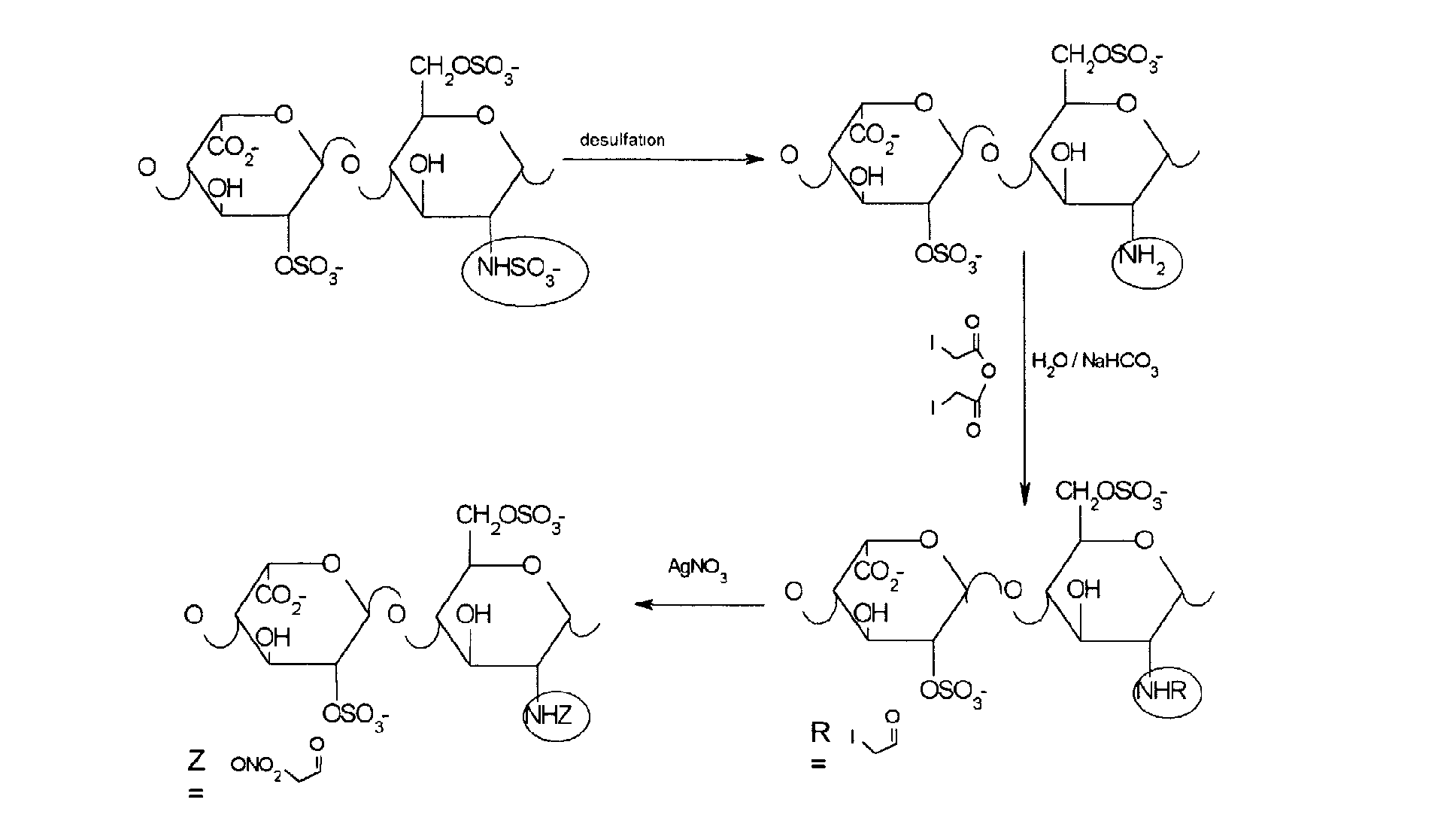
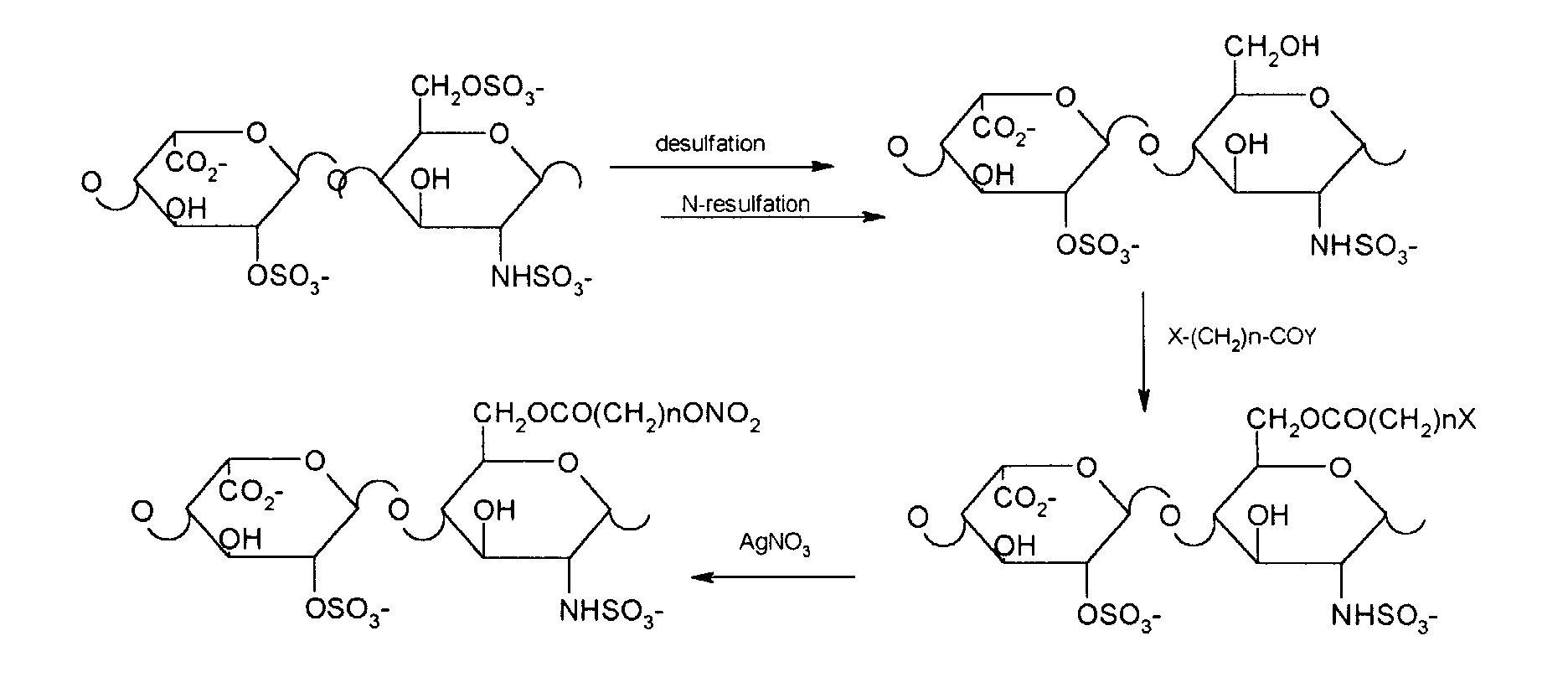
- It is also possible to acylate the position 6 of desulfated hexosamine. In this case it is preferable to use compounds of formula X-(CH2)n-COY wherein X is chlorine, bromine, iodine or tosyl; preferably X is bromine; Y is chlorine, mercaptothiazole, mercaptobenzothiazole, mercaptobenzoxazole, p-nitrophenol. The reaction scheme is the following:
- Another possible route of preparation of nitroderivatives is described in the following scheme, where the carboxyl group is activated by reaction with di cyclohexylcarbodiimide and then reacted with a compound of general formula X(CH2)nY where Y is Cl, Br, I, O-tosyl, ONO2 and X is OH or NH2:

- The nitro-derivatives of LMW heparin according to the invention can optionally be used in combination with a compound that donates, transfers or releases nitric oxide elevates endogenous levels of nitric oxide, or is a substrate for nitric oxide synthase.
- The compounds according to the present invention can also be used in combination with active substances normally used in the treatment of dysfunctions of the blood coagulating system and thrombotic system such as thrombolitic drugs, anticoagulant drugs, anti-platelet drugs, glycoprotein GP IIb/IIIa complex antagonists, thrombin antagonists. The active substance normally used in the treatment of disfunctions of blood coagulating system and thrombotic system can be those known in the art including for example aspirin, dypiridamole, ticlopidine, clopidsrogrel, hirudine or new nitrooxyderivatives of NSAIDs, for example 2-(acetyloxy)benzoic acid-3-(nitroxymethyl)phenyl ester described in EP 759 899.
- The compounds according to the invention can be used in the preparation of pharmaceutical compositions in combination with the appropriate inert carrier, for topic, parenteral and oral use.
- The formulation of therapeutic compositions is well known to persons skilled in this field. Suitable pharmaceutically acceptable carriers and/or diluents include any and all conventional solvents, dispersion media, fillers, solid carriers, aqueous solutions, coatings, antibacterial and antifungal agents, isotonic and absorption delaying agents, and the like. The use of such media and agents for pharmaceutically active substances is well known in the art, and it is described, by way of example, in Remington's 5 Pharmaceutical Sciences, 18th Edition, Mack Publishing Company, Pennsylvania, US.
- The present invention is now more deeply described through examples that must be considered explanatory but that are not intended to limit in any way the invention itself.
- The reactions have been carried out on the following substrates:
- 1. LMW-heparin calcium salt obtained by depolymerization with NaNO2. The
analytical characteristics were the following:
Mw 4400 Mw/Mn 1.7 Elemental analysis: C: 19.50 %; N: 1.62 %; atom of N per saccharide: 0.43 -
- Nitroacetic mixture was prepared by dropping, over 45 minutes, 48 ml of cold acetic anhydride in 72 ml of nitric acid (90%) kept under stirring and cooled at -20°C in an N2/acetone bath. At the end, 300 mg of LMW-heparin were added. When the temperature was stabilized, N2/acetone bath was changed with an ice bath; the mixture was stirred 3.5 hours at 0° C. The mixture was poured into 200 ml of a mixture diethyl ether - n-hexane 1:1 at -70°C in an N2/acetone bath. After 1 hour the sample was filtered, the precipitate dissolved in water, neutralized with a solution of diluted NaOH. The sample was dialyzed in dialysis tubes with a 1,000 Da cut-off against water for 48 hours. At the end, the sample was concentrated through evaporation at a reduced pressure and at a low temperature. The product was purified by gel filtration on Sephadex G10.
- The product has the following characteristics:
- Elemental analysis: C: 21.39%; N: 4.31%;
N per saccharide: 1.0
ONO2 per saccharide: 0.5 - Yield=21.3%
-
- For the assessment of anticoagulant activity, two standard clotting tests were run using a ACL 7000 coagulometer, and all reagent kits from Instrumentation Laboratories, following the manifacturer instructions. Activated Partial Thromboplastin Time (aPTT) and Thrombin clotting Time (TT) were performed using plasma samples of 300 ul incubated with different concentration of compounds. Test were run automatically by the coagulometer. Data were plotted on computer to obtain concentration response curves or histogram plots, comparing control (vehicle treated), standard (reference compound) and treated (compound in this invention) samples.
- The activity against the factor Xa (anti-Xa), a specific test intended to evaluate anti thrombotic activity was done as chromogenic test using the instrument and specific assay kits as above.
- The anti platelet activity was explored by aggregometric assays on a Chrono-Log VS 560 instrument, using the nephelometric tecnique. Briefly, platelet rich plasma (PRP) was incubated with different concentrations of the compounds to analyse complete concentration response curves and then stimulated with a proaggregating agent (such as ADP).
- To assess the NO release from the compounds of the invention, experiments were performed in presence or absence of direct inhibitors of soluble guanilyl cyclase, the enzyme responsible for the NO derived response.
Claims (13)
- Low molecular weight heparin having an average molecular weight by weight comprised between 3,000 and 6,500 Da, extremes excluded, characterized in that it contains nitro groups -ONO2 covalently bonded to the saccharide structure.
- Heparin according to claim 1, wherein the equivalents ratio between nitro groups and saccharide units varies from 0.10 to 1.25.
- Heparin according to claim 2, wherein the equivalents ratio between nitro groups and saccharide units varies from 0.20 to 1.00.
- Heparin according to claims 1-3 wherein Mw is equal to 5,000 + 400 Da.
- Heparin according to claims 1-4 wherein the nitro groups are introduced by reaction of one of the following positions: CH20H in 6 of desulfated hexosamine, CHOH in 3 of hexosamine and of uronic acid, carboxy group in 6 of uronic acid, CHOH in 2 of desulfated uronic acid and NH2 of desulfated hexosamine.
- Heparin according to claims 1-5 wherein the nitro groups are introduced by direct nitration using a nitrating mixture.
- Heparin according to claims 1-6 wherein the nitro group is covalently bonded to the saccharide structure through a divalent radical R acting as a spacer between the polymeric chain and the nitro group, wherein R is a C2-C20 aliphatic or aromatic hydrocarbon, an ether, a polyether, a carboxylic acid or its derivatives.
- Process for the preparation of low molecular weight heparin according to claims 1-7 comprising the following steps:a) depolymerization of natural heparin by chemical enzymatic or physical meansb) nitration by means of nitrating mixture
- Heparin according to claims 1-7 for use as a medicament.
- Pharmaceutical compositions containing heparin according to claims 1-7 admixed with pharmaceutically acceptable carriers.
- Heparin according to claims 1-7 for use in the treatment and prevention of pathologies associated with dysfunctions of haemostatic and cardiovascular systems.
- A composition comprising heparin according to claims 1-7 and a compound that donates, transfers or releases nitric oxide elevates endogenous levels of nitric oxide, or is a substrate for nitric oxide synthase.
- A composition comprising heparin according to claims 1-7 in combination with one or more active substances normally used in the treatment of dysfunctions of the blood coagulating system and thrombotic system selected from the groups consisting of thrombolitic drugs, anticoagulant drugs, anti-platelet drugs, glycoprotein GP IIb/IIIa complex antagonists, thrombin antagonists.
Priority Applications (3)
| Application Number | Priority Date | Filing Date | Title |
|---|---|---|---|
| EP02290490A EP1340771A1 (en) | 2002-02-28 | 2002-02-28 | Nitro-derivatives of low molecular weight heparin |
| AU2003210390A AU2003210390A1 (en) | 2002-02-28 | 2003-02-28 | Nitro-derivatives of low molecular weight heparin |
| PCT/EP2003/002092 WO2003072612A1 (en) | 2002-02-28 | 2003-02-28 | Nitro-derivatives of low molecular weight heparin |
Applications Claiming Priority (1)
| Application Number | Priority Date | Filing Date | Title |
|---|---|---|---|
| EP02290490A EP1340771A1 (en) | 2002-02-28 | 2002-02-28 | Nitro-derivatives of low molecular weight heparin |
Publications (1)
| Publication Number | Publication Date |
|---|---|
| EP1340771A1 true EP1340771A1 (en) | 2003-09-03 |
Family
ID=27675774
Family Applications (1)
| Application Number | Title | Priority Date | Filing Date |
|---|---|---|---|
| EP02290490A Withdrawn EP1340771A1 (en) | 2002-02-28 | 2002-02-28 | Nitro-derivatives of low molecular weight heparin |
Country Status (3)
| Country | Link |
|---|---|
| EP (1) | EP1340771A1 (en) |
| AU (1) | AU2003210390A1 (en) |
| WO (1) | WO2003072612A1 (en) |
Families Citing this family (2)
| Publication number | Priority date | Publication date | Assignee | Title |
|---|---|---|---|---|
| ES2357601B1 (en) * | 2011-01-26 | 2012-03-21 | Laboratorios Farmacéuticos Rovi, S.A. | PROCEDURE FOR THE PREPARATION OF DERIVATIVES OF GLYCONAMINOGLYCAN DONORS OF NORTIC OXIDE AND ITS USE IN THE TREATMENT OF CHRONIC ULCERS. |
| CN108117614B (en) * | 2016-11-29 | 2020-09-04 | 北京碧澄生物科技有限公司 | Low molecular weight heparins |
Citations (3)
| Publication number | Priority date | Publication date | Assignee | Title |
|---|---|---|---|---|
| US5482925A (en) * | 1994-03-17 | 1996-01-09 | Comedicus Incorporated | Complexes of nitric oxide with cardiovascular amines as dual acting cardiovascular agents |
| US6261594B1 (en) * | 1998-11-25 | 2001-07-17 | The University Of Akron | Chitosan-based nitric oxide donor compositions |
| EP1188773A1 (en) * | 2000-08-30 | 2002-03-20 | Nicox S.A. | Nitroderivatives of polysaccharides |
-
2002
- 2002-02-28 EP EP02290490A patent/EP1340771A1/en not_active Withdrawn
-
2003
- 2003-02-28 WO PCT/EP2003/002092 patent/WO2003072612A1/en not_active Ceased
- 2003-02-28 AU AU2003210390A patent/AU2003210390A1/en not_active Abandoned
Patent Citations (3)
| Publication number | Priority date | Publication date | Assignee | Title |
|---|---|---|---|---|
| US5482925A (en) * | 1994-03-17 | 1996-01-09 | Comedicus Incorporated | Complexes of nitric oxide with cardiovascular amines as dual acting cardiovascular agents |
| US6261594B1 (en) * | 1998-11-25 | 2001-07-17 | The University Of Akron | Chitosan-based nitric oxide donor compositions |
| EP1188773A1 (en) * | 2000-08-30 | 2002-03-20 | Nicox S.A. | Nitroderivatives of polysaccharides |
Non-Patent Citations (2)
| Title |
|---|
| GILBERT R. UPCHURCH ET AL.: "Heparin reacts with and inactivates nitric oxide.", JOURNAL OF CARDIOVASCULAR PHARMACOLOGY AND THERAPEUTICS, vol. 6, no. 2, 2001, pages 163 - 173, XP002208344 * |
| SAAVEDRA J E ET AL: "Conversion of a polysaccharide to nitric oxide-releasing form. dual-mechanism anticoagulant activity of diazeniumdiolated heparin", BIOORGANIC & MEDICINAL CHEMISTRY LETTERS, OXFORD, GB, vol. 10, no. 8, April 2000 (2000-04-01), pages 751 - 753, XP004203488, ISSN: 0960-894X * |
Also Published As
| Publication number | Publication date |
|---|---|
| AU2003210390A1 (en) | 2003-09-09 |
| WO2003072612A1 (en) | 2003-09-04 |
Similar Documents
| Publication | Publication Date | Title |
|---|---|---|
| US5013724A (en) | Process for the sulfation of glycosaminoglycans, the sulfated glycosaminoglycans and their biological applications | |
| Vikhoreva et al. | Preparation and anticoagulant activity of a low-molecular-weight sulfated chitosan | |
| DK173818B1 (en) | heparin derivative | |
| DK168824B1 (en) | Process for Preparing Mixtures of Sulfated Polysaccharides with a General Heparin Polysaccharide Structure | |
| US5795875A (en) | Therapeutic methods of using O-desulfated heparin derivatives | |
| KR100855331B1 (en) | Derivatives of partially desulfated glycosaminoglycans as heparanase inhibitors with angiogenesis inhibitory activity and no coagulation inhibitory effect | |
| JP5351770B2 (en) | Low molecular weight heparins comprising at least one covalent bond with biotin or a biotin derivative, methods for their production and their use. | |
| PT1556414E (en) | Heparin-derived oligosaccharide mixtures, preparation thereof and pharmaceutical compositions containing the same | |
| HUT64087A (en) | Process for producing n,o-sulfated heparosanes of high molecular weigh and pharmaceutical compositions comprising such compounds | |
| US8492352B2 (en) | Polysaccharides with antithrombotic activity, including a covalent bond and an amino chain | |
| US5721357A (en) | Preparation of sulfated polysaccharides for treatment or prevention of thromboses | |
| Linhardt et al. | Low molecular weight dermatan sulfate as an antithrombotic agent structure-activity relationship studies | |
| US8546354B2 (en) | Acylated decasaccharides and their use as antithrombotic agents | |
| US8518909B2 (en) | Sulfated heptasaccharide and its use as an antithrombotic agent | |
| BRPI9804699B1 (en) | carbohydrate derivative, pharmaceutical composition and use of the carbohydrate derivative | |
| JP4695756B2 (en) | Novel pentasaccharide, process for producing the same and pharmaceutical composition containing the same | |
| US7005508B2 (en) | Nitroderivatives of polysaccharides | |
| Linhardt et al. | New methodologies in heparin structure analysis and the generation of LMW heparins | |
| US20100075922A1 (en) | Heparins including at least one covalent bond with biotin or a biotin derivative, method for preparing same and use thereof | |
| WO2003072612A1 (en) | Nitro-derivatives of low molecular weight heparin | |
| US8501711B2 (en) | Acylated 1,6-anhydro decasaccharide and its use as an antithrombotic agent | |
| EP1340770A1 (en) | Nitro-derivatives of oligosaccharides | |
| JP2000080102A (en) | O-persulfated glycosaminoglycan and anticoagulant containing same as effective ingredient | |
| Klauser et al. | Antithrombotic and anticoagulant properties of synthetic polyanions: sulfated bis-aldonic acid amides. | |
| Ferrari et al. | Preliminary chemical, biochemical, and pharmacological characterization of a low molecular weight dermatan sulphate |
Legal Events
| Date | Code | Title | Description |
|---|---|---|---|
| PUAI | Public reference made under article 153(3) epc to a published international application that has entered the european phase |
Free format text: ORIGINAL CODE: 0009012 |
|
| AK | Designated contracting states |
Kind code of ref document: A1 Designated state(s): AT BE CH CY DE DK ES FI FR GB GR IE IT LI LU MC NL PT SE TR |
|
| AX | Request for extension of the european patent |
Extension state: AL LT LV MK RO SI |
|
| AKX | Designation fees paid | ||
| REG | Reference to a national code |
Ref country code: DE Ref legal event code: 8566 |
|
| STAA | Information on the status of an ep patent application or granted ep patent |
Free format text: STATUS: THE APPLICATION IS DEEMED TO BE WITHDRAWN |
|
| 18D | Application deemed to be withdrawn |
Effective date: 20040304 |