[Technical Field]
The present invention relates to 1-methylcarbapenem compounds having excellent
antibacterial activity, pharmacologically acceptable esters or salts thereof, pharmaceutical
compositions (particularly antibacterial agents) containing them as an active ingredient, use
of said compounds, ester derivatives or salts for the manufacture of said pharmaceutical
compositions, or a method for the prevention or treatment of diseases (particularly bacterial
infections) which comprises administering a pharmacologically effective amount of said
compounds, ester derivatives or salts to warm-blooded animals (particularly human beings).
[Background of the Invention]
There is a need for development of carbapenem derivatives having strong and
balanced antibacterial activity against a wide range of pathogenic bacteria. 1-methylcarbapenem
compounds having a structure analogous to that of the present invention
are disclosed in Japanese Patent Application (Kokai) No. Hei 8-53453.
The present inventors carried out investigations about 1-methylcarbapenem
compounds for a long time. As a result, it has been found that when compared with
conventional 1-methylcarbapenem derivatives, the compounds of formula (I) of the present
invention have stronger antibacterial power and are effective as an antibacterial agent for the
treatment or prevention (particularly the treatment) of bacterial infections, particularly
infections to the respiratory system, to accomplish the present invention.
[Detailed Description of the Invention]
The present invention relates to 1-methylcarbapenem compounds represented by the
formula (I):
or pharmacologically acceptable salts or esters thereof.
[wherein R3 represents a hydrogen atom, a C1-C6 alkyl group or a C3-C6 cycloalkyl group], (2) a group represented by the formula CONR4R5
[wherein R4 and R5 may be the same or different and each represents a hydrogen atom, a
C1-C6 alkyl group (which may be substituted by one or two groups which may be the same or
different and are selected from substituent group A below), a C3-C6 cycloalkyl group or a 3- to
6-membered heterocyclic group or a C6-C10 aryl group (which may be substituted by one or
two groups, which may be the same or different and are selected from substituent group B
below), or, together with the nitrogen atom to which they are bonded, represent a 3- to 6-membered
nitrogen-containing heterocycle (which may be substituted by one or two groups,
which may be the same or different and are selected from substituent group B below)], (3) a cyano group, (4) a group represented by the formula CH2OR6
[wherein R6 represents a hydrogen atom, a C1-C6 alkyl group or a C3-C6 cycloalkyl group] or (5) a group represented by the formula CH2NR7R8
[wherein R7 represents a hydrogen atom, a C1-C6 alkyl group or a C3-C6 cycloalkyl group,
and R8 represents a hydrogen atom, a C1-C6 alkyl group, a C3-C6 cycloalkyl group, a C1-C6
alkanoyl group, a C6-C10 arylcarbonyl group (which may be substituted by one or two groups
which may be the same or different and are selected from substituent group B below), a C1-C6
alkoxycarbonyl group, a 5- or 6-membered aromatic heterocyclylcarbonyl group, a C1-C6
alkylsulfonyl group or a C6-C10 arylsulfonyl group, or R7 and R8, together with the nitrogen
atom to which they are bonded, represent a succinimide group (which may be condensed
with a phenyl group)]; R2 represents a hydrogen atom or a C1-C6 alkyl group; n represents 1, 2 or 3; X represents a sulfur atom or an oxygen atom; substituent group A comprises a hydroxyl group, an amino group (which may be substituted
by one or two C1-C6 alkyl groups), a carbamoyl group (the amino moiety of which may be
substituted by one or two C1-C6 alkyl groups), a carboxyl group, a cyano group and a C1-C6
alkoxy group; and substituent group B comprises a hydroxy-C1-C4-alkyl group, an amino-C1-C4-alkyl group (the
amino moiety of which may be substituted by one or two C1-C6 alkyl groups), a carbamoyl
group (the amino moiety of which may be substituted by one or two C1-C6 alkyl groups), a
carboxyl group, a hydroxyl group, an amino group (which may be substituted by one or two
C1-C6 alkyl groups), a C1-C6 alkoxy group and a C1-C6 alkyl group].
In the above description, the "C1-C6 alkyl group" in the definitions of R2, R3, R4, R5, R6,
R7, R8, substituent group A and substituent group B is a straight or branched saturated
hydrocarbon group having from 1 to 6 carbon atoms. Examples of such a group include the
methyl, ethyl, n-propyl, isopropyl, n-butyl, isobutyl, s-butyl, tert-butyl, n-pentyl, isopentyl, 2-methylbutyl,
neopentyl, 1-ethylpropyl, n-hexyl, isohexyl, 4-methylpentyl, 3-methylpentyl, 2-methylpentyl,
1-methylpentyl, 3,3-dimethylbutyl, 2,2-dimethylbutyl, 1,1-dimethylbutyl, 1,2-dimethylbutyl,
1,3-dimethylbutyl, 2,3-dimethylbutyl, 2-ethylbutyl and 1-methyl-2-methylpropyl
groups. In the definitions of R2, R3, R6, R7, R8, substituent group A and substituent group B,
a C1-C3 alkyl group is preferred and a methyl group is particularly preferred. In the definition
of R4, a C1-C3 alkyl group is preferred and a methyl or isopropyl group is particularly
preferred. In the definition of R5, a C2-C6 alkyl group is preferred and a 1-methyl-2-methylpropyl
group is most preferred.
The "C3-C6 cycloalkyl group" in the definitions of R3, R4, R5, R6, R7 and R8, is a cyclic
hydrocarbon group having from 3 to 6 carbon atoms. Examples of such a group include the
cyclopropyl, cyclobutyl, cyclopentyl and cyclohexyl groups, of which a cyclopropyl group is
preferred.
The "3- to 6-membered heterocyclic group" in the definitions of R4 and R5 is a
saturated heterocyclic group including one or two oxygen, nitrogen and sulfur atoms.
Examples of such a group include the aziridinyl, azetidinyl, pyrrolidinyl, piperidinyl, oxiranyl,
oxetanyl, tetrahydrofuranyl, tetrahydropyranyl, tetrahydrothienyl, morpholinyl, piperazinyl and
thiomorpholinyl groups, of which a 4- to 6-membered nitrogen-containing heterocyclic group
is preferred and an azetidinyl, pyrrolidinyl or piperidinyl group is more preferred.
Examples of the "C6-C10 aryl group" in the definitions of R4 and R5 and the "C6-C10
aryl" moiety of the "C6-C10 arylcarbonyl group" and the "arylsulfonyl group" in the definition of
R8 include the phenyl, indenyl and naphthyl groups, of which the phenyl group is preferred.
The "nitrogen-containing heterocycle" of the "3- to 6-membered nitrogen-containing
heterocycle" in the definitions of the group formed by R4 and R5, together with the nitrogen
atom to which they are bonded, is a saturated heterocyclic group containing one or two
nitrogen atoms and which may contain an oxygen or sulfur atom. Examples of such a group
include the aziridino, azetidino, pyrrolidino, piperidino, morpholino, piperazino and
thiomorpholino groups, of which a 4- to 6-membered nitrogen-containing heterocycle is
preferred and the azetidino, piperazino, morpholino or thiomorpholino groups are more
preferred.
The "C1-C6 alkanoyl group" in the definition of R8 is a straight or branched alkanoyl
group having from 1 to 6 carbon atoms. Examples of such a group include the formyl, acetyl,
propionyl, butyryl, isobutyryl, valeryl, isovaleryl, pivaloyl and hexanoyl groups, of which a C1-C3
alkanoyl group is preferred and an acetyl group is most preferred.
The "C1-C6 alkoxy" moiety of the "C1-C6 alkoxycarbonyl group" in the definition of R8
and the "C1-C6 alkoxy group" in the definitions of the substituent groups is a straight or
branched alkoxy group having from 1 to 6 carbon atoms. Examples of such a group include
the methoxy, ethoxy, propoxy, isopropoxy, butoxy, pentyloxy and hexyloxy groups, of which
a C1-C3 alkoxy group is preferred and a methoxy group is most preferred.
The "5- or 6-membered aromatic heterocyclic" moiety of the "5- or 6-membered
aromatic heterocyclylcarbonyl group" in the definition of R8 is an aromatic heterocycle
containing from one to three oxygen, nitrogen and sulfur atoms. Examples of such a
heterocycle include pyrrole, imidazole, thiazole, oxazole, isoxazole, furan, thiophene,
triazole, thiadiazole, pyridine, pyrimidine, pyridazine and triazine, of which furan, thiophene or
pyridine is preferred.
Examples of the "hydroxy-C1-C4-alkyl group" in substituent group B include the
hydroxymethyl, hydroxyethyl, hydroxypropyl and hydroxybutyl groups, of which a hydroxy-C1-C2-alkyl
group is preferred and a hydroxymethyl group is most preferred.
Examples of the "amino-C1-C4-alkyl group" in substituent group B include the
aminomethyl, aminoethyl, aminopropyl and aminobutyl groups, of which an amino-C1-C2-alkyl
group is preferred and an aminomethyl group is most preferred.
Preferably substituent group A comprises a hydroxyl group, an amino group (which
may be substituted by one or two C1-C3 alkyl groups) and a carbamoyl group, of which an
amino group (which may be substituted by one or two methyl or ethyl groups) is most
preferred.
Preferably substituent group B comprises a hydroxy-C1-C4-alkyl group, an amino-C1-C4-alkyl
group (the amino moiety of which may be substituted by one or two C1-C3 alkyl
groups), a carbamoyl group (the amino moiety of which may be substituted by one or two C1-C3
alkyl groups), a hydroxyl group and an amino group (which may be substituted by one or
two C1-C3 alkyl groups), of which a group comprising a hydroxymethyl group, an
aminomethyl group (the amino moiety of which may be substituted by one or two methyl or
ethyl groups), a carbamoyl group (the amino moiety of which may be substituted by one or
two methyl or ethyl groups), a hydroxyl group and an amino group (which may be substituted
by one or two methyl or ethyl groups) is more preferred, an aminomethyl group and an amino
group being further preferred.
The "pharmacologically acceptable ester" of compound (I) is an ester in which some
of carboxyl groups or hydroxyl groups of compound (I) are protected by a group which may
be cleaved in the body of a human being or an animal by a chemical or biological method
such as hydrolysis to afford the original compound (I) or a salt thereof. Whether a derivative
is or is not such an ester can be determined by orally or intravenously administering the
derivative to an experimental animal such as a rat or mouse, studying the body fluid of the
animal and detecting the original compound (I) or the salt thereof.
Examples of the protective group which forms an ester of a carboxyl group include a
C1-C10 alkyl group, a C3-C6 cycloalkyl group, a C3-C6 cycloalkyl-C1-C4-alkyl group, a C2-C10
alkanoyloxy-C1-C4-alkyl group, a C1-C10 alkoxycarbonyloxy-C1-C4-alkyl group, a phenyl group
(said phenyl group may be substituted by one or two groups selected from a halogen atom, a
C1-C4 alkyl group, a C1-C4 alkoxy group, a methylenedioxy group and a C1-C6 alkanoyloxy
group), a C1-C10 alkanoyloxybenzyl group, a phthalidyl group and a 5-methyl-2-oxo-1,3-dioxolen-4-ylmethyl
group.
Examples of the protective group which forms an ester of a hydroxyl group include a
C1-C10 alkanoyl group, a C6-C10 arylcarbonyl group, a C1-C10 alkoxycarbonyl group and an
aminoacyl group.
Examples of the above "C1-C10 alkyl group" include the methyl, ethyl, propyl,
isopropyl, butyl, isobutyl, s-butyl, t-butyl, pentyl, 2-pentyl, 3-pentyl, isopentyl, hexyl, 2-hexyl,
3-hexyl, isohexyl, heptyl, octyl, nonyl and decyl groups, of which a C1-C6 alkyl group is
preferred, a C2-C4 alkyl group is more preferred and an ethyl group is most preferred.
Examples of the "C3-C6 cycloalkyl group" include the cyclopropyl, cyclobutyl,
cyclopentyl and cyclohexyl groups, of which the cyclopentyl or cyclohexyl group is preferred.
Examples of the "C3-C6 cycloalkyl-C1-C4-alkyl group" include the cyclopropylmethyl,
cyclopropylethyl, cyclopropylpropyl, cyclopropylbutyl, cyclobutylmethyl, cyclobutylethyl,
cyclobutylpropyl, cyclopentylmethyl, cyclopentylethyl, cyclopentylpropyl, cyclohexylmethyl
and cyclohexylethyl groups, of which the cyclopropylmethyl group is preferred.
Examples of the "C2-C10 alkanoyloxy-C1-C4-alkyl group" include the acetoxymethyl, 1-(acetoxy)ethyl,
1-(acetoxy)propyl, 1-(acetoxy)butyl, propionyloxymethyl, 1-(propionyloxy)ethyl,
isopropionyloxymethyl, 1-(isopropionyloxy)ethyl, butyryloxymethyl, 1-(butyryloxy)ethyl,
isobutyryloxymethyl, 1-(isobutyryloxy)ethyl, pivaloyloxymethyl, 1-(pivaloyloxy)ethyl,
valeryloxymethyl, 1-(valeryloxy)ethyl, isovaleryloxymethyl, 1-(isovaleryloxy)ethyl,
hexanoyloxymethyl, 1-(hexanoyloxy)ethyl, octanoyloxymethyl, 1-(octanoyloxy)ethyl,
decanoyloxymethyl, cyclopentylcarbonyloxymethyl, 1-methylcyclopentylcarbonyloxymethyl,
cyclohexylcarbonyloxymethyl and 1-methylcyclohexylcarbonyloxymethyl
groups, of which a C2-C6 alkanoyloxymethyl or 1-(C2-C6
alkanoyloxy)ethyl group is preferred.
Examples of the "C1-C10 alkoxycarbonyloxy-C1-C4-alkyl group" include the
methoxycarbonyloxymethyl, 1-(methoxycarbonyloxy)ethyl, ethoxycarbonyloxymethyl, 1-(ethoxycarbonyloxy)ethyl,
1-(ethoxycarbonyloxy)propyl, 1-(ethoxycarbonyloxy)butyl,
propoxycarbonyloxymethyl, 1-(propoxycarbonyloxy)ethyl, isopropoxycarbonyloxymethyl, 1-(isopropoxycarbonyloxy)ethyl,
butoxycarbonyloxymethyl, 1-(butoxycarbonyloxy)ethyl,
isobutoxycarbonyloxymethyl, 1-(isobutoxycarbonyloxy)ethyl, s-butoxycarbonyloxymethyl, 1-(s-butoxycarbonyloxy)ethyl,
t-butoxycarbonyloxymethyl, 1-(t-butoxycarbonyloxy)ethyl,
pentyloxycarbonyloxymethyl, 1-(pentyloxycarbonyloxy)ethyl, (1-methylbutyloxycarbonyloxy)methyl,
1-(1-methylbutyloxycarbonyloxy)ethyl, (2-methylbutyloxycarbonyloxy)methyl,
1-(2-methylbutyloxycarbonyloxy)ethyl, (3-methylbutyloxycarbonyloxy)methyl,
1-(3-methylbutyloxycarbonyloxy)ethyl, (1-ethylpropyloxycarbonyloxy)methyl,
1-(1-ethylpropyloxycarbonyloxy)ethyl,
hexyloxycarbonyloxymethyl, 1-(hexyloxycarbonyloxy)ethyl, (1-methylpentyloxycarbonyloxy)methyl,
1-(1-methylpentyloxycarbonyloxy)ethyl,
octyloxycarbonyloxymethyl, 1-(octyloxycarbonyloxy)ethyl, decyloxycarbonyloxymethyl, 1-(decyloxycarbonyloxy)ethyl,
cyclopentylcarbonyloxymethyl, 1-(cyclopentyloxycarbonyloxy)ethyl,
cyclohexylcarbonyloxymethyl and 1-(cyclohexyloxycarbonyloxy)ethyl
groups, of which a C1-C6 alkoxycarbonyloxymethyl or 1-(C1-C6
alkoxycarbonyloxy)ethyl group is preferred.
Examples of the "phenyl group which may be substituted" include the phenyl, 3-fluorophenyl,
4-fluorophenyl, 3,4-difluorophenyl, 3-methylphenyl, 4-methylphenyl, 3-methoxyphenyl,
4-methoxyphenyl, 3,4-dimethoxyphenyl, 3,4-methylenedioxyphenyl, 3-acetoxyphenyl
and 4-acetoxyphenyl groups, of which an unsubstituted phenyl group is
preferred.
Examples of the "C2-C10 alkanoyloxybenzyl group" include the 2-acetoxybenzyl, 3-acetoxybenzyl,
4-acetoxybenzyl, 3-propionyloxybenzyl, 4-propionyloxybenzyl, 4-butyryloxybenzyl,
4-valeryloxybenzyl, 4-hexanoyloxybenzyl, 4-octanoyloxybenzyl and 4-decanoyloxybenzyl
groups, of which the 3- or 4-(C2-C4 alkanoyloxy)benzyl group is preferred.
Examples of the "C1-C10 alkanoyl group" include the formyl, acetyl, propionyl, butyryl,
pentanoyl, hexanoyl, octanoyl and decanoyl groups, of which a C2-C6 alkanoyl group is
preferred.
Examples of the "C6-C10 arylcarbonyl group" include the benzoyl, 1-naphthoyl and 2-naphthoyl
groups, of which the benzoyl group is preferred.
Examples of the "C1-C10 alkoxycarbonyl group" include the methoxycarbonyl,
ethoxycarbonyl, propoxycarbonyl, butoxycarbonyl, pentyloxycarbonyl, hexyloxycarbonyl,
octyloxycarbonyl and decyloxycarbonyl groups, of which a C2-C6 alkoxycarbonyl group is
preferred.
Examples of the "aminoacyl group" include an amino acid group such as glycyl,
alanyl, β-alanyl, leucyl, isoleucyl, phenylalanyl, histidyl, asparagyl, prolyl and lysyl, of which a
glycyl group is preferred.
The compounds (I) and pharmacologically acceptable esters thereof of the present
invention can form pharmacologically acceptable salts if necessary.
The "pharmacologically acceptable salt thereof" is a salt to which the compound (I) of
the present invention can be converted. Preferred examples of such a salt include alkali
metal salts such as a sodium salt, a potassium salt and a lithium salt; alkaline earth metal
salts such as a calcium salt and a magnesium salt; metal salts such as an aluminium salt, an
iron salt, a zinc salt, a copper salt, a nickel salt and a cobalt salt; amine salts such as
inorganic salts such as an ammonium salt and organic salts such as a t-octylamine salt, a
dibenzylamine salt, a morpholine salt, a glucosamine salt, a phenylglycine alkyl ester salt, an
ethylenediamine salt, an N-methylglucamine salt, a guanidine salt, a diethylamine salt, a
triethylamine salt, a dicyclohexylamine salt, an N,N'-dibenzylethylenediamine salt, a
chloroprocaine salt, a procaine salt, a diethanolamine salt, an N-benzyl-phenethylamine salt,
a piperazine salt, a tetramethylammonium salt and a tris(hydroxymethyl)aminomethane salt;
inorganic acid salts such as hydrohalic acid salts such as a hydrofluoride, a hydrochloride, a
hydrobromide or a hydroiodide, a nitrate, a perchlorate, a sulfate or a phosphate; lower
alkanesulfonates such as a methanesulfonate, trifluoromethanesulfonate or an
ethanesulfonate; arylsulfonates such as a benzenesulfonate or a p-toluenesulfonate; and
organic acid salts such as an acetate, a malate, a fumarate, a succinate, a citrate, a tartrate,
an oxalate or a maleate; and amino acid salts such as a glycine salt, a lysine salt, an arginine
salt, an ornithine salt, a glutamate or an aspartate.
The compounds (I), pharmacologically acceptable salts and ester derivatives thereof
of the present invention include hydrates or solvates thereof.
In the compounds of the formula (I), the following compounds are preferred.
Compounds obtained by arbitrarily combining 2 or more of the above listed preferred
substituents are more preferred. More preferred examples of the compounds include the
following compounds:
(12) compounds wherein R1 represents a group represented by the formula CONR4R5
(wherein R4 represents a hydrogen atom or a C1-C3 alkyl group; and R5 represents a
hydrogen atom, a C1-C6 alkyl group (which may be substituted by one or two groups which
may be the same or different and are selected from substituent group A) or a 4- to 6-membered
nitrogen-containing heterocyclic group); R2 represents a hydrogen atom; n
represents 1; and X represents an oxygen atom or a sulfur atom. (13) compounds wherein R1 represents a group represented by the formula CONR4R5
(wherein R4 represents a hydrogen atom, a methyl group or an isopropyl group; and R5
represents a hydrogen atom, a C1-C6 alkyl group (which may be substituted by one or two
groups which may be the same or different and are selected from substituent group A), or an
azetidinyl, pyrrolidinyl or piperidinyl group); n represents 1; and X represents an oxygen atom
or a sulfur atom. (14) compounds wherein R1 represents a group represented by the formula CONR4R5
(wherein R4 and R5, together with the nitrogen atom to which they are bonded, represent a 4 -
to 6-membered nitrogen-containing heterocycle (which may be substituted by one or two
groups which may be the same or different and are selected from substituent group B); R2
represents a hydrogen atom; n represents 1; and X represents an oxygen atom or a sulfur
atom. (15) compounds wherein R1 represents a group represented by the formula CONR4R5
(wherein R4 and R5, together with the nitrogen atom to which they are bonded, represent an
azetidino, piperazino, morpholino or thiomorpholino group (which may be substituted by one
or two groups which may be the same or different and are selected from substituent group
B)); R2 represents a hydrogen atom; n represents 1; and X represents an oxygen atom or a
sulfur atom. (16) compounds wherein R1 represents a cyano group; R2 represents a hydrogen
atom; n represents 1; and X represents an oxygen atom or a sulfur atom. (17) compounds wherein R1 represents a group represented by the formula
CH2NR7R8 (wherein R7 represents a hydrogen atom or a C1-C3 alkyl group; and R8
represents a hydrogen atom, a C1-C3 alkyl group, a C1-C3 alkanoyl group, a benzoyl group
(which may be substituted by one or two groups which may be the same or different and are
selected from substituent group B), a C1-C3 alkoxycarbonyl group, a thienylcarbonyl group, a
furylcarbonyl group or a pyridylcarbonyl group); R2 represents a hydrogen atom; n represents
1; and X represents an oxygen atom or a sulfur atom. (18) compounds wherein R1 represents a group represented by the formula
CH2NR7R8 (wherein R7 represents a hydrogen atom or a methyl group; and R8 represents a
hydrogen atom, a benzoyl group (which may be substituted by one or two groups which may
be the same or different and are selected from substituent group B), a (2-thienyl)-carbonyl
group, a (2-furyl)-carbonyl group or a (3-pyridyl)-carbonyl group); R2 represents a hydrogen
atom; n represents 1, and X represents an oxygen atom or a sulfur atom.
Certain compounds (I) of the present invention are specifically exemplified in Tables 1
to 5. It should be noted that the compounds (I) of the present invention are not limited to
these exemplification compounds.
In Tables 1 to 5, Me represents a methyl group, Et an ethyl group, Pr a propyl group,
iPr an isopropyl group, Bu a butyl group, Pen a pentyl group, Hex a hexyl group, cPr a
cyclopropyl group, cBu a cyclobutyl group, cPen a cyclopentyl group, cHex a cyclohexyl
group, Azt an azetidinyl group, Pyr a pyrrolidinyl group, Pip a piperidinyl group, and Ph a
phenyl group. The term "position" means the bonding position of the sulfur atom.
Among the compounds exemplified in the above tables, the compounds of
Exemplification compound numbers: 1, 2, 3, 13, 14, 15, 26, 27, 28, 38, 39, 40, 51, 52, 53, 63,
64, 65, 76, 77, 78, 88, 89, 90, 101, 102, 103, 113, 114, 115, 126, 127, 128, 138, 139 and 140
in Table 1 are preferred,
the compounds of Exemplification compound numbers: 1, 2, 7, 22, 26, 31, 32, 34, 35,
39, 40, 44, 49, 50, 51, 52, 59, 62, 63, 64, 65, 89, 90, 95, 110, 114, 119, 120, 122, 123, 127,
128, 132, 137, 138, 139, 140, 147, 150, 151, 152, 153, 152, 177, 178, 183, 198, 202, 207,
208, 210, 211, 215, 216, 220, 225, 226, 227, 228, 235, 238, 239, 240, 241, 265, 266, 271,
286, 290, 295, 296, 298, 299, 303, 304, 308, 313, 314, 315, 316, 323, 326, 327, 328, 329,
353, 354, 359, 374, 378, 383, 384, 386, 387, 391, 392, 396, 401, 402, 403, 404, 411, 414,
415, 416, 417, 441, 442, 447, 462, 466, 471, 472, 474, 475, 479, 480, 484, 489, 490, 491,
492, 499, 502, 503, 504, 505, 529, 530, 535, 550, 554, 559, 560, 562, 563, 567, 568, 572,
577, 578, 579, 580, 587, 590, 591, 592, 593, 617, 618, 623, 638, 640, 647, 648, 650, 651,
655, 656, 660, 665, 666, 675, 678, 679, 680, 681, 705, 706, 711, 726, 730, 735, 753, 754,
755, 756, 763, 766, 767, 768, 769, 793, 794, 799, 814, 818, 823, 824, 826, 827, 831, 832,
836, 841, 851, 854, 855, 856, 857, 881, 882, 887, 902, 906, 911, 912, 914, 915, 919, 920,
924, 929, 930, 931, 932, 939, 942, 943, 944, 945, 969, 970, 975, 990, 994, 999, 1000, 1002,
1003, 1007, 1008, 1012, 1017, 1018, 1019, 1020, 1027, 1030, 1031, 1032, 1033, 1057,
1058, 1059, 1060, 1063, 1064, 1065, 1066, 1067, 1068, 1069, 1070, 1071, 1072, 1073,
1074, 1075, 1076, 1077, 1078, 1081, 1082, 1083, 1084, 1085, 1086, 1087, 1088, 1089,
1090, 1091, 1092, 1093, 1094, 1095, 1096, 1099, 1100, 1101, 1102, 1103, 1104, 1105,
1106, 1107, 1108, 1109, 1110, 1111, 1112, 1113, 1114, 1117, 1118, 1119, 1120, 1121,
1122, 1123, 1124, 1125, 1126, 1127, 1128, 1129, 1130, 1131, 1132, 1135, 1136, 1137,
1138, 1139, 1140, 1141, 1142, 1143, 1144, 1145, 1146, 1147, 1148, 1149, 1150, 1153,
1154, 1155, 1156, 1157, 1158, 1159, 1160, 1161, 1162, 1163 and 1164 in Table 2 are
preferred,
the compounds of Exemplification compound numbers: 1, 3, 5, 7, 9 and 11 in Table 3
are preferred,
the compounds of Exemplification compound numbers: 1, 2, 11, 12, 21, 22, 31, 32,
41, 42, 51, 52, 61, 62, 71, 72, 81, 82, 91, 92, 101, 102, 111 and 112 in Table 4 are preferred,
and
the compounds of Exemplification compound numbers: 1, 2, 4, 7, 8, 10, 12, 13, 14,
16, 17, 19, 22, 23, 25, 27, 28, 29, 31, 32, 34, 37, 38, 40, 42, 43, 44, 46, 47, 49, 52, 53, 55,
57, 58, 59, 61, 62, 64, 67, 68, 70, 72, 73, 74, 76, 77, 79, 82, 83, 85, 87, 88, 89, 91, 92, 94,
97, 98, 100, 102, 103, 104, 106, 107, 109, 112, 113, 115, 117, 118, 119, 121, 122, 124, 127,
128, 130, 132, 133, 134, 136, 137, 139, 142, 143, 145, 147, 148, 149, 151, 152, 154, 157,
158, 160, 162, 163, 164, 167, 168, 170, 173, 174, 176, 178, 179, 180, 182, 184, 185, 186,
187, 188, 189, 190, 191, 192, 193, 194, 195, 196, 197, 198, 199, 200, 201, 202, 203, 204,
205, 206, 207, 208, 209, 210, 211, 212, 213, 214, 215, 216, 217, 218, 219, 220, 221, 222,
223, 224, 225, 226, 227, 228, 229, 230, 231, 232, 233, 234, 235, 236, 237, 238, 239, 240,
241, 242, 243, 244, 245, 246, 247, 248, 249, 250, 251, 252, 253, 254, 255, 256, 257, 258,
259, 260, 261, 262, 263, 264, 265, 266, 267, 268, 269, 270, 271, 272, 273, 274, 275, 276,
277, 278, 279, 280, 281, 282, 283, 284, 285, 286, 287, 288, 289, 290, 291, 292, 293, 294,
295, 296, 297, 298, 299, 300, 301, 302, 303, 304, 305, 306, 307, 308, 309, 310, 311, 312,
313, 314, 315, 316, 317, 318, 319, 320, 321, 322, 323, 324, 325 and 326 in Table 5 are
preferred.
Of these, the compounds of Exemplification compound numbers: 3, 28, 53, 78, 103
and 128 in Table 1 are more preferred,
the compounds of Exemplification compound numbers: 1, 2, 7, 26, 31, 32, 34, 35, 39,
40, 44, 49, 50, 51, 52, 59, 62, 63, 64, 65, 529, 530, 535, 554, 559, 560, 562, 563, 567, 568,
572, 577, 578, 579, 580, 587, 590, 591, 592, 593, 1057, 1058, 1059, 1060, 1063, 1069,
1070, 1071, 1072, 1073, 1074, 1111, 1112, 1113, 1114, 1117, 1123, 1124, 1125, 1126, 1127
and 1128 in Table 2 are more preferred,
the compounds of Exemplification compound numbers: 1, 3, 7 and 11 in Table 3 are
more preferred,
the compounds of Exemplification compound numbers: 1, 2, 21, 22, 41, 42, 61, 62,
81, 82, 101 and 102 in Table 4 are more preferred, and
the compounds of Exemplification compound numbers: 1, 2, 4, 7, 8, 91, 92, 94, 97,
98, 182, 183, 184, 185, 186, 187, 188, 189, 190, 191, 192, 193, 194, 195, 196, 197, 198,
199, 200, 201, 202, 203, 248, 249, 250, 251, 252, 253, 254, 255, 256, 257, 258, 259, 260,
261, 262, 263, 264, 265, 266, 267, 268, 269, 314, 315, 320 and 321 in Table 5 are more
preferred.
The most preferred compounds are listed below:
[Modes for Carrying Out the Invention]
The 1-methylcarbapenem derivative represented by formula (I) of the present
invention can be prepared by methods described in Process A and Process B below.
[Process A]
Process A is a method for preparing a compound of formula (I) by reacting a
carbapenem derivative of formula (II) with a mercapto compound of formula (III) and
subsequently carrying out a deprotection reaction.
In the above formulae, R1, R2, X and n have the same meanings as defined above; L1
represents a group to be eliminated; P1 represents a protective group of a carboxyl group;
and R1p represents R1 which may have a protective group.
Examples of the "protective group of a carboxyl group" suitable as P1 include a benzyl
group which may have a substituent (the substituent is nitro, methyl, chloro or methoxy) such
as benzyl, 4-methoxybenzyl, 4-nitrobenzyl or 2-nitrobenzyl; a benzhydryl group; an allyl
group which may have a substituent at the 2-position (the substituent is chloro or methyl)
such as allyl, 2-chloroallyl or 2-methylallyl; and a group forming the above pharmacologically
acceptable ester, of which a benzyl group which may have a substituent (particularly a 4-nitrobenzyl
group) is preferred.
Examples of the "group to be eliminated" as L1 include a group of formula
-OR11 or -S(O)R12.
Examples of the group R11 include a C1-C4 alkanesulfonyl group such as a
methanesulfonyl, trifluoromethanesulfonyl, ethanesulfonyl, propanesulfonyl,
isopropanesulfonyl or butanesulfonyl group; a C6-C10 arylsulfonyl group such as
phenylsulfonyl, tolylsulfonyl or naphthylsulfonyl; a di-C1-C6 alkylphosphoryl group such as
dimethylphosphoryl, diethylphosphoryl, dipropylphosphoryl, diisopropylphosphoryl,
dibutylphosphoryl, dipentylphosphoryl or dihexylphosphoryl; or a di-C6-C10 arylphosphoryl
group such as diphenylphosphoryl or ditolylphosphoryl, of which a diphenylphosphoryl group
is preferred.
Examples of the group R12 include a C1-C4 alkyl group such as methyl, ethyl, propyl or
isopropyl; a halogeno C1-C4 alkyl group such as fluoromethyl, chloromethyl, fluoroethyl,
chloroethyl, fluoropropyl, difluoromethyl, difluoroethyl, dichloroethyl, trifluoromethyl or
trifluoroethyl; a 2-acetylaminoethyl group; a 2-acetylaminovinyl group; or a C6-C10 aryl group
(the aryl group may have from 1 to 3 substituents, which may be the same or different, and
the substituents may comprise a halogen atom such as fluorine, chlorine or bromine; a C1-C4
alkyl group such as methyl, ethyl, propyl or isopropyl; a C1-C4 alkoxy group such as methoxy,
ethoxy, propoxy or isopropoxy; a (C1-C4 alkoxy)carbonyl group such as methoxycarbonyl,
ethoxycarbonyl or t-butoxycarbonyl; carbamoyl, a mono- or di-(C1-C4 alkyl)carbamoyl group;
a nitro group; a hydroxyl group; or a cyano group) such as phenyl or naphthyl which may
have substituents; or a heteroaryl group which may have one or two nitrogen atoms (the
heteroaryl group may have from one to three substituents, which may be the same or
different, and the substituents may comprise a halogen atom such as fluorine, chlorine or
bromine; a C1-C4 alkyl group such as methyl, ethyl, propyl or isopropyl; a C1-C4 alkoxy group
such as methoxy, ethoxy, propoxy or isopropoxy; a (C1-C4 alkoxy)carbonyl group such as
methoxycarbonyl, ethoxycarbonyl or t-butoxycarbonyl; carbamoyl or a mono- or di-(C1-C4
alkyl)carbamoyl group; a nitro group; a hydroxyl group; or a cyano group) such as pyridyl or
pyrimidinyl which may have substituents.
Examples of the "protective group of a hydroxyl group" included in the definition of
R1p include a benzyloxycarbonyl group which may be substituted (the substituent may
comprise nitro, methyl, chloro or methoxy) such as benzyloxycarbonyl, 4-nitrobenzyloxycarbonyl,
4-chlorobenzyloxycarbonyl or 4-methoxybenzyloxycarbonyl; an
allyloxycarbonyl group which may be substituted at the 2-position (the substituent may
comprise chloro or methyl) such as allyloxycarbonyl, 2-chloroallyloxycarbonyl and 2-methylallyloxycarbonyl;
a tri-(C1-C4 alkyl)silyl group such as trimethylsilyl, triethylsilyl or t-butyldimethylsilyl;
and a group forming the above pharmacologically acceptable ester, of
which a tri-(C1-C4 alkyl)silyl group (particularly a t-butyldimethylsilyl group) is preferred.
Examples of the "protective group of an amino group" included in R1p include an
allyloxycarbonyl group which may be substituted at the 2-position (the substituent may
comprise chloro or methyl) such as allyloxycarbonyl, 2-chloroallyloxycarbonyl and 2-methylallyloxycarbonyl;
and a benzyloxycarbonyl group which may be substituted (the
substituent may comprise methyl, methoxy, chloro or nitro) such as benzyloxycarbonyl, 4-methylbenzyloxycarbonyl,
4-methoxybenzyloxycarbonyl, 4-chlorobenzyloxycarbonyl or 4-nitrobenzyloxycarbonyl,
of which an allyloxycarbonyl group or a 4-nitrobenzyloxycarbonyl
group is preferred and a 4-nitrobenzyloxycarbonyl group is more preferred.
The protective group used as the above P1 can be employed as the "protective group
of a carboxyl group" included in R1p.
The present process is a process in which a compound of formula (IV) is prepared by
reacting a compound of formula (II) with a compound of formula (III) in the presence of a
base (Step A1) and a compound of formula (I) is subsequently prepared by removing any
protective groups (Step A2). In the case where L1 represents a group represented by the
formula: -OR11, the compound of formula (II) which is used as a starting material is prepared
by a method described in D.H. Shih et al., Heterocycles 21, 29 (1984) or a method
analogous to it. In the case where L1 represents a group represented by formula: -S(O)R12,
the starting compound (II) is prepared by a method described in Japanese Patent Application
(Kokai) No. Sho 62-30781 or a method analogous to it. Each step will be described below.
(Step A1)
Step A1 is a step to prepare a compound of formula (IV), which is accomplished by
reacting a compound of formula (II) with a mercaptan derivative of formula (III) in the
presence of a base in an inert solvent.
There is no particular limitation on the nature of the solvent to be employed, provided
that it has no adverse effect on the reaction and it dissolves the starting materials to a certain
extent. Examples of suitable solvents include halogenated hydrocarbons such as methylene
chloride, 1,2-dichloroethane or chloroform; nitrites such as acetonitrile; amides such as N,N-dimethylformamide
or N,N-dimethylacetamide; esters such as ethyl acetate or methyl
acetate; and ethers such as diethyl ether, tetrahydrofuran or dioxane, of which acetonitrile,
N,N-dimethylformamide or tetrahydrofuran is preferred and acetonitrile is particularly
preferred.
Preferred examples of the base to be employed include organic amines such as
triethylamine, diisopropylethylamine, pyridine or dimethylaminopyridine; or inorganic bases
such as potassium carbonate, sodium carbonate or sodium hydrogencarbonate, of which
organic amines (particularly diisopropylethylamine) are preferred.
The reaction is usually carried out at a temperature from
-20°C to 40°C (preferably from -10°C to 20°C). The reaction time ranges from 30 minutes to
108 hours (preferably from one hour to 18 hours).
After completion of the reaction, the desired compound of formula (IV), which is the
product of the present step, is obtained from the reaction mixture by known means; for
example, adding to the reaction mixture or to the residue obtained by distilling off the solvent
from the reaction mixture an organic solvent which is not miscible with water, followed by
washing with water and distilling off the solvent. If necessary, the desired compound thus
obtained can be further purified by known means, for example, by recrystallization,
reprecipitation or chromatography. It is also possible to subject the desired compound of
formula (IV) to the next subsequent step without isolation, if desired.
(Step A2)
Step A2 is a step to convert a compound of formula (IV) to a compound of formula (I),
which is accomplished by removal of any protective groups contained in the compound of
formula (IV).
Although the method for removal of a protective group depends on the kind of the
protective group, it is accomplished by a method ordinarily employed in the field of organic
synthetic chemistry (for example, a method described in Protective Groups in Organic
Synthesis, Second Edition, John Wiley & Sons, Inc. 1991 written by T.W. Greene and P.G.M.
Wuts).
Preferred examples of the organic solvent mixed with water include an ether or
alcohol miscible with water such as tetrahydrofuran, dioxane, methanol, ethanol or propanol.
It is preferred that an alkali metal salt such as sodium phosphate, sodium acetate or
sodium hydrogencarbonate is added to water or a mixture of water and an organic solvent or
the pH is maintained in the range of from 6 to 8 using a pH buffer solution such as a
phosphoric acid buffer solution.
There is no limitation on the nature of the hydrolase provided that it can hydrolyze an
ester bond. Examples of such a hydrolase include esterase derived from pig liver.
The reaction time usually ranges from 10 minutes to 8 hours (preferably from 30
minutes to 2 hours) and the reaction temperature from 10°C to 50°C (preferably from 30°C to
40°C).
After completion of the reaction, the desired compound can be isolated and purified
by ion exchange chromatography, reverse phase column chromatography, reprecipitation,
recrystallization, etc.
When the compound of formula (IV) contains two or more kinds of protective groups,
the desired compound of formula (I) can be obtained by successively carrying out the above
deprotection reactions in combination. When the pharmacologically acceptable ester of the
compound of formula (I) is desired, it is not necessary to remove the group forming the
pharmacologically acceptable ester as the protective group.
The compound of formula (I) thus obtained can be converted to a pharmacologically
acceptable salt or ester, if necessary, according to a method or a technology known in the
field of medicinal chemistry, particularly that of β-lactam based antibiotics.
The pharmacologically acceptable esters of the carboxyl group of the compound of
formula (I) can be prepared by reacting a halogenated compound corresponding to the
desired ester residue of the compound of formula (I) in the presence of a base in a solvent.
Examples of the halogenated compound to be employed include a chloride, a
bromide or an iodide, of which an iodide is preferred. When a chloride or a bromide is used,
the reaction can be promoted by adding a catalytic amount of sodium iodide to the reaction
solution.
Examples of the base to be employed include organic amines such as triethylamine,
diisopropylethylamine, 4-dimethylaminopyridine or pyridine; and alkali metal carbonates such
as potassium carbonate, sodium carbonate or sodium hydrogencarbonate, of which organic
amines (particularly 4-dimethylaminopyridine) are preferred.
There is no particular limitation on the nature of the solvent to be employed, provided
that it has no adverse effect on the reaction and it dissolves the starting materials to a certain
extent. Examples of the solvent include nitriles such as acetonitrile; amides such as N,N-dimethylformamide;
and halogenated hydrocarbons such as methylene chloride, of which
amides (particularly dimethylacetamide) or nitriles (particularly acetonitrile) are preferred.
The reaction temperature usually ranges from -20°C to 50°C (preferably from -10°C
to 20°C) and the reaction time usually ranges from 0.5 hours to 108 hours (preferably from
one hour to 24 hours).
The compound previously isolated as a salt by reacting the compound of formula (I)
with a base can be also reacted with the halides as mentioned above.
Alternatively, the compound of formula (I) can be prepared by reacting an alcohol
corresponding to the desired ester residue on the compound of formula (I) in the presence of
a condensation agent and a base.
Examples of the condensation agent include Mitsunobu reagents such as diethyl
azodicarboxylate; phosphoric ester-based condensation agents such as
diphenylphosphorylazide; carbodiimide-based condensation agents such as
dicyclohexylcarbodiimide or 1-ethyl-3-(3-dimethylaminopropyl)carbodiimide; and onium
based condensation agents such as 2-chloro-1-methylpyridinium iodide.
Example of the base to be employed include organic amines such as triethylamine,
tributylamine, diisopropylethylamine or 4-dimethylaminopyridine.
Examples of other additives include phosphines such as triphenylphosphine and
tributylphosphine; and alcohols for forming an active ester such as 1-hydroxybenzotriazole.
Examples of the solvent include halogenated hydrocarbons such as methylene
chloride or dichloroethane; amides such as N,N-dimethylformamide; nitriles such as
acetonitrile; and ethers such as tetrahydrofuran.
Examples of a preferable combination of these include diethyl azodicarboxylate and
triphenylphosphine; 2-chloro-1-methylpyridinium iodide and tributylamine or triethylamine; 1-ethyl-3-(3-dimethylaminopropyl)carbodiimide
and 4-dimethylaminopyridine or 1-hydroxybenzotriazole.
After completion of the reaction, the desired compound is obtained from the reaction
mixture by known means, for example, adding to the reaction mixture, or to the residue
obtained by distilling off the solvent from the reaction mixture, an organic solvent which is not
miscible with water, followed by washing with water and distilling off the solvent. If
necessary, the desired compound thus obtained can be further purified by known means, for
example, recrystallization, reprecipitation or chromatography.
[Process B]
Process B is a method to prepare a compound of formula (III) used as a starting
material in Process A.
(Step B1)
Step B1 is a step for preparing a compound of formula (VI) by introducing an amide
group represented by the formula C(=X)NH
2 to the nitrogen atom of a compound of formula
(V).
In the above formula, X and n have the same meanings as defined above and R9
represents a C1-C4 alkyl group (preferably an ethyl group).
The step for preparing a compound (XIII) from a compound (V) is accomplished by
reacting a compound represented by the formula X=C=N-COOR9 (wherein X and R9 have
the same meanings as defined above) on the compound of formula (V) in a solvent.
There is no particular limitation on the nature of the solvent to be employed, provided
that it has no adverse effect on the reaction and it dissolves the starting materials to a certain
extent. Examples of the solvent include ethers such as tetrahydrofuran or diethyl ether;
halogenated hydrocarbons such as methylene chloride or dichloroethane; and a mixture of
these solvents and water, of which an ether or a mixture of an ether and water (particularly
tetrahydrofuran or a mixture of tetrahydrofuran and water) is preferred.
The reaction temperature usually ranges from -20°C to 150°C (preferably from -10°C
to 50°C) and the reaction time usually ranges from 0.5 to 108 hours (preferably from one to
24 hours).
After completion of the reaction, the desired compound is obtained from the reaction
mixture by known means. For example, the desired compound may be obtained by adding
an organic solvent immiscible with water to a residue obtained by distilling off the reaction
mixture or the solvent in the reaction mixture, washing with water and distilling off the
solvent. The desired compound thus obtained can be further purified, if necessary, by
conventional procedures such as recrystallization, reprecipitation or chromatography.
The step for preparing a compound of formula (VI) from a compound of formula (XIII)
is accomplished by reacting a base with the compound (XIII) in a solvent.
There is no particular limitation on the nature of the solvent to be employed, provided
that it has no adverse effect on the reaction and it dissolves the starting materials to a certain
extent. Examples of the solvent include alcohols such as methanol or ethanol; ethers such
as tetrahydrofuran or diethyl ether; and a mixture of these solvents and water, of which an
alcohol or a mixture of an alcohol and water (particularly ethanol or a mixture of ethanol and
water) is preferred.
Examples of the base to be employed include inorganic bases such as sodium
hydroxide, potassium hydroxide, sodium hydrogencarbonate, sodium carbonate and
potassium carbonate; and organic bases such as sodium methoxide and sodium ethoxide, of
which sodium hydroxide is preferred.
The reaction temperature usually ranges from -20°C to 15°C (preferably from -10°C
to 100°C) and the reaction time usually ranges from 0.5 to 108 hours (preferably from one to
24 hours).
After completion of the reaction, the desired compound is obtained from the reaction
mixture by known means. For example, the desired compound may be obtained by adding
an organic solvent immiscible with water to a residue obtained by distilling off the reaction
mixture or the solvent in the reaction mixture, washing with water and distilling off the
solvent. The desired compound thus obtained can be further purified, if necessary, by
conventional procedures sucn as recrystallization, reprecipitation or chromatography.
(Step B2)
Step B2 is a step for preparing a compound of formula (VII) by subjecting an amide
group of a compound of formula (VI) to a ring-closure reaction.
This step is accomplished by reacting a compound represented by the formula
R2CHL3COCOOP2 (wherein R2 and P2 have the same meanings as defined above and L3
represents a leaving group) with the compound of formula (VI) in the presence of a base in a
solvent. Preferred examples of the leaving group L3 include a halogen atom, of which a
bromine atom is particularly preferred.
There is no particular limitation on the nature of the solvent to be employed, provided
that it has no adverse effect on the reaction and it dissolves the starting materials to a certain
extent. Examples of the solvent include alcohols such as methanol or ethanol; ethers such
as tetrahydrofuran or diethyl ether; halogenated hydrocarbons such as methylene chloride or
dichloroethane; and amides such as N,N-dimethylformamide, of which alcohols (particularly
ethanol) are preferred.
Examples of the base to be employed include organic bases such as triethylamine
and diisopropylamine; and inorganic bases such as sodium carbonate, potassium carbonate
and sodium hydrogencarbonate, of which organic bases (particularly triethylamine) are
preferred.
The reaction temperature usually ranges from -20°C to 150°C (preferably from -10°C
to 100°C) and the reaction time usually ranges from 0.5 to 108 hours (preferably from one to
24 hours).
After completion of the reaction, the desired compound is obtained from the reaction
mixture by known means. For example, the desired compound may be obtained by adding
an organic solvent immiscible with water to a residue obtained by distilling off the reaction
mixture or the solvent in the reaction mixture, washing with water and distilling off the
solvent. The desired compound thus obtained can be further purified, if necessary, by
conventional procedures sucn as recrystallization, reprecipitation or chromatography.
(Step B3)
Step B3 is a step for preparing a compound of formula (VIII) by introducing a
protective group P3 to a hydroxyl group of a compound of formula (VII).
This step can be accomplished by a method usually used in the field of synthetic
organic chemistry (for example, a method described in Protective Groups in Organic
Synthesis, Second Edition, John Wiley & Sons, Inc. 1991, authors T.W. Greene and P.G.M.
Wuts).
Introduction of a silyl-based protective group is accomplished by reacting a silyl halide
or a silyl triflate having a desired substituent with a compound of formula (VII) in the
presence of a base in a solvent.
Examples of the silyl halide include trimethylsilyl chloride, triethylsilyl chloride, t-butyldimethylsilyl
chloride and t-butyldiphenylsilyl chloride, of which t-butyldiphenylsilyl
chloride is preferred.
Examples of the silyl triflate include trimethylsilyl triflate, triethylsilyl triflate, t-butyldimethylsilyl
triflate and t-butyldiphenylsilyl triflate, of which t-butyldiphenylsilyl triflate is
preferred.
There is no particular limitation on the nature of the solvent to be employed, provided
that it has no adverse effect on the reaction and it dissolves the starting materials to a certain
extent. Examples of the solvent include amides such as dimethylformamide; halogenated
hydrocarbons such as methylene chloride or dichloroethane; and ethers such as
tetrahydrofuran or diethyl ether, of which amides (particularly dimethylformamide) or
halogenated hydrocarbons (particularly methylene chloride) are preferred.
Examples of the base to be employed include organic bases such as imidazole,
triethylamine, lutidine, pyridine or dimethylaminopyridine, of which imidazole or 2,6-lutidine is
preferred.
The reaction temperature usually ranges from -20°C to 50°C (preferably from -10°C
to 40°C) and the reaction time usually ranges from 0.5 to 108 hours (preferably from 1 to 24
hours).
After completion of the reaction, the desired compound is obtained from the reaction
mixture by known means. For example, the desired compound may be obtained by adding
an organic solvent immiscible with water to a residue obtained by distilling off the reaction
mixture or the solvent in the reaction mixture, washing with water and distilling off the
solvent. The desired compound thus obtained can be further purified, if necessary, by
conventional procedures such as recrystallization, reprecipitation or chromatography.
(Step B4)
Step B4 is a step for preparing a compound of formula (IX) by converting a group
represented by the formula COOP2 in a compound (VIII) to a desired group R1p.
This step can be accomplished by applying a functional group conversion reaction
usually used in the field of synthetic organic chemistry. Details are described in Process C to
Process H, below.
(Step B5)
Step B5 is a step for preparing a compound of formula (X) by removal of the
protective group P3 of a hydroxyl group of the compound of formula (IX).
This step can be accomplished by a method usually used in the field of synthetic
organic chemistry (for example, a method described in Protective Groups in Organic
Synthesis, Second Edition, John Wiley & Sons, Inc. 1991, authors T.W. Greene and P.G.M.
Wuts).
When the protective group P3 of a hydroxyl group is a silyl-based protective group,
elimination thereof is accomplished in a similar manner to the method described in Step A2
(3).
(Step B6)
Step B6 is a step to prepare a compound (XI) by converting the hydroxyl group of a
compound of formula (X) to a leaving group L
2.
(Step B7)
Step B7 is a step for preparing a compound of formula (XII) by converting the leaving
group L2 of the compound of formula (XI) to a protected mercapto group.
This step is accomplished by reacting a mercapto-forming agent with a compound of
formula (XI) in a solvent.
Examples of the mercapto forming agent to be employed include alkali metal salts of
thiocarboxylic acids such as sodium thioacetate, potassium thioacetate, sodium
thiopropionate or sodium thiobenzoate; or alkali metal salts of 4-methoxybenzyl mercaptan,
of which potassium thioacetate is preferred.
There is no particular limitation on the nature of the solvent to be employed, provided
that it has no adverse effect on the reaction and it dissolves the starting materials to a certain
extent. Examples of the solvent include ethers such as tetrahydrofuran or dioxane; acetates
such as ethyl acetate or methyl acetate; nitriles such as acetonitrile; and amides such as
dimethylformamide or dimethylacetamide, of which an amide (particularly
dimethylformamide) is preferred.
The reaction temperature usually ranges from -20°C to 150°C (preferably from 0°C to
100°C) and the reaction time usually ranges from 0.5 to 108 hours (preferably from one to 24
hours).
After completion of the reaction, the desired compound is obtained from the reaction
mixture by known means. For example, the desired compound may be obtained by adding
an organic solvent immiscible with water to a residue obtained by distilling off the reaction
mixture or the solvent in the reaction mixture, washing with water and distilling off the
solvent. The desired compound thus obtained can be further purified, if necessary, by
conventional procedures such as recrystallization, reprecipitation or chromatography.
(Step B8)
Step B8 is a step for preparing a compound of formula (III) by removing a protective
group P
4 of the mercapto group of the compound of formula (XII).
[Process C]
Process C is a method for preparing a compound of formula (IX-1) having a desired
ester residue group by converting a protected carboxyl group of a compound of formula
(VIII).
In the above scheme, R2, X, n, P2 and P3 have the same meanings as defined above,
and R3p represents R3 which may be protected.
(Step C1)
Step C1 is a step for preparing a compound (XIV) by reducing the carboxylic ester
group of a compound of formula (VIII) to a hydroxymethyl group. This step is accomplished
by reacting a reducing agent with the compound of formula (VIII) in a solvent.
The reducing agent to be employed is not particularly limited so long as it can convert
a carboxylic ester group to a hydroxymethyl group by reduction. Examples of the reducing
agent include alkali metal aluminum hydrides such as lithium aluminum hydride; and alkali
metal boron hydrides such as lithium borohydride or sodium borohydride, of which lithium
aluminum hydride is preferred.
There is no particular limitation on the nature of the solvent to be employed, provided
that it has no adverse effect on the reaction and it dissolves the starting materials to a certain
extent. Examples of the solvent include ethers such as tetrahydrofuran or diethyl ether, of
which tetrahydrofuran is preferred.
The reaction temperature usually ranges from -20°C to 100°C (preferably from -10°C
to 40°C) and the reaction time usually ranges from 10 minutes to 24 hours (preferably from
0.5 to 24 hours).
After completion of the reaction, the desired compound is obtained from the reaction
mixture by known means. For example, the desired compound may be obtained by adding
an organic solvent immiscible with water to the reaction mixture, neutralizing it, washing with
water and distilling off the solvent. The desired compound thus obtained can be further
purified, if necessary, by conventional procedures such as recrystallization, reprecipitation or
chromatography.
(Step C2)
Step C2 is a step for preparing a compound of formula (XV) by oxidizing a
hydroxymethyl group of a compound of formula (XIV).
This step is accomplished by reacting an oxidizing agent with the compound of
formula (XIV) in a solvent and comprises a step of oxidizing a hydroxymethyl group to an
aldehyde group and a step of oxidizing the aldehyde group to a carboxyl group.
(Step C3)
Step C3 is a step for preparing a carboxylic acid compound of formula (XV) in an
alternative manner and is accomplished by removing the protective group of a compound
(VIII). This step can be carried out in a similar manner to Step A2 of Process A.
(Step C4)
Step C4 is a step for preparing a compound of formula (XIX-1) by esterifying the
carboxyl group of the compound of formula (XV).
[Process D]
Process D is a method for preparing a compound of formula (IX-2) having a desired
amide residue by conversion of the carboxyl group of a compound (XV).
In the above scheme, R2, X, n and P3 have the same meanings as defined above,
and R4p and R5p represent R4 and R5 which may be protected.
(Step D1)
This step is accomplished by reacting a desired compound having the formula
HNR4pR5p with a compound of formula (XV) in the presence of a condensation agent in a
solvent.
The present step can be carried out using an amino compound of formula HNR4pR5p
instead of the alcohol compound of formula R3pOH in the above Step C4 of Process C.
Examples of the condensation agent include a phosphoric acid ester-based
condensation agent such as diethylphosphoryl cyanide; and a carbonate-based
condensation agent such as carbonyldiimidazole, of which diethylphosphoryl cyanide or
carbonyldiimidazole are preferred.
[Process E]
Process E is a method for preparing a desired compound of formula (IX-2) having an
amide residue group by converting a carboxylic ester group of a compound (XIII).
In the above scheme, R2, X, n, P3, R4p and R5p have the same meanings as defined
above, and P2a represents a C1-C4 alkyl group as a protective group P2 of the above carboxyl
group.
(Step E1)
This step is accomplished by reacting a desired amino compound represented by the
formula HNR4pR5p with a compound of formula (VIII) in the presence of a catalyst in a
solvent.
Examples of the catalyst to be employed include tri-C1-C4 aluminiums such as
trimethylaluminium, of which trimethylaluminium is preferred.
There is no particular limitation on the nature of the solvent to be employed, provided
that it has no adverse effect on the reaction and it dissolves the starting materials to a certain
extent. Examples of the solvent include aromatic solvents such as benzene, toluene or
mesitylene; and halogenated hydrocarbons such as methylene chloride or dichloroethane, of
which aromatic solvents (particularly benzene or toluene) are preferred.
The reaction temperature usually ranges from -20°C to 150°C (preferably from -10°C
to 100°C) and the reaction time usually ranges from 0.5 to 108 hours (preferably from one to
24 hours).
After completion of the reaction, the desired compound is obtained from the reaction
mixture by known means. For example, the desired compound may be obtained by adding
an organic solvent immiscible with water to a residue obtained by distilling off the reaction
mixture or the solvent in the reaction mixture, neutralizing it, washing with water and distilling
off the solvent. The desired compound thus obtained can be further purified, if necessary, by
conventional procedures such as recrystallization, reprecipitation or chromatography.
[Process F]
Process F is a method for preparing a cyano compound of formula (IX-3) by
converting a carboxylic ester group of a compound of formula (XIII).
In the above scheme, R2, X, n, P3 and P2a have the same meanings as defined
above.
(Step F1)
This step is accomplished by using an ammonium salt instead of the amino
compound in the above Step E1 of Process E and reacting it at a higher reaction
temperature.
Ammonium chloride is preferably used as the ammonium salt and the reaction
temperature usually ranges from -20°C to 150°C (preferably from -10°C to 100°C).
[Process G]
Process G is a method for preparing a compound of formula (IX-4) by introducing a
desired substituent R
6 to a hydroxyl group of a compound of formula (XIV).
This step is accomplished by reacting an alkylating agent with a compound of formula
(XIV) in the presence of a base in a solvent or reacting a reducing agent and a desired
carbonyl compound with the compound of formula (XIV) in the presence of an acid catalyst in
a solvent.
[Process H]
Process H is a method for preparing a compound of formula (IX-5) by converting a
hydroxyl group of a compound of formula (XIV) to a desired group represented by the
formula NR
7pR
8p.
Step H1 is a step for preparing a compound of formula (XV) by introducing a leaving
group L3 to a compound of formula (XIV) and can be accomplished in a similar manner to
Step B6 of Process B above.
(Step H2)
Step H2 is a step for preparing an amine compound of formula (IX-5a) from a
compound of formula (XV) and for preparing a compound of formula (IX-5b), if necessary, by
introducing a substituent.
(A) Preparation of an amine compound of formula (IX-5a)
This step can be accomplished by reacting an aminating agent with the compound of
formula (XV) in a solvent. This step can also be accomplished by preparing an azide
compound by reacting an azidating agent with a compound of formula (XV) in a solvent,
followed by reaction with a reducing agent.
(1) Method in which an aminating agent is used
There is no particular limitation on the nature of the solvent to be employed, provided
that it has no adverse effect on the reaction and it dissolves the starting materials to a certain
extent. Examples of the solvent include amides such as dimethylformamide; alcohols such
as methanol or ethanol; and ethers such as tetrahydrofuran or diethyl ether, preferably the
amides (particularly dimethylformamide).
Examples of the aminating agent to be employed include primary alkylamines which
may be substituted such as methylamine or ethylamine; aromatic amines which may be
substituted such as aniline or aminothiazole; secondary alkylamines which may be
substituted such as methylethylamine or dimethylamine; and salts of these amines (for
example, hydrochloride), of which primary or secondary alkylamines which may be
substituted and salts thereof (particularly methylamine hydrochloride or dimethylamine
hydrochloride) are preferred.
The reaction temperature usually ranges from 0°C to 150°C (preferably from 10°C to
100°C) and the reaction time usually ranges from 0.5 to 108 hours (preferably from one to 24
hours).
After completion of the reaction, the desired compound is obtained from the reaction
mixture by known means. For example, the desired compound may be obtained by adding
an organic solvent immiscible with water to a residue obtained by distilling off the reaction
mixture or the solvent in the reaction mixture, neutralizing it, washing with water and distilling
off the solvent. The desired compound thus obtained can be further purified, if necessary, by
conventional procedures such as recrystallization, reprecipitation or chromatography.
(2) Method in which an azidating agent and a reducing agent are used
There is no particular limitation on the nature of the solvent to be employed, provided
that it has no adverse effect on the reaction and it dissolves the starting materials to a certain
extent. Examples of the solvent include amides such as dimethylformamide; alcohols such
as methanol or ethanol; and ethers such as tetrahydrofuran or diethyl ether, of which amides
(particularly dimethylformamide) are preferred.
Examples of the azidating agent include alkali metal azides such as sodium azide or
lithium azide, of which alkali metal azides (particularly sodium azide) are preferred.
The reaction temperature usually ranges from 0°C to 150°C (preferably from 10°C to
100°C) and the reaction time usually ranges from 0.5 to 108 hours (preferably from one to 24
hours).
After completion of the reaction, the desired compound is obtained from the reaction
mixture by known means. For example, the desired compound may be obtained by adding
an organic solvent immiscible with water to a residue obtained by distilling off the reaction
mixture or the solvent in the reaction mixture, neutralizing it, washing with water and distilling
off the solvent. The desired compound thus obtained can be further purified, if necessary, by
conventional procedures such as recrystallization, reprecipitation or chromatography.
The azide thus obtained is converted to an amine of formula (IX-5a) by a reduction
reaction.
Examples of the reducing agent to be employed include alkali metal aluminum
hydrides such as lithium aluminum hydride; phosphines such as triphenylphosphine; and
catalytic hydrogenation using metal catalysts such as palladium-carbon or platinum catalyst,
of which catalytic hydrogenation (particularly in the case where palladium-carbon is used as
the catalyst) is preferred.
There is no particular limitation on the nature of the solvent to be employed, provided
that it has no adverse effect on the reaction and it dissolves the starting materials to a certain
extent. Examples of the solvent include ethers such as tetrahydrofuran or diethyl ether; and
alcohols such as methanol or ethanol, of which ethers (particularly tetrahydrofuran) are
preferried.
Examples of the solvent to be employed in catalytic hydrogenation include alcohols
such as methanol or ethanol, of which methanol is preferred.
The reaction temperature usually ranges from -10°C to 150°C (preferably from 0°C to
100°C) and the reaction time usually ranges from 0.5 to 108 hours (preferably from one to 24
hours).
After completion of the reaction, the desired compound is obtained from the reaction
mixture by known means. For example, the desired compound may be obtained by adding
an organic solvent immiscible with water to a residue obtained by distilling off the reaction
mixture or the solvent in the reaction mixture, neutralizing it, washing with water and distilling
off the solvent. The desired compound thus obtained can be further purified, if necessary, by
conventional procedures such as recrystallization, reprecipitation or chromatography.
(B) Preparation of a compound (IX-5b)
This step is a step carried out if necessary in order to prepare a compound of formula
(IX-5b) by introducing a substituent to an amine compound of formula (IX-5a).
The present step is accomplished by reacting a desired acylating agent, a
sulfonylating agent, a phosphorylating agent or a chloroformic acid ester with an amine
compound of formula (IX-5a) in the presence of a base in a solvent.
Examples of the acylating agent include acid anhydrides such as acetic anhydride or
benzoic anhydride; and acid chlorides such as acetyl chloride or benzoyl chloride, of which
acid chlorides (particularly acetyl chloride) are preferred.
Examples of the sulfonylating agent include acid chlorides such as methanesulfonyl
chloride or p-toluenesulfonyl chloride; and acid anhydrides such as methanesulfonic
anhydride or p-toluenesulfonic anhydride, of which acid chlorides (particularly
methanesulfonyl chloride) are preferred.
Examples of the phosphorylating agent include acid chlorides such as
diethylphosphoryl chloride or dimethylphosphoryl chloride, of which diethylphosphoryl
chloride is preferred.
Examples of the chloroformic acid ester include ester compounds such as methyl
chloroformate, ethyl chloroformate or benzyl chloroformate, of which chloroformic acid esters
(particularly methyl chloroformate) are preferred.
Examples of the base to be employed include organic bases such as triethylamine,
diisopropylethylamine or pyridine; and inorganic bases such as sodium carbonate, potassium
carbonate or sodium hydrogencarbonate, of which organic bases (particularly triethylamine)
are preferred.
There is no particular limitation on the nature of the solvent to be employed, provided
that it has no adverse effect on the reaction and it dissolves the starting materials to a certain
extent. Examples of the solvent include ethers such as tetrahydrofuran or diethyl ether; and
halogenated hydrocarbons such as methylene chloride or dichloroethane, of which ethers
(particularly tetrahydrofuran) are preferred.
The reaction temperature usually ranges from 0°C to 100°C (preferably from 10°C to
50°C) and the reaction time usually ranges from 0.5 to 108 hours (preferably from one to 24
hours).
After completion of the reaction, the desired compound is obtained from the reaction
mixture by known means. For example, the desired compound may be obtained by adding
an organic solvent immiscible with water to a residue obtained by distilling off the reaction
mixture or the solvent in the reaction mixture, neutralizing it, washing with water and distilling
off the solvent. The desired compound thus obtained can be further purified, if necessary, by
conventional procedures such as recrystallization, reprecipitation or chromatography.
(Step H3)
Step H3 is a step for preparing an amine compound of formula (IX-5a) from a
compound of formula (XV) via an azide compound and for preparing a compound of formula
(IX-5b) by introducing a substituent if necessary.
(A) Preparation of an azide compound
The present step is carried out by reacting an azidating compound (particularly
diphenylphosphoryl azide), diethylazodicarboxylate and triphenylphosphine with a compound
of formula (XV) in a solvent.
There is no particular limitation on the nature of the solvent to be employed, provided
that it has no adverse effect on the reaction and it dissolves the starting materials to a certain
extent. Examples of the solvent include amides such as dimethylformamide; alcohols such
as methanol or ethanol; and ethers such as tetrahydrofuran or diethyl ether, of which ethers
(particularly tetrahydrofuran) are preferred.
The reaction temperature usually ranges from 0°C to 50°C (preferably from 10°C to
30°C) and the reaction time usually ranges from 0.5 to 108 hours (preferably from one to 24
hours).
After completion of the reaction, the desired compound is obtained from the reaction
mixture by known means. For example, the desired compound may be obtained by adding
an organic solvent immiscible with water to a residue obtained by distilling off the reaction
mixture or the solvent in the reaction mixture, neutralizing it, washing with water and distilling
off the solvent. The desired compound thus obtained can be further purified, if necessary, by
conventional procedures such as recrystallization, reprecipitation or chromatography.
(B) Preparation of an amine compound
This is a step for preparing an amine of formula (IX-5a) by reducing an azide
compound and can be carried out in a similar manner to the reduction described in Step H2
(A)(1).
(C) Preparation of a compound (IX-5b)
This step, carried out if necessary, is a step for preparing a compound of formula (IX-5b)
by introducing a substituent to the amine of formula (IX-5a) and can be carried out in a
similar manner to Step H2 (B) above.
The compounds of formula (IX-1) to (IX-5) obtained in Process C to Process H can be
converted to a compound of formula (III) which is used as a starting material of a side chain
at the 2-position of a compound of formula (I) according to the steps after Step B5 of Process
B.
[Process I]
Process I is a method for preparing a compound of formula (IX-6) which is a
compound of formula (IX), an intermediate in the synthetic route of Process B, wherein X is
an oxygen atom, in a different manner.
In the above scheme, R1p, R2, P3 and n have the same meanings as defined above;
Z represents a protective group of an amino group, preferably a benzyloxycarbonyl group;
and P5 represents a protective group of a hydroxyl group, preferably an acyl-based protective
group such as acetyl, benzoyl or pivaloyl, and most preferably a benzoyl group.
(Step I-1)
Step I-1 is a step for preparing a compound of formula (XVI) by converting a carboxyl
group of an amino acid compound (XVIa) of which amino group is protected to the desired
R1p.
This step can be carried out according to a method selected from the above
Processes C to H. It should be noted that in the compound of formula (XVIa) which forms
the starting material, a compound wherein R2 is a hydrogen atom can be prepared from
serine and a compound wherein R2 is a methyl group can be prepared from threonine.
Compounds wherein R2 is a group other than a hydrogen atom or a methyl group can also be
prepared by a method known by a person skilled in the art.
(Step I-2)
Step I-2 is a step for preparing a compound of formula (XVII) by introducing a
protective group to a hydroxyl group of a compound of formula (XVI).
This step can be carried out in a similar manner to Step B3 of Process B. Preferred
examples of the silyl-based protective group suitable as P3 include a t-butyldimethylsilyl
group.
(Step I-3)
Step I-3 is a step for preparing a compound of formula (XVIII) by removing the
protective group from the amino group of the compound of formula (XVII).
This step can be carried out in a similar manner to a method of Step A2 (1) of
Process A. The preferred solvent is methanol.
(Step I-4)
Step I-3 is a step for preparing a compound of formula (XIX) by converting the amino
group of the compound of formula (XVIII) to an isothiocyanate group.
This step is accomplished by reacting carbon disulfide and a dehydrosulfidation agent
with the compound of formula (XVIII) in the presence of a base in a solvent.
Preferred examples of the solvent include halogenated hydrocarbons (particularly
methylene chloride).
Preferred examples of the dehydrosulfidation agent include halogenated formic acid
esters (particularly ethyl chloroformate) or quatemary nitrogen-containing reagents
(particularly 2-chloro-1-methylpyridinium iodide or 2-chloro-1-ethylbenzoxazolium
tetrafluoroborate).
Preferred examples of the base include tertiary amines such as triethylamine,
diisopropylethylamine or tributylamine (particularly triethylamine).
The reaction temperature usually ranges from -20°C to 100°C (preferably from 0°C to
60°C) and the reaction time usually ranges from 0.5 to 48 hours (preferably from one to 12
hours).
After completion of the reaction, the desired compound is obtained from the reaction
mixture by known means. For example, the desired compound may be obtained by adding
an organic solvent immiscible with water to a residue obtained by distilling off the reaction
mixture or the solvent in the reaction mixture, neutralizing it, washing with water and distilling
off the solvent. The desired compound thus obtained can be further purified, if necessary, by
conventional procedures such as recrystallization, reprecipitation or chromatography.
(Step I-5)
Step I-5 is a step for preparing a compound of formula (XX) by reacting the desired
cyclic amine with the compound of formula (XIX). This step can be carried out according to
Step B1 of Process B.
(Step I-6)
Step I-6 is a step for preparing a compound of formula (XXI) by introducing an acyl-based
protective group P5 to a hydroxyl group of a compound (XX) and subsequently
removing a silyl based protective group P3.
(1) Introduction of an acyl-based protective group P5
This step can be carried out according to Step H2 (B) of Process H.
(2) Removal step of a silyl based protective group P3
This step can be carried out according to Step A2 of Process A.
(Step I-7)
Step I-7 is a step for preparing a compound of formula (XXII) by subjecting a
compound of formula (XXI) to a ring-closure reaction. This step is accomplished by reacting
a cyclization agent (dehydrosulfidation agent) with the compound of formula (XXI) in the
presence of a base in a solvent.
Examples of the solvent include amides such as dimethylformamide or
dimethylacetamide; halogenated hydrocarbons such as methylene chloride; and nitriles such
as acetonitrile; of which acetonitrile is preferred.
Preferred examples of the base include tertiary amines such as triethylamine,
diisopropylethylamine or tributylamine (particularly triethylamine).
Preferred examples of the cyclization (dehydrosulfidation) agent include mercury salts
such as mercury oxide and mercury chloride; or quaternary nitrogen-containing reagents
(particularly 2-chloro-1-methylpyridinium iodide or 2-chloro-1-ethylbenzoxazolium
tetrafluoroborate).
The reaction temperature usually ranges from -20°C to 100°C (preferably from 0°C to
60°C) and the reaction time usually ranges from 0.5 to 48 hours (preferably from one to 12
hours).
After completion of the reaction, the desired compound is obtained from the reaction
mixture by known means. For example, the desired compound may be obtained by adding
an organic solvent immiscible with water to a residue obtained by distilling off the reaction
mixture or the solvent in the reaction mixture, neutralizing it, washing with water and distilling
off the solvent. The desired compound thus obtained can be further purified, if necessary, by
conventional procedures such as recrystallization, reprecipitation or chromatography.
(Step I-8)
Step I-8 is a step for preparing a compound of formula (XXIII) by dehydrogenation of
the compound of formula (XXII).
This step is accomplished by reacting a dehydrogenating agent with the compound of
formula (XXII) in a solvent.
Examples of the solvent include aromatic hydrocarbons such as benzene or toluene;
and halogenated hydrocarbons such as methylene chloride or dichloroethane.
Examples of the dehydrogenating agent include oxidizing agents such as manganese
dioxide.
The reaction temperature usually ranges from 0°C to 100°C (preferably from 0°C to
60°C) and the reaction time usually ranges from 0.5 to 48 hours (preferably from one to 12
hours).
After completion of the reaction, the desired compound is obtained from the reaction
mixture by known means. For example, the desired compound may be obtained by adding
an organic solvent immiscible with water to a residue obtained by distilling off the reaction
mixture or the solvent in the reaction mixture, removing the insolubles by filtration, washing
with water and distilling off the solvent. The desired compound thus obtained can be further
purified, if necessary, by conventional procedures such as recrystallization, reprecipitation or
chromatography.
(Step I-9)
Step I-9 is a step for preparing a compound of formula (IX-6) by removing the acyl-based
protective group P5 of the compound of formula (XXIII) and subsequently introducing a
silyl-based protective group P3.
(1) Elimination of the acyl-based protective group P5
This step can be carried out according to a method for preparing the compound of
formula (VI) from the compound of formula (VIII) in Step B1 (2) of Process A.
(2) Introduction of the silyl-based protective group P3
This step can be carried out according to Step B3 of Process B.
[Process J]
The compound of formula (I) can be also prepared in a different manner from Process
A by the following Process J. Process J can be applied to the preparation of the compound
of formula (I-1) or (I-2) wherein R
1 is represented by the formula COOR
3 or the formula
CONR
4R
5.
In the above scheme, R1, R1p, R2, P1, P3, X, L1 and n have the same meanings as
defined above. A preferred example of P3 is a t-butyldimethylsilyl group.
(Step J1)
Step J1 is a step for preparing a compound of formula (IV-1) by condensing a
compound of formula (II-1) which is protected by a silyl-based protective group P3 and a
compound of formula (III-1) in which R1p is a carboxyl group protected by an allyl group.
This step can be carried out in a similar manner to Step A1 of Process A. The
compound of formula (II-1) used as a starting material can be prepared by reacting a
silylating agent with a compound of formula (II) and this step can be carried out according to
Step B3 of Process B. The compound of formula (III-1) can be prepared by Process B.
(Step J2)
Step J2 is a step for preparing the compound of formula (IV-2) by removing the allyl
protective group from the compound of formula (IV-1). This step can be carried out
according to Step A2 (2) of Process A.
(Step J3)
Step J3 is a step for preparing a compound of formula (IV-3) by modifying a carboxyl
group of the compound of formula (IV-2). This step can be carried out according to Step B4
of Process B (particularly Process C and Process D).
(Step J4)
Step J4 is a step for preparing a compound of formula (I) by removing the protective
groups P3 and P1 from the compound of formula (IV-3).
(1) Elimination of the protective group P3
This step can be carried out according to Step A2 (3) of Process A.
(2) Elimination of the protective group P1
This step can be carried out in a similar manner to Step A2 of Process A.
Compounds of formula (I) or pharmacologically acceptable salts thereof of the
present invention exhibit strong and broad antibacterial activity against various pathogenic
bacteria including Gram-positive bacteria such as Staphylococcus and Bacillus subtilis,
Gram-negative bacteria such as Escherichia coli, Klebsiella pneumoniae, Shigella, Proteus
vulgaris, Serratia, Enterobacter and Pseudomonas aerginosa, and anaerobic bacteria such
as Bacteroides fragilis, and, in particular, have a strong antibacterial activity against
Streptococcus pneumoniae (including penicillin-resistant bacteria) and Haemophilus
influenzae (including β-lactamase producing bacteria), which cause respiratory tract
infection. Compounds of formula (I) of the present invention have a high stability against β-lactamases
including metallo β-lactamase. Compounds of formula (I) of the present
invention show good pharmacokinetics such as a high maximum concentration in serum and
a long half-life in serum when administered either orally or non-orally. Therefore, compounds
of formula (I) of the present invention are expected to have a potent therapeutic effect even if
administered less frequently or with fewer doses in comparison with existing drugs.
Compounds of formula (I) of the present invention have weak toxicity to the kidney.
Accordingly, compounds of formula (I) or pharmacologically acceptable salts or ester thereof
of the. present invention, are useful, for example, as pharmaceuticals and are particularly
useful as antibacterial agents for the treatment or prevention (preferably treatment) of
bacterial infections caused by various kinds of pathogenic bacteria, particularly bacteria
causing respiratory tract infection.
When compounds of formula (1), pharmacologically acceptable esters or salts thereof
are used as pharmaceuticals, particularly antibacterial agents, they can be administered
orally in the form of tablets, capsules, granules, powders or syrups by using them as they are
or mixing them with appropriate pharmacologically acceptable additive such as excipients or
diluents, or administered parenterally in the form of injections.
These formulations can be prepared in a known manner by using additives.
Examples of the additives include excipients (e.g. sugar derivatives such as lactose, sucrose,
glucose, mannitol and sorbitol; starch derivatives such as corn starch, potato starch, α-starch,
dextrin and carboxymethyl starch; cellulose derivatives such as crystalline cellulose,
low-substituted hydroxypropyl cellulose, hydroxypropylmethyl cellulose, carboxymethyl
cellulose, calcium carboxymethyl cellulose and internally cross-linked sodium carboxymethyl
cellulose; gum arabic; dextran; and pullulan; silicate derivatives such as light silicic
anhydride, synthetic aluminum silicate and magnesium aluminometasilicate; phosphate
derivatives such as calcium phosphate; carbonate derivatives such as calcium carbonate; or
sulfate derivatives such as calcium sulfate), binders (e.g. the above-exemplified excipients;
gelatin; polyvinyl pyrrolidone; or Macrogol); disintegrators (e.g. the above-exemplified
excipients; or chemically modified starch or cellulose derivatives such as sodium
croscarmellose or sodium carboxymethyl starch; or cross-linked polyvinylpyrrolidone);
lubricants (e.g. talc; stearic acid; metal salts of stearic acid such as calcium stearate or
magnesium stearate; colloidal silica; veegum; waxes such as bees wax and spermaceti;
boric acid; glycol; carboxylic acids such as fumaric acid or adipic acid; sodium carboxylates
such as sodium benzoate; sulfates such as sodium sulfate; leucine; lauryl sulfates such as
sodium lauryl sulfate or magnesium lauryl sulfate; silicic acids such as silicic anhydride or
silicic hydrate; or starch derivatives exemplified above as the excipient), stabilizers (e.g. p-hydroxy
benzoic acid esters such as methyl paraben or propyl paraben; alcohols such as
chlorobutanol, benzyl alcohol or phenylethyl alcohol; benzalkonium chloride; phenols such as
phenol and cresol; thimerosal; acetic anhydride; or sorbic acid), corrigents (e.g. ordinarily-employed
sweetener, souring agents or flavors), suspending agents (e.g. Polysorbate 80 or
sodium carboxymethyl cellulose), diluents and solvents for formulation (e.g. water, ethanol or
glycerine).
The dose of the compounds of formula (I) will vary depending on the condition and
age of the patient. Orally, they are administered in an amount of 10 mg (preferably 50 mg) in
a single dose as a lower limit and 2000 mg (preferably 1000 mg) in a single dose as an
upper limit, while intravenously, they are administrered in an amount of 10 mg (preferably
100 mg) in a single dose as a lower limit and 3000 mg (preferably 2000 mg) in a single dose
as an upper limit. It is desirable that the compound is administered to an adult in a single
dose or in divided doses (sixths) per day depending on the condition of the patient.
[Best Mode for Carrying Out the Invention]
The present invention will now be illustrated in further detail by the following
Examples, Reference Examples, Test Examples and Formulation Examples. The scope of
the present invention is not limited by these Examples. In the nuclear magnetic resonance
spectra in the Examples and Reference Examples, sodium trimethylsilylpropionate-d4 was
used as an internal standard for the measurement in deuterated water, while
tetramethylsilane was used as an internal standard in the other solvents. Incidentally, when
an internal standard was not used in the measurement in deuterated water, the
measurement was made on the basis that the signal of HOD in deuterated water appears at
4.65 ppm.
Example 1
(1R,5S,6S)-2-[1-(4-Ethoxycarbonyl-1,3-thiazol-2-yl)azetidin-3-yl]thio-6-[(R)-1-hydroxyethyl]-1-methylcarbapen-2-em-3-carboxylic
acid sodium salt
(1) p-Nitrobenzyl (1R,5S,6S)-2-[1-(4-ethoxycarbonyl-1,3-thiazol-2-yl)azetidin-3-yl]thio-6-[(R)-1-hydroxyethyl]-1-methylcarbapen-2-em-3-carboxylate
To a solution of 3-acetylthio-1-(4-ethoxycarbonyl-1,3-thiazol-2-yl)azetidine (468 mg, 1.71
mmol) (obtained as described in Reference Example 1) in dimethylformamide (15 ml) was
added hydrazine acetate (171.0 mg, 1.86 mmol) at room temperature under an atmosphere
of nitrogen and the mixture was stirred for 1.5 hours. After checking the completion of the
reaction, a solution of p-nitrobenzyl (1R,5S,6S)-2-diphenylphosphoryloxy-6-[(R)-1-hydroxyethyl]-1-methylcarbapen-2-em-3-carboxylate
(1.02 g, 1.72 mmol) in acetonitrile (30
ml) was added dropwise to the resulting mixture in an ice bath under an atmosphere of
nitrogen, followed by the addition of diisopropylethylamine (1.5 ml, 8.61 mmol). The mixture
was stirred overnight while gradually raising the temperature to room temperature. After
checking the completion of the reaction, ethyl acetate and saturated aqueous sodium
hydrogencarbonate solution were added to the reaction mixture. The resulting mixture was
shaken in a separatory funnel and the ethyl acetate layer was separated, washed with 0.5 M
hydrochloric acid, saturated aqueous sodium hydrogencarbonate solution and saturated
aqueous sodium chloride solution, dried over anhydrous magnesium sulfate, filtered and
concentrated under reduced pressure. The residue was purified by chromatography on a
silica gel column (eluant: ethyl acetate) to afford p-nitrobenzyl (1R,5S,6S)-2-[1-(4-ethoxycarbonyl-1,3-thiazol-2-yl)azetidin-3-yl]thio-6-[(R)-1-hydroxyethyl]-1-methylcarbapen-2-em-3-carboxylate
as a pale yellow solid (752 mg, yield 75%).
1H-NMR (400 MHz, CDCl3): δ (ppm) 8.23 (2H, d, J=8.6Hz), 7.66 (2H, d, J=8.6Hz), 7.50
(1H, s), 5.50 (1H, d, J=13.7Hz), 5.25 (1H, d, J=13.7Hz), 4.55 (2H, dd, J=14.4, 8.0Hz), 4.36
(2H, q, J=7.1Hz), 4.35-4.20 (3H, m), 4.20-4.05 (2H, m), 3.29 (1H, dd, J=6.7, 2.4Hz), 3.20
(1H, dq, J=10.3, 8.3Hz), 1.82 (1H, br s), 1.42 (3H, d, J=6.3Hz), 1.40 (3H, t, J=7.1Hz), 1.26
(3H, t, J=7.5Hz).
Mass spectrum (FAB+): 589 [M+H]+
(2) (1R,5S,6S)-2-[1-(4-Ethoxycarbonyl-1,3-thiazol-2-yl)azetidin-3-yl]thio-6-[(R)-1-hydroxyethyl]-1-methylcarbapen-2-em-3-carboxylic
acid sodium salt
p-Nitrobenzyl (1R,5S,6S)-2-[1-(4-ethoxycarbonyl-1,3-thiazol-2-yl)azetidin-3-yl]thio-6-[(R)-1-hydroxyethyl]-1-methylcarbapen-2-em-3-carboxylate
(744 mg, 1.26 mmol) (obtained as
described in Example 1(1)) in a mixture of tetrahydrofuran (46 ml) and distilled water (23 ml)
was subjected to catalytic hydrogenation in the presence of 20% palladium hydroxide (736
mg) in a water bath (30°C) for 1.5 hours. After checking the completion of the reaction, the
reaction mixture was filtered and to the filtrate were added sodium hydrogencarbonate (106
mg), a mixture of ethyl acetate and tetrahydrofuran (1:1) and distilled water. The mixture
was shaken in a separatory funnel. The aqueous layer was separated, washed with a
mixture of ethyl acetate and tetrahydrofuran (1:1) and concentrated under reduced pressure.
The residue was purified by chromatography on a Cosmosil column using distilled water - 3%
acetonitrile; distilled water - 5% acetonitrile; distilled water - 7% acetonitrile and distilled
water as the eluant. The eluate was lyophilized to afford the desired compound (1R,5S,6S)-2-[1-(4-ethoxycarbonyl-1,3-thiazol-2-yl)azetidin-3-yl]thio-6-[(R)-1-hydroxyethyl]-1-methylcarbapen-2-em-3-carboxylic
acid (376 mg, yield 63%) as a white solid.
1H-NMR (400 MHz, D2O): δ (ppm) 7.68 (1H, s), 4.50 (2H, t, J=12.6Hz), 4.40-4.10 (5H, m
including q at 4.30 ppm, J=8.4Hz), 4.10-3.95 (2H, m), 3.45-3.35 (1H, m), 3.30-3.25 (1H, m),
1.30 (3H, t, J=8.4Hz), 1.25 (3H, d, J=6.7Hz), 1.15 (3H, d, J=9.2Hz).
IR (KBr): 1749, 1720, 1602, 1544, 1395, 1316 cm-1
Mass spectrum (FAB+): 476 [M+H]+
High-resolution mass spectrum (FAB+): calculated for C19H23O6N3S2Na : 476.0912, Found:
476.0938 [M+H]+
Example 2
(1R,5S,6S)-2-[1-(4-Carboxyl-1,3-thiazol-2-yl)azetidin-3-yl]thio-6-[(R)-1-hydroxyethyl]-1-methylcarbapen-2-em-3-carboxylic
acid disodium salt
(1) p-Nitrobenzyl (1R,5S,6S)-2-[1-(4-p-nitrobenzyloxycarbonyl-1,3-thiazol-2-yl)azetidin-3-yl]thio-6-[(R)-1-hydroxyethyl]-1-methylcarbapen-2-em-3-carboxylate
To a solution of 3-acetylthio-1-(4-p-nitrobenzylcarbonyl-1,3-thiazol-2-yl)azetidine (380 mg,
1.0 mmol) (obtained as described in Reference Example 2) in dimethylformamide (15 ml)
was added hydrazine acetate (115 mg, 1.25 mmol) at room temperature under an
atmosphere of nitrogen and the mixture was stirred for 3 hours. After checking the
completion of the reaction, a solution of p-nitrobenzyl (1R,5S,6S)-2-diphenylphosphoryloxy-6-[(R)-1-hydroxyethyl]-1-methylcarbapen-2-em-3-carboxylate
(695 mg, 1.17 mmol) in
acetonitrile (30 ml) was added dropwise to the resulting mixture in an ice bath under an
atmosphere of nitrogen, followed by the addition of diisopropylethylamine (0.84 ml, 4.82
mmol). The mixture was stirred overnight while gradually raising the temperature to room
temperature. After checking the completion of the reaction, ethyl acetate and saturated
aqueous sodium hydrogencarbonate solution were added to the reaction mixture. The
resulting mixture was shaken in a separatory funnel and the ethyl acetate layer was
separated, washed with 0.5 M hydrochloric acid, saturated aqueous sodium
hydrogencarbonate solution and saturated aqueous sodium chloride solution, dried over
anhydrous magnesium sulfate, filtered and concentrated under reduced pressure. The
residue was purified by chromatography on a silica gel column (eluant: ethyl acetate) to
afford p-nitrobenzyl (1R,5S,6S)-2-[1-(4-p-nitrobenzyloxycarbonyl-1,3-thiazol-2-yl)azetidin-3-yl]thio-6-[(R)-1-hydroxyethyl]-1-methylcarbapen-2-em-3-carboxylate
as a brown foaming
solid (336 mg, yield 50%).
1H-NMR (400 MHz, CDCl3): δ (ppm) 8.23 (2H, d, J=8.6Hz), 8.22 (2H, d, J=8.6Hz), 7.66 (2H,
d, J=8.6Hz), 7.59 (2H, d, J=8.6Hz), 7.57 (1H, s), 5.51 (1H, d, J=13.7Hz), 5.43 (2H, s), 5.25
(1H, d, J=13.7Hz), 4.56 (2H, dd, J=15.7, 8.7Hz), 4.31-4.20 (3H, m), 4.19-4.05 (3H, m), 3.29
(1H, dd, J=7.1, 2.9Hz), 3.20 (1H, dq, J=9.2, 7.4Hz), 1.38 (3H, d, J=6.5Hz), 1.27 (3H, d,
J=7.2Hz).
Mass spectrum (FAB+): 696 [M+H]+
(2) (1R,5S,6S)-2-[1-(4-Carboxyl-1,3-thiazol-2-yl)azetidin-3-yl]thio-6-[(R)-1-hydroxyethyl]-1-methylcarbapen-2-em-3-carboxylic
acid disodium salt
p-Nitrobenzyl (1R,5S,6S)-2-[1-(4-p-nitrobenzyloxycarbonyl-1,3-thiazol-2-yl)azetidin-3-yl]thio-6-[(R)-1-hydroxyethyl]-1-methylcarbapen-2-em-3-carboxylate
(330 mg, 0.474 mmol)
(obtained as described in Example 2(1)) in a mixture of tetrahydrofuran (16 ml) and distilled
water (8 ml) was subjected to catalytic hydrogenation in the presence of 20% palladium
hydroxide (325 mg) in a water bath (30°C) for 1.5 hours. After checking the completion of the
reaction, the reaction mixture was filtered and to the filtrate were added sodium
hydrogencarbonate (45 mg), a mixture of ethyl acetate and tetrahydrofuran (1:1) and distilled
water. The mixture was shaken in a separatory funnel. The aqueous layer was separated,
washed with a mixture of ethyl acetate and tetrahydrofuran (1:1) and concentrated under
reduced pressure. The residue was purified by chromatography on a Cosmosil column using
distilled water as the eluant. The eluate was lyophilized to afford the desired compound
(1R,5S,6S)-2-[1-(4-carboxyl-1,3-thiazol-2-yl)azetidin-3-yl]thio-6-[(R)-1-hydroxyethyl]-1-methylcarbapen-2-em-3-carboxylic
acid disodium salt (86 mg, yield 41%) as a white solid.
1H-NMR (400 MHz, D2O): δ (ppm) 7.10 (1H, s), 4.35 (2H, t, J=8.0Hz), 4.20-4.10 (1H, m),
4.10-4.00 (2H, m), 3.90-3.80 (2H, m), 3.25-3.20 (1H, m), 3.15-3.00 (1H, m), 1.12 (3H, d,
J=6.0Hz), 1.00 (3H, d, J=9.2Hz).
IR (KBr): 1745, 1594, 1541, 1400, 1316, 1282 cm-1.
Mass spectrum (FAB+): 470 [M+H]+
Example 3
(1R,5S,6S)-2-[1-(4-Carbamoyl-1,3-thiazol-2-yl)azetidin-3-yl]thio-6-[(R)-1-hydroxyethyl]-1-methylcarbapen-2-em-3-carboxylic
acid sodium salt
(1) p-Nitrobenzyl (1R,5S,6S)-2-[1-(4-carbamoyl-1,3-thiazol-2-yl)azetidin-3-yl]thio-6-[(R)-1-hydroxyethyl]-1-methylcarbapen-2-em-3-carboxylate
To a solution of 3-acetylthio-1-(4-carbamoyl-1,3-thiazol-2-yl)azetidine (1.13 g, 4.39 mmol)
(obtained as described in Reference Example 3) in dimethylformamide (57 ml) was added
hydrazine acetate (485 mg, 5.27 mmol) at room temperature under an atmosphere of
nitrogen and the mixture was stirred for 1 hour. After checking the completion of the
reaction, a solution of p-nitrobenzyl (1R,5S,6S)-2-diphenylphosphoryloxy-6-[(R)-1-hydroxyethyl]-1-methylcarbapen-2-em-3-carboxylate
(2.61 g, 4.39 mmol) in acetonitrile (130
ml) was added dropwise to the resulting mixture in an ice bath under an atmosphere of
nitrogen, followed by the addition of diisopropylethylamine (3.1 ml, 17.6 mmol). The mixture
was stirred for 3 hours while gradually raising the temperature to room temperature. After
checking the completion of the reaction, ethyl acetate and saturated aqueous sodium
hydrogencarbonate solution were added to the reaction mixture. The resulting mixture was
shaken in a separatory funnel and the ethyl acetate layer was separated, washed with 0.5 M
aqueous sodium chloride solution, saturated aqueous sodium hydrogencarbonate solution
and saturated aqueous sodium chloride solution, dried over anhydrous sodium sulfate,
filtered and concentrated under reduced pressure. The residue was purified by
chromatography on a silica gel column using methylene chloride-3% methanol, methylene
chloride-6% methanol, methylene chloride-9% methanol and methylene chloride as the
eluant to afford p-nitrobenzyl (1R,5S,6S)-2-[1-(4-carbamoyl-1,3-thiazol-2-yl)azetidin-3-yl]thio-6-[(R)-1-hydroxyethyl]-1-methylcarbapen-2-em-3-carboxylate
as a pale yellow solid (2.61 g,
yield 94%).
1H-NMR (400 MHz, CDCl3): δ (ppm) 8.23 (2H, d, J=8.8Hz), 7.66 (2H, d, J=8.8Hz), 7.48 (1H,
s), 6.99 (1H, br s), 5.55 (1H, bs), 5.51 (1H, d, J=13.9Hz), 5.25 (1H, d, J=13.9Hz), 4.50 (2H,
dd, J=16.0, 8.0Hz), 4.31-4.20 (3H, m), 4.10-4.00 (2H, m), 3.30 (1H, dd, J=6.6, 2.2Hz), 3.21
(1H, dq, J=10.6, 8.0Hz), 1.83 (1H, brs), 1.38 (3H, d, J=6.6Hz), 1.28 (3H, d, J=7.3Hz).
Mass spectrum (FAB+): 566 [M+H]+
(2) (1R,5S,6S)-2-[1-(4-Carbamoyl-1,3-thiazol-2-yl)azetidin-3-yl]thio-6-[(R)-1-hydroxyethyl]-1-methylcarbapen-2-em-3-carboxylic
acid sodium salt
p-Nitrobenzyl (1R,5S,6S)-2-[1-(4-carbamoyl-1,3-thiazol-2-yl)azetldln-3-yl]thio-6-[(R)-1-hydroxyethyl]-1-methylcarbapen-2-em-3-carboxylate
(2.2 g, 3.93 mmol) (obtained as
described in Example 3(1)) in a mixture of tetrahydrofuran (110 ml) and distilled water (110
ml) was subjected to catalytic hydrogenation in the presence of 10% palladium on charcoal
(2.2 g) at room temperature for 2 hours. After checking the completion of the reaction, the
reaction mixture was filtered and to the filtrate were added sodium hydrogencarbonate (330
mg), ethyl acetate and distilled water. The mixture was shaken in a separatory funnel. The
aqueous layer was separated and concentrated under reduced pressure. The residue was
purified by chromatography on a Cosmosil column using distilled water - 2% acetonitrile;
distilled water - 4% acetonitrile; distilled water - 6% acetonitrile; distilled water - 8%
acetonitrile and distilled water as the eluant. The eluate was lyophilized to afford the desired
compound (1R,5S,6S)-2-[1-(4-carbamoyl-1,3-thiazol-2-yl)azetidin-3-yl]thio-6-[(R)-1-hydroxyethyl]-1-methylcarbapen-2-em-3-carboxylic
acid sodium salt (1.12 g, yield 64%) as a
white solid.
1H-NMR (400 MHz, D2O, TSP): δ (ppm) 7.54 (1H, s), 4.56 (2H, t, J=8.6Hz), 4.40-4.30 (1H,
m), 4.52 (1H, quintet, J=6.2Hz), 4.21 (1H, dd, J=9.1, 2.5Hz), 4.07 (2H, m), 3.44 (1H, dd,
J=6.2, 2.5Hz), 4.07 (2H, dt, J=8.6, 4.2Hz), 3.44 (1H, dd, J=6.2, 2.5Hz), 3.26 (1H, dd, J=9.1,
7.2Hz), 1.30 (3H, d, J=6.2Hz), 1.20 (3H, d, J=7.2Hz).
IR (KBr): 1749, 1671, 1598, 1546, 1394, 1287 cm-1
Mass spectrum (FAB+): 447 [M+H]+
High-resolution mass spectrum (FAB+): calculated for C17H20O5N4S2Na : 447.0773, Found:
447.0734 [M+H]+
Example 4
(1R,5S,6S)-2-[1-(4-Cyano-1,3-thiazol-2-yl)azetidin-3-yl]thio-6-[(R)-1-hydroxyethyl]-1-methylcarbapen-2-em-3-carboxylic
acid sodium salt
(1) p-Nitrobenzyl (1R,5S,6S)-2-[1-(4-cyano-1,3-thiazol-2-yl)azetidin-3-yl]thio-6-[(R)-1-hydroxyethyl]-1-methylcarbapen-2-em-3-carboxylate
To a solution of 3-acetylthio-1-(4-cyano-1,3-thiazol-2-yl)azetidine (760 mg, 3.18 mmol)
(obtained as described in Reference Example 4) in dimethylformamide (38 ml) was added
hydrazine acetate (351 mg, 3.81 mmol) at room temperature under an atmosphere of
nitrogen and the mixture was stirred for 1 hour. After checking the completion of the
reaction, a solution of p-nitrobenzyl (1R,5S,6S)-2-diphenylphosphoryloxy-6-[(R)-1-hydroxyethyl]-1-methylcarbapen-2-em-3-carboxylate
(1.89 g, 3.18 mmol) in acetonitrile (95
ml) was added dropwise to the resulting mixture in an ice bath under an atmosphere of
nitrogen, followed by the addition of diisopropylethylamine (2.21 ml, 12.7 mmol). The mixture
was stirred for 4 hours while gradually raising the temperature to room temperature. After
checking the completion of the reaction, ethyl acetate and saturated aqueous sodium
hydrogencarbonate solution were added to the reaction mixture. The resulting mixture was
shaken in a separatory funnel and the ethyl acetate layer was separated, washed with 0.5 M
aqueous sodium chloride solution, saturated aqueous sodium hydrogencarbonate solution
and saturated aqueous sodium chloride solution, dried over anhydrous sodium sulfate,
filtered and concentrated under reduced pressure. The residue was purified by
chromatography on a silica gel column using hexane : ethyl acetate (1 : 4) and ethyl acetate
as the eluant to afford p-nitrobenzyl (1R,5S,6S)-2-[1-(4-cyano-1,3-thiazol-2-yl)azetidin-3-yl]thio-6-[(R)-1-hydroxyethyl]-1-methylcarbapen-2-em-3-carboxylate
as a pale yellow solid
(1.65 g, yield 96%).
1H-NMR (400 MHz, CDCl3): δ (ppm) 8.23 (2H, d, J=8.8Hz), 7.66 (2H, d, J=8.8Hz), 7.29 (1H,
s), 5.51 (1H, d, 13.9Hz), 5.25 (1H, d, J=13.9Hz), 4.54 (2H, dd, J=16.0, 8.0Hz), 4.36-4.24 (3H,
m), 4.12-4.04 (2H, m), 3.30 (1H, dd, J=6.6, 2.9Hz), 3.20 (1H, dq, J=9.4, 7.3Hz), 1.80 (1H, br
s), 1.38 (3H, d, J=5.9Hz), 1.27 (3H, d, J=7.3Hz).
Mass spectrum (FAB+): 542 [M+H]+
(2) (1R,5S,6S)-2-[1-(4-Cyano-1,3-thiazol-2-yl)azetidin-3-yl]thio-6-[(R)-1-hydroxyethyl]-1-methylcarbapen-2-em-3-carboxylic
acid sodium salt
p-Nitrobenzyl (1R,5S,6S)-2-[1-(4-cyano-1,3-thiazol-2-yl)azetidin-3-yl]thio-6-[(R)-1-hydroxyethyl]-1-methylcarbapen-2-em-3-carboxylate
(600 mg, 1.11 mmol) (obtained as
described in Example 4(1)) in a mixture of tetrahydrofuran (30 ml) and distilled water (30 ml)
was subjected to catalytic hydrogenation in the presence of 10% palladium on charcoal (600
mg) at room temperature for 2 hours. After checking the completion of the reaction, the
reaction mixture was filtered and to the filtrate were added sodium hydrogencarbonate (93
mg), ethyl acetate and distilled water. The mixture was shaken in a separatory funnel. The
aqueous layer was separated and concentrated under reduced pressure. The residue was
purified by chromatography on a Cosmosil column using distilled water- 3% acetonitrile;
distilled water - 6% acetonitrile; distilled water - 9% acetonitrile; distilled water - 12%
acetonitrile; distilled water - 15% acetonitrile; distilled water - 18% acetonitrile and distilled
water as the eluant. The eluate was lyophilized to afford the desired compound (1R,5S,6S)-2-[1-(4-cyano-1,3-thiazol-2-yl)azetidin-3-yl]thio-6-[(R)-1-hydroxyethyl]-1-methylcarbapen-2-em-3-carboxylic
acid sodium salt (285 mg, yield 60%) as a white solid.
1H-NMR (400 MHz, D2O, TSP): δ (ppm) 7.68 (1H, s), 4.57 (2H, t, J=8.2Hz), 4.44-4.32 (1H,
m), 4.25 (1H, quintet, J=6.2Hz), 4.21 (1H, dd, J=9.0, 2.3Hz), 4.07 (2H, dt, 8.2, 4.7Hz), 3.44
(1H, dd, J=6.2, 2.3Hz), 3.25 (1H, dq, J=9.0, 7.2Hz), 1.31 (3H, d, J=6.2Hz), 1.20 (3H, d,
J=7.2Hz).
IR (KBr): 2231. 1750, 1599, 1549, 1470, 1397, 1307 cm-1
Mass spectrum (FAB+): 429 [M+H]+
High-resolution mass spectrum (FAB+): calculated for C17H18O4N4S2Na : 429.0668, Found:
429.0662 [M+H]+
Example 5
(1R,5S,6S)-2-[1-(4-N-Methylcarbamoyl-1,3-thiazol-2-yl)azetidin-3-yl]thio-6-[(R)-1-hydroxyethyl]-1-methylcarbapen-2-em-3-carboxylic
acid sodium salt
(1) p-Nitrobenzyl (1R,5S,6S)-2-[1-(4-N-methylcarbamoyl-1,3-thiazol-2-yl)azetidin-3-yl]thio-6-[(R)-1-hydroxyethyl]-1-methylcarbapen-2-em-3-carboxylate
To a solution of 3-acetylthio-1-(4-N-methylcarbamoyl-1,3-thiazol-2-yl)azetidine (570 mg,
2.10 mmol) (obtained as described in Reference Example 5) in dimethylformamide (28 ml)
was added hydrazine acetate (291 mg, 3.16 mmol) at room temperature under an
atmosphere of nitrogen and the mixture was stirred for 2 hours. After checking the
completion of the reaction, a solution of p-nitrobenzyl (1R,5S,6S)-2-diphenylphosphoryloxy-6-[(R)-1-hydroxyethyl]-1-methylcarbapen-2-em-3-carboxylate
(1.25 g, 2.10 mmol) in
acetonitrile (25 ml) was added dropwise to the resulting mixture in an ice bath under an
atmosphere of nitrogen, followed by the addition of diisopropylethylamine (1.83 ml, 10.5
mmol). The mixture was stirred overnight while gradually raising the temperature to room
temperature. After checking the completion of the reaction, ethyl acetate and saturated
aqueous sodium hydrogencarbonate solution were added to the reaction mixture. The
resulting mixture was shaken in a separatory funnel and the ethyl acetate layer was
separated, washed with 0.5 M hydrochloric acid, saturated aqueous sodium
hydrogencarbonate solution and saturated aqueous sodium chloride solution, dried over
anhydrous magnesium sulfate, filtered and concentrated under reduced pressure. The
residue was purified by chromatography on a silica gel column using toluene : acetonitrile
(2 : 3) as the eluant to afford p-nitrobenzyl (1R,5S,6S)-2-[1-(4-N-methylcarbamoyl-1,3-thiazol-2-yl)azetidin-3-yl]thio-6-[(R)-1-hydroxyethyl]-1-methylcarbapen-2-em-3-carboxylate
as
a pale yellow solid (774 mg, yield 64%).
1H-NMR (400 MHz, CDCl3): δ (ppm) 8.21 (2H, d, J=8.8Hz), 7.66 (2H, d, J=8.8Hz), 7.43 (1H,
s), 7.14 (1H, s), 5.51 (1H, d, J=13.8Hz), 5.25 (1H, d, J=13.8Hz), 4.48 (2H, dd, J=17.2,
8.9Hz), 4.35-4.20 (3H, m), 4.10-4.00 (2H, m), 3.35-3.15 (2H, m), 2.96 (3H, d, J=5.1Hz), 1.70
(1H, br s), 1.38 (3H, d, J=6.2Hz), 1.27 (3H, d, J=7.3Hz).
Mass spectrum (FAB+): 574 [M+H]+
(2) (1R,5S,6S)-2-[1-(4-N-Methylcarbamoyl-1,3-thiazol-2-yl)azetidin-3-yl]thio-6-[(R)-1-hydroxyethyl]-1-methylcarbapen-2-em-3-carboxylic
acid sodium salt
p-Nitrobenzyl (1R,5S,6S)-2-[1-(4-N-methylcarbamoyl-1,3-thiazol-2-yl)azetidin-3-yl]thio-6-[(R)-1-hydroxyethyl]-1-methylcarbapen-2-em-3-carboxylate
(768 mg, 1.34 mmol) (obtained
as described in Example 5(1)) in a mixture of tetrahydrofuran (38 ml) and distilled water (19
ml) was subjected to catalytic hydrogenation in the presence of 20% palladium hydroxide
(757 mg) in a water bath (30°C) for 1.5 hours. After checking the completion of the reaction,
the reaction mixture was filtered and to the filtrate were added sodium hydrogencarbonate
(115 mg), a mixture of ethyl acetate and tetrahydrofuran (1:1) and distilled water. The
mixture was shaken in a separatory funnel. The aqueous layer was washed with a mixture of
ethyl acetate and tetrahydrofuran (1:1), separated and concentrated under reduced pressure.
The residue was purified by chromatography on a Cosmosil column using distilled water - 3%
acetonitrile; distilled water - 5% acetonitrile and distilled water as the eluant. The eluate was
lyophilized to afford the desired compound (1R,5S,6S)-2-[1-(4-N-methylcarbamoyl-1,3-thiazol-2-yl)azetidin-3-yl]thio-6-[(R)-1-hydroxyethyl]-1-methylcarbapen-2-em-3-carboxylic
acid
sodium salt (392 mg, yield 64%) as a white solid.
1H-NMR (400 MHz, D2O): δ (ppm) 7.30 (1H, s), 4.40 (2H, t, J=8.0Hz), 4.30-4.18 (1H, m),
4.18-4.00 (2H, m), 3.90-3.85 (2H, m), 3.30 (1H, dd, J=6.3, 3.8 Hz), 3.20-3.05 (1H, m), 1.18
(3H, d, J=6.4Hz), 1.06 (3H, d, J=7.2Hz).
IR (KBr): 1749, 1650, 1599, 1552, 1397, 1316 cm-1
Mass spectrum (FAB+) 461 [M+H]+
Example 6
(1R,5S,6S)-2-[1-(4-N,N-Dimethylcarbamoyl-1,3-thiazol-2-yl)azetidin-3-yl]thio-6-[(R)-1-hydroxyethyl]-1-methylcarbapen-2-em-3-carboxylic
acid sodium salt
(1) p-Nitrobenzyl (1R,5S,6S)-2-[1-(4-N,N-dimethylcarbamoyl-1,3-thiazol-2-yl)azetidin-3-yl]thio-6-[(R)-1-hydroxyethyl]-1-methylcarbapen-2-em-3-carboxylate
To a solution of 3-acetylthio-1-(4-N,N-dimethylcarbamoyl-1,3-thiazol-2-yl)azetidine (563
mg, 1.49 mmol) (obtained as described in Reference Example 6) in dimethylformamide (28
ml) was added hydrazine acetate (264 mg, 2.87 mmol) at room temperature under an
atmosphere of nitrogen and the mixture was stirred for 3 hours. After checking the
completion of the reaction, a solution of p-nitrobenzyl (1R,5S,6S)-2-diphenylphosphoryloxy-6-[(R)-1-hydroxyethyl]-1-methylcarbapen-2-em-3-carboxylate
(1.15 g, 1.94 mmol) in
acetonitrile (23 ml) was added dropwise to the resulting mixture in an ice bath under an
atmosphere of nitrogen, followed by the addition of diisopropylethylamine (1.7 ml, 9.76
mmol). The mixture was stirred overnight while gradually raising the temperature to room
temperature. After checking the completion of the reaction, ethyl acetate and saturated
aqueous sodium hydrogencarbonate solution were added to the reaction mixture. The
resulting mixture was shaken in a separatory funnel and the ethyl acetate layer was
separated, washed with 0.5 M hydrochloric acid, saturated aqueous sodium
hydrogencarbonate solution and saturated aqueous sodium chloride solution, dried over
anhydrous magnesium sulfate, filtered and concentrated under reduced pressure. The
residue was purified by chromatography on a silica gel column using toluene : acetonitrile
(2 : 3) as the eluant to afford p-nitrobenzyl (1R,5S,6S)-2-[1-(4-N,N-dimethylcarbamoyl-1,3-thiazol-2-yl)azetidin-3-yl]thio-6-[(R)-1-hydroxyethyl]-1-methylcarbapen-2-em-3-carboxylate
as
a pale yellow solid (777 mg, yield 68%).
1H-NMR (400 MHz, CDCl3): δ (ppm) 8.22 (2H, d, J=8.2Hz), 7.66 (2H, d, J=8.2Hz), 7.09 (1H,
s), 5.50 (1H, d, J=13.5Hz), 5.25 (1H, d, J=13.5Hz), 4.60-4.40 (2H, m), 4.35-4.20 (3H, m),
4.20-4.00 (2H, m), 3.32-3.25 (1H, m), 3.25-3.12 (4H, m), 3.05 (3H, br s), 1.57 (1H, br s), 1.38
(3H, d, J=6.2Hz), 1.25 (3H, d, J=7.1Hz).
Mass spectrum (FAB+): 588 [M+H]+
(2) (1R,5S,6S)-2-[1-(4-N,N-Dimethylcarbamoyl-1,3-thiazol-2-yl)azetidin-3-yl]thio-6-[(R)-1-hydroxyethyl]-1-methylcarbapen-2-em-3-carboxylic
acid sodium salt
p-Nitrobenzyl (1R,5S,6S)-2-[1-(4-N,N-dimethylcarbamoyl-1,3-thiazol-2-yl)azetidin-3-yl]thio-6-[(R)-1-hydroxyethyl]-1-methylcarbapen-2-em-3-carboxylate
(772 mg, 1.31 mmol) (obtained
as described in Example 6(1)) in a mixture of tetrahydrofuran (38 ml) and distilled water (19
ml) was subjected to catalytic hydrogenation in the presence of 20% palladium hydroxide
(768 mg) in a water bath (30°C) for 1.5 hours. After checking the completion of the reaction,
the reaction mixture was filtered and to the filtrate were added sodium hydrogencarbonate
(112 mg), a mixture of ethyl acetate and tetrahydrofuran (1:1) and distilled water. The
mixture was shaken in a separatory funnel. The aqueous layer was separated, washed with
a mixture of ethyl acetate and tetrahydrofuran (1:1) and concentrated under reduced
pressure. The residue was purified by chromatography on a Cosmosil column. The eluate
was lyophilized to afford the desired compound (1R,5S,6S)-2-[1-(4-N,N-dimethylcarbamoyl-1,3-thiazol-2-yl)azetidin-3-yl]thio-6-[(R)-1-hydroxyethyl]-1-methylcarbapen-2-em-3-carboxylic
acid sodium salt (375 mg, yield 60%) as a white solid.
1H-NMR (400 MHz, D2O): δ (ppm) 7.00 (1H, s), 4.56-4.36 (2H, m), 4.31-4.21 (1H, m), 4.21-4.06
(2H, m), 4.01-3.91 (2H, m), 3.41-3.32 (1H, m), 3.21-3.11 (1H, m), 3.00 (3H, s), 2.91 (3H,
s), 1.21 (3H, d, J=6.4Hz), 1.11 (3H, d, J=7.1Hz).
IR(KBr): 1750, 1610, 1540, 1397, 1305 cm-1
Mass spectrum (FAB+): 475 [M+H]+
High-resolution mass spectrum (FAB+): calculated for C19H24O5N4S2Na : 475.1087, Found:
475.1085 [M+H]+
Example 7
(1R,5S,6S)-2-[1-(4-N-Ethylcarbamoyl-1,3-thiazol-2-yl)azetidin-3-yl]thio-6-[(R)-1-hydroxyethyl]-1-methylcarbapen-2-em-3-carboxylic
acid sodium salt
(1) p-Nitrobenzyl (1R,5S,6S)-2-[1-(4-N-ethylcarbamoyl-1,3-thiazol-2-yl)azetidin-3-yl]thio-6-[(R)-1-hydroxyethyl]-1-methylcarbapen-2-em-3-carboxylate
To a solution of 3-acetylthio-1-(4-N-ethylcarbamoyl-1,3-thiazol-2-yl)azetidine (450 mg, 1.58
mmol) (obtained as described in Reference Example 7) in dimethylformamide (23 ml) was
added hydrazine acetate (174 mg, 1.89 mmol) at room temperature under an atmosphere of
nitrogen and the mixture was stirred for 1 hour. After checking the completion of the
reaction, a solution of p-nitrobenzyl (1R,5S,6S)-2-diphenylphosphoryloxy-6-[(R)-1-hydroxyethyl]-1-methylcarbapen-2-em-3-carboxylate
(939 mg, 1.58 mmol) in acetonitrile (47
ml) was added dropwise to the resulting mixture in an ice bath under an atmosphere of
nitrogen, followed by the addition of diisopropylethylamine (1.10 ml, 6.31 mmol). The mixture
was stirred overnight while gradually raising the temperature to room temperature. After
checking the completion of the reaction, ethyl acetate and saturated aqueous sodium
hydrogencarbonate solution were added to the reaction mixture. The resulting mixture was
shaken in a separatory funnel and the ethyl acetate layer was separated, washed with 0.5 M
hydrochloric acid, saturated aqueous sodium hydrogencarbonate solution and saturated
aqueous sodium chloride solution, dried over anhydrous sodium sulfate, filtered and
concentrated under reduced pressure. The residue was purified by chromatography on a
silica gel column using ethyl acetate - 10% methanol and ethyl acetate as the eluant to afford
p-nitrobenzyl (1R,5S,6S)-2-[1-(4-N-ethylcarbamoyl-1,3-thiazol-2-yl)azetidin-3-yl]thio-6-[(R)-1-hydroxyethyl]-1-methylcarbapen-2-em-3-carboxylate
as a pale yellow solid (753 mg, yield
81%).
1H-NMR (400 MHz, CDCl3): δ (ppm) 8.23 (2H, d, J=8.8Hz), 7.66 (2H, d, J=8.8Hz), 7.43 (1H,
s), 7.12 (1H, t, J=5.1Hz), 5.51 (1H, d, J=13.9Hz), 5.25 (1H, d, J=13.9Hz), 4.49 (2H, dd,
J=16.1, 8.1Hz), 4.32-4.20 (3H, m), 4.10-4.00 (2H, m), 3.44 (2H, dq, J=7.3, 5.0Hz), 3.29 (1H,
dd, J=7.3, 2.9Hz), 3.21 (1H, dq, J=8.9, 7.3Hz), 1.38 (3H, d, J=5.9Hz), 1.28 (3H, d, J=7.3Hz),
1.23 (3H, t, J=7.3Hz).
Mass spectrum (FAB+): 588 [M+H]+
(2) (1R,5S,6S)-2-[1-(4-N-Ethylcarbamoyl-1,3-thiazol-2-yl)azetidin-3-yl]thio-6-[(R)-1-hydroxyethyl]-1-methylcarbapen-2-em-3-carboxylic
acid sodium salt
p-Nitrobenzyl (1R,5S,6S)-2-[1-(4-N-ethylcarbamoyl-1,3-thiazol-2-yl)azetidin-3-yl]thio-6-[(R)-1-hydroxyethyl]-1-methylcarbapen-2-em-3-carboxylate
(750 mg, 1.23 mmol) (obtained as
described in Example 7(1)) in a mixture of tetrahydrofuran (38 ml) and distilled water (38 ml)
was subjected to catalytic hydrogenation in the presence of 10% palladium on charcoal (750
mg) at room temperature for 1.7 hours. After checking the completion of the reaction, the
reaction mixture was filtered and to the filtrate were added sodium hydrogencarbonate (103
mg), ethyl acetate and distilled water. The mixture was shaken in a separatory funnel. The
aqueous layer was separated and concentrated under reduced pressure. The residue was
purified by chromatography on a Cosmosil column using distilled water - 3% acetonitrile;
distilled water - 6% acetonitrile; distilled water - 9% acetonitrile; distilled water - 12%
acetonitrile; distilled water - 15% acetonitrile; distilled water - 18% acetonitrile; distilled water
- 21% acetonitrile; and distilled water as the eluant. The eluate was lyophilized to afford the
desired compound (1R,5S,6S)-2-[1-(4-N-ethylcarbamoyl-1,3-thiazol-2-yl )azetidin-3-yl]thio-6-[(R)-1-hydroxyethyl]-1-methylcarbapen-2-em-3-carboxylic
acid sodium salt (384 mg, yield
66%) as a white solid.
1H-NMR (400 MHz, D2O, TSP): δ (ppm) 7.45 (1H, s), 4.60-4.48 (2H, m), 4.40-4,29 (1H, m),
4.25 (1H, quintet, J=6.2Hz), 4.20 (1H, dd, J=9.1, 2.3Hz), 4.12-4.00 (2H, m), 3.43 (1H, dd,
J=6.2, 2.3Hz), 3.37 (3H, q, J=7.2Hz), 3.32-3.18 (1H, m), 1.30 (3H, d, J=6.2Hz), 1.20 (3H, d,
J=7.2Hz), 1.19 (3H, t, J=7.2Hz).
IR (KBr): 1750, 1659, 1604, 1548, 1394, 1315 cm-1
Mass spectrum (FAB+): 475 [M+H]+
High-resolution mass spectrum (FAB+): calculated for C19H24O5N4S2Na : 475.1086, Found:
475.1070 [M+H]+
Example 8
(1R,5S,6S)-2-[1-(4-N-Isopropylcarbamoyl-1,3-thiazol-2-yl)azetidin-3-yl)thio-6-[(R)-1-hydroxyethyl]-1-methylcarbapen-2-em-3-carboxylic
acid sodium salt
(1) p-Nitrobenzyl (1R,5S,6S)-2-[1-(4-N-isopropylcarbamoyl-1,3-thiazol-2-yl)azetidin-3-yl]thio-6-[(R)-1-hydroxyethyl]-1-methylcarbapen-2-em-3-carboxylate
To a solution of 3-acetylthio-1-(4-N-isopropylcarbamoyl-1,3-thiazol-2-yl)azetidine (460 mg,
1.65 mmol) (obtained as described in Reference Example 8) in dimethylformamide (23 ml)
was added hydrazine acetate (182 mg, 1.98 mmol) at room temperature under an
atmosphere of nitrogen and the mixture was stirred for 1 hour. After checking the completion
of the reaction, a solution of p-nitrobenzyl (1R,5S,6S)-2-diphenylphosphoryloxy-6-[(R)-1-hydroxyethyl]-1-methylcarbapen-2-em-3-carboxylate
(981 mg, 1.65 mmol) in acetonitrile (49
ml) was added dropwise to the resulting mixture in an ice bath under an atmosphere of
nitrogen, followed by the addition of diisopropylethylamine (1.15 ml, 6.60 mmol). The mixture
was stirred overnight while gradually raising the temperature to room temperature. After
checking the completion of the reaction, ethyl acetate and saturated aqueous sodium
hydrogencarbonate solution were added to the reaction mixture. The resulting mixture was
shaken in a separatory funnel and the ethyl acetate layer was separated, washed with 0.5 M
hydrochloric acid, saturated aqueous sodium hydrogencarbonate solution and saturated
aqueous sodium chloride solution, dried over anhydrous magnesium sulfate, filtered and
concentrated under reduced pressure. The residue was purified by chromatography on a
silica gel column using n-hexane : ethyl acetate (1 : 2); ethyl acetate - 5% methanol and
ethyl acetate as the eluant to afford p-nitrobenzyl (1R,5S,6S)-2-[1-(4-N-isopropylcarbamoyl-1,3-thiazol-2-yl)azetidin-3-yl]thio-6-[(R)-1-hydroxyethyl]-1-methylcarbapen-2-em-3-carboxylate
as a pale yellow solid (790 mg, yield 80%).
1H-NMR (400 MHz, CDCl3): δ (ppm) 8.23 (2H, d, J=8.8Hz), 7.66 (2H, d, J=8.8Hz), 7.42 (1H,
s), 6.95 (1H, d, J=8.1Hz), 5.51 (1H, d, J=13.6Hz), 5.25 (1H, d, J=13.6Hz), 4.49 (2H, dd,
J=14.6, 8.1Hz), 4.32-3.40 (5H, m), 3.30 (1H, dd, J=7.3, 2.9Hz), 3.21 (1H, dq, J=8.8, 7.3Hz),
1.60 (1H, br s), 1.38 (1H, d, J=6.6Hz), 1.30-1.20 (9H, m).
Mass spectrum (FAB+): 602 [M+H]
(2) (1R,5S,6S)-2-[1-(4-N-isopropylcarbamoyl-1,3-thiazol-2-yl)azetidin-3-yl]thio-6-[(R)-1-hydroxyethyl]-1-methylcarbapen-2-em-3-carboxylic
acid sodium salt
p-Nitrobenzyl (1R,5S,6S)-2-[1-(4-N-isopropylcarbamoyl-1,3-thiazol-2-yl)azetidin-3-yl]thio-6-[(R)-1-hydroxyethyl]-1-methylcarbapen-2-em-3-carboxylate
(790 mg, 1.31 mmol) (obtained
as described in Example 7(1)) in a mixture of tetrahydrofuran (40 ml) and distilled water (40
ml) was subjected to catalytic hydrogenation in the presence of 10% palladium on charcoal
(790 mg) at room temperature for 1.7 hours. After checking the completion of the reaction,
the reaction mixture was filtered and to the filtrate were added sodium hydrogencarbonate
(110 mg), ethyl acetate and distilled water. The mixture was shaken in a separatory funnel.
The aqueous layer was separated and concentrated under reduced pressure. The residue
was purified by chromatography on a Cosmosil column using distilled water - 4% acetonitrile;
distilled water - 8% acetonitrile; distilled water - 12% acetonitrile; distilled water - 16%
acetonitrile; distilled water - 20% acetonitrile and distilled water as the eluant. The eluate
was lyophilized to afford the desired compound (1R,5S,6S)-2-[1-(4-N-isopropylcarbamoyl-1,3-thiazol-2-yl)azetidin-3-yl]thio-6-[(R)-1-hydroxyethyl]-1-methylcarbapen-2-em-3-carboxylic
acid sodium salt (389 mg, yield 61%) as a white solid.
1H-NMR (400 MHz, D2O, TSP): δ (ppm) 7.45 (1H, s), 4.55 (2H, t, J=8.4Hz), 4.40-4.30 (1H,
m), 4.25 (1H, quintet, J=6.3Hz), 4.19 (1H, dd, J=9.0, 2.4Hz), 4.14-4.03 (3H, m), 3.43 (1H, dd,
J=6.3, 2.4Hz), 3.25 (1H, dq, J=9.0, 7.2Hz), 1.30 (3H, d, J=6.3Hz), 1.23 (6H, d, J=6.7Hz),
1.20 (3H, d, J=7.2Hz).
IR (KBr): 1751, 1657, 1548, 1492, 1469, 1393, 1303, 1263 cm-1
Mass spectrum (FAB+): 489 [M+H]+
High-resolution mass spectrum (FAB+): calculated for C20H26O5N4S2Na : 489.1242, Found:
489.1234 [M+H]+
Example 9
(1R,5S,6S)-2-[1-(4-N-Cyclopentylcarbamoyl-1,3-thiazol-2-yl)azetidin-3-yl]thio-6-[(R)-1-hydroxyethyl]-1-methylcarbapen-2-em-3-carboxylic
acid sodium salt
(1) p-Nitrobenzyl (1R,5S,6S)-2-[1-(4-N-cyclopentylcarbamoyl-1,3-thiazol-2-yl)azetidin-3-yl]thio-6-[(R)-1-hydroxyethyl]-1-methylcarbapen-2-em-3-carboxylate
To a solution of 3-acetylthio-1-(4-N-cyclopentylcarbamoyl-1,3-thiazol-2-yl)azetidine (550
mg, 1.67 mmol) (obtained as described in Reference Example 9) in dimethylformamide (28
ml) was added hydrazine acetate (187 mg, 2.03 mmol) at room temperature under an
atmosphere of nitrogen and the mixture was stirred for 1 hour. After checking the completion
of the reaction, a solution of p-nitrobenzyl (1R,5S,6S)-2-diphenylphosphoryloxy-6-[(R)-1-hydroxyethyl]-1-methylcarbapen-2-em-3-carboxylate
(993 mg, 1.67 mmol) in acetonitrile (50
ml) was added dropwise to the resulting mixture in an ice bath under an atmosphere of
nitrogen, followed by the addition of diisopropylethylamine (1.16 ml, 6.68 mmol). The mixture
was stirred overnight while gradually raising the temperature to room temperature. After
checking the completion of the reaction, ethyl acetate and saturated aqueous sodium
hydrogencarbonate solution were added to the reaction mixture. The resulting mixture was
shaken in a separatory funnel and the ethyl acetate layer was separated, washed with 0.5 M
hydrochloric acid, saturated aqueous sodium hydrogencarbonate solution and saturated
aqueous sodium chloride solution, dried over anhydrous magnesium sulfate, filtered and
concentrated under reduced pressure. The residue was purified by chromatography on a
silica gel column to afford p-nitrobenzyl (1R,5S,6S)-2-[1-(4-N-cyclopentylcarbamoyl-1,3-thiazol-2-yl)azetidin-3-yl]thio-6-[(R)-1-hydroxyethyl]-1-methylcarbapen-2-em-3-carboxylate
as
a pale yellow solid (346 mg, yield 33%).
1H-NMR (400 MHz, CDCl3): δ (ppm) 8.24 (2H, d, J=8.0Hz), 7.66 (2H, d, J=8.0Hz), 7.42 (1H,
s), 7.05 (1H, bd, J=8.0Hz), 5.51 (1H, d, J=13.6Hz), 5.26 (1H, d, J=13.6Hz), 4.49 (2H, dd,
J=15.6, 8.1Hz), 4.38-4.24 (3H, m), 4.10-4.00 (2H, m), 3.30 (1H, dd, J=6.2, 2.1Hz), 3.22 (1H,
dq, J=9.4, 8.3Hz), 2.12-2.00 (2H, m), 1.81 (1H, br s), 1.78-1.44 (6H, m), 1.38 (3H, d,
J=5.8Hz), 1.28 (3H, d, J=7.3Hz).
Mass spectrum (FAB+): 628 [M+H]+
(2) (1R,5S,6S)-2-[1-(4-N-cyclopentylcarbamoyl-1,3-thiazol-2-yl)azetidin-3-yl]thio-6-[(R)-1-hydroxyethyl]-1-methylcarbapen-2-em-3-carboxylic
acid sodium salt
p-Nitrobenzyl (1R,5S,6S)-2-[1-(4-N-cyclopentylcarbamoyl-1,3-thiazol-2-yl)azetidin-3-yl]thio-6-[(R)-1-hydroxyethyl]-1-methylcarbapen-2-em-3-carboxylate
(340 mg, 0.542 mmol)
(obtained as described in Example 9(1)) in a mixture of tetrahydrofuran (17 ml) and distilled
water (17 ml) was subjected to catalytic hydrogenation in the presence of 10% palladium on
charcoal (340 mg) at room temperature for 2 hours. After checking the completion of the
reaction, the reaction mixture was filtered and to the filtrate were added sodium
hydrogencarbonate (46 mg), ethyl acetate and distilled water. The mixture was shaken in a
separatory funnel. The aqueous layer was separated and concentrated under reduced
pressure. The residue was purified by chromatography on a Cosmosil column using distilled
water - 4% acetonitrile; distilled water - 8% acetonitrile; distilled water - 12% acetonitrile;
distilled water - 16% acetonitrile; distilled water - 20% acetonitrile; distilled water - 24%
acetonitrile; distilled water - 28% acetonitrile and distilled water as the eluant. The eluate
was lyophilized to afford the desired compound (1R,5S,6S)-2-[1-(4-N-cyclopentylcarbamoyl-1,3-thiazol-2-yl)azetidin-3-yl]thio-6-[(R)-1-hydroxyethyl]-1-methylcarbapen-2-em-3-carboxylic
acid sodium salt (159 mg, yield 57%) as a white solid.
1H-NMR (400 MHz, D2O, TSP): δ (ppm) 7.45 (1H, s), 4.55 (1H, dt, J=8.1, 1.3Hz), 4.40-4.30
(1H, m), 4.30-4.16 (3H, m including q at 4.25, J=6.3Hz, and dd at 4.19, J=9.1, 2.6Hz), 4.12-4.00
(2H, m), 3.43 (1H, dd, J=6.3, 2.6Hz), 3.24 (1H, dq, J=9.1, 7.3Hz), 2.06-1.94 (2H, m),
1.80-1.50 (6H, m), 1.30 (3H, d, J=6.3Hz), 1.19 (3H, d, J=7.3Hz).
IR(KBr): 1751, 1658, 1605, 1547, 1393, 1315 cm-1
Mass spectrum (FAB+): 515 [M+H]+
High-resolution mass spectrum (FAB+): calculated for C22H28O5N4S2Na : 515.1399, Found:
515.1398 [M+H]+
Example 10
(1R,5S,6S)-2-[1-(4-N-Cyclohexylcarbamoyl-1,3-thiazol-2-yl)azetidin-3-yl]thio-6-[(R)-1-hydroxyethyl]-1-methylcarbapen-2-em-3-carboxylic
acid sodium salt
(1) p-Nitrobenzyl (1R,5S,6S)-2-[1-(4-N-cyclohexylcarbamoyl-1,3-thiazol-2-yl)azetidin-3-yl]thio-6-[(R)-1-hydroxyethyl]-1-methylcarbapen-2-em-3-carboxylate
To a solution of 3-acetylthio-1-(4-N-cyclohexylcarbamoyl-1,3-thiazol-2-yl)azetidine (121
mg, 1.09 mmol) (obtained as described in Reference Example 10) in dimethylformamide (19
ml) was added hydrazine acetate (121 mg, 1.31 mmol) at room temperature under an
atmosphere of nitrogen and the mixture was stirred for 1 hour. After checking the completion
of the reaction, a solution of p-nitrobenzyl (1R,5S,6S)-2-diphenylphosphoryloxy-6-[(R)-1-hydroxyethyl]-1-methylcarbapen-2-em-3-carboxylate
(648 mg, 1.09 mmol) in acetonitrile (32
ml) was added dropwise to the resulting mixture in an ice bath under an atmosphere of
nitrogen, followed by the addition of diisopropylethylamine (0.759 ml, 4.36 mmol). The
mixture was stirred overnight while gradually raising the temperature to room temperature.
After checking the completion of the reaction, ethyl acetate and saturated aqueous sodium
hydrogencarbonate solution were added to the reaction mixture. The resulting mixture was
shaken in a separatory funnel and the ethyl acetate layer was separated, washed with 0.5 M
hydrochloric acid, saturated aqueous sodium hydrogencarbonate solution and saturated
aqueous sodium chloride solution, dried over anhydrous magnesium sulfate, filtered and
concentrated under reduced pressure. The residue was purified by chromatography on a
silica gel column using n-hexane : ethyl acetate (1 : 4); ethyl acetate - 5% methanol and
ethyl acetate as the eluant to afford p-nitrobenzyl (1R,5S,6S)-2-[1-(4-N-cyclohexylcarbamoyl-1,3-thiazol-2-yl)azetidin-3-yl]thio-6-[(R)-1-hydroxyethyl]-1-methylcarbapen-2-em-3-carboxylate
as a pale yellow solid (598 mg, yield 86%).
1H-NMR (400 MHz, CDCl3): δ (ppm) 8.23 (2H, d, J=8.8Hz), 7.66 (2H, d, J=8.8Hz), 7.42 (1H,
s), 7.00 (1H, d, J=8.8Hz), 5.51 (1H, d, J=13.5Hz), 5.25 (1H, d, J=13.5Hz), 4.49 (2H, dd,
J=15.4, 8.8Hz), 4.32-4.20 (3H, m), 4.11-4.00 (2H, m), 3.96-3.80 (1H, m), 3.29 (1H, dd, J=6.6,
2.2Hz), 3.21 (1H, dq, J=8.8, 7.3Hz), 2.01-1.18 (16H, m including 3H, d at 1.38, J=5.9Hz and
3H, d at 1.28, J=7.3Hz).
Mass spectrum (FAB+): 642 [M+H]+
(2)(1R,5S,6S)-2-[1-(4-N-Cyclohexylcarbamoyl-1,3-thiazol-2-yl)azetidin-3-yl]thio-6-[(R)-1-hydroxyethyl]-1-methylcarbapen-2-em-3-carboxylic
acid sodium salt
p-Nitrobenzyl (1R,5S,6S)-2-[1-(4-N-cyclohexylcarbamoyl-1,3-thiazol-2-yl)azetidin-3-yl]thio-6-[(R)-1-hydroxyethyl]-1-methylcarbapen-2-em-3-carboxylate
(590 mg, 0.919 mmol)
(obtained as described in Example 10(1)) in a mixture of tetrahydrofuran (30 ml) and distilled
water (30 ml) was subjected to catalytic hydrogenation in the presence of 10% palladium on
charcoal (590 mg) at room temperature for 3 hours. After checking the completion of the
reaction, the reaction mixture was filtered and to the filtrate were added sodium
hydrogencarbonate (77 mg), ethyl acetate and distilled water. The mixture was shaken in a
separatory funnel. The aqueous layer was separated and concentrated under reduced
pressure. The residue was purified by chromatography on a Cosmosil column using distilled
water - 4% acetonitrile; distilled water - 8% acetonitrile; distilled water- 12% acetonitrile;
distilled water - 16% acetonitrile; distilled water - 20% acetonitrile; distilled water - 24%
acetonitrile; distilled water - 28% acetonitrile and distilled water as the eluant. The eluate
was lyophilized to afford the desired compound (1R,5S,6S)-2-[1-(4-N-cyclohexylcarbamoyl-1,3-thiazol-2-yl)azetidin-3-yl]thio-6-[(R)-1-hydroxyethyl]-1-methylcarbapen-2-em-3-carboxylic
acid sodium salt (318 mg, yield 66%) as a white solid.
1H-NMR (400 MHz, D2O, TSP): δ (ppm) 7.45 (1H, s), 4.55 (2H, dt, J=8.5, 1.9Hz), 4.40-4.30
(1H, m), 4.25 (1H, quintet, J=6.3Hz), 4.19 (1H, dd, J=9.0, 2.4Hz), 4.10-4.00 (2H, m), 3.80-3.70
(1H, m), 3.43 (1H, dd, J=6.3, 2.4Hz), 3.24 (1H, dq, J=9.0, 7.1 Hz), 1.96-1.84 (2H, m),
1.83-1.70 (2H, m), 1.69-1.58 (1H, m), 1.46-1.10 (11H, m including 3H, d, at 1.30, J=6.3Hz,
and 3H, d, at 1.19, J=7.1Hz).
IR (KBr): 1751, 1660, 1605, 1545, 1492, 1393, 1310, 1296 cm-1
Mass spectrum (FAB+): 529 [M+H]+
High-resolution mass spectrum (FAB+): calculated for C23H30O5N4S2Na : 529.1555, Found:
529.1575 [M+H]+
Example 11
(1R,5S,6S)-2-[1-(4-Morpholinocarbonyl-1,3-thiazol-2-yl)azetidin-3-yl]thio-6-[(R)-1-hydroxyethyl]-1-methylcarbapen-2-em-3-carboxylic
acid sodium salt
(1) p-Nitrobenzyl (1R,5S,6S)-2-[1-(4-morpholinocarbonyl-1,3-thiazol-2-yl)azetidin-3-yl]thio-6-[(R)-1-hydroxyethyl]-1-methylcarbapen-2-em-3-carboxylate
To a solution of 3-acetylthio-1-(4-morpholinocarbonyl-1,3-thiazol-2-yl)azetidine (410 mg,
1.50 mmol) (obtained as described in Reference Example 11) in dimethylformamide (20 ml)
was added hydrazine acetate (138 mg, 1.50 mmol) at room temperature under an
atmosphere of nitrogen and the mixture was stirred for 1 hour. After checking the completion
of the reaction, a solution of p-nitrobenzyl (1R,5S,6S)-2-diphenylphosphoryloxy-6-[(R)-1-hydroxyethyl]-1-methylcarbapen-2-em-3-carboxylate
(743 mg, 1.25 mmol) in acetonitrile (37
ml) was added dropwise to the resulting mixture in an ice bath under an atmosphere of
nitrogen, followed by the addition of diisopropylethylamine (0.873 ml, 5.01 mmol). The
mixture was stirred overnight while gradually raising the temperature to room temperature.
After checking the completion of the reaction, ethyl acetate and saturated aqueous sodium
hydrogencarbonate solution were added to the reaction mixture. The resulting mixture was
shaken in a separatory funnel and the ethyl acetate layer was separated, washed with 0.5 M
hydrochloric acid, saturated aqueous sodium hydrogencarbonate solution and saturated
aqueous sodium chloride solution, dried over anhydrous magnesium sulfate, filtered and
concentrated under reduced pressure. The residue was purified by chromatography on a
silica gel column using ethyl acetate- 10% methanol and ethyl acetate as the eluant to
afford p-nitrobenzyl (1R,5S,6S)-2-[1-(4-morpholinocarbonyl-1,3-thiazol-2-yl)azetidin-3-yl]thio-6-[(R)-1-hydroxyethyl]-1-methylcarbapen-2-em-3-carboxylate
as a pale yellow solid (485 mg,
yield 62%).
1H-NMR (400 MHz, CDCl3): δ (ppm) 8.23 (2H, d, J=8.8Hz), 7.66 (2H, d, J=8.8Hz), 7.19 (1H,
s), 5.51 (1H, d, J=13.9Hz), 5.25 (1H, d, J=13.9Hz), 4.50 (2H, ddd, J=13.9, 8.1, 2.2Hz), 4.35-4.20
(3H, m), 4.10-4.00 (2H, m), 3.95-3.60 (8H, m), 3.29 (1H, dd, J=6.6, 2.2Hz), 3.20 (1H,
dq, J=8.8, 7.3Hz), 1.38 (3H, d, J=6.6Hz), 1.27 (3H, d, J=7.3Hz).
Mass spectrum (FAB+): 630 [M+H]+
(2) (1R,5S,6S)-2-[1-(4-Morpholinocarbonyl-1,3-thiazol-2-yl)azetidin-3-yl]thio-6-[(R)-1-hydroxyethyl]-1-methylcarbapen-2-em-3-carboxylic
acid sodium salt
p-Nitrobenzyl (1R,5S,6S)-2-[1-(4-morpholinocarbonyl-1,3-thiazol-2-yl )azetidin-3-yl]thio-6-[(R)-1-hydroxyethyl]-1-methylcarbapen-2-em-3-carboxylate
(480 mg, 0.762 mmol) (obtained
as described in Example 11(1)) in a mixture of tetrahydrofuran (24 ml) and distilled water (24
ml) was subjected to catalytic hydrogenation in the presence of 10% palladium on charcoal
(480 mg) at room temperature for 1.3 hours. After checking the completion of the reaction,
the reaction mixture was filtered and to the filtrate were added sodium hydrogencarbonate
(64 mg), ethyl acetate and distilled water. The mixture was shaken in a separatory funnel.
The aqueous layer was separated and concentrated under reduced pressure. The residue
was purified by chromatography on a Cosmosil column using distilled water - 3% acetonitrile;
distilled water - 6% acetonitrile; distilled water - 9% acetonitrile; distilled water- 12%
acetonitrile; distilled water - 15% acetonitrile and distilled water as the eluant. The eluate
was lyophilized to afford the desired compound (1R,5S,6S)-2-[1-(4-morpholinocarbonyl-1,3-thiazol-2-yl)azetidin-3-yl]thio-6-[(R)-1-hydroxyethyl]-1-methylcarbapen-2-em-3-carboxylic
acid
sodium salt (236 mg, yield 60%) as a white solid.
1H-NMR (400 MHz, D2O, TSP): δ (ppm) 7.15 (1H, s), 4.56 (2H, dt, J=8.4, 0.9Hz), 4.42-4.32
(1H, m), 4.25 (1H, quintet, J=6.3Hz), 4.21 (1H, dd, J=9.0, 2.3Hz), 4.05 (2H, m), 3.90-3.60
(8H, m), 3.44 (1H, dd, J=6.3, 2.3Hz), 3.25 (1H, dq, J=9.0, 7.3Hz), 1.30 (3H, d, J=6.3Hz), 1.20
(3H, d, J=7.3Hz).
IR (KBr): 1799, 1608, 1536, 1392, 1311, 1236, 1113 cm-1
Mass spectrum (FAB+): 517 [M+H]+
High-resolution mass spectrum (FAB+): calculated for C21H26O6N4S2Na : 517.1192, Found:
517.1186 [M+H]+
Example 12
(1R,5S,6S)-2-[1-(4-Ethoxycarbonyl-1,3-thiazol-2-yl)piperidin-4-yl]thio-6-[(R)-1-hydroxyethyl]-1-methylcarbapen-2-em-3-carboxylic
acid sodium salt
(1) p-Nitrobenzyl (1R,5S,6S)-2-[1-(4-ethoxycarbonyl-3-thiazol-2-yl)piperidin-4-yl]thio-6-[(R)-1-hydroxyethyl]-1-methylcarbapen-2-em-3-carboxylate
To a solution of 4-acetylthio-1-(4-ethoxycarbonyl-1,3-thiazol-2-yl)piperidine (400 mg, 1.27
mmol) (obtained as described in Reference Example 13) in dimethylformamide (12 ml) was
added hydrazine acetate (152 mg, 1.65 mmol) at room temperature under an atmosphere of
nitrogen and the mixture was stirred for 2.5 hours. After checking the completion of the
reaction, a solution of p-nitrobenzyl (1R,5S,6S)-2-diphenylphosphoryloxy-6-[(R)-1-hydroxyethyl]-1-methylcarbapen-2-em-3-carboxylate
(755 mg, 1.27 mmol) in acetonitrile (21
ml) was added dropwise to the resulting mixture in an ice bath under an atmosphere of
nitrogen, followed by the addition of diisopropylethylamine (1.11 ml, 6.37 mmol). The mixture
was stirred overnight while gradually raising the temperature to room temperature. After
checking the completion of the reaction, ethyl acetate and saturated aqueous sodium
hydrogencarbonate solution were added to the reaction mixture. The resulting mixture was
shaken in a separatory funnel and the ethyl acetate layer was separated, washed with 0.5 M
hydrochloric acid, saturated aqueous sodium hydrogencarbonate solution and saturated
aqueous sodium chloride solution, dried over anhydrous magnesium sulfate, filtered and
concentrated under reduced pressure. The residue was purified by chromatography on a
silica gel column using n-hexane : ethyl acetate (1 : 2) and ethyl acetate as the eluant to
afford p-nitrobenzyl (1R,5S,6S)-2-[1-(4-ethoxycarbonyl-1,3-thiazol-2-yl)piperidin-4-yl]thio-6-[(R)-1-hydroxyethyl]-1-methylcarbapen-2-em-3-carboxylate
as a pale yellow solid (296 mg,
yield 38%).
1H-NMR (400 MHz, CDCl3): δ (ppm) 8.27 (2H, d, J=8.7Hz), 7.71 (2H, d, J=8.7Hz), 7.51 (1H,
s), 5.56 (1H, d, J=13.7Hz), 5.28 (1H, d, J=13.7Hz), 4.40 (2H, q, J=7.1Hz), 4.39-4.30 (2H, m),
4.10-4.00 (2H, m), 3.60-3.20 (5H, m), 2.20-2.00 (2H, m), 1.90-1.70 (3H, m), 1.43 (3H, d,
J=6.5Hz), 1.41 (3H, t, J=7.1 Hz), 1.36(7.2Hz).
(2) (1R,5S,6S)-2-[1-(4-Ethoxycarbonyl-1,3-thiazol-2-yl)piperidin-4-yl]thio-6-[(R)-1-hydroxyethyl]-1-methylcarbapen-2-em-3-carboxylic
acid sodium salt
p-Nitrobenzyl (1R,5S,6S)-2-[1-(4-ethoxycarbonyl-1,3-thiazol-2-yl)piperidin-4-yl]thio-6-[(R)-1-hydroxyethyl]-1-methylcarbapen-2-em-3-carboxylate
(291 mg, 0.578 mmol) (obtained as
described in Example 12(1)) in a mixture of tetrahydrofuran (14 ml) and distilled water (7 ml)
was subjected to catalytic hydrogenation in the presence of 20% palladium hydroxide (291
mg) in a water bath (30°C) for 1.5 hours. After checking the completion of the reaction, the
reaction mixture was filtered and to the filtrate were added sodium hydrogencarbonate (42
mg), a mixture of ethyl acetate and tetrahydrofuran (1:1) and distilled water. The mixture
was shaken in a separatory funnel. The aqueous layer was separated, washed with a
mixture of ethyl acetate and tetrahydrofuran (1:1) and concentrated under reduced pressure.
The residue was purified by chromatography on a Cosmosil column using distilled water - 5%
acetonitrile; distilled water - 7% acetonitrile and distilled water as the eluant. The eluate was
lyophilized to afford the desired compound (1R,5S,6S)-2-[1-(4-ethoxycarbonyl-1,3-thiazol-2-yl)piperidin-4-yl]thio-6-[(R)-1-hydroxyethyl]-1-methylcarbapen-2-em-3-carboxylic
acid sodium
salt (69 mg, yield 29%) as a white solid.
1H-NMR (400 MHz, D2O, TSP): δ (ppm) 7.69 (1H, s), 4.35 (2H, q, J=7.1Hz), 4.30-4.20 (2H, m
including dd at 4.23, J=9.2, 2.5Hz), 4.00-3.85 (2H, m), 3.55-3.20 (5H,m), 2.20-2.05 (2H, m),
1.75-1.60 (2H, m), 1.36 (3H, t, J=7.1Hz), 1.31 (3H, d, J=6.4Hz), 1.23 (3H, d, J=7.2Hz).
IR (KBr): 1750, 1729, 1603, 1540, 1448, 1385, 1337, 1265, 1223, 1210 cm-1
Mass spectrum (FAB+): 504 [M+H]+
High-resolution mass spectrum (FAB+): calculated for C21H27O6N3S2Na : 504.1239, Found:
504.1246 [M+H]+
Example 13
(1R,5S,6S)-2-[1-(4-Carboxyl-1,3-thiazol-2-yl)piperidin-4-yl]thio-6-[(R)-1-hydroxyethyl]-1-methylcarbapen-2-em-3-carboxylic
acid disodium salt
(1) p-Nitrobenzyl (1R,5S,6S)-2-[1-(4-p-nitrobenzyloxycarbonyl-3-thiazol-2-yl)piperidin-4-yl]thio-6-[(R)-1-hydroxyethyl)-1-methylcarbapen-2-em-3-carboxylate
To a solution of 4-acetylthio-1-(4-p-nitrobenzylcarbonyl-1,3-thiazol-2-yl)piperidine (150 mg,
0.353 mmol) (obtained as described in Reference Example 14) in dimethylformamide (7.5
ml) was added hydrazine acetate (46 mg, 0.49 mmol) at room temperature under an
atmosphere of nitrogen and the mixture was stirred for 1 hour. After checking the completion
of the reaction, a solution of p-nitrobenzyl (1R,5S,6S)-2-diphenylphosphoryloxy-6-[(R)-1-hydroxyethyl]-1-methylcarbapen-2-em-3-carboxylate
(200 mg, 0.353 mmol) in acetonitrile
(3.0 ml) was added dropwise to the resulting mixture in an ice bath under an atmosphere of
nitrogen, followed by the addition of diisopropylethylamine (0.09 ml, 0.517 mmol). The
mixture was stirred overnight while gradually raising the temperature to room temperature.
After checking the completion of the reaction, ethyl acetate and saturated aqueous sodium
hydrogencarbonate solution were added to the reaction mixture. The resulting mixture was
shaken in a separatory funnel and the ethyl acetate layer was separated, washed with 0.5 M
hydrochloric acid, saturated aqueous sodium hydrogencarbonate solution and saturated
aqueous sodium chloride solution, dried over anhydrous magnesium sulfate, filtered and
concentrated under reduced pressure. The residue was purified by chromatography on a
silica gel column to afford p-nitrobenzyl (1R,5S,6S)-2-[1-(4-p-nitrobenzyloxycarbonyl-1,3-thiazol-2-yl)piperidin-4-yl]thio-6-[(R)-1-hydroxyethyl]-1-methylcarbapen-2-em-3-carboxylate
as a pale yellow solid (220 mg, yield 89%).
1H-NMR (400 MHz, CDCl3): δ (ppm) 8.23 (2H, d, J=8.6Hz), 8.22 (2H, d, J=8.6Hz), 7.66 (2H,
d, J=8.6Hz), 7.59 (2H, d, J=8.6Hz), 7.53 (1H, s), 5.51 (1H, d, J=13.8Hz), 5.43 (2H, s), 5.22
(1H, d, J=13.8Hz), 4.35-4.20 (2H, m), 4.05-3.90 (2H, m), 3.50-3.10 (6H, m), 2.20-1.95 (2H,
m), 1.90-1.50 (3H, m), 1.38 (3H, d, J=6.2Hz), 1.31 (3H, d, J=7.2Hz).
Mass spectrum (FAB+): 724 [M+H]+
(2) (1R,5S,6S)-2-[1-(4-Carboxyl-1,3-thiazol-2-yl)piperidin-4-yl]thio-6-[(R)-1-hydroxyethyl]-1-methylcarbapen-2-em-3-carboxylic
acid disodium salt
p-Nitrobenzyl (1R,5S,6S)-2-[1-(4-p-nitrobenzyloxycarbonyl-1,3-thiazol-2-yl)piperidin-4-yl]thio-6-[(R)-1-hydroxyethyl]-1-methylcarbapen-2-em-3-carboxylate
(570 mg, 0.788 mmol)
(obtained as described in Example 13(1)) in a mixture of tetrahydrofuran (38 ml) and distilled
water (19 ml) was subjected to catalytic hydrogenation in the presence of 20% palladium
hydroxide (572 mg) in a water bath (30°C) for 2 hours. After checking the completion of the
reaction, the reaction mixture was filtered and to the filtrate were added sodium
hydrogencarbonate (132 mg), a mixture of ethyl acetate and tetrahydrofuran (1:1) and
distilled water. The mixture was shaken in a separatory funnel. The aqueous layer was
separated, washed with a mixture of ethyl acetate and tetrahydrofuran (1:1) and
concentrated under reduced pressure. The residue was purified by chromatography on a
Cosmosil column using distilled water - 3% acetonitrile and distilled water as the eluant. The
eluate was lyophilized to afford the desired compound (1R,5S,6S)-2-[1-(4-carboxyl-1,3-thiazol-2-yl)piperidin-4-yl]thio-6-[(R)-1-hydroxyethyl]-1-methylcarbapen-2-em-3-carboxylic
acid disodium salt (285 mg, yield 76%) as a white solid.
1H-NMR (400 MHz, D2O): δ (ppm) 7.22 (1H, s), 4.30-4.10 (2H, m), 4.00-3.78 (2H, m), 3.60-3.05
(5H, m), 2.15-2.00 (2H, m), 1.80-1.55 (2H, m), 1.26 (3H, d, J=6.4Hz), 1.18 (3H, d,
J=7.2Hz).
IR (KBr): 1747, 1597, 1532, 1397, 1289 cm-1
Example 14
(1R,5S,6S)-2-[1-(4-Carbamoyl-1,3-thiazol-2-yl)piperidin-4-yl]thio-6-[(R)-1-hydroxyethyl]-1-methylcarbapen-2-em-3-carboxylic
acid sodium salt
(1) p-Nitrobenzyl (1R,5S,6S)-2-[1-(4-carbamoyl-1,3-thiazol-2-yl)piperidin-4-yl]thio-6-[(R)-1-hydroxyethyl]-1-methylcarbapen-2-em-3-carboxylate
To a solution of 4-acetylthio-1-(4-carbamoyl-1,3-thiazol-2-yl)piperidine (400 mg, 1.40 mmol)
(obtained as described in Reference Example 15) in dimethylformamide (20 ml) was added
hydrazine acetate (142 mg, 1.54 mmol) at room temperature under an atmosphere of
nitrogen and the mixture was stirred for 2 hours. After checking the completion of the
reaction, a solution of p-nitrobenzyl (1R,5S,6S)-2-diphenylphosphoryloxy-6-[(R)-1-hydroxyethyl]-1-methylcarbapen-2-em-3-carboxylate
(1.25 g, 2.10 mmol) in acetonitrile (37
ml) was added dropwise to the resulting mixture in an ice bath under an atmosphere of
nitrogen, followed by the addition of diisopropylethylamine (0.61 ml, 3.50 mmol). The mixture
was stirred overnight while gradually raising the temperature to room temperature. After
checking the completion of the reaction, ethyl acetate and saturated aqueous sodium
hydrogencarbonate solution were added to the reaction mixture. The resulting mixture was
shaken in a separatory funnel and the ethyl acetate layer was separated, washed with 0.5 M
hydrochloric acid, saturated aqueous sodium hydrogencarbonate solution and saturated
aqueous sodium chloride solution, dried over anhydrous magnesium sulfate, filtered and
concentrated under reduced pressure. The residue was purified by chromatography on a
silica gel column using ethyl acetate and ethyl acetate : methanol (10 : 1) as the eluant to
afford p-nitrobenzyl (1R,5S,6S)-2-[1-(4-carbamoyl-1,3-thiazol-2-yl)piperidin-4-yl]thio-6-[(R)-1-hydroxyethyl]-1-methylcarbapen-2-em-3-carboxylate
as a pale yellow solid (348 mg, yield
42%).
1H-NMR (400 MHz, CDCl3): δ (ppm) 8.22 (2H, d, J=8.6Hz), 7.66 (2H, d, J=8.6Hz), 7.44 (1H,
s), 6.99 (1H, br s), 5.56 (1H, br s), 5.51 (1H, d, J=13.8Hz), 5.24 (1H, d, J=13.8Hz), 4.35-4.20
(2H, m including dd at 4.28, J=9.7, 2.9Hz), 4.04-3.85 (3H, m), 3.50-3.10 (6H, m), 2.20-2.00
(2H, m), 1.95-1.70 (3H, m), 1.39 (3H, d, J=6.3Hz), 1.31 (3H, d, J=7.3Hz).
Mass spectrum (FAB+): 587 [M+H]+
(2) (1R,5S,6S)-2-[1-(4-Carbamoyl-1,3-thiazol-2-yl)piperidin-4-yl]thio-6-[(R)-1-hydroxyethyl]-1-methylcarbapen-2-em-3-carboxylic
acid sodium salt
p-Nitrobenzyl (1R,5S,6S)-2-[1-(4-carbamoyl-1,3-thiazol-2-yl)piperidin-4-yl]thio-6-[(R)-1-hydroxyethyl]-1-methylcarbapen-2-em-3-carboxylate
(493 mg, 0.839 mmol) (obtained as
described in Example 14(1)) in a mixture of tetrahydrofuran (30 ml) and distilled water (15 ml)
was subjected to catalytic hydrogenation in the presence of 20% palladium hydroxide (0.50
g) in a water bath (30°C) for 2 hours. After checking the completion of the reaction, the
reaction mixture was filtered and to the filtrate were added sodium hydrogencarbonate (71
mg), a mixture of ethyl acetate and tetrahydrofuran (1:1) and distilled water. The mixture
was shaken in a separatory funnel. The aqueous layer was separated, washed with a
mixture of ethyl acetate and tetrahydrofuran (1:1) and concentrated under reduced pressure.
The residue was purified by chromatography on a Cosmosil column using distilled water - 3%
acetonitrile; distilled water - 5% acetonitrile and distilled water as the eluant. The eluate was
lyophilized to afford the desired compound (1R,5S,6S)-2-[1-(4-carbamoyl-1,3-thiazol-2-yl)piperidin-4-yl]thio-6-[(R)-1-hydroxyethyl]-1-methylcarbapen-2-em-3-carboxylic
acid sodium
salt (127 mg, yield 32%) as a white solid.
1H-NMR (400 MHz, D2O): δ (ppm) 7.70 (1H, s), 4.50-4.35 (2H, m including dd at 4.18, J=9.2,
2.8Hz), 4.00-3.80 (2H, m), 3.50-3.10 (5H, m), 2.15-1.95 (2H, m), 1.75-1.55 (2H, m), 1.26 (3H,
d, J=6.5Hz), 1.19 (3H, d, J=9.0Hz)
IR (KBr): 1749, 1667, 1594, 1547, 1386 cm-1
Mass spectrum (FAB+): 475 [M+H]+
High-resolution mass spectrum (FAB+): calculated for C19H24O5N4S2Na : 475.1086, Found:
475.1070 [M+H]+
Example 15
(1R,5S,6S)-2-[1-(4-N-Methylcarbamoyl-1,3-thiazol-2-yl)azetidin-3-yl]thio-6-[(R)-1-hydroxyethyl]-1-methylcarbapen-2-em-3-carboxylic
acid sodium salt
(1) p-Nitrobenzyl (1R,5S,6S)-2-[1-(4-N-methylcarbamoyl-1,3-thiazol-2-yl)piperidin-4-yl]thio-6-[(R)-1-hydroxyethyl]-1-methylcarbapen-2-em-3-carboxylate
To a solution of 4-acetylthio-1-(4-N-methylcarbamoyl-1,3-thiazol-2-yl)piperidine (1.21 g,
4.04 mmol) (obtained as described in Reference Example 16) in dimethylformamide (36 ml)
was added hydrazine acetate (408 mg, 4.43 mmol) at room temperature under an
atmosphere of nitrogen and the mixture was stirred for 1.5 hours. After checking the
completion of the reaction, a solution of p-nitrobenzyl (1R,5S,6S)-2-diphenylphosphoryloxy-6-[(R)-1-hydroxyethyl]-1-methylcarbapen-2-em-3-carboxylate
(3.12 g, 5.25 mmol) in
acetonitrile (72 ml) was added dropwise to the resulting mixture in an ice bath under an
atmosphere of nitrogen, followed by the addition of diisopropylethylamine (1.76 ml, 10.1
mmol). The mixture was stirred overnight while gradually raising the temperature to room
temperature. After checking the completion of the reaction, ethyl acetate and saturated
aqueous sodium hydrogencarbonate solution were added to the reaction mixture. The
resulting mixture was shaken in a separatory funnel and the ethyl acetate layer was
separated, washed with 0.5 M hydrochloric acid, saturated aqueous sodium
hydrogencarbonate solution and saturated aqueous sodium chloride solution, dried over
anhydrous magnesium sulfate, filtered and concentrated under reduced pressure. The
residue was purified by chromatography on a silica gel column using ethyl acetate : methanol
(20 : 1) as the eluant to afford p-nitrobenzyl (1R,5S,6S)-2-[1-(4-N-methylcarbamoyl-1,3-thiazol-2-yl)piperidin-4-yl]thio-6-[(R)-1-hydroxyethyl]-1-methylcarbapen-2-em-3-carboxylate
as a pale yellow solid (1.336 g, yield 55%).
1H-NMR (400 MHz, CDCl3): δ (ppm) 8.21 (2H, d, J=8.0Hz), 7.64 (2H, d, J=8.0Hz), 7.40 (1H,
s), 7.19 (1H, br s), 5.50 (1H, d, J=12.8Hz), 5.22 (1H, d, J=12.8Hz), 4.40-4.20 (2H, m), 4.00-3.80
(2H, m), 3.50-3.10 (5H, m), 2.95 (3H, d, J=6.4Hz), 2.15-1.90 (3H, m), 1.90-1.70 (2H, m),
1.39 (3H, d, J=6.4Hz), 1.20 (3H, d, J=9.6Hz).
Mass spectrum (FAB+): 602 [M+H]+
(2) (1R,5S,6S)-2-[1-(4-N-Methylcarbamoyl-1,3-thiazol-2-yl)azetidin-3-yl]thio-6-[(R)-1-hydroxyethyl]-1-methylcarbapen-2-em-3-carboxylic
acid sodium salt
p-Nitrobenzyl (1R,5S,6S)-2-[1-(4-N-methylcarbamoyl-1,3-thiazol-2-yl)piperidin-4-yl]thio-6-[(R)-1-hydroxyethyl]-1-methylcarbapen-2-em-3-carboxylate
(857 mg, 1.424 mmol) (obtained
as described in Example 15(1)) in a mixture of tetrahydrofuran (40 ml) and distilled water (20
ml) was subjected to catalytic hydrogenation in the presence of 20% palladium hydroxide
(853 mg) in a water bath (30°C) for 2 hours. After checking the completion of the reaction,
the reaction mixture was filtered and to the filtrate were added sodium hydrogencarbonate
(120 mg), a mixture of ethyl acetate and tetrahydrofuran (1:1) and distilled water. The
mixture was shaken in a separatory funnel. The aqueous layer was separated, washed with
a mixture of ethyl acetate and tetrahydrofuran (1:1) and concentrated under reduced
pressure. The residue was purified by chromatography on a Cosmosil column using distilled
water - 3% acetonitrile; distilled water - 5% acetonitrile; distilled water - 7% acetonitrile;
distilled water - 9% acetonitrile and distilled water as the eluant. The eluate was lyophilized
to afford the desired compound (1R,5S,6S)-2-[1-(4-N-methylcarbamoyl-1,3-thiazol-2-yl)piperidin-4-yl]thio-6-[(R)-1-hydroxyethyl]-1-methylcarbapen-2-em-3-carboxylic
acid sodium
salt (317 mg, yield 46%) as a white solid.
1H-NMR (400 MHz, D2O): δ (ppm) 7.34 (1H, s), 4.25-4.10 (2H, m including dd at 4.16, J=9.2,
2.2Hz), 3.95-3.80 (2H, m), 3.50-3.10 (5H, m), 2.84 (3H, s), 2.15-1.95 (2H, m), 1.75-1.50 (2H,
m), 1.24 (3H, d, J=6.3Hz), 1.17 (3H, d, J=7.3Hz).
IR (KBr): 1750, 1654, 1602, 1553, 1385, 1266 cm-1
Mass spectrum (FAB+): 489 [M+H]+
High-resolution mass spectrum (FAB+): calculated for C20H26O5N4S2Na : 489.1242, Found:
489.1255 [M+H]+
Example 16
(1R,5S,6S)-2-[1-(4-N,N-Dimethylcarbamoyl-1,3-thiazol-2-yl)piperidin-4-yl]thio-6-[(R)-1-hydroxyethyl]-1-methylcarbapen-2-em-3-carboxylic
acid sodium salt
(1) p-Nitrobenzyl (1R,5S,6S)-2-[1-(4-N,N-dimethylcarbamoyl-1,3-thiazol-2-yl)piperidin-4-yl]thio-6-[(R)-1-hydroxyethyl]-1-methylcarbapen-2-em-3-carboxylate
To a solution of 4-acetylthio-1-(4-N,N-dimethylcarbamoyl-1,3-thiazol-2-yl)azetidine (620
mg, 1.98 mmol) (obtained as described in Reference Example 16) in dimethylformamide (35
ml) was added hydrazine acetate (201 mg, 2.18 mmol) at room temperature under an
atmosphere of nitrogen and the mixture was stirred for 1 hour. After checking the completion
of the reaction, a solution of p-nitrobenzyl (1R,5S,6S)-2-diphenylphosphoryloxy-6-[(R)-1-hydroxyethyl]-1-methylcarbapen-2-em-3-carboxylate
(2.35 g, 3.96 mmol) in acetonitrile (65
ml) was added dropwise to the resulting mixture in an ice bath under an atmosphere of
nitrogen, followed by the addition of diisopropylethylamine (1.40 ml, 8.04 mmol). The mixture
was stirred overnight while gradually raising the temperature to room temperature. After
checking the completion of the reaction, ethyl acetate and saturated aqueous sodium
hydrogencarbonate solution were added to the reaction mixture. The resulting mixture was
shaken in a separatory funnel and the ethyl acetate layer was separated, washed with 0.5 M
hydrochloric acid, saturated aqueous sodium hydrogencarbonate solution and saturated
aqueous sodium chloride solution, dried over anhydrous magnesium sulfate, filtered and
concentrated under reduced pressure. The residue was purified by chromatography on a
silica gel column using ethyl acetate and ethyl acetate : methanol (10 : 1) as the eluant to
afford p-nitrobenzyl (1R,5S,6S)-2-[1-(4-N,N-dimethylcarbamoyl-1,3-thiazol-2-yl)piperidin-4-yl]thio-6-[(R)-1-hydroxyethyl]-1-methylcarbapen-2-em-3-carboxylate
as a pale yellow solid
(495 mg, yield 41%).
1H-NMR (400 MHz, CDCl3): δ (ppm) 8.22 (2H, d, J=8.7Hz), 7.66 (2H, d, J=8.7Hz), 7.09 (1H,
s), 5.51 (1H, d, J=13.8Hz), 5.23 (1H, d, J=13.8Hz), 4.35-4.20 (2H, m), 4.00-3.85 (2H, m),
3.50-3.00 (12H, m including 3H x2, each br s at 3.22 and 3.07), 2.20-1.95 (2H, m), 1.93-1.70
(3H, m), 1.38 (3H, d, J=6.2Hz), 1.31 (3H, d, J=7.3Hz).
Mass spectrum (FAB+): 616 [M+H]+
(2) (1R,5S,6S)-2-[1-(4-N,N-Dimethylcarbamoyl-1,3-thiazol-2-yl)piperidin-4-yl]thio-6-[(R)-1-hydroxyethyl]-1-methylcarbapen-2-em-3-carboxylic
acid sodium salt
p-Nitrobenzyl (1R,5S,6S)-2-[1-(4-N,N-dimethylcarbamoyl-1,3-thiazol-2-yl)piperidin-4-yl]thio-6-[(R)-1-hydroxyethyl]-1-methylcarbapen-2-em-3-carboxylate
(487 mg, 0.791 mmol)
(obtained as described in Example 16(1)) in a mixture of tetrahydrofuran (22 ml) and distilled
water (11 ml) was subjected to catalytic hydrogenation in the presence of 20% palladium
hydroxide (485 mg) in a water bath (30°C) for 1.5 hours. After checking the completion of
the reaction, the reaction mixture was filtered and to the filtrate were added sodium
hydrogencarbonate (67 mg), a mixture of ethyl acetate and tetrahydrofuran (1:1) and distilled
water. The mixture was shaken in a separatory funnel. The aqueous layer was separated,
washed with a mixture of ethyl acetate and tetrahydrofuran (1:1) and concentrated under
reduced pressure. The residue was purified by chromatography on a Cosmosil column using
distilled water - 5% acetonitrile; distilled water - 7% acetonitrile; distilled water - 9%
acetonitrile and distilled water as the eluant. The eluate was lyophilized to afford the desired
compound (1R,5S,6S)-2-[1-(4-N,N-dimethylcarbamoyl-1,3-thiazol-2-yl)piperidin-4-yl]thio-6-[(R)-1-hydroxyethyl]-1-methylcarbapen-2-em-3-carboxylic
acid sodium salt (183 mg, yield
46%) as a white solid.
1H-NMR (400 MHz, D2O): δ (ppm) 7.00 (1H, s), 4.30-4.10 (2H, m including dd at 4.17, J=9.0,
2.3Hz), 3.95-3.75 (2H, m), 3.50-3.10 (5H, m), 3.07 (3H, s), 3.00 (3H, s), 2.15-1.95 (2H, m),
1.80-1.50 (2H, m), 1.25 (3H, d, J=6.3Hz), 1.18 (3H, d, J=7.2Hz).
IR (KBr): 1750, 1612, 1538, 1395 cm-1
Mass spectrum (FAB+): 503 [M+H]+
Example 17
(1R,5S,6S)-2-[(3S)-1-(4-Carbamoyl-1,3-thiazol-2-yl)pyrrolidin-3-yl]thio-6-[(R)-1-hydroxyethyl]-1-methylcarbapen-2-em-3-carboxylic
acid sodium salt
(1) p-Nitrobenzyl (1R,5S,6S)-2-[(3S)-1-(4-carbamoyl-1,3-thiazol-2-yl)pyrrolidin-3-yl]thio-6-[(R)-1-hydroxyethyl]-1-methylcarbapen-2-em-3-carboxylate
To a solution of (3S)-3-acetylthio-1-(4-carbamoyl-1,3-thiazol-2-yl)pyrrolidine (210 mg, 0.721
mmol) (obtained as described in Reference Example 18) in dimethylformamide (10 ml) was
added hydrazine acetate (80 mg, 0.865 mmol) at room temperature under an atmosphere of
nitrogen and the mixture was stirred for 1 hour. After checking the completion of the
reaction, a solution of p-nitrobenzyl (1R,5S,6S)-2-diphenylphosphoryloxy-6-[(R)-1-hydroxyethyl]-1-methylcarbapen-2-em-3-carboxylate
(429 mg, 0.721 mmol) in acetonitrile (20
ml) was added dropwise to the resulting mixture in an ice bath under an atmosphere of
nitrogen, followed by the addition of diisopropylethylamine (0.502 ml, 2.88 mmol). The
mixture was stirred overnight while gradually raising the temperature to room temperature.
After checking the completion of the reaction, ethyl acetate and saturated aqueous sodium
hydrogencarbonate solution were added to the reaction mixture. The resulting mixture was
shaken in a separatory funnel and the ethyl acetate layer was separated, washed with 0.5 M
hydrochloric acid, saturated aqueous sodium hydrogencarbonate solution and saturated
aqueous sodium chloride solution, dried over anhydrous sodium sulfate, filtered and
concentrated under reduced pressure. The residue was purified by chromatography on a
silica gel column using methylene chloride - 10% methanol and methylene chloride as the
eluant to afford p-nitrobenzyl (1R,5S,6S)-2-[(3S)-1-(4-carbamoyl-1,3-thiazol-2-yl)pyrrolidin-3-yl]thio-6-[(R)-1-hydroxyethyl]-1-methylcarbapen-2-em-3-carboxylate
as a pale yellow solid
(412 mg, yield 100%).
1H-NMR (400 MHz, CDCl3): δ (ppm) 8.22 (2H, d, J=8.8Hz), 7.65 (2H, d, J=8.8Hz), 7.40 (1H,
s), 7.03 (1H, br s), 5.50 (1H, d, J=13.6Hz), 5.48 (1H, br s), 5.22 (1H, d, J=13.6Hz), 4.36-4.25
(2H, m including dd at 4.32, J=9.5, 2.2Hz), 3.71-3.60 (1H, m), 3.60-3.49 (2H, m), 3.40 (1H,
dq, J=9.5, 7.3Hz), 3.30 (1H, dd, J=6.6, 2.2Hz), 2.60-2.45 (1H, m), 2.40-2.05 (1H, m), 1.77
(1H, d, J=4.4Hz), 1.39 (3H, d, J=6.6Hz), 1.31 (3H, d, J=7.3Hz).
Mass spectrum (FAB+): 574 [M+H]+
(2) (1R,5S,6S)-2-[(3S)-1-(4-Carbamoyl-1,3-thiazol-2-yl)pyrrolidin-3-yl]thio-6-[(R)-1-hydroxyethyl]-1-methylcarbapen-2-em-3-carboxylic
acid sodium salt
p-Nitrobenzyl (1R,5S,6S)-2-[(3S)-1-(4-carbamoyl-1,3-thiazol-2-yl)pyrrolidin-3-yl]thio-6-[(R)-1-hydroxyethyl]-1-methylcarbapen-2-em-3-carboxylate
(410 mg, 0.715 mmol) (obtained as
described in Example 17(1)) in a mixture of tetrahydrofuran (15 ml) and distilled water (15 ml)
was subjected to catalytic hydrogenation in the presence of 10% palladium on charcoal (410
mg) at room temperature for 1.7 hours. After checking the completion of the reaction, the
reaction mixture was filtered and to the filtrate were added sodium hydrogencarbonate (60
mg), ethyl acetate and distilled water. The mixture was shaken in a separatory funnel. The
aqueous layer was separated and concentrated under reduced pressure. The residue was
purified by chromatography on a Cosmosil column using distilled water - 3% acetonitrile;
distilled water - 6% acetonitrile; distilled water - 9% acetonitrile; distilled water - 12%
acetonitrile and distilled water as the eluant. The eluate was lyophilized to afford the desired
compound (1R,5S,6S)-2-[(3S)-1-(4-carbamoyl-1,3-thiazol-2-yl)pyrrolidin-3-yl]thio-6-[(R)-1-hydroxyethyl]-1-methylcarbapen-2-em-3-carboxylic
acid sodium salt (150 mg, yield 46%) as
a white solid.
1H-NMR (400 MHz, D2O): δ (ppm) 7.41 (1H, s), 4.35-4.20 (2H, m), 4.05 (1H, quintet,
J=5.2Hz), 3.90 (1H, dd, J=10.8, 5.9Hz), 3.75-3.65 (1H, m), 3.60-3.40 (4H, m), 2.60-2.45 (1H,
m), 2.20-2.15 (1H, m), 1.31 (3H, d, J=6.4Hz), 1.25 (3H, d, J=8.9Hz).
IR (KBr): 1749, 1669, 1599, 1557, 1391, 1289 cm-1
Mass spectrum (FAB+): 461 [M+H]+
High-resolution mass spectrum (FAB+): calculated for C18H22O5N4S2Na : 461.0929, Found:
461.0926 [M+H]+
Example 18
(1R,5S,6S)-2-[(3S)-1-(4-Cyano-1,3-thiazol-2-yl)pyrrolidin-3-yl]thio-6-[(R)-1-hydroxyethyl]-1-methylcarbapen-2-em-3-carboxylic
acid sodium salt
(1) p-Nitrobenzyl (1R,5S,6S)-2-[(3S)-1-(4-cyano-1,3-thiazol-2-yl)pyrrolidin-3-yl]thio-6-[(R)-1-hydroxyethyl]-1-methylcarbapen-2-em-3-carboxylate
To a solution of (3S)-3-acetylthio-1-(4-cyano-1,3-thiazol-2-yl)pyrrolidine (137 mg, 0.541
mmol) (obtained as described in Reference Example 19) in dimethylformamide (7 ml) was
added hydrazine acetate (60 mg, 0.649 mmol) at room temperature under an atmosphere of
nitrogen and the mixture was stirred for 1 hour. After checking the completion of the
reaction, a solution of p-nitrobenzyl (1R,5S,6S)-2-diphenylphosphoryloxy-6-[(R)-1-hydroxyethyl]-1-methylcarbapen-2-em-3-carboxylate
(322 mg, 0.541 mmol) in acetonitrile (16
ml) was added dropwise to the resulting mixture in an ice bath under an atmosphere of
nitrogen, followed by the addition of diisopropylethylamine (0.376 ml, 2.16 mmol). The
mixture was stirred for 2 hours while gradually raising the temperature to room temperature.
After checking the completion of the reaction, ethyl acetate and saturated aqueous sodium
hydrogencarbonate solution were added to the reaction mixture. The resulting mixture was
shaken in a separatory funnel and the ethyl acetate layer was separated, washed with 0.5 M
hydrochloric acid, saturated aqueous sodium hydrogencarbonate solution and saturated
aqueous sodium chloride solution, dried over anhydrous sodium sulfate, filtered and
concentrated under reduced pressure. The residue was purified by chromatography on a
silica gel column using n-hexane : ethyl acetate (1 : 3) and ethyl acetate as the eluant to
afford p-nitrobenzyl (1R,5S,6S)-2-[(3S)-1-(4-cyano-1,3-thiazol-2-yl)pyrrolidin-3-yl]thio-6-[(R)-1-hydroxyethyl]-1-methylcarbapen-2-em-3-carboxylate
as a pale yellow solid (251 mg, yield
84%).
1H-NMR (400 MHz, CDCl3): δ (ppm) 8.22 (2H, d, J=8.8Hz), 7.65 (2H, d, J=8.8Hz), 7.21 (1H,
s), 5.50 (1H, d, J=13.6Hz), 5.22 (1H, d, J=13.9Hz), 4.35-4.24 (2H, m), 3.90 (2H, m), 3.74-3.45
(3H, m), 3.38 (1H, dq, J=9.4, 4.7Hz), 3.30 (1H, dd, J=7.3, 2.9Hz), 2.60-2.48 (1H, m),
2.24-2.10 (1H, m), 1.62-1.50 (1H, br s), 1.38 (3H, d, J=5.9Hz), 1.31 (3H, d, J=7.3Hz).
Mass spectrum (FAB+): 556 [M+H]+
(2) (1R,5S,6S)-2-[(3S)-1-(4-Cyano-1,3-thiazol-2-yl)pyrrolidin-3-yl]thio-6-[(R)-1-hydroxyethyl]-1-methylcarbapen-2-em-3-carboxylic
acid sodium salt
p-Nitrobenzyl (1R,5S,6S)-2-[(3S)-1-(4-cyano-1,3-thiazol-2-yl)pyrrolidin-3-yl]thio-6-[(R)-1-hydroxyethyl]-1-methylcarbapen-2-em-3-carboxylate
(250 mg, 0.450 mmol) (obtained as
described in Example 18(1)) in a mixture of tetrahydrofuran (12 ml) and distilled water (12 ml)
was subjected to catalytic hydrogenation in the presence of 10% palladium on charcoal (250
mg) at room temperature for 2 hours. After checking the completion of the reaction, the
reaction mixture was filtered and to the filtrate were added sodium hydrogencarbonate (38
mg), ethyl acetate and distilled water. The mixture was shaken in a separatory funnel. The
aqueous layer was separated and concentrated under reduced pressure. The residue was
purified by chromatography on a Cosmosil column using distilled water - 3% acetonitrile;
distilled water - 6% acetonitrile; distilled water - 9% acetonitrile; distilled water - 12%
acetonitrile; distilled water - 15% acetonitrile and distilled water as the eluant. The eluate
was lyophilized to afford the desired compound (1R,5S,6S)-2-[(3S)-1-(4-cyano-1,3-thiazol-2-yl)pyrrolidin-3-yl]thio-6-[(R)-1-hydroxyethyl]-1-methylcarbapen-2-em-3-carboxylic
acid sodium
salt (128 mg, yield 64%) as a white solid.
1H-NMR (400 MHz, D2O): δ (ppm) 7.56 (1H, s), 4.32-4.22 (2H, m), 4.10-4.00 (1H, m), 3.88
(1H, dd, J=10.8, 5.9Hz), 3.74-3.62 (1H, m), 3.62-3.53 (1H, m), 3.52-3.38 (3H, m), 2.60-2.48
(1H, m), 2.19-2.08 (1H, m), 1.31 (3H, d, J=6.4Hz), 1.24 (3H, d, J=7.3Hz).
IR (KBr): 2229, 1751, 1604, 1560, 1391, 1310 cm-1
Mass spectrum (FAB+): 443 [M+H]+
High-resolution mass spectrum (FAB+): calculated for C18H20O4N4S2Na : 443.0824, Found:
443.0799 [M+H]+
Example 19
(1R,5S,6S)-2-[(3R)-1-(4-Carbamoyl-1,3-thiazol-2-yl)pyrrolidin-3-yl]thio-6-[(R)-1-hydroxyethyl]-1-methylcarbapen-2-em-3-carboxylic
acid sodium salt
(1) p-Nitrobenzyl (1R,5S,6S)-2-[(3R)-1-(4-carbamoyl-1,3-thiazol-2-yl)pyrrolidin-3-yl]thio-6-[(R)-1-hydroxyethyl]-1-methylcarbapen-2-em-3-carboxylate
To a solution of (3R)-3-acetylthio-1-(4-carbamoyl-1,3-thiazol-2-yl)pyrrolidine (500 mg, 1.84
mmol) (obtained as described in Reference Example 20) in dimethylformamide (25 ml) was
added hydrazine acetate (204 mg, 2.21 mmol) at room temperature under an atmosphere of
nitrogen and the mixture was stirred for 1 hour. After checking the completion of the
reaction, a solution of p-nitrobenzyl (1R,5S,6S)-2-diphenylphosphoryloxy-6-[(R)-1-hydroxyethyl]-1-methylcarbapen-2-em-3-carboxylate
(1.09 g, 1.84 mmol) in acetonitrile (55
ml) was added dropwise to the resulting mixture in an ice bath under an atmosphere of
nitrogen, followed by the addition of diisopropylethylamine (1.28 ml, 7.36 mmol). The mixture
was stirred overnight while gradually raising the temperature to room temperature. After
checking the completion of the reaction, ethyl acetate and saturated aqueous sodium
hydrogencarbonate solution were added to the reaction mixture. The resulting mixture was
shaken in a separatory funnel and the ethyl acetate layer was separated, washed with 0.5 M
hydrochloric acid, saturated aqueous sodium hydrogencarbonate solution and saturated
aqueous sodium chloride solution, dried over anhydrous sodium sulfate, filtered and
concentrated under reduced pressure. The residue was purified by chromatography on a
silica gel column using methylene chloride - 9% methanol and methylene chloride as the
eluant to afford p-nitrobenzyl (1R,5S,6S)-2-[(3R)-1-(4-carbamoyl-1,3-thiazol-2-yl)pyrrolidin-3-yl]thio-6-[(R)-1-hydroxyethyl]-1-methylcarbapen-2-em-3-carboxylate
as a pale yellow solid
(917 mg, yield 87%).
1H-NMR (400 MHz, CDCl3): δ (ppm) 8.22 (2H, d, J=8.2Hz), 7.66 (2H, d, J=8.2Hz), 7.40 (1H,
s), 7.05 (1H, br s), 5.55 (1H, br s), 5.51 (1H, d, J=14.1Hz), 5.24 (1H, d, J=14.1Hz), 4.35-4.25
(2H, m), 4.05-3.90 (2H, m), 3.70-3.60 (1H, m), 3.60-3.40 (4H, m), 3.31 (1H, dd, J=6.9,
2.9Hz), 2.60-2.40 (1H, m), 2.20-2.05 (1 H, m), 1.95 (1 H, br s), 1.39 (3H, d, J=5.9Hz), 1.33
(3H, d, J=6.8Hz).
Mass spectrum (FAB+): 574 [M+H]+
(2) (1R,5S,6S)-2-[(3R)-1-(4-Carbamoyl-1,3-thiazol-2-yl)pyrrolidin-3-yl]thio-6-[(R)-1-hydroxyethyl]-1-methylcarbapen-2-em-3-carboxylic
acid sodium salt
p-Nitrobenzyl (1R,5S,6S)-2-[(3R)-1-(4-carbamoyl-1,3-thiazol-2-yl)pyrrolidin-3-yl]thio-6-[(R)-1-hydroxyethyl]-1-methylcarbapen-2-em-3-carboxylate
(917 mg, 1.60 mmol) (obtained as
described in Example 19(1)) in a mixture of tetrahydrofuran (45 ml) and distilled water (45 ml)
was subjected to catalytic hydrogenation in the presence of 10% palladium on charcoal (917
mg) at room temperature for 1.7 hours. After checking the completion of the reaction, the
reaction mixture was filtered and to the filtrate were added sodium hydrogencarbonate (134
mg), ethyl acetate and distilled water. The mixture was shaken in a separatory funnel. The
aqueous layer was separated and concentrated under reduced pressure. The residue was
purified by chromatography on a Cosmosil column using distilled water - 2% acetonitrile;
distilled water - 4% acetonitrile; distilled water - 6% acetonitrile; distilled water - 8%
acetonitrile; distilled water - 10% acetonitrile; distilled water - 12% acetonitrile; distilled water
- 14% acetonitrile; distilled water - 16% acetonitrile and distilled water as the eluant. The
eluate was lyophilized to afford the desired compound (1R,5S,6S)-2-[(3R)-1-(4-carbamoyl-1,3-thiazol-2-yl)pyrrolidin-3-yl]thio-6-[(R)-1-hydroxyethyl]-1-methylcarbapen-2-em-3-carboxylic
acid sodium salt (338 mg, yield 46%) as a white solid.
1H-NMR (400 MHz, D2O): δ (ppm) 7.41 (1H, s), 4.35-4.20 (2H, m), 4.10-4.00 (1H, m), 3.89
(1H, dd, J=11.2, 6.7Hz), 3.70-3.60 (1H, m), 3.58-3.40 (4H, m), 2.60-2.45 (1H, m), 2.20-2.10
(1H, m), 1.31 (3H, d, J=6.3Hz), 1.25 (3H, d, J=7.3Hz).
IR (KBr): 1748, 1608, 1597, 1559, 1391, 1289 cm-1
Mass spectrum (FAB+): 461 [M+H]+
High-resolution mass spectrum (FAB+): calculated for C18H22O5N4S2Na : 461.0929 Found:
461.0938 [M+H]+
Example 20
(1R,5S,6S)-2-[1-(4-Hydroxymethyl-1,3-thiazol-2-yl)azetidin-3-yl]thio-6-[(R)-1-hydroxyethyl]-1-methylcarbapen-2-em-3-carboxylic
acid sodium salt (4)
(1) p-Nitrobenzyl (1R,5S,6S)-2-[1-(4-t-butyldimethylsilyloxymethyl-1,3-thiazol-2-yl)azetidin-3-yl]thio-6-[(R)-1-hydroxyethyl]-1-methylcarbapen-2-em-3-carboxylate
To a solution of 3-acetylthio-1-(4-4-t-butyldimethylsilyloxymethyl-1,3-thiazol-2-yl)azetidine
(415 mg, 1.16 mmol) (obtained as described in Reference Example 12) in
dimethylformamide (20.8 ml) was added hydrazine acetate (137.0 mg, 1.39 mmol) at room
temperature under an atmosphere of nitrogen and the mixture was stirred for 1 hour. After
checking the completion of the reaction, a solution of p-nitrobenzyl (1R,5S,6S)-2-diphenylphosphoryloxy-6-[(R)-1-hydroxyethyl]-1-methylcarbapen-2-em-3-carboxylate
(690
mg, 1.16 mmol) in acetonitrile (34.4 ml) was added dropwise to the resulting mixture in an ice
bath under an atmosphere of nitrogen, followed by the addition of diisopropylethylamine
(1.34 ml, 7.69 mmol). The mixture was stirred overnight while gradually raising the
temperature to room temperature. After checking the completion of the reaction, ethyl
acetate and saturated aqueous sodium hydrogencarbonate solution were added to the
reaction mixture. The resulting mixture was shaken in a separatory funnel and the ethyl
acetate layer was separated, washed with 0.5 M hydrochloric acid, saturated aqueous
sodium hydrogencarbonate solution and saturated aqueous sodium chloride solution, dried
over anhydrous magnesium sulfate, filtered and concentrated under reduced pressure. The
residue was purified by chromatography on a silica gel column using ethyl acetate as the
eluant to afford p-nitrobenzyl (1R,5S,6S)-2-[1-(4-t-butyldimethylsilyloxymethyl-1,3-thiazol-2-yl)azetidin-3-yl]thio-6-[(R)-1-hydroxyethyl]-1-methylcarbapen-2-em-3-carboxylate
as a pale
yellow syrup (719 mg, yield 94%).
1H-NMR (400 MHz, CDCl3): δ (ppm) 8.22 (2H, d, J=8.3Hz), 7.66 (2H, d, J=8.8Hz), 6.48 (1H,
s), 5.50 (1H, d, J=13.9Hz), 5.25 (1H, d, J=13.9Hz), 4.66 (2H, s), 4.46 (2H, dd, J=15.4,
8.1Hz), 4.32-4.20 (3H, m), 4.08-4.00 (2H, m), 3.28 (1H, dd, J=6.6, 2.2Hz), 3.21 (1H, d, dq,
J=9.1, 7.3Hz), 1.95 (1H, br s), 1.37 (3H, d, J=5.9Hz), 1.26 (3H, d, J=7.3Hz), 0.94 (9H, s),
0.10 (6H, s).
(2) p-Nitrobenzyl (1R,5S,6S)-2-[1-(4-hydroxymethyl-1,3-thiazol-2-yl)azetidin-3-yl]thio-6-[(R)-1-hydroxyethyl]-1-methylcarbapen-2-em-3-carboxylate
To a solution of p-nitrobenzyl (1R,5S,6S)-2-[1-(4-t-butyldimethylsilyloxymethyl-1,3-thiazol-2-yl)azetidin-3-yl]thio-6-[(R)-1-hydroxyethyl]-1-methylcarbapen-2-em-3-carboxylate
(719 mg, 1.09 mmol) (obtained as described in Example 20(1)) in anhydrous tetrahydrofuran
(36 ml) were added sequentially acetic acid (0.19 ml, 3.3 mmol) and a solution of tetra-n-butylammonium
fluoride in tetrahydrofuran (3.3 ml, 3.3 mmol) in an ice bath. The resulting
mixture was stirred at room temperature overnight. After checking the completion of the
reaction, the reaction mixture was partitioned between ethyl acetate and saturated aqueous
sodium hydrogencarbonate and the aqueous layer was further extracted with ethyl acetate.
The organic layers were washed with saturated aqueous sodium chloride solution, dried over
anhydrous magnesium sulfate, filtered and the filtrate was concentrated under reduced
pressure. The residue was purified by chromatography on a silica gel column using ethyl
acetate : methanol (15 : 1) as the eluant to afford the desired compound p-nitrobenzyl
(1R,5S,6S)-2-[1-(4-hydroxymethyl-1,3-thiazol-2-yl)azetidin-3-yl]thio-6-[(R)-1-hydroxyethyl]-1-methylcarbapen-2-em-3-carboxylate
(426.2 mg, yield 72%) as a yellow syrup.
1H-NMR (400 MHz, CDCl3): δ (ppm) 8.20 (2H, d, J=8.1Hz), 7.66 (2H, d, J=8.1Hz), 6.50 (1H,
s), 5.54 (1H, d, J=13.6Hz), 5.27 (1H, d, J=13.6Hz), 4.56 (1H, d, J=13.6Hz), 4.53 (1H, d,
J=13.6Hz), 4.47 (1H, t, J=8.5Hz), 4.41 (1H, t, J=8.5Hz), 4.32 (1H, quintet, J=6.4Hz), 4.28-4.20
(2H, m), 4.08 (1H, dd, J=8.5, 5.4Hz), 3.88 (1H, dd, J=5.4, 8.5Hz), 3.304 (1H, dd, 6.2,
2.7Hz), 3.204 (1H, dq, J=9.2, 7.3Hz), 1.35 (3H, d, J=6.2Hz), 1.25 (3H, d, J=7.3Hz).
(3) (1R,5S,6S)-2-[1-(4-Hydroxymethyl-1,3-thiazol-2-yl)azetidin-3-yl]thio-6-[(R)-1-hydroxyethyl]-1-methylcarbapen-2-em-3-carboxylic
acid sodium salt
p-Nitrobenzyl (1R,5S,6S)-2-[1-(4-hydroxymethyl-1,3-thiazol-2-yl)azetidin-3-yl]thio-6-[(R)-1-hydroxyethyl]-1-methylcarbapen-2-em-3-carboxylate
(426.2 mg, 0.78 mmol) (obtained as
described in Example 20(2)) in a mixture of tetrahydrofuran (20 ml) and distilled water (10 ml)
was subjected to catalytic hydrogenation in the presence of 20% palladium hydroxide (530
mg) at room temperature for 1.5 hours. After checking the completion of the reaction, the
reaction mixture was filtered and to the filtrate were added sodium hydrogencarbonate (65.5
mg), ethyl acetate and distilled water. The mixture was shaken in a separatory funnel. The
aqueous layer was separated and concentrated under reduced pressure. The residue was
purified by chromatography on a Cosmosil column using distilled water - 3% acetonitrile and
distilled water as the eluant. The eluate was lyophilized to afford the desired compound
(1R,5S,6S)-2-[1-(4-hydroxymethyl-1,3-thiazol-2-yl)azetidin-3-yl]thio-6-[(R)-1-hydroxyethyl]-1-methylcarbapen-2-em-3-carboxylic
acid sodium salt (156 mg, yield 46%) as a white solid.
1H-NMR (400 MHz, D2O): δ (ppm) 6.50 (1H, s), 4.36-4.28 (4H, m), 4.19-4.10 (1H, m), 4.10-3.98
(2H, m including 1H, dd at 4.01, J=8.0, 3.0Hz), 3.88-3.68 (2H ,m), 3.24 (1H, dd, J=6.6,
2.9Hz), 3.12-3.00 (1H, m), 1.11 (3H, d, J=5.9Hz), 1.00 (3H, d, J=7.3Hz).
IR (KBr): 3357, 1748, 1600, 1528, 1470, 1396, 1311 cm-1
Mass spectrum (FAB+): 434 [M+H]+
High-resolution mass spectrum (FAB+): calculated for C17H21O5N3S2Na : 434.0820, Found:
434.0796 [M+H]+
Example 21
(1R,5S,6S)-2-[1-(4-N-Methylcarbamoyl-1,3-oxazol-2-yl)azetidin-3-yl]thio-6-[(R)-1-hydroxyethyl]-1-methylcarbapen-2-em-3-carboxylic
acid sodium salt
(1) p-Nitrobenzyl (1R,5S,6S)-2-[1-(4-N-Methylcarbamoyl-1,3-oxazol-2-yl)azetidin-3-yl]thio-6-[(R)-1-hydroxyethyl]-1-methylcarbapen-2-em-3-carboxylate
To a solution of 3-acetylthio-1-(4-N-methylcarbamoyl-1,3-oxazol-2-yl)azetidine (142 mg,
0.56 mmol) (obtained as described in Reference Example 21) in dimethylformamide (7 ml)
was added hydrazine acetate (62 mg, 0.67 mmol) at room temperature under an atmosphere
of nitrogen and the mixture was stirred for 1 hour. After checking the completion of the
reaction, a solution of p-nitrobenzyl (1R,5S,6S)-2-diphenylphosphoryloxy-6-[(R)-1-hydroxyethyl]-1-methylcarbapen-2-em-3-carboxylate
(333 mg, 0.56 mmol) in acetonitrile (7
ml) was added dropwise to the resulting mixture in an ice bath under an atmosphere of
nitrogen, followed by the addition of diisopropylethylamine (0.39 ml, 2.24 mmol). The mixture
was stirred overnight while gradually raising the temperature to room temperature. After
checking the completion of the reaction, ethyl acetate and saturated aqueous sodium
hydrogencarbonate solution were added to the reaction mixture. The resulting mixture was
shaken in a separatory funnel and the ethyl acetate layer was separated, washed with 0.5 M
hydrochloric acid, saturated aqueous sodium hydrogencarbonate solution and saturated
aqueous sodium chloride solution, dried over anhydrous magnesium sulfate, filtered and
concentrated under reduced pressure. The residue was purified by chromatography on a
silica gel column using ethyl acetate : methanol (10 : 1) as the eluant to afford p-nitrobenzyl
(1R,5S,6S)-2-[1-(4-N-methylcarbamoyl-1,3-oxazol-2-yl)azetidin-3-yl]thio-6-[(R)-1-hydroxyethyl]-1-methylcarbapen-2-em-3-carboxylate
(274 mg, yield 88%) as a pale yellow
solid.
1H-NMR (400 MHz, CDCl3): δ (ppm) 8.23 (2H, d, J=8.8 Hz), 7.77 (1H, s), 7.66 (2H, d, J=8.8
Hz), 6.78 (1H, brs), 5.51 (1H, d, J=13.9 Hz), 5.25 (1H, d, J=13.2 Hz), 4.51 (2H, q, J=8.1 Hz),
4.30-4.21 (3H, m), 4.08 (2H, dd, J=5.9, 8.1 Hz), 3.30 (1H, dd, J=2.9, 7.3 Hz), 3.24, 3.16 (1H,
m), 2.94 (3H, d, J=5.1 Hz), 1.38 (3H, d, J=5.9 Hz), 1.26 (3H, d, J=7.4 Hz).
(2) (1R,5S,6S)-2-[1-(4-N-Methylcarbamoyl-1,3-oxazol-2-yl)azetidin-3-yl]thio-6-[(R)-1-hydroxyethyl]-1-methylcarbapen-2-em-3-carboxylic
acid sodium salt
p-Nitrobenzyl (1R,5S,6S)-2-[1-(4-N-methylcarbamoyl-1,3-oxazol-2-yl)azetidin-3-yl]thio-6-[(R)-1-hydroxyethyl]-1-methylcarbapen-2-em-3-carboxylate
(344 mg, 0.62 mmol) (obtained
as described in Example 21(1)) in a mixture of tetrahydrofuran (17 ml) and distilled water (9
ml) was subjected to catalytic hydrogenation in the presence of 20% palladium hydroxide
(344 mg) in a water bath (30°C) for 2 hours. After checking the completion of the reaction,
the reaction mixture was filtered and to the filtrate were added sodium hydrogencarbonate
(52 mg), a mixture of ethyl acetate and tetrahydrofuran (1:1) and distilled water. The mixture
was shaken in a separatory funnel. The aqueous layer was washed with a mixture of ethyl
acetate and tetrahydrofuran (1:1), separated and concentrated under reduced pressure. The
residue was purified by chromatography on a Cosmosil column using distilled water - 5%
acetonitrile as the eluant. The eluate was lyophilized to afford the desired compound
(1R,5S,6S)-2-[1-(4-N-methylcarbamoyl-1,3-oxazol-2-yl)azetidin-3-yl]thio-6-[(R)-1-hydroxyethyl]-1-methylcarbapen-2-em-3-carboxylic
acid sodium salt (166 mg, yield 60%) as
a white solid.
1H-NMR (400 MHz, D2O): δ (ppm) 7.73 (1H, s), 4.44 (2H, t, J=8.1 Hz), 4.20-4.13 (1H, m),
4.10 (1H, t, J=6.6 Hz), 4.05 (1H, d, J=9.5 Hz), 3.94 (2H, quint., J=4.4 Hz), 3.28 (1H, dd,
J=2.2, 5.9 Hz), 3.09 (1H, quint., J=7.3 Hz), 2.73 (3H, s), 1.15 (3H, d, J=6.6 Hz), 1.04 (3H, d,
J=7.3 Hz).
IR (KBr): 3415, 1750, 1625, 1531, 1388 cm-1
High-resolution mass spectrum (FAB+): calculated for C18H22O6N4SNa : 445.1157, Found:
445.1162[M+H]+
Example 22
(1R,5S,6S)-2-[1-(4-Carbamoyl-1,3-oxazol-2-yl)azetidin-3-yl]thio-6-[(R)-1-hydroxyethyl]-1-methylcarbapen-2-em-3-carboxylic
acid sodium salt
(1) p-Nitrobenzyl (1R,5S,6S)-2-[1-(4-carbamoyl-1,3-oxazol-2-yl)azetidin-3-yl]thio-6-[(R)-1-hydroxyethyl]-1-methylcarbapen-2-em-3-carboxylate
To a solution of 3-acetylthio-1-(4-carbamoyl-1,3-oxazol-2-yl)azetidine (275 mg, 1.14 mmol)
(obtained as described in Reference Example 22) in dimethylformamide (14 ml) was added
hydrazine acetate (126 mg, 1.37 mmol) at room temperature under an atmosphere of
nitrogen and the mixture was stirred for 1 hour. After checking the completion of the
reaction, a solution of p-nitrobenzyl (1R,5S,6S)-2-diphenylphosphoryloxy-6-[(R)-1-hydroxyethyl]-1-methylcarbapen-2-em-3-carboxylate
(677 mg, 1.14 mmol) in acetonitrile (14
ml) was added dropwise to the resulting mixture in an ice bath under an atmosphere of
nitrogen, followed by the addition of diisopropylethylamine (0.79 ml, 4.56 mmol). The mixture
was stirred overnight while gradually raising the temperature to room temperature. After
checking the completion of the reaction, ethyl acetate and saturated aqueous sodium
hydrogencarbonate solution were added to the reaction mixture. The resulting mixture was
shaken in a separatory funnel and the ethyl acetate layer was separated, washed with
saturated aqueous sodium chloride solution, dried over anhydrous magnesium sulfate,
filtered and concentrated under reduced pressure. The residue was purified by
chromatography on a silica gel column using toluene : acetonitrile : methanol (10 : 10 : 1) as
the eluant to afford p-nitrobenzyl (1R,5S,6S)-2-[1-(4-carbamoyl-1,3-oxazol-2-yl)azetidin-3-yl]thio-6-[(R)-1-hydroxyethyl]-1-methylcarbapen-2-em-3-carboxylate
(313 mg, yield 51%) as
a pale yellow solid.
1H-NMR (400 MHz, CD3OD): δ (ppm) 8.08 (2H, d, J=8.8 Hz), 7.77 (1H, s), 7.55 (2H, d, J=8.8
Hz), 5.32 (1H, d, J=13.9 Hz), 5.14 (1H, d, J=13.9 Hz), 4.43 (2H, t, J=8.8 Hz), 4.28-4.20 (1H,
m), 4.13 (1H, dd, J=2.9, 9.5 Hz), 4.00 (1H, t, J=6.6 Hz), 3.90 (2H, dt, J=4.4, 9.5 Hz), 3.23-3.18
(2H, m), 1.18 (3H, d, J=5.9 Hz), 1.09 (3H, d, J=7.3 Hz).
(2) (1R,5S,6S)-2-[1-(4-Carbamoyl-1,3-oxazol-2-yl)azetidin-3-yl]thio-6-[(R)-1-hydroxyethyl]-1-methylcarbapen-2-em-3-carboxylic
acid sodium salt
p-Nitrobenzyl (1R,5S,6S)-2-[1-(4-carbamoyl-1,3-oxazol-2-yl)azetidin-3-yl]thio-6-[(R)-1-hydroxyethyl]-1-methylcarbapen-2-em-3-carboxylate
(313 mg, 0.582 mmol) (obtained as
described in Example 22(1)) in a mixture of tetrahydrofuran (16 ml) and distilled water (8 ml)
was subjected to catalytic hydrogenation in the presence of 20% palladium hydroxide (313
mg) in a water bath (30°C) for 2 hours. After checking the completion of the reaction, the
reaction mixture was filtered and to the filtrate were added sodium hydrogencarbonate (49
mg), a mixture of ethyl acetate and tetrahydrofuran (1:1) and distilled water. The mixture
was shaken in a separatory funnel. The aqueous layer was washed with a mixture of ethyl
acetate and tetrahydrofuran (1:1), separated and concentrated under reduced pressure. The
residue was purified by chromatography on a Cosmosil column using distilled water - 5%
acetonitrile as the eluant. The eluate was lyophilized to afford the desired compound
(1R,5S,6S)-2-[1-(4-carbamoyl-1,3-oxazol-2-yl)azetidin-3-yl]thio-6-[(R)-1-hydroxyethyl]-1-methylcarbapen-2-em-3-carboxylic
acid sodium salt (110 mg, yield 44%) as a white solid.
1H-NMR (400 MHz, D2O): δ (ppm) 7.79 (1H, s), 4.46 (2H, t, J=8.1 Hz), 4.20-4.16 (1H, m),
4.10 (1H, t, J=5.9 Hz), 4.06 (1H, dd, J=2.9, 9.5 Hz), 3.95 (2H, quint., J=4.4 Hz), 3.28 (1H, dd,
J=2.9, 5.9 Hz), 3.12-3.08 (1H, m), 1.15 (3H, d, J=6.6 Hz), 1.05 (3H, d, J=7.3 Hz).
IR (KBr): 3360, 1749, 1671, 1625, 1384; 1275 cm-1
High-resolution mass spectrum (FAB+): calculated : 431.0992, Found: 431.1008[M+H]+
Example 23
(1R,5S,6S)-2-[1-(4-Cyano-1,3-oxazol-2-yl)azetidin-3-yl]thio-6-[(R)-1-hydroxyethyl]-1-methylcarbapen-2-em-3-carboxylic
acid sodium salt
(1) p-Nitrobenzyl (1R,5S,6S)-2-[1-(4-cyano-1,3-oxazol-2-yl)azetidin-3-yl]thio-6-[(R)-1-hydroxyethyl]-1-methylcarbapen-2-em-3-carboxylate
To a solution of 3-acetylthio-1-(4-cyano-1,3-oxazol-2-yl)azetidine (156 mg, 0.70 mmol)
(obtained as described in Reference Example 23) in dimethylformamide (8 ml) was added
hydrazine acetate (77 mg, 0.84 mmol) at room temperature under an atmosphere of nitrogen
and the mixture was stirred for 1 hour. After checking the completion of the reaction, a
solution of p-nitrobenzyl (1R,5S,6S)-2-diphenylphosphoryloxy-6-[(R)-1-hydroxyethyl]-1-methylcarbapen-2-em-3-carboxylate
(416 mg, 0.70 mmol) in acetonitrile (8 ml) was added
dropwise to the resulting mixture in an ice bath under an atmosphere of nitrogen, followed by
the addition of diisopropylethylamine (0.49 ml, 2.80 mmol). The mixture was stirred
overnight while gradually raising the temperature to room temperature. After checking the
completion of the reaction, ethyl acetate and saturated aqueous sodium hydrogencarbonate
solution were added to the reaction mixture. The resulting mixture was shaken in a
separatory funnel and the ethyl acetate layer was separated, washed with saturated aqueous
sodium chloride solution, dried over anhydrous magnesium sulfate, filtered and concentrated
under reduced pressure. The residue was purified by chromatography on a silica gel column
using ethyl acetate as the eluant to afford p-nitrobenzyl (1R,5S,6S)-2-[1-(4-cyano-1,3-oxazol-2-yl)azetidin-3-yl]thio-6-[(R)-1-hydroxyethyl]-1-methylcarbapen-2-em-3-carboxylate
(309 mg,
yield 84%) as a pale yellow solid.
1H-NMR (400 MHz, CDCl3): δ (ppm) 8.22 (2H, d, J=8.8 Hz), 7.74 (1H, s), 7.66 (2H, d, J=8.8
Hz), 5.51 (1H, d, J=13.9 Hz), 5.25 (1H, d, J=13.2 Hz), 4.56 (2H, q, J=8.1 Hz), 4.29-4.22 (3H,
m), 4.15-4.10 (2H, m), 3.30 (1H, dd, J=2.9, 7.3 Hz), 3.19 (1H, dt, J=7.3, 9.5 Hz), 1.37 (3H, d,
J=6.6 Hz), 1.26 (3H, d, J=7.3 Hz).
(2) (1R,5S,6S)-2-[1-(4-Cyano-1,3-oxazol-2-yl)azetidin-3-yl]thio-6-[(R)-1-hydroxyethyl]-1-methylcarbapen-2-em-3-carboxylic
acid sodium salt
p-Nitrobenzyl (1R,5S,6S)-2-[1-(4-cyano-1,3-oxazol-2-yl)azetidin-3-yl]thio-6-[(R)-1-hydroxyethyl]-1-methylcarbapen-2-em-3-carboxylate
(309 mg, 0.59 mmol) (obtained as
described in Example 23(1)) in a mixture of tetrahydrofuran (16 ml) and distilled water (8 ml)
was subjected to catalytic hydrogenation in the presence of 20% palladium hydroxide (309
mg) in a water bath (30°C) for 2 hours. After checking the completion of the reaction, the
reaction mixture was filtered and to the filtrate were added sodium hydrogencarbonate (50
mg), a mixture of ethyl acetate and tetrahydrofuran (1:1) and distilled water. The mixture
was shaken in a separatory funnel. The aqueous layer was washed with a mixture of ethyl
acetate and tetrahydrofuran (1:1), separated and concentrated under reduced pressure. The
residue was purified by chromatography on a Cosmosil column using distilled water - 5%
acetonitrile as the eluant. The eluate was lyophilized to afford the desired compound
(1R,5S,6S)-2-[1-(4-cyano-1,3-oxazol-2-yl)azetidin-3-yl]thio-6-[(R)-1-hydroxyethyl]-1-methylcarbapen-2-em-3-carboxylic
acid sodium salt (150 mg, yield 60%) as a white solid.
1H-NMR (400 MHz, D2O): δ (ppm) 7.92 (1H, s), 4.45 (2H, t, J=8.8 Hz), 4.20-4.16 (1H, m),
4.09 (1H, t, J=6.6 Hz), 4.05 (1H, d, J=8.8 Hz), 3.95 (2H, quint., J=4.4 Hz), 3.28 (1H, d, J=6.6
Hz), 3.08 (1H, quint., J=8.1 Hz), 1.14 (3H, d, J=6.6 Hz), 1.03 (3H, d, J=7.3 Hz).
IR (KBr): 3372, 1750, 1628, 1394, 1283 cm-1
High-resolution mass spectrum (FAB+): calculated : 413.0860, Found: 413.0921[M+H]+
Example 24
(1R,5S,6S)-2-[1-(4-Azetidinocarbonyl-1,3-thiazol-2-yl)azetidin-3-yl]thio-6-[(R)-1-hydroxyethyl]-1-methylcarbapen-2-em-3-carboxylic
acid sodium salt
(1) p-Nitrobenzyl (1R,5S,6S)-2-[1-(4-azetidinocarbonyl-1,3-thiazol-2-yl)azetidin-3-yl]thio-6-[(R)-1-hydroxyethyl]-1-methylcarbapen-2-em-3-carboxylate
To a solution of 3-acetylthio-1-(4-azetidinocarbonyl-1,3-thiazol-2-yl)azetidine (247 mg, 0.83
mmol) (obtained as described in Reference Example 24) in dimethylformamide (12 ml) was
added hydrazine acetate (92 mg, 1.0 mmol) at room temperature under an atmosphere of
nitrogen and the mixture was stirred for 1 hour. After checking the completion of the
reaction, a solution of p-nitrobenzyl (1R,5S,6S)-2-diphenylphosphoryloxy-6-[(R)-1-hydroxyethyl]-1-methylcarbapen-2-em-3-carboxylate
(493 mg, 0.83 mmol) in acetonitrile (25
ml) was added dropwise to the resulting mixture in an ice bath under an atmosphere of
nitrogen, followed by the addition of diisopropylethylamine (0.58 ml, 3.32 mmol). The mixture
was stirred overnight while gradually raising the temperature to room temperature. After
checking the completion of the reaction, ethyl acetate and saturated aqueous sodium
hydrogencarbonate solution were added to the reaction mixture. The resulting mixture was
shaken in a separatory funnel and the ethyl acetate layer was separated, washed with 0.5 M
hydrochloric acid, saturated aqueous sodium hydrogencarbonate and saturated aqueous
sodium chloride solution, dried over anhydrous sodium sulfate, filtered and concentrated
under reduced pressure. The residue was purified by chromatography on a silica gel column
using 10% methanol-ethyl acetate as the eluant to afford p-nitrobenzyl (1R,5S,6S)-2-[1-(4-azetidinocarbonyl-1,3-thiazol-2-yl)azetidin-3-yl]thio-6-[(R)-1-hydroxyethyl]-1-methylcarbapen-2-em-3-carboxylate
(321 mg, yield 65%) as a pale yellow solid.
1H-NMR (400 MHz, CDCl3): δ (ppm) 8.23 (2H, d, J=8.7Hz), 7.66 (2H, d, J=8.7Hz), 7.41 (1H,
s), 5.51 (1H, d, J=13.7Hz), 5.25 (1H, d, J=13.7Hz), 4.56 (2H, t, J=7.4Hz), 4.50-4.40 (2H, m),
4.35-4.10 (5H, m including 2H, t at 4.17, J=7.4Hz), 4.04 (1H, t, J=5.4Hz), 4.02 (1H, t,
J=5.4Hz), 3.29 (1H, dd, J=7.0, 2.5Hz), 3.18 (1H, dq, J=8.9, 7.3Hz), 2.30 (2H, quintet,
J=7.4Hz), 1.95-1.50 (dull s including 1H of OH group), 1.38 (3H, d, J=6.3Hz), 1.26 (3H, d,
J=7.3Hz).
Mass spectrum (FAB+): 600 [M+H]+
(2) (1R,5S,6S)-2-[1-(4-Azetidinocarbonyl-1,3-thiazol-2-yl)azetidin-3-yl]thio-6-[(R)-1-hydroxyethyl]-1-methylcarbapen-2-em-3-carboxylic
acid sodium salt
p-Nitrobenzyl (1R,5S,6S)-2-[1-(4-azetidinocarbonyl-1,3-thiazol-2-yl)azetidin-3-yl]thio-6-[(R)-1-hydroxyethyl]-1-methylcarbapen-2-em-3-carboxylate
(321 mg, 0.54 mmol) (obtained as
described in Example 24(1)) in a mixture of tetrahydrofuran (15 ml) and distilled water (15 ml)
was subjected to catalytic hydrogenation in the presence of 10% palladium on charcoal (321
mg) at room temperature for 2 hours. After checking the completion of the reaction, the
reaction mixture was filtered and to the filtrate were added sodium hydrogencarbonate (45
mg), ethyl acetate and distilled water. The mixture was shaken in a separatory funnel. The
aqueous layer was washed with the mixture of solvents described above, separated and
concentrated under reduced pressure. The residue was purified by chromatography on a
Cosmosil column using distilled water - 5% acetonitrile; distilled water - 10% acetonitrile;
distilled water- 15% acetonitrile and distilled water as the eluant. The eluate was lyophilized
to afford the desired compound (1R,5S,6S)-2-[1-(4-azetidinocarbonyl-1,3-thiazol-2-yl)azetidin-3-yl]thio-6-[(R)-1-hydroxyethyl)-1-methylcarbapen-2-em-3-carboxylic
acid sodium
salt (162 mg, yield 65%) as a white solid.
1H-NMR (400 MHz, D2O, TSP): δ (ppm) 7.34 (1H, s), 4.95-4.65 (4H, m), 4.40-4.30 (1H, m),
4.30-4.13 (4H, m including 1H, quintet at 4.25, J=6.3Hz, and 1H, dd, at 4.19, J=14.4, 7.2Hz),
4.10-4.00 (2H, m), 3.43 (1H, dd, J=6.3, 2.5Hz), 3.26 (1H, quintet, J=7.2Hz), 2.37 (2H, quintet,
J=7.9Hz), 1.30 (3H, d, J=6.4Hz), 1.20 (3H, d, J=7.2Hz).
IR (KBr): 1750, 1607, 1538, 1455, 1435, 1393, 1308, 1292 cm-1
Mass spectrum (FAB+): 487 [M+H]+
Example 25
(1R,5S,6S)-2-[1-(4-Thiomorpholinocarbonyl-1,3-thiazol-2-yl)azetidin-3-yl]thio-6-[(R)-1-hydroxyethyl]-1-methylcarbapen-2-em-3-carboxylic
acid sodium salt
(1) p-Nitrobenzyl (1R,5S,6S)-2-[1-(4-thiomorpholinocarbonyl-1,3-thiazol-2-yl)azetidin-3-yl]thio-6-[(R)-1-hydroxyethyl]-1-methylcarbapen-2-em-3-carboxylate
To a solution of 3-acetylthio-1-(4-thiomorpholinocarbonyl-1,3-thiazol-2-yl)azetidine (207
mg, 0.62 mmol) (obtained as described in Reference Example 25) in dimethylformamide (8
ml) was added hydrazine acetate (68.4 mg, 0.74 mmol) at 0°C under an atmosphere of
nitrogen.and the mixture was stirred for 1 hour. After checking the completion of the
reaction, a solution of p-nitrobenzyl (1R,5S,6S)-2-diphenylphosphoryloxy-6-[(R)-1-hydroxyethyl]-1-methylcarbapen-2-em-3-carboxylate
(370.5 mg, 0.62 mmol) in acetonitrile
(16 ml) was added dropwise to the resulting mixture in an ice bath under an atmosphere of
nitrogen, followed by the addition of diisopropylethylamine (0.43 ml, 2.48 mmol). The mixture
was stirred overnight while gradually raising the temperature to room temperature. After
checking the completion of the reaction, ethyl acetate and saturated aqueous sodium
hydrogencarbonate solution were added to the reaction mixture. The resulting mixture was
shaken in a separatory funnel and the ethyl acetate layer was separated, washed with 0.5 M
hydrochloric acid, saturated aqueous sodium hydrogencarbonate and saturated aqueous
sodium chloride solution, dried over anhydrous magnesium sulfate, filtered and concentrated
under reduced pressure. The residue was purified by chromatography on a silica gel column
using 5% methanol-ethyl acetate as the eluant to afford p-nitrobenzyl (1R,5S,6S)-2-[1-(1-(1,3-thiazol-4-thiomorpholinocarbonyl-2-yl)azetidin-3-yl)thio-6-[(R)-1-hydroxyethyl]-1-methylcarbapen-2-em-3-carboxylate
(246 mg, yield 61%) as a pale yellow solid.
1H-NMR (400 MHz, CDCl3): δ (ppm) 8.23 (2H, d, J=8.7Hz), 7.67 (2H, d, J=8.7Hz), 7.12 (1H,
s), 5.51 (1H, d, J=13.8Hz), 5.25 (1H, d, J=13.8Hz), 4.60-4.40 (2H, m), 4.35-4.22 (3H, m),
4.10-4.00 (2H, m), 4.00-3.90 (4H, m), 3.29 (1H, dd, J=6.4, 2.6Hz), 3.21 (1H, dq, J=9.2,
7.3Hz), 2.80-2.60 (4H, m), 1.80-1.50 (dull s including 1H of OH group), 1.38 (3H, d,
J=6.4Hz), 1.27 (3H, d, J=7.3Hz).
Mass spectrum (FAB+): 646 [M+H]+
(2) (1R,5S,6S)-2-[1-(4-Thiomorpholinocarbonyl-1,3-thiazol-2-yl)azetidin-3-yl]thio-6-[(R)-1-hydroxyethyl]-1-methylcarbapen-2-em-3-carboxylic
acid sodium salt
p-Nitrobenzyl (1 R,5S,6S)-2-[1-(4-thiomorpholinocarbonyl-1,3-thiazol-2-yl)azetidin-3-yl]thio-6-[(R)-1-hydroxyethyl]-1-methylcarbapen-2-em-3-carboxylate
(543 mg, 0.84 mmol) (obtained
as described in Example 25(1)) in a mixture of tetrahydrofuran (30 ml) and distilled water (30
ml) was subjected to catalytic hydrogenation in the presence of 10% palladium on charcoal
(543 mg) at room temperature for 2 hours. After checking the completion of the reaction, the
reaction mixture was filtered and to the filtrate were added sodium hydrogencarbonate (70.6
mg), ethyl acetate and distilled water. The mixture was shaken in a separatory funnel. The
aqueous layer was separated and concentrated under reduced pressure. The residue was
purified by chromatography on a Cosmosil column using distilled water - 5% acetonitrile;
distilled water - 10% acetonitrile; distilled water -15% acetonitrile; distilled water - 20%
acetonitrile and distilled water as the eluant. The eluate was lyophilized to afford the desired
compound (1R,5S,6S)-2-[1-(4-thiomorpholinocarbonyl-1,3-thiazol-2-yl)azetidin-3-yl]thio-6-[(R)-1-hydroxyethyl]-1-methylcarbapen-2-em-3-carboxylic
acid sodium salt (277 mg, yield
62%) as a white solid.
1H-NMR (400 MHz, D2O, TSP): δ (ppm) 7.10 (1H, s), 4.56 (2H, t, J=8.0Hz), 4.42-4.30 (1H,
m), 4.25 (1H, quintet, J=6.3Hz), 4.21 (2H, dd, J=7.8, 2.4Hz), 4.12-4.02 (2H, m), 3.96-3.85
(2H, m), 3.85-3.75 (2H, m), 3.44 (1H, dd, J=6.3, 2.4Hz), 3.26 (1H, dq, J=8.9, 7.8Hz), 2.86-2.70
(2H, m), 2.70-2.60 (2H, m), 1.30 (3H, d, J=6.3Hz), 1.20 (3H, d, J=7.8Hz).
IR (KBr): 1749, 1608, 1535, 1454 cm-1.
Mass spectrum (FAB+): 533 [M+H]+
Example 26
Ethyl (1R,5S,6S)-2-[1-(4-Carbamoyl-1,3-thiazol-2-yl)azetidin-3-yl]thio-6-[(R)-1-hydroxyethyl]-1-methylcarbapen-2-em-3-carboxylate
To a solution of (1R,5S,6S)-2-[1-(4-carbamoyl-1,3-thiazol-2-yl)azetidin-3-yl]thio-6-[(R)-1-hydroxyethyl]-1-methylcarbapen-2-em-3-carboxylic
acid sodium salt (357 mg, 0.80 mmol)
(obtained as described in Example 3) in dimethylformamide (5 ml) was added ethyl iodide
(357 mg, 2.40 mmol) at 0°C under an atmosphere of nitrogen and the mixture was stirred for
1 hour. The mixture was further stirred for 2 hours while gradually raising the temperature to
room temperature. At the end of this time, to the reaction mixture was added ethyl acetate
and the organic layer was washed sequentially with 10% aqueous sodium chloride solution,
10% aqueous sodium thiosulfate solution saturated aqueous sodium hydrogencarbonate
solution, and saturated aqueous sodium chloride solution, dried over anhydrous sodium
sulfate, filtered and concentrated under reduced pressure. The residue was purified by
chromatography on a silica gel column using ethyl acetate - 20% acetonitrile; ethyl acetate-40%
acetonitrile; ethyl acetate - 60% acetonitrile and ethyl acetate to give a purified product,
which was dissolved in methylene chloride and diethyl ether and hexane were sequentially
added to the solution to afford ethyl (1R,5S,6S)-2-[1-(4-carbamoyl-1,3-thiazol-2-yl)azetidin-3-yl]thio-6-[(R)-1-hydroxyethyl]-1-methylcarbapen-2-em-3-carboxylate
(387 mg, yield 95%) as
a colorless powder.
1H-NMR (400 MHz, CDCl3): δ (ppm) 7.48 (1H, s), 6.99 (1H, br s), 5.61 (1H, br s), 4.48 (2H, q,
J=8.5Hz), 4.19-4.43 (4H, m), 4.02-4.13 (2H, m), 3.26 (2H, dd, J=7.1, 2.7Hz), 3.10 (1H, dq,
J=9.0, 7.3Hz), 2.07 (1H, d, J=4.8Hz), 1.37 (3H, d, J=6.9Hz), 1.36 (3H, t, J=7.5Hz), 1.25 (3H
d, J=7.2Hz).
IR (KBr): 1770, 1669, 1602, 1543, 1324, 1283 cm-1
Mass spectrum (FAB+): 453 [M+H]+
High-resolution mass spectrum (FAB+): calculated for C19H25O5N4S2 476.1267, Found
453.1235 [M+H]+
Example 27
Phenyl (1R,5S,6S)-2-[1-(4-Carbamoyl-1,3-thiazol-2-yl)azetidin-3-yl]thio-6-[(R)-1-hydroxyethyl]-1-methylcarbapen-2-em-3-carboxylate
To a solution of (1R,5S,6S)-2-[1-(4-carbamoyl-1,3-thiazol-2-yl)azetidin-3-yl]thio-6-[(R)-1-hydroxyethyl]-1-methylcarbapen-2-em-3-carboxylic
acid sodium salt (162 mg, 0.36 mmol)
(obtained as described in Example 3) in a mixture of water (1 ml) and tetrahydrofuran (1 ml)
was added 1 M hydrochloric acid (0.33 ml, 0.36 mmol) at 0°C. The mixture was
concentrated under reduced pressure. To a solution of the residue in acetonitrile (10 ml)
were added phenol (102 mg, 1.1 mmol), dimethylaminopyridine (22 mg, 0.18 mmol) and 1-ethyl-3-(3-dimethylaminopropyl)carbodiimide
hydrochloride (139 mg, 0.73 mmol) at room
temperature. After stirring the mixture for 30 minutes, further 1-ethyl-3-(3-dimethylaminopropyl)carbodiimide
hydrochloride (139 mg, 0.73 mmol) was added thereto
and the resulting mixture was stirred for 30 minutes. At the end of this time, to the reaction
mixture was added ethyl acetate and the organic layer was washed sequentially with dilute
hydrochloric acid, saturated aqueous sodium hydrogencarbonate solution and saturated
aqueous sodium chloride solution, dried over anhydrous sodium sulfate, filtered and
concentrated under reduced pressure. The residue was purified by chromatography on a
silica gel column using ethyl acetate - 20% acetonitrile; ethyl acetate - 40% acetonitrile; ethyl
acetate - 60% acetonitrile and ethyl acetate to afford phenyl (1R,5S,6S)-2-[1-(4-carbamoyl-1,3-thiazol-2-yl)azetidin-3-yl]thio-6-[(R)-1-hydroxyethyl]-1-methylcarbapen-2-em-3-carboxylate
(66 mg, yield 36%) as a colorless powder.
1H-NMR (400 MHz, CDCl3): δ (ppm) 7.48 (1H, s), 7.38-7.43 (2H, m), 7.23-7.28 (3H, m), 6.99
(1H, br s), 5.60 (1H, br s), 4.40-4.55 (2H, m), 4.24-4.36 (3H, m), 4.03-4.13 (2H, m), 3.32 (1H,
dd, J=7.0, 2.6Hz), 3.25 (1H, dq, J=9.2, 7.3Hz), 2.09 (1H, br), 1.39 (3H, d, J=6.4Hz), 1.30 (3H,
d, J=7.3Hz).
IR (KBr): 1771, 1668, 1542, 1195 cm-1
Mass spectrum (FAB+): 501 [M+H]+
High-resolution mass spectrum (FAB+): calculated for C23H25O5N4S2 501.1266, Found
501.1266 [M+H]+
Example 28
Pivaloyloxymethyl (1R,5S,6S)-2-[1-(4-carbamoyl-1,3-thiazol-2-yl)azetidin-3-yl]thio-6-[(R)-1-hydroxyethyl]-1-methylcarbapen-2-em-3-carboxylate
To a solution of (1R,5S,6S)-2-[1-(4-carbamoyl-1,3-thiazol-2-yl)azetidin-3-yl]thio-6-[(R)-1-hydroxyethyl]-1-methylcarbapen-2-em-3-carboxylic
acid sodium salt (402 mg, 0.90 mmol)
(obtained as described in Example 3) in dimethylacetamide (5 ml) was added iodomethyl
pivalate (261 mg, 1.08 mmol) at 0°C under an atmosphere of nitrogen and the mixture was
stirred for 1 hour. At the end of this time, to the reaction mixture was added ethyl acetate
and the organic layer was washed sequentially with 10% aqueous sodium chloride solution
10% aqueous sodium thiosulfate solution, saturated aqueous sodium hydrogencarbonate
solution and saturated aqueous sodium chloride solution, dried over anhydrous sodium
sulfate, filtered and concentrated under reduced pressure. To the residue was added diethyl
ether to afford pivaloyloxymethyl (1R,5S,6S)-2-[1-(4-carbamoyl-1,3-thiazol-2-yl)azetidin-3-yl]thio-6-[(R)-1-hydroxyethyl]-1-methylcarbapen-2-em-3-carboxylate
(450 mg, yield 93%) as
a colorless powder.
1H-NMR (400 MHz, DMSO-d6): δ (ppm) 7.47 (1H, s), 7.43 (1H, br s), 7.32 (1H, br s), 5.89
(1H, d, J=5.9Hz), 5.74 (1H, d, J=5.9Hz), 5.09 (1H, d, J=5.2Hz), 4.42-4.58 (3H, m), 4.20 (1H,
dd, J=9.4, 2.4Hz), 3.89-4.02 (3H, m), 3.37 (1H, dq, J=9.1, 7.4Hz), 3.26 (1H, dd, J=6.3,
2.6Hz), 1.14 (3H, d, J=7.4Hz), 1.13 (9H, s), 1.11 (3H, d, J=6.5Hz).
IR (KBr): 1778, 1754, 1602, 1545, 1282, 1118 cm-1
Mass spectrum (FAB+): 539 [M+H]+
High-resolution mass spectrum (FAB+): calculated for C23H31O7N4S2 539.1634, Found
539.1634 [M+H]+
Example 29
1-(Isopropoxycarbonyloxy)ethyl (1R,5S,6S)-2-[1-(4-carbamoyl-1,3-thiazol-2-yl)azetidin-3-yl]thio-6-[(R)-1-hydroxyethyl]-1-methylcarbapen-2-em-3-carboxylate
To a solution of (1R,5S,6S)-2-[1-(4-carbamoyl-1,3-thiazol-2-yl)azetidin-3-yl]thio-6-[(R)-1-hydroxyethyl]-1-methylcarbapen-2-em-3-carboxylic
acid sodium salt (245 mg, 0.55 mmol)
obtained as described in Example 3 in dimethylacetamide (5 ml) was added 1-iodoethyl
isopropyl carbonate (317 mg, 1.21 mmol) at 0°C under an atmosphere of nitrogen and the
mixture was stirred for 1.5 hours. The resulting mixture was further stirred for 1.5 hours while
gradually raising the temperature to room temperature. At the end of this time, to the
reaction mixture was added ethyl acetate and the organic layer was washed sequentially with
10% aqueous sodium chloride solution, 0.1 M hydrochloric acid, 10% aqueous sodium
thiosulfate solution, saturated aqueous sodium hydrogencarbonate solution and saturated
aqueous sodium chloride solution, dried over anhydrous sodium sulfate, filtered and
concentrated under reduced pressure. The residue was purified by chromatography on a
silica gel column using ethyl acetate - 20% acetonitrile; ethyl acetate - 40% acetonitrile; ethyl
acetate - 60% acetonitrile and ethyl acetate to give a purified product, which was dissolved
in methylene chloride and diethyl ether and hexane were sequentially added to the solution
to afford 1-(isopropoxycarbonyloxy)ethyl (1R,5S,6S)-2-[1-(4-carbamoyl-1,3-thiazol-2-yl)azetidin-3-yl]thio-6-[(R)-1-hydroxyethyl]-1-methylcarbapen-2-em-3-carboxylate
(266 mg,
yield 88%) as a colorless powder.
1H-NMR (400 MHz, CDCl3): δ (ppm) 7.48 (1H, s), 7.00 (1H, br s), 6.82-6.92 (1H, m), 5.65
(1H, br s), 4.84-4.97 (1H, m), 4.43-4.52 (2H, m), 4.18-4.39 (3H, m), 4.02-4.07 (2H, m), 3.25
(1H, dd, J=7.0, 2.5Hz), 3.17 (1H, dq, J=9.3, 7.3Hz), 2.16 (1H, br), 1.61, 1.59 (3H, d*2,
J=5.5Hz), 1.18-1.39 (12H, m).
IR(KBr): 1763, 1669, 1542, 1276, 1074 cm-1
Mass spectrum (FAB+): 555 [M+H]+
High-resolution mass spectrum (FAB+): calculated for C23H31O8N4S2 555.1584, Found
555.1570 [M+H]+
Example 30
1-(3-Pentyloxycarbonyloxy)ethyl (1R,5S,6S)-2-[1-(4-carbamoyl-1,3-thiazol-2-yl)azetidin-3-yl]thio-6-[(R)-1-hydroxyethyl]-1-methylcarbapen-2-em-3-carboxylate
To a solution of (1R,5S,6S)-2-[1-(4-carbamoyl-1,3-thiazol-2-yl)azetidin-3-yl]thio-6-[(R)-1-hydroxyethyl]-1-methylcarbapen-2-em-3-carboxylic
acid sodium salt (402 mg, 0.90 mmol)
(obtained as described in Example 3) in dimethylacetamide (8 ml) was added 1-iodoethyl 3-pentyl
carbonate (568 mg, 1.98 mmol) at 0°C under an atmosphere of nitrogen and the
mixture was stirred for 1 hour. The resulting mixture was further stirred for 2 hours while
gradually raising the temperature to room temperature. At the end of this time, to the
reaction mixture was added ethyl acetate and the organic layer was washed sequentially with
10% aqueous sodium chloride solution, 0.1 M hydrochloric acid, 10% aqueous sodium
thiosulfate solution, saturated aqueous sodium hydrogencarbonate solution and saturated
aqueous sodium chloride solution, dried over anhydrous sodium sulfate, filtered and
concentrated under reduced pressure. The residue was purified by chromatography on a
silica gel column using ethyl acetate - 20% acetonitrile; ethyl acetate- 40% acetonitrile; ethyl
acetate - 60% acetonitrile and ethyl acetate to afford 1-(3-pentyloxycarbonyloxy)ethyl
(1R,5S,6S)-2-[1-(4-carbamoyl-1,3-thiazol-2-yl)azetidin-3-yl]thio-6-[(R)-1-hydroxyethyl]-1-methylcarbapen-2-em-3-carboxylate
(506 mg, yield 96%) as a colorless amorphous.
1H-NMR (400 MHz, CDCl3): δ (ppm) 7.48 (1H, s), 7.00 (1H, br s), 6.85-6.93 (1H, m), 5.58
(1H, br s), 4.57-4.66 (1H, m), 4.42-4.52 (2H, m), 4.15-4.32 (3H, m), 4.02-4.10 (2H, m), 3.24
(1H, dd, J=7.1, 2.6Hz), 3.17 (1H, dq, J=9.3, 7.4Hz), 2.00 (1H, br), 1.50-1.72 (7H, m), 1.34,
1.36 (3H, d*2, J=6.5Hz), 1.24, 1.25 (3H, d*2, J=7.3Hz), 0.84-0.98 (6H, m).
IR (KBr): 1761, 1671, 1542, 1268, 1074 cm-1
Mass spectrum (FAB+): 583 [M+H]+
High-resolution mass spectrum (FAB+): calculated for C25H35O8N4S2 583.1896, Found
583.1907 [M+H]+
Example 31
(1R,5S,6S)-2-[1-(4-Pyrrolidinocarbonyl-1,3-thiazol-2-yl)azetidin-3-yl]thio-6-[(R)-1-hydroxyethyl]-1-methylcarbapen-2-em-3-carboxylic
acid sodium salt
(1) p-Nitrobenzyl (1R,5S,6S)-2-[1-(4-pyrrolidinocarbonyl-1,3-thiazol-2-yl)azetidin-3-yl]thio-6-[(R)-1-hydroxyethyl]-1-methylcarbapen-2-em-3-carboxylate
To a solution of 3-acetylthio-1-(4-pyrrolidinocarbonyl-1,3-thiazol-2-yl)azetidine (235 mg,
0.84 mmol) (obtained as described in Reference Example 26) in dimethylformamide (12 ml)
was added hydrazine acetate (103 mg, 110 mmol) at room temperature under an
atmosphere of nitrogen and the mixture was stirred for 3 hours. After checking the
completion of the reaction, a solution of p-nitrobenzyl (1R,5S,6S)-2-(diphenylphosphoryloxy)-6-[(R)-1-hydroxyethyl]-1-methylcarbapen-2-em-3-carboxylate
(499 mg, 0.84 mmol) in
acetonitrile (25 ml) was added dropwise to the resulting mixture in an ice bath under an
atmosphere of nitrogen, followed by the addition of diisopropylethylamine (0.56 ml, 3.36
mmol). The mixture was stirred overnight while gradually raising the temperature to room
temperature. After checking the completion of the reaction, ethyl acetate and saturated
aqueous sodium hydrogencarbonate solution were added to the reaction mixture. The
resulting mixture was shaken in a separatory funnel and the ethyl acetate layer was
separated, washed with 0.5 M hydrochloric acid, saturated aqueous sodium
hydrogencarbonate solution and saturated aqueous sodium chloride solution, dried over
anhydrous magnesium sulfate, filtered and concentrated under reduced pressure. The
residue was purified by chromatography on a silica gel column using ethyl acetate and ethyl
acetate: methanol (9:1) as the eluant to afford p-nitrobenzyl (1R,5S,6S)-2-[1-(4-pyrrolidinocarbonyl-1,3-thiazol-2-yl)azetidin-3-yl]thio-6-[(R)-1-hydroxyethyl]-1-methylcarbapen-2-em-3-carboxylate
(240 mg, yield 46%) as a pale yellow solid.
1H-NMR (400 MHz, CDCl3): δ (ppm) 8.23 (2H, d, J= 8.7 Hz), 7.66 (2H, d, J= 8.7 Hz), 7.28
(1H, s), 5.51 (1H, d, J= 13.8 Hz), 5.25 (1H, d, J= 13.8 Hz), 4.49 (2H, dd, J= 14.6, 8.5 Hz),
4.35 - 4.20 (3H, m), 4.05 (1H, t, J= 6.1 Hz), 4.04 (1H, t, J= 6.1 Hz), 3.78 (2H, t, J= 6.5 Hz),
3.62 (2H, t, J= 6.5 Hz), 3.29 (1H, dd, J= 7.2, 2.5 Hz), 3.20 (1H, dq, J = 9.0, 7.3 Hz), 1.82 -
1.98 (4H, m), 1.38 (3H, d, J= 6.1 Hz),1.27 (3H, d, J= 7.2 Hz).
(2) (1R,5S,6S)-2-[1-(4-Pyrrolidinocarbonyl-1,3-thiazol-2-yl)azetidin-3-yl]thio-6-[(R)-1-hydroxyethyl]-1-methylcarbapen-2-em-3-carboxylic
acid sodium salt
p-Nitrobenzyl (1R,5S,6S)-2-[1-(4-pyrrolidinocarbonyl-1,3-thiazol-2-yl)azetidin-3-yl]thio-6-[(R)-1-hydroxyethyl]-1-methylcarbapen-2-em-3-carboxylate
(240 mg, 0.39 mmol) (obtained
as described in Example 31(1)) in a mixture of tetrahydrofuran (12 ml) and distilled water (12
ml) was subjected to catalytic hydrogenation in the presence of 7.5% palladium on charcoal
(240 mg) in a water bath (30°C) for 1.5 hours. After checking the completion of the reaction,
the reaction mixture was filtered and to the filtrate were added sodium hydrogencarbonate
(33 mg), acetic acid and distilled water. The mixture was shaken in a separatory funnel. The
aqueous layer was separated and concentrated under reduced pressure. The residue was
purified by chromatography on a Cosmosil column using distilled water - 3% acetonitrile;
distilled water - 6% acetonitrile and distilled water as the eluant. The eluate was lyophilized
to afford the desired compound (1R,5S,6S)-2-[1-(4-pyrrolidinocarbonyl-1,3-thiazol-2-yl)azetidin-3-yl]thio-6-[(R)-1-hydroxyethyl]-1-methylcarbapen-2-em-3-carboxylic
acid sodium
salt (113 mg, yield 60%) as a white solid.
1H-NMR (400 MHz, D2O): δ (ppm) 7.40 (1H, s), 4.56 (2H, t, J= 8.6 Hz), 4.43 - 4.30 (1H, m),
4.25 (1H, quint., J= 6.4 Hz), 4.20 (1H, dd, J= 8.9, 2.4 Hz), 4.10 - 3.98 (2H, m), 3.62 (2H, t, J=
6.6 Hz), 3.54 (2H, t, J= 6.6 Hz), 3.26 (1H, dq, J= 8.9, 7.4 Hz), 3.43 (1H, dd, J= 8.9, 2.4 Hz),
2.05 - 1.85 (4H, m), 1.30 (3H, d, J= 6.4 Hz),1.27 (3H, d, J= 7.4 Hz).
IR (KBr): 3375.7, 1605.9, 1537,4, 1468.9, 1423.6, 1396.6, 1298.2 cm-1
Mass spectrum (FAB+): m/z: 501 [M+H]+
Example 32
(1R,5S,6S)-2-[1-(4-Piperidinocarbonyl-1,3-thiazol-2-yl)azetldin-3-yl]thio-6-[(R)-1-hydroxyethyl]-1-methylcarbapen-2-em-3-carboxylic
acid sodium salt
(1) p-Nitrobenzyl (1R,5S,6S)-2-[1-(4-piperidinocarbonyl-1,3-thiazol-2-yl)azetidin-3-yl]thio-6-[(R)-1-hydroxyethyl]-1-methylcarbapen-2-em-3-carboxylate
To a solution of 3-acetylthio-1-(4-piperidinocarbonyl-1,3-thiazol-2-yl)azetidine (276 mg,
0.85 mmol) (obtained as described in Reference Example 27) in dimethylformamide (20 ml)
was added hydrazine acetate (94 mg, 1.02 mmol) at room temperature under an atmosphere
of nitrogen and the mixture was stirred for 2 hours. After checking the completion of the
reaction, a solution of p-nitrobenzyl (1R,5S,6S)-2-(diphenylphosphoryloxy)-6-[(R)-1-hydroxyethyl]-1-methylcarbapen-2-em-3-carboxylate
(505 mg, 0.85 mmol) in acetonitrile (20
ml) was added dropwise to the resulting mixture in an ice bath under an atmosphere of
nitrogen, followed by the addition of diisopropylethylamine (0.59 ml, 3.40 mmol). The mixture
was stirred overnight while gradually raising the temperature to room temperature. After
checking the completion of the reaction, ethyl acetate and saturated aqueous sodium
hydrogencarbonate solution were added to the reaction mixture. The resulting mixture was
shaken in a separatory funnel and the ethyl acetate layer was separated, washed with 0.5 M
hydrochloric acid, saturated aqueous sodium hydrogencarbonate solution and saturated
aqueous sodium chloride solution, dried over anhydrous magnesium sulfate, filtered and
concentrated under reduced pressure. The residue was purified by chromatography on a
silica gel column using ethyl acetate and ethyl acetate : methanol (9:1) as the eluant to afford
p-nitrobenzyl (1R,5S,6S)-2-[1-(4-piperidinocarbonyl-1,3-thiazol-2-yl)azetidin-3-yl]thio-6-[(R)-1-hydroxyethyl]-1-methylcarbapen-2-em-3-carboxylate
(464 mg, yield 87%) as a pale yellow
solid.
1H-NMR (400 MHz, CDCl3): δ (ppm) 8.23 (2H, d, J= 8.7 Hz), 7.66 (2H, d, J= 8.7 Hz), 7.02
(1H, s), 5.51 (1H, d, J= 13.7 Hz), 5.26 (1H, d, J= 13.7 Hz), 4.51 (1H, t, J= 8.1 Hz), 4.50 (1H,
t, J= 8.1 Hz), 4.32 - 4.20 (3H, m including 4.25 (1H, dd, J= 8.0, 2.5 Hz)), 4.07 (1H, t, J= 5.7
Hz), 4.05 (1H, t, J= 5.7 Hz), 3.72 - 3.58 (4H, m), 3.28 (1H, dd, J= 6.8, 2.5 Hz), 3.20 (1H, dq, J
= 8.4, 7.3 Hz), 1.80 - 1.45 (6H, m), 1.38 (3H, d, J= 6.8 Hz), 1.26 (3H, d, J= 7.1 Hz).
(2) (1R,5S,6S)-2-[1-(4-Piperidinocarbonyl-1,3-thiazol-2-yl)azetidin-3-yl]thio-6-[(R)-1-hydroxyethyl]-1-methylcarbapen-2-em-3-carboxylic
acid sodium salt
p-Nitrobenzyl (1R,5S,6S)-2-[1-(4-piperidinocarbonyl-1,3-thiazol-2-yl)azetidin-3-yl]thio-6-[(R)-1-hydroxyethyl]-1-methylcarbapen-2-em-3-carboxylate
(464 mg, 0.74 mmol) (obtained
as described in Example 32(1)) in a mixture of tetrahydrofuran (20 ml) and distilled water (20
ml) was subjected to catalytic hydrogenation in the presence of 7.5% palladium on charcoal
(464 mg) in a water bath (35°C) for 2 hours. After checking the completion of the reaction,
the reaction mixture was filtered and to the filtrate were added sodium hydrogencarbonate
(62 mg), acetic acid and distilled water. The mixture was shaken in a separatory funnel. The
aqueous layer was separated and concentrated under reduced pressure. The residue was
purified by chromatography on a Cosmosil column using distilled water- 2% acetonitrile;
distilled water - 5% acetonitrile; distilled water - 10% acetonitrile; distilled water - 20%
acetonitrile; distilled water - 30% acetonitrile and distilled water as the eluant. The eluate
was lyophilized to afford the desired compound (1R,5S,6S)-2-[1-(4-piperidinocarbonyl-1,3-thiazol-2-yl)azetidln-3-yl]thio-6-[(R)-1-hydroxyethyl]-1-methylcarbapen-2-em-3-carboxylic
acid
sodium salt (171 mg, yield 45%) as a white solid.
1H-NMR (400 MHz, D2O): δ (ppm) 7.04 (1H, s), 4.10 - 4.00 (2H, m), 4.42 - 4.30 (1H, m), 4.25
(1H, quint., J= 6.2 Hz), 4.21 (1H, dd, J= 9.0, 2.4 Hz), 4.05 (2H, ddd, J= 8.3, 5.4, 2.7 Hz), 3.62
(2H, t, J= 5.3 Hz), 3.49 (2H, t, J= 5.3 Hz), 3.44 (1H, dd, J= 6.2, 2.4 Hz), 3.26 (1H, dq, J= 7.7,
7.4 Hz), 1.70 - 1.60 (4H, m), 1.60 - 1.50 (2H, m), 1.30 (3H, d, J= 6.4 Hz),1.27 (3H, d, J= 7.2
Hz).
IR (KBr): 3382.5, 1747.7, 1605.9, 1538.4, 1400.4, 1310.7, 1249.0 cm-1
Mass spectrum (FAB+): m/z: 515 [M+H]+
Example 33
(1R,5S,6S)-2-[1-(4-N-cyclopropylcarbamoyl-1,3-thiazol-2-yl)azetidin-3-yl]thio-6-[(R)-1-hydroxyethyl]-1-methylcarbapen-2-em-3-carboxylic
acid sodium salt
(1) p-Nitrobenzyl (1R,5S,6S)-2-[1-(4-N-cyclopropylcarbamoyl-1,3-thiazol-2-yl)azetidin-3-yl]thio-6-[(R)-1-hydroxyethyl]-1-methylcarbapen-2-em-3-carboxylate
To a solution of 3-acetylthio-1-(4-N-cyclopropylcarbamoyl-1,3-thiazol-2-yl)azetidine (342
mg, 1.15 mmol) (obtained as described in Reference Example 28) in dimethylformamide (12
ml) was added hydrazine acetate (127 mg, 1.38 mmol) at room temperature under an
atmosphere of nitrogen and the mixture was stirred for 1 hour. After checking the completion
of the reaction, a solution of p-nitrobenzyl (1R,5S,6S)-2-(diphenylphosphoryloxy)-6-[(R)-1-hydroxyethyl]-1-methylcarbapen-2-em-3-carboxylate
(684 mg, 1.15 mmol) in acetonitrile (25
ml) was added dropwise to the resulting mixture in an ice bath under an atmosphere of
nitrogen, followed by the addition of diisopropylethylamine (0.80 ml, 4.60 mmol). The mixture
was stirred overnight while gradually raising the temperature to room temperature. After
checking the completion of the reaction, ethyl acetate and saturated aqueous sodium
hydrogencarbonate solution were added to the reaction mixture. The resulting mixture was
shaken in a separatory funnel and the ethyl acetate layer was separated, washed with 0.5 M
aqueous sodium chloride solution, saturated aqueous sodium hydrogencarbonate solution
and saturated aqueous sodium chloride solution, dried over anhydrous sodium sulfate,
filtered and concentrated under reduced pressure. The residue was purified by
chromatography on a silica gel column using ethyl acetate and ethyl acetate : methanol (9:1)
as the eluant to afford p-nitrobenzyl (1R,5S,6S)-2-[1-(4-N-cyclopropylcarbamoyl-1,3-thiazol-2-yl)azetidin-3-yl]thio-6-[(R)-1-hydroxyethyl]-1-methylcarbapen-2-em-3-carboxylate
(606 mg,
yield 88%) as a pale yellow solid.
1H-NMR (400 MHz, CDCl3): δ (ppm) 8.23 (2H, d, J= 8.7 Hz), 7.66 (2H, d, J= 8.7 Hz), 7.44
(1H, s), 7.23 (1H, br s), 5.51 (1H, d, J= 13.7 Hz), 5.25 (1H, d, J= 13.7 Hz), 4.49 (2H, dd, J=
14.3, 7.6 Hz), 4.37 - 4.19 (3H, m), 3.98 - 4.12 (3H, m), 3.30 (1H, dd, J= 9.2, 7.3 Hz), 3.20
(1H, dq, J = 9.2, 7.3 Hz), 2.80 - 2.94 (1H, m), 1.38 (3H, d, J= 6.4 Hz), 1.27 (3H, d, J= 7.3 Hz),
0.85 (1H, t, J = 5.5 Hz), 0.83 (1H, t, J = 5.5 Hz), 0.58 - 0.70 (2H, m).
(2) (1R,5S,6S)-2-[1-(4-N-Cyclopropylcarbamoyl-1,3-thiazol-2-yl)azetidin-3-yl]thio-6-[(R)-1-hydroxyethyl]-1-methylcarbapen-2-em-3-carboxylic
acid sodium salt
p-Nitrobenzyl (1R,5S,6S)-2-[1-(4-N-cyclopropylcarbamoyl-1,3-thiazol-2-yl)azetidin-3-yl]thio-6-[(R)-1-hydroxyethyl]-1-methylcarbapen-2-em-3-carboxylate
(606 mg, 1.01 mmol) (obtained
as described in Example 33(1)) in a mixture of tetrahydrofuran (30 ml) and distilled water (30
ml) was subjected to catalytic hydrogenation in the presence of 7.5% palladium on charcoal
(606 mg) in a water bath (35°C) for 2.5 hours. After checking the completion of the reaction,
the reaction mixture was filtered and to the filtrate were added sodium hydrogencarbonate
(85 mg), ethyl acetate and distilled water. The mixture was shaken in a separatory funnel.
The aqueous layer was separated and concentrated under reduced pressure. The residue
was purified by chromatography on a Cosmosil column using distilled water - 5% acetonitrile;
distilled water - 10% acetonitrile and distilled water as the eluant. The eluate was lyophilized
to afford the desired compound (1R,5S,6S)-2-[1-(4-N-cyclopropylcarbamoyl-1,3-thiazol-2-yl)azetidin-3-yl]thio-6-[(R)-1-hydroxyethyl]-1-methylcarbapen-2-em-3-carboxylic
acid sodium
salt (275 mg, yield 56%) as a white solid.
1H-NMR (400 MHz, D2O): δ (ppm) 7.46 (1H, s), 4.54 (2H, t, J= 8.2 Hz), 4.38 - 4.30 (1H, m),
4.25 (1H, quint., J= 6.3 Hz), 4.19 (1H, dd, J= 8.9, 2.4 Hz), 4.10 - 4.19 (1H, dd, J= 8.9, 2.4
Hz), 3.43 (1H, dd, J= 6.3, 2.4 Hz), 3.24 (1H, dq, J= 8.9, 7.3 Hz), 2.78 - 2.70 (1H, m), 1.30
(3H, d, J= 6.4 Hz), 1.19 (3H, d, J= 7.2 Hz), 0.85 (1H, t, J= 5.2 Hz), 0.84 (1H, t, J= 5.2 Hz),
0.73 - 0.61 (2H, m).
IR (KBr): 3397.0, 1750.1, 1603.5, 1545.7, 1489.7, 1470.5, 1393.3, 1312.3 cm-1
Mass spectrum (FAB+): m/z: 465 [M+H]+
Example 34
(1R,5S,6S)-2-[1-(4-N-Cyclobutylcarbamoyl-1,3-thiazol-2-yl)azetidin-3-yl]thio-6-[(R)-1-hydroxyethyl]-1-methylcarbapen-2-em-3-carboxylic
acid sodium salt
(1) p-Nitrobenzyl (1R,5S,6S)-2-[1-(4-N-cyclobutylcarbamoyl-1,3-thiazol-2-yl)azetidin-3-yl]thio-6-[(R)-1-hydroxyethyl]-1-methylcarbapen-2-em-3-carboxylate
To a solution of 3-acetylthio-1-(4-N-cyclobutylcarbamoyl-1,3-thiazol-2-yl)azetidine (398 mg,
1.28 mmol) (obtained as described in Reference Example 29) in dimethylformamide (15 ml)
was added hydrazine acetate (141 mg, 1.53 mmol) at room temperature under an
atmosphere of nitrogen and the mixture was stirred for 2.5 hours. After checking the
completion of the reaction, a solution of p-nitrobenzyl (1R,5S,6S)-2-(diphenylphosphoryloxy)-6-[(R)-1-hydroxyethyl]-1-methylcarbapen-2-em-3-carboxylate
(761 mg, 1.28 mmol) in
acetonitrile (30 ml) was added dropwise to the resulting mixture in an ice bath under an
atmosphere of nitrogen, followed by the addition of diisopropylethylamine (0.88 ml, 5.12
mmol). The mixture was stirred overnight while gradually raising the temperature to room
temperature. After checking the completion of the reaction, ethyl acetate and saturated
aqueous sodium hydrogencarbonate solution were added to the reaction mixture. The
resulting mixture was shaken in a separatory funnel and the ethyl acetate layer was
separated, washed with 0.5 M aqueous sodium chloride solution, saturated aqueous sodium
hydrogencarbonate solution and saturated aqueous sodium chloride solution, dried over
anhydrous sodium sulfate, filtered and concentrated under reduced pressure. The residue
was purified by chromatography on a silica gel column using ethyl acetate and ethyl acetate :
methanol (9:1) as the eluant to afford p-nitrobenzyl (1R,5S,6S)-2-[1-(4-N-cyclbutylcarbamoyl-1,3-thiazol-2-yl)azetidin-3-yl]thio-6-[(R)-1-hydroxyethyl]-1-methylcarbapen-2-em-3-carboxylate
(578 mg, yield 74%) as a pale yellow solid.
1H-NMR (400 MHz, CDCl3): δ (ppm) 8.23 (2H, d, J= 8.7 Hz), 7.66 (2H, d, J= 8.7 Hz), 7.41
(1H, s), 5.51 (1H, d, J= 13.7 Hz), 5.25 (1H, d, J= 13.7 Hz), 4.60 - 4.42 (3H, m including 4.52
(2H, quint., J= 7.8 Hz)), 4.36 - 4 20 (3H, m), 3.30 (1H, dd, J= 6.9, 2.5 Hz), 3.21 (1H, dq, J=
9.2, 7.4 Hz), 2.47 - 2.33 (2H, m), 2.10 - 1.92 (2H, m),1.85 - 1.65 (2H, m), 1.39 (3H, d, J= 6.4
Hz), 1.28 (3H, d, J= 7.3 Hz).
(2) (1R,5S,6S)-2-[1-(4-N-Cyclobutylcarbamoyl-1,3-thiazol-2-yl)azetidin-3-yl]thio-6-[(R)-1-hydroxyethyl]-1-methylcarbapen-2-em-3-carboxylic
acid sodium salt
p-Nitrobenzyl (1R,5S,6S)-2-[1-(4-N-cyclobutylcarbamoyl-1,3-thiazol-2-yl)azetidin-3-yl]thio-6-[(R)-1-hydroxyethyl]-1-methylcarbapen-2-em-3-carboxylate
(578 mg, 0.94 mmol) (obtained
as described in Example 34(1)) in a mixture of tetrahydrofuran (30 ml) and distilled water (30
ml) was subjected to catalytic hydrogenation in the presence of 7.5% palladium on charcoal
(578 mg) in a water bath (35°C) for 2.5 hours. After checking the completion of the reaction,
the reaction mixture was filtered and to the filtrate were added sodium hydrogencarbonate
(79 mg), ethyl acetate and distilled water. The mixture was shaken in a separatory funnel.
The aqueous layer was separated and concentrated under reduced pressure. The residue
was purified by chromatography on a Cosmosil column using distilled water - 5% acetonitrile;
distilled water - 10% acetonitrile and distilled water as the eluant. The eluate was lyophilized
to afford the desired compound (1R,5S,6S)-2-[1-(4-N-cyclobutylcarbamoyl-1,3-thiazol-2-yl)azetidin-3-yl]thio-6-[(R)-1-hydroxyethyl]-1-methylcarbapen-2-em-3-carboxylic
acid sodium
salt (322 mg, yield 68%) as a white solid.
1H-NMR (400 MHz, D2O): δ (ppm) 7.45 (1H, s), 4.56 (2H, t, J= 8.0 Hz), 4.44 - 4.29 (2H, m),
4.25 (1H, quint., J= 6.3 Hz), 4.20 (1H, dd, J= 8.8, 2.4 Hz), 4.12 - 4.00 (2H, m), 3.44 (1H, dd,
J= 6.3, 2.5 Hz), 3.26 (1H, dq, J= 8.8, 7.4 Hz), 2.41 - 2.28 (2H, m), 2.15 - 2.00 (2H, m), 1.87 -
1.72 (2H, m), 1.31 (3H, d, J= 6.2 Hz), 1.20 (3H, d, J= 7.2 Hz).
IR (KBr): 3395.1, 1750.1, 1659.4, 1604.5, 1545.7, 1490.7, 1470.5, 1393.8, 1310.4, 1251.6
cm-1
Mass spectrum (FAB+): m/z: 501 [M+H]+
Example 35
(1R,5S,6S)-2-{1-[4-(4-Methylpiperazine-1-carbonyl)-1,3-thiazol-2-yl]azetidin-3-yl}thio-6-[(R)-1-hydroxyethyl]-1-methylcarbapen-2-em-3-carboxylic
acid sodium salt
(1) p-Nitrobenzyl (1R,5S,6S)-2-{1-[4-(4-methylpiperazine-1-carbonyl)-1,3-thiazol-2-yl]azetidin-3-yl}thio-6-[(R)-1-hydroxyethyl]-1-methylcarbapen-2-em-3-carboxylate
To a solution of 3-acetylthio-1-[4-(4-methylpiperazine-1-carbonyl)-1,3-thiazol-2-yl]azetidine
(1.35 g, 3.97 mmol) (obtained as described in Reference Example 30) in dimethylformamide
(40 ml) was added hydrazine acetate (438 mg, 4.76 mmol) at room temperature under an
atmosphere of nitrogen and the mixture was stirred for 1 hour. After checking the completion
of the reaction, a solution of p-nitrobenzyl (1R,5S,6S)-2-(diphenylphosphoryloxy)-6-[(R)-1-hydroxyethyl]-1-methylcarbapen-2-em-3-carboxylate
(2.36 g, 3.97 mmol) in acetonitrile (40
ml) was added dropwise to the resulting mixture in an ice bath under an atmosphere of
nitrogen, followed by the addition of diisopropylethylamine (2.77 ml, 15.9 mmol). The mixture
was stirred overnight while gradually raising the temperature to room temperature. After
checking the completion of the reaction, ethyl acetate and saturated aqueous sodium
hydrogencarbonate solution were added to the reaction mixture. The resulting mixture was
shaken in a separatory funnel and the ethyl acetate layer was separated, washed with 0.5 M
hydrochloric acid, saturated aqueous sodium hydrogencarbonate solution and saturated
aqueous sodium chloride solution, dried over anhydrous magnesium sulfate, filtered and
concentrated under reduced pressure. The residue was purified by chromatography on a
silica gel column using ethyl acetate and ethyl acetate : methanol (1 : 5) as the eluant to
afford p-nitrobenzyl (1R,5S,6S)-2-{1-[4-(4-methylpiperazine-1-carbonyl)-1,3-thiazol-2-yl]azetidin-3-yl}thio-6-[(R)-1-hydroxyethyl]-1-methylcarbapen-2-em-3-carboxylate
(828 mg,
yield 60%) as a pale yellow solid.
1H-NMR (400 MHz, CDCl3): δ (ppm) 8.23 (2H, d, J= 8.7 Hz), 7.66 (2H, d, J= 8.7 Hz), 7.16
(1H, s), 5.51 (1H, d, J= 13.8 Hz), 5.25 (1H, d, J= 13.8 Hz), 4.50 (1H, t, J= 4.9 Hz), 4.49 (1H,
t, J= 4.9 Hz), 4.33 - 4.20 (3H, m), 4.06 (1H, t, J= 4.9 Hz), 4.05 (1H, t, J= 4.9 Hz) 3.99 - 3.73
(4H, m), 3.29 (1H, dd, J= 7.0, 2.5 Hz), 3.20 (1H, dq, J = 9.1, 7.3 Hz), 2.74 - 2.48 (4H, m),
1.38 (3H, d, J= 6.3 Hz), 1.27 (3H, d, J= 7.3 Hz).
(2) (1R,5S,6S)-2-{1-[4-(4-Methylpiperazine-1-carbonyl)-1,3-thiazol-2-yl]azetidin-3-yl}thio-6-[(R)-1-hydroxyethyl]-1-methylcarbapen-2-em-3-carboxylic
acid sodium salt
p-Nitrobenzyl (1R,5S,6S)-2-{1-[4-(4-methylpiperazine-1-carbonyl)-1,3-thiazol-2-yl]azetidin-3-yl}thio-6-[(R)-1-hydroxyethyl]-1-methylcarbapen-2-em-3-carboxylate
(500 mg, 0.78 mmol)
(obtained as described in Example 35(1)) in a mixture of tetrahydrofuran (25 ml) and distilled
water (25 ml) was subjected to catalytic hydrogenation in the presence of 7.5% palladium on
charcoal (500 mg) in a water bath (35°C) for 2 hours. After checking the completion of the
reaction, the reaction mixture was filtered and to the filtrate were added acetic acid and
distilled water. The mixture was shaken in a separatory funnel. The aqueous layer was
separated, washed with the mixture of solvents described above and concentrated under
reduced pressure. The residue was purified by chromatography on a Cosmosil column using
distilled water - 2% acetonitrile; distilled water - 4% acetonitrile; distilled water - 6%
acetonitrile; distilled water - 8% acetonitrile; distilled water - 10% acetonitrile; distilled water-12%
acetonitrile and distilled water as the eluant. The eluate was lyophilized to afford the
desired compound (1R,5S,6S)-2-{1-[4-(4-methylpiperazine-1-carbonyl)-1,3-thiazol-2-yl]azetidin-3-yl}thio-6-[(R)-1-hydroxyethyl]-1-methylcarbapen-2-em-3-carboxylic
acid sodium
salt (192 mg, yield 49%) as a white solid.
1H-NMR (400 MHz, D2O): δ (ppm) 7.24 (1H, s), 4.57 (2H, t, J= 8.4 Hz), 4.39 - 4.30 (1H, m),
4.25 (1H, quint., J= 6.3 Hz), 4.20 (1H, dd, J= 9.0, 2.4 Hz), 4.15 - 3.05 (12H, m including 4.04
(2H, dd, J= 8.4, 4.9 Hz), 3.44 (1H, dd, J= 6.3, 2.6 Hz), 3.25 (1H, dq, J= 9.0, 7.0 Hz)), 2.88
(3H, s), 1.30 (3H, d, J= 6.4 Hz), 1.20 (3H, d, J= 7.1 Hz).
IR (KBr): 3397.0, 1757.8, 1606.4, 1536.0, 1457.9, 1429.0, 1383.7, 1312.3 cm-1
Mass spectrum (FAB+): m/z: 508 [M+H]+
High-resolution mass spectrum (FSI+): calculated for C22H30O5N5S2Na 508.1688, Found
508.1688 [M+H]+
Example 36
(1R,5S,6S)-2-{1-[4-(3-Methoxyazetidine-1-carbonyl)-1,3-thiazol-2-yl]azetidin-3-yl}thio-6-[(R)-1-hydroxyethyl]-1-methylcarbapen-2-em-3-carboxylic
acid sodium salt
(1) p-Nitrobenzyl (1R,5S,6S)-2-{1-[4-(3-methoxyazetidine-1-carbonyl)-1,3-thiazol-2-yl]azetidin-3-yl}thio-6-[(R)-1-hydroxyethyl]-1-methylcarbapen-2-em-3-carboxylate
To a solution of 3-acetylthio-1-[4-(3-methoxyazetidine-1-carbonyl)-1,3-thiazol-2-yl]azetidine
(350 mg, 1.07 mmol) (obtained as described in Reference Example 31) in
dimethylformamide (18 ml) was added hydrazine acetate (118 mg, 1.28 mmol) at room
temperature under an atmosphere of nitrogen and the mixture was stirred for 1 hour. After
checking the completion of the reaction, a solution of p-nitrobenzyl (1R,5S,6S)-2-(diphenylphosphoryloxy)-6-[(R)-1-hydroxyethyl]-1-methylcarbapen-2-em-3-carboxylate
(636
mg, 1.07 mmol) in acetonitrile (32 ml) was added dropwise to the resulting mixture in an ice
bath under an atmosphere of nitrogen, followed by the addition of diisopropylethylamine (746
µl, 4.28 mmol). The mixture was stirred for 6 hours while gradually raising the temperature to
room temperature. After checking the completion of the reaction, ethyl acetate and saturated
aqueous sodium hydrogencarbonate solution were added to the reaction mixture. The
resulting mixture was shaken in a separatory funnel and the ethyl acetate layer was
separated, washed with 10% aqueous sodium chloride solution and saturated aqueous
sodium chloride solution, dried over anhydrous sodium sulfate, filtered and concentrated
under reduced pressure. The residue was purified by chromatography on a silica gel column
using ethyl acetate : methanol (95 : 5 and 9 : 1) as the eluant to afford p-nitrobenzyl
(1R,5S,6S)-2-{1-[4-(3-methoxyazetidine-1-carbonyl)-1,3-thiazol-2-yl]azetidin-3-yl}thio-6-[(R)-1-hydroxyethyl]-1-methylcarbapen-2-em-3-carboxylate
(636 mg, yield 94%) as a pale yellow
solid.
1H-NMR (400 MHz, CDCl3): δ (ppm) 8.23 (2H, d, J=8.8 Hz), 7.66 (2H, d, J=8.8Hz), 7.44 (1H,
s), 5.51 (1H, d, J=13.9 Hz), 5.25 (1H, d, J=13.2 Hz), 4.75 - 4.69 (1H, m), 4.51 - 4.43 (2H, m),
4.42 - 4.37 (1H, m), 4.32 - 4.20 (5H, m), 4.04 (2H, dt, J=8.1, 5.1 Hz), 3.33 (3H, s), 3.29 (1H,
dd, J=2.2, 6.6 Hz), 3.20 (1H, dq, J=9.2, 7.3Hz), 1.38 (3H, d, J=6.6 Hz), 1.27 (3H, d, J=7.3
Hz).
(2) (1R,5S,6S)-2-{1-[4-(3-Methoxyazetidine-1-carbonyl)-1,3-thiazol-2-yl]azetidin-3-yl}thio-6-[(R)-1-hydroxyethyl]-1-methylcarbapen-2-em-3-carboxylic
acid sodium salt
p-Nitrobenzyl (1R,5S,6S)-2-{1-[4-(3-methoxyazetidine-1-carbonyl)-1,3-thiazol-2-yl]azetidin-3-yl}thio-6-[(R)-1-hydroxyethyl]-1-methylcarbapen-2-em-3-carboxylate
(630 mg, 1.00 mmol)
(obtained as described in Example 36(1)) in a mixture of tetrahydrofuran (32 ml) and distilled
water (32 ml) was subjected to catalytic hydrogenation in the presence of 10% palladium on
charcoal (630 mg) at room temperature for 2 hours. After checking the completion of the
reaction, the reaction mixture was filtered and to the filtrate were added sodium
hydrogencarbonate (84 mg), ethyl acetate and distilled water. The mixture was shaken in a
separatory funnel. The aqueous layer was separated and concentrated under reduced
pressure. The residue was purified by chromatography on a Cosmosil column using distilled
water and distilled water: acetonitrile (92 : 8) as the eluant. The eluate was lyophilized to
afford the desired compound (1R,5S,6S)-2-{1-[4-(3-methoxyazetidine-1-carbonyl)-1,3-thiazol-2-yl]azetidin-3-yl}thio-6-[(R)-1-hydroxyethyl]-1-methylcarbapen-2-em-3-carboxylic
acid
sodium salt (239 mg, yield 46%) as a white solid.
1H-NMR (400 MHz, D2O): δ (ppm) 7.39 (1H, s), 4.76 - 4.69 (1H, m), 4.56 (2H, d, J=8.1 Hz),
4.44 - 4.31 (4H, m), 4.25 (1H, dq, J=6.1, 6.4 Hz), 4.20 (1H, dd, J=2.4, 9.1 Hz), 4.09 - 3.99
(3H, m), 3.43 (1H, dd, J=2.4, 6.1 Hz), 3.37 (3H, s), 3.26 (1H, dq, J=9.1, 7.2 Hz), 1.30 (3H, d,
J=6.4 Hz), 1.20 (3H, d, J=7.2 Hz)
IR (KBr): 1750, 1607, 1538, 1449, 1395, 1306 cm-1
Mass spectrum (FAB+): m/z: 539 [M+Na]+
High-resolution mass spectrum (FSI+): calculated for C21H25O6N4S2Na2 539.0111, Found
539.1026 [M+Na]+
Elemental analysis calculated for C21H25O6N4S2Na.3/2H2O
C:46.40%; H:5.19%; N:10.31%; S:11.80%
Found C:46.48%; H:5.53%; N:10.60%; S:11.66%
Example 37
(1R,5S,6S)-2-[1-(4-Phenylcarbamoyl-1,3-thiazol-2-yl)azetidin-3-yl]thio-6-[(R)-1-hydroxyethyl]-1-methylcarbapen-2-em-3-carboxylic
acid sodium salt
(1) p-Nitrobenzyl (1R,5S,6S)-2-[1-(4-phenylcarbamoyl-1,3-thiazol-2-yl)azetidin-3-yl]thio-6-[(R)-1-hydroxyethyl]-1-methylcarbapen-2-em-3-carboxylate
To a solution of 3-acetylthio-1-(4-phenylcarbamoyl-1,3-thiazol-2-yl)azetidine (893 mg, 2.68
mmol) (obtained as described in Reference Example 32) in dimethylformamide (40 ml) was
added hydrazine acetate (296 mg, 3.21 mmol) at room temperature under an atmosphere of
nitrogen and the mixture was stirred for 1 hour. After checking the completion of the
reaction, a solution of p-nitrobenzyl (1R,5S,6S)-2-(diphenylphosphoryloxy)-6-[(R)-1-hydroxyethyl]-1-methylcarbapen-2-em-3-carboxylate
(1.59 g, 3.21 mmol) in acetonitrile (53
ml) was added dropwise to the resulting mixture in an ice bath under an atmosphere of
nitrogen, followed by the addition of diisopropylethylamine (1.87 ml, 10.7 mmol). The mixture
was stirred overnight while gradually raising the temperature to room temperature. After
checking the completion of the reaction, ethyl acetate and saturated aqueous sodium
hydrogencarbonate solution were added to the reaction mixture. The resulting mixture was
shaken in a separatory funnel and the ethyl acetate layer was separated, washed with 0.5 M
hydrochloric acid, saturated aqueous sodium hydrogencarbonate solution and saturated
aqueous sodium chloride solution, dried over anhydrous sodium sulfate, filtered and
concentrated under reduced pressure. The residue was purified by chromatography on a
silica gel column using ethyl acetate and ethyl acetate : methanol (9 : 1) as the eluant to
afford p-nitrobenzyl (1R,5S,6S)-2-[1-(4-phenylcarbamoyl-1,3-thiazol-2-yl)azetidin-3-yl]thio-6-[(R)-1-hydroxyethyl]-1-methylcarbapen-2-em-3-carboxylate
(1.2 g, yield 71%) as a pale
yellow solid.
1H-NMR (400 MHz, CDCl3): δ (ppm) 8.29 - 8.18 (2H, m), 7.73 - 7.62 (4H, m), 7.62 - 7.50 (1H,
m), 7.42 - 7.82 (2H, m), 7.18 - 7.09 (1H, m), 5.51 (1H, d, J= 13.8 Hz), 5.25 (1H, d, J= 13.8
Hz), 4.54 (2H, dd, J= 15.6, 7.8 Hz), 4.40 - 4.21 (3H, m), 4.21 - 4.08 (2H, m), 3.31 (1H, dd, J=
6.9, 2.5 Hz), 3.23 (1H, dq, J= 9.1, 7.3 Hz), 1.39 (3H, d, J= 6.4 Hz), 1.29 (3H, d, J= 7.3 Hz).
(2) (1R,5S,6S)-2-[1-(4-Phenylcarbamoyl-1,3-thiazol-2-yl)azetidin-3-yl]thio-6-[(R)-1-hydroxyethyl]-1-methylcarbapen-2-em-3-carboxylic
acid sodium salt
p-Nitrobenzyl (1R,5S,6S)-2-[1-(4-phenylcarbamoyl-1,3-thiazol-2-yl)azetidin-3-yl]thio-6-[(R)-1-hydroxyethyl]-1-methylcarbapen-2-em-3-carboxylate
(400 mg, 0.63 mmol) (obtained as
described in Example 37(1)) in a mixture of tetrahydrofuran (120 ml) and distilled water (120
ml) was subjected to catalytic hydrogenation in the presence of 7.5% palladium on charcoal
(400 mg) at room temperature for 2 hours. After checking the completion of the reaction, the
reaction mixture was filtered and to the filtrate were added sodium hydrogencarbonate (53
mg), ethyl acetate and distilled water. The mixture was shaken in a separatory funnel. The
aqueous layer was separated and concentrated under reduced pressure. The residue was
purified by chromatography on a Cosmosil column using distilled water - 4% acetonitrile;
distilled water - 8% acetonitrile; distilled water -12% acetonitrile; distilled water - 16%
acetonitrile and distilled water as the eluant. The eluate was lyophilized to afford the desired
compound (1R,5S,6S)-2-[1-(4-phenylcarbamoyl-1,3-thiazol-2-yl)azetidin-3-yl]thio-6-[(R)-1-hydroxyethyl]-1-methylcarbapen-2-em-3-carboxylic
acid sodium salt (211 mg, yield 64%) as
a white solid.
1H-NMR (400 MHz, D2O): δ (ppm) 7.60 - 7.51 (3H, m), 7.54 - 7.42 (2H, m), 7.36 - 7.27 (1H,
m), 4.63 - 4.52 (2H, m), 4.29 - 4.39 (1H, m), 4.25 (1H, quint., J= 6.3 Hz), 4.20 (1H, ddd, J=
9.0, 2.3 Hz), 4.09 (1H, t, J= 8.8 Hz), 4.08 (1H, t, J= 8.8 Hz), 3.44 (1H, ddd, J= 6.6, 1.9 Hz),
3.25 (1H, dq, J= 6.3, 5.9 Hz), 1.3 (3H, d, J= 6.4 Hz), 1.20 (3H, dd, J= 7.2, 2.4 Hz).
IR (KBr): 3368.1, 1750.1, 1676.8, 1598.7, 1538.9, 1506.1, 1470.5, 1440.6, 1394.3, 1324.9,
1295.9, 1245.8 cm-1
Mass spectrum (FAB+): m/z: 501 [M+H]+
Example 38
(1R,5S,6S)-2-{1-[4-(2-Hydroxyethylcarbamoyl)-1,3-thiazol-2-yl]azetidin-3-yl}thio-6-[(R)-1-hydroxyethyl]-1-methylcarbapen-2-em-3-carboxylic
acid sodium salt
(1) p-Nitrobenzyl (1R,5S,6S)-2-(1-{4-[2-(t-Butyldiphenylsilyloxy)ethylcarbamoyl]-1,3-thiazol-2-yl}azetidin-3-yl)thio-6-[(R)-1-hydroxyethyl]-1-methylcarbapen-2-em-3-carboxylate
To a solution of 3-acetylthio-1-{4-[2-(t-butyldiphenylsilyloxy)ethylcarbamoyl]-1,3-thiazol-2-yl}azetidine
(398.2 mg, 0.96 mmol) (obtained as described in Reference Example 33) in
dimethylformamide (20 ml) was added hydrazine acetate (110 mg, 1.19 mmol) at room
temperature under an atmosphere of nitrogen and the mixture was stirred for 1 hour. After
checking the completion of the reaction, a solution of p-nitrobenzyl (1R,5S,6S)-2-(diphenylphosphoryloxy)-6-[(R)-1-hydroxyethyl]-1-methylcarbapen-2-em-3-carboxylate
(561.4 mg, 0.94 mmol) in acetonitrile (38 ml) was added dropwise to the resulting mixture in
an ice bath under an atmosphere of nitrogen, followed by the addition of
diisopropylethylamine (0.7 ml, 4.02 mmol). The mixture was stirred overnight while gradually
raising the temperature to room temperature. After checking the completion of the reaction,
ethyl acetate and saturated aqueous sodium hydrogencarbonate solution were added to the
reaction mixture. The resulting mixture was shaken in a separatory funnel and the ethyl
acetate layer was separated, washed with 0.5 M hydrochloric acid, saturated aqueous
sodium hydrogencarbonate solution and saturated aqueous sodium chloride solution, dried
over anhydrous magnesium sulfate, filtered and concentrated under reduced pressure. The
residue was purified by chromatography on a silica gel column using toluene : acetonitrile
(2 : 1) as the eluant to afford p-nitrobenzyl (1R,5S,6S)-2-(1-{4-[2-(t-butyldiphenylsilyloxy)ethylcarbamoyl]-1,3-thiazol-2-yl}azetidin-3-yl)thio-6-[(R)-1-hydroxyethyl]-1-methylcarbapen-2-em-3-carboxylate
(605.3 mg, yield 80%) as a pale yellow
syrup.
1H-NMR (500 MHz, CDCl3): δ (ppm) 8.79 (2H, d, J=8.8Hz), 7.66 (2H, d, J=8.8Hz), 7.54 (1H,
t, J=5.8Hz), 7.42 (1H, s), 5.51 (1H, d, J=13.7Hz), 5.26 (1H, d, J=13.7Hz), 4.48 (1H, dd,
J=8.3, 7.3Hz), 4.45 (1H, dd, J=8.3, 7.3Hz), 4.32-4.23 (3H, m), 4.06 (1H, dd, J=8.3, 5.9Hz),
4.03 (1H, dd, J=8.3, 5.9Hz), 3.76 (2H, t, J=5.8Hz), 3.52 (2H, q, J=5.8Hz), 3.30 (1H, dd,
J=6.8, 2.0Hz), 3.208 (1H, dq, J=9.0, 7.4Hz), 1.95 (1H, br s), 1.38 (3H, d, J=5.7Hz), 1.27 (3H,
d, J=6.8Hz), 0.91 (9H, s), 0.07 (6H, s).
(2) p-Nitrobenzyl (1R,5S,6S)-2-{1-[4-(2-hydroxy-ethylcarbamoyl)-1,3-thiazol-2-yl]azetidin-3-yl)thio-6-[(R)-1-hydroxyethyl]-1-methylcarbapen-2-em-3-carboxylate
To a solution of p-nitrobenzyl (1R,5S,6S)-2-(1-{4-[2-(t-butyldiphenylsilyloxy)ethylcarbamoyl]-1,3-thiazol-2-yl}azetidin-3-yl)thio-6-[(R)-1-hydroxyethyl]-1-methylcarbapen-2-em-3-carboxylate
(605.3 mg, 0.84 mmol) in
tetrahydrofuran (30 ml) were added acetic acid (0.15 ml, 2.6 mmol) and a solution of 1 M
tetrabutylammonium fluoride in tetrahydrofuran (2.5 ml, 2.5 mmol) in an ice bath and the
mixture was stirred for 1 hour at room temperature. After checking the completion of the
reaction, the reaction mixture was partitioned between ethyl acetate and saturated aqueous
sodium hydrogencarbonate solution. The organic layer was washed with saturated aqueous
sodium chloride solution, dried over anhydrous magnesium sulfate, filtered and concentrated
under reduced pressure. The residue was purified by chromatography on a silica gel column
using toluene : acetonitrile (2 : 3) as the eluant to afford p-nitrobenzyl (1R,5S,6S)-2-{1-[4-(2-hydroxyethylcarbamoyl)-1,3-thiazol-2-yl]azetidin-3-yl}thio-6-[(R)-1-hydroxyethyl]-1-methylcarbapen-2-em-3-carboxylate
(383.7 mg, yield 75%) as a pale yellow solid.
1H-NMR (500 MHz, CDCl3): δ (ppm) 8.23 (2H, d, J=7.9Hz), 7.66 (2H, d, J=7.9Hz), 7.53 (1H,
t, J=5.3Hz), 7.45 (1H, s), 5.508 (1H, d, J=13.7Hz), 5.255 (1H, d, J=13.7Hz), 4.50 (1H, t,
J=8.6Hz), 4.48 (1H, t, J=8.6Hz), 4.32-4.24 (3H, m), 4.07 (1H, dd, J=8.6, 5.3Hz), 4.05 (1H, dd,
J=8.6, 5.3Hz), 3.807 (2H, t, J=5.3Hz), 3.58 (2H, q, J=5.3Hz), 3.295 (1H, dd, J=7.6, 2.3Hz),
3.21 (1H, dq, J=9.1, 7.6Hz), 2.78 (1H, br s), 1.92 (1H, br s), 1.38 (3H, d, J=6.3Hz), 1.24 (3H,
d, J=7.6Hz).
(3) (1R,5S,6S)-2-{1-[4-(2-Hydroxyethylcarbamoyl)-1,3-thiazol-2-yl]azetidin-3-yl}thio-6-[(R)-1-hydroxyethyl]-1-methylcarbapen-2-em-3-carboxylic
acid sodium salt
p-Nitrobenzyl (1R,5S,6S)-2-{1-[4-(2-hydroxylethylcarbamoyl)-1,3-thiazol-2-yl]azetidin-3-yl}thio-6-[(R)-1-hydroxyethyl]-1-methylcarbapen-2-em-3-carboxylate
(383.7 mg, 0.64 mmol)
(obtained as described in Example 38(2)) in a mixture of tetrahydrofuran (20 ml) and distilled
water (9.6 ml) was subjected to catalytic hydrogenation in the presence of 20% palladium
hydroxide on charcoal (400 mg) in a water bath (30°C) for 1 hour. After checking the
completion of the reaction, the reaction mixture was filtered and to the filtrate were added
sodium hydrogencarbonate (53.4 mg), ethyl acetate and distilled water. The mixture was
shaken in a separatory funnel. The aqueous layer was separated and concentrated under
reduced pressure. The residue was purified by chromatography on a Cosmosil column using
distilled water - 3% acetonitrile; distilled water - 5% acetonitrile; distilled water - 10%
acetonitrile and distilled water as the eluant. The eluate was lyophilized to afford the desired
compound (1R,5S,6S)-2-{1-[4-(2-hydroxyethylcarbamoyl)-1,3-thiazol-2-yl]azetidin-3-yl}thio-6-[(R)-1-hydroxyethyl]-1-methylcarbapen-2-em-3-carboxylic
acid sodium salt (152.2 mg, yield
49%) as a white solid.
1H-NMR (400 MHz, D2O): δ (ppm) 7.29 (1H, s), 4.36 (2H, t, J=8.4Hz), 4.20-4.10 (1H, m), 4.05
(1H, quintet, J=6.6Hz), 4.00 (1H, dd, J=10.9, 2.2Hz), 3.90-3.83 (2H, m), 3.55 (2H, t,
J=5.5Hz), 3.32 (2H, t, J=5.5Hz), 3.24 (1H, dd, J=6.6, 2.2Hz), 3.06 (1H, dq, J=10.9, 8.6Hz),
1.11 (3H, d, J=6.6Hz), 1.00 (3H, d, J=8.6Hz).
IR (KBr): 3396, 1748, 1649, 1599, 1551, 1395, 1315, 1265 cm-1
Mass spectrum (FAB+): m/z: 491 [M+H]+
High-resolution mass spectrum (FAB+): calculated for C19H23O6N4S2Na 491.1035, Found
491.1024 [M+H]+
Example 39
(1R,5S,6S)-2-{1-[4-((1S)-1-Hydroxymethyl-propylcarbamoyl)-1,3-thiazol-2-yl]azetidin-3-yl}thio-6-[(R)-1-hydroxyethyl]-1-methylcarbapen-2-em-3-carboxylic
acid sodium salt
(1) p-Nitrobenzyl (1R,5S,6S)-2-(1-{4-[(1S)-1-(t-Butyldiphenylsilyloxymethyl)-propylcarbamoyl]-1,3-thiazol-2-yl}azetidin-3-yl)thio-6-[(R)-1-hydroxyethyl]-1-methylcarbapen-2-em-3-carboxylate
To a solution of 3-acetylthio-1-{4-[(1S)-1-(t-butyldiphenylsilyloxymethyl)-propylcarbamoyl]-1,3-thiazol-2-yl}azetidine
(610 mg, 1.37 mmol) (obtained as described in Reference Example
34) in dimethylformamide (30 ml) was added hydrazine acetate (152 mg, 1.65 mmol) at room
temperature under an atmosphere of nitrogen and the mixture was stirred for 1 hour. After
checking the completion of the reaction, a solution of p-nitrobenzyl (1R,5S,6S)-2-(diphenylphosphoryloxy)-6-[(R)-1-hydroxyethyl]-1-methylcarbapen-2-em-3-carboxylate
(814
mg, 1.37 mmol) in acetonitrile (40 ml) was added dropwise to the resulting mixture in an ice
bath under an atmosphere of nitrogen, followed by the addition of diisopropylethylamine (955
µl, 5.48 mmol). The mixture was stirred overnight while gradually raising the temperature to
room temperature. After checking the completion of the reaction, ethyl acetate and saturated
aqueous sodium hydrogencarbonate solution were added to the reaction mixture. The
resulting mixture was shaken in a separatory funnel and the ethyl acetate layer was
separated, washed with 10% aqueous sodium chloride solution and saturated aqueous
sodium chloride solution, dried over anhydrous sodium sulfate, filtered and concentrated
under reduced pressure. The residue was purified by chromatography on a silica gel column
using n-hexane : ethyl acetate (1 : 2) and ethyl acetate as the eluant to afford p-nitrobenzyl
(1R,5S,6S)-2-(1-{4-[(1S)-1-(t-butyldiphenylsilyloxymethyl)-propylcarbamoyl]-1,3-thiazol-2-yl}azetidin-3-yl)thio-6-[(R)-1-hydroxyethyl]-1-methylcarbapen-2-em-3-carboxylate
(928 mg,
yield 89%) as a pale yellow solid.
1H-NMR (400 MHz, CDCl3): δ (ppm) 8.23 (2H, d, J=8.8 Hz), 7.66 (2H, d, J=8.8 Hz), 7.42 (1H,
s), 7.42 - 7.38 (1H, br d, J=9.5 Hz), 5.51 (1H, d, J=13.9 Hz), 5.25 (1H, d, J=13.9 Hz), 4.50
(1H, t, J=8.1 Hz), 4.45 (1H, t, J=8.1 Hz), 4.31 - 4.23 (2H, m), 4.27 (1H, dd, J=8.8, 2.6 Hz),
4.07 - 1.01 (2H, m), 4.00 - 3.94 (1H, m), 3.72 (1H, dd, J=10.3, 2.6 Hz), 3.65 (1H, dd, J=10.3,
4.0 Hz), 3.30 (1H, dd, J=7.3, 2.6 Hz), 3.21 (1H, dq, J=8.8, 6.6 Hz), 1.72 - 1.56 (2H, m), 1.38
(3H, d, J=5.7 Hz), 1.27 (3H, d, J=6.6 Hz), 0.95 (3H, t, J=7.3 Hz), 0.90 (9H, s), 0.06 (6H, s).
(2) p-Nitrobenzyl (1R,5S,6S)-2-{1-[4-((1S)-1-hydroxymethyl-propylcarbamoyl)-1,3-thiazol-2-yl]azetidin-3-yl}thio-6-[(R)-1-hydroxyethyl]-1-methylcarbapen-2-em-3-carboxylate
To a solution of p-nitrobenzyl (1R,5S,6S)-2-(1-{4-[(1S)-1-(t-butyldiphenylsilyloxymethyl)-propylcarbamoyl]-1,3-thiazol-2-yl}azetidin-3-yl)thio-6-[(R)-1-hydroxyethyl]-1-methylcarbapen-2-em-3-carboxylate
(920 mg, 1.23 mmol) (obtained as described in Example 39(1)) in
tetrahydrofuran (46 ml) were added acetic acid (208 µl,3.63mmol) and a solution of 1 M
tetrabutylammonium fluoride in tetrahydrofuran (3.63 ml, 3.63 mmol) in an ice bath and the
mixture was stirred for 2 days at room temperature. After checking the completion of the
reaction, the reaction mixture was partitioned between ethyl acetate and water. The organic
layer was washed with saturated aqueous sodium hydrogencarbonate solution and saturated
aqueous sodium chloride solution, dried over anhydrous sodium sulfate, filtered and
concentrated under reduced pressure. The residue was purified by chromatography on a
silica gel column using ethyl acetate and ethyl acetate : methanol (95 : 5) as the eluant to
afford p-nitrobenzyl (1R,5S,6S)-2-{1-[4-((1S)-1-hydroxymethyl-propylcarbamoyl)-1,3-thiazol-2-yl]azetidin-3-yl)thio-6-[(R)-1-hydroxyethyl]-1-methylcarbapen-2-em-3-carboxylate
(437 mg,
yield 56%) as a pale yellow solid.
1H-NMR (500 MHz, CDCl3): δ (ppm) 8.23 (2H, d, J=8.8 Hz), 7.66 (2H, d, J=8.8 Hz), 7.44 (1H,
s), 7.24 - 7.19 (1H, br d, J=7.8 Hz), 5.51 (1H, d, J=13.7 Hz), 5.26 (1H, d, J=13.7 Hz), 4.50
(2H, dt, J=8.8, 4.9 Hz), 4.32 - 4.24 (3H, m), 4.07 (2H, dt, J=8.8, 5.9 Hz), 4.01 - 3.93 (1H, m),
3.81 - 3.75 (1H, m), 3.71 - 3.64 (1H, m), 3.30 (1H, dd, J=6.8, 2.9 Hz), 3.21 (1H, dq, J=9.0,
6.8 Hz), 1.75-1.66 (1H, m), 1.65 - 1.55 (1H, m), 1.38 (3H, d, J=6.8Hz), 1.28 (3H, d,
J=7.8Hz), 1.00 (3H, t, J=7.8 Hz).
(3) (1R,5S,6S)-2-{1-[4-((1S)-1-Hydroxymethyl-propylcarbamoyl)-1,3-thiazol-2-yl]azetidin-3-yl}thio-6-[(R)-1-hydroxyethyl]-1-methylcarbapen-2-em-3-carboxylic
acid sodium salt
p-Nitrobenzyl (1R,5S,6S)-2-{1-[4-((1S)-1-hydroxymethyl-propylcarbamoyl)-1,3-thiazol-2-yl]azetidin-3-yl}thio-6-[(R)-1-hydroxyethyl]-1-methylcarbapen-2-em-3-carboxylate
(430 mg,
0.681 mmol) (obtained as described in Example 39(2)) in a mixture of tetrahydrofuran (22 ml)
and distilled water (22 ml) was subjected to catalytic hydrogenation in the presence of 10%
palladium on charcoal (430 mg) at room temperature for 4 hours. After checking the
completion of the reaction, the reaction mixture was filtered and to the filtrate were added
sodium hydrogencarbonate (57 mg), ethyl acetate and distilled water. The mixture was
shaken in a separatory funnel. The aqueous layer was separated and concentrated under
reduced pressure. The residue was purified by chromatography on a Cosmosil column using
distilled water and distilled water: acetonitrile (94 : 6) as the eluant. The eluate was
lyophilized to afford the desired compound (1R,5S,6S)-2-{1-[4-((1S)-1-hydroxymethyl-propylcarbamoyl)-1,3-thiazol-2-yl]azetidin-3-yl}thio-6-[(R)-1-hydroxyethyl]-1-methylcarbapen-2-em-3-carboxylic
acid sodium salt (212 mg, yield 60%) as a white solid.
1H-NMR (400 MHz, D2O, TSP): δ (ppm) 7.49 (1H, s), 4.59 - 4.52 (2H, m), 4.39 - 4.31 (1H, m),
4.25 (1H, dq, J=6.8, 6.3 Hz), 4.21 (1H, dd, J=9.0, 2.4 Hz), 4.10 - 4.03 (2H, m), 4.01 - 3.93
(1H, m), 3.71 (1H, dd, J=11.7, 4.5 Hz), 3.64 (1H, dd, J=11.7, 6.8Hz), 3.43 (1H, dd, J=6.3,
2.4Hz), 3.26 (1H, dq, J=8.8, 7.2 Hz), 1.73 - 1.62 (1H, m), 1.57 -1.44 (1H, m), 1.30 (3H, d,
J=6.4 Hz), 1.20 (3H, d, J=7.2 Hz), 0.93 (3H, t, J=7.4 Hz).
IR (KBr): 1750, 1650, 1602, 1547, 1393, 1313 cm-1
Mass spectrum (FAB+): m/z: 519 [M+H]+
High-resolution mass spectrum (FAB+): calculated 519.1348, Found 519.1339 [M+H]+
Elemental analysis calculated for C21H27O6N4S2Na.7/4H2O
C:45.85%; H:5.79%; N:10.18%; S:11.66%
Found C:46.07%; H:5.78%; N:10.29%; S:11.61%
Example 40
(1R,5S,6S)-2-{1-[4-((1S)-1-Hydroxymethyl-ethylcarbamoyl)-1,3-thiazol-2-yl]azetidin-3-yl}thio-6-[(R)-1-hydroxyethyl]-1-methylcarbapen-2-em-3-carboxylic
acid sodium salt
(1) p-Nitrobenzyl (1R,5S,6S)-2-(1-{4-[(1S)-2-(t-Butyldiphenylsilyloxy)-1-methyl-ethylcarbamoyl]-1,3-thiazol-2-yl}azetidin-3-yl)thio-6-[(R)-1-hydroxyethyl]-1-methycarbapen-2-em-3-carboxylate
To a solution of 3-acetylthio-1-{4-[(1S)-2-(t-butyldimethylsilyloxy)-1-methyl-ethylcarbamoyl]-1,3-thiazol-2-yl}azetidine
(645 mg, 1.50 mmol) (obtained as described in Reference Example
35) in dimethylformamide (32 ml) was added hydrazine acetate (166 mg, 1.80 mmol) at room
temperature under an atmosphere of nitrogen and the mixture was stirred for 1 hour. After
checking the completion of the reaction, a solution of p-nitrobenzyl (1R,5S,6S)-2-(diphenylphosphoryloxy)-6-[(R)-1-hydroxyethyl]-1-methylcarbapen-2-em-3-carboxylate
(892
mg, 1.50 mmol) in acetonitrile (45 ml) was added dropwise to the resulting mixture in an ice
bath under an atmosphere of nitrogen, followed by the addition of diisopropylethylamine
(1.05 ml, 6.0 mmol). The mixture was stirred overnight while gradually raising the
temperature to room temperature. After checking the completion of the reaction, ethyl
acetate and saturated aqueous sodium hydrogencarbonate solution were added to the
reaction mixture. The resulting mixture was shaken in a separatory funnel and the ethyl
acetate layer was separated, washed with 10% aqueous sodium chloride solution and
saturated aqueous sodium chloride solution, dried over anhydrous sodium sulfate, filtered
and concentrated under reduced pressure. The residue was purified by chromatography on
a silica gel column using n-hexane : ethyl acetate (1 : 2) and ethyl acetate as the eluant to
afford p-nitrobenzyl (1R,5S,6S)-2-(1-{4-[(1S)-2-(t-butyldiphenylsilyloxy)-1-methyl]-ethylcarbamoyl}-1,3-thiazol-2-yl)azetidin-3-yl)thio-6-[(R)-1-hydroxyethyl]-1-methylcarbapen-2-em-3-carboxylate
(949 mg, yield 86%) as a pale yellow solid.
1H-NMR (400 MHz, CDCl3): δ (ppm) 8.23 (2H, d, J=8.8Hz), 7.66 (2H, d, J=8.8Hz), 7.44-7.38
(1H, br d, J=5.9Hz), 7.42 (1H, s), 5.51 (1H, d, J=13.9Hz), 5.25 (1H, d, J=13.9Hz), 4.52-4.42
(2H ,m), 4.33-4.22 (3H, m), 4.22-4.14 (1H, m), 4.04 (2H, ddd, J=14.0, 5.9, 2.9Hz), 3.67 (1H,
dd, J=10.3, 4.4Hz), 3.62 (1H, dd, J=10.3, 2.9Hz), 3.30 (1H, dd, J=6.6, 2.2Hz), 3.21 (1H, dq,
J=7.3, 6.6Hz), 1.38 (3H, d, J=5.9Hz), 1.27 (3H, d, J=7.3Hz), 1.25 (3H, d, J=6.6Hz), 0.92 (9H,
s), 0.07 (6H, s).
(2) p-Nitrobenzyl (1R,5S,6S)-2-{1-[4-((1S)-2-hydroxy-1-methylethylcarbamoyl)-1,3-thiazol-2-yl]azetidin-3-yl)thio-6-[(R)-1-hydroxyethyl]-1-methylcarbapen-2-em-3-carboxylate
To a solution of p-nitrobenzyl (1R,5S,6S)-2-(1-{4-[(1S)-2-(t-butyldiphenylsilyloxy)-1-methyl-ethylcarbamoyl]-1,3-thiazol-2-yl}azetidin-3-yl)thio-6-[(R)-1-hydroxyethyl]-1-methylcarbapen-2-em-3-carboxylate
(940 mg, 1.28 mmol) (obtained as described in Example 40(1)) in
tetrahydrofuran (47 ml) were added acetic acid (221 µl, 3.85 mmol) and a solution of 1 M
tetrabutylammonium fluoride in tetrahydrofuran (3.85 ml, 3.85 mmol) in an ice bath and the
mixture was stirred for 3 days at room temperature. After checking the completion of the
reaction, the reaction mixture was partitioned between ethyl acetate and water. The organic
layer was washed with saturated aqueous sodium hydrogencarbonate solution and saturated
aqueous sodium chloride solution, dried over anhydrous sodium sulfate, filtered and
concentrated under reduced pressure. The residue was purified by chromatography on a
silica gel column using ethyl acetate : methanol (99 : 1 and 9 : 1) as the eluant to afford p-nitrobenzyl
(1R,5S,6S)-2-{1-[4-((1S)-2-hydroxy-1-methylethylcarbamoyl)-1,3-thiazol-2-yl]azetidin-3-yl}thio-6-[(R)-1-hydroxyethyl]-1-methylcarbapen-2-em-3-carboxylate
(462 mg,
yield 58%) as a pale yellow solid.
1H-NMR (400 MHz, CDCl3): δ (ppm) 8.23 (2H, d, J=8.8Hz), 7.66 (2H, d, J=8.8Hz), 7.44 (1H,
s), 7.23-7.19 (1H, br d, J=7.3Hz), 5.51 (1H, d, J=13.9Hz), 5.25 (1H, d, J=13.9Hz), 4.52-4.46
(2H, m), 4.31-4.24 (2H, m), 4.27 (1H, dd, J=9.5, 2.0Hz), 4.22-4.15 (1H, m), 4.06 (2H, dt,
J=8.1, 5.1Hz), 3.79-3.71 (1H, m), 3.66-3.59 (1H, m), 3.30 (1H, dd, J=6.6, 2.2Hz), 3.21 (1H,
dq, J=9.5, 7.3Hz), 1.38 (3H, d, J=5.9Hz), 1.28 (6H, d, J=7.3Hz).
(3) (1R,5S,6S)-2-{1-[4-((1S)-2-Hydroxy-1-methylethylcarbamoyl)-1,3-thiazol-2-yl]azetidin-3-yl}thio-6-[(R)-1-hydroxyethyl]-1-methylcarbapen-2-em-3-carboxylic
acid sodium salt
p-Nitrobenzyl (1R,5S,6S)-2-{1-[4-((1S)-2-hydroxy-1-methylethylcarbamoyl)-1,3-thiazol-2-yl]azetidin-3-yl}thio-6-[(R)-1-hydroxyethyl]-1-methylcarbapen-2-em-3-carboxylate
(460 mg,
0.745 mmol) (obtained as described in Example 40(2)) in a mixture of tetrahydrofuran (23 ml)
and distilled water (23 ml) was subjected to catalytic hydrogenation in the presence of 10%
palladium on charcoal (460 mg) at room temperature for 3 hours. After checking the
completion of the reaction, the reaction mixture was filtered and to the filtrate were added
sodium hydrogencarbonate (63 mg), ethyl acetate and distilled water. The mixture was
shaken in a separatory funnel. The aqueous layer was separated and concentrated under
reduced pressure. The residue was purified by chromatography on a Cosmosil column using
distilled water and distilled water: acetonitrile (82 : 12) as the eluant. The eluate was
lyophilized to afford the desired compound (1R,5S,6S)-2-{1-[4-((1S)-2-hydroxy-1-methylethylcarbamoyl)-1,3-thiazol-2-yl]azetidin-3-yl)thio-6-[(R)-1-hydroxyethyl]-1-methylcarbapen-2-em-3-carboxylic
acid sodium salt (179 mg, yield 48%) as a white solid.
1H-NMR (400 MHz, D2O, TSP): δ (ppm) 7.48 (1H, s), 4.56 (2H, dd, J=8.3, 8.3Hz), 4.39-4.32
(1H, m), 4.25 (1H, dq, J=6.3, 6.4Hz), 4.20 (1H, dd, J=9.1, 2.4Hz), 4.18-4.11 (1H, m), 4.10-4.03
(2H, m), 3.68 (1H, dd, J=11.6, 4.8Hz), 3.61 (1H, dd, J=11.6, 6.7Hz), 3.44 (1H, dd, J=6.3,
2.4Hz), 3.26 (1H, dq, J=9.1, 6.6Hz), 1.30 (3H, d, J=6.4Hz), 1.22 (3H, d, J=6.7Hz), 1.20 (3H,
d, J=6.6Hz).
IR (KBr): 1749, 1650, 1602, 1547, 1393, 1313, 1295 cm-1
Mass spectrum (FAB+): m/z: 505 [M+H]+
High-resolution mass spectrum (FAB+): calculated for C20H26O6N4S2Na 505.1191, Found
505.1196 [M+H]+
Elemental analysis calculated for C20H25O6N4S2Na.4/3H2O
C:45.45%; H:5.28%; N:10.60%; S:12.13%
Found C:45.63%; H:5.35%; N:10.66%; S:11.91%
Example 41
(1R,5S,6S)-2-{1-[4-((1S)-1-Hydroxymethyl-2-methylpropylcarbamoyl)-1,3-thiazol-2-yl]azetidin-3-yl}thio-6-[(R)-1-hydroxyethyl]-1-methylcarbapen-2-em-3-carboxylic
acid sodium
salt
(1) p-Nitrobenzyl (1R,5S,6S)-2-(1-{4-[(1S)-1-(t-butyldiphenylsilyloxymethyl)-2-methylpropylcarbamoyl]-1,3-thiazol-2-yl}azetidin-3-yl)thio-6-[(R)-1-hydroxyethyl]-1-methylcarbapen-2-em-3-carboxylate
To a solution of 3-acetylthlo-1-{4-[(1S)-1-(t-butyldiphenylsilyloxymethyl)-2-methylpropylcarbamoyl]-1,3-thiazol-2-yl}azetidine
(500 mg, 1.09 mmol) (obtained as described in
Reference Example 36) in dimethylformamide (25 ml) was added hydrazine acetate (121 mg,
1.31 mmol) at room temperature under an atmosphere of nitrogen and the mixture was
stirred for 1 hour. After checking the completion of the reaction, a solution of p-nitrobenzyl
(1R,5S,6S)-2-(diphenylphosphoryloxy)-6-[(R)-1-hydroxyethyl]-1-methylcarbapen-2-em-3-carboxylate
(648 mg, 1.09 mmol) in acetonitrile (33 ml) was added dropwise to the resulting
mixture in an ice bath under an atmosphere of nitrogen, followed by the addition of
diisopropylethylamine (759 µl, 4.36 mmol). The mixture was stirred overnight while gradually
raising the temperature to room temperature. After checking the completion of the reaction,
ethyl acetate and saturated aqueous sodium hydrogencarbonate solution were added to the
reaction mixture. The resulting mixture was shaken in a separatory funnel and the ethyl
acetate layer was separated, washed with 10% aqueous sodium chloride solution and
saturated aqueous sodium chloride solution, dried over anhydrous sodium sulfate, filtered
and concentrated under reduced pressure. The residue was purified by chromatography on
a silica gel column using n-hexane : ethyl acetate (1 : 2 and 1 : 4) as the eluant to afford p-nitrobenzyl
(1R,5S,6S)-2-(1-{4-[(1S)-1-(t-butyldiphenylsilyloxymethyl)-2-methylpropylcarbamoyl]-1,3-thiazol-2-yl}azetidin-3-yl)thio-6-[(R)-1-hydroxyethyl]-1-methylcarbapen-2-em-3-carboxylate
(649 mg, yield 84%) as a pale yellow solid.
1H-NMR (400 MHz, CDCl3): δ (ppm) 8.23 (2H, d, J=8.8Hz), 7.66 (2H, d, J=8.8Hz), 7.47-7.52
(1H, br d, J=9.8Hz), 7.43 (1H, s), 5.52 (1H, d, J=13.7Hz), 5.25 (1H, d, J=13.7Hz), 4.51 (1H, t,
J=7.8Hz), 4.45 (1H, t, J=7.8Hz), 4.28 (1H, dd, J=9.3, 2.0Hz), 4.31-4.25 (2H, m), 4.05 (2H,
ddd, J=7.8, 5.6, 1.2Hz), 3.86-3.80 (2H, m), 3.62 (1H, dd, J=9.8, 3.9Hz), 3.30 (1H, dd, J=6.8,
2.0Hz), 3.22 (1H, dq, J=9.3, 6.8Hz), 2.05-1.95 (1H, m), 1.39 (3H, d, J=5.9Hz), 1.28 (3H, d,
J=6.8Hz), 0.99 (3H, d, J=6.8Hz), 0.97 (3H, d, J=6.8Hz), 0.91 (9H, s), 0.06 (6H, s).
(2) p-Nitrobenzyl (1R,5S,6S)-2-{1-[4-((1S)-1-hydroxymethyl-2-methylpropylcarbamoyl)-1,3-thiazol-2-yl]azetidin-3-yl}thio-6-[(R)-1-hydroxyethyl]-1-methylcarbapen-2-em-3-carboxylate
To a solution of p-nitrobenzyl (1R,5S,6S)-2-(1-{4-[(1S)-1-(t-butyldiphenylsilyloxymethyl)-2-methylpropylcarbamoyl]-1,3-thiazol-2-yl}azetidin-3-yl)thio-6-[(R)-1-hydroxyethyl]-1-methylcarbapen-2-em-3-carboxylate
(690 mg, 0.914 mmol) (obtained as described in
Example 41(1)) in tetrahydrofuran (35 ml) were added acetic acid (157 µl, 2.74mmol) and a
solution of 1 M tetrabutylammonium fluoride in tetrahydrofuran (2.74 ml, 2.74 mmol) in an ice
bath and the mixture was stirred for 2 days at room temperature. After checking the
completion of the reaction, the reaction mixture was partitioned between ethyl acetate and
water. The organic layer was washed with saturated aqueous sodium hydrogencarbonate
solution and saturated aqueous sodium chloride solution, dried over anhydrous sodium
sulfate, filtered and concentrated under reduced pressure. The residue was purified by
chromatography on a silica gel column using ethyl acetate and ethyl acetate : methanol
(9 : 1) as the eluant to afford p-nitrobenzyl (1R,5S,6S)-2-{1-[4-((1S)-1-hydroxymethyl-2-methylpropylcarbamoyl}-1,3-thiazol-2-yl]azetidin-3-yl}thio-6-[(R)-1-hydroxyethyl]-1-methylcarbapen-2-em-3-carboxylate
(388 mg, yield 66%) as a pale yellow solid.
1H-NMR (400 MHz, CDCl3): δ (ppm) 8.23 (2H, d, J=8.8Hz), 7.66 (2H, d, J=8.8Hz), 7.44 (1H,
s), 7.33-7.28 (1H, br d, J=8.8Hz), 5.51 (1H, d, J=13.9Hz), 5.25 (1H, d, J=13.9Hz), 4.50 (2H,
ddd, J=8.1, 8.1, 3.7Hz), 4.32-4.24 (2H, m), 4.27 (1H, dd, J=9.2, 2.5Hz), 3.88-3.76 (2H, m),
3.74 (1H, dd, J=11.0, 6.6Hz), 3.30 (1H, dd, J=7.0, 2.5Hz), 3.22 (1H, dq, J=7.2, 7.3Hz), 2.06-1.95
(1H,m), 1.38 (3H, d, J=6.6Hz), 1.28 (3H, d, J=7.3Hz), 1.02 (3H, d, J=7.3Hz), 0.99 (3H,
d, J=6.6Hz).
(3) (1R,5S,6S)-2-{1-[4-((1S)-1-Hydroxymethyl-2-methylpropylcarbamoyl)-1,3-thiazol-2-yl]azetidin-3-yl}thio-6-[(R)-1-hydroxyethyl]-1-methylcarbapen-2-em-3-carboxylic
acid sodium
salt
p-Nitrobenzyl (1R,5S,6S)-2-{1-[4-((1S)-1-hydroxymethyl-2-methylpropylcarbamoyl)-1,3-thiazol-2-yl]azetidin-3-yl}thio-6-[(R)-1-hydroxyethyl]-1-methylcarbapen-2-em-3-carboxylate
(380 mg, 0.588 mmol) obtained as described in Example 41(2) in a mixture of
tetrahydrofuran (19 ml) and distilled water (19 ml) was subjected to catalytic hydrogenation in
the presence of 10% palladium on charcoal (380 mg) at room temperature for 2 hours. After
checking the completion of the reaction, the reaction mixture was filtered and to the filtrate
were added sodium hydrogencarbonate (49 mg), ethyl acetate and distilled water. The
mixture was shaken in a separatory funnel. The aqueous layer was separated and
concentrated under reduced pressure. The residue was purified by chromatography on a
Cosmosil column using distilled water and distilled water: acetonitrile (76 : 24) as the eluant.
The eluate was lyophilized to afford the desired compound (1R,5S,6S)-2-{1-[4-((1S)-1-hydroxymethyl-2-methylpropylcarbamoyl)-1,3-thiazol-2-yl]azetidin-3-yl}thio-6-[(R)-1-hydroxyethyl]-1-methylcarbapen-2-em-3-carboxylic
acid sodium salt (164 mg, yield 52%) as
a white solid.
1H-NMR (400 MHz, D2O, TSP): δ (ppm) 7.49 (1H, s), 4.61-4.53 (2H, m), 4.39-4.31 (1H,), 4.25
(1H, dq, J=6.2, 6.3Hz), 4.20 (1H, dd, J=2.4, 9.1 Hz), 4.11-4.04 (2H, m), 3.87-3.83 (1H, m),
3.80 (1H, dd, J=3.8, 11.7Hz), 3.71 (1H, dd, J=7.5, 11.7Hz), 3.43 (1H, dd, J=2.4, 6.2Hz), 3.26
(1H, dq, J=9.1, 7.2Hz), 1.97-1.84 (1H, m), 1.30 (3H, d, J=6.3Hz), 1.20 (3H, d, J=7.2Hz), 0.97
(3H, d, J=6.8Hz), 0.93 (3H, d, J=6.9Hz).
IR (KBr): 1749, 1651, 1600, 1547, 1493, 1470, 1393, 1315 cm-1
Mass spectrum (FAB+): m/z: 555 [M+Na]+
High-resolution mass spectrum (FAB+): calculated for C22H30O6N4S2Na 533.1505, Found
533.1497 [M+H]+
Elemental analysis calculated for C22H29O6N4S2Na.5/3H2O
C:46.96%; H:5.79%; N: 9.96%; S:11.40%
Found C:46.89%; H:5.86%; N:10.41%; S:11.15%
Example 42
(1R,5S,6S)-2-{1-[4-((1S)-1-Hydroxymethyl-3-methylbutylcarbamoyl)-1,3-thiazol-2-yl]azetidin-3-yl}thio-6-[(R)-1-hydroxyethyl]-1-methylcarbapen-2-em-3-carboxylic
acid sodium salt
(1) p-Nitrobenzyl (1R,5S,6S)-2-(1-{4-[(1S)-1-(t-Butyldiphenylsilyloxymethyl)-3-methylbutylcarbamoyl]-1,3-thiazol-2-yl}azetidin-3-yl)thio-6-[(R)-1-hydroxyethyl]-1-methylcarbapen-2-em-3-carboxylate
To a solution of 3-acetylthio-1-{4-[(1S)-1-(t-butyldiphenylsilyloxymethyl)-3-methylbutylcarbamoyl]-1,3-thiazol-2-yl}azetidine
(450 mg, 0.954 mmol) (obtained as described in
Reference Example 37) in dimethylformamide (23 ml) was added hydrazine acetate (105 mg,
1.14 mmol) at room temperature under an atmosphere of nitrogen and the mixture was
stirred for 1 hour. After checking the completion of the reaction, a solution of p-nitrobenzyl
(1R,5S,6S)-2-(diphenylphosphoryloxy)-6-[(R)-1-hydroxyethyl]-1-methylcarbapen-2-em-3-carboxylate
(567 mg, 0.954 mmol) in acetonitrile (28 ml) was added dropwise to the resulting
mixture in an ice bath under an atmosphere of nitrogen, followed by the addition of
diisopropylethylamine (665 µl, 3.82 mmol). The mixture was stirred overnight while gradually
raising the temperature to room temperature. After checking the completion of the reaction,
ethyl acetate and saturated aqueous sodium hydrogencarbonate solution were added to the
reaction mixture. The resulting mixture was shaken in a separatory funnel and the ethyl
acetate layer was separated, washed with 10% aqueous sodium chloride solution and
saturated aqueous sodium chloride solution, dried over anhydrous sodium sulfate, filtered
and concentrated under reduced pressure. The residue was purified by chromatography on
a silica gel column using n-hexane : ethyl acetate (1 : 2 and 1 : 4) as the eluant to afford p-nitrobenzyl
(1R,5S,6S)-2-(1-{4-[(1S)-1-(t-butyldiphenylsilyloxy)-3-methylbutylcarbamoyl]-1,3-thiazol-2-yl}azetidin-3-yl)thio-6-[(R)-1-hydroxyethyl]-1-methylcarbapen-2-em-3-carboxylate
(645 mg, yield 87%) as a pale yellow solid.
1H-NMR (400 MHz, CDCl3): δ (ppm) 8.23 (2H,d,J=8.8Hz), 7.66 (2H, d, J=8.8Hz), 7.41 (1H,
s), 7.35-7.30 (1H, br d, J=9.5Hz), 5.51 (1H, d, J=13.9Hz), 5.25 (1H, d, J=13.9Hz), 4.50 (1H,
dd, J=8.1Hz), 4.45 (1H, dd, J=8.1Hz), 4.31-4.24 (3H, m), 4.21-4.13 (1H, m), 4.06 (1H, dd,
J=5.9, 2.9Hz), 4.03 (1H, dd, J=5.9, 2.2Hz), 3.66 (2H, d, J=2.9Hz), 3.30 (1H, dd, J=7.3,
2.9Hz), 3.21 (1H, dq, J=6.6, 7.3Hz), 1.68-1.57 (1H, m), 1.52 (1H, ddd, J=14.6, 8.8, 5.9Hz),
1.44 (1H, ddd, J=14.6, 8.8, 5.9Hz), 1.38 (3H, d, J=5.9Hz), 1.28 (3H, d, J=7.3Hz), 0.95 (6H, t,
J=6.6Hz), 0.91 (9H, s), 0.05 (6H, s).
(2) p-Nitrobenzyl (1R,5S,6S)-2-{1-[4-((1S)-1-Hydroxymethyl-3-methylbutylcarbamoyl)-1,3-thiazol-2-yl]azetidin-3-yl}thio-6-[(R)-1-hydroxyethyl]-1-methylcarbapen-2-em-3-carboxylate
To a solution of p-nitrobenzyl (1R,5S,6S)-2-(1-{4-[(1S)-1-(t-butyldiphenylsilyloxymethyl)-3-methylbutylcarbamoyl]-1,3-thiazol-2-yl}azetidin-3-yl)thio-6-[(R)-1-hydroxyethyl]-1-methylcarbapen-2-em-3-carboxylate
(640 mg, 0.827 mmol) (obtained as described in
Example 42(1)) in tetrahydrofuran (32 ml) were added acetic acid (142 µl, 2.48mmol) and a
solution of 1 M tetrabutylammonium fluoride in tetrahydrofuran (2.48 ml, 2.48 mmol) in an ice
bath and the mixture was stirred for 2 days at room temperature. After checking the
completion of the reaction, the reaction mixture was partitioned between ethyl acetate and
water. The organic layer was washed with saturated aqueous sodium hydrogencarbonate
solution and saturated aqueous sodium chloride solution, dried over anhydrous sodium
sulfate, filtered and concentrated under reduced pressure. The residue was purified by
chromatography on a silica gel column using ethyl acetate and ethyl acetate : methanol
(9 : 1) as the eluant to afford p-nitrobenzyl (1R,5S,6S)-2-{1-[4-((1S)-1-hydroxymethyl-3-methylbutylcarbamoyl)-1,3-thiazol-2-yl]azetidin-3-yl}thio-6-[(R)-1-hydroxyethyl]-1-methylcarbapen-2-em-3-carboxylate
(302 mg, yield 55%) as a pale yellow solid.
1H-NMR (400 MHz, CDCl3): δ (ppm) 8.23 (2H, d, J=8.8Hz), 7.66 (2H, d, J=8.8Hz), 7.44 (1H,
s), 7.18-7.14 (1H, br d, J=7.8Hz), 5.51 (1H, d, J=13.7Hz), 5.26 (1H, d, J=13.7Hz), 4.53-4.47
(2H, m), 4.31-4.25 (3H, m), 4.20-4.13 (1H, m), 4.07 (2H, ddd, J=8.8, 4.9, 4.9Hz), 3.80-3.74
(1H, m), 3.66-3.60 (1H, m), 3.30 (1H, dd, J=6.8, 2.9Hz), 3.22 (1H, dq, J=6.8, 6.8Hz), 2.79-2.74
(1H, bt, J=5.9Hz), 1.74-1.65 (1H, m), 1.51 (1H, ddd, J=14.7, 8.8, 5.9Hz), 1.43 (1H, ddd,
J=14.7, 8.8, 5.9Hz), 1.38 (3H, d, J=6.8Hz), 1.28 (3H, d, J=6.8Hz), 0.96 (3H, d, J=4.9Hz),
0.95 (3H, d, J=4.9Hz).
(3) (1R,5S,6S)-2-{1-[4-((1S)-1-Hydroxymethyl-3-methylbutylcarbamoyl)-1,3-thiazol-2-yl]azetidin-3-yl}thio-6-[(R)-1-hydroxyethyl]-1-methylcarbapen-2-em-3-carboxylic
acid sodium
salt
p-Nitrobenzyl (1R,5S,6S)-2-{1-[4-((1S)-1-hydroxymethyl-3-methylbutylcarbamoyl)-1,3-thiazol-2-yl]azetidin-3-yl}thio-6-[(R)-1-hydroxyethyl]-1-methylcarbapen-2-em-3-carboxylate
(300 mg, 0.455 mmol) obtained as described in Example 42(2) in a mixture of
tetrahydrofuran (15 ml) and distilled water (15 ml) was subjected to catalytic hydrogenation in
the presence of 10% palladium on charcoal (380 mg) at room temperature for 2.5 hours.
After checking the completion of the reaction, the reaction mixture was filtered and to the
filtrate were added sodium hydrogencarbonate (38 mg), ethyl acetate and distilled water.
The mixture was shaken in a separatory funnel. The aqueous layer was separated and
concentrated under reduced pressure. The residue was purified by chromatography on a
Cosmosil column using distilled water and distilled water : acetonitrile (76 : 24) as the eluant.
The eluate was lyophilized to afford the desired compound (1R,5S,6S)-2-{1-[4-((1S)-1-hydroxymethyl-3-methylbutylcarbamoyl)-1,3-thiazol-2-yl]azetidin-3-yl}thio-6-[(R)-1-hydroxyethyl]-1-methylcarbapen-2-em-3-carboxylic
acid sodium salt (131 mg, yield 53%) as
a white solid.
1H-NMR (400 MHz, D2O, TSP): δ (ppm) 7.45 (1H, s), 4.60-4.53 (2H, m), 4.39-4.31 (1H, m),
4.25 (1H, dq, J=6.0, 6.4Hz), 4.19 (1H, dd, J=2.0, 9.1Hz), 4.19-4.13 (1H, m), 4.06 (2H, dd,
J=4.9, 8.4Hz), 3.68 (1H, dd, J=4.7, 11.6Hz), 3.59 (1H, dd, J=6.7, 11.6Hz), 3.43 (1H, dd,
J=2.0, 6.0Hz), 3.26 (1H, dq, J=9.1, 7.2Hz), 1.69-1.57(1H, m), 1.50 (1H, ddd, J=4.5, 9.2,
14.1Hz), 1.39 (1H, ddd, J=4.5, 9.2, 14.1Hz), 1.39 (3H, d, J=6.4Hz), 1.20 (3H, d, J=7.2Hz),
0.91 (6H, t, J=6.2Hz).
IR (KBr): 1750, 1651, 1604, 1547, 1492, 1470, 1390, 1311 cm-1
Mass spectrum (FAB+): m/z: 547 [M+H]+
High-resolution mass spectrum (FAB+): calculated 547.1661, Found 547.1674 [M+H]+
Example 43
(1R,5S,6S)-2-{1-[4-((1S,2S)-1-hydroxymethyl-2-methylbutylcarbamoyl)-1,3-thiazol-2-yl]azetidin-3-yl}thio-6-[(R)-1-hydroxyethyl]-1-methylcarbapen-2-em-3-carboxylic
acid sodium
salt
(1) p-Nitrobenzyl (1R,5S,6S)-2-(1-{4-[(1S,2S)-1-(t-butyldiphenylsilyloxymethyl)-2-methylbutylcarbamoyl]-1,3-thiazol-2-yl)azetidin-3-yl)thio-6-[(R)-1-hydroxyethyl]-1-methylcarbapen-2-em-3-carboxylate
To a solution of 3-acetylthio-1-{4-[(1S,2S)-1-(t-butyldiphenylsilyloxymethyl)-2-methylbutylcarbamoyl]-1,3-thiazol-2-yl}azetidine
(910 mg, 1.93 mmol) (obtained as described
in Reference Example 38) in dimethylformamide (46 ml) was added hydrazine acetate (213
mg, 2.31 mmol) at room temperature under an atmosphere of nitrogen and the mixture was
stirred for 1 hour. After checking the completion of the reaction, a solution of p-nitrobenzyl
(1R,5S,6S)-2-(diphenylphosphoryloxy)-6-[(R)-1-hydroxyethyl]-1-methylcarbapen-2-em-3-carboxylate
(1.15g, 1.93mmol) in acetonitrile (58 ml) was added dropwise into the resulting
mixture in an ice bath under an atmosphere of nitrogen, followed by the addition of
diisopropylethylamine (1.34 ml, 7.72 mmol). The mixture was stirred overnight while
gradually raising the temperature to room temperature. After checking the completion of the
reaction, ethyl acetate and saturated aqueous sodium hydrogencarbonate solution were
added to the reaction mixture. The resulting mixture was shaken in a separatory funnel and
the ethyl acetate layer was separated, washed with 10% sodium chloride and saturated
aqueous sodium chloride solution, dried over anhydrous sodium sulfate, filtered and
concentrated under reduced pressure. The residue was purified by chromatography on a
silica gel column (eluant: n-hexane: ethyl acetate (1:1 → 1:4)) to afford p-nitrobenzyl
(1R,5S,6S)-2-(1-{4-[(1S,2S)-1-(t-butyldiphenylsilyloxymethyl)-2-methylbutylcarbamoyl]-1,3-thiazol-2-yl}azetidin-3-yl)thio-6-[(R)-1-hydroxyethyl]-1-methylcarbapen-2-em-3-carboxylate
(765 mg, yield 51%) as a pale yellow solid.
1H-NMR (400 MHz, CDCl3): δ (ppm) 8.23 (2H, d, J=8.8Hz), 7.66 (2H, d, J=8.8Hz), 7.50-7.45
(1H, br d, J=9.5Hz), 7.42 (1H, s), 5.66 (1H, d, J=13.9Hz), 5.25 (1H, d, J=13.9Hz), 4.50 (1H, t,
J=8.1Hz), 4.44 (1H, t, J=8.1Hz), 4.32-4.24 (2H, m), 4.27 (1H, dd, J=2.6, 9.7Hz), 4.07-4.02
(2H, m), 3.91-3.85 (1H, m), 3.83 (1H, dd, J=2.9, 10.3Hz), 3.63 (1H, dd, J=3.7, 10.3Hz), 3.30
(1H, dd, J=2.6, 7.0Hz), 3.21 (1H, dq, J=9.7, 6.6Hz), 1.88-1.84 (1H, br s), 1.80-1.70 (1H, m),
1.58-1.50 (1H, m), 1.38 (3H, d, J=6.6Hz), 1.27 (3H, d, J=7.3Hz), 1.22-1.10 (1H, m), 0.95 (3H,
d, J=7.3Hz), 0.90 (3H, t, J=7.4Hz), 0.91 (9H, s), 0.05 (6H, s).
(2) p-Nitrobenzyl (1R,5S,6S)-2-{1-[4-((1S,2S)-1-hydroxymethyl-2-methylbutylcarbamoyl)-1,3-thiazol-2-yl]azetidin-3-yl}thio-6-[(R)-1-hydroxyethyl]-1-methylcarbapen-2-em-3-carboxylate
p-Nitrobenzyl (1R,5S,6S)-2-(1-{4-[(1S,2S)-1-(t-butyldiphenylsilyloxymethyl)-2-methylbutylcarbamoyl]-1,3-thiazol-2-yl)azetidin-3-yl)thio-6-[(R)-1-hydroxyethyl]-1-methylcarbapen-2-em-3-carboxylate
(760 mg, 0.982 mmol) (obtained as described in Example 43(1)) in
tetrahydrofuran (38ml) was added to acetic acid (169 µl, 2.95 mmol) and 1 M
tetrabutylammonium fluoride in tetrahydrofuran solution (2.95 ml, 2.95 mmol) and the mixture
was stirred at room temperature for 3 days. After checking the completion of the reaction,
ethyl acetate and water were added to the reaction mixture. The resulting mixture was
shaken in a separatory funnel and the ethyl acetate layer was separated, washed with
saturated aqueous sodium hydrogencarbonate solution and saturated aqueous sodium
chloride solution, dried over anhydrous sodium sulfate, filtered and concentrated under
reduced pressure. The residue was purified by chromatography on a silica gel column
(eluant: ethyl acetate → ethyl acetate: methanol (9:1)) to afford p-nitrobenzyl (1R,5S,6S)-2-{1-[4-((1S,2S)-1-hydroxymethyl-2-methylbutylcarbamoyl)-1,3-thiazol-2-yl]azetidin-3-yl}thio-6-[(R)-1-hydroxyethyl]-1-methylcarbapen-2-em-3-carboxylate
(390 mg, yield 60%) as a pale
yellow solid.
1H-NMR (400 MHz, CDCl3): δ (ppm) 8.23 (2H, d, J=8.8Hz), 7.66 (2H, d, J=8.8Hz), 7.44
(1H,s), 7.33-7.29 (1H, br d, J=8.8Hz), 5.51 (1H, d, J=13.8Hz), 5.25 (1H, d, J=13.8Hz), 4.53-4.46
(2H, m), 4.31-4.28 (2H, m), 4.28 (1H, dd, J=9.5, 2.2Hz), 4.10-4.03 (2H, m), 3.94-3.87
(1H, m), 3.85-3.79 (1H, m), 3.78-3.72 (1H, m), 3.30 (1H, dd, J=7.0, 2.2Hz), 3.21 (1H, dq,
J=9.5, 7.3Hz), 1.83-1.72 (1H, m), 1.61-1.48 (1H, m), 1.38 (3H, d, J=6.6Hz), 1.28 (3H, d,
J=7.3Hz), 1.26-1.14 (1H, m), 0.99 (3H, d, J=6.6Hz), 0.93 (3H, t, J=7.3Hz).
(3) (1R,5S,6S)-2-{1-[4-((1S,2S)-1-hydroxymethyl-2-methylbutylcarbamoyl)-1,3-thiazol-2-yl]azetidin-3-yl}thio-6-[(R)-1-hydroxyethyl]-1-methylcarbapen-2-em-3-carboxylic
acid sodium
salt
p-Nitrobenzyl (1R,5S,6S)-2-{1-[4-((1S,2S)-1-hydroxymethyl-2-methylbutylcarbamoyl)-1,3-thiazol-2-yl]azetidin-3-yl}thio-6-[(R)-1-hydroxyethyl]-1-methylcarbapen-2-em-3-carboxylate
(390 mg, 0.591 mmol) (obtained as described in Example 43(2)) in a mixture of
tetrahydrofuran (20 ml) and distilled water (20 ml) was subjected to catalytic hydrogenation in
the presence of 10% palladium on charcoal (390 mg) at room temperature for 2 hours. After
checking the completion of the reaction, the reaction mixture was filtered and to the filtrate
were added sodium hydrogencarbonate (50 mg), ethyl acetate and distilled water. The
mixture was shaken in a separatory funnel. The aqueous layer was separated and
concentrated under reduced pressure. The residue was purified by chromatography on a
Cosmosil column (eluant: distilled water → distilled water:acetonitrile (76:24)) and the eluate
was lyophilized to afford the desired compound (1R,5S,6S)-2-{1-[4-((1S,2S)-1-hydroxymethyl-2-methylbutylcarbamoyl)-1,3-thiazol-2-yl]azetidin-3-yl}thio-6-[(R)-1-hydroxyethyl]-1-methylcarbapen-2-em-3-carboxylic
acid sodium salt (136 mg, yield 42%) as
a white solid.
1H-NMR (400 MHz, D2O, TSP): δ (ppm) 7.49 (1H, s), 4.61-4.53 (2H, m), 4.39-4.31 (1H, m),
4.25 (1H, dq, J=6.2, 6.3Hz), 4.20 (1H, dd, J=9.0, 2.3Hz), 4.11-4.04 (2H, m), 3.91 (1H, ddd,
J=7.4, 3.6, 3.6Hz), 3.81 (1H, dd, J=11.8, 3.6Hz), 3.72 (1H, dd, J=11.8, 7.4Hz), 3.43 (1H, dd,
J=6.2, 2.3Hz), 3.25 (1H, dq, J=9.0, 7.2Hz), 1.76-1.64(1H, m), 1.55-1.44(1H, m), 1.30 (3H, d,
J=6.3Hz), 1.20 (3H, d, J=7.2Hz), 1.22-1.11 (1H, m), 0.95 (3H, d, J=6.9Hz), 0.88 (3H, t,
J=7.4Hz).
IR (KBr): 1750, 1651, 1602, 1547, 1493, 1470, 1394, 1311 cm-1
Mass spectrum (FAB+): m/z: 547 [M+H]+
High-resolution mass spectrum (FAB+): calculated for 547.1661;
Found:547.1647[M+H]+
Example 44
(1R,5S,6S)-2-{1-[4-(2-hydroxy-1-(hydroxymethyl)ethylcarbamoyl)-1,3-thiazol-2-yl]azetidin-3-yl}thio-6-[(R)-1-hydroxyethyl]-1-methylcarbapen-2-em-3-carboxylic
acid sodium salt
(1) p-Nitrobenzyl (1R,5S,6S)-2-(1-{4-[(2-t-butyldiphenylsilyloxy)-(1-t-butyldiphenylsilyloxymethyl)ethylcarbamoyl]-1,3-thiazol-2-yl}azetidin-3-yl)thio-6-[(R)-1-hydroxyethyl]-1-methylcarbapen-2-em-3-carboxylate
To a solution of 3-acetylthio-1-{4-[(2-t-butyldiphenylsilyloxy)-(1-t-butyldiphenylsilyloxymethyl)ethylcarbamoyl]-1,3-thiazol-2-yl}azetidine
(770 mg, 1.45 mmol)
(obtained as described in Reference Example 39) in dimethylformamide (39 ml) was added
hydrazine acetate (160 mg, 1.74 mmol) at room temperature under an atmosphere of
nitrogen and the mixture was stirred for 1 hour. After checking the completion of the reaction,
a solution of p-nitrobenzyl (1R,5S,6S)-2-(diphenylphosphoryloxy)-6-[(R)-1-hydroxyethyl]-1-methylcarbapen-2-em-3-carboxylate
(862 mg, 1.45 mmol) in acetonitrile (43 ml) was added
dropwise into the resulting mixture in an ice bath under an atmosphere of nitrogen, followed
by the addition of diisopropylethylamine (1.01 ml, 5.79 mmol). The mixture was stirred
overnight while gradually raising the temperature to room temperature. After checking the
completion of the reaction, ethyl acetate and saturated aqueous sodium hydrogencarbonate
were added to the reaction mixture. The resulting mixture was shaken in a separatory funnel
and the ethyl acetate layer was separated, washed with 10% sodium chloride and saturated
aqueous sodium chloride solution, dried over anhydrous sodium sulfate, filtered and
concentrated under reduced pressure. The residue was purified by chromatography on a
silica gel column (eluant: n-hexane: ethyl acetate (1:2 → 1:4)) to afford p-nitrobenzyl
(1R,5S,6S)-2-(1-{4-[(2-t-butyldiphenylsilyloxy)-(1-t-butyldiphenylsilyloxymethyl)ethylcarbamoyl]-1,3-thiazol-2-yl}azetidin-3-yl)thio-6-[(R)-1-hydroxyethyl]-1-methylcarbapen-2-em-3-carboxylate
(951 mg, yield 76%) as a pale yellow
solid.
1H-NMR (400 MHz, CDCl3): δ (ppm) 8.23 (2H, d, J=8.8Hz), 7.66 (2H, d, J=8.8Hz), 7.57-7.52
(1H, br d, J=8.8Hz), 7.42 (1H, s), 5.52 (1H, d, J=13.9Hz), 5.25 (1H, d, J=13.9Hz), 4.47 (1H, t,
J=8.1Hz), 4.44 (1H, t, J=8.1Hz), 4.26 (1H, dd, J=3.6, 9.2Hz), 4.31-4.23 (2H, m), 4.09-3.99
(3H, m), 3.86-3.81 (1H, m), 3.61 (1H, dd, J=6.6, 9.5Hz), 3.30 (1H, dd, J=2.6, 7.0Hz), 3.21
(1H, dq, J=9.2, 6.6Hz), 1.38 (3H, d, J=5.9Hz), 1.27 (3H, d, J=6.6Hz), 0.91 (9H, s), 0.07 (6H,
s).
(2) p-Nitrobenzyl (1R,5S,6S)-2-{1-[4-(2-hydroxy-1-hydroxymethyl)ethylcarbamoyl)-1,3-thiazol-2-yl]azetidin-3-yl}thio-6-[(R)-1-hydroxyethyl]-1-methylcarbapen-2-em-3-carboxylate
p-Nitrobenzyl (1R,5S,6S)-2-(1-{4-[(2-t-butyldiphenylsilyloxy)-(1-t-butyldiphenylsilyloxymethyl)ethylcarbamoyl]-1,3-thiazol-2-yl}azetidin-3-yl)thio-6-[(R)-1-hydroxyethyl]-1-methylcarbapen-2-em-3-carboxylate
(950 mg, 1.10 mmol) (obtained as
described in Example 44(1)) in tetrahydrofuran (48ml) was added to acetic acid (378 µl, 6.60
mmol)and 1M tetrabutylammonium fluoride in tetrahydrofuran solution (6.60 ml, 6.60 mmol)
and the mixture was stirred at room temperature for 3 days. After checking the completion of
the reaction, ethyl acetate and water were added to the reaction mixture. The resulting
mixture was shaken in a separatory funnel and the ethyl acetate layer was separated,
washed with saturated aqueous sodium hydrogencarbonate solution and saturated aqueous
sodium chloride solution, dried over anhydrous sodium sulfate, filtered and concentrated
under reduced pressure. The residue was purified by chromatography on a silica gel column
(eluant: ethyl acetate: methanol (9:1 → 85: 15)) to afford p-nitrobenzyl (1R,5S,6S)-2-{1-[4-(2-hydroxy-1(hydroxymethyl)ethylcarbamoyl)-1,3-thiazol-2-yl]azetidin-3-yl}thio-6-[(R)-1-hydroxyethyl]-1-methylcarbapen-2-em-3-carboxylate
(499 mg, yield 72%) as a pale yellow
solid.
1H-NMR (400 MHz, CDCl3): δ (ppm) 8.23 (2H, d, J=8.8Hz), 7.73 (2H, d, J=8.8Hz), 7.49 (1H,
s), 7.45 (1H, d, J=8.1Hz), 5.46 (1H, d, J=13.9Hz), 5.31 (1H, d, J=13.9Hz), 5.09 (1H, d,
J=4.4Hz), 4.85-4.77 (2H, m), 4.57-4.42 (3H, m), 4.22 (1H, dd, J=1.7, 8.8Hz), 4.01-3.95
(2H,m), 3.89-3.82 (1H, m), 3.56-3.50 (2H, m), 3.49-3.41 (2H, m), 3.41-3.27 (2H, m), 1.16
(3H, d, J=6.6Hz), 1.14 (3H, d, J=6.6Hz).
(3) (1R,5S,6S)-2-{1-[4-(2-hydroxy-1-(hydroxymethyl)ethylcarbamoyl)-1,3-thiazol-2-yl]azetidin-3-yl}thio-6-[(R)-1-hydroxyethyl]-1-methylcarbapen-2-em-3-carboxylic
acid sodium salt
p-Nitrobenzyl (1R,5S,6S)-2-{1-[4-(2-hydroxy-1-(hydroxymethyl)ethylcarbamoyl)-1,3-thiazol-2-yl]azetidin-3-yl}thio-6-[(R)-1-hydroxyethyl]-1-methylcarbapen-2-em-3-carboxylate
(490 mg, 0.773 mmol) (obtained as described in Example 44(2)) in a mixture of
tetrahydrofuran (25 ml) and distilled water (25 ml) was subjected to catalytic hydrogenation in
the presence of 10% palladium on charcoal (490 mg) at room temperature for 2 hours. After
checking the completion of the reaction, the reaction mixture was filtered and to the filtrate
were added sodium hydrogencarbonate (65 mg), ethyl acetate and distilled water. The
mixture was shaken in a separatory funnel. The aqueous layer was separated and
concentrated under reduced pressure. The residue was purified by chromatography on a
Cosmosil column (eluant: distilled water → distilled water: acetonitrile (9:1), and the eluate
was lyophilized to afford the desired compound (1R,5S,6S)-2-{1-[4-(2-hydroxy-1-(hydroxymethyl)ethylcarbamoyl)-1,3-thiazol-2-yl]azetidin-3-yl}thio-6-[(R)-1-hydroxyethyl]-1-methylcarbapen-2-em-3-carboxylic
acid sodium salt (187 mg, yield 47%) as a white solid.
1H-NMR (400 MHz, D2O, TSP): δ (ppm) 7.51 (1H, s), 4.56 (2H, t, J=8.2Hz), 4.39-4.31 (1H,
m), 4.25 (1H, dq, J=6.3, 6.4Hz), 4.20 (1 H, dd, J=2.4, 9.0Hz), 4.19-4.14 (1H, m), 4.06 (2H,
ddd, J=3.6, 4.9, 8.6Hz), 3.78 (2H, dd, J=5.1, 11.7Hz), 3.72 (2H, dd, J=6.6, 11.7Hz), 3.43 (1H,
dd, J=2.4, 6.3Hz), 3.25 (1H, dq, J=9.0, 7.2Hz), 1.30 (3H, d, J=6.4Hz), 1.20 (3H, d, J=7.2Hz).
IR (KBr): 1748, 1649, 1599, 1547, 1393, 1313 cm-1
Mass spectrum (FAB+): m/z: 521 [M+H]+
High-resolution mass spectrum (FAB+): calculated for C20H26N4O7S2Na: 521.1141, Found:
521.1155[M+H]+
Elemental analysis: C20H25N4O7S2Na·4/3H2O
Calculated for: C,44.11% H,5.12% N,10.29% S,11.78%
Found: C,44.21% H,5.12% N,10.31% S,11.46%
Example 45
(1R,5S,6S)-2-(1-{4-[(2-hydroxyethyl)-methyl-carbamoyl]-1,3-thiazol-2-yl}azetidin-3-yl)thio-6-[(R)-1-hydroxyethyl]-1-methylcarbapen-2-em-3-carboxylic
acid sodium salt
(1) p-Nitrobenzyl (1R,5S,6S)-2-[1-(4-{2-[(t-butyldiphenylsilyloxy)ethyl]-methyl-carbamoyl}-1,3-thiazol-2-yl)azetidin-3-yl]thio-6-[(R)-1-hydroxyethyl]-1-methylcarbapen-2-em-3-carboxylate
To a solution of 3-acetylthio-1-(4-{2-[(t-butyldiphenylsilyloxy)ethyl]-methyl-carbamoyl}-1,3-thiazol-2-yl)azetidine
(384 mg, 0.89 mmol) (obtained as described in Reference Example
40) in dimethylformamide (11 ml) was added hydrazine acetate (99mg, 1.07 mmol) at room
temperature under an atmosphere of nitrogen and the mixture was stirred for 1 hour. After
checking the completion of the reaction, a solution of p-nitrobenzyl (1R,5S,6S)-2-(diphenylphosphoryloxy)-6-[(R)-1-hydroxyethyl]-1-methylcarbapen-2-em-3-carboxylate
(5.29
mg, 0.89 mmol) in acetonitrile (22 ml) was added dropwise into the resulting mixture in an ice
bath under an atmosphere of nitrogen, followed by the addition of diisopropylethylamine
(0.62 ml, 3.56 mmol). The mixture was stirred overnight while gradually raising the
temperature to room temperature. After checking the completion of the reaction, ethyl
acetate and saturated aqueous sodium hydrogencarbonate solution were added to the
reaction mixture. The resulting mixture was shaken in a separatory funnel and the ethyl
acetate layer was separated, washed with 0.5 M hydrochloric acid, saturated aqueous
sodium hydrogencarbonate solution and saturated aqueous sodium chloride solution, dried
over anhydrous magnesium sulfate, filtered and concentrated under reduced pressure. The
residue was purified by chromatography on a silica gel column (eluant: ethyl acetate → ethyl
acetate: methanol (9:1)) to afford p-nitrobenzyl (1R,5S,6S)-2-[1-(4-{2-[(t-butyldiphenylsilyloxy)ethyl]-methyl-carbamoyl)-1,3-thiazol-2-yl)azetidin-3-yl]thio-6-[(R)-1-hydroxyethyl]-1-methylcarbapen-2-em-3-carboxylate
(263 mg, yield 50%) as a pale yellow
solid.
1H-NMR (400 MHz, CDCl3): δ (ppm) 8.21 (2H, d, J= 8.7 Hz), 7.63 (2H, d, J= 8.7 Hz), 7.14
(0.6H, s), 7.03 (0.4H, s), 5.48 (1H, d, J= 1.3 Hz), 5.25 (1H, d, J= 1.3 Hz), 4.50 (1H, t, J= 8.0
Hz), 4.23 (2H, t, J= 9.0 Hz), 4.31 - 4.18 (3H, m), 4.05 (1H, dd, J= 8.3, 5.4 Hz), 3.89 - 3.80
(1H, m), 3.80 - 3.72 (1H, m), 3.72 - 3.63 (1H, m), 3.63 - 3.51 (1H, m), 3.26 (1H, dd, J= 7.1,
2.5 Hz), 3.26 (1.8H, s), 3.18 (1H, dq, J= 8.3, 7.5 Hz), 3.07 (1.2H, s), 1.35 (3H, d, J= 6.4 Hz),
1.22 (3H, d, J= 6.9 Hz), 0.86 (9H, dd, J= 7.8, 1.4 Hz), 0.27 (6H, dd, J= 12.4, 3.2 Hz).
(2) p-Nitrobenzyl (1R,5S,6S)-2-(1-{4-[(2-hydroxyethyl)-methyl-carbamoyl]-1,3-thiazol-2-yl}azetidin-3-yl)thio-6-[(R)-1-hydroxyethyl]-1-methylcarbapen-2-em-3-carboxylate
p-Nitrobenzyl (1R,5S,6S)-2-[1-(4-{2-[(t-butyldiphenylsilyloxy)ethyl]-methyl-carbamoyl}-1,3-thiazol-2-yl)azetidin-3-yl]thio-6-[(R)-1-hydroxyethyl]-1-methylcarbapen-2-em-3-carboxylate
(622 mg, 0.85 mmol) (obtained as described in Example 45(1)) in tetrahydrofuran (30 ml)
was added to acetic acid (0.15 ml, 2.55 mmol) and 1 M tetrabutylammonium fluoride in
tetrahydrofuran solution (2.55 ml, 2.55 mmol) in an ice bath and the mixture was stirred at
room temperature overnight. After checking the completion of the reaction, ethyl acetate and
saturated aqueous sodium hydrogencarbonate solution were added to the reaction mixture.
The resulting mixture was shaken in a separatory funnel and the ethyl acetate layer was
separated, washed with saturated aqueous sodium chloride solution, dried over anhydrous
sodium sulfate, filtered and concentrated under reduced pressure. The residue was purified
by chromatography on a silica gel column (eluant: ethyl acetate → ethyl acetate: methanol
(9:1)) to afford p-nitrobenzyl (1R,5S,6S)-2-(1-{4-[(2-hydroxyethyl)-methyl-carbamoyl]-1,3-thiazol-2-yl}azetidin-3-yl)thio-6-[(R)-1-hydroxyethyl]-1-methylcarbapen-2-em-3-carboxylate
(263 mg, yield 50%) as a pale yellow solid.
1H-NMR (400 MHz, CDCl3): δ (ppm) 8.23 (2H, d, J= 8.7 Hz), 7.66 (2H, d, J= 8.7 Hz), 7.25
(1 H, s), 5.50 (1 H, d, J= 1.4 Hz), 5.26 (1 H, d, J= 1.4 Hz), 4.62 - 4.40 (2H, m), 4.36 - 4.20 (3H,
m ), 4.08 (1H, t., J= 9.1 Hz), 4.06 (1H, t., J= 9.1 Hz), 3.84 (2H, t, J= 4.9 Hz), 3.63 (2H, dd., J=
4.9 Hz), 3.29 (1H, dd, J= 6.4, 2.6 Hz), 3.21 (1H, quint., J= 7.5 Hz),3.08 (3H, s), 1.38 (3H, d,
J= 6.2 Hz), 1.26 (3H, d, J= 7.3 Hz).
(3) (1R,5S,6S)-2-(1-{4-[(2-hydroxyethyl)-methyl-carbamoyl]-1,3-thiazol-2-yl}azetidin-3-yl)thio-6-[(R)-1-hydroxyethyl]-1-methylcarbapen-2-em-3-carboxylic
acid sodium salt
p-Nitrobenzyl (1R,5S,6S)-2-(1-{4-[(2-hydroxyethyl)-methyl-carbamoyl]-1,3-thiazol-2-yl}azetidin-3-yl)thio-6-[(R)-1-hydroxyethyl]-1-methylcarbapen-2-em-3-carboxylate
(401 mg,
0.65 mmol) (obtained as described in Example 45(2)) in a mixture of tetrahydrofuran (20 ml)
and distilled water (20 ml) was subjected to catalytic hydrogenation in the presence of 7.5%
palladium on charcoal (401 mg) in a water bath (35°C) for 2 hours. After checking the
completion of the reaction, the reaction mixture was filtered and to the filtrate were added
sodium hydrogencarbonate (5 mg), ethyl acetate and distilled water. The mixture was shaken
in a separatory funnel. The aqueous layer was separated and concentrated under reduced
pressure. The residue was purified by chromatography on a Cosmosil column (eluant:
distilled water → 2% acetonitrile in distilled water → 4% acetonitrile in distilled water), and
the eluate was lyophilized to afford the desired compound (1R,5S,6S)-2-(1-{4-[(2-hydroxyethyl)-methyl-carbamoyl]-1,3-thiazol-2-yl}azetidin-3-yl)thio-6-[(R)-1-hydroxyethyl]-1-methylcarbapen-2-em-3-carboxylic
acid sodium salt (134 mg, yield 41%) as a white solid.
1H-NMR (400 MHz, D2O, TSP): δ (ppm) 7.31 (0.6H, s), 7.11 (0.4H, s), 4.56 (2H, t, J= 8.2 Hz),
4.41 - 4.31 (2H, m), 4.25 (1H, quint., J= 6.2 Hz), 4.21 (1H, dd, J= 9.1, 2.4 Hz), 4.12 - 4.00
(2H, m), 3.85 (1H, t, J= 5.4 Hz), 3.74 (1H, t, J= 5.4 Hz), 3.70 - 3.60 (2H, m), 3.44 (1H, dd, J=
6.2, 2.4 Hz), 3.26 (1H, dq, J= 9.1, 7.4 Hz), 3.07 (1.2H, s), 3.08 (1.8H, s), 1.30 (3H, d, J= 6.5
Hz), 1.20 (3H, d, J= 7.3 Hz).
IR (KBr): 3397.0, 1749.1, 1606.4, 1538.9, 1469.5, 1398.1, 1311.4, 1266.0 cm-1
Mass spectrun (FAB+): m/z: 505 [M+H]+
High-resolution mass spectrum (ESI+):calculated for C20H25N4O6S2Na2:505.1191, Found:
505.1185[M+Na]+
Elemental analysis: C20H25N4O7S2Na·4/3H2O
Calculated for: C,44.11% H,5.12% N,10.29% S,11.78%
Example 46
(1R,5S,6S)-2-{1-[4-(carboxymethylcarbamoyl)-1,3-thiazol-2-yl]azetidin-3-yl)thio-6-[(R)-1-hydroxyethyl]-1-methylcarbapen-2-em-3-carboxylic
acid disodium salt
(1) p-Nitrobenzyl (1R,5S,6S)-2-{1-[4-(p-nitrobenzyloxycarbonylmethylcarbamoyl)-1,3-thiazol-2-yl]azetidin-3-yl}thio-6-[(R)-1-hydroxyethyl]-1-methylcarbapen-2-em-3-carboxylate
To a solution of p-nitrobenzyl (1R,5S,6S)-2-{1-[4-(p-nitrobenzyloxycarbonylmethyl-carbamoyl)-1,3-thiazol-2-yl]azetidin-3-yl}thio-6-[(R)-1-t-butyldimethylsilyloxyethyl]-1-methylcarbapen-2-em-3-carboxylate
(209.7 mg, 0.24 mmol) (obtained as described in
Reference Example 41(10)) in tetrahydrofuran (10 ml) was added acetic acid (0.042 ml, 0.7
mmol) and 1 M tetrabutylammonium fluoride in tetrahydrofuran solution (0.72 ml, 0.72 mmol)
in an ice bath and the mixture was stirred at room temperature for 4 days. After checking the
completion of the reaction, ethyl acetate and saturated aqueous sodium hydrogencarbonate
solution were added to the reaction mixture. The resulting mixture was shaken in a
separatory funnel and the ethyl acetate layer was separated, washed with saturated aqueous
sodium chloride solution, dried over anhydrous magnesium sulfate, filtered and concentrated
under reduced pressure. The residue was purified by chromatography on a silica gel column
(eluant : toluene: acetonitrile (2:1)) to afford p-nitrobenzyl (1R,5S,6S)-2-{1-[4-(p-nitrobenzyloxycarbonylmethyl-carbamoyl)-1,3-thiazol-2-yl]azetidin-3-yl}thio-6-[(R)-1-hydroxyethyl]-1-methylcarbapen-2-em-3-carboxylate
(94.5 mg, yield 53%) as a pale yellow
solid.
1H-NMR (400 MHz, CDCl3): δ (ppm) 8.23 (2H, d, J=7.9Hz), 8.22 (2H, d, J=7.9Hz), 7.66 (2H,
d, J=7.9Hz), 7.60 (1H, t, J=6.6Hz), 7.54 (2H, d, J=7.9Hz), 7.47 (1H, s), 5.505 (1H, d,
J=13.8Hz), 5.30 (2H, s), 5.255 (1H, d, J=13.8Hz), 4.50 (1H, t, J=8.3Hz), 4.40 (1H, t,
J=8.3Hz), 4.32-4.24 (4H, m), 4.06 (1H, dd, J=8.3, 6.2Hz), 4.05 (1H, dd, J=8.3, 6.2Hz), 3.30
(1H, dd, J=7.0, 3.1Hz), 3.21 (1H, dq, J=9.0, 7.4Hz), 1.98 (1H, br s), 1.38 (3H, J=5.7Hz), 1.27
(3H, d, J=7.4Hz).
(2) (1R,5S,6S)-2-{1-[4-(carboxymethylcarbamoyl)-1,3-thiazol-2-yl]azetidin-3-yl}thio-6-[(R)-1-hydroxyethyl]-1-methylcarbapen-2-em-3-carboxylic
acid disodium salt
p-Nitrobenzyl (1R,5S,6S)-2-{1-[4-(p-nitrobenzyloxycarbonylmethylcarbamoyl)-1,3-thiazol-2-yl]azetidin-3-yl}thio-6-[(R)-1-hydroxyethyl]-1-methylcarbapen-2-em-3-carboxylate
(330.4 mg,
0.38 mmol) obtained as described in Example 46(1) in a mixture of tetrahydrofuran (16.5 ml)
and distilled water (8.3 ml) was subjected to catalytic hydrogenation in the presence of 20%
palladium hydroxide on charcoal (350 mg) at room temperature for 2 hours. After checking
the completion of the reaction, the reaction mixture was filtered and to the filtrate were added
sodium hydrogencarbonate (63.9 mg), ethyl acetate and distilled water. The mixture was
shaken in a separatory funnel. The aqueous layer was separated and concentrated under
reduced pressure. The residue was purified by chromatography on a Cosmosil column
(eluant : distilled water), and the eluate was lyophilized to afford the desired compound
(1R,5S,6S)-2-{1-[4-(carboxymethylcarbamoyl)-1,3-thiazol-2-yl]azetidin-3-yl}thio-6-[(R)-1-hydroxyethyl]-1-methylcarbapen-2-em-3-carboxylic
acid disodium salt (158.7 mg, yield 79%)
as a white solid.
1H-NMR (400 MHz, D2O): δ (ppm) 7.83 (1H, s), 4.45 (1H, t, J=8.3Hz), 4.43 (1H, t, J=8.3Hz),
4.28-4.21 (1H, m), 4.124 (1H, quintet, J=5.8Hz), 4.08 (1H, dd, J=8.8, 2.0Hz), 3.99-3.92 (2H,
m), 3.80 (2H, s), 3.31 (1H, dd, J=5.9, 2.0Hz), 3.14 (1H, dq, J=8.8, 6.8Hz), 1.18 (3H, d,
J=5.9Hz), 1.08 (3H, d, J=6.8Hz).
IR (KBr): 3388, 1748, 1602, 1550, 1398, 1314, 1267 cm-1
Mass spectrum (FAB+): 527 [M+H]+
High-resolution mass spectrum (FAB+):calculated for C19H21N4O7S2Na:,
Found: [M+H]+
Example 47
(1R,5S,6S)-2-{1-[4-(3-hydroxyazetidine-1-carbonyl)-1,3-thiazol-2-yl]azetidin-3-yl}thio-6-[(R)-1-hydroxyethyl]-1-methylcarbapen-2-em-3-carboxylic
acid sodium salt
(1) p-Nitrobenzyl (1R,5S,6S)-2-{1-[4-(3-hydroxyazetidine-1-carbonyl)-1,3-thiazol-2-yl]azetidin-3-yl}thio-6-[(R)-1-t-butyldimethylsilyloxyethyl]-1-methylcarbapen-2-em-3-carboxylate
To a solution of p-nitrobenzyl (1R,5S,6S)-2-(1-{4-[3-(t-butyldiphenylsilyloxy)azetidine-1-carbonyl]-1,3-thiazol-2-yl}azetidin-3-yl)thio-6-[(R)-1-t-butyldimethylsilyloxyethyl]-1-methylcarbapen-2-em-3-carboxylate
(850 mg, 0.878 mmol) obtained as described in
Reference Example 42(2) in tetrahydrofuran (43 ml) was added acetic acid (301 µl, 5.27
mmol) and 1 M tetrabutylammonium fluoride in tetrahydrofuran solution (5.27 ml, 5.27 mmol)
in an ice bath and the mixture was stirred at room temperature for 1 day. After checking the
completion of the reaction, ethyl acetate and water were added to the reaction mixture. The
resulting mixture was shaken in a separatory funnel and the ethyl acetate layer was
separated, washed with saturated aqueous sodium hydrogencarbonate solution and
saturated aqueous sodium chloride solution, dried over anhydrous sodium sulfate, filtered
and concentrated under reduced pressure. The residue was purified by chromatography on a
silica gel column (eluant: ethyl acetate: methanol (95:5) → methylene chloride: methanol
(9:1) to afford p-nitrobenzyl (1R,5S,6S)-2-{1-[4-(3-hydroxyazetidine-1-carbonyl)-1,3-thiazol-2-yl]azetidin-3-yl)thio-6-[(R)-1-t-butyldimethylsilyloxyethyl]-1-methylcarbapen-2-em-3-carboxylate
(355 mg, yield 66%) as a pale yellow solid.
1H-NMR (400 MHz, CDCl3): δ (ppm) 8.23 (2H, d, J=8.7Hz), 7.66 (2H, d, J=8.7Hz), 7.44 (1H,
s), 5.51 (1H, d, J=13.7Hz), 5.25 (1H, d, J=13.7Hz), 4.82-4.77 (1H, m), 4.71-4.65 (1H, m),
4.51-4.36 (4H, m), 4.31-4.23 (3H, m), 4.07-3.96 (3H, m), 3.29 (1H, dd, J=2.4, 7.0Hz), 3.20
(1H, dq, J=9.2, 7.1Hz), 1.38 (3H, d, J=6.3Hz), 1.27 (3H, d, J=7.1Hz).
(2) (1R,5S,6S)-2-{1-[4-(3-hydroxyazetidine-1-carbonyl)-1,3-thiazol-2-yl]azetidin-3-yl}thio-6-[(R)-1-hydroxyethyl]-1-methylcarbapen-2-em-3-carboxylic
acid sodium salt
p-Nitrobenzyl (1R,5S,6S)-2-{1-[4-(3-hydroxyazetidine-1-carbonyl)-1,3-thiazol-2-yl]azetidin-3-yl}thio-6-[(R)-1-t-butyldimethylsilyloxyethyl]-1-methylcarbapen-2-em-3-carboxylate
(350 mg, 0.568 mmol) (obtained as described in Example 47(1)) in a mixture of
tetrahydrofuran (18 ml) and distilled water (18 ml) was subjected to catalytic hydrogenation in
the presence of 10% palladium on charcoal (350 mg) at room temperature for 2 hours. After
checking the completion of the reaction, the reaction mixture was filtered and to the filtrate
were added sodium hydrogencarbonate (48 mg), ethyl acetate and distilled water. The
mixture was shaken in a separatory funnel. The aqueous layer was separated and
concentrated under reduced pressure. The residue was purified by chromatography on a
Cosmosil column (eluant: distilled water → distilled water:acetonitrile (9:1)),and the eluate
was lyophilized to afford the desired compound (1R,5S,6S)-2-{1-[4-(3-hydroxyazetidine-1-carbonyl)-1,3-thiazol-2-yl]azetidin-3-yl}thio-6-[(R)-1-hydroxyethyl]-1-methylcarbapen-2-em-3-carboxylic
acid sodium salt (118 mg, yield 42%) as a white solid.
1H-NMR (400 MHz, D2O, TSP): δ (ppm) 7.33 (1H, s), 4.78-4.67 (2H, m), 4.56 (2H, t,
J=8.0Hz), 4.45-4.31 (3H, m), 4.25 (1H, dq, J=6.3, 6.3Hz), 4.20 (1H, dd, J=2.3, 9.0Hz), 4.10-4.03
(2H, m), 3.97 (1H, dd, J=3.7, 11.5Hz), 3.44 (1H, dd, J=2.3, 6.3Hz), 3.25 (1H, dq, J=9.0,
7.2Hz), 1.30 (3H, d, J=6.3Hz), 1.20 (3H, d, J=7.2Hz).
IR (KBr): 1749, 1603, 1540, 1452, 1394, 1306 cm-1
Mass spectrum (FAB+): m/z: 503 [M+H]+
High-resolution mass spectrum (FAB+):calculated for C20H24N4O6S2Na:503.1035, Found:
503.1040[M+H]+
Elemental analysis: C20H23N4O6S2Na·8/3H2O
Calculated for: C,43.63% H,5.19% N,10.18% S,11.65%
Found: C,44.04% H,4.93% N,9.86% S,11.30%
Example 48
(1R,5S,6S)-2-{1-(4-(carboxymethyl-methyl-carbamoyl)-1,3-thiazol-2-yl]azetidin-3-yl}thio-6-[(R)-1-hydroxyethyl]-1-methylcarbapen-2-em-3-carboxylic
acid disodium salt
(1) p-Nitrobenzyl (1R,5S,6S)-2-{1-[4-(methyl-p-nitrobenzyloxycarbonylmethyl-carbamoyl)-1,3-thiazol-2-yl]azetidin-3-yl}thio-6-[(R)-1-hydroxyethyl]-1-methylcarbapen-2-em-3-carboxylate
To a solution of p-nitrobenzyl (1R,5S,6S)-2-{1-[4-(methyl-p-nitrobenzylcarbonylmethyl-carbamoyl)-1,3-thiazol-2-yl]azetidin-3-yl}thio-6-[(R)-1-t-butyldimethylsilyloxyethyl]-1-methylcarbapen-2-em-3-carboxylate
(997 mg, 1.15 mmol) (obtained as described in
Reference Example 43(2)) in tetrahydrofuran (50 ml) was added acetic acid (0.2 ml, 3.44
mmol)and 1 M tetrabutylammonium fluoride in tetrahydrofuran solution (3.44 ml, 3.44 mmol)
in an ice bath and the mixture was stirred at room temperature for 2 days. After checking the
completion of the reaction, ethyl acetate and saturated aqueous sodium hydrogencarbonate
were added to the reaction mixture. The resulting mixture was shaken in a separatory funnel
and the ethyl acetate layer was separated, washed with saturated aqueous sodium chloride
solution, dried over anhydrous magnesium sulfate, filtered and concentrated under reduced
pressure. The residue was purified by chromatography on a silica gel column (eluant: ethyl
acetate → ethyl acetate: methanol (19:1)) to afford p-nitrobenzyl (1R,5S,6S)-2-{1-[4-(methyl-p-nitrobenzylcarbonylmethyl-carbamoyl)-1,3-thiazol-2-yl]azetidin-3-yl}thio-6-[(R)-1-hydroxyethyl]-1-methylcarbapen-2-em-3-carboxylate
(413 mg, yield 47%) as a pale yellow
solid.
1H-NMR (400 MHz, CDCl3): δ(ppm) 8.32 - 8.10 (4H, m), 7.75 - 7.60 (2H, m), 7.60 - 7.45 (2H,
m),7.75 (0.5H, s), 7.41 (0.5H, s), 5.51 (1H, d, J= 13.6 Hz), 5.38 - 5.20 (3H, m including 5.26
(1H, d, J= 13.6 Hz)), 4.75 - 3.71 (9H, m including 4.36 (1 H, s), 4.56 - 4.46 (1 H. m), 3.93 -
3.83 (1H, m)), 3.45 - 3.05 (4H, m including 3.36 (0.9H, s), 3.16 (2.1H, s)), 3.29 (1H, d, J= 6.3
Hz), 1.38 (3H, d, J= 6.1 Hz), 1.33 - 1.20 (3H, m).
(2) (1R,5S,6S)-2-{1-[4-(carboxymethyl-methyl-carbamoyl)-1,3-thiazol-2-yl]azetidin-3-yl}thio-6-[(R)-1-hydroxyethyl]-1-methylcarbapen-2-em-3-carboxylic
acid disodium salt
p-Nitrobenzyl (1R,5S,6S)-2-{1-[4-(methyl-p-nitrobenzylcarbonylmethyl-carbamoyl)-1,3-thiazol-2-yl]azetidin-3-yl)thio-6-[(R)-1-hydroxyethyl]-1-methylcarbapen-2-em-3-carboxylate
(413 mg, 0.54 mmol) (obtained as described in Example 48(1)) in a mixture of
tetrahydrofuran (20 ml) and distilled water (20 ml) was subjected to catalytic hydrogenation in
the presence of 7.5% palladium on charcoal (413 mg) at room temperature for 2 hours. After
checking the completion of the reaction, the reaction mixture was filtered and to the filtrate
were added sodium hydrogencarbonate (91 mg), ethyl acetate and distilled water. The
mixture was shaken in a separatory funnel. The aqueous layer was separated and
concentrated under reduced pressure. The residue was purified by chromatography on a
Cosmosil column (eluant: distilled water), and the eluate was lyophilized to afford the
desired compound (1R,5S,6S)-2-{1-[4-(carboxymethyl-methyl-carbamoyl)-1,3-thiazol-2-yl]azetidin-3-yl}thio-6-[(R)-1-hydroxyethyl]-1-methylcarbapen-2-em-3-carboxylic
acid
disodium salt (126 mg, yield 43%) as a white solid.
1H-NMR (400 MHz, D2O, TSP): δ (ppm) 7.18 (0.6H, s), 7.03 (0.4H, s), 4.41 - 4.32 (0.2H, m),
4.25 (1H, quint., J= 6.3 Hz), 4.15 - 3.98 (4H, m), 3.43 (1H, dd, J= 6.3, 2.2 Hz), 3.26 (1H,
quint., J= 8.2 Hz), 3.11 (1.2H, s), 3.06 (1.8H, s), 1.30 (3H, d, J= 6.4 Hz), 1.20 (3H, d, 7.1 Hz).
IR (KBr): 3389.3, 1748.2, 1605.4, 1541.8, 1469.5, 1394.3 cm-1
Mass spectrum (ESI+): m/z: 519 [M-Na+2H]+
High-resolution mass spectrum (ESI+): calculated for C20H24N4O7S2Na:519.0984, Found:
519.0956[M-Na+2H]+
Example 49
(1R,5S,6S)-2-[1-(4-N-carbamoylmethyl-N'-methyl-carbamoyl-1,3-thiazol-2-yl)azetidin-3-yl]thio-6-[(R)-1-hydroxyethyl]-1-methylcarbapen-2-em-3-carboxylic
acid sodium salt
(1) p-Nitrobenzyl (1R,5S,6S)-2-{1-[4-(carbamoylmethyl-methyl-carbamoyl)-1,3-thiazol-2-yl]azetidin-3-yl)thio-6-[(R)-1-hydroxyethyl]-1-methylcarbapen-2-em-3-carboxylate
To a solution of p-nitrobenzyl (1R,5S,6S)-2-{1-[4-(carbamoylmethyl-methyl-carbamoyl)-1,3-thiazol-2-yl]azetidin-3-yl}thio-6-[(R)-1-t-butyldimethylsilyloxyethyl]-1-methylcarbapen-2-em-3-carboxylate
(932 mg, 1.27 mmol) (obtained as described in
Reference Example 44(2)) in tetrahydrofuran (50 ml) were added acetic acid (0.22 ml, 3.81
mmol) and 1 M tetrabutylammonium fluoride in tetrahydrofuran solution (3.81 ml, 3.81 mmol)
in an ice bath and the mixture was stirred at room temperature for 2 days. After checking the
completion of the reaction, ethyl acetate and saturated aqueous sodium hydrogencarbonate
were added to the reaction mixture. The resulting mixture was shaken in a separatory funnel
and the ethyl acetate layer was separated, washed with saturated aqueous sodium chloride
solution, dried over anhydrous magnesium sulfate, filtered and concentrated under reduced
pressure. The residue was purified by chromatography on a silica gel column (eluant : ethyl
acetate → ethyl acetate: methanol (10:1)) to afford p-nitrobenzyl (1R,5S,6S)-2-{1-[4-(carbamoylmethyl-methyl-carbamoyl)-1,3-thiazol-2-yl]azetidin-3-yl)thio-6-[(R)-1-hydroxyethyl]-1-methylcarbapen-2-em-3-carboxylate
(424 mg, yield 53%) as a pale yellow
solid.
1H-NMR (400 MHz, CDCl3): δ (ppm) 8.23 (2H, d, J= 7.8 Hz), 7.66 (2H, d, J= 7.8 Hz), 7.36
(0.2H, s), 7.24 (0.8H, s), 5.51 (1H, d, J= 13.7 Hz), 5.25 (1H, d, J= 13.7 Hz), 4.59 - 4.39 (2H,
m), 4.39 - 3.94 (7H, m), 3.36 (0.6H, s), 3.29 (1H, dd, J= 6.9, 3.3 Hz), 3.25 - 3.14 (1H, m),
3.11 (2.4H, s), 1.38 (3H, d, J= 6.1 Hz), 1.26 (3H, d, J= 7.1 Hz).
(2) (1R,5S,6S)-2-{1-[4-(carbamoylmethyl-methyl-carbamoyl)-1,3-thiazol-2-yl]azetidin-3-yl}thio-6-[(R)-1-hydroxyethyl]-1-methylcarbapen-2-em-3-carboxylic
acid disodium salt
p-Nitrobenzyl (1R,5S,6S)-2-{1-[4-(carbamoylmethyl-methyl-carbamoyl)-1,3-thiazol-2-yl]azetidin-3-yl}thio-6-[(R)-1-hydroxyethyl]-1-methylcarbapen-2-em-3-carboxylate
(424 mg,
0.67 mmol) (obtained as described in Example 49(1)) in a mixture of tetrahydrofuran (20 ml)
and distilled water (20 ml) was subjected to catalytic hydrogenation in the presence of 7.5%
palladium on charcoal (424 mg) at room temperature for 2 hours. After checking the
completion of the reaction, the reaction mixture was filtered and to the filtrate were added
sodium hydrogencarbonate (57 mg), ethyl acetate and distilled water. The mixture was
shaken in a separatory funnel. The aqueous layer was separated and concentrated under
reduced pressure. The residue was purified by chromatography on a Cosmosil column
(eluant: distilled water → 2% acetonitrile in distilled water → 4% acetonitrile in distilled
water) and the eluate was lyophilized to afford the desired compound (1R,5S,6S)-2-{1-[4-(carbamoylmethyl-methyl-carbamoyl)-1,3-thiazol-2-yl]azetidin-3-yl}thio-6-[(R)-1-hydroxyethyl]-1-methylcarbapen-2-em-3-carboxylic
acid sodium salt (115 mg, yield 33%) as
a white solid.
1H-NMR (400 MHz, D2O, TSP): δ (ppm) 7.22 (0.5H, s), 7.20 (0.5H, s), 4.55 (2H, dd, J= 17.4,
8.4 Hz), 4.41 - 4.32 (1H, m), 4.25 (1H, quint., J= 6.3 Hz), 4.23 - 4.18 (3H, m including 4.22
(2H, s)), 4.05 (2H, ddd, J= 17.3, 8.8, 4.9 Hz), 3.44 (1H, dd, J= 6.2, 2.4 Hz), 3.31 - 3.20 (1H,
m), 3.18 (1.5H, s), 3.09 (1.5H, s), 1.30 (3H, d, J= 6.4 Hz), 1.20 (3H, d, 7.1 Hz).
IR (KBr): 3384.5, 1748.2, 1681.6, 1603.5, 1539.9, 1469.5, 1397 2, 1310.4 cm-1
Mass spectrum (FAB+): m/z: 518 [M+H]+
High-resolution mass spectrum (ESI+):calculated for C20H25N5O6S2Na: 518.1144, Found:
518.1168[M+H]+
Example 50
(1R,5S,6S)-2-{1-[4-(carbamoylmethyl-carbamoyl)-1,3-thiazol-2-yl]azetidin-3-yl}thio-6-[(R)-1-hydroxyethyl]-1-methylcarbapen-2-em-3-carboxylic
acid sodium salt
(1) p-Nitrobenzyl (1R,5S,6S)-2-{1-[4-(carbamoylmethyl-carbamoyl)-1,3-thiazol-2-yl]azetidin-3-yl}thio-6-[(R)-1-hydroxyethyl]-1-methylcarbapen-2-em-3-carboxylate
To a solution of p-nitrobenzyl (1R,5S,6S)-2-{1-[4-(carbamoylmethyl-carbamoyl)-1,3-thiazol-2-yl]azetidin-3-yl}thio-6-[(R)-1-t-butyldimethylsilyloxyethyl]-1-methylcarbapen-2-em-3-carboxylate
(428.6 mg, 0.6 mmol) (obtained as described in Reference Example 45(2)) in
tetrahydrofuran (21 ml) were added acetic acid (0.11 ml, 1.9 mmol) and 1 M
tetrabutylammonium fluoride in tetrahydrofuran solution (1.8 ml, 1.8 mmol) in an ice bath and
the mixture was stirred at room temperature for 3 days. After checking the completion of the
reaction, ethyl acetate and saturated aqueous sodium hydrogencarbonate were added to the
reaction mixture. The resulting mixture was shaken in a separatory funnel and the ethyl
acetate layer was separated, washed with saturated aqueous sodium chloride solution, dried
over anhydrous magnesium sulfate, filtered and concentrated under reduced pressure. The
residue was purified by chromatography on a silica gel column (eluant: ethyl acetate:
methanol (8:1)) to afford p-nitrobenzyl (1R,5S,6S)-2-{1-[4-(carbamoylmethyl-carbamoyl)-1,3-thiazol-2-yl]azetidin-3-yl}thio-6-[(R)-1-hydroxyethyl]-1-methylcarbapen-2-em-3-carboxylate
(310.5 mg, yield 85%) as a pale yellow solid.
1H-NMR (400 MHz, DMSO-d6): δ (ppm) 8.24 (2H, d, J=8.8Hz), 7.96 (1H, t, J=5.7Hz), 7.72
(2H, d, J=8.8Hz), 7.50 (1H, s), 7.40 (1H, br s), 7.08 (1H, br s), 5.46 (1H, d, J=13.9Hz), 5.32
(1H, d, J=13.9Hz), 5.09 (1H, d, J=5.1Hz), 4.58-4.40 (3H, m), 4.22 (1H, dd, J=9.2, 2.7Hz),
4.01-3.96 (3H, m), 3.81 (2H, d, J=5.7Hz), 3.44-3.30 (2H, m), 1.16 (3H, d, J=6.6Hz), 1.14 (3H,
d, J=7.3Hz).
(2) (1R,5S,6S)-2-{1-[4-(carbamoylmethyl-carbamoyl)-1,3-thiazol-2-yl]azetidin-3-yl}thio-6-[(R)-1-hydroxyethyl]-1-methylcarbapen-2-em-3-carboxylic
acid sodium salt
p-Nitrobenzyl (1R,5S,6S)-2-{1-[4-(carbamoylmethyl-carbamoyl)-1,3-thiazol-2-yl]azetidin-3-yl}thio-6-[(R)-1-hydroxyethyl]-1-methylcarbapen-2-em-3-carboxylate
(310.5 mg,
0.5 mmol) (obtained as described in Example 50(1)) in a mixture of tetrahydrofuran (15.5 ml)
and distilled water (7.8 ml) was subjected to catalytic hydrogenation in the presence of 20%
palladium hydroxide on charcoal (360 mg) in a water bath (35°C) for 2 hours. After checking
the completion of the reaction, the reaction mixture was filtered and to the filtrate were added
sodium hydrogencarbonate (42.3 mg), ethyl acetate and distilled water. The mixture was
shaken in a separatory funnel. The aqueous layer was separated and concentrated under
reduced pressure. The residue was purified by chromatography on a Cosmosil column
(eluant: distilled water → 5% acetonitrile in distilled water → 10% acetonitrile in distilled
water),and the eluate was lyophilized to afford the desired compound (1R,5S,6S)-2-{1-[4-(carbamoylmethyl-carbamoyl)-1,3-thiazol-2-yl]azetidin-3-yl}thio-6-[(R)-1-hydroxyethyl]-1-methylcarbapen-2-em-3-carboxylic
acid sodium salt (157 mg, yield 62%) as a white solid.
1H-NMR (400 MHz, D2O): δ (ppm) 7.43 (1H, s), 4.45 (2H, t, J=7.8Hz), 4.28-4.18 (1H, m), 4.13
(1H, quintet, J=5.9Hz), 4.08 (1H, dd, J=9.3, 2.3Hz), 4.00-3.92 (4H, m), 3.31 (1H, dd, J=5.9,
2.3Hz), 3.14 (1H, dq, J=9.3, 7.8Hz), 1.13 (3H, d, J=5.9Hz), 1.08 (3H, d, J=7.8Hz).
IR (KBr): 3384, 1748, 1660, 1600, 1549, 1492, 1471, 1394, 1315, 1264 cm-1
Mass spectrum (FAB+): 504 [M+H]+
High-resolution mass spectrum (FAB+): calculated for C19H23O6N5S2Na:504.0988, Found:
504.1018[M+H]+
Example 51
(1R,5S,6S)-2-{1-[4-((1S)-1-carboxyl-2-methylpropylcarbamoyl)-1,3-thiazol-2-yl]azetidin-3-yl}thio-6-[(R)-1-hydroxyethyl]-1-methylcarbapen-2-em-3-carboxylic
acid disodium salt
(1) p-Nitrobenzyl (1R,5S,6S)-2-(1-{4-[(1S)-2-methyl-1-(p-nitrobenzyloxycarboxyl)propylcarbamoyl]-1,3-thiazol-2-yl}azetidin-3-yl)thio-6-[(R)-1-hydroxyethyl]-1-methylcarbapen-2-em-3-carboxylate
To a solution of p-nitrobenzyl (1R,5S,6S)-2-(1-{4-[(1S)-2-methyl-1-(p-nitrobenzyloxycarboxyl)propylcarbamoyl]-1,3-thiazol-2-yl}azetidin-3-yl)thio-6-[(R)-1-t-butyldimethylsilyloxyethyl]-1-methylcarbapen-2-em-3-carboxylate
(1.15g, 1.29 mmol)
(obtained as described in Reference Example 46(3)) in tetrahydrofuran (58 ml) was added
acetic acid (222µl, 3.87 mmol) and 1 M tetrabutylammonium fluoride in tetrahydrofuran
solution (3.87 ml, 3.87 mmol) in an ice bath and the mixture was stirred at room temperature
for 2 days. After checking the completion of the reaction, ethyl acetate and saturated
aqueous sodium chloride were added to the reaction mixture. The resulting mixture was
shaken in a separatory funnel and the ethyl acetate layer was separated, washed with
saturated aqueous sodium hydrogencarbonate solution and saturated aqueous sodium
chloride solution, dried over anhydrous sodium sulfate, filtered and concentrated under
reduced pressure. The residue was purified by chromatography on a silica gel column
(eluant: n-hexane: ethyl acetate (1:2) → ethyl acetate) to afford p-nitrobenzyl (1R,5S,6S)-2-(1-{4-[(1S)-2-methyl-1-(p-nitrobenzyloxycarboxyl)propylcarbamoyl]-1,3-thiazol-2-yl}azetidin-3-yl)thio-6-[(R)-1-hydroxyethyl]-1-methylcarbapen-2-em-3-carboxylate
(377 mg, yield 37%) as
a pale yellow solid.
1H-NMR (400 MHz, CDCl3): δ (ppm) 8.23 (2H, d, J=8.8Hz), 8.22 (2H, d, J=8.8Hz), 7.66 (2H,
d, J=8.8Hz), 7.58-7.55 (1H, br s), 7.54 (2H, d, J=8.8Hz), 7.45 (1H, s), 5.51 (1H, d, J=13.5Hz),
5.28 (2H, s), 5.26 (1H, d, J=13.5Hz), 4.74 (1H, dd, J=5.1, 8.8Hz), 4.53-4.47 (2H, m), 4.32-4.26
(3H, m), 4.10-4.05 (2H, m), 3.30 (1H, dd, J=2.9, 6.6Hz), 3.22 (1H, dq, J=9.5, 6.6Hz),
2.32-2.24 (1H, m), 1.39 (3H, d, J=5.8Hz), 1.28 (3H, d, J=6.6Hz), 1.00 (3H, d, J=7.3Hz), 0.97
(3H, d, J=7.3Hz).
(2) (1R,5S,6S}-2-{1-[4-((1S)-1-carboxyl-2-methylpropylcarbamoyl)-1,3-thiazol-2-yl]azetidin-3-yl}thio-6-[(R)-1-hydroxyethyl]-1-methylcarbapen-2-em-3-carboxylic
acid disodium salt
p-Nitrobenzyl (1R,5S,6S)-2-(1-{4-[(1S)-2-methyl-1-(p-nitrobenzyloxycarboxyl)-propylcarbamoyl]-1,3-thiazol-2-yl}azetidin-3-yl)thio-6-[(R)-1-hydroxyethyl]-1-methylcarbapen-2-em-3-carboxylate
(370 mg, 0.465 mmol) (obtained as described in Example 51(1)) in a
mixture of tetrahydrofuran (19 ml) and distilled water (19 ml) was subjected to catalytic
hydrogenation in the presence of 10% palladium on charcoal (370 mg) at room temperature
for 3 hours. After checking the completion of the reaction, the reaction mixture was filtered
and to the filtrate were added sodium hydrogencarbonate (80 mg), ethyl acetate and distilled
water. The mixture was shaken in a separatory funnel. The aqueous layer was separated
and concentrated under reduced pressure. The residue was purified by chromatography on a
Cosmosil column (eluant: distilled water → distilled water:acetonitrile (96:4)),and the eluate
was lyophilized to afford the desired compound (1R,5S,6S)-2-{1-[4-((1S)-1-carboxyl-2-methyl-propylcarbamoyl)-1,3-thiazol-2-yl]azetidin-3-yl)thio-6-[(R)-1-hydroxyethyl]-1-methylcarbapen-2-em-3-carboxylic
acid disodium salt (165 mg, yield 63%) as a white solid.
1H-NMR (400 MHz, D2O, TSP): δ (ppm) 7.51 (1H, s), 4.59 (2H, dt, J=8.0, 5.6Hz), 4.40-4.34
(1H, m), 4.29-4.23 (2H, m), 4.20 (1H, dd, J=2.4, 9.0Hz), 4.10 (2H, dt, J=9.0, 5.2Hz), 3.44
(1H, dd, J=2.4, 6.4Hz), 3.27 (1H, dq, J=9.0, 7.2Hz), 2.28-2.16 (1H, m), 1.30 (3H, d, J=6.2Hz),
1.20 (3H, d, J=7.2Hz), 0.98 (3H, d, J=6.8Hz), 0.95 (3H, d, J=6.8Hz).
IR (KBr): 1749, 1599, 1547, 1491, 1471, 1400, 1314, 1292, 1264 cm-1
Mass spectrum (ESI+): m/z: 591 [M+Na]+
High-resolution mass spectrum (ESI+): calculated for C22H26N4O7S2Na2: 591.0936, Found:
591.0952[M+Na]+
Elemental analysis: C22H26N4O7S2Na2·8/3H2O
Calculated for: C,42.85% H,5.12% N,9.09% S,10.40%
Found: C,42.78% H,5.33% N,9.14% S,10.12%
Example 52
(1R,5S,6S)-2-{1-[4-((1S)-1-carbamoyl-2-methyl-propylcarbamoyl)-1,3-thiazol-2-yl]azetidin-3-yl}thio-6-[(R)-1-hydroxyethyl]-1-methylcarbapen-2-em-3-carboxylic
acid sodium salt
(1) p-Nitrobenzyl (1R,5S,6S)-2-{1-[4-((1S)-1-carbamoyl-2-methyl-propylcarbamoyl)-1,3-thiazol-2-yl]azetidin-3-yl}thio-6-[(R)-1-hydroxyethyl]-1-methylcarbapen-2-em-3-carboxylate
To a solution of p-nitrobenzyl (1R,5S,6S)-2-{1-[4-((1S)-1-carbamoyl-2-methyl-propylcarbamoyl)-1,3-thiazol-2-yl]azetidin-3-yl}thio-6-[(R)-1-t-butyldimethylsilyloxyethyl]-1-methylcarbapen-2-em-3-carboxylate
(930 mg, 1.20 mmol) (obtained as described in
Reference Example 47(3)) in tetrahydrofuran (47 ml) was added acetic acid (206 µl, 3.60
mmol) and 1 M tetrabutylammonium fluoride in tetrahydrofuran solution (3.60 ml, 3.60 mmol)
in an ice bath and the mixture was stirred at room temperature for 2 days. After checking the
completion of the reaction, ethyl acetate and water were added to the reaction mixture. The
resulting mixture was shaken in a separatory funnel and the ethyl acetate layer was
separated, washed with saturated aqueous sodium hydrogencarbonate solution and
saturated aqueous sodium chloride solution, dried over anhydrous magnesium sulfate,
filtered and concentrated under reduced pressure. The residue was purified by
chromatography on a silica gel column (eluant: ethyl acetate → ethyl acetate: methanol
(95:5)) to afford p-nitrobenzyl (1R,5S,6S)-2-{1-[4-((1S)-1-carbamoyl-2-methyl-propylcarbamoyl)-1,3-thiazol-2-yl]azetidin-3-yl}thio-6-[(R)-1-hydroxyethyl]-1-methylcarbapen-2-em-3-carboxylate
(383 mg, yield 48%) as a pale yellow solid.
1H-NMR (400 MHz, CDCl3): δ (ppm) 8.23 (2H, d, J=8.8Hz), 7.66 (2H, d, J=8.8Hz), 7.61-7.56
(1H, br d, J=9.5Hz), 6.05-6.01 (1H, br s), 5.51 (1H, d, J=13.5Hz), 5.43-5.39 (1H, br s), 5.26
(1H, d, J=13.5Hz), 4.54-4.47 (2H, m), 4.38-4.33 (1H, m), 4.32-4.25 (2H, m), 4.10-4.04 (2H,
m), 3.30 (1H, dd, J=6.6, 2.9Hz), 3.22 (1H, dq, J=9.5, 7.3Hz), 2.33-2.24 (1H, m), 1.38 (3H, d,
J=5.9Hz), 1.28 (3H, d, J=7.3Hz), 1.03 (3H, d, J=6.6Hz), 10.1 (3H, d, J=6.6Hz).
(2) (1R,5S,6S)-2-{1-[4-((1S)-1-carbamoyl-2-methyl-propylcarbamoyl)-1,3-thiazol-2-yl]azetidin-3-yl}thio-6-[(R)-1-hydroxyethyl]-1-methylcarbapen-2-em-3-carboxylic
acid sodium
salt
p-Nitrobenzyl (1R,5S,6S)-2-{1-[4-((1S)-1-carbamoyl-2-methyl-propylcarbamoyl)-1,3-thiazol-2-yl]azetidin-3-yl}thio-6-[(R)-1-hydroxyethyl]-1-methylcarbapen-2-em-3-carboxylate
(380 mg,
0.577 mmol) (obtained as described in Example 52(1)) in a mixture of tetrahydrofuran (19 ml)
and distilled water (19 ml) was subjected to catalytic hydrogenation in the presence of 10%
palladium on charcoal (380 mg) at room temperature for 3 hours. After checking the
completion of the reaction, the reaction mixture was filtered and to the filtrate were added
sodium hydrogencarbonate (48 mg), ethyl acetate and distilled water. The mixture was
shaken in a separatory funnel. The aqueous layer was separated and concentrated under
reduced pressure. The residue was purified by chromatography on a Cosmosil column
(eluant: distilled water → distilled water:acetonitrile (81:9)),and the eluate was lyophilized to
afford the desired compound (1R,5S,6S)-2-{1-[4-((1S)-1-carbamoyl-2-methyl-propylcarbamoyl)-1,3-thiazol-2-yl]azetidin-3-yl}thio-6-[(R)-1-hydroxyethyl]-1-methylcarbapen-2-em-3-carboxylic
acid sodium salt (170 mg, yield 54%) as a white solid.
1H-NMR (400 MHz, D2O, TSP): δ (ppm) 7.55 (1H, s), 4.58 (2H, t, J=8.2Hz), 4.40-4.34 (1H,
m), 4.29 (1H, d, J=6.9Hz), 4.25 (1H, dq, J=6.2, 6.4Hz), 4.20 (1H, dd, J=2.4, 9.0Hz), 4.09 (2H,
dt, J=9.0, 4.6Hz), 3.43 (1H, dd, J=2.4, 6.2Hz), 3.26 (1H, dq,J=9.0, 7.2Hz), 2.26-2.16 (1H, m),
1.30 (3H, d, J=6.4Hz), 0.20 (3H, d, J=7.2Hz), 1.02 (6H, d, J=6.8Hz).
IR (KBr): 1749, 1662, 1603, 1545, 1490, 1471, 1394, 1316, 1293, 1260 cm-1
Mass spectrum (FAB+): m/z: 546 [M+H]+
High-resolution mass spectrum (ESI+): calculated for C22H28N5O6SNa2: 568.1276, Found:
568.1271 [M+Na]+
Elemental analysis: C22H28N5O6SNa·3H2O
Calculated for: C,44.07% H,5.72% N,11.68% S,10.69%
Found: C,44.17% H,6.18% N,11.84% S,10.67%
Example 53
(1R,5S,6S)-2-{1-[4-(carboxymethyl-isopropyl-carbamoyl)-1,3-thiazol-2-yl]azetidin-3-yl}thio-6-[(R)-1-hydroxyethyl]-1-methylcarbapen-2-em-3-carboxylic
acid disodium salt
(1) To a solution of 3-acetylthio-1-(4-[isopropyl-(p-nitrobenzyloxycarbonylmethyl)-carbamoyl]-1,3-thiazol-2-yl}azetidine
(312 mg, 0.63 mmol) (obtained as described in Reference Example
48) in dimethylformamide (9 ml) was added hydrazine acetate (70 mg, 0.76 mmol) at room
temperature under an atmosphere of nitrogen and the mixture was stirred for 1 hour.
After checking the completion of the reaction, a solution of p-nitrobenzyl (1R,5S,6S)-2-(diphenylphosphoryloxy)-6-[(R)-1-hydroxyethyl]-1-methylcarbapen-2-em-3-carboxylate
(452
mg, 0.76 mmol) in acetonitrile (20 ml) was added dropwise into the resulting mixture in an ice
bath under an atmosphere of nitrogen, followed by the addition of diisopropylethylamine
(0.44 ml, 2.52 mmol). The mixture was stirred for 4 hours. After checking the completion of
the reaction, ethyl acetate and saturated aqueous sodium hydrogencarbonate solution were
added to the reaction mixture. The resulting mixture was shaken in a separatory funnel and
the ethyl acetate layer was separated, washed with 0.5 M hydrochloric acid, saturated
aqueous sodium hydrogencarbonate solution and saturated aqueous sodium chloride
solution, dried over anhydrous magnesium sulfate, filtered and concentrated under reduced
pressure. The residue was purified by chromatography on a silica gel column (eluant: ethyl
acetate → ethyl acetate: methanol (20:1)) to afford p-nitrobenzyl (1R,5S,6S)-2-(1-{4-[isopropyl-(p-nitrobenzyloxycarbonylmethyl)-carbamoyl]-1,3-thiazol-2-yl}azetidin-3-yl)thio-6-[(R)-1-hydroxyethyl]-1-methylcarbapen-2-em-3-carboxylate
(193 mg, yield 39%) as a pale
yellow solid.
1H-NMR (400 MHz, CDCl3): δ (ppm) 8.23 (4H, d, J= 8.9 Hz), 7.66 (2H, d, J= 8.9 Hz), 7.56
(1H, d, J = 8.0 Hz), 7.43 - 7.32 (1.4H, m), 7.15 (0.6H, br s), 5.51 (1H, d, J= 13.8 Hz), 5.28
(1.2H, br s), 5.25 (1H, d, J= 13.8 Hz), 5.20 (0.8H, br s), 5.05 - 4.65 (0.4H, m), 4.85 - 4.65
(0.6H, m), 4.65 - 3.95 (8H, m including 4.50 (2H, t, J= 7.4 Hz), 4.11 (2H, t, J= 7.4 Hz)), 3.93 -
3.75 (1 H, m), 3.29 (1 H, dd, J= 6.6, 2.0 Hz), 3.25 - 3.08 (1 H, m), 1.38 (3H, d, J= 6.4 Hz), 1.35
(3H, d, J= 7.2 Hz), 1.20 (6H, br s).
(2) (1R,5S,6S)-2-{1-[4-(carboxymethyl-isopropyl-carbamoyl)-1,3-thiazol-2-yl]azetidin-3-yl}thio-6-[(R)-1-hydroxyethyl]-1-methylcarbapen-2-em-3-carboxylic
acid disodium salt
p-Nitrobenzyl (1R,5S,6S)-2-1-{4-[isopropyl-(p-nitrobenzyloxycarbonylmethyl)-carbamoyl]-1,3-thiazol-2-yl}azetidin-3-yl)thio-6-[(R)-1-hydroxyethyl]-1-methylcarbapen-2-em-3-carboxylate
(193 mg, 0.24 mmol) (obtained as described in Example 53(1)) in a mixture of
tetrahydrofuran (9 ml) and distilled water (9 ml) was subjected to catalytic hydrogenation in
the presence of 7.5% palladium on charcoal (193 mg) in a water bath (35°C) for 3 hours.
After checking the completion of the reaction, the reaction mixture was filtered and to the
filtrate were added sodium hydrogencarbonate (40 mg), ethyl acetate and distilled water. The
mixture was shaken in a separatory funnel. The aqueous layer was separated, washed with
the above-mentioned mixed solvents, and concentrated under reduced pressure. The
residue was purified by chromatography on a Cosmosil column (eluant: distilled water),and
the eluate was lyophilized to afford the desired compound (1R,5S,6S)-2-{1-[4-(carboxymethyl-isopropyl-carbamoyl)-1,3-thiazol-2-yl]azetidin-3-yl}thio-6-[(R)-1-hydroxyethyl]-1-methylcarbapen-2-em-3-carboxylic
acid disodium salt (63 mg, yield 45%) as
a white solid.
1H-NMR (400 MHz, D2O): δ (ppm) 7.08 (0.6H, br s), 7.04 (0.4H, br s), 4.70 - 4.69 (0.2H. m),
4.53 (2H, d, J= 8.0 Hz), 4.42 - 4.31 (1H, m), 4.18 - 4.09 (0.8H, m), 4.25 (1H, quint., J= 6.4
Hz), 4.20 (1H, d, J= 9.1 Hz), 4.09 - 4.02 (2H, m), 3.95 (2H, d, J= 5.8 Hz), 3.43 (1 H, dd, J=
6.4, 0.8 Hz), 3.26 (1H, quint., J= 7.6 Hz), 1.31 (3H, d, J= 6.4 Hz), 1.26 -1.10 (9H, m).
IR (KBr): 3398.0, 1749.1, 1603.5, 1539.9, 1467., 1453.1, 1392.4, 1310.4, 1277.6 cm-1
Mass spectrum (FAB+): m/z: 569 [M+H]+
High-resolution mass spectrum (FAB+): calculated for C22H27O7N4S2Na2:569.1116, Found:
569.1119[M+H]+
Example 54
(1R,5S,6S)-2-{1-[4-(carbamoylmethyl-isopropyl-carbamoyl)-1,3-thiazol-2-yl]azetidin-3-yl}thio-6-[(R)-1-hydroxyethyl]-1-methylcarbapen-2-em-3-carboxylic
acid sodium salt
(1) p-Nitrobenzyl (1R,5S,6S)-2-{1-[4-(carbamoylmethyl-isopropyl-carbamoyl)-1,3-thiazol-2-yl]azetidin-3-yl}thio-6-[(R)-1-hydroxyethyl]-1-methylcarbapen-2-em-3-carboxylate
To a solution of 3-acetylthio-1-[4-(carbamoylmethyl-isopropyl-carbamoyl)-1,3-thiazol-2-yl]azetidine
(347 mg, 0.97 mmol) (obtained as described in Reference Example 49) in
dimethylformamide (10 ml) was added hydrazine acetate (108 mg, 1.17 mmol) at room
temperature under an atmosphere of nitrogen and the mixture was stirred for 1 hour. After
checking the completion of the reaction, a solution of p-nitrobenzyl (1R,5S,6S)-2-(diphenylphosphoryloxy)-6-[(R)-1-hydroxyethyl]-1-methylcarbapen-2-em-3-carboxylate
(696 mg, 1.17 mmol) in acetonitrile (20 ml) was added dropwise into the resulting mixture in
an ice bath under an atmosphere of nitrogen, followed by the addition of
diisopropylethylamine (0.68 ml, 3.88 mmol). The mixture was stirred overnight while
gradually raising the temperature to room temperature. After checking the completion of the
reaction, ethyl acetate and saturated aqueous sodium hydrogencarbonate solution were
added to the reaction mixture. The resulting mixture was shaken in a separatory funnel and
the ethyl acetate layer was separated, washed with 0.5 M hydrochloric acid, saturated
aqueous sodium hydrogencarbonate solution and saturated aqueous sodium chloride
solution, dried over anhydrous magnesium sulfate, filtered and concentrated under reduced
pressure. The residue was purified by chromatography on a silica gel column (eluant: ethyl
acetate: methanol (10:1) to afford p-nitrobenzyl (1R,5S,6S)-2-{1-(4-(carbamoylmethyl-isopropyl-carbamoyl)-1,3-thiazol-2-yl]azetidin-3-yl}thio-6-[(R)-1-hydroxyethyl]-1-methylcarbapen-2-em-3-carboxylate
(359 mg, yield 56%) as a pale yellow solid.
1H-NMR (400 MHz, CDCl3): δ (ppm) 8.22 (2H, d, J= 8.6 Hz), 7.66 (2H, d, J= 8.6 Hz), 7.05 -
6.72 (1H, m), 5.51 (1H, d, J= 13.8 Hz), 5.25 (11H, d, J= 13.8 Hz), 4.80 - 4.45 (1H, m), 4.45 -
4.35 (2H, m), 4.35 - 4.17 (3H, m), 4.03 (4H, m), 3.29 (1H, dd, J= 7.0, 2.5 Hz), 3.25 - 3.05
(1H, m), 1.38 (3H, d, J= 6.3 Hz), 1.33 - 0.98 (9H, m including 1.25 (3H, d, J= 7.1 Hz)).
(2) (1R,5S,6S)-2-{1-[4-(carbamoylmethyl-isopropyl-carbamoyl)-1,3-thiazol-2-yl]azetidin-3-yl}thio-6-[(R)-1-hydroxyethyl]-1-methylcarbapen-2-em-3-carboxylic
acid sodium salt
p-Nitrobenzyl (1R,5S,6S)-2-{1-[4-(carbamoylmethyl-isopropyl-carbamoyl)-1,3-thiazol-2-yl]azetidin-3-yl}thio-6-[(R)-1-hydroxyethyl]-1-methylcarbapen-2-em-3-carboxylate
(359 mg,
0.55 mmol) (obtained as described in Example 54(1)) in a mixture of tetrahydrofuran (12 ml)
and distilled water (12 ml) was subjected to catalytic hydrogenation in the presence of 7.5%
palladium hydroxide (359 mg) in a water bath (35°C) for 3 hours. After checking the
completion of the reaction, the reaction mixture was filtered and to the filtrate were added
sodium hydrogencarbonate (46 mg), acetic acid and distilled water. The mixture was shaken
in a separatory funnel. The aqueous layer was separated and concentrated under reduced
pressure. The residue was purified by chromatography on a Cosmosil column (eluant:
distilled water → 2% acetonitrile in distilled water) and the eluate was lyophilized to afford the
desired compound (1R,5S,6S)-2-{1-[4-(carbamoylmethyl-isopropyl-carbamoyl)-1,3-thiazol-2-yl]azetidin-3-yl}thio-6-[(R)-1-hydroxyethyl]-1-methylcarbapen-2-em-3-carboxylic
acid sodium
salt (195 mg, yield 65%) as a white solid.
1H-NMR (400 MHz, D2O): δ (ppm) 7.17 (0.2H, br s), 7.12 (0.8H, br s), 4.56 (2H, dd, J= 17.4,
9.0 Hz), 4.42 - 4.16 (4H, m including 4.25 (1H, quint., J= 6.3 Hz), 4.21 (1H, dd, J= 8.4, 2.3
Hz), 4.09 - 3.97 (2H, m), 3.44 (1H, dd, J=6.3, 2.5 Hz), 3.26 (1H, quint., J= 8.4 Hz), 1.30 (3H,
d, J= 6.4 Hz), 1.25 - 1.08 (9H, m including 1.19 (3H, d, J= 6.7 Hz)).
IR (KBr): 3404.7, 1749.1, 1681.6, 1605.4, 1538.0, 1468.5, 1448.3, 1395.2, 1306.5, 1277.6
cm-1
Mass spectrum (FAB+): m/z: 546 [M+H]+
High-resolution mass spectrum (FAB+): calculated for C22H29N5O6S2Na:546.1457, Found:
546.1458[M+H]+
Example 55
(1R,5S,6S)-2-{1-[4-(cyanomethyl-isopropyl-carbamoyl)-1,3-thiazol-2-yl]azetidin-3-yl}thio-6-[(R)-1-hydroxyethyl]-1-methylcarbapen-2-em-3-carboxylic
acid sodium salt
(1) p-Nitrobenzyl (1R,5S,6S)-2-{1-[4-(cyanomethyl-isopropyl-carbamoyl)-1,3-thiazol-2-yl]azetidin-3-yl}thio-6-[(R)-1-hydroxyethyl]-1-methylcarbapen-2-em-3-carboxylate
To a solution of 3-acetylthio-1-[4-(cyanomethyl-isopropyl-carbamoyl)-1,3-thiazol-2-yl]azetidine
(344 mg, 1.01 mmol) (obtained as described in Reference Example 50) in
dimethylformamide (10 ml) was added hydrazine acetate (112 mg, 1.22 mmol) at room
temperature under an atmosphere of nitrogen and the mixture was stirred for 1 hour.
After checking the completion of the reaction, a solution of p-nitrobenzyl (1R,5S,6S)-2-(diphenylphosphoryloxy)-6-[(R)-1-hydroxyethyl]-1-methylcarbapen-2-em-3-carboxylate
(725
mg,1.22 mmol) in acetonitrile (20 ml) was added dropwise into the resulting mixture in an ice
bath under an atmosphere of nitrogen, followed by the addition of diisopropylethylamine
(0.70 ml, 4.04 mmol). The mixture was stirred overnight while gradually raising the
temperature to room temperature. After checking the completion of the reaction, ethyl
acetate and saturated aqueous sodium hydrogencarbonate solution were added to the
reaction mixture. The resulting mixture was shaken in a separatory funnel and the ethyl
acetate layer was separated, washed with 0.5 M hydrochloric acid, saturated aqueous
sodium hydrogencarbonate solution and saturated aqueous sodium chloride solution, dried
over anhydrous magnesium sulfate, filtered and concentrated under reduced pressure. The
residue was purified by chromatography on a silica gel column (eluant: ethyl acetate → ethyl
acetate: methanol (10:1) to afford p-nitrobenzyl (1R,5S,6S)-2-{1-[4-(cyanomethyl-isopropyl-carbamoyl)-1,3-thiazol-2-yl]azetidin-3-yl}thio-6-[(R)-1-hydroxyethyl]-1-methylcarbapen-2-em-3-carboxylate
(245 mg, yield 39%) as a pale yellow solid.
1H-NMR (400 MHz, CDCl3): δ (ppm) 8.23 (2H, d, J= 8.7 Hz), 7.6 (2H, , J= 8.7 Hz), 7.48 - 7.15
(1H, m), 5.51 (1H, d, J= 14. 0 Hz), 5.26 (1H, d, J= 14. 0 Hz), 4.86 (1H, quint., J= 6.5 Hz),
4.72 - 3.76 (9H, m including 4.52 (2H, t, J= 8.1 Hz), 4.27 (2H, dd, J= 6.6, 2.5 Hz)), 3.29 (1H,
dd, J= 6.9, 2.5 Hz), 3.21 (1H, quint., J= 9.3, 7.3 Hz), 1.38 (3H, d, J= 6.2 Hz), 1.35 - 1.20 (9H,
m including 1.25 (3H, d, J= 7.3 Hz)).
(2) (1R,5S,6S)-2-{1-[4-(cyanomethyl-isopropyl-carbamoyl)-1,3-thiazol-2-yl]azetidin-3-yl}thio-6-[(R)-1-hydroxyethyl]-1-methylcarbapen-2-em-3-carboxylic
acid sodium salt
p-Nitrobenzyl (1R,5S,6S)-2-{1-[4-(cyanomethyl-isopropyl-carbamoyl)-1,3-thiazol-2-yl]azetidin-3-yl}thio-6-[(R)-1-hydroxyethyl]-1-methylcarbapen-2-em-3-carboxylate
(245 mg,
0.39 mmol) (obtained as described in Example 55(1)) in a mixture of tetrahydrofuran (12 ml)
and distilled water (12 ml) was subjected to catalytic hydrogenation in the presence of 7.5%
palladium on charcoal (245 mg) in a water bath (35°C) for 2 hours. After checking the
completion of the reaction, the reaction mixture was filtered and to the filtrate were added
sodium hydrogencarbonate (33 mg), ethyl acetate and distilled water. The mixture was
shaken in a separatory funnel. The aqueous layer was separated, washed with the above-mentioned
mixed solvent, and concentrated under reduced pressure. The residue was
purified by chromatography on a Cosmosil column (eluant: distilled water → 2% acetonitrile
in distilled water → 4% acetonitrile in distilled water → 6% acetonitrile in distilled water) and
the eluate was lyophilized to afford the desired compound (1R,5S,6S)-2-{1-[4-(cyanomethyl-isopropyl-carbamoyl)-1,3-thiazol-2-yl]azetidin-3-yl}thio-6-[(R)-1-hydroxyethyl]-1-methylcarbapen-2-em-3-carboxylic
acid sodium salt (87 mg, yield 42%) as a white solid.
1H-NMR (400 MHz, D2O): δ (ppm) 7.20 (1H, br s), 4.58 (2H, t, J= 8.0 Hz), 4.49 - 4.31 (3H, m
including 4.41 (2H, s)), 4.25 (1H, quint., J= 6.3 Hz), 4.21 (1, dd, J= 9.0, 2.3 Hz), 4.19 - 3.80
(3H, m including 4.07 (2H, dd, J= 8.6, 4.9 Hz), 3.44 (1H, dd, J= 6.3, 2.4 Hz), 3.26 (1H, dq, J=
9.0, 7.2 Hz),1.43- 1.25 (9H, m including 1.31 (3H, d, J= 6.4 Hz), 1.20 (3H, d, J= 7.2 Hz)).
IR (KBr): 3398.0, 1750.1, 1606.4, 1537.0, 1468.5, 1426.1, 1401.0, 1373.1, 1332.6, 1311.4,
1274.7 cm-1
Mass spectrum (FAB+): m/z: 550 [M+Na]+
High-resolution mass spectrum (FAB+): calculated for C22H26N5O5S2Na2:550.1171, Found:
550.1179[M+Na]+
Example 56
(1R,5S,6S)-2-{1-[4-(piperidin-4-ylcarbamoyl)-1,3-thiazol-2-yl]azetidin-3-yl}thio-6-[(R)-1-hydroxyethyl]-1-methylcarbapen-2-em-3-carboxylic
acid
(1) p-Nitrobenzyl (1R,5S,6S)-2-(1-{4-[1-(p-nitrobenzyloxycarbonyl)-piperidin-4-ylcarbamoyl]-1,3-thiazol-2-yl}azetidin-3-yl}thio-6-[(R)-1-hydroxyethyl]-1-methylcarbapen-2-em-3-carboxylate
To a solution of 3-acetylthio-1-{4-[1-(p-nitrobenzyloxycarbonyl)-piperidin-4-ylcarbamoyl]-1,3-thiazol-2-yl}azetidine
(260 mg, 0.500 mmol) (obtained as described in
Reference Example 51) in dimethylformamide (13 ml) was added hydrazine acetate (55 mg,
0.600 mmol) at room temperature under an atmosphere of nitrogen and the mixture was
stirred for 1 hour. After checking the completion of the reaction, a solution of
p-nitrobenzyl (1R,5S,6S)-2-(diphenylphosphoryloxy)-6-[(R)-1-hydroxyethyl]-1-methylcarbapen-2-em-3-carboxylate
(297 mg, 0.500 mmol) in acetonitrile (15 ml) was added
dropwise into the resulting mixture in an ice bath under an atmosphere of nitrogen, followed
by the addition of diisopropylethylamine (348 µl, 2.00 mmol). The mixture was stirred
overnight while gradually raising the temperature to room temperature. After checking the
completion of the reaction, ethyl acetate and saturated aqueous sodium hydrogencarbonate
solution were added to the reaction mixture. The resulting mixture was shaken in a
separatory funnel and the ethyl acetate layer was separated, washed with
0.5 M hydrochloric acid, saturated aqueous sodium hydrogencarbonate solution and
saturated aqueous sodium chloride solution, dried over anhydrous sodium sulfate, filtered
and concentrated under reduced pressure. The residue was purified by chromatography on a
silica gel column (eluant: ethyl acetate → ethyl acetate: methanol (9:1) to afford p-nitrobenzyl
(1R,5S,6S)-2-(1-{4-[1-(p-nitrobenzyloxycarbonyl)-piperidin-4-ylcarbamoyl]-1,3-thiazol-2-yl}azetidin-3-yl}thio-6-[(R)-1-hydroxyethyl]-1-methylcarbapen-2-em-3-carboxylate
(348 mg,
yield 85%) as a pale yellow solid.
1H-NMR (400 MHz, CDCl3): δ (ppm) 8.23 (4H, d, J=8.8Hz), 7.66 (2H, d, J=8.8Hz), 7.52 (2H,
d, J=8.8Hz), 7.43 (1H, s), 7.05-7.01 (1H, br d, J=8.8Hz), 5.51 (1H, d, J=13.7Hz), 5.25 (1H, d,
J=13.7Hz), 5.23 (2H, s), 4.52-4.46 (2H, m), 4.31-4.25 (3H, m), 4.23-4.04 (3H, m), 4.05 (2H,
dt, J=8.8, 5.9Hz), 3.30 (1H, dd, J=2.4, 7.3Hz), 3.21 (1H, dq, J=6.8, 8.8Hz), 3.11-2.95 (2H, m),
2.07-2.00 (2H, m), 1.55-1.41 (2H, m), 1.38 (3H, d, J=6.8Hz), 1.28 (3H, d, J=5.9Hz).
(2) (1R,5S,6S)-2-{1-[4-(piperidin-4-ylcarbamoyl)-1,3-thiazol-2-yl]azetidin-3-yl}thio-6-[(R)-1-hydroxyethyl]-1-methylcarbapen-2-em-3-carboxylate
carboxylic acid sodium salt
p-Nitrobenzyl (1R,5S,6S)-2-{(1-{4-[1-(p-nitrobenzyloxycarbonyl)-piperidin-4-ylcarbamoyl]-1,3-thiazol-2-yl}azetidin-3-yl}thio-6-[(R)-1-hydroxyethyl]-1-methylcarbapen-2-em-3-carboxylate
(340 mg, 0.414 mmol) (obtained as described in Example 56(1)) in a mixture of
tetrahydrofuran (17 ml) and distilled water (17 ml) was subjected to catalytic hydrogenation in
the presence of 10% palladium on charcoal (340 mg) at room temperature for 4.5 hours.
After checking the completion of the reaction, the reaction mixture was filtered and to the
filtrate were added ethyl acetate and distilled water. The mixture was shaken in a separatory
funnel. The aqueous layer was separated and concentrated under reduced pressure. The
residue was purified by chromatography on a Cosmosil column (eluant : distilled water →
distilled water:acetonitrile (8:2)) and the eluate was lyophilized to afford the desired
compound (1R,5S,6S)-2-{1-[4-(piperidin-4-ylcarbamoyl)-1,3-thiazol-2-yl]azetidin-3-yl}thio-6-[(R)-1-hydroxyethyl]-1-methylcarbapen-2-em-3-carboxylic
acid (70 mg, yield 33%) as a white
solid.
1H-NMR (400 MHz, D2O): δ (ppm) 7.50 (1H, s), 4.55 (2H, t, J=8.2Hz), 4.36-4.29 (1H, m), 4.24
(1H, dq, J=6.2, 6.4Hz), 4.17 (1H, dd, J=2.2, 9.1Hz), 4.17-4.08 (1H, m), 4.03 (1H, dd, J=5.0,
8.3Hz), 3.53 (2H, dt, J=13.3, 3.1Hz), 3.43 (1H, dd, J=2.2, 6.2Hz), 3.25 (1H, dq, J=9.1,
7.2Hz), 3.17 (2H, dt, J=12.8, 2.9Hz), 2.20 (1H, dd, J=2.9, 14.2Hz), 1.93-1.80 (2H, m), 1.30
(3H, d, J=6.4Hz), 1.19 (3H, d, J=7.2Hz).
IR (KBr): 1754, 1658, 1602, 1545, 1385, 1315 cm-1
Mass spectrum (FAB+): m/z: 508 [M+H]+
High-resolution mass spectrum (FAB+): calculated for C22H30N5O5S2:508.1688, Found:
508.1693[M+H]+
Elemental analysis: C22H29N5O5S2·3H2O
Calculated for: C,47.05% H,6.28% N,12.47% S, 11.42%
Found: C,47.07% H,6.38% N,12.37% S,11.14%
Example 57
(1R,5S,6S)-2-{1-[4-((3S)-pyrrolidin-3-ylcarbamoyl)-1,3-thiazol-2-yl]azetidin-3-yl}thio-6-[(R)-1-hydroxyethyl]-1-methylcarbapen-2-em-3-carboxylic
acid
(1) p-Nitrobenzyl (1R,5S,6S)-2-(1-{4-[(3S)-1-(p-nitrobenzyloxycarbonyl)-pyrrolidin-3-ylcarbamoyl]-1,3-thiazol-2-yl]azetidin-3-yl}thio-6-[(R)-1-hydroxyethyl]-1-methylcarbapen-2-em-3-carboxylate
To a solution of 3-acetylthio-1-{4-[(3S)-1-(p-nitrobenzyloxycarbonyl)-pyrrolidin-3-ylcarbamoyl]-1,3-thiazol-2-yl}azetidine
(280 mg, 0.554 mmol) (obtained as described in
Reference Example 52) in dimethylformamide (14 ml) was added hydrazine acetate (61 mg,
0.665 mmol) at room temperature under an atmosphere of nitrogen and the mixture was
stirred for 2 hours. After checking the completion of the reaction, a solution of p-nitrobenzyl
(1R,5S,6S)-2-(diphenylphosphoryloxy)-6-[(R)-1-hydroxyethyl]-1-methylcarbapen-2-em-3-carboxylate
(329 g, 0.554 mmol) in acetonitrile (16 ml) was added dropwise into the resulting
mixture in an ice bath under an atmosphere of nitrogen, followed by the addition of
diisopropylethylamine (356 µl, 2.22 mmol). The mixture was stirred overnight while gradually
raising the temperature to room temperature. After checking the completion of the reaction,
ethyl acetate and saturated aqueous sodium hydrogencarbonate solution were added to the
reaction mixture. The resulting mixture was shaken in a separatory funnel and the ethyl
acetate layer was separated, washed with 0.5 M hydrochloric acid, saturated aqueous
sodium hydrogencarbonate solution and saturated aqueous sodium chloride solution, dried
over anhydrous sodium sulfate, filtered and concentrated under reduced pressure. The
residue was purified by chromatography on a silica gel column (eluant: ethyl acetate → ethyl
acetate: methanol (9:1)) to afford p-nitrobenzyl (1R,5S,6S)-2-(1-{4-[(3S)-1-(p-nitrobenzyloxycarbonyl)-pyrrolidin-3-ylcarbamoyl]-1,3-thiazol-2-yl}azetidin-3-yl)thio-6-[(R)-1-hydroxyethyl]-1-methylcarbapen-2-em-3-carboxylate
(399 mg, yield 89%) as a pale yellow
solid.
1H-NMR (400 MHz, CDCl3): δ (ppm) 8.23 (2H, d, J=8.8Hz), 8.20 (2H, d, J=8.8Hz), 7.66 (2H,
d, J=8.8Hz), 7.53 (2H, dd, J=8.8, 13.7Hz), 7.45 (1H, s), 7.17-7.12 (1H, br t, J=7.8Hz), 5.51
(1H, d, J=13.7Hz), 5.25 (1H, d, J=13.7Hz), 5.30-5.18 (2H, m), 4.68-4.59 (1H, m), 4.54-4.46
(2H, m), 4.32-4.24 (3H, m), 4.09-4.00 (2H, m), 3.84-3.76 (1H, m), 3.65-3.53 (2H, m), 3.46-3.40
(1H, m), 3.30 (1H, dd, J=2.9, 6.8Hz), 3.22 (1H,dq,J=8.8,6.6Hz), 2.32-2.22 (1H,m), 2.09-1.94
(1H, m), 1.38 (3H, d, J=6.8Hz), 1.28 (3H, d, J=6.8Hz).
(2) (1R,5S,6S)-2-{1-[4-((3S)-pyrrolidin-3-ylcarbamoyl)-1,3-thiazol-2-yl]azetidin-3-yl}thio-6-[(R)-1-hydroxyethyl]-1-methylcarbapen-2-em-3-carboxylic
acid
p-Nitrobenzyl (1R,5S,6S)-2-(1-{4-[(3S)-1-(p-nitrobenzyloxycarbonyl)-pyrrolidin-3-ylcarbamoyl]-1,3-thiazol-2-yl)azetidin-3-yl}thio-6-[(R)-1-hydroxyethyl]-1-methylcarbapen-2-em-3-carboxylate
(390 mg, 0.483 mmol) (obtained as described in Example 57(1)) in a
mixture of tetrahydrofuran (20 ml) and distilled water (20 ml) was subjected to catalytic
hydrogenation in the presence of 20% palladium hydroxide (390 mg) at room temperature for
4.5 hours. After checking the completion of the reaction, the reaction mixture was filtered and
to the filtrate were added ethyl acetate and distilled water. The mixture was shaken in a
separatory funnel. The aqueous layer was separated and concentrated under reduced
pressure. The residue was purified by chromatography on a Cosmosil column (eluant:
distilled water → distilled water:acetonitrile (76:24)) and the eluate was lyophilized to afford
the desired compound (1R,5S,6S)-2-{1-[4-((3S)-pyrrolidin-3-ylcarbamoyl)-1,3-thiazol-2-yl]azetidin-3-yl}thio-6-[(R)-1-hydroxyethyl]-1-methylcarbapen-2-em-3-carboxylic
acid (90 mg,
yield 38%) as a white solid.
1H-NMR (400 MHz, D2O): δ (ppm) 7.52 (1H,s), 4.69-4.62 (1H, m), 4.59-4.50 (2H, m), 4.37-4.39
(1H, m), 4.22 (1H, dq, J=6.4, 6.4Hz), 4.11 (1H, dd, J=2.4, 9.0Hz), 4.07-4.01 (2H, m),
3.65-3.55 (2H, m), 3.48-3.39 (3H, m), 3.21 (1H, dq, J=9.0, 7.2Hz), 2.50-2.40 (1H, m), 2.23-2.14
(1H, m), 1.30 (3H, d, J=6.4Hz), 1.18 (3H, d, J=7.2Hz).
IR (KBr): 1754, 1654, 1597, 1545, 1386, 1313 cm-1
Mass spectrum (FAB+): m/z: 494 [M+H]+
High-resolution mass spectrum (FAB+):calculated for C21H28N5O5S2:494.1532, Found:
494.1529[M+H]+
Elemental analysis: C21H27N5O5S2.7/3H2O
Calculated for: C,47.09% H,5.96% N,13.08% S,11.97%
Found: C,47.04% H,5.95% N,13.04% S,11.83%
Example 58
(1R,5S,6S)-2-{1-[4-((3R)-pyrrolidin-3-ylcarbamoyl)-1,3-thiazol-2-yl]azetidin-3-yl}thio-6-[(R)-1-hydroxyethyl]-1-methylcarbapen-2-em-3-carboxylic
acid
(1) p-Nitrobenzyl (1R,5S,6S)-2-(1-{4-[(3R)-1-(p-nitrobenzyloxycarbonyl)-pyrrolidin-3-ylcarbamoyl]-1,3-thiazol-2-yl}azetidin-3-yl}thio-6-[(R)-1-hydroxyethyl]-1-methylcarbapen-2-em-3-carboxylate
To a solution of 3-acetylthio-1-{4-[(3R)-1-(p-nitrobenzyloxycarbonyl)-pyrrolidin-3-ylcarbamoyl]-1,3-thiazol-2-yl}azetidine
(280 mg, 0.554 mmol) (obtained as described in
Reference Example 53) in dimethylformamide (14 ml) was added hydrazine acetate (61 mg,
0.665 mmol) at room temperature under an atmosphere of nitrogen and the mixture was
stirred for 1 hour. After checking the completion of the reaction, a solution of p-nitrobenzyl
(1R,5S,6S)-2-(diphenylphosphoryloxy)-6-[(R)-1-hydroxyethyl]-1-methylcarbapen-2-em-3-carboxylate
(329 mg, 0.554 mmol) in acetonitrile (16 ml) was added dropwise into the
resulting mixture in an ice bath under an atmosphere of nitrogen, followed by the addition of
diisopropylethylamine (386 µl, 2.22 mmol). The mixture was stirred overnight while gradually
raising the temperature to room temperature. After checking the completion of the reaction,
ethyl acetate and saturated aqueous sodium hydrogencarbonate solution were added to the
reaction mixture. The resulting mixture was shaken in a separatory funnel and the ethyl
acetate layer was separated, washed with 0.5 M hydrochloric acid, saturated aqueous
sodium hydrogencarbonate solution and saturated aqueous sodium chloride solution, dried
over anhydrous sodium sulfate, filtered and concentrated under reduced pressure. The
residue was purified by chromatography on a silica gel column (eluant: ethyl acetate → ethyl
acetate: methanol (9:1)) to afford p-nitrobenzyl (1R,5S,6S)-2-(1-{4-[(3R)-1-(p-nitrobenzyloxycarbonyl)-pyrrolidin-3-ylcarbamoyl]-1,3-thiazol-2-yl}azetidin-3-yl}thio-6-[(R)-1-hydroxyethyl]-1-methylcarbapen-2-em-3-carboxylate
(4.6 mg, yield 93%) as a pale yellow
solid.
1H-NMR (400 MHz, CDCl3): δ (ppm) 8.23 (2H, d, J=8.8Hz), 8.19 (2H, d, J=8.8Hz), 7.66 (2H,
d, J=8.8Hz), 7.53 (2H, dd, J=8.8, 15.6Hz), 7.45 (1H, s), 7.17 - 7.11 (1H, br s), 5.51 (1H, d,
J=13.8Hz), 5.30 - 5.18 (3H, m), 4.67 - 4.58 (1H, m), 4.53 - 4.47 (2H, m), 4.32 - 4.23 (3H, m),
4.06 (2H, dt, J=8.8, 5.9Hz), 3.81 - 3.76 (1H, m), 3.65 - 3.53 (2H, m), 3.47 - 3.40 (1H, m), 3.30
(1H, dd, J=2.9, 6.8Hz), 3.22 (1H, dq, J=8.8, 7.8Hz), 2.32 - 2.25 (1H, m), 2.09 - 1.95 (1H, m),
1.39 (3H, d, J=5.9Hz), 1.28 (3H, d, J=7.8Hz).
(2) (1R,5S,6S)-2-{1-[4-((3R)-pyrrolidin-3-ylcarbamoyl)-1,3-thiazol-2-yl]azetidin-3-yl}thio-6-[(R)-1-hydroxyethyl]-1-methylcarbapen-2-em-3-carboxylic
acid
p-Nitrobenzyl (1R,5S,6S)-2-(1-{4-[(3R)-1-(p-nitrobenzyloxycarbonyl)-pyrrolidin-3-ylcarbamoyl]-1,3-thiazol-2-yl}azetidin-3-yl)thio-6-[(R)-1-hydroxyethyl]-1-methylcarbapen-2-em-3-carboxylate
(410 mg, 0.508 mmol) (obtained as described in Example 58(1)) in a
mixture of tetrahydrofuran (21 ml) and distilled water (21 ml) was subjected to catalytic
hydrogenation in the presence of 20% palladium hydroxide (410 mg) at room temperature for
4.5 hours. After checking the completion of the reaction, the reaction mixture was filtered and
to the filtrate were added ethyl acetate and distilled water. The mixture was shaken in a
separatory funnel. The aqueous layer was separated, washed with the above-mentioned
mixed solvent and concentrated under reduced pressure. The residue was purified by
chromatography on a Cosmosil column (eluant: distilled water → distilled water:acetonitrile
(76:24)) and the eluate was lyophilized to afford the desired compound (1R,5S,6S)-2-{1-[4-((3R)-pyrrolidin-3-ylcarbamoyl)-1,3-thiazol-2-yl]azetidin-3-yl}thio-6-[(R)-1-hydroxyethyl]-1-methylcarbapen-2-em-3-carboxylic
acid (101 mg, yield 41%) as a white solid.
1H-NMR (400 MHz, D2O): δ (ppm) 7.52 (1H, s), 4.69-4.62 (1H, m), 4.60-4.52 (2H, m), 4.38-4.30
(1H, m), 4.24 (1H, dq, J=6.3, 6.3Hz), 4.16 (1H, dd, J=2.3, 8.9Hz), 4.09-4.02 (2H, m),
3.67-3.54 (2H, m), 3.49-3.40 (3H, m), 3.24 (1H, dq, J=8.9, 7.2Hz), 2.49-2.40 (1H, m), 2.24-2.14
(1H, m), 1.30 (3H, d, J=6.3Hz), 1.20 (3H, d, J=7.2Hz).
IR (KBr): 1756, 1656, 1598, 1544, 1384, 1313 cm-1
Mass spectrum (FAB+): m/z: 494 [M+H]+
High-resolution mass spectrum (FAB+): calculated for C21H28N5O5S2:494.1532, Found:
494.1519[M+H]+
Elemental analysis: C21H27N5O5S2·3H2O
Calculated for: C,46.06% H,6.07% N,12.79% S,11.71%
Found: C,46.35% H,5.75% N, 12.82% S,11.68%
Example 59
(1R,5S,6S)-2-{1-[4-(azetidin-3-ylcarbamoyl)-1,3-thiazol-2-yl]azetidin-3-yl}thio-6-[(R)-1-hydroxyethyl]-1-methylcarbapen-2-em-3-carboxylic
acid
(1) p-Nitrobenzyl (1R,5S,6S)-2-(1-{4-[1-(p-nitrobenzyloxycarbonyl)-azetidin-3-ylcarbamoyl]-1,3-thiazol-2-yl}azetidin-3-yl)thio-6-[(R)-1-hydroxyethyl]-1-methylcarbapen-2-em-3-carboxylate
To a solution of 3-acetylthio-1-{4-[1-(p-nitrobenzyloxycarbonyl)-azetidin-3-ylcarbamoyl]-1,3-thiazol-2-yl}azetidine
(400 mg, 0.814 mmol) (obtained as described in Reference Example
54) in dimethylformamide (20 ml) was added hydrazine acetate (90 mg, 0.977 mmol) at room
temperature under an atmosphere of nitrogen and the mixture was stirred for 1 hour. After
checking the completion of the reaction, a solution of p-nitrobenzyl (1R,5S,6S)-2-(diphenylphosphoryloxy)-6-[(R)-1-hydroxyethyl]-1-methylcarbapen-2-em-3-carboxylate
(484
mg, 0.814 mmol) in acetonitrile (25 ml) was added dropwise into the resulting mixture in an
ice bath under an atmosphere of nitrogen, followed by the addition of diisopropylethylamine
(568 µl, 3.26 mmol). The mixture was stirred overnight while gradually raising the
temperature to room temperature. After checking the completion of the reaction, ethyl
acetate and saturated aqueous sodium hydrogencarbonate solution were added to the
reaction mixture. The resulting mixture was shaken in a separatory funnel and the ethyl
acetate layer was separated, washed with 0.5 M hydrochloric acid, saturated aqueous
sodium hydrogencarbonate solution and saturated aqueous sodium chloride solution, dried
over anhydrous sodium sulfate, filtered and concentrated under reduced pressure. The
residue was purified by chromatography on a silica gel column (eluant: ethyl acetate → ethyl
acetate: methanol (9:1)) to afford p-nitrobenzyl (1R,5S,6S)-2-(1-{4-[1-(p-nitrobenzyloxycarbonyl)-azetidin-3-ylcarbamoyl]-1,3-thiazol-2-yl}azetidin-3-yl)thio-6-[(R)-1-hydroxyethyl]-1-methylcarbapen-2-em-3-carboxylate
(496 mg, yield 77%) as a pale yellow
solid.
1H-NMR (400 MHz, CDCl3): δ (ppm) 7.54 (1H, s), 8.23 (4H, d, J=8.8Hz), 8.22 (2H, d,
J=8.8Hz), 7.66 (2H, d, J=8.8Hz), 7.52 (2H, d, J=8.8Hz), 7.52-7.47 (1H, m), 7.45 (1H, s), 5.51
(1H, d, J=13.9Hz), 5.25 (1H, d, J=13.9Hz), 4.90-4.80 (1H, m), 4.54-4.47 (2H, m), 4.47-4.38
(2H, m), 4.42 (2H, dd, J=8.8, 8.8Hz), 4.13-4.25 (2H, m), 4.27 (1H, dd, J=2.2, 9.5Hz), 4.09-3.96
(4H, m), 3.30 (1H, dd, J=2.2, 7.0Hz), 3.21 (1H, dq, J=9.5, 6.6Hz), 1.38 (3H, d, J=6.6Hz),
1.28 (3H, d, J=5.9Hz).
(2) (1R,5S,6S)-2-{1-[4-(azetidin-3-ylcarbamoyl)-1,3-thiazol-2-yl]azetidin-3-yl}thio-6-[(R)-1-hydroxyethyl]-1-methylcarbapen-2-em-3-carboxylic
acid
p-Nitrobenzyl (1R,5S,6S)-2-(1-{4-[1-(p-nitrobenzyloxycarbonyl)-azetidin-3-ylcarbamoyl]-1,3-thiazol-2-yl}azetidin-3-yl)thio-6-[(R)-1-hydroxyethyl]-1-methylcarbapen-2-em-3-carboxylate
(490 mg, 0.617 mmol) (obtained as described in Example 59(1)) in a mixture of
tetrahydrofuran (25 ml) and distilled water (25 ml) was subjected to catalytic hydrogenation in
the presence of 20% palladium hydroxide (490 mg) at room temperature for 4.5 hours. After
checking the completion of the reaction, the reaction mixture was filtered and to the filtrate
were added ethyl acetate and distilled water. The mixture was shaken in a separatory funnel.
The aqueous layer was separated and concentrated under reduced pressure. The residue
was purified by chromatography on a Cosmosil column (eluant: distilled water → distilled
water:acetonitrile (76:24)) and the eluate was lyophilized to afford the desired compound
(1R,5S,6S)-2-{1-[4-(azetidin-3-ylcarbamoyl)-1,3-thiazol-2-yl]azetidin-3-yl}thio-6-[(R)-1-hydroxyethyl]-1-methylcarbapen-2-em-3-carboxylic
acid (143 mg, yield 49%) as a white solid.
1H-NMR (400 MHz, D2O): δ (ppm) 7.54 (1H, s), 4.97-4.87 (1H, m), 4.60-4.54 (2H, m), 4.44
(2H, dd, J=11.9, 8.4Hz), 4.39-4.30 (3H, m), 4.23 (1H, qd, J=6.4, 6.2Hz), 4.15 (1H, dd, J=9.0,
2.4Hz), 4.10-4.03 (2H, m), 3.43 (1H, dd, J=6.3, 2.4Hz), 3.23 (1H, dq, J=9.0, 7.2Hz), 1.30 (3H,
d, J=6.4Hz), 1.19 (3H, d, J=7.2Hz).
IR (KBr): 1753, 1655, 1600, 1545, 1387, 1314 cm-1
Mass spectrum (FAB+): m/z: 480 [M+H]+
High-resolution mass spectrum (FAB+): calculated for C20H26N5O5S2:480.1375, Found:
480.1391[M+H]+
Elemental analysis: C20H25N5O5S2·9/4H2O
Calculated for: C,46.19% H,5.72% N,13.47% S, 12.33%
Found: C,46.06% H,5.38% N,13.70% S,12.33%
Example 60
(1R,5S,6S}-2-{1-[4-(piperazine-1-carbonyl)-1,3-thiazol-2-yl]azetidin-3-yl}thio-6-[(R)-1-hydroxyethyl]-1-methylcarbapen-2-em-3-carboxylic
acid
(1) p-Nitrobenzyl (1R,5S,6S)-2-(1-{4-[(4-p-nitrobenzyloxycarbonyl)-piperazine-1-carbonyl]-1,3-thiazol-2-yl}azetidin-3-yl)thio-6-[(R)-1-hydroxyethyl]-1-methylcarbapen-2-em-3-carboxylate
To a solution of 3-acetylthio-1-{4-[(4-p-nitrobenzyloxycarbonyl)-piperazine-1-carbonyl]-1,3-thiazol-2-yl}azetidine
(546 mg, 1.07 mmol) (obtained as described in Reference Example 55)
in dimethylformamide (15 ml) was added hydrazine acetate (118 mg, 1.29 mmol) in an ice
bath under an atmosphere of nitrogen and the mixture was stirred for 1 hour. After checking
the completion of the reaction, a solution of p-nitrobenzyl (1R,5S,6S)-2-(diphenylphosphoryloxy)-6-[(R)-1-hydroxyethyl]-1-methylcarbapen-2-em-3-carboxylate
(636
mg, 1.07 mmol) in acetonitrile(30 ml) was added dropwise into the resulting mixture in an ice
bath under an atmosphere of nitrogen, followed by the addition of diisopropylethylamine
(0.22 ml, 1.29 mmol). The mixture was stirred for 1 hour while gradually raising the
temperature to room temperature. After checking the completion of the reaction, ethyl
acetate and saturated aqueous sodium hydrogencarbonate solution were added to the
reaction mixture. The resulting mixture was shaken in a separatory funnel and the ethyl
acetate layer was separated, washed with 0.5 M hydrochloric acid, saturated aqueous
sodium hydrogencarbonate solution and saturated aqueous sodium chloride solution, dried
over anhydrous magnesium sulfate, filtered and concentrated under reduced pressure. The
residue was purified by chromatography on a silica gel column (eluant: ethyl acetate → ethyl
acetate: methanol (1:20)) to afford p-nitrobenzyl (1R,5S,6S)-2-(1-{4-[(4-p-nitrobenzyloxycarbonyl)-piperazine-1-carbonyl]-1,3-thiazol-2-yl}azetidin-3-yl)thio-6-[(R)-1-hydroxyethyl]-1-methylcarbapen-2-em-3-carboxylate
(215 mg, yield 29%) as a pale yellow
solid.
1H-NMR (400 MHz, CDCl3): δ (ppm) 8.22 (4H, dd, J= 8.5, 5.2 Hz), 7.66 (2H, d, J= 8.7 Hz),
7.52 (2H, d, J= 8.7 Hz), 7.22 (1H, s), 5.51 (1H, d, J= 13.8 Hz), 5.25 (1H, d, J= 13.8 Hz), 5.25
(2H, s), 4.50 (1H, t, J= 8.0 Hz), 4.49 (1H, t, J= 8.0 Hz), 4.35 - 4.20 (3H, m), 4.04 (1H, t, J= 8.5
Hz), 4.31 (1H, t, J= 8.5 Hz), 3.98 - 3.69 (4H, m), 3.69 - 3.48 (4H, m), 3.29 (1H, dd, J= 6.8, 2.6
Hz), 3.20 (1H, dq, J = 9.2, 7.2 Hz), 1.36 (3H, d, J= 6.3 Hz), 1.26 (3H, d, J= 7.5 Hz).
(2) (1R,5S,6S)-2-{1-[4-(piperazine-1-carbonyl)-1,3-thiazol-2-yl]azetidin-3-yl}thio-6-[(R)-1-hydroxyethyl]-1-methylcarbapen-2-em-3-carboxylic
acid
p-Nitrobenzyl (1R,5S,6S)-2-(1-{4-[(4-p-nitrobenzyloxycarbonyl)-piperazine-1-carbonyl]-1,3-thiazol-2-yl)azetidin-3-yl)thio-6-[(R)-1-hydroxyethyl]-1-methylcarbapen-2-em-3-carboxylate
(539 mg, 0.79 mmol) (obtained as described in Example 60(1)) in a mixture of
tetrahydrofuran (30 ml) and distilled water (30 ml) was subjected to catalytic hydrogenation in
the presence of 7.5% palladium on charcoal (539 mg) in a water bath (35°C) for 2 hours.
After checking the completion of the reaction, the reaction mixture was filtered and to the
filtrate were added ethyl acetate and distilled water. The mixture was shaken in a separatory
funnel. The aqueous layer was separated and concentrated under reduced pressure. The
residue was purified by chromatography on a Cosmosil column (eluant: distilled water → 2%
acetonitrile in distilled water → 4% acetonitrile in distilled water → 6% acetonitrile in distilled
water → 8% acetonitrile in distilled water → 10% acetonitrile in distilled water → 13%
acetonitrile in distilled water → 16% acetonitrile in distilled water → 20% acetonitrile in
distilled water) and the eluate was lyophilized to afford the desired compound (1R,5S,6S)-2-{1-[4-(piperazine-1-carbonyl)-1,3-thiazol-2-yl]azetidin-3-yl}thio-6-[(R)-1-hydroxyethyl]-1-methylcarbapen-2-em-3-carboxylic
acid (107 mg, yield 27%) as a white solid.
1H-NMR (400 MHz, D2O): δ (ppm) 7.23 (1H, s), 4.56 (2H, t, J= 8.4 Hz), 4.40 - 4.30 (1H, m),
4.24 (1H, quint., J= 6.2 Hz), 4.20 (1H, dd, J= 8.7, 2.2 Hz), 4.03 (2H, dd, J= 8.7, 2.2 Hz), 3.95
(4H, t, J= 5.2 Hz), 3.43 (1H, dd, J= 6.2, 2.4 Hz), 3.40 - 3.29 (4H, m), 3.24 (1H, dq, J= 8.7, 7.3
Hz),1.29 (3H, d, J= 6.3 Hz), 1.19 (3H, d, J= 7.9 Hz).
IR (KBr): 3415.3, 1759.7, 1620.9, 1536.0, 1456.0, 1431.9, 1384.6, 1313.3, 1246.8 cm-1
Mass spectrum (FAB+): m/z: 494 [M+H]+
High-resolution mass spectrum (ESI+): calculated for C21H28N5O5S2:494.2532, Found:
494.1529[M+H]+
Example 61
(1R,5S,6S)-2-{1-[4-((2-aminoethyl)carbamoyl)-1,3-thiazol-2-yl]azetidin-3-yl}thio-6-[(R)-1-hydroxyethyl]-1-methylcarbapen-2-em-3-carboxylic
acid
(1) p-Nitrobenzyl (1R,5S,6S)-2-(1-{4-[(2-(p-nitrobenzyloxycarbonylamino)ethyl)carbamoyl]-1,3-thiazol-2-yl}azetidin-3-yl)thio-6-[(R)-1-hydroxyethyl]-1-methylcarbapen-2-em-3-carboxylate
To a solution of 3-acetylthio-1-{4-[(2-(p-nitrobenzyloxycarbonylamino)ethyl)carbamoyl]-1,3-thiazol-2-yl)azetidine
(330.6 mg, 0.68 mmol) (obtained as described in Reference Example
56) in dimethylformamide (17 ml) was added hydrazine acetate (82 mg, 0.89 mmol) at room
temperature under an atmosphere of nitrogen and the mixture was stirred for 1 hour. After
checking the completion of the reaction, a solution of p-nitrobenzyl (1R,5S,6S)-2-(diphenylphosphoryloxy)-6-[(R)-1-hydroxyethyl]-1-methylcarbapen-2-em-3-carboxylate
(426
mg, 0.72 mmol) in acetonitrile (21 ml) was added dropwise into the resulting mixture in an ice
bath under an atmosphere of nitrogen, followed by the addition of diisopropylethylamine (0.5
ml, 2.9 mmol). The mixture was stirred overnight while gradually raising the temperature to
room temperature. After checking the completion of the reaction, ethyl acetate and saturated
aqueous sodium hydrogencarbonate solution were added to the reaction mixture. The
resulting mixture was shaken in a separatory funnel and the ethyl acetate layer was
separated, washed with 0.5 M hydrochloric acid, saturated aqueous sodium
hydrogencarbonate solution and saturated aqueous sodium chloride solution, dried over
anhydrous magnesium sulfate, filtered and concentrated under reduced pressure. The
residue was purified by chromatography on a silica gel column (eluant: toluene:acetonitrile
(1:2)) to afford p-nitrobenzyl (1R,5S,6S)-2-(1-{4-[(2-(p-nitrobenzyloxycarbonylamino)ethyl)carbamoyl]-1,3-thiazol-2-yl}azetidin-3-yl)thio-6-[(R)-1-hydroxyethyl]-1-methylcarbapen-2-em-3-carboxylate
(348.1 mg, yield 66%) as a pale yellow
solid.
1H-NMR (500 MHz, CDCl3): δ (ppm) 8.23 (2H, d, J=7.8Hz), 8.14 (2H, d, J=8.8Hz), 7.66 (2H,
d, J=7.8Hz), 7.47 (2H, d, J=8.8Hz), 7.43 (1H, s), 7.38 (1H, t, J=6.3Hz), 5.51 (1H, d,
J=13.7Hz), 5.51 (1H, t, J=6.3Hz), 5.25 (1H, d, J=13.7Hz), 5.18 (2H, s), 4.48 (1H, t, J=8.3Hz),
4.46 (1H, t, J=8.3Hz), 4.32-4.24 (3H, m), 4.05 (1H, dd, J=8.3, 5.6Hz), 4.03 (1H, dd, J=8.3,
5.6Hz), 3.55 (2H, d, 6.3Hz), 3.44 (2H, q, 6.3Hz), 3.30 (1H, dd, J=6.9, 1.9Hz), 3.22 (1H, dq,
J=8.8, 6.5Hz), 1.73 (1H, br s), 1.38 (3H, d, J=6.5Hz), 1.28 (3H, d, J=6.5Hz).
(2) (1R,5S,6S)-2-{1-[4-((2-aminoethyl)carbamoyl)-1,3-thiazol-2-yl]azetidin-3-yl}thio-6-[(R)-1-hydroxyethyl]-1-methylcarbapen-2-em-3-carboxylic
acid
p-Nitrobenzyl (1R,5S,6S)-2-(1-{4-[(2-(p-nitrobenzyloxycarbonylamino)ethyl)carbamoyl]-1,3-thiazol-2-yl}azetidin-3-yl)thio-6-[(R)-1-hydroxyethyl]-1-methylcarbapen-2-em-3-carboxylate
(328.4 mg, 0.42 mmol) (obtained as described in Example 61(1)) in a mixture of
tetrahydrofuran (16.4 ml) and distilled water (8.2 ml) was subjected to catalytic hydrogenation
in the presence of 20% palladium hydroxide on charcoal (328.4 mg) in a water bath (30°C)
for 2 hours. After checking the completion of the reaction, the reaction mixture was filtered
and to the filtrate were added ethyl acetate-tetrahydrofuran (1:1) and distilled water. The
mixture was shaken in a separatory funnel. The aqueous layer was separated, washed with
the above-mentioned mixed solvent, and concentrated under reduced pressure. The residue
was purified by chromatography on a Cosmosil column (eluant: distilled water → 5%
acetonitrile in distilled water → 10% acetonitrile in distilled water → 15% acetonitrile in
distilled water) and the eluate was lyophilized to afford the desired compound (1R,5S,6S)-2-{1-[4-((2-aminoethyl)carbamoyl)-1,3-thiazol-2-yl]azetidin-3-yl}thio-6-[(R)-1-hydroxyethyl]-1-methylcarbapen-2-em-3-carboxylic
acid (96.4 mg, yield 49%) as a white solid.
1H-NMR (400 MHz, D2O): δ (ppm) 7.37 (1H, s), 4.42 (1H, t, J=8.4Hz), 4.42 (1H, t, J=8.4Hz),
4.24-4.16 (1H, m), 4.10 (1H, quintet, J=6.6Hz), 4.00 (1H, dd, J=8.9, 2.4Hz), 3.94 (1H, dd,
J=8.4, 4.8Hz), 3.90 (1H, dd, J=8.4, 4.8Hz), 3.57 (2H, t, J=5.9Hz), 3.26 (1H, dd, J=6.6,
2.4Hz), 3.12 (2H, t, J=5.9Hz), 3.08 (1H, dq, J=8.9, 7.3Hz), 1.16 (3H, d, J=6.6Hz), 1.05 (3H, d,
J=7.3Hz).
IR (KBr): 3383, 1755, 1652, 1599, 1547, 1387, 1314 cm-1
Mass spectrum (FAB+): m/z: 468 [M+H]+
High-resolution mass spectrum (FAB+):calculated for C19H26O5N5S2:468.1366, Found:
468.1365[M+H]+
Example 62
(1R,5S,6S)-2-{1-[4-(3-aminoazetidine-1-carbonyl)-1,3-thiazol-2-yl]azetidin-3-yl}thio-6-[(R)-1-hydroxyethyl]-1-methylcarbapen-2-em-3-carboxylic
acid
(1) p-Nitrobenzyl (1R,5S,6S)-2-(1-{4-[3-(p-nitrobenzyloxycarbonylamino)azetidine-1-carbonyl]-1,3-thiazol-2-yl}azetidin-3-yl}thio-6-[(R)-1-hydroxyethyl]-1-methylcarbapen-2-em-3-carboxylate
To a solution of 3-acetylthio-1-{4-[3-(p-nitrobenzyloxycarbonylamino)azetidine-1-carbonyl]-1,3-thiazol-2-yl}azetidine
(390 mg, 0.793 mmol) (obtained as described in Reference
Example 57) in dimethylformamide (20 ml) was added hydrazine acetate (88 mg, 0.952
mmol) at room temperature under an atmosphere of nitrogen and the mixture was stirred for
1 hour. After checking the completion of the reaction, a solution of p-nitrobenzyl (1R,5S,6S)-2-(diphenylphosphoryloxy)-6-[(R)-1-hydroxyethyl]-1-methylcarbapen-2-em-3-carboxylate
(471 mg, 0.793 mmol) in acetonitrile (24 ml) was added dropwise into the resulting mixture in
an ice bath under an atmosphere of nitrogen, followed by the addition of
diisopropylethylamine (552 µl, 3.17 mmol). The mixture was stirred overnight while gradually
raising the temperature to room temperature. After checking the completion of the reaction,
ethyl acetate and saturated aqueous sodium hydrogencarbonate solution were added to the
reaction mixture. The resulting mixture was shaken in a separatory funnel and the ethyl
acetate layer was separated, washed with 10% sodium chloride solution and saturated
aqueous sodium chloride solution, dried over anhydrous sodium sulfate, filtered and
concentrated under reduced pressure. The residue was purified by chromatography on a
silica gel column (eluant: ethyl acetate: methanol (93:7)) to afford p-nitrobenzyl (1R,5S,6S)-2-(1-{4-[3-(p-nitrobenzyloxycarbonylamino)-azetidine-1-carbonyl]-1,3-thiazol-2-yl}azetidin-3-yl}thio-6-[(R)-1-hydroxyethyl]-1-methylcarbapen-2-em-3-carboxylate
(587 mg, yield 93%) as
a pale yellow solid.
1H-NMR (400 MHz, CDCl3): δ (ppm) 8.23 (4H, d, J=8.8Hz), 7.66 (2H, d, J=8.8Hz), 7.51 (2H,
d, J=8.8Hz), 7.46 (2H, s), 5.51 (1H, d, J=13.9Hz), 5.40-5.37 (1H, m), 5.25 (1H, d, J=13.9Hz),
5.21 (2H, s), 4.92-4.86 (1H, m), 4.59-4.42 (4H, m), 4.40-4.32 (1H, m), 4.30-4.23 (3H, m),
4.04-3.92 (3H, m), 3.30 (1H, dd, J=2.2, 6.6Hz), 3.21 (1H, dq, J=7.3, 9.0Hz), 1.38 (3H, d,
J=6.6Hz), 1.27 (3H, d, J=7.3Hz).
(2) (1R,5S,6S)-2-{1-[4-(3-aminoazetidino-1-carbonyl)-1,3-thiazol-2-yl]azetidin-3-yl}thio-6-[(R)-1-hydroxyethyl]-1-methylcarbapen-2-em-3-carboxylic
acid
p-Nitrobenzyl (1R,5S,6S)-2-{(1-{4-[3-(p-nitrobenzyloxycarbonyl)azetidine-1-carbonyl]-1,3-thiazol-2-yl}azetidin-3-yl}thio-6-[(R)-1-hydroxyethyl]-1-methylcarbapen-2-em-3-carboxylate
(580 mg, 0.731 mmol) (obtained as described in Example 62(1)) in a mixture of
tetrahydrofuran (30 ml) and distilled water (30 ml) was subjected to catalytic hydrogenation in
the presence of 10% palladium on charcoal (580 mg) at room temperature for 5 hours. After
checking the completion of the reaction, the reaction mixture was filtered and to the filtrate
were added ethyl acetate and distilled water. The mixture was shaken in a separatory funnel.
The aqueous layer was separated, washed with the above-mentioned mixed solvents, and
concentrated under reduced pressure. The residue was purified by chromatography on a
Cosmosil column (eluant : distilled water → distilled water:acetonitrile (8:2)) and the eluate
was lyophilized to afford the desired compound (1R,5S,6S)-2-{1-[4-(3-aminoazetidine-1-carbonyl)-1,3-thiazol-2-yl]azetidin-3-yl}thio-6-[(R)-1-hydroxyethyl]-1-methylcarbapen-2-em-3-carboxylic
acid (135 mg, yield 39%) as a white solid.
1H-NMR (400 MHz, D2O): δ (ppm) 7.45 (1H, s), 4.98-4.85 (1H, m), 4.64-4.49 (4H, m), 4.38-4.30
(1H, m), 4.31-4.17 (4H, m), 4.07-4.00 (2H, m), 3.44 (1H, dd, J=2.0, 5.9Hz), 3.24 (1H,
qd, J=7.2, 8.5Hz), 1.30 (3H, d, J=6.4Hz), 1.20 (3H, d, J=7.2Hz).
IR (KBr): 1756, 1607, 1537; 1449, 1387, 1309, 1291, 1261 cm-1
Mass spectrum (FAB+): m/z: 50 [M+Na]+
High-resolution mass spectrum (ESI+): calculated for C20H25N5O5S2Na:502.1195, Found:
502.1179[M+Na]+
Elemental analysis: C20H25N5O5S2·3H2O
Calculated for: C,45.02% H,5.86% N,13.12% S,12.02%
Found: C,44.27% H,5.28% N, 13.26% S,12.68%
Example 63
(1R,5S,6S)-2-(1-{4-[(2-aminoethyl)-methyl-carbamoyl]-1,3-thiazol-2-yl}azetidin-3-yl)thio-6-[(R)-1-hydroxyethyl]-1-methylcarbapen-2-em-3-carboxylic
acid
(1) p-Nitrobenzyl (1R,5S,6S)-2-[1-(4-{methyl-[2-(p-nitrobenzyloxycarbonylamino)ethyl]carbamoyl}-1,3-thiazol-2-yl)azetidin-3-yl]thio-6-[(R)-1-hydroxyethyl]-1-methylcarbapen-2-em-3-carboxylate
To a solution of 3-acetylthio-1-(4-{methyl-[2-(p-nitrobenzyloxycarbonylamino)-ethyl]carbamoyl}-1,3-thiazol-2-yl)azetidine
(348.9 mg, 0.71 mmol) (obtained as described in
Reference Example 58) in dimethylformamide (17.5 ml) was added hydrazine acetate (85.2
mg, 0.93 mmol) at room temperature under an atmosphere of nitrogen and the mixture was
stirred for 1 hour. After checking the completion of the reaction, a solution of p-nitrobenzyl
(1R,5S,6S)-2-(diphenylphosphoryloxy)-6-[(R)-1-hydroxyethyl]-1-methylcarbapen-2-em-3-carboxylate
(420.3 mg, 0.71 mmol) in acetonitrile (21 ml) was added dropwise into the
resulting mixture in an ice bath under an atmosphere of nitrogen, followed by the addition of
diisopropylethylamine (0.49 ml, 2.8 mmol). The mixture was stirred overnight while gradually
raising the temperature to room temperature. After checking the completion of the reaction,
ethyl acetate and saturated aqueous sodium hydrogencarbonate solution were added to the
reaction mixture. The resulting mixture was shaken in a separatory funnel and the ethyl
acetate layer was separated, washed with 0.5 M hydrochloric acid, saturated aqueous
sodium hydrogencarbonate solution and saturated aqueous sodium chloride solution, dried
over anhydrous magnesium sulfate, filtered and concentrated under reduced pressure. The
residue was purified by chromatography on a silica gel column (eluant: toluene:acetonitrile
(1:2)) to afford p-nitrobenzyl (1R,5S,6S)-2-[1-(4-{methyl-[2-(p-nitrobenzyloxycarbonylamino)ethyl]carbamoyl}-1,3-thiazol-2-yl)azetidin-3-yl]thio-6-[(R)-1-hydroxyethyl]-1-methylcarbapen-2-em-3-carboxylate
(267.5 mg, yield 47%) as a pale yellow
solid.
1H-NMR (400 MHz, CDCl3): δ (ppm) 8.23 (4H, d, J=8.8Hz), 7.66 (2H, d, J=8.8Hz), 7.56-7.46
(3H, m including 2H, d, at 7.49 ppm, J=8.8Hz), 7.22 (0.7H, s), 7.21 (0.3H, s), 5.52 (1H, d,
J=13.9Hz), 5.25 (1H, d, J=13.9Hz), 5.172 (2H, s), 4.52-4.38 (2H, m), 4.32-4.10 (3H, m), 4.10-3.98
(2H, m), 3.74-3.58 (2H, m), 3.56-3.40 (2H, m), 3.30-3.26 (1H, m), 3.16-3.06 (1H, m),
3.24 (0.9H, s), 3.04 (2.1H, s), 1.77 (1H, d, J=4.4Hz), 1.38 (3H, d, J=5.9Hz), 1.22 (3H,
J=7.3Hz).
(2) (1R,5S,6S)-2-(1-{4-[(2-aminoethyl)-methyl-carbamoyl]-1,3-thiazol-2-yl}azetidin-3-yl)thio-6-[(R)-1-hydroxyethyl]-1-methylcarbapen-2-em-3-carboxylic
acid
p-Nitrobenzyl (1R,5S,6S)-2-[1-(4-{methyl-[2-(p-nitrobenzyloxycarbonylamino)ethyl]carbamoyl}-1,3-thiazol-2-yl)azetidin-3-yl]thio-6-[(R)-1-hydroxyethyl]-1-methylcarbapen-2-em-3-carboxylate
(267.5 mg, 0.33 mmol) (obtained as
described in Example 63(1)) in a mixture of tetrahydrofuran (14 ml) and distilled water (6.7
ml) was subjected to catalytic hydrogenation in the presence of 20% palladium hydroxide on
charcoal (300 mg) at 30°C in a water bath for 1.5 hours. After checking the completion of the
reaction, the reaction mixture was filtered and to the filtrate were added ethyl acetate-tetrahydrofuran
(1:1) and distilled water. The mixture was shaken in a separatory funnel. The
aqueous layer was separated, washed with the above-mentioned mixed solvent, and
concentrated under reduced pressure. The residue was purified by chromatography on a
Cosmosil column (eluant : distilled water → 5% acetonitrile in distilled water → 10%
acetonitrile in distilled water → 15% acetonitrile in distilled water),and the eluate was
lyophilized to afford the desired compound (1R,5S,6S)-2-(1-{4-[(2-aminoethyl)-methyl-carbamoyl]-1,3-thiazol-2-yl}azetidin-3-yl)thio-6-[(R)-1-hydroxyethyl]-1-methylcarbapen-2-em-3-carboxylic
acid (81.6 mg, yield 51%) as a white solid.
1H-NMR (400 MHz, D2O): δ (ppm) 7.11 (0.4H, s), 7.05 (0.6H, s), 4.43 (2H, t, J=8.8Hz), 4.26-4.18
(1H, m), 4.12 (1H, quintet, J=5.9Hz), 4.08 (1H, dd, J=8.8, 2.3Hz), 3.91 (2H, dd, J=8.8,
4.9Hz), 3.70 (2H, t, 5.9Hz), 3.31 (1H, dd, J=5.9, 2.3Hz), 3.23-3.16 (2H, m), 3.12 (1H, dq,
J=8.8, 7.8Hz), 3.00 (1.8H, s), 2.94 (1.2H, s), 1.17 (3H, d, J=5.9Hz), 1.07 (3H, d, J=7.8Hz).
IR (KBr): 3419, 2966, 1754, 1607, 1540, 1470, 1391, 1315 cm-1
Mass spectrum (FAB+): m/z: 482 [M+H]+
Example 64
(1R,5S,6S)-2-(1-{4-[(2-hydroxyethyl)-isopropyl-carbamoyl]-1,3-thiazol-2-yl}azetidin-3-yl)thio-6-[(R)-1-hydroxyethyl]-1-methylcarbapen-2-em-3-carboxylic
acid
(1) p-Nitrobenzyl (1R,5S,6S)-2-[1-(4-{[2-(t-butyldimethylsilyloxy)ethyl]-isopropyl-carbamoyl}-1,3-thiazol-2-yl)azetidin-3-yl]thio-6-[(R)-1-hydroxyethyl]-1-methylcarbapen-2-em-3-carboxylate
To a solution of 3-acetylthio-1-(4-{[2-(t-butyldimethylsilyloxy)-ethyl]-isopropyl-carbamoyl}-1,3-thiazol-2-yl)azetidine
(618 mg, 1.35 mmol) (obtained as described in Reference Example
59) in dimethylformamide (30 ml) was added hydrazine acetate (149 mg, 1.62 mmol) at room
temperature under an atmosphere of nitrogen and the mixture was stirred for 1 hour. After
checking the completion of the reaction, a solution of p-nitrobenzyl (1R,5S,6S)-2-(diphenylphosphoryloxy)-6-[(R)-1-hydroxyethyl]-1-methylcarbapen-2-em-3-carboxylate
(963
mg, 1.62 mmol) in acetonitrile (60 ml) was added dropwise into the resulting mixture in an ice
bath under an atmosphere of nitrogen, followed by the addition of diisopropylethylamine
(0.94 ml, 5.40 mmol). The mixture was stirred for 8 hours gradually raising the temperature to
room temperature. After checking the completion of the reaction, ethyl acetate and saturated
aqueous sodium hydrogencarbonate solution were added to the reaction mixture. The
resulting mixture was shaken in a separatory funnel and the ethyl acetate layer was
separated, washed with 0.5 M hydrochloric acid, saturated aqueous sodium
hydrogencarbonate solution and saturated aqueous sodium chloride solution, dried over
anhydrous magnesium sulfate, filtered and concentrated under reduced pressure. The
residue was purified by chromatography on a silica gel column (eluant: ethyl acetate → ethyl
acetate: methanol (10:1)) to afford p-nitrobenzyl (1R,5S,6S)-2-{[1-(4-{[2-(t-butyldimethylsilyloxy)ethyl]-isopropyl-carbamoyl}-1,3-thiazol-2-yl)azetidin-3-yl]thio-6-[(R)-1-hydroxyethyl]-1-methylcarbapen-2-em-3-carboxylate
(310 mg, yield 30%) as a pale yellow
solid.
1H-NMR (400 MHz, CDCl3): δ (ppm) 8.21 (2H, d, J= 8.4 Hz), 7.64 (2H, d, J= 8.4 Hz), 7.12 -
6.90 (1H, m), 5.45 (1H, d, J= 13.7 Hz), 5.25 (1H, d, J= 13.7 Hz), 4.69 - 4.18 (6H, m including
4.45 (2H, dd, J= 7.9, 6.5 Hz), 4.24 (1H, quint., J= 6.3 Hz), 4.22 (1H, dd., J= 9.0, 2.5 Hz)),
3.89 - 3.72 (1H, m), 3.72 - 3.46 (2H, m), 3.46 - 3.32 (1H, m), 3.26 (1H, dd, J= 6.3, 2.5 Hz),
3.17 (1H, dq, J= 9.0, 7.3 Hz), 1.36 (3H, d, J= 6.3 Hz), 1.31 -1.09 (9H, m including 1.25 (3H,
d, J= 7.2 Hz)), 0.87 (9H, s), 0.06 (6H, d, J= 2.9 Hz).
(2) p-Nitrobenzyl (1R,5S,6S)-2-(1-{4-[(2-hydroxyethyl)-isopropyl-carbamoyl]-1,3-thiazol-2-yl}azetidin-3-yl)thio-6-[(R)-1-hydroxyethyl]-1-methylcarbapen-2-em-3-carboxylate
p-Nitrobenzyl (1R,5S,6S)-2-[1-(4-{[2-(t-butyldimethylsilyloxy)ethyl]-isopropyl-carbamoyl}-1,3-thiazol-2-yl)azetidin-3-yl]thio-6-[(R)-1-hydroxyethyl]-1-methylcarbapen-2-em-3-carboxylate
(4.47 g, 5.88 mmol) (obtained as described in Example 64(1)) in a mixture of
tetrahydrofuran (220 ml) was added to acetic acid (0.40 ml, 7.06 mmol) and 1M
tetrabutylammonium fluoride in tetrahydrofuran solution (7.06 ml, 7.06 mmol) and the mixture
was stirred at room temperature for 1 day. After checking the completion of the reaction,
ethyl acetate and saturated aqueous sodium hydrogencarbonate solution were added to the
reaction mixture. The resulting mixture was shaken in a separatory funnel and the ethyl
acetate layer was separated, washed with saturated aqueous sodium chloride solution, dried
over anhydrous magnesium sulfate, filtered and concentrated under reduced pressure. The
residue was purified by chromatography on a silica gel column (eluant: ethyl acetate → ethyl
acetate: methanol (10:1)) to afford p-nitrobenzyl (1R,5S,6S)-2-(1-{4-[(2-hydroxyethyl)-isopropyl-carbamoyl]-1,3-thiazol-2-yl}azetidin-3-yl)thio-6-[(R)-1-hydroxyethyl]-1-methylcarbapen-2-em-3-carboxylate
(1.79 g, yield 47%) as a pale yellow solid.
1H-NMR (400 MHz, CDCl3): δ(ppm) 8.23 (2H, d, J= 8.7 Hz), 7.66 (2H, d, J= 8.7 Hz), 7.20
(0.6H, br s), 7.09 (0.4H, br s), 5.50 (1H, d, J= 13.8 Hz), 5.26 (1H, d, J= 13.8 Hz), 4.62 - 4.18
(6H, m including 4.49 (2H, t., J= 8.4 Hz), 4.26 (1H, dd, J= 9.3, 2.6 Hz)), 4.04 (2H, dd, J= 8.4,
5.4 Hz), 3.80 (2H, br s), 3.56 (2H, br s), 3.28 (1H, dd, J= 7.5, 2.5 Hz), 3.19 (1H, br s),1.38
(3H, d, J= 6.2 Hz), 1.35 (3.6H, br s), 1.26 (3H, d, J= 7.3 Hz), 1.21 (2.4H, br s).
(3) (1R,5S,6S)-2-(1-{4-[(2-hydroxyethyl)-isopropyl-carbamoyl]-1,3-thiazol-2-yl}azetidin-3-yl)thio-6-[(R)-1-hydroxyethyl]-1-methylcarbapen-2-em-3-carboxylic
acid
p-Nitrobenzyl (1R,5S,6S)-2-(1-{4-[(2-hydroxyethyl)-isopropyl-carbamoyl]-1,3-thiazol-2-yl}azetidin-3-yl)thio-6-[(R)-1-hydroxyethyl]-1-methylcarbapen-2-em-3-carboxylate
(1.79 g,
2.77 mmol) (obtained as described in Example 64(2)) in a mixture of tetrahydrofuran (90 ml)
and distilled water (90 ml) was subjected to catalytic hydrogenation in the presence of 7.5%
palladium on charcoal (1.79 g) in a water bath (35°C) for 2 hours. After checking the
completion of the reaction, the reaction mixture was filtered and to the filtrate were added
sodium hydrogencarbonate (23 mg), ethyl acetate and distilled water. The mixture was
shaken in a separatory funnel. The aqueous layer was separated and concentrated under
reduced pressure. The residue was purified by chromatography on a Cosmosil column
(eluant: distilled water → 2% acetonitrile in distilled water → 4% acetonitrile in distilled
water) and the eluate was lyophilized to afford the desired compound (1R,5S,6S)-2-(1-{4-[(2-hydroxyethyl)-isopropyl-carbamoyl]-1,3-thiazol-2-yl)azetid
in-3-yl)thio-6-[(R)-1-hydroxyethyl]-1-methylcarbapen-2-em-3-carboxylic
acid (897 mg, yield 61%) as a white solid.
1H-NMR (400 MHz, D2O): δ (ppm) 7.08 (0.2H, s), 7.02 (0.8H, s), 4.56 (2H, t, J= 8.0 Hz), 4.50
- 4.40 (0.3H, m), 4.40 - 4.30 (1H, m), 4.25 (1H, quint., J= 6.5 Hz), 4.21 (1H, dd, J= 8.4, 2.2
Hz), 4.16 - 4.06 (0.7H, m), 4.05 (2H, dd, J= 8.0, 4.8 Hz), 3.69 - 3.60 (0.5H, m), 3.60 - 3.52
(0.5H, m), 3.52 (2H, t, J= 6.3 Hz), 3.43 (1H, dd, J= 6.5, 2.4 Hz), 3.25 (1H, quint., J= 8.4 Hz),
1.42 - 1.07 including 1.30 (3H, d, J= 6.3 Hz), 1.20 (3H, d, J= 7.1 Hz)).
IR (KBr): 3382.5, 1750.1, 1603.5, 1537.0, 1468.5, 1452.1, 1396.2, 1312.3, 1284.4 cm-1
Mass spectrum (FAB+): m/z: 533 [M+H]+
High-resolution mass spectrum (ESI+): calculated for C22H29N4O5S2Na:533.1504, Found:
533.1489[M+H]+
Example 65
(1R,5S,6S)-2-(1-{4-[(2-aminoethyl)-isopropyl-carbamoyl]-1,3-thiazol-2-yl}azetidin-3-yl)thio-6-[(R)-1-hydroxyethyl]-1-methylcarbapen-2-em-3-carboxylic
acid
(1) p-Nitrobenzyl (1R,5S,6S)-2-[1-(4-{isopropyl-[2-(p-nitrobenzyloxyamino)-ethyl]-carbamoyl}-1,3-thiazol-2-yl)azetidin-3-yl]thio-6-[(R)-1-hydroxyethyl]-1-methylcarbapen-2-em-3-carboxylate
To a solution of 3-acetylthio-1-(4-{isopropyl-[2-(p-nitrobenzyloxyamino)-ethyl]-carbamoyl}-1,3-thiazol-2-yl)azetidine
(746 mg, 1.43 mmol) (obtained as described in Reference Example
60) in dimethylformamide (22 ml) was added hydrazine acetate (158 mg, 1.72 mmol) at room
temperature under an atmosphere of nitrogen and the mixture was stirred for 1 hour. After
checking the completion of the reaction, a solution of p-nitrobenzyl (1R,5S,6S)-2-(diphenylphosphoryloxy)-6-[(R)-1-hydroxyethyl]-1-methylcarbapen-2-em-3-carboxylate
(1.02
g, 1.72 mmol) in acetonitrile (45 ml) was added dropwise into the resulting mixture in an ice
bath under an atmosphere of nitrogen, followed by the addition of diisopropylethylamine
(1.00 ml, 5.72 mmol). The mixture was stirred for 3 hours while gradually raising the
temperature to room temperature. After checking the completion of the reaction, ethyl
acetate and saturated aqueous sodium hydrogencarbonate solution were added to the
reaction mixture. The resulting mixture was shaken in a separatory funnel and the ethyl
acetate layer was separated, washed with 0.5 M hydrochloric acid, saturated aqueous
sodium hydrogencarbonate solution and saturated aqueous sodium chloride solution, dried
over anhydrous magnesium sulfate, filtered and concentrated under reduced pressure. The
residue was purified by chromatography on a silica gel column (eluant: ethyl acetate → ethyl
acetate: methanol (10:1)) to afford p-nitrobenzyl (1R,5S,6S)-2-[1-(4-{isopropyl-[2-(p-nitrobenzyloxyamino)ethyl]-carbamoyl}-1,3-thiazol-2-yl)azetidin-3-yl]thio-6-[(R)-1-hydroxyethyl]-1-methylcarbapen-2-em-3-carboxylate
(610 mg, yield 52%) as a pale yellow
solid.
1H-NMR (400 MHz, CDCl3): δ (ppm) 8.21 (4H, dd, J= 11.0, 8.6 Hz), 7.66 (2H, d, J= 8.6Hz),
7.50 (2H, d, J= 8.6Hz), 7.25 - 6.95 (1H, m), 5.51 (1H, d, J= 13.7 Hz), 5.25 (1H, d, J= 13.7
Hz), 5.19 (2H, s), 4.63 - 3.88 (8H, m), 3.91 - 3.35 (4H, m), 3.29 (1H, dd, J= 6.8, 2.2 Hz), 3.25
- 3.08 (1H, m), 1.38 (3H, d, J= 6.2 Hz), 1.31 (3H, br s), 1.25 (3H, d, J= 7.3 Hz), 1.21 (3H,
br s).
(2) (1R,5S,6S)-2-(1-{4-[(2-aminoethyl)-isopropyl-carbamoyl]-1,3-thiazol-2-yl}azetidin-3-yl)thio-6-[(R)-1-hydroxyethyl]-1-methylcarbapen-2-em-3-carboxylic
acid
p-Nitrobenzyl (1R,5S,6S)-2-[1-(4-{isopropyl-[2-(p-nitrobenzyloxyamino)ethyl]-carbamoyl}-1,3-thiazol-2-yl)azetidin-3-yl]thio-6-[(R)-1-hydroxyethyl]-1-methylcarbapen-2-em-3-carboxylate
(610 mg, 0.74 mmol) (obtained as described in Example 65(1)) in a mixture of
tetrahydrofuran (30 ml) and distilled water (30 ml) was subjected to catalytic hydrogenation in
the presence of 7.5% palladium on charcoal (610 mg) in a water bath (35°C) for 2 hours.
After checking the completion of the reaction, ethyl acetate and distilled water were added to
the reaction mixture. The resulting mixture was shaken in a separatory funnel and the
aqueous layer was separated and concentrated under reduced pressure. The residue was
purified by chromatography on a Cosmosil column (eluant: distilled water → 2% acetonitrile
in distilled water → 4% acetonitrile in distilled water → 6% acetonitrile in distilled water → 8%
acetonitrile in distilled water → 10% acetonitrile in distilled water → 12% acetonitrile in
distilled water → 14% acetonitrile in distilled water → 16% acetonitrile in distilled water →
18% acetonitrile in distilled water) and the eluate was lyophilized to afford the desired
compound (1R,5S,6S)-2-(1-{4-[(2-aminoethyl)-isopropyl-carbamoyl]-1,3-thiazol-2-yl}azetidin-3-yl)thio-6-[(R)-1-hydroxyethyl]-1-methylcarbapen-2-em-3-carboxylic
acid (104 mg, yield
28%) as a white solid.
1H-NMR (400 MHz, D2O): δ (ppm) 7.06 (1H, s), 4.56 (2H, t, J= 8.4 Hz), 4.41 - 4.31 (1H, m),
4.29 - 4.09 (3H, m including 4.24 (1H, quint., J= 6.3 Hz), 4.20 (1H, dd, J= 8.9, 2.4 Hz)), 4.03
(2H, dd, J= 8.4, 4.8 Hz), 3.43 (1H, dd, J= 6.3, 2.4 Hz), 3.37 - 3.16 (3H, m including 3.25 (1H,
dq, J= 8.9, 7.4 Hz)), 1.29 (3H, d, J= 6.4 Hz), 1.25 - 1.15 (9H, m including 1.19 (3H, d, J= 7.0
Hz))
IR (KBr): 3381.6, 1759.7, 1597.7, 1537.0, 1469.5, 1424.2, 1388.5, 1371.1, 1314.3, 1282.4
cm-1
Mass spectrum (FAB+): m/z: 510 [M+H]+
High-resolution mass spectrum (ESI+): calculated for C22H32N5O5S2Na:510.1845, Found:
510.1826[M+H]+
Example 66
(1R,5S,6S)-2-{1-[4-((1S)-1-aminomethyl-2-methylpropylcarbamoyl)-1,3-thiazol-2-yl]azetidin-3-yl}thio-6-[(R)-1-hydroxyethyl]-1-methylcarbapen-2-em-3-carboxylic
acid
(1) p-Nitrobenzyl (1R,5S,6S)-2-[1-(4-{(1S)-2-methyl-[1-(p-nitrobenzyloxycarbonylamino)methyl]propylcarbamoyl}-1,3-thiazol-2-yl)azetidin-3-yl]thio-6-[(R)-1-hydroxyethyl]-1-methylcarbapen-2-em-3-carboxylate
To a solution of 3-acetylthio-1-(4-{(1S)-2-methyl-[1-(p-nitrobenzyloxycarbonylamino)methyl]-propylcarbamoyl)-1,3-thiazol-2-yl)azetidine
(780 mg,
1.50 mmol) (obtained as described in Reference Example 61) in dimethylformamide (40 ml)
was added hydrazine acetate (166 mg, 1.80 mmol) at room temperature under an
atmosphere of nitrogen and the mixture was stirred for 1 hour. After checking the completion
of the reaction, a solution of p-nitrobenzyl (1R,5S,6S)-2-(diphenylphosphoryloxy)-6-[(R)-1-hydroxyethyl]-1-methylcarbapen-2-em-3-carboxylate
(892 mg, 1.50 mmol) in acetonitrile (45
ml) was added dropwise into the resulting mixture in an ice bath under an atmosphere of
nitrogen, followed by the addition of diisopropylethylamine (1.05 ml, 6.00 mmol). The mixture
was stirred overnight while gradually raising the temperature to room temperature. After
checking the completion of the reaction, ethyl acetate and saturated aqueous sodium
hydrogencarbonate solution were added to the reaction mixture. The resulting mixture was
shaken in a separatory funnel and the ethyl acetate layer was separated, washed with
10% sodium chloride solution and saturated aqueous sodium chloride solution, dried over
anhydrous sodium sulfate, filtered and concentrated under reduced pressure. The residue
was purified by chromatography on a silica gel column (eluant: ethyl acetate → ethyl acetate:
methanol (98:2)) to afford p-nitrobenzyl (1R,5S,6S)-2-[1-(4-{(1S)-2-methyl-[1-(p-nitrobenzyloxycarbonylamino)methyl]propylcarbamoyl}-1,3-thiazol-2-yl)azetidin-3-yl]thio-6-[(R)-1-hydroxyethyl]-1-methylcarbapen-2-em-3-carboxylate
(950 mg, yield 77%) as a pale
yellow solid.
1H-NMR (400 MHz, CDCl3): δ (ppm) 8.23 (2H, d, J=8.8Hz), 8.09 (2H, d, J=8.8Hz), 7.66 (2H,
d, J=8.8Hz), 7.43 (1H, s), 7.40 (2H, d, J=8.8Hz), 7.12 (1H, br d, J=8.8Hz), 5.51 (1H, d,
J=13.2Hz), 5.25 (1H, d, J=13.2Hz), 5.23 (1H, d, J=13.2Hz), 5.05 (1H, d, J=13.2Hz), 4.51 (1H,
t, J=8.1Hz), 4.44 (1H, t, J=8.1Hz), 4.32-4.25 (3H, m), 4.06-3.96 (3H, m), 3.45-3.32 (2H, m),
3.30 (1H, dd, J=2.2, 6.6Hz), 3.21 (1H, dq, J=7.3, 9.5Hz), 1.93-1.84 (1H, m), 1.38 (3H, d,
J=5.9Hz), 1.28 (3H, d, J=7.3Hz), 1.00 (3H, d, J=6.6Hz), 0.98 (3H, d, J=7.3Hz).
(2) (1R,5S,6S)-2-{1-[4-((1S)-1-aminomethyl-2-methylpropylcarbamoyl)-1,3-thiazol-2-yl]azetidin-3-yl}thio-6-[(R)-1-hydroxyethyl]-1-methylcarbapen-2-em-3-carboxylic
acid
p-Nitrobenzyl (1R,5S,6S)-2-[1-(4-{(1S)-2-methyl-[1-(p-nitrobenzyloxycarbonylamino)methyl]propylcarbamoyl}-1,3-thiazol-2-yl)azetidin-3-yl]thio-6-[(R)-1-hydroxyethyl]-1-methylcarbapen-2-em-3-carboxylate
(950 mg, 1.15 mmol) (obtained as described in Example 66(1)) in a mixture of
tetrahydrofuran (48 ml) and distilled water (48 ml) was subjected to catalytic hydrogenation in
the presence of 10% palladium on charcoal (950 mg) at room temperature for 3 hours. After
checking the completion of the reaction, the reaction mixture was filtered and to the filtrate
were added ethyl acetate and distilled water. The resulting mixture was shaken in a
separatory funnel and the aqueous layer was separated, washed with the above-mentioned
mixed solvent and concentrated under reduced pressure. The residue was purified by
chromatography on a Cosmosil column (eluant: distilled water → distilled water:acetonitrile
(76:24)) and the eluate was lyophilized to afford the desired compound
(1R,5S,6S)-2-{1-[4-((1S)-1-aminomethyl-2-methylpropylcarbamoyl)-1,3-thiazol-2-yl]azetidin-3-yl}thio-6-[(R)-1-hydroxyethyl]-1-methylcarbapen-2-em-3-carboxylic
acid (103 mg, yield
18%) as a white solid.
1H-NMR (400 MHz, D2O): δ (ppm) 8.18-8.03 (1H, m), 7.51 (1H, s), 4.47 (2H, t, J=8.1Hz),
4.24-4.14 (1H, m), 3.99-3.85 (4H, m), 3.84-3.77 (1H, m), 3.09-2.88 (4H, m), 1.94-1.84 (1H,
m), 1.14 (3H, d, J=6.2Hz), 1.03 (3H, d, J=7.0Hz), 0.89 (3H, d, J=6.6Hz), 0.84 (3H, d,
J=6.6Hz).
IR (KBr): 1752, 1660, 1605, 1545, 1494, 1471 cm-1
Mass spectrum (FAB+): m/z: 510 [M+H]+
High-resolution mass spectrum (FAB+): calculated for C22H32N5O6S2:510.1845, Found:
510.1846[M+H]+
Elemental analysis: C22H31N5O6S2·13/7H2O
Calculated for: C,48.65% H,6.44% N,12.90% S, 11.81%
Found: C,48.92% H,6.29% N,12.60% S,12.04%
Example 67
(1R,5S,6S)-2-[1-(4-aminomethyl-1,3-thiazol-2-yl)azetidin-3-yl]thio-6-[(R)-1-hydroxyethyl]-1-methylcarbapen-2-em-3-carboxylic
acid
(1) p-Nitrobenzyl (1R,5S,6S)-2-{1-[4-(p-nitrobenzylcarbonylaminomethyl)-1,3-thiazol-2-yl]azetidin-3-yl}thio-6-[(R)-1-hydroxyethyl]-1-methylcarbapen-2-em-3-carboxylate
To a solution of 3-acetylthio-1-[4-(p-nitrobenzylcarbonylaminomethyl)-1,3-thiazol-2-yl]azetidine
(265.2 mg, 0.63 mmol) (obtained as described in Reference Example 62) in
dimethylformamide (14 ml) was added hydrazine acetate (76.4 mg, 0.5 mmol) at room
temperature under an atmosphere of nitrogen and the mixture was stirred for 0.5 hour. After
checking the completion of the reaction, a solution of p-nitrobenzyl (1R,5S,6S)-2-(diphenylphosphoryloxy)-6-[(R)-1-hydroxyethyl]-1-methylcarbapen-2-em-3-carboxylate
(390
mg, 0.66 mmol) in acetonitrile (19 ml) was added dropwise into the resulting mixture in an ice
bath under an atmosphere of nitrogen, followed by the addition of diisopropylethylamine
(0.44 ml, 2.5 mmol). The mixture was stirred overnight while gradually raising the
temperature to room temperature. After checking the completion of the reaction, ethyl
acetate and saturated aqueous sodium hydrogencarbonate solution were added to the
reaction mixture. The resulting mixture was shaken in a separatory funnel and the ethyl
acetate layer was separated, washed with 0.5 M hydrochloric acid, saturated aqueous
sodium hydrogencarbonate solution and saturated aqueous sodium chloride solution, dried
over anhydrous magnesium sulfate, filtered and concentrated under reduced pressure. The
residue was purified by chromatography on a silica gel column (eluant: toluene:acetonitrile
(2:3)) to afford p-nitrobenzyl (1R,5S,6S)-2-{1-[4-(p-nitrobenzylcarbonylaminomethyl)-1,3-thiazol-2-yl]azetidin-3-yl}thio-6-[(R)-1-hydroxyethyl]-1-methylcarbapen-2-em-3-carboxylate
(268.4 mg, yield 59%) as a pale yellow solid.
1H-NMR (400 MHz, CDCl3): δ (ppm) 8.22 (4H, d, J=8.8Hz), 7.66 (2H, d, J=8.8Hz), 7.51 (2H,
d, J=8.8Hz), 6.45 (1H, s), 5.51 (1H, d, J=13.9Hz), 5.37 (1H, br s), 5.25 (1H, d, J=13.9Hz),
5.21 (2H, s), 4.48 (1H, t, J=7.8Hz), 4.46 (1H, t, J=7.8Hz), 4.35-4.20 (5H, m), 4.03 (2H, dd,
J=7.8, 4.9Hz), 3.29 (1H, dd, J=6.2, 2.5Hz), 3.22 (1H, dq, J=8.9, 7.3Hz), 1.80 (1H, d,
J=4.4Hz), 1.38 (3H, d, J=5.9Hz), 1.27 (3H, d, J=7.3Hz).
(2) (1R,5S,6S)-2-[1-(4-aminomethyl-1,3-thiazol-2-yl)azetidin-3-yl]thio-6-[(R)-1-hydroxyethyl]-1-methylcarbapen-2-em-3-carboxylic
acid
p-Nitrobenzyl (1R,5S,6S)-2-1-[4-(p-nitrobenzylcarbonylaminomethyl)-1,3-thiazol-2-yl]azetidin-3-yl}thio-6-[(R)-1-hydroxyethyl]-1-methylcarbapen-2-em-3-carboxylate
(660 mg,
0.89 mmol) (obtained as described in Example 67(1)) in a mixture of tetrahydrofuran (30 ml)
and distilled water (30 ml) was subjected to catalytic hydrogenation in the presence of 7.5%
palladium on charcoal (606 mg) in a water bath (35°C) for 2 hours. After checking the
completion of the reaction, the reaction mixture was filtered and to the filtrate were added
ethyl acetate and distilled water. The resulting mixture was shaken in a separatory funnel
and the aqueous layer was separated and concentrated under reduced pressure. The
residue was purified by chromatography on a Cosmosil column (eluant: distilled water → 2%
acetonitrile in distilled water → 4% acetonitrile in distilled water → 6% acetonitrile in distilled
water → 8% acetonitrile in distilled water → 10% acetonitrile in distilled water → 13%
acetonitrile in distilled water → 15% acetonitrile in distilled water), and the eluate was
lyophilized to afford the desired compound (1R,5S,6S)-2-[1-(4-aminomethyl-1,3-thiazol-2-yl)azetidin-3-yl]thio-6-[(R)-1-hydroxyethyl]-1-methylcarbapen-2-em-3-carboxylic
acid (123
mg, yield 34%) as a white solid.
1H-NMR (400 MHz, D2O): δ (ppm) 6.85 (1H, s), 4.54 (2H, t, J= 8.1 Hz), 4.38 - 4.30 (1H, m),
4.25 (1H, quint., J=6.3 Hz), 4.25 (1H, dd, J= 8.9, 2.5 Hz), 4.07 (2H, s), 4.02 (2H, dd, J= 8.1,
4.0 Hz), 3.44 (1H, dd, J= 6.3, 2.5 Hz), 3.25 (1H, dq, J= 8.9, 7.3 Hz), 1.30 (3H, d, J= 6.4 Hz),
1.20 (3H, d, J= 7.2 Hz).
IR (KBr): 3362.3, 1756.8, 1589.1, 1527.3, 1469.5, 1386.6, 1309.4, 1286.3, 1259.3 cm-1
Mass spectrum (FAB+): m/z: 411 [M+H]+
High-resolution mass spectrum (ESI+): calculated for C17H23N4O4S2:411.4161, Found:
411.1173[M+H]+
Example 68
(1R,5S,6S)-2-{1-[4-(methoxycarbonylaminomethyl)-1,3-thiazol-2-yl]azetidin-3-yl}thio-6-[(R)-1-hydroxyethyl]-1-methylcarbapen-2-em-3-carboxylic
acid sodium salt
(1) p-Nitrobenzyl (1R,5S,6S)-2-{1-[4-(methoxycarbonylaminomethyl)-1,3-thiazol-2-yl]azetidin-3-yl}thio-6-[(R)-1-hydroxyethyl]-1-methylcarbapen-2-em-3-carboxylate
To a solution of 3-acetylthio-1-[4-(methoxycarbonylamino-methyl)-1,3-thiazol-2-yl]azetidine
(441 mg, 1.39 mmol) (obtained as described in Reference Example 63) in
dimethylformamide (13 ml) was added hydrazine acetate (154 mg, 1.67 mmol) at room
temperature under an atmosphere of nitrogen and the mixture was stirred for 1 hour. After
checking the completion of the reaction, a solution of p-nitrobenzyl (1R,5S,6S)-2-(diphenylphosphoryloxy)-6-[(R)-1-hydroxyethyl]-1-methylcarbapen-2-em-3-carboxylate
(993
mg, 1.67 mmol) in acetonitrile (26 ml) was added dropwise into the resulting mixture in an ice
bath under an atmosphere of nitrogen, followed by the addition of diisopropylethylamine
(0.97 ml, 5.56 mmol). The mixture was stirred for 30 minutes while gradually raising the
temperature to room temperature. After checking the completion of the reaction, ethyl
acetate and saturated aqueous sodium hydrogencarbonate solution were added to the
reaction mixture. The resulting mixture was shaken in a separatory funnel and the ethyl
acetate layer was separated, washed with 0.5 M hydrochloric acid, saturated aqueous
sodium hydrogencarbonate solution and saturated aqueous sodium chloride solution, dried
over anhydrous magnesium sulfate, filtered and concentrated under reduced pressure. The
residue was purified by chromatography on a silica gel column (eluant: ethyl acetate) to
afford p-nitrobenzyl (1R,5S,6S)-2-{1-[4-(methoxycarbonylaminomethyl)-1,3-thiazol-2-yl]azetidin-3-yl}thio-6-[(R)-1-hydroxyethyl]-1-methylcarbapen-2-em-3-carboxylate
(307 mg,
yield 53%) as a pale yellow solid.
1H-NMR (400 MHz, CDCl3): δ (ppm) 8.22 (2H, d, J= 8.7 Hz), 7.66 (2H, d, J= 8.7 Hz), 6.45
(1H, s), 5.51 (1H, d, J= 13.7 Hz), 5.26 (1H, d, J= 13.7 Hz), 4.48 (2H, t, J= 8.0 Hz), 4.43 - 4.18
(5H, m), 4.09 - 3.99 (2H, m), 4.09 - 3.99 (2H, m), 3.69 (3H, s), 3.29 (1H, dd, J= 6.7, 2.7 Hz),
3.21 (1H, dq, J= 9.0, 7.3 Hz), 1.38 (3H, d, J= 6.1 Hz), 1.25 (3H, d, J= 7.3 Hz).
(2) (1R,5S,6S)-2-{1-[4-(methoxycarbonylaminomethyl)-1,3-thiazol-2-yl]azetidin-3-yl}thio-6-[(R)-1-hydroxyethyl]-1-methylcarbapen-2-em-3-carboxylic
acid sodium salt
p-Nitrobenzyl (1R,5S,6S)-2-{1-[4-(methoxycarbonylaminomethyl)-1,3-thiazol-2-yl]azetidin-3-yl}thio-6-[(R)-1-hydroxyethyl]-1-methylcarbapen-2-em-3-carboxylate
(307 mg, 0.52 mmol)
(obtained as described in Example 68(1)) in a mixture of tetrahydrofuran (15 ml) and distilled
water (15 ml) was subjected to catalytic hydrogenation in the presence of 7.5% palladium on
charcoal (307 mg) in a water bath (35°C) for 2 hours. After checking the completion of the
reaction, the reaction mixture was filtered and to the filtrate were added sodium
hydrogencarbonate (44 mg), ethyl acetate and distilled water. The resulting mixture was
shaken in a separatory funnel and the aqueous layer was separated and concentrated under
reduced pressure. The residue was purified by chromatography on a Cosmosil column
(eluant: distilled water → 2% acetonitrile in distilled water → 4% acetonitrile in distilled water
→ 6% acetonitrile in distilled water) and the eluate was lyophilized to afford the desired
compound (1R,5S,6S)-2-{1-[4-(methoxycarbonylaminomethyl)-1,3-thiazol-2-yl]azetidin-3-yl}thio-6-[(R)-1-hydroxyethyl]-1-methylcarbapen-2-em-3-carboxylic
acid sodium salt (135 mg,
yield 53%) as a white solid.
1H-NMR (400 MHz, D2O): δ (ppm) 6.59 (1H, s), 4.51 (2H, t, J= 8.1 Hz), 4.38 - 4.29 (1H, m),
4.25 (1H, quint., J= 6.2 Hz), 4.20 (1H, dd, J= 9.1, 2.5 Hz), 4.19 (2H, s), 4.05 - 3.98 (2H, m),
3.68 (3H, s), 3.43 (1H, dd, J= 6.2, 2.4 Hz), 3.25 (1H, dq, J= 9.1, 7.4 Hz), 1.30 (3H, d, J= 6.2
Hz), 1.20 (3H, d, J= 7.2 Hz).
IR (KBr): 3355.5, 1748.2, 1725.1, 1600.6, 1525.4, 1470.5, 1395.2, 1311.4, 1290.1, 1254.5
cm-1
Mass spectrum (FAB+): m/z: 513 [M+Na]+
High-resolution mass spectrum (FAB+): calculated for C19H23N4O5S2Na2:513.0855, Found:
513.0850[M+Na]+
Example 69
(1R,5S,6S)-2-{1-[4-(benzoylaminomethyl)-1,3-thiazol-2-yl]azetidin-3-yl}thio-6-[(R)-1-hydroxyethyl]-1-methylcarbapen-2-em-3-carboxylic
acid sodium salt
(1) p-Nitrobenzyl (1R,5S,6S)-2-{1-[4-(benzoylaminomethyl)-1,3-thiazol-2-yl]azetidin-3-yl}thio-6-[(R)-1-hydroxyethyl]-1-methylcarbapen-2-em-3-carboxylate
To a solution of 3-acetylthio-1-[4-(benzoylaminomethyl)-1,3-thiazol-2-yl]azetidine (698 mg,
2.01 mmol) (obtained as described in Reference Example 64) in dimethylformamide (20 ml)
was added hydrazine acetate (222 mg, 2.41 mmol) at room temperature under an
atmosphere of nitrogen and the mixture was stirred for 1 hour. After checking the completion
of the reaction, a solution of p-nitrobenzyl (1R,5S,6S)-2-(diphenylphosphoryloxy)-6-[(R)-1-hydroxyethyl]-1-methylcarbapen-2-em-3-carboxylate
(1.43 g, 2.41 mmol) in acetonitrile (40
ml) was added dropwise into the resulting mixture in an ice bath under an atmosphere of
nitrogen, followed by the addition of diisopropylethylamine (1.40 ml, 8.94 mmol). The mixture
was stirred for 2.5 hours while gradually raising the temperature to room temperature. After
checking the completion of the reaction, ethyl acetate and saturated aqueous sodium
hydrogencarbonate solution were added to the reaction mixture. The resulting mixture was
shaken in a separatory funnel and the ethyl acetate layer was separated, washed with
0.5 M hydrochloric acid, saturated aqueous sodium hydrogencarbonate solution and
saturated aqueous sodium chloride solution, dried over anhydrous magnesium sulfate,
filtered and concentrated under reduced pressure. The residue was purified by
chromatography on a silica gel column (eluant: ethyl acetate → ethyl acetate: methanol
(20:1)) to afford p-nitrobenzyl (1R,5S,6S)-2-{1-[4-(benzoylaminomethyl)-1,3-thiazol-2-yl]azetidin-3-yl}thio-6-[(R)-1-hydroxyethyl]-1-methylcarbapen-2-em-3-carboxylate
(851 mg,
yield 65%) as a pale yellow solid.
1H-NMR (400 MHz, CDCl3): δ (ppm) 8.21 (2H, d, J= 8.7 Hz), 7.81 (2H, d, J= 7.3 Hz), 7.66
(2H, d, J= 8.7 Hz), 7.56 - 7.38 (3H, m), 6.79 (1H, bs), 6.52 (1H, s), 5.51 (1H, d, J= 13.7 Hz),
5.25 (1H, d, J= 13.7 Hz), 4.53 (2H, dd, J= 5.3, 2.9 Hz), 4.47 (2H, t, J= 8.3 Hz), 4.33 - 4.22
(3H, m), 4.10 - 3.95 (2H, m), 3.28 (1H, dd, J= 6.7, 2.6 Hz), 3.19 (1H, dq, J = 7.9, 6.4 Hz),
1.37 (3H, d, J= 6.4 Hz), 1.26 (3H, d, J= 7.3 Hz).
(2) (1R,5S,6S)-2-{1-[4-(benzoylaminomethyl)-1,3-thiazol-2-yl]azetidin-3-yl}thio-6-[(R)-1-hydroxyethyl]-1-methylcarbapen-2-em-3-carboxylic
acid sodium salt
p-Nitrobenzyl (1R,5S,6S)-2-{1-[4-(benzoylaminomethyl)-1,3-thiazol-2-yl]azetidin-3-yl}thio-6-[(R)-1-hydroxyethyl]-1-methylcarbapen-2-em-3-carboxylate
(851 mg, 1.31 mmol) (obtained
as described in Example 69(1)) in a mixture of tetrahydrofuran (40 ml) and distilled water (40
ml) was subjected to catalytic hydrogenation in the presence of 7.5% palladium on charcoal
(851 mg) in a water bath (35°C) for 2 hours. After checking the completion of the reaction,
the reaction mixture was filtered and to the filtrate were added sodium hydrogencarbonate
(110 mg), ethyl acetate and distilled water. The resulting mixture was shaken in a separatory
funnel and the aqueous layer was separated and concentrated under reduced pressure. The
residue was purified by chromatography on a Cosmosil column (eluant: distilled water → 2%
acetonitrile in distilled water → 4% acetonitrile in distilled water → 6% acetonitrile in distilled
water → 8% acetonitrile in distilled water → 10% acetonitrile in distilled water → 15%
acetonitrile in distilled water) and the eluate was lyophilized to afford the desired compound
(1R,5S,6S)-2-{1-[4-(benzoylaminomethyl)-1,3-thiazol-2-yl]azetidin-3-yl}thio-6-[(R)-1-hydroxyethyl]-1-methylcarbapen-2-em-3-carboxylic
acid sodium salt (144 mg, yield 20%) as
a white solid.
1H-NMR (400 MHz, D2O): δ (ppm) 7.81 (2H, d, J= 7.4 Hz), 7.70 - 7.55 (3H, m), 6.62 (1H, d,
J= 8.6 Hz), 4.52 (2H, t, J= 7.9 Hz), 4.47 (2H, s), 4.37 - 4.28 (1H, m), 4.24 (1H, quint., J= 6.2
Hz), 4.19 (1H, dd, J= 8.8, 2.2 Hz), 4.05 - 3.97 (2H, m), 3.43 (1H, dd, J= 6.2, 2.2 Hz), 3.26
(1H, dq, J= 8.8, 7.2 Hz), 1.29 (3H, d, J= 6.4 Hz), 1.19 (3H, d, J= 7.2 Hz).
IR (KBr): 3336.2, 1750.2, 1645.9, 1601.6, 1526.4, 1488.8, 1470.5, 1396.2, 1308.5, 1294.0
cm-1
Mass spectrum (FAB+): m/z: 537 [M+H]+
High-resolution mass spectrum (FAB+): calculated for C24H26N4O5S2Na:537.1243, Found:
537.1246[M+H]+
Example 70
(1R,5S,6S)-2-{1-[4-(benzenesulfonylaminomethyl)-1,3-thiazol-2-yl]azetidin-3-yl}thio-6-[(R)-1-hydroxyethyl]-1-methylcarbapen-2-em-3-carboxylic
acid sodium salt
(1) p-Nitrobenzyl (1R,5S,6S)-2-{1-[4-(benzenesulfonylaminomethyl)-1,3-thiazol-2-yl]azetidin-3-yl}thio-6-[(R)-1-hydroxyethyl]-1-methylcarbapen-2-em-3-carboxylate
To a solution of 3-acetylthio-1-[4-(benzenesulfonylaminomethyl)-1,3-thiazol-2-yl]azetidine
(1.00 g, 2.68 mmol) (obtained as described in Reference Example 65) in dimethylformamide
(30 ml) was added hydrazine acetate (296 mg, 3.21 mmol) at room temperature under an
atmosphere of nitrogen and the mixture was stirred for 1 hour. After checking the completion
of the reaction, a solution of p-nitrobenzyl (1R,5S,6S)-2-(diphenylphosphoryloxy)-6-[(R)-1-hydroxyethyl]-1-methylcarbapen-2-em-3-carboxylate
(1.75 g, 2.94 mmol) in acetonitrile (60
ml) was added dropwise into the resulting mixture in an ice bath under an atmosphere of
nitrogen, followed by the addition of diisopropylethylamine (1.87 ml, 10.7 mmol). The mixture
was stirred for 3 hours while gradually raising the temperature to room temperature. After
checking the completion of the reaction, ethyl acetate and saturated aqueous sodium
hydrogencarbonate solution were added to the reaction mixture. The resulting mixture was
shaken in a separatory funnel and the ethyl acetate layer was separated, washed with 0.5 M
hydrochloric acid, saturated aqueous sodium hydrogencarbonate solution and saturated
aqueous sodium chloride solution, dried over anhydrous magnesium sulfate, filtered and
concentrated under reduced pressure. The residue was purified by chromatography on a
silica gel column (eluant: hexane: ethyl acetate (1:1)) to afford p-nitrobenzyl (1R,5S,6S)-2-{1-[4-(benzenesulfonylaminomethyl)-1,3-thiazol-2-yl]azetidin-3-yl)thio-6-[(R)-1-hydroxyethyl]-1-methylcarbapen-2-em-3-carboxylate
(1.13 g, yield 61%) as a pale yellow solid.
1H-NMR (400 MHz, CDCl3): δ (ppm) 8.21 (2H, d, J= 8.7 Hz), 7.83 (2H, d, J= 7.5 Hz), 7.66
(2H, d, J= 8.7 Hz), 7.60 - 7.43 (3H, m), 6.33 (1H, s), 5.58 (1H, br s), 5.51 (1H, d, J= 13.7 Hz),
5.26 (1H, d, J= 13.7 Hz), 4.48 (2H, t, J= 7.8 Hz), 4.44 (2H, t, J= 7.8 Hz), 4.36 - 4.18 (3H, m),
4.13 (1H, quint., J= 7.2 Hz), 4.08 (1H, dd, J= 12.7, 6.0 Hz), 4.01 (1H, dd, J= 8.6, 5.6 Hz),
3.94 (1H, dd, J= 8.6, 5.6 Hz), 3.30 (1H, dd, J= 6.7, 2.6 Hz), 3.21 (1H, dq, J = 8.9, 7.4 Hz),
1.37 (3H, d, J= 6.2 Hz), 1.23 (3H, dd, J= 7.2, 1.2 Hz).
(2) (1R,5S,6S)-2-{1-[4-(benzenesulfonylaminomethyl)-1,3-thiazol-2-yl]azetidin-3-yl}thio-6-[(R)-1-hydroxyethyl]-1-methylcarbapen-2-em-3-carboxylic
acid sodium salt
p-Nitrobenzyl (1R,5S,6S)-2-{1-[4-(benzenesulfonylaminomethyl)-1,3-thiazol-2-yl]azetidin-3-yl}thio-6-[(R)-1-hydroxyethyl]-1-methylcarbapen-2-em-3-carboxylate
(1.13 g, 1.65 mmol)
(obtained as described in Example 70(1)) in a mixture of tetrahydrofuran (55 ml) and distilled
water (55 ml) was subjected to catalytic hydrogenation in the presence of 7.5% palladium on
charcoal (1.13 g) in a water bath (35°C) for 2 hours. After checking the completion of the
reaction, the reaction mixture was filtered and to the filtrate were added sodium
hydrogencarbonate (139 mg), ethyl acetate and distilled water. The resulting mixture was
shaken in a separatory funnel and the aqueous layer was separated and concentrated under
reduced pressure. The residue was purified by chromatography on a Cosmosil column
(eluant: distilled water → 2% acetonitrile in distilled water → 4% acetonitrile in distilled water
→ 8% acetonitrile in distilled water → 12% acetonitrile in distilled water → 16% acetonitrile in
distilled water → 20% acetonitrile in distilled water) and the eluate was lyophilized to afford
the desired compound (1R,5S,6S)-2-{1-[4-(benzenesulfonylaminomethyl)-1,3-thiazol-2-yl]azetidin-3-yl}thio-6-[(R)-1-hydroxyethyl]-1-methylcarbapen-2-em-3-carboxylic
acid sodium
salt (627 mg, yield 66%) as a white solid.
1H-NMR (400 MHz, D2O): δ (ppm) 7.71 - 7.68 (3H, m), 7.61 - 7.52 (2H, m), 6.52 (1H, s), 4.35
- 4.18 (5H, m including 4.22 (1H, dd, J= 9.1, 2.4 Hz)), 4.12 (2H, s), 3.78 - 3.65 (2H, m), 3.36
(1H, dd, J= 6.2, 2.4 Hz), 3.23 (1H, dq, J= 8.8, 7.2 Hz), 1.31 (3H, d, J= 6.4 Hz), 1.21 (3H, d,
J= 7.2 Hz).
IR (KBr): 3293.8, 1748.2, 1597.7, 1528.3, 1470.5, 1447.3, 1397.2, 1314.3 cm-1
Mass spectrum (FAB+): m/z: 573 [M+H]+
High-resolution mass spectrum (FAB+): calculated for C23H26N4O5S2Na:573.0093, Found:
573.0911[M+H]+
Example 71
(1R,5S,6S)-2-(1-{4-[(Thiophene-2-carbonylamino)methyl]-1,3-thiazol-2-yl}azetidin-3-yl)thio-6-[(R)-1-hydroxyethyl]-1-methylcarbapen-2-em-3-carboxylic
acid sodium salt
(1) p-Nitrobenzyl (1R,5S,6S)-2-(1-{4-[(thiophene-2-carbonylamino)methyl]-1,3-thiazol-2-yl}azetidin-3-yl)thio-6-[(R)-1-hydroxyethyl]-1-methylcarbapen-2-em-3-carboxylate
To a solution of 3-acetylthin-1-{4-[(thiophene-2-carbonylamino)methyl]-1,3-thiazol-2-yl}azetidine
(490 mg, 1.52 mmol) (obtained as described in Reference Example 66) in
dimethylformamide (15 ml) was added hydrazine acetate (169 mg, 1.83 mmol) at room
temperature under an atmosphere of nitrogen and the mixture was stirred for 1 hour. After
checking the completion of the reaction, a solution of p-nitrobenzyl (1R,5S,6S)-2-(diphenylphosphoryloxy)-6-[(R)-1-hydroxyethyl]-1-methylcarbapen-2-em-3-carboxylate
(1.09
g, 1.83 mmol) in acetonitrile (30 ml) was added dropwise into the resulting mixture in an ice
bath under an atmosphere of nitrogen, followed by the addition of diisopropylethylamine
(1.06 ml, 0.68 mmol). The mixture was stirred for 2.5 hours while gradually raising the
temperature to room temperature. After checking the completion of the reaction, ethyl
acetate and saturated aqueous sodium hydrogencarbonate solution were added to the
reaction mixture. The resulting mixture was shaken in a separatory funnel and the ethyl
acetate layer was separated, washed with
0.5 M hydrochloric acid, saturated aqueous sodium hydrogencarbonate solution and
saturated aqueous sodium chloride solution, dried over anhydrous magnesium sulfate,
filtered and concentrated under reduced pressure. The residue was purified by
chromatography on a silica gel column (eluant: ethyl acetate) to afford p-nitrobenzyl
(1R,5S,6S)-2-(1-{4-[(thiophene-2-carbonylamino)methyl]-1,3-thiazol-2-yl}azetidin-3-yl)thio-6-[(R)-1-hydroxyethyl]-1-methylcarbapen-2-em-3-carboxylate
(997 mg, yield 100%) as a pale
yellow solid.
1H-NMR (400 MHz, CDCl3): δ (ppm) 8.22 (2H, d, J= 8.0 Hz), 8.02 (2H, s), 7.66 (2H, d, J= 8.0
Hz), 7.47 (1H, d, J= 5.2 Hz), 7.07 (1H, d, J= 4.2 Hz), 6.55 (1H, s), 5.50 (1H, d, J= 13.7 Hz),
5.26 (1H, d, J= 13.7 Hz), 4.67 - 4.55 (2H, m), 4.51 (2H, d, J= 5.3 Hz), 4.35 - 4.22 (2H, m),
4.22 - 4.03 (3H, m), 3.29 (1H, dd, J= 6.8, 2.6 Hz), 3.18 (1H, dq, J = 9.0, 7.5 Hz), 1.37 (3H, d,
J= 6.3 Hz), 1.25 (3H, d, J= 7.3 Hz).
(2) (1R,5S,6S)-2-(1-{4-[(thiophene-2-carbonylamino)methyl]-1,3-thiazol-2-yl}azetidin-3-yl)thio-6-[(R)-1-hydroxyethyl]-1-methylcarbapen-2-em-3-carboxylic
acid sodium salt
p-Nitrobenzyl (1R,5S,6S)-2-(1-{4-[(thiophene-2-carbonylamino)methyl]-1,3-thiazol-2-yl}azetidin-3-yl)thio-6-[(R)-1-hydroxyethyl]-1-methylcarbapen-2-em-3-carboxylate
(997 mg,
1.52 mmol) (obtained as described in Example 71(1)) in a mixture of tetrahydrofuran (35 ml)
and distilled water (35 ml) was subjected to catalytic hydrogenation in the presence of 7.5%
palladium on charcoal (997 mg) in a water bath (35°C) for 2 hours. After checking the
completion of the reaction, the reaction mixture was filtered and to the filtrate were added
sodium hydrogencarbonate (128 mg), ethyl acetate and distilled water. The resulting mixture
was shaken in a separatory funnel and the aqueous layer was separated and concentrated
under reduced pressure. The residue was purified by chromatography on a Cosmosil column
(eluant : distilled water → 4% acetonitrile in distilled water → 8% acetonitrile in distilled water
→ 12% acetonitrile in distilled water → 1.5% acetonitrile in distilled water → 20% acetonitrile
in distilled water) and the eluate was lyophilized to afford the desired compound (1R,5S,6S)-2-(1-{4-[(thiophene-2-carbonylamino)methyl]-1,3-thiazol-2-yl}azetidin-3-yl)thio-6-[(R)-1-hydroxyethyl]-1-methylcarbapen-2-em-3-carboxylic
acid sodium salt (287 mg, yield 35%) as
a white solid.
1H-NMR (400 MHz, D2O): δ (ppm) 7.73 (2H, d, J= 2.7 Hz), 7.19 (1H, t, J= 4.4 Hz), 6.59 (1H,
d, J= 0.7 Hz), 4.49 (2H, t, J= 7.5 Hz), 4.43 (2H, s), 4.35 - 4.27 (1H, m), 4.24 (1H, quint., J=
6.3 Hz), 4.18 (1H, dd, J= 8.3, 2.4 Hz), 3.99 (1H, t, J= 4.7 Hz), 3.97 (1H, t, J= 4.7 Hz), 3.42
(1H, dd, J= 6.3, 2.4 Hz), 3.22 (1H, quint., J= 8.3Hz), 1.30 (3H, d, J= 6.4 Hz), 1.18 (3H, d, J=
7.1 Hz).
IR (KBr): 3324.7, 1749.1, 1599.7, 1530.2, 1469.5, 1418.4, 1396.2 cm-1
Mass spectrum (FAB+): m/z: 521 [M-Na+2H]+
High-resolution mass spectrum (ESI+): calculated for C22H25N4O5S3:521.0942, Found:
521.0992[M-Na+2H]+
Example 72
(1R,5S,6S)-2-(1-{4-[(furan-2-carbonylamino)methyl]-1,3-thiazol-2-yl}azetidin-3-yl)thio-6-[(R)-1-hydroxyethyl]-1-methylcarbapen-2-em-3-carboxylic
acid sodium salt
(1) p-Nitrobenzyl (1R,5S,6S)-2-(1-{4-[(furan-2-carbonylamino)methyl]-1,3-thiazol-2-yl}azetidin-3-yl)thio-6-[(R)-1-hydroxyethyl]-1-methylcarbapen-2-em-3-carboxylate
To a solution of 3-acetylthio-1-{4-[(furan-2-carbonylamino)methyl]-1,3-thiazol-2-yl}azetidine
(341 mg, 1.12 mmol) (obtained as described in Reference Example 67) in
dimethylformamide (10 ml) was added hydrazine acetate (123 mg, 1.34 mmol) at room
temperature under an atmosphere of nitrogen and the mixture was stirred for 1 hour. After
checking the completion of the reaction, a solution of p-nitrobenzyl (1R,5S,6S)-2-(diphenylphosphoryloxy)-6-[(R)-1-hydroxyethyl]-1-methylcarbapen-2-em-3-carboxylate
(797
mg, 1.34 mmol) in acetonitrile (20 ml) was added dropwise into the resulting mixture in an ice
bath under an atmosphere of nitrogen, followed by the addition of diisopropylethylamine
(0.78 ml, 4.48 mmol). The mixture was stirred for 3 hours while gradually raising the
temperature to room temperature. After checking the completion of the reaction, ethyl
acetate and saturated aqueous sodium hydrogencarbonate solution were added to the
reaction mixture. The resulting mixture was shaken in a separatory funnel and the ethyl
acetate layer was separated, washed with 0.5 M hydrochloric acid, saturated aqueous
sodium hydrogencarbonate solution and saturated aqueous sodium chloride solution, dried
over anhydrous magnesium sulfate, filtered and concentrated under reduced pressure. The
residue was purified by chromatography on a silica gel column (eluant: ethyl acetate) to
afford p-nitrobenzyl (1R,5S,6S)-2-(1-{4-[(furan-2-carbonylamino)methyl]-1,3-thiazol-2-yl}azetidin-3-yl)thio-6-[(R)-1-hydroxyethyl]-1-methylcarbapen-2-em-3-carboxylate
(641 mg,
yield 89%) as a pale yellow solid.
1H-NMR (400 MHz, CDCl3): δ (ppm) 8.22 (2H, d, J= 7.8 Hz), 7.66 (2H, d, J= 7.8 Hz), 7.45
(1H, s), 7.13 (1H, d, J= 3.5 Hz), 6.53 (1H, s), 6.49 (1H, d, J= 5.1 Hz), 5.48 (1H, d, J= 13.7
Hz), 5.26 (1H, d, J= 13.7 Hz), 4.60 - 4.40 (4H, m including 4.51 (2H, d, J= 5.6 Hz)), 4.35 -
4.20 (2H, m), 4.20 - 4.00 (3H, m), 3.29 (1H, dd, J= 6.9, 2.5 Hz), 3.19 (1H, dq, J = 9.3, 7.3
Hz), 1.37 (3H, d, J= 6.4 Hz), 1.26 (3H, d, J= 7.3 Hz).
(2) (1R,5S,6S)-2-(1-{4-[(furan-2-carbonylamino)methyl]-1,3-thiazol-2-yl}azetidin-3-yl)thio-6-[(R)-1-hydroxyethyl]-1-methylcarbapen-2-em-3-carboxylic
acid sodium salt
p-Nitrobenzyl (1R,5S,6S)-2-(1-{4-[(furan-2-carbonylamino)methyl]-1,3-thiazol-2-yl}azetidin-3-yl)thio-6-[(R)-1-hydroxyethyl]-1-methylcarbapen-2-em-3-carboxylate
(640 mg, 1.00 mmol)
(obtained as described in Example 72(1)) in a mixture of tetrahydrofuran (32 ml) and distilled
water (32 ml) was subjected to catalytic hydrogenation in the presence of 7.5% palladium on
charcoal (640 mg) in a water bath (35°C) for 2 hours. After checking the completion of the
reaction, the reaction mixture was filtered and to the filtrate were added sodium
hydrogencarbonate (84 mg), ethyl acetate and distilled water. The resulting mixture was
shaken in a separatory funnel and the aqueous layer was separated and concentrated under
reduced pressure. The residue was purified by chromatography on a Cosmosil column
(eluant: distilled water → 2% acetonitrile in distilled water → 4% acetonitrile in distilled water
→ 6% acetonitrile in distilled water → 8% acetonitrile in distilled water → 10% acetonitrile in
distilled water → 15% acetonitrile in distilled water) and the eluate was lyophilized to afford
the desired compound (1R,5S,6S)-2-(1-{4-[(furan-2-carbonylamino)methyl]-1,3-thiazol-2-yl}azetidin-3-yl)thio-6-[(R)-1-hydroxyethyl]-1-methylcarbapen-2-em-3-carboxylic
acid sodium
salt (218 mg, yield 41%) as a white solid.
1H-NMR (400 MHz, D2O): δ (ppm) 7.69 (1H, dd, J= 1.7, 0.8 Hz), 7.19 (1H, dd, J= 3.6, 0.7
Hz), 6.64 (1H, dd, J= 3.6, 1.7 Hz), 4.51 (2H, t, J= 8.2 Hz), 4.44 (2H, s), 4.38 - 4.28 (1H, m),
4.25 (1H, quint., J= 6.3 Hz), 4.19 (1H, dd, J= 8.9, 2.2 Hz), 4.02 (1H, dd, J= 5.0, 3.2 Hz), 4.00
(1H, dd, J= 5.0, 2.9 Hz), 3.43 (1H, dd, J= 6.3, 2.5 Hz), 3.24 (1H, dq, J= 8.9, 7.1Hz), 1.30 (3H,
d, J= 6.4 Hz), 1.19 (3H, d, J= 7.1 Hz).
IR (KBr): 3367.1, 1749.1, 1653.7, 1594.8, 1524.5, 1472.4, 1395.2 cm-1
Mass spectrum (FAB+): m/z: 505 [M-Na+2H]+
High-resolution mass spectrum (ESI+): calculated for C22H25N4O6S2:505.1216, Found:
505.1208[M-Na+2H]+
Example 73
(1R,5S,6S)-2-[1-(4-phthalimidomethyl-1,3-thiazol-2-yl )azetidin-3-yl]thio-6-[(R)-1-hydroxyethyl]-1-methylcarbapen-2-em-3-carboxylic
acid sodium salt
(1) p-Nitrobenzyl (1R,5S,6S)-2-[1-(4-phthalimidomethyl-1,3-thiazol-2-yl)azetidin-3-yl]thio-6-[(R)-1-hydroxyethyl]-1-methylcarbapen-2-em-3-carboxylate
To a solution of 3-acetylthio-1-(4-phthalimidomethyl-1,3-thiazol-2-yl)azetidine
(599 mg, 1.60 mmol) obtained as described in Reference Example 68 in dimethylformamide
(18 ml) was added hydrazine acetate (177 mg, 1.92 mmol) at room temperature under an
atmosphere of nitrogen and the mixture was stirred for 1 hour. After checking the completion
of the reaction, a solution of p-nitrobenzyl (1R,5S,6S)-2-(diphenylphosphoryloxy)-6-[(R)-1-hydroxyethyl]-1-methylcarbapen-2-em-3-carboxylate
(1.14 g, 1.92 mmol) in acetonitrile (36
ml) was added dropwise into the resulting mixture in an ice bath under an atmosphere of
nitrogen, followed by the addition of diisopropylethylamine (1.11 ml, 6.40 mmol). The mixture
was stirred for 30 minutes while gradually raising the temperature to room temperature.
After checking the completion of the reaction, ethyl acetate and saturated aqueous sodium
hydrogencarbonate solution were added to the reaction mixture. The resulting mixture was
shaken in a separatory funnel and the ethyl acetate layer was separated, washed with
0.5 M hydrochloric acid, saturated aqueous sodium hydrogencarbonate solution and
saturated aqueous sodium chloride solution, dried over anhydrous magnesium sulfate,
filtered and concentrated under reduced pressure. The residue was purified by
chromatography on a silica gel column (eluant: ethyl acetate) to afford p-nitrobenzyl
(1R,5S,6S)-2-[1-(4-phthalimidomethyl-1,3-thiazol-2-yl)azetidin-3-yl]thio-6-[(R)-1-hydroxyethyl]-1-methylcarbapen-2-em-3-carboxylate
(640 mg, yield 59%) as a pale yellow
solid.
1H-NMR (400 MHz, CDCl3): δ (ppm) 8.22 (2H, d, J= 8.7 Hz), 7.88 (2H, dd, J= 5.5, 3.1 Hz),
7.73 (2H, dd, J= 5.5, 3.1 Hz), 7.65 (2H, d, J= 8.7 Hz), 6.41 (1H, s), 5.49 (1H, d, J= 13.7 Hz),
5.25 (1H, d, J= 13.7 Hz), 4.80 (2H, s), 4.46 (1H, t, J= 8.1 Hz), 4.43 (1H, t, J= 8.1 Hz), 4.32 -
4.18 (3H, m, including 4.24 (1H, dd, J= 9.2, 2.4 Hz)), 4.02 (1H, dd, J= 5.5, 2.8 Hz), 4.00 (1H,
dd, J= 5.5, 2.8 Hz), 3.26 (1H, dd, J= 6.9, 2.5 Hz), 3.19 (1H, dq, J = 9.2, 7.3 Hz), 1.38 (3H, d,
J= 6.2 Hz), 1.25 (3H, dd, J= 7.3, 2.1 Hz).
(2) (1R,5S,6S)-2-[1-(4-phthalimidomethyl-1,3-thiazol-2-yl)azetidin-3-yl)thio-6-[(R)-1-hydroxyethyl]-1-methylcarbapen-2-em-3-carboxylic
acid sodium salt
p-Nitrobenzyl (1R,5S,6S)-2-[1-(4-phthalimidomethyl-1,3-thiazol-2-yl)azetidin-3-yl]thio-6-[(R)-1-hydroxyethyl]-1-methylcarbapen-2-em-3-carboxylate
(640 mg, 0.95 mmol) (obtained
as described in Example 73(1)) in a mixture of tetrahydrofuran (32 ml) and distilled water (32
ml) was subjected to catalytic hydrogenation in the presence of 7.5% palladium on charcoal
(640 mg) in a water bath (35°C) for 2 hours. After checking the completion of the reaction,
the reaction mixture was filtered and to the filtrate were added sodium hydrogencarbonate
(80 mg), ethyl acetate and distilled water. The resulting mixture was shaken in a separatory
funnel and the aqueous layer was separated and concentrated under reduced pressure. The
residue was purified by chromatography on a Cosmosil column (eluant: distilled water → 2%
acetonitrile in distilled water → 4% acetonitrile in distilled water → 6% acetonitrile in distilled
water → 8% acetonitrile in distilled water → 10% acetonitrile in distilled water → 15%
acetonitrile in distilled water → 20% acetonitrile in distilled water) and the eluate was
lyophilized to afford the desired compound (1R,5S,6S)-2-[1-(4-phthalimidomethyl-1,3-thiazol-2-yl)azetidin-3-yl]thio-6-[(R)-1-hydroxyethyl]-1-methylcarbapen-2-em-3-carboxylic
acid
sodium salt (202 mg, yield 38%) as a white solid.
1H-NMR (400 MHz, D2O): δ (ppm) 7.90 - 7.78 (4H, m), 6.56 (1H, d, J= 2.7 Hz), 4.70 (2H, s),
4.43 (1H, t, J= 7.9 Hz), 4.42 (1H, t, J= 7.9 Hz), 4.31 - 4.19 (2H, m including 4.24 (1H, quint.,
J= 6.3 Hz)), 4.17 (1H, dd, J= 8.7, 2.0 Hz), 3.94 (1H, t, J = 7.9 Hz), 3.92 (1H, t, J = 7.9 Hz),
3.18 (1H, dq, J= 8.7, 7.2 Hz), 1.29 (3H, d, J= 6.4 Hz), 1.15 (3H, d, J= 7.2 Hz).
IR (KBr): 3409.5, 1768.4, 1750.1, 1717.3, 1601.6, 1528.3, 1425.1, 1393.3, 1313.3 cm-1
Mass spectrum (FAB*): m/z: 563 [M+H]+
High-resolution mass spectrum (FAB+): calculated for C25H23N4O6S2Na2: 585.0864, Found:
585.0865[M+Na]+
Example 74
(1R,5S,6S)-2-[1-(4-succinimidomethyl-1,3-thiazol-2-yl)azetidin-3-yl]thio-6-[(R)-1-hydroxyethyl]-1-methylcarbapen-2-em-3-carboxylic
acid sodium salt
(1) p-Nitrobenzyl (1R,5S,6S)-2-[1-(4-succinimidomethyl-1,3-thiazol-2-yl)azetidin-3-yl]thio-6-[(R)-1-hydroxyethyl]-1-methylcarbapen-2-em-3-carboxylate
To a solution of 3-acetylthio-1-(4-succinimidomethyl-1,3-thiazol-2-yl)azetidine
(238 mg, 0.73 mmol) (obtained as described in Reference Example 69) in
dimethylformamide (7 ml) was added hydrazine acetate (81 mg, 0.88 mmol) at room
temperature under an atmosphere of nitrogen and the mixture was stirred for 1 hour. After
checking the completion of the reaction, a solution of p-nitrobenzyl (1R,5S,6S)-2-(diphenylphosphoryloxy)-6-[(R)-1-hydroxyethyl]-1-methylcarbapen-2-em-3-carboxylate
(523
mg, 0.88 mmol) in acetonitrile (14 ml) was added dropwise into the resulting mixture in an ice
bath under an atmosphere of nitrogen, followed by the addition of diisopropylethylamine
(0.51 ml, 2.92 mmol). The mixture was stirred for 2 hours while gradually raising the
temperature to room temperature. After checking the completion of the reaction, ethyl
acetate and saturated aqueous sodium hydrogencarbonate solution were added to the
reaction mixture. The resulting mixture was shaken in a separatory funnel and the ethyl
acetate layer was separated, washed with 0.5 M hydrochloric acid, saturated aqueous
sodium hydrogencarbonate solution and saturated aqueous sodium chloride solution, dried
over anhydrous magnesium sulfate, filtered and concentrated under reduced pressure. The
residue was purified by chromatography on a silica gel column (eluant: ethyl acetate → ethyl
acetate: methanol (20:1)) to afford p-nitrobenzyl (1R,5S,6S)-2-[1-(4-succinimidomethyl-1,3-thiazol-2-yl)azetidin-3-yl]thio-6-[(R)-1-hydroxyethyl]-1-methylcarbapen-2-em-3-carboxylate
(211 mg, yield 46%) as a pale yellow solid.
1H-NMR (400 MHz, CDCl3): δ (ppm) 8.23 (2H, d, J= 8.7 Hz), 7.66 (2H, d, J= 8.7 Hz), 6.42
(1H, s), 5.50 (1H, d, J= 13.8 Hz), 5.25 (1H, d, J= 13.8 Hz), 4.61 (2H, s), 4.46 (1H, t, J= 8.0
Hz), 4.45 (1H, t, J= 8.0 Hz), 4.32 - 4.18 (3H, m, including 4.25 (1H, dd, J= 9.1, 2.3 Hz)), 4.02
(1H, t, J= 4.8 Hz), 4.00 (1H, dd, J= 4.8, 3.7 Hz), 3.28 (1H, dd, J= 6.9, 2.5 Hz), 3.20 (1H, dq, J
= 9.1, 7.3 Hz), 2.76 (4H, s), 1.38 (3H, d, J= 6.2 Hz), 1.27 (3H, d, J= 7.3 Hz).
(2) (1R,5S,6S)-2-[1-(4-succinimidomethyl-1,3-thiazol-2-yl)azetidin-3-yl]thio-6-[(R)-1-hydroxyethyl]-1-methylcarbapen-2-em-3-carboxylic
acid sodium salt
p-Nitrobenzyl (1R,5S,6S)-2-[1-(4-succinimidomethyl-1,3-thiazol-2-yl)azetidin-3-yl]thio-6-[(R)-1-hydroxyethyl]-1-methylcarbapen-2-em-3-carboxylate
(211 mg, 0.34 mmol) (obtained
as described in Example 74(1)) in a mixture of tetrahydrofuran (10 ml) and distilled water (10
ml) was subjected to catalytic hydrogenation in the presence of 7.5% palladium on charcoal
(211 mg) in a water bath (35°C) for 2 hours. After checking the completion of the reaction,
the reaction mixture was filtered and to the filtrate were added sodium hydrogencarbonate
(29 mg), ethyl acetate and distilled water. The resulting mixture was shaken in a separatory
funnel and the aqueous layer was separated and concentrated under reduced pressure. The
residue was purified by chromatography on a Cosmosil column (eluant: distilled water → 2%
acetonitrile in distilled water → 4% acetonitrile in distilled water) and the eluate was
lyophilized to afford the desired compound (1R,5S,6S)-2-[1-(4-succinimidomethyl-1,3-thiazol-2-yl)azetidin-3-yl]thio-6-[(R)-1-hydroxyethyl]-1-methylcarbapen-2-em-3-carboxylic
acid
sodium salt (115 mg, yield 66%) as a white solid.
1H-NMR (400 MHz, D2O): δ (ppm) 6.59 (1H, s), 4.57 (2H, s), 4.50 (2H, t, J= 8.1 Hz), 4.38 -
4.29 (1H, m), 4.25 (1H, quint., J= 6.3 Hz), 4.20 (1H, dd, J= 8.7, 2.3 Hz), 4.01 (1H, t, J = 4.2
Hz), 3.99 (1H, t, J = 4.2 Hz), 3.43 (1H, dd, J= 6.3, 2.4 Hz), 3.24 (1H, dq, J= 8.7, 7.4 Hz), 2.48
(4H, s), 1.30 (3H, d, J= 6.4 Hz), 1.19 (3H, d, J= 7.2 Hz).
IR (KBr): 3381.6, 1749.1, 1794.8, 1601.6, 1526.4, 1470.5, 1424.2, 1399.1, 1312.3, 1295.0,
1168.7 cm-1
Mass spectrum (FAB+): m/z: 515 [M+H]+
High-resolution mass spectrum (FAB+): calculated for C21H24N4O6S2Na: 515.1035, Found:
515.1034[M+H]+
Example 75
(1R,5S,6S)-2-[1-(4-azetidinocarbonyl-1,3-oxazol-2-yl)azetidin-3-yl]thio-6-[(R)-1-hydroxyethyl]-1-methylcarbapen-2-em-3-carboxylic
acid sodium salt
(1) p-Nitrobenzyl (1R,5S,6S)-2-[1-(4-azetidinocarbonyl-1,3-oxazol-2-yl)azetidin-3-yl]thio-6-[(R)-1-hydroxyethyl]-1-methylcarbapen-2-em-3-carboxylate
To a solution of 3-acetylthio-1-(4-azetidinocarbonyl-1,3-oxazol-2-yl)azetidine
(330 mg, 1.17 mmol) (obtained as described in Reference Example 71) in
dimethylformamide (17 ml) was added hydrazine acetate (130 mg, 1.41 mmol) at room
temperature under an atmosphere of nitrogen and the mixture was stirred for 1 hour. After
checking the completion of the reaction, a solution of p-nitrobenzyl (1R,5S,6S)-2-(diphenylphosphoryloxy)-6-[(R)-1-hydroxyethyl]-1-methylcarbapen-2-em-3-carboxylate
(696
mg, 1.17 mmol) in acetonitrile (35 ml) was added dropwise into the resulting mixture in an ice
bath under an atmosphere of nitrogen, followed by the addition of diisopropylethylamine (815
µl, 4.68 mmol). The mixture was stirred overnight while gradually raising the temperature to
room temperature. After checking the completion of the reaction, ethyl acetate and saturated
aqueous sodium hydrogencarbonate solution were added to the reaction mixture. The
resulting mixture was shaken in a separatory funnel and the ethyl acetate layer was
separated, washed with 10% sodium chloride solution and saturated aqueous sodium
chloride solution, dried over anhydrous sodium sulfate, filtered and concentrated under
reduced pressure. The residue was purified by chromatography on a silica gel column
(eluant: ethyl acetate: methanol (9:1)) to afford p-nitrobenzyl (1R,5S,6S)-2-[1-(4-azetidinocarbonyl-1,3-oxazol-2-yl)azetidin-3-yl]thio-6-[(R)-1-hydroxyethyl]-1-methylcarbapen-2-em-3-carboxylate
(605 mg, yield 89%) as a pale yellow solid.
1H-NMR (400 MHz, CDCl3): δ (ppm) 8.23 (2H, d, J=8.8Hz), 7.71 (1H, s), 7.66 (2H, d,
J=8.8Hz), 5.51 (1H, d, J=13.9Hz), 5.25 (1H, d, J=13.9Hz), .4.54-4.47 (4H, m), 4.29-4.12 (2H,
m), 4.26 (1H, dd, J=2.2, 9.5Hz), 4.09 (2H, t, J=8.8Hz), 4.07 (2H, t, J=8.8Hz), 3.29 (1H, dd,
J=2.2, 6.6Hz), 3.19 (1H, dq, J=9.5, 7.3Hz), 2.37-2.27 (2H, m), 1.38 (3H, d, J=5.9Hz), 1.26
(3H, d, J=7.3Hz).
(2) (1R,5S,6S)-2-[1-(4-azetidinocarbonyl-1,3-oxazol-2-yl)azetidin-3-yl]thio-6-[(R)-1-hydroxyethyl]-1-methylcarbapen-2-em-3-carboxylic
acid sodium salt
p-Nitrobenzyl (1R,5S,6S)-2-[1-(4-azetidinocarbonyl-1,3-oxazol-2-yl)azetidin-3-yl]thio-6-[(R)-1-hydroxyethyl]-1-methylcarbapen-2-em-3-carboxylate
(600 mg, 1.03 mmol) (obtained as
described in Example 75(1)) in a mixture of tetrahydrofuran (30 ml) and distilled water (30 ml)
was subjected to catalytic hydrogenation in the presence of 10% palladium on charcoal (600
mg) at room temperature for 2 hours. After checking the completion of the reaction, the
reaction mixture was filtered and to the filtrate were added sodium hydrogencarbonate (86
mg), ethyl acetate and distilled water. The resulting mixture was shaken in a separatory
funnel and the aqueous layer was separated and concentrated under reduced pressure. The
residue was purified by chromatography on a Cosmosil column (eluant : distilled water →
distilled water:acetonitrile (9:1)),and the eluate was lyophilized to afford the desired
compound (1R,5S,6S)-2-[1-(4-azetidinocarbonyl-1,3-oxazol-2-yl)azetidin-3-yl]thio-6-[(R)-1-hydroxyethyl]-1-methylcarbapen-2-em-3-carboxylic
acid sodium salt (278 mg, yield 58%) as
a white solid.
1H-NMR (400 MHz, D2O, TSP): δ (ppm) 7.80 (1H, s), 4.59 (2H, t, J=8.3Hz), 4.45 (2H, t,
J=7.8Hz), 4.35-4.27 (1H, m), 4.25 (1H, dq, J=6.2, 6.4Hz), 4.20 (1H, dd, J=2.4, 9.1Hz), 4.16
(2H, t, J=7.8Hz), 4.08 (2H, dt, J=9.2, 4.6Hz), 3.43 (1H, dd, J=2.4, 6.2Hz), 3.24 (1H, dq,
J=9.1, 7.2Hz), 2.39 (1H, quintet, J=7.8Hz), 1.30 (3H, d, J=6.4Hz), 1.19 (3H, d, J=7.2Hz).
IR (KBr): 1750, 1619, 1468, 1443, 1383 cm-1
Mass spectrum (FAB+): m/z: 493 [M+Na]+
High-resolution mass spectrum (ESI+):calculated for C20H23N4O6SNa2: 493.1133, Found:
493.1167[M+Na]+
Elemental analysis: C20H23N4O6SNa·H2O
Calculated for: C,49.18% H,5.16% N,11.47% S,6.56%
Found: C,49.04% H,5.46% N,11.57% S,6.29%
Example 76
(1R,5S,6S)-2-[1-(4-morpholinocarbonyl-1,3-oxazol-2-yl)azetidin-3-yl]thio-6-[(R)-1-hydroxyethyl]-1-methylcarbapen-2-em-3-carboxylic
acid sodium salt
(1) p-Nitrobenzyl (1R,5S,6S)-2-[1-(4-morpholinocarbonyl-1,3-oxazol-2-yl)azetidin-3-yl]thio-6-[(R)-1-hydroxyethyl]-1-methylcarbapen-2-em-3-carboxylate
To a solution of 3-acetylthio-1-(4-morpholinocarbonyl-1,3-oxazol-2-yl)azetidine
(260 mg, 0.835 mmol) (obtained as described in Reference Example 72) in
dimethylformamide (13 ml) was added hydrazine acetate (92 mg, 1.00 mmol) at room
temperature under an atmosphere of nitrogen and the mixture was stirred for 1 hour. After
checking the completion of the reaction, a solution of p-nitrobenzyl (1R,5S,6S)-2-(diphenylphosphoryloxy)-6-[(R)-1-hydroxyethyl]-1-methylcarbapen-2-em-3-carboxylate
(496
mg, 0.835 mmol) in acetonitrile (25 ml) was added dropwise into the resulting mixture in an
ice bath under an atmosphere of nitrogen, followed by the addition of diisopropylethylamine
(582 µl, 3.34 mmol). The mixture was stirred overnight while gradually raising the
temperature to room temperature. After checking the completion of the reaction, ethyl
acetate and saturated aqueous sodium hydrogencarbonate solution were added to the
reaction mixture. The resulting mixture was shaken in a separatory funnel and the ethyl
acetate layer was separated, washed with 10% sodium chloride solution and saturated
aqueous sodium chloride solution, dried over anhydrous sodium sulfate, filtered and
concentrated under reduced pressure. The residue was purified by chromatography on a
silica gel column (eluant: ethyl acetate:methanol (9:1)) to afford p-nitrobenzyl
(1R,5S,6S)-2-[1-(4-morpholinocarbonyl-1,3-oxazol-2-yl)azetidin-3-yl]thio-6-[(R)-1-hydroxyethyl]-1-methylcarbapen-2-em-3-carboxylate
(552 mg, yield 100%) as a pale yellow
solid.
1H-NMR (400 MHz, CDCl3): δ (ppm) 8.23 (2H, d, J=8.8Hz), 7.73 (1H, s), 7.66 (2H, d,
J=8.8Hz), 5.51 (1H, d, J=13.2Hz), 5.25 (1H, d, J=13.2Hz), 4.52 (2H, q, J=8.1Hz), 4.31-4.20
(3H, m), 4.13-4.06 (2H, m), 3.76-3.65 (8H, br s), 3.29 (1H, dd, J2.5,7.0Hz), 3.19 (1H, dq,
J=9.5, 7.3Hz), 1.38 (3H, d, J=5.9Hz), 1.26 (3H, d, J=7.3Hz).
(2) (1R,5S,6S)-2-[1-(4-morpholinocarbonyl-1,3-oxazol-2-yl)azetidin-3-yl]thio-6-[(R)-1-hydroxyethyl]-1-methylcarbapen-2-em-3-carboxylic
acid sodium salt
p-Nitrobenzyl (1R,5S,6S)-2-[1-(4-morpholinocarbonyl-1,3-oxazol-2-yl)azetidin-3-yl]thio-6-[(R)-1-hydroxyethyl]-1-methylcarbapen-2-em-3-carboxylate
(550 mg, 0.835 mmol) (obtained
as described in Example 76(1)) in a mixture of tetrahydrofuran (28 ml) and distilled water (28
ml) was subjected to catalytic hydrogenation in the presence of 10% palladium on charcoal
(550 mg) at room temperature for 2.5 hours. After checking the completion of the reaction,
the reaction mixture was filtered and to the filtrate were added sodium hydrogencarbonate
(70 mg), ethyl acetate and distilled water. The resulting mixture was shaken in a separatory
funnel and the aqueous layer was separated and concentrated under reduced pressure. The
residue was purified by chromatography on a Cosmosil column (eluant: distilled water →
distilled water:acetonitrile (9:1)) and the eluate was lyophilized to afford the desired
compound (1R,5S,6S)-2-[1-(4-morpholinocarbonyl-1,3-oxazol-2-yl)azetidin-3-yl]thio-6-[(R)-1-hydroxyethyl]-1-methylcarbapen-2-em-3-carboxylic
acid sodium salt (193 mg, yield 46%) as
a white solid.
1H-NMR (400 MHz, D2O, TSP): δ (ppm) 7.77 (1H, s), 4.60 (2H, t, J=8.2Hz), 4.36-4.28 (1H,
m), 4.25 (1H, dq, J=6.1, 6.3Hz), 4.21 (1H, dd, J=2.2, 9.0Hz), 4.09 (1H, dt, J=8.9, 4.5Hz),
3.90-3.66 (8H, m), 3.43 (1H, dd, J=2.2, 6.1Hz), 3.25 (1H, dq, J=9.0, 7.2Hz), 1.30 (3H, d,
J=6.3Hz), 1.19 (3H, d, J=7.2Hz).
IR (KBr): 1750, 1618, 1459, 1443, 1385, 1304 cm-1
Mass spectrum (FAB+): m/z: 523 [M+Na]+
High-resolution mass spectrum (ESI+): calculated for C21H25N4O7SNa2: 523.1240, Found:
523.1238[M+Na]+
Elemental analysis: C21H25N4O7SNa/H2O
Calculated for: C,48.64% H,5.25% N,10.81% S,6.18%
Found: C,48.45% H,5.41% N,10.45% S,5.55%
Example 77
(1R,5S,6S)-2-{1-[4-(3-methoxyazetidine-1-carbonyl)-1,3-oxazol-2-yl]azetidin-3-yl}thio-6-[(R)-1-hydroxyethyl]-1-methylcarbapen-2-em-3-carboxylic
acid sodium salt
(1) p-Nitrobenzyl (1R,5S,6S)-2-{1-[4-(3-methoxyazetidine-1-carbonyl)-1,3-oxazol-2-yl]azetidin-3-yl)thio-6-[(R)-1-hydroxyethyl]-1-methylcarbapen-2-em-3-carboxylate
To a solution of 3-acetylthio-1-(4-(3-methoxyazetidine-1-carbonyl)-1,3-oxazol-2-yl)azetidine
(330 mg, 1.06 mmol) (obtained as described in Reference Example 73) in
dimethylformamide (17 ml) was added hydrazine acetate (117 mg, 1.27 mmol) at room
temperature under an atmosphere of nitrogen and the mixture was stirred for 1 hour. After
checking the completion of the reaction, a solution of p-nitrobenzyl (1R,5S,6S)-2-(diphenylphosphoryloxy)-6-[(R)-1-hydroxyethyl]-1-methylcarbapen-2-em-3-carboxylate
(630 mg, 1.06 mmol) in acetonitrile (32 ml) was added dropwise into the resulting mixture in
an ice bath under an atmosphere of nitrogen, followed by the addition of
diisopropylethylamine (739 µml, 4.24 mmol). The mixture was stirred overnight while
gradually raising the temperature to room temperature. After checking the completion of the
reaction, ethyl acetate and saturated aqueous sodium hydrogencarbonate solution were
added to the reaction mixture. The resulting mixture was shaken in a separatory funnel and
the ethyl acetate layer was separated, washed with 10% sodium chloride solution and
saturated aqueous sodium chloride solution, dried over anhydrous sodium sulfate, filtered
and concentrated under reduced pressure. The residue was purified by chromatography on a
silica gel column (eluant: ethyl acetate: methanol (95:5 → 9:1)) to afford p-nitrobenzyl
(1R,5S,6S)-2-{1-[4-(3-methoxyazetidine-1-carbonyl)-1,3-oxazol-2-yl]azetidin-3-yl}thio-6-[(R)-1-hydroxyethyl]-1-methylcarbapen-2-em-3-carboxylate
(550 mg, yield 85%) as a pale yellow
solid.
1H-NMR (400 MHz, CDCl3): δ (ppm) 8.23 (2H, d, J=8.8Hz), 7.74 (1H, s), 7.66 (2H, d,
J=8.8Hz), 5.55 (1H, d, J=13.2Hz), 5.25 (1H, d, J=13.2Hz), 4.71-4.63 (1H, m), 4.51 (2H, q,
J=8.1Hz), 4.38-4.20 (6H, m), 4.10-4.05 (2H, m), 4.04-3.98 (1H, m), 3.32 (3H, s), 3.29 (1H,
dd, J=2.2, 6.6Hz), 3.20 (1H, dq, J=9.2, 7.3Hz), 1.38 (3H, d, J=5.9Hz), 1.26 (3H, d, J=7.3Hz).
(2) (1R,5S,6S)-2-{1-[4-(3-methoxyazetidine-1-carbonyl)-1,3-oxazol-2-yl]azetidin-3-yl}thio-6-[(R)-1-hydroxyethyl]-1-methylcarbapen-2-em-3-carboxylic
acid sodium salt
p-Nitrobenzyl (1R,5S,6S)-2-{1-[4-(3-methoxyazetidine-1-carbonyl)-1,3-oxazol-2-yl]azetidin-3-yl}thio-6-[(R)-1-hydroxyethyl]-1-methylcarbapen-2-em-3-carboxylate
(550 mg, 0.896 mmol)
(obtained as described in Example 77(1)) in a mixture of tetrahydrofuran (28 ml) and distilled
water (28 ml) was subjected to catalytic hydrogenation in the presence of 10% palladium on
charcoal (550 mg) at room temperature for 2 hours. After checking the completion of the
reaction, the reaction mixture was filtered and to the filtrate were added sodium
hydrogencarbonate (75 mg), acetic acid and distilled water. The resulting mixture was
shaken in a separatory funnel and the aqueous layer was separated and concentrated under
reduced pressure. The residue was purified by chromatography on a Cosmosil column
(eluant : distilled water → distilled water:acetonitrile (92:8)) and the eluate was lyophilized to
afford the desired compound (1R,5S,6S)-2-{1-[4-(3-methoxyazetidine-1-carbonyl)-1,3-oxazol-2-yl]azetidin-3-yl}thio-6-[(R)-1-hydroxyethyl]-1-methylcarbapen-2-em-3-carboxylic
acid
sodium salt (276 mg, yield 62%) as a white solid.
1H-NMR (400 MHz, D2O): δ (ppm) 7.84 (1H, s), 4.66 (1H, dd, J=6.4, 10.3Hz), 4.60 (2H, t,
J=8.3Hz), 4.46-4.30 (4H, m), 4.25 (1H, dq, J=6.2, 6.4Hz), 4.20 (1H, dd, J=2.4, 9.0Hz), 4.09
(2H, quintet, J=4.5Hz), 4.04-3.98 (1H, m), 3.43 (1H, dd, J=2.4, 6.2Hz), 3.37 (3H, s), 3.25 (1H,
dq, J=9.0, 7.2Hz), 1.30 (3H, d, J=6.4Hz), 1.19 (3H, d, J=7.2Hz).
IR (KBr): 1750, 1622, 1457, 1385 cm-1
Mass spectrum (FAB+): m/z: 523 [M+Na]+
High-resolution mass spectrum (ESI+): calculated for C21H25N4O7SNa2: 523.1239, Found:
523.1227[M+Na]+
Elemental analysis: C21H25N4O7SNa·4/3H2O
Calculated for: C,48.09% H,5.32% N,10.68% S,6.11%
Found: C,48.07% H,5.61% N,10.78% S,6.03%
Example 78
(1R,5S,6S)-2-{1-[4-(3-hydroxyazetidine-1-carbonyl)-1,3-oxazol-2-yl]azetidin-3-yl}thio-6-[(R)-1-hydroxyethyl]-1-methylcarbapen-2-em-3-carboxylic
acid sodium salt
(1) p-Nitrobenzyl (1R,5S,6S)-2-(1-{4-[3-(t-butyldiphenylsilyloxy)-azetidin-1-ylcarbonyl]-1,3-oxazol-2-yl}azetidin-3-yl)thio-6-[(R)-1-hydroxyethyl]-1-methylcarbapen-2-em-3-carboxylate
To a solution of 3-acetylthio-1-{4-[3-(t-butyldiphenylsilyloxy)-azetidin-1-ylcarbonyl]-1,3-oxazol-2-yl}azetidine
(860 mg, 1.61 mmol) (obtained as described in Reference Example 74)
in dimethylformamide (43 ml) was added hydrazine acetate (178 mg, 1.93 mmol) at room
temperature under an atmosphere of nitrogen and the mixture was stirred for 1 hour. After
checking the completion of the reaction, a solution of p-nitrobenzyl (1R,5S,6S)-2-(diphenylphosphoryloxy)-6-[(R)-1-hydroxyethyl]-1-methylcarbapen-2-em-3-carboxylate
(957
mg, 1.61 mmol) in acetonitrile (48 ml) was added dropwise into the resulting mixture in an ice
bath under an atmosphere of nitrogen, followed by the addition of diisopropylethylamine
(1.12 ml, 6.44 mmol). The mixture was stirred overnight while gradually raising the
temperature to room temperature. After checking the completion of the reaction, ethyl
acetate and saturated aqueous sodium hydrogencarbonate solution were added to the
reaction mixture. The resulting mixture was shaken in a separatory funnel and the ethyl
acetate layer was separated, washed with 10% sodium chloride solution and saturated
aqueous sodium chloride solution, dried over anhydrous sodium sulfate, filtered and
concentrated under reduced pressure. The residue was purified by chromatography on a
silica gel column (eluant: ethyl acetate → ethyl acetate: methanol (95:5)) to afford p-nitrobenzyl
(1R,5S,6S)-2-(1-{4-[3-(t-butyldiphenylsilyloxy)-azetidin-1-ylcarbonyl]-1,3-oxazol-2-yl}azetidin-3-yl)thio-6-[(R)-1-hydroxyethyl]-1-methylcarbapen-2-em-3-carboxylate
(1.20 g,
yield 89%) as a pale yellow solid.
1H-NMR (400 MHz, CDCl3): δ (ppm) 8.23 (2H, d, J=8.8Hz), 7.69 (1H, s), 7.66 (2H, d,
J=8.8Hz), 7.64-7.59 (4H, m), 7.47-7.36 (6H, m), 5.51 (1H, d, J=13.5Hz), 5.25 (1H, d,
J=13.5Hz), 4.65-4.59 (1H, m), 4.69-4.50 (1H, m), 4.50 (2H, q, J=8.1Hz), 4.39-4.32 (1H, m),
4.30-4.20 (2H, m), 4.26 (1H, dd, J=2.9, 9.5Hz), 4.18-3.99 (4H, m), 3.29 (1H, dd, J=2.9,
7.3Hz), 3.20 (1H, dq, J=9.5, 7.3Hz), 1.38 (3H, d, J=6.5Hz), 1.27 (3H, d, J=7.3Hz), 1.06 (9H,
s).
(2) p-Nitrobenzyl (1R,5S,6S)-2-{1-[4-(3-hydroxyazetidine-1-carbonyl)-1,3-oxazol-2-yl]azetidin-3-yl}thio-6-[(R)-1-hydroxyethyl]-1-methylcarbapen-2-em-3-carboxylate
p-Nitrobenzyl (1R,5S,6S)-2-(1-{4-[3-(t-butyldiphenylsilyloxy)-azetidin-1-ylcarbonyl]-1,3-oxazol-2-yl}azetidin-3-yl)thio-6-[(R)-1-hydroxyethyl]-1-methylcarbapen-2-em-3-carboxylate
(1.20 g, 1.43 mmol) (obtained as described in Example 78(1)) in tetrahydrofuran (60 ml) was
added to acetic acid (240 µl, 4.30 mmol) and 1 M tetrabutylammonium fluoride in
tetrahydrofuran solution (4.30 ml, 4.30 mmol) and the mixture was stirred at room
temperature for 4 days. After checking the completion of the reaction, ethyl acetate and
saturated aqueous sodium chloride solution were added to the reaction mixture. The
resulting mixture was shaken in a separatory funnel and the ethyl acetate layer was
separated, washed with saturated aqueous sodium hydrogencarbonate solution and
saturated aqueous sodium chloride solution, dried over anhydrous sodium sulfate, filtered
and concentrated under reduced pressure. The residue was purified by chromatography on a
silica gel column (eluant: ethyl acetate: methanol(95:5 → 9:1)) to afford p-nitrobenzyl
(1R,5S,6S)-2-{1-[4-(3-hydroxyazetidine-1-carbonyl)-1,3-oxazol-2-yl]azetidin-3-yl}thio-6-[(R)-1-hydroxyethyl]-1-methylcarbapen-2-em-3-carboxylate
(325 mg, yield 38%) as a pale yellow
solid.
1H-NMR (400 MHz, CDCl3): δ (ppm) 8.23 (2H, d, J=8.8Hz), 7.74 (1H, s), 7.66 (2H, d,
J=8.8Hz), 5.51 (1H, d, J=13.7Hz), 5.25 (1H, d, J=13.7Hz), 4.80-4.68 (2H, m), 4.50 (2H, q,
J=8.0Hz), 4.43-4.29 (2H, m), 4.29-4.20 (3H, m), 4.13-4.05 (2H, m), 4.02-3.95 (1H, m), 3.29
(1H, dd, J=2.7, 6.9Hz), 3.20 (1H, dq, J=9.3, 7.3Hz), 1.38 (3H, d, J=6.3Hz), 1.26 (3H, d,
J=7.3Hz).
(3) (1R,5S,6S)-2-{1-[4-(3-hydroxyazetidine-1-carbonyl)-1,3-oxazol-2-yl]azetidin-3-yl}thio-6-[(R)-1-hydroxyethyl]-1-methylcarbapen-2-em-3-carboxylic
acid sodium salt
p-Nitrobenzyl (1R,5S,6S)-2-{1-[4-(3-hydroxyazetidine-1-carbonyl)-1,3-oxazol-2-yl]azetidin-3-yl}thio-6-[(R)-1-hydroxyethyl]-1-methylcarbapen-2-em-3-carboxylate
(320 mg, 0.534 mmol)
(obtained as described in Example 78(2)) in a mixture of tetrahydrofuran (16 ml) and distilled
water (16 ml) was subjected to catalytic hydrogenation in the presence of 10% palladium on
charcoal (320 mg) at room temperature for 5 hours. After checking the completion of the
reaction, the reaction mixture was filtered and to the filtrate were added sodium
hydrogencarbonate (45 mg), ethyl acetate and distilled water. The resulting mixture was
shaken in a separatory funnel and the aqueous layer was separated and concentrated under
reduced pressure. The residue was purified by chromatography on a Cosmosil column
(eluant: distilled water → distilled water:acetonitrile (9:1)) and the eluate was lyophilized to
afford the desired compound (1R,5S,6S)-2-{1-[4-(3-hydroxyazetidine-1-carbonyl)-1,3-oxazol-2-yl]azetidin-3-yl}thio-6-[(R)-1-hydroxyethyl]-1-methylcarbapen-2-em-3-carboxylic
acid
sodium salt (144 mg, yield 56%) as a white solid.
1H-NMR (400 MHz, D2O, TSP): δ (ppm) 7.84 (1H, s), 4.75-4.66 (2H, m), 4.60 (2H, t,
J=8.2Hz), 4.44-4.38 (1H, m), 4.35-4.23 (3H, m), 4.20 (1H, dd, J=2.4, 9.0Hz), 4.09 (2H, dt,
J=8.9, 4.5Hz), 3.98-3.93 (1H, m), 3.43 (1H, dd, J=2.4, 6.2Hz), 3.24 (1H, dq, J=9.0, 7.2Hz),
1.30 (3H, d, J=6.4Hz), 1.19 (3H, d, J=7.2Hz).
IR (KBr): 1750, 1621, 1470, 1385, 1294, 1277 cm-1
Mass spectrum (FAB+): m/z: 509 [M+Na]+
High-resolution mass spectrum (ESI+): calculated for 509.1083, Found: 509.1102[M+Na]+
Elemental analysis:
Calculated for: C,49.38% H,4.77% N,11.52% S,6.59%
Found: C,46.25% H,6.23% N,11.07% S,5.90%
Example 79
(1R,5S,6S)-2-{1-[4-(3-aminoazetidine-1-carbonyl)-1,3-oxazol-2-yl]azetidin-3-yl}thio-6-[(R)-1-hydroxyethyl]-1-methylcarbapen-2-em-3-carboxylic
acid
(1) p-Nitrobenzyl (1R,5S,6S)-2-{1-{4-[3-(p-nitrobenzyloxycarbonylamino)azetidin-1-ylcarbonyl]-1,3-oxazol-2-yl}azetidin-3-yl}thio-6-[(R)-1-hydroxyethyl]-1-methylcarbapen-2-em-3-carboxylate
To a solution of 3-acetylthio-1-{4-[3-(p-nitrobenzyloxycarbonylamino)azetidin-1-ylcarbonyl]-1,3-oxazol-2-yl}azetidine
(190 mg, 0.383 mmol) (obtained as described in Reference
Example 75) in dimethylformamide (10 ml) was added hydrazine acetate (42 mg, 0.460
mmol) at room temperature under an atmosphere of nitrogen and the mixture was stirred for
1 hour. After checking the completion of the reaction, a solution of p-nitrobenzyl (1R,5S,6S)-2-(diphenylphosphoryloxy)-6-[(R)-1-hydroxyethyl]-1-methylcarbapen-2-em-3-carboxylate
(228 mg, 0.383 mmol) in acetonitrile (11 ml) was added dropwise into the resulting mixture in
an ice bath under an atmosphere of nitrogen, followed by the addition of
diisopropylethylamine (268 µl, 1.53 mmol). The mixture was stirred overnight while gradually
raising the temperature to room temperature. After checking the completion of the reaction,
ethyl acetate and saturated aqueous sodium hydrogencarbonate solution were added to the
reaction mixture. The resulting mixture was shaken in a separatory funnel and the ethyl
acetate layer was separated, washed with 10% sodium chloride solution and saturated
aqueous sodium chloride solution, dried over anhydrous sodium sulfate, filtered and
concentrated under reduced pressure. The residue was purified by chromatography on a
silica gel column (eluant: ethyl acetate:methanol (93:7)) to afford p-nitrobenzyl
(1R,5S,6S)-2-{1-{4-[3-(p-nitrobenzyloxycarbonylamino)azetidin-1-ylcarbonyl]-1,3-oxazol-2-yl}azetidin-3-yl}thio-6-[(R)-1-hydroxyethyl]-1-methylcarbapen-2-em-3-carboxylate
(257 mg,
yield 86%) as a pale yellow solid.
1H-NMR (400 MHz, CDCl3): δ (ppm) 8.22 (4H, d, J=8.8Hz), 7.75 (1H, s), 7.66 (2H, d,
J=8.8Hz), 7.51 (2H, d, J=8.8Hz), 5.51 (1H, d, J=13.7Hz), 5.34-5.31 (1H, m), 5.25 (1H, d,
J=13.7Hz), 5.21 (2H, s), 4.87-4.82 (1H, m), 4.60-4.42 (2H, m), 4.49 (2H, q, J=8.8Hz), 4.38-4.30
(1H, m), 4.28-4.20 (3H, m), 4.06 (2H, dt, J=8.8, 4.9Hz), 4.00-3.93 (1H, m), 3.29 (1H, dd,
J=2.9, 6.8Hz), 3.18 (1H, dq, J=9.0, 6.8Hz), 1.38 (3H, d, J=5.9Hz), 1.26 (3H, d, J=6.8Hz).
(2) (1R,5S,6S)-2-{1-[4-(3-aminoazetidine-1-carbonyl)-1,3-oxazol-2-yl]azetidin-3-yl}thio-6-[(R)-1-hydroxyethyl]-1-methylcarbapen-2-em-3-carboxylic
acid
p-Nitrobenzyl (1R,5S,6S)-2-{1-{4-[3-(p-nitrobenzyloxycarbonylamino)azetidin-1-ylcarbonyl]-1,3-oxazol-2-yl}azetidin-3-yl}thio-6-[(R)-1-hydroxyethyl]-1-methylcarbapen-2-em-3-carboxylate
(250 mg, 0.321 mmol) (obtained as described in Example 79(1)) in a mixture of
tetrahydrofuran (13 ml) and distilled water (13 ml) was subjected to catalytic hydrogenation in
the presence of 10% palladium on charcoal (250 mg) at room temperature for 3.5 hours.
After checking the completion of the reaction, the reaction mixture was filtered and to the
filtrate were added ethyl acetate and distilled water. The resulting mixture was shaken in a
separatory funnel and the aqueous layer was separated and concentrated under reduced
pressure. The residue was purified by chromatography on a Cosmosil column (eluant:
distilled water → distilled water:acetonitrile (82:18)) and the eluate was lyophilized to afford
the desired compound (1R,5S,6S)-2-{1-[4-(3-aminoazetidine-1-carbonyl)-1,3-oxazol-2-yl]azetidin-3-yl}thio-6-[(R)-1-hydroxyethyl]-1-methylcarbapen-2-em-3-carboxylic
acid (68 mg,
yield 46%) as a white solid.
1H-NMR (400 MHz, D2O): δ (ppm) 7.88 (1H, s), 4.60 (2H, t, J=8.2Hz), 4.57-4.49 (2H, m),
4.35-4.16 (6H, m), 4.08 (2H, dt, J=8.6, 4.5Hz), 3.44 (1H, dd, J=2.5, 6.2Hz), 3.24 (1H, dq,
J=9.0, 7.2Hz), 1.30 (3H, d, J=6.4Hz), 1.19 (3H, d, J=7.2Hz).
IR (KBr): 1754, 1624, 1457, 1380 cm-1
Mass spectrum (ESI+): m/z: 486[M+Na]+
High-resolution mass spectrum (ESI+): calculated for C20H26N5O6S:464.1603, Found:
464.1609[M+H]+
Elemental analysis: C20H25N5O6S·10/3H2O
Calculated for: C,45.85% H,5.69% N,13.62% S,6.18%
Found: C,45.88% H,6.10% N,13.38% S,6.12%
Example 80
(1R,5S,6S)-2-{1-[4-((3S)-pyrrolidin-3-ylcarbamoyl)-1,3-oxazol-2-yl]azetidin-3-yl}thio-6-[(R)-1-hydroxyethyl]-1-methylcarbapen-2-em-3-carboxylic
acid
(1) p-Nitrobenzyl (1R,5S,6S)-2-(1-{4-[(3S)-1-(p-nitrobenzyloxycarbonyl)-pyrrolidin-3-ylcarbamoyl]-1,3-oxazol-2-yl}azetidin-3-yl)thio-6-[(R)-1-hydroxyethyl]-1-methylcarbapen-2-em-3-carboxylate
To a solution of 3-acetylthio-1-{4-[(3S)-1-(p-nitrobenzyloxycarbonyl)-pyrrolidin-3-ylcarbamoyl]-1,3-oxazol-2-yl}azetidine
(530 mg, 1.08 mmol) (obtained as described in
Reference Example 76) in dimethylformamide (27 ml) was added hydrazine acetate (120 mg,
1.30 mmol) at room temperature under an atmosphere of nitrogen and the mixture was
stirred for 1 hour. After checking the completion of the reaction, a solution of p-nitrobenzyl
(1R,5S,6S)-2-(diphenylphosphoryloxy)-6-[(R)-1-hydroxyethyl]-1-methylcarbapen-2-em-3-carboxylate
(642 g, 1.08 mmol) in acetonitrile (32 ml) was added dropwise into the resulting
mixture in an ice bath under an atmosphere of nitrogen, followed by the addition of
diisopropylethylamine (753 µl, 4.32 mmol). The mixture was stirred overnight while gradually
raising the temperature to room temperature. After checking the completion of the reaction,
ethyl acetate and saturated aqueous sodium hydrogencarbonate solution were added to the
reaction mixture. The resulting mixture was shaken in a separatory funnel and the ethyl
acetate layer was separated, washed with 10% sodium chloride solution and saturated
aqueous sodium chloride solution, dried over anhydrous sodium sulfate, filtered and
concentrated under reduced pressure. The residue was purified by chromatography on a
silica gel column (eluant: ethyl acetate → ethyl acetate: methanol (95:5)) to afford p-nitrobenzyl
(1R,5S,6S)-2-(1-{4-[(3S)-1-(p-nitrobenzyloxycarbonyl)-pyrrolidin-3-ylcarbamoyl]-1,3-oxazol-2-yl}azetidin-3-yl)thio-6-[(R)-1-hydroxyethyl]-1-methylcarbapen-2-em-3-carboxylate
(652 mg, yield 76%) as a pale yellow solid.
1H-NMR (400 MHz, CDCl3): δ (ppm) 8.23 (4H, d, J=8.8Hz), 7.77 (1H, s), 7.66 (2H, d,
J=8.8Hz), 7.53 (2H, t, J=8.8Hz), 6.82-6.78 (1H, m), 5.51 (1H, d, J=13.6Hz), 5.25 (1H, d,
J=13.6Hz), 5.30-5.18 (2H, m), 4.66-4.58 (1H, m), 4.57-4.46 (2H, m), 4.11-4.20 (2H, m), 4.26
(1H, dd, J=2.2, 8.8Hz), 4.14-4.04 (2H, m), 3.82-3.74 (1H, m), 3.64-3.55 (2H, m), 3.46-3.40
(1H, m), 3.29 (1H, dd, J=2.2, 6.6Hz), 3.20 (1H, dq, J=8.8, 7.2Hz), 2.30-2.20 (1H, m), 2.10-1.92
(1H, m), 1.38 (3H, d, J=6.6Hz), 1.27 (3H, d, J=7.2Hz).
(2) (1R,5S,6S)-2-{1-[4-((3S)-pyrrolidin-3-ylcarbamoyl)-1,3-oxazol-2-yl]azetidin-3-yl}thio-6-[(R)-1-hydroxyethyl]-1-methylcarbapen-2-em-3-carboxylic
acid
p-Nitrobenzyl (1R,5S,6S)-2-(1-{4-[(3S)-1-(p-nitrobenzyloxycarbonyl)-pyrrolidin-3-ylcarbamoyl]-1,3-oxazol-2-yl}azetidin-3-yl)thio-6-[(R)-1-hydroxyethyl]-1-methylcarbapen-2-em-3-carboxylate
(650 mg, 0.821 mmol) (obtained as described in Example 80(1)) in a
mixture of tetrahydrofuran (33 ml) and distilled water (33 ml) was subjected to catalytic
hydrogenation in the presence of 10% palladium on charcoal (650 mg) at room temperature
for 4.5 hours. After checking the completion of the reaction, the reaction mixture was filtered
and to the filtrate were added ethyl acetate and distilled water. The resulting mixture was
shaken in a separatory funnel and the aqueous layer was separated and concentrated under
reduced pressure. The residue was purified by chromatography on a Cosmosil column
(eluant: distilled water → distilled water:acetonitrile (76:24)),and the eluate was lyophilized to
afford the desired compound (1R,5S,6S)-2-{1-[4-((3S)-pyrrolidin-3-ylcarbamoyl)-1,3-oxazol-2-yl]azetidin-3-yl}thio-6-[(R)-1-hydroxyethyl]-1-methylcarbapen-2-em-3-carboxylic
acid (129
mg, yield 33%) as a white solid.
1H-NMR (400 MHz, D2O): δ (ppm) 7.94 (1H, s), 4.68-4.60 (1H, m), 4.60 (2H, t, J=8.2Hz),
4.35-4.28 (1H, m), 4.25 (1H, dq, J=6.2, 6.4Hz), 4.19 (1H, dd, J=2.4, 9.1Hz), 4.09 (2H, dt,
J=8.9, 4.4Hz), 3.63 (1H, dd, J=7.0, 12.6Hz), 3.58 (1H, dt, J=12.0, 7.6Hz), 3.50-2.98 (3H, m),
3.24 (1H, dq, J=9.1, 7.2Hz), 2.49-2.39 (1H, m), 2.22-2.13 (1H, m), 1.30 (3H, d, J=6.4Hz),
1.19 (3H, d, J=7.2Hz).
IR (KBr): 1755, 1626, 1543, 1386 cm-1
Mass spectrum (FAB+): m/z: 478 [M+H]+
High-resolution mass spectrum (FAB+): calculated for C21H28N5O6S: 478.1761, Found:
478.1768[M+H]+
Elemental analysis: C21H27N5O6S·3H2O
Calculated for: C,47.45% H,6.26% N,13.17% S,6.06%
Found: C,47.33% H,5.52% N,12.9 % S,5.97%
Example 81
(1R,5S,6S)-2-{1-[4-((3R)-pyrrolidin-3-ylcarbamoyl)-1,3-oxazol-2-yl]azetidin-3-yl}thio-6-[(R)-1-hydroxyethyl]-1-methylcarbapen-2-em-3-carboxylic
acid
(1) p-Nitrobenzyl (1R,5S,6S)-2-{1-[4-((3R)-pyrrolidin-3-ylcarbamoyl)-1,3-oxazol-2-yl]azetidin-3-yl}thio-6-[(R)-1-hydroxyethyl]-1-methylcarbapen-2-em-3-carboxylate
To a solution of 3-acetylthio-1-[4-((3R)-pyrrolidin-3-ylcarbamoyl)-1,3-oxazol-2-yl]azetidine
(280 mg, 0.572 mmol) (obtained as described in Reference Example 77) in
dimethylformamide (14 ml) was added hydrazine acetate (63 mg, 0.686 mmol) at room
temperature under an atmosphere of nitrogen and the mixture was stirred for 1 hour. After
checking the completion of the reaction, a solution of p-nitrobenzyl (1R,5S,6S)-2-(diphenylphosphoryloxy)-6-[(R)-1-hydroxyethyl]-1-methylcarbapen-2-em-3-carboxylate
(340
g, 0.572 mmol) in acetonitrile (17 ml) was added dropwise into the resulting mixture in an ice
bath under an atmosphere of nitrogen, followed by the addition of diisopropylethylamine (399
µl, 2.29 mmol). The mixture was stirred for 4.5 hours while gradually raising the temperature
to room temperature. After checking the completion of the reaction, ethyl acetate and
saturated aqueous sodium hydrogencarbonate solution were added to the reaction mixture.
The resulting mixture was shaken in a separatory funnel and the ethyl acetate layer was
separated, washed with 10% sodium chloride solution and saturated aqueous sodium
chloride solution, dried over anhydrous sodium sulfate, filtered and concentrated under
reduced pressure. The residue was purified by chromatography on a silica gel column
(eluant: ethyl acetate → ethyl acetate: methanol (95:5)) to afford p-nitrobenzyl
(1 R,5S,6S)-2-1-[4-((3R)-pyrrolidin-3-ylcarbamoyl)-1,3-oxazol-2-yl]azetidin-3-yl}thio-6-[(R)-1-hydroxyethyl]-1-methylcarbapen-2-em-3-carboxylate
(323 mg, yield 73%) as a pale yellow
solid.
1H-NMR (400 MHz, CDCl3): δ (ppm) 8.23 (2H, d, J=8.8Hz), 8.22 (2H, dd, J=8.8, 12.7Hz),
7.77 (1H, s), 7.66 (2H, d, J=8.8Hz), 7.52 (2H, dd, J=8.8, 12.7Hz), 6.82-6.78 (1H, bt,
J=6.8Hz), 5.51 (1H, d, J=13.7Hz), 5.23 (1H, d, J=13.7Hz), 5.25-5.19 (2H, m), 4.66-4.58 (1H,
m), 4.56-4.49 (2H, m), 4.30-4.21 (3H, m), 4.13-4.04 (2H, m), 3.80-3.74 (1H, m), 3.64-3.53
(2H, m), 3.44-3.39 (1H, m), 3.29 (1H, dd, J=2.9, 6.8Hz), 3.20 (1H, dq, J=7.8,7.8Hz), 2.30-2.20
(1H, m), 2.10-1.94 (1H, m), 1.38 (3H, d, J=5.9Hz), 1.27 (3H, d, J=7.8Hz).
(2) (1R,5S,6S)-2-{1-[4-((3R)-pyrrolidin-3-ylcarbamoyl)-1,3-oxazol-2-yl]azetidin-3-yl}thio-6-[(R)-1-hydroxyethyl]-1-methylcarbapen-2-em-3-carboxylic
acid
p-Nitrobenzyl (1R,5S,6S)-2-1-[4-((3R)-pyrrolidin-3-ylcarbamoyl)-1,3-oxazol-2-yl]azetidin-3-yl}thio-6-[(R)-1-hydroxyethyl]-1-methylcarbapen-2-em-3-carboxylate
(320 mg, 0.404 mmol)
(obtained as described in Example 81(1)) in a mixture of tetrahydrofuran (16 ml) and distilled
water (16 ml) was subjected to catalytic hydrogenation in the presence of 10% palladium on
charcoal (320 mg) at room temperature for 4 hours. After checking the completion of the
reaction, the reaction mixture was filtered and to the filtrate were added ethyl acetate and
distilled water. The resulting mixture was shaken in a separatory funnel and the aqueous
layer was separated and concentrated under reduced pressure. The residue was purified by
chromatography on a Cosmosil column (eluant: distilled water → distilled water:acetonitrile
(79:21)) and the eluate was lyophilized to afford the desired compound (1R,5S,6S)-2-{1-[4-((3R)-pyrrolidin-3-ylcarbamoyl)-1,3-oxazol-2-yl]azetidin-3-yl}thio-6-[(R)-1-hydroxyethyl]-1-methylcarbapen-2-em-3-carboxylic
acid (88 mg, yield 46%) as a white solid.
1H-NMR (400 MHz, D2O): δ (ppm) 7.94 (1H, s), 4.67-4.60 (1H, m), 4.60 (2H, t, J=8.3Hz),
4.35-4.28 (1H, m), 4.25 (1H, dq, J=6.2, 6.4Hz), 4.20 (1H, dd, J=2.4, 9.1 Hz), 4.08 (2H, dt,
J=8.8, 4.5Hz), 3.63 (1H, dd, J=7.0, 12.6Hz), 3.57 (1H, dt, J=12.0, 7.6Hz), 3.49-3.37 (3H, m),
3.24 (1H, dq, J=9.1, 7.2Hz), 2.49-2.38 (1H, m), 2.22-2.13 (1H,m), 1.30 (3H, d, J=6.4Hz), 1.19
(3H, d, J=7.2Hz).
IR (KBr): 1758, 1625, 1543, 1385 cm-1
Mass spectrum (ESI+): m/z: 478 [M+H]+
High-resolution mass spectrum (ESI+): calculated for C21H28N5O6S: 478.1760, Found:
478.1739[M+H]+
Elemental analysis: C21H27N5O6S·3H2O
Calculated for: C,47.45% H,6.26% N,13.17% S,6.03%
Found: C,47.30% H,5.88% N,13.14% S,6.01%
Reference Example 1
3-Acetylthio-1-(4-ethoxycarbonyl-1,3-thiazol-2-yl)azetidine
(1) (3-Hydroxyazetidine-1-carbothioyl)carbamic acid ethyl ester
A solution of N-benzhydryl-3-hydroxyazetidine (20 g, 83.6 mmol) in methanol (600 ml)
was subjected to catalytic hydrogenation in the presence of 10% palladium on charcoal (20
g) in a water bath (50°C) under 1 atmosphere hydrogen pressure for 2 hours. After checking
the completion of the reaction, the reaction mixture was filtered in order to remove the
catalyst and the filtrate was concentrated under reduced pressure. The residue was
partitioned between ethyl acetate and distilled water. The organic layer was separated and
further extracted with distilled water. The aqueous layers were concentrated under reduced
pressure and dried in vacuo to give a product as a brown oil. To a solution of the product in
a mixture of tetrahydrofuran (180 ml) and distilled water (60 ml) was added ethoxycarbonyl
isothiocyanate (19.7 ml, 167 mmol) in an ice bath. After stirring the mixture for 10 minutes in
the ice bath, the resulting mixture was stirred at room temperature overnight. After checking
the completion of the reaction, the reaction mixture was partitioned between ethyl acetate
and saturated aqueous sodium chloride solution. The organic layer was dried over
anhydrous sodium sulfate, filtered and concentrated under reduced pressure. The residue
was purified by chromatography on a silica gel column using n-hexane : ethyl acetate (1 : 1)
→ ethyl acetate as the eluant to afford (3-hydroxyazetidine-1-carbothioyl)carbamic acid ethyl
ester (7.4 g, yield 43%) as a yellow oil.
1H-NMR (400 MHz, CDCl3): δ 7.63 (1H, br s), 4.80-4.50 (3H, m), 4.40-4.00 (4H, m including
2H, q, at 4.18, J=7.3Hz), 2.28 (1H, brs), 1.29(3H, t, 7.3Hz).
(2) 1-(4-Ethoxycarbonyl-1,3-thiazol-2-yl)-3-hydroxyazetidine
To a solution of (3-hydroxyazetidine-1-carbothioyl)carbamic acid ethyl ester (14.4 g, 70.5
mmol) (obtained as described in Reference Example 1(1)) in a mixture of ethanol (72 ml) and
distilled water (72 ml) was added sodium hydroxide (14.1 g, 353 mmol). The mixture was
heated under reflux for 16 hours. After checking the completion of the reaction, the reaction
mixture was cooled to room temperature. To the reaction mixture was added 4N hydrogen
chloride gas in dioxane (88 ml) in an ice bath, followed by the addition of ethyl 2-bromopyruvate
(17.7 ml, 141 mmol) and triethylamine (19.8 ml, 141 mmol). The resulting
mixture was heated under reflux for 1 hour. After checking the completion of the reaction,
the reaction mixture was partitioned between ethyl acetate and saturated aqueous sodium
hydrogencarbonate solution. The organic layer was washed with saturated aqueous sodium
chloride solution, dried over anhydrous sodium sulfate, filtered and concentrated under
reduced pressure. The residue was purified by chromatography on a silica gel column using
toluene : acetonitrile (3 : 1 → 1 : 1) as the eluant to afford 1-(4-ethoxycarbonyl-1,3-thiazol-2-yl)-3-hydroxyazetidine
(8.5 g, yield 53%) as a pale brown solid.
1H-NMR (400 MHz, CDCl3): δ 7.46 (1H, s), 4.88-4.78 (1H, m), 4.42-4.32 (4H, m), 4.02 (2H,
ddd, J=10.3, 5.6, 1.5Hz), 2.05 (1H, br s), 1.37 (3H, t, 7.3Hz).
(3) 1-(4-Ethoxycarbonyl-1,3-thiazol-2-yl)-3-methanesulfonyloxyazetidine
To a solution of 1-(4-ethoxycarbonyl-1,3-thiazol-2-yl)-3-hydroxyazetidine (676 mg, 2.96
mmol) (obtained as described in Reference Example 1(2)) in methylene chloride (20.5 ml)
were added methanesulfonyl chloride (0.28 ml, 3.63 mmol) and triethylamine (0.495 ml, 3.56
mmol) in an ice bath. After stirring the mixture in the ice bath for 10 minutes, the mixture was
stirred at room temperature for 2 hours. After checking the completion of the reaction,
ethanol was added to the reaction mixture in an ice bath and the resulting mixture was stirred
at room temperature for 30 minutes. The reaction mixture was partitioned between ethyl
acetate and saturated aqueous sodium hydrogencarbonate solution. The organic layer was
washed with saturated aqueous sodium chloride solution, dried over anhydrous magnesium
sulfate, filtered and concentrated under reduced pressure. The residue was purified by
chromatography on a silica gel column using n-hexane : ethyl acetate (1 : 2) as the eluant to
afford 1-(4-ethoxycarbonyl-1,3-thiazol-2-yl)-3-methanesulfonyloxyazetidine (748 mg, yield
82%) as a pale brown solid.
1H-NMR (400 MHz, CDCl3): δ (ppm) 7.52 (1H, s), 5.50-5.30 (1H, m), 4.51 (2H, dd, J=9.9,
6.7Hz), 4.37 (2H, q, J=7.1Hz), 4.32 (2H, dd, J=10.1, 3.7Hz), 3.09 (3H, s), 1.37 (3H, t,
J=7.1Hz).
(4) 3-Acetylthio-1-(4-ethoxycarbonyl-1,3-thiazol-2-yl)azetidine
To a solution of 1-(4-ethoxycarbonyl-1,3-thiazol-2-yl)-3-methanesulfonyloxyazetidine (742
mg, 2.42 mmol) (obtained as described in Reference Example 1(3)) in dimethylformamide
(37 ml) was added potassium thioacetate (1.11 g, 9.72 mmol) at room temperature. The
mixture was stirred in an oil bath (80°C) for 6 hours. After checking the completion of the
reaction, the reaction mixture was partitioned between ethyl acetate and saturated aqueous
sodium hydrogencarbonate solution. The organic layer was washed with saturated aqueous
sodium chloride solution, dried over anhydrous magnesium sulfate, filtered and concentrated
under reduced pressure. The residue was purified by chromatography on a silica gel column
using n-hexane : ethyl acetate (1 : 1) as the eluant to afford 3-acetylthio-1-(4-ethoxycarbonyl-1,3-thiazol-2-yl)azetidine
(494 mg, yield 71%) as a pale brown solid.
1H-NMR (400 MHz, CDCl3): δ (ppm) 7.49 (1H, s), 4.58 (2H, t, J=8.3Hz), 4.50-4.30 (3H, m,
including 2H, q, at 4.36, J=7.2Hz), 4.03 (2H, dd, J=8.3, 5.7Hz), 2.36 (3H, s), 1.37 (3H, t,
J=7.2Hz).
Mass spectrum (FAB+): 287 [M+H]+
Reference Example 2
3-Acetylthio-1-(4-p-nitrobenzylcarbonyl-1,3-thiazol-2-yl)azetidine
(1) 3-t-Butyldiphenylsilyloxy-1-(4-ethoxycarbonyl-1,3-thiazol-2-yl)azetidine
To a solution of 1-(4-ethoxycarbonyl-1,3-thiazol-2-yl)-3-hydroxyazetidine (8.5 g, 37.2
mmol) (obtained as described in Reference Example 1(2)) in dimethylformamide (255 ml)
were added t-butyldiphenylsilyl chloride (19.4 ml, 74.5 mmol) and imidazole (5.07 g, 74.5
mmol) in an ice bath. After stirring the mixture in an ice bath for 10 minutes, the resulting
mixture was stirred at room temperature for 2.5 hours. After checking the completion of the
reaction, ethanol (2.59 ml) was added to the reaction mixture in an ice bath and the resulting
mixture was stirred at room temperature for 30 minutes. The reaction mixture was
partitioned between ethyl acetate and 10% aqueous sodium chloride solution. The organic
layer was washed successively with saturated aqueous sodium hydrogencarbonate solution
and saturated aqueous sodium chloride solution, dried over anhydrous sodium sulfate,
filtered and concentrated under reduced pressure. The residue was purified by
chromatography on a silica gel column using n-hexane : ethyl acetate (6 : 1 → 2 : 1) as the
eluant to afford 3-t- butyldiphenylsilyloxy-1-(4-ethoxycarbonyl-1,3-thiazol-2-yl)azetidine
(14.85 g, yield 86%) as a pale brown solid.
1H-NMR (400 MHz, CDCl3): δ (ppm) 7.64-7.58 (4H, m), 7.50-7.36 (6H, m), 7.43 (1H, s), 4.79-4.50
(1H, m), 4.35 (2H, q, J=7.3Hz), 4.13 (2H, dd, J=9.0, 6.6Hz), 4.06 (2H, dd, J=9.0, 5.1Hz),
1.36 (3H, t, J=7.1Hz), 1.06 (9H, s).
(2) 3-t-Butyldiphenylsilyloxy-1-(4-hydroxymethyl-1,3-thiazol-2-yl)azetidine
A solution of 3-t-butyldiphenylsilyloxy-1-(4-ethoxycarbonyl-1,3-thiazol-2-yl)azetidine (5.0
g, 10.7 mmol) (obtained as described in Reference Example 2(1)) in anhydrous
tetrahydrofuran (100 ml) was added dropwise to a solution of lithium aluminum hydride (1.22
g, 32.1 mmol) in anhydrous tetrahydrofuran (250 ml) in an ice bath under an atmosphere of
nitrogen and the mixture was stirred for 1.5 hours under the same conditions. After checking
the completion of the reaction, magnesium sulfate decahydrate was gradually added to the
reaction mixture in an ice bath. After termination of foaming, the resulting mixture was stirred
at room temperature for 1 hour. Ethyl acetate was gradually added to the reaction mixture.
The resulting mixture was partitioned between ethyl acetate and saturated aqueous sodium
chloride solution. The organic layer was dried over anhydrous sodium sulfate, filtered and
concentrated under reduced pressure. The residue was purified by chromatography on a
silica gel column using n-hexane : ethyl acetate (3 : 1 → 1 : 2) as the eluant to afford 3-t-butyldiphenylsilyloxy-1-(4-hydroxymethyl-1,3-thiazol-2-yl)azetidine
(3.88 g, yield 86%) as a
white solid.
1H-NMR (400 MHz, CDCl3): δ (ppm) 7.66-7.58 (4H, m), 7.50-7.38 (6H, m), 6.40 (1H, s), 4.78-4.70
(1H, m), 4.53 (2H, s), 4.10 (2H, dd, J=9.2, 6.6Hz), 4.01 (2H, ddd, J=9.2, 5.1, 1.3Hz),
2.24 (1H, br s), 1.06 (9H, s).
(3) 3-t-Butyldiphenylsilyloxy-1-(4-formyl-1,3-thiazol-2-yl)azetidine
To a solution of 3-t-butyldiphenylsilyloxy-1-(4-hydroxymethyl-1,3-thiazol-2-yl)azetidine
(3.88 g, 9.15 mmol) (obtained as described in Reference Example 2(2)) in anhydrous
methylene chloride (194 ml) were added activated manganese dioxide (19.4 g) and the
mixture was stirred at room temperature for 7 hours. After checking the completion of the
reaction, the reaction mixture was filtered and the filtrate concentrated under reduced
pressure. The residue was purified by chromatography on a silica gel column using n-hexane
: ethyl acetate (3 : 1 → 1 : 1) as the eluant to afford 3-t-butyldiphenylsilyloxy-1-(4-formyl-1,3-thiazol-2-yl)azetidine
(3.54 g, yield 92%) as a white solid.
1H-NMR (400 MHz, CDCl3): δ (ppm) 9.69 (1H, s), 7.64-7.59-(4H, m), 7.50-7.36 (7H, m), 4.80-4.72
(1H, m), 4.16 (2H, dd, J=9.5, 6.6Hz), 4.08 (2H, ddd, J=9.5, 5.1, 1.5Hz), 1.06 (9H, s).
(4) 3-t-Butyldiphenylsilyloxy-1-(4-carboxyl-1,3-thiazol-2-yl)azetidine
To a solution of 3-t-butyldiphenylsilyloxy-1-(4-formyl-1,3-thiazol-2-yl)azetidine (3.5 g,
8.28 mmol) (obtained as described in Reference Example 2(3)) in anhydrous methylene
chloride (21 ml) were added t-butanol (105 ml) and a solution of 2M 2-methyl-2-butene in
tetrahydrofuran (41.4 ml), followed by dropwise addition of a solution of sodium chlorite (1.88
g, 16.6 mmol) and sodium dihydrogenphosphate (1.99 g, 16.6 mmol) in water (21 ml) in an
ice bath and the mixture was stirred for 1 hour. After checking the completion of the reaction,
to the reaction mixture was added 1 M hydrochloric acid to a pH of from 2 to 3. The resulting
mixture was extracted with ethyl acetate. The organic layer was separated, washed with
saturated aqueous sodium chloride solution, dried over anhydrous sodium sulfate, filtered
and concentrated under reduced pressure. The residue was purified by chromatography on
a silica gel column using ethyl acetate → 5% methanol in ethyl acetate as the eluant to afford
3-t-butyldiphenylsilyloxy-1-(4-carboxyl-1,3-thiazol-2-yl)azetidine (2.34 g, yield 67%) as a
brown syrup.
1H-NMR (400 MHz, CDCl3): δ (ppm) 7.62-7.56 (4H, m), 7.50 (1H, s), 7.49-7.36 (6H, m), 4.81-4.72
(1H, m), 4.16-4.08 (2H, m), 4.04 (2H, dd, J=9.5, 5.1Hz), 2.00 (1H, br s), 1.07 (9H, s).
(5) 3-t-Butyldiphenylsilyloxy-1-(4-p-nitrobenzylcarbonyl-1,3-thiazol-2-yl)azetidine
To a solution of 3-t-butyldiphenylsilyloxy-1-(4-carboxyl-1,3-thiazol-2-yl)azetidine (224.8
mg, 0.51 mmol) (obtained as described in Reference Example 2(4)) in anhydrous methylene
chloride (11.2 ml) were added oxalyl chloride (0.067 ml, 0.76 mmol) and a catalytic amount
of dimethylformamide (0.022 ml) in an ice bath. The mixture was stirred for 2 hours and then
concentrated under reduced pressure. The residue was dried in vacuo to give a product. To
a solution of the product in anhydrous dichloromethane (11.2 ml) were added p-nitrobenzyl
alcohol (157 mg, 1.0 mmol) and triethylamine (0.14 ml, 1.0 mmol) in an ice bath. The
mixture was stirred for 1 hour. After checking the completion of the reaction, the reaction
mixture was partitioned between ethyl acetate and saturated aqueous sodium
hydrogencarbonate solution. The organic layer was washed with saturated aqueous sodium
chloride solution, dried over anhydrous magnesium sulfate, filtered and concentrated under
reduced pressure. The residue was purified by chromatography on a silica gel column using
n-hexane : ethyl acetate (3 : 1) as the eluant to afford 3-t-butyldiphenylsilyloxy-1-(4-p-nitrobenzylcarbonyl-1,3-thiazol-2-yl)azetidine
(93 mg, yield 32%) as a pale yellow syrup.
1H-NMR (400 MHz, CDCl3): δ (ppm) 8.22 (2H, d, J=8.8Hz), 7.64-7.56 (4H, m), 7.50 (1H, s),
7.48-7.36 (6H, m), 5.42 (2H, s), 4.79-4.72 (1H, m), 4.16 (2H, dd, J=8.8, 6.8Hz), 4.07 (2H, dd,
J=8.8, 4.8Hz), 1.06 (9H, s).
(6) 1-(4-p-Nitrobenzyloxycarbonyl-1,3-thiazol-2-yl)-3-hydroxyazetidine
To a solution of 3-t-butyldiphenylsilyloxy-1-(4-p-nitrobenzylcarbonyl-1,3-thiazol-2-yl)azetidine
(93 mg, 0.16 mmol) (obtained as described in Reference Example 2(5)) in
anhydrous tetrahydrofuran (4.7 ml) were added acetic acid (0.028 ml, 0.49 mmol) and a
solution of 1 M tetrabutylammonium fluoride in tetrahydrofuran (0.48 ml, 0.48 mmol) in an ice
bath. The mixture was stirred for 2 hours. After checking the completion of the reaction, the
reaction mixture was partitioned between ethyl acetate and saturated aqueous sodium
hydrogencarbonate solution. The organic layer was washed with saturated aqueous sodium
chloride solution, dried over anhydrous magnesium sulfate, filtered and concentrated under
reduced pressure. The residue was purified by chromatography on a silica gel column using
toluene: acetonitrile (2 : 1) as the eluant to afford 1-(4-p-nitrobenzyloxycarbonyl-1,3-thiazol-2-yl)-3-hydroxyazetidine
(42.4 mg, yield 81%) as a pale yellow solid.
1H-NMR (400 MHz, CDCl3): δ (ppm) 8.23 (2H, d, J=8.8Hz), 7.59 (2H, d, J=8.8Hz), 7.53 (1H,
s), 5.40 (2H, s), 4.90-4.78 (1H, m), 4.39-(2H, dd, J=9.7, 7.2Hz), 4.03 (2H, dd, J=9.7, 5.1Hz),
2.28 (1H, d, J=6.2Hz).
(7) 1-(4-p-Nitrobenzyloxycarbonyl-1,3-thiazol-2-yl)-3-methanesulfonyloxyazetidine
To a solution of 1-(4-p-nitrobenzyloxycarbonyl-1,3-thiazol-2-yl)-3-hydroxyazetidine (648
mg, 1.93 mmol) (obtained as described in Reference Example 2(6)) in methylene chloride
(20 ml) were added methanesulfonyl chloride (0.31 ml, 3.95 mmol) and triethylamine (0.55
ml, 3.95 mmol) in an ice bath. After stirring the mixture in the ice bath for 10 minutes, the
mixture was stirred at room temperature for 3 hours. After checking the completion of the
reaction, the reaction mixture was partitioned between ethyl acetate and saturated aqueous
sodium hydrogencarbonate solution. The organic layer was washed with saturated aqueous
sodium chloride solution, dried over anhydrous magnesium sulfate, filtered and concentrated
under reduced pressure. The residue was recrystallized from a mixture of n-hexane and
ethyl acetate to afford 1-(4-p-nitrobenzyloxycarbonyl-1,3-thiazol-2-yl)-3-methanesulfonyloxyazetidine
(789 mg, yield 99%) as a white solid.
1H-NMR (400 MHz, CDCl3): δ (ppm) 8.23 (2H, d, J=8.7Hz), 7.59 (1H, s), 7.59 (2H, d,
J=8,7Hz), 5.50-5.40 (3H, m including 1H, s at 5.44), 4.52 (2H, dd, J=10.3, 6.6Hz), 4.32 (2H,
dd, J=10.3, 4.1Hz), 3.10 (3H, s).
(8) 3-Acetylthio-1-(4-p-nitrobenzyloxycarbonyl-1,3-thiazol-2-yl)azetidine
To a solution of 1-(4-p-nitrobenzyloxycarbonyl-1,3-thiazol-2-yl)-3-methanesulfonyloxyazetidine
(776 mg, 1.88 mmol) (obtained as described in Reference
Example 2(7)) in dimethylformamide (35 ml) was added potassium thioacetate (860 mg, 7.53
mmol) at room temperature. The mixture was stirred in an oil bath (90°C) for 4 hours. After
checking the completion of the reaction, the reaction mixture was partitioned between ethyl
acetate and saturated aqueous sodium hydrogencarbonate solution. The organic layer was
washed with saturated aqueous sodium chloride solution, dried over anhydrous magnesium
sulfate, filtered and concentrated under reduced pressure. The residue was purified by
chromatography on a silica gel column using n-hexane : ethyl acetate (1 : 1) as the eluant to
afford 3-acetylthio-1-(4-p-ntrobenzyloxycarbonyl-1,3-thiazol-2-yl)azetidine (73.8 mg, yield
11%) as a pale brown solid.
1H-NMR (400 MHz, CDCl3): δ (ppm) 8.23 (2H, d, J=8.6Hz), 7.59 (2H, d, J=8.6Hz), 7.55 (1H,
s), 5.43 (2H, s), 4.59 (2H, t, J=8.5Hz), 4.50-4.40 (1H, m), 4.04 (2H, dd, J=8.5, 5.7Hz), 2.36
(3H, s).
Reference Example 3
3-Acetylthio-1-(4-carbamoyl-1,3-thiazol-2-yl)azetidine
(1) 3-t-Butyldiphenylsilyloxy-1-(4-carbamoyl-1,3-thiazol-2-yl)azetidine
To a solution of 3-t-butyldiphenylsilyloxy-1-(4-ethoxycarbonyl-1,3-thiazol-2-yl)azetidine
(5.85 g, 12.5 mmol) (obtained as described in Reference Example 2(1)) in benzene (290 ml)
was added a solution of 0.67M ammonium chloride-trimethylaluminium in benzene (56.4 ml)
at room temperature under an atmosphere of nitrogen. The mixture was stirred in a water
bath (40°C) for 17 hours. After checking the completion of the reaction, 10% aqueous acetic
acid solution (100 ml) and ethyl acetate (50 ml) were added to the reaction mixture in an ice
bath and the resulting mixture was stirred at room temperature for 2 hours. After adding
ethyl acetate thereto, the reaction mixture was partitioned between ethyl acetate and water.
The organic layer was washed successively with saturated aqueous sodium
hydrogencarbonate solution and saturated aqueous sodium chloride solution, dried over
anhydrous sodium sulfate, filtered and concentrated under reduced pressure. The residue
was purified by chromatography on a silica gel column using toluene : acetonitrile (3 : 1 → 1 :
2) as the eluant to afford 3-t-butyldiphenylsilyloxy-1-(4-carbamoyl-1,3-thiazol-2-yl)azetidine
(4.97 g, yield 91%) as a pale brown solid.
1H-NMR (400 MHz, CDCl3): δ (ppm) 7.66-7.58 (4H, m), 7.50-7.38 (7H, m), 6.99 (1H, bs), 5.48
(1H, br s), 4.80-4.72 (1H, m), 4.10 (2H, dd, J=8.8, 6.6Hz), 4.01 (2H, dd, J=8.8, 5.1Hz), 1.07
(9H, s).
(2) 1-(4-Carbamoyl-1,3-thiazol-2-yl)-3-hydroxyazetidine
To a solution of 3-t-butyldiphenylsilyloxy-1-(4-carbamoyl-1,3-thiazol-2-yl)azetidine (6.7 g,
15.3 mmol) (obtained as described in Reference Example 3(1)) in anhydrous tetrahydrofuran
(200 ml) was added a solution of 1.0M tetra-n-butylammonium fluoride in tetrahydrofuran
(18.4 ml) in an ice bath. The mixture was stirred for 1 hour. After checking the completion of
the reaction, the reaction mixture was concentrated under reduced pressure. The residue
was purified by chromatography on a silica gel column using ethyl acetate → 10% methanol
in ethyl acetate as the eluant to afford 1-(4-carbamoyl-1,3-thiazol-2-yl)-3-hydroxyazetidine
(2.78 g, yield 91%) as a pale yellow solid.
1H-NMR (400 MHz, CDCl3): δ (ppm) 7.43 (1H, s), 7.05 (1H, br s), 5.47 (1H, br s), 4.90-4.80
(1H, m), 4.35 (2H, dd, J=9.5, 6.6Hz), 3.97 (2H, dd, J=9.5, 4.4Hz), 2.31 (1H, d, J=9.6Hz).
(3) 1-(4-Carbamoyl-1,3-thiazol-2-yl)-3-methanesulfonyloxyazetidine
To a solution of 1-(4-carbamoyl-1,3-thiazol-2-yl)-3-hydroxyazetidine (1.0 g, 5.02 mmol)
(obtained as described in Reference Example 3(2)) in a mixture of methylene chloride (30
ml) and pyridine (5 ml) were added methanesulfonyl chloride (0.967 ml, 12.5 mmol) and
triethylamine (1.75 ml, 12.5 mmol) in an ice bath. After stirring the mixture in the ice bath for
10 minutes, the mixture was stirred at room temperature for 2.5 hours. After checking the
completion of the reaction, methanol (0.405 ml) was added to the reaction mixture in an ice
bath and then the resulting mixture was stirred at room temperature for 30 minutes. The
reaction mixture was partitioned between ethyl acetate and saturated aqueous sodium
hydrogencarbonate solution. The organic layer was washed with saturated aqueous sodium
chloride solution, dried over anhydrous sodium sulfate, filtered and concentrated under
reduced pressure. To the residue was added isopropyl ether, and the mixture was filtered to
afford 1-(4-carbamoyl-1,3-thiazol-2-yl)-3-methanesulfonyloxyazetidine (1.30 g, yield 94%) as
a pale yellow solid.
1H-NMR (400 MHz, CDCl3): δ (ppm) 7.50 (1H, s), 6.99 (1H, br s), 5.60-5.40 (2H, m), 4.46
(2H, ddd, J=9.5, 6.6, 1.5Hz), 4.28 (2H, ddd, J=9.5, 4.4, 1.5Hz), 3.11 (1H, s).
(4) 3-Acetylthio-1-(4-carbamoyl-1,3-thiazol-2-yl)azetidine
To a solution of 1-(4-carbamoyl-1,3-thiazol-2-yl)-3-methanesulfonyloxyazetidine (3.04 g,
11.0 mmol) (obtained as described in Reference Example 3(3)) in dimethylformamide (152
ml) was added potassium thioacetate (7.5 g, 65.8 mmol) at room temperature. The mixture
was stirred in an oil bath (80°C) for 10 hours. After checking the completion of the reaction,
the reaction mixture was partitioned between ethyl acetate and 10% aqueous sodium
chloride solution. The organic layer was washed successively with saturated aqueous
sodium hydrogencarbonate solution and saturated aqueous sodium chloride solution, dried
over anhydrous magnesium sulfate, filtered and concentrated under reduced pressure. The
residue was purified by chromatography on a silica gel column using ethyl acetate → 4%
methanol in ethyl acetate as the eluant to afford 3-acetylthio-1-(4-carbamoyl-1,3-thiazol-2-yl)azetidine
(1.97 g, yield 70%) as a pale brown solid.
1H-NMR (400 MHz, CDCl3): δ (ppm) 7.46 (1H, s), 7.00 (1H, br s), 5.55 (1H, br s), 4.53 (2H, t,
J=8.1Hz), 4.50-4.40 (1H, m), 3.99 (2H, dd, J=8.1, 5.1Hz), 2.37 (3H, s).
Reference Example 4
3-Acetylthio-1-(4-cyano-1,3-thiazol-2-yl)azetidine
(1) 3-t-Butyldiphenylsilyloxy-1-(4-cyano-1,3-thiazol-2-yl)azetidine
To a solution of 3-t-butyldiphenylsilyloxy-1-(4-ethoxycarbonyl-1,3-thiazol-2-yl)azetidine
(7.73 g, 16.6 mmol) (obtained as described in Reference Example 2(1)) in benzene (370 ml)
was added a solution of 0.67M ammonium chloride-trimethylaluminium in benzene (75 ml) at
room temperature under an atmosphere of nitrogen. The mixture was stirred in a water bath
(50°C) for 17 hours. After checking the completion of the reaction, 10% aqueous acetic acid
solution (100 ml) and ethyl acetate (50 ml) were added to the reaction mixture in an ice bath
and the resulting mixture was stirred at room temperature for 30 minutes. The reaction
mixture was extracted with ethyl acetate. The organic layer was washed successively with
saturated aqueous sodium hydrogencarbonate solution and saturated aqueous sodium
chloride solution, dried over anhydrous magnesium sulfate, filtered and concentrated under
reduced pressure. The residue was purified by chromatography on a silica gel column using
n-hexane : ethyl acetate (3 : 1) as the eluant to afford 3-t-butyldiphenylsilyloxy-1-(4-cyano-1,3-thiazol-2-yl)azetidine
(6.98 g, yield 76%) as a pale brown solid.
1H-NMR (400 MHz, CDCl3): δ 7.64 (4H, m), 7.50-7.37 (6H, m), 7.20 (1H, s), 4.80-4.74 (1H,
m), 4.13 (2H, dd, J=8.8, 6.8Hz), 4.04 (2H, dd, J=8.8, 4.9Hz), 1.07 (9H, s).
IR (KBr): 2230, 1535, 1465, 1310, 1114 cm-1
Mass spectrum (FAB+): 420 [M+H]+
(2) 1-(4-Cyano-1,3-thiazol-2-yl)-3-hydroxyazetidine
To a solution of 3-t-butyldiphenylsilyloxy-1-(4-cyano-1,3-thiazol-2-yl)azetidine (2.36 g,
5.62 mmol) (obtained as described in Reference Example 4(1)) in anhydrous tetrahydrofuran
(115 ml) was added a solution of 1.0M tetra-n-butylammonium fluoride in tetrahydrofuran (6.7
ml, 6.7 mmol) in an ice bath. The mixture was stirred in the ice bath for 1 hour. After
checking the completion of the reaction, the reaction mixture was concentrated under
reduced pressure. The residue was purified by chromatography on a silica gel column using
toluene : ethyl acetate (1 : 2) as the eluant to afford 1-(4-cyano-1,3-thiazol-2-yl)-3-hydroxyazetidine
(0.78 g, yield 77%) as a white solid.
1H-NMR (400 MHz, CDCl3): δ (ppm) 7.26 (1H, s), 4.92-4.86 (1H, m), 4.37 (2H, dd, J=9.8,
6.8Hz), 4.02 (2H, dd, J=9.8, 4.9Hz), 2.34 (1H, d, J=5.9Hz).
(3) 1-(4-Cyano-1,3-thiazol-2-yl)-3-methanesulfonyloxyazetidine
To a solution of 1-(4-cyano-1,3-thiazol-2-yl)-3-hydroxyazetidine (0.78 g, 4.3 mmol)
(obtained as described in Reference Example 4(2)) in methylene chloride (40 ml) were
added methanesulfonyl chloride (1.0 ml, 12.9 mmol) and triethylamine (1.8 ml, 12.9 mmol) in
an ice bath. After stirring the mixture in the ice bath for 10 minutes, the mixture was stirred at
room temperature for 40 minutes. After checking the completion of the reaction, methanol
was added to the reaction mixture in an ice bath and then the resulting mixture was stirred at
room temperature for 30 minutes. The reaction mixture was partitioned between ethyl
acetate and saturated aqueous sodium hydrogencarbonate solution. The organic layer was
washed with saturated aqueous sodium chloride solution, dried over anhydrous magnesium
sulfate, filtered and concentrated under reduced pressure. The residue was purified by
chromatography on a silica gel column using toluene : ethyl acetate (1:1) as the eluant to
afford 1-(4-nitril-1,3-thiazol-2-yl)-3-methanesulfonyloxyazetidine (1.12 g, yield 100%) as a
white solid.
1H-NMR (400 MHz, CDCl3): δ (ppm) 7.31 (1H, s), 5.50-5.40 (1H, m), 4.50 (2H, dd, J=9.9,
6.6Hz), 4.31 (2H, dd, J=9.9, 4.4Hz), 3.11 (3H, s).
(4) 3-Acetylthio-1-(4-cyano-1,3-thiazol-2-yl)azetidine
To a solution of 1-(4-cyano-1,3-thiazol-2-yl)-3-methanesulfonyloxyazetidine (1.12 g, 4.32
mmol) (obtained as described in Reference Example 4(3)) in dimethylformamide (56 ml) was
added potassium thioacetate (3.89 g, 27.0 mmol) at room temperature. The mixture was
stirred in an oil bath (80°C) for 4 hours. After checking the completion of the reaction, the
reaction mixture was partitioned between ethyl acetate and saturated aqueous sodium
hydrogencarbonate solution. The organic layer was washed with saturated aqueous sodium
chloride solution, dried over anhydrous magnesium sulfate, filtered and concentrated under
reduced pressure. The residue was purified by chromatography on a silica gel column using
n-hexane : ethyl acetate (2 : 1) as the eluant to afford 3-acetylthio-1-(4-cyano-1,3-thiazol-2-yl)azetidine
(0.767 g, yield 75%) as a pale brown solid.
1H-NMR (400 MHz, CDCl3): δ (ppm) 7.28 (1H, s), 4.57 (2H, t, J=8.3Hz), 4.50-4.40 (1H, m),
4.03 (2H, dd, J=8.3, 5.5Hz), 2.39 (3H, s).
Reference Example 5
3-Acetylthio-1-(4-N-methylcarbamoyl-1,3-thiazol-2-yl)azetidine
(1) 3-t-Butyldiphenylsilyloxy-1-(4-N-methylcarbamoyl-1,3-thiazol-2-yl)azetidine
To a solution of 3-t-butyldiphenylsilyloxy-1-(4-ethoxycarbonyl-1,3-thiazol-2-yl)azetidine
(500 mg, 1.07 mmol) (obtained as described in Reference Example 2(1)) in benzene (25 ml)
was added a solution of 0.67M methylamine hydrochloride-trimethylaluminium in benzene
(3.21 ml) at room temperature under an atmosphere of nitrogen. The mixture was heated
under reflux for 1.5 hours. After checking the completion of the reaction, 10% aqueous
acetic acid solution (25 ml) and ethyl acetate (50 ml) were added to the reaction mixture in
an ice bath and the resulting mixture was stirred at room temperature for 30 minutes. The
reaction mixture was extracted with ethyl acetate. The organic layer was washed
successively with saturated aqueous sodium hydrogencarbonate solution and saturated
aqueous sodium chloride solution, dried over anhydrous magnesium sulfate, filtered and
concentrated under reduced pressure. The residue was purified by chromatography on a
silica gel column using n-hexane : ethyl acetate (1 : 1) as the eluant to afford 3-t-butyldiphenylsilyloxy-1-(4-N-methylcarbamoyl-1,3-thiazol-2-yl)azetidine
(479 mg, yield 99%)
as a pale brown solid.
1H-NMR (400 MHz, CDCl3): δ (ppm) 7.65-7.59 (4H, m), 7.50-7.34 (7H, m), 7.14 (1H, br s),
4.80-4.70 (1H, m), 4.09 (2H, t, J=8.8Hz), 4.00 (2H, dd, J=8.8, 5.1Hz), 2.95 (3H, d, J=5.1Hz),
1.06 (9H, s).
(2) 1-(4-N-Methylcarbamoyl-1,3-thiazol-2-yl)-3-hydroxyazetidine
To a solution of 3-t-butyldiphenylsilyloxy-1-(4-N-methylcarbamoyl-1,3-thiazol-2-yl)azetidine
(4.74 g, 10.5 mmol) (obtained as described in Reference Example 5(1)) in
anhydrous tetrahydrofuran (240 ml) was added a solution of 1.0M tetra-n-butylammonium
fluoride in tetrahydrofuran (12.6 ml, 12.6 mmol) in an ice bath. The mixture was stirred for 30
minutes. After checking the completion of the reaction, the reaction mixture was
concentrated under reduced pressure. The residue was purified by chromatography on a
silica gel column using ethyl acetate : methanol (10 : 1) as the eluant to afford 1-(4-N-methylcarbamoyl-1,3-thiazol-2-yl)-3-hydroxyazetidine
(2.10 g, yield 96%) as a white solid.
1H-NMR (400 MHz, CDCl3): δ (ppm) 7.34 (2H, s), 7.20 (1H, br s), 4.85-4.75 (1H, m), 4.31
(2H, dd, J=9.7, 6.4Hz), 3.94 (2H, dd, J=9.7, 5.5Hz), 3.10 (1H, br s), 2.96 (3H, d, J=5.1Hz).
Mass spectrum: 213 [M+]
(3) 1-(4-N-Methylcarbamoyl-1,3-thiazol-2-yl)-3-methanesulfonyloxyazetidine
To a solution of 1-(4-N-methylcarbamoyl-1,3-thiazol-2-yl)-3-hydroxyazetidine (2.15 g, 10.1
mmol) (obtained as described in Reference Example 5(2)) in methylene chloride (45 ml)
were added methanesulfonyl chloride (3.12 ml, 40.3 mmol) and triethylamine (7.04 ml, 50.5
mmol) in an ice bath. After stirring the mixture in the ice bath for 10 minutes, the mixture was
stirred at room temperature for 1.5 hours. After checking the completion of the reaction,
methanol was added to the reaction mixture in an ice bath and then the resulting mixture was
stirred at room temperature for 30 minutes. The reaction mixture was partitioned between
ethyl acetate and saturated aqueous sodium hydrogencarbonate solution. The organic layer
was washed with saturated aqueous sodium chloride solution, dried over anhydrous
magnesium sulfate, filtered and concentrated under reduced pressure. The residue was
purified by chromatography on a silica gel column using ethyl acetate : methanol (10 : 1) as
the eluant to afford 1-(4-N-methylcarbamoyl-1,3-thiazol-2-yl)-3-methanesulfonyloxyazetidine
(2.95 g, yield 100%) as a pale yellow foaming-solid.
1H-NMR (400 MHz, CDCl3): δ (ppm) 7.44 (1H, s), 7.18 (1H, br s), 5.50-5.39 (1H, m), 4.45
82H, dd, J=9.7, 6.6Hz), 4.26 (2H, dd, J=9.7, 4.3Hz), 3.11 (3H, s), 2.97 (3H, d, J=5.1Hz).
Mass spectrum (FAB+): 292 [M+H]+
(4) 3-Acetylthio-1-(4-N-methylcarbamoyl-1,3-thiazol-2-yl)azetidine
To a solution of 1-(4-N-methylcarbamoyl-1,3-thiazol-2-yl)-3-methanesulfonyloxyazetidine
(3.0 g, 10.3 mmol) (obtained as described in Reference Example 5(3)) in dimethylformamide
(150 ml) was added potassium thioacetate (7.07 g, 61.9 mmol) at room temperature. The
mixture was stirred in an oil bath (80°C) for 3 hours. After checking the completion of the
reaction, the reaction mixture was partitioned between ethyl acetate and saturated aqueous
sodium hydrogencarbonate solution. The organic layer was washed with saturated aqueous
sodium chloride solution, dried over anhydrous magnesium sulfate, filtered and concentrated
under reduced pressure. The residue was purified by chromatography on a silica gel column
using n-hexane : ethyl acetate (1 : 4 → 1 : 10) as the eluant to afford 3-acetylthio-1-(4-N-methylcarbamoyl-1,3-thiazol-2-yl)azetidine
(2.41 g, yield 86%) as a pale brown solid.
1H-NMR (400 MHz, CDCl3): δ (ppm) 7.44 (1H, s), 7.18 (1H, br s), 4.53 (2H, t, J=8.0Hz), 4.50-4.40
(1H, m), 4.50-3.95 (2H, m), 2.95 (3H, d, J=6.0Hz), 2.38 (3H, s).
Mass spectrum (FAB+): 272 [M+H]+
Reference Example 6
3-Acetylthio-1-(4-N,N-dimethylcarbamoyl-1,3-thiazol-2-yl)azetidine
(1) 3-t-Butyldiphenylsilyloxy-1-(4-N,N-dimethylcarbamoyl-1,3-thiazol-2-yl)azetidine
To a solution of 3-t-butyldiphenylsilyloxy-1-(4-ethoxycarbonyl-1,3-thiazol-2-yl)azetidine
(500 mg, 1.07 mmol) (obtained as described in Reference Example 2(1)) in benzene (25 ml)
was added a solution of 0.67M dimethylamine hydrochloride-trimethylaluminium in benzene
(3.21 ml) at room temperature under an atmosphere of nitrogen. The mixture was heated
under reflux for 2 hours. After checking the completion of the reaction, 10% aqueous acetic
acid solution (50 ml) and ethyl acetate (50 ml) were added to the reaction mixture in an ice
bath and the resulting mixture was stirred at room temperature for 30 minutes. The reaction
mixture was extracted with ethyl acetate. The organic layer was washed successively with
saturated aqueous sodium hydrogencarbonate solution and saturated aqueous sodium
chloride solution, dried over anhydrous sodium sulfate, filtered and concentrated under
reduced pressure. The residue was purified by chromatography on a silica gel column using
n-hexane : ethyl acetate (3 : 1 → 1 : 3) as the eluant to afford 3-t- butyldiphenylsilyloxy-1-(4-N,N-dimethylcarbamoyl-1,3-thiazol-2-yl)azetidine
(500 mg, yield 100%) as a pale brown
solid.
1H-NMR (400 MHz, CDCl3): δ (ppm) 7.70-7.60 (4H, m), 7.52-7.40 (6H, m), 7.00 (1H, s), 4.79-4.70
(1H, m), 4.11 (2H, dd, J=9.5, 7.5Hz), 4.02 (2H, dd, J=9.5, 5.0Hz), 3.19 (3H, s), 3.05 (3H,
s), 1.06 (9H, s).
(2) 1-(4-N,N-dimethylcarbamoyl-1,3-thiazol-2-yl)-3-hydroxyazetidine
To a solution of 3-t-butyldiphenylsilyloxy-1-(4-N,N-dimethylcarbamoyl-1,3-thiazol-2-yl)azetidine
(5.13 g, 10.7 mmol) (obtained as described in Reference Example 6(1)) in
anhydrous tetrahydrofuran (250 ml) was added a solution of 1.0M tetra-n-butylammonium
fluoride in tetrahydrofuran (12.0 ml, 12.0 mmol) in an ice bath. The mixture was stirred for 30
minutes. After checking the completion of the reaction, the reaction mixture was
concentrated under reduced pressure. The residue was purified by chromatography on a
silica gel column using ethyl acetate : methanol (10 : 1) as the eluant to afford 1-(4-N,N-dimethylcarbamoyl-1,3-thiazol-2-yl)-3-hydroxyazetidine
(2.42 g, yield 100%) as a clear syrup.
1H-NMR (400 MHz, CDCl3): δ (ppm) 7.03 (1H, s), 4.90-4.70 (1H, m), 4.32 (2H, t, J=8.2Hz),
3.95 (2H, dd, J=8.2, 4.5Hz), 3.20 (3H, br s), 3.05 (3H, br s), 2.85 (1H, br s).
Mass spectrum: 227 [M+]
(3) 1-(4-N,N-Dimethylcarbamoyl-1,3-thiazol-2-yl)-3-methanesulfonyloxyazetidine
To a solution of 1-(4-N,N-dimethylcarbamoyl-1,3-thiazol-2-yl)-3-hydroxyazetidine (2.56 g,
10.7 mmol) (obtained as described in Reference Example 6(2)) in methylene chloride (50
ml) were added methanesulfonyl chloride (2.4 ml, 31.0 mmol) and triethylamine (7.4 ml, 53.1
mmol) in an ice bath. After stirring the mixture in the ice bath for 10 minutes, the mixture was
stirred at room temperature for 2.5 hours. After checking the completion of the reaction,
methanol was added to the reaction mixture in an ice bath and then the resulting mixture was
stirred at room temperature for 30 minutes. The reaction mixture was partitioned between
ethyl acetate and saturated aqueous sodium hydrogencarbonate solution. The organic layer
was washed with saturated aqueous sodium chloride solution, dried over anhydrous
magnesium sulfate, filtered and concentrated under reduced pressure. The residue was
purified by chromatography on a silica gel column using ethyl acetate and ethyl acetate:
methanol (10 : 1) as the eluant to afford 1-(4-N,N-dimethylcarbamoyl-1,3-thiazol-2-yl)-3-methanesulfonyloxyazetidine
(3.28 g, yield 100%) as a pale brown oil.
1H-NMR (400 MHz, CDCl3): δ (ppm) 7.13 (1H, s), 5.50-5.38 (1H, m), 4.46 (2H, dd, J=9.7,
6.6Hz), 4.26 (2H, dd, J=9.7, 4.3Hz), 3.21 (3H, br s), 3.10 (3H, s), 3.07 (3H, br s).
Mass spectrum (FAB+): 306 [M+H]+
(4) 3-Acetylthio-1-(4-N,N-dimethylcarbamoyl-1,3-thiazol-2-yl)azetidine
To a solution of 1-(4-N,N-dimethylcarbamoyl-1,3-thiazol-2-yl)-3-methanesulfonyloxyazetidine
(3.40 g, 11.1 mmol) (obtained as described in Reference
Example 6(3)) in dimethylformamide (170 ml) was added potassium thioacetate (7.62 g, 66.7
mmol) at room temperature. The mixture was stirred in an oil bath (80°C) for 3 hours. After
checking the completion of the reaction, the reaction mixture was partitioned between ethyl
acetate and saturated aqueous sodium hydrogencarbonate solution. The organic layer was
washed with saturated aqueous sodium chloride solution, dried over anhydrous magnesium
sulfate, filtered and concentrated under reduced pressure. The residue was purified by
chromatography on a silica gel column using ethyl acetate : n-hexane (4 : 1 → 5 : 1 → 7 : 1)
as the eluant to afford 3-acetylthio-1-(4-N,N-dimethylcarbamoyl-1,3-thiazol-2-yl)azetidine
(2.71 g, yield 85%) as a brown syrup.
1H-NMR (400 MHz, CDCl3): δ (ppm) 7.09 (1H, s); 4.53 (2H, dd, J=9.0, 7.9Hz), 4.50-4.40 (1H,
m), 3.99 (2H, dd, J=9.0, 5.5Hz), 3.20 (3H, br s), 3.06 (3H, br s), 2.36 (3H, s).
Reference Example 7
3-Acetylthio-1-(4-N-ethylcarbamoyl-1,3-thiazol-2-yl)azetidine
(1) 3-t-Butyldiphenylsilyloxy-1-(4-N-ethylcarbamoyl-1,3-thiazol-2-yl)azetidine
To a solution of 3-t-butyldiphenylsilyloxy-1-(4-ethoxycarbonyl-1,3-thiazol-2-yl)azetidine
(1.0 g, 2.14 mmol) (obtained as described in Reference Example 2(1)) in benzene (50 ml)
was added a solution of 0.67M ethylamine hydrochloride-trimethylaluminium in benzene
(6.42 ml) at room temperature under an atmosphere of nitrogen. The mixture was heated
under reflux for 2 hours. After checking the completion of the reaction, 10% aqueous acetic
acid solution (50 ml) and ethyl acetate (100 ml) were added to the reaction mixture, and the
resulting mixture was stirred at room temperature for 30 minutes. After adding ethyl acetate
thereto, the reaction mixture was partitioned between ethyl acetate and water. The organic
layer was washed successively with saturated aqueous sodium hydrogencarbonate solution
and saturated aqueous sodium chloride solution, dried over anhydrous sodium sulfate,
filtered and concentrated under reduced pressure. The residue was purified by
chromatography on a silica gel column using n-hexane : ethyl acetate (5 : 1 → 1 : 1) as the
eluant to afford 3-t- butyldiphenylsilyloxy-1-(4-N-ethylcarbamoyl-1,3-thiazol-2-yl)azetidine
(997 mg, yield 100%) as a pale brown solid.
1H-NMR (400 MHz, CDCl3): δ (ppm) 7.66-7.58 (4H, m), 7.50-7.37 (6H, m), 7.35 (1H, s), 7.14
(1H, br s), 4.80-4.76 (1H, m), 4.16-4.06 (2H, m), 4.01 (2H, dd, J=8.8, 5.1Hz), 3.43 (2H, dq,
J=7.3, 5.6Hz), 1.22 (3H, t, J=7.3Hz), 1.07 (9H, s).
(2) 1-(4-N-Ethylcarbamoyl-1,3-thiazol-2-yl)-3-hydroxyazetidine
To a solution of 3-t-butyldiphenylsilyloxy-1-(4-N-ethylcarbamoyl-1,3-thiazol-2-yl)azetidine
(990 mg, 2.14 mmol) (obtained as described in Reference Example 7(1)) in anhydrous
tetrahydrofuran (30 ml) was added a solution of 1.0M tetra-n-butylammoniumfluoride in
tetrahydrofuran (2.56 ml, 2.56 mmol) in an ice bath. The mixture was stirred in the ice bath
for 1.3 hours. After checking the completion of the reaction, ethyl acetate was added thereto
and the reaction mixture was partitioned between ethyl acetate and water. The organic layer
was washed with saturated aqueous sodium chloride solution, dried over anhydrous sodium
sulfate, filtered and concentrated under reduced pressure. The residue was purified by
chromatography on a silica gel column using n-hexane : ethyl acetate (1 : 2) → ethyl acetate
→ 5% methanol in ethyl acetate as the eluant to afford 1-(4-N-ethylcarbamoyl-1,3-thiazol-2-yl)-3-hydroxyazetidine
(461 mg, yield 95%) as a white solid.
1H-NMR (400 MHz, CDCl3): δ (ppm) 7.36 (1H, s), 7.20 (1H, br s), 4.90-4.78 (1H, m), 4.32
(2H, dd, J=9.0, 7.3Hz), 3.96 (2H, dd, J=9.0, 4.3Hz), 3.44 (2H, dq, J=7.2, 5.4Hz), 2.61 (1H, d,
J=6.6Hz), 1.22 (3H, t, J=7.2Hz).
(3) 1-(4-N-Ethylcarbamoyl-1,3-thiazol-2-yl)-3-methanesulfonyloxyazetidine
To a solution of 1-(4-N-methylcarbamoyl-1,3-thiazol-2-yl)-3-hydroxyazetidine (460 mg,
2.02 mmol) (obtained as described in Reference Example 7(2)) in methylene chloride (23 ml)
were added methanesulfonyl chloride (0.469 ml, 6.06 mmol) and triethylamine (0.849 ml,
6.06 mmol) in an ice bath. The reaction mixture was brought to room temperature in 10
minutes and stirred for 1.3 hours. After checking the completion of the reaction, the reaction
mixture was partitioned between ethyl acetate and saturated aqueous sodium
hydrogencarbonate solution. The organic layer was washed with saturated aqueous sodium
chloride solution, dried over anhydrous sodium sulfate, filtered and concentrated under
reduced pressure. The residue was purified by chromatography on a silica gel column using
n-hexane : ethyl acetate (1 : 3) → ethyl acetate as the eluant to afford 1-(4-N-ethylcarbamoyl-1,3-thiazol-2-yl)-3-methanesulfonyloxyazetidine
(598 mg, yield 97%) as a
pale yellow solid.
1H-NMR (400 MHz, CDCl3): δ (ppm) 7.44 (1H, s), 7.13 (1H, br s), 5.48-5.38 (1H, m), 4.46
(2H, ddd, J=9.5, 6.6, 1.5Hz), 4.27 (2H, ddd, J=9.5, 4.4, 1.5Hz), 3.45 (2H, dq, J=7.3, 5.0Hz),
3.10 (3H, s), 1.24 (3H, t, J=7.3Hz).
(4) 3-Acetylthio-1-(4-N-ethylcarbamoyl-1,3-thiazol-2-yl)azetidine
To a solution of 1-(4-N-ethylcarbamoyl-1,3-thiazol-2-yl)-3-methanesulfonylazetidine (590
mg, 1.93 mmol) (obtained as described in Reference Example 7(3)) in dimethylformamide
(30 ml) was added potassium thioacetate (1.32 g, 11.6 mmol) at room temperature. The
reaction mixture was stirred in an oil bath (80°C) overnight. After checking the completion of
the reaction, the reaction mixture was partitioned between ethyl acetate and 10% aqueous
sodium chloride solution. The organic layer was washed successively with saturated
aqueous sodium hydrogencarbonate solution and saturated aqueous sodium chloride
solution, dried over anhydrous sodium sulfate, filtered and concentrated under reduced
pressure. The obtained residue was purified by chromatography on a silica gel column using
n-hexane : ethyl acetate (1 : 3 → 1 : 2) as the eluant to afford 3-acetylthio-1-(4-N-ethylcarbamoyl-1,3-thiazol-2-yl)azetidine
(453 mg, yield 82%) as a pale brown solid.
1H-NMR (400 MHz, CDCl3): δ (ppm) 7.40 (1H, s), 7.14 (1H, br s), 4.53 (2H, t, J=8.8Hz), 4.48-4.38
(1H, m), 3.98 (2H, dd, J=8.8, 5.6Hz), 3.44 (2H, dq, J=7.3, 5.9Hz), 2.37 (3H,s), 1.23 (3H,
t, J=7.3Hz).
Reference Example 8
3-Acetylthio-1-(4-N-isopropylcarbamoyl-1,3-thiazol-2-yl)azetidine
(1) 3-t-Butyldiphenylsilyloxy-1-(4-N-isopropylcarbamoyl-1,3-thiazol-2-yl)azetidine
To a solution of 3-t-butyldiphenylsilyloxy-1-(4-ethoxycarbamoyl-1,3-thiazol-2-yl)azetidine
(1.0 g, 2.14 mmol) (obtained as described in Reference Example 2(1)) in benzene (50 ml)
was added a solution of 0.67M isopropylamine hydrochloride-trimethylaluminium in benzene
(6.42 ml) at room temperature under an atmosphere of nitrogen. The mixture was heated
under reflux for 2.5 hours. After checking the completion of the reaction, 10% aqueous
acetic acid solution (50 ml) and ethyl acetate (100 ml) were added to the reaction mixture in
an ice bath and the resulting mixture was stirred at room temperature for 30 minutes. After
adding ethyl acetate thereto, the reaction mixture was partitioned between ethyl acetate and
water. The organic layer was washed successively with saturated aqueous sodium
hydrogencarbonate solution and saturated aqueous sodium chloride solution, dried over
anhydrous sodium sulfate, filtered and concentrated under reduced pressure. The residue
was purified by chromatography on a silica gel column to afford 3-t- butyldiphenylsilyloxy-1-(4-N-isopropylcarbamoyl-1,3-thiazol-2-yl)azetidine
(1.01 g, yield 99%) as a pale brown solid.
1H-NMR (400 MHz, CDCl3): δ (ppm) 7.66-7.58 (4H, m), 7.50-7.36 (6H, m), 7.34 (1H, s), 6.98
(1H, br d, J=8.1Hz), 4.80-4.70 (1H, m), 4.26-4.16 (1H, m), 4.11 (2H, dd, J=8.8, 7.3Hz), 4.02
(2H, dd, J=8.8, 4.4Hz), 1.24 (6H, d, J=6.6Hz), 1.07 (9H, s).
(2) 1-(4-N-Isopropylcarbamoyl-1,3-thiazol-2-yl)-3-hydroxyazetidine
To a solution of 3-t-butyldiphenylsilyloxy-1-(4-N-isopropylcarbamoyl-1,3-thiazol-2-yl)azetidine
(1.01 g, 2.11 mmol) (obtained as described in Reference Example 8(1)) in
anhydrous tetrahydrofuran (30 ml) was added a solution of 1.0M tetra-n-butylammonium
fluoride-tetrahydrofuran (2.53 ml) in an ice bath. The mixture was stirred for 30 minutes.
After checking the completion of the reaction, the reaction mixture was partitioned between
ethyl acetate and saturated aqueous sodium hydrogencarbonate solution. The organic layer
was washed with saturated aqueous sodium chloride solution, dried over anhydrous sodium
sulfate, filtered and concentrated under reduced pressure. The residue was purified by
chromatography on a silica gel column using n-hexane : ethyl acetate (1 : 3) → ethyl acetate
as the eluant to afford 1-(4-N-isopropylcarbamoyl-1,3-thiazol-2-yl)-3-hydroxyazetidine (681
mg, yield 100%) as a white solid.
1H-NMR (400 MHz, CDCl3): δ (ppm) 7.36 (1H, s), 7.00 (1H, br d, J=8.0Hz), 4.90-4.78 (1H,
m), 4.32 (2H, dd, J=9.9, 8.7Hz), 3.97 (2H, ddd, J=9.9, 7.3, 1.7Hz), 2.55 (1H, d, J=8.0Hz),
1.25 (6H, d, J=6.6Hz).
(3) 1-(4-N-lsopropylcarbamoyl-1,3-thiazol-2-yl)-3-methanesulfonyloxyazetidine
To a solution of 1-(4-N-isopropylcarbamoyl-1,3-thiazol-2-yl)-3-hydroxyazetidine (490 mg,
2.03 mmol) (obtained as described in Reference Example 8(2)) in methylene chloride (15 ml)
were added methanesulfonyl chloride (0.471 ml, 6.09 mmol) and triethylamine (0.854 ml,
6.09 mmol) in an ice bath. The reaction mixture was brought to room temperature in 10
minutes and stirred for 1.5 hours. After checking the completion of the reaction, the reaction
mixture was partitioned between ethyl acetate and saturated aqueous sodium
hydrogencarbonate solution. The organic layer was washed with saturated aqueous sodium
chloride solution, dried over anhydrous sodium sulfate, filtered and concentrated under
reduced pressure. The residue was purified by chromatography on a silica gel column using
n-hexane : ethyl acetate (1 : 3) → ethyl acetate as the eluant to afford 1-(4-N-isopropylcarbamoyl-1,3-thiazol-2-yl)-3-methanesulfonyloxyazetidine
(681 mg, yield 100%) as
a pale yellow solid.
1H-NMR (400 MHz, CDCl3): δ (ppm) 7.44 (1H, s), 7.00 (1H, br d, J=8.0Hz), 5.48-5.38 (1H,
m), 4.46 (2H, dd, J=9.5, 6.6Hz), 4.32-4.18 (3H, m including 2H, dd, at 4.28, J=9.5, 5.1 Hz),
3.11 (3H, s), 1.25 (6H, d, J=6.6Hz).
(4) 3-Acetylthio-1-(4-N-isopropylcarbamoyl-1,3-thiazol-2-yl)azetidine
To a solution of 1-(4-N-isopropylcarbamoyl-1,3-thiazol-2-yl)-3-methanesulfonyloxyazetidine
(680 mg, 2.03 mmol) (obtained as described in Reference
Example 8(3)) in dimethylformamide (35 ml) was added potassium thioacetate (1.39 g, 12.2
mmol) at room temperature. The reaction mixture was stirred in an oil bath (80°C) overnight.
After checking the completion of the reaction, the reaction mixture was partitioned between
ethyl acetate and 10% aqueous sodium chloride solution. The organic layer was washed
successively with saturated aqueous sodium hydrogencarbonate solution and saturated
aqueous sodium chloride solution, dried over anhydrous sodium sulfate, filtered and
concentrated under reduced pressure. The residue was purified by chromatography on a
silica gel column to afford 3-acetylthio-1-(4-N-isopropylcarbamoyl-1,3-thiazol-2-yl)azetidine
(461 mg, yield 81%) as a pale brown solid.
1H-NMR (400 MHz, CDCl3): δ (ppm) 7.40 (1H, s), 6.98 (1H, br s), 4.54 (2H, t, J=8.8Hz), 4.50-4.40
(1H, m), 4.26-4.16 (1H, m), 3.99 (2H, dd, J=8.8, 5.9Hz), 2.37 (3H, s), 1.24 (6H, d,
J=5.9Hz).
Reference Example 9
3-Acetylthio-1-(4-N-cyclopentylcarbamoyl-1,3-thiazol-2-yl)azetidine
(1) 3-t-Butyldiphenylsilyloxy-1-(4-N-cyclopentylcarbamoyl-1,3-thiazol-2-yl)azetidine
To a solution of 3-t-butyldiphenylsilyloxy-1-(4-ethoxycarbonyl-1,3-thiazol-2-yl)azetidine
(1.0 g, 2.14 mmol) (obtained as described in Reference Example 2(1)) in benzene (50 ml)
was added a solution of 0.67M cyclopentylamine-trimethylaluminium in benzene (6.42 ml) at
room temperature under an atmosphere of nitrogen. The mixture was heated under reflux
for 5 hours. After checking the completion of the reaction, 10% aqueous acetic acid solution
(50 ml) and ethyl acetate (100 ml) were added to the reaction mixture in an ice bath, and the
resulting mixture was stirred at room temperature for 30 minutes. After adding ethyl acetate
thereto, the reaction mixture was partitioned between ethyl acetate and water. The obtained
organic layer was washed successively with saturated aqueous sodium hydrogencarbonate
solution and saturated aqueous sodium chloride solution, dried over anhydrous magnesium
sulfate, filtered and concentrated under reduced pressure. The residue was purified by
chromatography on a silica gel column to afford 3-t- butyldiphenylsilyloxy-1-(4-N-cyclopentylcarbamoyl-1,3-thiazol-2-yl)azetidine
(1.07 g, yield 99%) as a pale brown solid.
1H-NMR (400 MHz, CDCl3): δ (ppm) 7.66-7.60 (4H, m), 7.50-7.38 (6H, m), 7.34 (1H, s), 7.08
(1H, br d, J=8.1Hz), 4.80-4.70 (1H, m), 4.38-4.26 (1H, m), 4.11 (2H, dd, J=8.8, 5.6Hz), 4.02
(2H, dd, J=8.8, 4.4Hz), 2.12-2.20 (2H, m), 1.80-1.40 (6H, m), 1.07 (9H, s).
(2) 1-(4-N-Cyclopentylcarbamoyl-1,3-thiazol-2-yl)-3-hydroxyazetidine
To a solution of 3-t-butyldiphenylsilyloxy-1-(4-N-cyclopentylcarbonyl-1,3-thiazol-2-yl)azetidine
(1.07 g, 2.12 mmol) (obtained as described in Reference Example 9(1)) in
anhydrous tetrahydrofuran (32 ml) was added a solution of 1.0M tetra-n-butylammonium
fluoride in tetrahydrofuran (2.54 ml, 2.54 mmol) in an ice bath. The mixture was stirred in the
ice bath for 40 minutes. After checking the completion of the reaction, the reaction mixture
was partitioned between ethyl acetate and saturated aqueous sodium hydrogencarbonate
solution. The obtained organic layer was washed with saturated aqueous sodium chloride
solution, dried over anhydrous magnesium sulfate, filtered and concentrated under reduced
pressure. The residue was purified by chromatography on a silica gel column to afford 1-(4-N-cyclopentylcarbamoyl-1,3-thiazol-2-yl)-3-hydroxyazetidine
(528 mg, yield 93%) as a white
solid.
1H-NMR (400 MHz, CDCl3): δ (ppm) 7.36 (1H, s), 7.11 (1H, d, J=4.4Hz), 4.88-4.78 (1H, m),
4.40-4.25 (3H, m), 3.96 (2H, dd, J=9.5, 4.4Hz), 2.54 (1H, d, J=6.0Hz), 2.12-2.00 (2H, m),
1.80-1.44 (6H, m).
(3) 1-(4-N-Cyclopentylcarbamoyl-1,3-thiazol-2-yl)-3-methanesulfonyloxyazetidine
To a solution of 1-(4-N-cyclopentylcarbamoyl-1,3-thiazol-2-yl)-3-hydroxyazetidine (520
mg, 1.95 mmol) (obtained as described in Reference Example 9(2)) in methylene chloride
(16 ml) were added methanesulfonyl chloride (0.452 ml, 5.84 mmol) and triethylamine (0.818
ml, 5.84 mmol) in an ice bath. The reaction mixture was brought to room temperature in 10
minutes and stirred overnight. After checking the completion of the reaction, the reaction
mixture was partitioned between ethyl acetate and saturated aqueous sodium
hydrogencarbonate solution. The obtained organic layer was washed with saturated
aqueous sodium chloride solution, dried over anhydrous magnesium sulfate, filtered and
concentrated under reduced pressure. The residue was purified by chromatography on a
silica gel column using n-hexane : ethyl acetate (1 : 2) → ethyl acetate as the eluant to afford
1-(4-N-cyclopentylcarbamoyl-1,3-thiazol-2-yl)-3-methanesulfonyloxyazetidine (691 mg, yield
100%) as a pale yellow solid.
1H-NMR (400 MHz, CDCl3): δ (ppm) 7.43 (1H, s), 7.07 (1H, br d, J=8.1Hz), 5.48-5.38 (1H,
m), 4.46 (2H, ddd, J=9.9, 6.6, 1.5Hz), 4.40-4.20 (3H, m including 2H, ddd, J=9.9, 4.9, 1.5Hz),
3.11 (3H, s), 2.15-1.98 (2H, m), 1.80-1.40 (6H, m).
(4) 3-Acetylthio-1-(4-N-cyclopentylcarbamoyl-1,3-thiazol-2-yl)azetidine
To a solution of 1-(4-N-cyclopentylcarbamoyl-1,3-thiazol-2-yl)-3-methanesulfonyloxyazetidine
(670 mg, 1.95 mmol) (obtained as described in Reference
Example 9(3)) in dimethylformamide (34 ml) was added potassium thioacetate (1.34 g, 11.7
mmol) at room temperature. The reaction mixture was stirred in an oil bath (80°C) overnight.
After checking the completion of the reaction, the reaction mixture was partitioned between
ethyl acetate and 10% aqueous sodium chloride solution. The obtained organic layer was
washed successively with saturated aqueous sodium hydrogencarbonate solution and
saturated aqueous sodium chloride solution, dried over anhydrous sodium sulfate, filtered
and concentrated under reduced pressure. The residue was purified by chromatography on
a silica gel column using n-hexane : ethyl acetate (2 : 1 → 1 : 2) as the eluant to afford 3-acetylthio-1-(4-N-cyclopentylcarbamoyl-1,3-thiazol-2-yl)azetidine
(550 mg, yield 87%) as a
pale brown solid.
1H-NMR (400 MHz, CDCl3): δ (ppm) 7.40 (1H, s), 7.10 (1H, d, J=8.0Hz), 4.53 (2H, dd, J=9.2,
6.9Hz), 4.48-4.38 (1H, m), 4.38-4.26 (1H, m), 3.99 (2H, dd, J=9.2, 4.6Hz), 2.36 (3H, s), 2.12-2.06
(2H, m), 1.80-1.40 (6H, m).
Reference Example 10
3-Acetylthio-1-(4-N-cyclohexylcarbamoyl-1,3-thiazol-2-yl)azetidine
(1) 3-t-Butyldiphenylsilyloxy-1-(4-N-cyclohexylcarbamoyl-1,3-thiazol-2-yl)azetidine
To a solution of 3-t-butyldiphenylsilyloxy-1-(4-ethoxycarbonyl-1,3-thiazol-2-yl)azetidine
(1.0 g, 2.14 mmol) (obtained as described in Reference Example 2(1)) in benzene (50 ml)
was added a solution of 0.67M cyclohexylamine-trimethylaluminium in benzene (6.42 ml) at
room temperature under an atmosphere of nitrogen and then the mixture was heated under
reflux for 2 hours. After checking the completion of the reaction, 10% aqueous acetic acid
solution (50 ml) and ethyl acetate (100 ml) were added to the reaction mixture in an ice bath,
and the reaction mixture was then stirred at room temperature for 30 minutes. Ethyl acetate
was gradually added to the reaction mixture, and the resulting mixture was partitioned
between ethyl acetate and water. The organic layer was washed successively with saturated
aqueous sodium hydrogencarbonate solution and saturated aqueous sodium chloride
solution, dried over anhydrous sodium sulfate, filtered and concentrated under reduced
pressure, The residue was purified by chromatography on a silica gel column using n-hexane
: ethyl acetate (5 : 1 → 1 : 1) as the eluant to afford 3-t-butyldiphenylsilyloxy-1-(4-N-cyclohexylcarbamoyl-1,3-thiazol-2-yl)azetidine
(1.09 g, yield 99%) as a pale brown solid.
1H-NMR (400 MHz, CDCl3): δ (ppm) 7.66-7.58 (4H, m), 7.50-7.38 (6H, m), 7.34 (1H, s), 7.04
(1H, br d, J=8.8Hz), 4.80-4.70 (1H, m), 4.11 (2H, dd, J=8.8, 6.6Hz), 4.02 (2H, dd, J=8.8,
5.1Hz), 3.98-3.80 (1H, m), 2.02-1.94 (2H, m), 1.80-1.70 (2H, m), 1.70-1.10 (6H, m), 1.07 (9H,
s).
(2) 1-(4-N-Cyclohexylcarbamoyl-1,3-thiazol-2-yl)-3-hydroxyazetidine
To a solution of 3-t-butyldiphenylsilyloxy-1-(4-N-cyclohexylcarbonyl-1,3-thiazol-2-yl)azetidine
(1.09 g, 2.10 mmol) (obtained as described in Reference Example 10(1)) in
anhydrous tetrahydrofuran (55 ml) was added a solution of 1.0M tetra-n-butylammonium
fluoride in tetrahydrofuran (2.52 ml) in an ice bath and then the mixture was stirred in the ice
bath for 1.5 hours. After checking the completion of the reaction, the reaction mixture was
partitioned between ethyl acetate and saturated aqueous sodium hydrogencarbonate
solution. The organic layer was washed with saturated aqueous sodium chloride solution,
dried over anhydrous sodium sulfate, filtered and concentrated under reduced pressure. The
residue was purified by chromatography on a silica gel column using n-hexane : ethyl acetate
(1 : 1) → ethyl acetate as the eluant to afford 1-(4-N-cyclohexylcarbamoyl-1,3-thiazol-2-yl)-3-hydroxyazetidine
(570 mg, yield 97%) as a white solid.
1H-NMR (400 MHz, CDCl3): δ (ppm) 7.36 (1H, s), 7.07 (1H, d, J=8.1Hz), 4.99-4.78 (1H, m),
4.33 (2H, dd, J=9.0, 7.3Hz), 4.00-3.80 (3H, m including 2H, dd, J=9.0, 4.4Hz), 2.56 (1H, d,
J=8.3Hz), 2.02-1.92 (2H, m), 1.80-1.70 (2H, m), 1.70-1.10 (6H, m).
(3) 1-(4-N-Cyclohexylcarbamoyl-1,3-thiazol-2-yl)-3-methanesulfonyloxyazetidine
To a solution of 1-(4-N-cyclohexylcarbamoyl-1,3-thiazol-2-yl)-3-hydroxyazetidine (570
mg, 2.03 mmol) (obtained as described in Reference Example 10(2)) in methylene chloride
(17 ml) were added methanesulfonyl chloride (0.471 ml, 6.08 mmol) and triethylamine (0.852
ml, 6.08 mmol) in an ice bath. The reaction mixture was brought to room temperature in 10
minutes, and then stirred at room temperature for 17 hours. After checking the completion of
the reaction, the reaction mixture was partitioned between ethyl acetate and saturated
aqueous sodium hydrogencarbonate solution. The organic layer was washed with saturated
aqueous sodium chloride solution, dried over anhydrous sodium sulfate, filtered and
concentrated under reduced pressure. To the obtained residue was added isopropyl ether,
and the resulting mixture was filtered to afford 1-(4-N-cyclohexylcarbamoyl-1,3-thiazol-2-yl)-3-methanesulfonyloxyazetidine
(739 mg, yield 100%) as a pale yellow solid.
1H-NMR (400 MHz, CDCl3): δ (ppm) 7.43 (1H, s), 7.02 (1H, br d, J=8.1 Hz), 5.48-5.39 (1H,
m), 4.46 (2H, ddd, J=9.5, 6.6, 1.5Hz), 4.27 (2H, dd, J=9.5, 5.1 Hz), 3.98-3.84 (1H, m), 3.11
(3H, s), 2.01-1.94 (2H, m), 1.80-1.70 (2H, m), 1.70-1.10 (6H, m).
(4) 3-Acetylthio-1-(4-N-cyclohexylcarbamoyl-1,3-thiazol-2-yl)azetidine
To a solution of 1-(4-N-cyclohexylcarbamoyl-1,3-thiazol-2-yl)-3-methanesulfonyloxyazetidine
(730 mg, 2.03 mmol) (obtained as described in Reference
Example 10(3)) in dimethylformamide (37 ml) was added potassium thioacetate (1.39 g, 12.2
mmol) at room temperature, and then the reaction mixture was stirred in an oil bath (80°C)
for 15 hours. After checking the completion of the reaction, the reaction mixture was
partitioned between ethyl acetate and 10% aqueous sodium chloride solution. The organic
layer was washed successively with saturated aqueous sodium hydrogencarbonate solution
and saturated aqueous sodium chloride solution, dried over anhydrous sodium sulfate,
filtered and concentrated under reduced pressure. The obtained residue was purified by
chromatography on a silica gel column using n-hexane : ethyl acetate (2 : 1 → 1 : 2) as the
eluant to afford 3-acetylthio-1-(4-N-cyclohexylcarbamoyl-1,3-thiazol-2-yl)azetidine (372 mg,
yield 54%) as a pale brown solid.
1H-NMR (400 MHz, CDCl3): δ (ppm) 7.40 (1H, s), 7.06 (1H, br d, J=8.0Hz), 4.53 (1H, dd,
J=9.5, 8.2Hz), 4.48-4.40 (1H, m), 3.99 (2H, dd, J=9.5, 3.7Hz), 3.95-3.85 (1H, m), 2.37 (3H,
s), 2.01-1.96 (2H, m), 1.80-1.10 (8H, m).
Reference Example 11
3-Acetylthio-1-(4-morpholinocarbonyl-1,3-thiazol-2-yl)azetidine
(1) 3-t-Butyldiphenylsilyloxy-1-(4-N-morpholinocarbonyl-1,3-thiazol-2-yl)azetidine
To a solution of 3-t-butyldiphenylsilyloxy-1-(4-ethoxycarbonyl-1,3-thiazol-2-yl)azetidine
(1.0 g, 2.14 mmol) (obtained as described in Reference Example 2(1)) in benzene (50 ml)
was added a solution of 0.67M morpholine-trimethylaluminium in benzene (6.42 ml) at room
temperature under an atmosphere of nitrogen. The reaction mixture was heated under reflux
for 2 hours. After checking the completion of the reaction, 10% aqueous acetic acid solution
(50 ml) and ethyl acetate (100 ml) were added to the reaction mixture in an ice bath, and
then the resulting mixture was stirred at room temperature for 30 minutes. The reaction
mixture was partitioned between ethyl acetate and water. The organic layer was washed
successively with saturated aqueous sodium hydrogencarbonate solution and saturated
aqueous sodium chloride solution, dried over anhydrous sodium sulfate, filtered and
concentrated under reduced pressure. The residue was purified by chromatography on a
silica gel column using n-hexane : ethyl acetate (3 : 1 → 1 : 3) as the eluant to afford 3-t-butyldiphenylsilyloxy-1-(4-morpholinocarbonyl-1,3-thiazol-2-yl)azetidine
(1.05 g, yield 97%)
as a pale brown solid.
1H-NMR (400 MHz, CDCl3): δ (ppm) 7.64-7.58 (4H, m), 7.50-7.36 (6H, m), 7.12 (1H, s), 4.80-4.70
(1H, m), 4.10 (2H, dd, J=9.6, 8.0Hz), 4.00 (2H, dd, J=9.6, 4.8Hz), 3.96-3.60 (8H, m),
1.06 (9H, s).
(2) 1-(4-N-Morpholinocarbonyl-1,3-thiazol-2-yl)-3-hydroxyazetidine
To a solution of 3-t-butyldiphenylsilyloxy-1-(4-morpholinocarbonyl-1,3-thiazol-2-yl)azetidine
(1.05 g, 2.07 mmol) (obtained as described in Reference Example 11(1)) in
anhydrous tetrahydrofuran (32 ml) was added a solution of 1.0M tetra-n-butylammonium
fluoride in tetrahydrofuran (2.48 ml, 2.48 mmol) and the reaction mixture was stirred for 1
hour. After checking the completion of the reaction, the reaction mixture was concentrated
under reduced pressure and the residue was purified by chromatography on a silica gel
column using ethyl acetate → 10% methanol in ethyl acetate as the eluant to afford 1-(4-morpholinocarbonyl-1,3-thiazol-2-yl)-3-hydroxyazetidine
(542 mg, yield 97%) as a white
solid.
1H-NMR (400 MHz, CDCl3): δ (ppm) 7.15 (1H, s), 4.90 (1H, m), 4.32 (2H, dd, J=8.8, 7.3Hz),
3.95 (2H, dd, J=8.8, 4.4Hz), 4.00-3.60 (8H, m), 2.45 (1H, br s).
(3) 1-(4-N-Morpholinocarbonyl-1,3-thiazol-2-yl)-3-methanesulfonyloxyazetidine
To a solution of 1-(4-morpholinocarbonyl-1,3-thiazol-2-yl)-3-hydroxyazetidine (540 mg,
2.01 mmol) (obtained as described in Reference Example 11(2)) in methylene chloride (27
ml) were added methanesulfonyl chloride (0.467 ml, 6.03 mmol) and triethylamine (0.845 ml,
6.03 mmol) in an ice bath. The reaction mixture was brought to room temperature in 10
minutes, and stirred for 1 hour. After checking the completion of the reaction, the reaction
mixture was partitioned between ethyl acetate and saturated aqueous sodium
hydrogencarbonate solution. The obtained organic layer was washed with saturated
aqueous sodium chloride solution, dried over anhydrous sodium sulfate, filtered and
concentrated under reduced pressure. The residue was purified by chromatography on a
silica gel column using 5% methanol in ethyl acetate as the eluant to afford 1-(4-morpholinocarbonyl-1,3-thiazol-2-yl)-3-methanesulfonyloxyazetidine
(688 mg, yield 99%) as
a pale yellow solid.
1H-NMR (400 MHz, CDCl3): δ (ppm) 7.23 (1H, s), 5.45-5.40 (1H, m), 4.45 (2H, dd, J=9.5,
6.6Hz), 4.26 (2H, ddd, J=9.5, 4.4, 1.5Hz), 4.00-3.60 (8H, m), 3.10 (3H, s).
(4) 3-Acetylthio-1-(4-N-morpholinocarbonyl-1,3-thiazol-2-yl)azetidine
To a solution of 1-(4-morpholinocarbonyl-1,3-thiazol-2-yl)-3-methanesulfonyloxyazetidine
(680 mg, 1.96 mmol) (obtained as described in Reference
Example 11(3)) in dimethylformamide (20 ml) was added potassium thioacetate (671 mg,
5.87 mmol) at room temperature, and then the reaction mixture was stirred in an oil bath
(80°C) for 18 hours. After checking the completion of the reaction, the reaction mixture was
partitioned between ethyl acetate and 10% aqueous sodium chloride solution. The obtained
organic layer was washed successively with saturated aqueous sodium hydrogencarbonate
solution and saturated aqueous sodium chloride solution, dried over anhydrous sodium
sulfate, filtered and concentrated under reduced pressure. The residue was purified by
chromatography on a silica gel column using n-hexane : ethyl acetate (1 : 3) → ethyl acetate
as the eluant to afford 3-acetylthio-1-(4-morpholinocarbonyl-1,3-thiazol-2-yl)azetidine (411
mg, yield 64%) as a pale brown solid.
1H-NMR (400 MHz, CDCl3): δ (ppm) 7.20 (1H, s), 4.52 (2H, t, J=8.8Hz), 4.48-4.38 (1H, m),
3.98 (2H, dd, J=8.8, 5.1 Hz), 4.00-3.60 (8H, m), 2.36 (3H, s).
Reference Example 12
3-Acetylthio-1-(4-t-butyldimethylsilyloxymethyl-1,3-thiazol-2-yl)azetidine
(1) 1-(4-Hydroxymethyl-1,3-thiazol-2-yl)-3-hydroxyazetidine
To a solution of 3-t-butyldiphenylsilyloxy-1-(4-hydroxymethyl-1,3-thiazol-2-yl)azetidine
(548.5 mg, 1.29 mmol) (obtained as described in Reference Example 2(2)) in anhydrous
tetrahydrofuran (28 ml) was added a solution of 1.0M tetra-n-butylammonium fluoride in
tetrahydrofuran (1.56 ml, 1.56 mmol) in an ice bath, and the mixture was then stirred in the
ice bath for 1 hour. After checking the completion of the reaction, the reaction mixture was
concentrated under reduced pressure. The residue was purified by chromatography on a
silica gel column using ethyl acetate : methanol (10 : 1) as the eluant to afford 1-(4-hydroxymethyl-1,3-thiazol-2-yl)-3-hydroxyazetidine
(230 mg, yield 96%) as a white solid.
1H-NMR (400 MHz, CD3OD): δ (ppm) 6.54 (1H, s), 4.76-4.68 (1 H, m), 4.46 (2H, s), 4.32-4.24
(2H, m), 3.88-3.82 (2H, m).
(2) 1-(4-t-Butyldimethylsilyloxymethyl-1,3-thiazol-2-yl)-3-hydroxyazetidine
To a solution of 1-(4-hydroxymethyl-1,3-thiazol-2-yl)-3-hydroxyazetidine (226.5 mg, 1.22
mmol) (obtained as described in Reference Example 12(1)) in dimethylformamide (11.5 ml)
were added t-butyldimethylsilyl chloride (220 mg, 1.46 mmol) and imidazole (120 mg, 1.76
mmol) in an ice bath. The reaction mixture was then brought to room temperature in 10
minutes, and stirred for 5 hours. After checking the completion of the reaction, methanol (2
ml) was added thereto in an ice bath, and then the reaction mixture was stirred at room
temperature for 30 minutes. The reaction mixture was partitioned between ethyl acetate and
saturated aqueous sodium hydrogencarbonate solution. The obtained organic layer was
washed with saturated aqueous sodium chloride solution, dried over anhydrous sodium
sulfate, filtered and concentrated under reduced pressure. The residue was purified by
chromatography on a silica gel column using n-hexane : ethyl acetate (1 : 1) as the eluant to
afford 1-(4-t-butyldimethylsilyloxymethyl-1,3-thiazol-2-yl )-3-hydroxyazetidine (300.4 mg, yield
82%) as a white solid.
1H-NMR (400 MHz, CDCl3): δ (ppm) 6.43 (1H, s), 4.86-4.78 (1H, m), 4.66 (2H, s), 4.30 (2H,
dd, J=9.5, 7.0Hz), 3.93 (2H, dd, J=9.5, 4.4Hz), 2.80 (1H, br s), 0.94 (9H, s), 0.10 (6H, s).
(3) 1-(4-t-Butyldimethylsilyloxymethyl-1,3-thiazol-2-yl)-3-methanesulfonyloxyazetidine
To a solution of 1-(4-t-butyldimethylsilyloxymethyl-1,3-thiazol-2-yl)-3-methanesulfonyloxyazetidine
(300.4 mg, 1.00 mmol) (obtained as described in Reference
Example 12(2)) in methylene chloride (15 ml) were added methanesulfonyl chloride (0.2 ml,
2.49 mmol) and triethylamine (0.35 ml, 2.51 mmol) in an ice bath, and the reaction mixture
was then stirred for 1 hour. After checking the completion of the reaction, the reaction
mixture was partitioned between ethyl acetate and saturated aqueous sodium
hydrogencarbonate solution. The obtained organic layer was washed with saturated
aqueous sodium chloride solution, dried over anhydrous magnesium sulfate, filtered and
concentrated under reduced pressure. The residue was purified by chromatography on a
silica gel column using n-hexane : ethyl acetate (1 : 1) as the eluant to afford 1-(4-t-butyldimethylsilyloxymethyl-1,3-thiazol-2-yl)-3-methanesulfonyloxyazetidine
(326.5 mg, yield
86%) as a yellow syrup.
1H-NMR (400 MHz, CDCl3): δ (ppm) 6.50 (1H, s), 5.44-5.38 (1H, m), 4.43 (2H, dd, J=9.9,
5.5Hz), 4.23 (2H, dd, J=9.9, 4.1Hz), 3.10 (3H, s), 0.90 (9H, s), 0.10 (6H, s).
(4) 3-Acetylthio-1-(4-t-butyldimethylsilyloxymethyl-1,3-thiazol-2-yl)azetidine
To a solution of 1-(4-t-butyldimethylsilyloxymethyl-1,3-thiazol-2-yl)-3-methanesulfonyloxyazetidine
(326.5 mg, 0.86 mmol) (obtained as described in Reference
Example 12(3)) in dimethylformamide (16 ml) was added potassium thioacetate (780 mg,
5.41 mmol) at room temperature, and the reaction mixture was then stirred in an oil bath
(80°C) for 2 hours. After checking the completion of the reaction, the reaction mixture was
partitioned between ethyl acetate and saturated aqueous sodium hydrogencarbonate
solution. The obtained organic layer was washed with saturated aqueous sodium chloride
solution, dried over anhydrous magnesium sulfate, filtered and concentrated under reduced
pressure. The residue was purified by chromatography on a silica gel column using n-hexane
: ethyl acetate (4 : 1) as the eluant to afford 3-acetylthio-1-(4-t-butyldimethylsilyloxymethyl-1,3-thiazol-2-yl)azetidine
(191 mg, yield 62%) as a brown syrup.
1H-NMR (400 MHz, CDCl3): δ (ppm) 6.45 (1H, s), 4.66 (2H, s), 4.50 (2H, t, J=8.6Hz), 3.95
(2H, dd, J=8.6, 5.1Hz), 2.35 (3H, s), 0.93 (9H, s), 0.10 (6H, s).
Reference Example 13
4-Acetylthio-1-(4-ethoxycarbonyl-1,3-thiazol-2-yl)piperidine
(1) (4-Hydroxypiperidine-1-carbothioyl)carbamic acid ethyl ester
To a solution of 3-hydroxypiperidine (1.0 g, 9.89 mmol) in tetrahydrofuran (50 ml) was
added ethoxycarbonyl isothiocyanate (1.4 ml, 11.9 mmol) in an ice bath. The reaction
mixture was brought to room temperature in 10 minutes and then stirred overnight. After
checking the completion of the reaction, the reaction mixture was partitioned between ethyl
acetate and saturated aqueous sodium chloride solution. The organic layer was dried over
anhydrous magnesium sulfate, filtered and concentrated under reduced pressure. The
obtained residue was purified by chromatography on a silica gel column using toluene : ethyl
acetate (1 : 2) as the eluant to afford (4-hydroxypiperidine-1-carbothioyl)carbamic acid ethyl
ester (2.3 g, yield 100%) as a yellow oil.
1H-NMR (400 MHz, CDCl3): δ (ppm) 4.26 (1H, br s), 4.19 (2H, q, J=8.3Hz), 4.06 (1H, m), 4.0-3.4
(3H, dull s), 2.10 (2H, m), 1.80-1.60 (4H, m), 1.29 (3H, t, J=8.3Hz).
(2) 1-(4-Ethoxycarbonyl-1,3-thiazol-2-yl)-4-hydroxypiperidine
To a solution of (4-hydroxypiperidine-1-carbothioyl)carbamic acid ethyl ester (2.3 g, 9.89
mmol) (obtained as described in Reference Example 13(1)) in ethanol (23 ml) and distilled
water (23 ml) was added sodium hydroxide (1.98 g, 49.5 mmol), and the mixture was then
heated under reflux for 15 hours. After checking the completion of the reaction, the reaction
mixture was brought to room temperature and a solution of 4N hydrogen chloride in dioxane
(12.4 ml) was added to the reaction mixture in an ice bath, ethyl 2-bromopyruvate (2.5 ml,
19.8 mmol) and triethylamine (2.8 ml, 20.1 mmol) were added thereto, and then the reaction
mixture was heated under reflux for 1 hour. After checking the completion of the reaction,
the reaction mixture was partitioned between ethyl acetate and saturated aqueous sodium
hydrogencarbonate solution. The organic layer was washed with saturated aqueous sodium
chloride solution, dried over anhydrous magnesium sulfate, filtered and concentrated under
reduced pressure. The obtained residue was purified by chromatography on a silica gel
column using toluene : ethyl acetate (2 : 1) as the eluant to afford 1-(4-ethoxycarbonyl-1,3-thiazol-2-yl)-4-hydroxypiperidine
(0.99 g, yield 39%) as a pale yellow syrup.
1H-NMR (400 MHz, CDCl3): δ (ppm) 7.46 (1H, s), 4.35 (2H, q, J=7.8Hz), 3.96 (1H, m), 3.88
(2H, dt, J=13.5, 3.0Hz), 3.31 (2H, ddd, J=13.5, 9.0, 3.0Hz), 2.04-1.96 (2H,m), 1.74-1.56 (3H,
m), 1.37 (3H, t, J=7.8Hz).
Mass spectrum: 256 [M+]
(3) 1-(4-Ethoxycarbonyl-1,3-thiazol-2-yl)-4-methanesulfonyloxypiperidine
To a solution of 1-(4-ethoxycarbonyl-1,3-thiazol-2-yl)-4-hydroxypiperidine (128 mg, 0.50
mmol) (obtained as described in Reference Example 13(2)) in methylene chloride (6.5 ml)
was added methanesulfonyl chloride (0.043 ml, 0.56 mmol) and triethylamine (0.084 ml, 0.60
mmol) in an ice bath. The reaction mixture was brought to room temperature in 10 minutes
and then stirred for 30 minutes. After checking the completion of the reaction, ethanol (1 ml)
was added thereto in an ice bath and then the reaction mixture was stirred for 30 minutes.
The reaction mixture was partitioned between ethyl acetate and saturated aqueous sodium
hydrogencarbonate solution. The organic layer was washed with saturated aqueous sodium
chloride solution, dried over anhydrous magnesium sulfate, filtered and concentrated under
reduced pressure. The obtained residue was recrystallized from a solution of ethyl acetate :
n-hexane (5 : 1) to afford 1-(4-ethoxycarbonyl-1,3-thiazol-2-yl)-4-methanesulfonyloxypiperidine
(81.0 mg, yield 49%) as a white solid.
1H-NMR (400 MHz, CDCl3): δ (ppm) 7.49 (1H, s), 5.01-4.90 (1H, m), 4.45 (2H, q, J=8.0Hz),
3.80 (2H, ddd, J=12.6, 8.4, 4.2Hz), 3.52 (2H, ddd, J=12.6, 8.4, 4.2Hz), 3.05 (3H, s), 2.20-1.90
(4H, m), 1.36 (3H, t, J=8.0Hz).
Mass spectrum: 334 [M+]
(4) 4-Acetylthio-1-(4-ethoxycarbonyl-1,3-thiazol-2-yl)piperidine
To a solution of 1-(4-ethoxycarbonyl-1,3-thiazol-2-yl)-4-methanesulfonyloxypiperidine
(76 mg, 0.23 mmol) (obtained as described in Reference Example 13(3)) in
dimethylformamide (4.0 ml) was added potassium thioacetate (145 mg, 1.3 mmol) at room
temperature, and the reaction mixture was then stirred in an oil bath (80°C) for 8 hours. After
checking the completion of the reaction, the reaction mixture was partitioned between ethyl
acetate and saturated aqueous sodium hydrogencarbonate solution. The organic layer was
washed with saturated aqueous sodium chloride solution, dried over anhydrous magnesium
sulfate, filtered and concentrated under reduced pressure. The obtained residue was
purified by chromatography on a silica gel column using n-hexane : ethyl acetate (1 : 1) as
the eluant to afford 4-acetylthio-1-(4-ethoxycarbonyl-1,3-thiazol-2-yl)piperidine (67 mg,
yield 94%) as a pale brown solid.
1H-NMR (400 MHz, CDCl3): δ(ppm) 7.45 (1H, s), 4.34 (2H, q, J=7.1Hz), 3.88 (2H, dt, J=13.4
3.2Hz), 3.80-3.60 (1H, m), 3.33 (ddd, J=13.6, 8.5, 3.2Hz), 2.33 (3H, s), 2.15-1.95 (2H, m),
1.85-1.65 (2H, m), 1.37 (3H, t, J=7.1Hz).
Mass spectrum: 314 [M+]
Reference Example 14
4-Acetylthio-1-(4-p-nitrobenzylcarbonyl-1,3-thiazol-2-yl)piperidine
(1) 4-t-Butyldimethylsilyloxy-1-(4-ethoxycarbonyl-1,3-thiazol-2-yl)piperidine
To a solution of 1-(4-ethoxycarbonyl-1,3-thiazol-2-yl)-4-hydroxypiperidine (1.00 g, 3.90
mmol) (obtained as described in Reference Example 13(2)) in dimethylformamide (50 ml)
were added t-butyldimethylsilyl chloride (1.2 g, 7.96 mmol) and imidazole (0.6 g, 8.8 mmol) in
an ice bath. The reaction mixture was brought to room temperature in 10 minutes and then
stirred for 18 hours. After checking the completion of the reaction, ethanol was added
thereto in an ice bath, and the reaction mixture was then stirred at room temperature for 30
minutes. The reaction mixture was partitioned between ethyl acetate and saturated aqueous
sodium hydrogencarbonate solution. The organic layer was washed with saturated aqueous
sodium chloride solution, dried over anhydrous magnesium sulfate, filtered and concentrated
under reduced pressure. The obtained residue was purified by chromatography on a silica
gel column using n-hexane : ethyl acetate (4 : 1) as the eluant to afford 4-t-butyldimethylsilyloxy-1-(4-ethoxycarbonyl-1,3-thiazol-2-yl)azetidine
(1.38 g, yield 95%) as a
pale yellow oil.
1H-NMR (400 MHz, CDCl3): δ (ppm) 7.42 (1H, s), 4.35 (2H, q, J=7.1Hz), 4.03-3.89 (1H, m),
3.70 (2H, ddd, J=12.4, 8.5, 3.7Hz), 3.46 (2H, ddd, 12.4, 8.5, 3.7Hz), 1.90-1.77 (2H, m), 1.71-1.59
(2H, m), 1.37 (3H, t, J=7.1Hz), 0.90 (9H, s), 0.08 (6H, s).
Mass spectrum: 370 [M+]
(2) 4-t-Butyldimethylsilyloxy-1-(4-carboxyl-1,3-thiazol-2-yl)piperidine
To a solution of 4-t-butyldimethylsilyloxy-1-(4-ethoxycarbonyl-1,3-thiazol-2-yl)piperidine
(1.00 g, 2.7 mmol) (obtained as described in Reference Example 14(1)) in ethanol (20 ml)
was added 1N aqueous sodium hydroxide solution (5.4 ml, 5.4 mmol) in an ice bath, and the
reaction mixture was then stirred at room temperature for 3.5 hours. After checking the
completion of the reaction, 2N aqueous hydrochloric acid solution (1.8 ml) was added thereto
in an ice bath. The reaction mixture was partitioned between ethyl acetate and saturated
aqueous sodium chloride solution. The organic layer was dried over anhydrous magnesium
sulfate, filtered and concentrated under reduced pressure. The obtained residue was
recrystallized from a solution of methanol in ethyl acetate to give a white crystal (471 mg) as
a primary crystal. Subsequently, the residue obtained by concentration of the mother liquor
was purified by chromatography on a silica gel column using ethyl acetate : 2-propanol:
water (10 : 4 : 1 → 5 : 2 : 1) as the eluant to afford 4-t-butyldimethylsilyloxy-1-(4-carboxyl-1,3-thiazol-2-yl)piperidine
(440 mg, total amount 911 mg, yield 99%) as a white solid.
1H-NMR (400 MHz, CDCl3 + D2O): δ (ppm) 7.35 (1H, s), 4.10-3.85 (1H, m), 3.75-3.50 (2H,
m), 3.50-3.25 (2H, m), 1.90-1.70 (2H, m), 1.70-1.50 (2H, m), 0.90 (9H, s), 0.07 (6H, m).
Mass spectrum (FAB+): 343 [M+H]+
(3) 4-t-Butyldimethylsilyloxy-1-(4-p-nitrobenzyloxycarboxyl-1,3-thiazol-2-yl)piperidine
To a solution of 4-t-butyldimethylsilyloxy-1-(4-carboxyl-1,3-thiazol-2-yl)piperidine (902
mg, 2.63 mmol) (obtained as described in Reference Example 14(2)) in anhydrous
methylene chloride (40 ml) were added hydroxybenzotriazole (710 mg, 5.3 mmol), 1-ethyl-3-(3-dimethylaminopropyl)carbodiimide
hydrochloride (WSC) (1.254 g, 6.6 mmol) and p-nitrobenzyl
alcohol (788 mg, 5.2 mmol) in an ice bath under an atmosphere of nitrogen, and
the mixture was then stirred at room temperature for 4 hours. After checking the completion
of the reaction, the reaction mixture was partitioned between ethyl acetate and saturated
aqueous sodium hydrogencarbonate solution. The organic layer was washed with saturated
aqueous sodium hydrogencarbonate solution, dried over anhydrous magnesium sulfate,
filtered and concentrated under reduced pressure. The obtained residue was purified by
chromatography on a silica gel column using n-hexane : ethyl acetate (1 : 1) as the eluant to
afford 4-t-butyldimethylsilyloxy-1-(4-p-nitrobenzyloxycarbonyl-1,3-thiazol-2-yl)piperidine (916
mg, yield 73%) as a yellow solid.
1H-NMR (400 MHz, CDCl3): δ (ppm) 8.23 (2H, d, J=8.5Hz), 7.60 (2H, d, J=8.5Hz), 7.49 (1H,
s), 5.42 (2H, s), 4.05-3.95 (1H, m), 3.70 (2H, ddd, J=12.6, 8.6, 3.9Hz), 3.48 (2H, ddd, J=12.6,
6.2, 4.2Hz), 1.92-1.76 (2H, m). 1.75-1.50 (2H, m), 0.90 (9H, s), 0.07 (6H, s).
Mass spectrum (FAB+): 478 [M+H]+
(4) 1-(4-p-Nitrobenzyloxycarbonyl-1,3-thiazol-2-yl)-4-hydroxypiperidine
To a solution of 4-t-butyldimethylsilyloxy-1-(4- p-nitrobenzyloxycarbonyl-1,3-thiazol-2-yl)piperidine
(300 mg, 0.628 mmol) (obtained as described in Reference Example 14(3)) in
anhydrous tetrahydrofuran (15 ml) were added acetic acid (0.22 ml, 0.628 mmol) and a
solution of 1M tetrabutylammonium fluoride in tetrahydrofuran (3.76 ml, 3.76 mmol) in an ice
bath, and the mixture was then stirred at room temperature for 21 hours. After checking the
completion of the reaction, the reaction mixture was partitioned between ethyl acetate and
saturated aqueous sodium hydrogencarbonate solution. The organic layer was washed with
saturated aqueous sodium chloride solution, dried over anhydrous magnesium sulfate,
filtered and concentrated under reduced pressure. The obtained residue was purified by
chromatography on a silica gel column using ethyl acetate : methanol (10 : 1) as the eluant to
afford 1-(4-p-nitrobenzyloxycarbonyl-1,3-thiazol-2-yl)-4-hydroxypiperidine (123 mg, yield
54%) as a pale yellow solid.
1H-NMR (400 MHz, CDCl3 + D2O): δ (ppm) 8.22 (2H, d, J=8.0Hz), 7.60 (2H, d, J=8.0Hz), 7.50
(1H, s), 5.42 (2H, s), 4.02-3.94 (1H, m), 3.89 (2H, dt, J=12.0, 4.0Hz), 3.33 (2H, ddd, J=12.0,
8.0, 4.0Hz), 2.05-1.94 (2H, m), 1.75-1.55 (2H, m).
Mass spectrum: 363 [M+]
(5) 4-Methanesulfonyloxy-1-(4-p-nitrobenzyloxycarbonyl-1,3-thiazol-2-yl)piperidine
To a solution of 1-(4-p-nitrobenzyloxycarbonyl-1,3-thiazol-2-yl)-4-hydroxypiperidine (0.75
g, 2.06 mmol) (obtained as described in Reference Example 14(4)) in anhydrous methylene
chloride (38 ml) were added methanesulfonyl chloride (0.18 ml, 2.33 mmol) and triethylamine
(0.35 ml, 2.51 mmol) in an ice bath. The mixture was brought to room temperature in 10
minutes, and then stirred for 1 hour. After checking the completion of the reaction, the
reaction mixture was partitioned between ethyl acetate and saturated aqueous sodium
hydrogencarbonate solution. The organic layer was washed with saturated aqueous sodium
chloride solution, dried over anhydrous magnesium sulfate, filtered and concentrated under
reduced pressure. The obtained residue was purified by chromatography on a silica gel
column using n-hexane : ethyl acetate (2 : 1) as the eluant to afford 4-methanesulfonyloxy-1-(4-p-nitrobenzyloxycarbonyl-1,3-thiazol-2-yl)piperidine
(0.87 g, yield 96%) as a colorless
solid.
1H-NMR (400 MHz, CDCl3): δ (ppm) 8.23 (2H, d, J=8.5Hz), 7.59 (2H, d, J=8.5Hz), 7.54 (1H,
s), 5.42 (2H, s), 5.05-4.95 (1H, m), 3.79 (2H, ddd, J=12.2, 7.6, 4.0Hz), 3.55 (2H, ddd, J=12.2,
7.2, 4.0Hz), 3.07 (3H, s), 2.18-2.06 (2H, m), 2.00-1.80 (2H, m).
Mass spectrum (FAB+): 441 [M+H]+
(6) 4-Acetylthio-1-(4-p-nitrobenzyloxycarbonyl-1,3-thiazol-2-yl)piperidine
To a solution of 4-methanesulfonyloxy-1-(4-p-nitrobenzyloxycarbonyl-1,3-thiazol-2-yl)piperidine
(1.2 g, 2.72 mmol) (obtained as described in Reference Example 14(5)) in
dimethylformamide (60 ml) was added potassium thioacetate (625 mg, 5.47 mmol) at room
temperature, and the reaction mixture was stirred in an oil bath (90°C) for 3.5 hours. After
checking the completion of the reaction, the reaction mixture was partitioned between ethyl
acetate and saturated aqueous sodium hydrogencarbonate solution. The organic layer was
washed with saturated aqueous sodium chloride solution, dried over anhydrous magnesium
sulfate, filtered and concentrated under reduced pressure. The obtained residue was
purified by chromatography on a silica gel column using n-hexane : ethyl acetate (1 : 1) as
the eluant to afford 4-acetylthio-1-(4-p-nitrobenzyloxycarbonyl-1,3-thiazol-2-yl)piperidine
(769 mg, yield 88%) as a pale brown solid.
1H-NMR (400 MHz, CDCl3): δ (ppm) 8.23 (2H, d, J=8.4Hz), 7.59 (2H, d, J=8.4Hz), 7.51 (1H,
s), 5.42 (2H, s), 3.95-3.80 (2H, m), 3.80-3.60 (1H, m), 3.34 (2H, ddd, J=13.1, 9.9, 3.1Hz),
2.34 (3H, s), 2.25-1.95 (2H, m), 1.85-1.65 (2H, m).
Mass spectrum (FAB+): 422 [M+H]+
Reference Example 15
4-Acetylthio-1-(4-carbamoyl-1,3-thiazol-2-yl)piperidine
(1) 4-t-Butyldimethylsilyloxy-1-(4-carbamoyl-1,3-thiazol-2-yl)piperidine
To a solution of 4-t-butyldimethylsilyloxy-1-(4-carboxyl-1,3-thiazol-2-yl)piperidine (4.99 g,
14.6 mmol) (obtained as described in Reference Example 14(2)) in methylene chloride (150
ml) was added carbonyldiimidazole (2.80 g, 17.3 mmol) at room temperature under an
atmosphere of nitrogen, and the reaction mixture was stirred for 1.5 hours under the same
conditions. After checking the completion of the reaction, 28% aqueous ammonia solution
was added thereto and the reaction mixture was stirred at room temperature for 30 minutes.
Subsequently, the reaction mixture was concentrated under reduced pressure. The
obtained residue was partitioned between ethyl acetate and saturated aqueous sodium
chloride solution. The organic layer was dried over anhydrous magnesium sulfate, filtered
and concentrated under reduced pressure. The residue was purified by chromatography on
a silica gel column using n-hexane : ethyl acetate (1 : 1) as the eluant to afford 4-t-butyldimethylsilyloxy-1-(4-carbamoyl-1,3-thiazol-2-yl)piperidine
(2.90 g, yield 59%) as a pale
yellow solid.
1H-NMR (400 MHz, CDCl3): δ (ppm) 7.39 (1H, s), 7.03 (1H, br s), 5.50 (1H, br s), 4.05-3.95
(1H, m), 3.66 (2H, ddd, J=12.5, 8.6, 3.7Hz), 3.43 (2H, ddd, J=12.5, 6.5, 4.2Hz), 1.92-1.75
(2H, m), 1.75-1.55 (2H, m), 0.90 (9H, s), 0.08 (6H, s).
Mass spectrum (FAB+): 342 [M+H]+
(2) 1-(4-Carbamoyl-1,3-thiazol-2-yl)-4-hydroxypiperidine
To a solution of 4-t-butyldimethylsilyloxy-1-(4-carbamoyl-1,3-thiazol-2-yl)piperidine
(1.226 g, 3.59 mmol) (obtained as described in Reference Example 15(1)) in anhydrous
tetrahydrofuran (30 ml) were added acetic acid (1.85 ml) and a solution of 1.0M tetra-n-butylammonium
fluoride in tetrahydrofuran (32.3 ml, 32.3 mmol) in an ice bath, and the
mixture was stirred for 24 hours. After checking the completion of the reaction, the reaction
mixture was concentrated under reduced pressure. The residue was purified by
chromatography on a silica gel column to afford 1-(4-carbamoyl-1,3-thiazol-2-yl)-4-hydroxypiperidine
(0.82 g, yield 100%) as a white solid.
1H-NMR (400 MHz, CD3OD): δ (ppm) 7.38 (1H, s), 3.95-3.80 (1H, m), 3.40-3.20 (2H, m),
2.00-1.85 (2H, m), 1.75-1.50 (2H, m).
Mass spectrum (FAB+): 228 [M+H]+
(3) 1-(4-Carbamoyl-1,3-thiazol-2-yl)-4-methanesulfonyloxypiperidine
To a solution of 1-(4-carbamoyl-1,3-thiazol-2-yl)-4-hydroxypiperidine (1.93 g, 8.49 mmol)
(obtained as described in Reference Example 15(2)) in methylene chloride (100 ml) were
added methanesulfonyl chloride (10.0 ml, 129 mmol) and triethylamine (18.0 ml, 129 mmol)
in an ice bath. After stirring the mixture in the ice bath for 10 minutes, the mixture was stirred
at room temperature for 24 hours. After checking the completion of the reaction, methanol
was added to the reaction mixture in an ice bath and the resulting mixture was stirred at
room temperature for 30 minutes. The reaction mixture was partitioned between ethyl
acetate and saturated aqueous sodium hydrogencarbonate solution. The organic layer was
washed with saturated aqueous sodium chloride solution, dried over anhydrous magnesium
sulfate, filtered and concentrated under reduced pressure. The residue was purified by
chromatography on a silica gel column using ethyl acetate : methanol (10 : 1) as the eluant to
afford 1-(4-carbamoyl-1,3-thiazol-2-yl)-4-methanesulfonyloxypiperidine (31a) (1.59 g, yield
61%) as a pale yellow solid.
1H-NMR (400 MHz, CD3OD): δ (ppm) 7.42 (1H, s), 5.10-4.90 (1H, m), 3.77 (2H, ddd, J=13.0,
7.4, 4.0Hz), 3.53 (2H, ddd, J=13.0, 7.7, 4.0Hz), 3.12 (3H, s), 2.18-2.07 (2H, m), 2.00-1.89
(2H, m).
Mass spectrum: 305 [M+]
(4) 4-Acetylthio-1-(4-carbamoyl-1,3-thiazol-2-yl)piperidine
To a solution of 1-(4-carbamoyl-1,3-thiazol-2-yl)-4-methanesulfonyloxypiperidine (31a)
(1.59 g, 5.21 mmol) (obtained as described in Reference Example 15(3)) in
dimethylformamide (80 ml) was added potassium thioacetate (1.19 g, 10.4 mmol) at room
temperature, and the reaction mixture was stirred in an oil bath (90°C) for 2.5 hours. After
checking the completion of the reaction, the reaction mixture was partitioned between ethyl
acetate and saturated aqueous sodium hydrogencarbonate solution. The obtained organic
layer was washed with saturated aqueous sodium chloride solution, dried over anhydrous
magnesium sulfate, filtered and concentrated under reduced pressure. The residue was
purified by chromatography on a silica gel column using ethyl acetate : n-hexane (10 : 1) as
the eluant to afford 4-acetylthio-1-(4-carbamoyl-1,3-thiazol-2-yl)piperidine (1.01 g, yield 68%)
as a brown solid.
1H-NMR (400 MHz, CDCl3): δ (ppm) 7.41 (1H, s), 7.00 (1H, br s), 5.55 (1H, br s), 3.90-3.78
(2H, m), 3.78-3.64 (1H, m), 3.35-3.25 (2H, m), 2.32 (3H, s), 2.10-2.00 (2H, m), 1,80-1.65
(2H, m).
Mass spectrum (FAB+): 285 [M+H]+
Reference Example 16
4-Acetylthio-1-(4-N-methylcarbamoyl-1,3-thiazol-2-yl)piperidine
(1) 4-t-Butyldimethylsilyloxy-1-(4-N-methylcarbamoyl-1,3-thiazol-2-yl)piperidine
To a solution of 4-t-butyldimethylsilyloxy-1-(4-carboxyl-1,3-thiazol-2-yl)piperidine (200
mg, 0.584 mmol) (obtained as described in Reference Example 14(2)) in dimethylformamide
(6.0 ml) was added carbonyldiimidazole (114 mg, 0.703 mmol) at room temperature under an
atmosphere of nitrogen, and the reaction mixture was then stirred in an oil bath (50°C) for 3
hours. After checking the completion of the reaction, 40% aqueous methylamine solution
(0.23 ml) was added thereto and the reaction mixture was stirred at room temperature for 30
minutes.
Subsequently, the reaction mixture was partitioned between ethyl acetate and saturated
aqueous sodium chloride solution. The obtained organic layer was dried over anhydrous
magnesium sulfate, filtered and concentrated under reduced pressure. The residue was
purified by chromatography on a silica gel column using n-hexane : ethyl acetate (5 : 4) as
the eluant to afford 4-t-butyldimethylsilyloxy-1-(4-N-methylcarbamoyl-1,3-thiazol-2-yl)piperidine
(202.5 mg, yield 97%) as a pale brown solid.
1H-NMR (400 MHz, CDCl3): δ (ppm) 7.36 (1H, s), 7.20 (1H, br s), 4.10-3.98 (1H, m), 3.68
(2H, ddd, J=12.6, 8.5, 3.7Hz), 3.45 (2H, ddd, J=12.6, 6.4, 4.2Hz), 2.99 (3H, d, J=4.8Hz),
1.95-1.78 (2H, m), 1.78-1.60 (2H, m), 0.93 (H, s), 0.11 (6H, s).
Mass spectrum (FAB+): 356 [M+H]+
(2) 1-(4-N-Methylcarbamoyl-1,3-thiazol-2-yl)-4-hydroxypiperidine
To a solution of 4-t-butyldimethylsilyloxy-1-(4-N-methylcarbamoyl-1,3-thiazol-2-yl)piperidine
(1.69 g, 4.75 mmol) (obtained as described in Reference Example 16(1)) in
anhydrous tetrahydrofuran (85 ml) was added a solution of 1.0M tetra-n-butylammonium
fluoride in tetrahydrofuran (23.8 ml, 23.8 mmol) in an ice bath, and then the mixture was
stirred in an oil bath (50°C) for 14.5 hours. After checking the completion of the reaction, the
reaction mixture was concentrated under reduced pressure. The residue was purified by
chromatography on a silica gel column using ethyl acetate : methanol (10 : 1) as the eluant to
afford 1-(4-N-methylcarbamoyl-1,3-thiazol-2-yl)-4-hydroxypiperidine (1.48 g, yield 97%) as a
white solid.
1H-NMR (400 MHz, CDCl3): δ 7.35 (1H, s), 7.18 (1H, br s), 4.05-3.90 (1H, m), 3.74 (2H, ddd,
J=12.7, 4.7Hz), 3.28 (2H, ddd, J=12.7, 9.0, 3.6Hz), 2.10-1.90 (2H, m), 1.80-1.50 (3H, m).
Mass spectrum: 241 [M+]
(3) 4-Methanesulfonyloxy-1-(4-N-methylcarbamoyl-1,3-thiazol-2-yl)piperidine
To a solution of 1-(4-N-methylcarbamoyl-1,3-thiazol-2-yl)-4-hydroxypiperidine (1.143 g,
4.74 mmol) (obtained as described in Reference Example 16(2)) in methylene chloride (35
ml) were added methanesulfonyl chloride (0.44 ml, 5.63 mmol) and triethylamine (0.86 ml,
5.68 mmol) in an ice bath. After stirring the mixture in the ice bath for 10 minutes, the
mixture was stirred at room temperature for 4 hours. After checking the completion of the
reaction, methanol was added to the reaction mixture in an ice bath and the resulting mixture
was stirred at room temperature for 30 minutes. The reaction mixture was partitioned
between ethyl acetate and saturated aqueous sodium hydrogencarbonate solution. The
organic layer was washed with saturated aqueous sodium chloride solution, dried over
anhydrous magnesium sulfate, filtered and concentrated under reduced pressure. To the
residue was added ethyl acetate, and the mixture was filtered to afford 4-methanesulfonyloxy-1-(4-N-methylcarbamoyl-1,3-thiazol-2-yl)piperidine
(1.438 g, yield 95%)
as a pale yellow solid.
1H-NMR (400 MHz, CDCl3): δ (ppm) 7.38 (1H, s), 7.14 (1H, br s), 5.06-4.93 (1H, m), 3.74
(2H, ddd, J=13.2, 7.5, 4.2Hz), 3.48 (2H, ddd, J=13.2, 7.2, 4.2Hz), 3.07 (3H, s), 2.97 (3H, d,
J=5.1Hz), 2.20-1.90 (4H, m).
Mass spectrum (FAB+): 320 [M+H]+
(4) 4-Acetylthio-1-(4-N-methylcarbamoyl-1,3-thiazol-2-yl)piperidine
To a solution of 4-methanesulfonyloxy-1-(4-N-methylcarbamoyl-1,3-thiazol-2-yl)piperidine
(1.438 g, 4.50 mmol) (obtained as described in Reference Example 16(3)) in
dimethylformamide (72 ml) was added potassium thioacetate (1.03 g, 9.00 mmol) at room
temperature. The reaction mixture was stirred in an oil bath (90°C) for 2.5 hours. After
checking the completion of the reaction, the reaction mixture was partitioned between ethyl
acetate and saturated aqueous sodium hydrogencarbonate solution. The organic layer was
washed with saturated aqueous sodium chloride solution, dried over anhydrous magnesium
sulfate, filtered and concentrated under reduced pressure. The obtained residue was
purified by chromatography on a silica gel column using ethyl acetate : n-hexane (10 : 1) →
ethyl acetate as the eluant to afford 4-acetylthio-1-(4-N-methylcarbamoyl-1,3-thiazol-2-yl)piperidine
(1.22 g, yield 91%) as a pale brown solid.
1H-NMR (400 MHz, CDCl3): δ (ppm) 7.38 (1H, s), 7.15 (1H, br s), 3.82 (2H, dt, J=12.7,
4.8Hz), 3.78-3.63 (1H, m), 3.30 (2H, ddd, J=12.7, 11.1, 4.7Hz), 2.95 (3H, d, J=6.4Hz), 2.35
(3H, s), 2.15-1.95 (2H, m), 1.85-1.35 (2H, m).
Mass spectrum (FAB+): 300 [M+H]+
Reference Example 17
4-Acetylthio-1-(4-N,N-dimethylcarbamoyl-1,3-thiazol-2-yl)azetidine
(1) 4-t-Butyldimethylsilyloxy-1-(4-N,N-dimethylcarbamoyl-1,3-thiazol-2-yl)piperidine
To a solution of 4-t-butyldimethylsilyloxy-1-(4-carboxyl-1,3-thiazol-2-yl)piperidine (0.98 g,
2.86 mmol) (obtained as described in Reference Example 14(2)) in dimethylformamide (30
ml) was added carbonyldiimidazole (559 mg, 3.45 mmol) at room temperature under an
atmosphere of nitrogen, and the reaction mixture was then stirred in an oil bath (50°C) for 3
hours. After checking the completion of the reaction, 50% aqueous dimethylamine solution
(100 ml) was added thereto and the reaction mixture was stirred at room temperature for 30
minutes.
Subsequently, the reaction mixture was partitioned between ethyl acetate and an
aqueous solution. The obtained organic layer was washed with saturated aqueous sodium
chloride solution, dried over anhydrous magnesium sulfate, filtered and concentrated under
reduced pressure. The residue was purified by chromatography on a silica gel column using
n-hexane : ethyl acetate (2 : 3) as the eluant to 4-t-butyldimethylsilyloxy-1-(4-N,N-dimethylcarbamoyl-1,3-thiazol-2-yl)piperidine
(440 mg, total amount 995 mg, yield 94%) as a
pale yellow oil.
1H-NMR (400 MHz, CDCl3): δ (ppm) 7.04 (1H, s), 4.05-3.95 (1H, m), 3.67 (2H, ddd, J=12.6,
8.4, 4.3Hz), 3.41 (2H, ddd, J=12.6, 7.0, 4.3Hz), 3.26 (3H, br s), 3.07 (3H, br s), 1.92-1.75
(2H, m), 1.72-1.50 (2H, m), 0.90 (9H, s), 0.08 (6H, s).
Mass spectrum (FAB+): 370 [M+H]+
(2) 1-(4-N,N-Dimethylcarbamoyl-1,3-thiazol-2-yl)-4-hydroxypiperidine
To a solution of 4-t-butyldimethyisilyloxy-1-(4-N,N-dimethylcarbamoyl-1,3-thiazol-2-yl)piperidine
(2.13 g, 5.76 mmol) (obtained as described in Reference Example 17(1)) in
anhydrous tetrahydrofuran (85 ml) were added acetic acid (1.65 ml, 28.8 mmol) and a
solution of 1.0M tetra-n-butylammonium fluoride in tetrahydrofuran (28.8 ml, 28.8 mmol) in an
ice bath, and the mixture was then stirred in an oil bath (50°C) for 1.5 hours. After checking
the completion of the reaction, the reaction mixture was concentrated under reduced
pressure. The residue was purified by chromatography on a silica gel column using ethyl
acetate : methanol (10 : 1) as the eluant to afford 1-(4-N,N-dimethylcarbamoyl-1,3-thiazol-2-yl)-4-hydroxypiperidine
(1.47 g, yield 100%) as a white solid.
1H-NMR (400 MHz, CDCl3): δ (ppm) 7.07 (1H, s), 4.03-3.89 (1H, m), 3.83 (2H, ddd, J=12.0,
5.0Hz), 3.35-3.20 (5H, m), 3.08 (3H, br s), 2.05-1.90 (2H, m), 1.90-1.55 (3H, m).
Mass spectrum: 255 [M+]
(3) 1-(4-N,N-Dimethylcarbamoyl-1,3-thiazol-2-yl)-4-methanesulfonyloxypiperidine
To a solution of 1-(4-N,N-dimethylcarbamoyl-1,3-thiazol-2-yl)-4-hydroxypiperidine (1.47
g, 5.76 mmol) (obtained as described in Reference Example 17(2)) in methylene chloride (60
ml) were added methanesulfonyl chloride (0.82 ml, 10.6 mmol) and triethylamine (1.48 ml,
10.6 mmol) in an ice bath. After stirring the mixture in the ice bath for 10 minutes, the
mixture was stirred at room temperature for 2 hours. After checking the completion of the
reaction, methanol was added to the reaction mixture in an ice bath and the resulting mixture
was stirred at room temperature for 30 minutes. The reaction mixture was partitioned
between ethyl acetate and saturated aqueous sodium hydrogencarbonate solution. The
organic layer was washed with saturated aqueous sodium chloride solution, dried over
anhydrous magnesium sulfate, filtered and concentrated under reduced pressure. The
residue was purified by chromatography on a silica gel column using ethyl acetate: methanol
(10 : 1) as the eluant to afford 1-(4-N,N-dimethylcarbamoyl-1,3-thiazol-2-yl)-4-methanesulfonyloxypiperidine
(1.38 g, yield 72%) as a pale yellow solid.
1H-NMR (400 MHz, CDCl3): δ (ppm) 7.12 (1H, s), 5.05-4.90 (1H, m), 3.85-3.65 (2H, m), 3.60-3.40
(2H, m), 3.23 (3H, br s), 3.08 (6H, br s), 2.20-1.90 (4H, m).
Mass spectrum (FAB+): 334 [M+H]+
(4) 4-Acetylthio-1-(4-N,N-dimethylcarbamoyl-1,3-thiazol-2-yl)piperidine
To a solution of 1-(4-N,N-dimethylcarbamoyl-1,3-thiazol-2-yl)-4-methanesulfonyloxypiperidine
(1.33 g, 3.99 mmol) (obtained as described in Reference
Example 17(3)) in dimethylformamide (66 ml) was added potassium thioacetate (940 mg,
8.23 mmol) at room temperature. The mixture was stirred in an oil bath (90°C) for 3.0 hours.
After checking the completion of the reaction, the reaction mixture was partitioned between
ethyl acetate and saturated aqueous sodium hydrogencarbonate solution. The organic layer
was washed with saturated aqueous sodium chloride solution, dried over anhydrous
magnesium sulfate, filtered and concentrated under reduced pressure. The residue was
purified by chromatography on a silica gel column using ethyl acetate : n-hexane (5 : 1 → 7 :
1) as the eluant to afford 4-acetylthio-1-(4-N,N-dimethylcarbamoyl-1,3-thiazol-2-yl)piperidine
(629 mg, yield 50%) as a pale brown solid.
1H-NMR (400 MHz, CDCl3): δ (ppm) 7.07 (1H, s), 3.90-3.78 (3H, m), 3.75-3.60 (2H, m), 3.40-3.15
(5H. m), 3.08 (3H, br s), 2.32 (3H, s), 2.12-1.98 (2H, m), 1.82-1.60 (2H, m).
Mass spectrum (FAB+): 314 [M+H]+
Reference Example 18
(3S)-3-Acetylthio-1-(4-carbamoyl-1,3-thiazol-2-yl)pyrrolidine
(1) [(3R)-3-Hydroxypyrrolidine-1-carbothioyl]carbamic acid ethyl ester
(3R)-3-hydroxypyrrolidine hydrochloride (15 g, 121.4 mmol) was dissolved in
tetrahydrofuran (450 ml), and ethoxycarbonyl isothiocyanate (15.7 ml) was added thereto in
an ice bath. The mixture solution was brought to room temperature in 10 minutes and then
stirred overnight. After checking the completion of the reaction, the reaction mixture was
partitioned between ethyl acetate and saturated aqueous sodium chloride solution. The
organic layer was dried over anhydrous sodium sulfate, filtered and concentrated under
reduced pressure. The residue was recrystallized from a mixture of ethyl acetate and n-hexane
to afford [(3R)-3-hydroxypyrrolidine-1-carbothioyl]carbamic acid ethyl ester (24.62 g,
yield 93%) as a yellow crystal.
1H-NMR (400 MHz, CDCl3): δ (ppm) 7.38-7.25 (1H, br s), 4.35-3.63 (5H, m), 4.16 (2H, q,
J=6.8Hz), 2.19-2.05 (2H, m), 1.30 (3H, t, J=6.8Hz).
(2) (3R)-1-(4-Ethoxycarbonyl-1,3-thiazol-2-yl)-3-hydroxypyrrolidine
To a solution of [(3R)-3-hydroxypyrrolidine-1-carbothioyl]carbamic acid hydrochloride
(24.6 g, 113 mmol) (obtained as described in Reference Example 18(1)) in ethanol (125 ml)
and distilled water (125 ml) was added sodium hydroxide (31.6 g, 789 mmol), and the
mixture was heated under reflux overnight. After checking the completion of the reaction, the
reaction mixture was cooled to room temperature. To the reaction mixture was added a
solution of 4N hydrogen chloride in dioxane was added in an ice bath until the pH of the
reaction mixture became 7, ethyl 2-bromopyruvate (28.4 ml, 226 mmol) and triethylamine
(31.7 ml, 226 mmol) were added thereto, and the reaction mixture was heated under reflux
for 1 hour. After checking the completion of the reaction, the reaction mixture was partitioned
between ethyl acetate and saturated aqueous sodium hydrogencarbonate solution. The
organic layer was washed with saturated aqueous sodium chloride solution, dried over
anhydrous sodium sulfate, filtered and concentrated under reduced pressure. The obtained
residue was purified by chromatography on a silica gel column using toluene : acetonitrile (1 :
1 → 1 : 2) as the eluant to afford (3R)-1-(4-ethoxycarbonyl-1,3-thiazol-2-yl)-3-hydroxypyrrolidine
(19.26 g, yield 70%) as a pale brown solid.
1H-NMR (400 MHz, CDCl3): δ (ppm) 7.39 (1H, s), 4.66-4.61 (1H, m), 4.36 (2H, q, J=7.3Hz),
3.72-3.65 (2H, m), 3.62-3.56 (2H, m), 2.23-2.15 (1H, m), 2.14-2.07 (1H, m), 1.37 (3H, t,
J=7.3Hz).
(3) (3R)-3-t-Butyldiphenylsilyloxy-1-(4-ethoxycarbonyl-1,3-thiazol-2-yl)pyrrolidine
To a solution of (3R)-1-(4-ethoxycarbonyl-1,3-thiazol-2-yl)-3-hydroxypyrrolidine (3.0 g,
12.4 mmol) (obtained as described in Reference Example 18(2)) in dimethylformamide (90
ml) were added t-butyldiphenylsilyl chloride (6.45 ml, 24.8 mmol) and imidazole (1.69 g, 24.8
mmol) in an ice bath. After stirring the mixture in an ice bath for 10 minutes, the resulting
mixture was stirred at room temperature overnight. After checking the completion of the
reaction, ethanol (2.59 ml) was added to the reaction mixture in an ice bath and the resulting
mixture was stirred at room temperature for 2 hours. The reaction mixture was partitioned
between ethyl acetate and 10% aqueous sodium chloride solution. The organic layer was
washed successively with saturated aqueous sodium hydrogencarbonate solution and
saturated aqueous sodium chloride solution, dried over anhydrous sodium sulfate, filtered
and concentrated under reduced pressure. The residue was purified by chromatography on
a silica gel column using n-hexane : ethyl acetate (4 : 1 → 1 : 1) as the eluant to afford (3R)-3-t-butyldiphenylsilyloxy-1-(4-ethoxycarbonyl-1,3-thiazol-2-yl)pyrrolidine
(5.85 g, yield 90%)
as a pale brown solid.
1H-NMR (400 MHz, CDCl3): δ (ppm) 7.69-7.60 (4H, m), 7.48-7.35 (6H, m), 7.39 (1H, s), 4.56-4.50
(1H, m), 4.12 (2H, q, J=7.3Hz), 3.77-3.70 (1H, m), 3.56-3.46 (3H, m), 2.06-1.90 (2H, m),
1.38 (3H, t, J=7.3Hz), 1.05 (9H, s).
(4) (3R)-3-t-Butyldiphenylsilyloxy-1-(4-carboxyl-1,3-thiazol-2-yl)pyrrolidine
To a solution of (3R)-3-t-butyldiphenylsilyloxy-1-(4-ethoxycarbonyl-1,3-thiazol-2-yl)pyrrolidine
(300 mg, 0.624 mmol) (obtained as described in Reference Example 18(3)) in
the mixture of ethanol (12 ml) and distilled water (3 ml) was added 1N aqueous sodium
hydroxide solution (1.56 ml, 1.56 mmol) at room temperature, and the reaction mixture was
stirred at room temperature for 6 hours. After checking the completion of the reaction, 1N
aqueous hydrochloric acid solution (1.8 ml) was added thereto in an ice bath until the pH of
the reaction mixture reached 4 to 5. The reaction mixture was partitioned between ethyl
acetate and saturated aqueous sodium chloride solution. The organic layer was dried over
anhydrous sodium sulfate, filtered and concentrated under reduced pressure to afford
(3R)-3-t-butyldiphenylsilyloxy-1-(4-carboxyl-1,3-thiazol-2-yl)pyrrolidine (305 mg, yield 97%)
as a white solid.
1H-NMR (400 MHz, CDCl3): δ (ppm) 7.68-7.60 (4H, m), 7.48-7.35 (6H, m), 7.40 (1H, s), 4.57-4.50
(1H, m), 3.72-3.62 (1H, m), 3.50-3.36 (3H, m), 2.10-1.92 (2H, m), 1.05 (9H, s).
(5) (3R)-3-t-Butyldiphenylsilyloxy-1-(4-carbamoyl-1,3-thiazol-2-yl)pyrrolidine
To a solution of (3R)-3-t-butyldiphenylsilyloxy-1-(4-carboxyl-1,3-thiazol-2-yl)pyrrolidine
(910 mg, 2.01 mmol) (obtained as described in Reference Example 18(4)) in
dimethylformamide (30 ml) was added carbonyldiimidazole (652 mg, 4.02 mmol) at room
temperature under an atmosphere of nitrogen, and the reaction mixture was then stirred in
an oil bath (50°C) for 4 hours. After checking the completion of the reaction, 28% aqueous
ammonia solution was added thereto and the reaction mixture was stirred at room
temperature for 30 minutes.
Subsequently, the reaction mixture was partitioned between ethyl acetate and 10%
aqueous sodium chloride solution. The organic layer was washed successively with
saturated aqueous sodium hydrogencarbonate solution and saturated aqueous sodium
chloride solution, dried over anhydrous sodium sulfate, filtered and concentrated under
reduced pressure. The residue was purified by chromatography on a silica gel column to
afford (3R)-3-t-butyldiphenylsilyloxy-1-(4-N-carbamoyl-1,3-thiazol-2-yl)pyrrolidine (730 mg,
yield 80%) as a pale brown solid.
1H-NMR (400 MHz, CDCl3): δ (ppm) 7.71-7.64 (4H, m), 7.48-7.38 (6H, m), 7.09-7.05 (1H, br
s), 5.50-5.44 (1H, br s), 4.57-4.52 (1H, m), 3.72-3.66 (1H, m), 3.51-3.45 (1H, m), 3.45-3.43
(2H, m), 2.09-2.02 (1H, m), 2.08-1.93 (1H, m), 1.08 (9H, s).
(6) (3R)-1-(4-Carbamoyl-1,3-thiazol-2-yl)-3-hydroxypyrrolidine
To a solution of (3R)-3-t-butyldiphenylsilyloxy-1-(4-carbamoyl-1,3-thiazol-2-yl)pyrrolidine
(950 mg, 2.10 mmol) (obtained as described in Reference Example 18(5)) in anhydrous
tetrahydrofuran (20 ml) was added a solution of 1.0M tetra-n-butylammonium fluoride in
tetrahydrofuran (2.52 ml, 2.52 mmol) in an ice bath. The mixture was stirred at room
temperature for 1 hour. After checking the completion of the reaction, the reaction mixture
was concentrated under reduced pressure. The residue was purified by chromatography on
a silica gel column using n-hexane : ethyl acetate (1 : 1) → 10% methanol in ethyl acetate as
the eluant to afford (3R)-1-(4-carbamoyl-1,3-thiazol-2-yl)-3-hydroxypyrrolidine (428 mg, yield
96%) as a white solid.
1H-NMR (400 MHz, DMSO-d6): δ (ppm) 7.42-7.36 (1H, br s), 7.30-7.23 (1H, br s), 7.27 (1H,
s), 5.08 (1H, d, J=3.7Hz), 4.42-4.37 (1H, m), 3.51 (1H, dd, J=11.0, 4.4Hz), 3.90-3.43 (2H, m),
3.30-3.27 (1H, m), 2.14-2.01 (1H, m), 1.99-1.86 (1H, m).
(7) (3R)-1-(4-Carbamoyl-1,3-thiazol-2-yl)-3-methanesulfonyloxypyrrolidine and (3R)-1-(4-cyano-1,3-thiazol-2-yl)-3-methanesulfonyloxypyrrolidine
To a solution of (3R)-1-(4-carbamoyl-1,3-thiazol-2-yl)-3-hydroxypyrrolidine (290 mg,
1.36 mmol) (obtained as described in Reference Example 18(6)) suspended in methylene
chloride (9 ml) were added methanesulfonyl chloride (0.684 ml, 8.85 mmol) and triethylamine
(1.24 ml, 8.85 mmol) in an ice bath. After stirring the mixture in the ice bath for 10 minutes,
the mixture was stirred at room temperature overnight. After checking the completion of the
reaction, methanol (0.33 ml) was added to the reaction mixture in an ice bath, and then the
resulting mixture was stirred at room temperature for 30 minutes. The reaction mixture was
concentrated under reduced pressure. The residue was purified by chromatography on a
silica gel column using 5% methanol in ethyl acetate → 10% methanol in ethyl acetate as the
eluant to afford (3R)-1-(4-carbamoyl-1,3-thiazol-2-yl)-3-methanesulfonyloxypyrrolidine (148
mg, yield 40%) as a pale yellow solid.
(3R)-1-(4-Carbamoyl-1,3-thiazol-2-yl)-3-methanesulfonyloxypyrrolidine (a)
1H-NMR (400 MHz, CDCl3): δ (ppm) 7.41 (1H, s), 7.10-6.98 (1H, bs), 5.60-5.52 (1H, br s),
5.50-5.40 (1H, m), 3.88-3.76 (2H, m), 3.65-3.60 (2H, m), 3.08 (3H, s), 2.50-2.41 (1H, m),
2.39-2.32 (1H, m).
(3R)-1-(4-Cyano-1,3-thiazol-2-yl)-3-methanesulfonyloxypyrrolidine (b)
1H-NMR (400 MHz, CDCl3): δ (ppm) 7.23 (1H, s), 5.45-5.42 (1H, m), 3.88-3.76 (2H, m), 3.69-3.62
(2H, m), 3.08 (3H, s), 2.55-2.47 (1H, m), 2.43-2.32 (1H, m).
(8) (3S)-3-Acetylthio-1-(4-carbamoyl-1,3-thiazol-2-yl)pyrrolidine
To a solution of (3R)-1-(4-carbamoyl-1,3-thiazol-2-yl)-3-methanesulfonyloxypyrrolidine
(190 mg, 0.652 mmol) (obtained as described in Reference Example 18(7)) in acetonitrile (6
ml) was added potassium thioacetate (223 mg, 1.96 mmol) at room temperature. The
mixture was heated under reflux for 4 hours. After checking the completion of the reaction,
the reaction mixture was partitioned between ethyl acetate and saturated aqueous sodium
hydrogencarbonate solution. The organic layer was washed with saturated aqueous sodium
chloride solution, dried over anhydrous sodium sulfate, filtered and concentrated under
reduced pressure. The residue was purified by chromatography on a silica gel column using
n-hexane : ethyl acetate (1 : 1) → ethyl acetate → 2% methanol in ethyl acetate as the eluant
to afford (3S)-3-acetylthio-1-(4-carbamoyl-1,3-thiazol-2-yl)pyrrolidine (135 mg, yield 77%) as
a pale brown solid.
1H-NMR (400 MHz, CDCl3): δ (ppm) 7.37 (1H, s), 7.08-7.02 (1H, br s), 5.50-5.44 (1H, br s),
4.26-4.12 (1H, m), 3.94 (1H, dd, J=11.0, 6.6Hz), 3.62-3.50 (2H, m), 3.44 (1H, dd, J=11.0,
5.1Hz), 2.54-2.45 (1H, m), 2.36 (3H, s), 2.13-2.04 (1H, m).
Reference Example 19
(3S)-3-Acetylthio-1-(4-cyano-1,3-thiazol-2-yl)pyrrolidine
To a solution of (3R)-1-(4-cyano-1,3-thiazol-2-yl)-3-methanesulfonyloxypyrrolidine (300
mg, 1.10 mmol) (obtained as described in Reference Example 18(7)) in acetonitrile (9 ml)
was added potassium thioacetate (376 mg, 3.30 mmol) at room temperature. The mixture
was heated under reflux for 5 hours. After checking the completion of the reaction, the
reaction mixture was partitioned between ethyl acetate and saturated aqueous sodium
hydrogencarbonate solution. The organic layer was washed with saturated aqueous sodium
chloride solution, dried over anhydrous sodium sulfate, filtered and concentrated under
reduced pressure. The residue was purified by chromatography on a silica gel column using
n-hexane : ethyl acetate (5 : 1 → 1 : 1) as the eluant to afford (3S)-3-acetylthio-1-(4-cyano-1,3-thiazol-2-yl)pyrrolidine
(137 mg, yield 50%) as a pale brown solid.
1H-NMR (400 MHz, CDCl3): δ (ppm) 7.19 (1H, s), 4.19-4.12 (1H, m), 3.94 (1H, dd, J=11.0,
6.6Hz), 3.64-3.53 (2H, m), 3.43 (1H, dd, J=11.0, 5.1Hz), 2.55-2.48 (1H, m), 2.36 (3H, s),
2.15-2.06 (1H, m).
Reference Example 20
(3R)-3-Acetylthio-1-(4-carbamoyl-1,3-thiazol-2-yl)pyrrolidine
(1) (3R)-1-(4-Ethoxycarbonyl-1,3-thiazol-2-yl)-3-methanesulfonyloxypyrrolidine
To a solution of (3R)-1-(4-ethoxycarbonyl-1,3-thiazol-2-yl)-3-hydroxypyrrolidine (970
mg, 4.00 mmol) (obtained as described in Reference Example 18(2)) in methylene chloride
(30 ml) were added methanesulfonyl chloride (1.24 ml, 16.0 mmol) and triethylamine (2.24
ml, 16.0 mmol) in an ice bath, and then the mixture was stirred for 1 hour. After checking the
completion of the reaction, ethanol (0.81 ml) was added thereto and then the resulting
mixture was stirred at room temperature for 30 minutes. The reaction mixture was
partitioned between ethyl acetate and saturated aqueous sodium hydrogencarbonate
solution. The organic layer was washed with saturated aqueous sodium chloride solution,
dried over anhydrous sodium sulfate, filtered and concentrated under reduced pressure. The
residue was purified by chromatography on a silica gel column using toluene : acetonitrile (4 :
1 → 1 : 1) as the eluant to afford (3R)-1-(4-ethoxycarbonyl-1,3-thiazol-2-yl)-3-methanesulfonyloxypyrrolidine
(1.00 g, yield 78%) as a pale yellow solid.
1H-NMR (400 MHz, CDCl3): δ (ppm) 7.43 (1H, s), 5.44-5.41 (1H, m), 4.36 (2H, q, J=7.0Hz),
3.92 (1H, dd, J=12.5, 1.5Hz), 3.85 (1H, dd, J=12.5, 3.7Hz), 3.72-3.65 (2H, m), 3.06 (3H, s),
2.52-2.46 (1H, m), 2.40-2.31(1H ,m), 1.38 (3H, t, J=7.0Hz).
(2) (3S)-3-Acetyl-1-(4-ethoxycarbonyl-1,3-thiazol-2-yl)pyrrolidine
To a solution of (3R)-1-(4-ethoxycarbonyl-1,3-thiazol-2-yl)-3-methanesulfonyloxypyrrolidine
(1.0 g, 3.12 mmol) (obtained as described in Reference
Example 20(1)) in dimethylformamide (30 ml) was added potassium thioacetate (919 mg,
9.36 mmol) at room temperature. The mixture was stirred in an oil bath (80°C) for 5.5 hours.
After checking the completion of the reaction, the reaction mixture was partitioned between
ethyl acetate and 10% aqueous sodium chloride solution. The organic layer was washed
successively with saturated aqueous sodium hydrogencarbonate solution and saturated
aqueous sodium chloride solution, dried over anhydrous sodium sulfate, filtered and
concentrated under reduced pressure. The residue was purified by chromatography on a
silica gel column using toluene : acetonitrile (3 : 1 → 1 : 1) as the eluant to afford (3S)-3-acetyl-1-(4-ethoxycarbonyl-1,3-thiazol-2-yl)pyrrolidine
(877 mg, yield 99%) as a pale brown
solid.
1H-NMR (400 MHz, CDCl3): δ (ppm) 7.41 (1H, s), 5.45-5.41 (1H, m), 4.36 (2H, q, J=7.3Hz),
3.44 (1H, dd, J=11.7, 5.1Hz), 3.70-3.60 (3H, m), 2.35-2.17 (2H, m), 2.05 (3H, s), 1.38 (3H, t,
7.3Hz).
(3) (3S)-1-(4-Ethoxycarbonyl-1,3-thiazol-2-yl)-3-hydroxypyrrolidine
To a solution of (3S)-3-acetyl-1-(4-ethoxycarbonyl-1,3-thiazol-2-yl)pyrrolidine
(5.0 g, 17.6 mmol) (obtained as described in Reference Example 20(2)) in ethanol (150 ml)
was added sodium ethoxide (60 mg, 0.879 mmol) at room temperature, and the mixture was
stirred overnight under the same conditions. After checking the completion of the reaction, a
solution of 4N hydrogen chloride in 1,4-dioxane (0.22 ml) was added thereto to neutralize the
reaction mixture. The reaction mixture was partitioned between ethyl acetate and saturated
aqueous sodium hydrogencarbonate solution. The organic layer was washed with saturated
aqueous sodium chloride solution, dried over anhydrous sodium sulfate, filtered and
concentrated under reduced pressure. The obtained residue was purified by
chromatography on a silica gel column using toluene : acetonitrile (1 : 1 → 1 : 2) as the
eluant to afford (3S)-1-(4-ethoxycarbonyl-1,3-thiazol-2-yl)-3-hydroxypyrrolidine (4.16 g, yield
98%) as a white solid.
1H-NMR (400 MHz, CDCl3): δ (ppm) 7.39 (1H, s), 4.67-4.61 (1H, m), 4.36 (2H, q, J=7.3Hz),
3.72-3.56 (4H, m), 2.24-2.07 (2H, m), 1.37 (3H, t, J=7.3Hz).
(4) (3S)-3-t-Butyldiphenylsilyloxy-1-(4-ethoxycarbonyl-1,3-thiazol-2-yl)pyrrolidine
To a solution of (3S)-1-(4-ethoxycarbonyl-1,3-thiazol-2-yl)-3-hydroxypyrrolidine
(4.1 g, 16.9 mmol) (obtained as described in Reference Example 20(3)) in
dimethylformamide (120 ml) were added t-butyldiphenylsilyl chloride (8.8 ml, 33.8 mmol) and
imidazole (2.3 g, 33.8 mmol) in an ice bath, and then the reaction mixture was brought to
room temperature in 10 minutes, and stirred for overnight. After checking the completion of
the reaction, ethanol (1.18 ml) was added thereto in an ice bath, and then the reaction
mixture was stirred at room temperature for 30 minutes. The reaction mixture was
partitioned between ethyl acetate and 10% aqueous sodium chloride solution. The obtained
organic layer was washed successively with saturated aqueous sodium hydrogencarbonate
solution and saturated aqueous sodium chloride solution, dried over anhydrous sodium
sulfate, filtered and concentrated under reduced pressure. The residue was purified by
chromatography on a silica gel column using n-hexane : ethyl acetate (4 : 1 → 1 : 1) as the
eluant to afford (3S)-3-t-butyldiphenylsilyloxy-1-(4-ethoxycarbonyl-1,3-thiazol-2-yl)pyrrolidine
(7.60 g, yield 94%) as a pale brown solid.
1H-NMR (400 MHz, CDCl3): δ (ppm) 7.68-7.61 (4H, m), 7.52-7.35 (6H, m), 7.37 (1H, s), 4.56-4.51
(1H, m), 4.36 (2H, q, J=7.0Hz), 3.77-3.69 (1H, m), 3.58-3.48 (3H, m), 2.05-1.88 (2H, m),
1.38 (3H, t, J=7.0Hz), 1.05 (9H, s).
(5) (3S)-3-t-Butyldiphenylsilyloxy-1-(4-carboxyl-1,3-thiazol-2-yl)pyrrolidine
To a solution of (3S)-3-t-butyldiphenylsilyloxy-1-(4-ethoxycarbonyl-1,3-thiazol-2-yl)pyrrolidine
(5.0 g, 10.4 mmol) (obtained as described in Reference Example 20(4)) in a
mixture of ethanol (200 ml) and distilled water (50 ml) was added 1N aqueous sodium
hydroxide solution (26.0 ml, 26.0 mmol) at room temperature, and the reaction mixture was
stirred at room temperature for 7.5 hours. After checking the completion of the reaction, 1N
aqueous hydrochloric acid solution was added thereto in an ice bath until the pH of the
reaction mixture reached 4 to 5. The reaction mixture was partitioned between ethyl acetate
and saturated aqueous sodium chloride solution. The organic layer was dried over
anhydrous sodium sulfate, filtered and concentrated under reduced pressure to afford (3S)-3-t-butyldiphenylsilyloxy-1-(4-carboxyl-1,3-thiazol-2-yl)pyrrolidine
(4.71 g, yield 100%) as a
white solid.
1H-NMR (400 MHz, CDCl3): δ (ppm) 7.70-7.52 (4H, m), 7.52-7.25 (6H, m), 7.40 (1H, s), 4.57-4.40
(1H, m), 3.68-3.55 (1H, m), 3.48-3.24 (3H, m), 2.04-1.86 (2H, m), 1.07 (9H, s).
(6) (3S)-3-t-Butyldiphenylsilyloxy-1-(4-carbamoyl-1,3-thiazol-2-yl)pyrrolidine
To a solution of (3S)-3-t-butyldiphenylsilyloxy-1-(4-carboxyl-1,3-thiazol-2-yl)pyrrolidine
(4.7 g, 10.4 mmol) (obtained as described in Reference Example 20(5)) in
dimethylformamide (140 ml) was added carbonyldiimidazole (3.37 g, 20.8 mmol) at room
temperature under an atmosphere of nitrogen, and then the reaction mixture was stirred in
an oil bath (50°C) for 3.5 hours. After checking the completion of the reaction, 28% aqueous
ammonia solution was added thereto and the reaction mixture was stirred at room
temperature for 1 hour. The reaction mixture was partitioned between ethyl acetate and 10%
aqueous sodium chloride solution. The organic layer was washed successively with
saturated aqueous sodium hydrogencarbonate solution and saturated aqueous sodium
chloride solution, dried over anhydrous sodium sulfate, filtered and concentrated under
reduced pressure. The residue was purified by chromatography on a silica gel column using
toluene : acetonitrile (4 : 1 → 2 : 1) as the eluant to afford (3S)-3-t-butyldiphenylsilyloxy-1-(4-N-carbamoyl-1,3-thiazol-2-yl)pyrrolidine
(3.14 g, yield 67%) as a pale brown solid.
1H-NMR (400 MHz, CDCl3): δ (ppm) 7.68-7.62 (4H, m), 7.48-7.36 (6H, m), 7.34 (1H, s), 7.08-7.05
(1H, br s), 5.49-5.44 (1H, br s), 4.57-4.51 (1H, m), 2.10-1.93 (2H, m), 1.06 (9H, s).
(7) (3S)-1-(4-Carbamoyl-1,3-thiazol-2-yl)-3-hydroxypyrrolidine
To a solution of (3S)-3-t-butyldiphenylsilyloxy-1-(4-carbamoyl-1,3-thiazol-2-yl)pyrrolidine
(3.1 g, 6.86 mmol) (obtained as described in Reference Example 20(6)) in anhydrous
tetrahydrofuran (90 ml) was added a solution of 1.0M tetra-n-butylammonium fluoride in
tetrahydrofuran (8.24 ml, 8.24 mmol) in an ice bath, and the mixture was stirred for 1.5 hours.
After checking the completion of the reaction, the reaction mixture was concentrated under
reduced pressure. The residue was purified by chromatography on a silica gel column using
ethyl acetate → 10% methanol in ethyl acetate as the eluant to afford (3S)-1-(4-carbamoyl-1,3-thiazol-2-yl)-3-hydroxypyrrolidine
(1.42 g, yield 98%) as a white solid.
1H-NMR (400 MHz, DMSO-d6): δ (ppm) 7.43-7.36 (1H, br s), 7.74-7.22 (1H, br s), 7.27 (1H,
s), 5.09 (1H, d, J=3.7Hz), 4.44-4.38 (1H, m), 3.51 (1H, dd, J=11.0, 4.4Hz), 3.49-3.42 (2H, m),
3.33-3.28(1H, m), 2.15-2.02 (1H, m), 1.97-1.89 (1H, m).
(8) (3S)-1-(4-Carbamoyl-1,3-thiazol-2-yl)-3-methanesulfonyloxypyrrolidine
To a solution of (3S)-1-(4-carbamoyl-1,3-thiazol-2-yl)-3-hydroxypyrrolidine (1.42 g, 6.66
mmol) (obtained as described in Reference Example 20(7)) suspended in a mixture of
methylene chloride (40 ml) and pyridine (9 ml) were added methanesulfonyl chloride (2.58
ml, 33.3 mmol) and triethylamine (4.67 ml, 33.3 mmol) in an ice bath, and the mixture was
stirred for 1 hour. After checking the completion of the reaction, methanol (1.2 ml) was
added thereto in an ice bath and the resulting mixture was stirred at room temperature for 30
minutes. The reaction mixture was partitioned between ethyl acetate and saturated aqueous
sodium hydrogencarbonate solution. The organic layer was washed with saturated aqueous
sodium chloride solution, dried over anhydrous sodium sulfate, filtered and concentrated
under reduced pressure. The residue was purified by chromatography on a silica gel column
using 5% methanol in ethyl acetate → 10% methanol in ethyl acetate as the eluant to afford
(3S)-1-(4-carbamoyl-1,3-thiazol-2-yl)-3-methanesulfonyloxypyrrolidine (1.15 g, yield 60%) as
a pale yellow solid.
1H-NMR (400 MHz, CDCl3): δ (ppm) 7.41 (1H, s), 7.08-7.02 (1H, br s), 5.57-5.46 (1H, br s),
5.45-5.43 (1H, m), 3.86 (1H, dd, J=12.5Hz), 3.80 (1H, dd, J=12.5, 4.4Hz), 3.68-3.60 (2H, m),
3.08 (3H, s), 2.52-2.40 (1H, m), 2.39-2.31 (1H, m).
(9) (3R)-3-Acetylthio-1-(4-carbamoyl-1,3-thiazol-2-yl)pyrrolidine
To a solution of (3S)-1-(4-carbamoyl-1,3-thiazol-2-yl)-3-methanesulfonyloxypyrrolidine
(1.15 g) (obtained as described in Reference Example 20(7)) in acetonitrile (35 ml) was
added potassium thioacetate (1.35 g, 11.8 mmol) at room temperature, and the mixture was
heated under reflux for 6 hours. After checking the completion of the reaction, the reaction
mixture was partitioned between ethyl acetate and saturated aqueous sodium
hydrogencarbonate solution. The organic layer was washed with saturated aqueous sodium
chloride solution, dried over anhydrous sodium sulfate, filtered and concentrated under
reduced pressure. The residue was purified by chromatography on a silica gel column using
ethyl acetate → 2% methanol in ethyl acetate as the eluant to afford (3R)-3-acetylthio-1-(4-carbamoyl-1,3-thiazol-2-yl)pyrrolidine
(962 mg, yield 90%) as a pale brown solid.
1H-NMR (400 MHz, CDCl3): δ (ppm) 7.37 (1H, s), 7.13-6.99 (1H, br s), 5.59-5.45 (1H, br s),
4.19-4.09 (1H, m), 3.94 (1H, dd, J=11.0, 6.6Hz), 3.61-3.50 (2H, m), 3.44 (1H, dd, J=11.0,
5.1Hz), 2.54-2.45 (1H, m), 2.37 (3H, s), 2.14-2.05 (1H, m).
Reference Example 21
3-Acetylthio-1-(4-N-methylcarbamoyl-1,3-thiazol-2-yl)azetidine
(1) 1-Carbamoyl-3-hydroxyazetidine
A solution of N-benzhydryl-3-hydroxyazetidine (5.36 g, 22.4 mmol) in methanol (250 ml)
underwent catalytic hydrogenation in the presence of 10% palladium hydroxide (5.36 g) a
water bath (50°C) at 1 atmosphere hydrogen pressure. After checking the completion of the
reaction, the reaction mixture was filtered to remove the catalyst. The filtrate was
concentrated under reduced pressure. The residue was partitioned between ethyl acetate
and distilled water. The organic layer was extracted with distilled water. The obtained
aqueous layer was concentrated under reduced pressure to give a reddish brown oily
product.
Subsequently, the product was dried under reduced pressure and dissolved in a mixture
of acetic acid (10 ml) and distilled water (20 ml), an aqueous solution (20 ml) of sodium
cyanide (2.91 g) was added thereto at room temperature and the reaction mixture was stirred
for 2 hours. After checking the completion of the reaction, the reaction mixture was
concentrated. The obtained residue was purified by chromatography on a silica gel column
using methylene chloride : methanol (5 : 1) as the eluant to afford 1-carbamoyl-3-hydroxyazetidine
as a colorless oil.
1H-NMR (500 MHz, CD3OD): δ (ppm) 4.54-4.50 (1H, m), 4.16-4.12 (2H, m), 3.74 (2H, dd,
J=4.4, 9.7 Hz).
(2) 3-t-Butyldiphenylsilyloxy-1-carbamoylazetidine
To a solution of 1-carbamoyl-3-hydroxyazetidine (obtained as described in Reference
Example 21(1)) in dimethylformamide (100 ml) were added t-butyldiphenylsilyl chloride (18.0
ml, 66.9 mmol) and imidazole (4.55 g, 66.9 mmol) in an ice bath. After stirring the mixture in
an ice bath for 10 minutes, the resulting mixture was stirred at room temperature overnight.
After checking the completion of the reaction, ethanol (1 ml) was added to the reaction
mixture in an ice bath and the resulting mixture was stirred at room temperature for 30
minutes. The reaction mixture was partitioned between ethyl acetate and aqueous sodium
hydrogencarbonate solution. The organic layer was washed with saturated aqueous sodium
chloride solution, dried over anhydrous magnesium sulfate, filtered and concentrated under
reduced pressure. The residue was purified by chromatography on a silica gel column using
ethyl acetate: methanol (10 : 1) as the eluant to afford 3-t-butyldiphenylsilyloxy-1-carbamoylazetidine
(1.4 5g, total yield 18%) as a white solid.
1H-NMR (400 MHz, CDCl3): δ (ppm) 7.60 (4H, d, J=8.1 Hz), 7.46-7.36 (6H, m), 4.59-4.54
(1H, m), 4.26 (2H, br s), 3.96 (2H, t, J=8.8 Hz), 3.91 (2H, dd, J=5.1, 8.8 Hz), 1.06 (9H, s).
(3) 3-t-Butyldiphenylsilyloxy-1-(4-ethoxycarbonyl-1,3-oxazol-2-yl)azetidine
To a solution of 3-t-butyldiphenylsilyloxy-1-carbamoylazetidine (3.47 g, 9.79 mmol)
(obtained as described in Reference Example 21(2)) in tetrahydrofuran (170 ml) were added
sodium hydrogencarbonate (4.11 g, 48.95 mmol) and ethyl-2-bromopyruvate (2.5 ml, 19.58
mmol), and the reaction mixture was heated under reflux for 8 hours. After checking the
completion of the reaction, the reaction mixture was partitioned between ethyl acetate and
saturated aqueous sodium hydrogencarbonate solution. The organic layer was washed with
saturated aqueous sodium chloride solution, dried over anhydrous magnesium sulfate,
filtered and concentrated under reduced pressure. The obtained residue was purified by
chromatography on a silica gel column using hexane : ethyl acetate (5 : 1) as the eluant to
afford 3-t-butyldiphenylsilyloxy-1-(4-ethoxycarbonyl-1,3-oxazol-2-yl)azetidine (2.96 g, yield
45%) as a white solid.
1H-NMR (400 MHz, CDCl3): δ (ppm) 7.76 (1H, s), 7.60 (4H, d, J=7.8 Hz), 7.46-7.37 (6H, m),
4.71-4.67 (1H, m), 4.34 (2H, q, J=6.8 Hz), 4.14 (2H, t, J=8.8 Hz), 4.09 (2H, dd, J=5.9, 9.8
Hz), 1.34 (3H, t, J=6.8 Hz), 1.05 (9H, s).
(4) 3-t-Butyldiphenylsilyloxy-1-(4-N-methylcarbamoyl-1,3-oxazol-2-yl)azetidine
To a solution of 3-t-butyldiphenylsilyloxy-1-(4-ethoxycarbonyl-1,3-oxazol-2-yl)azetidine
(325 mg, 0.72 mmol) (obtained as described in Reference Example 21(3)) in benzene (7 ml)
was added a solution of 0.67M methylamine-trimethylaluminium in benzene (2.7 ml) at room
temperature under an atmosphere of nitrogen. The mixture was heated under reflux for 1
hour. After checking the completion of the reaction, 10% aqueous acetic acid solution (20
ml) was added to the reaction mixture in an ice bath, and the resulting mixture was stirred at
room temperature for 30 minutes. The reaction mixture was partitioned between ethyl
acetate and water. The obtained organic layer was washed successively with saturated
aqueous sodium hydrogencarbonate solution and saturated aqueous sodium chloride
solution, dried over anhydrous magnesium sulfate, filtered and concentrated under reduced
pressure. The residue was purified by chromatography on a silica gel column using hexane :
ethyl acetate (1 : 1) as the eluant to afford 3-t-butyldiphenylsilyloxy-1-(4-N-methylcarbamoyl-1,3-oxazol-2-yl)azetidine
(236 mg, yield 75%) as a white solid.
1H-NMR (400 MHz, CDCl3): δ (ppm) 7.72 (1H, s), 7.61 (4H, d, J=7.8 Hz), 7.47-7.38 (6H, m),
6.88 (1H, brs), 4.74-4.68 (1H, m), 4.10 (2H, t, J=8.7 Hz), 4.04 (2H, dd, J=5.6, 8.8 Hz), 2.92
(3H, d, J=5.0 Hz), 1.06 (9H, s).
(5) 1-(4-N-Methylcarbamoyl-1,3-oxazol-2-yl)azetidine
To a solution of 3-t-butyldiphenylsilyloxy-1-(4-N-methylcarbamoyl-1,3-oxazol-2-yl)azetidine
(662 mg, 1.52 mmol) (obtained as described in Reference Example 21(4)) in tetrahydrofuran
(33 ml) was added a solution of 1.0M tetra-n-butylammonium fluoride in tetrahydrofuran (1.5
ml, 1.5 mmol) in an ice bath, and the mixture was stirred for 1 hour. After checking the
completion of the reaction, the reaction mixture was concentrated under reduced pressure.
The residue was purified by chromatography on a silica gel column using ethyl acetate :
methanol (10 : 1) as the eluant to afford 1-(4-N-methylcarbamoyl-1,3-oxazol-2-yl)azetidine
(210 mg, yield 70%) as a white solid.
1H-NMR (400 MHz, CD3OD): δ (ppm) 7.83 (1H, s), 4.86-4.66 (1H, m), 4.33 (2H, dd, J=6.6,
8.1 Hz), 3.93 (2H, dd, J=5.1, 8.8 Hz), 2.85 (3H, s).
(6) 1-(4-N-Methylcarbamoyl-1,3-oxazol-2-yl)-3-methanesulfonyloxyazetidine
To a solution of 1-(4-N-methylcarbamoyl-1,3-oxazol-2-yl)azetidine (209 mg, 1.06 mmol)
(obtained as described in Reference Example 21(5)) in a mixture of methylene chloride (5
ml) and pyridine (15 ml) were added methanesulfonyl chloride (0.41 ml, 5.30 mmol) and
triethylamine (0.74 ml, 5.30 mmol) in an ice bath. After stirring the mixture in the ice bath for
10 minutes, the mixture was stirred at room temperature for 2 hours. After checking the
completion of the reaction, methanol (1 ml) was added thereto and the reaction mixture was
stirred at room temperature for 30 minutes. After checking the completion of the reaction,
the reaction mixture was concentrated under reduced pressure. The residue was purified by
chromatography on a silica gel column using ethyl acetate: methanol (10 : 1) as the eluant to
afford 1-(4-N-methylcarbamoyl-1,3-oxazol-2-yl)-3-methanesulfonyloxyazetidine (253 mg,
yield 86%) as a white solid.
1H-NMR (400 MHz, CDCl3): δ (ppm) 7.78 (1H, s), 6.80 (1H, brs), 5.41-5.35 (1H, m), 4.48 (2H,
dd, J=6.6, 10.3 Hz), 4.30 (2H, dd, J=4.4, 10.3 Hz), 3.10 (3H, s), 2.94 (3H, d, J=5.1 Hz).
(7) 3-Acetylthio-1-(4-N-methylcarbamoyl-1,3-oxazol-2-yl)azetidine
To a solution of 1-(4-N-methylcarbamoyl-1,3-oxazol-2-yl)-3-methanesulfonyloxyazetidine
(252 mg, 0.92 mmol) (obtained as described in Reference Example 21(6)) in
dimethylformamide (12 ml) was added potassium thioacetate (0.63 g, 5.52 mmol) at room
temperature. The mixture was stirred in an oil bath (80°C) for 8 hours. After checking the
completion of the reaction, the reaction mixture was partitioned between ethyl acetate and
saturated aqueous sodium hydrogencarbonate solution. The organic layer was washed with
saturated aqueous sodium chloride solution, dried over anhydrous magnesium sulfate,
filtered and concentrated under reduced pressure. The residue was purified by
chromatography on a silica gel column using ethyl acetate as the eluant to afford 3-acetylthio-1-(4-N-methylcarbamoyl-1,3-oxazol-2-yl)azetidine
(136 mg, yield 58%) as a white
solid.
1H-NMR (500 MHz, CDCl3): δ (ppm) 7.75 (1H, s), 6.79 (1H, brs), 4.55 (2H, t, J=8.4 Hz), 4.43-4.37
(1H, m), 4.02 (2H, dd, J=5.8, 8.9 Hz), 2.94 (3H, d, J=5.1 Hz), 2.36 (3H, s).
Reference Example 22
3-Acetylthio-1-(4-N-carbamoyl-1,3-oxazol-2-yl)azetidine
(1) 3-t-Butyldiphenylsilyloxy-1-(4-carbamoyl-1,3-oxazol-2-yl)azetidine
To a solution of 3-t-butyldiphenylsilyloxy-1-(4-ethoxycarbonyl-1,3-oxazol-2-yl)azetidine
(1.70 g, 3.77 mmol) (obtained as described in Reference Example 21(3)) in benzene (38 ml)
was added a solution of 0.67M methylamine-trimethylaluminium in benzene (13.7 ml) at
room temperature under an atmosphere of nitrogen, and then the mixture was stirred in
water bath (50°C) for 4 hour. After checking the completion of the reaction, 10% aqueous
acetic acid solution (100 ml) was added to the reaction mixture in an ice bath, and the
resulting mixture was stirred at room temperature for 30 minutes. The reaction mixture was
partitioned between ethyl acetate and water. The obtained organic layer was washed
successively with saturated aqueous sodium hydrogencarbonate solution and saturated
aqueous sodium chloride solution, dried over anhydrous magnesium sulfate, filtered and
concentrated under reduced pressure. The residue was purified by chromatography on a
silica gel column using ethyl acetate as the eluant to afford 3-t-butyldiphenylsilyloxy-1-(4-carbamoyl-1,3-oxazol-2-yl)azetidine
(0.83 g, yield 52%) as a white solid.
1H-NMR (500 MHz, CDCl3): δ (ppm) 7.75 (1H, s), 7.61 (4H, d, J=6.7 Hz), 7.47-7.36 (6H, m),
6.72 (1H, brs), 5.69 (1H, brs), 4.74-4.69 (1H, m), 4.12 (2H, t, J=6.7 Hz), 4.05 (2H, dd, J=5.0,
7.8 Hz), 1.06 (9H, s).
(2) 1-(4-Carbamoyl-1,3-oxazol-2-yl)-3-hydroxyazetidine
To a solution of 3-t-butyldiphenylsilyloxy-1-(4-carbamoyl-1,3-oxazol-2-yl)azetidine (1.30
g, 3.08 mmol) in tetrahydrofuran (60 ml) was added a solution of 1.0M tetra-n-butylammonium
fluoride in tetrahydrofuran (3.1 ml) in an ice bath, and the mixture was stirred
for 1 hour. After checking the completion of the reaction, the reaction mixture was
concentrated under reduced pressure. The residue was purified by chromatography on a
silica gel column using ethyl acetate : methanol (10 : 1) as the eluant to afford 1-(4-carbamoyl-1,3-oxazol-2-yl)-3-hydroxyazetidine
(0.43 g, yield 75%) as a white solid.
1H-NMR (400 MHz, CD3OD): δ(ppm) 7.87 (1H, s), 4.70-4.65 (1H, m), 4.34 (2H, dd, J=6.6, 9.5
Hz), 3.94 (2H, dd, J=5.9, 9.5 Hz).
(3) 1-(4-Carbamoyl-1,3-oxazol-2-yl)-3-methanesulfonyloxyazetidine
To a solution of 1-(4-carbamoyl-1,3-oxazol-2-yl)-3-hydroxyazetidine (423 mg, 2.31
mmol) (obtained as described in Reference Example 22(2)) in a mixture of methylene
chloride (10 ml) and pyridine (30 ml) were added methanesulfonyl chloride (0.90 ml, 11.55
mmol) and triethylamine (1.60 ml, 11.55 mmol) in an ice bath. After stirring the mixture in the
ice bath for 10 minutes, the mixture was stirred at room temperature for 2 hours. After
checking the completion of the reaction, methanol (1 ml) was added to the reaction mixture in
an ice bath and then the resulting mixture was stirred at room temperature for 30 minutes.
After checking the completion of the reaction, the reaction mixture was concentrated under
reduced pressure. The residue was purified by chromatography on a silica gel column using
ethyl acetate : methanol (10 : 1) as the eluant to afford 1-(4-carbamoyl-1,3-oxazol-2-yl)-3-methanesulfonyloxyazetidine
(470 mg, yield 78%) as a white solid.
1H-NMR (400 MHz, CD3OD): δ (ppm) 7.91 (1H, s), 5.45-5.42 (1H, m), 4.51 (2H, dd, J=6.6,
9.5 Hz), 4.28 (2H, dd, J=4.4, 9.5 Hz), 3.16 (3H, s).
(4) 3-Acetylthio-1-(4-carbamoyl-1,3-oxazol-2-yl)azetidine
To a solution of 1-(4-carbamoyl-1,3-oxazol-2-yl)-3-methanesulfonyloxyazetidine (469
mg, 1.80 mmol) (obtained as described in Reference Example 22(3)) in dimethylformamide
(23 ml) was added potassium thioacetate (1.23 g, 10.80 mmol) at room temperature, and the
mixture was stirred in an oil bath (80°C) for 8 hours. After checking the completion of the
reaction, the reaction mixture was partitioned between ethyl acetate and saturated aqueous
sodium hydrogencarbonate solution. The organic layer was washed with saturated aqueous
sodium chloride solution, dried over anhydrous magnesium sulfate, filtered and concentrated
under reduced pressure. The residue was purified by chromatography on a silica gel column
using ethyl acetate : methanol (10 : 1) as the eluant to afford 3-acetylthio-1-(4-carbamoyl-1,3-oxazol-2-yl)azetidine
(275 mg, yield 63%) as a white solid.
1H-NMR (400 MHz, CDCl3): δ (ppm) 7.79 (1H, s), 6.69 (1H, brs), 5.60 (1H, brs), 4.56 (2H, t,
J=8.8 Hz), 4.44-4.37 (1H, m), 4.03 (2H, dd, J=5.1, 8.8 Hz), 2.36 (3H, s).
Reference Example 23
3-Acetylthio-1-(4-cyano-1,3-oxazol-2-yl)azetidine
(1) 3-t-Butyldiphenylsilyloxy-1-(4-cyano-1,3-oxazol-2-yl)azetidine
To a solution of 3-t-butyldiphenylsilyloxy-1-(4-ethoxycarbonyl-1,3-oxazol-2-yl)azetidine
(357 g, 0.79 mmol) (obtained as described in Reference Example 21(3)) in benzene (8 ml)
was added a solution of 0.67M methylamine-trimethylaluminium in benzene (2.8 ml) at room
temperature under an atmosphere of nitrogen. The mixture was stirred in a water bath
(60°C) for 7 hours. After checking the completion of the reaction, 10% aqueous acetic acid
solution (10 ml) was added to the reaction mixture in an ice bath, and the resulting mixture
was stirred at room temperature for 30 minutes. The reaction mixture was partitioned
between ethyl acetate and water. The obtained organic layer was washed successively with
saturated aqueous sodium hydrogencarbonate solution and saturated aqueous sodium
chloride solution, dried over anhydrous magnesium sulfate, filtered and concentrated under
reduced pressure. The residue was purified by chromatography on a silica gel column using
hexane : ethyl acetate (5 : 1) as the eluant to afford 3-t-butyldiphenylsilyloxy-1-(4-cyano-1,3-oxazol-2-yl)azetidine
(130 mg, yield 41%) as a colorless oil.
1H-NMR (400 MHz, CDCl3): δ (ppm) 7.66 (1H, s), 7.60 (4H, d, J=8.1 Hz), 7.48-7.38 (6H, m),
4.73-4.70 (1H, m), 4.14 (2H, dd, J=6.6, 8.8 Hz), 4.08 (2H, dd, J=5.1, 9.5 Hz), 1.06 (9H, s).
(2) 1-(4-Cyano-1,3-oxazol-2-yl)-3-hydroxyazetidine
To a solution of 3-t-butyldiphenylsilyloxy-1-(4-cyano-1,3-oxazol-2-yl)azetidine (0.61 g,
1.51 mmol) (obtained as described in Reference Example 23(1)) in tetrahydrofuran (30 ml)
was added a solution of 1.0M tetra-n-butylammonium fluoride in tetrahydrofuran (1.5 ml) in
an ice bath, and the mixture was stirred for 1 hour. After checking the completion of the
reaction, the reaction mixture was concentrated under reduced pressure. The residue was
purified by chromatography on a silica gel column using ethyl acetate as the eluant to afford
1-(4-cyano-1,3-oxazol-2-yl)-3-hydroxyazetidine (0.21 g, yield 86%) as a white solid.
1H-NMR (400 MHz, CDCl3): δ (ppm) 7.70 (1H, s), 4.83-4.81 (1H, m), 4.40 (2H, dd, J=6.6, 9.5
Hz), 4.06 (2H, dd, J=4.4, 8.8 Hz), 2.26 (1H, d, J=5.9 Hz).
(3) 1-(4-Cyano-1,3-oxazol-2-yl)-3-methanesulfonyloxyazetidine
To a solution of 1-(4-cyano-1,3-oxazol-2-yl)-3-hydroxyazetidine (214 mg, 1.30 mmol)
(obtained as described in Reference Example 23(2)) in a mixture of methylene chloride (10
ml) and pyridine (5 ml) were added methanesulfonyl chloride (0.50 ml, 6.50 mmol) and
triethylamine (0.90 ml, 6.50 mmol) in an ice bath. After stirring the mixture in the ice bath for
10 minutes, the resulting mixture was stirred at room temperature for 2 hours. After checking
the completion of the reaction, methanol (1 ml) was added thereto in an ice bath and then the
resulting mixture was stirred at room temperature for 30 minutes. After checking the
completion of the reaction, the reaction mixture was concentrated under reduced pressure.
The residue was purified by chromatography on a silica gel column using ethyl acetate as the
eluant to afford 1-(4-cyano-1,3-oxazol-2-yl)-3-methanesulfonyloxyazetidine (310 mg, yield
98%) as a colorless oil.
1H-NMR (400 MHz, CDCl3): δ (ppm) 7.76 (1H, s), 5.42-5.36 (1H, m), 4.53 (2H, dd, J=6.6,
11.0 Hz), 4.34 (2H, dd, J=4.4, 11.0 Hz), 3.11 (3H, s).
(4) 3-Acetylthio-1-(4-cyano-1,3-oxazol-2-yl)azetidine
To a solution of 1-(4-cyano-1,3-oxazol-2-yl)-3-methanesulfonyloxyazetidine (309 mg,
1.27 mmol) (obtained as described in Reference Example 23(3)) in dimethylformamide (15
ml) was added potassium thioacetate (0.87 g, 7.62 mmol) at room temperature. The reaction
mixture was stirred in an oil bath (80°C) for 5 hours. After checking the completion of the
reaction, the reaction mixture was partitioned between ethyl acetate and saturated aqueous
sodium hydrogencarbonate solution. The obtained organic layer was washed with saturated
aqueous sodium chloride solution, dried over anhydrous magnesium sulfate, filtered and
concentrated under reduced pressure. The residue was purified by chromatography on a
silica gel column using hexane: ethyl acetate (2 : 1) as the eluant to afford 3-acetylthio-1-(4-cyano-1,3-oxazol-2-yl)azetidine
(157 mg, yield 55%) as a colorless oil.
1H-NMR (400 MHz, CDCl3): δ (ppm) 7.72 (1H, s), 4.60 (2H, t, J=8.8 Hz), 4.45-4.38 (1H, m),
4.07 (2H, dd, J=5.9, 8.8 Hz), 2.37 (3H, s).
Reference Example 24
3-t-Acetylthio-1-(4-cyano-1,3-oxazol-2-yl)azetidine
(1) 3-t-Butyldiphenylsilyloxy-1-(4-azetidinocarbonyl-1,3-thiazol-2-yl)azetidine
To a solution of 3-t-butyldiphenylsilyloxy-1-(4-ethoxycarbonyl-1,3-thiazol-2-yl)azetidine
(1.0 g, 2.14 mmol) (obtained as described in Reference Example 2(1)) in benzene (50 ml)
was added a solution of 0.67M azetidine-trimethylaluminium in benzene (4.6 ml) at room
temperature under an atmosphere of nitrogen. The mixture was heated under reflux for 4
hours. After checking the completion of the reaction, 10% aqueous acetic acid solution (50
ml) and ethyl acetate (100 ml) were added to the reaction mixture in an ice bath and the
resulting mixture was stirred at room temperature for 30 minutes. The reaction mixture was
extracted with ethyl acetate. The organic layer was washed successively with saturated
aqueous sodium hydrogencarbonate solution and saturated aqueous sodium chloride
solution, dried over anhydrous sodium sulfate, filtered and concentrated under reduced
pressure. The residue was purified by chromatography on a silica gel column using n-hexane
: ethyl acetate (1 : 1) as the eluant to afford 3-t-butyldiphenylsilyloxy-1-(4-azetidinocarbonyl-1,3-thiazol-2-yl)azetidine
(0.60 g, yield 55%) as a pale brown solid.
1H-NMR (400 MHz, CDCl3): δ (ppm) 7.62 (4H, dd, J=8.0, 1.4Hz), 7.51-7.36 (6H, m), 7.42
(1H, s), 4.80-4.68 (1H, m), 4.56 (2H, t, J=7.7Hz), 4.16 (2H, t, J=7.7Hz), 4.09 (2H, t, J=8.7Hz),
4.00 (2H, dd, J=8.7, 4.9Hz), 2.28 (2H, quintet, J=7.7Hz), 1.06 (9H, s).
(2) 1-(4-Azetidinocarbonyl-1,3-thiazol-2-yl)-3-hydroxyazetidine
To a solution of 3-t-butyldiphenylsilyloxy-1-(4-azetidinocarbonyl-1,3-thiazol-2-yl)azetidine
(0.60 g, 1.18 mmol) (obtained as described in Reference Example 24(1)) in anhydrous
tetrahydrofuran (25 ml) was added a solution of 1.0M tetra-n-butylammonium fluoride in
tetrahydrofuran (1.42 ml, 1.42 mmol) in an ice bath, and then the mixture was stirred for 30
minutes. After checking the completion of the reaction, the reaction mixture was partitioned
between ethyl acetate and saturated aqueous sodium hydrogencarbonate solution. The
organic layer was washed with saturated aqueous sodium chloride solution, dried over
anhydrous sodium sulfate, filtered and concentrated under reduced pressure. The residue
was purified by chromatography on a silica gel column using 5% methanol in ethyl acetate as
the eluant to afford 1-(4-azetidinocarbonyl-1,3-thiazol-2-yl)-3-hydroxyazetidine (242 mg, yield
86%) as a white solid.
1H-NMR (400 MHz, CDCl3): δ (ppm) 7.35 (1H, s), 4.86-4.78 (2H, t, J=7.7Hz), 4.30 (2H, dd,
J=9.5, 6.6Hz), 4.16 (2H, t, J=7.7Hz), 3.93 (2H, dd, J=9.5, 5.0Hz), 2.29 (2H, quintet, J=7.7Hz),
1.95-1.5 (dull s including 1H of OH group).
(3) 1-(4-Azetidlnocarbonyl-1,3-thiazol-2-yl)-3-methanesulfonyloxyazetidine
To a solution of 1-(4-azetidinocarbonyl-1,3-thiazol-2-yl)-3-hydroxyazetidine (242 mg,
1.01 mmol) (obtained as described in Reference Example 24(2)) in methylene chloride (10
ml) were added methanesulfonyl chloride (0.43 ml, 3.04 mmol) and triethylamine (0.24 ml,
3.04 mmol) in an ice bath. After stirring the mixture in the ice bath for 10 minutes, the
mixture was stirred at room temperature for 30 minutes. After checking the completion of the
reaction, the reaction mixture was partitioned between ethyl acetate and saturated aqueous
sodium hydrogencarbonate solution. The organic layer was washed with saturated aqueous
sodium chloride solution, dried over anhydrous sodium sulfate, filtered and concentrated
under reduced pressure. To the residue was added isopropyl ether and the resulting mixture
was filtered to afford 1-(4-azetidinocarbonyl-1,3-thiazol-2-yl)-3-methanesulfonyloxyazetidine
(302 mg, yield 94%) as a pale yellow solid.
1H-NMR (400 MHz, CDCl3): δ (ppm) 7.44 (1H, s), 5.46-5.38 (1H, m), 4.58 (2H, t, J=7.8Hz),
4.43 (2H, ddd, J=9.6, 6.6, 1.0Hz), 4.24 (1H, ddd, J=9.6, 4.6, 1.0Hz), 4.17 (2H, t, J=7.8Hz),
3.10 (3H, s), 2.30 (2H, quintet, J=7.8Hz).
(4) 3-Acetylthio-1-(4-azetidinocarbonyl-1,3-thiazol-2-yl)azetidine
To a solution of 1-(4-azetidinocarbonyl-1,3-thiazol-2-yl)-3-methanesulfonyloxyazetidine
(302 mg, 0.95 mmol) (obtained as described in Reference Example 24(3)) in
dimethylformamide (10 ml) was added potassium thioacetate (0.65 g, 5.70 mmol) at room
temperature, and the reaction mixture was stirred in an oil bath (80°C) for 6 hours. After
checking the completion of the reaction, the reaction mixture was partitioned between ethyl
acetate and 10% aqueous sodium chloride solution. The obtained organic layer was washed
successively with saturated aqueous sodium hydrogencarbonate solution and saturated
aqueous sodium chloride solution, dried over anhydrous sodium sulfate, filtered and
concentrated under reduced pressure. The residue was purified by chromatography on a
silica gel column using n-hexane : ethyl acetate (2 : 1) as the eluant to afford 3-acetylthio-1-(4-azetidinocarbonyl-1,3-thiazol-2-yl)azetidine
(247 mg, yield 87%) as a pale brown solid.
1H-NMR (400 MHz, CDCl3): δ (ppm) 7.40 (1H, s), 4.57 (2H, t, J=7.8Hz), 4.51 (2H, t,
J=8.4Hz), 4.46-4.36 (1H, m), 4.16 (2H, t, J=7.8Hz), 3.96 (2H, dd, J=8.4, 5.3Hz), 2.36 (3H, s),
2.29 (2H, quintet, J=7.8Hz).
Reference Example 25
3-Acetylthio-1-(4-thiomorpholinocarbonyl-1,3-thiazol-2-yl)azetidine
(1) 3-t-Butyldiphenylsilyloxy-1-(4-thiomorpholinocarbonyl-1,3-thiazol-2-yl)azetidine
To a solution of 3-t-butyldiphenylsilyloxy-1-(4-ethoxycarbonyl-1,3-thiazol-2-yl)azetidine
(1.0 g, 2.14 mmol) (obtained as described in Reference Example 2(1)) in benzene (50 ml)
was added a solution of 0.67M thiomorphopline-trimethylaluminium in benzene (4.6 ml) at
room temperature under an atmosphere of nitrogen. The mixture was heated under reflux
for 4 hours. After checking the completion of the reaction, 10% aqueous acetic acid solution
(50 ml) and ethyl acetate (100 ml) were added to the reaction mixture in an ice bath and the
resulting mixture was stirred at room temperature for 30 minutes. The reaction mixture was
extracted with ethyl acetate. The organic layer was washed successively with saturated
aqueous sodium hydrogencarbonate solution and saturated aqueous sodium chloride
solution, dried over anhydrous sodium sulfate, filtered and concentrated under reduced
pressure. The residue was purified by chromatography on a silica gel column using n-hexane
: ethyl acetate (1 : 1) as the eluant to afford 3-t-butyldiphenylsilyloxy-1-(4-thiomorpholinocarbonyl-1,3-thiazol-2-yl)azetidine
(1.16 g, yield 98%) as a pale brown solid.
1H-NMR (400 MHz, CDCl3): δ (ppm) 7.32 (4H, dd, J=7.9, 1.4Hz), 7.54-7.35 (6H, m), 7.07
(1H, s), 4.80-4.70 (1H, m), 4.10 (2H, dd, J=8.8, 6.5Hz), 4.10-3.86 (6H, m including 2H, dd at
4.00, J=8.8, 4.8Hz), 2.80-2.55 (4H, m), 1.06 (9H, s).
(2) 1-(4-Thiomorpholinocarbonyl-1,3-thiazol-2-yl)-3-hydroxyazetidine
To a solution of 3-t-butyldiphenylsilyloxy-1-(4-thiomorpholinocarbonyl-1,3-thiazol-2-yl)azetidine
(1.16 g, 2.10 mmol) (obtained as described in Reference Example 25(1)) in
anhydrous tetrahydrofuran (35 ml) was added a solution of 1.0M tetra-n-butylammonium
fluoride in tetrahydrofuran (2.52 ml, 2.52 mmol), and the reaction mixture was stirred for 30
minutes. After checking the completion of the reaction, the reaction mixture was
concentrated under reduced pressure, and the residue was purified by chromatography on a
silica gel column using ethyl acetate as the eluant to afford 1-(4-thiomorpholinocarbonyl-1,3-thiazol-2-yl)-3-hydroxyazetidine
(599 mg, yield 100%) as a white solid.
1H-NMR (400 MHz, CDCl3): δ (ppm) 7.09 (1H, s), 4.89-4.77 (1H, m), 4.32 (2H, dd, J=9.1,
6.7Hz), 4.10-3.90 (6H, m including 2H, dd at 3.96, J=9.1, 4.3Hz), 2.80-2.58 (4H, m), 2.50
(1H, br s).
(3) 1-(4-Thiomorpholinocarbonyl-1,3-thiazol-2-yl)-3-methanesulfonyloxyazetidine
To a solution of 1-(4-thiomorpholinocarbonyl-1,3-thiazol-2-yl)-3-hydroxyazetidine (599 g,
2.50 mmol) (obtained as described in Reference Example 25(2)) in methylene chloride (30
ml) were added methanesulfonyl chloride (0.49 ml, 6.30 mmol) and triethylamine (0.88 ml,
6.30 mmol) in an ice bath. After stirring the mixture in the ice bath for 10 minutes, the
mixture was stirred at room temperature for 40 minutes. After checking the completion of the
reaction, the reaction mixture was partitioned between ethyl acetate and saturated aqueous
sodium hydrogencarbonate solution. The organic layer was washed with saturated aqueous
sodium chloride solution, dried over anhydrous sodium sulfate, filtered and concentrated
under reduced pressure. The residue was purified by chromatography on a silica gel
column using 5% methanol in ethyl acetate as the eluant to afford 1-(4-thiomorpholinocarbonyl-1,3-thiazol-2-yl)-3-methanesulfonyloxyazetidine
(709 mg, yield 93%)
as a pale yellow solid.
1H-NMR (400 MHz, CDCl3): δ (ppm) 7.17 (1H, s), 5.46-5.38 (1H, m), 4.45 (2H, ddd, J=9.8,
6.7, <1.1Hz), 4.26 (2H, ddd, J=9.8, 4.4, 1.1Hz), 4.08-3.93 (4H, m), 3.11 (3H, s), 2.80-2.60
(4H, m).
(4) 3-Acetylthio-1-(4-thiomorpholinocarbonyl-1,3-thiazol-2-yl)azetidine
To a solution of 1-(4-thiomorpholinocarbonyl-1,3-thiazol-2-yl)-3-methanesulfonyloxyazetidine
(709 g, 1.95 mmol) (obtained as described in Reference
Example 25(3)) in dimethylformamide (20 ml) was added potassium thioacetate (1.34 g, 11.7
mmol) at room temperature. The mixture was stirred in an oil bath (80°C) for 5 hours. After
checking the completion of the reaction, the reaction mixture was partitioned between ethyl
acetate and saturated aqueous sodium chloride solution. The organic layer was washed
successively with saturated aqueous sodium hydrogencarbonate solution and saturated
aqueous sodium chloride solution, dried over anhydrous sodium sulfate, filtered and
concentrated under reduced pressure. The residue was purified by chromatography on a
silica gel column using ethyl acetate : n-hexane : methylene chloride (1 : 1 : 1) as the eluant
to afford 3-acetylthio-1-(4-thiomorpholinocarbonyl-1,3-thiazol-2-yl)azetidine (413 mg, yield
64%) as a pale brown solid.
1H-NMR (400 MHz, CDCl3): δ (ppm) 7.13 (1H, s), 4.53 (2H, t, J=8.4Hz), 4.48-4.40 (1H, m),
4.13-3.86 (6H, m including 2H, dd at 3.98, J=8.4, 5.2Hz), 2.80-2.60 (4H, m), 2.36 (3H, s).
Reference Example 26
3-Acetylthio-1-(4-pyrrolidinocarbonyl-1,3-thiazol-2-yl)azetidine
(1) 3-t-Butyldiphenylsilyloxy-1-(4-pyrrolidinocarbonyl-1,3-thiazol-2-yl)azetidine
To a solution of 3-t-butyldiphenylsilyloxy-1-(4-ethoxycarbonyl-1,3-thiazol-2-yl)azetidine
(1.00 g, 2.14 mmol) (obtained as described in Reference Example 2(1)) in benzene (50 ml)
was added a solution of 0.67M pyrrolidine-trimethylaluminium in benzene (7.6 ml) at room
temperature under an atmosphere of nitrogen. The mixture was heated under reflux for 6
hours. After checking the completion of the reaction, 10% aqueous acetic acid solution (50
ml) and ethyl acetate (100 ml) were added to the reaction mixture in an ice bath and the
resulting mixture was stirred at room temperature for 2 hours. After adding ethyl acetate
thereto, the reaction mixture was partitioned between ethyl acetate and water. The organic
layer was washed successively with saturated aqueous sodium hydrogencarbonate solution
and saturated aqueous sodium chloride solution, dried over anhydrous sodium sulfate,
filtered and concentrated under reduced pressure. The residue was purified by
chromatography on a silica gel column using hexane : ethyl acetate (1 : 1) as the eluant to
afford 3-t-butyldiphenylsilyloxy-1-(4-pyrrolidinocarbonyl-1,3-thiazol-2-yl)azetidine (775 mg,
yield 78%) as a pale brown solid.
1H-NMR (400 MHz, CDCl3): δ (ppm) 7.70 - 7.56 (4H, m), 7.35 - 7.50 (6H, m), 7.21 (1H, s),
4.80 - 4.70 (1H, m), 4.18 - 4.06 (2H, m), 4.00 (2H, dd, J= 8.6. 5.1 Hz), 3.80 (2H, t, J= 6.5 Hz),
3.60 (2H, t, J= 6.5 Hz), 1.83 - 1.98 (4H, m), 1.06 (9H, s).
(2) 3-Hydroxy-1-(4-pyrrolidinocarbonyl-1,3-thiazol-2-yl)azetidine
To a solution of 3-t-butyldiphenylsilyloxy-1-(4-pyrrolidinocarbonyl-1,3-thiazol-2-yl)azetidine
(775 mg, 1.58 mmol) (obtained as described in Reference Example 26(1)) in
anhydrous tetrahydrofuran (30 ml) was added a solution of 1.0M tetra-n-butylammonium
fluoride in tetrahydrofuran (2.01 ml, 2.01 mmol) in an ice bath, and then the mixture was
stirred at room temperature for 1 hour. After checking the completion of the reaction, the
reaction mixture was concentrated under reduced pressure. The residue was purified by
chromatography on a silica gel column using ethyl acetate → ethyl acetate : methanol (20 :
1) as the eluant to afford 3-hydroxy-1-(4-pyrrolidinocarbonyl-1,3-thiazol-2-yl)azetidine (290
mg, yield 72%) as a white solid.
1H-NMR (400 MHz, CDCl3): δ (ppm) 7.42 (1H, s), 4.88 - 4.78 (1H, m), 4.32 (2H, dd, J= 9.0,
6.8 Hz), 3.95 (2H, dd, J= 9.0, 4.3 Hz), 3.82 (2H, t, J= 6.5 Hz), 3.61 (2H, t, J= 6.5 Hz), 2.43
(1H, d, J= 6.8 Hz), 1.83 - 1.97 (4H, m).
(3) 3-Methanesulfonyloxy-1-(4-pyrrolidinocarbonyl-1,3-thiazol-2-yl)azetidine
To a solution of 3-hydroxy-1-(4-pyrrolidinocarbonyl-1,3-thiazol-2-yl)azetidine
(290 mg, 1.14 mmol) (obtained as described in Reference Example 26(2)) in methylene
chloride (9 ml) were added methanesulfonyl chloride (0.30 ml, 5.12 mmol) and triethylamine
(0.70 ml, 5.12 mmol) in an ice bath, and the mixture was stirred for 1 hour. After checking
the completion of the reaction, the reaction mixture was partitioned between ethyl acetate
and saturated aqueous sodium hydrogencarbonate solution. The organic layer was washed
with saturated aqueous sodium chloride solution, dried over anhydrous sodium sulfate,
filtered and concentrated under reduced pressure. The residue was purified by
chromatography on a silica gel column using methylene chloride : ethyl acetate (1 : 1) →
ethyl acetate as the eluant to afford 3-methanesulfonyloxy-1-(4-pyrrolidinocarbonyl-1,3-thiazol-2-yl)azetidine
(335 mg, yield 89%) as a pale yellow solid.
1H-NMR (400 MHz, CDCl3): δ (ppm) 7.33 (1H, s), 5.48 - 5.38 (1H, m), 4.45 (2H, ddd, J= 10.1,
6.6, 1.2 Hz), 4.26 (2H, ddd, J= 10.1, 4.4, 1.1 Hz), 3.82 (2H, t, J= 6.6 Hz), 3.62 (2H, t, J= 6.6
Hz), 3.10 (3H, s), 2.00 - 1.83 (4H, m).
(4) 3-Acetylthio-1-(4-pyrrolidinocarbonyl-1,3-thiazol-2-yl)azetidine
To a solution of 3-methanesulfonyloxy-1-(4-pyrrolidinocarbonyl-1,3-thiazol-2-yl)azetidine
(335 mg, 1.01 mmol) (obtained as described in Reference Example 26(3)) in
dimethylformamide (15 ml) was added potassium thioacetate (1.10 g, 8.80 mmol) at room
temperature, and the reaction mixture was stirred in an oil bath (80°C) for 5 hours. After
checking the completion of the reaction, the reaction mixture was partitioned between ethyl
acetate and 10% aqueous sodium chloride solution. The organic layer was washed
successively with saturated aqueous sodium hydrogencarbonate solution and saturated
aqueous sodium chloride solution, dried over anhydrous sodium sulfate, filtered and
concentrated under reduced pressure. The obtained residue was purified by
chromatography on a silica gel column using ethyl acetate as the eluant to afford 3-acetylthio-1-(4-pyrrolidinocarbonyl-1,3-thiazol-2-yl)azetidine
(235 mg, yield 75%) as a pale
brown solid.
1H-NMR (400 MHz, CDCl3): δ (ppm) 7.28 (1H, s), 4.52 (2H, dd, J= 8.4, 8.4 Hz), 4.39 - 4.48
(1H, m), 3.98 (2H, dd, J= 8.4, 5.2 Hz), 3.82 (2H, t, J= 6.5 Hz), 3.61 (2H, t, J= 6.5 Hz), 2.36
(3H, s), 1.98 - 1.82 (4H, m).
Reference Example 27
3-Acetylthio-1-(4-piperidinocarbonyl-1,3-thiazol-2-yl)azetidine
(1) 3-t-Butyldiphenylsilyloxy-1-(4-piperidinocarbonyl-1,3-thiazol-2-yl)azetidine
To a solution of 3-t-butyldiphenylsilyloxy-1-(4-ethoxycarbonyl-1,3-thiazol-2-yl)azetidine
(1.00 g, 2.14 mmol) (obtained as described in Reference Example 2(1)) in benzene (50 ml)
was added a solution of 0.67M piperidine-trimethylaluminium in benzene (7.3 ml) at room
temperature under an atmosphere of nitrogen. The mixture was heated under reflux for 5
hours. After checking the completion of the reaction, 10% aqueous acetic acid solution (50
ml) and ethyl acetate (100 ml) were added to the reaction mixture in an ice bath and the
resulting mixture was stirred at room temperature for 2 hours. After adding ethyl acetate
thereto, the reaction mixture was partitioned between ethyl acetate and water. The organic
layer was washed successively with saturated aqueous sodium hydrogencarbonate solution
and saturated aqueous sodium chloride solution, dried over anhydrous sodium sulfate,
filtered and concentrated under reduced pressure. The residue was purified by
chromatography on a silica gel column using hexane : ethyl acetate (1 : 2) as the eluant to
afford 3-t-butyldiphenylsilyloxy-1-(4-piperidinocarbonyl-1,3-thiazol-2-yl)azetidine (607 mg,
yield 56%) as a pale brown solid.
1H-NMR (400 MHz, CDCl3): δ (ppm) 7.61 (4H, dd, J= 6.2 Hz), 7.35 - 7.50 (6H, m), 6.95 (1H,
s), 4.78 - 4.70 (1H, m), 4.17 - 4.05 (2H, m), 4.01 (2H, dd, J= 8.6. 4.9 Hz), 3.64 (4H, t, J= 5.4
Hz), 1.75 - 1.48 (6H, m), 1.06 (9H, s).
(2) 3-Hydroxy-1-(4-piperidinocarbonyl-1,3-thiazol-2-yl)azetidine
To a solution of 3-t-butyldiphenylsilyloxy-1-(4-piperidinocarbonyl-1,3-thiazol-2-yl)azetidine
(607 mg, 1.20 mmol) (obtained as described in Reference Example 27(1)) in
anhydrous tetrahydrofuran (25 ml) was added a solution of 1.0M tetra-n-butylammonium
fluoride in tetrahydrofuran (1.40 ml, 1.40 mmol) in an ice bath, and the mixture was stirred at
room temperature for 1 hour. After checking the completion of the reaction, the reaction
mixture was concentrated under reduced pressure. The residue was purified by
chromatography on a silica gel column using ethyl acetate → ethyl acetate : methanol (9 : 1)
as the eluant to afford 3-hydroxy-1-(4-piperidinocarbonyl-1,3-thiazol-2-yl)azetidine (310 mg,
yield 97%) as a white solid.
1H-NMR (400 MHz, CDCl3): δ (ppm) 6.97 (1H, s), 4.87 - 4.77 (1H, m), 4.33 (2H, ddd, J= 9.8,
6.6, 1.1 Hz), 3.96 (2H, dd, J= 9.8, 4.4 Hz), 3.57 - 3.72 (4H, t, J= 5.4 Hz), 1.81 1.45 (6H, m).
(3) 3-Methanesulfonyloxy-1-(4-piperidinocarbonyl-1,3-thiazol-2-yl)azetidine
To a solution of 3-hydroxy-1-(4-piperidinocarbonyl-1,3-thiazol-2-yl)azetidine (310 mg,
1.16 mmol) (obtained as described in Reference Example 27(2)) in methylene chloride (10
ml) were added methanesulfonyl chloride (0.27 ml, 3.48 mmol) and triethylamine (0.49 ml,
3.48 mmol) in an ice bath, and then the mixture was stirred for 1 hour. After checking the
completion of the reaction, the reaction mixture was partitioned between ethyl acetate and
saturated aqueous sodium hydrogencarbonate solution. The organic layer was washed with
saturated aqueous sodium chloride solution, dried over anhydrous sodium sulfate, filtered
and concentrated under reduced pressure. The residue was purified by chromatography on
a silica gel column using ethyl acetate as the eluant to afford 3-methanesulfonyloxy-1-(4-piperidinocarbonyl-1,3-thiazol-2-yl)azetidine
(346 mg, yield 86%) as a pale yellow solid.
1H-NMR (400 MHz, CDCl3): δ (ppm) 7.06 (1H, s), 5.37 - 5.47 (1H, m), 4.46 (2H, dd, J= 9.8,
6.7 Hz), 4.27 (2H, dd, J= 9.8, 4.3 Hz), 3.65 (4H, t, J= 5.2 Hz), 3.10 (3H, t, J = 5.2 Hz), 1.78-1.47
(6H, m).
(4) 3-Acetylthio-1-(4-piperidinocarbonyl-1,3-thiazol-2-yl)azetidine
To a solution of 3-methanesulfonyloxy-1-(4-piperidinocarbonyl-1,3-thiazol-2-yl)azetidine
(346 mg, 1.00 mmol) (obtained as described in Reference Example 27(3)) in
dimethylformamide (15 ml) was added potassium thioacetate (687 g, 6.01 mmol) at room
temperature. The reaction mixture was stirred in an oil bath (90°C) for 4 hours. After
checking the completion of the reaction, the reaction mixture was partitioned between ethyl
acetate and 10% aqueous sodium chloride solution. The obtained organic layer was washed
successively with saturated aqueous sodium hydrogencarbonate solution and saturated
aqueous sodium chloride solution, dried over anhydrous sodium sulfate, filtered and
concentrated under reduced pressure. The residue was purified by chromatography on a
silica gel column using ethyl acetate as the eluant to afford 3-acetylthio-1-(4-piperidinocarbonyl-1,3-thiazol-2-yl)azetidine
(276 mg, yield 85%) as a pale brown solid.
1H-NMR (400 MHz, CDCl3): δ (ppm) 7.02 (1H, s), 4.54 (2H, dd, J= 8.5 Hz), 4.39 - 4.49 (1H,
m), 3.99 (2H, dd, J= 8.5, 5.4 Hz), 3.65 (4H, t, J= 5.4 Hz), 2.36 (3H, s), 1.90 - 1.40 (6H, m).
Reference Example 28
3-Acetylthio-1-(4-N-cyclopentylcarbamoyl-1,3-thiazol-2-yl)azetidine
(1) 3-t-Butyldiphenylsilyloxy-1-(4-N-cyclopropylcarbamoyl-1,3-thiazol-2-yl)azetidine
To a solution of 3-t-butyldiphenylsilyloxy-1-(4-ethoxycarbonyl-1,3-thiazol-2-yl)azetidine
(1.00 g, 2.14 mmol) (obtained as described in Reference Example 2(1)) in benzene (50 ml)
was added a solution of 0.67M cyclopropylamine-trimethylaluminium in benzene (7.20 ml)
room temperature under an atmosphere of nitrogen. The mixture was heated under reflux
for 2 hours. After checking the completion of the reaction, 10% aqueous acetic acid solutic
(50 ml) and ethyl acetate (100 ml) were added to the reaction mixture in an ice bath, and the
resulting mixture was stirred at room temperature for 2 hours. After adding ethyl acetate
thereto, the reaction mixture was partitioned between ethyl acetate and water. The obtaine
organic layer was washed successively with saturated aqueous sodium hydrogencarbonate
solution and saturated aqueous sodium chloride solution, dried over anhydrous magnesiun
sulfate, filtered and concentrated under reduced pressure. The residue was purified by
chromatography on a silica gel column using hexane : ethyl acetate (1 : 2) as the eluant to
afford 3-t-butyldiphenylsilyloxy-1-(4-N-cyclopropylcarbamoyl-1,3-thiazol-2-yl)azetidine (979
mg, yield 90%) as a pale brown solid.
1H-NMR (400 MHz, CDCl3): δ (ppm) 7.62 - 7.62 (4H, m), 7.33 - 7.50 (6H, m), 7.36 (1H, s),
4.80 - 4.68 (1H, m), 4.18 - 4.06 (3H, m), 4.02 (2H, dd, J= 8.2, 5.8 Hz), 3.80 - 3.70 (1H, m),
1.06 (9H, s), 0.83 (1H, t, J= 6.9 Hz), 0.82 (1H, t, J= 6.9 Hz), 0.70 - 0.58 (2H, m).
(2) 1-(4-N-Cyclopropylcarbamoyl-1,3-thiazol-2-yl)-3-hydroxyazetidine
To a solution of 3-t-butyldiphenylsilyloxy-1-(4-N-cyclopropylcarbamoyl-1,3-thiazol-2-yl)azetidine
(907 mg, 1.94 mmol) (obtained as described in Reference Example 28(1)) in
anhydrous tetrahydrofuran (40 ml) was added a solution of 1.0M tetra-n-butylammonium
fluoride in tetrahydrofuran (2.30 ml, 2.30 mmol) in an ice bath, and then the mixture was
stirred for 1 hour. After checking the completion of the reaction, the reaction mixture was
partitioned between ethyl acetate and saturated aqueous sodium hydrogencarbonate
solution. The organic layer was washed with saturated aqueous sodium chloride solution,
dried over anhydrous magnesium sulfate, filtered and concentrated under reduced pressure.
The residue was purified by chromatography on a silica gel column using ethyl acetate as the
eluant to afford 1-(4-N-cyclopropylcarbamoyl-1,3-thiazol-2-yl)-3-hydroxyazetidine (367 mg,
yield 81%) as a white solid.
1H-NMR (400 MHz, CDCl3): δ (ppm) 7.37 (1H, s), 7.23 (1H, s), 4.67 - 4.80 (1H, m), 4.32 (2H,
dd, J= 9.0, 6.7 Hz), 3.96 (2H, dd, J= 9.0, 4.3 Hz), 2.82 - 2.70 (1H, m), 0.84 (1H, t, J= 7.1 Hz),
0.83 (1H, t, J= 7.1 Hz), 0.55 - 0.70 (2H, m).
(3) 1-(4-N-Cyclopropylcarbamoyl-1,3-thiazol-2-yl)-3-methanesulfonyloxyazetidine
To a solution of 1-(4-N-cyclopropylcarbamoyl-1,3-thiazol-2-yl)-3-hydroxyazetidine (376
mg, 1.57 mmol) (obtained as described in Reference Example 28(2)) in methylene chloride
(10 ml) were added methanesulfonyl chloride (0.36 ml, 4.71 mmol) and triethylamine (0.66
ml, 4.71 mmol) in an ice bath, and then the reaction mixture was stirred for 2 hours. After
checking the completion of the reaction, the reaction mixture was partitioned between ethyl
acetate and saturated aqueous sodium hydrogencarbonate solution. The obtained organic
layer was washed with saturated aqueous sodium chloride solution, dried over anhydrous
magnesium sulfate, filtered and concentrated under reduced pressure. The residue was
purified by chromatography on a silica gel column using hexane : ethyl acetate (1 : 1) as the
eluant to afford 1-(4-N-cyclopropylcarbamoyl-1,3-thiazol-2-yl)-3-methanesulfonyloxyazetidine
(343 mg, yield 88%) as a pale yellow solid.
1H-NMR (400 MHz, CDCl3): δ (ppm) 7.45 (1H, s), 7.18 (1H, s), 5.48 - 5.36 (1H, m), 4.44 (2H,
dd, J= 10.2, 6.6 Hz), 4.26 (2H, dd, J= 10.2, 4.4 Hz), 3.11 (3H, s), 2.91 - 2.79 (1H, m), 0.85
(1H, d, J= 6.9 Hz), 0.84 (1H, d, J= 6.9 Hz), 0.72 - 0.66 (2H, m).
(4) 3-Acetylthio-1-(4-N-cyclopropylcarbamoyl-1,3-thiazol-2-yl)azetidine
To a solution of 1-(4-N-cyclopropylcarbamoyl-1,3-thiazol-2-yl)-3-methanesulfonyloxyazetidine
(433 mg, 1.31 mmol) (obtained as described in Reference
Example 28(3)) in dimethylformamide (20 ml) was added potassium thioacetate (895 mg,
7.84 mmol) at room temperature. The mixture was stirred in an oil bath (90°C) for 5 hours.
After checking the completion of the reaction, the reaction mixture was partitioned between
ethyl acetate and 10% aqueous sodium chloride solution. The organic layer was washed
successively with saturated aqueous sodium hydrogencarbonate solution and saturated
aqueous sodium chloride solution, dried over anhydrous sodium sulfate, filtered and
concentrated under reduced pressure. The residue was purified by chromatography on a
silica gel column using hexane: ethyl acetate (1 : 1) as the eluant to afford 3-acetylthio-1-(4-N-cyclopropylcarbamoyl-1,3-thiazol-2-yl)azetidine
(343 mg, yield 88%) as a pale brown solid.
1H-NMR (400 MHz, CDCl3): δ (ppm) 7.14 (1H, s), 7.20 (1H, br s), 4.52 (2H, t, J= 8.6 Hz), 4.49
- 4.38 (1H, m), 3.98 (2H, dd, J= 8.6, 5.9 Hz), 3.98 (2H, dd, J= 8.6, 5.9 Hz), 2,90 - 2.82 (1H,
m), 2.36 (3H, s), 0.84 (1H, t, J= 7.0 Hz), 0.83 (1H, t, J= 7.0 Hz), 0.70 - 0.56 (2H, m).
Reference Example 29
3-Acetylthio-1-(4-N-cyclobutylcarbamoyl-1,3-thiazol-2-yl)azetidine
(1) 3-t-Butyldiphenylsilyloxy-1-(4-N-cyclobutylcarbamoyl-1,3-thiazol-2-yl)azetidine
To a solution of 3-t-butyldiphenylsilyloxy-1-(4-N-ethoxycarbonyl-1,3-thiazol-2-yl)azetidine
(1.00 g, 2.14 mmol) (obtained as described in Reference Example 2(1)) in benzene (50 ml)
was added a solution of 0.67M cyclobutylamine-trimethylaluminium in benzene (7.30 ml) at
room temperature under an atmosphere of nitrogen. The mixture was heated under reflux
for 2 hours. After checking the completion of the reaction, 10% aqueous acetic acid solution
(50 ml) and ethyl acetate (100 ml) were added to the reaction mixture in an ice bath, and the
resulting mixture was stirred at room temperature for 2 hours. After adding ethyl acetate
thereto, the reaction mixture was partitioned between ethyl acetate and water. The obtained
organic layer was washed successively with saturated aqueous sodium hydrogencarbonate
solution and saturated aqueous sodium chloride solution, dried over anhydrous magnesium
sulfate, filtered and concentrated under reduced pressure. The residue was purified by
chromatography on a silica gel column using hexane : ethyl acetate (1 : 1) as the eluant to
afford 3-t-butyldiphenylsilyloxy-1-(4-N-cyclobutylcarbamoyl-1,3-thiazol-2-yl)azetidine (965
mg, yield 87%) as a pale brown solid.
1H-NMR (400 MHz, CDCl3): δ (ppm) 7.62 (4H, d, J= 8.0 Hz), 7.28 - 7.39 (6H, m), 7.34 (1H,
s), 4.70 - 4.80 (1H, m), 4.58 - 4.46 (1H, m), 4.11 (2H, dd, J= 8.8, 6.5 Hz), 4.02 (2H, dd, J=
8.8, 4.0 Hz), 2.35 - 2.20 (2H, m), 2.05 - 1.92 (2H, m), 1.69 - 1.80 (2H, m), 1.07 (9H, s).
(2) 1-(4-N-Cyclobutylcarbamoyl-1,3-thiazol-2-yl)-3-hydroxyazetidine
To a solution of 3-t-butyldiphenylsilyloxy-1-(4-N-cyclobutylcarbamoyl-1,3-thiazol-2-yl)azetidine
(966 mg, 1.86 mmol) (obtained as described in Reference Example 29(1)) in
anhydrous tetrahydrofuran (40 ml) was added a solution of 1.0M tetra-n-butylammonium
fluoride in tetrahydrofuran (2.20 ml, 2.20 mmol) in an ice bath, and the mixture was stirred for
1 hour. After checking the completion of the reaction, the reaction mixture was partitioned
between ethyl acetate and saturated aqueous sodium hydrogencarbonate solution. The
obtained organic layer was washed with saturated aqueous sodium chloride solution, dried
over anhydrous magnesium sulfate, filtered and concentrated under reduced pressure. The
residue was purified by chromatography on a silica gel column using hexane : ethyl acetate
(1 : 1) → ethyl acetate as the eluant to afford 1-(4-N-cyclobutylcarbamoyl-1,3-thiazol-2-yl)-3-hydroxyazetidine
(433 mg, yield 95%) as a white solid.
1H-NMR (400 MHz, CDCl3): δ (ppm) 7.35 (1H, s), 4.89 - 4.78 (1H, m), 4.60 - 4.45 (1H, m),
4.34 (2H, dd, J= 9.3, 6.7 Hz), 3.96 (2H, dd, J= 9.3, 6.7 Hz), 2.32 - 2.48 (2H, m), 2.48 - 2.32
(1H, m), 1.72 - 1.68 (2H, m).
(3) 1-(4-N-Cyclobutylcarbamoyl-1,3-thiazol-2-yl)-3-methanesulfonyloxyazetidine
To a solution of 1-(4-N-cyclobutylcarbamoyl-1,3-thiazol-2-yl)-3-hydroxyazetidine
(433 mg, 1.71 mmol) (obtained as described in Reference Example 29(2)) in methylene
chloride (10 ml) were added methanesulfonyl chloride (0.30 ml, 5.12 mmol) and triethylamine
(0.70 ml, 5.12 mmol) in an ice bath, and the reaction mixture was stirred for 1 hour. After
checking the completion of the reaction, the reaction mixture was partitioned between ethyl
acetate and saturated aqueous sodium hydrogencarbonate solution. The obtained organic
layer was washed with saturated aqueous sodium chloride solution, dried over anhydrous
magnesium sulfate, filtered and concentrated under reduced pressure. The residue was
purified by chromatography on a silica gel column using ethyl acetate as the eluant to afford
1-(4-N-cyclobutylcarbamoyl-1,3-thiazol-2-yl)-3-methanesulfonyloxyazetidine (567 mg, yield
100%) as a pale yellow solid.
1H-NMR (400 MHz, CDCl3): δ (ppm) 7.43 (1H, s), 5.48 - 5.38 (1H, m), 4.60 - 4.38 (3H, m
including 4.47 (2H, dd, J= 9.6, 6.6 Hz)), 4.28 (2H, dd, J= 9.6, 4.6 Hz), 3.11 (3H, s), 2.48 -
2.33 (2H, m), 2.07 - 1.92 (2H, m), 1.85 - 1.68 (2H, m).
(4) 3-Acetylthio-1-(4-N-cyclobutylcarbamoyl-1,3-thiazol-2-yl)azetidine
To a solution of 1-(4-N-cyclobutylcarbamoyl-1,3-thiazol-2-yl)-3-methanesulfonyloxyazetidine
(567 mg, 1.71 mmol) (obtained as described in Reference
Example 29(3)) in dimethylformamide (10 ml) was added potassium thioacetate (1.17 g, 10.3
mmol) at room temperature. The mixture was stirred in an oil bath (90°C) overnight. After
checking the completion of the reaction, the reaction mixture was partitioned between ethyl
acetate and 10% aqueous sodium chloride solution. The organic layer was washed
successively with saturated aqueous sodium hydrogencarbonate solution and saturated
aqueous sodium chloride solution, dried over anhydrous sodium sulfate, filtered and
concentrated under reduced pressure. The residue was purified by chromatography on a
silica gel column using hexane : ethyl acetate (1 : 3) as the eluant to afford 3-acetylthio-1-(4-N-cyclobutylcarbamoyl-1,3-thiazol-2-yl)azetidine
(318 mg, yield 75%) as a pale brown solid.
1H-NMR (400 MHz, CDCl3): δ (ppm) 7.33 (1H, s), 4.62 - 4.37 (4H, m including 4.54 (2H, t, J=
8.6 Hz), 4.00 (2H, dd, J= 8.6, 2.5 Hz)), 2,31 - 2.48 (5H,m including 2.37 (3H, s)), 2.07 - 1.93
(2H, m), 1.84 - 1.67 (2H, m).
Reference Example 30
3-Acetylthio-1-[4-(4-methylpiperazine-1-carbonyl)-1,3-thiazol-2-yl]azetidine
(1) 3-t-Butyldiphenylsilyloxy-1-[4-(4-methylpiperazine-1-carbonyl)-1,3-thiazol-2-yl]azetidine
To a solution of 3-t-butyldiphenylsilyloxy-1-(4-ethoxycarbonyl-1,3-thiazol-2-yl)azetidine
(1.00 g, 2.14 mmol) (obtained as described in Reference Example 2(1)) in toluene (50 ml)
was added a solution of 0.67M 1-methylpiperazine-trimethylaluminium in toluene (7.40 ml) at
room temperature under an atmosphere of nitrogen. The mixture was heated under reflux
for 3 hours. After checking the completion of the reaction, 10% aqueous acetic acid solution
(50 ml) and ethyl acetate (100 ml) were added to the reaction mixture in an ice bath, and the
resulting mixture was stirred at room temperature for 2 hours. After adding ethyl acetate
thereto, the reaction mixture was partitioned between ethyl acetate and water. The obtained
organic layer was washed successively with saturated aqueous sodium hydrogencarbonate
solution and saturated aqueous sodium chloride solution, dried over anhydrous sodium
sulfate, filtered and concentrated under reduced pressure. The residue was purified by
chromatography on a silica gel column using ethyl acetate : methanol (10 : 1) as the eluant to
afford 3-t-butyldiphenylsilyloxy-1-[4-(4-methylpiperazine-1-carbonyl)-1,3-thiazol-2-yl]azetidine
(941 mg, yield 85%) as a pale brown solid.
1H-NMR (400 MHz, CDCl3): δ (ppm) 7.62 (4H, dd, J= 8.0, 1.4 Hz), 7.50 - 7.36 (6H, m), 7.08
(1H, s), 4.10 (2H, dd, J= 10.3, 6.9 Hz), 4.00 (2H, dd, J= 10.3, 5.0 Hz)), 3.98 - 3.65 (4H, m),
2.63 - 2.42 (4H, m), 2.37 (3H, m), 1.06 (9H, s).
(2) 3-Hydroxy-1-[4-(4-methylpiperazine-1-carbonyl)-1,3-thiazol-2-yl]azetidine
To a solution of 3-t-butyldiphenylsilyloxy-1-[4-(4-methylpiperazine-1-carbonyl)-1,3-thiazol-2-yl]azetidine
(941 mg, 1.81 mmol) (obtained as described in Reference Example
30(1)) in anhydrous tetrahydrofuran (47 ml) was added a solution of 1.0M tetra-n-butylammonium
fluoride in tetrahydrofuran (2.17 ml, 2.17 mmol) in an ice bath, and the
mixture was stirred for 1 hour. After checking the completion of the reaction, the reaction
mixture was concentrated under reduced pressure. The residue was purified by
chromatography on a silica gel column using ethyl acetate : methanol (3 : 1) as the eluant to
afford 3-hydroxy-1-[4-(4-methylpiperazine-1-carbonyl)-1,3-thiazol-2-yl]azetidine (422 mg,
yield 83%) as a white solid.
1H-NMR (400 MHz, CDCl3): δ (ppm) 7.01 (1H, s), 4.88 - 4.80 (1H, m), 4.26 (2H, dd, J= 8.6,
7.1 Hz), 3.96 (2H, dd, J= 8.6, 4.8 Hz), 3.89 - 3.68 (4H, m), 2.80 - 2.58 (4H, m), 2.31 (3H, s).
(3) 3-Methanesulfonyloxy-1-[4-(4-methylpiperazine-1-carbonyl)-1,3-thiazol-2-yl]azetidine
To a solution of 3-hydroxy-1-[4-(4-methylpiperazine-1-carbonyl)-1,3-thiazol-2-yl]azetidine
(422 mg, 1.49 mmol) (obtained as described in Reference Example 30(2)) in methylene
chloride (21 ml) were added methanesulfonyl chloride (0.14 ml, 1.79 mmol) and triethylamine
(0.25 ml, 1.79 mmol) in an ice bath, and then the mixture was stirred for 1 hour. After
checking the completion of the reaction, the reaction mixture was partitioned between ethyl
acetate and saturated aqueous sodium hydrogencarbonate solution. The organic layer was
washed with saturated aqueous sodium chloride solution, dried over anhydrous sodium
sulfate, filtered and concentrated under reduced pressure. The residue was purified by
chromatography on a silica gel column using toluene : methanol (3 : 1) as the eluant to afford
3-methanesulfonyloxy-1-[4-(4-methylpiperazine-1-carbonyl)-1,3-thiazol-2-yl]azetidine (537
mg, yield 100%) as a pale yellow solid.
1H-NMR (400 MHz, CDCl3): δ (ppm) 7.36 (1H, s), 5.47 - 5.40 (1H, m), 4.46 (2H, dd, J= 10.0,
6.6 Hz), 4.27 (2H, dd, J= 10.0, 4.3 Hz), 3.56 - 3.47 (4H, m), 3.11 (3H, s), 2.96 - 2.86 (4H, m),
2.81 (3H, s).
(4) 3-Acetylthio-1-[4-(4-methylpiperazine-1-carbonyl)-1,3-thiazol-2-yl]azetidine
To a solution of 3-methanesulfonyloxy-1-[4-(4-methylpiperazine-1-carbonyl)-1,3-thiazol-2-yl]azetidine
(537 mg, 1.49 mmol) (obtained as described in Reference Example 26(3)) in
dimethylformamide (16 ml) was added potassium thioacetate (1.02 g, 8.94 mmol) at room
temperature. The mixture was stirred in an oil bath (90°C) for 4 hours. After checking the
completion of the reaction, the reaction mixture was partitioned between ethyl acetate and
10% aqueous sodium chloride solution. The organic layer was washed successively with
saturated aqueous sodium hydrogencarbonate solution and saturated aqueous sodium
chloride solution, dried over anhydrous sodium sulfate, filtered and concentrated under
reduced pressure. The residue was purified by chromatography on a silica gel column using
ethyl acetate : methanol (10 : 1) as the eluant to afford 3-acetylthio-1-[4-(4-methylpiperazine-1-carbonyl)-1,3-thiazol-2-yl]azetidine
(261 mg, yield 51%) as a pale brown solid.
1H-NMR (400 MHz, CDCl3): δ (ppm) 7.15 (1H, s), 4.53 (2H, t, J= 8.5 Hz), 4.48 - 4.38 (1H, m),
3.98 (2H, dd, J= 8.5, 5.4 Hz), 3.96 - 3.74 (4H, m), 2.63 - 2.42 (4H, m), 3.49 (6H, s).
Reference Example 31
3-Acetylthio-1-[4-(3-methoxyazetidine-1-carbonyl)-1,3-thiazol-2-yl]azetidine
(1) 1-t-Butoxycarbonyl-3-methoxyazetidine
A solution of 1-benzhydryl-3-hydroxyazetidine (10.0 g, 41.8 mmol) in methanol (300 ml)
was subjected to catalytic hydrogenation in the presence of 10% palladium (10.0 g) on
charcoal at room temperature for 3 hours. After checking the completion of the reaction, the
reaction mixture was filtered in order to remove the catalyst. To the filtrate was added di-t-butoxycarbonic
anhydride (18.2 g, 83.6 mmol), and the reaction mixture was stirred at room
temperature for 1 hour. After checking the completion of the reaction, the reaction mixture
was concentrated under reduced pressure. The residue was purified by chromatography on
a silica gel column using n-hexane : ethyl acetate (1 : 1 → 1 : 2) as the eluant to afford 1-t-butoxycarbonyl-3-hydroxyazetidine
(7.05 g, yield 97%).
Subsequently, to a solution of 1-t-butoxycarbonyl-3-hydroxyazetidine (2.5 g, 14.4 mmol)
in dimethylformamide (125 ml) was added sodium hydride (55% oil dispersion) in an ice bath.
After stirring the mixture for 10 minutes in the ice bath, the resulting mixture was stirred at
room temperature for 30 minutes. To the reaction mixture was added methyl iodide (1.79 ml,
28. mmol) in an ice bath. After stirring the mixture in an ice bath for 10 minutes, the reaction
mixture was stirred at room temperature for 1 hour. After checking the completion of the
reaction, 10% aqueous acetic acid solution was added thereto in an ice bath and the reaction
mixture was stirred in the ice bath for 30 minutes. The reaction mixture was partitioned
between ethyl acetate and 10% aqueous sodium chloride solution. The organic layer was
washed successively with saturated aqueous sodium hydrogencarbonate solution and
saturated aqueous sodium chloride solution, dried over anhydrous sodium sulfate, filtered
and concentrated under reduced pressure. The residue was purified by chromatography on
a silica gel column using n-hexane : ethyl acetate (2 : 1) as the eluant to afford 1-t-butoxycarbonyl-3-methoxyazetidine
(2.18 g, yield 81%) as a colorless oil.
1H-NMR (400 MHz, CDCl3): δ (ppm) 4.16 - 4.10 (1H, m), 4.09 - 4.03 (2H, m), 3.82 (2H, dd,
J=10.2, 4.4Hz), 3.28 (3H, s), 1.44 (9H, s).
(2) 3-t-Butyldiphenylsilyloxy-1-[4-(3-methoxyazetidine-1-carbonyl)-1,3-thiazol-2-yl]azetidine
To a solution of 1-t-butoxycarbonyl-3-methoxyazetidine (2.60 g, 13.9 mmol) (obtained as
described in Reference Example 31(1)) in 1,4-dioxane (26 ml) was added a solution of 4N
hydrogen chloride in 1,4-dioxane (26 ml) in an ice bath, and the mixture was stirred at room
temperature overnight. After checking the completion of the reaction, the reaction mixture
was filtered, and to the residue was added ethyl acetate and diisopropyl ether. The resulting
mixture was filtered, and the residue was washed with diisopropyl ether and then dried under
reduced pressure to give 3-methoxyazetidine hydrochloride (1.84 g, yield 100%) as white
crystals.
Subsequently, to a solution of 3-t-butyidiphenylsilyloxy-1-(4-ethoxycarbonyl-1,3-thiazol-2-yl)azetidine
(500 mg, 1.07 mmol) in toluene (25 ml) was added a solution of 0.67M 3-methoxyazetidine-trimethylaluminium
in benzene (3.21 ml) at room temperature under an
atmosphere of nitrogen. The mixture was stirred in a water bath (80°C) for 1 hour. After
checking the completion of the reaction, 10% aqueous acetic acid solution (20 ml) and ethyl
acetate (50 ml) were added to the reaction mixture in an ice bath, and the resulting mixture
was stirred at room temperature for 1 hour. After adding ethyl acetate thereto, the reaction
mixture was partitioned between ethyl acetate and water. The obtained organic layer was
washed successively with saturated aqueous sodium hydrogencarbonate solution and
saturated aqueous sodium chloride solution, dried over anhydrous sodium sulfate, filtered
and concentrated under reduced pressure. The residue was purified by chromatography on
a silica gel column using ethyl acetate as the eluant to afford 3-t-butyldiphenylsilyloxy-1-[4-(3-methoxyazetidine-1-carbonyl)-1,3-thiazol-2-yl]azetidine
(366 mg, yield 67%) as a pale brown
solid.
1H-NMR (400 MHz, CDCl3): δ (ppm) 7.64 - 7.60 (4H, m), 7.49 - 7.38 (6H, m), 7.36 (1H, s),
4.78 - 4.70 (2H, m), 4.42 - 4.36 (1H, m), 4.32 - 4.25 (1H, m), 4.24 - 4.18 (1H, m), 4.09 (2H, t,
J=7.3Hz), 4.03 - 3.96 (3H, m), 3.33 (3H, s), 1.07 (9H, s).
(3) 3-Hydroxy-1-[4-(3-methoxyazetidine-1-carbonyl)-1,3-thiazol-2-yl]azetidine
To a solution of 3-t-butyldiphenylsilyloxy-1-[4-(3-methoxyazetidine-1-carbonyl)-1,3-thiazol-2-yl]azetidine
(870 mg, 1.71 mmol) (obtained as described in Reference Example 31(2)) in
anhydrous tetrahydrofuran (45 ml) was added a solution of 1.0M tetra-n-butylammonium
fluoride in tetrahydrofuran (2.06 ml, 2.06 mmol) in an ice bath, and then the mixture was
stirred for 30 minutes. After checking the completion of the reaction, the reaction mixture
was concentrated under reduced pressure. The residue was purified by chromatography on
a silica gel column using ethyl acetate : methanol (9 : 1) as the eluant to afford 3-hydroxy-1-[4-(3-methoxyazetidine-1-carbonyl)-1,3-thiazol-2-yl]azetidine
(481 mg, yield 100%) as a white
solid.
1H-NMR (400 MHz, CDCl3): δ (ppm) 7.38 (1H, s), 4.85 - 4.79 (1H, m), 4.75 (1H, dd, J=10.3,
5.9 Hz), 4.41 (1H, dd, J=11.0, 2.9 Hz), 4.34-4.25 (3H, m), 4.22 (1H, tt, J=6.6, 4.4 Hz), 4.01
(1H, dd, J=10.3, 2.9 Hz), 3.93 (2H, dd, J=8.8, 4.4 Hz), 3.32 (3H, s).
(4) 3-Methanesulfonyloxy-1-[4-(3-methoxyazetidine-1-carbonyl)-1,3-thiazol-2-yl]azetidine
To a solution of 3-hydroxy-1-[4-(3-methoxyazetidine-1-carbonyl)-1,3-thiazol-2-yl]azetidine
(480 mg, 1.71 mmol) (obtained as described in Reference Example 31(3)) in methylene
chloride (25 ml) were added methanesulfonyl chloride (397 µl, 5.13 mmol) and triethylamine
(719 µl, 5.13 mmol) in an ice bath. After stirring the mixture in the ice bath for 10 minutes,
the mixture was stirred at room temperature for 1 hour. After checking the completion of the
reaction, the reaction mixture was partitioned between ethyl acetate and saturated aqueous
sodium hydrogencarbonate solution. The organic layer was washed with saturated aqueous
sodium chloride solution, dried over anhydrous sodium sulfate, filtered and concentrated
under reduced pressure. The residue was purified by chromatography on a silica gel column
using ethyl acetate : methanol (95 : 5) as the eluant to afford 3-methanesulfonyloxy-1-[4-(3-methoxyazetidine-1-carbonyl)-1,3-thiazol-2-yl]azetidine
(568 mg, yield 96%) as a pale yellow
solid.
1H-NMR (400 MHz, CDCl3): δ (ppm) 7.46 (1H, s), 5.45 - 5.39 (1H, m), 4.74 (1H, dd, J=10.6,
6.2 Hz), 4.47 - 4.37 (3H, m), 4.33 - 4.19 (4H, m), 4.04 - 3.99 (1H, m), 3.33 (3H, s), 3.10 (3H,
s).
(5) 3-Acetylthio-1-[4-(3-methoxyazetidine-1-carbonyl)-1,3-thiazol-2-yl]azetidine
To a solution of 3-methanesulfonyloxy-1-[4-(3-methoxyazetidine-1-carbonyl)-1,3-thiazol-2-yl]azetidine
(560 mg, 1.61 mmol) (obtained as described in Reference Example 31(4)) in
dimethylformamide (28 ml) was added potassium thioacetate (1.10 g, 9.67 mmol) at room
temperature. The mixture was stirred in an oil bath (80°C) for 4.5 hours. After checking the
completion of the reaction, the reaction mixture was partitioned between ethyl acetate and
10% aqueous sodium chloride solution. The organic layer was washed successively with
saturated aqueous sodium hydrogencarbonate solution and saturated aqueous sodium
chloride solution, dried over anhydrous sodium sulfate, filtered and concentrated under
reduced pressure. The residue was purified by chromatography on a silica gel column using
ethyl acetate → ethyl acetate: methanol (97 : 3) as the eluant to afford 3-acetylthio-1-[4-(3-methoxy-azetidine-1-carbonyl)-1,3-thiazol-2-yl]azetidine
(356 mg, yield 68%) as a pale brown
solid.
1H-NMR (400 MHz, CDCl3): δ (ppm) 7.43 (1H, s), 4.73 (1H, dd, J=10.3, 5.1Hz), 4.51 (2H, t,
J=8.1Hz), 4.46 - 4.37 (2H, m), 4.32 - 4.26 (1H, m), 4.21 (1H, tt, J=6.6, 4.4Hz), 4.00 - 3.93
(2H, m), 3.78 - 3.72 (1H, m), 3.32 (3H, s), 2.36 (3H, s).
Reference Example 32
3-Acetylthio-1-(4-phenylcarbamoyl-1,3-thiazol-2-yl)azetidine
(1) 3-t-Butyldiphenylsilyloxy-1-(4-phenylcarbamoyl-1,3-thiazol-2-yl)azetidine
To a solution of 3-t-butyldiphenylsilyloxy-1-(4-ethoxycarbonyl-1,3-thiazol-2-yl)azetidine
(2.00 g, 4.29 mmol) (obtained as described in Reference Example 2(1)) in toluene (100 ml)
was added a solution of 0.67M aniline-trimethylaluminium in benzene (14.6 ml) at room
temperature under an atmosphere of nitrogen. The mixture was heated under reflux for 3
hours. After checking the completion of the reaction, 10% aqueous acetic acid solution (100
ml) and ethyl acetate (200 ml) were added to the reaction mixture in an ice bath and the
resulting mixture was stirred at room temperature for 3 hours. After adding ethyl acetate
thereto, the reaction mixture was partitioned between ethyl acetate and water. The organic
layer was washed successively with saturated aqueous sodium hydrogencarbonate solution
and saturated aqueous sodium chloride solution, dried over anhydrous sodium sulfate,
filtered and concentrated under reduced pressure. The residue was purified by
chromatography on a silica gel column using hexane : ethyl acetate (2 : 1) as the eluant to
afford 3-t-butyldiphenylsilyloxy-1-(4-phenylcarbamoyl-1,3-thiazol-2-yl)azetidine (2.20 g, yield
100%) as a pale brown solid.
1H-NMR (400 MHz, CDCl3): δ (ppm) 7.73 - 7.61 (6H, m), 7.51 - 7.30 (9H, m), 7.14 - 7.08 (1H,
m), 4.82 - 4.76 (1H, m), 4.14 (2H, dd, J= 15.2, 8.2 Hz), 4.06 (2H, dd, J= 8.9, 4.6 Hz), 1.08
(9H, s).
(2) 3-Hydroxy-1-(4-phenylcarbamoyl-1,3-thiazol-2-yl)azetidine
To a solution of 3-t-butyldiphenylsilyloxy-1-(4-phenylcarbamoyl-1,3-thiazol-2-yl)azetidine
(2.20 g, 4.29 mmol) (obtained as described in Reference Example 32(1)) in anhydrous
tetrahydrofuran (110 ml) was added a solution of 1.0M tetra-n-butylammonium fluoride in
tetrahydrofuran (5.15 ml, 5.15 mmol) in an ice bath, and then the mixture was stirred for 2
hours. After checking the completion of the reaction, the reaction mixture was concentrated
under reduced pressure. The residue was purified by chromatography on a silica gel column
using ethyl acetate as the eluant to afford 3-hydroxy-1-(4-phenylcarbamoyl-1,3-thiazol-2-yl)azetidine
(1.18 g, yield 100%) as a white solid.
1H-NMR (400 MHz, CDCl3): δ (ppm) 9.04 (1H, br s), 7.76 - 7.65 (2H, m), 7.51 - 7.37 (3H, m),
7.18 - 7.08 (1H, m), 4.90 - 4.80 (1H, m), 4.36 (2H, dd, J= 9.1, 6.6 Hz), 3.99 (2H, dd, J= 9.1,
4.3 Hz).
(3) 3-Methanesulfonyloxy-1-(4-phenylcarbamoyl-1,3-thiazol-2-yl)azetidine
To a solution of 3-hydroxy-1-(4-phenylcarbamoyl-1,3-thiazol-2-yl)azetidine (1.18 g, 4.29
mmol) (obtained as described in Reference Example 32(2)) in methylene chloride (60 ml)
were added methanesulfonyl chloride (0.50 ml, 6.44 mmol) and triethylamine (0.90 ml, 6.44
mmol) in an ice bath, and then the mixture was stirred in the ice bath for 2 hours. After
checking the completion of the reaction, the reaction mixture was partitioned between ethyl
acetate and saturated aqueous sodium hydrogencarbonate solution. The organic layer was
washed with saturated aqueous sodium chloride solution, dried over anhydrous sodium
sulfate, filtered and concentrated under reduced pressure. The residue was purified by
chromatography on a silica gel column using methylene chloride: ethyl acetate (9 : 1) as the
eluant to afford 3-methanesulfonyloxy-1-(4-phenylcarbamoyl-1,3-thiazol-2-yl)azetidine (1.36
g, yield 89%) as a pale yellow solid.
1H-NMR (400 MHz, CDCl3): δ (ppm) 8.98 (1H, br s), 7.68 (2H, d, J= 7.6 Hz), 7.55 (1H, s),
7.36 (2H, d, J= 8.0 Hz), 7.18 - 7.08 (1H, m), 5.50 - 5.40 (1H, m), 4.51 (2H, ddd, J= 9.6, 6.6,
1.0 Hz), 4.32 (2H, ddd, J= 9.6, 4.3, 1.0 Hz), 3.12 (3H, s).
(4) 3-Acetylthio-1-(4-phenylcarbamoyl-1,3-thiazol-2-yl)azetidine
To a solution of 3-methanesulfonyloxy-1-(4-phenylcarbamoyl-1,3-thiazol-2-yl)azetidine
(1.28 g, 3.85 mmol) (obtained as described in Reference Example 32(3)) in
dimethylformamide (40 ml) was added potassium thioacetate (2.60 g, 23.1 mmol) at room
temperature. The mixture was stirred in an oil bath (90°C) for 3 hours. After checking the
completion of the reaction, the reaction mixture was partitioned between ethyl acetate and
10% aqueous sodium chloride solution. The organic layer was washed successively with
saturated aqueous sodium hydrogencarbonate solution and saturated aqueous sodium
chloride solution, dried over anhydrous sodium sulfate, filtered and concentrated under
reduced pressure. The residue was purified by chromatography on a silica gel column using
hexane : ethyl acetate (1 : 2) as the eluant to afford 3-acetylthio-1-(4-phenylcarbamoyl-1,3-thiazol-2-yl)azetidine
(893 mg, yield 70%) as a pale brown solid.
1H-NMR (400 MHz, CDCl3): δ (ppm) 9.01 (1H, br s), 7.68 (2H, d, J= 8.6 Hz), 7.35 (2H, t, J =
7.5 Hz), 7.20 - 7.28 (1H, m), 4.58 (2H, t, J= 8.5 Hz), 4.52 - 4.02 (1H, m), 4.04 (2H, dd, J= 8.5,
5.3 Hz), 2.83 (3H, s).
Reference Example 33
3-Acetylthio-1-{4-[2-(t-butyldimethylsilyloxy)ethylcarbamoyl]-1,3-thiazol-2-yl}azetidine
(1) [2-(t-Butyldiphenylsilyloxy)ethyl]carbamic acid benzyl ester
To a solution of aminoethanol (2.0 g, 32.7 mmol) in methylene chloride (60 ml) were
added chloroformic acid benzyl ester (5.6 ml, 41.3 mmol) and triethylamine (5.5 ml, 39.5
mmol) in an ice bath. The mixture was stirred at room temperature for 1 hour. After
checking the completion of the reaction, the reaction mixture was partitioned between ethyl
acetate and saturated aqueous sodium chloride solution. The organic layer was dried over
anhydrous sodium sulfate, filtered and concentrated under reduced pressure. The residue
was purified by chromatography on a silica gel column using toluene : acetonitrile (3 : 2) as
the eluant to afford (2-hydroxyethyl)carbamic acid benzyl ester (5.37 g, yield 840%) as a
white solid.
Subsequently, to a solution of (N-benzyloxycarbonyl)-2-aminoethanol (5.37 g, 27.5
mmol) in dimethylformamide (160 ml) were added t-butyldiphenylsilyl chloride (8.6 ml, 33.0
mmol) and imidazole (2.3 g, 33.8 mmol) in an ice bath, and the mixture was stirred at room
temperature overnight. After checking the completion of the reaction, ethanol was added
thereto and the reaction mixture was stirred for 2 hours. The reaction mixture was
partitioned between ethyl acetate and saturated aqueous sodium hydrogencarbonate
solution. The organic layer was washed with saturated aqueous sodium chloride solution,
dried over anhydrous sodium sulfate, filtered and concentrated under reduced pressure. The
residue was purified by chromatography on a silica gel column using hexane : ethyl acetate
(5: 1) as the eluant to afford [2-(t-butyldiphenylsilyloxy)ethyl]carbamic acid benzyl ester
(11.93 g, yield 100%) as a colorless and transparent syrup.
1H-NMR (400 MHz, CDCl3): δ (ppm) 7.64 (4H, d, J=6.8Hz), 7.46-7.28 (12H, m), 5.10 (2H, s),
3.73 (2H, t, J=4.9Hz), 3.35 (2H, q, J=4.9Hz), 1.05 (9H, s).
(2) 3-t-Butyldiphenylsilyloxy-1-{4-[2-(t-butyldiphenylsilyloxy)ethylcarbamoyl]-1,3-thiazol-2-yl}azetidine
A solution of [2-(t-butyldiphenylsilyloxy)ethyl]carbamic acid benzyl ester (3.01 g, 6.9
mmol) (obtained as described in Reference Example 33(1)) in methanol (150 ml) was
subjected to catalytic hydrogenation in the presence of 20% palladium hydroxide on charcoal
(3.0 g) at room temperature. After checking the completion of the reaction, the reaction
mixture was filtered in order to remove the catalyst and the filtrate concentrated under
reduced pressure. The residue was purified by chromatography on a silica gel column using
methylene chloride: methanol (10 : 1) as the eluant to afford 2-(t-butyldiphenylsilyloxy)ethylamine
(1.49 g, yield 72%) as a pale brown syrup.
Subsequently, to a solution of 3-t-butyldiphenylsilyloxy-1-(4-ethoxycarbonyl-1,3-thiazol-2-yl)azetidine
(1.16 g, 2.49 mmol) (obtained as described in Reference Example 2(1)) in
benzene (8.5 ml) was added a solution of 0.67M 2-(t-butyldiphenylsilyloxy)ethylamine-trimethylaluminium
in benzene (6.42 ml) at room temperature under an atmosphere of
nitrogen. The mixture was heated under reflux for 5 hours. After checking the completion of
the reaction, 10% aqueous acetic acid solution (50 ml) and ethyl acetate (200 ml) were
added to the reaction mixture, and the resulting mixture was stirred at room temperature for 1
hour. After adding ethyl acetate thereto, the reaction mixture was partitioned between ethyl
acetate and water. The organic layer was washed successively with saturated aqueous
sodium hydrogencarbonate solution and saturated aqueous sodium chloride solution, dried
over anhydrous sodium sulfate, filtered and concentrated under reduced pressure. The
residue was purified by chromatography on a silica gel column using hexane : ethyl acetate
(3 : 1) as the eluant to afford 3-t-butyldiphenylsilyloxy-1-{4-[2-(t-butyldiphenylsilyloxy)ethylcarbamoyl]-1,3-thiazol-2-yl}azetidine
(1.68 g, yield 94%) as a pale
brown solid.
1H-NMR (400 MHz, CDCl3): δ (ppm) 7.74 (1H, br t, J=4.6Hz), 7.67 (4H, d, J=7.5Hz), 7.60
(4H, d, J=7.5Hz), 7.42-7.32 (13H, m), 4.78-4.68 (1H, m), 4.08 (2H, t, J=7.8Hz), 4.03-3.98
(2H, m), 3.79 (2H, t, J=4.6Hz), 3.56 (2H, t, J=4.6Hz), 1.08 (9H, s), 1.06 (9H, s).
(3) 3-Hydroxy-1-(4-hydroxyethylcarbamoyl-1,3-thiazol-2-yl)azetidine
To a solution of 3-t-butyldiphenylsilyloxy-1-{4-[2-(t-butyldiphenylsilyloxy)ethylcarbamoyl]-1,3-thiazol-2-yl}azetidine
(1.68 g, 2.33 mmol) (obtained as described in Reference Example
33(2)) in anhydrous tetrahydrofuran (75 ml) was added a solution of 1.0M tetra-n-butylammonium
fluoride in tetrahydrofuran (5.6 ml, 5.6 mmol) in an ice bath, and the mixture
was stirred in the ice bath for 1 hour. After checking the completion of the reaction, the
reaction mixture was concentrated under reduced pressure. The residue was purified by
chromatography on a silica gel column using ethyl acetate : methanol (10 : 1) as the eluant to
afford 3-hydroxy-1-(4-hydroxyethylcarbamoyl-1,3-thiazol-2-yl)azetidine (481.2 mg, yield 85%)
as a white solid.
1H-NMR (400 MHz, CD3OD): δ (ppm) 7.39 (1H, s), 4.78 (1H, m), 4.31 (2H, dd, J=8.4, 7.0Hz),
3.89 (2H, dd, J=8.4, 4.8Hz), 3.67 (2H, t, J=5.9Hz), 3.46 (2H, t, J=5.9Hz).
(4) 1-{4-[2-(t-Butyldimethylsilyloxy)ethylcarbamoyl]-1,3-thiazol-2-yl}-3-hydroxyazetidine
To a solution of 3-hydroxy-1-(4-hydroxyethylcarbamoyl-1,3-thiazol-2-yl)azetidine
(481.2 mg, 1.98 mmol) (obtained as described in Reference Example 33(3)) in
dimethylformamide (24.0 ml) were added t-butyldimethylsilyl chloride (352 mg, 2.3 mmol)
and imidazole (116.3 mg, 2.4 mmol) in an ice bath, and the mixture was stirred in the ice
bath for 4 hours. After checking the completion of the reaction, methanol was added thereto
and the reaction mixture was stirred for 30 minutes. The reaction mixture was partitioned
between ethyl acetate and saturated aqueous sodium hydrogencarbonate solution. The
organic layer was washed with saturated aqueous sodium chloride solution, dried over
anhydrous sodium sulfate, filtered and concentrated under reduced pressure. The residue
was purified by chromatography on a silica gel column using hexane : ethyl acetate (2: 3) as
the eluant to afford 1-{4-[2-(t-butyldimethylsilyloxy)-ethylcarbamoyl]-1,3-thiazol-2-yl}-3-hydroxyazetidine
(531.1 mg, yield 75%) as a colorless and transparent syrup.
1H-NMR (400 MHz, CDCl3): δ (ppm) 7.60 (1H, t, J=5.9Hz), 7.35 (1H, s), 4.88-4.76 (1H, m),
4.30 (2H, dd, J=9.8, 7.8Hz), 3.93 (2H, dd, J=9.8, 4.9Hz), 3.75 (2H, t, J=5.9Hz), 3.52 (2H, q,
J=5.9Hz), 2.85 (1H, d, J=6.8Hz), 0.92 (9H, s), 0.08 (6H, s).
(5) 1-{4-[2-(t-Butyldimethylsilyloxy)ethylcarbamoyl]-1,3-thiazol-2-yl}-3-methanesulfonyloxyazetidine
To a solution of 1-{4-[2-(t-butyldimethylsilyloxy)ethylcarbamoyl]-1,3-thiazol-2-yl}-3-hydroxyazetidine
(531.1 mg, 1.49 mmol) (obtained as described in Reference Example
33(4)) in methylene chloride (26.6 ml) were added methanesulfonyl chloride (0.3 ml, 3.9
mmol) and triethylamine (0.52 ml, 3.7 mmol) in an ice bath, and the mixture was stirred in the
ice bath for hours. After checking the completion of the reaction, methanol was added to
the reaction mixture and the resulting mixture was stirred for 30 minutes. The reaction
mixture was partitioned between ethyl acetate and saturated aqueous sodium
hydrogencarbonate solution. The organic layer was washed with saturated aqueous sodium
chloride solution, dried over anhydrous sodium sulfate, filtered and concentrated under
reduced pressure. The residue was purified by chromatography on a silica gel column using
toluene : ethyl acetate (1 : 1) as the eluant to afford 1-{4-[2-(t-butyldimethylsilyloxy)ethylcarbamoyl]-1,3-thiazol-2-yl}-3-methanesulfonyloxyazetidine
(647.1
mg, yield 100%) as a pale yellow solid.
1H-NMR (400 MHz, CDCl3): δ (ppm) 7.54 (1H, br t, J=5.9Hz), 7.44 (1H, s), 5.46-5.39 (1H, m),
4.43 (2H, dd, J=9.7, 6.8Hz), 4.24 (2H, dd, J=9.7, 3.9Hz), 3.76 (2H, t, J=5.9Hz). 3.53 (2H, t,
J=5.9Hz), 3.11 (3H, s), 0.93 (9H, s), 0.08 (6H, s).
(6) 3-Acetylthio-1-{4-[2-(t-butyldimethylsilyloxy)ethylcarbamoyl]-1,3-thiazol-2-yl}azetidine
To a solution of 1-{4-[2-(t-butyldimethylsilyloxy)ethylcarbamoyl]-1,3-thiazol-2-yl}-3-methanesulfonyloxyazetidine
(647.1 mg, 1.49 mmol) (obtained as described in Reference
Example 33(5)) in dimethylformamide (32.0 ml) was added potassium thioacetate (1.28 mg,
8.9 mmol) at room temperature. The mixture was stirred in an oil bath (80°C) for 4 hours.
After checking the completion of the reaction, the reaction mixture was partitioned between
ethyl acetate and 10% aqueous sodium chloride solution. The obtained organic layer was
washed successively with saturated aqueous sodium hydrogencarbonate solution and
saturated aqueous sodium chloride solution, dried over anhydrous sodium sulfate, filtered
and concentrated under reduced pressure. The residue was purified by chromatography on
a silica gel column using hexane : ethyl acetate (3 : 2) as the eluant to afford 3-acetylthio-1-{4-[2-(t-butyldimethylsilyloxy)ethylcarbamoyl]-1,3-thiazol-2-yl}azetidine
(398.2 mg, yield 65%)
as a pale brown solid.
1H-NMR (400 MHz, CDCl3): δ (ppm) 7.55 (1H, br t, J=5.4Hz), 7.40 (1H, s), 4.51 (2H, dd,
J=8.8, 7.8Hz), 4.48-4.40 (1H, m), 3.96 (2H, dd, J=8.8, 4.9Hz), 3.75 (2H, t, J=5.4Hz), 3.52
(2H, q, J=5.4Hz), 2.37 (3H, s), 0.92 (9H, s), 0.08 (6H, s).
Reference Example 34
3-Acetylthio-1-{4-[(1S)-1-(t-butyldimethylsilyloxymethyl)propylcarbamoyl]-1,3-thiazol-2-yl}azetidine
(1) [(1S)-1-(t-butyldiphenylsilyloxymethyl)propyl]carbamic acid benzyl ester
To a solution of L-ethylglycinol (2.00 g, 22.4 mmol) in methylene chloride (60 ml) were
added chloroformic acid benzyl ester (3.84 ml, 26.9 mmol) and triethylamine (3.77 ml, 26.9
mmol) in an ice bath, and the mixture was stirred at room temperature for 2 hours. After
checking the completion of the reaction, the reaction mixture was partitioned between ethyl
acetate and saturated aqueous sodium hydrogencarbonate solution. The obtained organic
layer was washed with saturated aqueous sodium chloride solution, dried over anhydrous
sodium sulfate, filtered and concentrated under reduced pressure. The residue was purified
by chromatography on a silica gel column using n-hexane : ethyl acetate (2 : 1 → 1 : 2) as
the eluant to afford [(1S)-1-(hydroxymethyl)propyl]carbamic acid benzyl ester (4.27 g, 85%)
as a colorless oil.
Subsequently, to a solution of [(1S)-1-(hydroxymethyl)propyl]carbamic acid benzyl ester
(4.27 g, 19.1 mmol) in dimethylformamide (128 ml) were added t-butyldiphenylsilyl chloride
(5.97 ml, 22.9 mmol) and imidazole (1.56 g, 22.9 mmol) in an ice bath. The mixture was
stirred at room temperature overnight. After checking the completion of the reaction, the
reaction mixture was partitioned between ethyl acetate and 10% aqueous sodium chloride
solution. The organic layer was washed successively with saturated aqueous sodium
hydrogencarbonate solution and saturated aqueous sodium chloride solution, dried over
anhydrous sodium sulfate, filtered and concentrated under reduced pressure. The residue
was purified by chromatography on a silica gel column using n-hexane : ethyl acetate (6 : 1
→ 4 : 1) as the eluant to afford [(1S)-1-(t-butyldiphenylsilyloxymethyl)propyl]carbamic acid
benzyl ester (9.48 g, yield 100%) as a white solid.
1H-NMR (400 MHz, CDCl3): δ (ppm) 7.65 - 7.60 (4H, m), 7.44 - 7.29 (11H, m), 5.09 (2H, s),
4.92 - 4.86 (1H, br d, J=8.8Hz), 3.71 - 3.47 (3H, m), 1.68 - 1.60 (2H, m), 1.05 (9H, s), 0.88
(3H, t, J=7.3Hz).
(2) 3-t-Butyldiphenylsilyloxy-1-{4-[(1S)-1-(t-butyldiphenylsilyloxymethyl)propylcarbamoyl]-1,3-thiazol-2-yl}azetidine
A solution of [(1S)-1-(t-butyldiphenylsilyloxymethyl)propyl]carbamic acid benzyl ester
(3.70 g, 8.00 mmol) (obtained as described in Reference Example 34(1)) in methanol (185
ml) was subjected to catalytic hydrogenation in the presence of 10% palladium on charcoal
(3.70 g) at room temperature for 4 hours. After checking the completion of the reaction, the
reaction mixture was filtered in order to remove the catalyst and the filtrate concentrated
under reduced pressure. The residue was purified by chromatography on a silica gel column
using methylene chloride : methanol (9 : 1) as the eluant to afford (1S)-1-(t-butyldiphenylsilyloxymethyl)propylamine
(2.32 g, yield 88%) as a colorless oil.
Subsequently, to a solution of 3-t-butyldiphenylsilyloxy-1-(4-ethoxycarbonyl-1,3-thiazol-2-yl)azetidine
(2.00 g, 4.29 mmol) (obtained as described in Reference Example 2(1)) in
benzene (100 ml) was added a solution of 0.67M (1S)-1-(t-butyldiphenylsilyloxymethyl)propylamine-trimethylaluminium
in benzene (12.9 ml) at room
temperature under an atmosphere of nitrogen. The mixture was heated under reflux
overnight. After checking the completion of the reaction, 10% aqueous acetic acid solution
(100 ml) and ethyl acetate (200 ml) were added to the reaction mixture in an ice bath and the
resulting mixture was stirred at room temperature for 1 hour. The reaction mixture was
extracted with ethyl acetate. The organic layer was washed successively with saturated
aqueous sodium hydrogencarbonate solution and saturated aqueous sodium chloride
solution, dried over anhydrous sodium sulfate, filtered and concentrated under reduced
pressure. The residue was purified by chromatography on a silica gel column using n-hexane
: ethyl acetate (6 : 1 → 2 : 1) as the eluant to afford 3-t-butyldiphenylsilyloxy-1-{4-[(1S)-1-(t-butyldiphenylsilyloxymethyl)-propylcarbamoyl]-1,3-thiazol-2-yl}azetidine
(2.52 g,
yield 79%) as a pale brown solid.
1H-NMR (400 MHz, CDCl3): δ (ppm) 7.57 - 7.69 (8H, m), 7.28 - 7.46 (12H, m), 7.36 (1H, s),
4.69 - 4.74 (1H, m), 3.76 - 4.11 (5H, m), 3.74 (1H, dd, J=10.3, 2.9Hz), 3.70 (1H, dd, J=10.3,
4.1 Hz), 1.08 (9H, s), 1.05 (9H, s), 0.93 (3H, t, J=7.3Hz).
(3) 3-Hydroxy-1-{4-[(1S)-1-(hydroxymethyl)-propylcarbamoyl]-1,3-thiazol-2-yl}azetidine
To a solution of 3-t-butyldiphenylsilyloxy-1-{4-[(1S)-1-(t-butyldiphenylsilyloxymethyl)-propylcarbamoyl]-1,3-thiazol-2-yl}azetidine
(2.52 g, 3.50 mmol) (obtained as described in
Reference Example 34(2)) in anhydrous tetrahydrofuran (126 ml) was added a solution of
1.0M tetra-n-butylammonium fluoride in tetrahydrofuran (8.40 ml, 8.40 mmol) in an ice bath.
The mixture was stirred overnight. After checking the completion of the reaction, the reaction
mixture was concentrated under reduced pressure. The residue was purified by
chromatography on a silica gel column using ethyl acetate → ethyl acetate : methanol (9 : 1)
as the eluant to afford 3-hydroxy-1-{4-[(1S)-1-(hydroxymethyl)-propylcarbamoyl]-1,3-thiazol-2-yl}azetidine
(947 mg, yield 100%) as a pale yellow oil.
1H-NMR (400 MHz, CDCl3): δ (ppm) 7.36 (1H, s), 4.86 - 4.75 (1H, m), 4.33 (2H, dd, J=8.1,
6.6Hz), 4.02 - 3.91 (3H, m), 3.79 (1H, dd, J=11.0, 1.2Hz), 3.67 (1H, dd, J=11.0, 6.6Hz), 3.19
- 3.10 (1H, br s), 3.02 - 2.97 (1H, br s), 1.73 - 1.64 (2H, m), 1.00 (3H, t, J=7.3Hz).
(4) 1-{4-[(1S)-1-(t-Butyldimethylsilyloxymethyl)-propylcarbamoyl]-1,3-thiazol-2-yl}-3-hydroxyazetidine
To a solution of 3-hydroxy-1-{4-[(1S)-1-(hydroxymethyl)-propylcarbamoyl]-1,3-thiazol-2-yl}azetidine
(940 mg, 3.50 mmol) (obtained as described in Reference Example 34(3)) in
dimethylformamide (47 ml) were added t-butyldimethylsilyl chloride (633 mg, 4.20 mmol) and
imidazole (286 mg, 4.20 mmol) in an ice bath, and the reaction mixture was stirred at room
temperature for 3 hours. After checking the completion of the reaction, the reaction mixture
was partitioned between ethyl acetate and 10% aqueous sodium chloride solution. The
obtained organic layer was washed successively with saturated aqueous sodium
hydrogencarbonate solution and saturated aqueous sodium chloride solution, dried over
anhydrous sodium sulfate, filtered and concentrated under reduced pressure. The residue
was purified by chromatography on a silica gel column using n-hexane : ethyl acetate (2 : 1
→ 1 : 3) as the eluant to afford 1-{4-[(1S)-1-(t-butyldimethylsilyloxymethyl)propylcarbamoyl]-1,3-thiazol-2-yl}-3-hydroxyazetidine
(1.00 g, yield 74%) as a pale yellow oil.
1H-NMR (400 MHz, CDCl3): δ (ppm) 7.50 - 7.44 (1H, m), 7.36 (1H, s), 4.86 - 4.79 (1H, m),
4.33 - 4.27 (2H, m), 4.01 - 3.92 (3H, m), 3.72 (1H, dd, J=9.9, 2.6Hz), 3.65 (1H, dd, J=9.9,
4.0Hz), 1.70 - 1.60 (2H, m), 0.95 (3H, t, J=7.3Hz), 0.92 (9H, s), 0.06 (6H, s).
(5) 1-{4-[(1S)-1-(t-Butyldimethylsilyloxymethyl)propylcarbamoyl]-1,3-thiazol-2-yl}-3-methanesulfonyloxyazetidine
To a solution of 1-{4-[(1S)-1-(t-butyldimethylsilyloxymethyl)propylcarbamoyl]-1,3-thiazol-2-yl}-3-hydroxyazetidine
(1.00 mg, 2.59 mmol) (obtained as described in Reference Example
34(4)) in methylene chloride (50 ml) were added methanesulfonyl chloride (602 µl, 7.78
mmol) and triethylamine (1.09 ml, 7.78 mmol) in an ice bath. After stirring the mixture in the
ice bath for 10 minutes, the mixture was stirred at room temperature for 3 hours. After
checking the completion of the reaction, the reaction mixture was partitioned between ethyl
acetate and saturated aqueous sodium hydrogencarbonate solution. The organic layer was
washed with saturated aqueous sodium chloride solution, dried over anhydrous sodium
sulfate, filtered and concentrated under reduced pressure. The residue was purified by
chromatography on a silica gel column using n-hexane : ethyl acetate (2 : 1 → 1 : 2) as the
eluant to afford 1-{4-[(1S)-1-(t-butyldimethylsilyloxymethyl)propylcarbamoyl]-1,3-thiazol-2-yl}-3-methanesulfonyloxyazetidine
(1.02 g, yield 85%) as a pale yellow oil.
1H-NMR (400 MHz, CDCl3): δ (ppm) 7.44 (1H, s), 7.44 - 7.38 (1H, m), 5.45 - 5.39 (1H, m),
4.47 - 4.40 (2H, m), 4.29 - 4.21 (2H, m), 4.02 - 3.95 (1H, m), 3.73 (1H, dd, J=10.3, 2.9Hz),
3.65 (1H, dd, J=10.3, 4.4Hz), 3.11 (3H, s), 0.95 (3H, t, J=7.3Hz), 0.92 (9H, s), 0.06 (6H, s).
(6) 3-Acetylthio-1-{4-[(1S)-1-(t-butyldimethylsilyloxymethyl)propylcarbamoyl]-1,3-thiazol-2-yl}azetidine
To a solution of 1-{4-[(1S)-1-(t-butyldimethylsilyloxymethyl)propylcarbamoyl]-1,3-thiazol-2-yl}-3-methanesulfonyloxyazetidine
(1.02 g, 2.20 mmol) (obtained as described in
Reference Example 34(5)) in dimethylformamide (50 ml) was added potassium thioacetate
(1.51 mg, 13.2 mmol) at room temperature. The mixture was stirred in an oil bath (80°C)
overnight. After checking the completion of the reaction, the reaction mixture was partitioned
between ethyl acetate and 10% aqueous sodium chloride solution. The organic layer was
washed successively with saturated aqueous sodium hydrogencarbonate solution and
saturated aqueous sodium chloride solution, dried over anhydrous sodium sulfate, filtered
and concentrated under reduced pressure. The residue was purified by chromatography on
a silica gel column using n-hexane : ethyl acetate (4 : 1 → 2 : 1) as the eluant to afford 3-acetylthio-1-{4-[(1S)-1-(t-butyldimethylsilyloxymethyl)propylcarbamoyl]-1,3-thiazol-2-yl}azetidine
(618 mg, yield 63%) as a pale brown oil.
1H-NMR (400 MHz, CDCl3): δ (ppm) 7.43 - 7.39 (1H, m), 7.40 (1H, s), 4.53 - 4.47 (2H, m),
4.46 - 4.41 (1H, m), 4.00 - 3.93 (3H, m), 3.74 - 3.70 (1H, m), 3.67 - 3.62 (1H, m), 2.37 (3H,
s), 1.72 - 1.56 (2H, m), 0.95 (3H, t, J=7.3Hz), 0.91 (9H, s), 0.06 (6H, s).
Reference Example 35
3-Acetylthio-1-{4-[(1S)-2-(t-butyldimethylsilyloxy)-1-methylethylcarbamoyl]-1,3-thiazol-2-yl}azetidine
(1) [(1S)-2-(t-Butyldiphenylsilyloxy)-1-methyl-ethyl]carbamic acid benzyl ester
To a solution of L-alaninol (2.00 g, 26.6 mmol) in methylene chloride (60 ml) were added
chloroformic acid benzyl ester (4.57 ml, 32.0 mmol) and triethylamine (4.48 ml, 32.0 mmol) in
an ice bath. The mixture was stirred at room temperature overnight. After checking the
completion of the reaction, the reaction mixture was partitioned between ethyl acetate and
saturated aqueous sodium hydrogencarbonate solution. The obtained organic layer was
washed with saturated aqueous sodium chloride solution, dried over anhydrous sodium
sulfate, filtered and concentrated under reduced pressure. The residue was purified by
chromatography on a silica gel column using n-hexane : ethyl acetate (2 : 1 → 1 : 2) as the
eluant to afford [(IS)-2-hydroxy-1-methylethyl]carbamic acid benzyl ester (4.61 g, yield 83%)
as white crystals.
Subsequently, to a solution of [(1S)-1-(hydroxymethyl)ethyl]carbamic acid benzyl ester
(4.61 g, 22.0 mmol) in dimethylformamide (140 ml) were added t-butyldiphenylsilyl chloride
(6.87 ml, 26.4 mmol) and imidazole (1.80 g, 26.4 mmol) in an ice bath. The resulting mixture
was stirred at room temperature for 6 hours. After checking the completion of the reaction,
the reaction mixture was partitioned between ethyl acetate and 10% aqueous sodium
chloride solution. The organic layer was washed successively with saturated aqueous
sodium hydrogencarbonate solution and saturated aqueous sodium chloride solution, dried
over anhydrous sodium sulfate, filtered and concentrated under reduced pressure. The
residue was purified by chromatography on a silica gel column using n-hexane : ethyl acetate
(8 : 1 → 6 : 1) as the eluant to afford [(1S)-2-(t-butyldiphenylsilyloxy)-1-methylethyl]carbamic
acid benzyl ester (10.7 g, yield 100%) as a colorless oil.
1H-NMR (400 MHz, CDCl3): δ (ppm) 7.67 - 7.60 (4H, m), 7.42 - 7.29 (11H, m), 5.10 (2H, s),
4.96 - 4.85 (1H, br s), 3.91 - 3.80 (1H, m), 3.67 (1H, dd, J=10.3, 2.6Hz), 3.56 (1H, dd,
J=10.3, 3.7Hz), 1.55 (3H, d, J=11.7Hz), 1.09 (9H, s).
(2) 3-t-Butyldiphenylsilyloxy-1-{4-[(1S)-2-(t-butyldiphenylsilyloxy)-1-methylethylcarbamoyl]-1,3-thiazol-2-yl}azetidine
A solution of [(1S)-2-(t-butyldiphenylsilyloxy)-1-methylethyl]carbamic acid benzyl ester
(6.71 g, 15.0 mmol) (obtained as described in Reference Example 35(1)) in methanol (340
ml) was subjected to catalytic hydrogenation in the presence of 10% palladium on charcoal
(6.71 g) at room temperature for 2.5 hours. After checking the completion of the reaction, the
reaction mixture was filtered in order to remove the catalyst and the filtrate concentrated
under reduced pressure. The residue was purified by chromatography on a silica gel column
using methylene chloride → methylene chloride : methanol (85 : 15) as the eluant to afford
(1S)-2-(t-butyldiphenylsilyloxy)-1-methyl-ethylamine (3.93 g, yield 84%) as a pale yellow oil.
Subsequently, to a solution of 3-t-butyldiphenylsilyloxy-1-(4-ethoxycarbonyl-1,3-thiazol-2-yl)azetidine
(2.0 g, 4.29 mmol) (obtained as described in Reference Example 2(1)) in
benzene (100 ml) was added a solution of 0.67M (1S)-2-(t-butyldiphenylsilyloxy)-1-methylethylamine-trimethylaluminium
in benzene (12.9 ml) at room temperature under an
atmosphere of nitrogen. The mixture was heated under reflux overnight. After checking the
completion of the reaction, 10% aqueous acetic acid solution (100 ml) and ethyl acetate (200
ml) were added to the reaction mixture in an ice bath, and the resulting mixture was stirred at
room temperature for 1 hour. After adding ethyl acetate thereto, the reaction mixture was
partitioned between ethyl acetate and water. The organic layer was washed successively
with saturated aqueous sodium hydrogencarbonate solution and saturated aqueous sodium
chloride solution, dried over anhydrous sodium sulfate, filtered and concentrated under
reduced pressure. The residue was purified by chromatography on a silica gel column using
n-hexane : ethyl acetate (6 : 1 → 2 : 1) as the eluant to afford 3-t-butyldiphenylsilyloxy-1-{4-[(1S}-2-(t-butyldiphenylsilyloxy)-1-methylethylcarbamoyl]-1,3-thiazol-2-yl}azetidine
(2.77 g,
yield 88%) as a pale brown solid.
1H-NMR (400 MHz, CDCl3): δ(ppm) 7.69 - 7.65 (4H, m), 7.61 - 7.57 (4H, m), 7.46 - 7.30
(12H, m), 7.35 (1H, s), 4.75 - 4.68 (1H, m), 4.28 - 4.18 (1H, m), 4.10 - 4.03 (H,m), 4.03 - 3.97
(2H, m), 3.72 (1H, dd. J=9.9, 4.1Hz), 3.64 (1H, dd, J=9.9, 3.3Hz), 1.31 (3H, d, J=6.6Hz), 1.09
(9H, s), 1.05 (9H, s).
(3) 3-Hydroxy-1-[4-((1S)-2-hydroxy-1-methylethylcarbamoyl)-1,3-thiazol-2-yl]azetidine
To a solution of 3-t-butyldiphenylsilyloxy-1-{4-[(1S)-2-(t-butyldiphenylsilyloxy)-1-methylethylcarbamoyl]-1,3-thiazol-2-yl}azetidine
(2.77 g, 3.77 mmol) (obtained as described
in Reference Example 35(2)) in anhydrous tetrahydrofuran (140 ml) was added a solution of
1.0M tetra-n-butylammonium fluoride in tetrahydrofuran (9.06 ml, 9.06 mmol) in an ice bath.
The mixture was stirred in the ice bath for 3.5 hours. After checking the completion of the
reaction, the reaction mixture was concentrated under reduced pressure. The residue was
purified by chromatography on a silica gel column using ethyl acetate → ethyl acetate :
methanol (9 : 1) as the eluant to afford 3-hydroxy-1-[4-((1S)-2-hydroxy-1-methylethylcarbamoyl)-1,3-thiazol-2-yl]azetidine
(911 mg, yield 94%) as a white solid.
1H-NMR (400 MHz, CDCl3): δ (ppm) 7.34 (1H, s), 7.26 - 7.10 (1H, br s), 4.86 - 4.77 (1H, m),
4.32 (2H, dd, J=8.8, 6.6Hz), 4.24 - 4.12 (1H,m), 3.99 - 3.92 (2H, m), 3.79 - 3.71 (1H, m), 3.66
- 3.58 (1H, m), 3.28 - 3.21 (1H, br s), 2.99 - 2.92 (1H, br d, J=5.1Hz), 1.25 (3H, d, J=7.2Hz).
(4) 1-{4-[(1S)-2-(t-Butyldimethylsilyloxy)-1-methylethylcarbamoyl]-1,3-thiazol-2-yl}-3-hydroxyazetidine
To a solution of 3-hydroxy-1-[4-((1S)-2-hydroxy-1-methylethylcarbamoyl)-1,3-thiazol-2-yl]azetidine
(910 mg, 3.54 mmol) (obtained as described in Reference Example 35(3)) in
dimethylformamide (46 ml) were added t-butyldimethylsilyl chloride (586 mg, 3.89 mmol) and
imidazole (265 mg, 3.89 mmol) in an ice bath, and the reaction mixture was stirred at room
temperature for 6 hours. After checking the completion of the reaction, the reaction mixture
was partitioned between ethyl acetate and 10% aqueous sodium chloride solution. The
obtained organic layer was washed successively with saturated aqueous sodium
hydrogencarbonate solution and saturated aqueous sodium chloride solution, dried over
anhydrous sodium sulfate, filtered and concentrated under reduced pressure. The residue
was purified by chromatography on a silica gel column using n-hexane : ethyl acetate (1 : 1
→ 1 : 4) as the eluant to afford 1-{4-[(1S)-2-(t-butyldimethylsilyloxy)-1-methylethylcarbamoyl]-1,3-thiazol-2-yl}-3-hydroxyazetidine
(935 mg, yield 71%) as a pale yellow oil.
1H-NMR (400 MHz, CDCl3): δ (ppm) 7.48 - 7.42 (1H, br d, J=8.8Hz), 7.36 (1H, s), 4.86 - 4.79
(1H, m), 4.30 (2H, ddd, J=15.6, 5.9, 2.9Hz), 4.34-4.27 (1H, m), 3.97 - 3.91 (2H, m), 3.68
(1H, dd, J=9.5, 4.4Hz), 3.63 (1H, dd, J=9.5, 2.9Hz), 1.25 (3H, d, J=7.3Hz), 0.93 (9H, s), 0.07
(6H, s).
(5) 1-{4-[(1S)-2-(t-Butyldimethylsilyloxy)-1-methylethylcarbamoyl]-1,3-thiazol-2-yl}-3-methanesulfonyloxyazetidine
To a solution of 1-{4-[(1S)-2-(t-butyldimethylsilyloxy)-1-methylethylcarbamoyl]-1,3-thiazol-2-yl}-3-hydroxyazetidine
(930 mg, 2.50 mmol) (obtained as described in Reference
Example 35(4)) in methylene chloride (47 ml) were added methanesulfonyl chloride (480 µl,
6.20 mmol) (obtained as described in Reference Example 35(4)) and triethylamine (869 µl,
6.20 mmol) in an ice bath. After stirring the mixture in the ice bath for 10 minutes, the
mixture was stirred at room temperature for 1 hour. After checking the completion of the
reaction, the reaction mixture was partitioned between ethyl acetate and saturated aqueous
sodium hydrogencarbonate solution. The organic layer was washed with saturated aqueous
sodium chloride solution, dried over anhydrous sodium sulfate, filtered and concentrated
under reduced pressure. The residue was purified by chromatography on a silica gel
column using n-hexane : ethyl acetate (2 : 1 → 1 : 2) as the eluant to afford 1-{4-[(1S)-2-(t-butyldimethylsilyloxy)-1-methylethylcarbamoyl]-1,3-thiazol-2-yl}-3-methanesulfonyloxyazetidine
(1.16 g, yield 100%) as a pale yellow oil.
1H-NMR (400 MHz, CDCl3): δ (ppm) 7.43 (1H, s), 7.43 - 7.39 (1H, br s), 5.44 - 5.39 (1H, m),
4.43 (2H, ddd, J=6.6, 5.9, 1.5Hz), 4.27 - 4.21 (2H, m), 4.21 - 4.13 (1H, m), 3.68 (1H, dd,
J=9.5, 4.4Hz), 3.63 (1H, dd, J=9.5, 2.9Hz), 3.11 (3H, s), 1.25 (3H, d, J=6.6Hz), 0.93 (9H, s),
0.07 (6H, s).
(6) 3-Acetylthio-1-{4-[(1S)-2-(t-butyldimethylsilyloxy)-1-methylethylcarbamoyl]-1,3-thiazol-2-yl}azetidine
To a solution of 1-{4-[(1S)-2-(t-butyldimethylsilyloxy)-1-methylethylcarbamoyl]-1,3-thiazol-2-yl}-3-methanesulfonyloxyazetidine
(1.16 g, 2.50 mmol) (obtained as described in
Reference Example 35(5)) in dimethylformamide (60 ml) was added potassium thioacetate
(1.71 mg, 15.0 mmol) at room temperature. The mixture was stirred in an oil bath (80°C)
overnight. After checking the completion of the reaction, the reaction mixture was partitioned
between ethyl acetate and 10% aqueous sodium chloride solution. The organic layer was
washed successively with saturated aqueous sodium hydrogencarbonate solution and
saturated aqueous sodium chloride solution, dried over anhydrous sodium sulfate, filtered
and concentrated under reduced pressure. The residue was purified by chromatography on
a silica gel column using n-hexane : ethyl acetate (4 : 1 → 2 : 1) as the eluant to afford 3-acetylthio-1-{4-[(1S)-2-(t-butyldimethylsilyloxy)-1-methylethylcarbamoyl]-1,3-thiazol-2-yl}azetidine
(709 mg, yield 60%) as a pale brown oil.
1H-NMR (400 MHz, CDCl3): δ (ppm) 7.45 - 7.40 (1H,br s), 7.39 (1H, s), 4.54 - 4.47 (2H, m),
4.46 - 4.41 (1H, m), 4.20 - 4.15 (1H, m), 4.00 - 3.93 (2H, m), 3.67 (1H, dd, J=10.3, 4.4Hz),
3.62 (1H, dd, J =10.3, 3.7Hz), 2.37 (3H, s), 1.24 (3H, d, J=6.6Hz), 0.92 (9H, s), 0.07 (6H, s).
Reference Example 36
3-Acetylthio-1-{4-[(1S)-1-(t-butyldimethylsilyloxy)-2-methylpropylcarbamoyl]-1,3-thiazol-2-yl}azetidine
(1) [(1S)-1-(t-Butyldiphenylsilyloxy)-2-methylpropyl]carbamic acid benzyl ester
To a solution of L-valinol (2.00 g, 19.4 mmol) in methylene chloride (60 ml) were added
chloroformic acid benzyl ester (3.32 ml, 23.3 mmol) and triethylamine (3.27 ml, 23.3 mmol) in
an ice bath, and the mixture was stirred at room temperature for 4.5 hours. After checking
the completion of the reaction, the reaction mixture was partitioned between ethyl acetate
and saturated aqueous sodium hydrogencarbonate solution. The obtained organic layer was
washed with saturated aqueous sodium chloride solution, dried over anhydrous sodium
sulfate, filtered and concentrated under reduced pressure. The residue was purified by
chromatography on a silica gel column using n-hexane : ethyl acetate (2 : 1 → 1 : 2) as the
eluant to afford [(1S)-1-(hydroxymethyl)-2-methylpropyl]carbamic acid benzyl ester (4.56 g,
yield 99%) as white crystals.
Subsequently, to a solution of [(1S)-1-(hydroxymethyl)-2-methylpropyl]carbamic acid
benzyl ester (4.56 g, 19.2 mmol) in dimethylformamide (140 ml) were added t-butyldiphenylsilyl
chloride (6.00 ml, 23.1 mmol) and imidazole (1.57 g, 23.1 mmol) in an ice
bath, and the resulting mixture was stirred at room temperature for 4 hours. After checking
the completion of the reaction, the reaction mixture was partitioned between ethyl acetate
and 10% aqueous sodium chloride solution. The organic layer was washed successively
with saturated aqueous sodium hydrogencarbonate solution and saturated aqueous sodium
chloride solution, dried over anhydrous sodium sulfate, filtered and concentrated under
reduced pressure. The residue was purified by chromatography on a silica gel column using
n-hexane : ethyl acetate (8 : 1 → 6 : 1) as the eluant to afford [(1S)-1-(t-butyldiphenylsilyloxy)-2-methyl-propyl]-carbamic
acid benzyl ester (10.1 g, yield 100%) as
white crystals.
1H-NMR (400 MHz, CDCl3): δ (ppm) 7.65 - 7.60 (4H, m), 7.45 - 7.29 (11H, m), 5.09 (2H, s),
4.92 - 4.84 (1H, br d, J=9.5Hz), 3.71 (1H, dd, J=10.3, 4.4Hz), 3.66 (1H, dd, J=10.3, 4.4Hz),
3.55 - 3.46 (1H, m), 1.99 - 1.87 (1H, m), 1.05 (9H, s), 0.89 (6H, d, J=7.3Hz).
(2) 3-t-Butyldiphenylsilyloxy-1-{4-[(1S)-1-(t-butyldiphenylsilyloxy)-2-methylpropylcarbamoyl]-1,3-thiazol-2-yl}azetidine
A solution of [(1S)-1-(t-butyldiphenylsilyloxy)-2-methylpropyl]carbamic acid benzyl ester
(7.14 g, 15.0 mmol) (obtained as described in Reference Example 36(1)) in methanol (215
ml) was subjected to catalytic hydrogenation in the presence of 10% palladium on charcoal
(7.14 g) at room temperature for 3 hours. After checking the completion of the reaction, the
reaction mixture was filtered in order to remove the catalyst and the filtrate concentrated
under reduced pressure. The residue was purified by chromatography on a silica gel column
using methylene chloride : methanol (98 : 2 → 9 : 1) as the eluant to afford (1S)-1-(t-butyldiphenylsilyloxymethyl)-2-methylpropylamine
(3.73 g, yield 73%) as a colorless oil.
Subsequently, to a solution of 3-t-butyldiphenylsilyloxy-1-(4-ethoxycarbonyl-1,3-thiazol-2-yl)azetidine
(2.0 g, 4.29 mmol) (obtained as described in Reference Example 2(1)) in
benzene (100 ml) was added a solution of 0.67M (1S)-1-(t-butyldiphenylsilyloxymethyl)-2-methylpropylamine-trimethylaluminium
in benzene (12.9 ml) at room temperature under an
atmosphere of nitrogen. The mixture was heated under reflux overnight. After checking the
completion of the reaction, 10% aqueous acetic acid solution (100 ml) and ethyl acetate (200
ml) were added to the reaction mixture in an ice bath, and the resulting mixture was stirred at
room temperature for 1 hour. After adding ethyl acetate thereto, the reaction mixture was
partitioned between ethyl acetate and water. The organic layer was washed successively
with saturated aqueous sodium hydrogencarbonate solution and saturated aqueous sodium
chloride solution, dried over anhydrous sodium sulfate, filtered and concentrated under
reduced pressure. The residue was purified by chromatography on a silica gel column using
n-hexane : ethyl acetate (6 : 1 → 4 : 1) as the eluant to afford 3-t-butyldiphenylsilyloxy-1-{4-[(1S)-1-(t-butyldiphenylsilyloxy)-2-methylpropylcarbamoyl]-1,3-thiazol-2-yl}azetidine
(1.98 g,
yield 61%) as a pale brown solid.
1H-NMR (400 MHz, CDCl3): δ (ppm) 7.69 - 7.56 (8H, m), 7.44 - 7.31 (12H, m), 7.37 (1H, s),
4.74 - 4.67 (1H, m), 4.09 - 3.94 (4H, m), 3.87 - 3.78 (1H, m), 3.85 (1H, dd, J=10.3, 2.1Hz),
3.67 (1H, dd, J=10.3, 3.9Hz), 2.17 - 2.05 (1H, m), 1.09 (9H, s), 1.06 (9H, s), 0.99 (3H, d,
J=6.9Hz), 0.97 (3H, d, J=6.8Hz),
(3) 3-Hydroxy-1-{4-[(1S)-1-(hydroxymethyl)-2-methylpropylcarbamoyl]-1,3-thiazol-2-yl}azetidine
To a solution of 3-t-butyldiphenylsilyloxy-1-{4-[(1S)-1-(t-butyldiphenylsilyloxy)-2-methyl-propylcarbamoyl]-1,3-thiazol-2-yl}azetidine
(1.98 g, 2.60 mmol) (obtained as described in
Reference Example 36(2)) in anhydrous tetrahydrofuran (100 ml) was added a solution of
1.0M tetra-n-butylammonium fluoride in tetrahydrofuran (6.23 ml, 6.23 mmol) in an ice bath.
The mixture was stirred in the ice bath overnight. After checking the completion of the
reaction, the reaction mixture was concentrated under reduced pressure. The residue was
purified by chromatography on a silica gel column using ethyl acetate → ethyl acetate :
methanol (95 : 5) as the eluant to afford 3-hydroxy-1-{4-[(1S)-1-(hydroxymethyl)-2-methylpropylcarbamoyl]-1,3-thiazol-2-yl}azetidine
(755 mg, yield 100%) as a colorless oil.
1H-NMR (400 MHz, CDCl3): δ (ppm) 7.34 (1H, s), 7.35 - 7.31 (1H, br s), 4.84 - 4.75 (1H, m),
4.32 2H, dd, J=8.8, 6.8Hz), 3.97 (1H, dd, J=8.8, 4.4Hz), 3.94 (1H, dd, J=8.8, 4.4Hz), 3.87-3.77
(2H, m), 3.73 (1H, dd, J=10.7, 6.8Hz), 3.33 - 3.21 (1H, br s), 3.24 - 2.94 (1H, br s), 1.98
(1H, septet, J=6.8Hz), 1.01 (3H, d, J=6.8Hz), 0.98 (3H, d, J=6.8Hz).
(4) 1-{4-[(1S)-1-(t-Butyldimethylsilyloxymethyl)-2-methylpropylcarbamoyl]-1,3-thiazol-2-yl}-3-hydroxyazetidine
To a solution of 3-hydroxy-1-{4-[(1S)-1-(hydroxymethyl)-2-methylpropylcarbamoyl]-1,3-thiazol-2-yl}azetidine
(750 mg, 2.60 mmol) (obtained as described in Reference Example
36(3)) in dimethylformamide (38 ml) were added t-butyldimethylsilyl chloride (470 mg, 3.12
mmol) and imidazole (212 mg, 3.12 mmol) in an ice bath, and then the reaction mixture was
stirred in the ice bath for 2 hours. After checking the completion of the reaction, the reaction
mixture was partitioned between ethyl acetate and 10% aqueous sodium chloride solution.
The obtained organic layer was washed successively with saturated aqueous sodium
hydrogencarbonate solution and saturated aqueous sodium chloride solution, dried over
anhydrous sodium sulfate, filtered and concentrated under reduced pressure. The residue
was purified by chromatography on a silica gel column using n-hexane : ethyl acetate (2 : 1
→ 1 : 3) as the eluant to afford 1-{4-[(1S)-1-(t-butyldimethylsilyloxymethyl)-2-methylpropylcarbamoyl]-1,3-thiazol-2-yl}-3-hydroxyazetidine
(700 mg, yield 67%) as a pale
yellow oil.
1H-NMR (400 MHz, CDCl3): δ (ppm) 7.54 - 7.50 (1H, br d, J=9.8Hz), 7.37 (1H, s), 4.86 - 4.80
(1H, m), 4.35 - 4.27 (2H, m), 3.98 - 3.92 (2H, m), 3.84 (1H, dd, J=9.8, 2.9Hz), 3.84 - 3.79
(1H, m), 3.62 (1H, dd, J=9.8, 3.9Hz), 2.00 (1H, septet, J=6.8Hz), 0.98 (3H, d, J=6.8Hz), 0.96
(3H, d, J=6.8Hz), 0.91 (9H, s), 0.06 (6H, s).
(5) 1-{4-[(1S)-1-(t-Butyldimethylsilyloxymethyl)-2-methylpropylcarbamoyl]-1,3-thiazol-2-yl}-3-methanesulfonyloxyazetidine
To a solution of 1-{4-[(1S)-1-(t-butyldimethylsilyloxymethyl)-2-methylpropylcarbamoyl]-1,3-thiazol-2-yl}-3-hydroxyazetidine
(700 mg, 1.75 mmol) (obtained as described in
Reference Example 36(4)) in methylene chloride (35 ml) were added methanesulfonyl
chloride (406 µl, 5.25 mmol) and triethylamine (736 µl, 5.25 mmol) in an ice bath. After
stirring the mixture in the ice bath for 10 minutes, the mixture was stirred at room
temperature for 1 hour. After checking the completion of the reaction, the reaction mixture
was partitioned between ethyl acetate and saturated aqueous sodium hydrogencarbonate
solution. The organic layer was washed with saturated aqueous sodium chloride solution,
dried over anhydrous sodium sulfate, filtered and concentrated under reduced pressure. The
residue was purified by chromatography on a silica gel column using n-hexane : ethyl acetate
(2 : 1 → 1 : 2) as the eluant to afford 1-{4-[(1S)-1-(t-butyldimethylsilyloxymethyl)-2-methylpropylcarbamoyl]-1,3-thiazol-2-yl}-3-methanesulfonyloxyazetidine
(895 mg, yield
100%) as a pale yellow oil.
1H-NMR (400 MHz, CDCl3): δ (ppm) 7.50 - 7.45 (1H, br d, J=9.5Hz), 7.44 (1H, s), 5.45 - 5.39
(1H, m), 4.43 (2H, ddd, J=11.0, 6.6, 1.5Hz), 4.24 (2H, ddd, J=11.0, 4.4, 1.5Hz), 3.83 (1H, dd,
J=10.7, 2.6Hz), 3.84 - 3.79 (1H, m), 3.62 (1H, dd, J=10.7, 4.8Hz), 3.11 (3H, s), 2.04 - 1.94
(1H, m), 0.98 (3H, d, J=7.3Hz), 0.96 (3H, d, J=6.6Hz), 0.91 (9H, s), 0.06 (6H, s).
(6) 3-Acetylthio-1-{4-[(1S)-1-(t-butyldimethylsilyloxymethyl)-2-methylpropylcarbamoyl]-1,3-thiazol-2-yl}azetidine
To a solution of 1-{4-[(1S)-1-(t-butyldimethylsilyloxymethyl)-2-methylpropylcarbamoyl]-1,3-thiazol-2-yl}-3-methanesulfonyloxyazetidine
(890 mg, 1.75 mmol) (obtained as described
in Reference Example 36(5)) in dimethylformamide (45 ml) was added potassium thioacetate
(1.20 g, 10.5 mmol) at room temperature. The mixture was stirred in an oil bath (80°C)
overnight. After checking the completion of the reaction, the reaction mixture was partitioned
between ethyl acetate and 10% aqueous sodium chloride solution. The organic layer was
washed successively with saturated aqueous sodium hydrogencarbonate solution and
saturated aqueous sodium chloride solution, dried over anhydrous magnesium sulfate,
filtered and concentrated under reduced pressure. The residue was purified by
chromatography on a silica gel column using n-hexane : ethyl acetate (3 : 1 → 1 : 1) as the
eluant to afford 3-acetylthio-1-{4-[(1S)-1-(t-butyldimethylsilyloxymethyl)-2-methylpropylcarbamoyl]-1,3-thiazol-2-yl}azetidine
(502 mg, yield 63%) as a pale brown oil.
1H-NMR (400 MHz, CDCl3): δ (ppm) 7.50 - 7.45 (1H, br d, J=9.5Hz), 7.40 (1H, s), 4.54 - 4.43
(2H, m), 4.47 - 4.40 (1H, m), 4.00 - 3.93 (2H, m), 3.86 - 3.78 (2H, m), 3.64 - 3.59 (1H, m),
2.04 - 1.94 (1H, m), 0.98 (3H, d, J=6.6Hz), 0.96 (3H, d, J=6.6Hz), 0.91 (9H, s), 0.05 (6H, s).
Reference Example 37
3-Acetylthio-1-{4-[(1S)-1-(t-butyldimethylsilyloxymethyl)-3-methylbutylcarbamoyl]-1,3-thiazol-2-yl}azetidine
(1) [(1S)-1-(t-Butyldiphenylsilyloxymethyl)-3-methylbutyl]carbamic acid benzyl ester
To a solution of L-leucinol (1.00 g, 8.53 mmol) in methylene chloride (30 ml) were added
chloroformic acid benzyl ester (1.46 ml, 10.2 mmol) and triethylamine (1.43 ml, 10.2 mmol) in
an ice bath, and the mixture was stirred at room temperature for 3 days. After checking the
completion of the reaction, the reaction mixture was partitioned between ethyl acetate and
saturated aqueous sodium hydrogencarbonate solution. The obtained organic layer was
washed with saturated aqueous sodium chloride solution, dried over anhydrous sodium
sulfate, filtered and concentrated under reduced pressure. The residue was purified by
chromatography on a silica gel column using n-hexane : ethyl acetate (2 : 1 → 1 : 1) as the
eluant to afford [(1S)-1-(hydroxymethyl)-3-methylbutyl]carbamic acid benzyl ester (2.31 g,
yield 100%) as a colorless oil.
Subsequently, to a solution of [(1S)-1-(hydroxymethyl)-3-methylbutyl]carbamic acid
benzyl ester (4.84 g, 19.3 mmol) in dimethylformamide (145 ml) were added t-butyldiphenylsilyl
chloride (6.01 ml, 23.1 mmol) and imidazole (1.57 g, 23.1 mmol) in an ice
bath, and then the mixture was stirred at room temperature for 8 hours. After checking the
completion of the reaction, the reaction mixture was partitioned between ethyl acetate and
10% aqueous sodium chloride solution. The organic layer was washed successively with
saturated aqueous sodium hydrogencarbonate solution and saturated aqueous sodium
chloride solution, dried over anhydrous sodium sulfate, filtered and concentrated under
reduced pressure. The residue was purified by chromatography on a silica gel column using
n-hexane : ethyl acetate (19 : 1 → 7 : 1) as the eluant to afford [(1S)-1-(t-butyldiphenylsilyloxymethyl)-3-methylbutyl]carbamic
acid benzyl ester (9.22 g, yield 98%) as
a colorless oil.
1H-NMR (400 MHz, CDCl3): δ (ppm) 7.65 - 7.61 (4H, m), 7.45 - 7.32 (11H ,m), 5.09 (2H, d,
J=2.9Hz), 4.85 - 4.80 (1H, br d, J=8.8Hz), 3.86 - 3.77 (1H, m), 3.70 (1H, dd, J=9.8, 2.9Hz),
3.59 (1H, dd, J=9.8, 2.9Hz), 1.63 - 1.54 (1H, m), 1.43 - 1.37 (2H, m), 1.06 (9H, s), 0.91 (3H,
d, J=6.8Hz), 0.89 (3H, d, J=6.8Hz).
(2) 3-t-Butyldiphenylsilyloxy-1-{4-[(1S)-1-(t-butyldiphenylsilyloxymethyl)-3-methylbutylcarbamoyl]-1,3-thiazol-2-yl}azetidine
A solution of [(1S)-1-(t-butyldiphenylsilyloxymethyl)-3-methylbutyl]carbamic acid benzyl
ester (7.35 g, 15.0 mmol) (obtained as described in Reference Example 37(1)) in methanol
(220 ml) was subjected to catalytic hydrogenation in the presence of 10% palladium on
charcoal (7.35 g) at room temperature for 4 hours. After checking the completion of the
reaction, the reaction mixture was filtered in order to remove the catalyst and the filtrate
concentrated under reduced pressure. The residue was purified by chromatography on a
silica gel column using methylene chloride : methanol (98 : 2 → 9 : 1) as the eluant to afford
(1S)-1-(t-butyldiphenylsilyloxymethyl)-3-methylbutylamine (4.50 g, yield 84%) as a colorless
oil.
Subsequently, to a solution of 3-t-butyldiphenylsilyloxy-1-(4-ethoxycarbonyl-1,3-thiazol-2-yl)azetidine
(2.00 g, 4.29 mmol) (obtained as described in Reference Example 2(1)) in
benzene (100 ml) was added a solution of 0.67M (1S)-1-(t-butyldiphenylsilyloxymethyl)-3-methylbutylamine-trimethylaluminium
in benzene (12.9 ml) at room temperature under an
atmosphere of nitrogen. The mixture was heated under reflux overnight. After checking the
completion of the reaction, 10% aqueous acetic acid solution (100 ml) and ethyl acetate (200
ml) were added to the reaction mixture in an ice bath, and the resulting mixture was stirred at
room temperature for 0 hour. After adding ethyl acetate thereto, the reaction mixture was
partitioned between ethyl acetate and water. The organic layer was washed successively
with saturated aqueous sodium hydrogencarbonate solution and saturated aqueous sodium
chloride solution, dried over anhydrous sodium sulfate, filtered and concentrated under
reduced pressure. The residue was purified by chromatography on a silica gel column using
n-hexane : ethyl acetate (6 : 1 → 4 : 1) as the eluant to afford 3-t-butyldiphenylsilyloxy-1-{4-[(1S)-1-(t-butyldiphenylsilyloxymethyl)-3-methylbutylcarbamoyl]-1,3-thiazol-2-yl}azetidine
(2.14 g, yield 64%) as a pale brown solid.
1H-NMR (400 MHz, CDCl3): δ (ppm) 7.68 - 7.62 (4H, m), 7.62 - 7.56 (4H, m), 7.46 - 7.28
(12H, m), 7.37 (1H, s), 4.74 - 4.69 (1H, m), 4.24 - 4.16 (1H, m), 4.11 - 4.03 (2H, m), 1.00 (1H,
dd, J=10.7, 4.9Hz), 3.98 (1H, dd, J=11.7, 4.9Hz), 3.72 (1H, dd, J=9.8, 3.9Hz), 3.67 (1H, dd,
J=9.8, 2.9Hz), 1.65 - 1.46 (3H, m), 1.08 (9H, s), 1.05 (9H, s), 0.94 (3H, d, J=5.9Hz), 0.92
(3H, d, J=5.9Hz).
(3) 3-Hydroxy-1-{4-[(1S)-1-(hydroxymethyl)-3-methylbutylcarbamoyl]-1,3-thiazol-2-yl}azetidine
To a solution of 3-t-butyldiphenylsilyloxy-1-{4-[(1S)-1-(t-butyldiphenylsilyloxymethyl)-3-methylbutylcarbamoyl]-1,3-thiazol-2-yl}azetidine
(2.14 g, 3.72 mmol) (obtained as described
in Reference Example 37(2)) in anhydrous tetrahydrofuran (107 ml) was added a solution of
1.0M tetra-n-butylammonium fluoride in tetrahydrofuran (8.94 ml, 8.94 mmol) in an ice bath.
The mixture was stirred in the ice bath for 4 hours. After checking the completion of the
reaction, the reaction mixture was concentrated under reduced pressure. The residue was
purified by chromatography on a silica gel column using ethyl acetate → ethyl acetate :
methanol (9 : 1) as the eluant to afford 3-hydroxy-1-{4-[(1S)-1-(hydroxymethyl)-3-methyl-butylcarbamoyl]-1,3-thiazol-2-yl}azetidine
(825 mg, yield 74%) as a pale yellow oil.
1H-NMR (400 MHz, CDCl3): δ (ppm) 7.36 (1H, s), 7.24 - 7.17 (1H, br d, J=8.8Hz), 4.85 - 4.77
(1H, m), 4.32 (2H, dd, J=8.8, 7.3Hz), 4.20 - 4.12 (1H, m), 3.96 (2H, ddd, J=8.8, 8.8, 4.4Hz),
3.77 (1H, dd, J=10.9, 1.3Hz), 3.61 (1H, dd, J=10.9, 5.9Hz), 3.17 - 3.08 (1H, br s), 3.08 - 2.95
(1H,br s), 1.75 - 1.65 (1H, m), 1.55 - 1.46 (1H, m), 1.46 - 1.37 (1H, m), 0.95 (3H, d, J=6.6Hz),
0.94 (3H, d, J=6.6Hz).
(4) 1-{4-[(1S)-1-(t-Butyldimethylsilyloxymethyl)-3-methylbutylcarbamoyl]-1,3-thiazol-2-yl}-3-hydroxyazetidine
To a solution of 3-hydroxy-1-{4-[(1S)-1-(hydroxymethyl)-3-methylbutylcarbamoyl]-1,3-thiazol-2-yl}azetidine
(820 mg, 2.74 mmol) (obtained as described in Reference Example
37(3)) in dimethylformamide (41 ml) were added t-butyldimethylsilyl chloride (495 mg, 3.29
mmol) and imidazole (224 mg, 3.29 mmol) in an ice bath, and then the reaction mixture was
stirred in the ice bath overnight. After checking the completion of the reaction, the reaction
mixture was partitioned between ethyl acetate and 10% aqueous sodium chloride solution.
The obtained organic layer was washed successively with saturated aqueous sodium
hydrogencarbonate solution and saturated aqueous sodium chloride solution, dried over
anhydrous sodium sulfate, filtered and concentrated under reduced pressure. The residue
was purified by chromatography on a silica gel column using n-hexane : ethyl acetate (2 : 1
→ 1 : 2) as the eluant to afford 1-{4-[(1S)-1-(t-butyldimethylsilyloxymethyl)-3-methylbutylcarbamoyl]-1,3-thiazol-2-yl}-3-hydroxyazetidine
(731 mg, yield 65%) as a pale
yellow oil.
1H-NMR (400 MHz, CDCl3): δ (ppm) 7.40 - 7.37 (1H, br s), 7.36 (1H, s), 4.87 - 4.79 (1H, m),
4.31 (2H, dd, J=15.0, 8.4Hz), 4.21 - 4.12 (1H, m), 3.98 - 3.92 (2H, m), 3.68 - 3.65 (2H, m),
1.68 - 1.60 (1H, m), 1.56 - 1.40 (2H, m), 0.95 (3H, d, J=6.6Hz), 0.94 (3H, d, J=6.6Hz), 0.92
(9H, s,), 0.06 (6H, s).
(5) 1-{4-[(1S)-1-(t-Butyldimethylsilyloxymethyl)-3-methylbutylcarbamoyl]-1,3-thiazol-2-yl}-3-methanesulfonyloxyazetidine
To a solution of 1-{4-[(1S)-1-(t-butyldimethylsilyloxymethyl)-3-methylbutylcarbamoyl]-1,3-thiazol-2-yl}-3-hydroxyazetidine
(730 mg, 1.76 mmol) (obtained as described in Reference
Example 37(4)) in methylene chloride (37 ml) were added methanesulfonyl chloride (409 µl,
5.29 mmol) and triethylamine (741 µl, 5.29 mmol) in an ice bath. After stirring the mixture in
the ice bath for 10 minutes, the mixture was stirred at room temperature for 1.5 hours. After
checking the completion of the reaction, the reaction mixture was partitioned between ethyl
acetate and saturated aqueous sodium hydrogencarbonate solution. The organic layer was
washed with saturated aqueous sodium chloride solution, dried over anhydrous sodium
sulfate, filtered and concentrated under reduced pressure. The residue was purified by
chromatography on a silica gel column using n-hexane : ethyl acetate (2 : 1 → 1 : 2) as the
eluant to afford 1-{4-[(1S)-1-(t-butyldimethylsilyloxymethyl)-3-methylbutylcarbamoyl]-1,3-thiazol-2-yl}-3-methanesulfonyloxyazetidine
(846 mg, yield 98%) as a pale yellow oil.
1H-NMR (400 MHz, CDCl3): δ (ppm) 7.43 (1H, s), 7.36 - 7.30 (1H, br d, J=9.5Hz), 5.45 - 5.39
(1H, m), 4.47 - 4.39 (2H, m), 4.28 - 4.20 (2H, m), 4.20 - 4.14 (1H, m), 3.66 (2H, d, J=3.7Hz),
3.11 (3H, s), 1.70 -1.58 (1H, m), 1.53 (1H, ddd, J=13.9, 8.8, 5.9Hz), 1.44 (1H, ddd, J=13.9,
8.8, 5.9Hz), 0.95 (6H, t, J=6.3Hz), 0.92 (9H, s), 0.09 (6H, s).
(6) 3-Acetylthio-1-{4-[(1S)-1-(t-butyldimethylsilyloxymethyl)-3-methylbutylcarbamoyl]-1,3-thiazol-2-yl}azetidine
To a solution of 1-{4-[(1S)-1-(t-butyldimethylsilyloxymethyl)-3-methylbutylcarbamoyl]-1,3-thiazol-2-yl}-3-methanesulfonyloxyazetidine
(840 mg, 1.71 mmol) (obtained as described in
Reference Example 37(5)) in dimethylformamide (42 ml) was added potassium thioacetate
(1.17 mg, 10.2 mmol) at room temperature. The mixture was stirred in an oil bath (80°C)
overnight. After checking the completion of the reaction, the reaction mixture was partitioned
between ethyl acetate and 10% aqueous sodium chloride solution. The organic layer was
washed successively with saturated aqueous sodium hydrogencarbonate solution and
saturated aqueous sodium chloride solution, dried over anhydrous sodium sulfate, filtered
and concentrated under reduced pressure. The residue was purified by chromatography on
a silica gel column using n-hexane : ethyl acetate (3 : 1 → 1 : 1) as the eluant to afford 3-acetylthio-1-{4-[(1S)-1-(t-butyldimethylsilyloxymethyl)-3-methyl-butylcarbamoyl]-1,3-thiazol-2-yl}azetidine
(452 mg, yield 56%) as a pale brown oil.
1H-NMR (400 MHz, CDCl3): δ (ppm) 7.39 (1H, s), 7.36 - 7.31 (1H, br d, J=9.5Hz), 4.54 - 4.39
(3H, m), 4.20 - 4.12 (1H, m), 3.97 (1H, dd, J=8.8Hz), 3.96 (1H, dd, J=8.8Hz), 3.66 (2H, d,
J=3.7Hz), 1.70 -1.60 (1H, m), 1.58 - 1.40 (2H, m), 0.95 (3H, d, J=6.6Hz), 0.94 (3H, d,
J=6.6Hz), 0.91 (9H, s), 0.05 (6H, s).
Reference Example 38
3-Acetylthio-1-{4-[(1S, 2S)-1-(t-butyldimethylsilyloxymethyl)-2-methylbutylcarbamoyl]-1,3-thiazol-2-yl}azetidine
(1) [(1S, 2S)-1-(t-Butyldiphenylsilyloxymethyl)-2-methylbutyl]carbamic acid benzyl ester
To a solution of L-isoleucinol (2.20 g, 18.8 mmol) in methylene chloride (66 ml) were
added chloroformic acid benzyl ester (3.22 ml, 22.5 mmol) and triethylamine (3.15 ml, 22.5
mmol) in an ice bath, and the mixture was stirred at room temperature for 1.5 hours. After
checking the completion of the reaction, the reaction mixture was partitioned between ethyl
acetate and saturated aqueous sodium hydrogencarbonate solution. The obtained organic
layer was washed with saturated aqueous sodium chloride solution, dried over anhydrous
sodium sulfate, filtered and concentrated under reduced pressure. The residue was purified
by chromatography on a silica gel column using n-hexane : ethyl acetate (2 : 1 → 1 : 1) as
the eluant to afford [(1S, 2S)-1-(hydroxymethyl)-2-methylbutyl]carbamic acid benzyl ester
(4.17 g, yield 88%) as a colorless oil.
Subsequently, to a solution of [(2S)-(N-benzyloxycarbonyl)-2-amino-3-methylbutanol
(4.17 g, 16.6 mmol) in dimethylformamide (125 ml) were added t-butyldiphenylsilyl chloride
(5.18 ml, 19.9 mmol) and imidazole (1.35 g, 19.9 mmol) in an ice bath, and the mixture was
stirred at room temperature for 4 hours. After checking the completion of the reaction, the
reaction mixture was partitioned between ethyl acetate and 10% aqueous sodium chloride
solution. The organic layer was washed successively with saturated aqueous sodium
hydrogencarbonate solution and saturated aqueous sodium chloride solution, dried over
anhydrous sodium sulfate, filtered and concentrated under reduced pressure. The residue
was purified by chromatography on a silica gel column using n-hexane : ethyl acetate (19 : 1
→ 5 : 1) as the eluant to afford [(1S, 2S)-1-(t-butyldiphenylsilyloxymethyl)-2-methylbutyl]carbamic
acid benzyl ester (6.72 g, yield 83%) as colorless crystals.
1H-NMR (400 MHz, CDCl3): δ (ppm) 7.65 - 7.60 (4H, m), 7.45 - 7.30 (11H, m), 5.09 (2H, m),
4.93 - 4.84 (1H, br d, J=8.8Hz), 3.74 - 3.60 (2H, m), 3.60 - 3.52 (1H, m), 1.74 - 1.64 (1H, m),
1.53 - 1.44 (1H, m), 1.14-1.06(1H, m), 1.04 (9H, s), 0.92 - 0.8 (6H, m).
(2) 3-t-Butyldiphenylsilyloxy-1-{4-[(1S, 2S)-1-(t-butyldiphenylsilyloxymethyl)-2-methylbutylcarbamoyl]-1,3-thiazol-2-yl}azetidine
A solution of [(1S, 2S)-1-(t-butyldiphenylsilyloxymethyl)-2-methylbutyl]carbamic acid
benzyl ester (6.72 g, 13.7 mmol) (obtained as described in Reference Example 38(1)) in
methanol (200 ml) was subjected to catalytic hydrogenation in the presence of 10%
palladium on charcoal (6.72 g) at room temperature for 2 hours. After checking the
completion of the reaction, the reaction mixture was filtered in order to remove the catalyst
and the filtrate concentrated under reduced pressure. The residue was purified by
chromatography on a silica gel column using methylene chloride : methanol (98 : 2 → 9 : 1)
as the eluant to afford (1S, 2S)-1-(t-butyldiphenylsilyloxymethyl)-2-methylbutylamine (4.04 g,
yield 83%).
Subsequently, to a solution of 3-t-butyldiphenylsilyloxy-1-(4-ethoxycarbonyl-1,3-thiazol-2-yl)azetidine
(2.00 g, 4.29 mmol) (obtained as described in Reference Example 2(1)) in
benzene (100 ml) was added a solution of 0.67M (1S, 2S)-1-(t-butyldiphenylsilyloxymethyl)-2-methylbutylamine-trimethylaluminium
in benzene (12.9 ml) at room temperature under an
atmosphere of nitrogen. The mixture was heated under reflux overnight. After checking the
completion of the reaction, 10% aqueous acetic acid solution (100 ml) and ethyl acetate (200
ml) were added to the reaction mixture in an ice bath, and the resulting mixture was stirred at
room temperature for 30 minutes. After adding ethyl acetate thereto, the reaction mixture
was partitioned between ethyl acetate and water. The organic layer was washed
successively with saturated aqueous sodium hydrogencarbonate solution and saturated
aqueous sodium chloride solution, dried over anhydrous sodium sulfate, filtered and
concentrated under reduced pressure. The residue was purified by chromatography on a
silica gel column using n-hexane : ethyl acetate (6 : 1 → 1 : 3) as the eluant to afford 3-t-butyldiphenylsilyloxy-1-{4-[(1S,
2S)-1-(t-butyldiphenylsilyloxymethyl)-2-methylbutylcarbamoyl]-1,3-thiazol-2-yl}azetidine
(1.89 g, yield 57%) as a pale brown solid.
1H-NMR (400 MHz, CDCl3): δ (ppm) 7.70 - 7.57 (8H, m), 7.46 - 7.26 (12H, m), 7.36 (1H, s),
4.73 - 4.67 (1H, m), 4.09 - 3.94 (4H, m), 3.93 - 3.86 (1H, m), 3.84 (1H, dd, J=10.7, 2.0Hz),
3.67 (1H, dd, J=10.7, 3.4Hz), 1.90 - 1.82 (1H, m), 1.22 - 1.11 (1H, m), 1.07 (9H, s), 1.04 (9H,
s), 0.93 (3H, d, J=6.9Hz), 0.90 (3H, t, J=7.3Hz).
(3) 3-Hydroxy-1-{4-[(1S, 2S)-1-(hydroxymethyl)-2-methylbutylcarbamoyl]-1,3-thiazol-2-yl}azetidine
To a solution of 3-t-butyldiphenylsilyloxy-1-{4-[(1S, 2S)-1-(t-butyldiphenylsilyloxymethyl)-2-methylbutylcarbamoyl]-1,3-thiazol-2-yl}azetidine
(1.89 g, 2.45 mmol) (obtained as
described in Reference Example 38(2)) in anhydrous tetrahydrofuran (95 ml) was added a
solution of 1.0M tetra-n-butylammonium fluoride in tetrahydrofuran (5.87 ml, 5.87 mmol) in an
ice bath. The mixture was stirred in the ice bath overnight. After checking the completion of
the reaction, the reaction mixture was concentrated under reduced pressure. The residue
was purified by chromatography on a silica gel column using ethyl acetate → ethyl acetate :
methanol (9 : 1) as the eluant to afford 3-hydroxy-1-{4-[(1S, 2S)-1-(hydroxymethyl)-2-methylbutylcarbamoyl]-1,3-thiazol-2-yl)azetidine
(811 mg, yield 100%) as a pale yellow oil.
1H-NMR (400 MHz, CDCl3): δ (ppm) 7.37 (1H, s), 7.35 - 7.31 (1H, br s), 4.87 - 4.78 (1H, m),
4.33 (2H, dd, J=10.3, 6.6Hz), 4.00 - 3.93 (2H, m), 3.92 - 3.86 (1H, m), 3.86 - 3.78 (1H, m),
3.78 - 3.70 (1H, m), 3.05 - 2.98 (1H, br s), 2.75 - 2.71 (1H, br d, J=7.3Hz), 1.80 - 1.70 (1H,
m), 1.59 - 1.50 (1H, m), 1.27 - 1.13 (1H, m), 0.98 (3H, d, J=7.3Hz), 0.93 (3H, t, J=7.3Hz).
(4) 3-Hydroxy-1-{4-[(1S, 2S)-1-(t-butyldimethylsilyloxymethyl)-2-methylbutylcarbamoyl]-1,3-thiazol-2-yl}azetidine
To a solution of 3-hydroxy-1-{4-[(1S, 2S)-1-(hydroxymethyl)-2-methylbutylcarbamoyl]-1,3-thiazol-2-yl}azetidine
(1.34 g, 4.48 mmol) (obtained as described in Reference Example
38(3)) in dimethylformamide (67 ml) were added t-butyldimethylsilyl chloride (810 mg, 5.37
mmol) and imidazole (527 mg, 5.37 mmol) in an ice bath, and then the reaction mixture was
stirred in the ice bath for 2.5 hours. After checking the completion of the reaction, the
reaction mixture was partitioned between ethyl acetate and 10% aqueous sodium chloride
solution. The obtained organic layer was washed successively with saturated aqueous
sodium hydrogencarbonate solution and saturated aqueous sodium chloride solution, dried
over anhydrous sodium sulfate, filtered and concentrated under reduced pressure. The
residue was purified by chromatography on a silica gel column using toluene : acetonitrile (5 :
1 → 3 : 1) as the eluant to afford 3-hydroxy-1-{4-[(1S, 2S)-1-(t-butyldimethylsilyloxymethyl)-2-methylbutylcarbamoyl]-1,3-thiazol-2-yl}azetidine
(1.35 g, yield 97%) as a pale yellow oil.
1H-NMR (400 MHz, CDCl3): δ (ppm) 7.57 - 7.51 (1H, br d, J=8.8Hz), 7.36 (1H, s), 4.86 - 4.79
(1H, m), 4.34 - 4.26 (2H, m), 3.98 - 3.91 (2H, m), 3.90 - 3.84 (1H, m), 3.84 (1H, dd, J=9.8,
2.4Hz), 3.63 (1H, dd, J=9.8, 3.9Hz), 2.63 - 2.59 (1H, br d, J=5.9Hz), 1.80 - 1.71 (1H, m), 1.60
- 1.51 (1H, m), 1.20 - 1.12 (1H, m), 0.95 (3H, d, J=6.8Hz), 0.91 (9H, s), 0.90 (2H, t, J=6.8Hz),
0.05 (6H, s).
(5) 1-{4-[(1S, 2S)-1-(t-Butyldimethylsilyloxymethyl)-2-methylbutylcarbamoyl]-1,3-thiazol-2-yl}-3-methanesulfonyloxyazetidine
To a solution of 3-hydroxy-1-{4-[(1S, 2S)-1-(t-butyldimethylsilyloxymethyl)-2-methylbutylcarbamoyl]-1,3-thiazol-2-yl}azetidine
(1.35 g, 3.26 mmol) (obtained as described
in Reference Example 38(4)) in methylene chloride (68 ml) were added methanesulfonyl
chloride (758 µl, 9.79 mmol) and triethylamine (1.37 ml, 9.79 mmol) in an ice bath. After
stirring the mixture in the ice bath for 10 minutes, the mixture was stirred at room
temperature for 1.5 hours. After checking the completion of the reaction, the reaction mixture
was partitioned between ethyl acetate and saturated aqueous sodium hydrogencarbonate
solution. The organic layer was washed with saturated aqueous sodium chloride solution,
dried over anhydrous sodium sulfate, filtered and concentrated under reduced pressure. The
residue was purified by chromatography on a silica gel column using n-hexane : ethyl acetate
(2 : 1 → 1 : 2) as the eluant to afford 1-{4-[(1S, 2S)-1-(t-butyldimethylsilyloxymethyl)-2-methylbutylcarbamoyl]-1,3-thiazol-2-yl}-3-methanesulfonyloxyazetidine
(1.55 g, yield 97%) as
a pale yellow oil.
1H-NMR (400 MHz, CDCl3): δ (ppm) 7.50 - 7.46 (1H, br d, J=9.8Hz), 7.43 (1H, s), 5.45 - 5.39
(1H, m), 4.45 (1H, dd, J=8.8, 6.8Hz), 4.42 (1H, dd, J=8.8, 6.8Hz), 4.26 (1H, dd, J=9.8,
3.9Hz), 4.23 (1H, dd, J=9.8, 3.9Hz), 3.91 - 3.85 (1H, m), 3.84 (1H, dd, J=10.3, 2.4Hz), 3.63
(1H, dd, J=10.3, 3.4Hz), 3.11 (3H, s), 1.80 - 1.71 (1H, m), 1.59 - 1.51 (1H, m), 1.22 - 1.12
(1H, m), 0.95 (3H, d, J=3.8Hz), 0.91 (9H, s), 0.91 (3H, t, J=6.8Hz), 0.05 (6H, s).
(6) 3-Acetylthio-1-{4-[(1S, 2S)-1-(t-butyldimethylsilyloxymethyl)-2-methylbutylcarbamoyl]-1,3-thiazol-2-yl}azetidine
To a solution of 1-{4-[(1S, 2S)-1-(t-butyldimethylsilyloxymethyl)-2-methylbutylcarbamoyl]-1,3-thiazol-2-yl}-3-methanesulfonyloxyazetidine
(1.55 g, 3.15 mmol) (obtained as described
in Reference Example 38(5)) in dimethylformamide (78 ml) was added potassium thioacetate
(2.16 g, 18.9 mmol) at room temperature. The mixture was stirred in an oil bath (80°C)
overnight. After checking the completion of the reaction, the reaction mixture was partitioned
between ethyl acetate and 10% aqueous sodium chloride solution. The organic layer was
washed successively with saturated aqueous sodium hydrogencarbonate solution and
saturated aqueous sodium chloride solution, dried over anhydrous sodium sulfate, filtered
and concentrated under reduced pressure. The residue was purified by chromatography on
a silica gel column using n-hexane : ethyl acetate (3 : 1 → 2 : 1) as the eluant to afford 3-acetylthio-1-{4-[(1S,
2S)-1-(t-butyldimethylsilyloxymethyl)-2-methyl-butylcarbamoyl]-1,3-thiazol-2-yl}azetidine
(910 mg, yield 61%) as a pale brown oil.
1H-NMR (400 MHz, CDCl3): δ (ppm) 7.52 - 7.46 (1H, br d, J=9.5Hz), 7.39 (1H, s), 4.54 - 4.40
(3H, m), 4.00 - 3.92 (2H, m), 3.91 - 3.84 (1H, m), 3.83 (1H, dd, J=10.3, 2.2Hz), 3.63 (1H, dd,
J=10.3, 3.7Hz), 2.37 (3H, s), 1.81 - 1.70 (1H, m), 1.58 - 1.50 (1H, m), 1.20 - 1.09 (1H, m),
0.95 (3H, d, J=6.6Hz), 0.91 (9H, s), 0.90 (3H, t, J=7.3Hz), 0.05 (6H, s).
Reference Example 39
3-Acetylthio-1-{4-[2-(t-butyldimethylsilyloxy)-1-(t-butyldimethylsilyloxymethyl)ethylcarbamoyl]-1,3-thiazol-2-yl}azetidine
(1) t-Butyldiphenylsilyloxy-N-carbobenzyloxy-L-serine methyl ester
To a solution of N-carbobenzyloxy-L-serine (4.0 g, 16.7 mmol) in benzene (200 ml) and
methanol (50 ml) was added a solution of 2M trimethylsilyldiazomethane in hexane (10.9 ml,
21.7 mmol) in an ice bath, and the mixture was stirred at room temperature for 3 hours. After
checking the completion of the reaction, the reaction mixture was concentrated under
reduced pressure. The residue was purified by chromatography on a silica gel column using
n-hexane : ethyl acetate (1 : 1 → 1 : 3) as the eluant to afford N-carbobenzyloxy-L-serine
methyl ester (4.40 g, yield 100%)as a colorless oil.
Subsequently, to a solution of N-carbobenzyloxy-L-serine methyl ester (4.40 g, 16.7
mmol) in dimethylformamide (210 ml) were added t-butyldiphenylsilyl chloride (5.20 ml, 20.0
mmol) and imidazole (1.36 g, 20.0 mmol) in an ice bath, and the mixture was stirred at room
temperature for 3 days. After checking the completion of the reaction, the reaction mixture
was partitioned between ethyl acetate and 10% aqueous sodium chloride solution. The
organic layer was washed successively with saturated aqueous sodium hydrogencarbonate
solution and saturated aqueous sodium chloride solution, dried over anhydrous sodium
sulfate, filtered and concentrated under reduced pressure. The residue was purified by
chromatography on a silica gel column using n-hexane : ethyl acetate (8 : 1 → 6 : 1) as the
eluant to afford t-butyldiphenylsilyloxy-N-carbobenzyloxy-L-serine methyl ester (18.8 g, 99%).
1H-NMR (400 MHz, CDCl3): δ (ppm) 7.61 - 7.56 (4H, m), 7.45 - 7.31 (11H, m), 5.69 - 5.62
(1H, br d, J=8.8Hz), 5.12 (2H, s), 4.45 (1H, dt, J=8.1, 2.9Hz), 4.09 (1H, dd, J=10.3, 2.9Hz),
3.90 (1H, dd, J=10.3, 2.9Hz), 3.74 (3H, s).
(2) [2-(t-Butyldiphenylsilyloxy)-1-(t-butyldiphenylsilyloxymethyl)ethyl]carbamic acid benzyl
ester
To a solution of t-butyldiphenylsilyloxy-N-carbobenzyloxy-L-serine methyl ester (11.5 g,
24.8 mmol) (obtained as described in Reference Example 39(1)) in a mixture of
tetrahydrofuran (115 ml) and ethanol (230 ml) were added sodium borohydride (1.88 g, 49.6
mmol) and lithium chloride (2.10 g, 49.6 mmol) in an ice bath, and then the mixture was
stirred at room temperature overnight. After checking the completion of the reaction, the
reaction mixture was partitioned between methylene chloride and 10% aqueous acetic acid
solution. The organic layer was washed successively with saturated aqueous sodium
hydrogencarbonate solution and saturated aqueous sodium chloride solution, dried over
anhydrous sodium sulfate, filtered and concentrated under reduced pressure. The obtained
residue was purified by chromatography on a silica gel column using n-hexane : ethyl acetate
(3 : 1 → 1 : 1) as the eluant to afford [2-(t-butyldiphenylsilyloxy)-1-(hydroxymethyl)ethyl]carbamic
acid benzyl ester (9.26 g, yield 81%) as a colorless oil.
Subsequently, to a solution of [2-(t-butyldiphenylsilyloxy)-1-(hydroxymethyl)ethyl]carbamic
acid benzyl ester (9.26 g, 20.0 mmol) in dimethylformamide
(280 ml) were added t-butyldiphenylsilyl chloride (7.79 ml, 30.0 mmol) and imidazole (2.04 g,
30.0 mmol) in an ice bath, and the mixture was stirred at room temperature for 4 hours. After
checking the completion of the reaction, the reaction mixture was partitioned between ethyl
acetate and 10% aqueous sodium chloride solution. The organic layer was washed
successively with saturated aqueous sodium hydrogencarbonate solution and saturated
aqueous sodium chloride solution, dried over anhydrous sodium sulfate, filtered and
concentrated under reduced pressure. The residue was purified by chromatography on a
silica gel column using n-hexane : ethyl acetate (19 : 1 → 9 : 1) as the eluant to afford [2-(t-butyldiphenylsilyloxy)-1-(t-butyldiphenylsilyloxymethyl)ethyl]carbamic
acid benzyl ester (13.6
g, 97%) as a colorless oil.
1H-NMR (400 MHz, CDCl3): δ (ppm) 7.65 - 7.60 (8H, m), 7.44 - 7.29 (17H, m), 5.05 (2H, s),
4.99 - 4.93 (1H, br d, J=8.8Hz), 3.94 - 3.87 (1H, m), 3.85 (2H, dd, J=9.8, 3.9Hz), 3.76 (2H,
dd, J=9.8, 5.9Hz), 1.02 (18H, s).
(3) 3-t-Butyldiphenyloxy-1-{4-[2-(t-butyldiphenylsilyloxy)-1-(t-butyldiphenylsilyloxymethyl)ethylcarbamoyl]-1,3-thiazol-2-yl}azetidine
A solution of [2-(t-butyldiphenylsilyloxy)-1-(t-butyldiphenylsilyloxymethyl)ethyl]carbamic
acid benzyl ester (13.6 g, 19.5 mmol) (obtained as described in Reference Example 39(2)) in
methanol (410 ml) was subjected to catalytic hydrogenation in the presence of 10%
palladium on charcoal (13.6 g) at room temperature for 3.5 hours. After checking the
completion of the reaction, the reaction mixture was filtered in order to remove the catalyst
and the filtrate concentrated under reduced pressure. The residue was purified by
chromatography on a silica gel column using methylene chloride : methanol (98 : 2 → 9 : 1)
as the eluant to afford 2-(t-butyldiphenylsilyloxy)-1-(t-butyldiphenylsilyloxymethyl)ethylamine
(9.34 g, yield 84%) as a colorless oil.
Subsequently, to a solution of 3-t-butyldiphenylsilyloxy-1-(4-ethoxycarbonyl-1,3-thiazol-2-yl)azetidine
(2.00 g, 4.29 mmol) (obtained as described in Reference Example 2(1)) in
benzene (100 ml) was added a solution of 0.67M 2-(t-butyldiphenylsilyloxy)-1-(t-butyldiphenylsilyloxymethyl)ethylamine-trimethylaluminium
in benzene (12.9 ml) at room
temperature under an atmosphere of nitrogen. The mixture was heated under reflux
overnight. After checking the completion of the reaction, 10% aqueous acetic acid solution
(200 ml) and ethyl acetate (200 ml) were added to the reaction mixture, and the resulting
mixture was stirred at room temperature for 3 hours. After adding ethyl acetate thereto, the
reaction mixture was partitioned between ethyl acetate and water. The organic layer was
washed successively with saturated aqueous sodium hydrogencarbonate solution and
saturated aqueous sodium chloride solution, dried over anhydrous sodium sulfate, filtered
and concentrated under reduced pressure. The residue was purified by chromatography on
a silica gel column using n-hexane : ethyl acetate (6 : 1 → 4 : 1) as the eluant to afford 3-t-butyldiphenyloxy-1-{4-[2-(t-butyldiphenylsilyloxy)-1-(t-butyldiphenylsilyloxymethyl)ethylcarbamoyl]-1,3-thiazol-2-yl}azetidine
(3.19 g, yield 75%) as
a pale yellow solid.
1H-NMR (400 MHz, CDCl3): δ (ppm) 7.70 - 7.65 (8H, m), 7.59 - 7.55 (4H, m), 7.44 - 7.28
(18H, m), 7.33 (1H, s), 4.71 - 4.64 (1H, m), 4.31 - 4.22 (1H, m), 4.04 - 3.97 (4H, m), 3.94 (2H,
dd, J=9.2, 4.4Hz), 3.82 (2H, dd, J=9.2, 6.2Hz).
(4) 3-Hydroxy-1-{4-[2-hydroxy-1-(hydroxymethyl)ethylcarbamoyl]-1,3-thiazol-2-yl}azetidine
To a solution of 3-t-butyldiphenyloxy-1-{4-[2-(t-butyldiphenylsilyloxy)-1-(t-butyldiphenylsilyloxymethyl)ethylcarbamoyl]-1,3-thiazol-2-yl}azetidine
(3.19 g, 3.23 mmol)
(obtained as described in Reference Example 39(3)) in anhydrous tetrahydrofuran (160 ml)
was added a solution of 1.0M tetra-n-butylammonium fluoride in tetrahydrofuran (11.6 ml,
11.6 mmol) in an ice bath. The mixture was stirred in the ice bath for 2 hours. After checking
the completion of the reaction, the reaction mixture was concentrated under reduced
pressure. The residue was purified by chromatography on a silica gel column using ethyl
acetate : methanol (9 : 1 → 8 : 2) as the eluant to afford 3-hydroxy-1-{4-[2-hydroxy-1-(hydroxymethyl)-ethylcarbamoyl]-1,3-thiazol-2-yl}azetidine
(1.21 g, yield 100%) as a white
solid.
1H-NMR (400 MHz, DMSO-d6): δ (ppm) 7.47 - 7.41 (1H, br d, J=8.8Hz), 7.42 (1H, s), 5.84
(1 H, d, J=6.6Hz), 4.80 (2H, t, J=5.5Hz), 4.66 - 4.58 (1H, m), 4.28 - 4.21 (2H, m), 3.88 - 3.81
(1H, m), 3.80 (2H, dd, J=8.8, 4.4Hz), 3.53 (2H, m), 3.45 (2H, m).
(5) 1-{4-[2-(t-Butyldimethylsilyloxy)-1-(t-butyldimethylsilyloxymethyl)ethylcarbamoyl]-1,3-thiazol-2-yl}-3-hydroxyazetidine
To a solution of 3-hydroxy-1-{4-[2-hydroxy-1-(hydroxymethyl)ethylcarbamoyl]-1,3-thiazol-2-yl}azetidine
(750 mg, 2.74 mmol) (obtained as described in Reference Example
39(4)) in dimethylformamide (38 ml) were added t-butyldimethylsilyl chloride (951 mg, 6.31
mmol) and imidazole (430 mg, 6.31 mmol) in an ice bath, and the reaction mixture was
stirred in the ice bath overnight. After checking the completion of the reaction, the reaction
mixture was partitioned between ethyl acetate and 10% aqueous sodium chloride solution.
The obtained organic layer was washed successively with saturated aqueous sodium
hydrogencarbonate solution and saturated aqueous sodium chloride solution, dried over
anhydrous sodium sulfate, filtered and concentrated under reduced pressure. The residue
was purified by chromatography on a silica gel column using n-hexane : ethyl acetate (3 : 1
→ 1 : 1) as the eluant to afford 1-{4-[2-(t-butyldimethylsilyloxy)-1-(t-butyldimethylsilyloxymethyl)ethylcarbamoyl]-1,3-thiazol-2-yl}-3-hydroxyazetidine
(070 mg,
yield 71%) as a pale yellow solid.
1H-NMR (400 MHz, DMSO-d6): δ (ppm) 7.62 - 7.57 (1H, br d, J=8.1Hz), 7.38 (1H, s), 4.87-4.78
(1H, m), 4.30 (2H, dd, J=10.3, 6.6Hz), 4.12 - 4.04 (1H, m), 3.93 (2H, dd, J=9.5, 4.4Hz),
3.84 (2H, dd, J=9.5, 3.7Hz), 3.62 (2H, dd, J=9.5, 6.6Hz), 2.26 - 2.22 (1H, br d, J=6.6Hz), 0.92
(18H, s), 0.08 (12H, s).
(6) 1-{4-[2-(t-Butyldimethylsilyloxy)-1-(t-butyldimethylsilyloxymethyl)ethylcarbamoyl]-1,3-thiazol-2-yl}-3-methanesulfonyloxyazetidine
To a solution of 1-{4-[2-(t-butyldimethylsilyloxy)-1-(t-butyldimethylsilyloxymethyl)ethylcarbamoyl]-1,3-thiazol-2-yl}-3-hydroxyazetidine
(1.27 g, 2.53
mmol) (obtained as described in Reference Example 39(5)) in methylene chloride (64 ml)
were added methanesulfonyl chloride (587 µl, 7.59 mmol) and triethylamine (1.06 ml, 7.59
mmol) in an ice bath. After stirring the mixture in the ice bath for 10 minutes, the mixture was
stirred at room temperature for 1.5 hours. After checking the completion of the reaction, the
reaction mixture was partitioned between ethyl acetate and saturated aqueous sodium
hydrogencarbonate solution. The organic layer was washed with saturated aqueous sodium
chloride solution, dried over anhydrous sodium sulfate, filtered and concentrated under
reduced pressure. The residue was purified by chromatography on a silica gel column
using n-hexane : ethyl acetate (3 : 1 → 1 : 2) as the eluant to afford 1-{4-[2-(t-butyldimethylsilyloxy)-1-(t-butyldimethylsilyloxymethyl)ethylcarbamoyl]-1,3-thiazol-2-yl}-3-methanesulfonyloxyazetidine
(1.56 g, yield 100%) as a pale yellow solid.
1H-NMR (400 MHz, CDCl3):δ (ppm) 7.58 - 7.53 (1H, br d, J=8.8Hz), 7.44 (1H, s), 5.43 - 5.38
(1H, m), 4.41 (2H, dd, J=9.5, 6.6Hz), 4.23 (2H, dd, J=9.5, 5.9Hz), 4.12 - 4.03 (1H, m), 3.84
(1H, dd, J=9.5, 2.9Hz), 3.64 (2H, dd, J=9.5, 5.9Hz), 3.11 (3H, s), 0.91 (18H, s), 0.07 (12H, s).
(7) 3-Acetylthio-1-{4-[2-(t-butyldimethylsilyloxy)-1-(t-butyldimethylsilyloxymethyl)-ethylcarbamoyl]-1,3-thiazol-2-yl}azetidine
To a solution of 1-{4-[2-(t-butyldimethylsilyloxy)-1-(t-butyldimethylsilyloxymethyl)-ethylcarbamoyl]-1,3-thiazol-2-yl}-3-methanesulfonyloxyazetidine
(1.56 g, 2.53 mmol)
(obtained as described in Reference Example 39(6)) in dimethylformamide (78 ml) was
added potassium thioacetate (1.73 g, 15.2 mmol) at room temperature. The mixture was
stirred in an oil bath (80°C) overnight. After checking the completion of the reaction, the
reaction mixture was partitioned between ethyl acetate and 10% aqueous sodium chloride
solution. The organic layer was washed successively with saturated aqueous sodium
hydrogencarbonate solution and saturated aqueous sodium chloride solution, dried over
anhydrous sodium sulfate, filtered and concentrated under reduced pressure. The residue
was purified by chromatography on a silica gel column using n-hexane : ethyl acetate (4 : 1
→ 2 : 1) as the eluant to afford 3-acetylthio-1-{4-[2-(t-butyldimethylsilyloxy)-1-(t-butyldimethylsilyloxymethyl)-ethylcarbamoyl}-1,3-thiazol-2-yl}azetidine
(773 mg, yield 57%)
as a pale brown solid.
1H-NMR (400 MHz, CDCl3): δ (ppm) 7.59 - 7.53 (1H, br d, J=8.8Hz), 7.40 (1H, s), 4.52 - 4.42
(3H, m), 4.11 - 4.06 (1H, m), 3.94 (2H, dd, J=8.4, 4.8Hz), 3.83 (2H, dd, J=9.5, 3.3Hz), 3.61
(2H, dd, J=9.5, 6.6Hz), 2.37 (3H, s), 0.91 (18H, s), 0.07 (12H, s).
Reference Example 40
3-Acetylthio-1-4-{[2-(t-butyldimethylsilyloxy)ethyl]-methyl-carbamoyl}-1,3-thiazol-2-yl)azetidine
(1) [2-(t-Butyldiphenylsilyloxy)ethyl]-methyl-carbamic acid benzyl ester
To a solution of N-methylaminoethanol (1.20 ml, 15.0 mmol) in methylene chloride (36
ml) were added chloroformic acid benzyl ester (2.56 ml, 18.0 mmol) and triethylamine (2.52
ml, 18.0 mmol) in an ice bath. The mixture was stirred at room temperature for 3 hours.
After checking the completion of the reaction, the reaction mixture was partitioned between
ethyl acetate and saturated aqueous sodium hydrogencarbonate solution. The obtained
organic layer was washed with saturated aqueous sodium chloride solution, dried over
anhydrous sodium sulfate, filtered and concentrated under reduced pressure. The residue
was purified by chromatography on a silica gel column using ethyl acetate as the eluant to
afford (2-hydroxyethyl)-methyl-carbamic acid benzyl ester (2.8 g, yield 90%) as a pale yellow
oil.
Subsequently, to a solution of (2-hydroxyethyl)-methylcarbamic acid benzyl ester (2.82
g, 13.5 mmol) in dimethylformamide (85 ml) were added t-butyldiphenylsilyl chloride (4.21 ml,
16.2 mmol) and imidazole (1.10 g, 16.2 mmol) in an ice bath. The resulting mixture was
stirred at room temperature for 3 hours. After checking the completion of the reaction,
methanol was added thereto and the reaction mixture was stirred for 30 minutes. The
reaction mixture was partitioned between ethyl acetate and saturated aqueous sodium
hydrogencarbonate solution. The organic layer was washed with saturated aqueous sodium
chloride solution, dried over anhydrous sodium sulfate, filtered and concentrated under
reduced pressure. The residue was purified by chromatography on a silica gel column using
hexane : ethyl acetate (9 : 1) as the eluant to afford [2-(t-butyldiphenylsilyloxy)ethyl]-methyl-carbamic
acid benzyl ester (5.7 g, yield 94%) as a pale yellow solid.
1H-NMR (400 MHz, CDCl3): δ (ppm) 7.72 (1H, dd, J= 7.4, 1.6 Hz), 7.47 - 7.20 (11H, m), 7.64
(4H, t, J= 6.1 Hz), 5.12 (1H, s), 5.05 (1H, s), 3.80 (1H, t, J= 5.5 Hz), 3.73 (1H, t, J= 5.5 Hz),
3.45 (1H, t, J= 5.6 Hz), 3.41 (1H, t, J= 5.6 Hz), 2.99 (3H, s), 1.03 (9H, s).
(2) 3-t-Butyldiphenylsilyloxy-1-(4-{[2-(t-butyldiphenylsilyloxy)ethyl]-methyl-carbamoyl}-1,3-thiazol-2-yl)azetidine
A solution of [2-(t-butyldiphenylsilyloxy)-ethyl]-methyl-carbamic acid benzyl ester (5.7 g,
12.7 mmol) (obtained as described in Reference Example 40(1)) in methanol (285 ml) was
subjected to catalytic hydrogenation in the presence of 10% palladium on charcoal (5.7 g) at
room temperature. After checking the completion of the reaction, the reaction mixture was
filtered in order to remove the catalyst and the filtrate concentrated under reduced pressure.
The residue was purified by chromatography on a silica gel column using ethyl acetate :
methanol (19 : 2) → ethyl acetate : methanol (1 : 1) as the eluant to afford [2-(t-butyldiphenylsilyloxy)ethyl]methylamine
(2.67 g, yield 69%) as a transparent oil.
Subsequently, to a solution of 3-t-butyldiphenylsilyloxy-1-(4-ethoxycarbonyl-1,3-thiazol-2-yl)azetidine
(1,91 g, 4.09 mmol) (obtained as described in Reference Example 2(1)) in
benzene (100 ml) was added a solution of 0.67M [2-(t-butyldiphenylsilyloxy)-ethyl]-methyl-amine-trimethylaluminium
in benzene (13.6 ml) at room temperature under an atmosphere of
nitrogen. The mixture was heated under reflux overnight. After checking the completion of
the reaction, 10% aqueous acetic acid solution (100 ml) and ethyl acetate (100 ml) were
added to the reaction mixture in an ice bath, and the resulting mixture was stirred at room
temperature for 2 hours. After adding ethyl acetate thereto, the reaction mixture was
partitioned between ethyl acetate and water. The organic layer was washed successively
with saturated aqueous sodium hydrogencarbonate solution and saturated aqueous sodium
chloride solution, dried over anhydrous sodium sulfate, filtered and concentrated under
reduced pressure. The residue was purified by chromatography on a silica gel column using
hexane : ethyl acetate (1 : 1) as the eluant to afford 3-t-butyldiphenylsilyloxy-1-(4-{[2-(t-butyldiphenylsilyloxy)ethyl]-methyl-carbamoyl}-1,3-thiazol-2-yl)azetidine
(2.54 g, yield 85%)
as a pale yellow solid.
1H-NMR (400 MHz, CDCl3): δ (ppm) 7.74 - 7.55 (8H, m), 7.50 - 7.31 (12H, m), 7.00 (1H, s),
4.79 - 4.64 (1H, m), 4.08 - 3.59 (7H, m, including 4.80 - 4.00 (2H, m), 3.85 - 3.73 (2H, m)),
3.27 (0.3 H, s), 3.07 (0.7 H, s), 1.06 (9H, s), 1.02 (9H, s).
(3) 3-Hydroxy-1-{4-[(2-hydroxyethyl)-methyl-carbamoyl]-1,3-thiazol-2-yl}azetidine
To a solution of 3-t-butyldiphenylsilyloxy-1-(4-{[2-(t-butyldiphenylsilyloxy)ethyl]-methyl-carbamoyl}-1,3-thiazol-2-yl)azetidine
(2.24 g, 3.05 mmol) (obtained as described in
Reference Example 40(2)) in anhydrous tetrahydrofuran (70 ml) was added a solution of
1.0M tetra-n-butylammonium fluoride in tetrahydrofuran (7.32 ml, 7.32 mmol) in an ice bath,
and the mixture was stirred in the ice bath for 1 hour. After checking the completion of the
reaction, the reaction mixture was concentrated under reduced pressure. The residue was
purified by chromatography on a silica gel column using ethyl acetate : methanol (20:1) →
ethyl acetate: methanol (15 : 1) as the eluant to afford 3-hydroxy-1-{4-[(2-hydroxyethyl)-methyl-carbamoyl]-1,3-thiazol-2-yl}azetidine
(833 mg, yield 94%) as a white solid.
1H-NMR (400 MHz, CDCl3): δ (ppm) 7.18 (1H, s), 4.86 - 4.74 (1H, m), 4.29 (2H, t, J= 8.4 Hz),
3.94 (2H, dd, J= 8.4, 4.9 Hz), 3.86 (2H, t, J= 5.0 Hz), 3.65 (2H, t, J= 5.0 Hz), 3.07 (3H, s).
(4) 1-(4-{[2-(t-Butyldimethylsilyloxy)ethyl]-methyl-carbamoyl}-1,3-thiazol-2-yl)-3-hydroxyazetidine
To a solution of 3-hydroxy-1-{4-[(2-hydroxyethyl)-methyl-carbamoyl]-1,3-thiazol-2-yl}azetidine
(576 mg, 2.24 mmol) (obtained as described in Reference Example 40(3)) in
dimethylformamide (29 ml) were added t-butyldimethylsilyl chloride (354 mg, 2.35 mmol) and
imidazole (160 mg, 2.35 mmol) in an ice bath, and then the reaction mixture was stirred in
the ice bath for 2 hours. After checking the completion of the reaction, the reaction mixture
was partitioned between ethyl acetate and saturated aqueous sodium hydrogencarbonate
solution. The obtained organic layer was washed with saturated aqueous sodium chloride
solution, dried over anhydrous sodium sulfate, filtered and concentrated under reduced
pressure. The residue was purified by chromatography on a silica gel column using hexane :
ethyl acetate (3 : 1) → ethyl acetate as the eluant to afford 1-(4-{[2-(t-butyldimethylsilyloxy)-ethyl]-methyl-carbamoyl}-1,3-thiazol-2-yl)-3-hydroxyazetidine
(489 mg, yield 60%) as a pale
yellow solid.
1H-NMR (400 MHz, CDCl3): δ (ppm) 7.11 (0.7H, s), 7.01 (0.3H, s), 4.87 - 4.76 (1H, m), 4.31
(2H, t, J= 8.3 Hz), 3.96 (2H, dd, J= 8.3, 4.5 Hz), 3.91 - 3.83 (1H, m), 3.79 (1H, d, J= 4.5 Hz),
3.74 (1H, d, J= 4.5 Hz), 3.66 - 3.52 (1H, m), 3.28 (0.9H, s), 3.11 (2.1H, s), 0.88 (9H, s), 0.05
(6H, d, J= 14.0 Hz).
(5) 1-(4-{[2-(t-Butyldimethylsilyloxy)ethyl]-methyl-carbamoyl}-1,3-thiazol-2-yl)-3-methanesulfonyloxyazetidine
To a solution of 1-(4-{[2-(t-butyldimethylsilyloxy)-ethyl]-methyl-carbamoyl}-1,3-thiazol-2-yl)-3-hydroxyazetidine
(442 mg, 1.19 mmol) (obtained as described in Reference Example
40(4)) in methylene chloride (15 ml) were added methanesulfonyl chloride (0.12 ml, 1.49
mmol) and triethylamine (0.20 ml, 1.49 mmol) in an ice bath. The mixture was stirred in the
ice bath for 1 hour. After checking the completion of the reaction, the reaction mixture was
partitioned between ethyl acetate and saturated aqueous sodium hydrogencarbonate
solution. The organic layer was washed with saturated aqueous sodium chloride solution,
dried over anhydrous sodium sulfate, filtered and concentrated under reduced pressure. The
residue was purified by chromatography on a silica gel column using hexane : ethyl acetate
(1 : 2) as the eluant to afford 1-(4-{[2-(t-butyldimethylsilyloxy)-ethyl]-methyl-carbamoyl}-1,3-thiazol-2-yl)-3-methanesulfonyloxyazetidine
(517 mg, yield 97%) as a pale yellow solid.
1H-NMR (400 MHz, CDCl3): δ (ppm) 7.18 (0.6H, s), 7.08 (0.4H, s), 5.45 - 5.35 (1H, m), 4.42
(2H, t, J= 8.7 Hz), 4.23 (2H, dd, J= 8.7, 3.7 Hz), 3.91 - 3.81 (1H, m), 3.81 - 3.74 (1H, m), 3.74
- 3.67 (1H, m), 3.62 - 3.53 (1H, m), 3.26 (1.2H, s), 3.09 (1.8H, s), 0.85 (9H, s), 0.01 (6H, s).
(6) 3-Acetylthio-1-(4-{[2-{t-butyldimethylsilyloxy)ethyl]-methyl-carbamoyl}-1,3-thiazol-2-yl)azetidine
To a solution of 1-(4-{[2-(t-butyldimethylsilyloxy)ethyl]-methyl-carbamoyl}-1,3-thiazol-2-yl)-3-methanesulfonyloxyazetidine
(516 mg, 1.14 mmol) (obtained as described in Reference
Example 40(5)) in dimethylformamide (15 ml) was added potassium thioacetate (815 mg,
7.14 mmol) at room temperature. The mixture was stirred in an oil bath (90°C) for 3 hours.
After checking the completion of the reaction, the reaction mixture was partitioned between
ethyl acetate and 10% aqueous sodium chloride solution. The organic layer was washed
successively with saturated aqueous sodium hydrogencarbonate solution and saturated
aqueous sodium chloride solution, dried over anhydrous sodium sulfate, filtered and
concentrated under reduced pressure. The residue was purified by chromatography on a
silica gel column using hexane: ethyl acetate (1 : 2) as the eluant to afford 3-acetylthio-1-(4-{[2-(t-butyldimethylsilyloxy)ethyl]-methyl-carbamoyl}-1,3-thiazol-2-yl)azetidine
(279 mg, yield
57%) as a pale brown solid.
1H-NMR (400 MHz, CDCl3): δ (ppm) 7.08 (0.7H, s), 7.16 (0.4H, s), 4.52 (2H, t, J= 7.3 Hz),
4.48 - 4.39 (1H, m), 3.97 (2H, t, J= 7.3 Hz), 3.92 - 3.82 (1H, m), 3.78 (1H, d, J= 4.1 Hz), 3.75
(1H, d, J= 4.1 Hz), 3.66 - 3.50 (1H, m), 3.59 (0.9H, s), 3.92 (2.1H, s), 2.39 (3H, s), 0.88 (9H,
d, J= 4.7 Hz), 0.04 (6H, d, J= 1.5 Hz).
Reference Example 41
p-Nitrobenzyl (1R,5S,6S)-2-{1-[4-(p-nitrobenzyloxycarbonylmethyl)carbamoyl-1,3-thiazol-2-yl]azetidin-3-yl)thio-6-[(R)-1-t-butyldimethylsilyloxyethyl]-1-methylcarbapen-2-em-3-carboxylate
(1) 1-(4-Allyloxycarbonyl-1,3-thiazol-2-yl)-3-t-butyldiphenylsilyloxyazetidine
To a solution of 3-t-butyldiphenylsilyloxy-1-(4-carboxyl-1,3-thiazol-2-yl)azetidine (6.73 g,
15.3 mmol) (obtained as described in Reference Example 2(4)) in dimethylformamide (330
ml) were added allyl bromide (1.59 ml, 18.4 mmol) and diisopropylethylamine (3.21 ml, 18.4
mmol) at room temperature. The mixture was stirred in an oil bath (80°C) for 10 hours. After
checking the completion of the reaction, the reaction mixture was partitioned between ethyl
acetate and 10% aqueous sodium chloride solution. The organic layer was washed
successively with saturated aqueous sodium hydrogencarbonate solution and saturated
aqueous sodium chloride solution, dried over anhydrous sodium sulfate, filtered and
concentrated under reduced pressure. The residue was purified by chromatography on a
silica gel column using n-hexane : ethyl acetate (5 : 1) as the eluant to afford 1-(4-allyloxycarbonyl-1,3-thiazol-2-yl)-3-t-butyldiphenylsilyloxyazetidine
(5.31 g, yield 73%) as a
brown oil.
1H-NMR (400 MHz, CDCl3): δ (ppm) 7.63 - 7.59 (4H, m), 7.46 (1H, s), 7.47 - 7.36 (6H, m),
6.04 - 5.95 (1H, m), 5.40 - 5.35 (1H, m), 5.28 - 5.24 (1H, m), 4.80 - 4.78 (2H, m), 4.77 - 4.71
(1H, m), 4.16 (2H, dd, J=8.8, 6.6Hz), 4.06 (2H, dd, J=8.8, 4.4Hz), 1.06 (9H, s).
(2) 1-(4-Allyloxycarbonyl-1,3-thiazol-2-yl)-3-hydroxyazetidine
To a solution of 1-(4-allyloxycarbonyl-1,3-thiazol-2-yl)-3-t-butyidiphenylsilyloxyazetidine
(5.31 g, 11.1 mmol) (obtained as described in Reference Example 41(1)) in anhydrous
tetrahydrofuran (266 ml) was added a solution of 1 M tetrabutylammonium fluoride in
tetrahydrofuran (13.3 ml, 13.3 mmol) in an ice bath. The mixture was stirred at room
temperature overnight. After checking the completion of the reaction, the reaction mixture
was concentrated under reduced pressure. The residue was purified by chromatography on
a silica gel column using ethyl acetate as the eluant to afford 1-(4-allyloxycarbonyl-1,3-thiazol-2-yl)-3-hydroxyazetidine
(2.91 g, yield 100%) as pale brown crystals.
1H-NMR (400 MHz, CDCl3): δ (ppm) 7.49 (1H, s), 6.06 - 5.96 (1H, m), 5.42 - 5.35 (1H, m),
5.29 - 5.24 (1H, m), 4.87 - 4.80 (1H, m), 4.79 (2H, d, J=5.9Hz), 4.38 (2H, t, J=8.8Hz), 4.02
(2H, dd, J=9.8, 3.9Hz), 2.52 - 2.37 (1H, br s).
(3) 1-(4-Allyloxycarbonyl-1,3-thiazol-2-yl)-3-methanesulfonyloxyazetidine
To a solution of 1-(4-allyloxycarbonyl-1,3-thiazol-2-yl)-3-hydroxyazetidine (2.91 g, 11.1
mmol) (obtained as described in Reference Example 41(2)) in methylene chloride (146 ml)
were added methanesulfonyl chloride (2.58 ml, 33.3 mmol) and triethylamine (4.67 ml, 33.3
mmol) in an ice bath. After stirring the mixture in the ice bath for 10 minutes, the mixture was
stirred at room temperature for 2 hours. After checking the completion of the reaction, the
reaction mixture was partitioned between ethyl acetate and saturated aqueous sodium
hydrogencarbonate solution. The organic layer was washed with saturated aqueous sodium
chloride solution, dried over anhydrous sodium sulfate, filtered and concentrated under
reduced pressure. To the residue were added ethyl acetate and diisopropyl ether, and then
the mixture was filtered and the resulting residue was washed with diisopropyl ether to give
1-(4-allyloxycarbonyl-1,3-thiazol-2-yl)-3-methanesulfonyloxyazetidine (2.71 g, yield 77%) as
pale brown crystals.
1H-NMR (400 MHz, CDCl3): δ (ppm) 7.55 (1H, s), 6.07 - 5.96 (1H, m), 5.45 - 5.35 (2H, m),
5.30 - 5.25 (1H, m), 4.81 (2H, dt, J=5.9, 1.5Hz), 4.51 (2H, dd, J=11.0, 6.6, 1.5Hz), 4.31 (2H,
ddd, J=11.0, 4.4, 1.5Hz), 3.10 (3H, s).
(4) 3-Acetylthio-1-(4-allyloxycarbonyl-1,3-thiazol-2-yl)azetidine
To a solution of 1-(4-allyloxycarbonyl-1,3-thiazol-2-yl)-3-methanesulfonyloxyazetidine
(2.70 g, 8.51 mmol) (obtained as described in Reference Example 41(3)) in
dimethylformamide (135 ml) was added potassium thioacetate (5.83 g, 51.1 mmol) at room
temperature. The mixture was stirred in an oil bath (80°C) for 10 hours. After checking the
completion of the reaction, the reaction mixture was partitioned between ethyl acetate and
10% aqueous sodium chloride solution. The organic layer was washed with saturated
aqueous sodium chloride solution, dried over anhydrous sodium sulfate, filtered and
concentrated under reduced pressure. The residue was purified by chromatography on a
silica gel column using n-hexane : ethyl acetate (2 : 1) as the eluant to afford 3-acetylthio-1-(4-allyloxycarbonyl-1,3-thiazol-2-yl)azetidine
(1.61 g, yield 63%) as a pate brown solid.
1H-NMR (400 MHz, CDCl3): δ (ppm) 7.51 (1H, s), 6.06 - 5.96 (1H, m), 5.41 - 5.35 (1H, m),
5.29 - 5.26 (1H, m), 4.58 (2H, t, J=8.1Hz), 4.47 - 4.40 (1H, m), 4.04 (2H, dd, J=9.5, 5.9Hz),
2.36 (3H, s).
(5) p-Nitrobenzyl (1R,5S,6S)-6-[(R)-1-t-butyldimethylsilyloxyethyl]-2-(diphenylphosphoryloxy)-1-methylcarbapen-2-em-3-carboxylate
To a solution of p-nitrobenzyl(1R,5S,6S)-2-(diphenylphosphoryloxy)-6-[(R)-1-hydroxyethyl]-1-methylcarbapen-2-em-3-carboxylate
(5.00 g, 8.41 mmol) in
dimethylformamide (250 ml) were added t-butyldimethylsilyl chloride (2.54 g, 16.8 mmol)
and imidazole (1.14 g, 16.8 mmol) in an ice bath, and the reaction mixture was stirred in the
ice bath for 7 hours. After checking the completion of the reaction, methanol was added
thereto and the resulting mixture was stirred for 30 minutes. The reaction mixture was
partitioned between ethyl acetate and 10% aqueous sodium chloride solution. The obtained
organic layer was washed successively with saturated aqueous sodium hydrogencarbonate
solution and saturated aqueous sodium chloride solution, dried over anhydrous sodium
sulfate, filtered and concentrated under reduced pressure. The residue was purified by
chromatography on a silica gel column using n-hexane : ethyl acetate (3 : 1) as the eluant to
afford p-nitrobenzyl (1R,5S,6S)-6-[(R)-1-t-butyldimethylsilyloxyethyl]-2-(diphenylphosphoryloxy)-1-methylcarbapen-2-em-3-carboxylate
(5.27 g, yield 88%) as a pale
yellow oil.
1H-NMR (400 MHz, CDCl3): δ (ppm) 8.14 (2H, d, J=8.8Hz), 7.56 (2H, d, J=8.8Hz), 7.39 - 7.29
(4H, m), 7.28 - 7.17 (6H, m), 5.34 (1H, d, J=13.9Hz), 5.23 (1H, d, J=13.9Hz), 4.24 (1H, dq,
J=5.9, 5.9Hz), 4.20 (1H, dd, J=10.3, 2.9Hz), 3.43 (1H, dq, J=10.3,7.3Hz), 3.28 (1H, dd,
J=5.9, 2.9Hz), 1.23 (3H, d, J=5.9Hz), 1.20 (3H, d, J=7.3Hz), 0.86 (9H, s), 0.06 (6H, d,
J=3.7Hz).
(6) p-Nitrobenzyl (1R,5S,6S)-2-[1-(4-allyloxycarbonyl-1,3-thiazol-2-yl)azetidin-3-yl]thio-6-[(R)-1-t-butyldimethylsilyloxyethyl]-1-methylcarbapen-2-em-3-carboxylate
To a solution of 3-acetylthio-1-(4-allyloxycarbonyl-1,3-thiazol-2-yl)azetidine (1.61 g, 5.40
mmol) (obtained Reference Example 41(4)) in dimethylformamide (80 ml) was added
hydrazine acetate (596 mg, 6.47 mmol) at room temperature under an atmosphere of
nitrogen, and the mixture was stirred for 1.5 hours under the same conditions. After
checking the completion of the reaction, a solution of p-nitrobenzyl (1R,5S,6S)-6-[(R)-1-t-butyldimethylsilyloxyethyl]-2-(diphenylphosphoryloxy)-1-methylcarbapen-2-em-3-carboxylate
(3.83 g, 5.40 mmol) (obtained as described in Reference Example 41(5)) in acetonitrile (190
ml) was added dropwise to the reaction mixture in an ice bath under an atmosphere of
nitrogen.
Subsequently, diisopropylethylamine (3.76 ml, 21.6 mmol) was added to the reaction
mixture, and the mixture was stirred overnight while gradually raising the temperature of
reaction mixture to room temperature. After checking the completion of the reaction, the
reaction mixture was partitioned between ethyl acetate and 10% aqueous sodium chloride
solution. The obtained organic layer was washed with saturated aqueous sodium
hydrogencarbonate solution and then washed with saturated aqueous sodium chloride
solution, dried over anhydrous sodium sulfate, filtered and concentrated under reduced
pressure. The residue was purified by chromatography on a silica gel column using n-hexane
: ethyl acetate (1 : 1) as the eluant to afford p-nitrobenzyl (1R,5S,6S)-2-[1-(4-allyloxycarbonyl-1,3-thiazol-2-yl)azetidin-3-yl]thio-6-[(R)-1-t-butyldimethylsilyloxyethyl]-1-methyl-carbapen-2-em-3-carboxylate
(3.73 g, yield 97%) as a pale yellow solid.
1H-NMR (400 MHz, CDCl3): δ (ppm) 8.21 (2H, d, J=8.8Hz), 7.65 (2H, d, J=8.8Hz), 7.53 (1H,
s), 6.07 - 5.96 (1H, m), 5.45 (1H, d, J=13.9Hz), 5.42 - 5.35 (1H, m), 5.30 - 5.25 (1H, m), 5.26
(1H, d, J=13.9Hz), 4.80 (2H, d, J=5.1Hz), 4.55 (2H, q, J=8.1Hz), 4.32 - 4.22 (3H, m), 4.15-4.09
(3H, m), 3.26 (1H, dd, J=5.1, 2.9Hz), 3.13 (1H, J=9.5, 7.3Hz), 1.25 (3H, d, J=5.9Hz),
1.24 (3H, d, J=7.3Hz), 0.87 (9H, s), 0.08 (6H, d, J=5.1Hz).
(7) p-Nitrobenzyl (1R,5S,6S)-2-[1-(4-carboxy-1,3-thiazol-2-yl)azetidin-3-yl]thio-6-[(R)-1-t-butyldimethylsilyloxyethyl]-1-methylcarbapen-2-em-3-carboxylate
To a solution of p-nitrobenzyl(1R,5S,6S)-2-[1-(4-allyloxycarbonyl-1,3-thiazol-2-yl)azetidin-3-yl]thio-6-[(R)-1-t-butyldimethylsilyloxyethyl]-1-methylcarbapen-2-em-3-carboxylate
(3.73 g, 5.2 mmol) (obtained Reference Example 41(6)) in methylene chloride
(180 ml) were added dimedone (1.46 g, 10.4 mmol), tetrakis(triphenylphosphine)palladium(0)
(603 mg, 0.522 mmol) and triphenylphosphine (205 mg, 0.783 mmol), and the mixture was
stirred at room temperature under an atmosphere of nitrogen for 2 hours. After checking the
completion of the reaction, the reaction mixture was partitioned between ethyl acetate and
saturated aqueous sodium chloride solution. The obtained organic layer was dried over
anhydrous sodium sulfate, filtered and concentrated under reduced pressure. The residue
was purified by chromatography on a silica gel column using ethyl acetate : methanol (10 : 1)
→ methylene chloride : methanol (10 : 1) as the eluant to afford p-nitrobenzyl (1R,5S,6S)-2-[1-(4-carboxy-1,3-thiazol-2-yl)azetidin-3-yl]thio-6-[(R)-1-t-butyldimethylsilyloxyethyl]-1-methylcarbapen-2-em-3-carboxylate
(1.91 g, yield 54%) as a pale brown solid.
Mass spectrum (FAB+): m/z: 675 [M+H]+
(8) N-(t-Butoxycarbonyl)glycine p-nitrobenzyl ester
To a solution of N-(t-butoxycarbonyl)glycine (1.51 g, 8.62 mmol) in anhydrous
methylene chloride (75 ml) were added p-nitrobenzyl alcohol (2.63 ml, 17.2 mmol), 1-ethyl-3-(3-dimethylaminopropyl)carbodiimide
hydrochloride (hereinafter referred to as WSC) (3.3 g,
17.2 mmol) and 4-dimethylaminopyridine (106 mg, 0.87 mmol) in an ice bath. The mixture
was stirred at room temperature under an atmosphere of nitrogen overnight. After checking
the completion of the reaction, the reaction mixture was partitioned between ethyl acetate
and saturated aqueous sodium hydrogencarbonate solution. The obtained organic layer was
washed with saturated aqueous sodium chloride solution, dried over anhydrous magnesium
sulfate, filtered and concentrated under reduced pressure. The residue was purified by
chromatography on a silica gel column using hexane : ethyl acetate (2 : 1) as the eluant to
afford N-(t-butoxycarbonyl)glycine p-nitrobenzyl ester (2.67 g, yield 100%) as white crystals.
1H-NMR (400 MHz, CDCl3): δ (ppm) 8.23 (2H, d, J=7.5Hz), 7.53 (2H, d, J=7.5Hz), 5.28 (2H,
s), 5.02 (1H, br t, J=3.3Hz), 4.00 (2H, d, J=3.3Hz), 1.46 (9H, s).
(9) p-Nitrobenzyl (1R,5S,6S)-2-{1-[4-(p-nitrobenzyloxycarbonylmethyl)carbamoyl-1,3-thiazol-2-yl]azetidin-3-yl}thio-6-[(R)-1-t-butyldimethylsilyloxyethyl]-1-methyl-carbapen-2-em-3-carboxylate
To a solution of N-(t-butoxycarbonyl)glycine nitrobenzyl ester (2.67 g, 8.62 mmol)
(obtained as described in Reference Example 41(8)) in 1,4-dioxane (27 ml) was added a
solution of 4N hydrogen chloride in 1,4-dioxane (27 ml) in an ice bath. The reaction mixture
was stirred at room temperature for 4 hours. After checking the completion of the reaction,
diethyl ether was added thereto and the reaction mixture was stirred for 30 minutes. The
resulting reaction mixture was filtered, and the obtained residue was washed with diethyl
ether and dried to give glycine p-nitrobenzyl ester hydrochloride (1.59 g, yield 75%) as white
crystals.
Subsequently, to a suspension of p-nitrobenzyl (1R,5S,6S)-2-[1-(4-carboxy-1,3-thiazol-2-yl)azetidin-3-yl]thio-6-[(R)-1-t-butyldimethylsilyloxyethyl]-1-methylcarbapen-2-em-3-carboxylate
(207.4 mg, 0.31 mmol) (obtained as described in Reference Example 41(7)) and
glycine p-nitrobenzyl ester hydrochloride (116 mg, 0.47 mmol) (obtained as described above)
in dimethylformamide (10.5 ml) were added diethylphosphoryl cyanide (0.072 ml, 0.47 mmol)
and triethylamine (0.14 ml, 1.00 mmol) in an ice bath under an atmosphere of nitrogen. The
mixture was stirred at room temperature for 2 hours. After checking the completion of the
reaction, the reaction mixture was partitioned between ethyl acetate and saturated aqueous
sodium hydrogencarbonate solution. The obtained organic layer was washed successively
with a 0.5M aqueous hydrochloric acid solution, saturated aqueous sodium
hydrogencarbonate solution, and saturated aqueous sodium chloride solution, dried over
anhydrous magnesium sulfate, filtered and concentrated under reduced pressure. The
residue was purified by chromatography on a silica gel column using toluene : acetonitrile (3 :
1) as the eluant to afford p-nitrobenzyl (1R,5S,6S)-2-{1-[4-(p-nitrobenzyloxycarbonylmethyl)carbamoyl-1,3-thiazol-2-yl]azetidin-3-yl}thio-6-[(R)-1-t-butyldimethylsilyloxyethyl]-1-methylcarbapen-2-em-3-carboxylate
(209.7 mg, yield 77%) as a
pale yellow syrup.
1H-NMR (400 MHz, CDCl3): δ (ppm) 8.23 (2H, d, J=8.8Hz), 8.22 (2H, d, J=8.8Hz), 7.65 (2H,
d, J=8.8Hz), 7.59 (1H, t, J=3.3Hz), 7.54 (2H, d, J=8.8Hz), 7.47 (1H, s), 5.46 (1H, d,
J=13.9Hz), 5.30 (2H, s), 5.27 (1H, d, J=13.9Hz), 4.51 (1H, t, J=8.3Hz), 4.47 (1H, t, J=8.3Hz),
4.37-4.23 (5H, m), 4.08 (1H, dd, J=8.3, 3.3Hz), 4.06 (1H, dd, J=8.3, 3.3Hz), 3.27 (1H, dd,
J=6.2, 3.6Hz), 3.16 (1H, dq, J=11.5, 8.8Hz), 1.27 (3H, d, J=8.8Hz), 1.25 (3H, d, J=8.8Hz),
0.87 (9H, s), 0.09 (3H, s), 0.08 (3H, s).
Reference Example 42
p-Nitrobenzyl (1R,5S,6S)-2-{1-[4-(3-t-butyldiphenylsilyloxyazetidine-1-carbonyl}-1,3-thiazol-2-yl]azetidin-3-yl)thio-6-[(R)-1-t-butyldimethylsilyloxyethyl]-1-methylcarbapen-2-em-3-carboxylate
(1) 1-Benzyloxycarbonyl-3-t-butyldiphenylsilyloxyazetidine
A solution of 1-benzhydryl-3-hydroxyazetidine (10 g, 41.8
mmol) in methanol (300 ml) was subjected to catalytic hydrogenation in the presence of 10%
palladium (10 g) on charcoal in a water bath (50°C) for 3 hours. After checking the
completion of the reaction, the reaction mixture was filtered and the residue washed with
methanol. The combined filtrate was concentrated under reduced pressure. The residue
was partitioned between ethyl acetate and distilled water. The organic layer was
concentrated under reduced pressure, and the obtained residue dried under reduced
pressure. The resulting crude product was dissolved in a mixture of methylene chloride (120
ml) and methanol (120 ml), chloroformic acid benzyl ester (8.95 ml, 62.7 mmol) and
triethylamine (8.79 ml, 62,7 mmol) were added thereto, and the mixture was stirred at room
temperature overnight. After checking the completion of the reaction, the reaction mixture
was partitioned between ethyl acetate and saturated aqueous sodium hydrogencarbonate
solution. The obtained organic layer was washed with saturated aqueous sodium chloride
solution, dried over anhydrous sodium sulfate, filtered and concentrated under reduced
pressure. The residue was purified by chromatography on a silica gel column using n-hexane
: ethyl acetate (1 : 1) → ethyl acetate as the eluant to afford 1-benzyloxycarbonyl-3-hydroxyazetidine
(1.91 g, yield 22%).
Subsequently, to a solution of 1-benzyloxycarbonyl-3-hydroxyazetidine (1.91 g, 9.22
mmol) in dimethylformamide (96 ml) were added t-butyldiphenylsilyl chloride (2.88 ml, 11.1
mmol) and imidazole (756 mg, 11.1 mmol) in an ice bath. The resulting mixture was stirred
in the ice bath for 6 hours. After checking the completion of the reaction, the reaction mixture
was partitioned between ethyl acetate and 10% aqueous sodium chloride solution. The
organic layer was washed with saturated aqueous sodium hydrogencarbonate solution and
saturated aqueous sodium chloride solution, dried over anhydrous sodium sulfate, filtered
and concentrated under reduced pressure. The residue was purified by chromatography on
a silica gel column using n-hexane : ethyl acetate (6 : 1) as the eluant to afford 1-benzyloxycarbonyl-3-t-butyldiphenylsilyloxyazetidine
(4.04 g, yield 98%) as a colorless oil.
1H-NMR (400 MHz, CDCl3): δ (ppm) 7.73 - 7.70 (1H, m), 7.60 - 7.56 (4H, m), 7.46 - 7.29
(10H, m), 5.07 (2H, s), 4.58 - 4.52 (1H, m), 4.01 (2H, m), 3.95 (2H, dd, J=9.8, 4.9Hz), 1.05
(9H, s).
(2) p-Nitrobenzyl (1R,5S,6S)-2-{1-[4-(3-t-butyldiphenylsilyloxyazetidine-1-carbonyl)-1,3-thiazol-2-yl]azetidin-3-yl}thio-6-[(R)-1-t-butyldimethylsilyloxyethyl]-1-methylcarbapen-2-em-3-carboxylate
A solution of 1-benzyloxycarbonyl-3-t-butyldiphenylsilyloxyazetidine (4.04 g, 9.07 mmol)
in methanol (200 ml) was subjected to catalytic hydrogenation in the presence of 10%
palladium on charcoal (4.04 g) at room temperature for 1.5 hours. After checking the
completion of the reaction, the reaction mixture was filtered and the filtrate concentrated
under reduced pressure, and the obtained residue was dried under reduced pressure to give
3-t-butyldiphenylsilyloxyazetidine (2.70 g, yield 96%) as a colorless oil.
Subsequently, to a solution of p-nitrobenzyl (1R,5S,6S)-2-[1-(4-carboxy-1,3-thiazol-2-yl)azetidin-3-yl]thio-6-[(R)-1-t-butyldimethylsilyloxyethyl]-1-methylcarbapen-2-em-3-carboxylate
(1.71 g, 2.53 mmol) and 3-t-butyldiphenylsilyloxyazetidine (947 mg, 3.04 mmol)
(obtained as described above) in dimethylformamide (86 ml) were added diethylphosphoryl
cyanide (461 µl, 3.04 mmol) and triethylamine (426 µl, 3.04 mmol) in an ice bath under an
atmosphere of nitrogen. The mixture was stirred at room temperature for 5.5 hours. After
checking the completion of the reaction, the reaction mixture was partitioned between ethyl
acetate and saturated aqueous sodium hydrogencarbonate solution. The obtained organic
layer was washed successively with 0.5M aqueous hydrochloric acid solution, saturated
aqueous sodium hydrogencarbonate solution and saturated aqueous sodium chloride
solution, dried over anhydrous sodium sulfate, filtered and concentrated under reduced
pressure. The residue was purified by chromatography on a silica gel column using toluene :
acetonitrile (4 : 1) as the eluant to afford p-nitrobenzyl(1R,5S,6S)-2-{1-[4-(3-t-butyldiphenylsilyloxyazetidine-1-carbonyl)-1,3-thiazol-2-yl]azetidin-3-yl}thio-6-[(R)-1-t-butyldimethylsilyloxyethyl]-1-methylcarbapen-2-em-3-carboxylate
(789 mg, yield 32%).
1H-NMR (400 MHz, CDCl3): δ (ppm) 8.22 (2H, d, J=8.8Hz), 7.66 (2H, d, J=8.8Hz), 7.62 (2H,
d, J=8.8Hz), 7.47 - 7.36 (6H, m), 7.39 (1H, s), 5.46 (1H, d, J=13.7Hz), 5.27 (1H, d,
J=13.7Hz), 4.65 - 4.52 (2H, m), 4.50 - 4.42 (2H, m), 4.40 - 4.34 (1H, m), 4.32 - 4.26 (3H, m),
4.19 - 4.11 (1H, m), 4.06 - 4.00 (3H, m), 3.28 (1H, dd, J=4.9, 2.9Hz), 3.18 (1H, dq, J=8.8,
7.8Hz), 1.27 (3H, d, J=7.8Hz), 1.26 (3H, d, J=5.9Hz), 1.07 (9H, s), 0.87 (9H, s), 0.09 (6H, d,
J=5.9Hz).
Reference Example 43
p-Nitrobenzyl (1R,5S,6S)-2-(1-{4-[methyl-(p-nitrobenzyloxycarbonyl)methyl-carbamoyl]-1,3-thiazol-2-yl)azetidine-3-yl)thio-6-[(R)-1-t-butyldimethylsilyloxyethyl]-1-methyl-carbapen-2-em-3-carboxylate
(1) (t-Butoxycarbonyl-methyl-amino)acetic acid p-nitrobenzyl ester
To a solution of sarcosine (3.56 g, 40 mmol) in a mixture of methanol (180 ml) and
distilled water (90 ml) was added 1M aqueous sodium hydroxide solution (80 ml) in an ice
bath, and the mixture was stirred at room temperature for 1.5 hours. After checking the
completion of the reaction, Dowex-50W was added thereto in the ice bath to adjust the pH of
the reaction mixture to 5 to 4. The reaction mixture was filtered and the filtrate concentrated
under reduced pressure to give (t-butoxycarbonyl-methyl-amino)acetic acid (7.57 g) as a
crude product.
Subsequently, to a solution of (t-butoxycarbonyl-methyl-amino)acetic acid (2.52 g, 13.3
mmol) and p-nitrobenzyl alcohol (4.07 g, 26.6 mmol) in methylene chloride (125 ml) were
added WSC (5,10 g, 26.6 mmol) and 4-dimethylaminopyridine (252 mg, 1.33 mmol) in an ice
bath under an atmosphere of nitrogen, and the mixture was stirred at room temperature
overnight. After checking the completion of the reaction, the reaction mixture was partitioned
between ethyl acetate and saturated aqueous sodium chloride solution. The organic layer
was dried over anhydrous magnesium sulfate, filtered and concentrated under reduced
pressure. The residue was purified by chromatography on a silica gel column using hexane :
ethyl acetate (1 : 1) as the eluant to afford (t-buthoxycarbonyl-methyl-amino)acetic acid p-nitrobenzyl
ester (4.30 g, yield 88%) as a pale yellow oil.
1H-NMR (400 MHz, CDCl3): δ (ppm) 8.28 - 8.29 (2H, m), 7.58 - 7.47 (2H, m), 5.72 (2H, d, J=
2.2 Hz), 4.07 (1.2H, s), 3.99 (0.8H, s), 2.95 (3H, d, J= 5.8 Hz), 1.47 (5.4H, s), 1.39 (3.6H, s).
(2) Sarcosine p-nitrobenzyl ester hydrochloride
To a solution of (t-butoxycarbonyl-methyl-amino)acetic acid p-nitrobenzyl ester (4.30 g,
133 mmol) (obtained as described in Reference Example 43(1)) was added a solution of 4N
hydrogen chloride in 1,4-dioxane (4.3 ml) in an ice bath, and the mixture was stirred at room
temperature for 2.5 hours. After checking the completion of the reaction, diethyl ether was
added thereto and the reaction mixture was stirred for 30 minutes. The resulting reaction
mixture was filtered and the obtained residue was washed with diethyl ether and dried to give
sarcosine p-nitrobenzyl ester hydrochloride (3.04 g, yield 88%).
1H-NMR (400 MHz, CDCl3): δ (ppm) 8.32 - 8.23 (2H, m), 7.72 - 7.60 (2H, m), 5.42 (2H, s),
4.08 (2H, s), 2.77 (3H, s).
(3) p-Nitrobenzyl (1R,5S,6S)-2-(1-{4-[methyl-(p-nitrobenzyloxycarbonyl)methyl-carbamoyl]-1,3-thiazol-2-yl}azetidin-3-yl)thio-6-[(R)-1-(t-butyldimethylsilyloxy)ethyl]-1-methylcarbapen-2-em-3-carboxylate
To a suspension of p-nitrobenzyl (1R,5S,6S)-2-[1-(4-carboxy-1,3-thiazol-2-yl)azetidin-3-yl]thio-6-[(R)-1-t-butyldimethylsilyloxyethyl]-1-methylcarbapen-2-em-3-carboxylate
(1.00 g,
1.51 mmol) (obtained as described in Reference Example 41(7)) and sarcosine p-nitrobenzyl
ester hydrochloride (590 mg, 2.26 mmol) (obtained as described in Reference Example
43(2)) in dimethylformamide (30 ml) were added diethylphosphoryl cyanide (0.37 ml, 2.26
mmol) and triethylamine (0.95 ml, 6.80 mmol) in an ice bath under an atmosphere of
nitrogen. The mixture was stirred at room temperature for 3 hours. After checking the
completion of the reaction, the reaction mixture was partitioned between ethyl acetate and
saturated aqueous sodium hydrogencarbonate solution. The obtained organic layer was
washed successively with 0.5M aqueous hydrochloric acid solution, saturated aqueous
sodium hydrogencarbonate solution and saturated aqueous sodium chloride solution, dried
over anhydrous magnesium sulfate, filtered and concentrated under reduced pressure. The
residue was purified by chromatography on a silica gel column using hexane : ethyl acetate
(1 : 1) → ethyl acetate as the eluant to afford p-nitrobenzyl (1R,5S,6S)-2-(1-{4-[methyl-(p-nitrobenzyloxycarbonyl)methyl-carbamoyl]-1,3-thiazol-2-yl}azetidin-3-yl)thio-6-[(R)-1-(t-butyldimethylsilyloxy)ethyl]-1-methylcarbapen-2-em-3-carboxylate
(997 mg, yield 76%).
1H-NMR (400 MHz, CDCl3): δ (ppm) 8.29 - 8.15 (4H, m), 7.71 - 7.62 (2H, m), 7.58 - 7.42 (
2H, m), 7.40 (0.6H, s), 7.25 (0.4H, s), 5.46 (1H, d, J= 13.8 Hz), 5.34 - 5.22 (3H, m including
5.26 (1H, d, J= 13.9 Hz)), 4.63 (1H, s), 4.57 - 4.45 (1H, m), 4.27 (2H, t, J= 9.6 Hz), 4.26 (2H,
t, J= 9.6 Hz), 3.89 (1H, dd, J= 7.7, 5.8 Hz), 3.36 (1.2H, s), 3.15 (1.8H, s), 3.26 (1H, dd, J=
5.0, 2.6 Hz), 1.25 (6H, d, J= 7.2 Hz), 0.86 (9H, s), 0.08 (6H, d, J= 5.0 Hz).
Reference Example 44
p-Nitrobenzyl (1R,5S,6S)-2-(1-{4-[methyl-(carbamoyl)methyl-carbamoyl]-1,3-thiazol-2-yl}azetidin-3-yl)thio-6-[(R)-1-t-butyldimethylsilyloxyethyl]-1-methylcarbapen-2-em-3-carboxylate
(1) Carbamoylmethyl-methyl-carbamic acid t-butyl ester
To a solution of (t-butoxycarbonyl-methyl-amino)-acetic acid (5.03 g, 26.6 mmol)
(obtained as described in Reference Example 43(1)) in methylene chloride (250 ml) were
added 1-hydroxybenzotriazole (7.19 g, 53.2 mmol), WSC (10.2 g, 53.2 mmol) and 4-dimethylaminopyridine
(325 mg, 2.66 mmol) in an ice bath, and the mixture was stirred at
room temperature under an atmosphere of nitrogen for 2 days. After checking the
completion of the reaction, 28% aqueous ammonia solution was added thereto and the
reaction mixture was stirred for 30 minutes. After checking the completion of the reaction, the
reaction mixture was partitioned between ethyl acetate and saturated aqueous sodium
chloride solution. The organic layer was dried over anhydrous magnesium sulfate, filtered
and concentrated under reduced pressure. The residue was purified by chromatography on
a silica gel column using methylene chloride : methanol (10 : 1) as the eluant to afford
carbamoylmethyl-methyl-carbamic acid t-butyl ester (848 mg, yield 17%) as a pale yellow oil.
1H-NMR (400 MHz, CDCl3): δ (ppm) 3.87 (2H, s), 2.96 (3H, s), 1.47 (9H, s).
(2) p-Nitrobenzyl (1R,5S,6S)-2-(1-{4-[methyl-(carbamoyl)methyl-carbamoyl]-1,3-thiazol-2-yl}azetidin-3-yl)thio-6-[(R)-1-t-butyldimethylsilyloxyethyl]-1-methylcarbapen-2-em-3-carboxylate
To a solution of carbamoylmethyl-methyl-carbamic acid t-butyl ester (848 mg, 4.50 mmol)
(obtained as described in Reference Example 44(1)) in 1,4-dioxane (8.50 ml) was added a
solution of 4N hydrogen chloride in 1,4-dioxane (8.50 ml) in an ice bath, and the mixture was
stirred at room temperature for 2.5 hours. After checking the completion of the reaction,
diethyl ether was added thereto, and the reaction mixture was stirred for 30 minutes. The
resulting reaction mixture was filtered, and the obtained residue was washed with diethyl
ether and dried to give 2-methylaminoacetamide hydrochloride (421 mg, yield 75%).
Subsequently, to a suspension of p-nitrobenzyl (1R,5S,6S)-2-[1-(4-carboxy-1,3-thiazol-2-yl)azetidin-3-yl]thio-6-[(R)-1-t-butyldimethylsilyloxyethyl]-1-methylcarbapen-2-em-3-carboxylate
(1.00 g, 1.51 mmol) (obtained as described in Reference Example 41(7)) and 2-methylamino-acetamide
hydrochloride (282 mg, 2.26 mmol) (obtained as described above) in
dimethylformamide (30 ml) were added diethylphosphoryl cyanide (0.37 ml, 2.26 mmol) and
triethylamine (0.95 ml, 6.80 mmol) in an ice bath under an atmosphere of nitrogen. The
mixture was stirred at room temperature for 3.5 hours. After checking the completion of the
reaction, the reaction mixture was partitioned between ethyl acetate and saturated aqueous
sodium hydrogencarbonate solution. The obtained organic layer was washed successively
with 0.5M aqueous hydrochloric acid solution, saturated aqueous sodium hydrogencarbonate
solution, and saturated aqueous sodium chloride solution, dried over anhydrous sodium
sulfate, filtered and concentrated under reduced pressure. The residue was purified by
chromatography on a silica gel column using ethyl acetate → ethyl acetate : methanol (10 :
1) as the eluant to afford p-nitrobenzyl (1R,5S,6S)-2-(1-{4-[methyl-(carbamoyl)methyl-carbamoyl]-1,3-thiazol-2-yl}azetidin-3-yl)thio-6-[(R)-1-(t-butyldimethylsilyloxy)ethyl]-1-methylcarbapen-2-em-3-carboxylate
(932 mg, yield 84%).
1H-NMR (400 MHz, CDCl3): δ (ppm) 8.22 (2H, d, J= 7.9 Hz), 7.65 (2H, d, J= 7.9), 7.35 (0.7H,
s), 7.23 (0.3H, s), 5.46 (1H, d, J= 13.9 Hz), 5.26 (1H, d, J= 13.9 Hz), 4.62 = 4.40 (2H, m),
4.40 - 4.22 (3H, m), 4.20 (1H, s), 4.12 (2H, dd, J= 14.2, 7.1 Hz), 4.07 - 3.97 (1H, m), 4.04
(0.6H, br s), 3.27 (1H, dd, J= 5.0, 2.8 Hz), 3.15 (1H, dq, J= 9.5, 7.3 Hz), 3.11 (2.4H, br s),
1.25 (6H, d, J= 5.8 Hz), 0.87 (9H, s), 0.08 (6H, d, J= 5.0 Hz).
Reference Example 45
p-Nitrobenzyl (1R,5S,6S)-2-{1-[4-(carbamoylmethyl)carbamoyl-1,3-thiazol-2-yl]azetidin-3-yl}thio-6-[(R)-1-t-butyldimethylsilyloxyethyl]-1-methylcarbapen-2-em-3-carboxylate
(1) (Carbamoylmethyl)carbamic acid t-butyl ester
To a solution of N-(t-butoxycarbonyl)glycine (3.01 g, 17.2 mmol) in anhydrous methylene
chloride (150 ml) were added 1-hydroxybenzotriazole (4.63 g, 34.3 mmol), WSC (6.60 g,
34.4 mmol) and 4-dimethylaminopyridine (210 mg, 1.72 mmol) in an ice bath. The mixture
was stirred at room temperature under an atmosphere of nitrogen overnight. After checking
the completion of the reaction, 28% aqueous ammonia solution was added thereto and
resulting mixture was stirred for 15 minutes. After checking the completion of the reaction,
the reaction mixture was partitioned between methylene chloride and saturated aqueous
sodium chloride solution. The organic layer was dried over anhydrous magnesium sulfate,
filtered and concentrated under reduced pressure. The residue was purified by
chromatography on a silica gel column using ethyl acetate: methanol (10 : 1) as the eluant to
afford (carbamoylmethyl)carbamic acid t-butyl ester (717.7 mg, yield 24%) as a colorless and
transparent syrup.
1H-NMR (400 MHz, CDCl3): δ(ppm) 6.202 (1H, br s), 5.763 (1H, br s), 5.267 (1H, br t, J-5.1
Hz), 3.820 (2H, d, J=5.1Hz), 1.456 (9H, s).
(2) p-Nitrobenzyl(1R,5S,6S)-2-{1-[4-(carbamoylmethyl)carbamoyl-1,3-thiazol-2-yl]azetidin-3-yl}thio-6-[(R)-1-t-butyldimethylsilyloxyethyl]-1-methylcarbapen-2-em-3-carboxylate
To a solution of (carbamoylmethyl)carbamic acid t-butyl ester (717.2 mg, 4.12 mmol)
(obtained as described in Reference Example 45(1)) in 1,4-dioxane (7.2 ml) was added a
solution of 4N hydrogen chloride in 1,4-dioxane (7.2 ml) in an ice bath. The reaction mixture
was stirred at room temperature overnight. After checking the completion of the reaction,
diethyl ether was added thereto, and the reaction mixture was stirred for 30 minutes. The
resulting reaction mixture was filtered, and the obtained residue was washed with diethyl
ether and dried to give glycinamide hydrochloride (389 mg, yield 86%) as white crystals.
Subsequently, to a suspension of p-nitrobenzyl (1R,5S,6S)-2-[1-(4-carboxy-1,3-thiazol-2-yl)azetidin-3-yl]thio-6-[(R)-1-t-butyldimethylsilyloxyethyl]-1-methylcarbapen-2-em-3-carboxylate
(566.6 mg, 0.85 mmol) (obtained as described in Reference Example 41(7)) and
glycinamide hydrochloride (154.3 mg, 1.40 mmol) (obtained as described above) in
dimethylformamide (28.0 ml) were added diethylphosphoryl cyanide (0.2 ml, 1.32 mmol) and
triethylamine (0.36 ml, 2.6 mmol) in an ice bath under an atmosphere of nitrogen. The
mixture was stirred at room temperature for 5 hours. After checking the completion of the
reaction, the reaction mixture was partitioned between ethyl acetate and saturated aqueous
sodium hydrogencarbonate solution. The obtained organic layer was washed successively
with 0.5M aqueous hydrochloric acid solution, saturated aqueous sodium hydrogencarbonate
solution and saturated aqueous sodium chloride solution, dried over anhydrous magnesium
sulfate, filtered and concentrated under reduced pressure. The residue was purified by
chromatography on a silica gel column using toluene : acetonitrile (2 : 3) as the eluant to
afford p-nitrobenzyl (1R,5S,6S)-2-{1-[4-(carbamoylmethyl)carbamoyl-1,3-thiazol-2-yl]azetidin-3-yl}thio-6-[(R)-1-t-butyldimethylsilyloxyethyl]-1-methyl-carbapen-2-em-3-carboxylate
(428.6
mg, yield 70%) as a pale yellow solid.
1H-NMR (400 MHz, CDCl3): δ (ppm) 8.21 (2H, d, J=8.4Hz), 7.70 (1H, t, J=5.3Hz), 7.65 (2H,
d, J=8.4Hz), 7.46 (1H, s), 6.15 (1H, br s), 5.46 (1H, d, J=13.4Hz), 5.43 (1H, br s), 5.27 (1H,
d, J=13.4Hz), 4.52 (1H, t, J=8.3Hz), 4.50 (1H, t, J=8.3Hz), 4.345-4.24 (3H, m), 4.12-4.04 (4H,
m), 3.265 (1H, dd, J=5.1, 2.7Hz), 3.155 (1H, dq, J=9.4, 7.0Hz), 1.264 (3H, d, J=7.0Hz), 1.22
(3H, d, J=4.8Hz), 0.86 (9H, s), 0.09 (3H, s), 0.08 (3H, s).
Reference Example 46
p-Nitrobenzyl (1R,5S,6S)-2-{1-[4-((1S)-2-methyl-1-(p-nitrobenzyloxycarbonyl)-propylcarbamoyl)-1,3-thiazol-2-yl]azetidin-3-yl}thio-6-[(R)-1-t-butyldimethylsilyloxyethyl]-1-methylcarbapen-2-em-3-carboxylate
(1) N-(t-Butoxycarbonyl)-L-valine p-nitrobenzyl ester
To a solution of N-(t-butoxycarbonyl)-L-valine (2.50 g, 11.5 mmol) in methylene chloride
(125 ml) were added p-nitrobenzyl alcohol (3.52 g, 23.0 mmol), WSC (4.41 g, 23.0 mmol)
and 4-dimethylaminopyridine (140 mg, 1.15 mmol) in an ice bath. The mixture was stirred at
room temperature under an atmosphere of nitrogen for 4.5 hours. After checking the
completion of the reaction, the reaction mixture was partitioned between ethyl acetate and
saturated aqueous sodium chloride solution. The organic layer was dried over anhydrous
sodium sulfate, filtered and concentrated under reduced pressure. The residue was purified
by chromatography on a silica gel column using n-hexane : ethyl acetate (2 : 1) as the eluant
to afford N-(t-butoxycarbonyl)-L-valine p-nitrobenzyl ester (3.07 g, yield 76%) as white
crystals.
1H-NMR (400 MHz, CDCl3): δ (ppm) 8.23 (2H, d, J=8.8Hz), 7.53 (2H, d, J=8.8Hz), 5.26 (2H,
d, J=5.1Hz), 5.00 - 4.94 (1H, m), 2.21 - 2.10 (1H, m), 1.45 (9H, s), 0.97 (3H, d, J=7.3Hz),
0.88 (3H, d, J=6.6Hz).
(2) L-Valine p-nitrobenzyl alcohol hydrochloride
To a solution of N-(t-butoxycarbonyl)-L-valine p-nitrobenzyl ester (3.07 g, 8.71 mmol)
(obtained as described in Reference Example 46(1)) in 1,4-dioxane (31 ml) was added a
solution of 4N hydrogen chloride in 1,4-dioxane (31 ml) in an ice bath, and the mixture was
stirred at room temperature overnight. After checking the completion of the reaction, the
reaction mixture was concentrated under reduced pressure, to the obtained residue was
added ethyl acetate, and the mixture was filtered. The resulting residue was washed with
ethyl acetate and dried to give L-valine p-nitrobenzyl ester hydrochloride (2.21 g, yield 88%).
| Elemental analysis: |
| Observed value | C,48.77% | H,5.63% | N,9.49% | Cl, 12.38% |
| Calculated value | C,49.92% | H,5.93% | N,9.70% | Cl, 12.28% |
To a solution of p-nitrobenzyl (1R,5S,6S)-2-[1-(4-carboxy-1,3-thiazol-2-yl)azetidin-3-yl]thio-6-[(R)-1-t-butyldimethylsilyloxyethyl]-1-methylcarbapen-2-em-3-carboxylate
(1.00 g,
1.48mmol) (obtained as described in Reference Example 41(7)) and L-valine p-nitrobenzyl
ester hydrochloride (514 mg, 1.78 mmol) (obtained as described in Reference Example
46(2)) in dimethylformamide (50 ml) were added diethylphosphoryl cyanide (275 µl, 1.78
mmol) and diisopropylethylamine (620 µl, 3.56 mmol) in an ice bath under an atmosphere of
nitrogen. The mixture was stirred at room temperature for 2 hours. After checking the
completion of the reaction, the reaction mixture was partitioned between ethyl acetate and
10% aqueous sodium chloride solution. The obtained organic layer was washed
successively with saturated aqueous sodium hydrogencarbonate solution and saturated
aqueous sodium chloride solution, dried over anhydrous sodium sulfate, filtered and
concentrated under reduced pressure. The residue was purified by chromatography on a
silica gel column using n-hexane : ethyl acetate (2 : 1 → 1 : 1) as the eluant to afford p-nitrobenzyl(1R,5S,6S)-2-{1-[4-((1S)-2-methyl-1-(p-nitrobenzyloxycarbonyl)-propylcarbamoyl)-1,3-thiazol-2-yl]azetidin-3-yl}thio-6-[(R)-1-t-butyldimethylsilyloxyethyl]-1-methylcarbapen-2-em-3-carboxylate
(1.15 g, yield 86%).
1H-NMR (400 MHz, CDCl3): δ (ppm) 8.23 (2H, d, J=8.8Hz), 8.21 (2H, d, J=8.8Hz), 7.65 (2H,
d, J=8.8Hz), 7.58 - 7.55 (1H, br s), 7.54 (2H, d, J=8.8Hz), 7.45 (1H, s), 5.46 (1H, d,
J=13.9Hz), 5.28 (2H, s), 5.27 (1H, d, J=13.9Hz), 4.74 (1H, dd, J=9.5, 5.9Hz), 4.51 (2H, t,
J=8.8Hz), 4.33 - 4.24 (3H, m), 4.08 (2H, dd, J=8.8, 5.9Hz), 3.27 (1H, dd, J=5.1, 2.9Hz), 3.17
(1H, dq, J=9.5, 7.3Hz), 2.33 - 2.24 (1H, m), 1.26 (3H, d, J=7.3Hz), 1.25 (3H, d, J=5.9Hz),
1.01 (3H, d, J=6.6Hz), 0.97 (3H, d, J=7.3Hz), 0.87 (9H, s), 0.09 (6H, d, J=5.1Hz).
Reference Example 47
p-Nitrobenzyl (1R,5S,6S)-2-{1-[4-((1S)-1-carbamoyl-2-methylpropylcarbamoyl)-1,3-thiazol-2-yl]azetidin-3-yl}thio-6-[(R)-1-t-butyldimethylsilyloxyethyl]-1-methylcarbapen-2-em-3-carboxylate
(1) (1S)-1-Carbamoyl-2-methylcarbamic acid t-butyl ester
To a solution of N-(t-butoxycarbonyl)-L-valine (3.00 g, 13.8 mmol) in anhydrous
methylene chloride (150 ml) were added 1-hydroxybenzotriazole (3.73 g, 27.6 mmol), WSC
(5.29 g, 27.6 mmol) and 4-dimethylaminopyridine (169 mg, 1.38 mmol) in an ice bath, and
the mixture was stirred at room temperature under an atmosphere of nitrogen for 3 hours.
After checking the completion of the reaction, 28% aqueous ammonia solution was added
thereto and the reaction mixture was stirred for 30 minutes. After checking the completion of
the reaction, the reaction mixture was partitioned between ethyl acetate and saturated
aqueous sodium chloride solution. The organic layer was dried over anhydrous sodium
sulfate, filtered and concentrated under reduced pressure. The residue was purified by
chromatography on a silica gel column using methylene chloride : methanol (9 : 1) as the
eluant to afford (1S)-1-carbamoyl-2-methylcarbamic acid t-butyl ester (2.81 g, yield 94%) as
white crystals.
1H-NMR (400 MHz, CDCl3): δ (ppm) 5.93 - 5.84 (1H, br s), 5.45 - 5.36 (1H, br s), 5.06 - 5.00
(1H, br s), 3.98 - 3.91 (1H, m), 2.21 - 2.12 (1H, m), 1.45 (9H, s), 0.99 (3H, d, J=6.6Hz), 0.94
(3H, d, J=6.6Hz).
(2) 2-Amino-3-methylbutyramide hydrochloride
To a solution of 1-carbamoyl-2-methylcarbamic acid t-butyl ester (2.81 g, 13.0 mmol)
(obtained as described in Reference Example 47(1)) in 1,4-dioxane (28 ml) was added a
solution of 4N hydrogen chloride in 1,4-dioxane (28 ml) in an ice bath, and then the mixture
was stirred at room temperature overnight. After checking the completion of the reaction,
ethyl acetate was added thereto, the reaction mixture was filtered and the obtained residue
washed with ethyl acetate and dried to give (2S)-2-amino-3-methylbutyramide hydrochloride
(1.94 g, yield 98%).
| Elemental analysis: |
| Observed value | C,39.21% | H,8.34% | N, 18.31% | Cl,23.38% |
| Calculated value | C,39.35% | H,8.59% | N,18.35% | Cl,23.23% |
To a solution of p-nitrobenzyl (1R,5S,6S)-2-[1-(4-carboxy-1,3-thiazol-2-yl)azetidin-3-yl]thio-6-[(R)-1-t-butyldimethylsilyloxyethyl]-1-methylcarbapen-2-em-3-carboxylate
(1.00 g,
1.48 mmol) (obtained as described in Reference Example 41(7)) and L-valinamide
hydrochloride (272 mg, 1.78 mmol) obtained as described in Reference Example 47(2) in
dimethylformamide (50 ml) were added diethylphosphoryl cyanide (275 µl, 1.78 mmol) and
diisopropylethylamine (620 µl, 3.56 mmol) in an ice bath under an atmosphere of nitrogen.
The mixture was stirred at room temperature for 2.5 hours. After checking the completion of
the reaction, the reaction mixture was partitioned between ethyl acetate and 10% aqueous
sodium chloride solution. The obtained organic layer was washed successively with
saturated aqueous sodium hydrogencarbonate solution and saturated aqueous sodium
chloride solution, dried over anhydrous sodium sulfate, filtered and concentrated under
reduced pressure. The residue was purified by chromatography on a silica gel column using
n-hexane : ethyl acetate (1 : 3) → methylene chloride : ethyl acetate (3 : 1) as the eluant to
afford p-nitrobenzyl (1R,5S,6S)-2-{1-[4-((1S)-1-carbamoyl-2-methylpropylcarbamoyl)-1,3-thiazol-2-yl]azetidin-3-yl}thio-6-[(R)-1-t-butyldimethylsilyloxyethyl]-1-methylcarbapen-2-em-3-carboxylate
(934 mg, yield 82%).
1H-NMR (400 MHz, CDCl3): δ (ppm) 8.22 (2H, d, J=8.8Hz), 7.65 (2H, d, J=8.8Hz), 7.61 - 7.56
(1H, br d, J=9.5Hz), 7.43 (1H, s), 6.06 - 6.00 (1H, br s), 5.46 (1H, d, J=13.9Hz), 5.42 - 5.37
(1H, brs), 5.27 (1H, d, J=13.9Hz), 4.50 (1H, dt, J=8.1,4.4Hz), 4.36 (1H, dd, J=8.8, 6.6Hz),
4.32 - 4.25 (3H, m), 4.08 (2H, dd, J=8.1, 5.1Hz), 3.27 (1H, dd, J=5.1, 2.2Hz), 3.16 (1H, dq,
J=9.5, 7.3Hz), 2.34 - 2.24 (1H, m), 1.26 (3H, d, J=7.3Hz), 1.25 (3H, d, J=6.6Hz), 1.03 (3H, d,
J=6.6Hz), 1.01 (3H, d, J=6.6Hz), 0.87 (9H, s), 0.08 (6H, d, J=4.4Hz).
Reference Example 48
3-Acetylthio-1-{4-[isopropyl-(p-nitorobenzyloxycarbonylmethyl)-carbamoyl]-1,3-thiazol-2-yl}azetidine
(1) (t-Butoxycarbonyl-isopropyl-amino)acetic acid methyl ester
To a solution of glycine methyl ester hydrochloride (3.03 g, 24.1 mmol) in methanol (150 ml)
were added triethylamine (3.4 ml, 24.4 mmol) and acetone (17.7 ml, 241.1 mmol), and the
mixture was stirred in a water bath (50°C) for 1.5 hours. Subsequently, sodium
cyanoborohydride (3.03 g, 48.2 mmol) was added thereto in an ice bath, and a solution of
10% hydrogen chloride in methanol was added to the reaction mixture to adjust the pH of the
reaction mixture to 3 to 4, and the resulting reaction mixture was stirred for 30 minutes. After
checking the completion of the reaction, the reaction mixture was concentrated under
reduced pressure, and the residue was dried under reduced pressure. To a suspension of
the obtained crude product in a mixture of methanol (45 ml) and methylene chloride (90 ml)
were added di-t-butoxycarbonic anhydride (10.5 g, 48.1 mmol) and triethylamine (13.5 ml,
96.9 mmol) in an ice bath, and the reaction mixture was stirred at room temperature
overnight. After checking the completion of the reaction, the reaction mixture was partitioned
between ethyl acetate and saturated aqueous sodium chloride solution. The obtained
organic layer was dried over anhydrous sodium sulfate, filtered and concentrated under
reduced pressure. The residue was purified by chromatography on a silica gel column using
toluene : ethyl acetate (5 : 1) as the eluant to afford (t-butoxycarbonyl-isopropyl-amino)-acetic
acid methyl ester (3.93 g, yield 70%) as a colorless transparent syrup.
1H-NMR (400 MHz, CDCl3): δ (ppm) 4.54-4.40 (0.6H, m), 4.24-4.10 (0.4H, m), 3.86 (0.8H, s),
3.74 (1.2H, s), 3.72 (3H, s), 1.48 (3.6H, s), 1.42 (5.4H, s), 1.11 (2.4H, d, J=7.7Hz), 1.09
(3.6H, d, J=7.7Hz).
(2) (t-Butoxycarbonyl-isopropyl-amino)-acetic acid p-nitrobenzyl ester
To a solution of (t-butoxycarbonyl-isopropyl-amino)-acetic acid methyl ester (5.59 g, 24.2
mmol) in a mixture of methanol (112 ml) and distilled water (56 ml) was added 1M aqueous
sodium hydroxide solution (37 ml) in an ice bath, and the mixture was stirred at room
temperature for 7 hours. After checking the completion of the reaction, Dowex-50W was
added thereto in the ice bath to adjust the pH of the reaction mixture to 5 to 4. The reaction
mixture was filtered and the filtrate concentrated under reduced pressure to give (t-butoxycarbonyl-isopropyl-amino)acetic
acid (5.25 g) as a crude product.
Subsequently, to a solution of (t-butoxycarbonyl-isopropyl-amino)-acetic acid (2.05 g,
9.44 mmol) and p-nitrobenzyl alcohol (2.89 g, 18.9 mmol) in methylene chloride (100 ml)
were added WSC (3.62 g, 18.9 mmol) and 4-dimethylaminopyridine (120 mg, 0.98 mmol) in
an ice bath under an atmosphere of nitrogen, and then the mixture was stirred at room
temperature overnight. After checking the completion of the reaction, the reaction mixture
was partitioned between ethyl acetate and saturated aqueous sodium chloride solution. The
organic layer was dried over anhydrous magnesium sulfate, filtered and concentrated under
reduced pressure. The residue was purified by chromatography on a silica gel column using
hexane : ethyl acetate (5 : 2) as the eluant to afford (t-butoxycarbonyl-isopropyl-amino)acetic
acid p-nitrobenzyl ester (1.93 g, yield 58%) as a pale yellow transparent syrup.
1H-NMR (400 MHz, CDCl3): δ (ppm) 8.24 (1H, d, J=8.0Hz), 8.22 (1H, d, J=8.0Hz), 7.53 (2H,
d, J=8.0Hz), 5.26 (2H, s), 4.54-4.42 (0.5H, m), 4.28-4.16 (0.5H, m), 3.94 (1H, s), 3.84 (1H, s),
1.48 (4.5H, s), 1.36 (4.5H, s), 1.12 (3H, d, J=7.7Hz), 1.10 (3H, d, J=7.7Hz).
(3) (Isopropylamino)acetic acid p-nitrobenzyl ester hydrochloride
To a solution of (t-butoxycarbonyl-isopropyl-amino)-acetic acid p-nitrobenzyl ester (1.93
g, 5.48 mmol) in 1,4-dioxane (20 ml) was added a solution of 4N hydrogen chloride in 1,4-dioxane
(20 ml) in an ice bath, and the mixture was stirred at room temperature overnight.
After checking the completion of the reaction, diethyl ether was added thereto the reaction
mixture was stirred for 30 minutes and filtered, and the obtained residue was washed with
diethyl ether and dried to give (isopropylamino)acetic acid p-nitrobenzyl ester hydrochloride
(1.50 g, yield 95%) as white crystals.
1H-NMR (400 MHz, CDCl3): δ (ppm) 8.26 (2H, d,. J=8.8Hz), 7.67 (2H, d, J=8.8Hz), 5.43 (2H,
s), 4.11 (2H, s), 3.50-3.40 (1H, m), 1.34 (6H, d, J=5.9Hz).
(4) 3-t-Butyldiphenylsilyloxy-1-{4-[isopropyl-(p-nitorobenzyloxycarbonylmethyl)carbamoyl]-1,3-thiazol-2-yl}azetidine
To a solution of (isopropylamino)acetic acid p-nitrobenzyl ester hydrochloride (500 mg,
1.73 mmol) (obtained as described in Reference Example 48(3)) and 3-t-butyldiphenylsilyloxy-1-(4-carboxyl-1,3-thiazol-2-yl)azetidine
(506 mg, 1.15 mmol) (obtained
as described in Reference Example 2(4)) in dimethylformamide (15 ml) were added
diethylphosphoryl cyanide (0.28 ml, 1.73 mmol) and triethylamine (0.60 ml, 4.32 mmol) in an
ice bath under an atmosphere of nitrogen. The mixture was stirred at room temperature for 2
hours. After checking the completion of the reaction, the reaction mixture was partitioned
between ethyl acetate and saturated aqueous sodium hydrogencarbonate solution. The
obtained organic layer was washed successively with 0.5M aqueous hydrochloric acid
solution, saturated aqueous sodium hydrogencarbonate solution and saturated aqueous
sodium chloride solution, dried over anhydrous magnesium sulfate, filtered and concentrated
under reduced pressure. The residue was purified by chromatography on a silica gel column
using hexane : ethyl acetate (1 : 1) as the eluant to afford 3-t-butyldiphenylsilyloxy-1-{4-[isopropyl-(p-nitrobenzyloxycarbonylmethyl)carbamoyl]-1,3-thiazol-2-yl}azetidine
(578 mg,
yield 75%) as a pale yellow syrup.
1H-NMR (400 MHz, CDCl3): δ (ppm) 8.28 - 8.18 (2H, m), 7.70 - 7.30 (12H, m), 7.38 (0.4H, br
s), 7.10 (0.6H, br s), 5.29 (0.8H, br s), 5.16 (1.2H, br s), 5.04 - 4.44 (3H, m), 4.20 - 3.85 (5H,
m), 1.17 (6H, br s), 1.06 (9H, br s).
(5) 3-Hydroxy-1-{4-[isopropyl-(p-nitrobenzyloxycarbonylmethyl)carbamoyl]-1,3-thiazol-2-yl}azetidine
To a solution of 3-t-butyldiphenylsilyloxy-1-{4-[isopropyl-(p-nitrobenzyloxycarbonylmethyl)carbamoyl]-1,3-thiazol-2-yl}azetidine
(1.81 g, 2.69 mmol)
(obtained as described in Reference Example 48(4)) in anhydrous tetrahydrofuran (90 ml)
were added acetic acid (0.18 ml, 3.23 mmol) and a solution of 1.0M tetra-n-butylammonium
fluoride in tetrahydrofuran (3.23 ml, 3.23 mmol) in an ice bath. The mixture was stirred in the
ice bath for 2 hours. After checking the completion of the reaction, the reaction mixture was
concentrated under reduced pressure. The residue was purified by chromatography on a
silica gel column using methylene chloride : ethyl acetate (1 : 1) as the eluant to afford 3-hydroxy-1-{4-[isopropyl-(p-nitrobenzyloxycarbonylmethyl)carbamoyl]-1,3-thiazol-2-yl}azetidine
(968 mg, yield 83%) as a white solid.
1H-NMR (400 MHz, CDCl3): δ (ppm) 7.22 (2H, d, J= 8.0 Hz), 7.55 (1H, d, J= 8.0 Hz), 7.42
(1H, d, J= 8.0 Hz), 7.39 (0.4H, s), 7.12 (0.6H, s), 5.29 (1.2H, br s), 5.22 (0.8H, br s), 5.03-4.89
(0.5H, m), 4.89 - 4.76 (1H, m), 4.59 (1H, br s), 4.32 (1H, t, J= 7.3 Hz), 4.22 - 4.02 (2H,
m), 4.02 - 3.85 (1H, m), 3.85 (1H, m), 1.10 - 1.03 (6H, m).
(6) 1-{4-[Isopropyl-(p-nitrobenzyloxycarbonylmethyl)carbamoyl]-1,3-thiazol-2-yl}-3-methanesulfonyloxyazetidine
To a solution of 3-hydroxy-1-{4-[isopropyl-(p-nitrobenzyloxycarbonylmethyl)carbamoyl]-1,3-thiazol-2-yl}azetidine
(968 mg, 2.23 mmol) (obtained as described in Reference Example
48(5)) in methylene chloride (50 ml) were added methanesulfonyl chloride (0.42 ml, 5.34
mmol) and triethylamine (0.37 ml, 2.67 mmol) in an ice bath. The reaction mixture was
stirred in the ice bath for 2 hours. After checking the completion of the reaction, the reaction
mixture was partitioned between ethyl acetate and saturated aqueous sodium
hydrogencarbonate solution. The obtained organic layer was washed with saturated
aqueous sodium chloride solution, dried over anhydrous sodium sulfate, filtered and
concentrated under reduced pressure. The residue was purified by chromatography on a
silica gel column using methylene chloride : ethyl acetate (1 : 1) as the eluant to afford 1-{4-[isopropyl-(p-nitrobenzyloxycarbonylmethyl)carbamoyl]-1,3-thiazol-2-yl}-3-methanesulfonyloxyazetidine
(835 mg, yield 73%) as a pale yellow solid.
1H-NMR (400 MHz, CDCl3): δ (ppm) 8.22 (2H, d, J= 7.9 Hz), 7.55 (1H, d, J= 7.9 Hz), 7.48
(0.4H, br s), 7.43 (1H, d, J= 7.9 Hz), 7.26 (0.6H, br s), 5.51 - 5.16 (3H, m including 5.29
(1.2H, s), 5.22 (0.8H, s)), 5.04 - 4.89 (0.4H, m), 4.89 - 4.72 (1H, m), 4.59 - 4.48 (1H, m), 4.48
- 4.37 (1H, m), 4.37 - 4.18 (2H, m), 4.18 - 3.96 (2H, m), 3.11 (3H, s), 1.30 - 1.17 (6H, m).
(7) 3-Acetylthio-1-{4-[isopropyl-(p-nitrobenzyloxycarbonylmethyl)carbamoyl]-1,3-thiazol-2-yl}azetidine
To a solution of 1-{4-[isopropyl-(p-nitrobenzyloxycarbonylmethyl)carbamoyl]-1,3-thiazol-2-yl}-3-methanesulfonyloxyazetidine
(835 mg, 1.63 mmol) (obtained as described in
Reference Example 48(6)) in dimethylformamide (42 ml) was added potassium thioacetate
(1.12 g, 9.77 mmol) at room temperature. The mixture was stirred in an oil bath (90°C) for 7
hours. After checking the completion of the reaction, the reaction mixture was partitioned
between ethyl acetate and 10% aqueous sodium chloride solution. The organic layer was
washed successively with saturated aqueous sodium hydrogencarbonate solution and
saturated aqueous sodium chloride solution, dried over anhydrous sodium sulfate, filtered
and concentrated under reduced pressure. The residue was purified by chromatography on
a silica gel column using hexane : ethyl acetate (1 : 1) as the eluant to afford methylene
chloride (50 ml) were added 3-acetylthio-1-{4-[isopropyl-(p-nitorobenzyloxycarbonylmethyl)carbamoyl]-1,3-thiazol-2-yl}azetidine
(312 mg, yield 39%) as
a pale brown solid.
1H-NMR (400 MHz, CDCl3): δ (ppm) 8.21 (2H, d, J= 6.9 Hz), 7.55 (1H, d, J= 8.3 Hz), 7.44
(0.6H, br s), 7.43 (1H, d, J= 8.3 Hz), 7.17 (0.6H, br s), 5.19 (1.2H, s), 5.22 (0.8H, br s), 5.02-4.90
(0.6H, m), 4.90 - 4.78 (0.4H, m), 4.65 - 3.65 (7H, m), 2.36 (3H, br s), 1.40 - 1.18 (6H,
m).
Reference Example 49
3-Acetylthio-1-[4-(carbamoylmethyl-isopropyl-carbamoyl)-1,3-thiazol-2-yl]azetidine
(1) Carbamoylmethyl-isopropyl-carbamic acid t-butyl ester
To a solution of (t-buthoxycarbonyl-isopropyl-amino)-acetic acid (3.20 mg, 14.7 mmol)
(obtained as described in Reference Example 48(2)) and 1-hydroxybenzotriazole (4.0 g, 29.6
mmol) in methylene chloride (150 ml) were added WSC (5.6 g, 29.2 mmol) and 4-dimethylaminopyridine
(200 mg, 1.64 mmol) in an ice bath under an atmosphere of nitrogen.
The mixture was stirred at room temperature overnight. After checking the completion of the
reaction, 28% aqueous ammonia solution (40 ml) was added thereto and the resulting
mixture was stirred for 30 minutes. After checking the completion of the reaction, the
reaction mixture was partitioned between methylene chloride and saturated aqueous sodium
chloride solution. The organic layer was dried over anhydrous magnesium sulfate, filtered
and concentrated under reduced pressure. The residue was purified by chromatography on
a silica gel column using methylene chloride : methanol (10 : 1) as the eluant to afford
carbamoylmethyl-isopropyl-carbamic acid t-butyl ester (2.67 g, yield 84%) as a white solid.
1H-NMR (400 MHz, CDCl3): δ (ppm) 5.434 (1H, br s), 4.25 (1H, br s), 3.735 (2H, s), 1.478
(9H, s), 1.14 (6H, d, J=6.6Hz).
(2) 2-lsopropylaminoacetamide hydrochloride
To a solution of carbamoylmethyl-isopropyl-carbamic acid t-butyl ester (2.67 g, 12.3
mmol) (obtained as described in Reference Example 49(1)) in 1,4-dioxane (30 ml) was
added a solution of 4N hydrogen chloride in 1,4-dioxane (30 ml) in an ice bath, and then the
mixture was stirred at room temperature overnight. After checking the completion of the
reaction, diethyl ether was added thereto and the reaction mixture was stirred for 30 minutes.
The resulting mixture was filtered, and the residue was washed with diethyl ether and then
dried under reduced pressure to give 2-isopropylaminoacetamide hydrochloride (1.82 g, yield
97%) as white crystals.
1H-NMR (500 MHz, CD3OD): δ (ppm) 3.80 (2H, s), 3.46-3.38 (1H, m), 1.34 (6H, d, J=6.8Hz)
(3) 3-t-Butyldiphenylsilyloxy-1-[4-(carbamoylmethyl-isopropyl-carbamoyl)-1,3-thiazol-2-yl]azetidine
To a solution of 2-isopropylamino-acetamide hydrochloride (500 mg, 3.28 mmol)
(obtained as described in Reference Example 49(2)) and 3-t-butyldiphenylsilyloxy-1-(4-carboxyl-1,3-thiazol-2-yl)azetidine
(961 mg, 2.19 mmol) in dimethylformamide (29 ml) were
added diethylphosphoryl cyanide (0.54 ml, 3.29 mmol) and triethylamine (1.15 ml, 8.19
mmol) in an ice bath under an atmosphere of nitrogen. The mixture was stirred at room
temperature for 2 hours. After checking the completion of the reaction, the reaction mixture
was partitioned between ethyl acetate and saturated aqueous sodium hydrogencarbonate
solution. The obtained organic layer was washed successively with 0.5M aqueous
hydrochloric acid solution, saturated aqueous sodium hydrogencarbonate solution and
saturated aqueous sodium chloride solution, dried over anhydrous magnesium sulfate,
filtered and concentrated under reduced pressure. The residue was purified by
chromatography on a silica gel column using ethyl acetate as the eluant to afford 3-t-butyldiphenylsilyloxy-1-[4-(carbamoylmethyl-isopropyl-carbamoyl)-1,3-thiazol-2-yl]azetidine
(1.18 g, yield 100%) as a pale yellow oil.
1H-NMR (400 MHz, CDCl3): δ (ppm) 7.62 (4H, d, J= 6.6 Hz), 7.52 - 7.36 (6H, m), 7.21 - 6.85
(1H, m), 4.80 - 4.72 (1H, m), 4.28 (1H, t, J= 7.3 Hz), 4.24 (1H, t, J= 7.3 Hz), 4.16 - 4.01 (2H,
m), 4.01 - 3.88 (2H, m), 1.25 (6H, d, J= 6.7 Hz), 1.07 (9H, br s).
(4) 1-[4-(Carbamoylmethyl-isopropyl-carbamoyl)-1,3-thiazol-2-yl]-3-hydroxyazetidine
To a solution of 3-t-butyldiphenylsilyloxy-1-[4-(carbamoylmethyl-isopropyl-carbamoyl)-1,3-thiazol-2-yl]azetidine
(6.52 g, 11.8 mmol) (obtained as described in Reference Example
49(3)) in anhydrous tetrahydrofuran (326 ml) was added a 1.0M solution of tetra-n-butylammonium
fluoride in tetrahydrofuran (14.2 ml, 14.2 mmol) in an ice bath, and the
mixture was stirred in the ice bath for 2 hours. After checking the completion of the reaction,
the reaction mixture was concentrated under reduced pressure. The residue was purified by
chromatography on a silica gel column using ethyl acetate: methanol (10 : 1) as the eluant to
afford 1-[4-(carbamoylmethyl-isopropyl-carbamoyl)-1,3-thiazol-2-yl]-3-hydroxyazetidine (2.35
g, yield 67%) as a white solid.
1H-NMR (400 MHz, CDCl3): δ (ppm) 7.20 - 7.02 (0.6H, m), 7.02 - 6.80 (0.6H, m), 5.86 - 5.62
(0.4H, m), 5.62 - 5.32 (0.6H, m), 5.25 - 5.14 (0.3H, m), 4.90 - 4.75 (0.7H, m), 4.67 (0.7H,
quint., J= 6.6 Hz), 4.43 - 4.34 (0.4H, m), 4.34 - 4.22 (0.6H, m),4.03 (2H, s), 4.00 - 3.91 (2H,
m), 3.89 (0.3H, quint., J= 6.0 Hz), 1.26 (6H, dd, J= 6.7, 2.4 Hz).
(5) 1-[4-(Carbamoylmethyl-isopropyl-carbamoyl)-1,3-thiazol-2-yl]-3-methanesulfonyloxyazetidine
and 1-[4-(cyanomethyl-isopropyl-carbamoyl)-1,3-thiazol-2-yl]-3-methanesulfonyloxyazetidine
To a solution of 1-[4-(carbamoylmethyl-isopropyl-carbamoyl)-1,3-thiazol-2-yl]-3-hydroxyazetidine
(2.35 g, 7.88 mmol) (obtained as described in Reference Example 49(4)) in
methylene chloride (120 ml) were added methanesulfonyl chloride (0.91 ml, 11.8 mmol) and
triethylamine (1.66 ml, 11.8 mmol) in an ice bath. The reaction mixture was stirred in the ice
bath for 2 hours. After checking the completion of the reaction, the reaction mixture was
partitioned between ethyl acetate and saturated aqueous sodium hydrogencarbonate
solution. The obtained organic layer was washed with saturated aqueous sodium chloride
solution, dried over anhydrous sodium sulfate, filtered and concentrated under reduced
pressure. The residue was purified by chromatography on a silica gel column using ethyl
acetate : methanol (10 : 1) as the eluant to afford 1-[4-(carbamoylmethyl-isopropyl-carbamoyl)-1,3-thiazol-2-yl]-3-methanesulfonyloxyazetidine
(516 mg, yield 17%) as a pale
yellow solid and 1-[4-(cyanomethyl-isopropyl-carbamoyl)-1,3-thiazol-2-yl]-3-methanesulfonyloxyazetidine
(634 mg, yield 22%) as a pale yellow solid.
1-[4-(Carbamoylmethyl-isopropyl-carbamoyl)-1,3-thiazol-2-yl]-3-methanesulfonyloxyazetidine
1H-NMR (400 MHz, CDCl3): δ (ppm) 7.15 - 6.72 (1H, m), 5.65 - 5.15 (1H, m), 4.79 - 4.62 (1H,
m), 4.44 (2H, t, J= 6.7 Hz), 4.26 (2H, d, J= 6.7 Hz), 4.05 (2H, m), 3.11 (3H, s), 1.26 (6H, m).
1-[4-(Cyanomethyl-isopropyl-carbamoyl)-1,3-thiazol-2-yl]-3-methanesulfonyloxyazetidine
1H-NMR (400 MHz, CDCl3): δ (ppm) 7.55 - 7.10 (1H, m), 5.50 - 5.38 (1H, m), 4.93 - 4.78 (1H,
m), 4.60 - 4.00 (6H, m including 4.51 (2H, t, J= 9.6 Hz), 4.32 (2H, dd, J= 9.6, 3.7 Hz)), 3.11
(3H, s), 1.31 (6H, d, J= 6.8 Hz).
(6) 3-Acetylthio-1-[4-(carbamoylmethyl-isopropyl-carbamoyl)-1,3-thiazol-2-yl]azetidine
To a solution of 1-[4-(carbamoylmethyl-isopropyl-carbamoyl)-1,3-thiazol-2-yl]-3-methanesulfonyloxyazetidine
(516 mg, 1.37 mmol) (obtained as described in Reference
Example 49(5)) in dimethylformamide (15 ml) was added potassium thioacetate (939 mg,
8.22 mmol) at room temperature. The mixture was stirred in an oil bath (90°C) for 3 hours.
After checking the completion of the reaction, the reaction mixture was partitioned between
ethyl acetate and 10% aqueous sodium chloride solution. The organic layer was washed
successively with saturated aqueous sodium hydrogencarbonate solution and saturated
aqueous sodium chloride solution, dried over anhydrous sodium sulfate, filtered and
concentrated under reduced pressure. The residue was purified by chromatography on a
silica gel column using ethyl acetate → ethyl acetate : methanol (20 : 1) as the eluant to
afford 3-acetylthio-1-[4-(carbamoylmethyl-isopropyl-carbamoyl)-1,3-thiazol-2-yl]azetidine
(347 mg, yield 71%) as a pale brown solid.
1H-NMR (400 MHz, CDCl3): δ (ppm) 7.45 - 6.72 (1H, m), 4.76 - 4.61 (1H, m), 4.51 (2H, t, J=
7.4 Hz), 4.47 - 4.40 (1H, m), 4.40 (2H, s), 3.98 (2H, t, J= 7.4 Hz), 2.37 (3H, s), 1.26 (6H, d,
J= 6.8 Hz).
Reference Example 50
3-Acetylthio-1-[4-(cyanomethylisopropyl-carbamoyl)-1,3-thiazol-2-yl]azetidine
(1) 3-Acetylthio-1-[4-(cyanomethylisopropyl-carbamoyl)-1,3-thiazol-2-yl]azetidine
To a solution of 1-[4-(cyanomethyl-isopropyl-carbamoyl)-1,3-thiazol-2-yl]-3-methanesulfonyloxyazetidine
(635 mg, 1.77 mmol) (obtained as described in Reference
Example 49(5)) in dimethylformamide (19 ml) was added potassium thioacetate (1.21 g, 10.6
mmol) at room temperature, and the reaction mixture was stirred in an oil bath (90°C) for 3
hours. After checking the completion of the reaction, the reaction mixture was partitioned
between ethyl acetate and 10% aqueous sodium chloride solution. The organic layer was
washed successively with saturated aqueous sodium hydrogencarbonate solution and
saturated aqueous sodium chloride solution, dried over anhydrous sodium sulfate, filtered
and concentrated under reduced pressure. The obtained residue was purified by
chromatography on a silica gel column using hexane : ethyl acetate (1 : 1) → ethyl acetate
as the eluant to afford 3-acetylthio-1-[4-(cyanomethylisopropyl-carbamoyl)-1,3-thiazol-2-yl]azetidine
(344 mg, yield 57%) as a pale brown solid.
1H-NMR (400 MHz, CDCl3): δ (ppm) 7.58 - 7.18 (1H, m), 4.96 - 4.82 (1H, m), 4.82 - 4.10 (5H,
m including 4.54 (2H, t, J= 8.4 Hz), 4.50 - 4.40 (1H, m)), 4.01 (2H, t, J= 8.4 Hz), 2.36 (3H, s),
1.30 (6H, d, J= 6.8 Hz).
Reference Example 51
3-Acetylthio-1-{4-[1-(p-nitrobenzyloxycarbonyl)-piperidin-4-ylcarbamoyl]-1,3-thiazol-2-yl}azetidine
(1) 4-Hydroxy-1-(p-nitrobenzyloxycarbonyl)piperidine
To a solution of 4-hydroxypiperidine hydrochloride (3.0 g, 21.8 mmol) in a mixture of
methylene chloride (90 ml) and pyridine (15 ml) were added chloroformic acid p-nitrobenzyl
ester (15.4 g, 72.0 mmol) and triethylamine (13.1 ml, 93.8 mmol) in an ice bath. The mixture
was stirred at room temperature for 3 days. After checking the completion of the reaction,
the reaction mixture was partitioned between ethyl acetate and saturated aqueous sodium
hydrogencarbonate solution. The obtained organic layer was washed with saturated
aqueous sodium chloride solution, dried over anhydrous sodium sulfate, filtered and
concentrated under reduced pressure. The residue was purified by chromatography on a
silica gel column using n-hexane : ethyl acetate (1 : 1) → ethyl acetate as the eluant to
afford 4-hydroxy-1-(p-nitrobenzyloxycarbonyl)piperidine (2.96 g, yield 48%) as pale yellow
crystals.
1H-NMR (400 MHz, CDCl3): δ (ppm) 8.23 (2H, d, J=8.1Hz), 8.51 (2H, d, J=8.1Hz), 5.23 (2H,
s), 3.98 - 3.87 (3H, m), 3.30 - 3.15 (2H, m), 1.96 - 1.85 (2H, m), 1.59 - 1.48 (2H, m).
(2) 4-Methanesulfonyloxy-1-(p-nitrobenzyloxycarbonyl)piperidine
To a solution of 4-hydroxy-1-(p-nitrobenzyloxycarbonyl)piperidine (2.96 g, 14.8 mmol)
(obtained as described in Reference Example 51(1)) in methylene chloride (90 ml) were
added methanesulfonyl chloride (1.15 ml, 14.8 mmol) and triethylamine (2.07 ml, 14.8 mmol)
in an ice bath. The reaction mixture was brought to room temperature in 10 minutes, and
then stirred for 6 hours. After checking the completion of the reaction, the reaction mixture
was partitioned between ethyl acetate and saturated aqueous sodium hydrogencarbonate
solution. The organic layer was washed with saturated aqueous sodium chloride solution,
dried over anhydrous sodium sulfate, filtered and concentrated under reduced pressure. The
obtained residue was recrystallized from a solution of n-hexane : ethyl acetate (1 : 1) to
afford 4-methanesulfonyloxy-1-(p-nitrobenzyloxycarbonyl)piperidine (3.31 g, yield 87%) as
pale yellow crystals.
1H-NMR (400 MHz, CDCl3): δ (ppm) 8.23 (2H, d, J=8.8Hz), 7.51 (2H, d, J=8.8Hz),
5.23,(2H,s), 4.96 - 4.90 (1H, m), 3.79 - 3.72 (2H, m), 3.51 - 3.44 (2H, m), 3.05 (3H, s), 2.10-1.96
(2H, m), 1.92 - 1.84 (2H, m).
(3) 4-Azido-1-(p-nitrobenzyloxycarbonyl)piperidine
To a solution of 4-methanesulfonyloxy-1-(p-nitrobenzyloxycarbonyl)piperidine (3.31 g,
9.24 mmol) (obtained as described in Reference Example 51(2)) in dimethylformamide (100
ml) was added sodium azide (660 mg, 10.2 mmol), and the mixture was stirred in an oil bath
(100°C) for 3 hours. After checking the completion of the reaction, the reaction mixture was
partitioned between ethyl acetate and 10% aqueous sodium chloride solution. The organic
layer was washed with saturated aqueous sodium chloride solution, dried over anhydrous
sodium sulfate, filtered and concentrated under reduced pressure. The residue was purified
by chromatography on a silica gel column using n-hexane : ethyl acetate (3 : 1 → 1 : 1) as
the eluant to afford 4-azido-1-(p-nitrobenzyloxycarbonyl)piperidine (2.81 g, yield 100%) as
pale yellow crystals.
1H-NMR (400 MHz, COCl3): δ (ppm) 8.23 (2H, d, J=8.8Hz), 7.51 (2H, d, J=8.8Hz), 5.22 (2H,
s), 3.86 (2H, dt, J=13.9, 5.1 Hz), 3.68 - 3.62 (1H, m), 3.32 - 3.20 (2H, m), 1.98 - 1.85 (2H, m),
1.68 - 1.61 (2H, m).
(4) 4-Amino-1-(p-nitrobenzyloxycarbonyl)piperidine
To a solution of 4-azido-1-(p-nitrobenzyloxycarbonyl)-piperidine (2.81 g, 9.17 mmol)
(obtained as described in Reference Example 51(3)) in acetonitrile (84 ml) was added
triphenylphosphine (2.53 g, 9.63 mmol), and the mixture was stirred in an oil bath (70°C) for
3 hours. After checking the completion of the reaction, sodium sulfate decahydrate (3.10 g,
9.63 mmol) was added thereto and the reaction mixture was stirred for 3 hours. After
checking the completion of the reaction, the reaction mixture was filtered and partitioned
between methylene chloride and 0.1M aqueous hydrogen chloride solution. To the obtained
aqueous layer were added methylene chloride and sodium hydrogencarbonate, and the
aqueous layer was extracted with methylene chloride. The obtained organic layer was dried
over anhydrous sodium sulfate, filtered and concentrated under reduced pressure. The
residue was dried under reduced pressure to give 4-amino-1-(p-nitrobenzyloxycarbonyl)-piperidine
(2.33 g, yield 91%) as pale yellow crystals.
1H-NMR (400 MHz, CDCl3): δ (ppm) 8.22 (2H, d, 8.8Hz), 7.51 (2H, d, 8.8Hz), 5.22 (2H, s),
4.18 - 4.06 (2H, m), 3.01 - 2.83 (2H, m), 1.88 - 1.80 (2H, m), 1.34 - 1.22 (2H, m).
(5) 3-t-Butyldiphenyloxy-1-{4-[1-(p-nitrobenzyloxycarbonyl)-piperidin-4-ylcarbamoyl]-1,3-thiazol-2-yl}azetidine
To a solution of 4-amino-1-(p-nitrobenzyloxycarbonyl)piperidine (382 mg, 1.37 mmol)
(obtained as described in Reference Example 51(4)) and 3-t-butyldiphenylsilyloxy-1-(4-carboxyl-1,3-thiazol-2-yl)azetidine
(500 mg, 1.14 mmol) (obtained as described in Reference
Example 2(4)) in dimethylformamide (25 ml) were added diethylphosphoryl cyanide (208 µl,
1.37 mmol) and triethylamine (192 µl, 1.37 mmol) in an ice bath under an atmosphere of
nitrogen. The mixture was stirred at room temperature for 1.5 hours. After checking the
completion of the reaction, the reaction mixture was partitioned between ethyl acetate and
10% aqueous sodium chloride solution. The obtained organic layer was washed
successively with saturated aqueous sodium hydrogencarbonate solution and saturated
aqueous sodium chloride solution, dried over anhydrous sodium sulfate, filtered and
concentrated under reduced pressure. The residue was purified by chromatography on a
silica gel column using n-hexane : ethyl acetate (1 : 1 → 1 : 3) as the eluant to afford 3-t-butyldiphenyloxy-1-{4-[1-(p-nitrobenzyloxycarbonyl)-piperidin-4-ylcarbamoyl]-1,3-thiazol-2-yl}azetidine
(574 mg, yield 72%) as a pale yellow solid.
1H-NMR (400 MHz, CDCl3): δ (ppm) 8.24 (2H, d, J=8.8Hz), 7.62 (4H, d, J=8.8Hz), 7.54 - 7.38
(6H, m), 7.36 (1H, s), 7.09 - 7.04 (1H, br d, J=8.8Hz), 5.23 (2H, s), 4.79 - 4.72 (1H, m), 4.22-4.04
(5H, m), 4.01 (2H, dd, J=8.8, 5.1 Hz), 3.08 - 2.97 (2H, m), 2.08 - 2.00 (2H, m), 1.55-1.42
(2H, m), 1.07 (9H, s).
(6) 3-Hydroxy-1-{4-[1-(p-nitrobenzyloxycarbonyl)-piperidin-4-ylcarbamoyl]-1,3-thiazol-2-yl}azetidine
To a solution of 3-t-butyldiphenyloxy-1-{4-[1-(p-nitrobenzyloxycarbonyl)-piperidin-4-ylcarbamoyl]-1,3-thiazol-2-yl}azetidine
(570 mg, 0.820 mmol) (obtained as described in
Reference Example 51(5)) in anhydrous tetarahydrofuran (17 ml) were added successively
acetic acid (56 µl, 0.984 mmol) and a 1.0M solution of tetra-n-butylammonium fluoride in
tetrahydrofuran (984 µl, 0.984 mmol) in an ice bath, and the mixture was stirred in the ice
bath for 1 hour. After checking the completion of the reaction, the reaction mixture was
partitioned between ethyl acetate and saturated aqueous sodium hydrogencarbonate
solution. The organic layer was washed successively with a saturated aqueous sodium
hydrogencarbonate solution and a saturated aqueous sodium chloride solution, dried over
anhydrous sodium sulfate, filtered and concentrated under reduced pressure. The residue
was purified by chromatography on a silica gel column using n-hexane : ethyl acetate (1 : 3)
→ ethyl acetate : methanol (95 : 5) as the eluant to afford 3-hydroxy-1-{4-[1-(p-nitrobenzyloxycarbonyl)-piperidin-4-ylcarbamoyl]-1,3-thiazol-2-yl}azetidine
(360 mg, yield
95%) as a white solid.
1H-NMR (400 MHz, CDCl3): δ (ppm) 8.23 (2H, d, J=8.8Hz), 7.51 (2H, d, J=8.8Hz), 7.39 (1H,
s), 7.11 - 7.06 (1H, br d, J=8.1Hz), 5.23 (2H, s), 4.88 - 4.80 (1H, m), 4.32 (2H, dd, J=8.8,
6.6Hz), 4.24 - 4.04 (3H, m), 3.96 (2H, dd, J=9.5, 4.4Hz), 3.12 - 2.95 (2H, m), 2.37 - 2.32 (1H,
d, J=5.9Hz), 2.04 - 1.99 (2H, m), 1.55 - 1.43 (2H, m).
(7) 3-Methanesulfonyloxy-1-{4-[1-(p-nitrobenzyloxycarbonyl)-piperidin-4-ylcarbamoyl]-1,3-thiazol-2-yl}azetidine
To a solution of 3-hydroxy-1-{4-[1-(p-nitrobenzyloxycarbonyl)-piperidin-4-ylcarbamoyl]-1,3-thiazol-2-yl}azetidine
(360 mg, 0.780 mmol) (obtained as described in Reference
Example 51(6)) in methylene chloride (18 ml) were added methanesulfonyl chloride (181 µl,
2.34 mmol) and triethylamine (328 µl, 2.34 mmol) in an ice bath. After stirring the mixture in
the ice bath for 10 minutes, the mixture was stirred at room temperature for 1 hour. After
checking the completion of the reaction, the reaction mixture was partitioned between ethyl
acetate and saturated aqueous sodium hydrogencarbonate solution. The organic layer was
washed with saturated aqueous sodium chloride solution, dried over anhydrous sodium
sulfate, filtered and concentrated under reduced pressure. The residue was purified by
chromatography on a silica gel column using ethyl acetate → ethyl acetate : methanol (98 :
2) as the eluant to afford 3-methanesulfonyloxy-1-{4-[1-(p-nitrobenzyloxycarbonyl)-piperidin-4-ylcarbamoyl]-1,3-thiazol-2-yl}azetidine
(390 mg, yield 93%) as a pale yellow solid.
1H-NMR (400 MHz, CDCl3): δ (ppm) 8.23 (2H, d, J=8.8Hz), 7.52 (2H, d, J=8.8Hz), 7.52 (1H,
s), 7.06 - 7.02 (1H, br d, J=7.7Hz), 5.45 - 5.40 (1H, m), 5.23 (2H, s), 4.45 (2H, dd, J=10.3,
6.8Hz), 4.27 (2H, dd, J=10.3, 4.3Hz), 4.24 - 4.06 (3H, m), 3.11 (3H, s), 3.10 - 2.95 (2H, m),
2.07 - 2.00 (2H, m), 1.56 -1.44 (2H, m).
(8) 3-Acetylthio-1-{4-[1-(p-nitrobenzyloxycarbonyl)-piperidin-4-ylcarbamoyl]-1,3-thiazol-2-yl}azetidine
To a solution of 3-methanesulfonyloxy-1-{4-[1-(p-nitrobenzyloxycarbonyl)-piperidin-4-ylcarbamoyl]-1,3-thiazol-2-yl}azetidine
(390 mg, 0.723 mmol) (obtained as described in
Reference Example 51(7)) in dimethylformamide (20 ml) was added potassium thioacetate
(496 mg, 4.34 mmol) at room temperature. The mixture was stirred in an oil bath (80°C)
overnight. After checking the completion of the reaction, the reaction mixture was partitioned
between ethyl acetate and 10% aqueous sodium chloride solution. The organic layer was
washed successively with saturated aqueous sodium hydrogencarbonate solution and
saturated aqueous sodium chloride solution, dried over anhydrous sodium sulfate, filtered
and concentrated under reduced pressure. The residue was purified by chromatography on
a silica gel column using n-hexane : ethyl acetate (1 : 2) → ethyl acetate as the eluant to
afford 3-acetylthio-1-{4-[1-(p-nitrobenzyloxycarbonyl)-piperidin-4-ylcarbamoyl]-1,3-thiazol-2-yl}azetidine
(262 mg, yield 70%) as a pale brown solid.
1H-NMR (400 MHz, CDCl3): δ (ppm) 8.23 (2H, d, J=8.1Hz), 7.51 (2H, d, J=8.1Hz), 7.41 (1H,
s), 7.08 - 7.04 (1H, br d, J=7.8Hz), 5.23 (2H, s), 4.53 (2H, t, J=8.8Hz), 4.46 - 4.40 (1H, m),
4.22 - 4.04 (3H, m), 3.98 (2H, dd, J=8.8, 5.9Hz), 3.12 - 2.96 (2H, m), 2.37 (3H, s), 2.06 - 2.00
(2H, m), 1.55 - 1.43 (2H, m).
Reference Example 52
3-Acetylthio-1-{4-[(3S)-1-(p-nitrobenzyloxycarbonyl)-pyrrolidin-3-ylcarbamoyl]-1,3-thiazol-2-yl}azetidine
(1) (3R)-3-Hydroxy-1-(p-nitrobenzyloxycarbonyl)pyrrolidine
To a suspension of (3R)-3-hydroxypyrrolidine hydrochloride (7.00 g, 56.6 mmol) in
methylene chloride (210 ml) were added chloroformic acid p-nitrobenzyl ester (13.4 g, 62.3
mmol) and triethylamine (17.4 ml, 125 mmol) in an ice bath. The mixture was stirred at room
temperature for 5 hours. After checking the completion of the reaction, the reaction mixture
was partitioned between ethyl acetate and saturated aqueous sodium hydrogencarbonate
solution. The obtained organic layer was washed with saturated aqueous sodium chloride
solution, dried over anhydrous sodium sulfate, filtered and concentrated under reduced
pressure. The residue was purified by chromatography on a silica gel column using n-hexane
: ethyl acetate (1 : 1) → ethyl acetate as the eluant to afford (3R)-3-hydroxy-1-(p-nitrobenzyloxycarbonyl)-pyrrolidine
(13.6 g, yield 90%) as a pale yellow solid.
1H-NMR (400 MHz, CDCl3): δ (ppm) 8.22 (2H, d, J=8.1Hz), 7.53 (2H, d, J=8.1Hz), 5.24 (2H,
s), 4.55 - 4.50 (1H, m), 3.63 - 3.53 (3H, m), 3.51 - 3.44 (1H, m), 2.09 - 1.93 (2H, m)
(2) (3R)-3-Methanesulfonyloxy-1-(p-nitrobenzyloxycarbonyl)pyrrolidine
To a solution of (3R)-3-hydroxy-1-(p-nitrobenzyloxycarbonyl)pyrrolidine (9.0 g, 33.8
mmol) in methylene chloride (270 ml) were added methanesulfonyl chloride (2.88 ml, 37.2
mmol) and triethylamine (5.21 ml, 37.2 mmol) in an ice bath. After stirring the mixture in the
ice bath for 10 minutes, the mixture was stirred at room temperature for 1.5 hours. After
checking the completion of the reaction, the reaction mixture was partitioned between ethyl
acetate and saturated aqueous sodium hydrogencarbonate solution. The organic layer was
washed with saturated aqueous sodium chloride solution, dried over anhydrous sodium
sulfate, filtered and concentrated under reduced pressure. The residue was purified by
chromatography on a silica gel column using n-hexane : ethyl acetate (1 : 2) → ethyl acetate
as the eluant to afford (3R)-3-methanesulfonyloxy-1-(p-nitrobenzyloxycarbonyl)-pyrrolidine
(11.5 g, yield 99%) as a pale yellow solid.
1H-NMR (400 MHz, CDCl3): δ (ppm) 8.23 (2H, d, J=8.1Hz), 7.53 (2H, m), 5.33 - 5.23 (1H, m)
5.24 (2H, s), 3.82 (1H, dd, J=12.5, 5.1Hz), 3.72 - 3.53 (3H, m), 3.06 (3H, s), 2.42 - 2.26 (1H,
m), 2.26 - 2.11 (1H, m).
(3) (3S)-3-Azido-1-(p-nitrobenzyloxycarbonyl)pyrrolidine
To a solution of (3R)-3-methanesulfonyloxy-1-(p-nitrobenzyloxycarbonyl)-pyrrolidine
(4.00 g, 11.6 mmol) (obtained as described in Reference Example 52(2)) in
dimethylformamide (120 ml) was added sodium azide (831 mg, 12.8 mmol), and the mixture
was stirred in an oil bath (100°C) for 2 hours. After checking the completion of the reaction,
the reaction mixture was partitioned between ethyl acetate and 10% aqueous sodium
chloride solution. The organic layer was washed with saturated aqueous sodium chloride
solution, dried over anhydrous sodium sulfate, filtered and concentrated under reduced
pressure. The residue was purified by chromatography on a silica gel column using n-hexane
: ethyl acetate (3 : 1 → 1 : 2) as the eluant to afford (3S)-3-azido-1-(p-nitrobenzyloxycarbonyl)pyrrolidine
(3.43 g, yield 100%) as a pale yellow solid.
1H-NMR (400 MHz, CDCl3): δ (ppm) 8.23 (2H, d, J=8.7Hz), 7.54 (2H, d, J=8.7Hz), 5.18 (2H,
s), 4.24 - 4.38 (1H, m), 3.62 - 3.48 (4H, m), 2.19 - 2.11 (2H, m).
(4) (3S)-3-Amino-1-(p-nitrobenzyloxycarbonyl)pyrrolidine
To a solution of (3S)-3-azido-1-(p-nitrobenzyloxycarbonyl)pyrrolidine (3.43 g, 11.6 mmol)
(obtained as described in Reference Example 52(3)) in acetonitrile (103 ml) was added
triphenylphosphine (3.19 g, 12.2 mmol), and the mixture was stirred in an oil bath (70°C) for
2 hours. After checking the completion of the reaction, sodium sulfate decahydrate (3.93 g,
12.2 mmol) was added thereto and the reaction mixture was stirred for 5 hours. After
checking the completion of the reaction, the reaction mixture was filtered and partitioned
between methylene chloride and 0.1M aqueous hydrogen chloride solution. To the obtained
aqueous layer were added methylene chloride and sodium hydrogencarbonate, and the
aqueous layer was extracted with methylene chloride. The obtained organic layer was dried
over anhydrous sodium sulfate, filtered and concentrated under reduced pressure. The
residue was dried under reduced pressure to give (3S)-3-amino-1-(p-nitrobenzyloxycarbonyl)pyrrolidine
(2.83 g, yield 92%) as a pale yellow solid.
1H-NMR (400 MHz, CDCl3): δ (ppm) 8.22 (2H, d, J=8.7Hz), 7.52 (2H, d, J=8.7Hz), 5.23 (2H,
s), 3.68 - 3.57 (3H, m), 3.52 - 3.44 (1H, m), 3.19 - 3.11 (1H, m), 2.14 - 2.04 (1H, m), 1.77-1.64
(1H, m).
(5) 3-t-Butyidiphenylsilyloxy-1-{4-[(3S)-1-(p-nitrobenzyloxycarbonyl)-pyrrolidin-3-ylcarbamoyl]-1,3-thiazol-2-yl}azetidine
To a suspension of (3S)-3-amino-1-(p-nitrobenzyloxycarbonyl)pyrrolidine (363 mg, 1.37
mmol) (obtained as described in Reference Example 52(4)) and 3-t-butyldiphenylsilyloxy-1-(4-carboxyl-1,3-thiazol-2-yl)azetidine
(500 mg, 1.14 mmol) (obtained as described in
Reference Example 2(4)) in dimethylformamide (25 ml) were added diethylphosphoryl
cyanide (208 µl, 1.37 mmol) and triethylamine (192 µl, 1.37 mmol) in an ice bath under an
atmosphere of nitrogen. The mixture was stirred at room temperature for 2 hours. After
checking the completion of the reaction, the reaction mixture was partitioned between ethyl
acetate and 10% aqueous sodium chloride solution. The obtained organic layer was washed
successively with saturated aqueous sodium hydrogencarbonate solution and saturated
aqueous sodium chloride solution, dried over anhydrous sodium sulfate, filtered and
concentrated under reduced pressure. The residue was purified by chromatography on a
silica gel column using n-hexane : ethyl acetate (1 : 1 → 1 : 3) as the eluant to afford 3-t-butyldiphenylsilyloxy-1-{4-[(3S)-1-(p-nitrobenzyloxycarbonyl)-pyrrolidin-3-ylcarbamoyl]-1,3-thiazol-2-yl}azetidine
(566 mg, yield 72%) as a pale yellow solid.
1H-NMR (400 MHz, CDCl3): δ (ppm) 8.22 (2H, m), 7.61 (4H, d, J=8.8Hz), 7.53 (2H, m), 7.48-7.38
(6H, m), 7.37 (1H, s), 7.22 - 7.15 (1H, br t, J=8.3Hz), 5.24 (2H, d, J=10.7Hz), 4.80 - 4.74
(1H, m), 4.67 - 4.59 (1H, m), 4.11 (2H, t, J=7.3Hz), 4.07 - 4.00 (2H, m), 3.81 (1H, dt, J=10.7,
5.9Hz), 3.67 - 3.52 (2H, m), 3.40 (1H, dd, J=11.2, 5.4Hz), 2.33 - 2.22 (1H, m), 2.08 - 1.92
(1H, m), 1.07 (9H, s).
(6) 3-Hydroxy-1-{4-[(3S)-1-(p-nitrobenzyloxycarbonyl)-pyrrolidin-3-ylcarbamoyl]-1,3-thiazol-2-yl}azetidine
To a solution of 3-t-butyldiphenylsilyloxy-1-{4-[(3S)-1-(p-nitrobenzyloxycarbonyl)-pyrrolidin-3-ylcarbamoyl]-1,3-thiazol-2-yl}azetidine
(560 mg, 0.816 mmol) (obtained as
described in Reference Example 52(5)) in anhydrous tetrahydrofuran (17 ml) was added
successively acetic acid (56 µl, 0.980 mmol) and a solution of 1.0M tetra-n-butylammonium
fluoride in tetrahydrofuran (980 µl, 0.980 mmol) in an ice bath. The mixture was stirred in the
ice bath for 1.5 hours. After checking the completion of the reaction, ethyl acetate and water
were added thereto and the aqueous layer was extracted with ethyl acetate. The obtained
organic layer was washed successively with saturated aqueous sodium hydrogencarbonate
solution and saturated aqueous sodium chloride solution, dried over anhydrous sodium
sulfate, filtered and concentrated under reduced pressure. The residue was purified by
chromatography on a silica gel column using ethyl acetate → ethyl acetate : methanol (95 :
1) as the eluant to afford 3-hydroxy-1-{4-[(3S)-1-(p-nitrobenzyloxycarbonyl)-pyrrolidin-3-ylcarbamoyl]-1,3-thiazol-2-yl}azetidine
(359 mg, yield 98%) as a white solid.
1H-NMR (400 MHz, CDCl3): δ (ppm) 8.22 (2H, m), 7.53 (2H, m), 7.40 (1H, s), 7.24 - 7.17 (1H,
br s), 5.30 - 5.18 (2H, m), 4.89 - 4.82 (1H, m), 4.66 - 4.58 (1H, m), 4.33 (2H, t, J=7.8Hz), 3.96
(2H, dd, J=8.8, 3.9Hz), 3.80 (1H, dt, J=11.2, 5.8Hz), 3.66 - 3.52 (2H, m), 3.46 - 3.39 (1H, m),
2.44 - 2.37 (1H, br s), 2.33 - 2.22 (1H, m), 2.10 - 1.95 (1H, m).
(7) 3-Methanesulfonyloxy-1-{4-[(3S)-1-(p-nitrobenzyloxycarbonyl)-pyrrolidin-3-ylcarbamoyl]-1,3-thiazol-2-yl}azetidine
To a solution of 3-hydroxy-1-{4-[(3S)-1-(p-nitrobenzyloxycarbonyl)-pyrrolidin-3-ylcarbamoyl]-1,3-thiazol-2-yl}azetidine
(350 mg, 0.782 mmol) (obtained as described in
Reference Example 52(6)) in methylene chloride (18 ml) were added methanesulfonyl
chloride (182 µl, 2.35 mmol) and triethylamine (329 µl, 2.35 mmol) in an ice bath. After
stirring the mixture in the ice bath for 10 minutes, the mixture was stirred at room
temperature for 1.5 hours. After checking the completion of the reaction, the reaction mixture
was partitioned between ethyl acetate and saturated aqueous sodium hydrogencarbonate
solution. The organic layer was washed with saturated aqueous sodium chloride solution,
dried over anhydrous sodium sulfate, filtered and concentrated under reduced pressure. The
residue was purified by chromatography on a silica gel column using ethyl acetate → ethyl
acetate : methanol (98 : 2) as the eluant to afford 3-methanesulfonyloxy-1-{4-[(3S)-1-(p-nitrobenzyloxycarbonyl)-pyrrolidin-3-ylcarbamoyl]-1,3-thiazol-2-yl}azetidine
(410 mg, yield
99%) as a pale yellow solid.
1H-NMR (400 MHz, CDCl3): δ (ppm) 8.21 (2H, m), 7.53 (2H, m), 7.46 (1H, s), 7.20 - 7.14 (1H,
br s), 5.45 - 5.40 (1H, m), 5.24 (2H, d, J=8.8Hz), 4.66 - 4.59 (1H, m), 4.46 (2H, t, J=8.1Hz),
4.27 (2H, dd, J=9.9, 4.0Hz), 3.81 (1H, dt, J=11.0, 6.3Hz), 3.67 - 3.52 (2H, m), 3.42 (1H, dd,
J=11.0, 5.1Hz), 3.12 (3H, s), 2.31 - 2.24 (1H, m), 2.07 - 1.95 (1H, m).
(8) 3-Acetylthio-1-{4-[(3S)-1-(p-nitrobenzyloxycarbonyl)-pyrrolidin-3-ylcarbamoyl]-1,3-thiazol-2-yl}azetidine
To a solution of 3-methanesulfonyloxy-1-{4-[(3S)-1-(p-nitrobenzyloxycarbonyl)-pyrrolidin-3-ylcarbamoyl]-1,3-thiazol-2-yl}azetidine
(410 mg, 0.780 mmol) (obtained as described in
Reference Example 52(7)) in dimethylformamide (21 ml) was added potassium thioacetate
(534 mg, 4.68 mmol) at room temperature, and the reaction mixture was stirred in an oil bath
(80°C) for 5 hours. After checking the completion of the reaction, the reaction mixture was
partitioned between ethyl acetate and 10% aqueous sodium chloride solution. The organic
layer was washed successively with saturated aqueous sodium hydrogencarbonate solution
and saturated aqueous sodium chloride solution, dried over anhydrous sodium sulfate,
filtered and concentrated under reduced pressure. The obtained residue was purified by
chromatography on a silica gel column using n-hexane : ethyl acetate (1 : 2) → ethyl acetate
as the eluant to afford 3-acetylthio-1-{4-[(3S)-1-(p-nitrobenzyloxycarbonyl)-pyrrolidin-3-ylcarbamoyl]-1,3-thiazol-2-yl}azetidine
(287 mg, yield 73%) as a pale brown solid.
1H-NMR (400 MHz, CDCl3): δ (ppm) 8.22 (2H, m), 7.52 (2H, m), 7.42 (1H, s), 7.20 - 7.15 (1H,
br s), 5.24 (2H, d, J=10.7Hz), 4.66 - 4.59 (1H, m), 4.53 (2H, t, J=8.3Hz), 4.47 - 4.41 (1H, m),
3.99 (2H, t, J=6.4Hz), 3.84 - 3.76 (1H, m), 3.65 - 3.53 (2H, m), 3.41 (1H, dd, J=11.7, 4.9Hz),
2.37 (3H, s), 2.33 - 2.20 (1H, m), 2.07 - 1.93 (1H, m).
Reference Example 53
3-Acetylthio-1-{4-[(3R)-1-(p-nitrobenzyloxycarbonyl)-pyrrolidin-3-ylcarbamoyl]-1,3-thiazol-2-yl}azetidine
(1) (3S)-3-Acetoxy-1-(p-nitrobenzyloxycarbonyl)pyrrolidine
To a solution of (3R)-3-methanesulfonyloxy-1-(p-nitrobenzyloxycarbonyl)pyrrolidine
(7.50 g, 21.8 mmol) (obtained as described in Reference Example 52(2)) in
dimethylformamide (225 ml) was added potassium acetate (6.41 g, 65.3 mmol), and the
mixture was stirred in an oil bath (80°C) overnight. After checking the completion of the
reaction, the reaction mixture was partitioned between ethyl acetate and saturated aqueous
sodium hydrogencarbonate solution. The organic layer was washed successively with 10%
aqueous sodium chloride solution and saturated aqueous sodium chloride solution, dried
over anhydrous sodium sulfate, filtered and concentrated under reduced pressure. The
obtained residue was purified by chromatography on a silica gel column using n-hexane :
ethyl acetate (2 : 1 → 1 : 2) as the eluant to afford (3S)-3-acetoxy-1-(p-nitrobenzyloxycarbonyl)pyrrolidine
(5.51 g, yield 82%) as white crystals.
1H-NMR (400 MHz, CDCl3): δ (ppm) 8.23 (2H, d, J=8.1Hz), 7.53 (2H, d, J=8.1Hz), 5.33 - 5.29
(1H, m), 5.24 (2H, s), 3.68 - 3.50 (4H, m), 2.19 - 2.02 (2H, m), 2.04 (3H, s).
(2) (3S)-3-Hydroxy-1-(p-nitrobenzyloxycarbonyl)pyrrolidine
To a solution of (3S)-3-acetoxy-1-(p-nitrobenzyloxycarbonyl)-pyrrolidine (5.51 g, 17.8
mmol) (obtained as described in Reference Example 53(1)) in methanol (200 ml) was added
a catalytic amount of sodium methoxide, and the mixture was stirred at room temperature for
4.5 hours. After checking the completion of the reaction, a solution of 4N hydrogen chloride
in 1,4-dioxane (4.3 ml) was added thereto to neutralize the reaction mixture. The resulting
reaction mixture was partitioned between ethyl acetate and saturated aqueous sodium
hydrogencarbonate solution. The organic layer was washed with saturated aqueous sodium
chloride solution, dried over anhydrous sodium sulfate, filtered and concentrated under
reduced pressure. The obtained residue was purified by chromatography on a silica gel
column using n-hexane : ethyl acetate (1 : 2) → ethyl acetate as the eluant to afford (3S)-3-hydroxy-1-(p-nitrobenzyloxycarbonyl)pyrrolidine
(4.00 g, yield 84%) as white crystals.
1H-NMR (400 MHz, CDCl3): δ (ppm) 8.22 (2H, d, J=8.1Hz), 7.53 (2H, d, J=8.1Hz), 5.24 (2H,
s), 4.55 - 4.50 (1H, m), 3.63 - 3.52 (3H, m), 3.52 - 3.44 (1H, m), 2.09 - 1.92 (2H, m).
(3) (3S)-3-Methanesulfonyloxy-1-(p-nitrobenzyloxycarbonyl)pyrrolidine
To a solution of (3S)-3-hydroxy-1-(p-nitrobenzyloxycarbonyl)pyrrolidine (4.00 g, 15.0
mmol) (obtained as described in Reference Example 53(2)) in methylene chloride (120 ml)
were added methanesulfonyl chloride (1.28 ml, 16.5 mmol) and triethylamine (2.31 ml, 16.5
mmol) in an ice bath. After stirring the mixture in the ice bath for 10 minutes, the mixture was
stirred at room temperature for 2.5 hours. After checking the completion of the reaction, the
reaction mixture was partitioned between ethyl acetate and saturated aqueous sodium
hydrogencarbonate solution. The organic layer was washed with saturated aqueous sodium
chloride solution, dried over anhydrous sodium sulfate, filtered and concentrated under
reduced pressure. The residue was purified by chromatography on a silica gel column using
n-hexane : ethyl acetate (1 : 2) → ethyl acetate as the eluant to afford (3S)-3-methanesulfonyloxy-1-(p-nitrobenzyloxycarbonyl)pyrrolidine
(5.33 g, yield 100%) as a
colorless and transparent syrup.
1H-NMR (400 MHz, CDCl3): δ (ppm) 8.23 (2H, d, J=8.8Hz), 7.53 (2H, dd, J=8.1, 3.7Hz), 5.33
- 5.23 (1H, m), 5.24 (2H, s), 3.82 (1H, dd, J=12.5, 5.1Hz), 3.72 - 3.53 (3H, m), 3.06 (3H, s),
2.42 - 2.26 (1H, m), 2.26 - 2.11 (1H, m).
(4) (3R)-3-Azido-1-(p-nitrobenzyloxycarbonyl)-pyrrolidine
To a solution of (3S)-3-methanesulfonyloxy-1-(p-nitrobenzyloxycarbonyl)pyrrolidine (5.33
g, 15.0 mmol) (obtained as described in Reference Example 53(3)) in dimethylformamide
(159 ml) was added sodium azide (1.07 g, 16.5 mmol), and the mixture was stirred in an oil
bath (100°C) for 3.5 hours. After checking the completion of the reaction, the reaction
mixture was partitioned between ethyl acetate and saturated aqueous sodium
hydrogencarbonate solution. The organic layer was washed successively with 10% aqueous
sodium chloride solution and saturated aqueous sodium chloride solution, dried over
anhydrous sodium sulfate, filtered and concentrated under reduced pressure. The residue
was purified by chromatography on a silica gel column using n-hexane : ethyl acetate (3 : 1
→ 1 : 2) as the eluant to afford (3R)-3-azido-1-(p-nitrobenzyloxycarbonyl)pyrrolidine (4.48 g,
yield 100%) as a colorless oil.
1H-NMR (400 MHz, CDCl3): δ (ppm) 8.23 (2H, d, J=8.8Hz), 7.53 (2H, d, J=8.8Hz), 5.24 (2H,
s), 4.24 - 4.18 (1H, m), 3.62 - 3.48 (4H, m), 2.19 - 2.02 (2H, m).
(5) (3R)-3-Amino-1-(p-nitrobenzyloxycarbonyl)pyrrolidine
To a solution of (3R)-3-azido-1-(p-nitrobenzyloxycarbonyl)pyrrolidine (4.48 g, 15.4 mmol)
(obtained as described in Reference Example 53(4)) in acetonitrile (134 ml) was added
triphenylphosphine (4.22 g, 16.1 mmol), and the mixture was stirred in an oil bath (70°C) for
1.5 hours. After checking the disappearance of the raw materials, sodium sulfate
decahydrate (5.19 g, 16.1 mmol) was added thereto and then the reaction mixture was
stirred for 5 hours. After checking the completion of the reaction, the reaction mixture was
filtered and partitioned between methylene chloride and 0.1M aqueous hydrogen chloride
solution. To the obtained aqueous layer were added methylene chloride and sodium
hydrogencarbonate, and the aqueous layer was extracted with methylene chloride. The
obtained organic layer was dried over anhydrous sodium sulfate, filtered and concentrated
under reduced pressure. The residue was dried under reduced pressure to give (3R)-3-amino-1-(p-nitrobenzyloxycarbonyl)pyrrolidine
(3.53 g, yield 86%) as pale yellow crystals.
1H-NMR (400 MHz, CDCl3): δ (ppm) 8.22 (2H, d, J=8.8Hz), 7.52 (2H, d, J=8.8Hz), 5.23 (2H,
s), 3.66 - 3.58 (3H, m), 3.52 - 3.45 (1H, m), 3.19 - 3.12 (1H, m), 2.13 - 2.04 (1H, m), 1.76-1.66
(1H, m).
(6) 3-t-Butyldiphenylsilyloxy-1-{4-[(3R}-1-(p-nitrobenzyloxycarbonyl)-pyrrolidin-3-ylcarbamoyl]-1,3-thiazol-2-yl}azetidine
To a suspension of (3R)-3-amino-1-(p-nitrobenzyloxycarbonyl)pyrrolidine (363 mg, 1.37
mmol) (obtained as described in Reference Example 53(5)) and 3-t-butyldiphenylsilyloxy-1-(4-carboxyl-1,3-thiazol-2-yl)azetidine
(500 mg, 1.14 mmol) (obtained as described in
Reference Example 2(4)) in dimethylformamide (25 ml) were added diethylphosphoryl
cyanide (208 µl, 1.37 mmol) and triethylamine (192 µl, 1.37 mmol) in an ice bath under an
atmosphere of nitrogen. The mixture was stirred at room temperature for 2 hours. After
checking the completion of the reaction, the reaction mixture was partitioned between ethyl
acetate and 10% aqueous sodium chloride solution. The obtained organic layer was washed
successively with saturated aqueous sodium hydrogencarbonate solution and saturated
aqueous sodium chloride solution, dried over anhydrous sodium sulfate, filtered and
concentrated under reduced pressure. The residue was purified by chromatography on a
silica gel column using n-hexane : ethyl acetate (1 : 1 → 1 : 3) as the eluant to afford 3-t-butyldiphenylsilyloxy-1-{4-[(3R)-1-(p-nitrobenzyloxycarbonyl)-pyrrolidin-3-ylcarbamoyl]-1,3-thiazol-2-yl}azetidine
(598 mg, yield 51%) as a pale yellow solid.
1H-NMR (400 MHz, CDCl3): δ (ppm) 8.22 (2H, d, J=8.8Hz), 7.62 (4H, d, J=8.1Hz), 7.56 - 7.38
(8H, m), 7.37 (1H, s), 7.22 - 7.16 (1H, br s), 5.24 (2H, d, J=8.8Hz), 4.76 (1H, ddd, J=6.6,
5.1Hz), 4.67 - 4.58 (1H, m), 4.15 - 4.07 (2H, m), 4.06 - 3.98 (2H, m), 3.86 - 3.78 (1H, m),
3.67 - 3.52 (2H, m), 3.40 (1H, dd, J=11.0, 5.1Hz), 2.34 - 2.20 (1H, m), 2.02 - 1.90 (1H, m),
1.07 (9H, s).
(7) 3-Hydroxy-1-{4-[(3R)-1-(p-nitrobenzyloxycarbonyl)-pyrrolidin-3-ylcarbamoyl]-1,3-thiazol-2-yl}azetidine
To a suspension of 3-t-butyldiphenylsilyloxy-1-{4-[(3R)-1-(p-nitrobenzyloxycarbonyl)-pyrrolidin-3-ylcarbamoyl]-1,3-thiazol-2-yl}azetidine
(590 mg, 0.860 mmol) (obtained as
described in Reference Example 53(6)) in anhydrous tetrahydrofuran (18 ml) were added
successively acetic acid (59 µl, 1.03 mmol) and a solution of 1.0M tetra-n-butylammonium
fluoride in tetrahydrofuran (1.03 ml, 1.03 mmol) in an ice bath, and the mixture was stirred in
the ice bath for 1 hour. After checking the completion of the reaction, the reaction mixture
was partitioned between ethyl acetate and water. The obtained organic layer was washed
successively with saturated aqueous sodium hydrogencarbonate solution and saturated
aqueous sodium chloride solution, dried over anhydrous sodium sulfate, filtered and
concentrated under reduced pressure. The residue was purified by chromatography on a
silica gel column using ethyl acetate → ethyl acetate : methanol (95 : 5) as the eluant to
afford 3-hydroxy-1-{4-[(3R)-1-(p-nitrobenzyloxycarbonyl)-pyrrolidin-3-ylcarbamoyl]-1,3-thiazol-2-yl}azetidine
(378 mg, yield 98%) as a white solid.
1H-NMR (400 MHz, CDCl3): δ (ppm) 8.21 (2H, m), 7.53 (2H, m), 7.40 (1H, s), 7.24 - 7.18
(1H,br s), 5.30 - 5.18 (2H, m), 4.88 - 4.81 (1H, m), 4.66 - 4.58 (1H, m), 4.32 (2H, t, J=7.8Hz),
3.96 (2H, dd, J=8.8, 4.9Hz), 3.80 (1H, dt, J=12.2, 6.8Hz), 3.66 - 3.52 (2H, m), 3.46 - 3.40
(1H, m), 2.49 - 2.41 (1H, br s), 2.33 - 2.22 (1H, m), 2.09 - 1.95 (1H, m).
(8) 3-Methanesulfonyloxy-1-{4-[(3R)-1-(p-nitrobenzyloxycarbonyl)-pyrrolidin-3-ylcarbamoyl]-1,3-thiazol-2-yl}azetidine
To a solution of 3-hydroxy-1-{4-[(3R)-1-(p-nitrobenzyloxycarbonyl)-pyrrolidin-3-ylcarbamoyl]-1,3-thiazol-2-yl}azetidine
(370 mg, 0.827 mmol) (obtained as described in
Reference Example 53(7)) in methylene chloride (19 ml) were added methanesulfonyl
chloride (192 µl, 2.48 mmol) and triethylamine (348 µl, 2.48 mmol) in an ice bath. The
reaction mixture was brought to room temperature in 10 minutes, and then stirred at room
temperature for 1.5 hours. After checking the completion of the reaction, the reaction mixture
was partitioned between ethyl acetate and saturated aqueous sodium hydrogencarbonate
solution. The organic layer was washed with saturated aqueous sodium chloride solution,
dried over anhydrous sodium sulfate, filtered and concentrated under reduced pressure. The
obtained residue was purified by chromatography on a silica gel column using ethyl acetate
→ ethyl acetate : methanol (98 : 2) as the eluant to afford 3-methanesulfonyloxy-1-{4-[(3R)-1-(p-nitrobenzyloxycarbonyl)-pyrrolidin-3-ylcarbamoyl]-1,3-thiazol-2-yl}azetidine
(422 mg, yield
97%) as a pale yellow solid.
1H-NMR (400 MHz, CDCl3): δ (ppm) 8.21 (2H, m), 7.53 (2H, m), 7.46 (1H, s), 7.19 - 7.13 (1H,
br s), 5.45 - 5.40 (1H, m), 5.24 (2H, d, J=10.7Hz), 4.66 - 4.59 (1H, m), 4.46 (2H, t, J=7.8Hz),
4.27 (2H, dd, J=9.8, 2.9Hz), 3.81 (1H, dt, J=13.7,5.9Hz), 3.66 - 3.54 (2H, m), 3.43 (1H, dd,
J=11.2, 4.4Hz), 3.12 (3H, s), 2.30 - 2.22 (1H, m), 2.09 - 1.95 (1H, m).
(9) 3-Acetylthio-1-{4-[(3R)-1-(p-nitrobenzyloxycarbonyl)-pyrrolidin-3-ylcarbamoyl]-1,3-thiazol-2-yl}azetidine
To a solution of 3-methanesulfonyloxy-1-{4-[(3R)-1-(p-nitrobenzyloxycarbonyl)-pyrrolidin-3-ylcarbamoyl]-1,3-thiazol-2-yl}azetidine
(420 mg, 0.799 mmol) (obtained as described in
Reference Example 53(8)) in dimethylformamide (21 ml) was added potassium thioacetate
(548 mg, 4.79 mmol) at room temperature. The mixture was stirred in an oil bath (80°C)
overnight. After checking the completion of the reaction, the reaction mixture was
partitioned between ethyl acetate and 10% aqueous sodium chloride solution. The organic
layer was washed successively with saturated aqueous sodium hydrogencarbonate solution
and saturated aqueous sodium chloride solution, dried over anhydrous sodium sulfate,
filtered and concentrated under reduced pressure. The residue was purified by
chromatography on a silica gel column using n-hexane : ethyl acetate (1 : 2) → ethyl acetate
: methanol (99 : 1) as the eluant to afford 3-acetylthio-1-{4-[(3R)-1-(p-nitrobenzyloxycarbonyl)-pyrrolidin-3-ylcarbamoyl]-1,3-thiazol-2-yl}azetidine
(280 mg, yield
69%) as a pale brown solid.
1H-NMR (400 MHz, CDCl3): δ (ppm) 8.22 (2H, m), 7.3 (2H, m), 7.42 (1H, s), 7.21 - 7.15 (1H,
br s), 5.24 (2H, d, J=10.7Hz), 4.66 - 4.58 (1H,m), 4.53 (2H, dd, J=8.8, 7.8Hz), 4.47 - 4.41
(1H, m), 3.99 (2H, dd, J=6.8, 5.9Hz), 3.84 - 3.76 (1H, m), 3.66 - 3.53 (2H, m), 3.41 (1H, dd,
J=11.7, 4.9Hz), 2.37 (3H, s), 2.33 - 2.23 (1H, m), 2.03 - 1.94 (1H, m).
Reference Example 54
3-Acetylthio-1-{4-[(1-p-nitrobenzyloxycarbonyl)-azetidin-3-ylcarbamoyl]-1,3-thiazol-2-yl}azetidine
(1) 3-Hydroxy-1-(p-nitrobenzyloxycarbonyl)azetidine
A solution of 1-benzhydryl-3-hydroxyazetidine (9.00 g, 37.6 mmol) in methanol (270 ml)
was subjected to catalytic hydrogenation in the presence of 10% palladium on charcoal (9.00
g) in a water bath (50°C) for 5.5 hours. After checking the completion of the reaction, the
reaction mixture was filtered in order to remove the catalyst and the filtrate concentrated
under reduced pressure. The residue was partitioned between ethyl acetate and distilled
water. The organic layer was concentrated under reduced pressure and dried in vacuo to
give a crude product. To a solution of the crude product in a mixture of methylene chloride
(82 ml) and methanol (55 ml) were added chloroformic acid p-nitrobenzyl ester (8.90 g, 41.3
mmol) and triethylamine (5.79 ml, 41.3 mmol) in an ice bath. The mixture was stirred at
room temperature for 1.5 hours. After checking the completion of the reaction, the reaction
mixture was partitioned between ethyl acetate and saturated aqueous sodium
hydrogencarbonate solution. The obtained organic layer was washed with saturated
aqueous sodium chloride solution, dried over anhydrous sodium sulfate, filtered and
concentrated under reduced pressure. The residue was purified by chromatography on a
silica gel column using n-hexane : ethyl acetate (1 : 1) → ethyl acetate as the eluant to
afford 3-hydroxy-1-(p-nitrobenzyloxycarbonyl)azetidine (3.52 g, yield 37%) as pale yellow
crystals.
1H-NMR (400 MHz, CDCl3): δ (ppm) 8.22 (2H, d, J=8.8Hz), 7.50 (2H, d, J=8.8Hz), 5.19 (2H,
s), 4.71 - 4.64 (1H, m), 4.27 (2H, dd, J=9.9, 7.0Hz), 3.93 (2H, dd, J=9.9, 4.0Hz), 2.20 - 2.16
(1H, br d, J=5.9Hz).
(2) 3-Methanesulfonyloxy-1-(p-nitrobenzyloxycarbonyl)azetidine
To a solution of 3-hydroxy-1-(p-nitrobenzyloxycarbonyl)azetidine (3.52 g, 14.0 mmol)
(obtained as described in Reference Example 54(1)) in methylene chloride (106 ml) were
added methanesulfonyl chloride (1.19 ml, 15.4 mmol) and triethylamine (2.16 ml, 15.4 mmol)
in an ice bath. After stirring the mixture in the ice bath for 10 minutes, the mixture was stirred
at room temperature overnight. After checking the completion of the reaction, the reaction
mixture was partitioned between ethyl acetate and saturated aqueous sodium
hydrogencarbonate solution. The organic layer was washed with saturated aqueous sodium
chloride solution, dried over anhydrous sodium sulfate, filtered and concentrated under
reduced pressure. The residue was purified by chromatography on a silica gel column using
n-hexane : ethyl acetate (1 : 1 → 1 : 3) as the eluant to afford 3-methanesulfonyloxy-1-(p-nitrobenzyloxycarbonyl)-azetidine
(4.63 g, yield 100%) as pale yellow crystals.
1H-NMR (400 MHz, CDCl3): δ (ppm) 8.22 (2H, d, J=8.8Hz), 7.50 (2H, d, J=8.8Hz), 5.29 - 5.22
(1H, m), 5.20 (2H, s), 4.40 (2H, dd, J=10.2, 6.2Hz), 4.22 (2H, dd, J=10.2, 4.0Hz), 3.08 (3H,
s).
(3) 3-Azido-1-(p-nitrobenzyloxycarbonyl)azetidine
To a solution of 3-methanesulfonyloxy-1-(p-nitrobenzyloxycarbonyl)azetidine (4.63 g,
14.0 mmol) (obtained as described in Reference Example 54(2)) in dimethylformamide (140
ml) was added sodium azide (1.37 g, 21.0 mmol), and the mixture was stirred in an oil bath
(100°C) for 4 hours. After checking the completion of the reaction, the reaction mixture was
partitioned between ethyl acetate and 10% aqueous sodium chloride solution. The organic
layer was washed with saturated aqueous sodium chloride solution, dried over anhydrous
sodium sulfate, filtered and concentrated under reduced pressure. The residue was purified
by chromatography on a silica gel column using n-hexane : ethyl acetate (2 : 1 → 1 : 1) as
the eluant to afford 3-azido-1-(p-nitrobenzyloxycarbonyl)azetidine (2.15 g, yield 55%) as pale
yellow crystals.
1H-NMR (400 MHz, CDCl3): δ (ppm) 8.22 (2H, d, J=8.8Hz), 7.50 (2H, d, J=8.8Hz), 5.19 (2H,
s), 4.33 - 4.28 (3H, m), 4.03 - 3.96 (2H, m).
(4) 3-Amino-1-(p-nitrobenzyloxycarbonyl)azetidine
To a solution of 3-azido-1-(p-nitrobenzyloxycarbonyl)azetidine (2.15 g, 7.76 mmol)
(obtained as described in Reference Example 54(3)) in acetonitrile (65 ml) was added
triphenylphosphine (2.14 g, 8.14 mmol), and the mixture was stirred in an oil bath (70°C) for
2 hours. After checking the disappearance of the raw materials, sodium sulfate decahydrate
(2.62 g, 8.14 mmol) was added thereto and then the reaction mixture was stirred for 3 hours.
After checking the completion of the reaction, the reaction mixture was filtered and
partitioned between methylene chloride and 0.1M aqueous hydrogen chloride solution. To
the obtained aqueous layer were added methylene chloride and sodium hydrogencarbonate,
and the aqueous layer was extracted with methylene chloride. The obtained organic layer
was dried over anhydrous sodium sulfate, filtered and concentrated under reduced pressure.
The residue was dried under reduced pressure to give 3-amino-1-(p-nitrobenzyloxycarbonyl)-azetidine
(1.87 g, yield 96%) as pale yellow crystals.
1H-NMR (400 MHz, CDCl3): δ (ppm) 8.22 (2H, d, J=8.8Hz), 7.50 (2H, d, J=8.8Hz), 5.18 (2H,
s), 4.27 (2H, dd, J=8.6, 8.6Hz), 3.87 (1H, tt, J=5.1,7.3Hz), 3.70 (2H, dd, J=8.8, 5.1Hz).
(5) 3-t-Butyldiphenylsilyloxy-1-{4-[(1-p-nitrobenzyloxycarbonyl)-azetidin-3-ylcarbamoyl]-1,3-thiazol-2-yl}azetidine
To a solution of 3-amino-1-(p-nitrobenzyloxycarbonyl)-azetidine (549 mg, 2.18 mmol)
(obtained as described in Reference Example 54(4)) and 3-t-butyldiphenylsilyloxy-1-(4-carboxyl-1,3-thiazol-2-yl)azetidine
(800 mg, 1.82 mmol) in dimethylformamide (40 ml) were
added diethylphosphoryl cyanide (331 µl, 2.18 mmol) and triethylamine (306 µl, 2.18 mmol)
in an ice bath under an atmosphere of nitrogen. The mixture was stirred at room
temperature for 5 hours. After checking the completion of the reaction, the reaction mixture
was partitioned between ethyl acetate and 10% aqueous sodium chloride solution. The
obtained organic layer was washed successively with saturated aqueous sodium
hydrogencarbonate solution and saturated aqueous sodium chloride solution, dried over
anhydrous sodium sulfate, filtered and concentrated under reduced pressure. The residue
was purified by chromatography on a silica gel column using n-hexane : ethyl acetate (1 : 1
→ 1 : 3) as the eluant to afford 3-t-butyldiphenylsilyloxy-1-{4-[(1-p-nitrobenzyloxycarbonyl)-azetidin-3-ylcarbamoyl]-1,3-thiazol-2-yl}azetidine
(1.06 g, yield 49%) as a pale yellow solid.
1H-NMR (400 MHz, CDCl3): δ (ppm) 8.23 (2H, d, J=8.1Hz), 7.62 (4H, d, J=8.1Hz), 7.54 - 7.39
(8H, m), 7.37 (1H, s), 5.21 (2H, s), 4.89 - 4.81 (1H, m), 4.81 - 4.73 (1H, m), 4.41 (2H, dd,
J=8.8, 8.8Hz), 4.12 (2H, dd, J=8.8, 8.8Hz), 4.05 - 3.98 (4H, m), 1.07 (9H, s).
(6) 3-Hydroxy-1-{4-[(1-p-nitrobenzyloxycarbonyl)-azetidin-3-ylcarbamoyl]-1,3-thiazol-2-yl}azetidine
To a solution of 3-t-butyldiphenylsilyloxy-1-{4-[(1-p-nitrobenzyloxycarbonyl)-azetidin-3-ylcarbamoyl]-1,3-thiazol-2-yl}azetidine
(1.06 g, 1.58 mmol) (obtained as described in
Reference Example 54(5)) in anhydrous tetrahydrofuran (53 ml) were added successively
acetic acid (109 µl, 1.90 mmol) and a 1.0M solution of tetra-n-butylammonium fluoride in
tetrahydrofuran (1.90 ml, 1.90 mmol) in an ice bath, and then the mixture was stirred in the
ice bath for 2 hours. After checking the completion of the reaction, the reaction mixture was
partitioned between ethyl acetate and water. The obtained organic layer was washed
successively with saturated aqueous sodium hydrogencarbonate solution and saturated
aqueous sodium chloride solution, dried over anhydrous magnesium sulfate, filtered and
concentrated under reduced pressure. The residue was purified by chromatography on a
silica gel column using ethyl acetate → ethyl acetate : methanol (95 : 5) as the eluant to
afford 3-hydroxy-1-{4-[(1-p-nitrobenzyloxycarbonyl)-azetidin-3-ylcarbamoyl]-1,3-thiazol-2-yl}azetidine
(649 mg, yield 95%) as a white solid.
1H-NMR (400 MHz, CDCl3): δ (ppm) 8.22 (2H, d, J=8.8Hz), 7.58 - 7.50 (1H, br s), 7.52 (2H,
d, J=8.8Hz), 7.40 (1H, s), 5.20 (2H, s), 4.90 - 4.80 (1H, m), 4.42 (2H, dd, J=8.8, 8.8Hz), 4.34
(2H, dd, J=9.5, 6.6Hz), 4.02 (2H, dd, J=9.5, 5.2Hz), 4.00 - 3.96 (2H, m).
(7) 3-Methanesulfonyloxy-1-{4-[(1-p-nitrobenzyloxycarbonyl)-azetidin-3-ylcarbamoyl]-1,3-thiazol-2-yl}azetidine
To a solution of 3-hydroxy-1-{4-[(1-p-nitrobenzyloxycarbonyl)-azetidin-3-ylcarbamoyl]-1,3-thiazol-2-yl}azetidine
(640 mg, 1.48 mmol) (obtained as described in Reference Example
54(6)) in methylene chloride (20 ml) were added methanesulfonyl chloride (343 µl, 4.43
mmol) and triethylamine (621 µl, 4.43 mmol) in an ice bath. After stirring the mixture in the
ice bath for 10 minutes, the mixture was stirred at room temperature overnight. After
checking the completion of the reaction, the reaction mixture was partitioned between ethyl
acetate and saturated aqueous sodium hydrogencarbonate solution. The organic layer was
washed with saturated aqueous sodium chloride solution, dried over anhydrous sodium
sulfate, filtered and concentrated under reduced pressure. The residue was purified by
chromatography on a silica gel column using ethyl acetate → ethyl acetate : methanol (98 :
2) as the eluant to afford 3-methanesulfonyloxy-1-{4-[(1-p-nitrobenzyloxycarbonyl)-azetidin-3-ylcarbamoyl]-1,3-thiazol-2-yl}azetidine
(611 mg, yield 81%) as a pale yellow solid.
1H-NMR (400 MHz, CDCl3): δ (ppm) 8.22 (2H, d, J=8.8Hz), 7.51 (2H, d, J=8.8Hz), 7.50 - 7.46
(1H, br s), 7.46 (1H, s), 5.46 - 5.41 (1H, m), 5.20 (2H, s), 4.89 - 4.80 (1H, m), 4.49 - 4.38 (4H,
m), 4.28 (2H, dd, J=11.8, 4.4Hz), 4.01 (2H, dd, J=9.5, 5.3Hz), 3.12 (3H, s).
(8) 3-Acetylthio-1-{4-[(1-p-nitrobenzyloxycarbonyl)-azetidin-3-ylcarbamoyl]-1,3-thiazol-2-yl}azetidine
To a solution of 3-methanesulfonyloxy-1-{4-[(1-P-nitrobenzyloxycarbonyl)-azetidin-3-ylcarbamoyl]-1,3-thiazol-2-yl}azetidine
(610 mg, 1.19 mmol) (obtained as described in
Reference Example 54(7)) in dimethylformamide (81 ml) was added potassium thioacetate
(817 mg, 7.15 mmol) at room temperature. The reaction mixture was stirred in an oil bath
(80°C) overnight. After checking the completion of the reaction, the reaction mixture was
partitioned between ethyl acetate and 10% aqueous sodium chloride solution. The obtained
organic layer was washed successively with saturated aqueous sodium hydrogencarbonate
solution and saturated aqueous sodium chloride solution, dried over anhydrous sodium
sulfate, filtered and concentrated under reduced pressure. The residue was purified by
chromatography on a silica gel column using n-hexane : ethyl acetate (1 : 2) → ethyl acetate
as the eluant to afford 3-acetylthio-1-{4-[(1-p-nitrobenzyloxycarbonyl)-azetidin-3-ylcarbamoyl]-1,3-thiazol-2-yl}azetidine
(405 mg, yield 69%) as a pale brown solid.
1H-NMR (400 MHz, CDCl3): δ (ppm) 8.22 (2H, d, J=8.8Hz), 7.53 - 7.49 (1H, m), 7.51 (2H, d,
J=8.8Hz), 7.43 (1H, s), 5.20 (2H, s), 4.89 - 4.79 (1H, m), 4.54 (2H, dd, J=8.1, 8.1Hz), 4.48-4.18
(3H, m), 4.04 - 3.97 (2H, m), 2.37 (3H, s).
Reference Example 55
3-Acetylthio-1-{4-[(4-p-nitrobenzyloxycarbonyl)-piperazine-1-carbonyl]-1,3-thiazol-2-yl}azetidine
(1) 4-(p-Nitrobenzyloxycarbonyl)piperazine hydrochloride
To a solution of 4-(t-butoxycarbonyl)piperazine (1.50 g, 8.05 mmol) in methylene
chloride (68 ml) were added chloroformic acid p-nitrobenzyl ester (1.90 g, 8.86 mmol) and
triethylamine (1.24 ml, 8.86 mmol) in an ice bath. The mixture was stirred in the ice bath for
1.5 hours. After checking the completion of the reaction, the reaction mixture was partitioned
between ethyl acetate and saturated aqueous sodium hydrogencarbonate solution. The
obtained organic layer was washed with saturated aqueous sodium chloride solution, dried
over anhydrous magnesium sulfate, filtered and concentrated under reduced pressure. The
residue was purified by chromatography on a silica gel column using hexane : ethyl acetate =
(1 : 3) as the eluant to afford 1-(t-butoxycarbonyl)-4-(p-nitrobenzyloxycarbonyl)piperazine
(2.60 g, yield 89%) as a pale yellow oil.
Subsequently, to a solution of this product (2.60 g, 7.12 mmol) in acetonitrile (100 ml)
was added a 4N solution of hydrogen chloride in ethyl acetate (15.0 ml) in an ice bath, and
then the reaction mixture was stirred in the ice bath for 2 hours. After checking the
completion of the reaction, diethyl ether was added thereto and the reaction mixture was
stirred for 30 minutes. The reaction mixture was filtered off and washed with diethyl ether to
give 4-(p-nitrobenzyloxycarbonyl)-piperazine hydrochloride (2.4 g, yield 86%) as a white
solid.
(2) 3-t-Butyldiphenylsilyloxy-1-{4-[(4-p-nitrobenzyloxycarbonyl)-piperazine-1-carbonyl]-1,3-thiazol-2-yl}azetidine
To a solution of 4-(p-nitrobenzyloxycarbonyl)piperazine hydrochloride (874 mg, 2.19
mmol) (obtained as described in Reference Example 55(1)) and 3-t-butyldiphenylsilyloxy-1-(4-carboxyl-1,3-thiazol-2-yl)azetidine
(800 mg, 1.82 mmol) (obtained as described in
Reference Example 2(4)) in dimethylformamide (40 ml) were added diethylphosphoryl
cyanide (0.33 ml, 2.19 mmol) and triethylamine (0.30 ml, 2.19 mmol) in an ice bath under an
atmosphere of nitrogen. The mixture was stirred in the ice bath for 1 hour. After checking
the completion of the reaction, the reaction mixture was partitioned between ethyl acetate
and saturated aqueous sodium hydrogencarbonate solution. The obtained organic layer was
washed successively with a 0.5M aqueous hydrochloric acid solution, saturated aqueous
sodium hydrogencarbonate solution, and saturated aqueous sodium chloride solution, dried
over anhydrous magnesium sulfate, filtered and concentrated under reduced pressure. The
residue was purified by chromatography on a silica gel column using hexane : ethyl acetate
(1 : 1) as the eluant to afford 3-t-butyldiphenylsilyloxy-1-{4-[(4-p-nitrobenzyloxycarbonyl)-piperazine-1-carbonyl]-1,3-thiazol-2-yl}azetidine
(915 mg, yield 73%) as a pale yellow oil.
1H-NMR (400 MHz, CDCl3): δ (ppm) 8.24 (2H, d, J= 8.7 Hz), 7.61 (4H, dd, J= 7.9, 1.4 Hz),
7.52 (2H, d, J= 8.7 Hz), 7.49 - 7.37 (6H, m), 7.14 (1H, s), 5.25 (2H, s), 4.80 - 4.71 (1H, m),
4.11 (2H, dd, J= 8.7, 6.6 Hz), 4.01 (2H, dd, J= 8.7, 4.9 Hz), 3.95 - 3.66 (4H, m), 3.65 - 3.52
(4H, m), 1.06 (9H, s).
(3) 3-Hydroxy-1-{4-[(4-p-nitrobenzyloxycarbonyl)-piperazine-1-carbonyl]-1,3-thiazol-2-yl}azetidine
To a solution of 3-t-butyldiphenylsilyloxy-1-{4-[(4-p-nitrobenzyloxycarbonyl)-piperazine-1-carbonyl]-1,3-thiazol-2-yl}azetidine
(1.77 g, 1.71 mmol) (obtained as described in Reference
Example 55(2)) in anhydrous tetrahydrofuran (35 ml) were added successively acetic acid
(0.11 ml, 1.88 mmol) and a solution of 1.0M tetra-n-butylammonium fluoride in
tetrahydrofuran (1.88 ml, 1.88 mmol) in an ice bath, and then the mixture was stirred in the
ice bath for 1 hour. After checking the completion of the reaction, the reaction mixture was
partitioned between ethyl acetate and saturated aqueous sodium hydrogencarbonate
solution. The obtained organic layer was washed with saturated aqueous sodium chloride
solution, dried over anhydrous magnesium sulfate, filtered and concentrated under reduced
pressure. The residue was purified by chromatography on a silica gel column using ethyl
acetate → ethyl acetate : methanol (9 : 1) as the eluant to afford 3-hydroxy-1-{4-[(4-p-nitrobenzyloxycarbonyl)-piperazine-1-carbonyl)-1,3-thiazol-2-yl}azetidine
(726 mg, yield 95%)
as a white solid.
1H-NMR (400 MHz, CDCl3): δ (ppm) 8.24 (2H, d, J= 8.6 Hz), 7.52 (2H, d, J= 8.6 Hz), 7.17
(1H, s), 5.25 (2H, s), 4.89 - 4.79 (1H, m), 4.32 (2H, dd, J= 9.1, 6.7 Hz), 3.96 (2H, dd, J= 9.1,
4.5 Hz), 3.93 - 3.68 (4H, m), 3.66 - 3.52 (4H, m).
(4) 3-Methanesulfonyloxy-1-{4-[(4-p-nitrobenzyloxycarbonyl)-piperazine-1-carbonyl]-1,3-thiazol-2-yl}azetidine
To a solution of 3-hydroxy-1-{4-[(4-p-nitrobenzyloxycarbonyl)-piperazine-1-carbonyl]-1,3-thiazol-2-yl}azetidine
(804 mg, 1.80 mmol) (obtained as described in Reference Example
55(3)) in methylene chloride (40 ml) were added methanesulfonyl chloride (0.30 ml, 2.15
mmol) and triethylamine (0.17 ml, 2.15 mmol) in an ice bath. The mixture was stirred in the
ice bath for 1 hour. After checking the completion of the reaction, the reaction mixture was
partitioned between ethyl acetate and saturated aqueous sodium hydrogencarbonate
solution. The organic layer was washed with saturated aqueous sodium chloride solution,
dried over anhydrous sodium sulfate, filtered and concentrated under reduced pressure. The
residue was purified by chromatography on a silica gel column using ethyl acetate → ethyl
acetate : methanol (9 : 1) as the eluant to afford 3-methanesulfonyloxy-1-{4-[(4-p-nitrobenzyloxycarbonyl)-piperazine-1-carbonyl]-1,3-thiazol-2-yl}azetidine
(550 mg, yield 58%)
as a pale yellow solid.
1H-NMR (400 MHz, CDCl3): δ (ppm) 8.23 (2H, d, J= 8.5 Hz), 7.53 (2H, d, J= 8.5 Hz), 7.25
(1H, s), 5.50 - 5.39 (1H, m), 5.26 (2H, s), 4.49 (2H, t, J= 9.6 Hz), 4.26 (2H, dd, J= 9.6, 4.2
Hz), 4.00 - 3.66 (4H, m), 3.66 - 3.47 (4H, m), 3.11 (3H, s).
(5) 3-Acetylthio-1-{4-[(4-p-nitrobenzyloxycarbonyl)-piperazine-1-carbonyl]-1,3-thiazol-2-yl}azetidine
To a solution of 3-methanesulfonyloxy-1-{4-[(4-p-nitrobenzyloxycarbonyl)-piperazine-1-carbonyl]-1,3-thiazol-2-yl}azetidine
(550 mg, 1.05 mmol) (obtained as described in Reference
Example 55(4)) in dimethylformamide (40 ml) was added potassium thioacetate (717 mg,
6.28 mmol) at room temperature. The reaction mixture was stirred in an oil bath (90°C) for 3
hours. After checking the completion of the reaction, the reaction mixture was partitioned
between ethyl acetate and 10% aqueous sodium chloride solution. The obtained organic
layer was washed successively with saturated aqueous sodium hydrogencarbonate solution
and saturated aqueous sodium chloride solution, dried over anhydrous sodium sulfate,
filtered and concentrated under reduced pressure. The residue was purified by
chromatography on a silica gel column using hexane : ethyl acetate (1 : 1) as the eluant to
afford 3-acetylthio-1-{4-[(4-p-nitrobenzyloxycarbonyl)-piperazine-1-carbonyl]-1,3-hiazol-2-yl}azetidine
(345 mg, yield 64%) as a pale brown solid.
1H-NMR (400 MHz, CDCl3): δ (ppm) 8.23 (2H, d, J= 8.7 Hz), 7.53 (2H, d, J= 8.7 Hz), 7.22
(1H, s), 5.25 (2H, s), 4.52 (2H, t, J= 8.4 Hz), 4.48 - 4.39 (1H, m), 3.98 (2H, dd, J= 8.4, 5.3
Hz), 3.95 - 3.68 (4H, m), 3.45 - 3.68 (4H, m), 2.33 (3H, s).
Reference Example 56
3-Acetylthio-1-{4-[2-(p-nitrobenzyloxycarbonylamino)ethylcarbamoyl]-1,3-thiazol-2-yl}azetidine
(1) (2-Hydroxyethyl)carbamic acid t-butyl ester
To a solution of aminoethanol (2.51 g, 41.1 mmol) in a mixture of methylene chloride (50
ml) and methanol (50 ml) were added di-t-butoxycarbonic anhydride (13.5 g, 61.9 mmol) and
triethylamine (8.6 ml, 61.7 mmol) in an ice bath. The mixture was stirred at room
temperature for 3 hours. After checking the completion of the reaction, the reaction mixture
was concentrated under reduced pressure. The obtained residue was partitioned between
ethyl acetate and saturated aqueous sodium chloride solution. The obtained organic layer
was dried over anhydrous sodium sulfate, filtered and concentrated under reduced pressure.
The residue was purified by chromatography on a silica gel column using hexane : ethyl
acetate (1 : 1) as the eluant to afford (2-hydroxyethyl)carbamic acid t-butyl ester (6.18 g,
yield 93%) as a colorless and transparent syrup.
1H-NMR (400 MHz, CDCl3): δ (ppm) 5.01 (1H, br s), 3.70 (2H, br s), 3.29 (2H, q, J=5.1Hz),
2.65 (1H, br s), 1.45 (9H, s).
(2) (2-Azidoethyl)carbamic acid t-butyl ester
To a solution of (2-hydroxyethyl)carbamic acid t-butyl ester (1.5 g, 6.2 mmol) in
tetrahydrofuran (75 ml) were added diphenylphosphoryl azide (3.0 ml, 13.9 mmol),
triphenylphosphine (3.7 9, 14.1 mmol), and a 40% solution of diethylazodicarboxylate in
toluene (5.1 g, 13.9 mmol) in an ice bath under an atmosphere of nitrogen, and then the
mixture was stirred for 4 hours under the same conditions. After checking the completion of
the reaction, the reaction mixture was partitioned between ethyl acetate and saturated
aqueous sodium chloride solution. The organic layer was dried over anhydrous sodium
sulfate, filtered and concentrated under reduced pressure. The obtained residue was
purified by chromatography on a silica gel column using hexane : ethyl acetate (3 : 1) as the
eluant to afford (2-azidoethyl)carbamic acid t-butyl ester (1.24 g, yield 72%) as a colorless
and transparent syrup.
1H-NMR (500 MHz, CDCl3): δ (ppm) 4.85 (1H, br s), 3.42 (2H, t, J=4.8Hz), 3.31 (2H, t,
J=4.8Hz), 1.45 (9H, s).
IR (liquid film): 2103, 1697, 1521, 1368, 1272, 1253 cm-1
Mass spectrum (FAB+): 187 [M+H]+
High resolution mass spectrum (FAB+): Observed value: 187.1186 [M+H]+, Calculated value:
187.1195 (C7H15O2N4)
(3) (2-t-Butoxycarbonylaminoethyl)carbamic acid p-nitrobenzyl ester
A solution of (2-azidoethyl)carbamic acid t-butyl ester (1.22 g, 6.55 mmol) in methanol
(60 ml) was subjected to catalytic hydrogenation in the presence of 20% palladium hydroxide
on charcoal (1.22 g) at room temperature. After checking the completion of the reaction, the
reaction mixture was filtered, and the filtrate concentrated under reduced pressure. To a
solution of the obtained crude product in methylene chloride (60 ml) were added chloroformic
acid p-nitrobenzyl ester (2.12 g, 9.8 mmol) and triethylamine (1.37 ml, 9.8 mmol) in an ice
bath, and the reaction mixture was stirred at room temperature overnight. After checking the
completion of the reaction, the reaction mixture was partitioned between ethyl acetate and
saturated aqueous sodium chloride solution. The organic layer was dried over anhydrous
sodium sulfate, filtered and concentrated under reduced pressure. The residue was purified
by chromatography on a silica gel column using toluene : acetonitrile (3 : 1) as the eluant to
afford (2-t-butoxycarbonylaminoethyl)carbamic acid p-nitrobenzyl ester (1.46 g, yield 66%) as
a white solid.
1H-NMR (500 MHz, CDCl3): δ (ppm) 8.22 (2H, d, J=9.0Hz), 7.51 (2H, d, J=9.0Hz), 5.37 (1H,
br s), 5.20 (2H, s), 4.82 (1H, br s), 3.35-3.25 (4H, m), 1.45 (9H, s).
IR (KBr): 3355, 1708, 1692, 1534, 1350, 1263, 1170 cm-1
Mass spectrum (FAB+): 340 [M+H]+
High resolution mass spectrum (FAB+): Observed value: 340.1512 [M+H]+, Calculated value:
340.1508 (C15H22O6N3)
(4) 3-t-Butyldiphenylsilyloxy-1-{4-[2-(p-nitrobenzyloxycarbonylamino)ethylcarbamoyl]-1,3-thiazol-2-yl}azetidine
To a solution of (2-t-butoxycarbonylaminoethyl)carbamic acid p-nitrobenzyl ester (1.46 g,
4.3 mmol) in 1,4-dioxane (15 ml) was added a 4N solution of hydrogen chloride in 1,4-dioxane
(15 ml) in an ice bath, and the mixture was stirred at room temperature for 5.5 hours.
After checking the completion of the reaction, diethyl ether was added thereto and the
reaction mixture was stirred for 30 minutes. The resulting reaction mixture was filtered off
and washed with diethyl ether to give 1-(p-nitrobenzyloxycarbonylamino)ethylamine
hydrochloride (1.18 g, yield 100%) as a white solid.
Subsequently, to a suspension of 2-(p-nitrobenzyloxycarbonylamino)ethylamine
hydrochloride (490 mg, 1.77 mmol) described above and 3-t-butyldiphenylsilyloxy-1-(4-carboxyl-1,3-thiazol-2-yl)azetidine
(530 mg, 1.21 mmol) (obtained as described in Reference
Example 2(4)) in dimethylformamide (26.5 ml) were added diethylphosphoryl cyanide (0.3 ml,
1.98 mmol) and triethylamine (0.5 ml, 3.59 mmol) in an ice bath under an atmosphere of
nitrogen. The mixture was stirred at room temperature for 1.5 hours. After checking the
completion of the reaction, the reaction mixture was partitioned between ethyl acetate and
saturated aqueous sodium hydrogencarbonate solution. The obtained organic layer was
washed successively with 0.5M aqueous hydrochloric acid solution, saturated aqueous
sodium hydrogencarbonate solution and saturated aqueous sodium chloride solution, dried
over anhydrous magnesium sulfate, filtered and concentrated under reduced pressure. The
residue was purified by chromatography on a silica gel column using toluene : acetonitrile (2 :
1) as the eluant to afford 3-t-butyldiphenylsilyloxy-1-{4-[2-(p-nitrobenzyloxycarbonylamino)ethylcarbamoyl]-1,3-thiazol-2-yl}azetidine
(630 mg, yield 79%)
as a pale yellow solid.
1H-NMR (500 MHz, CDCl3): δ (ppm) 8.16 (2H, d, J=8.8Hz), 7.62 (4H, d, J=6.8Hz), 7.50-7.38
(9H, m), 7.35 (1H, s), 5.62 (1H, br t, J=5.9Hz), 5.17 (2H, s), 4.79-4.72 (1H, m), 4.09 (2H, dd,
J=8.8, 6.6Hz), 4.00 (2H, dd, J=8.8, 4.9Hz), 3.55 (2H, q, J=5.9Hz), 3.43 (2H, q, J=5.9Hz),
1.07 (9H, s).
IR (KBr): 1724, 1660, 1547, 1523, 1346, 1318, 1255, 1113 cm-1
Mass spectrum (FAB+): 660 [M+H]+
High resolution mass spectrum (FAB+): Observed value: 660.2324 [M+H]+, Calculated value:
660.2312 (C33H38O6SSi)
(5) 3-Hydroxy-1-{4-[2-(p-nitrobenzyloxycarbonylamino)ethylcarbamoyl]-1,3-thiazol-2-yl}azetidine
To a solution of 3-t-butyldiphenylsilyloxy-1-{4-[2-(p-nitrobenzyloxycarbonylamino}-ethylcarbamoyl]-1,3-thiazol-2-yl}azetidine
(1.21 g, 1.84 mmol) (obtained as described in
Reference Example 56(4)) in anhydrous tetrahydrofuran (60.6 ml) were added successively
acetic acid (0.13 ml, 2.27 mmol) and a solution of 1.0M tetra-n-butylammonium fluoride in
tetrahydrofuran (2.2 ml, 2.2 mmol) in an ice bath. The mixture was stirred for 2.5 hours
under the same conditions. After checking the completion of the reaction, the reaction
mixture was partitioned between ethyl acetate and saturated aqueous sodium
hydrogencarbonate solution. The organic layer was washed with saturated aqueous sodium
chloride solution, dried over anhydrous magnesium sulfate, filtered and concentrated under
reduced pressure. To the residue was added isopropyl ether, and the mixture was stirred,
washed and filtered off to give 3-hydroxy-1-{4-[2-(p-nitrobenzyloxycarbonylamino)-ethylcarbamoyl]-1,3-thiazol-2-yl}azetidine
(667 mg, yield 86%) as a yellow solid.
1H-NMR (500 MHz, DMSO-d6): δ (ppm) 8.21 (2H, d, J=8.8Hz), 8.03 (1H, t, J=5.9Hz), 7.59
(2H, d, J=8.8Hz), 7.50 (1H, t, J=5.9Hz), 7.41 (1H, s), 5.83 (1H, d, J=5.9Hz), 5.17 (2H, s),
4.66-4.58 (1H, m), 4.23 (2H, dd, J=8.8, 7.0Hz), 3.79 (2H, dd, J=8.8, 4.9Hz), 3.31 (2H, q,
J=5.9Hz), 3.16 (2H, q, J=5.9Hz).
IR (KBr): 1698. 1655, 1552, 1520, 1343, 1279 cm-1
Mass spectrum (FAB+): 422 [M+H]+
High resolution mass spectrum (FAB+): Observed value: 444.0952 [M+Na]+, Calculated
value: 444.0953 (C17H19O6N5SNa)
(6) 3-Methanesulfonyloxy-1-{4-[2-(p-nitrobenzyloxycarbonylamino)ethylcarbamoyl]-1,3-thiazol-2-yl}azetidine
To a solution of 3―hydroxy-1-{4-[2-(p-nitrobenzyloxycarbonylamino)ethylcarbamoyl]-1,3-thiazol-2-yl}azetidine
(658.4 mg, 1.56 mmol) (obtained as described in Reference
Example 56(5)) in a mixture of methylene chloride (33 ml) and pyridine (5 ml) were added
methanesulfonyl chloride (0.31 ml, 4.00 mmol) and triethylamine (0.57 ml, 4.09 mmol) in an
ice bath. After stirring the mixture in the ice bath for 10 minutes, the resulting mixture was
stirred at room temperature for 4 hours. After checking the completion of the reaction, the
reaction mixture was partitioned between ethyl acetate and saturated aqueous sodium
hydrogencarbonate solution. The organic layer was washed successively with 0.5M
aqueous hydrochloric acid solution, saturated aqueous sodium hydrogencarbonate solution,
and saturated aqueous sodium chloride solution, dried over anhydrous sodium sulfate,
filtered and concentrated under reduced pressure. The residue was purified by
chromatography on a silica gel column using toluene : acetonitrile (1 : 2) as the eluant to
afford 3-methanesulfonyloxy-1-{4-[2-(p-nitrobenzyloxycarbonylamino)-ethylcarbamoyl]-1,3-thiazol-2-yl}azetidine
(607.3 mg, yield 78%) as a pale yellow solid.
1H-NMR (400 MHz, DMSO-d6): δ (ppm) 8.21 (2H, d, J=8.8Hz), 8.10 (1H, t, J=5.9Hz), 7.59
(2H, d, J=8.8Hz), 7.51 (1H, t, J=5.9Hz), 7.50 (1H, s), 5.46-5.41 (1H, m), 5.17 (2H, s), 4.45
(2H, dd, J=9.9, 6.6Hz), 4.17 (2H, dd, J=9.9, 4.0Hz), 3.29 (3H, s).
IR(KBr): 1720, 1658, 1547, 1523, 1348, 1255, 1184, 1169 cm-1
Mass spectrum (FAB+): 500 [M+H]+
High resolution mass spectrum (FAB+): Observed value: 500.0910 [M+H]+, Calculated value:
500.0910 (C18H22O8N5S2)
(7) 3-Acetylthio-1-{4-[2-(p-nitrobenzyloxycarbonylamino)-ethylcarbamoyl]-1,3-thiazol-2-yl}azetidine
To a solution of 3-methanesulfonyloxy-1-{4-[2-(p-nitrobenzyloxycarbonylamino)-ethylcarbamoyl]-1,3-thiazol-2-yl}azetidine
(607.3 mg, 1.22 mmol) (obtained as described in
Reference Example 56(6)) in dimethylformamide (33 ml) was added potassium thioacetate
(1.06 g, 7.35 mmol) at room temperature. The reaction mixture was stirred in an oil bath
(80°C) for 7 hours. After checking the completion of the reaction, the reaction mixture was
partitioned between ethyl acetate and saturated aqueous sodium hydrogencarbonate
solution. The organic layer was washed successively with 0.5M aqueous hydrochloric acid
solution, saturated aqueous sodium hydrogencarbonate solution, and saturated aqueous
sodium chloride solution, dried over anhydrous sodium sulfate, filtered and concentrated
under reduced pressure. The residue was purified by chromatography on a silica gel column
using toluene : acetonitrile (1 : 2) as the eluant to afford 3-acetylthio-1-{4-[2-(p-nitrobenzyloxycarbonylamino)-ethylcarbamoyl]-1,3-thiazol-2-yl}azetidine
(335.8 mg, yield
58%) as a pale brown solid.
1H-NMR (500 MHz, DMSO-d6): δ (ppm) 8.21 (2H, d, J=8.3Hz), 8.05 (1H, t, J=5.9Hz), 7.58
(2H, d, J=8.3Hz), 7.50 (1H, t, J=5.9Hz), 7.47 (1H, s), 5.17 (2H, s), 4.50 (2H, t, J=8.8Hz),
4.42-4.36 (1H, m), 3.92 (2H, dd, J=8.8, 4.6Hz), 3.305 (2H, q, J=5.9Hz), 3.16 (2H, q,
J=5.9Hz), 2.36 (3H, s).
IR (KBr): 3368, 1690, 1677, 1543, 1520, 1494, 1349, 1255, 1239, 1108 cm-1
Mass spectrum (FAB+): 480 [M+H]+
High resolution mass spectrum (FAB+): Observed value: 480.1002 [M+H]+, Calculated value:
480.1011 (C19H22O6N5S2)
Reference Example 57
3-Acetylthio-1-{4-[3-(p-nitrobenzyloxycarbonylamino)-azetidine-1-carbonyl]-1,3-thiazol-2-yl}azetidine
(1) 1-t-Butoxycarbonyl-3-(methanesulfonyloxy)azetidine
To a solution of 1-t-butoxycarbonyl-3-hydroxyazetidine (3.24 g, 18.7 mmol) (obtained as
described in Reference Example 31(1)) in methylene chloride (160 ml) were added
methanesulfonyl chloride (1.59 ml, 20.6 mmol) and triethylamine (2.89 ml, 20.6 mmol) in an
ice bath. After stirring the mixture in the ice bath for 10 minutes, the mixture was stirred at
room temperature for 6 hours. After checking the completion of the reaction, the reaction
mixture was partitioned between ethyl acetate and saturated aqueous sodium
hydrogencarbonate solution. The organic layer was washed with saturated aqueous sodium
chloride solution, dried over anhydrous sodium sulfate, filtered and concentrated under
reduced pressure. The residue was purified by chromatography on a silica gel column using
n-hexane : ethyl acetate (1 : 1 → 1 : 2) as the eluant to afford 1-t-butoxycarbonyl-3-(methanesulfonyloxy)azetidine
(4.71 mg, yield 100%) as a pale yellow oil.
1H-NMR (400 MHz, CDCl3): δ (ppm) 5.23 - 5.17 (1H, m), 4.28 (2H, dd, J=6.6,1.5Hz), 4.10
(2H, m), 3.07 (3H, s), 1.46 (9H, s).
(2) 3-Azido-1-(t-butoxycarbonyl)azetidine
To a solution of 1-t-butoxycarbonyl-3-(methanesulfonyloxy)azetidine (4.71 g, 18.7 mmol)
(obtained as described in Reference Example 57(1)) in dimethylformamide (140 ml) was
added sodium azide (3.65 g, 56.1 mmol), and the mixture was stirred in an oil bath (90°C)
overnight. After checking the completion of the reaction, the reaction mixture was partitioned
between ethyl acetate and 10% aqueous sodium chloride solution. The organic layer was
washed with saturated aqueous sodium hydrogencarbonate solution and saturated aqueous
sodium chloride solution, dried over anhydrous sodium sulfate, filtered and concentrated
under reduced pressure. The residue was purified by chromatography on a silica gel column
using n-hexane : ethyl acetate (4 : 1) as the eluant to afford 3-azido-1-(t-butoxycarbonyl)-azetidine
(3.44 g, yield 93%) as a colorless oil.
1H-NMR (400 MHz, CDCl3): δ (ppm) 4.25 - 4.15 (3H, m), 3.92 - 3.87 (2H, m), 1.45 (9H, s).
(3) 1-t-Butoxycarbonyl-3-(p-nitrobenzyloxycarbonylamino)azetidine
A solution of 3-azido-1-(t-butoxycarbonyl)azetidine (3.44 g, 17.4 mmol) (obtained as
described in Reference Example 57(2)) in methanol (170 ml) was subjected to catalytic
hydrogenation in the presence of 10% palladium on charcoal (3.44 g) at room temperature
for 2 hours. After checking the completion of the reaction, the reaction mixture was filtered in
order to remove the catalyst. The filtrate was concentrated under reduced pressure to give
3-amino-1-t-butoxycarbonylazetidine as a crude product. This product was dissolved in
methylene chloride (170 ml), and chloroformic acid p-nitrobenzyl ester (5.63 g, 26.1 mmol)
and triethylamine (3.66 ml, 26.1 mmol) were added thereto in an ice bath. The mixture was
stirred at room temperature overnight. After checking the completion of the reaction, the
reaction mixture was partitioned between ethyl acetate and saturated aqueous sodium
hydrogencarbonate solution. The obtained organic layer was washed with saturated
aqueous sodium chloride solution, dried over anhydrous sodium sulfate, filtered and
concentrated under reduced pressure. The residue was purified by chromatography on a
silica gel column using n-hexane : ethyl acetate (1 : 1 → 1 : 2) as the eluant to afford 1-t-butoxycarbonyl-3-(p-nitrobenzyloxycarbonylamino)azetidine
(4.84 g, yield 79%) as a
colorless oil.
1H-NMR (400 MHz, CDCl3): δ (ppm) 8.23 (2H, d, J=8.1Hz), 7.50 (2H, d, J=8.1Hz), 5.26 - 5.18
(1H, br s), 5.26 (2H, s), 5.84 (1H, d, J=5.1Hz), 4.50 - 4.40 (1H, m), 4.24 (2H, t, J=9.5Hz),
3.76 (2H, dd, J=9.5, 5.1 Hz), 1.43 (9H, s).
(4) 3-t-Butyldiphenylsilyloxy-1-{4-[3-(p-nitrobenzyloxycarbonylamino)-azetidine-1-carbonyl]-1,3-thiazol-2-yl}azetidine
To a solution of 1-t-butoxycarbonyl-3-(p-nitrobenzyloxycarbonylamino)azetidine
(4.84 g, 13.8 mmol) (obtained as described in Reference Example 57(3)) in 1,4-dioxane (50
ml) was added a 4N solution of hydrogen chloride in 1,4-dioxane (50 ml) in an ice bath, and
the mixture was stirred at room temperature for 2.5 hours. After checking the completion of
the reaction, the reaction mixture was concentrated under reduced pressure. To the residue
was added ethyl acetate, and the resulting mixture was filtered, and the residue was washed
with ethyl acetate and then dried under reduced pressure to give 3-(p-nitrobenzyloxycarbonylamino)azetidine
hydrochloride (2.31 g, yield 58%) as pale yellow
crystals.
Subsequently, to a suspension of 3-(p-nitrobenzyloxycarbonylamino)-azetidine
hydrochloride (944 mg, 3.28 mmol) (obtained as described above) and 3-t-butyldiphenylsilyloxy-1-(4-carboxyl-1,3-thiazol-2-yl)azetidine
(1.2 g, 2.74 mmol) (obtained as
described in Reference Example 2(4)) in dimethylformamide (60 ml) were added
diethylphosphoryl cyanide (498 µl, 3.28 mmol) and triethylamine (922µl, 6.58 mmol) in an ice
bath under an atmosphere of nitrogen. The mixture was stirred at room temperature
overnight. After checking the completion of the reaction, the reaction mixture was partitioned
between ethyl acetate and 10% aqueous sodium chloride solution. The obtained organic
layer was washed successively with saturated aqueous sodium hydrogencarbonate solution
and saturated aqueous sodium chloride solution, dried over anhydrous sodium sulfate,
filtered and concentrated under reduced pressure. The residue was purified by
chromatography on a silica gel column using ethyl acetate as the eluant to afford 3-t-butyldiphenylsilyloxy-1-{4-[3-(p-nitrobenzyloxycarbonylamino)-azetidine-1-carbonyl]-1,3-thiazol-2-yl}azetidine
(853 mg, yield 53%) as a pale yellow solid.
1H-NMR (400 MHz, CDCl3): δ (ppm) 8.23 (2H, d, J=8.8Hz), 7.64 - 7.59 (4H, m), 7.52 (2H, d,
J=8.8Hz), 7.48 - 7.37 (6H, m), 7.37 (1H, s), 5.58 - 5.51 (1H, br d, J=8.1Hz), 5.22 (2H, s), 4.93
- 4.84 (1H, m), 4.76 - 4.70 (1H, m), 4.60 - 4.50 (1H, m), 4.50 - 4.41 (1H, m), 4.39 - 4.30 (1H,
m), 4.11 - 4.03 (2H, m), 3.97 (2H, dd, J=8.1, 5.1Hz), 4.00 - 3.92 (1H, m), 1.06 (9H, s).
(5) 3-Hydroxy-1-{4-[3-(p-nitrobenzyloxycarbonylamino)-azetidine-1-carbonyl]-1,3-thiazol-2-yl}azetidine
To a solution of 3-t-butyldiphenylsilyloxy-1-{4-[3-(p-nitrobenzyloxycarbonylamino)-azetidine-1-carbonyl]-1,3-thiazol-2-yl}azetidine
(850 mg, 1.27 mmol) (obtained as described
in Reference Example 57(4)) in anhydrous tetrahydrofuran (43 ml) were added successively
acetic acid (87 µl, 1.52 mmol) and a solution of 1.0M tetra-n-butylammonium fluoride in
tetrahydrofuran (1.52 ml, 1.52 mmol) in an ice bath. The mixture was stirred in the ice bath
for 30 minutes. After checking the completion of the reaction, the reaction mixture was
partitioned between ethyl acetate and water. The obtained organic layer was washed
successively with saturated aqueous sodium hydrogencarbonate solution and saturated
aqueous sodium chloride solution, dried over anhydrous sodium sulfate, filtered and
concentrated under reduced pressure. To the residue were added ethyl acetate and
diisopropyl ether, and the resulting mixture was filtered off and washed with diisopropyl ether
to give 3-hydroxy-1-{4-[3-(p-nitrobenzyloxycarbonylamino)-azetidine-1-carbonyl]-1,3-thiazol-2-yl}azetidine
(486 mg, yield 88%) as a white solid.
1H-NMR (400 MHz, CDCl3): δ (ppm) 8.25 (2H, d, J=8.8Hz), 8.14 (1H, d, J=7.3Hz), 7.61 (2H,
d, J=8.8Hz), 7.43 (1H, s), 5.83 (1H, d, J=5.9Hz), 5.19 (2H, s), 4.74 - 4.67 (1H, m), 4.66 - 4.58
(1H, m), 4.40 - 4.34 (1H, m), 4.32 - 4.26 (1H, m), 4.24 - 4.17 (3H, m), 3.86 - 3.80 (1H, m),
3.79 - 3.71 (2H, m).
(6) 3-Methanesulfonyloxy-1-{4-[3-(p-nitrobenzyloxycarbonylamino)-azetidine-1-carbonyl]-1,3-thiazol-2-yl}azetidine
To a solution of 3-hydroxy-1-{4-[3-(p-nitrobenzyloxycarbonylamino)-azetidine-1-carbonyl]-1,3-thiazol-2-yl}azetidine
(630 mg, 1.45 mmol) (obtained as described in Reference
Example 57(5)) in a mixture of methylene chloride (32 ml) and pyridine (12 ml) were added
methanesulfonyl chloride (377 µl, 4.36 mmol) and triethylamine (611 µl, 4.36 mmol) in an ice
bath. After stirring the mixture in the ice bath for 10 minutes, the mixture was stirred at room
temperature for 4 hours. After checking the completion of the reaction, the reaction mixture
was partitioned between ethyl acetate and saturated aqueous sodium chloride solution. The
organic layer was washed with saturated aqueous sodium chloride solution, dried over
anhydrous sodium sulfate, filtered and concentrated under reduced pressure. To the residue
were added ethyl acetate and diisopropyl ether, and the mixture was filtered off and washed
with diisopropyl ether to afford 3-methanesulfonyloxy-1-{4-[3-(p-nitrobenzyloxycarbonylamino)-azetidine-1-carbonyl]-1,3-thiazol-2-yl}azetidine
(766 mg, yield
100%) as a white solid.
1H-NMR (400 MHz, CDCl3): δ (ppm) 8.25 (2H, d, J=8.8Hz), 8.15 (2H, d, J=7.3Hz), 7.61 (2H,
d, J=8.8Hz), 7.52 (1H, s), 5.50 - 5.43 (1H, m), 5.19 (2H, s), 4.72 (1H, t, J=8.8Hz), 4.46 - 4.27
(4H, m), 4.25 - 4.11 (3H, m), 3.85 (1H, dd, J=9.9, 5.5Hz), 3.29 (3H, s).
(7) 3-Acetylthio-1-{4-[3-(p-nitrobenzyloxycarbonylamino)-azetidine-1-carbonyl]-1,3-thiazol-2-yl}azetidine
To a solution of 3-methanesulfonyloxy-1-{4-[3-(p-nitrobenzyloxycarbonylamino)-azetidine-1-carbonyl]-1,3-thiazol-2-yl}azetidine
(760 mg, 1.45 mmol) (obtained as described
in Reference Example 57(6)) in dimethylformamide (38 ml) was added potassium thioacetate
(993 mg, 8.70 mmol) at room temperature. The mixture was stirred in an oil bath (80°C) for 9
hours. After checking the completion of the reaction, the reaction mixture was partitioned
between ethyl acetate and 10% aqueous sodium chloride solution. The organic layer was
washed with saturated aqueous sodium hydrogencarbonate solution and saturated aqueous
sodium chloride solution, dried over anhydrous sodium sulfate, filtered and concentrated
under reduced pressure. The residue was purified by chromatography on a silica gel column
using ethyl acetate as the eluant to afford 3acetylthio-1-{4-[3-(p-nitrobenzyloxycarbonylamino)-azetidine-1-carbonyl]-1,3-thiazol-2-yl}azetidine
(397 mg, yield
56%) as a pale brown solid.
1H-NMR (400 MHz, CDCl3): δ (ppm) 8.23 (2H, d, J=8.8Hz), 7.52 (2H, d, J=8.8Hz), 7.44 (1H,
s), 5.36 - 5.30 (1H, m), 5.21 (2H, s), 4.74 - 4.83 (1H, m), 4.60 - 4.34 (6H, m), 3.95 (3H, m),
2.37 (3H, s).
Reference Example 58
3-Acetylthio-1-(4-{methyl-[2-(p-nitrobenzyloxycarbonylamino)-ethyl]carbamoyl}-1,3-thiazol-2-yl)azetidine
(1) 3-t-Butyldiphenylsilyloxy-1-{4-[methyl-(2-hydroxyethyl)carbamoyl]-1,3-thiazol-2-yl}azetidine
To a suspension of N-methylaminoethanol (1.0 ml, 12.4 mmol) and 3-t-butyldiphenylsilyloxy-1-(4-carboxyl-1,3-thiazol-2-yl)azetidine
(3.64 g, 8.3 mmol) (obtained as
described in Reference Example 2(4)) in dimethylformamide (180 ml) were added
diethylphosphoryl cyanide (1.9 ml, 12.5 mmol) and triethylamine (1.73 ml, 12.4 mmol) in an
ice bath under an atmosphere of nitrogen. The mixture was stirred at room temperature for 7
hours. After checking the completion of the reaction, the reaction mixture was partitioned
between ethyl acetate and saturated aqueous sodium hydrogencarbonate solution. The
obtained organic layer was washed successively with 0.5M aqueous hydrochloric acid
solution, saturated aqueous sodium hydrogencarbonate solution, and saturated aqueous
sodium chloride solution, dried over anhydrous magnesium sulfate, filtered and concentrated
under reduced pressure. The residue was purified by chromatography on a silica gel column
using toluene: acetonitrile (1 : 1) as the eluant to afford 3-t-butyldiphenylsilyloxy-1-{4-[methyl-(2-hydroxyethyl)carbamoyl]-1,3-thiazol-2-yl}azetidine
(3.41 g, yield 83%) as a pale
yellow and transparent syrup.
1H-NMR (400 MHz, CDCl3): δ (ppm) 7.61 (4H, d, J=7.0Hz), 7.48-7.36 (6H, m), 7.17 (1H, s),
4.79-4.71 (1H, m), 4.17 (2H, t, J=6.8Hz), 4.05 (2H, dd, J=6.8, 2.7Hz), 3.84 (2H, t, J=5.4Hz),
3.64 (2H, t, J=5.4Hz), 3.28 (1H, br s), 3.05 (3H, s), 1.06 (9H, s).
(2) 3―t-Butyldiphenylsilyloxy-1-{4-[(2-azidoethyl)-methyl-carbamoyl]-1,3-thiazol-2-yl}azetidine
To a solution of 3―t-butyldiphenylsilyloxy-1-{4-[methyl-(2-hydroxyethyl)carbamoyl]-1,3-thiazol-2-yl}azetidine
(997.5 mg, 2.0 mmol) (obtained as described in Reference Example
58(1)) in tetrahydrofuran (50 ml) were added diphenylphosphoryl azide (0.65 ml, 3.02 mmol),
triphenylphosphine (793 mg, 3.02 mmol), and a 40% solution of diethylazodicarboxylate in
toluene (1.12 g, 3.04 mmol) in an ice bath under an atmosphere of nitrogen, and the mixture
was stirred overnight under the same conditions. After checking the completion of the
reaction, the reaction mixture was partitioned between ethyl acetate and saturated aqueous
sodium hydrogencarbonate solution. The organic layer was washed with saturated aqueous
sodium chloride solution, dried over anhydrous sodium sulfate, filtered and concentrated
under reduced pressure. The obtained residue was purified by chromatography on a silica
gel column using toluene : ethyl acetate (1 : 1) as the eluant to afford 3-t-butyldiphenylsilyloxy-1-{4-[(2-azidoethyl)-methyl-carbamoyl]-1,3-thiazol-2-yl}azetidine
(1.05
g, yield 100%) as a colorless and transparent syrup.
1H-NMR (400 MHz, CDCl3): δ (ppm) 7.80-7.00 (11H, m), 4.90-3.00 (11H, m), 1.06 (9H, s).
(3) 3-t-Butyldiphenylsilyloxy-1-(4-{methyl-[2-(p-nitrobenzyloxycarbonylamino)-ethyl]carbamoyl}-1,3-thiazol-2-yl)azetidine
A solution of 3―t-butyldiphenylsilyloxy-1-{4-[(2-azidoethyl)-methyl-carbamoyl]-1,3-thiazol-2-yl)azetidine
(1.05 g, 2.02 mmol) (obtained as described in Reference Example
58(2)) in methanol (60 ml) was subjected to catalytic hydrogenation in the presence of 20%
palladium hydroxide on charcoal (1.05 g) at room temperature. After checking the
completion of the reaction, the reaction mixture was filtered in order to remove the catalyst,
and the filtrate concentrated under reduced pressure. To a solution of the obtained crude
product in methylene chloride (52.3 ml) were added chloroformic acid p-nitrobenzyl ester
(650.7 mg, 3.02 mmol) end triethylamine (0.42 ml, 3.01 mmol) in an ice bath. The mixture
was stirred at room temperature for 1.5 hours. After checking the completion of the reaction,
the reaction mixture was partitioned between ethyl acetate and saturated aqueous sodium
chloride solution. The obtained organic layer was dried over anhydrous sodium sulfate,
filtered and concentrated under reduced pressure. The residue was purified by
chromatography on a silica gel column using toluene : acetonitrile (2 : 1) as the eluant to
afford 3-t-butyldiphenylsilyloxy-1-(4-{methyl-[2-(p-nitrobenzyloxycarbonylamino)-ethyl]carbamoyl}-1,3-thiazol-2-yl)azetidine
(699.5 mg, yield 52%) as a pale yellow solid.
1H-NMR (500 MHz, CDCl3): δ (ppm) 8.12 (2H, d, J=7.8Hz), 7.78 (1H, br s), 7.68-7.30 (13H,
m), 5.18 (0.5H, s), 5.13 (1.5H, s), 4.80-4.64 (1H, m), 4.10 (2H, t, J=7.3Hz), 4.01 (2H, dd,
J=7.3, 5.4Hz), 3.72 (2H, m), 3.50 (2H, m), 3.25 (0.75H, s), 3.02 (2.25H, s), 1.03 (9H, s).
Mass spectrum (FAB+): 674 [M+H]+
High resolution mass spectrum (FAB+): Observed value: 674.2490 [M+H]+, Calculated value:
674.2468 (C34H40O6N5SSi)
(4) 3-Hydroxy-1-(4-{methyl-[2-(p-nitrobenzyloxycarbonylamino)-ethyl]carbamoyl}-1,3-thiazol-2-yl)azetidine
To a solution of 3-t-butyldiphenylsilyloxy-1-(4-{methyl-[2-(p-nitrobenzyloxycarbonylamino)-ethyl)carbamoyl}-1,3-thiazol-2-yl)azetidine
(806.9 mg, 1.20
mmol) (obtained as described in Reference Example 58(3)) in anhydrous tetrahydrofuran (40
ml) were added successively acetic acid (0.09 ml, 1.57 mmol) and a solution of 1.0M tetra-n-butylammonium
fluoride in tetrahydrofuran (1.44 ml, 1.44 mmol) in an ice bath, and then the
mixture was stirred in the ice bath for 4 hours. After checking the completion of the reaction,
the reaction mixture was partitioned between ethyl acetate and saturated aqueous sodium
hydrogencarbonate solution. The obtained organic layer was washed with saturated
aqueous sodium chloride solution, dried over anhydrous magnesium sulfate, filtered and
concentrated under reduced pressure. The residue was purified by chromatography on a
silica gel column using ethyl acetate : methanol (15 : 1) as the eluant to afford 3-hydroxy-1-(4-{methyl-[2-(p-nitrobenzyloxycarbonylamino)-ethyl]carbamoyl}-1,3-thiazol-2-yl)azetidine
(428.2 mg, yield 84%) as a white solid.
1H-NMR (400 MHz, CDCl3): δ (ppm) 8.21 (2H, d, J=8.8Hz), 7.71 (1H, t, J=5.5Hz), 7.49 (2H,
d, J=8.8Hz), 7.17 (1H, s), 5.18 (2H, s), 4.88-4.70 (1H, m), 4.27 (2H, dd, J=9.1, 7.8Hz), 3.93
(2H, dd, J=9.1, 4.8Hz), 3.68 (2H, t, J=5.5Hz), 3.47 (2H, q, J=5.5Hz), 3.25 (0.8H, s), 3.03
(2.2H, s), 2.40 (1H, d, J=5.9Hz).
(5) 3-Methanesulfonyloxy-1-(4-{methyl-[2-(p-nitrobenzyloxycarbonylamino)ethyl]carbamoyl}-1,3-thiazol-2-yl)azetidine
To a solution of 3-hydroxy-1-(4-{methyl-[2-(p-nitrobenzyloxycarbonylamino)-ethyl]carbamoyl}-1,3-thiazol-2-yl)azetidine
(428.2 mg, 1.01 mmol) (obtained as described in
Reference Example 56(5)) in methylene chloride (21.4 ml) were added methanesulfonyl
chloride (0.25 ml, 3.23 mmol) and triethylamine (0.45 ml, 3.23 mmol) in an ice bath. After
stirring the mixture in the ice bath for 10 minutes, the mixture was stirred at room
temperature for 6 hours. After checking the completion of the reaction, the reaction mixture
was partitioned between ethyl acetate and saturated aqueous sodium hydrogencarbonate
solution. The organic layer was washed with saturated aqueous sodium chloride solution,
dried over anhydrous sodium sulfate, filtered and concentrated under reduced pressure. The
residue was purified by chromatography on a silica gel column using ethyl acetate : methanol
(15 : 1) as the eluant to afford 3-methanesulfonyloxy-1-(4-{methyl-[2-(p-nitrobenzyloxycarbonylamino)-ethyl]carbamoyl}-1,3-thiazol-2-yl)azetidine
(480.1 mg, yield
93%) as a pale yellow solid.
1H-NMR (400 MHz, CDCl3): δ (ppm) 8.22 (2H, d, J=8.1Hz), 7.60-7.44 (3H, m including d, at
7.50 ppm, J=8.1Hz), 7.26 (0.3H, s), 7.24 (0.7H, s), 5.41 (0.3H, m), 5.34 (0.7H, m), 5.18 (2H,
s), 4.42 (2H, dd, J=9.0, 7.4Hz), 4.25 (2H, dd, J=9.0, 3.2Hz), 3.66 (2H, t, J=5.2Hz), 3.60-3.42
(2H, m), 3.26 (0.9H, br s), 3.10 (0.9H, br s), 3.08 (2.1H, s), 3.03 (2.1H, s).
(7) 3-Acetylthio-1-(4-{methyl-[2-(p-nitrobenzyloxycarbonylamino)ethyl]carbamoyl}-1,3-thiazol-2-yl)azetidine
To a solution of 3-methanesulfonyloxy-1-(4-{methyl-[2-(p-nitrobenzyloxycarbonylamino)-ethyl]carbamoyl}-1,3-thiazol-2-yl)azetidine
(480.1 mg, 0.93 mmol) (obtained as described in
Reference Example 56(6)) in dimethylformamide (24 ml) was added potassium thioacetate
(820 mg, 5.69 mmol) at room temperature. The mixture was stirred in an oil bath (80°C) for
hours. After checking the completion of the reaction, the reaction mixture was partitioned
between ethyl acetate and saturated aqueous sodium hydrogencarbonate solution. The
organic layer was washed successively with 0.5M aqueous hydrochloric acid solution,
saturated aqueous sodium hydrogencarbonate solution and saturated aqueous sodium
chloride solution, dried over anhydrous sodium sulfate, filtered and concentrated under
reduced pressure. The residue was purified by chromatography on a silica gel column using
ethyl acetate : methanol (15 : 1) as the eluant to afford 3-acetylthio-1-(4-{methyl-[2-(p-nitrobenzyloxycarbonylamino)ethyl)carbamoyl]-1,3-thiazol-2-yl)azetidine
(348.9 mg, yield
76%) as a pale brown solid.
1H-NMR (500 MHz, CDCl3): δ (ppm) 8.22 (2H, d, J=8.8Hz), 7.73 (1H, br s), 7.49 (2H, d,
J=8.8Hz), 7.29 (0.4H, s), 7.20 (0.6H, s), 5.18 (2H, s), 4.47 (2H, t, J=8.8Hz), 4.40-4.28 (1H,
m), 3.92 (2H, dd, J=8.8, 5.7Hz), 3.66 (2H, t, J=5.4Hz), 3.52-3.44 (2H, m), 3.26 (1.2H, s), 3.03
(1.8H, s), 2.36 (1.2H, s), 2.34 (1.8H, s).
Reference Example 59
3-Acetylthio-1-(4-{[2-(t-butyldimethylsilyloxy)ethyl]-isopropyl-carbamoyl}-1,3-thiazol-2-yl)azetidine
(1) 3-t-Butyldiphenylsilyloxy-1-{4-[(2-hydroxyethyl)-isopropyl-carbamoyl]-1,3-thiazol-2-yl}azetidine
To a suspension of N-isopropylaminoethanol (0.61 ml, 1,38 mmol) and
3-t-butyldiphenylsilyloxy-1-(4-carboxyl-1,3-thiazol-2-yl)azetidine (500 mg, 1.14 mmol) in
dimethylformamide (15 ml) were added diethylphosphoryl cyanide (0.23 ml, 1.38 mmol) and
triethylamine (0.19 ml, 0.23 mmol) in an ice bath under an atmosphere of nitrogen. The
mixture was stirred for 2 hours under the same conditions. After checking the completion of
the reaction, the reaction mixture was partitioned between ethyl acetate and saturated
aqueous sodium hydrogencarbonate solution. The obtained organic layer was washed
successively with 0.5M aqueous hydrochloric acid solution, saturated aqueous sodium
hydrogencarbonate solution, and saturated aqueous sodium chloride solution, dried over
anhydrous magnesium sulfate, filtered and concentrated under reduced pressure. The
residue was purified by chromatography on a silica gel column using ethyl acetate as the
eluant to afford 3-t-butyldiphenylsilyloxy-1-{4-[(2-hydroxyethyl)-isopropyl-carbamoyl]-1,3-thiazol-2-yl}azetidine
(318 mg, yield 56%) as a pale yellow oil.
1H-NMR (400 MHz, CDCl3): δ (ppm) 7.57 (4H, d, J= 6.5 Hz), 7.50 - 7.30 (6H, m), 7.07 (0.6H,
s), 6.92 (0.4H, s), 4.81 - 4.63 (1H, m), 4.49 (0.5 H, s), 4.33 (0.5H, s), 4.22 - 3.88 (4H, m,
including 4.06 (2H, dd, J= 14.3, 7.7 Hz)), 3.88 - 3.62 (2H, m), 1.39 - 1.08 (6H, m), 1.02 (9H,
s).
(2) 3-Hydroxy-1-{4-[(2-hydroxyethyl)-isopropyl-carbamoyl]-1,3-thiazol-2-yl}azetidine
To a solution of 3-t-butyldiphenylsilyloxy-1-{4-[(2-hydroxyethyl)-isopropyl-carbamoyl]-1,3-thiazol-2-yl}azetidine
(2.49 g, 4.75 mmol) (obtained as described in Reference Example
59(1)) in anhydrous tetrahydrofuran (100 ml) was added a solution of 1.0M tetra-n-butylammonium
fluoride in tetrahydrofuran (5.70 ml, 5.70 mmol) in an ice bath. The mixture
was stirred in the ice bath for 1 hour. After checking the completion of the reaction, the
reaction mixture was concentrated under reduced pressure. The residue was purified by
chromatography on a silica gel column using ethyl acetate: methanol (10 : 1) as the eluant to
afford 3-hydroxy-1-{4-[(2-hydroxyethyl)-isopropyl-carbamoyl]-1,3-thiazol-2-yl}azetidine (1.33
g, yield 98%) as a white solid.
1H-NMR (400 MHz, CDCl3): δ (ppm) 7.13 (0.7H, s), 7.03 (0.3H, s), 4.62 - 4.48 (1H, m), 4.48-4.36
(1H, m), 4.29 (2H, t, J= 8.0 Hz), 3.94 (2H, dd, J= 8.0, 4.1 Hz), 3.80 (2H, br s), 3.57 (2H,
br s), 1.35 (3H, br s), 1.20 (3H, br s).
(3) 1-(4-{[2-(t-Butyldimethylsilyloxy)ethyl]-isopropyl-carbamoyl}-1,3-thiazol-2-yl)-3-hydroxyazetidine
To a solution of 3-hydroxy-1-{4-[(2-hydroxyethyl)-isopropyl-carbamoyl]-1,3-thiazol-2-yl}azetidine
(1.33 g, 4.66 mmol) (obtained as described in Reference Example 59(2)) in
dimethylformamide (40 ml) were added t-butyldimethylsilyl chloride (738 mg, 4.89 mmol) and
imidazole (333 mg, 4.89 mmol) in an ice bath, and the mixture was stirred in the ice bath for
2 hours. After checking the completion of the reaction, methanol was added thereto and the
mixture was stirred for 30 minutes. After checking the completion of the reaction, the
reaction mixture was partitioned between ethyl acetate and saturated aqueous sodium
hydrogencarbonate solution. The organic layer was washed with saturated aqueous sodium
chloride solution, dried over anhydrous sodium sulfate, filtered and concentrated under
reduced pressure. The residue was purified by chromatography on a silica gel column using
hexane : ethyl acetate (1 : 1) → ethyl acetate as the eluant to afford 1-(4-{[2-(t-butyldimethylsilyloxy)-ethyl]-isopropyl-carbamoyl]-1,3-thiazol-2-yl)-3-hydroxyazetidine
(1.26
g, yield 69%) as a pale yellow oil.
1H-NMR (400 MHz, CDCl3): δ (ppm) 6.99 (0.2H, s), 6.91 (0.8H, s), 4.84 - 4.72 (1H, m), 4.72-4.35
(1H, m), 4.72 - 4.35 (1H, m), 4.27 (2H, dd, J= 9.4, 6.8 Hz), 3.91 (2H, dd, J= 9.4, 4.8 Hz),
3.71 - 3.35 (1H, m), 3.71 - 3.50 (2H, m), 3.50 - 3.28 (1H, m), 1.17 (6H, br s), 0.87 (9H, br s),
0.06 (6H, d, J= 2.8 Hz).
(4) 1-(4-{[2-(t-Butyldimethylsilyloxy)ethyl]-isopropyl-carbamoyl}-1,3-thiazol-2-yl)-3-methanesulfonyloxyazetidine
To a solution of 1-(4-{[2-{t-butyldimethylsilyloxy)ethyl]-isopropyl-carbamoyl}-1,3-thiazol-2-yl)-3-hydroxyazetidine
(1.24 g, 3.23 mmol) (obtained as described in Reference Example
59(3)) in methylene chloride (62 ml) were added methanesulfonyl chloride (0.30 ml, 3.88
mmol) and triethylamine (0.54 ml, 3.88 mmol) in an ice bath, and then the mixture was stirred
in the ice bath for 1.5 hours. After checking the completion of the reaction, the reaction
mixture was partitioned between ethyl acetate and saturated aqueous sodium
hydrogencarbonate solution. The organic layer was washed with saturated aqueous sodium
chloride solution, dried over anhydrous sodium sulfate, filtered and concentrated under
reduced pressure. The residue was purified by chromatography on a silica gel column using
hexane : ethyl acetate (1 : 1) → ethyl acetate as the eluant to afford 1-(4-{[2-(t-butyldimethylsilyloxy)-ethyl]-isopropyl-carbamoyl}-1,3-thiazol-2-yl)-3-methanesulfonyloxyazetidine
(649 mg, yield 42%) as a pale yellow solid.
1H-NMR (400 MHz, CDCl3): δ (ppm) 7.16 - 6.95 (1H, m), 5.46 - 5.36 (1H, m), 4.49 - 3.68 (3H,
m including 4.41 (2H, ddd, J= 9.6, 6.6, 1.0 Hz)), 4.23 (2H, dd, J= 9.6, 4.4 Hz), 3.91 - 3.72
(1H, m), 3.72 - 3.51 (2H, m), 3.51 - 3.30 (1H, m), 3.07 (3H, s), 1.24 (6H, br s), 0.83 (9H, s),
0.06 (6H, d, J= 3.4 Hz).
(5) 3-Acetylthio-1-(4-{[2-(t-butyldimethylsilyloxy)ethyl]-isopropyl-carbamoyl}-1,3-thiazol-2-yl)azetidine
To a solution of 1-(4-{[2-(t-butyldimethylsilyloxy)ethyl]-isopropyl-carbamoyl}-1,3-thiazol-2-yl)-3-methanesulfonyloxyazetidine
(649 mg, 1.35 mmol) (obtained as described in
Reference Example 59(4)) in dimethylformamide (19 ml) was added potassium thioacetate
(930 mg, 8.14 mmol) at room temperature. The mixture was stirred in an oil bath (90°C) for 3
hours. After checking the completion of the reaction, the reaction mixture was partitioned
between ethyl acetate and 10% aqueous sodium chloride solution. The organic layer was
washed successively with saturated aqueous sodium hydrogencarbonate solution and
saturated aqueous sodium chloride solution, dried over anhydrous sodium sulfate, filtered
and concentrated under reduced pressure. The residue was purified by chromatography on
a silica gel column using hexane : ethyl acetate (3 : 1 ) → ethyl acetate as the eluant to afford
3-acetylthio-1-(4-{[2-(t-butyldimethylsilyloxy)-ethyl]-isopropyl-carbamoyl}-1,3-thiazol-2-yl)azetidine
(618 mg, yield 100%) as a pale brown solid.
1H-NMR (400 MHz, CDCl3): δ (ppm) 7.20 - 6.89 (1H, m), 4.68 - 4.18 (4H, m including 4.48
(2H, t, J= 8.5 Hz)), 3.94 (2H, dd, J= 8.5, 5.3 Hz), 3.88 - 3.23 (4H, m), 2.39 (3H, s), 1.16 (6H,
br s), 0.86 (9H, s), 0.04 (6H, d, J= 1.4 Hz).
Reference Example 60
3-Acetylthio-1-(4-{isopropyl-[2-(p-nitrobenzyloxyamino)ethyl]-carbamoyl}-1,3-thiazol-2-yl)azetidine
(1) 1-{4-[(2-Azidoethyl)-isopropyl-carbamoyl]-1,3-thiazol-2-yl}azetidine-3-t-butyldiphenylsilyloxyazetidine
To a solution of 3-t-butyldiphenylsilyloxy-1-{4-[(2-hydroxyethyl)-isopropyl-carbamoyl]-1,3-thiazol-2-yl}azetidine
(1.46 g, 2.79 mmol) (obtained as described in Reference Example
59(1)) in tetrahydrofuran (73 ml) were added diphenylphosphoryl azide (0.90 ml, 4.18
mmol), triphenylphosphine (1.10 g, 4.18 mmol), and a 40% solution of
diethylazodicarboxylate in toluene (1.54 g, 4.18 mmol) in an ice bath under an atmosphere of
nitrogen, and then the mixture was stirred for 3 hours under the same conditions. After
checking the completion of the reaction, the reaction mixture was partitioned between ethyl
acetate and saturated aqueous sodium chloride solution. The organic layer was dried over
anhydrous sodium sulfate, filtered and concentrated under reduced pressure. The obtained
residue was purified by chromatography on a silica gel column using hexane : ethyl acetate
(2 : 1) as the eluant to afford 1-{4-[(2-azidoethyl)-isopropyl-carbamoyl]-1,3-thiazol-2-yl}azetidine-3-t-butyldiphenyloxyazetidine
(1.38 g, yield 87%) as a pale yellow oil.
1H-NMR (400 MHz, CDCl3): δ (ppm) 7.62 (4H, dd, J= 8.0, 1.4 Hz), 7.36 - 7.26 (6H, m), 7.26-6.90
(1H, m), 4.80 - 4.76 (1H, m), 4.75 - 4.61 (1H, m), 4.13 (1H, t, J= 7.4 Hz), 4.10 (1H, t, J=
7.4 Hz), 4.01 (2H, dd, J= 8.7, 4.0 Hz), 3.80 - 3.33 (4H, m including 3.56 (2H, br s)), 1.20 (6H,
br s), 1.06 (9H, s).
(2) 3-t-Butyldiphenylsilyloxy-1-(4-{isopropyl-[2-(p-nitrobenzyloxyamino)-ethyl]-carbamoyl}-1,3-thiazol-2-yl)azetidine
A solution of 1-{4-[(2-azido-ethyl)-isopropyl-carbamoyl]-1,3-thiazol-2-yl}azetidine-3-t-butyldiphenyloxyazetidine
(1.33 g, 2.42 mmol) (obtained as described in Reference Example
60(1)) in methanol (65 ml) was subjected to catalytic hydrogenation in the presence of 20%
palladium hydroxide on charcoal (1.33 g) at room temperature. After checking the
completion of the reaction, the reaction mixture was filtered in order to remove the catalyst
and the filtrate concentrated under reduced pressure. To a solution of the obtained crude
product in methylene chloride (63 ml) were added chloroformic acid p-nitrobenzyl ester (627
mg, 2.90 mmol) and triethylamine (0.41 ml, 2.90 mmol) in an ice bath, and the mixture was
stirred for 1 hour under the same conditions. After checking the completion of the reaction,
the reaction mixture was partitioned between ethyl acetate and saturated aqueous sodium
chloride solution. The obtained organic layer was dried over anhydrous sodium sulfate,
filtered and concentrated under reduced pressure. The residue was purified by
chromatography on a silica gel column using ethyl acetate → ethyl acetate : methanol (10 :
1) as the eluant to afford 3-t-butyldiphenylsilyloxy-1-(4-{isopropyl-[2-(p-nitrobenzyloxyamino)ethyl]-carbamoyl}-1,3-thiazol-2-yl)azetidine
(945 mg, yield 56%) as a
pale yellow oil.
1H-NMR (400 MHz, CDCl3): δ (ppm) 7.60 (4H, d, J= 1.0 Hz), 7.55 - 7.32 (10H, m), 7.12
(0.4H, br s), 6.95 (0.6H, br s),5.28 - 5.18 (2H, m), 4.81 - 4.67 (1H, m), 4.24 - 4.06 (2H, m),
4.00 (2H, dd, J= 8.7, 4.9 Hz), 3.70-3.18 (4H, m), 1.20 (6H, br s), 1.06 (9H, d, J= 1.6 Hz).
(3) 3-Hydroxy-1-(4-{isopropyl-[2-(p-nitrobenzyloxyamino)ethyl]-carbamoyl}-1,3-thiazol-2-yl)azetidine
A solution of 3-t-butyldiphenylsilyloxy-1-(4-{isopropyl-[2-(p-nitrobenzyloxyamino)-ethyl]-carbamoyl}-1,3-thiazol-2-yl)azetidine
(945 mg, 1.38 mmol) (obtained as described in
Reference Example 60(2)) in anhydrous tetrahydrofuran (50 ml) were added successively
acetic acid (0.10 ml, 1.66 mmol) and a 1.0M solution of tetra-n-butylammonium fluoride in
tetrahydrofuran (1.66 ml, 1.66 mmol) in an ice bath, and the mixture was stirred in the ice
bath for 3 hours. After checking the completion of the reaction, the reaction mixture was
partitioned between ethyl acetate and saturated aqueous sodium hydrogencarbonate
solution. The obtained organic layer was washed with saturated aqueous sodium chloride
solution, dried over anhydrous magnesium sulfate, filtered and concentrated under reduced
pressure. The residue was purified by chromatography on a silica gel column using ethyl
acetate → ethyl acetate : methanol (10 : 1) as the eluant to afford 3-hydroxy-1-(4-{isopropyl-[2-(p-nitrobenzyloxyamino)-ethyl]-carbamoyl}-1,3-thiazol-2-yl)azetidine
(433 mg, yield 66%)
as a white solid.
1H-NMR (400 MHz, CDCl3): δ (ppm) 8.21 (2H, d, J= 8.5 Hz), 7.49 (2H, d, J= 8.5 Hz), 7.11
(0.4H, s), 6.95 (0.6H, s), 5.18 (2H, s), 4.88 - 4.62 (1H, m), 4.62 - 4.18 (3H, m), 3.93 (2H, dd,
J= 8.8, 4.4 Hz), 3.72 - 3.36 (4H, m), 1.30 (3H, br s), 1.20 (3H, br s).
(4) 1-(4-{lsopropyl-[2-(p-nitrobenzyloxyamino)-ethyl]-carbamoyl}-1,3-thiazol-2-yl)-3-methanesulfonyloxyazetidine
A solution of 3-hydroxy-1-(4-{isopropyl-[2-(p-nitrobenzyloxyamino)-ethyl]-carbamoyl}-1,3-thiazol-2-yl)azetidine
(1.43 g, 3.09 mmol) (obtained as described in Reference Example
60(3)) in methylene chloride (72 ml) were added methanesulfonyl chloride (0.29 ml, 3.70
mmol) and triethylamine (0.52 ml, 3.70 mmol) in an ice bath, and the mixture was stirred in
the ice bath for 1 hour. After checking the completion of the reaction, the reaction mixture
was partitioned between ethyl acetate and saturated aqueous sodium hydrogencarbonate
solution. The organic layer was washed with saturated aqueous sodium chloride solution,
dried over anhydrous sodium sulfate, filtered and concentrated under reduced pressure. The
residue was purified by chromatography on a silica gel column using ethyl acetate → ethyl
acetate : methanol (20 : 1) as the eluant to afford 1-(4-{isopropyl-[2-(p-nitrobenzyloxyamino)ethyl]-carbamoyl}-1,3-thiazol-2-yl)-3-methanesulfonyloxyazetidine
(766
mg, yield 46%) as a pale yellow solid.
1H-NMR (400 MHz, CDCl3): δ (ppm) 8.20 (2H, d, J= 8.4 Hz), 7.50 (2H, d, J= 8.4 Hz), 7.20
(0.4H, br s), 7.07 (0.6H, br s), 5.41 (1H, br s), 5.19 (2H, s), 4.66 - 4.18 (5H, m including 4.44
(2H, t, J= 8.8 Hz), 4.25 (2H, t, J= 8.8 Hz)), 3.68 - 3.36 (4H, m), 3.10 (3H, s), 1.31 (3H, br s),
1.22 (3H, br s).
(5) 3-Acetylthio-1-(4-{isopropyl-[2-(p-nitrobenzyloxyamino)ethyl]-carbamoyl}-1,3-thiazol-2-yl)azetidine
A solution of 1-(4-{isopropyl-[2-(p-nitrobenzyloxyamino)ethyl]-carbamoyl}-1,3-thiazol-2-yl)-3-methanesulfonyloxyazetidine
(776 mg, 1.43 mmol) (obtained as described in Reference
Example 60(4)) in dimethylformamide (23 ml) was added potassium thioacetate (982 mg,
8.60 mmol) at room temperature. The mixture was stirred in an oil bath (90°C) for 4 hours.
After checking the completion of the reaction, the reaction mixture was partitioned between
ethyl acetate and 10% aqueous sodium chloride solution. The organic layer was washed
successively with saturated aqueous sodium hydrogencarbonate solution and saturated
aqueous sodium chloride solution, dried over anhydrous sodium sulfate, filtered and
concentrated under reduced pressure. The residue was purified by chromatography on a
silica gel column using hexane : ethyl acetate (1 : 2) as the eluant to afford 3-acetylthio-1-(4-{isopropyl-[2-(p-nitrobenzyloxyamino)ethyl]-carbamoyl)-1,3-thiazol-2-yl)azetidine
(746 mg,
yield 46%) as a pale brown solid.
1H-NMR (400 MHz, CDCl3): δ (ppm) 8.21 (2H, d, J= 8.4 Hz), 7.50 (2H, d, J= 8.4 Hz), 7.15
(0.4H, br s), 7.04 (0.6H, br s), 5.19 (2H, s), 4.66 - 4.20 (4H, m), 4.08 - 3.88 (2H, m), 3.66-3.26
(4H, m), 2.96 (3H, s), 2.36 (3H, br s), 1.63 (3H, br s).
Reference Example 61
3-Acetylthio-1-(4-{(1S)-2-methyl-[1-(2-(p-nitrobenzyloxycarbonylamino)methyl)propylcarbamoyl]-1,3-thiazol-2-yl)azetidine
(1) ((1S)-1-Hydroxymethyl-2-methylpropyl)carbamic acid t-butyl ester
To a solution of L-valinol (2.00 g, 19.4 mmol) in a mixture of methylene chloride (50 ml)
and methanol (50 ml) was added di-t-butoxycarbonic anhydride (5.08 g, 23.3 mmol) in an ice
bath, and the reaction mixture was stirred at room temperature for 3 hours. After checking
the completion of the reaction, the reaction mixture was partitioned between ethyl acetate
and saturated aqueous sodium hydrogencarbonate solution. The organic layer was washed
with saturated aqueous sodium chloride solution, dried over anhydrous sodium sulfate,
filtered and concentrated under reduced pressure. The residue was purified by
chromatography on a silica gel column using n-hexane : ethyl acetate (1 : 1) as the eluant to
afford ((1S)-1-hydroxymethyl-2-methylpropyl)carbamic acid t-butyl ester (4.19 mg, yield
100%) as a colorless oil.
1H-NMR (400 MHz, CDCl3): δ (ppm) 4.70 - 4.59 (1H, br s), 3.74 - 3.66 (1H, m), 3.65 - 3.57
(1H, m), 3.48 - 3.39 (1H, m), 2.38 - 2.30 (1H, br s), 1.89-1.78 (1H, m), 1.45 (9H, s), 0.96
(3H, d, J=6.6Hz), 0.94 (3H, d, J=6.6Hz).
(2) ((1S)-1-Azidomethyl-2-methylpropyl)carbamic acid t-butyl ester
To a solution of ((1S)-1-hydroxymethyl-2-methylpropyl)carbamic acid t-butyl ester (3.00
g, 14.8 mmol) (obtained as described in Reference Example 61(1)) in tetrahydrofuran (150
ml) were added diphenylphosphoryl azide (4.78 ml, 22.2 mmol), triphenylphosphine (5.82 g,
22.2 mmol) and a 40% solution of diethylazodicarboxylate in toluene (9.67 g, 22.2 mmol) in
an ice bath under an atmosphere of nitrogen, and the mixture was stirred for 2 hours under
the same conditions. After checking the completion of the reaction, the reaction mixture was
partitioned between ethyl acetate and saturated aqueous sodium chloride solution. The
organic layer was dried over anhydrous sodium sulfate, filtered and concentrated under
reduced pressure. The obtained residue was purified by chromatography on a silica gel
column using n-hexane : ethyl acetate (9 : 1) as the eluant to afford ((1S)-1-azidomethyl-2-methylpropyl)carbamic
acid t-butyl ester (3.26 g, yield 90%) as a colorless oil.
1H-NMR (400 MHz, CDCl3): δ (ppm) 4.59 - 4.45 (1H, m), 3.56 - 3.47 (1H, m), 3.42 (2H, d,
J=4.4Hz), 1.86 - 1.74 (1H, m), 1.45 (9H, s), 0.95 (3H, d, J=6.6Hz), 0.93 (3H, d, J=7.3Hz).
(3) ((2S)-2-t-Butoxycarbonylamino-3-methylbutyl)carbamic acid p-nitrobenzyl ester
A solution of ((1S)-1-azidomethyl-2methylpropyl)-carbamic acid t-butyl ester (3.26 g,
13.3 mmol) (obtained as described in Reference Example 61(2)) in methanol (160 ml) was
subjected to catalytic hydrogenation in the presence of 10% palladium on charcoal (3.26 g)
at room temperature for 1 hour. After checking the completion of the reaction, the reaction
mixture was filtered in order to remove the catalyst and the filtrate concentrated under
reduced pressure. To a solution of the obtained crude product in methylene chloride (160
ml) were added chloroformic acid p-nitrobenzyl ester (4.31 g, 20.0 mmol) and triethylamine
(2.80 ml, 20.0 mmol) in an ice bath, and then the mixture was stirred at room temperature
overnight. After checking the completion of the reaction, the reaction mixture was partitioned
between ethyl acetate and saturated aqueous sodium hydrogencarbonate solution. The
obtained organic layer was washed with saturated aqueous sodium chloride solution, dried
over anhydrous sodium sulfate, filtered and concentrated under reduced pressure. The
residue was purified by chromatography on a silica gel column using n-hexane : ethyl acetate
(8 : 1 → 1 : 1) as the eluant to afford ((2S)-2-t-butoxycarbonylamino-3-methylbutyl)carbamic
acid p-nitrobenzyl ester (3.13 mg, yield 62%) as pale yellow crystals.
1H-NMR (400 MHz, CDCl3): δ (ppm) 8.21 (2H, d, J=8.8Hz), 7.50 (2H, d, J=8.8Hz), 5.43 - 5.31
(1H, br s), 5.19 (2H, s), 4.57 - 4.49 (1H, br d, J=8.8Hz), 3.60 - 3.49 (1H, m), 3.40 - 3.29 (1H,
m), 3.26 - 3.13 (1H, m), 1.82 - 1.71 (1H, m), 1.43 (9H, s), 0.96 (3H, d, J=7.3Hz), 0.93 (3H, d,
J=6.6Hz).
(4) 3-t-Butyldiphenylsilyloxy-1-(4-{(1S)-2-methyl-[1-(p-nitrobenzyloxycarbonylamino)methyl]-propylcarbamoyl)-1,3-thiazol-2-yl)azetidine
To a solution of ((2S)-2-t-butoxycarbonylamino-3-methylbutyl)-carbamic acid p-nitrobenzyl
ester (3.13 g, 8.21 mmol) (obtained as described in Reference Example 61(3)) in
1,4-dioxane (31 ml) was added a 4N solution of hydrogen chloride in 1,4-dioxane (31 ml) in
an ice bath, and the mixture was stirred at room temperature for 4 hours. After checking the
completion of the reaction, the reaction mixture was concentrated under reduced pressure.
Ethyl acetate was added to the residue, and the resulting mixture was filtered off and washed
with ethyl acetate to give ((2S)-2-amino-3-methylbutyl)carbamic acid p-nitrobenzyl ester
hydrochloride (1.82 g, yield 70%) as pale yellow crystals.
Subsequently, to a suspension of ((2S)-2-amino-3-methylbutyl)carbamic acid p-nitrobenzyl
ester hydrochloride (1.29 g, 4.05 mmol) obtained as described above and 3-t-butyldiphenylsilyloxy-1-(4-carboxyl-1,3-thiazol-2-yl)azetidine
(1.48 g, 3.37 mmol) (obtained as
described in Reference Example 2(4)) in dimethylformamide (74 ml) were added
diethylphosphoryl cyanide (615 µl, 4.05 mmol) and triethylamine (1.14 ml, 8.10 mmol) in an
ice bath under an atmosphere of nitrogen. The mixture was stirred at room temperature for 2
hours. After checking the completion of the reaction, the reaction mixture was partitioned
between ethyl acetate and 10% aqueous sodium chloride solution. The obtained organic
layer was washed successively with saturated aqueous sodium hydrogencarbonate solution
and saturated aqueous sodium chloride solution, dried over anhydrous sodium sulfate,
filtered and concentrated under reduced pressure. The residue was purified by
chromatography on a silica gel column using n-hexane : ethyl acetate (1 : 1 ) as the eluant to
afford 3-t-butyldiphenylsilyloxy-1-(4-{(1S)-2-methyl-[1-(p-nitrobenzyloxycarbonylamino)methyl]-propylcarbamoyl}-1,3-thiazol-2-yl)azetidine
(1.55 g,
yield 74%) as a pale yellow solid.
1H-NMR (400 MHz, CDCl3): δ (ppm) 8.11 (2H, d, J=8.8Hz), 7.64 - 7.60 (4H, m), 7.49 - 7.39
(8H, m), 7.35 (1H, s), 7.20 - 7.18 (1H, br d, J=9.8Hz), 5.56 - 5.48 (1H, br s), 5.20 (1H, d,
J=13.7Hz), 5.08 (1H, d, J=13.7Hz), 4.78 - 4.72 (1H, m), 4.14 - 4.06 (2H, m), 4.04 - 3.94 (3H,
m), 3.46 (1H, dt, J=13.7, 3.9Hz), 3.31 (1H, ddd, J=13.7, 10.7, 5.9Hz), 1.95 - 1.86 (1H, m),
1.07 (9H, s), 1.01 (3H, d, J=6.8Hz), 0.99 (3H, d, J=6.8Hz).
(5) 3-Hydroxy-1-(4-{(1S)-2-methyl-[1-(p-nitrobenzyloxycarbonylamino)methyl]-propylcarbamoyl}-1,3-thiazol-2-yl)azetidine
To a solution of 3-t-butyldiphenylsilyloxy-1-(4-{(1S)-2-methyl-[1-(p-nitrobenzyloxycarbonylamino)methyl]propylcarbamoyl}-1,3-thiazol-2-yl)azetidine
(1.54 g,
2.20 mmol) (obtained as described in Reference Example 61(4)) in anhydrous
tetrahydrofuran (78 ml) was added successively acetic acid (151 µl) and a 1.0M solution of
tetra-n-butylammonium fluoride in tetrahydrofuran (2.64 ml, 2.64 mmol) in an ice bath. The
mixture was stirred in the ice bath for 1 hour. After checking the completion of the reaction,
the reaction mixture was partitioned between ethyl acetate and water. The obtained organic
layer was washed successively with saturated aqueous sodium hydrogencarbonate solution
and saturated aqueous sodium chloride solution, dried over anhydrous sodium sulfate,
filtered and concentrated under reduced pressure. The residue was purified by
chromatography on a silica gel column using ethyl acetate as the eluant to afford
3-hydroxy-1-(4-{(1S)-2-methyl-[1-(p-nitrobenzyloxycarbonylamino)methyl]-propylcarbamoyl}-1,3-thiazol-2-yl)azetidine
(927 mg, yield 91%) as a white solid.
1H-NMR (400 MHz, CDCl3): δ (ppm) 8.09 (2H, d, J=8.8Hz), 7.41 (2H, d, J=8.8Hz), 7.39 (1H,
s), 7.19 - 7.14 (1H, br d, J=9.5Hz), 5.54 - 5.46 (1H, m), 5.22 (1H, d, J=13.6Hz), 5.06 (1H, d,
J=13.6Hz), 4.87 - 4.78 (1H, m), 4.37 - 4.26 (2H, m), 4.04 - 3.90 (3H, m), 3.47 - 3.40 (1H, m),
3.38 - 3.30 (1H, m), 2.38 (1H, d, J=7.3Hz), 1.94 - 1.83 (1H, m), 1.00 (3H, d, J=7.3Hz), 0.99
(3H, d, J=7.3Hz).
(6) 3-Methanesulfonyloxy-1-(4-{(1S)-2-methyl-[1-(p-nitrobenzyloxycarbonylamino)methyl]-propylcarbamoyl}-1,3-thiazol-2-yl)azetidine
To a solution of 3-hydroxy-1-(4-{(1S)-2-methyl-[1-(nitrobenzyloxycarbonylamino)methyl]-propylcarbamoyl}-1,3-thiazol-2-yl)azetidine
(920 mg, 1.98 mmol) (obtained as described in
Reference Example 61(5)) in methylene chloride (46 ml) were added methanesulfonyl
chloride (461 µl, 5.95 mmol) and triethylamine (834 µl, 5.95 mmol) in an ice bath. After
stirring the mixture in the ice bath for 10 minutes, the mixture was stirred at room
temperature for 1 hour. After checking the completion of the reaction, the reaction mixture
was partitioned between ethyl acetate and saturated aqueous sodium hydrogencarbonate
solution. The organic layer was washed with saturated aqueous sodium chloride solution,
dried over anhydrous magnesium sulfate, filtered and concentrated under reduced pressure.
The residue was purified by chromatography on a silica gel column using n-hexane : ethyl
acetate (1 : 4) as the eluant to afford 3-methanesulfonyloxy-1-(4-{(1S)-2-methyt-[1-(p-nitrobenzyloxycarbonylamino)methyl]-propylcarbamoyl}-1,3-thiazol-2-yl)azetidine
(1.06 g,
yield 99%) as a pale yellow solid.
1H-NMR (400 MHz, CDCl3): δ (ppm) 8.10 (2H, d, J=8.8Hz), 7.45 (1H, s), 7.41 (2H, d,
J=8.8Hz), 7.18 - 7.12 (1H, br d, J=8.8Hz), 5.50 - 5.45 (1H, br s), 5.42 (1H, tt, J=6.6, 4.4Hz),
5.22 (1H, d, J=13.2Hz), 5.08 (1H, d, J=13.2Hz), 4.49 - 4.40 (2H, m), 4.29 - 4.20 (2H, m), 4.04
- 3.95 (1H, m), 3.44 (1H, dt, J=13.9, 4.4Hz), 3.38 - 3.24 (1H, m), 3.12 (3H, s), 1.94 - 1.85
(1H, m), 1.01 (3H, d, J=6.6Hz), 0.99 (3H, d, J=6.6Hz).
(7) 3-Acetylthio-1-(4-{(1S)-2-methyl-[1-(p-nitrobenzyloxycarbonylamino)methyl]-propylcarbamoyl}-1,3-thiazol-2-yl)azetidine
To a solution of 3-methanesulfonyloxy-1-(4-{(1S)-2-methyl-[1-(p-nitrobenzyloxycarbonylamino)methyl]propylcarbamoyl}-1,3-thiazol-2-yl)azetidine
(1.06 g, 1.96 mmol) (obtained as described in Reference Example 61(6)) in
dimethylformamide (53 ml) was added potassium thioacetate (1.34 mg, 11.7 mmol) at room
temperature. The mixture was stirred in an oil bath (80°C) for 8.5 hours. After checking the
completion of the reaction, the reaction mixture was partitioned between ethyl acetate and
10% aqueous sodium chloride solution. The organic layer was washed successively with
saturated aqueous sodium hydrogencarbonate solution and saturated aqueous sodium
chloride solution, dried over anhydrous sodium sulfate, filtered and concentrated under
reduced pressure. The residue was purified by chromatography on a silica gel column using
n-hexane : ethyl acetate (2 : 3) as the eluant to afford 3-acetylthio-1-(4-{(1S)-2-methyl-[1-(p-nitrobenzyloxycarbonylamino)methyl]-propylcarbamoyl}-1,3-thiazol-2-yl)azetidine
(785 mg,
yield 77%) as a pale brown solid.
1H-NMR (400 MHz, CDCl3): δ (ppm) 8.12 (2H, d,J =8.8Hz), 7.42 (2H, d, J=8.8Hz), 7.41 (1H,
s), 7.20 - 7.16 (1H, br d, J=9.5Hz), 5.54 - 5.45 (1H, br s), 5.21 (1H, d, J=13.2Hz), 5.09 (1H, d,
J=13.2Hz), 4.51 (2H, dt, J=11.0, 8.4Hz), 4.47 - 4.39 (1H, m), 4.03 - 3.93 (3H, m), 3.45 (1H,
dt, J=13.2, 4.0Hz), 3.37 - 3.68 (1H, m), 2.37 (3H, s), 1.95 - 1.84 (1H, m), 1.00 (3H, d,
J=7.3Hz), 0.99 (3H, d, J=7.3Hz).
Reference Example 62
3-Acetylthio-1-{4-(p-nitrobenzyloxycarbonylamino}methyl-1,3-thiazol-2-yl}azetidine
(1) 1-(4-Azidomethyl-1,3-thiazol-2-yl)-3-t-butyldiphenylsilyloxyazetidine
To a solution of 3-t-butyldiphenylsilyloxy-1-(4-hydroxymethyl-1,3-thiazol-2-yl)azetidine (1.02
g, 2.39 mmol) (obtained as described in Reference Example 2(2)) in tetrahydrofuran (50 ml)
were added diphenylphosphoryl azide (0.8 ml, 3.71 mmol), triphenylphosphine (950 mg, 3.62
mmol) and 40 % diethylazodicarboxylate in toluene solution (1.32 g, 3.59 mmol) in an ice
bath under an atmosphere of nitrogen. The mixture was stirred in an ice bath for 2 hours.
After checking the completion of the reaction, the mixture was partitioned between ethyl
acetate and saturated aqueous sodium chloride solution. The organic layer was dried over
anhydrous sodium sulfate, filtered and concentrated under reduced pressure. The residue
was purified by chromatography on a silica gel column using hexane : ethyl acetate (8 : 1) as
the eluant to afford 1-(4-azidomethyl-1,3-thiazol-2-yl)-3-t-butyldiphenylsilyloxyazetidine (1.06
g, yield 99%) as colorless syrup.
1H-NMR (400 MHz, CDCl3): δ (ppm) 7.66-7.36 (10H, m), 6.45 (1H, s), 4.78-4.71 (1H, m), 4.24
(2H, s), 4.12 (2H, dd, J=8.6, 6.2Hz), 4.02 (2H, dd, J=8.6, 5.7Hz), 1.06 (9H, s).
IR (liquid film): 2858, 2170, 2100, 1527, 1313, 1182, 1143, 1114 cm-1
Mass spectrum (FAB+) 450 [M+H]+
High-resolution mass spectrum (FAB+): calculated for C23H28ON5SSi: 450.1784;
Found: 450.1793[M+H]+
(2) 3-t-Butyldiphenylsilyloxy-1-[4-(p-nitrobenzyloxycarbonylaminomethyl)-1,3-thiazol-2-yl]azetidine
1-(4-Azidomethyl-1,3-thiazol-2-yl)-3-t-butyldiphenylsilyloxyazetidine (1.06 g, 2.37 mmol)
(obtained as described in Reference Example 62(1)) in methanol (53 ml) was subjected to
catalytic hydrogenation in the presence of 20% palladium hydroxide on charcoal (1.05 g) at
room temperature. After checking the completion of the reaction, the reaction mixture was
filtered in order to remove the catalyst and the filtrate concentrated under reduced pressure.
The residue was dissolved in methylene chloride (53.2 ml). To the mixture were added p-nitrobenzyl
chloroformate (0.76 g, 3.52 mmol) and triethylamine (0.5 ml, 3.59 mmol) in an ice
bath, and the mixture was stirred at room temperature overnight. After checking the
completion of the reaction, the mixture was distilled under reduced pressure. The residue
was partitioned between ethyl acetate and saturated aqueous sodium hydrogencarbonate
solution. The organic layer was washed with saturated aqueous sodium chloride solution,
dried over anhydrous sodium sulfate, filtered and concentrated under reduced pressure. The
residue was purified by chromatography on a silica gel column using toluene : ethyl acetate
(3 : 2) as the eluant to afford 3-t-butyldiphenylsilyloxyl-1-[4-(p-nitrobenzyloxycarbonylaminomethyl)-1,3-thiazol-2-yl]azetidine
(867.2 mg, yield 61%) as a
yellow solid.
1H-NMR (500 MHz, CDCl3): 6 (ppm) 8.21 (2H, d, J=8.3Hz), 7.62 (4H, d, J=8.3Hz), 7.50 (2H,
d, J=8.3Hz), 7.50-7.34 (6H, m), 6.37 (1H, s), 5.38 (1H, brt, J=5.4Hz), 5.20 (2H, s), 4.78-4.71
(1H, m), 4.26 (2H, d, J=5.4Hz), 4.10 (2H, dd, J=8.3, 6.8Hz), 4.00 (2H, dd, J=8.3, 4.7Hz), 1.06
(9H, s).
(3) 3-Hydroxy-1-[4-(p-nitrobenzyloxycarbonylaminomethyl)-1,3-thiazol-2-yl]azetidine
To a solution of 3-t-butyldiphenylsilyloxyl-1-[4-(p-nitrobenzyloxycarbonylaminomethyl)-1,3-thiazol-2-yl]azetidine
(867.2 mg, 1.44 mmol) (obtained as described in Reference Example
62(2)) in anhydrous tetrahydrofuran (45 ml) were added acetic acid (0.1 ml, 1.75 mmol) and
1.0 M tetra-n-butylammonium fluoride in tetrahydrofuran (1.72 ml, 1.72 mmol) in an ice bath
and the mixture was stirred in an ice bath for 4.5 hours. After checking the completion of the
reaction, the mixture was partitioned between ethyl acetate and saturated aqueous sodium
hydrogencarbonate solution. The organic layer was washed with saturated aqueous sodium
chloride solution, dried over anhydrous magnesium sulfate, filtered and concentrated under
reduced pressure. The residue was purified by chromatography on a silica gel column using
ethyl acetate: methanol (15 : 1) as the eluant to afford 3-hydroxy-1-[4-(p-nitrobenzyloxycarbonylaminomethyl)-1,3-thiazol-2-yl]azetidine
(457 mg, yield 87%) as a
yellow solid.
1H-NMR (500 MHz, CDCl3): δ (ppm) 8.21 (2H, d, J=8.6Hz), 7.51 (2H, d, J=8.6Hz), 6.40 (1H,
s), 5.38 (1H, br s), 5.21 (2H, s), 4.88-4.80 (1H, m), 4.32 (2H, dd, J=9.1, 6.8Hz), 4.27 (2H, d,
J=5.7Hz), 3.95 (2H, dd, J=9.1, 4.5Hz), 2.23 (1H, d, J=7.9Hz).
(4) 3-Methanesulfonyloxy-1-[4-(p-nitrobenzyloxycarbonylaminomethyl)-1,3-thiazol-2-yl]azetidine
To a solution of 3-hydroxy-1-[4-(p-nitrobenzyloxycarbonylaminomethyl)-1,3-thiazol-2-yl]azetidine
(457 mg, 1.25 mmol) (obtained as described in Reference Example 62(3)) in
methylene chloride (25 ml) were added methanesulfonyl chloride (0.29 ml, 3.75 mmol) and
triethylamine (0.53 ml, 3.80 mmol) in an ice bath. After stirring the mixture for 10 minutes in
the ice bath, the resulting mixture was stirred at room temperature for 2 hours. After
checking the completion of the reaction, the mixture was partitioned between ethyl acetate
and saturated aqueous sodium hydrogencarbonate solution. The organic layer was washed
with saturated aqueous sodium chloride solution, dried over anhydrous sodium sulfate,
filtered and concentrated under reduced pressure. The residue was purified by
chromatography on a silica gel column using toluene : acetonitrile (1 : 1) as the eluant to
afford 3-methanesulfonyloxy-1-[4-(p-nitrobenzyloxycarbonylaminomethyl)-1,3-thiazol-2-yl]azetidine
(499.4 mg, yield 90%) as a yellow solid.
1H-NMR (400 MHz, CDCl3): δ (ppm) 8.21 (2H, d, J=7.8Hz), 7.51 (2H, d, J=7.8Hz), 6.46 (1H,
s), 5.44-5.38 (2H, m), 5.26 (2H, s), 4.43 (2H, dd, J=9.8, 6.8Hz), 4.28 (2H, d, J=5.9Hz), 4.24
(2H, dd, J=9.8, 4.4Hz), 3.10 (3H, s).
(5) 3-Acetylthic-1-[4-(p-nitrobenzyloxycarbonylaminomethyl)-1,3-thiazol-2-yl]azetidine
To a solution of 3-methanesulfonyloxy-1-[4-(p-nitrobenzyloxycarbonylaminomethyl)-1,3-thiazol-2-yl]azetidine
(499.4 mg, 1.13 mmol) (obtained as described in Reference Example
62(4)) in dimethylformamide (25 ml) was added potassium thioacetate (1.0 g, 6.93 mmol) at
room temperature, and the mixture was stirred in an oil bath (80°C) for 6.5 hours. After
checking the completion of the reaction, the mixture was partitioned between ethyl acetate
and saturated aqueous sodium hydrogencarbonate solution. The organic layer was washed
with 0.5 M hydrochloric acid, saturated aqueous sodium hydrogencarbonate solution and
saturated aqueous sodium chloride solution, dried over anhydrous sodium sulfate, filtered
and concentrated under reduced pressure. The residue was purified by chromatography on
a silica gel column using toluene : acetonitrile (2 : 1) as the eluant to afford 3-acetylthio-1-[4-(p-nitrobenzyloxycarbonylaminomethyl)-1,3-thiazol-2-yl]azetidine
(265.2 mg, yield 56%) as a
pale brown solid.
1H-NMR (400 MHz, CDCl3): δ (ppm) 8.21 (2H, d, J=8.42Hz), 7.51 (2H, d, J=8.4Hz), 6.42 (1H,
s), 5.39 (1H, br t, J=7.5Hz), 5.21 (2H, s), 4.51 (2H, t, J=8.1 Hz), 4.50-4.38 (1H, m), 4.27 (2H,
d, J=7.5Hz), 3.96 (2H, dd, J=8.1, 5.1Hz), 2.36 (3H, s).
Reference Example 63
3-Acetylthio-1-[4-(methoxycarbonylamino)methyl-1,3-thiazol-2-yl]azetidine
(1) 3-t-Butyldiphenylsilyloxy-1-[4-(methoxycarbonylaminomethyl)-1,3-thiazol-2-yl]azetidine
1-(4-Azidomethyl-1,3-thiazol-2-yl)-3-t-butyldiphenylsilyloxyazetidine (2.12 g, 4.71 mmol)
(obtained as described in Reference Example 62(1)) in methanol (106 ml) was subjected to
catalytic reduction in the presence of 20% palladium hydroxide (2.12 g) at room temperature.
After checking the completion of the reaction, the reaction mixture was filtered in order to
remove the catalyst and the filtrate concentrated under reduced pressure. The residue was
dissolved in methylene chloride (100 ml). To the mixture were added methyl chloroformate
(0.43 ml, 5.65 mmol) and triethylamine (0.79 ml, 5.65 mmol), and the mixture was stirred at
room temperature for 2 hours. After checking the completion of the reaction, the mixture was
distilled under reduced pressure. The residue was partitioned between ethyl acetate and
saturated aqueous sodium hydrogencarbonate solution. The organic layer was washed with
saturated aqueous sodium chloride solution, dried over anhydrous sodium sulfate, filtered
and concentrated under reduced pressure. The residue was purified by chromatography on
a silica gel column using ethyl acetate as the eluant to afford 3-t-butyldiphenylsilyloxy-1-[4-(methoxycarbonylamino-methyl)-1,3-thiazol-2-yl]azetidine
(1.88 g, yield 45%) as pale yellow
oil.
1H-NMR (400 MHz, CDCl3): δ (ppm) 7.60 (4H, d, J= 1.5 Hz), 7.48 - 7.31 (6H, m), 7.19 (1H, t,
J= 8.1 Hz), 7.00 (1H, s), 4.78 - 4.68 (1H, m), 4.24 (2H, d, J= 5.8 Hz), 4.09 (2H, t, J= 9.0, 6.6
Hz), 3.99 (2H, t, J= 9.0, 5.0 Hz), 3.67 (3H, s), 1.06 (9H, s).
(2) 3-Hydroxy-1-[4-(methoxycarbonylaminomethyl)-1,3-thiazol-2-yl]azetidine
To a solution of 3-t-butyldiphenylsilyloxy-1-[4-(methoxycarbonylaminomethyl)-1,3-thiazol-2-yl]azetidine
(1.88 g, 3.90 mmol) (obtained as described in Reference Example 63(1)) in
anhydrous tetrahydrofuran (94 ml) were added acetic acid (0.27 ml, 4.68 mmol) and 1.0 M
tetra-n-butylammonium fluoride in tetrahydrofuran (4.68 ml, 4.68 mmol) in an ice bath and
the mixture was stirred in an ice bath for 30 minutes. After checking the completion of the
reaction, the mixture was partitioned between ethyl acetate and saturated aqueous sodium
hydrogencarbonate solution. The organic layer was washed with saturated aqueous sodium
chloride solution, dried over anhydrous magnesium sulfate, filtered and concentrated under
reduced pressure. The residue was purified by chromatography on a silica gel column using
ethyl acetate as the eluant to afford 3-hydroxy-1-[4-(methoxycarbonylaminomethyl)-1,3-thiazol-2-yl]azetidine
(426 mg, yield 45%) as a white solid.
1H-NMR (400 MHz, CDCl3): δ (ppm) 6.39 (1H, s), 4.79 - 4.39 (1H, m), 4.31 (2H, dd, J= 9.1,
6.7 Hz), 4.25 (2H, d, J= 5.8 Hz), 3.94 (2H, dd, J= 9.1, 4.3 Hz), 3.68 (3H, s).
(3) 3-Methanesulfonyloxy-1-[4-(methoxycarbonylamino-methyl)-1,3-thiazol-2-yl]azetidine
To a solution of 3-hydroxy-1-[4-(methoxycarbonylamino-methyl)-1,3-thiazol-2-yl]azetidine
(426 mg, 1.75 mmol) (obtained as described in Reference Example 63(2)) in methylene
chloride (20 ml) were added methanesulfonyl chloride (0.16 ml, 2.10 mmol) and triethylamine
(0.29 ml, 2.10 mmol) in an ice bath and the mixture was stirred for 1 hour. After checking the
completion of the reaction, the mixture was partitioned between ethyl acetate and saturated
aqueous sodium hydrogencarbonate solution. The organic layer was washed with saturated
aqueous sodium chloride solution, dried over anhydrous sodium sulfate, filtered and
concentrated under reduced pressure. The residue was purified by chromatography on a
silica gel column using ethyl acetate as the eluant to afford 3-methanesulfonyloxy-1-[4-(methoxycarbonylaminomethyl)-1,3-thiazol-2-yl]azetidine
(448 mg, yield 80%) as a pale
yellow solid.
1H-NMR (400 MHz, CDCl3): δ (ppm) 6.45 (1H, s), 5,45 - 5.36 (1H, m), 4.43 (2H, dd, J= 9.6,
6.7 Hz), 4.25 (2H, s), 4.25 (1H, t. J= 5.8 Hz), 4.23 (1H, t. J= 5.8 Hz), 3.69 (3H, s), 3.10 (3H,
s).
(4) 3-Acetylthio-1-[4-(methoxycarbonylaminomethyl)-1,3-thiazol-2-yl]azetidine
To a solution of 3-methanesulfonyloxy-1-[4-(methoxycarbonylamino-methyl)-1,3-thiazol-2-yl]azetidine
(448 mg, 1.39 mmol) (obtained as described in Reference Example 63(3)) in
dimethylformamide (13 ml) was added potassium thioacetate (952 mg, 8.34 mmol) at room
temperature, and the mixture was stirred in an oil bath (90°C) for 6 hours. After checking the
completion of the reaction, the mixture was partitioned between ethyl acetate and 10%
aqueous sodium chloride solution. The organic layer was washed with saturated aqueous
sodium hydrogencarbonate solution and saturated aqueous sodium chloride solution, dried
over anhydrous sodium sulfate, filtered and concentrated under reduced pressure. The
residue was purified by chromatography on a silica gel column using hexane : ethyl acetate
(1 : 2) as the eluant to afford 3-acetylthio-1-[4-(methoxycarbonylaminomethyl)-1,3-thiazol-2-yl]azetidine
(441 mg, yield 100%) as a pale brown solid.
1H-NMR (400 MHz, CDCl3): δ (ppm) 6.41 (1H, s), 4.50 (2H, t, J= 8.5 Hz), 4.49 - 4.45 (1H, m),
4.25 (2H, d, J= 5.7 Hz), 3.56 (2H, dd, J= 8.5, 5.3 Hz), 3.68 (3H, s), 2.05 (3H, s).
Reference Example 64
3-Acetylthio-1-[4-(benzoylaminomethyl)-1,3-thiazol-2-yl]azetidine
(1) 1-[4-(Benzoylaminomethyl)-1,3-thiazol-2-yl]-3-t-butyldiphenylsilyloxyazetidine
1-(4-Azidomethyl-1,3-thiazol-2-yl)-3-t-butyldiphenylsilyloxyazetidine (2.53 g, 5.60 mmol)
(obtained as described in Reference Example 62(1) in methanol (120 ml) was subjected to
catalytic reduction in the presence of 20% palladium hydroxide (2.53 g) at room temperature.
After checking the completion of the reaction, the reaction mixture was filtered in order to
remove the catalyst. To the filtrate was added benzoic anhydride (1.90 ml, 8.40 mmol) in an
ice bath and the mixture was stirred for 2.5 hours. After checking the completion of the
reaction, the mixture was distilled under reduced pressure. The residue was partitioned
between ethyl acetate and saturated aqueous sodium hydrogencarbonate solution. The
organic layer was washed with saturated aqueous sodium chloride solution, dried over
anhydrous sodium sulfate, filtered and concentrated under reduced pressure. The residue
was purified by chromatography on a silica gel column using hexane : ethyl acetate (3:1) →
ethyl acetate as the eluant to afford
1-[4-(benzoylaminomethyl)-1,3-thiazol-2-yl]-3-t-butyldiphenylsilyloxyazetidine (1.49 g, yield
50%) as pale yellow oil.
1H-NMR (400 MHz, CDCl3): δ (ppm) 7.79 (2H, d, J= 7.3 Hz), 7.63 - 7.55 (4H, m), 7.55 - 7.31
(9H, m), 6.79 (1H, br s), 6.44 (1H, s), 4.79 - 4.68 (1H, m), 4.51 (2H, d, J= 5.4 Hz), 4.11 (2H,
dd, J= 8.4, 7.3 Hz), 4.01 (2H, dd, J= 8.4, 5.0 Hz), 1.06 (9H, s).
(2) 1-[4-(Benzoylaminomethyl)-1,3-thiazol-2-yl]-3-hydroxyazetidine
To a solution of 1-[4-(benzoylaminomethyl)-1,3-thiazol-2-yl]-3-t-butyldiphenylsilyloxyazetidine
(1.49 g, 2.82 mmol) (obtained as described in Reference
Example 64(1)) in anhydrous tetrahydrofuran (75 ml) was added a 1.0 M solution of tetra-n-butylammonium
fluoride in tetrahydrofuran (3.39 ml, 3.39 mmol) in an ice bath and the
mixture was stirred in an ice bath for 1 hour. After checking the completion of the reaction,
the mixture was partitioned between ethyl acetate and saturated aqueous sodium
hydrogencarbonate solution. The organic layer was washed with saturated aqueous sodium
chloride solution, dried over anhydrous magnesium sulfate, filtered and concentrated under
reduced pressure. The residue was purified by chromatography on a silica gel column using
hexane : ethyl acetate (1 : 2) → ethyl acetate: methanol (9 : 1) as the eluant to afford 1-[4-(benzoylaminomethyl)-1,3-thiazol-2-yl]-3-hydroxyazetidine
(582 mg, yield 71%) as a white
solid.
1H-NMR (400 MHz, CDCl3): δ (ppm) 7.79 (2H, dd, J= 7.4 Hz), 7.60 - 7.36 (3H, m), 6.82 (1H,
br s), 6.46 (1H, s), 4.85 - 4.77 (1H, m), 4.51 (2H, d, J= 5.6 Hz), 4.31 (2H, dd, J= 8.9, 6.6 Hz),
3.95 (2H, dd, J= 8.5, 4.4 Hz).
(3) 1-[4-(Benzoylaminomethyl)-1,3-thiazol-2-yl]-3-methanesulfonyloxyazetidine
To a solution of1-[4-(benzoylaminomethyl)-1,3-thiazol-2-yl]-3-hydroxyazetidine (582 mg,
2.01 mmol) (obtained as described in Reference Example 64(2)) in methylene chloride (30
ml) were added methanesulfonyl chloride (0.19 ml, 2.41 mmol), triethylamine (0.34 ml, 2.41
mmol) and pyridine (5.8 ml) in an ice bath and the mixture was stirred for 1 hour. After
checking the completion of the reaction, the mixture was partitioned between ethyl acetate
and saturated aqueous sodium hydrogencarbonate solution. The organic layer was washed
with saturated aqueous sodium chloride solution, dried over anhydrous sodium sulfate,
filtered and concentrated under reduced pressure. The residue was purified by
chromatography on a silica gel column using ethyl acetate as the eluant to afford 1-[4-(benzoylaminomethyl)-1,3-thiazol-2-yl]-3-methanesulfonyloxyazetidine
(739 mg, yield 100%)
as a pale yellow solid.
1H-NMR (400 MHz, CDCl3): δ (ppm) 7.80 (2H, d, J= 6.9 Hz), 7.57 - 7.41 (3H, m), 6.71 (1H,
bs), 6.53 (1H, s), 5.46 - 5.38 (1H, m), 4.54 (2H, d, J= 5.2 Hz), 4.44 (2H, ddd, J= 9.6, 6.6, 0.9
Hz), 4.25 (2H, ddd, J= 9.6, 9.3, 0.9 Hz), 3.10 (3H, s).
(4) 3-Acetylthio-1-[4-(benzoylamino-methyl)-1,3-thiazol-2-yl]azetidine
To a solution of 1-[4-(benzoylaminomethyl)-1,3-thiazol-2-yl]-3-methanesulfonyloxyazetidine
(739 mg, 2.01 mmol) (obtained as described in Reference Example 64(3)) in
dimethylformamide (20 ml) was added potassium thioacetate (1.38 g, 12.1 mmol) at room
temperature, and the mixture was stirred in an oil bath (90°C) for 3.5 hours. After checking
the completion of the reaction, the mixture was partitioned between ethyl acetate and 10%
aqueous sodium chloride solution. The organic layer was washed with saturated aqueous
sodium hydrogencarbonate solution and saturated aqueous sodium chloride solution, dried
over anhydrous sodium sulfate, filtered and concentrated under reduced pressure. The
residue was purified by chromatography on a silica gel column using hexane : ethyl acetate =
(1 : 1) → ethyl acetate as the eluant to afford 3-acetylthio-1-[4-(benzoylaminomethyl)-1,3-thiazol-2-yl]azetidine
(698 mg, yield 100%) as a pale brown solid.
1H-NMR (400 MHz, CDCl3): δ (ppm) 7.08 (2H, d, J= 7.8 Hz), 7.55 - 7.46 (3H, m), 6.77 (1H, br
s), 6.49 (1H, s), 4.47 - 4.38 (4H, m), 4.47 - 4.38 (1H, m), 3.97 (2H, dd, J= 8.6, 5.2 Hz), 2.37
(3H, s).
Reference Example 65
3-Acetylthio-1-[4-(benzenesulfonylamino)methyl-1,3-thiazol-2-yl]azetidine
(1) 3-t-Butyldiphenylsilyloxy-1-[4-(benzenesulfonylamino)methyl-1,3-thiazol-2-yl]azetidine
1-(4-Azidomethyl-1,3-thiazol-2-yl)-3-t-butyldiphenylsilyloxyazetidine (2.12 g, 4.71 mmol)
(obtained as described in Reference Example 62(1)) in methanol (106 ml) was subjected to
catalytic hydrogenation in the presence of 20% palladium hydroxide (2.12 g) at room
temperature. After checking the completion of the reaction, the reaction mixture was filtered
in order to remove the catalyst and the filtrate concentrated under reduced pressure. The
residue was dissolved in methylene chloride (100 ml). To the mixture were added
benzenesulfonyl chloride (0.90 g, 7.07 mmol) and triethylamine (0.98 ml, 7.07 mmol) in an
ice bath, and the mixture was stirred at room temperature for 2 hours. After checking the
completion of the reaction, the mixture was distilled under reduced pressure. The residue
was partitioned between ethyl acetate and saturated aqueous sodium hydrogencarbonate
solution. The organic layer was washed with saturated aqueous sodium chloride solution,
dried over anhydrous sodium sulfate, filtered and concentrated under reduced pressure. The
residue was purified by chromatography on a silica gel column using ethyl acetate as the
eluant to afford 3-t-butyldiphenylsilyloxy-1-[4-(benzenesulfonylamino)methyl-1,3-thiazol-2-yl]azetidine
(755 mg, yield 28%) as pale yellow oil.
1H-NMR (400 MHz, CDCl3): δ (ppm) 7.80 (2H, d, J= 7.5 Hz), 7.61 (4H, d, J= 6.3 Hz), 7.54-7.30
(9H, m), 6.21 (1H, s), 5.07 (1H, t, J= 6.0 Hz), 4.74 - 4.66 (1H, m), 4.05 (2H, d, J= 6.3
Hz), 3.99 (2H, dd, J= 7.6 Hz), 3.89 (2H, dd, J= 8.8, 4.8 Hz), 1.07 (9H, s).
(2) 1-[4-(Benzenesulfonylamino)methyl-1,3-thiazol-2-yl]-3-hydroxyazetidine
To a solution of 3-t-butyldiphenylsilyloxy-1-[4-(benzenesulfonylamino)methyl-1,3-thiazol-2-yl]azetidine
(2.79 g, 4.95 mmol) (obtained as described in Reference Example 65(1)) in
anhydrous tetrahydrofuran (140 ml) was added a solution of 1.0 M tetra-n-butylammonium
fluoride in tetrahydrofuran (5.94 ml, 5.94 mmol) in an ice bath and the mixture was stirred in
an ice bath for 2 hours. After checking the completion of the reaction, the mixture was
partitioned between ethyl acetate and saturated aqueous sodium hydrogencarbonate
solution. The organic layer was washed with saturated aqueous sodium chloride solution,
dried over anhydrous magnesium sulfate, filtered and concentrated under reduced pressure.
The residue was purified by chromatography on a silica gel column using ethyl acetate as the
eluant to afford 1-[4-(benzenesulfonylamino)methyl-1,3-thiazol-2-yl]-3-hydroxyazetidine (1.06
g, yield 66%) as a white solid.
1H-NMR (400 MHz, CDCl3): δ (ppm) 7.79 (2H, d, J= 7.5 Hz), 7.50 - 7.41 (3H, m), 6.25 (1H,
s), 5.51 (1H, br s), 4.80 - 4.70 (1H, m), 4.19 (2H, t, J= 9.1 Hz), 4.03 (2H, t, J= 3.5 Hz), 3.83
(2H, dd, J= 9.1, 4. Hz).
(3) 1-[4-(Benzenesulfonylamino)methyl-1,3-thiazol-2-yl]-33-methanesulfonyloxyazetidine
To a solution of 1-[4-(benzenesulfonylamino)methyl-1,3-thiazol-2-yl]-3-hydroxyazetidine
(1.06 g, 3.26 mmol) (obtained as described in Reference Example 65(2)) in methylene
chloride (50 ml) were added methanesulfonyl chloride (0.38 ml, 4.89 mmol) and triethylamine
(0.68 ml, 4.89 mmol) in an ice bath and the mixture was stirred for 1 hour. After checking the
completion of the reaction, the mixture was partitioned between ethyl acetate and saturated
aqueous sodium hydrogencarbonate solution. The organic layer was washed with saturated
aqueous sodium chloride solution, dried over anhydrous sodium sulfate, filtered and
concentrated under reduced pressure. The residue was purified by chromatography on a
silica gel column using ethyl acetate as the eluant to afford 1-[4-(benzenesulfonylamino)methyl-1,3-thiazol-2-yl]-3-methanesulfonyloxyazetidine
(1.16 mg,
yield 91%) as a pale yellow solid.
1H-NMR (400 MHz, CDCl3): δ (ppm) 7.82 (2H, d, J= 7.3 Hz), 7.61 - 7.46 (3H, m), 6.33 (1H,
s), 5.42 - 5.33 (1H, m), 5.15 (1H, t, J= 5.9 Hz), 4.34 (2H, dd, J= 9.8, 6.7 Hz), 4.14 (2H, dd, J=
9.8, 4.1 Hz), 4.08 (2H, d, J= 6.3 Hz), 3.10 (3H, s).
(4) 3-Acetylthio-1-[4-(benzenesulfonylamino)methyl-1,3-thiazol-2-yl]azetidine
To a solution of 1-[4-(benzenesulfonylamino)methyl-1,3-thiazol-2-yl]-3-methanesulfonyloxyazetidine
(1.16 g, 2.98 mmol) (obtained as described in Reference
Example 65(3)) in dimethylformamide (35 ml) was added potassium thioacetate (2.04 g, 17.9
mmol) at room temperature, and the mixture was stirred in an oil bath (90°C) for 4 hours.
After checking the completion of the reaction, the mixture was partitioned between ethyl
acetate and 10% aqueous sodium chloride solution. The organic layer was washed with
saturated aqueous sodium hydrogencarbonate solution and saturated aqueous sodium
chloride solution, dried over anhydrous sodium sulfate, filtered and concentrated under
reduced pressure. The residue was purified by chromatography on a silica gel column using
methylene chloride: ethyl acetate (5 : 1) as the eluant to afford
3-acetylthio-1-[4-(benzenesulfonylamino)methyl-1,3-thiazol-2-yl]azetidine (1.00 g, yield 91%)
as a pale brown solid.
1H-NMR (400 MHz, CDCl3): δ (ppm) 7.82 (2H, d, J= 7.4Hz), 7.58 - 7.42 (3H, m), 6.23 (1H, s),
5.40 - 5.50 (1H, m), 4.48 - 4.30 (3H, m), 4.09 (2H, d, J= 5.8 Hz), 3.90 (2H, dd, J= 8.3, 4.5
Hz), 2.37 (3H, s).
Reference Example 66
3-Acetylthio-1-[4-(thiophene-2-carbonylamino)methyl-1,3-thiazol-2-yl]azetidine
(1) 3-t-Butyldiphenylsilyloxy-1-[4-(thiophene-2-carbonylamino)methyl-1,3-thiazol-2-yl]azetidine
1-(4-Azidomethyl-1,3-thiazol-2-yl)-3-t-butyldiphenylsilyloxyazetidine (2.47 g, 5.50 mmol)
(obtained as described in Reference Example 62(1)) in methanol (120 ml) was subjected to
catalytic hydrogenation in the presence of 20% palladium hydroxide (2.47 g) at room
temperature. After checking the completion of the reaction, the reaction mixture was filtered
in order to remove the catalyst and the filtrate concentrated under reduced pressure. The
residue was dissolved in methylene chloride (115 ml). To the mixture were added thienyl
chloride (0.71 ml, 6.60 mmol) and triethylamine (0.92 ml, 6.60 mmol), and the mixture was
stirred at room temperature for 1 hour. After checking the completion of the reaction, the
mixture was distilled under reduced pressure. The residue was partitioned between ethyl
acetate and saturated aqueous sodium hydrogencarbonate solution. The organic layer was
washed with saturated aqueous sodium chloride solution, dried over anhydrous sodium
sulfate, filtered and concentrated under reduced pressure. The residue was purified by
chromatography on a silica gel column using hexane : ethyl acetate (1 : 1) as the eluant to
afford 3-t-butyldiphenylsilyloxy-1-[4-(thiophene-2-carbonylamino)methyl-1,3-thiazol-2-yl]azetidine
(1.88 g, yield 64%) as a pale yellow oil.
1H-NMR (400 MHz, CDCl3): δ (ppm) 7.75 - 7.32 (13H, m), 7.11 - 7.03 (1H, m), 6.65 (1H, br
s), 4.80 - 4.70 (1H, m), 4.47 (2H, d, J= 5.0 Hz), 4.11 (2H, t, J= 8.5 Hz), 4.01 (2H, dd, J= 8.5,
5.0 Hz), 1.06 (9H, s).
(2) 3-Hydroxy-1-[4-(thiophene-2-carbonylamino)methyl-1,3-thiazol-2-yl]azetidine
To a solution of 3-t-butyldiphenylsilyloxy-1-[4-(thiophene-2-carbonylamino)methyl-1,3-thiazol-2-yl]azetidine
(2.18 g, 4.08 mmol) (obtained as described in Reference Example
66(1)) in anhydrous tetrahydrofuran (110 ml) was added a solution of 1.0 M tetra-n-butylammonium
fluoride in tetrahydrofuran (4.90 ml, 4.90 mmol) in an ice bath and the
mixture was stirred in an ice bath for 1 hour. After checking the completion of the reaction,
the mixture was partitioned between ethyl acetate and saturated aqueous sodium
hydrogencarbonate solution. The organic layer was washed with saturated aqueous sodium
chloride solution, dried over anhydrous magnesium sulfate, filtered and concentrated under
reduced pressure. The residue was purified by chromatography on a silica gel column using
ethyl acetate : methanol (10 : 1) as the eluant to afford 3-hydroxy-1-[4-(thiophene-2-carbonylamino)methyl-1,3-thiazol-2-yl]azetidine
(571 mg, yield 47%) as a white solid.
1H-NMR (400 MHz, CDCl3): δ (ppm) 7.53 (1H, d, J= 3.5 Hz), 7.46 (1H, d, J= 5.4 Hz), 7.60
(1H, dd, J= 4.9, 3.8 Hz), 6.87 (1H, br s), 6.46 (1H, s), 4.87 - 4.78 (1H, m), 4.48 (2H, d, J= 5.6
Hz), 4.33 (2H, dd, J= 8.7, 4.6 Hz), 3.98 (2H, dd, J= 8.7, 4.6 Hz).
(3) 3-Methanesulfonyloxy-1-[4-(thiophene-2-carbonylamino)methyl-1,3-thiazol-2-yl]azetidine
To a solution of 3-hydroxy-1-[4-(thiophene-2-carbonyl-amino)methyl-1,3-thiazol-2-yl]azetidine
(571 mg, 1.93 mmol) (obtained as described in Reference Example 66(2)) in
methylene chloride (28 ml) were added methanesulfonyl chloride (0.18 ml, 2.32 mmol) and
triethylamine (0.33 ml, 2.32 mmol) in an ice bath and the mixture was stirred for 1 hour. After
checking the completion of the reaction, the mixture was partitioned between ethyl acetate
and saturated aqueous sodium hydrogencarbonate solution. The organic layer was washed
with saturated aqueous sodium chloride solution, dried over anhydrous sodium sulfate,
filtered and concentrated under reduced pressure. The residue was purified by
chromatography on a silica gel column using ethyl acetate: methanol (1 : 1) as the eluant to
afford 3-methanesulfonyloxy-1-[4-(thiophene-2-carbonyl-amino)methyl-1,3-thiazol-2-yl]azetidine
(490 mg, yield 91%) as a pale yellow solid.
1H-NMR (400 MHz, CDCl3): δ (ppm) 7.56 (1H, d, J= 5.4 Hz), 7.47 (1H, d, J= 5.4 Hz), 7.07
(1H, dd, J= 5.1, 3.7 Hz), 6.87 (1H, br s), 6.50 (1H, s), 4.57 (2H, t, J= 8.6 Hz), 4.50 (2H, t, J=
5.4 Hz), 4.50 (2H, d, J= 5.4 Hz), 4.48 - 4.37 (1H, m), 4.36 (2H, dd, J= 8.6, 5.5 Hz), 2.36 (3H,
s).
(4) 3-Acetylthio-1-[4-(thiophene-2-carbonylamino)methyl-1,3-thiazol-2-yl]azetidine
To a solution of 3-methanesulfonyloxy-1-[4-(thiophene-2-carbonylamino)methyl-1,3-thiazol-2-yl]azetidine
(623 mg, 1.67 mmol) (obtained as described in Reference Example 66(3)) in
dimethylformamide (18 ml) was added potassium thioacetate (1.14 g, 10.0 mmol) at room
temperature, and the mixture was stirred in an oil bath (90°C) for 4 hours. After checking the
completion of the reaction, the mixture was partitioned between ethyl acetate and 10%
aqueous sodium chloride solution. The organic layer was washed with saturated aqueous
sodium hydrogencarbonate solution and saturated aqueous sodium chloride solution, dried
over anhydrous sodium sulfate, filtered and concentrated under reduced pressure. The
residue was purified by chromatography on a silica gel column using hexane : ethyl acetate
(1 : 1) → ethyl acetate as the eluant to afford 3-acetylthio-1-[4-(thiophene-2-carbonylamino)methyl-1,3-thiazol-2-yl]azetidine
(490 mg, yield 91%) as a pale brown solid.
1H-NMR (400 MHz, CDCl3): δ (ppm) 7.56 (1H, d, J= 5.4 Hz), 7.47 (1H, d, J= 5.4 Hz), 7.07
(1H, dd, J= 5.1, 3.7 Hz), 6.87 (1H, br s), 6.50 (1H, s), 4.57 (2H, t, J= 8.6 Hz), 4.50 (2H, t, J=
5.4 Hz), 4.50 (2H, d, J= 5.4 Hz), 4.48 - 4.37 (1H, m), 4.36 (2H, dd, J= 8.6, 5.5 Hz), 2.36 (3H,
s).
Reference Example 67
3-Acetylthio-1-[4-(furan-2-carbonylamino)methyl-1,3-thiazol-2-yl]azetidine
(1) 3-t-Butyldiphenylsilyloxy-1-[4-(furan-2-carbonylamino)methyl-1,3-thiazol-2-yl]azetidine
1-(4-Azidomethyl-1,3-thiazol-2-yl)-3-t-butyldiphenylsilyloxyazetidine (2.47 g, 5.50 mmol)
(obtained as described in Reference Example 62(1)) in methanol (120 ml) was subjected to
catalytic reduction in the presence of 20% palladium hydroxide (2.47 g) at room temperature.
After checking the completion of the reaction, the reaction mixture was filtered in order to
remove the catalyst and the filtrate concentrated under reduced pressure. The residue was
dissolved in methylene chloride (115 ml). To the mixture were added 2-furoyl chloride (0.65
ml, 6.60 mmol) and triethylamine (0.92 ml, 6.60 mmol), and the mixture was stirred at room
temperature for 1 hour. After checking the completion of the reaction, the mixture was
distilled under reduced pressure. The residue was partitioned between ethyl acetate and
saturated aqueous sodium hydrogencarbonate solution. The organic layer was washed with
saturated aqueous sodium chloride solution, dried over anhydrous sodium sulfate, filtered
and concentrated under reduced pressure. The residue was purified by chromatography on
a silica gel column using hexane : ethyl acetate (1 : 1) as the eluant to afford 3-t-butyldiphenylsilyloxy-1-[4-(furan-2-carbonylamino)methyl-1,3-thiazol-2-yl]azetidine
(1.60 g,
yield 60%) as a pale yellow oil.
1H-NMR (400 MHz, CDCl3): δ (ppm) 7.75 - 7.58 (4H, m), 7.50 - 7.09 (9H, m), 6.68 (1H, br s),
4.82 - 4.70 (1H, m), 4.47 (2H, d, J= 5.5 Hz), 4.11 (2H, t, J= 8.3 Hz), 4.02 (2H, dd, J= 8.3, 5.0
Hz), 1.06 (9H, s).
(2) 1-[4-(Furan-2-carbonylamino)methyl-1,3-thiazol-2-yl]-3-hydroxyazetidine
To a solution of 3-t-butyldiphenylsilyloxy-1-[4-(furan-2-carbonyl-amino)methyl-1,3-thiazol-2-yl]azetidine
(1.90 g, 3.68 mmol) (obtained as described in Reference Example 67(1)) in
anhydrous tetrahydrofuran (95 ml) was added a solution of 1.0 M tetra-n-butylammonium
fluoride in tetrahydrofuran (4.41 ml, 4.41 mmol) in an ice bath and the mixture was stirred in
an ice bath for 1 hour. After checking the completion of the reaction, the mixture was
partitioned between ethyl acetate and saturated aqueous sodium hydrogencarbonate
solution. The organic layer was washed with saturated aqueous sodium chloride solution,
dried over anhydrous magnesium sulfate, filtered and concentrated under reduced pressure.
The residue was purified by chromatography on a silica gel column using ethyl acetate :
methanol (10 : 1) as the eluant to afford 1-[4-(furan-2-carbonylamino)methyl-1,3-thiazol-2-yl]-3-hydroxyazetidine
(426 mg, yield 47%) as a white solid.
1H-NMR (400 MHz, CDCl3): δ (ppm) 7.44 (1H, s), 7.12 (1H, d, J= 3.5 Hz), 7.04 (1H, br s),
6.49 (1H, dd, J= 3.4, 1.7 Hz), 6.45 (1H, s), 4.86 - 4.78 (1H, m), 4.48 (2H, d, J= 5.7 Hz), 4.33
(2H, t, J= 8.8 Hz), 3.98 (2H, dd, J= 8.8, 4.4 Hz).
(3) 1-[4-(Furan-2-carbonylamino)methyl-1,3-thiazol-2-yl]-3-methanesulfonyloxyazetidine
To a solution of 1-[4-(furan-2-carbonylamino)methyl-1,3-thiazol-2-yl]-3-hydroxyazetidine
(426 mg, 1.72 mmol) (obtained as described in Reference Example 67(2)) in methylene
chloride (20 ml) were added methanesulfonyl chloride (0.16 ml, 2.07 mmol) and triethylamine
(0.29 ml, 2.07 mmol) in an ice bath and the mixture was stirred for 1 hour. After checking the
completion of the reaction, the mixture was partitioned between ethyl acetate and saturated
aqueous sodium hydrogencarbonate solution. The organic layer was washed with saturated
aqueous sodium chloride solution, dried over anhydrous sodium sulfate, filtered and
concentrated under reduced pressure. The residue was purified by chromatography on a
silica gel column using ethyl acetate : methanol (20 : 1) as the eluant to afford 1-[4-(furan-2-carbonylamino)methyl-1,3-thiazol-2-yl]-3-methanesulfonyloxyazetidine
(481 mg, yield 78%)
as a pale yellow solid.
1H-NMR (400 MHz, CDCl3): δ (ppm) 7.45 (1H, d, J= 0.9 Hz), 7.13 (1H, d, J= 3.5 H), 7.00 (1H,
s), 6.53 (1H, s), 6.50 (1H, dd, J= 3.5, 1.8 Hz), 5.49 - 5.38 (1H, m), 4.51 (2H, d, J= 5.8 Hz),
4.48 (2H, dd, J= 3.1, 1.0 Hz), 4.29 (2H, dd, J= 5.8, 4.9 Hz), 3.10 (3H, s).
(4) 3-Acetylthio-1-[4-(furan-2-carbonylamino)methyl-1,3-thiazol-2-yl)azetidine
To a solution of 1-[4-(furan-2-carbonylamino)methyl-1,3-thiazol-2-yl]-3-methanesulfonyloxyazetidine
(481 mg, 1.34 mmol) (obtained as described in Reference
Example 67(3)) in dimethylformamide (14 ml) was added potassium thioacetate (921 mg,
8.07 mmol) at room temperature and the mixture was stirred in an oil bath (90°C) for 6 hours.
After checking the completion of the reaction, the mixture was partitioned between ethyl
acetate and 10% aqueous sodium chloride solution. The organic layer was washed with
saturated aqueous sodium hydrogencarbonate solution and saturated aqueous sodium
chloride solution, dried over anhydrous sodium sulfate, filtered and concentrated under
reduced pressure. The residue was purified by chromatography on a silica gel column using
hexane : ethyl acetate (1 : 1) as the eluant to afford 3-acetylthio-1-[4-(furan-2-carbonylamino)methyl-1,3-thiazol-2-yl]azetidine
(341 mg, yield 83%) as a pale brown solid.
1H-NMR (400 MHz, CDCl3): δ (ppm) 7.45 (1H, s), 7.12 (1H, d, J= 3.5 Hz), 7.09 - 6.94 (2H,
m), 6.49 (2H, t, J= 2.5 Hz), 4.56 (2H, t, J= 8.5 Hz), 4.50 (2H, d, J= 5.7 Hz), 4.48 - 4.38 (1H,
m), 4.02 (2H, dd, J= 8.5, 6.1 Hz), 2.36 (3H, s).
Reference Example 68
3-Acetylthio-1-(4-phthalimidomethyl-1,3-thiazol-2-yl)azetidine
(1) 3-t-Butyldiphenylsilyloxy-1-(4-phthalimidomethyl-1,3-thiazol-2-yl)azetidine
To a solution of 3-t-butyldiphenylsilyloxy-1-(4-hydroxymethyl-1,3-thiazol-2-yl)azetidine
(1.50 g, 3.53 mmol) (obtained as described in Reference Example 2(2)) in tetrahydrofuran
(75 ml) were added phthalimide (519 mg, 5.30 mmol), triphenylphosphine (1.39 g, 5.30
mmol) and 40 % diethyl azodicarboxylate in toluene solution (2.03 ml, 5.30 mmol) in an ice
bath under an atmosphere of nitrogen. The mixture was stirred in an ice bath for 2 hours.
After checking the completion of the reaction, the mixture was partitioned between ethyl
acetate and saturated aqueous sodium chloride solution. The organic layer was dried over
anhydrous sodium sulfate, filtered and concentrated under reduced pressure. The residue
was purified by chromatography on a silica gel column using hexane : ethyl acetate (1 : 5) as
the eluant to afford 3-t-butyldiphenylsilyloxy-1-(4-phthalimidomethyl-1,3-thiazol-2-yl)azetidine
(1.52 mg, yield 78%) as pale yellow oil.
1H-NMR (400 MHz, CDCl3): δ (ppm) 7.88 (2H, dd, J= 5.5, 3.1 Hz), 7.33 (2H, dd, J= 5.5, 3.1
Hz), 7.60 (4H, dd, J= 7.9, 1.4 Hz), 7.47 - 7.34 (6H, m), 6.26 (1H, s), 4.83 (2H, s), 4.76 - 4.68
(1H, m), 4.26 - 4.08 (2H, m), 4.08 - 3.92 (2H, m), 1.05 (9H, s).
(2) 1-(4-Phthalimidomethyl-1,3-thiazol-2-yl)-3-hydroxyazetidine
To a solution of 3-t-butyldiphenylsilyloxy-1-(4-phthalimidomethyl-1,3-thiazol-2-yl)azetidine
(1.52 g, 2.57 mmol) (obtained as described in Reference Example 68(1)) in anhydrous
tetrahydrofuran (76 ml) was added a 1.0 M solution of tetra-n-butylammonium fluoride in
tetrahydrofuran (3.29 ml, 3.29 mmol) in an ice bath and the mixture was stirred in an ice bath
for 1 hour. After checking the completion of the reaction, the mixture was partitioned
between ethyl acetate and saturated aqueous sodium hydrogencarbonate solution. The
organic layer was washed with saturated aqueous sodium chloride solution, dried over
anhydrous magnesium sulfate, filtered and concentrated under reduced pressure. The
residue was purified by chromatography on a silica gel column using ethyl acetate as the
eluant to afford 1-(4-phthalimidomethyl-1,3-thiazol-2-yl)-3-hydroxyazetidine (864 mg, yield
100%) as a white solid.
1H-NMR (400 MHz, CDCl3): δ (ppm) 7.87 (2H, dd, J= 5.4, 3.1 Hz), 7.73 (2H, dd, J= 5.4, 3.1
Hz), 6.32 (1H, s), 4.79 (2H, s), 4.78 - 4.70 (1H, m), 4.27 (2H, dd, J= 9.2, 6.9 Hz), 3.91 (2H,
dd, J= 9.2, 4.6 Hz).
(3) 1-(4-Phthalimidomethyl-1,3-thiazol-2-yl)-3-methanesulfonyloxyazetidine
To a solution of 1-(4-phthalimidomethyl-1,3-thiazol-2-yl)-3-hydroxyazetidine (864 mg, 2.74
mmol) (obtained as described in Reference Example 68(2)) in methylene chloride (35 ml)
were added methanesulfonyl chloride (0.25 ml, 3.29 mmol) and triethylamine (0.46 ml, 3.29
mmol) in an ice bath and the mixture was stirred for 1 hour. After checking the completion of
the reaction, the mixture was added to diethyl ether and stirred for 30 minutes. The mixture
was then filtered and the solid was collected by filtration and washed with diethyl ether to
afford 1-(4-phthalimidomethyl-1,3-thiazol-2-yl)-3-methanesulfonyloxyazetidine (726 mg, yield
67%) as a white solid.
1H-NMR (400 MHz, CDCl3): δ (ppm) 7.91 (2H, dd, J= 5.5, 2.8 Hz), 7.86 (2H, dd, J= 5.5, 3.5
Hz), 6.70 (1H, s), 5.46 - 5.39 (1H, m), 4.63 (2H, s), 4.36 (2H, dd, J= 10.0, 6.6 Hz), 4.09 (2H,
dd, J= 10.0, 3.4 Hz), 3.27 (3H, s).
(4) 3-Acetylthio-1-(4-phthalimidomethyl-1,3-thiazol-2-yl)azetidine
To a solution of 1-(4-phthalimidomethyl-1,3-thiazol-2-yl)-3-methanesulfonyloxyazetidine
(726 mg, 1.85 mmol) (obtained as described in Reference Example 68(3)) in
dimethylformamide (22 ml) was added potassium thioacetate (1.26 g, 11.1 mmol) at room
temperature, and the mixture was stirred in an oil bath (90°C) for 6.5 hours. After checking
the completion of the reaction, the mixture was partitioned between ethyl acetate and 10%
aqueous sodium chloride solution. The organic layer was washed with saturated aqueous
sodium hydrogencarbonate solution and saturated aqueous sodium chloride solution, dried
over anhydrous sodium sulfate, filtered and concentrated under reduced pressure. The
residue was purified by chromatography on a silica gel column using hexane : ethyl acetate
(1 : 1) as the eluant to afford 3-acetylthio-1-(4-phthalimidomethyl-1,3-thiazol-2-yl)azetidine
(599 mg, yield 87%) as a pale brown solid.
1H-NMR (400 MHz, CDCl3): δ (ppm) 7.88 (2H, dd, J= 5.4, 2.9 Hz), 7.73 (2H, dd, J= 5.4. 3.1
Hz), 6.35 (1H, s), 4.82 (2H, s), 4.52 (2H, t, J= 8.4 Hz), 4.45 - 4.35 (1H, m), 3.98 (2H, dd, J=
8.4, 5.7 Hz), 2.34 (3H, s).
Reference Example 69
3-Acetylthio-1-(4-succinimidomethyl-1,3-thiazol-2-yl)azetidine
(1) 3-t-Butyldiphenylsilyloxy-1-(4-succinimidomethyl-1,3-thiazol-2-yl)azetidine
To a solution of 3-t-butyldiphenylsilyloxy-1-(4-hydroxymethyl-1,3-thiazol-2-yl)azetidine
(1.50 g, 3.53 mmol) (obtained as described in Reference Example 2(2)) in tetrahydrofuran
(75 ml) were added succinimide (525 mg, 5.30 mmol), triphenylphosphine (1.39 g, 5.30
mmol) and 40 % diethyl azodicarboxylate in toluene solution (2.03 ml, 5.30 mmol) in an ice
bath under an atmosphere of nitrogen. The mixture was stirred in an ice bath for 4 hours.
After checking the completion of the reaction, the mixture was partitioned between ethyl
acetate and saturated aqueous sodium chloride solution. The organic layer was dried over
anhydrous sodium sulfate, filtered and concentrated under reduced pressure. The residue
was purified by chromatography on a silica gel column using hexane : ethyl acetate (1 : 1) as
the eluant to afford 3-t-butyldiphenylsilyloxy-1-(4-succinimidomethyl-1,3-thiazol-2-yl)azetidine
(1.79 g, yield 100%) as pale yellow oil.
1H-NMR (400 MHz, CDCl3): δ (ppm) 7.65 - 7.57 (4H, m), 7.49 - 7.36 (6H, m), 6.30 (1H, s),
4.75 - 4.66 (1H, m), 4.60 (2H, s), 4.21 (4H, dd, J= 14.2, 7.1 Hz), 4.12 (4H, dd, J= 14.2, 7.1
Hz), 4.09 (2H, t, J= 8.5 Hz), 3.99 (2H, dd, J= 8.5, 4.9 Hz), 1.05 (9H, s).
(2) 3-Hydroxy-1-(4-succinimidomethyl-1,3-thiazol-2-yl)azetidine
To a solution of 3-t-butyldiphenylsilyloxy-1-(4-succinimidomethyl-1,3-thiazol-2-yl)azetidine
(1.79 g, 3.53 mmol) (obtained as described in Reference Example 69(1)) in anhydrous
tetrahydrofuran (141 ml) was added a solution of 1.0 M tetra-n-butylammonium fluoride in
tetrahydrofuran (4.24 ml, 4.24 mmol) in an ice bath and the mixture was stirred in an ice bath
for 1 hour. After checking the completion of the reaction, the mixture was partitioned
between ethyl acetate and saturated aqueous sodium hydrogencarbonate solution. The
organic layer was washed with saturated aqueous sodium chloride solution, dried over
anhydrous magnesium sulfate, filtered and concentrated under reduced pressure. The
residue was purified by chromatography on a silica gel column using ethyl acetate → ethyl
acetate : methanol (20 : 1) as the eluant to afford 3-hydroxy-1-(4-succinimidomethyl-1,3-thiazol-2-yl)azetidine
(456 mg, yield 49%) as a white solid.
1H-NMR (400 MHz, CDCl3): δ (ppm) 6.34 (1H, s), 4.84 - 4.74 (1H, m), 4.62 (2H, s), 4.31 (2H,
dd, J= 9.9, 6.6 Hz), 3.94 (2H, dd, J= 9.9, 4.4 Hz), 2.76 (4H, m).
(3) 3-Methanesulfonyloxy-1-(4-succinimidomethyl-1,3-thiazol-2-yl)azetidine
To a solution of 3-hydroxy-1-(4-succinimidomethyl-1,3-thiazol-2-yl)azetidine (459 mg, 1.72
mmol) (obtained as described in Reference Example 69(2)) in methylene chloride (50 ml)
were added methanesulfonyl chloride (0.16 ml, 2.06 mmol) and triethylamine (0.29 ml, 2.06
mmol) in an ice bath and the mixture was stirred for 1 hour. After checking the completion of
the reaction, the mixture was partitioned between ethyl acetate and saturated aqueous
sodium hydrogencarbonate solution. The organic layer was washed with saturated aqueous
sodium chloride solution, dried over anhydrous sodium sulfate, filtered and concentrated
under reduced pressure. The residue was purified by chromatography on a silica gel column
using ethyl acetate as the eluant to afford 3-methanesulfonyloxy-1-(4-succiimidomethyl-1,3-thiazol-2-yl)azetidine
(515 mg, yield 87%) as a pale yellow solid.
1H-NMR (400 MHz, CDCl3): δ (ppm) 6.43 (1H, s), 5.44 - 5.34 (1H, m), 4.62 (2H, s), 4.44 (2H,
dd, J= 10.3, 6.6 Hz), 4.24 (2H, dd, J= 10.3, 4.2 Hz), 3.09 (3H, s), 2.76 (4H, s).
(4) 3-Acetylthio-1-(4-succinimidomethyl-1,3-thiazol-2-yl)azetidine
To a solution of 3-methanesulfonyloxy-1-(4-succinimidomethyl-1,3-thiazol-2-yl)azetidine
(515 mg, 1.49 mmol) (obtained as described in Reference Example 69(3)) in
dimethylformamide (15 ml) was added potassium thioacetate (1.02 g, 8.95 mmol) at room
temperature, and then stirred in an oil bath (90°C) for 8 hours. After checking the completion
of the reaction, the mixture was partitioned between ethyl acetate and 10% aqueous sodium
chloride solution. The organic layer was washed with saturated aqueous sodium
hydrogencarbonate solution and saturated aqueous sodium chloride solution, dried over
anhydrous sodium sulfate, filtered and concentrated under reduced pressure. The residue
was purified by chromatography on a silica gel column using ethyl acetate as the eluant to
afford 3-acetylthio-1-(4-succinimidomethyl-1,3-thiazol-2-yl)azetidine (238 mg, yield 49%) as a
pale brown solid.
1H-NMR (400 MHz, CDCl3): δ (ppm) 6.37 (1H, s), 4.62 (2H, s), 4.51 (2H, t, J= 8.5 Hz), 4.45-4.35
(1H, m), 3.97 (2H, dd, J= 8.4, 5.4 Hz), 2.76 (4H, s), 2.35 (3H, m).
Reference Example 70
3-t-Butyldiphenylsilyloxy-1-(4-carboxyl-1,3-oxazol-2-yl)azetidine
(1) (2S)-3-(t-Butyldiphenylsilyloxy)-2-isothiocyanatopropionic acid methyl ester
t-Butyldiphenylsilyloxy-N-benzyloxycarbonyl-L-serine methyl ester (32.0 g, 65.1 mmol)
(obtained as described in Reference Example 39(1)) in methanol (960 ml) was subjected to
catalytic hydrogenation in the presence of 10% palladium on charcoal at room temperature
for 2 hours. At the end of this time, the reaction mixture was filtered and the filtrate was
concentrated under reduced pressure. The residue was purified by chromatography on a
silica gel column using methylene chloride : methanol (95 : 5) as the eluant to afford t-butyldiphenylsilyloxy-L-serine
methyl ester (19.7 g, yield 85%) as a colorless oil. To a
solution of the product (t-butyldiphenylsilyloxy-L-serine methyl ester) (19.7 g, 55.0 mmol) in
methylene chloride (590 ml) were added carbon disulfide (6.62 ml, 110 mmol) and
triethylamine (19.3 ml, 138 mmol) at room temperature and the mixture was stirred overnight.
To the resulting mixture were added ethyl chloroformate (13.2 ml, 138 mmol) and
triethylamine (19.3 ml, 138 mmol) and the mixture was stirred for 1 hour. After checking the
completion of the reaction, methanol was added to the reaction mixture and the resulting
mixture was stirred for 30 minutes. The reaction mixture was partitioned between ethyl
acetate and saturated aqueous sodium chloride solution. The organic layer was dried over
anhydrous sodium sulfate, filtered and concentrated under reduced pressure. The residue
was purified by chromatography on a silica gel column using toluene as the eluant to afford
(2S)-3-(t-butyldiphenylsilyloxy)-2-isothiocyanatopropionic acid methyl ester (14.8 g, yield
67%) as yellow crystals.
1H-NMR (400 MHz, CDCl3): δ (ppm) 7.70 - 7.62 (4H, m), 7.48 - 7.38 (6H, m), 4.28 (1H, dd,
J=3.7, 5.1Hz), 4.05 (1H, dd, J=5.1, 10.3Hz), 3.95 (1H, dd, J=3.7, 10.3Hz), 3.80 (3H, s), 1.06
(9H, s).
(2) (2S)-3-(t-Butyldiphenylsilyloxy)-2-[(3-hydroxyazetidine-1-carbothloyl)amino]propionic acid
methyl ester
To a solution of 3-(t-butyldiphenylsilyloxy)-2-isothiocyanatopropionic acid methyl ester
(13.4 g, 33.5 mmol) (obtained as described in Reference Example 70(1)) in tetrahydrofuran
(245 ml) was added a solution of 3-hydroxyazetidine (4.90 g, 67.1 mmol) (obtained as
described in Reference Example 31(1)) in water (50 ml) at room temperature and the mixture
was stirred overnight. After checking the completion of the reaction, the reaction mixture was
partitioned between ethyl acetate and saturated aqueous sodium chloride solution. The
organic layer was dried over anhydrous sodium sulfate, filtered and concentrated under
reduced pressure. The residue was purified by chromatography on a silica gel column using
toluene and toluene : acetonitrile (3 : 1) as the eluant to afford (2S)-3-(t-butyldiphenylsilyloxy)-2-[(3-hydroxyazetidine-1-carbothioyl)amino]propionic
acid methyl ester
(9.60 g, yield 61%) as an yellow solid.
1H-NMR (400 MHz, CDCl3): δ (ppm) 7.61 - 7.55 (4H, m), 7.47 - 7.36 (6H, m), 5.94 (1H, br d,
J=8.1Hz), 5.19 (1H, dt, J=2.9, 8.1Hz), 4.71 - 4.64 (1H, m), 4.40 - 4.33 (1H, m), 4.31 - 4.23
(1H, m), 4.18 (1H, dd, J=2.2, 10.3Hz), 4.04 (1H, dd, J=2.9, 10.3Hz), 4.02 - 3.96 (1H, m), 3.94
- 3.88 (1H, m), 3.76 (3H, s), 2.24 (1H, br d, J=5.9Hz), 1.04 (9H, s).
(3) (2S)-2-{[3-(Benzoyloxy)-azetidine-1-carbothioyl]amino}-3-(t-butyldiphenylsilyloxy)propionic
acid methyl ester
To a solution of (2S)-3-(t-butyldiphenylsilyloxy)-2-[(3-hydroxyazetidine-1-carbothloyl)-amino]propionic
acid methyl ester (21.1 g, 44.6 mmol) (obtained as described in Reference
Example 70(2)) in pyridine (630 ml) were added a solution of benzoic anhydride (30.0 g, 133
mmol) and 4-dimethylaminopyridine (545 mg, 4.46 mmol) in an ice bath and the mixture was
stirred at room temperature for 2 hours. After checking the completion of the reaction, the
mixture was partitioned between ethyl acetate and saturated aqueous sodium
hydrogencarbonate solution. The organic layer was washed with 0.5 N hydrochloric aid,
saturated aqueous sodium hydrogencarbonate solution and saturated aqueous sodium
chloride solution, dried over anhydrous sodium sulfate, filtered and concentrated under
reduced pressure. The residue was purified by chromatography on a silica gel column using
n-hexane : ethyl acetate (4 : 1) as the eluant to afford (2S)-2-{[3-(benzoyloxy)-azetidine-1-carbothioyl]amino}-3-(t-butyldiphenylsilyloxy)propionic
acid methyl ester (23.3 g, yield 91%)
as a pale yellow solid.
1H-NMR (400 MHz, CDCl3): δ (ppm) 8.10 - 8.05 (2H, m), 7.65 - 7.54 (4H, m), 7.52 - 7.45 (3H,
m), 7.44 - 7.35 (6H, m), 5.96 (1H, br d, J=8.1Hz), 5.47 - 5.40 (1H, m), 5.20 (1H, dt, J=8.1,
2.9Hz), 4.57 - 4.51 (1H, m), 4.49 - 4.40 (1H, m), 4.27 - 4.20 (1H, m), 4.20 (1H, dd, J=2.2,
10.3Hz), 4.06 (1H, dd, J=2.9, 10.3Hz), 3.77 (3H, s), 1.04 (9H, s).
(4) (2S)-2-{[3-(Benzoyloxy)-azetidine-1-carbothioyl]amino}-3-hydroxypropionic acid methyl
ester
To a solution of (2S)-2-{[3-(benzoyloxy)-azetidine-1-carbothioyl]amino}-3-(t-butyldiphenylsilyloxy)propionic
acid methyl ester (23.3 g, 40.0 mmol) (obtained as described
in Reference Example 70(3)) in tetrahydrofuran (700 ml) was added a 1.0 M solution of tetra-n-butylammonium
fluoride in tetrahydrofuran (48.4 g, 48.4 mmol) in an ice bath and the
mixture was stirred overnight. After checking the completion of the reaction, the mixture was
partitioned between ethyl acetate and saturated aqueous sodium chloride solution. The
organic layer was dried over anhydrous sodium sulfate, filtered and concentrated under
reduced pressure. The residue was purified by chromatography on a silica gel column using
toluene : acetonitrile (3 : 1) as the eluant to afford (2S)-2-{[3-(benzoyloxy)-azetidine-1-carbothioyl]amino}-3-hydroxy-propionic
acid methyl ester (12.6 g, yield 92%) as a white solid.
1H-NMR (400 MHz, CDCl3): δ (ppm) 8.08 - 8.04 (2H, m), 7.64 - 7.59 (1H, m), 7.51 - 7.45 (2H,
m), 6.00 (1H, d, J=7.3Hz), 5.49 - 5.43 (1H, m), 5.25 (1H, dt, J=7.3, 3.7Hz), 4.63 - 4.56 (2H,
m), 4.32 - 4.24 (2H, m), 4.12 - 4.02 (2H, m), 3.82 (3H, s).
(5) 3-Benzoyloxy-1-[(4S)-4-methoxycarbonyl-1,3-oxazolin-2-yl]azetidine
To a solution of 2-chloro-3-ethylbenzoxazole tetrafluoroborate (15.1 g, 55.9 mmol) in
acetonitrile (380 ml) was added dropwise a solution of (2S)-2-{[3-(benzoyloxy)-azetidine-1-carbothioyl]amino}-3-hydroxypropionic
acid methyl ester (obtained as described in Reference
Example 70(4)) (12.6 g, 37.2 mmol) in acetonitrile (500 ml) in an ice bath under an
atmosphere of nitrogen and the mixture was stirred for 1 hour. To the resulting mixture was
added triethylamine (10.4 ml, 74.4 mmol) and the mixture was stirred for 1.5 hours. After
checking the completion of the reaction, the mixture was partitioned between ethyl acetate
and saturated aqueous sodium hydrogencarbonate solution and the organic layer was
washed with saturated aqueous sodium chloride solution, dried over anhydrous sodium
sulfate, filtered and concentrated under reduced pressure. The residue was purified by
chromatography on a silica gel column using ethyl acetate and ethyl acetate : methanol (95 :
5) as the eluant to afford 3-benzoyloxy-1-[(4S)-(4-methoxycarbonyl-1,3-oxazolin-2-yl)azetidine
(9.12 g, yield 81%) as a pale brown solid.
1H-NMR (400 MHz, CDCl3): δ (ppm) 8.08 - 8.04 (2H, m), 7.63 - 7.58 (1H, m), 7.49 - 7.44 (2H,
m), 5.50 - 5.44 (1H, m), 4.69 (1H, dd, J=6.6, 9.5Hz), 4.55 (1H, dd, J=6.6, 8.1Hz), 4.51 - 4.44
(3H, m), 4.20 - 4.14 (2H, m), 3.78 (3H, s).
(6) 3-Benzoyloxy-1-[4-methoxycarbonyl-1,3-oxazol-2-yl]azetidine
To a solution of 3-benzoyloxy-1-(4-methoxycarbonyl-1,3-oxazolin-2-yl)azetidine (9.12
g, 30.0 mmol) (obtained as described in Reference Example 70(5)) in a mixture of toluene
(450 ml) and methylene chloride (180 ml) was added manganese dioxide (63.8 g) and the
mixture was heated under reflux for 5 hours. After checking the completion of the reaction,
the mixture was filtered and the filtrate concentrated under reduced pressure. The residue
was purified by chromatography on a silica gel column using toluene : acetonitrile = 1 : 1 as
the eluant to afford 3-benzoyloxy-1-(4-methoxycarbonyl-1,3-oxazol-2-yl)azetidine (5.24 g,
yield 58%) as pale yellow crystals.
1H-NMR (400 MHz, CDCl3): δ (ppm) 8.08 - 8.04 (2H, m), 7.84 (1H, s), 7.63 - 7.58 (1H, m),
7.50 - 7.44 (2H, m), 5.60 - 5.53 (1H, m), 4.61 (1H, dd, J=5.9, 9.5Hz), 4.31 (1H, dd, J=3.4,
9.5Hz), 3.89 (3H, s).
(7) 3-Hydroxy-1-[4-methoxycarbonyl-1,3-oxazol-2-yl]azetidine
To a solution of 3-benzoyloxy-1-(4-methoxycarbonyl-1,3-oxazol-2-yl)azetidine (5.24 g,
17.3 mmol) (obtained as described in Reference Example 70(6)) in a mixture of methanol
(260 ml) and methylene chloride (80 ml) was added a catalytic amount of sodium methoxide
at room temperature and the mixture was stirred for 1 hour. After checking the completion of
the reaction, the mixture was neutralized with 4 N hydrogen chloride gas in dioxane and
concentrated under reduced pressure. The residue was purified by chromatography on a
silica gel column using methylene chloride : methanol (95 : 5) as the eluant to afford 3-hydroxy-1-(4-methoxycarbonyl-1,3-oxazol-2-yl)azetidine
(2.65 g, yield 77%) as pale brown
crystals.
1H-NMR (400 MHz, CDCl3): δ (ppm) 7.81 (1H, s), 4.83 - 4.76 (1H, br s), 4.41 (2H, dd, J=6.6,
9.5Hz), 4.06 (2H, dd, J=4.4, 9.5Hz), 3.88 (3H, s), 2.39 - 2.30 (1H, br s).
(8) 3-t-Butyldiphenylsilyloxy-1-(4-methoxycarbonyl-1,3-oxazol-2-yl]azetidine
To a solution of 3-hydroxy-1-(4-methoxycarbonyl-1,3-oxazol-2-yl)azetidine (2.64 g,
13.4 mmol) (obtained as described in Reference Example 70(7)) in dimethylformamide (80
ml) were added t-butyldiphenylsilane (6.97 ml, 26.8 mmol) and imidazole (1.82 g, 26.8 mmol)
in an ice bath and the mixture was stirred in an ice bath overnight. After checking the
completion of the reaction, methanol was added to the reaction mixture and the mixture was
stirred for 30 minutes. The resulting mixture was partitioned between ethyl acetate and 10%
aqueous sodium chloride solution. The organic layer was washed with saturated aqueous
sodium hydrogencarbonate solution and saturated aqueous sodium chloride solution, dried
over anhydrous sodium sulfate, filtered and concentrated under reduced pressure. The
residue was purified by chromatography on a silica gel column using n-hexane : ethyl acetate
(4 : 3 → 3 : 1) as the eluant to afford 3-t-butyldiphenylsilyloxy-1-(4-methoxycarbonyl-1,3-oxazol-2-yl)azetidine
(4.95 g, yield 85%) as a pale yellow solid.
1H-NMR (400 MHz, CDCl3): δ (ppm) 7.78 (1H, s), 7.62 - 7.58 (4H, m), 7.48 - 7.36 (6H, m),
4.74 - 4.67 (1H, m), 4.15 (1H, dd, J=6.6, 9.5Hz), 4.08 (1H, dd, J=5.1, 9.5Hz), 3.87 (3H, s),
1.06 (9H, s).
(9) 3-t-Butyldiphenylsilyloxy-1-(4-hydroxymethyl-1,3-oxazol-2-yl]azetidine
To a solution of 3-t-butyldiphenylsilyloxy-1-(4-methoxycarbonyl-1,3-oxazol-2-yl)azetidine
(4.95 g, 11.3 mmol) (obtained as described in Reference Example 70(8)) in
anhydrous tetrahydrofuran (100 ml) was added dropwise a suspension of lithium aluminium
hydride (1.29 g, 33.9 mmol) in anhydrous tetrahydrofuran (250 ml) in an ice bath under an
atmosphere of nitrogen and the mixture was stirred in an ice bath for 5 minutes. After
checking the completion of the reaction, magnesium sulfate decahydrate was gradually
added to the reaction mixture in an ice bath. After termination of foaming, the resulting
mixture was stirred at room temperature for 1 hour. Ethyl acetate was gradually added to the
reaction mixture. The resulting mixture was partitioned between ethyl acetate and saturated
aqueous sodium chloride solution. The organic layer was dried over anhydrous sodium
sulfate, filtered and concentrated under reduced pressure. The residue was purified by
chromatography on a silica gel column using toluene : acetonitrile (3 : 1) as the eluant to
afford 3-t-butyldiphenylsilyloxy-1-(4-hydroxymethyl-1,3-oxazol-2-yl)azetidine (3.88 g, yield
84%) as a white solid.
1H-NMR (400 MHz, CDCl3): δ (ppm) 7.63 - 7.59 (4H, m), 7.47 - 7.36 (6H, m), 7.13 (1H, s),
4.73 - 4.66 (1H, m), 4.45 (2H, s), 4.11 (2H, dd, J=6.6, 8.8Hz), 4.04 (2H, dd, J=5.1, 8.8Hz),
2.21 - 2.15 (1H, br s), 1.06 (9H, s).
(10) 3-t-Butyldiphenylsilyloxy-1-(4-formyl-1,3-oxazol-2-yl)azetidine
To a solution of 3-t-butyldiphenylsilyloxy-1-(4-hydroxymethyl-1,3-oxazol-2-yl)azetidine
(3.88 g, 9.50 mmol) (obtained as described in Reference Example 70(9)) in methylene
chloride (190 ml) was added activated manganese dioxide (19.4 g) and the mixture was
stirred at room temperature for 2 hours. After checking the completion of the reaction, the
mixture was filtered and the filtrate was concentrated under reduced pressure. The residue
was purified by chromatography on a silica gel column using n-hexane : ethyl acetate (3 : 1)
as the eluant to afford 3-t-butyldiphenylsilyloxy-1-(4-formyl-1,3-oxazol-2-yl)azetidine (3.09 g
yield 80%) as pale yellow crystals.
1H-NMR (400 MHz, CDCl3): δ (ppm) 9.75 (1H, s), 7.80 (1H, s), 7.63 - 7.58 (4H, m), 7.48-7.37
(6H, m), 4.75 - 4.68 (1H, s), 4.16 (2H, dd, J=6.6, 9.5Hz), 4.10 (2H, dd, J=5.1, 9.5Hz),
1.06 (9H, s).
(11) 3-t-Butyldiphenylsilyloxy-1-(4-carboxyl-2-yl)azetidine
To a solution of 3-t-butyldiphenylsilyloxy-1-(4-formyl-1,3-oxazol-2-yl)azetidine (3.09 g,
7.60 mmol) (obtained as described in Reference Example 70(10)) in anhydrous methylene
chloride (18 ml) were added t-butanol (93 ml) and a solution of 2 M 2-methyl-2-butene in
tetrahydrofuran (5.70 ml, 11.4 mmol), followed by dropwise addition of a solution of sodium
chlorite (1.72 g, 15.2 mmol) and sodium dihydrogenphosphate (1.82 g, 15.2 mmol) in water
(18 ml) in an ice bath, and the mixture was stirred for 1 hour. After checking the completior
of the reaction to the reaction mixture was added 1 M hydrochloric acid to a pH of from 2 to
3. The resulting mixture was extracted with ethyl acetate. The organic layer was separated,
washed with saturated aqueous sodium chloride solution, dried over anhydrous sodium
sulfate, filtered and concentrated under reduced pressure. The residue was purified by
chromatography on a silica gel column using methylene chloride and methylene chloride
(9 :1) as the eluant to afford 3-t-butyldiphenylsilyloxy-1-(4-carboxyl-1,3-thiazol-2-yl)azetidine
(1.90 g, yield 59%) as a brown solid.
Mass spectrum (FAB+): m/z: 423 [M+H]+
Reference Example 71
3-Acetylthio-1-(4-azetidinocarbonyl-1,3-oxazol-2-yl)azetidine
(1) 1-(4-Azetidinocarbonyl-1,3-oxazol-2-yl)-3-t-butyldiphenylsilyloxyazetidine
To a solution of 3-t-butyldiphenylsilyloxy-1-(4-methoxycarbonyl-1,3-oxazol-2-yl)azetidine
(2.00 g, 4.58 mmol) in toluene (100 ml) was added a solution of 0.67 M azetidine-trimethylaluminium
in benzene (13.7 ml) at room temperature under an atmosphere of
nitrogen and the mixture was stirred in an oil bath (100°C) for 5.5 hours. After checking the
completion of the reaction, to the reaction mixture were added 10% aqueous acetic acid (100
ml) and ethyl acetate (200 ml) in an ice bath and the mixture was stirred at room temperature
for 1 hour. The reaction mixture was partitioned between ethyl acetate and water. The
organic layer was washed with saturated aqueous sodium hydrogencarbonate solution and
saturated aqueous sodium chloride solution, dried over anhydrous sodium sulfate, filtered
and concentrated under reduced pressure. The residue was purified by chromatography on
a silica gel column using n-hexane : ethyl acetate (1 : 1) and ethyl acetate as the eluant to
afford 1-(4-azetidinocarbonyl-1,3-oxazol-2-yl)-3-t-butyldiphenylsilyloxyazetidine (875 mg,
yield 41%) as a pale brown solid.
1H-NMR (400 MHz, CDCl3): δ (ppm) 7.67 (1H, s), 7.65 - 7.57 (4H, m), 7.48 - 7.37 (6H, m),
4.72 - 4.66 (1H, m), 4.54 - 4.47 (2H, m), 4.18 - 4.11 (2H, m), 4.10 (2H, dd, J=6.6, 8.8Hz),
4.04 (2H, dd, J=5.1, 8.8Hz), 2.30 (2H, quintet, J=7.7Hz), 1.06 (9H, s).
(2) 1-(4-Azetidinocarbonyl-1,3-oxazol-2-yl)-3-hydroxyazetidine
To a solution of 1-(4-azetidinocarbonyl-1,3-oxazol-2-yl)-3-t-butyldiphenylsilyloxyazetidine
(870 mg, 1.88 mmol) (obtained as described in Reference Example 71(1)) in anhydrous
tetrahydrofuran (44 ml) was added a solution of 1.0 M tetra-n-butylammonium fluoride in
tetrahydrofuran (2.26 ml, 2.26 mmol) in an ice bath and the mixture was stirred in an ice bath
for 1 hour. After checking the completion of the reaction, the mixture was concentrated
under reduced pressure. The residue was purified by chromatography on a silica gel column
using ethyl acetate : methanol (9 : 1) as the eluant to afford 1-(4-azetidinocarbonyl-1,3-oxazol-2-yl)-3-hydroxyazetidine
(396 mg, yield 94%) as white crystals.
1H-NMR (400 MHz, CDCl3): δ (ppm) 7.70 (1H, s), 4.81 - 4.74 (1H, m), 4.53 (2H, dd, J=6.8,
7.8Hz), 4.34 (2H, dd, J=6.8, 9.8Hz), 4.16 (2H, dd, J=6.8, 7.8Hz), 3.99 (2H, dd, J=4.9, 8.8Hz),
2.34 (1 H, d, J=7.8Hz), 2.31 (2H, quintet, J=7.8Hz).
(3) 1-(4-Azetidinocarbonyl-1,3-oxazol-2-yl)-3-methanesulfonylazetidine
To a solution of 1-(4-azetidinocarbonyl-1,3-oxazol-2-yl)-3-hydroxyazetidine (390 mg, 1.75
mmol) (obtained as described in Reference Example 71(2)) in methylene chloride (20 ml)
were added methanesulfonyl chloride (406µl, 5.24 mmol) and triethylamine (734µl, 5.24
mmol) in an ice bath and the mixture was stirred for 10 minutes and then at room
temperature for 1 hour. After checking the completion of the reaction, the mixture was
partitioned between ethyl acetate and saturated aqueous sodium hydrogencarbonate
solution. The organic layer was washed with saturated aqueous sodium chloride solution,
dried over anhydrous sodium chloride, filtered and concentrated under reduced pressure. To
the residue were added ethyl acetate and diisopropyl ether to give a solid and the solid was
collected by filtration, washed with diisopropyl ether and dried in vacuo to afford 1-(4-azetidinocarbonyl-1,3-oxazol-2-yl)-3-methanesulfonylazetidine
(449 mg, yield 85%) as a pale
yellow solid.
1H-NMR (400 MHz, CDCl3): δ (ppm) 7.74 (1H, m), 5.40 - 5.34 (1H, m), 4.55 - 4.49 (2H, br t,
J=7.3Hz), 4.47 (2H, ddd, J=11.0, 6.6, 0.7Hz), 4.29 (2H, dd, J=11.0, 4.4Hz), 4.19 - 4.12 (2H,
br t, J=7.3Hz), 3.09 (3H, s), 2.32 (2H, quintet, J=7.3Hz).
(4) 3-Acetylthio-1-(4-azetidinocarbonyl-1,3-oxazol-2-yl)azetidine
To a solution of 1-(4-azetidinocarbonyl-1,3-oxazol-2-yl)-3-methanesulfonylazetidine (470
mg, 1.56 mmol) (obtained as described in Reference Example 71(3)) in dimethylformamide
(25 ml) was added potassium thioacetate (1.07 g, 9.36 mmol) at room temperature and the
mixture was stirred in an oil bath (80°C) for 8.5 hours. After checking the completion of the
reaction, the mixture was partitioned between ethyl acetate and 10% aqueous sodium
chloride solution. The organic layer was washed with saturated aqueous sodium
hydrogencarbonate solution and saturated aqueous sodium chloride solution, dried over
anhydrous sodium sulfate, filtered and concentrated under reduced pressure. The residue
was purified by chromatography on a silica gel column using ethyl acetate and ethyl acetate :
methanol (95 : 5) as the eluant to afford 3-acetylthio-1-(4-azetidinocarbonyl-1,3-oxazol-2-yl)azetdine
(330 mg, yield 75%) as a pale brown solid.
1H-NMR (400 MHz, CDCl3): δ (ppm) 7.71 (1H, s), 4.54 (2H, t, J=8.8Hz), 4.55 - 4.49 (2H, br t,
J=8.1 Hz), 4.43 - 4.35 (1H, m), 4.18 - 4.12 (2H, br t, J=8.1 Hz), 4.00 (2H, dd, J=8.8, 5.9Hz),
2.35 (3H, s), 2.36 - 2.26 (2H, m).
Reference Example 72
3-Acetylthio-1-(4-morpholinocarbonyl-1,3-oxazol-2-yl)azetidine
(1) 3-t-Butyldiphenylsilyloxy-1-(4-morpholinocarbonyl-1,3-oxazol-2-yl)azetidine
To a solution of 3-t-butyldiphenylsilyloxy-1-(4-methoxycarbonyl-1,3-oxazol-2-yl)azetidine
(1.00 g, 2.29 mmol) (obtained as described in Reference Example 70(8)) in toluene (50 ml)
was added a solution of 0.67 M morpholine-trimethylaluminum in toluene (6.87 ml) at room
temperature under an atmosphere of nitrogen and the mixture was stirred in an oil bath
(80°C) for 4 hours. After checking the completion of the reaction, to the reaction mixture
were added 10% aqueous acetic acid (50 ml) and ethyl acetate (100 ml) in an ice bath and
the mixture was stirred at room temperature for 1 hour.
To the reaction mixture was added ethyl acetate. The mixture was partitioned between ethyl
acetate and water. The organic layer was washed with saturated aqueous sodium
hydrogencarbonate and saturated aqueous sodium chloride solution, dried over anhydrous
sodium sulfate, filtered and concentrated under reduced pressure. The residue was purified
by chromatography on a silica gel column using n-hexane : ethyl acetate (1 : 2) as the eluant
to afford 3-t-butyldiphenylsilyloxy-1-(4-morpholinocarbonyl-1,3-oxazol-2-yl)azetidine (400 mg,
yield 36%) as a pale brown solid.
1H-NMR (400 MHz, CDCl3): δ (ppm) 7.68 (1H, s), 7.62 - 7.59 (4H, m), 7.48 - 7.37 (6H, m),
4.73 - 4.67 (1H, m), 4.15 - 4.09 (2H, m), 4.05 (2H, dd, J=8.8, 5.1Hz), 3.75 - 3.65 (8H, br s),
1.06 (9H, s).
(2) 3-Hydroxy-1-(4-morpholinocarbonyl-1,3-oxazol-2-yl)azetidine
To a solution of 3-t-butyldiphenylsilyloxy-1-(4-morpholinocarbonyl-1,3-oxazol-2-yl)azetidine
(730 mg, 1.48 mmol) (obtained as described in Reference Example 72(1)) in anhydrous
tetrahydrofuran (37 ml) was added a solution of 1.0 M tetra-n-butylammonium fluoride in
tetrahydrofuran (1.78 ml, 1.78 mmol) in an ice bath and the mixture was stirred in an ice bath
for 1.5 hours. After checking the completion of the reaction, the reaction mixture was
concentrated under reduced pressure. The residue was purified by chromatography on a
silica gel column using ethyl acetate : methanol (95 : 5 → 9 : 1) as the eluant to afford 3-hydroxy-1-(4-morpholinocarbonyl-1,3-oxazol-2-yl)azetidine
(377 mg, yield 100%) as white
crystals.
1H-NMR (400 MHz, CDCl3): δ (ppm) 7.71 (1H, s), 4.82 - 4.74 (1H, m), 4.35 (2H, dd, J=9.5,
6.6Hz), 4.00 (2H, dd, J=9.5, 4.4 Hz), 3.76 - 3.65 (8H, m), 2.42 - 2.30 (1H, br s).
(3) 3-Methanesulfonyloxy-1-(4-morpholinocarbonyl-1,3-oxazol-2-yl)azetidine
To a solution of 3-hydroxy-1-(4-morpholinocarbonyl-1,3-oxazol-2-yl)azetidine (370 mg, 1.48
mmol) (obtained as described in Reference Example 72(2)) in methylene chloride (19 ml)
were added methanesulfonyl chloride (344 µl, 4.44 mmol) and triethylamine (622 µl, 4.44
mmol) in an ice bath and the mixture was stirred for 10 minutes and then at room
temperature for 1 hour. After checking the completion of the reaction, the mixture was
partitioned between ethyl acetate and saturated aqueous sodium hydrogencarbonate
solution. The organic layer was washed with saturated aqueous sodium chloride solution,
dried over anhydrous sodium chloride, filtered and concentrated under reduced pressure.
The residue was purified by chromatography on a silica gel column using ethyl acetate :
methanol (93 : 7) as the eluant to afford 3-methanesulfonyloxy-1-(4-morpholinocarbonyl-1,3-oxazol-2-yl)azetidine
(404 mg, yield 100%) as pale yellow crystals.
1H-NMR (400 MHz, CDCl3): δ (ppm) 7.75 (1H, s), 5.41 - 5.34 (1H, m), 4.48 (2H, ddd, J=9.5,
6.6, 1.5Hz), 4.30 (2H, ddd, J=9.5, 4.0, 1.5Hz), 3.78 - 3.65 (8H, m), 3.10 (3H, s).
(4) 3-Acetylthio-1-(4-morpholinocarbonyl-1,3-oxazol-2-yl)azetidine
To a solution of 3-methanesulfonyloxy-1-(4-morpholinocarbonyl-1,3-oxazol-2-yl)azetidine
(400 mg, 1.21 mmol) (obtained as described in Reference Example 72(3)) in
dimethylformamide (20 ml) was added potassium thioacetate (827 mg, 7.24 mmol) at room
temperature and was stirred in an oil bath (80°C) for 6 hours. After checking the completion
of the reaction, the mixture was partitioned between ethyl acetate and 10% aqueous sodium
chloride solution. The organic layer was washed with saturated aqueous sodium
hydrogencarbonate solution and saturated aqueous sodium chloride solution, dried over
anhydrous sodium sulfate, filtered and concentrated under reduced pressure. The residue
was purified by chromatography on a silica gel column using ethyl acetate → ethyl acetate:
methanol (95 : 5) as the eluant to afford 3-acetylthio-1-(4-morpholinocarbonyl-1,3-oxazol-2-yl)azetidine
(266 mg, yield 71%) as a pale brown solid.
1H-NMR (400 MHz, CDCl3): δ (ppm) 7.72 (1H, s), 4.55 (2H, t, J=8.4Hz), 4.43 - 4.36 (1H, m),
4.02 (2H, dd, J=9.5, 5.9Hz), 3.76 - 3.66 (8H, br s), 2.36 (3H, s).
Reference Example 73
3-Acetylthio-1-[4-(3-methoxyazetidine-1-carbonyl)-1,3-oxazol-2-yl]azetidine
(1) 3-t-Butyldiphenylsilyloxy-1-[4-(3-methoxyazetidine-1-carbonyl)-1,3-oxazol-2-yl]azetidine
To a solution of 3-t-butyldiphenylsilyloxy-1-(4-methoxycarbonyl-1,3-oxazol-2-yl)azetidine
(1.57 g, 3.60 mmol) (obtained as described in Reference Example 70(8)) in toluene (80 ml)
was added a solution of 0.67 M 3-methoxyazetidine (obtained as described in Reference
Example 31(2))-trimethylaluminum in toluene (10.8 ml) at room temperature under an
atmosphere of nitrogen and the mixture was stirred in an oil bath (60°C) for 30 minutes. After
checking the completion of the reaction, to the reaction mixture were added 10% aqueous
acetic acid (100 ml) and ethyl acetate (200 ml) in an ice bath and the mixture was stirred at
room temperature for 1 hour. To the reaction mixture was added ethyl acetate. The mixture
was partitioned between ethyl acetate and water.
The organic layer was washed with saturated aqueous sodium hydrogencarbonate solution
and saturated aqueous sodium chloride solution, dried over anhydrous sodium sulfate,
filtered and concentrated under reduced pressure. The residue was purified by
chromatography on a silica gel column using ethyl acetate as the eluant to afford
3-t-butyldiphenylsilyloxy-1-[4-(3-methoxyazetidine-1-carbonyl)-1,3-oxazol-2-yl]azetidine (1.50
g, yield 90%) as a pale brown solid.
1H-NMR (400 MHz, CDCl3): δ (ppm) 7.69 (1H, s), 7.63 - 7.59 (4H, m), 7.48 - 7.37 (6H, m),
4.73 - 4.76 (2H, m), 4.37 - 4.19 (3H, m), 4.10 (2H, dd, J=8.8, 6.6Hz), 4.03 (2H, dd, J=8.8,
5.1Hz), 4.02 - 3.98 (1H, m), 3.32 (3H, s), 1.06 (9H, s).
(2) 3-Hydroxy-1-[4-(3-methoxyazetidine-1-carbonyl)-1,3-oxazol-2-yl]azetidine
To a solution of 3-t-butyldiphenylsilyloxy-1-[4-(3-methoxyazetidine-1-carbonyl)-1,3-oxazol-2-yl]azetidine
(1.49 g, 3.23 mmol) (obtained as described in Reference Example 72(1)) in
anhydrous tetrahydrofuran (75 ml) was added a solution of 1.0 M tetra-n-butylammonium
fluoride in tetrahydrofuran (3.88 ml, 3.88 mmol) in an ice bath and the mixture was stirred in
an ice bath for 1 hour. After checking the completion of the reaction, the mixture was
concentrated under reduced pressure. The residue was purified by chromatography on a
silica gel column using ethyl acetate : methanol (95 : 5 → 9 : 1) as the eluant to afford 3-hydroxy-1-[4-(3-methoxyazetidine-1-carbonyl)-1,3-oxazol-2-yl]azetidine
(486 mg, yield 60%)
as a white solid.
1H-NMR (400 MHz, CDCl3): δ (ppm) 7.71 (1H, s), 4.81 - 4.66 (2H, m), 4.34 (2H, dd, J=9.5,
6.6Hz), 4.39 - 4.20 (3H, m), 4.04 - 3.98 (1H, m), 3.99 (2H, dd, J=9.6, 4.4Hz), 3.32 (3H, s),
2.45 (1H, d, J=6.6Hz).
(3) 3-Methanesulfonyloxy-1-[4-(3-methoxyazetidine-1-carbonyl)-1,3-oxazol-2-yl]azetidine
To a solution of 3-hydroxy-1-[4-(3-methoxyazetidine-1-carbonyl)-1,3-oxazol-2-yl]azetidine
(480 mg, 1.89 mmol) (obtained as described in Reference Example 73(2)) in methylene
chloride (24 ml) were added methanesulfonyl chloride (439 µl, 5.67 mmol) and triethylamine
(795 ml, 5.67 mmol) in an ice bath and the mixture was stirred for 10 minutes and then at
room temperature for 30 minutes. After checking the completion of the reaction, the mixture
was partitioned between ethyl acetate and saturated aqueous sodium hydrogencarbonate
solution. The organic layer was washed with saturated aqueous sodium chloride solution,
dried over anhydrous sodium chloride, filtered and concentrated under reduced pressure. To
the residue were added ethyl acetate and diisopropyl ether to give a solid and the solid was
collected by filtration, washed with diisopropyl ether to afford 3-methanesulfonyloxy-1-[4-(3-methoxyazetidine-1-carbonyl)-1,3-oxazol-2-yl]azetidine
(586 mg, yield 94%) as a pale yellow
solid.
1H-NMR (400 MHz, CDCl3): δ (ppm) 7.76 (1H, s), 5.41 - 5.34 (1H, m), 4.72 - 4.63 (1H, m),
4.29 (2H, dd, J=11.0, 4.4Hz), 4.38 - 4.20 (5H, m), 4.03 - 3.97 (1H, m), 3.32 (3H, s), 3.10 (3H,
s).
(4) 3-Acetylthio-1-[4-(3-methoxy-azetidine-1-carbonyl)-1,3-oxazol-2-yl]azetidine
To a solution of 3-methanesulfonyloxy-1-[4-(3-methoxyazetidine-1-carbonyl)-1,3-oxazol-2-yl]azetidine
(580 mg, 1.75 mmol) (obtained as described in Reference Example 73(3)) in
dimethylformamide (30 ml) was added potassium thioacetate (1.20 g, 10.5 mmol) at room
temperature and the mixture was stirred in an oil bath (80°C) for 6 hours. After checking the
completion of the reaction, the mixture was partitioned between ethyl acetate and 10%
aqueous sodium chloride solution. The organic layer was washed with saturated aqueous
sodium hydrogencarbonate solution and saturated aqueous sodium chloride solution, dried
over anhydrous sodium sulfate, filtered and concentrated under reduced pressure. The
residue was purified by chromatography on a silica gel column using ethyl acetate → ethyl
acetate : methanol (97 : 3) as the eluant to afford 3-acetylthio-1-[4-(3-methoxyazetidine-1-carbonyl)-1,3-oxazol-2-yl]azetidine
(336 mg, yield 62%) as a pale brown solid.
1H-NMR (400 MHz, CDCl3): δ (ppm) 7.73 (1H, s), 4.72 - 4.65 (1H, m), 4.54 (2H, t, J=8.8Hz),
4.43 - 4.19 (4H, m), 4.03 - 3.97 (1H, m), 4.01 (2H, dd, J=8.8, 5.1Hz), 3.31 (3H, s), 2.35 (3H,
s).
Reference Example 74
3-Acetylthio-1-[4-(3-t-butyldiphenylsilyloxyazetidine-1-carbonyl)-1,3-oxazol-2-yl]azetidine
(1) 1-[4-(3-t-butyldiphenylsilyloxyazetidine-1-carbonyl)-1,3-oxazol-2-yl]-3-hydroxyazetidine
To a solution of 3-hydroxy-1-(4-methoxycarbonyl-1,3-oxazol-2-yl)azetidine (500 mg, 2.52
mmol) (obtained as described in Reference Example 70(7)) in toluene (25 ml) was added a
solution of 0.67 M 3-t-butyldiphenylsilyloxyazetidine (obtained as described in Reference
Example 42(2))-trimethylaluminum in toluene (11.3 ml) at room temperature under an
atmosphere of nitrogen and the mixture was stirred in an oil bath (80°C) for 15 minutes. After
checking the completion of the reaction, to the reaction mixture were added 10% aqueous
acetic acid (20 ml) and ethyl acetate (50 ml) in an ice bath and the mixture was stirred at
room temperature for 0.5 hours. To the reaction mixture was added ethyl acetate. The
mixture was partitioned between ethyl acetate and water. The organic layer was washed
with saturated aqueous sodium hydrogencarbonate solution and saturated aqueous sodium
chloride solution, dried over anhydrous sodium sulfate, filtered and concentrated under
reduced pressure. The residue was purified by chromatography on a silica gel column using
methylene chloride : methanol (95 : 5 → 9 : 1) as the eluant to afford 1-[4-(3-t-butyldiphenylsilyloxyazetidine-1-carbonyl)-1,3-oxazol-2-yl]-3-hydroxyazetidine
(1.24 g, yield
100%) as a pale brown solid.
1H-NMR (400 MHz, CDCl3): δ (ppm) 7.68 (1H, s), 7.61 (4H, dd, J=8.1, 1.5Hz), 7.47 - 7.36
(6H, m), 4.81 - 4.74 (1H, m), 4.65 - 4.52 (2H, m), 4.40 - 4.36 (1H, m), 4.33 (2H, dd, J=9.5,
6.6Hz), 4.18 - 4.11 (1H, m), 4.06 - 3.97 (1H, m), 3.98 (2H, dd, J=9.5, 5.1Hz), 1.06 (9H, s).
(2) 1-[4-(3-t-Butyldiphenylsilyloxyazetidine-1-carbonyl)-1,3-oxazol-2-yl]-3-methanesulfonyloxyazetidine
To a solution of 1-[4-(3-t-butyldiphenylsilyloxyazetidine-1-carbonyl)-1,3-oxazol-2-yl]-3-hydroxyazetidine
(1.68 g, 3.53 mmol) (obtained as described in Reference Example 74(1)) in
methylene chloride (84 ml) were added methanesulfonyl chloride (820 µl, 10.6 mmol) and
triethylamine (1.49 ml, 10.6 mmol) in an ice bath and the mixture was stirred for 10 minutes
and then at room temperature for 0.5 hour. After checking the completion of the reaction, the
mixture was partitioned between ethyl acetate and saturated aqueous sodium
hydrogencarbonate. The organic layer was washed with saturated aqueous sodium chloride
solution, dried over anhydrous sodium sulfate, filtered and concentrated under reduced
pressure. The residue was purified by chromatography on a silica gel column using
methylene chloride : ethyl acetate (1 : 1) as the eluant to afford 1-[4-(3-t-butyldiphenylsilyloxyazetidine-1-carbonyl)-1,3-oxazol-2-yl]-3-methanesulfonyloxyazetidine
(1.56 g, yield 80%) as a pale yellow solid.
1H-NMR (400 MHz, CDCl3): δ (ppm) 7.72 (1H, s), 7.61 (4H, d, J=6.8Hz), 7.45 (2H, t,
J=6.8Hz), 7.39 (4H, t, J=6.8Hz), 5.40 - 5.34 (1H, m), 4.64 - 4.59 (1H, m), 4.59 - 4.52 (1H, m),
4.45 (2H, dd, J=10.7, 5.9Hz), 4.39 - 4.32 (1H, m), 4.28 (2H, dd, J=10.7, 4.9Hz), 4.18 - 4.12
(1H, m), 4.05 - 4.00 (1H, m), 3.10 (3H, s), 1.07 (9H, s).
(3) 3-Acetylthio-1-[4-(3-t-butyldiphenylsilyloxyazetidine-1-carbonyl)-1,3-oxazol-2-yl]azetidine
To a solution of 1-[4-(3-t-butyldiphenylsilyloxyazetidine-1-carbonyl)-1,3-oxazol-2-yl]-3-methanesulfonyloxyazetidine
(1.56 g, 2.81 mmol) (obtained as described in Reference
Example 74(2)) in dimethylformamide (80 ml) was added potassium thioacetate (1.92 g, 16.8
mmol) at room temperature and the mixture was stirred in an oil bath (80°C) for 7.5 hours.
After checking the completion of the reaction, the mixture was partitioned between ethyl
acetate and 10% aqueous sodium chloride solution. The organic layer was washed with
saturated aqueous sodium hydrogencarbonate solution and saturated aqueous sodium
chloride solution, dried over anhydrous sodium sulfate, filtered and concentrated under
reduced pressure. The residue was purified by chromatography on a silica gel column using
n-hexane : ethyl acetate (2 : 1 → 1 : 1) as the eluant to afford 3-acetylthio-1-[4-(3-t-butyldiphenylsilyloxyazetidine-1-carbonyl)-1,3-oxazol-2-yl]azetidine
(863 mg, yield 57%) as a
pale brown solid.
1H-NMR (400 MHz, CDCl3): δ (ppm) 7.69 (1H, s), 7.63 - 7.60 (4H, m), 7.47 - 7.36 (6H, m),
4.64 - 4.54 (2H, m), 4.53 (2H, t, J=8.8Hz), 4.43 - 4.32 (2H, m), 4.18 - 4.13 (1H, m), 4.06-4.00
(1H, m), 4.00 (2H, dd, J=8.8, 5.9Hz), 2.36 (3H, s), 1.06 (9H, s).
Reference Example 75
3-Acetylthio-1-{4-[3-(p-nitrobenzyloxycarbonylamino)azetidine-1-carbonyl]-1,3-oxazol-2-yl}azetidine
(1) 3-t-Butyldiphenylsilyloxy-1-{4-[3-(p-nitrobenzyloxycarbonylamino)azetidine-1-carbonyl]-1,3-thiazol-2-yl}azetidine
To a solution of 3-(p-nitrobenzyloxycarbonylamino)azetidine hydrochloride
(1.39 g, 4.83 mmol) (obtained as described in Reference Example 57(4)) and
3-t-butyldiphenylsilyloxy-1-(4-carboxyl-1,3-oxazol-2-yl)azetidine (1.70 g, 4.02 mmol)
(obtained as described in Reference Example 70(11)) in dimethylformamide (85 ml) were
added diethylphosphoryl cyanide (801 µl, 4.83 mmol) and triethylamine (1.70 ml, 12.1 mmol)
in an ice bath and the mixture was stirred at room temperature overnight. After checking the
completion of the reaction, the mixture was partitioned between ethyl acetate and saturated
aqueous sodium hydrogencarbonate. The organic layer was washed with saturated aqueous
sodium hydrogencarbonate solution and saturated aqueous sodium chloride solution, dried
over anhydrous sodium sulfate, filtered and concentrated under reduced pressure. The
residue was purified by chromatography on a silica gel column using n-hexane : ethyl
acetate (1 : 2) → ethyl acetate as the eluant to afford 3-t-butyldiphenylsilyloxy-1-{4-[3-(p-nitrobenzyloxycarbonylamino)azetidine-1-carbonyl]-1,3-thiazol-2-yl}azetidine
(596 mg, yield
23%) as a pale yellow solid.
1H-NMR (400 MHz, CDCl3): δ (ppm) 8.23 (2H, d, J=8.8Hz), 7.71 (1H, s), 7.61 (4H, d,
J=8.8Hz), 7.53 - 7.49 (2H, m), 7.47 - 7.38 (6H, m), 5.30 - 5.26 (1H, m), 5.21 (2H, s), 4.89-4.80
(1H, m), 4.72 - 4.66 (1H, m), 4.59 - 4.51 (1H, m), 4.51 - 4.42 (1H, m), 4.37 - 4.30 (1H,
m), 4.12 - 4.06 (2H, m), 4.02 (2H, dd, J=8.8, 4.9Hz), 3.97 - 3.90 (1H, m), 1.06 (9H, s).
(2) 3-Hydroxy-1-{4-[3-(p-nitrobenzyloxycarbonylamino)azetidine-1-carbonyl)-1,3-thiazol-2-yl]azetidine
To a solution of 3-t-butyldiphenylsilyloxy-1-{4-[3-(p-nitrobenzyloxycarbonylamino)-azetidine-1-carbonyl]-1,3-thiazol-2-yl}azetidine
(640 mg, 0.976 mmol) (obtained as described
in Reference Example 75(1)) in anhydrous tetrahydrofuran (32 ml) was added a solution of
acetic acid (67 µl, 1.17 mmol) and 1.0 M tetra-n-butylammonium fluoride in tetrahydrofuran
(1.17 ml, 1.17 mmol) in an ice bath and the mixture was stirred in an ice bath for 1.5 hours.
After checking the completion of the reaction, the mixture was partitioned between ethyl
acetate and 10% aqueous sodium chloride solution. The organic layer was washed with
saturated aqueous sodium hydrogencarbonate solution and saturated aqueous sodium
chloride solution, dried over anhydrous sodium sulfate, filtered and concentrated under
reduced pressure. The residue was purified by chromatography on a silica gel column using
methylene chloride : methanol (95 : 5 → 9 : 1) as the eluant to afford 3-hydroxy-1-{4-[3-(p-nitrobenzyloxycarbonylamino)azetidine-1-carbonyl]-1,3-thiazol-2-yl}azetidine
(360 mg, yield
88%) as a white solid.
1H-NMR (400 MHz, CDCl3): δ (ppm) 8.23 (2H, d, J=8.8Hz), 7.73 (1H, s), 7.51 (2H, d,
J=8.8Hz), 5.46 - 5.40 (1H, m), 5.21 (2H, s), 4.89 - 4.74 (2H, m), 4.60 - 4.40 (2H, m), 4.39-4.31
(1H, m), 4.33 (2H, dd, J=9.5, 6.6Hz), 3.98 (2H, dd, J=9.5, 5.1 Hz), 3.96 - 3.90 (1H, m).
(3) 3-Methanesulfonyloxy-1-{4-[3-(p-nitrobenzyloxycarbonylamino)azetidine-1-carbonyl]-1,3-thiazol-2-yl}azetidine
To a solution of 3-hydroxy-1-{4-[3-(p-nitrobenzyloxycarbonylamino)azetidine-1-carbonyl]-1,3-thiazol-2-yl}azetidine
(360 mg, 0.863 mmol) (obtained as described in Reference
Example 75(2)) in methylene chloride (18 ml) were added methanesulfonyl chloride (200 µl,
2.59 mmol) and triethylamine (363 µl, 2.59 mmol) in an ice bath and the mixture was stirred
for 10 minutes and then at room temperature for 2 hours. After checking the completion of
the reaction, the mixture was partitioned between ethyl acetate and saturated aqueous
sodium hydrogencarbonate. The organic layer was washed with saturated aqueous sodium
chloride solution, dried over anhydrous sodium sulfate, filtered and concentrated under
reduced pressure. The residue was purified by chromatography on a silica gel column using
methylene chloride → methylene chloride : methanol (95 : 5) as the eluant to afford 3-methanesulfonyloxy-1-{4-[3-(p-nitrobenzyloxycarbonylamino)-azetidine-1-carbonyl]-1,3-thiazol-2-yl}azetidine
(390 mg, yield 91%) as a pale yellow solid.
1H-NMR (400 MHz, CDCl3): δ (ppm) 8.23 (2H, d, J=8.8Hz), 7.77 (1H, s), 7.51 (2H, d,
J=8.8Hz), 5.40 - 5.34 (1H, m), 5.11 - 5.27 (1H, m), 5.21 (2H, s), 4.90 - 4.81 (1H, m), 4.60-4.53
(1H, m), 4.45 (2H, dd, J=10.3, 6.6Hz), 4.39 - 4.30 (1H, m), 4.27 (2H, dd, J=10.3, 4.4Hz),
3.99 - 3.92 (1H, m), 3.10 (3H, s).
(4) 3-Acetylthio-1-{4-[3-(p-nitrobenzyloxycarbonylamino)azetidine-1-carbonyl]-1,3-thiazol-2-yl}azetidine
To a solution of 3-methanesulfonyloxy-1-{4-[3-(p-nitrobenzyloxycarbonylamino)azetidine-1-carbonyl]-1,3-thiazol-2-yl)azetidine
(390 mg, 0.787 mmol) (obtained as described in
Reference Example 75(3)) in dimethylformamide (20 ml) was added potassium thioacetate
(539 mg, 4.72 mmol) at room temperature and the mixturewas stirred in an oil bath (80°C) for
10.5 hours. After checking the completion of the reaction, the mixture was partitioned
between ethyl acetate and 10% aqueous sodium chloride solution. The organic layer was
washed with saturated aqueous sodium hydrogencarbonate solution and saturated aqueous
sodium chloride solution, dried over anhydrous sodium sulfate, filtered and concentrated
under reduced pressure. The residue was purified by chromatography on a silica gel column
using n-hexane : ethyl acetate (1 : 3) → ethyl acetate as the eluant to afford 3-acetylthio-1-{4-[3-(p-nitrobenzyloxycarbonylamino)azetidine-1-carbonyl]-1,3-thiazol-2-yl}azetidine
(195
mg, yield 52%) as a pale brown solid.
1H-NMR (400 MHz, CDCl3): δ (ppm) 8.24 (2H, d, J=8.8Hz), 7.75 (1H, s), 7.51 (2H, d,
J=8.8Hz), 5.16 - 5.10 (1H, br d, J=5.9Hz), 5.21 (2H, s), 4.89 - 4.80 (1H, m), 4.60 - 4.10 (4H,
m), 4.53 (2H, t, J=8.8Hz), 3.99 (2H, dd, J=9.5, 5.9Hz), 3.98 - 3.91 (1H, m), 2.36 (3H, s).
Reference Example 76
3-Acetylthio-1-{4-[(3S)-1-(p-nitrobenzyloxycarbonyl)-pyrrolidin-3-ylcarbamoyl]-1,3-oxazol-2-yl}azetidine
(1) 3-t-Butyldiphenylsilyloxy-1-{4-[(3S)-1-(p-nitrobenzyloxycarbonyl)-pyrrolidin-3-ylcarbamoyl]-1,3-oxazol-2-yl}azetidine
To a solution of (3S)-3-amino-1-p-nitrobenzyloxycarbonylpyrrolidine(905 mg, 3.41 mmol)
(obtained as described in Reference Example 52(4)) and 3-t-butyldiphenylsilyloxy-1-(4-carboxyl-1,3-oxazol-2-yl)azetidine
(1.20 g, 2.84 mmol) (obtained as described in Reference
Example 70(11)) in dimethylformamide (36 ml) were added diethylphosphoryl cyanide (556
µl, 3.41 mmol) and triethylamine (478 µl, 3.41 mmol) in an ice bath under an atmosphere of
nitrogen and the mixture was stirred at room temperature overnight. After checking the
completion of the reaction, the mixture was partitioned between ethyl acetate and 10%
aqueous sodium chloride solution. The organic layer was washed with saturated aqueous
sodium hydrogencarbonate solution and saturated aqueous sodium chloride solution, dried
over anhydrous sodium sulfate, filtered and concentrated under reduced pressure. The
residue was purified by chromatography on a silica gel column using n-hexane : ethyl acetate
(1 : 2 → 1 : 3) as the eluant to afford 3-t-butyldiphenylsilyloxy-1-{4-[(3S)-1-(p-nitrobenzyloxycarbonyl)-pyrrolidin-3-ylcarbamoyl]-1,3-oxazol-2-yl}azetidine
(936 mg, yield
49%) as a pale yellow solid.
1H-NMR (400 MHz, CDCl3): δ (ppm) 8.22 (2H, m), 7.72 (1H, s), 7.63 - 7.58 (4H, m), 7.53 (2H,
m), 7.48 - 7.37 (6H, m), 6.85 - 6.80 (1H, br t, J=8.1 Hz), 5.24 (2H, d, J=8.1Hz), 4.75 - 4.67
(1H, m), 4.65 - 4.58 (1H, m), 4.16 - 4.09 (2H, m), 4.06 (2H, dd, J=8.8, 5.1Hz), 3.83 - 3.75
(1H, m), 3.64 - 3.46 (2H, m), 3.38 (1H, dd, J=11.0, 4.4Hz), 2.30 - 2.20 (1H, m), 2.04 - 1.90
(1H, m), 1.06 (9H, s).
(2) 3-Hydroxy-1-{4-[(3S)-1-(p-nitrobenzyloxycarbonyl)pyrrolidin-3-ylcarbamoyl]-1,3-oxazol-2-yl}azetidine
To a solution of 3-t-butyldiphenylsilyloxy-1-{4-[(3S)-1-(p-nitrobenzyloxycarbonyl)pyrrolidin-3-ylcarbamoyl]-1,3-oxazol-2-yl}azetidine
(1.10 g, 1.64 mmol) (obtained as described in
Reference Example 76(1)) in anhydrous tetrahydrofuran (55 ml) was added a solution of
acetic acid (113 µl, 1.97 mmol) and 1.0 M tetra-n-butylammonium fluoride in tetrahydrofuran
(1.97 ml, 1.97 mmol) in an ice bath and the mixture was stirred in an ice bath overnight.
After checking the completion of the reaction, the reaction mixture was concentrated under
reduced pressure. The residue was purified by chromatography on a silica gel column using
ethyl acetate → ethyl acetate : methanol (95 : 5) as the eluant to afford 3-hydroxy-1-{4-[(3S)-1-(p-nitrobenzyloxycarbonyl)pyrrolidin-3-ylcarbamoyl]-1,3-oxazol-2-yl)azetidine
(687 mg,
yield 97%) as a white solid.
1H-NMR (400 MHz, CDCl3): δ (ppm) 8.22 (2H, m), 7.75 (1H, s), 7.52 (2H, m), 6.89 - 6.82 (1H,
m), 5.27 - 5.20 (2H, m), 4.84 - 4.77 (1H, m), 4.66 - 4.59 (1H, m), 4.36 (2H, dd, J=8.8, 7.3Hz),
4.01 (2H, dd, J=8.8, 5.2Hz), 3.82 - 3.74 (1H, m), 3.67 - 3.52 (3H, m), 3.45 - 3.39 (1H, m),
2.30 - 2.20 (1H, m), 2.03 - 1.93 (1H, m).
(3) 3-Methanesulfonyloxy-1-{4-[(3S)-1-(p-nitrobenzyloxycarbonyl)pyrrolidin-3-ylcarbamoyl]-1,3-oxazol-2-yl}azetidine
To a solution of 3-hydroxy-1-{4-[(3S)-1-(p-nitrobenzyloxycarbonyl)pyrrolidin-3-ylcarbamoyl]-1,3-oxazol-2-yl}azetidine
(680 mg, 1.58 mmol) (obtained as described in Reference Example
76(2)) in methylene chloride (34 ml) were added methanesulfonyl chloride (366 µl, 4.73
mmol) and triethylamine (663 µl, 4.73 mmol) in an ice bath and the mixture was stirred for 10
minutes and at room temperature for 2 hours. After checking the completion of the reaction,
the mixture was partitioned between ethyl acetate and saturated aqueous sodium
hydrogencarbonate. The organic layer was washed with saturated aqueous sodium chloride
solution, dried over anhydrous sodium sulfate, filtered and concentrated under reduced
pressure. The residue was purified by chromatography on a silica gel column using ethyl
acetate → ethyl acetate : methanol (96 : 4) as the eluant to afford 3-methanesulfonyloxy-1-{4-[(3S)-1-(p-nitrobenzyloxycarbonyl)pyrrolidin-3-ylcarbamoyl]-1,3-oxazol-2-yl)azetidine
(760
mg, yield 95%) as a pale yellow solid.
1H-NMR (400 MHz, CDCl3): δ (ppm) 8.22 (2H, m), 7.78 (1H, s), 7.52 (2H, m), 6.85 - 6.80 (1H,
m), 5.42 - 5.37 (1H, m), 5.24 (2H, d, J=8.1Hz), 4.66 - 4.58 (1H, m), 4.49 (2H, dd, J=10.3,
6.6Hz), 4.31 (2H, dd, J=10.3, 4.4Hz), 3.82 - 3.74 (1H, m), 3.64 - 3.75 (2H, m), 3.44 - 3.38
(1H, m), 3.11 (3H, s), 2.30 - 2.20 (1H, m), 2.04 - 1.96 (1H, m).
(4) 3-Acetylthio-1-{4-[(3S)-1-(p-nitrobenzyloxycarbonyl)pyrrolidin-3-ylcarbamoyl]-1,3-oxazol-2-yl}azetidine
To a solution of 3-methanesulfonyloxy-1-{4-[(3S)-1-(p-nitrobenzyloxycarbonyl)pyrrolidin-3-ylcarbamoyl]-1,3-oxazol-2-yl}azetidine
(760 mg, 1.49 mmol) (obtained as described in
Reference Example 76(3)) in dimethylformamide (38 ml) was added potassium thioacetate
(1.02 g, 8.95 mmol) at room temperature and was stirred in an oil bath (80°C) for 10.5 hours.
After checking the completion of the reaction, the mixture was partitioned between ethyl
acetate and 10% aqueous sodium chloride solution. The organic layer was washed with
saturated aqueous sodium hydrogencarbonate solution and saturated aqueous sodium
chloride solution, dried over anhydrous sodium sulfate, filtered and concentrated under
reduced pressure. The residue was purified by chromatography on a silica gel column using
n-hexane : ethyl acetate (1 : 6) → ethyl acetate as the eluant to afford 3-acetylthio-1-{4-[(3S)-1-(p-nitrobenzyloxycarbonyl)pyrrolidin-3-ylcarbamoyl]-1,3-oxazol-2-yl}azetidine
(533 mg,
yield 73%) as a pale brown solid.
1H-NMR (400 MHz, CDCl3): δ (ppm) 8.22 (2H, m), 7.76 (1H, s), 7.52 (2H, m), 6.87 - 6.80 (1H,
br s), 5.24 (2H, d, J=7.3Hz), 4.66 - 4.58 (1H, m), 4.56 (2H, t, J=8.8Hz), 4.44 - 4.36 (1H, m),
4.03 (2H, dd, J=8.8, 5.9Hz), 3.79 (1H, dt, J=11.0, 6.6Hz), 3.65 - 3.51 (2H, m), 3.40 (1H, dd,
J=11.0, 4.4Hz), 2.36 (3H, s), 2.32 - 2.20 (1H, m), 2.23 - 1.91 (1H, m).
Reference Example 77
3-Acetylthio-1-{4-[(3R)-1-(p-nitrobenzyloxycarbonyl)pyrrolidin-3-ylcarbamoyl]-1,3-oxazol-2-yl}azetidine
(1) 3-t-Butyldiphenylsilyloxy-1-{4-[(3R)-1-(p-nitrobenzyloxycarbonyl)pyrrolidin-3-ylcarbamoyl]-1,3-oxazol-2-yl}azetidine
To a solution of (3R)-3-amino-1-p-nitrobenzyloxycarbonylpyrrolidine (798 mg, 3.01 mmol)
(obtained as described in Reference Example 53(5)) and 3-t-butyldiphenylsilyloxy-1-(4-carboxyl-1,3-oxazol-2-yl)azetidine
(1.06 g, 2.51 mmol) (obtained as described in Reference
Example 70(11)) in dimethylformamide (50 ml) were added diethylphosphoryl cyanide (464
µl, 3.01 mmol) and triethylamine (422 µl, 3.01 mmol) in an ice bath under an atmosphere of
nitrogen and the mixture was stirred at room temperature overnight. After checking the
completion of the reaction, the mixture was partitioned between ethyl acetate and 10%
aqueous sodium chloride solution. The organic layer was washed with saturated aqueous
sodium hydrogencarbonate and saturated aqueous sodium chloride solution, dried over
anhydrous sodium sulfate, filtered and concentrated under reduced pressure. The residue
was purified by chromatography on a silica gel column using n-hexane : ethyl acetate (1 : 2
→ 1 : 3) as the eluant to afford 3-t-butyldiphenylsilyloxy-1-{4-[(3R)-1-(p-nitrobenzyloxycarbonyl)pyrrolidin-3-ylcarbamoyl]-1,3-oxazol-2-yl}azetidine
(813 mg, yield
48%) as a pale brown solid.
1H-NMR (400 MHz, CDCl3): δ (ppm) 8.22 (2H, m), 7.72 (1H, s) 7.63 - 7.59 (4H, m), 7.53(2H,
m), 7.48 - 7.38 (6H, m), 6.86 - 6.60 (1H, m), 5.24 (2H, d, J=8.1Hz), 4.77 - 4.68 (1H, m), 4.64-4.58
(1H, m), 4.15 - 4.09 (2H, m), 4.05 (2H, dd, J=8.8, 5.1Hz), 3.82 - 3.75 (1H, m), 3.64-3.49
(2H, m), 3.38 (1H, dd, J=11.0, 5.1Hz), 2.30 - 2.20 (1H, m), 2.06 - 1.90 (1H, m), 1.06
(9H, s).
(2) 3-Hydroxy-1-{4-[(3R)-1-(p-nitrobenzyloxycarbonyl)pyrrolidin-3-ylcarbamoyl]-1,3-oxazol-2-yl}azetidine
To a solution of 3-t-butyldiphenylsilyloxy-1-{4-[(3R)-1-(p-nitrobenzyloxycarbonyl)-pyrrolidin-3-ylcarbamoyl]-1,3-oxazol-2-yl}azetidine
(810 mg, 1.21 mmol) (obtained as described in
Reference Example 77(1)) in anhydrous tetrahydrofuran (40 ml) was added a solution of
acetic acid (83 µl, 1.45 mmol) and 1.0 M tetra-n-butylammonium fluoride in tetrahydrofuran
(1.45 ml, 1.45 mmol) in an ice bath and the mixture was stirred in an ice bath overnight.
After checking the completion of the reaction, the reaction mixture was concentrated under
reduced pressure. The residue was purified by chromatography on a silica gel column using
ethyl acetate → ethyl acetate : methanol (95 : 5) as the eluant to afford 3-hydroxy-1-{4-[(3R)-1-(p-nitrobenzyloxycarbonyl)pyrrolidin-3-ylcarbamoyl]-1,3-oxazol-2-yl}azetidine
(507 mg,
yield 97%) as a pale yellow oil.
1H-NMR (400 MHz, CDCl3): δ (ppm) 8.22 (2H, m), 7.75 (1H, s), 7.52 (2H, m), 6.89 - 6.83 (1H,
br s), 5.28 - 5.20 (2H, m), 4.84 - 4.76 (1H, m), 4.66 - 4.58 (1H, m), 4.36 (2H, dd, J=8.8,
6.6Hz), 4.01 (2H, dd, J=8.8, 4.4Hz), 3.82 - 3.74 (1H, m), 3.64 - 3.51 (2H, m), 3.44 - 3.37 (1H,
m), 2.32 - 2.20 (1H, m), 2.08 - 1.92 (1H, m).
(3) 3-Methanesulfonyloxy-1-{4-[(3R)-1-(p-nitrobenzyloxycarbonyl)pyrrolidin-3-ylcarbamoyl]-1,3-oxazol-2-yl}azetidine
To a solution of 3-hydroxy-1-{4-[(3R)-1-(p-nitrobenzyloxycarbonyl)-pyrrolidin-3-ylcarbamoyl]-1,3-oxazol-2-yl}azetidine
(500 mg, 1.16 mmol) (obtained as described in
Reference Example 77(2)) in methylene chloride (25 ml) were added methanesulfonyl
chloride (269 µl, 3.48 mmol) and triethylamine (488 µl, 3.48 mmol) in an ice bath and the
mixture was stirred for 10 minutes and then at room temperature for 3 hours. After checking
the completion of the reaction, the mixture was partitioned between ethyl acetate and
saturated aqueous sodium hydrogencarbonate. The organic layer was washed with
saturated aqueous sodium chloride solution, dried over anhydrous sodium sulfate, filtered
and concentrated under reduced pressure. The residue was purified by chromatography on
a silica gel column using ethyl acetate → ethyl acetate : methanol (96 : 4) as the eluant to
afford 3-methanesulfonyloxy-1-{4-[(3R)-1-(p-nitrobenzyloxycarbonyl)pyrrolidin-3-ylcarbamoyl]-1,3-oxazol-2-yl}azetidine
(546 mg, yield 92%) as a pale yellow solid.
Mass spectrum (FAB+): m/z: 510 [M+H]+
(4) 3-Acetylthio-1-{4-[(3R)-1-(p-nitrobenzyloxycarbonyl)pyrrolidin-3-ylcarbamoyl]-1,3-oxazol-2-yl}azetidine
To a solution of 3-methanesulfonyloxy-1-{4-[(3R)-1-(p-nitrobenzyloxycarbonyl)-pyrrolidin-3-ylcarbamoyl]-1,3-oxazol-2-yl}azetidine
(540 mg, 1.06 mmol) (obtained as described in
Reference Example 77(3)) in dimethylformamide (27 ml) was added potassium thioacetate
(726 mg, 6.36 mmol) at room temperature, and the mixture was stirred in an oil bath (80°C)
for 9 hours. After checking the completion of the reaction, the mixture was partitioned
between ethyl acetate and 10% aqueous sodium chloride solution. The organic layer was
washed with saturated aqueous sodium hydrogencarbonate solution and saturated aqueous
sodium chloride solution, dried over anhydrous sodium sulfate, filtered and concentrated
under reduced pressure. The residue was purified by chromatography on a silica gel column
using n-hexane : ethyl acetate (1 : 6) → ethyl acetate as the eluant to afford
3-acetylthio-1-{4-[(3R)-1-(p-nitrobenzyloxycarbonyl)-pyrrolidin-3-ylcarbamoyl]-1,3-oxazol-2-yl}azetidine
(281 mg, yield 54%) as a pale brown solid.
1H-NMR (400 MHz, CDCl3): δ (ppm) 8.22 (2H, m), 7.76 (1H, s), 7.52 (2H, m), 6.86 - 6.80 (1H,
m), 5.23 (2H, d, J=7.3Hz), 4.64 - 4.58 (1H, m), 4.56 (2H, t, J=8.8Hz), 4.44 - 3.86 (1H, m),
4.03 (2H, dd, J=8.8, 5.9Hz), 3.79 (1H, dd, J=11.0, 6.6Hz), 3.65 - 3.52 (2H, m), 3.40 (1H, dd,
J=11.0, 4.4Hz), 2.12 (3H, s), 2.32 - 2.20 (1H, m), 2.23 - 1.92 (1H, m).
Test Example 1 In vitro Antibacterial Activities
To assess the antibacterial activities of the compounds, the minimum concentrations
(µg/ml) of the compounds to inhibit growth of various pathogenic bacteria were determined
by agar plate dilution method. The results are shown in Table 6. In this Table, the employed
bacteria A, B, and C were as follow:
| Compounds | Minimum Concentration to Inhibit Growth (µg/ml) of the Employed Bacteria |
| | A | B | C |
| Example 3 | 0.05 | 0.20 | 0.10 |
| Example 4 | 0.05 | 0.20 | 0.20 |
| Example 5 | 0.05 | 0.20 | 0.20 |
| Example 6 | 0.05 | 0.20 | 0.20 |
| Example 19 | 0.05 | 0.20 | 0.10 |
| Example 22 | 0.05 | 0.20 | 0.10 |
| Example 24 | ≤0.012 | 0.025 | 0.05 |
| Example 25 | 0.025 | 0.10 | 0.39 |
| Example 56 | 0.05 | 0.20 | 0.20 |
| Example 57 | 0.025 | 0.20 | 0.20 |
| Example 58 | ≤0.012 | 0.20 | 0.20 |
| Example 59 | ≤0.012 | 0.20 | 0.20 |
| Example 60 | 0.025 | 0.39 | 0.39 |
| Example 61 | 0.025 | 0.20 | 0.39 |
| Example 67 | ≤0.012 | 0.39 | 0.20 |
| Example 69 | ≤0.012 | ≤0.012 | 0.78 |
| Example 70 | ≤0.012 | ≤0.012 | 0.78 |
| Example 71 | ≤0.012 | ≤0.012 | 0.39 |
| Example 72 | ≤0.012 | 0.025 | 0.20 |
| Example 76 | 0.05 | 0.20 | 0.39 |
| Example 80 | 0.025 | 0.20 | 0.39 |
| Example 81 | ≤0.012 | 0.20 | 0.39 |
These results indicate that the compounds of the present invention exert potent
antibacterial activities.
Test Example 2 Pharmacokinetics
The compounds of the present invention compound (20 mg/kg) was subcutaneously injected
to mice (n=3, ddY, male, purchased from SLC Japan). The plasma concentration of the
compound was determined by a bioassay method at 5, 15, and 30 min, and 1, 1.5, and 2 hr
after administration. The pharmacokinetic parameters determined are summarized in Table
7. In the Table, C
max, T
1/2, and AUC
all indicate the maximal plasma concentration, half-life in
plasma concentration, and area under the concentration-time curve in plasma of the
compound, respectively.
| Compound | Cmax (µg/ml) | T1/2 (hr) | AUCall (µg·hr/ml) |
| Example 3 | 127.17 | 0.25 | 83.90 |
| Example 4 | 157.38 | 1.02 | 165.19 |
| Example 11 | 56.56 | 0.33 | 40.38 |
| Example 57 | 48.15 | 0.38 | 45.31 |
| Example 58 | 63.88 | 0.41 | 47.38 |
| Example 60 | 46.14 | 0.30 | 27.88 |
| Example 67 | 40.20 | 0.45 | 34.13 |
| Example 76 | 52.80 | 0.19 | 27.88 |
Male ddY mice of 4 weeks old (purchased from SLC Japan) were intraperitoneally inoculated
with
S. pneumoniae 9605 (PRSP) at a volume of 0.2 ml (containing 5% mucin, 1-5 × 10
3
colony forming unit (cfu)/mouse). Immediately after the mice were infected, they were
subcutaneously treated with the test compound singly at a volume of 0.1 ml. Seven mice
were used per group. A solution of the test compound prepared by 2-step dilution was used
for the experiment. ED
50 values of the compounds were calculated by the Probit method from
survival rates 7 days after infection. The results are summarized in Table 8.
| Compounds | ED50 (mg/kg) |
| Example 57 | 0.855 |
| Example 58 | 0.899 |
| Example 59 | 1.08 |
| Example 60 | 1.41 |
| Example 61 | 1.79 |
| Example 67 | 1.60 |
| Example 76 | 0.534 |
500 mg of the compound of Example 3 dissolved in 5 ml of distilled water for injecti
and the solution was freeze-dried after passing it through a sterilization filter to prepare a
freeze-dried preparation for injection.
| Preparation Example 2 (capsules) |
| Compound of Example 24 | 50 mg |
| Lactose | 128 mg |
| Corn starch | 70 mg |
| Magnesium stearate | 2 mg |
| | 250 mg |
Powders of the above formulation were mixed and after the mixture was passed
through a sieve of 60 mesh, the powders were charged in a No. 3 gelatin capsule of 250 mg
to prepare a capsule.
| Preparation Example 3 (tablets) |
| Compound of Example 24 | 50 mg |
| Lactose | 126 mg |
| Corn starch | 23 mg |
| Magnesium stearate | 1 mg |
| | 200 mg |
Powders of the above formulation were mixed and after the mixture was wet-granulated
using corn starch and dried, a 200 mg tablet was prepared. This tablet can be
sugar-coated if necessary.
(Effect of the Invention)
The 1-methylcarbapenem compounds of formula (I) of the present invention and
pharmacologically acceptable salts thereof have excellent antibacterial activity, are stable
against dehydropeptidase I and β-lactamase, and have a high recovery ratio in urine. In
addition, since they exhibit low toxicity to the kidney, the compounds are useful as
pharmaceuticals, particularly antibacterial agents.
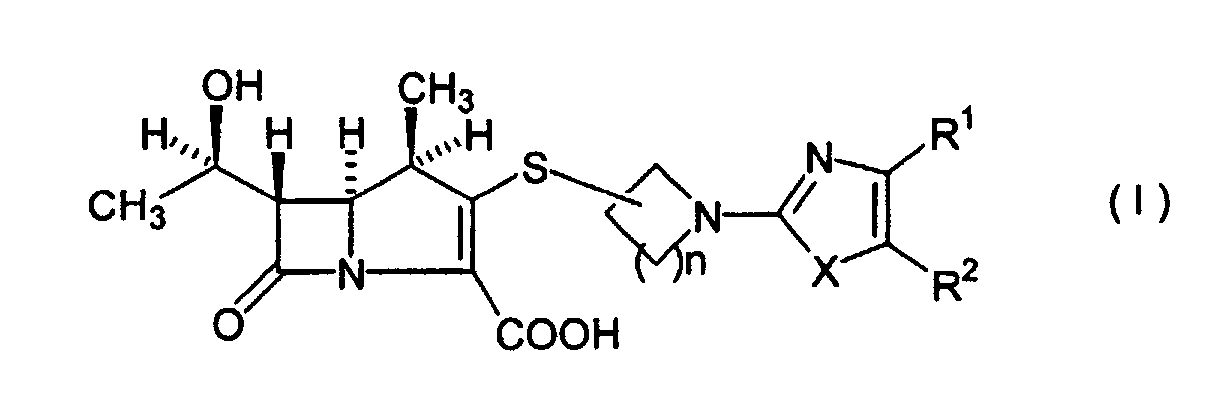


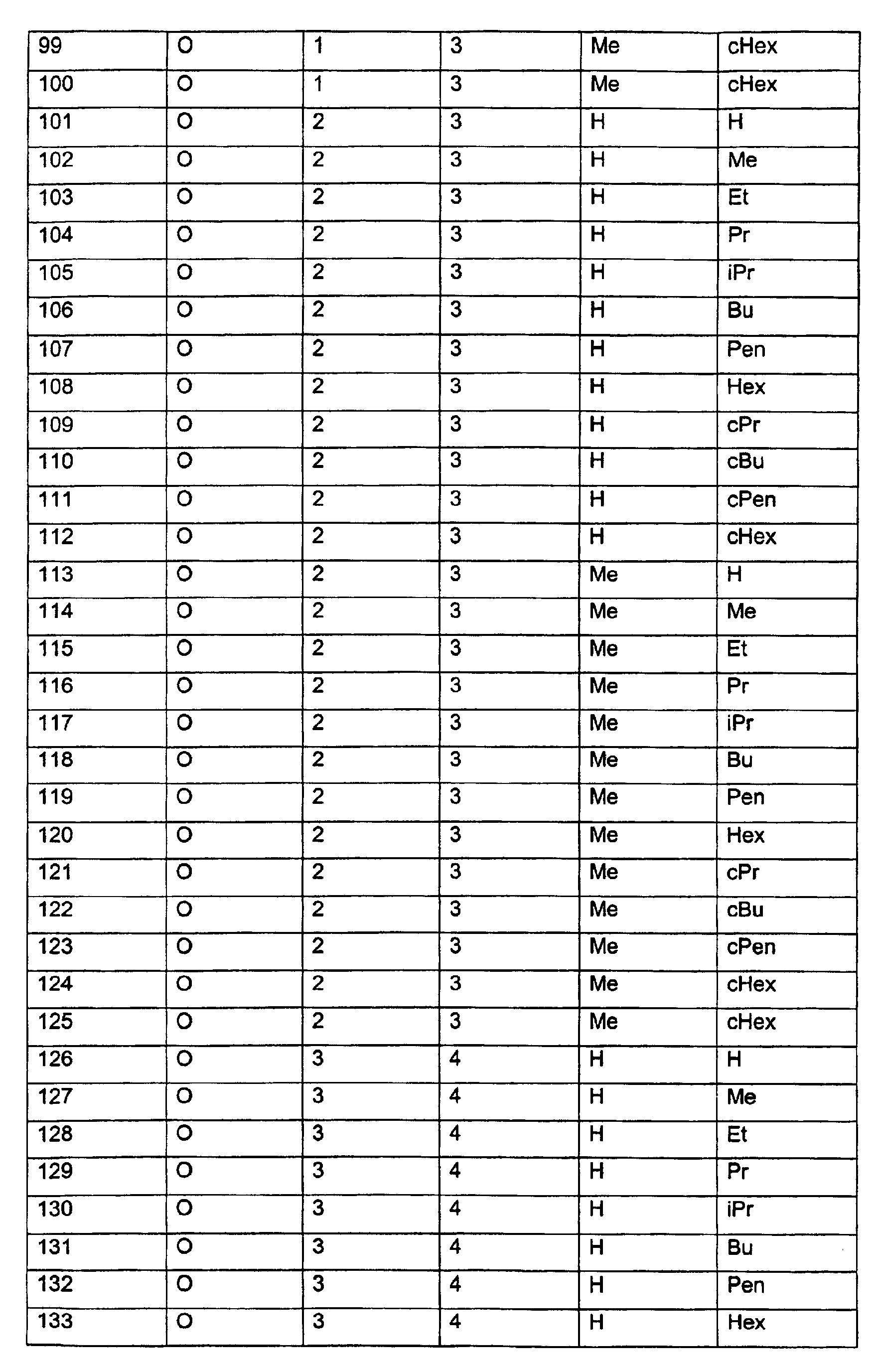
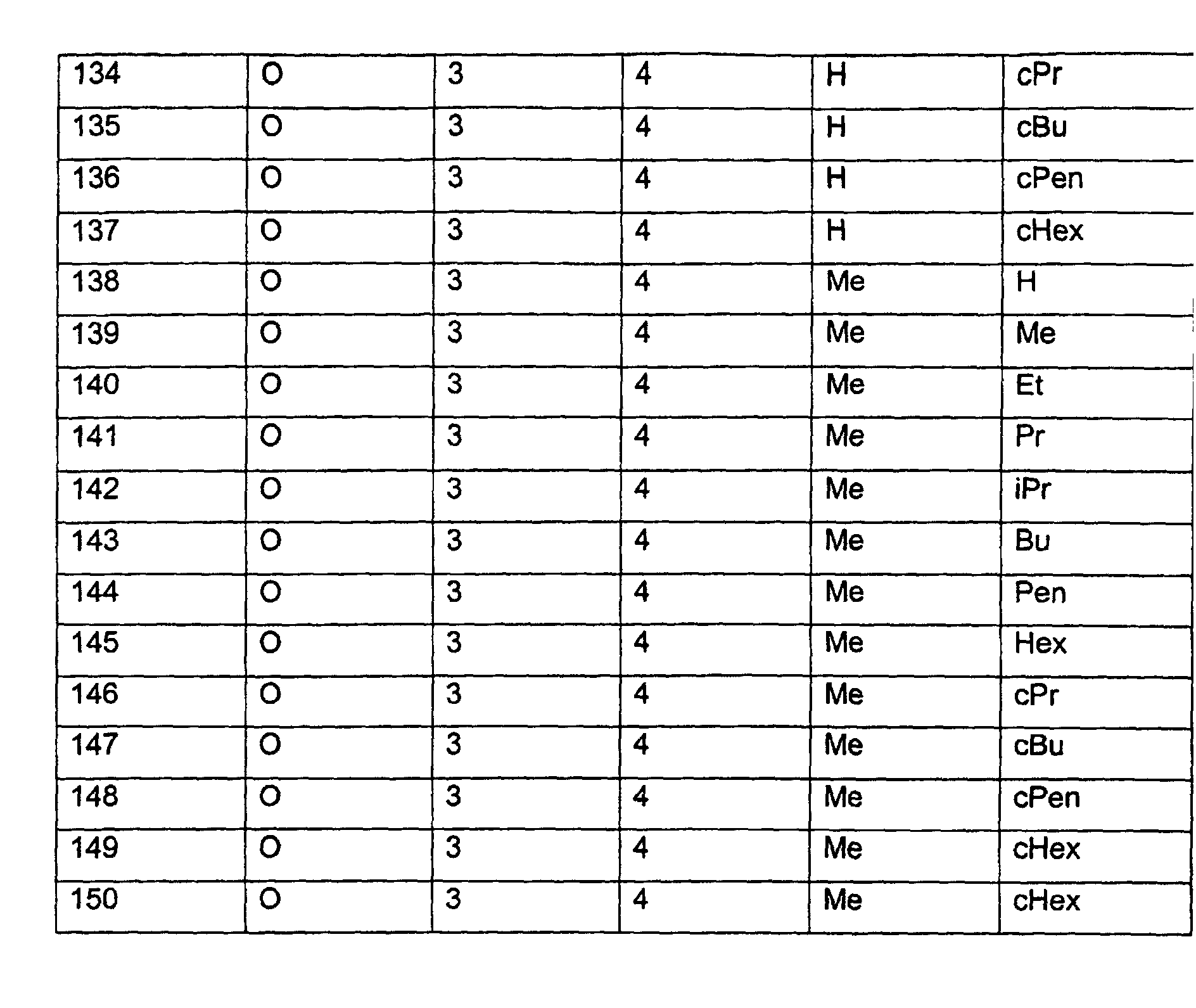


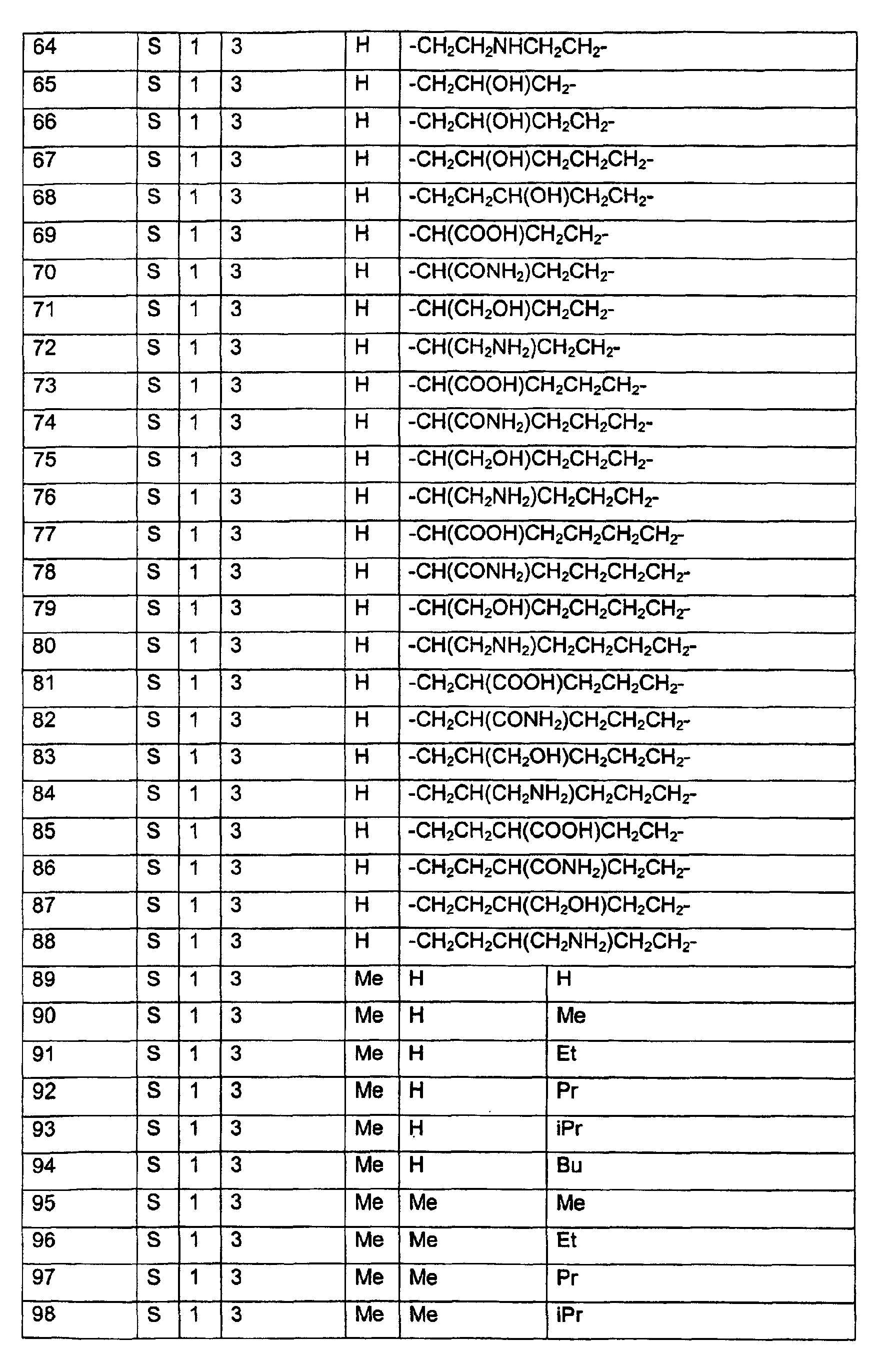


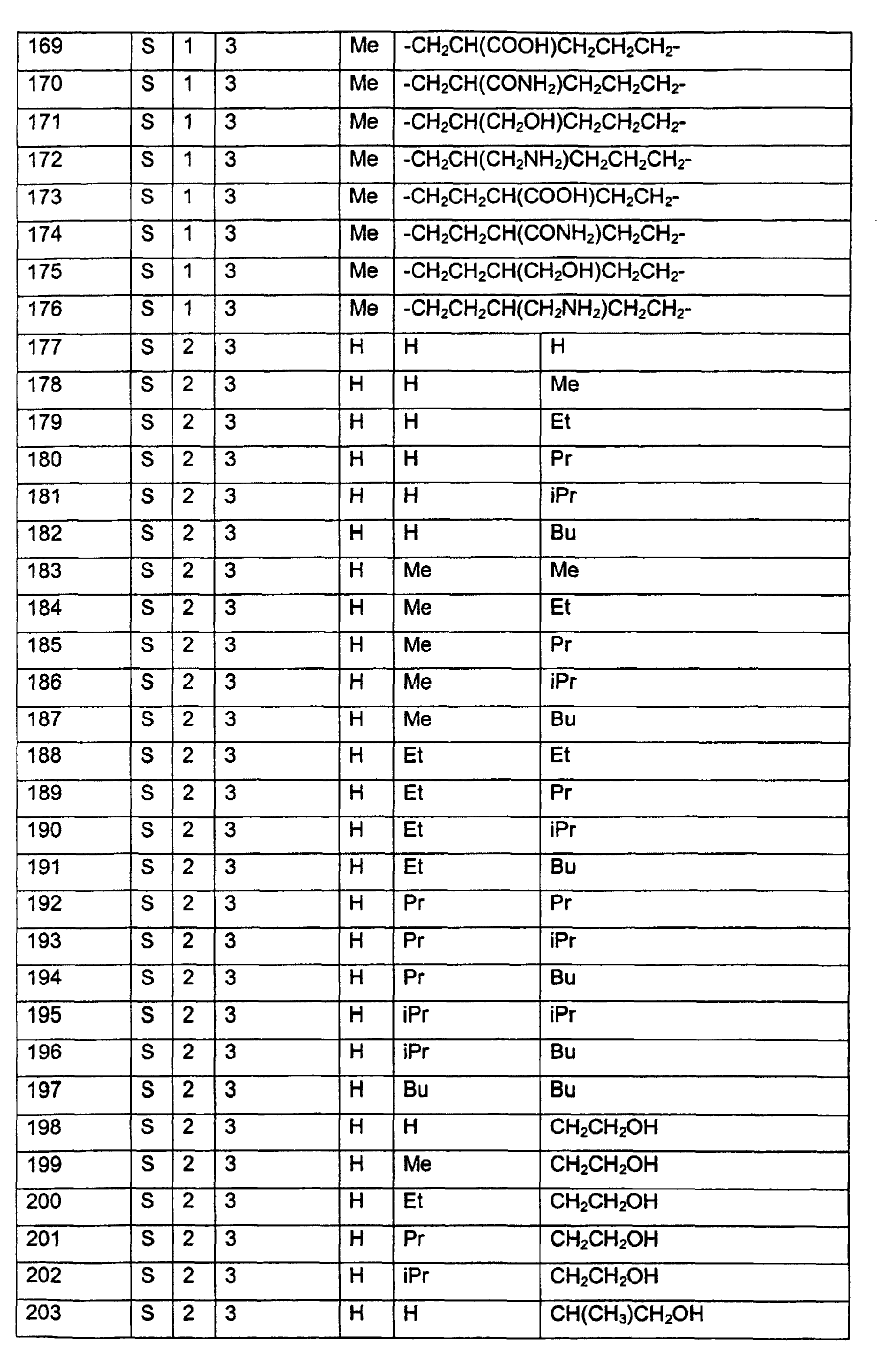

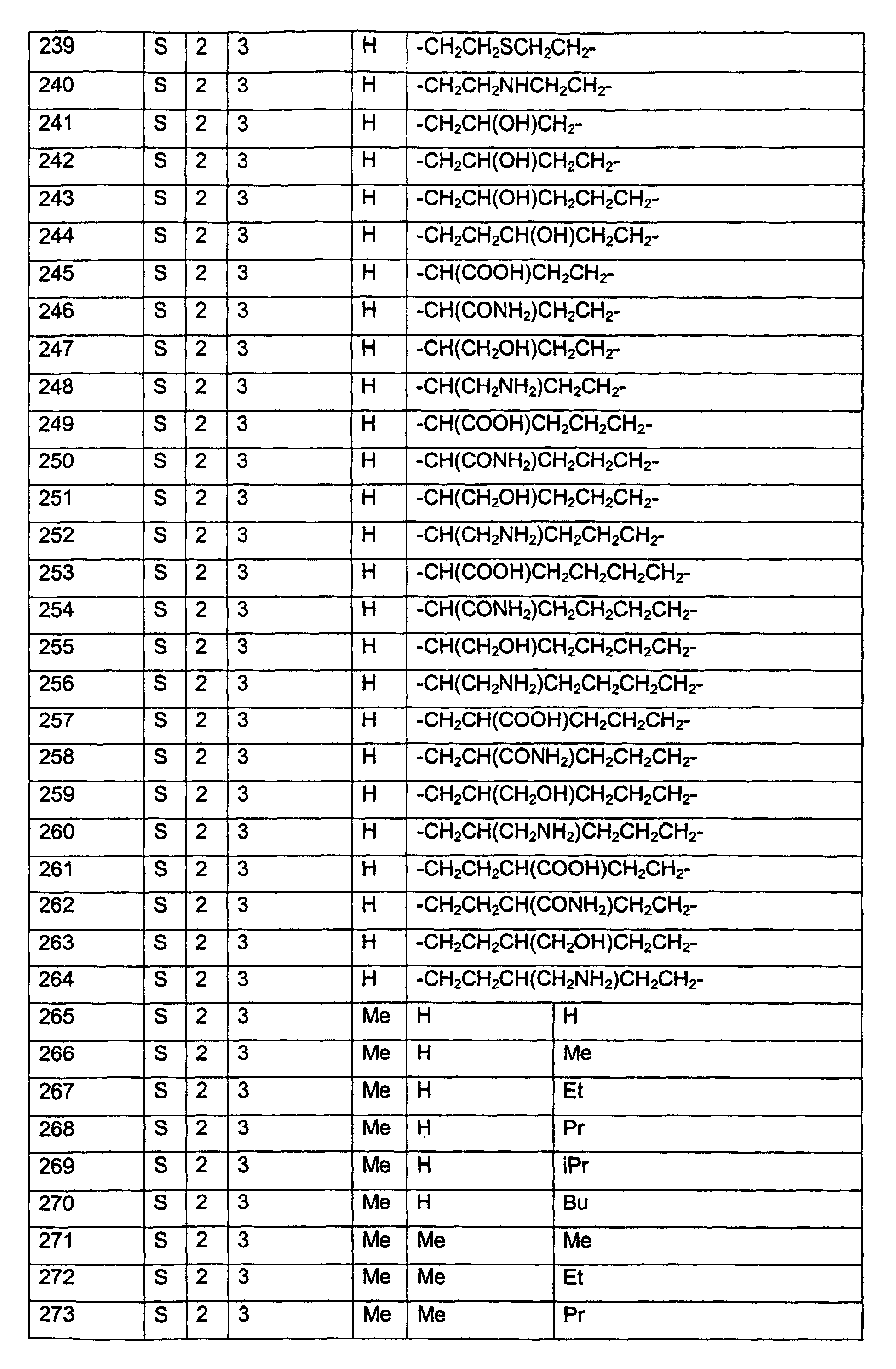
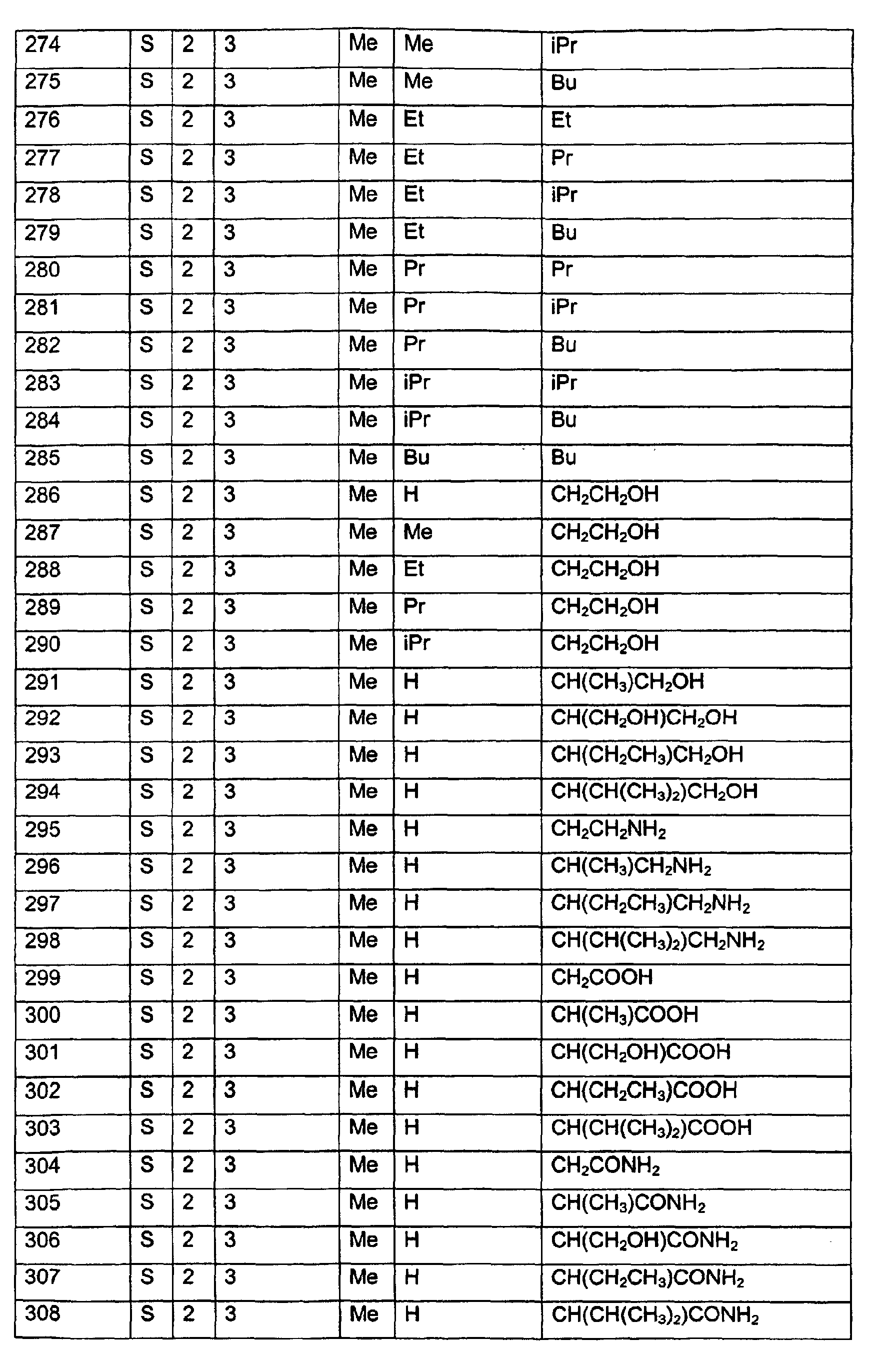

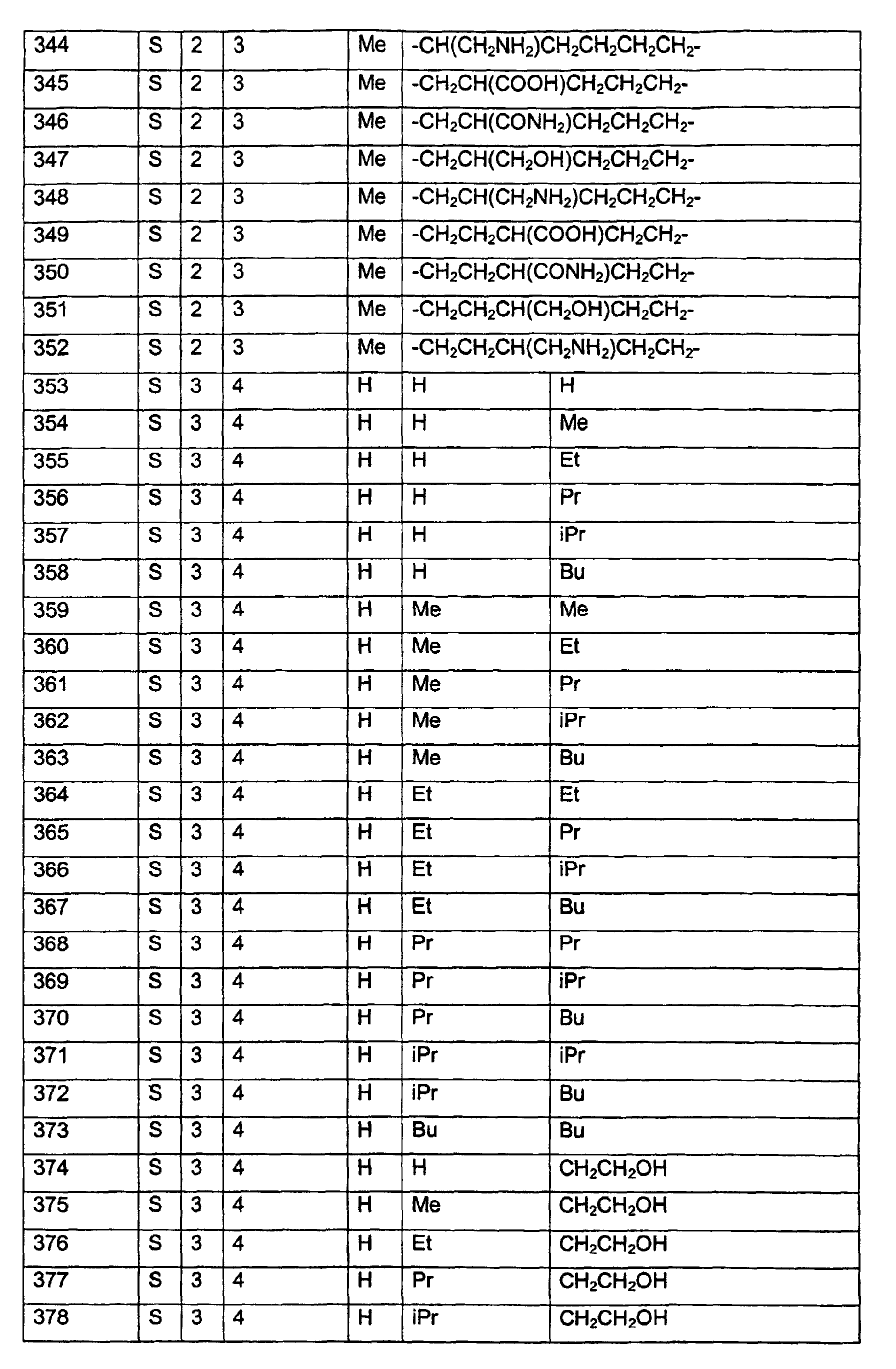


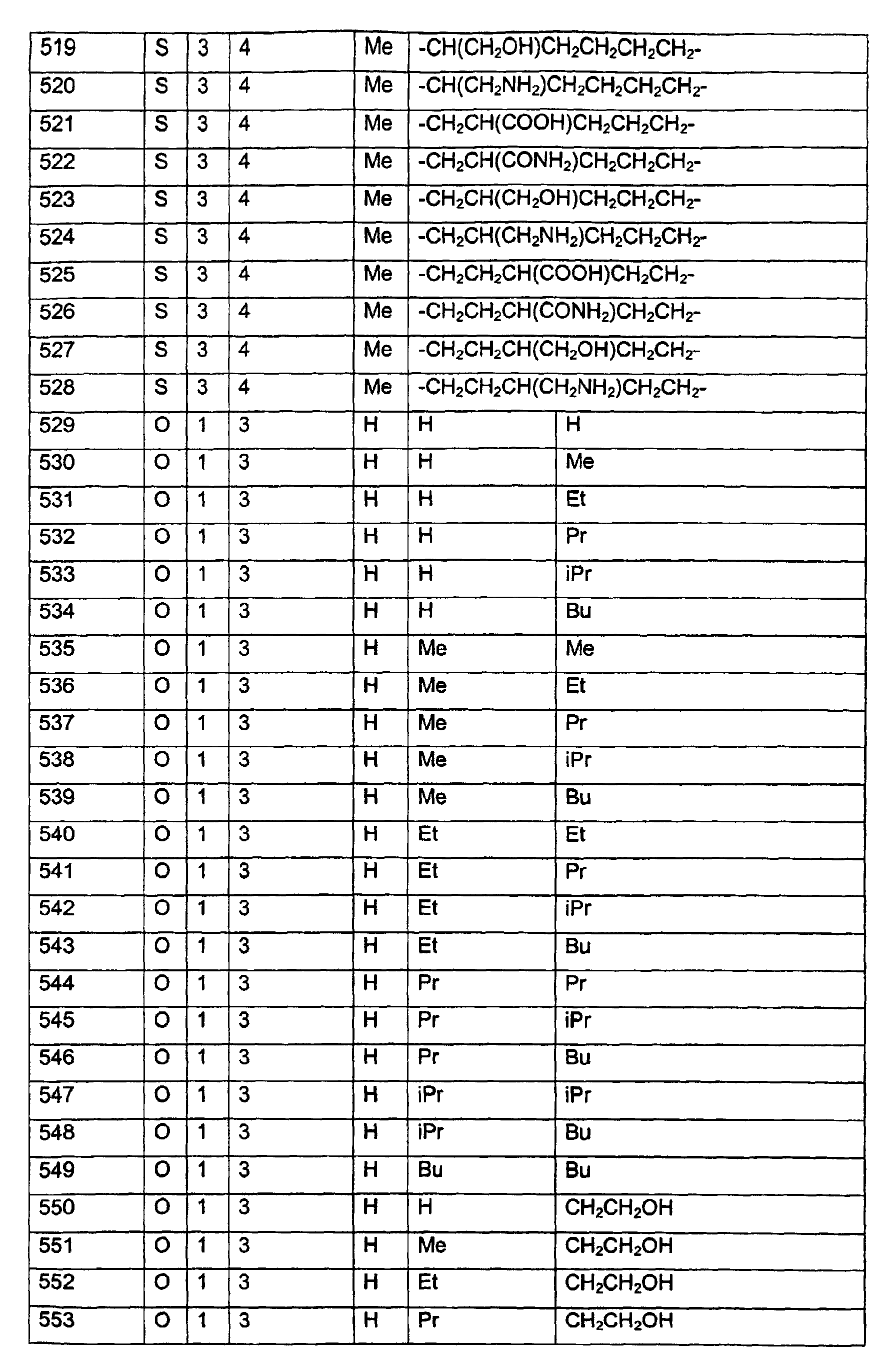
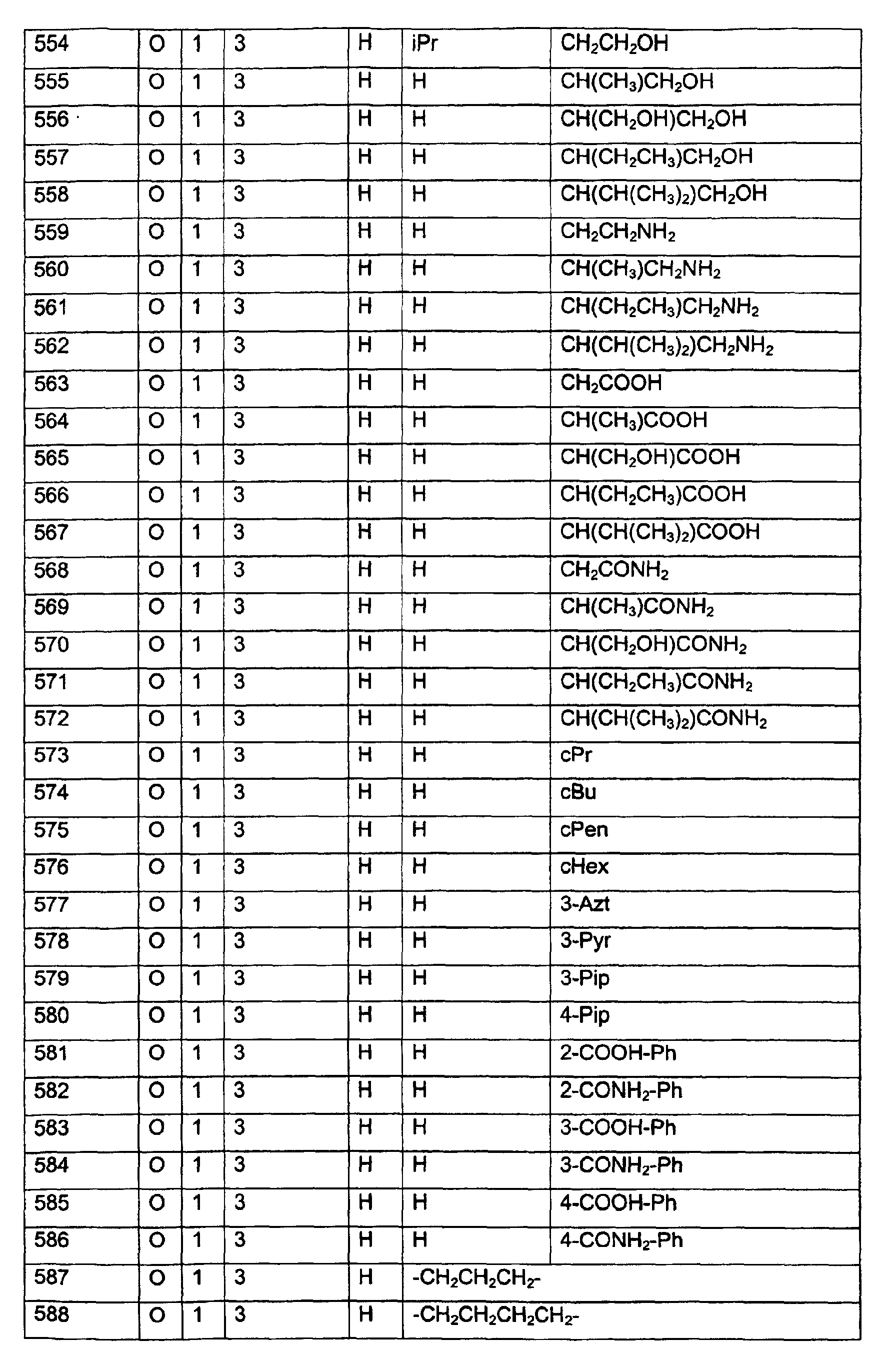
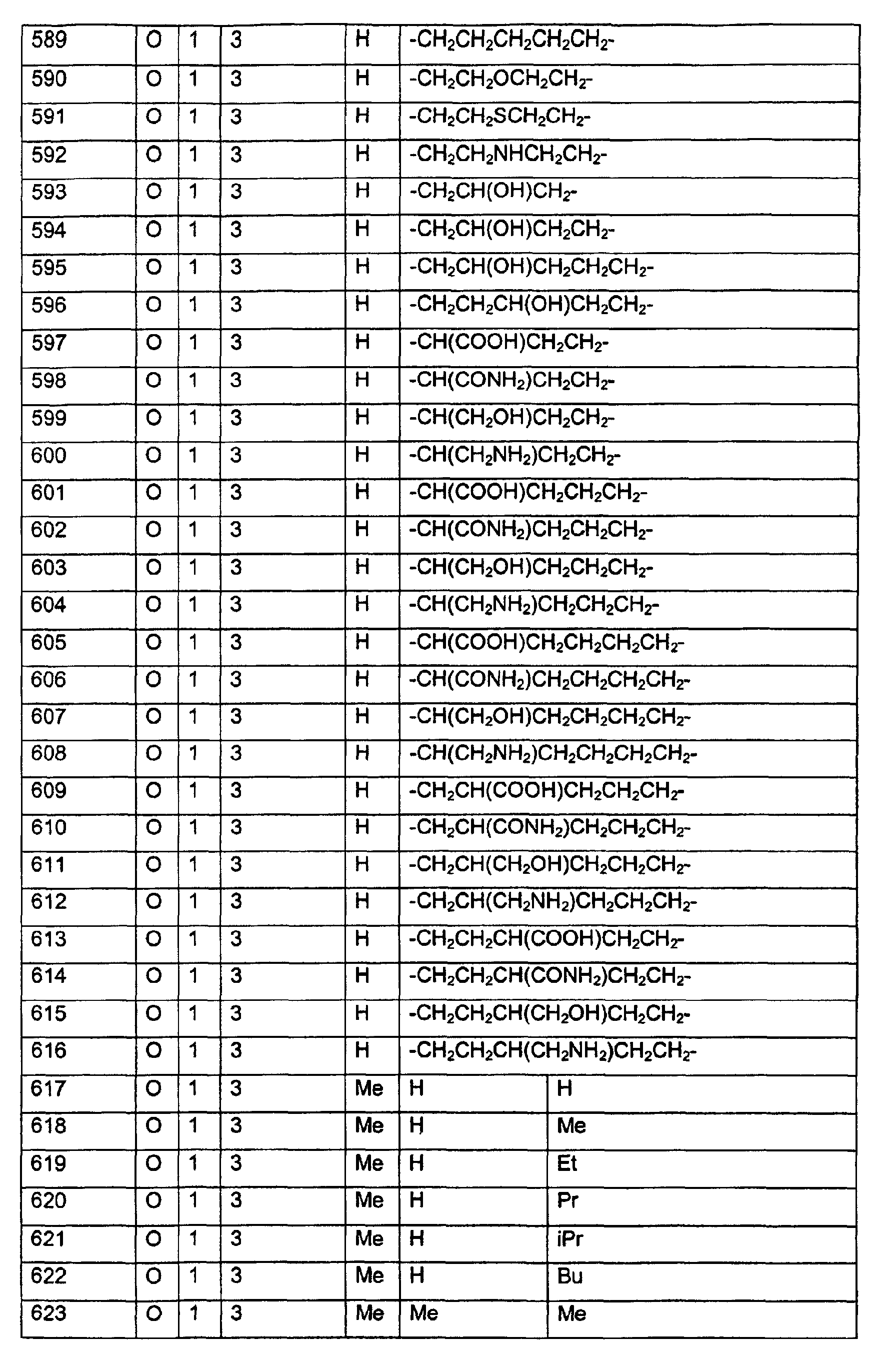
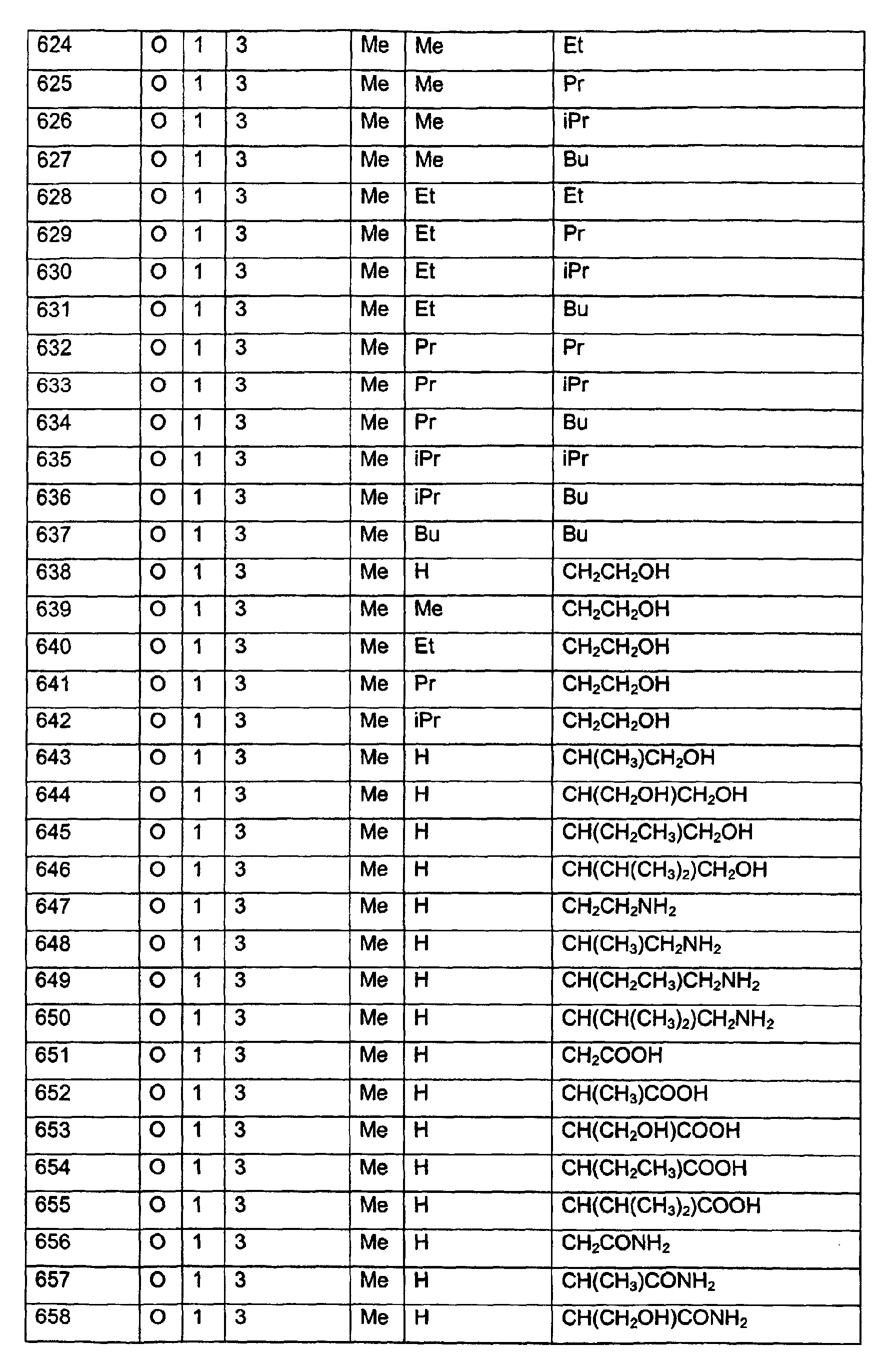

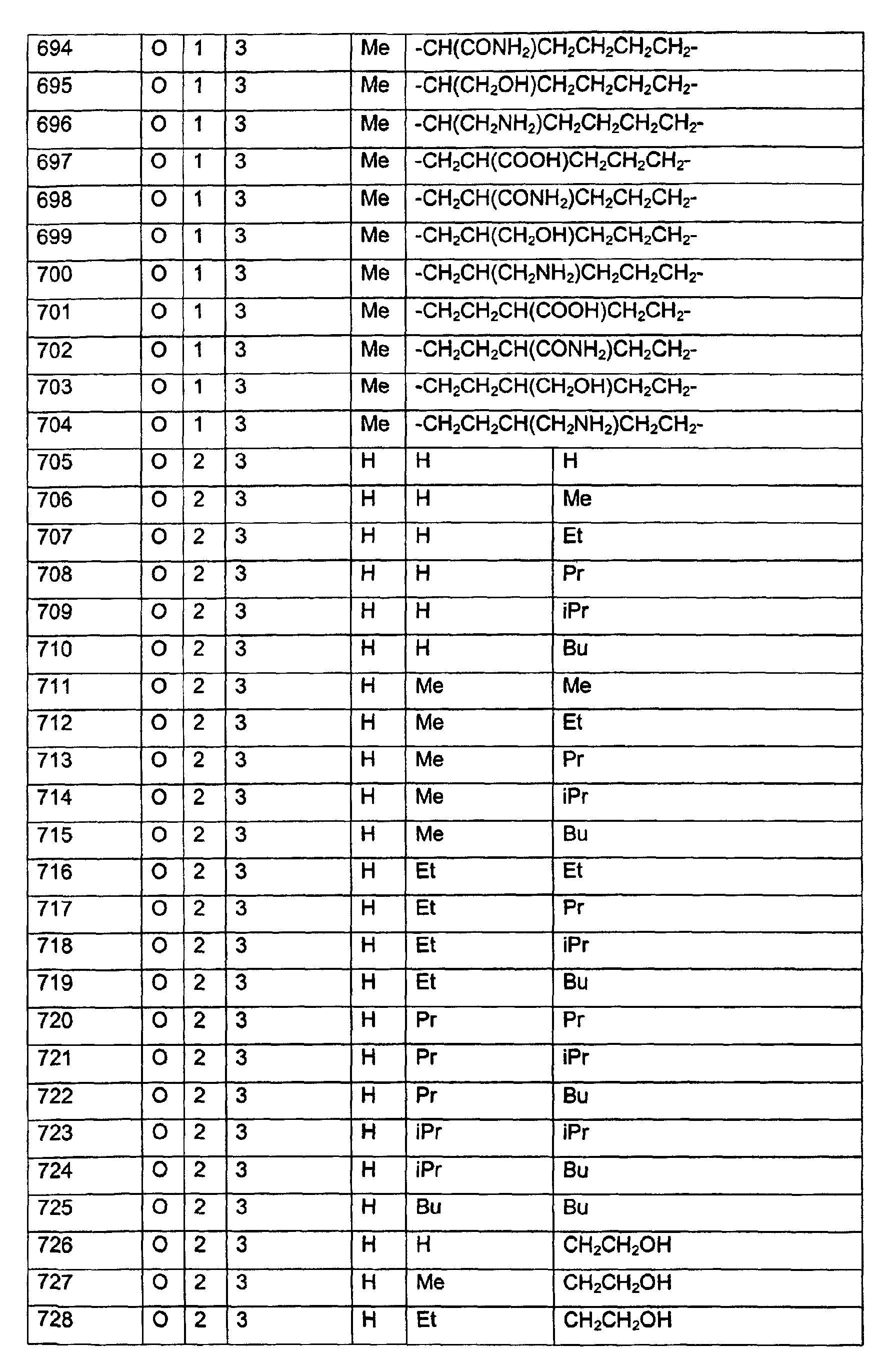


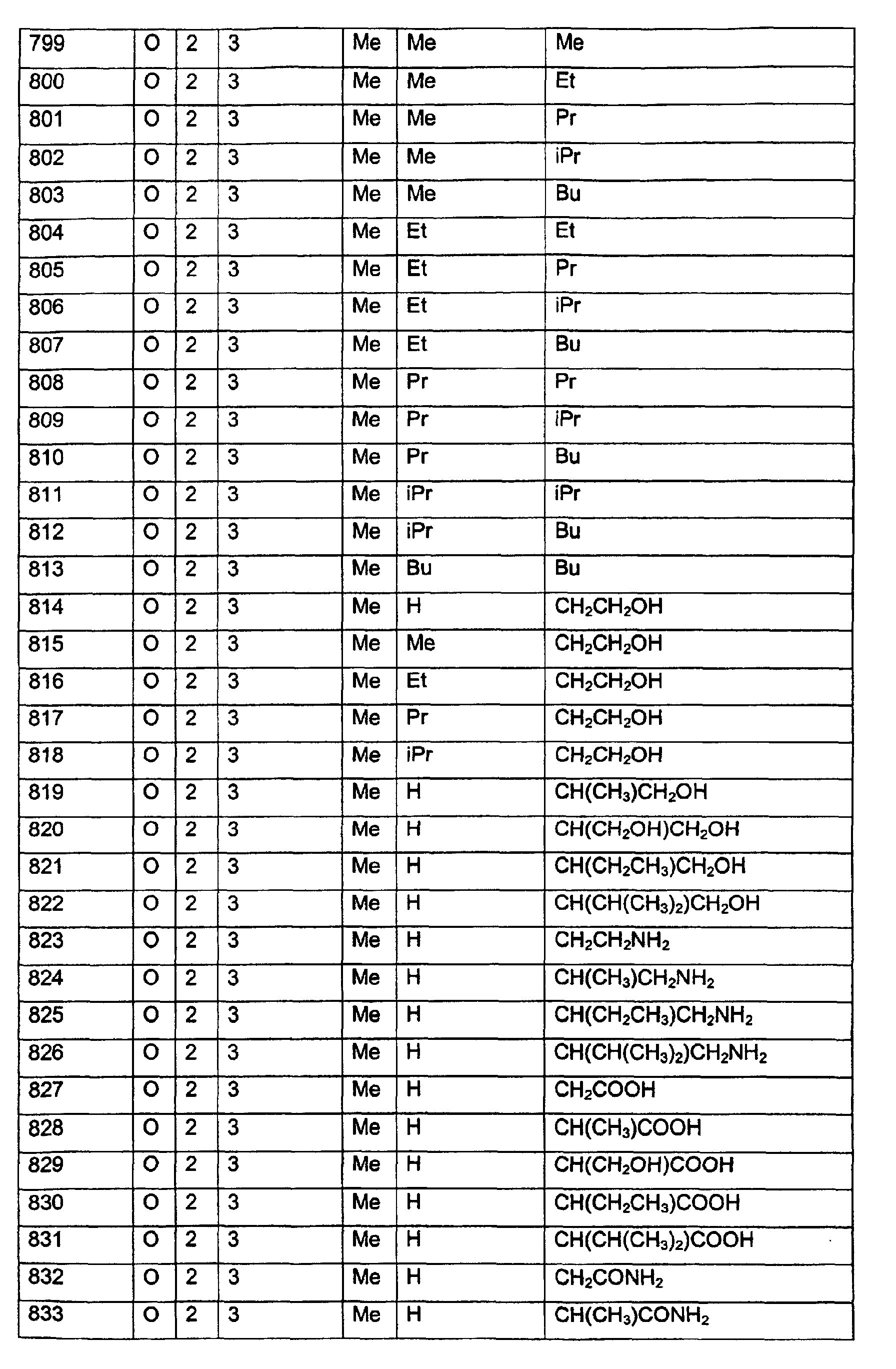

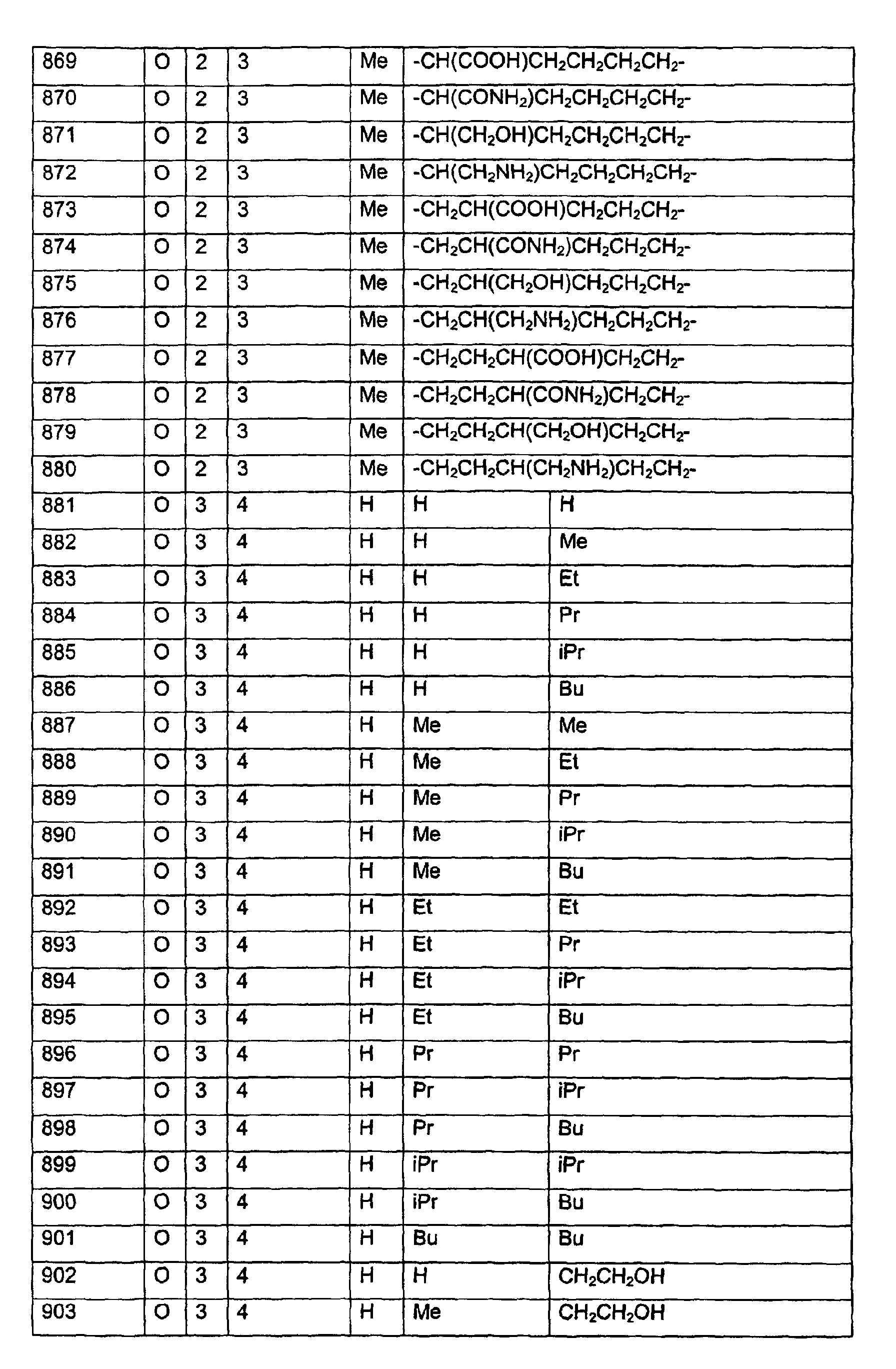
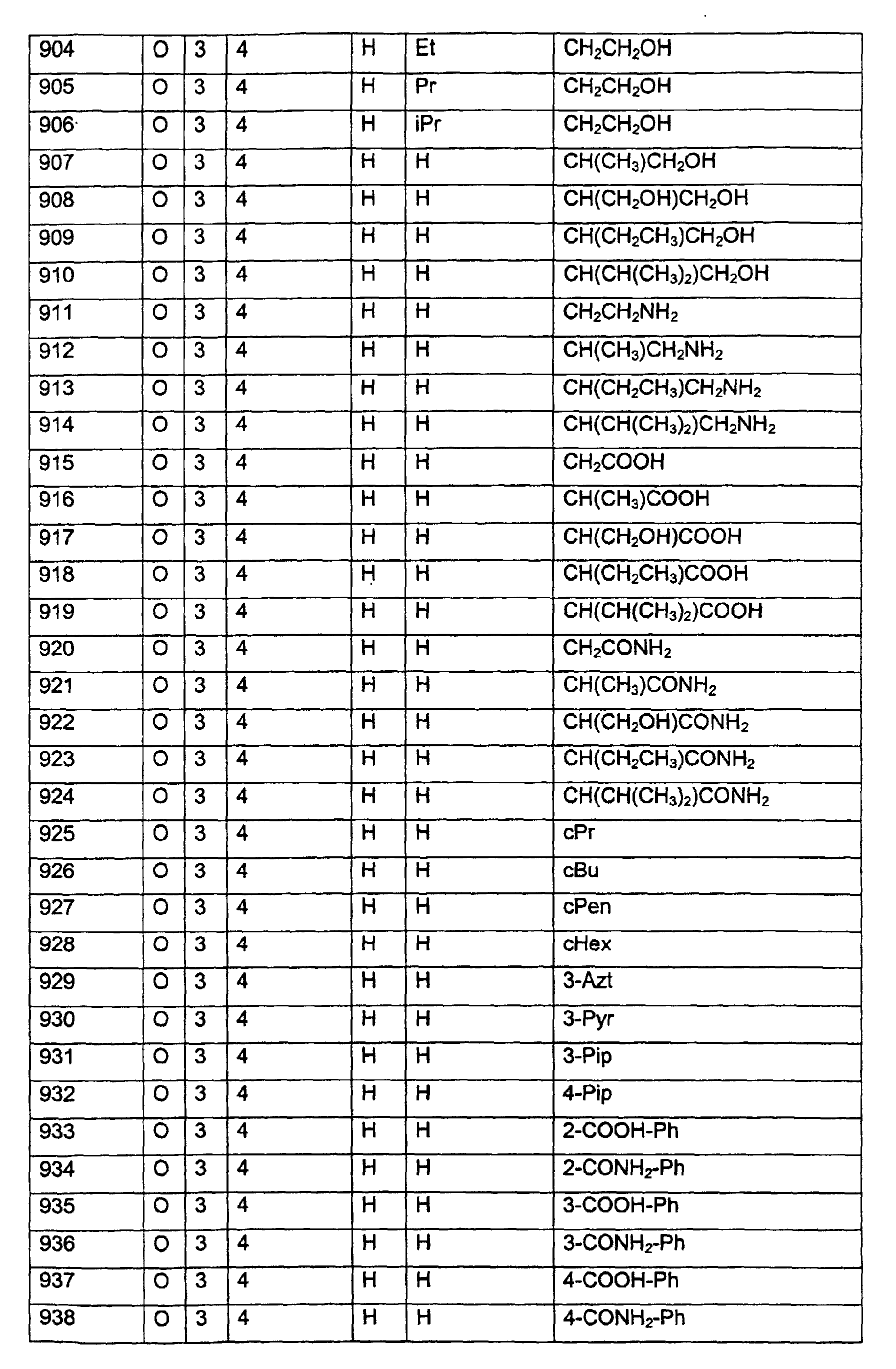


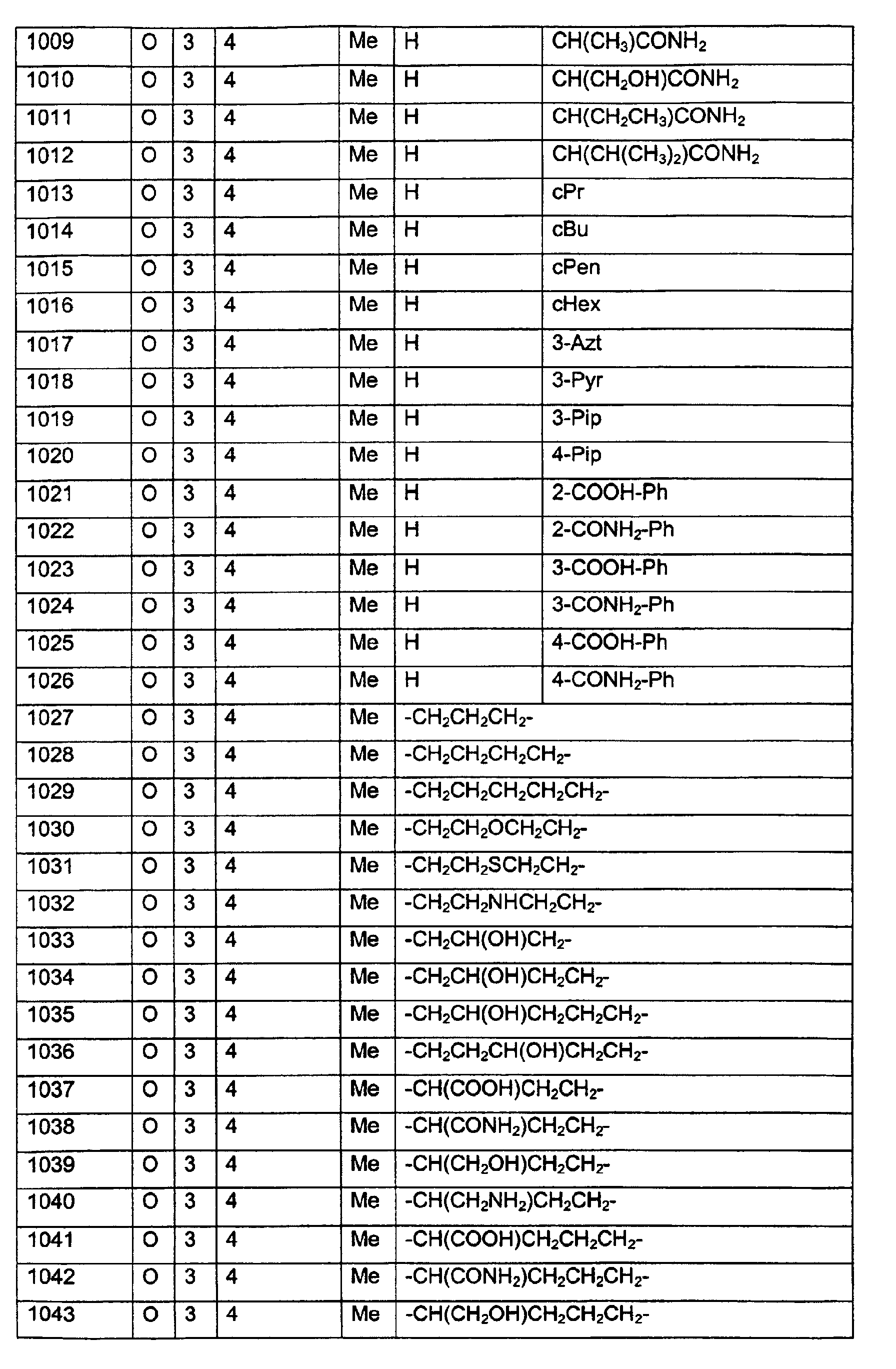
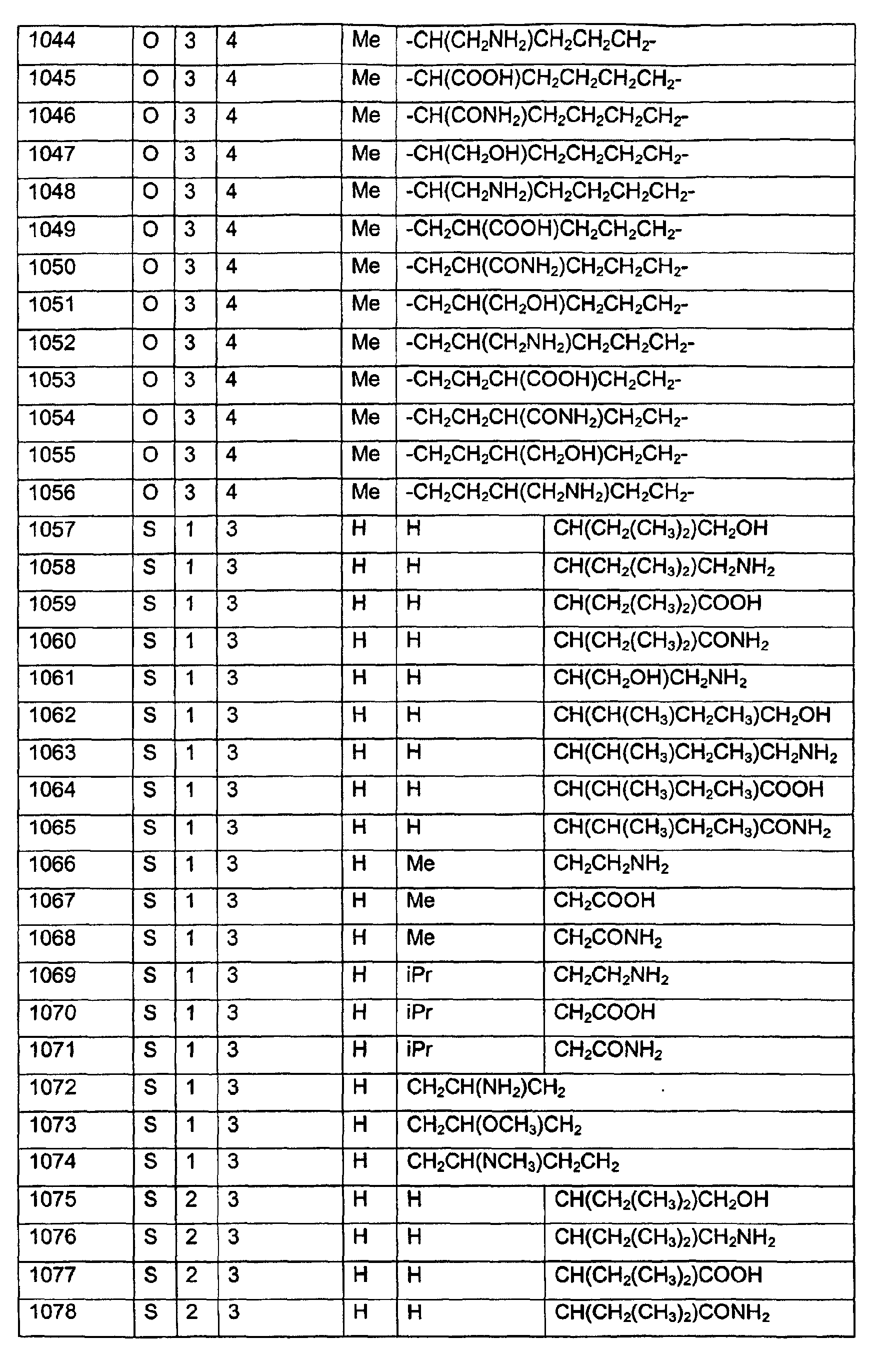
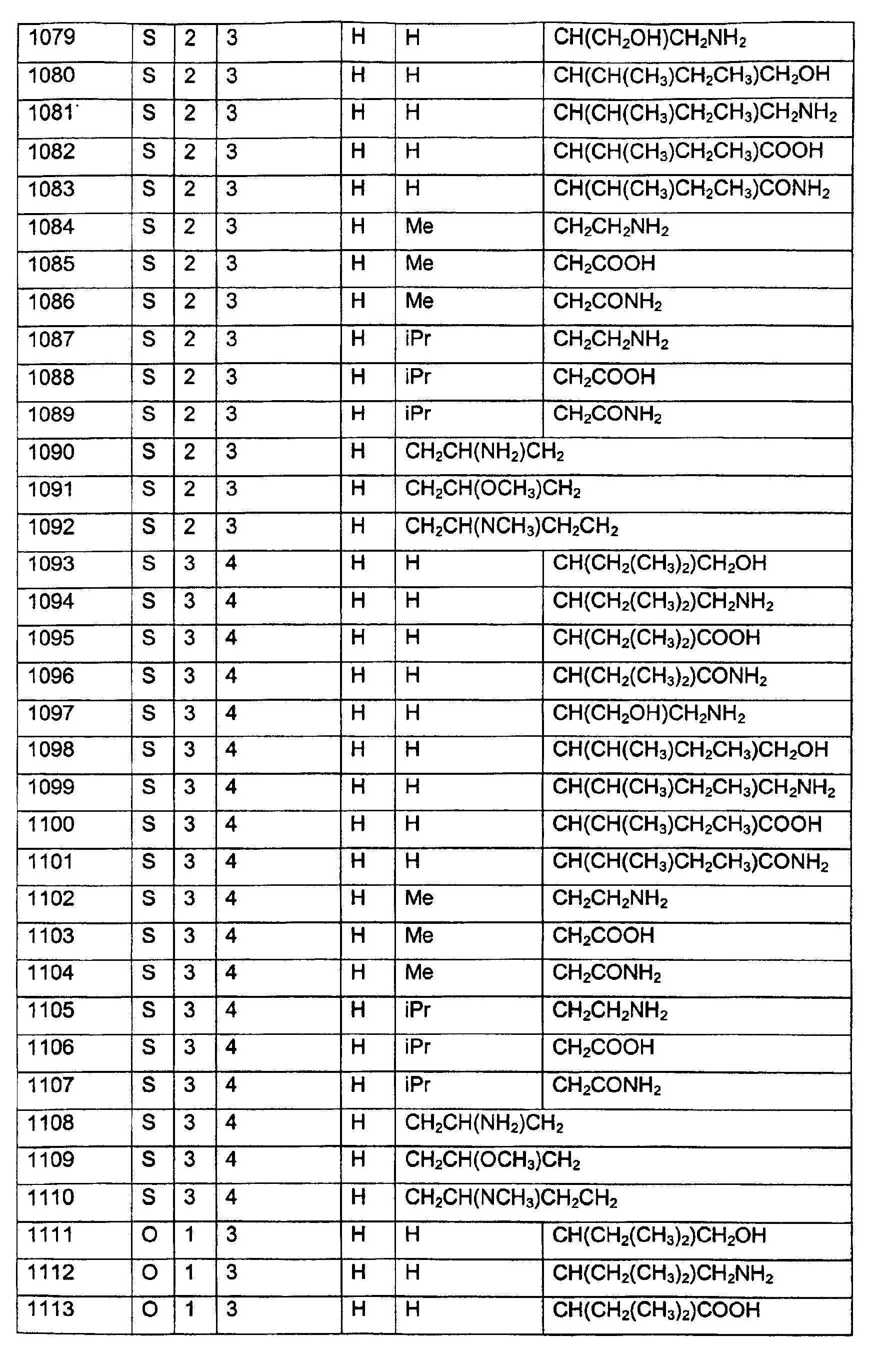
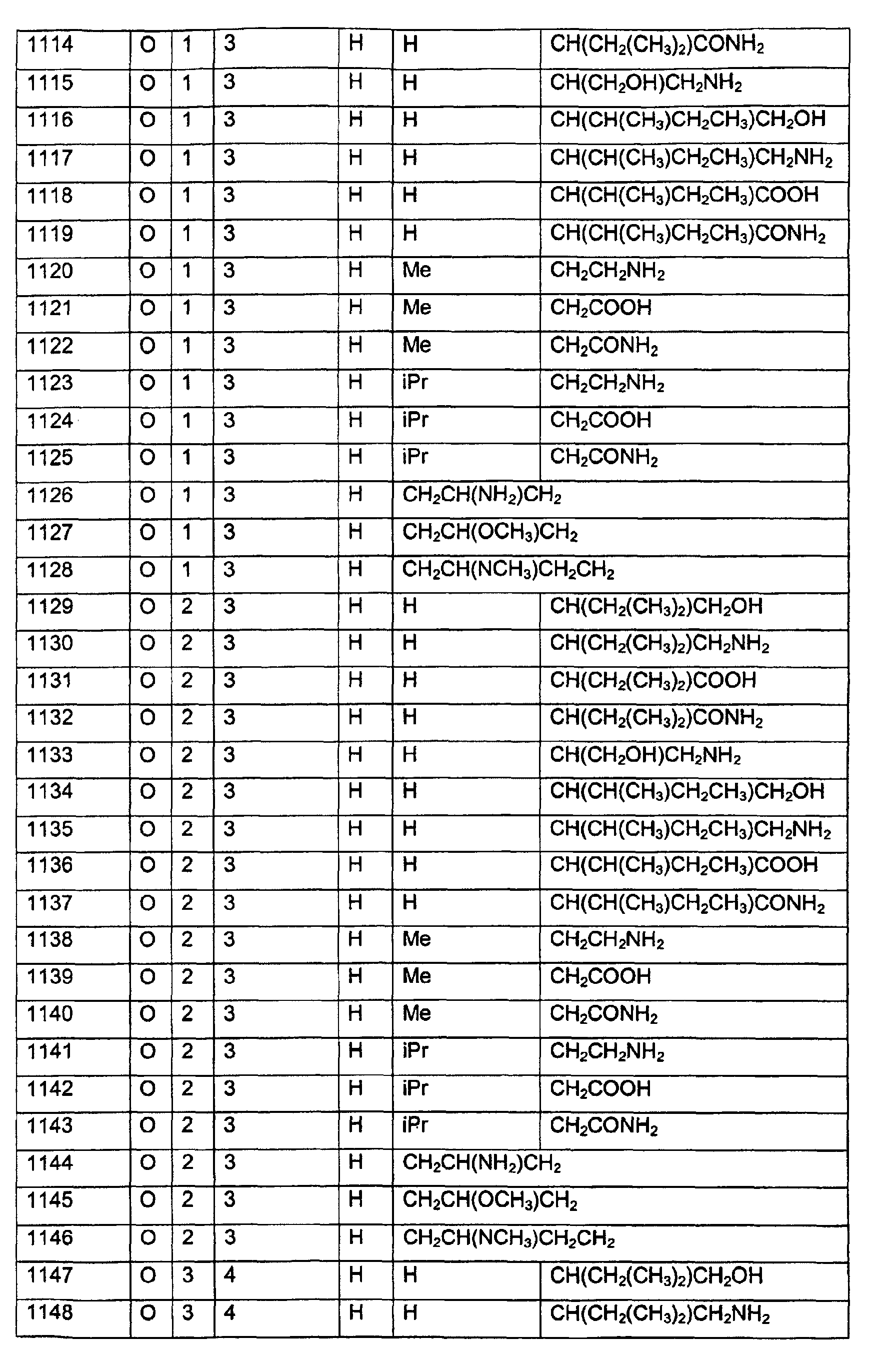
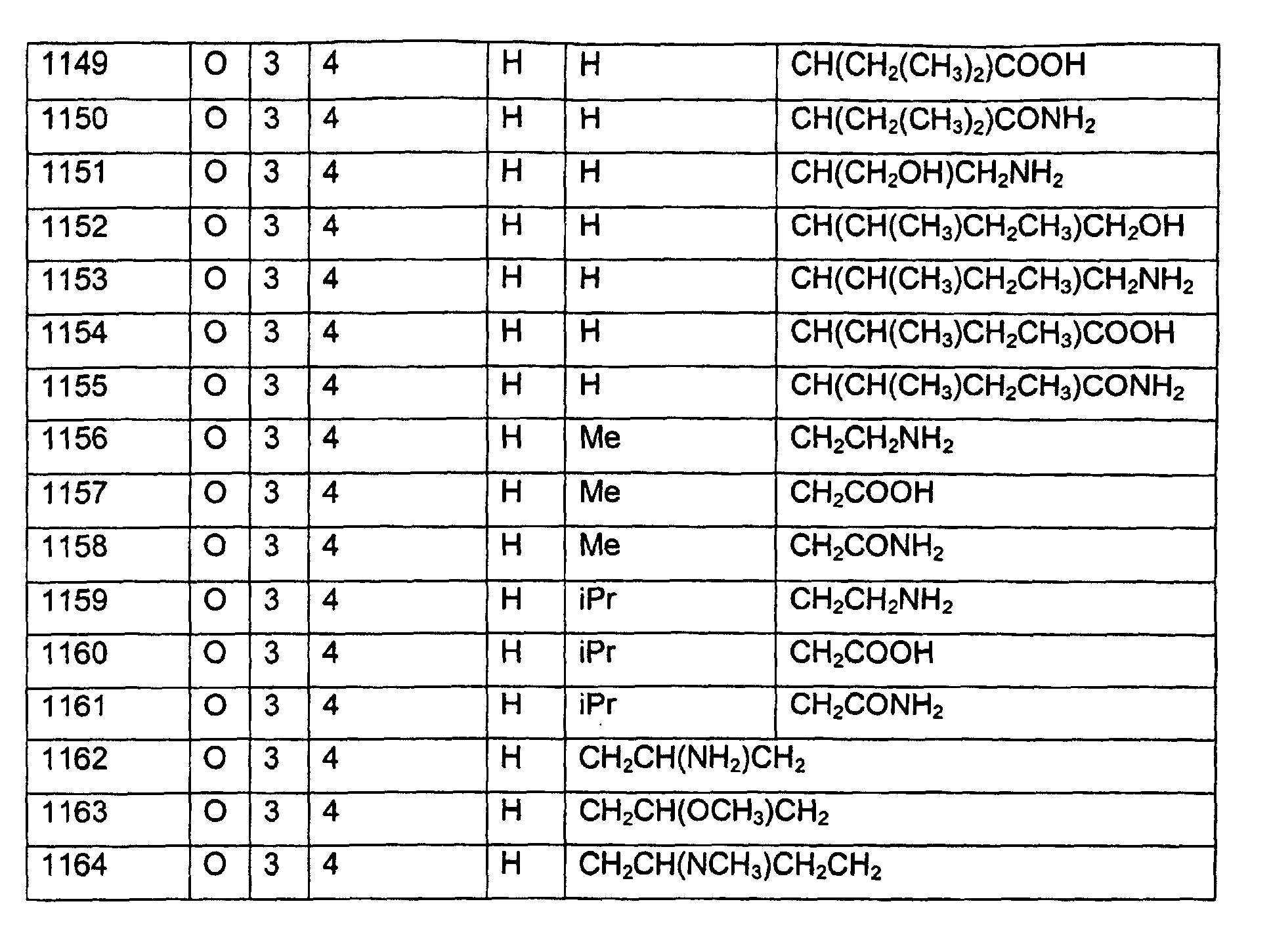

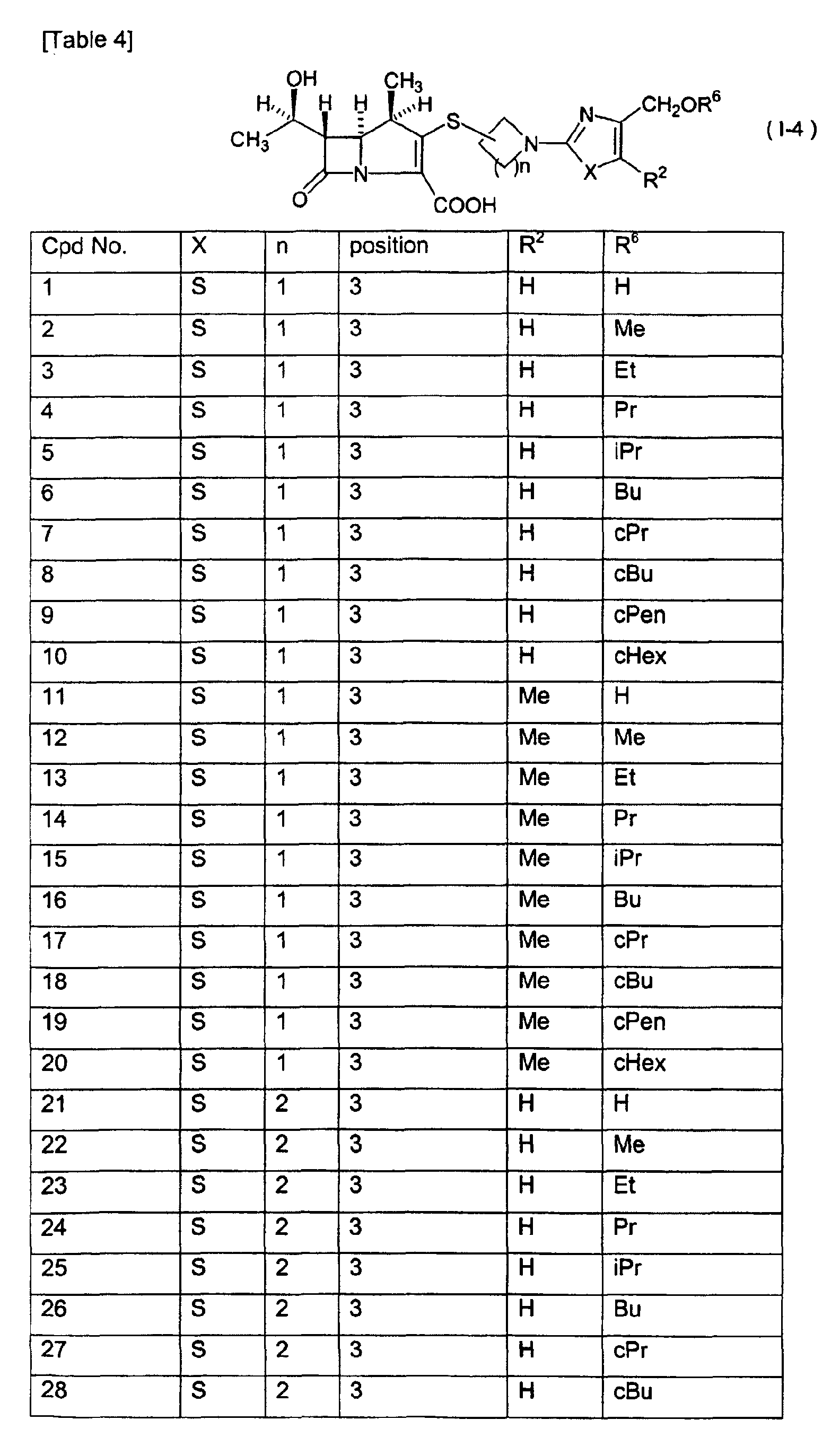
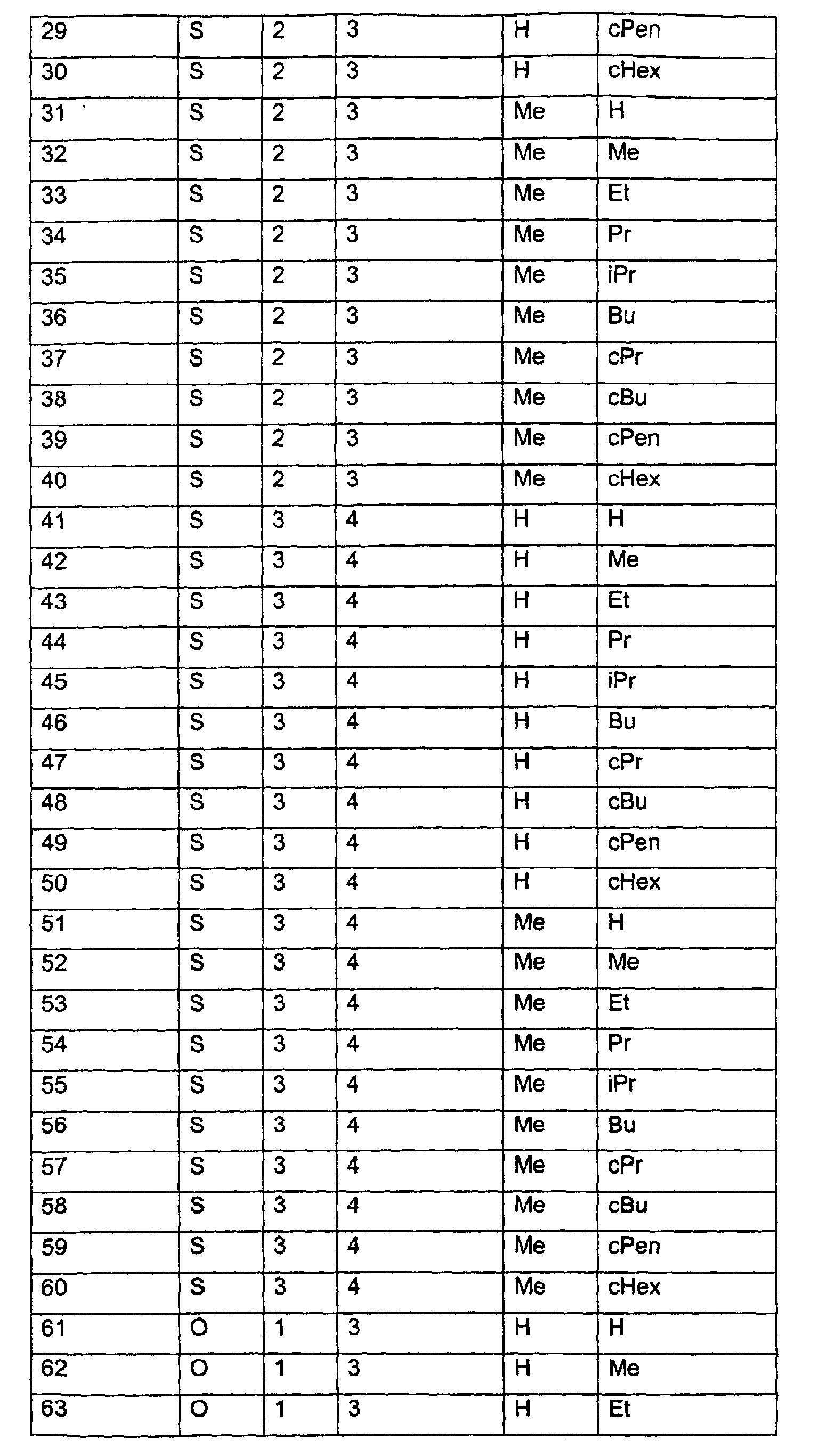
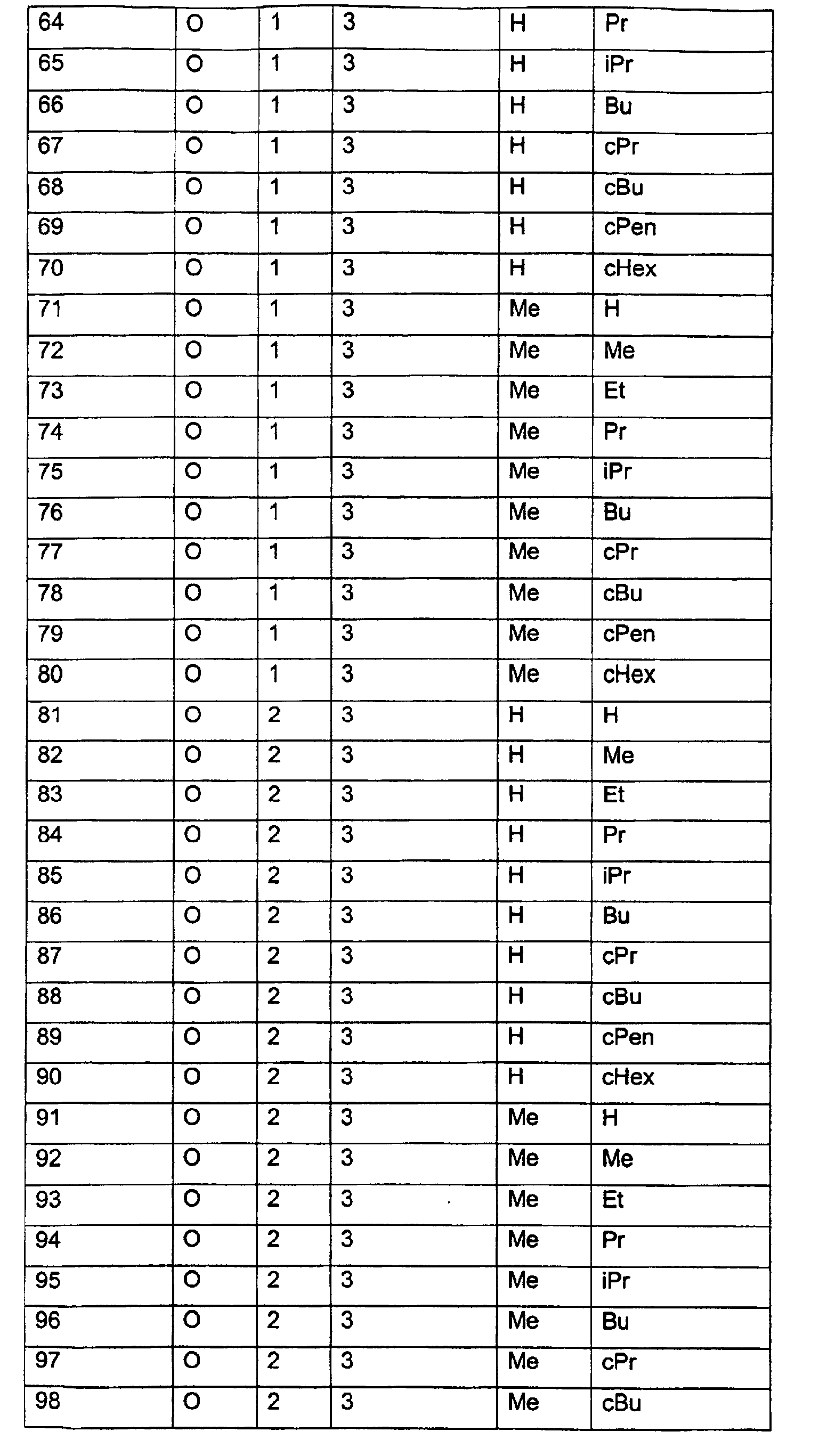


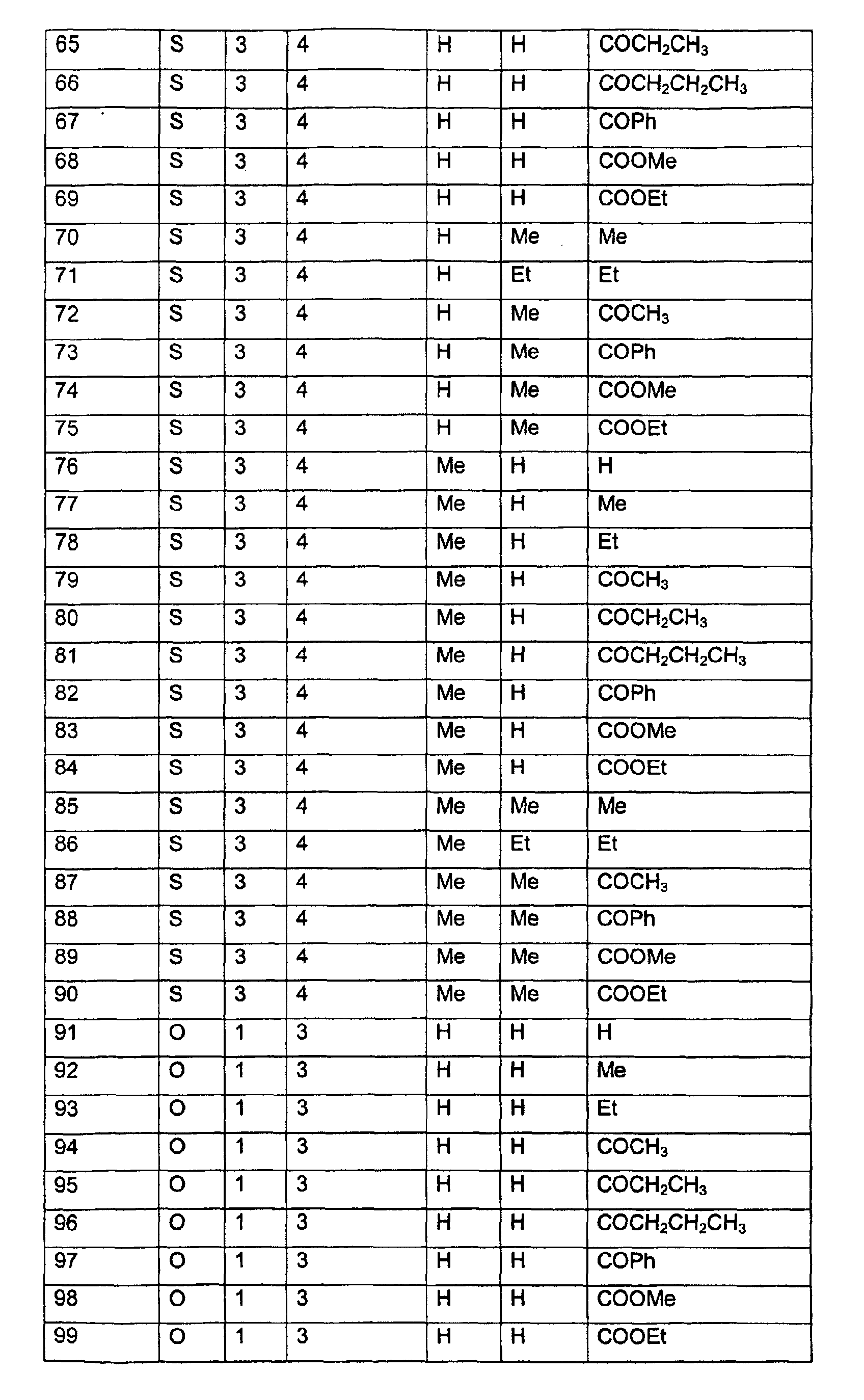


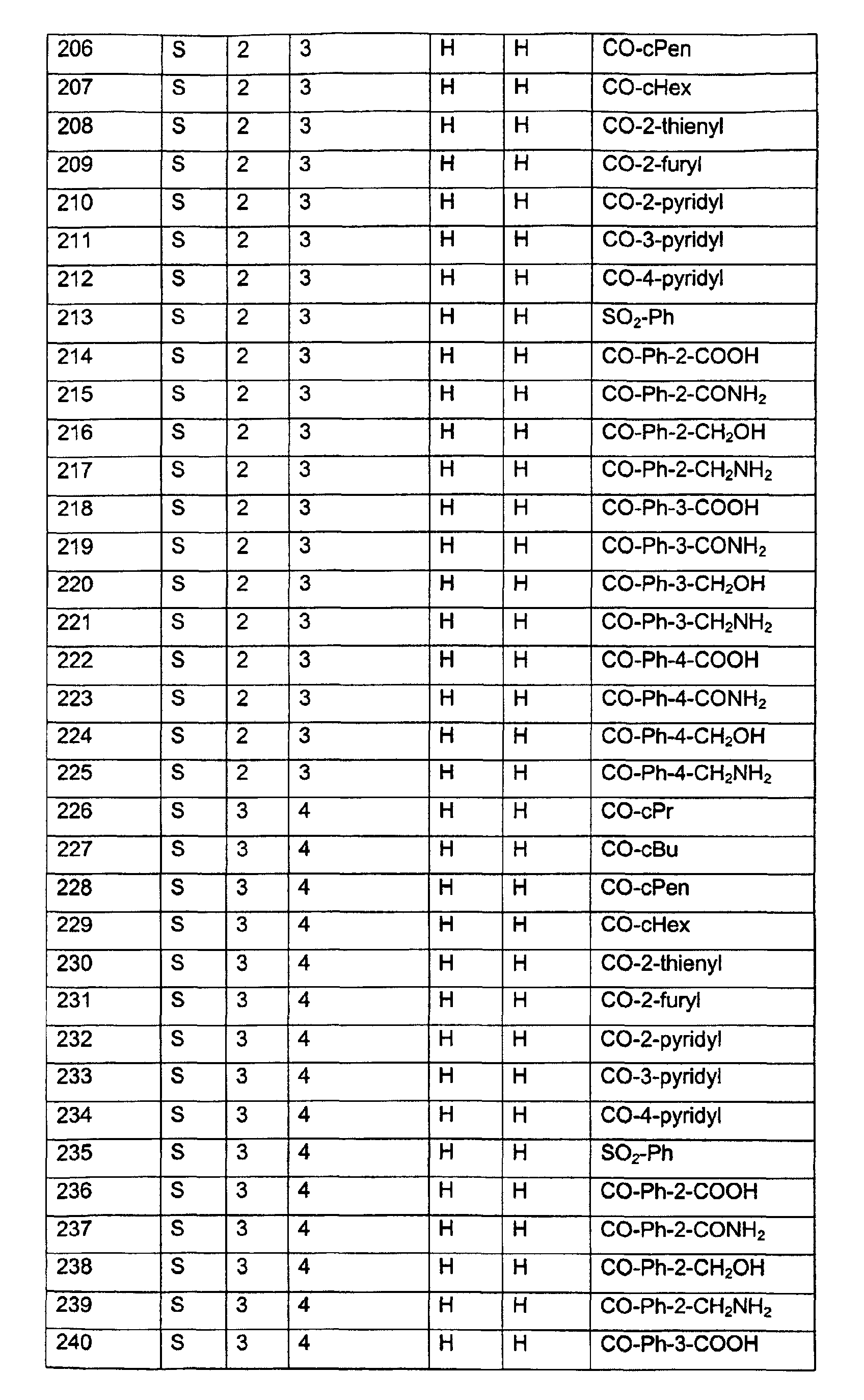
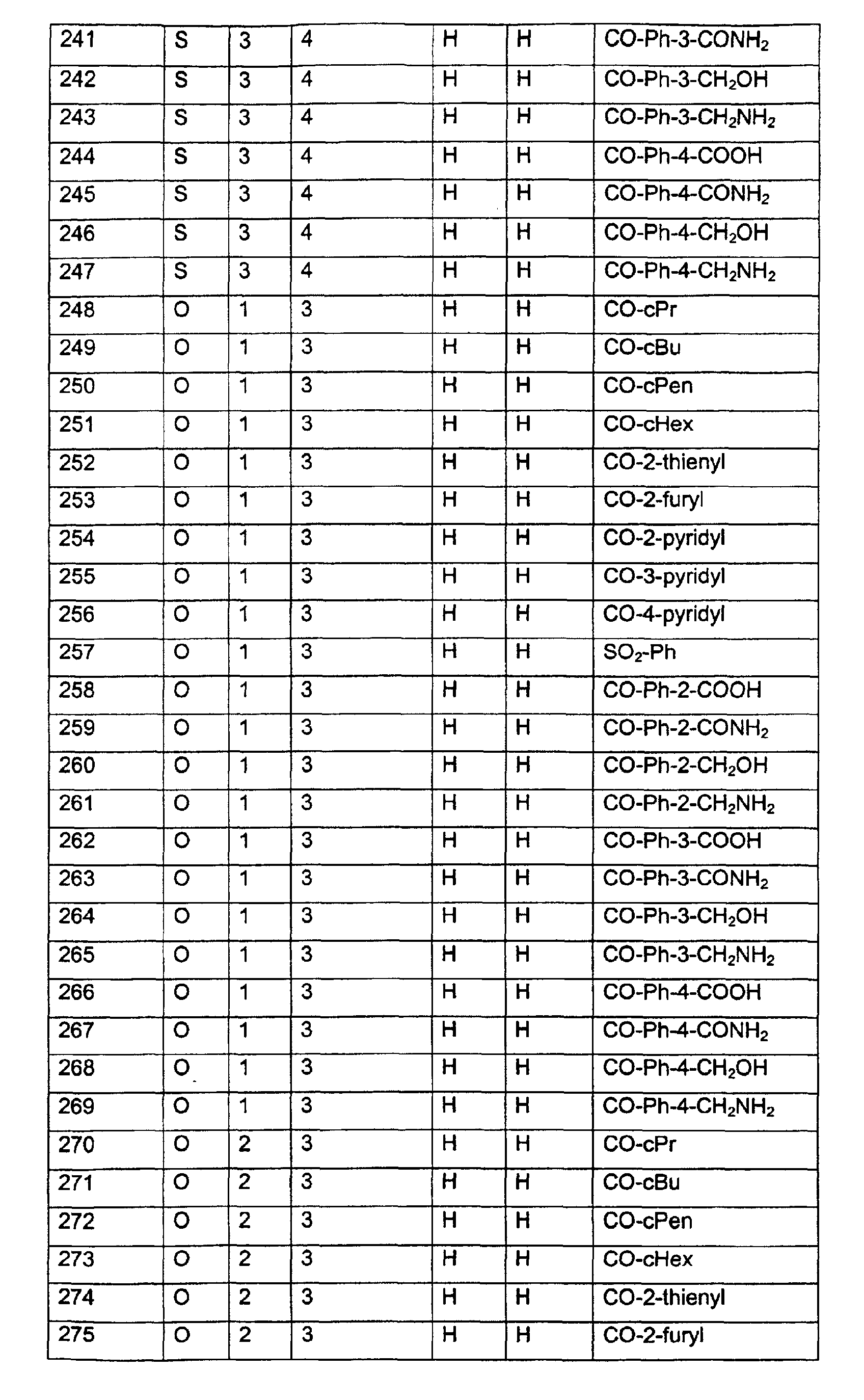
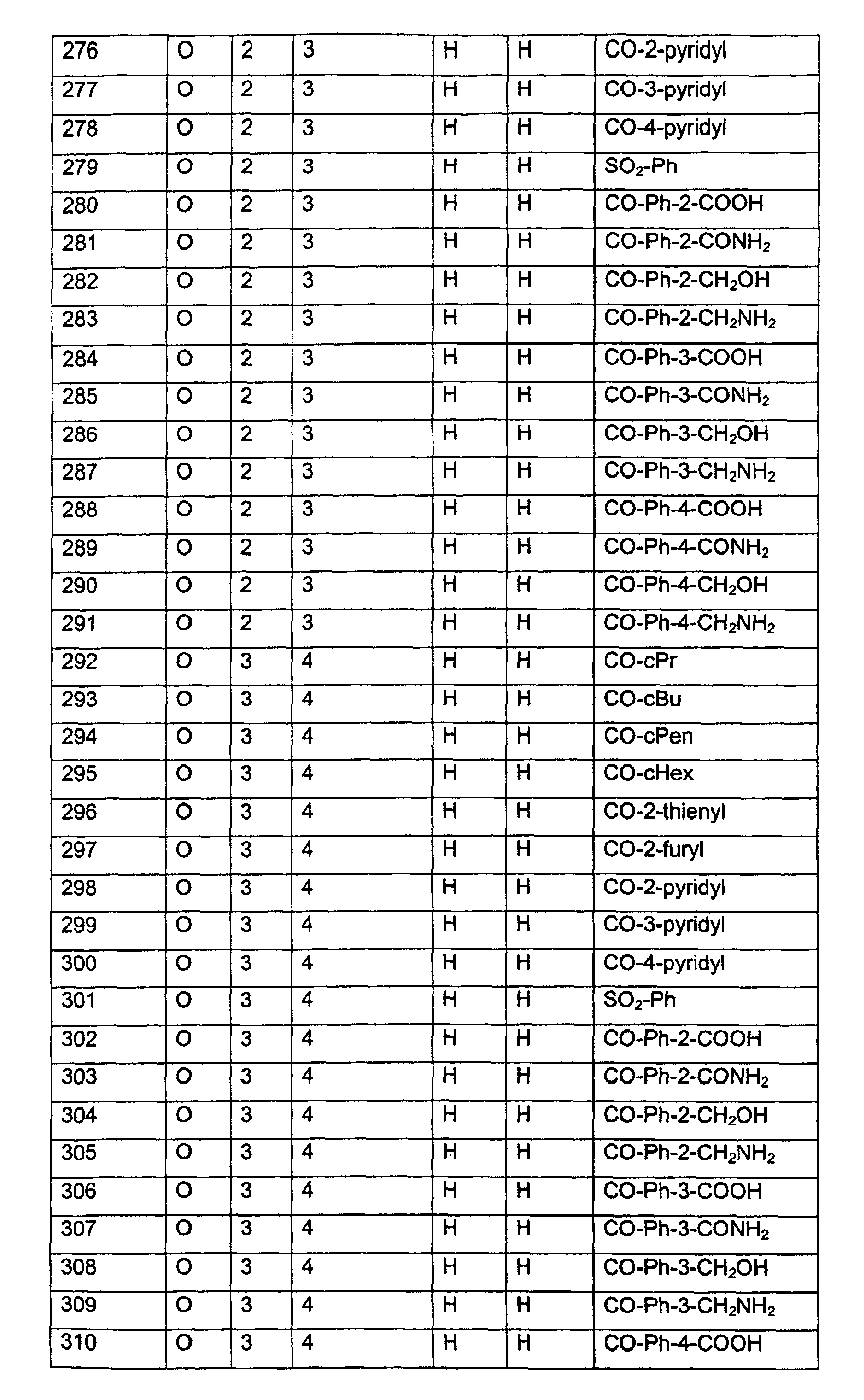


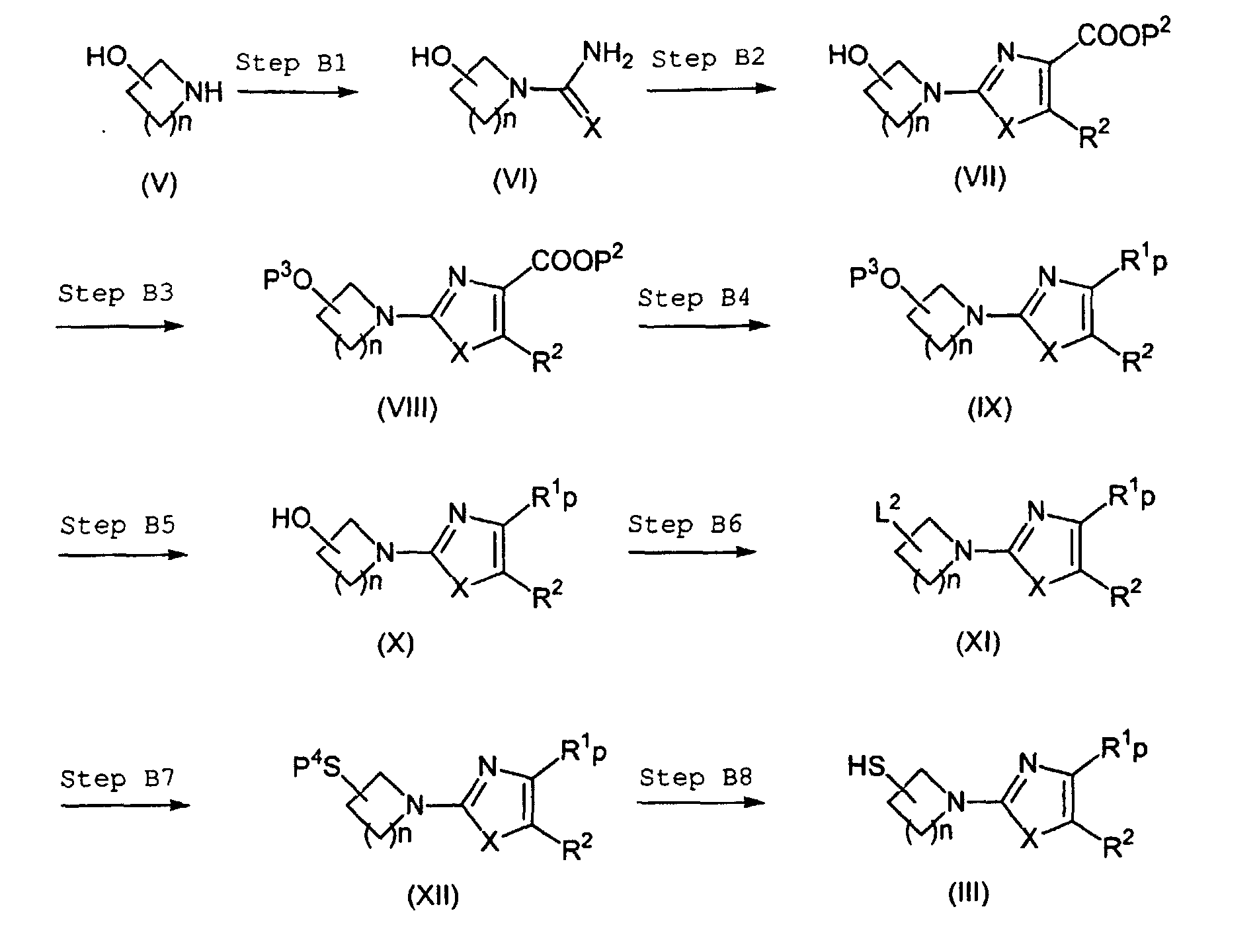


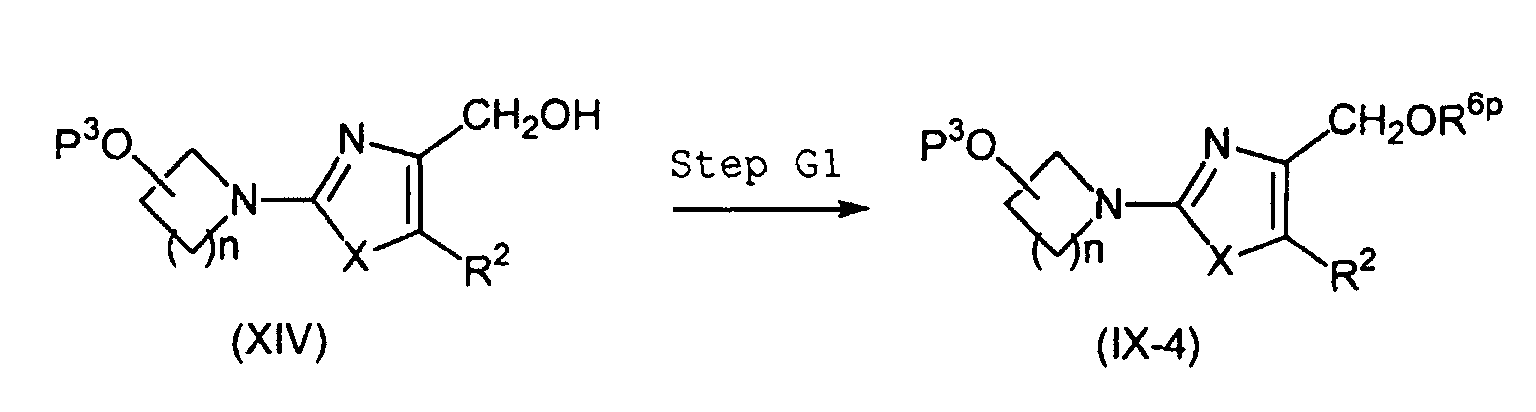

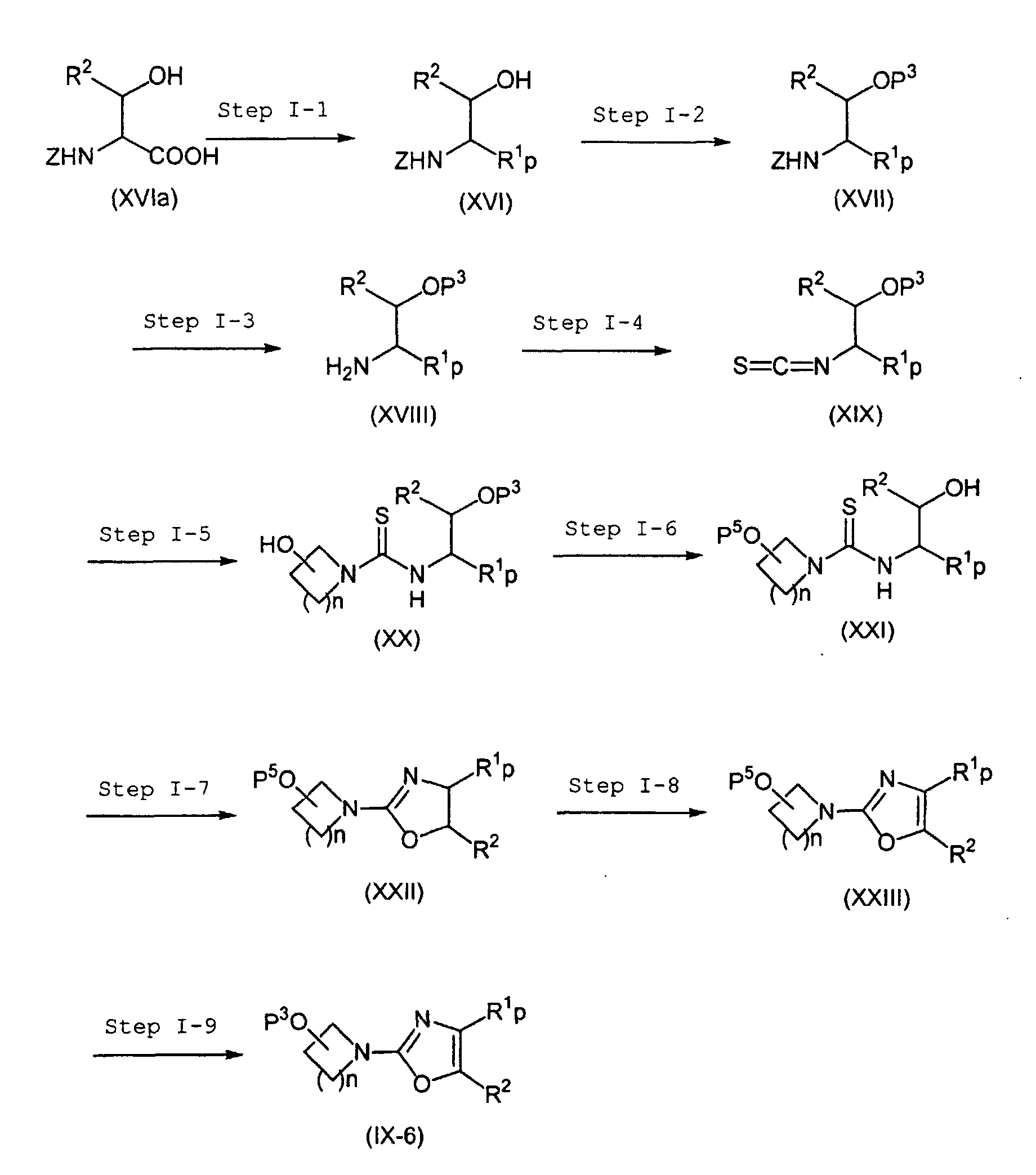

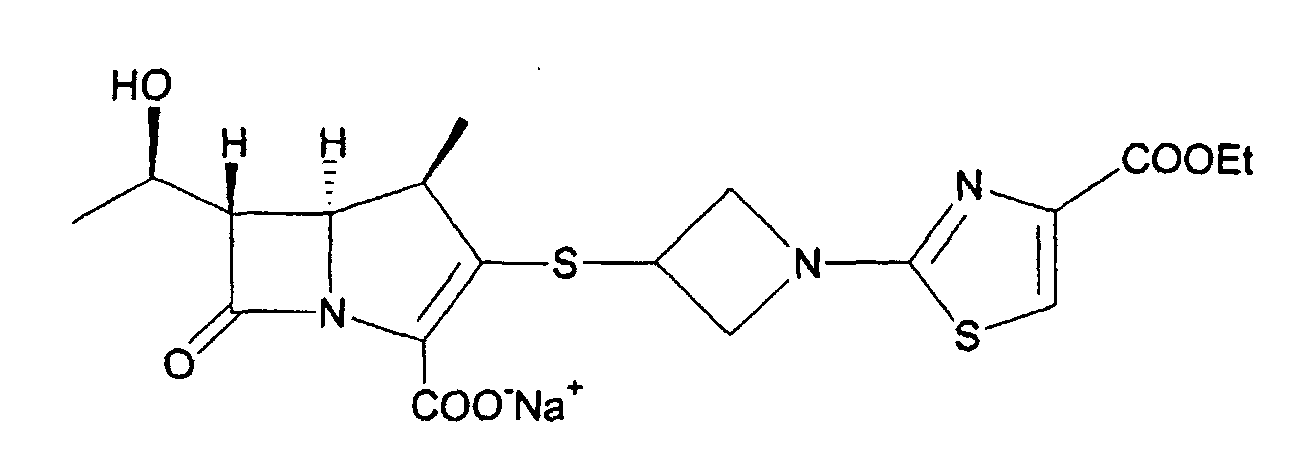


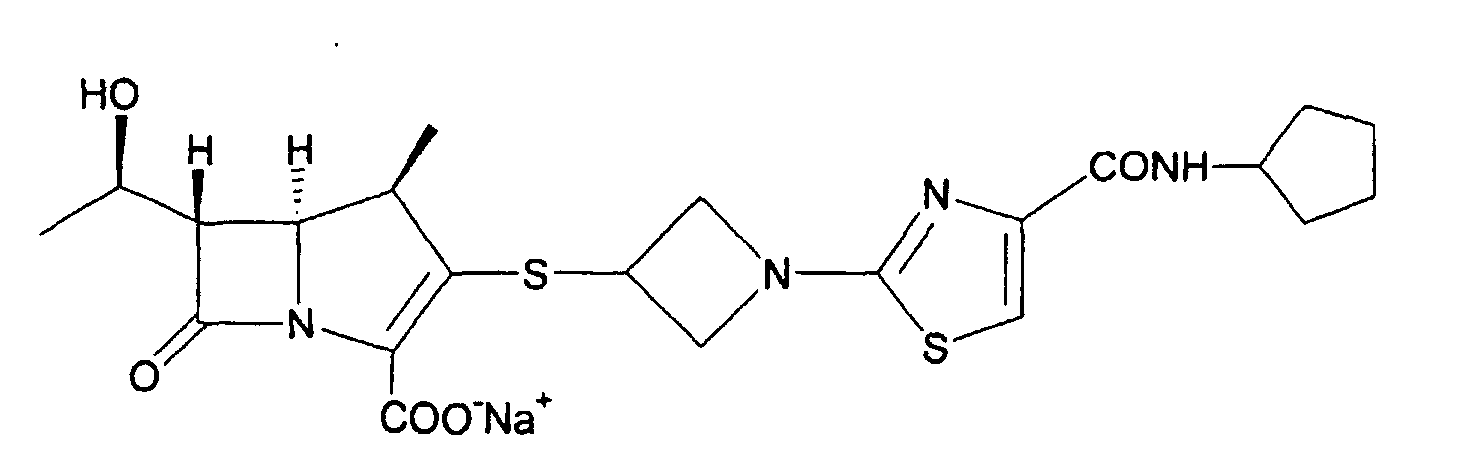
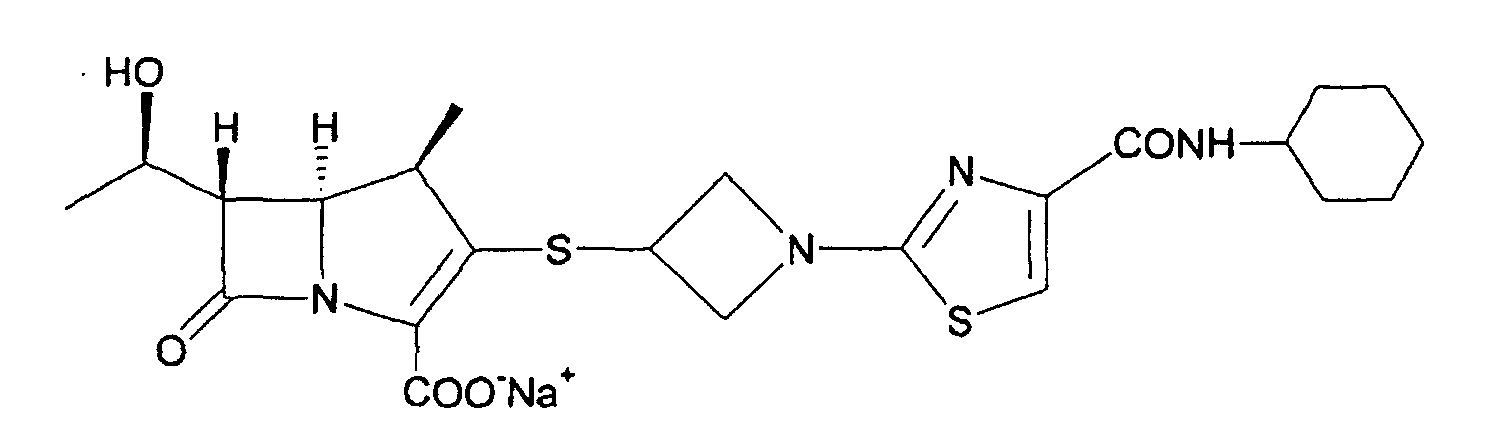


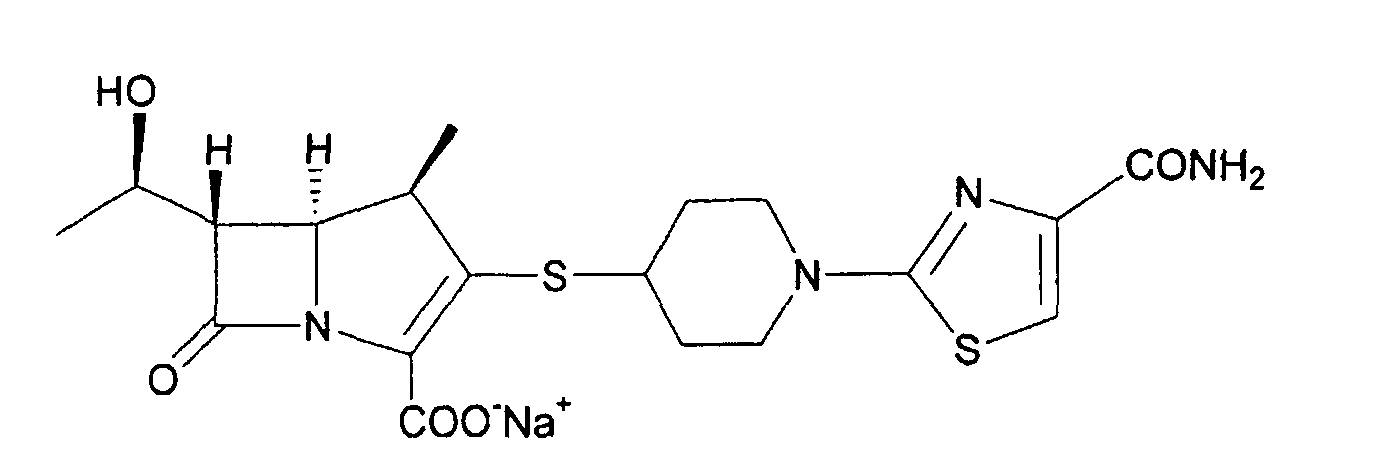


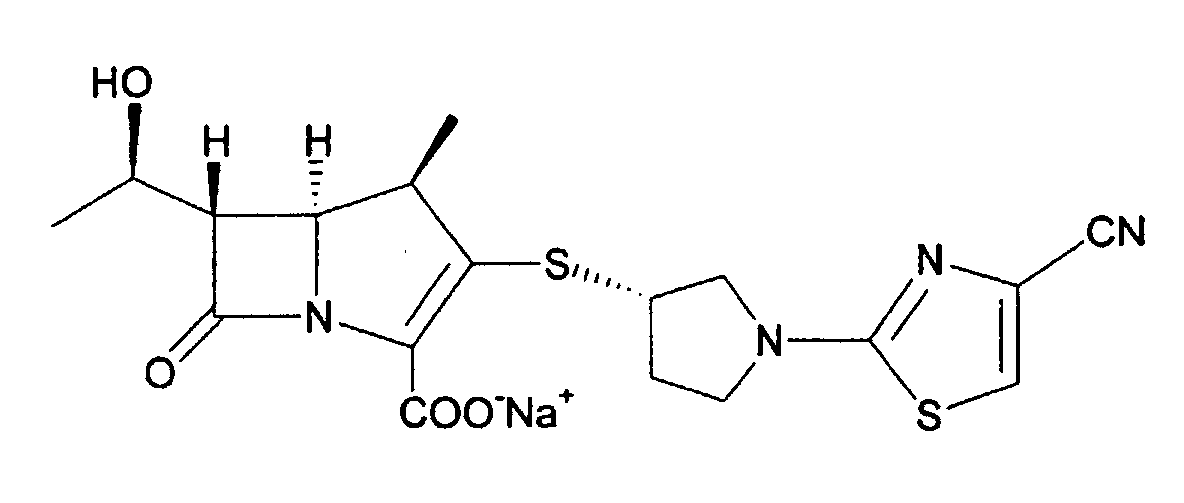
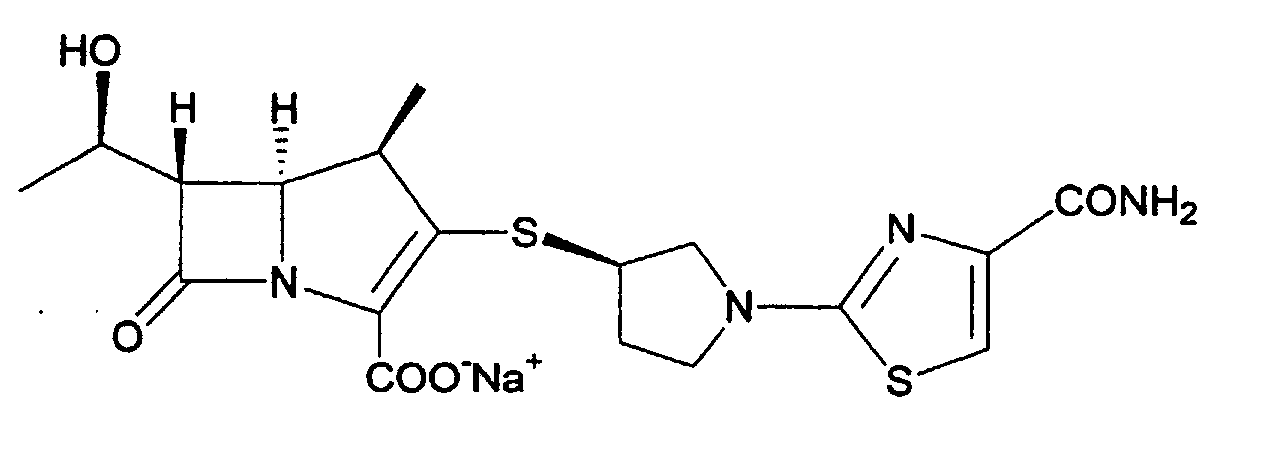


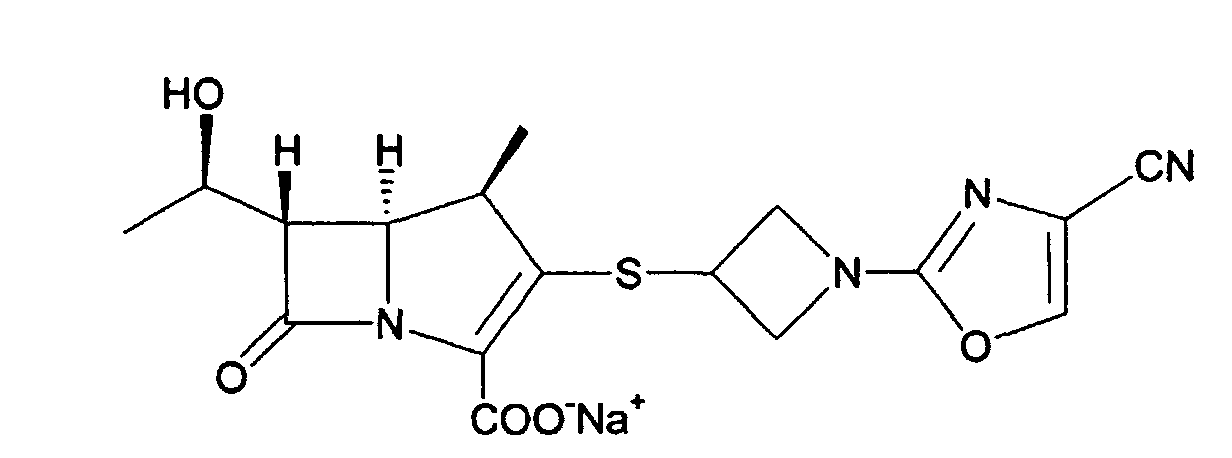

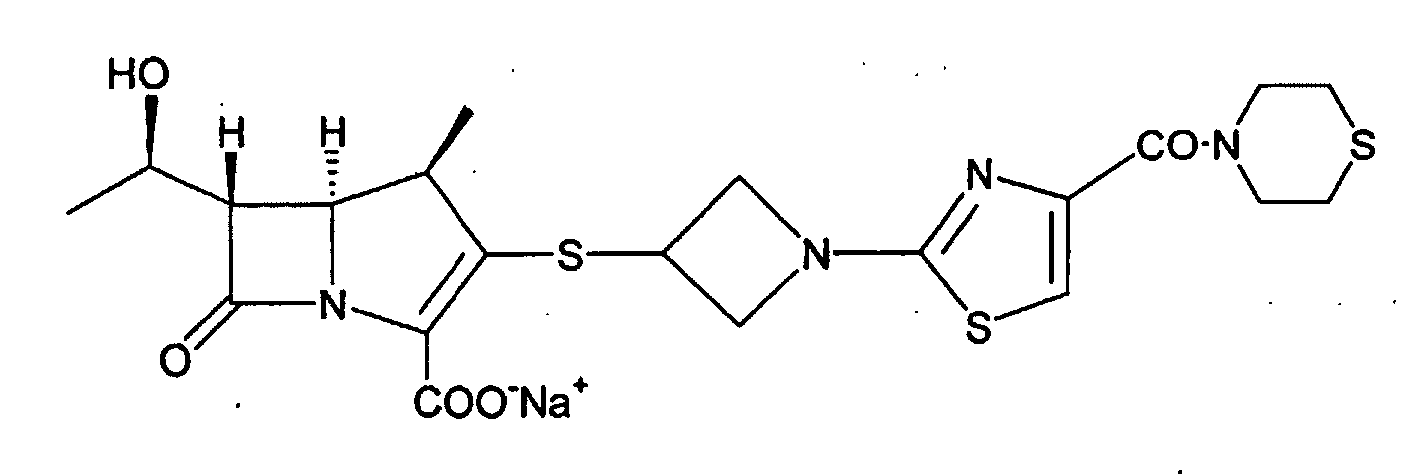
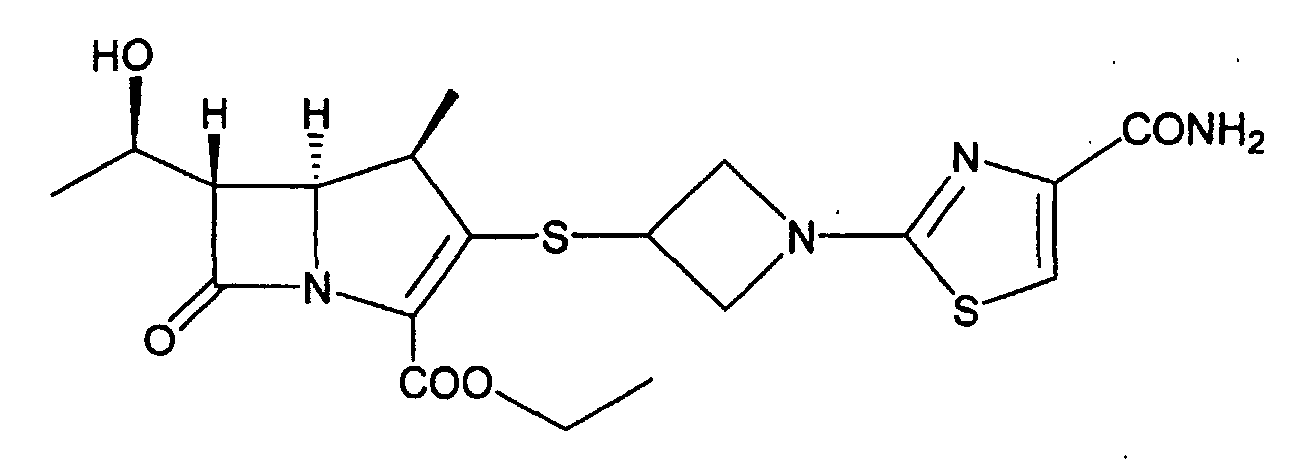


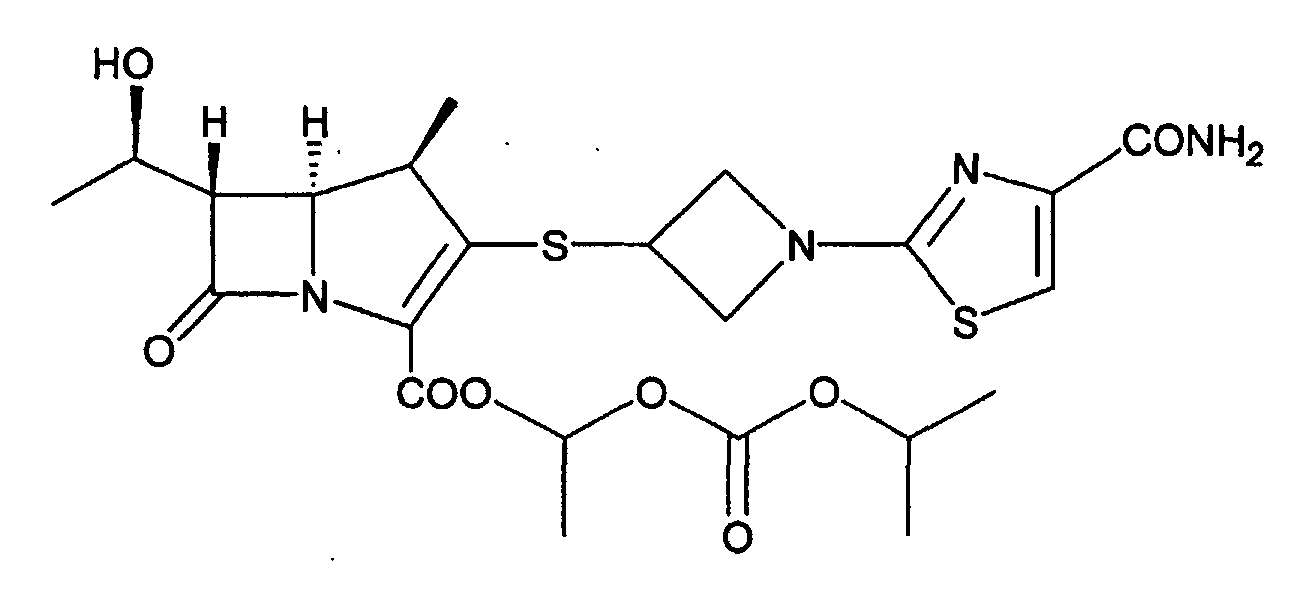


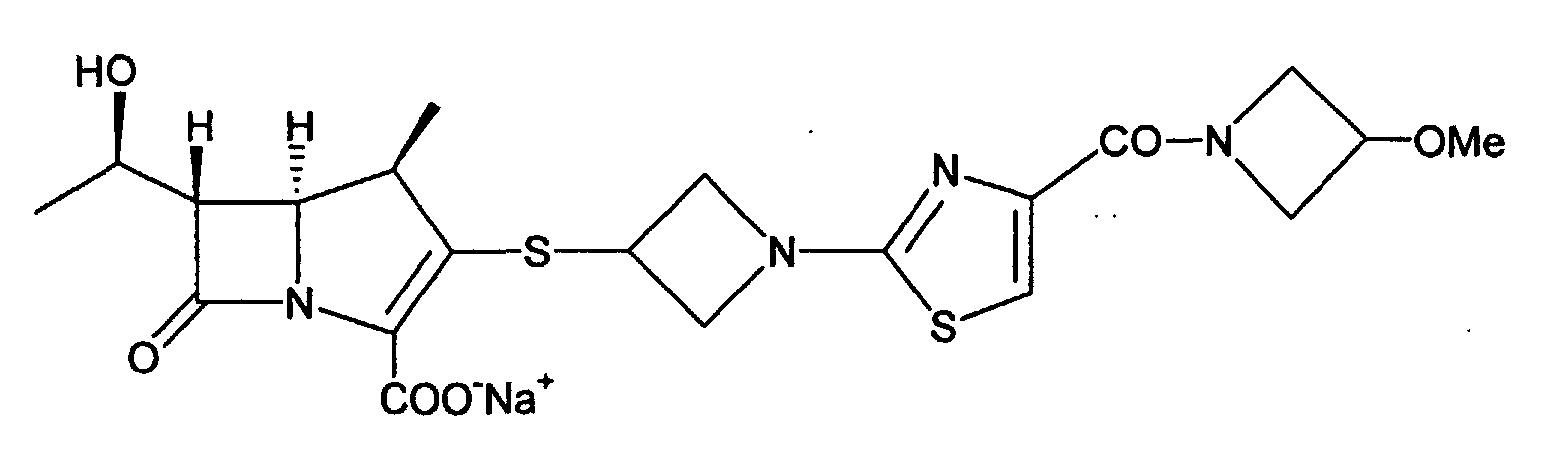


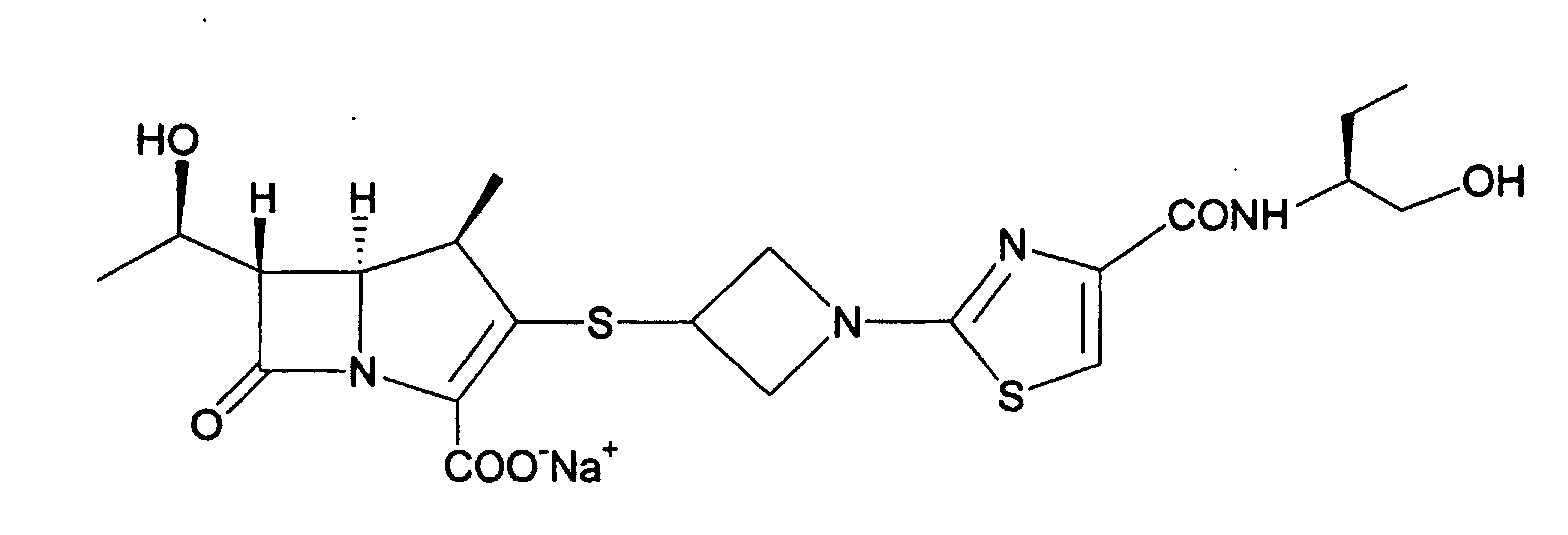
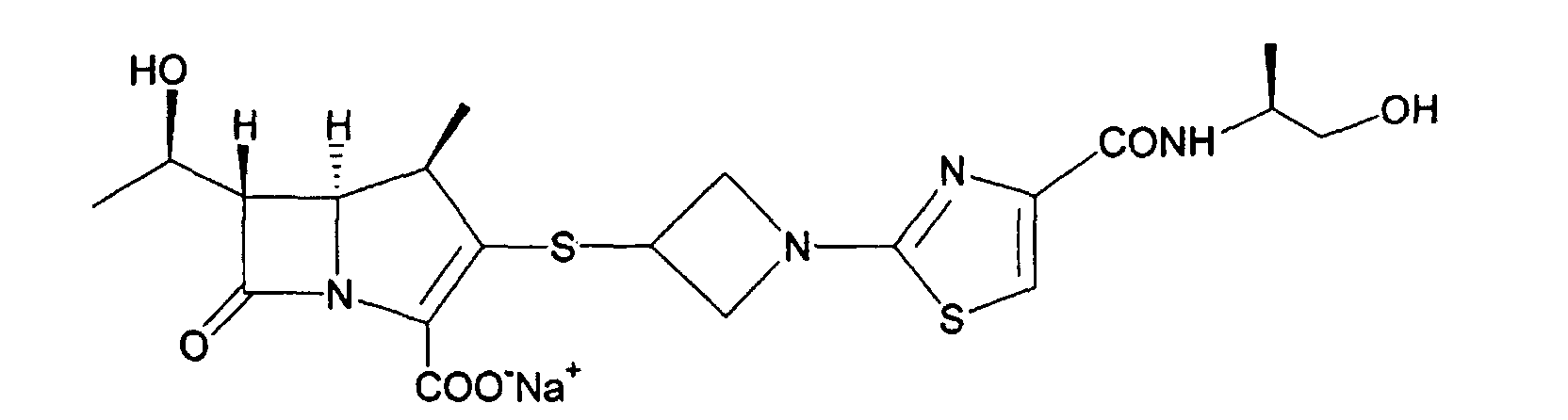


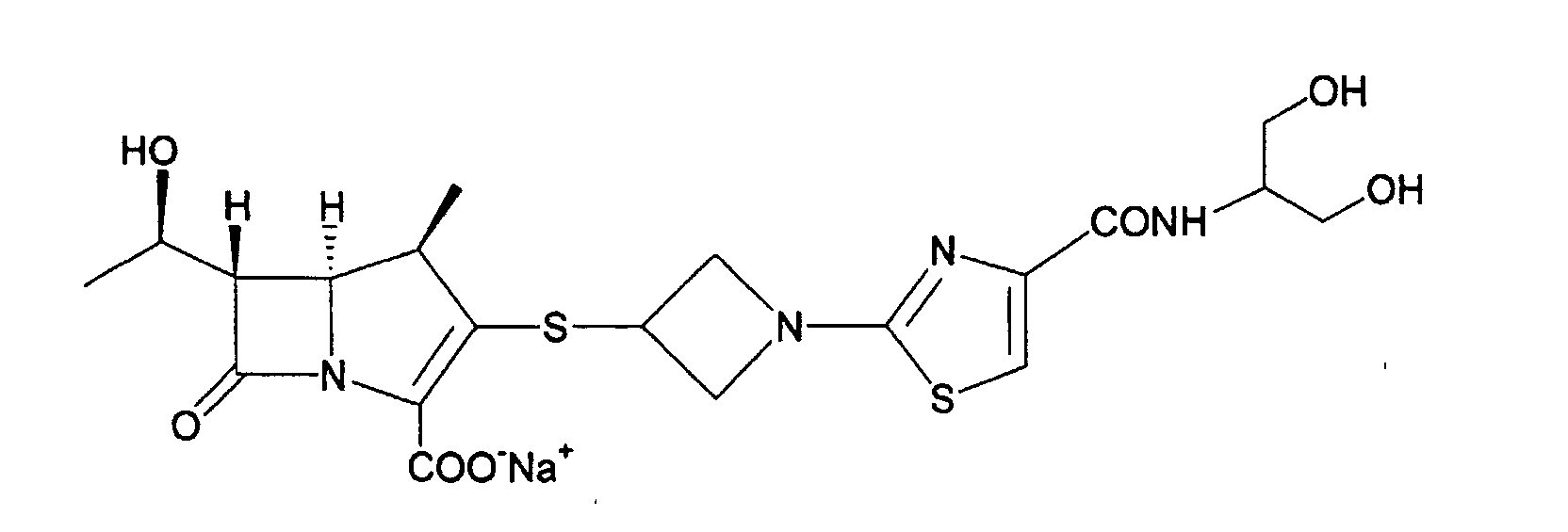
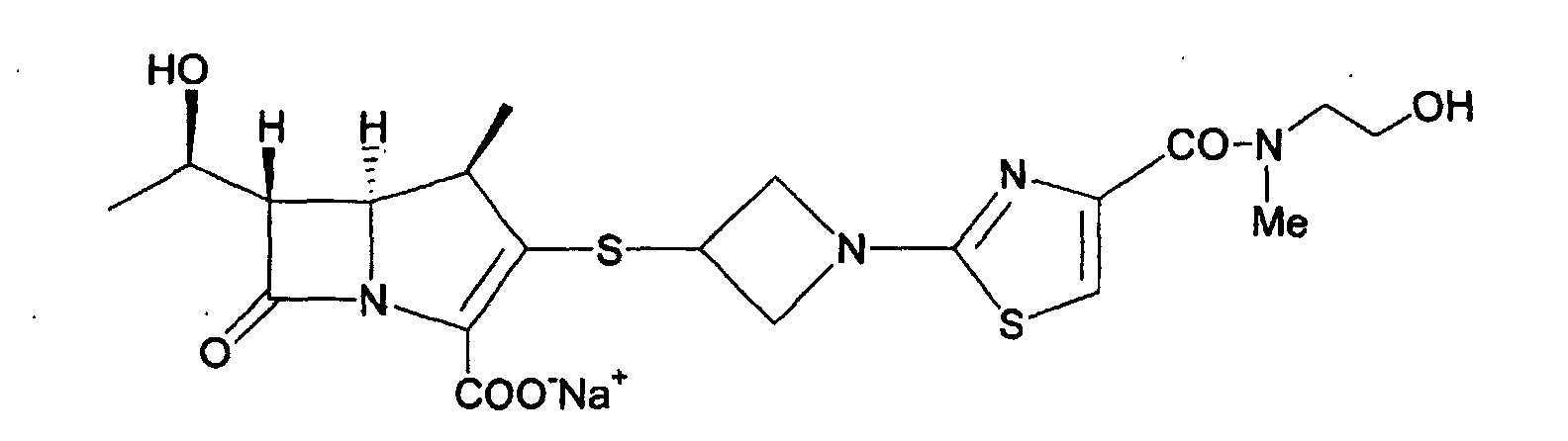
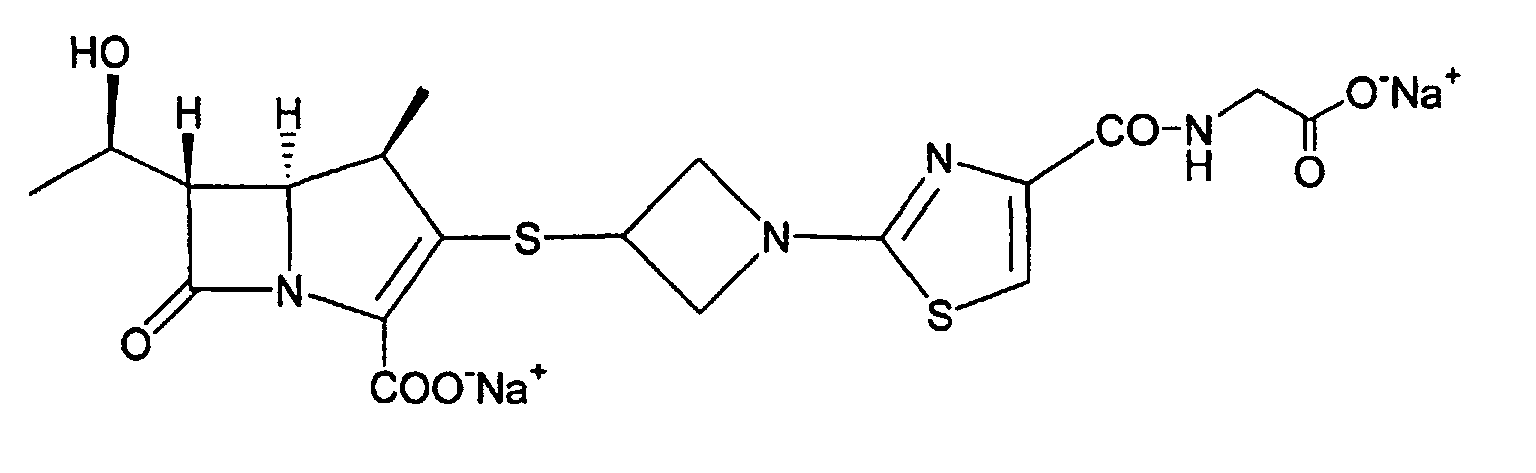


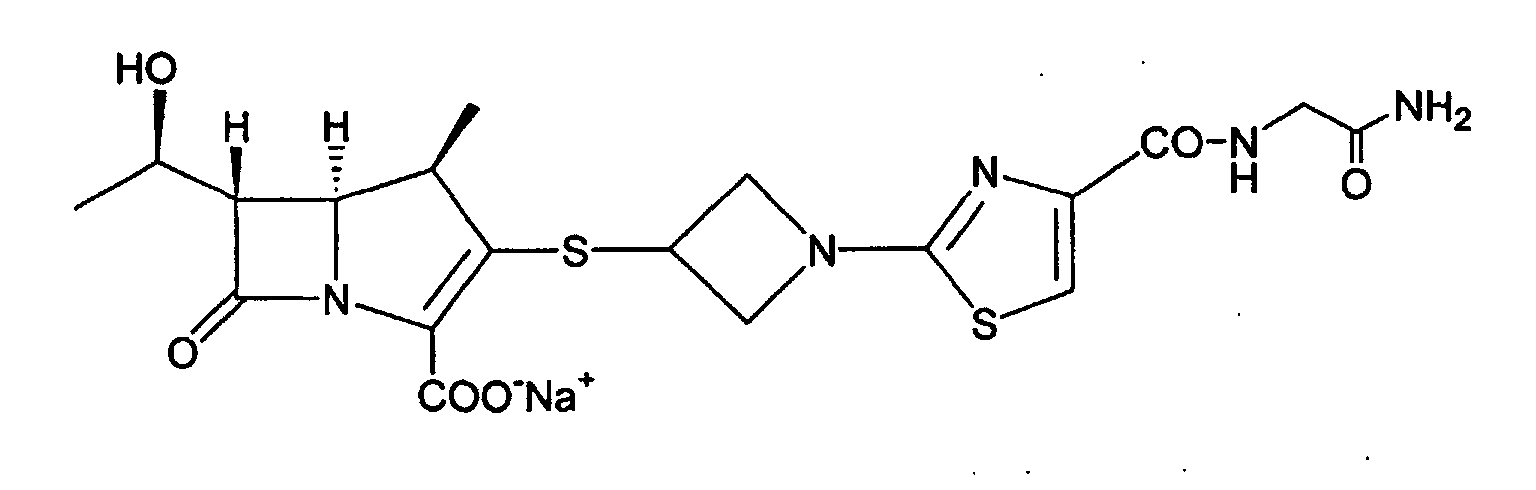


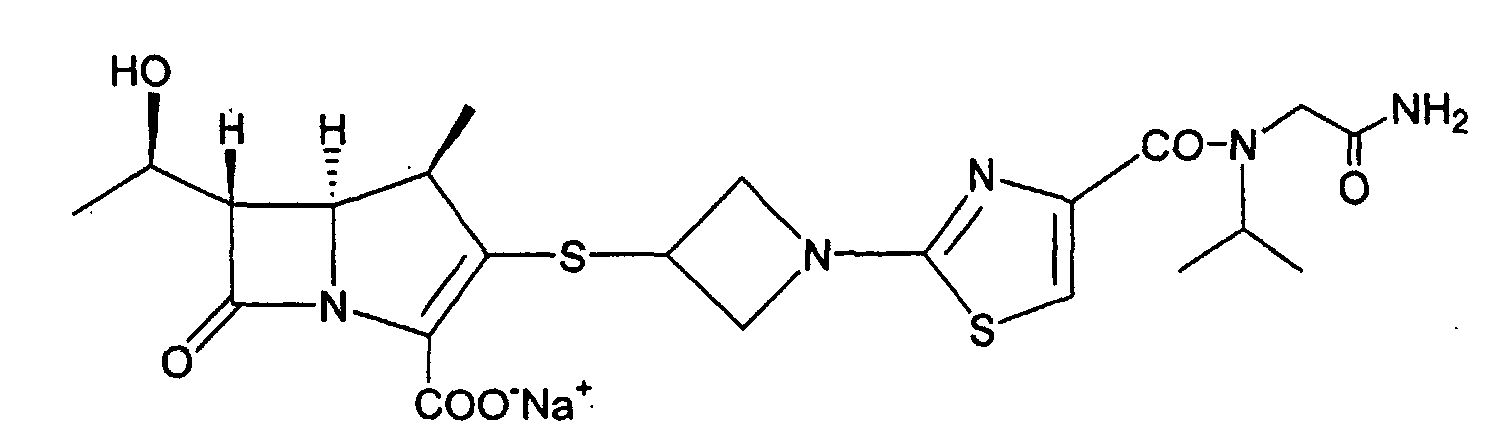
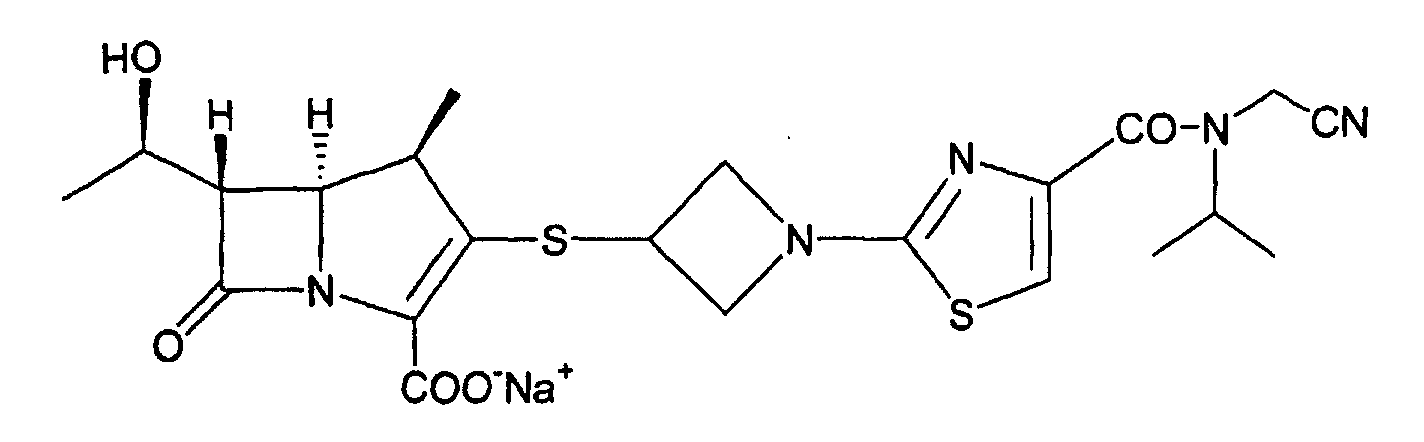
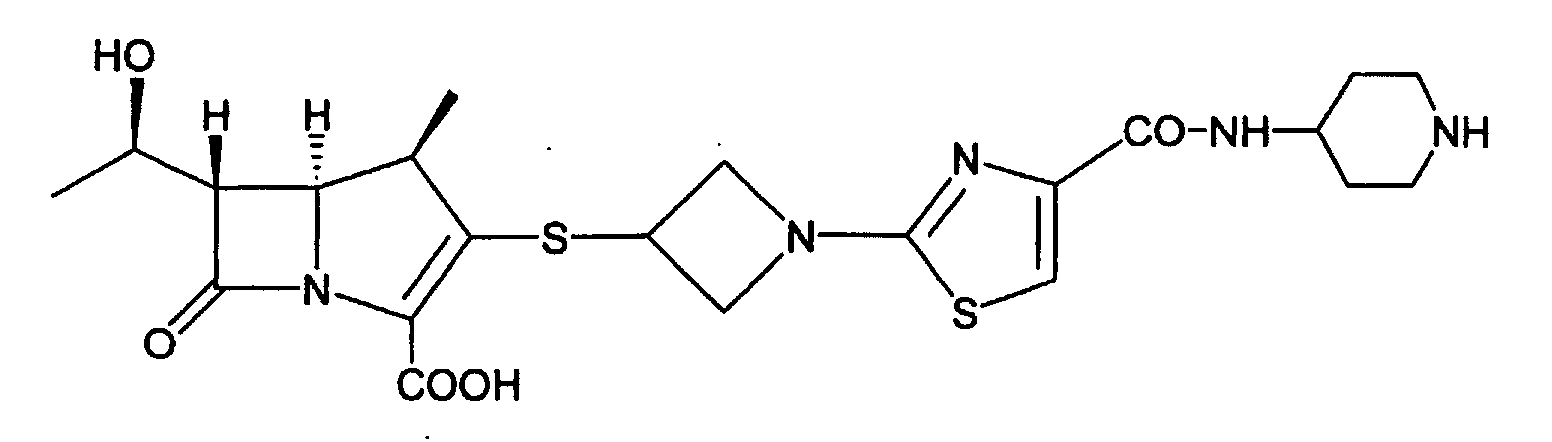


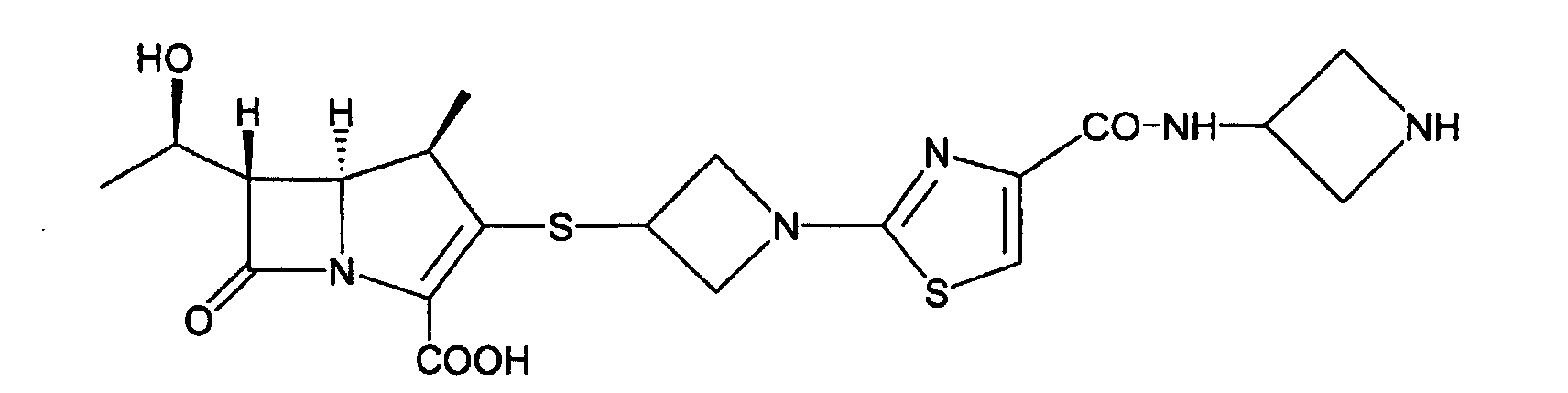
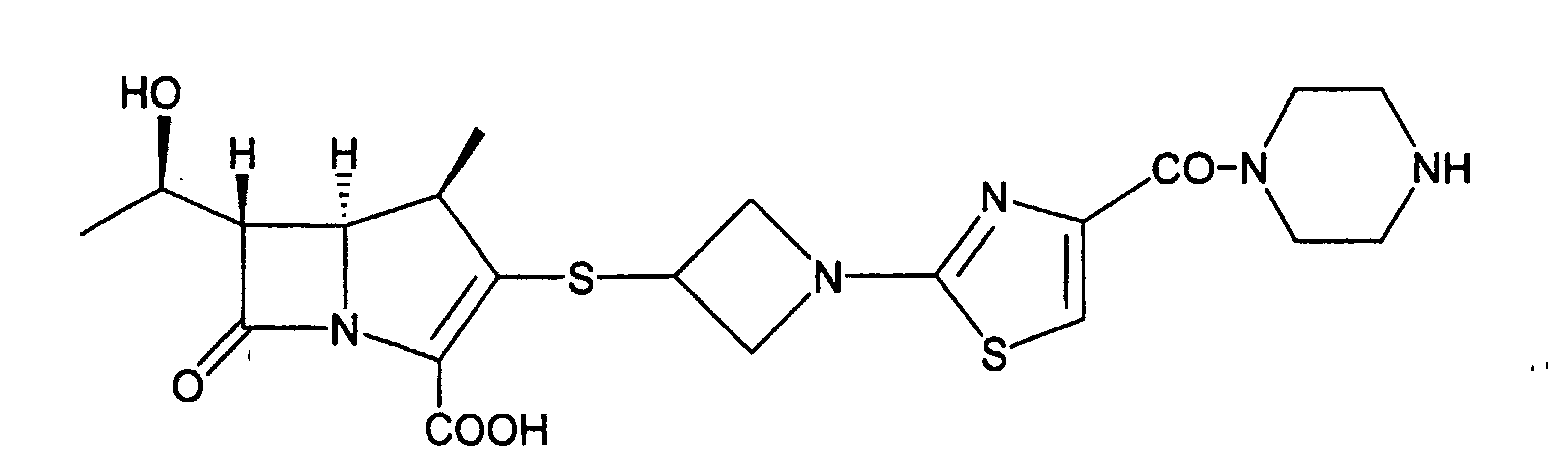

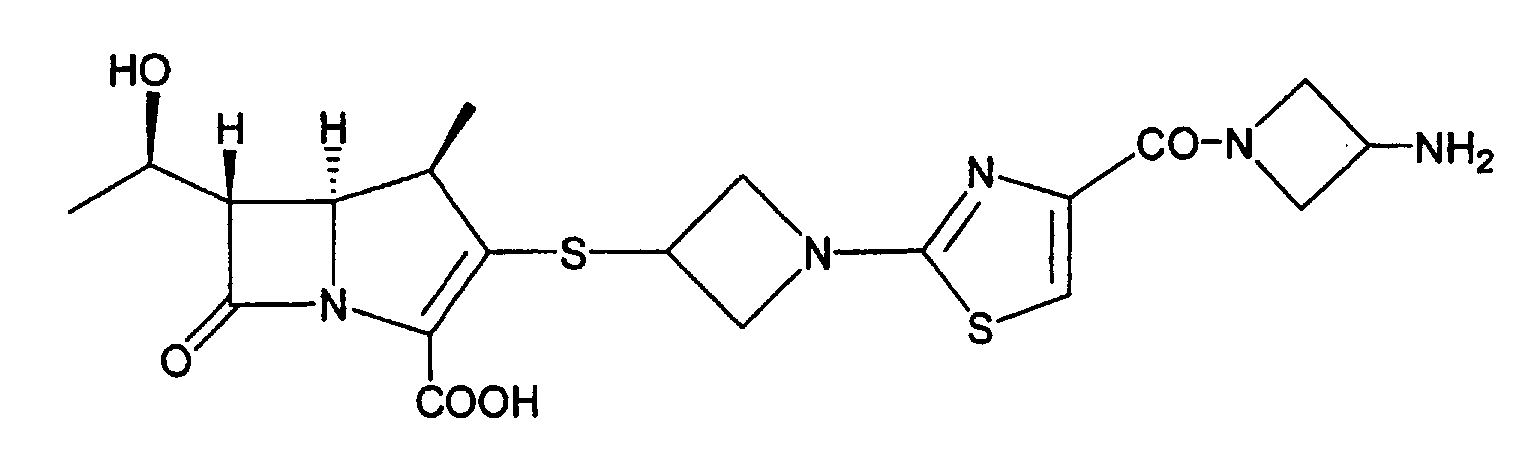
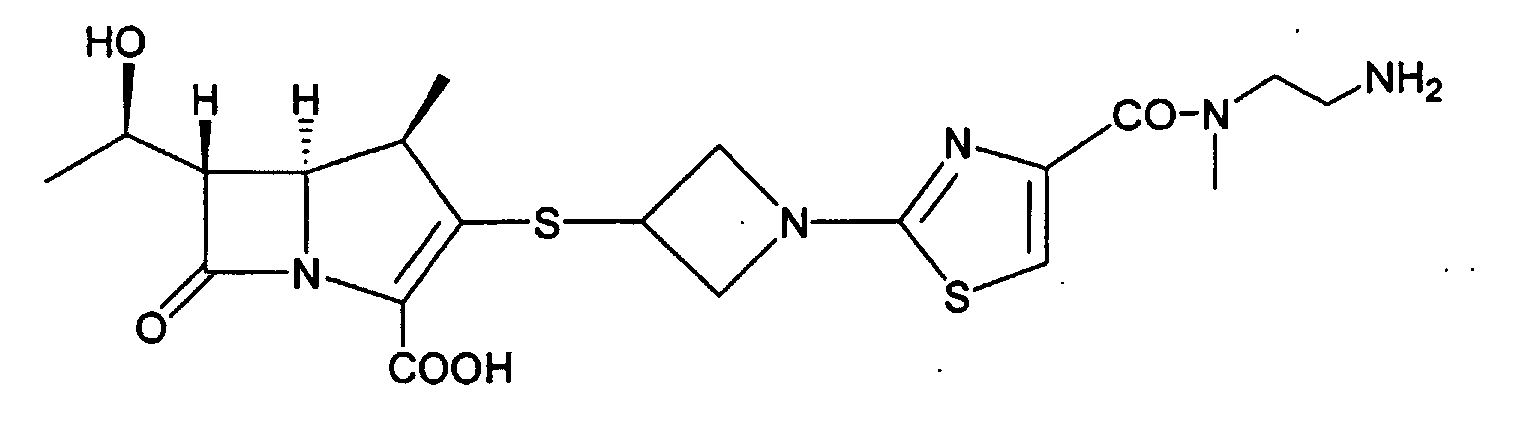
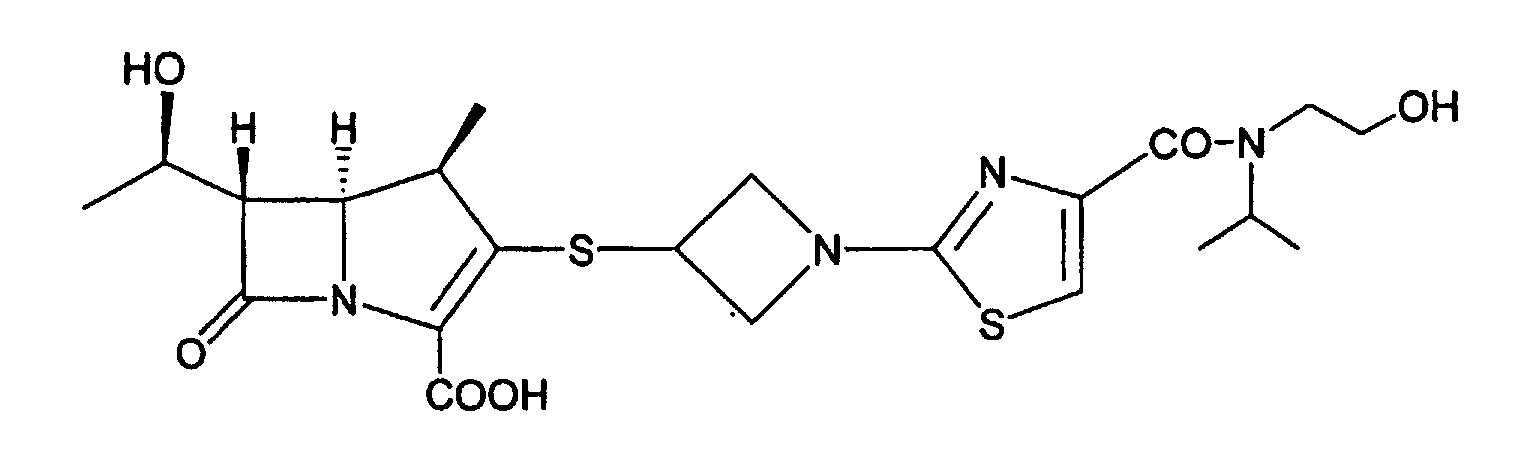

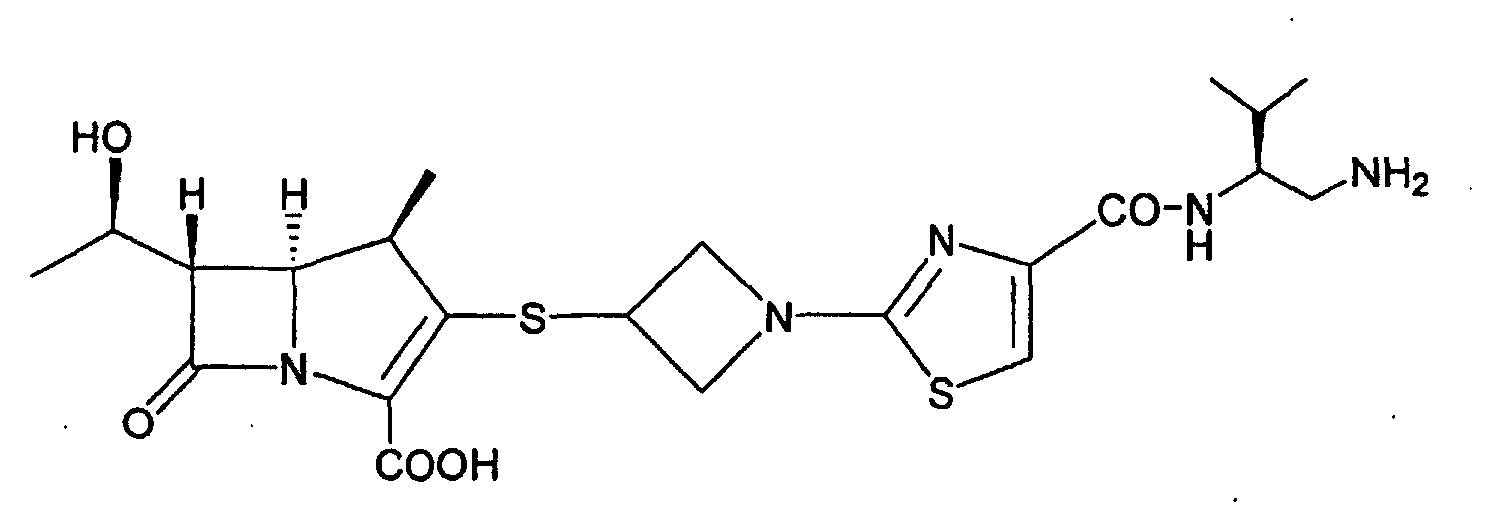

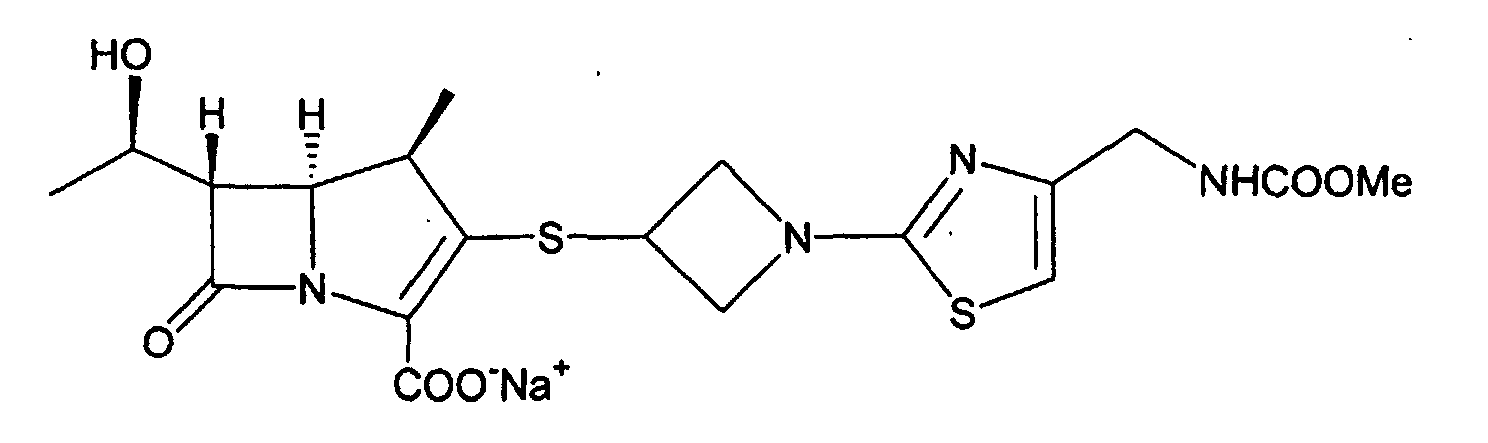

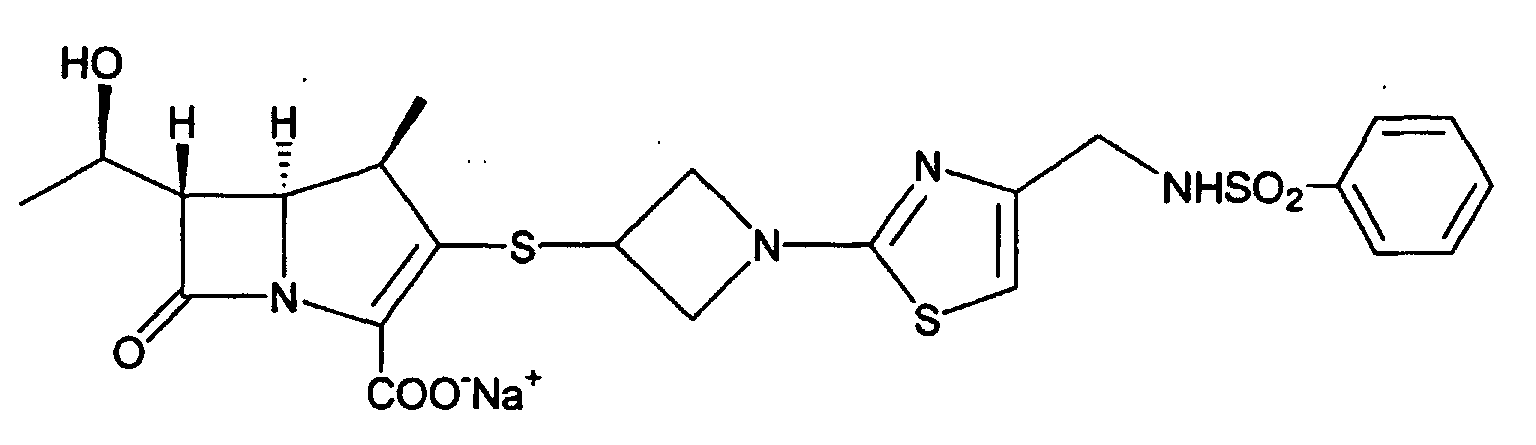

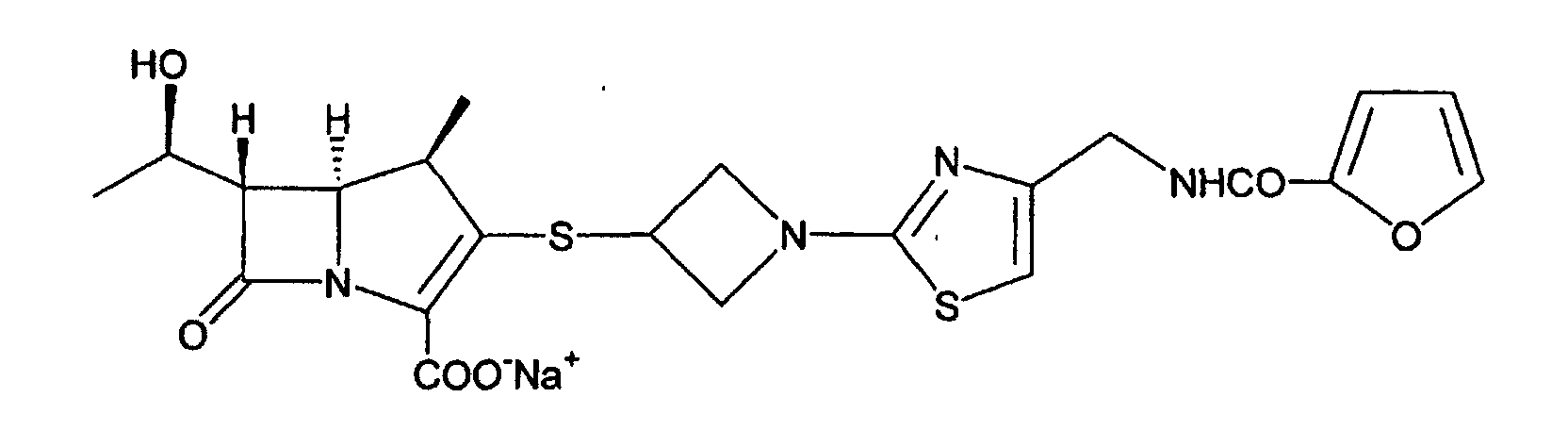
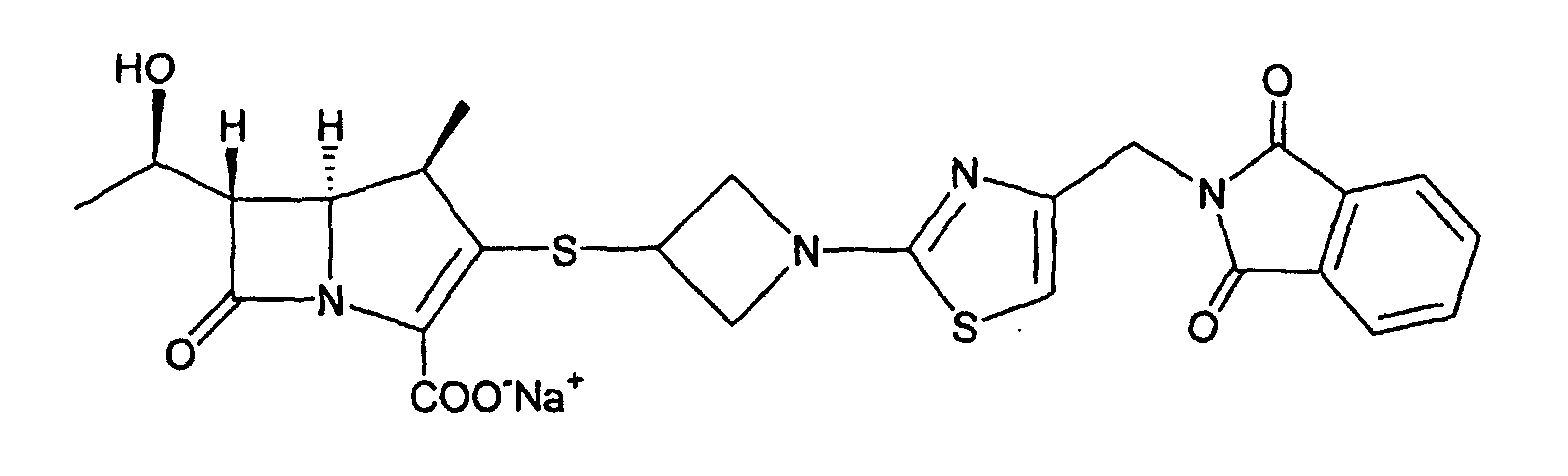


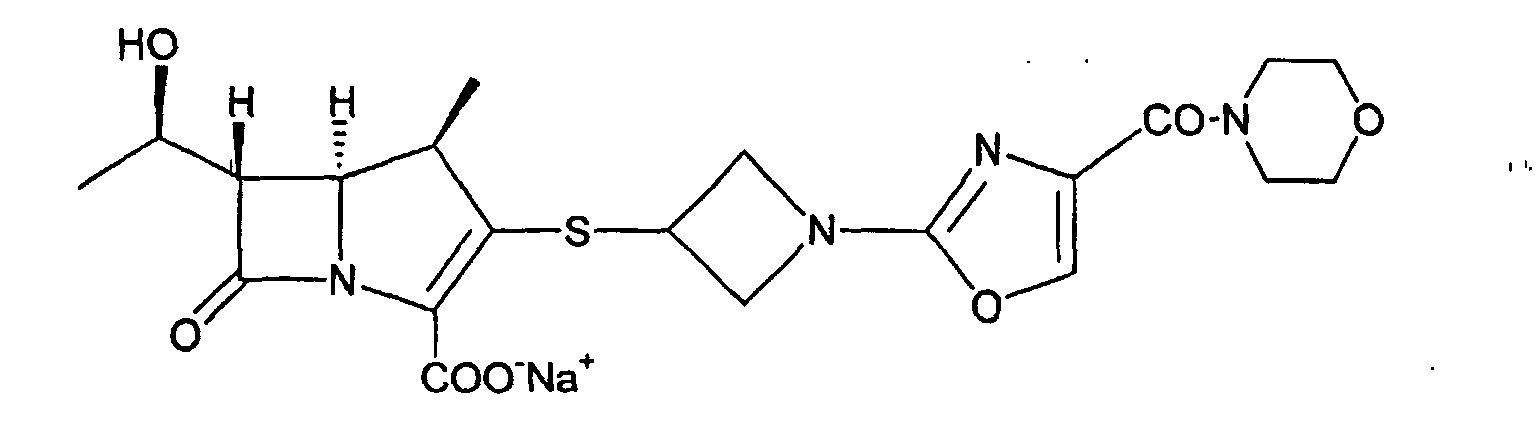


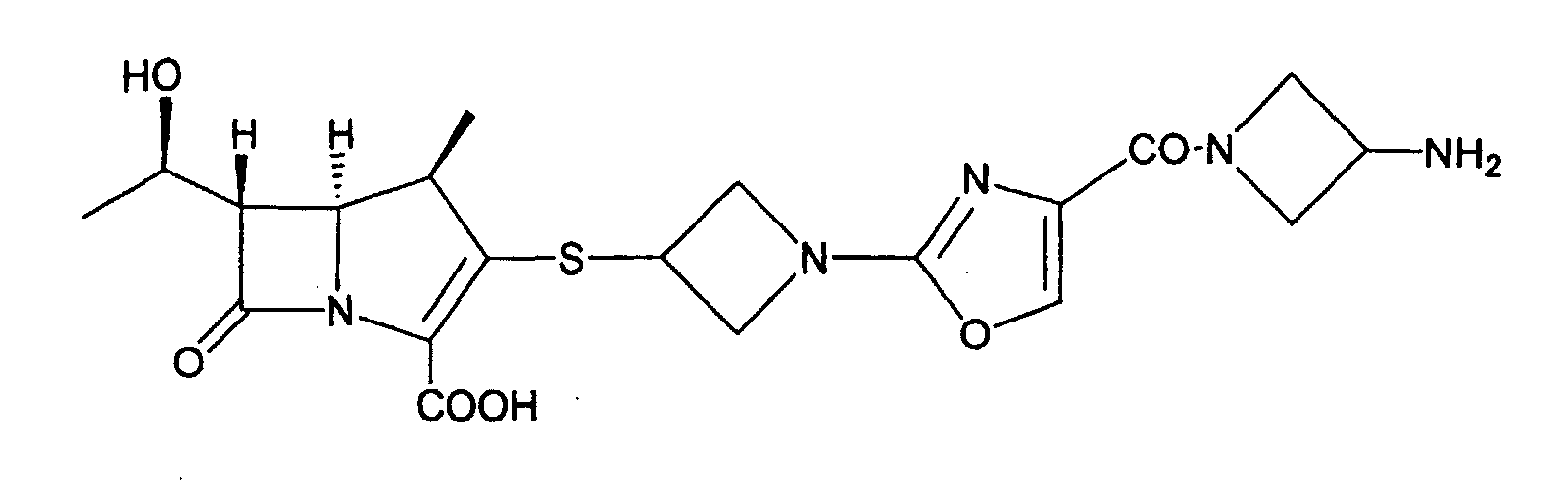
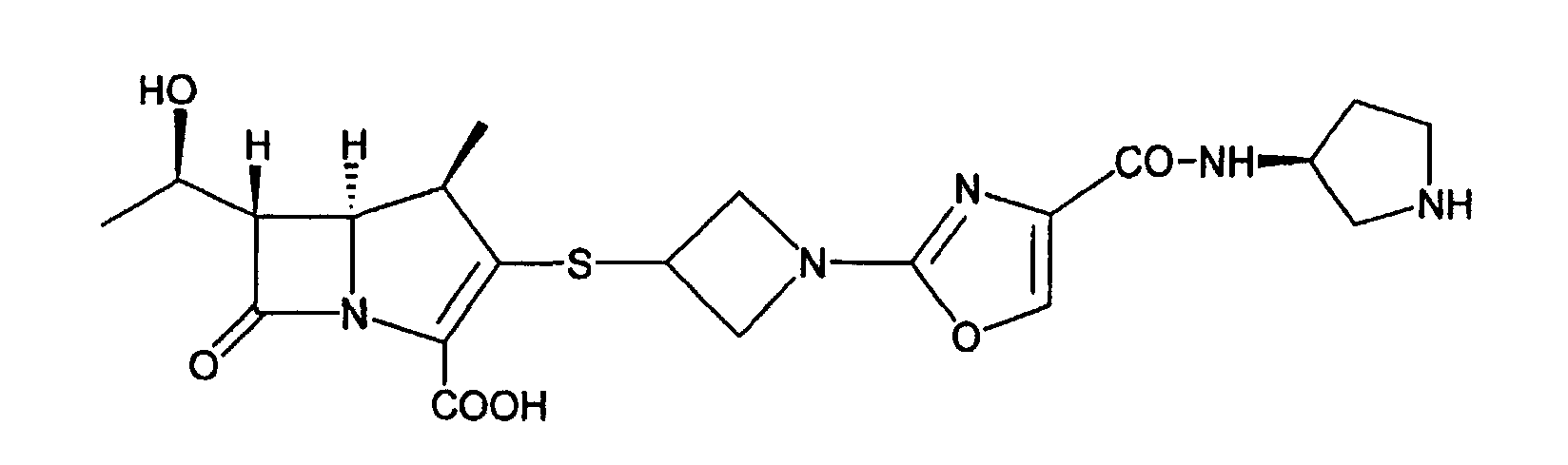

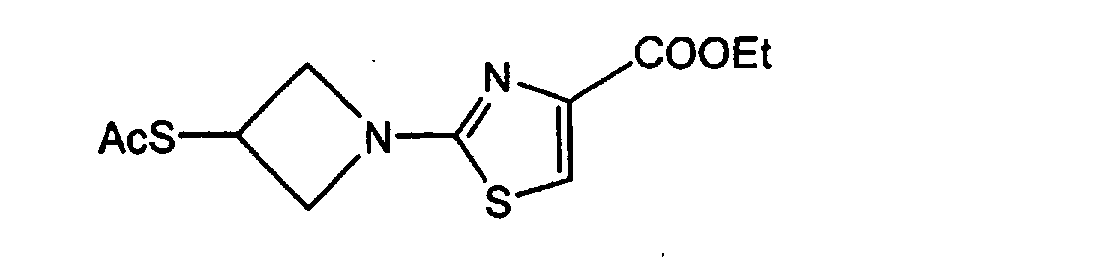

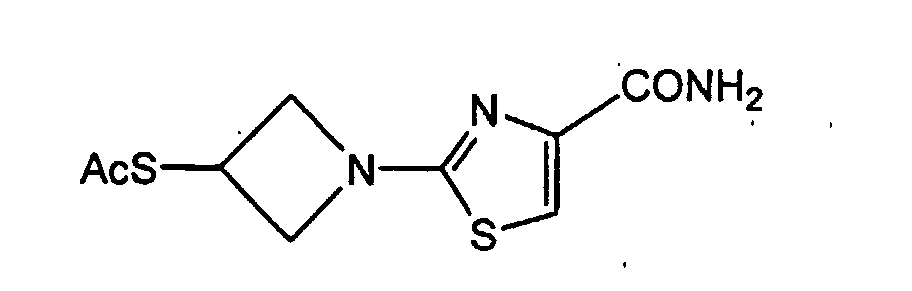
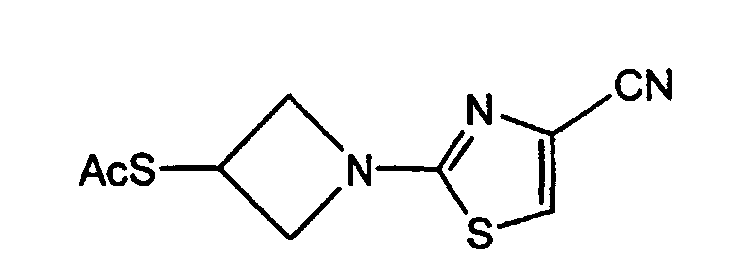
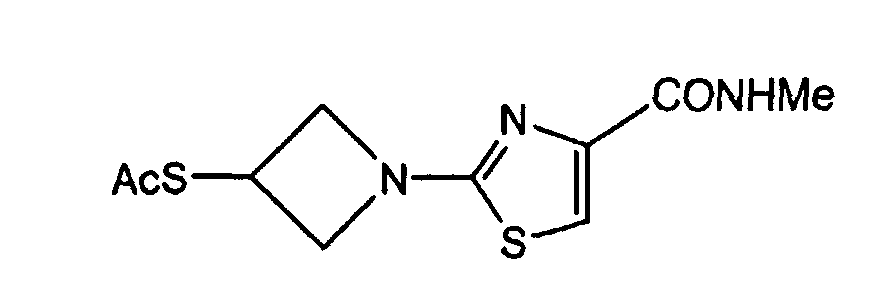

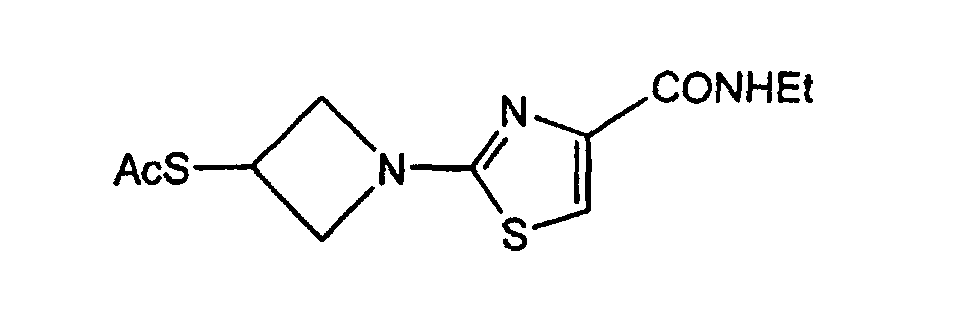
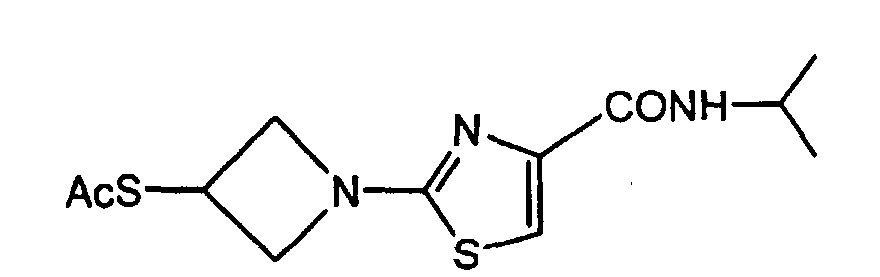
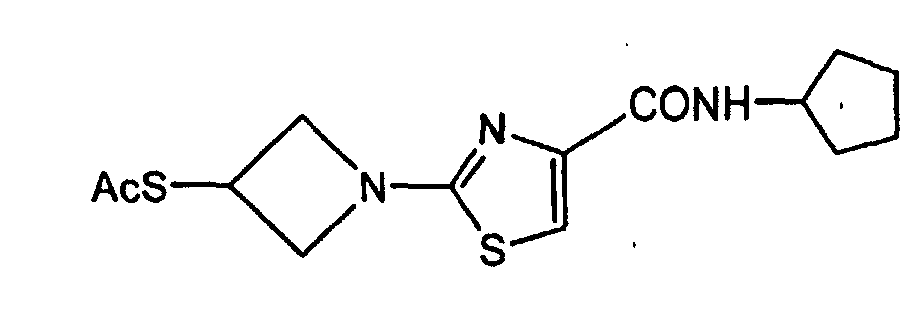
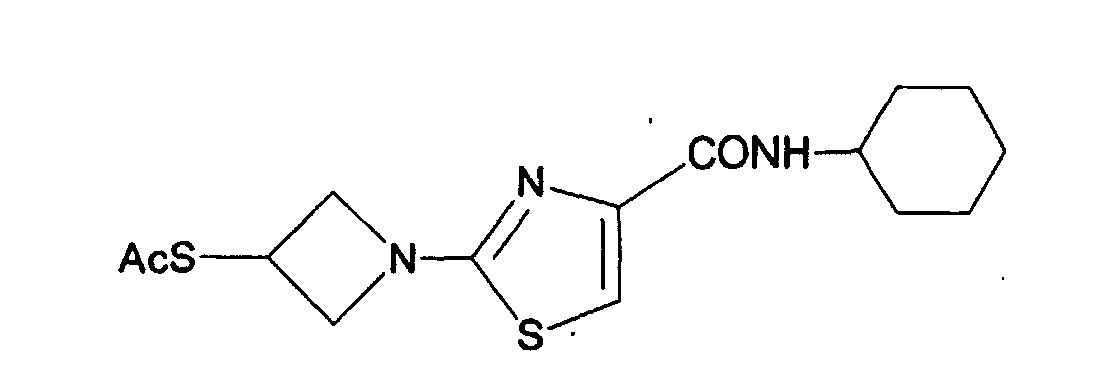

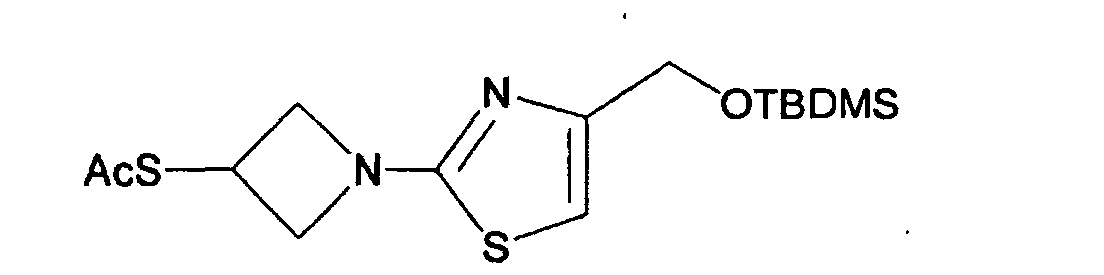
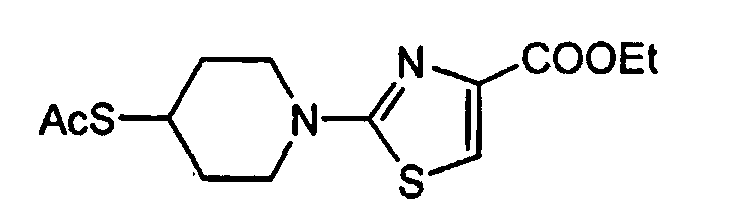


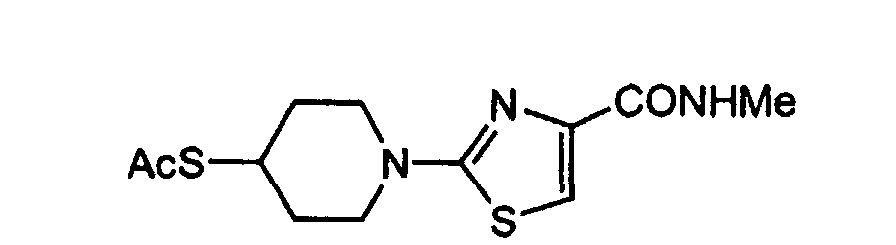

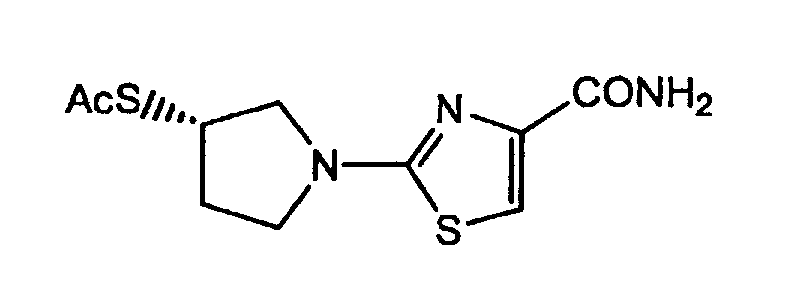


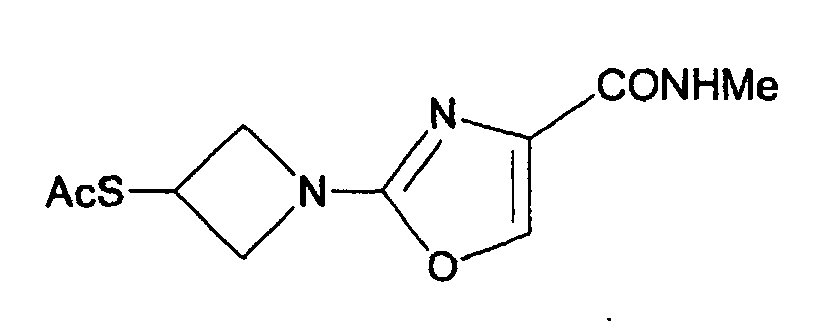

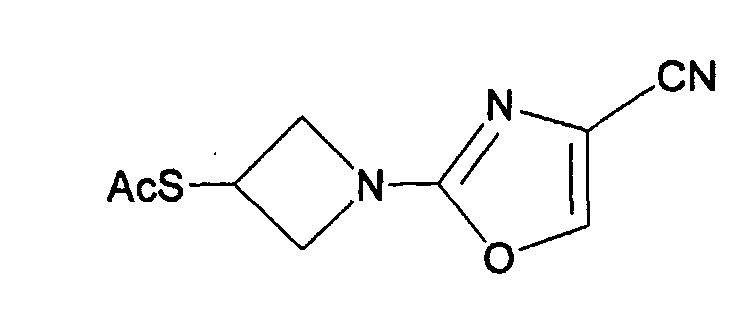
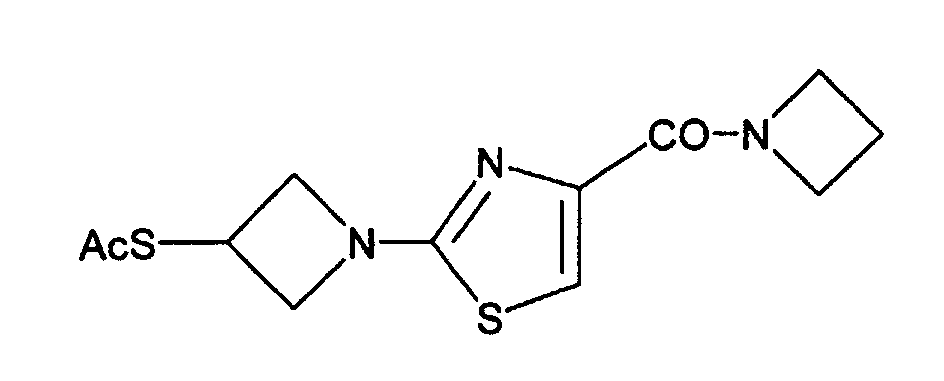


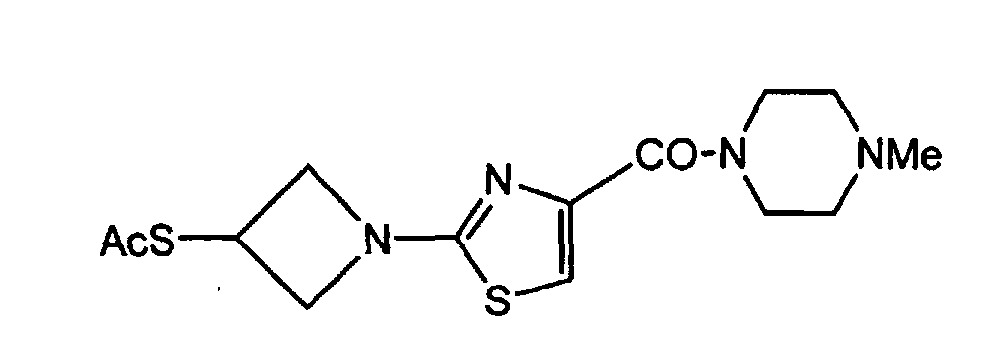

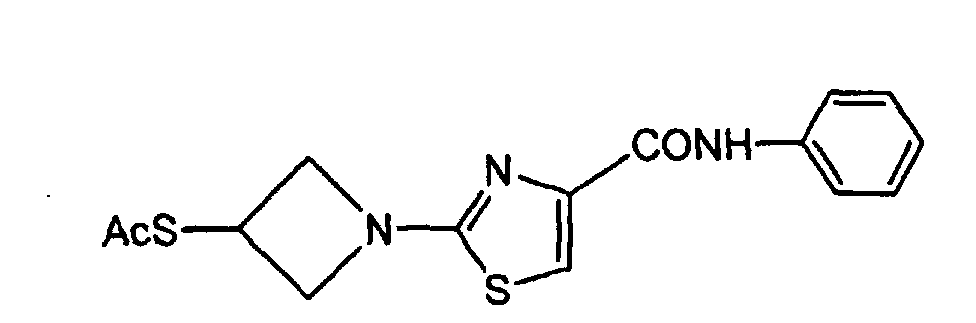


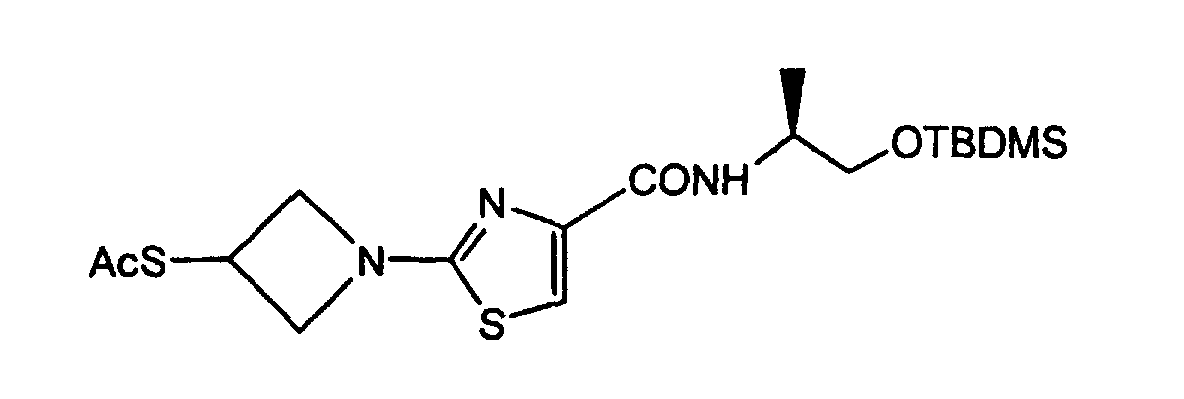


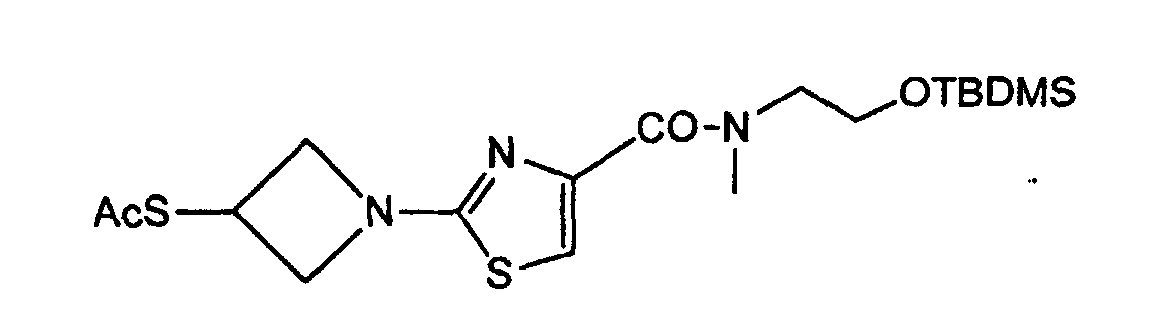
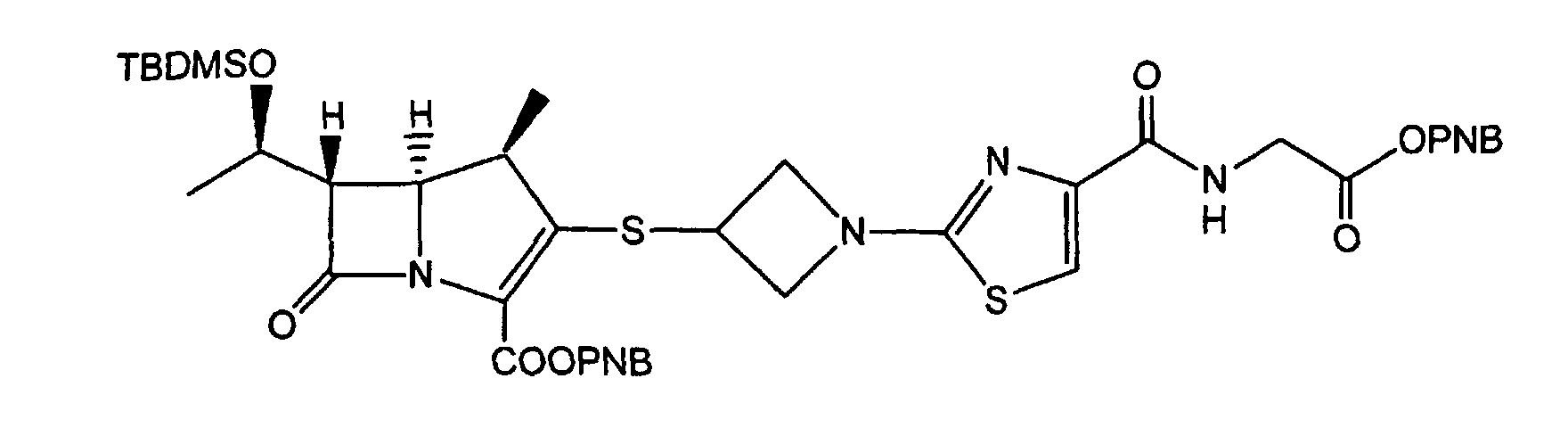


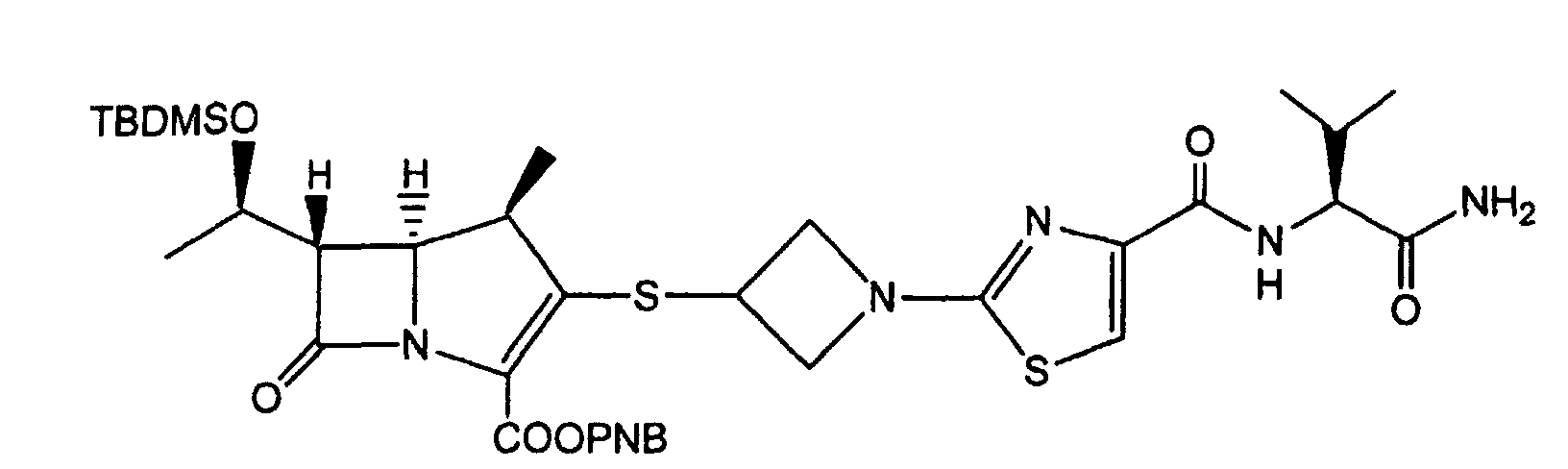

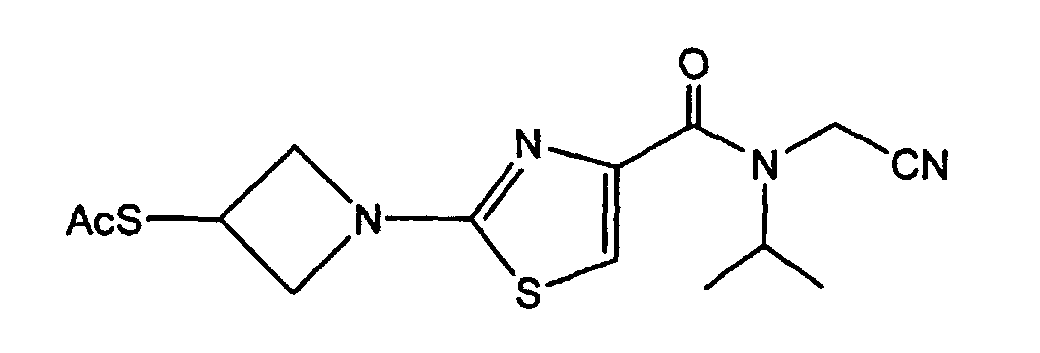
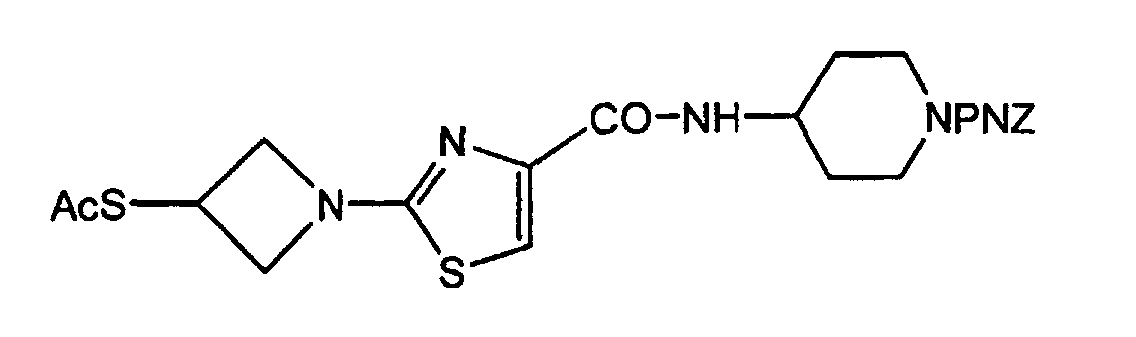
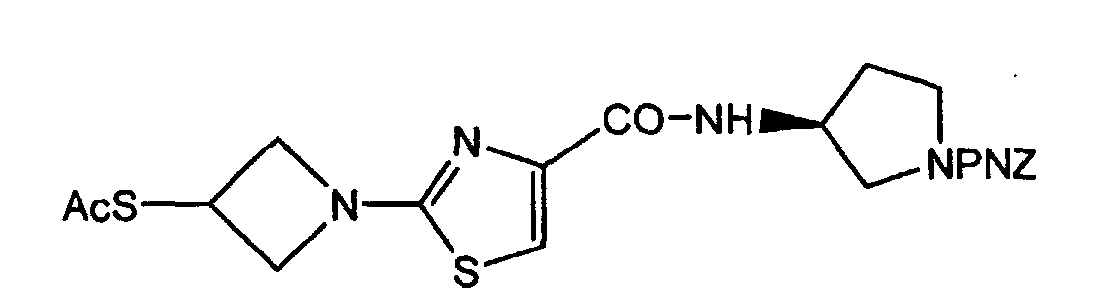
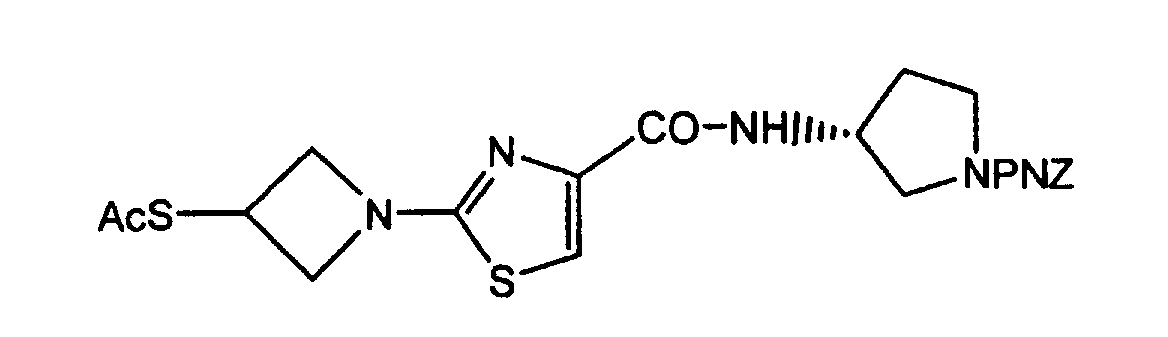
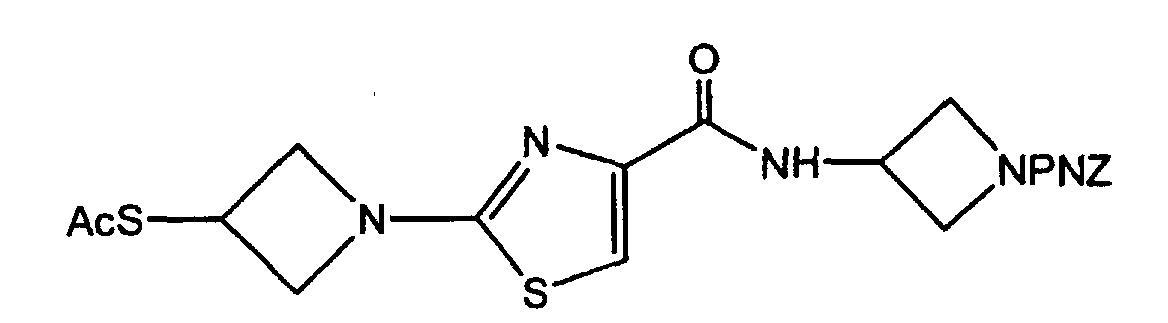


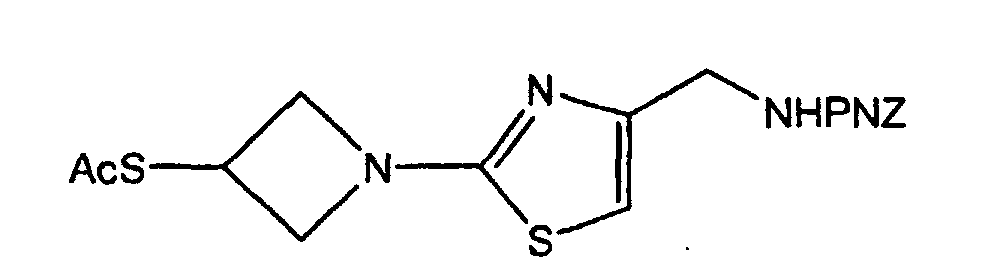
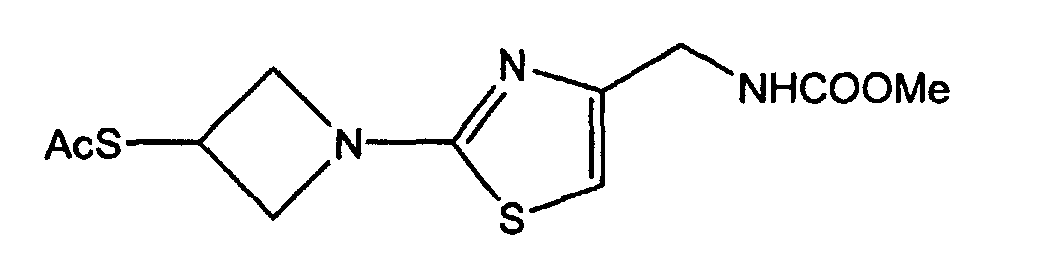
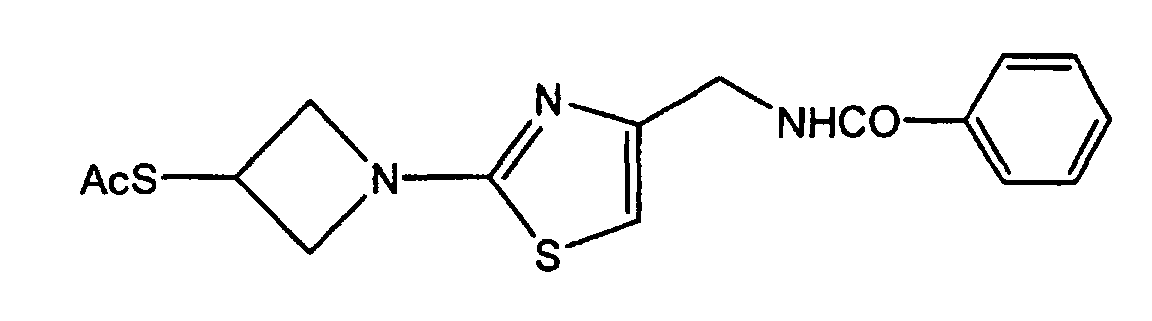
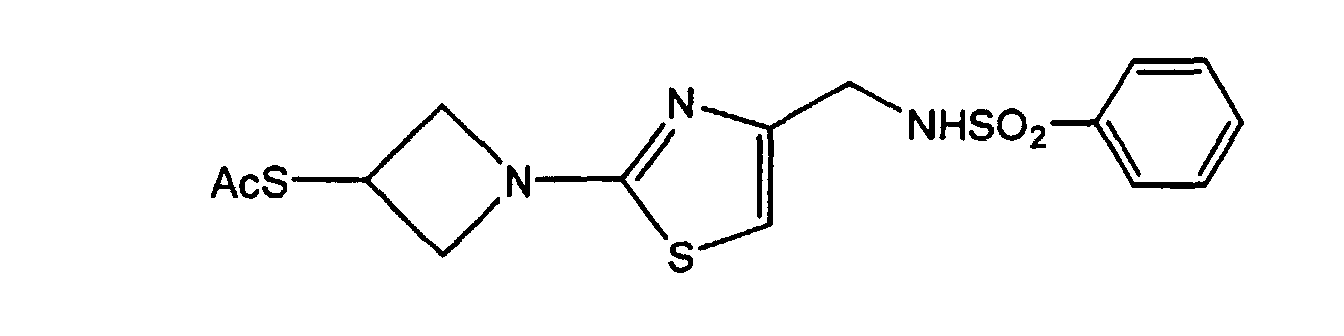


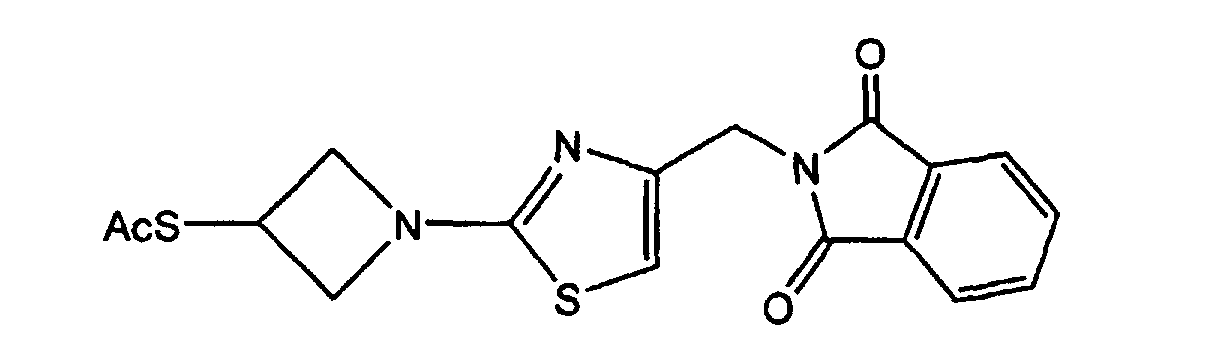

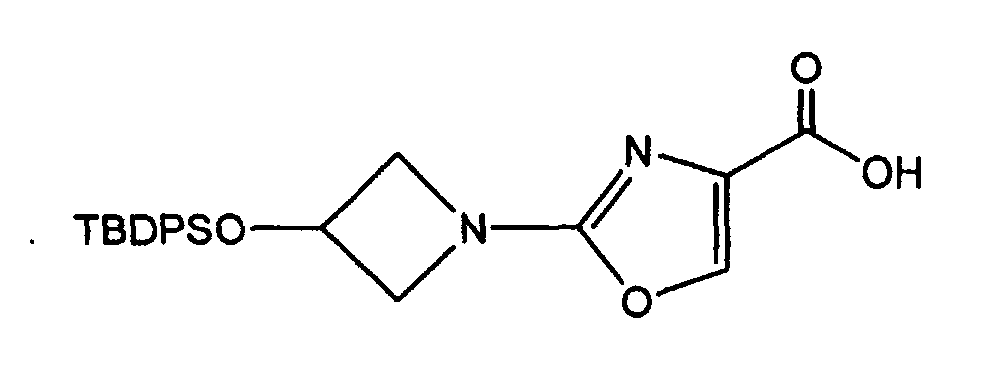
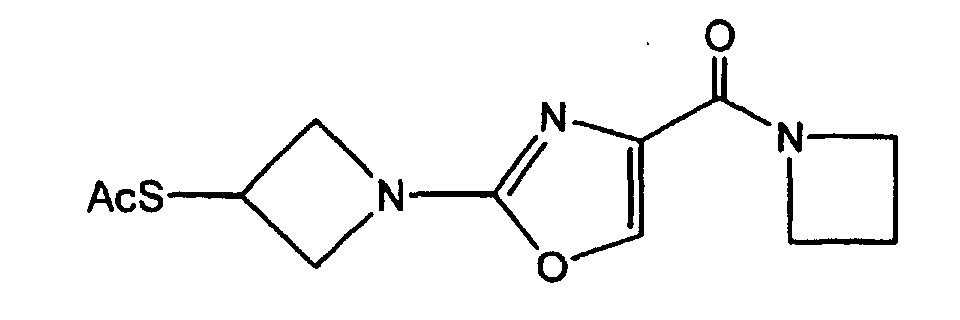
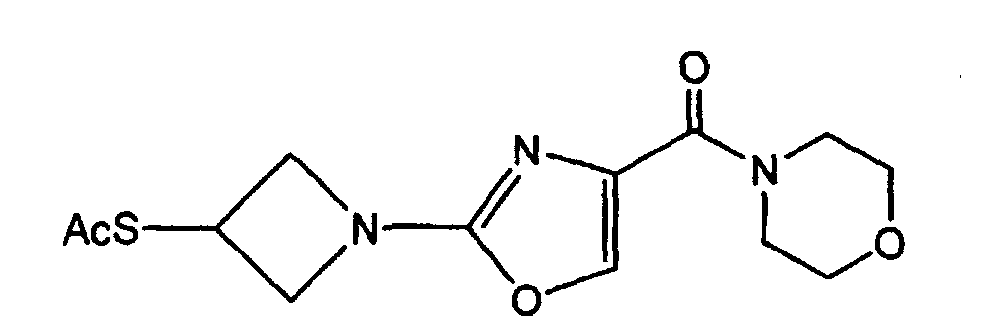
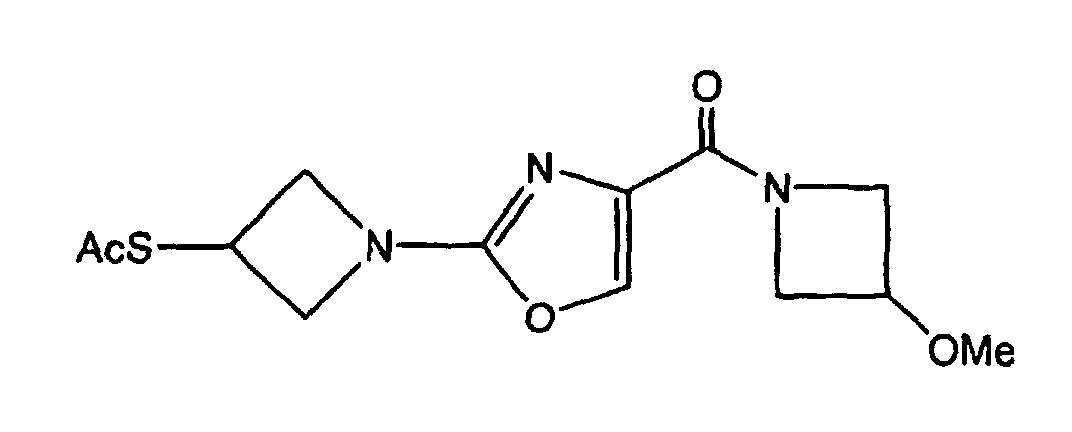
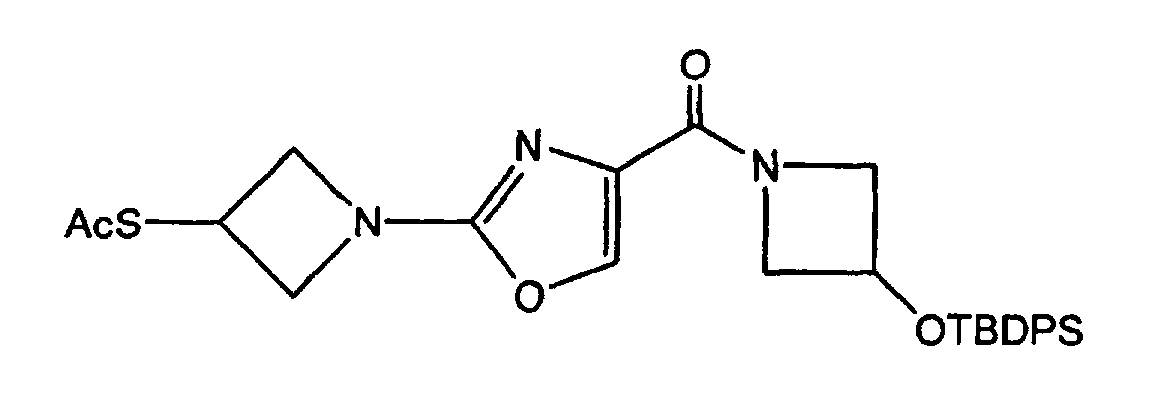

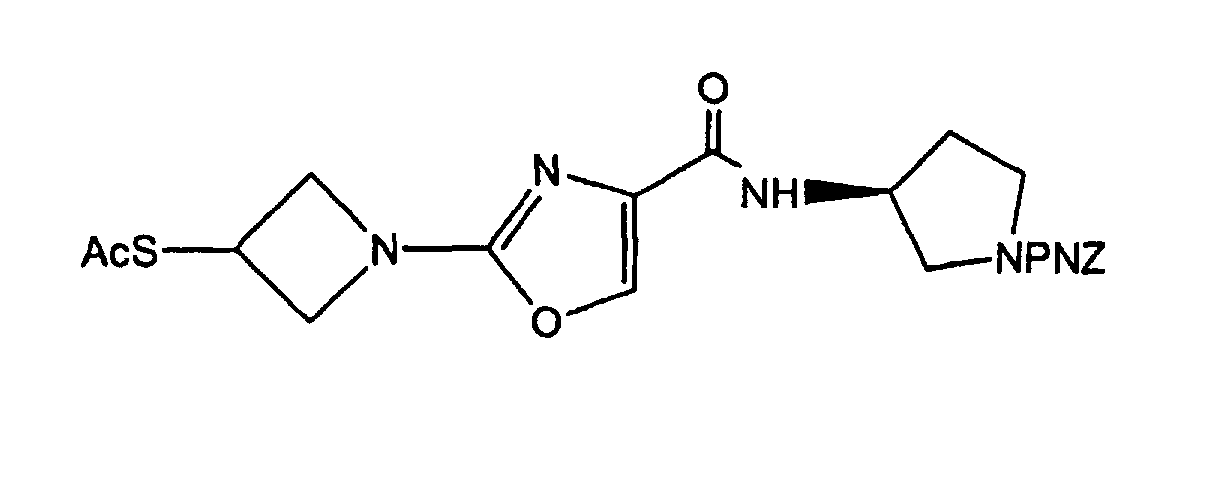
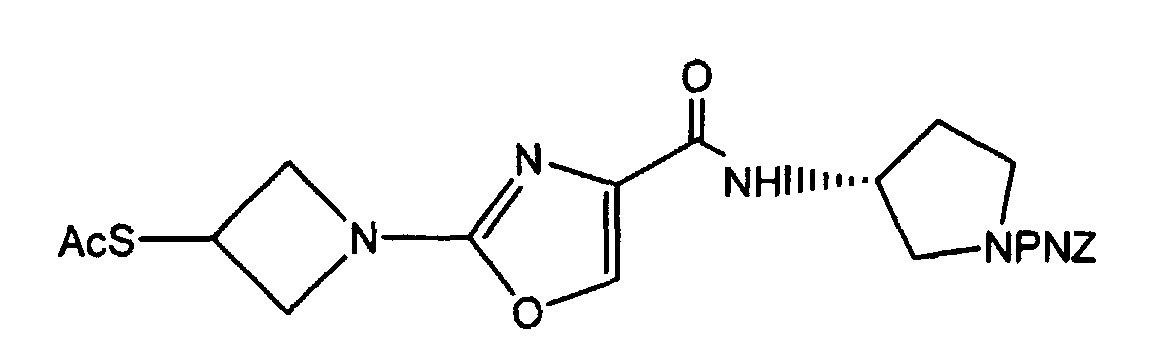
 R1 represents(1) a group represented by the formula COOR3