EP1340756A1 - Novel beta-lactam compounds and proecss for producing the same - Google Patents
Novel beta-lactam compounds and proecss for producing the same Download PDFInfo
- Publication number
- EP1340756A1 EP1340756A1 EP01979010A EP01979010A EP1340756A1 EP 1340756 A1 EP1340756 A1 EP 1340756A1 EP 01979010 A EP01979010 A EP 01979010A EP 01979010 A EP01979010 A EP 01979010A EP 1340756 A1 EP1340756 A1 EP 1340756A1
- Authority
- EP
- European Patent Office
- Prior art keywords
- methyl
- group
- solution
- allyl
- added
- Prior art date
- Legal status (The legal status is an assumption and is not a legal conclusion. Google has not performed a legal analysis and makes no representation as to the accuracy of the status listed.)
- Granted
Links
- 0 CC1=C*C(SC(C(*)C2C3*)=C(*)N2C3=O)=N1 Chemical compound CC1=C*C(SC(C(*)C2C3*)=C(*)N2C3=O)=N1 0.000 description 22
- HMDKEFDHEIRSJQ-QYEKGNEQSA-N C/C=C(\C=N/C(C)=C)/C(OC)=O Chemical compound C/C=C(\C=N/C(C)=C)/C(OC)=O HMDKEFDHEIRSJQ-QYEKGNEQSA-N 0.000 description 1
- OMFQALCJDYAWAG-UHFFFAOYSA-N CC1N(C)CC(C(OC)=O)=CC1 Chemical compound CC1N(C)CC(C(OC)=O)=CC1 OMFQALCJDYAWAG-UHFFFAOYSA-N 0.000 description 1
- VTQGSODJRBUZQP-JAMMHHFISA-N CCOC(C(CCN(C)[C@H]1C)C1=O)=O Chemical compound CCOC(C(CCN(C)[C@H]1C)C1=O)=O VTQGSODJRBUZQP-JAMMHHFISA-N 0.000 description 1
- NUITWBXESKKNHX-QMMMGPOBSA-N CCOC(C1=C[C@H](C)N(C)CC1)=O Chemical compound CCOC(C1=C[C@H](C)N(C)CC1)=O NUITWBXESKKNHX-QMMMGPOBSA-N 0.000 description 1
- VPZKIJODCAJOIS-QMMMGPOBSA-N CCOC(CCN(C)[C@@H](C)C(OC)=O)=O Chemical compound CCOC(CCN(C)[C@@H](C)C(OC)=O)=O VPZKIJODCAJOIS-QMMMGPOBSA-N 0.000 description 1
- HKSWNENEDUJKOM-ZETCQYMHSA-N C[C@@H]1N(C)CCC(C(CCl)=O)=C1 Chemical compound C[C@@H]1N(C)CCC(C(CCl)=O)=C1 HKSWNENEDUJKOM-ZETCQYMHSA-N 0.000 description 1
- QPBGZCBLFHANKL-UUYHEQIASA-N C[C@H]([C@H](C([C@H]1C)N2C(C(O)=O)=C1Sc1nc(C([C@@H]3C)=CCN3C=N)c[s]1)C2=O)O Chemical compound C[C@H]([C@H](C([C@H]1C)N2C(C(O)=O)=C1Sc1nc(C([C@@H]3C)=CCN3C=N)c[s]1)C2=O)O QPBGZCBLFHANKL-UUYHEQIASA-N 0.000 description 1
- QMMZJTMFPVKZTK-PSDNQQDLSA-N C[C@H]([C@H]([C@@H]([C@H]1C)N(C)C(C(O)=O)=C1S[IH]1=NC(C2=CC[C@H](CO)NC2)=CS1)C=O)O Chemical compound C[C@H]([C@H]([C@@H]([C@H]1C)N(C)C(C(O)=O)=C1S[IH]1=NC(C2=CC[C@H](CO)NC2)=CS1)C=O)O QMMZJTMFPVKZTK-PSDNQQDLSA-N 0.000 description 1
- YWLSGIUQTNPCMV-YDMBDPQISA-N C[C@H]([C@H]([C@@H]([C@H]1C)N2C(C(O)=O)=C1Sc1nc(C(C3)=CCN[C@@H]3c3ccccc3)c[s]1)C2O)O Chemical compound C[C@H]([C@H]([C@@H]([C@H]1C)N2C(C(O)=O)=C1Sc1nc(C(C3)=CCN[C@@H]3c3ccccc3)c[s]1)C2O)O YWLSGIUQTNPCMV-YDMBDPQISA-N 0.000 description 1
- CYZBHVGPRYZKQN-HWJSUCPMSA-N C[C@H]([C@H]([C@@H]([C@H]1C)N2C(C(O)=O)=C1Sc1nc(C3=CCN[C@@H](C)C3)c[s]1)C2=O)O Chemical compound C[C@H]([C@H]([C@@H]([C@H]1C)N2C(C(O)=O)=C1Sc1nc(C3=CCN[C@@H](C)C3)c[s]1)C2=O)O CYZBHVGPRYZKQN-HWJSUCPMSA-N 0.000 description 1
- BSHWEHWPYIWEKB-AVYYWPKPSA-N C[C@H]([C@H]([C@@H]([C@H]1C)N2C(C(O)=O)=C1Sc1nc(C3=CCN[C@H]3C)c[s]1)C2=O)O Chemical compound C[C@H]([C@H]([C@@H]([C@H]1C)N2C(C(O)=O)=C1Sc1nc(C3=CCN[C@H]3C)c[s]1)C2=O)O BSHWEHWPYIWEKB-AVYYWPKPSA-N 0.000 description 1
- NCZZQKFATZMCLW-AVYYWPKPSA-N C[C@H]([C@H]([C@@H]([C@H]1C)N2C(C(O)O)=C1Sc1nc(C3=CCN[C@H]3C)c[s]1)C2=O)O Chemical compound C[C@H]([C@H]([C@@H]([C@H]1C)N2C(C(O)O)=C1Sc1nc(C3=CCN[C@H]3C)c[s]1)C2=O)O NCZZQKFATZMCLW-AVYYWPKPSA-N 0.000 description 1
Classifications
-
- C—CHEMISTRY; METALLURGY
- C07—ORGANIC CHEMISTRY
- C07D—HETEROCYCLIC COMPOUNDS
- C07D477/00—Heterocyclic compounds containing 1-azabicyclo [3.2.0] heptane ring systems, i.e. compounds containing a ring system of the formula:, e.g. carbapenicillins, thienamycins; Such ring systems being further condensed, e.g. 2,3-condensed with an oxygen-, nitrogen- or sulphur-containing hetero ring
- C07D477/10—Heterocyclic compounds containing 1-azabicyclo [3.2.0] heptane ring systems, i.e. compounds containing a ring system of the formula:, e.g. carbapenicillins, thienamycins; Such ring systems being further condensed, e.g. 2,3-condensed with an oxygen-, nitrogen- or sulphur-containing hetero ring with hydrogen atoms, hydrocarbon or substituted hydrocarbon radicals, directly attached in position 4, and with a carbon atom having three bonds to hetero atoms with at the most one bond to halogen, e.g. an ester or nitrile radical, directly attached in position 2
- C07D477/12—Heterocyclic compounds containing 1-azabicyclo [3.2.0] heptane ring systems, i.e. compounds containing a ring system of the formula:, e.g. carbapenicillins, thienamycins; Such ring systems being further condensed, e.g. 2,3-condensed with an oxygen-, nitrogen- or sulphur-containing hetero ring with hydrogen atoms, hydrocarbon or substituted hydrocarbon radicals, directly attached in position 4, and with a carbon atom having three bonds to hetero atoms with at the most one bond to halogen, e.g. an ester or nitrile radical, directly attached in position 2 with hydrogen atoms, hydrocarbon or substituted hydrocarbon radicals, attached in position 6
- C07D477/16—Heterocyclic compounds containing 1-azabicyclo [3.2.0] heptane ring systems, i.e. compounds containing a ring system of the formula:, e.g. carbapenicillins, thienamycins; Such ring systems being further condensed, e.g. 2,3-condensed with an oxygen-, nitrogen- or sulphur-containing hetero ring with hydrogen atoms, hydrocarbon or substituted hydrocarbon radicals, directly attached in position 4, and with a carbon atom having three bonds to hetero atoms with at the most one bond to halogen, e.g. an ester or nitrile radical, directly attached in position 2 with hydrogen atoms, hydrocarbon or substituted hydrocarbon radicals, attached in position 6 with hetero atoms or carbon atoms having three bonds to hetero atoms with at the most one bond to halogen, e.g. an ester or nitrile radical, directly attached in position 3
- C07D477/20—Sulfur atoms
-
- A—HUMAN NECESSITIES
- A61—MEDICAL OR VETERINARY SCIENCE; HYGIENE
- A61P—SPECIFIC THERAPEUTIC ACTIVITY OF CHEMICAL COMPOUNDS OR MEDICINAL PREPARATIONS
- A61P31/00—Antiinfectives, i.e. antibiotics, antiseptics, chemotherapeutics
- A61P31/04—Antibacterial agents
-
- C—CHEMISTRY; METALLURGY
- C07—ORGANIC CHEMISTRY
- C07D—HETEROCYCLIC COMPOUNDS
- C07D477/00—Heterocyclic compounds containing 1-azabicyclo [3.2.0] heptane ring systems, i.e. compounds containing a ring system of the formula:, e.g. carbapenicillins, thienamycins; Such ring systems being further condensed, e.g. 2,3-condensed with an oxygen-, nitrogen- or sulphur-containing hetero ring
- C07D477/02—Preparation
- C07D477/06—Preparation from compounds already containing the ring or condensed ring systems, e.g. by dehydrogenation of the ring, by introduction, elimination or modification of substituents
Definitions
- the present invention relates to a novel ⁇ -lactam compound represented by the formula [1] as described below.
- MRSA methicillin-resistant Staphylococcus aureus
- MRCNS methicillin-resistant coagulase-negative Staphylococci
- An object of the present invention is to provide a ⁇ -lactam antibiotic having an excellent antibacterial activity against Gram-positive bacteria, especially against MRSA and MRCNS.
- the present inventors have intensively studied, and have found that a compound of the following formula [1] shows a potent effect on Gram-positive bacteria, and shows an excellent antibacterial activity especially against MRSA and MRCNS, and have accomplished the present invention.
- the present invention relates to
- the lower alkyl group in the present invention includes a straight chain or branched chain C 1 -C 6 alkyl group, for example, methyl, ethyl, n-propyl, isopropyl, n-butyl, isobutyl, tert-butyl, n-pentyl and n-hexyl.
- the lower alkyl group substituted by a hydroxy group includes ones having 1 to 6 carbon atoms, for example, hydroxymethyl, 1-hydroxyethyl, 2-hydroxyethyl, 1-hydroxy-1-methylethyl, 1-hydroxypropyl, and 2-hydroxypropyl.
- the lower alkoxy group includes a straight chain or branched chain C 1-6 alkyloxy group, for example methoxy, ethoxy, n-propoxy, isopropoxy, n-butoxy, isobutoxy, tert-butoxy, n-pentoxy and n-hexoxy.
- the lower alkylamino group includes mono or di-substituted amino group substituted by a straight chain or branched chain C 1-6 alkyl group, for example methylamino, ethylamino, n-propylamino, isopropylamino, n-butylamino, isobutylamino, tert-butylamino, n-pentylamino, n-hexylamino, methyl ethylamino, dimethylamino, diethylamino, di(n-propyl)amino, di(isopropyl)amino, di(n-butyl)amino, di(n-pentyl)amino and di(n-hexyl)amino.
- the halogen atom includes fluorine atom, chlorine atom, bromine atom and iodine atom.
- the 5 to 7 membered hetero ring includes, for example 3,4-dihydro-2-H-pyrrole ring, 2,3,4,5-tetrahydropyridine ring, 3,4,5,6-tetrahydro-2-H-azepine ring, etc.
- the substituent of lower alkyl group optionally substituted includes a hydroxy group, a lower alkoxy group, a lower alkylthio group, a lower alkylsulfinyl group, a lower alkylsulfonyl group, a lower alkylcarbonyl group, a lower alkylcarbonyloxy group, a lower alkoxycarbonyl group, a carboxyl group, a halogen atom, cyano group, -NR 6 R 7 (wherein R 6 and R 7 are independently hydrogen atom or a lower alkyl group, or R 6 and R 7 may be combined together with the nitrogen atom to form a 5-7 membered ring such as pyrrolidine, piperidine, azepane, morpholine, piperazine, or a N-lower alkyl piperazine), -CONR 6 R 7 (wherein R 6 and R 7 are the same as defined above), -NR 6a COR 7a (wherein R 6a and R 7
- the lower alkylcarbonyl group includes a straight chain or branched chain C 2-7 alkylcarbonyl group, for example methylcarbonyl, ethylcarbonyl, n-propylcarbonyl, isopropylcarbonyl, n-butylcarbonyl, isobutylcarbonyl, tert-butylcarbonyl, n-pentylcarbonyl and n-hexylcarbonyl.
- the lower alkylcarbonyloxy group includes a straight chain or branched chain C 2-7 alkylcarbonyloxy group, for example methylcarbonyloxy, ethylcarbonyloxy, n-propylcarbonyloxy, isopropylcarbonyloxy, n-butylcarbonyloxy, isobutylcarbonyloxy, tert-butylcarbonyloxy, n-pentylcarbonyloxy and n-hexylcarbonyloxy.
- the lower alkoxycarbonyl group includes a straight chain or branched chain C 2-7 alkoxycarbonyl group, for example methoxycarbonyl, ethoxycarbonyl, n-propoxycarbonyl, isopropoxycarbonyl, n-butoxycarbonyl, isobutoxycarbonyl, tert-butoxycarbonyl, n-pentoxycarbonyl and n-hexoxycarbonyl.
- the lower alkyl portion of a lower alkylthio group, a lower alkylsulfinyl group and a lower alkylsulfonyl group includes a straight chain or branched chain C 1 -C 6 alkyl group, for example, methyl, ethyl, n-propyl, isopropyl, n-butyl, isobutyl, tert-butyl, n-pentyl and n-hexyl.
- the substituent of a carbamoyl group optionally substituted includes one or two lower alkyl groups, pyrrolidine, piperidine, and azepane, which is formed with a nitrogen atom of the carbamoyl group.
- the substituent of the amino group optionally substituted includes one or two lower alkyl groups, and the amino group substituted includes pyrrolidine, piperidine, and azepane, which is formed with a nitrogen atom of the amino group.
- the substituent of the 5 to 7 membered heterocyclic group optionally substituted includes, for example, a lower alkyl group, a hydroxy group, a lower alkoxy group, a lower alkylcarbonyl group, a lower alkylcarbonyloxy group, a lower alkyloxycarbonyl group, a carboxyl group, a halogen atom, and cyano group.
- the protecting group for a carboxyl group may be any conventional protecting groups, but preferably for example, a straight chain or branched chain lower alkyl group having 1 to 5 carbon atoms (e.g., methyl, ethyl, isopropyl, tert-butyl, etc.), a halogeno lower alkyl group having 1 to 5 carbon atoms (e.g., 2-iodoethyl, 2,2,2-trichloroethyl), an alkoxymethyl group having 1 to 5 carbon atoms (e.g., methoxymethyl, ethoxymethyl, isobutoxymethyl), a lower aliphatic acyloxymethyl group having 1 to 5 carbon atoms (e.g., acetoxymethyl, propionyloxymethyl, butyryloxymethyl, pivaloyloxymethyl), a 1-(C 1 -C 5 ) lower alkoxycarbonyloxyethyl group (e.g., 1-ethoxycarbonyloxy
- the protecting group for a hydroxy group or an amino group may be any conventional ones, and preferably a lower alkoxycarbonyl group having 1 to 5 carbon atoms (e.g., tert-butyloxycarbonyl), a halogenoalkoxycarbonyl group having 1 to 5 carbon atoms (e.g., 2-iodoethyloxycarbonyl, 2,2,2-trichloroethyloxycarbonyl), a substituted or unsubstituted lower alkenyloxycarbonyl group having 3 to 7 carbon atoms (e.g., allyloxycarbonyl), a substituted or unsubstituted aralkyloxycarbonyl group (e.g., benzyloxycarbonyl, p-methoxybenzyloxycarbonyl, o-nitro benzyloxycarbonyl, p-nitrobenzyloxycarbonyl), or a trialkylsilyl group (e.g., trimethylsilyl
- the preferable substituents of Y 1 on the ⁇ -lactam compound of the formula [1a] are a C 1-3 alkyl group such as methyl, ethyl, isopropyl, etc., hydroxymethyl, chloromethyl, fluoromethyl, methoxymethyl, carbamoyloxymethyl, ureidomethyl, sulfamoylmethyl, sulfamoylaminomethyl, carbamoyl, etc.
- the pharmaceutically acceptable salt of the compound of the above formula [1] is a conventional non-toxic salt.
- Such salts include, as a salt with an intramolecular carboxylic acid, a salt with an inorganic base such as sodium, potassium, calcium, magnesium, ammonium, a salt with an organic base such as triethylammonium, pyridinium, diisopropylammonium, or an intramolecular salt being formed with a cation at the 3-side chain such as a quaternary ammonium ion.
- a salt with an intramolecular base a salt with an inorganic acid such as hydrochloric acid, sulfuric acid, phosphoric acid, or a salt with an organic acid such as formic acid, acetic acid, oxalic acid, methanesulfonic acid, benzenesulfonic acid can be exemplified.
- the non-toxic ester of the formula [1] includes a conventional pharmaceutically acceptable ester at the 2-carboxyl group of carbapenem antibacterial agents, and may be esters being able to be easily hydrolyzed in the living body, for example, esters with acetoxymethyl, pivaloyloxymethyl, 1-(ethoxycarbonyloxy)ethyl, and phthalidyl.
- the ⁇ -lactam compound of the formula [1], or a pharmaceutically acceptable salt thereof, or a non-toxic ester thereof may be in the form of an anhydride thereof, a hydrate thereof, or a solvate thereof.
- the compound of the formula [4]: wherein R 1a , R 2 , R 5 , m, n, X, Y 1 and Y 3 are the same as defined above, can be prepared by reacting a compound of the formula [2]: wherein R 1a , R 2 , R 5 and L are the same as defined above, with a compound of the formula [3]: wherein m, n, X, Y 1 and Y 3 are the same as defined above, in the presence of a base, or by reacting a compound of the formula [2] with a thiolate salt of the compound of the formula [3] in an inert solvent.
- the active ester of a hydroxy group includes, for example, a substituted or unsubstituted arylsulfonic acid ester (e.g., benzenesulfonic acid ester, p-toluenesulfonic acid ester, p-nitrobenzenesulfonic acid ester, p-bromobenzene sulfonic acid ester, etc.), a lower alkanesulfonic acid ester having 1 to 5 carbon atoms (e.g., methanesulfonic acid ester, ethanesulfonic acid ester, etc.), a halogenoalkanesulfonic acid ester having 1 to 5 carbon atoms (e.g., trifluoromethanesulfonic acid ester, etc.), an arylphosphoric acid ester (e.g., diphenylphosphoric acid ester, etc.), or a halide compound such as chloride, bromide, iod
- the preferable reactive ester of a hydroxy group may be p-toluenesulfonic acid ester, methanesulfonic acid ester, trifluoromethanesulfonic acid ester, and diphenylphosphoric acid ester.
- the inert solvent which is used in the reaction between the compound [2] and the compound [3] in the presence of a base to give the compound [4], includes, for example, dioxane, tetrahydrofuran, dimethylsulfoxide, dimethylformamide, acetonitrile, benzene, toluene, hexamethylphosphoramide, or a mixture of these solvents.
- the base includes, for example, an inorganic base such as sodium carbonate, potassium carbonate, sodium hydride, potassium hydride, or an organic base such as pyridine, dimethylaminopyridine, triethylamine, diisopropylethylamine, 1,8-diazabicyclo[5.4.0]undec-7-ene (DBU). Especially preferable one is DBU.
- the base should be used in an amount sufficient for carrying out the reaction, and it is usually used in an amount of 1 to 3 equivalents, to the amount of the mercaptan compound [3].
- the mercaptan compound [3] should be used in an amount sufficient for carrying out the reaction, and can be used in a large excess amount, but it is usually used in an amount of 1 to 2 equivalents, to the amount of the compound [2].
- the reaction is carried out at a temperature of from -78°C to +60°C, preferably at a temperature of from -40°C to +40°C. Besides, after the reaction is completely over, the product thus obtained is isolated by a conventional technique of organic chemistry.
- the inert solvent which is used in the reaction between the compound [2] and a thiolate salt of the compound [3] to give the compound [4], includes, for example, dioxane, tetrahydrofuran, dimethylsulfoxide, dimethylformamide, acetonitrile, benzene, toluene, hexamethylphosphoramide, or a mixture of these solvents.
- the thiolate salt should be used in an amount sufficient for carrying out the reaction, and can be used in a large excess amount, but it is usually used in an amount of 1 to 2 equivalents, to the amount of the compound [2].
- the reaction is carried out at a temperature of from -78°C to +60°C, more preferably at a temperature of from -40°C to +40°C. After the reaction is completely over, the product thus obtained is isolated by a conventional technique of organic chemistry.
- the thiolate salt is prepared by reacting the mercaptan compound [3] with a base.
- the base includes, for example, an inorganic base (e.g., sodium hydride, potassium hydride), a metal alkoxide (e.g., potassium tert-butoxide, sodium methoxide), or a metal amide (e.g., sodium amide, lithium diisopropylamide, lithium disilazide).
- an inorganic base e.g., sodium hydride, potassium hydride
- a metal alkoxide e.g., potassium tert-butoxide, sodium methoxide
- a metal amide e.g., sodium amide, lithium diisopropylamide, lithium disilazide
- the ⁇ -lactam compound of the formula [1] is obtained from the compound [4] in a conventional manner by carrying out, optionally combining or simultaneously, reactions such as the removal of the protecting group for a hydroxy group for R 1a or Y 1 , the removal of the protecting group of an amino group for Y 1 , the removal of protecting group of an amino group for Y 3 , the subsequent imidoylization reaction of the amino group of which protecing group was removed, or the removal of protecting group of an imidoyl group for Y 3 and removing the protecting group of a carboxyl group for R 5 and Y 1 .
- the removal of these protecting groups is carried out by treating with an acid, a base, or a reducing agent, and these methods per se are well known methods, as disclosed, for example, in T. W. Greene: Protective Groups in Organic Synthesis, J. Wiley & Sons Inc., 1981.
- the acid is preferably trifluoroacetic acid, formic acid, boron trifluoride, aluminum chloride, etc., or a mixture of these acids.
- the base is preferably an alkali metal carbonate (e.g., sodium carbonate, potassium carbonate, etc.), an alkali metal sulfide (e.g., sodium sulfide, potassium sulfide, etc.), or tetrabutylammonium fluoride.
- the reduction method includes, for example, hydrogenation with zinc and acetic acid, hydrogen and palladium-carbon or platinum, etc. There may be also used palladium (0) compound.
- the solvent may be any ones which do not disadvantageously affect the reaction, and includes, for example, water, alcohols (e.g., methanol, ethanol), ethers (e.g., tetrahydrofuran, dioxane), fatty acids (e.g., acetic acid), or a mixture of these solvents.
- the reaction can possibly be suppressed or promoted by properly lowering or raising the reaction temperature.
- the preferable reaction temperature is in the range from -30°C to +40°C.
- the product thus obtained can be isolated by a conventional technique of organic chemistry, for example, by neutralizing the reaction mixture, subjecting it to column chromatography on absorption resin, etc., collecting the fractions containing the desired compound, and then followed by lyophilizing the resultant.
- the compounds of the generic formula (2) are known, and can be prepared by the method disclosed in JP 63-55514 B.
- the mercaptan compounds of the generic formula (3) are , according to the following scheme, prepared by changing it into a mercaptothiazole derivative (C) after preparing a cyclic amine derivative (B) having a unsaturated ester portion from an appropriate amino acid. If necessary, an optically active mercaptothiazole derivative (C) is prepared by using an optically active intermediate.
- R a is an optionally substituted lower alkyl group
- R b is a protective group of an amino group
- p is an integer of 0 or 1.
- the compound of the above mentioned formula [1] may have optical isomers based on the asymmetric carbon atoms at the 4-, 5- and 6-positions of the carbapenem nucleus, as shown in the following formula: and these isomers are all conveniently expressed by only one formula.
- the scope of the present invention should not be construed to be limited thereby, and includes all isomers and a mixture of isomers based on each asymmetric carbon atom.
- the preferable isomers are ones wherein the 5-carbon atom has an R-configuration such as (5R,6R)-compounds or (5R, 6S)-compounds when R 2 is a hydrogen atom, and one wherein the 4-carbon atom has an R-configuration and the 5-carbon atom has an S-configuration, such as (4R,5S,6S)-compounds or (4R,5S,6R)-compounds, when R 2 is a lower alkyl group.
- R-configuration such as (5R,6R)-compounds or (5R, 6S)-compounds when R 2 is a hydrogen atom
- 4-carbon atom has an R-configuration and the 5-carbon atom has an S-configuration, such as (4R,5S,6S)-compounds or (4R,5S,6R)-compounds, when R 2 is a lower alkyl group.
- the compound [1] may have isomers having an R-configuration or an S-configuration at the 8-position, as shown in the above formula, the preferable one is ones having an R-configuration at the 8-position. There is an isomer due to a substituent, Y 1 .
- Isomers having such configurations are prepared by using each corresponding isomer of the starting compounds [2] and (3).
- the present compounds of the formula [1] are novel ⁇ -lactam compounds having an azolethio group having various substituents at the 3-position of the carbapenem nucleus, and these compounds show an excellent antibacterial activity, and are useful as a medicament.
- novel ⁇ -lactam compounds of the present invention represented by the above formula [1] exhibit antibacterial activities against a wide variety of pathogenic bacteria including Gram-positive bacteria such as Staphylococcus aureus, Staphylococcus epidermidis, Streptococcus pyogenes, Streptococcus pneumoniae, Enterococcus faecalis, and Gram-negative bacteria such as Escherichia coli, the genus Proteus, Klebslella pneumonlae, Haemophllus influenzae, Neisseria gonorrhoeae, the genus Branhamella, and especially exhibit excellent antibacterial activities against Gram-positive bacteria, as well as against MRSA and MRCNS.
- Gram-positive bacteria such as Staphylococcus aureus, Staphylococcus epidermidis, Streptococcus pyogenes, Streptococcus pneumoniae, Enterococcus faecalis
- Gram-negative bacteria such as
- the compounds [1] of the present invention are different in the degree on each compound, but the central nervous side effect is more reduced and the physicochemical property of the compound [1] such as solubility in water which should be equipped as the medicine, is more improved. These properties are exemplified as a characteristic property of the present invention.
- DHP-I dehydropeptidase-I
- a renal enzyme can easily hydrolyze carbapenem compounds derived from natural resources, but some of the present compounds [1], which are also carbapenem compounds, are stable over DHP-I, and can be used alone, but a DHP-I inhibitor may be used together with the present compound, if necessary.
- the present compounds When used as an antibacterial agent in the treatment of infectious diseases caused by bacteria, the present compounds are administered, for example, orally in the form of a tablet, capsule, powder, syrup, etc., or parenterally such as intravenous injection, intramuscular injection, or intrarectal administration.
- the suitable administration forms as mentioned above may be prepared by mixing an active ingredient with a conventional pharmaceutically acceptable carrier, excipient, binder, stabilizer, etc.
- a pharmaceutically acceptable buffering agent, solubilizer, isotonic agent, etc. may be added thereto.
- the dosage of the compound [1] varies according to the symptoms, ages, body weights, the administration form, the frequency of the administration, etc., but it is usually in the range of 100 to 3000 mg per day for an adult, which is administered once or divided into several dosage units. Besides, the dosage of the compound [1] may be increased or decreased, if necessary.
Landscapes
- Chemical & Material Sciences (AREA)
- Organic Chemistry (AREA)
- Health & Medical Sciences (AREA)
- Life Sciences & Earth Sciences (AREA)
- Molecular Biology (AREA)
- Nuclear Medicine, Radiotherapy & Molecular Imaging (AREA)
- Animal Behavior & Ethology (AREA)
- Chemical Kinetics & Catalysis (AREA)
- General Chemical & Material Sciences (AREA)
- Medicinal Chemistry (AREA)
- Communicable Diseases (AREA)
- Pharmacology & Pharmacy (AREA)
- Oncology (AREA)
- General Health & Medical Sciences (AREA)
- Public Health (AREA)
- Veterinary Medicine (AREA)
- Pharmaceuticals Containing Other Organic And Inorganic Compounds (AREA)
- Nitrogen Condensed Heterocyclic Rings (AREA)
- Hydrogenated Pyridines (AREA)
- Cephalosporin Compounds (AREA)
Abstract

Description
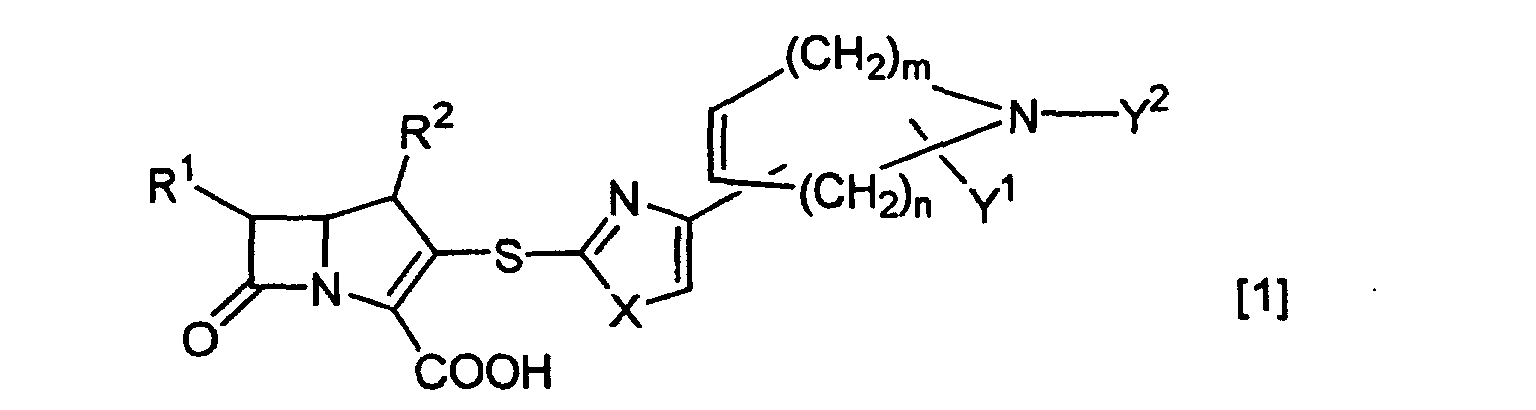
or a pharmaceutically acceptable salt thereof, or a non-toxic ester thereof,
or a pharmaceutically acceptable salt thereof, or a non-toxic ester thereof,
or a pharmaceutically acceptable salt thereof, or a non-toxic ester thereof,
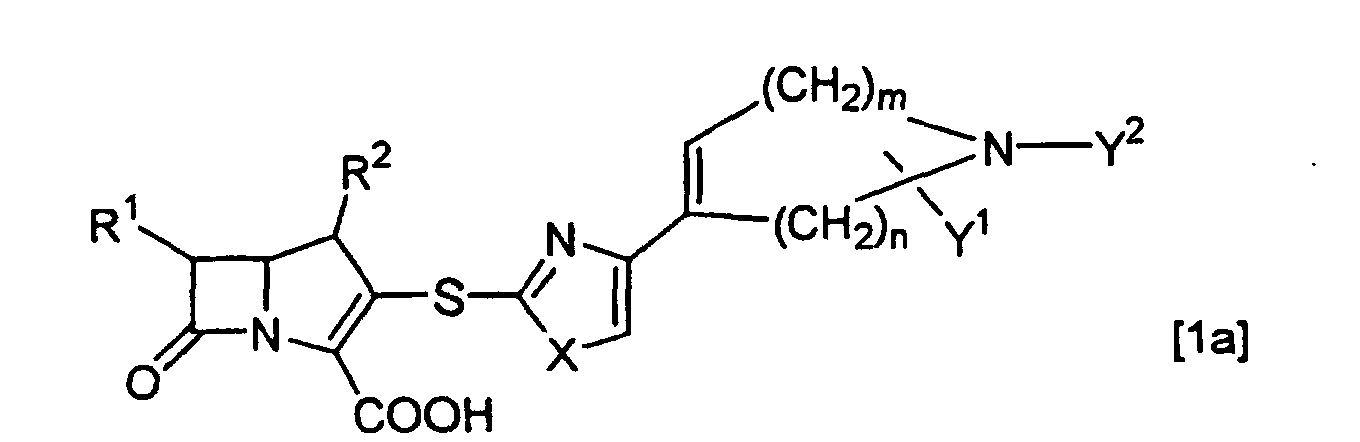
or a pharmaceutically acceptable salt thereof, or a non-toxic ester thereof,
or a pharmaceutically acceptable salt thereof, or a non-toxic ester thereof,
or a pharmaceutically acceptable salt thereof, or a non-toxic ester thereof,
or a pharmaceutically acceptable salt thereof, or a non-toxic ester thereof,
or a pharmaceutically acceptable salt thereof, or a non-toxic ester thereof,

or a salt thereof, which comprises
reacting a compound of the formula [2] :

with a compound of the formula [3]:

in the presence of a base, or reacting the compound of the formula [2] with a thiolate of the compound of the formula [3] to give a compound of the formula [4]:

followed by an appropriate combination of reactions which are properly selected from the removal of the protecting group of a hydroxy group for R1a and Y1, the removal of protecting group of an amino group for Y3, the removal of protecting group of an amino group for Y1, the optionally subsequent imidoylization reaction of an amino group of which protecting group was removed for Y3, or the removal of protecting group of an imidoyl group for Y3 and the removal of protecting group of a carboxyl group for R5 and Y1,

can be prepared by reacting a compound of the formula [2]:
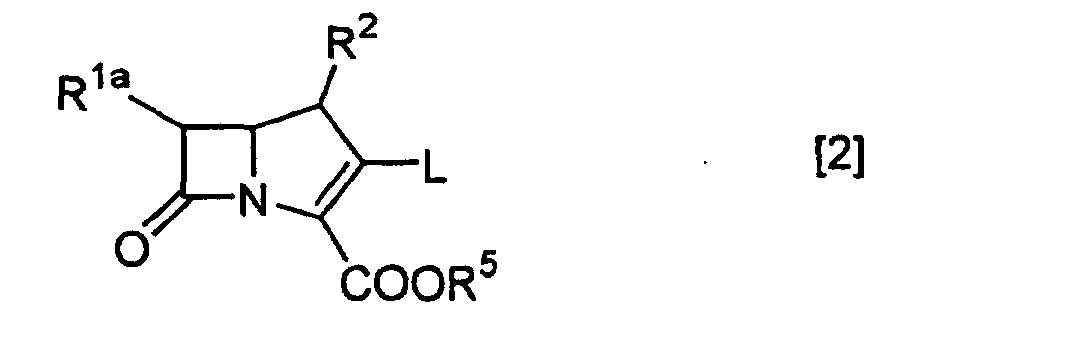
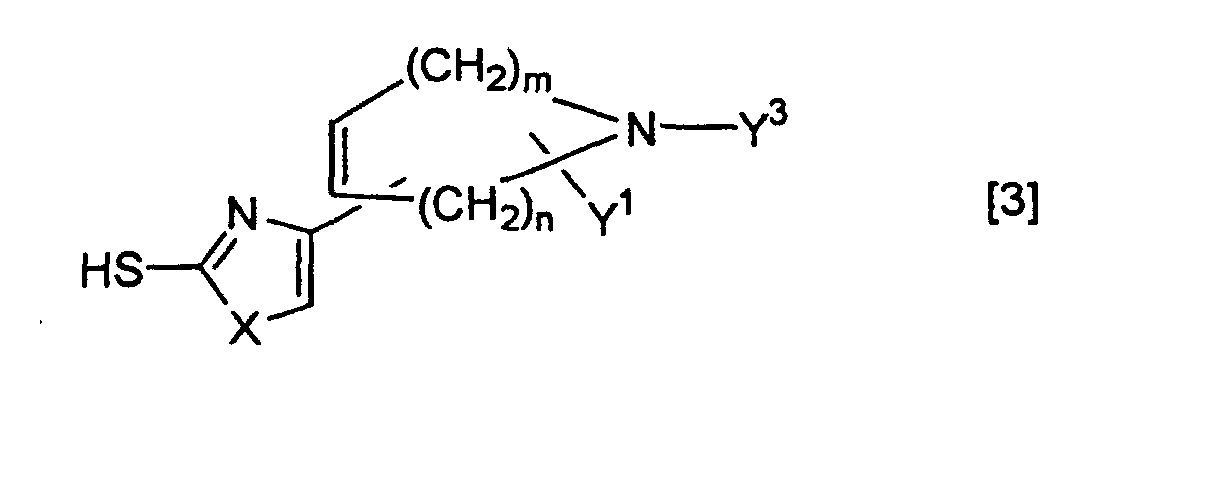
in the presence of a base, or by reacting a compound of the formula [2] with a thiolate salt of the compound of the formula [3] in an inert solvent.


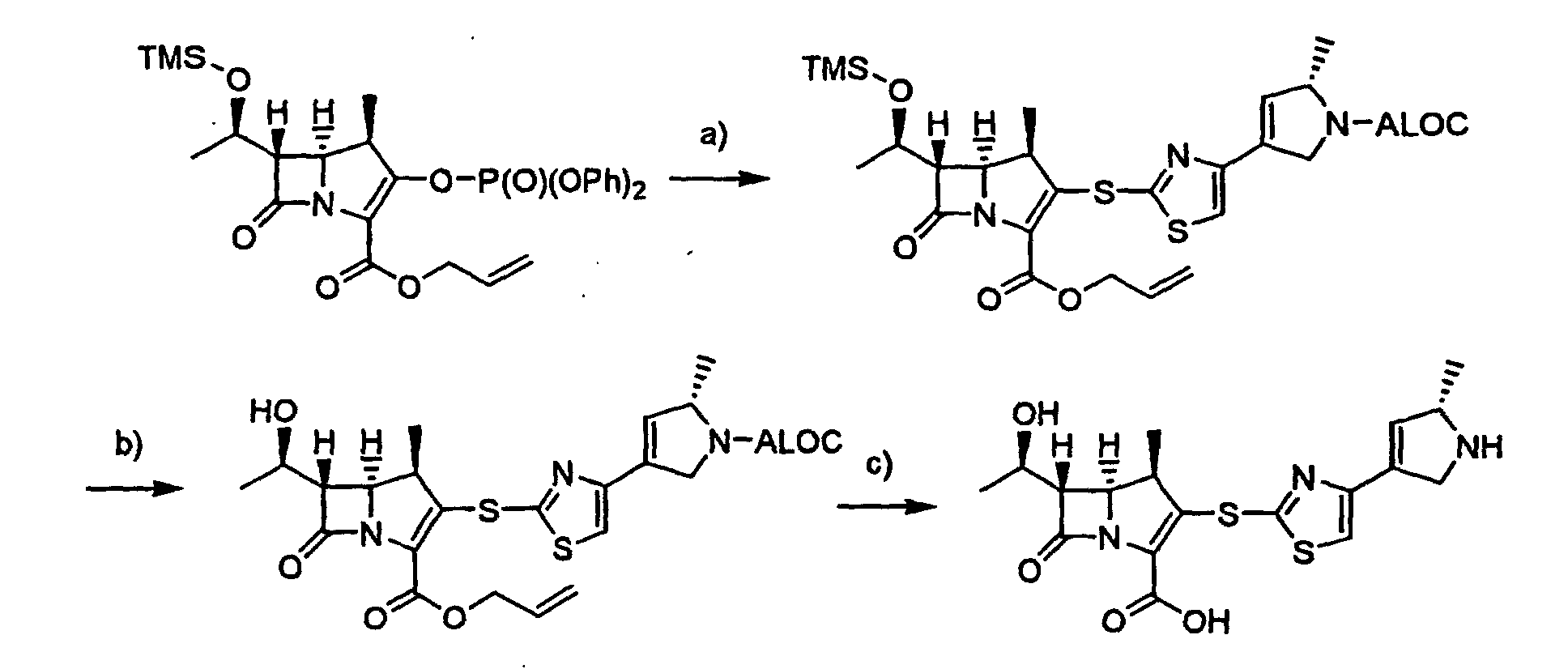
1H NMR (300 MHz, D2O) δ 0.94(3 H, d, J=7.3 Hz), 1.12(3 H, d, J = 6.4 Hz), 1.38(3 H, d, J = 6.8 Hz), 3.10-3.24 (1 H, m), 3.35 (1 H, dd, J = 2.6, 6.0 Hz), 4.05-4.15 (2 H, m), 4.23-4.37 (2 H, m), 6.25 (1 H, s), 7.50 (1 H, s).

[(allyloxy)carbonyl]-5-methyl-2,5-dihydro-lH-pyrrol-3-yl}-1,3-thiazol-2-yl)sulfanyl]-4-methyl-7-oxo-6-{(1R)-1-[(trimethylsilyl)oxy]ethyl}-1-azabicyclo[3.2.0]hept-2-ene-2-carboxylate.
1H NMR (300 MHz, CDCl3) δ 0.11 (9 H, s), 1.08-1.12 (3 H, m), 1.22-1.25 (3 H, m), 1.37-1.43 (3 H, m), 3.24 (1H, dd, J = 6.2, 2.9 Hz), 3.37-3.58 (1 H, m), 4.17-4.24 (2H, m), 4.40-4.87 (7 H, m), 5.21-5.50 (4 H, m), 5.91-6.05 (2 H, m), 6.34-6.38 (1H, m), 7.10-7.14 (1 H, m).
1H NMR (300 MHz, D2O) δ 0.92 (3 H, d, J = 7.2 Hz), 1.10 (3 H, d, J = 6.4 Hz), 1.31 (3 H, d, J = 6.8 Hz), 3.10-3.20 (1 H, m), 3.32 (1 H, dd, J = 5.9, 2.9 Hz), 4.03-4.28 (4 H, m), 6.23 (1 H, br s), 7.45 (1 H, s).

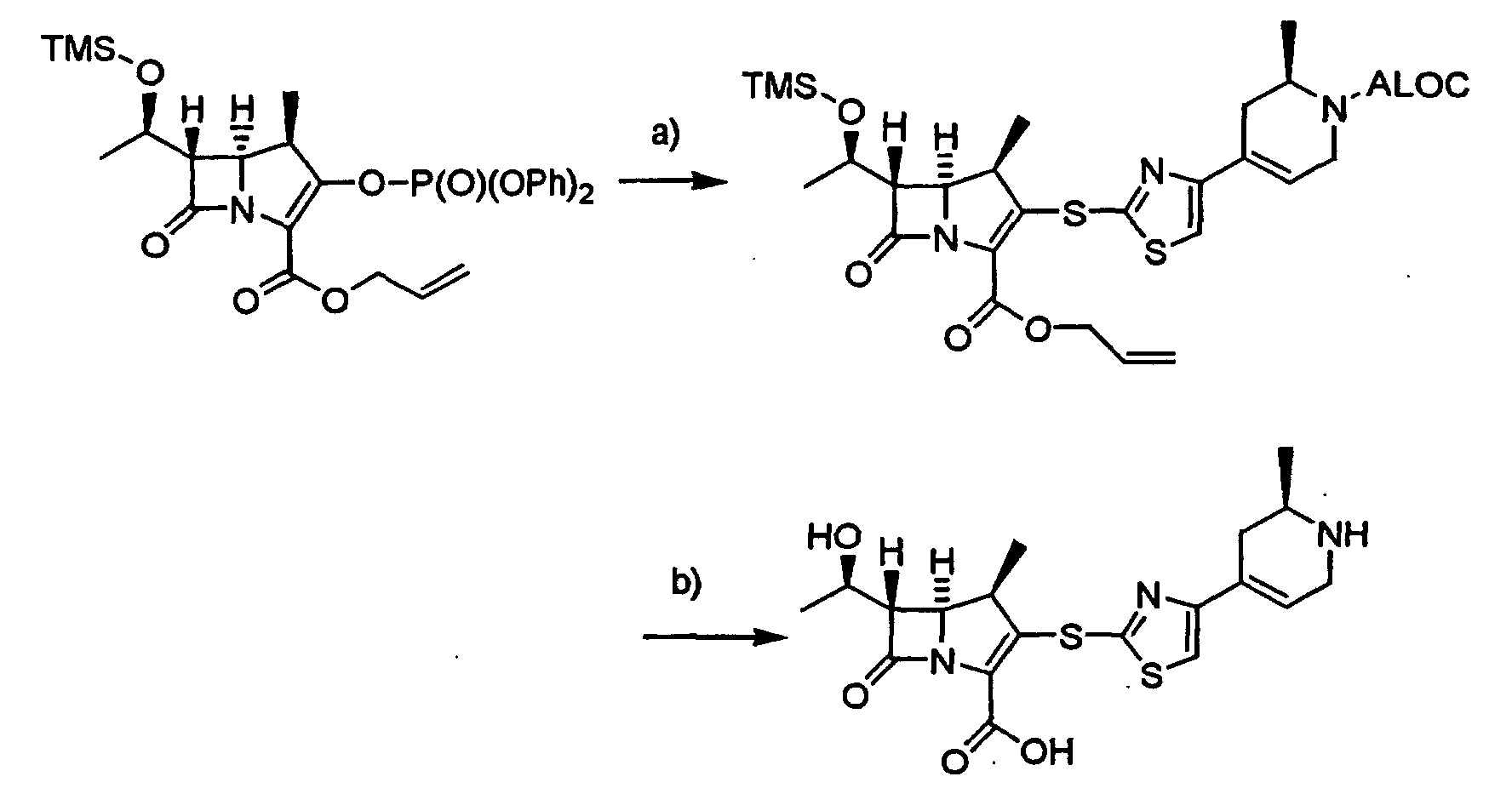
azabicyclo[3.2.0]hept-2-ene-2-carboxylate in acetonitrile (30%, 4.80g, 2.52mmol) and the solution was allowed to stand in a refrigerator for 60 hours. To the reaction solution was added ice water and the reaction mixture was extracted with ethyl acetate. The organic layer was washed with a saturated aqueous sodium chloride solution and dried over anhydrous sodium sulfate. After removal of the solvent in vacuo, the residue was purified with silica gel chromatography (hexane/ethyl acetate) to give allyl (4R,5S,6S)-3-[(4-{(6S)-1-[(allyloxy)carbonyl]-6-methyl-1,2,3,6-tetrahydro-4-pyridinyl}-1,3-thiazol-2-yl)sulfanyl]-4-methyl-7-oxo-6-{(1R)-1-[(trimethylsilyl)oxy]ethyl}-1-azabicyclo[3.2.0]hept-2-ene-2-carboxylate (590mg, 76%). 1H NMR (300 MHz, CDCl3) δ 0.12 (9 H, s), 1.06-1.12 (3 H, m), 1.24 (3 H, d, J = 6.0 Hz), 1.29-1.32 (3 H, m), 2.37-2.45 (1 H, m), 2.46-2.59 (1 H, m), 3.00-3.12 (1H, m), 3.24 (1H, dd, J = 6.4, 2.9 Hz), 3.42-3.61 (1 H, m), 4.16-4.40 (3 H, m), 4.62-4.87 (5 H, m), 5.20-5.50 (4 H, m), 5.90-6.04 (2 H, m), 6.61-6.64 (1 H, m), 7.10-7.13 (1 H, m).
IR (KBr) 3409, 2971, 1760, 1596, 1390, 1264, 1148, 1028 cm- 1
1H NMR (300 MHz, D2O) δ 0.91(3 H, d, J = 7.0 Hz), 1.10(3 H, d, J = 5.7 Hz), 1.32(3 H, d, J = 6.8 Hz), 2.58-2.63 (2 H, m), 3.09-3.26 (2 H, m), 3.30-3.34 (1 H, m), 3.42-3.51 (1 H, m), 4.01-4.11 (3 H, m), 6.28 (1 H, s), 7.44 (1 H, s).

1H NMR (300 MHz, CDCl3) δ 0.09 (9 H, s), 1.04-1.10 (3 H, m), 1.15-1.29 (6 H, m), 2.34-2.57 (2 H, m), 2.96-3.11 (1 H, m), 3.19-3.24 (1 H, m), 3.38-3.58 (1 H, m), 4.13-4.38 (3 H, m), 4.59-4.85 (5 H, m), 5.16-5.48 (4 H, m), 5.85-6.02 (2 H, m), 6.61 (1 H, m), 7.08-7.10 (1 H, m).
1H NMR (300 MHz, D2O) δ 0.89-0.91 (3 H, m), 1.09 (3 H, d, J = 6.4 Hz), 1.33 (3 H, d, J = 7.0 Hz), 2.58-2.67 (2 H, m), 3.07-3.35 (3 H, m), 3.43-3.53 (1 H, m), 4.00-4.12 (3 H, m), 6.28 (1 H, s), 7.44 (1 H, s).
IR (KBr) 3422, 1771 cm-1
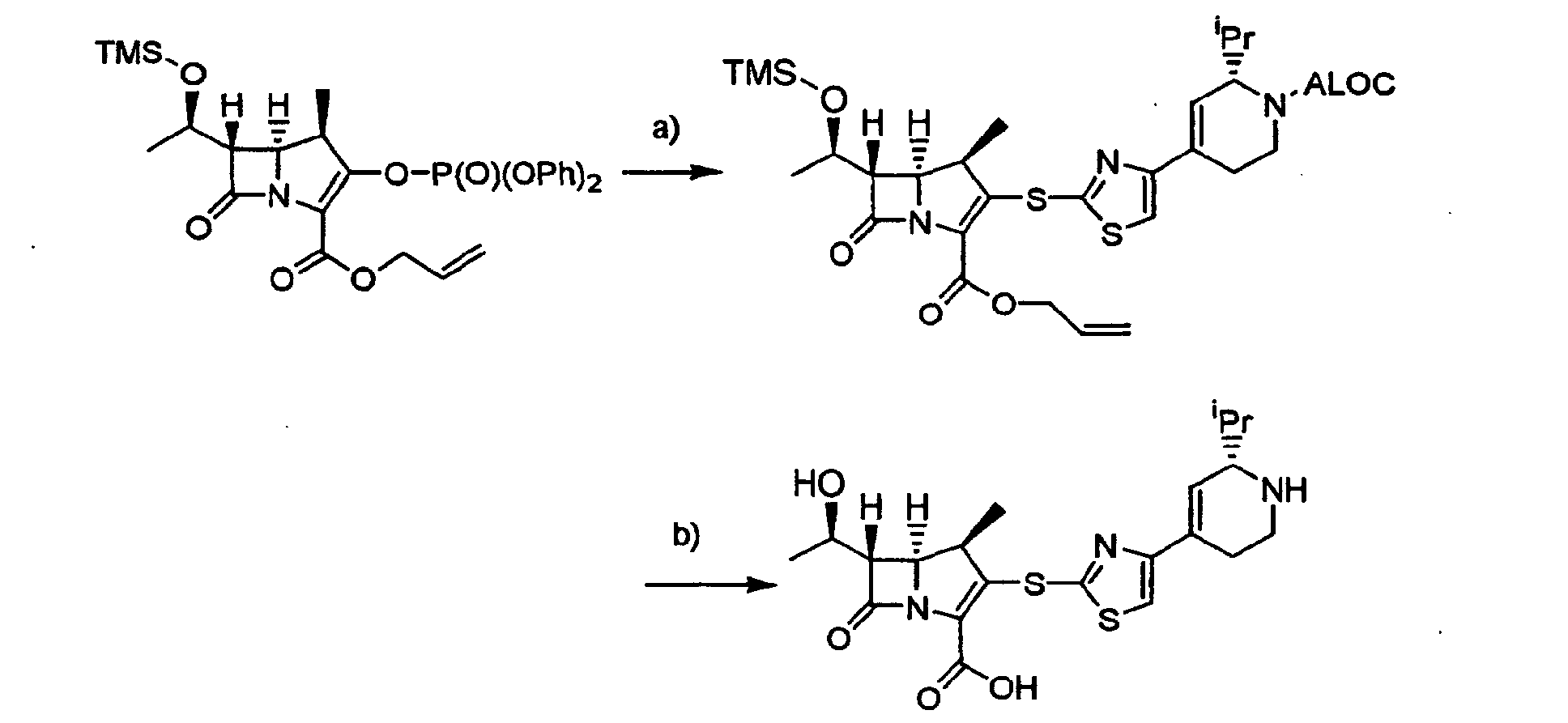
[(trimethylsilyl)oxy]ethyl}-1-azabicyclo[3.2.0]hept-2-ene-2-carboxylate (0.24g, 61%).
1H NMR (300 MHz, CDCl3) δ 0.00 (9 H, s), 0.88-1.00 (9 H, m), 1.11-1.14 (3 H, m), 1.87 (1 H, sesq, J = 7.3 Hz), 2.22-2.48 (2 H, m), 2.88-3.14 (2 H, m), 3.27-3.47 (1 H, m), 3.97-4.77 (8 H, m), 5.06-5.38 (4 H, m), 5.77-5.93 (2 H, m), 6,71 (1 H, brs), 6.99 (1 H, brs).
IR (KBr) 3362, 2968, 1760, 1599, 1390 cm-1
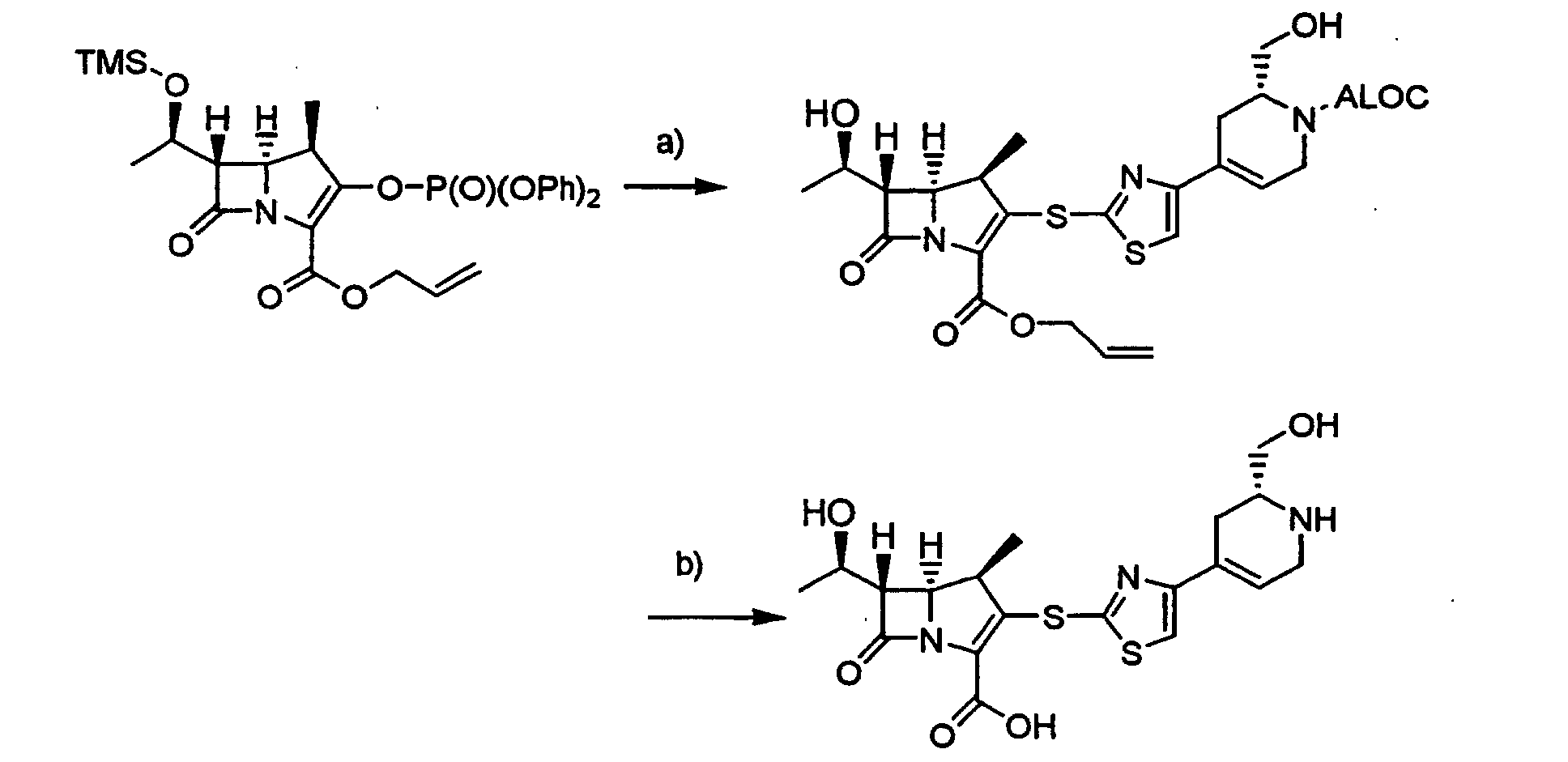
IR (KBr) 3426, 2933, 1772, 1700, 1559, 1457, 1136 cm-1
1H NMR (300 MHz, CDCl3) δ 1.10 (3 H, d, J = 7.3 Hz), 1.31 (3 H, d, J = 6.2 Hz), 2.50 (1 H, d, J = 17.4 Hz), 2.62-2.73 (1 H, m), 3.25 (1 H, d, J = 2.8, 7.0 Hz), 3.45-3.96 (4 H, m), 4.17-4.27 (2 H, m), 4.41-4.86 (6 H, m), 5.19-5.47 (4 H, m), 5.87-6.03 (2 H, m), 6.63 (1 H, s), 7.11 (1 H, s).
1H NMR (300 MHz, D2O) δ 0.92 (3 H, d, J = 7.0 Hz), 1.09 (3 H, d, J = 6.4 Hz), 2.35-2.65 (2 H, m), 3.08-3.18 (1 H, m), 3.30-3.44 (2 H, m), 3.60 (1 H, dd, J = 6.8, 12.5 Hz), 3.72-3.82 (3 H, m), 4.03-4.13 (2 H, m), 6.38 (1 H, s), 7.41 (1 H, s) .

1H NMR (300 MHz, CDCl3) δ 0.99 (3 H, d, J = 7.3 Hz), 1.21 (3 H, d, J = 6.0Hz), 2.38-2.63 (2 H, m), 3.15 (1 H, dd, J = 2.8, 6.8 Hz), 3.37-3.85 (4 H, m), 4.30-4.65 (5 H, m), 4.73 (1 H, dd, J = 5.3, 13.2 Hz), 5.10-5.37 (4 H, m), 5.78-5.93 (2 H, m), 6.54 (1 H, brs), 7.01 (1 H, s).
1H NMR (300 MHz, D2O) δ 0.91 (3 H, d, J = 7.0 Hz), 1.09 (3 H, d, J = 6.4 Hz), 2.20-2.33 (1 H, m), 2.44-2.53 (1 H, m), 3.08-3.73 (7 H, m), 4.02-4.13 (2 H, m), 6.39 (1 H, s), 7.37 (1 H, s).
1H NMR (300 MHz, CDCl3) δ 0.10 (9 H, s), 1.07 (3 H, d, J = 7.3 Hz), 1.17 (3 H, d, J = 6.8 Hz), 1.21 (3 H, d, J = 6.2 Hz), 2.28 (1 H, d, J = 17.2 Hz), 2.67-2.79 (1 H, m), 3.22 (1 H, dd, J = 2.7, 6.2 Hz), 3.56 (1 H, dd, J = 7.3, 9.9 Hz), 3.77-3.87 (1 H, m), 4.15-4.23 (2 H, m), 4.42-4.53 (1 H, m), 4.60-4.85 (5 H, m), 5.18-5.48 (4 H, m), 5.88-6.02 (2 H, m), 6.64 (1 H, brs), 7.06 (1 H, s).
IR (KBr) 3428, 2971, 1758, 1602, 1391, 1263 cm-1
1H NMR (300 MHz, D2O) δ 0.91 (3 H, d, J = 7.1 Hz), 1.10 (3 H, d, J = 6.2 Hz), 1.32 (3 H, d, J = 6.4 Hz), 2.30-2.45 (1 H, m), 2.67-2.78 (1 H, m) , 3.09-3.18 (1 H, m), 3.31-3.34 (1 H, m),3.41-3.52 (1 H, m), 3.77 (2 H, brs), 4.05-4.13 (2 H, m), 6.35 (1 H, m), 7.42 (1 H, m).

1H NMR (300 MHz, CDCl3) δ 0.09 (9 H, s), 1.10 (3 H, d, J = 7.1 Hz), 1.18 (3 H, d, J = 7.0 Hz), 1.21 (3 H, d, J = 6.2 Hz), 2.28 (1 H, d, J = 16.3 Hz), 2.67-2.79 (1 H, m), 3.22 (1 H, dd, J = 2.9, 6.2 Hz), 3.46 (1 H, dd, J = 7.4, 9.9 Hz), 3.75-3.86 (1 H, m), 4.15-4.23 (2 H, m), 4.42-4.53 (1 H, m), 4.59-4.86 (5 H, m), 5.16-5.48 (4 H, m), 5.88-6.03 (2 H, m), 6.64 (1 H, brs), 7.08 (1 H, s).
IR (KBr) 3392, 2970, 1758, 1599, 1391, 1263 cm-1
1H NMR (300 MHz, D2O) δ 0.91 (3 H, d, J = 7.1 Hz), 1.09 (3 H, d, J = 6.4 Hz), 1.26 (3 H, d, J = 6.4 Hz), 2.24-2.37 (1 H, m), 2.60-2.71 (1 H, m), 3.07-3.18 (1 H, m),3.28-3.38 (2 H, m), 3.68 (2 H, brs), 4.03-4.10 (2 H, m), 6.35 (1 H, m), 7.39 (1 H, m).
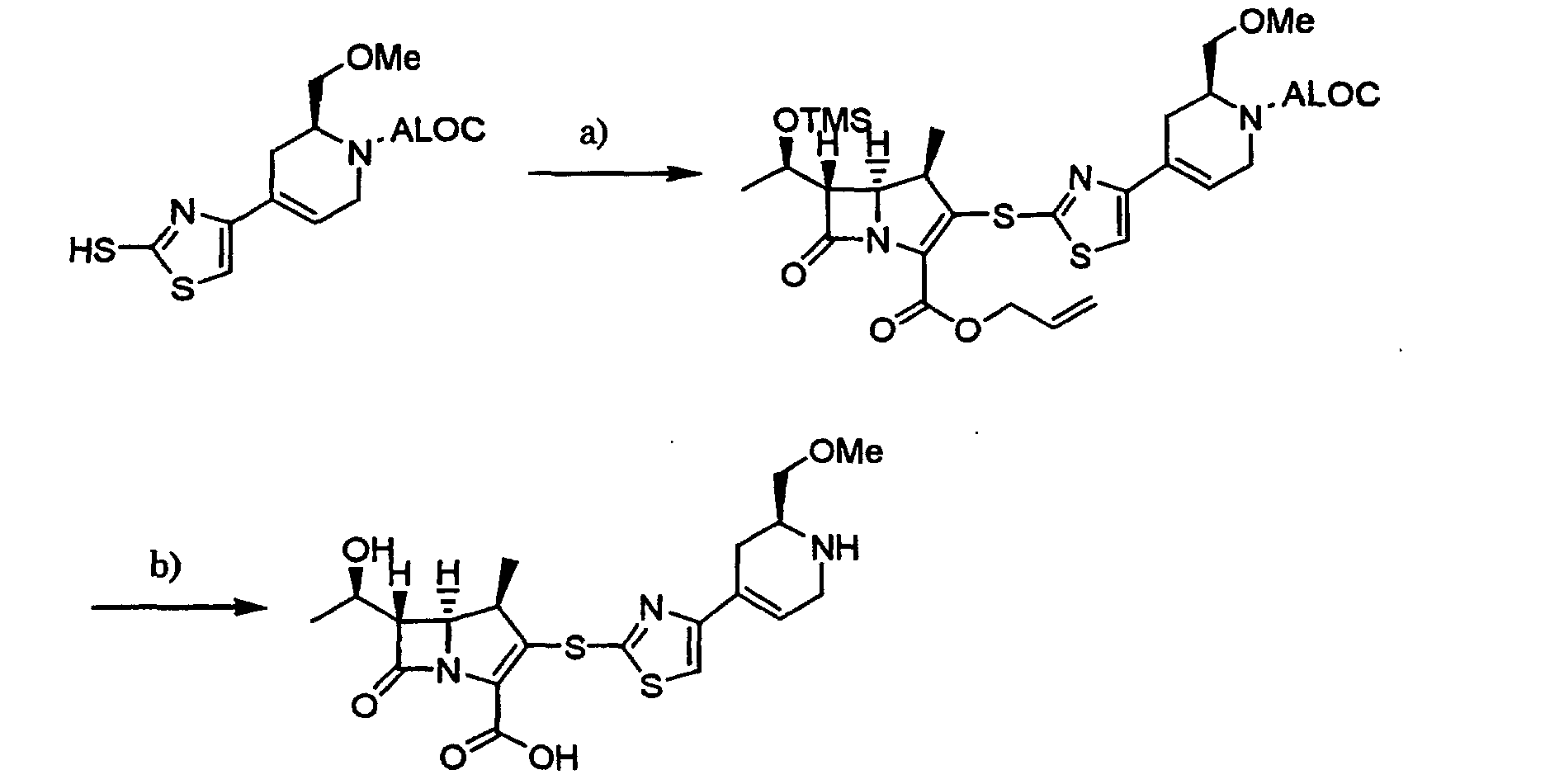
1H NMR (300MHz, CDCl3) δ 0.12 (9H, s), 1.09 (3H, d, J=7.3Hz), 1.24 (3H, d, J=6.2Hz), 2.54 (1H, d, J=16.8Hz), 2.63-2.73 (1H, m), 3.24 (1H, dd, J=6.2, 2.9Hz), 3.39-3.48 (2H, m), 3.34 (3H, s), 3.50-3.64 (1H, m), 3.70-3.87 (1H, m), 4.18-4.26 (2H, m), 4.48-4.88 (6H, m), 5.20-5.51 (4H, m), 5.90-6.04 (2H, m), 6.68 (1H, br s), 7.12 (1H, s).
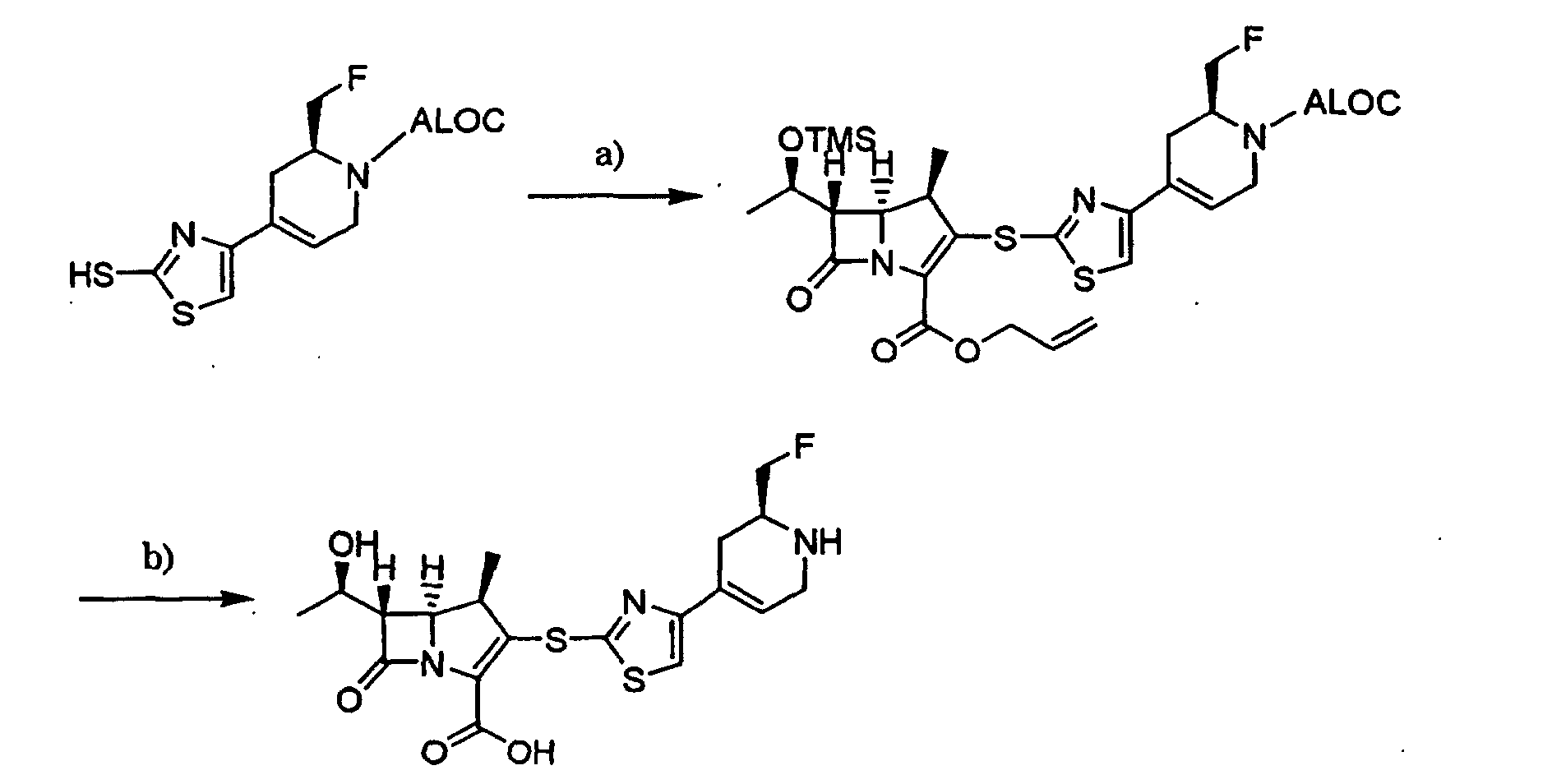
1H NMR (300MHz, CDCl3) δ 0.12 (9H, s), 1.10 (3H, d, J=7.3Hz), 1.24 (3H, d, J=6.0Hz), 2.57 (1H, d, J=16.7Hz), 2.69-2.80 (1H, m), 3.24 (1H, dd, J=6.2, 2.9Hz), 3.49-3.60 (1H, m), 3.78-3.94 (1H, m), 4.08-4.99 (10H, m), 5.22-5.50 (4H, m), 5.90-6.04 (2H, m), 6.69 (1H, br s), 7.14 (1H, s).
1H NMR (300MHz, D2O) δ 0.92 (3H, d, J=7.3Hz), 1.10 (3H, d, J=6.2Hz), 2.24-2.33 (1H, m), 2.43-2.49 (1H, m), 3.12-3.19 (1H, m), 3.30-3.33 (1H, m), 3.53-3.56 (2H, m), 4.05-4.12 (2H, m), 4.31-4.39 (1H, m), 4.46-4.54 (1H, m), 6.40-6.43 (1H, m), 7.36 (1H, s).
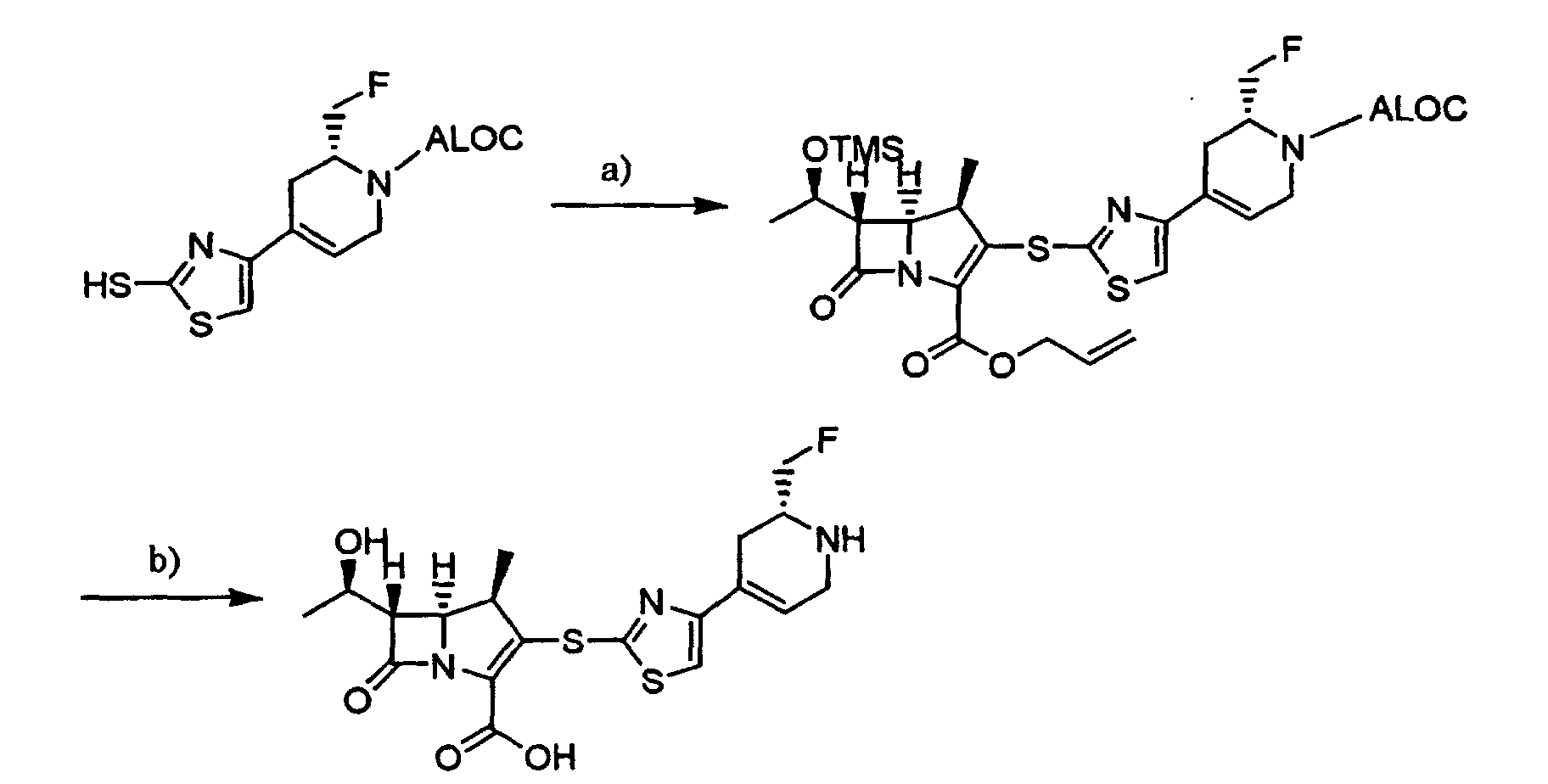
1H NMR (300MHz, CDCl3) δ 0.12 (9H, s), 1.13 (3H, d, J=7.3Hz), 1.24 (3H, d, J=6.0Hz), 2.57 (1H, d, J=16.9Hz), 2.69-2.80 (1H, m), 3.25 (1H, dd, J=6.2, 2.7Hz), 3.44-3.59 (1H, m), 3.78-3.94 (1H, m), 4.11-5.00 (10H, m), 5.22-5.50 (4H, m), 5.90-6.05 (2H, m), 6.68 (1H, br s), 7.15 (1H, s).
1H NMR (300MHz, D2O) δ 0.92 (3H, d, J=7.1Hz), 1.10 (3H, d, J=6.2Hz), 2.38-2.50 (1H, m), 2.55-2.63 (1H, m), 3.09-3.19 (1H, m), 3.31-3.34 (1H, m), 3.48-3.62 (1H, m), 3.68-3.72 (2H, m), 4.04-4.12 (2H, m), 4.40-4.45 (1H, m), 4.55-4.61 (1H, m), 6.39-6.42 (1H, m), 7.40 (1H, s).
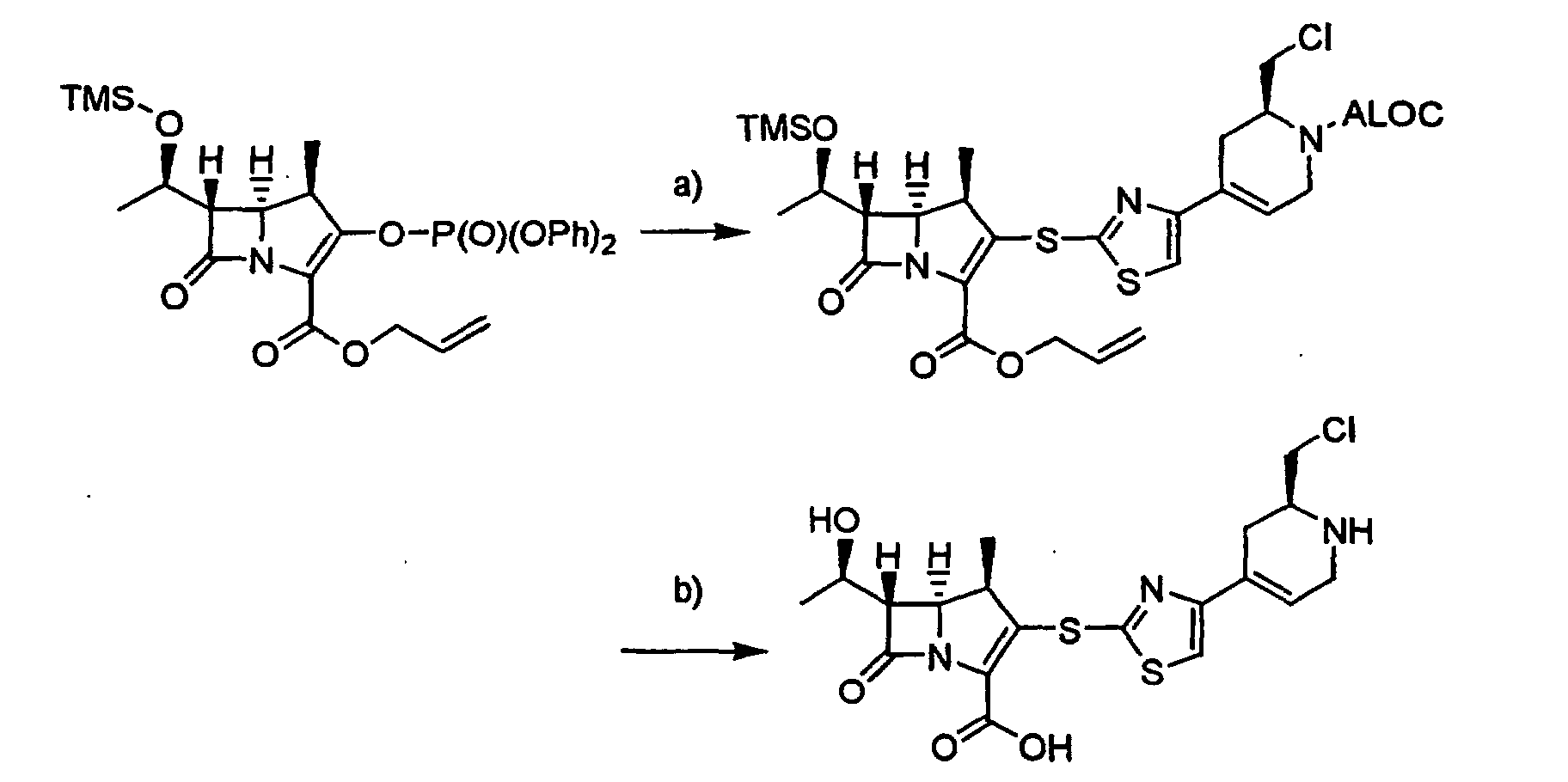
1H NMR (300 MHz, CDCl3) δ 0.11 (9 H, s), 1.07 (3 H, d, J = 7.4 Hz), 1.21 (3 H, d, J = 6.0 Hz), 2.68-2.75 (2 H, m), 3.22 (1 H, dd, J = 2.7, 6.4 Hz), 3.47-3.60 (3 H, m), 3.73-3.90 (1 H, m), 4.15-4.22 (2 H, m), 4.42-4.86 (6 H, m), 5.20-5.35 (3 H, m), 5.45 (1 H, dd, J = 1.5, 17.2 Hz), 5.88-6.03 (2 H, m), 6.65 (1 H, brs), 7.12 (1 H, s).
IR (KBr) 3398, 2968, 1760, 1601, 1389, 1264 cm-1
1H NMR (300 MHz, D2O) δ 0.91 (3 H, d, J = 7.1 Hz), 1.08 (3 H, d, J = 6.2 Hz), 2.67-2.75 (2 H, m), 3.14 (1 H, dd, J = 7.3, 9.7 Hz), 3.31 (1 H, dd, J = 2.8, 5.9 Hz), 3.75-3.95 (5 H, m), 4.02-4.11 (2 H, m), 6.37 (1 H, m), 7.43 (1 H, m).

1H NMR (300 MHz, D2O) δ 0.95 (3 H, d, J = 7.3 Hz), 1.12 (3 H, d, J = 6.4 Hz), 2.54-2.80 (2 H, m), 3.15-3.21 (1 H, m), 3.68-3.86 (3 H, m), 4.08-4.38 (5 H, m), 6.41 (1 H, s), 7.46 (1 H, s).

1H NMR (300 MHz, CDCl3) δ 0.10 (9 H, s), 1.05 (3 H, d, J = 7.1 Hz), 1.21 (6 H, d, J = 6.2 Hz), 2.24-2.36 (1 H, m), 2.41 (3 H, s), 2.50-2.61 (1 H, m), 2.69-3.00 (2 H, m), 3.19-3.22 (1 H, m), 3.47-3.53 (1 H, m), 4.15-4.20 (2 H, m), 4.46-4.85 (3 H, m), 5.25 (1 H, d, J = 10.4 Hz), 5.44 (1 H, dd, J = 1.4, 17.0 Hz), 5.96 (1 H, ddd, J = 5.1, 10.4, 17.0 Hz),6.61 (1 H, s), 7.07 (1 H, s).
IR (KBr) 3393, 2970, 1749, 1601, 1393, 1266 cm-1
1H NMR (300 MHz, D2O) δ 0.95 (3 H, d, J = 7.5 Hz), 1.13 (3 H, d, J = 6.2 Hz), 1.32 (3 H, d, J = 6.2 Hz), 2.47-2.58 (1 H, m), 2.74-2.88 (1 H, m), 2.79 (3 H, s), 3.11-3.23 (1 H, m), 3.32-3.38 (1 H, m),3.75-3.93 (1 H, m), 4.09-4.15 (2 H, m), 6.33 (1 H, s), 7.47 (1 H, s).

1H NMR (300 MHz, CDCl3) δ 0.10 (9 H, s), 1.07 (3 H, d, J = 7.3 Hz), 1.21 (3 H, d, J = 6.2 Hz), 2.37-2.65 (2 H, m),2.48 (3 H, s), 2.88-3.00 (1 H, m), 3.19-3.29 (2 H, m), 3.37-3.55 (2 H, m), 4.15-4.24 (4 H, m), 4.61-4.85 (4 H, m), 5.17-5.48 (4 H, m), 5.79-6.00 (2 H, m), 6.65 (1 H, s), 7.08 (1 H, s).
1H NMR (300 MHz, D2O) δ 0.94 (3 H, d, J = 7.1 Hz), 1.13 (3 H, d, J = 6.4 Hz), 2.62-2.75 (5 H, m), 3.13-3.22 (1 H, m), 3.28-3.33 (1 H, m), 3.53-3.74 (2 H, m),3.82-4.16 (5 H, m), 6.33 (1 H, s), 7.48 (1 H, s).
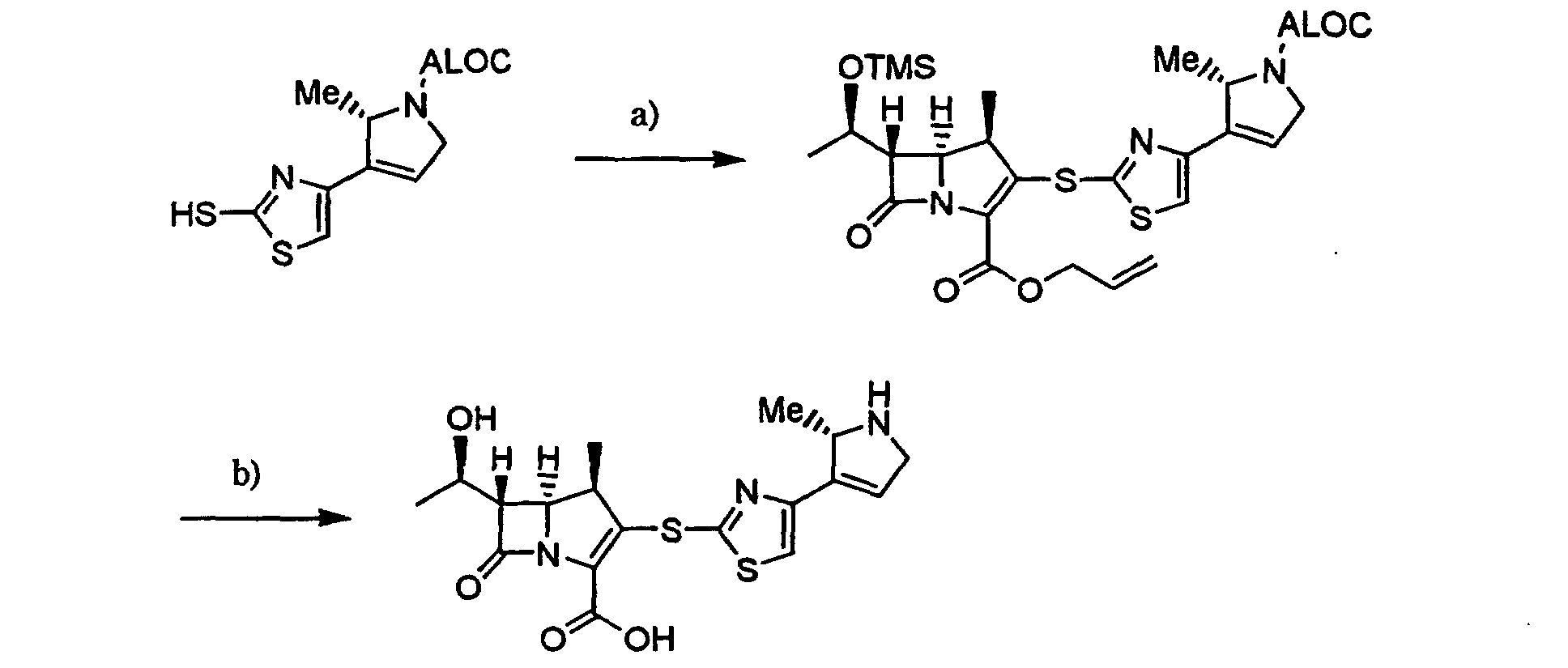
1H NMR (300MHz, CDCl3) δ 0.12 (9H, s), 1.12 (3H, d, J=7.1Hz), 1.23 (3H, d, J=6.2Hz), 1.44-1.50 (3H, m), 3.25 (1H, dd, J=6.0, 2.7Hz), 3.42-3.58 (1H, m), 4.12-4.48 (4H, m), 4.60-4.89 (4H, m), 4.98-5.08 (1H, m), 5.22-5.51 (4H, m), 5.91-6.05 (2H, m), 6.36-6.37 (1H, m), 7.18-7.26 (1H, m).
1H NMR (300MHz, D2O) δ 0.92 (3H, d, J=7.1Hz), 1.07 (3H, d, J=6.4Hz), 1.35 (3H, d, J=6.6Hz), 3.02-3.12 (1H, m), 3.31 (1H, dd, J=6.0, 2.7Hz), 3.97-4.13 (4H, m), 6.20 (1H, s), 7.53 (1H, s).
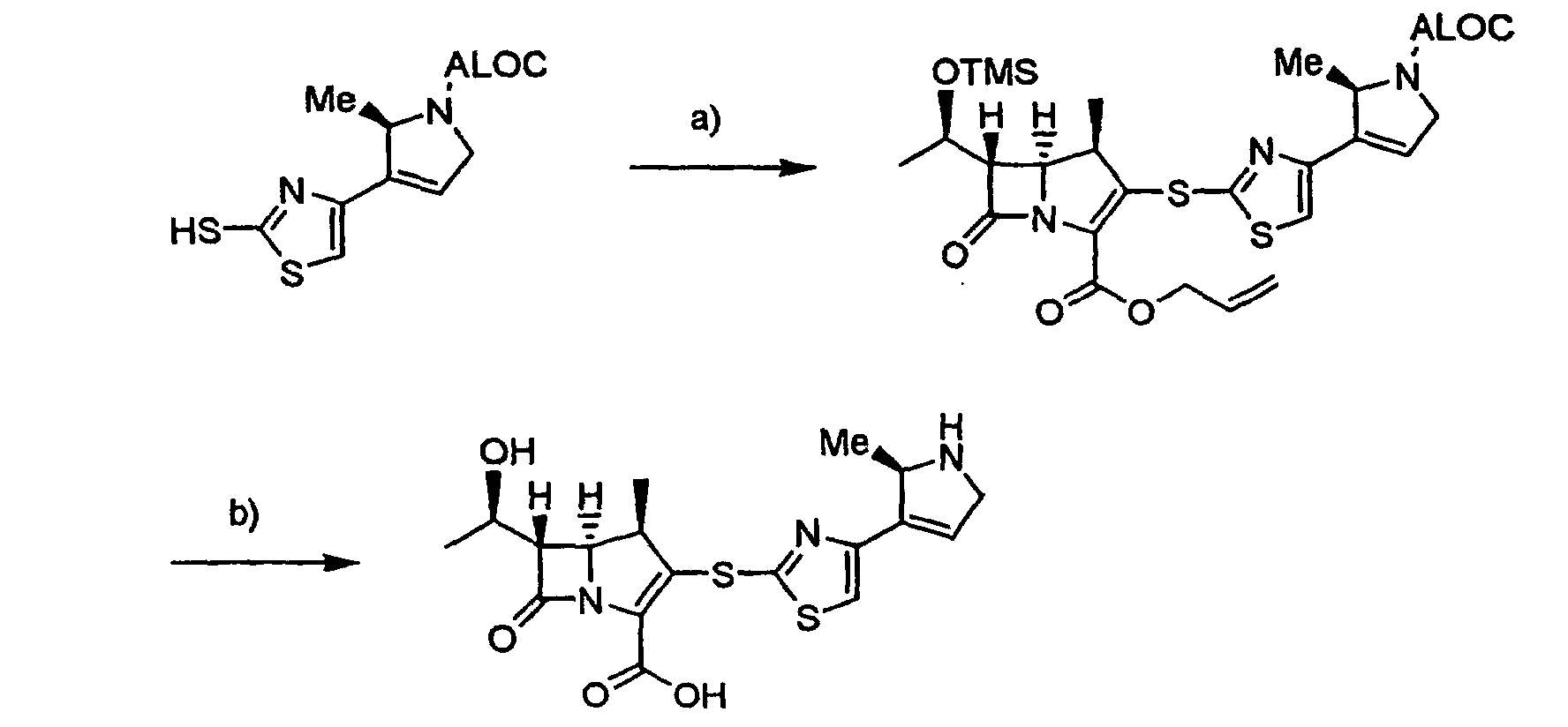
1H NMR (300MHz, CDCl3) δ 0.12 (9H, s), 1.07-1.10 (3H, m), 1.23-1.26 (3H, m), 1.44-1.50 (3H, m), 3.23-3.30 (1H, m), 3.53-3.62 (1H, m), 4.12-4.48 (4H, m), 4.60-4.89 (4H, m), 4.99-5.08 (1H, m), 5.22-5.51 (4H, m), 5.90-6.05 (2H, m), 6.33-6.37 (1H, m), 7.18-7.26 (1H, m).
1H NMR (300MHz, D2O) δ 0.92 (3H, d, J=7.1Hz), 1.10 (3H, d, J=6.4Hz), 1.36 (3H, d, J=6.8Hz), 3.05-3.22 (1H, m), 3.33 (1H, dd, J=5.9, 2.7Hz), 3.96-4.14 (4H, m), 6.22 (1H, s), 7.53 (1H, s).

1H NMR (300 MHz, CDCl3) δ 1.10 (3 H, d, J = 7.3 Hz), 1.32 (3 H, d, J = 6.1 Hz), 3.22-3.28 (1 H, m), 3.53-3.64 (1 H, m), 3.72-3.80 (1 H, m), 3.93-4.47 (6 H, m), 4.58-4.88 (4 H, m), 5.12-5.48 (4 H, m), 5.80-6.05 (2 H, m), 6.38 (1 H, s), 7.31 (1 H, s).
1H NMR (300 MHz, D2O) δ 0.92 (3 H, d, J = 6.8 Hz), 1.10 (3 H, d, J = 5.7 Hz), 3.12-3.19 (1 H, m), 3.30-3.35 (1 H, m), 3.73-4.13 (7 H, m), 6.36 (1 H, s), 7.55 (1 H, s).

1H NMR (300MHz, CDCl3) δ 1.21 (3H, d, J=7.1Hz), 1.33 (3H, d, J=6.2Hz), 3.27 (1H, dd, J=6.9, 2.7Hz), 3.42-3.60 (1H, m), 3.76-4.50 (7H, m), 4.66-4.89 (4H, m), 5.06-5.50 (5H, m), 5.91-6.05 (2H, m), 6.43-6.46 (1H, m), 7.35-7.40 (1H, m).
1H NMR (300MHz, D2O) δ 0.94 (3H, d, J=7.3Hz), 1.09 (3H, d, J=6.4Hz), 3.05-3.16 (1H, m), 3.32 (1H, dd, J=6.0, 2.9Hz), 3.81-3.93 (2H, m), 4.03-4.19 (4H, m), 4.87-4.90 (1H, m), 6.36 (1H, s), 7.60 (1H, s).

1H NMR (300MHz, CDCl3) δ 0.12 (9H, s), 1.11 (3H, d, J=7.3Hz), 1.23 (3H, d, J=6.1Hz), 3.21-3.30 (4H, m), 3.37-3.53 (1H, m), 3.74-3.93 (2H, m), 4.12-4.49 (4H, m), 4.60-4.89 (4H, m), 5.04-5.09 (1H, m), 5.22-5.51 (4H, m), 5.91-6.05 (2H, m), 6.47 (1H, s), 7.37-7.42 (1H, m).
1H NMR (300MHz, D2O) δ 0.94 (3H, d, J=7.0Hz), 1.09 (3H, d, J=6.6Hz), 3.07-3.13 (1H, m), 3.18 (1H, s), 3.31-3.34 (1H, m), 3.66-3.69 (2H, m), 3.97-4.12 (4H, m), 6.34 (1H, s), 7.58 (1H, s).
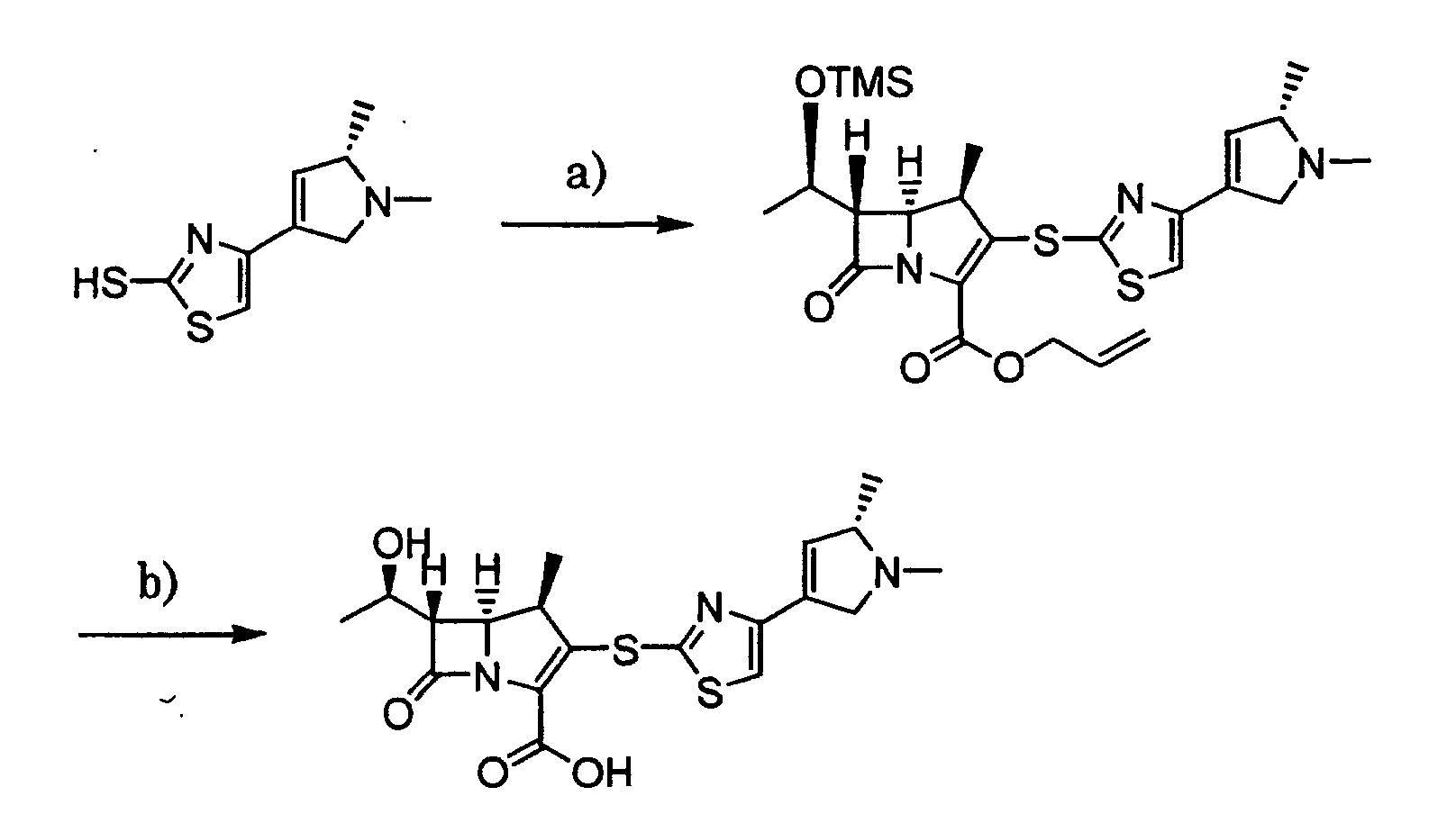
1H NMR (300MHz, CDCl3) δ 0.11-0.12 (9H, m), 1.04-1.09 (3H, m), 1.17-1.28 (6H, m), 2.52 (3H, s), 2.55-2.63 (1H, m), 3.21-3.25 (1H, m), 3.49-3.62 (3H, m), 4.09-4.25 (3H, m), 4.60-4.87 (3H, m), 5.17-5.50 (4H, m), 5.85-6.04 (1H, m), 6.28-6.30 (1H, m), 7.05-7.27 (1H, m).
1H NMR (300MHz, D2O) δ 0.93 (3H, d, J=7.1Hz), 1.11 (3H, d, J=6.2Hz), 1.34 (3H, d, J=6.8Hz), 2.81 (3H, s), 3.13-3.18 (1H, m), 3.34 (1H, dd, J=6.2, 2.8Hz), 4.03-4.14 (3H, m), 4.21-4.30 (1H, m), 4.38-4.45 (1H, m), 6.22 (1H, s), 7.47 (1H, s).
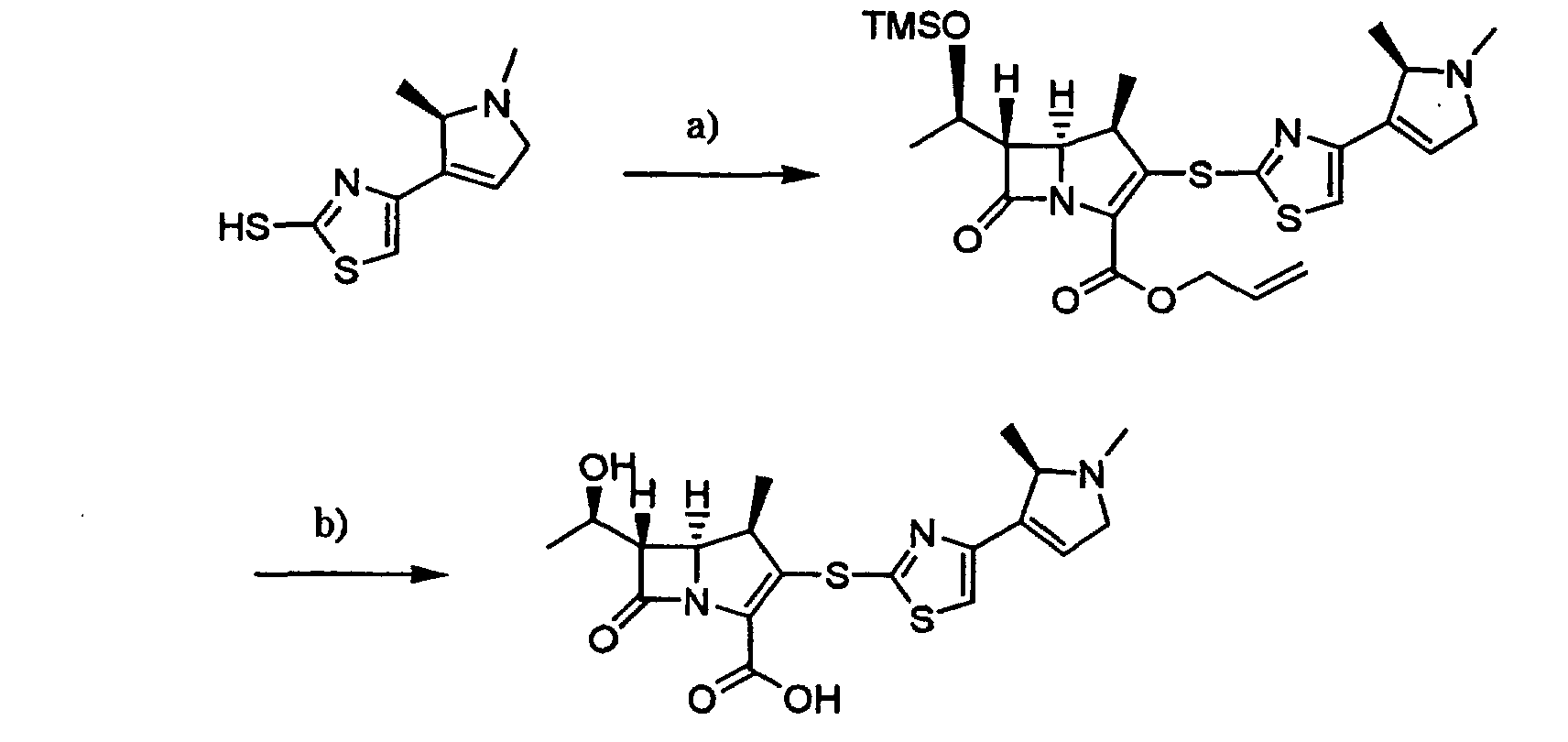
1H NMR (300MHz, CDCl3) δ 0.11 (9H, s), 1.08 (3H, d, J=7.4Hz), 1.25 (3H, d, J=6.2Hz), 1.30 (3H, d, J=6.2Hz), 2.53 (3H, s), 3.23 (1H, dd, J=6.6, 2.7Hz), 3.39-3.47 (1H, m), 3.53-3.63 (1H, m), 3.80-3.98 (2H, m), 4.16-4.26 (2H, m), 4.56-4.87 (2H, m), 5.25-5.50 (2H, m), 5.87-6.04 (1H, m), 6.29-6.31 (1H, m), 7.18 (1H, s).
1H NMR (300MHz, D2O) δ 0.94 (3H, d, J=7.3Hz), 1.12 (3H, d, J=6.4Hz), 1.37 (3H, d, J=6.6Hz), 2.80 (3H, s), 3.13-3.23 (1H, m), 3.35 (1H, dd, J=6.0, 2.9Hz), 3.84-3.89 (1H, m), 4.06-4.15 (2H, m), 4.21-4.27 (1H, m), 4.45-4.51 (1H, m), 6.21 (1H, s), 7.55 (1H, s).

1H NMR (300MHz, CDCl3) δ -0.03 (3H, s), 0.00 (3H, s), 0.12 (9H, s), 0.86 (9H, s), 1.09 (3H, d, J=7.3Hz), 1.23 (3H, d, J=6.2Hz), 2.59 (3H, s), 3.23 (1H, dd, J=6.4, 2.9Hz), 3.41-3.58 (2H, m), 3.67-3.97 (4H, m), 4.16-4.26 (2H, m), 4.65-4.88 (2H, m), 5.18-5.51 (2H, m), 5.82-6.04 (1H, m), 6.46 (1H, s), 7.41 (1H, s).
1H NMR (300MHz, D2O) δ 0.98 (3H, d, J=7.3Hz), 1.13 (3H, d, J=6.4Hz), 2.97 (3H, s), 3.09-3.19 (1H, m), 3.36 (1H, dd, J=6.0, 2.9Hz), 3.87-4.02 (3H, m), 4.06-4.15 (2H, m), 4.40-4.45 (1H, m), 6.38 (1H, s), 7.63 (1H, s).
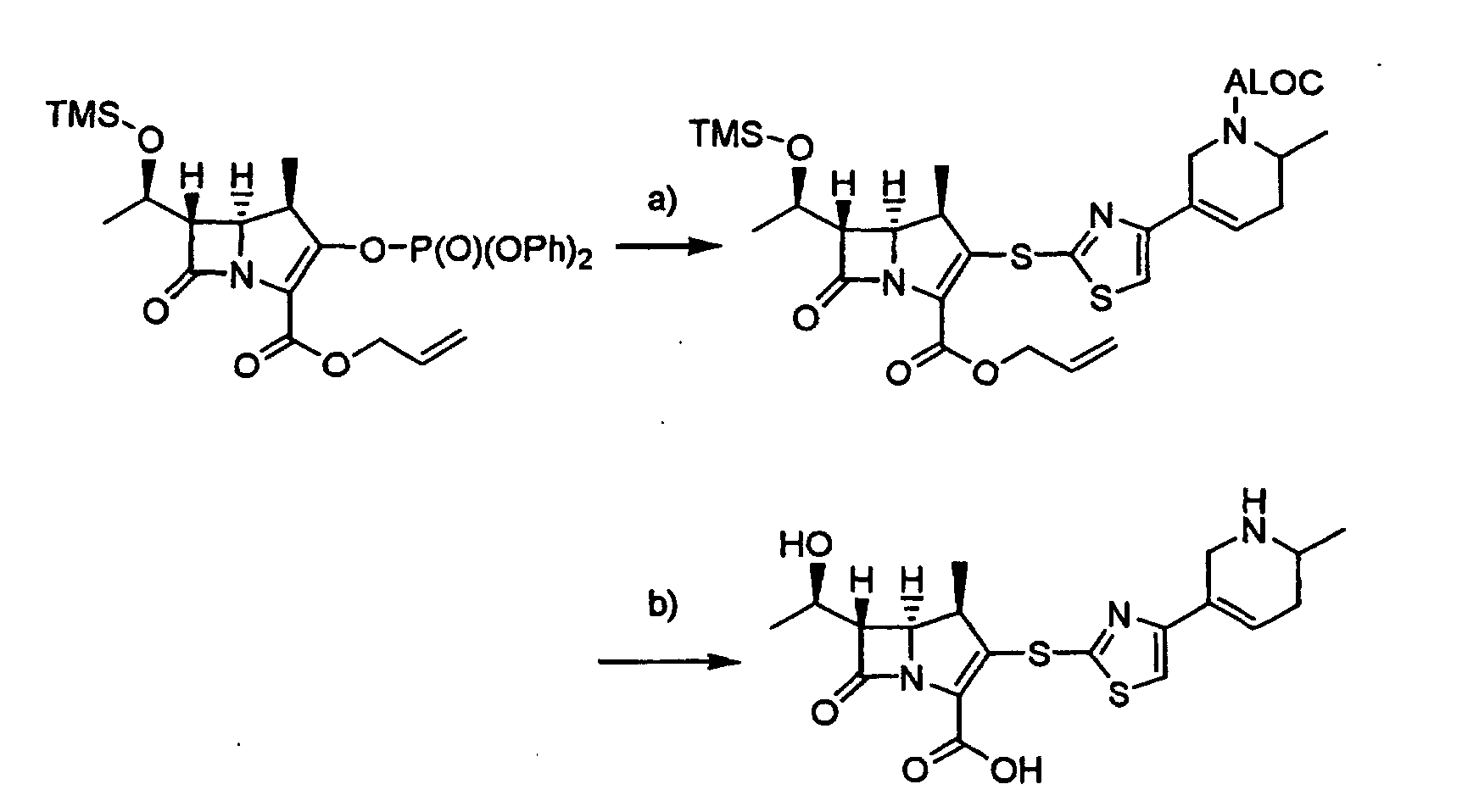
1H NMR (300 MHz, CDCl3) δ 0.09 (9 H, s), 1.06-1.22 (9 H,m), 2.04-2.15 (1 H, m),2.58-2.70 (1 H, m), 3.22 (1 H, dd, J = 2.7, 6.0 Hz), 3.40-3.60 (1 H, m), 3.82-3.93 (1 H, m), 4.13-4.23 (2 H, m), 4.60-4.86 (6 H, m), 5.19-5.33 (3 H, m), 5.45 (1 H, d, J = 17.0 Hz), 5.89-6.02 (2 H, m), 6.72 (1 H, brs), 7.10 (0.5 H, s), 7.11 (0.5 H, s).
1H NMR (300 MHz, D2O) δ 0.90 (3 H, d, J = 7.1 Hz), 1.08 (3 H, d, J = 6.2 Hz),1.27 (3 H, d, J = 6.6 Hz), 2.16-2.29 (1 H, m), 2.47-2.58 (1 H, m), 3.11 (1 H, dd, J = 7.3, 9.5 Hz), 3.30 (1 H, dd, J = 2.7, 5.9 Hz), 3.34-3.46 (1 H, m), 3.88-4.10 (4 H, m), 6.50 (1 H, brs), 7.36 (1 H, s).


1H NMR (300 MHz, CDCl3) δ 1.22-1.40 (6 H, m), 4.24 (2 H, q, J = 6.9 Hz), 4.29-4.49 (2 H, m), 4.56-4.84 (3 H, m), 5.23 (1 H, d, J = 10.4 Hz), 5.32 (1 H, d, J = 17.4 Hz), 5.89-6.02 (1 H, m), 6.62-6.67 (1 H, m).
1H NMR (300 MHz, CDCl3) δ 1.37-1.42 (3 H, m), 4.30-4.70 (6 H, m), 4.80-4.95 (1 H, m), 5.18-5.24 (1 H, m), 5.26-5.34 (1 H, m), 5.86-5.99 (1 H, m), 6.64-6.68 (1 H, m).
IR (KCl) 1683, 1649, 1629, 1404 cm-1.
1H NMR (300 MHz, CDCl3) δ 1.34-1.39 (3 H, m), 4.32-4.53 (2 H, m), 4.61-4.66 (2 H, m), 4.72-4.85 (1 H, m), 5.22 (1 H, d, J = 10.4 Hz), 5.27-5.35 (1 H, m), 5.87-6.09 (2 H, m), 6.37 (0.5 H, s), 6.40 (0.5 H, m).
Reference example 2
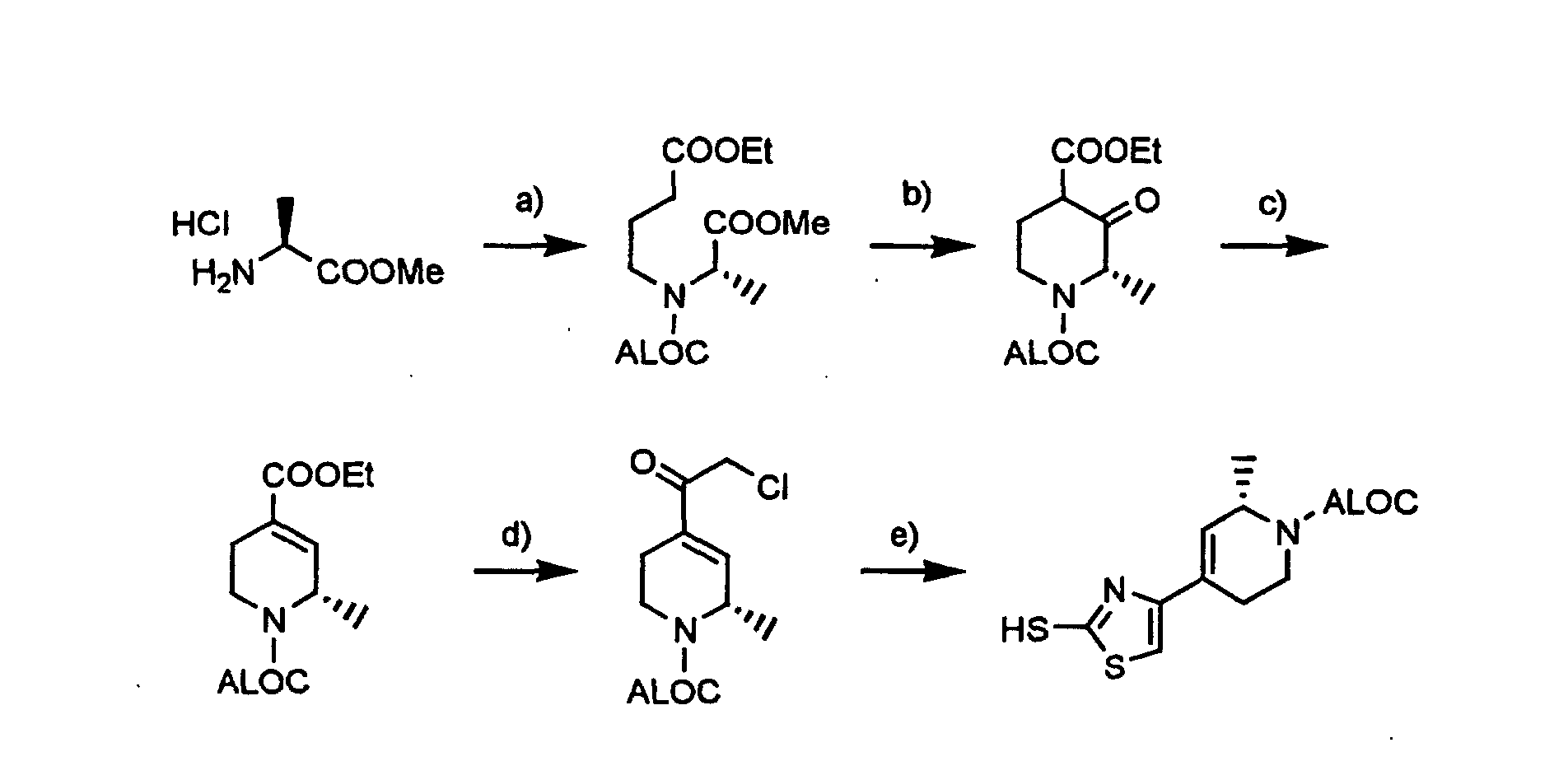
- a) To a suspension of methyl L-alaninate hydrochloride
(100mg, 0.72mmol) in DMF (2.5ml) were added potassium
carbonate (500mg, 3.6mmol), potassium iodide (60mg,
0.36mmol) and 4-bromolactic acid ethyl ester (0.103ml,
0.72mmol) and the resulting mixture was stirred at 60°C for
2 hours. To the mixture was again added ethyl 4-bromolactate
(0.103ml, 0.70mmol) and the resulting mixture
was stirred at the same temperature for more than 2 hours.
To the reaction mixture was added water and the mixture was
extracted three times with ethyl acetate and the organic
layers were combined. The combined organic layer was
washed with water and then a saturated aqueous sodium
chloride solution, dried over magnesium sulfate. The
organic solvent was removed under reduced pressure, and the
residue was dissolved in chloroform (5ml). To the solution
were added at room temperature diisopropylethylamine
(0.25ml, 1.44mmol) and allyl chloroformate (0.15ml,
1.42mmol) and the mixture was stirred for 1 hour. After
adding water to the reaction mixture and separating the
mixture with a separating funnel, the aqueous layer was
extracted twice with chloroform. The organic layer was
washed with a saturated aqueous sodium chloride solution,
and dried over magnesium sulfate. The organic solvent was
removed under reduced pressure, and the residue was
purified by silica gel chromatography to give methyl N-[(allyloxy)carbonyl]-N-(4-ethoxy-4-oxobutyl)-L-alaninate
(134mg).
1H NMR (300 MHz, CDCl3) δ 1.26 (3 H, t, J = 7.1 Hz), 1.49 (3 H, d, J = 7.4 Hz), 1.80-1.98 (2 H, m), 2.30-2.40 (2 H, m), 3.12-3.27 (1 H, m), 3.38-3.51 (1 H, m), 3.71 (3 H, s), 4.13 (2 H, q, J = 7.1 Hz), 4.45-4.62 (3 H, m), 5.18-5.33 (2 H, m), 5.81-6.00 (1 H, m). - b) To a suspension of potassium tert-butoxide (3.42g,
30mol) in THF which was warmed at 60°C was added a solution
of methyl N-[(allyloxy)carbonyl]-N-(4-ethoxy-4-oxobutyl)-L-alaninate(4.60g,
15mmol) in THF (30ml) and after stirring
for 1 minute, the reaction solution was poured into an
aqueous sodium dihydrogenphosphate solution (1M, 50ml).
The solution was adjusted to pH 2-3 and thereto was added
ethyl acetate. After separating the mixture with a
separating funnel, the aqueous layer was extracted twice
with ethyl acetate. The organic layer was washed with a
saturated aqueous sodium chloride solution, and dried over
magnesium sulfate. The organic solvent was removed under
reduced pressure, and the residue was purified by silica
gel chromatography to give 1-allyl 4-ethyl (2S)-2-methyl-3-oxo-1,4-piperidinedicarboxylate
(2.03g) and 1-allyl 4-methyl
(2S)-2-methyl-3-oxo-1,4-piperidinedicarboxylate
(1.20g).
1-allyl 4-ethyl (2S)-2-methyl-3-oxo-1,4-piperidinedicarboxylate
1H NMR (300 MHz, CDCl3) δ1.31 (3H, t, J = 7.1 Hz), 1.40 (3 H, d, J = 7.0 Hz), 2.25-2.42 (2 H, m), 2.86-3.08 (1 H, m), 4.07-4.28 (1 H, m), 4.23 (2 H, q, J = 7.1 Hz), 4.57-4.72 (3 H, m), 5.20-5.34 (2 H, m), 5.88-6.00 (1 H, m), 12.2 (1 H, s) .
1-allyl 4-methyl (2S)-2-methyl-3-oxo-1,4-piperidinedicarboxylate
1H NMR (300 MHz, CDCl3) δ 1.40 (3 H, d, J = 6.8 Hz), 2.25-2.42 (2 H, m), 2.86-3.03 (1 H, m), 3.78 (3 H, s), 4.07-4.28 (1 H, m), 4.57-4.72 (3 H, m), 5.20-5.34 (2 H, m), 5.88-6.01 (1 H, m), 12.1 (1 H, s). - c) To a solution of 1-allyl 4-ethyl (2S)-2-methyl-3-oxo-1,4-piperidinedicarboxylate(1.40g,
5.2mmol) in methanol
(27ml) were added acetic acid (0.36ml, 6.3mmol) and sodium
cyanoborohydride (0.39g, 6.3mmol), and the mixture was
stirred at room temperature for 1 hour. The solvent was
removed in vacuo and the residue was purified by silica gel
chromatography to give 1-allyl 4-ethyl (2S)-3-hydroxy-2-methyl-1,4-piperidinedicarboxylate
(1.36g). A solution of
this compound in dichloromethane (24ml) was cooled at -30°C
and to the solution were added methanesulfonyl chloride
(0.58ml, 7.5mmol), triethylamine (1.4ml, 10.0ml) and
dimethylaminopyridine (61mg, 0.50mmol). The mixture was
stirred at 0°C for 20 minutes and poured into 1N
hydrochloric acid and the solution was extracted three
times with chloroform. The organic layer was washed with a
saturated aqueous sodium chloride solution, dried over
magnesium sulfate and the organic solvent was removed under
reduced pressure. The residue was dissolved in toluene
(10ml) and dichloromethane (5ml). To the solution was
added DBU (2.3ml, 15.4mmol) and the solution was stirred at
room temperature for 5 hours. To the reaction solution was
added water and after separating the mixture with a
separating funnel the aqueous layer was extracted with
ethyl acetate. The organic layer was washed with a
saturated aqueous sodium chloride solution, dried over
magnesium sulfate and the organic solvent was removed under
reduced pressure. The residue was purified by silica gel
chromatography to give 1-allyl 4-ethyl (6S)-6-methyl-3,6-dihydro-1,4(2H)-pyridinedicarboxylate
(825mg) with an
intermediate, a methanesulfonylated compound (409mg).
1H NMR (300 MHz, CDCl3) δ 1.27 (3 H, d, J = 7.0 Hz), 1.30 (3 H, t, J = 7.1 Hz), 2.23-2.36 (1 H, m), 2.40-2.46 (1 H, m), 2.80-2.96 (1 H, m), 4.14-4.29 (3 H, m), 4.57-4.72 (3 H, m), 5.20-5.34 (2 H, m), 5.87-6.01 (1 H, m), 6.82 (1 H, s). - d) To a solution of 1-allyl 4-ethyl (6S)-6-methyl-3,6-dihydro-1,4(2H)-pyridinedicarboxylate
(200mg, 0.79mmol) and
bromochloromethane (0.082ml, 1.3mmol) in THF (4ml) was
added at -90°C a solution of n-butyllithium in hexane
(1.59M, 0.74ml, 1.2mmol). Twenty minute later, the
reaction mixture was poured into a mixture of ice (5g) and
phosphate buffer (pH 7.0, 10ml). To the solution was added
ethyl acetate and after separating the mixture with a
separating funnel, the aqueous layer was extracted twice
with ethyl acetate. The organic layer was washed with a
saturated aqueous sodium chloride solution, dried over
magnesium sulfate and the organic solvent was removed under
reduced pressure. The residue was purified by silica gel
chromatography to give allyl (6S)-4-(chloroacetyl)-6-methyl-3,6-dihydro-1(2H)-pyridinecarboxylate
(167mg).
1H NMR (300 MHz, CDCl3) δ 1.32 (3 H, d, J = 7.0 Hz), 2.18-2.31 (1 H, m), 2.49-2.56 (1 H, m), 2.80-2.94 (1 H, m), 4.16-4.31 (1 H, m), 4.39 (1 H, d, J = 14.1 Hz), 4.42 (1 H, d, J = 14.1 Hz), 4.60-4.64 (2 H, m), 4.74-4.83 (1 H, m), 5.20-5.34 (2 H, m), 5.86-6.02 (1 H, m), 6.73 (1 H, s). - e) To a solution of allyl 6S)-4-(chloroacetyl)-6-methyl-3,6-dihydro-1(2H)-pyridinecarboxylate
(167mg,
0.65mmol) in methanol (2ml) were added at 0-5°C
thioisonicotinamide (5mg) and ammonium thiocarbamate (87mg,
0.79mmol). The temperature was raised to room temperature
and the mixture was stirred for 15 minute. To the mixture
was added ethanol (4ml) and the solution was refluxed for 3
hours under stirring. The solvent was removed under
reduced pressure and the residue was dissolved in a 1N
aqueous sodium hydroxide solution. The solution was washed
with ether. The aqueous layer of the solution was adjusted
to pH 2-3 with 6N hydrochloric acid and the aqueous layer
was extracted three times with ethyl acetate. The organic
layer was washed with a saturated aqueous sodium chloride
solution, dried over magnesium sulfate and the organic
solvent was removed under reduced pressure to give allyl
(6S)-6-methyl-4-(2-mercapto-1,3-thiazol-4-yl)-3,6-dihydro-1(2H)-pyridinecarboxylate
(115mg).
1H NMR (300 MHz, CDCl3) δ 1.29 (3 H, d, J = 6.9 Hz), 2.20-2.28 (1 H, m), 2.38-2.50 (1 H, m), 2.83-3.05 (1 H, m), 4.25-4.33 (1 H, m), 4.60-4.65 (2 H, m), 4.66-4.78 (1 H, m), 5.21-5.35 (2 H, m), 5.89-6.02 (2 H, m), 6.40 (1 H, s).

1H NMR (300 MHz, CDCl3) δ 1.40 (9 H, s), 1.67-1.91 (2 H, m), 2.19-2.38 (2 H, m), 2.61 (1 H, brs), 3.48-3.70 (3 H, m), 5.06 (2 H, s), 5.17 (1H, brs), 7.25-7.36 (5 H, m).
1H NMR (300 MHz, CDCl3) δ 1.41 (9 H, s), 1.75-1.92 (2 H, m), 2.22-2.35 (2 H, m), 3.31 (3 H, s), 3.47-3.58 (2 H, m), 3.75-3.86 (1 H, m), 4.58 (2 H, s), 5.02 (1H, brd, J = 8.1 Hz), 5.07 (2 H, s), 7.26-7.37 (5 H, m).
1H NMR (300 MHz, CDCl3) δ 1.41 (9 H, s), 1.89 (2 H, q, J=7.1 Hz), 2.41 (2H, t, J = 7.5 Hz), 3.24-3.33 (2 H, m), 3.36 (3 H, s), 3.53 (1 H, dd, J = 6.8, 10.1 Hz), 3.68 (1 H, dd, J=3.8, 10.3 Hz), 4.57-4.83 (5 H, m).
1H NMR (300 MHz, CDCl3) δ1.50 (9 H, s), 2.29-2.44 (2 H, m), 3.33 (3 H, s), 3.49-3.76 (3 H, m), 4.31-4.48 (1 H, m), 4.56-4.70 (5 H, m), 5.22 (1 H, d, J = 10.4 Hz), 5.31 (1 H, d, J = 17.4 Hz), 5.94 (1 H, ddd, J = 5.1, 10.4, 17.2 Hz), 12.23 (1 H, s) .
1H NMR (300 MHz, CDCl3) δ 1.45 (9 H, s), 1.63-1.74 (2 H, m), 2.44-2.56 (1 H, m), 2.61-2.79 (1 H, m), 3.34 (3 H, s), 3.53-3.76 (3 H, m), 4.10-4.36 (1 H, m), 4.41-4.67 (5 H, m), 5.18 (1 H, d, J = 10.3 Hz), 5.28 (1 H, dd, J = 1.7, 17.2 Hz), 5.84-5.96 (1 H, m).
1-allyl 4-tert-butyl (2R)-2-[(methoxymethoxy)methyl]-5-[(methylsulfonyl)oxy]-1,4-piperidinedicarboxylate
1H NMR (300 MHz, CDCl3) δ 1.43 (9 H, s), 1.79 (1 H, dt, J = 5.9, 13.4 Hz), 2.07-2.18 (1 H, m), 2.75-2.87 (1 H, m), 3.03 (3 H, s), 3.34 (3 H, s), 3.57-3.68 (2 H, m), 4.45-4.75 (8 H, m), 5.20 (1 H, dd, J = 0.9, 10.3 Hz), 5.29 (1 H, d, J = 16.9 Hz), 5.84-5.96 (1 H, m).
1-allyl 4-tert-butyl (2R)-2-[(methoxymethoxy)methyl]-3,6-dihydro-1,4(2H)-pyridinedicarboxylate
1H NMR (300 MHz, CDCl3) δ 1.47 (9 H, s), 2.41-2.47 (2 H, m), 3.30 (3 H, s), 3.43 (2 H, d, J = 7.9 Hz), 3.64-3.80 (1 H, m), 4.37-4.80 (6 H, m), 5.19 (1 H, dd, J = 1.3, 10.4 Hz), 5.29 (1 H, d, J = 17.2 Hz), 5.87 (1 H, ddt, J = 5.3, 10.4, 17.2 Hz), 6.77 (1 H, brs).
1H NMR (300 MHz, CDCl3) δ -0.01 (6 H, s), 0.83 (9 H, s), 2.33-2.46 (1 H, m), 2.47-2.62 (1 H, m), 3.40-3.53 (2 H, m), 3.63-3.92 (1 H, m), 3.73 (3 H, s), 4.33-4.65 (4 H, m), 5.20 (1 H, dd, J = 1.5, 10.4 Hz), 5.29 (1 H, d, J = 16.7 Hz), 5.92 (1 H, ddt, J = 5.3, 10.4, 16.7 Hz), 6.78-6.92 (1 H, m). IR (KBr) n 2953, 1715, 1417, 1251, 1112 cm-1
1H NMR (300 MHz, CDCl3) δ -0.02 (6 H, s), 0.82 (9 H, s), 2.23-2.43 (1 H, m), 2.57-2.68 (1 H, m), 3.40-3.53 (2 H, m), 3.63-3.92 (2 H, m), 4.33-4.65 (5 H, m), 5.20 (1 H, dd, J = 1.3, 12.1 Hz), 5.29 (1 H, dd, J = 1.5, 17.2 Hz), 5.92 (1 H, ddt, J = 5.3, 12.1, 17.2 Hz), 6.73-6.85 (1 H, m).
IR (KBr) n 2954, 2858, 1692, 1650, 1414, 1113 cm-1
1H NMR (300 MHz, CDCl3) δ 0.00 (3 H, s), 0.02 (3 H, s), 0.84 (9 H, s), 2.40-2.57 (2 H, m), 3.45-3.85 (3 H, m), 3.38-3.65 (4 H, m), 5.18-5.35 (2 H, m), 5.88-6.01 (1 H, m), 6.07 (1 H, brs), 6.40 (1 H, s).

1H NMR (300 MHz, CDCl3) δ 2.40 (1 H, d, J = 17.4 Hz), 2.52-2.64 (1 H, m), 3.54-3.93 (3 H, m), 4.38-4.69 (2 H, m), 4.62 (2 H, d, J = 5.5 Hz), 5.22 (1 H, dd, J = 1.1, 10.3 Hz), 5.30 (1 H, dd, J = 1.5, 17.2 Hz), 5.93 (1 H, ddd, J = 5.7, 10.3, 17.2 Hz), 6.12 (1 H, s), 6.41 (1 H, s).
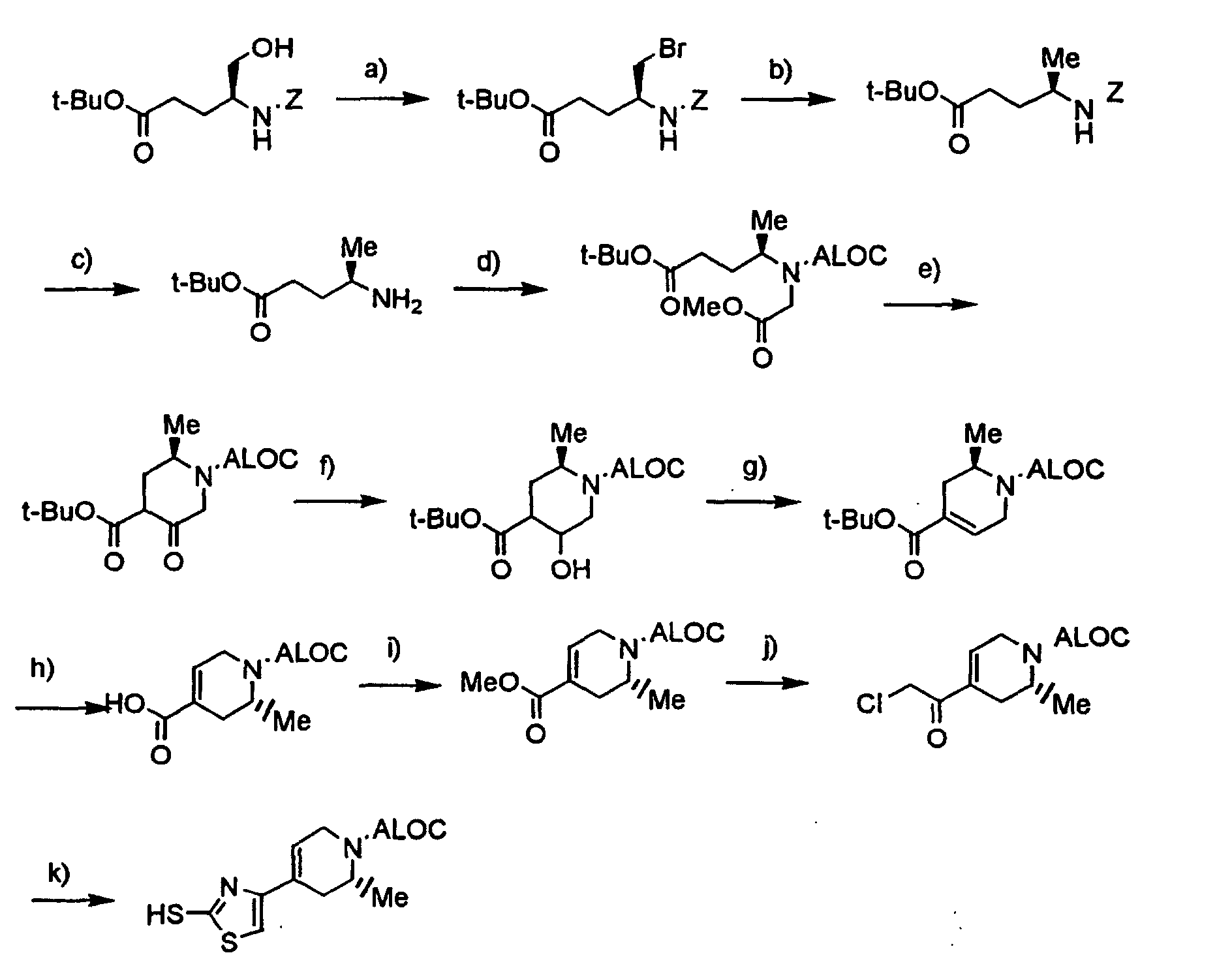
1H NMR (300MHz, CDCl3) δ 1.43 (9H, s), 1.84-1.92 (2H, m), 2.23-2.41 (2H, m), 3.50 (1H, dd, J=10.4, 3.5Hz), 3.57 (1H, dd, J=10.4, 4.4Hz), 3.86-3.97 (1H, m), 5.04-5.16 (3H, m), 7.27-7.40 (5H, m).
1H NMR (300MHz, CDCl3) δ 1.16 (3H, d, J=6.6Hz), 1.43 (9H, s), 1.68-1.79 (2H, m), 2.26-2.31 (2H, m), 3.69-3.80 (1H, m), 4.63-4.70 (1H, m), 5.04-5.12 (2H, m), 7.30-7.37 (5H, m).
1H NMR (300MHz, CDCl3) δ 1.13-1.17 (3H, m), 1.43 (9H, s), 1.64-1.74 (2H, m), 2.25-2.39 (2H, m), 3.69-3.94 (5H, m), 4.18-4.37 (1H, m), 4.56-4.64 (2H, m), 5.15-5.35 (2H, m), 5.81-6.00 (1H, m).
1H NMR (300MHz, CDCl3) δ 1.20 (3H, d, J=6.9Hz), 1.47 (9H, s), 1.69-1.87 (2H, m), 2.47-2.56 (1H, m), 2.70-2.80 (1H, m), 3.23 (1H, br s), 3.70-3.87 (1H, m), 4.12-4.28 (1H, m), 4.51 (1H, br s), 4.57-4.60 (2H, m), 5.17-5.33 (2H, m), 5.87-6.00 (1H, m) .
1H NMR (300MHz, CDCl3) δ 1.10 (3H, d, J=6.8Hz), 1.50 (9H, s), 2.30 (1H, d, J=16.8Hz), 2.42-2.53 (1H, m), 3.73 (1H, d, J=20.3Hz), 4.44 (1H, d, J=20.3Hz), 4.61-4.67 (3H, m), 5.19-5.34 (2H, m), 5.88-6.00 (1H, m), 6.78 (1H, s).
1H NMR (300 MHz, CDCl3) δ 1.07 (3 H, d, J = 6.8 Hz), 2.33 (1 H, d, J = 16.8 Hz), 2.44-2.56 (1 H, m), 3.70-3.80 (1 H, m), 3.74 (3 H, s), 4.38-4.50 (1 H, m), 4.55-4.70 (3 H, m), 5.20 (1 H, ddd, J = 1.5, 2.7, 10.4 Hz), 5.29 (1 H, ddd, J = 1.7, 3.1, 17.2 Hz), 5.93 (1 H, ddd, J = 5.5, 10.4, 17.2 Hz), 6.87 (1 H, brs).
1H NMR (300 MHz, CDCl3) δ 1.06 (3 H, d, J = 6.8 Hz), 2.43 (2 H, brs), 3.77-3.88 (1 H, m), 4.35-4.7 (6 H, m), 5.21 (1 H, ddd, J = 1.5, 2.7, 10.4 Hz), 5.29 (1 H, ddd, J = 1.7, 2.9, 17.2 Hz), 5.93 (1 H, ddd, J = 5.5, 10.4, 17.2 Hz), 6.81 (1 H, brs).
1H NMR (300 MHz, CDCl3) δ 1.14 (3 H, d, J = 6.9 Hz), 2.05-2.14 (1 H, m), 2.59-2.70 (1 H, m), 3.72-3.84 (1 H, m), 4. 43-4.74 (4 H, m), 5.21 (1 H, ddd, J = 1.5, 2.7, 10.4 Hz), 5.29 (1 H, ddd, J = 1.5, 2.9, 17.2 Hz), 5.93 (1 H, ddd, J = 5.7, 10.4, 17.2 Hz), 6.19 (1 H, brs), 6.38 (1 H, s).
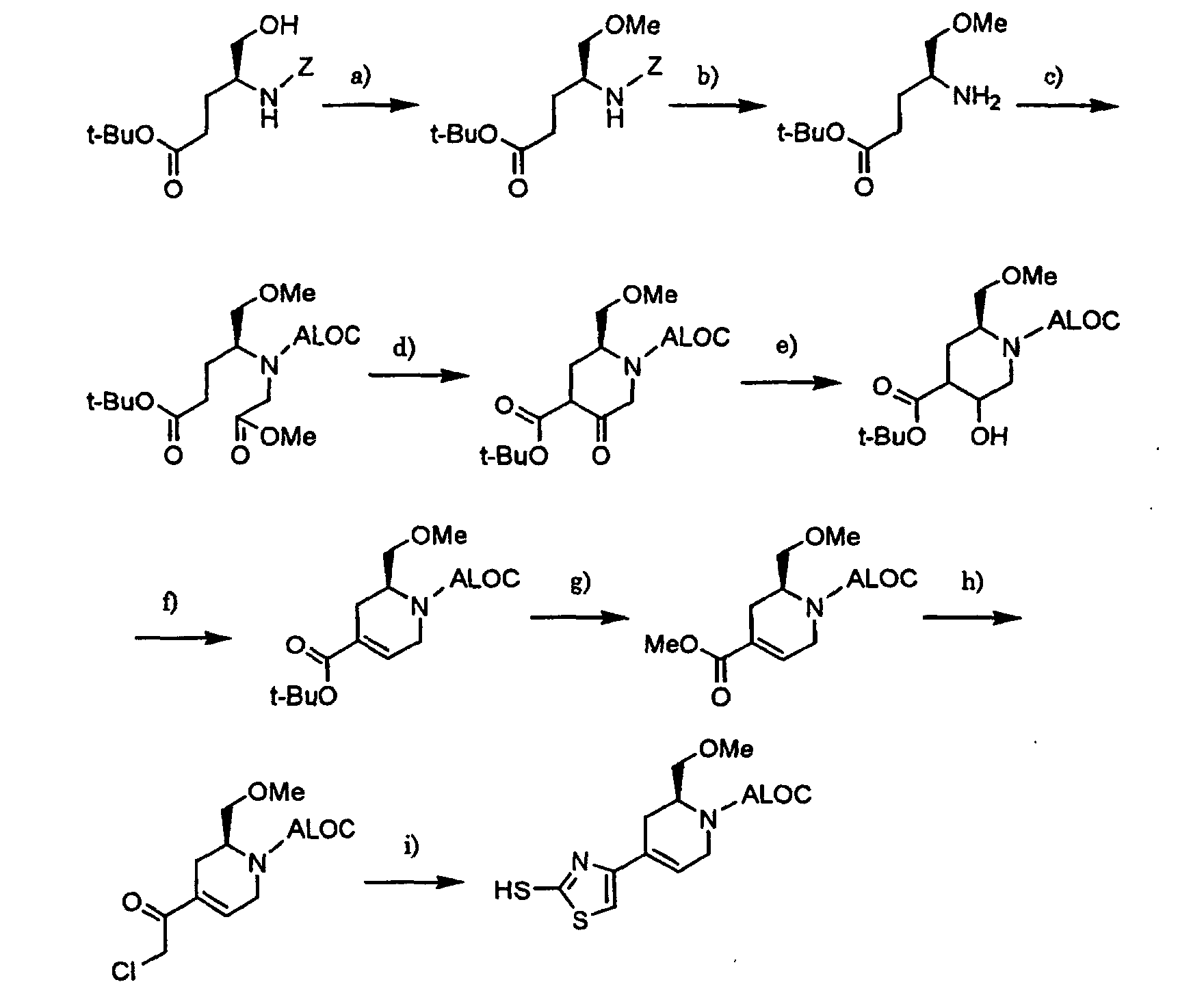
1H NMR (300MHz, CDCl3) δ 1.43 (9H, s), 1.75-1.91 (2H, m), 2.28-2.33 (2H, m), 3.33 (3H, s), 3.36-3.42 (2H, m), 3.75-3.85 (1H, m), 4.99-5.03 (1H, m), 5.09 (2H, s), 7.27-7.37 (5H, m).
1H NMR (300MHz, CDCl3) δ 1.44 (9H, s), 1.84-1.91 (2H, m), 2.40-2.45 (2H, m), 3.22-3.30 (1H, m), 3.37-3.55 (5H, m), 4.41 (2H, br s).
1H NMR (300MHz, CDCl3) δ 1.44 (9H, s), 1.74-1.92 (2H, m), 2.27-2.33 (2H, m), 3.24-3.25 (3H, m), 3.38-3.53 (2H, m), 3.68-3.73 (3H, m), 3.91-4.07 (2H, m), 4.20-4.36 (1H, m), 4.54-4.65 (2H, m), 5.16-5.34 (2H, m), 5.81-5.59 (1H, m).
1H NMR (300MHz, CDCl3) δ 1.51 (9H, s), 2.28 (1H, d, J=16.0Hz), 2.39-2.48 (1H, m), 3.27-3.46 (5H,m), 3.60-3.72 (1H, m), 4.34-4.72 (4H, m), 5.20-5.35 (2H, m), 5.88-6.00 (1H, m), 12.2 (1H, s).
1H NMR (300MHz, CDCl3) δ 1.47 (9H, s), 1.63-1.74 (1H, m), 2.04-2.12 (1H, m), 2.47-2.57 (1H, m), 2.69-2.84 (1H, m), 3.08-3.52 (5H, m), 3.70-3.81 (1H, m), 4.20-4.63 (4H, m), 5.17-5.35 (2H, m), 5.86-6.00 (1H, m).
1H NMR (300MHz, CDCl3) δ 1.49 (9H, s), 2.41-2.45 (2H, m), 3.23-3.39 (2H, m), 3.33 (3H, s), 3.65-3.79 (1H, m), 4.40-4.82 (4H, m), 5.19-5.36 (2H, m), 5.88-6.00 (1H, m), 6.78 (1H, s).
1H NMR (300MHz, CDCl3) δ 2.40-2.56 (2H, m), 3.23-3.40 (2H, m), 3.33 (3H, s), 3.66-3.84 (1H, m), 3.77 (3H, s), 4.42-4.82 (4H, m), 5.20-5.38 (2H, m), 5.89-6.01 (1H, m), 6.89 (1H, s).
1H NMR (300MHz, CDCl3) δ 2.18-2.65 (2H, m), 3.21-3.38 (2H, m), 3.31 (3H, s), 3.65-3.90 (2H, m), 4.41 (1H, d, J=14.1Hz), 4.43 (1H, d, J=14.1Hz), 4.50-4.80 (3H, m), 5.20-5.36 (2H, m), 5.89-6.02 (1H, m), 6.83 (1H, s).
1H NMR (300MHz, CDCl3) δ 2.42 (2H, d, J=16.8Hz), 2.52-2.63 (1H, m), 3.21-3.43 (2H, m), 3.34 (3H, s), 3.65-3.86 (1H, m), 4.43-4.82 (4H, m), 5.21-5.36 (2H, m), 5.89-6.02 (1H, m), 6.10 (1H, br s), 6.43 (1H, s).
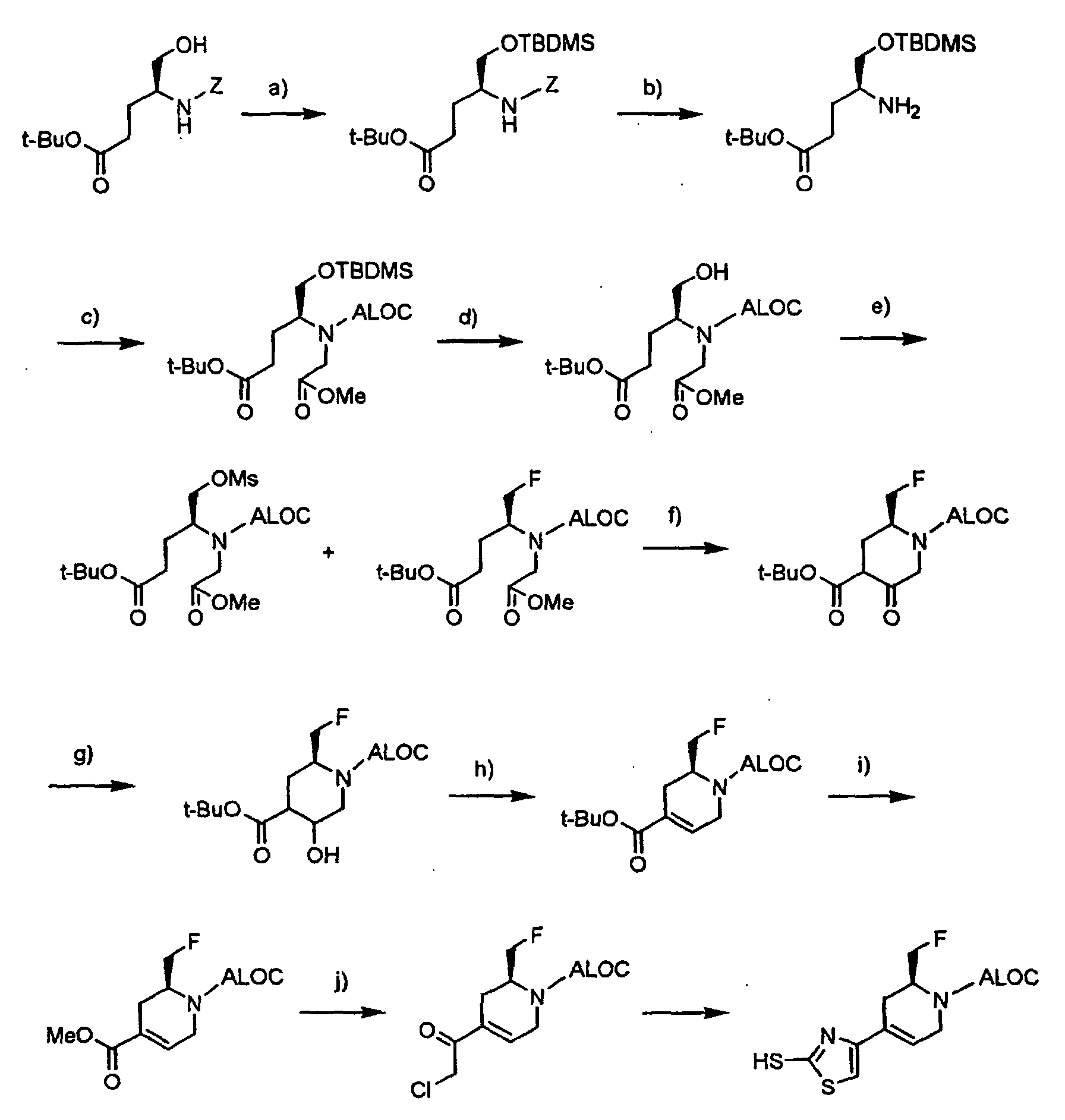
1H NMR (300MHz, CDCl3) δ 0.04 (6H, s), 0.88 (9H, s), 1.43 (9H, s), 1.74-1.89 (2H, m), 2.28-2.33 (2H, m), 3.60-3.72 (3H, m), 4.95 (1H, d, J=9.2Hz), 5.09 (2H, s), 7.27-7.37 (5H, m).
1H NMR (300MHz, CDCl3) δ 0.09 (6H, s), 0.90 (9H, s), 1.44 (9H, s), 1.72-1.91 (2H, m), 2.82-2.49 (2H, m), 3.02-3.10 (1H, m), 3.54 (1H, dd, J=10.1, 6.5Hz), 3.71 (1H, dd, J=10.1, 3.9Hz), 4.59 (2H, br s).
1H NMR (300MHz, CDCl3) δ 0.05 (6H, s), 0.87 (9H, s), 1.44 (9H, s), 1.75-1.89 (2H, m), 2.28-2.36 (2H, m), 3.59-3.82 (5H, m), 3.98-4.01 (2H, m), 4.09-4.23 (1H, m), 4.54-4.63 (2H, m), 5.14-5.33 (2H, m), 5.80-5.59 (1H, m).
1H NMR (300MHz, CDCl3) δ 1.44 (9H, s), 1.61-1.75 (2H, m), 2.21-2.30 (2H, m), 3.36-3.74 (3H, m), 3.78,-3.80 (3H, m), 4.01-4.13 (1H, m), 4.24-4.36 (1H, m), 4.52-4.66 (2H, m), 5.17-5.37 (2H, m), 5.80-6.00 (1H, m).
tert-Butyl (4S)-4-[[(allyloxy)carbonyl](2-methoxy-2-oxoethyl)amino]-5-[(methylsulfonyl)oxy]pentanoate
1H NMR (300MHz, CDCl3) δ 1.44 (9H, s), 1.75-1.99 (2H, m), 2.32-2.37 (2H, m), 3.01 (3H, s), 3.74-3.75 (3H, m), 3.88-4.03 (2H, m), 4.20-4.42 (3H, m), 4.55-4.71 (2H, m), 5.19-5.35 (2H, m), 5.80-5.99 (1H, m).
tert-Butyl (4S)-4-[[(allyloxy)carbonyl](2-methoxy-2-oxoethyl)amino]-5-fluoropentanoate
1H NMR (300MHz, CDCl3) δ 1.44 (9H, s), 1.75-1.99 (2H, m), 2.31-2.36 (2H, m), 3.69-3.77 (3H, m), 3.88-4.14 (2H, m), 4.20-4.73 (5H, m), 5.18-5.33 (2H, m), 5.80-5.99 (1H, m).
1H NMR(300MHz,CDCl3) δ 1.51 (9H, s), 2.34 (1H, d, J=15.7Hz), 2.45-2.55 (1H, m), 3.64-3.80 (1H, m), 4.28-4.81 (6H, m), 5.20-5.35 (2H, m), 5.88-6.00 (1H, m), 12.2 (1H, s).
1H NMR (300MHz, CDCl3) δ 1.48 (9H, s), 1.67-1.84 (1H, m), 2.09-2.30 (1H, m), 2.42-2.60 (1H, m), 2.70-2.88 (1H, m), 3.11-3.32 (1H, m), 3.70-3.83 (1H, m), 3.96-4.67 (6H, m), 5.21-5.34 (2H, m), 5.88-6.00 (1H, m).
1H NMR (300MHz, CDCl3) δ 1.50 (9H, s), 2.46-2.58 (2H, m), 3.71-3.87 (1H, m), 4.22-4.91 (6H, m), 5.21-5.35 (2H, m), 5.88-6.01 (1H, m), 6.81 (1H, br s).
1H NMR (300MHz, CDCl3) δ 2.48-2.60 (2H, m), 3.77 (3H, s), 3.78-3.90 (1H, m), 4.24-4.91 (6H, m), 5.21-5.36 (2H, m), 5.89-6.01 (1H, m), 6.91 (1H, br s).
1H NMR (300MHz, CDCl3) δ 2.44-2.53 (1H, m), 2.64 (1H, d, J=17.9Hz), 3.87-4.00 (1H, m), 4.18-4.91 (8H, m), 5.21-5.36 (2H, m), 5.89-6.02 (1H, m), 6.85 (1H, br s).
1H NMR (300MHz, CDCl3) δ 2.37-2.46 (1H, m), 2.52-2.63 (1H, m), 3.79-3.84 (1H, m), 4.24-4.91 (6H, m), 5.22-5.37 (2H, m), 5.89-6.02 (1H, m), 6.13 (1H, br s), 6.45 (1H, s).
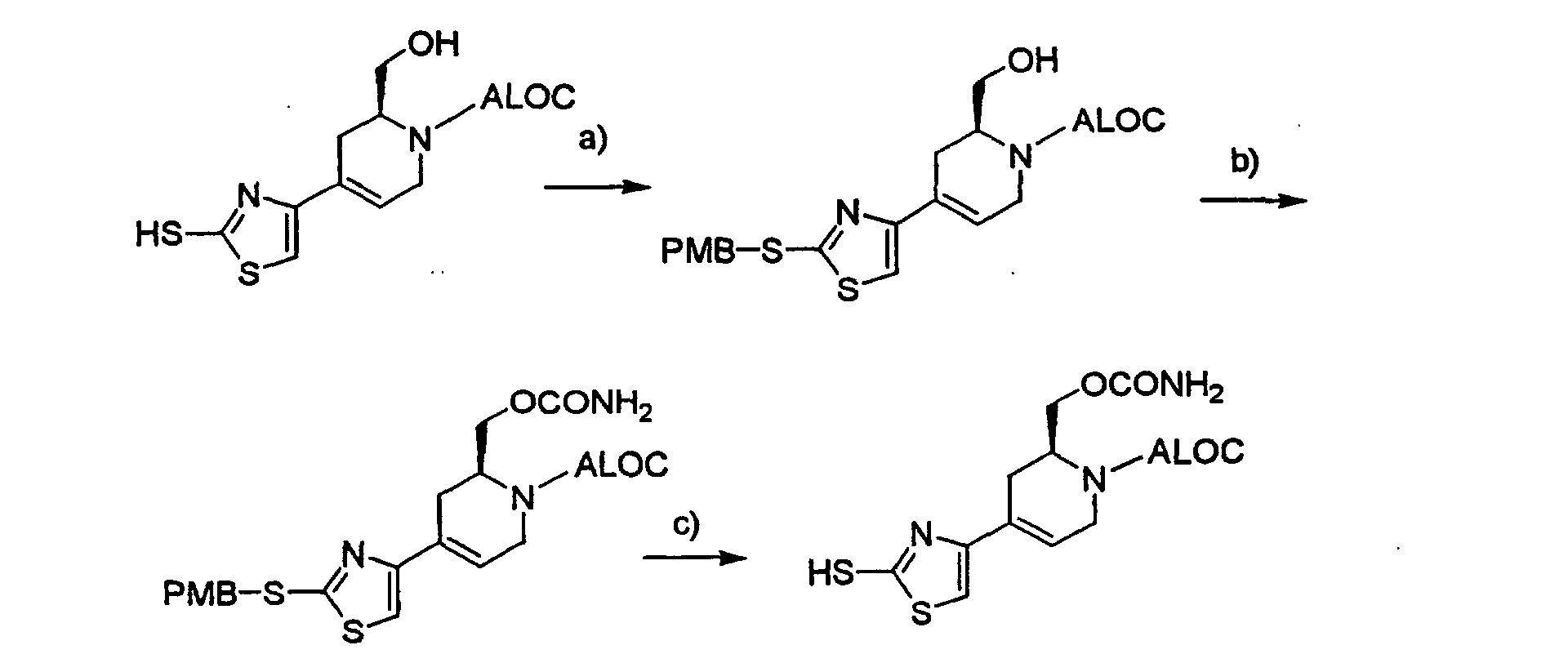
1H NMR (300 MHz, CDCl3) δ 2.40 (1 H, d, J = 16.7 Hz), 2.53-2.65 (1 H, m), 3.50-3.80 (3 H, m), 3.69 (3 H, s), 4.29-4.67 (2 H, m), 4.30 (2 H, s), 4.56 (2 H, d, J = 5.5 Hz), 5.13 (1 H, dd, J = 1.5, 10.4 Hz), 5.23 (1 H, dd, J = 1.5, 17.2 Hz), 5.87(1 H, ddd, J = 5.5, 10.4, 17.2 Hz), 6.56 (1 H, s), 6.75 (2 H, d, J = 8.6 Hz), 6.81 (1 H, s), 7.21 (2 H, d, J = 8.6 Hz).
1H NMR (300 MHz, CDCl3) δ 2.37-2.45 (1 H, m), 2.61-2.78 (1 H, m), 3.72-4.95 (9 H, m), 3.77 (3 H, s), 4.38 (2 H, s), 5.21 (1 H, dd, J = 1.3, 10.4 Hz), 5.31 (1 H, d, J =17.2 Hz), 5.95(1 H, ddd, J = 5.5, 10.4, 17.2 Hz), 6.64 (1 H, brs), 6.83 (2 H, d, J = 8.6 Hz), 6.88 (1 H, s), 7.29 (2 H, d, J = 8.6 Hz).
1H NMR (300 MHz, CDCl3) δ 2.21-2.70 (2 H, m), 3.73-4.65 (8 H, m), 4.80 (1 H, brs), 5.18 (1 H, d, J = 10.3 Hz), 5.26 (1 H, d, J =17.2 Hz), 5.88(1 H, ddd, J = 5.1, 10.3, 17.2 Hz), 6.22 (1 H, brs), 6.40 (1 H, s).
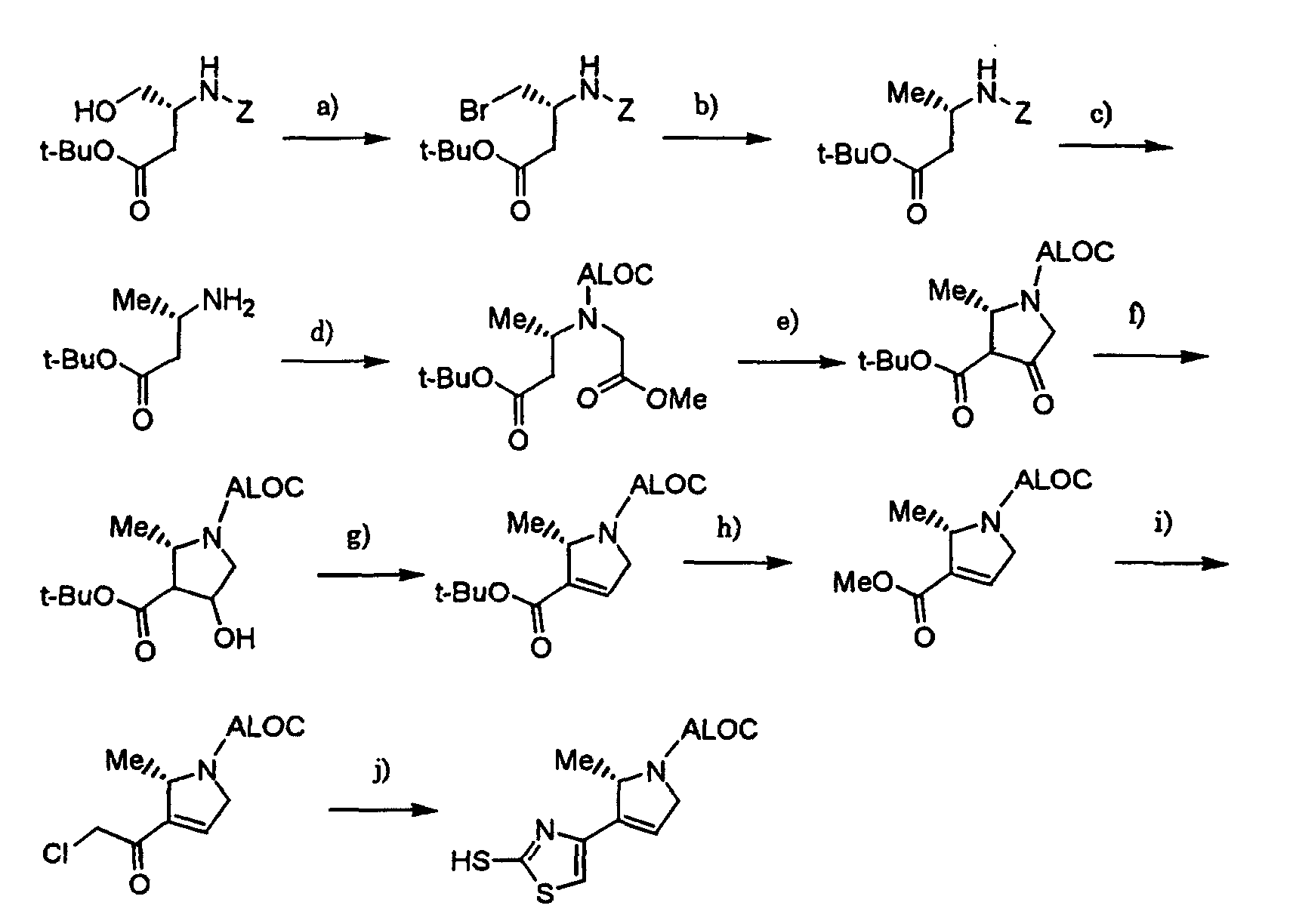
.a), by using tert-butyl (3R)-3-{[(benzyloxy)carbonyl]amino}-4-hydroxybutanoate (2.12g, 6.9mmol), there was obtained tert-butyl (3R)-3-{[(benzyloxy)carbonyl]amino}-4-bromobutanoate (2.09g, 82%). 1H NMR (300MHz, CDCl3) δ 1.44 (9H, s), 2.55-2.70 (2H, m), 3.47-3.64 (2H, m), 4.21-4.32 (1H, m), 5.03-5.18 (2H, m), 5.40 (1H, d, J=8.6Hz), 7.27-7.43 (5H, m).
.b), by using tert-butyl (3R)-3-{[(benzyloxy)carbonyl]amino}-4-bromobutanoate (2.08g, 5.6mmol), there was obtained tert-butyl (3S)-3-{[(benzyloxy)carbonyl]amino}butanoate (1.45g, 88%).
1H NMR (300MHz, CDCl3) δ 1.22 (3H, d, J=6.8Hz), 1.44 (9H, s), 2.34-2.51 (2H, m), 4.01-4.14 (1H, m), 5.01-5.17 (2H, m), 5.22-5.33 (1H, m), 7.28-7.36 (5H, m).
.b), by using tert-butyl (3S)-3-{[(benzyloxy)carbonyl]amino}butanoate (1.45g, 3.7mmol), there was obtained tert-butyl (3S)-3-aminobutanoate (586mg, 75%).
1H NMR (300MHz, CDCl3) δ 1.11 (3H, d, J=6.4Hz), 1.46 (9H, s), 2.22 (1H, dd, J=15.5, 8.2Hz), 2.32 (1H, dd, J=15.5, 4.7Hz), 3.28-3.39 (1H, m).
.d), by using tert-butyl (3S)-3-aminobutanoate (586mg, 4.9mmol), there was obtained tert-butyl (3S)-3-[[(allyloxy)carbonyl](2-methoxy-2-oxoethyl)amino]butanoate (917mg, 79%).
1H NMR (300MHz, CDCl3) δ 1.22-1.28 (3H, m), 1.43 (9H, s), 2.09-2.64 (2H, m), 3.68-3.73 (5H, m), 4.42-4.55 (1H, m), 4.55-4.66 (2H, m), 5.15-5.38 (2H, m), 5.80-6.02 (1H, m).
.b), by using tert-butyl (3S)-3-[[(allyloxy)carbonyl](2-methoxy-2-oxoethyl)amino]butanoate (917mg, 2.9mmol), there was obtained 1-allyl 3-tert-butyl (2S)-2-methyl-4-oxo-1,3-pyrrolidinedicarboxylate (166mg, 20%).
1H NMR (300MHz, CDCl3) δ 1.31-1.51 (12H, m), 4.10-4.33 (2H, m), 4.55-4.72 (3H, m), 5.20-5.38 (2H, m), 5.86-6.03 (1H, m), 10.39 (1H, br s).
.f), by using 1-allyl 3-tert-butyl (2S)-2-methyl-4-oxo-1,3-pyrrolidinedicarboxylate (166mg, 0.59mmol), there was obtained 1-allyl 3-tert-butyl (2S)-4-hydroxy-2-methyl-1,3-pyrrolidinedicarboxylate (127mg, 76%).
1H NMR (300MHz, CDCl3) δ 1.43-1.50 (12H, m), 2.38-2.62 (2H, m), 3.27 (1H, dd, J=11.2, 7.0Hz), 3.95 (1H, br s), 4.04 (1H, quint, J=6.4Hz), 4.39-4.46 (1H, m), 4.55-4.64 (2H, m), 5.18-5.35 (2H, m), 5.87-6.00 (1H, m).
.g), by using 1-allyl 3-tert-butyl (2S)-4-hydroxy-2-methyl-1,3-pyrrolidinedicarboxylate (127mg, 0.45mmol), there was obtained 1-allyl 3-tert-butyl (2S)-2-methyl-2,5-dihydro-lH-pyrrole-1,3-dicarboxylate (120mg, 100%).
1H NMR (300MHz, CDCl3) δ 1.40-1.45 (3H, m), 1.50 (9H, s), 4.18-4.41 (2H, m), 4.60-4.70 (2H, m), 4.73-4.86 (1H, m), 5.20-5.38 (2H, m), 5.89-6.03. (1H, m), 6.60-6.67 (1H, m).
.g) by using 1-allyl 3-tert-butyl (2S)-2-methyl-2,5-dihydro-1H-pyrrole-1,3-dicarboxylate (120mg, 0.45mmol), there was obtained 1-allyl 3-methyl (2S)-2-methyl-2,5-dihydro-1H-pyrrole-1,3-dicarboxylate (62mg, 61%).
1H NMR (300MHz, CDCl3) δ 1.41-1.47 (3H, m), 3.78 (3H, s), 4.21-4.45 (2H, m), 4.60-4.71 (2H, m), 4.80-4.90 (1H, m), 5.20-5.38 (2H, m), 5.89-6.02 (1H, m), 6.69-6.77 (1H, m).
.d), by using 1-allyl 3-methyl (2S)-2-methyl-2,5-dihydro-lH-pyrrole-1,3-dicarboxylate (62mg, 0.28mmol), there was obtained allyl (2S)-3-(chloroacetyl)-2-methyl-2,5-dihydro-1H-pyrrole-1-carboxylate (37mg, 55%).
1H NMR (300MHz, CDCl3) δ 1.39-1.44 (3H, m), 4.31-4.58 (4H, m), 4.60-4.71 (2H, m), 4.89-5.00 (1H, m), 5.21-5.38 (2H, m), 5.89-6.02 (1H, m), 6.67-6.87 (1H, m).
.e), by using allyl (2S)-3-(chloroacetyl)-2-methyl-2,5-dihydro-1H-pyrrole-1-carboxylate (37mg, 0.15mmol), there was obtained allyl (2S)-2-methyl-3-(sulfanyl-1,3-thiazol-4-yl)-2,5-dihydro-1H-pyrrole-1-carboxylate (36mg, 84%).
1H NMR (300MHz, CDCl3) δ 1.42-1.46 (3H, m), 4.26-4.50 (2H, m), 4.56-4.72 (2H, m), 4.87-5.00 (1H, m), 5.21-5.38 (2H, m), 5.88-6.03 (1H, m), 6.25-6.45 (2H, m).

1H NMR (300 MHz, CDCl3) δ 1.41 (9 H, s), 2.40-2.62 (3 H, m), 3.69 (2 H, d, J = 4.6 Hz), 3.97-4.07 (1 H, m), 5.08 (2 H, s), 5.48 (1 H, brs), 7.27-7.37 (5 H, m).
1H NMR (300 MHz, CDCl3) δ 1.41 (9 H, s), 2.53 (2 H, d, J = 6.1 Hz), 3.32 (3 H, s), 3.54 (1 H, dd, J = 5.0, 9.5 Hz), 3.63 (1 H, dd, J = 3.8, 9.5 Hz), 4.12-4.23 (1 H, m), 4.58 (2 H, s), 5.08 (2 H, s), 5.41 (1 H, d, J = 8.6 Hz), 7.27-7.38 (5 H, m) .
1H NMR (300 MHz, CDCl3) δ 1.43 (9 H, s), 2.42-2.57 (2 H, m), 3.28-3.65 (5 H, m), 3.35 (3 H, s), 4.63 (2 H, s).
1H NMR (300 MHz, CDCl3) δ 1.43 (9 H, s), 2.54-2.75 (2 H, m), 3.33 (3 H, s), 3.54-3.82 (5 H, m), 4.04-4.09 (2 H, m), 4.50-4.71 (5 H, m), 5.15-5.38 (2 H, m), 5.80-6.02 (1 H, m).
1H NMR (300 MHz, CDCl3) δ 1.46 (9 H, s), 2.98 (0.6 H, brs), 3.02 (0.4 H, brs), 3.33 (3 H, s), 3.36 (3 H, s), 3.46-3.80 (3 H, m), 4.02-4.70 (8 H, m), 5.22 (1 H, d, J = 10.4 Hz), 5.31 (1 H, d, J = 17.2 Hz), 5.94 (1 H, ddd, J = 5.5, 10.4, 17.2 Hz).
1H NMR (300 MHz, CDCl3) δ -0.08 (3 H, s), -0.07 (3 H, s), 0.78 (9 H, s), 3.75 (3 H, s), 3.84-4.42 (4 H, m), 4.58-4.64 (2 H, m), 4.77-4.84 (1 H, m), 5.18-5.23 (1 H, m), 5.29 (1 H, dt, J = 1.7, 17.2 Hz), 5.92(1 H, ddd, J = 5.5, 10.4, 17.2 Hz), 6.77-6.84 (1 H, m).
1H NMR (300 MHz, CDCl3) δ -0.08 (3 H, s), -0.06 (3 H, s), 0.78 (9 H, s), 3.86-4.13 (2 H, m), 4.23-4.63 (6 H, m), 4.87-4.96 (1 H, m), 5.21 (1 H, dd, J = 2.9, 10.4 Hz), 5.29 (1 H, d, J = 17.0 Hz), 5.92(1 H, ddd, J = 5.7, 10.4, 17.0 Hz), 6.79 (0.5 H, brs), 6.85 (0.5 H, brs).
1H NMR (300 MHz, DMSO-d6) δ -0.15 (3 H, s), -0.12 (3 H, s), 0.76 (9 H, s), 3.90-4.13 (3 H, m), 4.23-4.34 (1 H, m), 4.49-4.70 (2 H, m), 4.88-4.95 (1 H, m), 5.16-5.34 (2 H, m), 5.86-5.99(1 H, m), 6.56 (0.6 H, brs), 6.59 (0.4 H, brs), 7.06 (1 H, s).
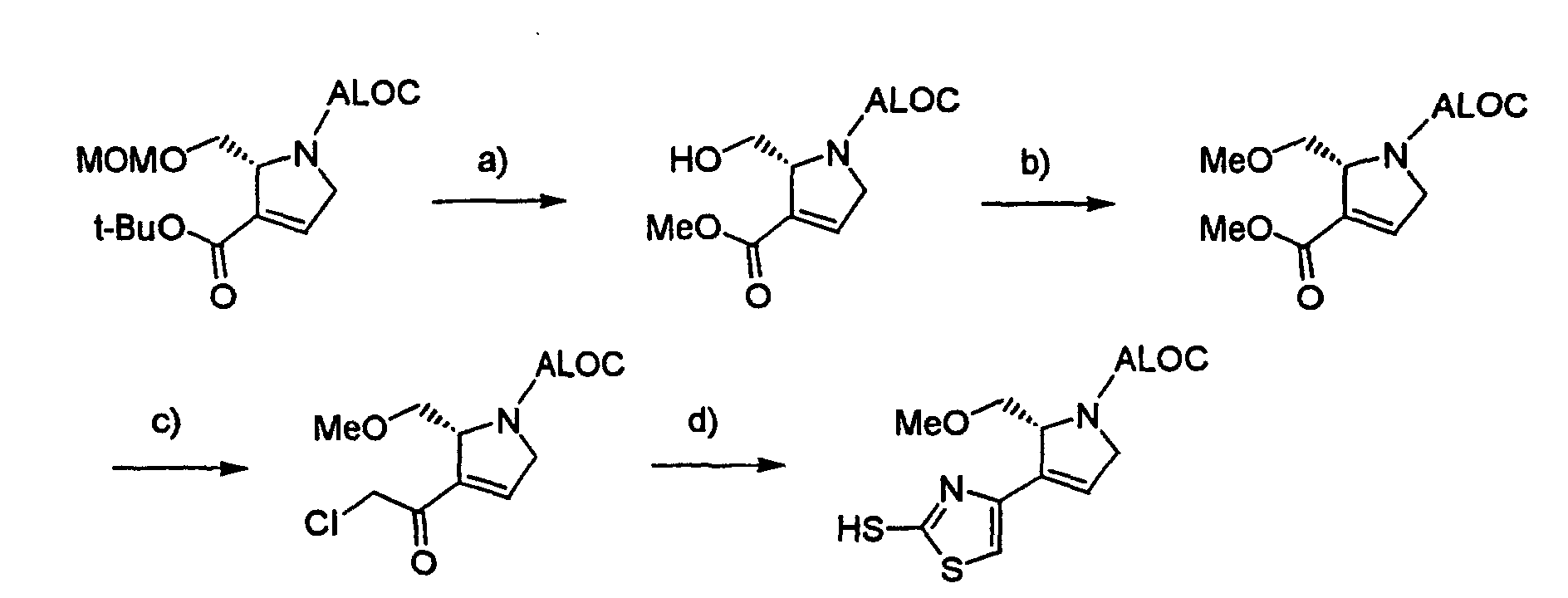
.g), by using 1-allyl 3-tert-butyl (2R)-2-[(methoxymethoxy)methyl]-2,5-dihydro-1H-pyrrole-1,3-dicarboxylate (470mg, 1.4mmol), there was obtained 1-allyl 3-methyl (2R)-2-(hydroxymethyl)-2,5-dihydro-1H-pyrrole-1,3-dicarboxylate (234mg, 68%).
1H NMR (300MHz, CDCl3) δ 3.70-4.59 (7H, m), 4.62-4.67 (2H, m), 4.82-5.01 (1H, m), 5.22-5.38 (2H, m), 5.89-6.02 (1H, m), 6.82-6.92 (1H, m) .
1H NMR (300MHz, CDCl3) δ 3.29-3.30 (3H, m), 3.70-3.97 (4H, m), 4.22-4.49 (2H, m), 4.52-4.72 (3H, m), 4.86-4.91 (1H, m), 5.21-5.38 (2H, m), 5.89-6.02 (1H, m), 6.82-6.94 (1H, m).
.d), by using 1-allyl 3-methyl (2R)-2-(methoxymethyl)-2,5-dihydro-1H-pyrrole-1,3-dicarboxylate (55mg, 0.22mmol) , there was obtained allyl (2R)-3-(chloroacetyl)-2-(methoxymethyl)-2,5-dihydro-1H-pyrrole-1-carboxylate (38mg, 64%).
1H NMR (300MHz, CDCl3) δ 3.25-3.26 (3H, m), 3.70-3.90 (2H, m), 4.31-4.71 (6H, m), 4.95-5.01 (1H, m), 5.21-5.36 (2H, m), 5.89-6.02 (1H, m), 6.81-6.88 (1H, m).
.e), by using allyl (2R)-3-(chloroacetyl)-2-(methoxymethyl)-2,5-dihydro-1H-pyrrole-1-carboxylate (38mg, 0.22mmol)
, there was obtained allyl (2R)-2-(methoxymethyl)-3-(2-sulfanyl-1,3-thiazol-4-yl)-2,5-dihydro-lH-pyrrole-1-carboxylate (37mg, 85%).
1H NMR (300MHz, CDCl3) δ 3.44-3.45 (3H, m), 3.53-3.71 (1H, m), 3.87-3.95 (1H, m), 4.20-4.46 (2H, m), 4.63-4.70 (2H, m), 4.86-4.96 (1H, m), 5.22-5.39 (2H, m), 5.89-6.03 (1H, m), 6.29-6.34 (1H, m), 6.62 (1H, s).

1H NMR (300MHz, CDCl3) δ 1.24 (3H, d, J=6.4Hz), 2.49 (3H, s), 3.43-3.59 (2H, m), 3.97-4.03 (1H, m), 5.89 (1H, br s), 6.30 (1H, s).

, there was obtained 4-[(2R)-1,2-dimethyl-2,5-dihydro-1H-pyrrol-3-yl]-1,3-thiazole-2-thiol (103mg, 49%).
1H NMR (300MHz, CDCl3-CD3OD) δ 1.33 (3H, d, J=6.4Hz), 2.57 (3H, s), 6.20-6.22 (1H, m), 6.43 (1H, s).

1H NMR (300MHz, CDCl3) δ 0.24 (3H, s), 0.25 (3H, s), 0.97 (9H, s), 2.51 (3H, s), 3.29-3.37 (1H, m), 3.55-3.61 (1H, m), 3.67-3.73 (1H, m), 3.80-3.96 (2H, m), 6.18-6.20 (1H, m), 6.61 (1H, s).
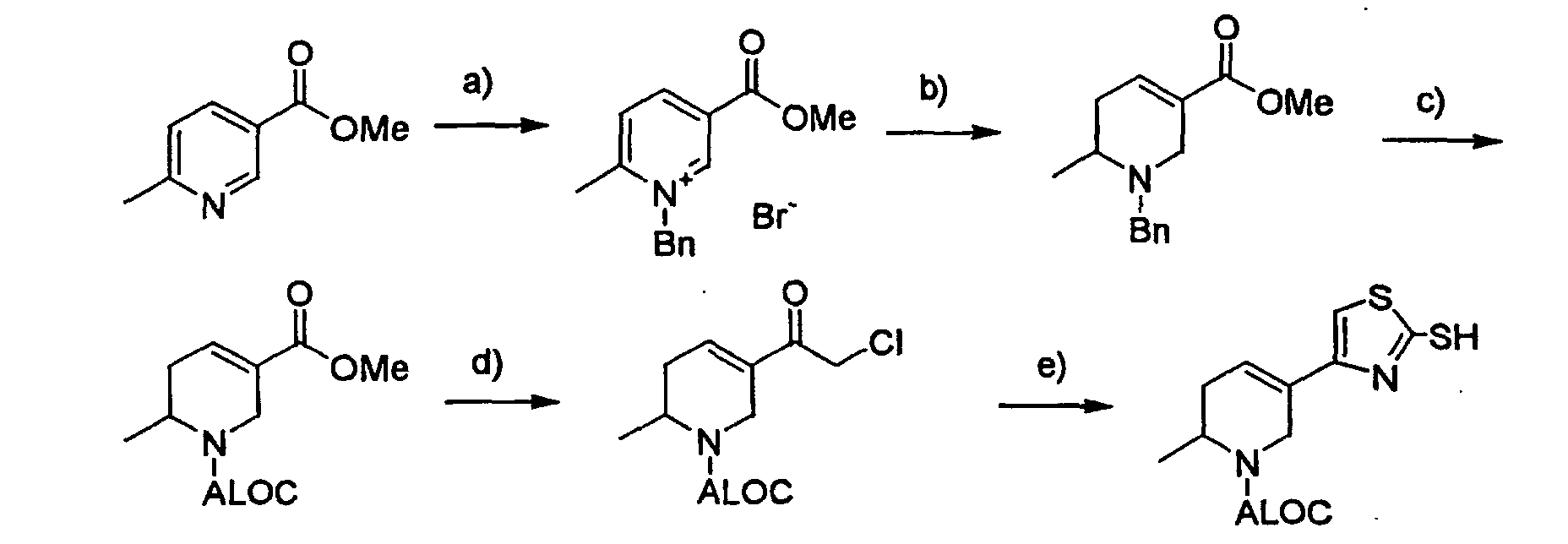
1H NMR (300 MHz, CDCl3) δ 3.12 (3 H, s), 3.98 (3 H, s), 6.28 (2 H, s), 7.30-7.42 (5 H, m), 8.13 (1 H, d, J = 8.3 Hz), 8.78 (1 H, dd, J = 1.8, 8.3 Hz), 9.44 (1 H, d, J = 1.8 Hz).
1H NMR (300 MHz, CDCl3) δ 1.03 (3 H, d, J = 6.6 Hz), 1.97-2.08 (1 H, m), 2.42-2.54 (1 H, m), 2.87-2.97 (1 H, m), 3.21-3.24 (2 H, m), 3.53 (1 H, d, J = 13.4 Hz), 3.68 (3 H, s), 3.75 (1 H, d, J = 13.4 Hz), 6.94-6.98 (1 H, m), 7.18-7.35 (5 H, m) .
1H NMR (300 MHz, CDCl3) δ 1.09 (3 H, d, J = 7.0 Hz), 2.02-2.12 (1 H, m), 2.50-2.63 (1 H, m), 3.65-3.78 (1 H, m), 3.75 (3 H, s), 4.50-4.65 (4 H, m), 5.20 (1 H, d, J = 10.3 Hz), 5.29 (1 H, d, J = 17.0 Hz), 5.93 (1 H, ddd, J = 5.0, 10.3, 17.0 Hz), 6.97-7.03 (1 H, m).
1H NMR (300 MHz, CDCl3) δ 1.09 (3 H, d, J = 7.0 Hz), 2.10-2.22 (1 H, m), 2.60-2.74 (1 H, m), 3.67-3.78 (1 H, m), 4.40 (2 H, s), 4.55-4.70 (4 H, m), 5.20 (1 H, d, J = 10.4 Hz), 5.28 (1 H, d, J = 17.0 Hz), 5.92 (1 H, ddd, J = 5.0, 10.4, 17.0 Hz), 6.92-6.98 (1 H, m).
1H NMR (300 MHz, CDCl3) δ1.14 (3 H, d, J = 6.8 Hz), 2.00-2.20 (1 H, m), 2.56-2.73 (1 H, m), 3.68-3.78 (1 H, m), 4.46-4.67 (4 H, m), 5.17-5.32 (2 H, m), 5.86-6.00 (1 H, m), 6.22 (0.5 H, brs), 6.24 (0.5 H, brs), 6.41 (1 H, s).
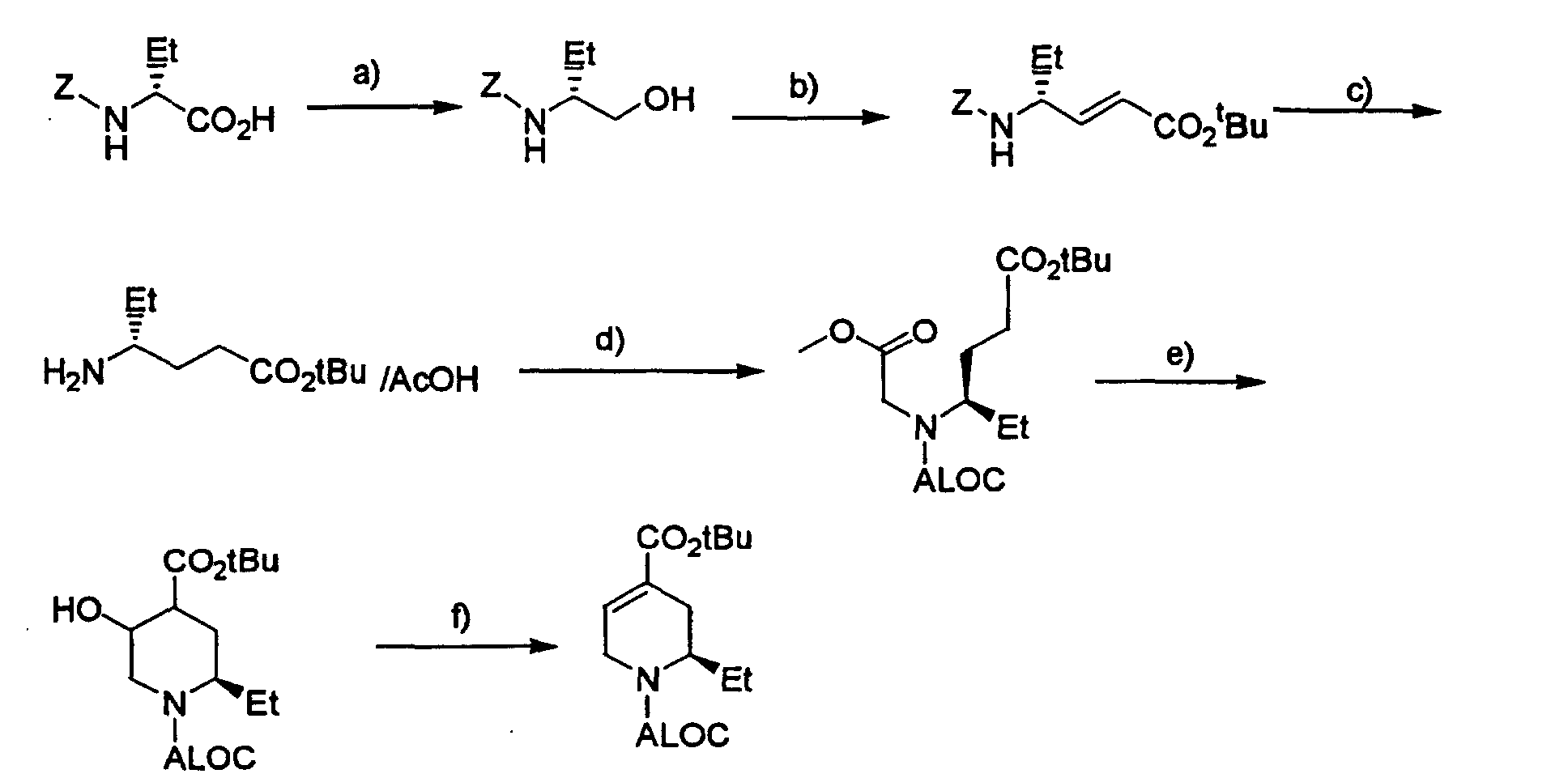
1H NMR (300 MHz, CDCl3) δ 0.94 (3 H, t, J = 7.3 Hz), 1.41-1.64 (2 H, m), 2.12 (1 H, brs), 3.52 (3 H, m), 4.82 (1 H, brs), 5.09 (2 H, s), 7.27-7.37 (5 H, m).
1H NMR (300 MHz, CDCl3) δ 0.93 (3 H, t, J = 7.5 Hz), 1.46 (9 H, s), 1.42-1.68 (2 H, m), 4.20-4.32 (1 H, m), 3.65-3.73 (1 H, m), 5.07 (1 H, d, J = 15.8 Hz), 5.11 (1 H, d, J = 15.8 Hz), 5.82 (1 H, d, J = 15.6 Hz), 6.71 (1 H, dd, J = 5.7, 15.6 Hz), 7.28-7.37 (5 H, m).
1H NMR (300 MHz, CDCl3) δ 0.95 (3 H, t, J = 7.5 Hz), 1.46 (9 H, s), 1.53-1.63 (2 H, m), 1.68-1.92 (2 H, m), 2.35 (2 H, t, J = 7.5 Hz), 2.90-2.98 (1 H, m).
1H NMR (300 MHz, CDCl3) δ 0.88 (3 H, t, J = 7.3 Hz), 1.41 (9 H, s), 1.37-1.79 (4 H, m), 2.21-2.42 (2 H, m), 3.66-3.77 (5 H, m), 3.90-4.20 (1 H, m), 4.50-4.63 (2 H, m), 5.13-5.32 (2 H, m), 5.78-5.97 (1 H, m).
1H NMR (300 MHz, CDCl3) δ 0.86 (3 H, t, J = 7.3 Hz), 1.44 (9 H, s), 1.36-1.47 (1 H, m), 1.58-1.73 (2 H, m), 1.83-1.93 (1 H, m), 2.39-2.48 (1 H, m), 2.54-2.73 (1 H, m), 3.65-3.77 (1 H, m), 4.04-4.34 (2 H, m), 4.55 (2 H, d, J = 5.5 Hz), 5.18 (1 H, dd, J = 1.3, 10.4 Hz), 5.26 (1 H, dd, J = 1.3, 17.0 Hz), 5.90 (1 H, ddt, J = 5.5, 10.4, 17.0 Hz).
1H NMR (300 MHz, CDCl3) δ 0.85 (3 H, t, J = 7.5 Hz), 1.32-1.59 (2 H, m), 1.47 (9 H, s), 2.35-2.42 (2 H, m), 3.55-3.73 (1 H, m), 4.29-4.63 (4 H, m), 5.19 (1 H, dd, J = 1.5, 10.4 Hz), 5.28 (1 H. dd, J = 1.5, 17.0 Hz), 5.92 (1 H, ddt, J = 5.5, 10.4, 17.0 Hz), 6.74 (1 H, brs).

1H NMR (300 MHz, CDCl3) δ 0.91 (3 H, d, J = 7.0 Hz), 0.94 (3 H, d, J = 7.9 Hz), 1.78-1.90 (1 H, m), 2.03-2.12 (1 H, m), 3.44-3.75 (3 H, m), 4.84 (1 H, brs), 5.09 (2 H, s), 7.28-7.37 (5 H, m).
1H NMR (300 MHz, CDCl3) δ 0.89 (3 H, d, J = 7.0 Hz), 0.92 (3 H, d, J = 6.8 Hz), 1.46 (9 H, s), 1.78-1.92 (1 H, m), 4.16-4.26 (1 H, m), 4.76 (1 H, d, J = 9.7 Hz), 5.07 (1 H, d, J = 13.9 Hz), 5.11 (1 H, d, J = 12.1 Hz), 5.83 (1 H, dd, J = 1.3, 15.5 Hz), 6.73 (1 H, dd, J = 5.5, 15.5 Hz), 7.28-7.37 (5 H, m).
1H NMR (300 MHz, CDCl3) δ 0.94 (3 H, d, J = 7.0 Hz), 0.95 (3 H, d, J = 6.8 Hz), 1.41 (9 H, s), 1.63-1.91 (3 H, m), 2.28-2.47 (2 H, m), 2.83 (1 H, dt, J = 4.4, 8.8 Hz).
1H NMR (300 MHz, CDCl3) δ 0.87 (3 H, d, J = 6.6 Hz), 0.97 (3 H, d, J = 6.6 Hz), 1.35-1.65 (2 H, m), 1.42 (9 H, s), 1.88-2.02 (1 H, m), 2.26-2.52 (2 H, m), 3.59-3.93 (5 H, m), 4.51-4.68 (2 H, m), 5.18-5.31 (2 H, m), 5.78-5.96 (1 H, m).
1H NMR (300 MHz, CDCl3) δ 0.84-0.97 (6 H, m), 1.45 (9 H, s), 1.50-1.70 (1 H, m), 1.74-2.13 (2 H, m), 2.33-3.09 (2 H, m), 3.64-4.38 (3 H, m), 4.50-4.65 (2 H, m), 5.15-5.34 (2 H, m), 5.85-5.98 (1 H, m).
1H NMR (300 MHz, CDCl3) δ 0.84 (3 H, d, J = 6.8 Hz), 0.91 (3 H, d, J = 6.6 Hz), 1.47 (9 H, s), 1.63-1.73 (1 H, m), 2.23-2.36 (1 H, m), 2.62 (1 H, d, J = 17.4 Hz), 3.53-3.72 (1 H, m), 3.90-4.14 (1 H, m), 4.40-4.65 (4 H, m), 5.19 (1 H, dd, J = 1.3, 10.4 Hz), 5.28 (1 H, d, J = 17.4 Hz), 5.92 (1 H, ddt, J = 5.5, 10.4, 17.4 Hz), 6.75 (1 H, brs).
1H NMR (300 MHz, CDCl3) δ 0.84 (3 H, d, J = 6.6Hz), 0.90(3 H, d, J = 6.4Hz), 1.60-1.72 (1 H, m), 2.28-2.40 (1 H, m), 2.67 (1 H, d, J = 17.6 Hz), 3.55-3.77 (1 H, m), 3.74 (3 H, s), 3.93-4.13 (1 H, m), 4.41-4.65 (3 H, m), 5.19 (1 H, ddd, J = 1.5, 2.8, 10.4 Hz), 5.28 (1 H, d, J = 17.2 Hz), 5.92 (1 H, ddt, J = 5.5, 10.4, 17.2 Hz), 6.86 (1 H, brs).
1H NMR (300 MHz, CDCl3) δ 0.85 (3 H, d, J = 6.8 Hz), 0.89 (3 H, d, J = 6.6 Hz), 1.50-1.64 (1 H, m), 2.21-2.34 (1 H, m), 2.78 (1 H, d, J = 17.4 Hz), 3.64-3.75 (2 H, m), 4.33-4.44 (2 H, m), 4.50-4.70 (3 H, m), 5.17-5.32 (2 H, m), 5.85-5.99 (1 H, m), 6.80 (1 H, brs).
1H NMR (300 MHz, CDCl3) δ 0.87 (3 H, d, J = 6.6 Hz), 0.92 (3 H, d, J = 6.6 Hz), 1.67-1.83 (1 H, m), 2.38-2.58 (2 H, m), 3.57-3.80 (1H, m), 3.97-4.18 (1H, m), 4.44-4.68 (3H, m), 5.21 (1 H, dd, J = 1.3, 10.4 Hz), 5.29 (1H, dd, J=1.4, 17.2 Hz), 5.93 (1H, ddt, J=5.5, 10.4, 17.2 Hz), 6.03 (1H, brs), 6.38 (1H, brs).

1H NMR (300 MHz, CD3OD) δ 1.23 (3 H, brs), 2.10-2.29 (1 H, m), 2.54 (3 H, brs), 2.80 (2 H, brs), 3.50-3.70 (2 H, m), 6.38 (1 H, brs), 6.71 (1 H, brs).
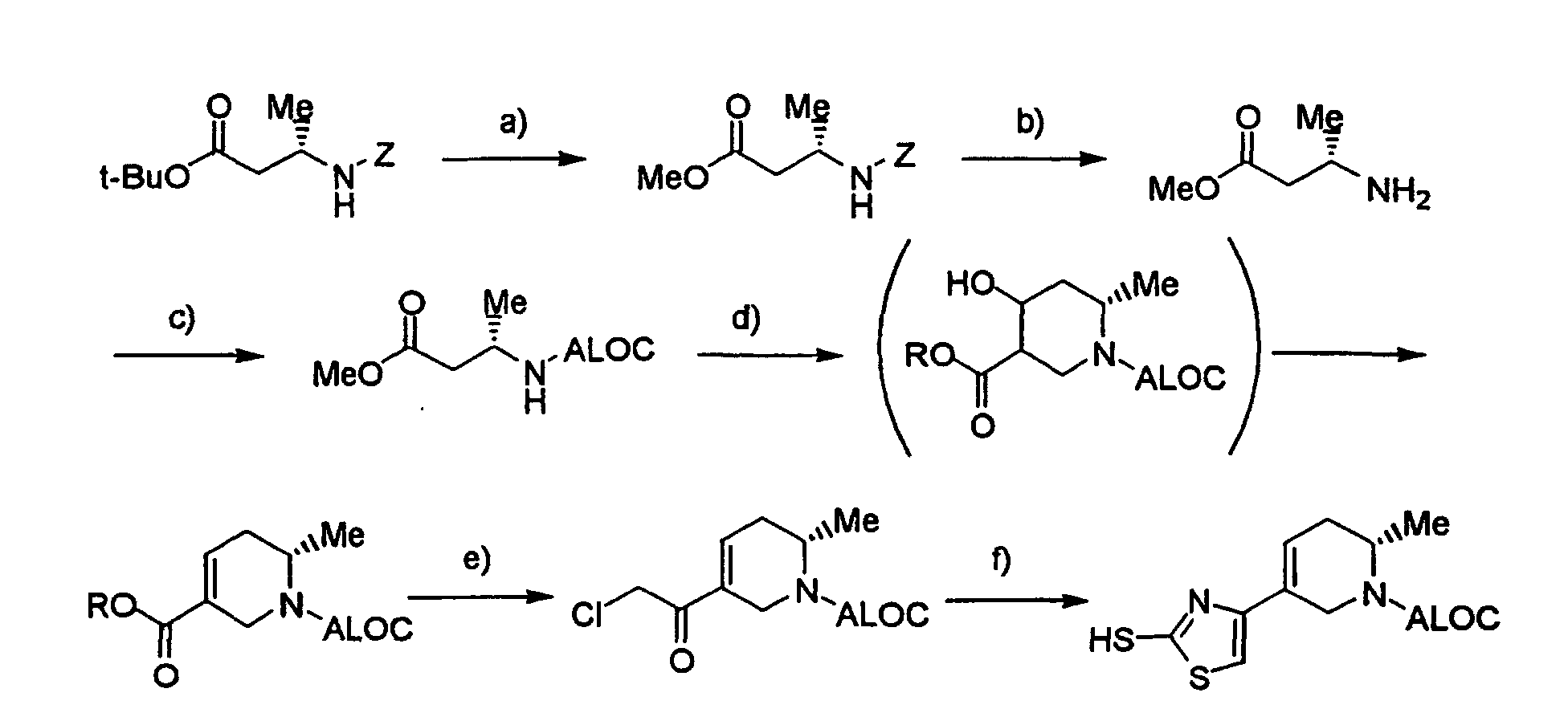
1H NMR (300MHz, CDCl3) δ 1.24 (3H, d, J=6.8Hz), 2.54 (2H, d, J=5.5Hz), 3.67 (3H, s), 4.05-4.18 (1H, m), 5.06-5.13 (2H, m), 5.15-5.24 (1H, m), 7.28-7.39 (5H, m).
1H NMR (300MHz, CDCl3) δ 1.14 (3H, d, J=6.4Hz), 2.33 (1H, dd, J=15.7, 8.2Hz), 2.43 (1H, dd, J=15.7, 4.6Hz), 3.34-3.45 (1H, m), 3.69 (3H, s).
1H NMR (300MHz, CDCl3) δ 1.25 (3H, d, J=6.8Hz), 2.24 (3H, d, J=5.5Hz), 3.69 (3H, s), 4.03-4.16 (1H, m), 4.54-4.58 (2H, m), 5.15-5.34 (3H, m), 5.85-5.98 (1H, m).
1-allyl 3-ethyl (6S)-6-methyl-5,6-dihydro-1,3(2H)-pyridinedicarboxylate 1H NMR (300MHz, CDCl3) δ 1.12 (3H, d, J=7.0Hz), 2.04-2.13 (1H, m), 2.54-2.63 (1H, m), 3.70-3.79 (1H, m), 4.23 (2H, q, J=7.1Hz) 4.55-4.68 (4H, m), 5.19-5.34 (2H, m), 5.89-6.02 (1H, m), 7.00-7.04 (1H, m).
1-allyl 3-methyl (6S)-6-methyl-5,6-dihydro-1,3(2H)-pyridinedicarboxylate
1H NMR (300MHz, CDCl3) δ 1.12 (3H, d, J=6.8Hz), 1.31 (3H, t, J=7.1Hz), 2.04-2.13 (1H, m), 2.53-2.64 (1H, m), 3.70-3.79 (1H, m), 3.77 (3H, s), 4.55-4.68 (4H, m), 5.19-5.34 (2H, m), 5.89-6.02 (1H, m), 7.00-7.04 (1H, m).
1H NMR (300MHz, CDCl3) δ 1.12 (3H, d, J=7.0Hz), 2.13-2.24 (1H, m), 2.66-2.75 (1H, m), 3.71-3.79 (1H, m), 4.36-4.46 (2H, m), 4.60-4.71 (4H, m), 5.20-5.34 (2H, m), 5.88-6.01 (1H, m), 6.96-6.99 (1H, m).
1H NMR (300MHz, CDCl3) δ 1.16 (3H, d, J=7.0Hz), 2.08-2.18 (1H, m), 2.60-2.70 (1H, m), 3.71-3.79 (1H, m), 4.52-4.65 (4H, m), 5.22-5.34 (2H, m), 5.89-6.01 (1H, m), 6.18-6.20 (1H, m), 6.42 (1H, s), 10.66 (1H, br s).

Ethyl (3S)-3-{[(benzyloxy)carbonyl]amino}-4-hydroxyhutanoate
1H NMR (300MHz, CDCl3) δ 1.24 (3H, t, J=7.1Hz), 2.61-2.65 (2H, m), 2.78 (1H, br s), 3.68-3.73 (2H, m), 4.02-4.17 (3H, m), 5.07-5.10 (2H, m), 5.50-5.58 (1H, m), 7.28-7.39 (5H, m).
Benzyl (3S)-5-oxotetrahydro-3-furanylcarbamate
1H NMR (300MHz, CDCl3) δ 1.24 (3H, t, J=7.1Hz), 2.46 (1H, dd, J=3.5, 17.9Hz), 2.81 (1H, dd, J=7.5, 17.9Hz), 4.17-4.24 (1H, m), 4.44-4.53 (2H, m), 5.10 (2H, s), 5.40-5.45 (1H, m), 7.28-7.39 (5H, m).
1H NMR (300MHz, CDCl3) δ 0.04 (6H, s), 0.89 (9H, s), 1.25 (3H, t, J=7.1Hz) 2.58-2.62 (2H, m), 3.64 (1H, dd, J=5.1, 9.9Hz), 3.70 (1H, dd, J=3.8, 9.9Hz), 4.04-4.16 (1H, m), 4.13 (2H, q, J=7.1), 4.54-4.58 (2H, m), 5.19-5.34 (3H, m), 5.85-5.98 (1H, m).
1H NMR (300MHz, CDCl3) δ 0.04 (6H, s), 0.89 (9H, s), 1.26 (3H, t, J=7.1Hz), 2.48-2.66 (3H, m), 3.60-3.73 (3H, m), 4.04-4.23 (4H, m), 4.14 (2H, q, J=7.1), 4.54-4.62 (2H, m), 5.19-5.34 (2H, m), 5.85-5.98 (1H, m).
1H NMR (300MHz, CDCl3) δ 0.01-0.04 (6H, m), 0.84-0.89 (9H, m), 1.23-1.33 (3H, m), 2.18-2.65 (2H, m), 3.45-3.92 (3H, m), 4.07-4.26 (2H, m), 4.45-4.68 (3H, m), 5.19-5.35 (2H, m), 5.86-6.02 (1H, m), 7.01 (1H, br s).
1H NMR (300MHz, CDCl3) δ 0.02 (3H, s), 0.03 (3H, s), 0.86 (9H, s), 2.42-2.65 (2H, m), 3.45-3.57 (3H, m), 3.67-3.78 (1H, m), 4.40 (2H, s), 4.50-4.65 (4H, m), 5.19-5.34 (2H, m), 5.88-6.01 (1H, m), 6.98 (1H, br s).
(dimethyl)silyl]oxy}methyl)-5-(chloroacetyl)-3,6-dihydro-1(2H)-pyridinecarboxylate (79mg, 0.20mmol), there was obtained allyl (2S)-2-({[tert-butyl(dimethyl)silyl]oxy}methyl)-5-(2-sulfanyl-1,3-thiazol-4-yl)-3,6-dihydro-1(2H)-pyridinecarboxylate (90mg, quantitatively).
1H NMR (300MHz, CDCl3) δ 0.03 (6H, s), 0.86 (9H, s), 2.27-2.38 (1H, m), 2.50-2.61 (1H, m), 3.48-3.82 (3H, m), 4.40-4.66 (4H, m), 5.19-5.34 (2H, m), 5.88-6.01 (1H, m), 6.29 (1H, br s), 6.44 (1H, br s), 11.49 (1H, br s).
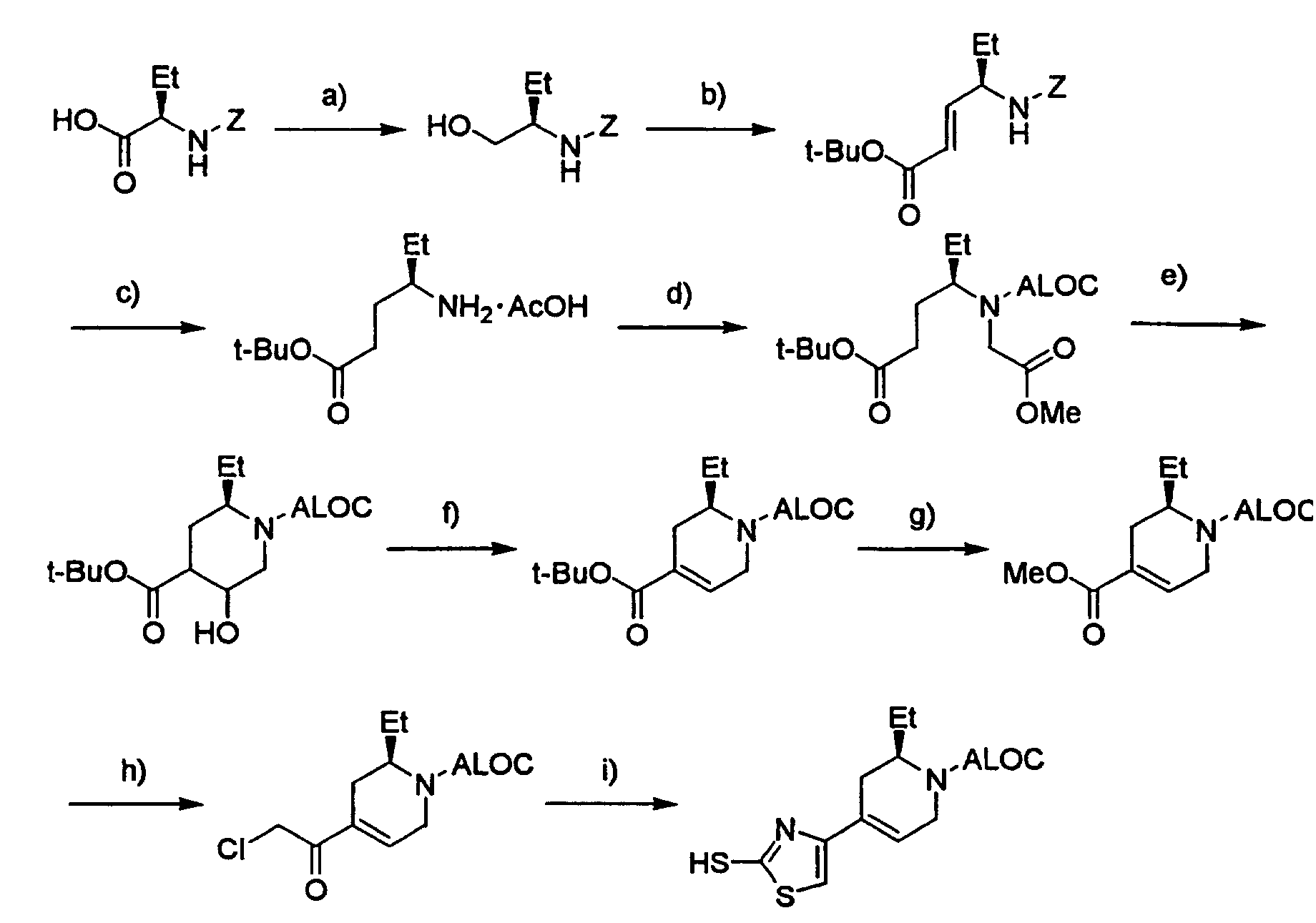
1H NMR (300 MHz, CDCl3) δ 0.94 (3H, t, J=7.3 Hz), 1.41-1.64 (2H, m), 2.12 (1H, brs), 3.52 (3H, m), 4.82 (1H, brs), 5.09 (2H, s), 7.27-7.37 (5H, m).
1H NMR (300 MHz, CDCl3) δ 0.93 (3H, t, J=7.5 Hz), 1.46 (9H, s), 1.42-1.68 (2H, m), 4.20-4.32 (1H, m), 3.65-3.73 (1H, m), 5.07 (1H, d, J=15.8 Hz), 5.11 (1H, d, J=15.8 Hz), 5.82 (1H, d, J = 15.6 Hz), 6.71 (1H, dd, J = 5.7, 15.6 Hz), 7.28-7.37 (5H, m).
1H NMR (300 MHz, CDCl3) δ 0.95 (3H, t, J = 7.5 Hz), 1.46 (9H, s), 1.53-1.63 (2H, m), 1.68-1.92 (2H, m), 2.35 (2H, t, J = 7.5 Hz), 2.90-2.98 (1H, m).
1H NMR (300 MHz, CDCl3) δ 0.88 (3H, t, J = 7.3 Hz), 1.41 (9H, s), 1.37-1.79 (4H, m), 2.21-2.42 (2H, m), 3.66-3.77 (5H, m), 3.90-4.20 (1H, m), 4.50-4.63 (2H, m), 5.13-5.32 (2H, m), 5.78-5.97 (1H, m).
1H NMR (300 MHz, CDCl3) δ 0.86 (3H, t, J = 7.3 Hz), 1.44 (9H, s), 1.36-1.47 (1H, m), 1.58-1.73 (2H, m), 1.83-1.93 (1H, m), 2.39-2.48 (1H, m), 2.54-2.73 (1H, m), 3.65-3.77 (1H, m), 4.04-4.34 (2H, m), 4.55 (2H, d, J = 5.5 Hz), 5.18 (1H, dd, J = 1.3, 10.4 Hz), 5.26 (1H, dd, J = 1.3, 17.0 Hz), 5.90 (1H, ddt, J = 5.5, 10.4, 17.0 Hz).
1H NMR (300 MHz, CDCl3) δ 0.85(3 H, t, J = 7.5 Hz), 1.32-1.59(2 H, m), 1.47(9 H, s), 2.35-2.42 (2H, m), 3.55-3.73 (1H, m), 4.29-4.63 (4H, m), 5.19 (1H, dd, J = 1.5, 10.4 Hz), 5.28 (1H. dd, J = 1.5, 17.0 Hz), 5.92 (1H, ddt, J = 5.5, 10.4, 17.0 Hz), 6.74 (1H, brs).
1H NMR (300MHz, CDCl3) δ 0.88 (3H, t, J=7.4Hz), 1.32-1.57 (2H, m), 2.44-2.47 (2H, m), 3.63-3.79 (1H, m), 3.76 (3H, s), 4.35-4.65 (4H, m), 5.19-5.34 (2H, m), 5.88-6.01 (1H, m), 6.88 (1H, br s).
1H NMR (300MHz, CDCl3) δ 0.88 (3H, t, J=7.3Hz), 1.32-1.57 (2H, m), 2.34-2.46 (1H, m), 2.50-2.57 (1H, m), 3.70-3.82 (1H, m), 4.34-4.48 (1H, m), 4.39 (1H, d, J=14.1), 4.43 (1H, d, J=14.1), 4.60-4.65 (1H, m), 5.19-5.34 (2H, m), 5.88-6.01 (1H, m), 6.81 (1H, br s).
1H NMR (300MHz, CDCl3) δ 0.90 (3H, t, J=7.4Hz), 1.37-1.66 (2H, m), 2.17-2.24 (1H, m), 2.58-2.68 (1H, m), 3.65-3.79 (1H, m), 4.43-4.67 (4H, m), 5.21-5.34 (2H, m), 5.89-6.01 (1H, m), 6.08 (1H, br s), 6.39 (1H, s), 10.94 (1H, br s).

1H NMR (300 MHz, D2O) δ 0.95 (6 H, d, J = 6.8 Hz), 0.97 (3 H, d, J = 6.8 Hz), 1.12 (3 H, d, J = 6.4 Hz), 1.95-2.07 (1 H, m), 2.47-2.76 (2 H, m), 3.16-3.36 (3 H, m), 3.82 (2 H, brs), 4.08-4.15 (2 H, m), 6.38 (1 H, brs), 7.48 (1 H, s). IR (KBr) 3434, 2969, 1753, 1598 cm-1

1H NMR (300 MHz, D2O) δ 0.92-0.98 (9 H, s), 1.12 (3 H, d = 6.4 Hz), 1.90-2.03 (1 H, m), 2.62-2.73 (2 H, m), 3.09-3.38 (3 H, m), 3.48-3.65 (1 H, m), 3.77-3.83 (1 H, m), 4.04-4.16 (2 H, m), 6.42 (1 H, s), 7.48 (1 H, m).
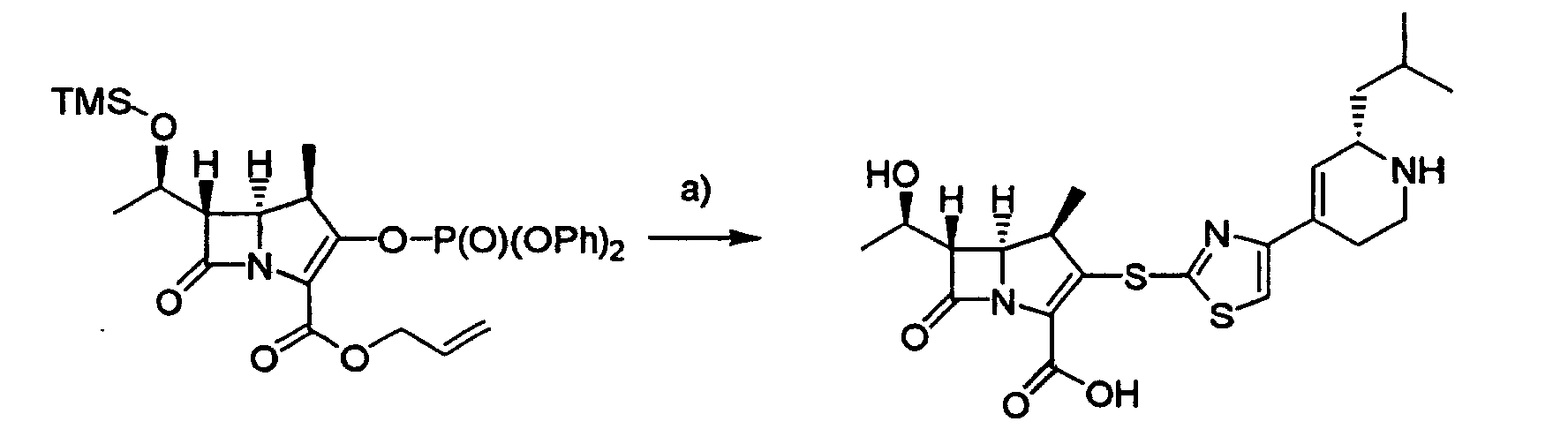
1H NMR (300 MHz, D2O) δ 0.86 (6 H, d, J = 6.2 Hz), 0.95 (3 H, d, J = 7.7 Hz), 1.12 (3 H, d, J = 6.2 Hz), 1.50-1.79 (3 H, m), 2.63-2.70 (2 H, m), 3.13-3.37 (3 H, m), 3.47-3.65 (2 H, m), 3.98-4.15 (2 H, m), 6.39 (1 H, brs), 7.47 (1 H, s).
IR (KBr) 3386, 2966, 1756, 1600, 1388 cm-1

1H NMR (300 MHz, CDCl3) δ 0.10 (9 H, s), 1.11 (3 H, d, J = 7.3 Hz), 1.17 (3 H, d, J = 6.8 Hz), 1.21 (3 H, d, J = 6.1 Hz), 2.04-2.15 (1 H, m), 2.58-2.71 (1 H, m), 3.18-3.24 (1 H, m), 3.37-3.48 (1 H, m), 3.82-3.93 (1 H, m), 4.06-4.21 (2 H, m), 4.62-4.86 (6 H, m), 5.15-5.48 (4 H, m), 5.87-6.03 (2 H, m), 6.71 (1 H, brs), 7.11 (1 H, s).
1H NMR (300 MHz, D2O) δ 0.95 (3 H, d, J = 7.3 Hz), 1.12 (3 H, d, J = 6.0Hz), 1.31 (3 H, d, J = 6.4 Hz), 2.18-2.33 (1 H, m), 2.50-2.64 (1 H, m), 3.10-3.49 (3 H, m), 3.95-4.16 (4 H, m), 6.54 (1 H, s), 7.41 (1 H, s).
IR (KBr) 3428, 2970, 1759, 1599, 1392 cm-1
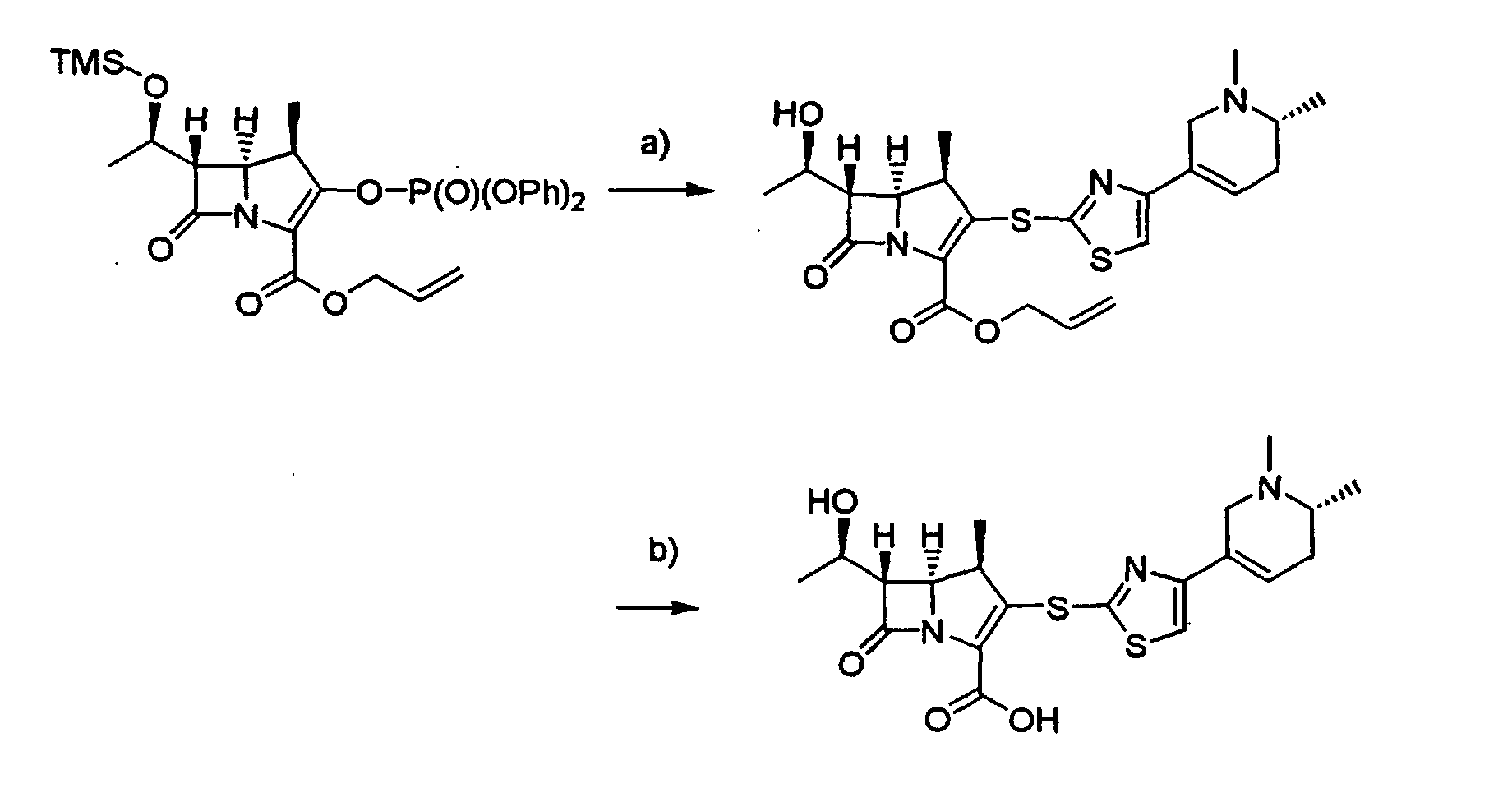
1H NMR (300 MHz, CDCl3) δ 1.06 (3 H, d, J = 7.3 Hz), 1.16 (3 H, d, J = 6.4 Hz), 1.29 (3 H, d, J = 6.4 Hz), 2.17-2.30 (2 H, m), 2.46 (3 H, s), 2.64-2.76 (1 H, m), 3.21-3.25 (1 H, m), 3.32-3.43 (1 H, m), 3.48-3.61 (2 H, m), 4.15-4.27 (2 H, m), 4.71 (1 H, dd, J = 5.7, 13.4 Hz), 4.83 (1 H, dd, J = 5.3, 13.4 Hz), 5.26 (1 H, d, J = 10.4 Hz), 5.44 (1 H, d, J = 17.2 Hz), 5.96 (1 H, dddd, J = 5.3, 5.7, 10.4, 17.2 Hz), 6.60 (1 H, s), 7.07 (1 H, s).
1H NMR (300 MHz, D2O) δ 0.95 (3 H, d, J = 7.3 Hz), 1.12 (3 H, d, J = 6.4 Hz), 1.28 (3 H, d, J = 6.6 Hz), 2.27-2.40 (1 H, m), 2.58-2.72 (1 H, m), 2.83 (3 H, s), 3.13-3.38 (4 H, m), 3.90-4.14 (3 H, m), 6.52 (1 H, s), 7.40 (1 H, s).
IR (KBr) 3400, 2968, 1764, 1602, 1386 cm-1

1H NMR (300 MHz, CDCl3) δ 1.04-1.31 (9 H, m), 2.07-2.20 (2 H, m), 2.43 (3 H, s), 2.54-2.64 (1 H, m), 3.21-3.24 (1 H, m), 3.48-3.99 (3 H, m), 4.14-4.26 (2 H, m), 4.62-4.86 (2 H, m), 5.14-5.47 (2 H, m), 5.89-6.03 (1 H, m), 6.59 (1 H, s), 7.05 (1 H, s).
1H NMR (300 MHz, D2O) δ 0.95 (3 H, d, J = 7.1 Hz), 1.12 (3 H, d, J = 6.2 Hz), 1.27 (3 H, d, J = 7.0 Hz), 2.27-2.40 (1 H, m), 2.58-2.72 (1 H, m), 2.81 (3 H, s), 3.13-3.38 (4 H, m), 3.90-4.14 (3 H, m), 6.51 (1 H, s), 7.40 (1 H, s).
IR (KBr) 3280, 2965, 1788, 1602, 1384 cm-1

1H NMR (300 MHz, D2O) δ 0.91-0.96 (9 H, m), 1.11 (3 H, d, J = 6.4 Hz), 1.93-2.05 (1 H, m), 3.11-3.22 (1 H, m), 3.34 (1 H, dd, J = 2.7, 6.0 Hz), 4.05-4.13 (2 H, m), 4.25-4.42 (3 H, m), 6.35 (1 H, s), 7.51 (1 H, s).
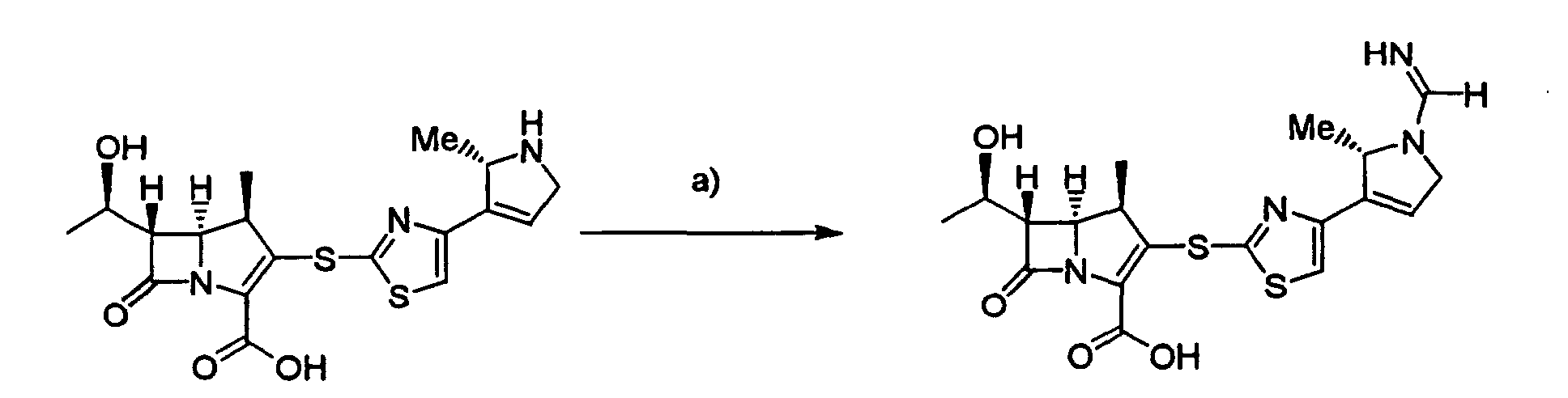
1H NMR (300 MHz, D2O) δ 0.96 (3 H, d, J = 7.3 Hz), 1.11 (3 H, d, J = 6.4 Hz), 1.40 (3 H, d, J = 6.6 Hz), 3.05-3.16 (1 H, m), 3.34 (1 H, dd, J = 2.7, 5.9 Hz), 4.05-4.14 (2 H, m), 4.30-4.37 (1 H, m), 5.03-5.20 (1 H, m), 6.27 (1 H, s), 7.55 (1 H, s), 8.04 (1 H, s).
IR (KBr) 3402, 2974, 1758, 1710, 1597, 1391 cm-1

1H NMR (300 MHz, D2O) δ 0.94 (3 H, d, J = 7.3 Hz), 1.10 (3 H, d, J = 6.4 Hz), 1.31 (1.65 H, d, J = 6.2 Hz), 1.34 (1.35 H, d, J = 6.4 Hz), 2.18 (1.65 H, s), 2.30 (1.35 H, s), 3.05-3.15 (1 H, m), 3.33 (1 H, dd, J = 2.6, 6.0 Hz), 4.03-4.13 (2 H, m), 4.27-4.33 (0.45 H, m), 4.43-4.48 (0.55 H, m), 4.97-5.07 (0.55 H, m), 5.16-5.25 (0.45 H, m), 6.26 (1 H, s), 7.53 (0.45 H, s), 7.54 (0.55 H, s).
IR (KBr) 3406, 1760, 1682, 1605, 1385 cm-1
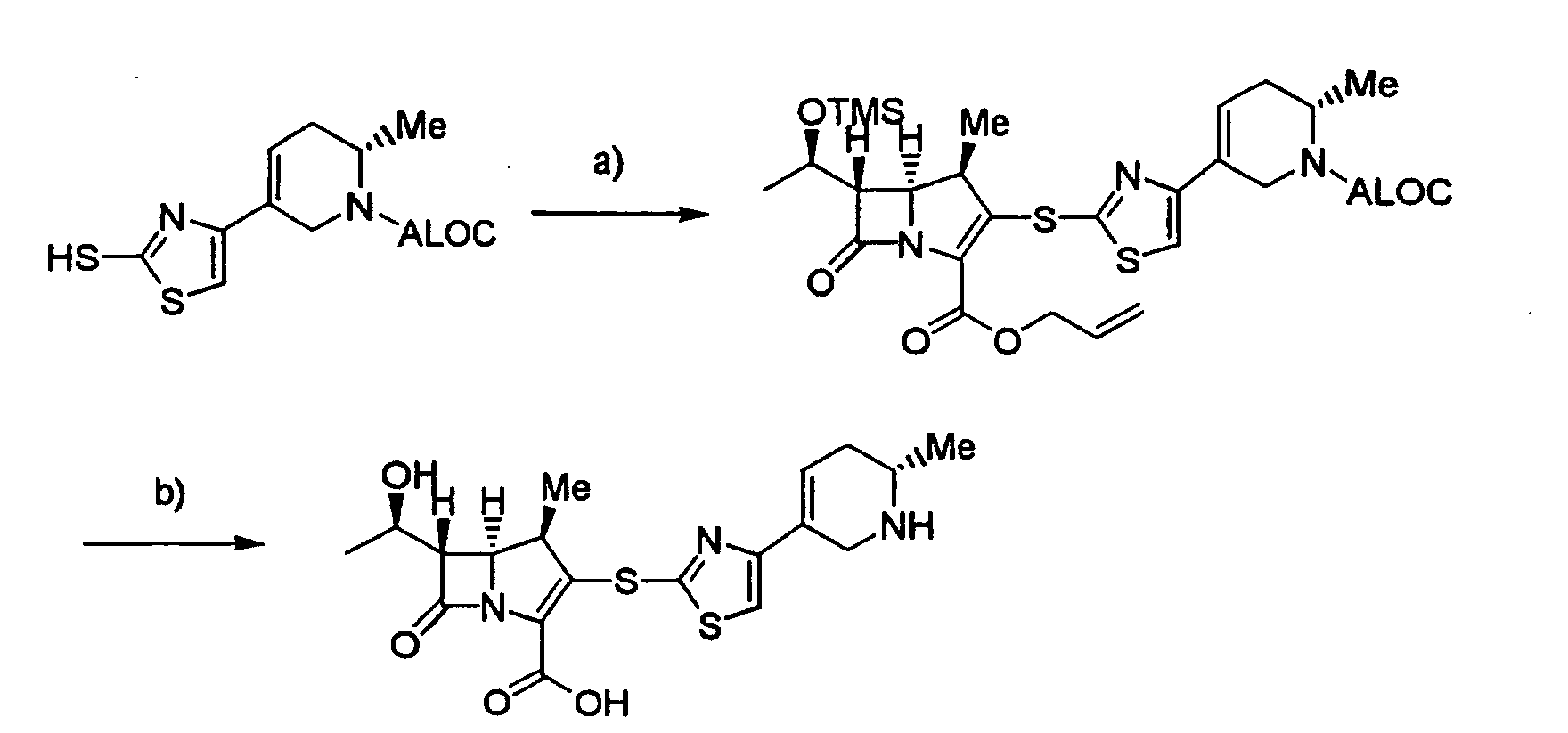
1H NMR (300MHz, CDCl3) δ 0.12 (9H, s), 1.10 (3H, d, J=7.1Hz), 1.19(3H, d, J=6.8Hz), 1.24 (3H, d, J=6.2 Hz), 2.09-2.17 (1H, m),2.62-2.70 (1H, m), 3.25 (1H, dd, J=3.5, 6.2Hz), 3.51-3.61 (1H, m), 3.88-3.94 (1H, m), 4.17-4.25 (2H, m), 4.64-4.88 (6H, m), 5.21-5.51 (4H, m), 5.91-6.04 (2H, m), 6.73-6.76 (1H, m), 7.12 (1H, s).
1H NMR (300MHz, D2O) δ 0.95 (3H, d, J=7.7 Hz), 1.13 (3H, d, J=6.2 Hz),1.31 (3H, d, J= 6.4Hz), 2.20-2.31 (1H, m), 2.52-2.62 (1H, m), 3.14-3.20 (1H, m), 3.33-3.37 (1H, m), 3.41-3.51 (1H, m), 3.96-4.01 (2H, m), 4.09-4.15 (2H, m), 6.53-6.65 (1H, m), 7.41 (1H, s).
IR (KBr) 3404, 2971, 1758, 1597, 1456, 1389, 1265, 1148, 1028, 767 cm-1

1H NMR (300MHz, D2O) δ 0.94 (3H, d, J=7.5Hz), 1.11 (3H, d, J=6.4Hz), 2.26-2.53 (2H, m), 3.09-3.21 (1H, m), 3.32-3.35 (1H, m), 3.38-3.49 (1H, m), 3.57-3.64 (1H, m), 3.77-3.83 (1H, m), 3.98-4.13 (4H, m), 6.52-6.56 (1H, m), 7.41 (1H, s). IR (KBr) 3380, 2969, 1760, 1596, 1389, 1263, 1056 cm-1

1H NMR (300MHz, CDCl3) δ 0.12 (9H, s), 0.91 (3H, t, J=6.7Hz), 1.09 (3H, d, J=7.1Hz), 1.24 (3H, d, J=6.2Hz), 1.41-1.69 (2H, m), 2.35-2.42 (1H, m),2.67-2.76 (1H, m), 3.24 (1H, dd, J=2.9, 6.2Hz), 3.51-3.63 (1H, m), 3.70-3.81 (1H, m), 4.17-4.24 (2H, m), 4.45-4.68 (4H, m), 4.70-4.87 (2H, m), 5.18-5.50 (4H, m), 5.90-6.05 (2H, m), 6.64 (1H, br s), 7.09 (1H, s).
1H NMR (300MHz, D2O) δ 0.94 (3H, t, J=7.5Hz), 0.95 (3H, d, J=6.1Hz), 1.12 (3H, d, J=6.2Hz), 1.59-1.81 (2H, m), 2.35-2.46 (1H, m), 2.72-2.81 (1H, m), 3.13-3.22 (1H, m), 3.25-3.37 (2H, m), 3.76-3.80 (2H, m), 4.08-4.14 (2H, m), 6.37-6.40 (1H, m), 7.46 (1H, s).
IR (KBr) 3248, 2969, 1760, 1599, 1392, 1264, 1028 cm-1
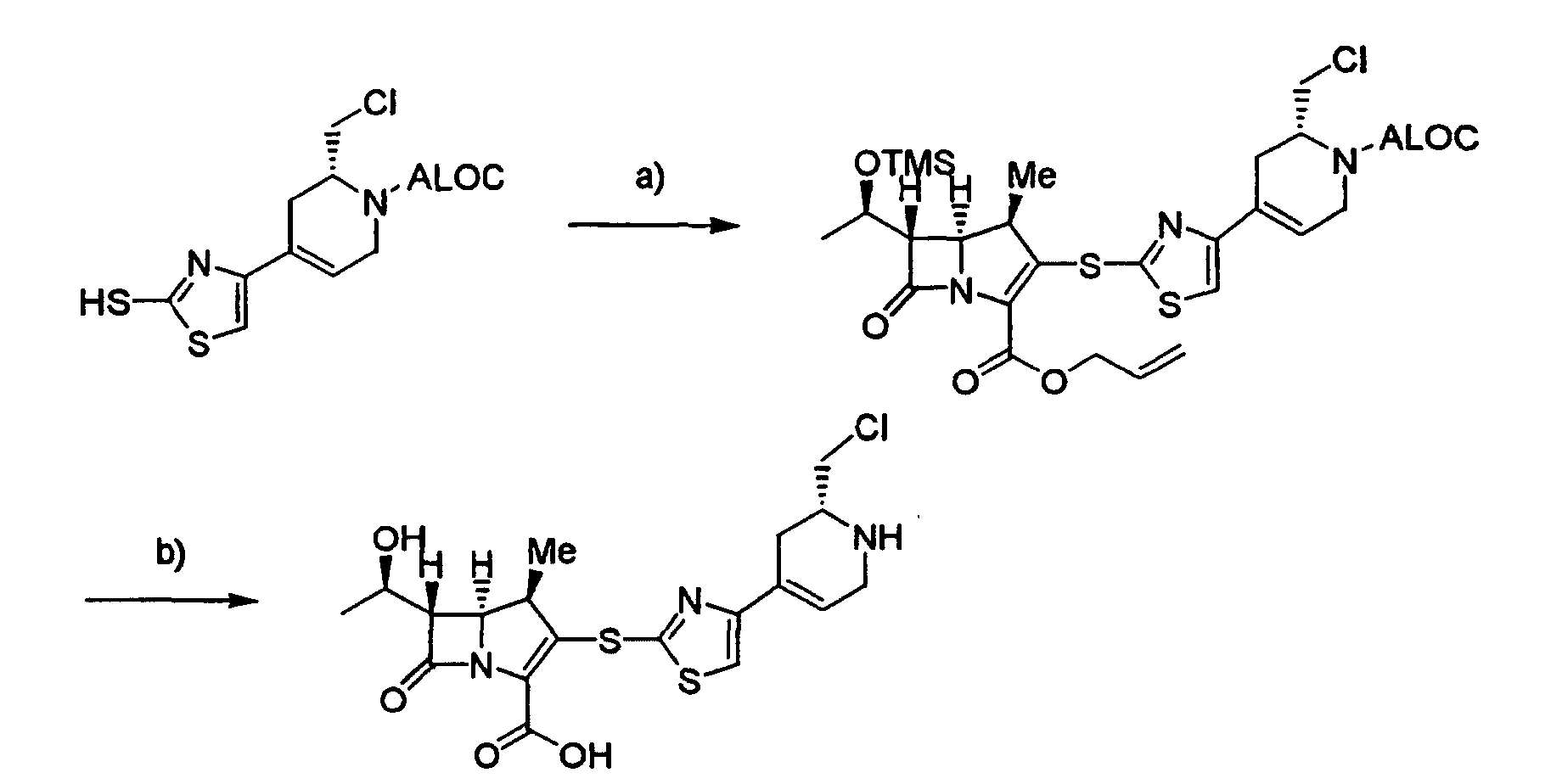
1H NMR (300MHz, CDCl3) δ 0.12 (9H, s), 1.13 (3H, d, J=7.1Hz), 1.23 (3H, d, J=6.2Hz), 2.71-2.76 (2H, m), 3.25 (1H, dd, J=2.9, 6.0Hz), 3.45-3.63 (3H, m), 3.76-3.91 (1H, m), 4.18-4.26 (2H, m), 4.45-4.88 (6H, m), 5.22-5.50 (4H, m), 5.90-6.04 (2H, m), 6.68 (1H, br s), 7.15 (1H, s).
1H NMR (300MHz, D2O) δ 1.02 (3H, d, J=7.1Hz), 1.19 (3H, d, J=6.4Hz), 2.64-2.82 (2H, m), 3.19-3.28 (1H, m), 3.40-3.43 (1H, m), 3.69-4.00 (5H, m), 4.13-4.20 (2H, m), 6.47-6.50 (1H, m), 7.51 (1H, s).
IR (KBr) 3412, 2968, 1758, 1600, 1393, 1264, 1028 cm-1
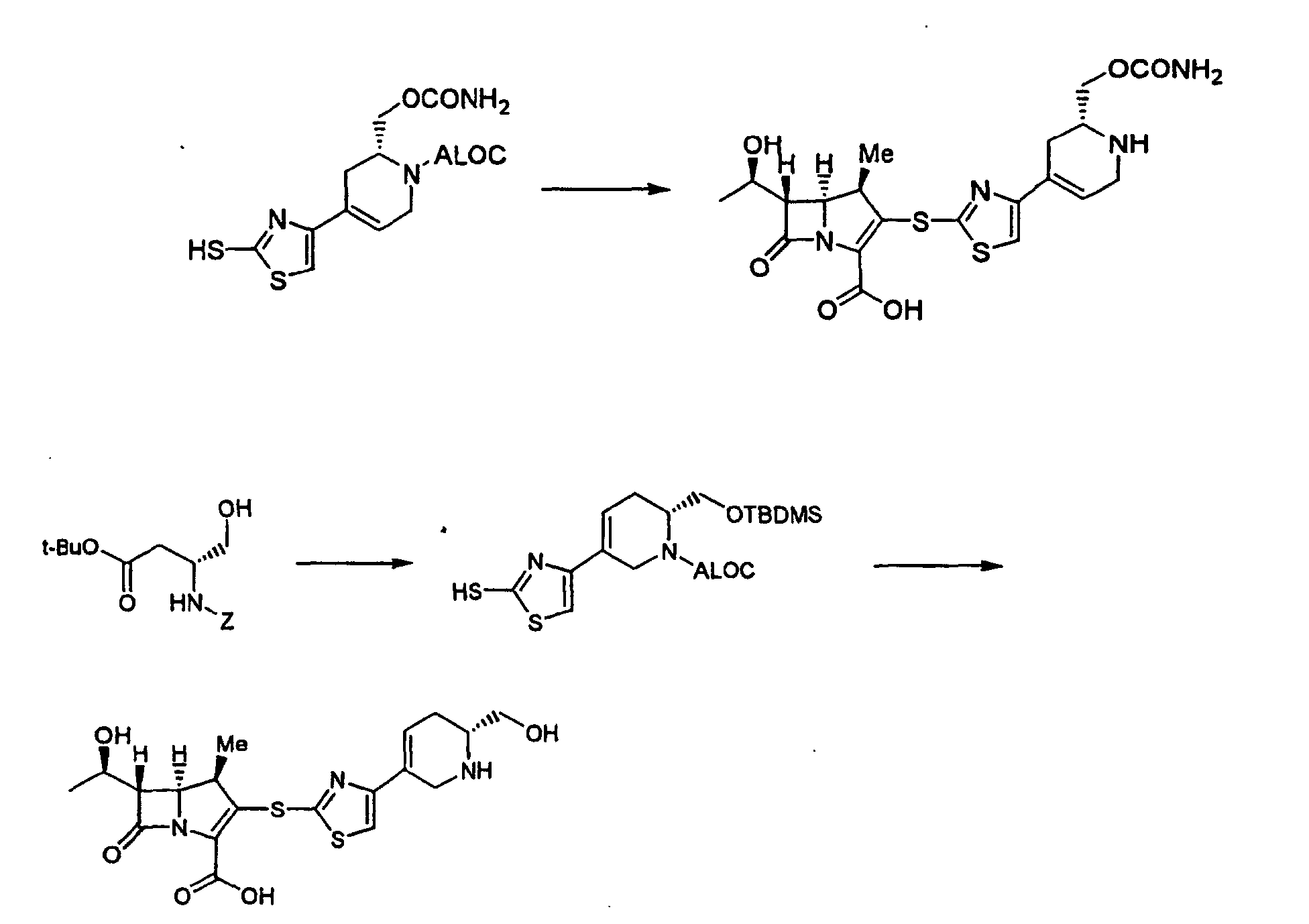
1H NMR (300MHz, D2O) δ 0.95 (3H, d, J=7.3Hz), 1.12 (3H, d, J=6.0Hz), 2.49-2.92 (2H, m), 3.14-3.20 (1H, m), 3.33-3.35 (1H, m), 3.82-3.85 (2H, m), 4.08-4.23 (2H, m), 4.30-4.37 (1H, m), 6.39-6.42 (1H, m), 7.46 (1H, s).
IR (KBr) 3406, 2969, 1759, 1728, 1602, 1391, 1264, 1087 cm-1

1H-NMR (300MHz, CDCl3) δ 3.70 (3H, s), 3.92-4.06 (2H, m), 4.17-4.38 (2H, m), 4.52-4.58 (2H, m), 5.00-5.07 (1H, m), 5.11-5.17 (1H, m), 5.18-5.25 (1H, m), 5.76-5.92 (1H, m), 6.81-6.88 (1H, m).
1H-NMR (300MHz, CDCl3) δ 3.98-4.03 (1H, m), 4.09-4.34 (1H, m), 4.37-4.61 (4H, m), 4.63-4.68 (2H, m), 5.22-5.36 (3H, m), 5.88-6.02 (1H, m), 6.95-7.03 (1H, m).
1H-NMR (300MHz, CDCl3) δ 3.73-3.80 (1H, m), 4.26-4.43 (1H, m), 4.62-4.68 (4H, m), 5.24-5.38 (4H, m), 5.89-6.02 (1H, m), 6.48-6.54 (2H, m).

1H-NMR (300MHz, CDCl3) 0.12 (9H, s), 1.08 (3H, d, J = 7.1 Hz), 1.24 (3H, d, J = 6.1 Hz), 3.24 (1H, dd, J = 2.9, 6.6 Hz), 3.42-3.51 (1H, m), 4.07-4.24 (4H, m), 4.35-4.44 (2H, m), 4.66-4.88 (4H, m), 5.23-5.38 (4H, m), 5.47 (1H, qd, J = 1.5, 17.2 Hz), 5.91-6.05 (2H, m), 6.45 (1H, br), 7.38 (1H, s).
1H-NMR (300MHz, D2O) 0.92 (3H, d, J = 7.5 Hz), 1.11 (3H, d, J = 6.4 Hz), 3.12-3.19 (1H, m), 3.32-3.36 (1H, m), 3.94-4.11 (6H, m), 5.18 (1H, br), 6.41 (1H, br), 7.64 (1H, br). IR (KBr) 3418, 2968, 1758, 1602, 1394, 1280, 1029 cm-1.


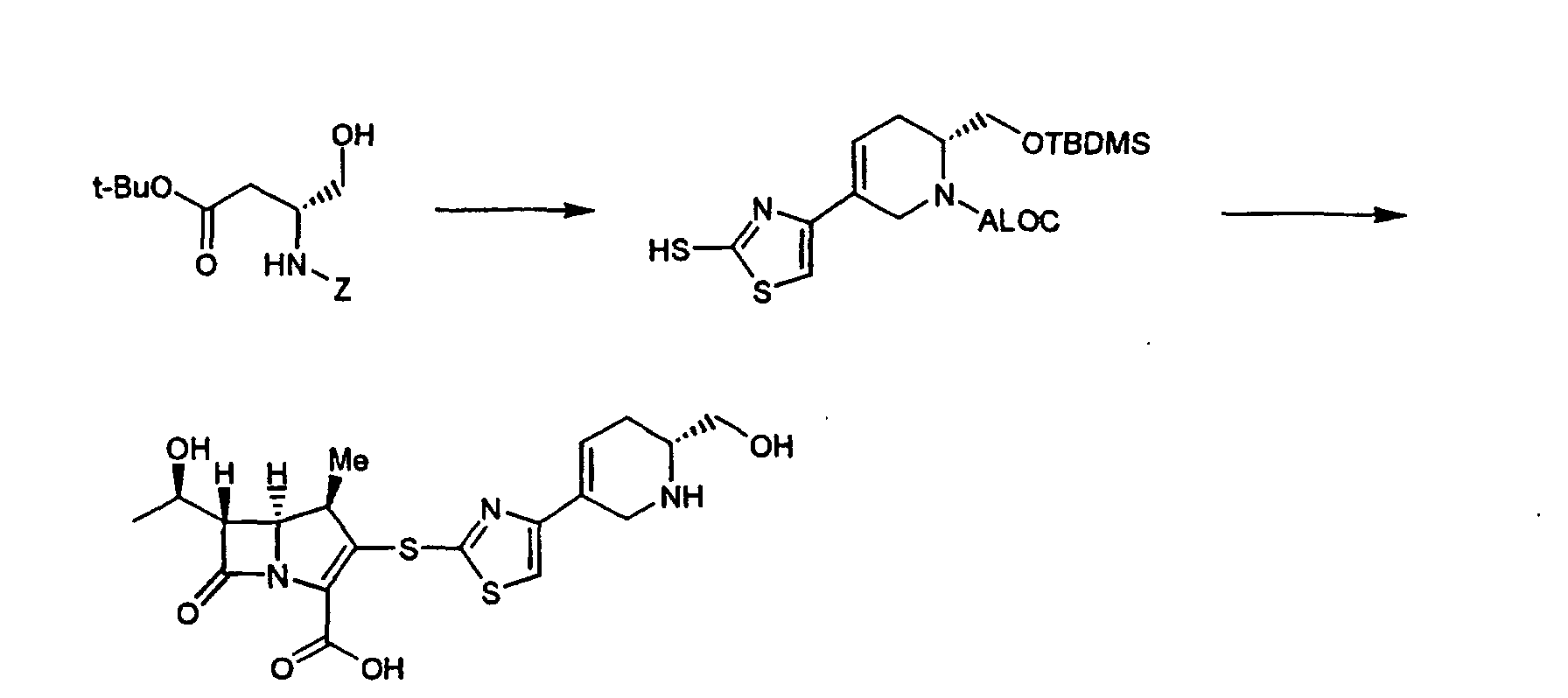
Claims (11)
- A β-lactam compound of the following formula [1];wherein R1 is a lower alkyl group or a lower alkyl group substituted by a hydroxy group; R2 is a hydrogen atom or a lower alkyl group; X is an oxygen atom, a sulfur atom or an imino group; m and n are independently an integer of 0 to 4 and the sum of m and n is 0 to 4, Y1 is a halogen atom, cyano group, a hydroxy group optionally protected, an amino group optionally protected, a lower alkyloxy group, a lower alkylamino group, a carboxy group optionally protected, a carbamoyl group optionally substituted, or a lower alkyl group optionally substituted, Y2 is hydrogen atom, a lower alkyl group optionally substituted, cyano group, or -C(R3)=NR4 (wherein R3 and R4 are independently, hydrogen atom, an amino group optionally substituted or protected, or a lower alkyl group optionally substituted, or R3 and R4 may combine each other together with the nitrogen atom to which they bond to form a 5- to 7-membered heterocyclic group), provided that 1 to 4 Y1s may present on the same ring and 2 Y1s may present on the same carbon atom, or a pharmaceutically acceptable salt thereof, or a non-toxic ester thereof.

- The β-lactam compound according to claim 1, wherein the sum of m and n is 2,
or a pharmaceutically acceptable salt thereof, or a non-toxic ester thereof. - The β-lactam compound according to claim 1, wherein the sum of m and n is 3,
or a pharmaceutically acceptable salt thereof, or a non-toxic ester thereof. - The β-lactam compound according to claim 1, wherein the β-lactam compound is a β-lactam compound of the following formula [la];wherein R1, R2, X, m, n, Y1 and Y2 are the same as defined above,

or a pharmaceutically acceptable salt thereof, or a non-toxic ester thereof. - The β-lactam compound according to the above (4), wherein the sum of m and n is 2,
or a pharmaceutically acceptable salt thereof, or a non-toxic ester thereof. - The β-lactam compound according to claim 4, wherein the sum of m and n is 3,
or a pharmaceutically acceptable salt thereof, or a non-toxic ester thereof. - The β-lactam compound according to any of claim 1 to claim 6, wherein X is a sulfur atom,
or a pharmaceutically acceptable salt thereof, or a non-toxic ester thereof. - The β-lactam compound according to any one of claim 1 to claim 7, wherein R1 is a 1-(R)-hydroxyethyl group,
or a pharmaceutically acceptable salt thereof, or a non-toxic ester thereof. - A process for producing a β-lactam compound of the formula [1]:wherein R1 is a lower alkyl group or a lower alkyl group substituted by a hydroxy group; R2 is a hydrogen atom or a lower alkyl group; X is an oxygen atom, a sulfur atom or an imino group; m and n are independently an interger of 0 to 4 and the sum of m and n is 0 to 4, Y1 is a halogen atom, cyano group, a hydroxy group optionally protected, an amino group optionally protected, a lower alkyloxy group, a lower alkylamino group, a carboxy group optionally protected, a carbamoyl group optionally substituted, or a lower alkyl group optionally substituted, Y2 is hydrogen atom, a lower alkyl group optionally substituted, cyano group, or -C(R3)=NR4 (wherein R3 and R4 are independently hydrogen atom, an amino group optionally substituted or protected, or a lower alkyl group optionally substituted, or R3 and R4 may combine each other together with the nitrogen atom to which they bond to form a 5- to 7-membered heterocyclic group), provided that 1 to 4 Y1s may present on the same ring and 2 Y1s may present on the same carbon atom,
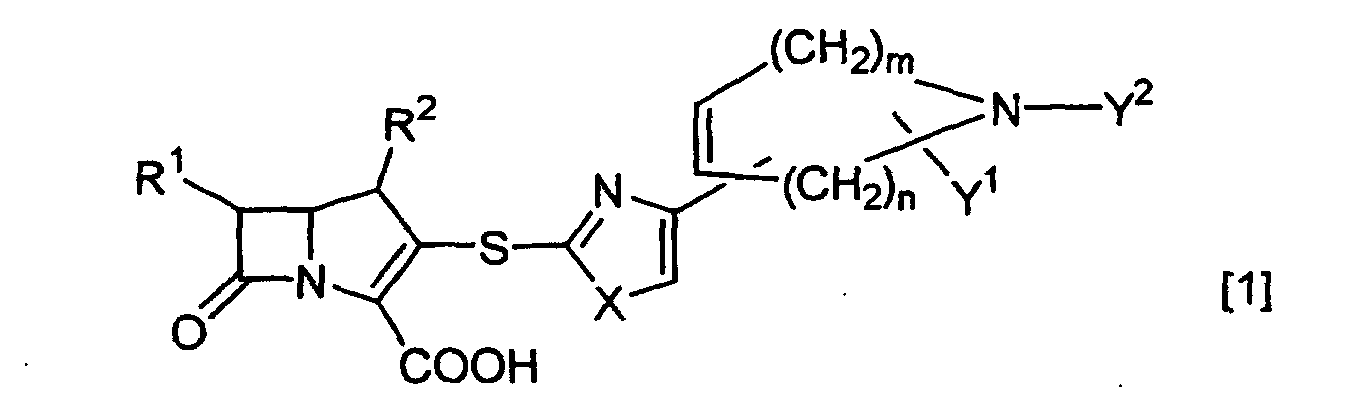
or a salt thereof, which comprises
reacting a compound of the formula [2]:wherein R1a is a lower alkyl group, a lower alkyl group substituted by a hydroxy group, or a lower alkyl group substituted by a hydroxy group protected by a protecting group, R2 is the same as defined above, R5 is a protecting group of a carboxyl group, and L is an active ester of a hydroxy group,
with a compound of the formula [3]:wherein m, n, X and Y1 are the same as defined above, and Y3 is hydrogen atom, a lower alkyl group optionally substituted, cyano group, or -C(R3)=NR4a (wherein R3 is the same as defined above, and R4a are hydrogen atom, an amino group optionally substituted or protected, or an alkyl group optionally substituted, or a protective group of an imidoyl group, or R3 and R4a may combine each other together with the nitrogen atom to which they bond to form a 5- to 7-membered heterocyclic group),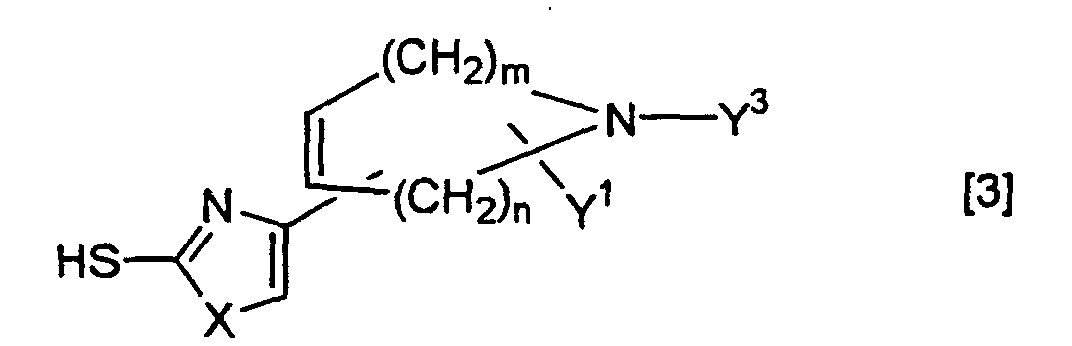
in the presence of a base, or reacting the compound of the formula [2] with a thiolate of the compound of the formula [3] to give a compound of the formula [4]:wherein R1a, R2, R5, m, n, X, Y1 and Y3 are the same as defined above,
followed by an appropriate combination of reactions which are properly selected from the removal of the protecting group of a hydroxy group for R1a and Y1, the removal of protecting group of an amino group for Y1, the removal of protecting group of an amino group for Y3, the optionally subsequent imidoylization reaction of an amino group of which protecting group was removed for Y3, or the removal of protecting group of an imidoyl group for Y3 and the removal of protecting group of a carboxyl group for R5 and Y1. - A pharmaceutical composition containing the β-lactam compound as set forth in any one of claim 1 to claim 8, or a pharmaceutically acceptable salt thereof, or a non-toxic ester thereof.
- An antibacterial agent containing the β-lactam compound as set forth in any one of claim 1 to claim 8, or a pharmaceutically acceptable salt thereof, or a non-toxic ester thereof.
Priority Applications (1)
| Application Number | Priority Date | Filing Date | Title |
|---|---|---|---|
| CY20071101605T CY1107837T1 (en) | 2000-11-08 | 2007-12-18 | NEW BETA-LACTAM UNIONS AND PROCEDURES FOR PRODUCING THEM |
Applications Claiming Priority (7)
| Application Number | Priority Date | Filing Date | Title |
|---|---|---|---|
| JP2000341063 | 2000-11-08 | ||
| JP2000341063 | 2000-11-08 | ||
| JP2001126296 | 2001-04-24 | ||
| JP2001126296 | 2001-04-24 | ||
| JP2001273615 | 2001-09-10 | ||
| JP2001273615 | 2001-09-10 | ||
| PCT/JP2001/009664 WO2002038564A1 (en) | 2000-11-08 | 2001-11-06 | NOVEL β-LACTAM COMPOUNDS AND PROECSS FOR PRODUCING THE SAME |
Publications (3)
| Publication Number | Publication Date |
|---|---|
| EP1340756A1 true EP1340756A1 (en) | 2003-09-03 |
| EP1340756A4 EP1340756A4 (en) | 2004-08-11 |
| EP1340756B1 EP1340756B1 (en) | 2007-10-10 |
Family
ID=27345150
Family Applications (1)
| Application Number | Title | Priority Date | Filing Date |
|---|---|---|---|
| EP01979010A Expired - Lifetime EP1340756B1 (en) | 2000-11-08 | 2001-11-06 | Novel beta-lactam compounds and process for producing the same |
Country Status (15)
| Country | Link |
|---|---|
| US (1) | US7163936B2 (en) |
| EP (1) | EP1340756B1 (en) |
| JP (1) | JP4213958B2 (en) |
| KR (1) | KR100814657B1 (en) |
| CN (1) | CN100379738C (en) |
| AT (1) | ATE375343T1 (en) |
| AU (1) | AU2002211006A1 (en) |
| CA (1) | CA2427812C (en) |
| CY (1) | CY1107837T1 (en) |
| DE (1) | DE60130916T2 (en) |
| DK (1) | DK1340756T3 (en) |
| ES (1) | ES2294035T3 (en) |
| PT (1) | PT1340756E (en) |
| TW (1) | TWI297689B (en) |
| WO (1) | WO2002038564A1 (en) |
Cited By (2)
| Publication number | Priority date | Publication date | Assignee | Title |
|---|---|---|---|---|
| EP1797879A4 (en) * | 2004-10-08 | 2009-05-06 | Dainippon Sumitomo Pharma Co | NEW ANTI-MICROBIAL MEDICINE |
| EP2230240A4 (en) * | 2007-12-12 | 2011-03-23 | Dainippon Sumitomo Pharma Co | STABLE CRYSTAL OF A B-LACTAM COMPOUND |
Families Citing this family (5)
| Publication number | Priority date | Publication date | Assignee | Title |
|---|---|---|---|---|
| US9149440B2 (en) * | 2003-09-02 | 2015-10-06 | University Of South Florida | Nanoparticles for drug-delivery |
| JP2006008641A (en) * | 2004-06-29 | 2006-01-12 | Sumitomo Pharmaceut Co Ltd | Process for producing optically active dihydropyrrole and tetrahydropyridine derivatives |
| WO2007142212A1 (en) * | 2006-06-08 | 2007-12-13 | Dainippon Sumitomo Pharma Co., Ltd. | Preparation composition |
| JPWO2009075309A1 (en) | 2007-12-12 | 2011-04-28 | 大日本住友製薬株式会社 | Formulation composition |
| US20100292463A1 (en) * | 2008-01-25 | 2010-11-18 | Shoji Watanabe | Process for production of b-lactam compound |
Family Cites Families (3)
| Publication number | Priority date | Publication date | Assignee | Title |
|---|---|---|---|---|
| US5750686A (en) * | 1993-06-16 | 1998-05-12 | Sumitomo Pharmaceuticals Company, Limited | Carbapenem compounds and process for producing the same |
| JPH1077285A (en) * | 1996-09-04 | 1998-03-24 | Sumitomo Pharmaceut Co Ltd | Novel β-lactam compound and method for producing the same |
| JP2000179834A (en) * | 1998-12-16 | 2000-06-27 | Rinnai Corp | Gas cock device |
-
2001
- 2001-11-06 ES ES01979010T patent/ES2294035T3/en not_active Expired - Lifetime
- 2001-11-06 KR KR1020037006034A patent/KR100814657B1/en not_active Expired - Fee Related
- 2001-11-06 WO PCT/JP2001/009664 patent/WO2002038564A1/en not_active Ceased
- 2001-11-06 DE DE60130916T patent/DE60130916T2/en not_active Expired - Lifetime
- 2001-11-06 US US10/416,334 patent/US7163936B2/en not_active Expired - Fee Related
- 2001-11-06 DK DK01979010T patent/DK1340756T3/en active
- 2001-11-06 PT PT01979010T patent/PT1340756E/en unknown
- 2001-11-06 CA CA002427812A patent/CA2427812C/en not_active Expired - Fee Related
- 2001-11-06 JP JP2002541097A patent/JP4213958B2/en not_active Expired - Fee Related
- 2001-11-06 EP EP01979010A patent/EP1340756B1/en not_active Expired - Lifetime
- 2001-11-06 AU AU2002211006A patent/AU2002211006A1/en not_active Abandoned
- 2001-11-06 AT AT01979010T patent/ATE375343T1/en active
- 2001-11-06 CN CNB018217559A patent/CN100379738C/en not_active Expired - Fee Related
- 2001-11-07 TW TW090127667A patent/TWI297689B/en not_active IP Right Cessation
-
2007
- 2007-12-18 CY CY20071101605T patent/CY1107837T1/en unknown
Cited By (2)
| Publication number | Priority date | Publication date | Assignee | Title |
|---|---|---|---|---|
| EP1797879A4 (en) * | 2004-10-08 | 2009-05-06 | Dainippon Sumitomo Pharma Co | NEW ANTI-MICROBIAL MEDICINE |
| EP2230240A4 (en) * | 2007-12-12 | 2011-03-23 | Dainippon Sumitomo Pharma Co | STABLE CRYSTAL OF A B-LACTAM COMPOUND |
Also Published As
| Publication number | Publication date |
|---|---|
| DE60130916D1 (en) | 2007-11-22 |
| EP1340756B1 (en) | 2007-10-10 |
| CY1107837T1 (en) | 2013-06-19 |
| AU2002211006A1 (en) | 2002-05-21 |
| KR20030048104A (en) | 2003-06-18 |
| TWI297689B (en) | 2008-06-11 |
| US20040102433A1 (en) | 2004-05-27 |
| CN100379738C (en) | 2008-04-09 |
| DE60130916T2 (en) | 2008-07-10 |
| ES2294035T3 (en) | 2008-04-01 |
| CN1484645A (en) | 2004-03-24 |
| CA2427812A1 (en) | 2003-05-02 |
| ATE375343T1 (en) | 2007-10-15 |
| US7163936B2 (en) | 2007-01-16 |
| JPWO2002038564A1 (en) | 2004-03-18 |
| EP1340756A4 (en) | 2004-08-11 |
| WO2002038564A1 (en) | 2002-05-16 |
| DK1340756T3 (en) | 2008-01-28 |
| JP4213958B2 (en) | 2009-01-28 |
| KR100814657B1 (en) | 2008-03-18 |
| PT1340756E (en) | 2008-01-15 |
| CA2427812C (en) | 2009-09-29 |
Similar Documents
| Publication | Publication Date | Title |
|---|---|---|
| FI83419B (en) | FOERFARANDE FOER FRAMSTAELLNING AV SOM CEILING MODEL ANVAENDBARA 1,2,6-SUBSTITUERAD KARBAPEN-2-EM-3-CARBOXYLSYRA. | |
| EP0337637A1 (en) | 2-(Heterocyclylthio)carbapenem derivatives their preparation and their use as antibiotics | |
| JPH05339269A (en) | 1-methylcarbapenem derivative | |
| AU711135B2 (en) | 1-methylcarbapenem derivatives | |
| RU2097383C1 (en) | Carbopenem derivatives and a method of their synthesis | |
| EP1340756B1 (en) | Novel beta-lactam compounds and process for producing the same | |
| KR970007946B1 (en) | 2-(2-substituted pyrrolidin -4-yl)-thio-carbapenem derivatives | |
| US4771046A (en) | Carbapenem derivatives | |
| US6265396B1 (en) | β-lactam compounds and process for preparing the same | |
| JP2955276B2 (en) | Antibacterial agent containing 1-methylcarbapenem derivative | |
| JP3199300B2 (en) | 1-methylcarbapenem derivative | |
| JP2965922B2 (en) | 1-methylcarbapenem derivative | |
| HK1122800A (en) | Novel beta-lactam compounds and process for producing the same | |
| CN101215288A (en) | Novel β-lactam compound and its preparation method | |
| JP3384768B2 (en) | Pharmaceutical containing 1-methylcarbapenem derivative | |
| JPH04321688A (en) | 2-(substituted pyrrolidinylthio)carbapenem derivative | |
| JPWO2002044178A1 (en) | Novel β-lactam compound and method for producing the same | |
| US20090029964A1 (en) | Novel carbapenem compound | |
| JPH05255330A (en) | 2-@(3754/24)substituted pyrrolidinylthio)carbapenem derivative | |
| JPH10168081A (en) | 1-methylcarbapenem derivative |
Legal Events
| Date | Code | Title | Description |
|---|---|---|---|
| PUAI | Public reference made under article 153(3) epc to a published international application that has entered the european phase |
Free format text: ORIGINAL CODE: 0009012 |
|
| 17P | Request for examination filed |
Effective date: 20030605 |
|
| AK | Designated contracting states |
Kind code of ref document: A1 Designated state(s): AT BE CH CY DE DK ES FI FR GB GR IE IT LI LU MC NL PT SE TR |
|
| AX | Request for extension of the european patent |
Extension state: AL LT LV MK RO SI |
|
| A4 | Supplementary search report drawn up and despatched |
Effective date: 20040625 |
|
| RAP1 | Party data changed (applicant data changed or rights of an application transferred) |
Owner name: DAINIPPON SUMITOMO PHARMA CO., LTD. |
|
| GRAP | Despatch of communication of intention to grant a patent |
Free format text: ORIGINAL CODE: EPIDOSNIGR1 |
|
| GRAS | Grant fee paid |
Free format text: ORIGINAL CODE: EPIDOSNIGR3 |
|
| RTI1 | Title (correction) |
Free format text: NOVEL BETA-LACTAM COMPOUNDS AND PROCESS FOR PRODUCING THE SAME |
|
| GRAA | (expected) grant |
Free format text: ORIGINAL CODE: 0009210 |
|
| AK | Designated contracting states |
Kind code of ref document: B1 Designated state(s): AT BE CH CY DE DK ES FI FR GB GR IE IT LI LU MC NL PT SE TR |
|
| REG | Reference to a national code |
Ref country code: GB Ref legal event code: FG4D |
|
| REG | Reference to a national code |
Ref country code: CH Ref legal event code: EP |
|
| REG | Reference to a national code |
Ref country code: IE Ref legal event code: FG4D |
|
| REF | Corresponds to: |
Ref document number: 60130916 Country of ref document: DE Date of ref document: 20071122 Kind code of ref document: P |
|
| REG | Reference to a national code |
Ref country code: CH Ref legal event code: NV Representative=s name: A. BRAUN, BRAUN, HERITIER, ESCHMANN AG PATENTANWAE |
|
| REG | Reference to a national code |
Ref country code: SE Ref legal event code: TRGR |
|
| REG | Reference to a national code |
Ref country code: PT Ref legal event code: SC4A Free format text: AVAILABILITY OF NATIONAL TRANSLATION Effective date: 20080103 |
|
| REG | Reference to a national code |
Ref country code: DK Ref legal event code: T3 |
|
| REG | Reference to a national code |
Ref country code: GR Ref legal event code: EP Ref document number: 20070403765 Country of ref document: GR |
|
| REG | Reference to a national code |
Ref country code: ES Ref legal event code: FG2A Ref document number: 2294035 Country of ref document: ES Kind code of ref document: T3 |
|
| ET | Fr: translation filed | ||
| REG | Reference to a national code |
Ref country code: CH Ref legal event code: PFA Owner name: DAINIPPON SUMITOMO PHARMA CO., LTD. Free format text: DAINIPPON SUMITOMO PHARMA CO., LTD.#6-8, DOSHO-MACHI 2-CHOME CHUO-KU OSAKA-SHI#OSAKA-FU (JP) -TRANSFER TO- DAINIPPON SUMITOMO PHARMA CO., LTD.#6-8, DOSHO-MACHI 2-CHOME CHUO-KU OSAKA-SHI#OSAKA-FU (JP) |
|
| PLBE | No opposition filed within time limit |
Free format text: ORIGINAL CODE: 0009261 |
|
| STAA | Information on the status of an ep patent application or granted ep patent |
Free format text: STATUS: NO OPPOSITION FILED WITHIN TIME LIMIT |
|
| 26N | No opposition filed |
Effective date: 20080711 |
|
| PG25 | Lapsed in a contracting state [announced via postgrant information from national office to epo] |
Ref country code: TR Free format text: LAPSE BECAUSE OF FAILURE TO SUBMIT A TRANSLATION OF THE DESCRIPTION OR TO PAY THE FEE WITHIN THE PRESCRIBED TIME-LIMIT Effective date: 20071010 |
|
| PGFP | Annual fee paid to national office [announced via postgrant information from national office to epo] |
Ref country code: MC Payment date: 20100929 Year of fee payment: 10 Ref country code: ES Payment date: 20100928 Year of fee payment: 10 Ref country code: IE Payment date: 20100929 Year of fee payment: 10 |
|
| PGFP | Annual fee paid to national office [announced via postgrant information from national office to epo] |
Ref country code: TR Payment date: 20100929 Year of fee payment: 10 |
|
| PGFP | Annual fee paid to national office [announced via postgrant information from national office to epo] |
Ref country code: GR Payment date: 20100928 Year of fee payment: 10 |
|
| PGFP | Annual fee paid to national office [announced via postgrant information from national office to epo] |
Ref country code: PT Payment date: 20100924 Year of fee payment: 10 Ref country code: NL Payment date: 20101130 Year of fee payment: 10 Ref country code: FR Payment date: 20101014 Year of fee payment: 10 Ref country code: DK Payment date: 20101110 Year of fee payment: 10 Ref country code: AT Payment date: 20101125 Year of fee payment: 10 |
|
| PGFP | Annual fee paid to national office [announced via postgrant information from national office to epo] |
Ref country code: LU Payment date: 20101123 Year of fee payment: 10 Ref country code: FI Payment date: 20101103 Year of fee payment: 10 Ref country code: CY Payment date: 20100929 Year of fee payment: 10 Ref country code: CH Payment date: 20101123 Year of fee payment: 10 |
|
| PGFP | Annual fee paid to national office [announced via postgrant information from national office to epo] |
Ref country code: GB Payment date: 20101124 Year of fee payment: 10 Ref country code: BE Payment date: 20101011 Year of fee payment: 10 Ref country code: IT Payment date: 20101116 Year of fee payment: 10 Ref country code: SE Payment date: 20101112 Year of fee payment: 10 |
|
| PGFP | Annual fee paid to national office [announced via postgrant information from national office to epo] |
Ref country code: DE Payment date: 20101230 Year of fee payment: 10 |
|
| REG | Reference to a national code |
Ref country code: PT Ref legal event code: MM4A Free format text: LAPSE DUE TO NON-PAYMENT OF FEES Effective date: 20120507 |
|
| BERE | Be: lapsed |
Owner name: DAINIPPON SUMITOMO PHARMA CO., LTD. Effective date: 20111130 |
|
| REG | Reference to a national code |
Ref country code: NL Ref legal event code: V1 Effective date: 20120601 |
|
| PG25 | Lapsed in a contracting state [announced via postgrant information from national office to epo] |
Ref country code: MC Free format text: LAPSE BECAUSE OF NON-PAYMENT OF DUE FEES Effective date: 20111130 |
|
| REG | Reference to a national code |
Ref country code: CH Ref legal event code: PL |
|
| REG | Reference to a national code |
Ref country code: DK Ref legal event code: EBP |
|
| REG | Reference to a national code |
Ref country code: SE Ref legal event code: EUG |
|
| REG | Reference to a national code |
Ref country code: GR Ref legal event code: ML Ref document number: 20070403765 Country of ref document: GR Effective date: 20120605 |
|
| GBPC | Gb: european patent ceased through non-payment of renewal fee |
Effective date: 20111106 |
|
| PG25 | Lapsed in a contracting state [announced via postgrant information from national office to epo] |
Ref country code: NL Free format text: LAPSE BECAUSE OF NON-PAYMENT OF DUE FEES Effective date: 20120601 Ref country code: CH Free format text: LAPSE BECAUSE OF NON-PAYMENT OF DUE FEES Effective date: 20111130 Ref country code: LI Free format text: LAPSE BECAUSE OF NON-PAYMENT OF DUE FEES Effective date: 20111130 |
|
| REG | Reference to a national code |
Ref country code: FR Ref legal event code: ST Effective date: 20120731 |
|
| REG | Reference to a national code |
Ref country code: IE Ref legal event code: MM4A |
|
| PG25 | Lapsed in a contracting state [announced via postgrant information from national office to epo] |
Ref country code: FI Free format text: LAPSE BECAUSE OF NON-PAYMENT OF DUE FEES Effective date: 20111106 Ref country code: IT Free format text: LAPSE BECAUSE OF NON-PAYMENT OF DUE FEES Effective date: 20111106 Ref country code: GR Free format text: LAPSE BECAUSE OF NON-PAYMENT OF DUE FEES Effective date: 20120605 Ref country code: PT Free format text: LAPSE BECAUSE OF NON-PAYMENT OF DUE FEES Effective date: 20120507 Ref country code: BE Free format text: LAPSE BECAUSE OF NON-PAYMENT OF DUE FEES Effective date: 20111130 |
|
| REG | Reference to a national code |
Ref country code: DE Ref legal event code: R119 Ref document number: 60130916 Country of ref document: DE Effective date: 20120601 |
|
| PG25 | Lapsed in a contracting state [announced via postgrant information from national office to epo] |
Ref country code: CY Free format text: LAPSE BECAUSE OF NON-PAYMENT OF DUE FEES Effective date: 20111106 |
|
| PG25 | Lapsed in a contracting state [announced via postgrant information from national office to epo] |
Ref country code: GB Free format text: LAPSE BECAUSE OF NON-PAYMENT OF DUE FEES Effective date: 20111106 Ref country code: DK Free format text: LAPSE BECAUSE OF NON-PAYMENT OF DUE FEES Effective date: 20111130 Ref country code: SE Free format text: LAPSE BECAUSE OF NON-PAYMENT OF DUE FEES Effective date: 20111107 Ref country code: IE Free format text: LAPSE BECAUSE OF NON-PAYMENT OF DUE FEES Effective date: 20111106 |
|
| REG | Reference to a national code |
Ref country code: AT Ref legal event code: MM01 Ref document number: 375343 Country of ref document: AT Kind code of ref document: T Effective date: 20111106 |
|
| PG25 | Lapsed in a contracting state [announced via postgrant information from national office to epo] |
Ref country code: FR Free format text: LAPSE BECAUSE OF NON-PAYMENT OF DUE FEES Effective date: 20111130 |
|
| PG25 | Lapsed in a contracting state [announced via postgrant information from national office to epo] |
Ref country code: TR Free format text: LAPSE BECAUSE OF FAILURE TO SUBMIT A TRANSLATION OF THE DESCRIPTION OR TO PAY THE FEE WITHIN THE PRESCRIBED TIME-LIMIT Effective date: 20111106 Ref country code: AT Free format text: LAPSE BECAUSE OF NON-PAYMENT OF DUE FEES Effective date: 20111106 |
|
| PG25 | Lapsed in a contracting state [announced via postgrant information from national office to epo] |
Ref country code: LU Free format text: LAPSE BECAUSE OF NON-PAYMENT OF DUE FEES Effective date: 20111106 |
|
| REG | Reference to a national code |
Ref country code: ES Ref legal event code: FD2A Effective date: 20130603 |
|
| PG25 | Lapsed in a contracting state [announced via postgrant information from national office to epo] |
Ref country code: DE Free format text: LAPSE BECAUSE OF NON-PAYMENT OF DUE FEES Effective date: 20120601 |
|
| PG25 | Lapsed in a contracting state [announced via postgrant information from national office to epo] |
Ref country code: ES Free format text: LAPSE BECAUSE OF NON-PAYMENT OF DUE FEES Effective date: 20111107 |