EP1340736A1 - Porous sound absorbing material and method of manufacturing the material - Google Patents
Porous sound absorbing material and method of manufacturing the material Download PDFInfo
- Publication number
- EP1340736A1 EP1340736A1 EP01998517A EP01998517A EP1340736A1 EP 1340736 A1 EP1340736 A1 EP 1340736A1 EP 01998517 A EP01998517 A EP 01998517A EP 01998517 A EP01998517 A EP 01998517A EP 1340736 A1 EP1340736 A1 EP 1340736A1
- Authority
- EP
- European Patent Office
- Prior art keywords
- sound
- absorbing material
- voids
- absorbing
- porous
- Prior art date
- Legal status (The legal status is an assumption and is not a legal conclusion. Google has not performed a legal analysis and makes no representation as to the accuracy of the status listed.)
- Granted
Links
Images



Classifications
-
- G—PHYSICS
- G10—MUSICAL INSTRUMENTS; ACOUSTICS
- G10K—SOUND-PRODUCING DEVICES; METHODS OR DEVICES FOR PROTECTING AGAINST, OR FOR DAMPING, NOISE OR OTHER ACOUSTIC WAVES IN GENERAL; ACOUSTICS NOT OTHERWISE PROVIDED FOR
- G10K11/00—Methods or devices for transmitting, conducting or directing sound in general; Methods or devices for protecting against, or for damping, noise or other acoustic waves in general
- G10K11/16—Methods or devices for protecting against, or for damping, noise or other acoustic waves in general
- G10K11/172—Methods or devices for protecting against, or for damping, noise or other acoustic waves in general using resonance effects
-
- C—CHEMISTRY; METALLURGY
- C03—GLASS; MINERAL OR SLAG WOOL
- C03C—CHEMICAL COMPOSITION OF GLASSES, GLAZES OR VITREOUS ENAMELS; SURFACE TREATMENT OF GLASS; SURFACE TREATMENT OF FIBRES OR FILAMENTS MADE FROM GLASS, MINERALS OR SLAGS; JOINING GLASS TO GLASS OR OTHER MATERIALS
- C03C11/00—Multi-cellular glass ; Porous or hollow glass or glass particles
- C03C11/007—Foam glass, e.g. obtained by incorporating a blowing agent and heating
-
- C—CHEMISTRY; METALLURGY
- C04—CEMENTS; CONCRETE; ARTIFICIAL STONE; CERAMICS; REFRACTORIES
- C04B—LIME, MAGNESIA; SLAG; CEMENTS; COMPOSITIONS THEREOF, e.g. MORTARS, CONCRETE OR LIKE BUILDING MATERIALS; ARTIFICIAL STONE; CERAMICS; REFRACTORIES; TREATMENT OF NATURAL STONE
- C04B38/00—Porous mortars, concrete, artificial stone or ceramic ware; Preparation thereof
- C04B38/04—Porous mortars, concrete, artificial stone or ceramic ware; Preparation thereof by dissolving-out added substances
-
- F—MECHANICAL ENGINEERING; LIGHTING; HEATING; WEAPONS; BLASTING
- F02—COMBUSTION ENGINES; HOT-GAS OR COMBUSTION-PRODUCT ENGINE PLANTS
- F02K—JET-PROPULSION PLANTS
- F02K1/00—Plants characterised by the form or arrangement of the jet pipe or nozzle; Jet pipes or nozzles peculiar thereto
- F02K1/78—Other construction of jet pipes
- F02K1/82—Jet pipe walls, e.g. liners
- F02K1/827—Sound absorbing structures or liners
-
- G—PHYSICS
- G10—MUSICAL INSTRUMENTS; ACOUSTICS
- G10K—SOUND-PRODUCING DEVICES; METHODS OR DEVICES FOR PROTECTING AGAINST, OR FOR DAMPING, NOISE OR OTHER ACOUSTIC WAVES IN GENERAL; ACOUSTICS NOT OTHERWISE PROVIDED FOR
- G10K11/00—Methods or devices for transmitting, conducting or directing sound in general; Methods or devices for protecting against, or for damping, noise or other acoustic waves in general
- G10K11/16—Methods or devices for protecting against, or for damping, noise or other acoustic waves in general
- G10K11/162—Selection of materials
-
- C—CHEMISTRY; METALLURGY
- C04—CEMENTS; CONCRETE; ARTIFICIAL STONE; CERAMICS; REFRACTORIES
- C04B—LIME, MAGNESIA; SLAG; CEMENTS; COMPOSITIONS THEREOF, e.g. MORTARS, CONCRETE OR LIKE BUILDING MATERIALS; ARTIFICIAL STONE; CERAMICS; REFRACTORIES; TREATMENT OF NATURAL STONE
- C04B2111/00—Mortars, concrete or artificial stone or mixtures to prepare them, characterised by specific function, property or use
- C04B2111/52—Sound-insulating materials
-
- F—MECHANICAL ENGINEERING; LIGHTING; HEATING; WEAPONS; BLASTING
- F05—INDEXING SCHEMES RELATING TO ENGINES OR PUMPS IN VARIOUS SUBCLASSES OF CLASSES F01-F04
- F05D—INDEXING SCHEME FOR ASPECTS RELATING TO NON-POSITIVE-DISPLACEMENT MACHINES OR ENGINES, GAS-TURBINES OR JET-PROPULSION PLANTS
- F05D2260/00—Function
- F05D2260/96—Preventing, counteracting or reducing vibration or noise
- F05D2260/962—Preventing, counteracting or reducing vibration or noise by means of "anti-noise"
-
- Y—GENERAL TAGGING OF NEW TECHNOLOGICAL DEVELOPMENTS; GENERAL TAGGING OF CROSS-SECTIONAL TECHNOLOGIES SPANNING OVER SEVERAL SECTIONS OF THE IPC; TECHNICAL SUBJECTS COVERED BY FORMER USPC CROSS-REFERENCE ART COLLECTIONS [XRACs] AND DIGESTS
- Y02—TECHNOLOGIES OR APPLICATIONS FOR MITIGATION OR ADAPTATION AGAINST CLIMATE CHANGE
- Y02T—CLIMATE CHANGE MITIGATION TECHNOLOGIES RELATED TO TRANSPORTATION
- Y02T50/00—Aeronautics or air transport
- Y02T50/60—Efficient propulsion technologies, e.g. for aircraft
Definitions
- the present invention relates to a porous sound-absorbing material used for the exhaust nozzle and the like of a jet engine, in particular to a porous sound-absorbing material with a high sound-absorbing effect over a wide frequency range and its manufacturing method.
- the honeycomb sound-absorbing material shown in Fig. 1 is comprised of a honeycomb 1 made of a heat-resistant alloy, a perforated plate 2, and a rear plate 3; the material has a reactive structure like a Helmholtz resonator, and disperses sound energy using the friction on the wall surface and the kinematic energy produced when the media move.
- the perforated plate 2 With the honeycomb sound-absorbing material described above, there have been problems such as the perforated plate 2, inner honeycomb 1 and its rear plate 3 being overheated or greatly deformed by heat from high-temperature exhaust gas (for instance, 700 ⁇ 800°K or more).
- high-temperature exhaust gas for instance, 700 ⁇ 800°K or more.
- the perforated plate 2 since the perforated plate 2 is made of a stainless steel panel or an aluminum panel, the plate may be damaged or thermally deformed, and the brazed portion between the plate and honeycomb 1 may peel.
- a sound-absorbing material with the structure described above provides only a narrow frequency range of absorbable noise, so such a wide range of noise as produced by a jet engine (for example, 1,000 ⁇ 3,000 Hz) cannot be absorbed satisfactorily.
- foamed sound-absorbing materials that can resist heat and provide a wide sound-absorbing frequency range have been proposed.
- These foamed sound-absorbing materials are of a resistance type made of porous ceramics, as shown in the enlarged photo in Fig. 2 (for instance, unexamined Japanese patent publications No. 187163, 1998 and 194864, 1998).
- both resistance to heat shocks and sound-absorbing performance of a sound-absorbing material are made high by laminating a dense layer containing ceramic fibers on the surface of a porous foamed ceramic.
- this material is composed of multiple layers of several types of sound-absorbing material, there is a problem in that its manufacturing cost is high.
- the sound-absorbing material is manufactured by foaming a ceramic, its porosity is not constant; therefore, as shown in the frequency characteristic graphs in Figs. 3A and 3B, there is also another problem in that the sound absorption effect cannot be easily expanded to a wide range of sound frequencies.
- the present invention aims to solve these problems.
- the objects of the present invention are to provide a porous sound-absorbing material that is light and highly resistant to heat for application to the exhaust nozzle and the like of a jet engine with a high sound absorbing effect to noises over a wide range of sound frequencies, such as those of a jet engine, and also to provide a method of manufacturing such a porous sound-absorbing material as that described above with stable performance and porosity without variations.
- the present invention provides a porous sound-absorbing material with the skeleton thereof formed with aggregates (5) with voids (6).
- the porosity of the invented porous sound-absorbing material is 75% to 85%, and the voids (6) of an aggregate (5) are smaller than the voids (4) between aggregates.
- the diameters of voids (6) of aggregate (5) are 50 ⁇ m to 100 ⁇ m, approximately, and the diameters of voids (4) between the aforementioned aggregates are about 100 ⁇ m to 600 ⁇ m.
- the sound-absorbing material is composed of porous ceramics with porosities of 75% to 85%, so the material retains the strength required of a sound-absorbing material, while maintaining the prescribed sound absorbing effect.
- the material can highly efficiently absorb noises over a wide range of sound frequencies, such as those from a jet engine, since the material contains an enormous number of voids (4) and (6); in which a plurality of capsule-like voids (4) with diameters of approximately 100 ⁇ m to 600 ⁇ m, can communicate with each other through chain-like aggregates (5), and also there are many voids (6) with diameters of about 50 ⁇ m to 100 ⁇ m, which are smaller than the diameters of capsule-like voids (4), in each aggregate (5).
- the present invention offers complicated sound passages for noises transmitted inside the porous sound-absorbing material, by means of capsule-like voids (4) between chain-like aggregates (5) and many other small voids (6) formed in these aggregates (5) themselves, so the apparent sound velocity in the sound absorbing material is changed, location by location, so that noise over a wide frequency range can be absorbed efficiently.
- capsule-like voids (4) between chain-like aggregates (5) and many other small voids (6) formed in these aggregates (5) themselves, so the apparent sound velocity in the sound absorbing material is changed, location by location, so that noise over a wide frequency range can be absorbed efficiently.
- vibrations are created and they produce sound resistance; however, since the number of passages of noises through voids (4, 6) is sharply increased, the overall resistance becomes large.
- the manufacturing method of the present invention provided is a method of manufacturing the porous sound-absorbing material, with the first process in which a raw material containing ceramic grains and a void forming material is formed into a prescribed shape, and a second process provided after the first process, in which the above-mentioned void forming material is removed.
- the aforementioned ceramic grains are composed of glass-based ceramics, and the above-mentioned void-forming material is an activated carbon material or carbon grains.
- mixed raw grains are poured into a mold and sintered or baked until solid; at that time, when required, an intermediate lid may be used to pressurize the raw grains to have an even and rigid porous body.
- an intermediate lid since oxygen is prevented from entering the raw grains through gaps in the mold and the intermediate lid even at a sintering or baking temperature, either carbon grains or an activated carbon material can be used as the void-forming material. At that time, the volumes of carbon grains and activated carbon material do not decrease to such a degree that the diameters of voids are affected significantly.
- the aforementioned manufacturing method produces a portion of the voids (4) by removing the mixed void forming material by sintering and the like, which differs from conventional methods whereby ceramics are foamed; therefore, a porous sound-absorbing material with a constant porosity can be fabricated.
- porous sound-absorbing material with voids (4) of a prescribed shape and size can be easily manufactured. Consequently, the porous sound-absorbing material can be easily manufactured according to a particular purpose as a sound-absorbing material, to have preferred porosity and high sound absorbing effect over a wide frequency range.
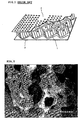
- Fig. 4 is a mosaic view of the porous sound-absorbing material according to the present invention.
- Fig. 5 is an enlarged photo that shows the status of an embodiment of the porous sound absorbing material according to the present invention.
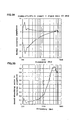
- Figs. 6A and 6B are frequency characteristic graphs for the porous sound-absorbing material in Fig. 5 and
- Fig. 7 is an enlarged photo showing the status of another embodiment of the porous sound-absorbing material disclosed in the present invention.
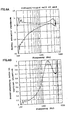
- Figs. 8A and 8B are frequency characteristic diagrams of the porous sound-absorbing material shown in Fig. 7.
- the porous sound-absorbing material of the present invention is a sound-absorbing material made of a raw material of porous ceramics with a porosity of 75% to 85%.
- the reason for selecting a porosity of 75% to 85% is to maintain the toughness of the material to be used in a high-temperature environment, while retaining the prescribed sound-absorbing effect described later.
- porous ceramics according to the present invention is glass-based ceramics.
- the glass-based ceramics used have a composition such as BMAS (BaO-MgO-Al 2 O 3 -SiO 2 ) and MAS bases (MgO-Al 2 O 3 -SiO 2 or MgO-Al 2 O 3 -SiO 2 -B 2 O 3 -ZnO based glass).
- porous ceramics contain a tremendous number of capsule-like voids 4 with diameters of 100 ⁇ m to 600 ⁇ m, and are constituted with one-, two- or three-dimensional chain-like aggregates 5 in which voids 4 communicate with each other one-, two-, or three-dimensionally.
- voids 4 formed by these aggregates 5 are preferably formed to have a diameter of about 500 ⁇ m.
- these aggregates 5 are also provided with a large number of voids 6 with diameters of 50 ⁇ m to 100 ⁇ m.
- the number of these voids 6 is several times that of the capsule-like voids 5 described above.
- voids 6 formed in aggregates 5 with diameters of 50 ⁇ m to 100 ⁇ m work in conjunction with the above-mentioned capsule-like voids 4 with diameters of 100 ⁇ m to 600 ⁇ m; passages of noise transmitted inside the porous sound-absorbing material are complicated by capsule-like voids 4 that communicate with each other one-, two-, or three-dimensionally in chain-like aggregates 5, and small voids 6 formed in these aggregates 5 themselves.
- Such a sound-absorbing structure as that described above locally varies the apparent sound velocity in the sound-absorbing material, and can enhance the sound-absorbing effect for noise over a wide frequency range, such as from a jet engine.
- the porous sound-absorbing material can provide a high sound-absorbing effect.
- sound-absorbing effects for noise over a wide frequency range are higher than those shown in the frequency characteristic diagrams of the conventional foamed sound-absorbing material in Figs. 3A and 3B.
- the aforementioned glass- or alumina-based ceramics grains are mixed with a dispersant, organic binder, and the like to form an ordinary raw material; then the raw material is mixed with a void forming material to form a raw slurry; or ceramic grains are uniformly mixed with the void-forming material in a dry system to form mixed grains.
- the mixed void-forming material is removed by sintering and the like, thereby not only can the porosity of 75% to 85% be achieved, but also voids 4 can be precisely formed according to preferred shape and size.
- raw slurry or dry mixed grains are poured into a mold, dehydrated and dried, sintered to form a skeleton, and removed from the mold (first process).
- the raw aggregate material is sintered or baked, and the skeleton is given a self-standing toughness.
- the mold is shaped according to a prescribed form for a particular purpose of absorbing sound.
- the void-forming material is removed by oxidation, solvent extraction, and the like (second process).
- the void-forming material used herein constitutes a portion of the voids 4 in the aggregates 5, and the shapes thereof can be made to capsules or balloons.
- the void-forming material can be activated carbon, for example.
- the first process when an intermediate lid is used to place a load on the raw grains, the entry of oxygen from gaps between the mold and the intermediate lid is prevented, so granular carbon or activated carbon can also be used as the void-forming material. At that time, the degree of volumetric decrement in the granular carbon or activated carbon is not so large as to affect the diameters of voids.
- the void-forming material To form voids, the void-forming material must be removed. Any residue of the void-forming material, after sintering or baking, adversely affects sound-absorbing characteristics. With few residues, there are no particular problems. With many residues, sound-absorbing characteristics deteriorate. In particular, if residues exceed 10 weight%, sound-absorbing characteristics become remarkably low. If less than 10 weight%, no problems occur. However, considering the operating environment of the sound-absorbing material, its content should preferably be not more than 1 weight%.
- the intermediate lid is used in the first process, to place a load on the low grains.
- the void-forming material is to have an oxygen resistance such that the volume of the material slightly decreases, and a ratio of residues at 10 weight% or less will be used for second process.
- carbon grains and activated carbon can be used.
- the void-forming material includes that in the first process, the volume of the material does not substantially decrease, the coefficient of thermal expansion thereof is greater than those of the aggregates, and in the second process, the ratio of residues is 10 weight% or less.
- NaU, NaF, KCl, and KF can be used.
- the porosities of the porous sound-absorbing material according to the present invention can be varied from 75% to 85% through a manufacturing process. These porosities can be adjusted by controlling basic raw materials such as ceramic grains, dispersant, and organic binder, and the mixing ratio of activated carbon as a void-forming material.
- the porosity is calculated by, for instance, the following formula 1.
- Diameters of voids 4 of the porous sound-absorbing material according to the present invention can also be adjusted to the same porosity as shown in the following Table 1 (Porous ceramics Test Piece manufacturing items); for instance, the mean diameter of activated carbon grains is changed between 100 ⁇ 150 ⁇ m and 550 ⁇ 600 ⁇ m and the diameters of the void can be changed while the same porosities.
- Table 1 Porous ceramics Test Piece manufacturing items
- a large number of voids 6, formed in aggregates 5, are portions such that when ceramics are sintered, moisture, fine void-forming material grains, and the like originally contained in the raw slurry or dry mixed grains have been vaporized.
- the diameters of these fine voids 6 can be adjusted during manufacture to have a prescribed size by controlling the mixing ratio of glass or alumina-based ceramics grains, dispersant, organic binder, void forming material, etc.
- the porous sound-absorbing material sintered can also be cut into a required shape, for application in the form prescribed for the exhaust nozzle etc. of a jet engine.
- aggregates of raw grains that is, BMAS 100g and a void-forming material of 60g of activated carbon with a mean grain diameter of 100 ⁇ m were mixed uniformly in a dry system, then poured into an alumina mold of 9 cm ⁇ 9 cm ⁇ 4 cm, and the mold was closed with an intermediate alumina lid of 8.5 cm ⁇ 8.5 cm ⁇ 1.0 cm.
- BMAS was crystallized by sintering the mixture in the atmosphere at 1,300°C for 2 hours.
- the workpiece was then removed from the mold, and baked once at 900°C for 10 hours to remove the activated carbon. Further, the baked body was turned upside down, and baked for a second time at 900°C for 10 hours.
- the porosity of the porous body was 80%.
- aggregates of raw grains of BMAS 100g, and a void-forming material of NaF 360g with a mean grain diameter of 600 ⁇ m were evenly mixed in a dry system, poured into a mold made of aluminum, 9 cm ⁇ 9 cm ⁇ 4 cm, and the mold was closed with an intermediate alumina lid of 8.5 cm ⁇ 8.5 cm ⁇ 1.0 cm.
- the workpiece was sintered in the atmosphere at 1,300°C for 2 hours, and BMAS was crystallized. Thereafter, the work was removed from the mold, rinsed with water and NaF was removed.
- the porosity of the porous body obtained at that time was 85%.
- the present invention should not be restricted only to the status of the above-mentioned applications and embodiments that have been described with regard to the implementation status of the porous sound-absorbing materials with porosities of 75% to 85%.
- these porosities are not limited, but can also be made lower than 75% or higher than 85%, depending on purposes of using a sound-absorbing material or types of ceramics. Therefore, it should be understood that of course many modifications are possible as far as the claims of the present invention are not exceeded.
- the porous sound-absorbing material of the present invention is a material composed of porous ceramics with a predetermined porosity, as described above, so the material has the prescribed bending strength to meet the requirements of the sound-absorbing material, while maintaining a specified sound-absorbing effect.
- the material is composed of chain-like aggregates containing voids with predetermined sizes, in which many other voids with diameters smaller than the diameters of the aforementioned voids are also formed, the material can be used advantageously to absorb noises over a wide frequency range, such as those produced by a jet engine.
- the passages of noises transmitted inside the porous sound absorbing material are made complicated by capsule-like voids in chain-like aggregates and voids formed in each aggregate, so the apparent sound velocity in the sound-absorbing material is changed locally, while improving the efficiency of absorbing noises over a wide frequency range. Also, when noise passes these large and small voids, acoustic resistance is created due to the material vibrating, however, because the number of passages through the voids is greatly increased; the overall acoustic resistance is increased.
- the method of manufacturing the porous sound-absorbing material based on the present invention provides for the easy manufacture of the porous sound-absorbing material with voids having preferred shapes and sizes, by removing the mixed void-forming material through baking and the like.
- the present invention offers a stable method of manufacturing the porous sound-absorbing material with a predetermined porosity, therefore, the manufacturing method according to the present invention provides excellent advantages in practice, such as easy manufacture of the porous sound-absorbing material with a high sound-absorbing effect in a wide frequency range.
Landscapes
- Engineering & Computer Science (AREA)
- Chemical & Material Sciences (AREA)
- Physics & Mathematics (AREA)
- Ceramic Engineering (AREA)
- Multimedia (AREA)
- Acoustics & Sound (AREA)
- Materials Engineering (AREA)
- Organic Chemistry (AREA)
- General Chemical & Material Sciences (AREA)
- Geochemistry & Mineralogy (AREA)
- Life Sciences & Earth Sciences (AREA)
- Chemical Kinetics & Catalysis (AREA)
- Structural Engineering (AREA)
- Combustion & Propulsion (AREA)
- Mechanical Engineering (AREA)
- General Engineering & Computer Science (AREA)
- Soundproofing, Sound Blocking, And Sound Damping (AREA)
- Porous Artificial Stone Or Porous Ceramic Products (AREA)
- Glass Compositions (AREA)
Abstract
Description
Figs. 8A and 8B are frequency characteristic diagrams of the porous sound-absorbing material shown in Fig. 7.


Conversely, these porosities are not limited, but can also be made lower than 75% or higher than 85%, depending on purposes of using a sound-absorbing material or types of ceramics. Therefore, it should be understood that of course many modifications are possible as far as the claims of the present invention are not exceeded.
Claims (6)
- A porous sound-absorbing material comprising a skeleton of aggregates (5) with voids (6).
- The porous sound-absorbing material specified in Claim 1, in which the porosity of the porous sound-absorbing material is 75% to 85%.
- The porous sound-absorbing material specified in Claims 1 or 2, in which voids (6) of said aggregates (5) are smaller than voids (4) between the aggregates.
- The porous sound-absorbing material specified in Claims 1 through 3, in which diameters of voids (6) of said aggregates (5) are 50 µm to 100 µm, approximately, and diameters of voids (4) between said aggregates are 100 µm to 600 µm.
- A method of manufacturing a sound-absorbing material, comprising
a first process wherein a raw material containing at least ceramic grains and a void-forming material is formed into a predetermined shape, and
a second process wherein said void forming material is removed. - The method of manufacturing a sound-absorbing material specified in Claim 5, in which said ceramic grains comprise glass-based ceramics, and said void-forming material comprises activated carbon or carbon grains.
Applications Claiming Priority (3)
| Application Number | Priority Date | Filing Date | Title |
|---|---|---|---|
| JP2000362242 | 2000-11-29 | ||
| JP2000362242A JP2002167290A (en) | 2000-11-29 | 2000-11-29 | Porous sound absorbing material and manufacturing method thereof |
| PCT/JP2001/010406 WO2002044105A1 (en) | 2000-11-29 | 2001-11-28 | Porous sound absorbing material and method of manufacturing the material |
Publications (3)
| Publication Number | Publication Date |
|---|---|
| EP1340736A1 true EP1340736A1 (en) | 2003-09-03 |
| EP1340736A4 EP1340736A4 (en) | 2006-12-13 |
| EP1340736B1 EP1340736B1 (en) | 2008-03-05 |
Family
ID=18833556
Family Applications (1)
| Application Number | Title | Priority Date | Filing Date |
|---|---|---|---|
| EP01998517A Expired - Lifetime EP1340736B1 (en) | 2000-11-29 | 2001-11-28 | Porous sound absorbing material and method of manufacturing the material |
Country Status (5)
| Country | Link |
|---|---|
| US (1) | US6911158B2 (en) |
| EP (1) | EP1340736B1 (en) |
| JP (1) | JP2002167290A (en) |
| DE (1) | DE60133124T2 (en) |
| WO (1) | WO2002044105A1 (en) |
Cited By (5)
| Publication number | Priority date | Publication date | Assignee | Title |
|---|---|---|---|---|
| FR2934641A1 (en) * | 2008-07-30 | 2010-02-05 | Aircelle Sa | Sound attenuation panel for jet engine nacelle of aircraft, has porous material placed on structuring skin that is fixed with stiffener, where porous material is used as sound absorption material |
| WO2015004191A1 (en) * | 2013-07-10 | 2015-01-15 | Fraunhofer-Gesellschaft zur Förderung der angewandten Forschung e. V. | Sound absorber made of activated carbon granulate |
| CN112679226A (en) * | 2021-01-08 | 2021-04-20 | 武汉科技大学 | Alumina-silicon carbide-carbon porous ceramic filter and preparation method thereof |
| DE102020133449B3 (en) | 2020-12-15 | 2021-12-30 | Dr. Ing. H.C. F. Porsche Aktiengesellschaft | Ducted propeller of an aircraft, aircraft and component thereof |
| EP4700763A1 (en) | 2024-08-19 | 2026-02-25 | DeCavis AG | Sub-wavelength sound absorbing system |
Families Citing this family (9)
| Publication number | Priority date | Publication date | Assignee | Title |
|---|---|---|---|---|
| JP4591913B2 (en) | 2004-04-13 | 2010-12-01 | 株式会社Ihi | Fiber-reinforced heat-resistant sound-absorbing material and method for producing the same |
| FR2908738B1 (en) * | 2006-11-16 | 2009-12-04 | Airbus France | AIRCRAFT ATTACK RIDGE. |
| US9514734B1 (en) * | 2011-06-30 | 2016-12-06 | The United States Of America As Represented By The Administrator Of National Aeronautics And Space Administration | Acoustic liners for turbine engines |
| JP6005046B2 (en) * | 2011-09-06 | 2016-10-12 | Hoya株式会社 | Porous body and method for producing porous body |
| JP2018517086A (en) * | 2015-06-11 | 2018-06-28 | イートン コーポレーションEaton Corporation | Bearing plate noise damper |
| CN105237033B (en) * | 2015-09-06 | 2018-11-30 | 歌尔股份有限公司 | Sound-absorbing material preparation method, sound-absorbing material and its fill method |
| CN107355323A (en) * | 2017-08-16 | 2017-11-17 | 冉超 | A kind of automotive air intake noise sound arrester |
| US11353240B2 (en) | 2018-10-02 | 2022-06-07 | United States Of America As Represented By The Administrator Of Nasa | Low drag, variable-depth acoustic liner |
| FR3095677B1 (en) * | 2019-05-03 | 2021-04-09 | Safran Aircraft Engines | Thrust reverser grille including acoustic treatment |
Family Cites Families (17)
| Publication number | Priority date | Publication date | Assignee | Title |
|---|---|---|---|---|
| JPS5091505A (en) | 1973-12-14 | 1975-07-22 | ||
| US4104077A (en) * | 1976-11-11 | 1978-08-01 | The Yokohama Rubber Co., Ltd. | Porous inorganic product |
| DE3103749C2 (en) * | 1981-02-04 | 1985-01-10 | Schott Glaswerke, 6500 Mainz | Open-pored molded body with homogeneous pore distribution and low density |
| US4481124A (en) * | 1983-01-07 | 1984-11-06 | Ngk Insulators, Ltd. | Thermal shock resistant porous sound absorbing body |
| DE3305854C1 (en) * | 1983-02-19 | 1984-09-06 | Schott Glaswerke, 6500 Mainz | Process for the production of porous sintered glass with a large open pore volume |
| DE3731649A1 (en) * | 1987-09-19 | 1989-03-30 | Schott Glaswerke | METHOD FOR PRODUCING OPEN-POROUS SINTER BODIES |
| US5219802A (en) * | 1992-05-04 | 1993-06-15 | Industrial Technology Research Institute | Porous ceramic radiation plate |
| DE19648270A1 (en) * | 1996-11-21 | 1998-05-28 | Basf Ag | Open cell porous sintered products and process for their manufacture |
| JPH10194864A (en) * | 1996-12-27 | 1998-07-28 | Ishikawajima Harima Heavy Ind Co Ltd | Lightweight CMC sound absorbing material and method of manufacturing the same |
| JPH10187163A (en) * | 1996-12-26 | 1998-07-14 | Ishikawajima Harima Heavy Ind Co Ltd | Lightweight ceramic sound-absorbing material and its manufacturing method |
| US6210612B1 (en) * | 1997-03-31 | 2001-04-03 | Pouvair Corporation | Method for the manufacture of porous ceramic articles |
| JP3469786B2 (en) * | 1998-02-16 | 2003-11-25 | 住友大阪セメント株式会社 | High strength porous concrete structure and method of manufacturing the same |
| US6113802A (en) * | 1998-03-19 | 2000-09-05 | Micropyretics Heaters International, Inc. | Compositions for and synthesis of improved insulations |
| JPH11333293A (en) | 1998-03-27 | 1999-12-07 | Denso Corp | Honeycomb structure and manufacturing method thereof |
| JPH11291403A (en) | 1998-04-08 | 1999-10-26 | Mitsubishi Materials Corp | Light-weight ceramic sound-absorbing material having multilayer structure and method of manufacturing the same |
| JP2000034178A (en) * | 1998-07-15 | 2000-02-02 | Tetra Co Ltd | Composite concrete block and composite concrete structure |
| JP2000226817A (en) * | 1999-02-05 | 2000-08-15 | Taiheiyo Cement Corp | Sound absorbing panel |
-
2000
- 2000-11-29 JP JP2000362242A patent/JP2002167290A/en active Pending
-
2001
- 2001-11-28 EP EP01998517A patent/EP1340736B1/en not_active Expired - Lifetime
- 2001-11-28 US US10/362,945 patent/US6911158B2/en not_active Expired - Fee Related
- 2001-11-28 DE DE60133124T patent/DE60133124T2/en not_active Expired - Fee Related
- 2001-11-28 WO PCT/JP2001/010406 patent/WO2002044105A1/en not_active Ceased
Cited By (7)
| Publication number | Priority date | Publication date | Assignee | Title |
|---|---|---|---|---|
| FR2934641A1 (en) * | 2008-07-30 | 2010-02-05 | Aircelle Sa | Sound attenuation panel for jet engine nacelle of aircraft, has porous material placed on structuring skin that is fixed with stiffener, where porous material is used as sound absorption material |
| WO2015004191A1 (en) * | 2013-07-10 | 2015-01-15 | Fraunhofer-Gesellschaft zur Förderung der angewandten Forschung e. V. | Sound absorber made of activated carbon granulate |
| DE102020133449B3 (en) | 2020-12-15 | 2021-12-30 | Dr. Ing. H.C. F. Porsche Aktiengesellschaft | Ducted propeller of an aircraft, aircraft and component thereof |
| US12180913B2 (en) | 2020-12-15 | 2024-12-31 | Dr. Ing. H.C. F. Porsche Aktiengesellschaft | Ducted fan of an aircraft, aircraft, and component thereof |
| CN112679226A (en) * | 2021-01-08 | 2021-04-20 | 武汉科技大学 | Alumina-silicon carbide-carbon porous ceramic filter and preparation method thereof |
| EP4700763A1 (en) | 2024-08-19 | 2026-02-25 | DeCavis AG | Sub-wavelength sound absorbing system |
| WO2026041624A1 (en) | 2024-08-19 | 2026-02-26 | Decavis Ag | Sub-wavelength sound absorbing system |
Also Published As
| Publication number | Publication date |
|---|---|
| DE60133124T2 (en) | 2009-02-19 |
| JP2002167290A (en) | 2002-06-11 |
| WO2002044105A1 (en) | 2002-06-06 |
| EP1340736A4 (en) | 2006-12-13 |
| DE60133124D1 (en) | 2008-04-17 |
| US20030183799A1 (en) | 2003-10-02 |
| EP1340736B1 (en) | 2008-03-05 |
| US6911158B2 (en) | 2005-06-28 |
Similar Documents
| Publication | Publication Date | Title |
|---|---|---|
| US6911158B2 (en) | Sound absorbing material and its manufacturing method | |
| CN1822952B (en) | Composition gradient thermostructural composite structure and method for the production thereof | |
| US5635454A (en) | Method for making low density ceramic composites | |
| US4814300A (en) | Porous ceramic shapes, compositions for the preparation thereof, and method for producing same | |
| US6764716B2 (en) | Ceramic honeycomb structural body and methods of preparing the same | |
| US4976760A (en) | Porous ceramic article for use as a filter for removing particulates from diesel exhaust gases | |
| US7563504B2 (en) | Utilization of discontinuous fibers for improving properties of high temperature insulation of ceramic matrix composites | |
| US6613255B2 (en) | Method of making a permeable ceramic tile insulation | |
| GB2212799A (en) | Porous ceramic article for use as a filter | |
| US20030057581A1 (en) | Method of making silicon nitride-bonded silicon carbide honeycomb filters | |
| US5441682A (en) | Method of forming a ceramic composite | |
| EP2194031B1 (en) | Ceramic honeycomb structure and its production method | |
| WO1994029238A1 (en) | Porous ceramic and process for producing the same | |
| US4963515A (en) | Lightweight hydrogel-bound aggregate shapes and process for producing same | |
| WO2005094967A1 (en) | Honeycomb structure and method for manufacture thereof | |
| JP5168451B2 (en) | Method for producing porous molded body and method for producing porous filled molded body | |
| EP1995226B1 (en) | Porous object based on silicon carbide and process for producing the same | |
| EP0322932B1 (en) | A fiber filled reticulated ceramic, used as a lining in a furnace | |
| JPH10194864A (en) | Lightweight CMC sound absorbing material and method of manufacturing the same | |
| JPH10187163A (en) | Lightweight ceramic sound-absorbing material and its manufacturing method | |
| KR20150091072A (en) | Porous mullite bodies having improved thermal stability | |
| CA2561737C (en) | Fiber-reinforced heat-resistant sound-absorbing material and process for producing the same | |
| JP4901045B2 (en) | Ceramic composite foam with high mechanical strength | |
| US5049324A (en) | Method of making a furnace lining with a fiber filled reticulated ceramic | |
| CN118664973B (en) | Active cooling heat-proof electromagnetic wave-absorbing function integrated composite structure based on porous super structure |
Legal Events
| Date | Code | Title | Description |
|---|---|---|---|
| PUAI | Public reference made under article 153(3) epc to a published international application that has entered the european phase |
Free format text: ORIGINAL CODE: 0009012 |
|
| 17P | Request for examination filed |
Effective date: 20030221 |
|
| AK | Designated contracting states |
Kind code of ref document: A1 Designated state(s): DE FR GB |
|
| A4 | Supplementary search report drawn up and despatched |
Effective date: 20061113 |
|
| RIC1 | Information provided on ipc code assigned before grant |
Ipc: G10K 11/172 20060101ALI20061107BHEP Ipc: G10K 11/162 20060101ALI20061107BHEP Ipc: F02K 1/82 20060101ALI20061107BHEP Ipc: C04B 38/00 20060101ALI20061107BHEP Ipc: C04B 38/04 20060101AFI20020613BHEP |
|
| 17Q | First examination report despatched |
Effective date: 20070222 |
|
| GRAP | Despatch of communication of intention to grant a patent |
Free format text: ORIGINAL CODE: EPIDOSNIGR1 |
|
| RAP1 | Party data changed (applicant data changed or rights of an application transferred) |
Owner name: UBE INDUSTRIES, LTD. Owner name: IHI CORPORATION |
|
| GRAS | Grant fee paid |
Free format text: ORIGINAL CODE: EPIDOSNIGR3 |
|
| GRAA | (expected) grant |
Free format text: ORIGINAL CODE: 0009210 |
|
| AK | Designated contracting states |
Kind code of ref document: B1 Designated state(s): DE FR GB |
|
| REG | Reference to a national code |
Ref country code: GB Ref legal event code: FG4D |
|
| REF | Corresponds to: |
Ref document number: 60133124 Country of ref document: DE Date of ref document: 20080417 Kind code of ref document: P |
|
| ET | Fr: translation filed | ||
| PLBE | No opposition filed within time limit |
Free format text: ORIGINAL CODE: 0009261 |
|
| STAA | Information on the status of an ep patent application or granted ep patent |
Free format text: STATUS: NO OPPOSITION FILED WITHIN TIME LIMIT |
|
| 26N | No opposition filed |
Effective date: 20081208 |
|
| PGFP | Annual fee paid to national office [announced via postgrant information from national office to epo] |
Ref country code: FR Payment date: 20081117 Year of fee payment: 8 |
|
| PGFP | Annual fee paid to national office [announced via postgrant information from national office to epo] |
Ref country code: DE Payment date: 20081223 Year of fee payment: 8 |
|
| PGFP | Annual fee paid to national office [announced via postgrant information from national office to epo] |
Ref country code: GB Payment date: 20081119 Year of fee payment: 8 |
|
| GBPC | Gb: european patent ceased through non-payment of renewal fee |
Effective date: 20091128 |
|
| REG | Reference to a national code |
Ref country code: FR Ref legal event code: ST Effective date: 20100730 |
|
| PG25 | Lapsed in a contracting state [announced via postgrant information from national office to epo] |
Ref country code: FR Free format text: LAPSE BECAUSE OF NON-PAYMENT OF DUE FEES Effective date: 20091130 |
|
| PG25 | Lapsed in a contracting state [announced via postgrant information from national office to epo] |
Ref country code: DE Free format text: LAPSE BECAUSE OF NON-PAYMENT OF DUE FEES Effective date: 20100601 |
|
| PG25 | Lapsed in a contracting state [announced via postgrant information from national office to epo] |
Ref country code: GB Free format text: LAPSE BECAUSE OF NON-PAYMENT OF DUE FEES Effective date: 20091128 |