EP1339669B1 - N-alkylated gaba compounds, processes for their preparation and their use as medicaments - Google Patents
N-alkylated gaba compounds, processes for their preparation and their use as medicaments Download PDFInfo
- Publication number
- EP1339669B1 EP1339669B1 EP01994655A EP01994655A EP1339669B1 EP 1339669 B1 EP1339669 B1 EP 1339669B1 EP 01994655 A EP01994655 A EP 01994655A EP 01994655 A EP01994655 A EP 01994655A EP 1339669 B1 EP1339669 B1 EP 1339669B1
- Authority
- EP
- European Patent Office
- Prior art keywords
- amino
- propyl
- aminocarbonyl
- butanoate
- derivatives
- Prior art date
- Legal status (The legal status is an assumption and is not a legal conclusion. Google has not performed a legal analysis and makes no representation as to the accuracy of the status listed.)
- Expired - Lifetime
Links
- 0 CCC(C(N)=O)NCCCC(*)=* Chemical compound CCC(C(N)=O)NCCCC(*)=* 0.000 description 2
Classifications
-
- C—CHEMISTRY; METALLURGY
- C07—ORGANIC CHEMISTRY
- C07C—ACYCLIC OR CARBOCYCLIC COMPOUNDS
- C07C327/00—Thiocarboxylic acids
- C07C327/20—Esters of monothiocarboxylic acids
- C07C327/22—Esters of monothiocarboxylic acids having carbon atoms of esterified thiocarboxyl groups bound to hydrogen atoms or to acyclic carbon atoms
-
- A—HUMAN NECESSITIES
- A61—MEDICAL OR VETERINARY SCIENCE; HYGIENE
- A61P—SPECIFIC THERAPEUTIC ACTIVITY OF CHEMICAL COMPOUNDS OR MEDICINAL PREPARATIONS
- A61P25/00—Drugs for disorders of the nervous system
-
- C—CHEMISTRY; METALLURGY
- C07—ORGANIC CHEMISTRY
- C07C—ACYCLIC OR CARBOCYCLIC COMPOUNDS
- C07C237/00—Carboxylic acid amides, the carbon skeleton of the acid part being further substituted by amino groups
- C07C237/02—Carboxylic acid amides, the carbon skeleton of the acid part being further substituted by amino groups having the carbon atoms of the carboxamide groups bound to acyclic carbon atoms of the carbon skeleton
- C07C237/04—Carboxylic acid amides, the carbon skeleton of the acid part being further substituted by amino groups having the carbon atoms of the carboxamide groups bound to acyclic carbon atoms of the carbon skeleton the carbon skeleton being acyclic and saturated
- C07C237/06—Carboxylic acid amides, the carbon skeleton of the acid part being further substituted by amino groups having the carbon atoms of the carboxamide groups bound to acyclic carbon atoms of the carbon skeleton the carbon skeleton being acyclic and saturated having the nitrogen atoms of the carboxamide groups bound to hydrogen atoms or to acyclic carbon atoms
-
- C—CHEMISTRY; METALLURGY
- C07—ORGANIC CHEMISTRY
- C07C—ACYCLIC OR CARBOCYCLIC COMPOUNDS
- C07C2601/00—Systems containing only non-condensed rings
- C07C2601/06—Systems containing only non-condensed rings with a five-membered ring
- C07C2601/08—Systems containing only non-condensed rings with a five-membered ring the ring being saturated
-
- C—CHEMISTRY; METALLURGY
- C07—ORGANIC CHEMISTRY
- C07C—ACYCLIC OR CARBOCYCLIC COMPOUNDS
- C07C2603/00—Systems containing at least three condensed rings
- C07C2603/56—Ring systems containing bridged rings
- C07C2603/58—Ring systems containing bridged rings containing three rings
- C07C2603/70—Ring systems containing bridged rings containing three rings containing only six-membered rings
- C07C2603/74—Adamantanes
Definitions
- the present invention relates to N-alkylated GABA (Gamma-aminobutyric acid) compounds, to processes for their preparation, to their use in therapy and to pharmaceutical compositions containing them. More particularly these compounds are useful for treatment of disorders of the central and/or peripheral nervous system. Of particular interest, is the potent anticonvulsant activity shown by these compounds.
- GABA GABA-aminobutyric acid
- these N-alkylated GABA compounds are particularly useful for the prevention and/or the treatment of epilepsy, epileptogenesis, seizure disorders and convulsions. These compounds may also be used for the prevention and/or the treatment of other neurological disorders including bipolar disorders, mania, depression, anxiety, migraine, trigeminal and other neuralgia, chronic pain, neuropathic pain, cerebral ischemia, cardiac arrhythmia, myotonia, cocaine abuse, stroke, myoclonus, tremor, neonatal cerebral haemorrhage, amyotrophic lateral sclerosis, spasticity, Parkinson's disease and other movement disorders.
- other neurological disorders including bipolar disorders, mania, depression, anxiety, migraine, trigeminal and other neuralgia, chronic pain, neuropathic pain, cerebral ischemia, cardiac arrhythmia, myotonia, cocaine abuse, stroke, myoclonus, tremor, neonatal cerebral haemorrhage, amyotrophic lateral sclerosis, spasti
- Epilepsy is a relatively common neurological condition affecting 0.4-1% of the world's population (45-100 million people). For the general population there are approximately 20-70 new cases per 100,000 diagnosed each year with a 3-5% lifetime probability of developing the disease. Epileptic seizures often cause transient impairment of consciousness, leaving the individual at risk of bodily harm and often interfering with education and employment.
- the older established antiepileptic drugs (AEDs) phenytoin, carbamazepine, clonazepam, ethosuximide, valproic acid and barbiturates are widely prescribed but suffer from a range of side effects. Furthermore, there are significant groups of patients (20-30%) that are resistant to the currently available therapeutic agents.
- Divalproex sodium a stable compound comprising sodium valproate and valproic acid in a 1:1 1 molar ratio, is a well known anticonvulsant drug and has been approved by the FDA for the migraine prophylaxis ( Mathew NT and col., Migraine prophylaxis with divalproex; Arch. Neurol. (1995), vol.52, p 281-286 ).
- Primidone is employed to suppress essential tremor.
- Clonazepam is used for some types of non-epileptic myoclonus and for trigeminal neuralgia.
- Chronic and/or neuropathic pains remain the pain syndromes which are the most difficult to treat and there is a genuine need to develop novel active compounds.
- a number of anticonvulsants such as valproate or carbamazepine, possess activity in the treatment of these pain conditions ( H. L. Fields et al., Excitability Blockers, p 93-116 - H. C. Hansen, MD, Treatment of chronic Pain With Antiepileptic Drugs: A New Era; South Medical Journal-Southern Medical Association (1999), 92(7), p 642-649 ).
- Carbamazepine and valproate are also the treatment of choice of trigeminal neuralgia or other neuralgia, and may be useful in various painful peripheral neuropathies.
- US-4,639,468 discloses glycinamide derivatives for the treatment of epilepsy, dyskinesia, memory troubles and psycholic troubles.
- vigabatrin and gabapentin may have "neuroprotective" actions that may prove useful in neurological disorders where the pathogenic mechanism is thought to involve glutamate-mediated excitotoxicity. These examples illustrate additional ways in which anticonvulsant agents are coming to be employed in contemporary medicine.
- alkyl as used herein, includes saturated monovalent hydrocarbon radicals having straight, or branched moieties or combinations thereof and containing 1-40 carbon atoms, preferably 1-12 carbon atoms.
- the alkyl group may optionally be substituted with any suitable group, including but not limited to one or more moieties independently selected from the group consisting of halogen, hydroxy, oxo, thiol, amino, nitro, cyano, acyl, acyloxy, sulfonyl, sulfinyl, cycloalkyl, alkenyl, alkynyl, cycloalkenyl, amino derivatives, carboxy, ester, ether, amido, sulfonic acid, phosphonic acid, phosphate, phosphonate, sulfonamide, sulfonyl derivatives, oxycarbonyl derivatives, sulfinyl derivatives, thio derivatives, acyloxy, esteroxy, amidooxy,
- Non-limiting examples of alkyl groups are methyl, ethyl, propyl, 2-propylpentyl, isopropyl, butyl, tertiobutyl, 2,2,2-trimethylethyl, phenethyl, trityl or the same substituted by at least a group selected from halogen, hydroxy, thiol, amino, nitro, cyano, such as trifluoromethyl, trichloromethyl, 2,2,2-trichloroethyl, 1,1-dimethyl-2,2-dibromoethyl, 1,1-dimethyl-2,2,2-trichloroethyl.
- lower alkyl refers to C 1 to C 6 saturated straight, branched or cyclic hydrocarbon.
- Non-limiting examples are methyl, ethyl, propyl, isopropyl, butyl, tertiobutyl, pentyl, cyclopentyl, isopentyl, neopentyl, hexyl, isohexyl, cyclohexyl, 3-methypentyl, 2,2-dimethylbutyl, optionally substituted with any suitable group, including but not limited to one or more moieties selected from groups as described above for the alkyl groups.
- alkenyl refers to an univalent C 2 to C 12 straight or branched, hydrocarbon with at least one double bond, optionally substituted with any suitable group, including but not limited to one or more moieties selected from lower alkyl or other groups as described above for the alkyl groups.
- suitable group including but not limited to one or more moieties selected from lower alkyl or other groups as described above for the alkyl groups.
- Non-limiting examples are ethenyl, 1-propenyl, 2-butenyl, 1,3-butadienyl, 2-pentenyl, isopropenyl, styryl, cinnamyl.
- alkynyl refers to an univalent C 2 to C 12 straight or branched hydrocarbon with at least one triple bond, optionally substituted with any suitable group, including but not limited to one or more moieties selected from lower alkyl or other groups as described above for the alkyl groups.
- suitable group including but not limited to one or more moieties selected from lower alkyl or other groups as described above for the alkyl groups.
- Non-limiting examples are ethynyl, propynyl, 2-penten-4-ynyl, and -C ⁇ C-CH 2 -(alkyl) including -O ⁇ C-CH 2 CH 3 .
- alkylene refers to an alkyl moiety as described above in which a hydrogen atom has been removed to yield a divalent radical.
- Non-limiting example is -CH 2 -CH(CH 3 )-CH 2 -.
- alkenylene refers to an alkenyl moiety as described above in which a hydrogen atom has been removed to yield a divalent radical.
- alkynylene refers to an alkynyl moiety as described above in which a hydrogen atom has been removed to yield a divalent radical.
- Non-limiting example is -C ⁇ C-C(CH 3 )2 - .
- cycloalkyl refers to a monovalent group of 3 to 18 carbons derived from a saturated cyclic or polycyclic hydrocarbon such as adamantyl, which can optionally be substituted with any suitable group, including but not limited to one or more moieties selected from lower alkyl or other groups as described above for the alkyl groups.
- adamantyl cyclopentyl
- cyclohexyl tricyclo(2.2.1.0)heptanyl.
- cycloalkenyl refers to a monovalent group derived from a cyclic or bicyclic hydrocarbon of 3 to 12 carbons that has at least one carbon-carbon double bound or the same which can be substituted with any suitable group, including but not limited to one or more moieties selected from lower alkyl or other groups as described above for the alkyl groups.
- suitable group including but not limited to one or more moieties selected from lower alkyl or other groups as described above for the alkyl groups.
- Non-limiting examples are 2-cyclopenten-1-yl, 2,4-cyclopentadien-1-yl, cyclohexene, 1,3-cyclohexadiene.
- heterocycle refers to an aromatic or non aromatic cyclic alkyl, alkenyl, or alkynyl moiety as defined above, having at least one O, S and/or N atom interrupting the carbocyclic ring structure and optionally, one of the carbon of the carbocyclic ring structure may be replaced by a carbonyl.
- Non-limiting examples of aromatic heterocycles are pyridyl, furyl, pyrrolyl, thienyl, isothiazolyl, imidazolyl, benzimidazolyl, tetrazolyl, quinazolinyl, quinolizinyl, naphthyridinyl, pyridazinyl, pyrimidinyl, pyrazinyl, quinolyl, isoquinolyl, isobenzofuranyl, benzothienyl, pyrazolyl, indolyl, indolizinyl, purinyl, isoindolyl, carbazolyl, thiazolyl, 1,2,4-thiadiazolyl, thieno(2,3-b)furanyl, furopyranyl, benzofuranyl, benzoxepinyl, isooxazolyl, oxazolyl, thianthrenyl, benzothiazolyl, or benzox
- Non-limiting examples of non aromatic heterocycles are tetrahydrofuranyl, tetrahydropyranyl, piperidinyl, piperidyl, piperazinyl, imidazolidinyl, morpholino, morpholinyl, 1-oxaspiro(4.5)dec-2-yl, pyrrolidinyl, 2-oxo-pyrrolidinyl, sugar moieties (i.e. glucose, pentose, hexose, ribose, fructose, which may also be substituted) or the same which can optionally be substituted with any suitable group, including but not limited to one or more moieties selected from lower alkyl, or other groups as described above for the alkyl groups.
- heterocycle also includes bicyclic, tricyclic and tetracyclic, spiro groups in which any of the above heterocyclic rings is fused to one or two rings independently selected from an aryl ring, a cyclohexane ring, a cyclohexene ring, a cyclopentane ring, a cyclopentene ring or another monocyclic heterocyclic ring or where a monocyclic heterocyclic group is bridged by an alkyl group, such as quinuclidinyl, 7-azabicyclo(2.2.1)heptanyl, 7-oxabicyclo(2.2.1)heptanyl, 8-azabicyclo(3.2.1)octanyl.
- alkyl group such as quinuclidinyl, 7-azabicyclo(2.2.1)heptanyl, 7-oxabicyclo(2.2.1)heptanyl, 8-azabicyclo(3.2.1)octanyl.
- oxy derivatives includes -O-R 4 groups wherein R 4 is defined below.
- Non-limiting examples are pentyloxy, allyloxy, methoxy, ethoxy, phenoxy, benzyloxy, 2-naphtyloxy, 2-pyridyloxy, methylenedioxy, carbonate.
- R 4 and R 5 are the same or not and are independently selected from the group consisting of alkyl, alkenyl, alkynyl, cycloalkyl, cycloalkenyl, heterocycle, aryl, arylalkyl or together are -L 2 - as described above.
- R 4 and R 5 can optionally be substituted with any suitable group, including but not limited to one or more moieties selected from lower alkyl or other groups as described above for the alkyl groups.
- thio derivative as used herein, includes -S-R 4 groups wherein R 4 is defined above.
- amino derivatives as used herein, includes -NHR 4 or -NR 4 R 5 groups wherein R 4 and R 5 are defined above.
- aryl as used herein, includes an organic radical derived from an aromatic hydrocarbon by removal of one hydrogen, such as phenyl, biphenyl, naphthyl, which can optionally be substituted with any suitable group, including but not limited to one or more moieties selected from lower alkyl or other groups as described above for the alkyl groups.
- the aryl radical consists of 1-3 rings, preferably one ring, and contains 6-30 carbon atoms preferably 6-10 carbon atoms.
- Non-limiting examples are phenyl, biphenyl, cumenyl, mesityl, tolyl, xylyl, halophenyl, cyanophenyl, nitrophenyl, methoxyphenyl, naphthyl, indenyl, anthryl.
- halogen as used herein, includes an atom of Cl, Br, F, I.
- hydroxy represents a group of the formula -OH.
- thiol represents a group of the formula -SH.
- cyano represents a group of the formula -CN.
- nitro represents a group of the formula -NO 2 .
- amino represents a group of the formula -NH 2 .
- sulfonic acid represents a group of the formula -SO 3 H.
- sulfonamide represents a group of the formula -SO 2 NH 2
- arylalkyl represents a group of the formula -L 3 -aryl in which L 3 is as defined below.
- Non-limiting examples are benzyl, halobenzyl, cyanobenzyl, methoxybenzyl, nitrobenzyl, 2-phenylethyl, diphenylmethyl, (4-methoxyphenyl)diphenylmethyl, indenyl, anthracenylmethyl.
- acyl derivative represents a radical derived from carboxylic acid and thus includes groups of the formula R 4 -CO-, wherein R 4 is defined above and may also be hydrogen.
- Non-limiting examples are formyl, acetyl, propionyl, isobutyryl, valeryl, lauroyl, heptanedioyl, cyclohexanecarbonyl, crotonoyl, fumaroyl, acryloyl, benzoyl, naphthoyl, furoyl, nicotinoyl, 4-carboxybutanoyl, oxalyl, ethoxalyl, cysteinyl, oxamoyl.
- acyloxy derivatives represents a radical of carboxylic acid and thus includes groups of the formula R 4 -CO-O-, wherein R 4 is defined above and may also be hydrogen. (possible groups are the same as for acyl derivatives)
- imidoyl as used herein, includes groups of the formula R 4 -CNH-, wherein R 4 is defined above and may also be hydrogen. Non-limiting examples are formimidoyl, hexanimidoyl, succinimidoyl.
- sulfonyl represents a group of the formula -SO 2 -R 4 , wherein R 4 is defined above.
- sulfinyl represents a group of the formula -SO-R 4 , wherein R 4 is defined above.
- esters means a group of formula -COO-R 4 wherein R 4 is defined above.
- estersoxy means a group of formula -O-COO-R 4 , wherein R 4 is defined above and may also be hydrogen.
- ether means a group selected from C 1 to C 50 straight or branched alkyl, or C 2 to C 50 straight or branched alkenyl or alkynyl groups or a combination of the same, interrupted by one or more oxygen atoms.
- L 3 and L 4 are the same or not and are independently selected from the group of C 1 to C 12 straight or branched alkylene, or C 2 to C 12 straight or branched alkenylene or alkynylene groups.
- amido means a group of formula -CONH 2 or -CONHR 4 or -CONR 4 R 5 wherein R 4 and R 5 are defined above.
- the invention includes within its scope all the possible salts or complexes and particularly pharmaceutically acceptable salts of the compounds of the present invention.
- the invention also includes within its scope all the possible isomers, stereoisomers, enantiomers, racemate, optical isomers and their mixtures of the compounds of formula (I).
- salts refers to either an acid addition salt or a base addition salt that retains the desired biological activity of the above-identified compounds and exhibit minimal or no toxicological effects.
- Pharmaceutically acceptable salts are well known in the art.
- salts include, but are not limited to acid addition salts formed with inorganic acids (for example, hydrochloric acid, hydrobromic acid, sulfuric acid, phosphoric acid, nitric acid, and the like), and salts formed with organic acids such as fumaric acid, acetic acid, tartaric acid, succinic acid, malic acid, fumaric acid, ascorbic acid, benzoic acid, tannic acid, pamoic acid, alginic acid, polyglutamic acid, napthalenesulfonic acid, napthalenedisulfonic acid, and polygalacturonic acid.
- inorganic acids for example, hydrochloric acid, hydrobromic acid, sulfuric acid, phosphoric acid, nitric acid, and the like
- organic acids such as fumaric acid, acetic acid, tartaric acid, succinic acid, malic acid, fumaric acid, ascorbic acid, benzoic acid, tannic acid, pamoic acid, alginic acid, polygluta
- stereoisomers is a general term for all isomers of the individual molecules that differ only in the orientation of their atoms in space. It includes mirror image isomers (enantiomers), geometric (cis/trans or Z/E) isomers and isomers of compounds with more than one chiral centre that are not mirror images of another (diastereomers). Compounds where asymmetric or chiral centers are present, are designated by the symbols "R” or "S”, depending on the configuration of substituents around the chiral carbon atom. The present invention contemplates various stereoisomers and mixtures thereof. The invention includes enantiomers, diastereomers and equal mixture of enantiomers designated as racemic mixture (+/-).
- Stereoisomers of compounds of the present invention can be prepared synthetically from commercially available starting materials which contain asymmetric or chiral centers or by the use of enantioselective reactions or by preparation of racemic mixture followed by resolution well-known to those of ordinary skill in the art.
- Geometric isomers can also exist in the compounds of the present invention.
- the present invention contemplates the various geometric isomers and mixtures thereof resulting from the arrangement of substituents around a carbon-carbon double bound or arrangement of substituents around a ring. Substituents around a carbon-carbon double bond are designated as being in the Z or E configuration ( E. L. Eliel and S. H. Wilen, Stereochemistry of Organic Compounds; Wiley-Interscience (1994), p. 1197 ).
- prodrug represents compounds which are rapidly transformed in vivo to the parent compound of the above formula (I), for example, by hydrolysis in blood.
- Prodrugs are compounds bearing groups which are removed by biotransformation prior to exhibiting their pharmacological action. Such groups include moieties which are readily cleaved in vivo from the compound bearing it, which compound after cleavage remains or becomes pharmacologically active. Metabolically cleavable groups form a class of groups well known to practitioners of the art. They include, but are not limited to such groups as alkanoyl (i.e.
- acetyl, propionyl, butyryl, and the like unsubstituted and substituted carbocyclic aroyl (such as benzoyl, substituted benzoyl and 1- and 2-naphthoyl), alkoxycarbonyl (such as ethoxycarbonyl), trialklysilyl (such as trimethyl- and triethylsilyl), monoesters formed with dicarboxylic acids (such as succinyl), phosphate, sulfate, sulfonate, sulfonyl, sulfinyl and the like.
- carbocyclic aroyl such as benzoyl, substituted benzoyl and 1- and 2-naphthoyl
- alkoxycarbonyl such as ethoxycarbonyl
- trialklysilyl such as trimethyl- and triethylsilyl
- monoesters formed with dicarboxylic acids such as succinyl
- the compounds bearing the metabolically cleavable groups have the advantage that they may exhibit improved bioavailability as a result of enhanced solubility and/or rate of absorption conferred upon the parent compound by virtue of the presence of the metabolically cleavable group.
- T. Higuchi and V. Stella "Pro-drugs as Novel Delivery System", Vol. 14 of the A.C.S. Symposium Series; "Bioreversible Carriers in Drug Design", ed. Edward B. Roche, American Pharmaceutical Association and Pergamon Press, 1987 .
- the present invention further provides a method for the synthesis of compounds of formula (I) according to the following schemes.
- This reaction may be carried out under inert atmosphere, in a solvent like dimethylformamide, acetonitrile, toluene or dichloromethane, in the presence or not of a base, and between -5°C and 100°C.
- the corresponding compound of formula (I) wherein R 0 represents -OR 1 is selectively hydrolysed by an acid or by a base under any appropriate conditions known to the person skilled in the art.
- the reaction may be carried out in an aqueous solution of HCl, between 0°C and 70°C.
- compound of formula (III) may be prepared by reacting a 4-halobutyryl halide of formula (V) in which X 1 and X 2 represent a halogen atom, with a compound of formula R 0 H in which R 0 is as defined above, according to the following equation
- This reaction may be carried out in an inert solvent, for example dichloromethane, at a temperature of about 0°C, in the presence of a base, for example pyridine or triethylamine. Alternatively, this reaction may be carried out without the inert solvent.
- an inert solvent for example dichloromethane
- a base for example pyridine or triethylamine.
- this reaction may be carried out without the inert solvent.
- R 0 represents-SR 1
- R 0 represents-SR 1
- ethanethiol Kociensky, P.J. in "Protecting Group” Georg Thieme Verlag, Stuttgart, 1994
- the invention provides compounds of formula (I) including the (S) and (R) forms of ethyl 4- ⁇ [1-(aminocarbonyl)propyl]amino ⁇ butanoate and the pharmaceutically acceptable salts thereof for their use as medicament.
- these compounds are particularly useful for the prevention and/or the treatment of epilepsy, epileptogenesis, seizure disorders and convulsions.
- These compounds may also be used for the prevention and/or the treatment of other neurological disorders including bipolar disorders, mania, depression, anxiety, migraine, trigeminal and other neuralgia, chronic pain, neuropathic pain, cerebral ischemia, cardiac arrhythmia, myotonia, cocaine abuse, stroke, myoclonus, tremor, neonatal cerebral haemorrhage, amyotrophic lateral sclerosis, spasticity, Parkinson's disease and other movement disorders.
- other neurological disorders including bipolar disorders, mania, depression, anxiety, migraine, trigeminal and other neuralgia, chronic pain, neuropathic pain, cerebral ischemia, cardiac arrhythmia, myotonia, cocaine abuse, stroke, myoclonus, tremor, neonatal cerebral haemorrhage, amyotrophic lateral sclerosis, spasticity, Parkinson's disease and other movement disorders.
- the present invention in a further aspect concerns the use of compounds of formula (I) or the pharmaceutically acceptable salts or prodrugs thereof as defined above, for the manufacture of a medicament for the treatment and/or prophylaxis of neurological disorders such as mentioned above.
- the present invention concerns the use of compounds of formula (I) and the pharmaceutically acceptable salts thereof as defined above, for the manufacture of a medicament for the treatment and/or prophylaxis of epilepsy, bipolar disorders, chronic pain or neuropathic pain and migraine.
- the active compound is administered in an enantiomerically enriched form, i.e., substantially in the form of one isomer.
- the present invention concerns the use of (S) enantiomers of formula (II) including the (S) form of ethyl 4- ⁇ [1-(aminocarbonyl)propyl]amino ⁇ butanoate and the pharmaceutically acceptable salts thereof as defined above, for the manufacture of a medicament for the treatment and/or prophylaxis of epilepsy, bipolar disorders, chronic pain or neuropathic pain and migraine.
- the present invention also concerns a method for treating epilepsy, migraine, bipolar disorders, chronic pain or neuropathic pain, in a mammal in need of such treatment, comprising administering a therapeutic dose of at least one compound of formula (I) or (II) and the pharmaceutically acceptable salts thereof to a patient.
- the methods of the invention comprise administration to a mammal (preferably human) suffering from above mentioned diseases, of a pharmaceutical composition according to the invention in an amount sufficient to alleviate the condition.
- a mammal preferably human
- the compound is conveniently administered in any suitable unit dosage form, including but not limited to one containing 100 to 4000 mg, preferably 250 to 1500 mg of active ingredient per unit dosage form.
- treatment means curative treatment and prophylactic treatment.
- curative we mean the efficaciousness of formula (I) or (II) in treating the current episode (e.g., like a manic phase or a depressive phase in bipolar disorders).
- prophylactic or “maintenance” we mean the prevention of the recurrence of epilepsy, manic/depressive, migraine, chronic pain or neuropathic pain episodes.
- epithelipsy refers to a disorder of brain function characterised by the periodic and unpredictable occurrence of seizures. Seizures can be "nonepileptic” when evoked in a normal brain by treatments such as electroshock or chemical convulsants or "epileptic” when evoked without evident provocation.
- seizure refers to a transient alteration of behaviour due to the disordered, synchronous, and rhythmic firing of populations of brain neurones.
- migraine migraine without aura
- Bipolar disorders are classified as Mood Disorders according to the Diagnostic and Statistical Manual of Mental Disorders, 4th edition ( Diagnostic and Statistical Manual of Mental Disorders (DSM-IV TM, American Psychiatry Association, Washington, DC, 1994 ). Bipolar disorders are generally characterised by spontaneously triggered repeated (i.e. at least two) episodes in which the patient's hyperexcitability, activity and mood are significantly disturbed, this disturbance consisting on some occasions of an elevation of mood and increased energy and activity (mania or hypomania), and in other occasions a lowering of mood and decreased energy and activity (depression). Bipolar disorders are separated into four main categories in the DSM-IV (bipolar I disorder, bipolar II disorder, cyclothymia, and bipolar disorders not otherwise specified).
- hypomania the applicant means a less extreme manic episode, with lower grade of severity.
- major depressive episode the applicant means a period of at least 2 weeks during which there is either depressed mood or the loss of interest or pleasure in nearly all activities with signs of impaired concentration and psychomotor retardation.
- mixed episode the applicant means a period of time (lasting at least 1 week) in which the criteria are met both for a manic episode and for a major depressive episode nearly every day.
- chronic pain as used by the Applicant is gradually being recognised as a disease process distinct from acute pain. Conventionally defined as pain that persists beyond the normal time of healing, pain can also be considered chronic at the point when the individual realises that the pain is going to be a persistent part of their lives for the foreseeable future. It is likely that a majority of chronic pain syndromes involves a neuropathic component, which is usually harder to treat than acute somatic pain
- neuroopathic pain is a pain initiated by a pathological change in a nerve which signals the presence of a noxious stimulus when no such recognisable stimulus exists, giving rise to a false sensation of pain. In other words, it appears that the pain system has been turned on and cannot turn itself off.
- the potent activity of the compounds of formula (I) or (II), or their pharmaceutically acceptable salts, as anticonvulsants was evidenced by audiogenic seizures test induced in sound-susceptible mice. These examples illustrate the invention without in any way limiting its scope.
- the objective of the following pharmacological test is to evaluate the anticonvulsant potency of a compound in sound-susceptible mice, a genetic animal model with reflex seizures. In this model of primary generalised epilepsy, seizures are evoked without electrical or chemical stimulation and the seizure types are, at least in part, similar in their clinical phenomenology to seizures occurring in man ( Löscher W. & Schmidt D., Epilepsy Res. (1998), 2, p. 145-181 ; Buchhalter J.R., Epilepsia (1993), 34, S31-S41 ). The results obtained with the tested compounds of formula (I) and (II) show a strong pharmacological effect (see Table 4).
- compounds of formula (I) or (II) including the (S) and (R) forms of ethyl 4- ⁇ ([1-(aminocarbonyl)propyl]amino ⁇ butanoate, or their pharmaceutically acceptable salts may be employed at an effective daily dosage and administered via a pharmaceutical composition.
- another embodiment of the present invention is a pharmaceutical composition that includes an effective amount of a compound of formula (I) or (II) including the (S) and (R) forms of ethyl 4- ⁇ [1-(aminocarbonyl)propyl]amino ⁇ butanoate, or its pharmaceutically acceptable salts in combination with a pharmaceutically acceptable carrier for any of the disorders described herein.
- N-alkylated GABA compounds of formula (I) or (II), or their pharmaceutically acceptable salts are intimately admixed with a pharmaceutical carrier according to conventional pharmaceutical compounding techniques, which carrier may take a wide variety of forms depending on the form of preparation desired for administrating, e.g., oral, rectal, or parenteral.
- the present invention requires administration of an effective dose of N-alkylated GABA compounds for the treatment and/or the prophylaxis of epilepsy, bipolar disorders, migraine and chronic pain or neuropathic pains.
- the dose required in accordance with the invention should be sufficiently high to permit the relief of epilepsy, bipolar disorders, migraine and chronic pain or neuropathic pains.
- Pharmaceutical compositions comprising N-alkylated GABA compounds can, for example, be administered orally or parenterally, i.e., intravenously, intramuscularly or subcutaneously, intrathecally.
- compositions which can be used for oral administration can be solids or liquids and can, for example, be in the form of tablets, pills, dragees, gelatin capsules, solutions, syrups, and the like.
- N-alkylated GABA compounds can be used mixed with an inert diluent or a non-toxic pharmaceutically acceptable vehicle such as starch or lactose, for example.
- these pharmaceutical compositions can also contain a binder such as microcrystalline cellulose, gum tragacanth or gelatine, a disintegrant such as alginic acid, a lubricant such as magnesium stearate, a glidant such as colloidal silicon dioxide, a sweetener such as sucrose or saccharin, or colouring agents or a flavouring agent such as peppermint or methyl salicylate.
- a binder such as microcrystalline cellulose, gum tragacanth or gelatine
- a disintegrant such as alginic acid
- a lubricant such as magnesium stearate
- a glidant such as colloidal silicon dioxide
- a sweetener such as sucrose or saccharin
- colouring agents or a flavouring agent such as peppermint or methyl sal
- compositions which can release the active substance in a controlled manner are in the pharmaceutical forms which are known for this mode of administration and are in the form of aqueous or oily solutions or suspensions generally contained in ampoules, disposable syringes, glass or plastics vials or infusion containers.
- these solutions or suspensions can optionally also contain a sterile diluent such as water for injection, a physiological saline solution, oils, polyethylene glycols, glycerine, propylene glycol or other synthetic solvents, antibacterial agents such as benzyl alcohol, antioxidants such as ascorbic acid or sodium bisulphite, chelating agents such as ethylene diamine-tetra-acetic acid, buffers such as acetates, citrates or phosphates and agents for adjusting the osmolarity, such as sodium chloride or dextrose.
- a sterile diluent such as water for injection, a physiological saline solution, oils, polyethylene glycols, glycerine, propylene glycol or other synthetic solvents, antibacterial agents such as benzyl alcohol, antioxidants such as ascorbic acid or sodium bisulphite, chelating agents such as ethylene diamine-tetra-acetic acid, buffers such as acetates, citrate
- the percentage of compound of formula (I) or (II) in the pharmaceutical compositions can fall within a wide range of concentrations and depends on a variety of factors such as the patient's sex, age, weight and medical condition, as well as on the method of administration.
- the quantity of compound of formula (I) or (II) in compositions for oral administration is at least 0.5% by weight and can be up to 80% by weight with respect to the composition weight.
- active material and “active product” as used by the Applicant mean N-alkylated GABA compounds alone or combined with at least one other pharmaceutically active compound for use in these pathologies.
- Non-limiting examples of these compounds which can be cited for use in combination with N-alkylated GABA compounds are antivirals, antispastics (i.e.: baclofen), antiemetics, antimanic mood stabilizing agents, analgesics (i.e.: aspirin, ibuprofen, paracetamol), narcotic analgesics, topical anesthetics, opioid analgesics, lithium salts, antidepressants (i.e.: mianserin, fluoxetine, trazodone), tricyclic antidepressants (i.e.: imipramine, desipramine), anticonvulsants (i.e.: valproic acid, carbamazepine, phenytoin ...), antipsychotics (i.e.: risperidone, haloperidol), neuroleptics, benzodiazepines (i.e.: diazepam, clonazepam), phenothia
- the present invention also concerns a pharmaceutical composition
- a pharmaceutical composition comprising at least one of the herein disclosed N-alkylated GABA compounds of formula (I) or (II) including the (S) and (R) forms of ethyl 4- ⁇ [1-(aminocarbonyl)propyl]amino ⁇ butanoate and at least one compound inducing neural inhibition mediated by the GABA A receptors.
- benzodiazepines By compounds inducing neural inhibition mediated by the GABA A receptors, we understand the following compounds : benzodiazepines, barbiturates, steroids, and anticonvulsants such as valproate, viagabatrine, tiagabine, or pharmaceutical acceptable salts thereof.
- Benzodiazepines include the 1,4 benzodiazepines, such as diazepam and clonazepam, and the 1,5 benzodiazepines, such as clobazam.
- Preferred compound is clonazepam.
- Barbiturates include phenobarbital and pentobarbital.
- Preferred compound is phenobarbital.
- Steroids include adrenocorticotropic hormones such as tetracosactide acetate, etc.
- Anticonvulsants include hydantoins (phenytoin, ethotoin, etc), oxazolidines (trimethadione, etc.), succinimides (ethosuximide, etc.), phenacemides (phenacemide, acetylpheneturide, etc.), sulfonamides (sulthiame, acetoazolamide, etc.), aminobutyric acids (e.g. gamma-amino-beta-hydroxybutyric acid, etc.), sodium valproate and derivatives, carbamazepine and so on.
- hydantoins phenytoin, ethotoin, etc
- oxazolidines trimethadione, etc.
- succinimides ethosuximide, etc.
- phenacemides phenacemide, acetylpheneturide, etc.
- sulfonamides sulthiame, ace
- Preferred compounds include valproic acid, valpromide, valproate pivoxil, sodium valproate, semi-sodium valproate, divalproex, clonazepam, phenobarbital, vigabatrine, tiagabine.
- the daily dosage is in the range 100 to 3000 milligrams (mg) of compounds of formula (I) or (II).
- the quantity of compound of formula (I) or (II) present is at least 0.5% by weight and can be up to 33% by weight with respect to the composition weight.
- the dosage unit is in the range 1 mg to 1000 mg of compounds of formula (I) or (II).
- the daily dose can fall within a wide range of dosage units of compound of formula (I) or (II), and is generally in the range 100 to 3000 mg. However, it should be understood that the specific doses can be adapted to particular cases depending on the individual requirements, at the physician's discretion.
- the amount of the active ingredients (compound (I) or (II) and compound inducing neural inhibition mediated by the GABA A receptors) in the pharmaceutical composition of the invention will vary depending on the mammal to which the compositions are administered, the disease to be treated, other active ingredients present, etc. Generally, the amount of the compound inducing neural inhibition mediated by the GABA A receptors and the amount of compound (I) or (II) for a given composition and dosage form can be readily determined employing routine procedures.
- 4-Bromo-butyric acid esters are known (see Table 2) or have been synthesized according to a general procedure. The physico-chemical properties of the new compounds are listed in table 2.
- NMR (Nuclear Magnetic Resonance) spectra were recorded on a BRUKER AC 250 Fourier Transform NMR Spectrometer or on a BRUCKER ADVANCE DRX 400 Fourier Transform NMR Spectrometer fitted with an Aspect 3000 computer and with a 5 mm 1 H/ 13 C dual probehead.
- the compound was studied in DMSO-d 6 (per-deuterated dimethylsulfoxyde) or in CDCl 3 (deuterated chloroform) solution at the probe temperature of 313 K and at a concentration of 20 mg/ml.
- the instrument was locked on the deuterium signal of DMSO-d 6 or CDCl 3 .
- the gradient ran from 100% solvent A (acetonitrile, water, TFA (Trifluoroacetic acid) (10/90/0.1, v/v/v)) to 100% solvent B (acetonitrile, water, TFA (90/10/0.1, v/v/v)) in 7 min with a hold at 100% B of 4 min.
- the flow rate was set at 2.5 ml/min and a split of 1/10 was used just before Atmospheric Pressure Ionisation (API) source.
- API Atmospheric Pressure Ionisation
- API spectra (+ or -) were performed using a FINNIGAN (San Jose, CA, USA) LCQ ion trap mass spectrometer.
- Atmospheric Pressure Chemical Ionisation (APCI) source operated at 450 °C and the capillary heater at 160 °C.
- ESI (Electrospray ionisation) source operated at 3.5 kV and the capillary heater at 210 °C.
- the objective of the following pharmacological test is to evaluate the anticonvulsant potency of a compound in sound-susceptible mice, a genetic animal model with reflex seizures.
- seizures are evoked without electrical or chemical stimulation and the seizure types are, at least in part, similar in their clinical phenomenology to seizures occurring in man ( Löscher W. and Schmidt D., Epilepsy Res. (1998), 2, p.145-181 ; Buchhalter J.R., Epilepsia (1993), 34, S31-S41 ).
- the experimental design consisted of several groups, one group receiving the vehicle control and the other groups different doses of the test-compound.
- the compounds were administered intraperitoneally 60 minutes before the induction of audiogenic seizures.
- the range of the doses administered had a logarithmic progression, generally between 1.0E-5 mol/kg and 1.0E-3 mol/kg, but lower or higher doses were tested if necessary.
- mice were placed in small cages, one mouse per cage, in a sound-attenuated chamber. After a period of orientation of 30 seconds, the acoustic stimulus (90 dB. 10 - 20 kHz) was delivered for 30 seconds via loud speakers positioned above each cage. During this interval, the mice were observed and the presence of the 3 phases of the seizure activity, namely wild running, clonic and tonic convulsions, was recorded. The proportion of mice protected against wild running, clonic and tonic convulsions, respectively, was calculated.
- an ED 50 value i.e. the dose producing 50% protection relative to the control group, together with 95% confidence limits, was calculated using a Probit Analysis (SAS/STATR Software, Version 6.09, PROBIT procedure) of the proportions of protected mice for each of the 3 phases of the seizure activity.
- Probit Analysis SAS/STATR Software, Version 6.09, PROBIT procedure
Landscapes
- Chemical & Material Sciences (AREA)
- Organic Chemistry (AREA)
- Health & Medical Sciences (AREA)
- Medicinal Chemistry (AREA)
- Pharmacology & Pharmacy (AREA)
- Biomedical Technology (AREA)
- Neurology (AREA)
- Neurosurgery (AREA)
- Chemical Kinetics & Catalysis (AREA)
- General Chemical & Material Sciences (AREA)
- Engineering & Computer Science (AREA)
- Nuclear Medicine, Radiotherapy & Molecular Imaging (AREA)
- Bioinformatics & Cheminformatics (AREA)
- Life Sciences & Earth Sciences (AREA)
- Animal Behavior & Ethology (AREA)
- General Health & Medical Sciences (AREA)
- Public Health (AREA)
- Veterinary Medicine (AREA)
- Acyclic And Carbocyclic Compounds In Medicinal Compositions (AREA)
- Pharmaceuticals Containing Other Organic And Inorganic Compounds (AREA)
- Organic Low-Molecular-Weight Compounds And Preparation Thereof (AREA)
- Indole Compounds (AREA)
Abstract
Description
- The present invention relates to N-alkylated GABA (Gamma-aminobutyric acid) compounds, to processes for their preparation, to their use in therapy and to pharmaceutical compositions containing them. More particularly these compounds are useful for treatment of disorders of the central and/or peripheral nervous system. Of particular interest, is the potent anticonvulsant activity shown by these compounds.
- Therefore, these N-alkylated GABA compounds are particularly useful for the prevention and/or the treatment of epilepsy, epileptogenesis, seizure disorders and convulsions. These compounds may also be used for the prevention and/or the treatment of other neurological disorders including bipolar disorders, mania, depression, anxiety, migraine, trigeminal and other neuralgia, chronic pain, neuropathic pain, cerebral ischemia, cardiac arrhythmia, myotonia, cocaine abuse, stroke, myoclonus, tremor, neonatal cerebral haemorrhage, amyotrophic lateral sclerosis, spasticity, Parkinson's disease and other movement disorders.
- Epilepsy is a relatively common neurological condition affecting 0.4-1% of the world's population (45-100 million people). For the general population there are approximately 20-70 new cases per 100,000 diagnosed each year with a 3-5% lifetime probability of developing the disease. Epileptic seizures often cause transient impairment of consciousness, leaving the individual at risk of bodily harm and often interfering with education and employment. The older established antiepileptic drugs (AEDs) phenytoin, carbamazepine, clonazepam, ethosuximide, valproic acid and barbiturates are widely prescribed but suffer from a range of side effects. Furthermore, there are significant groups of patients (20-30%) that are resistant to the currently available therapeutic agents. Since 1989 several new drugs have been launched, including felbamate, gabapentin, lamotrigine, oxcarbazepine, tiagabine, topimarate, vigabatrin and zonisamide. While many of the new AEDs show improved efficacies and side-effect profiles, patients with intractable epilepsy remain untreated. There is clearly a need for improved medications (N. D. P. Cosford and al.; Annual Reports in Medicinal Chemistry (1998), 33, p. 61-70). For many years, the agents customarily regarded as anticonvulsant drugs have also been used to treat disorders other than epilepsy (M. J. Eadie, Antiepileptic drugs; Pharmacology and therapeutics, Chapter 23 - M. J. Eadie & F. J. E. Vajda, Springer-Verlag Berlin Heidelberg (1999) - Ettore Beghi, The use of anticonvulsants in neurological conditions other than epilepsy; CNS Drugs (1999), 11(1), p. 61-82).
- Most anticonvulsant drugs have tranquillising properties, and these probably account for some of the beneficial actions attributed to the drugs.
- Over the years, phenytoin has achieved a rather wide area of applications, and is still sometimes employed in managing myotonia, occasional forms of migraine, trigeminal neuralgia, cardiac arrhythmia and, in recent times, cocaine abuse. Divalproex sodium, a stable compound comprising sodium valproate and valproic acid in a 1:1 1 molar ratio, is a well known anticonvulsant drug and has been approved by the FDA for the migraine prophylaxis (Mathew NT and col., Migraine prophylaxis with divalproex; Arch. Neurol. (1995), vol.52, p 281-286). Primidone is employed to suppress essential tremor. Clonazepam is used for some types of non-epileptic myoclonus and for trigeminal neuralgia.
- For a number of decades, the treatment of mania and manic recurrences in bipolar disorders has essentially been based on the use of lithium salts (Li+). In recent years, the incomplete protection and tolerance furnished by long-term use of Li+ for bipolar disorders has led to alternative treatments being considered. Clinical studies indicate that during the acute phase of bipolar disorder, up to 40% of patients do not satisfactorily respond to lithium treatment. Yet, one of the most common alternative treatments is the use of anticonvulsants, such as carbamazepine or valproic acid (or its sodium salt), which has been shown to have an antimanic activity and is also capable of having a mood stabilising activity. (Gustavo A. et al., Anticonvulsants for treatment of manic depression; Current Drug Therapy (1989), vol. 56, N° 8).
- Chronic and/or neuropathic pains remain the pain syndromes which are the most difficult to treat and there is a genuine need to develop novel active compounds. A number of anticonvulsants, such as valproate or carbamazepine, possess activity in the treatment of these pain conditions (H. L. Fields et al., Excitability Blockers, p 93-116 - H. C. Hansen, MD, Treatment of chronic Pain With Antiepileptic Drugs: A New Era; South Medical Journal-Southern Medical Association (1999), 92(7), p 642-649). Carbamazepine and valproate are also the treatment of choice of trigeminal neuralgia or other neuralgia, and may be useful in various painful peripheral neuropathies.
-
US-4,639,468 discloses glycinamide derivatives for the treatment of epilepsy, dyskinesia, memory troubles and psycholic troubles. - There are suggestions that vigabatrin and gabapentin may have "neuroprotective" actions that may prove useful in neurological disorders where the pathogenic mechanism is thought to involve glutamate-mediated excitotoxicity. These examples illustrate additional ways in which anticonvulsant agents are coming to be employed in contemporary medicine.
- Recent pharmacological studies conducted by the applicant have revealed unrecognised and potent pharmacological properties of the herein mentioned novel or known N-alkylated GABA compounds of formula (I), which suggest that they may be useful in treating disorders such as those mentioned above, but not limited to them.
- According to one aspect therefore, the present invention provides N-alkylated GABA compounds of formula (I), including pharmaceutically acceptable salts thereof,

- R0 is selected from the group consisting of -OR1, -SR1 or -NR2R1;
- R1 and R2 are independently selected from the group consisting of hydrogen, alkyl, alkenyl, alkynyl, cycloalkyl, cycloalkenyl, heterocycle, aryl, arylalkyl, acyl derivatives, imidoyl, amido, ester, oxo and -(L1)-R3 or together are -L2- ; if R0 is -NR2R1 then R1 may also be oxy derivatives or amino derivatives;
- R3 is selected from the group consisting of cycloalkyl, cycloalkenyl, heterocycle, aryl, oxy derivatives, thio derivatives, amino derivatives, acyl derivatives, acyloxy derivatives, ether, imidoyl, amido, amidooxy, ester, esteroxy, sulfinyl, sulfonyl;
- L1 is a straight or branched alkylene, alkenylene, alkynylene;
- L2 is a straight or branched alkylene, alkenylene, alkynylene, or one of the foregoing in which one or more methylenes are replaced by -O-, -S- or -NH-;
- The term "alkyl" as used herein, includes saturated monovalent hydrocarbon radicals having straight, or branched moieties or combinations thereof and containing 1-40 carbon atoms, preferably 1-12 carbon atoms. The alkyl group may optionally be substituted with any suitable group, including but not limited to one or more moieties independently selected from the group consisting of halogen, hydroxy, oxo, thiol, amino, nitro, cyano, acyl, acyloxy, sulfonyl, sulfinyl, cycloalkyl, alkenyl, alkynyl, cycloalkenyl, amino derivatives, carboxy, ester, ether, amido, sulfonic acid, phosphonic acid, phosphate, phosphonate, sulfonamide, sulfonyl derivatives, oxycarbonyl derivatives, sulfinyl derivatives, thio derivatives, acyloxy, esteroxy, amidooxy, heterocycle, vinyl, oxy derivatives, aryl. Non-limiting examples of alkyl groups are methyl, ethyl, propyl, 2-propylpentyl, isopropyl, butyl, tertiobutyl, 2,2,2-trimethylethyl, phenethyl, trityl or the same substituted by at least a group selected from halogen, hydroxy, thiol, amino, nitro, cyano, such as trifluoromethyl, trichloromethyl, 2,2,2-trichloroethyl, 1,1-dimethyl-2,2-dibromoethyl, 1,1-dimethyl-2,2,2-trichloroethyl.
- The term "lower alkyl", as used herein, and unless otherwise specified, refers to C1 to C6 saturated straight, branched or cyclic hydrocarbon. Non-limiting examples are methyl, ethyl, propyl, isopropyl, butyl, tertiobutyl, pentyl, cyclopentyl, isopentyl, neopentyl, hexyl, isohexyl, cyclohexyl, 3-methypentyl, 2,2-dimethylbutyl, optionally substituted with any suitable group, including but not limited to one or more moieties selected from groups as described above for the alkyl groups.
- The term "alkenyl" refers to an univalent C2 to C12 straight or branched, hydrocarbon with at least one double bond, optionally substituted with any suitable group, including but not limited to one or more moieties selected from lower alkyl or other groups as described above for the alkyl groups. Non-limiting examples are ethenyl, 1-propenyl, 2-butenyl, 1,3-butadienyl, 2-pentenyl, isopropenyl, styryl, cinnamyl.
- The term "alkynyl" refers to an univalent C2 to C12 straight or branched hydrocarbon with at least one triple bond, optionally substituted with any suitable group, including but not limited to one or more moieties selected from lower alkyl or other groups as described above for the alkyl groups. Non-limiting examples are ethynyl, propynyl, 2-penten-4-ynyl, and -C≡C-CH2-(alkyl) including -O≡C-CH2CH3.
- The term "alkylene" refers to an alkyl moiety as described above in which a hydrogen atom has been removed to yield a divalent radical. Non-limiting example is -CH2-CH(CH3)-CH2-.
- The term "alkenylene" refers to an alkenyl moiety as described above in which a hydrogen atom has been removed to yield a divalent radical. Non-limiting example is -CH2-CH=CH-CH2-.
- The term "alkynylene" refers to an alkynyl moiety as described above in which a hydrogen atom has been removed to yield a divalent radical. Non-limiting example is -C≡C-C(CH3)2-.
- The term "cycloalkyl", as used herein, refers to a monovalent group of 3 to 18 carbons derived from a saturated cyclic or polycyclic hydrocarbon such as adamantyl, which can optionally be substituted with any suitable group, including but not limited to one or more moieties selected from lower alkyl or other groups as described above for the alkyl groups. Non-limiting examples are adamantyl, cyclopentyl, cyclohexyl, tricyclo(2.2.1.0)heptanyl.
- The term "cycloalkenyl", as used herein, refers to a monovalent group derived from a cyclic or bicyclic hydrocarbon of 3 to 12 carbons that has at least one carbon-carbon double bound or the same which can be substituted with any suitable group, including but not limited to one or more moieties selected from lower alkyl or other groups as described above for the alkyl groups. Non-limiting examples are 2-cyclopenten-1-yl, 2,4-cyclopentadien-1-yl, cyclohexene, 1,3-cyclohexadiene.
- The term "heterocycle", as used herein, refers to an aromatic or non aromatic cyclic alkyl, alkenyl, or alkynyl moiety as defined above, having at least one O, S and/or N atom interrupting the carbocyclic ring structure and optionally, one of the carbon of the carbocyclic ring structure may be replaced by a carbonyl. Non-limiting examples of aromatic heterocycles are pyridyl, furyl, pyrrolyl, thienyl, isothiazolyl, imidazolyl, benzimidazolyl, tetrazolyl, quinazolinyl, quinolizinyl, naphthyridinyl, pyridazinyl, pyrimidinyl, pyrazinyl, quinolyl, isoquinolyl, isobenzofuranyl, benzothienyl, pyrazolyl, indolyl, indolizinyl, purinyl, isoindolyl, carbazolyl, thiazolyl, 1,2,4-thiadiazolyl, thieno(2,3-b)furanyl, furopyranyl, benzofuranyl, benzoxepinyl, isooxazolyl, oxazolyl, thianthrenyl, benzothiazolyl, or benzoxazolyl, cinnolinyl, phthalazinyl, quinoxalinyl, phenanthridinyl, acridinyl, perimidinyl, phenanthrolinyl, phenothiazinyl, furazanyl, isochromanyl, indolinyl, xanthenyl, hypoxanthinyl, pteridinyl, 5-azacytidinyl, 5-azauracilyl, triazolopyridinyl, imidazolopyridinyl, pyrrolopyrimidinyl, and pyrazolopyrimidinyl optionally substituted as described above for the alkyl groups. Non-limiting examples of non aromatic heterocycles are tetrahydrofuranyl, tetrahydropyranyl, piperidinyl, piperidyl, piperazinyl, imidazolidinyl, morpholino, morpholinyl, 1-oxaspiro(4.5)dec-2-yl, pyrrolidinyl, 2-oxo-pyrrolidinyl, sugar moieties (i.e. glucose, pentose, hexose, ribose, fructose, which may also be substituted) or the same which can optionally be substituted with any suitable group, including but not limited to one or more moieties selected from lower alkyl, or other groups as described above for the alkyl groups. The term "heterocycle" also includes bicyclic, tricyclic and tetracyclic, spiro groups in which any of the above heterocyclic rings is fused to one or two rings independently selected from an aryl ring, a cyclohexane ring, a cyclohexene ring, a cyclopentane ring, a cyclopentene ring or another monocyclic heterocyclic ring or where a monocyclic heterocyclic group is bridged by an alkyl group, such as quinuclidinyl, 7-azabicyclo(2.2.1)heptanyl, 7-oxabicyclo(2.2.1)heptanyl, 8-azabicyclo(3.2.1)octanyl.
- The term "oxy derivatives", as used herein includes -O-R4 groups wherein R4 is defined below. Non-limiting examples are pentyloxy, allyloxy, methoxy, ethoxy, phenoxy, benzyloxy, 2-naphtyloxy, 2-pyridyloxy, methylenedioxy, carbonate.
- R4 and R5 are the same or not and are independently selected from the group consisting of alkyl, alkenyl, alkynyl, cycloalkyl, cycloalkenyl, heterocycle, aryl, arylalkyl or together are -L2- as described above. R4 and R5 can optionally be substituted with any suitable group, including but not limited to one or more moieties selected from lower alkyl or other groups as described above for the alkyl groups.
- The term "thio derivative" as used herein, includes -S-R4 groups wherein R4 is defined above.
- The term "amino derivatives" as used herein, includes -NHR4 or -NR4R5 groups wherein R4 and R5 are defined above.
- The term "aryl" as used herein, includes an organic radical derived from an aromatic hydrocarbon by removal of one hydrogen, such as phenyl, biphenyl, naphthyl, which can optionally be substituted with any suitable group, including but not limited to one or more moieties selected from lower alkyl or other groups as described above for the alkyl groups. The aryl radical consists of 1-3 rings, preferably one ring, and contains 6-30 carbon atoms preferably 6-10 carbon atoms. Non-limiting examples are phenyl, biphenyl, cumenyl, mesityl, tolyl, xylyl, halophenyl, cyanophenyl, nitrophenyl, methoxyphenyl, naphthyl, indenyl, anthryl.
- The term "halogen" as used herein, includes an atom of Cl, Br, F, I.
- The term "hydroxy", as used herein, represents a group of the formula -OH.
- The term "thiol", as used herein, represents a group of the formula -SH.
- The term "cyano", as used herein, represents a group of the formula -CN.
- The term "nitro", as used herein, represents a group of the formula -NO2.
- The term "amino", as used herein, represents a group of the formula -NH2.
- The term "carboxy", as used herein, represents a group of the formula -COOH.
- The term "sulfonic acid", as used herein, represents a group of the formula -SO3H.
- The term "sulfonamide", as used herein, represents a group of the formula -SO2NH2
- The term "arylalkyl", as used herein, represents a group of the formula -L3-aryl in which L3 is as defined below. Non-limiting examples are benzyl, halobenzyl, cyanobenzyl, methoxybenzyl, nitrobenzyl, 2-phenylethyl, diphenylmethyl, (4-methoxyphenyl)diphenylmethyl, indenyl, anthracenylmethyl.
- The term "acyl derivative" as used herein, represents a radical derived from carboxylic acid and thus includes groups of the formula R4-CO-, wherein R4 is defined above and may also be hydrogen. Non-limiting examples are formyl, acetyl, propionyl, isobutyryl, valeryl, lauroyl, heptanedioyl, cyclohexanecarbonyl, crotonoyl, fumaroyl, acryloyl, benzoyl, naphthoyl, furoyl, nicotinoyl, 4-carboxybutanoyl, oxalyl, ethoxalyl, cysteinyl, oxamoyl.
- The term "acyloxy derivatives" as used herein, represents a radical of carboxylic acid and thus includes groups of the formula R4-CO-O-, wherein R4 is defined above and may also be hydrogen. (possible groups are the same as for acyl derivatives)
- The term "imidoyl" as used herein, includes groups of the formula R4-CNH-, wherein R4 is defined above and may also be hydrogen. Non-limiting examples are formimidoyl, hexanimidoyl, succinimidoyl.
- The term "sulfonyl" represents a group of the formula -SO2-R4, wherein R4 is defined above.
- The term "sulfinyl" represents a group of the formula -SO-R4, wherein R4 is defined above.
- The term "oxo" as used herein, represents a group of the formula =O.
- The term "ester" means a group of formula -COO-R4 wherein R4 is defined above.
- The term "esteroxy" means a group of formula -O-COO-R4, wherein R4 is defined above and may also be hydrogen.
- The term "ether" means a group selected from C1 to C50 straight or branched alkyl, or C2 to C50 straight or branched alkenyl or alkynyl groups or a combination of the same, interrupted by one or more oxygen atoms.
- L3 and L4 are the same or not and are independently selected from the group of C1 to C12 straight or branched alkylene, or C2 to C12 straight or branched alkenylene or alkynylene groups.
- The term "amido" means a group of formula -CONH2 or -CONHR4 or -CONR4R5 wherein R4 and R5 are defined above.
- The term "amidooxy" means a group of formula -O-CONH2 or -O-CONHR4 or -O-CONR4R5 wherein R4 and R5 are defined above.
Preferred compounds are the (S) or (R) isomers of formula (II)
- R0 is selected from the group consisting of -OR1, -SR1 or -NR2R1;
- R1 and R2 are independently selected from the group consisting of hydrogen, alkyl, alkenyl, alkynyl, cycloalkyl, cycloalkenyl, heterocycle, aryl, arylalkyl, acyl derivatives, imidoyl, amido, ester, oxo and -(L1)-R3 or together are -L2-; if R0 is -NR2R1 then R1 may also be oxy derivatives or amino derivatives;
- R3 is selected from the group consisting of cycloalkyl, cycloalkenyl, heterocycle, aryl, oxy derivatives, thio derivatives, amino derivatives, acyl derivatives, acyloxy derivatives, ether, imidoyl, amido, amidooxy, ester, esteroxy, sulfinyl, sulfonyl;
- L1 is a straight or branched alkylene, alkenylene, alkynylene;
- L2 is a straight or branched alkylene, alkenylene, alkynylene, or one of the foregoing in which one or more methylenes are replaced by -O-, -S- or -NH-;
- R0 is -OR1 or SR1 ;
- R1 is selected from the group consisting of (C1-C8) alkyl, (C1-C10) cycloalkyl, C6 aryl, and L1-R3 ;
- L1 is a (C1-C7) alkylene;
- R3 is (C1-C10) alkyl, (C1-C10) cycloalkyl, or C6 aryl.
- The invention includes within its scope all the possible salts or complexes and particularly pharmaceutically acceptable salts of the compounds of the present invention.
- The invention also includes within its scope all the possible isomers, stereoisomers, enantiomers, racemate, optical isomers and their mixtures of the compounds of formula (I).
- As used herein, the term "pharmaceutically acceptable salts" or complexes refers to either an acid addition salt or a base addition salt that retains the desired biological activity of the above-identified compounds and exhibit minimal or no toxicological effects.
Pharmaceutically acceptable salts are well known in the art. Examples of such salts include, but are not limited to acid addition salts formed with inorganic acids (for example, hydrochloric acid, hydrobromic acid, sulfuric acid, phosphoric acid, nitric acid, and the like), and salts formed with organic acids such as fumaric acid, acetic acid, tartaric acid, succinic acid, malic acid, fumaric acid, ascorbic acid, benzoic acid, tannic acid, pamoic acid, alginic acid, polyglutamic acid, napthalenesulfonic acid, napthalenedisulfonic acid, and polygalacturonic acid. - The term "stereoisomers" is a general term for all isomers of the individual molecules that differ only in the orientation of their atoms in space. It includes mirror image isomers (enantiomers), geometric (cis/trans or Z/E) isomers and isomers of compounds with more than one chiral centre that are not mirror images of another (diastereomers). Compounds where asymmetric or chiral centers are present, are designated by the symbols "R" or "S", depending on the configuration of substituents around the chiral carbon atom. The present invention contemplates various stereoisomers and mixtures thereof. The invention includes enantiomers, diastereomers and equal mixture of enantiomers designated as racemic mixture (+/-). Individual stereoisomers of compounds of the present invention can be prepared synthetically from commercially available starting materials which contain asymmetric or chiral centers or by the use of enantioselective reactions or by preparation of racemic mixture followed by resolution well-known to those of ordinary skill in the art. Geometric isomers can also exist in the compounds of the present invention. The present invention contemplates the various geometric isomers and mixtures thereof resulting from the arrangement of substituents around a carbon-carbon double bound or arrangement of substituents around a ring. Substituents around a carbon-carbon double bond are designated as being in the Z or E configuration (E. L. Eliel and S. H. Wilen, Stereochemistry of Organic Compounds; Wiley-Interscience (1994), p. 1197). The arrangement of substituents around a ring are designated as cis or trans where the term "cis" represents substituents on the same side of the plane of the ring and the term "trans" represents substituents on opposite sides of the plane of the ring. Mixtures of compounds where the substituents are disposed on both the same and opposite sides of plane of the ring are designated cis/trans.
- The term "prodrug" represents compounds which are rapidly transformed in vivo to the parent compound of the above formula (I), for example, by hydrolysis in blood. Prodrugs are compounds bearing groups which are removed by biotransformation prior to exhibiting their pharmacological action. Such groups include moieties which are readily cleaved in vivo from the compound bearing it, which compound after cleavage remains or becomes pharmacologically active. Metabolically cleavable groups form a class of groups well known to practitioners of the art. They include, but are not limited to such groups as alkanoyl (i.e. acetyl, propionyl, butyryl, and the like), unsubstituted and substituted carbocyclic aroyl (such as benzoyl, substituted benzoyl and 1- and 2-naphthoyl), alkoxycarbonyl (such as ethoxycarbonyl), trialklysilyl (such as trimethyl- and triethylsilyl), monoesters formed with dicarboxylic acids (such as succinyl), phosphate, sulfate, sulfonate, sulfonyl, sulfinyl and the like. The compounds bearing the metabolically cleavable groups have the advantage that they may exhibit improved bioavailability as a result of enhanced solubility and/or rate of absorption conferred upon the parent compound by virtue of the presence of the metabolically cleavable group. T. Higuchi and V. Stella, "Pro-drugs as Novel Delivery System", Vol. 14 of the A.C.S. Symposium Series; "Bioreversible Carriers in Drug Design", ed. Edward B. Roche, American Pharmaceutical Association and Pergamon Press, 1987.
- The present invention further provides a method for the synthesis of compounds of formula (I) according to the following schemes.
- The following experimental procedures are representative for the synthesis of compounds (I) or (II) depending on the choice of the absolute configuration of the 2-amino-butanamide (IV).
- For the synthesis of compounds of general formula (I) or (II) as defined above wherein R0 is OR1, R1 having the same meaning as stated above, a compound of formula (III) is reacted with 2-amino-butanamide of formula (IV) (1 to 2 equivalents) according to the equation:

- This reaction may be carried out under inert atmosphere, in a solvent like dimethylformamide, acetonitrile, toluene or dichloromethane, in the presence or not of a base, and between -5°C and 100°C.
- As an alternative, in order to obtain the compound of formula (I) or (II) in which R0 represents -OH, the corresponding compound of formula (I) wherein R0 represents -OR1 is selectively hydrolysed by an acid or by a base under any appropriate conditions known to the person skilled in the art. As an example, the reaction may be carried out in an aqueous solution of HCl, between 0°C and 70°C.
- Starting material, compound of formula (III), may be prepared by reacting a 4-halobutyryl halide of formula (V) in which X1 and X2 represent a halogen atom, with a compound of formula R0H in which R0 is as defined above, according to the following equation

- This reaction may be carried out in an inert solvent, for example dichloromethane, at a temperature of about 0°C, in the presence of a base, for example pyridine or triethylamine. Alternatively, this reaction may be carried out without the inert solvent.
- For the synthesis of compounds of general formula (I) or (II) wherein R0 represents -SR1 or -NR1R2, R1 and R2 having the same meanings as stated above, compound (I) or (II) in which R0 is OR1 is N-protected by a suitable chemical group to give compound (VI) wherein R0 is -OR1. This group, such as a benzyloxycarbonyl, can be introduced under any appropriate conditions known to the person skilled in the art (Kociensky, P.J. in "Protecting Group" Georg Thieme Verlag, Stuttgart, 1994). Selective hydrolysis of the ester (VI) in mild acidic conditions (for example dilute hydrochloric acid) with or without an organic cosolvent leads to the acid (VI)

- The coupling with an amine HNR1R2 or a thiol -SR1, R1 and R2 having the same meanings as stated above, is performed using standard conditions of peptidic coupling known to the person skilled in the art (Bodanszky, A.; Bodanszky, M. "The practice of Peptide Synthesis" Springer Verlag, 1984). The compounds of formula (VI) where R0 represents -NR1R2 can be deprotected under any appropriate conditions known to the person skilled in the art, for example by hydrogen in the presence of Pd on charcoal (Kociensky, P.J. in "Protecting Group" Georg Thieme Verlag, Stuttgart, 1994). The compounds of formula (VI) where R0 represents-SR1 can be deprotected selectively in acidic conditions using for example trifluoroacetic acid or boron trifluoride etherate and ethanethiol (Kociensky, P.J. in "Protecting Group" Georg Thieme Verlag, Stuttgart, 1994).
- In another aspect, the invention provides compounds of formula (I) including the (S) and (R) forms of ethyl 4-{[1-(aminocarbonyl)propyl]amino}butanoate and the pharmaceutically acceptable salts thereof for their use as medicament.
- Accordingly, the invention concerns N-alkylated GABA compounds of formula (I),

wherein: - R0 is selected from the group consisting of-OR1, -SR1 or -NR2R1;
- R1 and R2 are independently selected from the group consisting of hydrogen, alkyl, alkenyl, alkynyl, cycloalkyl, cycloalkenyl, heterocycle, aryl, arylalkyl, acyl derivatives, imidoyl, amido, ester, oxo and -(L1) -R3 or together are -L2- ; if R0 is -NR2R1 then R1 may also be oxy derivatives or amino derivatives;
- R3 is selected from the group consisting of cycloalkyl, cycloalkenyl, heterocycle, aryl, oxy derivatives, thio derivatives, amino derivatives, acyl derivatives, acyloxy derivatives, ether, imidoyl, amido, amidooxy, ester, esteroxy, sulfinyl, sulfonyl;
- L1 is a straight or branched alkylene, alkenylene, alkynylene;
- L2 is a straight or branched alkylene, alkenylene, alkynylene, or one of the foregoing in which one or more methylenes are replaced by -O-, -S- or -NH-;
- It has finally been found that compounds of formula (I) and the pharmaceutically acceptable salts thereof, are particularly effective anticonvulsant agents.
- Therefore, these compounds are particularly useful for the prevention and/or the treatment of epilepsy, epileptogenesis, seizure disorders and convulsions.
- These compounds may also be used for the prevention and/or the treatment of other neurological disorders including bipolar disorders, mania, depression, anxiety, migraine, trigeminal and other neuralgia, chronic pain, neuropathic pain, cerebral ischemia, cardiac arrhythmia, myotonia, cocaine abuse, stroke, myoclonus, tremor, neonatal cerebral haemorrhage, amyotrophic lateral sclerosis, spasticity, Parkinson's disease and other movement disorders.
- Thus, the present invention in a further aspect concerns the use of compounds of formula (I) or the pharmaceutically acceptable salts or prodrugs thereof as defined above, for the manufacture of a medicament for the treatment and/or prophylaxis of neurological disorders such as mentioned above.
- In particular, the present invention concerns the use of compounds of formula (I) and the pharmaceutically acceptable salts thereof as defined above, for the manufacture of a medicament for the treatment and/or prophylaxis of epilepsy, bipolar disorders, chronic pain or neuropathic pain and migraine.
- It has been surprisingly determined that the activity and properties of the active compounds, including anticonvulsant activity, oral availability and stability in vitro or in vivo can vary significantly among the optical isomers of the disclosed compounds.
- In a preferred embodiment, the active compound is administered in an enantiomerically enriched form, i.e., substantially in the form of one isomer.
- Therefore, in a preferred embodiment, the present invention concerns the use of (S) enantiomers of formula (II) including the (S) form of ethyl 4-{[1-(aminocarbonyl)propyl]amino}butanoate and the pharmaceutically acceptable salts thereof as defined above, for the manufacture of a medicament for the treatment and/or prophylaxis of epilepsy, bipolar disorders, chronic pain or neuropathic pain and migraine.
- The present invention also concerns a method for treating epilepsy, migraine, bipolar disorders, chronic pain or neuropathic pain, in a mammal in need of such treatment, comprising administering a therapeutic dose of at least one compound of formula (I) or (II) and the pharmaceutically acceptable salts thereof to a patient.
- The methods of the invention comprise administration to a mammal (preferably human) suffering from above mentioned diseases, of a pharmaceutical composition according to the invention in an amount sufficient to alleviate the condition. The compound is conveniently administered in any suitable unit dosage form, including but not limited to one containing 100 to 4000 mg, preferably 250 to 1500 mg of active ingredient per unit dosage form.
- The term "treatment" as used by the Applicant means curative treatment and prophylactic treatment.
- By "curative" we mean the efficaciousness of formula (I) or (II) in treating the current episode (e.g., like a manic phase or a depressive phase in bipolar disorders).
- By "prophylactic" or "maintenance" we mean the prevention of the recurrence of epilepsy, manic/depressive, migraine, chronic pain or neuropathic pain episodes.
- The term "epilepsy" as used by the Applicant refers to a disorder of brain function characterised by the periodic and unpredictable occurrence of seizures. Seizures can be "nonepileptic" when evoked in a normal brain by treatments such as electroshock or chemical convulsants or "epileptic" when evoked without evident provocation.
- The term "seizure" refers to a transient alteration of behaviour due to the disordered, synchronous, and rhythmic firing of populations of brain neurones.
- The term "migraine" as used by the Applicant means a disorder characterised by recurrent attacks of headache that vary widely in intensity, frequency, and duration. The attacks are commonly unilateral and are usually associated with anorexia, nausea, vomiting, phonophobia, and/or photophobia. In some cases they are preceded by, or associated with, neurological and mood disturbances. Migraine headache may last from 4 hours to about 72 hours. The International Headache Society (IHS, 1988) classifies migraine with aura (classical migraine) and migraine without aura (common migraine) as the major types of migraine. Migraine with aura consists of a headache phase preceded by characteristic visual, sensory, speech, or motor symptoms. In the absence of such symptoms, the headache is called migraine without aura.
- The term "bipolar disorders" as used by the Applicant is defined below. Bipolar disorders are classified as Mood Disorders according to the Diagnostic and Statistical Manual of Mental Disorders, 4th edition (Diagnostic and Statistical Manual of Mental Disorders (DSM-IV TM, American Psychiatry Association, Washington, DC, 1994). Bipolar disorders are generally characterised by spontaneously triggered repeated (i.e. at least two) episodes in which the patient's hyperexcitability, activity and mood are significantly disturbed, this disturbance consisting on some occasions of an elevation of mood and increased energy and activity (mania or hypomania), and in other occasions a lowering of mood and decreased energy and activity (depression). Bipolar disorders are separated into four main categories in the DSM-IV (bipolar I disorder, bipolar II disorder, cyclothymia, and bipolar disorders not otherwise specified).
- By "manic episode", the applicant means a distinct period during which there is an abnormally and persistently elevated, expansive, or irritable mood with signs of pressured speech and psychomotor agitation.
- By "hypomania", the applicant means a less extreme manic episode, with lower grade of severity.
- By "major depressive episode", the applicant means a period of at least 2 weeks during which there is either depressed mood or the loss of interest or pleasure in nearly all activities with signs of impaired concentration and psychomotor retardation.
- By "mixed episode", the applicant means a period of time (lasting at least 1 week) in which the criteria are met both for a manic episode and for a major depressive episode nearly every day.
- The term "chronic pain" as used by the Applicant is gradually being recognised as a disease process distinct from acute pain. Conventionally defined as pain that persists beyond the normal time of healing, pain can also be considered chronic at the point when the individual realises that the pain is going to be a persistent part of their lives for the foreseeable future. It is likely that a majority of chronic pain syndromes involves a neuropathic component, which is usually harder to treat than acute somatic pain
- The term "neuropathic pain" as used by the Applicant, is a pain initiated by a pathological change in a nerve which signals the presence of a noxious stimulus when no such recognisable stimulus exists, giving rise to a false sensation of pain. In other words, it appears that the pain system has been turned on and cannot turn itself off.
- The potent activity of the compounds of formula (I) or (II), or their pharmaceutically acceptable salts, as anticonvulsants was evidenced by audiogenic seizures test induced in sound-susceptible mice. These examples illustrate the invention without in any way limiting its scope. The objective of the following pharmacological test is to evaluate the anticonvulsant potency of a compound in sound-susceptible mice, a genetic animal model with reflex seizures. In this model of primary generalised epilepsy, seizures are evoked without electrical or chemical stimulation and the seizure types are, at least in part, similar in their clinical phenomenology to seizures occurring in man (Löscher W. & Schmidt D., Epilepsy Res. (1998), 2, p. 145-181; Buchhalter J.R., Epilepsia (1993), 34, S31-S41). The results obtained with the tested compounds of formula (I) and (II) show a strong pharmacological effect (see Table 4).
- For treating diseases, compounds of formula (I) or (II) including the (S) and (R) forms of ethyl 4-{([1-(aminocarbonyl)propyl]amino}butanoate, or their pharmaceutically acceptable salts, may be employed at an effective daily dosage and administered via a pharmaceutical composition.
- Therefore, another embodiment of the present invention is a pharmaceutical composition that includes an effective amount of a compound of formula (I) or (II) including the (S) and (R) forms of ethyl 4-{[1-(aminocarbonyl)propyl]amino}butanoate, or its pharmaceutically acceptable salts in combination with a pharmaceutically acceptable carrier for any of the disorders described herein.
- To prepare the pharmaceutical composition of this invention, one or more of the N-alkylated GABA compounds of formula (I) or (II), or their pharmaceutically acceptable salts, are intimately admixed with a pharmaceutical carrier according to conventional pharmaceutical compounding techniques, which carrier may take a wide variety of forms depending on the form of preparation desired for administrating, e.g., oral, rectal, or parenteral.
- The present invention requires administration of an effective dose of N-alkylated GABA compounds for the treatment and/or the prophylaxis of epilepsy, bipolar disorders, migraine and chronic pain or neuropathic pains. The dose required in accordance with the invention should be sufficiently high to permit the relief of epilepsy, bipolar disorders, migraine and chronic pain or neuropathic pains. Pharmaceutical compositions comprising N-alkylated GABA compounds can, for example, be administered orally or parenterally, i.e., intravenously, intramuscularly or subcutaneously, intrathecally.
- Pharmaceutical compositions which can be used for oral administration can be solids or liquids and can, for example, be in the form of tablets, pills, dragees, gelatin capsules, solutions, syrups, and the like.
- To this end, N-alkylated GABA compounds can be used mixed with an inert diluent or a non-toxic pharmaceutically acceptable vehicle such as starch or lactose, for example. Optionally, these pharmaceutical compositions can also contain a binder such as microcrystalline cellulose, gum tragacanth or gelatine, a disintegrant such as alginic acid, a lubricant such as magnesium stearate, a glidant such as colloidal silicon dioxide, a sweetener such as sucrose or saccharin, or colouring agents or a flavouring agent such as peppermint or methyl salicylate.
- They also comprise compositions which can release the active substance in a controlled manner. Pharmaceutical compositions which can be used for parenteral administration are in the pharmaceutical forms which are known for this mode of administration and are in the form of aqueous or oily solutions or suspensions generally contained in ampoules, disposable syringes, glass or plastics vials or infusion containers.
- In addition to the active compound, these solutions or suspensions can optionally also contain a sterile diluent such as water for injection, a physiological saline solution, oils, polyethylene glycols, glycerine, propylene glycol or other synthetic solvents, antibacterial agents such as benzyl alcohol, antioxidants such as ascorbic acid or sodium bisulphite, chelating agents such as ethylene diamine-tetra-acetic acid, buffers such as acetates, citrates or phosphates and agents for adjusting the osmolarity, such as sodium chloride or dextrose.
- These pharmaceutical forms are prepared using methods which are routinely used by pharmacists.
- The percentage of compound of formula (I) or (II) in the pharmaceutical compositions can fall within a wide range of concentrations and depends on a variety of factors such as the patient's sex, age, weight and medical condition, as well as on the method of administration. Thus the quantity of compound of formula (I) or (II) in compositions for oral administration is at least 0.5% by weight and can be up to 80% by weight with respect to the composition weight. The terms "active material" and "active product" as used by the Applicant mean N-alkylated GABA compounds alone or combined with at least one other pharmaceutically active compound for use in these pathologies. Non-limiting examples of these compounds which can be cited for use in combination with N-alkylated GABA compounds are antivirals, antispastics (i.e.: baclofen), antiemetics, antimanic mood stabilizing agents, analgesics (i.e.: aspirin, ibuprofen, paracetamol), narcotic analgesics, topical anesthetics, opioid analgesics, lithium salts, antidepressants (i.e.: mianserin, fluoxetine, trazodone), tricyclic antidepressants (i.e.: imipramine, desipramine), anticonvulsants (i.e.: valproic acid, carbamazepine, phenytoin ...), antipsychotics (i.e.: risperidone, haloperidol), neuroleptics, benzodiazepines (i.e.: diazepam, clonazepam), phenothiazines (i.e.: chlorpromazine), calcium channel blockers, amphetamine, clonidine, lidocaine, mexiletine, capsaicin, caffeine, quetiapine, serotonin antagonists, α-blockers, antiarrhythmics, triptans, ergot derivatives.
- Especially, the present invention also concerns a pharmaceutical composition comprising at least one of the herein disclosed N-alkylated GABA compounds of formula (I) or (II) including the (S) and (R) forms of ethyl 4-{[1-(aminocarbonyl)propyl]amino}butanoate and at least one compound inducing neural inhibition mediated by the GABAA receptors.
- By compounds inducing neural inhibition mediated by the GABAA receptors, we understand the following compounds : benzodiazepines, barbiturates, steroids, and anticonvulsants such as valproate, viagabatrine, tiagabine, or pharmaceutical acceptable salts thereof.
- Benzodiazepines include the 1,4 benzodiazepines, such as diazepam and clonazepam, and the 1,5 benzodiazepines, such as clobazam. Preferred compound is clonazepam.
- Barbiturates include phenobarbital and pentobarbital. Preferred compound is phenobarbital.
- Steroids include adrenocorticotropic hormones such as tetracosactide acetate, etc.
- Anticonvulsants include hydantoins (phenytoin, ethotoin, etc), oxazolidines (trimethadione, etc.), succinimides (ethosuximide, etc.), phenacemides (phenacemide, acetylpheneturide, etc.), sulfonamides (sulthiame, acetoazolamide, etc.), aminobutyric acids (e.g. gamma-amino-beta-hydroxybutyric acid, etc.), sodium valproate and derivatives, carbamazepine and so on.
- Preferred compounds include valproic acid, valpromide, valproate pivoxil, sodium valproate, semi-sodium valproate, divalproex, clonazepam, phenobarbital, vigabatrine, tiagabine.
- For the preferred oral compositions, the daily dosage is in the range 100 to 3000 milligrams (mg) of compounds of formula (I) or (II).
- In compositions for parenteral administration, the quantity of compound of formula (I) or (II) present is at least 0.5% by weight and can be up to 33% by weight with respect to the composition weight. For the preferred parenteral compositions, the dosage unit is in the range 1 mg to 1000 mg of compounds of formula (I) or (II).
- The daily dose can fall within a wide range of dosage units of compound of formula (I) or (II), and is generally in the range 100 to 3000 mg. However, it should be understood that the specific doses can be adapted to particular cases depending on the individual requirements, at the physician's discretion.
- The amount of the active ingredients (compound (I) or (II) and compound inducing neural inhibition mediated by the GABAA receptors) in the pharmaceutical composition of the invention will vary depending on the mammal to which the compositions are administered, the disease to be treated, other active ingredients present, etc. Generally, the amount of the compound inducing neural inhibition mediated by the GABAA receptors and the amount of compound (I) or (II) for a given composition and dosage form can be readily determined employing routine procedures.
- The above examples illustrate but do not limit the possible compositions containing the active compounds which have to be delivered.
- The following examples illustrate but do not limit the invention.
- 4-Bromo-butyric acid esters are known (see Table 2) or have been synthesized according to a general procedure. The physico-chemical properties of the new compounds are listed in table 2.

In a three necked flask under nitrogen, cyclopentanol (R0 = -O-R1 and R1 = -C5H9) (2.9 ml, 0.032 mole, available from commercial sources) was added dropwise to a stirred solution of 4-bromo-butyryl chloride (3 ml, 0.026 mole, available from commercial sources) and pyridine (2.1 ml, 0.026 mole) cooled at 0°C. The white suspension was stirred at room temperature (RT) for 20h, dissolved in dichloromethane, washed with IN HCl. The organic phase was dried over magnesium sulfate, filtered and concentrated in vacuum (20 mm Hg) to afford 5.98 g of cyclopentyl 4-bromo-butanoate. The compound was used directly in the next alkylation step without further purification. - The other 4-Bromo-butyric acid esters of formula (III) listed in Table 2, which includes the corresponding physico-chemical properties, the same synthesis scheme has been followed. The above examples illustrate but do not limit the invention.
TABLE 2 With R0 = OR1 and R1 = Name Reference/Physico-Chemical properties Methyl Methyl 4-bromo-butanoate Hand, E.S. ; Johnson, S.C. ; Baker, D.C. J. Org. Chem 1997, 62, 1348-1355. Isopropyl Isopropyl 4-bromo-butanoate 1H-NMR (DMSO): 1,20 (d, 6H); 2,05 (m, 2H); 2,40 (t, 2H); 3,55 (t, 2H); 4,90 (hept, 1H). Tertiobutyl Tertiobutyl 4-bromo-butanoate 1H-NMR (DMSO): 1,42 (s, 9H); 2,05 (m, 2H); 2,35 (t, 2H); 3,50 (t, 2H). 2-(1-adamantyl)ethyl 2-(1-adamantyl)ethyl 4-bromo-butanoate MS (GC/MS): 328/330 (M+.) Cyclopentyl Cyclopentyl 4-bromo-butanoate MS (GC/MS): 234/236 (M+.) n-Butyl n-butyl 4-bromo-butanoate Siggins, J.E. ; Ackerman, J.H. ; Larsen, A.A. J. Med. Chem 1965, 8, 728. n-Octyl n-Octyl 4-bromo-butanoate MS (GC/MS): 279/281 (M+.) Isobutyl Isobutyl 4-bromo-butanoate MS (GC/MS): 223/225 (M+.) Benzyl Benzyl 4-bromo-butanoate Baba, A. ; Kawamura, N. ; Makino, H. ; Ohta, Y. ; Taketomi, S. et al J. Med. Chem 1996, 39, 5176-5182. 2-Propylpentyl 2-Propylpentyl 4-bromo-butanoate MS (GC/MS): 279/281 (M+.) n-Propyl n-Propyl 4-bromo-butanoate Siggins, J.E. ; Ackerman, J.H. ; Larsen, A.A. J. Med. Chem 1965, 8, 728. d = doublet, t = triplet, m = multiplet, s = singlet, hept = heptuplet. - In a three necked flask under argon, cyclopentyl 4-bromo-butanoate (R0 = -O-R1 and R1 =-C5H9) (5.98 g; 0.025 mole) was added dropwise to a solution of (S)-2-amino-butanamide (5.20 g; 0.051 mole; For a synthesis: Folkers, K. et al J. Med. Chem. 1971, 14, p. 484-487) in dimethylformamide (DMF, 50 ml) at room temperature. The solution was stirred at this temperature for 20 h. The solvent was then evaporated under vacuum. The crude mixture was

For the other compounds of formula (I) or (II), some of which have been listed in table 3, the same synthesis scheme has been followed. - Aminolysis of GABA ester of formula (I) or (II) in which R0 is -O-CH3 or -O-CH2-CH3.
In a three necked flask, gazeous NH3 is bubbled through a solution of ethyl 4-{[(1S)-1-(aminocarbonyl)propyl]amino}butanoate (5 g, 0.019 mol.) in MeOH for 33 h and the solvent is evaporated. The crude amide is purified by preparative HPLC on silicagel (CH2Cl2 / MeOH /NH4OH) : 9/ 0.9 / 0.1 v/v). The free amine is dissolved in MeOH and a methanolic solution of HCl (2.3 M, 1.62 ml) is added. After 0.5 h, the solvent is evaporated in vacuo and the crude salt is recristallised in EtOH to afford the final hydrochloride (0.33 g). - Hydrolysis of ethyl 4-{[(1S)-1-(aminocarbonyl)propyl]amino}butanoate.
In a three neck flask under argon, a solution of ethyl 4-{[(1S)-1-(aminocarbonyl)propyl]amino}butanoate (2 g, 0.008 mol.) in HCl 2N is heated for 0.2 h at 55°C. cooled down to room temperature and the aqueous solution is lyophilized. The solid is triturated in acetonitrile, filtered and dried under vacuo to afford the acid (1.2 g) as a white solid.
For the other N-alkylated esters of formula (I) or (II) listed in Table 3, including the corresponding physico-chemical properties, the synthetic strategies described earlier have been followed. The examples in the table below illustrate but do not limit the invention.TABLE 3 Compound No. Salt Configuration Analysis/Reference A HCl S MS (LC/MS APCI+): 188 (MH+) B HCl S MS (LC/MS APCI+): 189 (MH+). C HBr racemic 1H-NMR (DMSO): 0,87 (t, 3H); 1,15 (t, 3H); 1,70-1,95 (m, 4H); 2,38 (t, 2H); 2,81 (m, 2H); 3,66 (dd, 1H); 4,30 [q, 2H]7,59 (s, 1H); 7,88 (s, 1H); 8,62 (broad s, 2H]. MS (LC/MS APCI+): 217 (MH+). D HCl S Described in: European Patent No 0162036 E HCl R Described in: European Patent No 0165919 F HCl S 1H-NMR (DMSO): 0,90 (t, 3H); 1,70-2,05 (m, 4H); 2,45 (t, 2H); 2,85 (m, 2H); 3,62 (s, 3H); 3,70 (dd, 1H); 7,60 (s, 1H); 8,05 (s, 1H); 8,80 (broad s, 1H); 9,40 (broad s, 1H). MS (LC/MS APCI+): 203 (MH+). G HCl S 1H-NMR (DMSO): 0,90 (t, 3H); 1,20 (d, 6H); 1,70-2,05 (m, 4H); 2,40 (t, 2H); 2,85 (m, 2H); 3,65 (dd, 1H); 4,90 (hept, 1H); 7,65 (s, 1H); 8,05 (s, 1H); 8,70-9,80 (broad s, 2H). MS (LC/MS APCI+): 231 (MH+). H HCl S 1H-NMR (DMSO): 0,89 (t, 3H); 1,40 (s, 9H); 1,70-2,00 (m, 4H); 2,32 (t, 2H); 2,80 (m, 2H); 3,67 (dd, 1H); 7,66 (s, 1H); 8,09 (s, 1H); 8,50-9,90 (broad d, 2H). MS (LC/MS APCI+): 245 (MH+) I HCl S 1H-NMR (DMSO): 0,90 (t, 3H); 1,35 (t, 2H); 1,50 (s, 6H); 1,55-1,75 (m, 6H), 1,75-2,05 (m, 7H); 2,40 (t, 2H); 2,85 (m, 2H); 3,65 (dd, 1H); 4,07 (t, 2H); 7,60 (s, 1H); 8,07 (s, 1H); 8,80 (broad s, 1H); 9,50 (broad s, 1H). MS (LC/MS APCI+): 351 (MH+) J HCl S 1H-NMR (DMSO): 0,91 (t, 3H); 1,50-2,10 (m, 12H); 2,37 (t, 2H); 2,82 (m, 2H); 3,68 (dd, 1H); 5,07 (m, 1H); 7,62 (s, 1H); 8,10 (s, 1H); 8,80 (broad s, 1H); 9,60 (broad s, 1H). MS (LC/MS APCI+): 257 (MH+) K HCl S 1H-NMR (DMSO): 0,80-0,95 (m, 6H); 1,35-1,45 (m, 2H); 1,45-1,65 (q, 2H); 1,70-2,10 (m, 4H); 2,40 (t, 2H); 2,85 (m, 2H); 3,70 (dd, 1H); 4,05 (t, 2H); 7,60 (s, 1H); 8,10 (s, 1H); 8,80 (broad s, 1H); 9,60 (broad s, 1H). MS (LC/MS APCI+): 245 (MH+) L HCl S 1H-NMR (DMSO): 0,80-0,95 (m, 6H); 1,20-1,40 (m, 10H); 1,50-1,65 (m, 2H); 1,70-2,05 (m, 4H); 2,43 (t, 2H); 2,83 (m, 2H); 3,71 (dd, 1H); 4,01 (t, 2H); 7,62 (s, 1H); 8,07 (s, 1H); 8,80 (broad s, 1H); 9,50 (broad s, 1H). MS (LC/MS APCI+): 301 (MH+) M HCl S 1H-NMR (DMSO): 0,80-0,95 (m, 9H); 1,70-2,05 (m, 5H); 2,44 (t, 2H); 2,82 (m, 2H); 3,66 (dd, 1H); 3,80 (d, 2H); 7,60 (s, 1H); 8,03 (s, 1H), 8,80 (broad s, 1H); 9,50 (broad s, 1H). MS (LC/MS APCI+): 245 (MH+) N HCl S 1H-NMR (DMSO): 0,90 (t, 3H); 1,70-2,05 (m, 4H); 2,54 (m, 2H); 2,84 (m, 2H); 3,86 (dd, 1H); 5,10 (s, 2H); 7,30-7,45 (m, 5H); 7,62 (s, 1H); 8,07 (s, 1H), 8,85 (broad s, 1H); 9,60 (broad s, 1H). MS (LC/MS APCI+): 279 (MH+) O HCl S 1H-NMR (DMSO): 0,80-0,95 (m, 9H); 1,20-1,40 (m, 8H); 1,60 (m, 1H); 1,70-2,05 (m, 4H); 2,44 (t, 2H); 2,82 (m, 2H); 3,70 (dd, 1H); 3,90 (d, 2H); 7,60 (s, 1H); 8,10 (s, 1H), 8,70 (broad s, 1H); 9,60 (broad s, 1H). MS (LC/MS APCI+): 301 (MH+) P HCl S 1H-NMR (DMSO): 0,80-0,95 (m, 6H); 1,60 (m, 2H); 1,70-2,10 (m, 4H); 2,45 (t, 2H); 2,85 (m, 2H); 3,70 (dd, 1H); 3,95 (t, 2H); 7,60 (s, 1H); 8,10 (s, 1H); 8,80 (broad s, 1H); 9,60 (broad s, 1H). MS (LC/MS APCI+): 231 (MH+) Q - S DSC onset : 100°C R - S DSC onset : 81°C S - S DSC onset : 89°C T HCl S DSC onset : 152°C U HCl S DSC onset : 84°C V - S DSC onset : 158°C W CF3CO2H S DSC onset : 108°C d = doublet, t = triplet, q = quadruplet, m = multiplet, s = singlet, hept = heptuplet.
The compound was studied in DMSO-d6 (per-deuterated dimethylsulfoxyde) or in CDCl3 (deuterated chloroform) solution at the probe temperature of 313 K and at a concentration of 20 mg/ml. The instrument was locked on the deuterium signal of DMSO-d6 or CDCl3.
Chemical shifts are given in ppm (part per million) downfield from TMS (Tetramethylsilane) taken as internal standard.
Mass spectrometric measurements in LC/MS (Liquid Chromatography/Mass Spectrometry) mode were performed as follows :
As regards HPLC (High Performance Liquid Chromatography) conditions, analyses were performed using a WATERS Alliance HPLC system mounted with an INERTSIL CHROMPACK 3 ODS, DP 5 µm, 250 X 4.6 mm column.
The gradient ran from 100% solvent A (acetonitrile, water, TFA (Trifluoroacetic acid) (10/90/0.1, v/v/v)) to 100% solvent B (acetonitrile, water, TFA (90/10/0.1, v/v/v)) in 7 min with a hold at 100% B of 4 min. The flow rate was set at 2.5 ml/min and a split of 1/10 was used just before Atmospheric Pressure Ionisation (API) source. The chromatography was carried out at 30 °C. - Samples were dissolved in acetonitrile/water (70/30, v/v) at the concentration of about 250 µgr/ml. API spectra (+ or -) were performed using a FINNIGAN (San Jose, CA, USA) LCQ ion trap mass spectrometer. Atmospheric Pressure Chemical Ionisation (APCI) source operated at 450 °C and the capillary heater at 160 °C. ESI (Electrospray ionisation) source operated at 3.5 kV and the capillary heater at 210 °C.
Mass spectrometric measurements in Electron Impact/Direct Introduction Probe (EI/DIP) mode were performed as follows : samples were vaporized by heating the probe from 50 °C to 250 °C in 5 min. EI (Electron Impact) spectra were recorded using a FINNIGAN (San Jose, CA, USA) TSQ 700 tandem quadrupole mass spectrometer. The source temperature was set at 150 °C.
Chromatographic separations are performed on silicagel 60 Merck, particle size 15-40 µm, reference 1.15111.9025.
Melting points are the onset temperature as determined by DSC (Differential Scanning Calorimetry) on a Perkin Elmer DSC 7. - In order to study the activity of the compounds of formula (I) and (II) including the (S) and (R) forms of ethyl 4-{[1-(aminocarbonyl)propyl]amino}butanoate, as anticonvulsant, the applicant performed out a series of experiments based on the audiogenic seizures test in mice.
- The objective of the following pharmacological test is to evaluate the anticonvulsant potency of a compound in sound-susceptible mice, a genetic animal model with reflex seizures. In this model of primary generalised epilepsy, seizures are evoked without electrical or chemical stimulation and the seizure types are, at least in part, similar in their clinical phenomenology to seizures occurring in man (Löscher W. and Schmidt D., Epilepsy Res. (1998), 2, p.145-181; Buchhalter J.R., Epilepsia (1993), 34, S31-S41).
- Male or female genetically sound-sensitive mice (14 - 28 g; N=10), derived from a DBA (Dilute Brown Agouti) strain originally selected by Dr. Lehmann of the Laboratory of Acoustic Physiology (Paris) and bred in the UCB Pharma Sector husbandry unit since 1978, were used. The experimental design consisted of several groups, one group receiving the vehicle control and the other groups different doses of the test-compound. The compounds were administered intraperitoneally 60 minutes before the induction of audiogenic seizures. The range of the doses administered had a logarithmic progression, generally between 1.0E-5 mol/kg and 1.0E-3 mol/kg, but lower or higher doses were tested if necessary.
- For testing, the animals were placed in small cages, one mouse per cage, in a sound-attenuated chamber. After a period of orientation of 30 seconds, the acoustic stimulus (90 dB. 10 - 20 kHz) was delivered for 30 seconds via loud speakers positioned above each cage. During this interval, the mice were observed and the presence of the 3 phases of the seizure activity, namely wild running, clonic and tonic convulsions, was recorded. The proportion of mice protected against wild running, clonic and tonic convulsions, respectively, was calculated.
- For active compounds, an ED50 value, i.e. the dose producing 50% protection relative to the control group, together with 95% confidence limits, was calculated using a Probit Analysis (SAS/STATR Software, Version 6.09, PROBIT procedure) of the proportions of protected mice for each of the 3 phases of the seizure activity.
In the Table 5 below, the best results are shown, but they do not limit the present invention. Compounds with smaller mean effective dose (ED50) levels are more potent as anticonvulsants.TABLE 5 Compound N°. Clonic Convulsion (ED50) moles/kg C 3.2E-04 D 6.8E-05 F 1.6E-04 G 1.5E-04 H 5.2E-04 I 1.3E-04 J 3.4E-04 K 1.0E-03 L 1.6E-04 M 3.6E-04 N 2.2E-04 O 1.2E-04 P 2.0E-04 W 5.4E-04
Most preferred compounds are the (S) isomers of formula (II)

The best results have been obtained with the (S) isomers of formula (II) in which:
| Compound No. | Structure | Configuration | Chemical name (IUPAC) |
| A |  | S | 4-{[(1S)-1-(aminocarbonyl)propyl]amino}butanamide |
| B |  | S | 4-{[(1S)-1-(aminocarbonyl)propyl]amino}butanoic acid |
| C |  | rac | ethyl 4-{[1-(aminocarbonyl)propyl]amino}butanoate |
| F |  | S | methyl 4-{[(1S)-1-(aminocarbonyl)propyl]amino}butanoate |
| G |  | S | isopropyl 4-{[(1S)-1-(aminocarbonyl)propyl]amino}butanoate |
| H |  | S | tertiobutyl 4-{[(1S)-1-(aminocarbonyl)propyl]amino}butanoate |
| I |  | S | 2-(1-adamantyl)ethyl 4-{[(1S)-1-(aminocarbonyl)propyl]amino}butanoate |
| J |  | S | cyclopentyl 4-{[(1S)-1-(aminocarbonyl)propyl]amino}butanoate |
| K |  | S | butyl 4-{[(1S)-1-(aminocarbonyl)propyl]amino}butanoate |
| L |  | S | octyl4-{[(1S)-1-(aminocarbonyl)propyl]amino}butanoate |
| M | 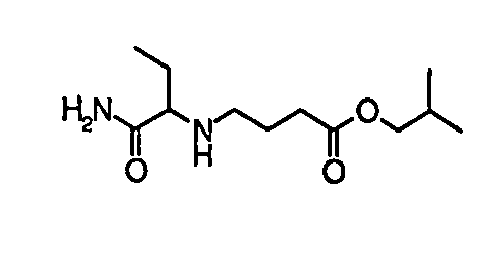 | S | isobutyl 4-{[(1S)-1-(aminocarbonyl)propyl]amino}butanoate |
| N |  | S | benzyl 4-{[(1S)-1-(aminocarbonyl)propyl]amino}butanoate |
| O |  | S | 2-propylpentyl4-{[(1S)-1-(aminocarbonyl)propyl]amino}butanoate |
| P |  | S | propyl 4-{[(1S)-1-(aminocarbonyl)propyl]amino}butanoate |
| Q |  | S | (2S)-2-{[4-(ethylamino)-4-oxobutyl]amino}butanamide |
| R |  | S | (2S)-2-{[4-(dimethylamino)-4-oxobutyl]amino}butanamide |
| S | 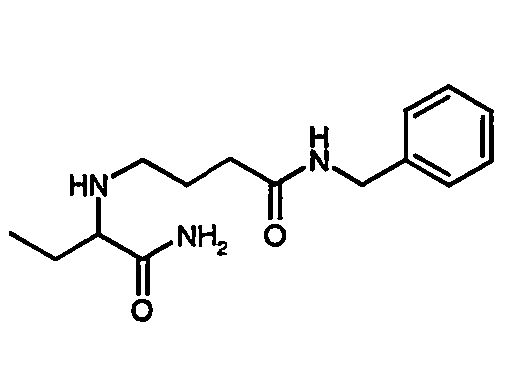 | S | (2S)-2-{[4-(benzylamino)-4-oxobutyl]amino}butanamide |
| T |  | S | ethyl 4-[(4-{[(1S)-1-(aminocarbonyl)propyl]amino}butanoyl)ami no]butanoate |
| U |  | S | (2S)-2-{[4-(butylamino)-4-oxobutyl]amino}butanamide |
| V |  | S | (2S)-2-{[4-(diethylamino)-4-oxobutyl]amino}butanamide |
| W |  | S | S-isopropyl4-{[(1S)-1-(aminocarbonyl)propyl]amino}butanethioate |
For the above-mentioned compounds, the preferred pharmaceutically acceptable salts are the hydrobromides or hydrochlorides.
By "rac" the applicant means the racemic form.
Claims (11)
- A compound of formula (I)
 - R0 is selected from the group consisting of -OR1, -SR1 or -NR2R1;- R1 and R2 are independently selected from the group consisting of hydrogen, alkyl, alkenyl, alkynyl, cycloalkyl, cycloalkenyl, heterocycle, aryl, arylalkyl, acyl derivatives, imidoyl, amido, ester, oxo and -(L1)-R3 or together are -L2-; if R0 is -NR2R1 then R1 may also be oxy derivatives or amino derivatives;- R3 is selected from the group consisting of cycloalkyl, cycloalkenyl, heterocycle, aryl, oxy derivatives, thio derivatives, amino derivatives, acyl derivatives, acyloxy derivatives, ether, imidoyl, amido, amidooxy, ester, esteroxy, sulfinyl, sulfonyl;- L1 is a straight or branched alkylene, alkenylene, alkynylene;- L2 is a straight or branched alkylene, alkenylene, alkynylene, or one of the foregoing in which one or more methylenes are replaced by -O-, -S- or -NH-;except the (S) and (R) forms of ethyl 4-{[1-(aminocarbonyl)propyl]amino}butanoate.
 - A compound according to claim 1 wherein compounds are the (S) or (R) isomers of formula (II)
 - R0 is selected from the group consisting of -OR1, -SR1 or -NR2R1;- R1 and R2 are independently selected from the group consisting of hydrogen, alkyl, alkenyl, alkynyl, cycloalkyl, cycloalkenyl, heterocycle, aryl, arylalkyl, acyl derivatives, imidoyl, amido, ester, oxo and -(L1)-R3 or together are -L2-; if R0 is -NR2R1 then R1 may also be oxy derivatives or amino derivatives;- R3 is selected from the group consisting of cycloalkyl, cycloalkenyl, heterocycle, aryl, oxy derivatives, thio derivatives, amino derivatives, acyl derivatives, acyloxy derivatives, ether, imidoyl, amido, amidooxy, ester, esteroxy, sulfinyl, sulfonyl;- L1 is a straight or branched alkylene, alkenylene, alkynylene;- L2 is a straight or branched alkylene, alkenylene, alkynylene, or one of the foregoing in which one or more methylenes are replaced by -O-, -S- or -NH-.
 - A compound according to claim 1 or 2, wherein compounds are the (S) isomers of formula (II)
 - R0 is -OR1 or -SR1- R1 is selected from the group consisting of (C1-C8) alkyl, (C1-C10) cycloalkyl, C6 aryl, and L1-R3;- L1 is a (C1-C7) alkylene;- R3 is (C1-C10) alkyl, (C1-C10) cycloalkyl, or C6 aryl.
 - A compound according to claim 1, selected from the group consisting of:4-{[(1S)-1-(aminocarbonyl)propyl]amino}butanamide,4-{[(1S)-1-(aminocarbonyl)propyl]amino}butanoic acid,methyl 4-{[(1S)-1-(aminocarbonyl)propyl]amino}butanoate,isopropyl 4-{[(1S)-1-(aminocarbonyl)propyl]amino}butanoate.tert-butyl 4-([(1S)-1-(aminocarbonyl)propyl]amino)butanoate,2-(1-adamantyl)ethyl 4-{[(1S)-1-(aminocarbonyl)propyl]amino}butanoate,cyclopentyl 4-([(1S)-1-(aminocarbonyl)propyl]amino)butanoate,butyl 4-{[(1S)-1-(aminocarbonyl)propyl]amino}butanoate,octyl 4-{[(1S)-1-(aminocarbonyl)propyl]amino}butanoate,isobutyl 4-{[(1S)-1-(aminocarbonyl)propyl]amino}butanoate,benzyl 4-{[(1S)-1-(aminocarbonyl)propyl]amino}butanoate,2-propylpentyl 4-{[(1S)-1-(aminocarbonyl)propyl]amino}butanoate,Propyl 4-{[(1S)-1-(aminocarbonyl)Propyl]amino}butanoate,S-isopropyl 4-{[(1S)-1-(aminocarbonyl)propyl]amino}butanethioateand the pharmaceutically acceptable salts thereof.
- A compound according to claims 1, 2, 3 and 4 for which the pharmaceutically acceptable salt is the hydrobromide or the hydrochloride.
- A compound according to claims 1, 2, 3, 4 or 5, including the (S) and (R) forms of ethyl 4-{[1-(aminocarbonyl)propyl]amino}butanoate, and the pharmaceutically acceptable salts thereof for their use as medicament.
- A compound according to claims 1, 2, 3, 4 or 5, including the (S) and (R) forms of ethyl 4-{[1-(aminocarbonyl)propyl]amino}butanoate, and the pharmaceutically acceptable salts thereof for the manufacture of a medicament for the treatment and/or prophylaxis of epilepsy, bipolar disorders, chronic pain or neuropathic pain and migraine.
- A compound according to claim 7, wherein it is a (S) isomer form.
- A pharmaceutical composition comprising a pharmaceutically acceptable carrier and at least one compound according to claim 1, 2, 3, 4 or 5, including the (S) and (R) forms of ethyl 4-{[1-(aminocarbonyl)propyl]amino}butanoate.
- A pharmaceutical composition comprising a pharmaceutically acceptable carrier, at least one compound according to claim 1, 2, 3, 4 or 5, including the (S) and (R) forms of ethyl 4-{[1-(aminocarbonyl)propyl]amino}butanoate and at least one compound inducing neural inhibition mediated by the GABAA receptors.
- Use of at least one compound according to claim 1, 2, 3, 4 or 5, including the (S) and (R) forms of ethyl 4-{[1-(aminocarbonyl)propyl]amino}butanoate, and the pharmaceutically acceptable salts thereof for the manufacture of a medicament for treating epilepsy, migraine, bipolar disorders, chronic pain or neuropathic pain.
Priority Applications (1)
| Application Number | Priority Date | Filing Date | Title |
|---|---|---|---|
| EP01994655A EP1339669B1 (en) | 2000-11-21 | 2001-11-14 | N-alkylated gaba compounds, processes for their preparation and their use as medicaments |
Applications Claiming Priority (4)
| Application Number | Priority Date | Filing Date | Title |
|---|---|---|---|
| EP00125480 | 2000-11-21 | ||
| EP00125480 | 2000-11-21 | ||
| PCT/EP2001/013162 WO2002042256A2 (en) | 2000-11-21 | 2001-11-14 | N-alkylated gaba compounds, processes for their preparation and their use as medicaments |
| EP01994655A EP1339669B1 (en) | 2000-11-21 | 2001-11-14 | N-alkylated gaba compounds, processes for their preparation and their use as medicaments |
Publications (2)
| Publication Number | Publication Date |
|---|---|
| EP1339669A2 EP1339669A2 (en) | 2003-09-03 |
| EP1339669B1 true EP1339669B1 (en) | 2008-06-04 |
Family
ID=8170439
Family Applications (1)
| Application Number | Title | Priority Date | Filing Date |
|---|---|---|---|
| EP01994655A Expired - Lifetime EP1339669B1 (en) | 2000-11-21 | 2001-11-14 | N-alkylated gaba compounds, processes for their preparation and their use as medicaments |
Country Status (7)
| Country | Link |
|---|---|
| US (1) | US7112612B2 (en) |
| EP (1) | EP1339669B1 (en) |
| AT (1) | ATE397584T1 (en) |
| AU (1) | AU2002224847A1 (en) |
| DE (1) | DE60134337D1 (en) |
| ES (1) | ES2307671T3 (en) |
| WO (1) | WO2002042256A2 (en) |
Families Citing this family (11)
| Publication number | Priority date | Publication date | Assignee | Title |
|---|---|---|---|---|
| EP1243262B1 (en) | 2001-03-20 | 2006-05-31 | Schwarz Pharma Ag | Novel use of a peptide class of compound for treating non-neuropathic inflammatory pain |
| DE60100055T2 (en) | 2001-03-21 | 2003-07-24 | Schwarz Pharma Ag | New use of a class of peptide compounds for the treatment of allodynia or other types of chronic or phantom pain |
| WO2005053667A1 (en) | 2003-12-02 | 2005-06-16 | Schwarz Pharma Ag | Novel use of peptide compounds for treating central neuropathic pain |
| KR20070007931A (en) | 2004-04-16 | 2007-01-16 | 쉬바르츠파르마에이지 | Use of Peptide Compounds for the Prevention and Treatment of Chronic Headaches |
| EP1604656A1 (en) | 2004-06-09 | 2005-12-14 | Schwarz Pharma Ag | Novel use of peptide compounds for treating amyotrophic lateral sclerosis (ALS) |
| EP1604655A1 (en) | 2004-06-09 | 2005-12-14 | Schwarz Pharma Ag | Novel use of peptide compounds for treating pain in trigeminal neuralgia |
| US7427601B2 (en) | 2004-06-24 | 2008-09-23 | Schwarz Pharma Ag | Method for treating tremor |
| WO2006021412A2 (en) | 2004-08-27 | 2006-03-02 | Schwarz Pharma Ag | Use of peptide compounds for treating bone cancer pain, chemotherapy-and nucleoside-induced pain |
| CN101466390B (en) | 2006-06-15 | 2014-03-12 | 优时比制药有限公司 | Peptide compounds for the treatment of refractory status epilepticus |
| US8735356B2 (en) | 2006-06-15 | 2014-05-27 | Ucb Pharma Gmbh | Anticonvulsant combination therapy |
| CN110615744B (en) * | 2018-06-20 | 2023-01-06 | 上海朴颐化学科技有限公司 | Buvalracetam intermediate and preparation method thereof |
Family Cites Families (4)
| Publication number | Priority date | Publication date | Assignee | Title |
|---|---|---|---|---|
| DE3010599A1 (en) * | 1979-03-22 | 1980-10-09 | Continental Pharma | DERIVATIVES OF GLYCINAMIDE, THEIR PRODUCTION AND USE |
| FI832935A7 (en) | 1982-08-20 | 1984-02-21 | Midit | DERIVAT AV W-AMINOSYROR, DERAS FRAMSTAELLNING SAMT DESSA DERIVAT INNEHAOLLANDE BLANDNINGAR |
| GB8412357D0 (en) * | 1984-05-15 | 1984-06-20 | Ucb Sa | Pharmaceutical composition |
| GB8412358D0 (en) * | 1984-05-15 | 1984-06-20 | Ucb Sa | Pharmaceutical composition |
-
2001
- 2001-11-14 AT AT01994655T patent/ATE397584T1/en not_active IP Right Cessation
- 2001-11-14 AU AU2002224847A patent/AU2002224847A1/en not_active Abandoned
- 2001-11-14 EP EP01994655A patent/EP1339669B1/en not_active Expired - Lifetime
- 2001-11-14 US US10/432,115 patent/US7112612B2/en not_active Expired - Fee Related
- 2001-11-14 ES ES01994655T patent/ES2307671T3/en not_active Expired - Lifetime
- 2001-11-14 WO PCT/EP2001/013162 patent/WO2002042256A2/en not_active Ceased
- 2001-11-14 DE DE60134337T patent/DE60134337D1/en not_active Expired - Lifetime
Also Published As
| Publication number | Publication date |
|---|---|
| ES2307671T3 (en) | 2008-12-01 |
| DE60134337D1 (en) | 2008-07-17 |
| US7112612B2 (en) | 2006-09-26 |
| US20040058991A1 (en) | 2004-03-25 |
| AU2002224847A1 (en) | 2002-06-03 |
| EP1339669A2 (en) | 2003-09-03 |
| ATE397584T1 (en) | 2008-06-15 |
| WO2002042256A2 (en) | 2002-05-30 |
| WO2002042256A3 (en) | 2003-05-01 |
Similar Documents
| Publication | Publication Date | Title |
|---|---|---|
| US11020385B2 (en) | Combination therapy | |
| DE60110557T2 (en) | AMINOADAMANTAN DERIVATIVES AS THERAPEUTIC AGENTS | |
| DE69716619T2 (en) | PHOSPHINIC ACID AMIDES AS A MATRIX METALLOPROTEASE INHIBITOR | |
| SU1225481A3 (en) | Method of producing mixture of glyceryl-1,2 and 1,3-bis-(di-h-propylacetates) showing properties of central nervous system depressant | |
| US7112612B2 (en) | N-alkylated GABA compounds, processes for their preparation and their use as medicaments | |
| SK283295B6 (en) | Substituted cyclic amino acid, use and pharmaceutical composition based on it | |
| JPH0136819B2 (en) | ||
| US20020082283A1 (en) | Nitrogen-containing compounds and their use as glycine transport inhibitors | |
| EP2323735A1 (en) | Substituted pyridoxine-lactam carboxylate salts | |
| SE450251B (en) | XANTATE SOCIETIES FOR THERAPEUTICAL USE, NEW XANTATE SOCIETIES, AND THERAPEUTIC COMPOSITIONS CONTAINING THESE SOCIETIES | |
| US7473697B2 (en) | 2-Oxo-piperidinyl- and 2-oxo-azepanyl alkanoic acid derivatives for the treatment of epilepsy and other neurological disorders | |
| WO2007117544A2 (en) | Carnitine conjugates of adamantanamines and neramexane derivatives as duel prodrugs for various uses | |
| CA3115162A1 (en) | Compositions and methods for the treatment of parkinson's disease | |
| DK168441B1 (en) | [R- (E)] - 4- (3-phosphono-2-propenyl) -2-piperazine carboxylic acid, process for its preparation, pharmaceutical composition containing the compound and use thereof | |
| RU2398764C2 (en) | New derivatives of 3,5-seco-4-norcholestane and their application | |
| RU2272027C2 (en) | Derivatives of 3-hydroxypiperidine and pharmaceutical composition based on thereof | |
| DE3204373A1 (en) | THIAZA SPIRIT DERIVATIVES, METHOD FOR THEIR PRODUCTION AND MEDICINAL PRODUCTS | |
| JPH04503216A (en) | 5-Aminocarbonyl-5H-dibenzo[a,d]cyclohepten-5,10-imine for the treatment of epilepsy and cocaine addiction | |
| EP0695308B1 (en) | Novel heterocyclic acyldipeptides, processes for the preparation thereof and pharmaceutical compositions containing the same | |
| NL8202658A (en) | ESTERS OF 2-THENOYLMERCAPTOPROPIONYLGLYCIN WITH SUBSTITUTED HYDROXYBENEES, METHODS FOR PREPARING THEM AND PHARMACEUTICAL COMPOSITIONS CONTAINING THESE ESTERS. | |
| CH644361A5 (en) | ARYLTHIO-3 HYDROXY-4 PYRROLIDINES 1-SUBSTITUTED AND THEIR DERIVATIVES. | |
| US6800770B2 (en) | Anti-spasticity of an eicosanoid analog | |
| CN115969991A (en) | A kind of conjugate of anesthetic and its preparation method and application | |
| US5278191A (en) | Diphenylmethylaminoacetamide derivatives as anti-convulsants | |
| JPS60197658A (en) | Thioketene derivative and its preparation |
Legal Events
| Date | Code | Title | Description |
|---|---|---|---|
| PUAI | Public reference made under article 153(3) epc to a published international application that has entered the european phase |
Free format text: ORIGINAL CODE: 0009012 |
|
| AK | Designated contracting states |
Kind code of ref document: A2 Designated state(s): AT BE CH CY DE DK ES FI FR GB GR IE IT LI LU MC NL PT SE TR |
|
| AX | Request for extension of the european patent |
Extension state: AL LT LV MK RO SI |
|
| 17P | Request for examination filed |
Effective date: 20031103 |
|
| 17Q | First examination report despatched |
Effective date: 20070320 |
|
| GRAP | Despatch of communication of intention to grant a patent |
Free format text: ORIGINAL CODE: EPIDOSNIGR1 |
|
| GRAS | Grant fee paid |
Free format text: ORIGINAL CODE: EPIDOSNIGR3 |
|
| GRAA | (expected) grant |
Free format text: ORIGINAL CODE: 0009210 |
|
| RAP1 | Party data changed (applicant data changed or rights of an application transferred) |
Owner name: UCB PHARMA, S.A. |
|
| AK | Designated contracting states |
Kind code of ref document: B1 Designated state(s): AT BE CH CY DE DK ES FI FR GB GR IE IT LI LU MC NL PT SE TR |
|
| AX | Request for extension of the european patent |
Extension state: AL LT LV MK RO SI |
|
| REG | Reference to a national code |
Ref country code: GB Ref legal event code: FG4D |
|
| REG | Reference to a national code |
Ref country code: CH Ref legal event code: EP |
|
| REF | Corresponds to: |
Ref document number: 60134337 Country of ref document: DE Date of ref document: 20080717 Kind code of ref document: P |
|
| REG | Reference to a national code |
Ref country code: IE Ref legal event code: FG4D |
|
| PG25 | Lapsed in a contracting state [announced via postgrant information from national office to epo] |
Ref country code: FI Free format text: LAPSE BECAUSE OF FAILURE TO SUBMIT A TRANSLATION OF THE DESCRIPTION OR TO PAY THE FEE WITHIN THE PRESCRIBED TIME-LIMIT Effective date: 20080604 |
|
| PG25 | Lapsed in a contracting state [announced via postgrant information from national office to epo] |
Ref country code: NL Free format text: LAPSE BECAUSE OF FAILURE TO SUBMIT A TRANSLATION OF THE DESCRIPTION OR TO PAY THE FEE WITHIN THE PRESCRIBED TIME-LIMIT Effective date: 20080604 Ref country code: AT Free format text: LAPSE BECAUSE OF FAILURE TO SUBMIT A TRANSLATION OF THE DESCRIPTION OR TO PAY THE FEE WITHIN THE PRESCRIBED TIME-LIMIT Effective date: 20080604 |
|
| NLV1 | Nl: lapsed or annulled due to failure to fulfill the requirements of art. 29p and 29m of the patents act | ||
| REG | Reference to a national code |
Ref country code: ES Ref legal event code: FG2A Ref document number: 2307671 Country of ref document: ES Kind code of ref document: T3 |
|
| PG25 | Lapsed in a contracting state [announced via postgrant information from national office to epo] |
Ref country code: PT Free format text: LAPSE BECAUSE OF FAILURE TO SUBMIT A TRANSLATION OF THE DESCRIPTION OR TO PAY THE FEE WITHIN THE PRESCRIBED TIME-LIMIT Effective date: 20081104 Ref country code: SE Free format text: LAPSE BECAUSE OF FAILURE TO SUBMIT A TRANSLATION OF THE DESCRIPTION OR TO PAY THE FEE WITHIN THE PRESCRIBED TIME-LIMIT Effective date: 20080904 |
|
| PG25 | Lapsed in a contracting state [announced via postgrant information from national office to epo] |
Ref country code: BE Free format text: LAPSE BECAUSE OF FAILURE TO SUBMIT A TRANSLATION OF THE DESCRIPTION OR TO PAY THE FEE WITHIN THE PRESCRIBED TIME-LIMIT Effective date: 20080604 |
|
| PLBE | No opposition filed within time limit |
Free format text: ORIGINAL CODE: 0009261 |
|
| STAA | Information on the status of an ep patent application or granted ep patent |
Free format text: STATUS: NO OPPOSITION FILED WITHIN TIME LIMIT |
|
| PG25 | Lapsed in a contracting state [announced via postgrant information from national office to epo] |
Ref country code: DK Free format text: LAPSE BECAUSE OF FAILURE TO SUBMIT A TRANSLATION OF THE DESCRIPTION OR TO PAY THE FEE WITHIN THE PRESCRIBED TIME-LIMIT Effective date: 20080604 |
|
| 26N | No opposition filed |
Effective date: 20090305 |
|
| PG25 | Lapsed in a contracting state [announced via postgrant information from national office to epo] |
Ref country code: MC Free format text: LAPSE BECAUSE OF NON-PAYMENT OF DUE FEES Effective date: 20081130 |
|
| REG | Reference to a national code |
Ref country code: CH Ref legal event code: PL |
|
| REG | Reference to a national code |
Ref country code: IE Ref legal event code: MM4A |
|
| PG25 | Lapsed in a contracting state [announced via postgrant information from national office to epo] |
Ref country code: CH Free format text: LAPSE BECAUSE OF NON-PAYMENT OF DUE FEES Effective date: 20081130 Ref country code: IE Free format text: LAPSE BECAUSE OF NON-PAYMENT OF DUE FEES Effective date: 20081114 Ref country code: LI Free format text: LAPSE BECAUSE OF NON-PAYMENT OF DUE FEES Effective date: 20081130 |
|
| PG25 | Lapsed in a contracting state [announced via postgrant information from national office to epo] |
Ref country code: CY Free format text: LAPSE BECAUSE OF FAILURE TO SUBMIT A TRANSLATION OF THE DESCRIPTION OR TO PAY THE FEE WITHIN THE PRESCRIBED TIME-LIMIT Effective date: 20080604 Ref country code: LU Free format text: LAPSE BECAUSE OF NON-PAYMENT OF DUE FEES Effective date: 20081114 |
|
| PG25 | Lapsed in a contracting state [announced via postgrant information from national office to epo] |
Ref country code: TR Free format text: LAPSE BECAUSE OF FAILURE TO SUBMIT A TRANSLATION OF THE DESCRIPTION OR TO PAY THE FEE WITHIN THE PRESCRIBED TIME-LIMIT Effective date: 20080604 |
|
| PG25 | Lapsed in a contracting state [announced via postgrant information from national office to epo] |
Ref country code: GR Free format text: LAPSE BECAUSE OF FAILURE TO SUBMIT A TRANSLATION OF THE DESCRIPTION OR TO PAY THE FEE WITHIN THE PRESCRIBED TIME-LIMIT Effective date: 20080905 |
|
| PGFP | Annual fee paid to national office [announced via postgrant information from national office to epo] |
Ref country code: FR Payment date: 20121130 Year of fee payment: 12 Ref country code: DE Payment date: 20121107 Year of fee payment: 12 |
|
| PGFP | Annual fee paid to national office [announced via postgrant information from national office to epo] |
Ref country code: IT Payment date: 20121114 Year of fee payment: 12 Ref country code: ES Payment date: 20121212 Year of fee payment: 12 Ref country code: GB Payment date: 20121114 Year of fee payment: 12 |
|
| GBPC | Gb: european patent ceased through non-payment of renewal fee |
Effective date: 20131114 |
|
| REG | Reference to a national code |
Ref country code: FR Ref legal event code: ST Effective date: 20140731 |
|
| REG | Reference to a national code |
Ref country code: DE Ref legal event code: R119 Ref document number: 60134337 Country of ref document: DE Effective date: 20140603 |
|
| PG25 | Lapsed in a contracting state [announced via postgrant information from national office to epo] |
Ref country code: IT Free format text: LAPSE BECAUSE OF NON-PAYMENT OF DUE FEES Effective date: 20131114 Ref country code: DE Free format text: LAPSE BECAUSE OF NON-PAYMENT OF DUE FEES Effective date: 20140603 |
|
| PG25 | Lapsed in a contracting state [announced via postgrant information from national office to epo] |
Ref country code: FR Free format text: LAPSE BECAUSE OF NON-PAYMENT OF DUE FEES Effective date: 20131202 Ref country code: GB Free format text: LAPSE BECAUSE OF NON-PAYMENT OF DUE FEES Effective date: 20131114 |
|
| REG | Reference to a national code |
Ref country code: ES Ref legal event code: FD2A Effective date: 20150504 |
|
| PG25 | Lapsed in a contracting state [announced via postgrant information from national office to epo] |
Ref country code: ES Free format text: LAPSE BECAUSE OF NON-PAYMENT OF DUE FEES Effective date: 20131115 |