EP1339040A1 - Vector quantizing device for lpc parameters - Google Patents
Vector quantizing device for lpc parameters Download PDFInfo
- Publication number
- EP1339040A1 EP1339040A1 EP01998967A EP01998967A EP1339040A1 EP 1339040 A1 EP1339040 A1 EP 1339040A1 EP 01998967 A EP01998967 A EP 01998967A EP 01998967 A EP01998967 A EP 01998967A EP 1339040 A1 EP1339040 A1 EP 1339040A1
- Authority
- EP
- European Patent Office
- Prior art keywords
- lpc
- vector
- section
- distortion
- codebook
- Prior art date
- Legal status (The legal status is an assumption and is not a legal conclusion. Google has not performed a legal analysis and makes no representation as to the accuracy of the status listed.)
- Granted
Links
Images






Classifications
-
- G—PHYSICS
- G10—MUSICAL INSTRUMENTS; ACOUSTICS
- G10L—SPEECH ANALYSIS TECHNIQUES OR SPEECH SYNTHESIS; SPEECH RECOGNITION; SPEECH OR VOICE PROCESSING TECHNIQUES; SPEECH OR AUDIO CODING OR DECODING
- G10L19/00—Speech or audio signals analysis-synthesis techniques for redundancy reduction, e.g. in vocoders; Coding or decoding of speech or audio signals, using source filter models or psychoacoustic analysis
- G10L19/04—Speech or audio signals analysis-synthesis techniques for redundancy reduction, e.g. in vocoders; Coding or decoding of speech or audio signals, using source filter models or psychoacoustic analysis using predictive techniques
- G10L19/06—Determination or coding of the spectral characteristics, e.g. of the short-term prediction coefficients
-
- G—PHYSICS
- G10—MUSICAL INSTRUMENTS; ACOUSTICS
- G10L—SPEECH ANALYSIS TECHNIQUES OR SPEECH SYNTHESIS; SPEECH RECOGNITION; SPEECH OR VOICE PROCESSING TECHNIQUES; SPEECH OR AUDIO CODING OR DECODING
- G10L19/00—Speech or audio signals analysis-synthesis techniques for redundancy reduction, e.g. in vocoders; Coding or decoding of speech or audio signals, using source filter models or psychoacoustic analysis
- G10L19/04—Speech or audio signals analysis-synthesis techniques for redundancy reduction, e.g. in vocoders; Coding or decoding of speech or audio signals, using source filter models or psychoacoustic analysis using predictive techniques
- G10L19/06—Determination or coding of the spectral characteristics, e.g. of the short-term prediction coefficients
- G10L19/07—Line spectrum pair [LSP] vocoders
-
- G—PHYSICS
- G10—MUSICAL INSTRUMENTS; ACOUSTICS
- G10L—SPEECH ANALYSIS TECHNIQUES OR SPEECH SYNTHESIS; SPEECH RECOGNITION; SPEECH OR VOICE PROCESSING TECHNIQUES; SPEECH OR AUDIO CODING OR DECODING
- G10L19/00—Speech or audio signals analysis-synthesis techniques for redundancy reduction, e.g. in vocoders; Coding or decoding of speech or audio signals, using source filter models or psychoacoustic analysis
- G10L19/02—Speech or audio signals analysis-synthesis techniques for redundancy reduction, e.g. in vocoders; Coding or decoding of speech or audio signals, using source filter models or psychoacoustic analysis using spectral analysis, e.g. transform vocoders or subband vocoders
- G10L19/032—Quantisation or dequantisation of spectral components
- G10L19/038—Vector quantisation, e.g. TwinVQ audio
-
- H—ELECTRICITY
- H03—ELECTRONIC CIRCUITRY
- H03M—CODING; DECODING; CODE CONVERSION IN GENERAL
- H03M7/00—Conversion of a code where information is represented by a given sequence or number of digits to a code where the same, similar or subset of information is represented by a different sequence or number of digits
- H03M7/30—Compression; Expansion; Suppression of unnecessary data, e.g. redundancy reduction
- H03M7/3082—Vector coding
-
- G—PHYSICS
- G10—MUSICAL INSTRUMENTS; ACOUSTICS
- G10L—SPEECH ANALYSIS TECHNIQUES OR SPEECH SYNTHESIS; SPEECH RECOGNITION; SPEECH OR VOICE PROCESSING TECHNIQUES; SPEECH OR AUDIO CODING OR DECODING
- G10L19/00—Speech or audio signals analysis-synthesis techniques for redundancy reduction, e.g. in vocoders; Coding or decoding of speech or audio signals, using source filter models or psychoacoustic analysis
- G10L2019/0001—Codebooks
- G10L2019/0004—Design or structure of the codebook
- G10L2019/0005—Multi-stage vector quantisation
-
- G—PHYSICS
- G10—MUSICAL INSTRUMENTS; ACOUSTICS
- G10L—SPEECH ANALYSIS TECHNIQUES OR SPEECH SYNTHESIS; SPEECH RECOGNITION; SPEECH OR VOICE PROCESSING TECHNIQUES; SPEECH OR AUDIO CODING OR DECODING
- G10L19/00—Speech or audio signals analysis-synthesis techniques for redundancy reduction, e.g. in vocoders; Coding or decoding of speech or audio signals, using source filter models or psychoacoustic analysis
- G10L2019/0001—Codebooks
- G10L2019/0013—Codebook search algorithms
- G10L2019/0014—Selection criteria for distances
Definitions
- the present invention relates to an LPC vector quantization apparatus applicable to a speech coder/decoder used to enhance transmission efficiency of a speech signal in the fields of a packet communication system represented by Internet communication and mobile communication system, etc.
- a compression/coding technology is often used to enhance transmission efficiency of the speech signal.
- Many speech coding systems have been developed so far, and many low bit rate speech coding systems developed in recent years separate a speech signal into a spectral envelope information and a sound source information and compress/code the separated information pieces.
- a CELP system described in Document 1 (M.R.Schroeder, B.S.Atal, "Code Excited Linear Prediction: High Quality Speech at Low Bit Rate", IEEE proc., ICASSP'85 pp.937-940) is one of its examples.
- FIG. 1 An input speech signal is input to a speech coder successively every processing frame delimited by a time interval of approximately 20 ms.
- the input speech signal input to the speech coder for every processing frame is supplied to an LPC analysis section 11 first.
- the LPC analysis section 11 carries out an LPC (Linear Predictive Coding) analysis on the input speech signal, obtains an LPC vector having LPC coefficients as vector components, vector-quantizes the LPC vector obtained to obtain an LPC code, and decodes this LPC code to obtain a decoded LPC vector having decoded LPC coefficients as vector components.
- LPC Linear Predictive Coding
- An excitation vector generation section 14 reads an adaptive codevector and fixed codevector from an adaptive codebook 12 and a fixed codebook 13 respectively and sends those codevectors to an LPC synthesis filter 15.
- the LPC synthesis filter 15 performs synthesis filtering on the adaptive codevector and the fixed codevector supplied from the excitation vector generation section 14 using an all-pole model synthesis filter having the decoded LPC coefficients given from the LPC analysis section 11 as filter coefficients and obtains a synthesized adaptive codevector and a synthesized fixed codevector, respectively.
- a comparison section 16 analyzes a relationship between the synthesized adaptive codevector, the synthesized fixed codevector output from the LPC synthesis filter 15 and the input speech signal, and calculates an adaptive codebook optimum gain to be multiplied on the synthesized adaptive codevector and a fixed codebook optimum gain to be multiplied on the synthesized fixed codevector, respectively. Furthermore, the comparison section 16 adds up the vector obtained by multiplying the synthesized adaptive codevector by the adaptive codebook optimum gain and the vector obtained by multiplying the synthesized fixed codevector by the fixed codebook optimum gain to obtain a synthesized speech vector and calculates a distortion between the synthesized speech vector obtained and input speech signal.
- the comparison section 16 further calculates distortions between many synthesized speech vectors obtained by operating the excitation vector generation section 14 and LPC synthesis filter 15 on all possible combinations of adaptive codevectors stored in the adaptive codebook 12 and fixed codevectors stored in the fixed codebook 13, and the input speech signal, determines an index of an adaptive codevector and an index of a fixed codevector that minimize the distortions from among those codevectors and sends the indices of the codevectors output from the respective codebooks, codevectors corresponding to the indices and an adaptive codebook optimum gain and fixed codebook optimum gain corresponding to the indices to a parameter coding section 17.
- the parameter coding section 17 codes the adaptive codebook optimum gain and fixed codebook optimum gain to obtain gain codes, and outputs the gain codes obtained, the LPC code given from the LPC analysis section 11 and the indices of the respective codebooks together for each processing frame.
- the parameter coding section 17 further adds up two vectors; a vector obtained by multiplying the adaptive codevector corresponding to the index of the adaptive codebook by an adaptive codebook gain corresponding to the gain code and a vector obtained by multiplying the fixed codevector corresponding to the index of the fixed codebook by a fixed codebook gain corresponding to the gain code, thereby obtains an excitation vector and updates the old adaptive codevector in the adaptive codebook 12 with the excitation vector obtained.
- an LPC codebook 22 stores a plural entries of typical LPC vectors acquired beforehand by applying the LBG algorithm to many LPC vectors obtained by actually carrying out an LPC analysis on input speech signals of many processing frames .
- LBG algorithm the details of its technology are disclosed in Document 2 (Y. Linde, A. Buzo, R. M. Gray, "An Algorithm for Vector Quantizer Design," IEEE trans. Comm., Vol. COM-28, No. 1, pp84-95, Jan., 1980).
- a quantization target vector input to the vector quantizer in FIG.2 (an LPC vector obtained by carrying out an LPC analysis on a speech signal in a processing frame section corresponds to the quantization target) is supplied to a distortion calculation section 21.
- the distortion calculation section 21 calculates a Euclidean distortion between an LPC codevector stored in the LPC codebook 22 and the quantization target vector according to the following Expression (1): where in Expression (1), X T is a quantization target vector, C m is an mth (1 ⁇ m ⁇ M) LPC codevector in the LPC codebook, i is a component number of a vector, N is the order of a vector (corresponds to an LPC analysis order) and d m is a Euclidean distortion between X T and C m .
- the distortion calculation section 21 successively calculates Euclidean distortions between all LPC codevectors stored in the LPC codebook 22 and the quantization target vector, then successively outputs the calculation results(respective Euclidean distortions) to an LPC codebook search section 23.
- the LPC codebook search section 23 compares the respective Euclidean distortions supplied from the distortion calculation section 21 and outputs an index of an LPC codevector that minimizes the Euclidean distortion as an LPC code (coded expressing spectral envelope information on the processing frame).
- decoded LPC coefficients decode LPC coefficients
- the processing of generating decoded LPC coefficients, which are used for constituting an all-pole model LPC synthesis filter, from the LPC code is generally carried out by both the speech coder and speech decoder.
- LPC vector is not quantized as it is, and it is a general practice that an LPC vector is converted to an LSF (Line Spectral Frequency) vector having LSF parameters as vector components or an LSP (Line Spectral Pairs) vector having LSP parameters as vector components, which are one-to-one mutually convertible frequency domain vectors, and then vector-quantized.
- LSF Line Spectral Frequency
- LSP Line Spectral Pairs
- LSF (or LSP) vector is quantized, the weighted Euclidean distortion d m in Expression (2) below instead of Expression (1) above is often used as a measure for an LPC codebook search.
- decoded LSF parameters decode LSF parameters
- the decoded LSF parameters read based on the LPC code are parameters in the frequency domain.Thus, additional processing for converting the decoded LSF parameters in the frequency domain to decoded LPC coefficients in the time domain for constructing an all-pole model LPC synthesis filter is required.
- LPC parameters representing short-time spectral envelope information of a speech signal (hereinafter LPC coefficients and parameters such as LSF which are mutually convertible with LPC coefficients will be generically referred to as "LPC parameters") are generally compressed/coded by a vector quantizer.
- LPC coefficients and parameters such as LSF which are mutually convertible with LPC coefficients will be generically referred to as "LPC parameters”
- LPC coefficients and parameters such as LSF which are mutually convertible with LPC coefficients will be generically referred to as "LPC parameters”
- LPC parameters LPC coefficients and parameters such as LSF which are mutually convertible with LPC coefficients
- CD Code Division Multiple Access
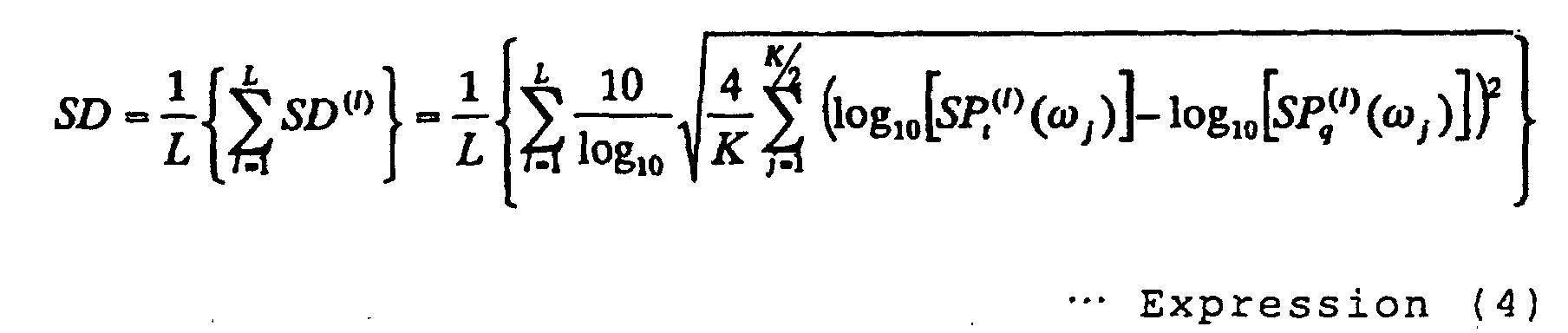
- SD Spectral Distortion
- FFT Fast Fourier Transformation
- spectral domain is often used as a performance evaluation measure: where in Expression (3), L is the number of data frames used for evaluation, l is a frame number, Nc is the order of an LPC cepstrum (when the LPC analysis order N is the 10 th order, Nc is often on the order of the 16th order), CEP t (1) [i] is a target LPC cepstrum obtained by converting a quantization target of the first processing frame and CEP q (1) [i] is LPC cepstrum obtained by converting decoded LPC vector of the first processing frame.
- L is the number data frames used for evaluation
- l is a frame number
- K is the number of FFT points
- SP t (1) ( ⁇ j) is an FFT power spectrum of a quantization target of the 1th processing frame
- Both CD in Expression (3) and SD in Expression (4) are obtained by adding up quantization distortion generated in each processing frame throughout the evaluation data and then averaging the addition result by the number of data frames in the evaluation data, which means that the smaller the CD or SD, the higher the performance of the vector quantizer.
- a Euclidean distortion Expression (1) or weighted Euclidean distortion Expression (2) is used as a reference measure for a LPC codebook search.
- the performance of the LPC vector quantizer is generally evaluated using CD described in Expression (3) or SD described in Expression (4) as a performance evaluation measure. That is, in LPC vector quantizers developed so far, a reference measure used for LPC codebook search is different from a reference measure used for evaluating the vector quantizer performance. For this reason, the LPC code selected by LPC codebook search is not always an index for minimizing CD or SD measure. This causes a problem in designing a high performance vector quantizer.
- This object is attained when a target LSF vector is vector-quantized by a pre-selection for selecting a preset small number of codevectors from many candidate LSF codevector entries stored in an LSF codebook according to a weighted Euclidean distortion measure, further final search for selecting a final code from the small number of pre-selected LSF codevectors according to the CD or SD measure.
- FIG.3 is a block diagram showing a configuration of the LPC vector quantization apparatus according to Embodiment 1 of the present invention.
- This vector quantization apparatus is provided with an LSF codebook 101 that stores LSF codevector entries, a distortion calculation section 102 that calculates distortions between LSF codevector entries in the LSF codebook 101 and a target LSF vector, an LPC code pre-selection section 103 that preliminarily selects a preset small number of LPC codes based on the distortions calculated by the distortion calculation section 102, LSF/LPC conversion sections 104 and 106 that convert LSF vector to LPC coefficients, LPC coefficient/LPC cepstrum conversion sections 105 and 107 that convert LPC coefficients to LPC cepstrum and an LPC code final search section 108 that finally selects an LPC code based on the results of distortion evaluation in the LPC cepstrum domain.
- the LSF codebook 101 of the vector quantization apparatus in the above-described configuration stores M candidate LSF codevector entries acquired beforehand by the LBG algorithm. Furthermore, suppose the LPC vector quantization apparatus according to this embodiment carries out an LPC analysis on a speech signal in a processing frame section to obtain LPC coefficients, further converts the LPC coefficients obtained to an LSF vector and inputs the LSF vector obtained as a quantization target vector.
- the LPC code pre-selection section 103 instructs the LSF codebook 101 to output another LSF codevector corresponding to the next index (m+1).
- the processing at the LPC code pre-selection section 103 is repeated M times until M distortions between LSF quantization target vector and M candidate LSF vector are obtained, and the M distortions are output to the LPC code pre-selection section 103.
- this embodiment assumes that the number of LSF codevectors stored in the LSF codebook 101 is M and the number of codevectors preliminarily selected by the LPC code pre-selection section 103 is S.
- the above-described value M is determined by the number of bits allocated to the LPC parameter vector quantization apparatus. For example, when 21 bits per frame are allocated to the vector quantization apparatus shown in FIG.3, the value M becomes an extremely large number of 2 21 .
- the above-described value S can be freely set, but it is often set to 8, 16 or about 32 empirically or through an advance performance evaluation test.
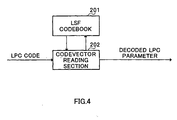
- decoder shown in FIG.4 is provided with the same LSF codebook 201 as that in the vector quantization apparatus and a codevector reading section 202 that reads an LSF codevector from the LSF codebook 201.
- the decoded LSF vector output from the LPC vector decoder above is parameters in the LSF-domain, an additional processing for converting the decoded LSF vector in the LSF-domain to decoded LPC coefficients in the LPC-domain for constructing an all-pole model LPC synthesis filter is required.
- the target LSF vector which is a quantization target is vector-quantized, it is possible to preliminarily select the preset small number of LSF codevectors from all candidate LSF codevectors stored in the LSF codebook using a weighted Euclidean distortion as a measure and it is possible to fully select a final code from the small number of pre-selected candidate LSF codevectors based on the pre-selection result using the CD minimization as a measure.
- the vector quantization apparatus makes it possible to reduce the problem of the conventional technology (problem that a selected LPC code by the vector quantization apparatus often mismatches an index of the codevector that minimizes the CD) without drastically increasing the amount of calculation required for an LPC codebook search and improve the performance of the LPC vector quantization apparatus.
- the vector quantization apparatus of the present invention when the vector quantization apparatus of the present invention is compared with the vector quantization apparatus explained in the section of the prior art, the vector quantization apparatus of the present invention slightly increases the amount of calculation required for the search of LPC codebook.
- the portion corresponding to the increase in the amount of calculation can be summarized as the following six points:
- this embodiment has described the case where the number of candidate LSF codevectors left by the LPC code pre-selection section is predetermined, but it is also possible to use other pre-selection methods such as setting a threshold for a weighted Euclidean distortion and leaving a candidate whose weighted Euclidean distortion is smaller than the set threshold as a candidate after the pre-selection, and the same effect/operation can also be obtained in this case, too.
- this embodiment has described the case where the LPC code pre-selection section carries out pre-selection of an LSF codevector using the weighted Euclidean distortion of Expression (2) above as ameasure, but the present invention can also be implemented when a weighted Euclidean distortion which is different from above-described Expression (2) such as Expression (8) and Expression (10) in the aforementioned Document 4 is used, and the same effect/operation can also be obtained in this case, too.
- Expression (2) such as Expression (8) and Expression (10) in the aforementioned Document 4
- this embodiment has described the case where the LPC vector input to the vector quantization apparatus is LSF, but the present invention is also applicable when other vector expressing short-time spectral envelope information of a speech signal such as LSP vector, PARCOR vector having a PARCOR parameters as vector components, LPC vectoris input to the vector quantization apparatus as a target vector and the same effect/operation can also be obtained in this case, too.
- LSP is input as a quantization target
- this embodiment has described the case where the LPC code final search section specifies a final LPC code using the CD measure, but if the LPC coefficient/LPC cepstrum conversion sections (105, 107) is replaced by an LPC coefficient/FFT power spectrum calculation section that has the function of calculating an FFT power spectrum from LPC coefficients and Expression (5) above as the calculation expression executed by the LPC code final search section 108 is replaced by the calculation expression inside the square root portion of Expression (4), SD (Spectral Distortion) can also be used as a measure to specify the final LPC code and the same effect/operation can also be obtained in this case, too.
- SD Spectrum Distortion
- the vector quantization apparatus is preferably applicable to cases where short-time spectral envelope information of a speech signal is coded/decoded by a speech coder/decoder based on a CELP system or Vocoder system.
- This embodiment will explain the configuration of a vector quantization apparatus, processing procedure and effect/operation thereof when the technology according to the present invention is applied to the LPC vector quantization apparatus using a predictive vector quantization technology, multistage vector quantization technology and split vector quantization technology together.
- the configuration of the vector quantization apparatus strongly depends on the bit rate of the entire speech coder/decoder and the number of bits allocated to the LPC vector quantization apparatus.
- a vector quantization apparatus with 21-bit bit information per processing frame of a time interval of 20 ms allocated will be explained as a specific example below.
- the vector quantization apparatus used in this explanation uses a third-order MA (Moving Average) prediction technology and uses 4 sets of MA predictive coefficients per processing frame (2-bit information is required for MA predictive coefficients switching).
- the vector quantization apparatus used in the explanation uses a 2-stage vector quantization technology.
- the vector quantization apparatus used in the explanation uses a split vector quantization technology at the second stage of the 2-stage vector quantization apparatus.
- the first stage vector quantizer, the vector quantizer of the second stage lower frequency components and the vector quantizer of the second stage higher frequency components are assigned 7 bits, 6 bits and 6 bits, respectively.
- FIG.5 is a block diagram showing a configuration of a vector quantization apparatus according to Embodiment 2 the present invention.
- the vector quantization apparatus in a 2-stage split configuration using third-order MA prediction to which the technology according to the present invention is applied is provided with a weight calculation section (WC) 301, a predictive coefficient codebook (PCC) 302, an MA predictor (MP) 303, a predictive residual calculation section (ARC) 304, a first stage codebook (FSC) 305, a first stage distortion calculation section (FSDCS) 306, a first stage VQ pre-selection section (FSVPS) 307, a first stage VQ residual calculation section (FSVRC) 308, a second stage lower frequency codebook (SSLFC) 309, a second stage lower frequency distortion calculation section (SSLFD) 310, a second stage higher frequency distortion calculation section (SSHFD) 311, a second stage higher frequency codebook (SSHFC) 312, a second stage lower frequency codebook search section (SSLFC)
- LSF vector input to the vector quantization apparatus in FIG. 5 are supplied to the weight calculation section 301, predictive residual calculation section 304 and LSF/LPC conversion section 319.
- the weight calculation section 301 calculates a "weight" used to calculate a weighted Euclidean distortion based on the LSF vector and outputs this weight(s) to the first stage distortion calculation section 306, second stage lower frequency distortion calculation section 310 and second stage higher frequency distortion calculation section 311.
- the MA predictor 303 calculates predictive vectors using decoded predictive residual vectors corresponding to the past 3 frames stored in the decoding predictive residual storage section (DPRS) 322 and third-order MA predictive coefficients stored in the predictive coefficient codebook 302 and outputs the calculated predictive vector to the predictive residual calculation section 304.
- DPRS decoding predictive residual storage section
- the predictive residual calculation section 304 differentiates the predictive vectors supplied from the MA predictor 303 from the vector obtained by the aforementioned difference, calculates a predictive residual vector and outputs the calculated predictive residual vector as a target vector of the first stage vector quantizer to the first stage distortion calculation section 306, first stage VQ residual calculation section 308 and decoded LSF generation section 316.
- the first stage codebook 305 stores 128 entries of predictive residual codevectors.
- 128 entries of predictive residual codevectors are acquired beforehand by carrying out a series of the above-described processes until a quantization target is calculated on speech signals in many processing frames, obtaining many predictive residual vectors, applying an LBG algorithm to the many predictive residual vectors obtained, extracting 128 entries of typical samples of predictive residual vectors and further applying the generalized Lloyd algorithm disclosed in the aforementioned Document 8, etc.
- w[i] is "weight" calculated by the weight calculation section 301
- the processing of the first stage vector quantizer of the 2-stage vector quantizer has been explained in detail so far.
- the processing of the second stage vector quantizer of the second stage vector quantizer (processing corresponding to the second stage lower frequency codebook 309, second stage lower frequency distortion calculation section 310, second stage higher frequency distortion calculation section 311, second stage higher frequency codebook 312, second stage lower frequency codebook search section 313 and second stage higher frequency codebook search section 314) will be explained in detail.
- the aforementioned 64 entries of codevectors are acquired beforehand by carrying out processing until the last processing of the first stage vector quantizer which calculates the first stage VQ residual vectors on speech signals in many processing frames, obtaining many lower frequency components of many first stage VQ residual vectors, applying the LBG algorithm to the many lower frequency components of many first stage VQ residual vectors obtained, extracting 64 entries of typical lower frequency components of the first stage VQ residual vector and further applying the generalization Lloyd algorithm disclosed in the aforementioned Document 8, etc., to the extracted 64 entries of typical lower frequency components of the first stage VQ residual vectors.
- w[i] in Expression (8) is the same "weight" in Expression (6).
- codevectors C N1cand_m[j] , C2L N2Lcand[j] and C2H N2Hcand[j]
- the LSF/LPC coefficient conversion section 319 converts the LSF parameters to LPC coefficients and outputs the LPC coefficients to the LPC coefficient/LPC cepstrum conversion section 320.
- 21-bit information combining the following four information items corresponding to the specified index "J", that is:
- the decoder of the LSF parameters output from the vector quantization apparatus can comprise a step of decomposing an LPC code into four index information pieces (N1cand_k[J], N1cand_m[J], N2Lcand[J] and N2Hcand[J]), a step of calculating a decoded predictive residual vector based on each piece of index information obtained in the step of decomposing an LPC code and a step of generating a decoded LSF vector based on the decoded predictive residual vector obtained in the step of calculating a decoded predictive residual vector.
- an LPC code is decomposed into four index information pieces (N1cand_k[J], N1cand_m[J], N2Lcand[J] and N2Hcand[J]) first.
- the vector quantization apparatus having a 2-stage split structure using third-order MA prediction explained in detail so far preliminarily selects codes using a weighted Euclidean distortion as a measure, and can thereby select optimum codes for the remaining candidates after the pre-selection using CD (Cepstram Distortion) as a reference measure.
- CD Codepstram Distortion
- the first stage VQ pre-selection section 307 controls the number of codevectors to be selected preliminarily and can thereby freely control the increment in the amount of calculation required for an LPC codebook search as in the case of Embodiment 1. That is, the present invention can improve the performance of the vector quantizer taking account of the increment in the amount of calculation required for an LPC codebook search.
- this embodiment has described the case where the number of codevector candidates N1 left by the first stage VQ pre-selection section 307 is predetermined (N1 is often determined through experiments or empirically to values such as 8, 16, 32 and 64), but it is also possible to use other pre-selection methods, for example, setting a threshold as a weighted Euclidean distortion and leaving candidates whose weighted Euclidean distortion is smaller than the set threshold as candidates after the pre-selection and similar effect/operation can be obtained in this case, too.
- this embodiment has described the case where the first stage VQ pre-selection section 307 preliminarily selects codevectors using the weighted Euclidean distortion in Expression (2) above as a measure, but the present invention can also be implemented when a weighted Euclidean distortion whose mathematical expression is different from Expression (2) above such as Expression (8) or Expression (10) in the aforementioned Document 4 is used, and similar effect/operation to those of this embodiment can be obtained in this case, too.
- this embodiment has described the case where input vector is an LSF vector, but this embodiment is also applicable to cases where other parameters expressing short-time spectral envelope information of a speech signal such as LSP vector, PARCOR coefficients or an LPC vector is vector-quantized and similar effect/operation can be obtained in this case, too.
- this embodiment has described the case where the LPC code final search section 321 specifies a final LPC code using CD (Cepstral Distortion) as a measure, but it is also possible to replace the LPC coefficient/LPC cepstrum conversion sections 318 and 320 with the LPC coefficient/FFT power spectrum calculation section having the function of calculating an FFT power spectrum from the LPC coefficient and further changing the calculation expression carried out by the LPC code final search section 32 from Expression (11) above to the calculation expression in the square root portion in Expression (4) above to use the SD (Spectral Distortion) as the final measure of the LPC code search section, and similar effect/operation can be obtained in this case, too.
- CD Codepstral Distortion
- this embodiment has described an example of a vector quantizer having a specific structure called "2-stage split structure using third-order MA prediction" for simplicity of explanation, but this embodiment is also applicable to an LPC parameter vector quantization apparatus having a structure other than this example and similar effect/operation can be obtained in this case, too.
- This embodiment explained above is preferably applicable to coding/decoding of short-time spectral envelope information of a speech signal in a speech coder/decoder based on a CELP system or Vocoder system.
- FIG.6 is a block diagram showing a configuration of a vector quantization apparatus according to Embodiment 3.
- components of the vector quantization apparatus shown in FIG.6 common to those in FIG.5 explained in Embodiment 2 are assigned the same reference numerals as those in FIG.5 and detailed explanations thereof will be omitted.
- the vector quantization apparatus shown in FIG.6 adopts a configuration with a lower frequency scaling factor codebook 350 and a higher frequency scaling factor codebook 360 added to the vector quantization apparatus in FIG.5.
- components 301 to 306 and 316 to 323 are omitted to make drawings easier to see.
- the configuration of the vector quantization apparatus strongly depends on the bit rate of the entire speech coder/decoder and the number of bits allocated to the LPC parameter vector quantization apparatus.
- bit information with 21 bits per processing frame of a time interval of 20 ms is assigned.
- the vector quantization apparatus which will be explained in this embodiment also uses third-order MA (Moving Average) prediction technology and uses 4 sets of (2 bits required as switching information) MA predictive coefficients per processing frame. Furthermore, suppose the vector quantization apparatus which will be explained in this embodiment uses a 2-stage vector quantization technology. Furthermore, suppose the vector quantization apparatus which will be explained in this embodiment uses a split vector quantization technology for the second stage of the 2-stage vector quantization apparatus. By the way, suppose that the first stage vector quantizer, the vector quantizer of the second stage lower frequency component and the vector quantizer of the second stage higher frequency component are assigned 7 bits, 6 bits and 6 bits, respectively.
- the vector quantization apparatus in FIG.6 carries out processing after an LSF parameter is input until a target vector of the first stage vector quantizer is obtained (processing corresponding to the weight calculation section 301, predictive coefficient codebook 302, MA predictor 303 and predictive residual calculation section 304).
- processing corresponding to the weight calculation section 301, predictive coefficient codebook 302, MA predictor 303 and predictive residual calculation section 304.
- the vector quantization apparatus in FIG.6 carries out the processing by the first stage vector quantizer of the 2-stage vector quantizer (processing corresponding to the first stage codebook 305, first stage distortion calculation section 306, first stage VQ pre-search section 307 and first stage VQ residual calculation section 308).
- the first stage codebook 305 stores 128 entries of predictive residual codevectors.
- the 128 entries of predictive residual codevectors are acquired beforehand by carrying out the above-described series of processes until a quantization target is calculated on speech signals in many processing frames, obtaining many predictive residual vectors, applying an LBG algorithm to the many predictive residual vectors obtained, extracting 128 entries of typical samples of predictive residual vectors and applying a generalization Lloyd algorithm disclosed in the aforementioned Document 8, etc., to the 128 entries of typical vectors extracted.
- the vector quantization apparatus in FIG.6 then performs the processing by the second stage vector quantizer of the 2-stage vector quantizer (processing corresponding to the second stage lower frequency codebook 309, lower frequency scaling factor codebook 350, second stage lower frequency distortion calculation section 310, second stage higher frequency distortion calculation section 311, higher frequency scaling factor codebook 360, second stage higher frequency codebook 312, second stage lower frequency codebook search section 313 and second stage higher frequency codebook search section 314).
- this embodiment will also explain the processing by the aforementioned second stage vector quantizer of the 2-stage vector quantizer in detail below.
- the LSF/LPC coefficient conversion section 319 converts the LSF parameters to LPC coefficients and outputs the LPC coefficients to the LPC coefficient/LPC cepstrum conversion section 320.
- the LPC code final search section 321 also supplies index J that minimizes DISj to the predictive residual decoding section 315.
- the decoder for LSF parameters output from the vector quantization apparatus can be constructed of a step of decomposing an LPC code into four pieces of index information (N1cand_k[J], N1cand_m[J], N2Lcand[J] and N2Hcand[J]), a step of calculating decoded predictive residual vectors based on each piece of index information obtained in the step of decomposing an LPC code and a step of generating decoded LSF vectors based on the decoded predictive residual vectors obtained in the step of calculating decoded predictive residual vectors.
- an LPC code is decomposed into four pieces of index information (N1cand_k[J], N1cand_m[J], N2Lcand[J] and N2Hcand[J]) first.
- the vector quantization apparatus having a 2-stage split structure using third-order MA prediction further equipped with the lower frequency scaling factor codebook 350 and higher frequency scaling factor codebook 360 explained in detail above, it is possible to adapt the contribution of the second stage codevector in the whole decoding vector to the codevector C N1cand_m[j] (actually index N1cand_m[j] corresponding to codevector C N1cand_m[j] ) selected in the first stage vector quantization processing and control it, and thereby reduce quantization distortion, carry out pre-selection of a code using the weighted Euclidean distortion as a measure and select an optimum code using CD (Cepstram Distortion) as a reference measure for the remaining candidates after the pre-selection, which makes it possible to vector-quantize LSF parameters with high accuracy compared to the conventional vector quantization apparatus.
- CD Codepstram Distortion
- this embodiment makes it possible to improve the performance of the vector quantizer while considering the increment in the amount of calculation required for an LPC codebook search.
- this embodiment has described the case where the number of candidates N1 of codevectors left by the first stage VQ pre-selection section 307 (N1 is often determined to values such as 8, 16, 32 and 64 through experiments or empirically), but it is also possible to use other pre-selection methods such as setting a threshold for the weighted Euclidean distortion and leaving candidates whose weighted Euclidean distortion is smaller than the set threshold as the candidates after the pre-selection and similar effect/operation can be obtained in this case, too.
- this embodiment has described the case where the first stage VQ pre-selection section 307 preliminarily selects codevectors using the weighted Euclidean distortion in Expression (2) as a measure, but this embodiment can also be implemented when a weighted Euclidean distortion according to expressions different from Expressions (8) and (10) in the aforementioned Document 4 is used, and an effect/operation similar to those of this embodiment can be obtained in this case, too.
- this embodiment has described the case where input vectors are LSF parameters, but this embodiment is also applicable to a case where other parameters expressing short-time spectral envelope information of a speech signal such as LSP parameter, PARCOR coefficient and LPC coefficient are vector-quantized and a similar effect/operation can be obtained in this case, too.
- this embodiment has described the case where the LPC code final search section 321 specifies a final LPC code using CD (Cepstral Distortion) as a measure, but it is also possible to replace the LPC coefficient/LPC cepstrum conversion sections 318 and 320 with an LPC coefficient/FFT power spectrum calculation section having the function of calculating an FFT power spectrum from LPC coefficients and further change the calculation expression used by the LPC code final search section 321 from Expression (11) to the calculation expression in the square root portion in Expression (4) to use SD (Spectral Distortion) as the final measure of the LPC code search section and a similar effect/operation can be obtained in this case, too.
- CD Codepstral Distortion
- this embodiment has described the vector quantizer having a specific structure called "2-stage split structure using third-order MA prediction accompanied by scaling factors" as an example, but this embodiment is also applicable to an LPC parameter vector quantization apparatus having a structure other than this example and a similar effect/operation can be obtained in this case, too.
- the above-described embodiment is preferably applicable to coding/decoding of short-time spectral envelope information on speech signals of a speech coder/decoder based on a CELP system or Vocoder system.
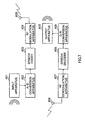
- FIG.7 is a block diagram showing a configuration of a speech signal transmission apparatus and reception apparatus according to Embodiment 4 of present invention.
- a speech signal is converted to an electric signal by an input apparatus 401 of the transmission apparatus and output to an A/D conversion apparatus 402.
- the A/D conversion apparatus 402 converts the (analog) speech signal output from the input apparatus 401 to a digital signal and outputs the signal to a speech coder 403.
- the speech coder 403 codes the digital speech signal output from the A/D conversion apparatus 402 using a speech coding method, which will be described later, and outputs the coded information to an RF modulation apparatus 404.
- the RF modulation apparatus 404 converts the speech coded information output from the speech coder 403 to a signal to be carried on a propagation medium such as a radio frequency band and outputs the signal to a transmission antenna 405.
- the transmission antenna 405 sends the output signal output from the RF modulation apparatus 404 as a radio signal (RF signal).
- the RF signal sent from the transmission apparatus is received by a reception antenna 406 of the reception apparatus and output to an RF demodulation apparatus 407.
- the RF demodulation apparatus 407 demodulates speech coded information from the RF signal output from the reception antenna 406 and outputs it to the speech decoder 408.
- the speech decoder 408 decodes the speech signal according to a speech decoding method, which will be described later, using the speech coded information output from the RF demodulation apparatus 407 and outputs it to a D/A conversion apparatus 409.
- the D/A conversion apparatus 409 converts the digital speech signal output from the speech decoder 408 to an analog electric signal and outputs it to an output apparatus 410.
- the output apparatus 410 converts the electric signal to air vibration and outputs it as sound wave audible to human ears.
- FIG.8 is a block diagram showing a configuration of the speech coder 403.
- an input speech signal is the signal output from the A/D conversion apparatus 402 in FIG.7 and input to a pre-processing section 501.
- the pre-processing section 501 carries out high pass filter processing for removing a DC component, waveform shaping processing and pre-emphasis processing which will lead to a performance improvement of the subsequent coding processing on the input speech signal and outputs the processed signal to an LPC analysis section 502, an adder 505 and a parameter decision section 513 (Xin).
- the LPC analysis section 502 carries out a linear predictive analysis using Xin and outputs the result (LPC vector/LPC coefficients) to an LPC quantization section 503.
- the LPC quantization section 503 converts the LPC vector output from the LPC analysis section 502 to an LSF parameter and vector-quantizes the LSF vector obtained through the conversion using the method shown in Embodiments 1, 2 and 3 and outputs the LPC code (L) obtained by vector quantization to a multiplexing section 514.
- the LPC quantization section 503 further obtains decoded LPC vector in the LSF domain using the LPC vector decoding method shown in Embodiments 1, 2 and 3, converts the decoded LPC(LSF) vector obtained to decoded LPC coefficients and outputs the decoded LPC coefficients obtained by the conversion to a synthesis filter 504.
- the synthesis filter 504 carries out a filter synthesis using the decoded LPC coefficients and an excitation vector output from an adder 511 and outputs the synthesis signal to the adder 505.
- the adder 505 calculates an error signal between Xin and the synthesis signal and outputs the error signal to a perceptual weighting section 512.
- the perceptual weighting section 512 carries out perceptual weighting on the error signal output from the adder 505, calculates distortion between Xin and the synthesis signal in the perceptual weighted domain and outputs it to the parameter decision section 513.
- the parameter decision section 513 decides the signal to be generated from an adaptive excitation codebook 506, a fixed excitation codebook 508 and quantization gain generation section 507 so that the coding distortion output from the perceptual weighting section 512 is minimized.
- the adaptive excitation codebook 506 buffers excitation signals output in the past from the adder 511, extracts adaptive excitation vectors from the position specified by a signal (A) output from the parameter decision section 513 and outputs them to a multiplier 509.
- the fixed excitation codebook 508 outputs vectors having a shape specified by a signal (F) output from the parameter decision section 513 to a multiplier 510.
- the quantization gain generation section 507 outputs the adaptive excitation gain and fixed excitation gain specified by a signal (G) output from the parameter decision section 513 to the multipliers 509 and 510 respectively.
- the multiplier 509 multiplies the adaptive excitation vector output from the adaptive excitation codebook 506 by the quantization adaptive excitation gain output from the quantization gain generation section 507 and outputs the multiplication result to the adder 511.
- the multiplier 510 multiplies the fixed excitation gain output from the fixed excitation codebook 508 by the fixed excitation vector output from the quantization gain generation section 507 and outputs the multiplication result to the adder 511.
- the adder 511 inputs the adaptive excitation vector and fixed excitation vector after the gain multiplication from the multipliers 509 and 510 respectively, carries out a vector addition and outputs the addition result to the synthesis filter 504 and the adaptive excitation codebook 506.
- the multiplexing section 514 inputs a code L representing a quantization LPC from the LPC quantization section 503, inputs a code A representing an adaptive excitation vector, a code F representing a fixed excitation vector and a code G representing a quantization gain from the parameter decision section 513 and multiplexes these pieces of information and outputs the multiplexed information as coded information to a transmission path.
- FIG.9 is a block diagram showing a configuration of the speech decoder 408 in FIG.7.
- the multiplexed coded information output from the RF demodulation section 407 is demultiplexed into individual coded information pieces by a demultiplexing section 601.
- a demultiplexed LPC code L is output to an LPC decoding section 602
- a demultiplexed adaptive excitation vector code A is output to an adaptive excitation codebook 605
- a demultiplexed excitation gain code G is output to a quantization gain generation section 606
- a demultiplexed fixed excitation vector code F is output to a fixed excitation codebook 607.
- An LPC decoding section 602 acquires a decoded LPC vector from the code L (which means the LPC code in Embodiments 1, 2 and 3) output from the demultiplexing section 601 using the decoded LPC vector generation method shown in Embodiments 1, 2 and 3, converts the acquired decoded LPC vector to decoded LPC coefficients and outputs the decoded LPC coefficients obtained by the conversion to a synthesis filter 603.
- the adaptive excitation codebook 605 extracts an adaptive excitation vector from a position specified by the code A output from the demultiplexing section 601 and outputs it to a multiplier 608.
- the fixed excitation codebook 607 generates a fixed excitation vector specified by the code F output from the demultiplexing section 601 and outputs it to a multiplier 609.
- the quantization gain generation section 606 decodes the adaptive excitation vector gain and fixed excitation vector gain specified by the excitation gain code G output from the demultiplexing section 601 and outputs the gains to multipliers 608 and 609 respectively.
- the multiplier 608 multiplies the adaptive codevector by the adaptive codevector gain and outputs the multiplication result to an adder 610.
- the multiplier 609 multiplies the fixed codevector by the fixed codevector gain and outputs the multiplication result to the adder 610.
- the adder 610 adds up the adaptive excitation vector and the fixed excitation vector after the gain multiplication output from the multipliers 608 and 609 and outputs the addition result to the synthesis filter 603.
- the synthesis filter 603 carries out a filter synthesis using the excitation vector output from the adder 610 as a sound source signaland a synthesis filter constructed with the decoded LPC coefficients supplied from the LPC decoding section 602 as the filter coefficient, and outputs the synthesized signal to a post-processing section 604.
- the post-processing section 604 carries out processing of improving subjective speech quality such as formant emphasis and/or pitch emphasis, and processing of improving subjective speech quality of stationary noise segments, etc., and outputs the processed signal as a final decoded speech signal.
- the above-described speech coder/decoder is also applicable to a communication apparatus such as a base station apparatus and mobile station in a digital radio communication system. This makes it possible to obtain synthesized speech of higher quality than that using a conventional vector quantization apparatus in a digital radio communication system.
- the present invention is not limited to Embodiments 1 to 3 above, but can be implemented modified in various ways.
- the vector quantization/decoding of an LPC vector according to Embodiments 1, 2 and 3 has been explained as a vector quantization apparatus or speech coder/speech decoder, but vector quantization/decoding of an LPC vector can also be implemented by software.
- An operation/effect similar to those of Embodiments 1, 2 and 3 above can also be obtained in this case, too.
- the present invention can preliminarily select a small number of codevectors using a (weighted) Euclidean distortion as a measure, carry out a codebook search (specification of a final LPC code) using an amount of distortion of a spectral space such as CD (Cepstram Distortion) or SD (Spectral Distortion) as a reference measure, and consequently provide a vector quantizer with higher performance than the conventional vector quantization apparatus using only a (weighted) Euclidean distortion as a reference measure for a codebook search (distortion in a spectral space such as CD and SD is smaller than the conventional one).
- the present invention is preferably applicable to a speech coder/decoder used to enhance the speech signal transmission efficiency in the fields of a packet communication system represented by Internet communication and a mobile communication system, etc.
Landscapes
- Engineering & Computer Science (AREA)
- Physics & Mathematics (AREA)
- Spectroscopy & Molecular Physics (AREA)
- Computational Linguistics (AREA)
- Signal Processing (AREA)
- Health & Medical Sciences (AREA)
- Audiology, Speech & Language Pathology (AREA)
- Human Computer Interaction (AREA)
- Acoustics & Sound (AREA)
- Multimedia (AREA)
- Theoretical Computer Science (AREA)
- Compression, Expansion, Code Conversion, And Decoders (AREA)
Abstract
Description
Furthermore, the








(MAk[0][i]*Cm[i],i=1,...,N) obtained by multiplying the predictive residual codevector (Cm[i],i=1,...,N) with index m read from the
Furthermore, according to this embodiment, the first stage
(MAN1cand_k[j][0][i]*SF_low[N1cand_m[j]]*C2Lm2L[i], i=1,...,NL) obtained by multiplying the second stage lower frequency codevector (C2Lm2L[i],i=1,...,NL) with index m2L read from the second stage

(MAN1cand_k[j][0] [i]*SF_high[N1cand_m[j]]*C2Hm2H[i], i=NL+1,...,N) obtained by multiplying the second stage higher frequency codevector (C2Hm2H[i],i=NL+1,...,N) with index m2H read from the second stage

Claims (34)
- An LPC parameter vector quantization apparatus comprising:a first calculation section that calculates distortion between a plurality of codevectors read successively from a codebook storing many codevectors and a quantization target using a first distortion evaluation measure;a pre-selection section that preliminarily selects codevectors that reduce the amount of distortion according to said first distortion evaluation measure from said many codevectors;a second calculation section that calculates distortion between the preliminarily selected codevectors and said quantization target using a second distortion evaluation measure which is different from said first distortion evaluation measure; anda final search section that specifies a codevector that minimizes the amount of distortion according to said second distortion evaluation measure from the preliminarily selected codevectors and outputs index information of the specified codevector.
- The LPC parameter vector quantization apparatus according to claim 1, wherein the quantization target is an LPC parameter that represents short-time spectral envelope information of a speech signal.
- The LPC parameter vector quantization apparatus according to claim 2, wherein the LPC parameter is an LPC coefficient obtained by carrying out a linear predictive analysis on a speech signal in a processing frame section.
- The LPC parameter vector quantization apparatus according to claim 2, wherein the LPC parameter is a parameter obtained by converting an LPC coefficient obtained by carrying out a linear predictive analysis on a speech signal of a processing frame section to a parameter in a frequency area.
- The LPC parameter vector quantization apparatus according to claim 2, wherein the LPC parameter is an LSF parameter obtained by converting an LPC coefficient obtained by carrying out a linear predictive analysis on a speech signal of a processing frame section.
- The LPC parameter vector quantization apparatus according to claim 2, wherein the LPC parameter is an LSP parameter obtained by converting an LPC coefficient obtained by carrying out a linear predictive analysis on a speech signal of a processing frame section.
- The LPC parameter vector quantization apparatus according to claim 2, wherein the first distortion evaluation measure used to calculate distortion between the codevectors read successively from the codebook and the quantization target is a Euclidean distortion.
- The LPC parameter vector quantization apparatus according to claim 2, wherein the first distortion evaluation measure used to calculate distortion between the codevectors read successively from the codebook and the quantization target is a weighted Euclidean distortion.
- The LPC parameter vector quantization apparatus according to claim 2, wherein the second distortion evaluation measure used to calculate distortion between the preliminarily selected codevectors and the quantization target is a measure to evaluate an amount of distortion in a frequency spectral space.
- The LPC parameter vector quantization apparatus according to claim 9, wherein the second distortion evaluation measure used to calculate distortion between the preliminarily selected codevectors and the quantization target is cepstrum distortion (CD).
- The LPC parameter vector quantization apparatus according to claim 9, wherein the second distortion evaluation measure used to calculate distortion between the preliminarily selected codevectors and the quantization target is spectrum distortion (SD).
- The LPC parameter vector quantization apparatus according to claim 2, wherein the number of codevectors preliminarily selected by the pre-selection section is specified beforehand.
- The LPC parameter vector quantization apparatus according to claim 2, wherein the pre-selection section presets a threshold as the amount of distortion by the first distortion evaluation measure and preliminarily selects codevectors whereby the amount of distortion by the first evaluation measure is smaller than said set threshold.
- An LPC parameter decoder comprising:wherein the codevector corresponding to said index information is read from said codebook and the read codevector is output as a decoded LPC parameter.an input section that inputs index information output by the vector quantization apparatus according to claim 2; anda reading section that reads any codevector from the same codebook as the codebook at said vector quantization apparatus and a plurality of codevectors stored in said codebook;
- An LPC parameter vector quantization apparatus comprising:a distortion calculation section that calculates a Euclidean distortion between codevectors successively read from an LSF codebook storing many LSF codevectors and a quantization target;an LPC code pre-selection section that preliminarily selects codevector indices that reduce said Euclidean distortion and generates decoded LSF parameters corresponding to their respective preliminarily selected indices;a first LSF/LPC coefficient conversion section that converts said decoded LSF parameters to their respective decoded LPC coefficients;a first LPC coefficient/LPC cepstrum conversion section that converts said decoded LPC coefficients to their respective LPC cepstra;a second LSF/LPC coefficient conversion section that converts an LSF parameter which is a quantization target to an LPC coefficient;a second LPC coefficient/LPC cepstrum conversion section that converts the LPC coefficient obtained by converting said quantization target to an LPC cepstrum;an LPC code final search section that calculates cepstrum distortion (CD) between LPC cepstra obtained by converting the quantization targets supplied from said first and second LPC coefficient/LPC cepstrum conversion sections and the LPC cepstra obtained by converting the decoded LSF parameters, and outputs the index of the LSF codevector corresponding to the LPC cepstrum that minimizes said cepstrum distortion as an LPC code.
- An LPC parameter vector quantization apparatus comprising:a distortion calculation section that calculates a Euclidean distortion between codevectors successively read from an LSF codebook storing many LSF codevectors and a quantization target;an LPC code pre-search section that preliminarily selects codevector indices that reduce said Euclidean distortion and generates decoded LSF parameters corresponding to their respective preliminarily selected indices;an LSF/LPC coefficient conversion section that converts said decoded LSF parameters to their respective decoded LPC coefficients;a first LPC coefficient/FFT power spectrum calculation section that calculates FFT power spectra from said decoded LPC coefficients;an LSF/LPC coefficient conversion section that converts the LSF parameter which is a quantization target to an LPC coefficient;a second LPC coefficient/FFT power spectrum calculation section that calculates an FFT power spectrum from the LPC coefficient obtained by converting said quantization target; andan LPC code final search section that calculates spectrum distortion (SD) between FFT power spectra obtained by converting the quantization targets supplied from said first and second LPC coefficient/FFT power spectrum calculation sections and the FFT power spectra obtained by converting the decoded LSF parameters, and outputs the LSF codevector index according to the FFT power spectrum that minimizes said spectrum distortion as an LPC code.
- An LPC parameter decoder comprising:wherein the codevector corresponding to said input LPC code is read from said codebook and output as a decoded LPC parameter.an input section that inputs an LPC code output by the LSF parameter vector quantization apparatus according to claim 15; anda reading section that reads an arbitrary codevector from the same codebook as the codebook used for vector quantization and a plurality of codevectors stored in said codebook,
- The LPC parameter vector quantization apparatus according to claim 2 that carries out predictive vector quantization.
- The LPC parameter vector quantization apparatus according to claim 2 that carries out split vector quantization.
- The LPC parameter vector quantization apparatus according to claim 2 that carries out predictive vector quantization and split vector quantization.
- The LPC parameter vector quantization apparatus according to claim 2 that carries out third-order MA predictive vector quantization, 2-stage vector quantization and split vector quantization, vector-quantizes an LPC parameter input as a quantization target and outputs an LPC code.
- An LSF parameter vector quantization apparatus having a 2-stage split configuration that calculates a differential vector by differentiating a prestored average LSF parameter from an input LSF parameter, calculates a predictive vector corresponding to said differential vector, calculates a predictive residual vector by further differentiating said predictive vector from said differential vector, vector-quantizes the predictive residual vector and outputs an LPC code, comprising:a first stage vector quantization section that vector-quantizes said predictive residual vector using a plurality of predictive residual vectors stored in a first stage codebook and using a weighted Euclidean distortion as a distortion evaluation measure; anda second stage vector quantization section that vector-quantizes a first stage VQ residual vector generated by said first stage vector quantization section using a plurality of first stage VQ residual vector lower frequency components stored in a second stage lower frequency codebook and first stage VQ residual vector higher frequency components stored in a second stage higher frequency codebook and using cepstrum distortion (CD) as a distortion evaluation measure.
- An LSF parameter vector quantization apparatus having a 2-stage split configuration that calculates a differential vector by differentiating a prestored average LSF parameter from an input LSF parameter, calculates a predictive vector corresponding to said differential vector, calculates a predictive residual vector by further differentiating said predictive vector from said differential vector, vector-quantizes the predictive residual vector and outputs an LPC code, comprising:a first stage vector quantization section that vector-quantizes said predictive residual vector using a plurality of predictive residual vectors stored in a first stage codebook and using a weighted Euclidean distortion as a distortion evaluation measure; anda second stage vector quantization section that vector-quantizes a first stage VQ residual vector generated by said first stage vector quantization section using the same number of entries of lower frequency scaling factors as predictive residual vectors stored in a lower frequency scaling factor codebook, the same number of entries of higher frequency scaling factors as predictive residual vectors stored in the first stage codebook stored in a higher frequency scaling factor codebook and higher frequency codevectors stored in the second stage higher frequency codebook and using cepstrum distortion (CD) as a distortion evaluation measure.
- An LPC parameter decoder that inputs an LPC code output by the LPC parameter vector quantization apparatus according to claim 21 and generates a decoded LPC parameter based on said input LPC code.
- An LSF parameter decoder that decomposes the LPC code output by the vector quantization apparatus according to claim 22 into index information, calculates a decoded predictive residual vector based on this index information and generates a decoded LSF parameter based on this decoded predictive residual vector, wherein said LSF parameter decoder reads a first stage codevector corresponding to said index information, second stage lower frequency codevector and second stage higher frequency codevector from their respective codebooks, adds up said three codevectors read and thereby generates a decoded predictive residual vector.
- An LSF parameter decoder that decomposes the LPC code output by the vector quantization apparatus according to claim 23 into index information, calculates a decoded predictive residual vector based on this index information and generates a decoded LSF parameter based on this decoded predictive residual vector, wherein said LSF parameter decoder reads a first stage codevector corresponding to said index information, second stage lower frequency codevector, second stage higher frequency codevector and lower frequency scaling factor and high scaling factor from their respective codebooks, calculates a sum of products of said three codevectors read and two scaling factors and thereby generates a decoded predictive residual vector.
- An LPC coefficient decoder comprising a function of converting the decoded LSF parameter generated by the LSF parameter decoder according to claim 25 to a decoded LPC coefficient.
- An LPC coefficient decoder that converts the decoded LSF parameter generated by the LSF parameter decoder according to claim 26 to a decoded LPC coefficient.
- A computer-readable recording medium that stores an LPC parameter vector quantization program, said LPC parameter vector quantization program comprising:a step of calculating distortion between a plurality of codevectors read successively from a codebook storing many codevectors and a quantization target using a first distortion evaluation measure;a step of preliminarily selecting a codevector that reduces an amount of distortion by said first distortion evaluation measure from among said many codevectors;a step of calculating distortion between the preliminarily selected codevectors and said quantization target using a second distortion evaluation measure which is different from said first distortion evaluation measure; anda step of specifying a codevector that minimizes the amount of distortion by said second distortion evaluation measure from among the preliminarily selected codevectors and outputting index information of the specified codevector.
- A computer-readable recording medium that stores an LPC parameter vector decoding program, said LPC parameter vector decoding program comprising:a step of reading codevectors corresponding to the index information output by the vector quantization program according to claim 23 from a codebook; anda step of outputting the read codevector as a decoded LPC parameter.
- A speech coder using the LPC parameter vector quantization apparatus according to claim 2, comprising:a section that quantizes/codes spectrum characteristics of an input speech signal;an adaptive excitation codebook that represents a cyclic component of an input speech signal;a fixed excitation codebook;a section that synthesizes a synthesized speech signal using excitation vectors generated from said fixed excitation codebook and said adaptive excitation codebook, and said parameters; anda section that determines the outputs from said fixed codebook and said adaptive codebook so that distortion between an input speech signal and said synthesized speech signal decreases.
- A speech decoder using the LPC parameter decoder according to claim 14, comprising:a section that decodes parameters representing spectrum characteristics coded by a speech coder;a fixed excitation codebook;an adaptive excitation codebook that represents a cyclic component of a synthesized speech signal; anda section that decodes excitation vectors determined by said speech coder from said fixed excitation codebook and said adaptive excitation codebook and synthesizes a synthesized speech signal from the decoded excitation vector and said parameter.
- A speech signal transmission apparatus equipped with a speech coder, said speech coder using the LPC parameter vector quantization apparatus according to claim 2 comprising:a section that quantizes/codes spectrum characteristics of an input speech signal;an adaptive excitation codebook that represents a cyclic component of an input speech signal;a fixed excitation codebook;a section that synthesizes a synthesized speech signal using excitation vectors generated from said fixed excitation codebook and said adaptive excitation codebook and said parameter; anda section that determines the outputs from said fixed codebook and said adaptive codebook so that distortion between an input speech signal and said synthesized speech signal decreases.
- A speech signal reception apparatus equipped with a speech decoder, said speech decoder using the LPC parameter decoder according to claim 14 comprising:a section that decodes parameters representing spectrum characteristics coded by a speech coder;a fixed excitation codebook;an adaptive excitation codebook that represents a cyclic component of a synthesized speech signal; anda section that decodes excitation vectors determined by said speech coder from said fixed excitation codebook and said adaptive excitation codebook and synthesizes a synthesized speech signal from the decoded excitation vector and said parameter.
Priority Applications (1)
| Application Number | Priority Date | Filing Date | Title |
|---|---|---|---|
| EP07017041A EP1860650A1 (en) | 2000-11-30 | 2001-11-29 | Vector quantizing device for LPC parameters |
Applications Claiming Priority (3)
| Application Number | Priority Date | Filing Date | Title |
|---|---|---|---|
| JP2000366191 | 2000-11-30 | ||
| JP2000366191 | 2000-11-30 | ||
| PCT/JP2001/010425 WO2002045077A1 (en) | 2000-11-30 | 2001-11-29 | Vector quantizing device for lpc parameters |
Related Child Applications (1)
| Application Number | Title | Priority Date | Filing Date |
|---|---|---|---|
| EP07017041A Division EP1860650A1 (en) | 2000-11-30 | 2001-11-29 | Vector quantizing device for LPC parameters |
Publications (3)
| Publication Number | Publication Date |
|---|---|
| EP1339040A1 true EP1339040A1 (en) | 2003-08-27 |
| EP1339040A4 EP1339040A4 (en) | 2005-09-14 |
| EP1339040B1 EP1339040B1 (en) | 2009-01-07 |
Family
ID=18836849
Family Applications (2)
| Application Number | Title | Priority Date | Filing Date |
|---|---|---|---|
| EP07017041A Withdrawn EP1860650A1 (en) | 2000-11-30 | 2001-11-29 | Vector quantizing device for LPC parameters |
| EP01998967A Expired - Lifetime EP1339040B1 (en) | 2000-11-30 | 2001-11-29 | Vector quantizing device for lpc parameters |
Family Applications Before (1)
| Application Number | Title | Priority Date | Filing Date |
|---|---|---|---|
| EP07017041A Withdrawn EP1860650A1 (en) | 2000-11-30 | 2001-11-29 | Vector quantizing device for LPC parameters |
Country Status (9)
| Country | Link |
|---|---|
| US (1) | US7392179B2 (en) |
| EP (2) | EP1860650A1 (en) |
| KR (2) | KR100872538B1 (en) |
| CN (1) | CN1200403C (en) |
| AU (1) | AU2002218501A1 (en) |
| CA (2) | CA2733453C (en) |
| CZ (1) | CZ304196B6 (en) |
| DE (1) | DE60137359D1 (en) |
| WO (1) | WO2002045077A1 (en) |
Families Citing this family (34)
| Publication number | Priority date | Publication date | Assignee | Title |
|---|---|---|---|---|
| US7453936B2 (en) * | 2001-11-09 | 2008-11-18 | Sony Corporation | Transmitting apparatus and method, receiving apparatus and method, program and recording medium, and transmitting/receiving system |
| JP3887598B2 (en) * | 2002-11-14 | 2007-02-28 | 松下電器産業株式会社 | Coding method and decoding method for sound source of probabilistic codebook |
| CA2415105A1 (en) * | 2002-12-24 | 2004-06-24 | Voiceage Corporation | A method and device for robust predictive vector quantization of linear prediction parameters in variable bit rate speech coding |
| JP4546464B2 (en) * | 2004-04-27 | 2010-09-15 | パナソニック株式会社 | Scalable encoding apparatus, scalable decoding apparatus, and methods thereof |
| KR100647290B1 (en) | 2004-09-22 | 2006-11-23 | 삼성전자주식회사 | Speech encoding / decoding apparatus and method for selecting quantization / dequantization using synthesized speech characteristics |
| KR100721537B1 (en) * | 2004-12-08 | 2007-05-23 | 한국전자통신연구원 | Apparatus and Method for Highband Coding of Splitband Wideband Speech Coder |
| RU2386179C2 (en) | 2005-04-01 | 2010-04-10 | Квэлкомм Инкорпорейтед | Method and device for coding of voice signals with strip splitting |
| TWI324336B (en) | 2005-04-22 | 2010-05-01 | Qualcomm Inc | Method of signal processing and apparatus for gain factor smoothing |
| US7693921B2 (en) * | 2005-08-18 | 2010-04-06 | Texas Instruments Incorporated | Reducing computational complexity in determining the distance from each of a set of input points to each of a set of fixed points |
| KR100735246B1 (en) * | 2005-09-12 | 2007-07-03 | 삼성전자주식회사 | Audio signal transmission device and method |
| DE102006022346B4 (en) | 2006-05-12 | 2008-02-28 | Fraunhofer-Gesellschaft zur Förderung der angewandten Forschung e.V. | Information signal coding |
| EP2099025A4 (en) * | 2006-12-14 | 2010-12-22 | Panasonic Corp | AUDIO CODING DEVICE AND AUDIO CODING METHOD |
| WO2008103087A1 (en) * | 2007-02-21 | 2008-08-28 | Telefonaktiebolaget L M Ericsson (Publ) | Double talk detector |
| JP5300733B2 (en) * | 2007-10-12 | 2013-09-25 | パナソニック株式会社 | Vector quantization apparatus, vector inverse quantization apparatus, and methods thereof |
| JP5419714B2 (en) * | 2008-01-16 | 2014-02-19 | パナソニック株式会社 | Vector quantization apparatus, vector inverse quantization apparatus, and methods thereof |
| BRPI0915450B1 (en) * | 2008-07-10 | 2020-03-10 | Voiceage Corporation | Device and method for inversely quantizing and quantizing lpc filters in a superframe |
| CN101630510B (en) * | 2008-07-18 | 2012-03-28 | 上海摩波彼克半导体有限公司 | Quick codebook searching method for LSP coefficient quantization in AMR speech coding |
| CN101409075B (en) * | 2008-11-27 | 2011-05-11 | 杭州电子科技大学 | Method for transforming and quantifying line spectrum pair coefficient of G.729 standard |
| EP2398149B1 (en) * | 2009-02-13 | 2014-05-07 | Panasonic Corporation | Vector quantization device, vector inverse-quantization device, and associated methods |
| WO2011126340A2 (en) * | 2010-04-08 | 2011-10-13 | 엘지전자 주식회사 | Method and apparatus for processing an audio signal |
| US20110313756A1 (en) * | 2010-06-21 | 2011-12-22 | Connor Robert A | Text sizer (TM) |
| KR20130112869A (en) | 2010-09-17 | 2013-10-14 | 파나소닉 주식회사 | Quantization device and quantization method |
| KR101747917B1 (en) | 2010-10-18 | 2017-06-15 | 삼성전자주식회사 | Apparatus and method for determining weighting function having low complexity for lpc coefficients quantization |
| ES2960582T3 (en) * | 2012-03-29 | 2024-03-05 | Ericsson Telefon Ab L M | Vector quantifier |
| EP2873074A4 (en) * | 2012-07-12 | 2016-04-13 | Nokia Technologies Oy | Vector quantization |
| CN107945813B (en) * | 2012-08-29 | 2021-10-26 | 日本电信电话株式会社 | Decoding method, decoding device, and computer-readable recording medium |
| EP3069338B1 (en) * | 2013-11-13 | 2018-12-19 | Fraunhofer Gesellschaft zur Förderung der Angewand | Encoder for encoding an audio signal, audio transmission system and method for determining correction values |
| CN111105807B (en) * | 2014-01-15 | 2023-09-15 | 三星电子株式会社 | Weighting function determination device and method for quantizing linear prediction coding coefficients |
| CN110503963B (en) * | 2014-04-24 | 2022-10-04 | 日本电信电话株式会社 | Decoding method, decoding device, and recording medium |
| ES2912595T3 (en) * | 2014-05-01 | 2022-05-26 | Nippon Telegraph & Telephone | Encoding of a sound signal |
| KR102298767B1 (en) * | 2014-11-17 | 2021-09-06 | 삼성전자주식회사 | Voice recognition system, server, display apparatus and control methods thereof |
| EP3270376B1 (en) * | 2015-04-13 | 2020-03-18 | Nippon Telegraph and Telephone Corporation | Sound signal linear predictive coding |
| US10991376B2 (en) * | 2016-12-16 | 2021-04-27 | Telefonaktiebolaget Lm Ericsson (Publ) | Methods, encoder and decoder for handling line spectral frequency coefficients |
| CN112669857B (en) * | 2021-03-17 | 2021-05-18 | 腾讯科技(深圳)有限公司 | Voice processing method, device and equipment |
Family Cites Families (25)
| Publication number | Priority date | Publication date | Assignee | Title |
|---|---|---|---|---|
| JPH0650440B2 (en) | 1985-05-02 | 1994-06-29 | 日本電気株式会社 | LSP type pattern matching vocoder |
| JP2562037B2 (en) * | 1987-10-07 | 1996-12-11 | サカタインクス株式会社 | Coating composition for press working |
| JPH01154699A (en) | 1987-12-11 | 1989-06-16 | Hitachi Ltd | Wireless telemeter |
| JP2702157B2 (en) * | 1988-06-21 | 1998-01-21 | 三菱電機株式会社 | Optimal sound source vector search device |
| JP3296363B2 (en) | 1991-04-30 | 2002-06-24 | 日本電信電話株式会社 | Speech linear prediction parameter coding method |
| US5495555A (en) | 1992-06-01 | 1996-02-27 | Hughes Aircraft Company | High quality low bit rate celp-based speech codec |
| US5734789A (en) | 1992-06-01 | 1998-03-31 | Hughes Electronics | Voiced, unvoiced or noise modes in a CELP vocoder |
| US5651026A (en) * | 1992-06-01 | 1997-07-22 | Hughes Electronics | Robust vector quantization of line spectral frequencies |
| JP3042886B2 (en) * | 1993-03-26 | 2000-05-22 | モトローラ・インコーポレーテッド | Vector quantizer method and apparatus |
| WO1995010760A2 (en) | 1993-10-08 | 1995-04-20 | Comsat Corporation | Improved low bit rate vocoders and methods of operation therefor |
| JP3144194B2 (en) * | 1993-12-27 | 2001-03-12 | 日本電気株式会社 | Audio coding device |
| JP3471889B2 (en) | 1994-04-01 | 2003-12-02 | 株式会社東芝 | Audio encoding method and apparatus |
| JP3224955B2 (en) * | 1994-05-27 | 2001-11-05 | 株式会社東芝 | Vector quantization apparatus and vector quantization method |
| JP3179291B2 (en) * | 1994-08-11 | 2001-06-25 | 日本電気株式会社 | Audio coding device |
| JP3285072B2 (en) | 1994-12-28 | 2002-05-27 | 日本電信電話株式会社 | Weighted vector quantization method |
| US5732389A (en) * | 1995-06-07 | 1998-03-24 | Lucent Technologies Inc. | Voiced/unvoiced classification of speech for excitation codebook selection in celp speech decoding during frame erasures |
| US5664055A (en) * | 1995-06-07 | 1997-09-02 | Lucent Technologies Inc. | CS-ACELP speech compression system with adaptive pitch prediction filter gain based on a measure of periodicity |
| US5819213A (en) | 1996-01-31 | 1998-10-06 | Kabushiki Kaisha Toshiba | Speech encoding and decoding with pitch filter range unrestricted by codebook range and preselecting, then increasing, search candidates from linear overlap codebooks |
| JP3238063B2 (en) | 1996-01-31 | 2001-12-10 | 株式会社東芝 | Vector quantization method and speech coding method |
| JPH09234797A (en) | 1996-03-01 | 1997-09-09 | Muto Kasei Kogyosho:Kk | Method of molding sealed container |
| JP3707153B2 (en) | 1996-09-24 | 2005-10-19 | ソニー株式会社 | Vector quantization method, speech coding method and apparatus |
| JPH1152994A (en) | 1997-08-05 | 1999-02-26 | Kokusai Electric Co Ltd | Audio coding device |
| US6104992A (en) * | 1998-08-24 | 2000-08-15 | Conexant Systems, Inc. | Adaptive gain reduction to produce fixed codebook target signal |
| US6389389B1 (en) * | 1998-10-13 | 2002-05-14 | Motorola, Inc. | Speech recognition using unequally-weighted subvector error measures for determining a codebook vector index to represent plural speech parameters |
| JP2001154699A (en) * | 1999-11-23 | 2001-06-08 | Texas Instr Inc <Ti> | Hiding for frame erasure and its method |
-
2001
- 2001-11-29 CA CA2733453A patent/CA2733453C/en not_active Expired - Fee Related
- 2001-11-29 DE DE60137359T patent/DE60137359D1/en not_active Expired - Lifetime
- 2001-11-29 US US10/416,532 patent/US7392179B2/en not_active Expired - Fee Related
- 2001-11-29 AU AU2002218501A patent/AU2002218501A1/en not_active Abandoned
- 2001-11-29 EP EP07017041A patent/EP1860650A1/en not_active Withdrawn
- 2001-11-29 KR KR1020037007206A patent/KR100872538B1/en not_active Expired - Fee Related
- 2001-11-29 CN CNB01822198XA patent/CN1200403C/en not_active Expired - Fee Related
- 2001-11-29 KR KR1020087018896A patent/KR100910282B1/en not_active Expired - Fee Related
- 2001-11-29 WO PCT/JP2001/010425 patent/WO2002045077A1/en not_active Ceased
- 2001-11-29 EP EP01998967A patent/EP1339040B1/en not_active Expired - Lifetime
- 2001-11-29 CA CA2429832A patent/CA2429832C/en not_active Expired - Fee Related
- 2001-11-29 CZ CZ2003-1500A patent/CZ304196B6/en not_active IP Right Cessation
Also Published As
| Publication number | Publication date |
|---|---|
| CN1200403C (en) | 2005-05-04 |
| WO2002045077A1 (en) | 2002-06-06 |
| KR100910282B1 (en) | 2009-08-03 |
| KR100872538B1 (en) | 2008-12-08 |
| KR20080074234A (en) | 2008-08-12 |
| US20040015346A1 (en) | 2004-01-22 |
| AU2002218501A1 (en) | 2002-06-11 |
| US7392179B2 (en) | 2008-06-24 |
| KR20030062361A (en) | 2003-07-23 |
| EP1860650A1 (en) | 2007-11-28 |
| CA2429832C (en) | 2011-05-17 |
| CZ20031500A3 (en) | 2003-10-15 |
| CA2429832A1 (en) | 2002-06-06 |
| EP1339040B1 (en) | 2009-01-07 |
| CZ304196B6 (en) | 2013-12-27 |
| DE60137359D1 (en) | 2009-02-26 |
| CA2733453C (en) | 2014-10-14 |
| EP1339040A4 (en) | 2005-09-14 |
| CN1488135A (en) | 2004-04-07 |
| CA2733453A1 (en) | 2002-06-06 |
Similar Documents
| Publication | Publication Date | Title |
|---|---|---|
| EP1339040B1 (en) | Vector quantizing device for lpc parameters | |
| JP3707153B2 (en) | Vector quantization method, speech coding method and apparatus | |
| JP3707154B2 (en) | Speech coding method and apparatus | |
| US5787391A (en) | Speech coding by code-edited linear prediction | |
| US5208862A (en) | Speech coder | |
| JPH09127989A (en) | Speech coding method and speech coding apparatus | |
| JPH09127991A (en) | Speech coding method and apparatus, speech decoding method and apparatus | |
| JPH09127990A (en) | Audio encoding method and apparatus | |
| WO1994023426A1 (en) | Vector quantizer method and apparatus | |
| JPH10124092A (en) | Method and device for encoding speech and method and device for encoding audible signal | |
| EP1597721B1 (en) | 600 bps mixed excitation linear prediction transcoding | |
| JPH08272395A (en) | Voice encoding device | |
| US6768978B2 (en) | Speech coding/decoding method and apparatus | |
| EP2398149B1 (en) | Vector quantization device, vector inverse-quantization device, and associated methods | |
| CA2239672C (en) | Speech coder for high quality at low bit rates | |
| EP0696793B1 (en) | A speech coder | |
| JP2003044099A (en) | Pitch cycle search range setting device and pitch cycle search device | |
| Yeldener et al. | A mixed sinusoidally excited linear prediction coder at 4 kb/s and below | |
| JP3793111B2 (en) | Vector quantizer for spectral envelope parameters using split scaling factor | |
| JP2002073097A (en) | CELP-type speech coding apparatus, CELP-type speech decoding apparatus, speech coding method, and speech decoding method | |
| JP3232728B2 (en) | Audio coding method | |
| JP3675054B2 (en) | Vector quantization method, speech encoding method and apparatus, and speech decoding method | |
| JP3230380B2 (en) | Audio coding device | |
| JP2002229597A (en) | Vector quantization device for LPC parameters | |
| JPH09269798A (en) | Speech encoding method and speech decoding method |
Legal Events
| Date | Code | Title | Description |
|---|---|---|---|
| PUAI | Public reference made under article 153(3) epc to a published international application that has entered the european phase |
Free format text: ORIGINAL CODE: 0009012 |
|
| 17P | Request for examination filed |
Effective date: 20030530 |
|
| AK | Designated contracting states |
Designated state(s): AT BE CH CY DE DK ES FI FR GB GR IE IT LI LU MC NL PT SE TR |
|
| AX | Request for extension of the european patent |
Extension state: AL LT LV MK RO SI |
|
| RBV | Designated contracting states (corrected) |
Designated state(s): DE FR GB IT |
|
| A4 | Supplementary search report drawn up and despatched |
Effective date: 20050729 |
|
| RIC1 | Information provided on ipc code assigned before grant |
Ipc: 7G 10L 19/04 A Ipc: 7G 10L 19/12 B Ipc: 7G 10L 19/06 B Ipc: 7H 03M 7/30 B |
|
| 17Q | First examination report despatched |
Effective date: 20051110 |
|
| GRAP | Despatch of communication of intention to grant a patent |
Free format text: ORIGINAL CODE: EPIDOSNIGR1 |
|
| GRAS | Grant fee paid |
Free format text: ORIGINAL CODE: EPIDOSNIGR3 |
|
| GRAS | Grant fee paid |
Free format text: ORIGINAL CODE: EPIDOSNIGR3 |
|
| RAP1 | Party data changed (applicant data changed or rights of an application transferred) |
Owner name: NIPPON TELEGRAPH AND TELEPHONE CORPORATION Owner name: PANASONIC CORPORATION |
|
| GRAA | (expected) grant |
Free format text: ORIGINAL CODE: 0009210 |
|
| AK | Designated contracting states |
Kind code of ref document: B1 Designated state(s): DE FR GB IT |
|
| REG | Reference to a national code |
Ref country code: GB Ref legal event code: FG4D |
|
| REF | Corresponds to: |
Ref document number: 60137359 Country of ref document: DE Date of ref document: 20090226 Kind code of ref document: P |
|
| PLBE | No opposition filed within time limit |
Free format text: ORIGINAL CODE: 0009261 |
|
| STAA | Information on the status of an ep patent application or granted ep patent |
Free format text: STATUS: NO OPPOSITION FILED WITHIN TIME LIMIT |
|
| 26N | No opposition filed |
Effective date: 20091008 |
|
| REG | Reference to a national code |
Ref country code: FR Ref legal event code: PLFP Year of fee payment: 15 |
|
| PGFP | Annual fee paid to national office [announced via postgrant information from national office to epo] |
Ref country code: IT Payment date: 20151124 Year of fee payment: 15 Ref country code: GB Payment date: 20151125 Year of fee payment: 15 Ref country code: DE Payment date: 20151125 Year of fee payment: 15 |
|
| PGFP | Annual fee paid to national office [announced via postgrant information from national office to epo] |
Ref country code: FR Payment date: 20151008 Year of fee payment: 15 |
|
| REG | Reference to a national code |
Ref country code: DE Ref legal event code: R119 Ref document number: 60137359 Country of ref document: DE |
|
| GBPC | Gb: european patent ceased through non-payment of renewal fee |
Effective date: 20161129 |
|
| REG | Reference to a national code |
Ref country code: FR Ref legal event code: ST Effective date: 20170731 |
|
| PG25 | Lapsed in a contracting state [announced via postgrant information from national office to epo] |
Ref country code: FR Free format text: LAPSE BECAUSE OF NON-PAYMENT OF DUE FEES Effective date: 20161130 Ref country code: IT Free format text: LAPSE BECAUSE OF NON-PAYMENT OF DUE FEES Effective date: 20161129 |
|
| PG25 | Lapsed in a contracting state [announced via postgrant information from national office to epo] |
Ref country code: GB Free format text: LAPSE BECAUSE OF NON-PAYMENT OF DUE FEES Effective date: 20161129 Ref country code: DE Free format text: LAPSE BECAUSE OF NON-PAYMENT OF DUE FEES Effective date: 20170601 |