EP1338637A1 - Aqueous dispersion of water- and oil-repellent and process for the production thereof - Google Patents
Aqueous dispersion of water- and oil-repellent and process for the production thereof Download PDFInfo
- Publication number
- EP1338637A1 EP1338637A1 EP01965598A EP01965598A EP1338637A1 EP 1338637 A1 EP1338637 A1 EP 1338637A1 EP 01965598 A EP01965598 A EP 01965598A EP 01965598 A EP01965598 A EP 01965598A EP 1338637 A1 EP1338637 A1 EP 1338637A1
- Authority
- EP
- European Patent Office
- Prior art keywords
- polymerizable compound
- polymerization
- oil
- water
- group
- Prior art date
- Legal status (The legal status is an assumption and is not a legal conclusion. Google has not performed a legal analysis and makes no representation as to the accuracy of the status listed.)
- Withdrawn
Links
Classifications
-
- D—TEXTILES; PAPER
- D06—TREATMENT OF TEXTILES OR THE LIKE; LAUNDERING; FLEXIBLE MATERIALS NOT OTHERWISE PROVIDED FOR
- D06M—TREATMENT, NOT PROVIDED FOR ELSEWHERE IN CLASS D06, OF FIBRES, THREADS, YARNS, FABRICS, FEATHERS OR FIBROUS GOODS MADE FROM SUCH MATERIALS
- D06M15/00—Treating fibres, threads, yarns, fabrics, or fibrous goods made from such materials, with macromolecular compounds; Such treatment combined with mechanical treatment
- D06M15/19—Treating fibres, threads, yarns, fabrics, or fibrous goods made from such materials, with macromolecular compounds; Such treatment combined with mechanical treatment with synthetic macromolecular compounds
- D06M15/21—Macromolecular compounds obtained by reactions only involving carbon-to-carbon unsaturated bonds
- D06M15/263—Macromolecular compounds obtained by reactions only involving carbon-to-carbon unsaturated bonds of unsaturated carboxylic acids; Salts or esters thereof
- D06M15/277—Macromolecular compounds obtained by reactions only involving carbon-to-carbon unsaturated bonds of unsaturated carboxylic acids; Salts or esters thereof containing fluorine
-
- C—CHEMISTRY; METALLURGY
- C08—ORGANIC MACROMOLECULAR COMPOUNDS; THEIR PREPARATION OR CHEMICAL WORKING-UP; COMPOSITIONS BASED THEREON
- C08F—MACROMOLECULAR COMPOUNDS OBTAINED BY REACTIONS ONLY INVOLVING CARBON-TO-CARBON UNSATURATED BONDS
- C08F2/00—Processes of polymerisation
- C08F2/12—Polymerisation in non-solvents
- C08F2/16—Aqueous medium
- C08F2/22—Emulsion polymerisation
-
- C—CHEMISTRY; METALLURGY
- C09—DYES; PAINTS; POLISHES; NATURAL RESINS; ADHESIVES; COMPOSITIONS NOT OTHERWISE PROVIDED FOR; APPLICATIONS OF MATERIALS NOT OTHERWISE PROVIDED FOR
- C09K—MATERIALS FOR MISCELLANEOUS APPLICATIONS, NOT PROVIDED FOR ELSEWHERE
- C09K3/00—Materials not provided for elsewhere
- C09K3/18—Materials not provided for elsewhere for application to surfaces to minimize adherence of ice, mist or water thereto; Thawing or antifreeze materials for application to surfaces
-
- D—TEXTILES; PAPER
- D06—TREATMENT OF TEXTILES OR THE LIKE; LAUNDERING; FLEXIBLE MATERIALS NOT OTHERWISE PROVIDED FOR
- D06M—TREATMENT, NOT PROVIDED FOR ELSEWHERE IN CLASS D06, OF FIBRES, THREADS, YARNS, FABRICS, FEATHERS OR FIBROUS GOODS MADE FROM SUCH MATERIALS
- D06M2200/00—Functionality of the treatment composition and/or properties imparted to the textile material
- D06M2200/10—Repellency against liquids
- D06M2200/11—Oleophobic properties
-
- D—TEXTILES; PAPER
- D06—TREATMENT OF TEXTILES OR THE LIKE; LAUNDERING; FLEXIBLE MATERIALS NOT OTHERWISE PROVIDED FOR
- D06M—TREATMENT, NOT PROVIDED FOR ELSEWHERE IN CLASS D06, OF FIBRES, THREADS, YARNS, FABRICS, FEATHERS OR FIBROUS GOODS MADE FROM SUCH MATERIALS
- D06M2200/00—Functionality of the treatment composition and/or properties imparted to the textile material
- D06M2200/10—Repellency against liquids
- D06M2200/12—Hydrophobic properties
Definitions
- the present invention relates to an aqueous water- and oil-repellent dispersion composition free of an organic solvent.
- a copolymer of a perfluoroalkyl group-containing (meth)acrylate is widely used as a water- and oil-repellent agent.
- a polymerization method such as a bulk polymerization, a solution polymerization, a dispersion polymerization and an emulsion polymerization is used.
- the emulsion polymerization is industrially advantageous, because the perfluoroalkyl group-containing (meth)acrylate copolymer can be obtained directly in the form of an aqueous emulsion.
- mini-emulsion polymerization a monomer which cannot easily react in a usual emulsion polymerization can conduct the polymerization, which polymerization is known as "mini-emulsion polymerization".
- mini-emulsion polymerization Various mini-emulsion polymerization methods of producing the aqueous water- and oil-repellent dispersion, which do not use the co-solvent, are proposed also for the polymerization of the perfluoroalkyl group-containing (meth)acrylate.
- JP-A-4-248863 describes that the stable emulsion of the perfluoroalkyl group-containing (meth)acrylate can be obtained without the use of the organic solvent by using a fluorine-containing amine oxide or hydrocarbon-based amine oxide as the emulsifier, and then the emulsion is polymerized to give a copolymer emulsion comprising the perfluoroalkyl group-containing (meth)acrylate.
- JP-A-11-255995 describes a method of producing an aqueous emulsion characterized in that said monomer is emulsion-polymerized in the presence of a betaine-type emulsifier or an amine oxide-type emulsifier and a nonionic emulsifier at pH of 2 to 5.5.
- JP-A-5-17538 and JP-A-6-49319 describe that the perfluoroalkyl group-containing (meth)acrylate can be stably emulsified by using a carboxyl group-containing polymerizable compound and a hydroxyl group-containing polymerizable compound so that the mini-emulsion polymerization can be conducted.
- the emulsion after the polymerization has remarkably poor storage stability since the emulsion after emulsification has poor stability.
- the polymer product produced according to the method of JP-A-11-255995 disadvantageously has remarkably poor storage stability so that said method cannot practically used.
- the reason why the storage stability after the polymerization is remarkably poor is that polymer particles is not fine, or that coarse particles are generated to decrease the stability of the emulsion.
- the particle diameter of the polymer is governed by the emulsified particle diameter of the polymerizable compound in the case of the mini-emulsion polymerization, it is necessary that the particles at the emulsification are sufficiently minified and coarse particles does not remains, in order to give good storage stability after polymerization.
- the emulsifier is used in excess to minify sufficiently the particles and to improve the stability, performances such as the durability of water-and oil-repellency and the dying fastness are remarkably deteriorated, resulting in practical problems.
- the aqueous water- and oil-repellent dispersion exhibiting high water- and oil-repellency cannot have both the absence of a solvent and the excellent storage stability.
- One of the objects of the present invention is to provide an aqueous water- and oil-repellent dispersion free of an organic solvent, having durable water- and oil-repellency and excellent storage stability.
- the present invention provides an aqueous water- and oil-repellent dispersion composition
- aqueous water- and oil-repellent dispersion composition comprising:
- the present invention provides a method of producing an aqueous water- and oil-repellent dispersion composition comprising:
- the polymerizable compound is polymerized after the polymerizable compound is emulsified so that the emulsion has the average particle diameter of at most 100 nm and the integrating sphere turbidity of at most 20 (kaolin). If the average particle diameter is larger than 100 nm and/or the integrating sphere turbidity is larger than 20 (kaolin), the sedimentation amount of the product is large due to a large amount of coarse particles contained in the aqueous water-and oil-repellent dispersion composition after the polymerization.
- the integrating sphere turbidity may be at most 10.
- a method of emulsifying the polymerizable compound to have the desired average particle diameter and integrating sphere turbidity includes a method of emulsifying the polymerizable compound by using, as a co-solvent, a low boiling point organic solvent such as acetone, and a method of emulsifying the polymerizable compound by using water alone as a dispersion medium substantially without the use of an organic solvent.
- a co-solvent a low boiling point organic solvent such as acetone
- the desired average particle diameter and integrating sphere turbidity can be obtained by suitable combination of the emulsifiers.
- a small amount of the organic solvent remains in the emulsion after the elimination of the organic solvent and a small amount of the organic solvent contained in raw materials is incorporated into the emulsion. Because said organic solvent is in very small amount (e.g., at most 1.0% by weight, for example, at most 0.5% by weight, particularly at most 0.2% by weight, based on the aqueous water- and oil-repellent dispersion composition), problems such as combustibility are not caused and the significance of the present invention is not damaged.
- the presence of such small amount of the organic solvent does not affect the solubility of the polymerizable compound (particularly, a perfluoroalkyl group or perfluoroalkenyl group-containing (meth)acrylate), and does not impair the characteristics of the present invention that the polymerization is conducted without co-solvent.
- the polymerizable compound is a polymerizable compound having a perfluoroalkyl or perfluoroalkenyl group and a acrylate or methacrylate group, and/or another polymerizable compound copolymerizable therewith,
- polymerizable compound examples include:
- the another copolymerizable compounds are various.
- the another copolymerizable compound include: (1) acrylic acid and methacrylic acid, and methyl, ethyl, butyl, isobutyl, t-butyl, propyl, 2-ethylhexyl, hexyl, decyl, lauryl, stearyl, isobornyl, ⁇ -hydroxyethyl, glycidyl, phenyl, benzyl and 4-cyanophenyl esters thereof; (2) vinyl esters of fatty acids such as acetic acid, propionic acid, caprylic acid, lauric acid and stearic acid; (3) styrene compounds such as styrene, ⁇ -methylstyrene and p-methylstyrene; (4) vinyl halides and vinylidene compounds such as vinyl fluoride, vinyl chloride, vinyl bromide, vinylidene fluoride and vinylidene chloride;
- the dispersant used when the polymerizable compound is emulsified in water is referred as an "emulsification dispersant".
- the emulsification dispersant is preferably a nonionic surfactant having less than 8 mol of addition ethylene oxide per one mol of a hydrophobic group, more preferably a combination (weight ratio: for example, 1:0.01 to 5) of a nonionic surfactant having less than 8 mol of addition ethylene oxide per one mol of a hydrophobic group and an ionic surfactant.
- the ionic surfactant is a cationic surfactant alone or an anionic surfactant alone, or a combination of at least two thereof.
- the cationic surfactant includes a quarternary ammonium salt, an ethylene oxide addition-type ammonium salt and an amine salt.
- Specific examples of the cationic surfactant include alkyl trimethyl ammonium chloride, dialkyl dimethyl ammonium chloride, alkyl methyl dipolyoxyethylene ammonium chloride, alkyl amine acetate salt and alkyldimethylamine hydrochloride salt.
- the anionic surfactant includes a fatty acid salt, an alpha-olefin sulfonate salt, an alkylbenzene sulfonic acid and salt thereof, an alkyl sulfate ester salt, an alkylether sulfate ester salt, an alkylphenylether sulfate ester salt, a methyl taurinate salt, a sulfosuccinate salt and an ether sulfonate salt.
- the amount of the emulsification dispersant may be from 0.1 to 20 parts by weight, preferably from 1 to 10 parts by weight, based on 100 parts by weight of the polymerizable compound.
- the emulsification dispersant may be the nonionic surfactant having less than 8 mol of addition ethylene oxide per one mol of the hydrophobic group.
- examples of such emulsification dispersant include polyoxyethylenealkyl ether, polyoxyethylenealkylphenyl ether, polyoxyethylene fatty acid ester, sorbitan fatty acid ester and polyoxyethylene sorbitan fatty acid ester.
- the dispersant added to the emulsion of the polymerizable compound before polymerization is referred as a "polymerization dispersant”.
- the stable aqueous water- and oil-repellent dispersion composition can be obtained by polymerizing the emulsion having the desired average particle diameter and integrating sphere turbidity.
- more stable aqueous water- and oil-repellent dispersion composition can be obtained by adding the polymerization dispersant (that is, the surfactant having at least 8 mol of the addition ethylene oxide per 1 mol of the hydrophobic group and/or protective colloid), which prevents the emulsion destruction, before the polymerization, followed by the polymerization.
- the polymerization dispersant that is, the surfactant having at least 8 mol of the addition ethylene oxide per 1 mol of the hydrophobic group and/or protective colloid
- the surfactant having at least 8 mole of the addition ethylene oxide is not limited, and may be a nonionic or may have an ionic group (an anionic group and/or a cationic group).
- the nonionic surfactant include polyoxyethylenealkyl ether, polyoxyethylenealkylphenyl ether, polyoxyethylene fatty acid ester and polyoxyethylene sorbitan fatty acid ester.
- the surfactant having the anionic group include an alkylether sulfate ester salt, an alkylphenylether sulfate ester salt and an ether sulfonate salt.
- the surfactant having the cationic group include an ethylene oxide addition-type ammonium salt, an ethylene oxide addition-type alkylamine and an ethylene oxide addition-type alkylamide.
- the protective colloid includes water-soluble polymeric compounds such as polyvinyl alcohol, polyacrylate salts, water-soluble starch and water-soluble cellulose derivatives.
- the amount of the polymerizable dispersant may be from 0.1 to 20 parts by weight, preferably from 1 to 10 parts by weight, based on 100 parts by weight of the polymerizable compound.
- a chain transfer agent such as mercaptan can be also homogeneously dispersed into the emulsion by dissolving into the polymerization dispersant.
- the emulsification dispersant and the polymerization dispersant may contain one hydrophobic group, or may contain at least two hydrophobic groups.
- the value obtained by dividing the number of mol of addition ethylene oxide contained in one molecule by the number of the hydrophobic group contained in one molecule is less than 8 or at least 8.
- the nonionic surfactant having a plurality of hydrophobic groups in molecule such as polyoxyethylene hardened castor oil, polyoxyethylene castor oil and polyoxyethylene sorbitol fatty acid ester
- the value obtained by dividing the number of mol of ethylene oxide by the number of hydrophobic groups is necessarily less than 8.
- the present inventors succeeded in that a fine and extremely stable emulsion can be produced even in the absence of a solvent and an aqueous water- and oil-repellent dispersion excellent in storage stability after the polymerization can be produced by using an optimal surfactant only for the purpose of obtaining a fine and stable emulsion in the emulsification and by adding an optimal surfactant or protective colloid only for the purpose of obtaining a stable polymer liquid in the polymerization.
- polymerizable compounds which can copolymerize it is difficult to emulsify a polymerizable compound having high volatility together with other polymerizable compounds.
- the presence of a large amount of a polymerizable compound having high water solubility might change HLB of the emulsifier to prevent the emulsification.
- These polymerizable compounds can be copolymerized with the perfluoroalkyl or perfluoroalkenyl group-containing (meth)acrylate by emulsifying the other polymerizable compounds to give desirable average particle diameter and integrating sphere turbidity and then adding these polymerizable compounds before the polymerization.
- the production method of the present invention is very useful also in view of practicality.
- a substrate which is treated with the dispersion of the present invention is not limited.
- the substrate include textile, glass, paper, wood, leather, brick, cement, metal and oxide thereof, ceramics and plastics.
- the textile in the form of a fiber, a yarn or fabric is preferable.
- the dispersion according to the present invention can be applied to the substrate preferably by coating, dipping, spraying, padding, roll coating, or combination of these procedures.
- the substrate is padded in the bath, and then excess liquid is usually removed by a squeezing roll to give the dry pickup amount (the weight of dry polymer on the substrate) of from 0.01 to 10 % by weight based on the weight of the substrate.
- the treated substrate is preferably heated at 100-200 °C.
- the emulsification property is evaluated by an average particle diameter and an integrating sphere turbidity.
- the average particle diameter is measured by a dynamic light scattering method using a laser particle diameter analysis system LPA-3000.
- the integrating sphere turbidity is measured according to an integrating sphere-type photoelectric light intensity method in JIS K-0101 using a POIC integrating sphere turbidimeter SEP-PT-706D.
- the aqueous water- and oil-repellent dispersion composition is filtered with a 400 mesh stainless steel sieve, and a ratio of the weight of a dried matter remaining on the sieve to the weight of the whole composition is determined.
- the polymer dispersion liquid is diluted with water to give a treatment liquid having a solid content of 0.08 % by weight.
- a polyester fabric is immersed in the treatment liquid, squeezed with a mangle to give a wet pickup of 65%, dried at 100°C for two minutes, heated at 160°C for one minute, and then subjected to an evaluation of water- and oil-repellency.
- the water-repellency is expressed by the water repellency No. (cf. the following Table 1) determined by the spray method according to JIS (Japanese Industrial Standard) L-1092.
- the oil-repellency is determined by dropping several drops of a test solution shown in the following Table 2 according to AATCC-TM118 on two positions of a surface of a test cloth and observing the penetration state of the drops after 30 seconds. The maximum point at which the test solution exhibits no penetration is expressed by the oil-repellency. Water repellency No.
- the aqueous dispersion is diluted with tap water to give a solid content of 0.2 % by weight.
- the diluted dispersion is stirred in a homomixer at 3,000 rpm for 10 minutes and generated scum is filtered with a black cotton fabric.
- the aqueous dispersion is diluted with tap water to give a solid content of 0.6 % by weight. 0.03 % by weight of a fixing agent for nylon is added to the diluted dispersion and intimately stirred. The generation of agglomeration is observed.
- Example 2 The same procedure as in Example 1 was repeated except that the type of the surfactant for emulsification, or the type of the surfactant or protective colloid added prior to polymerization was changed and the amounts of the emulsification dispersant and the polymerization dispersant were the same as shown in Table A. The results are shown in Table B.
- Example 2 The same procedure as in Example 1 was repeated except that the type of the surfactant for emulsification, or the type of the surfactant or protective colloid added prior to polymerization was changed and the amounts of the emulsification dispersant and the polymerization dispersant were the same as shown in Table A. The results are shown in Table B.
- Surfactant for emulsification Surfactant or protective colloid added prior to polymerization Ex. 1 C 12 H 25 O(C 2 H 4 O) 4 H C 12 H 25 O(C 2 H 4 O) 21 H Ex. 2 C 12 H 25 O(C 2 H 4 O) 6 H EO 15 mol addition coconut alkylammonium chloride Ex.
- the aqueous water-and oil-repellent dispersion free of an organic solvent and having durable water- and oil-repellency and excellent storage stability can be obtained.
Landscapes
- Chemical & Material Sciences (AREA)
- Engineering & Computer Science (AREA)
- Organic Chemistry (AREA)
- Chemical Kinetics & Catalysis (AREA)
- Medicinal Chemistry (AREA)
- Polymers & Plastics (AREA)
- Health & Medical Sciences (AREA)
- Combustion & Propulsion (AREA)
- Materials Engineering (AREA)
- Textile Engineering (AREA)
- Materials Applied To Surfaces To Minimize Adherence Of Mist Or Water (AREA)
- Addition Polymer Or Copolymer, Post-Treatments, Or Chemical Modifications (AREA)
- Treatments For Attaching Organic Compounds To Fibrous Goods (AREA)
Abstract
Provided is an aqueous water- and oil-repellent
dispersion free of an organic solvent and having durable
water- and oil-repellency and excellent storage stability..
The aqueous water- and oil-repellent dispersion is produced
by emulsifying a perfluoroalkyl group-containing
(meth)acrylate copolymer with the use of an ionic
surfactant and/or a nonionic surfactant having less than 8
mol of added ethylene oxide per one hydrophobic group so
that an average particle diameter is at most 100 nm and an
integrating sphere turbidity is at most 20 (kaolin); adding,
before the polymerization, a surfactant having at least 8
mol of added ethylene oxide per one hydrophobic group and a
protective colloid; and conducting the polymerization.
Description
The present invention relates to an aqueous water- and
oil-repellent dispersion composition free of an organic
solvent.
A copolymer of a perfluoroalkyl group-containing
(meth)acrylate is widely used as a water- and oil-repellent
agent. In order to obtain the perfluoroalkyl group-containing
(meth)acrylate copolymer, a polymerization
method such as a bulk polymerization, a solution
polymerization, a dispersion polymerization and an emulsion
polymerization is used. Among them, the emulsion
polymerization is industrially advantageous, because the
perfluoroalkyl group-containing (meth)acrylate copolymer
can be obtained directly in the form of an aqueous emulsion.
However, it is known that the perfluoroalkyl group-containing
(meth)acrylate is very insoluble in water and
that the reaction does not easily proceed in the emulsion
polymerization using water alone as a dispersing medium.
Thus, proposed is a method of using a co-solvent (an
organic solvent such as ketones and glycols) for the
purpose of increasing the solubility of the monomer when
conducting the emulsion polymerization (U.S. Patent Nos.
3,062,765, 3,403,122 and 3,068,187). However, the use of a
low flash point solvent such as acetone causes the problem
of combustibility of products, and even if the organic
solvent is a high flash point solvent, the use of the
organic solvent problematically gives environmental
pollution such as air pollution and waste water pollution
during processing.
On the other hand, if a polymerizable compound is
formed into a very fine emulsion, a monomer which cannot
easily react in a usual emulsion polymerization can conduct
the polymerization, which polymerization is known as "mini-emulsion
polymerization". Various mini-emulsion
polymerization methods of producing the aqueous water- and
oil-repellent dispersion, which do not use the co-solvent,
are proposed also for the polymerization of the
perfluoroalkyl group-containing (meth)acrylate. For
example, JP-A-4-248863 describes that the stable emulsion
of the perfluoroalkyl group-containing (meth)acrylate can
be obtained without the use of the organic solvent by using
a fluorine-containing amine oxide or hydrocarbon-based
amine oxide as the emulsifier, and then the emulsion is
polymerized to give a copolymer emulsion comprising the
perfluoroalkyl group-containing (meth)acrylate. In
addition, JP-A-11-255995 describes a method of producing an
aqueous emulsion characterized in that said monomer is
emulsion-polymerized in the presence of a betaine-type
emulsifier or an amine oxide-type emulsifier and a nonionic
emulsifier at pH of 2 to 5.5. Further, JP-A-5-17538 and
JP-A-6-49319 describe that the perfluoroalkyl group-containing
(meth)acrylate can be stably emulsified by using
a carboxyl group-containing polymerizable compound and a
hydroxyl group-containing polymerizable compound so that
the mini-emulsion polymerization can be conducted.
However, when the mini-polymerization polymerization
is conducted according to these proposed methods, the
emulsion after the polymerization has remarkably poor
storage stability since the emulsion after emulsification
has poor stability. For example, the polymer product
produced according to the method of JP-A-11-255995
disadvantageously has remarkably poor storage stability so
that said method cannot practically used. The reason why
the storage stability after the polymerization is
remarkably poor is that polymer particles is not fine, or
that coarse particles are generated to decrease the
stability of the emulsion. Since the particle diameter of
the polymer is governed by the emulsified particle diameter
of the polymerizable compound in the case of the mini-emulsion
polymerization, it is necessary that the particles
at the emulsification are sufficiently minified and coarse
particles does not remains, in order to give good storage
stability after polymerization. However, it was difficult
for the conventionally proposed emulsifier to minify
sufficiently the particles and to prevent the generation of
coarse particles. When the emulsifier is used in excess to
minify sufficiently the particles and to improve the
stability, performances such as the durability of water-and
oil-repellency and the dying fastness are remarkably
deteriorated, resulting in practical problems.
Thus, in the conventional arts, the aqueous water- and
oil-repellent dispersion exhibiting high water- and oil-repellency
cannot have both the absence of a solvent and
the excellent storage stability.
One of the objects of the present invention is to
provide an aqueous water- and oil-repellent dispersion free
of an organic solvent, having durable water- and oil-repellency
and excellent storage stability.
The present invention provides an aqueous water- and
oil-repellent dispersion composition comprising a polymer
obtained by polymerizing an emulsion of a polymerizable
compound wherein the polymerizable compound is emulsified
into water so that an average particle diameter is at most
100 nm and an integrating sphere turbidity is at most 20
(kaolin), at least one polymerization dispersant selected
from the group consisting of surfactants having at least 8
mol of added ethylene oxide per one hydrophobic group and
protective colloids is added to the emulsion of the
polymerizable compound before the polymerization, and the
emulsion of the polymerizable compound is free of an
organic solvent.
Further, the present invention provides an aqueous
water- and oil-repellent dispersion composition comprising:
Additionally, the present invention provides a method
of producing an aqueous water- and oil-repellent dispersion
composition comprising:
In order to polymerize the aqueous water- and oil-repellent
dispersion composition having excellent storage
stability without using a co-solvent, the polymerizable
compound is polymerized after the polymerizable compound is
emulsified so that the emulsion has the average particle
diameter of at most 100 nm and the integrating sphere
turbidity of at most 20 (kaolin). If the average particle
diameter is larger than 100 nm and/or the integrating
sphere turbidity is larger than 20 (kaolin), the
sedimentation amount of the product is large due to a large
amount of coarse particles contained in the aqueous water-and
oil-repellent dispersion composition after the
polymerization. The integrating sphere turbidity may be at
most 10.
A method of emulsifying the polymerizable compound to
have the desired average particle diameter and integrating
sphere turbidity includes a method of emulsifying the
polymerizable compound by using, as a co-solvent, a low
boiling point organic solvent such as acetone, and a method
of emulsifying the polymerizable compound by using water
alone as a dispersion medium substantially without the use
of an organic solvent. When the co-solvent is used during
the emulsification, the emulsion free of the organic
solvent having the desired average particle diameter and
integrating sphere turbidity can be obtained by eliminating
the solvent before the polymerization. Even if the co-solvent
is not used, the desired average particle diameter
and integrating sphere turbidity can be obtained by
suitable combination of the emulsifiers. In the
emulsification, a small amount of the organic solvent
remains in the emulsion after the elimination of the
organic solvent and a small amount of the organic solvent
contained in raw materials is incorporated into the
emulsion. Because said organic solvent is in very small
amount (e.g., at most 1.0% by weight, for example, at most
0.5% by weight, particularly at most 0.2% by weight, based
on the aqueous water- and oil-repellent dispersion
composition), problems such as combustibility are not
caused and the significance of the present invention is not
damaged. The presence of such small amount of the organic
solvent does not affect the solubility of the polymerizable
compound (particularly, a perfluoroalkyl group or
perfluoroalkenyl group-containing (meth)acrylate), and does
not impair the characteristics of the present invention
that the polymerization is conducted without co-solvent.
The polymerizable compound is a polymerizable compound
having a perfluoroalkyl or perfluoroalkenyl group and a
acrylate or methacrylate group, and/or another
polymerizable compound copolymerizable therewith,
Examples of the polymerizable compound having the
perfluoroalkyl or perfluoroalkenyl group and the acrylate
or methacrylate group include fluorine-containing
(meth)acrylates represented by the formulas:

Rf-(CH2)nOCOCR3=CH2
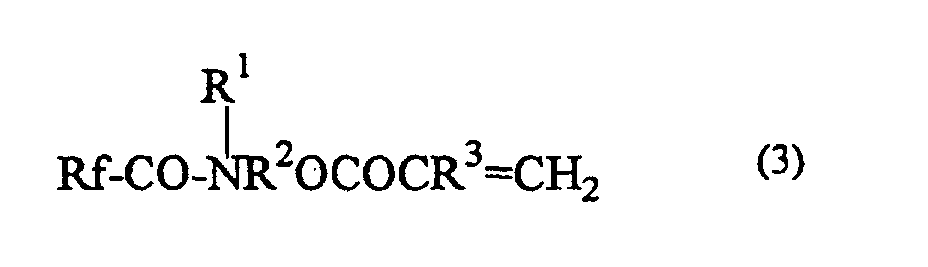


Rf-O-Ar-CH2OCOCR3=CH2
wherein Rf is a perfluoroalkyl or perfluoroalkenyl group
having 3 to 21 carbon atoms,
R1 is a hydrogen atom or an alkyl group having 1 to 10 carbon atoms,
R2 is an alkylene group having 1 to 10 carbon atoms,
R3 is a hydrogen atom or a methyl group,
Ar is an aryl group which optionally has a substituent group, and
n is an integer of 1 to 10.
R1 is a hydrogen atom or an alkyl group having 1 to 10 carbon atoms,
R2 is an alkylene group having 1 to 10 carbon atoms,
R3 is a hydrogen atom or a methyl group,
Ar is an aryl group which optionally has a substituent group, and
n is an integer of 1 to 10.
Specific examples of said polymerizable compound
include:
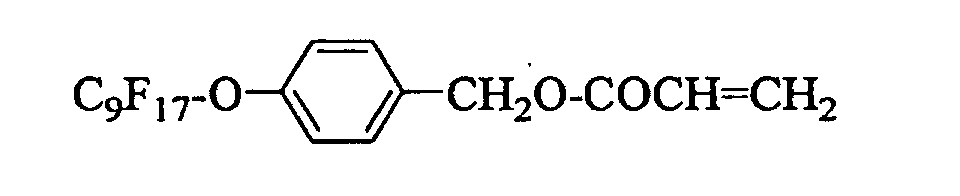

The another copolymerizable compounds are various.
Examples of the another copolymerizable compound include:
(1) acrylic acid and methacrylic acid, and methyl, ethyl,
butyl, isobutyl, t-butyl, propyl, 2-ethylhexyl, hexyl,
decyl, lauryl, stearyl, isobornyl, β-hydroxyethyl, glycidyl,
phenyl, benzyl and 4-cyanophenyl esters thereof; (2) vinyl
esters of fatty acids such as acetic acid, propionic acid,
caprylic acid, lauric acid and stearic acid; (3) styrene
compounds such as styrene, α-methylstyrene and p-methylstyrene;
(4) vinyl halides and vinylidene compounds
such as vinyl fluoride, vinyl chloride, vinyl bromide,
vinylidene fluoride and vinylidene chloride; (5) fatty acid
allyl esters such as allyl heptanoate, allyl caprylate and
allyl caproate; (6) vinyl alkyl ketones such as vinyl
methyl ketone and vinyl ethyl ketone; (7) acryl amides such
as N-methylacrylamide and N-methylolmethacrylamide; and (8)
dienes such as 2,3-dichloro-1,3-butadiene and isoprene.
The dispersant used when the polymerizable compound is
emulsified in water is referred as an "emulsification
dispersant". The emulsification dispersant is preferably a
nonionic surfactant having less than 8 mol of addition
ethylene oxide per one mol of a hydrophobic group, more
preferably a combination (weight ratio: for example, 1:0.01
to 5) of a nonionic surfactant having less than 8 mol of
addition ethylene oxide per one mol of a hydrophobic group
and an ionic surfactant.
The ionic surfactant is a cationic surfactant alone or
an anionic surfactant alone, or a combination of at least
two thereof.
The cationic surfactant includes a quarternary
ammonium salt, an ethylene oxide addition-type ammonium
salt and an amine salt. Specific examples of the cationic
surfactant include alkyl trimethyl ammonium chloride,
dialkyl dimethyl ammonium chloride, alkyl methyl
dipolyoxyethylene ammonium chloride, alkyl amine acetate
salt and alkyldimethylamine hydrochloride salt.
The anionic surfactant includes a fatty acid salt, an
alpha-olefin sulfonate salt, an alkylbenzene sulfonic acid
and salt thereof, an alkyl sulfate ester salt, an
alkylether sulfate ester salt, an alkylphenylether sulfate
ester salt, a methyl taurinate salt, a sulfosuccinate salt
and an ether sulfonate salt.
The amount of the emulsification dispersant may be
from 0.1 to 20 parts by weight, preferably from 1 to 10
parts by weight, based on 100 parts by weight of the
polymerizable compound.
The emulsification dispersant may be the nonionic
surfactant having less than 8 mol of addition ethylene
oxide per one mol of the hydrophobic group. Examples of
such emulsification dispersant include polyoxyethylenealkyl
ether, polyoxyethylenealkylphenyl ether, polyoxyethylene
fatty acid ester, sorbitan fatty acid ester and
polyoxyethylene sorbitan fatty acid ester.
The dispersant added to the emulsion of the
polymerizable compound before polymerization is referred as
a "polymerization dispersant".
The stable aqueous water- and oil-repellent dispersion
composition can be obtained by polymerizing the emulsion
having the desired average particle diameter and
integrating sphere turbidity. Preferably, more stable
aqueous water- and oil-repellent dispersion composition can
be obtained by adding the polymerization dispersant (that
is, the surfactant having at least 8 mol of the addition
ethylene oxide per 1 mol of the hydrophobic group and/or
protective colloid), which prevents the emulsion
destruction, before the polymerization, followed by the
polymerization.
The surfactant having at least 8 mole of the addition
ethylene oxide is not limited, and may be a nonionic or may
have an ionic group (an anionic group and/or a cationic
group). Examples of the nonionic surfactant include
polyoxyethylenealkyl ether, polyoxyethylenealkylphenyl
ether, polyoxyethylene fatty acid ester and polyoxyethylene
sorbitan fatty acid ester. Examples of the surfactant
having the anionic group include an alkylether sulfate
ester salt, an alkylphenylether sulfate ester salt and an
ether sulfonate salt. Examples of the surfactant having
the cationic group include an ethylene oxide addition-type
ammonium salt, an ethylene oxide addition-type alkylamine
and an ethylene oxide addition-type alkylamide.
The protective colloid includes water-soluble
polymeric compounds such as polyvinyl alcohol, polyacrylate
salts, water-soluble starch and water-soluble cellulose
derivatives.
The amount of the polymerizable dispersant may be from
0.1 to 20 parts by weight, preferably from 1 to 10 parts by
weight, based on 100 parts by weight of the polymerizable
compound.
A chain transfer agent such as mercaptan can be also
homogeneously dispersed into the emulsion by dissolving
into the polymerization dispersant.
The emulsification dispersant and the polymerization
dispersant may contain one hydrophobic group, or may
contain at least two hydrophobic groups.
In the emulsification dispersant or the polymerization
dispersant, the value obtained by dividing the number of
mol of addition ethylene oxide contained in one molecule by
the number of the hydrophobic group contained in one
molecule is less than 8 or at least 8. For example, when
using, as the emulsification dispersant, the nonionic
surfactant having a plurality of hydrophobic groups in
molecule, such as polyoxyethylene hardened castor oil,
polyoxyethylene castor oil and polyoxyethylene sorbitol
fatty acid ester, the value obtained by dividing the number
of mol of ethylene oxide by the number of hydrophobic
groups is necessarily less than 8.
Specifically, the present inventors succeeded in that
a fine and extremely stable emulsion can be produced even
in the absence of a solvent and an aqueous water- and oil-repellent
dispersion excellent in storage stability after
the polymerization can be produced by using an optimal
surfactant only for the purpose of obtaining a fine and
stable emulsion in the emulsification and by adding an
optimal surfactant or protective colloid only for the
purpose of obtaining a stable polymer liquid in the
polymerization.
Among the polymerizable compounds which can
copolymerize, it is difficult to emulsify a polymerizable
compound having high volatility together with other
polymerizable compounds. The presence of a large amount of
a polymerizable compound having high water solubility might
change HLB of the emulsifier to prevent the emulsification.
These polymerizable compounds can be copolymerized with the
perfluoroalkyl or perfluoroalkenyl group-containing
(meth)acrylate by emulsifying the other polymerizable
compounds to give desirable average particle diameter and
integrating sphere turbidity and then adding these
polymerizable compounds before the polymerization.
The production method of the present invention is very
useful also in view of practicality.
A substrate which is treated with the dispersion of
the present invention is not limited. Examples of the
substrate include textile, glass, paper, wood, leather,
brick, cement, metal and oxide thereof, ceramics and
plastics. Particularly, the textile in the form of a fiber,
a yarn or fabric is preferable.
The dispersion according to the present invention can
be applied to the substrate preferably by coating, dipping,
spraying, padding, roll coating, or combination of these
procedures. The substrate is padded in the bath, and then
excess liquid is usually removed by a squeezing roll to
give the dry pickup amount (the weight of dry polymer on
the substrate) of from 0.01 to 10 % by weight based on the
weight of the substrate. Then, the treated substrate is
preferably heated at 100-200 °C.
Examples are shown hereinafter to illustrate the
present invention in detail.
Properties are determined as follows:
The emulsification property is evaluated by an average
particle diameter and an integrating sphere turbidity. The
average particle diameter is measured by a dynamic light
scattering method using a laser particle diameter analysis
system LPA-3000. The integrating sphere turbidity is
measured according to an integrating sphere-type
photoelectric light intensity method in JIS K-0101 using a
POIC integrating sphere turbidimeter SEP-PT-706D.
- Good:
- Average particle diameter of at most 100 nm and integrating sphere turbidity of at most 20 (kaolin)
- Fair:
- Either of average particle diameter of at most 100 nm or integrating sphere turbidity of at most 20 (kaolin)
- Poor:
- Average particle diameter of at least 101 nm and integrating sphere turbidity of at least 21 (kaolin)
The aqueous water- and oil-repellent dispersion
composition is filtered with a 400 mesh stainless steel
sieve, and a ratio of the weight of a dried matter
remaining on the sieve to the weight of the whole
composition is determined.
- Good:
- Weight ratio of dried remaining matter is at most 100 ppm based on aqueous water- and oil-repellent dispersion composition
- Fair:
- Weight ratio of dried remaining matter is at least 101 ppm and at most 500 ppm based on aqueous water- and oil-repellent dispersion composition
- Poor:
- Weight ratio of dried remaining matter is at least 501 ppm based on aqueous water- and oil-repellent dispersion composition
The polymer dispersion liquid is diluted with water to
give a treatment liquid having a solid content of 0.08 % by
weight. A polyester fabric is immersed in the treatment
liquid, squeezed with a mangle to give a wet pickup of 65%,
dried at 100°C for two minutes, heated at 160°C for one
minute, and then subjected to an evaluation of water- and
oil-repellency.
The water-repellency is expressed by the water
repellency No. (cf. the following Table 1) determined by
the spray method according to JIS (Japanese Industrial
Standard) L-1092.
The oil-repellency is determined by dropping several
drops of a test solution shown in the following Table 2
according to AATCC-TM118 on two positions of a surface of a
test cloth and observing the penetration state of the drops
after 30 seconds. The maximum point at which the test
solution exhibits no penetration is expressed by the oil-repellency.
| Water repellency No. | State |
| 5 | No wet on the surface |
| 4 | Slight wet on the surface |
| 3 | Partial wet on the surface |
| 2 | Wet on the surface |
| 1 | Wet over the whole surface |
| Oil-repellency | Test solution | Surface tension (dyne/cm, 25°C) |
| 8 | n-Heptane | 20.0 |
| 7 | n-Octane | 21.8 |
| 6 | n-Decane | 23.5 |
| 5 | n-Dodecane | 25.0 |
| 4 | n-Tetradecane | 26.7 |
| 3 | n-Hexadecane | 27.3 |
| 2 | n-Hexadecane/Nujol mixture solution (35/65 by weight) | 29.6 |
| 1 | Nujol | 31.2 |
| 0 | Inferior to 1 | - |
The aqueous dispersion is diluted with tap water to
give a solid content of 0.2 % by weight. The diluted
dispersion is stirred in a homomixer at 3,000 rpm for 10
minutes and generated scum is filtered with a black cotton
fabric.
The aqueous dispersion is diluted with tap water to
give a solid content of 0.6 % by weight. 0.03 % by weight
of a fixing agent for nylon is added to the diluted
dispersion and intimately stirred. The generation of
agglomeration is observed.
After the aqueous dispersion (solid content: 30 % by
weight) is stored at 40°C for one month, the generation of
precipitation is observed.
100 g of CnF2n+1CH2CH2OCOCH=CH2 (n is 6, 8, 10, 12 and 14
(average of n is 8)), 7 g of stearyl acrylate, 3 g of N-methylol
acrylamide, 400 g of pure water, 0.6 g of acetic
acid and 6 g of C12H25O(C2H4O)4H were charged into a 1 L
autoclave and emulsified at 80°C for 20 minutes by means of
ultrasonic wave with stirring. After the emulsification, 1
g of n-dodecylmercaptan previously dispersed in 7 g of
C12H25O(C2H4O)21H was added. Then, 30 g of vinyl chloride was
pressed into the autoclave. 0.8 g of azobisisobutylamidine
dihydrochloride was added and the reaction was conducted
for 5 hours to give an aqueous water- and oil-repellent
dispersion. The emulsification property, the coagulate
amount, the water- and oil-repellency, the mechanical
stability, the chemical stability and the storage stability
of the aqueous water- and oil-repellent dispersion were
evaluated. The results are shown in Table B.
The same procedure as in Example 1 was repeated except
that the type of the surfactant for emulsification, or the
type of the surfactant or protective colloid added prior to
polymerization was changed and the amounts of the
emulsification dispersant and the polymerization dispersant
were the same as shown in Table A. The results are shown
in Table B.
The same procedure as in Example 1 was repeated except
that the type of the surfactant for emulsification, or the
type of the surfactant or protective colloid added prior to
polymerization was changed and the amounts of the
emulsification dispersant and the polymerization dispersant
were the same as shown in Table A. The results are shown
in Table B.
| Surfactant for emulsification | Surfactant or protective colloid added prior to polymerization | ||
| Ex. 1 | C12H25O(C2H4O)4H | C12H25O(C2H4O)21H | |
| Ex. 2 | C12H25O(C2H4O)6H | EO 15 mol addition coconut alkylammonium chloride | |
| Ex. 3 | DSDMACl /STMACl | C12H25O(C2H4O)25H | |
| Ex. 4 | SDOSS | C12H25O(C2H4O)25H | |
| Ex. 5 | SLS | C12H25O(C2H4O)2H | CnH2n+1O(C3H6O)6(C2H4O)20H |
| Ex. 6 | DSDMACl | C12H25O(C2H4O)7H | Polyvinyl alcohol |
| Ex. 7 | DSDMACl | sec - CnH2n+1O(C2H4O)3H | C12H25O(C2H4O)21H |
| Ex. 8 | DSDMACl | sec - CnH2n+1O(C2H4O)5H | EO 15 mol addition coconut alkylammonium chloride |
| Ex. 9 | DSDMACl /STMACl | CnH2n+1O(C2H4)6H | Sorbitan monopalmitate EO 20 mol |
| Ex. 10 | DSDMACl /STMACl | CnH2n+1O(C2H4O)3H | CnH2n+1O(C2H4O)20H |
| Ex. 11 | DSDMACl /STMACl | Sorbitan monocaprylate | CnH2n+1O(C3H6O)6(C2H4O)20H |
| Com. Ex. 1 | DSDMACl /STMACl | CnH2n+1O(C2H4O)10H | CnH2n+1O(C2H4O)20H |
| Com. Ex. 2 | DSDMACl | CnH2n+1O(C2H4O)20H | None |
| Com. Ex. 3 | DSDMACl /STMACl | Methyl cellulose | None |
| Com. Ex. 4 | DSDMACl | C12H25O(C2H4O)2H | None |
| Com. Ex. 5 | DSDMACl /STMACl | CnH2n+1O(C2H4O)3H | None |
| Com. Ex. 6 | SLS | sec-CnH2n+1O(C2H4O)3H | None |
| Com. Ex. 7 | DSDMACl | C12H25O(C2H4O)4H | sec - CnH2n+1O(C2H4O)5H |
| Note: n = 12 to 14 DSDMACl: Distearyldimethylammonium chloride STMACl: Stearyltrimethylammonium chloride SDOSS: Sodium dioctylsulfosuccinate SLS: Sodium laurylsulfonate |
| Emulsification property | Coag. amount | Water- and oil-repellency | Mechanical stability | Chemical stability | Storage stability | ||||||
| Initial | Durability | ||||||||||
| HL-0 | HL-3 | DC-3 | |||||||||
| Water repellency | Oil repel lency | Water repellency | Oil repellency | Water repellency | Oil repellency | ||||||
| Ex. 1 | Good | Good | 5 | 7 | 4 | 5 | 4 | 3 | Good | Good | Good |
| Ex. 2 | Good | Good | 5 | 7 | 5 | 5 | 4 | 4 | Good | Good | Good |
| Ex. 3 | Good | Good | 5 | 6 | 5 | 4 | 4 | 4 | Good | Good | Good |
| Ex. 4 | Good | Good | 4 | 5 | 3 | 4 | 3 | 3 | Good | Good | Good |
| Ex. 5 | Good | Good | 4 | 5 | 3 | 4 | 3 | 3 | Good | Good | Good |
| Ex. 6 | Good | Good | 5 | 6 | 5 | 5 | 4 | 4 | Good | Good | Good |
| Ex. 7 | Good | Good | 5 | 7 | 5 | 5 | 4 | 3 | Good | Good | Good |
| Ex. 8 | Good | Good | 5 | 7 | 4 | 6 | 4 | 4 | Good | Good | Good |
| Ex. 9 | Good | Good | 5 | 7 | 4 | 6 | 4 | 5 | Good | Good | Good |
| Ex. 10 | Good | Good | 5 | 7 | 5 | 6 | 5 | 4 | Good | Good | Good |
| Ex. 11 | Good | Good | 5 | 6 | 4 | 5 | 4 | 4 | Good | Good | Good |
| Com. Ex. 1 | Fair | Good | 4 | 5 | 3 | 2 | 3 | 2 | Good | Good | Fair |
| Com. Ex. 2 | Poor | Fair | 4 | 5 | 3 | 2 | 3 | 2 | Fair | Fair | Fair |
| Com. Ex. 3 | Poor | Fair | 4 | 6 | 2 | 2 | 2 | 1 | Poor | Fair | Fair |
| Com. Ex. 4 | Good | Poor | 5 | 6 | 3 | 3 | 3 | 3 | Poor | Poor | Poor |
| Com. Ex. 5 | Good | Poor | 5 | 7 | 4 | 4 | 4 | 3 | Poor | Poor | Poor |
| Com. Ex. 6 | Good | Poor | 4 | 5 | 2 | 2 | 2 | 1 | Poor | Good | Poor |
| Com. Ex. 7 | Good | Poor | 5 | 6 | 4 | 4 | 4 | 2 | Fair | Poor | Poor |
According to the present invention, the aqueous water-and
oil-repellent dispersion free of an organic solvent and
having durable water- and oil-repellency and excellent
storage stability can be obtained.
Claims (6)
- An aqueous water- and oil-repellent dispersion composition comprising a polymer obtained by polymerizing an emulsion of a polymerizable compound wherein the polymerizable compound is emulsified into water so that an average particle diameter is at most 100 nm and an integrating sphere turbidity is at most 20 (kaolin), at least one polymerization dispersant selected from the group consisting of surfactants having at least 8 mol of added ethylene oxide per one hydrophobic group and protective colloids is added to the emulsion of the polymerizable compound before the polymerization, and the emulsion of the polymerizable compound is free of an organic solvent.
- The aqueous water- and oil-repellent dispersion composition according to claim 1, wherein an emulsification dispersant is used for the purpose of emulsifying the polymerizable compound so that an average particle diameter is at most 100 nm and an integrating sphere turbidity is at most 20 (kaolin), and said emulsification dispersant is an ionic surfactant and/or a nonionic surfactant having less than 8 mol of added ethylene oxide per one hydrophobic group.
- An aqueous water- and oil-repellent dispersion composition comprising:(A) a homopolymer or copolymer comprising at least one polymerizable compound having a perfluoroalkyl or perfluoroalkenyl group and an acrylate or methacrylate group, or a copolymer comprising said polymerizable compound and another polymerizable compound copolymerizable therewith,(B) an emulsification dispersant comprising an ionic surfactant and/or a nonionic surfactant having less than 8 mol of added ethylene oxide per one hydrophobic group, which emulsification dispersant is used for emulsifying the polymerizable compound, and(C) a polymerization dispersant comprising a nonionic surfactant having at least 8 mol of added ethylene oxide per one hydrophobic group and/or a protective colloid, which polymerization dispersant is added after the emulsion of the polymerizable compound is prepared and before the polymerization.
- The aqueous water- and oil-repellent dispersion composition according to anyone of claims 1 to 3, wherein a water-soluble or volatile polymerizable compound is added after the emulsification and before the polymerization.
- A method of producing an aqueous water- and oil-repellent dispersion composition comprising:emulsifying a polymerizable compound into water so. that an average particle diameter is at most 100 nm and an integrating sphere turbidity is at most 20 (kaolin);adding, before the polymerization, at least one polymerization dispersant selected from the group consisting of surfactants having at least 8 mol of added ethylene oxide per one hydrophobic group and protective colloids to prepare an emulsion of the polymerizable compound free of an organic solvent; andpolymerizing the polymerizable compound to form a polymer.
- A treated material which is obtained by treating a substrate with the composition according to anyone of claims 1 to 4.
Applications Claiming Priority (3)
| Application Number | Priority Date | Filing Date | Title |
|---|---|---|---|
| JP2000286964 | 2000-09-21 | ||
| JP2000286964 | 2000-09-21 | ||
| PCT/JP2001/007929 WO2002024828A1 (en) | 2000-09-21 | 2001-09-13 | Aqueous dispersion of water- and oil-repellent and process for the production thereof |
Publications (2)
| Publication Number | Publication Date |
|---|---|
| EP1338637A1 true EP1338637A1 (en) | 2003-08-27 |
| EP1338637A4 EP1338637A4 (en) | 2008-03-05 |
Family
ID=18770793
Family Applications (1)
| Application Number | Title | Priority Date | Filing Date |
|---|---|---|---|
| EP01965598A Withdrawn EP1338637A4 (en) | 2000-09-21 | 2001-09-13 | AQUEOUS DISPERSION OF WATER AND OLEOFUGE OF ITS MANUFACTURING PROCESS |
Country Status (4)
| Country | Link |
|---|---|
| US (1) | US6894106B2 (en) |
| EP (1) | EP1338637A4 (en) |
| JP (1) | JP5298399B2 (en) |
| WO (1) | WO2002024828A1 (en) |
Cited By (6)
| Publication number | Priority date | Publication date | Assignee | Title |
|---|---|---|---|---|
| EP1801133A1 (en) | 2005-12-19 | 2007-06-27 | Lanxess Deutschland GmbH | Curable fluorinated copolymers and coatings and processes thereof |
| EP1820809A1 (en) | 2006-02-17 | 2007-08-22 | Lanxess Deutschland GmbH | Coating of substrates with curable fluorinated copolymers |
| EP1788047A4 (en) * | 2004-08-25 | 2011-12-21 | Daikin Ind Ltd | HYDROFUGE / OLEOFUGE COMPOSITION |
| CN102605616A (en) * | 2012-03-16 | 2012-07-25 | 李民旭 | A method of imparting persistent and durable hydrophobicity to fibrous structures |
| CN105026637A (en) * | 2012-07-17 | 2015-11-04 | 菱衣商业有限公司 | Permanent/durable waterproofing method for fiber structures |
| CN112063079A (en) * | 2020-09-19 | 2020-12-11 | 上海普信高分子材料有限公司 | Low-carbon chain organic fluorine-based oil-repellent composition and preparation method thereof |
Families Citing this family (15)
| Publication number | Priority date | Publication date | Assignee | Title |
|---|---|---|---|---|
| CH695946A5 (en) * | 2000-04-04 | 2006-10-31 | Schoeller Technologies Ag | Finishing of textile fibers, tissues and fabrics. |
| EP1477543A4 (en) * | 2002-01-21 | 2007-10-31 | Daikin Ind Ltd | AQUEOUS DISPERSION WATERPROOFING AND OIL |
| US7678155B2 (en) * | 2003-04-08 | 2010-03-16 | Daikin Industries, Ltd. | Water- and oil-repellent treatment of textile |
| CN1871207A (en) * | 2003-10-27 | 2006-11-29 | 西巴特殊化学品普法希股份有限公司 | Perfluoroalkyl substituted acrylate monomers and polymers thereof |
| WO2005063827A1 (en) * | 2003-12-25 | 2005-07-14 | Daikin Industries, Ltd. | Process for producing fluoropolymer |
| DE602004012324T2 (en) * | 2003-12-31 | 2009-03-19 | 3M Innovative Properties Co., St. Paul | WATER- AND OIL-REPELLENT FLUOROACRYLATE |
| KR100807451B1 (en) * | 2004-04-20 | 2008-02-25 | 다이킨 고교 가부시키가이샤 | Water- and Oil-Repellent Composition and Process for Production Thereof |
| EP1781683B1 (en) * | 2004-08-24 | 2011-11-16 | BTG International Limited | Process for the preparation of 17-vinyl- triflates as intermediates |
| US7253241B2 (en) * | 2004-12-28 | 2007-08-07 | 3M Innovative Properties Company | Fluorochemical containing low adhesion backsize |
| US20060142530A1 (en) * | 2004-12-28 | 2006-06-29 | Moore George G | Water- and oil-repellent fluorourethanes and fluoroureas |
| US7291688B2 (en) * | 2004-12-28 | 2007-11-06 | 3M Innovative Properties Company | Fluoroacrylate-mercaptofunctional copolymers |
| US7964657B2 (en) * | 2007-03-23 | 2011-06-21 | Peach State Labs, Inc. | Polymeric dispersions and applications thereof |
| PL2459641T3 (en) * | 2009-07-31 | 2017-04-28 | 3M Innovative Properties Company | Fluoropolymer compositions containing a polyol compound and methods of making them |
| KR101497971B1 (en) | 2013-10-24 | 2015-03-06 | 함병수 | After the anti-fog spray that does not wipe |
| CN105254997A (en) * | 2015-09-01 | 2016-01-20 | 上海大学 | Manufacture method for super-hydrophobic plastic |
Family Cites Families (29)
| Publication number | Priority date | Publication date | Assignee | Title |
|---|---|---|---|---|
| US3062765A (en) * | 1957-04-03 | 1962-11-06 | Minnesota Mining & Mfg | Emulsion polymerization of water insoluble ethylenic monomers |
| DE1248945B (en) * | 1959-08-10 | 1967-08-31 | Minnesota Mining and Manufacturing Company, St Paul, Minn (V St A) | Process for the production of fluorine-containing block copolymers |
| US3403122A (en) * | 1967-12-22 | 1968-09-24 | Minnesota Mining & Mfg | Emulsion polymerization of water insoluble omega-(n-perfluoroalkanesulfonyl) aminoalkyl acrylates or methacrylates |
| US4728707A (en) * | 1985-03-18 | 1988-03-01 | Daikin Industries Ltd. | Water- and oil-repellent |
| US4742140A (en) * | 1986-01-23 | 1988-05-03 | E. I. Du Pont De Nemours And Company | Oil- and water-repellent copolymers |
| US4831092A (en) * | 1986-09-08 | 1989-05-16 | Exxon Research And Engineering Company | Micellar process for preparing hydrophobically functionalized cationic polymers (C-2114) |
| DE4026097A1 (en) * | 1990-08-17 | 1992-02-20 | Hoechst Ag | AQUEOUS DISPERSION OF FLUORINE POLYMERS |
| JP2968364B2 (en) * | 1991-02-27 | 1999-10-25 | 旭硝子株式会社 | Water and oil repellent and water and oil repellent composition with excellent durability |
| JPH0778154B2 (en) | 1991-07-11 | 1995-08-23 | ヘキスト合成株式会社 | Method for producing aqueous fluorinated acrylic copolymer emulsion and composition thereof |
| JP2660312B2 (en) | 1992-05-29 | 1997-10-08 | ヘキスト合成株式会社 | Fluorine-containing water- and oil-repellent composition |
| JPH05345810A (en) * | 1992-06-15 | 1993-12-27 | Toagosei Chem Ind Co Ltd | Dispresion of fluorine-containing water-base resin |
| JP3484708B2 (en) * | 1992-07-15 | 2004-01-06 | 旭硝子株式会社 | Water / oil repellent composition |
| JPH07179528A (en) * | 1993-12-21 | 1995-07-18 | N O K Kluber Kk | Production of high-flash point emulsion type water and oil repellent |
| US5531913A (en) * | 1995-03-10 | 1996-07-02 | Eastman Kodak Company | Haze-free transparent film-forming aqueous coating compositions for magnetic recording layers |
| JP3463391B2 (en) * | 1995-01-26 | 2003-11-05 | 旭硝子株式会社 | Water-dispersed fluorine-based water / oil repellent composition with improved antifouling properties |
| US5830934A (en) * | 1995-10-27 | 1998-11-03 | Reichhold Chemicals, Inc. | Colloidally stabilized emulsion polymer |
| DE69728545T2 (en) * | 1996-06-13 | 2005-02-24 | Daikin Industries, Ltd. | NEW COPOLYMER, METHOD FOR ITS MANUFACTURE AND ITS USE |
| JPH108041A (en) * | 1996-06-21 | 1998-01-13 | Daikin Ind Ltd | Water-dispersed fluorine-based water / oil repellent |
| DE19628142A1 (en) | 1996-07-12 | 1998-01-15 | Basf Ag | Process for the preparation of aqueous polymer dispersions with a bimodal particle size distribution |
| US5889097A (en) * | 1996-10-03 | 1999-03-30 | Cytec Technology Corp. | Anionic water-soluble polymer precipitation in salt solution |
| US6015838A (en) * | 1996-11-04 | 2000-01-18 | 3M Innovative Properties Company | Aqueous film-forming foam compositions |
| US5731379A (en) | 1997-01-03 | 1998-03-24 | Dow Corning Corporation | Copolymers of polyorganosiloxane, polyisobutylene, and alkyl acrylates or methacrylates |
| US5840813A (en) | 1997-01-03 | 1998-11-24 | Dow Corning Corporation | Homopolymerization of acrylate or methacrylate endblocked polydiorganosiloxanes |
| JP3624615B2 (en) * | 1997-02-28 | 2005-03-02 | ユニマテック株式会社 | Novel copolymer and water / oil repellent containing the same |
| JP3876495B2 (en) | 1997-09-12 | 2007-01-31 | ユニマテック株式会社 | Water and oil repellent and method for producing the same |
| JP3721772B2 (en) * | 1998-03-06 | 2005-11-30 | ユニマテック株式会社 | Water and oil repellent |
| FR2781487B1 (en) | 1998-07-10 | 2000-12-08 | Atochem Elf Sa | EMULSION POLYMERIZATION IN THE PRESENCE OF A STABLE FREE RADICAL |
| JP2000160149A (en) | 1998-11-30 | 2000-06-13 | Asahi Glass Co Ltd | Water-dispersed composition for water- and oil-repellent and method for producing the same |
| JP2000212549A (en) * | 1999-01-25 | 2000-08-02 | Asahi Glass Co Ltd | Water / oil repellent composition and method for producing the same |
-
2001
- 2001-09-13 JP JP2002529228A patent/JP5298399B2/en not_active Expired - Fee Related
- 2001-09-13 EP EP01965598A patent/EP1338637A4/en not_active Withdrawn
- 2001-09-13 US US10/380,569 patent/US6894106B2/en not_active Expired - Lifetime
- 2001-09-13 WO PCT/JP2001/007929 patent/WO2002024828A1/en not_active Ceased
Cited By (7)
| Publication number | Priority date | Publication date | Assignee | Title |
|---|---|---|---|---|
| EP1788047A4 (en) * | 2004-08-25 | 2011-12-21 | Daikin Ind Ltd | HYDROFUGE / OLEOFUGE COMPOSITION |
| EP1801133A1 (en) | 2005-12-19 | 2007-06-27 | Lanxess Deutschland GmbH | Curable fluorinated copolymers and coatings and processes thereof |
| EP1820809A1 (en) | 2006-02-17 | 2007-08-22 | Lanxess Deutschland GmbH | Coating of substrates with curable fluorinated copolymers |
| CN102605616A (en) * | 2012-03-16 | 2012-07-25 | 李民旭 | A method of imparting persistent and durable hydrophobicity to fibrous structures |
| CN105026637A (en) * | 2012-07-17 | 2015-11-04 | 菱衣商业有限公司 | Permanent/durable waterproofing method for fiber structures |
| CN112063079A (en) * | 2020-09-19 | 2020-12-11 | 上海普信高分子材料有限公司 | Low-carbon chain organic fluorine-based oil-repellent composition and preparation method thereof |
| CN112063079B (en) * | 2020-09-19 | 2022-06-24 | 上海普信高分子材料有限公司 | Low-carbon chain organic fluorine-based oil-repellent composition and preparation method thereof |
Also Published As
| Publication number | Publication date |
|---|---|
| WO2002024828A1 (en) | 2002-03-28 |
| EP1338637A4 (en) | 2008-03-05 |
| JPWO2002024828A1 (en) | 2004-01-29 |
| US6894106B2 (en) | 2005-05-17 |
| US20040014873A1 (en) | 2004-01-22 |
| JP5298399B2 (en) | 2013-09-25 |
Similar Documents
| Publication | Publication Date | Title |
|---|---|---|
| US6894106B2 (en) | Aqueous dispersion of water- and oil-repellent and process for the production thereof | |
| CN102149738B (en) | Water and oil repellent compositions | |
| KR102513179B1 (en) | surface treatment agent | |
| KR101816464B1 (en) | Fluorine-containing polymer and treatment agent | |
| JP2011515503A (en) | Fluoropolymer and water / oil repellent | |
| EP0609456A1 (en) | Soil remover for dry cleaning | |
| JPS62577A (en) | Water and oil repellent material | |
| CA2725486C (en) | Method for producing an aqueous emulsion | |
| JP3744035B2 (en) | Water-dispersed water / oil repellent composition with excellent stability | |
| TWI260343B (en) | A water and oil repellent aqueous dispersion | |
| JP4760707B2 (en) | Water / oil repellent composition and process for producing the same | |
| JP2010222382A (en) | Fluorine-containing fiber finishing agent with dirt release properties | |
| KR101185652B1 (en) | Fluorine-containing fiber processing agent having alcohol repellency and soil release properties | |
| KR20130076756A (en) | Surface treating agent | |
| JP2005272557A (en) | Method for producing acrylic copolymer | |
| JP5125625B2 (en) | Fluoropolymer and antifouling agent | |
| JPS6150082B2 (en) | ||
| EP1767547A1 (en) | Soil release agent containing fluorine-containing copolymer and method for producing same | |
| JP2002220539A (en) | Water-dispersed fluorine-based copolymer composition | |
| JP3484708B2 (en) | Water / oil repellent composition | |
| JPH06287548A (en) | Production of water-dispersible fluorine-based water-and oil-repellent composition | |
| JP2000044936A (en) | Water / oil repellent composition and method for producing the same | |
| JP2003105675A (en) | Water-absorbing and oil-repelling stain-proofing agent for natural fiber and fiber product treated thereby | |
| JPWO2000061696A1 (en) | Water and oil repellent aqueous dispersion |
Legal Events
| Date | Code | Title | Description |
|---|---|---|---|
| PUAI | Public reference made under article 153(3) epc to a published international application that has entered the european phase |
Free format text: ORIGINAL CODE: 0009012 |
|
| 17P | Request for examination filed |
Effective date: 20030408 |
|
| AK | Designated contracting states |
Designated state(s): AT BE CH CY DE DK ES FI FR GB GR IE IT LI LU MC NL PT SE TR |
|
| RBV | Designated contracting states (corrected) |
Designated state(s): AT BE CH DE FR GB LI |
|
| A4 | Supplementary search report drawn up and despatched |
Effective date: 20080201 |
|
| 17Q | First examination report despatched |
Effective date: 20080721 |
|
| STAA | Information on the status of an ep patent application or granted ep patent |
Free format text: STATUS: THE APPLICATION IS DEEMED TO BE WITHDRAWN |
|
| 18D | Application deemed to be withdrawn |
Effective date: 20100421 |