EP1337090A1 - Procédé de sélection d'un format de codage dans un terminal - Google Patents
Procédé de sélection d'un format de codage dans un terminal Download PDFInfo
- Publication number
- EP1337090A1 EP1337090A1 EP03290206A EP03290206A EP1337090A1 EP 1337090 A1 EP1337090 A1 EP 1337090A1 EP 03290206 A EP03290206 A EP 03290206A EP 03290206 A EP03290206 A EP 03290206A EP 1337090 A1 EP1337090 A1 EP 1337090A1
- Authority
- EP
- European Patent Office
- Prior art keywords
- terminals
- server
- coding
- multimedia data
- terminal
- Prior art date
- Legal status (The legal status is an assumption and is not a legal conclusion. Google has not performed a legal analysis and makes no representation as to the accuracy of the status listed.)
- Withdrawn
Links
- 238000000034 method Methods 0.000 title claims abstract description 11
- 230000005540 biological transmission Effects 0.000 claims abstract description 29
- 238000006243 chemical reaction Methods 0.000 claims abstract description 20
- 238000010187 selection method Methods 0.000 claims 2
- 230000000717 retained effect Effects 0.000 description 4
- 230000000903 blocking effect Effects 0.000 description 2
- 230000000712 assembly Effects 0.000 description 1
- 238000000429 assembly Methods 0.000 description 1
- 230000000977 initiatory effect Effects 0.000 description 1
Images

Classifications
-
- H—ELECTRICITY
- H04—ELECTRIC COMMUNICATION TECHNIQUE
- H04L—TRANSMISSION OF DIGITAL INFORMATION, e.g. TELEGRAPHIC COMMUNICATION
- H04L69/00—Network arrangements, protocols or services independent of the application payload and not provided for in the other groups of this subclass
- H04L69/24—Negotiation of communication capabilities
-
- H—ELECTRICITY
- H04—ELECTRIC COMMUNICATION TECHNIQUE
- H04L—TRANSMISSION OF DIGITAL INFORMATION, e.g. TELEGRAPHIC COMMUNICATION
- H04L65/00—Network arrangements, protocols or services for supporting real-time applications in data packet communication
- H04L65/1066—Session management
- H04L65/1101—Session protocols
-
- H—ELECTRICITY
- H04—ELECTRIC COMMUNICATION TECHNIQUE
- H04L—TRANSMISSION OF DIGITAL INFORMATION, e.g. TELEGRAPHIC COMMUNICATION
- H04L65/00—Network arrangements, protocols or services for supporting real-time applications in data packet communication
- H04L65/1066—Session management
- H04L65/1101—Session protocols
- H04L65/1104—Session initiation protocol [SIP]
-
- H—ELECTRICITY
- H04—ELECTRIC COMMUNICATION TECHNIQUE
- H04L—TRANSMISSION OF DIGITAL INFORMATION, e.g. TELEGRAPHIC COMMUNICATION
- H04L65/00—Network arrangements, protocols or services for supporting real-time applications in data packet communication
- H04L65/1066—Session management
- H04L65/1101—Session protocols
- H04L65/1106—Call signalling protocols; H.323 and related
-
- H—ELECTRICITY
- H04—ELECTRIC COMMUNICATION TECHNIQUE
- H04L—TRANSMISSION OF DIGITAL INFORMATION, e.g. TELEGRAPHIC COMMUNICATION
- H04L65/00—Network arrangements, protocols or services for supporting real-time applications in data packet communication
- H04L65/60—Network streaming of media packets
- H04L65/70—Media network packetisation
-
- H—ELECTRICITY
- H04—ELECTRIC COMMUNICATION TECHNIQUE
- H04L—TRANSMISSION OF DIGITAL INFORMATION, e.g. TELEGRAPHIC COMMUNICATION
- H04L65/00—Network arrangements, protocols or services for supporting real-time applications in data packet communication
- H04L65/60—Network streaming of media packets
- H04L65/75—Media network packet handling
- H04L65/765—Media network packet handling intermediate
Definitions
- the invention relates to a method for selecting coding formats.
- multimedia data in a communication system comprising at least at least two terminals capable of exchanging multimedia data between them.
- Multimedia data includes all types of digitized data such as voice (telephony), text or video (Images).
- the present invention will be more particularly described in the communication systems framework with terminals operating according to the SIP protocol (for Session Initiation protocol in Anglo-Saxon terminology) or the H323 protocol without being visible any limitation of the scope of the invention to this type of system Communication.
- said terminals select a coding format to use so that any data coded multimedia transmitted by either terminal can be decoded by the terminal receiving said multimedia data.
- all communication system terminals do not necessarily have the same means for coding and / or decoding multimedia data.
- Figure 1 illustrates the selection of a data encoding format multimedia in a communication system with two terminals T1 and T2 operating according to the SIP protocol.
- the two T1 and T2 terminals seek to exchange multimedia data.
- the terminal T1 selects, for this sending, an encoding format which it can apply to the multimedia data to be sent and that the T2 terminal can process on receipt.
- the terminal T2 must select an encoding format which it can apply to the multimedia data to be transmitted and that the terminal T1 can process on receipt.
- the terminal T1 communicates with the terminal T2, via a proxy server S (proxy server in English terminology), a set of coding formats grouping together the coding formats it is able to apply to multimedia data in transmission and those it is able to process on reception.
- This set is hereinafter called E1.
- the corresponding assembly associated with the terminal T2 is denoted E2.
- the terms broadcast coding format and reception coding of a given terminal respectively designate a encoding format that this terminal is capable of applying to data that it transmits and a coding format that it is capable of decoding into reception.
- This step of communication of the assembly E1 to the server S then at terminal T2 is represented in figure 1 by two arrows connecting respectively the terminal T1 to the server S and the server S to the terminal T2, above which the instruction INVITE (E1) is affixed.
- the terminal T2 is capable of decoding at least one format of transmission coding of the set E1 (case where at least one of the formats of reception coding of the set E2 corresponds to at least one of the transmission coding formats of the set E1)
- the transmission of multimedia data from terminal T1 to terminal T2 can take place and the coding format that will be used by the T1 terminal to code the data to be transmitted from T1 to T2 will be one of those that the T2 terminal is able to decode.
- the terminal T2 if the terminal T2 cannot decode any of the formats of transmission coding of the set E1 (none of the coding formats of reception of the set E2 does not correspond to a coding format E1), the data transmission from T1 to T2 is impossible. This case is illustrated in Figure 1.
- the T2 terminal then warns the terminal T1 via the proxy server S. This step is represented in Figure 1 by two arrows connecting the terminal T2 to the server S and the server S at terminal T1, above which instruction 606 is affixed No Acceptable.
- An object of the invention is to minimize these situations of blocking.
- An immediate solution would be to increase the capacity of coding and decoding of each of the terminals of the communication.
- Another solution would be to standardize capacities coding and decoding of the terminals of the communication system, that is to say to provide a system in which all the terminals would have identical coding and decoding means.
- These two solutions represent a high financial cost since they require either numerous means of coding and decoding for each terminal of the system, i.e. regular updating of coding and decoding means of all the terminals so that they all have substantially the same encoding and decoding formats and, preferably, the most Recent.
- the idea underlying the invention is to enrich virtually all coding formats for each terminal in the system when it is transmitted to another terminal.
- each system terminal further includes means for selecting a reception encoding format among those it is capable of processing in reception and that the other of said two terminals is capable of applying in emission according to its completed set and / or a coding format emission among those that he is able to apply in emission and that the other of said two terminals is capable of processing reception according to its set completed.
- the server S is connected to means intended to convert, if necessary, the format of coding of multimedia data exchanged between the terminals of the system.
- the server S when the server S receives a set of coding formats, it completes it, if necessary for data exchange and if possible, depending on the conversion means at its disposal.
- FIG. 2 which relates, as in Figure 1, to a communication system comprising two SIP, T1 and T2 terminals, and a proxy server S.
- the 3 steps of Figure 1 represented by the INVITE (E1), INVITE (E1) and 606 Not Acceptable are shown in Figure 2.
- the S server knows that terminal T2 is unable to decode data coded multimedia from terminal T1.
- the server S invites the terminal T2 to communicate its set of coding formats, E2.
- This step is represented in the figure by the INVITE () instruction.
- the terminal T2 communicates its whole E2 to the server S (instruction 200 OK (E2)).
- the server S then completes the set E2 received according to the means of conversion at its disposal.
- the server S is in relationship with C1, C2 coding format conversion means via a media gateway P.
- the step to complete the coding format sets received by server S can be illustrated through a very simple example. For example, if the set E2 received by the server S understands the format of coding A and that the conversion means make it possible to convert the coding format A into coding format B, the set E2 completed will consist of coding formats A and B.
- the server S then communicates the completed E2 set to terminal T1 (instruction 200 OK (E2 completed)).
- the terminal T1 selects a transmission coding format which belongs to both the transmission coding formats of the set E1 and to the reception coding formats of the set E2. He selects also a receiving encoding format that belongs to both reception coding formats of the E1 set and coding formats of emission of the set E2.
- the terminal T1 then communicates to the server S the formats of transmission and reception coding that it has retained (ACK instruction).
- the S server changes these encoding formats to match respectively to a reception encoding format and a reception format transmission coding of the E2 assembly, then transmits them thus modified to the terminal T2.
- the server S reserves with the media gateway P the resources required to convert the formats of coding retained by the terminal T1.
- Multimedia data transmission between terminals T1 and T2 can then take place according to the coding formats selected. These multimedia data pass through the media gateway P which converts, using the conversion circuits reserved by the server S, the format of multimedia data coding if necessary.
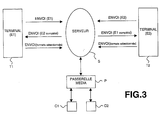
- FIG. 3 illustrates the selection of coding format in a communication system comprising terminals operating according to the H323 protocol.
- the system includes two terminals, T1 and T2, a server S which is here an access controller server, and C1 and C2 coding format conversion means connected to the server S via a media gateway P.
- the latter Before any exchange multimedia data between terminals T1 and T2, the latter both communicate their sets of coding formats, E1 and E2 respectively, to server S.
- the server S completes said assemblies, depending on the conversion means at its disposal, so that a multimedia data transmission between the terminals T1 and T2 is possible.
- the server S then communicates the completed E1 set to terminal T2 and the set E2 completed at terminal T1.
- Each of the terminals T1 and T2 then selects a transmission coding format and reception as in the system of figure 2.
- Each terminal then communicates to the server S the coding formats it has selected so that the server reserves the means with the media gateway to conversion necessary to pass coding formats retained by the terminal T1 to those retained by terminal T2.
Landscapes
- Engineering & Computer Science (AREA)
- Multimedia (AREA)
- Computer Networks & Wireless Communication (AREA)
- Signal Processing (AREA)
- Business, Economics & Management (AREA)
- General Business, Economics & Management (AREA)
- Computer Security & Cryptography (AREA)
- Communication Control (AREA)
- Telephonic Communication Services (AREA)
- Two-Way Televisions, Distribution Of Moving Picture Or The Like (AREA)
- Computer And Data Communications (AREA)
Abstract
Description
caractérisé en ce que, avant tout échange de données multimédia entre deux terminaux du système de communication, il comporte les étapes suivantes :
- au moins l'un des deux terminaux communique son ensemble de formats de codage à un serveur du système de communication en relation avec des moyens de conversion du format de codage des données multimédia destinées à être échangées,
- le serveur complète, si nécessaire pour l'échange de données multimédia, le ou chaque ensemble de formats de codage reçu d'un desdits deux terminaux en fonction des moyens de conversion à sa disposition et le communique à l'autre desdits deux terminaux, et
- chaque terminal recevant un ensemble complété de l'autre desdits deux terminaux sélectionne un format de codage de réception parmi ceux qu'il est capable de traiter en réception et que l'autre desdits deux terminaux est capable d'appliquer en émission selon son ensemble complété et/ou un format de codage d'émission parmi ceux qu'il est capable d'appliquer en émission et que l'autre desdits deux terminaux est capable de traiter en réception selon son ensemble complété. On augmente ainsi, de manière virtuelle, les capacités de codage des terminaux du système. L'invention concerne également un système de communication comportant
- au moins deux terminaux aptes à échanger des données multimédia entre eux, chaque terminal disposant d'un ensemble de formats de codage regroupant ceux qu'il est capable de traiter en réception et ceux qu'il est capable d'appliquer aux données multimédia en émission,
- un serveur pour transmettre, avant tout échange de données multimédia entre deux terminaux du système de communication, l'ensemble de formats de codage d'au moins l'un desdits deux terminaux vers l'autre,
et en ce que le serveur complète, si nécessaire pour l'échange de données multimédia, le ou chaque ensemble de formats de codage reçus de l'un desdits deux terminaux en fonction des moyens de conversion à sa disposition avant de le communiquer à l'autre desdits deux terminaux.
- la figure 1, déjà décrite, illustre la sélection d'un format de codage dans un système de communication de l'art antérieur ;
- la figure 2 illustre la sélection d'un format de codage conforme à l'invention dans un système de communication comprenant deux terminaux SIP ; et
- la figure 3 illustre la sélection d'un format de codage conforme à l'invention dans un système de communication comprenant deux terminaux H323.
Claims (8)
- Procédé de sélection de formats de codage de données multimédia dans un système de communication comportant au moins deux terminaux (Ti) aptes à échanger des données multimédia entre eux, chaque terminal (Ti) disposant d'un ensemble de formats de codage (Ei) regroupant ceux qu'il est capable de traiter en réception et ceux qu'il est capable d'appliquer aux données multimédia en émission,
caractérisé en ce que, avant tout échange de données multimédia entre deux terminaux du système de communication, il comporte les étapes suivantes :au moins l'un des deux terminaux communique son ensemble de formats de codage à un serveur (S) du système de communication en relation avec des moyens de conversion (C1,C2) du format de codage des données multimédia destinées à être échangées,le serveur (S) complète, si nécessaire pour l'échange de données multimédia, le ou chaque ensemble de formats de codage reçu d'un desdits deux terminaux en fonction des moyens de conversion à sa disposition et le communique à l'autre desdits deux terminaux, etchaque terminal recevant un ensemble complété de l'autre desdits deux terminaux sélectionne un format de codage de réception parmi ceux qu'il est capable de traiter en réception et que l'autre desdits deux terminaux est capable d'appliquer en émission selon son ensemble complété et/ou un format de codage d'émission parmi ceux qu'il est capable d'appliquer en émission et que l'autre desdits deux terminaux est capable de traiter en réception selon son ensemble complété. - Procédé de sélection selon la revendication 1, caractérisé en ce que lesdits terminaux (Ti) fonctionnent selon le protocole SIP et en ce que le serveur (S) est un serveur mandataire.
- Procédé de sélection selon la revendication 1, caractérisé en ce que lesdits terminaux (Ti) fonctionnent selon le protocole H323 et en ce que le serveur (S) est un contrôleur d'accès.
- Système de communication comportantcaractérisé en ce que le serveur (S) est connecté à des moyens de conversion (C1,C2) du format de codage des données multimédia destinées à être échangées,au moins deux terminaux (Ti) aptes à échanger des données multimédia entre eux, chaque terminal (Ti) disposant d'un ensemble de formats de codage (Ei) regroupant ceux qu'il est capable de traiter en réception et ceux qu'il est capable d'appliquer aux données multimédia en émission,un serveur (S) pour transmettre, avant tout échange de données multimédia entre deux terminaux du système de communication, l'ensemble de formats de codage d'au moins l'un desdits deux terminaux vers l'autre,
et en ce que le serveur (S) complète, si nécessaire pour l'échange de données multimédia, le ou chaque ensemble de formats de codage reçus de l'un desdits deux terminaux (Ti) en fonction des moyens de conversion (C1,C2) à sa disposition avant de le communiquer à l'autre desdits deux terminaux. - Système de communication selon la revendication 4, caractérisé en ce que chaque terminal (Ti) comporte en outre des moyens pour sélectionner un format de codage de réception parmi ceux qu'il est capable de traiter en réception et que l'autre desdits deux terminaux est capable d'appliquer en émission selon son ensemble complété et/ou un format de codage d'émission parmi ceux qu'il est capable d'appliquer en émission et que l'autre desdits deux terminaux est capable de traiter en réception selon son ensemble complété.
- Système de communication selon la revendication 4 ou 5, caractérisé en ce que le serveur (S) est connecté aux moyens de conversion (C1,C2) par l'intermédiaire d'une passerelle média (P).
- Système de communication selon l'une des revendications précédentes, caractérisé en ce que lesdits terminaux (Ti) fonctionnent selon le protocole SIP et en ce que le serveur (S) est un serveur mandataire.
- Système de communication selon l'une des revendications 4 à 6, caractérisé en ce que lesdits terminaux (Ti) fonctionnent selon le protocole H323 et en ce que le serveur (S) est un contrôleur d'accès.
Applications Claiming Priority (2)
| Application Number | Priority Date | Filing Date | Title |
|---|---|---|---|
| FR0202016A FR2836323B1 (fr) | 2002-02-18 | 2002-02-18 | Procede de selection d'un format de codage dans un terminal d'un systeme de communication |
| FR0202016 | 2002-02-18 |
Publications (1)
| Publication Number | Publication Date |
|---|---|
| EP1337090A1 true EP1337090A1 (fr) | 2003-08-20 |
Family
ID=27620259
Family Applications (1)
| Application Number | Title | Priority Date | Filing Date |
|---|---|---|---|
| EP03290206A Withdrawn EP1337090A1 (fr) | 2002-02-18 | 2003-01-28 | Procédé de sélection d'un format de codage dans un terminal |
Country Status (3)
| Country | Link |
|---|---|
| US (1) | US20030156568A1 (fr) |
| EP (1) | EP1337090A1 (fr) |
| FR (1) | FR2836323B1 (fr) |
Families Citing this family (2)
| Publication number | Priority date | Publication date | Assignee | Title |
|---|---|---|---|---|
| FI20055552A7 (fi) * | 2005-10-11 | 2007-04-12 | Teliasonera Ab | Menetelmä, järjestelmä ja välipalvelin IP-yhteispalveluntarjontaverkkoa varten |
| US8127036B2 (en) * | 2006-06-30 | 2012-02-28 | Microsoft Corporation | Remote session media data flow and playback |
Citations (2)
| Publication number | Priority date | Publication date | Assignee | Title |
|---|---|---|---|---|
| WO2000070885A1 (fr) * | 1999-05-17 | 2000-11-23 | Telefonaktiebolaget Lm Ericsson (Publ) | Negociation relative a la capacite dans un reseau de telecommunications |
| WO2001003401A1 (fr) * | 1999-07-02 | 2001-01-11 | Nokia Corporation | Commande de connexion pour canaux logiques separes dans un support multimedia h.323 |
Family Cites Families (3)
| Publication number | Priority date | Publication date | Assignee | Title |
|---|---|---|---|---|
| US6415434B1 (en) * | 1999-06-18 | 2002-07-02 | Hewlett-Packard Company | Apparatus and method for a runtime method overloading resolver |
| US7002989B2 (en) * | 2000-04-10 | 2006-02-21 | At&T Corp. | Method and apparatus for S.I.P./H. 323 interworking |
| US6970935B1 (en) * | 2000-11-01 | 2005-11-29 | International Business Machines Corporation | Conversational networking via transport, coding and control conversational protocols |
-
2002
- 2002-02-18 FR FR0202016A patent/FR2836323B1/fr not_active Expired - Fee Related
-
2003
- 2003-01-28 EP EP03290206A patent/EP1337090A1/fr not_active Withdrawn
- 2003-02-13 US US10/365,466 patent/US20030156568A1/en not_active Abandoned
Patent Citations (2)
| Publication number | Priority date | Publication date | Assignee | Title |
|---|---|---|---|---|
| WO2000070885A1 (fr) * | 1999-05-17 | 2000-11-23 | Telefonaktiebolaget Lm Ericsson (Publ) | Negociation relative a la capacite dans un reseau de telecommunications |
| WO2001003401A1 (fr) * | 1999-07-02 | 2001-01-11 | Nokia Corporation | Commande de connexion pour canaux logiques separes dans un support multimedia h.323 |
Also Published As
| Publication number | Publication date |
|---|---|
| FR2836323B1 (fr) | 2004-11-26 |
| FR2836323A1 (fr) | 2003-08-22 |
| US20030156568A1 (en) | 2003-08-21 |
Similar Documents
| Publication | Publication Date | Title |
|---|---|---|
| US7779134B1 (en) | Using modem profiles to improve connectivity, connect timing, and compression performance on a modem relay (MR) gateway | |
| US7949375B2 (en) | Reliability for wireless data communications | |
| CN101163143A (zh) | 用在tcp/ip通信网络中的轻量级协议 | |
| CN101964705B (zh) | 通信设备、通信系统、通信方法、通信程序、通信电路 | |
| KR100433629B1 (ko) | 인터넷 팩스 데이터의 오류 제어 방법 | |
| US7738887B2 (en) | Voice instant messaging between mobile and computing devices | |
| US6493325B1 (en) | Method and apparatus for providing telephony over a computer network | |
| CN113162675A (zh) | 基于窄带卫星通信的数据传输系统、方法、装置及电子设备 | |
| EP1337090A1 (fr) | Procédé de sélection d'un format de codage dans un terminal | |
| EP1411704A1 (fr) | Dispositif et procédé pour l'établissement de canaux de transmission | |
| US7590132B2 (en) | In-band negotiation in single transcompression scenarios related applications | |
| US20070115917A1 (en) | MTOM data transfer via TCP | |
| WO2002025896A2 (fr) | Procede de contrôle d'une passerelle media | |
| CN101112069B (zh) | 通信设备、通信系统、通信方法、通信电路 | |
| US7512694B2 (en) | Wireless communications invisible proxy and hooking systems and methods | |
| FR2702578A1 (fr) | Système de communication avec un réseau. | |
| EP1428373A2 (fr) | Passerelle protocolaire entre un terminal h.323 et un autre terminal, sans mise en oeuvre du r le de ma tre | |
| FR2847405A1 (fr) | Procede de gestion de messages, systeme et entites de communication pour la mise en oeuvre du procede | |
| WO2023152447A1 (fr) | Fragmentation de paquets | |
| CN114531428A (zh) | 云对讲方法、装置、系统及网关 | |
| KR20030089390A (ko) | 데이터 송수신 시스템 | |
| FR2886797A1 (fr) | Procede de communication entre un point de commande de services d'un reseau intelligent et un serveur externe, point de commande, serveur externe, systeme et programmes d'ordinateur associes | |
| PERCIVAL et al. | Efficient transfer of images over networks(Abstract Only) | |
| FR2865332A1 (fr) | Procede de transfert de donnees entre un premier et un second terminal, de telecommunication | |
| FR2892254A1 (fr) | Procede de telecommunication pour un reseau du type ims, serveur et terminal implementant un tel procede |
Legal Events
| Date | Code | Title | Description |
|---|---|---|---|
| PUAI | Public reference made under article 153(3) epc to a published international application that has entered the european phase |
Free format text: ORIGINAL CODE: 0009012 |
|
| AK | Designated contracting states |
Designated state(s): AT BE BG CH CY CZ DE DK EE ES FI FR GB GR HU IE IT LI LU MC NL PT SE SI SK TR |
|
| AX | Request for extension of the european patent |
Extension state: AL LT LV MK RO |
|
| 17P | Request for examination filed |
Effective date: 20040220 |
|
| AKX | Designation fees paid |
Designated state(s): AT BE BG CH CY CZ DE DK EE ES FI FR GB GR HU IE IT LI LU MC NL PT SE SI SK TR |
|
| 17Q | First examination report despatched |
Effective date: 20061129 |
|
| RAP1 | Party data changed (applicant data changed or rights of an application transferred) |
Owner name: ALCATEL LUCENT |
|
| STAA | Information on the status of an ep patent application or granted ep patent |
Free format text: STATUS: THE APPLICATION IS DEEMED TO BE WITHDRAWN |
|
| 18D | Application deemed to be withdrawn |
Effective date: 20070411 |