The present invention relates to a call charging method as described
in the preamble of claim 1, a call server being adapted to perform the method
as described in the preambles of claim 9.
Such a charging method is already known in the art, e.g. from the
INTERNET DRAFT "IP Multimedia Charging requirements on Diameter Accounting"
with reference draft-olsson-ip-multimedia-charging-reqs-00.txt by Patrik Olsson,
published in November 2001.
Therein, a call charging method for charging user agents, called SIP
clients is disclosed. These user agents are charged for the use of the transport
network, called the bearer resources, in a Next generation network. Such a next
generation network, called an Internet Protocol Multimedia network in the cited
Internet draft is set up as a layered network. A first layer of such next generation
network is the transport layer that provides in the establishment of the media
bearers between two or more user agents. The establishment of these media
bearers between two or more user agents is performed under control of the call
control which is located in call servers, called the SIP POC servers and a
multimedia session establishment protocol, called the session initiation protocol
SIP executed by such call server and each of the user agents. These call servers
are located at a second layer of such a next generation network, the session
layer.
Additionally, there is a third layer holding service intelligence, which is
placed above the session layer, i.e. the application layer.
Charging for the resources in use in this communication session is
supported in the call servers by logging of information in a Charge data record.
Special charging applications such as a prepaid server are situated at the
application layer and get the required information over an interface with the
session layer.
The user agents consume resources at the bearer level. To charge the
use of these resources a number of parameters are determined and forwarded
for logging in the CDR or communicated to the charging related applications in
the application layer. To properly reflect the used transport resources, these
parameters may comprise the duration of the session, characteristics reflecting
the quality of the session and possibly the volume of data exchanged.
To avoid theft of service, charging must count for all resources used
during a call. Exchange of media information between the user agents is realised
over the transport layer, without involving the session layer where charging is
situated.
However, besides the media-transfer on the transport layer, there is
still another way wherein a (SIP) user agent is able to send data towards another
(SIP) user agent. This is attained by adding user-to-user data to the (SIP)
signalling messages (a possibility with SIP is to add a body that needs to be
rendered to the involved user agents). Such a user-to-user data-transfer is
included in signalling messages is disclosed in Internet Draft "SIP: Session
Initiation Protocol" with reference draft-ietf-sip-rfc2543bis-05.txt by Jonathan
Rosenberg et. Al., published by the Internet Engineering Task Force at October
26, 2001.
Since this user-to-user information is comprised in the signalling
message, which is not subject to the charging mechanisms as described above,
this data transfer cannot be charged currently.
An object of the present invention is to provide a call charging
method, a call server of the above known type but wherein it is enabled to
charge such user-to-user data include in a signalling message.
According to the invention, this object is achieved by the charging
method described in claim 1 and the network element as described in claim 12
Indeed, by analysing the signalling messages transferred between the
user agents and a call server for determining an amount of non-signalling
information comprised in any of the signalling messages and subsequently
processing this amount of non-signalling information for charging
purposes, the transfer of non-signalling information may be charged.
An additional characteristic feature of the present invention is
described in claim 2 and claim 13.
The analysing of the signalling messages for determining an
amount of non-signalling information is achieved by counting an amount
of data exceeding a predetermined amount of data carried by each said
signalling message.
An alternative characteristic feature of the present invention is
described in claim 3 and claim 14.
The analysing of the signalling messages for determining an
amount of non-signalling information is achieved by counting the amount of
data carried by each body to be rendered to a user agent.
A further additional characteristic feature of the present invention is
described in claim 4 and d claim 15.
The processing is determining online a charge based on the
amount of non-signalling information included in said signalling messages.
Another additional characteristic feature of the present invention is
described in claim 5 and claim 16.
The processing is forwarding the amount of non-signalling data
to a server for including the amount of non-signalling data in a charging
record.
Still a further characteristic feature of the present invention is
described in claim 6 and claim 17.
The processing may also be forwarding the amount of non-signalling
data to an application server for calculating an online charging.
A characteristic feature of the present invention is described in claim 7
and claim 18.
The analysing of the signalling messages for determining an amount
of non-signalling information in each of said signalling messages is performed
by a call server.
A characteristic feature of the present invention is described in claim 8
and claim 19.
The analysing of the signalling messages for determining an amount
of non-signalling information in each of said signalling messages is performed
by an application server for calculating an online charging.
Another characteristic feature of the present invention is described in
claim 9.
The signalling messages are Session Initiation Protocol signalling
messages.
Another characteristic feature of the present invention is described in
claim 10.
The next generation network is a Universal Mobile
Telecommunication System (UMTS) network.
Still an alternative characteristic feature of the present invention is
described in claim 11.
The next generation network may also be an Internet Protocol
multimedia network.It is to be noticed that the term 'comprising', used in the
claims, should not be interpreted as being restricted to the means listed thereafter.
Thus, the scope of the expression 'a device comprising means A and B' should not
be limited to devices consisting only of components A and B. It means that with
respect to the present invention, the only relevant components of the device are A
and B.
Similarly, it is to be noticed that the term 'coupled', also used in the
claims, should not be interpreted as being restricted to direct connections only.
Thus, the scope of the expression 'a device A coupled to a device B' should not be
limited to devices or systems wherein an output of device A is directly connected to
an input of device B. It means that there exists a path between an output of A and
an input of B which may be a path including other devices or means.
The above and other objects and features of the invention will become
more apparent and the invention itself will be best understood by referring to the
following description of an embodiment taken in conjunction with the
accompanying drawings wherein:
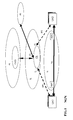
In the following paragraphs, referring to the drawings, an
implementation of the charging method and the related call server according to
the present invention will be described. In the first paragraph of this description
the main elements of the UMTS next generation network as presented in FIG. 1
are described. In the second paragraph, all connections between the before
mentioned elements and described means are defined. Subsequently all relevant
functional means of the mentioned call server as presented in FIG.2 are
described followed by a description of all interconnections. In the succeeding
paragraph the actual execution of the method for session establishment is
described.
Such UMTS next generation network comprises a large number of
user agents, however in order to keep simplicity in this description it is chosen to
only present two user agents UA1, UA2.
Moreover there are policy enforcement point PEP1, PEP2 for controlling the data
exchange. Such a policy enforcement point PEP1, PEP2 blocks data which is not
conform to the characteristics agreed during the reservation phase, since it is not
being charged for. The user agent and the policy enforcement point are situated
at the transport Layer TL.
Additionally there is at least one a call server CS supporting a
multimedia session establishment protocol, in this embodiment chosen to be the
Session Initiation Protocol further referred to as SIP which is situated at the
session layer SL. In this embodiment only one call server is described, again for
sake of simplicity, although such a network may comprise a plurality of such call
servers. The session initiation protocol is the protocol used in such a UMTS next
generation network for establishing a communication session between at least
two user agents UA1, UA2.
Additionally there is an Accounting Server AS that deals with the call
charging details received from the call server CS and therefrom generates
Charging detail records CDRs.
Further within the application layer AL, there is an online charging
server OLCS that is able to calculate online the current charge of a data-transfer
based on the call charging details received from the call server CS.
These user agents UA1, UA2 are coupled to each other over a
transmission link TLI of the Transport Layer TL of the UMTS network, here being
an UMTS air link.
Each of the user agents is coupled to this Transport Link TL via a
policy enforcement point PEP located in the transport layer TL.
The call server CS is coupled to the first user agent UA1 over a first
signalling path SP1 and coupled to the second user agent UA2 over a second
signalling path SP2. Such signalling paths SP1, SP2 again may be UMTS air
links. The Accounting server AS is coupled to the call server CS over an Internet
Protocol Link and the Online Charging Server OLCS is coupled over an IP-link to
the Call Server CS.
The call server CS of the UMTS next generation network is presented in Fig. 2.
Essential elements of the call server CS are the signalling reception means SRM
that is able to receive the SIP signalling message from a first user agent UA1 and
hand the message over to the signalling handling means SHM that is adapted to
handle the establishment of a communication session between at least two user
agents UA1, UA2. Further there is a signalling forwarding means SFM that is
able to forward the received SIP signalling message towards the second user
agent UA2. Additionally there is a signalling message analysing means SMAM
that is adapted to analyse the signalling messages for determining an amount of
non-signalling information that is included in each of said signalling messages.
The analysing of the signalling messages for determining an amount of non-signalling
information that is included in each of said signalling messages may
be performed by determining the length of a certain message above a certain
length threshold value or by counting the amount of data carried by all bodies
which should be rendered to the user agent. It is to be remarked that such a
body is an element of a SIP signalling message for carrying non-signalling
information. Alternatively, this may be determined by counting the amount of
message information that is not identified as strictly required for signalling or by
any other method that gives a measure of the carried amount of non-signalling
information Furthermore, there is an amount processing means APM that is
able to process the amount of non-signalling information for charging
purposes.
The signalling reception means SRM has an input-terminal that is at
the same time input I1 of the call server CS. The signalling reception means SRM
is further coupled with an output to an input of the signalling handling means
SHM which in its turn coupled is with an output to an input of the signalling
forwarding means SFM. The signalling forwarding means SFM has an output-terminal
that is at the same time an output-terminal O1 of the call server CS. The
signalling reception means SRM is additionally coupled with an output to an
input of the signalling message analysing means SMAM that is coupled with an
output to an input of the amount processing means APM. The amount
processing means APM has an output-terminal that is at the same time an
output-terminal O2 of the call server CS.
In order to explain the operation of the present invention it is assumed
that a communication session is to be established between the first user agent,
the calling user agent UA1 and the second user agent, the called user agent
UA2. Thereto it is assumed that the first user agent UA1, the calling user agent,
generates a SIP INVITE signalling message, that is transmitted via the call server
CS serving the calling party towards the called user agent UA2. This SIP
signalling message contains a description of the required media as proposed by
the calling user agent UA1. The signalling message reception means SRM of the
Call server CS receives the INVITE message and subsequently hands over the
message to the signalling handling means SHM that is adapted to handle the
establishment of a communication session between both user agents UA1, UA2
and additionally to the signalling message analysing means SMAM. Further there
is a signalling forwarding means SFM that is able to forward the received SIP
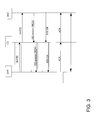
INVITE signalling message towards the second user agent UA2. (FIG. 3
represents the signalling flow with respect to the call set-up of a communication
session involving both user agents UA1, UA2). User agent UA2 receives the SIP
INVITE signalling message.
The called user agent UA2 replies to this invite with a SIP "183 session
progress" signalling message indicating the media description as acceptable to
him.
The session layer reserves resources at the transport layer that fulfil the
needs expressed in the message exchange described above, at the same time
informing the PEP about the allowed resource consumption. Use of these
resources is however still blocked.
When the called user agent UA2 answers the call by transmitting a SIP
"200 OK" signalling message via the involved call server CS to the calling user
agent UA1, the call server CS will open the resources. Assuming that the moment
of answer is the moment that charging will start, this time will be logged in the
CDR to make charging in function of duration possible, if charging related
application servers (such as a the online charging server OLCS or a prepaid
server) are involved, they will be informed about this event.
During the conversation phase of the session, the user agents UA1,
UA2 exchange data without involving the session layer SL but only the Transport
Layer TL. The data exchange is however controlled by the PEP, data that is not
conform to the characteristics agreed during the reservation phase will be
blocked, since it is not being charged for.
It is to be noticed that, although it is not completely described, the call
server CS also comprises reception means and forwarding means for the
opposite signalling message direction, from the called user agent UA2 towards
the calling user agent UA1. The signalling flow within the call server CS is bidirectional
and all signalling messages are being treated in an analogue way as
is described for the SIP INVITE signalling message.
In this way both parties have agreed on the establishment of the
communication session. Finally an acknowledgement message ACK is sent from
the first user agent UA1 towards the second user agent UA2 to acknowledge the
establishment of the call.
The ending of a communication session is indicated by sending a BYE
message to the in the communication session involved parties, the BYE message
also indicates that the charging is to be ended which is communicated to the
charging related devices, the accounting server and/or the online charging
server OLCS.
In the mean time the signalling message analysing means SMAM
determines by analysing the INVITE signalling messages for determining an
amount of non-signalling information that is included in the INVITE signalling
message. The signalling message analysing means SMAM checks the bodies of
the INVITE message.
Alternatively this amount also may be determined by counting the
amount of data that exceeds a certain to be predetermined amount of data,
wherein it is supposed that the first amount is signalling data and the subsequent
amount of data above the first amount is user-to-user data. Or any other
appropriate method could be used.
The amount of non signalling data as determined by the signalling
message analysing means SMAM is handed over to the amount processing
means APM, that is able to process the amount of non-signalling
information for charging purposes. The amount processing means APM is
adapted to forward the determined amount of non-signalling information
towards an accounting server AS together with information identifying the user
agent to be charged for generating charging detail records. The determined
amount of user-to-user data being non-signalling information may
additionally be forwarded to an application server for calculating an online
charging such as the online charging Server OLCS.
In the mean time the signalling message analysing means SMAM
determines by analysing the INVITE signalling messages for determining an
amount of non-signalling information that is included in the INVITE signalling
message. The signalling message analysing means SMAM checks the bodies of
the INVITE message.
Alternatively this amount also may be determined by counting the
amount of data that exceeds a certain to be predetermined amount of data,
wherein it is supposed that the first amount is signalling data and the subsequent
amount of data above the first amount is user-to-user data. Or any other
appropriate method could be used.
The amount of non signalling data as determined by the signalling
message analysing means SMAM is handed over to the amount processing
means APM, that is able to process the amount of non-signalling
information for charging purposes. The amount processing means APM is
adapted to forward the determined amount of non-signalling information
towards an accounting server AS together with information identifying the user
agent to be charged for generating charging detail records. The determined
amount of user-to-user data being non-signalling information may
additionally be forwarded to an application server for calculating an online
charging such as the online charging Server OLCS.
In addition to the previously described embodiment, the entire
Signalling message may be forwarded by a call server to an application
server for online charging. This application server may analyse the
signalling message itself, in the same way as is described for the call
server, and based on the determined amount of non-signalling information
the application server may online determine the charge for the transferred
non-signalling information in signalling messages.
Another additional embodiment is that a network element, other
than the call server or the application server for online charging, is able to
perform the analysing the signalling messages for determining an amount
of non-signaling information, i.e user-to-user information included in a
signalling message and may subsequently forward the amount of non-signalling
data for further processing of the charging of the transferred
data.
Each of the SIP signalling messages forwarded between user agents
along a call server is to be analysed by the signalling message analysing means
SMAM in the same way as is done with respect to the INVITE signalling message
as each such message may carry user-to-user data. Especially SIP INFO
messages are suitable for including user-to-user data and as a consequence
should be analysed well.
Furthermore it should be noticed that, although an UMTS network is
described, any next generation network such as an Internet Protocol Multimedia
network may be equally applicable.
Another remark is that embodiments of the present invention are
described above in terms of functional blocks. From the functional description of
these blocks it will be obvious for a person skilled in the art of designing
electronic devices how embodiments of these blocks can be manufactured with
well-known electronic components. A detailed architecture of the contents of the
functional blocks hence is not given for most of them.
While the principles of the invention have been described above in
connection with specific apparatus, it is to be clearly understood that this
description is made only by way of example and not as a limitation on the scope
of the invention, as defined in the appended claims.