EP1336891A1 - Production method for spectacle lens and supply system for spectacle lens - Google Patents
Production method for spectacle lens and supply system for spectacle lens Download PDFInfo
- Publication number
- EP1336891A1 EP1336891A1 EP01976840A EP01976840A EP1336891A1 EP 1336891 A1 EP1336891 A1 EP 1336891A1 EP 01976840 A EP01976840 A EP 01976840A EP 01976840 A EP01976840 A EP 01976840A EP 1336891 A1 EP1336891 A1 EP 1336891A1
- Authority
- EP
- European Patent Office
- Prior art keywords
- lens
- lenses
- spectacle
- prescription
- optical performance
- Prior art date
- Legal status (The legal status is an assumption and is not a legal conclusion. Google has not performed a legal analysis and makes no representation as to the accuracy of the status listed.)
- Granted
Links
Images





Classifications
-
- G—PHYSICS
- G06—COMPUTING OR CALCULATING; COUNTING
- G06Q—INFORMATION AND COMMUNICATION TECHNOLOGY [ICT] SPECIALLY ADAPTED FOR ADMINISTRATIVE, COMMERCIAL, FINANCIAL, MANAGERIAL OR SUPERVISORY PURPOSES; SYSTEMS OR METHODS SPECIALLY ADAPTED FOR ADMINISTRATIVE, COMMERCIAL, FINANCIAL, MANAGERIAL OR SUPERVISORY PURPOSES, NOT OTHERWISE PROVIDED FOR
- G06Q10/00—Administration; Management
- G06Q10/04—Forecasting or optimisation specially adapted for administrative or management purposes, e.g. linear programming or "cutting stock problem"
-
- G—PHYSICS
- G02—OPTICS
- G02C—SPECTACLES; SUNGLASSES OR GOGGLES INSOFAR AS THEY HAVE THE SAME FEATURES AS SPECTACLES; CONTACT LENSES
- G02C13/00—Assembling; Repairing; Cleaning
- G02C13/003—Measuring during assembly or fitting of spectacles
-
- G—PHYSICS
- G06—COMPUTING OR CALCULATING; COUNTING
- G06Q—INFORMATION AND COMMUNICATION TECHNOLOGY [ICT] SPECIALLY ADAPTED FOR ADMINISTRATIVE, COMMERCIAL, FINANCIAL, MANAGERIAL OR SUPERVISORY PURPOSES; SYSTEMS OR METHODS SPECIALLY ADAPTED FOR ADMINISTRATIVE, COMMERCIAL, FINANCIAL, MANAGERIAL OR SUPERVISORY PURPOSES, NOT OTHERWISE PROVIDED FOR
- G06Q10/00—Administration; Management
- G06Q10/08—Logistics, e.g. warehousing, loading or distribution; Inventory or stock management
- G06Q10/087—Inventory or stock management, e.g. order filling, procurement or balancing against orders
-
- G—PHYSICS
- G06—COMPUTING OR CALCULATING; COUNTING
- G06Q—INFORMATION AND COMMUNICATION TECHNOLOGY [ICT] SPECIALLY ADAPTED FOR ADMINISTRATIVE, COMMERCIAL, FINANCIAL, MANAGERIAL OR SUPERVISORY PURPOSES; SYSTEMS OR METHODS SPECIALLY ADAPTED FOR ADMINISTRATIVE, COMMERCIAL, FINANCIAL, MANAGERIAL OR SUPERVISORY PURPOSES, NOT OTHERWISE PROVIDED FOR
- G06Q30/00—Commerce
- G06Q30/06—Buying, selling or leasing transactions
Definitions
- This invention relates to a supply system equipped with a lens design function, with which a spectacle lens with good appearance and optical performance can be obtained even when the difference in prescription, such as the diopter, between the left and right eyes is over a specific amount, and furthermore with which optical performance can be taken into account when the wearer changes his or her prescription and new spectacles are produced, or when the eyewear history of a customer is updated.
- lenses of the same refractive power are prescribed when the left and right eyes both have the same visual acuity, so the curvature of the first refractive surface and the second refractive surface is also the same, and the optical performance, such as astigmatism, curvature of field, and distortion, is also the same. If the visual acuity of the left and right eyes is not the same, however, lenses having different refractive power (diopter) will of course be prescribed.
- Tscherning's ellipse which Tscherning discovered as a geometric solution for eliminating astigmatism of a spectacle lens
- the optimal base curve for eliminating astigmatism (the refractive power of the first refractive surface) varies. Consequently, if the visual acuity differs between the left and right eyes, the base curve of the left and right lenses must also be different according to Tscherning's ellipse.
- the same base curve is sometimes used within a specific diopter range in order to lower the manufacturing costs.
- lenses manufactured by this method may have a base curve that is not exactly optimal, so a problem is that the optical performance is inevitably inferior.
- juvenile myopia tends to increase over time up to a certain age, and this is accompanied by changes in the prescription values for the spectacle lenses.
- Some wearers are physiologically sensitive to changes in prescription values. That is, they experience severe discomfort when they wear lenses manufactured with a new prescription, and in some cases the body itself may be affected. These symptoms may appear even in regular customers, although not pronounced.
- lenses having a curved surface shape and so forth that match this new prescription are newly designed and manufactured for supply to the customer.
- the newly designed and manufactured lenses that match the new prescription it is not uncommon for the newly designed and manufactured lenses that match the new prescription to have optical performance (astigmatism, curvature of field, and distortion) that is different from the optical performance of the old lenses designed to match the old prescription.
- the difference in optical performance has been a serious problem, one that occurs due to a diopter difference in prescription lenses resulting from differences between the left and right eyes, or to a diopter difference between new and old lenses.
- the existing spectacle lens supply systems mentioned above merely involved having the ordering side (such as an optician) specify lenses to a lens manufacturer, who then supplied the lenses, and no function was in place for solving the above-mentioned problem.
- the present invention was conceived in light of the above situation, and it is an object thereof to provide a spectacle lens manufacturing method and a spectacle lens supply method with which good optical performance and good appearance can be both be achieved.
- the first means for solving the above problem is a spectacle lens supply method, in which a computer is set up on a spectacle lens order side and a computer that is connected to this order-side computer such that information can be mutually exchanged is provided on the manufacturer side, and spectacle lenses are supplied by having the order-side computer and the manufacturer-side computer perform computations according to specific input operations and perform the processing required for the taking and/or placing of orders for spectacle lenses while exchanging information with each other, characterized in that when spectacle lens information, spectacle frame information, prescription values, layout information, processing instructions information, and other such processing condition data required for processing is transmitted by the order-side computer to the manufacturer-side computer, a lens design program installed on the manufacturer-side computer performs optical lens design tailored to the customer on the basis of the transmitted data for lens information so that the optical performance of the left and right lenses will be similar, and the lenses are manufactured according to this design.
- the second means is the spectacle lens supply method according to the first means, wherein the lens design program further performs optical lens design that approximates the left and right base curves to each other.
- the third means is the spectacle lens supply method according to the first means, wherein the optical performance consists of at least one of astigmatism, curvature of field, and distortion.
- the fourth means is the spectacle lens supply method according to the first means, comprising the steps of:
- the fifth means is the spectacle lens supply method according to the second means, wherein the optical lens design is such that the difference in convex surface base curves of the left and right spectacle lenses is no more than 1 D.
- the sixth means is the spectacle lens supply method according to the second means, wherein a display means for comparing data including the lens shape before the curve matching and the prescription data for this lens, to data including the lens shape after the curve matching and the prescription data for this lens, is transferred to and displayed at the computer set up on the side where spectacle lens is ordered.
- the seventh means is a spectacle lens supply system, comprising a computer set up on a spectacle lens order side and a manufacturer-side computer that is information exchangeably connected to this order-side computer and has a customer database including spectacle lens prescription data and lens design data,
- the order-side computer and the manufacturer-side computer perform computations according to specific input operations and perform the processing required for the taking and/or placing of orders for spectacle lenses while exchanging information with each other
- the manufacturer-side computer has the function of performing lens design such that a customer will experience substantially no discomfort originating in an optical performance difference when changing from old to new lenses
- new design data for a lens on the basis of customer spectacle lens processing condition data required for processing, such as spectacle lens information, spectacle frame information, prescription values, layout information, and processing instructions information, when this data is transmitted from the order-side computer to the manufacturer-side computer, and making the optical performance of the new lenses produced with this new design data approximate the optical performance of the old lenses produced with the old design data based on the old prescription values of the pre-registered customer database.
- the eighth means is a spectacle lens supply system, comprising a computer set up on a spectacle lens order side and a manufacturer-side computer that is information exchangeably connected to this order-side computer and has a customer database including spectacle lens prescription data and lens design data,
- the order-side computer and the manufacturer-side computer perform computations according to specific input operations and perform the processing required for the taking and placing of orders for spectacle lenses while exchanging information with each other, wherein, when customer spectacle lens processing condition data required for processing, such as spectacle lens information, spectacle frame information, prescription values, layout information, and processing instructions information, is transmitted from the order-side computer to the manufacturer-side computer, the manufacturer-side computer has the function of performing processing comprising:
- the ninth means is the spectacle lens supply system according to the seventh or eighth means, wherein the newly determined new design data is registered for the first time or updated in the customer database.
- the tenth means is the spectacle lens supply system according to the seventh or eighth means, wherein, when there is old prescription data for the customer, a step is provided for comparing the difference between the old and new prescription values, and if this difference is not over 0.5 D as the diopter difference, the new lens design data for the new prescription values is selected or produced without performing the optical performance comparison step, and this data is set as the design data for producing the new lenses.
- the eleventh means is the spectacle lens supply system according to the seventh or eighth means, wherein the lens design data is such that the difference in the curve of a first refractive surface of the left and right spectacle lenses is no more than 1 D.
- the twelfth means is the spectacle lens supply system according to the seventh or eighth means, wherein the optical performance is at least one of astigmatism, curvature of field, and distortion.
- the thirteenth means is the spectacle lens supply system according to the seventh or eighth means, wherein the curvature of at least one of the first refractive surfaces of the left and right spectacle lenses is selected such that this curved surface will be aspherical.
- the fourteenth means is a method for manufacturing a spectacle lens, involving the design and manufacture of left and right spectacle lenses that make up a pair of spectacles in which the prescription including diopter is different for the left and right eyes, wherein, if there is more than a specific amount of difference in the prescription including diopter between the left and right eyes: when the refractive surfaces in front of the left and right spectacle lenses are termed the first refractive surfaces and the refractive surfaces on the eye side are termed the second refractive surfaces, in designing the curvature of the curved surfaces of the first and second refractive surfaces of the left and right spectacle lenses, the curvature of the first and second refractive surfaces of at least one of the left and right spectacle lenses is selected so that the left and right spectacle lenses satisfy their respective prescription conditions including the diopter so that the difference in the curvature of the first refractive surfaces between the left and right spectacle lenses falls within a specific range.
- the fifteenth means is a method for manufacturing a spectacle lens, involving the design and manufacture of left and right spectacle lenses that make up a pair of spectacles in which the prescription including diopter is different for the left and right eyes, wherein, if there is more than a specific amount of difference in the prescription including diopter between the left and right eyes: when the refractive surfaces in front of the left and right spectacle lenses are termed the first refractive surfaces and the refractive surfaces on the eye side are termed the second refractive surfaces, in designing the curvature of the curved surfaces of the first and second refractive surfaces of the left and right spectacle lenses, the curvature of the first and second refractive surfaces of at least one of the left and right spectacle lenses is selected so that the left and right spectacle lenses satisfy their respective prescription conditions including the diopter, so that the optical performance of each lens falls within an acceptable range, and so that the difference in the curvature of the first refractive surfaces between the left and right spectacle lenses falls within a specific range.
- the sixteenth means is the method for manufacturing a spectacle lens pertaining to the fourteenth or fifteenth means, wherein the difference in the diopter between the left and right eyes is at least 0.5 D when the diopter prescription out of said prescription including the diopter includes a positive diopter, the difference in the diopter between the left and right eyes is at least 1 D when the diopter prescription includes a negative diopter, and the difference in the curvature of the first refractive surfaces of the left and right spectacle lenses is no more than 1 D.
- the seventeenth means is the method for manufacturing a spectacle lens pertaining to the fifteenth means, wherein the optical performance consists of one or more of astigmatism, curvature of field, and distortion.
- the eighteenth means is the method for manufacturing a spectacle lens pertaining to the fifteenth means, wherein the curvature of one or both of the first refractive surfaces of the left and right spectacle lenses is selected such that this curved surface will be aspherical.
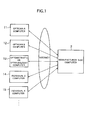
- Fig. 1 is a diagram illustrating the simplified structure of the spectacle lens supply system pertaining to an embodiment
- Fig. 2 is a diagram illustrating the auto-entry screen on which the type of lens is specified
- Fig. 3 is a block diagram of a manufacturer-side computer
- Fig. 4 is a diagram illustrating an example of part of the contents of a customer database.
- computers 11, 12, 13, 14, and 15 are installed as order-side terminal computers at optician offices A and B, an optometrist or opthalmologist office C, and individuals D and E, respectively. These are connected to a manufacturer-side computer 2 via the Internet or a dedicated communications line.
- the order-side terminal computers 11, 12, 13, 14, and 15 are part of a system that allows orders for spectacle lenses to be placed by exchanging information with the manufacturer-side computer 2 according to the instructions on a screen.
- information related to producing spectacles such as prescription values, lens information, frame information, and layout information
- the order type such as unmachined circular lens, beveled lens, or spectacles
- the instructions on the screen the result being that the data necessary for that order is supplied from the manufacturer-side computer 2 and the order processed.
- Fig. 2 is a diagram illustrating the auto-entry screen used to specify the type of lens.
- the type of lens is specified in section 61. That is, the manufacturer's product category code is inputted, which specifies the lens material, refractive index, coating, lens coloring, optical design of the lens surface, outside diameter, and so forth.
- the "type” in section 65 specifies whether the lens being ordered or inquired about is a lens that has already been beveled (HELP) or one that has yet to undergo edging or beveling.
- the "METS machining” in section 65 specifies machining so that the thickness of the lens will be the minimum required, or specifies chamfering to smooth off the edges of negative lens, or polishing of this portion.
- “binocular vision balance design” includes, of course, having the left and right lenses satisfy the prescription conditions within the specified range, but also means keeping the difference in optical performance between the left and right lenses within the specified range, and also keeping the difference in curvature (base curve) of the first surfaces (first refractive surfaces) of the left and right lenses within the specified range, and thereby striking a good balance between left and right in terms of appearance when the spectacles are worn, and making the spectacles more attractive.
- Fig. 2 illustrates a case in which "yes” has already been specified on the order side for the binocular vision balance design, but the lens design program in this example automatically checks the binocular vision in both eyes.
- a software menu is displayed at the bottom of the auto-entry screen in Fig. 2.
- Displayed on the screen here are a send key for sending registered data, a register key for registering the screen inputted data, an order key for switching the screen to the order screen, a clear key, a page specification key, and an end key for ending a registration.
- These screen keys are selected by using the function keys on the keyboard of the terminal computer 11, for instance.
- the color of the lens is specified in section 61.
- the prescription values for the lens are inputted on the left side in section 62, and similarly, machining instructions for the lens are inputted on the ride side in section 62, information about the spectacle frame is inputted in section 63, and layout information such as the PD, NPD (near PD), SEG (segment cylinder position, ET (minimum edge thickness), and EP (eye point), as well as the beveling mode and the beveling form (including beveling position) is inputted in section 64.
- the layout information specifies the eyepoint position, which is the pupil position above the spectacle frame.
- Frame information can be inputted two ways.
- the manufacturer's product category code (frame number) can be inputted, allowing an individual with no frame measurement apparatus to place an order from his or her terminal via the Internet, or the frame can be measured directly and this data inputted.
- frame information such as frame size, material, color, shape, and edge type can be inputted all at once, and in the case of an "inquiry,” if only one type of lens has been specified, then up to two types of frame can be specified.
- the "machining 1" to "machining 3" on the auto-entry screen are for inputting general machining instructions.
- Various lens machining instructions can be inputted, such as lens center thickness, edge thickness, prism, decentration, outside diameter, and lens front curve (base curve).
- the beveling mode can be "1:1,” “1:2,” “conform to convexity,” “conform to frame,” or “auto-beveling.” One of these is selected and inputted.
- Conform to convexity is a mode in which the beveling is performed along the lens surface (front side).
- Inputting the bevel position is only effective when the beveling mode is "conform to convexity,” “conform to frame,” or “auto-beveling.”
- the user specifies how far back the bottom of the beveling surface is to be located from the front side of the lens, and specifies this in 0.5 mm units. Even if the frame is thick and there is considerable distance from the front of the frame to the bevel groove, inputting this bevel position allows the bevel vertex to be positioned so that the front of the lens will follow along the front of the frame.
- the bevel form can be selected from among “standard bevel,” “combination bevel” (beveling for combination frames), “grooved,” and “flat.”
- a “combination bevel” is specified when decorative pieces are provided to the frame, so that the lens will not hit these decorative pieces.
- “Grooved” or “flat” is specified in section 70.
- the manufacturer-side computer 2 receives customer information pertaining to an order (such as prescription values) from the order-side computer 11, lenses, etc., are manufactured according to the order, and these lenses are assembled into spectacles and supplied to the customer.
- This ordering data and machining data are also included in the customer database.
- this manufacturer-side computer 2 is also connected to machining or measurement apparatus in the factory, or to a stock control system, accounting control system, ordering system, or any of various other systems required for taking and placing orders.
- the manufacturer-side computer 2 has an input/output unit 21, an arithmetic and control unit 22, a database 23, and so forth.
- the input/output unit 21 is equipped, for example, with input means comprising a keyboard, a mouse, a floppy disk (FD), a CD-R, etc., and output means comprising a display, a printer, etc.
- the arithmetic and control unit 22 comprises a CPU, ROM, RAM, etc., and in addition to standard control programs found on ordinary computers, a lens design program, lens machining program, special control program, and so forth are installed.
- the lens design program includes an optical design program for calculating the curve of the lens surface, lens thickness, and so forth while accessing the database 23, an optical performance comparison program for determining and comparing the optical performance for astigmatism, a base curve adjustment program, a lens weight calculation program, and other programs needed for lens design.
- the lens machining program includes programs for producing machining data by compiling the data required for lens machining, such as lens refractive surface shape, lens edge shape, and beveling form, while accessing the database 23.
- the special control program includes a customer database read/write program and data verification program for accesses a customer data file or the like and executing data reading, verification, storage (including temporary storage), writing, update, new addition, and so forth, or a graphic display program for lens shape and lens thickness comparison tables, for instance.
- the database 23 holds a customer database, lens design tables (lens data tables), lens machining tables, and so forth.
- Fig. 4 illustrates an example of part of the contents of a customer database, and shows the format displayed on the display screen.
- the example shown in Fig. 4 (a) is a table listing personal data such as customer ID, sex, name, telephone number, address, date of birth, age, occupation, hobbies, ordering lab, order date, the name of the office placing the order, office address, and office telephone number.
- the example shown in Fig. 4 (b) is a "first-time prescription registration," consisting of a table listing prescription information when a specific customer places an order for the first time, and a table listing data such as the type of condition (such as myopia or astigmatism), symptoms (primary complaint), intended use, number of orders, lens prescription values, and frame prescription.
- SPH stands for spherical diopter
- CYL stands for cylindrical diopter
- AXS stands for cylindrical axis
- ADD stands for addition
- PD stands for distance between pupils
- VA stands for naked eye visual acuity
- R stands for the right eye
- L stands for the left eye.
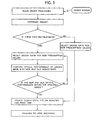
- Fig. 5 is a flow chart of the processing involved in taking an order. An example of the processing from the placing of an order for spectacle lenses up to their supply, by means of a spectacle lens supply system having the structure discussed above, will now be described through reference to Fig. 5.
- a patient receives an eye examination at an optometrist's or opthalmologist's office, and takes the prescription to an optician office A, for example.
- the customer's information, prescription values, and so forth are inputted according to the instruction screen on an order-side computer 11 installed at the office, and the customer's frame specifications, spectacle machining specifications, and other such information necessary for ordering spectacle lenses is determined.
- the order screen of the order-side computer 11 (the auto-entry screen in Fig. 2) is then used to access the manufacturer-side computer 2 via the Internet, the customer's order information, such as prescription values and various specifications, are sent, and the order is processed.
- Order processing commences when order access occurs from the order-side computer 11, etc. First, an inquiry is made as to whether the customer database contains an existing data file for the customer in question.
- the lens prescription values contained in the called-up old data are compared with the lens prescription values contained in the new data sent in the course of a new order (that is, the new prescription values).
- a decision is then made as to whether the difference between the old and new prescription values is within a specific range. Specifically, it is decided, for instance, whether the difference in diopter is over 0.5 D.
- the lens prescription values referred to here include the spherical diopter (abbreviated as SPH), the cylindrical diopter (CYL), the cylindrical axis (AXS), and the addition (ADD).
- SPH spherical diopter
- CYL cylindrical diopter
- AXS cylindrical axis
- ADD addition
- new design data based directly on the new prescription is usually read out from the lens design data table, additions or other update registration process necessary for the file is performed, and the procedure then moves on to lens machining. Specifically, the step of comparing the optical performance and redoing the design on the basis of this comparison (adjusting optical performance), which will be discussed below, is omitted.
- the optical performance adjustment discussed below may still be performed after the new design data has been selected even if the difference between the old and new prescription values is within the specified range.
- the new and old prescription values such as diopter
- this adjustment may be skipped.
- the above-mentioned step of adjusting optical performance is performed if the difference between the old and new prescription values is over the specified range.
- optical performance refers to astigmatism, curvature of field, distortion, etc.
- Specific range means that as a result of comparing the optical performance, the optical performance difference is within a range such that the customer will experience substantially no discomfort originating in an optical performance difference when changing from old to new lenses. These ranges are empirically determined according to astigmatism, curvature of field, distortion, and so on.
- optical design is a specific example of how to select or product the lens design data so that the optical performance will fall within the specified range. These examples involve design in which the object point is infinity.
- Figs. 6 and 7 are design tables (lens data tables) for lenses with -2.0 D and -4.0 D spherical design.
- the refractive index of the lenses is 1.50.
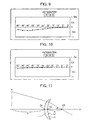
- Figs. 8 and 9 are astigmatism diagrams for new and old lenses design using the values from the above tables.
- the vertical axis in these drawings is the angle of the field of vision (units: degrees), while the horizontal axis is the astigmatism based on the refractive power on the optical axis (units: D, the difference (m-s) between the meridional direction (m) and the sagittal direction (s)).
- Fig. 10 is an astigmatism diagram of a new lens obtained by aspherical design. In this aspherical design, though, there is no change to the radius of curvature at the vertex. As can be seen from Figs. 9 and 10, astigmatism is improved by changing the first surface to an aspherical surface, and the optical performance is the same as that shown in Fig. 8, which is a -2 D astigmatism diagram.
- Fig. 11 is a diagram illustrating the principle of a ray tracing method.
- a positive lens will be used as an example here for the sake of convenience.
- Fig. 11 deals with a hypermetropic lens and an object point at infinity.
- a ray 1 is sent out backwards from the center of rotation CR at an angle of ⁇ to the optical axis A, and the position of a point P that lies in the object plane at a distance an ahead of the vertex O1 of a first refractive surface L1 of the lens L is determined. This ray 1 is called the chief ray.
- the image position m in the meridional direction and the image position s in the sagittal direction after the chief ray 1 has been refracted through the lens L are calculated, and the amount of astigmatism (m-s) is calculated (for details, see OUYOU BUTSURI, Vol. 26, No. 5, 1957, pp. 206-210).
- the distance b between the center of rotation CR and the vertex O2 of the second refractive surface L2 of the lens L is 25 mm.
- a value of 27 mm is used for b in Europe and North America.
- n is an integer greater than or equal to 2
- X is the distance of a vertical line dropped from a point on an aspherical surface whose distance from the optical axis is ⁇ to a plane tangent to the aspherical surface vertex
- ⁇ is the distance from the optical axis
- K is the conic coefficient
- a n is the aspherical coefficient of the term ⁇ 2n .
- K and A n are determined by aberration optimization such that the astigmatism will be the specified amount or less.
- the refractive power (diopter) of a spectacle lens is generally approximated as the sum of refractive power of the first surface and the refractive power of the second surface, and is expressed in units of diopters (D).
- the refractive power of the first refractive surface of a spectacle lens is called the base curve.
- the curve of lens at an aspherical surface is calculated using the radius of curvature at the vertex.
- the lens design program reads a lens design table (lens data table) for spherical design, which has been produced according to various prescriptions.
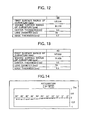
- Figs. 12 and 13 illustrate examples of design tables (lens data table) for lenses with spherical design of -2.0 D for the left eye and -4.0 D for the right eye, respectively.
- the refractive index of the lenses is 1.50.
- Figs. 14 and 15 are astigmatism diagrams for lenses designed using the values in the tables in Figs. 12 and 13.
- the vertical axis in these drawings is the angle of the field of vision (units: degrees), while the horizontal axis is the astigmatism based on the refractive power on the optical axis (units: D, the difference (m-s) between the meridional direction (m) and the sagittal direction (s)).
- D the difference (m-s) between the meridional direction (m) and the sagittal direction (s)
- the base curves are generally also different.
- the spectacles will look odd if the difference is too pronounced (over 1 D).
- myopia is more advanced in one eye, as in this example, not only will the optical performance suffer as mentioned above, but the aesthetic appearance of the spectacles will also suffer.
- the base curves of the left and right lens are matched and the optical performance is made the same as with the previous prescription.
- the curved surface shape of the first and second refractive surfaces is determined so as to satisfy the following conditions for the lens on the -4.0 D side.
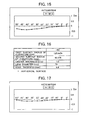
- Fig. 16 is a table listing the radius of curvature and so forth for a new prescription lens obtained by redesign (aspherical design -4.0 D).
- the refractive index of the lens is 1.50.
- the first surface (which is an aspherical surface) radius of curvature indicates the radius of curvature at the vertex of the first surface.
- Fig. 17 is an astigmatism diagram for a new prescription lens obtained by new design. As is clear from Figs. 14 and 17, the optical performance is maintained substantially the same as that before redesign, while the appearance of the spectacles is markedly improved.
- the astigmatism was kept the same in the above example, but it is only necessary for one or more of astigmatism, curvature of field, and distortion to be kept substantially the same.
- the five Seidel aberrations in spectacle lenses it can be seen that, except in the case of lenses with very high refractive power (diopter), there is no need to factor in spherical aberration or coma aberration because the pupil diameter is smaller than the spectacle lens and the focal length of a spectacle lens is longer (that is, it is a dark optical system with a large F-number), and because the limiting resolution angle (approximately 1') is not that small.
- another base curve adjustment method that can be used is to match the base curves in the left and right lenses of the spectacles, treat optical performance as being of secondary importance, and merely matching or approximately matching the convex curves while redesigning the concave side. This situation would occur when "lens table curve specification" was performed from the ordering side in the "machining" box on the above-mentioned auto-entry screen in Fig. 2. It is also possible to adjust the base curve by using a base curve value that is halfway or approximately halfway between the base curves of the left and right lenses.
- the curvature of the first surface is different when the prescriptions for the left and right eyes are different. It we look at this in terms of the appearance (aesthetics) of the spectacles, it has been found that there will be a noticeable difference it the appearance of the left and right lenses, giving an unbalanced look, if the curve difference between the left and right lenses is over about 1 D, although this varies somewhat with personal taste. In view of this, in this embodiment, a curve difference over this is considered to result in an imbalance between the left and right lenses, so a redesign program is executed.
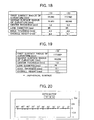
- Fig. 18 illustrates an example of a design table for lenses with a spherical design.
- the refractive index of the lens is 1.50.
- Figs. 20 and 21 are astigmatism diagrams of lenses produced using the design values in the table of Fig. 18. It can be seen from these graphs that astigmatism is favorably corrected.
- Fig. 19 is a table listing the radius of curvature, etc., of the lens (left) obtained by redesign. As is clear from this table, this redesigned lens has a first surface (first refractive surface) lens curve difference that has been corrected to within 1 D.
- Fig. 22 is an astigmatism diagram for the lens (left) obtained by redesign. As is clear from Fig. 22, the optical performance is substantially the same as or better than that prior to redesign, while the aesthetic appearance is markedly improved.
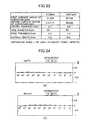
- Fig. 23 is an example of a design table (lens data table) for lenses of spherical design.
- the overall height in the table refers to the height of the entire lens when the lens is viewed from the side in a plane.
- Figs. 24 (a) and (b) are astigmatism diagrams of the left and right lenses designed using the values in the above table, respectively.
- the vertical axis in these drawings is the angle of the field of vision (units: degrees), while the horizontal axis is the astigmatism based on the refractive power on the optical axis (units: D, the difference (m-s) between the meridional direction (m) and the sagittal direction (s)). It can be seen from these graphs that good optical correction is achieved.
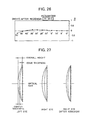
- Fig. 25 is a table listing the radius of curvature, etc., of a lens (right) obtained by redesign.
- the first surface (which is an aspherical surface) radius of curvature indicates the radius of curvature at the vertex of the first surface.
- Fig. 26 is an astigmatism diagram for a lens (right) obtained by redesign. As is clear from Fig. 26, the optical performance is maintained substantially the same as that before redesign, while the appearance of the spectacles is markedly improved.
- Fig. 27 consists of diagrams illustrating a screen display comparing the curved surface shape of a lens before and after redesign. It can be seen from Fig. 27 that the curvature of the first surface (first refractive surface) is substantially the same on the left and right as a result of redesign. The base curves of the left and right lenses were adjusted to the shallower curve, but the shallower curve does not necessarily have to be used as the standard, and adjusting to the deeper curve is also possible.
- the difference in the diopter between the left and right eyes is at least 0.5 D in a prescription including a positive diopter, if the difference in diopter between the left and right eyes is at least 1 D in a prescription including a negative diopter, and if the curvature difference of the first refractive surfaces of the left and right spectacle lenses is no more than 1 D.
- Toric surface here refers to a surface having two orthogonal principal meridians, with each principal meridian having spherical shape, while “atoric surface” refers to a surface in which these principal meridians have an aspherical shape.
- the lens data table was prepared for prescription lenses with new and old spherical designs, but the lens data table may instead be for aspherical designs.
- the lens data table in the above example was prepared for left and right single vision lenses, but this lens data table may instead be for multifocal lenses or progressive-power lenses. That is, it is also possible to match the curves of the far portions (the portions used for far vision) and make the optical performance the same.
- This lens machining step consists of selecting or calculating machining data based on lens design data and so forth, coordinate conversion, determination of the machining start point and machining axis, confirmation calculation of the edge thickness prior to lens machining, machining the lens refractive surface, edging the lens to the frame shape, beveling the edge of the lens, and other such processing. These are carried out by sending machining-related data to the control computers of the various machining devices of the factory which are connected to the manufacturer-side computer 2.
- the machined lenses are sent to an optician, optometrist, etc., through a delivery system, accounting system, and so forth. Spectacles are produced in this way. The spectacles thus produced are delivered to the customer via the optician, optometrist, etc.
- the newly updated or registered database will be useful for the next order.
- data such as optical performance, the lens center thickness, edge thickness, overall height, or weight, or cross sections of the lens, may be transmitted to the order-side computer as desired by the ordering side.
- data based on previous prescription values or lens data such as optical performance, the lens center thickness, edge thickness, overall height, or weight, or cross sections of the lens, can be compared with the current data.
- the effective use of a customer database makes it possible to supply customers with spectacle lenses that are exactly suited to their needs. Also, since the customer database can be used like an electronic medical chart by updating it every time an order is received, the history of prescription values for a customer can be reviewed, which is useful for medical purposes. Furthermore, since the optical performance is examined and optical design is performed as needed every time an order is received, spectacle lenses having the optical performance best suited to the customer can always be provided. Also, orders for just one lens are sometimes placed by customers who have lost or damaged either the left or right lens, in which case this system can be applied and its advantages fully exploited as long as the optical performance of the remaining lens is known.
- the network system involved connecting the manufacturer-side computer and the order-side computer via the Internet but a dedicated line or the like can be used instead of the Internet.
- the network linking the manufacturer-side computer and the order-side computer need not do so directly, and of course may link them indirectly by having a server in between, or by interposing a plurality of manufacturer-side computers from a server, for example, or a plurality of units may be combined.
- the present invention provides a lens design program with a check function so that the optical performance difference or curve difference between left and right lenses and/or old and new lenses will be within a specific range, the result being a spectacle lens supply system with which it is possible to supply lenses that cause no discomfort between the left and right eyes or in a change from old lenses produced with an old prescription to new lenses produced with a new prescription.
Landscapes
- Business, Economics & Management (AREA)
- Engineering & Computer Science (AREA)
- Economics (AREA)
- Physics & Mathematics (AREA)
- Strategic Management (AREA)
- General Physics & Mathematics (AREA)
- Theoretical Computer Science (AREA)
- Accounting & Taxation (AREA)
- Marketing (AREA)
- Finance (AREA)
- Development Economics (AREA)
- General Business, Economics & Management (AREA)
- Human Resources & Organizations (AREA)
- Tourism & Hospitality (AREA)
- Quality & Reliability (AREA)
- Entrepreneurship & Innovation (AREA)
- Operations Research (AREA)
- Game Theory and Decision Science (AREA)
- Health & Medical Sciences (AREA)
- Ophthalmology & Optometry (AREA)
- Optics & Photonics (AREA)
- Eyeglasses (AREA)
Abstract
Description
characterized in that when spectacle lens information, spectacle frame information, prescription values, layout information, processing instructions information, and other such processing condition data required for processing is transmitted by the order-side computer to the manufacturer-side computer, a lens design program installed on the manufacturer-side computer performs optical lens design tailored to the customer on the basis of the transmitted data for lens information so that the optical performance of the left and right lenses will be similar, and the lenses are manufactured according to this design.
wherein the manufacturer-side computer has the function of performing lens design such that a customer will experience substantially no discomfort originating in an optical performance difference when changing from old to new lenses, by selecting or producing new design data for a lens on the basis of customer spectacle lens processing condition data required for processing, such as spectacle lens information, spectacle frame information, prescription values, layout information, and processing instructions information, when this data is transmitted from the order-side computer to the manufacturer-side computer, and making the optical performance of the new lenses produced with this new design data approximate the optical performance of the old lenses produced with the old design data based on the old prescription values of the pre-registered customer database.
wherein, when customer spectacle lens processing condition data required for processing, such as spectacle lens information, spectacle frame information, prescription values, layout information, and processing instructions information, is transmitted from the order-side computer to the manufacturer-side computer, the manufacturer-side computer has the function of performing processing comprising:
wherein, if there is more than a specific amount of difference in the prescription including diopter between the left and right eyes:
when the refractive surfaces in front of the left and right spectacle lenses are termed the first refractive surfaces and the refractive surfaces on the eye side are termed the second refractive surfaces, in designing the curvature of the curved surfaces of the first and second refractive surfaces of the left and right spectacle lenses, the curvature of the first and second refractive surfaces of at least one of the left and right spectacle lenses is selected so that the left and right spectacle lenses satisfy their respective prescription conditions including the diopter so that the difference in the curvature of the first refractive surfaces between the left and right spectacle lenses falls within a specific range.
wherein, if there is more than a specific amount of difference in the prescription including diopter between the left and right eyes:
when the refractive surfaces in front of the left and right spectacle lenses are termed the first refractive surfaces and the refractive surfaces on the eye side are termed the second refractive surfaces, in designing the curvature of the curved surfaces of the first and second refractive surfaces of the left and right spectacle lenses, the curvature of the first and second refractive surfaces of at least one of the left and right spectacle lenses is selected so that the left and right spectacle lenses satisfy their respective prescription conditions including the diopter, so that the optical performance of each lens falls within an acceptable range, and so that the difference in the curvature of the first refractive surfaces between the left and right spectacle lenses falls within a specific range.
Fig. 2 is a diagram illustrating the auto-entry screen on which the type of lens is specified, Fig. 3 is a block diagram of a manufacturer-side computer, and Fig. 4 is a diagram illustrating an example of part of the contents of a customer database. The spectacle lens supply system pertaining to an embodiment of the present invention will now be described through reference to these drawings.
"Binocular vision balance design" includes, of course, having the left and right lenses satisfy the prescription conditions within the specified range, but also means keeping the difference in optical performance between the left and right lenses within the specified range, and also keeping the difference in curvature (base curve) of the first surfaces (first refractive surfaces) of the left and right lenses within the specified range, and thereby striking a good balance between left and right in terms of appearance when the spectacles are worn, and making the spectacles more attractive. Fig. 2 illustrates a case in which "yes" has already been specified on the order side for the binocular vision balance design, but the lens design program in this example automatically checks the binocular vision in both eyes.
This ordering data and machining data are also included in the customer database.

X is the distance of a vertical line dropped from a point on an aspherical surface whose distance from the optical axis is ρ to a plane tangent to the aspherical surface vertex,
C is the curvature of a reference spherical surface at the vertex of the aspherical surface (C = 1/R, where R is the radius of curvature at the vertex),
ρ is the distance from the optical axis,
K is the conic coefficient, and
An is the aspherical coefficient of the term ρ2n.
Claims (18)
- A spectacle lens supply method, in which a computer is set up on a spectacle lens order side and a computer that is connected to this order-side computer such that information can be mutually exchanged is provided on the manufacturer side, and spectacle lenses are supplied by having the order-side computer and the manufacturer-side computer perform computations according to specific input operations and perform the processing required for the taking and/or placing of orders for spectacle lenses while exchanging information with each other,
characterized in that when spectacle lens information, spectacle frame information, prescription values, layout information, processing instructions information, and other such processing condition data required for processing is transmitted by the order-side computer to the manufacturer-side computer, a lens design program installed on the manufacturer-side computer performs optical lens design tailored to the customer on the basis of the transmitted data for lens information so that the optical performance of the left and right lenses will be similar, and the lenses are manufactured according to this design. - The spectacle lens supply method according to Claim 1, wherein the lens design program further performs optical lens design that approximates the left and right base curves to each other.
- The spectacle lens supply method according to Claim 1, wherein the optical performance consists of at least one of astigmatism, curvature of field, and distortion.
- The spectacle lens supply method according to Claim 1, comprising the steps of:selecting the left and right lenses from a lens design table prepared on the basis of prescription values when the lens design program approximates the optical performance of the left and right eyes to each other;comparing the convex surface base curve difference between the selected left and right lenses; andwhen this base curve difference is over a predetermined standard, performing lens redesign in which the convex surface curve of one lens is made to have an aspherical shape similar to that of the convex surface curve of the other lens so that the astigmatism is substantially the same.
- The spectacle lens supply method according to Claim 2, wherein the optical lens design is such that the difference in convex surface base curves of the left and right spectacle lenses is no more than 1 D.
- The spectacle lens supply method according to Claim 2, wherein a display means for comparing data including the lens shape before the curve matching and the prescription data for this lens, to data including the lens shape after the curve matching and the prescription data for this lens, is transferred to and displayed at the computer set up on the side where spectacle lens is ordered.
- A spectacle lens supply system, comprising a computer set up on a spectacle lens order side and a manufacturer-side computer that is information exchangeably connected to this order-side computer and has a customer database including spectacle lens prescription data and lens design data,
in which the order-side computer and the manufacturer-side computer perform computations according to specific input operations and perform the processing required for the taking and/or placing of orders for spectacle lenses while exchanging information with each other,
wherein the manufacturer-side computer has the function of performing lens design such that a customer will experience substantially no discomfort originating in an optical performance difference when changing from old to new lenses, by selecting or producing new design data for a lens on the basis of customer spectacle lens processing condition data required for processing, such as spectacle lens information, spectacle frame information, prescription values, layout information, and processing instructions information, when this data is transmitted from the order-side computer to the manufacturer-side computer, and making the optical performance of the new lenses produced with this new design data approximate the optical performance of the old lenses produced with the old design data based on the old prescription values of the pre-registered customer database. - A spectacle lens supply system, comprising a computer set up on a spectacle lens order side and a manufacturer-side computer that is information exchangeably connected to this order-side computer and has a customer database including spectacle lens prescription data and lens design data,
in which the order-side computer and the manufacturer-side computer perform computations according to specific input operations and perform the processing required for the taking and placing of orders for spectacle lenses while exchanging information with each other,
wherein, when customer spectacle lens processing condition data required for processing, such as spectacle lens information, spectacle frame information, prescription values, layout information, and processing instructions information, is transmitted from the order-side computer to the manufacturer-side computer, the manufacturer-side computer has the function of performing processing comprising:a step of checking whether there is any old prescription data for that customer;a step of selecting or producing lens design data matching the new prescription values as lens design data for the new prescription values if no old data for that customer exists in the manufacturer-side computer, and setting this data as the design data for producing the new lenses;an optical performance comparison step in which, if there is old prescription data for the customer, the new lens design data for the new prescription values is selected or produced, and the optical performance of the new lenses designed on the basis of the newly selected or produced new design data is compared to the optical performance of the old lenses designed with the old design data matching the old prescription values; anda step in which, when the results of comparing the optical performance as above indicate that the optical performance difference is within a range such that the customer will experience substantially no discomfort originating in an optical performance difference when changing from old to new lenses, the selected or produced new design data is set as the design data for producing the new lenses, and when said difference goes outside a range in which the customer will experience substantially no discomfort originating in an optical performance difference when changing from old to new lenses, new design data is newly selected or produced for putting the optical performance difference within said range before returning to said optical performance comparison step and such processing is repeated until the optical performance difference is within said range. - The spectacle lens supply system according to Claim 7 or 8, wherein the newly determined new design data is registered for the first time or updated in the customer database.
- The spectacle lens supply system according to Claim 7 or 8, wherein, when there is old prescription data for the customer, a step is provided for comparing the difference between the old and new prescription values, and if this difference is not over 0.5 D as the diopter difference, the new lens design data for the new prescription values is selected or produced without performing the optical performance comparison step, and this data is set as the design data for producing the new lenses.
- The spectacle lens supply system according to Claim 7 or 8, wherein the lens design data is such that the difference in the curve of a first refractive surface of the left and right spectacle lenses is no more than 1 D.
- The spectacle lens supply system according to Claim 7 or 8, wherein the optical performance is at least one of astigmatism, curvature of field, and distortion.
- The spectacle lens supply system according to Claim 7 or 8, wherein the curvature of at least one of the first refractive surfaces of the left and right spectacle lenses is selected such that this curved surface will be aspherical.
- A method for manufacturing a spectacle lens, involving the design and manufacture of left and right spectacle lenses that make up a pair of spectacles in which the prescription including diopter is different for the left and right eyes,
wherein, if there is more than a specific amount of difference in the prescription including diopter between the left and right eyes:when the refractive surfaces in front of the left and right spectacle lenses are termed the first refractive surfaces and the refractive surfaces on the eye side are termed the second refractive surfaces, in designing the curvature of the curved surfaces of the first and second refractive surfaces of the left and right spectacle lenses, the curvature of the first and second refractive surfaces of at least one of the left and right spectacle lenses is selected so that the left and right spectacle lenses satisfy their respective prescription conditions including the diopter and so that the difference in the curvature of the first refractive surfaces between the left and right spectacle lenses falls within a specific range. - A method for manufacturing a spectacle lens, involving the design and manufacture of left and right spectacle lenses that make up a pair of spectacles in which the prescription including diopter is different for the left and right eyes,
wherein, if there is more than a specific amount of difference in the prescription including diopter between the left and right eyes:when the refractive surfaces in front of the left and right spectacle lenses are termed the first refractive surfaces and the refractive surfaces on the eye side are termed the second refractive surfaces, in designing the curvature of the curved surfaces of the first and second refractive surfaces of the left and right spectacle lenses, the curvature of the first and second refractive surfaces of at least one of the left and right spectacle lenses is selected so that the left and right spectacle lenses satisfy their respective prescription conditions including the diopter, so that the optical performance of each lens falls within an acceptable range, and so that the difference in the curvature of the first refractive surfaces between the left and right spectacle lenses falls within a specific range. - The method for manufacturing a spectacle lens according to Claim 14 or 15, wherein the difference in the diopter between the left and right eyes is 0.5 D or greater when the diopter prescription out of said prescription including the diopter includes a positive diopter, the difference in the diopter between the left and right eyes is 1 D or greater when the diopter prescription includes a negative diopter, and the difference in the curvature of the first refractive surfaces of the left and right spectacle lenses is no more than 1 D.
- The method for manufacturing a spectacle lens according to Claim 15, wherein the optical performance consists of at least one of astigmatism, curvature of field, and distortion.
- The method for manufacturing a spectacle lens according to Claim 15, wherein the curvature of one or both of the first refractive surfaces of the left and right spectacle lenses is selected such that this curved surface will be aspherical.
Priority Applications (1)
| Application Number | Priority Date | Filing Date | Title |
|---|---|---|---|
| EP08157081A EP1956417B1 (en) | 2000-10-27 | 2001-10-26 | Spectacle Lens Manufacturing Method and Spectacle Lens Supply System |
Applications Claiming Priority (5)
| Application Number | Priority Date | Filing Date | Title |
|---|---|---|---|
| JP2000329259 | 2000-10-27 | ||
| JP2000329259 | 2000-10-27 | ||
| JP2001269368A JP4233244B2 (en) | 2001-09-05 | 2001-09-05 | Eyeglass lens supply system |
| JP2001269368 | 2001-09-05 | ||
| PCT/JP2001/009431 WO2002035280A1 (en) | 2000-10-27 | 2001-10-26 | Production method for spectacle lens and supply system for spectacle lens |
Related Child Applications (2)
| Application Number | Title | Priority Date | Filing Date |
|---|---|---|---|
| EP08157081A Division EP1956417B1 (en) | 2000-10-27 | 2001-10-26 | Spectacle Lens Manufacturing Method and Spectacle Lens Supply System |
| EP08157081.4 Division-Into | 2008-05-28 |
Publications (3)
| Publication Number | Publication Date |
|---|---|
| EP1336891A1 true EP1336891A1 (en) | 2003-08-20 |
| EP1336891A4 EP1336891A4 (en) | 2005-10-12 |
| EP1336891B1 EP1336891B1 (en) | 2010-09-01 |
Family
ID=26602961
Family Applications (2)
| Application Number | Title | Priority Date | Filing Date |
|---|---|---|---|
| EP08157081A Expired - Lifetime EP1956417B1 (en) | 2000-10-27 | 2001-10-26 | Spectacle Lens Manufacturing Method and Spectacle Lens Supply System |
| EP01976840A Expired - Lifetime EP1336891B1 (en) | 2000-10-27 | 2001-10-26 | Production method for spectacle lens and supply system for spectacle lens |
Family Applications Before (1)
| Application Number | Title | Priority Date | Filing Date |
|---|---|---|---|
| EP08157081A Expired - Lifetime EP1956417B1 (en) | 2000-10-27 | 2001-10-26 | Spectacle Lens Manufacturing Method and Spectacle Lens Supply System |
Country Status (4)
| Country | Link |
|---|---|
| US (2) | US6817713B2 (en) |
| EP (2) | EP1956417B1 (en) |
| DE (2) | DE60142982D1 (en) |
| WO (1) | WO2002035280A1 (en) |
Cited By (3)
| Publication number | Priority date | Publication date | Assignee | Title |
|---|---|---|---|---|
| EP1728467A4 (en) * | 2004-03-26 | 2009-09-16 | Hoya Corp | Spectacle lens supply system, spectacle wearing parameter measurement device, spectacle wearing inspection system, spectacle lens, and spectacle |
| EP1767983A4 (en) * | 2004-06-29 | 2015-10-28 | Hoya Corp | METHOD OF PREPARING GLASS LENSES |
| EP2442171B1 (en) * | 2010-10-12 | 2017-04-12 | EHS Lens Philippines, Inc. | Spectacle lenses, and method for manufacturing spectacle lens |
Families Citing this family (32)
| Publication number | Priority date | Publication date | Assignee | Title |
|---|---|---|---|---|
| AU2002953061A0 (en) * | 2002-11-20 | 2002-12-19 | Sola International Holdings Ltd | Method for designing progressive lenses |
| US7090348B2 (en) * | 2003-10-28 | 2006-08-15 | Essilor International (Compagnie Generale D'optique) | Method for designing spectacle lenses taking into account an individual's head and eye movement |
| JP4225204B2 (en) * | 2004-01-19 | 2009-02-18 | セイコーエプソン株式会社 | Design data providing method and design data providing system |
| FR2878975B1 (en) * | 2004-12-03 | 2007-02-16 | Essilor Int | METHOD AND DEVICE FOR PREPARING THE MOUNTING OF A JOB OF TWO OPHTHALMIC LENSES OF THE SAME PAIR OF EYEWEAR |
| RU2373557C2 (en) * | 2005-06-24 | 2009-11-20 | Хойа Корпорейшн | Method of designing group of bi-aspherical lenses with gradual increase of focal power and group of bi-aspherical lenses with gradual increase of focal power |
| EP1967894A4 (en) * | 2005-12-26 | 2010-03-31 | Hoya Corp | Spectacles lens supply system, ordering system and production method |
| JP5143541B2 (en) * | 2007-12-19 | 2013-02-13 | 株式会社トプコン | Ball shape measuring device |
| JP5139792B2 (en) * | 2007-12-19 | 2013-02-06 | 株式会社トプコン | Ball shape measuring device |
| EP2037314B1 (en) * | 2007-12-28 | 2021-12-01 | Essilor International | A method and computer means for choosing spectacle lenses adapted to a frame |
| EP2028529B1 (en) * | 2007-12-28 | 2020-09-09 | Essilor International | Method of calculating an optical system according to a given spectacle frame |
| EP2031434B1 (en) * | 2007-12-28 | 2022-10-19 | Essilor International | An asynchronous method for obtaining spectacle features to order |
| EP2028531B1 (en) * | 2007-12-28 | 2016-05-04 | Essilor International (Compagnie Generale D'optique) | Method of selecting a semi-finished ophthalmic lens according to a given spectacle frame |
| ES2829678T3 (en) * | 2007-12-28 | 2021-06-01 | Essilor Int | Method of calculating an optical system based on a given spectacle frame |
| EP2175405A1 (en) * | 2008-10-10 | 2010-04-14 | Essilor International (Compagnie Générale D'Optique) | A processing device for processing an order request of an ophtalmic lens |
| BRPI1007210B1 (en) | 2009-01-30 | 2019-12-17 | Hoya Corp | computer-implemented method for designing eyeglass lens, method for manufacturing eyeglass lens, and system for manufacturing eyeglass lens |
| CN102369476B (en) | 2009-02-05 | 2014-04-30 | Hoya株式会社 | Eyeglass lens evaluation method, eyeglass lens design method, eyeglass lens manufacturing method, eyeglass lens manufacturing system, and eyeglass lens |
| JP5648299B2 (en) * | 2010-03-16 | 2015-01-07 | 株式会社ニコン | Eyeglass sales system, lens company terminal, frame company terminal, eyeglass sales method, and eyeglass sales program |
| EP2590114A1 (en) * | 2011-11-03 | 2013-05-08 | Essilor International (Compagnie Générale D'Optique) | Secured data communication in a networked computer system for providing optical lenses |
| US9236024B2 (en) | 2011-12-06 | 2016-01-12 | Glasses.Com Inc. | Systems and methods for obtaining a pupillary distance measurement using a mobile computing device |
| JP5905248B2 (en) * | 2011-12-12 | 2016-04-20 | Hoya株式会社 | Spectacle lens ordering system, spectacle lens ordering program, and spectacle lens ordering method |
| WO2013117766A2 (en) * | 2012-02-10 | 2013-08-15 | Essilor International (Compagnie Generale D'optique) | System and method for real time segmentation |
| US20130314401A1 (en) | 2012-05-23 | 2013-11-28 | 1-800 Contacts, Inc. | Systems and methods for generating a 3-d model of a user for a virtual try-on product |
| US9483853B2 (en) | 2012-05-23 | 2016-11-01 | Glasses.Com Inc. | Systems and methods to display rendered images |
| US9286715B2 (en) | 2012-05-23 | 2016-03-15 | Glasses.Com Inc. | Systems and methods for adjusting a virtual try-on |
| JP6052296B2 (en) | 2012-11-05 | 2016-12-27 | 株式会社ニコン | Spectacle lens design method and spectacle lens design system |
| US20140257839A1 (en) * | 2013-03-07 | 2014-09-11 | Pro Fit Optix Inc. | Online Lens Ordering System for Vision Care Professionals or Direct to Customers |
| US9952584B2 (en) * | 2014-04-01 | 2018-04-24 | Digital Vision, Inc. | Modifying a digital ophthalmic lens map to accommodate characteristics of a lens surfacing machine |
| US10634935B2 (en) | 2018-01-18 | 2020-04-28 | Digital Vision, Inc. | Multifocal lenses with ocular side lens segments |
| FR3078248B1 (en) * | 2018-02-23 | 2020-03-06 | Nathalie Guillemain | OPTICAL LENS COMPARISON METHOD, CONTROL MODULE AND SYSTEM THEREOF |
| US11642018B1 (en) | 2020-01-15 | 2023-05-09 | Meta Platforms Technologies, Llc | Volumetric depth imaging for lens fit |
| US11614638B1 (en) | 2020-01-15 | 2023-03-28 | Meta Platforms Technologies, Llc | Prescription optical element for selected head mounted device |
| US11768378B1 (en) * | 2020-01-15 | 2023-09-26 | Meta Platforms Technologies, Llc | Prescription optical element based on optical-mechanical profile |
Family Cites Families (16)
| Publication number | Priority date | Publication date | Assignee | Title |
|---|---|---|---|---|
| US4958280A (en) * | 1987-07-10 | 1990-09-18 | Vistakon, Inc. | Apparatus and method for satisfying disposable contact lens prescriptions |
| EP0867261B1 (en) * | 1992-06-24 | 2003-01-08 | Hoya Corporation | Spectacle lens production |
| JP2982991B2 (en) | 1992-06-24 | 1999-11-29 | ホーヤ株式会社 | Eyeglass lens supply system |
| US5790232A (en) * | 1994-10-31 | 1998-08-04 | Nikon Corporation | Spectacle lens and manufacturing method thereof |
| JP3196877B2 (en) * | 1995-04-18 | 2001-08-06 | ホーヤ株式会社 | Progressive multifocal lens |
| JP3603412B2 (en) * | 1995-09-22 | 2004-12-22 | セイコーエプソン株式会社 | Eyeglass lens information display device and display method |
| US5767940A (en) * | 1995-10-31 | 1998-06-16 | Nidek Co., Ltd. | Ophthalmic apparatus |
| US5592248A (en) * | 1995-11-16 | 1997-01-07 | Norton; Ross A. | Computerized method for fitting eyeglasses |
| WO1998016862A1 (en) * | 1996-10-14 | 1998-04-23 | Seiko Epson Corporation | Method of manufacturing progressive multifocal lens |
| US5983201A (en) * | 1997-03-28 | 1999-11-09 | Fay; Pierre N. | System and method enabling shopping from home for fitted eyeglass frames |
| EP1063600B1 (en) * | 1998-02-03 | 2013-03-13 | Tsuyoshi Saigo | Simulation system for wearing glasses |
| US6095650A (en) * | 1998-09-22 | 2000-08-01 | Virtual Visual Devices, Llc | Interactive eyewear selection system |
| HK1043840B (en) * | 1999-02-12 | 2005-05-20 | Hoya株式会社 | Eyeglass manufacturing method |
| US6419549B2 (en) * | 2000-02-29 | 2002-07-16 | Asahi Kogaku Kogyo Kabushiki Kaisha | Manufacturing method of spectacle lenses and system thereof |
| JP3845251B2 (en) * | 2000-07-05 | 2006-11-15 | ペンタックス株式会社 | Manufacturing method and supply method of spectacle lens |
| MXPA03003126A (en) * | 2000-10-10 | 2004-07-30 | Univ Rochester | Determination of ocular refraction from wavefront aberration data. |
-
2001
- 2001-10-26 US US10/069,394 patent/US6817713B2/en not_active Expired - Lifetime
- 2001-10-26 DE DE60142982T patent/DE60142982D1/en not_active Expired - Lifetime
- 2001-10-26 WO PCT/JP2001/009431 patent/WO2002035280A1/en not_active Ceased
- 2001-10-26 EP EP08157081A patent/EP1956417B1/en not_active Expired - Lifetime
- 2001-10-26 DE DE60142997T patent/DE60142997D1/en not_active Expired - Lifetime
- 2001-10-26 EP EP01976840A patent/EP1336891B1/en not_active Expired - Lifetime
-
2004
- 2004-07-30 US US10/902,298 patent/US7069107B2/en not_active Expired - Lifetime
Cited By (3)
| Publication number | Priority date | Publication date | Assignee | Title |
|---|---|---|---|---|
| EP1728467A4 (en) * | 2004-03-26 | 2009-09-16 | Hoya Corp | Spectacle lens supply system, spectacle wearing parameter measurement device, spectacle wearing inspection system, spectacle lens, and spectacle |
| EP1767983A4 (en) * | 2004-06-29 | 2015-10-28 | Hoya Corp | METHOD OF PREPARING GLASS LENSES |
| EP2442171B1 (en) * | 2010-10-12 | 2017-04-12 | EHS Lens Philippines, Inc. | Spectacle lenses, and method for manufacturing spectacle lens |
Also Published As
| Publication number | Publication date |
|---|---|
| EP1956417B1 (en) | 2010-09-01 |
| EP1956417A1 (en) | 2008-08-13 |
| EP1336891A4 (en) | 2005-10-12 |
| DE60142982D1 (en) | 2010-10-14 |
| WO2002035280A1 (en) | 2002-05-02 |
| EP1336891B1 (en) | 2010-09-01 |
| US6817713B2 (en) | 2004-11-16 |
| US7069107B2 (en) | 2006-06-27 |
| US20050004694A1 (en) | 2005-01-06 |
| DE60142997D1 (en) | 2010-10-14 |
| US20020176052A1 (en) | 2002-11-28 |
Similar Documents
| Publication | Publication Date | Title |
|---|---|---|
| EP1956417B1 (en) | Spectacle Lens Manufacturing Method and Spectacle Lens Supply System | |
| AU769864B2 (en) | Eyeglass and its manufacturing method | |
| TWI402557B (en) | Design method, manufacturing method and supply system of spectacle lens for progressive refractive index lens | |
| US8313194B2 (en) | Method for selecting base-curves for an ophthalmic lens and related spectacle lens manufacturing method | |
| AU2017201961B2 (en) | Spectacle Lenses | |
| US8308294B2 (en) | Method of calculating an optical system according to a given spectacle frame | |
| CN105103040B (en) | Manufacture device and manufacture method for eyeglass | |
| JP2003344813A (en) | Both-side aspherical progressive refractive power lens | |
| EP1550897A1 (en) | Glasses lens designing method, production method for glasses lens and computer program | |
| WO2014097852A1 (en) | Production method and production device for spectacle lenses | |
| CA3095519C (en) | A method for determining a single vision ophthalmic lens | |
| CN105190411B (en) | Manufacturing device and method for astigmatism spectacle lenses | |
| US9753307B2 (en) | Spectacle lens, manufacturing method thereof and lens supply system | |
| US20220308361A1 (en) | Method and system for determining an ophthalmic element adapted to a wearer | |
| JP4233244B2 (en) | Eyeglass lens supply system | |
| US20060050235A1 (en) | Progressive power semi-finished spectacle lens blanks for astigmatic presbyopes | |
| JP2002202482A (en) | Method for manufacturing spectacles lens, spectacles lens and method for supplying spectacles lens | |
| JP4707705B2 (en) | Eyeglass lens supply method | |
| JP2008097031A (en) | Spectacle lens supply method | |
| WO2020225449A1 (en) | An ophthalmic progressive addition lens adapted for a wearer | |
| EP2829905A1 (en) | Spectacle lens, method for designing spectacle lens, manufacturing method and manufacturing system | |
| Ladopoulos et al. | Freeform vs. Aspheric Spectacle Lenses: A Comprehensive Review of Optical Performance, Clinical Outcomes, and Patient Considerations | |
| JP3916519B2 (en) | Eyeglass lens manufacturing method and apparatus | |
| JP3792562B2 (en) | Eyeglass lens design method and apparatus | |
| US20220003959A1 (en) | Apparatus, method, and computer-readable medium for selecting and manufacturing optical lenses |
Legal Events
| Date | Code | Title | Description |
|---|---|---|---|
| PUAI | Public reference made under article 153(3) epc to a published international application that has entered the european phase |
Free format text: ORIGINAL CODE: 0009012 |
|
| 17P | Request for examination filed |
Effective date: 20030521 |
|
| AK | Designated contracting states |
Designated state(s): AT BE CH CY DE DK ES FI FR GB GR IE IT LI LU MC NL PT SE TR |
|
| AX | Request for extension of the european patent |
Extension state: AL LT LV MK RO SI |
|
| RBV | Designated contracting states (corrected) |
Designated state(s): DE FR GB NL |
|
| A4 | Supplementary search report drawn up and despatched |
Effective date: 20050825 |
|
| 17Q | First examination report despatched |
Effective date: 20061011 |
|
| RIC1 | Information provided on ipc code assigned before grant |
Ipc: G02C 7/02 20060101ALI20080702BHEP Ipc: G06F 17/50 20060101ALN20080702BHEP Ipc: G06Q 30/00 20060101ALN20080702BHEP Ipc: G02C 13/00 20060101AFI20080702BHEP |
|
| RIC1 | Information provided on ipc code assigned before grant |
Ipc: G02C 7/02 20060101ALI20100203BHEP Ipc: G06F 17/50 20060101ALN20100203BHEP Ipc: G06Q 30/00 20060101ALN20100203BHEP Ipc: G02C 13/00 20060101AFI20100203BHEP |
|
| GRAP | Despatch of communication of intention to grant a patent |
Free format text: ORIGINAL CODE: EPIDOSNIGR1 |
|
| GRAS | Grant fee paid |
Free format text: ORIGINAL CODE: EPIDOSNIGR3 |
|
| GRAA | (expected) grant |
Free format text: ORIGINAL CODE: 0009210 |
|
| AK | Designated contracting states |
Kind code of ref document: B1 Designated state(s): DE FR GB NL |
|
| REG | Reference to a national code |
Ref country code: GB Ref legal event code: FG4D |
|
| REG | Reference to a national code |
Ref country code: NL Ref legal event code: T3 |
|
| REF | Corresponds to: |
Ref document number: 60142982 Country of ref document: DE Date of ref document: 20101014 Kind code of ref document: P |
|
| PLBE | No opposition filed within time limit |
Free format text: ORIGINAL CODE: 0009261 |
|
| STAA | Information on the status of an ep patent application or granted ep patent |
Free format text: STATUS: NO OPPOSITION FILED WITHIN TIME LIMIT |
|
| 26N | No opposition filed |
Effective date: 20110606 |
|
| REG | Reference to a national code |
Ref country code: DE Ref legal event code: R097 Ref document number: 60142982 Country of ref document: DE Effective date: 20110606 |
|
| PGFP | Annual fee paid to national office [announced via postgrant information from national office to epo] |
Ref country code: NL Payment date: 20111025 Year of fee payment: 11 |
|
| REG | Reference to a national code |
Ref country code: NL Ref legal event code: V1 Effective date: 20130501 |
|
| PG25 | Lapsed in a contracting state [announced via postgrant information from national office to epo] |
Ref country code: NL Free format text: LAPSE BECAUSE OF NON-PAYMENT OF DUE FEES Effective date: 20130501 |
|
| REG | Reference to a national code |
Ref country code: FR Ref legal event code: PLFP Year of fee payment: 16 |
|
| REG | Reference to a national code |
Ref country code: FR Ref legal event code: PLFP Year of fee payment: 17 |
|
| PGFP | Annual fee paid to national office [announced via postgrant information from national office to epo] |
Ref country code: FR Payment date: 20170918 Year of fee payment: 17 |
|
| PGFP | Annual fee paid to national office [announced via postgrant information from national office to epo] |
Ref country code: DE Payment date: 20171018 Year of fee payment: 17 |
|
| PGFP | Annual fee paid to national office [announced via postgrant information from national office to epo] |
Ref country code: GB Payment date: 20171025 Year of fee payment: 17 |
|
| REG | Reference to a national code |
Ref country code: DE Ref legal event code: R119 Ref document number: 60142982 Country of ref document: DE |
|
| GBPC | Gb: european patent ceased through non-payment of renewal fee |
Effective date: 20181026 |
|
| PG25 | Lapsed in a contracting state [announced via postgrant information from national office to epo] |
Ref country code: DE Free format text: LAPSE BECAUSE OF NON-PAYMENT OF DUE FEES Effective date: 20190501 |
|
| PG25 | Lapsed in a contracting state [announced via postgrant information from national office to epo] |
Ref country code: FR Free format text: LAPSE BECAUSE OF NON-PAYMENT OF DUE FEES Effective date: 20181031 |
|
| PG25 | Lapsed in a contracting state [announced via postgrant information from national office to epo] |
Ref country code: GB Free format text: LAPSE BECAUSE OF NON-PAYMENT OF DUE FEES Effective date: 20181026 |