EP1336671A1 - Method for generating an artificially patterned substrate for stimulating the crystallization of a biomolecule thereon and method of stimulating the crystallization of biomolecules - Google Patents
Method for generating an artificially patterned substrate for stimulating the crystallization of a biomolecule thereon and method of stimulating the crystallization of biomolecules Download PDFInfo
- Publication number
- EP1336671A1 EP1336671A1 EP02010730A EP02010730A EP1336671A1 EP 1336671 A1 EP1336671 A1 EP 1336671A1 EP 02010730 A EP02010730 A EP 02010730A EP 02010730 A EP02010730 A EP 02010730A EP 1336671 A1 EP1336671 A1 EP 1336671A1
- Authority
- EP
- European Patent Office
- Prior art keywords
- substrate
- patterned substrate
- biomolecules
- artificially
- ray
- Prior art date
- Legal status (The legal status is an assumption and is not a legal conclusion. Google has not performed a legal analysis and makes no representation as to the accuracy of the status listed.)
- Withdrawn
Links
- 239000000758 substrate Substances 0.000 title claims abstract description 74
- 238000000034 method Methods 0.000 title claims abstract description 57
- 238000002425 crystallisation Methods 0.000 title claims abstract description 28
- 230000008025 crystallization Effects 0.000 title claims abstract description 28
- 230000004936 stimulating effect Effects 0.000 title claims abstract description 10
- 239000013078 crystal Substances 0.000 claims abstract description 35
- 238000005516 engineering process Methods 0.000 claims abstract description 13
- 238000000025 interference lithography Methods 0.000 claims abstract description 9
- 239000006193 liquid solution Substances 0.000 claims abstract description 7
- 230000000977 initiatory effect Effects 0.000 claims abstract description 3
- 102000004169 proteins and genes Human genes 0.000 claims description 17
- 108090000623 proteins and genes Proteins 0.000 claims description 17
- 229920002521 macromolecule Polymers 0.000 claims description 5
- 239000011521 glass Substances 0.000 claims description 3
- 239000000919 ceramic Substances 0.000 claims description 2
- 102000004196 processed proteins & peptides Human genes 0.000 claims description 2
- 108090000765 processed proteins & peptides Proteins 0.000 claims description 2
- 230000008569 process Effects 0.000 abstract description 8
- 230000000638 stimulation Effects 0.000 abstract description 7
- 230000006872 improvement Effects 0.000 abstract description 2
- 238000010899 nucleation Methods 0.000 description 18
- 230000006911 nucleation Effects 0.000 description 17
- 239000000126 substance Substances 0.000 description 10
- 238000012216 screening Methods 0.000 description 8
- 238000005286 illumination Methods 0.000 description 5
- 230000005855 radiation Effects 0.000 description 5
- 229920001400 block copolymer Polymers 0.000 description 4
- 239000000463 material Substances 0.000 description 4
- 239000000203 mixture Substances 0.000 description 4
- 229920002120 photoresistant polymer Polymers 0.000 description 4
- 238000002441 X-ray diffraction Methods 0.000 description 3
- 230000001427 coherent effect Effects 0.000 description 3
- 239000010410 layer Substances 0.000 description 3
- 230000000737 periodic effect Effects 0.000 description 3
- 239000012071 phase Substances 0.000 description 3
- 238000011160 research Methods 0.000 description 3
- 230000004044 response Effects 0.000 description 3
- 238000001338 self-assembly Methods 0.000 description 3
- 230000008901 benefit Effects 0.000 description 2
- 230000008859 change Effects 0.000 description 2
- 229920001577 copolymer Polymers 0.000 description 2
- 238000000407 epitaxy Methods 0.000 description 2
- 238000002474 experimental method Methods 0.000 description 2
- 239000012452 mother liquor Substances 0.000 description 2
- 230000001737 promoting effect Effects 0.000 description 2
- 239000002094 self assembled monolayer Substances 0.000 description 2
- 239000013545 self-assembled monolayer Substances 0.000 description 2
- 238000012360 testing method Methods 0.000 description 2
- 238000001015 X-ray lithography Methods 0.000 description 1
- 238000005054 agglomeration Methods 0.000 description 1
- 230000002776 aggregation Effects 0.000 description 1
- 238000013459 approach Methods 0.000 description 1
- 230000000975 bioactive effect Effects 0.000 description 1
- 230000031018 biological processes and functions Effects 0.000 description 1
- 230000015572 biosynthetic process Effects 0.000 description 1
- 238000004364 calculation method Methods 0.000 description 1
- 230000003197 catalytic effect Effects 0.000 description 1
- 150000001875 compounds Chemical class 0.000 description 1
- 230000001419 dependent effect Effects 0.000 description 1
- 238000013461 design Methods 0.000 description 1
- 238000011161 development Methods 0.000 description 1
- 229920000359 diblock copolymer Polymers 0.000 description 1
- 239000003814 drug Substances 0.000 description 1
- 230000005284 excitation Effects 0.000 description 1
- 102000034238 globular proteins Human genes 0.000 description 1
- 108091005896 globular proteins Proteins 0.000 description 1
- PCHJSUWPFVWCPO-UHFFFAOYSA-N gold Chemical compound [Au] PCHJSUWPFVWCPO-UHFFFAOYSA-N 0.000 description 1
- 239000010931 gold Substances 0.000 description 1
- 229910052737 gold Inorganic materials 0.000 description 1
- 230000003993 interaction Effects 0.000 description 1
- 239000007788 liquid Substances 0.000 description 1
- 238000004519 manufacturing process Methods 0.000 description 1
- 230000007246 mechanism Effects 0.000 description 1
- 239000007769 metal material Substances 0.000 description 1
- 238000005457 optimization Methods 0.000 description 1
- 230000008520 organization Effects 0.000 description 1
- 238000009304 pastoral farming Methods 0.000 description 1
- 238000000059 patterning Methods 0.000 description 1
- 238000005191 phase separation Methods 0.000 description 1
- 238000002360 preparation method Methods 0.000 description 1
- 239000007787 solid Substances 0.000 description 1
- 239000007790 solid phase Substances 0.000 description 1
- 230000002269 spontaneous effect Effects 0.000 description 1
- 230000007480 spreading Effects 0.000 description 1
- 238000003892 spreading Methods 0.000 description 1
- 238000012916 structural analysis Methods 0.000 description 1
- 238000003786 synthesis reaction Methods 0.000 description 1
- 230000007306 turnover Effects 0.000 description 1
Images

Classifications
-
- G—PHYSICS
- G03—PHOTOGRAPHY; CINEMATOGRAPHY; ANALOGOUS TECHNIQUES USING WAVES OTHER THAN OPTICAL WAVES; ELECTROGRAPHY; HOLOGRAPHY
- G03F—PHOTOMECHANICAL PRODUCTION OF TEXTURED OR PATTERNED SURFACES, e.g. FOR PRINTING, FOR PROCESSING OF SEMICONDUCTOR DEVICES; MATERIALS THEREFOR; ORIGINALS THEREFOR; APPARATUS SPECIALLY ADAPTED THEREFOR
- G03F7/00—Photomechanical, e.g. photolithographic, production of textured or patterned surfaces, e.g. printing surfaces; Materials therefor, e.g. comprising photoresists; Apparatus specially adapted therefor
-
- C—CHEMISTRY; METALLURGY
- C07—ORGANIC CHEMISTRY
- C07K—PEPTIDES
- C07K1/00—General methods for the preparation of peptides, i.e. processes for the organic chemical preparation of peptides or proteins of any length
- C07K1/14—Extraction; Separation; Purification
- C07K1/30—Extraction; Separation; Purification by precipitation
- C07K1/306—Extraction; Separation; Purification by precipitation by crystallization
-
- C—CHEMISTRY; METALLURGY
- C30—CRYSTAL GROWTH
- C30B—SINGLE-CRYSTAL GROWTH; UNIDIRECTIONAL SOLIDIFICATION OF EUTECTIC MATERIAL OR UNIDIRECTIONAL DEMIXING OF EUTECTOID MATERIAL; REFINING BY ZONE-MELTING OF MATERIAL; PRODUCTION OF A HOMOGENEOUS POLYCRYSTALLINE MATERIAL WITH DEFINED STRUCTURE; SINGLE CRYSTALS OR HOMOGENEOUS POLYCRYSTALLINE MATERIAL WITH DEFINED STRUCTURE; AFTER-TREATMENT OF SINGLE CRYSTALS OR A HOMOGENEOUS POLYCRYSTALLINE MATERIAL WITH DEFINED STRUCTURE; APPARATUS THEREFOR
- C30B29/00—Single crystals or homogeneous polycrystalline material with defined structure characterised by the material or by their shape
- C30B29/54—Organic compounds
- C30B29/58—Macromolecular compounds
-
- C—CHEMISTRY; METALLURGY
- C30—CRYSTAL GROWTH
- C30B—SINGLE-CRYSTAL GROWTH; UNIDIRECTIONAL SOLIDIFICATION OF EUTECTIC MATERIAL OR UNIDIRECTIONAL DEMIXING OF EUTECTOID MATERIAL; REFINING BY ZONE-MELTING OF MATERIAL; PRODUCTION OF A HOMOGENEOUS POLYCRYSTALLINE MATERIAL WITH DEFINED STRUCTURE; SINGLE CRYSTALS OR HOMOGENEOUS POLYCRYSTALLINE MATERIAL WITH DEFINED STRUCTURE; AFTER-TREATMENT OF SINGLE CRYSTALS OR A HOMOGENEOUS POLYCRYSTALLINE MATERIAL WITH DEFINED STRUCTURE; APPARATUS THEREFOR
- C30B7/00—Single-crystal growth from solutions using solvents which are liquid at normal temperature, e.g. aqueous solutions
-
- Y—GENERAL TAGGING OF NEW TECHNOLOGICAL DEVELOPMENTS; GENERAL TAGGING OF CROSS-SECTIONAL TECHNOLOGIES SPANNING OVER SEVERAL SECTIONS OF THE IPC; TECHNICAL SUBJECTS COVERED BY FORMER USPC CROSS-REFERENCE ART COLLECTIONS [XRACs] AND DIGESTS
- Y10—TECHNICAL SUBJECTS COVERED BY FORMER USPC
- Y10S—TECHNICAL SUBJECTS COVERED BY FORMER USPC CROSS-REFERENCE ART COLLECTIONS [XRACs] AND DIGESTS
- Y10S977/00—Nanotechnology
- Y10S977/84—Manufacture, treatment, or detection of nanostructure
- Y10S977/888—Shaping or removal of materials, e.g. etching
Definitions
- the invention relates to a method for generating an artificially patterned substrate for stimulating the crystallation of a biomolecule. Further, the invention relates to a method for stimulating the crystallization of biomolecules from a liquid solution containing said biomolecules.
- This method subjects said biomolecule to a set of compositions in a sample volume of 1 to 100 nanoliters in order to induce or to allow each of said compositions to adopt at least one first condition possibly allowing said crystallization to occur and to detect whether crystallization has occurred or not.
- the screening disclosed in this publication is performed by differing the test conditions from each test volume to the next.
- An appropriate method for the preparation of a solid support medium containing wells with a volume of up to 100 nanoliter provides a layer of negative photoresist on a carrier body and applies a pattern to said photoresist. Afterwards UV-illumination is applied to the photoresist and then the non-illuminated parts of the photoresist are removed.
- the main drawback of this disclosure is that the methods proposed do not give any contribution to a better fundamental understanding of the crystallization and growth of proteins and other macromolecules. These methods are based more or less on arbitrary screening approaches to explore the optimal condition for the crystallization of biomolecules. It has to be mentioned that this lack of awareness for the fundamentals of macromolecular crystallization is inherent to the current state of art in this field of research.
- SAM Self Assembled Monolayer
- XIL X-ray interference lithography
- the aim of the invention to provide a technology for the stimulation of the crystallization of biomolecules contained in a liquid solution that leads to significant improvements in the reliability of crystal growth processes and shortens the time and the number of attempts to grow crystals of a certain biomolecule, with particular emphasis on the case that only very small amounts of the biomolecule are available.
- a method for generating an artificially patterned substrate for stimulating the crystallation of a biomolecule comprising:
- the method might be adapted such that at least one lattice parameter of a crystal containing a number of said biomolecules is determined or already known, whereby the surface of the artificially patterned substrate is adjusted to this said at least one lattice parameter.
- This can be especially useful for production of protein crystals in a reproducible way for biotechnological or medical applications.
- the method can be performed by generating a gradiential artificially patterned substrate having a gradient with respect to the periodicity of the pattern in at least one dimension of the surface of said gradiential artificially patterned substrate.
- This gradiential artificially patterned substrate allows to cover a certain range of lattice parameters. For instance, some rough idea about the range of the lattice parameter can be inferred from the size of the biomolecule and the gradient allows to design the surface to cover a certain range of periodicity around the expected or estimated period gained from the expected or estimated lattice parameters.
- the pattern derived thereof can be made to cover a certain period range with a certain frequency gradient so that locally the biomolecules are enabled to interact with a region of the surface having an approximately constant periodicity with a certain tolerance.
- the gradiential artificially patterned substrate has an average period and the periodicity has a variation in the range of 0.1 to 20% of the average period across the length and/or the width of the surface.
- the periodicity varies in the range of 3 to 12%, preferably 5% or 10%, of the average period.
- the surface has an area in the range of 25 ⁇ m 2 to 25 mm 2 .
- the area of the surface is in the range of 100 ⁇ m 2 to 10 mm 2 , preferably approximately 1 mm 2 . In accordance with the above, this area is large enough for the growth of the crystal to be expected in the region where the best match of the pattern with the natural crystalline form is obtained.
- the procedure is analoguous to search for the resonance response of an electrical or mechanical system by scanning the frequency of excitation and mesuring the response of the system.
- the gradiential period structure will scan the "spatial frequency ranges" to find the resonance, i.e. the optimal match of the pattern with a natural crystal structure.
- the basic substrate is a transparent substrate, such as a standard glass cover slip.
- the glass material may additionally contribute to the success of this technology by its inert characteristics with respect to any chemical and/or catalytic impacts on the crystals to be nucleated and grown afterwards.
- one main advantage of this proposed technique is the flexibility of materials used as basic substrates for the subsequent patterning. This may lead to the conclusion that this technique is also very suitable in case of the basic substrate being of ceramic or metallic material, such as a thin layer of gold that allows to generate surfaces having solely or additionally a chemical contrast. For this reason, from various attempts it can turn out that the optimal growth conditions of the crystals are achieved with a surface having topographical contrast or having chemical contrast or having both topographical and chemical contrast.
- the lattice parameters of proteins vary in the range of 5 to 100 nm. It is therefore adequate that the artificially generated pattern can be generated with a periodicity between 0.5 nm and 500 nm. A most appropriate periodicity is deemed to be achieved in the range of 1 to 100 nm. For periods larger than 30 to 40 nm it is easily possible to have a one-to-one match between the crystal and the surface pattern of the artificially patterned substrate. For smaller periods, for instance 10 nm, it is possible to match to an integer multiple of the biomolecule lattice parameter.
- Figure 1 shows schematically three different arrangements a) to c) of interference lithography technology with X-ray radiation 2 for generating an artifically patterned substrate 4 having a topographical patterned surface 6.
- Figure 1 b depicts the second possible arrangement to generate the artifically patterned substrate 4 having a topographical surface 6.
- the grating pattern is hereby formed by two beams being diffracted by a linear grating 14.
- a grating could be used that has a gradient in its structure, too.
- a topographical surface 16 having in one dimension a gradiential growth of the periodicity is shown in Figure 2 a).
- Figure 1 c) last but not least shows a third possible arrangement for generating a two dimensional patterned topographical surface 6 on the then artificially patterned substrate 4.
- Four beams of the coherent X-ray radiation 2 are diffracted by linear gratings 14 and interfere afterwards when meeting under different angles and generate the interferential patterned topographical surface 6.
- the gratings 14 shows gradiential behaviour along the x- and y-axis a topographical surface 6 having a gradiential change of the periodicity in two dimensions as it is shown schematically in Figure 2 b) can be obtained.
- the topographical surface according to Figure 2 b) is best suitable for use in a process for screening or determining the optimal conditions for the stimulation of the crystallization of biomolecules on the topographical surface 6 since a more or less broad variation of the pattern allows the biomolecule to crystallize where the best match of its lattice parameters with the period of topographical surface 6 is provided.
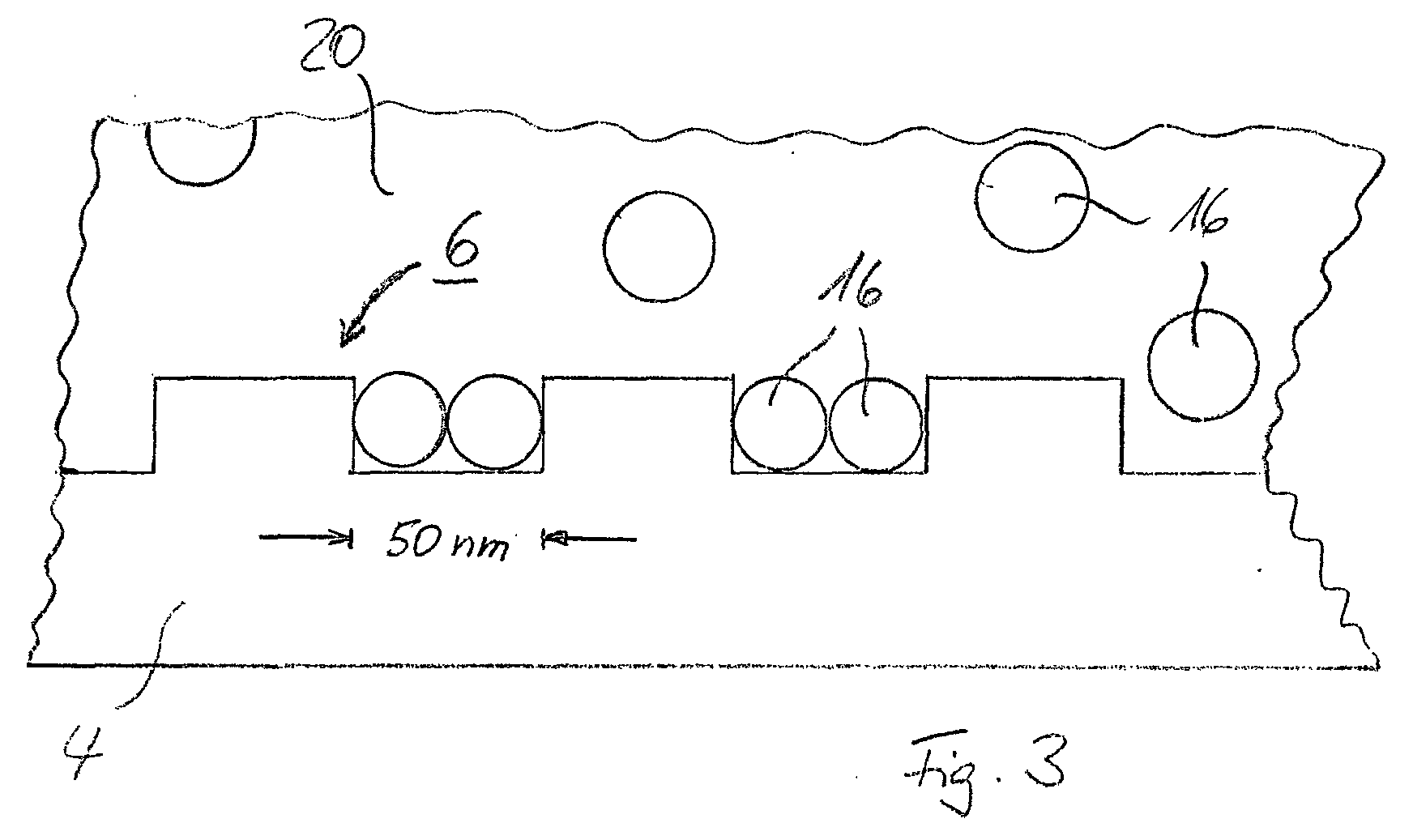
- the artificially patterned substrate 4 can be made with a pattern periodicity to match a certain crystal plane. Examples for this stimulation of the crystallization are schematically depicted in Figures 3 and 4.
- Figure 3 thereby depicts a situation where the match of the period of the topographical surface 6 is an integer multiple, here four-fold, of the diameter of a mostly spherical protein molecule 16 which crystallizes in the wells of the topographical surface 6 having in this examples only a topographical contrast with respect to the periodicity of the wells.
- the situation shown in Figure 3 should give a concept of initial crystal growth. After occupation of a certain number of adjacent wells, the next layers of crystallizing protein molecules 16 will connect the different nuclei stemming from the initial crystallization events and located in the different wells to form a crystal then spreading over a comparatively long range.
- Figure 4 illustrates a significant match of the dimensions of a second protein molecule 18 with the dimension of the artificially generated pattern of the substrate 4.
- the period of the pattern lies in the middle of the usually existing range of biomolecule's lattice parameters.
- topographical patterned surfaces 6 Once the topographical patterned surfaces 6 are created and characterized they will be brought into contact with a solution 20 containing a certain concentration of the biomolecules 16 to be crystallized or containing an unknown composition of certain biomolecules. So they can be tested (initially) using standard protein or biomolecule growth configurations. If the patterned surfaces 6 are active in promoting crystal nucleation then the experiments can be conducted similar to micro-seeding ones.
- the methods according to the invention allow the stimulation of the crystallization at solute concentration where nucleation usually can not be expected to occur spontaneously.
- the amount of biomolecules 16, 18 for this experiment can be limited to very tiny amounts, e.g. an amount corresponding to the volume of a certain number of the wells (range of microliters and/or nanoliters). If the crystal nucleation is successful, e.g. whether the nucleation was truly epitaxial, could be varified by the orientational conformity between the topographical surface 6 and the crystal provided that the crystal does not detach from the topographical surface 6.
- the methods according to the inventions envision the use of this technique in solving a number of nucleation related problems as mentioned in the very beginning of the description.
- this technique leads to much quicker turnover times.
- artificial epitaxy can be used to achieve nucleation in a more controlled way under the conditions of an inclined supersaturation of the mother liquor.
- the technique induces nucleation and subsequent crystal growth of the desired crystall.
Landscapes
- Chemical & Material Sciences (AREA)
- Organic Chemistry (AREA)
- Crystallography & Structural Chemistry (AREA)
- Engineering & Computer Science (AREA)
- Materials Engineering (AREA)
- Metallurgy (AREA)
- Life Sciences & Earth Sciences (AREA)
- General Health & Medical Sciences (AREA)
- Analytical Chemistry (AREA)
- Health & Medical Sciences (AREA)
- Physics & Mathematics (AREA)
- Biochemistry (AREA)
- Biophysics (AREA)
- General Physics & Mathematics (AREA)
- Genetics & Genomics (AREA)
- Medicinal Chemistry (AREA)
- Molecular Biology (AREA)
- Proteomics, Peptides & Aminoacids (AREA)
- Analysing Materials By The Use Of Radiation (AREA)
- Crystals, And After-Treatments Of Crystals (AREA)
Abstract
It is the aim of the invention to provide a technology for
the stimulation of the crystallization of biomolecules
contained in a liquid solution that leads to significant
improvements in the reliability of crystall growth processes
and shortens the time and the number of attempts to grow a
certain biomolecule crystal, also under the condition that
only very small amounts of the biomolecules are available.
This task is solved according to the invention by a method
for generating an artificially patterned substrate for
stimulating the crystallation of a biomolecule, comprising:
Description
- The invention relates to a method for generating an artificially patterned substrate for stimulating the crystallation of a biomolecule. Further, the invention relates to a method for stimulating the crystallization of biomolecules from a liquid solution containing said biomolecules.
- Generally, collecting information related to the structure of proteins and other biomolecules is becoming an important field of technology. With information on the three-dimensional structure of biomolecules, knowledge on many fundamental processes of life can be deepened and the working mechanisms of essential biological processes can be partially or fully elucidated. This knowledge may allow for the more efficient synthesis of bio-active compounds and the optimization of the development of pharmaceuticals.
- For this reason, the determination of molecular structures of proteins is an immensely important task in biological research. The most common method so far for structure determination is X-ray diffraction, which requires proteins to be crystallized before they can be analysed. Protein crystals are often obtained only after lengthy and labour-intensive screening processes. A considerable number of proteins resist crystallization efforts or yield crystals of poor quality which are not suitable for structure determination. Current laboratory practices are largely based on empirical results rather than on a fundamental understanding of crystal nucleation and growth at a physical level.
- In the under the Patent Cooperation Treaty (PCT) published international patent application WO 01/92293 A2 are methods for nano-crystallogenesis disclosed. The disclosure relates so far to methods for identifying crystallization conditions for biomolecules using e.g. a method and an apparatus for screening the phase behaviour in liquid gel or solid phase of such biomolecules, like proteins, peptides, other macromolecules or complexes thereof. This publication also discloses methods for the screening of crystallization conditions and for allowing crystals with higher quality to be grown. These results are achieved by establishing a method for identifying crystallization conditions for at least one biomolecule. This method subjects said biomolecule to a set of compositions in a sample volume of 1 to 100 nanoliters in order to induce or to allow each of said compositions to adopt at least one first condition possibly allowing said crystallization to occur and to detect whether crystallization has occurred or not. The screening disclosed in this publication is performed by differing the test conditions from each test volume to the next. An appropriate method for the preparation of a solid support medium containing wells with a volume of up to 100 nanoliter provides a layer of negative photoresist on a carrier body and applies a pattern to said photoresist. Afterwards UV-illumination is applied to the photoresist and then the non-illuminated parts of the photoresist are removed.
- The main drawback of this disclosure is that the methods proposed do not give any contribution to a better fundamental understanding of the crystallization and growth of proteins and other macromolecules. These methods are based more or less on arbitrary screening approaches to explore the optimal condition for the crystallization of biomolecules. It has to be mentioned that this lack of awareness for the fundamentals of macromolecular crystallization is inherent to the current state of art in this field of research.
- One of the most promising attempts in the last years has been published by X.M.Yang, R.D.Peters, P.F.Nealey, H.H.Solak, F.Cerrina,"Guided self assembly of Symmetric Diblock Copolymer films on chemically nanopatterned substrates, Macromolecules 33, p. 9575. This publication recently demonstrated the organization of macromolecules by chemical contrast of the surface of a substrate matching the natural periodicity of the molecular structures by guided self-assembly of block copolymers. Block copolymers naturally form periodic structures due to micro-phase forces. The resultant structures are not crystalline but they are both regular and periodic. In this study a Self Assembled Monolayer (SAM) coated Si wafer was subjected to X-ray interference lithography (XIL) to obtain a periodic surface structure with chemical contrast. The block copolymer was then deposited on this template surface and annealed to activate the micro-phase separation process. The block copolymers were observed to arrange their domains according to the artificial template structure which was designed to match the natural periodicity of the copolymer.
- Unfortunately, this technology does not apply to the stimulation of the crystallization of biomolecules since the attraction of copolymer self assembly is induced by micro-phase forces and is supported by the fact that a sufficient amount of the material to be self assembled is available. Very often in the field of biomolecular research the determination of the conditions under which crystallogenesis of biomolecules is efficient suffers from another drawback, namely that the available amounts of the target biomolecules are severely limited. More often than not biomolecules are available only in minute quantities (micrograms or nanograms), generally obtained after long and tedious processes.
- According to these main drawbacks in the current state of the art, it is the aim of the invention to provide a technology for the stimulation of the crystallization of biomolecules contained in a liquid solution that leads to significant improvements in the reliability of crystal growth processes and shortens the time and the number of attempts to grow crystals of a certain biomolecule, with particular emphasis on the case that only very small amounts of the biomolecule are available.
- This task is solved according to the invention by a method for generating an artificially patterned substrate for stimulating the crystallation of a biomolecule, comprising:
- a) treating a basic substrate for providing an artificially
patterned substrate;
- i) generating said artificially patterned substrate by exposing X-ray-radiation to said basic substrate;
- ii) performing said exposing of the X-ray-radiation according to X-ray interference lithography technology;
- With respect to a method for stimulating the crystallization
of biomolecules from a liquid solution containing said
biomolecules, this task is solved according to the invention
by a method comprising:
- a) treating a basic substrate for providing an artificially patterned substrate;
- i) generating said artificially patterned substrate by exposing X-ray-radiation to said basic substrate;
- ii) performing said exposing of the X-ray-radiation according to X-ray interference lithography technology;
- b) bringing said artificially patterned substrate into contact with said solution for initiating the crystallization of said biomolecules on the pattern of the artificially patterned substrate.
-
- These methods take advantage of the fact that the crystallization of the biomolecules can be induced by the interaction of the biomolecules with the surface of the artificially patterned substrate. This surface is so far characterized by the behaviour of the basic substrate under the illumination with X-rays carried out using X-ray lithography technology. This illumination will therefore depend on the material/chemical composition of the basic substrate and lead to a topographical and/or chemical contrast of this surface. While the artificially patterned surface is active in promoting crystal nucleation, crystal growth can be induced at solute concentrations where nucleation is expected not to occur spontaneously. For that reason, also for proteins where the nucleation proceeds too rapidly, artificial epitaxy can be used to achieve nucleation in a more controlled way under conditions where spontaneous nucleation does not occur such as lower supersaturation of the mother liquor.
- To achieve excellent conditions for the stimulation of the crystallization the method might be adapted such that at least one lattice parameter of a crystal containing a number of said biomolecules is determined or already known, whereby the surface of the artificially patterned substrate is adjusted to this said at least one lattice parameter. This can be especially useful for production of protein crystals in a reproducible way for biotechnological or medical applications.
- Excellent results are achieved when the dimension of the pattern matches at least approximately at least one lattice parameter of said crystal or when the dimension of the pattern is at least approximately an integer multiple of the at least one lattice parameter of said crystal or an integer part of at least one lattice parameter of said crystal. This measure allows the crystallization of the biomolecules on the regular and periodically patterned surface having mechanical and/or chemical contrast.
- To provide a method that also allows determining the optimal structure of the artificially patterned substrate for a biomolecule whose lattice parameters are not or only roughly known, the method can be performed by generating a gradiential artificially patterned substrate having a gradient with respect to the periodicity of the pattern in at least one dimension of the surface of said gradiential artificially patterned substrate. This gradiential artificially patterned substrate allows to cover a certain range of lattice parameters. For instance, some rough idea about the range of the lattice parameter can be inferred from the size of the biomolecule and the gradient allows to design the surface to cover a certain range of periodicity around the expected or estimated period gained from the expected or estimated lattice parameters. The pattern derived thereof can be made to cover a certain period range with a certain frequency gradient so that locally the biomolecules are enabled to interact with a region of the surface having an approximately constant periodicity with a certain tolerance.
- For this screening or determining process is might be most helpful, if the gradiential artificially patterned substrate has an average period and the periodicity has a variation in the range of 0.1 to 20% of the average period across the length and/or the width of the surface. For achieving surface areas with approximately constant periodicity and a sufficient number of periods it might be most appropriate if the periodicity varies in the range of 3 to 12%, preferably 5% or 10%, of the average period.
- For example, when considering a variable period grating with an average period of 50 nm with 5% variation across the surface, i.e. covering a 1x1 mm2 area, and under the assumption that the pattern period for succesful epitaxial nucleation has to be within an +/- 0.1% interval around a certain period (e.g. 51 nm) then from calculation it can be derived that this requirement is satisfied within a 40 µm wide area encompassing approximately 800 periods of the grating. This can be deemed to be a large enough area for nucleation, given the observation that nuclei in protein crystal growth usually include several hundred molecules.
- For this reason, the most suitable match of these requirements is obtained when the surface has an area in the range of 25 µm2 to 25 mm2. Typically, the area of the surface is in the range of 100 µm2 to 10 mm2, preferably approximately 1 mm2. In accordance with the above, this area is large enough for the growth of the crystal to be expected in the region where the best match of the pattern with the natural crystalline form is obtained.
- To describe this method in other words, the procedure is analoguous to search for the resonance response of an electrical or mechanical system by scanning the frequency of excitation and mesuring the response of the system. When the system is driven at the resonance frequency, then a large amplitude response is achieved. In the case of crystal growth the gradiential period structure will scan the "spatial frequency ranges" to find the resonance, i.e. the optimal match of the pattern with a natural crystal structure.
- To generate a high capability of the artificially patterned substrate to structural analysis, for instance performed by X-ray diffraction means, the basic substrate is a transparent substrate, such as a standard glass cover slip. The glass material may additionally contribute to the success of this technology by its inert characteristics with respect to any chemical and/or catalytic impacts on the crystals to be nucleated and grown afterwards.
- Nevertheless, one main advantage of this proposed technique is the flexibility of materials used as basic substrates for the subsequent patterning. This may lead to the conclusion that this technique is also very suitable in case of the basic substrate being of ceramic or metallic material, such as a thin layer of gold that allows to generate surfaces having solely or additionally a chemical contrast. For this reason, from various attempts it can turn out that the optimal growth conditions of the crystals are achieved with a surface having topographical contrast or having chemical contrast or having both topographical and chemical contrast.
- Usually, the lattice parameters of proteins vary in the range of 5 to 100 nm. It is therefore adequate that the artificially generated pattern can be generated with a periodicity between 0.5 nm and 500 nm. A most appropriate periodicity is deemed to be achieved in the range of 1 to 100 nm. For periods larger than 30 to 40 nm it is easily possible to have a one-to-one match between the crystal and the surface pattern of the artificially patterned substrate. For smaller periods, for instance 10 nm, it is possible to match to an integer multiple of the biomolecule lattice parameter.
- Additional advantageous variations of the inventions may be derived from the other dependent claims.
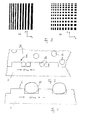
- Examples of the invention are described with reference to the following drawing. Thereby, the drawing depicts:
- Figure 1
- a schematic view on three arrangements a) to c) of interference lithography with x-rays for generating an artificially patterned substrate;
- Figure 2
- a schematic partial view on two different artificially patterned substrates having a gradiental topographical surface;
- Figure 3
- a schematic partial view on a first artificially patterned substrate having a period of about 50 nm; and
- Figure 4
- a schematic partial view on a second artificially patterned substrate having a period of about 60 nm.
- Figure 1 shows schematically three different arrangements a) to c) of interference lithography technology with
X-ray radiation 2 for generating an artifically patternedsubstrate 4 having a topographical patternedsurface 6. In Figure 1 a) an arrangement is shown having two grazing incidence mirrors 8, 10 which allow to a coherent X-ray beam to be deflected thereon and being by this deflection oriented towards the surface of a basic substrate having at the very beginning a more or less homogenous surface. - Due to the facts that the deflected beams are applied to the surface of the basic substrate under different angles the interference of these two beams is originated what leads to a grating pattern according to the interferencial behaviour of the two beams. After the illumination with this interferencial X-ray radiation the former homogeneous surface of the basic substrate became changed into the topographical patterned
surface 6. The structure of the pattern, namely the periodicity of the pattern, depends thereby on the interferential pattern of the X-ray radiation, on the wave length of the X-ray radiation and on the angles with which the two beam are deflected by the mirrors 8, 10. To refrain the surface area illuminated with the interferential X-ray pattern from direct coherent X-ray illumination a directbeam stop element 12 is provided. - Figure 1 b) depicts the second possible arrangement to generate the artifically patterned
substrate 4 having atopographical surface 6. The grating pattern is hereby formed by two beams being diffracted by alinear grating 14. To generate thetopographical surface 6 having a gradiential change of the periodicity in one dimension instead of a linear grating 14 a grating could be used that has a gradient in its structure, too. Atopographical surface 16 having in one dimension a gradiential growth of the periodicity is shown in Figure 2 a). - Figure 1 c) last but not least shows a third possible arrangement for generating a two dimensional patterned
topographical surface 6 on the then artificially patternedsubstrate 4. Four beams of thecoherent X-ray radiation 2 are diffracted bylinear gratings 14 and interfere afterwards when meeting under different angles and generate the interferential patternedtopographical surface 6. Under the provision that thegratings 14 shows gradiential behaviour along the x- and y-axis atopographical surface 6 having a gradiential change of the periodicity in two dimensions as it is shown schematically in Figure 2 b) can be obtained. - The topographical surface according to Figure 2 b) is best suitable for use in a process for screening or determining the optimal conditions for the stimulation of the crystallization of biomolecules on the
topographical surface 6 since a more or less broad variation of the pattern allows the biomolecule to crystallize where the best match of its lattice parameters with the period oftopographical surface 6 is provided. - On the other hand, in cases where lattice parameters and space group of a desired protein crystal are known a priori, the artificially patterned
substrate 4 can be made with a pattern periodicity to match a certain crystal plane. Examples for this stimulation of the crystallization are schematically depicted in Figures 3 and 4. - Figure 3 thereby depicts a situation where the match of the period of the
topographical surface 6 is an integer multiple, here four-fold, of the diameter of a mostlyspherical protein molecule 16 which crystallizes in the wells of thetopographical surface 6 having in this examples only a topographical contrast with respect to the periodicity of the wells. As far as the description of a surface having chemical contrast by means of a drawing is considered not to be possible in an appropriate manner only surfaces having topographical contrast are shown in the drawings. The situation shown in Figure 3 should give a concept of initial crystal growth. After occupation of a certain number of adjacent wells, the next layers of crystallizingprotein molecules 16 will connect the different nuclei stemming from the initial crystallization events and located in the different wells to form a crystal then spreading over a comparatively long range. - A corresponding situation is shown in Figure 4, which illustrates a significant match of the dimensions of a
second protein molecule 18 with the dimension of the artificially generated pattern of thesubstrate 4. In both cases according to the figures 3 and 4 the period of the pattern lies in the middle of the usually existing range of biomolecule's lattice parameters. - Once the topographical
patterned surfaces 6 are created and characterized they will be brought into contact with asolution 20 containing a certain concentration of thebiomolecules 16 to be crystallized or containing an unknown composition of certain biomolecules. So they can be tested (initially) using standard protein or biomolecule growth configurations. If thepatterned surfaces 6 are active in promoting crystal nucleation then the experiments can be conducted similar to micro-seeding ones. - The methods according to the invention allow the stimulation of the crystallization at solute concentration where nucleation usually can not be expected to occur spontaneously. This means that the amount of
biomolecules topographical surface 6 and the crystal provided that the crystal does not detach from thetopographical surface 6. - Finally, the methods according to the inventions envision the use of this technique in solving a number of nucleation related problems as mentioned in the very beginning of the description. In screening of growth conditions this technique leads to much quicker turnover times. For proteins where nucleation proceeds too rapidly due to the kinetical behaviour of the molecules and the therefrom derived danger of forming agglomerations in an amorphous form, artificial epitaxy can be used to achieve nucleation in a more controlled way under the conditions of an inclined supersaturation of the mother liquor. And in cases where the difficulties in the nucleation step causes restriction in the crystal growth altogether the technique induces nucleation and subsequent crystal growth of the desired crystall.
Claims (16)
- A method for generating an artificially patterned substrate (4) for stimulating the crystallation of a biomolecule (16, 18), comprising:a) treating a basic substrate for providing an artificially patterned substrate (4);i) generating said artificially patterned substrate (4) by exposing X-ray-radiation (2) to said basic substrate;ii) performing said exposing of the x-ray-radiation (2) according to X-ray interference lithography technology;
- A method for stimulating the crystallization of biomolecules (16, 18) from a liquid solution (20) containing said biomolecules (16, 18), comprising:a) treating a basic substrate for providing an artificially patterned substrate (4);i) generating said artificially patterned substrate (4) by exposing X-ray-radiation (2) to said basic substrate;ii) performing said exposing of the X-ray-radiation (2) according to X-ray interference lithography technology;b) bringing said artificially patterned substrate (4) into contact with said liquid solution (20) for initiating the crystallization of said biomolecules (16, 18) on the artificially patterned substrate (4).
- The method according to claim 1 or 2,
characterized in that
at least one lattice parameter of a crystal containing a number of said biomolecules (16, 18) is determined or already known, whereby the pattern of the artificially patterned substrate (4) is adapted to this said at least one lattice parameter by adjusting the wave length of the X-ray-radiation (2) and/or the interference conditions to the dimension of the pattern to be artificially generated. - The method according to claim 3,
characterized in that
the dimension of the pattern matches at least approximately with the at least one lattice parameter of said crystal. - The method according to claim 3,
characterized in that
the dimension of the pattern is at least approximately an integer multiple of the at least one lattice parameter of said crystal or an integer part of the at least one lattice parameter of said crystal. - The method according to claim 1 or 2,
characterized in that
generating a gradiential artificially patterned substrate (4) having a gradient with respect to the periodicity of the pattern in at least one dimension of a surface (6) of said gradiential artificially patterned substrate (4). - The method according to claim 6,
characterized in that
the gradiential artificially patterned substrate (4) has an average period and the periodicity has a variation in the range of 0.1 to 20% of the average period across the length and/or the width of the surface (6). - The method according to claim 7,
characterized in that
the periodicity varies in the range of 3 to 12%, preferably 5% or 10%, of the average period. - The method according to at least one of the claims 6 to 8, characterized in that
the surface (6) has an area in the range of 25 µm2 to 25 mm2. - The method according to claim 9,
characterized in that
the surface (6) has an area in the range of 100 µm2 to 10 mm2, preferably approximately 1 mm2. - The method according to at least one of the claims 1 to 10, characterized in that
the basic substrate (4) is a transparent substrate. - The method according to claim 11,
characterized in that
the transparent substrate is a standard glass cover slip. - The method according to at least one of the claims 1 to 10, characterized in that
the basic substrate (4) is a ceramic substrate or a metallic substrate. - The method according to at least one of the claims 1 to 13, characterized in that
the artificially generated pattern of the surface (6) has a periodicity in the range of 0.5 nm to 500 nm. - The method according to claim 14,
characterized in that
the periodicity is in the range of 1 to 100 nm. - The method according to at least one of the claims 1 to 15, characterized in that
the biomolecules (16, 18) are proteins, peptides, macromolecules or complexes thereof.
Priority Applications (4)
| Application Number | Priority Date | Filing Date | Title |
|---|---|---|---|
| EP02010730A EP1336671A1 (en) | 2002-02-15 | 2002-05-14 | Method for generating an artificially patterned substrate for stimulating the crystallization of a biomolecule thereon and method of stimulating the crystallization of biomolecules |
| AU2003206863A AU2003206863A1 (en) | 2002-02-15 | 2003-02-07 | Method for generating an artificially patterned substrate |
| PCT/EP2003/001221 WO2003069028A1 (en) | 2002-02-15 | 2003-02-07 | Method for generating an artificially patterned substrate |
| US10/916,472 US7459614B2 (en) | 2002-02-15 | 2004-08-12 | Method for generating an artificially patterned substrate for stimulating the crystallation of a biomolecule thereon and method for stimulating the crystallization of biomolecules |
Applications Claiming Priority (3)
| Application Number | Priority Date | Filing Date | Title |
|---|---|---|---|
| EP02003534 | 2002-02-15 | ||
| EP02003534 | 2002-02-15 | ||
| EP02010730A EP1336671A1 (en) | 2002-02-15 | 2002-05-14 | Method for generating an artificially patterned substrate for stimulating the crystallization of a biomolecule thereon and method of stimulating the crystallization of biomolecules |
Publications (1)
| Publication Number | Publication Date |
|---|---|
| EP1336671A1 true EP1336671A1 (en) | 2003-08-20 |
Family
ID=27624081
Family Applications (1)
| Application Number | Title | Priority Date | Filing Date |
|---|---|---|---|
| EP02010730A Withdrawn EP1336671A1 (en) | 2002-02-15 | 2002-05-14 | Method for generating an artificially patterned substrate for stimulating the crystallization of a biomolecule thereon and method of stimulating the crystallization of biomolecules |
Country Status (4)
| Country | Link |
|---|---|
| US (1) | US7459614B2 (en) |
| EP (1) | EP1336671A1 (en) |
| AU (1) | AU2003206863A1 (en) |
| WO (1) | WO2003069028A1 (en) |
Cited By (1)
| Publication number | Priority date | Publication date | Assignee | Title |
|---|---|---|---|---|
| WO2009152635A1 (en) * | 2008-06-20 | 2009-12-23 | ETH Zürich | Gradient-based screening tools for polymorph detection and identification |
Families Citing this family (3)
| Publication number | Priority date | Publication date | Assignee | Title |
|---|---|---|---|---|
| EP2106858B1 (en) | 2008-03-31 | 2011-11-02 | Sony DADC Austria AG | Substrate and target plate |
| EP2795501A2 (en) * | 2011-12-21 | 2014-10-29 | Life Technologies Corporation | Methods and systems for in silico experimental designing and performing a biological workflow |
| US20230130343A1 (en) * | 2020-03-31 | 2023-04-27 | Nippon Telegraph And Telephone Corporation | Crystal Growing Condition Analysis Method, Crystal Growing Condition Analysis System, Crystal Growing Condition Analysis Program, and Data Structure for Crystal Growing Data |
Citations (2)
| Publication number | Priority date | Publication date | Assignee | Title |
|---|---|---|---|---|
| EP0997780A1 (en) * | 1998-10-27 | 2000-05-03 | Canon Kabushiki Kaisha | Exposure method |
| WO2001092293A2 (en) * | 2000-05-31 | 2001-12-06 | Universiteit Leiden | Methods for identifying crystallization conditions for biomolecules |
Family Cites Families (3)
| Publication number | Priority date | Publication date | Assignee | Title |
|---|---|---|---|---|
| US6882477B1 (en) * | 1999-11-10 | 2005-04-19 | Massachusetts Institute Of Technology | Method and system for interference lithography utilizing phase-locked scanning beams |
| US6645677B1 (en) * | 2000-09-18 | 2003-11-11 | Micronic Laser Systems Ab | Dual layer reticle blank and manufacturing process |
| AU2002228598A1 (en) * | 2000-11-20 | 2002-06-03 | Parallel Synthesis Technologies, Inc. | Methods and devices for high throughput crystallization |
-
2002
- 2002-05-14 EP EP02010730A patent/EP1336671A1/en not_active Withdrawn
-
2003
- 2003-02-07 AU AU2003206863A patent/AU2003206863A1/en not_active Abandoned
- 2003-02-07 WO PCT/EP2003/001221 patent/WO2003069028A1/en not_active Ceased
-
2004
- 2004-08-12 US US10/916,472 patent/US7459614B2/en not_active Expired - Lifetime
Patent Citations (2)
| Publication number | Priority date | Publication date | Assignee | Title |
|---|---|---|---|---|
| EP0997780A1 (en) * | 1998-10-27 | 2000-05-03 | Canon Kabushiki Kaisha | Exposure method |
| WO2001092293A2 (en) * | 2000-05-31 | 2001-12-06 | Universiteit Leiden | Methods for identifying crystallization conditions for biomolecules |
Non-Patent Citations (1)
| Title |
|---|
| YANG X M ET AL: "Guided self-assembly of symmetric diblock copolymer films on chemically nanopatterned substrates", MACROMOLECULES, AMERICAN CHEMICAL SOCIETY, EASTON, PA, US, vol. 33, no. 26, December 2000 (2000-12-01), pages 9575 - 9582, XP002223275, ISSN: 0024-9297 * |
Cited By (1)
| Publication number | Priority date | Publication date | Assignee | Title |
|---|---|---|---|---|
| WO2009152635A1 (en) * | 2008-06-20 | 2009-12-23 | ETH Zürich | Gradient-based screening tools for polymorph detection and identification |
Also Published As
| Publication number | Publication date |
|---|---|
| US20070111256A1 (en) | 2007-05-17 |
| WO2003069028A1 (en) | 2003-08-21 |
| US7459614B2 (en) | 2008-12-02 |
| AU2003206863A1 (en) | 2003-09-04 |
Similar Documents
| Publication | Publication Date | Title |
|---|---|---|
| DE69334108T2 (en) | Electric method for the determination of molecules | |
| USRE42315E1 (en) | Nanostructured separation and analysis devices for biological membranes | |
| Kuzmenko et al. | Design and characterization of crystalline thin film architectures at the air− liquid interface: Simplicity to complexity | |
| DE69737883T2 (en) | LIGHT-REGULATED, ELECTROKINETIC COMPOSITION OF PARTICLES TO SURFACES | |
| Robinson et al. | Dental enamel—a biological ceramic: regular substructures in enamel hydroxyapatite crystals revealed by atomic force microscopy | |
| DE602004011244T2 (en) | USE OF LIQUID CRYSTALS FOR THE DETECTION OF AFFINITY MICROCONTACT PRINTED BIOMOLECULES | |
| DE69012119T2 (en) | SYNTHESIS OF IMMOBILIZED POLYMERS ON A LARGE SCALE. | |
| Rapaport et al. | From nucleation to engineering of crystalline architectures at air− liquid interfaces | |
| DE69833562T2 (en) | NANO ELECTRODE ARRANGEMENT | |
| US7132122B2 (en) | Direct micro-patterning of lipid bilayers using UV light and selected uses thereof | |
| JP3953473B2 (en) | Fabrication method of nano-pattern and carbon nanotube-bio-nanoarray using organic supramolecular self-assembly and UV etching | |
| US20040245209A1 (en) | Method for fabricating a carbon nanotube array and a biochip using the self-assembly of supramolecules and staining of metal compound | |
| US7318903B2 (en) | Photonic sensor particles and fabrication methods | |
| US7329592B2 (en) | Method for screening crystallization conditions using multifunctional substrates | |
| US7459614B2 (en) | Method for generating an artificially patterned substrate for stimulating the crystallation of a biomolecule thereon and method for stimulating the crystallization of biomolecules | |
| US7975363B2 (en) | Method of making a probe tip | |
| Pechkova et al. | Proteomics and Nanocrystallography | |
| Eiswirth et al. | Spatiotemporal selforganization on isothermal catalysts | |
| CN103201631A (en) | Devices and methods for controlling actin filaments growth and organization using micropatterned nucleation sites | |
| Yurtsever et al. | Dynamics of Molecular Self‐Assembly of Short Peptides at Liquid–Solid Interfaces–Effect of Charged Amino Acid Point Mutations | |
| Liakakos et al. | Oriented metallic nano-objects on crystalline surfaces by solution epitaxial growth | |
| DE102004027865A1 (en) | Manufacture of conductive carbon nanotubes dotted with metals for biosensors, involves combining carboxyl group of nanotube with amino group of substance having amino and thiol groups, and combining metal with thiol group | |
| Peled et al. | Characterization of photodeposited selenium planar structures by scanning force microscopy | |
| Teschke et al. | Chiral asymmetric structures in aspartic acid and valine crystals assessed by atomic force microscopy | |
| US20030068252A1 (en) | Crystal nucleating chip |
Legal Events
| Date | Code | Title | Description |
|---|---|---|---|
| PUAI | Public reference made under article 153(3) epc to a published international application that has entered the european phase |
Free format text: ORIGINAL CODE: 0009012 |
|
| AK | Designated contracting states |
Designated state(s): AT BE CH CY DE DK ES FI FR GB GR IE IT LI LU MC NL PT SE TR |
|
| AX | Request for extension of the european patent |
Extension state: AL LT LV MK RO SI |
|
| AKX | Designation fees paid | ||
| REG | Reference to a national code |
Ref country code: DE Ref legal event code: 8566 |
|
| STAA | Information on the status of an ep patent application or granted ep patent |
Free format text: STATUS: THE APPLICATION IS DEEMED TO BE WITHDRAWN |
|
| 18D | Application deemed to be withdrawn |
Effective date: 20040302 |