EP1335901B1 - Pharmaceutically active sulfanilide derivatives - Google Patents
Pharmaceutically active sulfanilide derivatives Download PDFInfo
- Publication number
- EP1335901B1 EP1335901B1 EP01982432A EP01982432A EP1335901B1 EP 1335901 B1 EP1335901 B1 EP 1335901B1 EP 01982432 A EP01982432 A EP 01982432A EP 01982432 A EP01982432 A EP 01982432A EP 1335901 B1 EP1335901 B1 EP 1335901B1
- Authority
- EP
- European Patent Office
- Prior art keywords
- oxo
- ethoxy
- hydrazino
- dihydro
- ethyl
- Prior art date
- Legal status (The legal status is an assumption and is not a legal conclusion. Google has not performed a legal analysis and makes no representation as to the accuracy of the status listed.)
- Expired - Lifetime
Links
- -1 preterm labor Chemical compound 0.000 claims abstract description 163
- 125000001072 heteroaryl group Chemical group 0.000 claims abstract description 73
- XNOPRXBHLZRZKH-UHFFFAOYSA-N Oxytocin Natural products N1C(=O)C(N)CSSCC(C(=O)N2C(CCC2)C(=O)NC(CC(C)C)C(=O)NCC(N)=O)NC(=O)C(CC(N)=O)NC(=O)C(CCC(N)=O)NC(=O)C(C(C)CC)NC(=O)C1CC1=CC=C(O)C=C1 XNOPRXBHLZRZKH-UHFFFAOYSA-N 0.000 claims abstract description 54
- 229960001723 oxytocin Drugs 0.000 claims abstract description 53
- XNOPRXBHLZRZKH-DSZYJQQASA-N oxytocin Chemical compound C([C@H]1C(=O)N[C@H](C(N[C@@H](CCC(N)=O)C(=O)N[C@@H](CC(N)=O)C(=O)N[C@@H](CSSC[C@H](N)C(=O)N1)C(=O)N1[C@@H](CCC1)C(=O)N[C@@H](CC(C)C)C(=O)NCC(N)=O)=O)[C@@H](C)CC)C1=CC=C(O)C=C1 XNOPRXBHLZRZKH-DSZYJQQASA-N 0.000 claims abstract description 51
- 238000000034 method Methods 0.000 claims abstract description 50
- 101800000989 Oxytocin Proteins 0.000 claims abstract description 47
- KBZOIRJILGZLEJ-LGYYRGKSSA-N argipressin Chemical compound C([C@H]1C(=O)N[C@@H](CCC(N)=O)C(=O)N[C@@H](CC(N)=O)C(=O)N[C@@H](CSSC[C@@H](C(N[C@@H](CC=2C=CC(O)=CC=2)C(=O)N1)=O)N)C(=O)N1[C@@H](CCC1)C(=O)N[C@@H](CCCN=C(N)N)C(=O)NCC(N)=O)C1=CC=CC=C1 KBZOIRJILGZLEJ-LGYYRGKSSA-N 0.000 claims abstract description 30
- 102000004279 Oxytocin receptors Human genes 0.000 claims abstract description 26
- 108090000876 Oxytocin receptors Proteins 0.000 claims abstract description 26
- 208000006399 Premature Obstetric Labor Diseases 0.000 claims abstract description 25
- GXBMIBRIOWHPDT-UHFFFAOYSA-N Vasopressin Natural products N1C(=O)C(CC=2C=C(O)C=CC=2)NC(=O)C(N)CSSCC(C(=O)N2C(CCC2)C(=O)NC(CCCN=C(N)N)C(=O)NCC(N)=O)NC(=O)C(CC(N)=O)NC(=O)C(CCC(N)=O)NC(=O)C1CC1=CC=CC=C1 GXBMIBRIOWHPDT-UHFFFAOYSA-N 0.000 claims abstract description 24
- 108010004977 Vasopressins Proteins 0.000 claims abstract description 24
- 102000002852 Vasopressins Human genes 0.000 claims abstract description 24
- 229960003726 vasopressin Drugs 0.000 claims abstract description 24
- 208000005171 Dysmenorrhea Diseases 0.000 claims abstract description 22
- 206010013935 Dysmenorrhoea Diseases 0.000 claims abstract description 21
- 208000005107 Premature Birth Diseases 0.000 claims abstract description 16
- 206010036590 Premature baby Diseases 0.000 claims abstract description 16
- 239000008194 pharmaceutical composition Substances 0.000 claims abstract description 16
- 238000002360 preparation method Methods 0.000 claims abstract description 16
- 230000028327 secretion Effects 0.000 claims abstract description 15
- 206010007559 Cardiac failure congestive Diseases 0.000 claims abstract description 14
- 206010019280 Heart failures Diseases 0.000 claims abstract description 14
- 206010029164 Nephrotic syndrome Diseases 0.000 claims abstract description 14
- 208000037849 arterial hypertension Diseases 0.000 claims abstract description 14
- 208000019425 cirrhosis of liver Diseases 0.000 claims abstract description 14
- 206010030043 Ocular hypertension Diseases 0.000 claims abstract description 13
- 102000004136 Vasopressin Receptors Human genes 0.000 claims abstract description 11
- 108090000643 Vasopressin Receptors Proteins 0.000 claims abstract description 11
- 102100031951 Oxytocin-neurophysin 1 Human genes 0.000 claims abstract 3
- 125000004169 (C1-C6) alkyl group Chemical group 0.000 claims description 102
- 125000003118 aryl group Chemical group 0.000 claims description 97
- 125000001495 ethyl group Chemical group [H]C([H])([H])C([H])([H])* 0.000 claims description 47
- 125000000717 hydrazino group Chemical group [H]N([*])N([H])[H] 0.000 claims description 38
- 125000001301 ethoxy group Chemical group [H]C([H])([H])C([H])([H])O* 0.000 claims description 24
- 125000001424 substituent group Chemical group 0.000 claims description 24
- 125000003917 carbamoyl group Chemical group [H]N([H])C(*)=O 0.000 claims description 23
- 125000000753 cycloalkyl group Chemical group 0.000 claims description 23
- DLFVBJFMPXGRIB-UHFFFAOYSA-N Acetamide Chemical group CC(N)=O DLFVBJFMPXGRIB-UHFFFAOYSA-N 0.000 claims description 22
- 125000000882 C2-C6 alkenyl group Chemical group 0.000 claims description 22
- 229910052736 halogen Inorganic materials 0.000 claims description 22
- 125000002924 primary amino group Chemical group [H]N([H])* 0.000 claims description 22
- 125000003601 C2-C6 alkynyl group Chemical group 0.000 claims description 21
- 125000002252 acyl group Chemical group 0.000 claims description 21
- 125000004453 alkoxycarbonyl group Chemical group 0.000 claims description 20
- 238000006243 chemical reaction Methods 0.000 claims description 20
- 125000004191 (C1-C6) alkoxy group Chemical group 0.000 claims description 19
- 125000003178 carboxy group Chemical group [H]OC(*)=O 0.000 claims description 19
- 229910052739 hydrogen Inorganic materials 0.000 claims description 19
- 102000005962 receptors Human genes 0.000 claims description 19
- 108020003175 receptors Proteins 0.000 claims description 19
- 150000002367 halogens Chemical class 0.000 claims description 18
- 229920006395 saturated elastomer Polymers 0.000 claims description 18
- 125000000472 sulfonyl group Chemical group *S(*)(=O)=O 0.000 claims description 18
- 150000003839 salts Chemical class 0.000 claims description 17
- 125000005842 heteroatom Chemical group 0.000 claims description 16
- 230000027455 binding Effects 0.000 claims description 15
- 230000008569 process Effects 0.000 claims description 15
- 229910052717 sulfur Inorganic materials 0.000 claims description 15
- 125000003545 alkoxy group Chemical group 0.000 claims description 14
- 125000001997 phenyl group Chemical group [H]C1=C([H])C([H])=C(*)C([H])=C1[H] 0.000 claims description 14
- 125000004093 cyano group Chemical group *C#N 0.000 claims description 13
- 125000000623 heterocyclic group Chemical group 0.000 claims description 13
- 229910052757 nitrogen Inorganic materials 0.000 claims description 13
- 229910052760 oxygen Inorganic materials 0.000 claims description 13
- UWYZHKAOTLEWKK-UHFFFAOYSA-N 1,2,3,4-tetrahydroisoquinoline Chemical compound C1=CC=C2CNCCC2=C1 UWYZHKAOTLEWKK-UHFFFAOYSA-N 0.000 claims description 12
- 125000004442 acylamino group Chemical group 0.000 claims description 12
- 125000004423 acyloxy group Chemical group 0.000 claims description 12
- 125000005309 thioalkoxy group Chemical group 0.000 claims description 12
- 125000003396 thiol group Chemical group [H]S* 0.000 claims description 12
- 125000004432 carbon atom Chemical group C* 0.000 claims description 11
- 125000000467 secondary amino group Chemical group [H]N([*:1])[*:2] 0.000 claims description 11
- 125000001302 tertiary amino group Chemical group 0.000 claims description 11
- NQRYJNQNLNOLGT-UHFFFAOYSA-N Piperidine Chemical compound C1CCNCC1 NQRYJNQNLNOLGT-UHFFFAOYSA-N 0.000 claims description 10
- 239000003814 drug Substances 0.000 claims description 10
- QLNJFJADRCOGBJ-UHFFFAOYSA-N propionamide Chemical compound CCC(N)=O QLNJFJADRCOGBJ-UHFFFAOYSA-N 0.000 claims description 10
- RWRDLPDLKQPQOW-UHFFFAOYSA-N Pyrrolidine Chemical compound C1CCNC1 RWRDLPDLKQPQOW-UHFFFAOYSA-N 0.000 claims description 9
- 239000001257 hydrogen Substances 0.000 claims description 9
- KHBQMWCZKVMBLN-UHFFFAOYSA-N Benzenesulfonamide Chemical compound NS(=O)(=O)C1=CC=CC=C1 KHBQMWCZKVMBLN-UHFFFAOYSA-N 0.000 claims description 8
- 125000004122 cyclic group Chemical group 0.000 claims description 8
- 125000004435 hydrogen atom Chemical class [H]* 0.000 claims description 8
- IUVKMZGDUIUOCP-BTNSXGMBSA-N quinbolone Chemical group O([C@H]1CC[C@H]2[C@H]3[C@@H]([C@]4(C=CC(=O)C=C4CC3)C)CC[C@@]21C)C1=CCCC1 IUVKMZGDUIUOCP-BTNSXGMBSA-N 0.000 claims description 8
- HBAQYPYDRFILMT-UHFFFAOYSA-N 8-[3-(1-cyclopropylpyrazol-4-yl)-1H-pyrazolo[4,3-d]pyrimidin-5-yl]-3-methyl-3,8-diazabicyclo[3.2.1]octan-2-one Chemical class C1(CC1)N1N=CC(=C1)C1=NNC2=C1N=C(N=C2)N1C2C(N(CC1CC2)C)=O HBAQYPYDRFILMT-UHFFFAOYSA-N 0.000 claims description 7
- 125000003342 alkenyl group Chemical group 0.000 claims description 7
- 125000000304 alkynyl group Chemical group 0.000 claims description 7
- 125000002915 carbonyl group Chemical group [*:2]C([*:1])=O 0.000 claims description 7
- 125000000449 nitro group Chemical group [O-][N+](*)=O 0.000 claims description 7
- 125000006239 protecting group Chemical group 0.000 claims description 7
- 238000006798 ring closing metathesis reaction Methods 0.000 claims description 7
- 125000000217 alkyl group Chemical group 0.000 claims description 6
- QGZKDVFQNNGYKY-UHFFFAOYSA-O ammonium group Chemical group [NH4+] QGZKDVFQNNGYKY-UHFFFAOYSA-O 0.000 claims description 6
- SHUVSCHNMZHWMV-UHFFFAOYSA-N n-(4-chlorophenyl)-4-(2-morpholin-4-ylethylamino)-n-[2-oxo-2-[2-(2-oxoindol-3-yl)hydrazinyl]ethyl]benzenesulfonamide Chemical compound C1=CC(Cl)=CC=C1N(S(=O)(=O)C=1C=CC(NCCN2CCOCC2)=CC=1)CC(=O)N\N=C/1C2=CC=CC=C2NC\1=O SHUVSCHNMZHWMV-UHFFFAOYSA-N 0.000 claims description 6
- 125000004433 nitrogen atom Chemical group N* 0.000 claims description 6
- 125000004095 oxindolyl group Chemical group N1(C(CC2=CC=CC=C12)=O)* 0.000 claims description 6
- 239000000546 pharmaceutical excipient Substances 0.000 claims description 6
- 125000004953 trihalomethyl group Chemical group 0.000 claims description 6
- CDCNCECUUOTQLA-UHFFFAOYSA-N 3-[4-[(4-methylphenyl)-[2-oxo-2-[2-(2-oxoindol-3-yl)hydrazinyl]ethyl]sulfamoyl]phenyl]propanamide Chemical compound C1=CC(C)=CC=C1N(S(=O)(=O)C=1C=CC(CCC(N)=O)=CC=1)CC(=O)N\N=C/1C2=CC=CC=C2NC\1=O CDCNCECUUOTQLA-UHFFFAOYSA-N 0.000 claims description 5
- PKJXBTOESGFNEK-UHFFFAOYSA-N 4-ethoxy-n-(4-methylphenyl)-n-[1-oxo-1-[2-(2-oxoindol-3-yl)hydrazinyl]propan-2-yl]benzenesulfonamide Chemical compound C1=CC(OCC)=CC=C1S(=O)(=O)N(C=1C=CC(C)=CC=1)C(C)C(=O)N\N=C/1C2=CC=CC=C2NC\1=O PKJXBTOESGFNEK-UHFFFAOYSA-N 0.000 claims description 5
- 239000003085 diluting agent Substances 0.000 claims description 5
- 150000003335 secondary amines Chemical class 0.000 claims description 5
- BUKWNCANUKACAQ-UHFFFAOYSA-N 3-[4-[(4-chlorophenyl)-[2-oxo-2-[2-(2-oxoindol-3-yl)hydrazinyl]ethyl]sulfamoyl]phenyl]-n-[3-(dimethylamino)propyl]propanamide Chemical compound C1=CC(CCC(=O)NCCCN(C)C)=CC=C1S(=O)(=O)N(C=1C=CC(Cl)=CC=1)CC(=O)NNC1=C(C=CC=C2)C2=NC1=O BUKWNCANUKACAQ-UHFFFAOYSA-N 0.000 claims description 4
- ZRXFNSDCBBRXNT-UHFFFAOYSA-N 4-methoxy-n-(4-methylphenyl)-n-[2-oxo-2-[2-(2-oxoindol-3-yl)hydrazinyl]ethyl]benzenesulfonamide Chemical compound C1=CC(OC)=CC=C1S(=O)(=O)N(C=1C=CC(C)=CC=1)CC(=O)NN=C1C2=CC=CC=C2NC1=O ZRXFNSDCBBRXNT-UHFFFAOYSA-N 0.000 claims description 4
- 125000001797 benzyl group Chemical group [H]C1=C([H])C([H])=C(C([H])=C1[H])C([H])([H])* 0.000 claims description 4
- 125000005843 halogen group Chemical group 0.000 claims description 4
- 125000001041 indolyl group Chemical group 0.000 claims description 4
- SYQHKFJZYINWHL-UHFFFAOYSA-N n-(4-chlorophenyl)-4-[2-(2-methoxyethoxy)ethoxy]-n-[2-oxo-2-[2-(2-oxoindol-3-yl)hydrazinyl]ethyl]benzenesulfonamide Chemical compound C1=CC(OCCOCCOC)=CC=C1S(=O)(=O)N(C=1C=CC(Cl)=CC=1)CC(=O)N\N=C/1C2=CC=CC=C2NC\1=O SYQHKFJZYINWHL-UHFFFAOYSA-N 0.000 claims description 4
- KADSBHRUZZTVJC-UHFFFAOYSA-N n-(4-chlorophenyl)-4-[3-(dimethylamino)propoxy]-n-[2-oxo-2-[2-(2-oxopyrrolo[3,2-c]pyridin-3-yl)hydrazinyl]ethyl]benzenesulfonamide Chemical compound C1=CC(OCCCN(C)C)=CC=C1S(=O)(=O)N(C=1C=CC(Cl)=CC=1)CC(=O)N\N=C/1C2=CN=CC=C2NC\1=O KADSBHRUZZTVJC-UHFFFAOYSA-N 0.000 claims description 4
- SBZYDBPLQSOQPJ-WGOQTCKBSA-N n-[(e)-(2-aminophenyl)methylideneamino]-2-(n-(4-ethoxyphenyl)sulfonyl-4-methylanilino)acetamide Chemical compound C1=CC(OCC)=CC=C1S(=O)(=O)N(C=1C=CC(C)=CC=1)CC(=O)N\N=C\C1=CC=CC=C1N SBZYDBPLQSOQPJ-WGOQTCKBSA-N 0.000 claims description 4
- SGRAVRUHEWLMMM-FQEVSTJZSA-N (2s)-2-[[2-(n-(3,4-dimethoxyphenyl)sulfonyl-4-fluoroanilino)acetyl]amino]-3-methylbutanoic acid Chemical compound C1=C(OC)C(OC)=CC=C1S(=O)(=O)N(CC(=O)N[C@@H](C(C)C)C(O)=O)C1=CC=C(F)C=C1 SGRAVRUHEWLMMM-FQEVSTJZSA-N 0.000 claims description 3
- IQHKPRZHUKFVCD-AFUMVMLFSA-N 2-(4-chloro-N-(3,4-dimethoxyphenyl)sulfonylanilino)-N-[(E)-(2-hydroxyphenyl)methylideneamino]acetamide Chemical compound C1=C(OC)C(OC)=CC=C1S(=O)(=O)N(C=1C=CC(Cl)=CC=1)CC(=O)N\N=C\C1=CC=CC=C1O IQHKPRZHUKFVCD-AFUMVMLFSA-N 0.000 claims description 3
- ULLDHNAKOOJKFD-MFKUBSTISA-N 2-(4-chloro-n-(4-ethoxyphenyl)sulfonylanilino)-n-[(e)-pyridin-2-ylmethylideneamino]acetamide Chemical compound C1=CC(OCC)=CC=C1S(=O)(=O)N(C=1C=CC(Cl)=CC=1)CC(=O)N\N=C\C1=CC=CC=N1 ULLDHNAKOOJKFD-MFKUBSTISA-N 0.000 claims description 3
- 125000000586 2-(4-morpholinyl)ethoxy group Chemical group [H]C([H])(O*)C([H])([H])N1C([H])([H])C([H])([H])OC([H])([H])C1([H])[H] 0.000 claims description 3
- XKXOGTZJEHCMNC-OGLMXYFKSA-N 2-(N-(4-ethoxyphenyl)sulfonyl-4-methylanilino)-N-[(E)-(2-methyl-1H-indol-3-yl)methylideneamino]acetamide Chemical compound C1=CC(OCC)=CC=C1S(=O)(=O)N(C=1C=CC(C)=CC=1)CC(=O)N\N=C\C1=C(C)NC2=CC=CC=C12 XKXOGTZJEHCMNC-OGLMXYFKSA-N 0.000 claims description 3
- ZUQPLDIDIPJFMT-OGLMXYFKSA-N 2-(N-(4-ethoxyphenyl)sulfonyl-4-methylanilino)-N-[(E)-1H-indol-3-ylmethylideneamino]acetamide Chemical compound C1=CC(OCC)=CC=C1S(=O)(=O)N(C=1C=CC(C)=CC=1)CC(=O)N\N=C\C1=CNC2=CC=CC=C12 ZUQPLDIDIPJFMT-OGLMXYFKSA-N 0.000 claims description 3
- MAMQBNFAJNHPNW-ZVHZXABRSA-N 2-(N-(4-fluorophenyl)sulfonyl-4-methylanilino)-N-[(E)-(2-hydroxyphenyl)methylideneamino]acetamide Chemical compound C1=CC(C)=CC=C1N(S(=O)(=O)C=1C=CC(F)=CC=1)CC(=O)N\N=C\C1=CC=CC=C1O MAMQBNFAJNHPNW-ZVHZXABRSA-N 0.000 claims description 3
- SQHGHHGHNNGODU-UHFFFAOYSA-N 2-[2-[2-(n-(4-ethoxyphenyl)sulfonyl-4-methoxyanilino)acetyl]-3,4-dihydro-1h-isoquinolin-3-yl]acetamide Chemical compound C1=CC(OCC)=CC=C1S(=O)(=O)N(C=1C=CC(OC)=CC=1)CC(=O)N1C(CC(N)=O)CC2=CC=CC=C2C1 SQHGHHGHNNGODU-UHFFFAOYSA-N 0.000 claims description 3
- QOYJPIRFIREWPF-UHFFFAOYSA-N 2-[[2-(n-(4-ethoxyphenyl)sulfonyl-4-fluoroanilino)acetyl]amino]-3-(1h-indol-3-yl)propanamide Chemical compound C1=CC(OCC)=CC=C1S(=O)(=O)N(C=1C=CC(F)=CC=1)CC(=O)NC(C(N)=O)CC1=CNC2=CC=CC=C12 QOYJPIRFIREWPF-UHFFFAOYSA-N 0.000 claims description 3
- 125000000094 2-phenylethyl group Chemical group [H]C1=C([H])C([H])=C(C([H])=C1[H])C([H])([H])C([H])([H])* 0.000 claims description 3
- VHMICKWLTGFITH-UHFFFAOYSA-N 2H-isoindole Chemical compound C1=CC=CC2=CNC=C21 VHMICKWLTGFITH-UHFFFAOYSA-N 0.000 claims description 3
- FMTVKAXRAQYMDS-UHFFFAOYSA-N 3-[2-[2-(4-chloro-n-[4-[3-(dimethylamino)propoxy]phenyl]sulfonylanilino)acetyl]hydrazinyl]-2-oxoindole-7-carboxylic acid Chemical compound C1=CC(OCCCN(C)C)=CC=C1S(=O)(=O)N(C=1C=CC(Cl)=CC=1)CC(=O)N\N=C/1C(C=CC=C2C(O)=O)=C2NC\1=O FMTVKAXRAQYMDS-UHFFFAOYSA-N 0.000 claims description 3
- XUKRCELWKWXXDD-UHFFFAOYSA-N 4-(4-methoxyphenyl)-n-(4-methylphenyl)-n-[2-oxo-2-[2-(2-oxoindol-3-yl)hydrazinyl]ethyl]benzenesulfonamide Chemical compound C1=CC(OC)=CC=C1C1=CC=C(S(=O)(=O)N(CC(=O)N\N=C/2C3=CC=CC=C3NC\2=O)C=2C=CC(C)=CC=2)C=C1 XUKRCELWKWXXDD-UHFFFAOYSA-N 0.000 claims description 3
- BKDYRRXMJCHJEM-UHFFFAOYSA-N 4-[2-(dimethylamino)ethoxy]-n-(4-methylphenyl)-n-[2-oxo-2-[2-(2-oxoindol-3-yl)hydrazinyl]ethyl]benzenesulfonamide Chemical compound C1=CC(OCCN(C)C)=CC=C1S(=O)(=O)N(C=1C=CC(C)=CC=1)CC(=O)N\N=C/1C2=CC=CC=C2NC\1=O BKDYRRXMJCHJEM-UHFFFAOYSA-N 0.000 claims description 3
- AULHQTICNXXEBN-UHFFFAOYSA-N 4-cyano-n-(4-methylphenyl)-n-[2-oxo-2-[2-(2-oxoindol-3-yl)hydrazinyl]ethyl]benzenesulfonamide Chemical compound C1=CC(C)=CC=C1N(S(=O)(=O)C=1C=CC(=CC=1)C#N)CC(=O)NN=C1C2=CC=CC=C2NC1=O AULHQTICNXXEBN-UHFFFAOYSA-N 0.000 claims description 3
- LWAGCEQSXBGKFO-UHFFFAOYSA-N 4-ethoxy-n-[3-hydroxy-1-oxo-1-[2-(2-oxoindol-3-yl)hydrazinyl]propan-2-yl]-n-(4-methylphenyl)benzenesulfonamide Chemical compound C1=CC(OCC)=CC=C1S(=O)(=O)N(C=1C=CC(C)=CC=1)C(CO)C(=O)N\N=C/1C2=CC=CC=C2NC\1=O LWAGCEQSXBGKFO-UHFFFAOYSA-N 0.000 claims description 3
- CMGDQUSTMMEZNS-PCLIKHOPSA-N N-[(E)-[2-(dihydroxyamino)phenyl]methylideneamino]-2-(N-(4-ethoxyphenyl)sulfonyl-4-methylanilino)acetamide Chemical compound C1=CC(OCC)=CC=C1S(=O)(=O)N(C=1C=CC(C)=CC=1)CC(=O)N\N=C\C1=CC=CC=C1N(O)O CMGDQUSTMMEZNS-PCLIKHOPSA-N 0.000 claims description 3
- 230000000903 blocking effect Effects 0.000 claims description 3
- YVHGINVRZRXJOT-ZMOGYAJESA-N chembl199078 Chemical compound C1=CC(OCC)=CC=C1S(=O)(=O)N(C=1C=CC(Cl)=CC=1)CC(=O)N\N=C\C1=NC=CN1 YVHGINVRZRXJOT-ZMOGYAJESA-N 0.000 claims description 3
- XBTYBBKGYXUZQU-MWAVMZGNSA-N chembl380582 Chemical compound C1=CC(OCC)=CC=C1S(=O)(=O)N(C=1C=CC(C)=CC=1)CC(=O)N\N=C(/C)C1=CC=C(C=CC=C2)C2=C1O XBTYBBKGYXUZQU-MWAVMZGNSA-N 0.000 claims description 3
- UZIXSOYCYNWDNI-UHFFFAOYSA-N methyl 3-[2-[2-(4-chloro-n-[4-[3-(dimethylamino)propoxy]phenyl]sulfonylanilino)acetyl]hydrazinyl]-2-oxoindole-7-carboxylate Chemical compound O=C1NC=2C(C(=O)OC)=CC=CC=2\C1=N\NC(=O)CN(S(=O)(=O)C=1C=CC(OCCCN(C)C)=CC=1)C1=CC=C(Cl)C=C1 UZIXSOYCYNWDNI-UHFFFAOYSA-N 0.000 claims description 3
- ICWWEAORXDWNNY-UHFFFAOYSA-N n-(4-chlorophenyl)-4-(2-methylbutan-2-yl)-n-[2-oxo-2-[2-(2-oxoindol-3-yl)hydrazinyl]ethyl]benzenesulfonamide Chemical compound C1=CC(C(C)(C)CC)=CC=C1S(=O)(=O)N(C=1C=CC(Cl)=CC=1)CC(=O)N\N=C/1C2=CC=CC=C2NC\1=O ICWWEAORXDWNNY-UHFFFAOYSA-N 0.000 claims description 3
- PQRHJRVPZXLUFN-UHFFFAOYSA-N n-(4-chlorophenyl)-4-[3-(4-methylpiperazin-1-yl)-3-oxopropyl]-n-[2-oxo-2-[2-(2-oxoindol-3-yl)hydrazinyl]ethyl]benzenesulfonamide Chemical compound C1CN(C)CCN1C(=O)CCC1=CC=C(S(=O)(=O)N(CC(=O)N\N=C/2C3=CC=CC=C3NC\2=O)C=2C=CC(Cl)=CC=2)C=C1 PQRHJRVPZXLUFN-UHFFFAOYSA-N 0.000 claims description 3
- DWBXKUWLRDJMQF-UHFFFAOYSA-N n-(4-chlorophenyl)-4-ethoxy-n-[2-oxo-2-[2-(2-oxopyrrolo[3,2-c]pyridin-3-yl)hydrazinyl]ethyl]benzenesulfonamide Chemical compound C1=CC(OCC)=CC=C1S(=O)(=O)N(C=1C=CC(Cl)=CC=1)CC(=O)N\N=C/1C2=CN=CC=C2NC\1=O DWBXKUWLRDJMQF-UHFFFAOYSA-N 0.000 claims description 3
- MOQXXRVBYZBMTC-UHFFFAOYSA-N n-(4-chlorophenyl)-n-[2-oxo-2-[2-(2-oxoindol-3-yl)hydrazinyl]ethyl]-4-(thiophen-2-ylmethoxy)benzenesulfonamide Chemical compound C1=CC(Cl)=CC=C1N(S(=O)(=O)C=1C=CC(OCC=2SC=CC=2)=CC=1)CC(=O)N\N=C/1C2=CC=CC=C2NC\1=O MOQXXRVBYZBMTC-UHFFFAOYSA-N 0.000 claims description 3
- QCIUZJCYSFMRCR-UHFFFAOYSA-N n-(4-chlorophenyl)-n-[2-oxo-2-[2-(2-oxoindol-3-yl)hydrazinyl]ethyl]thiophene-2-sulfonamide Chemical compound C1=CC(Cl)=CC=C1N(S(=O)(=O)C=1SC=CC=1)CC(=O)N\N=C/1C2=CC=CC=C2NC\1=O QCIUZJCYSFMRCR-UHFFFAOYSA-N 0.000 claims description 3
- GDJDYWSAVTXTJP-UHFFFAOYSA-N n-(4-methylphenyl)-4-(2-morpholin-4-ylethoxy)-n-[2-oxo-2-[2-(2-oxoindol-3-yl)hydrazinyl]ethyl]benzenesulfonamide Chemical compound C1=CC(C)=CC=C1N(S(=O)(=O)C=1C=CC(OCCN2CCOCC2)=CC=1)CC(=O)N\N=C/1C2=CC=CC=C2NC\1=O GDJDYWSAVTXTJP-UHFFFAOYSA-N 0.000 claims description 3
- CUFOIVGKLGBSSO-UHFFFAOYSA-N n-(4-methylphenyl)-n-[2-oxo-2-[2-(2-oxoindol-3-yl)hydrazinyl]ethyl]thiophene-2-sulfonamide Chemical compound C1=CC(C)=CC=C1N(S(=O)(=O)C=1SC=CC=1)CC(=O)N\N=C/1C2=CC=CC=C2NC\1=O CUFOIVGKLGBSSO-UHFFFAOYSA-N 0.000 claims description 3
- FVIYLUNZAQJQQY-WPWMEQJKSA-N n-[(e)-(2-acetamidophenyl)methylideneamino]-2-(n-(4-ethoxyphenyl)sulfonyl-4-methylanilino)acetamide Chemical compound C1=CC(OCC)=CC=C1S(=O)(=O)N(C=1C=CC(C)=CC=1)CC(=O)N\N=C\C1=CC=CC=C1NC(C)=O FVIYLUNZAQJQQY-WPWMEQJKSA-N 0.000 claims description 3
- 125000001453 quaternary ammonium group Chemical group 0.000 claims description 3
- 125000004066 1-hydroxyethyl group Chemical group [H]OC([H])([*])C([H])([H])[H] 0.000 claims description 2
- 125000000954 2-hydroxyethyl group Chemical group [H]C([*])([H])C([H])([H])O[H] 0.000 claims description 2
- 125000003974 3-carbamimidamidopropyl group Chemical group C(N)(=N)NCCC* 0.000 claims description 2
- 125000004042 4-aminobutyl group Chemical group [H]C([*])([H])C([H])([H])C([H])([H])C([H])([H])N([H])[H] 0.000 claims description 2
- YZQHNCKQEIKFHQ-UHFFFAOYSA-N 4-chloro-n-(4-methylphenyl)-n-[2-oxo-2-[2-(2-oxoindol-3-yl)hydrazinyl]ethyl]benzenesulfonamide Chemical compound C1=CC(C)=CC=C1N(S(=O)(=O)C=1C=CC(Cl)=CC=1)CC(=O)NN=C1C2=CC=CC=C2NC1=O YZQHNCKQEIKFHQ-UHFFFAOYSA-N 0.000 claims description 2
- OGJGORGHNVKREA-UHFFFAOYSA-N 4-ethoxy-n-[2-oxo-2-[2-(2-oxoindol-3-yl)hydrazinyl]ethyl]-n-phenylbenzenesulfonamide Chemical compound C1=CC(OCC)=CC=C1S(=O)(=O)N(C=1C=CC=CC=1)CC(=O)NN=C1C2=CC=CC=C2NC1=O OGJGORGHNVKREA-UHFFFAOYSA-N 0.000 claims description 2
- 125000002777 acetyl group Chemical group [H]C([H])([H])C(*)=O 0.000 claims description 2
- 125000002057 carboxymethyl group Chemical group [H]OC(=O)C([H])([H])[*] 0.000 claims description 2
- 239000003937 drug carrier Substances 0.000 claims description 2
- 125000004029 hydroxymethyl group Chemical group [H]OC([H])([H])* 0.000 claims description 2
- MNULAOTUVLJGIJ-UHFFFAOYSA-N n-(4-methylphenyl)-n-[2-oxo-2-[2-(2-oxoindol-3-yl)hydrazinyl]ethyl]naphthalene-2-sulfonamide Chemical compound C1=CC(C)=CC=C1N(S(=O)(=O)C=1C=C2C=CC=CC2=CC=1)CC(=O)NN=C1C2=CC=CC=C2NC1=O MNULAOTUVLJGIJ-UHFFFAOYSA-N 0.000 claims description 2
- WGYKZJWCGVVSQN-UHFFFAOYSA-N propylamine Chemical group CCCN WGYKZJWCGVVSQN-UHFFFAOYSA-N 0.000 claims description 2
- 125000002887 hydroxy group Chemical group [H]O* 0.000 claims 4
- 125000002877 alkyl aryl group Chemical group 0.000 claims 3
- 125000005213 alkyl heteroaryl group Chemical group 0.000 claims 3
- 125000000219 ethylidene group Chemical group [H]C(=[*])C([H])([H])[H] 0.000 claims 3
- UYYFKXDQXHIGCA-UHFFFAOYSA-N n-(4-chlorophenyl)-2-[2-oxo-2-[2-(2-oxoindol-3-yl)hydrazinyl]ethyl]-4-propoxybenzenesulfonamide Chemical compound C=12C=CC=CC2=NC(=O)C=1NNC(=O)CC1=CC(OCCC)=CC=C1S(=O)(=O)NC1=CC=C(Cl)C=C1 UYYFKXDQXHIGCA-UHFFFAOYSA-N 0.000 claims 2
- 125000002572 propoxy group Chemical group [*]OC([H])([H])C(C([H])([H])[H])([H])[H] 0.000 claims 2
- 125000006528 (C2-C6) alkyl group Chemical group 0.000 claims 1
- IOHYSWLAFQRAJZ-UHFFFAOYSA-N 2-[[2-(n-(4-ethoxyphenyl)sulfonyl-4-methoxyanilino)acetyl]amino]-4-phenylbutanamide;2-[2-[2-(n-(4-ethoxyphenyl)sulfonyl-4-methylanilino)acetyl]-3,4-dihydro-1h-isoquinolin-3-yl]acetamide Chemical compound C1=CC(OCC)=CC=C1S(=O)(=O)N(C=1C=CC(OC)=CC=1)CC(=O)NC(C(N)=O)CCC1=CC=CC=C1.C1=CC(OCC)=CC=C1S(=O)(=O)N(C=1C=CC(C)=CC=1)CC(=O)N1C(CC(N)=O)CC2=CC=CC=C2C1 IOHYSWLAFQRAJZ-UHFFFAOYSA-N 0.000 claims 1
- HLASKUCFCUZNGK-UHFFFAOYSA-N 4-[2-(dimethylamino)propoxy]-n-(4-methylphenyl)-n-[2-oxo-2-[2-(2-oxoindol-3-yl)hydrazinyl]ethyl]benzenesulfonamide Chemical compound C1=CC(OCC(C)N(C)C)=CC=C1S(=O)(=O)N(C=1C=CC(C)=CC=1)CC(=O)NNC1=C(C=CC=C2)C2=NC1=O HLASKUCFCUZNGK-UHFFFAOYSA-N 0.000 claims 1
- FILNJZOZQNWLBA-UHFFFAOYSA-N C(C)OC1=CC=C(C=C1)S(=O)(=O)N(C1=CC=CC=C1)CC(=O)N1CC2=CC=CC=C2CC1CC(=O)N.C(C)OC1=CC=C(C=C1)S(=O)(=O)N(C1=CC=C(C=C1)C)CC(=O)N1C(CCC1C1=CC=CC=C1)C(=O)N Chemical compound C(C)OC1=CC=C(C=C1)S(=O)(=O)N(C1=CC=CC=C1)CC(=O)N1CC2=CC=CC=C2CC1CC(=O)N.C(C)OC1=CC=C(C=C1)S(=O)(=O)N(C1=CC=C(C=C1)C)CC(=O)N1C(CCC1C1=CC=CC=C1)C(=O)N FILNJZOZQNWLBA-UHFFFAOYSA-N 0.000 claims 1
- XDWPJUNDCKIYMD-UHFFFAOYSA-N C(C1=CC=CC=C1)OCC(C(=O)N)NC(CN(C1=CC=C(C=C1)Cl)S(=O)(=O)C1=CC=CC=C1)=O.C(C1=CC=CC=C1)OCC(C(=O)N)NC(CN(C1=CC=C(C=C1)Cl)S(=O)(=O)C1=CC(=C(C=C1)OC)OC)=O Chemical compound C(C1=CC=CC=C1)OCC(C(=O)N)NC(CN(C1=CC=C(C=C1)Cl)S(=O)(=O)C1=CC=CC=C1)=O.C(C1=CC=CC=C1)OCC(C(=O)N)NC(CN(C1=CC=C(C=C1)Cl)S(=O)(=O)C1=CC(=C(C=C1)OC)OC)=O XDWPJUNDCKIYMD-UHFFFAOYSA-N 0.000 claims 1
- DXMQQXOYIXJDQD-ICZAGBKOSA-N ClC1=CC=C(N(S(=O)(=O)C2=CC=C(C=C2)OCC)CC(=O)N[C@@H](C(C)C)C(=O)O)C=C1.COC=1C=C(C=CC1OC)S(=O)(=O)N(C1=CC=C(C=C1)OC)CC(=O)N1CC2=CC=CC=C2CC1CC(=O)N Chemical compound ClC1=CC=C(N(S(=O)(=O)C2=CC=C(C=C2)OCC)CC(=O)N[C@@H](C(C)C)C(=O)O)C=C1.COC=1C=C(C=CC1OC)S(=O)(=O)N(C1=CC=C(C=C1)OC)CC(=O)N1CC2=CC=CC=C2CC1CC(=O)N DXMQQXOYIXJDQD-ICZAGBKOSA-N 0.000 claims 1
- 125000005638 hydrazono group Chemical group 0.000 claims 1
- UGDOKJNNQXGNOL-UHFFFAOYSA-N n-(4-chlorophenyl)-2-[2-oxo-2-[2-(2-oxoindol-3-yl)hydrazinyl]ethyl]-4-propylbenzenesulfonamide Chemical compound C=12C=CC=CC2=NC(=O)C=1NNC(=O)CC1=CC(CCC)=CC=C1S(=O)(=O)NC1=CC=C(Cl)C=C1 UGDOKJNNQXGNOL-UHFFFAOYSA-N 0.000 claims 1
- CYRVMFDIDXQPAH-UHFFFAOYSA-N n-(4-chlorophenyl)-2-[2-oxo-2-[2-(2-oxoindol-3-yl)hydrazinyl]ethyl]benzenesulfonamide Chemical compound C1=CC(Cl)=CC=C1NS(=O)(=O)C1=CC=CC=C1CC(=O)NNC1=C(C=CC=C2)C2=NC1=O CYRVMFDIDXQPAH-UHFFFAOYSA-N 0.000 claims 1
- ZFINMWTVRAXENG-UHFFFAOYSA-N n-(4-chlorophenyl)-4-(2-methylbutan-2-yl)-2-[2-oxo-2-[2-(2-oxoindol-3-yl)hydrazinyl]ethyl]benzenesulfonamide Chemical compound C=12C=CC=CC2=NC(=O)C=1NNC(=O)CC1=CC(C(C)(C)CC)=CC=C1S(=O)(=O)NC1=CC=C(Cl)C=C1 ZFINMWTVRAXENG-UHFFFAOYSA-N 0.000 claims 1
- 150000001875 compounds Chemical class 0.000 abstract description 208
- 230000001404 mediated effect Effects 0.000 abstract description 21
- 230000002265 prevention Effects 0.000 abstract description 5
- 230000003042 antagnostic effect Effects 0.000 abstract description 3
- 230000006806 disease prevention Effects 0.000 abstract description 2
- 125000003107 substituted aryl group Chemical group 0.000 abstract description 2
- OKKJLVBELUTLKV-UHFFFAOYSA-N Methanol Chemical compound OC OKKJLVBELUTLKV-UHFFFAOYSA-N 0.000 description 132
- XEKOWRVHYACXOJ-UHFFFAOYSA-N Ethyl acetate Chemical compound CCOC(C)=O XEKOWRVHYACXOJ-UHFFFAOYSA-N 0.000 description 125
- 238000004128 high performance liquid chromatography Methods 0.000 description 106
- 238000001514 detection method Methods 0.000 description 105
- 238000005160 1H NMR spectroscopy Methods 0.000 description 99
- 239000002904 solvent Substances 0.000 description 96
- YMWUJEATGCHHMB-UHFFFAOYSA-N Dichloromethane Chemical compound ClCCl YMWUJEATGCHHMB-UHFFFAOYSA-N 0.000 description 95
- YDCHPLOFQATIDS-UHFFFAOYSA-N methyl 2-bromoacetate Chemical compound COC(=O)CBr YDCHPLOFQATIDS-UHFFFAOYSA-N 0.000 description 85
- 238000007429 general method Methods 0.000 description 84
- 239000000203 mixture Substances 0.000 description 83
- LFQSCWFLJHTTHZ-UHFFFAOYSA-N Ethanol Chemical compound CCO LFQSCWFLJHTTHZ-UHFFFAOYSA-N 0.000 description 68
- ZMXDDKWLCZADIW-UHFFFAOYSA-N N,N-Dimethylformamide Chemical compound CN(C)C=O ZMXDDKWLCZADIW-UHFFFAOYSA-N 0.000 description 67
- JXDYKVIHCLTXOP-UHFFFAOYSA-N isatin Chemical compound C1=CC=C2C(=O)C(=O)NC2=C1 JXDYKVIHCLTXOP-UHFFFAOYSA-N 0.000 description 66
- RZXMPPFPUUCRFN-UHFFFAOYSA-N p-toluidine Chemical compound CC1=CC=C(N)C=C1 RZXMPPFPUUCRFN-UHFFFAOYSA-N 0.000 description 64
- IAZDPXIOMUYVGZ-WFGJKAKNSA-N Dimethyl sulfoxide Chemical compound [2H]C([2H])([2H])S(=O)C([2H])([2H])[2H] IAZDPXIOMUYVGZ-WFGJKAKNSA-N 0.000 description 63
- 125000002496 methyl group Chemical group [H]C([H])([H])* 0.000 description 63
- HEDRZPFGACZZDS-MICDWDOJSA-N Trichloro(2H)methane Chemical compound [2H]C(Cl)(Cl)Cl HEDRZPFGACZZDS-MICDWDOJSA-N 0.000 description 62
- 238000001704 evaporation Methods 0.000 description 57
- 230000008020 evaporation Effects 0.000 description 57
- 239000000047 product Substances 0.000 description 52
- 239000000843 powder Substances 0.000 description 49
- 239000007787 solid Substances 0.000 description 46
- 102400000050 Oxytocin Human genes 0.000 description 44
- 230000015572 biosynthetic process Effects 0.000 description 43
- 235000019439 ethyl acetate Nutrition 0.000 description 43
- CSNNHWWHGAXBCP-UHFFFAOYSA-L Magnesium sulfate Chemical compound [Mg+2].[O-][S+2]([O-])([O-])[O-] CSNNHWWHGAXBCP-UHFFFAOYSA-L 0.000 description 42
- XIWSSFMVSKKXRJ-UHFFFAOYSA-N 4-ethoxybenzenesulfonyl chloride Chemical compound CCOC1=CC=C(S(Cl)(=O)=O)C=C1 XIWSSFMVSKKXRJ-UHFFFAOYSA-N 0.000 description 38
- 239000000543 intermediate Substances 0.000 description 38
- QTBSBXVTEAMEQO-UHFFFAOYSA-N Acetic acid Chemical compound CC(O)=O QTBSBXVTEAMEQO-UHFFFAOYSA-N 0.000 description 35
- 239000011347 resin Substances 0.000 description 33
- 229920005989 resin Polymers 0.000 description 33
- QSNSCYSYFYORTR-UHFFFAOYSA-N 4-chloroaniline Chemical compound NC1=CC=C(Cl)C=C1 QSNSCYSYFYORTR-UHFFFAOYSA-N 0.000 description 30
- 239000011541 reaction mixture Substances 0.000 description 29
- 239000000243 solution Substances 0.000 description 29
- 238000003786 synthesis reaction Methods 0.000 description 28
- 239000003480 eluent Substances 0.000 description 27
- 238000003818 flash chromatography Methods 0.000 description 27
- DTQVDTLACAAQTR-UHFFFAOYSA-N Trifluoroacetic acid Chemical compound OC(=O)C(F)(F)F DTQVDTLACAAQTR-UHFFFAOYSA-N 0.000 description 26
- RTZKZFJDLAIYFH-UHFFFAOYSA-N Diethyl ether Chemical compound CCOCC RTZKZFJDLAIYFH-UHFFFAOYSA-N 0.000 description 23
- 238000004458 analytical method Methods 0.000 description 23
- XLYOFNOQVPJJNP-UHFFFAOYSA-N water Substances O XLYOFNOQVPJJNP-UHFFFAOYSA-N 0.000 description 23
- 238000001914 filtration Methods 0.000 description 22
- AFBPFSWMIHJQDM-UHFFFAOYSA-N N-methyl-N-phenylamine Natural products CNC1=CC=CC=C1 AFBPFSWMIHJQDM-UHFFFAOYSA-N 0.000 description 21
- 238000002425 crystallisation Methods 0.000 description 21
- 230000008025 crystallization Effects 0.000 description 21
- 238000004895 liquid chromatography mass spectrometry Methods 0.000 description 21
- 229910052943 magnesium sulfate Inorganic materials 0.000 description 21
- 238000012360 testing method Methods 0.000 description 21
- 230000000694 effects Effects 0.000 description 19
- 125000000956 methoxy group Chemical group [H]C([H])([H])O* 0.000 description 18
- XDTMQSROBMDMFD-UHFFFAOYSA-N Cyclohexane Chemical compound C1CCCCC1 XDTMQSROBMDMFD-UHFFFAOYSA-N 0.000 description 17
- 125000005241 heteroarylamino group Chemical group 0.000 description 17
- 239000012071 phase Substances 0.000 description 17
- 235000019341 magnesium sulphate Nutrition 0.000 description 16
- 238000000746 purification Methods 0.000 description 16
- 210000004027 cell Anatomy 0.000 description 15
- 238000003556 assay Methods 0.000 description 14
- 239000005557 antagonist Substances 0.000 description 13
- 239000012230 colorless oil Substances 0.000 description 13
- 239000012074 organic phase Substances 0.000 description 13
- VEXZGXHMUGYJMC-UHFFFAOYSA-N Hydrochloric acid Chemical compound Cl VEXZGXHMUGYJMC-UHFFFAOYSA-N 0.000 description 12
- 239000003921 oil Substances 0.000 description 12
- 235000001014 amino acid Nutrition 0.000 description 11
- 229940024606 amino acid Drugs 0.000 description 11
- 239000002609 medium Substances 0.000 description 11
- 238000001953 recrystallisation Methods 0.000 description 11
- 230000009466 transformation Effects 0.000 description 11
- 239000012267 brine Substances 0.000 description 10
- 238000006073 displacement reaction Methods 0.000 description 10
- 230000005764 inhibitory process Effects 0.000 description 10
- BWHMMNNQKKPAPP-UHFFFAOYSA-L potassium carbonate Chemical compound [K+].[K+].[O-]C([O-])=O BWHMMNNQKKPAPP-UHFFFAOYSA-L 0.000 description 10
- 239000002244 precipitate Substances 0.000 description 10
- HPALAKNZSZLMCH-UHFFFAOYSA-M sodium;chloride;hydrate Chemical compound O.[Na+].[Cl-] HPALAKNZSZLMCH-UHFFFAOYSA-M 0.000 description 10
- 239000007858 starting material Substances 0.000 description 10
- WEVYAHXRMPXWCK-UHFFFAOYSA-N Acetonitrile Chemical compound CC#N WEVYAHXRMPXWCK-UHFFFAOYSA-N 0.000 description 9
- HEMHJVSKTPXQMS-UHFFFAOYSA-M Sodium hydroxide Chemical compound [OH-].[Na+] HEMHJVSKTPXQMS-UHFFFAOYSA-M 0.000 description 9
- WYURNTSHIVDZCO-UHFFFAOYSA-N Tetrahydrofuran Chemical compound C1CCOC1 WYURNTSHIVDZCO-UHFFFAOYSA-N 0.000 description 9
- 235000008206 alpha-amino acids Nutrition 0.000 description 9
- 208000037265 diseases, disorders, signs and symptoms Diseases 0.000 description 9
- 238000005694 sulfonylation reaction Methods 0.000 description 9
- 0 *c(cc1)ccc1N(CC(N(*)*)=O)S(c1ccc(*)cc1)(=O)=O Chemical compound *c(cc1)ccc1N(CC(N(*)*)=O)S(c1ccc(*)cc1)(=O)=O 0.000 description 8
- PAYRUJLWNCNPSJ-UHFFFAOYSA-N Aniline Chemical compound NC1=CC=CC=C1 PAYRUJLWNCNPSJ-UHFFFAOYSA-N 0.000 description 8
- OUVXYXNWSVIOSJ-UHFFFAOYSA-N Fluo-4 Chemical compound CC1=CC=C(N(CC(O)=O)CC(O)=O)C(OCCOC=2C(=CC=C(C=2)C2=C3C=C(F)C(=O)C=C3OC3=CC(O)=C(F)C=C32)N(CC(O)=O)CC(O)=O)=C1 OUVXYXNWSVIOSJ-UHFFFAOYSA-N 0.000 description 8
- TWRXJAOTZQYOKJ-UHFFFAOYSA-L Magnesium chloride Chemical compound [Mg+2].[Cl-].[Cl-] TWRXJAOTZQYOKJ-UHFFFAOYSA-L 0.000 description 8
- 239000002253 acid Substances 0.000 description 8
- 150000001413 amino acids Chemical class 0.000 description 8
- 239000012043 crude product Substances 0.000 description 8
- 125000002147 dimethylamino group Chemical group [H]C([H])([H])N(*)C([H])([H])[H] 0.000 description 8
- 125000001570 methylene group Chemical group [H]C([H])([*:1])[*:2] 0.000 description 8
- KDLHZDBZIXYQEI-UHFFFAOYSA-N palladium Substances [Pd] KDLHZDBZIXYQEI-UHFFFAOYSA-N 0.000 description 8
- SMQUZDBALVYZAC-UHFFFAOYSA-N salicylaldehyde Chemical compound OC1=CC=CC=C1C=O SMQUZDBALVYZAC-UHFFFAOYSA-N 0.000 description 8
- RYHBNJHYFVUHQT-UHFFFAOYSA-N 1,4-Dioxane Chemical compound C1COCCO1 RYHBNJHYFVUHQT-UHFFFAOYSA-N 0.000 description 7
- IAZDPXIOMUYVGZ-UHFFFAOYSA-N Dimethylsulphoxide Chemical compound CS(C)=O IAZDPXIOMUYVGZ-UHFFFAOYSA-N 0.000 description 7
- 241000124008 Mammalia Species 0.000 description 7
- 208000036029 Uterine contractions during pregnancy Diseases 0.000 description 7
- 150000001412 amines Chemical class 0.000 description 7
- 238000004166 bioassay Methods 0.000 description 7
- 239000000872 buffer Substances 0.000 description 7
- 238000010511 deprotection reaction Methods 0.000 description 7
- 238000009472 formulation Methods 0.000 description 7
- 238000000338 in vitro Methods 0.000 description 7
- HIQATIKDFNQXOP-UHFFFAOYSA-N n-(4-chlorophenyl)-4-[3-(dimethylamino)propoxy]-n-[2-oxo-2-[2-(2-oxoindol-3-yl)hydrazinyl]ethyl]benzenesulfonamide Chemical compound C1=CC(OCCCN(C)C)=CC=C1S(=O)(=O)N(C=1C=CC(Cl)=CC=1)CC(=O)N\N=C/1C2=CC=CC=C2NC\1=O HIQATIKDFNQXOP-UHFFFAOYSA-N 0.000 description 7
- BHAAPTBBJKJZER-UHFFFAOYSA-N p-anisidine Chemical compound COC1=CC=C(N)C=C1 BHAAPTBBJKJZER-UHFFFAOYSA-N 0.000 description 7
- NWZSZGALRFJKBT-KNIFDHDWSA-N (2s)-2,6-diaminohexanoic acid;(2s)-2-hydroxybutanedioic acid Chemical compound OC(=O)[C@@H](O)CC(O)=O.NCCCC[C@H](N)C(O)=O NWZSZGALRFJKBT-KNIFDHDWSA-N 0.000 description 6
- RSJSYCZYQNJQPY-UHFFFAOYSA-N 3,4-dimethoxybenzenesulfonyl chloride Chemical compound COC1=CC=C(S(Cl)(=O)=O)C=C1OC RSJSYCZYQNJQPY-UHFFFAOYSA-N 0.000 description 6
- 108091003079 Bovine Serum Albumin Proteins 0.000 description 6
- HEDRZPFGACZZDS-UHFFFAOYSA-N Chloroform Chemical compound ClC(Cl)Cl HEDRZPFGACZZDS-UHFFFAOYSA-N 0.000 description 6
- SJRJJKPEHAURKC-UHFFFAOYSA-N N-Methylmorpholine Chemical compound CN1CCOCC1 SJRJJKPEHAURKC-UHFFFAOYSA-N 0.000 description 6
- JUJWROOIHBZHMG-UHFFFAOYSA-N Pyridine Chemical compound C1=CC=NC=C1 JUJWROOIHBZHMG-UHFFFAOYSA-N 0.000 description 6
- UIIMBOGNXHQVGW-UHFFFAOYSA-M Sodium bicarbonate Chemical compound [Na+].OC([O-])=O UIIMBOGNXHQVGW-UHFFFAOYSA-M 0.000 description 6
- FAPWRFPIFSIZLT-UHFFFAOYSA-M Sodium chloride Chemical compound [Na+].[Cl-] FAPWRFPIFSIZLT-UHFFFAOYSA-M 0.000 description 6
- MMWCIQZXVOZEGG-HOZKJCLWSA-N [(1S,2R,3S,4S,5R,6S)-2,3,5-trihydroxy-4,6-diphosphonooxycyclohexyl] dihydrogen phosphate Chemical compound O[C@H]1[C@@H](O)[C@H](OP(O)(O)=O)[C@@H](OP(O)(O)=O)[C@H](O)[C@H]1OP(O)(O)=O MMWCIQZXVOZEGG-HOZKJCLWSA-N 0.000 description 6
- 230000001275 ca(2+)-mobilization Effects 0.000 description 6
- 239000002775 capsule Substances 0.000 description 6
- 239000003795 chemical substances by application Substances 0.000 description 6
- KRKNYBCHXYNGOX-UHFFFAOYSA-N citric acid Chemical compound OC(=O)CC(O)(C(O)=O)CC(O)=O KRKNYBCHXYNGOX-UHFFFAOYSA-N 0.000 description 6
- 239000012894 fetal calf serum Substances 0.000 description 6
- IKDUDTNKRLTJSI-UHFFFAOYSA-N hydrazine monohydrate Substances O.NN IKDUDTNKRLTJSI-UHFFFAOYSA-N 0.000 description 6
- VYFOAVADNIHPTR-UHFFFAOYSA-N isatoic anhydride Chemical compound NC1=CC=CC=C1CO VYFOAVADNIHPTR-UHFFFAOYSA-N 0.000 description 6
- HQKMJHAJHXVSDF-UHFFFAOYSA-L magnesium stearate Chemical compound [Mg+2].CCCCCCCCCCCCCCCCCC([O-])=O.CCCCCCCCCCCCCCCCCC([O-])=O HQKMJHAJHXVSDF-UHFFFAOYSA-L 0.000 description 6
- 239000003550 marker Substances 0.000 description 6
- 230000009467 reduction Effects 0.000 description 6
- 230000006103 sulfonylation Effects 0.000 description 6
- VZCYOOQTPOCHFL-UHFFFAOYSA-N trans-butenedioic acid Natural products OC(=O)C=CC(O)=O VZCYOOQTPOCHFL-UHFFFAOYSA-N 0.000 description 6
- 210000004291 uterus Anatomy 0.000 description 6
- BDNKZNFMNDZQMI-UHFFFAOYSA-N 1,3-diisopropylcarbodiimide Chemical compound CC(C)N=C=NC(C)C BDNKZNFMNDZQMI-UHFFFAOYSA-N 0.000 description 5
- PYSGFFTXMUWEOT-UHFFFAOYSA-N 3-(dimethylamino)propan-1-ol Chemical compound CN(C)CCCO PYSGFFTXMUWEOT-UHFFFAOYSA-N 0.000 description 5
- DKIZPIUQQAFPCI-UHFFFAOYSA-N 3-[4-[(4-chlorophenyl)sulfamoyl]phenyl]-n-[3-(dimethylamino)propyl]propanamide Chemical compound C1=CC(CCC(=O)NCCCN(C)C)=CC=C1S(=O)(=O)NC1=CC=C(Cl)C=C1 DKIZPIUQQAFPCI-UHFFFAOYSA-N 0.000 description 5
- RBUUSVUWBYKFII-UHFFFAOYSA-N 4-ethoxy-n-(4-methylphenyl)benzenesulfonamide Chemical compound C1=CC(OCC)=CC=C1S(=O)(=O)NC1=CC=C(C)C=C1 RBUUSVUWBYKFII-UHFFFAOYSA-N 0.000 description 5
- KRZCOLNOCZKSDF-UHFFFAOYSA-N 4-fluoroaniline Chemical compound NC1=CC=C(F)C=C1 KRZCOLNOCZKSDF-UHFFFAOYSA-N 0.000 description 5
- BFXHJFKKRGVUMU-UHFFFAOYSA-N 4-fluorobenzenesulfonyl chloride Chemical compound FC1=CC=C(S(Cl)(=O)=O)C=C1 BFXHJFKKRGVUMU-UHFFFAOYSA-N 0.000 description 5
- 101800001144 Arg-vasopressin Proteins 0.000 description 5
- VYPSYNLAJGMNEJ-UHFFFAOYSA-N Silicium dioxide Chemical compound O=[Si]=O VYPSYNLAJGMNEJ-UHFFFAOYSA-N 0.000 description 5
- 102100026383 Vasopressin-neurophysin 2-copeptin Human genes 0.000 description 5
- 150000001450 anions Chemical class 0.000 description 5
- 150000001733 carboxylic acid esters Chemical class 0.000 description 5
- 238000003776 cleavage reaction Methods 0.000 description 5
- 230000008878 coupling Effects 0.000 description 5
- 238000010168 coupling process Methods 0.000 description 5
- 238000005859 coupling reaction Methods 0.000 description 5
- BGRWYRAHAFMIBJ-UHFFFAOYSA-N diisopropylcarbodiimide Natural products CC(C)NC(=O)NC(C)C BGRWYRAHAFMIBJ-UHFFFAOYSA-N 0.000 description 5
- 208000035475 disorder Diseases 0.000 description 5
- 239000002552 dosage form Substances 0.000 description 5
- 229920000159 gelatin Polymers 0.000 description 5
- 235000019322 gelatine Nutrition 0.000 description 5
- 229960000367 inositol Drugs 0.000 description 5
- 239000007788 liquid Substances 0.000 description 5
- 239000012528 membrane Substances 0.000 description 5
- 229910000027 potassium carbonate Inorganic materials 0.000 description 5
- 230000007017 scission Effects 0.000 description 5
- 125000003088 (fluoren-9-ylmethoxy)carbonyl group Chemical group 0.000 description 4
- ZYNHEOMLCMDTDW-UHFFFAOYSA-N 2-[2-(9h-fluoren-9-ylmethoxycarbonyl)-3,4-dihydro-1h-isoquinolin-3-yl]acetic acid Chemical compound C12=CC=CC=C2C2=CC=CC=C2C1COC(=O)N1CC2=CC=CC=C2CC1CC(=O)O ZYNHEOMLCMDTDW-UHFFFAOYSA-N 0.000 description 4
- JKMHFZQWWAIEOD-UHFFFAOYSA-N 2-[4-(2-hydroxyethyl)piperazin-1-yl]ethanesulfonic acid Chemical compound OCC[NH+]1CCN(CCS([O-])(=O)=O)CC1 JKMHFZQWWAIEOD-UHFFFAOYSA-N 0.000 description 4
- HPMPSCSIQNHXJF-UHFFFAOYSA-N 2-[[2-[n-(benzenesulfonyl)-4-fluoroanilino]acetyl]amino]-3-(3,4-dichlorophenyl)propanamide Chemical compound C=1C=C(F)C=CC=1N(S(=O)(=O)C=1C=CC=CC=1)CC(=O)NC(C(=O)N)CC1=CC=C(Cl)C(Cl)=C1 HPMPSCSIQNHXJF-UHFFFAOYSA-N 0.000 description 4
- YBSGDDNXUFQANF-UHFFFAOYSA-N 4-(2-methoxyethoxy)-n-(4-methylphenyl)-n-[2-oxo-2-[2-(2-oxoindol-3-yl)hydrazinyl]ethyl]benzenesulfonamide Chemical compound C1=CC(OCCOC)=CC=C1S(=O)(=O)N(C=1C=CC(C)=CC=1)CC(=O)N\N=C/1C2=CC=CC=C2NC\1=O YBSGDDNXUFQANF-UHFFFAOYSA-N 0.000 description 4
- VHYFNPMBLIVWCW-UHFFFAOYSA-N 4-Dimethylaminopyridine Chemical compound CN(C)C1=CC=NC=C1 VHYFNPMBLIVWCW-UHFFFAOYSA-N 0.000 description 4
- CIWBSHSKHKDKBQ-JLAZNSOCSA-N Ascorbic acid Chemical compound OC[C@H](O)[C@H]1OC(=O)C(O)=C1O CIWBSHSKHKDKBQ-JLAZNSOCSA-N 0.000 description 4
- VZCYOOQTPOCHFL-OWOJBTEDSA-N Fumaric acid Chemical compound OC(=O)\C=C\C(O)=O VZCYOOQTPOCHFL-OWOJBTEDSA-N 0.000 description 4
- SQUHHTBVTRBESD-UHFFFAOYSA-N Hexa-Ac-myo-Inositol Natural products CC(=O)OC1C(OC(C)=O)C(OC(C)=O)C(OC(C)=O)C(OC(C)=O)C1OC(C)=O SQUHHTBVTRBESD-UHFFFAOYSA-N 0.000 description 4
- 241000282412 Homo Species 0.000 description 4
- OAKJQQAXSVQMHS-UHFFFAOYSA-N Hydrazine Chemical compound NN OAKJQQAXSVQMHS-UHFFFAOYSA-N 0.000 description 4
- MZRVEZGGRBJDDB-UHFFFAOYSA-N N-Butyllithium Chemical compound [Li]CCCC MZRVEZGGRBJDDB-UHFFFAOYSA-N 0.000 description 4
- 150000001371 alpha-amino acids Chemical class 0.000 description 4
- 150000001408 amides Chemical group 0.000 description 4
- 125000003277 amino group Chemical group 0.000 description 4
- 150000001448 anilines Chemical class 0.000 description 4
- WPYMKLBDIGXBTP-UHFFFAOYSA-N benzoic acid Chemical compound OC(=O)C1=CC=CC=C1 WPYMKLBDIGXBTP-UHFFFAOYSA-N 0.000 description 4
- 150000001718 carbodiimides Chemical class 0.000 description 4
- 150000001732 carboxylic acid derivatives Chemical class 0.000 description 4
- 239000003153 chemical reaction reagent Substances 0.000 description 4
- 239000010779 crude oil Substances 0.000 description 4
- 229960004132 diethyl ether Drugs 0.000 description 4
- 201000010099 disease Diseases 0.000 description 4
- 230000006870 function Effects 0.000 description 4
- 125000005143 heteroarylsulfonyl group Chemical group 0.000 description 4
- CDAISMWEOUEBRE-GPIVLXJGSA-N inositol Chemical compound O[C@H]1[C@H](O)[C@@H](O)[C@H](O)[C@H](O)[C@@H]1O CDAISMWEOUEBRE-GPIVLXJGSA-N 0.000 description 4
- 208000037805 labour Diseases 0.000 description 4
- 229910001629 magnesium chloride Inorganic materials 0.000 description 4
- OWMJAQBUFVTERI-UHFFFAOYSA-N n-(2-formylphenyl)acetamide Chemical compound CC(=O)NC1=CC=CC=C1C=O OWMJAQBUFVTERI-UHFFFAOYSA-N 0.000 description 4
- YKEINPCCDMREBZ-UHFFFAOYSA-N n-(4-chlorophenyl)-4-[3-(dimethylamino)propoxy]-n-(2-hydrazinyl-2-oxoethyl)benzenesulfonamide Chemical compound C1=CC(OCCCN(C)C)=CC=C1S(=O)(=O)N(CC(=O)NN)C1=CC=C(Cl)C=C1 YKEINPCCDMREBZ-UHFFFAOYSA-N 0.000 description 4
- DFVHRDLVQACADE-UHFFFAOYSA-N n-(4-chlorophenyl)-4-fluorobenzenesulfonamide Chemical compound C1=CC(F)=CC=C1S(=O)(=O)NC1=CC=C(Cl)C=C1 DFVHRDLVQACADE-UHFFFAOYSA-N 0.000 description 4
- 239000012044 organic layer Substances 0.000 description 4
- 229920000729 poly(L-lysine) polymer Polymers 0.000 description 4
- 150000003180 prostaglandins Chemical class 0.000 description 4
- IOVGROKTTNBUGK-SJCJKPOMSA-N ritodrine Chemical compound N([C@@H](C)[C@H](O)C=1C=CC(O)=CC=1)CCC1=CC=C(O)C=C1 IOVGROKTTNBUGK-SJCJKPOMSA-N 0.000 description 4
- 229960001634 ritodrine Drugs 0.000 description 4
- CDAISMWEOUEBRE-UHFFFAOYSA-N scyllo-inosotol Natural products OC1C(O)C(O)C(O)C(O)C1O CDAISMWEOUEBRE-UHFFFAOYSA-N 0.000 description 4
- 239000011780 sodium chloride Substances 0.000 description 4
- LPXPTNMVRIOKMN-UHFFFAOYSA-M sodium nitrite Chemical compound [Na+].[O-]N=O LPXPTNMVRIOKMN-UHFFFAOYSA-M 0.000 description 4
- 239000007790 solid phase Substances 0.000 description 4
- 238000003756 stirring Methods 0.000 description 4
- 239000000126 substance Substances 0.000 description 4
- YLQBMQCUIZJEEH-UHFFFAOYSA-N tetrahydrofuran Natural products C=1C=COC=1 YLQBMQCUIZJEEH-UHFFFAOYSA-N 0.000 description 4
- RIOQSEWOXXDEQQ-UHFFFAOYSA-N triphenylphosphine Chemical compound C1=CC=CC=C1P(C=1C=CC=CC=1)C1=CC=CC=C1 RIOQSEWOXXDEQQ-UHFFFAOYSA-N 0.000 description 4
- LMDZBCPBFSXMTL-UHFFFAOYSA-N 1-ethyl-3-(3-dimethylaminopropyl)carbodiimide Chemical compound CCN=C=NCCCN(C)C LMDZBCPBFSXMTL-UHFFFAOYSA-N 0.000 description 3
- UDPUHHRSRIMTDX-UHFFFAOYSA-N 2-[N-(benzenesulfonyl)-4-bromoanilino]-N-[1-(2-hydroxyphenyl)ethylideneamino]acetamide Chemical compound C=1C=CC=C(O)C=1C(C)=NNC(=O)CN(S(=O)(=O)C=1C=CC=CC=1)C1=CC=C(Br)C=C1 UDPUHHRSRIMTDX-UHFFFAOYSA-N 0.000 description 3
- WXFZLOJEOVZVJM-UHFFFAOYSA-N 2-bromo-3-[(2-methylpropan-2-yl)oxy]propanoic acid Chemical compound CC(C)(C)OCC(Br)C(O)=O WXFZLOJEOVZVJM-UHFFFAOYSA-N 0.000 description 3
- DLYCFGKCALFDIA-UHFFFAOYSA-N 4-(2-methoxyethoxy)-n-(4-methylphenyl)benzenesulfonamide Chemical compound C1=CC(OCCOC)=CC=C1S(=O)(=O)NC1=CC=C(C)C=C1 DLYCFGKCALFDIA-UHFFFAOYSA-N 0.000 description 3
- HJBBTRZYKBBPGN-UHFFFAOYSA-N 4-[3-(dimethylamino)propoxy]-n-(4-methylphenyl)-n-[2-oxo-2-[2-(2-oxoindol-3-yl)hydrazinyl]ethyl]benzenesulfonamide Chemical compound C1=CC(OCCCN(C)C)=CC=C1S(=O)(=O)N(C=1C=CC(C)=CC=1)CC(=O)N\N=C/1C2=CC=CC=C2NC\1=O HJBBTRZYKBBPGN-UHFFFAOYSA-N 0.000 description 3
- HPDQEHILFLRMOA-UHFFFAOYSA-N 4-ethoxy-n-(2-hydrazinyl-2-oxoethyl)-n-(4-methylphenyl)benzenesulfonamide Chemical compound C1=CC(OCC)=CC=C1S(=O)(=O)N(CC(=O)NN)C1=CC=C(C)C=C1 HPDQEHILFLRMOA-UHFFFAOYSA-N 0.000 description 3
- IMTZHKQCVJWSGI-UHFFFAOYSA-N 4-ethoxy-n-(4-methylphenyl)-n-[2-oxo-2-[2-(2-oxoindol-3-yl)hydrazinyl]ethyl]benzenesulfonamide Chemical compound C1=CC(OCC)=CC=C1S(=O)(=O)N(C=1C=CC(C)=CC=1)CC(=O)NNC1=C(C=CC=C2)C2=NC1=O IMTZHKQCVJWSGI-UHFFFAOYSA-N 0.000 description 3
- UKALZYIIGJAVGR-UHFFFAOYSA-N 4-ethoxy-n-[1-hydrazinyl-3-[(2-methylpropan-2-yl)oxy]-1-oxopropan-2-yl]-n-(4-methylphenyl)benzenesulfonamide Chemical compound C1=CC(OCC)=CC=C1S(=O)(=O)N(C(COC(C)(C)C)C(=O)NN)C1=CC=C(C)C=C1 UKALZYIIGJAVGR-UHFFFAOYSA-N 0.000 description 3
- LHYZGURMLPSRFU-UHFFFAOYSA-N 4-propoxybenzenesulfonyl chloride Chemical compound CCCOC1=CC=C(S(Cl)(=O)=O)C=C1 LHYZGURMLPSRFU-UHFFFAOYSA-N 0.000 description 3
- WFDIJRYMOXRFFG-UHFFFAOYSA-N Acetic anhydride Chemical compound CC(=O)OC(C)=O WFDIJRYMOXRFFG-UHFFFAOYSA-N 0.000 description 3
- NLXLAEXVIDQMFP-UHFFFAOYSA-N Ammonia chloride Chemical compound [NH4+].[Cl-] NLXLAEXVIDQMFP-UHFFFAOYSA-N 0.000 description 3
- FEWJPZIEWOKRBE-JCYAYHJZSA-N Dextrotartaric acid Chemical compound OC(=O)[C@H](O)[C@@H](O)C(O)=O FEWJPZIEWOKRBE-JCYAYHJZSA-N 0.000 description 3
- 239000006144 Dulbecco’s modified Eagle's medium Substances 0.000 description 3
- WSFSSNUMVMOOMR-UHFFFAOYSA-N Formaldehyde Chemical group O=C WSFSSNUMVMOOMR-UHFFFAOYSA-N 0.000 description 3
- 239000001828 Gelatine Substances 0.000 description 3
- 238000007341 Heck reaction Methods 0.000 description 3
- CPELXLSAUQHCOX-UHFFFAOYSA-N Hydrogen bromide Chemical compound Br CPELXLSAUQHCOX-UHFFFAOYSA-N 0.000 description 3
- JVTAAEKCZFNVCJ-UHFFFAOYSA-M Lactate Chemical compound CC(O)C([O-])=O JVTAAEKCZFNVCJ-UHFFFAOYSA-M 0.000 description 3
- 238000006751 Mitsunobu reaction Methods 0.000 description 3
- MUBZPKHOEPUJKR-UHFFFAOYSA-N Oxalic acid Chemical compound OC(=O)C(O)=O MUBZPKHOEPUJKR-UHFFFAOYSA-N 0.000 description 3
- 206010036600 Premature labour Diseases 0.000 description 3
- 241000700159 Rattus Species 0.000 description 3
- 150000001241 acetals Chemical class 0.000 description 3
- 239000000048 adrenergic agonist Substances 0.000 description 3
- 150000001299 aldehydes Chemical class 0.000 description 3
- 150000007854 aminals Chemical class 0.000 description 3
- 125000002490 anilino group Chemical group [H]N(*)C1=C([H])C([H])=C([H])C([H])=C1[H] 0.000 description 3
- 238000013459 approach Methods 0.000 description 3
- 239000002585 base Substances 0.000 description 3
- CSKNSYBAZOQPLR-UHFFFAOYSA-N benzenesulfonyl chloride Chemical compound ClS(=O)(=O)C1=CC=CC=C1 CSKNSYBAZOQPLR-UHFFFAOYSA-N 0.000 description 3
- 239000011230 binding agent Substances 0.000 description 3
- 230000004071 biological effect Effects 0.000 description 3
- TVYKZKRSYDWJQH-UHFFFAOYSA-N chembl200738 Chemical compound C1=CC(OCC)=CC=C1S(=O)(=O)N(C=1C=CC(C)=CC=1)CC(=O)N=NC1=C(O)NC2=CC=C(S(O)(=O)=O)C=C12 TVYKZKRSYDWJQH-UHFFFAOYSA-N 0.000 description 3
- 210000004978 chinese hamster ovary cell Anatomy 0.000 description 3
- ZWWWLCMDTZFSOO-UHFFFAOYSA-N diethoxyphosphorylformonitrile Chemical compound CCOP(=O)(C#N)OCC ZWWWLCMDTZFSOO-UHFFFAOYSA-N 0.000 description 3
- 238000002474 experimental method Methods 0.000 description 3
- 239000000796 flavoring agent Substances 0.000 description 3
- 238000002825 functional assay Methods 0.000 description 3
- 150000007857 hydrazones Chemical class 0.000 description 3
- 150000002576 ketones Chemical class 0.000 description 3
- 150000003951 lactams Chemical class 0.000 description 3
- 239000000314 lubricant Substances 0.000 description 3
- 235000019359 magnesium stearate Nutrition 0.000 description 3
- VZCYOOQTPOCHFL-UPHRSURJSA-N maleic acid Chemical compound OC(=O)\C=C/C(O)=O VZCYOOQTPOCHFL-UPHRSURJSA-N 0.000 description 3
- 239000000463 material Substances 0.000 description 3
- LLDNEUPXMMHVQB-UHFFFAOYSA-N methyl 2-(4-chloro-n-[4-[3-(dimethylamino)propoxy]phenyl]sulfonylanilino)acetate Chemical compound C=1C=C(OCCCN(C)C)C=CC=1S(=O)(=O)N(CC(=O)OC)C1=CC=C(Cl)C=C1 LLDNEUPXMMHVQB-UHFFFAOYSA-N 0.000 description 3
- OXQYRTRBTRSLPG-UHFFFAOYSA-N methyl 2-(n-(4-ethoxyphenyl)sulfonyl-4-methylanilino)-3-[(2-methylpropan-2-yl)oxy]propanoate Chemical compound C1=CC(OCC)=CC=C1S(=O)(=O)N(C(COC(C)(C)C)C(=O)OC)C1=CC=C(C)C=C1 OXQYRTRBTRSLPG-UHFFFAOYSA-N 0.000 description 3
- WVEVHHAYXKSAQX-UHFFFAOYSA-N methyl 2-(n-(4-ethoxyphenyl)sulfonyl-4-methylanilino)propanoate Chemical compound C1=CC(OCC)=CC=C1S(=O)(=O)N(C(C)C(=O)OC)C1=CC=C(C)C=C1 WVEVHHAYXKSAQX-UHFFFAOYSA-N 0.000 description 3
- SZSGZCHITUURRQ-UHFFFAOYSA-N methyl 2-(n-[4-(2-methoxyethoxy)phenyl]sulfonyl-4-methylanilino)acetate Chemical compound C1=CC(OCCOC)=CC=C1S(=O)(=O)N(CC(=O)OC)C1=CC=C(C)C=C1 SZSGZCHITUURRQ-UHFFFAOYSA-N 0.000 description 3
- JBEWWTIUYYUXLH-UHFFFAOYSA-N methyl 2-(n-[4-(3-amino-3-oxopropyl)phenyl]sulfonyl-4-methylanilino)acetate Chemical compound C=1C=C(CCC(N)=O)C=CC=1S(=O)(=O)N(CC(=O)OC)C1=CC=C(C)C=C1 JBEWWTIUYYUXLH-UHFFFAOYSA-N 0.000 description 3
- AIMJXKPRTPMOJR-UHFFFAOYSA-N methyl 3-[4-[(4-chlorophenyl)sulfamoyl]phenyl]propanoate Chemical compound C1=CC(CCC(=O)OC)=CC=C1S(=O)(=O)NC1=CC=C(Cl)C=C1 AIMJXKPRTPMOJR-UHFFFAOYSA-N 0.000 description 3
- YINIMFWTACIXJA-UHFFFAOYSA-N n-(2-hydrazinyl-2-oxoethyl)-4-(2-methoxyethoxy)-n-(4-methylphenyl)benzenesulfonamide Chemical compound C1=CC(OCCOC)=CC=C1S(=O)(=O)N(CC(=O)NN)C1=CC=C(C)C=C1 YINIMFWTACIXJA-UHFFFAOYSA-N 0.000 description 3
- BLNZMQLSYBZPRO-UHFFFAOYSA-N n-(4-chlorophenyl)-4-(2-methoxyethoxy)-n-[2-oxo-2-[2-(2-oxoindol-3-yl)hydrazinyl]ethyl]benzenesulfonamide Chemical compound C1=CC(OCCOC)=CC=C1S(=O)(=O)N(C=1C=CC(Cl)=CC=1)CC(=O)N\N=C/1C2=CC=CC=C2NC\1=O BLNZMQLSYBZPRO-UHFFFAOYSA-N 0.000 description 3
- FVCFHEBNVVUXTG-UHFFFAOYSA-N n-(4-chlorophenyl)-4-(2-morpholin-4-ylethylamino)benzenesulfonamide Chemical compound C1=CC(Cl)=CC=C1NS(=O)(=O)C(C=C1)=CC=C1NCCN1CCOCC1 FVCFHEBNVVUXTG-UHFFFAOYSA-N 0.000 description 3
- LWNJDAOBKCPZOY-UHFFFAOYSA-N n-(4-chlorophenyl)-4-[2-(dimethylamino)ethoxy]-n-[2-oxo-2-[2-(2-oxoindol-3-yl)hydrazinyl]ethyl]benzenesulfonamide Chemical compound C1=CC(OCCN(C)C)=CC=C1S(=O)(=O)N(C=1C=CC(Cl)=CC=1)CC(=O)N\N=C/1C2=CC=CC=C2NC\1=O LWNJDAOBKCPZOY-UHFFFAOYSA-N 0.000 description 3
- JIRPSFHZYRYTRZ-UHFFFAOYSA-N n-(4-chlorophenyl)-4-[3-(dimethylamino)propoxy]benzenesulfonamide Chemical compound C1=CC(OCCCN(C)C)=CC=C1S(=O)(=O)NC1=CC=C(Cl)C=C1 JIRPSFHZYRYTRZ-UHFFFAOYSA-N 0.000 description 3
- AGFYOHRHWFUWBJ-UHFFFAOYSA-N n-(4-chlorophenyl)-4-ethoxy-n-[2-oxo-2-[2-(2-oxoindol-3-yl)hydrazinyl]ethyl]benzenesulfonamide Chemical compound C1=CC(OCC)=CC=C1S(=O)(=O)N(C=1C=CC(Cl)=CC=1)CC(=O)N\N=C/1C2=CC=CC=C2NC\1=O AGFYOHRHWFUWBJ-UHFFFAOYSA-N 0.000 description 3
- BZRMNWXTHSVHLI-UHFFFAOYSA-N n-(4-chlorophenyl)-n-[2-oxo-2-[2-(2-oxoindol-3-yl)hydrazinyl]ethyl]-4-(3-pyridin-3-ylpropoxy)benzenesulfonamide Chemical compound C1=CC(Cl)=CC=C1N(S(=O)(=O)C=1C=CC(OCCCC=2C=NC=CC=2)=CC=1)CC(=O)N\N=C/1C2=CC=CC=C2NC\1=O BZRMNWXTHSVHLI-UHFFFAOYSA-N 0.000 description 3
- VLKZOEOYAKHREP-UHFFFAOYSA-N n-Hexane Chemical compound CCCCCC VLKZOEOYAKHREP-UHFFFAOYSA-N 0.000 description 3
- RQJHQXMAFMCVHL-UHFFFAOYSA-N n-[2-(hydroxymethyl)phenyl]acetamide Chemical compound CC(=O)NC1=CC=CC=C1CO RQJHQXMAFMCVHL-UHFFFAOYSA-N 0.000 description 3
- 238000010534 nucleophilic substitution reaction Methods 0.000 description 3
- 229940094443 oxytocics prostaglandins Drugs 0.000 description 3
- 239000003336 oxytocin antagonist Substances 0.000 description 3
- 229940121361 oxytocin antagonists Drugs 0.000 description 3
- 239000002243 precursor Substances 0.000 description 3
- 230000035935 pregnancy Effects 0.000 description 3
- 208000026440 premature labor Diseases 0.000 description 3
- 238000002953 preparative HPLC Methods 0.000 description 3
- UMJSCPRVCHMLSP-UHFFFAOYSA-N pyridine Natural products COC1=CC=CN=C1 UMJSCPRVCHMLSP-UHFFFAOYSA-N 0.000 description 3
- QEVHRUUCFGRFIF-MDEJGZGSSA-N reserpine Chemical compound O([C@H]1[C@@H]([C@H]([C@H]2C[C@@H]3C4=C(C5=CC=C(OC)C=C5N4)CCN3C[C@H]2C1)C(=O)OC)OC)C(=O)C1=CC(OC)=C(OC)C(OC)=C1 QEVHRUUCFGRFIF-MDEJGZGSSA-N 0.000 description 3
- 238000007127 saponification reaction Methods 0.000 description 3
- 239000012047 saturated solution Substances 0.000 description 3
- 239000011734 sodium Substances 0.000 description 3
- 229910000030 sodium bicarbonate Inorganic materials 0.000 description 3
- 229910000104 sodium hydride Inorganic materials 0.000 description 3
- 238000010532 solid phase synthesis reaction Methods 0.000 description 3
- 238000006467 substitution reaction Methods 0.000 description 3
- 229940124530 sulfonamide Drugs 0.000 description 3
- YBBRCQOCSYXUOC-UHFFFAOYSA-N sulfuryl dichloride Chemical compound ClS(Cl)(=O)=O YBBRCQOCSYXUOC-UHFFFAOYSA-N 0.000 description 3
- 239000012730 sustained-release form Substances 0.000 description 3
- 150000003555 thioacetals Chemical class 0.000 description 3
- CPGGPRFZPDANKB-FQEVSTJZSA-N (2s)-2-[[2-(4-chloro-n-(4-ethoxyphenyl)sulfonylanilino)acetyl]amino]-3-methylbutanoic acid Chemical compound C1=CC(OCC)=CC=C1S(=O)(=O)N(CC(=O)N[C@@H](C(C)C)C(O)=O)C1=CC=C(Cl)C=C1 CPGGPRFZPDANKB-FQEVSTJZSA-N 0.000 description 2
- JEEBFSSXASHKSF-UHFFFAOYSA-N 1-(9h-fluoren-9-ylmethoxycarbonyl)-5-phenylpyrrolidine-2-carboxylic acid Chemical compound C12=CC=CC=C2C2=CC=CC=C2C1COC(=O)N1C(C(=O)O)CCC1C1=CC=CC=C1 JEEBFSSXASHKSF-UHFFFAOYSA-N 0.000 description 2
- LXDIGPLVCBZVTE-UHFFFAOYSA-N 1-[2-(n-(4-ethoxyphenyl)sulfonyl-4-fluoroanilino)acetyl]-5-phenylpyrrolidine-2-carboxamide Chemical compound C1=CC(OCC)=CC=C1S(=O)(=O)N(C=1C=CC(F)=CC=1)CC(=O)N1C(C=2C=CC=CC=2)CCC1C(N)=O LXDIGPLVCBZVTE-UHFFFAOYSA-N 0.000 description 2
- SWNBBZZBADRBLX-UHFFFAOYSA-N 1-[2-(n-(4-ethoxyphenyl)sulfonyl-4-methylanilino)acetyl]-5-phenylpyrrolidine-2-carboxamide Chemical compound C1=CC(OCC)=CC=C1S(=O)(=O)N(C=1C=CC(C)=CC=1)CC(=O)N1C(C=2C=CC=CC=2)CCC1C(N)=O SWNBBZZBADRBLX-UHFFFAOYSA-N 0.000 description 2
- WXBCGJJPRSHDFX-UHFFFAOYSA-N 1h-pyrrolo[3,2-c]pyridine-2,3-dione Chemical compound C1=NC=C2C(=O)C(=O)NC2=C1 WXBCGJJPRSHDFX-UHFFFAOYSA-N 0.000 description 2
- SULYEHHGGXARJS-UHFFFAOYSA-N 2',4'-dihydroxyacetophenone Chemical compound CC(=O)C1=CC=C(O)C=C1O SULYEHHGGXARJS-UHFFFAOYSA-N 0.000 description 2
- SBASXUCJHJRPEV-UHFFFAOYSA-N 2-(2-methoxyethoxy)ethanol Chemical compound COCCOCCO SBASXUCJHJRPEV-UHFFFAOYSA-N 0.000 description 2
- PCJHOCNJLMFYCV-UHFFFAOYSA-N 2-(9h-fluoren-9-ylmethoxycarbonylamino)-2-phenylacetic acid Chemical compound C12=CC=CC=C2C2=CC=CC=C2C1COC(=O)NC(C(=O)O)C1=CC=CC=C1 PCJHOCNJLMFYCV-UHFFFAOYSA-N 0.000 description 2
- MGHMWKZOLAAOTD-UHFFFAOYSA-N 2-(9h-fluoren-9-ylmethoxycarbonylamino)-3-(1h-indol-3-yl)propanoic acid Chemical compound C12=CC=CC=C2C2=CC=CC=C2C1COC(=O)NC(C(=O)O)CC1=CNC2=CC=CC=C12 MGHMWKZOLAAOTD-UHFFFAOYSA-N 0.000 description 2
- DYBDGLCDMLNEMJ-UHFFFAOYSA-N 2-(9h-fluoren-9-ylmethoxycarbonylamino)-3-phenylmethoxypropanoic acid Chemical compound C12=CC=CC=C2C2=CC=CC=C2C1COC(=O)NC(C(=O)O)COCC1=CC=CC=C1 DYBDGLCDMLNEMJ-UHFFFAOYSA-N 0.000 description 2
- KKFDCBRMNNSAAW-UHFFFAOYSA-N 2-(morpholin-4-yl)ethanol Chemical compound OCCN1CCOCC1 KKFDCBRMNNSAAW-UHFFFAOYSA-N 0.000 description 2
- XNWFRZJHXBZDAG-UHFFFAOYSA-N 2-METHOXYETHANOL Chemical compound COCCO XNWFRZJHXBZDAG-UHFFFAOYSA-N 0.000 description 2
- DWPVFRUEFUJCKZ-UHFFFAOYSA-N 2-[2-[2-(n-(3,4-dimethoxyphenyl)sulfonyl-4-methoxyanilino)acetyl]-3,4-dihydro-1h-isoquinolin-3-yl]acetamide Chemical compound C1=CC(OC)=CC=C1N(S(=O)(=O)C=1C=C(OC)C(OC)=CC=1)CC(=O)N1C(CC(N)=O)CC2=CC=CC=C2C1 DWPVFRUEFUJCKZ-UHFFFAOYSA-N 0.000 description 2
- JUJUCUQAMNQELN-UHFFFAOYSA-N 2-[2-[2-(n-(4-ethoxyphenyl)sulfonyl-4-methylanilino)acetyl]-3,4-dihydro-1h-isoquinolin-3-yl]acetamide Chemical compound C1=CC(OCC)=CC=C1S(=O)(=O)N(C=1C=CC(C)=CC=1)CC(=O)N1C(CC(N)=O)CC2=CC=CC=C2C1 JUJUCUQAMNQELN-UHFFFAOYSA-N 0.000 description 2
- UKOAFKORELFPOL-UHFFFAOYSA-N 2-[2-[2-(n-(4-ethoxyphenyl)sulfonylanilino)acetyl]-3,4-dihydro-1h-isoquinolin-3-yl]acetamide Chemical compound C1=CC(OCC)=CC=C1S(=O)(=O)N(C=1C=CC=CC=1)CC(=O)N1C(CC(N)=O)CC2=CC=CC=C2C1 UKOAFKORELFPOL-UHFFFAOYSA-N 0.000 description 2
- GIFPHVLKBUJELP-UHFFFAOYSA-N 2-[[2-(n-(4-ethoxyphenyl)sulfonyl-4-methoxyanilino)acetyl]amino]-3-(1h-indol-3-yl)propanamide Chemical compound C1=CC(OCC)=CC=C1S(=O)(=O)N(C=1C=CC(OC)=CC=1)CC(=O)NC(C(N)=O)CC1=CNC2=CC=CC=C12 GIFPHVLKBUJELP-UHFFFAOYSA-N 0.000 description 2
- XOQGGRLHUGOGNO-UHFFFAOYSA-N 2-[[2-(n-(4-ethoxyphenyl)sulfonyl-4-methylanilino)acetyl]amino]-2-phenylacetamide Chemical compound C1=CC(OCC)=CC=C1S(=O)(=O)N(C=1C=CC(C)=CC=1)CC(=O)NC(C(N)=O)C1=CC=CC=C1 XOQGGRLHUGOGNO-UHFFFAOYSA-N 0.000 description 2
- SUBRFAUTCYFJIK-UHFFFAOYSA-N 2-[[2-[n-(benzenesulfonyl)-4-chloroanilino]acetyl]amino]-3-phenylmethoxypropanamide Chemical compound C=1C=C(Cl)C=CC=1N(S(=O)(=O)C=1C=CC=CC=1)CC(=O)NC(C(=O)N)COCC1=CC=CC=C1 SUBRFAUTCYFJIK-UHFFFAOYSA-N 0.000 description 2
- JECYUBVRTQDVAT-UHFFFAOYSA-N 2-acetylphenol Chemical compound CC(=O)C1=CC=CC=C1O JECYUBVRTQDVAT-UHFFFAOYSA-N 0.000 description 2
- QKNYBSVHEMOAJP-UHFFFAOYSA-N 2-amino-2-(hydroxymethyl)propane-1,3-diol;hydron;chloride Chemical compound Cl.OCC(N)(CO)CO QKNYBSVHEMOAJP-UHFFFAOYSA-N 0.000 description 2
- QNVHCYWPXIGFGN-UHFFFAOYSA-N 3-(3,4-dichlorophenyl)-2-(9h-fluoren-9-ylmethoxycarbonylamino)propanoic acid Chemical compound C12=CC=CC=C2C2=CC=CC=C2C1COC(=O)NC(C(=O)O)CC1=CC=C(Cl)C(Cl)=C1 QNVHCYWPXIGFGN-UHFFFAOYSA-N 0.000 description 2
- FGZSEJGLRYUFLQ-UHFFFAOYSA-N 3-(3,4-dichlorophenyl)-2-[[2-(n-(4-fluorophenyl)sulfonyl-4-methoxyanilino)acetyl]amino]propanamide Chemical compound C1=CC(OC)=CC=C1N(S(=O)(=O)C=1C=CC(F)=CC=1)CC(=O)NC(C(N)=O)CC1=CC=C(Cl)C(Cl)=C1 FGZSEJGLRYUFLQ-UHFFFAOYSA-N 0.000 description 2
- QVVWXFSRXMSZQU-UHFFFAOYSA-N 3-[4-[(2-hydrazinyl-2-oxoethyl)-(4-methylphenyl)sulfamoyl]phenyl]propanamide Chemical compound C1=CC(C)=CC=C1N(CC(=O)NN)S(=O)(=O)C1=CC=C(CCC(N)=O)C=C1 QVVWXFSRXMSZQU-UHFFFAOYSA-N 0.000 description 2
- ZIUSBAKKRYFUSA-UHFFFAOYSA-N 3-[4-[(4-chlorophenyl)-(2-hydrazinyl-2-oxoethyl)sulfamoyl]phenyl]-n-[3-(dimethylamino)propyl]propanamide Chemical compound C1=CC(CCC(=O)NCCCN(C)C)=CC=C1S(=O)(=O)N(CC(=O)NN)C1=CC=C(Cl)C=C1 ZIUSBAKKRYFUSA-UHFFFAOYSA-N 0.000 description 2
- RCYBQVPHQPJKSY-UHFFFAOYSA-N 4-(2-methylbutan-2-yl)-n-(4-methylphenyl)-n-[2-oxo-2-[2-(2-oxoindol-3-yl)hydrazinyl]ethyl]benzenesulfonamide Chemical compound C1=CC(C(C)(C)CC)=CC=C1S(=O)(=O)N(C=1C=CC(C)=CC=1)CC(=O)N\N=C/1C2=CC=CC=C2NC\1=O RCYBQVPHQPJKSY-UHFFFAOYSA-N 0.000 description 2
- WLBQFZZPRWQTGR-UHFFFAOYSA-N 4-(2-methylbutan-2-yl)benzenesulfonyl chloride Chemical compound CCC(C)(C)C1=CC=C(S(Cl)(=O)=O)C=C1 WLBQFZZPRWQTGR-UHFFFAOYSA-N 0.000 description 2
- SRGYYVFVMRNETP-UHFFFAOYSA-N 4-butoxy-n-(4-chlorophenyl)-n-[2-oxo-2-[2-(2-oxoindol-3-yl)hydrazinyl]ethyl]benzenesulfonamide Chemical compound C1=CC(OCCCC)=CC=C1S(=O)(=O)N(C=1C=CC(Cl)=CC=1)CC(=O)N\N=C/1C2=CC=CC=C2NC\1=O SRGYYVFVMRNETP-UHFFFAOYSA-N 0.000 description 2
- MUMKLIQJKKFHJT-UHFFFAOYSA-N 4-butoxy-n-(4-methylphenyl)-n-[2-oxo-2-[2-(2-oxoindol-3-yl)hydrazinyl]ethyl]benzenesulfonamide Chemical compound C1=CC(OCCCC)=CC=C1S(=O)(=O)N(C=1C=CC(C)=CC=1)CC(=O)N\N=C\1C2=CC=CC=C2NC/1=O MUMKLIQJKKFHJT-UHFFFAOYSA-N 0.000 description 2
- HGKWMUBXVMFXNC-UHFFFAOYSA-N 4-butoxybenzenesulfonyl chloride Chemical compound CCCCOC1=CC=C(S(Cl)(=O)=O)C=C1 HGKWMUBXVMFXNC-UHFFFAOYSA-N 0.000 description 2
- OWOLSFMHRRHSJZ-UHFFFAOYSA-N 4-ethoxy-n-(1-hydrazinyl-1-oxopropan-2-yl)-n-(4-methylphenyl)benzenesulfonamide Chemical compound C1=CC(OCC)=CC=C1S(=O)(=O)N(C(C)C(=O)NN)C1=CC=C(C)C=C1 OWOLSFMHRRHSJZ-UHFFFAOYSA-N 0.000 description 2
- QUJGRERMPMQVAJ-UHFFFAOYSA-N 4-ethoxy-n-[2-oxo-2-[2-(2-oxoindol-3-yl)hydrazinyl]ethyl]-n-pyrimidin-2-ylbenzenesulfonamide Chemical compound C1=CC(OCC)=CC=C1S(=O)(=O)N(C=1N=CC=CN=1)CC(=O)N\N=C/1C2=CC=CC=C2NC\1=O QUJGRERMPMQVAJ-UHFFFAOYSA-N 0.000 description 2
- FYLWYXQJWFHHKR-UHFFFAOYSA-N 4-fluoro-n-(4-methylphenyl)benzenesulfonamide Chemical compound C1=CC(C)=CC=C1NS(=O)(=O)C1=CC=C(F)C=C1 FYLWYXQJWFHHKR-UHFFFAOYSA-N 0.000 description 2
- OGXGILAJOODWOF-UHFFFAOYSA-N 4-methyl-n-(4-methylphenyl)-n-[2-oxo-2-[2-(2-oxoindol-3-yl)hydrazinyl]ethyl]benzenesulfonamide Chemical compound C1=CC(C)=CC=C1N(S(=O)(=O)C=1C=CC(C)=CC=1)CC(=O)N\N=C\1C2=CC=CC=C2NC/1=O OGXGILAJOODWOF-UHFFFAOYSA-N 0.000 description 2
- IJNSLJVDMQFOPU-UHFFFAOYSA-N 4-tert-butyl-n-(4-chlorophenyl)-n-[2-oxo-2-[2-(2-oxoindol-3-yl)hydrazinyl]ethyl]benzenesulfonamide Chemical compound C1=CC(C(C)(C)C)=CC=C1S(=O)(=O)N(C=1C=CC(Cl)=CC=1)CC(=O)N\N=C\1C2=CC=CC=C2NC/1=O IJNSLJVDMQFOPU-UHFFFAOYSA-N 0.000 description 2
- ZCGMXDVGQWPTAK-UHFFFAOYSA-N 4-tert-butyl-n-(4-methylphenyl)-n-[2-oxo-2-[2-(2-oxoindol-3-yl)hydrazinyl]ethyl]benzenesulfonamide Chemical compound C1=CC(C)=CC=C1N(S(=O)(=O)C=1C=CC(=CC=1)C(C)(C)C)CC(=O)N\N=C\1C2=CC=CC=C2NC/1=O ZCGMXDVGQWPTAK-UHFFFAOYSA-N 0.000 description 2
- YEZADZMMVHWFIY-UHFFFAOYSA-N 4-tert-butylbenzenesulfonyl chloride Chemical compound CC(C)(C)C1=CC=C(S(Cl)(=O)=O)C=C1 YEZADZMMVHWFIY-UHFFFAOYSA-N 0.000 description 2
- BDDLHHRCDSJVKV-UHFFFAOYSA-N 7028-40-2 Chemical compound CC(O)=O.CC(O)=O.CC(O)=O.CC(O)=O BDDLHHRCDSJVKV-UHFFFAOYSA-N 0.000 description 2
- QTBSBXVTEAMEQO-UHFFFAOYSA-M Acetate Chemical compound CC([O-])=O QTBSBXVTEAMEQO-UHFFFAOYSA-M 0.000 description 2
- 239000000275 Adrenocorticotropic Hormone Substances 0.000 description 2
- XKRFYHLGVUSROY-UHFFFAOYSA-N Argon Chemical compound [Ar] XKRFYHLGVUSROY-UHFFFAOYSA-N 0.000 description 2
- OYPRJOBELJOOCE-UHFFFAOYSA-N Calcium Chemical compound [Ca] OYPRJOBELJOOCE-UHFFFAOYSA-N 0.000 description 2
- KRKNYBCHXYNGOX-UHFFFAOYSA-K Citrate Chemical compound [O-]C(=O)CC(O)(CC([O-])=O)C([O-])=O KRKNYBCHXYNGOX-UHFFFAOYSA-K 0.000 description 2
- 101800000414 Corticotropin Proteins 0.000 description 2
- OKKJLVBELUTLKV-MZCSYVLQSA-N Deuterated methanol Chemical compound [2H]OC([2H])([2H])[2H] OKKJLVBELUTLKV-MZCSYVLQSA-N 0.000 description 2
- 102000003688 G-Protein-Coupled Receptors Human genes 0.000 description 2
- 108090000045 G-Protein-Coupled Receptors Proteins 0.000 description 2
- 108010010803 Gelatin Proteins 0.000 description 2
- WQZGKKKJIJFFOK-GASJEMHNSA-N Glucose Natural products OC[C@H]1OC(O)[C@H](O)[C@@H](O)[C@@H]1O WQZGKKKJIJFFOK-GASJEMHNSA-N 0.000 description 2
- DHMQDGOQFOQNFH-UHFFFAOYSA-N Glycine Chemical compound NCC(O)=O DHMQDGOQFOQNFH-UHFFFAOYSA-N 0.000 description 2
- 101000986765 Homo sapiens Oxytocin receptor Proteins 0.000 description 2
- DGAQECJNVWCQMB-PUAWFVPOSA-M Ilexoside XXIX Chemical group C[C@@H]1CC[C@@]2(CC[C@@]3(C(=CC[C@H]4[C@]3(CC[C@@H]5[C@@]4(CC[C@@H](C5(C)C)OS(=O)(=O)[O-])C)C)[C@@H]2[C@]1(C)O)C)C(=O)O[C@H]6[C@@H]([C@H]([C@@H]([C@H](O6)CO)O)O)O.[Na+] DGAQECJNVWCQMB-PUAWFVPOSA-M 0.000 description 2
- 241001465754 Metazoa Species 0.000 description 2
- 229920000168 Microcrystalline cellulose Polymers 0.000 description 2
- JGFZNNIVVJXRND-UHFFFAOYSA-N N,N-Diisopropylethylamine (DIPEA) Chemical compound CCN(C(C)C)C(C)C JGFZNNIVVJXRND-UHFFFAOYSA-N 0.000 description 2
- UEEJHVSXFDXPFK-UHFFFAOYSA-N N-dimethylaminoethanol Chemical compound CN(C)CCO UEEJHVSXFDXPFK-UHFFFAOYSA-N 0.000 description 2
- 229940122828 Oxytocin receptor antagonist Drugs 0.000 description 2
- 229910019142 PO4 Inorganic materials 0.000 description 2
- 208000002193 Pain Diseases 0.000 description 2
- NBIIXXVUZAFLBC-UHFFFAOYSA-N Phosphoric acid Chemical compound OP(O)(O)=O NBIIXXVUZAFLBC-UHFFFAOYSA-N 0.000 description 2
- 239000004698 Polyethylene Substances 0.000 description 2
- PMZURENOXWZQFD-UHFFFAOYSA-L Sodium Sulfate Chemical compound [Na+].[Na+].[O-]S([O-])(=O)=O PMZURENOXWZQFD-UHFFFAOYSA-L 0.000 description 2
- 229920002472 Starch Polymers 0.000 description 2
- 229930006000 Sucrose Natural products 0.000 description 2
- CZMRCDWAGMRECN-UGDNZRGBSA-N Sucrose Chemical compound O[C@H]1[C@H](O)[C@@H](CO)O[C@@]1(CO)O[C@@H]1[C@H](O)[C@@H](O)[C@H](O)[C@@H](CO)O1 CZMRCDWAGMRECN-UGDNZRGBSA-N 0.000 description 2
- QAOWNCQODCNURD-UHFFFAOYSA-N Sulfuric acid Chemical compound OS(O)(=O)=O QAOWNCQODCNURD-UHFFFAOYSA-N 0.000 description 2
- 239000012317 TBTU Substances 0.000 description 2
- ZMANZCXQSJIPKH-UHFFFAOYSA-N Triethylamine Chemical compound CCN(CC)CC ZMANZCXQSJIPKH-UHFFFAOYSA-N 0.000 description 2
- 229940116211 Vasopressin antagonist Drugs 0.000 description 2
- CLZISMQKJZCZDN-UHFFFAOYSA-N [benzotriazol-1-yloxy(dimethylamino)methylidene]-dimethylazanium Chemical compound C1=CC=C2N(OC(N(C)C)=[N+](C)C)N=NC2=C1 CLZISMQKJZCZDN-UHFFFAOYSA-N 0.000 description 2
- 150000007513 acids Chemical class 0.000 description 2
- 230000009471 action Effects 0.000 description 2
- 230000010933 acylation Effects 0.000 description 2
- 238000005917 acylation reaction Methods 0.000 description 2
- 239000000783 alginic acid Substances 0.000 description 2
- 235000010443 alginic acid Nutrition 0.000 description 2
- 229920000615 alginic acid Polymers 0.000 description 2
- 229960001126 alginic acid Drugs 0.000 description 2
- 150000004781 alginic acids Chemical class 0.000 description 2
- 230000029936 alkylation Effects 0.000 description 2
- 238000005804 alkylation reaction Methods 0.000 description 2
- BJEPYKJPYRNKOW-UHFFFAOYSA-N alpha-hydroxysuccinic acid Natural products OC(=O)C(O)CC(O)=O BJEPYKJPYRNKOW-UHFFFAOYSA-N 0.000 description 2
- 238000010976 amide bond formation reaction Methods 0.000 description 2
- 238000010640 amide synthesis reaction Methods 0.000 description 2
- 235000010323 ascorbic acid Nutrition 0.000 description 2
- 239000011668 ascorbic acid Substances 0.000 description 2
- 238000011914 asymmetric synthesis Methods 0.000 description 2
- 239000011324 bead Substances 0.000 description 2
- 125000004618 benzofuryl group Chemical group O1C(=CC2=C1C=CC=C2)* 0.000 description 2
- 210000004369 blood Anatomy 0.000 description 2
- 239000008280 blood Substances 0.000 description 2
- 239000011575 calcium Substances 0.000 description 2
- 229910052791 calcium Inorganic materials 0.000 description 2
- 210000001715 carotid artery Anatomy 0.000 description 2
- 239000000969 carrier Substances 0.000 description 2
- 239000003610 charcoal Substances 0.000 description 2
- QKCMTBFQEFVQAF-NLRVBDNBSA-N chembl198850 Chemical compound C1=CC(OCC)=CC=C1S(=O)(=O)N(C=1C=CC(C)=CC=1)CC(=O)N\N=C(/C)C1=CC=C(O)C=C1O QKCMTBFQEFVQAF-NLRVBDNBSA-N 0.000 description 2
- QSNXITWGYAHDLF-UHFFFAOYSA-N chembl371223 Chemical compound C1=C(OC)C(OC)=CC=C1S(=O)(=O)N(C=1C=CC(Cl)=CC=1)CC(=O)N=NC1=C(O)NC2=CC=CC=C12 QSNXITWGYAHDLF-UHFFFAOYSA-N 0.000 description 2
- LJGXREKFTOOZBM-MFKUBSTISA-N chembl372122 Chemical compound C1=CC(OCC)=CC=C1S(=O)(=O)N(C=1C=CC(Cl)=CC=1)CC(=O)N\N=C\C1=CC=CC=C1O LJGXREKFTOOZBM-MFKUBSTISA-N 0.000 description 2
- 150000001805 chlorine compounds Chemical class 0.000 description 2
- 229940001468 citrate Drugs 0.000 description 2
- 230000009989 contractile response Effects 0.000 description 2
- 230000008602 contraction Effects 0.000 description 2
- IDLFZVILOHSSID-OVLDLUHVSA-N corticotropin Chemical compound C([C@@H](C(=O)N[C@@H](CO)C(=O)N[C@@H](CCSC)C(=O)N[C@@H](CCC(O)=O)C(=O)N[C@@H](CC=1NC=NC=1)C(=O)N[C@@H](CC=1C=CC=CC=1)C(=O)N[C@@H](CCCNC(N)=N)C(=O)N[C@@H](CC=1C2=CC=CC=C2NC=1)C(=O)NCC(=O)N[C@@H](CCCCN)C(=O)N1[C@@H](CCC1)C(=O)N[C@@H](C(C)C)C(=O)NCC(=O)N[C@@H](CCCCN)C(=O)N[C@@H](CCCCN)C(=O)N[C@@H](CCCNC(N)=N)C(=O)N[C@@H](CCCNC(N)=N)C(=O)N1[C@@H](CCC1)C(=O)N[C@@H](C(C)C)C(=O)N[C@@H](CCCCN)C(=O)N[C@@H](C(C)C)C(=O)N[C@@H](CC=1C=CC(O)=CC=1)C(=O)N1[C@@H](CCC1)C(=O)N[C@@H](CC(N)=O)C(=O)NCC(=O)N[C@@H](C)C(=O)N[C@@H](CCC(O)=O)C(=O)N[C@@H](CC(O)=O)C(=O)N[C@@H](CCC(O)=O)C(=O)N[C@@H](CO)C(=O)N[C@@H](C)C(=O)N[C@@H](CCC(O)=O)C(=O)N[C@@H](C)C(=O)N[C@@H](CC=1C=CC=CC=1)C(=O)N1[C@@H](CCC1)C(=O)N[C@@H](CC(C)C)C(=O)N[C@@H](CCC(O)=O)C(=O)N[C@@H](CC=1C=CC=CC=1)C(O)=O)NC(=O)[C@@H](N)CO)C1=CC=C(O)C=C1 IDLFZVILOHSSID-OVLDLUHVSA-N 0.000 description 2
- 229960000258 corticotropin Drugs 0.000 description 2
- 150000001934 cyclohexanes Chemical class 0.000 description 2
- 230000002950 deficient Effects 0.000 description 2
- 230000003828 downregulation Effects 0.000 description 2
- 238000010828 elution Methods 0.000 description 2
- 210000004696 endometrium Anatomy 0.000 description 2
- 235000019634 flavors Nutrition 0.000 description 2
- 238000000799 fluorescence microscopy Methods 0.000 description 2
- 238000012632 fluorescent imaging Methods 0.000 description 2
- 238000004108 freeze drying Methods 0.000 description 2
- 238000007306 functionalization reaction Methods 0.000 description 2
- 239000008273 gelatin Substances 0.000 description 2
- 235000011852 gelatine desserts Nutrition 0.000 description 2
- 230000008570 general process Effects 0.000 description 2
- 239000008103 glucose Substances 0.000 description 2
- 229940088597 hormone Drugs 0.000 description 2
- 239000005556 hormone Substances 0.000 description 2
- 229940042795 hydrazides for tuberculosis treatment Drugs 0.000 description 2
- 150000003840 hydrochlorides Chemical class 0.000 description 2
- 238000001727 in vivo Methods 0.000 description 2
- 239000004615 ingredient Substances 0.000 description 2
- 230000002401 inhibitory effect Effects 0.000 description 2
- 239000007972 injectable composition Substances 0.000 description 2
- 239000007924 injection Substances 0.000 description 2
- 238000002347 injection Methods 0.000 description 2
- 230000003834 intracellular effect Effects 0.000 description 2
- 238000002372 labelling Methods 0.000 description 2
- 239000010410 layer Substances 0.000 description 2
- KWGKDLIKAYFUFQ-UHFFFAOYSA-M lithium chloride Chemical compound [Li+].[Cl-] KWGKDLIKAYFUFQ-UHFFFAOYSA-M 0.000 description 2
- 238000011068 loading method Methods 0.000 description 2
- NUJOXMJBOLGQSY-UHFFFAOYSA-N manganese dioxide Chemical compound O=[Mn]=O NUJOXMJBOLGQSY-UHFFFAOYSA-N 0.000 description 2
- 238000004519 manufacturing process Methods 0.000 description 2
- 238000005259 measurement Methods 0.000 description 2
- BDAGIHXWWSANSR-UHFFFAOYSA-N methanoic acid Natural products OC=O BDAGIHXWWSANSR-UHFFFAOYSA-N 0.000 description 2
- LABNZTNMFNWJFO-UHFFFAOYSA-N methyl 2-(4-chloro-n-[4-[3-[3-(dimethylamino)propylamino]-3-oxopropyl]phenyl]sulfonylanilino)acetate Chemical compound C=1C=C(CCC(=O)NCCCN(C)C)C=CC=1S(=O)(=O)N(CC(=O)OC)C1=CC=C(Cl)C=C1 LABNZTNMFNWJFO-UHFFFAOYSA-N 0.000 description 2
- UDHXBFPRTVBTMK-UHFFFAOYSA-N methyl 2-(n-(4-bromophenyl)sulfonyl-4-methylanilino)acetate Chemical compound C=1C=C(Br)C=CC=1S(=O)(=O)N(CC(=O)OC)C1=CC=C(C)C=C1 UDHXBFPRTVBTMK-UHFFFAOYSA-N 0.000 description 2
- ULHQKPKCLPNFMY-UHFFFAOYSA-N methyl 2-(n-(4-ethoxyphenyl)sulfonyl-4-methylanilino)acetate Chemical compound C1=CC(OCC)=CC=C1S(=O)(=O)N(CC(=O)OC)C1=CC=C(C)C=C1 ULHQKPKCLPNFMY-UHFFFAOYSA-N 0.000 description 2
- MQNQCVPRHVMCIH-KPKJPENVSA-N methyl 2-(n-[4-[(e)-3-amino-3-oxoprop-1-enyl]phenyl]sulfonyl-4-methylanilino)acetate Chemical compound C=1C=C(\C=C\C(N)=O)C=CC=1S(=O)(=O)N(CC(=O)OC)C1=CC=C(C)C=C1 MQNQCVPRHVMCIH-KPKJPENVSA-N 0.000 description 2
- NQHJWUFRNXYFJD-UHFFFAOYSA-N methyl 2-bromo-3-[(2-methylpropan-2-yl)oxy]propanoate Chemical compound COC(=O)C(Br)COC(C)(C)C NQHJWUFRNXYFJD-UHFFFAOYSA-N 0.000 description 2
- MLBUSWRSGABXFY-UHFFFAOYSA-N methyl 3-(4-chlorosulfonylphenyl)propanoate Chemical compound COC(=O)CCC1=CC=C(S(Cl)(=O)=O)C=C1 MLBUSWRSGABXFY-UHFFFAOYSA-N 0.000 description 2
- OSWPMRLSEDHDFF-UHFFFAOYSA-N methyl salicylate Chemical compound COC(=O)C1=CC=CC=C1O OSWPMRLSEDHDFF-UHFFFAOYSA-N 0.000 description 2
- 239000008108 microcrystalline cellulose Substances 0.000 description 2
- 235000019813 microcrystalline cellulose Nutrition 0.000 description 2
- 229940016286 microcrystalline cellulose Drugs 0.000 description 2
- ZLVIQYFQBVQPGT-UHFFFAOYSA-N n-(4-chlorophenyl)-4-(2-morpholin-4-ylethoxy)-n-[2-oxo-2-[2-(2-oxoindol-3-yl)hydrazinyl]ethyl]benzenesulfonamide Chemical compound C1=CC(Cl)=CC=C1N(S(=O)(=O)C=1C=CC(OCCN2CCOCC2)=CC=1)CC(=O)NN=C1C2=CC=CC=C2NC1=O ZLVIQYFQBVQPGT-UHFFFAOYSA-N 0.000 description 2
- NKOMEALGZQMIMM-UHFFFAOYSA-N n-(4-chlorophenyl)-n-(2-hydrazinyl-2-oxoethyl)-4-(2-morpholin-4-ylethylamino)benzenesulfonamide Chemical compound C=1C=C(NCCN2CCOCC2)C=CC=1S(=O)(=O)N(CC(=O)NN)C1=CC=C(Cl)C=C1 NKOMEALGZQMIMM-UHFFFAOYSA-N 0.000 description 2
- VDVSUPDNAQYKQP-UHFFFAOYSA-N n-(4-chlorophenyl)-n-[2-oxo-2-[2-(2-oxoindol-3-yl)hydrazinyl]ethyl]-4-(3-pyridin-2-ylpropoxy)benzenesulfonamide Chemical compound C1=CC(Cl)=CC=C1N(S(=O)(=O)C=1C=CC(OCCCC=2N=CC=CC=2)=CC=1)CC(=O)N\N=C/1C2=CC=CC=C2NC\1=O VDVSUPDNAQYKQP-UHFFFAOYSA-N 0.000 description 2
- LEIJPHABCJFILJ-UHFFFAOYSA-N n-(4-chlorophenyl)-n-[2-oxo-2-[2-(2-oxoindol-3-yl)hydrazinyl]ethyl]-4-propoxybenzenesulfonamide Chemical compound C1=CC(OCCC)=CC=C1S(=O)(=O)N(C=1C=CC(Cl)=CC=1)CC(=O)N\N=C/1C2=CC=CC=C2NC\1=O LEIJPHABCJFILJ-UHFFFAOYSA-N 0.000 description 2
- BCDJDRUARAADBL-UHFFFAOYSA-N n-(4-chlorophenyl)-n-[2-oxo-2-[2-(2-oxoindol-3-yl)hydrazinyl]ethyl]-4-propylbenzenesulfonamide Chemical compound C1=CC(CCC)=CC=C1S(=O)(=O)N(C=1C=CC(Cl)=CC=1)CC(=O)N\N=C/1C2=CC=CC=C2NC\1=O BCDJDRUARAADBL-UHFFFAOYSA-N 0.000 description 2
- ARUAOAVGHDNAEF-UHFFFAOYSA-N n-(4-methylphenyl)-n-[2-oxo-2-[2-(2-oxoindol-3-yl)hydrazinyl]ethyl]-4-phenoxybenzenesulfonamide Chemical compound C1=CC(C)=CC=C1N(S(=O)(=O)C=1C=CC(OC=2C=CC=CC=2)=CC=1)CC(=O)NN=C1C2=CC=CC=C2NC1=O ARUAOAVGHDNAEF-UHFFFAOYSA-N 0.000 description 2
- BHQPCMKATAVGQV-UHFFFAOYSA-N n-(4-methylphenyl)-n-[2-oxo-2-[2-(2-oxoindol-3-yl)hydrazinyl]ethyl]-4-phenylbenzenesulfonamide Chemical compound C1=CC(C)=CC=C1N(S(=O)(=O)C=1C=CC(=CC=1)C=1C=CC=CC=1)CC(=O)NN=C1C2=CC=CC=C2NC1=O BHQPCMKATAVGQV-UHFFFAOYSA-N 0.000 description 2
- WELZXYRRUGRPLI-UHFFFAOYSA-N n-(4-methylphenyl)-n-[2-oxo-2-[2-(2-oxoindol-3-yl)hydrazinyl]ethyl]-4-propoxybenzenesulfonamide Chemical compound C1=CC(OCCC)=CC=C1S(=O)(=O)N(C=1C=CC(C)=CC=1)CC(=O)N\N=C/1C2=CC=CC=C2NC\1=O WELZXYRRUGRPLI-UHFFFAOYSA-N 0.000 description 2
- CCIHFNCEUSGBES-UHFFFAOYSA-N n-[2-(3,4-dihydro-1h-isoquinolin-2-yl)-2-oxoethyl]-4-ethoxy-n-(4-methylphenyl)benzenesulfonamide Chemical compound C1=CC(OCC)=CC=C1S(=O)(=O)N(C=1C=CC(C)=CC=1)CC(=O)N1CC2=CC=CC=C2CC1 CCIHFNCEUSGBES-UHFFFAOYSA-N 0.000 description 2
- 125000001624 naphthyl group Chemical group 0.000 description 2
- FEMOMIGRRWSMCU-UHFFFAOYSA-N ninhydrin Chemical compound C1=CC=C2C(=O)C(O)(O)C(=O)C2=C1 FEMOMIGRRWSMCU-UHFFFAOYSA-N 0.000 description 2
- 230000009871 nonspecific binding Effects 0.000 description 2
- 229910052763 palladium Inorganic materials 0.000 description 2
- VLTRZXGMWDSKGL-UHFFFAOYSA-N perchloric acid Chemical compound OCl(=O)(=O)=O VLTRZXGMWDSKGL-UHFFFAOYSA-N 0.000 description 2
- NBIIXXVUZAFLBC-UHFFFAOYSA-K phosphate Chemical compound [O-]P([O-])([O-])=O NBIIXXVUZAFLBC-UHFFFAOYSA-K 0.000 description 2
- 239000010452 phosphate Substances 0.000 description 2
- 235000021317 phosphate Nutrition 0.000 description 2
- 230000036470 plasma concentration Effects 0.000 description 2
- 229920001983 poloxamer Polymers 0.000 description 2
- 229920000573 polyethylene Polymers 0.000 description 2
- IOLCXVTUBQKXJR-UHFFFAOYSA-M potassium bromide Chemical compound [K+].[Br-] IOLCXVTUBQKXJR-UHFFFAOYSA-M 0.000 description 2
- 108090000765 processed proteins & peptides Proteins 0.000 description 2
- 238000000159 protein binding assay Methods 0.000 description 2
- 125000004076 pyridyl group Chemical group 0.000 description 2
- 229940044551 receptor antagonist Drugs 0.000 description 2
- 239000002464 receptor antagonist Substances 0.000 description 2
- 238000006722 reduction reaction Methods 0.000 description 2
- 230000002441 reversible effect Effects 0.000 description 2
- 229910052708 sodium Inorganic materials 0.000 description 2
- 229910052938 sodium sulfate Inorganic materials 0.000 description 2
- 239000008107 starch Substances 0.000 description 2
- 235000019698 starch Nutrition 0.000 description 2
- 238000007920 subcutaneous administration Methods 0.000 description 2
- 125000000547 substituted alkyl group Chemical group 0.000 description 2
- KDYFGRWQOYBRFD-UHFFFAOYSA-L succinate(2-) Chemical compound [O-]C(=O)CCC([O-])=O KDYFGRWQOYBRFD-UHFFFAOYSA-L 0.000 description 2
- 239000005720 sucrose Substances 0.000 description 2
- 238000013268 sustained release Methods 0.000 description 2
- 229940095064 tartrate Drugs 0.000 description 2
- 230000001225 therapeutic effect Effects 0.000 description 2
- VNNLHYZDXIBHKZ-UHFFFAOYSA-N thiophene-2-sulfonyl chloride Chemical compound ClS(=O)(=O)C1=CC=CS1 VNNLHYZDXIBHKZ-UHFFFAOYSA-N 0.000 description 2
- 239000003038 vasopressin antagonist Substances 0.000 description 2
- 125000000391 vinyl group Chemical group [H]C([*])=C([H])[H] 0.000 description 2
- XWTYSIMOBUGWOL-UHFFFAOYSA-N (+-)-Terbutaline Chemical compound CC(C)(C)NCC(O)C1=CC(O)=CC(O)=C1 XWTYSIMOBUGWOL-UHFFFAOYSA-N 0.000 description 1
- BWRBVBFLFQKBPT-UHFFFAOYSA-N (2-nitrophenyl)methanol Chemical compound OCC1=CC=CC=C1[N+]([O-])=O BWRBVBFLFQKBPT-UHFFFAOYSA-N 0.000 description 1
- MTCFGRXMJLQNBG-REOHCLBHSA-N (2S)-2-Amino-3-hydroxypropansäure Chemical compound OC[C@H](N)C(O)=O MTCFGRXMJLQNBG-REOHCLBHSA-N 0.000 description 1
- AOFUBOWZWQFQJU-SNOJBQEQSA-N (2r,3s,4s,5r)-2,5-bis(hydroxymethyl)oxolane-2,3,4-triol;(2s,3r,4s,5s,6r)-6-(hydroxymethyl)oxane-2,3,4,5-tetrol Chemical compound OC[C@H]1O[C@](O)(CO)[C@@H](O)[C@@H]1O.OC[C@H]1O[C@H](O)[C@H](O)[C@@H](O)[C@@H]1O AOFUBOWZWQFQJU-SNOJBQEQSA-N 0.000 description 1
- DDCPKNYKNWXULB-YFKPBYRVSA-N (2s)-2-azaniumyl-3-[(2-methylpropan-2-yl)oxy]propanoate Chemical compound CC(C)(C)OC[C@H]([NH3+])C([O-])=O DDCPKNYKNWXULB-YFKPBYRVSA-N 0.000 description 1
- XHDMXBLPNDFGOB-YKVWRKJBSA-N (2s)-n-[(2r)-1-[(2s)-2-[[(2s)-5-amino-1-[[(2s)-1-amino-3-(4-methoxyphenyl)-1-oxopropan-2-yl]amino]-1-oxopentan-2-yl]carbamoyl]pyrrolidin-1-yl]-1-oxo-3-sulfanylidenepropan-2-yl]-2-[[(2s,3r)-3-hydroxy-2-[[(2s,3s)-2-[[(2s)-3-(4-hydroxyphenyl)-2-[[2-(1-sulfan Chemical compound C([C@@H](C(=O)N[C@@H]([C@@H](C)CC)C(=O)N[C@@H]([C@@H](C)O)C(=O)N[C@@H](CC(N)=O)C(=O)N[C@@H](C=S)C(=O)N1[C@@H](CCC1)C(=O)N[C@@H](CCCN)C(=O)N[C@@H](CC=1C=CC(OC)=CC=1)C(N)=O)NC(=O)CC1(S)CCCCC1)C1=CC=C(O)C=C1 XHDMXBLPNDFGOB-YKVWRKJBSA-N 0.000 description 1
- BJEPYKJPYRNKOW-REOHCLBHSA-N (S)-malic acid Chemical compound OC(=O)[C@@H](O)CC(O)=O BJEPYKJPYRNKOW-REOHCLBHSA-N 0.000 description 1
- 108700000335 (beta-mercapto-beta,beta-cyclopentamethylenepropionic acid)-O-methyl-Tyr(2)-Thr(4)-Orn(8)-Tyr(9)-NH2 vasotocin Proteins 0.000 description 1
- LNOLJFCCYQZFBQ-BUHFOSPRSA-N (ne)-n-[(4-nitrophenyl)-phenylmethylidene]hydroxylamine Chemical compound C=1C=C([N+]([O-])=O)C=CC=1C(=N/O)/C1=CC=CC=C1 LNOLJFCCYQZFBQ-BUHFOSPRSA-N 0.000 description 1
- SCYULBFZEHDVBN-UHFFFAOYSA-N 1,1-Dichloroethane Chemical compound CC(Cl)Cl SCYULBFZEHDVBN-UHFFFAOYSA-N 0.000 description 1
- 125000004502 1,2,3-oxadiazolyl group Chemical group 0.000 description 1
- 125000004529 1,2,3-triazinyl group Chemical group N1=NN=C(C=C1)* 0.000 description 1
- 125000001399 1,2,3-triazolyl group Chemical group N1N=NC(=C1)* 0.000 description 1
- 125000004504 1,2,4-oxadiazolyl group Chemical group 0.000 description 1
- 125000001376 1,2,4-triazolyl group Chemical group N1N=C(N=C1)* 0.000 description 1
- 125000004506 1,2,5-oxadiazolyl group Chemical group 0.000 description 1
- NWUYHJFMYQTDRP-UHFFFAOYSA-N 1,2-bis(ethenyl)benzene;1-ethenyl-2-ethylbenzene;styrene Chemical compound C=CC1=CC=CC=C1.CCC1=CC=CC=C1C=C.C=CC1=CC=CC=C1C=C NWUYHJFMYQTDRP-UHFFFAOYSA-N 0.000 description 1
- UHKAJLSKXBADFT-UHFFFAOYSA-N 1,3-indandione Chemical compound C1=CC=C2C(=O)CC(=O)C2=C1 UHKAJLSKXBADFT-UHFFFAOYSA-N 0.000 description 1
- AGECZFKPNRSRDG-UHFFFAOYSA-N 1-(2,3-dihydro-1h-inden-1-yl)piperidine Chemical class C1CC2=CC=CC=C2C1N1CCCCC1 AGECZFKPNRSRDG-UHFFFAOYSA-N 0.000 description 1
- VUIOUIWZVKVFCI-UHFFFAOYSA-N 1-(2-hydroxynaphthalen-1-yl)ethanone Chemical compound C1=CC=C2C(C(=O)C)=C(O)C=CC2=C1 VUIOUIWZVKVFCI-UHFFFAOYSA-N 0.000 description 1
- PVOAHINGSUIXLS-UHFFFAOYSA-N 1-Methylpiperazine Chemical compound CN1CCNCC1 PVOAHINGSUIXLS-UHFFFAOYSA-N 0.000 description 1
- TUSDEZXZIZRFGC-UHFFFAOYSA-N 1-O-galloyl-3,6-(R)-HHDP-beta-D-glucose Natural products OC1C(O2)COC(=O)C3=CC(O)=C(O)C(O)=C3C3=C(O)C(O)=C(O)C=C3C(=O)OC1C(O)C2OC(=O)C1=CC(O)=C(O)C(O)=C1 TUSDEZXZIZRFGC-UHFFFAOYSA-N 0.000 description 1
- VCYBVWFTGAZHGH-UHFFFAOYSA-N 1-methylindole-2,3-dione Chemical compound C1=CC=C2N(C)C(=O)C(=O)C2=C1 VCYBVWFTGAZHGH-UHFFFAOYSA-N 0.000 description 1
- XYHKNCXZYYTLRG-UHFFFAOYSA-N 1h-imidazole-2-carbaldehyde Chemical compound O=CC1=NC=CN1 XYHKNCXZYYTLRG-UHFFFAOYSA-N 0.000 description 1
- PYHXGXCGESYPCW-UHFFFAOYSA-M 2,2-diphenylacetate Chemical compound C=1C=CC=CC=1C(C(=O)[O-])C1=CC=CC=C1 PYHXGXCGESYPCW-UHFFFAOYSA-M 0.000 description 1
- ROODQCZSWXEDJL-UHFFFAOYSA-N 2,3-dioxo-1h-indole-7-carboxylic acid Chemical compound OC(=O)C1=CC=CC2=C1NC(=O)C2=O ROODQCZSWXEDJL-UHFFFAOYSA-N 0.000 description 1
- GOPUHTXVZGIOHN-UHFFFAOYSA-N 2,4-dihydroxybenzohydrazide Chemical compound NNC(=O)C1=CC=C(O)C=C1O GOPUHTXVZGIOHN-UHFFFAOYSA-N 0.000 description 1
- YDLDAMFCNLVPGY-UHFFFAOYSA-N 2-(9h-fluoren-9-ylmethoxycarbonyl)-1,3-dihydroisoindole-1-carboxylic acid Chemical compound C12=CC=CC=C2C2=CC=CC=C2C1COC(=O)N1C(C(=O)O)C2=CC=CC=C2C1 YDLDAMFCNLVPGY-UHFFFAOYSA-N 0.000 description 1
- LIRBCUNCXDZOOU-UHFFFAOYSA-N 2-(9h-fluoren-9-ylmethoxycarbonyl)-3,4-dihydro-1h-isoquinoline-3-carboxylic acid Chemical compound C12=CC=CC=C2C2=CC=CC=C2C1COC(=O)N1CC2=CC=CC=C2CC1C(=O)O LIRBCUNCXDZOOU-UHFFFAOYSA-N 0.000 description 1
- CIHPCIUGLIZADU-UHFFFAOYSA-N 2-(9h-fluoren-9-ylmethoxycarbonylamino)-4-phenylbutanoic acid Chemical compound C12=CC=CC=C2C2=CC=CC=C2C1COC(=O)NC(C(=O)O)CCC1=CC=CC=C1 CIHPCIUGLIZADU-UHFFFAOYSA-N 0.000 description 1
- XKXUZDGUQKONAV-LGUFXXKBSA-N 2-(N-(4-ethoxyphenyl)sulfonyl-4-methylanilino)-N-[(E)-1-(2-hydroxyphenyl)ethylideneamino]acetamide Chemical compound C1=CC(OCC)=CC=C1S(=O)(=O)N(C=1C=CC(C)=CC=1)CC(=O)N\N=C(/C)C1=CC=CC=C1O XKXUZDGUQKONAV-LGUFXXKBSA-N 0.000 description 1
- SJKRZLOGISAYIE-MIXAMLLLSA-N 2-(N-(4-ethoxyphenyl)sulfonyl-4-methylanilino)-N-[(Z)-(2-hydroxynaphthalen-1-yl)methylideneamino]acetamide Chemical compound C1=CC(OCC)=CC=C1S(=O)(=O)N(C=1C=CC(C)=CC=1)CC(=O)N\N=C/C1=C(O)C=CC2=CC=CC=C12 SJKRZLOGISAYIE-MIXAMLLLSA-N 0.000 description 1
- BMXMBAWTAZIUJK-XYGWBWBKSA-N 2-(N-(4-ethoxyphenyl)sulfonyl-4-methylanilino)-N-[(Z)-(2-hydroxyphenyl)methylideneamino]acetamide Chemical compound C1=CC(OCC)=CC=C1S(=O)(=O)N(C=1C=CC(C)=CC=1)CC(=O)N\N=C/C1=CC=CC=C1O BMXMBAWTAZIUJK-XYGWBWBKSA-N 0.000 description 1
- FDSZMQJDKINTMD-OFWBYEQRSA-N 2-(N-(4-ethoxyphenyl)sulfonyl-4-methylanilino)-N-[(Z)-1-(2-hydroxynaphthalen-1-yl)ethylideneamino]acetamide Chemical compound C1=CC(OCC)=CC=C1S(=O)(=O)N(C=1C=CC(C)=CC=1)CC(=O)N\N=C(\C)C1=C(O)C=CC2=CC=CC=C12 FDSZMQJDKINTMD-OFWBYEQRSA-N 0.000 description 1
- FDSZMQJDKINTMD-UHFFFAOYSA-N 2-(N-(4-ethoxyphenyl)sulfonyl-4-methylanilino)-N-[1-(2-hydroxynaphthalen-1-yl)ethylideneamino]acetamide Chemical compound C(C)OC1=CC=C(C=C1)S(=O)(=O)N(C1=CC=C(C=C1)C)CC(=O)NN=C(C)C1=C(C=CC2=CC=CC=C12)O FDSZMQJDKINTMD-UHFFFAOYSA-N 0.000 description 1
- XKXUZDGUQKONAV-UHFFFAOYSA-N 2-(N-(4-ethoxyphenyl)sulfonyl-4-methylanilino)-N-[1-(2-hydroxyphenyl)ethylideneamino]acetamide Chemical compound C1=CC(OCC)=CC=C1S(=O)(=O)N(C=1C=CC(C)=CC=1)CC(=O)NN=C(C)C1=CC=CC=C1O XKXUZDGUQKONAV-UHFFFAOYSA-N 0.000 description 1
- YBECQKLBYZQWNW-UHFFFAOYSA-N 2-(n-(4-ethoxyphenyl)sulfonyl-4-methylanilino)-n-[(1-methyl-2-oxoindol-3-ylidene)amino]acetamide Chemical compound C1=CC(OCC)=CC=C1S(=O)(=O)N(C=1C=CC(C)=CC=1)CC(=O)NN=C1C2=CC=CC=C2N(C)C1=O YBECQKLBYZQWNW-UHFFFAOYSA-N 0.000 description 1
- IEGCQGOVFFHJTF-UHFFFAOYSA-N 2-(n-(4-ethoxyphenyl)sulfonyl-4-methylanilino)-n-[(2-fluorophenyl)methylideneamino]acetamide Chemical compound C1=CC(OCC)=CC=C1S(=O)(=O)N(C=1C=CC(C)=CC=1)CC(=O)NN=CC1=CC=CC=C1F IEGCQGOVFFHJTF-UHFFFAOYSA-N 0.000 description 1
- SSHXTHYDTAIUFX-PCLIKHOPSA-N 2-(n-(4-ethoxyphenyl)sulfonyl-4-methylanilino)-n-[(e)-(2-nitrophenyl)methylideneamino]acetamide Chemical compound C1=CC(OCC)=CC=C1S(=O)(=O)N(C=1C=CC(C)=CC=1)CC(=O)N\N=C\C1=CC=CC=C1[N+]([O-])=O SSHXTHYDTAIUFX-PCLIKHOPSA-N 0.000 description 1
- YBECQKLBYZQWNW-FVDSYPCUSA-N 2-(n-(4-ethoxyphenyl)sulfonyl-4-methylanilino)-n-[(z)-(1-methyl-2-oxoindol-3-ylidene)amino]acetamide Chemical compound C1=CC(OCC)=CC=C1S(=O)(=O)N(C=1C=CC(C)=CC=1)CC(=O)N\N=C/1C2=CC=CC=C2N(C)C\1=O YBECQKLBYZQWNW-FVDSYPCUSA-N 0.000 description 1
- IEGCQGOVFFHJTF-QQXSKIMKSA-N 2-(n-(4-ethoxyphenyl)sulfonyl-4-methylanilino)-n-[(z)-(2-fluorophenyl)methylideneamino]acetamide Chemical compound C1=CC(OCC)=CC=C1S(=O)(=O)N(C=1C=CC(C)=CC=1)CC(=O)N\N=C/C1=CC=CC=C1F IEGCQGOVFFHJTF-QQXSKIMKSA-N 0.000 description 1
- ZQAOWEGYYVUQDM-PNHLSOANSA-N 2-(n-(4-ethoxyphenyl)sulfonyl-4-methylanilino)-n-[(z)-(3-oxoinden-1-ylidene)amino]acetamide Chemical compound C1=CC(OCC)=CC=C1S(=O)(=O)N(C=1C=CC(C)=CC=1)CC(=O)N\N=C\1C2=CC=CC=C2C(=O)C/1 ZQAOWEGYYVUQDM-PNHLSOANSA-N 0.000 description 1
- JLUOCMJZZOWQOH-UHFFFAOYSA-N 2-[2-(n-(4-ethoxyphenyl)sulfonyl-4-methoxyanilino)acetyl]-1,3-dihydroisoindole-1-carboxamide Chemical compound C1=CC(OCC)=CC=C1S(=O)(=O)N(C=1C=CC(OC)=CC=1)CC(=O)N1C(C(N)=O)C2=CC=CC=C2C1 JLUOCMJZZOWQOH-UHFFFAOYSA-N 0.000 description 1
- KBCWEFINRBPCKH-UHFFFAOYSA-N 2-[2-(n-(4-ethoxyphenyl)sulfonyl-4-methoxyanilino)acetyl]-3,4-dihydro-1h-isoquinoline-3-carboxamide Chemical compound C1=CC(OCC)=CC=C1S(=O)(=O)N(C=1C=CC(OC)=CC=1)CC(=O)N1C(C(N)=O)CC2=CC=CC=C2C1 KBCWEFINRBPCKH-UHFFFAOYSA-N 0.000 description 1
- YCXXXPZNQXXRIG-UHFFFAOYSA-N 2-[9h-fluoren-9-ylmethoxycarbonyl(methyl)amino]-3-methylbutanoic acid Chemical compound C1=CC=C2C(COC(=O)N(C)C(C(C)C)C(O)=O)C3=CC=CC=C3C2=C1 YCXXXPZNQXXRIG-UHFFFAOYSA-N 0.000 description 1
- GVEFTUFQBPONLE-UHFFFAOYSA-N 2-[[2-(4-chloro-n-(3,4-dimethoxyphenyl)sulfonylanilino)acetyl]amino]-3-phenylmethoxypropanamide Chemical compound C1=C(OC)C(OC)=CC=C1S(=O)(=O)N(C=1C=CC(Cl)=CC=1)CC(=O)NC(C(N)=O)COCC1=CC=CC=C1 GVEFTUFQBPONLE-UHFFFAOYSA-N 0.000 description 1
- JZHLTKDHIUYACK-UHFFFAOYSA-N 2-[[2-(n-(4-ethoxyphenyl)sulfonyl-4-fluoroanilino)acetyl]amino]-2-phenylacetamide Chemical compound C1=CC(OCC)=CC=C1S(=O)(=O)N(C=1C=CC(F)=CC=1)CC(=O)NC(C(N)=O)C1=CC=CC=C1 JZHLTKDHIUYACK-UHFFFAOYSA-N 0.000 description 1
- UMCOKJPSAYWEHH-UHFFFAOYSA-N 2-[[2-(n-(4-ethoxyphenyl)sulfonyl-4-methoxyanilino)acetyl]amino]-4-phenylbutanamide Chemical compound C1=CC(OCC)=CC=C1S(=O)(=O)N(C=1C=CC(OC)=CC=1)CC(=O)NC(C(N)=O)CCC1=CC=CC=C1 UMCOKJPSAYWEHH-UHFFFAOYSA-N 0.000 description 1
- URJFMOQWWPPSNG-UHFFFAOYSA-N 2-[n-(benzenesulfonyl)-4-bromoanilino]-n-(3-chloro-2-methylphenyl)acetamide Chemical compound CC1=C(Cl)C=CC=C1NC(=O)CN(S(=O)(=O)C=1C=CC=CC=1)C1=CC=C(Br)C=C1 URJFMOQWWPPSNG-UHFFFAOYSA-N 0.000 description 1
- IUFOHMSDBJSWMQ-UHFFFAOYSA-N 2-[n-(benzenesulfonyl)-4-bromoanilino]-n-quinolin-8-ylacetamide Chemical compound C1=CC(Br)=CC=C1N(S(=O)(=O)C=1C=CC=CC=1)CC(=O)NC1=CC=CC2=CC=CN=C12 IUFOHMSDBJSWMQ-UHFFFAOYSA-N 0.000 description 1
- ZPBHROOKPNFDBT-UHFFFAOYSA-N 2-[n-(benzenesulfonyl)-4-chloroanilino]-n-(3-chloro-2-methylphenyl)acetamide Chemical compound CC1=C(Cl)C=CC=C1NC(=O)CN(S(=O)(=O)C=1C=CC=CC=1)C1=CC=C(Cl)C=C1 ZPBHROOKPNFDBT-UHFFFAOYSA-N 0.000 description 1
- FMDRYLWUHQJCGF-UHFFFAOYSA-N 2-[n-(benzenesulfonyl)-4-methoxyanilino]-n-(2,4-dimethylphenyl)acetamide Chemical compound C1=CC(OC)=CC=C1N(S(=O)(=O)C=1C=CC=CC=1)CC(=O)NC1=CC=C(C)C=C1C FMDRYLWUHQJCGF-UHFFFAOYSA-N 0.000 description 1
- VSZYBMKOSZGEKM-UHFFFAOYSA-N 2-[n-(benzenesulfonyl)-4-methoxyanilino]-n-naphthalen-1-ylacetamide Chemical compound C1=CC(OC)=CC=C1N(S(=O)(=O)C=1C=CC=CC=1)CC(=O)NC1=CC=CC2=CC=CC=C12 VSZYBMKOSZGEKM-UHFFFAOYSA-N 0.000 description 1
- 125000000143 2-carboxyethyl group Chemical group [H]OC(=O)C([H])([H])C([H])([H])* 0.000 description 1
- ZWDVQMVZZYIAHO-UHFFFAOYSA-N 2-fluorobenzaldehyde Chemical compound FC1=CC=CC=C1C=O ZWDVQMVZZYIAHO-UHFFFAOYSA-N 0.000 description 1
- CSDSSGBPEUDDEE-UHFFFAOYSA-N 2-formylpyridine Chemical compound O=CC1=CC=CC=N1 CSDSSGBPEUDDEE-UHFFFAOYSA-N 0.000 description 1
- NTCCNERMXRIPTR-UHFFFAOYSA-N 2-hydroxy-1-naphthaldehyde Chemical compound C1=CC=CC2=C(C=O)C(O)=CC=C21 NTCCNERMXRIPTR-UHFFFAOYSA-N 0.000 description 1
- BHNHHSOHWZKFOX-UHFFFAOYSA-N 2-methyl-1H-indole Chemical compound C1=CC=C2NC(C)=CC2=C1 BHNHHSOHWZKFOX-UHFFFAOYSA-N 0.000 description 1
- LBLYYCQCTBFVLH-UHFFFAOYSA-M 2-methylbenzenesulfonate Chemical compound CC1=CC=CC=C1S([O-])(=O)=O LBLYYCQCTBFVLH-UHFFFAOYSA-M 0.000 description 1
- YOETUEMZNOLGDB-UHFFFAOYSA-N 2-methylpropyl carbonochloridate Chemical compound CC(C)COC(Cl)=O YOETUEMZNOLGDB-UHFFFAOYSA-N 0.000 description 1
- CMWKITSNTDAEDT-UHFFFAOYSA-N 2-nitrobenzaldehyde Chemical compound [O-][N+](=O)C1=CC=CC=C1C=O CMWKITSNTDAEDT-UHFFFAOYSA-N 0.000 description 1
- 125000003903 2-propenyl group Chemical group [H]C([*])([H])C([H])=C([H])[H] 0.000 description 1
- 125000001494 2-propynyl group Chemical group [H]C#CC([H])([H])* 0.000 description 1
- OAXOYVBSEWFJPE-UHFFFAOYSA-N 3,4-dimethoxy-n-(4-methylphenyl)-n-[2-oxo-2-[2-(2-oxoindol-3-yl)hydrazinyl]ethyl]benzenesulfonamide Chemical compound C1=C(OC)C(OC)=CC=C1S(=O)(=O)N(C=1C=CC(C)=CC=1)CC(=O)NN=C1C2=CC=CC=C2NC1=O OAXOYVBSEWFJPE-UHFFFAOYSA-N 0.000 description 1
- GHIYUBHSVGESGB-UHFFFAOYSA-N 3-[2-[2-(n-(4-ethoxyphenyl)sulfonyl-4-methylanilino)acetyl]hydrazinyl]-2-oxoindole-5-sulfonic acid Chemical compound C1=CC(OCC)=CC=C1S(=O)(=O)N(C=1C=CC(C)=CC=1)CC(=O)N\N=C\1C2=CC(S(O)(=O)=O)=CC=C2NC/1=O GHIYUBHSVGESGB-UHFFFAOYSA-N 0.000 description 1
- BMYNFMYTOJXKLE-UHFFFAOYSA-N 3-azaniumyl-2-hydroxypropanoate Chemical compound NCC(O)C(O)=O BMYNFMYTOJXKLE-UHFFFAOYSA-N 0.000 description 1
- GBCYLZKFDBVTNN-UHFFFAOYSA-N 3-piperidin-1-yl-2h-1,2-benzoxazine Chemical class C1CCCCN1C1=CC2=CC=CC=C2ON1 GBCYLZKFDBVTNN-UHFFFAOYSA-N 0.000 description 1
- FVZXYJDGVYLMDB-UHFFFAOYSA-N 3-pyridin-2-ylpropan-1-ol Chemical compound OCCCC1=CC=CC=N1 FVZXYJDGVYLMDB-UHFFFAOYSA-N 0.000 description 1
- ZUGAIMFLQLPTKB-UHFFFAOYSA-N 3-pyridin-3-ylpropan-1-ol Chemical compound OCCCC1=CC=CN=C1 ZUGAIMFLQLPTKB-UHFFFAOYSA-N 0.000 description 1
- OSWFIVFLDKOXQC-UHFFFAOYSA-N 4-(3-methoxyphenyl)aniline Chemical compound COC1=CC=CC(C=2C=CC(N)=CC=2)=C1 OSWFIVFLDKOXQC-UHFFFAOYSA-N 0.000 description 1
- AJWXJCPSCXFPJJ-UHFFFAOYSA-N 4-(4-methoxyphenyl)benzenesulfonyl chloride Chemical compound C1=CC(OC)=CC=C1C1=CC=C(S(Cl)(=O)=O)C=C1 AJWXJCPSCXFPJJ-UHFFFAOYSA-N 0.000 description 1
- XFVZSRRZZNLWBW-UHFFFAOYSA-N 4-(Diethylamino)salicylaldehyde Chemical compound CCN(CC)C1=CC=C(C=O)C(O)=C1 XFVZSRRZZNLWBW-UHFFFAOYSA-N 0.000 description 1
- KMMHZIBWCXYAAH-UHFFFAOYSA-N 4-bromobenzenesulfonyl chloride Chemical compound ClS(=O)(=O)C1=CC=C(Br)C=C1 KMMHZIBWCXYAAH-UHFFFAOYSA-N 0.000 description 1
- ZLYBFBAHAQEEQQ-UHFFFAOYSA-N 4-chlorobenzenesulfonyl chloride Chemical compound ClC1=CC=C(S(Cl)(=O)=O)C=C1 ZLYBFBAHAQEEQQ-UHFFFAOYSA-N 0.000 description 1
- DBMFYTQPPBBKHI-UHFFFAOYSA-N 4-cyanobenzenesulfonyl chloride Chemical compound ClS(=O)(=O)C1=CC=C(C#N)C=C1 DBMFYTQPPBBKHI-UHFFFAOYSA-N 0.000 description 1
- 229960000549 4-dimethylaminophenol Drugs 0.000 description 1
- ZDFHDNMIYHFQNZ-UHFFFAOYSA-N 4-ethoxy-n-(1-hydrazinyl-1-oxopropan-2-yl)-n-(4-methylphenyl)benzenesulfonamide Chemical compound C1=CC(OCC)=CC=C1S(=O)(=O)N(C(C)C(=O)NN)C1=CC=C(C)C=C1.C1=CC(OCC)=CC=C1S(=O)(=O)N(C(C)C(=O)NN)C1=CC=C(C)C=C1 ZDFHDNMIYHFQNZ-UHFFFAOYSA-N 0.000 description 1
- RGULBRHDFPFHJT-UHFFFAOYSA-N 4-ethoxy-n-[2-[2-(5-iodo-2-oxoindol-3-yl)hydrazinyl]-2-oxoethyl]-n-phenylbenzenesulfonamide Chemical compound C1=CC(OCC)=CC=C1S(=O)(=O)N(C=1C=CC=CC=1)CC(=O)NN=C1C2=CC(I)=CC=C2NC1=O RGULBRHDFPFHJT-UHFFFAOYSA-N 0.000 description 1
- GUBNUCRJILBOLL-UHFFFAOYSA-N 4-ethoxy-n-[2-hydrazinyl-2-oxo-1-(2-oxo-1h-indol-3-ylidene)ethyl]-n-(4-methylphenyl)benzenesulfonamide Chemical compound C1=CC(OCC)=CC=C1S(=O)(=O)N(C=1C=CC(C)=CC=1)C(C(=O)NN)=C1C2=CC=CC=C2NC1=O GUBNUCRJILBOLL-UHFFFAOYSA-N 0.000 description 1
- WNWVKZTYMQWFHE-UHFFFAOYSA-N 4-ethylmorpholine Chemical group [CH2]CN1CCOCC1 WNWVKZTYMQWFHE-UHFFFAOYSA-N 0.000 description 1
- HSUGMYLUFQBHNO-UHFFFAOYSA-N 4-fluoro-n-(4-methylphenyl)-n-[2-oxo-2-[2-(2-oxoindol-3-yl)hydrazinyl]ethyl]benzenesulfonamide Chemical compound C1=CC(C)=CC=C1N(S(=O)(=O)C=1C=CC(F)=CC=1)CC(=O)N\N=C/1C2=CC=CC=C2NC\1=O HSUGMYLUFQBHNO-UHFFFAOYSA-N 0.000 description 1
- DTJVECUKADWGMO-UHFFFAOYSA-N 4-methoxybenzenesulfonyl chloride Chemical compound COC1=CC=C(S(Cl)(=O)=O)C=C1 DTJVECUKADWGMO-UHFFFAOYSA-N 0.000 description 1
- ALBQXDHCMLLQMB-UHFFFAOYSA-N 4-phenylbenzenesulfonyl chloride Chemical compound C1=CC(S(=O)(=O)Cl)=CC=C1C1=CC=CC=C1 ALBQXDHCMLLQMB-UHFFFAOYSA-N 0.000 description 1
- LEFGAGRZHLNPLS-UHFFFAOYSA-N 4-propylbenzenesulfonyl chloride Chemical compound CCCC1=CC=C(S(Cl)(=O)=O)C=C1 LEFGAGRZHLNPLS-UHFFFAOYSA-N 0.000 description 1
- YYROPELSRYBVMQ-UHFFFAOYSA-N 4-toluenesulfonyl chloride Chemical compound CC1=CC=C(S(Cl)(=O)=O)C=C1 YYROPELSRYBVMQ-UHFFFAOYSA-N 0.000 description 1
- HQQTZCPKNZVLFF-UHFFFAOYSA-N 4h-1,2-benzoxazin-3-one Chemical class C1=CC=C2ONC(=O)CC2=C1 HQQTZCPKNZVLFF-UHFFFAOYSA-N 0.000 description 1
- OEUGDMOJQQLVAZ-UHFFFAOYSA-N 5-Iodoisatin Chemical compound IC1=CC=C2NC(=O)C(=O)C2=C1 OEUGDMOJQQLVAZ-UHFFFAOYSA-N 0.000 description 1
- UNMYHYODJHKLOC-UHFFFAOYSA-N 5-Nitroisatin Chemical compound [O-][N+](=O)C1=CC=C2NC(=O)C(=O)C2=C1 UNMYHYODJHKLOC-UHFFFAOYSA-N 0.000 description 1
- HRPVXLWXLXDGHG-UHFFFAOYSA-N Acrylamide Chemical compound NC(=O)C=C HRPVXLWXLXDGHG-UHFFFAOYSA-N 0.000 description 1
- 244000144730 Amygdalus persica Species 0.000 description 1
- 241000416162 Astragalus gummifer Species 0.000 description 1
- 239000005711 Benzoic acid Substances 0.000 description 1
- CPELXLSAUQHCOX-UHFFFAOYSA-M Bromide Chemical compound [Br-] CPELXLSAUQHCOX-UHFFFAOYSA-M 0.000 description 1
- UUUQIMLSSXEVGE-UHFFFAOYSA-N C1=CC(OCC)=CC=C1S(=O)(=O)N(C=1C=CC=CC=1)CC(=O)NNC1=C(C=C(C=C2)N(O)O)C2=NC1=O Chemical compound C1=CC(OCC)=CC=C1S(=O)(=O)N(C=1C=CC=CC=1)CC(=O)NNC1=C(C=C(C=C2)N(O)O)C2=NC1=O UUUQIMLSSXEVGE-UHFFFAOYSA-N 0.000 description 1
- XKXUZDGUQKONAV-XHPQRKPJSA-N CCOc(cc1)ccc1S(N(CC(N/N=C(/C)\c(cccc1)c1O)=O)c1ccc(C)cc1)(=O)=O Chemical compound CCOc(cc1)ccc1S(N(CC(N/N=C(/C)\c(cccc1)c1O)=O)c1ccc(C)cc1)(=O)=O XKXUZDGUQKONAV-XHPQRKPJSA-N 0.000 description 1
- UNPHRYHOYJHNAF-UHFFFAOYSA-N Cc(cc1)ccc1N(CC(N/N=C(\c1ccccc1N1)/C1=O)=O)S(c(cc1)ccc1Cl)(O)=O Chemical compound Cc(cc1)ccc1N(CC(N/N=C(\c1ccccc1N1)/C1=O)=O)S(c(cc1)ccc1Cl)(O)=O UNPHRYHOYJHNAF-UHFFFAOYSA-N 0.000 description 1
- VEXZGXHMUGYJMC-UHFFFAOYSA-M Chloride anion Chemical compound [Cl-] VEXZGXHMUGYJMC-UHFFFAOYSA-M 0.000 description 1
- 229920002261 Corn starch Polymers 0.000 description 1
- RGHNJXZEOKUKBD-SQOUGZDYSA-M D-gluconate Chemical compound OC[C@@H](O)[C@@H](O)[C@H](O)[C@@H](O)C([O-])=O RGHNJXZEOKUKBD-SQOUGZDYSA-M 0.000 description 1
- YXHKONLOYHBTNS-UHFFFAOYSA-N Diazomethane Chemical compound C=[N+]=[N-] YXHKONLOYHBTNS-UHFFFAOYSA-N 0.000 description 1
- JOYRKODLDBILNP-UHFFFAOYSA-N Ethyl urethane Chemical compound CCOC(N)=O JOYRKODLDBILNP-UHFFFAOYSA-N 0.000 description 1
- 239000001263 FEMA 3042 Substances 0.000 description 1
- 239000004471 Glycine Substances 0.000 description 1
- AEMRFAOFKBGASW-UHFFFAOYSA-M Glycolate Chemical compound OCC([O-])=O AEMRFAOFKBGASW-UHFFFAOYSA-M 0.000 description 1
- 208000010496 Heart Arrest Diseases 0.000 description 1
- UFHFLCQGNIYNRP-UHFFFAOYSA-N Hydrogen Chemical compound [H][H] UFHFLCQGNIYNRP-UHFFFAOYSA-N 0.000 description 1
- 241000270878 Hyla Species 0.000 description 1
- 206010020772 Hypertension Diseases 0.000 description 1
- 208000013016 Hypoglycemia Diseases 0.000 description 1
- QNAYBMKLOCPYGJ-REOHCLBHSA-N L-alanine Chemical compound C[C@H](N)C(O)=O QNAYBMKLOCPYGJ-REOHCLBHSA-N 0.000 description 1
- ROHFNLRQFUQHCH-YFKPBYRVSA-N L-leucine Chemical compound CC(C)C[C@H](N)C(O)=O ROHFNLRQFUQHCH-YFKPBYRVSA-N 0.000 description 1
- OUYCCCASQSFEME-QMMMGPOBSA-N L-tyrosine Chemical compound OC(=O)[C@@H](N)CC1=CC=C(O)C=C1 OUYCCCASQSFEME-QMMMGPOBSA-N 0.000 description 1
- KZSNJWFQEVHDMF-BYPYZUCNSA-N L-valine Chemical compound CC(C)[C@H](N)C(O)=O KZSNJWFQEVHDMF-BYPYZUCNSA-N 0.000 description 1
- GUBGYTABKSRVRQ-QKKXKWKRSA-N Lactose Natural products OC[C@H]1O[C@@H](O[C@H]2[C@H](O)[C@@H](O)C(O)O[C@@H]2CO)[C@H](O)[C@@H](O)[C@H]1O GUBGYTABKSRVRQ-QKKXKWKRSA-N 0.000 description 1
- ROHFNLRQFUQHCH-UHFFFAOYSA-N Leucine Natural products CC(C)CC(N)C(O)=O ROHFNLRQFUQHCH-UHFFFAOYSA-N 0.000 description 1
- 244000246386 Mentha pulegium Species 0.000 description 1
- 235000016257 Mentha pulegium Nutrition 0.000 description 1
- 235000004357 Mentha x piperita Nutrition 0.000 description 1
- AFVFQIVMOAPDHO-UHFFFAOYSA-M Methanesulfonate Chemical compound CS([O-])(=O)=O AFVFQIVMOAPDHO-UHFFFAOYSA-M 0.000 description 1
- AFVFQIVMOAPDHO-UHFFFAOYSA-N Methanesulfonic acid Chemical compound CS(O)(=O)=O AFVFQIVMOAPDHO-UHFFFAOYSA-N 0.000 description 1
- 101100208721 Mus musculus Usp5 gene Proteins 0.000 description 1
- MPJYFSTUXZYWKA-CEUNXORHSA-N N-[(Z)-[4-(diethylamino)-2-hydroxyphenyl]methylideneamino]-2-(N-(4-ethoxyphenyl)sulfonyl-4-methylanilino)acetamide Chemical compound C1=CC(OCC)=CC=C1S(=O)(=O)N(C=1C=CC(C)=CC=1)CC(=O)N\N=C/C1=CC=C(N(CC)CC)C=C1O MPJYFSTUXZYWKA-CEUNXORHSA-N 0.000 description 1
- 238000005481 NMR spectroscopy Methods 0.000 description 1
- 239000007832 Na2SO4 Substances 0.000 description 1
- GRYLNZFGIOXLOG-UHFFFAOYSA-N Nitric acid Chemical compound O[N+]([O-])=O GRYLNZFGIOXLOG-UHFFFAOYSA-N 0.000 description 1
- 239000006057 Non-nutritive feed additive Substances 0.000 description 1
- 102100028139 Oxytocin receptor Human genes 0.000 description 1
- LRBQNJMCXXYXIU-PPKXGCFTSA-N Penta-digallate-beta-D-glucose Natural products OC1=C(O)C(O)=CC(C(=O)OC=2C(=C(O)C=C(C=2)C(=O)OC[C@@H]2[C@H]([C@H](OC(=O)C=3C=C(OC(=O)C=4C=C(O)C(O)=C(O)C=4)C(O)=C(O)C=3)[C@@H](OC(=O)C=3C=C(OC(=O)C=4C=C(O)C(O)=C(O)C=4)C(O)=C(O)C=3)[C@H](OC(=O)C=3C=C(OC(=O)C=4C=C(O)C(O)=C(O)C=4)C(O)=C(O)C=3)O2)OC(=O)C=2C=C(OC(=O)C=3C=C(O)C(O)=C(O)C=3)C(O)=C(O)C=2)O)=C1 LRBQNJMCXXYXIU-PPKXGCFTSA-N 0.000 description 1
- NBIIXXVUZAFLBC-UHFFFAOYSA-L Phosphate ion(2-) Chemical compound OP([O-])([O-])=O NBIIXXVUZAFLBC-UHFFFAOYSA-L 0.000 description 1
- 108010020346 Polyglutamic Acid Proteins 0.000 description 1
- OFOBLEOULBTSOW-UHFFFAOYSA-N Propanedioic acid Natural products OC(=O)CC(O)=O OFOBLEOULBTSOW-UHFFFAOYSA-N 0.000 description 1
- 235000006040 Prunus persica var persica Nutrition 0.000 description 1
- 102100028255 Renin Human genes 0.000 description 1
- 108090000783 Renin Proteins 0.000 description 1
- 208000004756 Respiratory Insufficiency Diseases 0.000 description 1
- 206010038678 Respiratory depression Diseases 0.000 description 1
- 206010038687 Respiratory distress Diseases 0.000 description 1
- MTCFGRXMJLQNBG-UHFFFAOYSA-N Serine Natural products OCC(N)C(O)=O MTCFGRXMJLQNBG-UHFFFAOYSA-N 0.000 description 1
- KEAYESYHFKHZAL-UHFFFAOYSA-N Sodium Chemical compound [Na] KEAYESYHFKHZAL-UHFFFAOYSA-N 0.000 description 1
- VMHLLURERBWHNL-UHFFFAOYSA-M Sodium acetate Chemical compound [Na+].CC([O-])=O VMHLLURERBWHNL-UHFFFAOYSA-M 0.000 description 1
- KDYFGRWQOYBRFD-UHFFFAOYSA-N Succinic acid Natural products OC(=O)CCC(O)=O KDYFGRWQOYBRFD-UHFFFAOYSA-N 0.000 description 1
- QAOWNCQODCNURD-UHFFFAOYSA-L Sulfate Chemical compound [O-]S([O-])(=O)=O QAOWNCQODCNURD-UHFFFAOYSA-L 0.000 description 1
- 208000001871 Tachycardia Diseases 0.000 description 1
- FEWJPZIEWOKRBE-UHFFFAOYSA-N Tartaric acid Natural products [H+].[H+].[O-]C(=O)C(O)C(O)C([O-])=O FEWJPZIEWOKRBE-UHFFFAOYSA-N 0.000 description 1
- 229920001615 Tragacanth Polymers 0.000 description 1
- 206010046788 Uterine haemorrhage Diseases 0.000 description 1
- 206010046797 Uterine ischaemia Diseases 0.000 description 1
- 206010046910 Vaginal haemorrhage Diseases 0.000 description 1
- KZSNJWFQEVHDMF-UHFFFAOYSA-N Valine Natural products CC(C)C(N)C(O)=O KZSNJWFQEVHDMF-UHFFFAOYSA-N 0.000 description 1
- 206010047139 Vasoconstriction Diseases 0.000 description 1
- 239000003875 Wang resin Substances 0.000 description 1
- NERFNHBZJXXFGY-UHFFFAOYSA-N [4-[(4-methylphenyl)methoxy]phenyl]methanol Chemical compound C1=CC(C)=CC=C1COC1=CC=C(CO)C=C1 NERFNHBZJXXFGY-UHFFFAOYSA-N 0.000 description 1
- 230000003187 abdominal effect Effects 0.000 description 1
- 235000011054 acetic acid Nutrition 0.000 description 1
- DPXJVFZANSGRMM-UHFFFAOYSA-N acetic acid;2,3,4,5,6-pentahydroxyhexanal;sodium Chemical compound [Na].CC(O)=O.OCC(O)C(O)C(O)C(O)C=O DPXJVFZANSGRMM-UHFFFAOYSA-N 0.000 description 1
- 230000002378 acidificating effect Effects 0.000 description 1
- 230000004913 activation Effects 0.000 description 1
- 239000004480 active ingredient Substances 0.000 description 1
- 239000011149 active material Substances 0.000 description 1
- 239000013543 active substance Substances 0.000 description 1
- 239000002671 adjuvant Substances 0.000 description 1
- 239000000556 agonist Substances 0.000 description 1
- 235000004279 alanine Nutrition 0.000 description 1
- NDAUXUAQIAJITI-UHFFFAOYSA-N albuterol Chemical compound CC(C)(C)NCC(O)C1=CC=C(O)C(CO)=C1 NDAUXUAQIAJITI-UHFFFAOYSA-N 0.000 description 1
- HSFWRNGVRCDJHI-UHFFFAOYSA-N alpha-acetylene Natural products C#C HSFWRNGVRCDJHI-UHFFFAOYSA-N 0.000 description 1
- 150000001370 alpha-amino acid derivatives Chemical group 0.000 description 1
- 229910000147 aluminium phosphate Inorganic materials 0.000 description 1
- VZTDIZULWFCMLS-UHFFFAOYSA-N ammonium formate Chemical compound [NH4+].[O-]C=O VZTDIZULWFCMLS-UHFFFAOYSA-N 0.000 description 1
- 238000010171 animal model Methods 0.000 description 1
- 239000012736 aqueous medium Substances 0.000 description 1
- 239000008346 aqueous phase Substances 0.000 description 1
- 239000008135 aqueous vehicle Substances 0.000 description 1
- 229910052786 argon Inorganic materials 0.000 description 1
- 238000006254 arylation reaction Methods 0.000 description 1
- 229940072107 ascorbate Drugs 0.000 description 1
- 229960005070 ascorbic acid Drugs 0.000 description 1
- VWXRQYYUEIYXCZ-OBIMUBPZSA-N atosiban Chemical compound C1=CC(OCC)=CC=C1C[C@@H]1C(=O)N[C@@H]([C@@H](C)CC)C(=O)N[C@@H]([C@@H](C)O)C(=O)N[C@@H](CC(N)=O)C(=O)N[C@H](C(=O)N2[C@@H](CCC2)C(=O)N[C@@H](CCCN)C(=O)NCC(N)=O)CSSCCC(=O)N1 VWXRQYYUEIYXCZ-OBIMUBPZSA-N 0.000 description 1
- 108700007535 atosiban Proteins 0.000 description 1
- 229960002403 atosiban Drugs 0.000 description 1
- SRSXLGNVWSONIS-UHFFFAOYSA-M benzenesulfonate Chemical compound [O-]S(=O)(=O)C1=CC=CC=C1 SRSXLGNVWSONIS-UHFFFAOYSA-M 0.000 description 1
- 229940077388 benzenesulfonate Drugs 0.000 description 1
- 125000003785 benzimidazolyl group Chemical group N1=C(NC2=C1C=CC=C2)* 0.000 description 1
- 235000010233 benzoic acid Nutrition 0.000 description 1
- 125000001164 benzothiazolyl group Chemical group S1C(=NC2=C1C=CC=C2)* 0.000 description 1
- 125000004196 benzothienyl group Chemical group S1C(=CC2=C1C=CC=C2)* 0.000 description 1
- 125000003354 benzotriazolyl group Chemical group N1N=NC2=C1C=CC=C2* 0.000 description 1
- 125000004541 benzoxazolyl group Chemical group O1C(=NC2=C1C=CC=C2)* 0.000 description 1
- 125000002619 bicyclic group Chemical group 0.000 description 1
- 230000005540 biological transmission Effects 0.000 description 1
- ZADPBFCGQRWHPN-UHFFFAOYSA-N boronic acid Chemical compound OBO ZADPBFCGQRWHPN-UHFFFAOYSA-N 0.000 description 1
- 125000001246 bromo group Chemical group Br* 0.000 description 1
- KDYFGRWQOYBRFD-NUQCWPJISA-N butanedioic acid Chemical compound O[14C](=O)CC[14C](O)=O KDYFGRWQOYBRFD-NUQCWPJISA-N 0.000 description 1
- 210000004899 c-terminal region Anatomy 0.000 description 1
- 125000000609 carbazolyl group Chemical group C1(=CC=CC=2C3=CC=CC=C3NC12)* 0.000 description 1
- 125000002837 carbocyclic group Chemical group 0.000 description 1
- 239000001768 carboxy methyl cellulose Substances 0.000 description 1
- 150000007942 carboxylates Chemical class 0.000 description 1
- 150000001735 carboxylic acids Chemical class 0.000 description 1
- 230000011128 cardiac conduction Effects 0.000 description 1
- 230000015556 catabolic process Effects 0.000 description 1
- 239000003054 catalyst Substances 0.000 description 1
- 230000004663 cell proliferation Effects 0.000 description 1
- 210000003679 cervix uteri Anatomy 0.000 description 1
- REDMLZJTYWNRQH-UHFFFAOYSA-N chembl200282 Chemical compound C1=CC(OCC)=CC=C1S(=O)(=O)N(C=1C=CC=CC=1)CC(=O)N=NC1=C(O)NC2=CC=C([N+]([O-])=O)C=C12 REDMLZJTYWNRQH-UHFFFAOYSA-N 0.000 description 1
- BMXMBAWTAZIUJK-PCLIKHOPSA-N chembl200329 Chemical compound C1=CC(OCC)=CC=C1S(=O)(=O)N(C=1C=CC(C)=CC=1)CC(=O)N\N=C\C1=CC=CC=C1O BMXMBAWTAZIUJK-PCLIKHOPSA-N 0.000 description 1
- SWSSHGSRPZMMDM-UHFFFAOYSA-N chembl200403 Chemical compound C1=CC(OCC)=CC=C1S(=O)(=O)N(C=1C=CC=CC=1)CC(=O)N=NC1=C(O)NC2=CC=CC=C12 SWSSHGSRPZMMDM-UHFFFAOYSA-N 0.000 description 1
- FUILVOSYSLIWPS-UHFFFAOYSA-N chembl200729 Chemical compound C1=CC(C)=CC=C1N(S(=O)(=O)C=1C=C2C=CC=CC2=CC=1)CC(=O)N=NC1=C(O)NC2=CC=CC=C12 FUILVOSYSLIWPS-UHFFFAOYSA-N 0.000 description 1
- YWQLZELWTCRLQP-UHFFFAOYSA-N chembl200922 Chemical compound C1=CC(OCC)=CC=C1S(=O)(=O)N(C=1C=CC=CC=1)CC(=O)N=NC1=C(O)NC2=CC=C(I)C=C12 YWQLZELWTCRLQP-UHFFFAOYSA-N 0.000 description 1
- MPJYFSTUXZYWKA-VUTHCHCSSA-N chembl382071 Chemical compound C1=CC(OCC)=CC=C1S(=O)(=O)N(C=1C=CC(C)=CC=1)CC(=O)N\N=C\C1=CC=C(N(CC)CC)C=C1O MPJYFSTUXZYWKA-VUTHCHCSSA-N 0.000 description 1
- 239000007810 chemical reaction solvent Substances 0.000 description 1
- 125000001309 chloro group Chemical group Cl* 0.000 description 1
- 238000005957 chlorosulfonylation reaction Methods 0.000 description 1
- 238000004587 chromatography analysis Methods 0.000 description 1
- WBYWAXJHAXSJNI-UHFFFAOYSA-N cinnamic acid Chemical compound OC(=O)C=CC1=CC=CC=C1 WBYWAXJHAXSJNI-UHFFFAOYSA-N 0.000 description 1
- 229940075614 colloidal silicon dioxide Drugs 0.000 description 1
- 239000003086 colorant Substances 0.000 description 1
- 238000001816 cooling Methods 0.000 description 1
- 239000008120 corn starch Substances 0.000 description 1
- 239000007822 coupling agent Substances 0.000 description 1
- 210000003785 decidua Anatomy 0.000 description 1
- 238000000354 decomposition reaction Methods 0.000 description 1
- 238000006731 degradation reaction Methods 0.000 description 1
- 238000011161 development Methods 0.000 description 1
- 230000018109 developmental process Effects 0.000 description 1
- FAMRKDQNMBBFBR-BQYQJAHWSA-N diethyl azodicarboxylate Substances CCOC(=O)\N=N\C(=O)OCC FAMRKDQNMBBFBR-BQYQJAHWSA-N 0.000 description 1
- RGLYKWWBQGJZGM-ISLYRVAYSA-N diethylstilbestrol Chemical compound C=1C=C(O)C=CC=1C(/CC)=C(\CC)C1=CC=C(O)C=C1 RGLYKWWBQGJZGM-ISLYRVAYSA-N 0.000 description 1
- 230000010339 dilation Effects 0.000 description 1
- IUNMPGNGSSIWFP-UHFFFAOYSA-N dimethylaminopropylamine Chemical compound CN(C)CCCN IUNMPGNGSSIWFP-UHFFFAOYSA-N 0.000 description 1
- LOKCTEFSRHRXRJ-UHFFFAOYSA-I dipotassium trisodium dihydrogen phosphate hydrogen phosphate dichloride Chemical compound P(=O)(O)(O)[O-].[K+].P(=O)(O)([O-])[O-].[Na+].[Na+].[Cl-].[K+].[Cl-].[Na+] LOKCTEFSRHRXRJ-UHFFFAOYSA-I 0.000 description 1
- 230000008034 disappearance Effects 0.000 description 1
- 238000004090 dissolution Methods 0.000 description 1
- 230000002222 downregulating effect Effects 0.000 description 1
- 238000012377 drug delivery Methods 0.000 description 1
- 210000001198 duodenum Anatomy 0.000 description 1
- 230000002526 effect on cardiovascular system Effects 0.000 description 1
- 239000000839 emulsion Substances 0.000 description 1
- 230000002708 enhancing effect Effects 0.000 description 1
- SEACYXSIPDVVMV-UHFFFAOYSA-L eosin Y Chemical compound [Na+].[Na+].[O-]C(=O)C1=CC=CC=C1C1=C2C=C(Br)C(=O)C(Br)=C2OC2=C(Br)C([O-])=C(Br)C=C21 SEACYXSIPDVVMV-UHFFFAOYSA-L 0.000 description 1
- 229940011871 estrogen Drugs 0.000 description 1
- 239000000262 estrogen Substances 0.000 description 1
- WBJINCZRORDGAQ-UHFFFAOYSA-N ethyl formate Chemical compound CCOC=O WBJINCZRORDGAQ-UHFFFAOYSA-N 0.000 description 1
- FAMRKDQNMBBFBR-UHFFFAOYSA-N ethyl n-ethoxycarbonyliminocarbamate Chemical compound CCOC(=O)N=NC(=O)OCC FAMRKDQNMBBFBR-UHFFFAOYSA-N 0.000 description 1
- 125000002534 ethynyl group Chemical group [H]C#C* 0.000 description 1
- 230000001605 fetal effect Effects 0.000 description 1
- 210000003754 fetus Anatomy 0.000 description 1
- 238000011049 filling Methods 0.000 description 1
- 239000000706 filtrate Substances 0.000 description 1
- 239000012467 final product Substances 0.000 description 1
- 239000012530 fluid Substances 0.000 description 1
- 125000001153 fluoro group Chemical group F* 0.000 description 1
- 235000013355 food flavoring agent Nutrition 0.000 description 1
- 235000003599 food sweetener Nutrition 0.000 description 1
- 235000019253 formic acid Nutrition 0.000 description 1
- 125000002485 formyl group Chemical group [H]C(*)=O 0.000 description 1
- 239000012458 free base Substances 0.000 description 1
- 229940050411 fumarate Drugs 0.000 description 1
- 239000001530 fumaric acid Substances 0.000 description 1
- 235000011087 fumaric acid Nutrition 0.000 description 1
- 125000002541 furyl group Chemical group 0.000 description 1
- LRBQNJMCXXYXIU-QWKBTXIPSA-N gallotannic acid Chemical compound OC1=C(O)C(O)=CC(C(=O)OC=2C(=C(O)C=C(C=2)C(=O)OC[C@H]2[C@@H]([C@@H](OC(=O)C=3C=C(OC(=O)C=4C=C(O)C(O)=C(O)C=4)C(O)=C(O)C=3)[C@H](OC(=O)C=3C=C(OC(=O)C=4C=C(O)C(O)=C(O)C=4)C(O)=C(O)C=3)[C@@H](OC(=O)C=3C=C(OC(=O)C=4C=C(O)C(O)=C(O)C=4)C(O)=C(O)C=3)O2)OC(=O)C=2C=C(OC(=O)C=3C=C(O)C(O)=C(O)C=3)C(O)=C(O)C=2)O)=C1 LRBQNJMCXXYXIU-QWKBTXIPSA-N 0.000 description 1
- 229940050410 gluconate Drugs 0.000 description 1
- 229940093915 gynecological organic acid Drugs 0.000 description 1
- 230000013632 homeostatic process Effects 0.000 description 1
- 235000001050 hortel pimenta Nutrition 0.000 description 1
- XMBWDFGMSWQBCA-UHFFFAOYSA-N hydrogen iodide Chemical compound I XMBWDFGMSWQBCA-UHFFFAOYSA-N 0.000 description 1
- 238000005984 hydrogenation reaction Methods 0.000 description 1
- QAOWNCQODCNURD-UHFFFAOYSA-M hydrogensulfate Chemical compound OS([O-])(=O)=O QAOWNCQODCNURD-UHFFFAOYSA-M 0.000 description 1
- 125000002768 hydroxyalkyl group Chemical group 0.000 description 1
- NPZTUJOABDZTLV-UHFFFAOYSA-N hydroxybenzotriazole Substances O=C1C=CC=C2NNN=C12 NPZTUJOABDZTLV-UHFFFAOYSA-N 0.000 description 1
- 201000001421 hyperglycemia Diseases 0.000 description 1
- 125000005946 imidazo[1,2-a]pyridyl group Chemical group 0.000 description 1
- 125000002883 imidazolyl group Chemical group 0.000 description 1
- 230000001771 impaired effect Effects 0.000 description 1
- 230000000968 intestinal effect Effects 0.000 description 1
- 238000007918 intramuscular administration Methods 0.000 description 1
- 238000001990 intravenous administration Methods 0.000 description 1
- 125000002346 iodo group Chemical group I* 0.000 description 1
- 239000003456 ion exchange resin Substances 0.000 description 1
- 229920003303 ion-exchange polymer Polymers 0.000 description 1
- 125000005990 isobenzothienyl group Chemical group 0.000 description 1
- 125000000959 isobutyl group Chemical group [H]C([H])([H])C([H])(C([H])([H])[H])C([H])([H])* 0.000 description 1
- 125000000904 isoindolyl group Chemical group C=1(NC=C2C=CC=CC12)* 0.000 description 1
- 125000001449 isopropyl group Chemical group [H]C([H])([H])C([H])(*)C([H])([H])[H] 0.000 description 1
- 125000005956 isoquinolyl group Chemical group 0.000 description 1
- 125000001786 isothiazolyl group Chemical group 0.000 description 1
- 125000000842 isoxazolyl group Chemical group 0.000 description 1
- 210000004731 jugular vein Anatomy 0.000 description 1
- 210000003734 kidney Anatomy 0.000 description 1
- 230000003907 kidney function Effects 0.000 description 1
- 229940001447 lactate Drugs 0.000 description 1
- 239000008101 lactose Substances 0.000 description 1
- 239000003446 ligand Substances 0.000 description 1
- 125000005647 linker group Chemical group 0.000 description 1
- 239000006193 liquid solution Substances 0.000 description 1
- 239000006194 liquid suspension Substances 0.000 description 1
- AFRJJFRNGGLMDW-UHFFFAOYSA-N lithium amide Chemical group [Li+].[NH2-] AFRJJFRNGGLMDW-UHFFFAOYSA-N 0.000 description 1
- 229940049920 malate Drugs 0.000 description 1
- 239000011976 maleic acid Substances 0.000 description 1
- 239000001630 malic acid Substances 0.000 description 1
- 235000011090 malic acid Nutrition 0.000 description 1
- 238000007726 management method Methods 0.000 description 1
- 238000002844 melting Methods 0.000 description 1
- 230000008018 melting Effects 0.000 description 1
- 210000004914 menses Anatomy 0.000 description 1
- 230000002503 metabolic effect Effects 0.000 description 1
- BKMLLFWFPNUDNF-UHFFFAOYSA-N methyl 2,3-dioxo-1h-indole-7-carboxylate Chemical compound COC(=O)C1=CC=CC2=C1NC(=O)C2=O BKMLLFWFPNUDNF-UHFFFAOYSA-N 0.000 description 1
- QECFGKNSYCFMCB-UHFFFAOYSA-N methyl 2-(4-chloro-n-[4-(2-morpholin-4-ylethylamino)phenyl]sulfonylanilino)acetate Chemical compound C=1C=C(NCCN2CCOCC2)C=CC=1S(=O)(=O)N(CC(=O)OC)C1=CC=C(Cl)C=C1 QECFGKNSYCFMCB-UHFFFAOYSA-N 0.000 description 1
- ACEONLNNWKIPTM-UHFFFAOYSA-N methyl 2-bromopropanoate Chemical compound COC(=O)C(C)Br ACEONLNNWKIPTM-UHFFFAOYSA-N 0.000 description 1
- STZCRXQWRGQSJD-GEEYTBSJSA-M methyl orange Chemical compound [Na+].C1=CC(N(C)C)=CC=C1\N=N\C1=CC=C(S([O-])(=O)=O)C=C1 STZCRXQWRGQSJD-GEEYTBSJSA-M 0.000 description 1
- 229940012189 methyl orange Drugs 0.000 description 1
- 229960001047 methyl salicylate Drugs 0.000 description 1
- 150000007522 mineralic acids Chemical class 0.000 description 1
- 230000004048 modification Effects 0.000 description 1
- 238000012986 modification Methods 0.000 description 1
- 125000002950 monocyclic group Chemical group 0.000 description 1
- 210000000754 myometrium Anatomy 0.000 description 1
- JPDKGTQYCZSNCY-UHFFFAOYSA-N n-(2-hydroxy-2-phenylethyl)-2-(4-methyl-n-(4-methylphenyl)sulfonylanilino)acetamide Chemical compound C1=CC(C)=CC=C1N(S(=O)(=O)C=1C=CC(C)=CC=1)CC(=O)NCC(O)C1=CC=CC=C1 JPDKGTQYCZSNCY-UHFFFAOYSA-N 0.000 description 1
- DZZJJPOQMQJGGG-UHFFFAOYSA-N n-(3-bromophenyl)-n-[3-hydrazinyl-1-(2-hydroxyphenyl)-3-oxoprop-1-en-2-yl]benzenesulfonamide Chemical compound C=1C=CC(Br)=CC=1N(S(=O)(=O)C=1C=CC=CC=1)C(C(=O)NN)=CC1=CC=CC=C1O DZZJJPOQMQJGGG-UHFFFAOYSA-N 0.000 description 1
- NALGTKRTIJHBBK-UHFFFAOYSA-N n-(3-chloro-2-methylphenyl)acetamide Chemical compound CC(=O)NC1=CC=CC(Cl)=C1C NALGTKRTIJHBBK-UHFFFAOYSA-N 0.000 description 1
- IKTLJPSFOJQXBJ-UHFFFAOYSA-N n-(3-chlorophenyl)-n-[1-(3,4-dimethoxyphenyl)-3-hydrazinyl-3-oxoprop-1-en-2-yl]benzenesulfonamide Chemical compound C1=C(OC)C(OC)=CC=C1C=C(C(=O)NN)N(S(=O)(=O)C=1C=CC=CC=1)C1=CC=CC(Cl)=C1 IKTLJPSFOJQXBJ-UHFFFAOYSA-N 0.000 description 1
- FKMBVOFOTGJDGE-UHFFFAOYSA-N n-(3-chlorophenyl)-n-[1-hydrazinyl-3-(2-hydroxyphenyl)-1-oxobut-2-en-2-yl]benzenesulfonamide Chemical compound C=1C=CC=C(O)C=1C(C)=C(C(=O)NN)N(S(=O)(=O)C=1C=CC=CC=1)C1=CC=CC(Cl)=C1 FKMBVOFOTGJDGE-UHFFFAOYSA-N 0.000 description 1
- WMHHXYOPEQARIN-UHFFFAOYSA-N n-(4-chloro-2-methylphenyl)acetamide Chemical compound CC(=O)NC1=CC=C(Cl)C=C1C WMHHXYOPEQARIN-UHFFFAOYSA-N 0.000 description 1
- WWKDOYKVFAPFBA-UHFFFAOYSA-N n-(4-chlorophenyl)-n-[2-oxo-2-[2-(2-oxoindol-3-yl)hydrazinyl]ethyl]benzenesulfonamide Chemical compound C1=CC(Cl)=CC=C1N(S(=O)(=O)C=1C=CC=CC=1)CC(=O)N\N=C/1C2=CC=CC=C2NC\1=O WWKDOYKVFAPFBA-UHFFFAOYSA-N 0.000 description 1
- QDUZXBZHFZIMTE-UHFFFAOYSA-N n-(4-chlorophenyl)-n-[3-hydrazinyl-1-(2-hydroxyphenyl)-3-oxoprop-1-en-2-yl]-3,4-dimethoxybenzenesulfonamide Chemical compound C1=C(OC)C(OC)=CC=C1S(=O)(=O)N(C=1C=CC(Cl)=CC=1)C(C(=O)NN)=CC1=CC=CC=C1O QDUZXBZHFZIMTE-UHFFFAOYSA-N 0.000 description 1
- GSSCBKBBYCYMAF-UHFFFAOYSA-N n-(4-methylphenyl)-n-[2-oxo-2-[2-(2-oxoindol-3-yl)hydrazinyl]ethyl]-4-propylbenzenesulfonamide Chemical compound C1=CC(CCC)=CC=C1S(=O)(=O)N(C=1C=CC(C)=CC=1)CC(=O)N\N=C\1C2=CC=CC=C2NC/1=O GSSCBKBBYCYMAF-UHFFFAOYSA-N 0.000 description 1
- JXIGIYONGSQKLR-UHFFFAOYSA-N n-(4-methylphenyl)-n-[2-oxo-2-[2-(2-oxoindol-3-yl)hydrazinyl]ethyl]naphthalene-1-sulfonamide Chemical compound C1=CC(C)=CC=C1N(S(=O)(=O)C=1C2=CC=CC=C2C=CC=1)CC(=O)NN=C1C2=CC=CC=C2NC1=O JXIGIYONGSQKLR-UHFFFAOYSA-N 0.000 description 1
- OLFCWYACCCZZMH-UHFFFAOYSA-N n-[2-oxo-2-[2-(2-oxoindol-3-yl)hydrazinyl]ethyl]-n-phenylbenzenesulfonamide Chemical compound C=12C=CC=CC2=NC(=O)C=1NNC(=O)CN(S(=O)(=O)C=1C=CC=CC=1)C1=CC=CC=C1 OLFCWYACCCZZMH-UHFFFAOYSA-N 0.000 description 1
- RWIVICVCHVMHMU-UHFFFAOYSA-N n-aminoethylmorpholine Chemical compound NCCN1CCOCC1 RWIVICVCHVMHMU-UHFFFAOYSA-N 0.000 description 1
- 125000004108 n-butyl group Chemical group [H]C([H])([H])C([H])([H])C([H])([H])C([H])([H])* 0.000 description 1
- 125000001280 n-hexyl group Chemical group C(CCCCC)* 0.000 description 1
- 125000004123 n-propyl group Chemical group [H]C([H])([H])C([H])([H])C([H])([H])* 0.000 description 1
- AEMBWNDIEFEPTH-UHFFFAOYSA-N n-tert-butyl-n-ethylnitrous amide Chemical compound CCN(N=O)C(C)(C)C AEMBWNDIEFEPTH-UHFFFAOYSA-N 0.000 description 1
- YZMHQCWXYHARLS-UHFFFAOYSA-N naphthalene-1,2-disulfonic acid Chemical compound C1=CC=CC2=C(S(O)(=O)=O)C(S(=O)(=O)O)=CC=C21 YZMHQCWXYHARLS-UHFFFAOYSA-N 0.000 description 1
- PSZYNBSKGUBXEH-UHFFFAOYSA-N naphthalene-1-sulfonic acid Chemical compound C1=CC=C2C(S(=O)(=O)O)=CC=CC2=C1 PSZYNBSKGUBXEH-UHFFFAOYSA-N 0.000 description 1
- DASJFYAPNPUBGG-UHFFFAOYSA-N naphthalene-1-sulfonyl chloride Chemical compound C1=CC=C2C(S(=O)(=O)Cl)=CC=CC2=C1 DASJFYAPNPUBGG-UHFFFAOYSA-N 0.000 description 1
- OPECTNGATDYLSS-UHFFFAOYSA-N naphthalene-2-sulfonyl chloride Chemical compound C1=CC=CC2=CC(S(=O)(=O)Cl)=CC=C21 OPECTNGATDYLSS-UHFFFAOYSA-N 0.000 description 1
- 230000002232 neuromuscular Effects 0.000 description 1
- 230000003472 neutralizing effect Effects 0.000 description 1
- 229910017604 nitric acid Inorganic materials 0.000 description 1
- 231100000957 no side effect Toxicity 0.000 description 1
- 239000002687 nonaqueous vehicle Substances 0.000 description 1
- 150000007524 organic acids Chemical class 0.000 description 1
- 235000005985 organic acids Nutrition 0.000 description 1
- 230000000624 ovulatory effect Effects 0.000 description 1
- 235000006408 oxalic acid Nutrition 0.000 description 1
- 125000002971 oxazolyl group Chemical group 0.000 description 1
- KLAKIAVEMQMVBT-UHFFFAOYSA-N p-hydroxy-phenacyl alcohol Natural products OCC(=O)C1=CC=C(O)C=C1 KLAKIAVEMQMVBT-UHFFFAOYSA-N 0.000 description 1
- LXNAVEXFUKBNMK-UHFFFAOYSA-N palladium(II) acetate Substances [Pd].CC(O)=O.CC(O)=O LXNAVEXFUKBNMK-UHFFFAOYSA-N 0.000 description 1
- YJVFFLUZDVXJQI-UHFFFAOYSA-L palladium(ii) acetate Chemical compound [Pd+2].CC([O-])=O.CC([O-])=O YJVFFLUZDVXJQI-UHFFFAOYSA-L 0.000 description 1
- WLJNZVDCPSBLRP-UHFFFAOYSA-N pamoic acid Chemical compound C1=CC=C2C(CC=3C4=CC=CC=C4C=C(C=3O)C(=O)O)=C(O)C(C(O)=O)=CC2=C1 WLJNZVDCPSBLRP-UHFFFAOYSA-N 0.000 description 1
- 230000037361 pathway Effects 0.000 description 1
- 238000005897 peptide coupling reaction Methods 0.000 description 1
- 239000000813 peptide hormone Substances 0.000 description 1
- 108091005465 peptide hormone receptors Proteins 0.000 description 1
- 102000014187 peptide receptors Human genes 0.000 description 1
- 230000009984 peri-natal effect Effects 0.000 description 1
- 239000003208 petroleum Substances 0.000 description 1
- 229940124531 pharmaceutical excipient Drugs 0.000 description 1
- 230000000144 pharmacologic effect Effects 0.000 description 1
- 239000002953 phosphate buffered saline Substances 0.000 description 1
- 230000001766 physiological effect Effects 0.000 description 1
- 239000002504 physiological saline solution Substances 0.000 description 1
- 239000006187 pill Substances 0.000 description 1
- 239000010318 polygalacturonic acid Substances 0.000 description 1
- 229920002643 polyglutamic acid Polymers 0.000 description 1
- 239000011736 potassium bicarbonate Substances 0.000 description 1
- 229910000028 potassium bicarbonate Inorganic materials 0.000 description 1
- TYJJADVDDVDEDZ-UHFFFAOYSA-M potassium hydrogencarbonate Chemical compound [K+].OC([O-])=O TYJJADVDDVDEDZ-UHFFFAOYSA-M 0.000 description 1
- 238000012545 processing Methods 0.000 description 1
- 125000001436 propyl group Chemical group [H]C([*])([H])C([H])([H])C([H])([H])[H] 0.000 description 1
- 125000001042 pteridinyl group Chemical group N1=C(N=CC2=NC=CN=C12)* 0.000 description 1
- 125000000561 purinyl group Chemical group N1=C(N=C2N=CNC2=C1)* 0.000 description 1
- 125000003226 pyrazolyl group Chemical group 0.000 description 1
- LJXQPZWIHJMPQQ-UHFFFAOYSA-N pyrimidin-2-amine Chemical compound NC1=NC=CC=N1 LJXQPZWIHJMPQQ-UHFFFAOYSA-N 0.000 description 1
- 125000000168 pyrrolyl group Chemical group 0.000 description 1
- 150000003242 quaternary ammonium salts Chemical class 0.000 description 1
- 125000002294 quinazolinyl group Chemical group N1=C(N=CC2=CC=CC=C12)* 0.000 description 1
- 125000005493 quinolyl group Chemical group 0.000 description 1
- 125000001567 quinoxalinyl group Chemical group N1=C(C=NC2=CC=CC=C12)* 0.000 description 1
- 230000009103 reabsorption Effects 0.000 description 1
- 239000000376 reactant Substances 0.000 description 1
- 238000010992 reflux Methods 0.000 description 1
- 239000012508 resin bead Substances 0.000 description 1
- 230000004044 response Effects 0.000 description 1
- 230000005070 ripening Effects 0.000 description 1
- 230000000630 rising effect Effects 0.000 description 1
- CVHZOJJKTDOEJC-UHFFFAOYSA-N saccharin Chemical compound C1=CC=C2C(=O)NS(=O)(=O)C2=C1 CVHZOJJKTDOEJC-UHFFFAOYSA-N 0.000 description 1
- 229940081974 saccharin Drugs 0.000 description 1
- 235000019204 saccharin Nutrition 0.000 description 1
- 239000000901 saccharin and its Na,K and Ca salt Substances 0.000 description 1
- 229960002052 salbutamol Drugs 0.000 description 1
- 238000003345 scintillation counting Methods 0.000 description 1
- 230000003248 secreting effect Effects 0.000 description 1
- 230000035945 sensitivity Effects 0.000 description 1
- 238000000926 separation method Methods 0.000 description 1
- 229960001153 serine Drugs 0.000 description 1
- 150000003384 small molecules Chemical class 0.000 description 1
- 239000001632 sodium acetate Substances 0.000 description 1
- 235000017281 sodium acetate Nutrition 0.000 description 1
- WXMKPNITSTVMEF-UHFFFAOYSA-M sodium benzoate Chemical compound [Na+].[O-]C(=O)C1=CC=CC=C1 WXMKPNITSTVMEF-UHFFFAOYSA-M 0.000 description 1
- 239000004299 sodium benzoate Substances 0.000 description 1
- 235000010234 sodium benzoate Nutrition 0.000 description 1
- 235000017557 sodium bicarbonate Nutrition 0.000 description 1
- 235000019812 sodium carboxymethyl cellulose Nutrition 0.000 description 1
- 229920001027 sodium carboxymethylcellulose Polymers 0.000 description 1
- 239000012312 sodium hydride Substances 0.000 description 1
- 235000010288 sodium nitrite Nutrition 0.000 description 1
- 235000011152 sodium sulphate Nutrition 0.000 description 1
- QOAFLTFHMZZJFP-UHFFFAOYSA-M sodium;2,3-dioxo-1h-indole-5-sulfonate;dihydrate Chemical compound O.O.[Na+].[O-]S(=O)(=O)C1=CC=C2NC(=O)C(=O)C2=C1 QOAFLTFHMZZJFP-UHFFFAOYSA-M 0.000 description 1
- 239000008247 solid mixture Substances 0.000 description 1
- 230000002269 spontaneous effect Effects 0.000 description 1
- 230000006641 stabilisation Effects 0.000 description 1
- 238000011105 stabilization Methods 0.000 description 1
- 230000000638 stimulation Effects 0.000 description 1
- 239000012089 stop solution Substances 0.000 description 1
- 150000003456 sulfonamides Chemical class 0.000 description 1
- BDHFUVZGWQCTTF-UHFFFAOYSA-M sulfonate Chemical compound [O-]S(=O)=O BDHFUVZGWQCTTF-UHFFFAOYSA-M 0.000 description 1
- 150000003871 sulfonates Chemical class 0.000 description 1
- 239000006228 supernatant Substances 0.000 description 1
- 239000013589 supplement Substances 0.000 description 1
- 239000000725 suspension Substances 0.000 description 1
- 239000003765 sweetening agent Substances 0.000 description 1
- 208000024891 symptom Diseases 0.000 description 1
- 208000011580 syndromic disease Diseases 0.000 description 1
- 238000010189 synthetic method Methods 0.000 description 1
- 239000003826 tablet Substances 0.000 description 1
- 230000006794 tachycardia Effects 0.000 description 1
- 235000015523 tannic acid Nutrition 0.000 description 1
- 229940033123 tannic acid Drugs 0.000 description 1
- 229920002258 tannic acid Polymers 0.000 description 1
- 239000011975 tartaric acid Substances 0.000 description 1
- 235000002906 tartaric acid Nutrition 0.000 description 1
- 229960000195 terbutaline Drugs 0.000 description 1
- 125000000999 tert-butyl group Chemical group [H]C([H])([H])C(*)(C([H])([H])[H])C([H])([H])[H] 0.000 description 1
- 150000003512 tertiary amines Chemical group 0.000 description 1
- 125000003831 tetrazolyl group Chemical group 0.000 description 1
- 125000000335 thiazolyl group Chemical group 0.000 description 1
- 125000001544 thienyl group Chemical group 0.000 description 1
- ZPHGMBGIFODUMF-UHFFFAOYSA-N thiophen-2-ylmethanol Chemical compound OCC1=CC=CS1 ZPHGMBGIFODUMF-UHFFFAOYSA-N 0.000 description 1
- 229940125712 tocolytic agent Drugs 0.000 description 1
- 239000003675 tocolytic agent Substances 0.000 description 1
- 230000003195 tocolytic effect Effects 0.000 description 1
- JOXIMZWYDAKGHI-UHFFFAOYSA-M toluene-4-sulfonate Chemical class CC1=CC=C(S([O-])(=O)=O)C=C1 JOXIMZWYDAKGHI-UHFFFAOYSA-M 0.000 description 1
- 210000003437 trachea Anatomy 0.000 description 1
- 230000001228 trophic effect Effects 0.000 description 1
- OUYCCCASQSFEME-UHFFFAOYSA-N tyrosine Natural products OC(=O)C(N)CC1=CC=C(O)C=C1 OUYCCCASQSFEME-UHFFFAOYSA-N 0.000 description 1
- 230000003827 upregulation Effects 0.000 description 1
- 239000004474 valine Substances 0.000 description 1
- 230000002227 vasoactive effect Effects 0.000 description 1
- 230000025033 vasoconstriction Effects 0.000 description 1
- 239000003981 vehicle Substances 0.000 description 1
- 238000010626 work up procedure Methods 0.000 description 1
- 239000000230 xanthan gum Substances 0.000 description 1
- 235000010493 xanthan gum Nutrition 0.000 description 1
- 229920001285 xanthan gum Polymers 0.000 description 1
- 229940082509 xanthan gum Drugs 0.000 description 1
- 125000001834 xanthenyl group Chemical group C1=CC=CC=2OC3=CC=CC=C3C(C12)* 0.000 description 1
Classifications
-
- C—CHEMISTRY; METALLURGY
- C07—ORGANIC CHEMISTRY
- C07D—HETEROCYCLIC COMPOUNDS
- C07D213/00—Heterocyclic compounds containing six-membered rings, not condensed with other rings, with one nitrogen atom as the only ring hetero atom and three or more double bonds between ring members or between ring members and non-ring members
- C07D213/02—Heterocyclic compounds containing six-membered rings, not condensed with other rings, with one nitrogen atom as the only ring hetero atom and three or more double bonds between ring members or between ring members and non-ring members having three double bonds between ring members or between ring members and non-ring members
- C07D213/04—Heterocyclic compounds containing six-membered rings, not condensed with other rings, with one nitrogen atom as the only ring hetero atom and three or more double bonds between ring members or between ring members and non-ring members having three double bonds between ring members or between ring members and non-ring members having no bond between the ring nitrogen atom and a non-ring member or having only hydrogen or carbon atoms directly attached to the ring nitrogen atom
- C07D213/24—Heterocyclic compounds containing six-membered rings, not condensed with other rings, with one nitrogen atom as the only ring hetero atom and three or more double bonds between ring members or between ring members and non-ring members having three double bonds between ring members or between ring members and non-ring members having no bond between the ring nitrogen atom and a non-ring member or having only hydrogen or carbon atoms directly attached to the ring nitrogen atom with substituted hydrocarbon radicals attached to ring carbon atoms
- C07D213/44—Radicals substituted by doubly-bound oxygen, sulfur, or nitrogen atoms, or by two such atoms singly-bound to the same carbon atom
- C07D213/53—Nitrogen atoms
-
- A—HUMAN NECESSITIES
- A61—MEDICAL OR VETERINARY SCIENCE; HYGIENE
- A61K—PREPARATIONS FOR MEDICAL, DENTAL OR TOILETRY PURPOSES
- A61K31/00—Medicinal preparations containing organic active ingredients
- A61K31/16—Amides, e.g. hydroxamic acids
- A61K31/18—Sulfonamides
-
- A—HUMAN NECESSITIES
- A61—MEDICAL OR VETERINARY SCIENCE; HYGIENE
- A61K—PREPARATIONS FOR MEDICAL, DENTAL OR TOILETRY PURPOSES
- A61K31/00—Medicinal preparations containing organic active ingredients
- A61K31/33—Heterocyclic compounds
- A61K31/395—Heterocyclic compounds having nitrogen as a ring hetero atom, e.g. guanethidine or rifamycins
- A61K31/40—Heterocyclic compounds having nitrogen as a ring hetero atom, e.g. guanethidine or rifamycins having five-membered rings with one nitrogen as the only ring hetero atom, e.g. sulpiride, succinimide, tolmetin, buflomedil
- A61K31/403—Heterocyclic compounds having nitrogen as a ring hetero atom, e.g. guanethidine or rifamycins having five-membered rings with one nitrogen as the only ring hetero atom, e.g. sulpiride, succinimide, tolmetin, buflomedil condensed with carbocyclic rings, e.g. carbazole
- A61K31/404—Indoles, e.g. pindolol
- A61K31/4045—Indole-alkylamines; Amides thereof, e.g. serotonin, melatonin
-
- A—HUMAN NECESSITIES
- A61—MEDICAL OR VETERINARY SCIENCE; HYGIENE
- A61K—PREPARATIONS FOR MEDICAL, DENTAL OR TOILETRY PURPOSES
- A61K31/00—Medicinal preparations containing organic active ingredients
- A61K31/33—Heterocyclic compounds
- A61K31/395—Heterocyclic compounds having nitrogen as a ring hetero atom, e.g. guanethidine or rifamycins
- A61K31/435—Heterocyclic compounds having nitrogen as a ring hetero atom, e.g. guanethidine or rifamycins having six-membered rings with one nitrogen as the only ring hetero atom
- A61K31/4353—Heterocyclic compounds having nitrogen as a ring hetero atom, e.g. guanethidine or rifamycins having six-membered rings with one nitrogen as the only ring hetero atom ortho- or peri-condensed with heterocyclic ring systems
- A61K31/437—Heterocyclic compounds having nitrogen as a ring hetero atom, e.g. guanethidine or rifamycins having six-membered rings with one nitrogen as the only ring hetero atom ortho- or peri-condensed with heterocyclic ring systems the heterocyclic ring system containing a five-membered ring having nitrogen as a ring hetero atom, e.g. indolizine, beta-carboline
-
- A—HUMAN NECESSITIES
- A61—MEDICAL OR VETERINARY SCIENCE; HYGIENE
- A61K—PREPARATIONS FOR MEDICAL, DENTAL OR TOILETRY PURPOSES
- A61K31/00—Medicinal preparations containing organic active ingredients
- A61K31/33—Heterocyclic compounds
- A61K31/395—Heterocyclic compounds having nitrogen as a ring hetero atom, e.g. guanethidine or rifamycins
- A61K31/435—Heterocyclic compounds having nitrogen as a ring hetero atom, e.g. guanethidine or rifamycins having six-membered rings with one nitrogen as the only ring hetero atom
- A61K31/44—Non condensed pyridines; Hydrogenated derivatives thereof
- A61K31/4402—Non condensed pyridines; Hydrogenated derivatives thereof only substituted in position 2, e.g. pheniramine, bisacodyl
-
- A—HUMAN NECESSITIES
- A61—MEDICAL OR VETERINARY SCIENCE; HYGIENE
- A61K—PREPARATIONS FOR MEDICAL, DENTAL OR TOILETRY PURPOSES
- A61K31/00—Medicinal preparations containing organic active ingredients
- A61K31/33—Heterocyclic compounds
- A61K31/395—Heterocyclic compounds having nitrogen as a ring hetero atom, e.g. guanethidine or rifamycins
- A61K31/435—Heterocyclic compounds having nitrogen as a ring hetero atom, e.g. guanethidine or rifamycins having six-membered rings with one nitrogen as the only ring hetero atom
- A61K31/44—Non condensed pyridines; Hydrogenated derivatives thereof
- A61K31/4427—Non condensed pyridines; Hydrogenated derivatives thereof containing further heterocyclic ring systems
- A61K31/4439—Non condensed pyridines; Hydrogenated derivatives thereof containing further heterocyclic ring systems containing a five-membered ring with nitrogen as a ring hetero atom, e.g. omeprazole
-
- A—HUMAN NECESSITIES
- A61—MEDICAL OR VETERINARY SCIENCE; HYGIENE
- A61K—PREPARATIONS FOR MEDICAL, DENTAL OR TOILETRY PURPOSES
- A61K31/00—Medicinal preparations containing organic active ingredients
- A61K31/33—Heterocyclic compounds
- A61K31/395—Heterocyclic compounds having nitrogen as a ring hetero atom, e.g. guanethidine or rifamycins
- A61K31/435—Heterocyclic compounds having nitrogen as a ring hetero atom, e.g. guanethidine or rifamycins having six-membered rings with one nitrogen as the only ring hetero atom
- A61K31/47—Quinolines; Isoquinolines
- A61K31/4706—4-Aminoquinolines; 8-Aminoquinolines, e.g. chloroquine, primaquine
-
- A—HUMAN NECESSITIES
- A61—MEDICAL OR VETERINARY SCIENCE; HYGIENE
- A61K—PREPARATIONS FOR MEDICAL, DENTAL OR TOILETRY PURPOSES
- A61K31/00—Medicinal preparations containing organic active ingredients
- A61K31/33—Heterocyclic compounds
- A61K31/395—Heterocyclic compounds having nitrogen as a ring hetero atom, e.g. guanethidine or rifamycins
- A61K31/435—Heterocyclic compounds having nitrogen as a ring hetero atom, e.g. guanethidine or rifamycins having six-membered rings with one nitrogen as the only ring hetero atom
- A61K31/47—Quinolines; Isoquinolines
- A61K31/472—Non-condensed isoquinolines, e.g. papaverine
-
- A—HUMAN NECESSITIES
- A61—MEDICAL OR VETERINARY SCIENCE; HYGIENE
- A61K—PREPARATIONS FOR MEDICAL, DENTAL OR TOILETRY PURPOSES
- A61K31/00—Medicinal preparations containing organic active ingredients
- A61K31/33—Heterocyclic compounds
- A61K31/395—Heterocyclic compounds having nitrogen as a ring hetero atom, e.g. guanethidine or rifamycins
- A61K31/535—Heterocyclic compounds having nitrogen as a ring hetero atom, e.g. guanethidine or rifamycins having six-membered rings with at least one nitrogen and one oxygen as the ring hetero atoms, e.g. 1,2-oxazines
- A61K31/5375—1,4-Oxazines, e.g. morpholine
- A61K31/5377—1,4-Oxazines, e.g. morpholine not condensed and containing further heterocyclic rings, e.g. timolol
-
- A—HUMAN NECESSITIES
- A61—MEDICAL OR VETERINARY SCIENCE; HYGIENE
- A61P—SPECIFIC THERAPEUTIC ACTIVITY OF CHEMICAL COMPOUNDS OR MEDICINAL PREPARATIONS
- A61P1/00—Drugs for disorders of the alimentary tract or the digestive system
- A61P1/16—Drugs for disorders of the alimentary tract or the digestive system for liver or gallbladder disorders, e.g. hepatoprotective agents, cholagogues, litholytics
-
- A—HUMAN NECESSITIES
- A61—MEDICAL OR VETERINARY SCIENCE; HYGIENE
- A61P—SPECIFIC THERAPEUTIC ACTIVITY OF CHEMICAL COMPOUNDS OR MEDICINAL PREPARATIONS
- A61P13/00—Drugs for disorders of the urinary system
- A61P13/12—Drugs for disorders of the urinary system of the kidneys
-
- A—HUMAN NECESSITIES
- A61—MEDICAL OR VETERINARY SCIENCE; HYGIENE
- A61P—SPECIFIC THERAPEUTIC ACTIVITY OF CHEMICAL COMPOUNDS OR MEDICINAL PREPARATIONS
- A61P15/00—Drugs for genital or sexual disorders; Contraceptives
-
- A—HUMAN NECESSITIES
- A61—MEDICAL OR VETERINARY SCIENCE; HYGIENE
- A61P—SPECIFIC THERAPEUTIC ACTIVITY OF CHEMICAL COMPOUNDS OR MEDICINAL PREPARATIONS
- A61P15/00—Drugs for genital or sexual disorders; Contraceptives
- A61P15/06—Antiabortive agents; Labour repressants
-
- A—HUMAN NECESSITIES
- A61—MEDICAL OR VETERINARY SCIENCE; HYGIENE
- A61P—SPECIFIC THERAPEUTIC ACTIVITY OF CHEMICAL COMPOUNDS OR MEDICINAL PREPARATIONS
- A61P27/00—Drugs for disorders of the senses
- A61P27/02—Ophthalmic agents
-
- A—HUMAN NECESSITIES
- A61—MEDICAL OR VETERINARY SCIENCE; HYGIENE
- A61P—SPECIFIC THERAPEUTIC ACTIVITY OF CHEMICAL COMPOUNDS OR MEDICINAL PREPARATIONS
- A61P43/00—Drugs for specific purposes, not provided for in groups A61P1/00-A61P41/00
-
- A—HUMAN NECESSITIES
- A61—MEDICAL OR VETERINARY SCIENCE; HYGIENE
- A61P—SPECIFIC THERAPEUTIC ACTIVITY OF CHEMICAL COMPOUNDS OR MEDICINAL PREPARATIONS
- A61P5/00—Drugs for disorders of the endocrine system
- A61P5/10—Drugs for disorders of the endocrine system of the posterior pituitary hormones, e.g. oxytocin, ADH
- A61P5/12—Drugs for disorders of the endocrine system of the posterior pituitary hormones, e.g. oxytocin, ADH for decreasing, blocking or antagonising the activity of the posterior pituitary hormones
-
- A—HUMAN NECESSITIES
- A61—MEDICAL OR VETERINARY SCIENCE; HYGIENE
- A61P—SPECIFIC THERAPEUTIC ACTIVITY OF CHEMICAL COMPOUNDS OR MEDICINAL PREPARATIONS
- A61P5/00—Drugs for disorders of the endocrine system
- A61P5/24—Drugs for disorders of the endocrine system of the sex hormones
-
- A—HUMAN NECESSITIES
- A61—MEDICAL OR VETERINARY SCIENCE; HYGIENE
- A61P—SPECIFIC THERAPEUTIC ACTIVITY OF CHEMICAL COMPOUNDS OR MEDICINAL PREPARATIONS
- A61P9/00—Drugs for disorders of the cardiovascular system
- A61P9/04—Inotropic agents, i.e. stimulants of cardiac contraction; Drugs for heart failure
-
- A—HUMAN NECESSITIES
- A61—MEDICAL OR VETERINARY SCIENCE; HYGIENE
- A61P—SPECIFIC THERAPEUTIC ACTIVITY OF CHEMICAL COMPOUNDS OR MEDICINAL PREPARATIONS
- A61P9/00—Drugs for disorders of the cardiovascular system
- A61P9/08—Vasodilators for multiple indications
-
- A—HUMAN NECESSITIES
- A61—MEDICAL OR VETERINARY SCIENCE; HYGIENE
- A61P—SPECIFIC THERAPEUTIC ACTIVITY OF CHEMICAL COMPOUNDS OR MEDICINAL PREPARATIONS
- A61P9/00—Drugs for disorders of the cardiovascular system
- A61P9/12—Antihypertensives
-
- C—CHEMISTRY; METALLURGY
- C07—ORGANIC CHEMISTRY
- C07D—HETEROCYCLIC COMPOUNDS
- C07D207/00—Heterocyclic compounds containing five-membered rings not condensed with other rings, with one nitrogen atom as the only ring hetero atom
- C07D207/02—Heterocyclic compounds containing five-membered rings not condensed with other rings, with one nitrogen atom as the only ring hetero atom with only hydrogen or carbon atoms directly attached to the ring nitrogen atom
- C07D207/04—Heterocyclic compounds containing five-membered rings not condensed with other rings, with one nitrogen atom as the only ring hetero atom with only hydrogen or carbon atoms directly attached to the ring nitrogen atom having no double bonds between ring members or between ring members and non-ring members
- C07D207/10—Heterocyclic compounds containing five-membered rings not condensed with other rings, with one nitrogen atom as the only ring hetero atom with only hydrogen or carbon atoms directly attached to the ring nitrogen atom having no double bonds between ring members or between ring members and non-ring members with hetero atoms or with carbon atoms having three bonds to hetero atoms with at the most one bond to halogen, e.g. ester or nitrile radicals, directly attached to ring carbon atoms
- C07D207/16—Carbon atoms having three bonds to hetero atoms with at the most one bond to halogen, e.g. ester or nitrile radicals
-
- C—CHEMISTRY; METALLURGY
- C07—ORGANIC CHEMISTRY
- C07D—HETEROCYCLIC COMPOUNDS
- C07D209/00—Heterocyclic compounds containing five-membered rings, condensed with other rings, with one nitrogen atom as the only ring hetero atom
- C07D209/02—Heterocyclic compounds containing five-membered rings, condensed with other rings, with one nitrogen atom as the only ring hetero atom condensed with one carbocyclic ring
- C07D209/04—Indoles; Hydrogenated indoles
- C07D209/10—Indoles; Hydrogenated indoles with substituted hydrocarbon radicals attached to carbon atoms of the hetero ring
- C07D209/18—Radicals substituted by carbon atoms having three bonds to hetero atoms with at the most one bond to halogen, e.g. ester or nitrile radicals
- C07D209/20—Radicals substituted by carbon atoms having three bonds to hetero atoms with at the most one bond to halogen, e.g. ester or nitrile radicals substituted additionally by nitrogen atoms, e.g. tryptophane
-
- C—CHEMISTRY; METALLURGY
- C07—ORGANIC CHEMISTRY
- C07D—HETEROCYCLIC COMPOUNDS
- C07D209/00—Heterocyclic compounds containing five-membered rings, condensed with other rings, with one nitrogen atom as the only ring hetero atom
- C07D209/02—Heterocyclic compounds containing five-membered rings, condensed with other rings, with one nitrogen atom as the only ring hetero atom condensed with one carbocyclic ring
- C07D209/04—Indoles; Hydrogenated indoles
- C07D209/30—Indoles; Hydrogenated indoles with hetero atoms or with carbon atoms having three bonds to hetero atoms with at the most one bond to halogen, directly attached to carbon atoms of the hetero ring
- C07D209/40—Nitrogen atoms, not forming part of a nitro radical, e.g. isatin semicarbazone
-
- C—CHEMISTRY; METALLURGY
- C07—ORGANIC CHEMISTRY
- C07D—HETEROCYCLIC COMPOUNDS
- C07D209/00—Heterocyclic compounds containing five-membered rings, condensed with other rings, with one nitrogen atom as the only ring hetero atom
- C07D209/02—Heterocyclic compounds containing five-membered rings, condensed with other rings, with one nitrogen atom as the only ring hetero atom condensed with one carbocyclic ring
- C07D209/44—Iso-indoles; Hydrogenated iso-indoles
-
- C—CHEMISTRY; METALLURGY
- C07—ORGANIC CHEMISTRY
- C07D—HETEROCYCLIC COMPOUNDS
- C07D217/00—Heterocyclic compounds containing isoquinoline or hydrogenated isoquinoline ring systems
- C07D217/12—Heterocyclic compounds containing isoquinoline or hydrogenated isoquinoline ring systems with radicals, substituted by hetero atoms, attached to carbon atoms of the nitrogen-containing ring
- C07D217/14—Heterocyclic compounds containing isoquinoline or hydrogenated isoquinoline ring systems with radicals, substituted by hetero atoms, attached to carbon atoms of the nitrogen-containing ring other than aralkyl radicals
- C07D217/16—Heterocyclic compounds containing isoquinoline or hydrogenated isoquinoline ring systems with radicals, substituted by hetero atoms, attached to carbon atoms of the nitrogen-containing ring other than aralkyl radicals substituted by oxygen atoms
-
- C—CHEMISTRY; METALLURGY
- C07—ORGANIC CHEMISTRY
- C07D—HETEROCYCLIC COMPOUNDS
- C07D217/00—Heterocyclic compounds containing isoquinoline or hydrogenated isoquinoline ring systems
- C07D217/22—Heterocyclic compounds containing isoquinoline or hydrogenated isoquinoline ring systems with hetero atoms or with carbon atoms having three bonds to hetero atoms with at the most one bond to halogen, e.g. ester or nitrile radicals, directly attached to carbon atoms of the nitrogen-containing ring
- C07D217/26—Carbon atoms having three bonds to hetero atoms with at the most one bond to halogen
-
- C—CHEMISTRY; METALLURGY
- C07—ORGANIC CHEMISTRY
- C07D—HETEROCYCLIC COMPOUNDS
- C07D233/00—Heterocyclic compounds containing 1,3-diazole or hydrogenated 1,3-diazole rings, not condensed with other rings
- C07D233/54—Heterocyclic compounds containing 1,3-diazole or hydrogenated 1,3-diazole rings, not condensed with other rings having two double bonds between ring members or between ring members and non-ring members
- C07D233/64—Heterocyclic compounds containing 1,3-diazole or hydrogenated 1,3-diazole rings, not condensed with other rings having two double bonds between ring members or between ring members and non-ring members with substituted hydrocarbon radicals attached to ring carbon atoms, e.g. histidine
-
- C—CHEMISTRY; METALLURGY
- C07—ORGANIC CHEMISTRY
- C07D—HETEROCYCLIC COMPOUNDS
- C07D471/00—Heterocyclic compounds containing nitrogen atoms as the only ring hetero atoms in the condensed system, at least one ring being a six-membered ring with one nitrogen atom, not provided for by groups C07D451/00 - C07D463/00
- C07D471/02—Heterocyclic compounds containing nitrogen atoms as the only ring hetero atoms in the condensed system, at least one ring being a six-membered ring with one nitrogen atom, not provided for by groups C07D451/00 - C07D463/00 in which the condensed system contains two hetero rings
- C07D471/04—Ortho-condensed systems
-
- C—CHEMISTRY; METALLURGY
- C07—ORGANIC CHEMISTRY
- C07K—PEPTIDES
- C07K5/00—Peptides containing up to four amino acids in a fully defined sequence; Derivatives thereof
- C07K5/04—Peptides containing up to four amino acids in a fully defined sequence; Derivatives thereof containing only normal peptide links
- C07K5/06—Dipeptides
- C07K5/06008—Dipeptides with the first amino acid being neutral
- C07K5/06017—Dipeptides with the first amino acid being neutral and aliphatic
- C07K5/06026—Dipeptides with the first amino acid being neutral and aliphatic the side chain containing 0 or 1 carbon atom, i.e. Gly or Ala
-
- C—CHEMISTRY; METALLURGY
- C07—ORGANIC CHEMISTRY
- C07K—PEPTIDES
- C07K5/00—Peptides containing up to four amino acids in a fully defined sequence; Derivatives thereof
- C07K5/04—Peptides containing up to four amino acids in a fully defined sequence; Derivatives thereof containing only normal peptide links
- C07K5/06—Dipeptides
- C07K5/06191—Dipeptides containing heteroatoms different from O, S, or N
-
- A—HUMAN NECESSITIES
- A61—MEDICAL OR VETERINARY SCIENCE; HYGIENE
- A61K—PREPARATIONS FOR MEDICAL, DENTAL OR TOILETRY PURPOSES
- A61K38/00—Medicinal preparations containing peptides
Definitions
- the present invention is related to sulfanilide derivatives, in particular for use as medicaments, as well as pharmaceutical formulations containing such sulfanilide derivatives.
- Said sulfanilide derivatives are useful in the treatment and/or prevention of preterm labor, premature birth, dysmenorrhea, inappropriate secretion of vasopressin, congestive heart failure, arterial hypertension, liver cirrhosis, nephrotic syndrome and ocular hypertension.
- the sulfanilide derivatives display a modulatory, notably an antagonist activity of the oxytocin and/or vasopressin receptor.
- said compounds are useful in the treatment and/or prevention of disease states mediated by oxytocin and/or vasopressin, including preterm labor, premature birth, inappropriate secretion of vasopressin, congestive heart failure, arterial hypertension, liver cirrhosis, nephrotic syndrome, hypertension and dysmenorrhea.
- Arginine vasopressin (AVP) and oxytocin (OT) are cyclic nonapeptides whose actions are mediated by activation of specific G protein-coupled receptors currently classifid into V 1 -vascular (V 1 R), V 2 -renal (V 2 R) and V 3 -pituitary (V 3 R) AVP receptors, as well as OT receptors (OT-R).
- Oxytocin is a peptide hormone that causes the contraction of the uterus of mammals during labor.
- the corresponding oxytocin receptor belongs to the family of G-protein-coupled receptors and is similar to V 1 and V 2 vasopressin receptors.
- OT receptors increase dramatically during the course of pregnancy.
- the concentration of OT receptors has been shown to correlate with spontaneous uterine activity ( M. Maggi et al. J.Clin.Endocrinol Metabol; 70; 1142, 1990 ).
- Premature labor, though, and premature birth is undesired as it represents a major cause of perinatal morbidity and mortality.
- the management of preterm labor represents a significant problem in the field of obstetrics.
- Vasopressin is a cyclic nonapeptide hormone that exhibits a series of physiological effects including free water reabsorption, vasoconstriction, cellular proliferation and adrenocorticotrophic hormone (ACTH) secretion.
- vasopressin plays an important role in the homeostasis of fluid osmolality and volume status.
- vasopressin is assumed to play an important role ( Thibonnier et al. Adv. Rev.Pharmacol.Toxicol., 2001; 41: 175-202 ; Thibonnier et al. Adv.Exp.Med.Biolog.; 1998; 449: 251-203 ).
- oxytocin modulator e.g. blocker or antagonists would likely be more efficacious for treating preterm labor than current regimens.
- oxytocin at term has only an effect on the uterus, such an oxytocin modulator would have only few or no side effects.
- a further condition being related to oxytocin is dysmenorrhea, which is characterised by cyclic pain associated with menses during ovulatory cycles. Said pain is believed to result from uterine contractions and ischemia, probably mediated by the effect of prostaglandins produced in the secretory endometrium.
- an oxytocin antagonist is belived more efficacious for treating dysmenorrhea than current regimens.
- Such tocolytic agents include beta-2-adrenergic agonists, magnesium sulfate and ethanol.
- beta-2-adrenergic agonists is Ritodrine, which causes a number of cardiovascular and metabolic side effects, including tachycardia, increased renin secretion, hyperglycemia and reactive hypoglycemia in the infant.
- beta-2-adrenergic agonists including terbutaline and albuterol have side effets similar to those of ritodrine.
- Magnesium sulfate at plasma concentrations above the therapeutic range of 4 to 8 mg/dL can cause inhibition of cardiac conduction and neuromuscular transmission, respiratory depression and cardiac arrest, thus making this agent unsuitable when renal function is impaired.
- Ethanol is as effective as ritodrine in preventing premature labor, but it does not produce a corresponding reduction in the incidence of fetal respiratory distress that administration of ritodrine does.
- peptide antagonists including also atosiban are the problems of low oral bioavailability resulting from intestinal degradation. Hence, they must be administered parenterally.
- an object of the present invention to provide a new category of pharmaceutical formulations for the treatment of preterm labor and dysmenorrhea, and/or diseases mediated by the oxytocin receptor. It is finally an obj ect of the present invention to provide a method of treating or prevent disorders mediated by the oxytocin receptor, like preterm labor, inappropriate secretion of vasopressin, congestive heart failure, arterial hypertension, liver cirrhosis, nephrotic syndrome, dysmenorrhea and ocular hypertension with oxytocin and/or vasopressin antagonists, acting for example by antagonising the binding of oxytocin and/or vasopressin to their receptor.
- a sulfanilide derivative according to appended Claims 10 and 13 a sulfanilide derivative according to appended Claim 15 for use as a medicament
- a sulfanilide derivative according to appended Claims 1 and 20 for use in treating preterm labor, premature birth, dysmenorrhea, inappropriate secretion of vasopressin, congestive heart failure, arterial hypertension, liver cirrhosis, nephrotic syndrome and ocular hypertension
- use of a sulfanilide derivative according to appended Claims 9, 16 and 24 a pharmaceutical composition according to appended Claim 25
- a process for the preparation of a sulfanilide derivative according to appended Claims 26 and 27 a process for the preparation of a sulfanilide derivative according to appended Claims 26 and 27.
- C 1 -C 6 -alkyl refers to monovalent alkyl groups having 1 to 6 carbon atoms. This term is exemplified by groups such as methyl, ethyl, n-propyl, isopropyl, n-butyl, isobutyl, tert-butyl, n-hexyl and the like.
- Aryl refers to an unsaturated aromatic carbocyclic group of from 6 to 14 carbon atoms having a single ring (e.g. phenyl) or multiple condensed rings (e.g. naphthyl).
- Preferred aryl include phenyl, naphthyl, phenantrenyl and the like.
- C 1 -C 6 -alkyl aryl refers to C 1 -C 6 -alkyl groups having an aryl substituent, such as, for example, benzyl, phenethyl and the like.
- Heteroaryl refers to a monocyclic heteromatic, or a bicyclic or a tricyclic fused-ring heteroaromatic group.
- Particular examples of heteroaromatic groups include optionally substituted pyridyl, pyrrolyl, furyl, thienyl, imidazolyl, oxazolyl, isoxazolyl, thiazolyl, isothiazolyl, pyrazolyl, 1,2,3-triazolyl, 1,2,4-triazolyl, 1,2,3-oxadiazolyl, 1,2,4-oxadiazolyl, 1,2,5-oxadiazolyl, 1,3,4-oxadiazoly1,1,3,4-triazinyl, 1,2,3-triazinyl, benzofuryl, [2,3-dihydro]benzofuryl, isobenzofuryl, benzothienyl, benzotriazolyl, isobenzothienyl, indolyl, isoin
- C 1 -C 6 -alkyl heteroaryl refers to C 1 -C 6 -alkyl groups having a heteroaryl substituent, such as, for example, 2-furylmethyl, 2-thienylmethyl, 2-(1H-indol-3-yl)ethyl and the like.
- Alkynyl refers to alkynyl groups preferably having from 2 to 6 carbon atoms and having one or more sites of alkynyl unsaturation. Preferred alkynyl groups include ethynyl (-C ⁇ CH), propargyl (-CH 2 C ⁇ CH), and the like.
- Acyl refers to the group -C(O)R where R includes "C 1 -C 6 -alkyl", “aryl”, “heteroaryl”, “C 1 -C 6 -alkyl aryl” or "C 1 -C 6 -alkyl heteroaryl”.
- Acyloxy refers to the group -OC(O)R where R includes "C 1 -C 6 -alkyl", “aryl”, “heteroaryl”, “C 1 -C 6 -alkyl aryl” or "C 1 -C 6 -alkyl heteroaryl”.
- Alkoxy refers to the group -O-R where R includes "C 1 -C 6 -alkyl” or “aryl” or “heteroaryl” or "C 1 -C 6 -alkyl aryl” or "C 1 -C 6 -alkyl heteroaryl”.
- Preferred alkoxy groups include by way of example, methoxy, ethoxy, phenoxy and the like.
- Alkoxycarbonyl refers to the group -C(O)OR where R includes "C 1 -C 6 -alkyl” or “aryl” or “heteroaryl” or "C 1 -C 6 -alkyl aryl” or "C 1 -C 6 -alkyl heteroaryl”.
- Aminocarbonyl refers to the group -C(O)NRR' where each R, R' includes independently hydrogen or C 1 -C 6 -alkyl or aryl or heteroaryl or "C 1 -C 6 -alkyl aryl” or "C 1 -C 6 -alkyl heteroaryl”.
- Acylamino refers to the group NR(CO)R' where each R, R' is independently hydrogen or "C 1 -C 6 -alkyl” or “aryl” or “heteroaryl” or "C 1 -C 6 -alkyl aryl” or "C 1 -C 6 -alkyl heteroaryl”.
- Halogen refers to fluoro, chloro, bromo and iodo atoms.
- “Sulfonyl” refers to a group '-SO 2 -R" wherein R is selected from H, "C 1 -C 6 -alkyl", “C 1 -C 6 -alkyl” optionally substituted with halogens, such as, for example, an -SO 2 -CF 3 group, "aryl", “heteroaryl”, “C 1 -C 6 -alkyl aryl” or "C 1 -C 6 -alkyl heteroaryl".
- “Sulfoxy” refers to a group “-S(O)-R” wherein R is selected from H, “C 1 -C 6 -alkyl", “C 1 -C 6 -alkyl” optionally substituted with halogens, such as, for example, an -SO-CF 3 group, "aryl", “heteroaryl” , “C 1 -C 6 -alkyl aryl” or “C 1 -C 6 -alkyl heteroaryl”.
- Thioalkoxy refers to groups -S-R where R includes "C 1 -C 6 -alkyl” or “aryl” or “heteroaryl” or "C 1 -C 6 -alkyl aryl” or "C 1 -C 6 -alkyl heteroaryl”.
- Preferred thioalkoxy groups include thiomethoxy, thioethoxy, and the like.
- substitution is meant to also comprise situations where neighboring substituents undergo ring closure, in particular when vicinal functional substituents are involved, thus forming e.g. lactams, lactons, cyclic anhydrides, but also acetals, thioacetals, aminals formed by ring closure for instance in an effort to obtain a protective group.
- “Pharmaceutically acceptable salts or complexes” refers to salts or complexes of the below-identified compounds of Formula I that retain the desired biological activity.
- Examples of such salts include, but are not restricted to, acid addition salts formed with inorganic acids (e.g.
- Said compounds can also be administered as pharmaceutically acceptable quaternary salts known by a person skilled in the art, which specifically include the quaternary ammonium salt of the Formula NR,R',R" + Z - , wherein R, R', R" is independently hydrogen, alkyl, or benzyl, and Z is a counterion, including chloride, bromide, iodide, -O-alkyl, toluenesulfonate, methylsulfonate, sulfonate, phos-phate, or carboxylate (such as benzoate, succinate, acetate, glycolate, maleate, malate, fumarate, citrate, tartrate, ascorbate, cinnamoate, mandeloate, and diphenylacetate).
- quaternary ammonium salt of the Formula NR,R',R" + Z - wherein R, R', R" is independently hydrogen, alkyl, or benzyl, and
- “Pharmaceutically active derivative” refers to any compound that upon administration to the recipient, is capable of providing directly or indirectly, the activity disclosed herein.
- Enantiomeric excess refers to the products that are obtained by an asymmetric synthesis, i.e. a synthesis involving non-racemic starting materials and/or reagents or a synthesis comprising at least one enantioselective step, whereby a surplus of one enantiomer in the order of at least about 52% ee is yielded.
- asymmetric synthesis i.e. a synthesis involving non-racemic starting materials and/or reagents or a synthesis comprising at least one enantioselective step, whereby a surplus of one enantiomer in the order of at least about 52% ee is yielded.
- racemic products are usually obtained that do however also have the inventive set out activity as OT-R antagonists.
- doctornorrhea shall mean painful menstruation.
- cesarean delivery shall mean incision through the abdominal and uterine walls for delivery of a fetus.
- Said "aryl” or “heteroaryl” may be substituted with 1 to 5 substituents independently selected from the group consisting of : “C 1 -C 6 -alkyl", “C 1 -C 6 -alkyl aryl", “C 1 -C 6 -alkyl heteroaryl", “C 1 -C 6 -alkyl cycloalkyl", “C 2 -C 6 -alkenyl", “C 2 -C 6 -alkynyl”, primary, secondary or tertiary amino groups or quarternary ammonium moieties, "acyl", “acyloxy”, “acylamino”, “aminocarbonyl”, “allcoxycarbonyl”, “aryl”, “heteroaryl”, carboxyl, cyano, halogen, hydroxy, mercapto, nitro, sulfoxy, sulfonyl, alkoxy, thioalcoxy, trihalomethyl, 2-alkoxyethoxy, 2-
- R 4 and R 5 form together with the C atom to which they are attached a 3-8 membered saturated or unsaturated heterocyclic ring which may contain 1-2 further heteroatoms selected from N, S and O and which may be fused with an aryl, heteroaryl or 3-8 membered cycloalkyl ring.
- R 8 and R 9 are independently selected from H, halogen, "C 1 -C 6 -alkoxy” or "C 1 -C 6 -alkyl".
- compositions comprising a compound of Formula I and a pharmaceutically acceptable carrier, diluent or excipient therefore are also within the scope of the present invention.
- a pharmaceutically acceptable carrier, diluent or excipient therefore are also within the scope of the present invention.
- a person skilled in the art is aware of a whole variety of such carrier, diluent or excipient compounds suitable to formulate a pharmaceutical composition.
- the present invention provides compounds for use as a medicament.
- the invention provides the compounds of Formula I for use as antagonists of the oxytocin receptor, for the treatment or prevention of disorders mediated by the oxytocin receptor in mammals, particularly in humans, either alone or in combination with other medicaments, e.g. in combination with a further OT antagonist.
- compositions and unit dosages thereof may be placed into the form of pharmaceutical compositions and unit dosages thereof, and in such form may be employed as solids, such as tablets or filled capsules, or liquids such as solutions, suspensions, emulsions, elixirs, or capsules filled with the same, all for oral use, or in the form of sterile injectable solutions for parenteral (including subcutaneous) use.
- Such pharmaceutical compositions and unit dosage forms thereof may comprise ingredients in conventional proportions, with or without additional active compounds or principles, and such unit dosage forms may contain any suitable effective amount of the active ingredient commensurate with the intended daily dosage range to be employed.
- compositions of the invention can be administered by a variety of routes including oral, rectal, transdermal, subcutaneous, intravenous, intramuscular, and intranasal.
- the compounds are preferably Formula ted as either injectable or oral compositions.
- the compositions for oral administration can take the form of bulk liquid solutions or suspensions, or bulk powders. More commonly, however, the compositions are presented in unit dosage forms to facilitate accurate dosing.
- unit dosage forms refers to physically discrete units suitable as unitary dosages for human subjects and other mammals, each unit containing a predetermined quantity of active material calculated to produce the desired therapeutic effect, in association with a suitable pharmaceutical excipient.
- Injectable compositions are typically based upon injectable sterile saline or phosphate-buffered saline or other injectable carriers known in the art.
- the sulfanilide derivatives of Formula I in such compositions is typically a minor component, frequently ranging between 0.05 to 10% by weight with the remainder being the injectable carrier and the like.
- the compounds of this invention can also be administered in sustained release forms or from sustained release drug delivery systems.
- sustained release materials can also be found in the incorporated materials in Remington's Pharmaceutical Sciences.
- N -acetyl- O -acetyl-2-aminobenzyl alcohol 55 g, 0.25 mol
- MeOH 550 mL
- K 2 CO 3 200 g, 1.42 mol
- the resulting solid was filtered and concentrated.
- the crude product was dissolved in CH 2 Cl 2 (250 mL), washed with water, brine and dried over MgSO 4 . The solvent was removed under vacuum, affording N -acetyl-2-aminobenzylalcohol (20g, 47% yield).
- N -acetyl-2-amino-benzylalcohol 20 g
- dry CHCl 3 500 mL
- MnO 2 160 g, 8 equivalents
- the reaction mixture was filtered through celite and concentrated.
- the crude product was recrystallised from CHCl 3 /petrol ether to give N -acetyl-2-aminobenzaldehyde (14 g, 73%).
- Example 2 Following the general method as outlined in Example 1, starting from 4-ethoxybenzene-sulfonyl chloride, aniline, methyl bromoacetate and 1H-indole-2,3-dione, the title compound was precipitated with the addition of water and recristallized from MeOH. A bright yellow solid (74 mg, 62%) was isolated in 99.6 % purity by HPLC (MaxPlot detection between 230 and 400 nm).
- Example 2 Following the general method as outlined in Example 1, starting from 4-ethoxybenzene-sulfonyl chloride, aniline, methyl bromoacetate and 5-nitro-1H-indole-2,3-dione, the title compound was precipitated with the addition of water and recristallized in THF/H 2 O. A yellow powder (48 mg, 40%) was isolated in 98.9 % purity by HPLC (MaxPlot detection between 230 and 400 nm).
- Example 2 Following the general method as outlined in Example 1, starting from 4-ethoxybenzene-sulfonyl chloride,p-toluidine, methyl bromoacetate and 1H-indole-2,3-dione, the title compound was precipitated with the addition of water and recristallized in MeOH. A bright yellow solid (197 mg, 58%) was isolated in 98.9 % purity by HPLC (MaxPlot detection between 230 and 400 nm).
- Example 2 Following the general method as outlined in Example 1, starting from 2-naphthalenesulfonyl chloride, p -toluidine, methyl bromoacetate and 1H-indole-2,3-dione, the title compound was isolated by evaporation of the solvents and purified by recrystallization in MeOH. An orange powder (52 mg, 55%) was obtained in 94.7 % purity by HPLC (MaxPlot detection between 230 and 400 nm).
- Example 2 Following the general method as outlined in Example 1, starting from 4-chlorobenzenesulfonyl chloride, p -toluidine, methyl bromoacetate and 1H-indole-2,3-dione, the title compound was isolated by evaporation of the solvents and purified by recrystallization in MeOH. A yellow powder (50 mg, 51 %) was obtained in 98.7 % purity by HPLC (MaxPlot detection between 230 and 400 nm).
- Example 2 Following the general method as outlined in Example 1, starting from 4- methoxybenzenesulfonyl chloride, p -toluidine, methyl bromoacetate and 1H-indole-2,3-dione, the title compound was isolated by evaporation of the solvents and purified by recrystallization in MeOH. A yellow powder (60 mg, 63%) was obtained in 97.0 % purity by HPLC (MaxPlot detection between 230 and 400 nm).
- Example 2 Following the general method as outlined in Example 1, starting from 4-methylbenzene-sulfonyl chloride, p -toluidine, methyl bromoacetate and 1H-indole-2,3-dione, the title compound was isolated by evaporation of the solvents and purified by recrystallization in MeOH. A yellow power (37 mg, 40%) was obtained in 98.0 % purity by HPLC (MaxPlot detection between 230 and 400 nm).
- Example 2 Following the general method as outlined in Example 1, starting from 4- cyanobenzene-sulfonyl chloride, p -toluidine, methyl bromoacetate and 1H-indole-2,3-dione, the title compound was isolated by evaporation of the solvents and purified by recrystallization in MeOH. A yellow powder (59 mg, 63%) was obtained in 93.0 % purity by HPLC (MaxPlot detection between 230 and 400 nm).
- Example 2 Following the general method as outlined in Example 1, starting from 4-ethoxybenzene-sulfonyl chloride, p -toluidine, methyl bromoacetate and 2-fluorobenzaldehyde, the title compound precipitate in the reaction mixture. It was collected by filtration, washed with cold EtOH and dried under vacuo at 40°C, affording a colorless powder (72 mg, 77%) in 96 % purity by HPLC (MaxPlot detection between 230 and 400 nm).
- Example 2 Following the general method as outlined in Example 1, starting from 4-phenylbenzene-sulfonyl chloride, p -toluidine, methyl bromoacetate and 1H-indole-2,3-dione, the title compound precipitate in the reaction mixture. It was collected by filtration, washed with cold EtOH and dried under vacuo at 40°C, affording a yellow-orange powder (76 mg, 70%) in 99 % purity by HPLC (MaxPlot detection between 230 and 400 nm).
- Example 2 Following the general method as outlined in Example 1, starting from 4-phenoxybenzene-sulfonyl chloride, p -toluidine, methyl bromoacetate and 1H-indole-2,3-dione, the title compound precipitate in the reaction mixture. It was collected by filtration, washed with cold EtOH and dried under vacuo at 40°C, affording a yellow powder (84 mg, 78%) in 98 % purity by HPLC (MaxPlot detection between 230 and 400 nm).
- Example 2 Following the general method as outlined in Example 1, starting from 4-ethoxybenzene-sulfonyl chloride, p -toluidine, methyl bromoacetate and 2-hydroxybenzaldehyde, the title compound precipitate in the reaction mixture. It was collected by filtration, washed with cold EtOH and dried under vacuo at 40°C, affording a colorless powder (63 mg, 68%) in 83 % purity by HPLC (MaxPlot detection between 230 and 400 nm).
- Example 17 4-ethoxy-N-(2- ⁇ 2-[(2-hydrox-1-naphthyl)methylene]hydrazino ⁇ -2-oxoethyl)-N-(4-methylphenyl)benzenesulfonamide
- Example 2 Following the general method as outlined in Example 1, starting from 4-ethoxybenzene-sulfonyl chloride, p -toluidine, methyl bromoacetate and 2-hydroxy-1-naphthaldehyde, the title compound precipitate in the reaction mixture. It was collected by filtration, washed with cold EtOH and dried under vacuo at 40°C, affording a bright yellow powder (71 mg, 68%) in 92 % purity by HPLC (MaxPlot detection between 230 and 400 nm).
- Example 18 4-ethoxy-N-(4-methylphenyl)-N- ⁇ 2-oxo-2-[2-(3-oxo-2,3-dihydro-1H-inden-1-ylidene)hydroazino]ethyl ⁇ benzenesulfonamide
- Example 2 Following the general method as outlined in Example 1, starting from 4-ethoxybenzene-sulfonyl chloride, p -toluidine, methyl bromoacetate and 1H-indene-1,3(2H)-dione, the title compound precipitate in the reaction mixture. It was collected by filtration, washed with cold EtOH and dried under vacuo at 40°C, affording a grey brown powder (60 mg, 62%) in 93 % purity by HPLC (MaxPlot detection between 230 and 400 nm).
- Example 2 Following the general method as outlined in Example 1, starting from 4-ethoxybenzene-sulfonyl chloride, p -toluidine, methyl bromoacetate and 1-methylisatin, the title compound was isolated by evaporation of the solvents and purified by recrystallization in MeOH. A yellow powder (79 mg, 79%) was obtained in 99% purity by HPLC (MaxPlot detection between 230 and 400 nm).
- Example 2 Following the general method as outlined in Example 1, starting from 4-ethoxybenzene-sulfonyl chloride, p -toluidine, methyl bromoacetate and 2,4-dihydroxyacetophenone, the title compound was isolated by evaporation of the solvents and purified by recrystallization in MeOH. A light yellow powder (33 mg, 33%) was obtained in 93% purity by HPLC (MaxPlot detection between 230 and 400 nm).
- Example 2 Following the general method as outlined in Example 1, starting from 4-ethoxybenzene-sulfonyl chloride, p -toluidine, methyl bromoacetate and 2-hydroxyacetophenone, the title compound was isolated by evaporation of the solvents and purified by recrystallization in MeOH. A colorless powder (59 mg, 61 %) was obtained in 99% purity by HPLC (MaxPlot detection between 230 and 400 nm).
- Example 2 Following the general method as outlined in Example 1, starting from 3,4-dimethoxy-benzenesulfonyl chloride, p -toluidine, methyl bromoacetate and 1H-indole-2,3-dione, the title compound was isolated by evaporation of the solvents and purified by recrystallization in EtOAc. A dark orange powder (35 mg, 35%) was obtained in 92% purity by HPLC (MaxPlot detection between 230 and 400 nm).
- Example 2 Following the general method as outlined in Example 1, starting from 4-ethoxybenzene-sulfonyl chloride, p -toluidine, methyl bromoacetate and 2-hydroxy-1-acetonaphthone, the title compound was isolated by evaporation of the solvents and purified by recrystallization in AcOEt. A light yellow powder (55 mg, 52%) was obtained in 90% purity by HPLC (MaxPlot detection between 230 and 400 nm).
- Example 25 4-Ethoxy-N-(2- ⁇ (2E)-2-[1-(1-hydroxy-2-naphthyl)ethylidene]hydrazino ⁇ -2-oxoethyl)-N-(4-methylphenyl)benzenesulfonamide
- Example 2 Following the general method as outlined in Example 1, starting from 4-ethoxybenzene-sulfonyl chloride, 4-toluidine, methyl bromoacetate and 1'-hydroxy-2'-acetophenone, the title compound was isolated by evaporation of the solvents and purified by crystallization in EtOH/AcOH 5%. A light beige solid (18.9 mg, 18%) was obtained in 98.18% purity by HPLC (MaxPlot detection between 230 and 400 nm).
- Example 2 Following the general method as outlined in Example 1, starting from 4-tert-butylbenzenesulfonyl chloride, 4-chloroaniline, methyl bromoacetate and isatine, the title compound was isolated by evaporation of the solvents and purified by crystallization in MeOH. A yellow powder (72.7 mg, 69%) was obtained in 99.35% purity by HPLC (MaxPlot detection between 230 and 400 nm).
- Example 2 Following the general method as outlined in Example 1, starting from 3,4-dimethoxybenzenesulfonyl chloride, 4-chloroaniline, methyl bromoacetate and isatine, the title compound was isolated by evaporation of the solvents and purified by crystallization in MeOH. A yellow powder (91.0 mg, 86%) was obtained in 97.58% purity by HPLC (MaxPlot detection between 230 and 400 nm).
- Example 2 Following the general method as outlined in Example 1, starting from 4-tert-butylbenzenesulfonyl chloride, 4-toluidine, methyl bromoacetate and isatine, the title compound was isolated by evaporation of the solvents and purified by crystallization in MeOH. A yellow powder (49.9 mg, 49%) was obtained in 99.44% purity by HPLC (MaxPlot detection between 230 and 400 nm).
- Example 2 Following the general method as outlined in Example 1, starting from 4-n-propylbenzenesulphonyl chloride, 4-toluidine, methyl bromoacetate and isatine, the title compound was isolated by evaporation of the solvents and purified by crystallization in MeOH. A orange powder (44.5 mg, 45%) was obtained in 96.59% purity by HPLC (MaxPlot detection between 230 and 400 nm).
- Example 2 Following the general method as outlined in Example 1, starting from 4-(n-butoxy)benzenesulfonyl chloride, 4-toluidine, methyl bromoacetate and isatine, the title compound was isolated by evaporation of the solvents and purified by crystallization in MeOH. A yellow powder (61.4 mg, 59%) was obtained in 99.39% purity by HPLC (MaxPlot detection between 230 and 400 nm).
- Example 2 Following the general method as outlined in Example 1, starting from 4-(n-butoxy)benzenesulfonyl chloride, 4-chloroaniline, methyl bromoacetate and isatine, the title compound was isolated by evaporation of the solvents and purified by crystallization in MeOH. A yellow powder (26.3 mg, 25%) was obtained in 96.1% purity by HPLC (MaxPlot detection between 230 and 400 nm).
- Example 2 Following the general method as outlined in Example 1, starting from 4-n-propoxy-1-benzenesulfonyl chloride, 4-chloroaniline, methyl bromoacetate and isatine, the title compound was isolated by evaporation of the solvents and purified by flash chromatography, using a mixture cyclohexane/ethyl acetate 3:1 as eluent. A yellow powder (46.8 mg, 44.4%) was obtained in 98.92% purity by HPLC (MaxPlot detection between 230 and 400 nm).
- Example 2 Following the general method as outlined in Example 1, starting from 4-tert-amylbenzenesulfonyl chloride, 4-toluidine, methyl bromoacetate and isatine, the title compound was isolated by evaporation of the solvents and purified by crystallization in EtOH. A orange-yellow powder (14.7 mg, 14.2%) was obtained in 88.22% purity by HPLC (MaxPlot detection between 230 and 400 nm).
- Example 2 Following the general method as outlined in Example 1, starting from 4-n-propoxy-1-benzenesulfonyl chloride, 4-toluidine, methyl bromoacetate and isatine, the title compound was isolated by evaporation of the solvents and purified by flash chromatography, using a mixture cyclohexane/ethyl acetate 3:1 as eluent. A yellow powder (46.9 mg, 46.3%) was obtained in 99.6% purity by HPLC (MaxPlot detection between 230 and 400 nm).
- Example 2 Following the general method as outlined in Example 1, starting from 2-thiophenesulfonyl chloride, 4-toluidine, methyl bromoacetate and isatine, the title compound was isolated by evaporation of the solvents and purified by crystallization in EtOH. A brown powder (12.9 mg, 14.2%) was obtained in 58.4% purity by HPLC (MaxPlot detection between 230 and 400 nm).
- Example 2 Following the general method as outlined in Example 1, starting from 2-thiophenesulfonyl chloride, 4-chloroaniline, methyl bromoacetate and isatine, the title compound was isolated by evaporation of the solvents and purified by flash chromatography, using a mixture cyclohexane/ethyl acetate 3:1 as eluent. A yellow powder (21.8 mg, 23%) was obtained in 99.2% purity by HPLC (MaxPlot detection between 230 and 400 nm).
- Example 2 Following the general method as outlined in Example 1, starting from 3,4-dimethoxybenzenesulfonyl chloride, 4-chloroaniline, methyl bromoacetate and salicylaldehyde, the title compound was isolated by evaporation of the solvents and purified by crystallization in EtOH/5% AcOH. A colorless solid (232 mg, 80.4%) was obtained in 99.52% purity by HPLC (MaxPlot detection between 230 and 400 nm).
- Example 2 Following the general method as outlined in Example 1, starting from 4-ethoxybenzene-sulfonyl chloride, 4-chloroaniline, methyl bromoacetate and salicylaldehyde, the title compound was isolated by evaporation of the solvents and purified by crystallization in EtOH. A colorless powder (64.6 mg, 66.2%) was obtained in 92.2% purity by HPLC (MaxPlot detection between 230 and 400 nm).
- Example 2 Following the general method as outlined in Example 1, starting from 4-tert-amylbenzenesulfonyl chloride, 4-chloroaniline, methyl bromoacetate and isatine, the title compound was isolated by evaporation of the solvents and purified by crystallization in EtOH. A brown-orange powder (59.3 mg, 55%) was obtained in 76% purity by HPLC (MaxPlot detection between 230 and 400 nm).
- Example 2 Following the general method as outlined in Example 1, starting from 4-ethoxybenzene-sulfonyl chloride, 4-chloroaniline, methyl bromoacetate and isatine, the title compound was isolated by evaporation of the solvents and purified by flash chromatography, using a mixture cyclohexane/ethyl acetate 3:1 as eluent. A orange powder (60.3 mg, 59%) was obtained in 95.48% purity by HPLC (MaxPlot detection between 230 and 400 nm).
- Example 2 Following the general method as outlined in Example 1, starting from benzene-sulfonyl chloride, 4-chloroaniline, methyl bromoacetate and isatine, the title compound was isolated by evaporation of the solvents and purified by flash chromatography, using a mixture cyclohexane/ethyl acetate 3:1 as eluent. A yellow powder (15.5 mg, 16.5%) was obtained in 98% purity by HPLC (MaxPlot detection between 230 and 400 nm).
- Example 2 Following the general method as outlined in Example 1, starting from 4-n-propoxy-1-benzenesulfonyl chloride, 4-chloroaniline, methyl bromoacetate and isatine, the title compound was isolated by evaporation of the solvents and purified by flash chromatography, using a mixture cyclohexane/ethyl acetate 3:1 as eluent. A yellow powder (32.8 mg, 32%) was obtained in 67.9% purity by HPLC (MaxPlot detection between 230 and 400 nm).
- Example 2 Following the general method as outlined in Example 1, starting from 4-ethoxybenzene-sulfonyl chloride, 4-chloroaniline, methyl bromoacetate and 2-imidazolecarboxaldehyde, the title compound was isolated by evaporation of the solvents and purified by crystallization in EtOH/5% AcOH. A colorless powder (34 mg, 74%) was obtained in 98.73% purity by HPLC (MaxPlot detection between 230 and 400 nm).
- Example 2 Following the general method as outlined in Example 1, starting from 4-ethoxybenzene-sulfonyl chloride, 4-chloroaniline, methyl bromoacetate and 2-pyridinecarboxaldehyde, the title compound was isolated by evaporation of the solvents and purified by crystallization in EtOH/5% AcOH. A colorless powder (26.9 mg, 57%) was obtained in 96.4% purity by HPLC (MaxPlot detection between 230 and 400 nm).
- Example 2 Following the general method as outlined in Example 1, starting from 4-fluorobenzenesulfonyl chloride, 4-toluidine, methyl bromoacetate and isatine, the title compound was isolated by evaporation of the solvents and purified by crystallization in EtOH/5% AcOH. A yellow powder (26 mg, 59%) was obtained in 94.7% purity by HPLC (MaxPlot detection between 230 and 400 nm).
- Example 46 4-Fluoro-N- ⁇ 2-[(2E)-2-(2-hydroxybenzylidene)hydrazino]-2-oxoethyl ⁇ -N-(4-methylphenyl)benzenesulfonamide
- Example 2 Following the general method as outlined in Example 1, starting from 4-fluorobenzenesulfonyl chloride, 4-toluidine, methyl bromoacetate and salicylaldehyde, the title compound was isolated by evaporation of the solvents and purified by crystallization in EtOH/5% AcOH. A colorless powder (33.5 mg, 76%) was obtained in 87.3% purity by HPLC (MaxPlot detection between 230 and 400 nm).
- Example 2 Following the general method as outlined in Example 1, starting from 4-ethoxybenzene-sulfonyl chloride, 4-toluidine, methyl bromoacetate and 2-nitrobenzaldehyde, the title compound was isolated by evaporation of the solvents and purified by crystallization in AcOH. A colorless powder (418.3 mg, 84%) was obtained in 98.62% purity by HPLC (MaxPlot detection between 230 and 400 nm).
- Example 2 Following the general method as outlined in Example 1, starting from 4-ethoxybenzene-sulfonyl chloride, 4-toluidine, methyl bromoacetate and N-acetyl-2-aminobenzaldehyde, the title compound was isolated by evaporation of the solvents and purified by flash chromatography, using a mixture cyclohexane/ethyl acetate 4:1 as eluent. A light yellow solid (18.3 mg, 18%) was obtained in 93.6% purity by HPLC (MaxPlot detection between 230 and 400 nm).
- Example 2 Following the general method as outlined in Example 1, starting from 4-ethoxybenzene-sulfonyl chloride, 4-chloroaniline, methyl bromoacetate and 5-azaisatine, the title compound was isolated by evaporation of the solvents and purified by flash chromatography, using a mixture DCM/MeOH 20:1 as eluent. A light yellow solid (32.4 mg, 26%) was obtained in 87% purity by HPLC (MaxPlot detection between 230 and 400 nm).
- Example 51 4-Ethoxy-N- ⁇ 2-[(2E)-2-(1H-indol-3-ylmethylene)hydrazino]-2-oxoethyl ⁇ -N-(4-methylphenyl)benzenesulfonamide
- Example 2 Following the general method as outlined in Example 1, starting from 4-ethoxybenzene-sulfonyl chloride, 4-toluidine, methyl bromoacetate and indole-3-carboxyldehyde, the title compound was isolated by evaporation of the solvents and purified by crystallization in ethyl acetate. A beige solid (40 mg, 43.3%) was obtained in 93.2% purity by HPLC (MaxPlot detection between 230 and 400 nm).
- Example 52 4-Ethoxy-N-(2- ⁇ (2E)-2-[(2-methyl-1H-indol-3-yl)methylene]hydrazino ⁇ -2-oxoethyl)-N-(4-methylphenyl)benzenesulfonamide
- Example 2 Following the general method as outlined in Example 1, starting from 4-ethoxybenzene-sulfonyl chloride, 4-toluidine, methyl bromoacetate and 2-methylindole-3-carboxyldehyde, the title compound was isolated by evaporation of the solvents and purified by crystallization in ethyl acetate. A yellow powder (57.4 mg, 60%) was obtained in 95.2% purity by HPLC (MaxPlot detection between 230 and 400 nm).
- Example 2 Following the general method as outlined in Example 1, starting from 4-ethoxybenzene-sulfonyl chloride, 2-amino-pyrimidine, methyl bromoacetate and isatine, the title compound was isolated by evaporation of the solvents and purified by crystallization in AcOH. A yellow solid (61.1 mg, 75%) was obtained in 96.63% purity by HPLC (MaxPlot detection between 230 and 400 nm).
- the resulting solid was recrystallized in cyclohexane/ethyl acetate 9:1.
- the desired product e . g . 4-fluoro- N -(4-methylphenyl)benzenesulfonamide (9.4754 g, 89%), was obtained as a colorless solid, in 98 % purity by HPLC (MaxPlot detection between 230 and 400 nm).
- the desired product e . g . N-(2-hydrazino-2-oxoethyl)-4-(2-methoxyethoxy)-N-(4-methylphenyl)benzenesulfonamide was isolated as a light yellow oil, in 86 % purity by HPLC (MaxPlot detection between 230 and 400 nm). This intermediate was used in the next step without further purification.
- Protocol for the formation of the acyl hydrazone, II (Scheme 1), e.g. 4-(2-methoxyethoxy)-N-(4-methylphenyl)-N- ⁇ 2-oxo-2-[(2Z)-2-(2-oxo-1,2-dihydro-3H-indol-3-ylidene)hydrazino]ethyl ⁇ benzenesumonamide .
- Example 54 Following the general method as outlined in Example 54, starting from 4-chloroaniline, 2-morpholin-4-yl-ethanol, methyl bromoacetate and isatine, the title compound was isolated by evaporation of the solvents and purified by flash chromatography, using a mixture methylene chloride/MeOH 40:1 as eluent. A yellow powder (342.1 mg, 8.2% over four steps) was obtained in 95% purity by HPLC (MaxPlot detection between 230 and 400 nm).
- Example 54 Following the general method as outlined in Example 54, starting from 4-toluidine, 2-morpholin-4-yl-ethanol, methyl bromoacetate and isatine, the title compound was isolated by evaporation of the solvents and purified by flash chromatography, using a mixture methylene chloride/MeOH 40:1 as eluent. A yellow solid. (39.7 mg, 7% over 4 steps) was obtained in 95.38% purity by HPLC (MaxPlot detection between 230 and 400 nm).
- Example 54 Following the general method as outlined in Example 54, starting from 4-chloroaniline, 2-dimethylamino-ethanol, methyl bromoacetate and isatine, the title compound was isolated by evaporation of the solvents and purified by flash chromatography, using a mixture methylene chloride/MeOH 20:1 as eluent. A yellow oil. (20.0 mg, 8% over 4 steps) was obtained in 97.54% purity by HPLC (MaxPlot detection between 230 and 400 nm).
- Example 58 4-[2-(Dimethylamino)ethoxy]-N-(4-methylphenyl)-N- ⁇ 2-oxo-2-[(2Z)-2-(2-oxo-1,2-dihydro-3H-indol-3-ylidene)hydrazino]ethyl ⁇ benzenesulfonamide
- Example 54 Following the general method as outlined in Example 54, starting from 4-toluidine, 2-dimethylamino-ethanol, methyl bromoacetate and isatine, the title compound was isolated by evaporation of the solvents and purified by flash chromatography, using a mixture methylene chloride/MeOH 20:1 as eluent. A yellow oil. (23.4 mg, 9% over 4 steps) was obtained in 98.42% purity by HPLC (MaxPlot detection between 230 and 400 nm).
- Example 59 4-[3-(Dimethylamino)propoxy]-N-(4-methylphenyl)-N- ⁇ 2-oxo-2-[(2Z)-2-(2-oxo-1,2-dihydro-3H-indol-3-ylidene)hydrazino]ethyl ⁇ benzenesulfonamide
- Example 54 Following the general method as outlined in Example 54, starting from 4-toluidine, 3-dimethylamino-propan-1-ol, methyl bromoacetate and isatine, the title compound was isolated by evaporation of the solvents and purified by flash chromatography, using a mixture methylene chloride/MeOH 10:1 as eluent. A yellow solid (22.9 mg, 7% over 4 steps) was obtained in 97.93% purity by HPLC (MaxPlot detection between 230 and 400 nm).
- Example 54 Following the general method as outlined in Example 54, starting from 4-chloroaniline, thiophen-2-yl-methanol, methyl bromoacetate and isatine, the title compound was isolated by evaporation of the solvents and purified by flash chromatography, using a mixture cyclohexane/ethyl acetate 4:1 as eluent. A yellow soild (149.6 mg, 26% over 4 steps) was obtained in 91.11 % purity by HPLC (MaxPlot detection between 230 and 400 nm).
- Example 54 Following the general method as outlined in Example 54, starting from 4-chloroaniline, 2-(2-methoxy-ethoxy)-ethanol, methyl bromoacetate and isatine, the title compound was isolated by evaporation of the solvents and purified by flash chromatography, using a mixture cyclohexane/ethyl acetate 1:1 then 2:3 as eluent. A yellow solid. (447 mg, 38% over 4 steps) was obtained in 95.5% purity by HPLC (MaxPlot detection between 230 and 400 nm).
- Example 54 Following the general method as outlined in Example 54, starting from 4-chloroaniline, 2-methoxy-ethanol, methyl bromoacetate and isatine, the title compound was isolated by evaporation of the solvents and purified by flash chromatography, using a mixture cyclohexane/ethyl acetate 1:1 as eluent. A orange solid. (240 mg, 44% over 4 steps) was obtained in 91.3% purity by HPLC (MaxPlot detection between 230 and 400 nm).
- Example 54 Following the general method as outlined in Example 54, starting from 4-chloroaniline, 3-pyridin-3-yl-propan-1-ol, methyl bromoacetate and isatine, the title compound was isolated by evaporation of the solvents and purified by flash chromatography, using pure ethyl acetate as eluent. A yellow solid. (88.9 mg, 15% over 4 steps) was obtained in 99.67% purity by HPLC (MaxPlot detection between 230 and 400 nm).
- Example 54 Following the general method as outlined in Example 54, starting from 4-chloroaniline, 3-pyridin-2-yl-propan-1-ol, methyl bromoacetate and isatine, the title compound was isolated by evaporation of the solvents and purified by flash chromatography, using a mixture cyclohexane/ethyl acetate 1:1 to 1:4 as eluent. A yellow solid (59.4 mg, 10% over 4 steps) was obtained in 95.15% purity by HPLC (MaxPlot detection between 230 and 400 nm).
- the resulting solid was recrystallized in cyclohexane/ethyl acetate 9:1.
- the desired product e.g. 4-fluoro- N -(4-chlorophenyl)benzenesulfonamide (6.630 g, 58%), was obtained as a colorless solid, in 97.3% purity by HPLC (MaxPlot detection between 230 and 400 nm).
- N-(2aminoethyl)morpholine (293 ⁇ L, 2.25 mmol) was dissolved in THF (7.5 mL) and was cooled down to -78°C. A 2.5N solution of nBuLi in hexane (1 mL, 2.5 mmol) was added dropwise. After 5 min. at -78°C, the mixture was stirred 1h at -40°C.
- N-aryl-benzene-sulfonamide building block XIII e.g. 4-fluoro- N -(4-chlorophenyl)benzenesulfonamide (214 mg, 0.75 mmol), was added as a solid.
- the reaction mixture was stirred 2h at room temperature, then overnight at 60°C.
- the reaction was quenched at room temperature with NH 4 Cl saturated solution in water (5 mL).
- the desired product was extracted with three portions of ethyl acetate (3x10 mL). Combined organic phases were dried over magnesium sulfate before filtering and removal of solvent.
- the crude product was purified by flash chromatography, using pure ethyl acetate as eluent.
- the desired product e.g.
- N-(4-chlorophenyl)-4- ⁇ [2-(4-morpholinyl)ethyl]amino ⁇ benzenesulfonamide (184.2 mg, 62% yield) was obtained as a colorless oil, in 97% purity by HPLC (MaxPlot detection between 230 and 400 nm). This intermediate was used in the next step without further purification.
- Expected product e.g. methyl ⁇ 4-chloro[(4- ⁇ [2-(4-morpholinyl)ethyl]amino ⁇ phenyl)sulfonyl]anilino ⁇ acetate, was obtained as a colorless oil, in 87% purity by HPLC (MaxPlot detection between 230 and 400 nm). This intermediate was used in the next step without further purification.
- N-(4-chlorophenyl)-N-(2-hydrazino-2-oxoethyl)4- ⁇ [2-(4-morpholinyl)ethyl]amino ⁇ benzenesulfonamide was obtained as a colorless oil, in 96% purity by HPLC (MaxPlot detection between 230 and 400 nm). This intermediate was used in the next step without further purification.
- the crude product resulting from the precedent step e.g. methyl [( ⁇ 4-[(1E)-3-amino-3-oxo-1-propenyl]phenyl ⁇ sulfonyl)-4-methylanilino]acetate (1 mmol) was dissolved in DMF (5 mL). Palladium 10% on charcoal (100 mg, 0.09 mmol) was added. The mixture was heated 4 days under 45 bar of H 2 at 60°C. The solution was filtered through celite and solvents were evaporated. The desired product, e.g.
- N-aryl-benzenesulfonamide building block XIII* resulting from the precedent step e.g. N-(4-chlorophenyl)-4-[3-(dimethylamino)propoxy]benzenesulfonamide (33.35 mmol)
- Triphenyl phosphine (33.689 g, 128.44 mmol) was added, and the resulting mixture was cooled down to 0°C.
- Diethyl azodicarboxylate (19.97 mL, 128.44 mmol) was added dropwise. After 15 min at room temperature, methyl glycolate in THF (100 mL) was added dropwise.
- the crude carboxylic acid methyl ester resulting from the precedent step e.g. methyl [4-chloro( ⁇ 4-[3-(dimethylamino)propoxy]phenyl ⁇ sulfonyl)anilino]acetate (12.235 g, 27.75 mmol), was dissolved in MeOH (95 mL). Hydrazine hydrate was added (10 mL). The reaction mixture was stirred 1h at room temperature. Solvents were evaporated. The crude product was dissolved in ethyl acetate (50 mL) and It was extracted with 30% citric acid solution in water (2x70 mL). Combined aqueous layers were extracted with diethyl ether (2x50 mL).
- N-(4-chlorophenyl)-4-[3-(dimethylamino)propoxy]-N- ⁇ 2-oxo-2-[(2Z)-2-(2-oxo-1,2-dihydro-3H-indol-3-ylidene)hydrazino]ethyl ⁇ benzenesulfonamide (855 mg in 92.2% purity and 5.141 g in 74% purity by HPLC ((MaxPlot detection between 230 and 400 nm) were isolated as a yellow solid (61% yield).
- Example 68 N-(4-chlorophenyl)-4-[3-(dimethylamino)propoxy]-N- ⁇ 2-oxo-2-[(2Z)-2-(2-oxo-1,2-dihydro-3H-pyrrolo[3,2-c]pyridin-3-ylidene)hydrazino]ethyl ⁇ benzenesulfonamide
- Example 67 Following the general method as outlined in Example 67, starting from 4-chloroaniline, 3-dimethylamino-propan-1-ol, methyl bromoacetate and 1H-pyrrolo[3,2-c]pyridine-2,3-dione, the title compound was isolated by evaporation of the solvents and purified by flash chromatography, using a mixture methylene chloride/MeOH 10:1 to 5:1 as eluent. A light yellow powder (296.4 mg, 43%) was obtained in 94% purity by HPLC (MaxPlot detection between 230 and 400 nm). It was further purified by preparative HPLC with a gradient of H 2 O/0.1%TFA and MeCN/1%TFA as eluent. A beige powder. (234.4, %) was obtained in 99.68% purity by HPLC (MaxPlot detection between 230 and 400 nm).
- Example 67 Following the general method as outlined in Example 67, starting from 4-chloroaniline, 3-dimethylamino-propan-1-ol, methyl bromoacetate and 2,3-dioxo-2,3-dihydro-1H-indole-7-carboxylic acid, the title compound was isolated by evaporation of the solvents and purified by flash chromatography, using a mixture methylene chloride/MeOH 10:1 to 5:1 as eluent. A yellow solid. (39.7 mg, 35%) was obtained in 92.02% purity by HPLC (MaxPlot detection between 230 and 400 nm).
- Example 70 methyl (3Z)-3-( ⁇ [4-chloro( ⁇ 4-[3-(dimethylamino)propoxy]phenyl ⁇ sulfonyl)anilino]acetyl ⁇ hydrazono)-2-oxo-2,3-dihydro-1H-indole-7-carboxylate
- Example 67 Following the general method as outlined in Example 67, starting from 4-chloroaniline, 3-dimethylamino-propan-1-ol, methyl bromoacetate and 2,3-dioxo-2,3-dihydro-1H-indole-7-carboxylic acid methyl ester, the title compound was isolated by evaporation of the solvents and purified by flash chromatography, using a mixture methylene chloride/MeOH 20:1 as eluent. A yellow solid. (83.8 mg, 77%) was obtained in 92.52% purity by HPLC (MaxPlot detection between 230 and 400 nm).
- N,N-dimethyl-1,3-propanediamine (316 mg, 3.09 mmol) was added and the mixture was allowed to gradually warm to room temperaure. After 16h, solvents were removed. The crude residue was dissolved in EtOAc and washed with water and with a 10% solution of NaHCO 3 in water. Organic layer was dried over Na 2 SO 4 filtrated and evaporated.
- the desired product e.g.
- the crude carboxylic acid methyl ester resulting from the precedent step e.g. methyl (4-chloro ⁇ [4-(3- ⁇ [3-(dimethylamino)propyl]amino ⁇ -3-oxopropyl)phenyl]sulfonyl ⁇ anilino)-acetate (0.70 mmol), was transformed in the corresponding hydrazide following the procedure described in the general protocol C point d).
- Expected product e . g .
- the TFA salt of the expected product e.g. 3- ⁇ 4-[(4-chloro ⁇ 2-oxo-2-[(2Z)-2-(2-oxo-1,2-dihydro-3H-indol-3-ylidene)hydrazino]ethyl ⁇ -anilino)sulfonyl]phenyl ⁇ -N-[3-(dimethylamino)propyl]propanamide (107.9 mg, 44% yield), was isolated as a yellow solid, in 98% purity by HPLC (MaxPlot detection between 230 and 400 nm).
- Example 72 N-(4-chlorophenyl)-4-[3-(4-methyl-1-pinerazinyl)-3-oxopropyl]-N- ⁇ 2-oxo-2-[(2Z)-2-(2-oxo-1,2-dihydro-3H-indol-3-ylidene)hydrazino]ethyl ⁇ benzenesulfonamide
- Example D1 Following the general method as outlined in Example D1, starting from methyl 3-(4-chlorosulphonyl)phenylpropionate, 4-chloroaniline, 1-methylpiperazine, methyl glycolate and isatine, the title compound was isolated by evaporation of the solvents and purified by preparative HPLC (reverse phase, H 2 O 0.1%TFA/ MeCN 0.1 %TFA gradient between 100:1 and 45:55). After lyophilisation, the TFA salt of the expected product, e.g.
- N-aryl-benzenesulfonamide building block XIII e.g. 4-ethoxy- N -(4-methylphenyl)benzenesulfonamide (204 mg, 0.70 mmol, preparation described in example 1, step a)
- DMF 5 mL
- Methyl-2-bromopropionate (0.117 mL, 1.05 mmol)
- potassium carbonate (193 mg, 1.40 mmol) were added.
- the mixture was heated overnight at 60°C. Solvents were evaporated.
- the crude residue was suspended in ethyl acetate (10 mL) and was washed with 1N HCl solution (7 mL) and with brine (7 mL).
- Protocol for the formation of the acyl hydrazone, II (Scheme 1), e.g. 4-ethoxy-N- ⁇ 1-methyl-2-oxo-2-[(2Z)-2-(2-oxo-1,2-dihydro-3H-indol-3-ylidene)hydrazino]ethyl ⁇ -N-(4-methylphenyl)benzenesulfonamide.
- the bromo acid isolated in the precedent step e.g. 2-bromo-3-tert-butoxypropanoic acid (1.276 g, 5.67 mmol) was dissolved in a 3:1 chloroform / MeOH mixture (81 mL). Tirmethylsilyl diazomethane (8.505 mL, 17.01 mmol) was added dropwise. The yellow resulting mixture was stirred overnight at room temperature. The solvents were evaporated at atmospheric pressure, affording the desired product, e.g. methyl 2-bromo-3-tert-butoxypropanoate (1.482 g), in quantitative yield. This intermediate was used in the next step without further purification.
- 2-bromo-3-tert-butoxypropanoic acid 1.276 g, 5.67 mmol
- N-aryl-benzenesulfonamide building block XIII e.g. 4-ethoxy- N -(4-methylphenyl)benzenesulfonamide (388 mg, 1.33 mmol, preparation described in example 1, step a)
- DMF 5 mL
- the mixture was heated overnight at 60°C. Solvents were evaporated.
- the crude carboxylic acid methyl ester e.g . methyl 3-tert-butoxy-2- ⁇ [(4-ethoxyphenyl)sulfonyl]-4-methylanilino ⁇ propanoate (157 mg, 0.35 mmol), was dissolved in MeOH (1 mL). Hydrazine hydrate was added (0.11 mL). The reaction mixture was stirred 3 days at 60°C. By cooling down the reaction mixture, the desired product, e.g. N-[1-(tert-butoxymethyl)-2-hydrazino-2-oxoethyl]-4-ethoxy-N-(4-methylphenyl)benzenesulfonamide (40.5 mg, 25%) crystallised. It was isolated by filtration as a colorless solid in 86 % purity by HPLC (MaxPlot detection between 230 and 400 nm).
- the crude product was purified by flash chromatography, using a mixture cyclohexane / ethyl acetate 1:1 as eluent.
- the desired product e.g. 4-ethoxy-N- ⁇ 1-(hydroxymethyl)-2-oxo-2-[(2Z)-2-(2-oxo-1,2-dihydro-3H-indol-3-ylidene)hydrazino]ethyl ⁇ -N-(4-methylphenyl)benzenesulfonamide (17.2 mg, 36%) was isolated as an orange solid in 90% purity by HPLC (MaxPlot detection between 230 and 400 nm).
- the resin resulting from the precendent step, the Rink amine resine, XXIV, was suspended in DMF (10 ml/g) fmoc-protected amino acid (3 eq) was added, together with diisopropylcarbodiimide (3 eq). The suspention was shaken overnight at room temperature. The resin was washed with DMF, DCM, DMF, DCM, MeOH and twice with Et 2 O. It was finally dried on sinter. The formation of this new amide bond could be checked by negative ninhydrin test and the apparition of new C O stretches in IR.
- Resin amine recovered from the precendent step was suspended in DMF (10 mL/g).
- Carboxylic acid XIa (3 eq), e.g. bromoacetic acid, and diisopropylcarbodiimide (3 eq) were added and the mixture was shaken overnight at room temperature.
- Sulfonyl chloride VII e.g. benzenesulfonyl chloride (5 eq)
- dichloroethane 10 mL/g of resin
- N-methylmorpholine 5 eq
- Example 80 2-[2-( ⁇ [(4-Ethoxyphenyl)sulfonyl]-4-methoxyanilino ⁇ acetyl)-1,2,3,4-tetrahydro-3-isoquinolinyl]acetamide
- Example 82 2-[2-( ⁇ [(3,4-Dimethoxyhenyl)sulfonyl]-4-methoxyanilino ⁇ acetyl)-1,2,3,4-tetahydro-3-isoquinolinyl]acetamide
- Example 84 2-[( ⁇ [(4-Ethoxyphenyl)sulfonyl]-4-fluoroanilino ⁇ acetyl)amino]-3-(1H-indol-3-yl)propanamide
- a sulfanilide compound of Formula I is admixed as a dry powder with a dry gelatin binder in an approximate 1:2 weight ration. A minor amount of magnesium stearate is added as a lubricant. The mixture is formed into 240-270 mg tablets (80-90 mg of active sulfanilide compound per tablet) in a tablet press.
- a sulfanilide compound of Formula I is admixed as a dry powder with a starch diluent in an approximate 1:1 weight ratio. The mixture is filled into 250 mg capsules (125 mg of active sulfanilide compound per capsule).
- a sulfanilide compound of Formula I (1250 mg), sucrose (1.75 g) and xanthan gum (4 mg) are blended, passed through a No. 10 mesh U.S. sieve, and then mixed with a previously prepared solution of microcrystalline cellulose and sodium carboxymethyl cellulose (11:89, 50 mg) in water.
- Sodium benzoate (10 mg) flavor, and color are diluted with water and added with stirring. Sufficient water is then added to produce a total volume of 5 mL.
- a sulfanilide compound of Formula I is admixed as a dry powder with a dry gelatin binder in an approximate 1:2 weight ratio. A minor amount of magnesium stearate is added as a lubricant. The mixture is formed into 450-900 mg tablets (150-300 mg of active sulfanilide compound) in a tablet press.
- a sulfanilide compound of Formula I is dissolved in a buffered sterile saline injectable aqueous medium to a concentration of approximately 5 mg/ml.
- the compounds according to Formula I may be subjected to the following assays:
- the total assay volume was 100 ⁇ l.
- the plates (Corning ® NBS plate) were incubated at room temperature for 30 min and counted on a Mibrobeta plate counter.
- the tests compounds were used in concentrations of 30 ⁇ M.M, 10 ⁇ M, 1 ⁇ M, 300 nM, 100 nM, 10 nM, 1 nM, 100 pM, 10 pM.
- the competition binding data were analysed using the iterative, nonlinear, curve-fitting program, "Prism".
- the binding affinities to the oxytocin receptor of the sulfanilide derivatives claimed in the formula I were assessed using the above described in vitro biological assay. Representative values for some example compounds are given in Table 1 below. The values refer to the binding affinity (IC 50 ; ⁇ M) of the example compounds according to formula I to the Oxytocin receptor. From the values shown in Table 1 it can be derived that said test compounds according to formula I do show a significant binding to the oxytocin receptor. Table 1.
- This assays allows to determine the affinity of the test compounds for the V1a receptor.
- Membranes from CHO cells expressing the hV1a receptor were resuspended in buffer containing 50 mM Tris-HCl, pH 7.4, 5 mM MgCl 2 and 0.1 % BSA (w/v).
- the membranes (5-10 ⁇ g) were mixed with 0.2 mg wheat-germ aglutinin (WGA) SPA bead (type A) and 0.03 nM of the radiolabel [ 125 I]-LVA ( LVA being Linear Vasopressin Antagonist and is an analogue of AVP for competition binding experiments).
- WGA wheat-germ aglutinin
- SPA bead type A
- Non-specific binding was determined in the presence of 1 ⁇ M AVP.
- the total assay volume was 100 ⁇ l.
- the plates (Coming ® NBS plate) were incubated at room temperature for 2 hours and counted on a Mibrobeta plate counter.
- the tests compounds were used in concentrations of 30 ⁇ M, 10 ⁇ M, 1 ⁇ M, 300 nM, 100 nM, 10 nM, 1 nM, 100 pM, 10 pM.
- the competition binding data were analysed using the iterative, nonlinear, curve-fitting program, Graph pad "Prism".
- the binding affinities to the V la receptor of the sulfanilide derivatives claimed in the formula I were assessed using the above described in vitro biological assay. Representative values for some example compounds are given in Table 1 below. The values refer to the binding affinity (IC 50 ; ⁇ m) of the example compounds according to formula I to the V 1a receptor. From the values shown in Table 1 it can be derived that said test compounds according to formula I do show a significant binding to the V 1a receptor.
- FLIPR is a machine for fluorescence imaging using a laser that is capable of illuminating a 96-well plate and a means of simultaneously reading each well thus enabling rapid measurements on a large number of samples.
- This assay intends to show the inhibition of the OT / OT-R mediated calcium mobilisation - being necessary to cause uterine contractions - by using test compounds of formula (I).
- FLIPR-plates were pre-coated with PLL (Poly-L-Lysine) 10 ⁇ g/ml + 0.1 % gelatine to attach the HEK (Human Embryonic Kidney) cells for 30min up to 2 days at 37 °C. The cells were plated out into 96-well plates (60000 cells/well).
- PLL Poly-L-Lysine
- fluo-4 fluorescent marker
- 20 ⁇ l pluronic acid 20% in DMSO
- the dissolved fluo-4 was then diluted in 10ml DMEM (Dubecco's Minimal Essential Medium-F12 medium without FCS (Fetal Calf Serum).
- the medium was removed from the plates, followed by one wash with DMEM-F12 medium.
- 100 ⁇ l of the DMEM-F12 medium containing fluo-4 were added and the cells incubated for 1.5-2h (HEK-cells). The cells now contain the fluorescent marker.
- Buffer 145mM NaCl, 5mM KCI, 1mM MgCl 2 , 10mM Hepes, 10mM Glucose, EGTA (Ethylene-bis oxyethylene nitrilo tetraacetic acid). Adjust to pH 7.4.
- Performance of the assay A minimum of 80 ⁇ l/well of antagonists (5x) in the above buffer (1x) were prepared (96-well plates). The antagonists were added to the well-plates at different concentrations (30 ⁇ M, 10 ⁇ , 1 ⁇ M, 300 nM,100 nM, 10 nM, 1 nM, 100 pM, 10 pM). OT is added at a concentration of 40 nM.
- the fluorescent marker being sensitive to the amount of Ca 2+ mobilized within the cell may be quantified by the FLIPR machine.
- the activities of the sulfanilide derivatives according to formula I were assessed using the above described in vitro biological assay. Representative values for some example compounds are given in Table 3 below. The values refer to the capacity of the example compounds according to formula I to effectively antagonize oxytocin-induced intracellular Ca 2+ -mobilization mediated by the oxytocin receptor. From the values shown in Table 3 it can be derived that said example test compounds according to formula I do exhibit a significant activity as oxytocin receptor antagonists.
- FLIPR is a machine for fluorescence imaging using a laser that is capable of illuminating a 96-well plate and a means of simultaneously reading each well thus enabling rapid measurements on a large number of samples.
- This assay intends to show the inhibition of the AVP / V la -R mediated calcium mobilisation - being necessary to cause uterine contractions - by using test compounds of formula (I).
- FLIPR-plates were pre-coated with PLL (Poly-L-Lysine) 10 ⁇ g/ml + 0.1% gelatine to attach the CHO cells (expessing hV 1a ) for 30min up to 2 days at 37 °C. The cells were plated out into 96-well plates (60000 cells/well).
- PLL Poly-L-Lysine
- fluo-4 fluorescent marker
- 20 ⁇ l pluronic acid 20% in DMSO
- the dissolved fluo-4 was then diluted in 10ml DMEM (Dubecco's Minimal Essential Medium-F12 medium without FCS (Fetal Calf Serum).
- the medium was removed from the plates, followed by one wash with DMEM-F12 medium.
- 100 ⁇ l of the DMEM-F12 medium containing fluo-4 were added and the cells incubated for 1-1.5h (CHO-cells). The cells now contain the fluorescent marker.
- Buffer 145mM NaCl, 5mM KCl, 1mM MgCl 2 , 10mM Hepes, 10mM Glucose, EGTA (Ethylene-bis oxyethylene nitrilo tetraacetic acid). Adjust to pH 7.4.
- Performance of the assay A minimum of 80 ⁇ l/well of antagonists (5x) in the above buffer (1x) were prepared (96-well plates). The antagonists were added to the well-plates at different concentrations (30 ⁇ M, 10 ⁇ M, 1 ⁇ M, 300 nM, 100 nM, 10 nM, 1 nM, 100 pM, 10 pM). AVP is added at a concentration of 40 nM.
- the fluorescent marker being sensitive to the amount of Ca 2+ mobilized within the cell may be quantified by the FLIPR machine.
- the activities of the sulfanilide derivatives according to formula I were assessed using the above described in vitro biological assay. Representative values for some example compounds are given in Table 4 below. The values refer to the capacity of the example compounds according to formula I to effectively antagonize AVP-induced intracellular Ca 2+ -mobilization mediated by the V 1a -receptor. From the values shown in Table 4 it can be derived that said example test compounds according to formula I do exhibit a significant activity as V 1a receptor antagonists.
- This assay intends to show the inhibition of the OT / OT-R mediated IP3 synthesis - being necessary to cause uterine contractions - by using test compounds of formula (I).
- HEK/EBNA OTR(rat or human) cells were plated out into costar 12-well plates, and equilibrated for 15-24h with [ 3 H]-inositol radiolabel in medium without inositol supplement, with 1% FCS (0.5ml/well). 4 ⁇ Ci/ml were used. After this, the medium containing the label was aspirated. Then was added DMEM (without FCS, inositol), 20mM Hepes (4-(2-hydroxyethyl)-1-piperazine-ethane-sulphonic acid), 1mg/ml BSA containing 10mM LiCl (freshly prepared), for 10-15min at 37°C.
- the agonist i.e.
- oxytocin used at a concentration of 10 nM used at a concentration of 10 nM
- the antagonists i.e. the tests compounds of formula (I) used in a concentration of 10 ⁇ M, 1 ⁇ M, 300 nM, 100 nM, 10 nM, 1 nM, 100 pM, 10 pM, 3 pM
- the time required 15-45min
- the radiolabeled inositol is phosphorylated to yield IP3, the amount of the radiolabeled IP3 may be determined through the ensuing work-up.
- the reaction was stopped with 1ml STOP-solution (i.e.
- IP's Separation of IP's The samples were spun in a table top centrifuge at 3000-4000 rpm for 15min. 1ml of the supernatant was transferred to new tubes containing 2.5ml H 2 O. Packed resin (0.8ml) was equilibrated with 20ml H 2 O, and the whole samples poured onto the chromatography columns, thus separating the mixture. To discard free inositol, two washes with 10ml H 2 O were carried out.
- the assay intends to show the biological effect of tested compounds in an in vivo model of preterm labor, premature birth.
- Non-pregnant Charles River CD(SD) BR female rats (9-10 weeks old, 200-250g) were treated at 18 and 24 hours before the experiment with 250 ⁇ g/kg, i.p. diethylstilbestrol (DES).
- DES diethylstilbestrol
- the animal was anaesthetised by urethane (1.75 g/kg, i.p.) and placed on an homeothermic operating table.
- the trachea was isolated and cannulated with a suitable polyethylene (PE) tubing.
- PE polyethylene
- a midline incision at the hypogastrium level was made' and one uterine horn exposed, its cephalic end cannulated with a PE240 tubing and, after filling the internal cavity with 0.2 ml of sterile physiological saline, connected to a "Gemini" amplifying/recording system via a P23ID Gould Statham pressure transducer.
- a PE240 tubing For the i.v. route of administration of the test compounds, one jugular vein was isolated and cannulated with a PE60 tubing connected to a butterfly needle to allow the administration by a dispensing syringe.
- the duodenum was isolated and similarly cannulated through a small incision in its wall.
- One carotid artery was also isolated and cannulated with PE60 catheter and connected to a suitable syringe for blood sample collection (see below). After a stabilization period, the same dose of oxytocin was repeatedly injected intravenously at 30-min intervals. When comparable contractile responses of the uterus to the selected dose of oxytocin were obtained, the dose of the test or reference compound was administered. Further injections of the same dose of oxytocin were then made for a suitable time after treatment to assess inhibitory effects of the compounds under study. The contractile response of the uterus to oxytocin was quantified by measuring the intra-uterine pressure and the number of contractions. The effect of the reference and test compounds were evaluated by comparing pre- and post-treatment pressure values.
Landscapes
- Chemical & Material Sciences (AREA)
- Health & Medical Sciences (AREA)
- Organic Chemistry (AREA)
- Medicinal Chemistry (AREA)
- Life Sciences & Earth Sciences (AREA)
- General Health & Medical Sciences (AREA)
- Pharmacology & Pharmacy (AREA)
- Animal Behavior & Ethology (AREA)
- Public Health (AREA)
- Veterinary Medicine (AREA)
- Epidemiology (AREA)
- Engineering & Computer Science (AREA)
- Bioinformatics & Cheminformatics (AREA)
- Chemical Kinetics & Catalysis (AREA)
- Nuclear Medicine, Radiotherapy & Molecular Imaging (AREA)
- General Chemical & Material Sciences (AREA)
- Biophysics (AREA)
- Biochemistry (AREA)
- Cardiology (AREA)
- Genetics & Genomics (AREA)
- Molecular Biology (AREA)
- Proteomics, Peptides & Aminoacids (AREA)
- Endocrinology (AREA)
- Heart & Thoracic Surgery (AREA)
- Diabetes (AREA)
- Reproductive Health (AREA)
- Gastroenterology & Hepatology (AREA)
- Gynecology & Obstetrics (AREA)
- Pregnancy & Childbirth (AREA)
- Urology & Nephrology (AREA)
- Hospice & Palliative Care (AREA)
- Ophthalmology & Optometry (AREA)
- Pharmaceuticals Containing Other Organic And Inorganic Compounds (AREA)
- Indole Compounds (AREA)
- Acyclic And Carbocyclic Compounds In Medicinal Compositions (AREA)
- Organic Low-Molecular-Weight Compounds And Preparation Thereof (AREA)
- Quinoline Compounds (AREA)
- Other In-Based Heterocyclic Compounds (AREA)
- Pyridine Compounds (AREA)
- Nitrogen Condensed Heterocyclic Rings (AREA)
Abstract
Description
- The present invention is related to sulfanilide derivatives, in particular for use as medicaments, as well as pharmaceutical formulations containing such sulfanilide derivatives. Said sulfanilide derivatives are useful in the treatment and/or prevention of preterm labor, premature birth, dysmenorrhea, inappropriate secretion of vasopressin, congestive heart failure, arterial hypertension, liver cirrhosis, nephrotic syndrome and ocular hypertension. Preferably, the sulfanilide derivatives display a modulatory, notably an antagonist activity of the oxytocin and/or vasopressin receptor. More preferably, said compounds are useful in the treatment and/or prevention of disease states mediated by oxytocin and/or vasopressin, including preterm labor, premature birth, inappropriate secretion of vasopressin, congestive heart failure, arterial hypertension, liver cirrhosis, nephrotic syndrome, hypertension and dysmenorrhea.
- Arginine vasopressin (AVP) and oxytocin (OT) are cyclic nonapeptides whose actions are mediated by activation of specific G protein-coupled receptors currently classifid into V1-vascular (V1R), V2-renal (V2R) and V3-pituitary (V3R) AVP receptors, as well as OT receptors (OT-R).
- Oxytocin (OT) is a peptide hormone that causes the contraction of the uterus of mammals during labor. The corresponding oxytocin receptor belongs to the family of G-protein-coupled receptors and is similar to V1 and V2 vasopressin receptors. OT receptors increase dramatically during the course of pregnancy. The concentration of OT receptors has been shown to correlate with spontaneous uterine activity (M. Maggi et al. J.Clin.Endocrinol Metabol; 70; 1142, 1990). Premature labor, though, and premature birth is undesired as it represents a major cause of perinatal morbidity and mortality. Hence, the management of preterm labor represents a significant problem in the field of obstetrics.
- Vasopressin is a cyclic nonapeptide hormone that exhibits a series of physiological effects including free water reabsorption, vasoconstriction, cellular proliferation and adrenocorticotrophic hormone (ACTH) secretion. In a healthy organism, vasopressin plays an important role in the homeostasis of fluid osmolality and volume status. However, in several diseases or conditions such as the syndrome of inappropriate secretion of vasopressin, congestive heart failure, arterial hypertension, liver cirrhosis, nephrotic syndrome, dysmenorrhea and ocular hypertension, vasopressin is assumed to play an important role (Thibonnier et al. Adv. Rev.Pharmacol.Toxicol., 2001; 41: 175-202; Thibonnier et al. Adv.Exp.Med.Biolog.; 1998; 449: 251-203).
- In recent years, strong evidence has accumulated indicating that the hormone oxytocin plays a major role in iniating labor in mammals, in particular in humans. Thereby, it is assumed that oxytocin exerts said effect in a direct as well as an indirect way, by contracting the uterine myometrium and by enhancing the synthesis and release of contractile prostaglandins from the uterine endometrium/decidua. These prostaglandins may furthermore play a role in the cervical ripening process. This "up-regulation" of oxytocin receptors and increased uterine sensitivity seems to be due to trophic effects of rising plasma levels of estrogen towards term. By down-regulating oxytocin, it is expected that both the direct (contractile) and indirect (increased prostaglandin synthesis) effects of oxytocin on the uterine could be blocked. An oxytocin modulator, e.g. blocker or antagonists would likely be more efficacious for treating preterm labor than current regimens. Moreover, as oxytocin at term has only an effect on the uterus, such an oxytocin modulator would have only few or no side effects.
- A further condition being related to oxytocin is dysmenorrhea, which is characterised by cyclic pain associated with menses during ovulatory cycles. Said pain is believed to result from uterine contractions and ischemia, probably mediated by the effect of prostaglandins produced in the secretory endometrium. By blocking both the indirect and direct effects of oxytocin on the uterus, an oxytocin antagonist is belived more efficacious for treating dysmenorrhea than current regimens.
- Some agents counteracting the action of oxytocin are currently used in clinical studies. Such tocolytic agents (i.e. uterine-relaxing agents) include beta-2-adrenergic agonists, magnesium sulfate and ethanol. The leading beta-2-adrenergic agonists is Ritodrine, which causes a number of cardiovascular and metabolic side effects, including tachycardia, increased renin secretion, hyperglycemia and reactive hypoglycemia in the infant. Further beta-2-adrenergic agonists, including terbutaline and albuterol have side effets similar to those of ritodrine. Magnesium sulfate at plasma concentrations above the therapeutic range of 4 to 8 mg/dL can cause inhibition of cardiac conduction and neuromuscular transmission, respiratory depression and cardiac arrest, thus making this agent unsuitable when renal function is impaired. Ethanol is as effective as ritodrine in preventing premature labor, but it does not produce a corresponding reduction in the incidence of fetal respiratory distress that administration of ritodrine does.
- The principal drawback to the use of peptide antagonists including also atosiban is the problem of low oral bioavailability resulting from intestinal degradation. Hence, they must be administered parenterally.
- The development of non-peptide ligands for peptide hormone receptors are expected to overcome this problem. Small molecule selective oxytocin antagonists have been reported by Merck. In addition to cyclic hexapeptides, Merck suggested indanylpiperidines and tolyl-piperazines as orally deliverable OT antagonists (Evans et al. J.Med.Chem., 35, 3919 (1992). In
WO 96/22775 US-5,756,497 Merck reported benzoxazinylpiperidines or benzoxazinones as OT receptor antagonists. - Specific sulfonamides have been reported to antagonize ocytocin at the oxytocin receptor. Elf Sanofi's
EP-A-0469994 andEP-A-0526348 report N-sulfonyl indolines acting as antagonists of the vasopressin and the oxytocin receptors. - It is an object of the present invention to provide substances which down-regulate-up to antagonizing - the function of OT and/or V1a in disease states in animals, preferably mammals, especially in humans. It is another object of this invention to provide a method of antagonizing the functions of the OT and/or V1a receptors in disease states of mammals. It is also an objective of the present invention to provide small molecule chemical compound for the modulation, preferably the down-regulation or even antagonisation of the oxytocin receptor. Moreover, it is an objective of the present invention to provide methods for preparing said small molecule chemical compounds. It is furthermore, an object of the present invention to provide a new category of pharmaceutical formulations for the treatment of preterm labor and dysmenorrhea, and/or diseases mediated by the oxytocin receptor. It is finally an obj ect of the present invention to provide a method of treating or prevent disorders mediated by the oxytocin receptor, like preterm labor, inappropriate secretion of vasopressin, congestive heart failure, arterial hypertension, liver cirrhosis, nephrotic syndrome, dysmenorrhea and ocular hypertension with oxytocin and/or vasopressin antagonists, acting for example by antagonising the binding of oxytocin and/or vasopressin to their receptor.
- According to the present invention, there is provided a sulfanilide derivative according to appended Claims 10 and 13; a sulfanilide derivative according to appended Claim 15 for use as a medicament; a sulfanilide derivative according to appended Claims 1 and 20 for use in treating preterm labor, premature birth, dysmenorrhea, inappropriate secretion of vasopressin, congestive heart failure, arterial hypertension, liver cirrhosis, nephrotic syndrome and ocular hypertension; use of a sulfanilide derivative according to appended Claims 9, 16 and 24; a pharmaceutical composition according to appended Claim 25; and a process for the preparation of a sulfanilide derivative according to appended Claims 26 and 27.
- The following paragraphs provide definitions of the various chemical moieties that make up the compounds according to the invention and are intended to apply uniformly through-out the specification and claims unless an otherwise expressly set out definition provides a broader definition.
- "C1-C6 -alkyl" refers to monovalent alkyl groups having 1 to 6 carbon atoms. This term is exemplified by groups such as methyl, ethyl, n-propyl, isopropyl, n-butyl, isobutyl, tert-butyl, n-hexyl and the like.
- "Aryl" refers to an unsaturated aromatic carbocyclic group of from 6 to 14 carbon atoms having a single ring (e.g. phenyl) or multiple condensed rings (e.g. naphthyl). Preferred aryl include phenyl, naphthyl, phenantrenyl and the like.
- "C1-C6-alkyl aryl" refers to C1-C6-alkyl groups having an aryl substituent, such as, for example, benzyl, phenethyl and the like.
- "Heteroaryl" refers to a monocyclic heteromatic, or a bicyclic or a tricyclic fused-ring heteroaromatic group. Particular examples of heteroaromatic groups include optionally substituted pyridyl, pyrrolyl, furyl, thienyl, imidazolyl, oxazolyl, isoxazolyl, thiazolyl, isothiazolyl, pyrazolyl, 1,2,3-triazolyl, 1,2,4-triazolyl, 1,2,3-oxadiazolyl, 1,2,4-oxadiazolyl, 1,2,5-oxadiazolyl, 1,3,4-oxadiazoly1,1,3,4-triazinyl, 1,2,3-triazinyl, benzofuryl, [2,3-dihydro]benzofuryl, isobenzofuryl, benzothienyl, benzotriazolyl, isobenzothienyl, indolyl, isoindolyl, 3H-indolyl, benzimidazolyl, imidazo[1,2-a]pyridyl, benzothiazolyl, benzoxazolyl, quinolizinyl, quinazolinyl, pthalazinyl, quinoxalinyl, cinnnolinyl, napthyridinyl, pyrido[3,4-b]pyridyl, pyrido[3,2-b]pyridyl, pyrido[4,3-b]pyridyl, quinolyl, isoquinolyl, tetrazolyl, 5,6,7,8-tetrahydroquinolyl, 5,6,7,8-tetrehydroisoquinolyl, purinyl, pteridinyl, carbazolyl, xanthenyl or benzoquinolyl and the like.
- "C1-C6-alkyl heteroaryl" refers to C1-C6-alkyl groups having a heteroaryl substituent, such as, for example, 2-furylmethyl, 2-thienylmethyl, 2-(1H-indol-3-yl)ethyl and the like.
- "Alkenyl" refers to alkenyl groups preferably having from 2 to 6 carbon atoms and having one or more sites of alkenyl unsaturation. Preferred alkenyl groups include ethenyl (-CH=CH2), n-2-propenyl (allyl, -CH2CH=CH2) and the like.
- "Alkynyl" refers to alkynyl groups preferably having from 2 to 6 carbon atoms and having one or more sites of alkynyl unsaturation. Preferred alkynyl groups include ethynyl (-C≡CH), propargyl (-CH2C≡CH), and the like.
- "Acyl" refers to the group -C(O)R where R includes "C1-C6-alkyl", "aryl", "heteroaryl", "C1-C6-alkyl aryl" or "C1-C6-alkyl heteroaryl".
- "Acyloxy" refers to the group -OC(O)R where R includes "C1-C6-alkyl", "aryl", "heteroaryl", "C1-C6-alkyl aryl" or "C1-C6-alkyl heteroaryl".
- "Alkoxy" refers to the group -O-R where R includes "C1-C6-alkyl" or "aryl" or "heteroaryl" or "C1-C6-alkyl aryl" or "C1-C6-alkyl heteroaryl". Preferred alkoxy groups include by way of example, methoxy, ethoxy, phenoxy and the like.
- "Alkoxycarbonyl" refers to the group -C(O)OR where R includes "C1-C6-alkyl" or "aryl" or "heteroaryl" or "C1-C6-alkyl aryl" or "C1-C6-alkyl heteroaryl".
- "Aminocarbonyl" refers to the group -C(O)NRR' where each R, R' includes independently hydrogen or C1-C6-alkyl or aryl or heteroaryl or "C1-C6-alkyl aryl" or "C1-C6-alkyl heteroaryl".
- "Acylamino" refers to the group NR(CO)R' where each R, R' is independently hydrogen or "C1-C6-alkyl" or "aryl" or "heteroaryl" or "C1-C6-alkyl aryl" or "C1-C6-alkyl heteroaryl".
- "Halogen" refers to fluoro, chloro, bromo and iodo atoms.
- "Sulfonyl" refers to a group '-SO2-R" wherein R is selected from H, "C1-C6-alkyl", "C1-C6-alkyl" optionally substituted with halogens, such as, for example, an -SO2-CF3 group, "aryl", "heteroaryl", "C1-C6-alkyl aryl" or "C1-C6-alkyl heteroaryl".
- "Sulfoxy" refers to a group "-S(O)-R" wherein R is selected from H, "C1-C6-alkyl", "C1-C6-alkyl" optionally substituted with halogens, such as, for example, an -SO-CF3 group, "aryl", "heteroaryl" , "C1-C6-alkyl aryl" or "C1-C6-alkyl heteroaryl".
- "Thioalkoxy" refers to groups -S-R where R includes "C1-C6-alkyl" or "aryl" or "heteroaryl" or "C1-C6-alkyl aryl" or "C1-C6-alkyl heteroaryl". Preferred thioalkoxy groups include thiomethoxy, thioethoxy, and the like.
- "Substituted or unsubstituted" : Unless otherwise constrained by the definition of the individual substituent, the above set out groups, like "alkyl", "alkenyl", "alkynyl", "aryl" and "heteroaryl" etc. groups can optionally be substituted with from 1 to 5 substituents selected from the group consisting of "C1-C6-alkyl", "C1-C6-alkyl aryl", "C1-C6-alkyl heteroaryl", "C2-C6-alkenyl", "C2-C6-alkynyl", primary, secondary or tertiary amino groups or quarternary ammonium moieties, "acyl", "acyloxy", "acylamino", "aminocarbonyl", "alkoxycarbonyl", "aryl", "heteroaryl", carboxyl, cyano, halogen, hydroxy, mercapto, nitro, sulfoxy, sulfonyl, alkoxy, thioalkoxy, trihalomethyl and the like. Within the framework of this invention, said "substitution" is meant to also comprise situations where neighboring substituents undergo ring closure, in particular when vicinal functional substituents are involved, thus forming e.g. lactams, lactons, cyclic anhydrides, but also acetals, thioacetals, aminals formed by ring closure for instance in an effort to obtain a protective group.
- "Pharmaceutically acceptable salts or complexes" refers to salts or complexes of the below-identified compounds of Formula I that retain the desired biological activity. Examples of such salts include, but are not restricted to, acid addition salts formed with inorganic acids (e.g. hydrochloric acid, hydrobromic acid, sulfuric acid, phosphoric acid, nitric acid, and the like), and salts formed with organic acids such as acetic acid, oxalic acid, tartaric acid, succinic acid, malic acid, fumaric acid, maleic acid, ascorbic acid, benzoic acid, tannic acid, pamoic acid, alginic acid, polyglutamic acid, naphthalene sulfonic acid, naphthalene disulfonic acid, and poly-galacturonic acid. Said compounds can also be administered as pharmaceutically acceptable quaternary salts known by a person skilled in the art, which specifically include the quaternary ammonium salt of the Formula NR,R',R" + Z-, wherein R, R', R" is independently hydrogen, alkyl, or benzyl, and Z is a counterion, including chloride, bromide, iodide, -O-alkyl, toluenesulfonate, methylsulfonate, sulfonate, phos-phate, or carboxylate (such as benzoate, succinate, acetate, glycolate, maleate, malate, fumarate, citrate, tartrate, ascorbate, cinnamoate, mandeloate, and diphenylacetate).
- "Pharmaceutically active derivative" refers to any compound that upon administration to the recipient, is capable of providing directly or indirectly, the activity disclosed herein.
- "Enantiomeric excess" (ee) refers to the products that are obtained by an asymmetric synthesis, i.e. a synthesis involving non-racemic starting materials and/or reagents or a synthesis comprising at least one enantioselective step, whereby a surplus of one enantiomer in the order of at least about 52% ee is yielded. In the absence of an asymmetric synthesis, racemic products are usually obtained that do however also have the inventive set out activity as OT-R antagonists.
- The term "preterm labor" or the term "premature labor" shall mean expulsion from the uterus of a viable infant before the normal end of gestation, or more particularly, onset of labor with effacement and dilation of the cervix before the 37th week of gestation. It may or may not be associated with vaginal bleeding or rupture of the membranes.
- The term "dismenorrhea" shall mean painful menstruation.
- The term "cesarean delivery" shall mean incision through the abdominal and uterine walls for delivery of a fetus.
- It has now been found that sulfanilide derivatives according to Formula I, set out below, are suitable pharmaceutically active agents, by effectively modulating, in particular by effectively inhibiting the OT-R function and more specifically by antagonising the oxytocin receptor. When compounds according to Formula I are used, oxytocin is antagonised by being prevented to interact with its receptor and is therefore unable to exert its biologic or pharmacological effects. The compounds of the present invention are therefore particularly useful in the treatment and/or prevention of oxytocin-related disorders of mammals and in particular of humans. Disorders mediated by the oxytocin receptor are primarily preterm labor and dysmenorrhea.
- The present invention thus provides the use of sulfanilides of Formula I:

- Compounds of Formula (I) include also their geometrical isomers, their optically active forms as enantiomers, diastereomers and its racemate forms, as well as pharmaceutically acceptable salts thereof, wherein:
- R1 and R2 are "aryl" or "heteroaryl" groups, which may be fused with 1-2 further cycloalkyl or aryl or heteroaryl groups.
- Said "aryl" or "heteroaryl" may be substituted with 1 to 5 substituents independently selected from the group consisting of : "C1-C6-alkyl", "C1-C6-alkyl aryl", "C1-C6-alkyl heteroaryl", "C1-C6-alkyl cycloalkyl", "C2-C6-alkenyl", "C2-C6-alkynyl", primary, secondary or tertiary amino groups or quarternary ammonium moieties, "acyl", "acyloxy", "acylamino", "aminocarbonyl", "allcoxycarbonyl", "aryl", "heteroaryl", carboxyl, cyano, halogen, hydroxy, mercapto, nitro, sulfoxy, sulfonyl, alkoxy, thioalcoxy, trihalomethyl, 2-alkoxyethoxy, 2-(2-alkoxyethoxy)ethoxy, 2-hydroxyethoxy, 2-(2-hydroxyethoxy)ethoxy, 2-(dimethylamino)ethoxy, 2-(2-(dimethylamino)ethoxy)ethoxy, 2-carboxyethoxy, 2-(2-carboxyethoxy)ethoxy, carboxymethoxy, 2-sulfoxyethoxy, 2-(2-sulfoxyethoxy)ethoxy, 2-[(2-methoxyethyl)sulfanyl]ethoxy, 2-[(2-hydroxyethyl)sulfanyl]ethoxy, 2-[(2-carboxyethyl)sulfanyl]ethoxy, 2-[(2-carboxymethyl)sulfanyl]ethoxy, 2-[(2-sulfbxyethyl)sulfanyl]ethoxy and the like.
- R3 is selected from the group consisting of H, "C1-C6-alkyl", such as, e.g., hydroxymethyl, 1-hydroxyethyl, 2-hydroxyethyl, carboxymethyl, (aminocarbonyl)methyl, 2-carboxyethyl, 2-aminocarbonylethyl, 3-aminopropyl, 4-aminobutyl, 3-guanidinopropyl and the like, "C1-C6-alkyl aryl", such as, e.g. phenylmethyl, 2-phenylethyl, hydroxy(phenyl)methyl and the like, "C1-C6-alkyl heteroaryl", such as, e.g., (imidazol-4-yl)methyl, (indol-3-yl)methyl, (pyrid-2-yl)methyl, (pyrid-3-yl)methyl, (pyrid-4-yl)methyl, (thien-2-yl)methyl, (thien-3-yl)methyl and the like, "C2-C6-alkenyl", "C2-C6-alkynyl". Preferred are H and "C1-C6-alkyl,", like a methyl or a ethyl group.
- R4 and R5 are independently selected from the group consisting of hydrogen, C1-C6 alkyl, C2-C6 alkenyl, C2-C6 alkynyl, saturated or unsaturated 3-8-membered cycloalkyl which may contain 1 to 3 heteroatoms selected from N, O, S, aryl, heteroaryl, C1-C6-alkyl aryl, C1-C6-alkyl heteroaryl and the like.
- Alternatively, R4 and R5 may form together with the N atom - to which they are attached - a 3-8 membered saturated or unsaturated heterocyclic ring which may contain 1-2 further heteroatoms. Said heteroatoms are preferably selected from N, S and O. Said heterocyclic ring may optionally be fused with an aryl, heteroaryl or 3-8 membered saturated or unsaturated cycloalkyl ring.
- According to a further embodiment, R4 can be H or C1-C6 alkyl, and R5 may be N=CR6R7, wherein:
- R6 is an "aryl" or a "heteroaryl" group optionally substituted with from 1 to 5 substituents selected from the group consisting of "C1-C6-alkyl", "C1-C6-alkyl aryl", "C1-C6-alkyl heteroaryl", "C2-C6-alkenyl", "C2-C6-alkynyl", primary, secondary or tertiary amino groups, "acyl", "acyloxy", "acylamino", "amino-carbonyl", "alkoxycarbonyl", "aryl", "heteroaryl", carboxyl, cyano, halogen, hydroxy, mercapto, nitro, sulfoxy, sulfonyl, alkoxy, thioalkoxy, trihalomethyl, 2-alkoxyethoxy, 2-(2-alkoxyethoxy)ethoxy, 2-hydroxyethoxy, 2-(2-hydroxyethoxy)ethoxy, 2-(dimethylamino)ethoxy, 2-(2-(dimethyl-amino)ethoxy)ethoxy, 2-carboxyethoxy, 2-(2-carboxyethoxy)ethoxy, carboxymethoxy, 2-sulfoxyethoxy, 2-(2-sulfoxyethoxy)ethoxy, 2-[(2-methoxyethyl)sulfanyl]ethoxy, 2-[(2-hydroxyethyl)sulfanyl]-ethoxy, 2-[(2-carboxyethyl)sulfanyl]ethoxy, 2-[(2-carboxymethyl)-sulfanyl]ethoxy, 2-[(2-sulfoxyethyl)sulfanyl]ethoxy and the like;
- R7 is selected from the group consisting of H, "C1-C6-alkyl", "C1-C6-alkyl aryl", "C1-C6-alkyl heteroaryl", "C2-C6-alkenyl", "C2-C6-alkynyl", "acyl", "aminocarbonyl", "alkoxycarbonyl", "aryl", "heteroaryl", carboxyl, cyano, sulfonyl and the like.
- Alternatively, R6 and R7 may form together with the C atom to which they are attached a 3-8 membered saturated or unsaturated heterocyclic ring which may contain 1-2 further heteroatoms selected from N, S and O and which is optionally fused with an aryl, heteroaryl or 3-8 membered saturated or unsaturated cycloalkyl ring.
- Preferably, the compounds according to Formula I are suitable for the modulation of the oxytocin and/or vasopressin (in particular the V1a) function, thus specifically allowing the treatment and/or prevention of disorders which are mediated by the oxytocin and/or vasopressin receptor. Said treatment involves the modulation - in particular the down regulation or the antagonisation - of the oxytocin and/or vasopressin receptor.
- More specifically, the compounds of the present invention are useful for the treatment of preterm labor, premature birth, dysmenorrhea, inappropriate secretion of vasopressin, congestive heart failure, arterial hypertension, liver cirrhosis, nephrotic syndrome, ocular hypertension and for stopping labor prior to cesarean delivery. The compounds of the present invention are in particular useful for the treatment of preterm labor, premature birth, dysmenorrhea.
- Preferred R1 and R2 groups are aryl and heteroaryl rings, whereby either or both of said rings are substituted with 1 or 2 substituents selected from the group consisting of halogens, cyano, C1-C6-alkyl, primary, secondary amines or C1-C6-alkoxy groups. Particularly preferred substituents are alkoxy groups such as, for example, methoxy, ethoxy groups and substituted ethoxy groups such as, for example, 2-alkoxyethoxy, 2-(2-alkoxyethoxy)ethoxy 2-hydroxyethoxy, 2-(2-hydroxyethoxy)ethoxy, 2-(dimethylamino)ethoxy, 2-(2-(dimethylamino)ethoxy)ethoxy, 2-carboxyethoxy, 2-(2-carboxyethoxy)ethoxy, carboxymethoxy, 2-sulfoxyethoxy, 2-(2-sulfoxyethoxy)ethoxy, 2-[(2-methoxyethyl)sulfanyl]ethoxy, 2-[(2-hydroxyethyl)sulfanyl]ethoxy, 2-[(2-carboxy-ethyl)sulfanyl]ethoxy, 2-[(2-carboxymethyl)sulfanyl]ethoxy, 2-[(2-sulfoxyethyl)sulfanyl]-ethoxy.
- Preferred sulfanilide derivatives are compounds according to Formula I, wherein R1 and R2 are unsubstituted or substituted aryl and more particularly preferred are sulfanilides of Formula I wherein R1 and R2 are unsubstituted or substituted phenyl.
- Particularly preferred sulfanilides are compounds according to Formula I wherein R1 and R2 are unsubstituted or substituted phenyl rings, R3 and R4 are H, and R5 is a group N=CR6R7 thus giving sulfanilides of the Formula II:

- Formula (II) also comprises tautomeric forms, such as, for example, the keto-enol form of the carbonyl group or the different forms of the group -N=CR6R7, its geometrical isomers, its optically active forms as enantiomers, diastereomers and its racemate forms, as well as pharmaceutically acceptable salts thereof. In Formula (II) the substituents are as follows :
- R6 is an "aryl" or "heteroaryl" group.
- R7 of Formula II is selected from the group consisting of H, "C1-C6-alkyl", "C1-C6-alkyl aryl", "C1-C6-alkyl heteroaryl", "C1-C6-alkyl cycloalkyl, "C2-C6-alkenyl", "C2-C6-alkynyl", "acyl", "aminocarbonyl", "alkoxycarbonyl", "aryl", "heteroaryl", carboxyl, cyano, sulfonyl.
- Alternatively, R6 and R7 form together with the C atom to which they are attached a 3-8 membered saturated or unsaturated heterocyclic ring which may contain 1-2 further heteroatoms selected from N, S and O and which may be fused with an aryl, heteroaryl or 3-8 membered cycloalkyl ring.
- Further particularly preferred sulfanilide derivatives of Formula II are compounds wherein R6 is an phenyl and R7 is hydrogen or C1-C6-alkyl; or R6 and R7 form together a tetrahydroisoquinoline or oxindole group. Most preferred are compounds of Formula II wherein or R6 and R7 are together an oxindole group.
- R8 and R9 selected from the group consisting of "C1-C6-alkyl", "C1-C6-alkyl aryl", "C1-C6-alkyl heteroaryl", "C1-C6-alkyl cycloalkyl, "C2-C6-alkenyl", "C2-C6-alkynyl", primary, secondary or tertiary amino groups or quaternary ammonium moieties, "acyl", "acyloxy", "acylamino", "aminocarbonyl", "alkoxycarbonyl", "aryl", "heteroaryl", carbonyl, carboxyl, cyano, halogen, hydroxy, mercapto, nitro, sulfoxy, sulfonyl, C1-C6-alkoxy, thioalkoxy, with the proviso that R8 is not a carbonyl moiety in the 2 position (ortho).
- Alternatively, 2 substituents of R8 and/or of R9 may undergo ring closure, in particular when vicinal functional substituents are involved, thus forming e.g. lactams, lactons, cyclic anhydrides, but also acetals, thioacetals, aminals formed by ring closure for instance in an effort to obtain a protective group. n and n' are independently selected from 1 to 5.
- More preferred R8 and R9 are halogen, C1-C6-alkyl or C1-C6-alkoxy groups. Particularly preferred are alkoxy groups such as, for example, methoxy, ethoxy groups and substituted ethoxy groups such as, for example, 2-alkoxyethoxy, 2-(2-alkoxyethoxy)ethoxy, 2-hydroxyethoxy, 2-(2-hydroxyethoxy)ethoxy, 2-(dimethylamino)ethoxy, 2-(2-(dimethyl-amino)ethoxy)ethoxy, 2-carboxyethoxy, 2-(2-carboxyethoxy)ethoxy, carboxymethoxy, 2-sulfoxyethoxy, 2-(2-sulfoxyethoxy)ethoxy, 2-[(2-methoxyethyl)sulfanyl]ethoxy, 2-[(2-hydroxyethyl)sulfanyl]ethoxy, 2-[(2-carboxyethyl)sulfanyl]ethoxy, 2-[(2-carboxymethyl)-sulfanyl]ethoxy, 2-[(2-sulfoxyethyl)sulfanyl]ethoxy.
- Further particularly preferred sulfanilides are compounds according to Formula I wherein R1 and R2 are unsubstituted or substituted phenyl rings, R3 is H thus giving sulfanilides of the Formula Ia:

- R4 and R5 of Formula Ia are independently selected from the group consisting of H, "C1-C6-alkyl", "C1-C6-alkyl aryl", "C1-C6-alkyl heteroaryl","C1-C6-alkyl cycloalkyl, "C2-C6-alkenyl", "C2-C6-alkynyl", "acyl", "aminocarbonyl", "alkoxycarbonyl", "aryl", "heteroaryl", carboxyl, cyano, sulfonyl.
- Alternatively, R4 and R5 form together with the C atom to which they are attached a 3-8 membered saturated or unsaturated heterocyclic ring which may contain 1-2 further heteroatoms selected from N, S and O and which may be fused with an aryl, heteroaryl or 3-8 membered cycloalkyl ring.
- Further particularly preferred sulfanilide derivatives of Formula Ia are compounds wherein R4 is hydrogen or "C1-C6-allcyl", and R5 is an acetamide, propionic amide, propionic acid moiety, being substituted by "C1-C6-alkyl", "C1-C6-alkoxy", "C1-C6-alkyl aryl", "C1-C6-alkyl heteroaryl","C1-C6-alkyl cycloalkyl. Alternatively preferred compounds of Formula (Ia) are those wherein R4 and R5 form together a pyrrolidine, piperidine, tetrahydroisoquinoline, isoindole or indole ring, optionally carrying an acetamide, propionic amide or propionic acid moiety and which may be substituted by "C1-C6-alkyl", "C1-C6-alkoxy", "C1-C6-alkyl aryl", "C1-C6-alkyl heteroaryl","C1-C6-alkyl cycloalkyl.
- R8 and R9 are selected from the group consisting of "C1-C6-alkyl", "C1-C6-alkyl aryl", "C1-C6-alkyl heteroaryl", "C2-C6-alkenyl", "C2-C6-alkynyl", primary, secondary or tertiary amino groups or quaternary ammonium moieties, "acyl", "acyloxy", "acylamino", "aminocarbonyl", "alkoxycarbonyl", "aryl", "heteroaryl", carbonyl, carboxyl, cyano, halogen, hydroxy, mercapto, nitro, sulfoxy, sulfonyl, C1-C6-alkoxy, thioalkoxy.
- Alternatively, R8 and R9 may undergo ring closure, in particular when vicinal functional substituents are involved, thus forming e.g. lactams, lactons, cyclic anhydrides, but also acetals, thioacetals, aminals formed by ring closure for instance in an effort to obtain a protective group. n and n' are independently selected from 1 to 5.
- More preferred R8 and R9 are halogen, C1-C6-alkyl or C1-C6-alkoxy groups. Particularly preferred are alkoxy groups such as, for example, methoxy, ethoxy groups and substituted ethoxy groups such as, for example, 2-allcoxyethoxy, 2-(2-alkoxyethoxy)ethoxy, 2-hydroxyethoxy, 2-(2-hydroxyethoxy)ethoxy, 2-(dimethylamino)ethoxy, 2-(2-(dimethyl-amino)ethoxy)ethoxy, 2-carboxyethoxy, 2-(2-carboxyethoxy)ethoxy, carboxymethoxy, 2-sulfoxyethoxy, 2-(2-sulfoxyethoxy)ethoxy, 2-[(2-methoxyethyl)sulfanyl]ethoxy, 2-[(2-hydroxyethyl)sulfanyl]ethoxy, 2-[(2-carboxyethyl)sulfanyl]ethoxy, 2-[(2-carboxymethyl)-sulfanyl]ethoxy, 2-[(2-sulfoxyethyl)sulfanyl]ethoxy.
- Preferred pharmaceutically acceptable salts of compounds of Formulae I, Ia and II containing a basic residue such as, for example, a primary, secondary, or tertiary amine or a pyridyl moiety, are acid addition salts formed with pharmaceutically acceptable acids like hydrochloride, hydrobromide, sulfate or bisulfate, phosphate or hydrogen phosphate, acetate, benzoate, succinate, fumarate, maleate, lactate, citrate, tartrate, gluconate, methanesulfonate, benzenesulfonate, and para-toluenesulfonate salts.
- The compounds of Formulae I, Ia and II may contain one or more asymmetric centers and may therefore exist as enantiomers or diasteroisomers. It is to be understood that the invention includes both mixtures and separate individual isomers or enantiomers of the compounds of Formula I and Formula II. In a particularly preferred embodiment the sulfanilide derivatives according to Formula I or Formula II containing an asymmetric centre are obtained in an enantiomeric excess of at least 52 % ee, preferably of at least 92-98% ee. Also both mixtures and separate individual E/Z geometrical isomers with regard to the sulfanilide derivatives of the present invention, for example hydrazones of Formula II wherein R8 and R9 are are different from each other, are comprised within the scope of the present invention. Tautomeric forms with regard to the sulfanilides of the present invention, such as those present in the hydrazones or in the keto-enol forms of the carbonyl of compounds of Formula II, are also comprised within the scope of the present invention.
- A further aspect of the present iunvention consists in the actually novel compounds of Formula I. They are specified by the ensuing Formulae (IIa) and (Ib) :

- R3 is either H or "C1-C6-alkyl", more preferrd H.
- R6, R7 of Formula II are independently selected from the group consisting of H, "C1-C6-alkyl", "C1-C6-alkyl aryl", "C1-C6-alkyl heteroaryl", "C1-C6-alkyl cycloalkyl", "C2-C6-alkenyl", "C2-C6-alkynyl", "acyl", "aminocarbonyl", "alkoxycarbonyl", "aryl", "heteroaryl", carboxyl, cyano, sulfonyl.
- Alternatively, R6 and R7 form together with the C atom to which they are attached a 3-8 membered saturated or unsaturated cyclic or heterocyclic ring which may contain 1-2 further heteroatoms selected from N, S and O and which may be fused with an aryl, heteroaryl or 3-8 membered cycloalkyl ring.
- Further particularly preferred sulfanilide derivatives of Formula II are compounds wherein R6 is phenyl and R7 is hydrogen or C1-C6-alkyl; or R6 and R7 form together a tetrahydroisoquinoline or oxindole group. Most preferred are compounds of Formula IIa wherein or R6 and R7 form together an oxindole ring.
- R8 is H, halogen or "C1-C6-alkyl".
- R9 is selected from the group consisting of -X-(C1-C6-alkyl)-Y, whereby X is a bond, O, NR, -CONR; Y is a 3-8-membered cycloalkyl, a 3-8-membered cycloalkyl containing 1-3 heteroatoms selected from N, O, S, aryl, heteroaryl, OR, NRR', -(C=O)-NRR', with R, R' independently being H, "C1-C6-alkyl", "C1-C6-alkyl aryl", "C1-C6-alkyl heteroaryl","C1-C6-alkyl cycloalkyl", "C1-C6-alkoxy" or R, R' form together with the N atom - to which they are attached - a 3-8 membered saturated or unsaturated heterocyclic ring which may contain 1-2 further heteroatoms selected from N, S and O and which may be fused with an aryl, heteroaryl or 3-8 membered cycloalkyl ring.
- Novel compounds of Formulae Ib are as follows :

- R8 and R9 are independently selected from H, halogen, "C1-C6-alkoxy" or "C1-C6-alkyl".
- R4 is hydrogen or "C1-C6-alkyl" and R5 is an acetamide, a propionic amide, a propionic acid moiety, being substituted by "C1-C6-alkyl", "C1-C6-alkyl aryl", "C1-C6-alkyl heteroaryl", "C1-C6-alkoxy".
- Alternatively, R4 and R5 form together with the nitrogen atom - to which they are attached - a pyrrolidine, piperidine, tetrahydroisoquinoline, isoindole or indole ring carrying an acetamide, propionic amide or propionic acid moiety. Said acetamide, propionic amide or propionic acid moiety may be substituted by "C1-C6-alkyl", "C1-C6-alkyl aryl", "C1-C6-alkyl heteroaryl", "C1-C6-alkoxy".
- Specific examples of compounds of Formula I include the following:
- 4-ethoxy-N-(2-{(2E)-2-[1-(2-hydroxyphenyl)ethylidene]hydrazino}-2-oxoethyl)-N-(4-methylphenyl)benzenesulfonamide
- 4-ethoxy-N-(4-methylphenyl)-N-{2-oxo-2-[(2Z)-2-(2-oxo-1,2-dihydro-3H-indol-3-ylidene)hydrazino]ethyl}benzenesulfonamide
- 4-ethoxy-N-{2-oxo-2-[(2E)-2-(2-oxo-1,2-dihydro-3H-indol-3-ylidene)hydrazino]ethyl} -N-phenylbenzenesulfonamide
- 4-ethoxy-N-[2-((2E)-2-{5-[hydroxy(oxido)amino]-2-oxo-1,2-dihydro-3H-indol-3-ylidene}hydrazino)-2-oxoethyl]-N-phenylbenzenesulfonamide
- 4-ethoxy-N-{2-[(2E)-2-(5-iodo-2-oxo-1,2-dihydro-3H-indol-3-ylidene)hydrazino]-2-oxoethyl}-N-phenylbenzenesulfonamide
- 4-ethoxy-N-(2-hydrazino-2-oxoethyl)-N-(4-methylphenyl)benzenesulfonantide
- N-(4-methylphenyl)-N-{2-oxo-2-[(2E)-2-(2-oxo-1,2-dihydro-3H-indol-3-ylidene)hydrazino]ethyl}-1-naphthalenesulfonanude
- N-(4-methylphenyl)-N-{2-oxo-2-[(2E)-2-(2-oxo-1,2-dihydro-3H-indol-3-ylidene)hydrazino]ethyl}-2-naphthalenesulfonamide
- 4-chloro-N-(4-methylphenyl)-N- {2-oxo-2-[(2E)-2-(2-oxo-1,2-dihydro-3H-indol-3-ylidene)hydrazino]ethyl}benzenesulfonamide
- 4-methoxy-N-(4-methylphenyl)-N- {2-oxo-2-[(2E)-2-(2-oxo-1,2-dihydro-3H-indol-3-ylidene)hydrazino]ethyl}benzenesulfonamide
- 4-methyl-N-(4-methylphenyl)-N-{2-oxo-2-[(2E)-2-(2-oxo-1,2-dihydro-3H-indol-3-ylidene)hydrazino]ethyl}benzenesulfonamide
- 4-cyano-N-(4-methylphenyl)-N- {2-oxo-2-[(2E)-2-(2-oxo-1,2-dihydro-3H-indol-3-ylidene)hydrazino]ethyl}benzenesulfonamide
- 4-ethoxy-N-{2-[(2Z)-2-(2-fluorobenzylidene)hydrazino]-2-oxoethyl}-N-(4-methylphenyl)benzenesulfonamide
- (3E)-3-[({[(4-ethoxyphenyl)sulfonyl]-4-methylanilino}acetyl)hydrazono]-2-oxo-2,3-dihydro-1H-indole-5-sulfonic acid
- N-(4-methylphenyl)-N-{2-oxo-2-[(2E)-2-(2-oxo-1,2-dihydro-3H-indol-3-ylidene)hydrazino]ethyl}[1,1'-biphenyl]-4-sulfonamide
- N-(4-methylphenyl)-N-{2-oxo-2-[(2E)-2-(2-oxo-1,2-dihydro-3H-indol-3-ylidene)hydrazino]ethyl}-4-phenoxybenzenesulfonamide
- 4-ethoxy-N-{2-[(2Z)-2-(2-hydroxybenzylidene)hydrazino]-2-oxoethyl} -N-(4-methylphenyl)benzenesulfonamide
- N-(2-{(2Z)-2-[4-(diethylamino)-2-hydroxybenzylidene]hydrazino}-2-oxoethyl)-4-ethoxy-N-(4-methylphenyl)benzenesulfonamide
- 4-ethoxy-N-(2-{(2Z)-2-[(2-hydroxy-1-naphthyl)methylene]hydrazino}-2-oxoethyl)-N-(4-methylphenyl)benzenesulfonamide
- 4-ethoxy-N-(4-methylphenyl)-N-{2-oxo-2-[(2Z)-2-(3-oxo-2,3-dihydro-1H-inden-1-ylidene)hydrazino]ethyl}benzenesulfonamide
- 4'-methoxy-N-(4-methylphenyl)-N-{2-oxo-2-[(2Z)-2-(2-oxo-1,2-dihydro-3H-indol-3-ylidene)hydrazino]ethyl}[1,1'-biphenyl]-4-sulfonamide
- 4-ethoxy-N-{2-[(2Z)-2-(1-methyl-2-oxo-1,2-dihydro-3H-indol-3-ylidene)hydrazino]-2-oxoethyl}-N-(4-methylphenyl)benzenesulfonamide
- N-(2-{(2E)-2-[1-(2,4-dihydroxyphenyl)ethylidene]hydrazino}-2-oxoethyl)-4-ethoxy-N-(4-methylphenyl)benzenesulfonamide
- 3,4-dimethoxy-N-(4-methylphenyl)-N-{2-oxo-2-[(2E)-2-(2-oxo-1,2-dihydro-3H-indol-3-ylidene)hydrazino]ethyl}benzenesulfonamide
- 4-ethoxy-N-(2-{(2Z)-2-[1-(2-hydroxy-1-naphthyl)ethylidene]hydrazino}-2-oxoethyl)-N-(4-methylphenyl)benzenesulfonamide
- 4-ethoxy-N-(2-{(2E)-2-[1-(1-hydroxy-2-naphthyl)ethylidene]hydrazino}-2-oxoethyl)-N-(4-methylphenyl)benzenesulfonamide
- 4-tert-butyl-N-(4-chlorophenyl)-N- {2-oxo-2-[(2E)-2-(2-oxo-1,2-dihydro-3H-indol-3-ylidene)hydrazino]ethyl}benzenesulfonamide
- N-(4-chlorophenyl)-3,4-dimethoxy-N-{2-oxo-2-[(2E)-2-(2-oxo-1,2-dihydro-3H-indol-3-ylidene)hydrazino]ethyl}benzenesulfonamide
- 4-tert-butyl-N-(4-methylphenyl)-N-{2-oxo-2-[(2E)-2-(2-oxo-1,2-dihydro-3H-indol-3-ylidene)hydrazino]ethyl}benzenesulfonamide
- N-(4-methylphenyl)-N-{2-oxo-2-[(2E)-2-(2-oxo-1,2-dihydro-3H-indol-3-ylidene)hydrazino]ethyl}-4-propylbenzenesulfonatnide
- 4-butoxy-N-(4-methylphenyl)-N-{2-oxo-2-[(2E)-2-(2-oxo-1,2-dihydro-3H-indol-3-ylidene)hydrazino]ethyl}benzenesulfonamide
- 4-butoxy-N-(4-chlorophenyl)-N-{2-oxo-2-[(2Z)-2-(2-oxo-1,2-dihydro-3H-indol-3-ylidene)hydrazino]ethyl}benzenesulfonamide
- N-(4-chlorophenyl)-N-{2-oxo-2-[(2Z)-2-(2-oxo-1,2-dihydro-3H-indol-3-ylidene)hydrazino]ethyl}-4-propoxybenzenesulfonamide
- N-(4-methylphenyl)-N-{2-oxo-2-[(2Z)-2-(2-oxo-1,2-dihydro-3H-indol-3-ylidene)hydrazino]ethyl}-4-tert-pentylbenzenesulfonamide
- N-(4-methylphenyl)-N-{2-oxo-2-[(2Z)-2-(2-oxo-1,2-dihydro-3H-indol-3-ylidene)hydrazino]ethyl}-4-propoxybenzenesulfonamide
- N-(4-methylphenyl)-N-{2-oxo-2-[(2Z)-2-(2-oxo-1,2-dihydro-3H-indol-3-ylidene)hydrazino]ethyl}-2-thiophenesulfonamide
- N-(4-chlorophenyl)-N-{2-oxo-2-[(2Z)-2-(2-oxo-1,2-dihydro-3H-indol-3-ylidene)hydrazino]ethyl}-2-thiophenesulfonamide
- N-(4-chlorophenyl)-N-{2-[(2E)-2-(2-hydroxybenzylidene)hydrazino]-2-oxoethyl}-3,4-dimethoxybenzenesulfonamide
- N-(4-chlorophenyl)-4-ethoxy-N-{2-[(2E)-2-(2-hydroxybenzylidene)hydrazino]-2-oxoethyl}benzenesulfonamide
- N-(4-chlorophenyl)-N-{2-oxo-2-[(2Z)-2-(2-oxo-1,2-dihydro-3H-indol-3-ylidene)hydrazino]ethyl}-4-tert-pentylbenzenesulfonamide
- N-(4-chlorophenyl)-4-ethoxy-N-{2-oxo-2-[(2Z)-2-(2-oxo-1,2-dihydro-3H-indol-3-ylidene)hydrazino]ethyl}benzenesulfonamide
- N-(4-chlorophenyl)-N-{2-oxo-2-[(2Z)-2-(2-oxo-1,2-dihydro-3H-indol-3-ylidene)hydrazino] ethyl} benzenesulfonamide
- N-(4-chlorophenyl)-N-{2-oxo-2-[(2Z)-2-(2-oxo-1,2-dihydro-3H-indol-3-ylidene)hydrazino]ethyl}-4-propylbenzenesulfonamide
- 4-ethoxy-N-{1-methyl-2-oxo-2-[(2Z)-2-(2-oxo-1,2-dihydro-3H-indol-3-ylidene)hydrazino]ethyl}-N-(4-methylphenyl)benzenesulfonamide
- 4-ethoxy-N-{1-(hydroxymethyl)-2-oxo-2-[(2Z)-2-(2-oxo-1,2-dihydro-3H-indol-3-ylidene)hydrazino]ethyl}-N-(4-methylphenyl)benzenesulfonamide
- N-(4-chlorophenyl)-4-ethoxy-N-{2-[(2E)-2-(1H-imidazol-2-ylmethylene)hydrazino]-2-oxoethyl}benzenesulfonamide
- N-(4-chlorophenyl)-4-ethoxy-N-{2-oxo-2-[(2E)-2-(2-pyridinylmethylene)hydrazino]ethyl}benzenesulfonamide
- 4-fluoro-N-(4-methylphenyl)-N-{2-oxo-2-[(2Z)-2-(2-oxo-1,2-dihydro-3H-indol-3-ylidene)hydrazino] ethyl} benzenesulfonamide
- 4-fluoro-N-{2-[(2E)-2-(2-hydroxybenzylidene)hydrazino]-2-oxoethyl}-N-(4-methylphenyl)benzenesulfonamide
- 4-ethoxy-N-[2-((2E)-2-{2-[hydroxy(oxido)amino]benzylidene}hydrazino)-2-oxoethyl]-N-(4-methylphenyl)benzenesulfonamide
- N-{2-[(2E)-2-(2-aminobenzylidene)hydrazino]-2-oxoethyl}-4-ethoxy-N-(4-methylphenyl)benzenesulfonamide
- N-(2-{(E)-[2-(2-{[(4-ethoxyphenyl)sulfonyl]-4-methylanilino}acetyl)hydrazono]methyl}phenyl)acetamide
- N-(4-chlorophenyl)-4-[2-(4-morpholinyl)ethoxy]-N-{2-oxo-2-[2-(2-o;o-1,2-dihydro-3H-indol-3-ylidene)hydrazino]ethyl}benzenesulfonamide
- N-(4-methylphenyl)-4-[2-(4-morpholinyl)ethoxy]-N-{2-oxo-2-[(2Z)-2-(2-oxo-1,2-dihydro-3H-indol-3-ylidene)hydrazino]ethyl}benzenesulfonamide
- N-(4-chlorophenyl)-4-[2-(dimethylamino)ethoxy]-N-{2-oxo-2-[(2Z)-2-(2-oxo-1,2-dihydro-3H-indol-3-ylidene)hydrazino]ethyl}benzenesulfonamide
- 4-[2-(dimethylamino)ethoxy]-N-(4-methylphenyl)-N-{2-oxo-2-[(2Z)-2-(2-oxo-1,2-dihydro-3H-indol-3-ylidene)hydrazino]ethyl}benzenesulfonamide
- 4-[3-(dimethylamino)propoxy]-N-(4-methylphenyl)-N-{2-oxo-2-[(2Z)-2-(2-oxo-1,2-dihydro-3H-indol-3-ylidene)hydrazino]ethyl}benzenesulfonamide
- N-(4-chlorophenyl)-4-[3-(dimethylamino)propoxy]-N-{2-oxo-2-[(2Z)-2-(2-oxo-1,2-dihydro-3H-indol-3-ylidene)hydrazino]ethyl}benzenesulfonamide
- N-(4-chlorophenyl)-4-ethoxy-N-{2-oxo-2-[(2Z)-2-(2-oxo-1,2-dihydro-3H-pyrrolo[3,2-c]pyridin-3-ylidene)hydrazino]ethyl}benzenesulfonamide
- N-(4-chlorophenyl)-4-([2-(4-morpholinyl)ethyl]amino) -N- {2-oxo-2-[(2Z)-2-(2-oxo-1,2-dihydro-3H-indol-3-ylidene)hydrazino]ethyl}benzenesulfonamide
- 3-{4-[(4-methyl{2-oxo-2-[(2Z)-2-(2-oxo-1,2-dihydro-3H-indol-3-ylidene)hydrazino]ethyl}anilino)sulfonyl]phenyl}propanamide
- N-(4-chlorophenyl)-N-{2-oxo-2-[(2Z)-2-(2-oxo-1,2-dihydro-3H-indol-3-ylidene)hydrazino]ethyl}-4-(2-thienylmethoxy)benzenesulfonamide
- N-(4-chlorophenyl)-4-[2-(2-methoxyethoxy)ethoxy]-N-{2-oxo-2-[(2Z)-2-(2-oxo-1,2-dihydro-3H-indol-3-ylidene)hydrazino]ethyl}benzenesulfonamide
- N-(4-chlorophenyl)-4-(2-methoxyethoxy)-N-{2-oxo-2-[(2Z)-2-(2-oxo-1,2-dihydro-3H-indol-3-ylidene)hydrazino]ethyl}benzenesulfonamide
- N-(4-chlorophenyl)-N-{2-oxo-2-[(2Z)-2-(2-oxo-1,2-dihydro-3H-indol-3-ylidene)hydrazino]ethyl}-4-[3-(3-pyridinyl)propoxy]benzenesulfonamide
- N-(4-chlorophenyl)-N-{2-oxo-2-[(2Z)-2-(2-oxo-1,2-dihydro-3H-indol-3-ylidene)hydrazino]ethyl}-4-[3-(2-pyridinyl)propoxy]benzenesulfonamide
- 4-(2-methoxyethoxy)-N-(4-methylphenyl)-N-{2-oxo-2-[(2Z)-2-(2-oxo-1,2-dihydro-3H-indol-3-ylidene)hydrazino]ethyl}benzenesulfonamide
- 4-ethoxy-N-{2-[(2E)-2-(1H-indol-3-ylmethylene)hydrazino]-2-oxoethyl}-N-(4-methylphenyl)benzenesulfonamide
- 4-ethoxy-N-(2-{(2E)-2-[(2-methyl-1H-indol-3-yl)methylene]hydrazino}-2-oxoethyl)-N-(4-methylphenyl)benzenesulfonamide
- N-(4-chlorophenyl)-4-[3-(dimethylamino)propoxy]-N-{2-oxo-2-[(2Z)-2-(2-oxo-1,2 dihydro-3H-pyrrolo[3,2-c]pyridin-3-ylidene)hydrazino]ethyl}benzenesulfonamide
- (3Z)-3-({[4-chloro({4-[3-(dimethylamino)propoxy]phenyl}sulfonyl)anilino]acetyl}hydrazono)-2-oxo-2,3-dihydro-1H-indole-7-carboxylic acid
- methyl (3Z)-3-({[4-chloro({4-[3-(dimethylamino)propoxy]phenyl}sulfonyl)anilino]acetyl}hydrazono)-2-oxo-2,3-dihydro-1H-indole-7-carboxylate
- 4-ethoxy-N-{2-oxo-2-[(2Z)-2-(2-oxo-1,2-dihydro-3H-indol-3-ylidene)hydrazino]ethyl}-N-(2-pyrimidinyl)benzenesulfonamide
- 3-{4-[(4-chloro{2-oxo-2-[(2Z)-2-(2-oxo-1,2-dihydro-3H-indol-3-ylidene)hydrazino]ethyl} anilino)sulfonyl]phenyl}-N-[3-(dimethylamino)propyl]propanamide
- N-(4-chlorophenyl)-4-[3-(4-methyl-1-piperazinyl)-3-oxopropyl]-N-{2-oxo-2-[(2Z)-2-(2-oxo-1,2-dihydro-3H-indol-3-ylidene)hydrazino]ethyl}benzenesulfonamide
- 3-(benzyloxy)-2-[({4-chloro[(3,4-dimethoxyphenyl)sulfonyl]anilino}acetyl)amino]propanamide
- 3-(benzyloxy)-2-({[4-chloro(phenylsulfonyl)anilino]acetyl}amino)propanamide
- 2-[({[(4-ethoxyphenyl)sulfonyl]-4-methylanilino}acetyl)amino]-2-phenylacetamide
- 3-(3,4-dichlorophenyl)-2-[({[(4-fluorophenyl)sulfonyl]-4-methoxyanilino}acetyl)amino]propanamide
- 2-[2-({[(4-ethoxyphenyl)sulfonyl]-4-methoxyanilino}acetyl)-1,2,3,4-tetrahydro-3-isoquinolinyl]acetamide
- 2-({[(4-ethoxyphenyl)sulfonyl]-4-methoxyanilino}acetyl)-1-isoindolinecarboxamide
- 2-[2-({[(3,4-dimethoxyphenyl)sulfonyl]-4-methoxyanilino}acetyl)-1,2,3,4-tetrahydro-3 isoquinolinyl]acetamide
- N-({4-chloro[(4-ethoxyphenyl)sulfonyl]anilino}acetyl)valine
- 2-[({[(4-ethoxyphenyl)sulfonyl]-4-fluoroanilino}acetyl)amino]-3-(1H-indol-3-yl)propanamide
- 2-[({[(4-ethoxyphenyl)sulfonyl]-4-fluoroanilino}acetyl)amino]-2-phenylacetamide
- N-({[(3,4-dimethoxyphenyl)sulfonyl]-4-fluoroanilino}acetyl)valine
- 1-({[(4-ethoxyphenyl)sulfonyl]-4-methylanilino}acetyl)-5-phenyl-2-pyrrolidinecarboxamide
- 2-[2-({[(4-ethoxyphenyl)sulfonyl]anilino}acetyl)-1,2,3,4-tetrahydro-3-isoquinolinyl]acetamide
- 2-[2-({[(4-ethoxyphenyl)sulfonyl]-4-methylanilino}acetyl)-1,2,3,4-tetrahydro-3-isoquinolinyl]acetamide
- 2-[({[(4-ethoxyphenyl)sulfonyl]-4-methoxyanilino}acetyl)amino]-4-phenylbutanamide
- 2-({[(4-ethoxyphenyl)sulfonyl]-4-methoxyanilino}acetyl)-1,2,3,4-tetrallydro-3-isoquinolinecarboxamide
- 2-[({[(4-ethoxyphenyl)sulfonyl]-4-methoxyanilino}acetyl)amino]-3-(1H-indol-3-yl)propanamide
- 1-({[(4-ethoxyphenyl)sulfonyl]-4-fluoroanilino}acetyl)-5-phenyl-2-pyrrolidinecarboxamide
- 3-(3,4-dichlorophenyl)-2-({[4-fluoro(phenylsulfonyl)anilino]acetyl}amino)propanamide
- A further object of the present invention is a process for preparing the sulfanilide derivatives according to Formula I, Ia, Ib and Formula II as well as IIa.
- The sulfanilide derivatives exemplified in this invention may be prepared from readily available or previously described starting materials using the following general methods and procedures. It will be appreciated that where typical or preferred experimental conditions (i.e. reaction temperatures, time, moles of reagents, solvents, etc.) are given, other experimental conditions can also be used unless otherwise stated. Optimum reaction conditions may vary with the parti-cular reactants or solvents used, but such conditions can be determined by one skilled in the art by routine optimisation procedures.
- Generally, the sulfanilide derivatives according to the general Formula I and/or II may be obtained by several processes, using both solution-phase and solid-phase chemistry protocols. Depending on the nature of R1-R9, certain processes will, in some instances, be preferred over others, and it is assumed that the choice of the most suitable process will be known to the practitioner skilled in the art.
- According to one process, sulfanilide derivatives according to the general Formula I, whereby C(O)-NR4R5 represents an amide moiety, with R4 and R5 being defined as above, are prepared from the corresponding carboxylic acids III (R = H) and primary or secondary amines IV, following solution-phase chemistry protocols such as described in the Examples and shown in Scheme 1, using conditions and methods well known to those skilled in the art to prepare an amide bond from an amine and a carboxylic acid or a carboxylic acid derivative, with standard peptide coupling agents, such as e.g. DIC, EDC, TBTU, DECP, or others.
- According to another process, sulfanilide derivatives according to the general Formula I, whereby C(O)-NR4R5 represents an acyl hydrazone moiety C(O)-NH-N=CR8R9 (general Formula II), with R8 and R9 being defined as above, are prepared from the corresponding C1-C6-alkyl esters III (R = Me, for example), which are first converted to the corresponding hydrazides by treatment with hydrazine, followed by reaction with ketones or aldehydes V, using standard solution-phase chemistry protocols such as those described in the Examples and shown in Scheme 1. The ketones or aldehydes, V, are either commercial or can be prepared from readily available starting materials according to published litterature procedures (see e.g., Rivalle, C.; Bisagni, E. J. Heterocyclic Chem. 1997, 34, 441. Deady, L. W.; Kaye, A. J.; Finlay, G. J.; Baguley, B. C.; Denny, W. A. J. Med. Chem. 1997, 40, 2040), standard protocols, as hereinafter described in the Examples, or by other current methods well known to the practitioner skilled in the art.
- Other derivatives of Formula I and/or of Formula II are prepared using known modifications to the Scheme 1 reaction sequence.
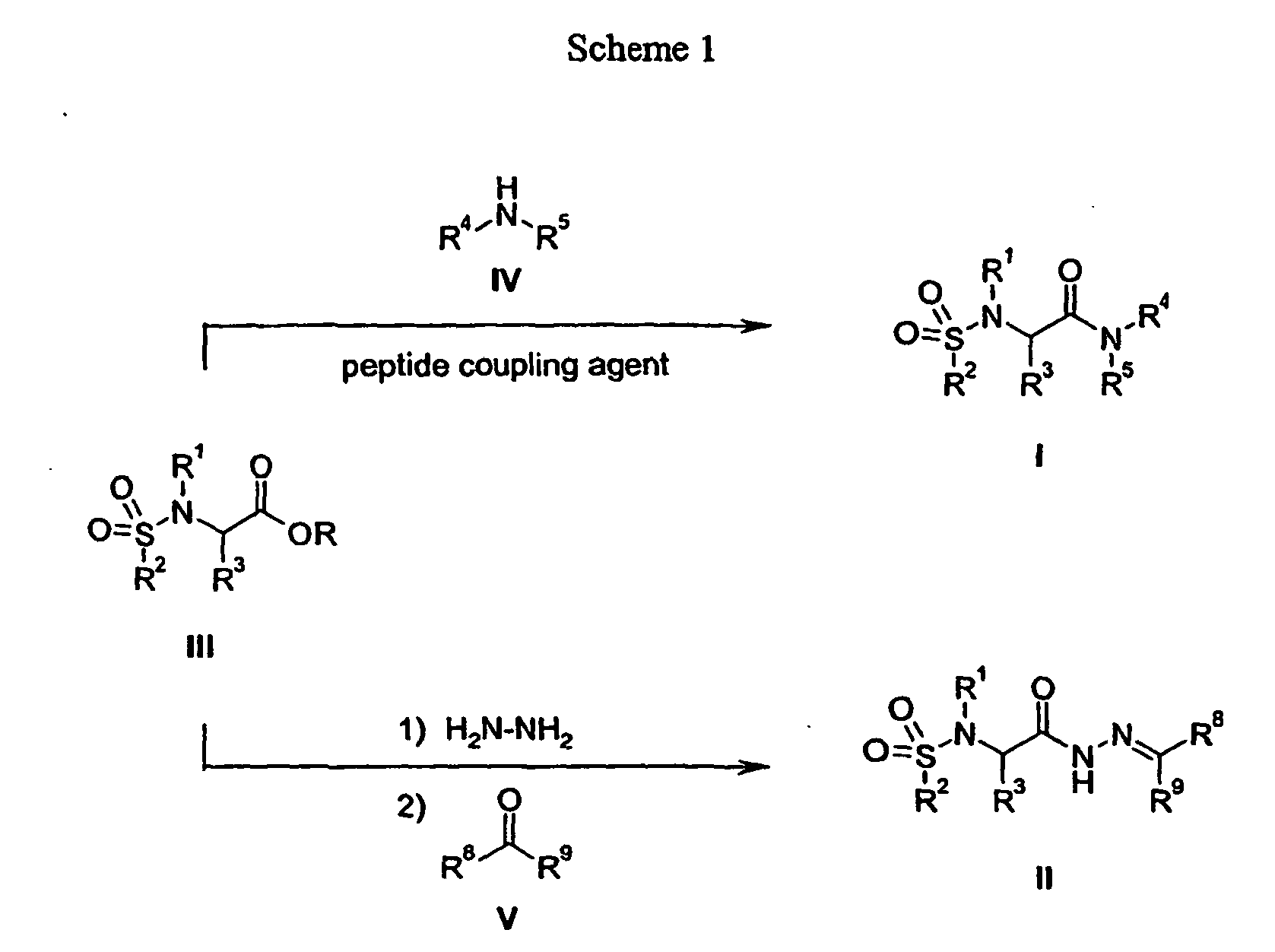
- Compounds of Formula III may be converted to alternative compounds III*, if R2 is bearing an appropriate reactive group G and by employing suitable interconversion techniques as described in Scheme 2 and hereinafter in the Examples. G can be substituted by activated unsaturated chains, using Pd catalysed Heck reaction under usual reaction conditions described in the litterature as shown in Scheme 2 and reported hereinafter in the Examples. This unsaturated substituted alkyl chain, such as in compound IIIa, can optionally be hydrogenated and further transformed (reduction, saponification, amide formation, substitution, etc) following standard conditions well known to the person skilled in the art and as it is described below in the Examples. Resulting alternative intermediate III* can be converted into I or II following procedures described on Scheme 1 and hereinafter described in the Examples.

- Compounds of Formula III, whereby the substituents R1, R2 and R3 are as above defined, can be prepared from the corresponding N-aryl- or N-heteroaryl α-aminoacids or aminoacid esters, VI, by sulfonylation with aryl or heteroaryl sulfonyl chlorides VII, using standard synthetic techniques, as hereinafter described in the Examples and shown in Scheme 2. The aryl or heteroaryl sulfonyl chlorides, VII, are either commercial or may be prepared from readily available starting materials according to standard protocols, such as by chlorosulfonylation (see e.g., Ramage, R.; Green, J.; Blake, A. J. Tetrahedron, 1991, 47, 6353), as hereinafter described in the Examples, or by other current methods well known to the practitioner skilled in the art.
- The corresponding N-aryl- or N-heteroaryl α-aminoacids or aminoacid esters, VI, can be prepared from the corresponding N-unsubstituted precursors VIII, using a variety of synthetic strategies, of which some selected examples are shown in Scheme 3 and described hereinafter in the Examples. Thus, the amino group of compounds of Formula VIII can for example be cross-coupled with aryl or heteroaryl halides and sulfonates, IX, using a base and an appropriate Pd-catalyst, the correct choice of will depend on the molecular context, as appreciated by one skilled in the art and as recently reviewed in extenso (Wolfe, J.P.; Tomori, H.; Sadighi, J.P.; Yin, J.; Buchwald, S.L. J.Org.Chem., 2000, 65, 1158). The N-unsubstituted precursors VIII are notably naturally occuring and/or synthetic α-amino acids including Glycine, Serine, Tyrosine, Alanine, Valine, Leucine etc..
- Alternatively, to get access to compounds of general Formula VI, compounds of Formula VIII can be reacted with electron-deficient aryl or heteroaryl fluorides and/or chlorides, X, under conditions suitable for SNAr-type reactions. If the aryl component X contains a nitro-group, as shown in Scheme 3 and described hereinafter in the Examples, the resulting compound VI can optionally be carried on to nitro group reduction and further functionalization (acylation, sulfonylation, alkylation) of the resulting primary amino group, before eventually being converted to III by sulfonylation with VII.
- As a further alternative, compounds of general Formula VI can be prepared from corresponding precursors of general Formula XI containing a suitable leaving group Z, by displacement of the latter with aryl or heteroaryl amines (e.g. anilines), XII, under standard conditions well known to the person skilled in the art. Compounds of Formula XI are either commercially available per se or readily accessible from commercial starting materials. In one particularly preferred synthetic approach, compounds of Formula XI whereby Z =Br and n =1 are made from suitably side-chain protected α-amino acids by treatment with NaNO2 and HBr, as shown in Scheme 3 and described hereinafter in the Examples (see e.g., Souers, A.J.; Schuerer, S.; Kwack, H.; Virgilio, A.A.; Ellman, J.A. Synthesis, 1999, 583).

- As a further alternative, compounds of general Formula III can be prepared from intermediates of general Formula XI (see Scheme 2) containing a suitable leaving group Z, by displacement of the latter with preformed anions of N-sulfonylated aryl or heteroaryl amines or heteroaryl amines, XII, using standard synthetic techniques as shown in Scheme 4 and hereinafter described in the Examples. Alternatively, compounds of general Formula III can be prepared from N-sulfonylated aryl or heteroaryl amines or heteroaryl amines, XIII, with intermediates of general Formula XIa by Mitsunobu reaction, using standard reaction conditions, as depicted in Scheme 4.

- Said N-sulfonylated aryl or heteroaryl amines or heteroaryl amines, XIII, are obtained from reactions between aryl or heteroaryl sulfonyl chlorides, VII, and aryl or heteroaryl amines, XII, using conditions and methods well known to those skilled in the art to form a sulfonamide bond from an amine and a sulfonyl chloride, as shown in Scheme 4 and hereinafter described in the Examples.
- According to a further general process, intermediate XIII can be converted to alternative intermediate XIII*, if R2 is bearing an appropriate reactive group G and by employing suitable interconversion techniques as described in Scheme 5 and hereinafter in the Examples. Under conditions suitable for SNAr-type reactions, G can be displaced by preformed anions of the appropriate alkohol or amine R10, as shown in Scheme 5 (compound XIIIb) and hereinafter described in the Examples. Alternatively, G can be substituted by activated unsaturated chains, using Pd catalysed Heck reaction under usual reaction conditions described in the litterature as shown in Scheme 5 and reported hereinafter in the Examples. This unsaturated substituted alkyl chain, such as in compound XIIIb, can optionally be hydrogenated and further transformed (reduction, saponification, amide formation, substitution, etc) following standard conditions well known to the person skilled in the art and as it is described below in the Examples. Resulting alternative intermediate XIII or XIII* can be converted into III following procedures described on Scheme 5 and hereinafter described in the Examples.

- According to another process, compounds of Formula III, whereby the substituents R1, R2 and R3 are as above defined, are prepared from the corresponding N-sulfonylated α-aminoacid esters, XIV (R = Me), by N-arylation, using cuprate/boronic acid methodologies (see e.g., Combs, A.P. et al. J.Comb.Chem., 2000, 2, 29), as shown in Scheme 6 and described hereinafter in the Examples. The appropriate N-sulfonylated α-aminoacid esters, XIV, are obtained from reactions between aryl or heteroaryl sulfonyl chlorides, VII, and α-aminoacid esters, VIII (R = Me) using conditions and methods well known to those skilled in the art to form a sulfonamide bond from an amino group and a sulfonyl chloride.

- The processes hitherto presented provide compounds of general Formula e I and II by initial elaboration of the N-terminal portion of the central α-aminoacid core, followed by ultimate transformation of the carboxy terminus into the corresponding amides and/or acylhydrazones. As will be appreciated by the person skilled in the art, it may, depending on the molecular context, sometimes be preferable to inverse the order of the above reaction sequence. Thus, suitably N-protected α-aminoacids or amino acid esters, XVI, are subjectd to the reaction conditions outlined in Scheme 1 and the associated text, to provide the corresponding N-protected amides and/or acyl hydrazones XVII, as shown in Scheme 7. After N-deprotection, the resulting free amino groups are then elaborated according to the conditions and methods summarized in Schemes 3 and 6 and the associated text above, to afford the final products of general Formulae I, Ia, Ib, II, IIa.
- By virtue of analogy, compounds of general Formula XI containing a suitable leaving group Z, which are either commercially available per se or readily accessible from commercial starting materials, as described in Scheme 3 and the associated text, may first be subjected to the reaction conditions outlined in Scheme 1 (see also the inserted text), to provide the corresponding amides and/or acyl hydrazones of Formula XVIII, as shown in Scheme 7 below. Subsequent displacement of the leaving group Z from compounds XVIII, either using aryl or heteroaryl amines (e.g. anilines), XII (Scheme 3), followed by N-sulfonylation, or using preformed anions of N-sulfonylated aryl or heteroaryl amines or heteroaryl amines, XIII (Scheme 4), affords the final products of general Formulae I, Ia, Ib, II, IIa.

- According to yet another process, sulfanilide derivatives according to the general Formula e I and/or II, whereby the substituents R1-R9 are as above defined, are prepared by solid-phase and/or mixed solid-/solution-phase synthesis protocols such as, e.g., those described in the examples and shown in Schemes 8 and 9 below. It will be appreciated by the practitioner skilled in the art that basically the same conditions, methods and reagents as above described in Schemes 1-4 for the solution-phase synthesis of compounds of Formula e I and/or II can be applied to the solid-phase and/or mixed solid-/solution-phase synthesis of said compounds. In the context of such a solid-phase and/or mixed solid-/solution-phase synthesis protocol, the R-group contained in the C(O)-OR moiety of the compounds III, VI, VIII, XI and XIV shown in Schemes 1-4, represents a suitable resin comprising the appropriate cleavable linker. The circles within the below Schemes 8 and 9 illustrate the resin beads to which the corresponding compounds are linked during the solid phase synthesis. It is to be understood that further to the below mentioned resin types, other suitable reagents, notably resins, known to a person skilled in the art, could be employed for the solid-phase synthesis of compounds of general Formula e I and/or II.
- Thus, in one preferred scenario, suitably N-protected α-aminoacids are coupled to an acid-labile resin, such as, e.g., Wang resin, XIX, using standard carbodiimide-mediated coupling conditions well known to the practitioner skilled in the art, followed by N-deprotection, to afford resin-bound intermediates of Formula VIIIa. According to the methods outlined in Scheme 2, the latter intermediates VIIIa can then be reacted with electron-deficient aryl or heteroaryl fluorides and/or chlorides, X, under conditions suitable for SNAr-type reactions. If the aryl component X contains a nitro-group, as shown in Scheme 8 and described hereinafter in the Examples, the resulting compound VIa can optionally be carried on to nitro group reduction and further functionalization (acylation, sulfonylation, alkylation) of the resulting primary amino group, before eventually being converted to III by sulfonylation with VII, and subsequent acid-catalyzed cleavage from the resin. The resulting acids III can directly be captured onto a further, nucleophile-labile, resin, such as, e.g. Kaiser oxime resin, XX, to give intermediates of Formula IIIb, which upon cleavage with either primary or secondary amines IV, and/or hydrazones of Formula XXI, will yield compounds of general Formula I and/or II, respectively, as shown in Scheme 8 and described hereinafter in the Examples.


- According to another preferred process, Fmoc-protected α-, β-, γ-, cyclic and acylic amino acids, which are either commercially available per se or readily accessible from commercial starting materials, as described in Scheme 10, may first be coupled to a resin presenting a amine moiety, XXIV, such as, e.g., Rink resin, using standard carbodiimide-mediated coupling conditions well known to the practitioner skilled in the art. Subsequent Fmoc deprotection and coupling with carboxylic acid XIa, using stardard carbodiimide-mediated coupling conditions, are affording intermediate XXVI. Displacement of the leaving group Z from the resulting resin-bound intermediates XXVI, either using aryl or heteroaryl amines (e.g. anilines), XII (Scheme 2), followed by N-sulfonylation, or using preformed anions of N-sulfonylated aryl or heteroaryl amines or heteroaryl amines, XIII (Scheme 3), affords the resin-bound intermediates of general Formula XXVIII. Cleavage from the resin is effected under acidic conditions, affording the corresponding acetamide IIa as described hereinafter in the Examples and shown in Scheme 10.

- The term "fmoc-N-amino acid-COOH" as used in the above Scheme 10, denotes an α-, β-, γ-, cyclic and acylic amino acid which is protected by the protective group "Fmoc".
- The reaction sequences outlined in the above Schemes provides enantiomerically pure compounds of Formula I, if enantiomerically pure starting materials are used. (R) as well as (S) enantiomers can be obtained depending upon whether (R) or (S) forms of commercially available starting materials are used.
- According to a further general process, compounds of Formula I can be converted to alternative compounds of Formula I, employing suitable interconversion techniques such as hereinafter described in the Examples.
- If the above set out general synthetic methods are not applicable for obtaining compounds according to Formula I and/or necessary intermediates for the synthesis of compounds of Formula I, suitable methods of preparation known by a person skilled on the art should be used. In general, the synthesis pathways for any individual compound of Formula I will depend on the specific substitutents of each molecule and upon the ready availability of intermediates necessary; again such factors being appreciated by those of ordinary skill in the art. For all the protection, de-protection methods, see Philip J. Kocienski, in "Protecting Groups", Georg Thieme Verlag Stuttgart, New York, 1994 and, Theodora W. Greene and Peter G. M. Wuts in "Protective Groups in Organic Synthesis", Wiley-Interscience, 1991.
- Compounds of this invention can be isolated in association with solvent molecules by crystallization from evaporation of an appropriate solvent. The pharmaceutically acceptable acid addition salts of the compounds of Formula I, which contain a basic center, may be prepared in a conventional manner. For example, a solution of the free base may be treated with a suitable acid, either neat or in a suitable solution, and the resulting salt isolated either by filtration or by evaporation under vacuum of the reaction solvent. Pharmaceutically acceptable base addition salts may be obtained in an analogous manner by treating a solution of compound of Formula I with a suitable base. Both types of salt may be formed or interconverted using ion-exchange resin techniques.
- A final aspect of the present invention relates to the use of the compounds according to Formula I and Formula II for the preparation of pharmaceutical compositions for the modulation of the oxytocin receptor and/or the vasopressin receptor as well as the Formula tions containing the active compounds according to Formula I and Formula II. The modulation of the oxytocin receptor is viewed as a suitable approach for the treatment of preterm labor and dysmenorrhea. The modulation of the vasopressin receptor is viewed as a suitable approach for the treatment of congestive heart failure, arterial hypertension, liver cirrhosis, nephrotic syndrome and ocular hypertension. When employed as pharmaceuticals, the sulfanilide derivatives of the present invention are typically administered in the form of a pharmaceutical composition. Hence, pharmaceutical compositions comprising a compound of Formula I and a pharmaceutically acceptable carrier, diluent or excipient therefore are also within the scope of the present invention. A person skilled in the art is aware of a whole variety of such carrier, diluent or excipient compounds suitable to formulate a pharmaceutical composition. Also, the present invention provides compounds for use as a medicament. In particular, the invention provides the compounds of Formula I for use as antagonists of the oxytocin receptor, for the treatment or prevention of disorders mediated by the oxytocin receptor in mammals, particularly in humans, either alone or in combination with other medicaments, e.g. in combination with a further OT antagonist.
- The compounds of the invention, together with a conventionally employed adjuvant, carrier, diluent or excipient may be placed into the form of pharmaceutical compositions and unit dosages thereof, and in such form may be employed as solids, such as tablets or filled capsules, or liquids such as solutions, suspensions, emulsions, elixirs, or capsules filled with the same, all for oral use, or in the form of sterile injectable solutions for parenteral (including subcutaneous) use. Such pharmaceutical compositions and unit dosage forms thereof may comprise ingredients in conventional proportions, with or without additional active compounds or principles, and such unit dosage forms may contain any suitable effective amount of the active ingredient commensurate with the intended daily dosage range to be employed.
- When employed as pharmaceuticals, the sulfanilide derivatives of this invention are typically administered in the form of a pharmaceutical composition. Such compositions can be prepared in a manner well known in the pharmaceutical art and comprise at least one active compound. Generally, the compounds of this invention are administered in a pharmaceutically effective amount. The amount of the compound actually administered will typically be determined by a physician, in the light of the relevant circumstances, including the condition to be treated, the chosen route of administration, the actual compound administered, the age, weight, and response of the individual patient, the severity of the patient's symptoms, and the like.
- The pharmaceutical compositions of the invention can be administered by a variety of routes including oral, rectal, transdermal, subcutaneous, intravenous, intramuscular, and intranasal. Depending on the intended route of delivery, the compounds are preferably Formula ted as either injectable or oral compositions. The compositions for oral administration can take the form of bulk liquid solutions or suspensions, or bulk powders. More commonly, however, the compositions are presented in unit dosage forms to facilitate accurate dosing. The term "unit dosage forms" refers to physically discrete units suitable as unitary dosages for human subjects and other mammals, each unit containing a predetermined quantity of active material calculated to produce the desired therapeutic effect, in association with a suitable pharmaceutical excipient. Typical unit dosage forms include prefilled, premeasured ampoules or syringes of the liquid compositions or pills, tablets, capsules or the like in the case of solid compositions. In such compositions, the sulfanilide compound is usually a minor component (from about 0.1 to about 50% by weight or preferably from about 1 to about 40% by weight) with the remainder being various vehicles or carriers and processing aids helpful for forming the desired dosing form.
- Liquid forms suitable for oral administration may include a suitable aqueous or nonaqueous vehicle with buffers, suspending and dispensing agents, colorants, flavors and the like. Solid forms may include, for example, any of the following ingredients, or compounds of a similar nature: a binder such as microcrystalline cellulose, gum tragacanth or gelatine; an excipient such as starch or lactose, a disintegrating agent such as alginic acid, Primogel, or corn starch; a lubricant such as magnesium stearate; a glidant such as colloidal silicon dioxide; a sweetening agent such as sucrose or saccharin; or a flavoring agent such as peppermint, methyl salicylate, or orange flavoring.
- Injectable compositions are typically based upon injectable sterile saline or phosphate-buffered saline or other injectable carriers known in the art. As above mentioned, the sulfanilide derivatives of Formula I in such compositions is typically a minor component, frequently ranging between 0.05 to 10% by weight with the remainder being the injectable carrier and the like.
- The above described components for orally administered or injectable compositions are merely representative. Further materials as well as processing techniques and the like are set out in Part 8 of Remington's Pharmaceutical Sciences, 17th Edition, 1985, Marck Publishing Company, Easton, Pennsylvania, which is incorporated herein be reference.
- The compounds of this invention can also be administered in sustained release forms or from sustained release drug delivery systems. A description of representative sustained release materials can also be found in the incorporated materials in Remington's Pharmaceutical Sciences.
- The present invention shall be illustrated by means of the following examples. The HPLC, NMR and MS data provided in the examples described below were obtained as followed. The following abbreviations are hereinafter used in the accompanying examples: min (minute), hr (hour), g (gram), mmol (millimole), m.p. (melting point), eq (equivalents), mL (milliliter), µL (microliters), mL (milliliters), ACN (Acetonitrile), CDCl3 (deuterated chloroform), cHex (Cyclohexanes), DCM (Dichloromethane), DECP (Diethylcyanophosphonate), DIC (Diisopropyl carbodiimide), DMAP (4- Dimethylaminopyridine) DMF (Dimethylformamide), DMSO (Dimethylsulfoxide), DMSO-d6 (deuterated dimethylsul-foxide), EDC (1-(3-Dimethyl-amino-propyl)-3-ethylcarbodiimide), EtOAc (Ethyl acetate), Et2O (Diethyl ether), HOBt (1-Hydroxybenzoiriazole), K2CO3 (potassium carbonate), NaH (Sodium hydride), NaHCO3 (Sodium bicarbonate), nBuLi (n Butyllithium), TBTU (O-Benzotriazolyl-N,N,N',N'-tetramethyluronium-tetrafluoroborate), TEA (Triethyl amine), TFA (Trifluoro-acetic acid), THF (Tetrahydrofuran), MgSO4 (Magnesium sulfate), PetEther (Petroleum ether), rt (room temperature).
-

- To a solution of 2-nitrobenzyl alcohol (500 g, 3.2 mol) in MeOH (2.5 L) was added Pd/C (40 g) under N2 and refluxed for 30min. Hydrazine hydrate (500 mL) was added slowly with stirring. The resulting mixture was stirred under reflux for another 2 h. The solid formed was filtered, concentrated and the crude residue was extracted with ethyl acetate (2x500 mL). The organic layer was washed with brine and dried over MgSO4. After evaporation of the solvents, 2-aminobenzyl alcohol (357 g, 89% yield) was isolated as pale yellow solid.
- Et3N (132g, 1.3mol) was added to a solution of 2-aminobenzyl alcohol (40g, 0.33 mol) in dry CH2Cl2 (400 mL). The mixture was stirred for 20 min. and acetic anhydride (100g, 0.98mol) was added slowly. After 12h stirring at room temperature, the reaction mixture was washed with water, brine and dried over MgSO4. The solvents were removed under vacuum to give the crude N-acetyl-O-acetyl-2-aminobenzyl alcohol (55 g, 88% yield).
- To a solution of N-acetyl-O-acetyl-2-aminobenzyl alcohol (55 g, 0.25 mol) in MeOH (550 mL) was added K2CO3 (200 g, 1.42 mol). After 2 h at room temperature, the resulting solid was filtered and concentrated. The crude product was dissolved in CH2Cl2 (250 mL), washed with water, brine and dried over MgSO4. The solvent was removed under vacuum, affording N-acetyl-2-aminobenzylalcohol (20g, 47% yield).
- To a stirred solution of N-acetyl-2-amino-benzylalcohol (20 g) in dry CHCl3 (500 mL) was added MnO2 (160 g, 8 equivalents) and allowed to stir at room temperature for 12 h. The reaction mixture was filtered through celite and concentrated. The crude product was recrystallised from CHCl3/petrol ether to give N-acetyl-2-aminobenzaldehyde (14 g, 73%).
- 1H NMR (300 MHz, DMSO-d6): 2.01 (s, 3H), 7.30 (m, 2H, H arom.), 7.65 (m, 2H, H arom.), 7.85 (m, 2H, H arom.), 8.09 (m, 2H, H arom.), 9.95 (s, 1H, CHO), 10.70 (s, 1H, NH).
-

- 1-Amino-4-methylbenzene (1.821 g, 17.0 mmol) was dissolved in DCM (25 mL). N,N-Diisopropylethylamine (3.1 mL, 18.1 mmol) and 4-ethoxy-benzenesulfonyl chloride (2.50 g, 11.3 mmol) were added successively. The reaction mixture was stirred at room temperature overnight and then washed with 10% HCl (2 x 20 mL) and brine (1 x 20 mL). Organic phase was dried with sodium sulfate before filtering and removal of solvent. The desired product, e.g. 4-ethoxy-N-(4-methylphenyl)benzenesulfonamide (3.087 g, 94%), was obtained as a colorless solid, in 99.2 % purity by HPLC (MaxPlot detection between 230 and 400 nm).
- 1H NMR (300 MHz, CDCl3): 1.39 (t, J = 7.0 Hz, 3H, OCH2CH 3), 2.24 (s, 3H, CH3), 4.02 (q, J = 7.0 Hz, 2H, OCH 2CH3), 6.35 (br s, 1H, NH), 6.84 (m, 2H, H arom.), 6.91 (m, 2H, H arom.), 7.01 (m, 2H, H arom.), 7.63 (m, 2H, H arom.); M+(ES+): 292; M-(ES-): 290.
- The crude N-aryl-benzenesulfonamide building block XIII, e.g. 4-ethoxy-N-(4-methylphenyl)benzenesulfonamide (3.087 g, 10.6 mmol), was dissolved in DMF (10 mL) and was added to a suspention ofNaH (13.6 mmol, 0.593 mg ofNaH 55-65% in oil) in DMF (30 mL). The mixture was stirred 45 min at room temperature. 2-Bromoacetic acid methyl ester (1.45 mL, 15.9 mmol) was added dropwise. The resulting mixture was stirred at room temperature overnight. The solvents were evaporated, affording the desired product, e.g. methyl {[(4-ethoxyphenyl)sulfonyl]-4-methylanilino}acetate (3.816 g, quantitative crude yield) as a light yellow solid, in 96.1 % purity by HPLC (MaxPlot detection between 230 and 400 nm).
- 1H NMR (300 MHz, CDCl3): 1.42 (t, J = 7.0 Hz, 3H, OCH2CH3 ), 2.29 (s, 3H, CH3), 3.67 (s, 3H, OCH3), 4.06 (q, J = 7.0 Hz, 2H, OCH2 CH3), 4.36 (s, 2H, NCH 2CO), 6.87 (m, 2H, H arm.), 7.05 (br s, 4H, H arom.), 7.58 (m, 2H, H arom.); M+(APCI+): 364; M-(APCI-): 362.
- The crude carboxylic acid methyl ester, e.g. methyl {[(4-ethoxyphenyl)sulfonyl]-4-methyl-anilino} acetate (3.816 g, 10.5 mmol), was dissolved in MeOH (30 mL). Hydrazine hydrate was added (3.3 mL). The reaction mixture was stirred overnight at room temperature. A white precipitate was formed. It was isolated by filtration and rinsed with cold MeOH. From mother liquors some more compound could be recovered, affording the desired product, e.g. 4-ethoxy-N-(2-hydrazino-2-oxoethyl)-N-(4-methylphenyl)benzene-sulfonamide (2.745 g, 72%) as a colorless solid in 99.8 % purity by HPLC (MaxPlot detection between 230 and 400 nm).
- M.p. 117.5-118.5 °C; IR (neat) ν 3326, 2926,1595,1344, 1154 cm-1; 1H NMR (300 MHz, DMSO-d 6): 1.34 (t, J = 7.0 Hz, 3H, OCH2CH 3), 2.26 (s, 3H, CH3), 4.10 (q, J = 7.0 Hz, 2H, OCH2 CH3), 4.11 (s, 2H, NCH2 CO), 4.18 (br s, 2H, N-NH 2), 6.95-7.15 (m, 6H, H arom.), 7.51 (m, 2H, H arom.); M-(APCI-): 362. Analysis calculated for C17H21N3O4S 07 H2O: C, 54.30; H, 6.00; N, 11.17. Found: C, 53.97; H, 5.97; N, 11.03.
- Hydrazide obtained in the precedent step, e.g. 4-ethoxy-N-(2-hydrazino-2-oxoethyl)-N-(4-methylphenyl)benzenesulfonamide (73 mg, 0.2 mmol), was dissolved in EtOH / 5 % AcOH (4 mL). Isatin-5-sulfonic acid sodium salt dihydrate (57 mg, 0.2 mmol) was added. The reaction mixture was stirred overnight at 76°C. A yellow precipitate was formed. It was collected by filtration, washed with cold EtOH and dried under vacuo at 40°C, affording the desired product, e.g. 3-[({[(4-ethoxyphenyl)sulfonyl]-4-methylanilino}acetyl)-hydrazono]-2-oxo-2,3-dihydro-1H-indole-5-sulfonic acid (38 mg, 32%; ) as a yellow solid in 98.4 % purity by HPLC (MaxPlot detection between 230 and 400 nm).
- M.p. 318-319 °C, decomposition; IR (neat) ν 2988, 1698, 1595, 1500, 1354,1222, 1091 cm-1; 1H NMR (300 MHz, DMSO-d 6): 1.42 (t, J = 7.0 Hz, 3H, OCH2CH3 ), 2.33 (s, 3H, CH3), 4.20 (m, 2H, OCH2 CH3), 4.55 (br s, 2H, NCH2 CO, minor isomer (45%)), 4.55 (br s, 2H, NCH2 CO, major isomer (55%)), 6.95 (m,1H, H arom.), 7.06-7.30 (m, 6H, H arom.), 7.50-7.90 (m, 4H, H arom.), 11.38 (s, 1H, NH), 12.54 (br s, 1H, CONHN, major isomer (55%)), 13.64 (br s, 1H, CONHN, minor isomer (45%)); M'(APCr): 571. Analysis calculated for C25H24N4O8S2Na 0.5 H2O: C, 49.75; H, 4.01; N, 9.28. Found: C, 49.58; H, 3.93; N, 9.24.
-

- Following the general method as outlined in Example 1, starting from 4-ethoxybenzene-sulfonyl chloride, aniline, methyl bromoacetate and 1H-indole-2,3-dione, the title compound was precipitated with the addition of water and recristallized from MeOH. A bright yellow solid (74 mg, 62%) was isolated in 99.6 % purity by HPLC (MaxPlot detection between 230 and 400 nm).
- M.p. 135.5-136.5 °C; IR (neat) ν 3168, 1688,1595, 1495, 1337, 1155, 1122, 1091 cm-1; 1H NMR (300 MHz, DMSO-d 6): 1.34 (t, J = 7.0 Hz, 3H, OCH2CH 3), 4.11 (q, J = 7.0 Hz, 2H, OCH2 CH3), 4.51 (br s, 2H, NCH2 CO, major isomer (65%)), 5.00 (br s, 2H, NCH2 CO, minor isomer (35%)), 6.95 (m, 1H, H arom.), 7.03-7.17 (m, 3H, H arom.), 7.19-7.43 (m, 6H, H arom.), 7.43-7.70 (m, 3H, H arom.), 11.27 (s, 1H, NH), 12.50 (br s, 1H, CONHN, minor isomer (35%)), 13.66 (br s, 1H, CONHN, major isomer (65%)); M-(APCI-): 477. Analysis calculated for C24H22N4O5S 1 H2O: C, 58.05; H, 4.87; N, 11.28. Found: C, 57.71; H, 4.92; N, 11.03.
-

- Following the general method as outlined in Example 1, starting from 4-ethoxybenzene-sulfonyl chloride, aniline, methyl bromoacetate and 5-nitro-1H-indole-2,3-dione, the title compound was precipitated with the addition of water and recristallized in THF/H2O. A yellow powder (48 mg, 40%) was isolated in 98.9 % purity by HPLC (MaxPlot detection between 230 and 400 nm).
- M.p. 252-253 °C; IR (neat) ν 3107, 1734, 1721, 1624, 1595, 1518, 1337, 1154, 1118, 1084 cm-1; 1H NMR (300 MHz, DMSO-d 6): 1.34 (t, J = 7.0 Hz, 3H, OCH2CH 3), 4.20 (q, J = 7.0 Hz, 2H, OCH2 CH3), 4.68 (br s, 2H, NCH2 CO, major isomer (55%)), 5.14 (br s, 2H, NCH2 CO, minor isomer (45%)), 7.12-7.27 (m, 3H, H arom.), 7.30-7.48 (m, 5H, H arom.), 7.52-7.77 (m, 2H, H arom.), 8.23-8.46 (m, 2H, H arom.), 11.95 (s, 1H, NH), 12.48 (br s, 1H, CONHN, minor isomer (45%)), 13.58 (br s, 1H, CONHN, major isomer (55%)); M- (APCI-): 522. Analysis calculated for C24H21N5O7S: C, 55.06; H, 4.04; N, 13.38. Found: C, 54.92; H, 4.09; N, 13.27.
-

- Following the general method as outlined in Example 1, starting from 4-ethoxybenzene-sulfonyl chloride, aniline, methyl bromoacetate and 5-iodo-1H-indole-2,3-dione, the title compound was precipitated with the addition of water and recristallized in EtOH. A yellow solid (65 mg, 47%) was isolated in 95.1 % purity by HPLC (MaxPlot detection between 230 and 400 nm).
- M.p. 233-234 °C; IR (neat) ν 3371, 2976, 1719, 1693, 1594, 1534, 1338, 1156, 1094 cm-1; 1H NMR (300 MHz, DMSO-d 6): 1.13 (t, J = 7.0 Hz, 3H, OCH2CH 3), 3.89 (q, J = 7.0 Hz, 2H, OCH2 CH3), 4.31 (br s, 2H, NCH2 CO, major isomer (55%)), 1.80 (br s, 2H, NCH2 CO, minor isomer (45%)), 6.79 (m, 1H, H arom.), 7.07 (m, 2H, H arom.), 7.19-7.41 (m, 5H, H arom.), 7.41-7.92 (m, 4H, H arom.), 11.35 (s, 1H, NH), 12.42 (br s, 1H, CONHN, minor isomer (45%)), 13.58 (br s, 1H, CONHN, major isomer (55%)); M-(APCI-): 603. Analysis calculated for C24H21N4O5S 0.1 H2O: C, 47.55; H, 3.52; N, 9.24. Found: C, 47.20; H, 3.58; N, 9.26.
-

- Following the general method as outlined in Example 1, starting from 4-ethoxybenzene-sulfonyl chloride,p-toluidine, methyl bromoacetate and 1H-indole-2,3-dione, the title compound was precipitated with the addition of water and recristallized in MeOH. A bright yellow solid (197 mg, 58%) was isolated in 98.9 % purity by HPLC (MaxPlot detection between 230 and 400 nm).
- M.p. 130-131°C; IR (neat) ν 3170, 1682, 1598, 1335, 1262, 1152, 1091 cm-1; 1H NMR (300 MHz, DMSO-d 6): 1.16 (t, J = 7.0 Hz, 3H, OCH2CH3 ), 2.07 (s, 3H, CH3), 3.93 (q, J = 7.0 Hz, 2H, OCH2 CH3), 4.29 (br s, 2H, NCH2 CO, major isomer (67%)), 4.78 (br s, 2H, NCH2 CO, minor isomer (33%)), 6.77 (m, 1H, H arom.), 7.01-7.20 (m, 7H, H arom.), 7.20 (m, 1H, H arom.), 7.43-7.68 (m, 3H, H arom.), 11.09 (s, 1H, NH), 12.31 (br s, 1H, CONHN, minor isomer (33%)), 13.46 (br s, 1H, CONHN, major isomer (67%)); M+(ES+): 493; M-(ES-): 491. Analysis calculated for C25H24N4O5S 1 H2O: C, 58.81; H, 5.13; N, 10.97. Found: C, 58.41; H, 5.19; N, 10.98.
-

- Following the general method as outlined in Example 1, starting from 1-naphthalenesulfonyl chloride, p-toluidine, methyl bromoacetate and 1H-indole-2,3-dione, the title compound was isolated by evaporation of the solvents and purified by recrystallization in MeOH. A yellow powder (52 mg, 52%) was obtained in 98.5 % purity by HPLC (MaxPlot detection between 230 and 400 nm).
- M.p. 138-139°C; IR (neat) ν 3431, 1698, 1621, 1494, 1465, 1336, 1193, 1161, 1162 cm-1; 1H NMR (300 MHz, DMSO-d 6): 2.27 (s, 3H, CH3), 4.66 (br s, 2H, NCH2 CO, major isomer (60%)), 5.14 (br s, 2H, NCH2 CO, minor isomer (40%)), 6.98 (m, 1H, H arom.), 6.99-7.15 (m, 5H, H arom.), 7.30-7.70 (m, 5H, H arom.), 8.02-8.19 (m, 2H, H arom.), 8.21-8.45 (m, 2H, H arom.), 11.30 (s, 1H, NH), 12.54 (br s, 1H, CONHN, minor isomer (40%)), 13.56 (br s, 1H, CONHN, major isomer (60%)); M-(APCI-): 497. Analysis calculated for C27H22N4O4S 0.5 H2O: C, 63.89; H, 4.57; N, 11.04. Found: C, 63.73; H, 4.48; N, 11.34.
-

- Following the general method as outlined in Example 1, starting from 2-naphthalenesulfonyl chloride, p-toluidine, methyl bromoacetate and 1H-indole-2,3-dione, the title compound was isolated by evaporation of the solvents and purified by recrystallization in MeOH. An orange powder (52 mg, 55%) was obtained in 94.7 % purity by HPLC (MaxPlot detection between 230 and 400 nm).
- 1H NMR (300 MHz, DMSO-d 6): 2.24 (s, 3H, CH3), 4.60 (br s, 2H, NCH2 CO, major isomer (65%)), 5.06 (br s, 2H, NCH2 CO, minor isomer (35%)), 6.82-7.19 (m, 6H, H arom.), 7.38 (m, 1H, H arom.), 7.46-7.61 (m, 2H, H arom.), 7.61-7.79 (m, 2H, H arom.), 8.02-8.20 (m, 3H, H carom.), 8.38 (s, 1H, H arom.), 11.27 (s, 1H, NH), 12.51 (br s, 1H, CONHN, minor isomer (35%)), 13.66 (br s, 1H, CONHN, major isomer (65%)); M-(APCI-): 497.
-

- Following the general method as outlined in Example 1, starting from 4-chlorobenzenesulfonyl chloride, p-toluidine, methyl bromoacetate and 1H-indole-2,3-dione, the title compound was isolated by evaporation of the solvents and purified by recrystallization in MeOH. A yellow powder (50 mg, 51 %) was obtained in 98.7 % purity by HPLC (MaxPlot detection between 230 and 400 nm).
- M.p. 234-235°C; IR (neat) ν 3352, 1717, 1693, 1614, 1509, 1463, 1332, 1192, 1152, 1127, 1087 cm-1; 1H NMR (300 MHz, DMSO-d 6): 2.26 (s, 3H, CH3), 4.56 (br s, 2H, NCH2 CO, major isomer (60%)), 5.00 (br s, 2H, NCH2 CO, minor isomer (40%)), 6.94 (m, 1H, H arom.), 7.03-7.19 (m, 5H, H arom.), 7.38 (m, 1H, H arom.), 7.46-7.71 (m, 5H, H arom.), 11.27 (s, 1H, NH), 12.49 (br s, 1H, CONHN, minor isomer (40%)), 13.59 (br s, 1H, CONHN, major isomer (60%)); M-(APCI-): 481. Analysis calculated for C23H19ClN4O4S 0.4 H2O: C, 56.36; H, 4.07; N, 11.43. Found: C, 56.54; H, 4.11; N, 11.43.
-

- Following the general method as outlined in Example 1, starting from 4- methoxybenzenesulfonyl chloride, p-toluidine, methyl bromoacetate and 1H-indole-2,3-dione, the title compound was isolated by evaporation of the solvents and purified by recrystallization in MeOH. A yellow powder (60 mg, 63%) was obtained in 97.0 % purity by HPLC (MaxPlot detection between 230 and 400 nm).
- M.p. 134-135°C; IR (neat) ν 3353, 1691, 1613, 1503, 1464, 1334, 1152, 1123, 1089 cm-1; 1H NMR (300 MHz, DMSO-d 6): 2.25 (s, 3H, CH3), 3.84 (s, 3H, OCH3), 4.47 (br s, 2H, NCH2 CO, major isomer (67%)), 4.96 (br s, 2H, NCH2 CO, minor isomer (33%)), 6.84-7.01 (m, 1H, H arom.), 7.06-7.18 (m, 7H, H arom.), 7.38 (m, 1H, H arom.), 7.44-7.68 (m, 3H, H arom.), 11.27 (s, 1H, NH), 12.49 (br s, 1H, CONHN, minor isomer (33%)), 13.65 (br s, 1H, CONHN, major isomer (67%)); M+(APCI+): 479; M-(APCI-): 477. Analysis calculated for C24H22N4O5S 1.5 H2O: C, 57.02; H, 4.98; N, 11.08. Found: C, 57.02; H, 4.93; N, 11.10.
-

- Following the general method as outlined in Example 1, starting from 4-methylbenzene-sulfonyl chloride, p-toluidine, methyl bromoacetate and 1H-indole-2,3-dione, the title compound was isolated by evaporation of the solvents and purified by recrystallization in MeOH. A yellow power (37 mg, 40%) was obtained in 98.0 % purity by HPLC (MaxPlot detection between 230 and 400 nm).
- M.p. 243-244°C; IR (neat) ν 3350, 1715, 1692, 1614, 1508, 1462, 1328, 1150, 1124, 1091 cm-1; 1H NMR (300 MHz, DMSO-d 6): 2.25 (s, 3H, CH3), 2.39 (s, 3H, CH3), 4.49 (br s, 2H, NCH2 CO, major isomer (65%)), 4.97 (br s, 2H, NCH2 CO, minor isomer (35%)), 6.95 (m, 1H, H arom.), 7.04-7.19 (m, 5H, H arom.), 7.34-7.64 (m, 6H, H arom.), 11.27 (s, 1H, NH), 12.49 (br s, 1H, CONHN, minor isomer (35%)), 13.63 (br s, 1H, CONHN, major isomer (65%)); M+(APCI+): 463; M-(APCI-): 461. Analysis calculated for C24H22N4O4S 0.3 H2O: C, 61.60; H, 4.87; N, 11.97. Found: C, 61.48; H, 4.87; N, 12.02.
-

- Following the general method as outlined in Example 1, starting from 4- cyanobenzene-sulfonyl chloride, p-toluidine, methyl bromoacetate and 1H-indole-2,3-dione, the title compound was isolated by evaporation of the solvents and purified by recrystallization in MeOH. A yellow powder (59 mg, 63%) was obtained in 93.0 % purity by HPLC (MaxPlot detection between 230 and 400 nm).
- 1H NMR (300 MHz, DMSO-d 6): 2.25 (s, 3H, CH3), 4.62 (br s, 2H, NCH2 CO, major isomer (57%)), 5.04 (br s, 2H, NCH2 CO, minor isomer (43%)), 6.94 (m, 1H, H arom.), 7.03-7.22 (m, 5H, H arom.), 7.38 (m, 1H, H arom.), 7.46-7.62 (m, 1H, H arom.), 7.72-7.92 (m, 2H, H arom.), 8.08 (m, 2H, H arom.), 11.27 (s, 1H, NH), 12.49 (br s, 1H, CONHN, minor isomer (43%)), 13.52 (br s, 1H, CONHN, major isomer (57%)); M-(APCI-): 472.
-

- Following the general method as outlined in Example 1, starting from 4-ethoxybenzene-sulfonyl chloride, p-toluidine, methyl bromoacetate and 2-fluorobenzaldehyde, the title compound precipitate in the reaction mixture. It was collected by filtration, washed with cold EtOH and dried under vacuo at 40°C, affording a colorless powder (72 mg, 77%) in 96 % purity by HPLC (MaxPlot detection between 230 and 400 nm).
- M.p. 183-184°C; IR (neat) ν 3286, 2987, 1673, 1594, 1537, 1454, 1343, 1256, 1152, 1091, 1073 cm-1; 1H NMR (300 MHz, DMSO-d 6): 1.34 (t, J = 7.0 Hz, 3H, OCH2CH3 ), 2.24 (s, 3H, CH3), 4.10 (q, J = 7.0 Hz, 2H, OCH2 CH3), 4.31 (s, 2H, NCH2 CO, minor isomer (38%)), 4.80 (s, 2H, NCH2 CO, major isomer (62%)), 6.95-7.15 (m, 6H, H arom.), 7.20-7.33 (m, 2H, H arom.), 7.42-7.64 (m, 3H, H arom.), 7.75-7.95 (m, 1H, H arom.), 8.15 (s, 1H, CH=N, major isomer (62%)), 8.42 (s, 1H, CH=N, minor isomer (38%)), 11.56 (s, 1H, CONHN, major isomer (62%)), 11.60 (s, 1H, CONHN, minor isomer (38%)); M-(APCI-): 468. Analysis calculated for C24H24FN3O4S 0.1 H2O: C, 61.16; H, 5.17; N, 8.92. Found: C, 60.92; H, 5.21; N, 8.95.
-

- Following the general method as outlined in Example 1, starting from 4-phenylbenzene-sulfonyl chloride, p-toluidine, methyl bromoacetate and 1H-indole-2,3-dione, the title compound precipitate in the reaction mixture. It was collected by filtration, washed with cold EtOH and dried under vacuo at 40°C, affording a yellow-orange powder (76 mg, 70%) in 99 % purity by HPLC (MaxPlot detection between 230 and 400 nm).
- M.p. 246-247°C; IR (neat) ν 3098, 1698, 1616, 1506, 1468, 1317, 1148, 1117 cm-1; 1H NMR (300 MHz, DMSO-d 6): 2.26 (s, 3H, CH3), 4.57 (br s, 2H, NCH2 CO, major isomer (65%)), 5.04 (br s, 2H, NCH2 CO, minor isomer (35%)), 6.94 (m, 1H, H arom.), 7.08 (m, 1H, H arom.), 7.16 (m, 4H, H arom.), 7.34-7.60 (m, 5H, H arom.), 7.60-7.83 (m, 4H, H arom.), 7.90 (m, 2H, H arom.), 11.27 (s, 1H, NH), 12.52 (br s, 1H, CONHN, minor isomer (35%)), 13.64 (br s, 1H, CONHN, major isomer (65%)); M-(APCI-): 523. Analysis calculated for C29H24N4O4S: C, 66.40; H, 4.61; N, 10.68. Found: C, 66.25; H, 4.63; N, 10.59.
-

- Following the general method as outlined in Example 1, starting from 4-phenoxybenzene-sulfonyl chloride, p-toluidine, methyl bromoacetate and 1H-indole-2,3-dione, the title compound precipitate in the reaction mixture. It was collected by filtration, washed with cold EtOH and dried under vacuo at 40°C, affording a yellow powder (84 mg, 78%) in 98 % purity by HPLC (MaxPlot detection between 230 and 400 nm).
- M.p. 245-246°C; IR (neat) ν 2987, 1698, 1616, 1506, 1468, 1317, 1248, 1148, 1117, 1078 cm-1; 1H NMR (300 MHz, DMSO-d 6): 2.26 (s, 3H, CH3), 4.57 (br s, 2H, NCH2 CO, major isomer (63%)), 5.04 (br s, 2H, NCH2 CO, minor isomer (37%)), 6.95 (m, 1H, H arom.), 7.08 (m, 1H, H arom.), 7.16 (m, 4H, H arom.), 7.34-7.61 (m, 5H, H arom.), 7.61-7.84 (m, 4H, H arom.), 7.90 (m, 2H, H arom.), 11.27 (s, 1H, NH), 12.52 (br s, 1H, CONHN, minor isomer (37%)), 13.64 (br s, 1H, CONHN, major isomer (63%)); [M-CH3]-(APCI-): 523.
-

- Following the general method as outlined in Example 1, starting from 4-ethoxybenzene-sulfonyl chloride, p-toluidine, methyl bromoacetate and 2-hydroxybenzaldehyde, the title compound precipitate in the reaction mixture. It was collected by filtration, washed with cold EtOH and dried under vacuo at 40°C, affording a colorless powder (63 mg, 68%) in 83 % purity by HPLC (MaxPlot detection between 230 and 400 nm).
- 1H NMR (300 MHz, DMSO-d 6): 1.34 (t, J = 7.0 Hz, 3H, OCH2CH3 ), 2.24 (s, 3H, CH3), 4.10 (q, J = 7.0 Hz, 2H, OCH2 CH3), 4.32 (s, 2H, NCH2 CO, major isomer (63%)), 4.77 (s, 2H, NCH2 CO, minor isomer (37%)), 6.81-7.16 (m, 8H, H arom.), 7.18-7.31 (m, 1H, H arom.), 7.45-7.72 (m, 3H, H arom.), 8.23 (s, 1H, CH=N, minor isomer (37%)), 8.39 (s, 1H, CH=N, major isomer (63%)), 9.98 (s, 1H, OH, minor isomer (37%)), 10.92 (s, 1H, OH, major isomer (63%)), 11.37 (s, 1H, CONHN, minor isomer (37%)), 11.68 (s, 1H, CONHN, minor isomer (38%)); M-(APCI-): 466.
-

- Following the general method as outlined in Example 1, starting from 4-ethoxybenzene-sulfonyl chloride, p-toluidine, methyl bromoacetate and 4-(diethylamino)-2-hydroxybenzaldehyde, the title compound precipitate in the reaction mixture. It was collected by filtration, washed with cold EtOH and dried under vacuo at 40°C, affording a peach powder (91 mg, 85%) in 98 % purity by HPLC (MaxPlot detection between 230 and 400 nm).
- M.p. 227-228°C; IR (neat) ν 3338, 2978, 1687, 1633, 1592, 1510, 1338, 1242, 1154,1092, 1043 cm-1; 1H NMR (300 MHz, DMSO-d 6): 1.00-1.17 (m, 6H, NCH 2CH3 ), 1.34 (t, J = 7.0 Hz, 3H, OCH2CH3 ), 2.24 (s, 3H, CH3), 3.20-3.43 (m, 4H, NCH2 CH3), 4.10 (q, J = 7.0 Hz, 2H, OCH2 CH3), 4.27 (s, 2H, NCH2 CO, major isomer (75%)), 4.68 (s, 2H, NCH2 CO, minor isomer (25%)), 6.06 (s, 1H, H arom, major isomer (75%)), 6.10 (s, 1H, H arom, minor isomer (25%)), 6.22 (m, 1H, H arom.), 6.95-7.40 (m, 7H, H arom.), 7.45-7.65 (m, 2H, H arom.), 8.02 (s, 1H, CH=N, minor isomer (25%)), 8.15 (s, 1H, CH=N, major isomer (75%)), 9.75 (s, 1H, OH, minor isomer (25%)), 11.06 (s, 1H, OH, major isomer (75%)), 11.10 (s, 1H, CONHN, minor isomer (25%)), 11.36 (s, 1H, CONHN, major isomer (75%)); M-(APCI-): 537. Analysis calculated for C28H34N4O5S: C, 62.43; H, 6.36; N, 10.40. Found: C, 62.31; H, 6.40; N, 10.41.
-
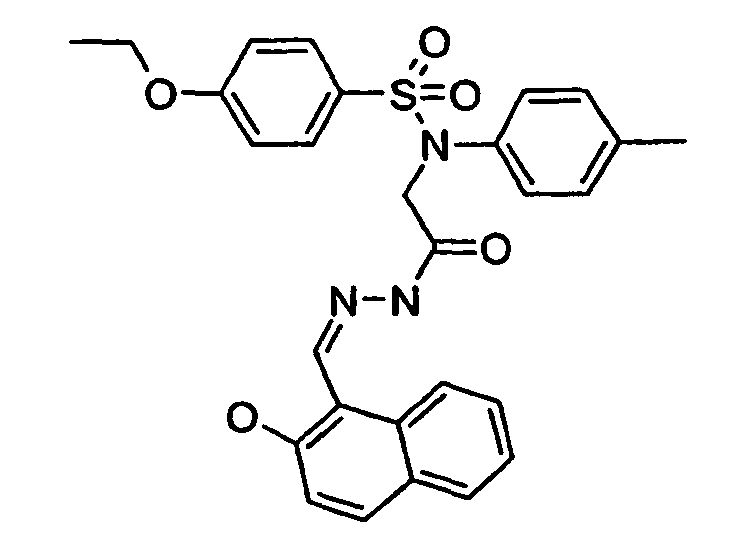
- Following the general method as outlined in Example 1, starting from 4-ethoxybenzene-sulfonyl chloride, p-toluidine, methyl bromoacetate and 2-hydroxy-1-naphthaldehyde, the title compound precipitate in the reaction mixture. It was collected by filtration, washed with cold EtOH and dried under vacuo at 40°C, affording a bright yellow powder (71 mg, 68%) in 92 % purity by HPLC (MaxPlot detection between 230 and 400 nm).
- 1H NMR (300 MHz, DMSO-d 6): 1.34 (t, J = 7.0 Hz, 3H, OCH2CH3 ), 2.25 (s, 3H, CH3), 4.11 (q, J = 7.0 Hz, 2H, OCH2 CH3), 4.39 (s, 2H, NCH2 CO, major isomer (76%)), 4.81 (s, 2H, NCH2 CO, minor isomer (24%)), 7.05-7.65 (m, 11H, H arom.), 7.82-7.95 (m, 2H, H arom.), 8.25 (m, 1H, H arom., major isomer (76%)), 8.64 (m, 1H, H arom., minor isomer (24%)), 8.78 (s, 1H, CH=N, minor isomer (24%)), 9.26 (s, 1H, CH=N, major isomer (76%)), 10.70 (s, 1H, OH, minor isomer (24%)), 11.41 (s, 1H, CONHN, minor isomer (24%)), 11.77 (s, 1H, OH, major isomer (76%)), 11.33 (s, 1H, CONHN, major isomer (76%)); M-(APCI-): 516.
-

- Following the general method as outlined in Example 1, starting from 4-ethoxybenzene-sulfonyl chloride, p-toluidine, methyl bromoacetate and 1H-indene-1,3(2H)-dione, the title compound precipitate in the reaction mixture. It was collected by filtration, washed with cold EtOH and dried under vacuo at 40°C, affording a grey brown powder (60 mg, 62%) in 93 % purity by HPLC (MaxPlot detection between 230 and 400 nm).
- 1H NMR (300 MHz, DMSO-d 6): 1.35 (t, J = 7.0 Hz, 3H, OCH2CH3 ), 2.24 (s, 3H, CH3), 3.39 (m, 2H, (C=N)CH2 (C=O)), 4.11 (q, J = 7.0 Hz, 2H, OCH2 CH3), 4.44 (s, 2H, NCH2 CO, minor isomer (38%)), 4.88 (s, 2H, NCH2 CO, major isomer (62 %)), 6.98-7.16 (m, 6H, H arom.), 7.51-7.68 (m, 3H, H arom.), 7.70-7.86 (m, 2H, H arom.), 7.90 (m, 1H, H arom., minor isomer (38%)), 7.99 (m, 1H, H arom., major isomer (62%)), 10.52 (s, 1H, CONHN, minor isomer (38%)), 10.92 (s, 1H, CONHN, major isomer (62%)); M-(APCI-): 490.
-

- Following the general method as outlined in Example 1, starting 4'-methoxy[1,1'-biphenyl]-4-sulfonyl chloride, p-toluidine, methyl bromoacetate and 1H-indole-2,3-dione, the title compound precipitate in the reaction mixture. It was collected by filtration, washed with cold EtOH and dried under vacuo at 40°C, affording a yellow-orange powder (106 mg, 92%) in 98 % purity by HPLC (MaxPlot detection between 230 and 400 nm).
- M.p. 235-236°C; IR (neat) ν 3204, 1717,1688, 1595, 1504, 1466, 1337, 1249,1155, 1125, 1092 cm-1; 1H NMR (300 MHz, DMSO-d 6): 2.26 (s, 3H, CH3), 3.81 (s, 3H, OCH3), 4.55 (br s, 2H, NCH2 CO, major isomer (63%)), 5.03 (br s, 2H, NCH2 CO, minor isomer (37%)), 6.95 (m, 1H, H arom.), 7.01-7.22 (m, 7H, H arom.), 7.38 (m, 1H, H arom.), 7.46-7.78 (m, 5H, H arom.), 7.85 (m, 2H, H arom.), 11.27 (s, 1H, NH), 12.51 (br s, 1H, CONHN, minor isomer (37%)), 13.64 (br s, 1H, CONHN, major isomer (63%)); M-(APCI-): 553. Analysis calculated for C30H26N4O5S: C, 64.97; H, 4.73; N, 10.10. Found: C, 64.60; H, 4.70; N, 9.94.
-

- Following the general method as outlined in Example 1, starting from 4-ethoxybenzene-sulfonyl chloride, p-toluidine, methyl bromoacetate and 1-methylisatin, the title compound was isolated by evaporation of the solvents and purified by recrystallization in MeOH. A yellow powder (79 mg, 79%) was obtained in 99% purity by HPLC (MaxPlot detection between 230 and 400 nm).
- M.p. 109-110°C; IR (neat) ν 2987, 1694, 1616, 1592, 1505, 1470, 1356, 1338, 1261, 1153, 1116, 1097, 1041 cm-1; 1H NMR (300 MHz, DMSO-d 6): 1.34 (t, J = 7.0 Hz, 3H, OCH2CH3 ), 2.26 (s, 3H, CH3), 3.31 (s, 3H, CH3), 4.11 (q, J = 7.0 Hz, 2H, OCH2 CH3), 4.48 (s, 2H, NCH2 CO, major isomer (70%)), 4.96 (s, 2H, NCH2 CO, major isomer (30%)), 7.02-7.23 (m, 8H, H arom.), 7.43-7.67 (m, 4H, H arom.), 12.42 (s, 1H, CONHN, minor isomer (30%)), 13.60 (s, 1H, CONHN, major isomer (70%)); M-(APCI-): 505. Analysis calculated for C26H26N4O5S 0.2 H2O: C, 61.21; H, 5.22; N, 10.98. Found: C, 60.96; H, 5.23; N, 10.92.
-

- Following the general method as outlined in Example 1, starting from 4-ethoxybenzene-sulfonyl chloride, p-toluidine, methyl bromoacetate and 2,4-dihydroxyacetophenone, the title compound was isolated by evaporation of the solvents and purified by recrystallization in MeOH. A light yellow powder (33 mg, 33%) was obtained in 93% purity by HPLC (MaxPlot detection between 230 and 400 nm).
- 1H NMR (300 MHz, DMSO-d 6): 1.34 (t, J = 7.0 Hz, 3H, OCH2CH 3), 2.21 (s, 3H, CH3), 2.25 (s, 3H, CH3), 4.10 (q, J = 7.0 Hz, 2H, OCH 2CH3), 4.45 (s, 2H, NCH 2CO), 6.20 (m, 1H, H arom.), 6.28 (m, 1H, H arom.), 6.95-7.18 (m, 6H, H arom.), 7.35 (m, 1H, H arom.), 7.55 (m, 2H, H arom.), 9.81 (s, 1H, OH), 10.79 (s, 1H, OH), 13.12 (s, 1H, CONHN); M- (APCI-): 496.
-

- Following the general method as outlined in Example 1, starting from 4-ethoxybenzene-sulfonyl chloride, p-toluidine, methyl bromoacetate and 2-hydroxyacetophenone, the title compound was isolated by evaporation of the solvents and purified by recrystallization in MeOH. A colorless powder (59 mg, 61 %) was obtained in 99% purity by HPLC (MaxPlot detection between 230 and 400 nm).
- M.p. 199-200°C; IR (neat) ν 2986, 1669, 1592, 1534, 1493, 1351, 1304, 1244, 1203, 1161, 1084 cm-1; 1H NMR (300 MHz, DMSO-d 6): 1.34 (t, J = 7.0 Hz, 3H, OCH2CH3 ), 2.25 (s, 3H, CH3), 2.30 (s, 3H, CH3), 4.10 (q, J = 7.0 Hz, 2H, OCH2 CH3), 4.49 (s, 2H, NCH 2CO, major isomer (93%)), 4.72 (s, 2H, NCH2 CO, minor isomer (7%)), 6.81-6.90 (m, 2H, H arom.), 7.00-7.16 (m, 6H, H arom.), 7.26 (m, 1H, H arom.), 7.55 (m, 3H, H arom.), 10.77 (s, 1H, CH=N, minor isomer (7%)), 10.98 (s, 1H, CH=N, major isomer (93%)), 12.94 (s, 1H, CONHN); M-(APCI-): 480. Analysis calculated for C25H27N3O5S: C, 62.35; H, 5.65; N, 8.73. Found: C, 62.16; H, 5.60; N, 8.74.
-

- Following the general method as outlined in Example 1, starting from 3,4-dimethoxy-benzenesulfonyl chloride, p-toluidine, methyl bromoacetate and 1H-indole-2,3-dione, the title compound was isolated by evaporation of the solvents and purified by recrystallization in EtOAc. A dark orange powder (35 mg, 35%) was obtained in 92% purity by HPLC (MaxPlot detection between 230 and 400 nm).
- 1H NMR (300 MHz, DMSO-d 6): 2.08 (s, 3H, CH3), 3.54 (s, 3H, OCH3), 3.66 (s, 3H, OCH3), 4.31 (s, 2H, NCH2 CO, major isomer (70%)), 4.79 (s, 2H, NCH2 CO, minor isomer (30%)), 6.68-6.85 (m, 2H, H arom.), 6.85-7.10 (m, 7H, H arom.), 7.20 (m, 1H, H arom.), 7.35 (m, 1H, H arom.), 11.09 (s, 1H, NH), 12.32 (s, 1H, CONHN, minor isomer (30%)), 13.48 (s, 1H, CONHN, major isomer (70%)); M+(APCI+): 509, M-(APCI-): 507.
-
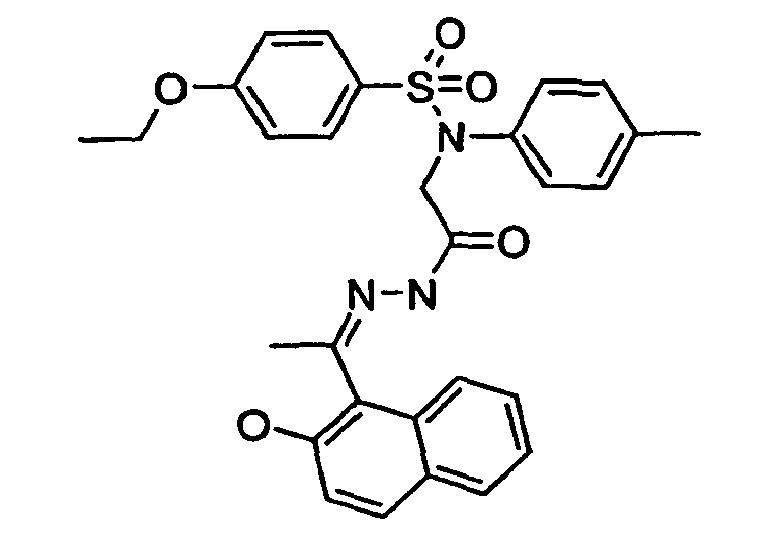
- Following the general method as outlined in Example 1, starting from 4-ethoxybenzene-sulfonyl chloride, p-toluidine, methyl bromoacetate and 2-hydroxy-1-acetonaphthone, the title compound was isolated by evaporation of the solvents and purified by recrystallization in AcOEt. A light yellow powder (55 mg, 52%) was obtained in 90% purity by HPLC (MaxPlot detection between 230 and 400 nm).
- 1H NMR (300 MHz, DMSO-d 6): 1.34 (m, 3H, OCH2CH3 ), 2.25 (m, 6H, 2 CH3), 3.90-4.15 (m, 4H, OCH2 CH3 and NCH2 CO, minor isomer (30%)), 4.79 (s, 2H, NCH2 CO, major isomer (70%)), 6.25 (m, 1H, H arom.), 6.80 (m, 1H, H arom.), 6.88-7.65 (m, 10H, H arom.), 7.76-8.04 (m, 2H, H arom.), 9.13 (s, 1H, OH, minor isomer (30%)), 9.30 (s, 1H, OH, major isomer (70%)), 10.07 (s, 1H, CONHN, minor isomer (30%)), 10.23 (s, 1H, CONHN, major isomer (70%)); M-(APCI-): 530.
-

- Following the general method as outlined in Example 1, starting from 4-ethoxybenzene-sulfonyl chloride, 4-toluidine, methyl bromoacetate and 1'-hydroxy-2'-acetophenone, the title compound was isolated by evaporation of the solvents and purified by crystallization in EtOH/AcOH 5%. A light beige solid (18.9 mg, 18%) was obtained in 98.18% purity by HPLC (MaxPlot detection between 230 and 400 nm).
- 1H NMR (DMSO-d6, 300 MHz) d 1.37 (t, 3H, J=6.8Hz), 2.22 (s, 3H), 2.43 (s, 3H), 4.14 (q, 2H, J=6.8Hz), 4.56 (s, 2H), 7.05-7.18 (m, 6H), 7.39 (m, 1H), 7.47-7.70 (m, 5H), 7.85 (m, 1H), 8.29 (m, 1H), 11.1 (s, 1H, OH). (APCI-): 530.2. (APCI+): 532.2.
-

- Following the general method as outlined in Example 1, starting from 4-tert-butylbenzenesulfonyl chloride, 4-chloroaniline, methyl bromoacetate and isatine, the title compound was isolated by evaporation of the solvents and purified by crystallization in MeOH. A yellow powder (72.7 mg, 69%) was obtained in 99.35% purity by HPLC (MaxPlot detection between 230 and 400 nm).
- M.p. 194-195°C. IR (neat) ν 2966, 1698, 1620, 1469, 1366, 1170, 1084 cm-1. 1H NMR (DMSO-d6, 300 MHz) d 1.30 (s, 9H), 4.57 (br s, 2H, NCH2CO, major isomer (60%)), 5.04 (br s, 2H, NCH2CO, minor isomer (40%)), 6.94 (m, 1H), 7.09 (m, 1H), 7.25-7.67 (m, 10H), 11.27 (s, 1H, NH), 12.52 (br s, 1H, CONHN, minor isomer (40%)), 13.56 (br s, 1H, CONHN, major isomer (60%)). (ESI-): 523. Analysis calculated for C26H25ClN4O4S•0.5 H2OC, 58.48; H, 4.91; N, 10.49. Found: C, 58.37; H, 4.97; N, 10.57.
-

- Following the general method as outlined in Example 1, starting from 3,4-dimethoxybenzenesulfonyl chloride, 4-chloroaniline, methyl bromoacetate and isatine, the title compound was isolated by evaporation of the solvents and purified by crystallization in MeOH. A yellow powder (91.0 mg, 86%) was obtained in 97.58% purity by HPLC (MaxPlot detection between 230 and 400 nm).
- M.p. 132-133°C. IR (neat) ν 3188, 2966, 1714, 1622, 1506, 1464, 1337, 1139, 1016 cm-1. 1H NMR (DMSO-d6, 300 MHz) d 3.74 (s, 3H, OCH3), 3.83 (s, 3H, OCH3), 4.55 (br s, 2H, NCH2CO, major isomer (60%)), 5.03 (br s, 2H, NCH2CO, minor isomer (40%)), 6.90-7.60 (m, 11H, H arom.), 11.27 (s, 1H, NH), 12.52 (br s, 1H, CONHN, minor isomer (40%)), 13.62 (br s, 1H, CONHN, major isomer (60%)). Analysis calculated for C24H21ClN4O6S•1.8 H2OC, 51.35; H, 4.42; N, 9.98. Found: C, 51.12; H, 4.08; N, 10.05.
-

- Following the general method as outlined in Example 1, starting from 4-tert-butylbenzenesulfonyl chloride, 4-toluidine, methyl bromoacetate and isatine, the title compound was isolated by evaporation of the solvents and purified by crystallization in MeOH. A yellow powder (49.9 mg, 49%) was obtained in 99.44% purity by HPLC (MaxPlot detection between 230 and 400 nm).
- M.p. 139-140°C. IR (neat) ν 3188, 2968, 1698, 1506,1465, 1338, 1160, 1084 cm-1. 1H NMR (DMSO-d6, 300 MHz) d 1.30 (s, 9H), 2.25 (s, 3H), 4.50 (br s, 2H, NCH2CO, major isomer (60%)), 4.98 (br s, 2H, NCH2CO, minor isomer (40%)), 6.94 (m, 1H), 7.02-7.20 (m, 5H), 7.38 (m, 1H), 7.47-7.70 (m, 5H), 11.27 (s, 1H, NH), 12.52 (br s, 1H, CONHN, minor isomer (40%)), 13.56 (br s, 1H, CONHN, major isomer (60%)). (ESI-): 503. (ESI+): 505.
-

- Following the general method as outlined in Example 1, starting from 4-n-propylbenzenesulphonyl chloride, 4-toluidine, methyl bromoacetate and isatine, the title compound was isolated by evaporation of the solvents and purified by crystallization in MeOH. A orange powder (44.5 mg, 45%) was obtained in 96.59% purity by HPLC (MaxPlot detection between 230 and 400 nm).
- M.p. 198-199°C. IR (neat) ν 3207, 2966, 1698, 1619, 1467, 1314, 1245, 1143, 1116 cm-1. 1H NMR (DMSO-d6, 300 MHz) d 0.88 (t, 3H, J=7.54Hz), 1.60 (sex, 2H, J=7.54Hz), 2.25 (s, 3H), 2.64 (t, 2H, J=7.54Hz), 4.50 (s, 2H, NCH2CO, major isomer (60%)), 4.97 (br s, 2H, NCH2CO, minor isomer (40%)), 6.94 (m, 1H), 7.05-7.20 (m, 5H), 7.30-7.65 (m, 6H), 11.28 (s, 1H, NH), 12.49 (br s, 1H, CONHN, minor isomer (40%)), 13.63 (br s, 1H, CONHN, major isomer (60%)). (ESI-): 489.2. Analysis calculated for C26H26N4O4SC, 63.66; H, 5.34; N, 11.42. Found: C, 63.60; H, 5.36; N, 11.49.
-

- Following the general method as outlined in Example 1, starting from 4-(n-butoxy)benzenesulfonyl chloride, 4-toluidine, methyl bromoacetate and isatine, the title compound was isolated by evaporation of the solvents and purified by crystallization in MeOH. A yellow powder (61.4 mg, 59%) was obtained in 99.39% purity by HPLC (MaxPlot detection between 230 and 400 nm).
- M.p. 111-112°C. IR (neat) ν 2962, 1693, 1622, 1594, 1497, 1466, 1347, 1257, 1152, 1092 cm-1. 1H NMR (DMSO-d6, 300 MHz) d 0.93 (t, 3H, J=7.53Hz), 1.43 (sex, 2H, J=7.53Hz), 1.71 (m, 2H), 2.26 (s, 3H), 4.05 (t, 2H, J=6.39Hz), 4.47 (s, 2H, NCH2CO, major isomer (65%)), 4.95 (br s, 2H, NCH2CO, minor isomer (35%)), 6.95 (m, 1H), 7.05-7.26 (m, 7H), 7.36 (m, 1H), 7.38-7.70 (m, 3H), 11.28 (s, 1H, NH), 12.49 (br s, 1H, CONHN, minor isomer (35%)), 13.65 (br s, 1H, CONHN, major isomer (65%)). (ESI-): 519.2. (ESI+): 521.2. Analysis calculated for C27H28N4O5SC, 62.29; H, 5.42; N, 10.76. Found: C, 62.19; H, 5.44; N, 10.67.
-

- Following the general method as outlined in Example 1, starting from 4-(n-butoxy)benzenesulfonyl chloride, 4-chloroaniline, methyl bromoacetate and isatine, the title compound was isolated by evaporation of the solvents and purified by crystallization in MeOH. A yellow powder (26.3 mg, 25%) was obtained in 96.1% purity by HPLC (MaxPlot detection between 230 and 400 nm).
- 1H NMR (DMSO-d6, 300 MHz) d 0.93 (t, 3H, J=7.5Hz), 1.43 (sex, 2H, J=7.5Hz), 1.71 (m, 2H), 4.05 (t, 2H, J=6.40Hz), 4.52 (s, 2H, NCH2CO, major isomer (65%)), 5.01 (br s, 2H, NCH2CO, minor isomer (35%)), 6.95 (m, 1H), 7.03-7.14 (m, 3H), 7.22-7.68 (m, 8H), 11.28 (s, 1H, NH), 12.51 (br s, 1H, CONHN, minor isomer (35%)), 13.60 (br s, 1H, CONHN, major isomer (65%)). (APCI-): 539. (APCI+): 541.
-

- Following the general method as outlined in Example 1, starting from 4-n-propoxy-1-benzenesulfonyl chloride, 4-chloroaniline, methyl bromoacetate and isatine, the title compound was isolated by evaporation of the solvents and purified by flash chromatography, using a mixture cyclohexane/ethyl acetate 3:1 as eluent. A yellow powder (46.8 mg, 44.4%) was obtained in 98.92% purity by HPLC (MaxPlot detection between 230 and 400 nm).
- 1H NMR (DMSO-d6, 300 MHz) d 0.98 (t, 3H, J=7.53Hz), 1.75 (m, 2H), 4.02 (t, 2H, J=6.40Hz), 4.53 (s, 2H, NCH2CO, major isomer (65%)), 5.02 (br s, 2H, NCH2CO, minor isomer (35%)), 6.95 (m, 1H), 7.05-7.16 (m, 3H), 7.28 (m, 2H), 7.35-7.70 (m, 6H), 11.28 (s, 1H, NH), 12.52 (br s, 1H, CONHN, minor isomer (35%)), 13.61 (br s, 1H, CONHN, major isomer (65%)). (APCI-): 525.2. (APCI+): 527.2.
-

- Following the general method as outlined in Example 1, starting from 4-tert-amylbenzenesulfonyl chloride, 4-toluidine, methyl bromoacetate and isatine, the title compound was isolated by evaporation of the solvents and purified by crystallization in EtOH. A orange-yellow powder (14.7 mg, 14.2%) was obtained in 88.22% purity by HPLC (MaxPlot detection between 230 and 400 nm).
- 1H NMR (DMSO-d6, 300 MHz) d 0.98 (t, 3H, J=7.53Hz), 1.26 (s, 6H), 1.63 (q, 2H, J=7.53Hz), 2.25 (s, 3H), 4.51 (s, 2H, NCH2CO, major isomer (65%)), 4.98 (br s, 2H, NCH2CO, minor isomer (35%)), 6.95 (m, 1H), 7.02-7.18 (m, 5H), 7.38 (m, 1H), 7.46-7.67 (m, 5H), 11.27 (s, 1H, NH), 12.49 (br s, 1H, CONHN, minor isomer (35%)), 13.62 (br s, 1H, CONHN, major isomer (65%)). (APCI-): 517. (APCI+): 519.2.
-

- Following the general method as outlined in Example 1, starting from 4-n-propoxy-1-benzenesulfonyl chloride, 4-toluidine, methyl bromoacetate and isatine, the title compound was isolated by evaporation of the solvents and purified by flash chromatography, using a mixture cyclohexane/ethyl acetate 3:1 as eluent. A yellow powder (46.9 mg, 46.3%) was obtained in 99.6% purity by HPLC (MaxPlot detection between 230 and 400 nm).
- 1H NMR (DMSO-d6, 300 MHz) d 0.97 (t, 3H, J=7.34Hz), 1.74 (m, 2H), 2.25 (s, 3H), 4.01 (t, 2H, J=6.40Hz), 4.47 (s, 2H, NCH2CO, major isomer (70%)), 4.95 (br s, 2H, NCH2CO, minor isomer (30%)), 6.95 (m, 1H), 7.03-7.18 (m, 7H), 7.38 (m, 1H), 7.44-7.68 (m, 6H), 11.28 (s, 1H, NH), 12.49 (br s, 1H, CONHN, minor isomer (30%)), 13.65 (br s, 1H, CONHN, major isomer (70%)). (APCI-): 505. (APCI+): 507.2.
-

- Following the general method as outlined in Example 1, starting from 2-thiophenesulfonyl chloride, 4-toluidine, methyl bromoacetate and isatine, the title compound was isolated by evaporation of the solvents and purified by crystallization in EtOH. A brown powder (12.9 mg, 14.2%) was obtained in 58.4% purity by HPLC (MaxPlot detection between 230 and 400 nm).
- (APCI-): 453. (APCI+): 455.
-
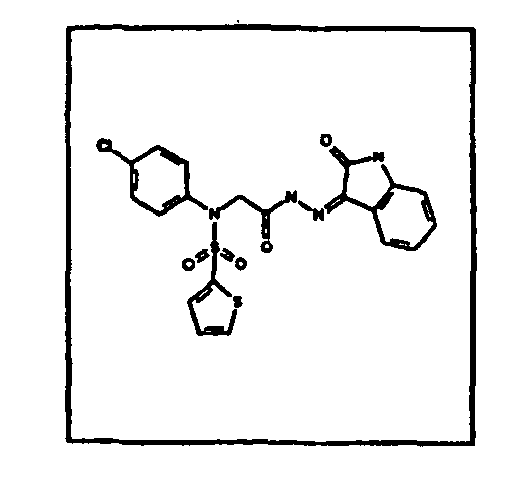
- Following the general method as outlined in Example 1, starting from 2-thiophenesulfonyl chloride, 4-chloroaniline, methyl bromoacetate and isatine, the title compound was isolated by evaporation of the solvents and purified by flash chromatography, using a mixture cyclohexane/ethyl acetate 3:1 as eluent. A yellow powder (21.8 mg, 23%) was obtained in 99.2% purity by HPLC (MaxPlot detection between 230 and 400 nm).
- 1H NMR (DMSO-d6, 300 MHz) d 4.59 (s, 2H, NCH2CO, major isomer (60%)), 5.03 (br s, 2H, NCH2CO, minor isomer (40%)), 6.94 (m, 1H), 7.09 (m, 1H), 7.21-7.59 (m, 7H), 7.64 (m, 1H), 8.05 (m, 1H), 11.28 (s, 1H, NH), 12.52 (br s, 1H, CONHN, minor isomer (40%)), 13.62 (br s, 1H, CONHN, major isomer (60%)). (APCI-): 473. (APCI+): 475.
-

- Following the general method as outlined in Example 1, starting from 3,4-dimethoxybenzenesulfonyl chloride, 4-chloroaniline, methyl bromoacetate and salicylaldehyde, the title compound was isolated by evaporation of the solvents and purified by crystallization in EtOH/5% AcOH. A colorless solid (232 mg, 80.4%) was obtained in 99.52% purity by HPLC (MaxPlot detection between 230 and 400 nm).
- M.p. 188-189°C. IR (neat) ν 2962, 1673, 1507, 1488, 1351, 1241, 1137, 1020 cm-1. 1H NMR (DMSO-d6, 300 MHz) d 3.74 (s, 3H), 3.77 (s, 3H), 4.39 (s, 2H, NCH2CO, major isomer (54%)), 4.85 (br s, 2H, NCH2CO, minor isomer (46%)), 6.80-6.93 (m, 2H), 7.05-7.15 (m, 2H), 7.17-7.31 (m, 4H), 7.34-7.45 (m, 2H), 7.50 (m, 1H, major isomer (54%)), 7.67 (m, 1H, minor isomer (46%)), 8.24 (s, 1H, minor isomer (46%)), 8.41 (s, 1H, major isomer (54%)), 10.00 (s, 1H, minor isomer (46%)), 10.90 (s, 1H, major isomer (54%)), 11.46 (s, 1H, minor isomer (46%)), 11.74 (s, 1H, major isomer (54%)). (APCI-): 502.
- (APCI+): 504.2. Analysis calculated for C23H22ClN3O6SC, 54.82; H, 4.40; N, 8.34. Found: C, 54.48; H, 4.44; N, 8.31.
-

- Following the general method as outlined in Example 1, starting from 4-ethoxybenzene-sulfonyl chloride, 4-chloroaniline, methyl bromoacetate and salicylaldehyde, the title compound was isolated by evaporation of the solvents and purified by crystallization in EtOH. A colorless powder (64.6 mg, 66.2%) was obtained in 92.2% purity by HPLC (MaxPlot detection between 230 and 400 nm).
- IR (neat) ν 2988, 1632, 1488, 1351, 1262,1155, 1084 cm-1. 1H NMR (DMSO-d6, 300 MHz) d 1.34 (t, 3H, J=7.14Hz), 4.10 (q, 2H, J=7.14Hz), 4.37 (s, 2H, NCH2CO, major isomer (55%)), 4.82 (br s, 2H, NCH2CO, minor isomer (45%)), 6.81-7.14 (m, 4H), 7.16-7.32 (m, 3H), 7.35-7.44 (m, 2H), 7.46-7.73 (m, 3H), 8.24 (s, 1H, minor isomer (45%)), 8.40 (s, 1H, major isomer (55%)), 9.99 (s, 1H, minor isomer (45%)), 10.90 (s, 1H, major isomer (55%)), 11.42 (s, 1H, minor isomer (45%)), 11.74 (s, 1H, major isomer (55%)). (APCI-): 486. (APCI+): 488.
-

- Following the general method as outlined in Example 1, starting from 4-tert-amylbenzenesulfonyl chloride, 4-chloroaniline, methyl bromoacetate and isatine, the title compound was isolated by evaporation of the solvents and purified by crystallization in EtOH. A brown-orange powder (59.3 mg, 55%) was obtained in 76% purity by HPLC (MaxPlot detection between 230 and 400 nm).
- (APCI-): 537. (APCI+): 539.2.
-

- Following the general method as outlined in Example 1, starting from 4-ethoxybenzene-sulfonyl chloride, 4-chloroaniline, methyl bromoacetate and isatine, the title compound was isolated by evaporation of the solvents and purified by flash chromatography, using a mixture cyclohexane/ethyl acetate 3:1 as eluent. A orange powder (60.3 mg, 59%) was obtained in 95.48% purity by HPLC (MaxPlot detection between 230 and 400 nm).
- 1H NMR (DMSO-d6, 300 MHz) d 1.34 (t, 3H, J=6.78Hz), 4.10 (q, 2H, J=6.78Hz), 4.52 (s, 2H, NCH2CO, major isomer (60%)), 5.01 (br s, 2H, NCH2CO, minor isomer (40%)), 6.94 (m, 1H), 7.02-7.14 (m, 3H), 7.26 (m, 2H), 7.33-7.71 (m, 6H), 11.28 (s, 1H, NH), 12.52 (br s, 1H, CONHN, minor isomer (40%)), 13.61 (br s, 1H, CONHN, major isomer (60%)). (APCI-): 511. (APCI+): 513.
-

- Following the general method as outlined in Example 1, starting from benzene-sulfonyl chloride, 4-chloroaniline, methyl bromoacetate and isatine, the title compound was isolated by evaporation of the solvents and purified by flash chromatography, using a mixture cyclohexane/ethyl acetate 3:1 as eluent. A yellow powder (15.5 mg, 16.5%) was obtained in 98% purity by HPLC (MaxPlot detection between 230 and 400 nm).
- 1H NMR (DMSO-d6, 300 MHz) d 4.59 (s, 2H, NCH2CO, major isomer (55%)), 5.06 (br s, 2H, NCH2CO, minor isomer (45%)), 6.94 (m, 1H), 7.09 (m, 1H), 7.26 (m, 2H), 7.33-7.47 (m, 3H), 7.49-7.78 (m, 6H), 11.28 (s, 1H, NH), 12.53 (br s, 1H, CONHN, minor isomer (45%)), 13.58 (br s, 1H, CONHN, major isomer (55%)). (APCI-): 466.8. (APCI+): 469.
-
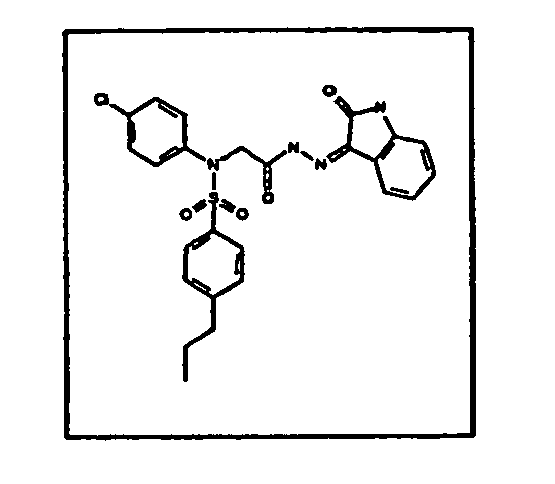
- Following the general method as outlined in Example 1, starting from 4-n-propoxy-1-benzenesulfonyl chloride, 4-chloroaniline, methyl bromoacetate and isatine, the title compound was isolated by evaporation of the solvents and purified by flash chromatography, using a mixture cyclohexane/ethyl acetate 3:1 as eluent. A yellow powder (32.8 mg, 32%) was obtained in 67.9% purity by HPLC (MaxPlot detection between 230 and 400 nm).
- (APCI-): 508.8. (APCI+): 511.2.
-

- Following the general method as outlined in Example 1, starting from 4-ethoxybenzene-sulfonyl chloride, 4-chloroaniline, methyl bromoacetate and 2-imidazolecarboxaldehyde, the title compound was isolated by evaporation of the solvents and purified by crystallization in EtOH/5% AcOH. A colorless powder (34 mg, 74%) was obtained in 98.73% purity by HPLC (MaxPlot detection between 230 and 400 nm).
- 1H NMR (DMSO-d6, 300 MHz) d 1.34 (t, 3H, J=6.0Hz), 4.10 (q, 2H, J=6.0Hz), 4.35 (s, 2H, NCH2CO, minor isomer (35%)), 4.89 (br s, 2H, NCH2CO, major isomer (65%)), 6.98-7.44 (m, 8H), 7.54 (m, 2H, minor isomer (35%)), 7.64 (m, 2H, major isomer (65%)), 7.82 (s, 1H, major isomer (65%)), 8.07 (s, 1H, minor isomer (35%)), 11.50 (s, 1H, NH), 12.55 (br s, 1H, CONHN, major isomer (65%)), 12.72 (br s, 1H, CONHN, minor isomer (35%)). (APCI-): 459.8. (APCI+): 462.
-

- Following the general method as outlined in Example 1, starting from 4-ethoxybenzene-sulfonyl chloride, 4-chloroaniline, methyl bromoacetate and 2-pyridinecarboxaldehyde, the title compound was isolated by evaporation of the solvents and purified by crystallization in EtOH/5% AcOH. A colorless powder (26.9 mg, 57%) was obtained in 96.4% purity by HPLC (MaxPlot detection between 230 and 400 nm).
- 1H NMR (DMSO-d6, 300 MHz) d 1.34 (t, 3H, J=6.0Hz), 4.11 (q, 2H, J=6.0Hz), 4.38 (s, 2H, NCH2CO, minor isomer (35%)), 4.88 (br s, 2H, NCH2CO, major isomer (65%)), 7.01-7.66 (m, 9H), 7.80-8.22 (m, 3H), 8.58 (m, 1H), 11.71 (m, 1H). (APCr): 471. (APCI+): 473.
-

- Following the general method as outlined in Example 1, starting from 4-fluorobenzenesulfonyl chloride, 4-toluidine, methyl bromoacetate and isatine, the title compound was isolated by evaporation of the solvents and purified by crystallization in EtOH/5% AcOH. A yellow powder (26 mg, 59%) was obtained in 94.7% purity by HPLC (MaxPlot detection between 230 and 400 nm).
- 1H NMR (DMSO-d6, 300 MHz) d 2.27 (s, 3H), 4.54 (s, 2H, NCH2CO, major isomer (68%)), 5.01 (br s, 2H, NCH2CO, minor isomer (32%)), 6.94 (m, 1H), 7.03-7.22 (m, 5H), 7.33-7.85 (m, 6H), 11.28 (s, 1H, NH), 12.49 (br s, 1H, CONHN, minor isomer (32%)), 13.61 (br s, 1H, CONHN, major isomer (68%)). (ESI-): 464.8.
-
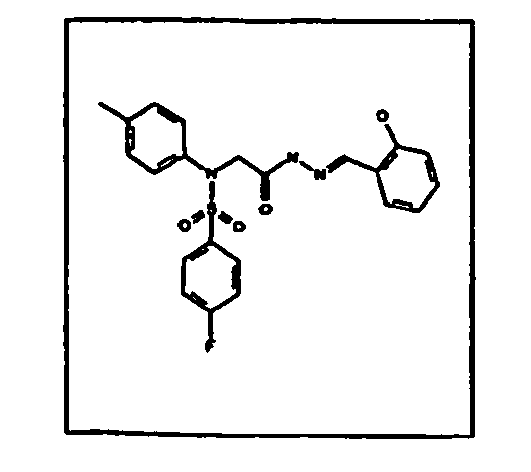
- Following the general method as outlined in Example 1, starting from 4-fluorobenzenesulfonyl chloride, 4-toluidine, methyl bromoacetate and salicylaldehyde, the title compound was isolated by evaporation of the solvents and purified by crystallization in EtOH/5% AcOH. A colorless powder (33.5 mg, 76%) was obtained in 87.3% purity by HPLC (MaxPlot detection between 230 and 400 nm).
- 1H NMR (DMSO-d6, 300 MHz) d 2.25 (s, 3H), 4.37 (s, 2H, NCH2CO, major isomer (56%)), 4.81 (br s, 2H, NCH2CO, minor isomer (44%)), 6.81-6.91 (m, 2H), 7.02-7.32 (m, 5H), 7.36-7.78 (m, 5H), 8.24 (s, 1H, minor isomer (44%)), 8.40 (s, 1H, major isomer (56%)), 9.98 (s, 1H, minor isomer (44%)), 10.90 (s, 1H, major isomer (56%)), 11.40 (s, 1H, minor isomer (44%)), 11.71 (s, 1H, major isomer (56%)). (ESI-): 440.
-

- Following the general method as outlined in Example 1, starting from 4-ethoxybenzene-sulfonyl chloride, 4-toluidine, methyl bromoacetate and 2-nitrobenzaldehyde, the title compound was isolated by evaporation of the solvents and purified by crystallization in AcOH. A colorless powder (418.3 mg, 84%) was obtained in 98.62% purity by HPLC (MaxPlot detection between 230 and 400 nm).
- 1H NMR (DMSO-d6, 300 MHz) d 1.34 (t, 3H, J=6.0Hz), 2.24 (s, 3H), 4.10 (q, 2H, J=6.0Hz), 4.34 (s, 2H, NCH2CO, minor isomer (38%)), 4.78 (br s, 2H, NCH2CO, major isomer (62%)), 6.88-7.20 (m, 6H), 7.50-7.70 (m, 3H), 7.77 (m, 1H), 7.95-8.10 (m, 2H), 8.29 (s, 1H, major isomer (62%)), 8.58 (s, 1H, minor isomer (38%)), 11.74 (s, 1H, major isomer (62%)), 11.81 (s, 1H, minor isomer (38%)), 11.93 (s, 1H). (APCI-): 494.8. (APCI+): 496.8.
-
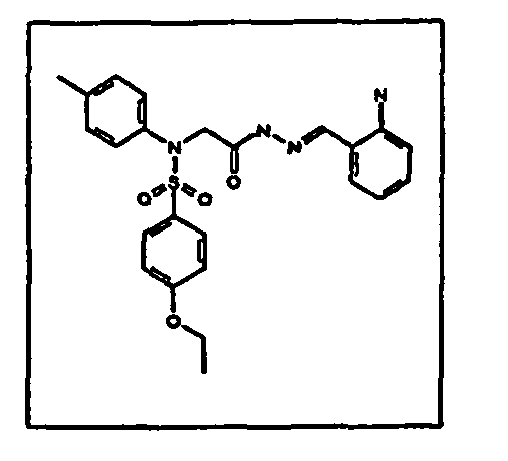
- 4-ethoxy-N-(4-methylphenyl)-N-{2-[(2E)-2-(2-nitrobenzylidene)hydrazino]-2-oxoethyl}benzenesulfonamide (99 mg, 0.2 mmol) was dissolved in methylene chloride. Palladium 5% on charcoal was added (10 mol%). The mixture was stirred under H2 at athmospheric pressure at room temperature overnight. It was filtered on Celite and solvents were evaporated. The expected product, e.g. N-{2-[(2E)-2-(2-aminobenzylidene)hydrazino]-2-oxoethyl}-4-ethoxy-N-(4-methylphenyl)benzenesulfonamide (71.2 mg, 76%), was obtained as a light yellow solid, in 90.9 % purity by HPLC (MaxPlot detection between 230 and 400 nm).
- 1H NMR (300 MHz, CDCl3): 1.38 (t, J = 6.0 Hz, 3H, OCH2CH 3), 2.26 (s, 3H, CH3), 3.5 (br s, 2H), 4.01 (q, J = 6.0 Hz, 2H, OCH 2CH3), 4.14 (s, 2H), 6.62 (m, 1H), 6.76-6.91 (m, 5H, H arom.), 6.93-7.07 (m, 4H, H arom.), 7.40 (m, 2H, H arom.), 7.85 (br s, 1H).
-

- Following the general method as outlined in Example 1, starting from 4-ethoxybenzene-sulfonyl chloride, 4-toluidine, methyl bromoacetate and N-acetyl-2-aminobenzaldehyde, the title compound was isolated by evaporation of the solvents and purified by flash chromatography, using a mixture cyclohexane/ethyl acetate 4:1 as eluent. A light yellow solid (18.3 mg, 18%) was obtained in 93.6% purity by HPLC (MaxPlot detection between 230 and 400 nm).
- 1H NMR (DMSO-d6, 300 MHz) d 1.44 (t, 3H, J=6.0Hz), 2.26 (s, 3H), 2.32 (s, 3H), 4.08 (q, 2H, J=6.0Hz), 4.29 (s, 2H, NCH2CO), 6.81-7.16 (m, 7H), 7.24 (m, 1H), 7.38 (m, 1H), 7.50 (m, 2H), 8.13 (s, 1H), 8.69 (d, 1H, J=6Hz), 9.82 (s, 1H), 11.59 (s, 1H). (ESI-): 507.
-

- Following the general method as outlined in Example 1, starting from 4-ethoxybenzene-sulfonyl chloride, 4-chloroaniline, methyl bromoacetate and 5-azaisatine, the title compound was isolated by evaporation of the solvents and purified by flash chromatography, using a mixture DCM/MeOH 20:1 as eluent. A light yellow solid (32.4 mg, 26%) was obtained in 87% purity by HPLC (MaxPlot detection between 230 and 400 nm).
- 1H NMR (DMSO-d6, 300 MHz) d 1.12 (t, 3H, J=6Hz), 3.88 (q, 2H, J=6Hz), 4.35 (s, 2H, NCH2CO, major isomer (63%)), 4.80 (br s, 2H, NCH2CO, minor isomer (37%)), 6.79 (m, 1H), 6.87 (m, 2H), 7.03 (m, 2H), 7.19 (m, 2H), 7.32 (m, 2H), 8.24 (d, 1H, J=3Hz), 8.40 (br s, 1H), 11.45 (s, 1H, NH), 12.15 (br s, 1H, CONHN, minor isomer (37%)), 13.28 (br s, 1H, CONHN, major isomer (63%)). (ESI-): 511.8. (ESI+): 514.
-

- Following the general method as outlined in Example 1, starting from 4-ethoxybenzene-sulfonyl chloride, 4-toluidine, methyl bromoacetate and indole-3-carboxyldehyde, the title compound was isolated by evaporation of the solvents and purified by crystallization in ethyl acetate. A beige solid (40 mg, 43.3%) was obtained in 93.2% purity by HPLC (MaxPlot detection between 230 and 400 nm).
- 1H NMR (DMSO-d6, 300 MHz) d 1.37 (m, 3H), 2.24 (s, 3H), 4.12 (m, 2H), 4.29 (s, 2H, NCH2CO, minor isomer (36%)), 4.80 (br s, 2H, NCH2CO, major isomer (64%)), 7.01-7.26 (m, 1H), 7.42 (m, 1H), 7.57 (m, 2H), 7.77 (m, 1H), 7.99 (m, 1H, major isomer (64%)), 8.10 (br s, 1H, major isomer (64%)), 8.12 (m, 1H, minor isomer (36%)), 8.30 (br s, 1H, minor isomer (36%)), 11.08 (s, 1H, CONHN, minor isomer (36%)), 11.55 (s, 1H, CONHN, major isomer (64%)), 11.55 (br s, 1H, NH). (APCI-): 489. (APCI+): 491.2.
-

- Following the general method as outlined in Example 1, starting from 4-ethoxybenzene-sulfonyl chloride, 4-toluidine, methyl bromoacetate and 2-methylindole-3-carboxyldehyde, the title compound was isolated by evaporation of the solvents and purified by crystallization in ethyl acetate. A yellow powder (57.4 mg, 60%) was obtained in 95.2% purity by HPLC (MaxPlot detection between 230 and 400 nm).
- 1H NMR (DMSO-d6, 300 MHz) d 1.36 (m, 3H), 2.24 (s, 3H), 2.43 (s, 3H, major isomer (60%)), 2.45 (s, 3H, minor isomer (40%)), 4.12 (m, 2H), 4.27 (s, 2H, NCH2CO, minor isomer (40%)), 4.78 (br s, 2H, NCH2CO, major isomer (60%)), 6.95-7.18 (m, 8H), 7.32 (m, 1H), 7.56 (m, 2H), 7.77 (m, 1H), 7.88 (m, 1H, major isomer (60%)), 8.04 (m, 1H, minor isomer (40%)), 8.18 (s, 1H, major isomer (60%)), 8.37 (s, 1H, minor isomer (40%)), 11.44 (br s, 1H, minor isomer (40%)), 11.46 (br s, 1H, major isomer (60%)), 11.90 (br s, 1H, NH). (APCI-): 503.2. (APCI+): 505.2.
-

- Following the general method as outlined in Example 1, starting from 4-ethoxybenzene-sulfonyl chloride, 2-amino-pyrimidine, methyl bromoacetate and isatine, the title compound was isolated by evaporation of the solvents and purified by crystallization in AcOH. A yellow solid (61.1 mg, 75%) was obtained in 96.63% purity by HPLC (MaxPlot detection between 230 and 400 nm).
- 1H NMR (DMSO-d6, 300 MHz) d 1.27 (t, 3H, J=6Hz), 4.05 (q, 2H, J=6Hz), 5.01 (s, 2H, NCH2CO, minor isomer (20%)), 5.42 (br s, 2H, NCH2CO, major isomer (80%)), 6.89 (m, 1H), 6.94-7.15 (m, 4H), 7.34 (m, 1H), 7.42-7.68 (m, 1H), 8.01 (m, 2H), 8.48 (m, 2H), 11.20 (br s, 1H, major isomer (80%)), 12.55 (br s, 1H, minor isomer (20%)). (ESI-): 479.17. (ESI+): 481.24.
-

- 4-Toluidine (6.430 g, 60 mmol) was dissolved in pyridine (200 mL). The resulting mixture was cooled down to 0°C. 4-fluoro-benzenesulfonyl chloride (7.784 g, 40 mmol) was added in portions. The mixture was stirred between 0°C and room temperature overnight. Solvents were evaporated to dryness. The crude oil was dissolved in ethyl acetate (150 mL) and washed with 10% HCl (2 x 75 mL) and brine (1 x 75 mL). Organic phase was dried over magnesium sulfate before filtering and removal of solvent. The resulting solid was recrystallized in cyclohexane/ethyl acetate 9:1. The desired product, e.g. 4-fluoro-N-(4-methylphenyl)benzenesulfonamide (9.4754 g, 89%), was obtained as a colorless solid, in 98 % purity by HPLC (MaxPlot detection between 230 and 400 nm).
- 1H NMR (300 MHz, CDCl3): 2.26 (s, 3H, CH3), 6.63 (br s, 1H, NH), 6.92 (m, 2H, H arom.), 6.97-7.14 (m, 4H, H arom.), 7.73 (m, 2H, H arom.); M+(ESI+): 266.20; M-(ESI-): 264.18.
- To a suspention ofNaH (2.2 mmol, 55-65% in oil) in dry dioxane (6 mL) was added 2-methoxyethanol (158 µl, 2 mmol). The mixture was stirred 1h at room temperature. A solution of 4-fluoro-N-(4-methylphenyl)benzenesulfonamide (265.3 mg, 1 mmol) in dry dioxane (2 mL) was added. The resulting mixture was heated 24h at 100°C. Solvents were evaporated. NH4Cl saturated solution in water (5 mL) was added and the desired product was extracted with three portions of ethyl acetate (3x5 mL). Combined organic phases were dried over magnesium sulfate before filtering and removal of solvent. The desired product, e.g. 4-(2-methoxyethoxy)-N-(4-methylphenyl)benzenesulfonamide was obtained as a colorless oil, in 77% purity by HPLC (MaxPlot detection between 230 and 400 nm). This intermediate was used in the next step without further purification.
- M+(APCI+): 322.
- The crude N-aryl-benzenesulfonamide building block XIII* resulting from the precedent step, e.g. 4-(2-methoxyethoxy)-N-(4-methylphenyl)benzenesulfonamide (1 mmol), was dissolved in dry dioxane (5 mL) and was added to a suspention ofNaH (1.2 mmol, 55-65% in oil) in dry dioxane (1 mL). The mixture was stirred 1 h at room temperature. 2-Bromoacetic acid methyl ester (133 µL, 1.4 mmol) was added dropwise. The resulting mixture was stirred at 60°C overnight. The solvents were evaporated, affording the desired product, e.g. methyl ({[4-(2-methoxyethoxy)phenyl]sulfonyl}-4-methylanilino)acetate as a light yellow oil, in 74 % purity by HPLC (MaxPlot detection between 230 and 400 nm). This intermediate was used in the next step without further purification.
- M+(APCI+): 394.
- The crude carboxylic acid methyl ester resulting from the precedent step, e.g. methyl ({[4-(2-methoxyethoxy)phenyl]sulfonyl}-4-methylanilino)acetate (1 mmol), was dissolved,in MeOH (3.5 mL). Hydrazine hydrate was added (0.385 mL). The reaction mixture was stirred overnight at room temperature. Solvents were evaporated. The crude product was dissolved in ethyl acetate (4 mL) and was washed with water (4 mL). Aqueous phase was extracted with ethyl acetate (3x2 mL) and with methylene chloride (2x2mL). Combined organic phases were dried over magnesium sulfate, filtrated and solvents were evaporated.
- The desired product, e.g. N-(2-hydrazino-2-oxoethyl)-4-(2-methoxyethoxy)-N-(4-methylphenyl)benzenesulfonamide was isolated as a light yellow oil, in 86 % purity by HPLC (MaxPlot detection between 230 and 400 nm). This intermediate was used in the next step without further purification.
- M+(ESI+): 394.33. M-(ESI-): 392.18.
- Hydrazide obtained in the precedent step, e.g. N-(2-hydrazino-2-oxoethyl)-4-(2-methoxyethoxy)-N-(4-methylphenyl)benzenesulfonamide (1 mmol), was dissolved in EtOH / 5 % AcOH (3 mL). Isatin (118 mg, 0.8 mmol) was added. The reaction mixture was stirred overnight at 75°C. Solvents were evaporated and the desired product was purfied by flash chromatography using a 1:1 mixture of cyclohexane and ethyl acetate. The expected product, e.g. 4-(2-methoxyethoxy)-N-(4-methylphenyl)-N-{2-oxo-2-[(2Z)-2-(2-oxo-1,2-dihydro-3H-indol-3-ylidene)hydrazino]ethyl}benzenesulfonamide (135.6 mg, 26% yield over 4 steps) was isolated as a yellow solid in 96% purity by HPLC (MaxPlot detection between 230 and 400 nm).
- 1H NMR (300 MHz, DMSO-d 6): 2.29 (s, 3H, CH3), 3.45 (s, 3H, OCH3), 3.76 (m, 2H), 4.16 (m, 2H), 4.39 (br s, 2H, NCH 2CO, major isomer (68%)), 5.00 (br s, 2H, NCH2 CO, minor isomer (32%)), 6.87-7.01 (m, 3H, H arom.), 7.02-7.21 (m, 4H, H arom.), 7.32 (m, 1H, H arom.), 7.52 (m, 2H, H arom.), 7.66-7.78 (m, 2H, H arom.), 7.92 (br s, 1H, minor isomer (32%)), 8.34 (br s, 1H, major isomer (68%)), 12.39 (br s, 1H, minor isomer (32%)), 14.00 (br s, 1H, major isomer (68%)); M+(APCI+): 523.0; M-(APCI-): 521.0.
-

- Following the general method as outlined in Example 54, starting from 4-chloroaniline, 2-morpholin-4-yl-ethanol, methyl bromoacetate and isatine, the title compound was isolated by evaporation of the solvents and purified by flash chromatography, using a mixture methylene chloride/MeOH 40:1 as eluent. A yellow powder (342.1 mg, 8.2% over four steps) was obtained in 95% purity by HPLC (MaxPlot detection between 230 and 400 nm).
- N-(4-chlorophenyl)-4-[2-(4-morpholinyl)ethoxy]-N- {2-oxo-2-[2-(2-oxo-1,2-dihydro-3H-indol-3-ylidene)hydrazino]ethyl}benzenesulfonamide (342.1 mg, 0.572 mmol) was dissolved in DCM (10 mL). A HCl solution in diethylether (1M, 0.58 mL, 0.580 mmol) was added. Solvents were evaporated and the resulting mass was recrystallized in MeOH. A yellow powder. (307.9 mg, 90% yield ofrecrystallization) was obtained in 100% purity by HPLC (MaxPlot detection between 230 and 400 nm).
- M.p. 255°C. IR (neat) ν 2971, 1682, 1506, 1492, 1350, 1233, 1159, 1089 cm-1. 1H NMR (DMSO-d6, 300 MHz) δ 3.28 (m, 2H), 3.51-3.74 (m, 4H), 3.84 (m, 2H), 4.04 (m, 2H), 4.48-4.74 (m, 2H + 2H, NCH2CO, major isomer (60%)), 5.12 (br s, 2H, NCH2CO, minor isomer (40%)), 7.03 (m, 1H, H arom.), 7.16 (m, 1H, H arom.), 7.25 (m, 2H, H arom.), 7.35 (m, 2H, H arom.), 7.41-7.56 (m, 3H, H arom.), 7.57-7.82 (m, 3H, H arom.), 10.91 (br s, 1H), 11.39 (s, 1H), 12.59 (br s, 1H, CONHN, minor isomer (40%)), 13.68 (br s, 1H, CONHN, major isomer (60%)). (ESI-): 596.4. (ESI+): 598.0.
-

- Following the general method as outlined in Example 54, starting from 4-toluidine, 2-morpholin-4-yl-ethanol, methyl bromoacetate and isatine, the title compound was isolated by evaporation of the solvents and purified by flash chromatography, using a mixture methylene chloride/MeOH 40:1 as eluent. A yellow solid. (39.7 mg, 7% over 4 steps) was obtained in 95.38% purity by HPLC (MaxPlot detection between 230 and 400 nm).
- 1H NMR (CDCl3, 300 MHz) δ 2.28 (s, 3H), 2.58 (m, 4H), 2.83 (m, 2H), 3.73 (m, 4H), 4.15 (m, 2H), 4.40 (s, 2H, NCH2CO, major isomer (70%)), 4.99 (s, 2H, NCH2CO, minor isomer (30%)), 6.86-7.22 (m, 8H, H arom.), 7.29 (m, 1H, H arom.), 7.51 (m, 2H, H arom.), 7.69 (m, 1H, H arom.), 8.85 (s, 1H, minor isomer (40%)), 9.32 (s, 1H, major isomer (60%)), 12.41 (s, 1H, minor isomer (40%)), 14.06 (s, 1H, major isomer (60%)). (ESI-): 576.3. (ESI+): 578.5.
-

- Following the general method as outlined in Example 54, starting from 4-chloroaniline, 2-dimethylamino-ethanol, methyl bromoacetate and isatine, the title compound was isolated by evaporation of the solvents and purified by flash chromatography, using a mixture methylene chloride/MeOH 20:1 as eluent. A yellow oil. (20.0 mg, 8% over 4 steps) was obtained in 97.54% purity by HPLC (MaxPlot detection between 230 and 400 nm).
- 1H NMR (CDCl3, 300 MHz) δ 2.44 (s, 6H, N(CH3)2), 2.91 (m, 2H), 4.18 (m, 2H), 4.39 (s, 2H, NCH2CO, major isomer (60%)), 4.99 (s, 2H, NCH2CO, minor isomer (40%)), 6.86-6.98 (m, 3H, H arom.), 7.07 (m, 1H, H arom.), 7.12-7.36 (m, 5H, H arom.), 7.49 (m, 2H, H arom.), 7.69 (m, 1H, H arom.), 9.20 (br s, 1H), 12.45 (s, 1H, minor isomer (40%)), 13.98 (s, 1H, major isomer (60%)). (ESI-): 554.1. (ESI+): 556.3.
-

- Following the general method as outlined in Example 54, starting from 4-toluidine, 2-dimethylamino-ethanol, methyl bromoacetate and isatine, the title compound was isolated by evaporation of the solvents and purified by flash chromatography, using a mixture methylene chloride/MeOH 20:1 as eluent. A yellow oil. (23.4 mg, 9% over 4 steps) was obtained in 98.42% purity by HPLC (MaxPlot detection between 230 and 400 nm).
- 1H NMR (CDCl3, 300 MHz) δ 2.42 (s, 6H, N(CH3)2), 2.87 (m, 2H), 4.17 (m, 2H), 4.40 (s, 2H, NCH2CO, major isomer (60%)), 4.99 (s, 2H, NCH2CO, minor isomer (40%)), 6.86-6.98 (m, 3H, H arom.), 7.02-7.22 (m, 5H, H arom.), 7.32 (m, 1H, H arom.), 7.50 (m, 2H, H arom.), 7.72 (m, 1H, H arom.), 8.05 (br s, 1H, minor isomer (40%)), 8.60 (br s, 1H, major isomer (60%)), 12.37 (s, 1H, minor isomer (40%)), 13.95 (s, 1H, major isomer (60%)). (APCI-): 534.0. (APCI+): 536.4.
-

- Following the general method as outlined in Example 54, starting from 4-toluidine, 3-dimethylamino-propan-1-ol, methyl bromoacetate and isatine, the title compound was isolated by evaporation of the solvents and purified by flash chromatography, using a mixture methylene chloride/MeOH 10:1 as eluent. A yellow solid (22.9 mg, 7% over 4 steps) was obtained in 97.93% purity by HPLC (MaxPlot detection between 230 and 400 nm).
- 1H NMR (CDCl3, 300 MHz) δ 2.25 (m, 2H), 2.29 (s, 3H, CH3), 2.68 (s, 6H, N(CH3)2), 2.94 (m, 2H, minor isomer (25%)), 2.94 (m, 2H, major isomer (75%)), 4.08 (m, 2H, minor isomer (25%)), 4.15 (m, 2H, major isomer (75%)), 4.32 (s, 2H, NCH2CO, major isomer (75%)), 4.97 (br s, 2H, NCH2CO, minor isomer (25%)), 6.78-7.23 (m, 9H, H arom.), 7.32 (m, 2H, H arom.), 7.70 (m, 1H, H arom.), 8.40 (br s, 1H, minor isomer (25%)), 9.60 (br s, 1H, major isomer (75%)), 12.36 (s, 1H, minor isomer (25%)), 14.08 (s, 1H, major isomer (75%)). (APCI-): 548.0. (APCI+): 550.2.
-

- Following the general method as outlined in Example 54, starting from 4-chloroaniline, thiophen-2-yl-methanol, methyl bromoacetate and isatine, the title compound was isolated by evaporation of the solvents and purified by flash chromatography, using a mixture cyclohexane/ethyl acetate 4:1 as eluent. A yellow soild (149.6 mg, 26% over 4 steps) was obtained in 91.11 % purity by HPLC (MaxPlot detection between 230 and 400 nm).
- 1H NMR (CDCl3, 300 MHz) δ 4.38 (s, 2H, NCH2CO, major isomer (53%)), 5.01 (s, 2H, NCH2CO, minor isomer (47%)), 5.26 (m, 2H), 6.90 (m, 1H, H arom.), 7.02 (m, 2H, H arom.), 7.05-7.39 (m, 6H, H arom.), 7.47-7.64 (m, 3H, H arom.), 7.68 (m, 2H, H arom.), 7.77 (m, 1H, H arom.), 12.42 (s, 1H, minor isomer (47%)), 13.92 (s, 1H, major isomer (53%)). (ESI-): 579.0. (ESI+): 581.2.
-
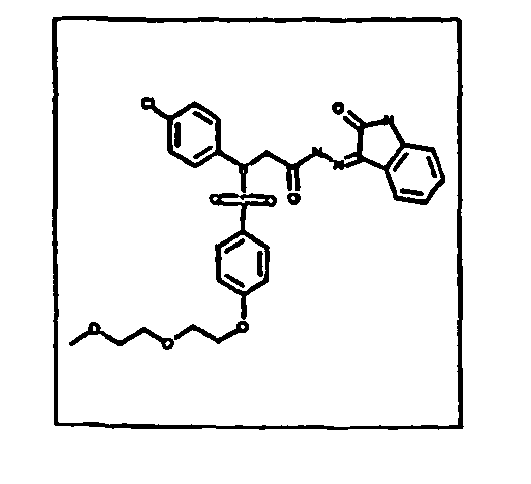
- Following the general method as outlined in Example 54, starting from 4-chloroaniline, 2-(2-methoxy-ethoxy)-ethanol, methyl bromoacetate and isatine, the title compound was isolated by evaporation of the solvents and purified by flash chromatography, using a mixture cyclohexane/ethyl acetate 1:1 then 2:3 as eluent. A yellow solid. (447 mg, 38% over 4 steps) was obtained in 95.5% purity by HPLC (MaxPlot detection between 230 and 400 nm).
- 1H NMR (CDCl3, 300 MHz) δ 3.38 (s, 3H, OCH3), 3.57 (m, 2H), 3.71 (m, 2H), 3.87 (m, 2H), 4.17 (m, 2H), 4.39 (s, 2H, NCH2CO, major isomer (58%)), 4.99 (s, 2H, NCH2CO, minor isomer (42%)), 6.88-6.97 (m, 3H, H arom.), 7.09 (m, 1H, H arom.), 7.14-7.37 (m, 5H, H arom.), 7.52 (m, 2H, H arom.), 7.70 (m, 1H, H arom.), 7.98 (br s, 1H, minor isomer (42%)), 8.28 (br s, 1H, major isomer (58%)), 12.41 (s, 1H, minor isomer (42%)), 13.91 (s, 1H, major isomer (58%)). (ESI-): 586.0. (ESI+): 587.3.
-

- Following the general method as outlined in Example 54, starting from 4-chloroaniline, 2-methoxy-ethanol, methyl bromoacetate and isatine, the title compound was isolated by evaporation of the solvents and purified by flash chromatography, using a mixture cyclohexane/ethyl acetate 1:1 as eluent. A orange solid. (240 mg, 44% over 4 steps) was obtained in 91.3% purity by HPLC (MaxPlot detection between 230 and 400 nm).
- 1H NMR (CDCl3, 300 MHz) δ 3.45 (s, 3H, OCH3), 3.76 (m, 2H), 4.16 (m, 2H), 4.38 (s, 2H, NCH2CO, major isomer (56%)), 4.99 (s, 2H, NCH2CO, minor isomer (44%)), 6.87-7.01 (m, 3H, H arom.), 7.03-7.29 (m, 5H, H arom.), 7.33 (m, 1H, H arom.), 7.53 (m, 2H, H arom.), 7.61 (m, 1H, H arom.), 7.82 (br s, 1H, minor isomer (44%)), 8.11 (br s, 1H, major isomer (56%)), 12.42 (s, 1H, minor isomer (44%)), 13.94 (s, 1H, major isomer (56%)). (APCI-): 540.6. (APCI+): 543.0.
-

- Following the general method as outlined in Example 54, starting from 4-chloroaniline, 3-pyridin-3-yl-propan-1-ol, methyl bromoacetate and isatine, the title compound was isolated by evaporation of the solvents and purified by flash chromatography, using pure ethyl acetate as eluent. A yellow solid. (88.9 mg, 15% over 4 steps) was obtained in 99.67% purity by HPLC (MaxPlot detection between 230 and 400 nm).
- 1H NMR (CDCl3, 300 MHz) δ 2.16 (m, 2H), 2.89 (m, 2H), 4.02 (m, 2H), 4.42 (s, 2H, NCH2CO, major isomer (64%)), 5.00 (s, 2H, NCH2CO, minor isomer (36%)), 6.83-6.99 (m, 4H, H arom.), 6.08 (m, 1H, H arom.), 7.14-7.44 (m, 5H, H arom.), 7.46-7.58 (m, 2H, H arom.), 7.63-7.77 (m, 3H, H arom.), 8.17 (s, 1H, minor isomer (36%)), 8.55 (s, 1H, H arom.), 9.18 (s, 1H, major isomer (64%)), 12.43 (s, 1H, minor isomer (36%)), 13.92 (s, 1H, major isomer (64%)). (ESI-): 602.06. (ESI+): 604.11.
-

- Following the general method as outlined in Example 54, starting from 4-chloroaniline, 3-pyridin-2-yl-propan-1-ol, methyl bromoacetate and isatine, the title compound was isolated by evaporation of the solvents and purified by flash chromatography, using a mixture cyclohexane/ethyl acetate 1:1 to 1:4 as eluent. A yellow solid (59.4 mg, 10% over 4 steps) was obtained in 95.15% purity by HPLC (MaxPlot detection between 230 and 400 nm).
- 1H NMR (CDCl3, 300 MHz) δ 2.27 (m, 2H), 3.02 (m, 2H), 4.06 (m, 2H), 4.42 (s, 2H, NCH2CO, major isomer (60%)), 4.99 (s, 2H, NCH2CO, minor isomer (40%)), 6.83-6.94 (m, 3H, H arom.), 7.03-7.38 (m, 8H, H arom.), 7.46-7.80 (m, 4H, H arom.), 8.01 (br s, 1H, minor isomer (40%)), 8.55 (m, 1H, H arom.), 8.72 (br s, 1H, major isomer (60%)), 12.42 (s, 1H, minor isomer (40%)), 13.86 (s, 1H, major isomer (60%)). (ESI-): 601.98. (ESI+): 604.06.
-

- 4-Chloroaniline (6.697 g, 52 mmol) was dissolved in pyridine (250 mL). The resulting mixture was cooled down to 0°C. 4-fluoro-benzenesulfonyl chloride (7.775 g, 40 mmol) was added in portions. The mixture was stirred between 0°C and room temperature overnight. Solvents were evaporated to dryness. The crude oil was dissolved in ethyl acetate (150 mL) and washed with 10% HCl (2 x 75 mL) and brine (1 x 75 mL). Organic phase was dried over magnesium sulfate before filtering and removal of solvent. The resulting solid was recrystallized in cyclohexane/ethyl acetate 9:1. The desired product, e.g. 4-fluoro-N-(4-chlorophenyl)benzenesulfonamide (6.630 g, 58%), was obtained as a colorless solid, in 97.3% purity by HPLC (MaxPlot detection between 230 and 400 nm).
- 1H NMR (300 MHz, CDCl3): 7.05 (m, 2H, H arom.), 7.15 (m, 2H, H arom.), 7.24 (m, 2H, H arom.), 7.81 (m, 2H, H arom.); M-(ESI-): 284.12.
- N-(2aminoethyl)morpholine (293 µL, 2.25 mmol) was dissolved in THF (7.5 mL) and was cooled down to -78°C. A 2.5N solution of nBuLi in hexane (1 mL, 2.5 mmol) was added dropwise. After 5 min. at -78°C, the mixture was stirred 1h at -40°C. N-aryl-benzene-sulfonamide building block XIII, e.g. 4-fluoro-N-(4-chlorophenyl)benzenesulfonamide (214 mg, 0.75 mmol), was added as a solid. The reaction mixture was stirred 2h at room temperature, then overnight at 60°C. The reaction was quenched at room temperature with NH4Cl saturated solution in water (5 mL). The desired product was extracted with three portions of ethyl acetate (3x10 mL). Combined organic phases were dried over magnesium sulfate before filtering and removal of solvent. The crude product was purified by flash chromatography, using pure ethyl acetate as eluent. The desired product, e.g. N-(4-chlorophenyl)-4-{[2-(4-morpholinyl)ethyl]amino}benzenesulfonamide (184.2 mg, 62% yield) was obtained as a colorless oil, in 97% purity by HPLC (MaxPlot detection between 230 and 400 nm). This intermediate was used in the next step without further purification.
- 1H NMR (300 MHz, CDCl3): 2.30 (m, 4H), 2.46 (m, 2H), 3.00 (m, 2H), 3.55 (m, 4H), 4.74 (br s, 1H), 6.35 (m, 2H, H arom.), 6.51 (br s, 1H), 6.84 (m, 2H, H arom.), 7.01 (m, 2H, H arom.), 7.37 (m, 2H, H arom.); M-(ESI-): 394.
- The crude N-aryl-benzenesulfonamide building block XIII* resulting from the precedent step, e.g. N-(4-chlorophenyl)-4-{[2-(4-morpholinyl)ethyl]amino}benzenesulfonamide (0.465 mmol), was submitted to the procedure described in the general protocol B point c). Expected product, e.g. methyl {4-chloro[(4-{[2-(4-morpholinyl)ethyl]amino}phenyl)sulfonyl]anilino} acetate, was obtained as a colorless oil, in 87% purity by HPLC (MaxPlot detection between 230 and 400 nm). This intermediate was used in the next step without further purification.
- 1H NMR (300 MHz, CDCl3): 2.48 (m, 4H), 2.64 (m, 2H), 3.18 (m, 2H), 3.68 (s, 3H, OCH3), 3.72 (m, 4H), 4.34 (s, 2H, NCH2 CO), 4.92 (br s, 1H, NH), 6.52 (m, 2H, H arom.), 7.13 (m, 2H, H arom.), 7.23 (m, 2H, H arom.), 7.42 (m, 2H, H arom.); N+(ESI+): 468.3; M- (ESI-): 466.3.
- The crude carboxylic acid methyl ester resulting from the precedent step, e.g. methyl {4-chloro[(4-{[2-(4-morpholinyl)ethyl]amino}phenyl)sulfonyl]anilino}acetate (0.465 mmol), was transformed in the corresponding hydrazide following the procedure described in the general protocol B point d). Expected product, e.g. N-(4-chlorophenyl)-N-(2-hydrazino-2-oxoethyl)4-{[2-(4-morpholinyl)ethyl]amino}benzenesulfonamide, was obtained as a colorless oil, in 96% purity by HPLC (MaxPlot detection between 230 and 400 nm). This intermediate was used in the next step without further purification.
- M+(APCI+): 468.0; M-(APCI-): 465.6.
- Hydrazide obtained in the precedent step, e.g. N-(4-chlorophenyl)-N-(2-hydrazino-2-oxoethyl)-4-{[2-(4-morpholinyl)ethyl]amino}benzenesulfonamide (0.465 mmol), was dissolved in EtOH/5%AcOH (8 mL). Isatin (65 mg, 0.442 mmol) was added. The reaction mixture was stirred overnight at 77°C. Temperature was cooled down to room temperature, and the desired product, e.g. N-(4-chlorophenyl)-4-{[2-(4-morpholinyl)ethyl]amino}-N-{2-oxo-2-[(2Z)-2-(2-oxo-1,2-dihydro-3H-indol-3-ylidene)hydrazino]ethyl}benzenesulfonamide (220.9 mg, 84% yield), crystallised in the reaction mixture. It was isolated by filtration as an orange-yellow solid, in 98% purity by HPLC (MaxPlot detection between 230 and 400 nm).
- 1H NMR (300 MHz, DMSO-d 6): 2.9-3.78 (m, 10H), 3.93 (m, 2H), 4.40 (br s, 2H, NCH2 CO, major isomer (65%)), 4.93 (br s, 2H, NCH2 CO, major isomer (35%)), 6.64 (m, 2H, H arom.), 6.77 (br s, 1H, NH minor isomer (35%)), 6.90 (m, 1H, H arom.), 7.03 (m, 1H, H arom.), 7.15-7.55 (m, 8H, H arom.), 11.38 (s, 1H, NH, major isomer (65%)), 11.22 (s, 1H, NH), 12.46 (br s, 1H, CONHN, minor isomer (35%)), 13.60 (br s, 1H, CONHN, major isomer (65%)); M-(ESI-): 595.0.
-

- Following the general protocol A as outlined in Example 1, points a) and b), starting from 4-bromobenzene-sulfonyl chloride, p-toluidine and methyl bromoacetate, the title compound was isolated as a light yellow oil (3.347 g, quantitative yield) in 98 % purity by HPLC (MaxPlot detection between 230 and 400 nm).
- 1H NMR (300 MHz, DMSO-d 6): 2.29 (s, 3H), 3.63 (s, 3H), 4.53 (s, 2H), 7.07 (m, 2H, H arom.), 7.17 (m, 2H, H arom.), 7.58 (m, 2H, H arom.), 7.82 (m, 2H, H arom.); M+(APCI+): 400.0.
- Sodium acetate was dissolved in water (0.5 mL). The carboxylic acid methyl ester builiding block III, e.g. methyl {[(4-bromophenyl)sulfonyl]4-methylanilino} acetate (398 mg, 1 mmol), in DMF (3.5 mL) was added, followed by acrylamide (78 mg, 1.1 mmol), triphenylphosphine (26.2 mg, 0.1 mmol, 10 mol%) and palladium diacetate (11.2 mg, 0.05 mmol, 5 mol%). The resulting mixture was degazed for 5 min with argon and was heated at 80°C for 3h. It was filtrated through celite. Water (5 mL) was added and the desired product was extracted with ethyl acetate (3x7 mL). Combined organic phases were dried over magnesium sulfate before filtering and removal of solvent. The desired product, e.g. methyl [({4-[(1E)-3-amino-3-oxo-1-propenyl]phenyl}sulfonyl)-4-methylanilino]acetate was obtained as a colorless oil, in 88% purity by HPLC (MaxPlot detection between 230 and 400 nm). This intermediate was used in the next step without further purification.
- 1H NMR (300 MHz, CDCl3): 2.20 (s, 3H), 3.58 (s, 3H, OCH3), 4.29 (s, 2H), 5.60-5.90 (m, 2H, CONH2 ), 6.92-7.03 (m, 4H), 7.43 (m, 2H), 7.50-7.62 (m, 4H); M+(ESI+): 389.2; M- (ESI-): 387.1.
- The crude product resulting from the precedent step, e.g. methyl [({4-[(1E)-3-amino-3-oxo-1-propenyl]phenyl}sulfonyl)-4-methylanilino]acetate (1 mmol) was dissolved in DMF (5 mL). Palladium 10% on charcoal (100 mg, 0.09 mmol) was added. The mixture was heated 4 days under 45 bar of H2 at 60°C. The solution was filtered through celite and solvents were evaporated. The desired product, e.g. methyl ({[4-(3-amino-3-oxopropyl)phenyl]sulfonyl}-4-methylanilino)acetate (308 mg, 79% yield over two steps), was obtained as a colorless oil, in 79% purity by HPLC (MaxPlot detection between 230 and 400 nm). This intermediate was used in the next step without further purification.
- 1H NMR (300 MHz, CDCl3): 2.25 (s, 3H), 2.47 (t, 2H, J = 6.0 Hz), 2.97 (t, 2H, J = 6.0 Hz), 3.62 (s, 3H, OCH3 ), 4.31 (s, 2H), 5.33 (br s, 2H, CONH2 ), 6.95-7.05 (m, 4H, H arom.), 7.21 (m, 2H, H arom.), 7.52 (m, 2H, H arom.); M+(ESI+): 391.5; M-(ESI-): 389.2.
- The crude carboxylic acid methyl ester resulting from the precedent step III*, e.g. methyl ({[4-(3-amino-3-oxopropyl)phenyl]sulfonyl}-4-methylanilino)acetate (308 mg, 0.789 mmol), was transformed in the corresponding hydrazide following the procedure described in the general protocol B point d). Expected product, e.g. 3-(4-{[(2-hydrazino-2-oxoethyl)-4-methylanilino]sulfonyl}phenyl)propanamide (197.3 mg, 64%) was obtained as a colorless oil, in 79% purity by HPLC (MaxPlot detection between 230 and 400 nm). This intermediate was used in the next step without further purification.
- 1H NMR (300 MHz, MeOH-d 4): 2.21 (s, 3H, CH3), 2.44 (t, 2H, J = 7.5 Hz), 2.90 (t, 2H, J = 7.5 Hz), 4.13 (s, 2H, NCH2 CO), 6.90 (m, 2H, H arom.), 7.01 (m, 2H, H arom.), 7.30 (m, 2H, H arom.), 7.41 (m, 2H, H arom.); M+(ESI+): 391.4; M-(ESI-): 389.2.
- Hydrazide obtained in the precedent step, e.g. 3-(4-{[(2-hydrazino-2-oxoethyl)-4-methylanilino]sulfonyl}phenyl)propanamide (197 mg, 0.505 mmol), was dissolved in EtOH/5%AcOH (8 mL). Isatin (71 mg, 0.480 mmol) was added. The reaction mixture was stirred overnight at 77°C. Solvents were evaporated and the crude product was recrystallized in EtOH. The desired product, e.g. 3-{4-[(4-methyl{2-oxo-2-[(2Z)-2-(2-oxo-1,2-dihydro-3H-indol-3-ylidene)hydrazino]ethyl}anilino)sulfonyl]phenyl}propanamide (171.3 mg, 69% yield), was isolated by filtration as a yellow solid, in 94% purity by HPLC (MaxPlot detection between 230 and 400 nm).
- 1H NMR (300 MHz, DMSO-d 6): 2.25 (s, 3H, CH3), 2.38 (t, 2H, J = 7.5 Hz), 2.89 (t, 2H, J = 7.5 Hz), 4.50 (br s, 2H, NCH2 CO, major isomer (65%)), 4.97 (br s, 2H, NCH2 CO, minor isomer (35%)), 6.80 (br s, 1H), 6.94 (m, 1H, H arom.), 7.03-7.17 (m, 5H, H arom.), 7.30 (br, s 1H), 7.34-7.64 (m, 6H, H arom.), 11.27 (s, 1H, NH), 12.50 (br s, 1H, CONHN, minor isomer (35%)), 13.64 (br s, 1H, CONHN, major isomer (65%)); M+(ESI+): 520.3; M-(ESI-): 518.3.
-

- To a suspention of NaH (100 mmol, 55-65% in oil) in dry dioxane (140 mL) was added 3-dimethylamino-1-propanol (11.90 mL, 100 mmol). The mixture was stirred 1h at room temperature. A solution of 4-fluoro-N-(4-chlorophenyl)benzenesulfonamide (9.53 g, 33.35 mmol, preparation described in example 66) in dry dioxane (35 mL) was added. The resulting mixture was heated 24h at 100°C. Solvents were evaporated. NH4Cl saturated solution in water (75 mL) was added and the desired product was extracted with three portions of ethyl acetate (3x100 mL). Combined organic phases were dried over magnesium sulfate before filtering and removal of solvent. The desired product, e.g. N-(4-chlorophenyl)-4-[3-(dimethylamino)propoxy]benzenesulfonamide was obtained as a colorless oil, in 96% purity by HPLC (MaxPlot detection between 230 and 400 nm). This intermediate was used in the next step without further purification.
- 1H NMR (300 MHz, CDCl3): 1.99 (m, 2H, CH2CH2 CH2), 2.29 (s, 6H, N(CH3 )2), 2.50 (m, 2H, NCH2 CH2), 4.01 (m, 2H, OCH2 CH2), 6.84 (m, 2H, H arom.), 7.01 (m, 2H, H arom.), 7.14 (m, 2H, H arom.), 7.65 (m, 2H, H arom.); M+(ESI+): 369.17; M-(ESI-): 366.86.
- The crude N-aryl-benzenesulfonamide building block XIII* resulting from the precedent step, e.g. N-(4-chlorophenyl)-4-[3-(dimethylamino)propoxy]benzenesulfonamide (33.35 mmol), was dissolved in dry THE (500 mL). Triphenyl phosphine (33.689 g, 128.44 mmol) was added, and the resulting mixture was cooled down to 0°C. Diethyl azodicarboxylate (19.97 mL, 128.44 mmol) was added dropwise. After 15 min at room temperature, methyl glycolate in THF (100 mL) was added dropwise. The mixture was stirred 30 min. at room temperature. Solvents were evaporated and th resulting crude oil was dissolved in ethyl acetate (100 mL). It was extracted with 30% citric acid solution in water (2x70 mL). Combined aqueous layers were extracted with diethyl ether (2x50 mL). They were then basified with NaOH 2M until pH 10, and extracted with EtOAc (3x70 mL). Combined organic layers were dried over magnesium sulfate, filtrated and evaporated. The desired product, e.g. methyl [4-chloro({4-[3-(dimethylamino)propoxy]phenyl}sulfonyl)anilino]acetate (12.235 g, 83% yield over 2 steps) was obtained as a colorless oil, in 90% purity by HPLC (MaxPlot detection between 230 and 400 nm). This intermediate was used in the next step without further purification.
- 1H NMR (300 MHz, CDCl3): 2.03 (m, 2H, CH2CH2 CH2), 2.29 (s, 6H, N(CH3 )2), 2.49 (m, 2H, NCH2 CH2), 3.72 (s, 3H, OCH3 ), 4.09 (m, 2H, OCH2 CH2), 4.39 (s, 2H), 6.93 (m, 2H, H arom.), 7.16 (m, 2H, H arom.), 7.28 (m, 2H, H arom.), 7.60 (m, 2H, H arom.); M+(ESI+): 441.09.
- The crude carboxylic acid methyl ester resulting from the precedent step, e.g. methyl [4-chloro({4-[3-(dimethylamino)propoxy]phenyl}sulfonyl)anilino]acetate (12.235 g, 27.75 mmol), was dissolved in MeOH (95 mL). Hydrazine hydrate was added (10 mL). The reaction mixture was stirred 1h at room temperature. Solvents were evaporated. The crude product was dissolved in ethyl acetate (50 mL) and It was extracted with 30% citric acid solution in water (2x70 mL). Combined aqueous layers were extracted with diethyl ether (2x50 mL). They were then basified with NaOH 2M until pH 10, and extracted with EtOAc (3x70 mL). Combined organic layers were dried over magnesium sulfate, filtrated and evaporated. The desired product, e.g. N-(4-chlorophenyl)-4-[3-(dimethylamino)propoxy]-N-(2-hydrazino-2-oxoethyl)benzenesulfonamide (8.772 g, 72% yield) was obtained as a colorless solid, in 87% purity by HPLC (MaxPlot detection between 230 and 400 nm).
- A fraction of this crude intermediate (842 mg) was recrystallized in EtOH. The expected product, e.g. N-(4-chlorophenyl)-4-[3-(dimethylamino)propoxy]-N-(2-hydrazino-2-oxoethyl)benzenesulfonamide (283 mg, 34% yield) was was isolated as a colorless solid, in 97% purity by HPLC (MaxPlot detection between 230 and 400 nm).
- 1H NMR (300 MHz, CDCl3): 1.79 (m, 2H, CH2CH2 CH2), 2.07 (s, 6H, N(CH3 )2), 2.28 (m, 2H, NCH2 CH2), 3.24 (s, 2H), 4.00 (m, 2H, OCH2 CH2), 4.09 (s, 2H), 4.12 (br s, 1H), 7.01 (m, 2H, H arom.), 7.10 (m, 2H, H arom.), 7.33 (m, 2H, H arom.), 7.45 (m, 2H, H arom.); M+(ESI+): 441.12; M-(ESI-): 439.12.
- Hydrazide obtained in the precedent step, e.g. N-(4-chlorophenyl)-4-[3-(dimethylamino)propoxy]-N-(2-hydrazino-2-oxoethyl)benzenesulfonamide, was dissolved in EtOH / 5 % AcOH (40 mL). Isatin (2.029 g, 13.8 mmol) was added. The reaction mixture was stirred overnight at 75°C. Solvents were evaporated and the desired product was purfied by flash chromatography using a mixture methylene chloride / MeOH 40:1 to 40:3 as eluent. Two fractions of the expected product, e.g. N-(4-chlorophenyl)-4-[3-(dimethylamino)propoxy]-N- {2-oxo-2-[(2Z)-2-(2-oxo-1,2-dihydro-3H-indol-3-ylidene)hydrazino]ethyl}benzenesulfonamide (855 mg in 92.2% purity and 5.141 g in 74% purity by HPLC ((MaxPlot detection between 230 and 400 nm) were isolated as a yellow solid (61% yield).
- One fraction of the final product (5.141 g, 9.018 mmol, 74% pure) was transformed in the corresponding HCl salt, by dissolution in methylene chloride (120 mL) and addition of one equivalent of a 1N HCl solution in diethyl ether (9.5 mL). After evaporation of the solvents, the crude salt was recrystallized in EtOH. The expected product, e.g. HCl salt of N-(4-chlorophenyl)-4-[3-(dimethylamino)propoxy]-N-{2-oxo-2-[(2Z)-2-(2-oxo-1,2-dihydro-3H-indol-3-ylidene)hydrazino]ethyl}benzenesulfonamide (1.734 g, 32% yield), was isolated as a yellow solid, in 98% purity by HPLC (MaxPlot detection between 230 and 400 nm).
- M.p. 232 °C; IR (neat) ν 3060, 1694, 1596, 1467, 1353, 1267, 1158 cm-1; 1H NMR (300 MHz, DMSO-d 6): 2.16 (m, 2H), 2.77 (s, 6H, N(CH3)2), 3.20 (m, 2H), 4.15 (m, 2H), 4.54 (br s, 2H, NCH2 CO, major isomer (60%)), 5.03 (br s, 2H, NCH2 CO, minor isomer (40%)), 6.96 (m, 1H, H arom.), 7.03-7.17 (m, 3H, H arom.), 7.10 (m, 2H, H arom.), 7.33-7.74 (m, 6H, H arom.), 10.55 (br s, 1H), 11.35 (s, 1H), 12.52 (br s, 1H, CONHN, minor isomer (40%)), 13.61 (br s, 1H, CONHN, major isomer (60%)); M+(APCI+): 570.2; M-(APCI-): 568.0. Analysis calculated for C27H29Cl2N5O5S•0.5 H2O: C, 52.69; H, 4.91; N, 11.38; Cl, 11.52. Found: C, 53.01; H, 4.95; N, 11.45; Cl, 11.57.
-

- Following the general method as outlined in Example 67, starting from 4-chloroaniline, 3-dimethylamino-propan-1-ol, methyl bromoacetate and 1H-pyrrolo[3,2-c]pyridine-2,3-dione, the title compound was isolated by evaporation of the solvents and purified by flash chromatography, using a mixture methylene chloride/MeOH 10:1 to 5:1 as eluent. A light yellow powder (296.4 mg, 43%) was obtained in 94% purity by HPLC (MaxPlot detection between 230 and 400 nm). It was further purified by preparative HPLC with a gradient of H2O/0.1%TFA and MeCN/1%TFA as eluent. A beige powder. (234.4, %) was obtained in 99.68% purity by HPLC (MaxPlot detection between 230 and 400 nm).
- IR (neat) ν 1718, 1674, 1651, 1487, 1195, 1123 cm-1. 1H NMR (DMSO-d6, 300 MHz) δ 2.11 (m, 2H), 2.82 (s, 3H, N(CH3)2), 2.22 (m, 2H), 4.01 (br s, 2H, major isomer (65%)), 4.13 (m, 2H), 4.70 (m, 2H, minor isomer (35%)), 7.00 (m, 2H, H arom.), 7.17-7.34 (m, 3H, H arom.), 7.43 (m, 2H, H arom.), 7.59 (m, 2H), 8.57 (m, 1H, H arom.), 9.49 (s, 1H), 11.06 (br s, 1H), 12.19 (s, 1H, major isomer (65%)), 13.38 (s, 1H, minor isomer (35%)). (ESI-): 569.48. (ESI+): 571.47.
-

- Following the general method as outlined in Example 67, starting from 4-chloroaniline, 3-dimethylamino-propan-1-ol, methyl bromoacetate and 2,3-dioxo-2,3-dihydro-1H-indole-7-carboxylic acid, the title compound was isolated by evaporation of the solvents and purified by flash chromatography, using a mixture methylene chloride/MeOH 10:1 to 5:1 as eluent. A yellow solid. (39.7 mg, 35%) was obtained in 92.02% purity by HPLC (MaxPlot detection between 230 and 400 nm).
- 1H NMR (DMSO-d6, 300 MHz) δ 1.94 (m, 2H), 2.23 (s, 3H, N(CH3)2), 2.60 (m, 2H), 4.09 (m, 2H), 4.54 (br s, 2H, major isomer (65%)), 5.01 (m, 2H, minor isomer (35%)), 7.02-7.13 (m, 4H, H arom.), 7.28 (m, 2H, H arom.), 7.40 (m, 2H, H arom.), 7.46-7.67 (m, 3H), 7.79 (m, 1H), 11.06 (br s, 1H), 12.51 (s, 1H, minor isomer (35%)), 13.60 (s, 1H, major isomer (65%)). (ESI-): 611.89. (ESI+): 614.03.
-

- Following the general method as outlined in Example 67, starting from 4-chloroaniline, 3-dimethylamino-propan-1-ol, methyl bromoacetate and 2,3-dioxo-2,3-dihydro-1H-indole-7-carboxylic acid methyl ester, the title compound was isolated by evaporation of the solvents and purified by flash chromatography, using a mixture methylene chloride/MeOH 20:1 as eluent. A yellow solid. (83.8 mg, 77%) was obtained in 92.52% purity by HPLC (MaxPlot detection between 230 and 400 nm).
- 1H NMR (DMSO-d6, 300 MHz) δ 1.85 (m, 2H), 2.13 (s, 3H, N(CH3)2), 2.34 (m, 2H), 3.89 (s, 3H, OCH3), 4.07 (m, 2H), 4.57 (br s, 2H, major isomer (65%)), 5.02 (m, 2H, minor isomer (35%)), 7.03-7.15 (m, 2H, H arom.), 7.17-7.33 (m, 3H, H arom.), 7.37-7.46 (m, 2H, H arom.), 7.55 (m, 2H, H arom.), 7.81 (m, 1H, H arom.), 7.89 (m, 1H, H arom.), 11.17 (br s, 1H), 12.45 (br s, 1H, minor isomer (35%)), 13.58 (br s, 1H, major isomer (65%)). (ESI-): 626.15. (ESI+): 628.22.
-
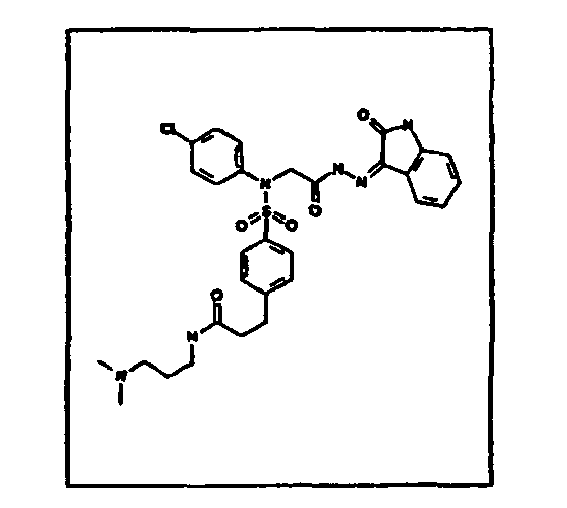
- 4-Chloroaniline (957 mg, 7.5 mmol) was dissolved in pyridine (25 mL). The resulting mixture was cooled down to 0°C. Methyl 3-(4-chlorosulphonyl)phenylpropionate (1.314 g, 5.0 mmol) was added in portions. The mixture was stirred between 0°C and room temperature overnight. Solvents were evaporated to dryness. The crude oil was dissolved in ethyl acetate (30 mL) and washed with 10% HCl (2 x 15 mL) and brine (1 x 15 mL). Organic phase was dried over magnesium sulfate before filtering and removal of solvent. The desired product, e.g. methyl 3-{4-[(4-chloroanilino)sulfonyl]phenyl}propanoate (1.458 g, 82.4%), was obtained as a colorless solid, in 98.5% purity by HPLC (MaxPlot detection between 230 and 400 nm).
- 1H NMR (300 MHz, CDCl3): 2.65 (t, 2H, J = 7.0 Hz), 3.00 (t, 2H, J = 7.0 Hz), 3.67 (s, 3H, OCH3 ), 6.91 (br s, 1H, NH), 7.04 (m, 2H, H arom.), 7.22 (m, 2H, H arom.), 7.30 (m, 2H, H arom.), 7.70 (m, 2H, H arom.); M-(ESI-): 351.4.
- A solution of sodium hydroxide (560 mg, 14.0 mmol) in water (7.0 mL) was added to the intermediate resulting from the precedent step, e.g. methyl 3-{4-[(4-chloroanilino)sulfonyl]phenyl}propanoate (1.458 g, 4.12 mmol) in 3:1 dioxane:water (30ml). The resulting mixture was stirred overnight at room temperature. The reaction mixture was acidified to pH 2 with 2N solution of HCl in water. It was extracted with ethyl acetate (3x30 mL). Combined organic phases were dried over magnesium sulphate, filtered and evaporated. The expected product, e.g. 3-{4-[(4-chloroanilino)sulfonyl]phenyl}-N-[3-(dimethylamino)propyl]propanamide (1.410 g, quantitative yield) was obtained as a colorless oil, in 95% purity by HPLC (MaxPlot detection between 230 and 400 nm). This intermediate was used in the next step without further purification.
- 1H NMR (300 MHz, DMSO-d 6): 2.53 (t, 2H, J = 7.0 Hz), 2.84 (t, 2H, J = 7.0 Hz), 7.08 (m, 2H, H arom.), 7.28 (m, 2H, H arom.), 7.40 (m, 2H, H arom.), 7.64 (m, 2H, H arom.), 10.40 (s, 1H), 12.16 (s, 1H); M+(ESI+): 340.11; M-(ESI-): 338.10.
- Intermediate resulting from the precedent step, e.g. 3-{4-[(4-chloroanilino)sulfonyl]phenyl}-N-[3-(dimethylamino)propyl]propanamide (2.06 mmol) was dissolved in THF (10 mL) and cooled down to -25°C. N-methyl morpholine (0.57 mL, 5.15 mmol) and isobutylchloroformate (0.29 mL, 2.27 mmol) were added successively. The resulting mixture was stirred at -25°C for 30 min. N,N-dimethyl-1,3-propanediamine (316 mg, 3.09 mmol) was added and the mixture was allowed to gradually warm to room temperaure. After 16h, solvents were removed. The crude residue was dissolved in EtOAc and washed with water and with a 10% solution of NaHCO3 in water. Organic layer was dried over Na2SO4 filtrated and evaporated. The desired product, e.g. 3-{4-[(4-chloroanilino)sulfonyl]phenyl}-N-[3-(dimethylamino)propyl]propanamide (816.2 mg, 98%), was obtained as a colorless oil, in 94.3% purity by HPLC (MaxPlot detection between 230 and 400 nm).
- 1H NMR (300 MHz, CDCl3): 1.61 (m, 2H), 2.23 (s, 6H, N(CH3 )2), 2.35 (m, 2H), 2.42 (m, 2H), 2.96 (m, 2H), 3.26 (m, 2H), 7.04 (m, 2H, H arom.), 7.16 (m, 2H, H arom.), 7.24 (m, 2H, H arom.), 7.64 (m, 2H, H arom.); M+(ESI+): 424.22; M-(ESI-): 422.16.
- The crude N-aryl-benzenesulfonamide building block XIII* resulting from the precedent step, e.g. 3-{4-[(4-chloroanilino)sulfonyl]phenyl}-N-[3-(dimethylamino)propyl]-propanamide (1.925 mmol), was submitted to the Mitsunobu reaction following the procedure described in the general protocol C point c). Expected product, e.g. methyl (4-chloro {[4-(3-{[3-(dimethylamino)propyl]amino}-3-oxopropyl)phenyl]sulfonyl}-anilino)acetate (664.5 mg, 69% yield) was obtained as a colorless oil, in 84% purity by HPLC (MaxPlot detection between 230 and 400 nm). This intermediate was used in the next step without further purification.
- 1H NMR (300 MHz, CDCl3): 1.57 (m, 2H), 2.20 (s, 6H, N(CH3 )2), 2.29 (m, 2H), 2.38 (m, 2H), 2.94 (m, 2H), 3.22 (m, 2H), 3.61 (s, 3H, OCH3 ), 4.29 (s, 2H), 7.06 (m, 2H, H arom.), 7.14-7.29 (m, 4H, H arom.), 7.48 (m, 2H, H arom.); M+(APCI+): 496.2.
- The crude carboxylic acid methyl ester resulting from the precedent step, e.g. methyl (4-chloro {[4-(3-{[3-(dimethylamino)propyl]amino}-3-oxopropyl)phenyl]sulfonyl}anilino)-acetate (0.70 mmol), was transformed in the corresponding hydrazide following the procedure described in the general protocol C point d). Expected product, e.g. 3-(4-{[4-chloro(2-hydrazino-2-oxoethyl)anilino]sulfonyl}phenyl)-N-[3-(dimethylamino)propyl]-propanamide (170.2 mg, 49% yield) was obtained as a colorless oil, in 75% purity by HPLC (MaxPlot detection between 230 and 400 nm). This intermediate was used in the next step without further purification.
- 1H NMR (300 MHz, MeOH-d4 ): 1.64 (m, 2H), 2.24 (s, 6H, N(CH3 )2), 2.29 (m, 2H), 2.54 (m, 2H), 3.03 (m, 2H), 3.18 (m, 2H), 4.28 (s, 2H), 7.18 (m, 2H, H arom.), 7.34 (m, 2H, H arom.), 7.42 (m, 2H, H arom.), 7.56 (m, 2H, H arom.); M+(APCI+): 496.
- Hydrazide obtained in the precedent step, e.g. 3-(4-{[4-chloro(2-hydrazino-2-oxoethyl)-anilino]sulfonyl}phenyl)-N-[3-(dimethylamino)propyl]propanamide (170 mg, 0.34 mmol), was dissolved in AcOH (3.5 mL). Isatin (48 mg, 0.33 mmol) was added. The reaction mixture was stirred 1h at 100°C. Solvents were evaporated and the desired product was purfied by preparative HPLC (reverse phase, H2O 0.1%TFA/ MeCN 0.1%TFA gradient between 100:1 and 45:55). After lyophilisation, the TFA salt of the expected product, e.g. 3-{4-[(4-chloro{2-oxo-2-[(2Z)-2-(2-oxo-1,2-dihydro-3H-indol-3-ylidene)hydrazino]ethyl}-anilino)sulfonyl]phenyl}-N-[3-(dimethylamino)propyl]propanamide (107.9 mg, 44% yield), was isolated as a yellow solid, in 98% purity by HPLC (MaxPlot detection between 230 and 400 nm).
- 1H NMR (300 MHz, DMSO-d 6): 1.68 (m, 2H), 2.42 (m, 2H), 2.73 (s, 3H, N(CH3)2), 2.88-2.96 (m, 4H), 3.06 (m, 2H), 4.56 (br s, 2H, NCH2 CO, major isomer (60%)), 5.05 (br s, 2H, NCH2 CO, minor isomer (40%)), 6.95 (m, 1H, H arom.), 7.09 (m, 1H, H arom.), 7.25 (m, 2H, H arom.), 7.34-7.68 (m, 8H), 8.00 (m, 1H),), 9.19 (br s, 1H),), 11.28 (s, 1H), 12.52 (br s, 1H, CONHN, minor isomer (40%)), 13.58 (br s, 1H, CONHN, major isomer (60%)); M+(APCI+): 625.2 M-(APCI-): 623.0. Analysis calculated for C30H33CN6O5S 0.5 H2O 1.7 TFA: C, 48.45; H, 4.35; N, 10.15. Found: C, 48.39; H, 4.64; N, 10.33.
-

- Following the general method as outlined in Example D1, starting from methyl 3-(4-chlorosulphonyl)phenylpropionate, 4-chloroaniline, 1-methylpiperazine, methyl glycolate and isatine, the title compound was isolated by evaporation of the solvents and purified by preparative HPLC (reverse phase, H2O 0.1%TFA/ MeCN 0.1 %TFA gradient between 100:1 and 45:55). After lyophilisation, the TFA salt of the expected product, e.g. N-(4-chlorophenyl)-4-[3-(4-methyl-1-piperazinyl)-3-oxopropyl]-N-{2-oxo-2-[(2Z)-2-(2-oxo-1,2-dihydro-3H-indol-3-ylidene)hydrazino]ethyl}benzenesulfonamide (68.9 mg, 27.5% yield), was isolated as a yellow solid, in 98% purity by HPLC (MaxPlot detection between 230 and 400 nm).
- 1H NMR (300 MHz, DMSO-d 6): 2.65-3.05 (m, 8H), 2.79 (s, 3H, NCH3), 3.25-3.45 (m, 2H), 4.05 (m, 1H), 4.43 (m, 1H), 4.57 (br s, 2H, NCH2 CO, major isomer (60%)), 5.06 (br s, 2H, NCH2 CO, minor isomer (40%)), 6.95 (m, 1H, H arom.), 7.09 (m, 1H, H arom.), 7.28 (m, 2H, H arom.), 7.34-7.72 (m, 8H, H arom.), 9.79 (br s, 1H), 11.29 (s, 1H), 12.52 (br s, 1H, CONHN, minor isomer (40%)), 13.57 (br s, 1H, CONHN, major isomer (60%)); M+(ESI+): 623.12; M-(ESI-): 621.18.
-

- The crude N-aryl-benzenesulfonamide building block XIII, e.g. 4-ethoxy-N-(4-methylphenyl)benzenesulfonamide (204 mg, 0.70 mmol, preparation described in example 1, step a)), was dissolved in DMF (5 mL). Methyl-2-bromopropionate (0.117 mL, 1.05 mmol) and potassium carbonate (193 mg, 1.40 mmol) were added. The mixture was heated overnight at 60°C. Solvents were evaporated. The crude residue was suspended in ethyl acetate (10 mL) and was washed with 1N HCl solution (7 mL) and with brine (7 mL). Organic phase was dried over MgSO4, fltrated and evaporated. The desired product, e.g. methyl 2-{[(4-ethoxyphenyl)sulfonyl]-4-methylanilino}propanoate (276 mg, quantitative crude yield) was isolated as a light yellow oil, in 94.3 % purity by HPLC (MaxPlot detection between 230 and 400 nm).
- 1H NMR (300 MHz, CDCl3): 1.42 (t, 3H, J = 7.1 Hz), 2.30 (s, 3H), 3.65 (s, 3H), 4.01-4.17 (m, 3H), 6.85 (m, 2H, H arom.), 6.98-7.10 (m, 4H, H arom.), 7.58 (m, 2H, H arom.); M+(APCI+): 378.
- The crude carboxylic acid methyl ester, e.g. methyl 2-{[(4-ethoxyphenyl)sulfonyl]-4-methylanilino}propanoate (264 mg, 0.70 mmol), was dissolved in MeOH (2 mL). Hydrazine hydrate was added (0.44 mL). The reaction mixture was stirred overnight at 60°C. Solvents were evaporated. The crude mass was redissolved in MeOH and solvents were evaporated again. This process was repeated three times. The desired product, e.g. 4-ethoxy-N-(2-hydrazino-1-methyl-2-oxoethyl)-N-(4-methylphenyl)benzenesulfonamide (138.4 mg, 52%) was isolated as a colorless solid in 91.1 % purity by HPLC (MaxPlot detection between 230 and 400 nm).
- 1H NMR (300 MHz, CDCl3): 1.13 (d, 3H, J = 7.2 Hz), 1.45 (t, 3H, J = 7.0 Hz), 2.36 (s, 3H), 3.34 (m, 1H), 4.15 (q, 2H, J = 7.0 Hz), 7.03 (m, 2H, H arom.), 7.09 (m, 2H, H arom.), 7.15 (m, 2H, H arom.), 7.63 (m, 2H, H arom.); M+(APCI+): 378.0; M-(APCI-): 376.0.
- Hydrazide obtained in the precedent step, e.g. 4-ethoxy-N-(2-hydrazino-1-methyl-2-oxoethyl)-N-(4-methylphenyl)benzenesulfonamide 4-ethoxy-N-(2-hydrazino-1-methyl-2-oxoethyl)-N-(4-methylphenyl)benzenesulfonamide (138 mg, 0.37 mmol), was dissolved in EtOH / 5 % AcOH (8 mL). Isatin (54 mg, 0.37 mmol) was added. The reaction mixture was stirred overnight at 76°C. Solvents were evaporated and the crude mixture was purified by flash chromatography, using a mixture cyclohexane / ethyl acetate 6:4 as eluent. The desired product, e.g. 4-ethoxy-N-{1-methyl-2-oxo-2-[(2Z)-2-(2-oxo-1,2-dihydro-3H-indol-3-ylidene)hydrazino]ethyl}-N-(4-methylphenyl)benzenesulfonamide (86 mg, 46%;) was isolated as a yellow solid in 89% purity by HPLC (MaxPlot detection between 230 and 400 nm).
- 1H NMR (300 MHz, CDCl3): 1.28 (d, J = 7.2 Hz, 3H), 1.41 (m, 3H, OCH2CH 3), 4.04 (m, 2H, OCH 2CH3), 5.05 (m, 1H, NCHCO, major isomer (65%)), 6.11 (m,1H, NCHCO, minor isomer (35%)), 6.72-6.95 (m, 3H, H arom.), 6.98-7.22 (m, 5H, H arom.), 7.29 (m, 1H, H arom.), 7.52-7.80 (m, 3H, H arom.), 8.23 (br s, 1H, CONHN, minor isomer (35%)), 8.67 (br s, 1H, CONHN, major isomer (65%)), 12.40 (br s, 1H, CONHN, minor isomer (35%)), 13.83 (br s, 1H, CONHN, major isomer (65%)); M+(APCl+): 507; M-(APCI): 505.
-
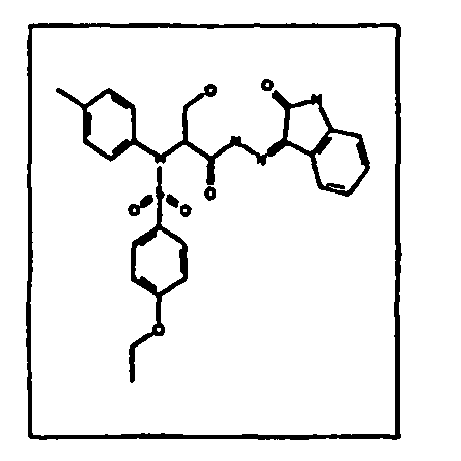
- A mixture of potassium bromide (6.830 g, 57.39 mmol) and 0.75 M HBr solution (91 mL, 68.24 mmol) was cooled down to -7°C. Sodium nitrite (2.093 g, 29.47 mmol) and L-serine tert-butyl ether (2.50 g, 15.51 mmol) were added successively and the mixture was stirred 3h at room temperature. The mixture was cooled down to 0°C, and was extracted with ethyl acetate (3x100 mL). Combined organic phases were washed with brine (2x 180 mL), dried over MgSO4, filtrated and evaporated. The expected product, e.g. 2-bromo-3-tert-butoxypropanoic acid (3.481 g, quantitative yield), was isolated as a light yellow oil. This intermediate was used in the next step without further purification.
- 1H NMR (300 MHz, MeOH-d 4): 1.21 (s, 9H), 3.68 (m,1H), 3.84 (m, 1H), 4.22 (m, 1H); M+(APCI+): 168.4.
- The bromo acid isolated in the precedent step, e.g. 2-bromo-3-tert-butoxypropanoic acid (1.276 g, 5.67 mmol), was dissolved in a 3:1 chloroform / MeOH mixture (81 mL). Tirmethylsilyl diazomethane (8.505 mL, 17.01 mmol) was added dropwise. The yellow resulting mixture was stirred overnight at room temperature. The solvents were evaporated at atmospheric pressure, affording the desired product, e.g. methyl 2-bromo-3-tert-butoxypropanoate (1.482 g), in quantitative yield. This intermediate was used in the next step without further purification.
- 1H NMR (300 MHz, CDCl3): 1.01 (s, 9H), 3.51 (m, 1H), 3.67 (s, 3H, OCH3 ), 3.69 (m, 1H), 4.05 (m, 1H); M+(APCI+): 240.
- The crude N-aryl-benzenesulfonamide building block XIII, e.g. 4-ethoxy-N-(4-methylphenyl)benzenesulfonamide (388 mg, 1.33 mmol, preparation described in example 1, step a)), was dissolved in DMF (5 mL). Intermediate XI with R3=CH2OtBu, e.g. methyl 2-bromo-3-tert-butoxypropanoate (478 mg, 2 mmol) and potassium carbonate (368 mg, 2.66 mmol) were added. The mixture was heated overnight at 60°C. Solvents were evaporated. The crude residue was suspended in ethyl acetate (10 mL) and was washed with IN HCl solution (7 mL) and with brine (7 mL). Organic phase was dried over MgSO4, fltrated and evaporated. The crude mixture was purified by flash chromatography, using a 8:2 mixture cyclohexane / ethyl acetate as eluent. The desired product, e.g. methyl 3-tert-butoxy-2-{[(4-ethoxyphenyl)sulfonyl]-4-methylanilino}propanoate (157 mg, 26.3%) was isolated as a light yellow oil, in 96.4 % purity by HPLC (MaxPlot detection between 230 and 400 nm).
- 1H NMR (300 MHz, CDCl3): 1.28 (s. 9H), 1.61 (t, 3H, J = 7.1 Hz), 2.49 (s, 3H), 3.50 (t, 1H, J = 9.4 Hz), 3.85 (dd, 1H, J = 4.9, 9.4 Hz), 3.92 (s, 3H), 4.25 (q, 2H, J = 7.1 Hz), 5.33 (dd, 1H, J = 4.9,9.4 Hz), 7.03 (m, 2H, H arom.), 7.23 (m, 2H, H arom.), 7.28 (m, 2H, H arom.), 7.87 (m, 2H, H arom.); M+(APCI+): 450.
- The crude carboxylic acid methyl ester, e.g. methyl 3-tert-butoxy-2-{[(4-ethoxyphenyl)sulfonyl]-4-methylanilino}propanoate (157 mg, 0.35 mmol), was dissolved in MeOH (1 mL). Hydrazine hydrate was added (0.11 mL). The reaction mixture was stirred 3 days at 60°C. By cooling down the reaction mixture, the desired product, e.g. N-[1-(tert-butoxymethyl)-2-hydrazino-2-oxoethyl]-4-ethoxy-N-(4-methylphenyl)benzenesulfonamide (40.5 mg, 25%) crystallised. It was isolated by filtration as a colorless solid in 86 % purity by HPLC (MaxPlot detection between 230 and 400 nm).
- 1H NMR (300 MHz, MeOH-d4 ): 1.21 (s. 9H), 1.60 (t, 3H, J = 7.1 Hz), 2.51 (s, 3H), 3.43 (m, 1H), 3.53 (s, 2H), 3.62 (m, 1H), 3.79 (m, 1H), 4.29 (q, 2H, J = 7.1 Hz), 7.15 (m, 2H, H arom.), 7.29 (m, 4H, H arom.), 7.82 (m, 2H, H arom.); M+(APCI+): 450.2.
- Hydrazide obtained in the precedent step, e.g. N-[1-(tert-butoxymethyl)-2-hydrazino-2-oxoethyl]-4-ethoxy-N-(4-methylphenyl)benzenesulfonamide (40 mg, 0.09 mmol), was dissolved in EtOH / 5 % AcOH (2 mL). Isatin (13 mg, 0.09 mmol) was added. The reaction mixture was stirred overnight at 76°C. Solvents were evaporated and the crude mixture was dissolved in methylene chloride (1 mL). Trifluoroacetic acid (0.5 mL) was added at 0°C. The reaction mixture was stirred 3 days at room temperature and the solvents were evaporated. The crude product was purified by flash chromatography, using a mixture cyclohexane / ethyl acetate 1:1 as eluent. The desired product, e.g. 4-ethoxy-N- {1-(hydroxymethyl)-2-oxo-2-[(2Z)-2-(2-oxo-1,2-dihydro-3H-indol-3-ylidene)hydrazino]ethyl}-N-(4-methylphenyl)benzenesulfonamide (17.2 mg, 36%) was isolated as an orange solid in 90% purity by HPLC (MaxPlot detection between 230 and 400 nm).
- 1H NMR (300 MHz, MeOH-d 4): 1.16 (m, 3H, OCH2CH 3), 2.20 (s, 3H, CH3), 3.56 (m, 1H); 3.64-3.81 (m, 1H), 3.84-4.02 (m, 2H), 4.86 (m, 1H, NCHCO, major isomer (68%)), 5.22 (m, 1H, NCHCO, minor isomer (32%)), 6.77-6.87 (m, 3H, H arom.), 7.93-7.04 (m, 5H, H arom.), 7.26 (m, 1H), 7.44-7.72 (m, 3H, H arom.). M-(APCI-): 521.
-

- Fmoc-Rink amide resin (0.84 mmol/g) was suspended in 10 mL/g of 20% piperidine in DMF and was shaken for 30 min. The resin was filtered and washed with DMF, DCM, DMF, DCM, MeOH and twice with Et2O. It was finally dried on sinter. The disappearance of the C=O stretch in the IR indicated a complete deprotection of the Fmoc-Rink amide.
- The resin resulting from the precendent step, the Rink amine resine, XXIV, was suspended in DMF (10 ml/g) fmoc-protected amino acid (3 eq) was added, together with diisopropylcarbodiimide (3 eq). The suspention was shaken overnight at room temperature. The resin was washed with DMF, DCM, DMF, DCM, MeOH and twice with Et2O. It was finally dried on sinter. The formation of this new amide bond could be checked by negative ninhydrin test and the apparition of new C=O stretches in IR.
- Fmoc-protected amino acid loaded on Rink resin (0.84 mmol/g) was suspended in 10 mL/g of 20% piperidine in DMF and was shaken for 30 min. The resin was filtered and washed with DMF, DCM, DMF, DCM, MeOH and twice with Et2O. It was finally dried on sinter. The lost of the C=O stretch in IR indicated a complete deprotection of the amino acid.
- Resin amine recovered from the precendent step was suspended in DMF (10 mL/g). Carboxylic acid XIa (3 eq), e.g. bromoacetic acid, and diisopropylcarbodiimide (3 eq) were added and the mixture was shaken overnight at room temperature. The resin was washed with DMF, DCM, DMF, DCM, MeOH and twice with Et2O. It was finally dried on sinter. The formation of this new amide bond could be checked by negative ninhydrin test and the apparition of new C=O stretches in IR.
- Amine XII, e.g. 4-fluoroaniline (25 eq), was dissolved in DMSO (10 mL/g of resin). This solution was added to the resin resulting from the precendent step and the mixture was shaken overnight at room temperature. The resin was recovered and washed with DMF, DCM, DMF, DCM, MeOH and twice with Et2O It was finally dried on sinter. The formation of this new amide bond was checked on a sample of resin which was suspended in 50%TFA/DCM for 10 min at room temperature. The resulting solution was analysed by LC-MS and 1H NMR.
- Sulfonyl chloride VII, e.g. benzenesulfonyl chloride (5 eq), was dissolved in dichloroethane (10 mL/g of resin) and N-methylmorpholine (5 eq) was added. This solution was added on the resin resulting from the precedent step. The whole mixture was shaken overnight at 60°C. The resin was recovered and washed with DMF, DCM, DMF, DCM, MeOH and twice with Et2O. It was finally dried on sinter.
- A 50% TFA in DCM solution (3 x 0.5 mL) was allowed to drip through the resin resulting from the precedent step. This procedure was repeated twice. The combined filtrate was evaporated and analyzed by LC-MS and 1H NMR. Through this procedure, the desired product, e.g. 3-(3,4-Dichlorophenyl)-2-({[4-fluoro(phenylsulfonyl)anilino]acetyl}amino)propanamide, was isolated in >60% purity by LC/MS. (ESI+): 525.
-

- Following the general method as outlined in Example 75, starting from N-fmoc-2-amino-3-benzyloxy-propionic acid, methyl bromoacetate, 4-chloroaniline and 3,4-dimethoxy benzenesulfonyl chloride, the title compound was obtained in >60% purity by LC/MS. (ESI+): 563.
-

- Following the general method as outlined in Example 75, starting from N-fmoc-2-amino-3-benzyloxy-propionic acid, methyl bromoacetate, 4-chloroaniline and benzenesulfonyl chloride, the title compound was obtained in >60% purity by LC/MS. (ESI+): 502.
-

- Following the general method as outlined in Example 75, starting from N-fmoc-aminophenyl-acetic acid, methyl bromoacetate, 4-toluidine and 4-ethoxy-benzenesulfonyl chloride, the title compound was obtained in >60% purity by LC/MS. (ESI+): 482.
-

- Following the general method as outlined in Example 75, starting from N-fmoc-2-amino-3-(3,4-dichloro-phenyl)-propionic acid, methyl bromoacetate, 4-methoxy-aniline and 4-fluoro-benzenesulfonyl chloride, the title compound was obtained in >60% purity by LC/MS. (ESI+): 555.
-

- Following the general method as outlined in Example 75, starting from N-fmoc-(1,2,3,4-tetrahydro-isoquinolin-3-yl)-acetic acid, methyl bromoacetate, 4-methoxy-aniline and 4-ethoxy-benzenesulfonyl chloride, the title compound was obtained in >60% purity by LC/MS. (ESt): 538.
-

- Following the general method as outlined in Example 75, starting from N-fmoc-2,3-dihydro-1H-isoindole-1-carboxylic acid, methyl bromoacetate, 4-methoxy-aniline and 4-ethoxy-benzenesulfonyl chloride, the title compound was obtained in >60% purity by LC/MS. (ESI+): 510.
-

- Following the general method as outlined in Example 75, starting from N-fmoc-(1,2,3,4-tetrahydro-isoquinolin-3-yl)-acetic acid, methyl bromoacetate, 4-methoxy-aniline and 3,4-dimethoxy-benzenesulfonyl chloride, the title compound was obtained in >60% purity by LC/MS. (ESI+): 554.
-

- Following the general method as outlined in Example 75, starting from N-finoc-3-methyl-2-methylamino-butyric acid, methyl bromoacetate, 4-chloroaniline and 4-ethoxy-benzenesulfonyl chloride, the title compound was obtained in >60% purity by LC/MS. (ESI+): 483.
-

- Following the general method as outlined in Example 75, starting from N-fmoc-2-amino-3-(1H-indol-3-yl)-propionic acid, methyl bromoacetate, 4-fluoroaniline and 4-ethoxy-benzenesulfonyl chloride, the title compound was obtained in >60% purity by LC/MS. (ESI+): 539.
-
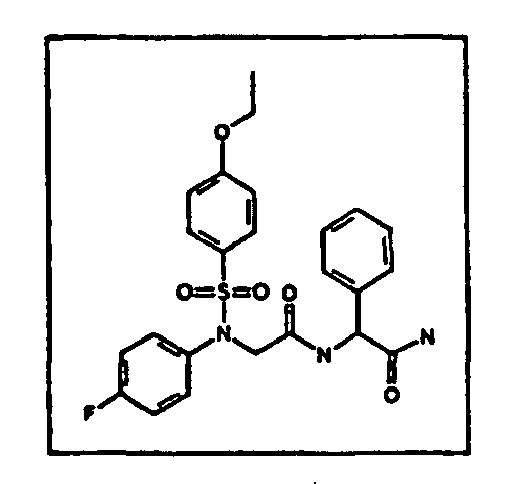
- Following the general method as outlined in Example 75, starting from N-fmoc-aminophenyl-acetic acid, methyl bromoacetate, 4-fluoroaniline and 4-ethoxy-benzenesulfonyl chloride, the title compound was obtained in >60% purity by LC/MS. (ESI+): 486.
-

- Following the general method as outlined in Example 75, starting from N-fmoc-3-methyl-2-methylamino-butyric acid, methyl bromoacetate, 4-fluoroaniline and 3,4-dimethoxy-benzenesulfonyl chloride, the title compound was obtained in >60% purity by LC/MS. (ESI+): 483.
-

- Following the general method as outlined in Example 75, starting from N-fmoc-5-phenylpyrrolidine-2-carboxylic acid, methyl bromoacetate, 4-toluidine and 4-ethoxy-benzenesulfonyl chloride, the title compound was obtained in >60% purity by LC/MS. (ESI+): 522.
-

- Following the general method as outlined in Example 75, starting from N-fmoc-(1,2,3,4-tetrahydro-isoquinolin-3-yl)-acetic acid, methyl bromoacetate, aniline and 4-ethoxy-benzenesulfonyl chloride, the title compound was obtained in >60% purity by LC/MS. (ESI+): 508.
-

- Following the general method as outlined in Example 75, starting from N-fmoc-(1,2,3,4-tetrahydro-isoquinolin-3-yl)-acetic acid, methyl bromoacetate, 4-toluidine and 4-ethoxy-benzenesulfonyl chloride, the title compound was obtained in >60% purity by LC/MS. (ESI+): 522.
-

- Following the general method as outlined in Example 75, starting from N-fmoc-2-amino-4-phenyl-butyric acid, methyl bromoacetate, 4-methoxy-aniline and 4-ethoxy benzenesulfonyl chloride, the title compound was obtained in >60% purity by LC/MS. (ESI+): 526.
-
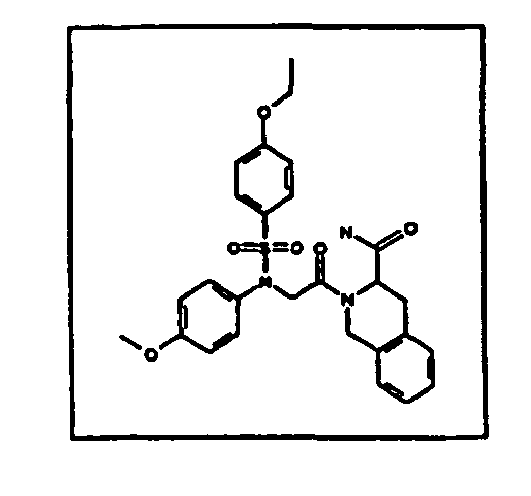
- Following the general method as outlined in Example 75, starting from N-fmoc-1,2,3,4-tetrahydroisoquinoline-3-carboxylic acid, methyl bromoacetate, 4-methoxy-aniline and 4-ethoxy-benzenesulfonyl chloride, the title compound was obtained in >60% purity by LC/MS. (ESI+): 524.
-

- Following the general method as outlined in Example 75, starting from N-fmoc-2-amino-3-(1H-indol-3-yl)-propionic acid, methyl bromoacetate, 4-methoxy-aniline and 4-ethoxy-benzenesulfonyl chloride, the title compound was obtained in >60% purity by LC/MS. (ES+): 551.
-

- Following the general method as outlined in Example 75, starting from N-fmoc-5-phenylpyrrolidine-2-carboxylic acid, methyl bromoacetate, 4-fluoroaniline and 4-ethoxy-benzenesulfonyl chloride, the title compound was obtained in >60% purity by LC/MS. (ESI+): 526.
- The following Formula tion examples illustrate representative pharmaceutical compositions according to the present invention being not restricted thereto.
- A sulfanilide compound of Formula I is admixed as a dry powder with a dry gelatin binder in an approximate 1:2 weight ration. A minor amount of magnesium stearate is added as a lubricant. The mixture is formed into 240-270 mg tablets (80-90 mg of active sulfanilide compound per tablet) in a tablet press.
- A sulfanilide compound of Formula I is admixed as a dry powder with a starch diluent in an approximate 1:1 weight ratio. The mixture is filled into 250 mg capsules (125 mg of active sulfanilide compound per capsule).
- A sulfanilide compound of Formula I (1250 mg), sucrose (1.75 g) and xanthan gum (4 mg) are blended, passed through a No. 10 mesh U.S. sieve, and then mixed with a previously prepared solution of microcrystalline cellulose and sodium carboxymethyl cellulose (11:89, 50 mg) in water. Sodium benzoate (10 mg), flavor, and color are diluted with water and added with stirring. Sufficient water is then added to produce a total volume of 5 mL.
- A sulfanilide compound of Formula I is admixed as a dry powder with a dry gelatin binder in an approximate 1:2 weight ratio. A minor amount of magnesium stearate is added as a lubricant. The mixture is formed into 450-900 mg tablets (150-300 mg of active sulfanilide compound) in a tablet press.
- A sulfanilide compound of Formula I is dissolved in a buffered sterile saline injectable aqueous medium to a concentration of approximately 5 mg/ml.
- The compounds according to Formula I may be subjected to the following assays:
- This assays allows to determine the affinity of the test compounds for the OT receptor. Membranes from HEK293EBNA cells expressing the hOT receptor were resuspended in buffer containing 50 mM Tris-HCl, pH 7.4, 5 mM MgCl2 and 0.1 % BSA (w/v). The membranes (2-4 µg) were mixed with 0.1 mg wheat-germ aglutinin (WGA) SPA bead (type A) and 0.2 nM of the radiolabel [125I]-OVTA (OVTA being Omithin Vasoactive and is an analogue of OT for competition binding experiments). Non-specific binding was determined in the presence of 1 µM Oxytocin. The total assay volume was 100 µl. The plates (Corning ® NBS plate) were incubated at room temperature for 30 min and counted on a Mibrobeta plate counter. The tests compounds were used in concentrations of 30 µM.M, 10 µM, 1 µM, 300 nM, 100 nM, 10 nM, 1 nM, 100 pM, 10 pM. The competition binding data were analysed using the iterative, nonlinear, curve-fitting program, "Prism".
- The binding affinities to the oxytocin receptor of the sulfanilide derivatives claimed in the formula I were assessed using the above described in vitro biological assay. Representative values for some example compounds are given in Table 1 below. The values refer to the binding affinity (IC50; µM) of the example compounds according to formula I to the Oxytocin receptor. From the values shown in Table 1 it can be derived that said test compounds according to formula I do show a significant binding to the oxytocin receptor.
Table 1. Chemical Structure IUPAC-Name Binding Affinity Human OT-R Ki (µM) 
N-(4-chlorphenyl)-4-[3-(dimethylamino)propoxyl-N-{2-oxo-2[(2Z)-2-oxo-1,2-dihydro-3H-inndol-3-ylidene)hydrazino]elhyl}benzenesulfonamide 0.0006 
3-{4-[(4-chloro{2-oxo-2-[(2Z)-2-2-oxo-1,2-dihydro-3H-indol-3-ylidene)hydrazino]ethyl}anilino)sulfonyl]phenyl)-N [3-(dimethylamino)propyl]propanamide 0.0007 
N-(4-chlorophenyl)-4-[2-(4-morpholitryl)ethoxy]-N-{2-oxo-2-[2-(2-oxo-1,2-dihydro-3H-indot-3-ylidene)hydrazino]ethyl}benzenesulfonamide 0.0008 
N-(4-chlorophenyl)-4-[2-(dimethylamino)ethoxy]-N-{2-oxo-2-[(2Z)-2-(2-oxo-1,2-dihydro-3H-indol-3-ylidene)hydrazino]ethyl}benzenesulfonamide 0.0018 
N-(4-chlorophenyl)-N-{2-oxo-2-[(2Z)-2-(2-oxo-1,2-dihydro-3H-indol-3-ylidene)hydrazino]ethyl}-4-[3-(3-pyridinyl)propoxy]benzenesulfonamide 0.0028 
N-(4-chlorophenyl)-4-[2-(2-methoxyethoxy)ethoxy]-N-{2-oxo-2-[(2Z)-2-(2-oxo-1,2-dihydro-3H-indol-3-ylidene)hydrazino]ethyl}benzenesulfonamide 0.0029 
4-[3-(dimethylamino)propoxy]-N-(4-methylphenyl)-N-{2-oxo-2-[(2Z)-2-(2-oxo-1,2-dihydro-3H-indol-3-ylidene)hydrazino]ethyl}benzenesulfonamide 0.003 
3-{4-[(4-methyl{2-oxo-2-[(2Z)-2-(2-oxo-1,2-dihydro-3H-indol-3-ylidene)hydrazino]ethyl}anilino)sulfonyl]phenyl}propana mide 0.0034 
N-(4-chlorophenyl)-4-ethoxy-N-{2-oxo-2-[(2Z)-2-(2-oxo-1,2-dihydro-3H-indol-3-ylidene)hydrazino]ethyl}benzenesulfonamide 0.004 
N-(4-chlorophenyl)-4-{[2-(4-morpholinyl)ethyl]amino}-N-{2-oxo-2-[(2Z)-2-(2-oxo-1,2-dihydro-3H-indol-3-ylidene)hydrazino]ethyl}benzenesulfonamide 0.0069 
4-ethoxy-N-{2-[(2Z)-2-(2-hydroxybenzylidene)hydrazino]-2-oxoethyl}-N-(4-melhylphenyl)benzenesulfonamide 0.012 
N-(4-chlorophenyl)-4-ethoxy-N-{2-[(2E)-2-(2-hydroxybenzylidene)hydrazinol-2-oxoethyl}benzenesulfonamide 0.0148 
4-ethoxy-N-(4-methylphenyl)-N-{2-oxo-2-[(2Z)-2-(2-oxo-1,2-dihydro-3H-indol-3-ylidene)hydrazino]ethyl}benzenesulfonamide 0.0173 
N-(4-chlorophenyl)-N-2-oxo-2-[(2Z)-2-(2-oxo-1,2-dihydro-3H-indol-3-ylidene)hydrazino]ethyl}-2-thiophenesulfonamide 0.0293 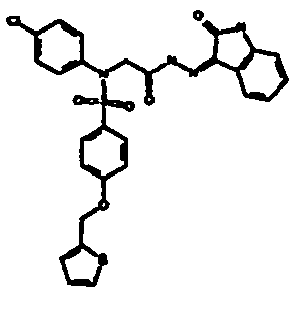
N-(4-chlorophenyl)-N-{2-oxo-2-[(2Z)-2-(2-oxo-1,2-dihydro-3H-indol-3-ylidene)hydrazino]ethyl}-4-(2-thlenylmethoxy)benzenesulfonamide 0.0533 
N-(4-chlorophenyl)-4-ethoxy-N-{2-oxo-2-[(2Z)-2-(2-oxo-12-dihydro-3H-pyrrolo[3.2-c]pyridin-3-ylidene)hydrazinolethyl)benzenesulfonamide 0.0571 
N-(4-chlorophenyl)-4-[3-(dimethylamino)propoxy]-N-{2-oxo-2-[(2Z)-2-(2-oxo-1,2-dihydro-3H-pyrrolo[3,2-c]pyridin 3-ylidene)hydrazino]ethyl}benzenesulfonamide 0.0781 
methyl (3Z)-3-({[4-chloro({4-[3-(dimethylamino)propoxy]phenyl}sulfonyl)anilino]acetyl}h ydrazono)-2-oxo-2,3-dihydro-1H-indole-7-carboxylate 0.1081 
2-[Benzenesulfonyl-(4-bromo-phenyl)-amino]-N-quinolin 8-yl-acetamide 0.192 
N-[2-(3,4-Dihydro-1H-isoquinolin-2-yl)-2-oxo-ethyl]-4-ethoxy-N-p-tolyl-benzenesulfonamide 0.246 
2-{2-(4-Ethoxy-benzenesulfonyl)-(4-methoxy-phenyl)-amino]-acetyl}-1,2,3,4-tetrahydro-isoquinoline-3-carboxylic acid amide 0.316 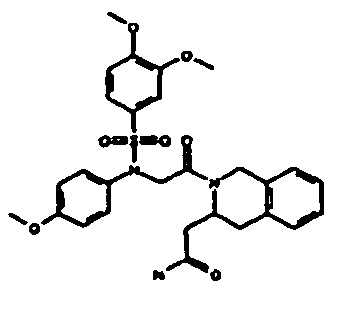
2-(2-{2-[(3,4-Dimethoxy-benzenesulfonyl)-(4-methoxy-phenyl)-amino]-acetyl)-1,2,3,4-tetrahydro-isoquinolin-3-yl)-acetamide 0.465 
N-[2-(3,4-Dihydro-1H-isoquinalin-2-yl)-2-oxo-ethyl]-N-p-tolyl-benzenesulfonamide 0.472 
2-(2-{2-[(4-Ethoxy-benzenesulfonyl)-p-tolyl-amino]-acetyt}-1,2,3,4-tetrahydro-isoquinolin-3-yl)-acetamide 0.498 - This assays allows to determine the affinity of the test compounds for the V1a receptor. Membranes from CHO cells expressing the hV1a receptor were resuspended in buffer containing 50 mM Tris-HCl, pH 7.4, 5 mM MgCl2 and 0.1 % BSA (w/v). The membranes (5-10 µg) were mixed with 0.2 mg wheat-germ aglutinin (WGA) SPA bead (type A) and 0.03 nM of the radiolabel [125I]-LVA ( LVA being Linear Vasopressin Antagonist and is an analogue of AVP for competition binding experiments). Non-specific binding was determined in the presence of 1 µM AVP. The total assay volume was 100 µl. The plates (Coming ® NBS plate) were incubated at room temperature for 2 hours and counted on a Mibrobeta plate counter. The tests compounds were used in concentrations of 30 µM, 10 µM, 1 µM, 300 nM, 100 nM, 10 nM, 1 nM, 100 pM, 10 pM. The competition binding data were analysed using the iterative, nonlinear, curve-fitting program, Graph pad "Prism".
- The binding affinities to the Vla receptor of the sulfanilide derivatives claimed in the formula I were assessed using the above described in vitro biological assay. Representative values for some example compounds are given in Table 1 below. The values refer to the binding affinity (IC50; µm) of the example compounds according to formula I to the V1a receptor. From the values shown in Table 1 it can be derived that said test compounds according to formula I do show a significant binding to the V1a receptor.
Table 2 Chemical Structure IUPAC-Name Binding Affinity Human V1a Ki(µM) 
N-(4-Bromo-phenyl)-N-[1-(2-hydroxy-phenyl)-ethylidene hydrazinocarbonylmethyl]-benzenesulfonamide 0.391 
N-(3-Bromo-phenyl)-N-(2-hydroxy-benzylidene-hydrazinocarbonylmethyl)-benzenesulfonamide 0.503 
N-(4-Chloro-phenyl)-N-(2-hydroxy-benzylidene-hydrazinocarbonylmethyl)-3,4-dimethoxy-benzenesulfonamide 0.55 
4-Ethoxy-N-(2-oxo-1,2-dihydro-indol-3-ylidene-hydrazinocarbonylmethyl)-N-p-tolyl-benzenesulfonamide 0.75 
N-(4-Chloro-phenyl)-N-(2-hydroxy-benzylidene-hydrazinocarbonylmethyly-benzenesulfonamide 0.75 
N-(4-Bromo-phenyl)-N-[1-(2-hydroxy-phenyl)-ethylidene hydrazinocarbonylmethyl]-benzenesulfonamide 0.8 
2-[Benzenesulfonyl-(4-methoxy-phenyl)-amino]-N-(2,4-dimethyl-phenyl)-acetamide 0.045 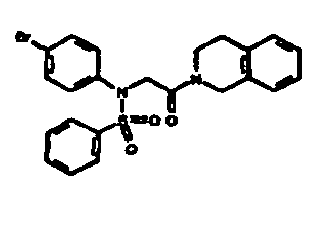
N-(4-Bromo-phenyl)-N-[2-(3,4-dihydro-1H-isoqulnolin-2-yl)-2-oxo-ethyl]-benzenesulfonamide 0.058 
2-1(3,4-Dimethoxy-benzenesulfonyl)-(4-methoxy-phenyl) amino]-N-(2.4-dimethyl-phenyl)-acetamide 0.135 
N-(2-Hydroxy-2-phenyl-ethyl)-2-[(toluene-4-sulfonyl)-p-tolylamino]-acetamide 0.37 
N-[2-(3,4-Dihydro-1H-isoquinolin-2-yl)-2-oxo-ethyl]-4-ethoxy-N-p-tolyl-benzenesulfonamide 0.375 
2-[(4-Methoxy-phenyl)-(toluene-4-sulfonyl)-amino]-N-(2-(pyridin-2-ylsulfanyl)-ethyl)-acelamide 0.43 - FLIPR is a machine for fluorescence imaging using a laser that is capable of illuminating a 96-well plate and a means of simultaneously reading each well thus enabling rapid measurements on a large number of samples.
- This assay intends to show the inhibition of the OT / OT-R mediated calcium mobilisation - being necessary to cause uterine contractions - by using test compounds of formula (I).
- Preparing the plates: FLIPR-plates were pre-coated with PLL (Poly-L-Lysine) 10µg/ml + 0.1 % gelatine to attach the HEK (Human Embryonic Kidney) cells for 30min up to 2 days at 37 °C. The cells were plated out into 96-well plates (60000 cells/well).
- Labelling with fluo-4: 50µg fluo-4 (fluorescent marker) were dissolved in 20µl pluronic acid (20% in DMSO). The dissolved fluo-4 was then diluted in 10ml DMEM (Dubecco's Minimal Essential Medium-F12 medium without FCS (Fetal Calf Serum). The medium was removed from the plates, followed by one wash with DMEM-F12 medium. Now, 100µl of the DMEM-F12 medium containing fluo-4 were added and the cells incubated for 1.5-2h (HEK-cells). The cells now contain the fluorescent marker.
- Buffer: 145mM NaCl, 5mM KCI, 1mM MgCl2, 10mM Hepes, 10mM Glucose, EGTA (Ethylene-bis oxyethylene nitrilo tetraacetic acid). Adjust to pH 7.4.
- Performance of the assay: A minimum of 80µl/well of antagonists (5x) in the above buffer (1x) were prepared (96-well plates). The antagonists were added to the well-plates at different concentrations (30 µM, 10 µ, 1 µM, 300 nM,100 nM, 10 nM, 1 nM, 100 pM, 10 pM).
OT is added at a concentration of 40 nM. - The fluorescent marker being sensitive to the amount of Ca2+ mobilized within the cell may be quantified by the FLIPR machine.
- The activities of the sulfanilide derivatives according to formula I were assessed using the above described in vitro biological assay. Representative values for some example compounds are given in Table 3 below. The values refer to the capacity of the example compounds according to formula I to effectively antagonize oxytocin-induced intracellular Ca2+-mobilization mediated by the oxytocin receptor. From the values shown in Table 3 it can be derived that said example test compounds according to formula I do exhibit a significant activity as oxytocin receptor antagonists.
Table 3 Structure IUPAC-Name Inhibition of Ca2+ mobilization hOT-R IC50 (µM) 
N-(4-chtorophenyl)-4-[2-(2-methoxyethoxy)ethoxy]-N-{2-oxo-2-(2Z)-2-(2-oxo-1,2-dihydro-3H-indol-3-ylidene)hydrazino]ethyl}benzenesulfonamide 0.0069 
N-(4-chlorophenyl)-4-[2-(4-morpholinyl)ethoxyl-N-{2-oxo-2-[2-(2-oxo-1,2-dihydro-3H-indol-3-ylidene)hydrazino]ethyl}benzenesulfonamide 0.007 
N-(4-chlorophenyl)-4-(2-methoxyethoxy)-N-{2-oxo-2-[(2Z)-2-(2-oxo-1,2-dihydro-3H-indol-3-ylidene)hydrazino]ethyl}benzenesulfonamide 0.008 
N-(4-chlorophenyl)-4-[3-(dimethylamino)propoxy]-N-{2-oxo-2-[(2Z)-2-(2-oxo-1,2-dihydro-3H-indol-3-ylidene)hydrazino]ethyl}benzenesulfonamide 0.0136 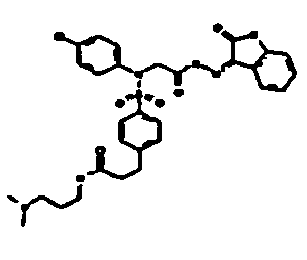
3-{4-[(4-chloro{2-oxo-2-[(2Z)-2-(2-oxo-1,2-dihydro-3H-indol-3-ylidene)hydrazino]ethyl}anilino)sulfanyl]phenyl}-N-[3-(dmethylamino)propyl]propanamide 0.014 
N-(4-chlorophenyl)-N-(2-oxo-2-[(2Z)-2-(2-oxo-1,2-dihydro-3H-indol-3-ylidene)hydrazino]ethyl} 4-[3-(3-pyridinyl)propoxyl]benzenesulfonamide 0.017 
3-{4-[(4-methyl{2-oxo-2-[(2Z)-2-(2-oxo-1,2-dihydro-3H-indol-3-ylidene)hydrazino]ethyl}anilino)sulfonyl]phenyl} propanamide 0.019 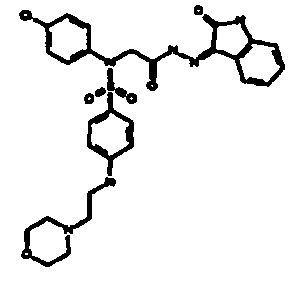
N-(4-chlorophenyl)-4-{[2-(4-morpholinyl)ethyl]amino}-N-{2-oxo-2-[(2Z)-2-(2-oxo-1,2-dihydro-3H-indol-3-ylidene)hydrazinolethyl}benzenesulfonamide 0.049 
4-ethoxy-N-(4-methylphenyl)-N-(2-oxo-2-(2Z)-2-(2-oxo-1.2-dihydro-3H-indo)-3-ylidene)hydrazino]ethyl}benzenesulfonamide 0.055 
N-(4-chlorophenyl)-4-ethoxy-N-{2-oxo-2-[(2Z)-2-(2-oxo-1,2-dihydro-3H-indol-3-ylidene)hydrazino]ethyl}benzenesutfonamide 0.102 
methyl (3Z)-3-({[4-chloro({4-[3-(dimethylamino)propoxy]phenyl}sulfonyl)anilino }acetyl}hydrazono)-2-oxo-2,30ihydro-1H-indole 7-carboxylate 0.393 
2-[Benzenesutfonyl-(4-methoxy-phenyl)-aminol N-(3-chloro-2-methyl-phenyl)-acetamide 0.045 
2-[Benzenesulonyl-(4-bromo-pheny)-amino]-N (3-chloro-2-methyl-phenyl)-acetamide 0.353 
2-[Benzenesulfonyl-(4-methoxy-phenyl)-amino]-N-naphthalen-1-yl-acetamide 0.363 
2-[Benzenesulfonyl-(4-methoxy-phenyl)-amino] N-(3-methoxy-phenyly-acetamide 0.392 
2-[Benzenesulfonyl-(4-chloro-phenyl)-amino]-N-(3-chloro-2-methyl-phenyl)-acetamide 0.443 
N-(2,4-Dichloro-benzyl)-2-[(toluene-4-sulfonyl)-p-tolyl-amino]-acelamide 0.595 - FLIPR is a machine for fluorescence imaging using a laser that is capable of illuminating a 96-well plate and a means of simultaneously reading each well thus enabling rapid measurements on a large number of samples.
- This assay intends to show the inhibition of the AVP / Vla-R mediated calcium mobilisation - being necessary to cause uterine contractions - by using test compounds of formula (I).
- Preparing the plates: FLIPR-plates were pre-coated with PLL (Poly-L-Lysine) 10µg/ml + 0.1% gelatine to attach the CHO cells (expessing hV1a) for 30min up to 2 days at 37 °C. The cells were plated out into 96-well plates (60000 cells/well).
- Labelling with fluo-4: 50µg fluo-4 (fluorescent marker) were dissolved in 20µl pluronic acid (20% in DMSO). The dissolved fluo-4 was then diluted in 10ml DMEM (Dubecco's Minimal Essential Medium-F12 medium without FCS (Fetal Calf Serum). The medium was removed from the plates, followed by one wash with DMEM-F12 medium. Now, 100µl of the DMEM-F12 medium containing fluo-4 were added and the cells incubated for 1-1.5h (CHO-cells). The cells now contain the fluorescent marker.
- Buffer: 145mM NaCl, 5mM KCl, 1mM MgCl2, 10mM Hepes, 10mM Glucose, EGTA (Ethylene-bis oxyethylene nitrilo tetraacetic acid). Adjust to pH 7.4.
- Performance of the assay: A minimum of 80µl/well of antagonists (5x) in the above buffer (1x) were prepared (96-well plates). The antagonists were added to the well-plates at different concentrations (30 µM, 10 µM, 1 µM, 300 nM, 100 nM, 10 nM, 1 nM, 100 pM, 10 pM).
AVP is added at a concentration of 40 nM. - The fluorescent marker being sensitive to the amount of Ca2+ mobilized within the cell may be quantified by the FLIPR machine.
- The activities of the sulfanilide derivatives according to formula I were assessed using the above described in vitro biological assay. Representative values for some example compounds are given in Table 4 below. The values refer to the capacity of the example compounds according to formula I to effectively antagonize AVP-induced intracellular Ca2+-mobilization mediated by the V1a-receptor. From the values shown in Table 4 it can be derived that said example test compounds according to formula I do exhibit a significant activity as V1a receptor antagonists.
Table 4 Structure IUPAC-Name Inhibition of Ca2+ mobilization; hV1a IC50(µM) 
2-[Benzenesulfonyl-(4-methoxy-phenyl)-amino] N-(4-chloro-2-methyl-phenyl)-acetamide 0.09 
N-(3-Bromo-phenyl)-N-(3,4-dimemoxy-benzylidene-hydrazinocarbonylmethyl)-benzenesulfonamide 0.44 
N-(3-Chloro-phenyl)-N-(3,4-dimethoxy-benzylidene-hydrazinocarbonylmethyl)-benzenesulfonamide 0.55 
N-(3-Chloro-phenyl)-N-[1-(2-hydroxy-phenyl)-ethylidene-hydrazinocarbonylmethyl]-benzenesulfonamide 0.37 - This assay intends to show the inhibition of the OT / OT-R mediated IP3 synthesis - being necessary to cause uterine contractions - by using test compounds of formula (I).
- Stimulation of the cells: HEK/EBNA OTR(rat or human) cells were plated out into costar 12-well plates, and equilibrated for 15-24h with [3H]-inositol radiolabel in medium without inositol supplement, with 1% FCS (0.5ml/well). 4 µCi/ml were used. After this, the medium containing the label was aspirated. Then was added DMEM (without FCS, inositol), 20mM Hepes (4-(2-hydroxyethyl)-1-piperazine-ethane-sulphonic acid), 1mg/ml BSA containing 10mM LiCl (freshly prepared), for 10-15min at 37°C. The agonist (i.e. oxytocin used at a concentration of 10 nM) and the antagonists (i.e. the tests compounds of formula (I) used in a concentration of 10 µM, 1µM, 300 nM, 100 nM, 10 nM, 1 nM, 100 pM, 10 pM, 3 pM) were added for the time required (15-45min), followed by aspiration of the medium. Due to the antagonization of the OT receptor, the radiolabeled inositol is phosphorylated to yield IP3, the amount of the radiolabeled IP3 may be determined through the ensuing work-up. The reaction was stopped with 1ml STOP-solution (i.e. 0.4 M perchloric acid), and let sit for 5-10min at Room Temperature. Then, 0.8ml were transferred into tubes containing 0.4ml of neutralizing solution (0.72 M KOH/0.6M KHCO3), and the tubes vortexed and kept in the cold at least for 2h.
- Separation of IP's: The samples were spun in a table top centrifuge at 3000-4000 rpm for 15min. 1ml of the supernatant was transferred to new tubes containing 2.5ml H2O. Packed resin (0.8ml) was equilibrated with 20ml H2O, and the whole samples poured onto the chromatography columns, thus separating the mixture. To discard free inositol, two washes with 10ml H2O were carried out.
- Elution of total IP's: The elution was achieved using 3ml 1M ammonium formate/0.1M formic acid. The eluant was collected in scintillation counting tubes, followed by addition of 7ml of scintillation liquid. The amount of IP3 is determined by a scintillating counter.
- The activities of the sulfanilide derivatives claimed in the formula I were assessed using the above described in vitro biological assay. Representative values for some example compounds are given in Table 5 below. The values refer to the capacity of the example compounds according to formula I to effectively antagonize oxytocin-induced IP3-synthesis mediated by the oxytocin receptor. From the values shown in Table 5 it can be derived that said example test compounds according to formula I do exhibit a significant activity as oxytocin receptor antagonists.
Table 5 Structure IUPAC-Name Inhibition of IP3-synthesis,ratOT-R IC50 (µM) 
4-ethoxy-N-(4-methylphenyl)-N-{2-oxo-2-[2-(2-oxo-1,2-dihydro-3H-indol-3-ylidene)hydrazino]ethyl}benzenesul fonamide 0.013 
N-(4-bromophenyl)-N-(2-{2-[1-(2-hydroxyphenyl)ethylidene]hydrazino }-2-oxoethyl)benzenesulfonamide 0.048 
N-(3-chloro-2-methylphenyl)-2-[4-diloro(phenylsulfonyl)anilino]aceta mide 0.32 
N-{2-oxo-2-[2-(2-oxo-1,2-dihydro-3H-indol-3-ylidene)hydrazino]ethyl}-N-phenylbenzenesulfonamide 0.3 
2-[4-bromo(phenylsulfonyl)anilino]-N-(3-chloro-2-methylphenyl)acetamide 0.11 - The assay intends to show the biological effect of tested compounds in an in vivo model of preterm labor, premature birth.
- Non-pregnant Charles River CD(SD) BR female rats (9-10 weeks old, 200-250g) were treated at 18 and 24 hours before the experiment with 250 µg/kg, i.p. diethylstilbestrol (DES). For the assay, the animal was anaesthetised by urethane (1.75 g/kg, i.p.) and placed on an homeothermic operating table. The trachea was isolated and cannulated with a suitable polyethylene (PE) tubing. A midline incision at the hypogastrium level was made' and one uterine horn exposed, its cephalic end cannulated with a PE240 tubing and, after filling the internal cavity with 0.2 ml of sterile physiological saline, connected to a "Gemini" amplifying/recording system via a P23ID Gould Statham pressure transducer. For the i.v. route of administration of the test compounds, one jugular vein was isolated and cannulated with a PE60 tubing connected to a butterfly needle to allow the administration by a dispensing syringe. In the case of intraduodenal administration of the test compounds, the duodenum was isolated and similarly cannulated through a small incision in its wall. One carotid artery was also isolated and cannulated with PE60 catheter and connected to a suitable syringe for blood sample collection (see below). After a stabilization period, the same dose of oxytocin was repeatedly injected intravenously at 30-min intervals. When comparable contractile responses of the uterus to the selected dose of oxytocin were obtained, the dose of the test or reference compound was administered. Further injections of the same dose of oxytocin were then made for a suitable time after treatment to assess inhibitory effects of the compounds under study. The contractile response of the uterus to oxytocin was quantified by measuring the intra-uterine pressure and the number of contractions. The effect of the reference and test compounds were evaluated by comparing pre- and post-treatment pressure values. In addition, at 2, 30, 90 and 210 minutes after test compound administration, a 0.5-ml blood sample was withdrawn from the cannulated carotid artery of each experimental animal. Plasma was obtained by standard laboratory procedure and the resulting samples were stored at -20°C.
- The activities of the sulfanilide derivatives claimed in the Formula I were assessed using the above described in vivo biological assay. Representative values for one example compound are given in Table 4 below. The values refer to the capacity of the example compound according to Formula I to effectively antagonize oxytocin-induced uterine contractions in the rat. From the values shown in Table 6 it can be derived that said example test compound according to Formula I does exhibit a significant activity as tocolytic, i.e. uterine-relaxing, agent.
Table 6 Structure IUPAC-Name %Reduction of Uterine Contraction Doses (mg/kg) 
N-(4-chlorophenyl)-4-[2-(4-morpholinyl)ethoxy]-N-{2-oxo-2-[2-(2-oxo-1,2-dihydro-3H-indol-3-ylidene)hydrazino]ethyt}benzenesulfonamide 4.3 ± 1.7 0.3 18.2 ± 3.7 1 39.8 ± 5.1 3 41.7 ± 12.5 10 71.3 ± 6.4 30 
N-(4-chlorophenyl)-4-[3-(dimethylamino)propoxy]-N-{2-oxo-2-[(2Z)-2-(2-oxo-1,2-dihydro-3H-indol-3-ylidene)hydrazino]ethyl}benzenesulfonamide 9.3 ± 2.5 0.3 20.8 ± 2.2 1 34.4 ± 3.9 3 57.1 ± 4.8 10 67.4 ± 7.1 30 
4-ethoxy-N-(4-methylphenyl)-N-{2-oxo-2-[(2Z)-2-(2-oxo-1,2-dihydro-3H-indol-3-ylidene)hydrazino]ethyl}benzenesulfonamide 23.9 ± 4.0 5 40.3 ± 4.2 7.5 62.6 ± 5.0 10
Claims (27)
- A sulfanilide derivative of Formula I:
 R1 and R1 are "aryl" or "heteroaryl" which may be fused with 1-2 further cycloalkyl or aryl or heteroaryl groups;R3 is selected from the group consisting of H, "C1-C6-alkyl", "C1-C6-alkyl aryl","C1-C6-alkyl heteroaryl", "C2-C6-alkenyl". "C2-C6-alkynyl";R4 and R5 are independently selected from the group consisting of hydrogen, "C3-C6-alkyl", "C2-C6-alkenyl", "C2-C6-alkynyl"; saturated or unsaturated 3-8-membered "cycloalkyl" which may contain 1 to 3 heteroatoms selected from N, O, S, "aryl", "heteroaryl", "C1-C6-alkyl aryl", " C1-C6-alkyl heteroary",or R4 and R5 may form together with the N atom to which they are attached a 3-8 membered saturated or unsaturated heterocyclic ring which may contain 1-2 further heteroatoms selected from N, S and 0 and which is optionally fused with an aryl, heteroaryl or 3-8 membered saturated or unsaturated cycloalkyl ring;or R4 can be H or C1-C6 alkyl, and R5 can be -N=CR6R7, wherein:R6 is an "aryl" or a "heteroaryl" ring carrying 1 to 5 substituents selected from the group consisting of H, "C1-C6-alkyl", "C1-C6-alkyl aryl", "C1-C6-alkyl heteroaryl", "C2-C6-alkenyl", "C2-C6-alkyl", primary, secondary or tertiary amino groups, "acyl", "acyloxy", "acylamino", "aminocarbonyl", "alkoxycarbonyl", "aryl", "heteroaryl", carboxyl, cyano, halogen, hydroxy, mercapto, nitro, sulfoxy, sulfonyl, "C1-C6-alkoxy", thioalkoxy; 2-alkoxyethoxy, 2-(2-alkoxyethoxy)ethoxy, 2-hydroxyethoxy, 2-(2-hydroxyethoxy)-ethoxy, 2-(dimethylamino)ethoxy, 2-(2-(dimethylamino)ethoxy)-ethoxy, 2-carboxyethoxy, 2-(2-carboxyethoxy)ethoxy, carboxymethoxy, 2-sulfoxy-ethoxy, 2-(2-sulfoxyethoxy)ethoxy, 2-[(2-methoxyethyl)sulfanyl]ethoxy, 2-[(2-hydroxyethyl)-sulfanyl]ethoxy, 2-[(2-carboxyethyl)sulfanyl]ethoxy, 2-[(2-carboxymethyl)sulfanyl]-ethoxy, 2-[(2-sulfoxyethyl)sulfanyl]ethoxy;R7 is selected from the group consisting of H, "C1-C6-alkyl", "C1-C6-alkyl aryl", "C1-C6-alkyl heteroaryl", "C2-C6-alkenyl", "C2-C6-alkynyl", "acyl", "aminocarbonyl", "alkoxycarbonyl", "aryl", "heteroaryl", carboxyl, cyano, sulfonyl;or R6 and R7 form together with the C atom to which they are attached a 3-8 membered saturated or unsaturated heterocyclic ring which may contain 1-2 further heteroatoms selected from N, S and O and which is optionally fused with an aryl, heteroaryl or 3-8 membered saturated or unsaturated cycloalkyl ring;wherein groups selected from alkyl, alkenyl, alkynyl, aryl, heteroaryl, alkyl aryl, alkyl heteroaryl, acyl, alkoxycarbonyl, aminocarbonyl, acylamino, sulfonyl and sulfoxy are optionally substituted with from 1 to 5 substituents selected from the group consisting of C1-C6-alky; C1-C6-alkyl aryl; C1-C6-alkyl heteroaryl; C2-C6-alkenyl; C2-C6-alkynyl; primary, secondary, or tertiary amino groups or quarternary ammonium moieties; acyl; acyloxy; acylamino; aminocarbonyl; alkoxycarbonyl; aryl; heteroaryl; carboxyl; cyano; halogen; hydroxyl; mercapto, nitro; sulfoxy; sulfonyl; alkoxy; thioalkoxy; and trihalomethyl,for use in the treatment of preterm labor, premature birth,dysmenorrhea, mappropriate secretion of vasopressin, congestive heart failure, arterial hypertension, liver cirrhosis, nephrotic syndrome and ocular hypertension.
 - The sulfanilide derivative according to claim 1, wherein R1 and/or R2 are substituted with from 1 to 5 substituents independently selected from the group consisting of "C1-C6-alkyl", "C1-C6-alkyl aryl", "C1-C6-alkyl heteroaryl", "C2-C6-alkenyl", "C2-C6-alkynyl", primary, secondary or tertiary amino groups or quarternary ammonium moieties, "acyl", "acyloxy", "acylamino", "aminocarbonyl", "alkoxycarbonyl", "aryl", "heteroaryl", carboxyl, cyano, halogen, hydroxy, mercapto, nitro, sulfoxy, sulfonyl, alkoxy, thioalkoxy, 2-alkoxyethoxy, 2-(2-alkoxyethoxy)ethoxy, 2-hydroxyethoxy, 2-(2-hydroxyethoxy)ethoxy, 2-(dimethylamino)ethoxy, 2-(2-(dimethylamino)ethoxy)-ethoxy, 2-carboxyethoxy, 2-(2-carboxyethoxy)ethoxy, carboxymethoxy, 2-sulfoxyethoxy, 2-(2-sulfoxyethoxy)ethoxy, 2-[(2-methoxyethyl)sulfanyl]ethoxy, 2-[(2 hydroxyethyl)sulfanyl]ethoxy, 2-[(2-carboxythyl)sulfanyl]ethoxy, 2-[(2-carboxymethyl)sulfanyl]ethoxy, 2-[(2-sulfoxy-ethyl)sulfanyl]ethoxy.
- The sulfanilide derivative according to claim 1 or 2, wherein R1 and R2 are aryl and heteroaryl rings whereby either or both of said rings are substituted with 1 or 2 substituents selected from the group consisting of halogens, cyano, C1-C6-alkyl, primary, secondary amines or C1-C6-alkoxy groups.
- The sulfanilide derivative according to claim 3, wherein the C1-C6-alkoxy groups are selected from the group consisting of methoxy, ethoxy groups and substituted ethoxy groups such as, for example, 2-alkoxyethoxy, 2-(2-alkoxyethoxy)ethoxy, 2-hydroxy-ethoxy, 2-(2-hydroxyethoxy)ethoxy, 2-(dimethylamino)ethoxy, 2-(2-(dimethylamino)-ethoxy)ethoxy, 2-carboxyethoxy, 2-(2-carboxyethoxy)ethoxy, carboxymethoxy, 2-sulfoxyethoxy, 2-(2-sulfoxyethoxy)sthoxy, 2-[(2-methoxyetbyl)sulfanyl]ethoxy, 2-[(2-hydroxyethyl)sulfanyl]ethoxy, 2-[(2-carboxyethyl)sulfanyl]ethoxy, 2-[(2-carboxy-methyl)sulfanyl]ethoxy, 2-[(2-sulfoxyethyl)sulfanyl]ethoxy.
- The sulfanilide derivative according to any of the preceding claims, wherein R1 and R2 are unsubstituted or substituted phenyl.
- The sulfanilide derivative according to any of the preceding claims, wherein R4 and R5 are independently selected from the group consisting of hydroxymethyl, 1-hydroxyethyl, 2-hydroxyethyl, carboxymethyl, (aminocarbonyl)methyl, 2-carboxylethyl, 2-aminocarbonylethyl, 3-aminopropyl, 4-aminobutyl, 3-guanidinopropyl, phenylmethyl, 2-phenylethyl, hydroxy(phenyl)methyl, (imidazol-4-yl)methyl, (indol-3-yl)methyl, (pyrid-2-yl)methyl, (pyrid-3-yl)methyl, (pyrid-4-yl)methyl, (thien-2-yl)methyl, (thien-3-yl)methyl.
- The sulfanilide derivative according to any of the preceding claims, wherein R3 and R4 are H, and R5 is a group N=CR6R7, according to Formula II:
 R6 is an "aryl" or "heteroaryl" group;R7 is selected from the group consisting of H, "C1-C6-alkyl", "C1-C6-alkyl aryl". "C1-C6-alkyl heteroaryl","C1-C6-alkyl cycloalkyl", "C2-C6-alkenyl", "C2-C6-alkynyl", "acyl", "aminocarbonyl", "alkoxycarbonyl", "aryl", "heteroaryl", carboxyl, cyano, sulfonyl;or R6 and R7 form together with the C atom to which they are attached a 3-8 membered, saturated or unsaturated heterocyclic ring which may contain 1-2 further heteroatoms selected from N, S and O and which is optionally fused with an aryl, heteroaryl or 3-8 membered saturated or unsaturated cycloalkyl ring;R8 and R9 are selected from the group consisting of "C1-C6-alkyl", "C1-C6-alkyl aryl", "C1-C6-alkyl heteroaryl","C1-C6-alkyl cycloalkyl", "C2-C6-alkenyl", "C2-C6-alkynyl", primary, secondary or tertiary amino groups or quarternary ammonium moieties, "acyl", "acyloxy", "acylammo", "aminocarbonyl", "alkoxycarbonyl", "aryl", "heteroaryl", carbonyl, carboxyl, cyano, halogen, hydroxy, mercapto, nitro, sulfoxy, sulfonyl, C1-C6-alkoxy, thioalkoxy;or 2 substituents of R8 and/or of R9 undergo ring closure, n and n' are independently selected from 1 to 5.
 - The sulfanilide derivative according to claim 7, wherein R6 and R7 form an oxindole ring.
- Use of a sulfanilide derivative according to any one of Claims 1 to 8 in the preparation of a medicament for the treatment of preterm labor, premature birth, dysmenorrhea, inappropriate secretion of vasopressin, congestive heart failure, arterial hypertension, liver cirrhosis, nephrotic syndrome and ocular hypertension.
- Sulfanilide derivatives of Formula (IIa) :
 R3 is H or "C1-C6-alkyl";R6, R7 are independently selected from the group consisting of H, "C1-C6-alkyl", "C1-C6-alkyl aryl", "C1-C6-alkyl heteroaryl","C1-C6-alkyl cycloalkyl", "C2-C6-alkenyl", "C2-C6-alkynyl", "acyl", "aminocarbonyl", "alkoxycarbonyl", "aryl", "heteroaryl", carboxyl, cyano, sulfonyl;or, R6 and R7 form together with the C atom to which they are attached a 3-8 membered saturated or unsaturated (cyclic or) heterocyclic ring which may contain 1-2 further heteroatoms selected from N, S and 0 and which may be fused with an aryl, heteroaryl or 3-8 membered cycloalkyl ring;R8 is H, halogen or "C1-C6-alkyl";R9 is selected from the group consisting of -X-(C1-C6-alkyl)-Y, whereby X is a bond, O, NR, -CONR; Y is a 3-8-membered cycloalkyl, a 3-8-membered cycloalkyl containing 1-3 heteroatoms selected from N, O, S, aryl, heteroaryl, OR, NRR', -(C=O)-NRR', with R, R' independently being H, "C1-C6-alkyl", "C1-C6-alkyl aryl", "C1-C6-alkyl heteroaryl","C1-C6-alkyl cycloalkyl", "C1-C6-alkoxy" or R, R' from together with the N atom - to which they are attached - a 3-8 membered saturated or unsaturated heterocyclic ring which may contain 1-2 further heteroatoms selected from N, S and O and which may be fused with an aryl, heteroaryl or 3-8 membered cycloalkyl ring, wherein groups selected from alkyl, alkenyl, alkynyl, aryl, heteroaryl, alkyl aryl, alkyl heteroaryl, acyl, alkoxycarbonyl, aminocarbonyl, alkoxy and sulfonyl are optionally substituted with from 1 to 5 substituents selected from the group consisting of C1-C6-alkyl; C1-C6-alkyl aryl; C1-C6-alkyl heteroaryl; C2-C6-alkenyl; C2-C6-alkynyl; primary, secondary, or tertiary amino groups or quarternary ammonium moieties; acyl; acyloxy; acylamino; aminocarbonyl; alkoxycarbonyl; aryl; heteroaryl; carboxyl; cyano; halogen; hydroxyl; mercapto; nitro; sulfoxy; sulfonyl; alkoxy; thioalkoxy; and trihalomethyl.
 - Sulfanilide derivatives according to claim 10, wherein R3 is H, R6 is phenyl and R7 is H or C1-C6-alkyl.
- Sulfanilide derivatives according to claim 10, wherein R6 and R7 form together an tetrahydroisoquinoline or an oxindole ring.
- Sulfanilide derivatives of Formule Ib:
 R8 and R9 are independently selected from H, halogen, "C1-C6-alkoxy" or "C1-C6-alkyl";R4 is H or "C1-C6-alkyl" and R5 is an acetamide, a propionic amide, a propionic acid moiety, being substituted by "C1-C6-alkyl", "C1-C6-alkyl aryl", "C1-C6-alkyl heteroaryl", "C1-C6-alkoxy", orR4 and R5 form together with the nitrogen atom - to which they are attached - a pyrrolidine, piperidine, tetrahydroisoquinoline, isoindole or indole ring carrying an acetamide, propionic amide or propionic acid moiety, said acetamide, propionic amide or propionic acid moiety may be substituted by "C1-C6-alkyl", "C1-C6-alkyl aryl". "C1-C6-alkyl heteroaryl", "C1-C6-alkoxy",
wherein groups selected from alkyl, alkyl aryl, alkyl heteroaryl and alkoxy are optionally substituted with from 1 to 5 substituents selected from the group consisting of C1-C6-alkyl; C1-C6-alkyl aryl; C1-C6-alkyl heteroaryl, C2-C6-alkenyl; C2-C6-alkynyl; primary, secondary, or tertiary amino groups or quaternary ammonium moieties; acyl; acyloxy; acylamino; aminocarbonyl; alkoxycarbonyl; aryl; heteroaryl; carboxyl; cyano; halogen; hydroxyl; mercapto; nitro; sulfoxy; sulfonyl; alkoxy; thioalkoxy; and trihalomethyl. - A sulfanilide derivative according to any of claims 1 to 8 or claims 10 to 13 selected from the following group:4-ethoxy-N-(2-{(2E)-2-[1(2-hydroxyphenyl)ethylidene]hydrazion}-2-oxoethyl)-N-(4-methylpbenyl)benzenesulfonamide4-ethoxy-N-(4-methyphenyl)-N-{2-oxo-2-[(2Z)-2-(2-oxo-1,2-dihyro-3H-indol-3-ylidene)hydrazino]ethyl}benzenesulfonarmide4-ethoxy-N-{2-oxo-2-[(2E)-2-(2-oxo-1,2-dihydro-3H-indol-3-ylidene)hydrazino]ethyl}-N-phenylbenzenesulfonamide4-ethoxy-N-[2-((2E)-2-{5-[hydroxy(oxido)amino]-2-oxo-1,2-dihydro -3H-indol-3-ylidene}hydrazion)-2-oxoethyl]-N-phenylenzenesulfonamide4-ethoxy-N-{2-[(2E)-2-(5-indo-2-oxo1,2-dihydro-3H-indo]-3-ylidene)hydrazion]-2-oxoethyl}-N-phenylbenzenesulfonamide4-ethoxy-N-(2-hydrazion-2-oxoethyl)-N-(4-methylphenyl)benzenesulfonamideN-(4-methylphenyl)-N-{2-oxo-2-[(2E)-2-(2-oxo-1,2-dihydro-3H-indol-3H-indol-3-ylidene)hydrazino]ethyl}-1-naphthalenesulfonamideN-(4-methylphenyl)-N-{2-oxo-2-[(2E)-2-(2-oxo-1,2-dihydro-3H-indol-3-ylidene)hydrazino]ethyl}-2-naphthalenesulfonamide4-chloro-N-(4-methylphenyl)-N-{2-oxo-2-[(2E)-2-(2-oxo-1,2-dihydro-3H-indol-3-ylidene)hydrazino]ethyl}benzenesulfonamide4-methoxy-N-(4-methylphenyl)-N-{2-oxo-2-[(2E)-2-(2-oxo-1,2-dihydro-3H-indol-3-ylidene)hydrazino]ethyl}benzenesulfonamide4-methoxy-N-(4-methylphenyl)-N-{2-oxo-2-[(2E)-2-(2-oxo-1,2-dihydro-3H-indol-3-ylidene)hydrazino]ethyl}benzenesulfonamide4-cyano-N-(4-methylphenyl)-N-{2-oxo-2-[(2E)-2-(2-oxo-1,2-dihydro-3H-indol-3-ylidene)hydrazino]ethyl}benzenesulfonamide4-ethoxy-N-{2-[(2Z)-2-(2-fluorobenxylidene)hydrazion]-2-oxoethyl}-N-(4-methylphenyl)benzenesulfonamide(3E)-3-[({[(4-ethoxyphenyl)sulfonyl]-4-methylamilino}acetyl)hydrazono]-2-oxo-2,3-dihydro-1H-indole-5-sulfonic acidN-(4-methylphenyl)-N-{2-oxo-2-[(2E)-2-(2-oxo-1,2-dihydro-3H-indol-3-ylidene)hydrazion]ethyl}[1,1'-biphenyl]-4-sulfonamideN-(4-methylphenyl)-N-{2-oxo-2-[(2E)-2-(2-oxo-1,2-dihydro-3H-indol-3-ylidene)hydrazion]ethyl}-4-phenohybenzenesulfonamide4-ethoxy-N-{2-[(2Z)-2-(2-hydroxybenxylidene)hydrazion]-2-oxoethyl}-N-(4-methylphenyl)benzenesulfonamideN-(2-{(2Z)-2-[4-(diethylamion)-2-hydroxybenzylidene]hydrazion}-2-oxosthyl)-4-ethoxy-N-(4-methylphenyl)benzenesulfonamide4-ethoxy-N-(2-{(2Z)-2-[(2-hydroxy-1-naphthyl)methylene]hydrazino}-2-oxoethyl)-N-(4-methylphenyl)benazesulfonamide4-ethoxy-N-(4-methylphenyl-N-{2-oxo-2-[(2Z)-2-(3-oxo-2,3-dihydro-1H-inden-1-ylidene)hydrazion]ethyl}benzenesulfonamide4'-methoxy-N-(4-methylphenyl)-N-{2-oxo-2-[(2Z)-2-(2-oxo-1,2-dihydro-3H-indol-3-ylidene)hydrazino]ethyl}[1,1'-biphenyl]-4-sulfonamide4-ethoxy-N-{2-[(2Z)-2-(1-methyl-2-oxo-1,2-dihydro-3H-indol-3-ylidene)hydrazion]-2-oxoethyl}-N-(4-methylphenyl)benzenesulfonamideN-(2-{(2E)-2-[1-(2,4-dihydroxyphenyl)ethylidene]hydrazion}-2-oxoethyl)-4-ethoxy-N-(4-methylphenyl)benzenesulfonamide3,4-dimethoxy-N-(4-methylphenyl)-N-{2-oxo-2-[(2E)-(2-oxo-1,2-dihydro-3H-indol-3-ylidene)hydrazion]ethyl}benzenesulfonamide4-ethoxy-N-(2-{(2Z)-2-[1-(2-hydroxy-1-napthyl)ethylidene]hydrazino}-2-oxoethyl)-N-(4-methylphenyl)benzenesulfonamide4-ethoxy-N-(2-{(2E)-2-[1-(1-hydroxy-2-naphthyl)ethylidene]hydrazino}-2-oxoethyl)-N-(4-methylphenyl)benzenesulfonamide4-tert-butyl-N-(4-chlorophenyl)-N-{2-oxo-2-[(2E)-2-(2-oxo-1,2-dihydro-3H-indol-3-ylidene)hydiazino]ethyl}benzenesulfonamideN-(4-chlorophenyl)-3,4-dimethoxy-N-{2-oxo-2-[(2E)-2-(2-oxo-1,2-dihydro-3H-indol-3-ylidene)hydrazio]ethyl}benzenesulfonamide4-tert-butyl-N-(4-methylphenyl)-N-{2-oxo-2-[(2E)-2-(2-oxo-1,2-dihydro-3H-indol-3-ylidene)hydrzino]ethyl}benzenesulfonamideN-(4-methylphenyl)-{2-oxo-2-[(2E)-2-(2-oxo-1,2-dihydro-3H-indol-3 ylidene)hydrazion]ethyl}-4-propylbenzenesulfonamide4-butoxy-N-(4-methylpheny)-N-{2-oxo-2-[(2E)-2-(2-oxo-1,2-dihydro-3H-didol-3-ylidene)hydrazion]ethyl}bezenesulfonamide4-butoxy-N-(4-chlorophenyl)-N-{2-oxo-2-[(2Z)-2-(2-oxo-1,2-dihydro-3H-indol-3-ylidene)hydraino]ethyl}benzenesulfonamideN-(4-chlorophenyl)-{2-oxo-2-[(2Z)-2-(2-oxo-1,2-dihydro-3H-indol-3-ylidene)hydrazino]ethyl}-4-propoxybenzenesulfonamideN-(4-chlorophenyl)-{2-oxo-2-[(2Z)-2-(2-oxo-1,2-dihydro-3H-indol-3-ylidene)hydrazino]ethyl}-4-tert-pentylbenzenesulfonamideN-(4-chlorophenyl)-{2-oxo-2-[(2Z)-2-(2-oxo-1,2-dihydro-3H-indol-3-ylidene)hydrazino]ethyl}-4-propoxybenzenesulfonamideN-(4-methylphenyl)-N-{2-oxo-2-[(2Z)-2-(2-oxo-1,2-dihydro-3H-indol-3-ylidene)hydrazino]ethyl}-2-thiophenesulfonamideN-(4-chlorophenyl)-N-{2-oxo-2-[(2Z)-2-(2-oxo-1,2-dihydro-3H-indol-3-ylidene)hydrazino]ethyl}-2-thiophenesulfonamideN-(4-chlorophenyl)-N-{2-[(2E)-2-(2-hydroxybenzylidene)hydrazino]-2-oxoethyl}-3,4-dimethoxybenzenesulfonamideN-(4-chlorophenyl)-4-ethoxy-N-{2-[(2E)-2-(2-hydroxybenzylidene)hydrazio]-2-oxoethyl}benzenesulfonamideN-(4-chlorophenyl)-N-{2-oxo-2-[(2Z)-2-(2-oxo-1,2-dihydro-3H-indol-3-ylidene)hydrazino]ethyl}-4-tert-pentylbenzenesulfonamideN-(4-chlorophenyl)-4-ethoxy-N-{2-[(2E)-2-(2-oxo-1,2-dihydor-3H-indol-3-ylidene)hydrazino]ethyl}benzenesulfonamideN-(4-chlorophenyl)-{2-oxo-2-[(2Z)-2-(2-oxo-1,2-dihydro-3H-indol-3-ylidene)hydrazino]ethyl}benzenesulfonamideN-(4-chlorophenyl)-{2-oxo-2-[(2Z)-2-(2-oxo-1,2-dihydro-3H-indol-3-ylidene)hydrazino]ethyl}-4-propylbenzenesulfonamide4-ethoxy-N-{1-methyl-2-oxo-2-[(2Z)-2-(2-oxo-1,2-dihydro-3H-indol-3-ylidene)hydrazino]ethyl}-N-(4-methylphenyl)benzenesulfonamide4-ethoxy-N-{1-(hydroxymethyl)-2-oxo-2-[(2Z)-2-(2-oxo-1,2-dihydro-3H-indol-3-ylidene)hydrazino]ethyl}-N-(4-methylphenyl)benzenesulfonamideN-(4-chlorophenyl)-4-ethoxy-N-{2-[(2E)-2-(1H-imidazol-2-ylmethylene)hydrazino]-2-oxoethyl}benzenesulfonamideN-(4-chlorophenyl)-4-ethoxy-N-{2-oxo-2-[(2E)-2-(2-pyridinylmethylene)hydrazino]ethyl}benzenesulfonamide4-fluoro-N-(4-methylphenyl)-N-{2-oxo-2-[(2Z)-2-oxo-1,2-dihydro-3H-indol-3-ylidene)hydrazino]ethyl}benzenesulfonamide4-fluoro-N-{2-[(2E)-2-(2-hydroxybenzylidene)hydrazino]-2-oxoethyl}-N-(4-methylphenyl)benzenesulfonamide4-ethoxy-N-[2-((2E)-2-{2-[hydroxy(oxido)amino]benzylidene}hydrazino)-2-oxoethyl]-N-(4-methylphenyl)benzenesulfonamideN-{2-[(2E)-2-(2-aminobenzylidene)hydrazino]-2-oxoethyl}-4-ethoxy-N-(4-methylphenyl)benzenesulfonamideN-(2-{(E)-[2-(2-{[(4-ethoxyphenyl)sulfonyl]-4-methylanilino}acetyl)hydrazono]methyl}phenyl)acetamideN-(4-chlorophenyl)-4-[2-(4-morpholinyl)ethoxy]-N-{2-oxo-2-[2-(2-oxo-1,2-dihydro 3H-indol-3-ylidene)hydrazino]ethyl}benzeneslfonamideN-(4-methylphenyl)-4-[2-(4-morpholinyl)ethoxyl]-N-{2-oxo-2-[(2Z)-2-(2-oxo-1,2-dihydro-3H-indol-3-ylidene)hydrazino]ethyl}benzenesulfonamideN-(4-chlorophenyl)-4-[2-(dimethylamino)ethoxy]-N-{2-oxo-2-[(2Z)-2-(2-oxo-1,2-dihydro-3H-indol-3-ylidene)hydrazion]ethyl}benzenesulfonamide4-[2-(dimethylamino)ethoxy]-N-(4-methylphenyl)-N-{2-oxo-2-[(2Z)-2-(2-oxo-1,2-dihydro-3H-indol-3-ylidene)hydrazino]ethyl}benzenesulfonamide4-[2-(dimethylamino)propoxy]-N-(4-methylphenyl)-N-{2-oxo-2-[(2Z)-2-(2-oxo-1,2-dihydro-3H-indol-3-ylidene)hydrazino]ethyl}benzenesulfonamideN-(4-chlorophenyl)-4-[3-(dimethylamino)propoxy]-N-{2-oxo-2-[(2Z)-2-(2-oxo-1,2-dihydro-3H-ylidene)hydrazino]ethyl}benzenesulfonamideN-(4-chlorophenyl)-4-ethoxy-N-{2-oxo-2-[(2Z)-2-(2-oxo-1,2-dihydro-3H-pyrrolo[3,2-c]pyridin-3-ylidene)hydrazino]ethyl}benzenesulfonamideN-(4-chlorophenyl)-4-{[2-(4-morpholinyl)ethyl]amino}-N-{2-oxo-2-[(2Z)-2-(2-oxo-1,2-dihydro-3H-indol-3-ylidene)hydrazino]ethyl}benzenesulfonamide3-{4-[(4-methyl{2-oxo-2-[(2Z)-2-(2-oxo-1,2-dihydro-3H-indol-3-ylidene)hydrazino]ethyl}anilino)sulfonyl]phenyl}propanamideN-(4-chlorophenyl)-N-{2-oxo-2-[(2Z)-2-(2oxo-1,2-dihydro-3H-indol-3-ylidene)hydrazino]ethyl}-4-(2-thienylmethoxy)benzenesulfonamideN-(4-chlorophenyl)-4-[2-(2-methoxyethoxy)ethoxy]-N-{2-oxo-2-[(2Z)-2-(2-oxo-1,2-dihydro-3H-indol-3-ylidene)hydrazino]ethyl}benzenesulfonamideN-(4-chlorophenyl)-4-(2-methoxyethoxy)-N-{2-oxo-2-[(2Z)-2-(2-oxo-1,2-dihydro-3H-mdol-3-ylidene)hydrazino]ethyl}benzenesulfonamideN-(4-chlorophenyl)-N-{2-oxo-2-[(2Z)-2-(2-oxo-1,2-dihydro-3H-indol-3-ylidene)hydrazino]ethyl}-4-[3-(3-pyridinyl)proxy]benzenesulfonamideN-(4-chlorophenyl)-N-{2-oxo-2-[(2Z)-2-(2-oxo-1,2-dihydro-3H-indol-3-ylidene)hydrazino]ethyl}-4-[3-(2-pyridinyl)propoxy]benzenesulfomamide4-(2-methoxyethoxy)-N-(4-methylphenyl)-N-{2-oxo-2-[(2Z)-2-(2-oxo-1,2-dihydro-3H-indol-3-ylidene)hydrazino]ethyl}benzemesulfonarmide4-ethoxy-N-{2-[(2E)-2-(1H-indol-3-ylmethylene)hydrazino]-2-oxoethyl}-N-(4-methylphenyl)benzenesulfonamide4-ethoxy-N-(2-{(2E)-2-[(2-methyl-1H-indol-3-yl)methylene]hydrazino}-2-oxoethyl)-N-(4-methylphenyl)benzenesulfonamideN-(4-chlorophenyl)-4-[3-(dimethylamino)propoxy]-N-{2-oxo-2-[(2Z)-2-(2-oxo-1,2-dihydro-3H-pyrrolo[3,2-c]pyridin-3-ylidene)hydrazino]ethyl}benzenesulfonamide(3Z)-3-({[4-chloro({4-[3-(dimethylamino)propoxy]phenyl}sulfonyl)anilino]acetyl}hydrazono)-2-oxo-2,3-dihydro-1H-indole-7-carboxylic acidmethyl (3Z)-3-({[4-chloro({4-[3-(dimethylamino)propoxy]phenyl}sulfonyl)anilino]acetyl}hydrazono)-2-oxo-2,3-dihydro-1H-indole-7-carboxylate4-ethoxy-N-{2-oxo-2-[(2Z)-2-(2-oxo-1,2-dihydr-3H-indol-3-ylidene)hydrazino]ethyl}-N-(2-pyrimidmyl)benzenesulfonamide3-{4-[(4-chloro{2-oxo-2-[(2Z)-2-(2-oxo-1,2-dihydro-3H-indol-3-ylidene)hydrazino]ethyl}anilino)sulfonyl]phenyl}-N-[3-(dimethylamino)propyl]propanamideN-(4-chlorophenyl)-4-[3-(4-methyl-1-piperazinyl)-3-oxopropyl]-N-{2-oxo-2-[(2Z)-2-(2-oxo-1,2-dihydro-3H-indol-3-ylidene)hydrazino]ethyl}benzenesulfonamide3-(benzyloxy)-2-[({4-chloro[(3,4-dimethoxyphenyl)sulfonyl]anilino}acetyl)amino]propanamide3-(benzyloxy)-2-({[4-chloro(phenylsulfonyl)anilino]acetyl}amino)propanamide2-[({[(4-ethoxyphenyl)sulfonyl]-4-methylanilino}acetyl)amino]-2-phenylacetamide3-(3,4-dichlorophenyl)-2-[({[(4-fluorophenyl)sulfonyl]-4-methoxyanilino}acetyl)amino]propanamide2-[2-({[(4-ethoxyphenyl)sulfonyl]-4-methoxyanilino}acetyl)-1,2,3,4-tetrahydro-3-isoquinolinyl]acetamide2-({[(4-ethoxyphenyl)sulfonyl]-4-methoxyanilmo}acetyl)-1-isoindolinecarboxamide2-[2-({[(3,4-dimethoxyphenyl)sulfonyl]-4-methoxyanilino}acetyl)-1,2,3,4-tetrahydro-3-isoquinolinyl]acetamideN-({4-chloro[(4-ethoxyphenyl)sulfonyl]anilino}acetyl)valine2-[({[(4-ethoxyphenyl)sulfonyl]-4-fluoroanilino}acetyl)amino]-3-(1H-indol-3-yl)propanamide2-[({[(4-ethoxyphenyl)sulfonyl]-4-fluoroanilino}acetyl]-2-phenylacetamideN-({[(3,4-dimethoxyphenyl)sulfonyl]-4-fluoroanilino}acetyl)valine1-({[(4-ethoxyphenyl)sulfonyl]-4-methylanilino}acetyl)-5-phenyl-2-pyrrolidinecarboxamide2-[2-({[(4-ethoxyphenyl)sulfonyl]anilino}acetyl)-1,2,3,4-tetrahydro-3-isoquinolinyl]acetamide2-[2-({[(4-ethoxyphenyl)sulfonyl]-4-methylanilino}acetyl)-1,2,3,4-tetrahydro-3-isoquinolinyl]acetamide2-[({[(4-ethoxyphenyl)sulfonyl]-4-methoxyanilino}acetyl)amino]-4-phenylbutanamide2-({[(4-ethoxyphenyl)sulfonyl]-4-methoxyanilino}acetyl)-1,2,3,-tetrahydro-3-isoquinolinecarboxamide2-[({[(4-ethoxyphenyl)sulfonyl]-4-methoxyanilino}acetyl)amino]-3-(1H-indol-3-yl)propanamide1-({[(4-ethoxyphenyl)sulfonyl]-4-fluoroanilino}acetyl)-5-phenyl-2-pyrrolidinecarboxamide3-(3,4-dichlorophenyl)-2-({[4-fluoro(phenylsulfonyl)amilino]acetyl}amino)propanamide
- Sulfanilide derivatives according to any of claims 10 to 14 for use as a medicament
- Use of a sulfanilide derivatives according to any of claims 10 to 14 for the preparation of a medicament for the treatment of preterm labor, premature birth, dysmenorrhea, inappropriate secretion of vasopressin, congestive heart failure, arterial hypertension, liver cirrhosis, nephrotic syndrome and ocular hypertension.
- Use of a sulfanilide derivatives according to any of claims 10 to 14 for the preparation of a medicament for the treatment of preterm labor, premature birth, dysmenorrhea
- Use according to claim 16 to 17, wherein such treatment is associated with the modulation of the oxytocin and/or vasopressin receptor.
- Use according to claim 18, wherein said modulation consists in the blocking of the oxytocin and/or vasopressin receptor or in antagonising the binding of oxytocin and/or vasopressin to its receptor.
- A sulfanilide derivative according to any one of Claims 10 to 14 for use in treating preterm labor, premature birth, dysmenorrhea, inappropriate secretion of vasopressin, congestive heart failure, arterial hypertension, liver cirrhosis, nephrotic syndrome and ocular hypertension.
- A sulfanilide derivative according to any one of Claims 10 to 14 for use in treating preterm labor, premature birth and dysmenorrhea.
- The sulfanilide derivative according to Claim 20 or Claim 21, wherein said treating is associated with the modulation of the oxytocin and/or vasopressin receptor.
- The sulfanilide derivative according to Claim 22; wherein said modulation consists in the blocking of the oxytocin and/or vasopressin receptor or in antagonising the binding of oxytocin and/or vasopressin to its receptor.
- Use of a sulfanilide derivative according to any of claims 10 to 14 for the prep aration of a pharmaceutical composition.
- A pharmaceutical composition containing at least one sulfanilide derivative according to any of claims 10 to 14 and a pharmaceutically acceptable carrier, diluent or excipient thereof.
- Process for the preparation of a sulfanilide derivative according to any of claims 10 to 14, wherein one of the following reactions are performed:

- Process for the preparation of a sulfanilide derivative according to any of claims 10 to 14, wherein one of the following reactions are performed:

Priority Applications (1)
| Application Number | Priority Date | Filing Date | Title |
|---|---|---|---|
| EP01982432A EP1335901B1 (en) | 2000-10-17 | 2001-10-15 | Pharmaceutically active sulfanilide derivatives |
Applications Claiming Priority (4)
| Application Number | Priority Date | Filing Date | Title |
|---|---|---|---|
| EP00122588 | 2000-10-17 | ||
| EP00122588 | 2000-10-17 | ||
| EP01982432A EP1335901B1 (en) | 2000-10-17 | 2001-10-15 | Pharmaceutically active sulfanilide derivatives |
| PCT/EP2001/011865 WO2002032864A1 (en) | 2000-10-17 | 2001-10-15 | Pharmaceutically active sulfanilide derivatives |
Publications (2)
| Publication Number | Publication Date |
|---|---|
| EP1335901A1 EP1335901A1 (en) | 2003-08-20 |
| EP1335901B1 true EP1335901B1 (en) | 2010-04-14 |
Family
ID=8170112
Family Applications (1)
| Application Number | Title | Priority Date | Filing Date |
|---|---|---|---|
| EP01982432A Expired - Lifetime EP1335901B1 (en) | 2000-10-17 | 2001-10-15 | Pharmaceutically active sulfanilide derivatives |
Country Status (10)
| Country | Link |
|---|---|
| US (1) | US7312358B2 (en) |
| EP (1) | EP1335901B1 (en) |
| JP (1) | JP4080868B2 (en) |
| AT (1) | ATE464292T1 (en) |
| AU (2) | AU1401902A (en) |
| CA (1) | CA2423933A1 (en) |
| DE (1) | DE60141849D1 (en) |
| ES (1) | ES2340362T3 (en) |
| IL (1) | IL155333A0 (en) |
| WO (1) | WO2002032864A1 (en) |
Families Citing this family (31)
| Publication number | Priority date | Publication date | Assignee | Title |
|---|---|---|---|---|
| AU1401902A (en) | 2000-10-17 | 2002-04-29 | Applied Research Systems | Pharmaceutically active sulfanilide derivatives |
| BR0211030A (en) * | 2001-06-18 | 2004-06-22 | Applied Research Systems | Pyrrolidine oxadiazole derivative, use of a pyrrolidine oxadiazole derivative, pharmaceutical composition containing at least one pyrrolidine oxadiazole derivative, method for preparing a pyrrolidine oxadiazole compound |
| WO2003093816A2 (en) * | 2002-05-02 | 2003-11-13 | Bayer Healtchare Ag | Diagnostics and therapeutics for diseases associated with oxytocin receptor (oxtr) |
| DE60309019T2 (en) * | 2002-05-03 | 2007-05-16 | Avecia Ltd., Blackley | METHOD FOR THE PRODUCTION OF PEPTIDAMIDES BY SIDE-CHAIN TAPPING ON A SOLID PHASE |
| NZ538749A (en) | 2002-10-11 | 2006-11-30 | Actelion Pharmaceuticals Ltd | Sulfonylamino-acetic acid derivatives and their use as orexin receptor antagonists |
| WO2006038594A1 (en) * | 2004-10-04 | 2006-04-13 | Ono Pharmaceutical Co., Ltd. | N-type calcium channel inhibitor |
| ES2580108T3 (en) | 2005-07-11 | 2016-08-19 | Aerie Pharmaceuticals, Inc | Isoquinoline compounds |
| US20070135499A1 (en) * | 2005-07-11 | 2007-06-14 | Aerie Pharmaceuticals, Inc. | Hydrazide compounds |
| US7314890B2 (en) * | 2005-08-22 | 2008-01-01 | Allergan, Inc. | Sulfonamides |
| JP2009533419A (en) | 2006-04-11 | 2009-09-17 | アクテリオン ファーマシューティカルズ リミテッド | New sulfonamide compounds |
| TW200817319A (en) | 2006-08-10 | 2008-04-16 | Astellas Pharma Inc | Sulfonamide compound or salt thereof |
| EP2526948A1 (en) | 2006-09-20 | 2012-11-28 | Aerie Pharmaceuticals, Inc. | RHO kinase inhibitors |
| US8455513B2 (en) | 2007-01-10 | 2013-06-04 | Aerie Pharmaceuticals, Inc. | 6-aminoisoquinoline compounds |
| EP2142498A2 (en) | 2007-04-02 | 2010-01-13 | Institute for Oneworld Health | Cftr inhibitor compounds and uses thereof |
| US8455514B2 (en) | 2008-01-17 | 2013-06-04 | Aerie Pharmaceuticals, Inc. | 6-and 7-amino isoquinoline compounds and methods for making and using the same |
| ATE511500T1 (en) * | 2008-01-21 | 2011-06-15 | Hoffmann La Roche | SULFONAMIDES AS OREXIN ANTAGONISTS |
| EP2278879B1 (en) | 2008-04-21 | 2016-06-15 | PATH Drug Solutions | Compounds, compositions and methods comprising oxadiazole derivatives |
| US8450344B2 (en) | 2008-07-25 | 2013-05-28 | Aerie Pharmaceuticals, Inc. | Beta- and gamma-amino-isoquinoline amide compounds and substituted benzamide compounds |
| US8343976B2 (en) | 2009-04-20 | 2013-01-01 | Institute For Oneworld Health | Compounds, compositions and methods comprising pyrazole derivatives |
| WO2010126626A2 (en) | 2009-05-01 | 2010-11-04 | Aerie Pharmaceuticals, Inc. | Dual mechanism inhibitors for the treatment of disease |
| WO2011094693A1 (en) * | 2010-02-01 | 2011-08-04 | Mount Sinai School Of Medicine | Interferon-inducing compounds and uses thereof |
| FR2962649B1 (en) | 2010-07-19 | 2025-10-24 | Conservatoire Nat Arts Et Metiers | TREATMENT OF A PATHOLOGY RELATED TO AN EXCESSIVE EFFECT OF TNF WITH A BENZENE SULFONAMIDE COMPOUND |
| ES2776199T3 (en) | 2013-03-15 | 2020-07-29 | Aerie Pharmaceuticals Inc | Conjugates of isoquinoline compounds and prostaglandins |
| WO2017086941A1 (en) | 2015-11-17 | 2017-05-26 | Aerie Pharmaceuticals, Inc. | Process for the preparation of kinase inhibitors and intermediates thereof |
| US9643927B1 (en) | 2015-11-17 | 2017-05-09 | Aerie Pharmaceuticals, Inc. | Process for the preparation of kinase inhibitors and intermediates thereof |
| CN107789354B (en) * | 2016-08-31 | 2022-02-25 | 中国科学院上海药物研究所 | Compounds for preventing and treating depression and their applications |
| WO2018045091A1 (en) | 2016-08-31 | 2018-03-08 | Aerie Pharmaceuticals, Inc. | Ophthalmic compositions |
| CA3057872A1 (en) | 2017-03-31 | 2018-10-04 | Aerie Pharmaceuticals, Inc. | Aryl cyclopropyl-amino-isoquinolinyl amide compounds |
| CN109020887B (en) * | 2017-06-10 | 2022-03-01 | 绍兴从零医药科技有限公司 | Amide compounds for the prevention and treatment of mental disorders |
| AU2019337703B2 (en) | 2018-09-14 | 2023-02-02 | Aerie Pharmaceuticals, Inc. | Aryl cyclopropyl-amino-isoquinolinyl amide compounds |
| WO2022000071A1 (en) * | 2020-06-29 | 2022-01-06 | Brandon University | Matrix metalloproteinase inhibitors (mmpis) |
Family Cites Families (15)
| Publication number | Priority date | Publication date | Assignee | Title |
|---|---|---|---|---|
| US3853862A (en) | 1973-04-23 | 1974-12-10 | Pfizer | Production of 4-hydroxy-1,2-benzothiazine-3-carboxamides |
| US5338755A (en) * | 1990-07-31 | 1994-08-16 | Elf Sanofi | N-sulfonylindoline derivatives, their preparation and the pharmaceutical compositions in which they are present |
| FR2679903B1 (en) | 1991-08-02 | 1993-12-03 | Elf Sanofi | DERIVATIVES OF N-SULFONYL INDOLINE CARRYING AN AMIDIC FUNCTION, THEIR PREPARATION, THE PHARMACEUTICAL COMPOSITIONS CONTAINING SAME. |
| FR2665441B1 (en) | 1990-07-31 | 1992-12-04 | Sanofi Sa | N-SULFONYL INDOLINE DERIVATIVES, THEIR PREPARATION, THE PHARMACEUTICAL COMPOSITIONS CONTAINING SAME. |
| US5691648A (en) * | 1992-11-10 | 1997-11-25 | Cheng; David | Method and apparatus for measuring sheet resistance and thickness of thin films and substrates |
| AU4763896A (en) | 1995-01-24 | 1996-08-14 | Merck & Co., Inc. | Tocolytic oxytocin receptor antagonists |
| US5756497A (en) | 1996-03-01 | 1998-05-26 | Merck & Co., Inc. | Tocolytic oxytocin receptor antagonists |
| CN1265647A (en) * | 1997-07-31 | 2000-09-06 | 普罗克特和甘保尔公司 | Acyclic Metalloproteinase Inhibitors |
| AU4710199A (en) | 1998-06-22 | 2000-01-10 | Elan Pharmaceuticals, Inc. | Compounds for inhibiting beta-amyloid peptide release and/or its synthesis |
| ATE353270T1 (en) | 1998-07-31 | 2007-02-15 | Saint Gobain Abrasives Inc | ROTATING DRESSING ROLLER CONTAINING ABRASIVE INSERTS |
| CN1348442A (en) | 1999-02-26 | 2002-05-08 | 默克公司 | Novel sulfonamide compounds and uses thereof |
| KR20010102486A (en) | 1999-03-03 | 2001-11-15 | 데이비드 엠 모이어 | Alkenyl- and alkynyl-containing metalloprotease inhibitors |
| US6218254B1 (en) * | 1999-09-22 | 2001-04-17 | Cree Research, Inc. | Method of fabricating a self-aligned bipolar junction transistor in silicon carbide and resulting devices |
| US6228665B1 (en) * | 2000-06-20 | 2001-05-08 | International Business Machines Corporation | Method of measuring oxide thickness during semiconductor fabrication |
| AU1401902A (en) | 2000-10-17 | 2002-04-29 | Applied Research Systems | Pharmaceutically active sulfanilide derivatives |
-
2001
- 2001-10-15 AU AU1401902A patent/AU1401902A/en active Pending
- 2001-10-15 ES ES01982432T patent/ES2340362T3/en not_active Expired - Lifetime
- 2001-10-15 CA CA002423933A patent/CA2423933A1/en not_active Abandoned
- 2001-10-15 US US10/399,040 patent/US7312358B2/en not_active Expired - Fee Related
- 2001-10-15 WO PCT/EP2001/011865 patent/WO2002032864A1/en not_active Ceased
- 2001-10-15 EP EP01982432A patent/EP1335901B1/en not_active Expired - Lifetime
- 2001-10-15 DE DE60141849T patent/DE60141849D1/en not_active Expired - Lifetime
- 2001-10-15 AU AU2002214019A patent/AU2002214019B2/en not_active Ceased
- 2001-10-15 IL IL15533301A patent/IL155333A0/en unknown
- 2001-10-15 JP JP2002536048A patent/JP4080868B2/en not_active Expired - Fee Related
- 2001-10-15 AT AT01982432T patent/ATE464292T1/en not_active IP Right Cessation
Also Published As
| Publication number | Publication date |
|---|---|
| DE60141849D1 (en) | 2010-05-27 |
| US7312358B2 (en) | 2007-12-25 |
| AU2002214019B2 (en) | 2007-01-25 |
| EP1335901A1 (en) | 2003-08-20 |
| ATE464292T1 (en) | 2010-04-15 |
| IL155333A0 (en) | 2003-11-23 |
| JP4080868B2 (en) | 2008-04-23 |
| JP2004511543A (en) | 2004-04-15 |
| US20040072816A1 (en) | 2004-04-15 |
| ES2340362T3 (en) | 2010-06-02 |
| WO2002032864A1 (en) | 2002-04-25 |
| AU1401902A (en) | 2002-04-29 |
| CA2423933A1 (en) | 2002-04-25 |
Similar Documents
| Publication | Publication Date | Title |
|---|---|---|
| US7312358B2 (en) | Pharmaceutically active sulfanilide derivatives | |
| AU2002214019A1 (en) | Pharmaceutically active sulfanilide derivatives | |
| JP4039856B2 (en) | Integrin expression inhibitor | |
| EP1569899B1 (en) | Substituted 3-alkyl- and 3-arylalkyl-1h-indol-1-yl-acetic acid derivatives as inhibitors of plasminogen activator inhibitor-1 (pai-1) | |
| AU725696B2 (en) | Bicyclic inhibitors of protein farnesyl transferase | |
| JPWO2001056607A1 (en) | Integrin expression inhibitors | |
| JP5754040B2 (en) | Modulator of TNFα signaling | |
| TW591020B (en) | 6-(aryl-amido or aryl-amidomethyl)-naphthalen-2-yloxy-acidic derivatives as inhibitors of plasminogen activator inhibitor type-1 (PAI-1) | |
| WO2003095625A2 (en) | Method for cytoprotection through mdm2 and hdm2 inhibition | |
| HRP20040415A2 (en) | Substituted 1,4-benzodiazepines and uses thereof for the treatment of cancer | |
| CZ2002959A3 (en) | Inhibitors of Xa factor | |
| JPH08501559A (en) | Serotonin receptor agent | |
| CN100497314C (en) | Substituted 4-phenyltetrahydroisoquinolinium, process for their preparation, their use as a medicament, and medicament containing them | |
| TW200404780A (en) | Isoindolone derivatives, preparation process and intermediates of this process, their use as medicaments, and pharmaceutical compositions comprising them | |
| AU2001287992A1 (en) | Pharmaceutically active benzsulfonamide derivatives as inhibitors of protein junkinases | |
| EP1320526A1 (en) | Pharmaceutically active benzsulfonamide derivatives as inhibitors of protein junkinases | |
| JP2002537375A (en) | N-substituted arylsulfonylaminohydroxamic acids useful as inhibitors of C-proteinases and for treating or preventing disorders associated with unregulated collagen production | |
| CN107787321A (en) | New 5 HT2Antagonist | |
| JP2000517301A (en) | Tetrahydroisoquinoline derivatives and their pharmacological uses | |
| EP1390347B1 (en) | Pyrrolidine ester derivatives with oxytocin modulating activity | |
| KR101905647B1 (en) | Novel amide compounds and use thereof | |
| AU2007201854A1 (en) | Pharmaceutically active sulfanilide derivatives | |
| JP2006151810A (en) | Dihydrothienoquinoline derivative and cell adhesion inhibitor containing the same | |
| JP7559082B2 (en) | Use of heterocyclic derivatives having cardiomyocyte proliferation activity for the treatment of cardiac disease - Patents.com | |
| JP2002371042A (en) | Dimamine compound, method for producing the same and use thereof |
Legal Events
| Date | Code | Title | Description |
|---|---|---|---|
| PUAI | Public reference made under article 153(3) epc to a published international application that has entered the european phase |
Free format text: ORIGINAL CODE: 0009012 |
|
| 17P | Request for examination filed |
Effective date: 20030403 |
|
| AK | Designated contracting states |
Designated state(s): AT BE CH CY DE DK ES FI FR GB GR IE IT LI LU MC NL PT SE TR |
|
| AX | Request for extension of the european patent |
Extension state: AL LT LV MK RO SI |
|
| RIN1 | Information on inventor provided before grant (corrected) |
Inventor name: SCHEER, ALEXANDER Inventor name: QUATTROPANI, ANNA Inventor name: JORAND-LEBRUN, CATHERINE Inventor name: SCHWARZ, MATTHIAS Inventor name: CHURCH, DENNIS |
|
| RIN1 | Information on inventor provided before grant (corrected) |
Inventor name: QUATTROPANI, ANNA Inventor name: SCHEER, ALEXANDER Inventor name: JORAND-LEBRUN, CATHERINE Inventor name: SCHWARZ, MATTHIAS Inventor name: CHURCH, DENNIS |
|
| RAP1 | Party data changed (applicant data changed or rights of an application transferred) |
Owner name: LABORATOIRES SERONO SA |
|
| 17Q | First examination report despatched |
Effective date: 20071001 |
|
| RAP1 | Party data changed (applicant data changed or rights of an application transferred) |
Owner name: MERCK SERONO SA |
|
| GRAP | Despatch of communication of intention to grant a patent |
Free format text: ORIGINAL CODE: EPIDOSNIGR1 |
|
| GRAS | Grant fee paid |
Free format text: ORIGINAL CODE: EPIDOSNIGR3 |
|
| GRAA | (expected) grant |
Free format text: ORIGINAL CODE: 0009210 |
|
| AK | Designated contracting states |
Kind code of ref document: B1 Designated state(s): AT BE CH CY DE DK ES FI FR GB GR IE IT LI LU MC NL PT SE TR |
|
| AX | Request for extension of the european patent |
Extension state: AL LT LV RO SI |
|
| REG | Reference to a national code |
Ref country code: GB Ref legal event code: FG4D |
|
| REG | Reference to a national code |
Ref country code: CH Ref legal event code: EP |
|
| REG | Reference to a national code |
Ref country code: IE Ref legal event code: FG4D |
|
| REF | Corresponds to: |
Ref document number: 60141849 Country of ref document: DE Date of ref document: 20100527 Kind code of ref document: P |
|
| REG | Reference to a national code |
Ref country code: ES Ref legal event code: FG2A Ref document number: 2340362 Country of ref document: ES Kind code of ref document: T3 |
|
| REG | Reference to a national code |
Ref country code: NL Ref legal event code: VDEP Effective date: 20100414 |
|
| LTIE | Lt: invalidation of european patent or patent extension |
Effective date: 20100414 |
|
| PG25 | Lapsed in a contracting state [announced via postgrant information from national office to epo] |
Ref country code: SE Free format text: LAPSE BECAUSE OF FAILURE TO SUBMIT A TRANSLATION OF THE DESCRIPTION OR TO PAY THE FEE WITHIN THE PRESCRIBED TIME-LIMIT Effective date: 20100414 Ref country code: NL Free format text: LAPSE BECAUSE OF FAILURE TO SUBMIT A TRANSLATION OF THE DESCRIPTION OR TO PAY THE FEE WITHIN THE PRESCRIBED TIME-LIMIT Effective date: 20100414 |
|
| PG25 | Lapsed in a contracting state [announced via postgrant information from national office to epo] |
Ref country code: AT Free format text: LAPSE BECAUSE OF FAILURE TO SUBMIT A TRANSLATION OF THE DESCRIPTION OR TO PAY THE FEE WITHIN THE PRESCRIBED TIME-LIMIT Effective date: 20100414 Ref country code: FI Free format text: LAPSE BECAUSE OF FAILURE TO SUBMIT A TRANSLATION OF THE DESCRIPTION OR TO PAY THE FEE WITHIN THE PRESCRIBED TIME-LIMIT Effective date: 20100414 |
|
| PG25 | Lapsed in a contracting state [announced via postgrant information from national office to epo] |
Ref country code: CY Free format text: LAPSE BECAUSE OF FAILURE TO SUBMIT A TRANSLATION OF THE DESCRIPTION OR TO PAY THE FEE WITHIN THE PRESCRIBED TIME-LIMIT Effective date: 20100414 Ref country code: GR Free format text: LAPSE BECAUSE OF FAILURE TO SUBMIT A TRANSLATION OF THE DESCRIPTION OR TO PAY THE FEE WITHIN THE PRESCRIBED TIME-LIMIT Effective date: 20100715 |
|
| PG25 | Lapsed in a contracting state [announced via postgrant information from national office to epo] |
Ref country code: PT Free format text: LAPSE BECAUSE OF FAILURE TO SUBMIT A TRANSLATION OF THE DESCRIPTION OR TO PAY THE FEE WITHIN THE PRESCRIBED TIME-LIMIT Effective date: 20100816 Ref country code: DK Free format text: LAPSE BECAUSE OF FAILURE TO SUBMIT A TRANSLATION OF THE DESCRIPTION OR TO PAY THE FEE WITHIN THE PRESCRIBED TIME-LIMIT Effective date: 20100414 |
|
| PLBE | No opposition filed within time limit |
Free format text: ORIGINAL CODE: 0009261 |
|
| STAA | Information on the status of an ep patent application or granted ep patent |
Free format text: STATUS: NO OPPOSITION FILED WITHIN TIME LIMIT |
|
| PG25 | Lapsed in a contracting state [announced via postgrant information from national office to epo] |
Ref country code: BE Free format text: LAPSE BECAUSE OF FAILURE TO SUBMIT A TRANSLATION OF THE DESCRIPTION OR TO PAY THE FEE WITHIN THE PRESCRIBED TIME-LIMIT Effective date: 20100414 |
|
| 26N | No opposition filed |
Effective date: 20110117 |
|
| PG25 | Lapsed in a contracting state [announced via postgrant information from national office to epo] |
Ref country code: MC Free format text: LAPSE BECAUSE OF NON-PAYMENT OF DUE FEES Effective date: 20101031 |
|
| REG | Reference to a national code |
Ref country code: CH Ref legal event code: PL |
|
| PG25 | Lapsed in a contracting state [announced via postgrant information from national office to epo] |
Ref country code: CH Free format text: LAPSE BECAUSE OF NON-PAYMENT OF DUE FEES Effective date: 20101031 Ref country code: LI Free format text: LAPSE BECAUSE OF NON-PAYMENT OF DUE FEES Effective date: 20101031 |
|
| PG25 | Lapsed in a contracting state [announced via postgrant information from national office to epo] |
Ref country code: IE Free format text: LAPSE BECAUSE OF NON-PAYMENT OF DUE FEES Effective date: 20101015 |
|
| PG25 | Lapsed in a contracting state [announced via postgrant information from national office to epo] |
Ref country code: LU Free format text: LAPSE BECAUSE OF NON-PAYMENT OF DUE FEES Effective date: 20101015 |
|
| PG25 | Lapsed in a contracting state [announced via postgrant information from national office to epo] |
Ref country code: TR Free format text: LAPSE BECAUSE OF FAILURE TO SUBMIT A TRANSLATION OF THE DESCRIPTION OR TO PAY THE FEE WITHIN THE PRESCRIBED TIME-LIMIT Effective date: 20100414 |
|
| PGFP | Annual fee paid to national office [announced via postgrant information from national office to epo] |
Ref country code: ES Payment date: 20140911 Year of fee payment: 14 |
|
| PGFP | Annual fee paid to national office [announced via postgrant information from national office to epo] |
Ref country code: DE Payment date: 20141007 Year of fee payment: 14 Ref country code: FR Payment date: 20141008 Year of fee payment: 14 Ref country code: GB Payment date: 20141015 Year of fee payment: 14 |
|
| PGFP | Annual fee paid to national office [announced via postgrant information from national office to epo] |
Ref country code: IT Payment date: 20140908 Year of fee payment: 14 |
|
| REG | Reference to a national code |
Ref country code: DE Ref legal event code: R119 Ref document number: 60141849 Country of ref document: DE |
|
| GBPC | Gb: european patent ceased through non-payment of renewal fee |
Effective date: 20151015 |
|
| PG25 | Lapsed in a contracting state [announced via postgrant information from national office to epo] |
Ref country code: GB Free format text: LAPSE BECAUSE OF NON-PAYMENT OF DUE FEES Effective date: 20151015 Ref country code: DE Free format text: LAPSE BECAUSE OF NON-PAYMENT OF DUE FEES Effective date: 20160503 Ref country code: IT Free format text: LAPSE BECAUSE OF NON-PAYMENT OF DUE FEES Effective date: 20151015 |
|
| REG | Reference to a national code |
Ref country code: FR Ref legal event code: ST Effective date: 20160630 |
|
| PG25 | Lapsed in a contracting state [announced via postgrant information from national office to epo] |
Ref country code: FR Free format text: LAPSE BECAUSE OF NON-PAYMENT OF DUE FEES Effective date: 20151102 |
|
| REG | Reference to a national code |
Ref country code: ES Ref legal event code: FD2A Effective date: 20161125 |
|
| PG25 | Lapsed in a contracting state [announced via postgrant information from national office to epo] |
Ref country code: ES Free format text: LAPSE BECAUSE OF NON-PAYMENT OF DUE FEES Effective date: 20151016 |