EP1334973A1 - Preventive or therapeutic medicines for diabetes containing fused-heterocycle compounds or their salts - Google Patents
Preventive or therapeutic medicines for diabetes containing fused-heterocycle compounds or their salts Download PDFInfo
- Publication number
- EP1334973A1 EP1334973A1 EP01983816A EP01983816A EP1334973A1 EP 1334973 A1 EP1334973 A1 EP 1334973A1 EP 01983816 A EP01983816 A EP 01983816A EP 01983816 A EP01983816 A EP 01983816A EP 1334973 A1 EP1334973 A1 EP 1334973A1
- Authority
- EP
- European Patent Office
- Prior art keywords
- group
- substituted
- compound
- heterocyclic
- cycloalkenyl
- Prior art date
- Legal status (The legal status is an assumption and is not a legal conclusion. Google has not performed a legal analysis and makes no representation as to the accuracy of the status listed.)
- Withdrawn
Links
- 0 Cc1c2nc(*)c(*)c(*)[n]2nc1S Chemical compound Cc1c2nc(*)c(*)c(*)[n]2nc1S 0.000 description 2
Classifications
-
- C—CHEMISTRY; METALLURGY
- C07—ORGANIC CHEMISTRY
- C07D—HETEROCYCLIC COMPOUNDS
- C07D487/00—Heterocyclic compounds containing nitrogen atoms as the only ring hetero atoms in the condensed system, not provided for by groups C07D451/00 - C07D477/00
- C07D487/02—Heterocyclic compounds containing nitrogen atoms as the only ring hetero atoms in the condensed system, not provided for by groups C07D451/00 - C07D477/00 in which the condensed system contains two hetero rings
- C07D487/04—Ortho-condensed systems
-
- A—HUMAN NECESSITIES
- A61—MEDICAL OR VETERINARY SCIENCE; HYGIENE
- A61K—PREPARATIONS FOR MEDICAL, DENTAL OR TOILETRY PURPOSES
- A61K31/00—Medicinal preparations containing organic active ingredients
- A61K31/33—Heterocyclic compounds
- A61K31/395—Heterocyclic compounds having nitrogen as a ring hetero atom, e.g. guanethidine or rifamycins
- A61K31/495—Heterocyclic compounds having nitrogen as a ring hetero atom, e.g. guanethidine or rifamycins having six-membered rings with two or more nitrogen atoms as the only ring heteroatoms, e.g. piperazine or tetrazines
- A61K31/505—Pyrimidines; Hydrogenated pyrimidines, e.g. trimethoprim
- A61K31/519—Pyrimidines; Hydrogenated pyrimidines, e.g. trimethoprim ortho- or peri-condensed with heterocyclic rings
-
- A—HUMAN NECESSITIES
- A61—MEDICAL OR VETERINARY SCIENCE; HYGIENE
- A61P—SPECIFIC THERAPEUTIC ACTIVITY OF CHEMICAL COMPOUNDS OR MEDICINAL PREPARATIONS
- A61P13/00—Drugs for disorders of the urinary system
- A61P13/12—Drugs for disorders of the urinary system of the kidneys
-
- A—HUMAN NECESSITIES
- A61—MEDICAL OR VETERINARY SCIENCE; HYGIENE
- A61P—SPECIFIC THERAPEUTIC ACTIVITY OF CHEMICAL COMPOUNDS OR MEDICINAL PREPARATIONS
- A61P27/00—Drugs for disorders of the senses
- A61P27/02—Ophthalmic agents
-
- A—HUMAN NECESSITIES
- A61—MEDICAL OR VETERINARY SCIENCE; HYGIENE
- A61P—SPECIFIC THERAPEUTIC ACTIVITY OF CHEMICAL COMPOUNDS OR MEDICINAL PREPARATIONS
- A61P3/00—Drugs for disorders of the metabolism
- A61P3/04—Anorexiants; Antiobesity agents
-
- A—HUMAN NECESSITIES
- A61—MEDICAL OR VETERINARY SCIENCE; HYGIENE
- A61P—SPECIFIC THERAPEUTIC ACTIVITY OF CHEMICAL COMPOUNDS OR MEDICINAL PREPARATIONS
- A61P3/00—Drugs for disorders of the metabolism
- A61P3/06—Antihyperlipidemics
-
- A—HUMAN NECESSITIES
- A61—MEDICAL OR VETERINARY SCIENCE; HYGIENE
- A61P—SPECIFIC THERAPEUTIC ACTIVITY OF CHEMICAL COMPOUNDS OR MEDICINAL PREPARATIONS
- A61P3/00—Drugs for disorders of the metabolism
- A61P3/08—Drugs for disorders of the metabolism for glucose homeostasis
- A61P3/10—Drugs for disorders of the metabolism for glucose homeostasis for hyperglycaemia, e.g. antidiabetics
-
- A—HUMAN NECESSITIES
- A61—MEDICAL OR VETERINARY SCIENCE; HYGIENE
- A61P—SPECIFIC THERAPEUTIC ACTIVITY OF CHEMICAL COMPOUNDS OR MEDICINAL PREPARATIONS
- A61P9/00—Drugs for disorders of the cardiovascular system
-
- A—HUMAN NECESSITIES
- A61—MEDICAL OR VETERINARY SCIENCE; HYGIENE
- A61P—SPECIFIC THERAPEUTIC ACTIVITY OF CHEMICAL COMPOUNDS OR MEDICINAL PREPARATIONS
- A61P9/00—Drugs for disorders of the cardiovascular system
- A61P9/10—Drugs for disorders of the cardiovascular system for treating ischaemic or atherosclerotic diseases, e.g. antianginal drugs, coronary vasodilators, drugs for myocardial infarction, retinopathy, cerebrovascula insufficiency, renal arteriosclerosis
Definitions
- the present invention relates to preventive or therapeutic medicines for diabetes, which contain specific fused-heterocyclic compounds or their salts as active ingredients. Further, some of fused-heterocyclic compounds or their salts as described hereinafter are novel substances.
- the preventive or therapeutic medicines for diabetes of the present invention have a stimulating effect on glucose uptake and a hypoglycemic effect, and they are useful as preventive or therapeutic medicines for diabetes; impaired glucose tolerance; various diabetic complications such as hyperlipidemia, vascular diseases, retinopathy, nephropathy, neuropathy and hypertension; and obesity.
- the oral hypoglycemic agents may, for example, be islet-activating agents represented by sulfonylurea agents, liver gluconeogenesis inhibitors represented by biguanides and insulin sensitizers represented by thiazolidine derivatives.
- these therapeutic medicines are not effectively affect on many patients, and it is not easy to control the blood glucose level only by these therapeutic medicines, and various diabetic complications are caused in fact.
- a muscle is the most important tissue which plays a role of glucose metabolism at the time of hyperglycemia, and a decrease in glucose uptake activity of skeletal muscle cells is considered to be one of great factors causing hyperglycemia to diabetic patients.
- Therapeutic medicines for diabetes which directly accelerate glucose uptake activity in skeletal muscles as a principal action without depending on insulin are hypoglycemic agents of new types, and therapeutic medicines as disclosed in JP-A-6-345647 and JP-A-8-12579 have been proposed, but have not been used practically yet.
- the present inventors have found that a stimulating effect on glucose uptake is obtained by applying compounds of the formula (I) as described hereinafter having structures totally different from those in the above patent applications to skeletal muscle cells for a short time. Further, they have also confirmed that the compounds of the formula (I) as described hereinafter show a hypoglycemic effect or an effect of improving impaired glucose tolerance, several hours after administration of the compounds to diabetic KK-Ay mice and the like.
- the present inventors have found that when a specific fused-heterocyclic compound or its salt is applied to skeletal muscle cells for a short time, a stimulating effect on glucose uptake is obtained, and the present invention has been accomplished on the basis of this discovery.
- the present invention relates to a preventive or therapeutic medicine for diabetes containing as an active ingredient a fused-heterocyclic compound of the formula (I) or its salt: [wherein A is a nitrogen atom or C-G ⁇ wherein G is CN, NO 2 , SO 2 R 3 (wherein R 3 is an alkyl group which may be substituted, an alkenyl group which may be substituted, an alkynyl group which may be substituted, a cycloalkyl group which may be substituted, a cycloalkenyl group which may be substituted, an aryl group which may be substituted or a heterocyclic group which may be substituted), CO 2 R 4 (wherein R 4 is a hydrogen atom, an alkyl group which may be substituted, an alkenyl group which may be substituted, an alkynyl group which may be substituted,
- X is a nitrogen atom or C-R 10 (wherein R 10 is a hydrogen atom, a halogen atom, an alkyl group which may be substituted, an alkenyl group which may be substituted, an alkynyl group which may be substituted, a cycloalkyl group which may be substituted, a cycloalkenyl group which may be substituted, a -B 2 -R 9 group (wherein B 2 and R 9 are as defined above), an amino group which may be substituted, a cyano group or a nitro group); and in a case where Y is C-R 8 , and X is C-R 10 or Z is C-R 8 , R 8 and R 10 or two R 8 's together may form a ring containing or not containing a hetero atom].
- R 10 is a hydrogen atom, a halogen atom, an alkyl group which may be substituted, an alkenyl group which may be substituted, an alky
- the salt of the fused-heterocyclic compound of the above formula (I) may be any pharmaceutically acceptable salt, and it may, for example, be a mineral acid salt such as a hydrochloride, a sulfate or a nitrate; an organic acid salt such as a p-toluenesulfonate, a propane sulfonate or a methane sulfonate; an alkali metal salt such as a potassium salt or a sodium salt; an alkaline earth metal salt such as a calcium salt; or an organic amine salt such as a triethanol amine salt or a tris(hydroxymethyl) aminomethane salt. Some of these salts have crystal water.
- a mineral acid salt such as a hydrochloride, a sulfate or a nitrate
- an organic acid salt such as a p-toluenesulfonate, a propane sulfonate or a methane sulfon
- the alkyl moiety of the alkyl group which may be substituted represented by each of R 1 , R 2 , R 3 , R 4 , R 5 , R 6 , R 7 , R 8 , R 9 , R 10 , R a and R b in the formula (I) may be usually one having a carbon number of from 1 to 18, and it may, for example, be a methyl group, an ethyl group, a propyl group, a butyl group, a pentyl group, a hexyl group, an octyl group, a nonyl group, a decyl group or a nonadecyl group, and they include linear or branched aliphatic structural isomers.
- the alkenyl moiety of the alkenyl group which may be substituted or the alkynyl moiety of the alkynyl group which may be substituted represented by each of R 1 , R 2 , R 3 , R 4 , R 5 , R 6 , R 7 , R 8 , R 9 , R 10 , R a and R b in the formula (I), may be usually one having a carbon number of from 2 to 18, and they include linear or branched aliphatic structural isomers.
- the cycloalkyl moiety of the cycloalkyl group which may be substituted or the cycloalkenyl moiety of the cycloalkenyl group which may be substituted represented by each of R 1 , R 2 , R 3 , R 4 , R 5 , R 6 , R 7 , R 8 , R 9 , R 10 , R a and R b in the formula (I), may be usually one having a carbon number of from 3 to 10, and it may, for example, be a monocyclic group such as a cyclopropyl group, a cyclobutyl group, a cyclopentyl group, a cyclohexyl group, a cyclopentenyl group or a cyclohexenyl group, a fused-polycyclic group or a crosslinked polycyclic group.
- the aryl moiety of the aryl group which may be substituted represented by each of R 1 , R 2 , R 3 , R 4 , R 5 , R 6 , R 7 , R 8 , R 9 , R a and R b in the formula (I) may be a fused-polycyclic group such as a naphthyl group, as well as a phenyl group.
- the heterocyclic moiety of the heterocyclic group which may be substituted represented by each of R 1 , R 2 , R 3 , R 4 , R 5 , R 6 , R 7 , R 8 , R 9 , R a and R b in the formula (I), may, for example, be a monocyclic heterocyclic group such as a pyrrolyl group, a pyrrolinyl group, a pyrrolidinyl group, a furanyl group, a dihydrofuranyl group, a tetrahydrofuranyl group, a thienyl group, a dihydrothienyl group, a tetrahydrothienyl group, a pyrazolyl group, a pyrazolinyl group, a pyrazolidinyl group, an imidazolyl group, an imidazolinyl group, an imidazolidinyl group, an oxazolyl group, an oxa
- each of the alkyl group which may be substituted, the alkenyl group which may be substituted and the alkynyl group which may be substituted represented by each of R 1 , R 2 , R 3 , R 4 , R 5 , R 6 , R 7 , R 8 , R 9 , R 10 , R a and R b in the formula (I), may, for example, be a halogen atom, a hydroxyl group, a mercapto group, a substitutable alkoxy group, a substitutable alkylthio group, a substitutable alkenyloxy group, a substitutable alkenylthio group, a substitutable alkynyloxy group, a substitutable alkynylthio group, a substitutable cycloalkyl group, a substitutable cycloalkenyl group, a substitutable cycloalkoxy group, a substitutable cycloalkylthio group, a substitutable cyclo
- each of the cycloalkyl group which may be substituted, the cycloalkenyl group which may be substituted, the aryl group which may be substituted and the heterocyclic group which may be substituted represented by each of R 1 , R 2 , R 3 , R 4 , R 5 , R 6 , R 7 , R 8 , R 9 , R 10 , R a and R b in the formula (I), may, for example, be a halogen atom, a hydroxyl group, a mercapto group, a substitutable alkyl group, a substitutable alkenyl group, a substitutable alkynyl group, a substitutable alkoxy group, a substitutable alkylthio group, a substitutable alkenyloxy group, a substitutable alkenylthio group, a substitutable alkynyloxy group, a substitutable alkynylthio group, a substitutable cycloalkyl group,
- the secondary substituent of the amino group which may be substituted represented by each of R 1 , R 2 , R 8 and R 10 in the formula (I), may, for example, be a hydroxyl group, a substitutable alkyl group, a substitutable alkenyl group, a substitutable alkynyl group, a substitutable alkoxy group, a substitutable alkenyloxy group, a substitutable alkynyloxy group, a substitutable cycloalkyl group, a substitutable cycloalkenyl group, a substitutable cycloalkoxy group, a substitutable cycloalkenyloxy group, a substitutable alkoxycarbonyl group, a substitutable alkylcarbonyl group, a substitutable alkenyloxycarbonyl group, a substitutable alkenylcarbonyl group, a substitutable alkynyloxycarbonyl group, a substitutable alkynylcarbonyl group, a substitutable cycloalkoxycarbony
- the tertiary substituent of each of substitutable groups among the above secondary substituents may, for example, be a halogen atom, a hydroxyl group, a mercapto group, a cyano group, a nitro group, a carboxyl group, an amino group, an alkyl group, an alkenyl group, an alkynyl group, a cycloalkyl group, a cycloalkenyl group, an aryl group, a heterocyclic group, an alkoxy group, an alkenyloxy group, an alkynyloxy group, a cycloalkyloxy group, a cycloalkenyloxy group, an aryloxy group, a heterocyclyloxy group, an alkylthio group, an alkenylthio group, an alkynylthio group, a cycloalkylthio group, a cycloalkenylthio group, an arylthio group, a hetero
- the number of such tertiary substituents may be one or two or more, and when the number is two or more, such substituents may be the same or different. Further, when the secondary substituent is an amino group substituted with two tertiary substituents, such tertiary substituents together may form a ring containing or not containing a hetero atom.
- each of the alkyl moiety, the alkenyl moiety, the alkynyl moiety, the cycloalkyl moiety, the cycloalkenyl moiety, the aryl moiety and the heterocyclic moiety of each of such tertiary substituents may further be substituted with a quaternary substituent such as a halogen atom, a hydroxyl group, a mercapto group, a cyano group, a nitro group, a carboxyl group, an amino group, an alkyl group, a haloalkyl group, an alkoxy group, a haloalkoxy group, an alkylthio group, a haloalkylthio group, an alkoxycarbonyl group, an aminocarbonyl group, an alkylaminocarbonyl group, a dialkylaminocarbonyl group, an aminosulfonyl group, an alkylaminosulfonyl group, a dialky
- fused-heterocyclic compounds of the formula (I') and their salts fused-heterocyclic compounds of the formula (I') and their salts: [wherein G is CN, NO 2 , CO 2 R 4 (wherein R 4 is a hydrogen atom, an alkyl group which may be substituted, an alkenyl group which may be substituted, an alkynyl group which may be substituted, a cycloalkyl group which may be substituted, a cycloalkenyl group which may be substituted, an aryl group which may be substituted or a heterocyclic group which may be substituted), CHO, SO 2 NR a R b (wherein each of R a and R b which are independent of each other, is a hydrogen atom, a hydroxyl group, an alkoxy group, an alkyl group which may be substituted, an alkenyl group which may be substituted, an alkynyl group which may be substituted, a cyclo
- R 1 is a halogen atom, a -O-R 5 group (wherein R 5 is a hydrogen atom, an alkyl group which may be substituted, an alkenyl group which may be substituted, an alkynyl group which may be substituted, a cycloalkyl group which may be substituted, a cycloalkenyl group which may be substituted, an aryl group which may be substituted or a heterocyclic group which may be substituted) or a -S-R 5 group (wherein R 5 is as defined above);
- R 2 is a halogen atom, a -O-R 5 group (wherein R 5 is as defined above) or an amino group which may be substituted; and each of R 8 and R 10 which are independent of each other, is a hydrogen atom, a halogen atom or an alkyl group], are novel compounds.
- the compounds of the above formula (I) and the compounds of the formula (I') included therein are useful as active ingredients for preventive or therapeutic medicines for diabetes, and are useful as the following agents for example.
- the following compounds are excellent as active ingredients for preventive or therapeutic medicines for diabetes.
- the compounds of the above formula (I) are more excellent as active ingredients for preventive or therapeutic medicines for diabetes.
- No pharmaceutical compositions containing the compound of the formula (I') have conventionally been known.
- the compounds of the formula (I') more preferred compounds are mentioned below.
- Each of the alkyl group which may be substituted, the alkenyl group which may be substituted, the alkynyl group which may be substituted, the cycloalkyl group which may be substituted, the cycloalkenyl group which may be substituted, the aryl group which may be substituted and the heterocyclic group which may be substituted in each of the substituents represented by each of R c and R d in the -NR c R d group in the above formula (iii) is as defined for each of the substituents in the compound of the formula (I).
- a substitutable alkylamino group, a substitutable dialkylamino group, an alkylcarbonylamino group, a substitutable alkynylamino group, a cycloalkylamino group or a substitutable arylamino group is preferred, and a substitutable alkylamino group or a substitutable arylamino group is more preferred.
- the substitutable alkylamino group may, for example, be a benzylamino group, a 4-nitrobenzylamino group, a 4-pyridylmethylamino group, a 3-pyridylmethylamino group, a 2-pyridylmethylamino group, a dioxolanylmethylamino group, a pyranylmethylamino group, a methylamino group, an ethylamino group or a dimethylamino group.
- the substitutable arylamino group may, for example, be a phenylamino group, a 4-cyanophenylamino group, a 3-cyanophenylamino group, a 4-chlorophenylamino group, a 2-chlorophenylamino group, a 4-methylphenylamino group, a 3-methylphenylamino group, a 2-methylphenylamino group, a 4-nitrophenylamino group or a 3-nitrophenylamino group.
- the preventive or therapeutic medicines for diabetes of the present invention are usually used in the form of a common pharmaceutical preparation.
- the pharmaceutical preparation is prepared by using a commonly used diluent or excipient such as a bulking agent, an extender, a binding agent, a moisture-imparting agent, a disintegrator, a surfactant or a lubricant.
- various forms may be selected depending upon the purpose of treatment, and a tablet, a pill, a powder, a dust, a granule, a capsule, a suppository, a solution, a suspension, an emulsion, an injection (such as a solution or a suspension), a spray, an aerosol, a cream, an ointment, a lotion or a transdermal agent (a patch, a matrix or a tape) may be mentioned as examples.
- carriers which have conventionally been known in this field can be used widely, and they may, for example, be excipients such as lactose, sucrose, sodium chloride, glucose, urea, starch, calcium carbonate, kaolin, crystalline cellulose and silicic acid, binding agents such as water, ethanol, propanol, simple syrup, a glucose solution, a starch solution, a gelatin solution, carboxymethyl cellulose, Shellac, methyl cellulose, potassium phosphate and polyvinyl pyrrolidone, disintegrators such as dried starch, sodium alginate, an agar powder, a laminaran powder, sodium hydrogencarbonate, calcium carbonate, polyoxyethylene sorbitan fatty acid esters, sodium lauryl sulfate, monoglyceryl stearate, starch and lactose, disintegration inhibitors such as sucrose, stearin, cacao butter and hydrogenated oil, absorption stimulators such as a quaternary am
- a tablet may be a tablet having a common coating applied thereto as the case requires, such as a sugar-coated tablet, a gelatin-coated tablet, an enteric-coated tablet or a film-coated tablet, or a double tablet or a multilayer tablet.
- carriers which have conventionally been known in this field can be used widely, and they may, for example, be excipients such as glucose, lactose, starch, cacao butter, hydrogenated vegetable oil, kaolin and talc, binding agents such as powdered acacia, powdered tragacanth, gelatin and ethanol and disintegrators such as laminaran agar.
- conventionally known carriers can be used widely, and they may, for example, be polyethylene glycol, cacao butter, higher alcohols, higher alcohol esters, gelatin and semi-synthetic glyceride.
- a solution, an emulsion or a suspension is sterilized, and is preferably isotonic with the blood, and to form the medicine into a solution, an emulsion or a suspension
- all the diluents which are commonly used in this field can be used, and they may, for example, be water, a lactic acid aqueous solution, ethyl alcohol, propylene glycol, ethoxylated isostearyl alcohol, polyoxylated isostearyl alcohol and polyoxyethylene sorbitan fatty acid esters.
- salt, glucose or glycerin in an amount adequate to prepare an isotonic solution may be incorporated in the pharmaceutical preparation, and a common solubilizing agent, buffer, soothing agent or the like may be added thereto.
- a colorant, a preservative, a fragrant material, a flavoring agent, a sweetener or another pharmaceutical agent may be incorporated in the pharmaceutical preparation.
- the amount of the compound of the above formula (I) to be contained in the therapeutic medicine for diabetes of the present invention is not particularly limited and may optionally be selected from a wide range, but it is usually from 1 to 70 wt%, preferably from 5 to 50 wt% in the entire composition.
- the administration method of the preventive or therapeutic medicines for diabetes of the present invention is not particularly limited, and they are orally or parenterally administered by a method depending upon the form of the preparation, the age, the sex or other conditions of the patient and the degree of the disease.
- a tablet, a pill, a solution, a suspension, an emulsion, a granule or a capsule may, for example, be mentioned as a preferred form.
- the medicine may be administered in the form of e.g. a topical agent, an injection, a transdermal agent, a transnasal formulation, a pulmonary delivery formulation or a suppository.
- the medicine is intravenously administered by itself or as mixed with a conventional fluid replacement such as glucose or amino acids, or as the case requires, it is intramuscularly, intradermally, subcutaneously or intraperitoneally administered by itself. Further, in the case of a suppository, it is preferred that the medicine is administered in rectum.
- the dose of the preventive or therapeutic medicines for diabetes of the present invention is optionally selected depending upon e.g. the dose regimen, the age, the sex or other conditions of the patient and the degree of disease, and usually the amount of the compound of the above formula (I) as an active ingredient is preferably from about 0.05 to about 50 mg per kg of the body weight per day, and the medicine may be administered once or several times a day. Further, it is preferred that the active ingredient is contained in an amount of from 1 to 1,000 mg in the administration unit form.
- the compounds of the above formula (I) and their salts can be produced by a process for producing known analogous compounds, or a method in accordance therewith, and as preferred embodiments, the following Preparation Methods [1] to [5] will be exemplified.
- L As the leaving group represented by L in the formula (II), various ones may be mentioned, and a halogen atom, a -OR 5 group, a -SR 5 group or a dialkylamino group is preferred (R 5 is as defined above).
- the reaction of the Preparation Method 1 may be carried out in the presence of a proper solvent.
- the specific solvent used may, for example, be an alcohol such as methanol, ethanol, propanol or butanol; an aromatic hydrocarbon such as benzene, toluene or xylene; an aliphatic hydrocarbon such as pentane, hexane, heptane, petroleum ether, ligroin or petroleum benzine; an ether such as diethyl ether, dipropyl ether, dibutyl ether, tetrahydrofuran or dioxane; a nitrile such as acetonitrile or propionitrile; an acid amide such as dimethylformamide or dimethylacetamide; a sulfoxide such as dimethylsulfoxide; a sulfone such as sulfolane; a phosphate amide such as hexamethylphosphoramide; or a halogenated hydro
- the reaction is carried out preferably in the presence of a base in some cases.
- the specific base used may, for example, be an organic base such as triethylamine, pyridine, piperidine, N-methylmorpholine, 1,8-diazabicyclo[5,4,0]-7-undecene or N,N-dimethylaniline; an alkali metal such as lithium, sodium or potassium; a carbonate of an alkali metal such as lithium carbonate, sodium carbonate or potassium carbonate; a hydrogencarbonate of an alkali metal such as lithium hydrogencarbonate, sodium hydrogencarbonate or potassium hydrogencarbonate; a hydride of an alkali metal such as lithium hydride, sodium hydride or potassium hydride; or n-butylithium, lithium diisopropylamide or sodium amide.
- the reaction of the Preparation Method 1 is carried out usually at a reaction temperature of from 0 to 150°C, preferably at a reaction temperature of from 10 to 100°C.
- the reaction time is usually from 0.1 to 48 hours.
- the compound of the formula (III) may be used in an amount of from 0.8 to 2 equivalents, preferably from 1 to 1.5 equivalents, per 1 mol of the compound of the above formula (II).
- reaction conditions may optionally be combined with one another. Further, such various reaction conditions include reaction conditions in a usual range and reaction conditions in a preferred range, and they may also be optionally selected and combined with one another.
- a method for producing the compound of the above formula (I) by reacting a compound of the formula (I-1): [wherein either one of R 1' and R 2' is an amino group, OH or SH; and the other is a hydrogen atom, a halogen atom, an alkyl group which may be substituted, an alkenyl group which may be substituted, an alkynyl group which may be substituted, a cycloalkyl group which may be substituted, a cycloalkenyl group which may be substituted, an aryl group which may be substituted, a heterocyclic group which may be substituted, a -B 1 -R 5 group (wherein B 1 and R 5 are as defined above), an amino group which may be substituted or -N CR 6 R 7 (wherein R 6 and R 7 are as defined above); and A, X, Y and Z are as defined above], with a compound of the formula (IV): R'-L' [wherein R' is an alkyl group which
- the reaction of the Preparation Method 2 may be carried out in the presence of a proper solvent.
- the specific solvent used may, for example, be an aromatic hydrocarbon such as benzene, toluene or xylene; an aliphatic hydrocarbon such as pentane, hexane, heptane, petroleum ether, ligroin or petroleum benzine; an ether such as diethyl ether, dipropyl ether, dibutyl ether, tetrahydrofuran or dioxane; a nitrile such as acetonitrile or propionitrile; an acid amide such as dimethylformamide or dimethylacetamide; a sulfoxide such as dimethylsulfoxide; a sulfone such as sulfolane; a phosphate amide such as hexamethylphosphoramide; or a halogenated hydrocarbon such as chloroform, dichloromethane, carbon tetrachloride
- the reaction is carried out preferably in the presence of a base, so as to carry out the reaction efficiently.
- the specific base used may, for example, be an organic base such as triethylamine, pyridine, N-methylmorpholine, 1,8-diazabicyclo[5,4,0]-7-undecene or N,N-dimethylaniline; an alkali metal such as lithium, sodium or potassium; a carbonate of an alkali metal such as lithium carbonate, sodium carbonate or potassium carbonate; a hydrogencarbonate of an alkali metal such as lithium hydrogencarbonate, sodium hydrogencarbonate or potassium hydrogencarbonate; a hydride of an alkali metal such as lithium hydride, sodium hydride or potassium hydride; or n-butylithium, lithium diisopropylamide or sodium amide.
- the reaction of the Preparation Method 2 is carried out usually at a reaction temperature of from -70 to 200°C, preferably at a reaction temperature of from -10 to 150°C.
- the reaction time is usually from 0.1 to 48 hours.
- the compound of the formula (IV) may be used in an amount of from 0.8 to 2 equivalents, preferably from 1 to 1.5 equivalents, per 1 mol of the compound of the above formula (I-1).
- reaction conditions may optionally be combined with one another. Further, such various reaction conditions include reaction conditions in a usual range and reaction conditions in a preferred range, and they may also be optionally selected and combined with one another.
- a method for producing the compound of the above formula (I) by reacting a compound of the formula (I-2) : [wherein either one of R 1" and R 2" is OH, and the other is a hydrogen atom, a halogen atom, an alkyl group which may be substituted, an alkenyl group which may be substituted, an alkynyl group which may be substituted, a cycloalkyl group which may be substituted, a cycloalkenyl group which may be substituted, an aryl group which may be substituted, a heterocyclic group which may be substituted, a -B 1 -R 5 group (wherein B 1 and R 5 are as defined above), an amino group which may be substituted or -N CR 6 R 7 (wherein R 6 and R 7 are as defined above); and A, X, Y and Z are as defined above], with a halogenating agent.
- the halogenating agent used in the reaction of the Preparation Method 3 may, for example, be phosphorus pentachloride, phosphorus oxychloride, phosphorus trichloride, thionyl chloride, oxalyl chloride or phenylphosphonate dichloride, and its amount is from 1 to 10 equivalents, preferably from 1 to 5 equivalents, per 1 mol of the compound of the above formula (I-2).
- the reaction of the Preparation Method 3 may be carried out in the presence of a proper solvent.
- the specific solvent used may, for example, be an aromatic hydrocarbon such as benzene, toluene or xylene; an aliphatic hydrocarbon such as pentane, hexane, heptane, petroleum ether, ligroin or petroleum benzine; an ether such as diethyl ether, dipropyl ether, dibutyl ether, tetrahydrofuran or dioxane; or a halogenated hydrocarbon such as chloroform, dichloromethane, carbon tetrachloride or 1,2-dichloroethane, or a mixed solvent thereof.
- the reaction is carried out preferably in the system in which no water is present.
- the reaction is carried out preferably in the presence of a base, so as to carry out the reaction efficiently.
- the specific base used may, for example, be an organic base such as triethylamine, pyridine, N-methylmorpholine, 1,8-diazabicyclo[5,4,0]-7-undecene or N,N-dimethylaniline.
- the reaction of the Preparation Method 2 is carried out usually at a reaction temperature of from -30 to 200°C, preferably at a reaction temperature of from 0 to 150°C.
- the reaction time is usually from 0.1 to 48 hours.
- reaction conditions may optionally be combined with one another.
- Such various reaction conditions include reaction conditions in a usual range and reaction conditions in a preferred range, and they may also be optionally selected and combined with one another.
- the reaction of the Preparation Method 4 may be carried out in the presence of a proper solvent.
- the specific solvent used may, for example, be an aromatic hydrocarbon such as benzene, toluene or xylene; an aliphatic hydrocarbon such as pentane, hexane, heptane, petroleum ether, ligroin or petroleum benzine; an ether such as diethyl ether, dipropyl ether, dibutyl ether, tetrahydrofuran or dioxane; a nitrile such as acetonitrile or propionitrile; an acid amide such as dimethylformamide or dimethylacetamide; a sulfoxide such as dimethylsulfoxide; a sulfone such as sulfolane; a phosphate amide such as hexamethylphosphoramide; or a halogenated hydrocarbon such as chloroform, dichloromethane, carbon tetrachloride
- the reaction is carried out preferably in the presence of a base, so as to carry out the reaction efficiently.
- the specific base used may, for example, be an organic base such as triethylamine, pyridine, N-methylmorpholine, 1,8-diazabicyclo[5,4,0]-7-undecene or N,N-dimethylaniline; an alkali metal such as lithium, sodium or potassium; a carbonate of an alkali metal such as lithium carbonate, sodium carbonate or potassium carbonate; a hydrogencarbonate of an alkali metal such as lithium hydrogencarbonate, sodium hydrogencarbonate or potassium hydrogencarbonate; a hydride of an alkali metal such as lithium hydride, sodium hydride or potassium hydride; or n-butylithium, lithium diisopropylamide or sodium amide.
- the reaction of the Preparation Method 4 is carried out usually at a reaction temperature of from -70 to 150°C, preferably at a reaction temperature of from -10 to 100°C.
- the reaction time is usually from 0.1 to 48 hours.
- the compound of the formula (V) may be used in an amount of from 0.8 to 2 equivalents, preferably from 1 to 1.5 equivalents, per 1 mol of the compound of the above formula (I-3).
- reaction conditions may optionally be combined with one another. Further, such various reaction conditions include reaction conditions in a usual range and reaction conditions in a preferred range, and they may also be optionally selected and combined with one another.
- the reaction of the Preparation Method 5 may be carried out in the presence of a proper solvent.
- the specific solvent used may, for example, be an alcohol such as methanol, ethanol, propanol or butanol; an aromatic hydrocarbon such as benzene, toluene or xylene; an aliphatic hydrocarbon such as pentane, hexane, heptane, petroleum ether, ligroin or petroleum benzine; an ether such as diethyl ether, dipropyl ether, dibutyl ether, tetrahydrofuran or dioxane; a nitrile such as acetonitrile or propionitrile; an acid amide such as dimethylformamide or dimethylacetamide; a sulfoxide such as dimethylsulfoxide; a sulfone such as sulfolane; a phosphate amide such as hexamethylphosphoramide; or a halogenated hydro
- the reaction is carried out preferably in the presence of a base, so as to carry out the reaction efficiently.
- the specific base used may, for example, be an organic base such as triethylamine, pyridine, N-methylmorpholine, 1,8-diazabicyclo[5,4,0]-7-undecene or N,N-dimethylaniline; a carbonate of an alkali metal such as lithium carbonate, sodium carbonate or potassium carbonate; or a hydrogencarbonate of an alkali metal such as lithium hydrogencarbonate, sodium hydrogencarbonate or potassium hydrogencarbonate.
- the reaction is carried out preferably in the presence of a dehydrating agent such as molecular sieves, so as to carry out the reaction efficiently.
- a proper solvent may be used to remove formed moisture from the reaction system by azeotropy.
- the reaction of the Preparation Method 5 is carried out usually at a reaction temperature of from -30 to 150°C, preferably at a reaction temperature of from 0 to 100°C.
- the reaction time is usually from 0.1 to 48 hours.
- the compound of the formula (VI) may be used in an amount of from 0.8 to 2 equivalents, preferably from 1 to 1.5 equivalents, per 1 mol of the compound of the above formula (I-3).
- reaction conditions may optionally be combined with one another. Further, such various reaction conditions include reaction conditions in a usual range and reaction conditions in a preferred range, and they may also be optionally selected and combined with one another.
- the compounds of the above formula (I) and their salts may be produced by any one of the above Preparation Methods [1] to [5] or a combination thereof.
- the compounds of the above formula (I) may form salts by a conventional method. Further, the compounds of the above formula (I) may form inner salts in some cases.
- compounds having a carboxyl group in their molecular structures and their salts may be produced by hydrolyzing corresponding esters under an acid or alkali condition.
- compounds of the formula (I') and their salts may be produced by one of the following Preparation Methods [A] to [G] or a combination of these Preparation Methods, in accordance with the above Preparation Methods 1 to 5.
- compounds of the formula (I'-1) and their salts [wherein R 1 , R 8 , R 10 and G are as defined in the above formula (I')], can be produced by reacting a compound of the formula (VII): [wherein R 1 and G are as defined above; D is an alkoxycarbonyl group; and L is a halogen atom, a -OR 5 group, a -SR 5 group or a dialkylamino group (R 5 is as defined above)], with a compound of the formula (VIII) : [wherein R 8 and R 10 are as defined above].
- the Preparation Method [A] is in accordance with the Preparation Method 1, and various reaction conditions in the Preparation Method 1 can be applied.
- compounds of the formula (I'-3) and their salts: [wherein R 1 , R 8 , R 10 and G are as defined in the above formula (I')], can be produced by reacting the compound of the formula (I'-1) produced by the method as defined in the Preparation Method [A] with a halogenating agent.
- the Preparation Method [C] is in accordance with the Preparation Method 3, and various reaction conditions in the Preparation Method 3 can be applied.
- compounds of the formula (I'-4) and their salts [wherein R 1 , R 8 , R 10 and G are as defined in the above formula (I'); and R 5' is an alkyl group which may be substituted, an alkenyl group which may be substituted, an alkynyl group which may be substituted, a cycloalkyl group which may be substituted, a cycloalkenyl group which may be substituted, an aryl group which may be substituted or a heterocyclic group which may be substituted], can be produced by reacting the compound of the formula (I'-1) produced by the method as defined in the Preparation Method [A] with a compound of the formula (IX) : R 5' -L' [wherein R 5' is as defined above; and L' is a halogen atom, a methanesulfonyloxy group or a para-toluenesulfonyl
- compounds of the formula (I'-5) and their salts: [wherein R 1 , R 8 , R 10 and G are as defined in the above formula (I'); and Q is a substituted amino group], can be produced also by reacting the compound of the formula (I'-3) produced by the method as defined in the Preparation Method [C] with a compound of the formula (IV-1): H-Q [wherein Q is a substituted amino group].
- the Preparation Method [E] is in accordance with the Preparation Method 4, and various reaction conditions in the Preparation Method 4 can be applied.
- the compounds of the formula (I'-5) and their salts can be produced also by reacting the compound of the formula (I'-4) produced by the method as defined in the Preparation Method [D] with the compound of the formula (IV-1).
- the Preparation Method [F] is in accordance with the Preparation Method 4, and various reaction conditions in the Preparation Method 4 can be applied.
- compounds of the formula (I'-5') and their salts [wherein R 1 , R 8 , R 10 and Q are as defined in the above formula (I'-5); and G' is as defined in the above formula (I'-2)] can be produced by reacting the compound of the formula (I'-2) produced by the method as defined in the Preparation Method [B] with a compound of the formula (IV-2): L'-J [wherein J is a substituent of the substituted amino group represented by Q; and L' is a halogen atom, a methanesulfonyloxy group or a para-toluenesulfonyloxy group].
- the Preparation Method [G] is in accordance with the Preparation Method 2, and various reaction conditions in the Preparation Method 2 can be applied.
- L6 cells rat cells originally derived from skeletal muscles
- MEM ⁇ -minimum essential medium
- FBS fetal bovine serum
- the culture medium was replaced with MEM solution without FBS, followed by cultivation for three hours, and then the compound under test prepared to a treatment concentration (diluted with MEM solution without FBS) was reacted with the skeletal muscle cells at 37°C for 1 hour.
- the cells were washed with Krebs-Henseleit-Ringer buffer solution (hereinafter referred to simply as KHR buffer solution), and 2-deoxy-[ 3 H]-glucose was added to the cells in the KHR buffer solution, followed by treatment at 37°C for 10 minutes.
- KHR buffer solution Krebs-Henseleit-Ringer buffer solution
- the treatment solution was removed, the cells were washed with the KHR buffer solution, then the cells were dissolved in a 1N sodium hydroxide solution in an appropriate amount, and the [ 3 H] radio activity was measured by means of a liquid scintillation counter (cpm).
- the percentage of the glucose uptake was represented by the percentage of radio activity when the compound under test was applied, taking the radio activity of the control (the MEM solvent alone was applied) as 100%.
- Each of the compounds as identified in Table 27 was used for treatment at a concentration of each of 10 ⁇ g/ml and 100 ⁇ g/ml to examine the stimulating effect on glucose uptake.
- KK-Ay/Ta mice purchased from CLEA Japan, Inc.
- the hypoglycemic effect of each of compounds under test was confirmed by the following method.
- mice sufficiently preliminarily bred and acclimatized were classified into groups, each consisting of six mice, and each of the compounds under test was administered.
- Each of the compounds under test was suspended in 0.5% carboxymethyl cellulose (manufactured by Nacalai Tesque), and each compound was orally administered singly in a dose of 50 mg/kg (10 ml/kg) by means of an oral conductor.
- 0.5% carboxymethyl cellulose was administered in the same volume (10 ml/kg) as for the group of administration of compound under test.
- Collection of blood was carried out by the following method before the administration of each of the compounds under test or the vehicle, and at the time as identified in Table 28 after the administration.
- the tail vein of each mouse was shallowly cut by the edge of a razor to cause bleeding in an amount of blood of from 10 to 20 ⁇ L, and the blood was collected by a micropipet.
- the collected blood samples were immediately mixed with a heparin solution (20 U/ml) (manufactured by Mochida Yakuhin) in the same amount as the respective collected blood samples, and subjected to centrifugation at 4°C for 5 minutes (10,000 rpm) by means of a cooling centrifugal machine.
- the plasma after the centrifugation was obtained as a sample for blood glucose level measurement.
- the blood glucose level was measured by means of glucose oxidase method, and measured by using a commercially available assay kit (Glucose CII TEST WAKO, manufactured by Wako Pure Chemical Industries, Ltd.). Measurement was carried out on the day after the collection of blood, and the obtained plasma was stored at -20°C before the measurement.
- the blood glucose level at the time of collection of blood was calculated as the percentage to the blood glucose level before administration of the compound under test, and the hypoglycemic effect of the compound under test was evaluated by comparison with the change of the blood glucose level (percentage) of the group of vehicle control at the time of collection of blood.
- the results are shown in Table 28.
- the evaluation results of the hypoglycemic effect are considered to have a significant difference compared with the vehicle control by means of Wilcoxon's rank sum test (P ⁇ 0.05).
- Compound under test Time for collection of blood Rate of change of blood glucose level Rate of change of blood glucose level of vehicle control Compd. No. 3 After 3 hours 78% 93% Compd. No. 8 After 6 hours 68% 88% Compd. No. 50 After 3 hours 74% 96% Compd. No. 186 After 3 hours 80% 96% Compd. No. 200 After 3 hours 79% 96%
- the preventive or therapeutic medicines for diabetes of the present invention show stimulating effect on glucose uptake by application to skeletal muscle cells only for a short time, and accordingly they are useful as preventive or therapeutic medicines particularly for diabetes; impaired glucose tolerance; various diabetic complications such as hyperlipidemia, vascular diseases, retinopathy, nephropathy, neuropathy and hypertension; and obesity.
Landscapes
- Health & Medical Sciences (AREA)
- Chemical & Material Sciences (AREA)
- Organic Chemistry (AREA)
- Pharmacology & Pharmacy (AREA)
- Veterinary Medicine (AREA)
- Public Health (AREA)
- General Health & Medical Sciences (AREA)
- Animal Behavior & Ethology (AREA)
- Medicinal Chemistry (AREA)
- Life Sciences & Earth Sciences (AREA)
- Engineering & Computer Science (AREA)
- Bioinformatics & Cheminformatics (AREA)
- Chemical Kinetics & Catalysis (AREA)
- General Chemical & Material Sciences (AREA)
- Nuclear Medicine, Radiotherapy & Molecular Imaging (AREA)
- Diabetes (AREA)
- Obesity (AREA)
- Hematology (AREA)
- Epidemiology (AREA)
- Urology & Nephrology (AREA)
- Cardiology (AREA)
- Heart & Thoracic Surgery (AREA)
- Vascular Medicine (AREA)
- Ophthalmology & Optometry (AREA)
- Emergency Medicine (AREA)
- Endocrinology (AREA)
- Child & Adolescent Psychology (AREA)
- Pharmaceuticals Containing Other Organic And Inorganic Compounds (AREA)
Abstract
The present invention provides a preventive or
therapeutic medicine for diabetes containing as an active
ingredient a fused-heterocyclic compound of the formula
(I') or its salt:
 [wherein G is CN, NO2, CO2R4, CHO, SO2NRaRb or CONRaRb; R1
is a halogen atom, a -O-R5 group or a -S-R5 group; R2 is a
halogen atom, a -O-R5 group (wherein R5 is as defined
above) or an amino group which may be substituted; and
each of R8 and R10 which are independent of each other, is
a hydrogen atom, a halogen atom or an alkyl group].
[wherein G is CN, NO2, CO2R4, CHO, SO2NRaRb or CONRaRb; R1
is a halogen atom, a -O-R5 group or a -S-R5 group; R2 is a
halogen atom, a -O-R5 group (wherein R5 is as defined
above) or an amino group which may be substituted; and
each of R8 and R10 which are independent of each other, is
a hydrogen atom, a halogen atom or an alkyl group].
Description
- The present invention relates to preventive or therapeutic medicines for diabetes, which contain specific fused-heterocyclic compounds or their salts as active ingredients. Further, some of fused-heterocyclic compounds or their salts as described hereinafter are novel substances. The preventive or therapeutic medicines for diabetes of the present invention have a stimulating effect on glucose uptake and a hypoglycemic effect, and they are useful as preventive or therapeutic medicines for diabetes; impaired glucose tolerance; various diabetic complications such as hyperlipidemia, vascular diseases, retinopathy, nephropathy, neuropathy and hypertension; and obesity.
- As general antidiabetic agents having a hypoglycemic effect, insulin preparations and oral hypoglycemic agents are mainly utilized. The oral hypoglycemic agents may, for example, be islet-activating agents represented by sulfonylurea agents, liver gluconeogenesis inhibitors represented by biguanides and insulin sensitizers represented by thiazolidine derivatives. However, these therapeutic medicines are not effectively affect on many patients, and it is not easy to control the blood glucose level only by these therapeutic medicines, and various diabetic complications are caused in fact. Among peripheral organs in the body, a muscle is the most important tissue which plays a role of glucose metabolism at the time of hyperglycemia, and a decrease in glucose uptake activity of skeletal muscle cells is considered to be one of great factors causing hyperglycemia to diabetic patients. Therapeutic medicines for diabetes which directly accelerate glucose uptake activity in skeletal muscles as a principal action without depending on insulin are hypoglycemic agents of new types, and therapeutic medicines as disclosed in JP-A-6-345647 and JP-A-8-12579 have been proposed, but have not been used practically yet. These patent applications disclose that it takes so long time of 24 hours to apply a compound under test to skeletal muscle cells, and do not disclose the effect in a case of application for a level of 1 hour. The present inventors have found that a stimulating effect on glucose uptake is obtained by applying compounds of the formula (I) as described hereinafter having structures totally different from those in the above patent applications to skeletal muscle cells for a short time. Further, they have also confirmed that the compounds of the formula (I) as described hereinafter show a hypoglycemic effect or an effect of improving impaired glucose tolerance, several hours after administration of the compounds to diabetic KK-Ay mice and the like.
- As compounds having chemical structures analogous to those of the compounds of the formula (I) as described hereinafter, compounds as disclosed in WO97/35550, WO99/60858 and WO00/44754 may be mentioned. However, these patent applications fail to disclose the effect as stimulators of glucose uptake in skeletal muscle cells.
- The present inventors have found that when a specific fused-heterocyclic compound or its salt is applied to skeletal muscle cells for a short time, a stimulating effect on glucose uptake is obtained, and the present invention has been accomplished on the basis of this discovery.
- The present inventors have conducted extensive studies to find more excellent antidiabetic agents and as a results, have accomplished the present invention. Namely, the present invention relates to a preventive or therapeutic medicine for diabetes containing as an active ingredient a fused-heterocyclic compound of the formula
(I) or its salt:[wherein A is a nitrogen atom or C-G {wherein G is CN, NO2, SO2R3 (wherein R3 is an alkyl group which may be substituted, an alkenyl group which may be substituted, an alkynyl group which may be substituted, a cycloalkyl group which may be substituted, a cycloalkenyl group which may be substituted, an aryl group which may be substituted or a heterocyclic group which may be substituted), CO2R4 (wherein R4 is a hydrogen atom, an alkyl group which may be substituted, an alkenyl group which may be substituted, an alkynyl group which may be substituted, a cycloalkyl group which may be substituted, a cycloalkenyl group which may be substituted, an aryl group which may be substituted or a heterocyclic group which may be substituted), CHO, SO2NRaRb (wherein each of Ra and Rb which are independent of each other, is a hydrogen atom, a hydroxyl group, an alkoxy group, an alkyl group which may be substituted, an alkenyl group which may be substituted, an alkynyl group which may be substituted, a cycloalkyl group which may be substituted, a cycloalkenyl group which may be substituted, an aryl group which may be substituted or a heterocyclic group which may be substituted, or Ra and Rb together form a ring) or CONRaRb (wherein Ra and Rb are as defined above)};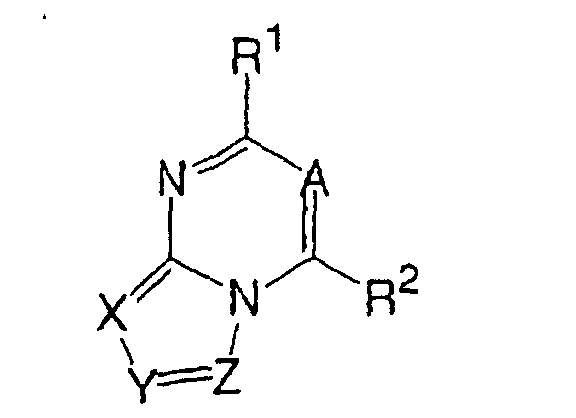
each of R1 and R2 which are independent of each other, is a hydrogen atom, a halogen atom, an alkyl group which may be substituted, an alkenyl group which may be substituted, an alkynyl group which may be substituted, a cycloalkyl group which may be substituted, a cycloalkenyl group which may be substituted, an aryl group which may be substituted, a heterocyclic group which may be substituted, a -B1-R5 group (wherein B1 is CO, COO, O, OCO, OSO2, S, SO or SO2, and R5 is a hydrogen atom, an alkyl group which may be substituted, an alkenyl group which may be substituted, an alkynyl group which may be substituted, a cycloalkyl group which may be substituted, a cycloalkenyl group which may be substituted, an aryl group which may be substituted or a heterocyclic group which may be substituted), an amino group which may be substituted or -N=CR6R7 (wherein each of R6 and R7 which are independent of each other, is a hydrogen atom, an alkyl group which may be substituted, an alkenyl group which may be substituted, an alkynyl group which may be substituted, a cycloalkyl group which may be substituted, a cycloalkenyl group which may be substituted, an aryl group which may be substituted or a heterocyclic group which may be substituted);
each of Y and Z which are independent of each other, is a nitrogen atom or C-R8 (wherein R8 is a hydrogen atom, a halogen atom, an alkyl group which may be substituted, an alkenyl group which may be substituted, an alkynyl group which may be substituted, a cycloalkyl group which may be substituted, a cycloalkenyl group which may be substituted, an aryl group which may be substituted, a heterocyclic group which may be substituted, a -B2-R9 group (wherein B2 is CO, COO, O, OCO, OSO2, S, SO or SO2, and R9 is a hydrogen atom, an alkyl group which may be substituted, an alkenyl group which may be substituted, an alkynyl group which may be substituted, a cycloalkyl group which may be substituted, a cycloalkenyl group which may be substituted, an aryl group which may be substituted or a heterocyclic group which may be substituted), an amino group which may be substituted, a cyano group or a nitro group), provided that when Y and Z are simultaneously C-R8, the two R8's may be the same or different; - X is a nitrogen atom or C-R10 (wherein R10 is a hydrogen atom, a halogen atom, an alkyl group which may be substituted, an alkenyl group which may be substituted, an alkynyl group which may be substituted, a cycloalkyl group which may be substituted, a cycloalkenyl group which may be substituted, a -B2-R9 group (wherein B2 and R9 are as defined above), an amino group which may be substituted, a cyano group or a nitro group); and
in a case where Y is C-R8, and X is C-R10 or Z is C-R8, R8 and R10 or two R8's together may form a ring containing or not containing a hetero atom]. - The salt of the fused-heterocyclic compound of the above formula (I) may be any pharmaceutically acceptable salt, and it may, for example, be a mineral acid salt such as a hydrochloride, a sulfate or a nitrate; an organic acid salt such as a p-toluenesulfonate, a propane sulfonate or a methane sulfonate; an alkali metal salt such as a potassium salt or a sodium salt; an alkaline earth metal salt such as a calcium salt; or an organic amine salt such as a triethanol amine salt or a tris(hydroxymethyl) aminomethane salt. Some of these salts have crystal water.
- The alkyl moiety of the alkyl group which may be substituted represented by each of R1, R2, R3, R4, R5, R6, R7, R8, R9, R10, Ra and Rb in the formula (I) may be usually one having a carbon number of from 1 to 18, and it may, for example, be a methyl group, an ethyl group, a propyl group, a butyl group, a pentyl group, a hexyl group, an octyl group, a nonyl group, a decyl group or a nonadecyl group, and they include linear or branched aliphatic structural isomers.
- The alkenyl moiety of the alkenyl group which may be substituted or the alkynyl moiety of the alkynyl group which may be substituted, represented by each of R1, R2, R3, R4, R5, R6, R7, R8, R9, R10, Ra and Rb in the formula (I), may be usually one having a carbon number of from 2 to 18, and they include linear or branched aliphatic structural isomers.
- The cycloalkyl moiety of the cycloalkyl group which may be substituted or the cycloalkenyl moiety of the cycloalkenyl group which may be substituted, represented by each of R1, R2, R3, R4, R5, R6, R7, R8, R9, R10, Ra and Rb in the formula (I), may be usually one having a carbon number of from 3 to 10, and it may, for example, be a monocyclic group such as a cyclopropyl group, a cyclobutyl group, a cyclopentyl group, a cyclohexyl group, a cyclopentenyl group or a cyclohexenyl group, a fused-polycyclic group or a crosslinked polycyclic group.
- The aryl moiety of the aryl group which may be substituted represented by each of R1, R2, R3, R4, R5, R6, R7, R8, R9, Ra and Rb in the formula (I) may be a fused-polycyclic group such as a naphthyl group, as well as a phenyl group.
- The heterocyclic moiety of the heterocyclic group which may be substituted represented by each of R1, R2, R3, R4, R5, R6, R7, R8, R9, Ra and Rb in the formula (I), may, for example, be a monocyclic heterocyclic group such as a pyrrolyl group, a pyrrolinyl group, a pyrrolidinyl group, a furanyl group, a dihydrofuranyl group, a tetrahydrofuranyl group, a thienyl group, a dihydrothienyl group, a tetrahydrothienyl group, a pyrazolyl group, a pyrazolinyl group, a pyrazolidinyl group, an imidazolyl group, an imidazolinyl group, an imidazolidinyl group, an oxazolyl group, an oxazolinyl group, an oxazolidinyl group, an isoxazolyl group, an isoxazolinyl group, an isoxazolidinyl group, a thiazolyl group, a thiazolinyl group, a thiazolidinyl group, an isothiazolyl group, an isothiazolinyl group, an isothiazolidinyl group, an oxadiazolyl group, an oxadiazolinyl group, an oxadiazolidinyl group, a thiadiazolyl group, a thiadiazolinyl group, a thiadiazolidinyl group, a triazolyl group, a triazolinyl group, a triazolidinyl group, a tetrazolyl group, a tetrazolinyl group, a tetrazolidinyl group, a dioxolyl group, a dioxolanyl group, a dithiolyl group, a dithiolanyl group, a pyridyl group, a dihydropyridyl group, a tetrahydropyridyl group, a piperidinyl group, a pyrimidyl group, a dihydropyrimidyl group, a tetrahydropyrimidyl group, a hexahydropyrimidyl group, a pyridazinyl group, a dihydropyridazinyl group, a tetrahydropyridazinyl group, a hexahydropyridazinyl group, a pyrazinyl group, a dihydropyrazinyl group, a tertahydropyrazinyl group, a piperazinyl group, a pyranyl group, a dihydropyranyl group, a tetrahydropyranyl group, a dioxinyl group, a dioxenyl group, a dioxanyl group, a dithianyl group or a morpholinyl group; a fused-polycyclic heterocyclic group such as a thienothienyl group, a dihydrocyclopentathienyl group, an indolyl group, a tetrahydroindolyl group, an isoindolyl group, a tetrahydroisoindolyl group, a benzothienyl group, a tetrahydrobenzothienyl group, a benzofuranyl group, a tetrahydrobenzofuranyl group, a benzoxazolyl group, a tetrahydrobenzoxazolyl group, a benzoisoxazolyl group, a tetrahydrobenzoisoxazolyl group, a benzothiazolyl group, a tetrahydrobenzothiazolyl group, a benzoisothiazolyl group, a tetrahydrobenzoisothiazolyl group, a benzoimidazolyl group, a tetrahydrobenzimidazolyl group, a benzodioxolyl group, a benzodithiolyl group, a benzodioxanyl group, a benzodithianyl group, a quinolinyl group, an isoquinolinyl group, a quinazolinyl group, a quinoxalinyl group, a phthalazinyl group, a naphthylidinyl group or a purinyl group; or a crosslinked polycyclic heterocyclic group such as a quinuclidinyl group.
- The secondary substituent of each of the alkyl group which may be substituted, the alkenyl group which may be substituted and the alkynyl group which may be substituted, represented by each of R1, R2, R3, R4, R5, R6, R7, R8, R9, R10, Ra and Rb in the formula (I), may, for example, be a halogen atom, a hydroxyl group, a mercapto group, a substitutable alkoxy group, a substitutable alkylthio group, a substitutable alkenyloxy group, a substitutable alkenylthio group, a substitutable alkynyloxy group, a substitutable alkynylthio group, a substitutable cycloalkyl group, a substitutable cycloalkenyl group, a substitutable cycloalkoxy group, a substitutable cycloalkylthio group, a substitutable cycloalkenyloxy group, a substitutable cycloalkenylthio group, a substitutable alkoxycarbonyl group, a substitutable alkylcarbonyl group, a substitutable alkylcarbonyloxy group, a substitutable alkenyloxycarbonyl group, a substitutable alkenylcarbonyl group, a substitutable alkenylcarbonyloxy group, a substitutable alkynyloxycarbonyl group, a substitutable alkynylcarbonyl group, a substitutable alkynylcarbonyloxy group, a substitutable cycloalkoxycarbonyl group, a substitutable cycloalkylcarbonyl group, a substitutable cycloalkylcarbonyloxy group, a substitutable cycloalkenyloxycarbonyl group, a substitutable cycloalkenylcarbonyl group, a substitutable cycloalkenylcarbonyloxy group, a substitutable aryl group, a substitutable aryloxy group, a substitutable arylthio group, a substitutable aryloxycarbonyl group, a substitutable arylcarbonyl group, a substitutable arylcarbonyloxy group, a substitutable heterocyclic group, a substitutable heterocyclyloxy group, a substitutable heterocyclylthio group, a substitutable heterocyclyloxycarbonyl group, a substitutable heterocyclylcarbonyl group, a substitutable heterocyclylcarbonyloxy group, a substitutable amino group, a cyano group, a nitro group, a carboxyl group, a substitutable aminocarbonyl group, a substitutable alkylsulfonyl group, a substitutable alkenylsulfonyl group, a substitutable alkynylsulfonyl group, a substitutable cycloalkylsulfonyl group, a substitutable cycloalkenylsulfonyl group, a substitutable arylsulfonyl group, a substitutable heterocyclylsulfonyl group or a substitutable aminosulfonyl group. The number of such substituents may be one or two or more, and when the number of the substituents is two or more, such substituents may be the same or different.
- The secondary substituent of each of the cycloalkyl group which may be substituted, the cycloalkenyl group which may be substituted, the aryl group which may be substituted and the heterocyclic group which may be substituted, represented by each of R1, R2, R3, R4, R5, R6, R7, R8, R9, R10, Ra and Rb in the formula (I), may, for example, be a halogen atom, a hydroxyl group, a mercapto group, a substitutable alkyl group, a substitutable alkenyl group, a substitutable alkynyl group, a substitutable alkoxy group, a substitutable alkylthio group, a substitutable alkenyloxy group, a substitutable alkenylthio group, a substitutable alkynyloxy group, a substitutable alkynylthio group, a substitutable cycloalkyl group, a substitutable cycloalkenyl group, a substitutable cycloalkoxy group, a substitutable cycloalkylthio group, a substitutable cycloalkenyloxy group, a substitutable cycloalkenylthio group, a substitutable alkoxycarbonyl group, a substitutable alkylcarbonyl group, a substitutable alkylcarbonyloxy group, a substitutable alkenyloxycarbonyl group, a substitutable alkenylcarbonyl group, a substitutable alkenylcarbonyloxy group, a substitutable alkynyloxycarbonyl group, a substitutable alkynylcarbonyl group, a substitutable alkynylcarbonyloxy group, a substitutable cycloalkoxycarbonyl group, a substitutable cycloalkylcarbonyl group, a substitutable cycloalkylcarbonyloxy group, a substitutable cycloalkenyloxycarbonyl group, a substitutable cycloalkenylcarbonyl group, a substitutable cycloalkenylcarbonyloxy group, a substitutable aryl group, a substitutable aryloxy group, a substitutable arylthio group, a substitutable aryloxycarbonyl group, a substitutable arylcarbonyl group, a substitutable arylcarbonyloxy group, a substitutable heterocyclic group, a substitutable heterocyclyloxy group, a substitutable heterocyclylthio group, a substitutable heterocyclyloxycarbonyl group, a substitutable heterocyclylcarbonyl group, a substitutable heterocyclylcarbonyloxy group, a substitutable amino group, a cyano group, a nitro group, a carboxyl group, a substitutable aminocarbonyl group, a substitutable alkylsulfonyl group, a substitutable alkenylsulfonyl group, a substitutable alkynylsulfonyl group, a substitutable cycloalkylsulfonyl group, a substitutable cycloalkenylsulfonyl group, a substitutable arylsulfonyl group, a substitutable heterocyclylsulfonyl group or a substitutable aminosulfonyl group. The number of such substituents may be one or two or more, and when the number of the substituents is two or more, such substituents may be the same or different.
- The secondary substituent of the amino group which may be substituted represented by each of R1, R2, R8 and R10 in the formula (I), may, for example, be a hydroxyl group, a substitutable alkyl group, a substitutable alkenyl group, a substitutable alkynyl group, a substitutable alkoxy group, a substitutable alkenyloxy group, a substitutable alkynyloxy group, a substitutable cycloalkyl group, a substitutable cycloalkenyl group, a substitutable cycloalkoxy group, a substitutable cycloalkenyloxy group, a substitutable alkoxycarbonyl group, a substitutable alkylcarbonyl group, a substitutable alkenyloxycarbonyl group, a substitutable alkenylcarbonyl group, a substitutable alkynyloxycarbonyl group, a substitutable alkynylcarbonyl group, a substitutable cycloalkoxycarbonyl group, a substitutable cycloalkylcarbonyl group, a substitutable cycloalkenyloxycarbonyl group, a substitutable cycloalkenylcarbonyl group, a substitutable aryl group, a substitutable aryloxy group, a substitutable aryloxycarbonyl group, a substitutable arylcarbonyl group, a substitutable heterocyclic group, a substitutable heterocyclyloxy group, a substitutable heterocyclyloxycarbonyl group, a substitutable heterocyclylcarbonyl group, a substitutable aminocarbonyl group, a substitutable alkylsulfonyl group, a substitutable alkenylsulfonyl group, a substitutable alkynylsulfonyl group, a substitutable cycloalkylsulfonyl group, a substitutable cycloalkenylsulfonyl group, a substitutable arylsulfonyl group, a substitutable heterocyclylsulfonyl group or a substitutable aminosulfonyl group. The number of such secondary substituents may be one or two, and when the number is two, they may be the same or different. Further, the two secondary substituents may form a ring containing or not containing a hetero atom.
- The tertiary substituent of each of substitutable groups among the above secondary substituents may, for example, be a halogen atom, a hydroxyl group, a mercapto group, a cyano group, a nitro group, a carboxyl group, an amino group, an alkyl group, an alkenyl group, an alkynyl group, a cycloalkyl group, a cycloalkenyl group, an aryl group, a heterocyclic group, an alkoxy group, an alkenyloxy group, an alkynyloxy group, a cycloalkyloxy group, a cycloalkenyloxy group, an aryloxy group, a heterocyclyloxy group, an alkylthio group, an alkenylthio group, an alkynylthio group, a cycloalkylthio group, a cycloalkenylthio group, an arylthio group, a heterocyclylthio group, an alkylsulfonyl group, an alkenylsulfonyl group, an alkynylsulfonyl group, a cycloalkylsulfonyl group, a cycloalkenylsulfonyl group, an arylsulfonyl group, a heterocyclylsulfonyl group, an alkylcarbonyl group, an alkenylcarbonyl group, an alkynylcarbonyl group, a cycloalkylcarbonyl group, a cycloalkenylcarbonyl group, an arylcarbonyl group, a heterocyclylcarbonyl group, an alkyloxycarbonyl group, an alkenyloxycarbonyl group, an alkynyloxycarbonyl group, a cycloalkyloxycarbonyl group, a cycloalkenyloxycarbonyl group, an aryloxycarbonyl group, a heterocyclyloxycarbonyl group, an aminocarbonyl group, an alkylaminocarbonyl group, a dialkylaminocarbonyl group, an alkenylaminocarbonyl group, an alkynylaminocarbonyl group, a cycloalkylaminocarbonyl group, a cycloalkenylaminocarbonyl group, an arylaminocarbonyl group, a heterocyclylaminocarbonyl group, an aminosulfonyl group, an alkylaminosulfonyl group, a dialkylaminosulfonyl group, an alkenylaminosulfonyl group, an alkynylaminosulfonyl group, a cycloalkylaminosulfonyl group, a cycloalkenylaminosulfonyl group, an arylaminosulfonyl group, a heterocyclylaminosulfonyl group, an alkylamino group, a dialkylamino group, an alkenylamino group, an alkynylamino group, a cycloalkylamino group, a cycloalkenylamino group, an arylamino group, a heterocyclylamino group, an alkylcarbonylamino group, an alkenylcarbonylamino group, an alkynylcarbonylamino group, a cycloalkylcarbonylamino group, a cycloalkenylcarbonylamino group, an arylcarbonylamino group, a heterocyclylcarbonylamino group, an alkylsulfonylamino group, an alkenylsulfonylamino group, an alkynylsulfonylamino group, a cycloalkylsulfonylamino group, a cycloalkenylsulfonylamino group, an arylsulfonylamino group or a heterocyclylsulfonylamino group. The number of such tertiary substituents may be one or two or more, and when the number is two or more, such substituents may be the same or different. Further, when the secondary substituent is an amino group substituted with two tertiary substituents, such tertiary substituents together may form a ring containing or not containing a hetero atom.
- Further, each of the alkyl moiety, the alkenyl moiety, the alkynyl moiety, the cycloalkyl moiety, the cycloalkenyl moiety, the aryl moiety and the heterocyclic moiety of each of such tertiary substituents may further be substituted with a quaternary substituent such as a halogen atom, a hydroxyl group, a mercapto group, a cyano group, a nitro group, a carboxyl group, an amino group, an alkyl group, a haloalkyl group, an alkoxy group, a haloalkoxy group, an alkylthio group, a haloalkylthio group, an alkoxycarbonyl group, an aminocarbonyl group, an alkylaminocarbonyl group, a dialkylaminocarbonyl group, an aminosulfonyl group, an alkylaminosulfonyl group, a dialkylaminosulfonyl group, an alkylamino group, a dialkylamino group, an alkylcarbonylamino group, an alkylsulfonylamino group, a cycloalkyl group, an aryl group or a heterocyclic group. The number of such substituents may be one or two or more, and when the number of the substituents is two or more, such substituents may be the same or different.
- Among the fused-heterocyclic compounds of the above formula (I) and their salts, fused-heterocyclic compounds of the formula (I') and their salts:[wherein G is CN, NO2, CO2R4 (wherein R4 is a hydrogen atom, an alkyl group which may be substituted, an alkenyl group which may be substituted, an alkynyl group which may be substituted, a cycloalkyl group which may be substituted, a cycloalkenyl group which may be substituted, an aryl group which may be substituted or a heterocyclic group which may be substituted), CHO, SO2NRaRb (wherein each of Ra and Rb which are independent of each other, is a hydrogen atom, a hydroxyl group, an alkoxy group, an alkyl group which may be substituted, an alkenyl group which may be substituted, an alkynyl group which may be substituted, a cycloalkyl group which may be substituted, a cycloalkenyl group which may be substituted, an aryl group which may be substituted or a heterocyclic group which may be substituted, or Ra and Rb together form a ring) or CONRaRb (wherein Ra and Rb are as defined above);
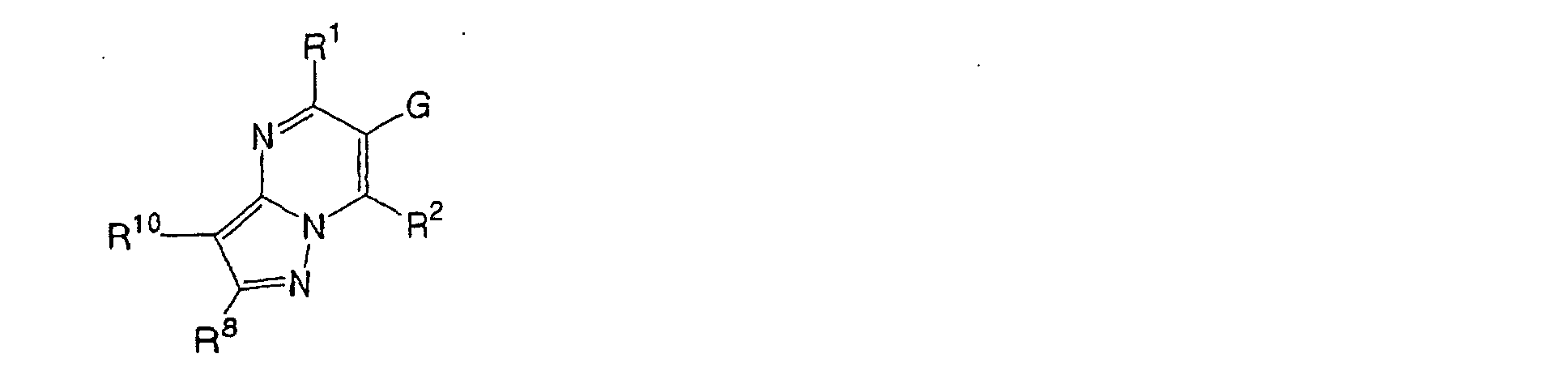
- R1 is a halogen atom, a -O-R5 group (wherein R5 is a hydrogen atom, an alkyl group which may be substituted, an alkenyl group which may be substituted, an alkynyl group which may be substituted, a cycloalkyl group which may be substituted, a cycloalkenyl group which may be substituted, an aryl group which may be substituted or a heterocyclic group which may be substituted) or a -S-R5 group (wherein R5 is as defined above);
- R2 is a halogen atom, a -O-R5 group (wherein R5 is as defined above) or an amino group which may be substituted; and
each of R8 and R10 which are independent of each other, is a hydrogen atom, a halogen atom or an alkyl group], are novel compounds. - Now, some of preferred embodiments of the present invention will be explained, however, the present invention is by no means restricted thereto.
- The compounds of the above formula (I) and the compounds of the formula (I') included therein, are useful as active ingredients for preventive or therapeutic medicines for diabetes, and are useful as the following agents for example.
- (1) Stimulators of glucose uptake in skeletal muscle cells.
- (2) Hypoglycemic agents.
- (3) Preventive or therapeutic medicines for impaired glucose tolerance.
- (4) Preventive or therapeutic medicines for diabetic complications.
- (5) Preventive or therapeutic medicines for at least one diabetic complication selected from the group consisting of hyperlipidemia, vascular diseases, retinopathy, nephropathy, neuropathy and hypertension.
- (6) Preventive or therapeutic medicines for obesity.
-
- Among the compounds of the above formula (I), the following compounds are excellent as active ingredients for preventive or therapeutic medicines for diabetes.
- (1) Compounds wherein A is C-G {wherein G is CN, NO2,
CO2R4 (wherein R4 is a hydrogen atom, an alkyl group which
may be substituted, an alkenyl group which may be
substituted, an alkynyl group which may be substituted, a
cycloalkyl group which may be substituted, a cycloalkenyl
group which may be substituted, an aryl group which may
be substituted or a heterocyclic group which may be
substituted), CHO, SO2NRaRb (wherein each of Ra and Rb
which are independent of each other, is a hydrogen atom,
a hydroxyl group, an alkoxy group, an alkyl group which
may be substituted, an alkenyl group which may be
substituted, an alkynyl group which may be substituted, a
cycloalkyl group which may be substituted, a cycloalkenyl
group which may be substituted, an aryl group which may
be substituted or a heterocyclic group which may be
substituted, or Ra and Rb together form a ring) or CONRaRb
(wherein Ra and Rb are as defined above)};
each of Y and Z which are independent of each other, is a nitrogen atom or C-R8 {wherein R8 is a hydrogen atom, a halogen atom, an alkyl group which may be substituted, an alkenyl group which may be substituted, an alkynyl group which may be substituted, a cycloalkyl group which may be substituted, a cycloalkenyl group which may be substituted, an aryl group which may be substituted, a heterocyclic group which may be substituted, a -B2-R9 group (wherein B2 is CO, COO, O, OCO, OSO2, S, SO or SO2, and R9 is a hydrogen atom, an alkyl group which may be substituted, an alkenyl group which may be substituted, an alkynyl group which may be substituted, a cycloalkyl group which may be substituted, a cycloalkenyl group which may be substituted, an aryl group which may be substituted or a heterocyclic group which may be substituted), an amino group which may be substituted, a cyano group or a nitro group}, provided that when Y and Z are simultaneously C-R8, the two R8's may be the same or different; and
X is a nitrogen atom or C-R10 {wherein R10 is a hydrogen atom, a halogen atom, an alkyl group which may be substituted, an alkenyl group which may be substituted, an alkynyl group which may be substituted, a cycloalkyl group which may be substituted, a cycloalkenyl group which may be substituted, a -B2-R9 group (wherein B2 and R9 are as defined above), an amino group which may be substituted, a cyano group or a nitro group}. - (2) Compounds wherein each of R1 and R2 which are
independent of each other, is a halogen atom, an alkyl
group which may be substituted, an alkenyl group which
may be substituted, an alkynyl group which may be
substituted, a cycloalkyl group which may be substituted,
a cycloalkenyl group which may be substituted, an aryl
group which may be substituted, a heterocyclic group
which may be substituted, a -B1'-R5 group (wherein B1' is
O or S, and R5 is a hydrogen atom, an alkyl group which
may be substituted, an alkenyl group which may be
substituted, an alkynyl group which may be substituted, a
cycloalkyl group which may be substituted, a cycloalkenyl
group which may be substituted, an aryl group which may
be substituted or a heterocyclic group which may be
substituted), an amino group which may be substituted or
-N=CR6R7 (wherein each of R6 and R7 which are independent
of each other, is a hydrogen atom, an alkyl group which
may be substituted, an alkenyl group which may be
substituted, an alkynyl group which may be substituted, a
cycloalkyl group which may be substituted, a cycloalkenyl
group which may be substituted, an aryl group which may
be substituted or a heterocyclic group which may be
substituted); and
each of Y and Z which are independent of each other, is a nitrogen atom or C-R8 {wherein R8 is a hydrogen atom, a halogen atom, an alkyl group which may be substituted, an alkenyl group which may be substituted, an alkynyl group which may be substituted, a cycloalkyl group which may be substituted, a cycloalkenyl group which may be substituted, an aryl group which may be substituted, a heterocyclic group which may be substituted, a -B2'-R9 group (wherein B2' is CO, COO, O, OCO or S, and R9 is a hydrogen atom, an alkyl group which may be substituted, an alkenyl group which may be substituted, an alkynyl group which may be substituted, a cycloalkyl group which may be substituted, a cycloalkenyl group which may be substituted, an aryl group which may be substituted or a heterocyclic group which may be substituted), an amino group which may be substituted, a cyano group or a nitro group}. -
- Among the compounds of the above formula (I), the compounds of the above formula (I') are more excellent as active ingredients for preventive or therapeutic medicines for diabetes. No pharmaceutical compositions containing the compound of the formula (I') have conventionally been known. Among the compounds of the formula (I'), more preferred compounds are mentioned below.
- (i) Compounds of the formula (I') wherein R2 is an amino group which may be substituted.
- (ii) Compounds of the formula (I') wherein R2 is an amino group which may be substituted, and each of R8 and R10 is a hydrogen atom.
- (iii) Compounds of (ii) wherein the amino group which may be substituted represented by R2 is a -NRcRd group {wherein each of Rc and Rd which are independent of each other, is a hydrogen atom, a -O-R5 group (wherein R5 is a hydrogen atom, an alkyl group which may be substituted, an alkenyl group which may be substituted, an alkynyl group which may be substituted, a cycloalkyl group which may be substituted, a cycloalkenyl group which may be substituted, an aryl group which may be substituted or a heterocyclic group which may be substituted), an alkyl group which may be substituted, an alkenyl group which may be substituted, an alkynyl group which may be substituted, a cycloalkyl group which may be substituted, a cycloalkenyl group which may be substituted, an aryl group which may be substituted or a heterocyclic group which may be substituted, or Rc and Rd together form a ring}.
- (iv) Compounds of the formula (I') wherein G is CN, CO2R4 (wherein R4 is a hydrogen atom, an alkyl group which may be substituted, an alkenyl group which may be substituted, an alkynyl group which may be substituted, a cycloalkyl group which may be substituted, a cycloalkenyl group which may be substituted, an aryl group which may be substituted or a heterocyclic group which may be substituted), CHO, SO2NRaRb (wherein each of Ra and Rb which are independent of each other, is a hydrogen atom, a hydroxyl group, an alkoxy group, an alkyl group which may be substituted, an alkenyl group which may be substituted, an alkynyl group which may be substituted, a cycloalkyl group which may be substituted, a cycloalkenyl group which may be substituted or a heterocyclic group which may be substituted, or Ra and Rb together form a ring) or CONRa'Rb' (wherein each of Ra' and Rb' which are independent of each other, is a hydroxyl group, an alkoxy group, an alkyl group which may be substituted, an alkenyl group which may be substituted, an alkynyl group which may be substituted, a cycloalkyl group which may be substituted, a cycloalkenyl group which may be substituted, an aryl group which may be substituted or a heterocyclic group which may be substituted, or Ra' and Rb' together form a ring).
- (v) Compounds of the formula (I') wherein G is CN,
NO2, CO2R4 (wherein R4 is a hydrogen atom, an alkyl group
which may be substituted, an alkenyl group which may be
substituted, an alkynyl group which may be substituted, a
cycloalkyl group which may be substituted, a cycloalkenyl
group which may be substituted, an aryl group which may
be substituted or a heterocyclic group which may be
substituted), CHO, C-SO2NRaRb (wherein each of Ra and Rb
which are independent of each other, is a hydrogen atom,
a hydroxyl group, an alkoxy group, an alkyl group which
may be substituted, an alkenyl group which may be
substituted, an alkynyl group which may be substituted, a
cycloalkyl group which may be substituted, a cycloalkenyl
group which may be substituted or a heterocyclic group
which may be substituted, or Ra and Rb together form a
ring) or CONRa'Rb' (wherein each of Ra' and Rb' which are
independent of each other, is a hydroxyl group, an alkoxy
group, an alkyl group which may be substituted, an
alkenyl group which may be substituted, an alkynyl group
which may be substituted, a cycloalkyl group which may be
substituted, a cycloalkenyl group which may be
substituted, an aryl group which may be substituted or a
heterocyclic group which may be substituted, or Ra' and
Rb' together form a ring) ; and
R1 is a -O-R5 group (wherein R5 is a hydrogen atom, an alkyl group which may be substituted, an alkenyl group which may be substituted, an alkynyl group which may be substituted, a cycloalkyl group which may be substituted, a cycloalkenyl group which may be substituted, an aryl group which may be substituted or a heterocyclic group which may be substituted) or a -S-R5 group (R5 is an alkyl group which may be substituted, an alkenyl group which may be substituted, an alkynyl group which may be substituted, a cycloalkyl group which may be substituted, a cycloalkenyl group which may be substituted, an aryl group which may be substituted or a heterocyclic group which may be substituted). -
- Each of the alkyl group which may be substituted, the alkenyl group which may be substituted, the alkynyl group which may be substituted, the cycloalkyl group which may be substituted, the cycloalkenyl group which may be substituted, the aryl group which may be substituted and the heterocyclic group which may be substituted in each of the substituents represented by each of Rc and Rd in the -NRcRd group in the above formula (iii) is as defined for each of the substituents in the compound of the formula (I). Further, as the -NRcRd group, a substitutable alkylamino group, a substitutable dialkylamino group, an alkylcarbonylamino group, a substitutable alkynylamino group, a cycloalkylamino group or a substitutable arylamino group is preferred, and a substitutable alkylamino group or a substitutable arylamino group is more preferred. The substitutable alkylamino group may, for example, be a benzylamino group, a 4-nitrobenzylamino group, a 4-pyridylmethylamino group, a 3-pyridylmethylamino group, a 2-pyridylmethylamino group, a dioxolanylmethylamino group, a pyranylmethylamino group, a methylamino group, an ethylamino group or a dimethylamino group. The substitutable arylamino group may, for example, be a phenylamino group, a 4-cyanophenylamino group, a 3-cyanophenylamino group, a 4-chlorophenylamino group, a 2-chlorophenylamino group, a 4-methylphenylamino group, a 3-methylphenylamino group, a 2-methylphenylamino group, a 4-nitrophenylamino group or a 3-nitrophenylamino group.
- The preventive or therapeutic medicines for diabetes of the present invention are usually used in the form of a common pharmaceutical preparation. The pharmaceutical preparation is prepared by using a commonly used diluent or excipient such as a bulking agent, an extender, a binding agent, a moisture-imparting agent, a disintegrator, a surfactant or a lubricant. As the pharmaceutical preparation, various forms may be selected depending upon the purpose of treatment, and a tablet, a pill, a powder, a dust, a granule, a capsule, a suppository, a solution, a suspension, an emulsion, an injection (such as a solution or a suspension), a spray, an aerosol, a cream, an ointment, a lotion or a transdermal agent (a patch, a matrix or a tape) may be mentioned as examples.
- To form the medicine into a tablet, carriers which have conventionally been known in this field can be used widely, and they may, for example, be excipients such as lactose, sucrose, sodium chloride, glucose, urea, starch, calcium carbonate, kaolin, crystalline cellulose and silicic acid, binding agents such as water, ethanol, propanol, simple syrup, a glucose solution, a starch solution, a gelatin solution, carboxymethyl cellulose, Shellac, methyl cellulose, potassium phosphate and polyvinyl pyrrolidone, disintegrators such as dried starch, sodium alginate, an agar powder, a laminaran powder, sodium hydrogencarbonate, calcium carbonate, polyoxyethylene sorbitan fatty acid esters, sodium lauryl sulfate, monoglyceryl stearate, starch and lactose, disintegration inhibitors such as sucrose, stearin, cacao butter and hydrogenated oil, absorption stimulators such as a quaternary ammonium base and sodium lauryl sulfate, moisturizers such as glycerin and starch, absorbents such as starch, lactose, kaolin, bentonite and colloidal silicate, and lubricants such as purified talc, a stearate, a boric acid powder and polyethylene glycol. Further, a tablet may be a tablet having a common coating applied thereto as the case requires, such as a sugar-coated tablet, a gelatin-coated tablet, an enteric-coated tablet or a film-coated tablet, or a double tablet or a multilayer tablet.
- To form the medicine into a pill, carriers which have conventionally been known in this field can be used widely, and they may, for example, be excipients such as glucose, lactose, starch, cacao butter, hydrogenated vegetable oil, kaolin and talc, binding agents such as powdered acacia, powdered tragacanth, gelatin and ethanol and disintegrators such as laminaran agar.
- To form the medicine into a suppository, conventionally known carriers can be used widely, and they may, for example, be polyethylene glycol, cacao butter, higher alcohols, higher alcohol esters, gelatin and semi-synthetic glyceride.
- To prepare an injection, a solution, an emulsion or a suspension is sterilized, and is preferably isotonic with the blood, and to form the medicine into a solution, an emulsion or a suspension, all the diluents which are commonly used in this field can be used, and they may, for example, be water, a lactic acid aqueous solution, ethyl alcohol, propylene glycol, ethoxylated isostearyl alcohol, polyoxylated isostearyl alcohol and polyoxyethylene sorbitan fatty acid esters. In this case, salt, glucose or glycerin in an amount adequate to prepare an isotonic solution may be incorporated in the pharmaceutical preparation, and a common solubilizing agent, buffer, soothing agent or the like may be added thereto. Further, as the case requires, a colorant, a preservative, a fragrant material, a flavoring agent, a sweetener or another pharmaceutical agent may be incorporated in the pharmaceutical preparation.
- The amount of the compound of the above formula (I) to be contained in the therapeutic medicine for diabetes of the present invention is not particularly limited and may optionally be selected from a wide range, but it is usually from 1 to 70 wt%, preferably from 5 to 50 wt% in the entire composition.
- The administration method of the preventive or therapeutic medicines for diabetes of the present invention is not particularly limited, and they are orally or parenterally administered by a method depending upon the form of the preparation, the age, the sex or other conditions of the patient and the degree of the disease. For example, for oral administration, a tablet, a pill, a solution, a suspension, an emulsion, a granule or a capsule may, for example, be mentioned as a preferred form. For parenteral administration, the medicine may be administered in the form of e.g. a topical agent, an injection, a transdermal agent, a transnasal formulation, a pulmonary delivery formulation or a suppository. In the case of an injection, it is preferred that the medicine is intravenously administered by itself or as mixed with a conventional fluid replacement such as glucose or amino acids, or as the case requires, it is intramuscularly, intradermally, subcutaneously or intraperitoneally administered by itself. Further, in the case of a suppository, it is preferred that the medicine is administered in rectum.
- The dose of the preventive or therapeutic medicines for diabetes of the present invention is optionally selected depending upon e.g. the dose regimen, the age, the sex or other conditions of the patient and the degree of disease, and usually the amount of the compound of the above formula (I) as an active ingredient is preferably from about 0.05 to about 50 mg per kg of the body weight per day, and the medicine may be administered once or several times a day. Further, it is preferred that the active ingredient is contained in an amount of from 1 to 1,000 mg in the administration unit form.
- The compounds of the above formula (I) and their salts can be produced by a process for producing known analogous compounds, or a method in accordance therewith, and as preferred embodiments, the following Preparation Methods [1] to [5] will be exemplified.
- A method for producing the compound of the above formula (I) by reacting a compound of the formula (II) :[wherein R is R1 or R2 in the formula (I), A is as defined above, D is a cyano group or an alkoxycarbonyl group, and L is a leaving group], with a compound of the formula (III) :
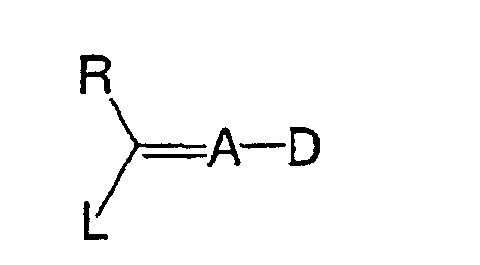 [wherein X, Y and Z are as defined above]. As the leaving group represented by L in the formula (II), various ones may be mentioned, and a halogen atom, a -OR5 group, a -SR5 group or a dialkylamino group is preferred (R5 is as defined above).
- The reaction of the Preparation Method 1 may be carried out in the presence of a proper solvent. The specific solvent used may, for example, be an alcohol such as methanol, ethanol, propanol or butanol; an aromatic hydrocarbon such as benzene, toluene or xylene; an aliphatic hydrocarbon such as pentane, hexane, heptane, petroleum ether, ligroin or petroleum benzine; an ether such as diethyl ether, dipropyl ether, dibutyl ether, tetrahydrofuran or dioxane; a nitrile such as acetonitrile or propionitrile; an acid amide such as dimethylformamide or dimethylacetamide; a sulfoxide such as dimethylsulfoxide; a sulfone such as sulfolane; a phosphate amide such as hexamethylphosphoramide; or a halogenated hydrocarbon such as chloroform, dichloromethane, carbon tetrachloride or 1,2-dichloroethane, or a mixed solvent thereof.
- In the Preparation Method 1, the reaction is carried out preferably in the presence of a base in some cases. The specific base used may, for example, be an organic base such as triethylamine, pyridine, piperidine, N-methylmorpholine, 1,8-diazabicyclo[5,4,0]-7-undecene or N,N-dimethylaniline; an alkali metal such as lithium, sodium or potassium; a carbonate of an alkali metal such as lithium carbonate, sodium carbonate or potassium carbonate; a hydrogencarbonate of an alkali metal such as lithium hydrogencarbonate, sodium hydrogencarbonate or potassium hydrogencarbonate; a hydride of an alkali metal such as lithium hydride, sodium hydride or potassium hydride; or n-butylithium, lithium diisopropylamide or sodium amide.
- The reaction of the Preparation Method 1 is carried out usually at a reaction temperature of from 0 to 150°C, preferably at a reaction temperature of from 10 to 100°C. The reaction time is usually from 0.1 to 48 hours.
- In the Preparation Method 1, the compound of the formula (III) may be used in an amount of from 0.8 to 2 equivalents, preferably from 1 to 1.5 equivalents, per 1 mol of the compound of the above formula (II).
- In the Preparation Method 1, various reaction conditions may optionally be combined with one another. Further, such various reaction conditions include reaction conditions in a usual range and reaction conditions in a preferred range, and they may also be optionally selected and combined with one another.
- A method for producing the compound of the above formula (I) by reacting a compound of the formula (I-1):[wherein either one of R1' and R2' is an amino group, OH or SH; and the other is a hydrogen atom, a halogen atom, an alkyl group which may be substituted, an alkenyl group which may be substituted, an alkynyl group which may be substituted, a cycloalkyl group which may be substituted, a cycloalkenyl group which may be substituted, an aryl group which may be substituted, a heterocyclic group which may be substituted, a -B1-R5 group (wherein B1 and R5 are as defined above), an amino group which may be substituted or -N=CR6R7 (wherein R6 and R7 are as defined above); and A, X, Y and Z are as defined above], with a compound of the formula (IV): R'-L' [wherein R' is an alkyl group which may be substituted, an alkenyl group which may be substituted, an alkynyl group which may be substituted, a cycloalkyl group which may be substituted, a cycloalkenyl group which may be substituted, an aryl group which may be substituted, a heterocyclic group which may be substituted or a -B1"-R5' group (wherein B1" is CO or SO2, and R5' is an alkyl group which may be substituted, an alkenyl group which may be substituted, an alkynyl group which may be substituted, a cycloalkyl group which may be substituted, a cycloalkenyl group which may be substituted, an aryl group which may be substituted or a heterocyclic group which may be substituted); and L' is a leaving group]. As the leaving group represented by L' in the formula (IV), various ones may be mentioned, and a halogen atom, a methanesulfonyloxy group or a para-toluenesulfonyloxy group is preferred.

- The reaction of the Preparation Method 2 may be carried out in the presence of a proper solvent. The specific solvent used may, for example, be an aromatic hydrocarbon such as benzene, toluene or xylene; an aliphatic hydrocarbon such as pentane, hexane, heptane, petroleum ether, ligroin or petroleum benzine; an ether such as diethyl ether, dipropyl ether, dibutyl ether, tetrahydrofuran or dioxane; a nitrile such as acetonitrile or propionitrile; an acid amide such as dimethylformamide or dimethylacetamide; a sulfoxide such as dimethylsulfoxide; a sulfone such as sulfolane; a phosphate amide such as hexamethylphosphoramide; or a halogenated hydrocarbon such as chloroform, dichloromethane, carbon tetrachloride or 1,2-dichloroethane, or a mixed solvent thereof.
- In the Preparation Method 2, the reaction is carried out preferably in the presence of a base, so as to carry out the reaction efficiently. The specific base used may, for example, be an organic base such as triethylamine, pyridine, N-methylmorpholine, 1,8-diazabicyclo[5,4,0]-7-undecene or N,N-dimethylaniline; an alkali metal such as lithium, sodium or potassium; a carbonate of an alkali metal such as lithium carbonate, sodium carbonate or potassium carbonate; a hydrogencarbonate of an alkali metal such as lithium hydrogencarbonate, sodium hydrogencarbonate or potassium hydrogencarbonate; a hydride of an alkali metal such as lithium hydride, sodium hydride or potassium hydride; or n-butylithium, lithium diisopropylamide or sodium amide.
- The reaction of the Preparation Method 2 is carried out usually at a reaction temperature of from -70 to 200°C, preferably at a reaction temperature of from -10 to 150°C. The reaction time is usually from 0.1 to 48 hours.
- In the Preparation Method 2, the compound of the formula (IV) may be used in an amount of from 0.8 to 2 equivalents, preferably from 1 to 1.5 equivalents, per 1 mol of the compound of the above formula (I-1).
- In the Preparation Method 2, various reaction conditions may optionally be combined with one another. Further, such various reaction conditions include reaction conditions in a usual range and reaction conditions in a preferred range, and they may also be optionally selected and combined with one another.
- A method for producing the compound of the above formula (I) by reacting a compound of the formula (I-2) :[wherein either one of R1" and R2" is OH, and the other is a hydrogen atom, a halogen atom, an alkyl group which may be substituted, an alkenyl group which may be substituted, an alkynyl group which may be substituted, a cycloalkyl group which may be substituted, a cycloalkenyl group which may be substituted, an aryl group which may be substituted, a heterocyclic group which may be substituted, a -B1-R5 group (wherein B1 and R5 are as defined above), an amino group which may be substituted or -N=CR6R7 (wherein R6 and R7 are as defined above); and A, X, Y and Z are as defined above], with a halogenating agent.

- The halogenating agent used in the reaction of the Preparation Method 3 may, for example, be phosphorus pentachloride, phosphorus oxychloride, phosphorus trichloride, thionyl chloride, oxalyl chloride or phenylphosphonate dichloride, and its amount is from 1 to 10 equivalents, preferably from 1 to 5 equivalents, per 1 mol of the compound of the above formula (I-2).
- The reaction of the Preparation Method 3 may be carried out in the presence of a proper solvent. The specific solvent used may, for example, be an aromatic hydrocarbon such as benzene, toluene or xylene; an aliphatic hydrocarbon such as pentane, hexane, heptane, petroleum ether, ligroin or petroleum benzine; an ether such as diethyl ether, dipropyl ether, dibutyl ether, tetrahydrofuran or dioxane; or a halogenated hydrocarbon such as chloroform, dichloromethane, carbon tetrachloride or 1,2-dichloroethane, or a mixed solvent thereof. The reaction is carried out preferably in the system in which no water is present.
- In the Preparation Method 3, the reaction is carried out preferably in the presence of a base, so as to carry out the reaction efficiently. The specific base used may, for example, be an organic base such as triethylamine, pyridine, N-methylmorpholine, 1,8-diazabicyclo[5,4,0]-7-undecene or N,N-dimethylaniline.
- The reaction of the Preparation Method 2 is carried out usually at a reaction temperature of from -30 to 200°C, preferably at a reaction temperature of from 0 to 150°C. The reaction time is usually from 0.1 to 48 hours.
- In the Preparation Method 3, various reaction conditions may optionally be combined with one another. Such various reaction conditions include reaction conditions in a usual range and reaction conditions in a preferred range, and they may also be optionally selected and combined with one another.
- A method for producing the compound of the above formula (I) by reacting a compound of the formula (I-3) :[wherein either one of R1"' and R2"' is a halogen atom, a -B1"'-R5" group (wherein B1"' is O, OSO2, S or SO2, and R5" is an alkyl group which may be substituted or an aryl group which may be substituted) or a dialkylamino group, and the other is a hydrogen atom, a halogen atom, an alkyl group which may be substituted, an alkenyl group which may be substituted, an alkynyl group which may be substituted, a cycloalkyl group which may be substituted, a cycloalkenyl group which may be substituted, an aryl group which may be substituted, a heterocyclic group which may be substituted, a -B1-R5 group (wherein B1 and R5 are as defined above), an amino group which may be substituted or -N=CR6R7 (wherein R6 and R7 are as defined above); and A, X, Y and Z are as defined above], with a compound of the formula (V): R" - B"' [wherein R is an alkyl group which may be substituted, an alkenyl group which may be substituted, an alkynyl group which may be substituted, a cycloalkyl group which may be substituted, a cycloalkenyl group which may be substituted, an aryl group which may be substituted or a heterocyclic group which may be substituted, and B"' is an amino group, OH or SH].

- The reaction of the Preparation Method 4 may be carried out in the presence of a proper solvent. The specific solvent used may, for example, be an aromatic hydrocarbon such as benzene, toluene or xylene; an aliphatic hydrocarbon such as pentane, hexane, heptane, petroleum ether, ligroin or petroleum benzine; an ether such as diethyl ether, dipropyl ether, dibutyl ether, tetrahydrofuran or dioxane; a nitrile such as acetonitrile or propionitrile; an acid amide such as dimethylformamide or dimethylacetamide; a sulfoxide such as dimethylsulfoxide; a sulfone such as sulfolane; a phosphate amide such as hexamethylphosphoramide; or a halogenated hydrocarbon such as chloroform, dichloromethane, carbon tetrachloride or 1,2-dichloroethane, or a mixed solvent thereof.
- In the Preparation Method 4, the reaction is carried out preferably in the presence of a base, so as to carry out the reaction efficiently. The specific base used may, for example, be an organic base such as triethylamine, pyridine, N-methylmorpholine, 1,8-diazabicyclo[5,4,0]-7-undecene or N,N-dimethylaniline; an alkali metal such as lithium, sodium or potassium; a carbonate of an alkali metal such as lithium carbonate, sodium carbonate or potassium carbonate; a hydrogencarbonate of an alkali metal such as lithium hydrogencarbonate, sodium hydrogencarbonate or potassium hydrogencarbonate; a hydride of an alkali metal such as lithium hydride, sodium hydride or potassium hydride; or n-butylithium, lithium diisopropylamide or sodium amide.
- The reaction of the Preparation Method 4 is carried out usually at a reaction temperature of from -70 to 150°C, preferably at a reaction temperature of from -10 to 100°C. The reaction time is usually from 0.1 to 48 hours.
- In the Preparation Method 4, the compound of the formula (V) may be used in an amount of from 0.8 to 2 equivalents, preferably from 1 to 1.5 equivalents, per 1 mol of the compound of the above formula (I-3).
- In the Preparation Method 3, various reaction conditions may optionally be combined with one another. Further, such various reaction conditions include reaction conditions in a usual range and reaction conditions in a preferred range, and they may also be optionally selected and combined with one another.
- A method for producing the compound of the above formula (I) by reacting a compound of the formula (I-4):[wherein either one of R1"" and R2"" is an amino group, and the other is a hydrogen atom, a halogen atom, an alkyl group which may be substituted, an alkenyl group which may be substituted, an alkynyl group which may be substituted, a cycloalkyl group which may be substituted, a cycloalkenyl group which may be substituted, an aryl group which may be substituted, a heterocyclic group which may be substituted, a -B1-R5 group (wherein B1 and R5 are as defined above), an amino group which may be substituted or -N=CR6R7 (wherein R6 and R7 are as defined above); and A, X, Y and Z are as defined above], with a compound of the formula (VI) : R6R7C=O [wherein R6 and R7 are as defined above].
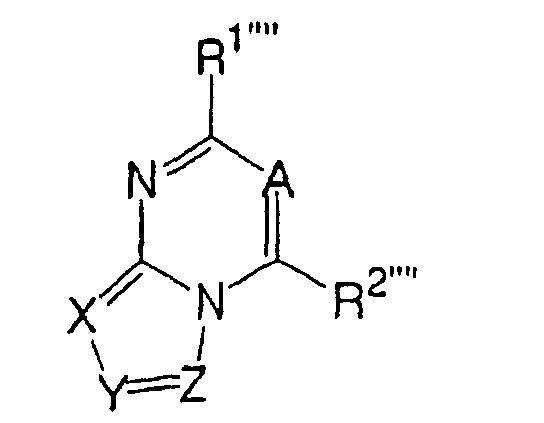
- The reaction of the Preparation Method 5 may be carried out in the presence of a proper solvent. The specific solvent used may, for example, be an alcohol such as methanol, ethanol, propanol or butanol; an aromatic hydrocarbon such as benzene, toluene or xylene; an aliphatic hydrocarbon such as pentane, hexane, heptane, petroleum ether, ligroin or petroleum benzine; an ether such as diethyl ether, dipropyl ether, dibutyl ether, tetrahydrofuran or dioxane; a nitrile such as acetonitrile or propionitrile; an acid amide such as dimethylformamide or dimethylacetamide; a sulfoxide such as dimethylsulfoxide; a sulfone such as sulfolane; a phosphate amide such as hexamethylphosphoramide; or a halogenated hydrocarbon such as chloroform, dichloromethane, carbon tetrachloride or 1,2-dichloroethane, or a mixed solvent thereof.
- In the Preparation Method 5, the reaction is carried out preferably in the presence of a base, so as to carry out the reaction efficiently. The specific base used may, for example, be an organic base such as triethylamine, pyridine, N-methylmorpholine, 1,8-diazabicyclo[5,4,0]-7-undecene or N,N-dimethylaniline; a carbonate of an alkali metal such as lithium carbonate, sodium carbonate or potassium carbonate; or a hydrogencarbonate of an alkali metal such as lithium hydrogencarbonate, sodium hydrogencarbonate or potassium hydrogencarbonate.
- In the Preparation Method 5, the reaction is carried out preferably in the presence of a dehydrating agent such as molecular sieves, so as to carry out the reaction efficiently. Further, a proper solvent may be used to remove formed moisture from the reaction system by azeotropy.
- The reaction of the Preparation Method 5 is carried out usually at a reaction temperature of from -30 to 150°C, preferably at a reaction temperature of from 0 to 100°C. The reaction time is usually from 0.1 to 48 hours.
- In the Preparation Method 5, the compound of the formula (VI) may be used in an amount of from 0.8 to 2 equivalents, preferably from 1 to 1.5 equivalents, per 1 mol of the compound of the above formula (I-3).
- In the Preparation Method 5, various reaction conditions may optionally be combined with one another. Further, such various reaction conditions include reaction conditions in a usual range and reaction conditions in a preferred range, and they may also be optionally selected and combined with one another.
- The compounds of the above formula (I) and their salts may be produced by any one of the above Preparation Methods [1] to [5] or a combination thereof.
- The compounds of the above formula (I) may form salts by a conventional method. Further, the compounds of the above formula (I) may form inner salts in some cases.
- Among the compounds of the above formula (I) and their salts, compounds having a carboxyl group in their molecular structures and their salts may be produced by hydrolyzing corresponding esters under an acid or alkali condition.
- Among the compounds of the above formula (I) and their salts, compounds of the formula (I') and their salts may be produced by one of the following Preparation Methods [A] to [G] or a combination of these Preparation Methods, in accordance with the above Preparation Methods 1 to 5.
- Among the compounds of the above formula (I') and their salts, compounds of the formula (I'-1) and their salts:[wherein R1, R8, R10 and G are as defined in the above formula (I')], can be produced by reacting a compound of the formula (VII):
 [wherein R1 and G are as defined above; D is an alkoxycarbonyl group; and L is a halogen atom, a -OR5 group, a -SR5 group or a dialkylamino group (R5 is as defined above)], with a compound of the formula (VIII) :
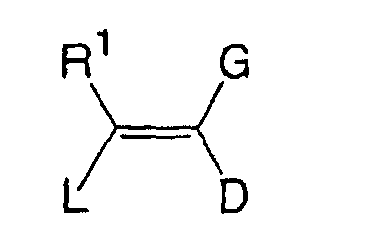 [wherein R8 and R10 are as defined above]. The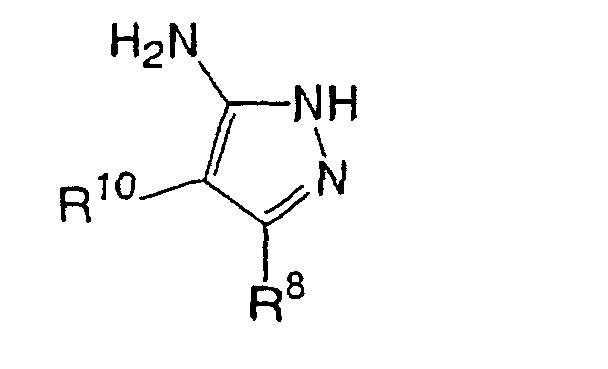
Preparation Method [A] is in accordance with the Preparation Method 1, and various reaction conditions in the Preparation Method 1 can be applied. - Among the compounds of the above formula (I') and their salts, compounds of the formula (I'-2) and their salts:[wherein R1, R8 and R10 are as defined in the above formula (I'); and G' is CN, NO2, SO2NRaRb (wherein Ra and Rb are as defined above) or CONRaRb (wherein Ra and Rb are as defined above)], can be produced by reacting a compound of the formula (VII'):
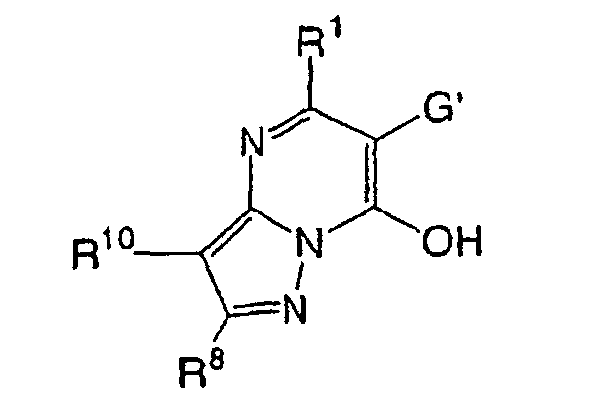 [wherein R1 and G' are as defined above; and L is a halogen atom, a -OR5 group, a -SR5 group or a dialkylamino group (R5 is as defined above)], with a compound of the formula (VIII):
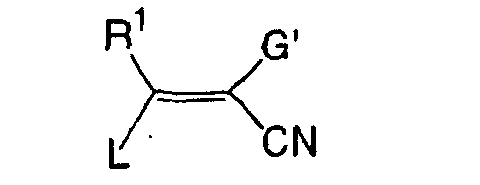 [wherein R8 and R10 are as defined above]. The Preparation Method [B] is in accordance with the Preparation Method 1, and various reaction conditions in the Preparation Method 1 can be applied.
- Among the compounds of the above formula (I') and their salts, compounds of the formula (I'-3) and their salts:[wherein R1, R8, R10 and G are as defined in the above formula (I')], can be produced by reacting the compound of the formula (I'-1) produced by the method as defined in the Preparation Method [A] with a halogenating agent. The Preparation Method [C] is in accordance with the Preparation Method 3, and various reaction conditions in the Preparation Method 3 can be applied.

- Among the compounds of the above formula (I') and their salts, compounds of the formula (I'-4) and their salts:[wherein R1, R8, R10 and G are as defined in the above formula (I'); and R5' is an alkyl group which may be substituted, an alkenyl group which may be substituted, an alkynyl group which may be substituted, a cycloalkyl group which may be substituted, a cycloalkenyl group which may be substituted, an aryl group which may be substituted or a heterocyclic group which may be substituted], can be produced by reacting the compound of the formula (I'-1) produced by the method as defined in the Preparation Method [A] with a compound of the formula (IX) : R5'-L' [wherein R5' is as defined above; and L' is a halogen atom, a methanesulfonyloxy group or a para-toluenesulfonyloxy group]. The Preparation Method [D] is in accordance with the Preparation Method 2, and various reaction conditions in the Preparation Method 2 can be applied.
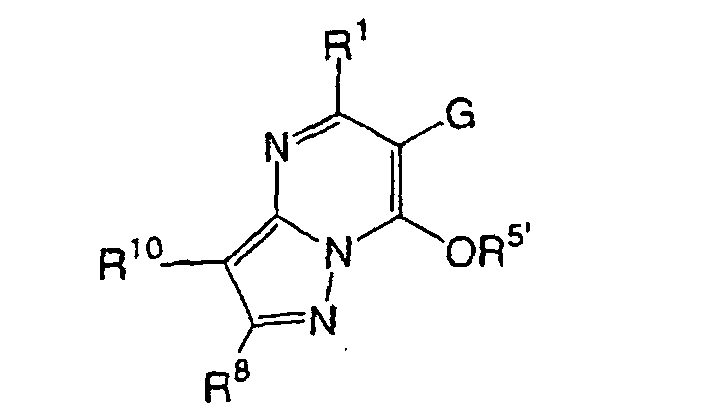
- Among the compounds of the above formula (I') and their salts, compounds of the formula (I'-5) and their salts:[wherein R1, R8, R10 and G are as defined in the above formula (I'); and Q is a substituted amino group], can be produced also by reacting the compound of the formula

(I'-3) produced by the method as defined in the Preparation Method [C] with a compound of the formula (IV-1): H-Q [wherein Q is a substituted amino group]. The Preparation Method [E] is in accordance with the Preparation Method 4, and various reaction conditions in the Preparation Method 4 can be applied. - Further, the compounds of the formula (I'-5) and their salts can be produced also by reacting the compound of the formula (I'-4) produced by the method as defined in the Preparation Method [D] with the compound of the formula (IV-1). The Preparation Method [F] is in accordance with the Preparation Method 4, and various reaction conditions in the Preparation Method 4 can be applied.
- Further, among the compounds of the above formula (I'-5) and their salts, compounds of the formula (I'-5') and their salts:[wherein R1, R8, R10 and Q are as defined in the above formula (I'-5); and G' is as defined in the above formula (I'-2)], can be produced by reacting the compound of the formula (I'-2) produced by the method as defined in the Preparation Method [B] with a compound of the formula

(IV-2): L'-J [wherein J is a substituent of the substituted amino group represented by Q; and L' is a halogen atom, a methanesulfonyloxy group or a para-toluenesulfonyloxy group]. The Preparation Method [G] is in accordance with the Preparation Method 2, and various reaction conditions in the Preparation Method 2 can be applied. - Now, Examples (Preparation Examples and Test Examples) of the present invention will be described, however, the present invention is by no means restricted thereto.
- (1) 10.3 g of bismethylthio methylenepropane dinitrile, 5.0 g of 3-aminopyrazole and 250 ml of ethanol were stirred under reflux with heating for about 6 hours and then cooled to room temperature, and the precipitated crystals were collected by filtration. The collected crystals were washed with ethanol and then dried to obtain 10.9 g of 7-amino-5-methylthiopyrazolo[1,5-a]pyrimidine-6-carbonitrile (compound No. 1) having a melting point of at least 240°C.
- (2) 100 mg of sodium hydride (60%) was added to 500 mg of 7-amino-5-methylthiopyrazolo[1,5-a]pyrimidine-6-carbonitrile and 8 ml of DMF, followed by stirring at room temperature for about 10 minutes, and then 420 mg of benzyl bromide was added thereto, followed by stirring at about 50°C for about 2 hours. After completion of the reaction, the reaction mixture was cooled to room temperature, about 50 ml of water was added thereto, and the precipitated crystals were collected by filtration, washed with water and dried to obtain crude crystals. The crude crystals were purified by silica gel column chromatography to obtain 570 mg of 7-benzylamino-5-methylthiopyrazolo[1,5-a]pyrimidine-6-carbonitrile (compound No. 2) having a melting point of 165°C.
- (1) 3.0 g of 2-cyano-3,3-bismethylthio-2-propenoic acid methyl ester, 1.3 g of 3-aminopyrazole and 20 ml of ethanol were stirred under reflux with heating for about 2.5 hours and then cooled to room temperature, and the precipitated crystals were collected by filtration. The collected crystals were washed with ethanol and then dried to obtain 1.69 g of 7-hydroxy-5-methylthiopyrazolo[1,5-a]pyrimidine-6-carbonitrile (compound No. 49) having a melting point of over 250°C.
- (2) 80 mg of sodium hydride (60%) was added to 400 mg of 7-hydroxy-5-methylthiopyrazolo[1,5-a]pyrimidine-6-carbonitrile and 6 ml of DMF, followed by stirring at room temperature for about 10 minutes, and then 350 mg of benzyl bromide was added thereto, followed by stirring at about 50°C overnight. After completion of the reaction, the reaction mixture was cooled to room temperature, about 50 ml of water was added thereto, and the precipitated crystals were collected by filtration, washed with water and dried to obtain crude crystals. The crude crystals were purified by silica gel column chromatography to obtain 490 mg of 7-benzyloxy-5-methylthiopyrazolo[1,5-a]pyrimidine-6-carbonitrile (compound No. 51) having a melting point of 194°C.
- (1) A mixture comprising 2.15 g of 7-hydroxy-5-methylthiopyrazolo[1,5-a]pyrimidine-6-carbonitrile (compound No. 49), 1.3 g of N,N-dimethylaniline and 5 ml of phosphorus oxychloride was stirred under reflux with heating for about 3 hours. After the completion of the reaction, the reaction mixture was cooled to room temperature, and poured into ice water, followed by stirring. The precipitated crystals were collected by filtration, washed with water and dried to obtain crude crystals. The crude crystals were purified by silica gel column chromatography to obtain 2.17 g of 7-chloro-5-methylthiopyrazolo[1,5-a]pyrimidine-6-carbonitrile (compound No. 62) having a melting point of from 201 to 202°C.
- (2) A mixture comprising 460 mg of 4-picolylamine, 430 mg of triethylamine and 1 ml of acetonitrile was dropwise added to 950 mg of 7-chloro-5-methylthiopyrazolo[1,5-a]pyrimidine-6-carbonitrile and 20 ml of acetonitrile under cooling with ice, followed by stirring for about 1 hour. After completion of the reaction, about 80 ml of water was added thereto, and the precipitated crystals were collected by filtration, washed with water and dried to obtain crude crystals. The crude crystals were purified by silica gel column chromatography to obtain 970 mg of 7-(4-pyridylmethyl)amino-5-methylthiopyrazolo[1,5-a]pyrimidine-6-carbonitrile (compound No. 3) having a melting point of from 153 to 154°C.
- 200 mg of 7-chloro-5-methylthiopyrazolo[1,5-a]pyrimidine-6-carbonitrile (compound No. 62) and 100 mg of furfurylamine were reacted in 5 ml of THF in the presence of 110 mg of triethylamine for about 30 minutes, then about 30 ml of water was added thereto, and the precipitated crystals were collected by filtration, washed with water and dried to obtain crude crystals. The crude crystals were washed with ether to obtain 180 mg of 7-furfurylamino-5-methylthiopyrazolo[1,5-a]pyrimidine-6-carbonitrile (compound No. 78) having a melting point of 110°C.
- Compounds of the above formula (I) produced in Preparation Examples 1 to 4 and by methods in accordance with the above Preparation Methods 1 to 5 are shown in the following Tables 1 to 26.

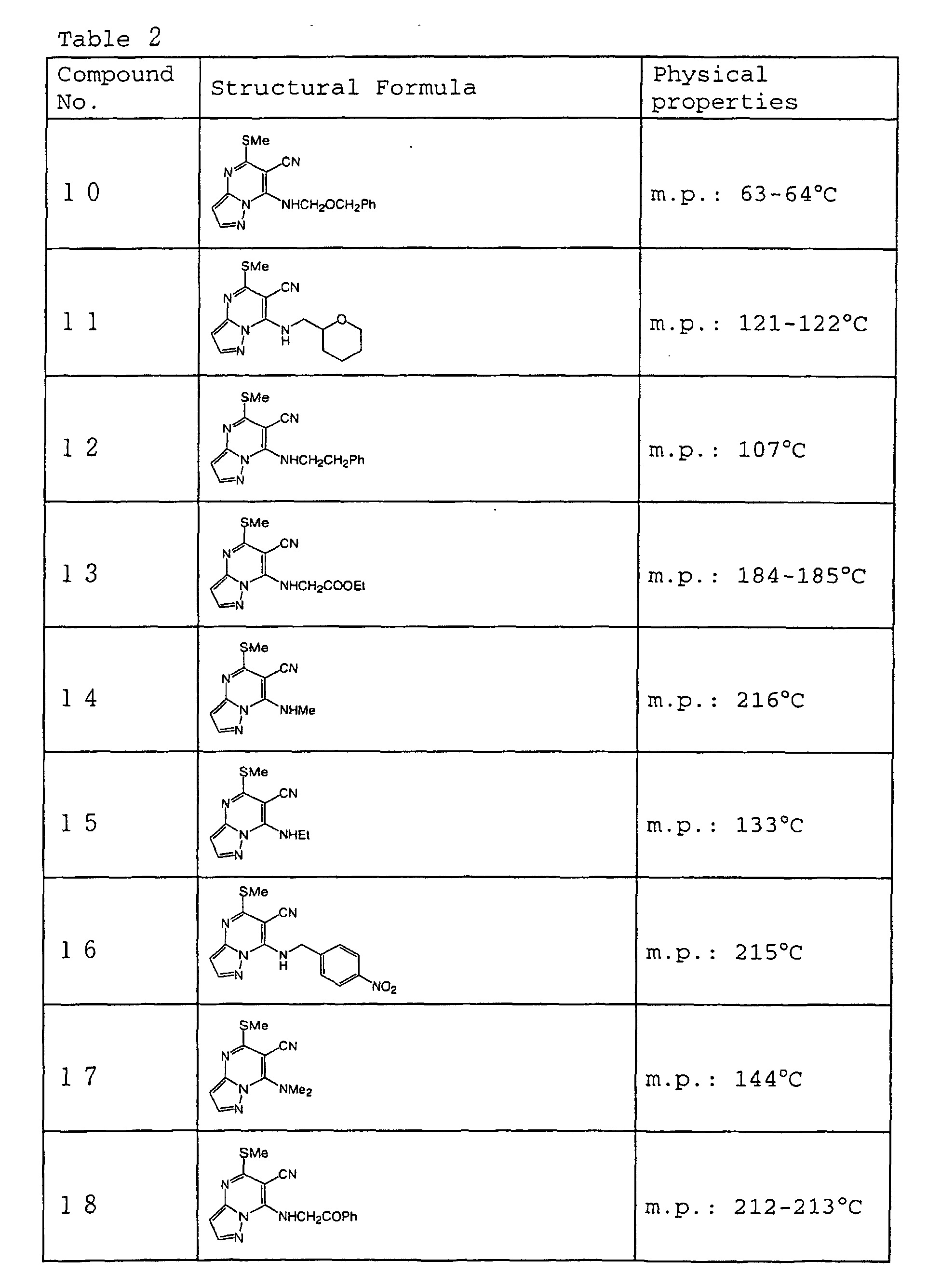

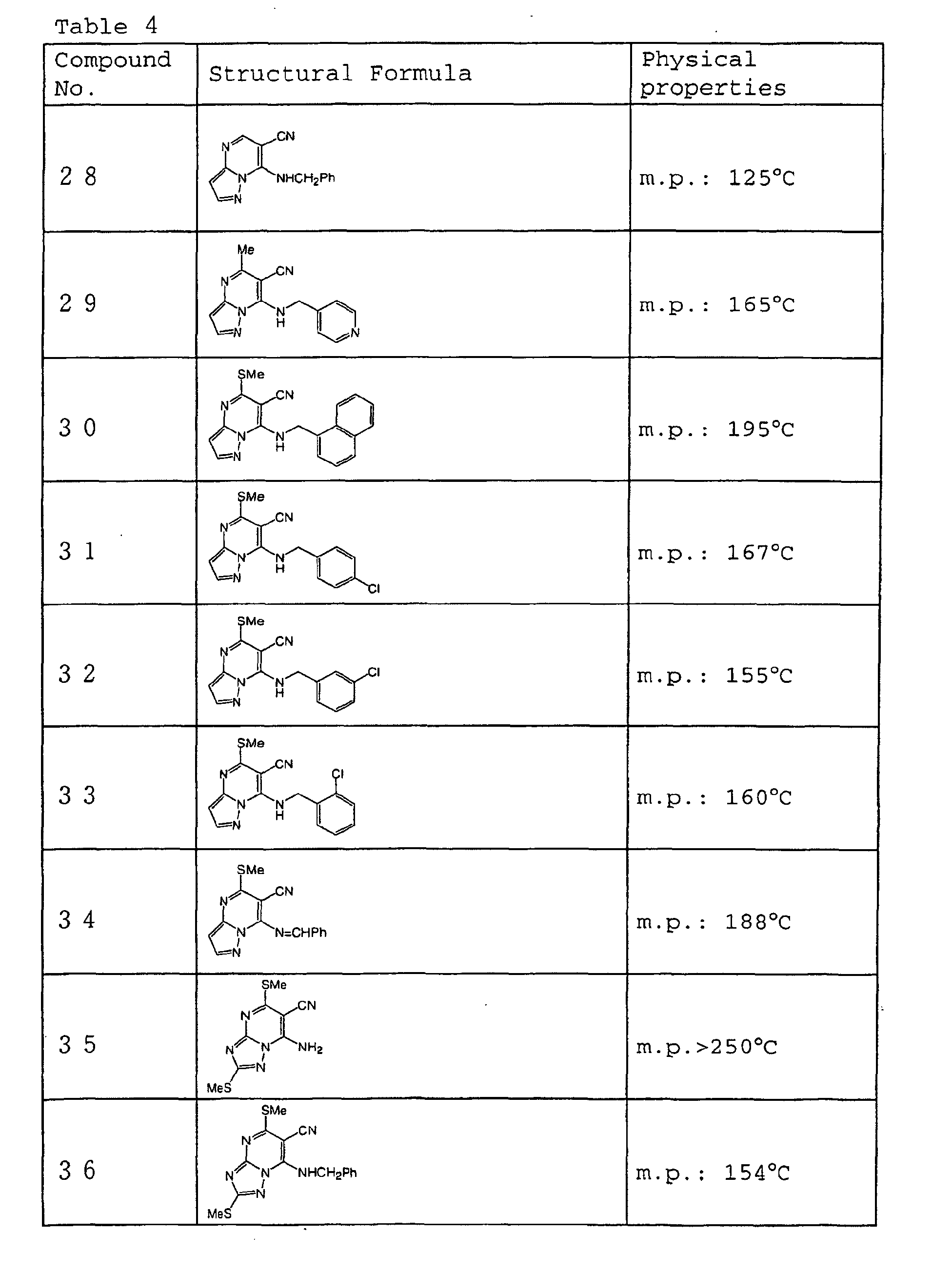


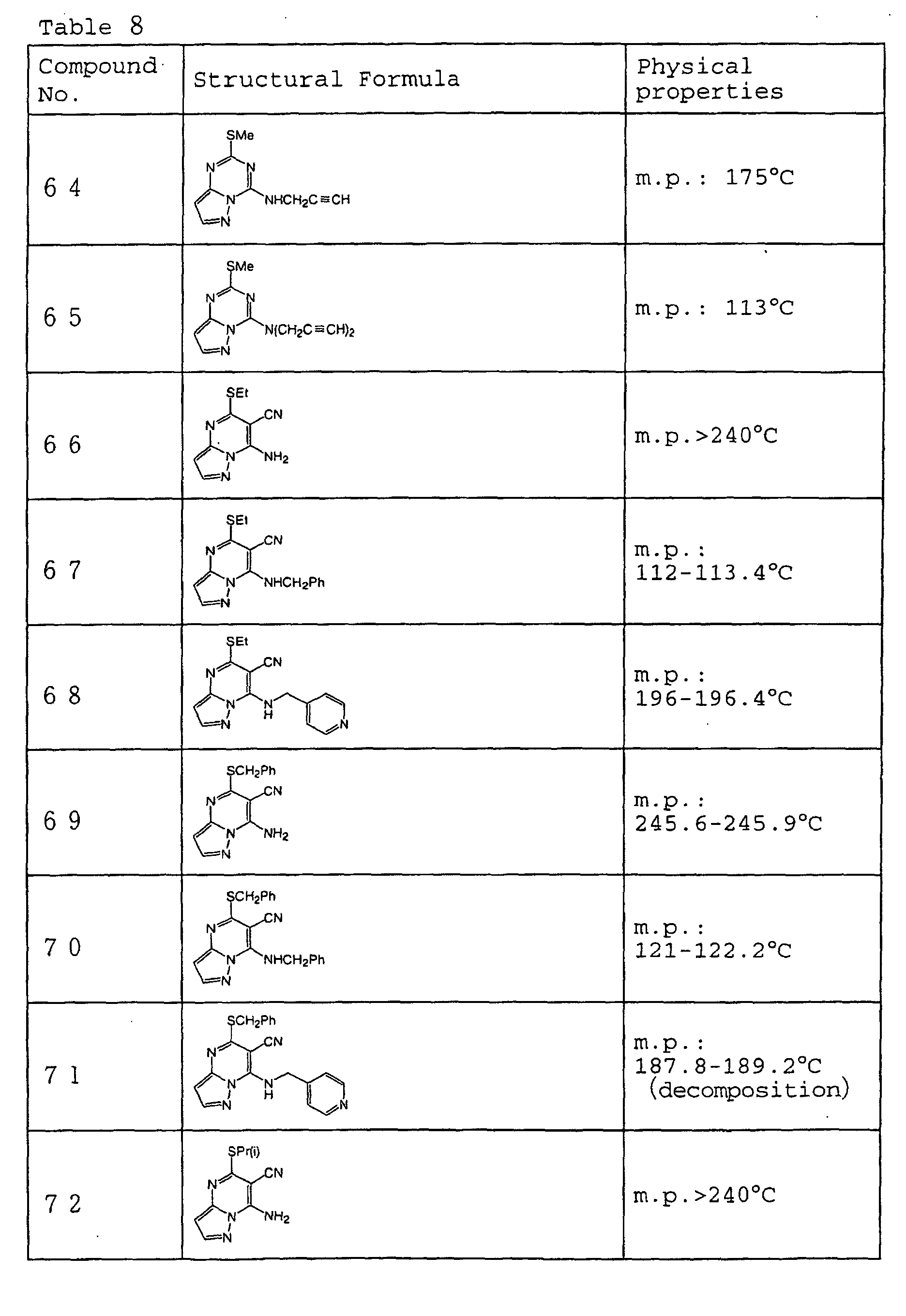
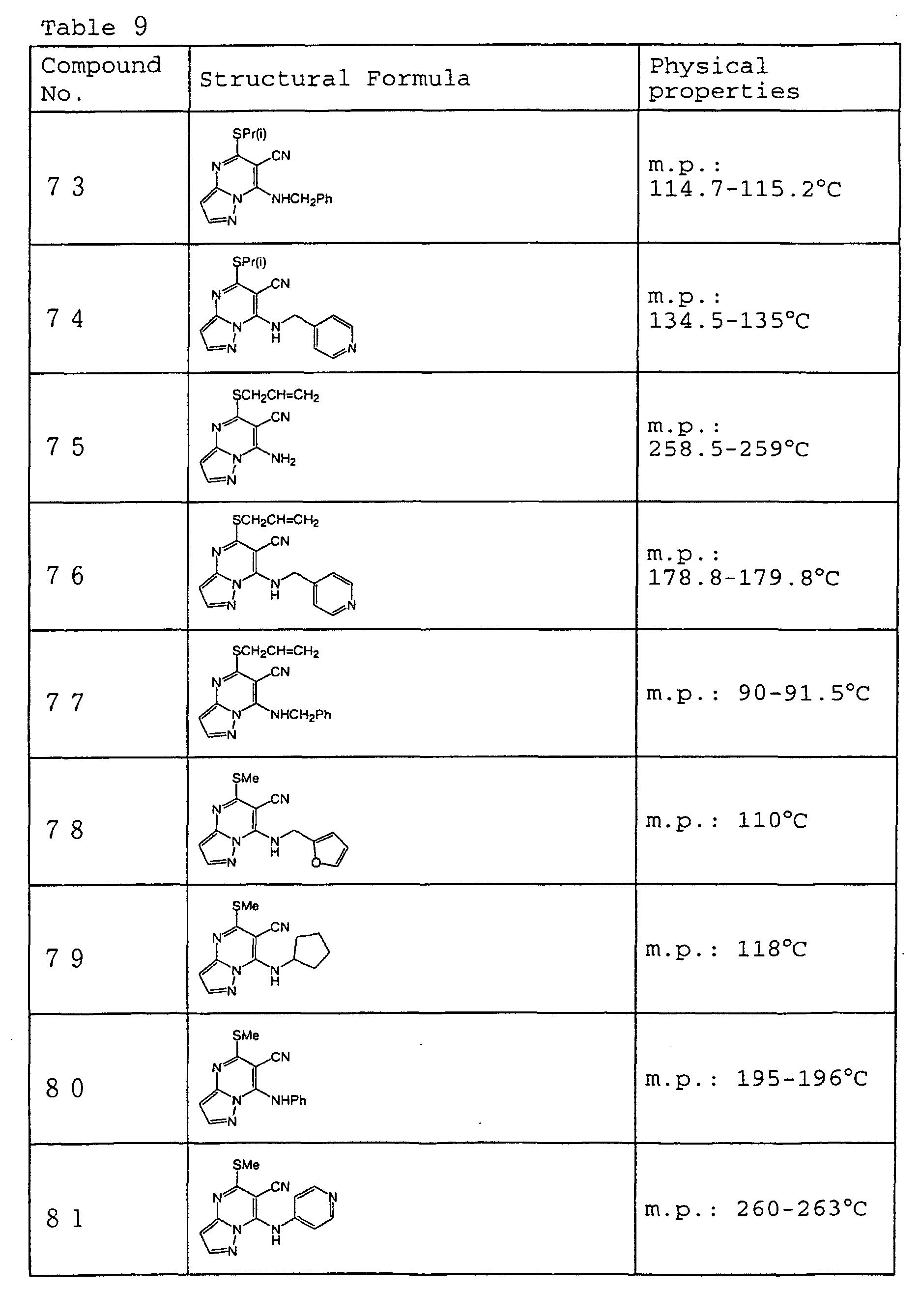
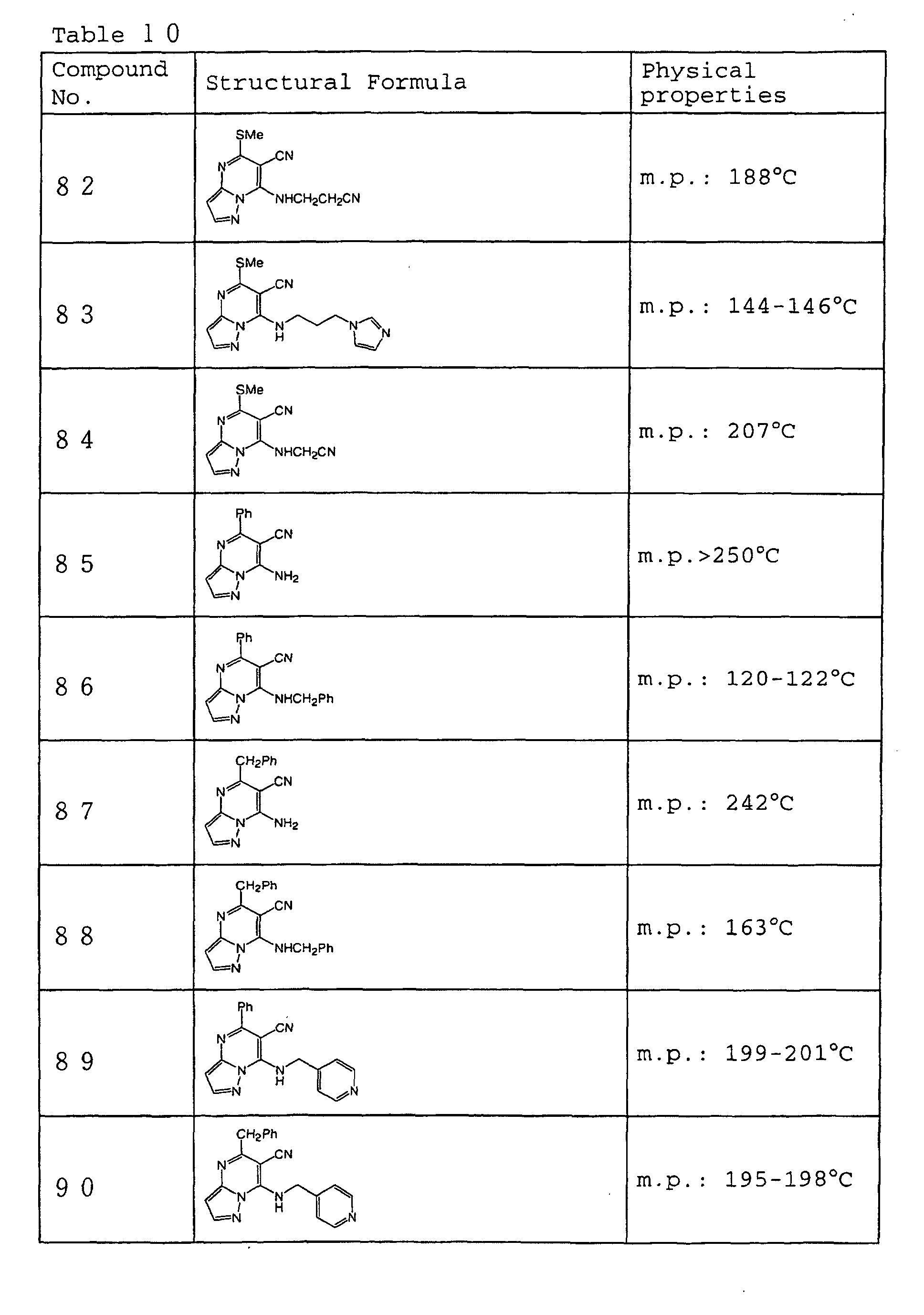

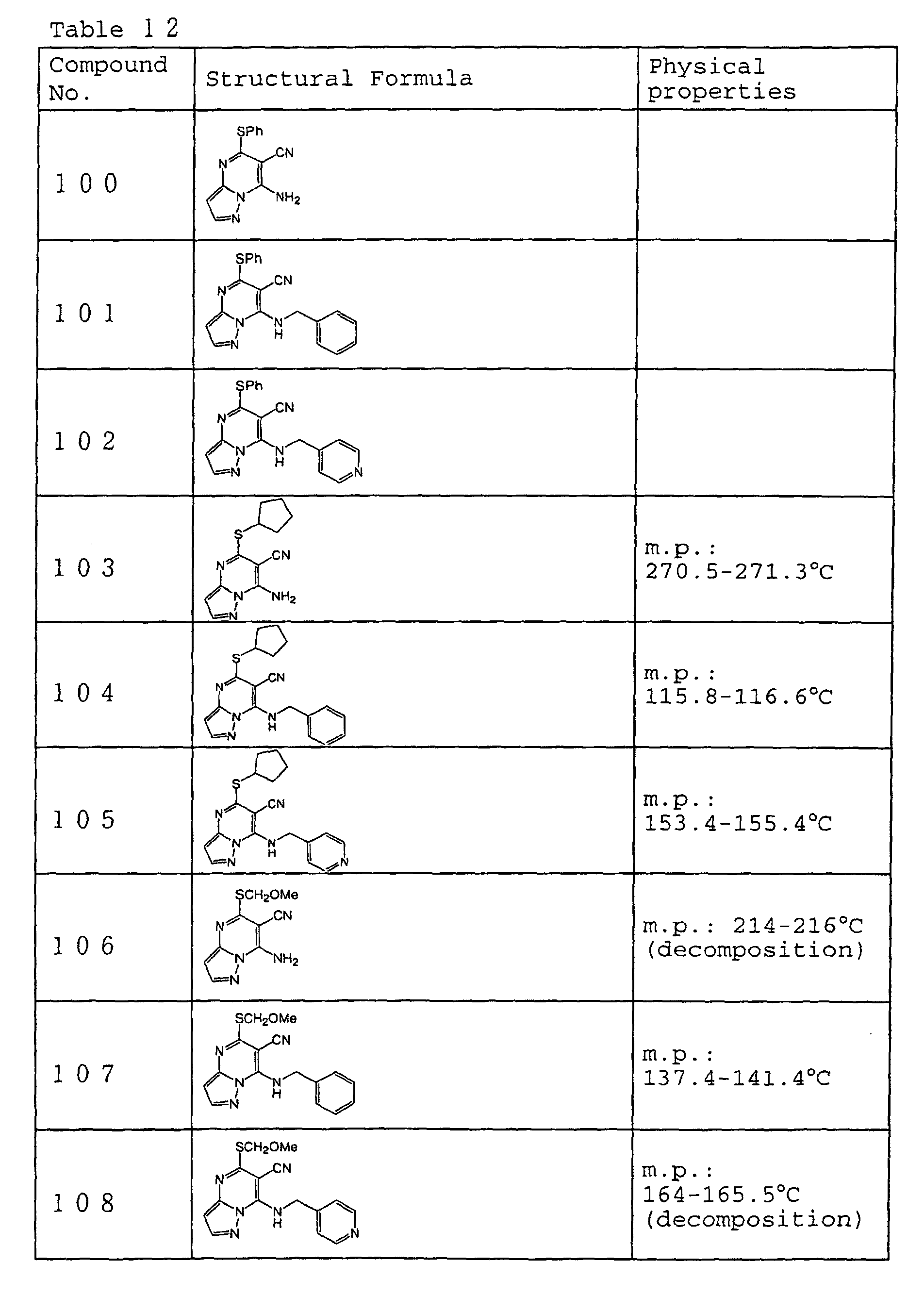
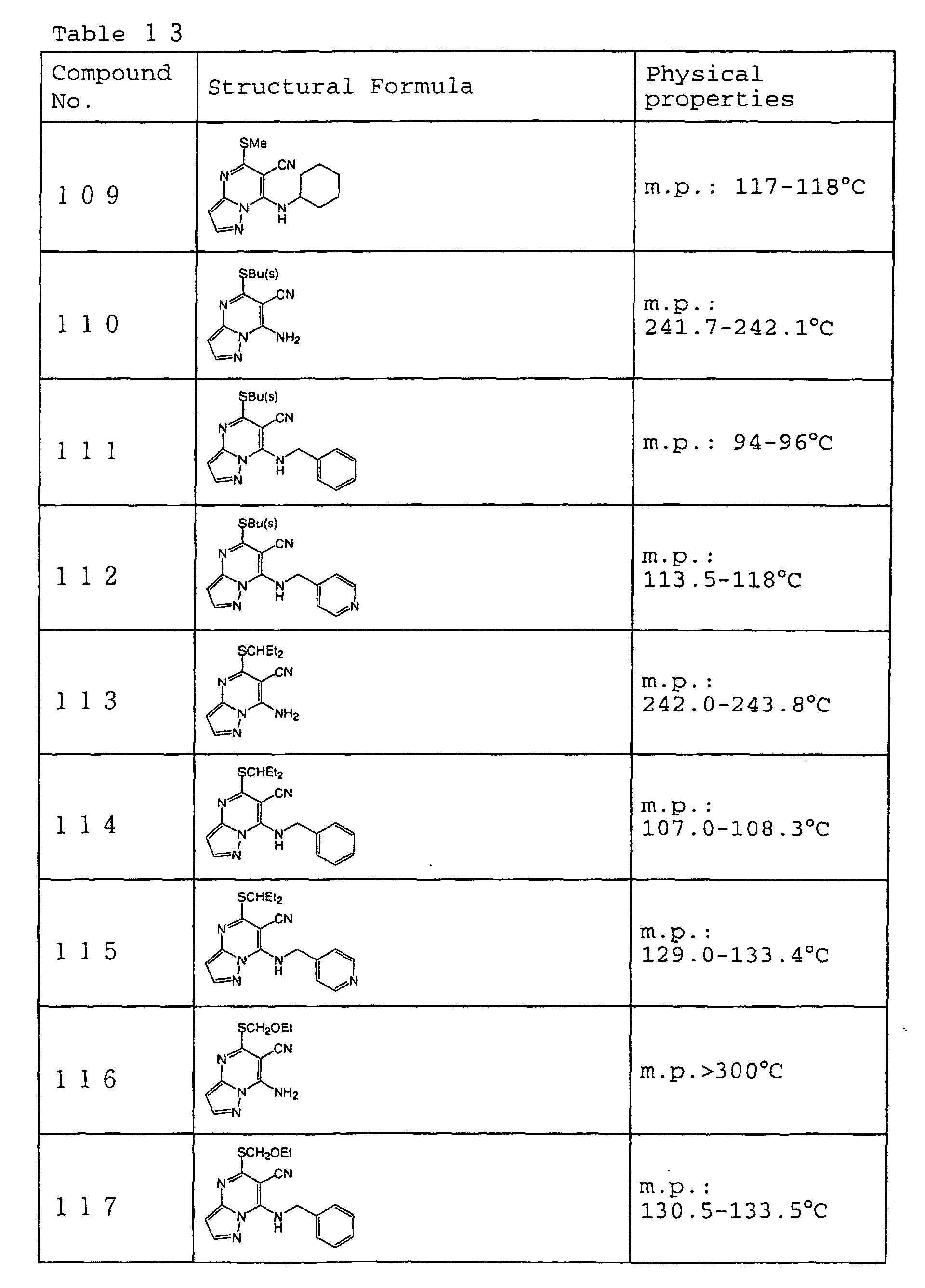

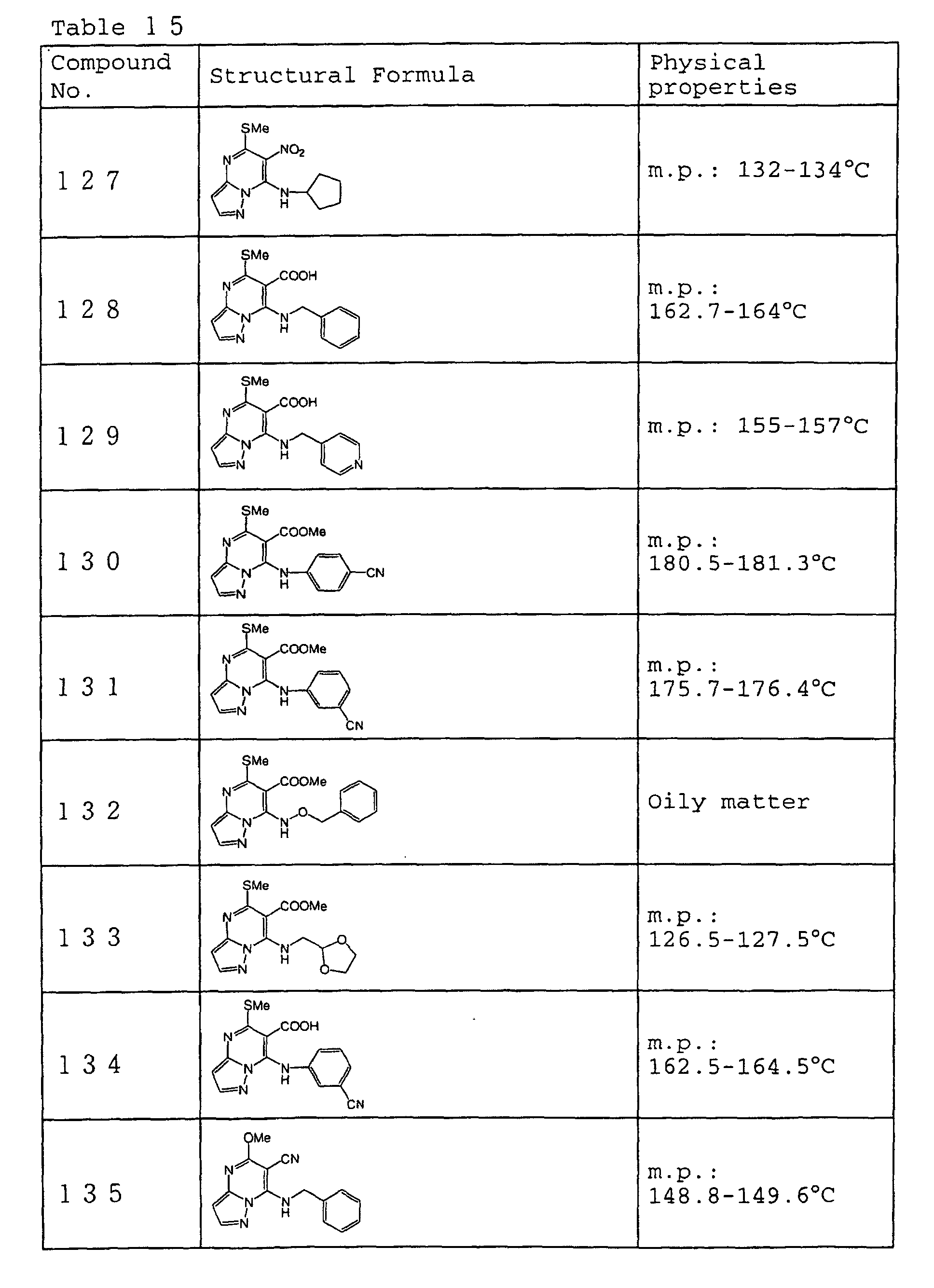


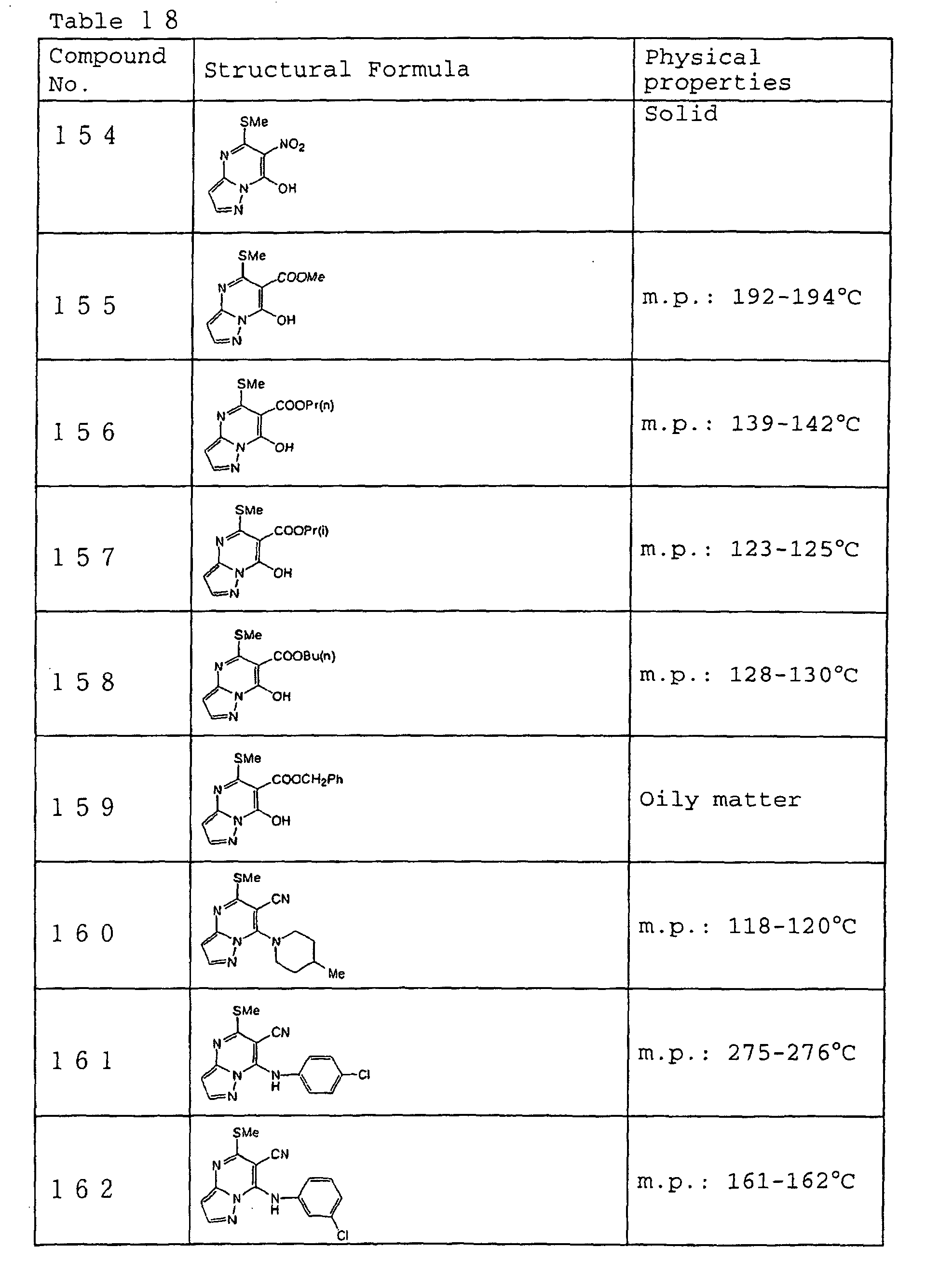


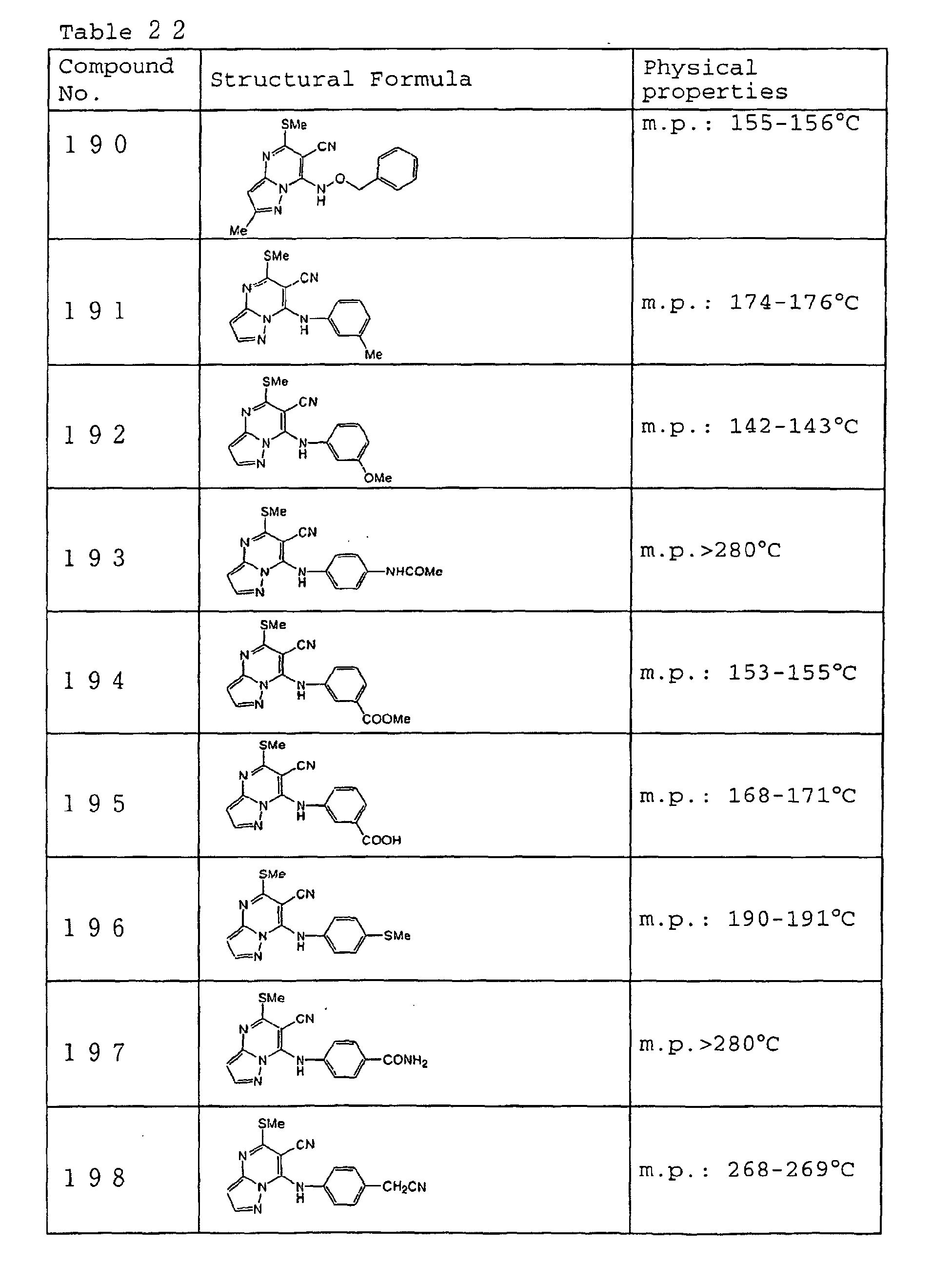


- Each of compounds under test was applied to L6 cells (rat cells originally derived from skeletal muscles) by the following method to measure the stimulating effect on glucose uptake. Namely, L6 cells were suspended in α-minimum essential medium (hereinafter referred to simply as MEM) containing 10% fetal bovine serum (hereinafter referred to simply as FBS), and inoculated into a 96-well plastic plate in an amount of 5×10⁴ cells/well and cultivated in an incubator (5% carbon dioxide gas, 37°C ) until the cells grew all over the well. Then, the culture medium was switched to MEM solution containing 2% FBS, followed by cultivation further for from 7 to 10 days (the culture medium was exchanged every three days) to differentiate the cells into skeletal muscle cells.
Then, the culture medium was replaced with MEM solution without FBS, followed by cultivation for three hours, and then the compound under test prepared to a treatment concentration (diluted with MEM solution without FBS) was reacted with the skeletal muscle cells at 37°C for 1 hour. The cells were washed with Krebs-Henseleit-Ringer buffer solution (hereinafter referred to simply as KHR buffer solution), and 2-deoxy-[3H]-glucose was added to the cells in the KHR buffer solution, followed by treatment at 37°C for 10 minutes. The treatment solution was removed, the cells were washed with the KHR buffer solution, then the cells were dissolved in a 1N sodium hydroxide solution in an appropriate amount, and the [3H] radio activity was measured by means of a liquid scintillation counter (cpm). The percentage of the glucose uptake was represented by the percentage of radio activity when the compound under test was applied, taking the radio activity of the control (the MEM solvent alone was applied) as 100%. Each of the compounds as identified in Table 27 was used for treatment at a concentration of each of 10 µg/ml and 100 µg/ml to examine the stimulating effect on glucose uptake. As a result, it was confirmed that all the tested compounds showed stimulating effects on glucose uptake of at least 115% at least within a range of from 10 µg/ml to 100 µg/ml.Treatment concentration (µg/ml) Compound No. Ratio activity (%) activity 10 2, 3, 9, 11, 22, 40, 43, 50, 60, 64, 68, 71, 72, 74, 79, 80, 82, 105, 112, 118, 120, 121, 122, 126, 131, 133, 135, 136, 138, 144, 161, 163, 164, 168, 172, 178, 186, 191, 200, 203, 205, 206, 210, 211, 215, 218, 221, 222, 223, 224, 225, 226 >115 100 2, 3, 4, 5, 8, 9, 14, 15, 17, 22, 25 27, 28, 29, 40, 43, 46, 47, 48, 50, 53, 68, 71, 83, 108, 118, 121, 122, 130, 131, 132, 135, 136, 144, 168, 172, 174, 177, 178, 186, 190, 200, 210, 211, 218, 221, 223, 226 >115 - Using KK-Ay/Ta mice (purchased from CLEA Japan, Inc.) as spontaneous diabetic type II, the hypoglycemic effect of each of compounds under test was confirmed by the following method.
- Male KK-Ay/Ta mice sufficiently preliminarily bred and acclimatized were classified into groups, each consisting of six mice, and each of the compounds under test was administered. Each of the compounds under test was suspended in 0.5% carboxymethyl cellulose (manufactured by Nacalai Tesque), and each compound was orally administered singly in a dose of 50 mg/kg (10 ml/kg) by means of an oral conductor. At the same time, as a group of vehicle control, 0.5% carboxymethyl cellulose was administered in the same volume (10 ml/kg) as for the group of administration of compound under test.
- Collection of blood was carried out by the following method before the administration of each of the compounds under test or the vehicle, and at the time as identified in Table 28 after the administration. The tail vein of each mouse was shallowly cut by the edge of a razor to cause bleeding in an amount of blood of from 10 to 20 µL, and the blood was collected by a micropipet. The collected blood samples were immediately mixed with a heparin solution (20 U/ml) (manufactured by Mochida Yakuhin) in the same amount as the respective collected blood samples, and subjected to centrifugation at 4°C for 5 minutes (10,000 rpm) by means of a cooling centrifugal machine. The plasma after the centrifugation was obtained as a sample for blood glucose level measurement.
- The blood glucose level was measured by means of glucose oxidase method, and measured by using a commercially available assay kit (Glucose CII TEST WAKO, manufactured by Wako Pure Chemical Industries, Ltd.). Measurement was carried out on the day after the collection of blood, and the obtained plasma was stored at -20°C before the measurement.
- The blood glucose level at the time of collection of blood was calculated as the percentage to the blood glucose level before administration of the compound under test, and the hypoglycemic effect of the compound under test was evaluated by comparison with the change of the blood glucose level (percentage) of the group of vehicle control at the time of collection of blood. The results are shown in Table 28. The evaluation results of the hypoglycemic effect are considered to have a significant difference compared with the vehicle control by means of Wilcoxon's rank sum test (P≦0.05).
Compound under test Time for collection of blood Rate of change of blood glucose level Rate of change of blood glucose level of vehicle control Compd. No. 3 After 3 hours 78% 93% Compd. No. 8 After 6 hours 68% 88% Compd. No. 50 After 3 hours 74% 96% Compd. No. 186 After 3 hours 80% 96% Compd. No. 200 After 3 hours 79% 96% - The preventive or therapeutic medicines for diabetes of the present invention show stimulating effect on glucose uptake by application to skeletal muscle cells only for a short time, and accordingly they are useful as preventive or therapeutic medicines particularly for diabetes; impaired glucose tolerance; various diabetic complications such as hyperlipidemia, vascular diseases, retinopathy, nephropathy, neuropathy and hypertension; and obesity.
Claims (21)
- A preventive or therapeutic medicine for diabetes containing as an active ingredient a fused-heterocyclic compound of the formula (I) or its salt:[wherein A is a nitrogen atom or C-G {wherein G is CN, NO2, SO2R3 (wherein R3 is an alkyl group which may be substituted, an alkenyl group which may be substituted, an alkynyl group which may be substituted, a cycloalkyl group which may be substituted, a cycloalkenyl group which may be substituted, an aryl group which may be substituted or a heterocyclic group which may be substituted), CO2R4 (wherein R4 is a hydrogen atom, an alkyl group which may be substituted, an alkenyl group which may be substituted, an alkynyl group which may be substituted, a cycloalkyl group which may be substituted, a cycloalkenyl group which may be substituted, an aryl group which may be substituted or a heterocyclic group which may be substituted), CHO, SO2NRaRb (wherein each of Ra and Rb which are independent of each other, is a hydrogen atom, a hydroxyl group, an alkoxy group, an alkyl group which may be substituted, an alkenyl group which may be substituted, an alkynyl group which may be substituted, a cycloalkyl group which may be substituted, a cycloalkenyl group which may be substituted, an aryl group which may be substituted or a heterocyclic group which may be substituted, or Ra and Rb together form a ring) or CONRaRb (wherein Ra and Rb are as defined above)};

each of R1 and R2 which are independent of each other, is a hydrogen atom, a halogen atom, an alkyl group which may be substituted, an alkenyl group which may be substituted, an alkynyl group which may be substituted, a cycloalkyl group which may be substituted, a cycloalkenyl group which may be substituted, an aryl group which may be substituted, a heterocyclic group which may be substituted, a -B1-R5 group (wherein B1 is CO, COO, O, OCO, OSO2, S, SO or SO2, and R5 is a hydrogen atom, an alkyl group which may be substituted, an alkenyl group which may be substituted, an alkynyl group which may be substituted, a cycloalkyl group which may be substituted, a cycloalkenyl group which may be substituted, an aryl group which may be substituted or a heterocyclic group which may be substituted), an amino group which may be substituted or -N=CR6R7 (wherein each of R6 and R7 which are independent of each other, is a hydrogen atom, an alkyl group which may be substituted, an alkenyl group which may be substituted, an alkynyl group which may be substituted, a cycloalkyl group which may be substituted, a cycloalkenyl group which may be substituted, an aryl group which may be substituted or a heterocyclic group which may be substituted;
each of Y and Z which are independent of each other, is a nitrogen atom or C-R8 {wherein R8 is a hydrogen atom, a halogen atom, an alkyl group which may be substituted, an alkenyl group which may be substituted, an alkynyl group which may be substituted, a cycloalkyl group which may be substituted, a cycloalkenyl group which may be substituted, an aryl group which may be substituted, a heterocyclic group which may be substituted, a -B2-R9 group (wherein B2 is CO, COO, O, OCO, OSO2, S, SO or SO2, and R9 is a hydrogen atom, an alkyl group which may be substituted, an alkenyl group which may be substituted, an alkynyl group which may be substituted, a cycloalkyl group which may be substituted, a cycloalkenyl group which may be substituted, an aryl group which may be substituted or a heterocyclic group which may be substituted), an amino group which may be substituted, a cyano group or a nitro group}, provided that when Y and Z are simultaneously C-R8, the two R8's may be the same or different;
X is a nitrogen atom or C-R10 {wherein R10 is a hydrogen atom, a halogen atom, an alkyl group which may be substituted, an alkenyl group which may be substituted, an alkynyl group which may be substituted, a cycloalkyl group which may be substituted, a cycloalkenyl group which may be substituted, a -B2-R9 group (wherein B2 and R9 are as defined above), an amino group which may be substituted, a cyano group or a nitro group}; and
in a case where Y is C-R8, and X is C-R10 or Z is C-R8, R8 and R10 or two R8's together may form a ring containing or not containing a hetero atom]. - The preventive or therapeutic medicine for diabetes according to Claim 1, wherein A is C-G {wherein G is CN, NO2, CO2R4 (wherein R4 is a hydrogen atom, an alkyl group which may be substituted, an alkenyl group which may be substituted, an alkynyl group which may be substituted, a cycloalkyl group which may be substituted, a cycloalkenyl group which may be substituted, an aryl group which may be substituted or a heterocyclic group which may be substituted), CHO, SO2NRaRb (wherein each of Ra and Rb which are independent of each other, is a hydrogen atom, a hydroxyl group, an alkoxy group, an alkyl group which may be substituted, an alkenyl group which may be substituted, an alkynyl group which may be substituted, a cycloalkyl group which may be substituted, a cycloalkenyl group which may be substituted, an aryl group which may be substituted or a heterocyclic group which may be substituted, or Ra and Rb together form a ring) or CONRaRb (wherein Ra and Rb are as defined above)};
each of Y and Z which are independent of each other, is a nitrogen atom or C-R8 {wherein R8 is a hydrogen atom, a halogen atom, an alkyl group which may be substituted, an alkenyl group which may be substituted, an alkynyl group which may be substituted, a cycloalkyl group which may be substituted, a cycloalkenyl group which may be substituted, an aryl group which may be substituted, a heterocyclic group which may be substituted, a -B2-R9 group (wherein B2 is CO, COO, O, OCO, OSO2, S, SO or SO2, and R9 is a hydrogen atom, an alkyl group which may be substituted, an alkenyl group which may be substituted, an alkynyl group which may be substituted, a cycloalkyl group which may be substituted, a cycloalkenyl group which may be substituted, an aryl group which may be substituted or a heterocyclic group which may be substituted), an amino group which may be substituted, a cyano group or a nitro group}, provided that when Y and Z are simultaneously C-R8, the two R8's may be the same or different; and
X is a nitrogen atom or C-R10 {wherein R10 is a hydrogen atom, a halogen atom, an alkyl group which may be substituted, an alkenyl group which may be substituted, an alkynyl group which may be substituted, a cycloalkyl group which may be substituted, a cycloalkenyl group which may be substituted, a -B2-R9 group (wherein B2 and R9 are as defined above), an amino group which may be substituted, a cyano group or a nitro group}. - The preventive or therapeutic medicine for diabetes according to Claim 1, wherein each of R1 and R2 which are independent of each other, is a halogen atom, an alkyl group which may be substituted, an alkenyl group which may be substituted, an alkynyl group which may be substituted, a cycloalkyl group which may be substituted, a cycloalkenyl group which may be substituted, an aryl group which may be substituted, a heterocyclic group which may be substituted, a -B1'-R5 group (wherein B1' is O or S, and R5 is a hydrogen atom, an alkyl group which may be substituted, an alkenyl group which may be substituted, an alkynyl group which may be substituted, a cycloalkyl group which may be substituted, a cycloalkenyl group which may be substituted, an aryl group which may be substituted or a heterocyclic group which may be substituted), an amino group which may be substituted or -N=CR6R7 (wherein each of R6 and R7 which are independent of each other, is a hydrogen atom, an alkyl group which may be substituted, an alkenyl group which may be substituted, an alkynyl group which may be substituted, a cycloalkyl group which may be substituted, a cycloalkenyl group which may be substituted, an aryl group which may be substituted or a heterocyclic group which may be substituted); and
each of Y and Z which are independent of each other, is a nitrogen atom or C-R8 {wherein R8 is a hydrogen atom, a halogen atom, an alkyl group which may be substituted, an alkenyl group which may be substituted, an alkynyl group which may be substituted, a cycloalkyl group which may be substituted, a cycloalkenyl group which may be substituted, an aryl group which may be substituted, a heterocyclic group which may be substituted, a -B2'-R9 group (B2' is CO, COO, O, OCO or S, and R9 is a hydrogen atom, an alkyl group which may be substituted, an alkenyl group which may be substituted, an alkynyl group which may be substituted, a cycloalkyl group which may be substituted, a cycloalkenyl group which may be substituted, an aryl group which may be substituted or a heterocyclic group which may be substituted), an amino group which may be substituted, a cyano group or a nitro group}. - A stimulator of glucose uptake in skeletal muscle cells, which contains the compound or its salt as defined in Claim 1 as an active ingredient.
- A hypoglycemic agent which contains the compound or its salt as defined in Claim 1 as an active ingredient.
- A preventive or therapeutic medicine for impaired glucose tolerance, which contains the compound or its salt as defined in Claim 1 as an active ingredient.
- A preventive or therapeutic medicine for diabetic complications, which contains the compound or its salt as defined in Claim 1 as an active ingredient.
- The preventive or therapeutic medicine for diabetic complications according to Claim 7, wherein the diabetic complication is at least one member selected from the group consisting of hyperlipidemia, vascular diseases, retinopathy, nephropathy, neuropathy and hypertension.
- A preventive or therapeutic medicine for obesity, which contains the compound or its salt as defined in Claim 1 as an active ingredient.
- A fused-heterocyclic compound of the formula (I') or its salt:[wherein G is CN, NO2, CO2R4 (wherein R4 is a hydrogen atom, an alkyl group which may be substituted, an alkenyl group which may be substituted, an alkynyl group which may be substituted, a cycloalkyl group which may be substituted, a cycloalkenyl group which may be substituted, an aryl group which may be substituted or a heterocyclic group which may be substituted), CHO, SO2NRaRb (wherein each of Ra and Rb which are independent of each other, is a hydrogen atom, a hydroxyl group, an alkoxy group, an alkyl group which may be substituted, an alkenyl group which may be substituted, an alkynyl group which may be substituted, a cycloalkyl group which may be substituted, a cycloalkenyl group which may be substituted, an aryl group which may be substituted or a heterocyclic group which may be substituted, or Ra and Rb together form a ring) or CONRaRb (wherein Ra and Rb are as defined above);

R1 is a halogen atom, a -O-R5 group (wherein R5 is a hydrogen atom, an alkyl group which may be substituted, an alkenyl group which may be substituted, an alkynyl group which may be substituted, a cycloalkyl group which may be substituted, a cycloalkenyl group which may be substituted, an aryl group which may be substituted or a heterocyclic group which may be substituted) or a -S-R5 group (wherein R5 is as defined above);
R2 is a halogen atom, a -O-R5 group (wherein R5 is as defined above) or an amino group which may be substituted; and
each of R8 and R10 which are independent of each other, is a hydrogen atom, a halogen atom or an alkyl group]. - The compound or its salt according to Claim 10, wherein R2 is an amino group which may be substituted.
- The compound or its salt according to Claim 10, wherein R2 is an amino group which may be substituted, and each of R8 and R10 is a hydrogen atom.
- The compound or its salt according to Claim 12, wherein the amino group which may be substituted represented by R2 is a -NRcRd group (wherein each of Rc and Rd which are independent of each other, is a hydrogen atom, a -O-R5 group (wherein R5 is a hydrogen atom, an alkyl group which may be substituted, an alkenyl group which may be substituted, an alkynyl group which may be substituted, a cycloalkyl group which may be substituted, a cycloalkenyl group which may be substituted, an aryl group which may be substituted or a heterocyclic group which may be substituted), an alkyl group which may be substituted, an alkenyl group which may be substituted, an alkynyl group which may be substituted, a cycloalkyl group which may be substituted, a cycloalkenyl group which may be substituted, an aryl group which may be substituted or a heterocyclic group which may be substituted, or Rc and Rd together form a ring).
- The compound or its salt according to Claim 10, wherein G is CN, CO2R4 (wherein R4 is a hydrogen atom, an alkyl group which may be substituted, an alkenyl group which may be substituted, an alkynyl group which may be substituted, a cycloalkyl group which may be substituted, a cycloalkenyl group which may be substituted, an aryl group which may be substituted or a heterocyclic group which may be substituted), CHO, SO2NRaRb (wherein each of Ra and Rb which are independent of each other, is a hydrogen atom, a hydroxyl group, an alkoxy group, an alkyl group which may be substituted, an alkenyl group which may be substituted, an alkynyl group which may be substituted, a cycloalkyl group which may be substituted, a cycloalkenyl group which may be substituted or a heterocyclic group which may be substituted, or Ra and Rb together form a ring) or CONRa'Rb' (wherein each of Ra' and Rb' which are independent of each other, is a hydroxyl group, an alkoxy group, an alkyl group which may be substituted, an alkenyl group which may be substituted, an alkynyl group which may be substituted, a cycloalkyl group which may be substituted, a cycloalkenyl group which may be substituted, an aryl group which may be substituted or a heterocyclic group which may be substituted, or Ra' and Rb' together may form a ring).
- A pharmaceutical composition which contains the compound or its salt as defined in Claim 10 as an active ingredient.
- A method for producing a fused-heterocyclic compound of the formula (I'-1) or its salt:[wherein R1, R8, R10 and G are as defined in Claim 10], which comprises reacting a compound of the formula (VII) :
 [wherein R1 and G are as defined above; D is an alkoxycarbonyl group; L is a halogen atom, a -OR5 group, a -SR5 group or a dialkylamino group (wherein R5 is as defined in Claim 10)] with a compound of the formula (VIII):
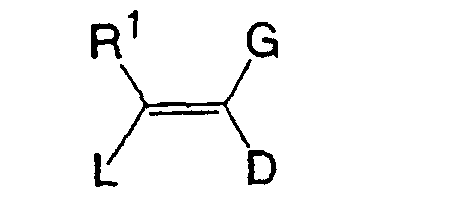 [wherein R8 and R10 are as defined above].
- A method for producing a fused-heterocyclic compound of the formula (I'-2) or its salt:[wherein R1, R8 and R10 are as defined in Claim 10, G' is CN, NO2, SO2NRaRb (wherein Ra and Rb are as defined in Claim 10) or CONRaRb (wherein Ra and Rb are as defined above)], which comprises reacting a compound of the formula (VII'):
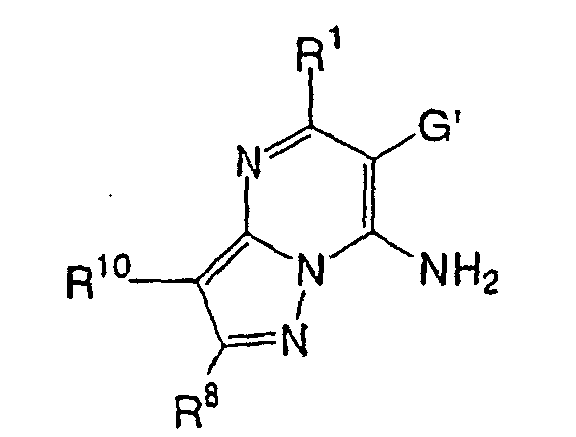 [wherein R1 and G' are as defined above, and L is a halogen atom, a -OR5 group, a -SR5 group or a dialkylamino group (wherein R5 is as defined above)] with a compound of the formula (VIII):
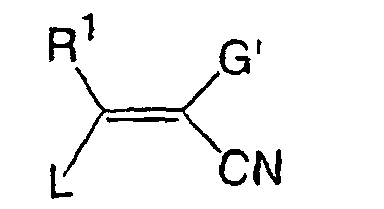 [wherein R8 and R10 are as defined above].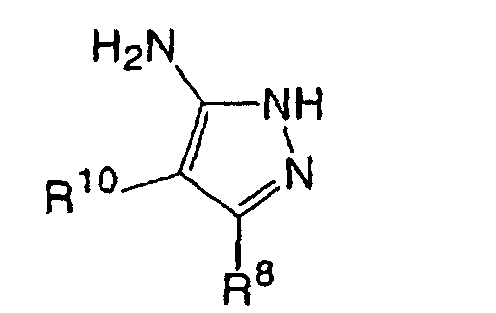
- A method for producing a fused-heterocyclic compound of the formula (I'-3) or its salt:[wherein R1, R8, R10 and G are as defined in Claim 10, and Hal is a halogen atom], which comprises reacting the compound of the formula (I'-1) produced by the method as defined in Claim 16, with a halogenating agent.

- A method for producing a fused-heterocyclic compound of the formula (I'-4) or its salt:[wherein R1, R8, R10 and G are as defined in Claim 10; and R5' is an alkyl group which may be substituted, an alkenyl group which may be substituted, an alkynyl group which may be substituted, a cycloalkyl group which may be substituted, a cycloalkenyl group which may be substituted, an aryl group which may be substituted or a heterocyclic group which may be substituted], which comprises reacting the compound of the formula (I'-1) produced by the method as defined in Claim 16, with a compound of the formula (IX):
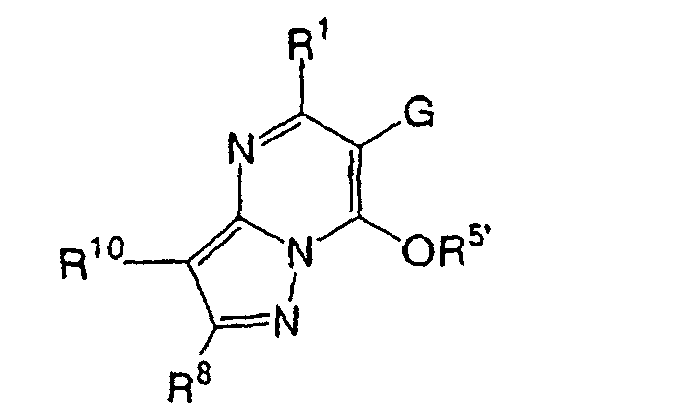
R5' -L'
[wherein R5' is as defined above; and L' is a halogen atom, a methanesulfonyloxy group or a para-toluenesulfonyloxy group]. - A method for producing a fused-heterocyclic compound of the formula (I'-5) or its salt:[wherein R1, R8, R10 and G are as defined in Claim 10; and Q is a substituted amino group], which comprises (1) reacting the compound of the formula (I'-3) produced by the method as defined in Claim 18 with a compound of the formula (IV-1): H-Q [wherein Q is as defined above], or
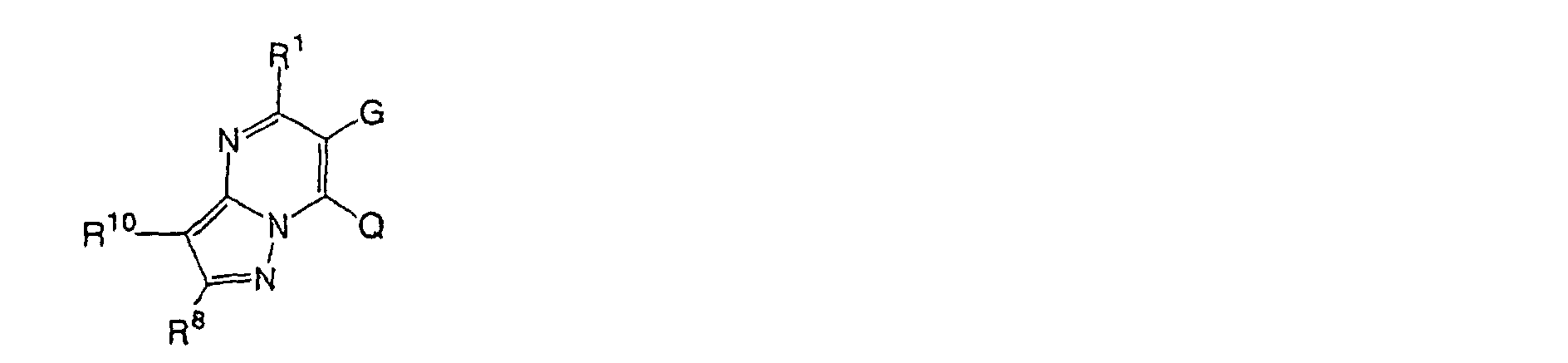
(2) reacting the compound of the formula (I'-4) produced by the method as defined in Claim 19 with the compound of the formula (IV-1). - A method for producing a fused-heterocyclic compound of the formula (I'-5') or its salt:[wherein R1, R8 and R10 are as defined in Claim 10; G' is CN, NO2, SO2NRaRb (wherein Ra and Rb are as defined in Claim 10) or CONRaRb (wherein Ra and Rb are as defined above); and Q is a substituted amino group], which comprises reacting the compound of the formula (I'-2) produced by the method as defined in Claim 17 with a compound of the formula (IV-2): L'-J [wherein J is a secondary substituent of the substituted amino group represented by Q; and L' is a halogen atom, a methanesulfonyloxy group or a para-toluenesulfonyloxy group.

Applications Claiming Priority (3)
| Application Number | Priority Date | Filing Date | Title |
|---|---|---|---|
| JP2000351764 | 2000-11-17 | ||
| JP2000351764 | 2000-11-17 | ||
| PCT/JP2001/010061 WO2002040485A1 (en) | 2000-11-17 | 2001-11-16 | Preventive or therapeutic medicines for diabetes containing fused-heterocycle compounds or their salts |
Publications (1)
| Publication Number | Publication Date |
|---|---|
| EP1334973A1 true EP1334973A1 (en) | 2003-08-13 |
Family
ID=18824765
Family Applications (1)
| Application Number | Title | Priority Date | Filing Date |
|---|---|---|---|
| EP01983816A Withdrawn EP1334973A1 (en) | 2000-11-17 | 2001-11-16 | Preventive or therapeutic medicines for diabetes containing fused-heterocycle compounds or their salts |
Country Status (7)
| Country | Link |
|---|---|
| US (1) | US7067520B2 (en) |
| EP (1) | EP1334973A1 (en) |
| CN (1) | CN1474818A (en) |
| AU (1) | AU2002215223A1 (en) |
| CA (1) | CA2429067A1 (en) |
| RU (1) | RU2003117719A (en) |
| WO (1) | WO2002040485A1 (en) |
Cited By (15)
| Publication number | Priority date | Publication date | Assignee | Title |
|---|---|---|---|---|
| WO2004022560A1 (en) * | 2002-09-04 | 2004-03-18 | Schering Corporation | Pyrazolopyrimidines as cyclin dependent kinase inhibitors |
| WO2004022559A1 (en) * | 2002-09-04 | 2004-03-18 | Schering Corporation | Pyrazolopyrimidines as cyclin dependent kinase inhibitors |
| WO2005077952A1 (en) * | 2004-02-13 | 2005-08-25 | Bayer Cropscience Aktiengesellschaft | Imidazolopyrimidines used as fungicidal active ingredients |
| US7067661B2 (en) | 2002-09-04 | 2006-06-27 | Schering Corporation | Pyrazolopyrimidines as cyclin dependent kinase inhibitors |
| US7084271B2 (en) | 2002-09-04 | 2006-08-01 | Schering Corporation | Pyrazolopyrimidines as cyclin dependent kinase inhibitors |
| US7119200B2 (en) | 2002-09-04 | 2006-10-10 | Schering Corporation | Pyrazolopyrimidines as cyclin dependent kinase inhibitors |
| US7161003B1 (en) | 2002-09-04 | 2007-01-09 | Schering Corporation | Pyrazolopyrimidines as cyclin dependent kinase inhibitors |
| WO2007017678A1 (en) * | 2005-08-09 | 2007-02-15 | Eirx Therapeutics Limited | Pyrazolo[1,5-a] pyrimidine compounds and pharmaceutical compositions containing them |
| EP1666468A4 (en) * | 2003-09-09 | 2007-03-21 | Ono Pharmaceutical Co | Crf antagonists and heterobicyclic compounds |
| US7196078B2 (en) | 2002-09-04 | 2007-03-27 | Schering Corpoartion | Trisubstituted and tetrasubstituted pyrazolopyrimidines as cyclin dependent kinase inhibitors |
| WO2007041712A1 (en) * | 2005-10-06 | 2007-04-12 | Schering Corporation | Pyrazolopyrimidines as protein kinase inhibitors |
| US7205308B2 (en) | 2002-09-04 | 2007-04-17 | Schering Corporation | Trisubstituted 7-aminopyrazolopyrimidines as cyclin dependent kinase inhibitors |
| WO2013059594A1 (en) | 2011-10-20 | 2013-04-25 | Sirtris Pharmaceuticals, Inc. | Substituted bicyclic aza-heterocycles and analogues as sirtuin modulators |
| US9957271B2 (en) | 2011-10-20 | 2018-05-01 | Glaxosmithkline Llc | Substituted bicyclic aza-heterocycles and analogues as sirtuin modulators |
| DE102008050882B4 (en) | 2008-10-09 | 2019-03-28 | Leuze Lumiflex Gmbh + Co. Kg | sensor arrangement |
Families Citing this family (27)
| Publication number | Priority date | Publication date | Assignee | Title |
|---|---|---|---|---|
| FR2842809A1 (en) * | 2002-07-26 | 2004-01-30 | Greenpharma Sas | NOVEL SUBSTITUTED PYRAZOLO [1,5-a] -1,3,5-TRIAZINES AND THEIR ANALOGUES, PHARMACEUTICAL COMPOSITIONS CONTAINING THE SAME, USE AS A MEDICAMENT AND METHODS FOR THEIR PREPARATION |
| US8580782B2 (en) | 2002-09-04 | 2013-11-12 | Merck Sharp & Dohme Corp. | Substituted pyrazolo[1,5-a]pyrimidines as cyclin dependent kinase inhibitors |
| US8673924B2 (en) | 2002-09-04 | 2014-03-18 | Merck Sharp & Dohme Corp. | Substituted pyrazolo[1,5-a]pyrimidines as cyclin dependent kinase inhibitors |
| PL224879B1 (en) | 2002-09-04 | 2017-02-28 | Pharmacopeia Drug Discovery Inc | Pyrazolopyrimidines as cyclin-dependent kinase inhibitors |
| WO2006016715A1 (en) * | 2004-08-13 | 2006-02-16 | Teijin Pharma Limited | PYRAZOLO[1,5-a]PYRIMIDINE DERIVATIVE |
| US7667036B2 (en) * | 2004-08-13 | 2010-02-23 | Teijin Pharma Limited | Pyrazolo[1,5-a]pyrimidine derivatives |
| NZ563131A (en) | 2005-04-28 | 2010-09-30 | Ajinomoto Kk | Tricyclic lactam compound as a hypoglycemic agent |
| JP2009507843A (en) * | 2005-09-09 | 2009-02-26 | シェーリング コーポレイション | Aza-fused cyclin-dependent kinase inhibitors |
| KR20100087298A (en) * | 2007-09-28 | 2010-08-04 | 교와 핫꼬 기린 가부시키가이샤 | Agent for prevention and/or treatment of skin diseases |
| JP5643105B2 (en) * | 2007-12-14 | 2014-12-17 | エフ.ホフマン−ラ ロシュ アーゲーF. Hoffmann−La Roche Aktiengesellschaft | Novel imidazo [1,2-a] pyridine and imidazo [1,2-b] pyridazine derivatives |
| US8343977B2 (en) | 2009-12-30 | 2013-01-01 | Arqule, Inc. | Substituted triazolo-pyrimidine compounds |
| MY183861A (en) | 2010-03-05 | 2021-03-17 | Kyowa Hakko Kirin Co Ltd | Pyrazolopyrimidine derivative |
| WO2012088682A1 (en) * | 2010-12-29 | 2012-07-05 | Shanghai Fochon Pharmaceutical Co Ltd. | 2-(3-aminopiperidin-1-yl)-[1,2,4]triazolo[1,5-c]pyrimidine-5,7(3h,6h)-dione derivates as dipeptidyl peptidase iv(dpp-iv) inhibitors |
| US9309250B2 (en) | 2011-06-22 | 2016-04-12 | Vertex Pharmaceuticals Incorporated | Substituted pyrrolo[2,3-b]pyrazines as ATR kinase inhibitors |
| HK1198443A1 (en) | 2011-07-19 | 2015-04-24 | 无限药品股份有限公司 | Heterocyclic compounds and uses thereof |
| TW201311693A (en) | 2011-09-02 | 2013-03-16 | Kyowa Hakko Kirin Co Ltd | Chemokine receptor activity regulator |
| JP2014530870A (en) * | 2011-10-20 | 2014-11-20 | グラクソスミスクライン・リミテッド・ライアビリティ・カンパニーGlaxoSmithKline LLC | Substituted bicyclic azaheterocycles and analogs as sirtuin regulators |
| CA2889919C (en) | 2012-11-16 | 2021-08-17 | University Health Network | Pyrazolopyrimidine compounds |
| SI2941432T1 (en) | 2012-12-07 | 2018-07-31 | Vertex Pharmaceuticals Incorporated | 2-amino-6-fluoro-n-(5-fluoro-4-(4-(4-(oxetan-3-yl)piperazine-1-carbonyl)piperidin-1-yl)pyridin-3-yl)pyrazolo(1,5alpha)pyrimidine-3-carboxamide as inhibitor of atr kinase |
| US8957078B2 (en) | 2013-03-15 | 2015-02-17 | Vertex Pharmaceuticals Incorporated | Compounds useful as inhibitors of ATR kinase |
| EP2970288A1 (en) | 2013-03-15 | 2016-01-20 | Vertex Pharmaceuticals Incorporated | Compounds useful as inhibitors of atr kinase |
| WO2014143240A1 (en) | 2013-03-15 | 2014-09-18 | Vertex Pharmaceuticals Incorporated | Fused pyrazolopyrimidine derivatives useful as inhibitors of atr kinase |
| PT3077397T (en) | 2013-12-06 | 2020-01-22 | Vertex Pharma | 2-amino-6-fluoro-n-[5-fluoro-pyridin-3-yl]pyrazolo[1,5-a]pyrimidin-3-carboxamide compound useful as atr kinase inhibitor, its preparation, different solid forms and radiolabelled derivatives thereof |
| MX373102B (en) | 2014-06-05 | 2020-04-17 | Vertex Pharma | Radiolabelled derivatives of a 2-amino-6-fluoro-n-[5-fluoro-pyridin-3-yl]- pyrazolo[1,5-a]pyrimidin-3-carboxamide compound useful as atr kinase inhibitor, the preparation of said compound and different solid forms thereof |
| SG11201610500WA (en) | 2014-06-17 | 2017-01-27 | Vertex Pharma | Method for treating cancer using a combination of chk1 and atr inhibitors |
| AU2016331955B2 (en) | 2015-09-30 | 2022-07-21 | Vertex Pharmaceuticals Incorporated | Method for treating cancer using a combination of DNA damaging agents and ATR inhibitors |
| CN116789669B (en) * | 2022-03-14 | 2025-08-19 | 南京理工大学 | High-energy low-inductance energetic compound and preparation method thereof |
Family Cites Families (8)
| Publication number | Priority date | Publication date | Assignee | Title |
|---|---|---|---|---|
| DE255734C (en) * | ||||
| US3202512A (en) * | 1962-02-23 | 1965-08-24 | Eastman Kodak Co | Photographic silver halide emulsions stabilized with tetrazaindene compounds |
| GB1040161A (en) * | 1964-01-29 | |||
| JPH07168303A (en) * | 1993-12-13 | 1995-07-04 | Fuji Photo Film Co Ltd | Silver halide photographic sensitive material and image forming method using same |
| ATE208778T1 (en) * | 1995-05-09 | 2001-11-15 | Basf Ag | PYRAZOLO-1,5A)-PYRIMIDINES, METHOD FOR THE PRODUCTION THEREOF AND THEIR USE |
| JP2002501532A (en) | 1997-05-30 | 2002-01-15 | メルク エンド カンパニー インコーポレーテッド | Novel angiogenesis inhibitors |
| WO2000044754A1 (en) | 1999-01-29 | 2000-08-03 | Sumitomo Chemical Company, Limited | Fat accumulation inhibitory agents |
| JP2001302666A (en) * | 1999-09-21 | 2001-10-31 | Nissan Chem Ind Ltd | Azole-condensed heterocyclic anilide compound and herbicide |
-
2001
- 2001-11-15 US US10/416,164 patent/US7067520B2/en not_active Expired - Fee Related
- 2001-11-16 AU AU2002215223A patent/AU2002215223A1/en not_active Abandoned
- 2001-11-16 CN CNA018188389A patent/CN1474818A/en active Pending
- 2001-11-16 WO PCT/JP2001/010061 patent/WO2002040485A1/en not_active Ceased
- 2001-11-16 RU RU2003117719/14A patent/RU2003117719A/en not_active Application Discontinuation
- 2001-11-16 CA CA002429067A patent/CA2429067A1/en not_active Abandoned
- 2001-11-16 EP EP01983816A patent/EP1334973A1/en not_active Withdrawn
Non-Patent Citations (1)
| Title |
|---|
| See references of WO0240485A1 * |
Cited By (26)
| Publication number | Priority date | Publication date | Assignee | Title |
|---|---|---|---|---|
| US7514442B2 (en) | 2002-09-04 | 2009-04-07 | Schering Corporation | Trisubstituted 4-aminopyrazolopyrimidines as cyclin dependent kinase inhibitors |
| US8586576B2 (en) | 2002-09-04 | 2013-11-19 | Merck Sharp & Dohme Corp. | Substituted pyrazolo[1,5-a]pyrimidines as cyclin dependent kinase inhibitors |
| US7205308B2 (en) | 2002-09-04 | 2007-04-17 | Schering Corporation | Trisubstituted 7-aminopyrazolopyrimidines as cyclin dependent kinase inhibitors |
| US7067661B2 (en) | 2002-09-04 | 2006-06-27 | Schering Corporation | Pyrazolopyrimidines as cyclin dependent kinase inhibitors |
| US7074924B2 (en) | 2002-09-04 | 2006-07-11 | Schering Corporation | Pyrazolopyrimidines as cyclin dependent kinase inhibitors |
| US7078525B2 (en) | 2002-09-04 | 2006-07-18 | Schering Corporation | Pyrazolopyrimidines as cyclin dependent kinase inhibitors |
| US7084271B2 (en) | 2002-09-04 | 2006-08-01 | Schering Corporation | Pyrazolopyrimidines as cyclin dependent kinase inhibitors |
| US7119200B2 (en) | 2002-09-04 | 2006-10-10 | Schering Corporation | Pyrazolopyrimidines as cyclin dependent kinase inhibitors |
| US7161003B1 (en) | 2002-09-04 | 2007-01-09 | Schering Corporation | Pyrazolopyrimidines as cyclin dependent kinase inhibitors |
| US7807683B2 (en) | 2002-09-04 | 2010-10-05 | Schering Corporation | N-heteroaryl pyrazolopyrimidines as cyclin dependent kinase inhibitors |
| US7309705B2 (en) | 2002-09-04 | 2007-12-18 | Schering Corporation | Pyrazolopyrimidines as cyclin dependent kinase inhibitors |
| US7196078B2 (en) | 2002-09-04 | 2007-03-27 | Schering Corpoartion | Trisubstituted and tetrasubstituted pyrazolopyrimidines as cyclin dependent kinase inhibitors |
| WO2004022559A1 (en) * | 2002-09-04 | 2004-03-18 | Schering Corporation | Pyrazolopyrimidines as cyclin dependent kinase inhibitors |
| US7511049B2 (en) | 2002-09-04 | 2009-03-31 | Schering Corporation | Pyrazolopyrimidines as cyclin dependent kinase inhibitors |
| WO2004022560A1 (en) * | 2002-09-04 | 2004-03-18 | Schering Corporation | Pyrazolopyrimidines as cyclin dependent kinase inhibitors |
| US7468372B2 (en) | 2002-09-04 | 2008-12-23 | Schering Corporation | Trisubstituted 4-aminopyrazolopyrimidines as cyclin dependent kinase inhibitors |
| US7470695B2 (en) | 2002-09-04 | 2008-12-30 | Schering Corporation | N-heteroaryl pyrazolopyrimidines as cyclin dependent kinase inhibitors |
| EP1666468A4 (en) * | 2003-09-09 | 2007-03-21 | Ono Pharmaceutical Co | Crf antagonists and heterobicyclic compounds |
| WO2005077952A1 (en) * | 2004-02-13 | 2005-08-25 | Bayer Cropscience Aktiengesellschaft | Imidazolopyrimidines used as fungicidal active ingredients |
| WO2007017678A1 (en) * | 2005-08-09 | 2007-02-15 | Eirx Therapeutics Limited | Pyrazolo[1,5-a] pyrimidine compounds and pharmaceutical compositions containing them |
| WO2007041712A1 (en) * | 2005-10-06 | 2007-04-12 | Schering Corporation | Pyrazolopyrimidines as protein kinase inhibitors |
| US7776865B2 (en) | 2005-10-06 | 2010-08-17 | Schering Corporation | Substituted pyrazolo[1,5-a]pyrimidines as protein kinase inhibitors |
| DE102008050882B4 (en) | 2008-10-09 | 2019-03-28 | Leuze Lumiflex Gmbh + Co. Kg | sensor arrangement |
| WO2013059594A1 (en) | 2011-10-20 | 2013-04-25 | Sirtris Pharmaceuticals, Inc. | Substituted bicyclic aza-heterocycles and analogues as sirtuin modulators |
| EP2768833A4 (en) * | 2011-10-20 | 2015-04-15 | Sirtris Pharmaceuticals Inc | Substituted bicyclic aza-heterocycles and analogues as sirtuin modulators |
| US9957271B2 (en) | 2011-10-20 | 2018-05-01 | Glaxosmithkline Llc | Substituted bicyclic aza-heterocycles and analogues as sirtuin modulators |
Also Published As
| Publication number | Publication date |
|---|---|
| WO2002040485A1 (en) | 2002-05-23 |
| US20040043998A1 (en) | 2004-03-04 |
| AU2002215223A1 (en) | 2002-05-27 |
| CA2429067A1 (en) | 2002-05-23 |
| US7067520B2 (en) | 2006-06-27 |
| RU2003117719A (en) | 2004-10-27 |
| CN1474818A (en) | 2004-02-11 |
Similar Documents
| Publication | Publication Date | Title |
|---|---|---|
| US7067520B2 (en) | Preventive or therapeutic medicines for diabetes containing fused-heterocyclic compounds or their salts | |
| US7132546B2 (en) | Aniline derivatives or salts thereof and cytokine production inhibitors containing the same | |
| EP2563362B1 (en) | Cyclopropyl dicarboxamides and analogs exhibiting anti-cancer and anti-proliferative activites | |
| JP5827326B2 (en) | Compounds and methods for inhibiting phosphate transport | |
| ES2626457T3 (en) | Fluoro-pyridinone derivatives useful as antibacterial agents | |
| CN103068801A (en) | Thioacetate compounds, compositions and methods of use | |
| CA3075305A1 (en) | Cxcr-2 inhibitors for treating disorders | |
| JP2013544753A (en) | Compounds and methods for inhibiting phosphate transport | |
| JP2006523641A (en) | Substituted 3-cyanothiophenacetamides as glucagon receptor antagonists | |
| JP4829506B2 (en) | Thioamide compounds or salts thereof, and cytokine production inhibitors containing them | |
| JP7692832B2 (en) | Method for treating or preventing diabetes using combined medication | |
| JP4083422B2 (en) | Aniline derivatives or salts thereof, and cytokine production inhibitors containing them | |
| CN119110795A (en) | Compounds and compositions for treating conditions associated with LPA receptor activity | |
| JP2002212076A (en) | Prophylactic or therapeutic agent for diabetes comprising condensed heterocyclic compound or its salt | |
| JP2006160628A (en) | COMPOSITION FOR TREATING OR PREVENTING DISEASE REQUIRING ADMINISTRATION OF ADENOSINE A2a RECEPTOR AGONIST | |
| TWI613201B (en) | New type 5 phosphodiesterase inhibitor and its medical application | |
| HK1211918A1 (en) | Coumarin derivative | |
| US20250026719A1 (en) | Novel compounds as inhibitors of pcsk9 | |
| JP2005023064A (en) | COMPOSITION FOR TREATING OR PREVENTING DISEASE REQUIRING ADMINISTRATION OF ADENOSINE A2a-RECEPTOR AGONIST | |
| JP2003306433A (en) | Pyridine derivative or its salt and cytokine production inhibitor comprising the same | |
| CN104788423A (en) | New cystic fibrosis transmembrane conductance regulator inhibitor | |
| WO2010098298A1 (en) | Pharmaceutical composition comprising combination of compound having nutrient digestion/absorption inhibitory activity and cyclohexanecarboxamide derivative | |
| CN102344416B (en) | Pyridazine derivatives and the purposes as Antipicornaviral infection medicine thereof | |
| JP2004508312A (en) | Substituted hydrazine derivatives | |
| WO2025043079A1 (en) | Compounds, compositions, and methods |
Legal Events
| Date | Code | Title | Description |
|---|---|---|---|
| PUAI | Public reference made under article 153(3) epc to a published international application that has entered the european phase |
Free format text: ORIGINAL CODE: 0009012 |
|
| 17P | Request for examination filed |
Effective date: 20030423 |
|
| AK | Designated contracting states |
Designated state(s): AT BE CH CY DE DK ES FI FR GB GR IE IT LI LU MC NL PT SE TR |
|
| AX | Request for extension of the european patent |
Extension state: AL LT LV MK RO SI |
|
| STAA | Information on the status of an ep patent application or granted ep patent |
Free format text: STATUS: THE APPLICATION IS DEEMED TO BE WITHDRAWN |
|
| 18D | Application deemed to be withdrawn |
Effective date: 20070601 |