EP1334870A2 - Flashing optical indicator device - Google Patents
Flashing optical indicator device Download PDFInfo
- Publication number
- EP1334870A2 EP1334870A2 EP03002813A EP03002813A EP1334870A2 EP 1334870 A2 EP1334870 A2 EP 1334870A2 EP 03002813 A EP03002813 A EP 03002813A EP 03002813 A EP03002813 A EP 03002813A EP 1334870 A2 EP1334870 A2 EP 1334870A2
- Authority
- EP
- European Patent Office
- Prior art keywords
- light sources
- optical element
- light source
- profile
- light
- Prior art date
- Legal status (The legal status is an assumption and is not a legal conclusion. Google has not performed a legal analysis and makes no representation as to the accuracy of the status listed.)
- Withdrawn
Links
Images

Classifications
-
- B—PERFORMING OPERATIONS; TRANSPORTING
- B60—VEHICLES IN GENERAL
- B60Q—ARRANGEMENT OF SIGNALLING OR LIGHTING DEVICES, THE MOUNTING OR SUPPORTING THEREOF OR CIRCUITS THEREFOR, FOR VEHICLES IN GENERAL
- B60Q1/00—Arrangement of optical signalling or lighting devices, the mounting or supporting thereof or circuits therefor
- B60Q1/26—Arrangement of optical signalling or lighting devices, the mounting or supporting thereof or circuits therefor the devices being primarily intended to indicate the vehicle, or parts thereof, or to give signals, to other traffic
- B60Q1/2611—Indicating devices mounted on the roof of the vehicle
-
- F—MECHANICAL ENGINEERING; LIGHTING; HEATING; WEAPONS; BLASTING
- F21—LIGHTING
- F21S—NON-PORTABLE LIGHTING DEVICES; SYSTEMS THEREOF; VEHICLE LIGHTING DEVICES SPECIALLY ADAPTED FOR VEHICLE EXTERIORS
- F21S43/00—Signalling devices specially adapted for vehicle exteriors, e.g. brake lamps, direction indicator lights or reversing lights
- F21S43/10—Signalling devices specially adapted for vehicle exteriors, e.g. brake lamps, direction indicator lights or reversing lights characterised by the light source
- F21S43/13—Signalling devices specially adapted for vehicle exteriors, e.g. brake lamps, direction indicator lights or reversing lights characterised by the light source characterised by the type of light source
- F21S43/14—Light emitting diodes [LED]
-
- F—MECHANICAL ENGINEERING; LIGHTING; HEATING; WEAPONS; BLASTING
- F21—LIGHTING
- F21S—NON-PORTABLE LIGHTING DEVICES; SYSTEMS THEREOF; VEHICLE LIGHTING DEVICES SPECIALLY ADAPTED FOR VEHICLE EXTERIORS
- F21S43/00—Signalling devices specially adapted for vehicle exteriors, e.g. brake lamps, direction indicator lights or reversing lights
- F21S43/10—Signalling devices specially adapted for vehicle exteriors, e.g. brake lamps, direction indicator lights or reversing lights characterised by the light source
- F21S43/13—Signalling devices specially adapted for vehicle exteriors, e.g. brake lamps, direction indicator lights or reversing lights characterised by the light source characterised by the type of light source
- F21S43/15—Strips of light sources
-
- F—MECHANICAL ENGINEERING; LIGHTING; HEATING; WEAPONS; BLASTING
- F21—LIGHTING
- F21S—NON-PORTABLE LIGHTING DEVICES; SYSTEMS THEREOF; VEHICLE LIGHTING DEVICES SPECIALLY ADAPTED FOR VEHICLE EXTERIORS
- F21S43/00—Signalling devices specially adapted for vehicle exteriors, e.g. brake lamps, direction indicator lights or reversing lights
- F21S43/30—Signalling devices specially adapted for vehicle exteriors, e.g. brake lamps, direction indicator lights or reversing lights characterised by reflectors
- F21S43/31—Optical layout thereof
- F21S43/315—Optical layout thereof using total internal reflection
-
- F—MECHANICAL ENGINEERING; LIGHTING; HEATING; WEAPONS; BLASTING
- F21—LIGHTING
- F21S—NON-PORTABLE LIGHTING DEVICES; SYSTEMS THEREOF; VEHICLE LIGHTING DEVICES SPECIALLY ADAPTED FOR VEHICLE EXTERIORS
- F21S10/00—Lighting devices or systems producing a varying lighting effect
- F21S10/06—Lighting devices or systems producing a varying lighting effect flashing, e.g. with rotating reflector or light source
-
- F—MECHANICAL ENGINEERING; LIGHTING; HEATING; WEAPONS; BLASTING
- F21—LIGHTING
- F21W—INDEXING SCHEME ASSOCIATED WITH SUBCLASSES F21K, F21L, F21S and F21V, RELATING TO USES OR APPLICATIONS OF LIGHTING DEVICES OR SYSTEMS
- F21W2107/00—Use or application of lighting devices on or in particular types of vehicles
- F21W2107/10—Use or application of lighting devices on or in particular types of vehicles for land vehicles
-
- F—MECHANICAL ENGINEERING; LIGHTING; HEATING; WEAPONS; BLASTING
- F21—LIGHTING
- F21Y—INDEXING SCHEME ASSOCIATED WITH SUBCLASSES F21K, F21L, F21S and F21V, RELATING TO THE FORM OR THE KIND OF THE LIGHT SOURCES OR OF THE COLOUR OF THE LIGHT EMITTED
- F21Y2115/00—Light-generating elements of semiconductor light sources
- F21Y2115/10—Light-emitting diodes [LED]
Definitions
- the present invention relates to a flashing optical indicator device, which is particularly suitable for emergency vehicles (police, fire, ambulance, etc.), but which may also be used to advantage on industrial vehicles and fixed or moving structures of various types to indicate moving parts or machinery, and in all situations in general requiring a flashing warning light.
- emergency vehicles police, fire, ambulance, etc.
- Flashing devices e.g. on emergency vehicles, which comprise a fixed light source, typically a filament lamp, with a rotary reflector, which rotates about the lamp to produce the desired flashing effect.
- Devices of this sort have various drawbacks, mainly on account of featuring a rotary mechanical member, which makes them relatively complicated, bulky, heavy, and at times unreliable.
- the lamps normally used in devices of this sort invariably have a short working life and consume large amounts of energy.
- the light source is a flashing discharge lamp with a lens (normally a Fresnel lens), and the flashing effect is produced by turning the lamp on and off in alternating sequence.
- Devices of this sort also normally employ high-power lamps with a short working life, and, though no rotary members are involved, are relatively expensive, bulky and heavy.
- a flashing optical indicator device characterized by comprising a number of solid-state light sources arranged in a predetermined spatial pattern defining a substantially continuous profile; a number of optical elements associated with the light sources; and a control unit for selectively and successively activating said light sources along said profile in a predetermined sequence.
- the device according to the invention therefore involves no rotary mechanical parts or conventional high-power lamps with a short working life, is compact and lightweight, is cheap and easy to produce and cheap and reliable to operate, and allows a good deal of freedom in terms of geometry, thus enabling a wide range of design options.
- Number 1 in the accompanying drawings indicates as a whole a flashing optical indicator device, in particular for emergency or industrial vehicles or fixed or moving structures of various types.
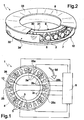
- Device 1 comprises a supporting structure 2; a number of solid-state light sources 3 fitted to supporting structure 2 and arranged in a predetermined spatial pattern defining a substantially continuous profile 4 (shown by the a dash-and-dot line in Figure 1); a number of optical elements 5 associated with light sources 3; and a control unit 6 connected electrically to light sources 3 to selectively and successively activate light sources 3 along profile 4 in a predetermined sequence.
- light sources 3 are known light-emitting diodes (LEDs), and are arranged side by side to form a closed, e.g. substantially circular, loop, so that profile 4 is a closed-loop profile (which, in the purely non-limiting example shown in Figures 1 and 2, is circular).
- Supporting structure 2 comprises an annular base 7; a housing 8; a central opening 9 defining a seat for an auxiliary device (e.g. a known fixed or swing light not shown); and known fastening members (not shown) for assembly to a supporting surface, e.g. a surface of the vehicle or structure to which device 1 is to be fitted.
- auxiliary device e.g. a known fixed or swing light not shown
- fastening members not shown
- Light sources 3 are arranged in preassembled modular units 10, each of which ( Figure 3) comprises a light source 3, an optical element 5, and a plate 11.
- Light source 3 is fitted to a known mount 13 (shown only schematically, and which, according to a known solution, may also comprise an integrated heat-dissipating plate); and mount 13 is fixed to plate 11, for example, by means of known heat-conducting adhesive.
- Plate 11 is a substantially flat heat-dissipating plate made, for example, of metal and of any shape.
- Optical element 5 is a total-internal-reflection lens, and comprises a substantially cup-shaped optical body 15 made of transparent plastic material (e.g. polycarbonate PC or polymethyl methacrylate PMMA) and having an optical axis A.
- transparent plastic material e.g. polycarbonate PC or polymethyl methacrylate PMMA
- Optical element 5 is such as to impart to the light beam emitted by respective light source 3 a cross section having a predominant dimension. More specifically, the optical element is such as to impart to the light beam emitted by the respective light source a substantially oval cross section with an axis ratio of about 2:1, and, in particular, respective angles of about ⁇ 4° and ⁇ 8° in directions perpendicular to each other and to optical axis A.
- modular unit 10 is mounted so that optical axis A is substantially horizontal, and the beam has a vertical angle of about ⁇ 4°, and a horizontal angle of about ⁇ 8°.
- Optical body 15 is fitted with three (or more) rods 16 spaced circumferentially apart along a peripheral edge 17 of optical body 15, and by which optical element 5 is supported on and projects from plate 11. Rods 16 are separated by radial gaps 18 for effectively ventilating light source 3.
- Rods 16 are fixed in any known manner to plate 11, e.g. by inserting and fixing their respective longitudinal free ends 21 inside respective seats 22 formed in the plate.
- optical element 5 When the modular unit is assembled ( Figure 4), optical element 5 rests axially against mount 13 and is secured to plate 11 by rods 16; and light source 3 and mount 13 are gripped between optical element 5 and plate 11.
- Plate 11 has a fastening portion 23 defined, for example, by a flange perpendicular to plate 11, and having mechanical fastening means 24 (shown schematically by holes for respective fastening members, screws or rivets) for assembly to supporting structure 2, which may be done in any known way (even by gluing or welding).
- Modular units 10 are carried by supporting structure 2, to which they can be fixed in predetermined positions (in the predetermined spatial pattern defining profile 4).
- modular units 10 are grouped into modules 25, each comprising, for example, three modular units 10 fitted to a common plate 26 ( Figure 4). That is, as opposed to modular units 10 being fitted directly to supporting structure 2, each modular unit 10 is fixed to plate 26 of module 25 (by mechanical fastening means 24), and plate 26 in turn is fixed to supporting structure 2.
- plate 26 may also be fastened to supporting structure 2 in any known manner, e.g. by mechanical fastening means shown schematically by a hole 27 formed in plate 26 and for receiving a respective fastening member.
- Modular units 10 may even be fitted directly and singly to supporting structure 2.
- each plate 26 for supplying electrical power to light sources 3 and for connecting light sources 3 and control unit 6 are not shown.
- Modular units 10, grouped or not into modules 25, are housed inside a substantially annular chamber 30 of housing 8; which chamber 30 is defined by a radially inner rear wall 31, and by a transparent radially outer screen 32, and is closed by an annular cover 33 facing annular base 7.
- Screen 32 has a known optical surface 34 for blending distribution of the beams emitted by individual optical elements into a uniform beam.
- control unit 6 activates light sources 3 selectively and successively in a predetermined sequence along profile 4. More specifically ( Figure 1), control unit 6 successively turns on light sources 3 of successive adjacent modules 25 along profile 4 in the direction shown, for example, by arrow 35 in Figure 1. That is, control unit 6 turns on light sources 3a of a first module 25a, then light sources 3b of a module 25b adjacent to module 25a, then light sources 3c of a further module 25c, and so on. Control unit 6 may turn off light sources 3a of module 25a and turn on light sources 3b of the adjacent module 25b either simultaneously or after a given delay, to obtain different visual effects.
- each light source 3 may obviously also be activated singly. Different visual effects can also be produced by varying the turn-on times of individual light sources 3; and the direction and sequence in which the sources are activated, and the time intervals between activation of successive sources, may obviously be varied as required.
Landscapes
- Engineering & Computer Science (AREA)
- General Engineering & Computer Science (AREA)
- Mechanical Engineering (AREA)
- Physics & Mathematics (AREA)
- Microelectronics & Electronic Packaging (AREA)
- Optics & Photonics (AREA)
- Non-Portable Lighting Devices Or Systems Thereof (AREA)
- Traffic Control Systems (AREA)
Abstract
Description
Claims (9)
- A flashing optical indicator device (1), characterized by comprising a number of solid-state light sources (3) arranged in a predetermined spatial pattern defining a substantially continuous profile (4); a number of optical elements (5) associated with the light sources (3); and a control unit (6) for selectively and successively activating said light sources (3) along said profile (4) in a predetermined sequence.
- A device as claimed in Claim 1, characterized in that said profile (4) is a closed-loop profile; said light sources (3) being arranged side by side to form a closed loop.
- A device as claimed in Claim 1 or 2, characterized in that each light source (3) is associated with a respective optical element (5).
- A device as claimed in Claim 3, characterized in that the optical element (5) associated with each light source (3) is a total-internal-reflection lens for imparting to the light beam emitted by the respective light source (3) a cross section having a predominant dimension.
- A device as claimed in Claim 4, characterized in that said optical element (5) is such as to impart to the light beam emitted by the respective light source (3) a substantially oval cross section with an axis ratio of about 2:1.
- A device as claimed in Claim 4 or 5, characterized in that said optical element (5) is such as to impart to the light beam emitted by the respective light source (3) respective angles of about ±4° and about ±8° in directions perpendicular to each other and to an optical axis (A) of said optical element (5).
- A device as claimed in one of the foregoing Claims, characterized by comprising a number of preassembled modular units (10); each modular unit (10) comprising at least one light source (3), an optical element (5), and a supporting plate (11).
- A device as claimed in the foregoing Claim, characterized in that the preassembled said modular units (10) are fitted to a supporting structure (2); electrical connections and mechanical fasteners being provided to connect each modular unit (10) to the supporting structure (2).
- A device as claimed in any one of the foregoing Claims, characterized in that the light sources (3) are light-emitting diodes (LEDs).
Applications Claiming Priority (2)
| Application Number | Priority Date | Filing Date | Title |
|---|---|---|---|
| IT2002MI000234 ITMI20020234A1 (en) | 2002-02-08 | 2002-02-08 | OPTICAL SIGNALING FLASHING DEVICE |
| ITMI20020234 | 2002-02-08 |
Publications (2)
| Publication Number | Publication Date |
|---|---|
| EP1334870A2 true EP1334870A2 (en) | 2003-08-13 |
| EP1334870A3 EP1334870A3 (en) | 2004-08-18 |
Family
ID=11449151
Family Applications (1)
| Application Number | Title | Priority Date | Filing Date |
|---|---|---|---|
| EP20030002813 Withdrawn EP1334870A3 (en) | 2002-02-08 | 2003-02-07 | Flashing optical indicator device |
Country Status (2)
| Country | Link |
|---|---|
| EP (1) | EP1334870A3 (en) |
| IT (1) | ITMI20020234A1 (en) |
Cited By (7)
| Publication number | Priority date | Publication date | Assignee | Title |
|---|---|---|---|---|
| DE10333034A1 (en) * | 2003-07-21 | 2005-02-17 | Hella Kgaa Hueck & Co. | Lighting unit for motor vehicles, comprises an LED arrangement which has two laminar LED panels, with second LED panel being at an angled plane to the first LED panel |
| EP1552983A1 (en) * | 2004-01-07 | 2005-07-13 | Goodrich Hella Aerospace Lighting Systems GmbH | Light, especially warning light, for vehicle |
| DE102004028149A1 (en) * | 2004-06-15 | 2006-01-12 | Inomatic Gmbh | Signal device e.g. identification signal device, has additional monochrome light emitting diode light sources that are installed above or below light joint of main light source and under outer casing for warning system |
| EP1590598B1 (en) * | 2003-02-05 | 2011-10-19 | Obelux Oy | Flight obstacle light with a tubular body |
| US20140362571A1 (en) * | 2012-01-20 | 2014-12-11 | Orga Holding B.V. | Beacon light optic, beacon light, method for obtaining a beacon light optic |
| JP2016184532A (en) * | 2015-03-26 | 2016-10-20 | 株式会社パトライト | Indicator light |
| EP4332429A1 (en) * | 2022-09-02 | 2024-03-06 | Many Wain Enterprise Co., Ltd. | Vehicle lamp comprising a airflow circulating structure |
Family Cites Families (4)
| Publication number | Priority date | Publication date | Assignee | Title |
|---|---|---|---|---|
| US5694112A (en) * | 1994-12-12 | 1997-12-02 | Grote Industries, Inc. | Solid state rotary apparent beacon |
| DE19728354C2 (en) * | 1997-07-03 | 1999-12-02 | Sidler Gmbh & Co | Refractor element as an attachment for a light source and use of such a refractor element as an attachment for a brake light of a vehicle |
| GB2350176B (en) * | 1999-05-18 | 2002-10-09 | John Clayton Ruddick | Light beacon |
| JP2001135102A (en) * | 1999-11-05 | 2001-05-18 | Zeni Lite Buoy Co Ltd | LED lighting |
-
2002
- 2002-02-08 IT IT2002MI000234 patent/ITMI20020234A1/en unknown
-
2003
- 2003-02-07 EP EP20030002813 patent/EP1334870A3/en not_active Withdrawn
Cited By (8)
| Publication number | Priority date | Publication date | Assignee | Title |
|---|---|---|---|---|
| EP1590598B1 (en) * | 2003-02-05 | 2011-10-19 | Obelux Oy | Flight obstacle light with a tubular body |
| DE10333034A1 (en) * | 2003-07-21 | 2005-02-17 | Hella Kgaa Hueck & Co. | Lighting unit for motor vehicles, comprises an LED arrangement which has two laminar LED panels, with second LED panel being at an angled plane to the first LED panel |
| EP1552983A1 (en) * | 2004-01-07 | 2005-07-13 | Goodrich Hella Aerospace Lighting Systems GmbH | Light, especially warning light, for vehicle |
| DE102004028149A1 (en) * | 2004-06-15 | 2006-01-12 | Inomatic Gmbh | Signal device e.g. identification signal device, has additional monochrome light emitting diode light sources that are installed above or below light joint of main light source and under outer casing for warning system |
| US20140362571A1 (en) * | 2012-01-20 | 2014-12-11 | Orga Holding B.V. | Beacon light optic, beacon light, method for obtaining a beacon light optic |
| US9243763B2 (en) * | 2012-01-20 | 2016-01-26 | Orga Holding B.V. | Beacon light optic, beacon light, method for obtaining a beacon light optic |
| JP2016184532A (en) * | 2015-03-26 | 2016-10-20 | 株式会社パトライト | Indicator light |
| EP4332429A1 (en) * | 2022-09-02 | 2024-03-06 | Many Wain Enterprise Co., Ltd. | Vehicle lamp comprising a airflow circulating structure |
Also Published As
| Publication number | Publication date |
|---|---|
| EP1334870A3 (en) | 2004-08-18 |
| ITMI20020234A1 (en) | 2003-08-08 |
| ITMI20020234A0 (en) | 2002-02-08 |
Similar Documents
| Publication | Publication Date | Title |
|---|---|---|
| US8021027B2 (en) | LED based acorn style luminaire | |
| EP2553327B1 (en) | Apparatus, method, and system for highly controlled light distribution using multiple light sources | |
| US7625102B2 (en) | Lighting device | |
| KR101881998B1 (en) | Apparatus, method, and system for independent aiming and cutoff steps in illuminating a target area | |
| US10663126B2 (en) | Illumination device | |
| US9777910B2 (en) | LED based area lighting fixture | |
| US8500299B2 (en) | Narrow beam LED spotlight | |
| US12284991B2 (en) | Arc modular light devices, systems, and methods | |
| KR102051489B1 (en) | Beam angle adjustable LED floodlight | |
| US7631985B1 (en) | Finite element and multi-distribution LED luminaire | |
| KR101344513B1 (en) | LED lamp assembly | |
| CN101010541A (en) | Illuminating device | |
| US20140016318A1 (en) | LED Light Assembly | |
| US10794563B2 (en) | Illumination device | |
| EP2722582A1 (en) | Luminaire | |
| EP1334870A2 (en) | Flashing optical indicator device | |
| CN104100923B (en) | A kind of quick-fried flash LED warning lamp | |
| US8783924B1 (en) | Wide angle illumination assembly and reflector therefor | |
| US10774995B2 (en) | PCB module LED lamp having irradiation angle setting up function for Edison socket | |
| KR101779643B1 (en) | Lighting device | |
| KR20160000695U (en) | Vehicle headlight assembly | |
| US20050174772A1 (en) | Lighting devices and apparatus | |
| KR200480185Y1 (en) | Assembly illuminating apparatus | |
| EP2596282B1 (en) | Lighting module with optimized emission, in particular for road illumination | |
| CN220038300U (en) | Lamp set |
Legal Events
| Date | Code | Title | Description |
|---|---|---|---|
| PUAI | Public reference made under article 153(3) epc to a published international application that has entered the european phase |
Free format text: ORIGINAL CODE: 0009012 |
|
| AK | Designated contracting states |
Designated state(s): AT BE BG CH CY CZ DE DK EE ES FI FR GB GR HU IE IT LI LU MC NL PT SE SI SK TR |
|
| AX | Request for extension of the european patent |
Extension state: AL LT LV MK RO |
|
| PUAL | Search report despatched |
Free format text: ORIGINAL CODE: 0009013 |
|
| AK | Designated contracting states |
Kind code of ref document: A3 Designated state(s): AT BE BG CH CY CZ DE DK EE ES FI FR GB GR HU IE IT LI LU MC NL PT SE SI SK TR |
|
| AX | Request for extension of the european patent |
Extension state: AL LT LV MK RO |
|
| RIC1 | Information provided on ipc code assigned before grant |
Ipc: 7F 21S 8/00 B Ipc: 7B 60Q 1/26 A |
|
| 17P | Request for examination filed |
Effective date: 20050216 |
|
| AKX | Designation fees paid |
Designated state(s): AT BE BG CH CY CZ DE DK EE ES FI FR GB GR HU IE IT LI LU MC NL PT SE SI SK TR |
|
| 17Q | First examination report despatched |
Effective date: 20050401 |
|
| GRAP | Despatch of communication of intention to grant a patent |
Free format text: ORIGINAL CODE: EPIDOSNIGR1 |
|
| STAA | Information on the status of an ep patent application or granted ep patent |
Free format text: STATUS: THE APPLICATION IS DEEMED TO BE WITHDRAWN |
|
| 18D | Application deemed to be withdrawn |
Effective date: 20060523 |