EP1334765A1 - Process for producing liposome and apparatus therefor - Google Patents
Process for producing liposome and apparatus therefor Download PDFInfo
- Publication number
- EP1334765A1 EP1334765A1 EP01974773A EP01974773A EP1334765A1 EP 1334765 A1 EP1334765 A1 EP 1334765A1 EP 01974773 A EP01974773 A EP 01974773A EP 01974773 A EP01974773 A EP 01974773A EP 1334765 A1 EP1334765 A1 EP 1334765A1
- Authority
- EP
- European Patent Office
- Prior art keywords
- liposomes
- substance
- pressure
- aqueous phase
- carbon dioxide
- Prior art date
- Legal status (The legal status is an assumption and is not a legal conclusion. Google has not performed a legal analysis and makes no representation as to the accuracy of the status listed.)
- Granted
Links
Images


Classifications
-
- A—HUMAN NECESSITIES
- A61—MEDICAL OR VETERINARY SCIENCE; HYGIENE
- A61K—PREPARATIONS FOR MEDICAL, DENTAL OR TOILETRY PURPOSES
- A61K9/00—Medicinal preparations characterised by special physical form
- A61K9/10—Dispersions; Emulsions
- A61K9/127—Synthetic bilayered vehicles, e.g. liposomes or liposomes with cholesterol as the only non-phosphatidyl surfactant
- A61K9/1277—Preparation processes; Proliposomes
-
- A—HUMAN NECESSITIES
- A61—MEDICAL OR VETERINARY SCIENCE; HYGIENE
- A61K—PREPARATIONS FOR MEDICAL, DENTAL OR TOILETRY PURPOSES
- A61K9/00—Medicinal preparations characterised by special physical form
- A61K9/10—Dispersions; Emulsions
- A61K9/127—Synthetic bilayered vehicles, e.g. liposomes or liposomes with cholesterol as the only non-phosphatidyl surfactant
-
- B—PERFORMING OPERATIONS; TRANSPORTING
- B01—PHYSICAL OR CHEMICAL PROCESSES OR APPARATUS IN GENERAL
- B01J—CHEMICAL OR PHYSICAL PROCESSES, e.g. CATALYSIS OR COLLOID CHEMISTRY; THEIR RELEVANT APPARATUS
- B01J13/00—Colloid chemistry, e.g. the production of colloidal materials or their solutions, not otherwise provided for; Making microcapsules or microballoons
- B01J13/02—Making microcapsules or microballoons
-
- B—PERFORMING OPERATIONS; TRANSPORTING
- B01—PHYSICAL OR CHEMICAL PROCESSES OR APPARATUS IN GENERAL
- B01J—CHEMICAL OR PHYSICAL PROCESSES, e.g. CATALYSIS OR COLLOID CHEMISTRY; THEIR RELEVANT APPARATUS
- B01J3/00—Processes of utilising sub-atmospheric or super-atmospheric pressure to effect chemical or physical change of matter; Apparatus therefor
- B01J3/008—Processes carried out under supercritical conditions
-
- A—HUMAN NECESSITIES
- A61—MEDICAL OR VETERINARY SCIENCE; HYGIENE
- A61J—CONTAINERS SPECIALLY ADAPTED FOR MEDICAL OR PHARMACEUTICAL PURPOSES; DEVICES OR METHODS SPECIALLY ADAPTED FOR BRINGING PHARMACEUTICAL PRODUCTS INTO PARTICULAR PHYSICAL OR ADMINISTERING FORMS; DEVICES FOR ADMINISTERING FOOD OR MEDICINES ORALLY; BABY COMFORTERS; DEVICES FOR RECEIVING SPITTLE
- A61J3/00—Devices or methods specially adapted for bringing pharmaceutical products into particular physical or administering forms
- A61J3/07—Devices or methods specially adapted for bringing pharmaceutical products into particular physical or administering forms into the form of capsules or similar small containers for oral use
-
- Y—GENERAL TAGGING OF NEW TECHNOLOGICAL DEVELOPMENTS; GENERAL TAGGING OF CROSS-SECTIONAL TECHNOLOGIES SPANNING OVER SEVERAL SECTIONS OF THE IPC; TECHNICAL SUBJECTS COVERED BY FORMER USPC CROSS-REFERENCE ART COLLECTIONS [XRACs] AND DIGESTS
- Y02—TECHNOLOGIES OR APPLICATIONS FOR MITIGATION OR ADAPTATION AGAINST CLIMATE CHANGE
- Y02P—CLIMATE CHANGE MITIGATION TECHNOLOGIES IN THE PRODUCTION OR PROCESSING OF GOODS
- Y02P20/00—Technologies relating to chemical industry
- Y02P20/50—Improvements relating to the production of bulk chemicals
- Y02P20/54—Improvements relating to the production of bulk chemicals using solvents, e.g. supercritical solvents or ionic liquids
Definitions
- the present invention relates to a method and an apparatus for producing liposomes that take advantage of supercritical carbon dioxide.
- Liposomes which are formed of a lipid bilayer, can encapsulate a variety of water-soluble substances and are therefore used as an effective carrier for delivering pharmacologically active substances into a living system.
- Liposomes can be obtained by subjecting suspensions of phospholipids, which are amphipathic substances, to stirring and other proper treatments.
- known techniques for preparing liposome on industrial scale are (1) sonication technique, in which a suspension of a phospholipid or glycolipid is exposed to ultrasound; (2) surfactant removal technique, which involves mixing a phospholipid or a glycolipid with a surfactant to form micelles and subsequently removing the surfactant; (3) organic solvent injection technique, in which a phospholipid or a glycolipid dissolved in an organic solvent is injected into a water reservoir so that liposomes are formed at the interface between the aqueous phase and the organic phase; (4) freeze-melt technique, which involves freezing a suspension of a phospholipid or a glycolipid in water, subsequently melting the frozen suspension to form a lipid bilayer, and further freezing and thawing the lipid bilayer to form liposomes; (5) reversed phase evaporation technique, in which a mixture of a hydrophobic organic
- the phospholipid dissolved in a fluid mixture of carbon dioxide and ethanol, is transported to a reduction valve 34, where the pressure of the fluid mixture is reduced. Once phospholipid precipitates during the pressure reduction, an aqueous phase containing a water-soluble material to be entrapped in the liposome is added to the phospholipid via a pump 35. The resulting mixture is then stirred by a mixer 36 to form liposomes within the mixer 36.
- This technique only provides liposomes with a low efficiency to entrap water-soluble substances and often requires the removal of organic solvents.
- liposomes are not formed under supercritical conditions but are formed by making use of the rapid expansion of supercritical solutions (RESS).
- RSS supercritical solutions
- phospholipid is allowed to precipitate, while forming fine particles, as its solubility abruptly decreases upon pressure reduction, and the aqueous solution is then mixed with the phospholipid precipitates to form liposomes.
- the present invention provides a method for producing liposome encapsulating a desired substance, characterized in that an aqueous phase containing the substance to be encapsulated is added to a mixture of a phospholipid or a glycolipid and carbon dioxide either under a supercritical condition or under a condition in which temperature or pressure is higher than or equal to its critical point.
- the present invention also provides an apparatus for producing liposome encapsulating a desired substance, comprising a pressure reactor for containing a pressurized homogenous fluid mixture of a phospholipid or a glycolipid and carbon dioxide either under a supercritical condition or under a condition in which temperature or pressure is higher than or equal to its critical point; and means for introducing into the mixture placed in the pressure reactor an aqueous phase that contains the substance to be encapsulated, which is either water-soluble or hydrophilic.
- the present invention also provides an apparatus for producing liposome encapsulating a desired substance, comprising a pressure reactor; means for introducing into the pressure reactor carbon dioxide either under a supercritical condition or under a condition in which temperature or pressure is higher than or equal to its critical point; means for introducing into the pressure reactor a phospholipid or a glycolipid uniformly dispersed in a cosolvent; and means for introducing into the pressure reactor an aqueous phase containing the substance to be encapsulated.
- the method of the present invention is characteristic in that it enables single-step production of liposomes encapsulating a desired substance through the addition of the aqueous phase containing the water-soluble or hydrophilic substance to be encapsulated to a homogenous mixture of a phospholipid and carbon dioxide either under a supercritical condition or under a condition in which temperature or pressure is higher than or equal to its critical point.
- the liposome produced by the method of the present invention has improved trapping efficiency and can thus encapsulate larger amounts of the desired substance than can the conventional liposome.
- carbon dioxide under a supercritical condition refers to carbon dioxide under a supercritical condition, which is defined as a condition in which the temperature is higher than, or equal to, the critical temperature ( i . e ., 30.98°C) and, at the same time, the pressure is higher than, or equal to, the critical pressure ( i . e ., 7.3773 ⁇ 0.0030MPa).
- carbon dioxide under a condition in which temperature or pressure is higher than or equal to its critical point refers to carbon dioxide under a condition in which either the temperature is higher than, or equal to, the critical temperature or the pressure is higher than, or equal to, the critical pressure (the other parameter remains less than its critical value).
- the carbon dioxide under a supercritical condition and the carbon dioxide under a condition in which temperature or pressure is higher than or equal to its critical point are collectively referred to as "supercritical carbon dioxide.”
- Phospholipid or glycolipid for use in the present invention may be any type of phospholipid or glycolipid that can form a lipid bilayer.
- Phospholipid also known as phosphatide, is a collective term for a group of compounds consisting of compound lipids including a phosphate ester and a C-P bond.
- phospholipid for use in the present invention include, but are not limited to, glycerophospholipids such as phosphatidylcholine, phosphatidylethanolamine, phosphatidylseline, phosphatidic acid, phosphatidylglycerol, phosphatidylinositol, cardiolipin, yolk lecithin, hydrogenated yolk lecithin, soy lecithin, and hydrogenated soy lecithin; and sphingophospholipids such as sphingomyelin, ceramide phosphorylethanolamine, and ceramide phosphorylglycerol.
- glycolipid examples include, but are not limited to, glycerolipids such as digalactosyldiglyceride and galactosyldiglyceride sulfate; and sphingoglycolipids such as galactosylceramide, galactosylceramide sulfate, lactosylceramide, ganglioside G7, ganglioside G6, and ganglioside G4.
- glycerolipids such as digalactosyldiglyceride and galactosyldiglyceride sulfate
- sphingoglycolipids such as galactosylceramide, galactosylceramide sulfate, lactosylceramide, ganglioside G7, ganglioside G6, and ganglioside G4.
- a cosolvent is preferably used to prepare a uniform mixture of phospholipid and supercritical carbon dioxide.
- the addition of the cosolvent to the system increases the solubility of the substance to be encapsulated in the supercritical carbon dioxide, which otherwise can hardly dissolve the substance.
- the amount of the cosolvent to be added is preferably 15wt% or less with respect to the amount of the supercritical carbon dioxide. The amount exceeding 15wt% causes the ethanol liquid phase to crystallize and thus is unfavorable.
- the amount of ethanol is kept as small as possible since ethanol interferes with the formation of liposomes.
- Ethanol for example, may suitably be used as the cosolvent for that purpose.
- the aqueous phase to be added to the uniform mixture of phospholipid and the supercritical carbon dioxide contains the substance to be encapsulated in liposomes.
- the substance to be encapsulated for use in the present invention may be any water-soluble or hydrophilic substance.
- the aqueous phase may be added in any amount that ensures the fluidity of water and does not interfere with the formation of liposomes.
- the water-soluble or hydrophilic substance to be encapsulated may be a pharmacologically active ingredient.
- Examples of the pharmacologically active ingredient include, but are not limited to, magnesium L-ascorbyl phosphate, glycoside ascorbate, dipotassium glycyrrhizinate, ⁇ -glycyrrhetic acid, ammonium glycyrrhetate, stearyl glycyrrhetate, esculin, pantothenyl alcohol, pantothenic acid and salts thereof, thiamine, flavin, folic acid, antibiotics, or at least one non-steroid anti-inflammatory agent, ketoprofen, ibuprofen, bufexamac, or indomethacin.
- the method of the present invention has made it possible for the liposomes to encapsulate larger amounts of the pharmacological active ingredients than are possible by the conventional techniques.
- the liposomes of the present invention improve percutaneous absorption of the active ingredient when used in an external preparation and improve absorption by body when used for internal use.
- the substance to be encapsulated for use in the present invention may be a water-soluble color.
- the water-soluble color include, but are not limited to, red #104, red #2, red #3, blue #1, blue #2, yellow #4, yellow #5, green #3, carmine, carthamine, monascus color, gardenia color, anthocyanin, and chlorophyll. While these water-soluble colors are highly unstable in nature and are susceptible to oxidation and decoloration, they can be made stable by encapsulating in the liposomes. Ascorbic acid or a salt thereof or a sulfite may be added to the aqueous phase to serve as an antioxidant in order to improve the antioxidation property of the water-soluble color in the liposomes.
- the medium to serve as the aqueous phase to contain the substance to be encapsulated in accordance with the present invention may be distilled water, purified water, deep sea water or ultrafiltrates of deep sea water.
- the deep sea water which is known to facilitate the growth of fibrocytes, can provide liposomes that not only have improved percutaneous absorption but are also capable of enhancing cell growth.
- liposomes are produced by adding the aqueous phase to the mixture of supercritical carbon dioxide and phospholipid.
- the aqueous phase containing the substance to be encapsulated may be introduced into a homogenous fluid mixture consisting of carbon dioxide under the supercritical condition or under the condition in which temperature or pressure is higher or equal to its critical point, the phospholipid or the glycolipid, and optionally, the cosolvent, while the fluid mixture is vigorously stirred.
- the aqueous phase As the aqueous phase is introduced, the initially clear homogenous fluid mixture gradually becomes turbid and turns whitish (due to formation of reversed micelles).
- the saturation point of water in the supercritical carbon dioxide (and reversed micelles) is eventually reached, upon which a turbid whitish aqueous layer is formed at the bottom of the reaction vessel.
- the pressure is reduced to form uniform liposome.
- unilamellar liposomes 50nm to 800nm in diameter and with a high trapping efficiency of 7 to 30%, can be produced.
- the liposomes produced in accordance with the method of the present invention resemble the biological membranes and can serve as a useful model for the biological membranes. Furthermore, the liposomes of the present invention are free of harmful organic solvents and thus do not exhibit the toxicity caused by the residual organic materials. Accordingly, the liposomes of the present invention are suitable for use as matrix to prevent disappearance of active ingredients of perfumes and cosmetics, preparations to facilitate percutaneous absorption of active ingredients, matrix to prevent inactivation of active ingredients of drugs, and DDS formulations to significantly reduce the risk of side effects.
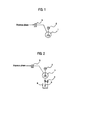
- FIG. 1 a schematic diagram of one example of a first embodiment of an apparatus of the present invention is shown.
- a homogenous fluid mixture of supercritical carbon dioxide, a phospholipid or a glycolipid, and a cosolvent is first placed in a pressure reactor 1 under pressure. While the pressurized homogenous fluid mixture is being stirred vigorously with a stirrer 2, an aqueous phase containing a substance to be encapsulated is added dropwise into the pressure reactor 1 via a pump 3, which serves as means for introducing aqueous phase. Once a predetermined amount of the aqueous phase has been added, the pressure is released and the pressure reactor 1 opened to obtain liposomes encapsulating the substance.
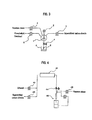
- FIG. 2 a schematic diagram of one example of a second embodiment of the present invention is shown. Elements analogous to those shown in Fig. 1 are designated by like reference numerals.
- a homogenous fluid mixture of supercritical carbon dioxide, a phospholipid or a glycolipid, and a cosolvent is first placed in a pressure reactor 1 under pressure. While the pressurized homogenous fluid mixture is being stirred vigorously with a stirrer 2, an aqueous phase containing a substance to be encapsulated is added dropwise into the pressure reactor 1 via a pump 3, which serves as means for introducing aqueous phase.
- a relief valve 4 is provided to serve as means for discharging liposomes.
- liposome 5 is discharged from the pressure reactor 1 through the relief valve 4 into a receiver 6 and accumulates in the receiver 6.
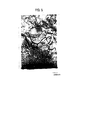
- FIG. 3 a schematic diagram of another example of the second embodiment of the present invention is shown. Elements analogous to those shown in Fig. 2 are designated by like reference numerals.
- reference numeral 8 denotes a pump that serves as means for introducing a phospholipid or a glycolipid uniformly dispersed in a cosolvent into a pressure reactor 1
- reference numeral 9 denotes a pump that serves as means for introducing an aqueous phase containing a water-soluble or hydrophilic substance to be encapsulated.
- the supercritical carbon dioxide, the phospholipid or the glycolipid and the cosolvent, and the aqueous phase are introduced at once through the pumps 7, 8, and 3, respectively, into the pressure reactor 1.
- the mixture is then stirred with a stirrer 2 to form liposomes.
- liposome 5 is discharged from the pressure reactor 1 through a relief valve 4 into a receiver 6 and accumulates in the receiver 6.
- the apparatus according to this embodiment permits continuous production of liposomes.
- Liposomes were prepared using the apparatus shown in Fig. 1.
- the pressure reactor was used as the pressure reactor.
- DPPC dipalmitoylphosphatidylcholine
- VC-PMG magnesium L-ascorbyl phosphate
- TEM transmission electron microscopy
- the trapping efficiency of the liposomes was determined by the glucose dialysis, a standard technique.
- additional liposomes were prepared by sonication (Bangham method), which is also a commonly used technique in the preparation of liposomes, and the trapping efficiency of the liposomes was also determined. The results are shown in Table 1.
- the liposome of Example 1 in the present invention which makes use of supercritical carbon dioxide, has a trapping efficiency 10 or more times higher than that of the liposome of Comparative Example 1 prepared by the conventional sonication technique.
- Liposomes were prepared using the apparatus shown in Fig. 2.
- the pressure reactor used was identical to that used in Example 1.
- a fluid mixture of 0.014g hydrogenated soy lecithin, 13.749g supercritical carbon dioxide (200atm, 60°C) and 0.96g ethanol was placed in the pressure reactor. While the fluid mixture was being stirred vigorously, 2.81ml of a 3.5% aqueous solution of magnesium L-ascorbyl phosphate (VC-PMG) was injected into the pressure reactor with a pump at a flow rate of 0.05cc/min. With the relief valve set to operate at 200kgf/cm 2 , liposomes encapsulating VC-PMG were obtained.
- VC-PMG magnesium L-ascorbyl phosphate
- TEM transmission electron microscopy
- Liposomes were prepared using the apparatus shown in Fig. 2.
- the pressure reactor used was identical to that used in Example 1.
- a fluid mixture of 0.041g hydrogenated soy lecithin, supercritical carbon dioxide (200atm, 60°C) and 0.96g ethanol was placed in the pressure reactor. While the fluid mixture was being stirred vigorously, an aqueous solution of 10mg ibuprofen dissolved in 2.81ml water was injected into the pressure reactor with a pump at a flow rate of 0.05cc/min.
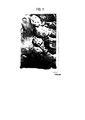
- the relief valve set to operate at 200kgf/cm 2 liposomes encapsulating ibuprofen were obtained. Morphology of the resulting liposomes was observed by transmission electron microscopy (TEM). The observation revealed that these liposomes were large unilamellar vesicles sized 100 to 1000nm.
- a TEM image of the liposomes was shown in Fig. 7.
- the liposome of Example 3 in the present invention contains 10 or more times as much agent as the liposome of Comparative Example 1 prepared by the conventional sonication technique.
- liposomes were prepared using the following conditions.
- the method and the apparatus of the present invention enable single-step, efficient production of liposomes with high trapping efficiency.
- the high trapping efficiency of the liposome produced by the method of the present invention facilitates percutaneous absorption of the encapsulated agent when the liposome is used in an external preparation and improves absorption of the encapsulated agent by body when the liposome is used for internal use.
- liposomes that facilitate the cell growth and percutaneous absorption of encapsulated agents can be obtained.
Landscapes
- Chemical & Material Sciences (AREA)
- Health & Medical Sciences (AREA)
- Organic Chemistry (AREA)
- Dispersion Chemistry (AREA)
- Pharmacology & Pharmacy (AREA)
- Medicinal Chemistry (AREA)
- Chemical Kinetics & Catalysis (AREA)
- Epidemiology (AREA)
- Life Sciences & Earth Sciences (AREA)
- Animal Behavior & Ethology (AREA)
- General Health & Medical Sciences (AREA)
- Public Health (AREA)
- Veterinary Medicine (AREA)
- Medicinal Preparation (AREA)
- Manufacturing Of Micro-Capsules (AREA)
Abstract
Description
characterized in that an aqueous phase containing the substance to be encapsulated is added to a mixture of a phospholipid or a glycolipid and carbon dioxide either under a supercritical condition or under a condition in which temperature or pressure is higher than or equal to its critical point. The present invention also provides an apparatus for producing liposome encapsulating a desired substance, comprising a pressure reactor for containing a pressurized homogenous fluid mixture of a phospholipid or a glycolipid and carbon dioxide either under a supercritical condition or under a condition in which temperature or pressure is higher than or equal to its critical point; and means for introducing into the mixture placed in the pressure reactor an aqueous phase that contains the substance to be encapsulated, which is either water-soluble or hydrophilic. The present invention also provides an apparatus for producing liposome encapsulating a desired substance, comprising a pressure reactor; means for introducing into the pressure reactor carbon dioxide either under a supercritical condition or under a condition in which temperature or pressure is higher than or equal to its critical point; means for introducing into the pressure reactor a phospholipid or a glycolipid uniformly dispersed in a cosolvent; and means for introducing into the pressure reactor an aqueous phase containing the substance to be encapsulated.
- 1
- Pressure reactor
- 2
- Stirrer
- 3
- Pump
- 4
- Relief valve
- 5
- Liposome
- 6
- Receiver
- 7
- Pump
- 8
- Pump
| Example 1 (supercritical liposomes) | Comparative Example 1 (liposomes made by Bangham method) | |
| Trapping efficiency | 32% | 2.8% |
| Example 3 (supercritical liposomes) | Comparative Example 2 (liposomes made by Bangham method) | |
| Content of agent | 7.8mg | 0.6mg |
Lipids used:
Claims (9)
- A method for producing liposome encapsulating a desired substance, characterized in that an aqueous phase containing the substance to be encapsulated is added to a homogenous fluid mixture of a phospholipid or a glycolipid and carbon dioxide either under a supercritical condition or under a condition in which temperature or pressure is higher than or equal to its critical point.
- The method for producing liposome according to claim 1, characterized in that the fluid mixture contains a cosolvent.
- The method for producing liposome according to claim 1 or 2, characterized in that the aqueous phase contains deep sea water or its filtrate obtained by reverse osmosis membrane filtration.
- The method for producing liposome according to any one of claims 1 to 3, characterized in that the substance to be encapsulated includes at least one water-soluble or hydrophilic pharmacologically active agent.
- The method for producing liposome according to any one of claims 1 to 3, characterized in that the substance to be encapsulated includes at least one water-soluble color.
- The method for producing liposome according to claim 5, characterized in that the aqueous phase contains as an antioxidant ascorbic acid or a salt thereof or a sulfite.
- An apparatus for producing liposome encapsulating a desired substance, comprising:a pressure reactor for containing a pressurized homogenous fluid mixture of a phospholipid or a glycolipid and carbon dioxide either under a supercritical condition or under a condition in which temperature or pressure is higher than or equal to its critical point; andmeans for introducing an aqueous phase containing the substance to be encapsulated into the mixture placed in the pressure reactor.
- An apparatus for producing liposome encapsulating a desired substance, comprising:a pressure reactor;means for introducing into the pressure reactor carbon dioxide either under a supercritical condition or under a condition in which temperature or pressure is higher than or equal to its critical point;means for introducing into the pressure reactor a phospholipid or a glycolipid uniformly dispersed in a cosolvent; andmeans for introducing into the pressure reactor an aqueous phase containing the substance to be encapsulated.
- The apparatus for producing liposome according to claim 7 or 8, further including means for discharging liposome.
Applications Claiming Priority (3)
| Application Number | Priority Date | Filing Date | Title |
|---|---|---|---|
| JP2000313599 | 2000-10-13 | ||
| JP2000313599 | 2000-10-13 | ||
| PCT/JP2001/008907 WO2002032564A1 (en) | 2000-10-13 | 2001-10-11 | Process for producing liposome and apparatus therefor |
Publications (3)
| Publication Number | Publication Date |
|---|---|
| EP1334765A1 true EP1334765A1 (en) | 2003-08-13 |
| EP1334765A4 EP1334765A4 (en) | 2005-11-09 |
| EP1334765B1 EP1334765B1 (en) | 2010-06-30 |
Family
ID=18792992
Family Applications (1)
| Application Number | Title | Priority Date | Filing Date |
|---|---|---|---|
| EP01974773A Expired - Lifetime EP1334765B1 (en) | 2000-10-13 | 2001-10-11 | Process for producing liposome |
Country Status (5)
| Country | Link |
|---|---|
| US (1) | US20040099976A1 (en) |
| EP (1) | EP1334765B1 (en) |
| JP (2) | JP4296341B2 (en) |
| DE (1) | DE60142487D1 (en) |
| WO (1) | WO2002032564A1 (en) |
Cited By (3)
| Publication number | Priority date | Publication date | Assignee | Title |
|---|---|---|---|---|
| WO2012070971A1 (en) * | 2010-11-22 | 2012-05-31 | Farber Boris Slavinovich | Cosmetic and pharmaceutical composition for rejuvenating and regenerating the skin, inter alia after surgical operations |
| EP1776948A4 (en) * | 2004-08-11 | 2012-06-20 | Konica Minolta Med & Graphic | Method of producing liposome-containing preparation |
| EP3494964A1 (en) * | 2007-05-14 | 2019-06-12 | Konica Minolta Holdings, Inc. | Liposome and method for producing liposome |
Families Citing this family (30)
| Publication number | Priority date | Publication date | Assignee | Title |
|---|---|---|---|---|
| ATE397488T1 (en) * | 1998-11-13 | 2008-06-15 | Heriot William A | DEVICE FOR PRODUCING LIPOSOMES |
| JP2005170923A (en) * | 2003-10-21 | 2005-06-30 | Konica Minolta Medical & Graphic Inc | Liposome-containing X-ray contrast medium and method for producing the same |
| JP2005170928A (en) * | 2003-10-21 | 2005-06-30 | Konica Minolta Medical & Graphic Inc | Lyposome-containing x ray-imaging agent and method for producing the same |
| JP2005145845A (en) * | 2003-11-12 | 2005-06-09 | Konica Minolta Medical & Graphic Inc | Contrast medium for x-ray examination |
| JP4595319B2 (en) * | 2003-12-03 | 2010-12-08 | コニカミノルタエムジー株式会社 | Liposomes for liposomes, liposomes and methods for producing them |
| JP2005162702A (en) * | 2003-12-04 | 2005-06-23 | Konica Minolta Medical & Graphic Inc | Liposome preparation production method, liposome preparation and production apparatus thereof |
| JP2005220034A (en) * | 2004-02-03 | 2005-08-18 | Konica Minolta Medical & Graphic Inc | Method for producing contrast medium for X-ray examination |
| JP2005220045A (en) * | 2004-02-04 | 2005-08-18 | Konica Minolta Medical & Graphic Inc | Fluorescent contrast agent |
| JP4649841B2 (en) * | 2004-02-18 | 2011-03-16 | コニカミノルタエムジー株式会社 | Method for producing liposome-containing preparation, and liposome-containing preparation |
| JP4654590B2 (en) * | 2004-03-31 | 2011-03-23 | コニカミノルタエムジー株式会社 | Contrast composition for X-ray CT and method for producing the same |
| JP4669665B2 (en) * | 2004-04-12 | 2011-04-13 | 正彦 阿部 | Polycation-modified liposome having no cytotoxicity and method for producing the same |
| US7588751B2 (en) * | 2004-07-21 | 2009-09-15 | Konica Minolta Medical & Graphic, Inc. | Liposome-containing radiographic contrast medium and preparation method thereof |
| JP2006056807A (en) * | 2004-08-18 | 2006-03-02 | Konica Minolta Medical & Graphic Inc | Photodynamic therapy formulation |
| JP4715133B2 (en) * | 2004-08-26 | 2011-07-06 | コニカミノルタエムジー株式会社 | Anti-tumor liposome preparation and production method thereof |
| JP2006069929A (en) * | 2004-08-31 | 2006-03-16 | Konica Minolta Medical & Graphic Inc | Preparation for treating mycosis and method for producing the same |
| US20060239925A1 (en) * | 2005-04-21 | 2006-10-26 | Konica Minolta Medical & Graphic, Inc. | Method of manufacturing pharmaceutical preparation containing liposomes |
| JP2007002119A (en) * | 2005-06-24 | 2007-01-11 | Nkk Kk | Method for producing carbon dioxide-dme mixed gas |
| JP5004333B2 (en) * | 2006-12-08 | 2012-08-22 | 日機装株式会社 | Nano-order particle manufacturing equipment |
| JP2009191177A (en) * | 2008-02-14 | 2009-08-27 | Nippon Boron:Kk | Additive, method for producing it, and composition containing it |
| US9981238B2 (en) * | 2010-08-25 | 2018-05-29 | Aphios Corporation | Apparatus and methods for making nanosomes loaded with nucleic acid |
| US9489872B2 (en) | 2010-12-27 | 2016-11-08 | Sato Holdings Kabushiki Kaisha | Label, printing paper top layer formation material, information-bearing medium, wristband clip, and carbon dioxide reduction method using same |
| JP6026339B2 (en) * | 2013-03-28 | 2016-11-16 | 日本全薬工業株式会社 | Liposome carrier for transdermal absorption agent |
| EP3345759B1 (en) | 2015-09-04 | 2020-01-01 | Toppan Printing Co., Ltd. | Decorative sheet |
| JP6913861B2 (en) * | 2016-01-12 | 2021-08-04 | 凸版印刷株式会社 | Cosmetic sheet |
| CN106389353B (en) * | 2016-08-29 | 2020-03-27 | 海南通用康力制药有限公司 | Compound monoammonium glycyrrhizinate S for injection and preparation method thereof |
| CN110035897A (en) | 2016-11-29 | 2019-07-19 | 凸版印刷株式会社 | Decorative sheet and method for producing decorative sheet |
| JP7330488B2 (en) * | 2018-05-10 | 2023-08-22 | 学校法人福岡大学 | Liposome production method and production apparatus |
| CN109432008A (en) * | 2018-12-07 | 2019-03-08 | 河南工业大学 | A kind of preparation method of nano liposomes |
| KR102259975B1 (en) * | 2020-07-29 | 2021-06-03 | 주식회사 한국리포좀 | System for mass production of liposome with high encapsulation efficiency |
| KR102339804B1 (en) * | 2021-09-28 | 2021-12-15 | 주식회사 바이오뷰텍 | Manufacturing method for more enhancing stability by encapsulating active ingredients in a liposome structure formed as a multilayer in a molecular clustering state, and a cosmetic composition containing the same |
Family Cites Families (6)
| Publication number | Priority date | Publication date | Assignee | Title |
|---|---|---|---|---|
| US3773919A (en) * | 1969-10-23 | 1973-11-20 | Du Pont | Polylactide-drug mixtures |
| JPS59163313A (en) * | 1983-03-09 | 1984-09-14 | Teijin Ltd | Peptide hormone composition for nasal administration |
| DE3744329A1 (en) * | 1987-12-28 | 1989-07-06 | Schwarz Pharma Gmbh | METHOD FOR THE PRODUCTION OF AT LEAST ONE ACTIVE AGENT AND A TRAITER COMPRISING PREPARATION |
| DE59406065D1 (en) * | 1993-03-24 | 1998-07-02 | Ciba Geigy Ag | Process for the production of a liposome dispersion in the high pressure range |
| US5554382A (en) * | 1993-05-28 | 1996-09-10 | Aphios Corporation | Methods and apparatus for making liposomes |
| CA2234957C (en) * | 1995-10-17 | 2006-12-19 | Inge B. Henriksen | Insoluble drug delivery |
-
2001
- 2001-10-11 EP EP01974773A patent/EP1334765B1/en not_active Expired - Lifetime
- 2001-10-11 US US10/398,667 patent/US20040099976A1/en not_active Abandoned
- 2001-10-11 JP JP2002535796A patent/JP4296341B2/en not_active Expired - Lifetime
- 2001-10-11 DE DE60142487T patent/DE60142487D1/en not_active Expired - Lifetime
- 2001-10-11 WO PCT/JP2001/008907 patent/WO2002032564A1/en not_active Ceased
-
2009
- 2009-02-16 JP JP2009032624A patent/JP5190003B2/en not_active Expired - Lifetime
Cited By (4)
| Publication number | Priority date | Publication date | Assignee | Title |
|---|---|---|---|---|
| EP1776948A4 (en) * | 2004-08-11 | 2012-06-20 | Konica Minolta Med & Graphic | Method of producing liposome-containing preparation |
| US8480952B2 (en) | 2004-08-11 | 2013-07-09 | Konica Minolta Medical & Graphic, Inc. | Method of manufacturing pharmaceutical preparations containing liposomes |
| EP3494964A1 (en) * | 2007-05-14 | 2019-06-12 | Konica Minolta Holdings, Inc. | Liposome and method for producing liposome |
| WO2012070971A1 (en) * | 2010-11-22 | 2012-05-31 | Farber Boris Slavinovich | Cosmetic and pharmaceutical composition for rejuvenating and regenerating the skin, inter alia after surgical operations |
Also Published As
| Publication number | Publication date |
|---|---|
| EP1334765A4 (en) | 2005-11-09 |
| EP1334765B1 (en) | 2010-06-30 |
| WO2002032564A1 (en) | 2002-04-25 |
| US20040099976A1 (en) | 2004-05-27 |
| JP4296341B2 (en) | 2009-07-15 |
| DE60142487D1 (en) | 2010-08-12 |
| JP2010194377A (en) | 2010-09-09 |
| JP5190003B2 (en) | 2013-04-24 |
| JPWO2002032564A1 (en) | 2004-03-04 |
Similar Documents
| Publication | Publication Date | Title |
|---|---|---|
| EP1334765B1 (en) | Process for producing liposome | |
| EP0225130B1 (en) | Liposome composition | |
| EP0253619B1 (en) | Method of preparing single bilayered liposomes | |
| US4485054A (en) | Method of encapsulating biologically active materials in multilamellar lipid vesicles (MLV) | |
| US4994213A (en) | Method of preparing lipid structures | |
| US4776991A (en) | Scaled-up production of liposome-encapsulated hemoglobin | |
| JPS6144808A (en) | Pro-liposome compositions and methods for making aqueous dispersions of liposomes | |
| ZA200501176B (en) | Platinum aggregates and process for producing the same | |
| WO1993000888A1 (en) | Loading technique for preparing drug containing liposomes | |
| CA2146963A1 (en) | Process and device for producing liquid, dispersed systems | |
| JPH04506207A (en) | Preparation of liposome and lipid complex compositions | |
| HUT73531A (en) | Ketoprofene liposomes | |
| DE4038075C1 (en) | Encapsulating solid or liq. lipophilic agents - comprises mixing hydration medium with phospholipid increasing temp. to above soln. phase change temp. and adding remaining medium | |
| US20070122469A1 (en) | Method for producing a vesicle dispersion | |
| JP2002509866A (en) | Method for producing liposome-like active substance preparation | |
| WO1989011335A1 (en) | Preparation of uniform-size liposomes and other lipid structures | |
| JP2005162678A (en) | Liposomes for liposomes, liposomes and methods for producing them | |
| JP5904555B2 (en) | Method for producing liposome | |
| EP0661044A1 (en) | Drug-containing liposomes | |
| Verma et al. | Liposomes as carrier systems | |
| DE4023241A1 (en) | STABLE ACTIVE SUBSTANCE FORMULATION | |
| JP2005232054A (en) | Method for producing liposome-containing preparation, and liposome-containing preparation | |
| JPS62201815A (en) | Liposome preparation | |
| JP2005232053A (en) | Method for producing liposome-containing preparation, and liposome-containing preparation |
Legal Events
| Date | Code | Title | Description |
|---|---|---|---|
| PUAI | Public reference made under article 153(3) epc to a published international application that has entered the european phase |
Free format text: ORIGINAL CODE: 0009012 |
|
| 17P | Request for examination filed |
Effective date: 20030502 |
|
| AK | Designated contracting states |
Designated state(s): DE FR GB |
|
| A4 | Supplementary search report drawn up and despatched |
Effective date: 20050922 |
|
| RIC1 | Information provided on ipc code assigned before grant |
Ipc: 7A 61J 3/07 B Ipc: 7B 01J 13/02 B Ipc: 7A 61K 9/127 A Ipc: 7B 01J 3/00 B |
|
| 17Q | First examination report despatched |
Effective date: 20060717 |
|
| 17Q | First examination report despatched |
Effective date: 20060717 |
|
| GRAP | Despatch of communication of intention to grant a patent |
Free format text: ORIGINAL CODE: EPIDOSNIGR1 |
|
| RTI1 | Title (correction) |
Free format text: PROCESS FOR PRODUCING LIPOSOME |
|
| GRAS | Grant fee paid |
Free format text: ORIGINAL CODE: EPIDOSNIGR3 |
|
| GRAA | (expected) grant |
Free format text: ORIGINAL CODE: 0009210 |
|
| AK | Designated contracting states |
Kind code of ref document: B1 Designated state(s): DE FR GB |
|
| REG | Reference to a national code |
Ref country code: GB Ref legal event code: FG4D |
|
| REF | Corresponds to: |
Ref document number: 60142487 Country of ref document: DE Date of ref document: 20100812 Kind code of ref document: P |
|
| PLBE | No opposition filed within time limit |
Free format text: ORIGINAL CODE: 0009261 |
|
| STAA | Information on the status of an ep patent application or granted ep patent |
Free format text: STATUS: NO OPPOSITION FILED WITHIN TIME LIMIT |
|
| 26N | No opposition filed |
Effective date: 20110331 |
|
| REG | Reference to a national code |
Ref country code: DE Ref legal event code: R097 Ref document number: 60142487 Country of ref document: DE Effective date: 20110330 |
|
| REG | Reference to a national code |
Ref country code: FR Ref legal event code: PLFP Year of fee payment: 16 |
|
| REG | Reference to a national code |
Ref country code: FR Ref legal event code: PLFP Year of fee payment: 17 |
|
| REG | Reference to a national code |
Ref country code: FR Ref legal event code: PLFP Year of fee payment: 18 |
|
| PGFP | Annual fee paid to national office [announced via postgrant information from national office to epo] |
Ref country code: GB Payment date: 20200930 Year of fee payment: 20 Ref country code: FR Payment date: 20200914 Year of fee payment: 20 |
|
| PGFP | Annual fee paid to national office [announced via postgrant information from national office to epo] |
Ref country code: DE Payment date: 20200929 Year of fee payment: 20 |
|
| REG | Reference to a national code |
Ref country code: DE Ref legal event code: R071 Ref document number: 60142487 Country of ref document: DE |
|
| REG | Reference to a national code |
Ref country code: GB Ref legal event code: PE20 Expiry date: 20211010 |
|
| PG25 | Lapsed in a contracting state [announced via postgrant information from national office to epo] |
Ref country code: GB Free format text: LAPSE BECAUSE OF EXPIRATION OF PROTECTION Effective date: 20211010 |