EP1333630A2 - Technique for implementing a virtual private cross-connect - Google Patents
Technique for implementing a virtual private cross-connect Download PDFInfo
- Publication number
- EP1333630A2 EP1333630A2 EP03250746A EP03250746A EP1333630A2 EP 1333630 A2 EP1333630 A2 EP 1333630A2 EP 03250746 A EP03250746 A EP 03250746A EP 03250746 A EP03250746 A EP 03250746A EP 1333630 A2 EP1333630 A2 EP 1333630A2
- Authority
- EP
- European Patent Office
- Prior art keywords
- layer
- virtual private
- connect
- service
- cross
- Prior art date
- Legal status (The legal status is an assumption and is not a legal conclusion. Google has not performed a legal analysis and makes no representation as to the accuracy of the status listed.)
- Granted
Links
Images


Classifications
-
- H—ELECTRICITY
- H04—ELECTRIC COMMUNICATION TECHNIQUE
- H04Q—SELECTING
- H04Q3/00—Selecting arrangements
- H04Q3/0016—Arrangements providing connection between exchanges
- H04Q3/0025—Provisions for signalling
-
- H—ELECTRICITY
- H04—ELECTRIC COMMUNICATION TECHNIQUE
- H04Q—SELECTING
- H04Q11/00—Selecting arrangements for multiplex systems
- H04Q11/0001—Selecting arrangements for multiplex systems using optical switching
- H04Q11/0005—Switch and router aspects
-
- H—ELECTRICITY
- H04—ELECTRIC COMMUNICATION TECHNIQUE
- H04Q—SELECTING
- H04Q11/00—Selecting arrangements for multiplex systems
- H04Q11/0001—Selecting arrangements for multiplex systems using optical switching
- H04Q11/0062—Network aspects
- H04Q11/0071—Provisions for the electrical-optical layer interface
-
- H—ELECTRICITY
- H04—ELECTRIC COMMUNICATION TECHNIQUE
- H04Q—SELECTING
- H04Q11/00—Selecting arrangements for multiplex systems
- H04Q11/0001—Selecting arrangements for multiplex systems using optical switching
- H04Q11/0062—Network aspects
- H04Q2011/0077—Labelling aspects, e.g. multiprotocol label switching [MPLS], G-MPLS, MPAS
-
- H—ELECTRICITY
- H04—ELECTRIC COMMUNICATION TECHNIQUE
- H04Q—SELECTING
- H04Q11/00—Selecting arrangements for multiplex systems
- H04Q11/0001—Selecting arrangements for multiplex systems using optical switching
- H04Q11/0062—Network aspects
- H04Q2011/0088—Signalling aspects
-
- H—ELECTRICITY
- H04—ELECTRIC COMMUNICATION TECHNIQUE
- H04Q—SELECTING
- H04Q11/00—Selecting arrangements for multiplex systems
- H04Q11/0001—Selecting arrangements for multiplex systems using optical switching
- H04Q11/0062—Network aspects
- H04Q2011/009—Topology aspects
Definitions
- the present invention relates generally to virtual private networks and, more particularly, to a technique for implementing a multi-service packet and optical/TDM (Time division multiplexing) virtual private cross-connect.
- optical/TDM Time division multiplexing
- OPN optical virtual private network
- the call based model is characterized by an emphasis on bandwidth and connectivity, achieved generally through complex in-house built dedicated network solutions. As a result, the architecture is very expensive. Under the call based model, connectivity services are generally transport dependent type services. Oftentimes, these services require major and expensive upgrades to the transport technology used.
- VPN virtual private network
- Mechanisms used in these architectures are call centric, which involves a user subscribing to a closed-user group and a network defining a set of rules for incoming and outgoing calls to/from the group to an open portion of the network.
- Call-based architectures have traditionally minimized or ignored the importance of providing carrier based VPN services that offer complete client flexibility, reduce operational complexity and introduce new added-value services beyond basic point-to-point connectivity.
- GMPLS Generalized Multi Protocol Label Switching
- a technique for implementing a multi-service packet and optical/TDM virtual private cross-connect is provided, as defined by the claims.
- the technique may be realized by a method for implementing a multi-service packet and optical/time division multiplexing virtual private cross-connect comprising the steps of implementing a virtual private cross-connect for supporting a plurality sites associated with at least one virtual private network; providing at least one connection between the virtual private cross-connect and each site; and supporting a combination of at least two of layer-3, layer-2 and layer-1 services.
- the virtual private cross-connect supports at least one packet-based link wherein the packet-based link comprises one of IP, ATM, Frame Relay and Ethernet;
- the layer-3 service comprises an Internet Protocol based network and wherein at least one connection associated with the layer-3 service is an Internet Protocol link;
- the at least one connection is provided at the virtual private cross-connect by at least one port associated with each connection wherein the at least one port supports at least one private address;
- the layer-2 service comprises Asynchronous Time Multiplexing and wherein at least one connection associated with the layer-2 service is a GMPLS link;
- the virtual private cross-connection provides flexible port topology determination;
- the virtual private cross-connection provides flexible on-demand connectivity and the virtual private cross-connection provides private port auto-discovery.
- a computer signal embodied in a carrier wave readable by a computing system and encoding a computer program of instructions for executing a computer process performing the method recited above.
- a system for implementing a multi-service packet and optical/time division multiplexing virtual private cross-connect comprises a virtual private cross-connect for supporting a plurality sites associated with at least one virtual private network; and at least one connection between the virtual private cross-connect and each site; wherein the virtual private cross-connect supports a combination of at least two of layer-3, layer-2 and layer-1 services.
- the layer-3 service comprises an Internet Protocol based network and wherein at least one connection associated with the layer-3 service is an Internet Protocol link; the at least one connection is provided at the virtual private cross-connect by at least one port associated with each connection wherein the at least one port supports at least one private address; the layer-2 service comprises Asynchronous Time Multiplexing and wherein at least one connection associated with the layer-2 service is a GMPLS link; the virtual private cross-connection provides flexible port topology determination; the virtual private cross-connection provides flexible on-demand connectivity; the virtual private cross-connection provides private port auto-discovery; and the virtual private cross-connect supports at least one packet-based link wherein the packet-based link comprises one of IP, ATM, Frame Relay and Ethernet.
- an article of manufacture for implementing a multi-service packet and optical/time division multiplexing virtual private cross-connect comprises at least one processor readable carrier; and instructions carried on the at least one carrier; wherein the instructions are configured to be readable from the at least one carrier by at least one processor and thereby cause the at least one processor to operate so as to implement a virtual private cross-connect for supporting a plurality sites associated with at least one virtual private network; provide at least one connection between the virtual private cross-connect and each site; and support a combination of at least two of layer-3, layer-2 and layer-1 services.
- the layer-3 service comprises an Internet Protocol based network and wherein at least one connection associated with the layer-3 service is an Internet Protocol link and the layer-2 service comprises Asynchronous Time Multiplexing and wherein at least one connection associated with the layer-2 service is a GMPLS link.
- a multi-service packet and optical/TDM virtual private cross-connect may support a combination of services, including layer-3 (such as Internet Protocol-based networks), layer-2 (such as frame relay (FR), ATM (Asynchronous Time Multiplexing) or Ethernet VPNs), layer-1 (such as Synchronous Optical Network Technologies (SONET)/Synchronous Digital Hierarchy (SDH) network) and an optical/time division multiplexing (TDM) network.
- layer-3 such as Internet Protocol-based networks
- layer-2 such as frame relay (FR), ATM (Asynchronous Time Multiplexing) or Ethernet VPNs
- layer-1 such as Synchronous Optical Network Technologies (SONET)/Synchronous Digital Hierarchy (SDH) network
- SONET Synchronous Optical Network Technologies
- SDH Synchronous Digital Hierarchy
- TDM optical/time division multiplexing
- a customer of a provider network may subscribe to a multi-service virtual private cross-connect (VPXC).
- a VPXC may appear to a customer network as a
- a VPXC may use techniques associated with a virtual private optical cross-connect with the exception that the VPXC may also accommodate packet-based links, such as IP, ATM, Ethernet or other packet-based links.
- a VPXC may provide packet-based layer-2, layer-3 and GMPLS-based Optical/TDM VPN services where the concept of GMPLS-based Virtual Private optical/TDM cross-connect may be extended to include packet-based VPNs.
- the VPXC may also use technology developed in provider provisioned virtual private networks (e.g., L3, L2, OVPNs) such as VPN auto-discovery used for Virtual Private Optical Cross-Connect (VPOXC) and Generalized VPN (GVPN) as applied to layer-2 circuits, for example.
- provider provisioned virtual private networks e.g., L3, L2, OVPNs
- VPN auto-discovery used for Virtual Private Optical Cross-Connect (VPOXC) and Generalized VPN (GVPN) as applied to layer-2 circuits
- Generalized VPN is a technology that allows providers to offer optical/TDM VPN services to their customers.
- GVPN is a port-based VPN.
- a customer may signal any connectivity between at least two customer sites.
- a Virtual Private Optical Cross-connect may be considered a variation of GVPN technology, allowing the provider to offer VPN services where the provider network appears as a virtual private node to the client network.
- This virtual node may support optical/TDM links, for
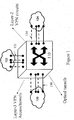
- FIG. 1 is a diagram of a multi-service virtual private cross-connect in accordance with an embodiment of the present invention.
- VPXC 110 may support multiple types of services.
- VPXC 110 may be connected to a plurality of sites associated with a VPN.
- Site 120 of a VPN is connected to VPXC 110 via links 130.
- Site 122 of the VPN is connected to VPXC 110 via links 132.
- Site 124 of the VPN is connected to VPXC 110 via links 134.
- Multi-service virtual private cross-connect 110 may support layer-3 VPN access/tunnels, layer-2 VPN circuits, layer-1 optical tunnels and intelligent L3/L2/L1 cross-connect.
- a service provider network offering VPXC services may include devices such as optical network element (ONE) which may include optical cross connects (OXCs), Routers, ATM, Frame Relay or Ethernet switches, SONET/SDH Cross Connects and other similar devices. These devices may be partitioned into P (Provider) and PE (Provider Edge), for example.
- the P may be connected to other PE or P within a provider's network.
- the PE may be connected to P within the provider network as well as to devices outside of the provider network.
- client edge devices CEs
- An example of a CE may include a router, a SONET/SDH Cross Connect, an Ethernet switch or other similar device.
- the service provider may appear as a multi-service virtual private cross-connect where customer ports are attached to it.
- resources used to connect a CE to a VPXC may be represented as a traffic engineering (TE) link.
- TE traffic engineering
- constructs e.g., link bundling, etc.
- CE an end point of the TE link connected to the CE
- VPXC an end point of the TE link connected to the (VPXC) PE
- FIG. 2 is a diagram illustrating a VPXC that connects a plurality of sites associated with a VPN in accordance with an embodiment of the present invention.
- VPXC 210 may support provider network 220 for establishing connectivity and tunnels between/among multiple sites 230, 232, 234, 236, 238 and 240.
- the example of Figure 2 may support layer-1 services.
- Client Edge (CE) devices CE1, CE2, CE3, CE4, CE5 and CE6 may support sites 230, 232, 234, 236, 238 and 240, respectively.
- Ports 250, 252, 254, 256, 258 and 260 associated with CE1, CE2, CE3, CE4, CE5 and CE6, respectively may represent packet/optical/TDM port(s).
- the ports may support private addresses as used in a Virtual Private Network.
- VPXC mode(s) of operations may be considered independent from a provider internal network mode(s) of operations.
- VPXC bandwidth may be increased/decreased without impacting provider/private networks.
- the provider may also add/remove nodes/links within a switched private partition without impacting client addressing.
- a VPOXC based VPSTN provides flexibility to the client and optimal scalability for the provider.
- a VPXC may tunnel multiple layer-1, layer-2, or layer-3 customer VPN services using layer-1, layer-2 and/or layer-3 defined tunnels such as IPSec, ATM, FR, SONET/SDH, etc.
- Tunnelling for layer-1 may involve using the hierarchical concept by nesting multiple connections by their order of physical definition. For example, TDM may be nested on top of a lambda type connection.
- FIG. 3 is a diagram of VPXC functions in accordance with an embodiment of the present invention.
- VPXC 310 may provide various services 320, such as flexible VPN port topology determination 322, flexible on-demand connectivity (e.g., tunnels) 324 and intelligent private port auto-discovery 326. Other services or functions may be provided as well.
- the VPXC may implement a wide spectrum of port topologies, including a full mesh port topology (e.g., hub and spoke, arbitrary, etc.) and other topologies.
- the auto discovery functionality may be similar to that used in VPOXC and Generalized VPNs (GVPN), for example.
- the provider may run a discovery mechanism that distributes the VPXC port information in a similar manner as performed with GVPN and VPOXC.
- advantages of various embodiments of the present invention may include enabling clients to monitor VPXC operations using defined tools; support of a range of security capabilities for private control traffic; support of a range of quality of service (QoS) capabilities; use of VPXC technology at a node level and at a network level where a VPXC may be built from multiple physical resources partitioned among a set of physical cross-connects; network independence between VPXCs and provider networks; support for online/offline traffic engineering per VPXC running on a customer network; and support for inter-service provider VPXCs.
- QoS quality of service
- a VPXC may implement functions related to a VPN auto-discovery for layer-1, layer-2 and/or layer-3.
- a VPXC may implement GMPLS based signalling for both packet and optical links.
- a VPXC may be associated with a VPN membership scheme which may include VPN-IDs (such as defined in RFC2685 or route-target such as used in Border Gateway Protocol (BGP) based protocols).
- VPN-IDs such as defined in RFC2685 or route-target such as used in Border Gateway Protocol (BGP) based protocols.
- a VPXC customer may define a VPXC topology to be supported by a service provider. Within a VPSTN topology, the customer may select and control any connectivity topology. The provider may restrict and constrain port-to-port connectivity according to the topology implemented within the VPxC. VPXC topology determination may be derived from explicit configuration of the import/export policy for the route-target values of from explicit signalling of the topology information.
- VPXC multiple services may be provided on a single VPXC where a VPXC customer may provide VPXC services and/or other VPN services. Addition of a new VPXC will not impact other VPXCs.
- Provider internal network operations may be isolated from VPXC customer network operations.
- VPXCs may be used in multiple types of networks that include optical metro, access and long haul networks and/or layer-2 and layer-3 networks. Flexible mobility between VPXCs and provider network equipment may also be achieved through various embodiments of the present invention.
- VPXC may use (G)MPLS based signaling to signal any packet or optical connectivity according to a topology implemented by the VPXC.
- Client devices may operate within a VPXC space independently from the service provider network operations.
- VPXC may be instantiated on one or more physical devices.
- a customer may own one or more VPXCs and build routing peering between the VPOXCs within a private network.
- FIG. 4 is a diagram illustrating a layer-2 VPN service with VPXC in accordance with an embodiment of the present invention.
- VPXC 410 may be connected to a plurality of layer-2 VPNs, which may support ATM.
- VPN 420 is a layer-2 VPN support ATM, such is connected to VPN A 430.
- Links 440 between VPXC 410 and VPN 420 may be GMPLS links.
- VPN 422 is a layer-2 VPN connected to VPN A 432.
- Links 442 between VPXC 410 and VPN 422 may be GMPLS links.
- VPN 424 is a layer-2 VPN connected to VPN A 434.
- Links 444 between VPXC 410 and VPN 424 may be GMPLS links.
- VPN 430, 432 and 434 may represent a site associated with a single VPN.
- VPXC 410 further supports layer-2 VPN tunnels for establishing connectivity between/among the layer-2 VPNs.
- GMPLS signaling may be used to create CE-VPOXC-CE connections or inter-CE connections through the VPXC(s).
- RSVP-TE or CR-LDP protocols may be implemented.
- a layer-2 VPXC may be considered a VPXC where the links are layer-2 links.
- the VPXC may be addressed through Ethernet layer-2 and/or layer-3 addresses.
- a customer may peer at layer-2 with the VPXC.
- a customer device may use GMPLS-based signalling to request a layer-2 service.
- FIG. 5 is a diagram illustrating a layer-3 VPN service in accordance with an embodiment of the present invention.
- VPXC structure 510 may include a plurality of VPXCs, as shown by VPXC 512, VPXC 514 and VPXC 516.
- VPXC 510 may be connected to one or more PE nodes, such as PE 502, which may include a plurality of Virtual Routers, such as VR 520, VR 522 and VR 524, and PE 504 which may include a plurality of Virtual Routers, such as VR 526, VR 528 and VR 530.
- Each Virtual Router may be connected to a VPN via an IP link.
- VR 520 may be connected to VPN 540 via an IP link; VR 522 may be connected to VPN 542 via an IP link and VR 524 may be connected to VPN 544 via an IP link.
- VR 526 may be connected to VPN 546 via an IP link; VR 528 may be connected to VPN 548 via an IP link and VR 530 may be connected to VPN 550 via an IP link.
- Each VPN may represent a site associated with a single VPN. The connectivity may be created and/or established automatically. In addition, tunnels within VPXC 510 do not need to be configured end-to-end.
- a VPXC may peer with a client device at layer-3.
- the VPXC may appear as one hop away from the CE.
- a layer-3 VPXC may be used for both building layer-3 tunnels and connecting the VPXC to an existing IP VPN service, such as virtual router or RFC2547bis.
- a CE may directly peer with the VPXC at layer-3.
- a layer-1 service with VPXC is similar to the concept of virtual private Optical/TDM cross-connect.
- layer-1 service may be supported in a VPXC as illustrated in Figure 2.
- the customer may use GMPLS to request Optical/TDM connectivity between two CEs attached to the VPXC.
- a VPXC may have links that are a combination of layer-1, layer-2 and layer-3.
- the VPXC may connect ports that are of the same layer type, ports that may interwork and/or ports that are compatible.
- an ATM link may be connected to another ATM or frame relay link but not to SONET/SDH link of the VPXC.
- FIG. 6 is a diagram illustrating a layer-2 VPXC service used with an IP VPN service in accordance with an embodiment of the present invention.
- VPXC 610 may be connected to a plurality of Virtual Routers, such as VR 620, VR 622 and VR 624. Each Virtual Router may also be connected to a VPN.
- VR 620 is connected to VPN 630
- VR 622 is connected to VPN 632
- VR 624 is connected to VPN 634.
- layer-3 may use layer-2/Optical Cross connect auto-discovery performed on the VPXC 610.
- the VPOXC may provide layer-2 tunnel connectivity between virtual routers.
- the VPXC may provide layer-1 connectivity between virtual routers. In both examples, the VPXC may be run layer-1 or layer-2 auto discovery.
- a VPXC may accommodate multiple layers, the VPXC may nest multiple types of VPXC.
- a layer-2 VPXC may be built on top of layer-1 VPXC. Layer-2 circuits may be then tunnelled through connections provided by layer-1 VPXC.
- implementing a multi-service packet and optical/TDM virtual private cross-connect in accordance with the present invention as described above typically involves the processing of input data and the generation of output data to some extent.
- This input data processing and output data generation may be implemented in hardware or software.
- specific electronic components may be employed in a node or similar or related circuitry for implementing a multi-service packet and optical/TDM virtual private cross-connect in accordance with the present invention as described above.
- one or more processors operating in accordance with stored instructions may implement the functions associated with implementing a multi-service packet and optical/TDM virtual private cross-connect in accordance with the present invention as described above. If such is the case, it is within the scope of the present invention that such instructions may be stored on one or more processor readable media, or transmitted to one or more processors via one or more signals.
Landscapes
- Engineering & Computer Science (AREA)
- Computer Networks & Wireless Communication (AREA)
- Data Exchanges In Wide-Area Networks (AREA)
- Optical Communication System (AREA)
- Communication Control (AREA)
Abstract
Description
- The present invention relates generally to virtual private networks and, more particularly, to a technique for implementing a multi-service packet and optical/TDM (Time division multiplexing) virtual private cross-connect.
- Due to recent developments in fiber-optics-based networks and carrier virtual private network technologies, optical virtual private network (OVPN) services are currently being explored in the industry. Most call-based network architectures currently deployed are designed towards providing a basic unit of service that usually entails providing connectivity between two network public entry endpoints. The set of services and associated network architecture are based on a call based model and require architectural building blocks that are call centric.
- The call based model is characterized by an emphasis on bandwidth and connectivity, achieved generally through complex in-house built dedicated network solutions. As a result, the architecture is very expensive. Under the call based model, connectivity services are generally transport dependent type services. Oftentimes, these services require major and expensive upgrades to the transport technology used.
- Currently, virtual private network (VPN) architectures built around the call based model focus on restricting connectivity to a group of users (e.g., closed-user group). Mechanisms used in these architectures are call centric, which involves a user subscribing to a closed-user group and a network defining a set of rules for incoming and outgoing calls to/from the group to an open portion of the network.
- Call-based architectures have traditionally minimized or ignored the importance of providing carrier based VPN services that offer complete client flexibility, reduce operational complexity and introduce new added-value services beyond basic point-to-point connectivity.
- In view of the foregoing, it would be desirable to provide a technique for implementing a multi-service packet and optical/TDM virtual private cross-connect. More particularly, to implement mechanisms associated with VPN auto-discovery and Generalized Multi Protocol Label Switching (GMPLS) to provide virtual private optical cross-connect and/or GMPLS-based packet-based port-based VPNs in an efficient and cost effective manner.
- According to the present invention, a technique for implementing a multi-service packet and optical/TDM virtual private cross-connect is provided, as defined by the claims. In one particular exemplary embodiment, the technique may be realized by a method for implementing a multi-service packet and optical/time division multiplexing virtual private cross-connect comprising the steps of implementing a virtual private cross-connect for supporting a plurality sites associated with at least one virtual private network; providing at least one connection between the virtual private cross-connect and each site; and supporting a combination of at least two of layer-3, layer-2 and layer-1 services.
- In accordance with other aspects of this particular exemplary embodiment of the present invention, the virtual private cross-connect supports at least one packet-based link wherein the packet-based link comprises one of IP, ATM, Frame Relay and Ethernet; the layer-3 service comprises an Internet Protocol based network and wherein at least one connection associated with the layer-3 service is an Internet Protocol link; the at least one connection is provided at the virtual private cross-connect by at least one port associated with each connection wherein the at least one port supports at least one private address; the layer-2 service comprises Asynchronous Time Multiplexing and wherein at least one connection associated with the layer-2 service is a GMPLS link; the virtual private cross-connection provides flexible port topology determination; the virtual private cross-connection provides flexible on-demand connectivity and the virtual private cross-connection provides private port auto-discovery.
- According to another particular exemplary embodiment, a computer signal embodied in a carrier wave readable by a computing system and encoding a computer program of instructions for executing a computer process performing the method recited above.
- According to another particular exemplary embodiment, a system for implementing a multi-service packet and optical/time division multiplexing virtual private cross-connect comprises a virtual private cross-connect for supporting a plurality sites associated with at least one virtual private network; and at least one connection between the virtual private cross-connect and each site; wherein the virtual private cross-connect supports a combination of at least two of layer-3, layer-2 and layer-1 services.
- In accordance with other aspects of this particular exemplary embodiment of the present invention, the layer-3 service comprises an Internet Protocol based network and wherein at least one connection associated with the layer-3 service is an Internet Protocol link; the at least one connection is provided at the virtual private cross-connect by at least one port associated with each connection wherein the at least one port supports at least one private address; the layer-2 service comprises Asynchronous Time Multiplexing and wherein at least one connection associated with the layer-2 service is a GMPLS link; the virtual private cross-connection provides flexible port topology determination; the virtual private cross-connection provides flexible on-demand connectivity; the virtual private cross-connection provides private port auto-discovery; and the virtual private cross-connect supports at least one packet-based link wherein the packet-based link comprises one of IP, ATM, Frame Relay and Ethernet.
- According to another particular exemplary embodiment, an article of manufacture for implementing a multi-service packet and optical/time division multiplexing virtual private cross-connect comprises at least one processor readable carrier; and instructions carried on the at least one carrier; wherein the instructions are configured to be readable from the at least one carrier by at least one processor and thereby cause the at least one processor to operate so as to implement a virtual private cross-connect for supporting a plurality sites associated with at least one virtual private network; provide at least one connection between the virtual private cross-connect and each site; and support a combination of at least two of layer-3, layer-2 and layer-1 services.
- In accordance with other aspects of this particular exemplary embodiment of the present invention, the layer-3 service comprises an Internet Protocol based network and wherein at least one connection associated with the layer-3 service is an Internet Protocol link and the layer-2 service comprises Asynchronous Time Multiplexing and wherein at least one connection associated with the layer-2 service is a GMPLS link.
- The present invention will now be described in more detail with reference to exemplary embodiments thereof as shown in the appended drawings. While the present invention is described below with reference to preferred embodiments, it should be understood that the present invention is not limited thereto. Those of ordinary skill in the art having access to the teachings herein will recognize additional implementations, modifications, and embodiments, as well as other fields of use, which are within the scope of the present invention as disclosed and claimed herein, and with respect to which the present invention could be of significant utility.
- In order to facilitate a fuller understanding of the present invention, reference is now made to the appended drawings. These drawings should not be construed as limiting the present invention, but are intended to be exemplary only.
- Figure 1 is a diagram illustrating a multi-service virtual private cross-connect (VPXC) in accordance with an embodiment of the present invention.
- Figure 2 is a diagram illustrating a VPXC that connects a plurality of sites associated with the same VPN in accordance with an embodiment of the present invention.
- Figure 3 is a diagram of VPXC functions in accordance with an embodiment of the present invention.
- Figure 4 is a diagram illustrating a layer-2 VPN service in accordance with an embodiment of the present invention.
- Figure 5 is a diagram illustrating a layer-3 VPN service in accordance with an embodiment of the present invention.
- Figure 6 is a diagram illustrating a layer-2 VPXC service used with an IP VPN service in accordance with an embodiment of the present invention.
-
- According to an embodiment of the present invention, a multi-service packet and optical/TDM virtual private cross-connect may support a combination of services, including layer-3 (such as Internet Protocol-based networks), layer-2 (such as frame relay (FR), ATM (Asynchronous Time Multiplexing) or Ethernet VPNs), layer-1 (such as Synchronous Optical Network Technologies (SONET)/Synchronous Digital Hierarchy (SDH) network) and an optical/time division multiplexing (TDM) network. A customer of a provider network may subscribe to a multi-service virtual private cross-connect (VPXC). A VPXC may appear to a customer network as a virtual node within the network and may be addressed using a client addressing scheme. A VPXC may use techniques associated with a virtual private optical cross-connect with the exception that the VPXC may also accommodate packet-based links, such as IP, ATM, Ethernet or other packet-based links. In a Provider Provisioned Virtual Private Service Network, a VPXC may provide packet-based layer-2, layer-3 and GMPLS-based Optical/TDM VPN services where the concept of GMPLS-based Virtual Private optical/TDM cross-connect may be extended to include packet-based VPNs. The VPXC may also use technology developed in provider provisioned virtual private networks (e.g., L3, L2, OVPNs) such as VPN auto-discovery used for Virtual Private Optical Cross-Connect (VPOXC) and Generalized VPN (GVPN) as applied to layer-2 circuits, for example. Generalized VPN is a technology that allows providers to offer optical/TDM VPN services to their customers. GVPN is a port-based VPN. A customer may signal any connectivity between at least two customer sites. According to an embodiment of the present invention, a Virtual Private Optical Cross-connect may be considered a variation of GVPN technology, allowing the provider to offer VPN services where the provider network appears as a virtual private node to the client network. This virtual node may support optical/TDM links, for example. The customer may compute in a routing system paths that cross the virtual node (e.g., VPOXC).
- Figure 1 is a diagram of a multi-service virtual private cross-connect in accordance with an embodiment of the present invention. As shown in Figure 1, VPXC 110 may support multiple types of services. VPXC 110 may be connected to a plurality of sites associated with a VPN. For example,
Site 120 of a VPN is connected to VPXC 110 vialinks 130.Site 122 of the VPN is connected to VPXC 110 vialinks 132.Site 124 of the VPN is connected to VPXC 110 vialinks 134. Multi-service virtualprivate cross-connect 110 may support layer-3 VPN access/tunnels, layer-2 VPN circuits, layer-1 optical tunnels and intelligent L3/L2/L1 cross-connect. - A service provider network offering VPXC services may include devices such as optical network element (ONE) which may include optical cross connects (OXCs), Routers, ATM, Frame Relay or Ethernet switches, SONET/SDH Cross Connects and other similar devices. These devices may be partitioned into P (Provider) and PE (Provider Edge), for example. The P may be connected to other PE or P within a provider's network. The PE may be connected to P within the provider network as well as to devices outside of the provider network. Such other devices may be referred to as client edge devices (CEs). An example of a CE may include a router, a SONET/SDH Cross Connect, an Ethernet switch or other similar device. To each CE port of the same VPN, the service provider may appear as a multi-service virtual private cross-connect where customer ports are attached to it. For the purpose of the VPXC service, resources used to connect a CE to a VPXC may be represented as a traffic engineering (TE) link. As a result, constructs (e.g., link bundling, etc.) applicable to TE links are applicable here as well. For a given TE link that connects a CE to a (VPXC) PE, an end point of the TE link connected to the CE may be referred to as CE port, while an end point of the TE link connected to the (VPXC) PE may be referred to as VPXC port.
- Figure 2 is a diagram illustrating a VPXC that connects a plurality of sites associated with a VPN in accordance with an embodiment of the present invention. VPXC 210 may support
provider network 220 for establishing connectivity and tunnels between/amongmultiple sites sites Ports - According to an embodiment of the present invention, VPXC mode(s) of operations may be considered independent from a provider internal network mode(s) of operations. VPXC bandwidth may be increased/decreased without impacting provider/private networks. The provider may also add/remove nodes/links within a switched private partition without impacting client addressing. Thus, a VPOXC based VPSTN provides flexibility to the client and optimal scalability for the provider.
- A VPXC may tunnel multiple layer-1, layer-2, or layer-3 customer VPN services using layer-1, layer-2 and/or layer-3 defined tunnels such as IPSec, ATM, FR, SONET/SDH, etc. Tunnelling for layer-1 may involve using the hierarchical concept by nesting multiple connections by their order of physical definition. For example, TDM may be nested on top of a lambda type connection.
- Figure 3 is a diagram of VPXC functions in accordance with an embodiment of the present invention.
VPXC 310 may providevarious services 320, such as flexible VPNport topology determination 322, flexible on-demand connectivity (e.g., tunnels) 324 and intelligent private port auto-discovery 326. Other services or functions may be provided as well. The VPXC may implement a wide spectrum of port topologies, including a full mesh port topology (e.g., hub and spoke, arbitrary, etc.) and other topologies. The auto discovery functionality may be similar to that used in VPOXC and Generalized VPNs (GVPN), for example. In particular, the provider may run a discovery mechanism that distributes the VPXC port information in a similar manner as performed with GVPN and VPOXC. - Other advantages of various embodiments of the present invention may include enabling clients to monitor VPXC operations using defined tools; support of a range of security capabilities for private control traffic; support of a range of quality of service (QoS) capabilities; use of VPXC technology at a node level and at a network level where a VPXC may be built from multiple physical resources partitioned among a set of physical cross-connects; network independence between VPXCs and provider networks; support for online/offline traffic engineering per VPXC running on a customer network; and support for inter-service provider VPXCs.
- A VPXC may implement functions related to a VPN auto-discovery for layer-1, layer-2 and/or layer-3. In addition, a VPXC may implement GMPLS based signalling for both packet and optical links. Further, a VPXC may be associated with a VPN membership scheme which may include VPN-IDs (such as defined in RFC2685 or route-target such as used in Border Gateway Protocol (BGP) based protocols).
- A VPXC customer may define a VPXC topology to be supported by a service provider. Within a VPSTN topology, the customer may select and control any connectivity topology. The provider may restrict and constrain port-to-port connectivity according to the topology implemented within the VPxC. VPXC topology determination may be derived from explicit configuration of the import/export policy for the route-target values of from explicit signalling of the topology information.
- In addition, multiple services may be provided on a single VPXC where a VPXC customer may provide VPXC services and/or other VPN services. Addition of a new VPXC will not impact other VPXCs. Provider internal network operations may be isolated from VPXC customer network operations. As VPXC are multi-service by nature, VPXCs may be used in multiple types of networks that include optical metro, access and long haul networks and/or layer-2 and layer-3 networks. Flexible mobility between VPXCs and provider network equipment may also be achieved through various embodiments of the present invention.
- Customers may use (G)MPLS based signaling to signal any packet or optical connectivity according to a topology implemented by the VPXC. Client devices may operate within a VPXC space independently from the service provider network operations. VPXC may be instantiated on one or more physical devices. A customer may own one or more VPXCs and build routing peering between the VPOXCs within a private network.
- Figure 4 is a diagram illustrating a layer-2 VPN service with VPXC in accordance with an embodiment of the present invention.
VPXC 410 may be connected to a plurality of layer-2 VPNs, which may support ATM. For example, VPN 420 is a layer-2 VPN support ATM, such is connected toVPN A 430.Links 440 betweenVPXC 410 and VPN 420 may be GMPLS links.VPN 422 is a layer-2 VPN connected toVPN A 432.Links 442 betweenVPXC 410 andVPN 422 may be GMPLS links.VPN 424 is a layer-2 VPN connected toVPN A 434.Links 444 betweenVPXC 410 andVPN 424 may be GMPLS links.VPN VPXC 410 further supports layer-2 VPN tunnels for establishing connectivity between/among the layer-2 VPNs. - GMPLS signaling may be used to create CE-VPOXC-CE connections or inter-CE connections through the VPXC(s). For example, RSVP-TE or CR-LDP protocols may be implemented. A layer-2 VPXC may be considered a VPXC where the links are layer-2 links. The VPXC may be addressed through Ethernet layer-2 and/or layer-3 addresses. A customer may peer at layer-2 with the VPXC. In addition, a customer device may use GMPLS-based signalling to request a layer-2 service.
- Figure 5 is a diagram illustrating a layer-3 VPN service in accordance with an embodiment of the present invention.
VPXC structure 510 may include a plurality of VPXCs, as shown byVPXC 512,VPXC 514 andVPXC 516.VPXC 510 may be connected to one or more PE nodes, such asPE 502, which may include a plurality of Virtual Routers, such asVR 520,VR 522 andVR 524, andPE 504 which may include a plurality of Virtual Routers, such asVR 526,VR 528 andVR 530. Each Virtual Router may be connected to a VPN via an IP link. For example,VR 520 may be connected to VPN 540 via an IP link;VR 522 may be connected to VPN 542 via an IP link andVR 524 may be connected to VPN 544 via an IP link. In addition,VR 526 may be connected to VPN 546 via an IP link;VR 528 may be connected to VPN 548 via an IP link andVR 530 may be connected to VPN 550 via an IP link. Each VPN may represent a site associated with a single VPN. The connectivity may be created and/or established automatically. In addition, tunnels withinVPXC 510 do not need to be configured end-to-end. - A VPXC may peer with a client device at layer-3. The VPXC may appear as one hop away from the CE. A layer-3 VPXC may be used for both building layer-3 tunnels and connecting the VPXC to an existing IP VPN service, such as virtual router or RFC2547bis. In addition, a CE may directly peer with the VPXC at layer-3.
- A layer-1 service with VPXC is similar to the concept of virtual private Optical/TDM cross-connect. For example, layer-1 service may be supported in a VPXC as illustrated in Figure 2. The customer may use GMPLS to request Optical/TDM connectivity between two CEs attached to the VPXC.
- A VPXC may have links that are a combination of layer-1, layer-2 and layer-3. In that respect, the VPXC may connect ports that are of the same layer type, ports that may interwork and/or ports that are compatible. For example, an ATM link may be connected to another ATM or frame relay link but not to SONET/SDH link of the VPXC.
- Figure 6 is a diagram illustrating a layer-2 VPXC service used with an IP VPN service in accordance with an embodiment of the present invention.
VPXC 610 may be connected to a plurality of Virtual Routers, such asVR 620,VR 622 andVR 624. Each Virtual Router may also be connected to a VPN. For example,VR 620 is connected to VPN 630,VR 622 is connected to VPN 632, andVR 624 is connected toVPN 634. In this example, layer-3 may use layer-2/Optical Cross connect auto-discovery performed on theVPXC 610. In another example, if the VPXC is of layer-2 links, the VPOXC may provide layer-2 tunnel connectivity between virtual routers. In another example, if the VPXC has links of SONET/SDH, the VPXC may provide layer-1 connectivity between virtual routers. In both examples, the VPXC may be run layer-1 or layer-2 auto discovery. - Since a VPXC may accommodate multiple layers, the VPXC may nest multiple types of VPXC. For example, a layer-2 VPXC may be built on top of layer-1 VPXC. Layer-2 circuits may be then tunnelled through connections provided by layer-1 VPXC.
- At this point it should be noted that implementing a multi-service packet and optical/TDM virtual private cross-connect in accordance with the present invention as described above typically involves the processing of input data and the generation of output data to some extent. This input data processing and output data generation may be implemented in hardware or software. For example, specific electronic components may be employed in a node or similar or related circuitry for implementing a multi-service packet and optical/TDM virtual private cross-connect in accordance with the present invention as described above. Alternatively, one or more processors operating in accordance with stored instructions may implement the functions associated with implementing a multi-service packet and optical/TDM virtual private cross-connect in accordance with the present invention as described above. If such is the case, it is within the scope of the present invention that such instructions may be stored on one or more processor readable media, or transmitted to one or more processors via one or more signals.
- The present invention is not to be limited in scope by the specific embodiments described herein. Indeed, various modifications of the present invention, in addition to those described herein, will be apparent to those of ordinary skill in the art from the foregoing description and accompanying drawings. Thus, such modifications are intended to fall within the scope of the following appended claims. Further, although the present invention has been described herein in the context of a particular implementation in a particular environment for a particular purpose, those of ordinary skill in the art will recognize that its usefulness is not limited thereto and that the present invention can be beneficially implemented in any number of environments for any number of purposes. Accordingly, the claims set forth below should be construed in view of the full breath and spirit of the present invention as disclosed herein.
Claims (22)
- A method for implementing a multi-service packet and optical/time division multiplexing virtual private cross-connect, the method comprising the steps of:implementing a virtual private cross-connect for supporting a plurality of sites associated with at least one virtual private network;providing at least one connection between the virtual private cross-connect and each site; andsupporting a combination of at least two of layer-3, layer-2 and layer-1 services.
- The method of claim 1, wherein the virtual private cross-connect supports at least one packet-based link wherein the packet-based link comprises one of IP, ATM, Frame Relay and Ethernet.
- The method of claim 1 or 2, wherein the layer-3 service comprises an Internet Protocol based network and wherein at least one connection associated with the layer-3 service is an Internet Protocol link.
- The method of any one of the preceding claims, wherein the at least one connection is provided at the virtual private cross-connect by at least one port associated with each connection wherein the at least one port supports at least one private address.
- The method of any one of the preceding claims, wherein the layer-2 service comprises Asynchronous Time Multiplexing and wherein at least one connection associated with the layer-2 service is a GMPLS link.
- The method of any one of the preceding claims, wherein the virtual private cross-connection provides flexible port topology determination.
- The method of any one of the preceding claims, wherein the virtual private cross-connection provides flexible on-demand connectivity.
- The method of any one of the preceding claims, wherein the virtual private cross-connection provides private port auto-discovery.
- A computer program product adapted to cause a computer system to carry out a method according to any one of the preceding claims.
- A computer program product according to claim 9 recorded on a data carrier.
- A computer signal embodied in a carrier wave readable by a computing system and encoding a computer program of instructions for executing a computer process performing the method recited in any one of claims 1 to 8.
- A system for implementing a multi-service packet and optical/time division multiplexing virtual private cross-connect, the system comprising:wherein the virtual private cross-connect supports a combination of at least two of layer-3, layer-2 and layer-1 services.a virtual private cross-connect for supporting a plurality of sites associated with at least one virtual private network; andat least one connection between the virtual private cross-connect and each site;
- The system of claim 12, wherein the layer-3 service comprises an Internet Protocol based network and wherein at least one connection associated with the layer-3 service is an Internet Protocol link.
- The system of claim 12 or 13, wherein the at least one connection is provided at the virtual private cross-connect by at least one port associated with each connection wherein the at least one port supports at least one private address.
- The system of any one of claims 12 to 14, wherein the layer-2 service comprises Asynchronous Time Multiplexing and wherein at least one connection associated with the layer-2 service is a GMPLS link.
- The system of any one of claims 12 to 15, wherein the virtual private cross-connection provides flexible port topology determination.
- The system of any one of claims 12 to 16, wherein the virtual private cross-connection provides flexible on-demand connectivity.
- The system of any one of claims 12 to 17, wherein the virtual private cross-connection provides private port auto-discovery.
- The system of any one of claims 12 to 18, wherein the virtual private cross-connect supports at least one packet-based link wherein the packet-based link comprises one of IP, ATM, Frame Relay and Ethernet.
- An article of manufacture for implementing a multi-service packet and optical/time division multiplexing virtual private cross-connect, the article of manufacture comprising:wherein the instructions are configured to be readable from the at least one carrier by at least one processor and thereby cause the at least one processor to operate so as to:at least one processor readable carrier; andinstructions carried on the at least one carrier;implement a virtual private cross-connect for supporting a plurality of sites associated with at least one virtual private network;provide at least one connection between the virtual private cross-connect and each site; andsupport a combination of at least two of layer-3, layer-2 and layer-1 services.
- The article of manufacturing of claim 20, wherein the layer-3 service comprises an Internet Protocol based network and wherein at least one connection associated with the layer-3 service is an Internet Protocol link.
- The article of manufacturing of claim 20 or 21, wherein the layer-2 service comprises Asynchronous Time Multiplexing and wherein at least one connection associated with the layer-2 service is a GMPLS link.
Applications Claiming Priority (4)
| Application Number | Priority Date | Filing Date | Title |
|---|---|---|---|
| US35464102P | 2002-02-05 | 2002-02-05 | |
| US354641P | 2002-02-05 | ||
| US326122 | 2002-12-23 | ||
| US10/326,122 US7653050B2 (en) | 2002-02-05 | 2002-12-23 | Technique for implementing a multi-service packet and optical/TDM virtual private cross-connect |
Publications (3)
| Publication Number | Publication Date |
|---|---|
| EP1333630A2 true EP1333630A2 (en) | 2003-08-06 |
| EP1333630A3 EP1333630A3 (en) | 2005-06-15 |
| EP1333630B1 EP1333630B1 (en) | 2011-08-10 |
Family
ID=26985257
Family Applications (1)
| Application Number | Title | Priority Date | Filing Date |
|---|---|---|---|
| EP03250746A Expired - Lifetime EP1333630B1 (en) | 2002-02-05 | 2003-02-05 | Technique for implementing a virtual private cross-connect |
Country Status (4)
| Country | Link |
|---|---|
| US (1) | US7653050B2 (en) |
| EP (1) | EP1333630B1 (en) |
| AT (1) | ATE520223T1 (en) |
| CA (1) | CA2418439C (en) |
Cited By (2)
| Publication number | Priority date | Publication date | Assignee | Title |
|---|---|---|---|---|
| EP1998507A4 (en) * | 2006-05-16 | 2009-05-06 | Huawei Tech Co Ltd | Service switching method in optical network,system of optical network,switching device and network edging device of the provider |
| EP1864449A4 (en) * | 2005-03-28 | 2011-09-28 | Cisco Tech Inc | METHOD AND APPARATUS FOR CREATING AND UPDATING A TEST POINT ARCHIVING MEMBER FOR THE DIAGNOSIS OF SERVICE LEVEL OF NETWORK VIRTUAL PRIVATE NETWORKS |
Families Citing this family (13)
| Publication number | Priority date | Publication date | Assignee | Title |
|---|---|---|---|---|
| EP1592181B1 (en) * | 2003-02-03 | 2015-01-21 | Nippon Telegraph And Telephone Corporation | Optical network, optical edge router, program thereof, cut through method, and edge router |
| US7593388B1 (en) * | 2003-09-30 | 2009-09-22 | Nortel Networks Limited | Convertor shared by multiple virtual private networks |
| US8051177B1 (en) | 2003-09-30 | 2011-11-01 | Genband Us Llc | Media proxy having interface to multiple virtual private networks |
| US7664123B2 (en) * | 2004-01-22 | 2010-02-16 | Nortel Networks Limited | Generalized virtual router |
| US7774500B1 (en) * | 2004-07-01 | 2010-08-10 | At&T Intellectual Property Ii, L.P. | Method and apparatus for flexible network management of multiple customer virtual private networks |
| US7995569B2 (en) * | 2005-04-01 | 2011-08-09 | Nortel Networks Limited | Virtual routers for GMPLS networks |
| CN101146015B (en) * | 2006-09-13 | 2010-08-04 | 华为技术有限公司 | A Method and Device for Realizing Layer 1 Virtual Private Network L1 VPN |
| US8301848B2 (en) | 2008-06-09 | 2012-10-30 | International Business Machines Corporation | Virtualizing storage for WPAR clients using node port ID virtualization |
| CN102045242B (en) * | 2009-10-21 | 2012-08-08 | 华为技术有限公司 | Network communication method and network node equipment |
| WO2021029910A1 (en) * | 2019-08-14 | 2021-02-18 | Telnyx Llc | Secure virtual private mobile and ip network in cloud |
| US12248577B2 (en) | 2021-11-09 | 2025-03-11 | Dell Products L.P. | Edge day zero secure infrastructure provisioning with autonomic methods |
| US12105850B2 (en) * | 2021-11-09 | 2024-10-01 | Dell Products L.P. | Secure base activation image for edge day zero secure infrastructure provisioning |
| US12086255B2 (en) | 2021-11-09 | 2024-09-10 | Dell Products L.P. | Edge day zero secure infrastructure identification and attestation |
Citations (1)
| Publication number | Priority date | Publication date | Assignee | Title |
|---|---|---|---|---|
| US20030123446A1 (en) | 2001-12-21 | 2003-07-03 | Muirhead Charles S. | System for supply chain management of virtual private network services |
Family Cites Families (14)
| Publication number | Priority date | Publication date | Assignee | Title |
|---|---|---|---|---|
| EP0133630A1 (en) | 1983-08-05 | 1985-03-06 | W.B. Black & Sons (Holdings) Limited | Improvements in the piecemeal demolition of chimneys |
| US6108702A (en) * | 1998-12-02 | 2000-08-22 | Micromuse, Inc. | Method and apparatus for determining accurate topology features of a network |
| US6789118B1 (en) * | 1999-02-23 | 2004-09-07 | Alcatel | Multi-service network switch with policy based routing |
| US6937574B1 (en) * | 1999-03-16 | 2005-08-30 | Nortel Networks Limited | Virtual private networks and methods for their operation |
| US6614791B1 (en) | 1999-05-11 | 2003-09-02 | Nortel Networks Limited | System, device, and method for supporting virtual private networks |
| US6614809B1 (en) * | 2000-02-29 | 2003-09-02 | 3Com Corporation | Method and apparatus for tunneling across multiple network of different types |
| US6930890B1 (en) * | 2000-05-20 | 2005-08-16 | Ciena Corporation | Network device including reverse orientated modules |
| US7088720B1 (en) * | 2000-08-07 | 2006-08-08 | Sbc Technology Resources, Inc. | Multiservice use of network connection capability under user-to-network interface signaling |
| JP3654168B2 (en) * | 2000-09-28 | 2005-06-02 | 日本電気株式会社 | Interface identification device, interface identification method, and MPLS-VPN service network |
| JP4489925B2 (en) * | 2000-11-02 | 2010-06-23 | 富士通株式会社 | Network shared bandwidth allocation method and network system using the same |
| BR0208223A (en) | 2001-03-20 | 2004-03-02 | Worldcom Inc | System, method and apparatus that employ virtual private networks to resist denial of service attack ip qos |
| US20030026271A1 (en) * | 2001-07-03 | 2003-02-06 | Erb Guy C. | L2/L3 network with LSP-enabled virtual routing |
| US7152115B2 (en) * | 2001-07-12 | 2006-12-19 | Nortel Networks Limited | Virtual private networks |
| US6907047B2 (en) * | 2001-07-18 | 2005-06-14 | Sbc Technology Resources, Inc. | Service aware switched SDH/SONET/TDM network |
-
2002
- 2002-12-23 US US10/326,122 patent/US7653050B2/en not_active Expired - Fee Related
-
2003
- 2003-02-04 CA CA2418439A patent/CA2418439C/en not_active Expired - Fee Related
- 2003-02-05 AT AT03250746T patent/ATE520223T1/en not_active IP Right Cessation
- 2003-02-05 EP EP03250746A patent/EP1333630B1/en not_active Expired - Lifetime
Patent Citations (1)
| Publication number | Priority date | Publication date | Assignee | Title |
|---|---|---|---|---|
| US20030123446A1 (en) | 2001-12-21 | 2003-07-03 | Muirhead Charles S. | System for supply chain management of virtual private network services |
Cited By (3)
| Publication number | Priority date | Publication date | Assignee | Title |
|---|---|---|---|---|
| EP1864449A4 (en) * | 2005-03-28 | 2011-09-28 | Cisco Tech Inc | METHOD AND APPARATUS FOR CREATING AND UPDATING A TEST POINT ARCHIVING MEMBER FOR THE DIAGNOSIS OF SERVICE LEVEL OF NETWORK VIRTUAL PRIVATE NETWORKS |
| EP1998507A4 (en) * | 2006-05-16 | 2009-05-06 | Huawei Tech Co Ltd | Service switching method in optical network,system of optical network,switching device and network edging device of the provider |
| US8090262B2 (en) | 2006-05-16 | 2012-01-03 | Huawei Technologies Co., Ltd. | Service handover method, optical network system, handover equipment and PE equipment in an OVPN |
Also Published As
| Publication number | Publication date |
|---|---|
| EP1333630B1 (en) | 2011-08-10 |
| US20030147402A1 (en) | 2003-08-07 |
| CA2418439C (en) | 2011-05-24 |
| ATE520223T1 (en) | 2011-08-15 |
| US7653050B2 (en) | 2010-01-26 |
| CA2418439A1 (en) | 2003-08-05 |
| EP1333630A3 (en) | 2005-06-15 |
Similar Documents
| Publication | Publication Date | Title |
|---|---|---|
| US7031607B1 (en) | MPLS application to optical cross-connect using wavelength as a label | |
| EP1187405B1 (en) | Label switched communications network | |
| CA2418439C (en) | Technique for implementing a multi-service packet and optical/tdm virtual private cross-connect | |
| US7133403B1 (en) | Transport network and method | |
| US9237035B2 (en) | Technique for implementing an optical/TDM virtual private network | |
| Moral et al. | The optical internet: architectures and protocols for the global infrastructure of tomorrow | |
| Dixit et al. | Streamlining the Internet-fiber connection | |
| Xu et al. | A novel IP with MPLS over WDM-based broad-band wavelength switched IP network | |
| US7379457B2 (en) | Technique for implementing a virtual private optical switched transport network using virtual private optical/TDM cross-connect technology | |
| CA2552048A1 (en) | Apparatus and method for distributing layer-2 vpn information | |
| Ali et al. | Architectural options for the next-generation networking paradigm: is optical Internet the answer? | |
| US7412168B2 (en) | MPLS application to optical cross-connect using wavelength as a label | |
| JP3843062B2 (en) | Node control method and node control apparatus | |
| Malis | Converged services over MPLS | |
| US20070263661A1 (en) | Wide area multi-service communication networks based on connection-oriented packet switching | |
| Gringeri et al. | Packet and TDM transport integration: how, when and why? | |
| EP2093952A1 (en) | Method and device for processing data in an MPLS domain and communication system comprising such device | |
| Xu et al. | Promising network evolution technology: MPLS | |
| Hayashi et al. | Peer/overlay hybrid optical network using protocol gateways of GMPLS and OIF-UNI/NNI | |
| Lingampalli et al. | Capturing New Packet Services with Converged Optical Switching and Transport | |
| Choi et al. | Standardization efforts in optical networking focused on architecture and signaling issues | |
| Cao et al. | Optical internetworking models and standards directions | |
| Zouganeli | Optical Network Functionality: From" Dumb Fat Pipes" to Bright Networking | |
| Tatipamula et al. | Design Implementation of IPv6 services over GMPLS based IP/Optical Network | |
| Ghani | IP Over Optical |
Legal Events
| Date | Code | Title | Description |
|---|---|---|---|
| PUAI | Public reference made under article 153(3) epc to a published international application that has entered the european phase |
Free format text: ORIGINAL CODE: 0009012 |
|
| AK | Designated contracting states |
Designated state(s): AT BE BG CH CY CZ DE DK EE ES FI FR GB GR HU IE IT LI LU MC NL PT SE SI SK TR |
|
| AX | Request for extension of the european patent |
Extension state: AL LT LV MK RO |
|
| PUAL | Search report despatched |
Free format text: ORIGINAL CODE: 0009013 |
|
| AK | Designated contracting states |
Kind code of ref document: A3 Designated state(s): AT BE BG CH CY CZ DE DK EE ES FI FR GB GR HU IE IT LI LU MC NL PT SE SI SK TR |
|
| AX | Request for extension of the european patent |
Extension state: AL LT LV MK RO |
|
| 17P | Request for examination filed |
Effective date: 20051123 |
|
| AKX | Designation fees paid |
Designated state(s): AT BE BG CH CY CZ DE DK EE ES FI FR GB GR HU IE IT LI LU MC NL PT SE SI SK TR |
|
| 17Q | First examination report despatched |
Effective date: 20061006 |
|
| GRAP | Despatch of communication of intention to grant a patent |
Free format text: ORIGINAL CODE: EPIDOSNIGR1 |
|
| RIC1 | Information provided on ipc code assigned before grant |
Ipc: H04Q 11/00 20060101ALI20110126BHEP Ipc: H04L 12/56 20060101AFI20110126BHEP |
|
| GRAS | Grant fee paid |
Free format text: ORIGINAL CODE: EPIDOSNIGR3 |
|
| GRAA | (expected) grant |
Free format text: ORIGINAL CODE: 0009210 |
|
| AK | Designated contracting states |
Kind code of ref document: B1 Designated state(s): AT BE BG CH CY CZ DE DK EE ES FI FR GB GR HU IE IT LI LU MC NL PT SE SI SK TR |
|
| REG | Reference to a national code |
Ref country code: GB Ref legal event code: FG4D |
|
| REG | Reference to a national code |
Ref country code: CH Ref legal event code: EP |
|
| REG | Reference to a national code |
Ref country code: IE Ref legal event code: FG4D |
|
| REG | Reference to a national code |
Ref country code: DE Ref legal event code: R096 Ref document number: 60337958 Country of ref document: DE Effective date: 20111013 |
|
| REG | Reference to a national code |
Ref country code: NL Ref legal event code: VDEP Effective date: 20110810 |
|
| PG25 | Lapsed in a contracting state [announced via postgrant information from national office to epo] |
Ref country code: SE Free format text: LAPSE BECAUSE OF FAILURE TO SUBMIT A TRANSLATION OF THE DESCRIPTION OR TO PAY THE FEE WITHIN THE PRESCRIBED TIME-LIMIT Effective date: 20110810 Ref country code: PT Free format text: LAPSE BECAUSE OF FAILURE TO SUBMIT A TRANSLATION OF THE DESCRIPTION OR TO PAY THE FEE WITHIN THE PRESCRIBED TIME-LIMIT Effective date: 20111212 Ref country code: NL Free format text: LAPSE BECAUSE OF FAILURE TO SUBMIT A TRANSLATION OF THE DESCRIPTION OR TO PAY THE FEE WITHIN THE PRESCRIBED TIME-LIMIT Effective date: 20110810 Ref country code: FI Free format text: LAPSE BECAUSE OF FAILURE TO SUBMIT A TRANSLATION OF THE DESCRIPTION OR TO PAY THE FEE WITHIN THE PRESCRIBED TIME-LIMIT Effective date: 20110810 |
|
| REG | Reference to a national code |
Ref country code: AT Ref legal event code: MK05 Ref document number: 520223 Country of ref document: AT Kind code of ref document: T Effective date: 20110810 |
|
| PG25 | Lapsed in a contracting state [announced via postgrant information from national office to epo] |
Ref country code: AT Free format text: LAPSE BECAUSE OF FAILURE TO SUBMIT A TRANSLATION OF THE DESCRIPTION OR TO PAY THE FEE WITHIN THE PRESCRIBED TIME-LIMIT Effective date: 20110810 Ref country code: CY Free format text: LAPSE BECAUSE OF FAILURE TO SUBMIT A TRANSLATION OF THE DESCRIPTION OR TO PAY THE FEE WITHIN THE PRESCRIBED TIME-LIMIT Effective date: 20110810 Ref country code: GR Free format text: LAPSE BECAUSE OF FAILURE TO SUBMIT A TRANSLATION OF THE DESCRIPTION OR TO PAY THE FEE WITHIN THE PRESCRIBED TIME-LIMIT Effective date: 20111111 Ref country code: SI Free format text: LAPSE BECAUSE OF FAILURE TO SUBMIT A TRANSLATION OF THE DESCRIPTION OR TO PAY THE FEE WITHIN THE PRESCRIBED TIME-LIMIT Effective date: 20110810 |
|
| PG25 | Lapsed in a contracting state [announced via postgrant information from national office to epo] |
Ref country code: BE Free format text: LAPSE BECAUSE OF FAILURE TO SUBMIT A TRANSLATION OF THE DESCRIPTION OR TO PAY THE FEE WITHIN THE PRESCRIBED TIME-LIMIT Effective date: 20110810 |
|
| PG25 | Lapsed in a contracting state [announced via postgrant information from national office to epo] |
Ref country code: SK Free format text: LAPSE BECAUSE OF FAILURE TO SUBMIT A TRANSLATION OF THE DESCRIPTION OR TO PAY THE FEE WITHIN THE PRESCRIBED TIME-LIMIT Effective date: 20110810 Ref country code: CZ Free format text: LAPSE BECAUSE OF FAILURE TO SUBMIT A TRANSLATION OF THE DESCRIPTION OR TO PAY THE FEE WITHIN THE PRESCRIBED TIME-LIMIT Effective date: 20110810 |
|
| PG25 | Lapsed in a contracting state [announced via postgrant information from national office to epo] |
Ref country code: EE Free format text: LAPSE BECAUSE OF FAILURE TO SUBMIT A TRANSLATION OF THE DESCRIPTION OR TO PAY THE FEE WITHIN THE PRESCRIBED TIME-LIMIT Effective date: 20110810 Ref country code: IT Free format text: LAPSE BECAUSE OF FAILURE TO SUBMIT A TRANSLATION OF THE DESCRIPTION OR TO PAY THE FEE WITHIN THE PRESCRIBED TIME-LIMIT Effective date: 20110810 |
|
| PLBE | No opposition filed within time limit |
Free format text: ORIGINAL CODE: 0009261 |
|
| STAA | Information on the status of an ep patent application or granted ep patent |
Free format text: STATUS: NO OPPOSITION FILED WITHIN TIME LIMIT |
|
| PG25 | Lapsed in a contracting state [announced via postgrant information from national office to epo] |
Ref country code: DK Free format text: LAPSE BECAUSE OF FAILURE TO SUBMIT A TRANSLATION OF THE DESCRIPTION OR TO PAY THE FEE WITHIN THE PRESCRIBED TIME-LIMIT Effective date: 20110810 |
|
| 26N | No opposition filed |
Effective date: 20120511 |
|
| REG | Reference to a national code |
Ref country code: DE Ref legal event code: R097 Ref document number: 60337958 Country of ref document: DE Effective date: 20120511 |
|
| PG25 | Lapsed in a contracting state [announced via postgrant information from national office to epo] |
Ref country code: MC Free format text: LAPSE BECAUSE OF NON-PAYMENT OF DUE FEES Effective date: 20120229 |
|
| REG | Reference to a national code |
Ref country code: CH Ref legal event code: PL |
|
| PG25 | Lapsed in a contracting state [announced via postgrant information from national office to epo] |
Ref country code: LI Free format text: LAPSE BECAUSE OF NON-PAYMENT OF DUE FEES Effective date: 20120229 Ref country code: CH Free format text: LAPSE BECAUSE OF NON-PAYMENT OF DUE FEES Effective date: 20120229 |
|
| REG | Reference to a national code |
Ref country code: IE Ref legal event code: MM4A |
|
| PG25 | Lapsed in a contracting state [announced via postgrant information from national office to epo] |
Ref country code: IE Free format text: LAPSE BECAUSE OF NON-PAYMENT OF DUE FEES Effective date: 20120205 |
|
| PG25 | Lapsed in a contracting state [announced via postgrant information from national office to epo] |
Ref country code: ES Free format text: LAPSE BECAUSE OF FAILURE TO SUBMIT A TRANSLATION OF THE DESCRIPTION OR TO PAY THE FEE WITHIN THE PRESCRIBED TIME-LIMIT Effective date: 20111121 |
|
| PG25 | Lapsed in a contracting state [announced via postgrant information from national office to epo] |
Ref country code: BG Free format text: LAPSE BECAUSE OF FAILURE TO SUBMIT A TRANSLATION OF THE DESCRIPTION OR TO PAY THE FEE WITHIN THE PRESCRIBED TIME-LIMIT Effective date: 20111110 |
|
| PG25 | Lapsed in a contracting state [announced via postgrant information from national office to epo] |
Ref country code: TR Free format text: LAPSE BECAUSE OF FAILURE TO SUBMIT A TRANSLATION OF THE DESCRIPTION OR TO PAY THE FEE WITHIN THE PRESCRIBED TIME-LIMIT Effective date: 20110810 |
|
| PG25 | Lapsed in a contracting state [announced via postgrant information from national office to epo] |
Ref country code: LU Free format text: LAPSE BECAUSE OF NON-PAYMENT OF DUE FEES Effective date: 20120205 |
|
| PG25 | Lapsed in a contracting state [announced via postgrant information from national office to epo] |
Ref country code: HU Free format text: LAPSE BECAUSE OF FAILURE TO SUBMIT A TRANSLATION OF THE DESCRIPTION OR TO PAY THE FEE WITHIN THE PRESCRIBED TIME-LIMIT Effective date: 20030205 |
|
| REG | Reference to a national code |
Ref country code: FR Ref legal event code: PLFP Year of fee payment: 13 |
|
| PGFP | Annual fee paid to national office [announced via postgrant information from national office to epo] |
Ref country code: FR Payment date: 20150126 Year of fee payment: 13 Ref country code: GB Payment date: 20150212 Year of fee payment: 13 |
|
| PGFP | Annual fee paid to national office [announced via postgrant information from national office to epo] |
Ref country code: DE Payment date: 20150414 Year of fee payment: 13 |
|
| REG | Reference to a national code |
Ref country code: DE Ref legal event code: R119 Ref document number: 60337958 Country of ref document: DE |
|
| GBPC | Gb: european patent ceased through non-payment of renewal fee |
Effective date: 20160205 |
|
| REG | Reference to a national code |
Ref country code: FR Ref legal event code: ST Effective date: 20161028 |
|
| PG25 | Lapsed in a contracting state [announced via postgrant information from national office to epo] |
Ref country code: FR Free format text: LAPSE BECAUSE OF NON-PAYMENT OF DUE FEES Effective date: 20160229 Ref country code: DE Free format text: LAPSE BECAUSE OF NON-PAYMENT OF DUE FEES Effective date: 20160901 Ref country code: GB Free format text: LAPSE BECAUSE OF NON-PAYMENT OF DUE FEES Effective date: 20160205 |