EP1333192A2 - Method for determining an angle of crank arrangement in a multi-cylinder internal combustion engine and a multi-cylinder internal combustion engine using this method - Google Patents
Method for determining an angle of crank arrangement in a multi-cylinder internal combustion engine and a multi-cylinder internal combustion engine using this method Download PDFInfo
- Publication number
- EP1333192A2 EP1333192A2 EP03001386A EP03001386A EP1333192A2 EP 1333192 A2 EP1333192 A2 EP 1333192A2 EP 03001386 A EP03001386 A EP 03001386A EP 03001386 A EP03001386 A EP 03001386A EP 1333192 A2 EP1333192 A2 EP 1333192A2
- Authority
- EP
- European Patent Office
- Prior art keywords
- crank throw
- exp
- cylinder
- crank
- arrangement
- Prior art date
- Legal status (The legal status is an assumption and is not a legal conclusion. Google has not performed a legal analysis and makes no representation as to the accuracy of the status listed.)
- Granted
Links
Classifications
-
- F—MECHANICAL ENGINEERING; LIGHTING; HEATING; WEAPONS; BLASTING
- F02—COMBUSTION ENGINES; HOT-GAS OR COMBUSTION-PRODUCT ENGINE PLANTS
- F02B—INTERNAL-COMBUSTION PISTON ENGINES; COMBUSTION ENGINES IN GENERAL
- F02B75/00—Other engines
- F02B75/06—Engines with means for equalising torque
-
- F—MECHANICAL ENGINEERING; LIGHTING; HEATING; WEAPONS; BLASTING
- F02—COMBUSTION ENGINES; HOT-GAS OR COMBUSTION-PRODUCT ENGINE PLANTS
- F02B—INTERNAL-COMBUSTION PISTON ENGINES; COMBUSTION ENGINES IN GENERAL
- F02B75/00—Other engines
- F02B75/16—Engines characterised by number of cylinders, e.g. single-cylinder engines
- F02B75/18—Multi-cylinder engines
- F02B75/20—Multi-cylinder engines with cylinders all in one line
-
- F—MECHANICAL ENGINEERING; LIGHTING; HEATING; WEAPONS; BLASTING
- F02—COMBUSTION ENGINES; HOT-GAS OR COMBUSTION-PRODUCT ENGINE PLANTS
- F02B—INTERNAL-COMBUSTION PISTON ENGINES; COMBUSTION ENGINES IN GENERAL
- F02B75/00—Other engines
- F02B75/16—Engines characterised by number of cylinders, e.g. single-cylinder engines
- F02B75/18—Multi-cylinder engines
- F02B75/22—Multi-cylinder engines with cylinders in V, fan, or star arrangement
-
- F—MECHANICAL ENGINEERING; LIGHTING; HEATING; WEAPONS; BLASTING
- F16—ENGINEERING ELEMENTS AND UNITS; GENERAL MEASURES FOR PRODUCING AND MAINTAINING EFFECTIVE FUNCTIONING OF MACHINES OR INSTALLATIONS; THERMAL INSULATION IN GENERAL
- F16F—SPRINGS; SHOCK-ABSORBERS; MEANS FOR DAMPING VIBRATION
- F16F15/00—Suppression of vibrations in systems; Means or arrangements for avoiding or reducing out-of-balance forces, e.g. due to motion
- F16F15/22—Compensation of inertia forces
- F16F15/24—Compensation of inertia forces of crankshaft systems by particular disposition of cranks, pistons, or the like
-
- F—MECHANICAL ENGINEERING; LIGHTING; HEATING; WEAPONS; BLASTING
- F02—COMBUSTION ENGINES; HOT-GAS OR COMBUSTION-PRODUCT ENGINE PLANTS
- F02B—INTERNAL-COMBUSTION PISTON ENGINES; COMBUSTION ENGINES IN GENERAL
- F02B75/00—Other engines
- F02B75/02—Engines characterised by their cycles, e.g. six-stroke
- F02B2075/022—Engines characterised by their cycles, e.g. six-stroke having less than six strokes per cycle
- F02B2075/025—Engines characterised by their cycles, e.g. six-stroke having less than six strokes per cycle two
-
- F—MECHANICAL ENGINEERING; LIGHTING; HEATING; WEAPONS; BLASTING
- F02—COMBUSTION ENGINES; HOT-GAS OR COMBUSTION-PRODUCT ENGINE PLANTS
- F02B—INTERNAL-COMBUSTION PISTON ENGINES; COMBUSTION ENGINES IN GENERAL
- F02B75/00—Other engines
- F02B75/02—Engines characterised by their cycles, e.g. six-stroke
- F02B2075/022—Engines characterised by their cycles, e.g. six-stroke having less than six strokes per cycle
- F02B2075/027—Engines characterised by their cycles, e.g. six-stroke having less than six strokes per cycle four
-
- F—MECHANICAL ENGINEERING; LIGHTING; HEATING; WEAPONS; BLASTING
- F02—COMBUSTION ENGINES; HOT-GAS OR COMBUSTION-PRODUCT ENGINE PLANTS
- F02B—INTERNAL-COMBUSTION PISTON ENGINES; COMBUSTION ENGINES IN GENERAL
- F02B75/00—Other engines
- F02B75/16—Engines characterised by number of cylinders, e.g. single-cylinder engines
- F02B75/18—Multi-cylinder engines
- F02B2075/1804—Number of cylinders
- F02B2075/1828—Number of cylinders seven
-
- F—MECHANICAL ENGINEERING; LIGHTING; HEATING; WEAPONS; BLASTING
- F02—COMBUSTION ENGINES; HOT-GAS OR COMBUSTION-PRODUCT ENGINE PLANTS
- F02B—INTERNAL-COMBUSTION PISTON ENGINES; COMBUSTION ENGINES IN GENERAL
- F02B75/00—Other engines
- F02B75/16—Engines characterised by number of cylinders, e.g. single-cylinder engines
- F02B75/18—Multi-cylinder engines
- F02B2075/1804—Number of cylinders
- F02B2075/1836—Number of cylinders nine
-
- F—MECHANICAL ENGINEERING; LIGHTING; HEATING; WEAPONS; BLASTING
- F02—COMBUSTION ENGINES; HOT-GAS OR COMBUSTION-PRODUCT ENGINE PLANTS
- F02B—INTERNAL-COMBUSTION PISTON ENGINES; COMBUSTION ENGINES IN GENERAL
- F02B75/00—Other engines
- F02B75/16—Engines characterised by number of cylinders, e.g. single-cylinder engines
- F02B75/18—Multi-cylinder engines
- F02B2075/1804—Number of cylinders
- F02B2075/1856—Number of cylinders fourteen
Definitions
- the present invention generally relates to a method for determining an angle of crank arrangement in a multi-cylinder internal combustion engine and to a multi-cylinder internal combustion engine using this method. More particularly, the method is for determining the angle of the crank throw arrangement (ignition interval) of each cylinder in a multi-cylinder reciprocating internal combustion engine, that is most influential on the engine vibration, so that unbalanced couple acting as vibrating force becomes minimum. Also, the engine using this method is a multi-cylinder reciprocating internal combustion engine that has the angle of the crank throw arrangement determined so that the unbalanced couple becomes minimum.
- This engine includes a 4-stroke cycle in-line type 7 cylinder or V-type 14 cylinder internal combustion engine, a 4-stroke cycle in-line type 9 cylinder or V-type 18 cylinder internal combustion engine and a 2-stroke cycle in-line type 8 cylinder internal combustion engine.
- the vibrating force that generates vibration in the reciprocating internal combustion engine includes unbalanced force, external couple, internal couple, torque variation, etc. and the vibration includes many kinds of vibration, such as vibration of the engine main body, torsional vibration of the crankshaft, etc.
- the vibrating force is caused mainly by inertia force of moving portions in the internal combustion engine and explosion force in the cylinder. But, as the angle of the crank throw arrangement of each cylinder is changed, the direction of vibrating force changes in each of the cylinders. Hence, the vibrating force as a whole in the internal combustion engine is largely influenced by the angle of the crank throw arrangement.
- the inventors here have heretofore studied to suppress within an allowable range the unbalanced force caused in the multi-cylinder reciprocating internal combustion engine that has the angle of the crank throw arrangement unequally spaced, and disclosed a method for determining the angle of the crank throw arrangement so as to obtain the optimal angle of the crank throw arrangement by which the vibrating force in question can be reduced to a necessary level regardless of the number of cylinders (the Japanese laid-open patent application No. 2001-65443).
- the angle of the crank throw arrangement in a multi-cylinder reciprocating internal combustion engine is determined as follows:
- n is the number of cylinders, that is, the number of crank throws
- s j means a non-dimensional coordinate in the crank axial direction of the crank throw of number j, represented by a plus or minus value from a reference crank throw, that is, s j may be smaller than 0 (s j ⁇ 0).
- t is a designation of a turned matrix.
- ⁇ j is an angle of the relative arrangement between each cylinder, one thereof is fixed.
- M (k) is an unbalanced couple of order k that is expressed in the form that an unbalanced force of each cylinder in the engine is weighted by distance between each cylinder and added together and is represented by;
- f k ⁇ [s 1 s 2 ⁇ s n ][exp(ik ⁇ 1 ) exp(ik ⁇ 2 ) ⁇ exp(ik ⁇ ⁇ n )] t
- These engines of the V-type are such ones as have a structure in which a piston/connecting rod arrangement is provided with respect to cylinders of V-banks mutually opposing in one crank throw and the same vibrating force description can be made as in the in-line type 7 or 9 cylinder internal combustion engines.
- the abovementioned non-dimensional coefficient f k of the unbalanced force that acts as vibrating force may be practically based on f 1 only. This is because, if f 2 also is to be minimized at the same time, the restrictive condition becomes too severe to obtain a freedom of solution as well as because, as generally known and also as seen in the actual examples as will be described later, f 2 decreases more than in the case of the equal ignition interval or, even if it increases, it is so slight as gives substantially no influence. Hence, f 2 may be left unchecked unless it much increases as compared with the case of the equal ignition interval. It is to be noted that the same applies to the internal couple.
- a sequential solution obtaining routine is carried out by means of a non-linear programming method, such as SQP method or Newton-Raphson method, and a solution can be obtained by the abovementioned method for determining the angle of the crank arrangement.
- a non-linear programming method such as SQP method or Newton-Raphson method
- the unbalanced force of the first and second orders may be first set to nearly zero, except the case where the above equation is minimized on the condition that the unbalanced force of the first or second order is set to a finite value that is allowed by the surrounding environment where the internal combustion engine is installed.
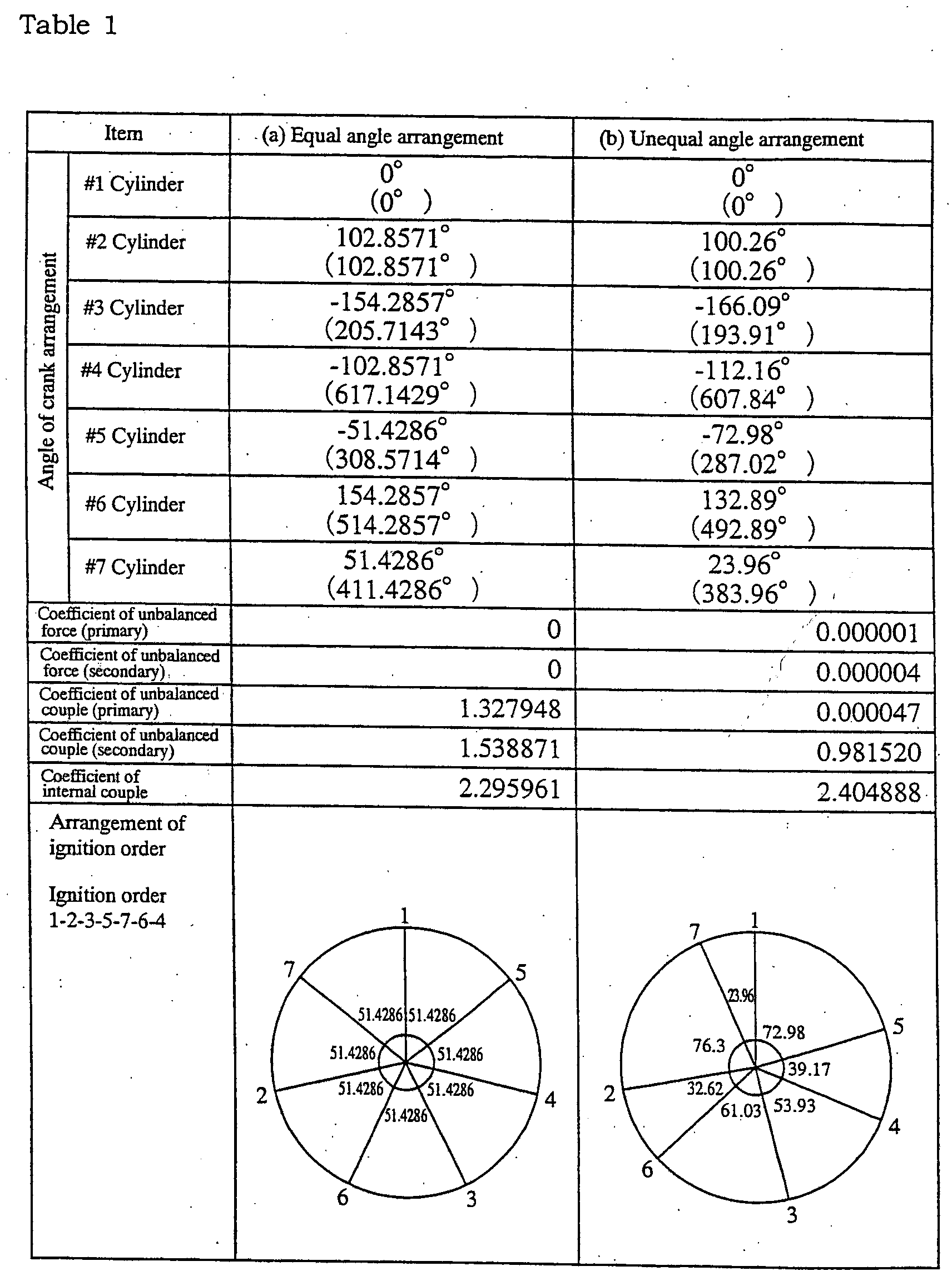
- a 4-stroke cycle 7 cylinder internal combustion engine in which the angles of the crank throw arrangement of other crank throws relative to the reference crank throw are; +99.52° ⁇ 0.5° ,-154.44° ⁇ 0.5° , -96.46° +0.5° , +166.30° ⁇ 0.5° , -44.28° ⁇ 0.5° and +64.18° ⁇ 0.5° .
- crank arrangement is also applicable to a 4-stroke cycle V-type 14 cylinder internal combustion engine in which a piston/connecting rod arrangement is provided with respect to cylinders of V-banks mutually opposing in one crank throw and, in this case also, the same effect to reduce the vibrating force can be obtained.
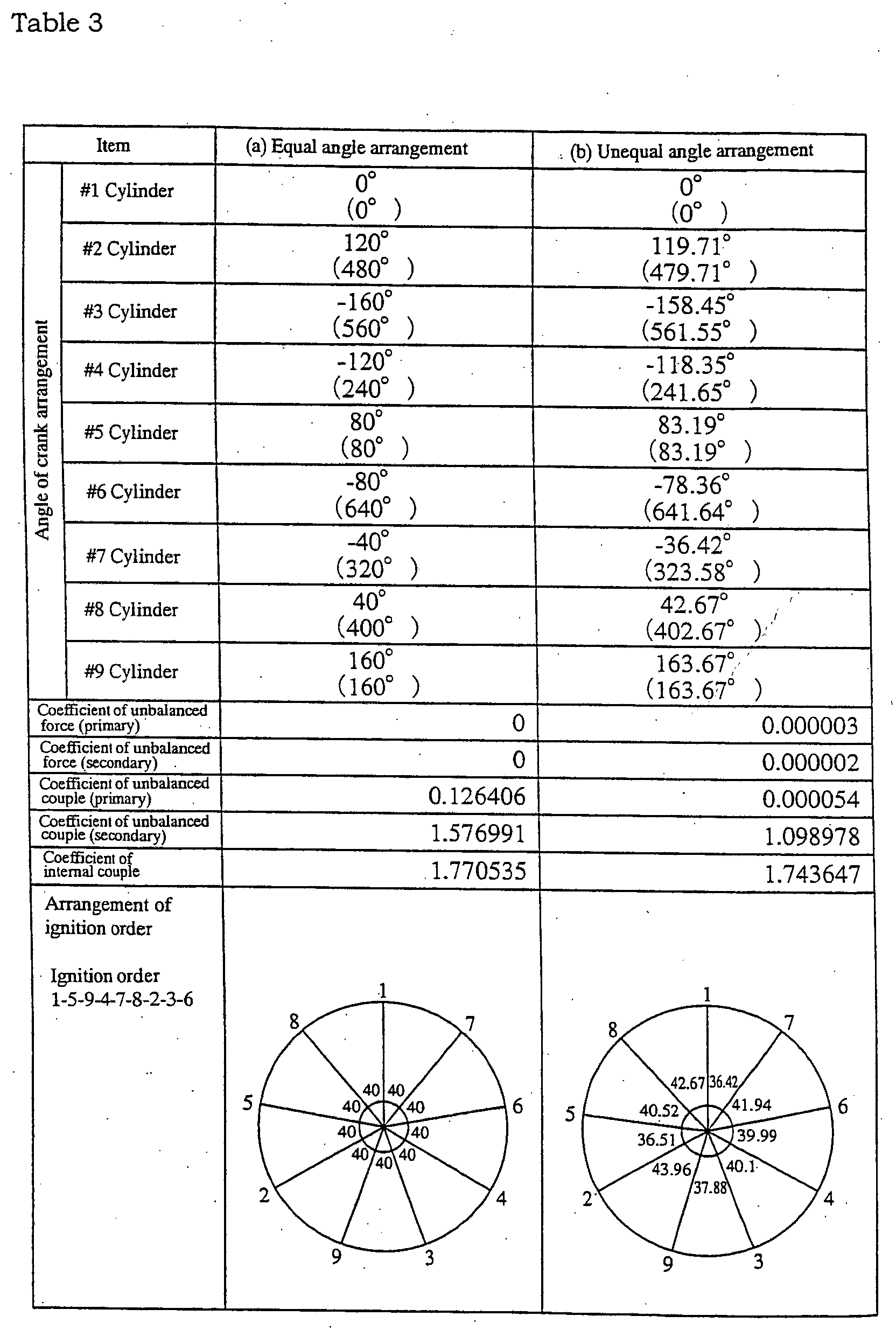
- a 4-stroke cycle 9 cylinder internal combustion engine in which the angles of the crank throw arrangement of other crank throws relative to the reference crank throw are; +119.71° ⁇ 0.5° ,-158.45° ⁇ 0.5° ,-118.35° ⁇ 0.5° , +83.19° ⁇ 0.5° , -78.36° ⁇ 0.5° , -36.42° ⁇ 0.5° , +42.67° ⁇ 0.5° and +163.67° ⁇ 0.5° .
- a 4-stroke cycle 9 cylinder internal combustion engine in which the angles of the crank throw arrangement of other crank throws relative to the reference crank throw are; +80.87° ⁇ 2° , -80.73° ⁇ 2° , +154.77° ⁇ 2° , -155.08° ⁇ 2° , -123.36° ⁇ 2° , +121.73° ⁇ 2° , -39.13° ⁇ 2° and +37.62° ⁇ 2° .
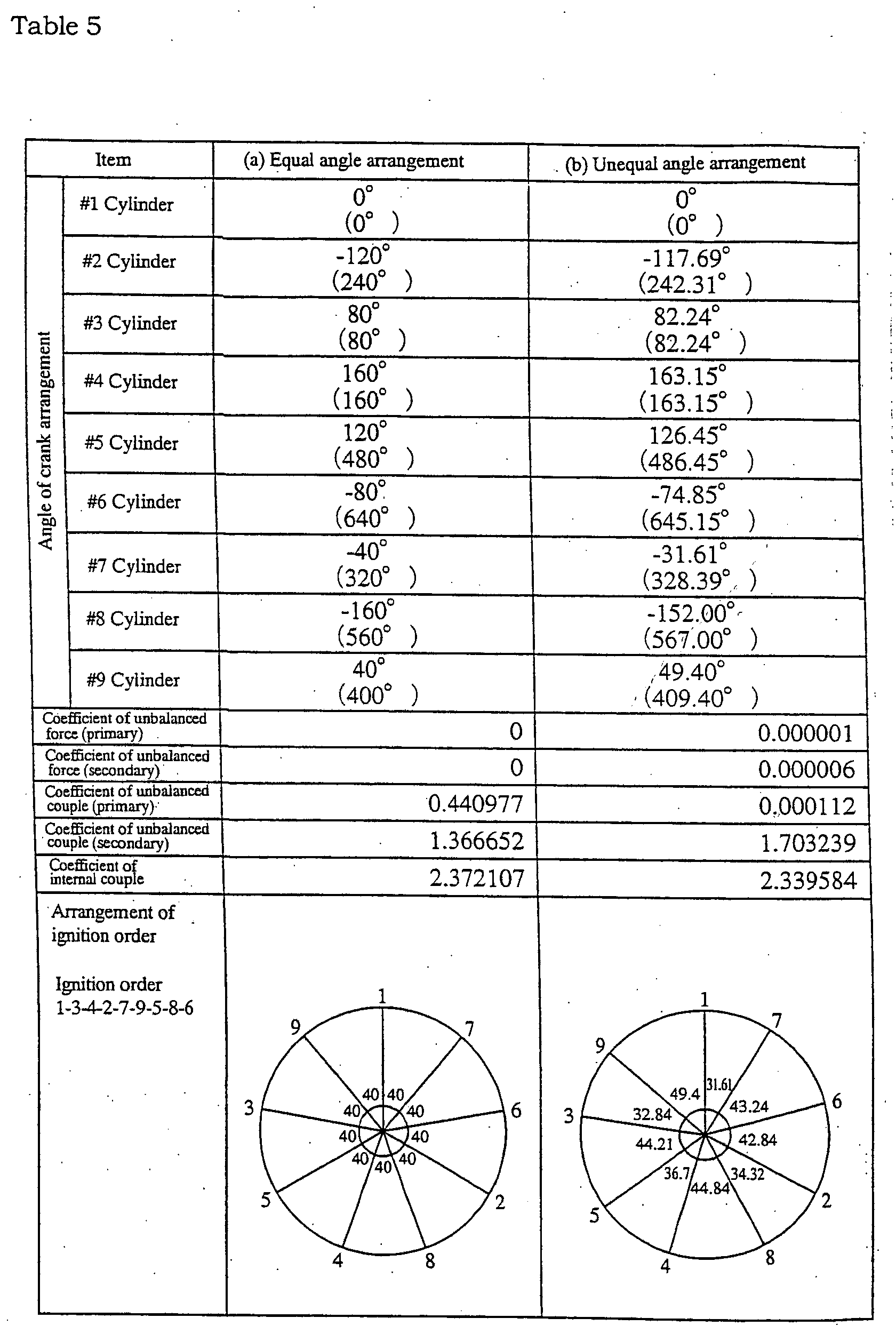
- a 4-stroke cycle 9 cylinder internal combustion engine in which the angles of the crank throw arrangement of other crank throws relative to the reference crank throw are; -117.69° ⁇ 3° , +82.24° ⁇ 3° , +163.15° ⁇ 3° , +126.45° ⁇ 3° , -74.85° ⁇ 3, -31.61° ⁇ 3° , -152.00° ⁇ 3° and +49.40° ⁇ 3° .
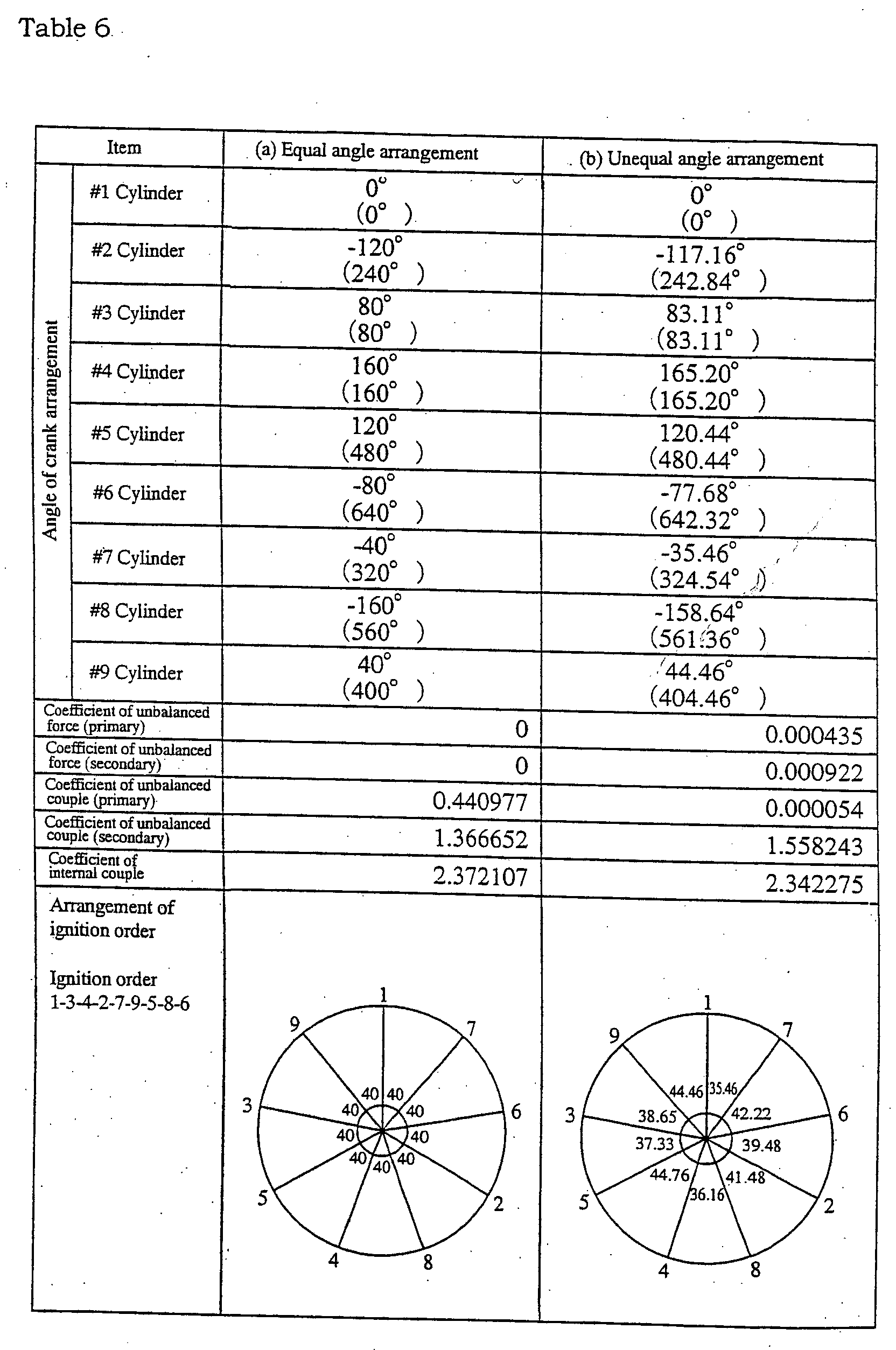
- a 4-stroke cycle 9 cylinder internal combustion engine in which the angles of the crank throw arrangement of other crank throws relative to the reference crank throw are; -117.16° ⁇ 0.5° , +83.11° ⁇ 0.5° , +165.20° ⁇ 0.5° , +120.44° ⁇ 0.5° ,-77.68° ⁇ 0.5° ,-35.46° ⁇ 0.5° , -158.64° ⁇ 0.5° and +44.46° ⁇ 0.5° .
- crank arrangement is also applicable to a 4-stroke cycle V-type 18 cylinder internal combustion engine in which a piston/connecting rod arrangement is provided with respect to cylinders of V-banks mutually opposing in one crank throw and, in this case also, the same effect to reduce the vibrating force can be obtained.
- a 2-stroke cycle 8 cylinder internal combustion engine in which the angles of the crank throw arrangement of other crank throws relative to the reference crank throw are; -144.71° ⁇ 0.5° , +92.74° ⁇ 0.5° , +129.03° ⁇ 0.5° , -84.22° ⁇ 0.5° , -47.94° ⁇ 0.5° , -170.49° ⁇ 0.5° and +44.81° ⁇ 0.5° .
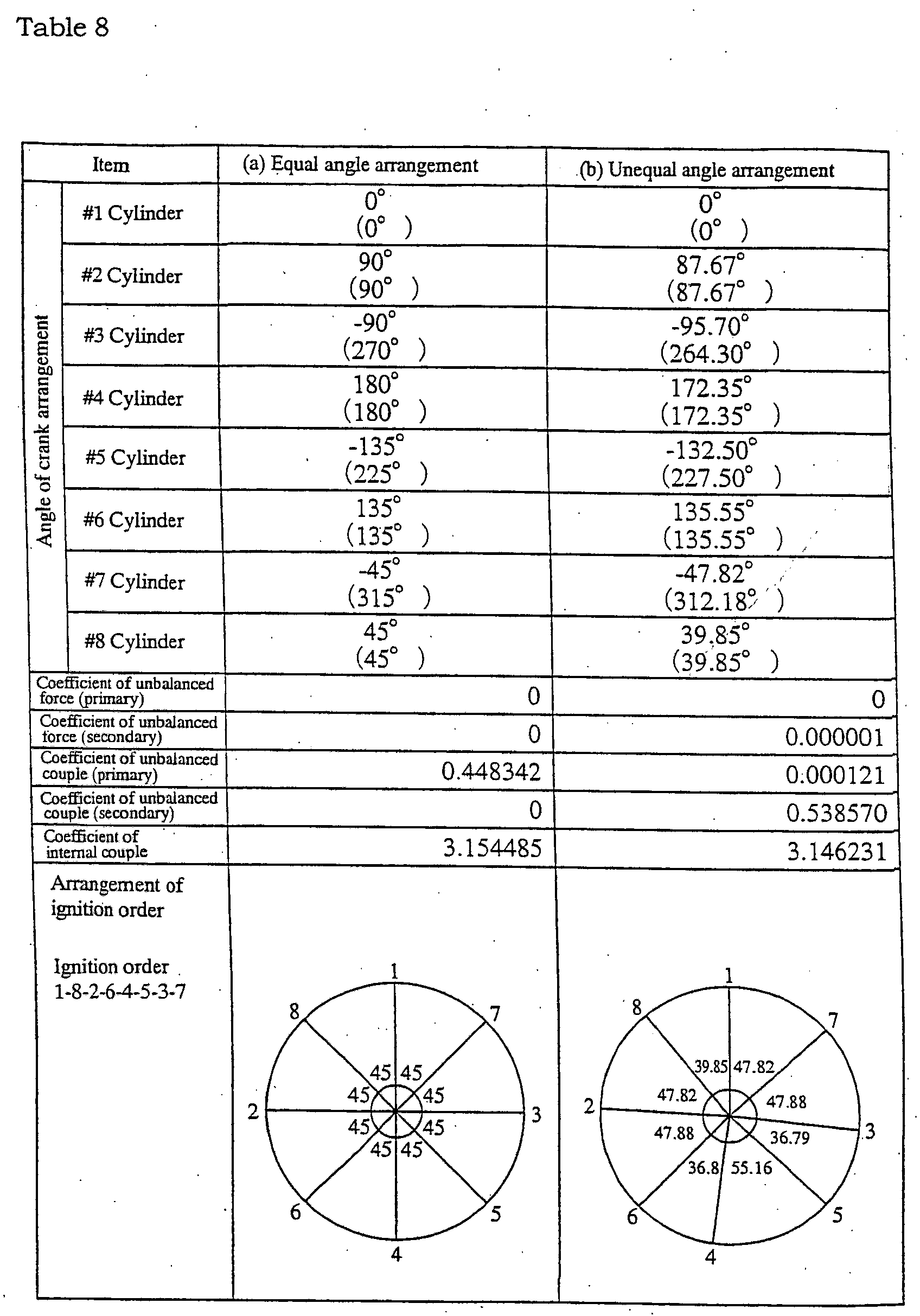
- a 2-stroke cycle 8 cylinder internal combustion engine in which the angles of the crank throw arrangement of other crank throws relative to the reference crank throw are; +87.67° ⁇ 0.5° , -95.70° ⁇ 0.5° , +172.35° ⁇ 0.5° , -132.50° ⁇ 0.5° , +135.55° ⁇ 0.5° , -47.82° ⁇ 0.5° and +39.85° ⁇ 0.5° .
- a 2-stroke cycle 8 cylinder internal combustion engine in which the angles of the crank throw arrangement of other crank throws relative to the reference crank throw are; +92.80° ⁇ 0.5° ,-140.66° ⁇ 0.5° , -83.55° ⁇ 0.5° , +133.09° ⁇ 0.5° ,-169.79° ⁇ 0.5° ,-43.25° ⁇ 0.5° and +49.54° ⁇ 0.5° .
- the multi-cylinder internal combustion engines according to the present invention are elastically supported, then an excellent effect can be obtained in reducing the influence of the couple caused by the unbalanced force.
- the invention is not limited to the mentioned examples but may be added with certain deviations.
- the angles obtained in the Examples 1 to 3 and 6 to 9 if the deviations are within ⁇ 0.5° on these angles, a multi-cylinder internal combustion engine that has the unbalanced couple, acting as the vibrating force, reduced to a nearly satisfactory extent can be obtained.
- is an absolute value of a non-dimensional coefficient of the unbalanced couple, that is obtained by M (k) being divided by F k L, and is represented by;
- abs ⁇ [s 1 s 2 ⁇ s n ][exp(ik ⁇ 1 ) exp(ik ⁇ ⁇ 2 ) ⁇ exp(ik ⁇ ⁇ n )] t ⁇ ; obtaining an angle of the crank throw arrangement ⁇ j by an expression on an orthogonal coordinate system, the angle of the crank throw arrangement ⁇ j minimizing, under the restrictive condition, the n-th power of
- a multi-cylinder internal combustion engine that has the unbalanced couple acting as the vibrating force minimized can be provided.
- the method of the present invention is applicable not only to the case where the external couple is to be minimized but also to the case where the vibrating force on which the similar vibration description can be made (such as internal couple, vibrating force of H ⁇ X type vibration, etc.) is to be minimized.
Landscapes
- Engineering & Computer Science (AREA)
- General Engineering & Computer Science (AREA)
- Mechanical Engineering (AREA)
- Chemical & Material Sciences (AREA)
- Combustion & Propulsion (AREA)
- Physics & Mathematics (AREA)
- Acoustics & Sound (AREA)
- Aviation & Aerospace Engineering (AREA)
- Shafts, Cranks, Connecting Bars, And Related Bearings (AREA)
- Transmission Devices (AREA)
- Electrical Control Of Ignition Timing (AREA)
Abstract
|gm| is an absolute value of a non-dimensional coefficient of F(m) and is represented by;
|fk| is an absolute value of a non-dimensional coefficient of the unbalanced couple, that is obtained by M(k) being divided by FkL, and is represented by;
Description
Where;
M(k) is an unbalanced couple of order k that is expressed in the form that an unbalanced force of each cylinder in the engine is weighted by distance between each cylinder and added together and is represented by;
fk is a non-dimensional coefficient in the above M(k) and is represented by;
where;
F(m) is the sum of the unbalanced force of order m that acts as vibrating force in the multi-cylinder reciprocating internal combustion engine (having the number of crank throws of n) and is represented by;
|gm| is an absolute value of a non-dimensional coefficient of the unbalanced force, that is obtained by F(m) being divided by Fm, and is represented by;
and
where;
M(k) is an unbalanced couple that is expressed by the unbalanced force of order k of each crank throw, weighted by distance L between each cylinder, and is represented by;
|fk| is an absolute value of a non-dimensional coefficient of the unbalanced couple, that is obtained by M(k) being divided by FkL, and is represented by;


+100.26° ±1° , -166.09° ±0.5° ,-112.16° ±0.5° ,
-72.98° ±0.5° , +132.89° ±0.5° and +23.96° ±0.5° .
+99.52° ±0.5° ,-154.44° ±0.5° , -96.46° +0.5° ,
+166.30° ±0.5° , -44.28° ±0.5° and +64.18° ±0.5° .
+119.71° ±0.5° ,-158.45° ±0.5° ,-118.35° ±0.5° ,
+83.19° ±0.5° , -78.36° ±0.5° , -36.42° ±0.5° ,
+42.67° ±0.5° and +163.67° ±0.5° .
+80.87° ±2° , -80.73° ±2° , +154.77° ±2° , -155.08° ±2° ,
-123.36° ±2° , +121.73° ±2° , -39.13° ±2° and
+37.62° ±2° .
-117.69° ±3° , +82.24° ±3° , +163.15° ±3° , +126.45° ±3° ,
-74.85° ±3, -31.61° ±3° , -152.00° ±3° and +49.40° ±3° .
-117.16° ±0.5° , +83.11° ±0.5° , +165.20° ±0.5° ,
+120.44° ±0.5° ,-77.68° ±0.5° ,-35.46° ±0.5° ,
-158.64° ±0.5° and +44.46° ±0.5° .
-144.71° ±0.5° , +92.74° ±0.5° , +129.03° ±0.5° ,
-84.22° ±0.5° , -47.94° ±0.5° , -170.49° ±0.5° and
+44.81° ±0.5° .
+87.67° ±0.5° , -95.70° ±0.5° , +172.35° ±0.5° ,
-132.50° ±0.5° , +135.55° ±0.5° , -47.82° ±0.5° and
+39.85° ±0.5° .
+92.80° ±0.5° ,-140.66° ±0.5° , -83.55° ±0.5° ,
+133.09° ±0.5° ,-169.79° ±0.5° ,-43.25° ±0.5° and
+49.54° ±0.5° .




where;
Fj is an unbalanced force of order m of each cylinder in the multi-cylinder reciprocating internal combustion engine (having the number of crank throws of n) and is represented by;
F(m) is the sum of the unbalanced force of order m that acts as vibrating force and is represented by;
|gm| is an absolute value of a non-dimensional coefficient of the unbalanced force, that is obtained by F(m) being divided by Fm, and is represented by;
where;
M(k) is an unbalanced couple that is expressed by the unbalanced force of order k of each crank throw, weighted by distance L between each cylinder, and is represented by;
|fk| is an absolute value of a non-dimensional coefficient of the unbalanced couple, that is obtained by M(k) being divided by FkL, and is represented by;
Claims (14)
- A method for determining an angle of a crank throw arrangement (ignition interval) of each cylinder in a multi-cylinder reciprocating internal combustion engine so that unbalanced couple acting as vibrating force becomes minimum, characterized in comprising the steps of:
where;
Fj is an unbalanced force of order m of each cylinder in the multi-cylinder reciprocating internal combustion engine (having the number of crank throws of n) and is represented by;
|gm| is an absolute value of a non-dimensional coefficient of the unbalanced force, that is obtained by F(m) being divided by Fm, and is represented by;
where;
M(k) is an unbalanced couple that is expressed by the unbalanced force of order k of each crank throw, weighted by distance L between each cylinder, and is represented by;
|fk| is an absolute value of a non-dimensional coefficient of the unbalanced couple, that is obtained by M(k) being divided by FkL, and is represented by; - A method for determining an angle of a crank throw arrangement (ignition interval) of each cylinder in a multi-cylinder reciprocating internal combustion engine so that unbalanced couple acting as vibrating force becomes minimum, characterized in comprising the steps of:
where;
Fj is an unbalanced force of order m of each cylinder in the multi-cylinder reciprocating internal combustion engine (having the number of crank throws of n) and is represented by;
|gm| is an absolute value of a non-dimensional coefficient of the unbalanced force, that is obtained by F(m) being divided by Fm, and is represented by;
where;
M(k) is an unbalanced couple that is expressed by the unbalanced force of order k of each crank throw, weighted by distance L between each cylinder, and is represented by;
|fk| is an absolute value of a non-dimensional coefficient of the unbalanced couple, that is obtained by M(k) being divided by FkL, and is represented by;(Here, "^" is a designation of power, β is a weighting coefficient of order k. Pk, being an integer, is a power of order k.);
obtaining an angle of the crank throw arrangement αj by an expression on an orthogonal coordinate system, said angle of the crank throw arrangement αj minimizing, under said restrictive condition, said sumβk|fk|^(2pk).
- A 4-stroke cycle in-line type 7 cylinder or V-type 14 cylinder internal combustion engine having an angle of a crank throw arrangement (ignition interval) of each cylinder determined so that unbalanced couple acting as vibrating force becomes minimum, characterized in that, where a crank throw of a front end or a rear end of a crank shaft is defined a reference crank throw, angles of the crank throw arrangement of other crank throws relative to the reference crank throw are set to +100.26° ±1° , -166.09° ±0.5° , -112.16° ± 0.5° , -72.98° ±0.5° , +132.89° +0.5° and +23.96° ±0.5° in the order counted from the reference crank throw, provided that the total of the deviations shown by ± relative to each of said angles shall be zero.
- A 4-stroke cycle in-line type 7 cylinder or V-type 14 cylinder internal combustion engine having an angle of a crank throw arrangement (ignition interval) of each cylinder determined so that unbalanced couple acting as vibrating force becomes minimum, characterized in that, where a crank throw of a front end or a rear end of a crank shaft is defined a reference crank throw, angles of the crank throw arrangement of other crank throws relative to the reference crank throw are set to +99.52° ±0.5° , -154.44° ±0.5° , -96.46° ± 0.5° , +166.30° ±0.5° , -44.28° ±0.5° and +64.18° ±0.5° in the order counted from the reference crank throw, provided that the total of the deviations shown by ± relative to each of said angles shall be zero.
- A 4-stroke cycle in-line type 9 cylinder or V-type 18 cylinder internal combustion engine having an angle of a crank throw arrangement (ignition interval) of each cylinder determined so that unbalanced couple acting as vibrating force becomes minimum, characterized in that, where a crank throw of a front end or a rear end of a crank shaft is defined a reference crank throw, angles of the crank throw arrangement of other crank throws relative to the reference crank throw are set to +119.71° ±0.5° , -158.45° ±0.5° , -118.35° ±0.5° , +83.19° ±0.5° , -78.36° ±0.5° , -36.42° ±0.5° , +42.67° ± 0.5° and +163.67° ±0.5° in the order counted from the reference crank throw, provided that the total of the deviations shown by ± relative to each of said angles shall be zero.
- A 4-stroke cycle in-line type 9 cylinder or V-type 18 cylinder internal combustion engine having an angle of a crank throw arrangement (ignition interval) of each cylinder determined so that unbalanced couple acting as vibrating force becomes minimum, characterized in that, where a crank throw of a front end or a rear end of a crank shaft is defined a reference crank throw, angles of the crank throw arrangement of other crank throws relative to the reference crank throw are set to +80.87° ±2° , -80.73° ±2° , +154.77° ±2° ,-155.08° ±2° , -123.36° ±2° , +121.73° ±2° , -39.13° ±2° and +37.62° ±2° in the order counted from the reference crank throw, provided that the total of the deviations shown by ± relative to each of said angles shall be zero.
- A 4-stroke cycle in-line type 9 cylinder or V-type 18 cylinder internal combustion engine having an angle of a crank throw arrangement (ignition interval) of each cylinder determined so that unbalanced couple acting as vibrating force becomes minimum, characterized in that, where a crank throw of a front end or a rear end of a crank shaft is defined a reference crank throw, angles of the crank throw arrangement of other crank throws relative to the reference crank throw are set to -117.69° ±3°, +82.24° +3°, +163.15° ±3° , +126.45° ±3° , -74.85° ±3, -31.61° ±3° , -152.00° ±3° and +49.40° +3° in the order counted from the reference crank throw, provided that the total of the deviations shown by ± relative to each of said angles shall be zero.
- A 4-stroke cycle in-line type 9 cylinder or V-type 18 cylinder internal combustion engine having an angle of a crank throw arrangement (ignition interval) of each cylinder determined so that unbalanced couple acting as vibrating force becomes minimum, characterized in that, where a crank throw of a front end or a rear end of a crank shaft is defined a reference crank throw, angles of the crank throw arrangement of other crank throws relative to the reference crank throw are set to -117.16° ±0.5° ,+83.11° ±0.5° , +165.20° ± 0.5° , +120.44° ±0.5° , -77.68° ±0.5° , -35.46° ±0.5° , -158.64° ±0.5° and +44.46° ±0.5° in the order counted from the reference crank throw, provided that the total of the deviations shown by ± relative to each of said angles shall be zero.
- A 2-stroke cycle in-line type 8 cylinder internal combustion engine having an angle of a crank throw arrangement (ignition interval) of each cylinder determined so that unbalanced couple acting as vibrating force becomes minimum, characterized in that, where a crank throw of a front end or a rear end of a crank shaft is defined a reference crank throw, the angles of the crank throw arrangement of other crank throws relative to the reference crank throw are set to-144.71° ° ±0.5° , ±92.74° ±0.5° , +129.03° ±0.5° , -84.22° ±0.5° , -47.94° ±0.5° , -170.49° ±0.5° and +44.81° ±0.5° in the order counted from the reference crank throw, provided that the total of the deviations shown by ± relative to each of said angles shall be zero.
- A 2-stroke cycle in-line type 8 cylinder internal combustion engine having an angle of a crank throw arrangement (ignition interval) of each cylinder determined so that unbalanced couple acting as vibrating force becomes minimum, characterized in that, where a crank throw of a front end or a rear end of a crank shaft is defined a reference crank throw, the angles of the crank throw arrangement of other crank throws relative to the reference crank throw are set to +87.67° ±0.5° , -95.70° ±0.5° , +172.35° ±0.5° , -132.50° ±0.5° , +135.55° ±0.5° , -47.82° ±0.5° and +39.85° ±0.5° in the order counted from the reference crank throw, provided that the total of the deviations shown by ± relative to each of said angles shall be zero.
- A 2-stroke cycle in-line type 8 cylinder internal combustion engine having an angle of a crank throw arrangement (ignition interval) of each cylinder determined so that unbalanced couple acting as vibrating force becomes minimum, characterized in that, where a crank throw of a front end or a rear end of a crank shaft is defined a reference crank throw, the angles of the crank throw arrangement of other crank throws relative to the reference crank throw are set to +92.80° ±0.5° , -140.66° ±0.5° , -83.55° ±0.5° , +133.09° ±0.5° , -169.79° ±0.5° , -43.25° ±0.5° and +49.54° ±0.5° in the order counted from the reference crank throw, provided that the total of the deviations shown by ± relative to each of said angles shall be zero.
- A 4-stroke cycle in-line type 7 cylinder or V-type 14 cylinder internal combustion engine as claimed in Claim 3 or 4, characterized in being elastically supported relative to a support structure of said engine.
- A 4-stroke cycle in-line type 9 cylinder or V-type 18 cylinder internal combustion engine as claimed in any one of Claims 5 to 8, characterized in being elastically supported to a support structure of said engine.
- A 2-stroke cycle in-line type 8 cylinder internal combustion engine as claimed in any one of Claims 9 to 11, characterized in being elastically supported to a support structure of said engine.
Applications Claiming Priority (2)
| Application Number | Priority Date | Filing Date | Title |
|---|---|---|---|
| JP2002020985 | 2002-01-30 | ||
| JP2002020985A JP3861012B2 (en) | 2002-01-30 | 2002-01-30 | Multi-cylinder internal combustion engine |
Publications (3)
| Publication Number | Publication Date |
|---|---|
| EP1333192A2 true EP1333192A2 (en) | 2003-08-06 |
| EP1333192A3 EP1333192A3 (en) | 2004-08-11 |
| EP1333192B1 EP1333192B1 (en) | 2006-10-25 |
Family
ID=19192173
Family Applications (1)
| Application Number | Title | Priority Date | Filing Date |
|---|---|---|---|
| EP03001386A Expired - Lifetime EP1333192B1 (en) | 2002-01-30 | 2003-01-27 | Method for determining an angle of crank arrangement in a multi-cylinder internal combustion engine and a multi-cylinder internal combustion engine using this method |
Country Status (9)
| Country | Link |
|---|---|
| US (1) | US20030154937A1 (en) |
| EP (1) | EP1333192B1 (en) |
| JP (1) | JP3861012B2 (en) |
| KR (1) | KR20030065325A (en) |
| CN (1) | CN1435560A (en) |
| AT (1) | ATE343743T1 (en) |
| AU (1) | AU2003200229A1 (en) |
| CA (1) | CA2416958A1 (en) |
| DE (1) | DE60309223D1 (en) |
Cited By (3)
| Publication number | Priority date | Publication date | Assignee | Title |
|---|---|---|---|---|
| EP1387059A1 (en) * | 2002-08-03 | 2004-02-04 | Bayerische Motoren Werke Aktiengesellschaft | 10 cylinder engine |
| EP1548251A1 (en) * | 2003-12-17 | 2005-06-29 | MAN B&W DIESEL A/S | Two-stroke constant-pressure turbocharged internal combustion engine having 13 cylinders in a single row |
| EP1808775A3 (en) * | 2006-01-16 | 2013-05-01 | Mitsubishi Heavy Industries, Ltd. | Design aiding apparatus and computer program |
Families Citing this family (4)
| Publication number | Priority date | Publication date | Assignee | Title |
|---|---|---|---|---|
| DE202004002185U1 (en) * | 2004-01-28 | 2004-07-22 | Man B & W Diesel A/S | Two-stroke internal combustion engine with turbocharging, constant pressure and 14 cylinders in a single row |
| DE102011000585A1 (en) * | 2011-02-09 | 2012-08-09 | Ford Global Technologies, Llc. | Multi-cylinder in-line internal combustion engine for a motor vehicle, and method for operating the same |
| DE102013203560B4 (en) * | 2013-03-01 | 2020-06-18 | Ford Global Technologies, Llc | Internal combustion engine with a balance weight arranged on the crankshaft and serving as an unbalance and method for producing the crankshaft |
| CN118500671B (en) * | 2024-07-16 | 2024-09-10 | 招商局金陵船舶(南京)有限公司 | A ship vibration excitation device and a ship hull vibration test analysis method |
Family Cites Families (3)
| Publication number | Priority date | Publication date | Assignee | Title |
|---|---|---|---|---|
| FR826173A (en) * | 1937-09-01 | 1938-03-24 | Armstrong Siddeley Motors Ltd | Improvements to air-cooled internal combustion engines |
| JPS5837342A (en) * | 1981-08-31 | 1983-03-04 | Ishikawajima Harima Heavy Ind Co Ltd | Reduction of imbalance moment in diesel main engine |
| JP2001065443A (en) * | 1999-08-30 | 2001-03-16 | Mitsubishi Heavy Ind Ltd | Determination of ignition interval in a multi-cylinder internal combustion engine |
-
2002
- 2002-01-30 JP JP2002020985A patent/JP3861012B2/en not_active Expired - Fee Related
-
2003
- 2003-01-15 KR KR10-2003-0002805A patent/KR20030065325A/en not_active Ceased
- 2003-01-22 CA CA002416958A patent/CA2416958A1/en not_active Abandoned
- 2003-01-24 AU AU2003200229A patent/AU2003200229A1/en not_active Abandoned
- 2003-01-27 DE DE60309223T patent/DE60309223D1/en not_active Expired - Lifetime
- 2003-01-27 EP EP03001386A patent/EP1333192B1/en not_active Expired - Lifetime
- 2003-01-27 AT AT03001386T patent/ATE343743T1/en not_active IP Right Cessation
- 2003-01-29 CN CN03103555A patent/CN1435560A/en active Pending
- 2003-01-30 US US10/354,089 patent/US20030154937A1/en not_active Abandoned
Cited By (3)
| Publication number | Priority date | Publication date | Assignee | Title |
|---|---|---|---|---|
| EP1387059A1 (en) * | 2002-08-03 | 2004-02-04 | Bayerische Motoren Werke Aktiengesellschaft | 10 cylinder engine |
| EP1548251A1 (en) * | 2003-12-17 | 2005-06-29 | MAN B&W DIESEL A/S | Two-stroke constant-pressure turbocharged internal combustion engine having 13 cylinders in a single row |
| EP1808775A3 (en) * | 2006-01-16 | 2013-05-01 | Mitsubishi Heavy Industries, Ltd. | Design aiding apparatus and computer program |
Also Published As
| Publication number | Publication date |
|---|---|
| CA2416958A1 (en) | 2003-07-30 |
| KR20030065325A (en) | 2003-08-06 |
| JP3861012B2 (en) | 2006-12-20 |
| CN1435560A (en) | 2003-08-13 |
| EP1333192A3 (en) | 2004-08-11 |
| US20030154937A1 (en) | 2003-08-21 |
| JP2003222024A (en) | 2003-08-08 |
| ATE343743T1 (en) | 2006-11-15 |
| EP1333192B1 (en) | 2006-10-25 |
| AU2003200229A1 (en) | 2003-08-21 |
| DE60309223D1 (en) | 2006-12-07 |
Similar Documents
| Publication | Publication Date | Title |
|---|---|---|
| JPS57195944A (en) | Balancer device of internal combustion engine | |
| CA1113811A (en) | Balancing device for an engine | |
| HUP0004266A2 (en) | Internal combustion engines | |
| US8757123B2 (en) | Balancing an opposed-piston, opposed-cylinder engine | |
| EP1333192B1 (en) | Method for determining an angle of crank arrangement in a multi-cylinder internal combustion engine and a multi-cylinder internal combustion engine using this method | |
| US3995610A (en) | Four cylinder straight-type engine with secondary balancer system | |
| JPS6344984B2 (en) | ||
| JP3993622B2 (en) | Determination method of crank arrangement angle of multi-cylinder reciprocating internal combustion engine | |
| JP2954375B2 (en) | Balancer device for in-line four-cylinder internal combustion engine for vehicle | |
| JPS6036730A (en) | Vibration damping mechanism for reciprocating internal- combustion engine | |
| JPS5881251A (en) | V-type internal-combustion engine with a threefold number of cylinders | |
| KR100765295B1 (en) | Crank Array Angle Design Method of Reciprocating Internal Combustion Engine for Vibration Control | |
| Yamauchi et al. | Experiment and computation analyses for torsional vibration of crankshaft system with viscous torsional damper on diesel engine | |
| Patterson | Engine torque and balance characteristics | |
| JP6578239B2 (en) | V type engine | |
| RU2826661C1 (en) | Power unit | |
| Kimura et al. | Experiments and Analysis of Crankshaft Three-Dimensional Vibrations and Bending Stresses in a V-Type Ten-Cylinder Engine: Influence of Crankshaft Gyroscopic Motions | |
| KR200184252Y1 (en) | Variable balance weight have crank shaft | |
| JP3422498B2 (en) | V-type 4-cylinder 4-stroke engine | |
| CA1056677A (en) | Four cylinder in-line engine with secondary balancer system | |
| Mosaad et al. | A new approach for marine propulsion shafting design | |
| Stanley et al. | Bearing characteristic parameters to estimate the optimum counterweight mass of a 6-cylinder in-line engine | |
| KR950033076A (en) | Optimization method of ignition angle of serial engine and engine | |
| JP2007510867A (en) | Configuration and method for balancing an internal combustion engine in a vehicle | |
| Sweeney | Simplified Model of Net Disturbances for In-Line Diesel Engines |
Legal Events
| Date | Code | Title | Description |
|---|---|---|---|
| PUAI | Public reference made under article 153(3) epc to a published international application that has entered the european phase |
Free format text: ORIGINAL CODE: 0009012 |
|
| 17P | Request for examination filed |
Effective date: 20030127 |
|
| AK | Designated contracting states |
Designated state(s): AT BE BG CH CY CZ DE DK EE ES FI FR GB GR HU IE IT LI LU MC NL PT SE SI SK TR |
|
| AX | Request for extension of the european patent |
Extension state: AL LT LV MK RO |
|
| PUAL | Search report despatched |
Free format text: ORIGINAL CODE: 0009013 |
|
| AK | Designated contracting states |
Kind code of ref document: A3 Designated state(s): AT BE BG CH CY CZ DE DK EE ES FI FR GB GR HU IE IT LI LU MC NL PT SE SI SK TR |
|
| AX | Request for extension of the european patent |
Extension state: AL LT LV MK RO |
|
| 17Q | First examination report despatched |
Effective date: 20050315 |
|
| AKX | Designation fees paid |
Designated state(s): AT BE BG CH CY CZ DE DK EE ES FI FR GB GR HU IE IT LI LU MC NL PT SE SI SK TR |
|
| GRAP | Despatch of communication of intention to grant a patent |
Free format text: ORIGINAL CODE: EPIDOSNIGR1 |
|
| GRAS | Grant fee paid |
Free format text: ORIGINAL CODE: EPIDOSNIGR3 |
|
| GRAA | (expected) grant |
Free format text: ORIGINAL CODE: 0009210 |
|
| AK | Designated contracting states |
Kind code of ref document: B1 Designated state(s): AT BE BG CH CY CZ DE DK EE ES FI FR GB GR HU IE IT LI LU MC NL PT SE SI SK TR |
|
| PG25 | Lapsed in a contracting state [announced via postgrant information from national office to epo] |
Ref country code: IT Free format text: LAPSE BECAUSE OF FAILURE TO SUBMIT A TRANSLATION OF THE DESCRIPTION OR TO PAY THE FEE WITHIN THE PRESCRIBED TIME-LIMIT;WARNING: LAPSES OF ITALIAN PATENTS WITH EFFECTIVE DATE BEFORE 2007 MAY HAVE OCCURRED AT ANY TIME BEFORE 2007. THE CORRECT EFFECTIVE DATE MAY BE DIFFERENT FROM THE ONE RECORDED. Effective date: 20061025 Ref country code: SI Free format text: LAPSE BECAUSE OF FAILURE TO SUBMIT A TRANSLATION OF THE DESCRIPTION OR TO PAY THE FEE WITHIN THE PRESCRIBED TIME-LIMIT Effective date: 20061025 Ref country code: NL Free format text: LAPSE BECAUSE OF FAILURE TO SUBMIT A TRANSLATION OF THE DESCRIPTION OR TO PAY THE FEE WITHIN THE PRESCRIBED TIME-LIMIT Effective date: 20061025 Ref country code: SK Free format text: LAPSE BECAUSE OF FAILURE TO SUBMIT A TRANSLATION OF THE DESCRIPTION OR TO PAY THE FEE WITHIN THE PRESCRIBED TIME-LIMIT Effective date: 20061025 Ref country code: BE Free format text: LAPSE BECAUSE OF FAILURE TO SUBMIT A TRANSLATION OF THE DESCRIPTION OR TO PAY THE FEE WITHIN THE PRESCRIBED TIME-LIMIT Effective date: 20061025 Ref country code: CZ Free format text: LAPSE BECAUSE OF FAILURE TO SUBMIT A TRANSLATION OF THE DESCRIPTION OR TO PAY THE FEE WITHIN THE PRESCRIBED TIME-LIMIT Effective date: 20061025 Ref country code: LI Free format text: LAPSE BECAUSE OF FAILURE TO SUBMIT A TRANSLATION OF THE DESCRIPTION OR TO PAY THE FEE WITHIN THE PRESCRIBED TIME-LIMIT Effective date: 20061025 Ref country code: AT Free format text: LAPSE BECAUSE OF FAILURE TO SUBMIT A TRANSLATION OF THE DESCRIPTION OR TO PAY THE FEE WITHIN THE PRESCRIBED TIME-LIMIT Effective date: 20061025 Ref country code: CH Free format text: LAPSE BECAUSE OF FAILURE TO SUBMIT A TRANSLATION OF THE DESCRIPTION OR TO PAY THE FEE WITHIN THE PRESCRIBED TIME-LIMIT Effective date: 20061025 |
|
| REG | Reference to a national code |
Ref country code: GB Ref legal event code: FG4D |
|
| REG | Reference to a national code |
Ref country code: CH Ref legal event code: EP |
|
| REG | Reference to a national code |
Ref country code: IE Ref legal event code: FG4D |
|
| REF | Corresponds to: |
Ref document number: 60309223 Country of ref document: DE Date of ref document: 20061207 Kind code of ref document: P |
|
| PG25 | Lapsed in a contracting state [announced via postgrant information from national office to epo] |
Ref country code: BG Free format text: LAPSE BECAUSE OF FAILURE TO SUBMIT A TRANSLATION OF THE DESCRIPTION OR TO PAY THE FEE WITHIN THE PRESCRIBED TIME-LIMIT Effective date: 20070125 Ref country code: SE Free format text: LAPSE BECAUSE OF FAILURE TO SUBMIT A TRANSLATION OF THE DESCRIPTION OR TO PAY THE FEE WITHIN THE PRESCRIBED TIME-LIMIT Effective date: 20070125 Ref country code: DK Free format text: LAPSE BECAUSE OF FAILURE TO SUBMIT A TRANSLATION OF THE DESCRIPTION OR TO PAY THE FEE WITHIN THE PRESCRIBED TIME-LIMIT Effective date: 20070125 |
|
| PG25 | Lapsed in a contracting state [announced via postgrant information from national office to epo] |
Ref country code: DE Free format text: LAPSE BECAUSE OF FAILURE TO SUBMIT A TRANSLATION OF THE DESCRIPTION OR TO PAY THE FEE WITHIN THE PRESCRIBED TIME-LIMIT Effective date: 20070126 |
|
| PG25 | Lapsed in a contracting state [announced via postgrant information from national office to epo] |
Ref country code: MC Free format text: LAPSE BECAUSE OF NON-PAYMENT OF DUE FEES Effective date: 20070131 |
|
| PG25 | Lapsed in a contracting state [announced via postgrant information from national office to epo] |
Ref country code: ES Free format text: LAPSE BECAUSE OF FAILURE TO SUBMIT A TRANSLATION OF THE DESCRIPTION OR TO PAY THE FEE WITHIN THE PRESCRIBED TIME-LIMIT Effective date: 20070205 |
|
| PG25 | Lapsed in a contracting state [announced via postgrant information from national office to epo] |
Ref country code: PT Free format text: LAPSE BECAUSE OF FAILURE TO SUBMIT A TRANSLATION OF THE DESCRIPTION OR TO PAY THE FEE WITHIN THE PRESCRIBED TIME-LIMIT Effective date: 20070326 |
|
| NLV1 | Nl: lapsed or annulled due to failure to fulfill the requirements of art. 29p and 29m of the patents act | ||
| REG | Reference to a national code |
Ref country code: CH Ref legal event code: PL |
|
| EN | Fr: translation not filed | ||
| PLBE | No opposition filed within time limit |
Free format text: ORIGINAL CODE: 0009261 |
|
| STAA | Information on the status of an ep patent application or granted ep patent |
Free format text: STATUS: NO OPPOSITION FILED WITHIN TIME LIMIT |
|
| GBPC | Gb: european patent ceased through non-payment of renewal fee |
Effective date: 20070127 |
|
| 26N | No opposition filed |
Effective date: 20070726 |
|
| PG25 | Lapsed in a contracting state [announced via postgrant information from national office to epo] |
Ref country code: GB Free format text: LAPSE BECAUSE OF NON-PAYMENT OF DUE FEES Effective date: 20070127 |
|
| PG25 | Lapsed in a contracting state [announced via postgrant information from national office to epo] |
Ref country code: IE Free format text: LAPSE BECAUSE OF NON-PAYMENT OF DUE FEES Effective date: 20070129 |
|
| PG25 | Lapsed in a contracting state [announced via postgrant information from national office to epo] |
Ref country code: GR Free format text: LAPSE BECAUSE OF FAILURE TO SUBMIT A TRANSLATION OF THE DESCRIPTION OR TO PAY THE FEE WITHIN THE PRESCRIBED TIME-LIMIT Effective date: 20070126 Ref country code: FR Free format text: LAPSE BECAUSE OF FAILURE TO SUBMIT A TRANSLATION OF THE DESCRIPTION OR TO PAY THE FEE WITHIN THE PRESCRIBED TIME-LIMIT Effective date: 20070608 |
|
| PG25 | Lapsed in a contracting state [announced via postgrant information from national office to epo] |
Ref country code: FR Free format text: LAPSE BECAUSE OF FAILURE TO SUBMIT A TRANSLATION OF THE DESCRIPTION OR TO PAY THE FEE WITHIN THE PRESCRIBED TIME-LIMIT Effective date: 20061025 |
|
| PG25 | Lapsed in a contracting state [announced via postgrant information from national office to epo] |
Ref country code: EE Free format text: LAPSE BECAUSE OF FAILURE TO SUBMIT A TRANSLATION OF THE DESCRIPTION OR TO PAY THE FEE WITHIN THE PRESCRIBED TIME-LIMIT Effective date: 20061025 |
|
| PG25 | Lapsed in a contracting state [announced via postgrant information from national office to epo] |
Ref country code: LU Free format text: LAPSE BECAUSE OF NON-PAYMENT OF DUE FEES Effective date: 20070127 Ref country code: CY Free format text: LAPSE BECAUSE OF FAILURE TO SUBMIT A TRANSLATION OF THE DESCRIPTION OR TO PAY THE FEE WITHIN THE PRESCRIBED TIME-LIMIT Effective date: 20061025 |
|
| PG25 | Lapsed in a contracting state [announced via postgrant information from national office to epo] |
Ref country code: TR Free format text: LAPSE BECAUSE OF FAILURE TO SUBMIT A TRANSLATION OF THE DESCRIPTION OR TO PAY THE FEE WITHIN THE PRESCRIBED TIME-LIMIT Effective date: 20061025 Ref country code: HU Free format text: LAPSE BECAUSE OF FAILURE TO SUBMIT A TRANSLATION OF THE DESCRIPTION OR TO PAY THE FEE WITHIN THE PRESCRIBED TIME-LIMIT Effective date: 20070426 |
|
| PGFP | Annual fee paid to national office [announced via postgrant information from national office to epo] |
Ref country code: FI Payment date: 20180110 Year of fee payment: 16 |
|
| PG25 | Lapsed in a contracting state [announced via postgrant information from national office to epo] |
Ref country code: FI Free format text: LAPSE BECAUSE OF NON-PAYMENT OF DUE FEES Effective date: 20190127 |