EP1333100B1 - RET oligonucleotide microchip for detecting hereditary cancer - Google Patents
RET oligonucleotide microchip for detecting hereditary cancer Download PDFInfo
- Publication number
- EP1333100B1 EP1333100B1 EP02001681A EP02001681A EP1333100B1 EP 1333100 B1 EP1333100 B1 EP 1333100B1 EP 02001681 A EP02001681 A EP 02001681A EP 02001681 A EP02001681 A EP 02001681A EP 1333100 B1 EP1333100 B1 EP 1333100B1
- Authority
- EP
- European Patent Office
- Prior art keywords
- oligonucleotides
- codon
- dna
- ret
- seq
- Prior art date
- Legal status (The legal status is an assumption and is not a legal conclusion. Google has not performed a legal analysis and makes no representation as to the accuracy of the status listed.)
- Expired - Lifetime
Links
Images
Classifications
-
- C—CHEMISTRY; METALLURGY
- C12—BIOCHEMISTRY; BEER; SPIRITS; WINE; VINEGAR; MICROBIOLOGY; ENZYMOLOGY; MUTATION OR GENETIC ENGINEERING
- C12Q—MEASURING OR TESTING PROCESSES INVOLVING ENZYMES, NUCLEIC ACIDS OR MICROORGANISMS; COMPOSITIONS OR TEST PAPERS THEREFOR; PROCESSES OF PREPARING SUCH COMPOSITIONS; CONDITION-RESPONSIVE CONTROL IN MICROBIOLOGICAL OR ENZYMOLOGICAL PROCESSES
- C12Q1/00—Measuring or testing processes involving enzymes, nucleic acids or microorganisms; Compositions therefor; Processes of preparing such compositions
- C12Q1/68—Measuring or testing processes involving enzymes, nucleic acids or microorganisms; Compositions therefor; Processes of preparing such compositions involving nucleic acids
-
- C—CHEMISTRY; METALLURGY
- C12—BIOCHEMISTRY; BEER; SPIRITS; WINE; VINEGAR; MICROBIOLOGY; ENZYMOLOGY; MUTATION OR GENETIC ENGINEERING
- C12Q—MEASURING OR TESTING PROCESSES INVOLVING ENZYMES, NUCLEIC ACIDS OR MICROORGANISMS; COMPOSITIONS OR TEST PAPERS THEREFOR; PROCESSES OF PREPARING SUCH COMPOSITIONS; CONDITION-RESPONSIVE CONTROL IN MICROBIOLOGICAL OR ENZYMOLOGICAL PROCESSES
- C12Q1/00—Measuring or testing processes involving enzymes, nucleic acids or microorganisms; Compositions therefor; Processes of preparing such compositions
- C12Q1/68—Measuring or testing processes involving enzymes, nucleic acids or microorganisms; Compositions therefor; Processes of preparing such compositions involving nucleic acids
- C12Q1/6876—Nucleic acid products used in the analysis of nucleic acids, e.g. primers or probes
- C12Q1/6883—Nucleic acid products used in the analysis of nucleic acids, e.g. primers or probes for diseases caused by alterations of genetic material
-
- C—CHEMISTRY; METALLURGY
- C12—BIOCHEMISTRY; BEER; SPIRITS; WINE; VINEGAR; MICROBIOLOGY; ENZYMOLOGY; MUTATION OR GENETIC ENGINEERING
- C12Q—MEASURING OR TESTING PROCESSES INVOLVING ENZYMES, NUCLEIC ACIDS OR MICROORGANISMS; COMPOSITIONS OR TEST PAPERS THEREFOR; PROCESSES OF PREPARING SUCH COMPOSITIONS; CONDITION-RESPONSIVE CONTROL IN MICROBIOLOGICAL OR ENZYMOLOGICAL PROCESSES
- C12Q2600/00—Oligonucleotides characterized by their use
- C12Q2600/156—Polymorphic or mutational markers
Definitions
- the present invention relates to an RET oligonucleotide microchip for detecting mutation in the mutational hot spot regions of RET gene, a manufacturing process thereof and a method for detecting hereditary cancer employing same.
- hereditary cancer is hereditary in nature, and such hereditary cancer is caused by gene mutation. Accordingly, by detecting gene mutation in family members of hereditary cancer patient, hereditary cancer can be prevented or cured at an early stage. Studies of hereditary cancer also provide key clues to unravel tumorigenesis as well as means for the prevention and early diagnosis of cancer. Such studies have already identified several kinds of tumor suppressor genes.
- oligo chip To test germline mutation for members of high-risk families, an oligonucleotide microchip (hereinafter, referred to as "oligo chip”) has been developed. It is used to examine the presence of germline mutation in high-risk family members, detect the hereditary cancer in its early stage and provides a regular medical treatment to the member having germline mutation. The result of such tests also relieves family members having no germline mutation of the fear of cancer.
- oligonucleotide-coated solid matrix may be prepared in two ways: by directly synthesizing oligonucleotides on the solid matrix surface, or by fixing pre-synthesized oligonucleotides on the solid matrix surface.
- the former uses a photolithographic oligonucleotide synthesizing technique: A surface bearing photoprotected hydroxyls is illuminated through a photolithographic mask to generate free hydroxyl groups in the photodeprotected regions, and then, the hydroxyl groups are coupled to deoxynucleoside phosphoramidite (Pease, A. C. et al., Proc. Natl. Acad. Sci. USA 91:5022 ⁇ 5026, 1994).
- oligonucleotides carrying homopolymer tails with terminal deoxyribonucleotidyl transferase are spotted onto a nylon membrane and covalently bound by UV irradiation (Saiki, R. K. et al., Proc. Natl. Acad. Sci. USA 86:6230 ⁇ 6234, 1989). Also reported is an improved method based on the formation of amide bonds between carboxyl groups of the membranes and amino-linkers attached to the 5' end of oligonucleotides, to avoid non-specific fixation that occurs when heat or ultraviolet light is used (Zhang, Y. et al., Nucleic Acids Res. 19:3929 ⁇ 3933, 1991).
- oligo chips for the detection of gene mutation are not easy to manufacture, and therefore, only a few oligo chips have been commercialized, e.g., by Affymetrix (Santa Clara, CA 95051), and their applicability is limited to detect gene mutation in only a few genes, e. g., p53, ATM and BRCA1.
- the oligo chip sold by Affymetrix is manufactured by directly synthesizing oligonucleotides on the surface of a solid matrix using phothlithography.
- this oligo chip has many problems, e.
- MEN2A multiple endocrine neoplasia type 2
- FMTC mamilial medullary thyroid carcinoma
- mutation in the RET gene plays an important role in the MEN2 syndromes: missense mutation at one of 9 codons (codons 609, 611, 618, 620, 630, 634, 768, 804, and 918) of RET gene is observed in more than 95% MEN2 cases.
- the present inventors have therefore endeavored to meet the above need, and developed an RET oligo chip which is manufactured by fixing oligonucleotides on the surface of a solid matrix using an automatic microarrayer, the oligonucleotides being designed to detect missense mutation at mutational hot spot regions of RET gene.
- the RET oligo chip of the present invention can also be used in studies to unravel the signal transduction mechanism and tumorigenesis related to RET gene.
- an object of the present invention is to provide an RET oligo chip which can be used as a fast and reliable genetic diagnostic device for detecting RET gene mutations and hereditary cancer.
- an RET oligonucleotide microchip as specified in claim 1 for detecting RET mutations comprising a plurality of oligonucleotides fixed on the surface of a solid matrix, wherein the oligonucleotides are designed to detect missense mutation in the mutational hot spots of RET gene.
- the present invention provides an RET oligonucleotide microchip for detecting RET mutations as specified in claim 1, which comprises oligonucleotides fixed on the surface of a solid matrix using an automatic microarrayer, wherein the oligonucleotides being capable of detecting missense mutation at mutational hot spot regions of RET gene.
- the oligonucleotides are designed to detect all generable missense mutation types at 8 codons (codons 609, 611, 618, 630, 634, 768, and 804) and one missense mutation type at codon 918.
- RET gene is responsible for MEN2 syndromes, which are inherited in an autosomal dominant fashion with high penetrance and diverse clinical manifestations.
- the predominant RET mutation is missense mutation which is restricted to 9 codons (codons 609, 611, 618, 620, 630, 634, 768, 804 and 918).
- the MEN2 syndromes have 3 subtypes: multiple endocrine neoplasia type 2A (MEN2A), MEN2B, and familial medullary thyroid carcinoma (FMTC).
- Missense mutations at exon 10 have been identified in 98% of MEN2A families and in 85% of FMTC families. Missense mutations at codons 768 and 804 have been known to be responsible for 5 ⁇ 10% of FMTC cases. In addition, missense mutations at exon 16 (codon 918) have been found in 95% of MEN2B cases.
- the present invention provides various oligonucleotides which can be used to detect missense mutation at the above mentioned hot spots of RET gene, which occur at a frequency of more than 95% of all cases examined. Therefore, the RET oligo chip of the present invention makes it possible to detect mutation at a confidence level of over 95%.
- the oligonucleotides used in the inventive RET oligo chip is designed to detect all possible missense mutations at 8 codons, it is possible to detect any missense mutation at these codons which have not yet been discovered.
- mutation occurs predominantly as Met ⁇ Thr type mutation, and accordingly, the oligonucleotide used in this invention is designed to detect this mutation type. Namely, as the inventive oligonucleotides are specifically designed to detect mutation at the hot spot of RET gene taking the gene characteristics into consideration, the inventive RET oligo chip provides improved accuracy and efficiency in detecting RET gene mutation.
- the inventive RET oligo chip has 67 types of oligonucleotides spotted and fixed on the surface of a solid matrix, wherein the oligonucleotides can detect various missense mutations at the 9 hot spot codons of RET gene.
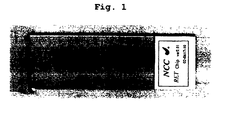
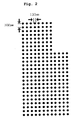
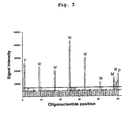
- Each oligonucleotide is spotted 4 times horizontally for increased accuracy of measured signals, as shown in Table 1, Figs. 1 and 2.
- Positions 1 to 25 are spotted first, then positions 26 to 50, and finally, positions 51 to 67.
- Positions 1 and 50 are positive controls for exon 10 and 11, respectively.
- the other oligonucleotides are: 2-33 for exon 10 (codons 609, 611, 618, and 620); 34 ⁇ 49 for exon 11 (codons 630 and 634); 51 ⁇ 58 for exon 13 (codon 768); 59 ⁇ 65 for exon 14 (codon 804); and 66 ⁇ 67 for exon 16 (codon 918).
- oligonucleotides (M) having 7 types of missense mutations and the one wild type oligonucleotide (W) are spotted; for codon 804, oligonucleotides (M) having 6 types of missense mutations and one wild type oligonucleotide (W) are spotted; and for codon 918, the oligonucleotide (M) having the predominant mutation type and one wild type oligonucleotide (W) are spotted.
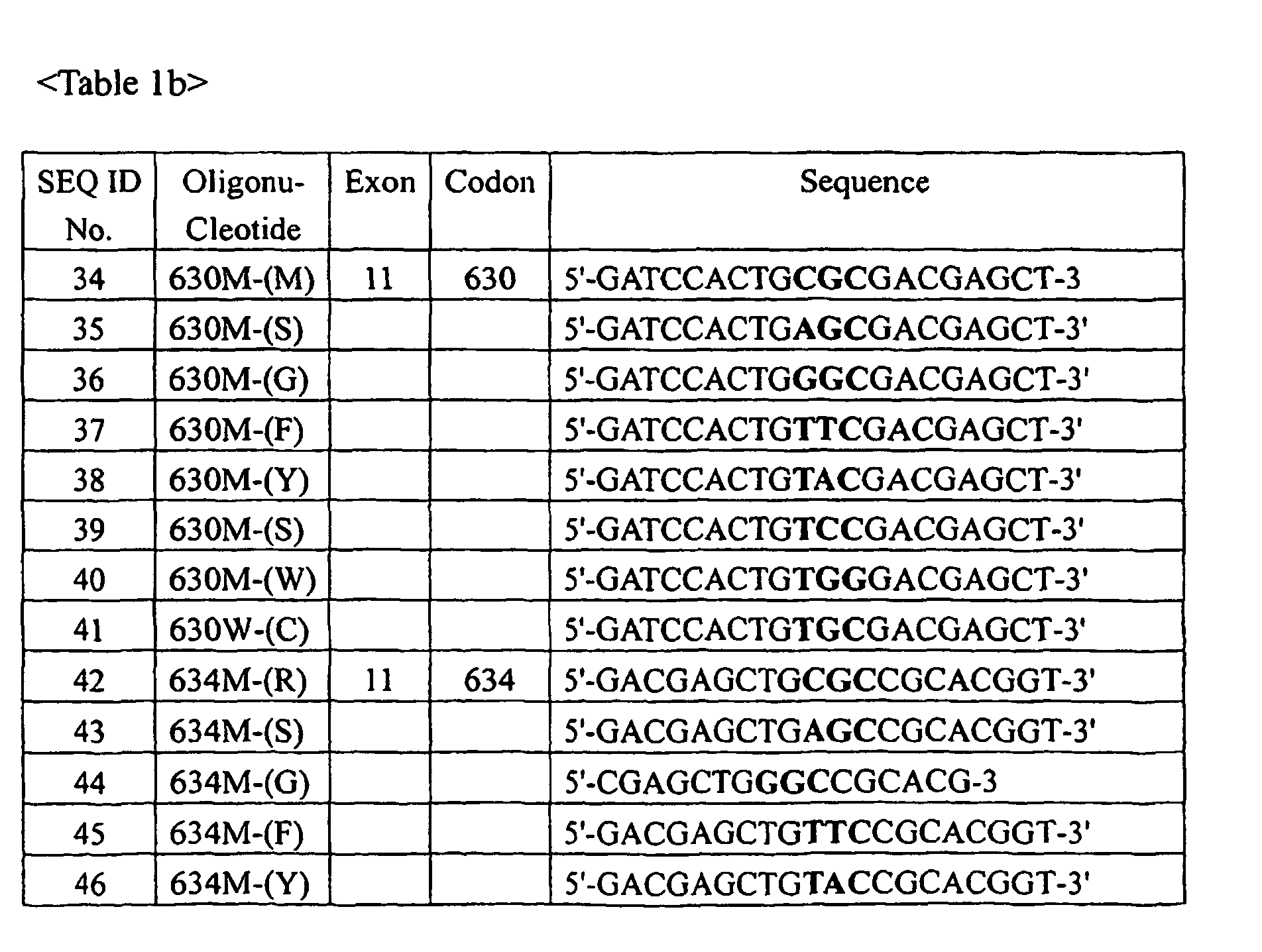
- codons 609, 611, 618, 620, 630, and 634 are 7 types of oligonucleotides obtained by replacing TGC (cysteine) with CGC (arginine), AGC (serine), GGC (glycine), TTC (phenylalanine), TAC (tyrosine), TCC (serine) and TGG (tryptophan), respectively.
- codon 768 Used for codon 768 are 7 types of oligonucleotides obtained by replacing GAG (glutamic acid) with CAG (glutamine), AAG (lysine), GCG (alanine), GGG (glycine), GTG (valine), GAC (aspartic acid) and GAT (aspartic acid), respectively.
- GAG Glutamic acid
- CAG CAG
- AAG lysine
- GCG alanine
- GGG glycine
- GAC aspartic acid
- GAT aspartic acid
- codon 804 6 types of mutated oligonucleotides are used: GTG (valine) was replaced with CTG (leucine), ATG (methionine), TTG (leucine), GAG (glutamic acid), GCG (alanine) and GGG (glycine), respectively.
- Codon 918 mutant is oligonucleotide obtained by replacing ATG (methionine) with ACC (there
- oligonucleotide One wild type of oligonucleotide (W) is designed for each codon to be directly compared with mutation types. For example, 8 oligonucleotides are spotted for codon 618, one is to detect a normal base sequence and the rest, the mutated base sequences. As a whole, 56 mutant oligonucleotides are designed for the 56 missense mutation types at the 9 hot spot codons, and 11 oligonucleotides, for the wild types and positive controls (see Tables 1a and 1b). The positive controls are designed for exons 10 and 11 in which most mutations have been identified.
- the three oligonucleotides described in SEQ ID Nos. 4, 20, and 44, respectively, are designed to have a shorter length of 16-mer rather than 20-mer. Preliminary experiments have revealed that some G-A mismatches often occur to exhibit non-specific signals when 20-mer oligonucleotides are used (positions 4, 20, and 44).
- the complementary sequence (-ACG) in a sample DNA hybridizes only with the oligonucleotide of SEQ ID No. 8, in principle.
- the length of the oligonucleotides is reduced from 20-mer to 16-mer in three cases (positions 4, 20, and 44) in order to decrease the destabilizing effect caused by G-A mismatch.
- These 16-mer oligonucleotides are analyzed with perfectly matched oligonucleotides.
- the RET oligo chip of the present invention may be manufactured by fixing as many as 67 oligonucleotides on the surface of a solid matrix using an automatic microarrayer by a process comprising the steps of:
- each of the oligonucleotides used in step (1) has preferably a functional group that can be used to form stable binding with the solid matrix surface.
- each oligonucleotide may be linked with a 12 carbon spacer having a 5' amino function, e.g., H 2 N-(CH 2 ) 12 -oligonucleotide. This amine group undergoes Schiff's base reaction with an aldehyde group on the solid matrix to form a firm bond therebetween.
- the 12 carbon spacer serves to enhance the hybridization rate by facilitating the contact between the oligonucleotide and a fluorescent-labeled target DNA.
- the micro spotting solution used in step (1) may contain suitable salts and polymers to facilitate the application of the oligonucleotides on the solid matrix.
- the solid matrix used in step (2) may be made of a glass; a modified silicone; a plastic cassette; or a polymer such as polycarbonate or a gel thereof.
- the surface of a solid matrix may be coated with a chemical compound that can serve to bind the oligonucleotide to the matrix substrate.
- Preferable chemicals that can be used for such coating have functional groups such as aldehyde or amine groups.
- the present invention uses a slide glass coated with an aldehyde.
- a total of 268 oligonucleotides are arranged in a specified manner on a solid matrix using an automatic pin microarrayer.
- Each oligonucleotide spot is preferably of circular shape with a diameter ranging from 100 to 500 ⁇ m.
- a preferable example of the solid matrix is a slide glass having a size of about 3.7 cm ⁇ 7.6 cm, which can accommodate approximately 100 to 10,000 spots per chip.
- a total of 268 oligonucleotide spots, each of 130 ⁇ m diameter may be arranged in multiple columns and rows at intervals of 300 ⁇ m (see Fig. 2).
- step (3) the oligonucleotides are fixed on the solid matrix surface by way of forming covalent bonds between the amine groups of the oligonucleotide and the aldehyde groups of the solid matrix via Schiff's base reaction. Free unreacted oligonucleotides are removed by washing the solid matrix with SDS, SSC, SSPE, etc.
- step (4) the fixed oligonucleotides are denatured, and unreacted aldehyde groups remaining on the solid matrix are reduced and inactivated by sodium borohydride treatment.
- the RET oligo chip of the present invention manufactured by the above process may be advantageously used to detect gene mutation and this inventive method is much simpler and more economical than any of the conventional gene mutation detection methods: It takes several days to months on the average when the presence of gene mutation is examined using such conventional methods as SSCP (single strand conformation polymorphism), PTT (protein truncation test), RFLP (restriction fragment length polymorphism), cloning, direct sequencing, etc. However, analysis of a DNA sample for RET gene mutation takes less than 9 hours when the inventive RET oligo chip is employed. In addition, the RET oligo chip of the present invention can be manufactured much more simply at a much less production cost than conventional chips. Once the required oligonucleotides are synthesized, it is possible to mass-produce the inventive slides. The amounts of reagents required when the inventive RET oligo chip is used are far less than those required in any of the conventional methods.
- the RET oligo chip of the present invention is easy to manufacture using a pin microarrayer, while the existing Affymetrix oligo chip must be prepared using a complicated and expense phothlithography technique.
- the inventive RET oligo chip of the present invention is capable of providing greater experimental accuracy than was possible before.
- the present disclosure provides a method for detecting hereditary cancer employing the RET oligo chip, which comprises the steps of:
- a DNA sample is prepared by incorporating a fluorescent dye into a blood DNA sample obtained from a subject patient.
- a fluorescent dye include, but are not limited to, Cy5 and Cy3.
- step (2) the florescent dye-labeled DNA sample prepared in step (1) is mixed with a hybridization solution and transferred to each of the oligonucleotide.
- the hybridization reaction is performed in a 45 ⁇ 60°C incubator saturated with water vapor for 3 ⁇ 9 hours.
- the oligo chip is washed to remove unbound sample DNA and dried (step 3), and the resulting fluorescence is analyzed with a fluorescence reader using an appropriate software (step 4).
- step (5) setting a maximum value in 99% reliable range as a threshold value, any signal showing a fluorescence level higher than the threshold is regarded positive for the presence of mutation.
- the RET oligo chip of the present invention can be effectively used to diagnose such hereditary cancer as MEN2A, MEN2B, FMTC, etc. Since RET gene belongs to the receptor tyrosine kinase family responsible for the cell signal transduction pathway, the inventive RET oligo chip can be used as an effective diagnostic tool for the study of cancer cells.
- Step 1 Manufacture of RET oligo chip
- oligonucleotides designed to detect all 56 missense mutation types at 9 mutational hot spot codons of RET gene, were manufactured as follows (Tables 1a and 1b).
- the oligonucleotides 10-PC and 11-PC described in SEQ ID Nos. 1 and 50 are positive controls, and the oligonucleotides described in SEQ ID Nos. 9, 17, 25, 33, 41, 49, 58, 65 and 67 are wild types.
- Other oligonucleotide each have missense mutation at one of the hot spot codons: the oligonucleotides described in SEQ ID Nos. 2 to 8, at codon 609; the oligonucleotides described in SEQ ID Nos.
- oligonucleotides each having a 12 carbon spacer to 5'-terminal modified with an amine residue which can undergo Schiff's base reaction with aldehyde groups, were obtained from MWG-Biotech (Ebrsberg, Germany) and fixed on a glass slide. Twenty pmole/ ⁇ l of each oligonucleotide was mixed with a micro spotting solution (TeleChem International Inc, Sunnyvale, CA) at a mix ratio of 1:1, resulting in 10 pmol/ ⁇ l of final volume, and 40 ⁇ l of each oligonucleotide was transferred to a 96 well plate.
- a micro spotting solution TeleChem International Inc, Sunnyvale, CA
- each oligonucleotide was printed on an aldehyde-coated glass slide (26 ⁇ 76 ⁇ 1 mm, CEL Associates Inc, Houston, TX). Spots, each of 130 ⁇ m dameter in size, were arranged in multiple columns and rows at intervals of 300 ⁇ m.
- the glass slide spotted with the oligonucleotides was washed twice with 0.2% SDS and then, once with distilled water.
- the glass slide was soaked in hot water (95 °C) to denature the oligonucleotides, and then, in sodium borohydride solution for 5 minutes to inactivate unreacted aldehyde groups. Then, the glass slide was washed twice with 0.2% SDS, and then, once with distilled water, centrifuged, and dried.
- the term of 'affected member' means a MEN2A patient showing clinical symptoms of MEN2A
- the term of 'gene carrier' means a mutated RET gene carrier not showing clinical symptoms of MEN2A.
- Total genomic DNA was extracted from each blood sample using Ficoll-Paque (Amersham Pharmacia-biotech Ltd, Uppsala, Sweden) and TRI reagent (Molecular Research Center, Cincinati, OH), following the manufacture's instructions.
- PCR amplification was performed using the extracted DNA as a template and five pairs of primers described in SEQ ID Nos. 68 to 77 (MWG-Biotech, Ebersberg, Germany) (Table 3).
- PCR primers for exon 10 and 11 were used as described in Takiguchi-Shirahama, S. et al., Hum. Genet. 95:187-190, 1995, PCR primers for exon 14 were used as described in Shuffenecker I.
- PCR primers for exon 13 and 16 were used as described in Karaga, H. J. et al., Eur. J. Endocrinol. 139:410-415, 1998).
- PCR reaction solution was composed of 100 ng of genomic DNA, 10 pmol of each primer, 40 uM of dCTP, 20 uM of fluorescent dye Cy5-dCTP (MEN) or Cy3-dCTP (Amersham-biotech Ltd., Buckinghamshire, UK) in a volume of 25 ⁇ l.
- the Cy5- or Cy3-labeled DNA samples of each exon prepared in step (2) were each mixed and resuspended in pre-warmed 1 ⁇ UniHyb solution (TeleChem International Inc, Sunnyvale, CA) to a volume of 2-4 ⁇ l. 2 ⁇ l of the mixed DNA sample was dropped on the glass slide prepared in step (1) and the glass slide was covered with a cover glass.
- the hybridization reaction was performed by incubating the glass slide in a saturated vapor tube at 60°C for 3 hours.
- the hybridized glass slide was rinsed at room temperature in a buffer of 2x SSC + 0.2% SDS for 10 ⁇ 30 min, and then, in distilled water for 5 min, followed by centrifuging and drying.
- the glass slide was scanned using a ScanArray Lite (Parkard Instrument Co, Meriden, CT) and analyzed using Quantitative Microarray analysis software (QuantArray, version 2.0). To establish a threshold value, all data analysis was carried out using a SigmaPlot (SPSS Inc., San Rafael, CA), and means and standard deviations were calculated.
- ScanArray Lite Parkard Instrument Co, Meriden, CT
- Quantitative Microarray analysis software Quantitative Microarray analysis software
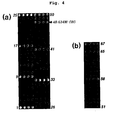
- Fig. 4 (a) shows the extents of hybridization occurred at exon 10 (codons 609, 611, 618, and 620) and exon 11 (codon 630 and 634). More than 95% of MEN2A mutations have been represented to occur at exon 10 and exon 11.
- Fig. 4 (b) indicates hybridization at exon 13 (codon 768) and 14 (codon 804). Most FMTC mutations have been identified at exon 13 and exon 14; while most MEN2B mutations have been observed occur at exon 16 (codon 918).
Landscapes
- Chemical & Material Sciences (AREA)
- Life Sciences & Earth Sciences (AREA)
- Organic Chemistry (AREA)
- Health & Medical Sciences (AREA)
- Proteomics, Peptides & Aminoacids (AREA)
- Zoology (AREA)
- Wood Science & Technology (AREA)
- Engineering & Computer Science (AREA)
- Genetics & Genomics (AREA)
- Analytical Chemistry (AREA)
- Microbiology (AREA)
- Biochemistry (AREA)
- Biotechnology (AREA)
- Molecular Biology (AREA)
- Biophysics (AREA)
- Physics & Mathematics (AREA)
- General Health & Medical Sciences (AREA)
- Immunology (AREA)
- Bioinformatics & Cheminformatics (AREA)
- General Engineering & Computer Science (AREA)
- Pathology (AREA)
- Measuring Or Testing Involving Enzymes Or Micro-Organisms (AREA)
- Investigating Or Analysing Biological Materials (AREA)
- Apparatus Associated With Microorganisms And Enzymes (AREA)
Abstract
Description



| Family | No. of affected members | No. of gene carriers | Mutation | Direct sequencing | Cloning and sequencing | RET oligo chip |
| I | 5 | 4 | C634W | + | + | + |
| II | 2 | 3 | C634R | + | + | + |
| III | 2 | 1 | C634R | + | + | + |
| IV | 11 | 9 | C618S | + | + | + |
| V | 1 | - | C634Y | No detection | + | + |
| SEQ ID No. | Primer | Amplifying region | Amplified size | |
| 68 | Exon- | Exon | 10 | 199 by |
| 69 | Exon-10R | |||
| 70 | Exon-11F | Exon 11 | 279 bp | |
| 71 | Exon-11R | |||
| 72 | Exon-13F | Exon 13 | 209 bp | |
| 73 | Exon-13R | |||
| 74 | Exon-14F | Exon 14 | 287 bp | |
| 75 | Exon-14R | |||
| 76 | Exon-16F | Exon 16 | 186 bp | |
| 77 | Exon-16R |
<211> 21
<212> DNA
<213> Artificial Sequence
<223> 10-PC

<211> 21
<212> DNA
<213> Artificial Sequence
<223> 609M-(R)

<211> 21
<212> DNA
<213> Artificial Sequence
<223> 609M-(S)

<211> 16
<212> DNA
<213> Artificial Sequence
<223> 609M-(G)

<211> 22
<212> DNA
<213> Artificial Sequence
<223> 609M-(F)

<211> 22
<212> DNA
<213> Artificial Sequence
<223> 609M-(Y)

<211> 21
<212> DNA
<213> Artificial Sequence
<223> 609M-(S)

<211> 21
<212> DNA
<213> Artificial Sequence
<223> 609M-(W)

<211> 21
<212> DNA
<213> Artificial Sequence
<220>
<223> 609M-(C)

<211> 20
<212> DNA
<213> Artificial Sequence
<223> 611M-(R)

<211> 21
<212> DNA
<213> Artificial Sequence
<223> 611M-(S)

<211> 20
<212> DNA
<213> Artificial Sequence
<223> 611M-(G)

<211> 21
<212> DNA
<213> Artificial Sequence
<223> 611M-(F)

<211> 21
<212> DNA
<213> Artificial Sequence
<223> 611M-(Y)

<211> 21
<212> DNA
<213> Artificial Sequence
<223> 611M-(S)

<211> 21
<212> DNA
<213> Artificial Sequence
<223> 611M-(W)

<211> 21
<212> DNA
<213> Artificial Sequence
<223> 611W-(C)

<211> 20
<212> DNA
<213> Artificial Sequence
<223> 618M-(R)

<211> 21
<212> DNA
<213> Artificial Sequence
<223> 618M-(S)

<211> 16
<212> DNA
<213> Artificial Sequence
<223> 618M-(G)

<211> 20
<212> DNA
<213> Artificial Sequence
<223> 618M-(F)

<211> 20
<212> DNA
<213> Artificial Sequence
<223> 618M-(Y)

<211> 20
<212> DNA
<213> Artificial Sequence
<223> 618M-(S)

<211> 20
<212> DNA
<213> Artificial Sequence
<223> 618M-(W)

<211> 21
<212> DNA
<213> Artificial Sequence
<223> 618W-(C)

<211 > 20
<212> DNA
<213> Artificial Sequence
<223> 620M-(R)

<211> 20
<212> DNA
<213> Artificial Sequence
<223> 620M-(S)

<211> 20
<212> DNA
<213> Artificial Sequence
<220>
<223> 620M-(G)

<211> 20
<212> DNA
<213> Artificial Sequence
<223> 620M-(F)

<211> 20
<212> DNA
<213> Artificial Sequence
<223> 620M-(Y)

<211> 20
<212> DNA
<213> Artificial Sequence
<223> 620M-(S)

<211> 20
<212> DNA
<213> Artificial Sequence
<223> 620M-(W)

<211> 20
<212> DNA
<213> Artificial Sequence
<223> 620W-(C)

<211> 20
<212> DNA
<213> Artificial Sequence
<223> 630M-(M)

<211> 20
<212> DNA
<213> Artificial Sequence
<223> 630M-(S)

<211> 20
<212> DNA
<213> Artificial Sequence
<223> 630M-(G)

<211> 20
<212> DNA
<213> Artificial Sequence
<223> 630M-(F)

<211> 20
<212> DNA
<213> Artificial Sequence
<223> 630M-(Y)

<211> 20
<212> DNA
<213> Artificial Sequence
<223> 630M-(S)

<211> 20
<212> DNA
<213> Artificial Sequence
<223> 630M-(W)

<211> 20
<212> DNA
<213> Artificial Sequence
<223> 630W-(C)

<211> 20
<212> DNA
<213> Artificial Sequence
<223> 634M-(R)

<211> 20
<212> DNA
<213> Artificial Sequence
<223> 634M-(S)

<211> 16
<212> DNA
<213> Artificial Sequence
<223> 634M-(G)

<211> 20
<212> DNA
<213> Artificial Sequence
<223> 634M-(F)

<211> 20
<212> DNA
<213> Artificial Sequence
<223> 634M-(Y)

<211> 20
<212> DNA
<213> Artificial Sequence
<223> 634M-(S)

<211> 20
<212> DNA
<213> Artificial Sequence
<223> 634M-(W)

<211> 20
<212> DNA
<213> Artificial Sequence
<223> 634W-(C)

<211> 20
<212> DNA
<213> Artificial Sequence
<220>
<223> 11PC

<211> 20
<212> DNA
<213> Artificial Sequence
<223> 768M-(Q)

<211> 21
<212> DNA
<213> Artificial Sequence
<223> 768M-(K)

<211> 20
<212> DNA
<213> Artificial Sequence
<223> 768M-(A)

<211> 20
<212> DNA
<213> Artificial Sequence
<223> 768M-(G)

<211> 20
<212> DNA
<213> Artificial Sequence
<223> 768M-(V)

<211> 20
<212> DNA
<213> Artificial Sequence
<223> 768M-(D)

<211> 21
<212> DNA
<213> Artificial Sequence
<223> 768M-(D)

<211> 20
<212> DNA
<213> Artificial Sequence
<223> 768W-(E)

<211> 20
<212> DNA
<213> Artificial Sequence
<223> 804M-(L)

<211> 21
<212> DNA
<213> Artificial Sequence
<223> 804M-(M)

<211> 21
<212> DNA
<213> Artificial Sequence
<223> 804M-(L)

<211> 20
<212> DNA
<213> Artificial Sequence
<223> 804M-(E)

<211> 20
<212> DNA
<213> Artificial Sequence
<223> 804M-(A)

<211> 20
<212> DNA
<213> Artificial Sequence
<223> 804M-(G)

<211> 20
<212> DNA
<213> Artificial Sequence
<223> 804W-(V)

<211> 24
<212> DNA
<213> Artificial Sequence
<223> 918M-(T)

<211> 24
<212> DNA
<213> Artificial Sequence
<223> 918W-(M)

<211> 28
<212> DNA
<213> Artificial Sequence
<223> Exon-10F

<211> 30
<212> DNA
<213> Artificial Sequence
<220>
<223> Exon-10R

<211> 30
<212> DNA
<213> Artificial Sequence
<223> Exon-11F

<211> 29
<212> DNA
<213> Artificial Sequence
<223> Exon-11R

<211> 39
<212> DNA
<213> Artificial Sequence
<223> Exon-13F

<211> 36
<212> DNA
<213> Artificial Sequence
<223> Exon-13R

<211> 19
<212> DNA
<213> Artificial Sequence
<223> Exon-14F

<211> 19
<212> DNA
<213> Artificial Sequence
<223> Exon-14R

<211> 43
<212> DNA
<213> Artificial Sequence
<223> Exon-16F

<211> 37
<212> DNA
<213> Artificial Sequence
<223> Exon-16R

Claims (6)
- A RET oligonucleotide microchip for detecting RET mutations which comprises oligonucleotides consisting of the nucleotide sequences SEQ ID Nos. 1 to 67 fixed on the surface of a solid matrix, said oligonucleotides being designed to detect missense mutation types hot spots of RET gene.
- The RET oligonucleotide microchip of claim 1, wherein the hot spots are codons 609, 611, 618, 620, 630, 634, 768, 804 and 918.
- The RET oligonucleotide microchip of claim 1, wherein the oligonucleotides are designed to detect 7 types of missense mutation at codons 609, 611, 618, 620, 630, 634, and 768, 6 types of missense mutation at codon 804, 1 type of missense mutation at codon 918, 9 types of wild type to each codon, and 2 types of positive control for exon 10 and 11.
- The RET oligonucleotide microchip of claim 3, wherein the oligonucleotides described in SEQ ID Nos. 2 to 8 are for the detection of missense mutations at codon 609, SEQ ID Nos. 10 to 16 for missense mutations at codon 611, SEQ ID Nos. 18 to 24 for missense mutations at codon 618, SEQ ID Nos. 26 to 32 for missense mutations at codon 620, SEQ ID Nos. 34 to 40 for missense mutations at codon 630, SEQ ID Nos. 42 to 48 for missense mutations at codon 634, SEQ ID Nos. 51 to 57 for missense mutations at codon 768, SEQ ID Nos. 59 to 64 for missense mutations at codon 804, and SEQ ID No. 66 for missense mutations at codon 918.
- A manufacturing process of the RET oligonucleotide microchip of any of claims 1 to 5, comprising1) mixing each of the oligonucleotides in a micro spotting solution and distributing to a well plate, wherein the oligonucleotides consist of the nucleotide sequences of SEQ ID Nos. 1 to 67;2) spotting the oligonucleotides on the surface of a solid matrix using a microarrayer;3) fixing the oligonucleotides on the solid matrix surface and washing;4) denaturing the fixed oligonucleotides by soaking the solid matrix in 95°C water, and then, treating the solid matrix with a sodium borohydride solution; and5) washing and drying the solid matrix.
- The manufacturing process of claim 5, wherein each of the oligonucleotides used in step (1) has a 12 carbon spacer with 5' amino modification.
Applications Claiming Priority (2)
| Application Number | Priority Date | Filing Date | Title |
|---|---|---|---|
| KR2001071774 | 2001-11-19 | ||
| KR10-2001-0071774A KR100451864B1 (en) | 2001-11-19 | 2001-11-19 | Ret oligonucleotide microchip and method for detecting hereditary cancer employing same |
Publications (3)
| Publication Number | Publication Date |
|---|---|
| EP1333100A2 EP1333100A2 (en) | 2003-08-06 |
| EP1333100A3 EP1333100A3 (en) | 2003-12-17 |
| EP1333100B1 true EP1333100B1 (en) | 2005-12-14 |
Family
ID=36746257
Family Applications (1)
| Application Number | Title | Priority Date | Filing Date |
|---|---|---|---|
| EP02001681A Expired - Lifetime EP1333100B1 (en) | 2001-11-19 | 2002-01-24 | RET oligonucleotide microchip for detecting hereditary cancer |
Country Status (7)
| Country | Link |
|---|---|
| US (1) | US20030152938A1 (en) |
| EP (1) | EP1333100B1 (en) |
| JP (1) | JP2003156492A (en) |
| KR (1) | KR100451864B1 (en) |
| CN (1) | CN1169969C (en) |
| AT (1) | ATE312945T1 (en) |
| DE (1) | DE60207975T2 (en) |
Families Citing this family (3)
| Publication number | Priority date | Publication date | Assignee | Title |
|---|---|---|---|---|
| US20050064482A1 (en) * | 2003-08-27 | 2005-03-24 | Norihisa Mino | Microchip, process of manufacturing the same, and analytical method using the same |
| JP4202391B2 (en) * | 2004-03-17 | 2008-12-24 | パナソニック株式会社 | Biochip manufacturing method, probe solution, and biochip |
| KR100666099B1 (en) * | 2004-04-27 | 2007-01-10 | 국립암센터 | K-raa oligonucleotide microarray and method for detecting mutation of K-raa gene using it |
-
2001
- 2001-11-19 KR KR10-2001-0071774A patent/KR100451864B1/en not_active Expired - Fee Related
-
2002
- 2002-01-24 EP EP02001681A patent/EP1333100B1/en not_active Expired - Lifetime
- 2002-01-24 AT AT02001681T patent/ATE312945T1/en not_active IP Right Cessation
- 2002-01-24 DE DE60207975T patent/DE60207975T2/en not_active Expired - Fee Related
- 2002-02-21 CN CNB021053014A patent/CN1169969C/en not_active Expired - Fee Related
- 2002-04-05 US US10/117,586 patent/US20030152938A1/en not_active Abandoned
- 2002-04-19 JP JP2002117713A patent/JP2003156492A/en active Pending
Also Published As
| Publication number | Publication date |
|---|---|
| KR20030041045A (en) | 2003-05-23 |
| DE60207975D1 (en) | 2006-01-19 |
| CN1169969C (en) | 2004-10-06 |
| DE60207975T2 (en) | 2006-08-17 |
| EP1333100A2 (en) | 2003-08-06 |
| ATE312945T1 (en) | 2005-12-15 |
| JP2003156492A (en) | 2003-05-30 |
| US20030152938A1 (en) | 2003-08-14 |
| KR100451864B1 (en) | 2004-10-08 |
| CN1422963A (en) | 2003-06-11 |
| EP1333100A3 (en) | 2003-12-17 |
Similar Documents
| Publication | Publication Date | Title |
|---|---|---|
| JP4766750B2 (en) | Detection of nucleic acid sequence differences using a ligase detection reaction with a positionable array | |
| JP5992895B2 (en) | Method for designing positionable arrays for detection of nucleic acid sequence differences using ligase detection reactions | |
| Huber et al. | Detection of single base alterations in genomic DNA by solid phase polymerase chain reaction on oligonucleotide microarrays | |
| JP4276691B2 (en) | Male infertility-related gene protamine-2 mutation and diagnostic method for male infertility | |
| WO2002002809A2 (en) | Diagnosis of behavioural disorders, neurological disorders and cancer | |
| CA2312273A1 (en) | Cancer susceptibility mutations of brca1 | |
| CA2311680A1 (en) | Cancer susceptibility mutations of brca2 | |
| US7381808B2 (en) | Method and nucleic acids for the differentiation of prostate tumors | |
| US20070298419A1 (en) | K-Ras Oligonucleotide Microarray and Method for Detecting K-Ras Mutations Employing the Same | |
| EP1333100A2 (en) | RET oligonucleotide microchip and method for detecting hereditary cancer employing same | |
| EP1437417B1 (en) | Beta-catenin oligonucleotide michrochip and method for detecting beta-catenin mutations employing same | |
| EP1788098A1 (en) | Design of capture molecules for the detection of amplicons with high sensitivity | |
| EP1699935A1 (en) | Use of a mutation in the braf gene for the determination of the malignancy of melanoma cells | |
| US7732139B2 (en) | Multiple SNP for diagnosing cardiovascular disease, microarray and kit comprising the same, and method of diagnosing cardiovascular disease using the same | |
| WO2008061672A2 (en) | Genetic risk factor for cancer | |
| Jeong et al. | The Study of X Chromosome Inactivation Mechanism in Klinefelter's Syndrome by cDNA Microarray Experiment | |
| WO2008061673A2 (en) | Drug discovery for cancer | |
| JP2009532028A (en) | Identification of novel genes underlying familial spastic paraplegia |
Legal Events
| Date | Code | Title | Description |
|---|---|---|---|
| PUAI | Public reference made under article 153(3) epc to a published international application that has entered the european phase |
Free format text: ORIGINAL CODE: 0009012 |
|
| 17P | Request for examination filed |
Effective date: 20020124 |
|
| AK | Designated contracting states |
Designated state(s): AT BE CH CY DE DK ES FI FR GB GR IE IT LI LU MC NL PT SE TR |
|
| AX | Request for extension of the european patent |
Extension state: AL LT LV MK RO SI |
|
| PUAL | Search report despatched |
Free format text: ORIGINAL CODE: 0009013 |
|
| RIC1 | Information provided on ipc code assigned before grant |
Ipc: 7B 01J 19/00 B Ipc: 7C 12Q 1/68 A |
|
| AK | Designated contracting states |
Kind code of ref document: A3 Designated state(s): AT BE CH CY DE DK ES FI FR GB GR IE IT LI LU MC NL PT SE TR |
|
| AX | Request for extension of the european patent |
Extension state: AL LT LV MK RO SI |
|
| 17Q | First examination report despatched |
Effective date: 20040311 |
|
| AKX | Designation fees paid |
Designated state(s): AT BE CH CY DE DK ES FI FR GB GR IE IT LI LU MC NL PT SE TR |
|
| GRAP | Despatch of communication of intention to grant a patent |
Free format text: ORIGINAL CODE: EPIDOSNIGR1 |
|
| RTI1 | Title (correction) |
Free format text: RET MICROPUCE AE OLIGONUCLEOTIDES DE DETECTION DE CANCER HEREDITAIRE |
|
| RTI1 | Title (correction) |
Free format text: RET OLIGONUCLEOTIDE MICROCHIP FOR DETECTING HEREDITARY CANCER |
|
| GRAS | Grant fee paid |
Free format text: ORIGINAL CODE: EPIDOSNIGR3 |
|
| GRAA | (expected) grant |
Free format text: ORIGINAL CODE: 0009210 |
|
| AK | Designated contracting states |
Kind code of ref document: B1 Designated state(s): AT BE CH CY DE DK ES FI FR GB GR IE IT LI LU MC NL PT SE TR |
|
| PG25 | Lapsed in a contracting state [announced via postgrant information from national office to epo] |
Ref country code: BE Free format text: LAPSE BECAUSE OF FAILURE TO SUBMIT A TRANSLATION OF THE DESCRIPTION OR TO PAY THE FEE WITHIN THE PRESCRIBED TIME-LIMIT Effective date: 20051214 Ref country code: FI Free format text: LAPSE BECAUSE OF FAILURE TO SUBMIT A TRANSLATION OF THE DESCRIPTION OR TO PAY THE FEE WITHIN THE PRESCRIBED TIME-LIMIT Effective date: 20051214 Ref country code: AT Free format text: LAPSE BECAUSE OF FAILURE TO SUBMIT A TRANSLATION OF THE DESCRIPTION OR TO PAY THE FEE WITHIN THE PRESCRIBED TIME-LIMIT Effective date: 20051214 |
|
| REG | Reference to a national code |
Ref country code: GB Ref legal event code: FG4D |
|
| REG | Reference to a national code |
Ref country code: CH Ref legal event code: EP |
|
| REG | Reference to a national code |
Ref country code: IE Ref legal event code: FG4D |
|
| REF | Corresponds to: |
Ref document number: 60207975 Country of ref document: DE Date of ref document: 20060119 Kind code of ref document: P |
|
| PG25 | Lapsed in a contracting state [announced via postgrant information from national office to epo] |
Ref country code: IE Free format text: LAPSE BECAUSE OF NON-PAYMENT OF DUE FEES Effective date: 20060124 |
|
| PG25 | Lapsed in a contracting state [announced via postgrant information from national office to epo] |
Ref country code: LU Free format text: LAPSE BECAUSE OF NON-PAYMENT OF DUE FEES Effective date: 20060131 Ref country code: MC Free format text: LAPSE BECAUSE OF NON-PAYMENT OF DUE FEES Effective date: 20060131 |
|
| PG25 | Lapsed in a contracting state [announced via postgrant information from national office to epo] |
Ref country code: DK Free format text: LAPSE BECAUSE OF FAILURE TO SUBMIT A TRANSLATION OF THE DESCRIPTION OR TO PAY THE FEE WITHIN THE PRESCRIBED TIME-LIMIT Effective date: 20060314 Ref country code: SE Free format text: LAPSE BECAUSE OF FAILURE TO SUBMIT A TRANSLATION OF THE DESCRIPTION OR TO PAY THE FEE WITHIN THE PRESCRIBED TIME-LIMIT Effective date: 20060314 Ref country code: GR Free format text: LAPSE BECAUSE OF FAILURE TO SUBMIT A TRANSLATION OF THE DESCRIPTION OR TO PAY THE FEE WITHIN THE PRESCRIBED TIME-LIMIT Effective date: 20060314 |
|
| PG25 | Lapsed in a contracting state [announced via postgrant information from national office to epo] |
Ref country code: ES Free format text: LAPSE BECAUSE OF FAILURE TO SUBMIT A TRANSLATION OF THE DESCRIPTION OR TO PAY THE FEE WITHIN THE PRESCRIBED TIME-LIMIT Effective date: 20060325 |
|
| REG | Reference to a national code |
Ref country code: CH Ref legal event code: NV Representative=s name: E. BLUM & CO. PATENTANWAELTE |
|
| PG25 | Lapsed in a contracting state [announced via postgrant information from national office to epo] |
Ref country code: PT Free format text: LAPSE BECAUSE OF FAILURE TO SUBMIT A TRANSLATION OF THE DESCRIPTION OR TO PAY THE FEE WITHIN THE PRESCRIBED TIME-LIMIT Effective date: 20060515 |
|
| ET | Fr: translation filed | ||
| REG | Reference to a national code |
Ref country code: IE Ref legal event code: MM4A |
|
| PLBE | No opposition filed within time limit |
Free format text: ORIGINAL CODE: 0009261 |
|
| STAA | Information on the status of an ep patent application or granted ep patent |
Free format text: STATUS: NO OPPOSITION FILED WITHIN TIME LIMIT |
|
| 26N | No opposition filed |
Effective date: 20060915 |
|
| REG | Reference to a national code |
Ref country code: CH Ref legal event code: PFA Owner name: NATIONAL CANCER CENTER Free format text: NATIONAL CANCER CENTER#NO. 809, MADU-1-DONG, ILSAN-GU#GOYANG-SI, GYEONGGI-DO 411-764 (KR) -TRANSFER TO- NATIONAL CANCER CENTER#NO. 809, MADU-1-DONG, ILSAN-GU#GOYANG-SI, GYEONGGI-DO 411-764 (KR) |
|
| PGFP | Annual fee paid to national office [announced via postgrant information from national office to epo] |
Ref country code: CH Payment date: 20080129 Year of fee payment: 7 |
|
| PGFP | Annual fee paid to national office [announced via postgrant information from national office to epo] |
Ref country code: DE Payment date: 20080124 Year of fee payment: 7 Ref country code: GB Payment date: 20080123 Year of fee payment: 7 Ref country code: IT Payment date: 20080130 Year of fee payment: 7 Ref country code: NL Payment date: 20080123 Year of fee payment: 7 |
|
| PG25 | Lapsed in a contracting state [announced via postgrant information from national office to epo] |
Ref country code: TR Free format text: LAPSE BECAUSE OF FAILURE TO SUBMIT A TRANSLATION OF THE DESCRIPTION OR TO PAY THE FEE WITHIN THE PRESCRIBED TIME-LIMIT Effective date: 20051214 |
|
| PGFP | Annual fee paid to national office [announced via postgrant information from national office to epo] |
Ref country code: FR Payment date: 20080125 Year of fee payment: 7 |
|
| PG25 | Lapsed in a contracting state [announced via postgrant information from national office to epo] |
Ref country code: CY Free format text: LAPSE BECAUSE OF FAILURE TO SUBMIT A TRANSLATION OF THE DESCRIPTION OR TO PAY THE FEE WITHIN THE PRESCRIBED TIME-LIMIT Effective date: 20051214 |
|
| REG | Reference to a national code |
Ref country code: CH Ref legal event code: PL |
|
| GBPC | Gb: european patent ceased through non-payment of renewal fee |
Effective date: 20090124 |
|
| NLV4 | Nl: lapsed or anulled due to non-payment of the annual fee |
Effective date: 20090801 |
|
| PG25 | Lapsed in a contracting state [announced via postgrant information from national office to epo] |
Ref country code: CH Free format text: LAPSE BECAUSE OF NON-PAYMENT OF DUE FEES Effective date: 20090131 Ref country code: LI Free format text: LAPSE BECAUSE OF NON-PAYMENT OF DUE FEES Effective date: 20090131 Ref country code: DE Free format text: LAPSE BECAUSE OF NON-PAYMENT OF DUE FEES Effective date: 20090801 |
|
| REG | Reference to a national code |
Ref country code: FR Ref legal event code: ST Effective date: 20091030 |
|
| PG25 | Lapsed in a contracting state [announced via postgrant information from national office to epo] |
Ref country code: NL Free format text: LAPSE BECAUSE OF NON-PAYMENT OF DUE FEES Effective date: 20090801 Ref country code: GB Free format text: LAPSE BECAUSE OF NON-PAYMENT OF DUE FEES Effective date: 20090124 |
|
| PG25 | Lapsed in a contracting state [announced via postgrant information from national office to epo] |
Ref country code: FR Free format text: LAPSE BECAUSE OF NON-PAYMENT OF DUE FEES Effective date: 20090202 |
|
| PG25 | Lapsed in a contracting state [announced via postgrant information from national office to epo] |
Ref country code: IT Free format text: LAPSE BECAUSE OF NON-PAYMENT OF DUE FEES Effective date: 20090124 |