EP1333024B1 - Peptide derivatives and their pharmaceutically acceptable salts, processes for preparation of both, and use thereof - Google Patents
Peptide derivatives and their pharmaceutically acceptable salts, processes for preparation of both, and use thereof Download PDFInfo
- Publication number
- EP1333024B1 EP1333024B1 EP01980959A EP01980959A EP1333024B1 EP 1333024 B1 EP1333024 B1 EP 1333024B1 EP 01980959 A EP01980959 A EP 01980959A EP 01980959 A EP01980959 A EP 01980959A EP 1333024 B1 EP1333024 B1 EP 1333024B1
- Authority
- EP
- European Patent Office
- Prior art keywords
- chain
- pharmaceutically acceptable
- formula
- branched
- straight
- Prior art date
- Legal status (The legal status is an assumption and is not a legal conclusion. Google has not performed a legal analysis and makes no representation as to the accuracy of the status listed.)
- Expired - Lifetime
Links
- 108090000765 processed proteins & peptides Proteins 0.000 title claims abstract description 71
- 150000003839 salts Chemical class 0.000 title claims abstract description 71
- 238000000034 method Methods 0.000 title claims description 45
- 238000002360 preparation method Methods 0.000 title description 5
- 125000003545 alkoxy group Chemical group 0.000 claims abstract description 44
- 239000001257 hydrogen Substances 0.000 claims abstract description 43
- 229910052739 hydrogen Inorganic materials 0.000 claims abstract description 43
- 125000002887 hydroxy group Chemical group [H]O* 0.000 claims abstract description 37
- 125000005740 oxycarbonyl group Chemical group [*:1]OC([*:2])=O 0.000 claims abstract description 26
- 238000004519 manufacturing process Methods 0.000 claims abstract description 19
- 125000004193 piperazinyl group Chemical group 0.000 claims abstract description 18
- 125000006239 protecting group Chemical group 0.000 claims abstract description 16
- UFHFLCQGNIYNRP-UHFFFAOYSA-N Hydrogen Chemical compound [H][H] UFHFLCQGNIYNRP-UHFFFAOYSA-N 0.000 claims abstract description 14
- 150000001370 alpha-amino acid derivatives Chemical class 0.000 claims abstract description 7
- 235000008206 alpha-amino acids Nutrition 0.000 claims abstract description 7
- 150000001875 compounds Chemical class 0.000 claims description 125
- -1 mercaptomethyl Chemical group 0.000 claims description 85
- 125000000217 alkyl group Chemical group 0.000 claims description 48
- 239000000203 mixture Substances 0.000 claims description 38
- 150000002431 hydrogen Chemical class 0.000 claims description 25
- 208000028169 periodontal disease Diseases 0.000 claims description 20
- 125000001584 benzyloxycarbonyl group Chemical group C(=O)(OCC1=CC=CC=C1)* 0.000 claims description 18
- 125000002924 primary amino group Chemical group [H]N([H])* 0.000 claims description 17
- LFQSCWFLJHTTHZ-UHFFFAOYSA-N Ethanol Chemical compound CCO LFQSCWFLJHTTHZ-UHFFFAOYSA-N 0.000 claims description 16
- 125000001797 benzyl group Chemical group [H]C1=C([H])C([H])=C(C([H])=C1[H])C([H])([H])* 0.000 claims description 16
- 108091020100 Gingipain Cysteine Endopeptidases Proteins 0.000 claims description 15
- 125000004453 alkoxycarbonyl group Chemical group 0.000 claims description 15
- UYWQUFXKFGHYNT-UHFFFAOYSA-N phenylmethyl ester of formic acid Natural products O=COCC1=CC=CC=C1 UYWQUFXKFGHYNT-UHFFFAOYSA-N 0.000 claims description 15
- 125000000959 isobutyl group Chemical group [H]C([H])([H])C([H])(C([H])([H])[H])C([H])([H])* 0.000 claims description 14
- 125000002496 methyl group Chemical group [H]C([H])([H])* 0.000 claims description 14
- 125000000143 2-carboxyethyl group Chemical group [H]OC(=O)C([H])([H])C([H])([H])* 0.000 claims description 12
- 125000004042 4-aminobutyl group Chemical group [H]C([*])([H])C([H])([H])C([H])([H])C([H])([H])N([H])[H] 0.000 claims description 12
- 239000003153 chemical reaction reagent Substances 0.000 claims description 12
- 210000000214 mouth Anatomy 0.000 claims description 12
- 238000006482 condensation reaction Methods 0.000 claims description 11
- 125000001997 phenyl group Chemical group [H]C1=C([H])C([H])=C(*)C([H])=C1[H] 0.000 claims description 11
- 239000004480 active ingredient Substances 0.000 claims description 10
- 125000003277 amino group Chemical group 0.000 claims description 10
- 125000003118 aryl group Chemical group 0.000 claims description 10
- 239000000825 pharmaceutical preparation Substances 0.000 claims description 10
- 125000000094 2-phenylethyl group Chemical group [H]C1=C([H])C([H])=C(C([H])=C1[H])C([H])([H])C([H])([H])* 0.000 claims description 9
- 229940123188 Gingipain inhibitor Drugs 0.000 claims description 8
- 239000002253 acid Substances 0.000 claims description 8
- 125000001449 isopropyl group Chemical group [H]C([H])([H])C([H])(*)C([H])([H])[H] 0.000 claims description 7
- 125000004108 n-butyl group Chemical group [H]C([H])([H])C([H])([H])C([H])([H])C([H])([H])* 0.000 claims description 7
- 125000001424 substituent group Chemical group 0.000 claims description 7
- 125000005098 aryl alkoxy carbonyl group Chemical group 0.000 claims description 6
- 125000003178 carboxy group Chemical group [H]OC(*)=O 0.000 claims description 6
- 125000004066 1-hydroxyethyl group Chemical group [H]OC([H])([*])C([H])([H])[H] 0.000 claims description 5
- 125000003143 4-hydroxybenzyl group Chemical group [H]C([*])([H])C1=C([H])C([H])=C(O[H])C([H])=C1[H] 0.000 claims description 5
- 150000001412 amines Chemical class 0.000 claims description 5
- 125000003710 aryl alkyl group Chemical group 0.000 claims description 5
- 125000002057 carboxymethyl group Chemical group [H]OC(=O)C([H])([H])[*] 0.000 claims description 5
- GLUUGHFHXGJENI-UHFFFAOYSA-N diethylenediamine Natural products C1CNCCN1 GLUUGHFHXGJENI-UHFFFAOYSA-N 0.000 claims description 5
- 239000003937 drug carrier Substances 0.000 claims description 5
- 125000004029 hydroxymethyl group Chemical group [H]OC([H])([H])* 0.000 claims description 5
- 125000002914 sec-butyl group Chemical group [H]C([H])([H])C([H])([H])C([H])(*)C([H])([H])[H] 0.000 claims description 5
- 125000004466 alkoxycarbonylamino group Chemical group 0.000 claims description 4
- 125000004435 hydrogen atom Chemical group [H]* 0.000 claims description 4
- 230000001590 oxidative effect Effects 0.000 claims description 3
- 150000004885 piperazines Chemical class 0.000 claims description 3
- 230000003301 hydrolyzing effect Effects 0.000 claims description 2
- IAZDPXIOMUYVGZ-WFGJKAKNSA-N Dimethyl sulfoxide Chemical compound [2H]C([2H])([2H])S(=O)C([2H])([2H])[2H] IAZDPXIOMUYVGZ-WFGJKAKNSA-N 0.000 description 102
- XEKOWRVHYACXOJ-UHFFFAOYSA-N Ethyl acetate Chemical compound CCOC(C)=O XEKOWRVHYACXOJ-UHFFFAOYSA-N 0.000 description 66
- 238000005160 1H NMR spectroscopy Methods 0.000 description 52
- 238000006243 chemical reaction Methods 0.000 description 41
- 239000002904 solvent Substances 0.000 description 37
- WYURNTSHIVDZCO-UHFFFAOYSA-N Tetrahydrofuran Chemical compound C1CCOC1 WYURNTSHIVDZCO-UHFFFAOYSA-N 0.000 description 24
- ZMXDDKWLCZADIW-UHFFFAOYSA-N N,N-Dimethylformamide Chemical compound CN(C)C=O ZMXDDKWLCZADIW-UHFFFAOYSA-N 0.000 description 22
- YMWUJEATGCHHMB-UHFFFAOYSA-N Dichloromethane Chemical compound ClCCl YMWUJEATGCHHMB-UHFFFAOYSA-N 0.000 description 21
- 239000000243 solution Substances 0.000 description 20
- 239000011734 sodium Substances 0.000 description 18
- KRKNYBCHXYNGOX-UHFFFAOYSA-N citric acid Chemical compound OC(=O)CC(O)(C(O)=O)CC(O)=O KRKNYBCHXYNGOX-UHFFFAOYSA-N 0.000 description 15
- 239000003795 chemical substances by application Substances 0.000 description 14
- FAPWRFPIFSIZLT-UHFFFAOYSA-M Sodium chloride Chemical compound [Na+].[Cl-] FAPWRFPIFSIZLT-UHFFFAOYSA-M 0.000 description 13
- OKKJLVBELUTLKV-UHFFFAOYSA-N Methanol Chemical compound OC OKKJLVBELUTLKV-UHFFFAOYSA-N 0.000 description 12
- 239000003814 drug Substances 0.000 description 11
- 230000002401 inhibitory effect Effects 0.000 description 11
- UIIMBOGNXHQVGW-UHFFFAOYSA-M Sodium bicarbonate Chemical compound [Na+].OC([O-])=O UIIMBOGNXHQVGW-UHFFFAOYSA-M 0.000 description 10
- XLYOFNOQVPJJNP-UHFFFAOYSA-N water Substances O XLYOFNOQVPJJNP-UHFFFAOYSA-N 0.000 description 10
- SJRJJKPEHAURKC-UHFFFAOYSA-N N-Methylmorpholine Chemical compound CN1CCOCC1 SJRJJKPEHAURKC-UHFFFAOYSA-N 0.000 description 9
- 241000605862 Porphyromonas gingivalis Species 0.000 description 9
- 239000000463 material Substances 0.000 description 9
- VLKZOEOYAKHREP-UHFFFAOYSA-N n-Hexane Chemical compound CCCCCC VLKZOEOYAKHREP-UHFFFAOYSA-N 0.000 description 9
- 239000007864 aqueous solution Substances 0.000 description 8
- 238000001914 filtration Methods 0.000 description 8
- YLQBMQCUIZJEEH-UHFFFAOYSA-N tetrahydrofuran Natural products C=1C=COC=1 YLQBMQCUIZJEEH-UHFFFAOYSA-N 0.000 description 8
- 229940124597 therapeutic agent Drugs 0.000 description 8
- PEDCQBHIVMGVHV-UHFFFAOYSA-N Glycerine Chemical compound OCC(O)CO PEDCQBHIVMGVHV-UHFFFAOYSA-N 0.000 description 7
- PMZURENOXWZQFD-UHFFFAOYSA-L Sodium Sulfate Chemical compound [Na+].[Na+].[O-]S([O-])(=O)=O PMZURENOXWZQFD-UHFFFAOYSA-L 0.000 description 7
- 238000000605 extraction Methods 0.000 description 7
- 230000003239 periodontal effect Effects 0.000 description 7
- 230000035484 reaction time Effects 0.000 description 7
- 238000003756 stirring Methods 0.000 description 7
- RYHBNJHYFVUHQT-UHFFFAOYSA-N 1,4-Dioxane Chemical compound C1COCCO1 RYHBNJHYFVUHQT-UHFFFAOYSA-N 0.000 description 6
- IAZDPXIOMUYVGZ-UHFFFAOYSA-N Dimethylsulphoxide Chemical compound CS(C)=O IAZDPXIOMUYVGZ-UHFFFAOYSA-N 0.000 description 6
- HEMHJVSKTPXQMS-UHFFFAOYSA-M Sodium hydroxide Chemical compound [OH-].[Na+] HEMHJVSKTPXQMS-UHFFFAOYSA-M 0.000 description 6
- 238000009472 formulation Methods 0.000 description 6
- 239000004615 ingredient Substances 0.000 description 6
- 238000002955 isolation Methods 0.000 description 6
- 239000010410 layer Substances 0.000 description 6
- 239000000843 powder Substances 0.000 description 6
- 125000000999 tert-butyl group Chemical group [H]C([H])([H])C(*)(C([H])([H])[H])C([H])([H])[H] 0.000 description 6
- LMDZBCPBFSXMTL-UHFFFAOYSA-N 1-Ethyl-3-(3-dimethylaminopropyl)carbodiimide Substances CCN=C=NCCCN(C)C LMDZBCPBFSXMTL-UHFFFAOYSA-N 0.000 description 5
- ASOKPJOREAFHNY-UHFFFAOYSA-N 1-Hydroxybenzotriazole Chemical compound C1=CC=C2N(O)N=NC2=C1 ASOKPJOREAFHNY-UHFFFAOYSA-N 0.000 description 5
- FPQQSJJWHUJYPU-UHFFFAOYSA-N 3-(dimethylamino)propyliminomethylidene-ethylazanium;chloride Chemical compound Cl.CCN=C=NCCCN(C)C FPQQSJJWHUJYPU-UHFFFAOYSA-N 0.000 description 5
- 0 CC(C)(C)OC(NCCCC[C@](CC(C([C@](CC*)N*C=*)=O)=C)C(CO)C(NC(CC(N)=O)C(N(C)C)=O)=O)=O Chemical compound CC(C)(C)OC(NCCCC[C@](CC(C([C@](CC*)N*C=*)=O)=C)C(CO)C(NC(CC(N)=O)C(N(C)C)=O)=O)=O 0.000 description 5
- SECXISVLQFMRJM-UHFFFAOYSA-N N-Methylpyrrolidone Chemical compound CN1CCCC1=O SECXISVLQFMRJM-UHFFFAOYSA-N 0.000 description 5
- 108091005804 Peptidases Proteins 0.000 description 5
- 102000035195 Peptidases Human genes 0.000 description 5
- 239000000654 additive Substances 0.000 description 5
- 230000000996 additive effect Effects 0.000 description 5
- 238000001816 cooling Methods 0.000 description 5
- 230000000694 effects Effects 0.000 description 5
- 125000001495 ethyl group Chemical group [H]C([H])([H])C([H])([H])* 0.000 description 5
- 239000000796 flavoring agent Substances 0.000 description 5
- 235000019634 flavors Nutrition 0.000 description 5
- 230000003449 preventive effect Effects 0.000 description 5
- 235000017557 sodium bicarbonate Nutrition 0.000 description 5
- 229910000030 sodium bicarbonate Inorganic materials 0.000 description 5
- YOETUEMZNOLGDB-UHFFFAOYSA-N 2-methylpropyl carbonochloridate Chemical compound CC(C)COC(Cl)=O YOETUEMZNOLGDB-UHFFFAOYSA-N 0.000 description 4
- VTYYLEPIZMXCLO-UHFFFAOYSA-L Calcium carbonate Chemical compound [Ca+2].[O-]C([O-])=O VTYYLEPIZMXCLO-UHFFFAOYSA-L 0.000 description 4
- 102000004190 Enzymes Human genes 0.000 description 4
- 108090000790 Enzymes Proteins 0.000 description 4
- 229920003171 Poly (ethylene oxide) Polymers 0.000 description 4
- 229940088598 enzyme Drugs 0.000 description 4
- CVHZOJJKTDOEJC-UHFFFAOYSA-N saccharin Chemical compound C1=CC=C2C(=O)NS(=O)(=O)C2=C1 CVHZOJJKTDOEJC-UHFFFAOYSA-N 0.000 description 4
- DYHSDKLCOJIUFX-UHFFFAOYSA-N tert-butoxycarbonyl anhydride Chemical compound CC(C)(C)OC(=O)OC(=O)OC(C)(C)C DYHSDKLCOJIUFX-UHFFFAOYSA-N 0.000 description 4
- QTBSBXVTEAMEQO-UHFFFAOYSA-N Acetic acid Chemical compound CC(O)=O QTBSBXVTEAMEQO-UHFFFAOYSA-N 0.000 description 3
- 241000894006 Bacteria Species 0.000 description 3
- QOSSAOTZNIDXMA-UHFFFAOYSA-N Dicylcohexylcarbodiimide Chemical compound C1CCCCC1N=C=NC1CCCCC1 QOSSAOTZNIDXMA-UHFFFAOYSA-N 0.000 description 3
- KFZMGEQAYNKOFK-UHFFFAOYSA-N Isopropanol Chemical compound CC(C)O KFZMGEQAYNKOFK-UHFFFAOYSA-N 0.000 description 3
- XUJNEKJLAYXESH-REOHCLBHSA-N L-Cysteine Chemical compound SC[C@H](N)C(O)=O XUJNEKJLAYXESH-REOHCLBHSA-N 0.000 description 3
- WMFOQBRAJBCJND-UHFFFAOYSA-M Lithium hydroxide Chemical compound [Li+].[OH-] WMFOQBRAJBCJND-UHFFFAOYSA-M 0.000 description 3
- KWYUFKZDYYNOTN-UHFFFAOYSA-M Potassium hydroxide Chemical compound [OH-].[K+] KWYUFKZDYYNOTN-UHFFFAOYSA-M 0.000 description 3
- DTQVDTLACAAQTR-UHFFFAOYSA-N Trifluoroacetic acid Chemical class OC(=O)C(F)(F)F DTQVDTLACAAQTR-UHFFFAOYSA-N 0.000 description 3
- 150000008065 acid anhydrides Chemical class 0.000 description 3
- 150000007513 acids Chemical class 0.000 description 3
- 150000001540 azides Chemical class 0.000 description 3
- 235000015218 chewing gum Nutrition 0.000 description 3
- 229940079593 drug Drugs 0.000 description 3
- 150000002148 esters Chemical class 0.000 description 3
- 235000011187 glycerol Nutrition 0.000 description 3
- 125000005843 halogen group Chemical group 0.000 description 3
- 125000004051 hexyl group Chemical group [H]C([H])([H])C([H])([H])C([H])([H])C([H])([H])C([H])([H])C([H])([H])* 0.000 description 3
- 239000003112 inhibitor Substances 0.000 description 3
- 239000002324 mouth wash Substances 0.000 description 3
- 125000004123 n-propyl group Chemical group [H]C([H])([H])C([H])([H])C([H])([H])* 0.000 description 3
- BDERNNFJNOPAEC-UHFFFAOYSA-N propan-1-ol Chemical compound CCCO BDERNNFJNOPAEC-UHFFFAOYSA-N 0.000 description 3
- 238000010898 silica gel chromatography Methods 0.000 description 3
- 239000000758 substrate Substances 0.000 description 3
- 238000003786 synthesis reaction Methods 0.000 description 3
- VBICKXHEKHSIBG-UHFFFAOYSA-N 1-monostearoylglycerol Chemical compound CCCCCCCCCCCCCCCCCC(=O)OCC(O)CO VBICKXHEKHSIBG-UHFFFAOYSA-N 0.000 description 2
- 125000000022 2-aminoethyl group Chemical group [H]C([*])([H])C([H])([H])N([H])[H] 0.000 description 2
- HBAQYPYDRFILMT-UHFFFAOYSA-N 8-[3-(1-cyclopropylpyrazol-4-yl)-1H-pyrazolo[4,3-d]pyrimidin-5-yl]-3-methyl-3,8-diazabicyclo[3.2.1]octan-2-one Chemical class C1(CC1)N1N=CC(=C1)C1=NNC2=C1N=C(N=C2)N1C2C(N(CC1CC2)C)=O HBAQYPYDRFILMT-UHFFFAOYSA-N 0.000 description 2
- 244000215068 Acacia senegal Species 0.000 description 2
- QFOHBWFCKVYLES-UHFFFAOYSA-N Butylparaben Chemical compound CCCCOC(=O)C1=CC=C(O)C=C1 QFOHBWFCKVYLES-UHFFFAOYSA-N 0.000 description 2
- HEDRZPFGACZZDS-UHFFFAOYSA-N Chloroform Chemical compound ClC(Cl)Cl HEDRZPFGACZZDS-UHFFFAOYSA-N 0.000 description 2
- 102000008186 Collagen Human genes 0.000 description 2
- 108010035532 Collagen Proteins 0.000 description 2
- FBPFZTCFMRRESA-FSIIMWSLSA-N D-Glucitol Natural products OC[C@H](O)[C@H](O)[C@@H](O)[C@H](O)CO FBPFZTCFMRRESA-FSIIMWSLSA-N 0.000 description 2
- FBPFZTCFMRRESA-KVTDHHQDSA-N D-Mannitol Chemical compound OC[C@@H](O)[C@@H](O)[C@H](O)[C@H](O)CO FBPFZTCFMRRESA-KVTDHHQDSA-N 0.000 description 2
- 238000006646 Dess-Martin oxidation reaction Methods 0.000 description 2
- RTZKZFJDLAIYFH-UHFFFAOYSA-N Diethyl ether Chemical compound CCOCC RTZKZFJDLAIYFH-UHFFFAOYSA-N 0.000 description 2
- WQZGKKKJIJFFOK-GASJEMHNSA-N Glucose Natural products OC[C@H]1OC(O)[C@H](O)[C@@H](O)[C@@H]1O WQZGKKKJIJFFOK-GASJEMHNSA-N 0.000 description 2
- DHMQDGOQFOQNFH-UHFFFAOYSA-N Glycine Chemical compound NCC(O)=O DHMQDGOQFOQNFH-UHFFFAOYSA-N 0.000 description 2
- 229920000084 Gum arabic Polymers 0.000 description 2
- VEXZGXHMUGYJMC-UHFFFAOYSA-N Hydrochloric acid Chemical compound Cl VEXZGXHMUGYJMC-UHFFFAOYSA-N 0.000 description 2
- GUBGYTABKSRVRQ-QKKXKWKRSA-N Lactose Natural products OC[C@H]1O[C@@H](O[C@H]2[C@H](O)[C@@H](O)C(O)O[C@@H]2CO)[C@H](O)[C@@H](O)[C@H]1O GUBGYTABKSRVRQ-QKKXKWKRSA-N 0.000 description 2
- 229930195725 Mannitol Natural products 0.000 description 2
- DBMJMQXJHONAFJ-UHFFFAOYSA-M Sodium laurylsulphate Chemical compound [Na+].CCCCCCCCCCCCOS([O-])(=O)=O DBMJMQXJHONAFJ-UHFFFAOYSA-M 0.000 description 2
- QAOWNCQODCNURD-UHFFFAOYSA-N Sulfuric acid Chemical compound OS(O)(=O)=O QAOWNCQODCNURD-UHFFFAOYSA-N 0.000 description 2
- HEDRZPFGACZZDS-MICDWDOJSA-N Trichloro(2H)methane Chemical compound [2H]C(Cl)(Cl)Cl HEDRZPFGACZZDS-MICDWDOJSA-N 0.000 description 2
- 235000010489 acacia gum Nutrition 0.000 description 2
- 239000000205 acacia gum Substances 0.000 description 2
- 239000000853 adhesive Substances 0.000 description 2
- 230000001070 adhesive effect Effects 0.000 description 2
- POJWUDADGALRAB-UHFFFAOYSA-N allantoin Chemical compound NC(=O)NC1NC(=O)NC1=O POJWUDADGALRAB-UHFFFAOYSA-N 0.000 description 2
- 235000001014 amino acid Nutrition 0.000 description 2
- 229940024606 amino acid Drugs 0.000 description 2
- 150000001413 amino acids Chemical class 0.000 description 2
- CUFNKYGDVFVPHO-UHFFFAOYSA-N azulene Chemical compound C1=CC=CC2=CC=CC2=C1 CUFNKYGDVFVPHO-UHFFFAOYSA-N 0.000 description 2
- FUWUEFKEXZQKKA-UHFFFAOYSA-N beta-thujaplicin Chemical compound CC(C)C=1C=CC=C(O)C(=O)C=1 FUWUEFKEXZQKKA-UHFFFAOYSA-N 0.000 description 2
- 230000037396 body weight Effects 0.000 description 2
- 125000000484 butyl group Chemical group [H]C([*])([H])C([H])([H])C([H])([H])C([H])([H])[H] 0.000 description 2
- 229910000019 calcium carbonate Inorganic materials 0.000 description 2
- FUFJGUQYACFECW-UHFFFAOYSA-L calcium hydrogenphosphate Chemical compound [Ca+2].OP([O-])([O-])=O FUFJGUQYACFECW-UHFFFAOYSA-L 0.000 description 2
- 108010035639 carbobenzoxy-histidyl-glutamyl-lysyl-4-methyl-coumaryl-7-amide Proteins 0.000 description 2
- 229910052799 carbon Inorganic materials 0.000 description 2
- 235000010418 carrageenan Nutrition 0.000 description 2
- 239000000679 carrageenan Substances 0.000 description 2
- 229920001525 carrageenan Polymers 0.000 description 2
- 229940113118 carrageenan Drugs 0.000 description 2
- 239000000969 carrier Substances 0.000 description 2
- 239000004359 castor oil Substances 0.000 description 2
- 235000019438 castor oil Nutrition 0.000 description 2
- 229940112822 chewing gum Drugs 0.000 description 2
- 229920001436 collagen Polymers 0.000 description 2
- 239000013078 crystal Substances 0.000 description 2
- 239000000551 dentifrice Substances 0.000 description 2
- NKLCNNUWBJBICK-UHFFFAOYSA-N dess–martin periodinane Chemical compound C1=CC=C2I(OC(=O)C)(OC(C)=O)(OC(C)=O)OC(=O)C2=C1 NKLCNNUWBJBICK-UHFFFAOYSA-N 0.000 description 2
- 201000010099 disease Diseases 0.000 description 2
- 208000037265 diseases, disorders, signs and symptoms Diseases 0.000 description 2
- MVEAAGBEUOMFRX-UHFFFAOYSA-N ethyl acetate;hydrochloride Chemical compound Cl.CCOC(C)=O MVEAAGBEUOMFRX-UHFFFAOYSA-N 0.000 description 2
- PQVSTLUFSYVLTO-UHFFFAOYSA-N ethyl n-ethoxycarbonylcarbamate Chemical compound CCOC(=O)NC(=O)OCC PQVSTLUFSYVLTO-UHFFFAOYSA-N 0.000 description 2
- 239000008103 glucose Substances 0.000 description 2
- ZEMPKEQAKRGZGQ-XOQCFJPHSA-N glycerol triricinoleate Natural products CCCCCC[C@@H](O)CC=CCCCCCCCC(=O)OC[C@@H](COC(=O)CCCCCCCC=CC[C@@H](O)CCCCCC)OC(=O)CCCCCCCC=CC[C@H](O)CCCCCC ZEMPKEQAKRGZGQ-XOQCFJPHSA-N 0.000 description 2
- BXWNKGSJHAJOGX-UHFFFAOYSA-N hexadecan-1-ol Chemical compound CCCCCCCCCCCCCCCCO BXWNKGSJHAJOGX-UHFFFAOYSA-N 0.000 description 2
- 150000003840 hydrochlorides Chemical class 0.000 description 2
- 208000015181 infectious disease Diseases 0.000 description 2
- 239000008101 lactose Substances 0.000 description 2
- 229940057995 liquid paraffin Drugs 0.000 description 2
- GLXDVVHUTZTUQK-UHFFFAOYSA-M lithium hydroxide monohydrate Substances [Li+].O.[OH-] GLXDVVHUTZTUQK-UHFFFAOYSA-M 0.000 description 2
- 229940040692 lithium hydroxide monohydrate Drugs 0.000 description 2
- HQKMJHAJHXVSDF-UHFFFAOYSA-L magnesium stearate Chemical compound [Mg+2].CCCCCCCCCCCCCCCCCC([O-])=O.CCCCCCCCCCCCCCCCCC([O-])=O HQKMJHAJHXVSDF-UHFFFAOYSA-L 0.000 description 2
- 239000000594 mannitol Substances 0.000 description 2
- 235000010355 mannitol Nutrition 0.000 description 2
- 238000005259 measurement Methods 0.000 description 2
- 125000000956 methoxy group Chemical group [H]C([H])([H])O* 0.000 description 2
- 229940051866 mouthwash Drugs 0.000 description 2
- 125000000449 nitro group Chemical group [O-][N+](*)=O 0.000 description 2
- 229940042125 oral ointment Drugs 0.000 description 2
- 238000007254 oxidation reaction Methods 0.000 description 2
- 235000019271 petrolatum Nutrition 0.000 description 2
- 229920001495 poly(sodium acrylate) polymer Polymers 0.000 description 2
- 238000000746 purification Methods 0.000 description 2
- 239000011541 reaction mixture Substances 0.000 description 2
- 229940081974 saccharin Drugs 0.000 description 2
- 235000019204 saccharin Nutrition 0.000 description 2
- 239000000901 saccharin and its Na,K and Ca salt Substances 0.000 description 2
- PUZPDOWCWNUUKD-UHFFFAOYSA-M sodium fluoride Chemical compound [F-].[Na+] PUZPDOWCWNUUKD-UHFFFAOYSA-M 0.000 description 2
- 235000019333 sodium laurylsulphate Nutrition 0.000 description 2
- NNMHYFLPFNGQFZ-UHFFFAOYSA-M sodium polyacrylate Chemical compound [Na+].[O-]C(=O)C=C NNMHYFLPFNGQFZ-UHFFFAOYSA-M 0.000 description 2
- 239000000600 sorbitol Substances 0.000 description 2
- 235000010356 sorbitol Nutrition 0.000 description 2
- 229940098465 tincture Drugs 0.000 description 2
- 210000001519 tissue Anatomy 0.000 description 2
- JOXIMZWYDAKGHI-UHFFFAOYSA-N toluene-4-sulfonic acid Chemical compound CC1=CC=C(S(O)(=O)=O)C=C1 JOXIMZWYDAKGHI-UHFFFAOYSA-N 0.000 description 2
- URAYPUMNDPQOKB-UHFFFAOYSA-N triacetin Chemical compound CC(=O)OCC(OC(C)=O)COC(C)=O URAYPUMNDPQOKB-UHFFFAOYSA-N 0.000 description 2
- 239000003871 white petrolatum Substances 0.000 description 2
- UHVMMEOXYDMDKI-JKYCWFKZSA-L zinc;1-(5-cyanopyridin-2-yl)-3-[(1s,2s)-2-(6-fluoro-2-hydroxy-3-propanoylphenyl)cyclopropyl]urea;diacetate Chemical compound [Zn+2].CC([O-])=O.CC([O-])=O.CCC(=O)C1=CC=C(F)C([C@H]2[C@H](C2)NC(=O)NC=2N=CC(=CC=2)C#N)=C1O UHVMMEOXYDMDKI-JKYCWFKZSA-L 0.000 description 2
- NOOLISFMXDJSKH-UTLUCORTSA-N (+)-Neomenthol Chemical compound CC(C)[C@@H]1CC[C@@H](C)C[C@@H]1O NOOLISFMXDJSKH-UTLUCORTSA-N 0.000 description 1
- ASGMFNBUXDJWJJ-JLCFBVMHSA-N (1R,3R)-3-[[3-bromo-1-[4-(5-methyl-1,3,4-thiadiazol-2-yl)phenyl]pyrazolo[3,4-d]pyrimidin-6-yl]amino]-N,1-dimethylcyclopentane-1-carboxamide Chemical compound BrC1=NN(C2=NC(=NC=C21)N[C@H]1C[C@@](CC1)(C(=O)NC)C)C1=CC=C(C=C1)C=1SC(=NN=1)C ASGMFNBUXDJWJJ-JLCFBVMHSA-N 0.000 description 1
- FTLYMKDSHNWQKD-UHFFFAOYSA-N (2,4,5-trichlorophenyl)boronic acid Chemical compound OB(O)C1=CC(Cl)=C(Cl)C=C1Cl FTLYMKDSHNWQKD-UHFFFAOYSA-N 0.000 description 1
- GHYOCDFICYLMRF-UTIIJYGPSA-N (2S,3R)-N-[(2S)-3-(cyclopenten-1-yl)-1-[(2R)-2-methyloxiran-2-yl]-1-oxopropan-2-yl]-3-hydroxy-3-(4-methoxyphenyl)-2-[[(2S)-2-[(2-morpholin-4-ylacetyl)amino]propanoyl]amino]propanamide Chemical compound C1(=CCCC1)C[C@@H](C(=O)[C@@]1(OC1)C)NC([C@H]([C@@H](C1=CC=C(C=C1)OC)O)NC([C@H](C)NC(CN1CCOCC1)=O)=O)=O GHYOCDFICYLMRF-UTIIJYGPSA-N 0.000 description 1
- PVFCXMDXBIEMQG-JTQLQIEISA-N (2s)-2-(phenylmethoxycarbonylamino)pentanedioic acid Chemical compound OC(=O)CC[C@@H](C(O)=O)NC(=O)OCC1=CC=CC=C1 PVFCXMDXBIEMQG-JTQLQIEISA-N 0.000 description 1
- NTFPAOHCUPWJNQ-PPHPATTJSA-N (2s)-2-amino-n,n-dimethyl-3-phenylpropanamide;hydrochloride Chemical compound Cl.CN(C)C(=O)[C@@H](N)CC1=CC=CC=C1 NTFPAOHCUPWJNQ-PPHPATTJSA-N 0.000 description 1
- YQOLEILXOBUDMU-KRWDZBQOSA-N (4R)-5-[(6-bromo-3-methyl-2-pyrrolidin-1-ylquinoline-4-carbonyl)amino]-4-(2-chlorophenyl)pentanoic acid Chemical compound CC1=C(C2=C(C=CC(=C2)Br)N=C1N3CCCC3)C(=O)NC[C@H](CCC(=O)O)C4=CC=CC=C4Cl YQOLEILXOBUDMU-KRWDZBQOSA-N 0.000 description 1
- FFTVPQUHLQBXQZ-KVUCHLLUSA-N (4s,4as,5ar,12ar)-4,7-bis(dimethylamino)-1,10,11,12a-tetrahydroxy-3,12-dioxo-4a,5,5a,6-tetrahydro-4h-tetracene-2-carboxamide Chemical compound C1C2=C(N(C)C)C=CC(O)=C2C(O)=C2[C@@H]1C[C@H]1[C@H](N(C)C)C(=O)C(C(N)=O)=C(O)[C@@]1(O)C2=O FFTVPQUHLQBXQZ-KVUCHLLUSA-N 0.000 description 1
- CMCBDXRRFKYBDG-UHFFFAOYSA-N 1-dodecoxydodecane Chemical compound CCCCCCCCCCCCOCCCCCCCCCCCC CMCBDXRRFKYBDG-UHFFFAOYSA-N 0.000 description 1
- IXPNQXFRVYWDDI-UHFFFAOYSA-N 1-methyl-2,4-dioxo-1,3-diazinane-5-carboximidamide Chemical compound CN1CC(C(N)=N)C(=O)NC1=O IXPNQXFRVYWDDI-UHFFFAOYSA-N 0.000 description 1
- LJCZNYWLQZZIOS-UHFFFAOYSA-N 2,2,2-trichlorethoxycarbonyl chloride Chemical compound ClC(=O)OCC(Cl)(Cl)Cl LJCZNYWLQZZIOS-UHFFFAOYSA-N 0.000 description 1
- BGAJNPLDJJBRHK-UHFFFAOYSA-N 3-[2-[5-(3-chloro-4-propan-2-yloxyphenyl)-1,3,4-thiadiazol-2-yl]-3-methyl-6,7-dihydro-4h-pyrazolo[4,3-c]pyridin-5-yl]propanoic acid Chemical compound C1=C(Cl)C(OC(C)C)=CC=C1C1=NN=C(N2C(=C3CN(CCC(O)=O)CCC3=N2)C)S1 BGAJNPLDJJBRHK-UHFFFAOYSA-N 0.000 description 1
- XGRSAFKZAGGXJV-UHFFFAOYSA-N 3-azaniumyl-3-cyclohexylpropanoate Chemical compound OC(=O)CC(N)C1CCCCC1 XGRSAFKZAGGXJV-UHFFFAOYSA-N 0.000 description 1
- 229940121819 ATPase inhibitor Drugs 0.000 description 1
- POJWUDADGALRAB-PVQJCKRUSA-N Allantoin Natural products NC(=O)N[C@@H]1NC(=O)NC1=O POJWUDADGALRAB-PVQJCKRUSA-N 0.000 description 1
- GUBGYTABKSRVRQ-XLOQQCSPSA-N Alpha-Lactose Chemical compound O[C@@H]1[C@@H](O)[C@@H](O)[C@@H](CO)O[C@H]1O[C@@H]1[C@@H](CO)O[C@H](O)[C@H](O)[C@H]1O GUBGYTABKSRVRQ-XLOQQCSPSA-N 0.000 description 1
- NLXLAEXVIDQMFP-UHFFFAOYSA-N Ammonium chloride Substances [NH4+].[Cl-] NLXLAEXVIDQMFP-UHFFFAOYSA-N 0.000 description 1
- VHUUQVKOLVNVRT-UHFFFAOYSA-N Ammonium hydroxide Chemical compound [NH4+].[OH-] VHUUQVKOLVNVRT-UHFFFAOYSA-N 0.000 description 1
- DCXYFEDJOCDNAF-UHFFFAOYSA-N Asparagine Natural products OC(=O)C(N)CC(N)=O DCXYFEDJOCDNAF-UHFFFAOYSA-N 0.000 description 1
- 241000416162 Astragalus gummifer Species 0.000 description 1
- 102000004506 Blood Proteins Human genes 0.000 description 1
- 108010017384 Blood Proteins Proteins 0.000 description 1
- UUFHCOAGTBYEKY-UHFFFAOYSA-N CCC(C)C1(C)CC(C)CC1 Chemical compound CCC(C)C1(C)CC(C)CC1 UUFHCOAGTBYEKY-UHFFFAOYSA-N 0.000 description 1
- OKTJSMMVPCPJKN-UHFFFAOYSA-N Carbon Chemical compound [C] OKTJSMMVPCPJKN-UHFFFAOYSA-N 0.000 description 1
- 235000007866 Chamaemelum nobile Nutrition 0.000 description 1
- 229920001661 Chitosan Polymers 0.000 description 1
- VEXZGXHMUGYJMC-UHFFFAOYSA-M Chloride anion Chemical compound [Cl-] VEXZGXHMUGYJMC-UHFFFAOYSA-M 0.000 description 1
- WUVCTYPITMPHQT-UHFFFAOYSA-N Cl.CS(C)=O.OC(=O)C(Cl)Cl.CCN=C=NCCCN(C)C Chemical compound Cl.CS(C)=O.OC(=O)C(Cl)Cl.CCN=C=NCCCN(C)C WUVCTYPITMPHQT-UHFFFAOYSA-N 0.000 description 1
- 101000749287 Clitocybe nebularis Clitocypin Proteins 0.000 description 1
- 101000767029 Clitocybe nebularis Clitocypin-1 Proteins 0.000 description 1
- 208000035473 Communicable disease Diseases 0.000 description 1
- 229940127007 Compound 39 Drugs 0.000 description 1
- 229920002261 Corn starch Polymers 0.000 description 1
- 229940094664 Cysteine protease inhibitor Drugs 0.000 description 1
- 150000008574 D-amino acids Chemical class 0.000 description 1
- FBPFZTCFMRRESA-JGWLITMVSA-N D-glucitol Chemical compound OC[C@H](O)[C@@H](O)[C@H](O)[C@H](O)CO FBPFZTCFMRRESA-JGWLITMVSA-N 0.000 description 1
- NOOLISFMXDJSKH-UHFFFAOYSA-N DL-menthol Natural products CC(C)C1CCC(C)CC1O NOOLISFMXDJSKH-UHFFFAOYSA-N 0.000 description 1
- LYCAIKOWRPUZTN-UHFFFAOYSA-N Ethylene glycol Chemical compound OCCO LYCAIKOWRPUZTN-UHFFFAOYSA-N 0.000 description 1
- 102000008946 Fibrinogen Human genes 0.000 description 1
- 108010049003 Fibrinogen Proteins 0.000 description 1
- KRHYYFGTRYWZRS-UHFFFAOYSA-M Fluoride anion Chemical compound [F-] KRHYYFGTRYWZRS-UHFFFAOYSA-M 0.000 description 1
- 108010010803 Gelatin Proteins 0.000 description 1
- WHUUTDBJXJRKMK-UHFFFAOYSA-N Glutamic acid Natural products OC(=O)C(N)CCC(O)=O WHUUTDBJXJRKMK-UHFFFAOYSA-N 0.000 description 1
- 239000004471 Glycine Substances 0.000 description 1
- 239000004378 Glycyrrhizin Substances 0.000 description 1
- 102000002261 High-Molecular-Weight Kininogen Human genes 0.000 description 1
- 108010000487 High-Molecular-Weight Kininogen Proteins 0.000 description 1
- 239000004354 Hydroxyethyl cellulose Substances 0.000 description 1
- 229920000663 Hydroxyethyl cellulose Polymers 0.000 description 1
- DGAQECJNVWCQMB-PUAWFVPOSA-M Ilexoside XXIX Chemical compound C[C@@H]1CC[C@@]2(CC[C@@]3(C(=CC[C@H]4[C@]3(CC[C@@H]5[C@@]4(CC[C@@H](C5(C)C)OS(=O)(=O)[O-])C)C)[C@@H]2[C@]1(C)O)C)C(=O)O[C@H]6[C@@H]([C@H]([C@@H]([C@H](O6)CO)O)O)O.[Na+] DGAQECJNVWCQMB-PUAWFVPOSA-M 0.000 description 1
- 102100027612 Kallikrein-11 Human genes 0.000 description 1
- 241000331124 Krameria argentea Species 0.000 description 1
- QNAYBMKLOCPYGJ-REOHCLBHSA-N L-alanine Chemical compound C[C@H](N)C(O)=O QNAYBMKLOCPYGJ-REOHCLBHSA-N 0.000 description 1
- 150000008575 L-amino acids Chemical class 0.000 description 1
- DCXYFEDJOCDNAF-REOHCLBHSA-N L-asparagine Chemical compound OC(=O)[C@@H](N)CC(N)=O DCXYFEDJOCDNAF-REOHCLBHSA-N 0.000 description 1
- CKLJMWTZIZZHCS-REOHCLBHSA-N L-aspartic acid Chemical compound OC(=O)[C@@H](N)CC(O)=O CKLJMWTZIZZHCS-REOHCLBHSA-N 0.000 description 1
- AGPKZVBTJJNPAG-WHFBIAKZSA-N L-isoleucine Chemical compound CC[C@H](C)[C@H](N)C(O)=O AGPKZVBTJJNPAG-WHFBIAKZSA-N 0.000 description 1
- ROHFNLRQFUQHCH-YFKPBYRVSA-N L-leucine Chemical compound CC(C)C[C@H](N)C(O)=O ROHFNLRQFUQHCH-YFKPBYRVSA-N 0.000 description 1
- FFEARJCKVFRZRR-BYPYZUCNSA-N L-methionine Chemical compound CSCC[C@H](N)C(O)=O FFEARJCKVFRZRR-BYPYZUCNSA-N 0.000 description 1
- LRQKBLKVPFOOQJ-YFKPBYRVSA-N L-norleucine Chemical compound CCCC[C@H]([NH3+])C([O-])=O LRQKBLKVPFOOQJ-YFKPBYRVSA-N 0.000 description 1
- COLNVLDHVKWLRT-QMMMGPOBSA-N L-phenylalanine Chemical compound OC(=O)[C@@H](N)CC1=CC=CC=C1 COLNVLDHVKWLRT-QMMMGPOBSA-N 0.000 description 1
- KZSNJWFQEVHDMF-BYPYZUCNSA-N L-valine Chemical compound CC(C)[C@H](N)C(O)=O KZSNJWFQEVHDMF-BYPYZUCNSA-N 0.000 description 1
- ROHFNLRQFUQHCH-UHFFFAOYSA-N Leucine Natural products CC(C)CC(N)C(O)=O ROHFNLRQFUQHCH-UHFFFAOYSA-N 0.000 description 1
- 239000004472 Lysine Substances 0.000 description 1
- KDXKERNSBIXSRK-UHFFFAOYSA-N Lysine Natural products NCCCCC(N)C(O)=O KDXKERNSBIXSRK-UHFFFAOYSA-N 0.000 description 1
- 241000124008 Mammalia Species 0.000 description 1
- 244000042664 Matricaria chamomilla Species 0.000 description 1
- 235000007232 Matricaria chamomilla Nutrition 0.000 description 1
- 244000024873 Mentha crispa Species 0.000 description 1
- 235000014749 Mentha crispa Nutrition 0.000 description 1
- 244000246386 Mentha pulegium Species 0.000 description 1
- 235000016257 Mentha pulegium Nutrition 0.000 description 1
- 235000004357 Mentha x piperita Nutrition 0.000 description 1
- 102000016943 Muramidase Human genes 0.000 description 1
- 108010014251 Muramidase Proteins 0.000 description 1
- HSHXDCVZWHOWCS-UHFFFAOYSA-N N'-hexadecylthiophene-2-carbohydrazide Chemical compound CCCCCCCCCCCCCCCCNNC(=O)c1cccs1 HSHXDCVZWHOWCS-UHFFFAOYSA-N 0.000 description 1
- 108010062010 N-Acetylmuramoyl-L-alanine Amidase Proteins 0.000 description 1
- 208000005888 Periodontal Pocket Diseases 0.000 description 1
- 206010034535 Periodontal destruction Diseases 0.000 description 1
- 229920002845 Poly(methacrylic acid) Polymers 0.000 description 1
- 239000002202 Polyethylene glycol Substances 0.000 description 1
- 229920002367 Polyisobutene Polymers 0.000 description 1
- 229920002675 Polyoxyl Polymers 0.000 description 1
- 229920001214 Polysorbate 60 Polymers 0.000 description 1
- 239000004372 Polyvinyl alcohol Substances 0.000 description 1
- 241000605894 Porphyromonas Species 0.000 description 1
- HDSBZMRLPLPFLQ-UHFFFAOYSA-N Propylene glycol alginate Chemical compound OC1C(O)C(OC)OC(C(O)=O)C1OC1C(O)C(O)C(C)C(C(=O)OCC(C)O)O1 HDSBZMRLPLPFLQ-UHFFFAOYSA-N 0.000 description 1
- 239000004365 Protease Substances 0.000 description 1
- 239000004373 Pullulan Substances 0.000 description 1
- 229920001218 Pullulan Polymers 0.000 description 1
- MTCFGRXMJLQNBG-UHFFFAOYSA-N Serine Natural products OCC(N)C(O)=O MTCFGRXMJLQNBG-UHFFFAOYSA-N 0.000 description 1
- DWAQJAXMDSEUJJ-UHFFFAOYSA-M Sodium bisulfite Chemical compound [Na+].OS([O-])=O DWAQJAXMDSEUJJ-UHFFFAOYSA-M 0.000 description 1
- 229920002125 Sokalan® Polymers 0.000 description 1
- 229920002472 Starch Polymers 0.000 description 1
- UEDUENGHJMELGK-HYDKPPNVSA-N Stevioside Chemical compound O([C@@H]1[C@@H](O)[C@H](O)[C@@H](CO)O[C@H]1O[C@]12C(=C)C[C@@]3(C1)CC[C@@H]1[C@@](C)(CCC[C@]1([C@@H]3CC2)C)C(=O)O[C@H]1[C@@H]([C@@H](O)[C@H](O)[C@@H](CO)O1)O)[C@@H]1O[C@H](CO)[C@@H](O)[C@H](O)[C@H]1O UEDUENGHJMELGK-HYDKPPNVSA-N 0.000 description 1
- 239000004098 Tetracycline Substances 0.000 description 1
- AYFVYJQAPQTCCC-UHFFFAOYSA-N Threonine Natural products CC(O)C(N)C(O)=O AYFVYJQAPQTCCC-UHFFFAOYSA-N 0.000 description 1
- 239000004473 Threonine Substances 0.000 description 1
- 229920001615 Tragacanth Polymers 0.000 description 1
- 101710152431 Trypsin-like protease Proteins 0.000 description 1
- KZSNJWFQEVHDMF-UHFFFAOYSA-N Valine Natural products CC(C)C(N)C(O)=O KZSNJWFQEVHDMF-UHFFFAOYSA-N 0.000 description 1
- LWZFANDGMFTDAV-BURFUSLBSA-N [(2r)-2-[(2r,3r,4s)-3,4-dihydroxyoxolan-2-yl]-2-hydroxyethyl] dodecanoate Chemical compound CCCCCCCCCCCC(=O)OC[C@@H](O)[C@H]1OC[C@H](O)[C@H]1O LWZFANDGMFTDAV-BURFUSLBSA-N 0.000 description 1
- SMNRFWMNPDABKZ-WVALLCKVSA-N [[(2R,3S,4R,5S)-5-(2,6-dioxo-3H-pyridin-3-yl)-3,4-dihydroxyoxolan-2-yl]methoxy-hydroxyphosphoryl] [[[(2R,3S,4S,5R,6R)-4-fluoro-3,5-dihydroxy-6-(hydroxymethyl)oxan-2-yl]oxy-hydroxyphosphoryl]oxy-hydroxyphosphoryl] hydrogen phosphate Chemical compound OC[C@H]1O[C@H](OP(O)(=O)OP(O)(=O)OP(O)(=O)OP(O)(=O)OC[C@H]2O[C@H]([C@H](O)[C@@H]2O)C2C=CC(=O)NC2=O)[C@H](O)[C@@H](F)[C@@H]1O SMNRFWMNPDABKZ-WVALLCKVSA-N 0.000 description 1
- 150000001242 acetic acid derivatives Chemical class 0.000 description 1
- DPXJVFZANSGRMM-UHFFFAOYSA-N acetic acid;2,3,4,5,6-pentahydroxyhexanal;sodium Chemical compound [Na].CC(O)=O.OCC(O)C(O)C(O)C(O)C=O DPXJVFZANSGRMM-UHFFFAOYSA-N 0.000 description 1
- 239000000362 adenosine triphosphatase inhibitor Substances 0.000 description 1
- 235000004279 alanine Nutrition 0.000 description 1
- 229960000458 allantoin Drugs 0.000 description 1
- TUFYVOCKVJOUIR-UHFFFAOYSA-N alpha-Thujaplicin Natural products CC(C)C=1C=CC=CC(=O)C=1O TUFYVOCKVJOUIR-UHFFFAOYSA-N 0.000 description 1
- 150000001408 amides Chemical group 0.000 description 1
- QGZKDVFQNNGYKY-UHFFFAOYSA-N ammonia Natural products N QGZKDVFQNNGYKY-UHFFFAOYSA-N 0.000 description 1
- 235000011114 ammonium hydroxide Nutrition 0.000 description 1
- 125000005428 anthryl group Chemical group [H]C1=C([H])C([H])=C2C([H])=C3C(*)=C([H])C([H])=C([H])C3=C([H])C2=C1[H] 0.000 description 1
- 239000003242 anti bacterial agent Substances 0.000 description 1
- 239000002260 anti-inflammatory agent Substances 0.000 description 1
- 229940121363 anti-inflammatory agent Drugs 0.000 description 1
- 229940088710 antibiotic agent Drugs 0.000 description 1
- 235000019568 aromas Nutrition 0.000 description 1
- 235000009582 asparagine Nutrition 0.000 description 1
- 229960001230 asparagine Drugs 0.000 description 1
- 235000003704 aspartic acid Nutrition 0.000 description 1
- 239000012298 atmosphere Substances 0.000 description 1
- 244000052616 bacterial pathogen Species 0.000 description 1
- HSDAJNMJOMSNEV-UHFFFAOYSA-N benzyl chloroformate Chemical compound ClC(=O)OCC1=CC=CC=C1 HSDAJNMJOMSNEV-UHFFFAOYSA-N 0.000 description 1
- WQZGKKKJIJFFOK-VFUOTHLCSA-N beta-D-glucose Chemical compound OC[C@H]1O[C@@H](O)[C@H](O)[C@@H](O)[C@@H]1O WQZGKKKJIJFFOK-VFUOTHLCSA-N 0.000 description 1
- OQFSQFPPLPISGP-UHFFFAOYSA-N beta-carboxyaspartic acid Natural products OC(=O)C(N)C(C(O)=O)C(O)=O OQFSQFPPLPISGP-UHFFFAOYSA-N 0.000 description 1
- 230000015572 biosynthetic process Effects 0.000 description 1
- 239000007853 buffer solution Substances 0.000 description 1
- 229960003563 calcium carbonate Drugs 0.000 description 1
- 235000010216 calcium carbonate Nutrition 0.000 description 1
- 229920003123 carboxymethyl cellulose sodium Polymers 0.000 description 1
- 229940063834 carboxymethylcellulose sodium Drugs 0.000 description 1
- 229920002301 cellulose acetate Polymers 0.000 description 1
- 229960000541 cetyl alcohol Drugs 0.000 description 1
- 229940045110 chitosan Drugs 0.000 description 1
- WORJEOGGNQDSOE-UHFFFAOYSA-N chloroform;methanol Chemical compound OC.ClC(Cl)Cl WORJEOGGNQDSOE-UHFFFAOYSA-N 0.000 description 1
- 208000034391 chronic adult periodontitis Diseases 0.000 description 1
- 208000001277 chronic periodontitis Diseases 0.000 description 1
- 239000003086 colorant Substances 0.000 description 1
- 238000004440 column chromatography Methods 0.000 description 1
- 229940125904 compound 1 Drugs 0.000 description 1
- 229940125797 compound 12 Drugs 0.000 description 1
- 229940125844 compound 46 Drugs 0.000 description 1
- 235000009508 confectionery Nutrition 0.000 description 1
- 239000008120 corn starch Substances 0.000 description 1
- 229940099112 cornstarch Drugs 0.000 description 1
- 235000018417 cysteine Nutrition 0.000 description 1
- XUJNEKJLAYXESH-UHFFFAOYSA-N cysteine Natural products SCC(N)C(O)=O XUJNEKJLAYXESH-UHFFFAOYSA-N 0.000 description 1
- 230000006378 damage Effects 0.000 description 1
- 235000019700 dicalcium phosphate Nutrition 0.000 description 1
- 229940095079 dicalcium phosphate anhydrous Drugs 0.000 description 1
- PSHRANCNVXNITH-UHFFFAOYSA-N dimethylamino acetate Chemical compound CN(C)OC(C)=O PSHRANCNVXNITH-UHFFFAOYSA-N 0.000 description 1
- 235000019329 dioctyl sodium sulphosuccinate Nutrition 0.000 description 1
- ZPWVASYFFYYZEW-UHFFFAOYSA-L dipotassium hydrogen phosphate Chemical compound [K+].[K+].OP([O-])([O-])=O ZPWVASYFFYYZEW-UHFFFAOYSA-L 0.000 description 1
- 229910000396 dipotassium phosphate Inorganic materials 0.000 description 1
- 235000019797 dipotassium phosphate Nutrition 0.000 description 1
- YHAIUSTWZPMYGG-UHFFFAOYSA-L disodium;2,2-dioctyl-3-sulfobutanedioate Chemical compound [Na+].[Na+].CCCCCCCCC(C([O-])=O)(C(C([O-])=O)S(O)(=O)=O)CCCCCCCC YHAIUSTWZPMYGG-UHFFFAOYSA-L 0.000 description 1
- 238000004821 distillation Methods 0.000 description 1
- 239000012153 distilled water Substances 0.000 description 1
- GVGUFUZHNYFZLC-UHFFFAOYSA-N dodecyl benzenesulfonate;sodium Chemical compound [Na].CCCCCCCCCCCCOS(=O)(=O)C1=CC=CC=C1 GVGUFUZHNYFZLC-UHFFFAOYSA-N 0.000 description 1
- 239000002552 dosage form Substances 0.000 description 1
- 238000010828 elution Methods 0.000 description 1
- 230000002255 enzymatic effect Effects 0.000 description 1
- 238000006911 enzymatic reaction Methods 0.000 description 1
- 229960004756 ethanol Drugs 0.000 description 1
- 125000003754 ethoxycarbonyl group Chemical group C(=O)(OCC)* 0.000 description 1
- SUPCQIBBMFXVTL-UHFFFAOYSA-N ethyl 2-methylprop-2-enoate Chemical compound CCOC(=O)C(C)=C SUPCQIBBMFXVTL-UHFFFAOYSA-N 0.000 description 1
- SFNALCNOMXIBKG-UHFFFAOYSA-N ethylene glycol monododecyl ether Chemical compound CCCCCCCCCCCCOCCO SFNALCNOMXIBKG-UHFFFAOYSA-N 0.000 description 1
- 229940044949 eucalyptus oil Drugs 0.000 description 1
- 239000010642 eucalyptus oil Substances 0.000 description 1
- 229940012952 fibrinogen Drugs 0.000 description 1
- 239000000706 filtrate Substances 0.000 description 1
- IRXSLJNXXZKURP-UHFFFAOYSA-N fluorenylmethyloxycarbonyl chloride Chemical compound C1=CC=C2C(COC(=O)Cl)C3=CC=CC=C3C2=C1 IRXSLJNXXZKURP-UHFFFAOYSA-N 0.000 description 1
- 229940091249 fluoride supplement Drugs 0.000 description 1
- 150000004675 formic acid derivatives Chemical class 0.000 description 1
- VZCYOOQTPOCHFL-OWOJBTEDSA-L fumarate(2-) Chemical class [O-]C(=O)\C=C\C([O-])=O VZCYOOQTPOCHFL-OWOJBTEDSA-L 0.000 description 1
- 239000000499 gel Substances 0.000 description 1
- 239000008273 gelatin Substances 0.000 description 1
- 229920000159 gelatin Polymers 0.000 description 1
- 229940014259 gelatin Drugs 0.000 description 1
- 235000019322 gelatine Nutrition 0.000 description 1
- 235000011852 gelatine desserts Nutrition 0.000 description 1
- 235000013922 glutamic acid Nutrition 0.000 description 1
- 229960002989 glutamic acid Drugs 0.000 description 1
- 239000004220 glutamic acid Substances 0.000 description 1
- ZDXPYRJPNDTMRX-UHFFFAOYSA-N glutamine Natural products OC(=O)C(N)CCC(N)=O ZDXPYRJPNDTMRX-UHFFFAOYSA-N 0.000 description 1
- 229960005150 glycerol Drugs 0.000 description 1
- 229940075507 glyceryl monostearate Drugs 0.000 description 1
- 239000001087 glyceryl triacetate Substances 0.000 description 1
- 235000013773 glyceryl triacetate Nutrition 0.000 description 1
- LPLVUJXQOOQHMX-UHFFFAOYSA-N glycyrrhetinic acid glycoside Natural products C1CC(C2C(C3(CCC4(C)CCC(C)(CC4C3=CC2=O)C(O)=O)C)(C)CC2)(C)C2C(C)(C)C1OC1OC(C(O)=O)C(O)C(O)C1OC1OC(C(O)=O)C(O)C(O)C1O LPLVUJXQOOQHMX-UHFFFAOYSA-N 0.000 description 1
- UYRUBYNTXSDKQT-UHFFFAOYSA-N glycyrrhizic acid Natural products CC1(C)C(CCC2(C)C1CCC3(C)C2C(=O)C=C4C5CC(C)(CCC5(C)CCC34C)C(=O)O)OC6OC(C(O)C(O)C6OC7OC(O)C(O)C(O)C7C(=O)O)C(=O)O UYRUBYNTXSDKQT-UHFFFAOYSA-N 0.000 description 1
- 229960004949 glycyrrhizic acid Drugs 0.000 description 1
- 235000019410 glycyrrhizin Nutrition 0.000 description 1
- LPLVUJXQOOQHMX-QWBHMCJMSA-N glycyrrhizinic acid Chemical compound O([C@@H]1[C@@H](O)[C@H](O)[C@H](O[C@@H]1O[C@@H]1C([C@H]2[C@]([C@@H]3[C@@]([C@@]4(CC[C@@]5(C)CC[C@@](C)(C[C@H]5C4=CC3=O)C(O)=O)C)(C)CC2)(C)CC1)(C)C)C(O)=O)[C@@H]1O[C@H](C(O)=O)[C@@H](O)[C@H](O)[C@H]1O LPLVUJXQOOQHMX-QWBHMCJMSA-N 0.000 description 1
- 229910052736 halogen Inorganic materials 0.000 description 1
- 150000002367 halogens Chemical class 0.000 description 1
- 235000001050 hortel pimenta Nutrition 0.000 description 1
- 150000004677 hydrates Chemical class 0.000 description 1
- 230000007062 hydrolysis Effects 0.000 description 1
- 238000006460 hydrolysis reaction Methods 0.000 description 1
- 235000019447 hydroxyethyl cellulose Nutrition 0.000 description 1
- 229940071826 hydroxyethyl cellulose Drugs 0.000 description 1
- 229920003063 hydroxymethyl cellulose Polymers 0.000 description 1
- 229940031574 hydroxymethyl cellulose Drugs 0.000 description 1
- 235000010979 hydroxypropyl methyl cellulose Nutrition 0.000 description 1
- 239000001866 hydroxypropyl methyl cellulose Substances 0.000 description 1
- 229920003088 hydroxypropyl methyl cellulose Polymers 0.000 description 1
- 238000001727 in vivo Methods 0.000 description 1
- 238000011534 incubation Methods 0.000 description 1
- 229910052500 inorganic mineral Inorganic materials 0.000 description 1
- 239000000138 intercalating agent Substances 0.000 description 1
- PGLTVOMIXTUURA-UHFFFAOYSA-N iodoacetamide Chemical compound NC(=O)CI PGLTVOMIXTUURA-UHFFFAOYSA-N 0.000 description 1
- 125000006316 iso-butyl amino group Chemical group [H]N(*)C([H])([H])C([H])(C([H])([H])[H])C([H])([H])[H] 0.000 description 1
- 229960000310 isoleucine Drugs 0.000 description 1
- AGPKZVBTJJNPAG-UHFFFAOYSA-N isoleucine Natural products CCC(C)C(N)C(O)=O AGPKZVBTJJNPAG-UHFFFAOYSA-N 0.000 description 1
- 239000004325 lysozyme Substances 0.000 description 1
- 229960000274 lysozyme Drugs 0.000 description 1
- 235000010335 lysozyme Nutrition 0.000 description 1
- ZLNQQNXFFQJAID-UHFFFAOYSA-L magnesium carbonate Chemical compound [Mg+2].[O-]C([O-])=O ZLNQQNXFFQJAID-UHFFFAOYSA-L 0.000 description 1
- 239000001095 magnesium carbonate Substances 0.000 description 1
- 229910000021 magnesium carbonate Inorganic materials 0.000 description 1
- 229960001708 magnesium carbonate Drugs 0.000 description 1
- 235000014380 magnesium carbonate Nutrition 0.000 description 1
- 235000019359 magnesium stearate Nutrition 0.000 description 1
- 150000002688 maleic acid derivatives Chemical class 0.000 description 1
- 229940041616 menthol Drugs 0.000 description 1
- 239000002207 metabolite Substances 0.000 description 1
- UKVIEHSSVKSQBA-UHFFFAOYSA-N methane;palladium Chemical compound C.[Pd] UKVIEHSSVKSQBA-UHFFFAOYSA-N 0.000 description 1
- AFVFQIVMOAPDHO-UHFFFAOYSA-M methanesulfonate group Chemical class CS(=O)(=O)[O-] AFVFQIVMOAPDHO-UHFFFAOYSA-M 0.000 description 1
- 229930182817 methionine Natural products 0.000 description 1
- 125000001160 methoxycarbonyl group Chemical group [H]C([H])([H])OC(*)=O 0.000 description 1
- NZHJAGGNYCMMST-BHWOMJMDSA-N methyl (3s)-2-hydroxy-7-[(2-methylpropan-2-yl)oxycarbonylamino]-3-(phenylmethoxycarbonylamino)heptanoate Chemical compound CC(C)(C)OC(=O)NCCCC[C@@H](C(O)C(=O)OC)NC(=O)OCC1=CC=CC=C1 NZHJAGGNYCMMST-BHWOMJMDSA-N 0.000 description 1
- 229920000609 methyl cellulose Polymers 0.000 description 1
- 239000001923 methylcellulose Substances 0.000 description 1
- 229960002900 methylcellulose Drugs 0.000 description 1
- 235000010755 mineral Nutrition 0.000 description 1
- 239000011707 mineral Substances 0.000 description 1
- 229960004023 minocycline Drugs 0.000 description 1
- 239000011259 mixed solution Substances 0.000 description 1
- 239000001788 mono and diglycerides of fatty acids Substances 0.000 description 1
- 229910000402 monopotassium phosphate Inorganic materials 0.000 description 1
- 235000019796 monopotassium phosphate Nutrition 0.000 description 1
- 210000004400 mucous membrane Anatomy 0.000 description 1
- 125000001624 naphthyl group Chemical group 0.000 description 1
- 125000005184 naphthylamino group Chemical group C1(=CC=CC2=CC=CC=C12)N* 0.000 description 1
- 230000037125 natural defense Effects 0.000 description 1
- 229930014626 natural product Natural products 0.000 description 1
- QIQXTHQIDYTFRH-UHFFFAOYSA-N octadecanoic acid Chemical compound CCCCCCCCCCCCCCCCCC(O)=O QIQXTHQIDYTFRH-UHFFFAOYSA-N 0.000 description 1
- 239000002674 ointment Substances 0.000 description 1
- 150000007524 organic acids Chemical class 0.000 description 1
- 235000005985 organic acids Nutrition 0.000 description 1
- 239000012044 organic layer Substances 0.000 description 1
- 230000003647 oxidation Effects 0.000 description 1
- 239000006072 paste Substances 0.000 description 1
- 230000007918 pathogenicity Effects 0.000 description 1
- 201000001245 periodontitis Diseases 0.000 description 1
- COLNVLDHVKWLRT-UHFFFAOYSA-N phenylalanine Natural products OC(=O)C(N)CC1=CC=CC=C1 COLNVLDHVKWLRT-UHFFFAOYSA-N 0.000 description 1
- 239000004584 polyacrylic acid Substances 0.000 description 1
- 229920001223 polyethylene glycol Polymers 0.000 description 1
- 235000010989 polyoxyethylene sorbitan monostearate Nutrition 0.000 description 1
- 239000001818 polyoxyethylene sorbitan monostearate Substances 0.000 description 1
- 229940113124 polysorbate 60 Drugs 0.000 description 1
- 229920002689 polyvinyl acetate Polymers 0.000 description 1
- 239000011118 polyvinyl acetate Substances 0.000 description 1
- 229920002451 polyvinyl alcohol Polymers 0.000 description 1
- 239000001267 polyvinylpyrrolidone Substances 0.000 description 1
- 229920000036 polyvinylpyrrolidone Polymers 0.000 description 1
- 235000013855 polyvinylpyrrolidone Nutrition 0.000 description 1
- GNSKLFRGEWLPPA-UHFFFAOYSA-M potassium dihydrogen phosphate Chemical compound [K+].OP(O)([O-])=O GNSKLFRGEWLPPA-UHFFFAOYSA-M 0.000 description 1
- 239000002244 precipitate Substances 0.000 description 1
- 230000000750 progressive effect Effects 0.000 description 1
- 235000010409 propane-1,2-diol alginate Nutrition 0.000 description 1
- 239000000770 propane-1,2-diol alginate Substances 0.000 description 1
- 230000000069 prophylactic effect Effects 0.000 description 1
- 125000001436 propyl group Chemical group [H]C([*])([H])C([H])([H])C([H])([H])[H] 0.000 description 1
- 235000019833 protease Nutrition 0.000 description 1
- 235000019423 pullulan Nutrition 0.000 description 1
- 238000001953 recrystallisation Methods 0.000 description 1
- 230000002829 reductive effect Effects 0.000 description 1
- 229940085605 saccharin sodium Drugs 0.000 description 1
- 229920006395 saturated elastomer Polymers 0.000 description 1
- 238000000926 separation method Methods 0.000 description 1
- 210000002966 serum Anatomy 0.000 description 1
- 229910052708 sodium Inorganic materials 0.000 description 1
- 235000010413 sodium alginate Nutrition 0.000 description 1
- 239000000661 sodium alginate Substances 0.000 description 1
- 229940005550 sodium alginate Drugs 0.000 description 1
- 239000011780 sodium chloride Substances 0.000 description 1
- 229940080264 sodium dodecylbenzenesulfonate Drugs 0.000 description 1
- 239000011775 sodium fluoride Substances 0.000 description 1
- 235000013024 sodium fluoride Nutrition 0.000 description 1
- 229940079827 sodium hydrogen sulfite Drugs 0.000 description 1
- 235000010267 sodium hydrogen sulphite Nutrition 0.000 description 1
- 229960004711 sodium monofluorophosphate Drugs 0.000 description 1
- 239000012064 sodium phosphate buffer Substances 0.000 description 1
- 239000012453 solvate Substances 0.000 description 1
- 229950006451 sorbitan laurate Drugs 0.000 description 1
- 235000011067 sorbitan monolaureate Nutrition 0.000 description 1
- 239000008107 starch Substances 0.000 description 1
- 235000019698 starch Nutrition 0.000 description 1
- OHHNJQXIOPOJSC-UHFFFAOYSA-N stevioside Natural products CC1(CCCC2(C)C3(C)CCC4(CC3(CCC12C)CC4=C)OC5OC(CO)C(O)C(O)C5OC6OC(CO)C(O)C(O)C6O)C(=O)OC7OC(CO)C(O)C(O)C7O OHHNJQXIOPOJSC-UHFFFAOYSA-N 0.000 description 1
- 229940013618 stevioside Drugs 0.000 description 1
- 235000019202 steviosides Nutrition 0.000 description 1
- 150000003890 succinate salts Chemical class 0.000 description 1
- 150000003467 sulfuric acid derivatives Chemical class 0.000 description 1
- 150000003892 tartrate salts Chemical class 0.000 description 1
- 125000004213 tert-butoxy group Chemical group [H]C([H])([H])C(O*)(C([H])([H])[H])C([H])([H])[H] 0.000 description 1
- 229960002180 tetracycline Drugs 0.000 description 1
- 229930101283 tetracycline Natural products 0.000 description 1
- 235000019364 tetracycline Nutrition 0.000 description 1
- 150000003522 tetracyclines Chemical class 0.000 description 1
- 239000000606 toothpaste Substances 0.000 description 1
- 235000010487 tragacanth Nutrition 0.000 description 1
- 239000000196 tragacanth Substances 0.000 description 1
- 229940116362 tragacanth Drugs 0.000 description 1
- GYDJEQRTZSCIOI-LJGSYFOKSA-N tranexamic acid Chemical compound NC[C@H]1CC[C@H](C(O)=O)CC1 GYDJEQRTZSCIOI-LJGSYFOKSA-N 0.000 description 1
- 229960000401 tranexamic acid Drugs 0.000 description 1
- 229960002622 triacetin Drugs 0.000 description 1
- 125000006000 trichloroethyl group Chemical group 0.000 description 1
- 239000004474 valine Substances 0.000 description 1
- 238000005406 washing Methods 0.000 description 1
- 235000010493 xanthan gum Nutrition 0.000 description 1
- 239000000230 xanthan gum Substances 0.000 description 1
- 229920001285 xanthan gum Polymers 0.000 description 1
- 229940082509 xanthan gum Drugs 0.000 description 1
- 229930007845 β-thujaplicin Natural products 0.000 description 1
Classifications
-
- C—CHEMISTRY; METALLURGY
- C07—ORGANIC CHEMISTRY
- C07D—HETEROCYCLIC COMPOUNDS
- C07D295/00—Heterocyclic compounds containing polymethylene-imine rings with at least five ring members, 3-azabicyclo [3.2.2] nonane, piperazine, morpholine or thiomorpholine rings, having only hydrogen atoms directly attached to the ring carbon atoms
- C07D295/16—Heterocyclic compounds containing polymethylene-imine rings with at least five ring members, 3-azabicyclo [3.2.2] nonane, piperazine, morpholine or thiomorpholine rings, having only hydrogen atoms directly attached to the ring carbon atoms acylated on ring nitrogen atoms
- C07D295/18—Heterocyclic compounds containing polymethylene-imine rings with at least five ring members, 3-azabicyclo [3.2.2] nonane, piperazine, morpholine or thiomorpholine rings, having only hydrogen atoms directly attached to the ring carbon atoms acylated on ring nitrogen atoms by radicals derived from carboxylic acids, or sulfur or nitrogen analogues thereof
- C07D295/182—Radicals derived from carboxylic acids
- C07D295/185—Radicals derived from carboxylic acids from aliphatic carboxylic acids
-
- A—HUMAN NECESSITIES
- A61—MEDICAL OR VETERINARY SCIENCE; HYGIENE
- A61P—SPECIFIC THERAPEUTIC ACTIVITY OF CHEMICAL COMPOUNDS OR MEDICINAL PREPARATIONS
- A61P1/00—Drugs for disorders of the alimentary tract or the digestive system
- A61P1/02—Stomatological preparations, e.g. drugs for caries, aphtae, periodontitis
-
- A—HUMAN NECESSITIES
- A61—MEDICAL OR VETERINARY SCIENCE; HYGIENE
- A61P—SPECIFIC THERAPEUTIC ACTIVITY OF CHEMICAL COMPOUNDS OR MEDICINAL PREPARATIONS
- A61P43/00—Drugs for specific purposes, not provided for in groups A61P1/00-A61P41/00
-
- C—CHEMISTRY; METALLURGY
- C07—ORGANIC CHEMISTRY
- C07C—ACYCLIC OR CARBOCYCLIC COMPOUNDS
- C07C271/00—Derivatives of carbamic acids, i.e. compounds containing any of the groups, the nitrogen atom not being part of nitro or nitroso groups
- C07C271/06—Esters of carbamic acids
- C07C271/08—Esters of carbamic acids having oxygen atoms of carbamate groups bound to acyclic carbon atoms
- C07C271/10—Esters of carbamic acids having oxygen atoms of carbamate groups bound to acyclic carbon atoms with the nitrogen atoms of the carbamate groups bound to hydrogen atoms or to acyclic carbon atoms
- C07C271/22—Esters of carbamic acids having oxygen atoms of carbamate groups bound to acyclic carbon atoms with the nitrogen atoms of the carbamate groups bound to hydrogen atoms or to acyclic carbon atoms to carbon atoms of hydrocarbon radicals substituted by carboxyl groups
-
- C—CHEMISTRY; METALLURGY
- C07—ORGANIC CHEMISTRY
- C07K—PEPTIDES
- C07K5/00—Peptides containing up to four amino acids in a fully defined sequence; Derivatives thereof
- C07K5/04—Peptides containing up to four amino acids in a fully defined sequence; Derivatives thereof containing only normal peptide links
- C07K5/06—Dipeptides
- C07K5/06104—Dipeptides with the first amino acid being acidic
-
- C—CHEMISTRY; METALLURGY
- C07—ORGANIC CHEMISTRY
- C07K—PEPTIDES
- C07K5/00—Peptides containing up to four amino acids in a fully defined sequence; Derivatives thereof
- C07K5/04—Peptides containing up to four amino acids in a fully defined sequence; Derivatives thereof containing only normal peptide links
- C07K5/08—Tripeptides
- C07K5/0819—Tripeptides with the first amino acid being acidic
-
- A—HUMAN NECESSITIES
- A61—MEDICAL OR VETERINARY SCIENCE; HYGIENE
- A61K—PREPARATIONS FOR MEDICAL, DENTAL OR TOILETRY PURPOSES
- A61K38/00—Medicinal preparations containing peptides
-
- Y—GENERAL TAGGING OF NEW TECHNOLOGICAL DEVELOPMENTS; GENERAL TAGGING OF CROSS-SECTIONAL TECHNOLOGIES SPANNING OVER SEVERAL SECTIONS OF THE IPC; TECHNICAL SUBJECTS COVERED BY FORMER USPC CROSS-REFERENCE ART COLLECTIONS [XRACs] AND DIGESTS
- Y02—TECHNOLOGIES OR APPLICATIONS FOR MITIGATION OR ADAPTATION AGAINST CLIMATE CHANGE
- Y02P—CLIMATE CHANGE MITIGATION TECHNOLOGIES IN THE PRODUCTION OR PROCESSING OF GOODS
- Y02P20/00—Technologies relating to chemical industry
- Y02P20/50—Improvements relating to the production of bulk chemicals
- Y02P20/55—Design of synthesis routes, e.g. reducing the use of auxiliary or protecting groups
Definitions
- the present invention relates to a novel peptide derivative and pharmaceutically acceptable salts thereof, and a production process and use thereof.
- Porphyromonas gingivalis a gram-negative anaerobic bacterium called Porphyromonas gingivalis (hereinafter abbreviated as "P. gingivalis") is the most important pathogenic bacterium in the infections that cause adult periodontitis and rapidly progressive periodontitis ( J. Clin. Periodontol., 15, 85-93, 1988 , ibid 316-323, 1988 ; J. Dent. Res., 63, 441-451, 1984 ). In recent years, it has become known that proteases produced by P.
- gingivalis decompose periodontal tissue components such as collagen, and blood serum proteins involved in the body's natural defense system and are intimately related to the pathogenicity of P. gingivalis ( Greiner D.: Biology of the Species Porphyromonas Gingivalis, Edited by Shah H. N., Mayrrand D. and Genco R. J., pp.227-243, CRC Press, Boca Raton, Ann Arbor, London, Tokyo, 1993 ).
- Lys-gingipain hereinafter sometimes abbreviated as "KGP”
- KGP Lys-gingipain
- gingivalis is known to have a high ability to digest high molecular weight kininogen and fibrinogen and considered to play a role in the onset of periodontal disease and destruction of periodontal tissues ( J. Biol. Chem., 269, 406-411, 1994 ).
- drugs for inhibiting the growth of bacteria are conventionally used.
- Useful drugs include, for example, antibiotics such as tetracycline and minocycline; natural products such as chamomile tincture and rhatany tincture; cyclohexadine, tranexamic acid and the like.
- antibiotics such as tetracycline and minocycline
- natural products such as chamomile tincture and rhatany tincture
- cyclohexadine, tranexamic acid and the like have safety problems or other various problems such as unpleasant smell.
- Japanese Unexamined Patent Publication No. 97708/1993 discloses a periodontal therapeutic agent comprising an ATPase inhibitor, a cysteine protease inhibitor or the like as an active ingredient.
- the anti-periodontal disease effect of this therapeutic agent is unsatisfactory.
- Japanese Patent No. 2529825 describes various peptidase substrate analogues but nowhere mentions peptide derivatives having a glutamic acid-lysine derivative structure as the basic skeleton, like the compound of the present invention. In addition, there is no description about compounds having KGP-specific inhibitory effects or compounds useful for treating periodontal diseases. JP-A-11-228526 describes a specific peptide derivative, its pharmacologically permissible salt, its production and use.
- An object of the invention is to provide a novel compound which has the ability to potently and selectively inhibit Lys-gingipain and a production process thereof.
- Another object of the invention is to provide a novel Lys-gingipain inhibitor and a pharmaceutical preparation for periodontal disease.
- a further object of the invention is to provide a novel composition for use in the oral cavity.
- the present invention provides the following peptide derivatives and pharmaceutically acceptable salts thereof, production processes and uses thereof.
- the present inventors focused on the fact that P. gingivalis plays a significant role in the onset and progress of periodontal disease and that KGP, a proteolytic enzyme produced by P. gingivalis, causes periodontal disease.
- the inventors carried out intensive research to produce an effective preventive and therapeutic agent for periodontal disease.
- the inventors found that a novel peptide derivative capable of potently and selectively inhibiting KGP is highly effective as a periodontal preventive and therapeutic agent.
- the inventors further carried out a variety of research based on this finding and accomplished the present invention.
- the substituted oxycarbonyl group represented by R 1 , R 2 or R 3 is not specifically limited as long as it does not affect living organisms or synthetic reactions, and suitable examples thereof are commonly used amino protective groups. Examples thereof include optionally substituted aralkyloxycarbonyl, optionally substituted lower alkyloxycarbonyl, 1-adamantyloxycarbonyl and cyclopentyloxycarbonyl.
- optionally substituted aralkyloxycarbonyl groups include benzyloxycarbonyl (abbreviated as Cbz); benzyloxycarbonyl substituted with 1 or 2 C 1-4 lower alkoxy groups, such as p-methoxybenzyloxycarbonyl and p-ethoxybenzyloxycarbonyl; benzyloxycarbonyl substituted with 1 or 2 nitro groups, such as p-nitrobenzyloxycarbonyl; benzyloxycarbonyl substituted with 1 or 2 halogen atoms, such as p-bromobenzyloxycarbonyl and 2,4-dichlorobenzyloxycarbonyl; and diphenylmethoxycarbonyl and the like. Particularly preferred is, for example, benzyloxycarbonyl.
- optionally substituted lower alkyloxycarbonyl groups include C 2-7 straight-chain or branched-chain lower alkyloxycarbonyl optionally substituted with 1 to 3 halogen atoms, such as methoxycarbonyl, ethoxycarbonyl, t-butoxycarbonyl (abbreviated as Boc), 9-fluorenylmethyloxycarbonyl and 2,2,2-trichloroethyloxycarbonyl. Particularly preferred is, for example, t-butoxycarbonyl.
- Preferred examples of the substituted oxycarbonyl group represented by R 1 or R 2 are lower alkyloxycarbonyl optionally substituted with 1 to 3 halogen atoms, more preferably lower alkyloxycarbonyl, particularly preferably t-butoxycarbonyl (Boc).
- Preferred examples of the substituted oxycarbonyl group represented by R 3 are optionally substituted aralkyloxycarbonyl, more preferably benzyloxycarbonyl optionally having 1 or 2 substituents selected from the group consisting of lower alkoxy, nitro and halogen, particularly preferably benzyloxycarbonyl (Cbz).
- Examples of the lower alkoxy group represented by R 4 include C 1-6 straight-chain or branched-chain lower alkoxy such as methoxy, ethoxy, n-propoxy, isopropoxy, n-butoxy, isobutoxy, t-butoxy, n-pentyloxy, isopentyloxy, n-hexyloxy and isohexyloxy, preferably t-butoxy.
- Examples of the optionally substituted piperazinyl group represented by R 4 include piperazinyl; piperazinyl substituted with C 1-4 straight-chain or branched-chain lower alkyl, such as N-methylpiperazinyl, N-ethylpiperazinyl and N-t-butylpiperazinyl; piperazinyl substituted with C 2-5 straight-chain or branched-chain lower alkoxycarbonyl, such as N-methoxycarbonylpiperazinyl, N-ethoxycarbonylpiperazinyl and N-t-butoxycarbonylpiperazinyl; N-benzyloxycarbonylpiperazinyl and the like.
- Preferred is piperazinyl optionally substituted with lower alkyl. More preferred are piperazinyl and N-t-butoxycarbonylpiperazinyl.
- Examples of the optionally substituted lower alkyl group represented by R 7 or R 8 are C 1-6 straight-chain or branched-chain lower alkyl groups optionally having amino or C 2-5 lower alkoxycarbonylamino as a substituent. Specific examples include methyl, ethyl, n-propyl, isopropyl, n-butyl, isobutyl, t-butyl, hexyl, aminoethyl, aminopropyl, aminobutyl, methoxycarbonylaminomethyl, ethoxycarbonylaminoethyl and t-butoxycarbonylaminoethyl.
- C 1-6 straight-chain or branched-chain lower alkyl groups optionally having amino or t-butoxycarbonylamino as a substituent. More preferred are methyl, ethyl, aminoethyl and t-butoxycarbonylaminoethyl.
- Examples of the amino group optionally substituted with lower alkyl(s) or aryl(s) represented by R 7 or R 8 include amino; methylamino, dimethylamino, ethylamino, diethylamino, n-propylamino, isopropylamino, n-butylamino and isobutylamino and like amino having 1 or 2 C 1-4 straight-chain or branched-chain lower alkyl groups; phenylamino, N-methyl-N-phenylamino, N-ethyl-N-phenylamino, N,N-diphenylamino, naphthylamino and the like.
- Preferred is amino optionally substituted with lower alkyl(s) or phenyl(s). More preferred are amino, methylamino, dimethylamino, phenylamino and N-methyl-N-phenylamino.
- the R-group side chain of the "R-group side chain of an ⁇ -amino acid represented by R 5 is a characteristic side chain or residue attached to the ⁇ -carbon atom of an ⁇ -amino acid.
- Such side chains are hydrogen (for glycine), methyl (for alanine), isopropyl (for valine), n-butyl (norleucine), isobutyl (for leucine), 1-methylpropyl (for isoleucine), hydroxymethyl (for serine), 1-hydroxyethyl (for threonine), mercaptomethyl (for cysteine), 2-methylthioethyl (for methionine), carbamoylmethyl (for asparagine), carboxymethyl (for aspartic acid), 2-carboxyethyl (for glutamic acid), 2-carbamoylethyl (for glutamine), 4-aminobutyl (for lysine), benzyl (for phenylalanine) and 4-hydroxybenzyl (for thyrosin).
- isobutyl, carbamoylmethyl, 2-carboxyethyl, 4-aminobutyl and benzyl are preferred.
- the amino group on the R-group side chain is optionally protected by C 2-7 straight-chain or branched-chain alkyloxycarbonyl, and the carboxyl on the R-group side chain is optionally protected by C 1-6 straight-chain or branched-chain alkyl.
- protective groups examples include those described in T.W. Greene, "Protective groups in Organic Synthesis", A Wiley-Interscience Publication, John-Wiley & Sons, New York, 1981, pp.218-287 . Specific examples include C 2-7 straight-chain or branched-chain lower alkyloxycarbonyl groups, such as t-butoxycarbonyl (Boc).
- the protective group for carboxyl on the above R-group side chain is C 1-6 straight-chain or branched-chain substituted or unsubstituted lower alkyl groups such as methyl, ethyl, propyl, butyl, t-butyl, hexyl and trichloroethyl.
- Examples of the lower alkoxy group represented by R 6 are C 1-4 straight-chain or branched-chain alkoxy groups such as methoxy, ethoxy, n-propoxy, isopropoxy, n-butoxy, isobutoxy and t-butoxy. Preferred is methoxy.
- Examples of the lower alkyl group represented by R 9 or R 10 are C 1-6 straight-chain or branched-chain lower alkyl groups such as methyl, ethyl, n-propyl, isopropyl, n-butyl, isobutyl, t-butyl and hexyl. Preferred are methyl, ethyl and n-propyl.
- Examples of the aryl group include phenyl, naphthyl and anthryl. Preferred is phenyl.
- Examples of the aralkyl group include benzyl and phenethyl.
- R 1 and R 2 may be the same or different and are hydrogen or lower alkyloxycarbonyl and R 3 is optionally substituted aralkyloxycarbonyl.
- More preferred compounds of the invention are compounds of formula (1) wherein R 4 is hydroxyl, lower alkoxy, piperazinyl optionally substituted with lower alkyl or -NR 7 R 8 (wherein R 7 and R 8 may be the same or different and are hydrogen, lower alkyl optionally substituted with amino or lower alkoxycarbonylamino, or amino optionally substituted with lower alkyl(s) or phenyl(s)); R 6 is hydroxyl, lower alkoxy or -NR 9 R 10 (wherein R 9 and R 10 may be the same or different and are hydrogen, lower alkyl, phenyl, benzyl or phenethyl); and n is 4.
- R 6 is -NR 9 R 10 (wherein R 9 and R 10 may be the same or different and are lower alkyl, or one of R 9 and R 10 is hydrogen and the other is phenethyl).
- especially preferred compounds of the invention are those wherein R 5 is isobutyl, carbamoylmethyl optionally protected by a protective group, 2-carboxyethyl optionally protected by a protective group, 4-aminobutyl optionally protected by a protective group, or benzyl, and R 6 is -NR 9 R 10 (wherein R 9 and R 10 may be the same or different and are lower alkyl).
- n 4.
- X is -CO-.
- the pharmaceutically acceptable salts of the compounds of the invention include pharmaceutically acceptable acid addition salts thereof.
- Useful acids include inorganic acid salts such as hydrochlorides and sulfates; and organic acid salts such as formates, trifluoroacetates, acetates, tartrates, maleates, fumarates, succinates and methanesulfonates. Preferred are hydrochlorides.
- the compounds of the invention or pharmaceutically acceptable salts thereof may be in the form of solvates such as hydrates.
- the amino acid constituting the compound of the invention may be an L- or D-amino acid. Preferred is L-amino acid.
- the compounds of the invention exist as enantiomers or diastereoisomers depending on the asymmetric carbon(s) in the molecular structure. These enantiomers and diastereoisomers are included in the scope of the invention. Such compounds can be used as an isomer mixture as they are or can be optically resolved by a usual method and used.
- R 3 and n are as defined above; R 1a is hydrogen or substituted oxycarbonyl; R 2a is substituted oxycarbonyl; R 4a is hydroxyl or lower alkoxy; and R 6a is lower alkoxy.
- Examples of the substituted oxycarbonyl group represented by R 1a or R 2a include those mentioned as examples of the substituted oxycarbonyl group represented by R 1 or R 2 .
- the substituted oxycarbonyl group represented by R 1a or R 2a be different from R 3 .
- the lower alkoxy group represented by R 4a include those mentioned as examples of the lower alkoxy group represented by R 4 .
- Examples of the lower alkoxy group represented by R 6a include those mentioned as examples of the lower alkoxy group represented by R 6 .
- a compound of formula (I-a) of the invention can be produced by a condensation reaction between a known compound of formula (II) (see, for example, WO98/50420 ) and a known compound of formula (III) in a suitable solvent.
- the condensation reaction can be carried out by known methods.
- Useful methods include, for example, a method using a condensing agent such as N,N-dicyclohexylcarbodiimide and 1-ethyl-3-(3-dimethylaminopropyl)carbodiimide hydrochloride or a method using an additive (e.g., 1-hydroxybenzotriazole, N-hydroxy-5-norbornene-2,3-dicarboxyimide, etc.) in addition to the condensing agent; the mixed acid anhydride method using isobutyl chloroformate, etc.; the azide method; the active ester method; and the like. Any solvent that does not participate in this reaction can be used.
- a condensing agent such as N,N-dicyclohexylcarbodiimide and 1-ethyl-3-(3-dimethylaminopropyl)carbodiimide hydrochloride
- an additive e.g., 1-hydroxybenz
- Useful solvents include, for example, N,N-dimethylformamide, tetrahydrofuran, methylene chloride, dioxane, ethyl acetate, N-methylpyrrolidone, etc. These solvents can be used singly or in combinations of two or more.
- the amount of the compound of formula (III) is about 0.5 to 10 moles, preferably 1 to 5 moles, per mole of the compound of formula (II), and the amount of the condensing agent is about 0.5 to 10 moles, preferably 1 to 5 moles, per mole of the compound of formula (II), and the amount of the additive is about 0.5 to 10 moles, preferably 1 to 5 moles, per mole of the compound of formula (II).
- the reaction time is about 0.3 to 100 hours, preferably about 0.5 to 20 hours.
- the reaction temperature is about -10°C to 100°C, preferably 0°C to 40°C.
- the compound obtained in this step can be used in the following reaction step, after being isolated or without isolation.
- Step (ii): The compound of formula (I-b) of the invention is produced by hydrolysis of the compound of formula (I-a) with a suitable base, preferably in a suitable solvent.
- bases useful in this reaction include lithium hydroxide, sodium hydroxide and potassium hydroxide.
- the reaction temperature is about -20°C to 50°C, preferably 0°C to 40°C. Any solvent that does not participate in this reaction can be used.
- Useful solvents include, for example, water, methanol, ethanol, 1-propanol, 2-propanol, tetrahydrofuran, etc. These solvents can be used singly or in combinations of two or more.
- the amount of the reagent is about 0.5 to 10 moles, preferably 1 to 2 moles, per mole of the compound of formula (I-a).
- the reaction time is about 0.3 to 100 hours, preferably about 0.5 to 20 hours.
- the reaction temperature is about 0 to 100°C, preferably 0 to 40°C.
- R 1a , R 2a , R 3 , R 4a , R 5 , n and m are as defined above;
- R 6b is hydroxyl, lower alkoxy or -NR 9 R 10 (wherein R 9 and R 10 are as defined above), provided, however, that when m is 0, R 6b is not hydroxyl.
- Examples of the lower alkoxy group represented by R 6b include those mentioned as examples of the lower alkoxy group represented by R 6 .
- the compound of formula (I-c) of the invention can be produced by a condensation reaction between the compound of formula (I-b) obtained in Reaction Scheme 1 and a known compound of formula (IV), preferably in a suitable solvent.
- the condensation reaction can be carried out by known methods.
- Useful methods include, for example, a method using a condensing agent such as N,N-dicyclohexylcarbodiimide and 1-ethyl-3-(3-dimethylaminopropyl)carbodiimide hydrochloride or a method using an additive (e.g., 1-hydroxybenzotriazol, N-hydroxy-5-norbornene, etc.) in addition to the condensing agent; the mixed acid anhydride method using isobutyl chloroformate, etc.; the azide method; the active ester method; and the like. Any solvent that does not participate in this reaction can be used.
- a condensing agent such as N,N-dicyclohexylcarbodiimide and 1-ethyl-3-(3-dimethylaminopropyl)carbodiimide hydrochloride
- an additive e.g., 1-hydroxybenzotriazol, N-hydroxy-5-
- Useful solvents include, for example, N,N-dimethylformamide, tetrahydrofuran, methylene chloride, dioxane, ethyl acetate and N-methylpyrrolidone. These solvents can be used singly or in combinations of two or more.
- the amount each of the reagents is about 0.5 to 10 moles, preferably 1 to 2 moles, per mole of the compound of formula (II).
- the reaction time is about 0.3 to 100 hours, preferably about 0.5 to 20 hours.
- the reaction temperature is about 0°C to 100°C, preferably 0°C to 40°C.
- R 1a , R 2a , R 3 , R 4a , R 5 , R 6 , n and m are as defined above.
- Step (iv): The compound of formula (I-d) of the invention can be produced by oxidizing a compound of formula (I-a), (I-b) or (I-c) obtained in Reaction Scheme 1 or 2, preferably in a suitable solvent.
- the oxidation reaction can be carried out by known methods.
- Useful methods include, for example, Dess-Martin oxidation using Dess-Martin reagents; and improved Moffat oxidation using dimethyl sulfoxide-1-ethyl-3-(3-dimethylaminopropyl)carbodiimide hydrochloride-dichloroacetic acid.
- Any solvent can be used in this reaction as long as it does not participate in the reaction.
- Useful solvents include, for example, N,N-dimethylformamide, tetrahydrofuran, methylene chloride, dioxane, ethyl acetate, N-methylpyrrolidone, etc. These solvents can be used singly or in combinations of two or more.
- the amount of the reagent is about 0.3 to 100 moles, preferably 1 to 10 moles, per mole of the compound of formula (I-a), (I-b) or (I-c).
- the reaction time is about 0.1 to 100 hours, preferably about 0.2 to 50 hours.
- the reaction temperature is about -20°C to 100°C, preferably 0°C to 40°C.
- the compound obtained in this step can be used in the following reaction step, after being isolated or without isolation.
- X, R 3 , R 4a , R 5 , R 6 , n and m are as defined above.
- Step (v): The compound of formula (I-e) of the invention can be produced by reacting the compound of formula (I-a), (I-b), (I-c) or (I-d) with an acid, in a suitable solvent or without the use of solvents.
- Any solvent can be used in this reaction as long as it does not participate in the reaction.
- Useful solvents include, for example, chloroform, dichloromethane, dioxane, tetrahydrofuran and ethyl acetate.
- Useful acids include, for example, mineral acids such as hydrochloric acid and sulfuric acid; and organic acids such as trifluoroacetic acid and p-toluenesulfonic acid.
- the amount of the acid used in the reaction is about 1 to 1,000 moles, preferably 1 to 100 moles, per mole of the compound of formula (I-a), (I-b), (I-c) or (I-d).
- the reaction time is about 0.5 to 5 hours.
- the reaction temperature is about 0°C to 100°C, preferably 0°C to 30°C.
- the compound wherein R 4 is lower alkoxy, optionally substituted piperazinyl or -NR 7 R 8 (wherein R 7 and R 8 may be the same or different and are hydrogen, optionally substituted lower alkyl or amino optionally substituted with lower alkyl(s) or phenyl(s)) can be produced in accordance with Reaction Scheme 5 shown below.
- Reaction Scheme 5 Reaction Scheme 5 shown below.
- X, R 1 , R 2 , R 3 , R 5 , R 6 , n and m are as defined above
- R 4b is hydroxyl or lower alkoxy
- R 4c is lower alkoxy
- optionally substituted piperazinyl or -NR 7 R 8 (wherein R 7 and R 8 are as defined above).
- the compound of formula (I-g) of the invention can be produced by reacting compound (I-f) of the invention wherein R 4 is hydroxyl with a lower alcohol, optionally substituted piperazine or an amine represented by NHR 7 R 8 (wherein R 7 and R 8 are as defined above) using a condensing agent, in a suitable solvent or without the use of solvents.
- the condensation reaction can be carried out by known methods.
- Useful methods include, for example, methods using condensing agents such as N,N-dicyclohexylcarbodiimide and 1-ethyl-3-(3-dimethylaminopropyl)carbodiimide hydrochloride or methods using an additive (e.g., 1-hydroxybenzotriazol, N-hydroxy-5-norbornene-2,3-dicarboxyimide, etc.) in addition to the condensing agent; the mixed acid anhydride method using isobutyl chloroformate, etc.; the azide method; the active ester method; and the like. Any solvent can be used in this reaction as long as it does do not participate in the reactions.
- Useful solvents include, for example, N,N-dimethylformamide, tetrahydrofuran, methylene chloride, dioxane, ethyl acetate and N-methylpyrrolidone. These solvents can be used singly or in combinations of two or more.
- the amount of the reagents the lower alcohol, the piperazine or the amine is in an amount of about 0.5 to 10 moles, preferably 1 to 5 moles, per mole of the compound of formula (I-f).
- the amount of condensing agent is about 0.5 to 10 moles, preferably 1 to 5 moles, and the amount of additive is about 0.5 to 10 moles, preferably 1 to 2 moles, per mole of the compound of formula (I-f).
- the reaction time is about 0.1 to 100 hours, preferably about 0.3 to 20 hours.
- the reaction temperature is about 0°C to 100°C, preferably 0°C to 40°C.
- the compound wherein R 1 is hydrogen and R 2 is substituted oxycarbonyl can also be produced in accordance with Reaction Scheme 6 shown below.
- Reaction Scheme 6 shown below.
- X, R 3 , R 4 , R 5 , R 6 , n and m are as defined above, and R 2b is substituted oxycarbonyl.
- Step (vii): The compound of formula (I-i) of the invention can be obtained by protecting the amino group of compound (I-h) of the invention wherein R 1 and R 2 are hydrogen with a known substituted oxycarbonyl-introducing reagent, preferably in a suitable solvent.
- the introducing reagent is not specifically limited as long as it is a known introducing agent used to protect amino groups.
- useful introducing reagents include di-tert-butyl dicarbonate, benzyloxycarbonyl chloride, 2,2,2-trichloroethyloxycarbonyl chloride, and 9-fluorenylmethyloxycarbonyl chloride. Any solvent that does not participate in the reaction can be used.
- Useful solvents include, for example, N,N-dimethylformamide, tetrahydrofuran, methylene chloride, dioxane, ethyl acetate, N-methylpyrrolidone, etc. These solvents can be used singly or in combinations of two or more.
- the amount of the protective group introducing reagent is about 1 to 100 moles, preferably 1 to 10 moles, per mole of the compound of formula (I-h).
- the reaction time is about 0.1 to 100 hours, preferably about 0.5 to 50 hours.
- the reaction temperature is about -20°C to 100°C, preferably 0°C to 40°C.
- the compound (I-i) obtained in this step can be used for the reactions shown in Reaction Schemes 3 to 5, after being isolated or without isolation.
- the compounds of the invention obtained by the above processes and all mentioned compounds can be purified by separation and purification methods usually used in the field of chemical synthesis, such as recrystallization, distillation and various column chromatography methods.
- the peptide derivative of formula (1) of the invention and pharmaceutically acceptable salts thereof potently and selectively inhibit KGP, a proteolytic enzyme produced by P. gingivalis, which plays a significant role in the onset and progress of periodontal disease. Since the peptide derivative of the invention is composed of a highly safe natural amino acid or a derivative thereof, the derivative, inclusive of its metabolites produced in vivo, is considered to be highly safe.
- the peptide derivative of formula (I) and pharmaceutically acceptable salts thereof can be used as an active ingredient of Lys-gingipain inhibitors and pharmaceutical preparations for periodontal disease.
- the Lys-gingipain inhibitors and pharmaceutical preparations for periodontal disease can be used as periodontal preventive agents or therapeutic agents.
- the peptide derivative of formula (I) and pharmaceutically acceptable salts thereof can also be used, together with a pharmaceutically acceptable carrier, to prepare compositions for use in the oral cavity.
- the peptide derivative of formula (I) or pharmaceutically acceptable salts thereof can be mixed with a pharmaceutically acceptable carrier and administered as preparations for use in the oral cavity, such as gel preparations for use in the oral cavity, oral ointments for adhesive application to mucous membranes, oral pastes, periodontal-pocket intercalating agents, and preparations for adhesive application to gingivae; and oral hygiene agents such as toothpastes, mouthwashes, chewing gums, tablets, candies and troches.
- the compositions for oral cavity can be used as periodontal preventive agents or therapeutic agents.
- Useful pharmaceutically acceptable carriers include appropriate carriers commonly used in accordance with the dosage form. Examples of such carriers include methylcellulose, hydroxymethylcellulose, hydroxyethylcellulose, carboxymethylcellulose sodium, hydroxypropylmethylcellulose, liquid paraffin, white petrolatum, Eudoragit L, sodium alginate, propylene glycol alginate, pullulan, tragacanth, xanthan gum, chitosan, polyvinylpyrrolidone, polyvinyl alcohol, polyacrylic acid, sodium polyacrylate, polymethacrylic acid, ethyl methacrylate, dimethylamino acetate, cellulose acetate, collagen, atherocollagen, gelatin, glycerol, triacetin, Macrogol 400, Polysorbate 60, polyoxyl stearate 40, butyl parahydroxybenzoate, ethanol, cetyl alcohol, glyceryl monostearate, calcium carbonate, magnesium carbonate, dibasic calcium phosphate, carrageenan, sodium
- the administration method can be such that an appropriate amount of the inhibitor, preparation or composition having an active ingredient content of 0.001 wt.% or more, preferably 0.01 to 20 wt.%, is inserted, applied or used for washing, etc., usually at least once a day.
- the dosage can be suitably selected according to the mode of administration, the patient's age, sex and other factors, and the severity of disease.
- the dosage of the active ingredient compound of the invention is usually 0.001 to 100 mg per kg body weight a day, preferably 0.005 to 10 mg/kg/day.
- the dosage can be suitably selected according to the mode of administration, the patient's age, sex and other factors, and the severity of disease.
- the dosage of the active ingredient compound of the invention is usually 0.001 to 100 mg per kg body weight a day, preferably 0.005 to 10 mg/kg/day.
- Me represents methyl; Boc, t-butoxycarbonyl; Cbz, benzyloxycarbonyl; t Bu, t-butyl; and Ph, phenyl.
- a 10% aqueous solution of citric acid was added to adjust the pH to 3, followed by extraction with ethyl acetate.
- the ethyl acetate layer was washed sequentially with a saturated saline solution, a 5% aqueous solution of sodium hydrogen carbonate, and a saturated saline solution, and then dried over anhydrous sodium sulfate.
- Dess-Martin reagent (83 mg, 0.195 mmols) was added to 3 ml of a methylene chloride solution of 100 mg (0.130 mmols) of the compound obtained in Example 3, followed by stirring at room temperature for 15 minutes. After completion of the reaction, a 20% aqueous solution of sodium hydrogen sulfite was added. The mixture was stirred for 5 minutes and subjected to extraction with ethyl acetate. The ethyl acetate layer was washed sequentially with a saturated saline solution, a 5% aqueous sodium hydrogen carbonate solution and a saturated saline solution, and then dried over anhydrous sodium sulfate.
- Example 1 Compound 1 of the invention obtained in Example 1 1.0 White petrolatum 10 Sodium polyacrylate 3.0 Liquid paraffin Balance Total 100.0(wt.%)
- An oral ointment was prepared by a conventional process using the above ingredients.
- a dentifrice was prepared by a conventional process using the above ingredients.
- Troches were prepared by a conventional process using the above ingredients.
- Chewing gum was prepared by a conventional process using the above ingredients.
- a gargle was prepared by a conventional process using the above ingredients.
- a mouthwash was prepared by a conventional process using the above ingredients.
- the inhibitory activity against Lys-gingipain was measured by the method described in Journal Biochemistry, Vol. 123, 305-312 (1998 ), using Z-His-Glu-Lys-MCA as a substrate. Specifically, the measurement was carried out in the following manner: 100 ⁇ l of 50 mM L-cystein, 200 ⁇ l of a 0.1 M sodium phosphate buffer solution (pH 7.5), 20 ⁇ l of 12.3 nM KGP solution containing 0.05% "Brij35" (a tradename of Aldrich, polyoxyethylene(23) lauryl ether), 80 ⁇ l of distilled water and 100 ⁇ l of a dimethyl sulfoxide solution of a compound according to the invention were mixed together, and preincubated at 37°C for 5 minutes.
- KGP Lys-gingipain
- RGP The inhibitory activity against Arg-gingipain
- Table 1 shows the inhibitory activities of the compound of the invention against KGP and RGP.
- Table 1 Compound (Ex.No.) Concentration (mol/l) Enzyme inhibitory activity (%) Compound (Ex.No.) Concentration (mol/l) Enzyme inhibitory activity (%) KGP RGP KGP RGP 34 10 -6 99.7 5.7 43 10 -6 100.0 9.0 10 -9 40.6 - 10 -9 93.8 - 35 10 -6 99.9 3.7 44 10 -6 100.0 1.9 10 -9 50.6 - 10 -9 97.3 - 36 10 -6 98.6 0.0 45 10 -6 100.0 0.0 10 -9 38.4 - 10 -9 93.7 - 37 10 -6 99.9 8.5 46 10 -6 99.9 0.5 10 -9 59.6 - 10 -9 99.9 - 39 10 -6 99.6 0.0 47 10 -6 100.0 6.4 10 -9 71.9 - 10 -9 98.5 - 40 10 -6 99.6 0.0 48 10 -6 100.0
- Table 1 reveals that the compound of the invention specifically inhibits, with a high activity, the enzymatic activity of KGP.
- the compound of the invention is useful as, for example, a prophylactic or therapeutic agent for periodontal disease, because of its high and specific activity to inhibit the activity of Lys-gingipain (KGP) produced by Porphyromonas gingibvalis, which is a Gram-negative anaerobic bacterium.
- KGP Lys-gingipain
Landscapes
- Chemical & Material Sciences (AREA)
- Organic Chemistry (AREA)
- Health & Medical Sciences (AREA)
- General Health & Medical Sciences (AREA)
- Medicinal Chemistry (AREA)
- Life Sciences & Earth Sciences (AREA)
- Biochemistry (AREA)
- Proteomics, Peptides & Aminoacids (AREA)
- Molecular Biology (AREA)
- Genetics & Genomics (AREA)
- Biophysics (AREA)
- Pharmacology & Pharmacy (AREA)
- Nuclear Medicine, Radiotherapy & Molecular Imaging (AREA)
- Public Health (AREA)
- Veterinary Medicine (AREA)
- Animal Behavior & Ethology (AREA)
- Chemical Kinetics & Catalysis (AREA)
- Bioinformatics & Cheminformatics (AREA)
- Engineering & Computer Science (AREA)
- General Chemical & Material Sciences (AREA)
- Peptides Or Proteins (AREA)
- Medicines That Contain Protein Lipid Enzymes And Other Medicines (AREA)
- Organic Low-Molecular-Weight Compounds And Preparation Thereof (AREA)
- Cosmetics (AREA)
- Pharmaceuticals Containing Other Organic And Inorganic Compounds (AREA)
Abstract
Description
- The present invention relates to a novel peptide derivative and pharmaceutically acceptable salts thereof, and a production process and use thereof.
- Most periodontal diseases are considered to be a kind of infectious disease caused by indigenous microbes residing in the periodontal area. It has been revealed that a gram-negative anaerobic bacterium called Porphyromonas gingivalis (hereinafter abbreviated as "P. gingivalis") is the most important pathogenic bacterium in the infections that cause adult periodontitis and rapidly progressive periodontitis (J. Clin. Periodontol., 15, 85-93, 1988, ibid 316-323, 1988; J. Dent. Res., 63, 441-451, 1984). In recent years, it has become known that proteases produced by P. gingivalis decompose periodontal tissue components such as collagen, and blood serum proteins involved in the body's natural defense system and are intimately related to the pathogenicity of P. gingivalis (Greiner D.: Biology of the Species Porphyromonas Gingivalis, Edited by Shah H. N., Mayrrand D. and Genco R. J., pp.227-243, CRC Press, Boca Raton, Ann Arbor, London, Tokyo, 1993). For example, Lys-gingipain (hereinafter sometimes abbreviated as "KGP"), a proteolytic enzyme having trypsin-like protease activity and produced by P. gingivalis, is known to have a high ability to digest high molecular weight kininogen and fibrinogen and considered to play a role in the onset of periodontal disease and destruction of periodontal tissues (J. Biol. Chem., 269, 406-411, 1994).
- In order to prevent and treat periodontal disease, drugs for inhibiting the growth of bacteria are conventionally used. Useful drugs include, for example, antibiotics such as tetracycline and minocycline; natural products such as chamomile tincture and rhatany tincture; cyclohexadine, tranexamic acid and the like. However, these drugs have safety problems or other various problems such as unpleasant smell. Japanese Unexamined Patent Publication No.
97708/1993 - Japanese Patent No.
2529825 JP-A-11-228526 - An object of the invention is to provide a novel compound which has the ability to potently and selectively inhibit Lys-gingipain and a production process thereof.
- Another object of the invention is to provide a novel Lys-gingipain inhibitor and a pharmaceutical preparation for periodontal disease.
- A further object of the invention is to provide a novel composition for use in the oral cavity.
- Other objects and features of the invention will become apparent from the following description.
- The present invention provides the following peptide derivatives and pharmaceutically acceptable salts thereof, production processes and uses thereof.
- 1. A peptide derivative of formula (I)

-NR7R8 (wherein R7 and R8 may be the same or different and are hydrogen, optionally substituted C1-6 straight-chain or branched-chain alkyl, or amino optionally substituted with C1-4 straight-chain or branched-chain alkyl(s) or aryl(s)); R5 is a R-group side chain of an α-amino acid, which is hydrogen, methyl, isopropyl, n-butyl, isobutyl, 1-methylpropyl, hydroxymethyl, 1-hydroxyethyl, mercaptomethyl, 2-methylthioethyl, carbamoylmethyl, carboxymethyl, 2-carboxyethyl, 2-carbamoylethyl, 4-aminobutyl, benzyl or 4-hydroxybenzyl, wherein the amino group on the R-group side chain is optionally protected by C2-7 straight-chain or branched-chain alkyloxycarbonyl, and the carboxyl on the R-group side chain is optionally protected by C1-6 straight-chain or branched-chain alkyl; R6 is hydroxyl, C1-4 straight-chain or branched-chain alkoxy, or -NR9R10 (wherein R9 and R10 may be the same or different and are hydrogen, C1-6 straight-chain or branched-chain alkyl, aryl or aralkyl); m is 0 or 1; and n is an integer of 2 to 6; or a pharmaceutically acceptable salt thereof. - 2. The peptide derivative according to item 1 wherein n is 4; or a pharmaceutically acceptable salt thereof.
- 3. The peptide derivative according to item 1 wherein X is -CO-; or a pharmaceutically acceptable salt thereof.
- 4. The peptide derivative according to item 1 wherein R1 and R2 may be the same or different and are hydrogen or C2-7 straight-chain or branched-chain alkyloxycarbonyl and R3 is optionally substituted aralkyloxycarbonyl; or a pharmaceutically acceptable salt thereof.
- 5. The peptide derivative according to item 4 wherein R4 is hydroxyl, C1-6 straight-chain or branched-chain alkoxy, piperazinyl optionally having C1-4 straight-chain or branched-chain alkyl as a substituent, or -NR7R8 (wherein R7 and R8 may be the same or different and are hydrogen, C1-6 straight-chain or branched-chain alkyl optionally having amino or C2-5 alkoxycarbonylamino as a substituent, or amino optionally substituted with C1-4 straight-chain or branched-chain alkyl(s) or phenyl(s)); R6 is hydroxyl, C1-4 straight-chain or branched-chain alkoxy or -NR9R10 (wherein R9 and R10 may be the same or different and are hydrogen, C1-6 straight-chain or branched-chain alkyl, phenyl, benzyl or phenethyl); and n is 4; or a pharmaceutically acceptable salt thereof.
- 6. The peptide derivative according to item 5 wherein m is 0 and R6 is hydroxyl or -NR9R10 (wherein R9 and R10 may be the same or different and are C1-6 straight-chain or branched-chain alkyl or phenethyl, or one of R9 and R10 is hydrogen and the other is phenethyl); or a pharmaceutically acceptable salt thereof.
- 7. The peptide derivative according to item 5 wherein m is 1, R5 is isobutyl, carbamoylmethyl optionally protected by a protective group, 2-carboxyethyl optionally protected by a protective group, 4-aminobutyl optionally protected by a protective group, or benzyl, and R6 is -NR9R10 (wherein R9 and R10 may be the same or different and are C1-6 straight-chain or branched-chain alkyl); or a pharmaceutically acceptable salt thereof.
- 8. The peptide derivative according to item 1 wherein X is -CO-, R1 and R2 are hydrogen, R3 is benzyloxycarbonyl, R4 is hydroxyl, R5 is isobutyl, carbamoylmethyl, 2-carboxyethyl, 4-aminobutyl or benzyl, R6 is -NR9R10 (wherein R9 and R10 are methyl), m is 1, and n is 4; or a pharmaceutically acceptable salt thereof.
- 9. The peptide derivative according to item 1 wherein X is -CO-, R1 and R2 are hydrogen, R3 is benzyloxycarbonyl, R4 is hydroxyl, amino, methylamino, dimethylamino, (2-aminoethyl)amino, piperazinyl, 1,1-dimethylhydrazino or 1-methyl-1-phenylhydrazino, R6 is n-propylamino, phenylamino, benzylamino or phenethylamino, m is 0, and n is 4; or a pharmaceutically acceptable salt thereof.
- 10. A process for preparing a peptide derivative of formula (I)
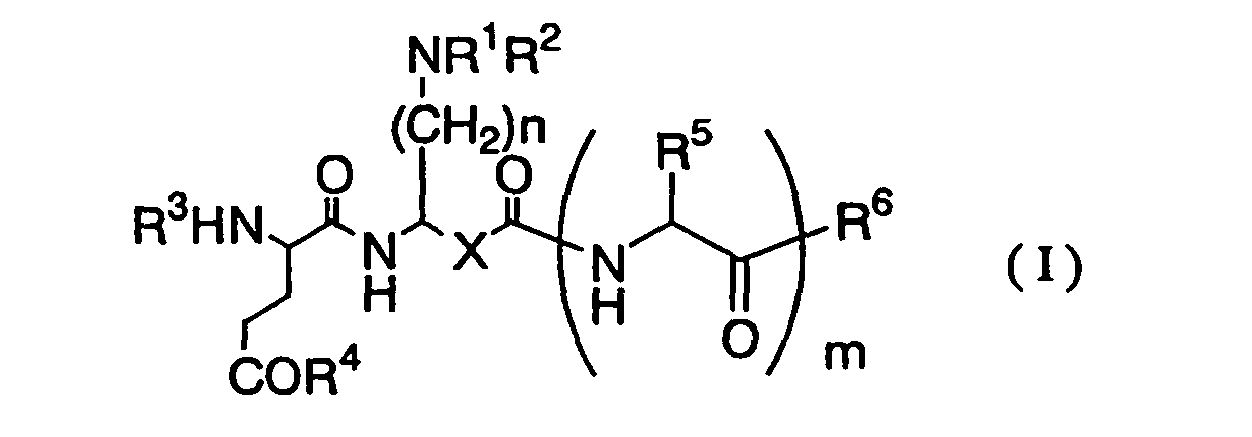
the process comprising the following step (i):- (i) carrying out a condensation reaction between a compound of formula (II)

a compound of formula (III)
to produce a peptide derivative of formula (I-a)
- (i) carrying out a condensation reaction between a compound of formula (II)
- 11. A process for preparing a peptide derivative of formula (I) or a pharmaceutically acceptable salt thereof, comprising the following step (ii):
- (ii) hydrolyzing a compound of formula (I-a) with a base to produce a peptide derivative of formula (I-b)

- (ii) hydrolyzing a compound of formula (I-a) with a base to produce a peptide derivative of formula (I-b)
- 12. A process for preparing a peptide derivative of formula (I) or a pharmaceutically acceptable salt thereof, comprising the following step (iii):
- (iii) carrying out a condensation reaction between a compound of formula (I-b) and a compound of formula (IV)

to produce a peptide derivative of formula (I-c)
- (iii) carrying out a condensation reaction between a compound of formula (I-b) and a compound of formula (IV)
- 13. A process for preparing a peptide derivative of formula (I) or a pharmaceutically acceptable salt thereof, comprising the following step (iv):
- (iv) oxidizing a compound of formula (I-a), (I-b) or (I-c) to produce a peptide derivative of formula (I-d)

- (iv) oxidizing a compound of formula (I-a), (I-b) or (I-c) to produce a peptide derivative of formula (I-d)
- 14. A process for preparing a peptide derivative of formula (I) or a pharmaceutically acceptable salt thereof, comprising the following step (v):
- (v) treating a compound of formula (I-a), (I-b), (I-c) or (I-d) with an acid to produce a peptide derivative of formula (I-e)
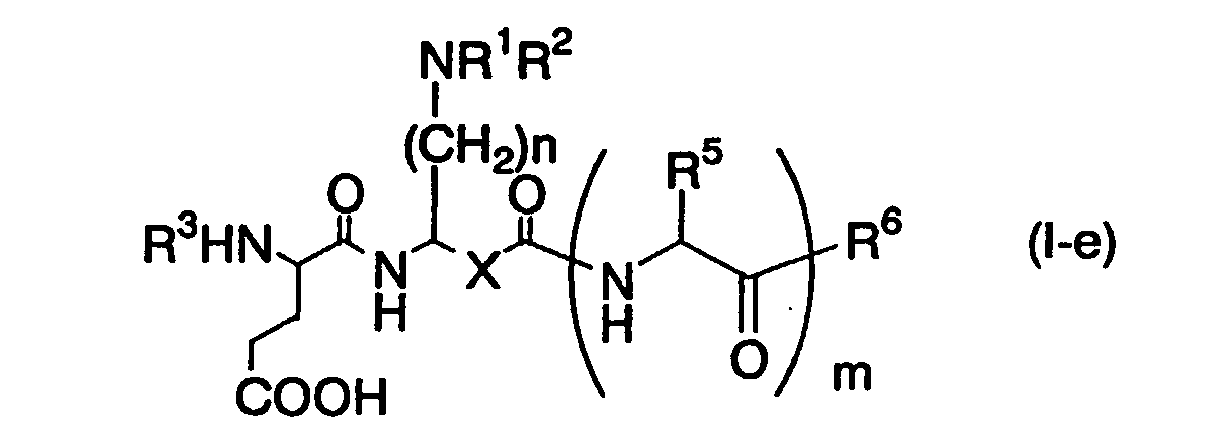
- (v) treating a compound of formula (I-a), (I-b), (I-c) or (I-d) with an acid to produce a peptide derivative of formula (I-e)
- 15. A process for preparing a peptide derivative of formula (I) or a pharmaceutically acceptable salt thereof, comprising the following step (vi):
- (vi) carrying out a condensation reaction of a compound of formula (I-f)

with a C1-6 straight-chain or branched-chain alcohol, an optionally substituted piperazine or an amine represented by NHR7R8 (wherein R7 and R8 are as defined above) to produce a peptide derivative of formula (I-g)
- (vi) carrying out a condensation reaction of a compound of formula (I-f)
- 16. A process for preparing a peptide derivative of formula (I) or a pharmaceutically acceptable salt thereof, comprising the following step (vii):
- (vii) protecting an amino group of a compound of formula (I-h)


- (vii) protecting an amino group of a compound of formula (I-h)
- 17. A Lys-gingipain inhibitor comprising the peptide derivative of formula (I) of item 1 or a pharmaceutically acceptable salt thereof as an active ingredient.
- 18. A pharmaceutical preparation for periodontal disease comprising the peptide derivative of formula (I) of item 1 or a pharmaceutically acceptable salt thereof as an active ingredient.
- 19. A composition for use in the oral cavity comprising the peptide derivative of formula (I) of item 1 or a pharmaceutically acceptable salt thereof and a pharmaceutically acceptable carrier.
- 20. Use of the peptide derivative of item 1 or a pharmaceutically acceptable salt thereof for preparing the Lys-gingipain inhibitor of item 17.
- 21. Use of the peptide derivative of item 1 or a pharmaceutically acceptable salt thereof for preparing the pharmaceutical preparation for periodontal disease of item 18.
- 22. Use of the peptide derivative of item 1 or a pharmaceutically acceptable salt thereof for preparing the composition for oral cavity of item 19.
- The present inventors focused on the fact that P. gingivalis plays a significant role in the onset and progress of periodontal disease and that KGP, a proteolytic enzyme produced by P. gingivalis, causes periodontal disease. The inventors carried out intensive research to produce an effective preventive and therapeutic agent for periodontal disease. As a result, the inventors found that a novel peptide derivative capable of potently and selectively inhibiting KGP is highly effective as a periodontal preventive and therapeutic agent. The inventors further carried out a variety of research based on this finding and accomplished the present invention.
- In formula (I), the substituted oxycarbonyl group represented by R1, R2 or R3 is not specifically limited as long as it does not affect living organisms or synthetic reactions, and suitable examples thereof are commonly used amino protective groups. Examples thereof include optionally substituted aralkyloxycarbonyl, optionally substituted lower alkyloxycarbonyl, 1-adamantyloxycarbonyl and cyclopentyloxycarbonyl.
- Examples of optionally substituted aralkyloxycarbonyl groups include benzyloxycarbonyl (abbreviated as Cbz); benzyloxycarbonyl substituted with 1 or 2 C1-4 lower alkoxy groups, such as p-methoxybenzyloxycarbonyl and p-ethoxybenzyloxycarbonyl; benzyloxycarbonyl substituted with 1 or 2 nitro groups, such as p-nitrobenzyloxycarbonyl; benzyloxycarbonyl substituted with 1 or 2 halogen atoms, such as p-bromobenzyloxycarbonyl and 2,4-dichlorobenzyloxycarbonyl; and diphenylmethoxycarbonyl and the like. Particularly preferred is, for example, benzyloxycarbonyl.
- Examples of optionally substituted lower alkyloxycarbonyl groups include C2-7 straight-chain or branched-chain lower alkyloxycarbonyl optionally substituted with 1 to 3 halogen atoms, such as methoxycarbonyl, ethoxycarbonyl, t-butoxycarbonyl (abbreviated as Boc), 9-fluorenylmethyloxycarbonyl and 2,2,2-trichloroethyloxycarbonyl. Particularly preferred is, for example, t-butoxycarbonyl.
- Preferred examples of the substituted oxycarbonyl group represented by R1 or R2 are lower alkyloxycarbonyl optionally substituted with 1 to 3 halogen atoms, more preferably lower alkyloxycarbonyl, particularly preferably t-butoxycarbonyl (Boc).
- Preferred examples of the substituted oxycarbonyl group represented by R3 are optionally substituted aralkyloxycarbonyl, more preferably benzyloxycarbonyl optionally having 1 or 2 substituents selected from the group consisting of lower alkoxy, nitro and halogen, particularly preferably benzyloxycarbonyl (Cbz).
- Examples of the lower alkoxy group represented by R4 include C1-6 straight-chain or branched-chain lower alkoxy such as methoxy, ethoxy, n-propoxy, isopropoxy, n-butoxy, isobutoxy, t-butoxy, n-pentyloxy, isopentyloxy, n-hexyloxy and isohexyloxy, preferably t-butoxy.
- Examples of the optionally substituted piperazinyl group represented by R4 include piperazinyl; piperazinyl substituted with C1-4 straight-chain or branched-chain lower alkyl, such as N-methylpiperazinyl, N-ethylpiperazinyl and N-t-butylpiperazinyl; piperazinyl substituted with C2-5 straight-chain or branched-chain lower alkoxycarbonyl, such as N-methoxycarbonylpiperazinyl, N-ethoxycarbonylpiperazinyl and N-t-butoxycarbonylpiperazinyl; N-benzyloxycarbonylpiperazinyl and the like. Preferred is piperazinyl optionally substituted with lower alkyl. More preferred are piperazinyl and N-t-butoxycarbonylpiperazinyl.
- Examples of the optionally substituted lower alkyl group represented by R7 or R8 are C1-6 straight-chain or branched-chain lower alkyl groups optionally having amino or C2-5 lower alkoxycarbonylamino as a substituent. Specific examples include methyl, ethyl, n-propyl, isopropyl, n-butyl, isobutyl, t-butyl, hexyl, aminoethyl, aminopropyl, aminobutyl, methoxycarbonylaminomethyl, ethoxycarbonylaminoethyl and t-butoxycarbonylaminoethyl. Preferred are C1-6 straight-chain or branched-chain lower alkyl groups optionally having amino or t-butoxycarbonylamino as a substituent. More preferred are methyl, ethyl, aminoethyl and t-butoxycarbonylaminoethyl.
- Examples of the amino group optionally substituted with lower alkyl(s) or aryl(s) represented by R7 or R8 include amino; methylamino, dimethylamino, ethylamino, diethylamino, n-propylamino, isopropylamino, n-butylamino and isobutylamino and like amino having 1 or 2 C1-4 straight-chain or branched-chain lower alkyl groups; phenylamino, N-methyl-N-phenylamino, N-ethyl-N-phenylamino, N,N-diphenylamino, naphthylamino and the like. Preferred is amino optionally substituted with lower alkyl(s) or phenyl(s). More preferred are amino, methylamino, dimethylamino, phenylamino and N-methyl-N-phenylamino.
- The R-group side chain of the "R-group side chain of an α-amino acid represented by R5 is a characteristic side chain or residue attached to the α-carbon atom of an α-amino acid.
- Such side chains are hydrogen (for glycine), methyl (for alanine), isopropyl (for valine), n-butyl (norleucine), isobutyl (for leucine), 1-methylpropyl (for isoleucine), hydroxymethyl (for serine), 1-hydroxyethyl (for threonine), mercaptomethyl (for cysteine), 2-methylthioethyl (for methionine), carbamoylmethyl (for asparagine), carboxymethyl (for aspartic acid), 2-carboxyethyl (for glutamic acid), 2-carbamoylethyl (for glutamine), 4-aminobutyl (for lysine), benzyl (for phenylalanine) and 4-hydroxybenzyl (for thyrosin). Preferred are isobutyl, carbamoylmethyl, 2-carboxyethyl, 4-aminobutyl and benzyl. The amino group on the R-group side chain is optionally protected by C2-7 straight-chain or branched-chain alkyloxycarbonyl, and the carboxyl on the R-group side chain is optionally protected by C1-6 straight-chain or branched-chain alkyl.
- Examples of useful protective groups are those described in T.W. Greene, "Protective groups in Organic Synthesis", A Wiley-Interscience Publication, John-Wiley & Sons, New York, 1981, pp.218-287. Specific examples include C2-7 straight-chain or branched-chain lower alkyloxycarbonyl groups, such as t-butoxycarbonyl (Boc). The protective group for carboxyl on the above R-group side chain is C1-6 straight-chain or branched-chain substituted or unsubstituted lower alkyl groups such as methyl, ethyl, propyl, butyl, t-butyl, hexyl and trichloroethyl.
- Particularly preferred is t-butyl.
- Examples of the lower alkoxy group represented by R6 are C1-4 straight-chain or branched-chain alkoxy groups such as methoxy, ethoxy, n-propoxy, isopropoxy, n-butoxy, isobutoxy and t-butoxy. Preferred is methoxy.
- Examples of the lower alkyl group represented by R9 or R10 are C1-6 straight-chain or branched-chain lower alkyl groups such as methyl, ethyl, n-propyl, isopropyl, n-butyl, isobutyl, t-butyl and hexyl. Preferred are methyl, ethyl and n-propyl. Examples of the aryl group include phenyl, naphthyl and anthryl. Preferred is phenyl. Examples of the aralkyl group include benzyl and phenethyl.
- Of the compounds of the invention, preferred are compounds of formula (I) wherein R1 and R2 may be the same or different and are hydrogen or lower alkyloxycarbonyl and R3 is optionally substituted aralkyloxycarbonyl.
- More preferred compounds of the invention are compounds of formula (1) wherein R4 is hydroxyl, lower alkoxy, piperazinyl optionally substituted with lower alkyl or -NR7R8(wherein R7 and R8 may be the same or different and are hydrogen, lower alkyl optionally substituted with amino or lower alkoxycarbonylamino, or amino optionally substituted with lower alkyl(s) or phenyl(s)); R6 is hydroxyl, lower alkoxy or -NR9R10 (wherein R9 and R10 may be the same or different and are hydrogen, lower alkyl, phenyl, benzyl or phenethyl); and n is 4.
- Of the compounds of the invention, when m is 0, preferred are those wherein R6 is -NR9R10 (wherein R9 and R10 may be the same or different and are lower alkyl, or one of R9 and R10 is hydrogen and the other is phenethyl).
- When m is 1, especially preferred compounds of the invention are those wherein R5 is isobutyl, carbamoylmethyl optionally protected by a protective group, 2-carboxyethyl optionally protected by a protective group, 4-aminobutyl optionally protected by a protective group, or benzyl, and R6 is -NR9R10 (wherein R9 and R10 may be the same or different and are lower alkyl).
- Preferably, n is 4.
- Preferably, X is -CO-.
- Preferred examples of compounds of the invention are further described below.
- (1) Compounds of formula (I) wherein X is -CO-, R1 and R2 are hydrogen, R3 is benzyloxycarbonyl, R4 is hydroxyl, R5 is isobutyl, carbamoylmethyl, 2-carboxyethyl, 4-aminobutyl or benzyl, R6 is -NR9R10 (wherein R9 and R10 are methyl), m is 1, and n is 4.
- (2) Compounds of formula (I) wherein X is -CO-, R1 and R2 are hydrogen, R3 is benzyloxycarbonyl, R4 is hydroxyl, amino, methylamino, dimethylamino, (2-aminoethyl)amino, piperazinyl, 1,1-dimethylhydrazino or 1-methyl-1-phenylhydrazino, R6 is n-propylamino, phenylamino, benzylamino or phenethylamino, m is 0, and n is 4.
- There is no specific limitation on the pharmaceutically acceptable salts of the compounds of the invention. Examples thereof include pharmaceutically acceptable acid addition salts thereof. Useful acids include inorganic acid salts such as hydrochlorides and sulfates; and organic acid salts such as formates, trifluoroacetates, acetates, tartrates, maleates, fumarates, succinates and methanesulfonates. Preferred are hydrochlorides. The compounds of the invention or pharmaceutically acceptable salts thereof may be in the form of solvates such as hydrates.
- The amino acid constituting the compound of the invention may be an L- or D-amino acid. Preferred is L-amino acid.
- The compounds of the invention exist as enantiomers or diastereoisomers depending on the asymmetric carbon(s) in the molecular structure. These enantiomers and diastereoisomers are included in the scope of the invention. Such compounds can be used as an isomer mixture as they are or can be optically resolved by a usual method and used.
- The compounds represented by formula (I) can be prepared according to the following reaction schemes.

- Examples of the substituted oxycarbonyl group represented by R1a or R2a include those mentioned as examples of the substituted oxycarbonyl group represented by R1 or R2.
- In view of the convenience of the reaction for synthesis, it is preferable that the substituted oxycarbonyl group represented by R1a or R2a be different from R3. Examples of the lower alkoxy group represented by R4a include those mentioned as examples of the lower alkoxy group represented by R4.
- Examples of the lower alkoxy group represented by R6a include those mentioned as examples of the lower alkoxy group represented by R6.
- Step (i): A compound of formula (I-a) of the invention can be produced by a condensation reaction between a known compound of formula (II) (see, for example,
WO98/50420 - The condensation reaction can be carried out by known methods. Useful methods include, for example, a method using a condensing agent such as N,N-dicyclohexylcarbodiimide and 1-ethyl-3-(3-dimethylaminopropyl)carbodiimide hydrochloride or a method using an additive (e.g., 1-hydroxybenzotriazole, N-hydroxy-5-norbornene-2,3-dicarboxyimide, etc.) in addition to the condensing agent; the mixed acid anhydride method using isobutyl chloroformate, etc.; the azide method; the active ester method; and the like. Any solvent that does not participate in this reaction can be used. Useful solvents include, for example, N,N-dimethylformamide, tetrahydrofuran, methylene chloride, dioxane, ethyl acetate, N-methylpyrrolidone, etc. These solvents can be used singly or in combinations of two or more. As to the amount each of the reagents, the amount of the compound of formula (III) is about 0.5 to 10 moles, preferably 1 to 5 moles, per mole of the compound of formula (II), and the amount of the condensing agent is about 0.5 to 10 moles, preferably 1 to 5 moles, per mole of the compound of formula (II), and the amount of the additive is about 0.5 to 10 moles, preferably 1 to 5 moles, per mole of the compound of formula (II). The reaction time is about 0.3 to 100 hours, preferably about 0.5 to 20 hours. The reaction temperature is about -10°C to 100°C, preferably 0°C to 40°C.
- The compound obtained in this step can be used in the following reaction step, after being isolated or without isolation.
- Step (ii): The compound of formula (I-b) of the invention is produced by hydrolysis of the compound of formula (I-a) with a suitable base, preferably in a suitable solvent. Examples of bases useful in this reaction include lithium hydroxide, sodium hydroxide and potassium hydroxide. The reaction temperature is about -20°C to 50°C, preferably 0°C to 40°C. Any solvent that does not participate in this reaction can be used. Useful solvents include, for example, water, methanol, ethanol, 1-propanol, 2-propanol, tetrahydrofuran, etc. These solvents can be used singly or in combinations of two or more. The amount of the reagent is about 0.5 to 10 moles, preferably 1 to 2 moles, per mole of the compound of formula (I-a). The reaction time is about 0.3 to 100 hours, preferably about 0.5 to 20 hours. The reaction temperature is about 0 to 100°C, preferably 0 to 40°C.
- The compound obtained in this step can be used in the following reaction step, after being isolated or without isolation.

- Examples of the lower alkoxy group represented by R6b include those mentioned as examples of the lower alkoxy group represented by R6.
- Step (iii): The compound of formula (I-c) of the invention can be produced by a condensation reaction between the compound of formula (I-b) obtained in Reaction Scheme 1 and a known compound of formula (IV), preferably in a suitable solvent.
- The condensation reaction can be carried out by known methods. Useful methods include, for example, a method using a condensing agent such as N,N-dicyclohexylcarbodiimide and 1-ethyl-3-(3-dimethylaminopropyl)carbodiimide hydrochloride or a method using an additive (e.g., 1-hydroxybenzotriazol, N-hydroxy-5-norbornene, etc.) in addition to the condensing agent; the mixed acid anhydride method using isobutyl chloroformate, etc.; the azide method; the active ester method; and the like. Any solvent that does not participate in this reaction can be used. Useful solvents include, for example, N,N-dimethylformamide, tetrahydrofuran, methylene chloride, dioxane, ethyl acetate and N-methylpyrrolidone. These solvents can be used singly or in combinations of two or more. The amount each of the reagents is about 0.5 to 10 moles, preferably 1 to 2 moles, per mole of the compound of formula (II). The reaction time is about 0.3 to 100 hours, preferably about 0.5 to 20 hours. The reaction temperature is about 0°C to 100°C, preferably 0°C to 40°C.
- The compound obtained in this step can be used in the following reaction step, after being isolated or without isolation.

- Step (iv): The compound of formula (I-d) of the invention can be produced by oxidizing a compound of formula (I-a), (I-b) or (I-c) obtained in Reaction Scheme 1 or 2, preferably in a suitable solvent.
- The oxidation reaction can be carried out by known methods. Useful methods include, for example, Dess-Martin oxidation using Dess-Martin reagents; and improved Moffat oxidation using dimethyl sulfoxide-1-ethyl-3-(3-dimethylaminopropyl)carbodiimide hydrochloride-dichloroacetic acid. Any solvent can be used in this reaction as long as it does not participate in the reaction. Useful solvents include, for example, N,N-dimethylformamide, tetrahydrofuran, methylene chloride, dioxane, ethyl acetate, N-methylpyrrolidone, etc. These solvents can be used singly or in combinations of two or more. The amount of the reagent is about 0.3 to 100 moles, preferably 1 to 10 moles, per mole of the compound of formula (I-a), (I-b) or (I-c). The reaction time is about 0.1 to 100 hours, preferably about 0.2 to 50 hours. The reaction temperature is about -20°C to 100°C, preferably 0°C to 40°C.
- The compound obtained in this step can be used in the following reaction step, after being isolated or without isolation.

- Step (v): The compound of formula (I-e) of the invention can be produced by reacting the compound of formula (I-a), (I-b), (I-c) or (I-d) with an acid, in a suitable solvent or without the use of solvents.
- Any solvent can be used in this reaction as long as it does not participate in the reaction. Useful solvents include, for example, chloroform, dichloromethane, dioxane, tetrahydrofuran and ethyl acetate. Useful acids include, for example, mineral acids such as hydrochloric acid and sulfuric acid; and organic acids such as trifluoroacetic acid and p-toluenesulfonic acid. The amount of the acid used in the reaction is about 1 to 1,000 moles, preferably 1 to 100 moles, per mole of the compound of formula (I-a), (I-b), (I-c) or (I-d). The reaction time is about 0.5 to 5 hours. The reaction temperature is about 0°C to 100°C, preferably 0°C to 30°C.
- Of the compounds of formula (I), the compound wherein R4 is lower alkoxy, optionally substituted piperazinyl or -NR7R8 (wherein R7 and R8 may be the same or different and are hydrogen, optionally substituted lower alkyl or amino optionally substituted with lower alkyl(s) or phenyl(s)) can be produced in accordance with Reaction Scheme 5 shown below.

- Step (vi): The compound of formula (I-g) of the invention can be produced by reacting compound (I-f) of the invention wherein R4 is hydroxyl with a lower alcohol, optionally substituted piperazine or an amine represented by NHR7R8 (wherein R7 and R8 are as defined above) using a condensing agent, in a suitable solvent or without the use of solvents.
- The condensation reaction can be carried out by known methods. Useful methods include, for example, methods using condensing agents such as N,N-dicyclohexylcarbodiimide and 1-ethyl-3-(3-dimethylaminopropyl)carbodiimide hydrochloride or methods using an additive (e.g., 1-hydroxybenzotriazol, N-hydroxy-5-norbornene-2,3-dicarboxyimide, etc.) in addition to the condensing agent; the mixed acid anhydride method using isobutyl chloroformate, etc.; the azide method; the active ester method; and the like. Any solvent can be used in this reaction as long as it does do not participate in the reactions. Useful solvents include, for example, N,N-dimethylformamide, tetrahydrofuran, methylene chloride, dioxane, ethyl acetate and N-methylpyrrolidone. These solvents can be used singly or in combinations of two or more. As to the amount of the reagents, the lower alcohol, the piperazine or the amine is in an amount of about 0.5 to 10 moles, preferably 1 to 5 moles, per mole of the compound of formula (I-f). The amount of condensing agent is about 0.5 to 10 moles, preferably 1 to 5 moles, and the amount of additive is about 0.5 to 10 moles, preferably 1 to 2 moles, per mole of the compound of formula (I-f). The reaction time is about 0.1 to 100 hours, preferably about 0.3 to 20 hours. The reaction temperature is about 0°C to 100°C, preferably 0°C to 40°C.
- Of the compounds of formula (I), the compound wherein R1 is hydrogen and R2 is substituted oxycarbonyl can also be produced in accordance with Reaction Scheme 6 shown below.

- Step (vii): The compound of formula (I-i) of the invention can be obtained by protecting the amino group of compound (I-h) of the invention wherein R1 and R2 are hydrogen with a known substituted oxycarbonyl-introducing reagent, preferably in a suitable solvent.
- The introducing reagent is not specifically limited as long as it is a known introducing agent used to protect amino groups. Examples of useful introducing reagents include di-tert-butyl dicarbonate, benzyloxycarbonyl chloride, 2,2,2-trichloroethyloxycarbonyl chloride, and 9-fluorenylmethyloxycarbonyl chloride. Any solvent that does not participate in the reaction can be used. Useful solvents include, for example, N,N-dimethylformamide, tetrahydrofuran, methylene chloride, dioxane, ethyl acetate, N-methylpyrrolidone, etc. These solvents can be used singly or in combinations of two or more. The amount of the protective group introducing reagent is about 1 to 100 moles, preferably 1 to 10 moles, per mole of the compound of formula (I-h). The reaction time is about 0.1 to 100 hours, preferably about 0.5 to 50 hours. The reaction temperature is about -20°C to 100°C, preferably 0°C to 40°C. The compound (I-i) obtained in this step can be used for the reactions shown in Reaction Schemes 3 to 5, after being isolated or without isolation.
- The compounds of the invention obtained by the above processes and all mentioned compounds can be purified by separation and purification methods usually used in the field of chemical synthesis, such as recrystallization, distillation and various column chromatography methods.
- The peptide derivative of formula (1) of the invention and pharmaceutically acceptable salts thereof potently and selectively inhibit KGP, a proteolytic enzyme produced by P. gingivalis, which plays a significant role in the onset and progress of periodontal disease. Since the peptide derivative of the invention is composed of a highly safe natural amino acid or a derivative thereof, the derivative, inclusive of its metabolites produced in vivo, is considered to be highly safe.
- Therefore, the peptide derivative of formula (I) and pharmaceutically acceptable salts thereof can be used as an active ingredient of Lys-gingipain inhibitors and pharmaceutical preparations for periodontal disease. The Lys-gingipain inhibitors and pharmaceutical preparations for periodontal disease can be used as periodontal preventive agents or therapeutic agents.
- The peptide derivative of formula (I) and pharmaceutically acceptable salts thereof can also be used, together with a pharmaceutically acceptable carrier, to prepare compositions for use in the oral cavity. The peptide derivative of formula (I) or pharmaceutically acceptable salts thereof can be mixed with a pharmaceutically acceptable carrier and administered as preparations for use in the oral cavity, such as gel preparations for use in the oral cavity, oral ointments for adhesive application to mucous membranes, oral pastes, periodontal-pocket intercalating agents, and preparations for adhesive application to gingivae; and oral hygiene agents such as toothpastes, mouthwashes, chewing gums, tablets, candies and troches. The compositions for oral cavity can be used as periodontal preventive agents or therapeutic agents.
- Useful pharmaceutically acceptable carriers include appropriate carriers commonly used in accordance with the dosage form. Examples of such carriers include methylcellulose, hydroxymethylcellulose, hydroxyethylcellulose, carboxymethylcellulose sodium, hydroxypropylmethylcellulose, liquid paraffin, white petrolatum, Eudoragit L, sodium alginate, propylene glycol alginate, pullulan, tragacanth, xanthan gum, chitosan, polyvinylpyrrolidone, polyvinyl alcohol, polyacrylic acid, sodium polyacrylate, polymethacrylic acid, ethyl methacrylate, dimethylamino acetate, cellulose acetate, collagen, atherocollagen, gelatin, glycerol, triacetin, Macrogol 400, Polysorbate 60, polyoxyl stearate 40, butyl parahydroxybenzoate, ethanol, cetyl alcohol, glyceryl monostearate, calcium carbonate, magnesium carbonate, dibasic calcium phosphate, carrageenan, sodium dioctyl sulfosuccinate, sodium lauryl sulfate, sodium dodecylbenzenesulfonate, hinokitiol, allantoin, glycyrrhizin, gum arabic, starch, cornstarch, saccharin, saccharin sodium, stevioside, glucose, lactose, sorbitol, mannitol, magnesium stearate, potassium phosphate monobasic, potassium phosphate dibasic, menthol, eucalyptus oil, peppermint, spearmint, colors, aromas, sodium fluoride, and fluoride of sodium monofluorophosphate, lysozyme chloride, azulene and like anti-inflammatory agents, sodium chloride and like components usually added.
- When a Lys-gingipain inhibitor, pharmaceutical preparation for periodontal disease, or composition for oral cavity, each containing as an active ingredient the peptide derivative of the invention or a pharmaceutically acceptable salt thereof, is to be administered to mammals, including humans, the administration method can be such that an appropriate amount of the inhibitor, preparation or composition having an active ingredient content of 0.001 wt.% or more, preferably 0.01 to 20 wt.%, is inserted, applied or used for washing, etc., usually at least once a day.
- When the Lys-gingipain inhibitor, pharmaceutical preparation for periodontal disease, or composition for use in the oral cavity of the invention is used as a therapeutic agent, the dosage can be suitably selected according to the mode of administration, the patient's age, sex and other factors, and the severity of disease. When administered to humans, the dosage of the active ingredient compound of the invention is usually 0.001 to 100 mg per kg body weight a day, preferably 0.005 to 10 mg/kg/day.
- When the Lys-gingipain inhibitor, pharmaceutical preparation for periodontal disease or composition for oral cavity of the invention is used as a preventive agent, the dosage can be suitably selected according to the mode of administration, the patient's age, sex and other factors, and the severity of disease. When administered to humans, the dosage of the active ingredient compound of the invention is usually 0.001 to 100 mg per kg body weight a day, preferably 0.005 to 10 mg/kg/day.
- The following Examples and Test Examples are provided to illustrate the invention in detail and are not to limit the scope of the invention. In these examples, Me represents methyl; Boc, t-butoxycarbonyl; Cbz, benzyloxycarbonyl; tBu, t-butyl; and Ph, phenyl.
- A compound of the following formula was synthesized.

- Four grams of 10% palladium-carbon was added to 1000 ml of a mixed solution in methanol-chloroform (10:1) of 21 g (49.47 mmols) of (3S)-7-[(t-butoxy)carbonylamino]-2-hydroxy-3-[(phenylmethoxy)carbonylamino]-heptanoic acid methyl ester (Cbz-Lys(Boc)ψ[CHOHCO]-OMe) which is a known compound prepared by a process described in
WO 98/50420
1H-NMR(DMSO-d6)δ: 7.67 (0.3H, d, J=8.8 Hz), 7.54 (0.7H, d, J=9.0 Hz), 7.40-7.25 (6H, m), 6.73 (1H, m), 5.69 (0.3H, d, J=5.9 Hz), 5.53 (0.7H, d, J=5.6 Hz), 5.02 (2H, m), 4.11-3.96 (3H, m), 3.61 (0.9H, s), 3.56 (2.1H, s), 2.87 (2H, m), 2.20 (2H, m), 1.83 (1H, m), 1.66 (1H, m), 1.59-1.06 (6H, m), 1.38 (9H, s), 1.36 (9H, s).
m.p.: 101-103°C. Mass(FAB(+)): m/z 610(M+H)+. - A compound of the following formula was synthesized.

- An aqueous solution (10 ml) of 270 mg (6.43 mmols) of lithium hydroxide monohydrate was added to 100 ml of a solution of 3.53 g (5.76 mmols) of the compound obtained in Example 1 in THF (tetrahydrofuran, the same applies hereinafter) with ice cooling. The resulting mixture was stirred for 1 hour, and then stirred at room temperature for 30 minutes. After completion of the reaction, the reaction mixture was concentrated under reduced pressure. A 10% aqueous solution of citric acid was added to the residue to adjust the pH to 3, followed by extraction with ethyl acetate. The ethyl acetate layer was washed with a saturated saline solution, and then dried over anhydrous sodium sulfate. After filtration, the solvent was distilled off, giving 3.5 g of the above compound as a white powder (yield: 100%). The following are the properties of the compound.
1H-NMR(DMSO-d6)δ: 12.45 (1H, brs), 7.49-7.31 (7H, m), 6.74 (1H, m), 5.38 (0.3H, d, J=5.8 Hz), 5.26 (0.7H, d, J=5.8 Hz), 5.01 (1H, ABq, J=12.4 Hz), 4.04-3.85 (4H, m), 2.86 (2H, m), 2.19 (2H, m), 1.90-0.90 (8H, m), 1.40-1.36 (18H, s x 2).
m.p.: 48-50°C. Mass(FAB(-)): m/z 594(M-H)-. - A compound of the following formula was synthesized.

- To 5 ml of a DMF solution of 250 mg (0.42 mmols) of the compound obtained in Example 2 were added, with ice cooling, 94 mg (0.420 mmols) of phenylalanine N,N-dimethylamide hydrochloride, 62 mg (0.46 mmols) of 1-hydroxybenzotriazole, 79 mg (0.42 mmols) of 1-ethyl-3-(3-dimethylaminopropyl)carbodiimide hydrochloride and 46 mg (0.46 mmols) of N-methylmorpholine. The resulting mixture was stirred at room temperature for 3 hours. After completion of the reaction, a 10% aqueous solution of citric acid was added to adjust the pH to 3, followed by extraction with ethyl acetate. The ethyl acetate layer was washed sequentially with a saturated saline solution, a 5% aqueous solution of sodium hydrogen carbonate, and a saturated saline solution, and then dried over anhydrous sodium sulfate. After filtration, the solvent was distilled off, and the residue was separated and purified by silica gel column chromatography (hexane: ethyl acetate: methanol = 5:5:1), giving diastereomers of the above compound as white powders in amounts of 93 mg (yield: 31%) and 60 mg (yield: 20%) in the order of elution. The following are the properties of the diastereomers.
- 1H-NMR (DMSO-d6) δ: 7.88 (1H, d, J=8.1 Hz), 7.40 (1H, d, J=8.0 Hz), 7.35-7.20 (11H, m), 6.73 (1H, t, J=5.4 Hz), 5.75 (1H, d, J=6.1 Hz), 5.00 (2H, ABq, J=12.4 Hz), 4.88 (1H, dt, J=9.4, 4.7 Hz), 4.07-3.85 (3H, m), 2.95-2.80 (4H, m), 2.74 (6H, s x 2), 2.18 (2H, t, J=7.7 Hz), 1.83 (1H, m), 1.66 (1H, m), 1.49-1.11 (6H, m), 1.36 (18H, s x 2).
m.p.: 68-71°C. Mass(FAB(+)): m/z 770(M+H)+, Mass(FAB(-)):m/z 768(M-H)-. - 1H-NMR(DMSO-d6)δ: 7.68 (1H, d, J=8.5 Hz), 7.49 (1H, d, J=9.0 Hz), 7.41-7.14 (11H, m), 6.72 (1H, t, J=5.1 Hz), 5.92 (1H, d, J=5.8 Hz), 5.02 (2H, ABq, J=12.4 Hz), 4.98 (1H, m), 4.04-3.96 (2H, m), 3.84 (1H, m), 2.95-2.73 (4H, m), 2.87 (3H, s), 2.79 (3H, s), 2.21 (2H, t, J=8.0 Hz), 1.89 (1H, m), 1.72 (1H, m), 1.48-0.83 (6H, m), 1.38 (9H, s), 1.36 (9H, s).
m.p.: 132-134°C. Mass(FAB(+)): m/z 770(M+H)+, Mass(FAB(-)): m/z 768(M-H)-. - In the following Examples 4 to 11, the compounds shown therein were synthesized by following the procedure of Example 3.
- A compound of the following formula was synthesized, and its diastereomers were separated.

- 1H-NMR (DMSO-d6) δ: 7.76 (1H, d, J=8.3 Hz), 7.40 (1H, d, J=7.8 Hz), 7.36-7.32 (6H, m), 6.72 (1H, t, J=5.1 Hz), 5.69 (1H, d, J=2.9 Hz), 5.02 (2H, s), 4.74 (1H, m), 4.04-3.86 (3H, m), 3.00 (3H, s), 2.81 (3H, s), 2.89-2.81 (2H, m), 2.18 (2H, t, J=7.5 Hz), 1.84 (1H, m), 1.70-1.16 (10H, m), 1.37 (9H, s ), 1.36 (9H, s ), 0.87 (3H, d, J=6.3 Hz), 0.85 (3H, d, J=6.8 Hz).
m.p.: 59-61°C. Mass(FAB(+)): m/z 736(M+H)+. - 1H-NMR (DMSO-d6) δ: 7.65(1H, d, J=8.5 Hz), 7.56 (1H, d, J=8.6 Hz), 7.41 (1H, d, J=7.8 Hz), 7.37-7.31 (5H, m), 6.72 (1H, t, J=5.9 Hz), 5.96 (1H, d, J=5.6 Hz), 5.03 (2H, ABq, J=12.4 Hz), 4.80 (1H, dt, J=3.8, 9.5 Hz), 4.11-3.99 (2H, m), 3.88 (1H, m), 3.02 (3H, s), 2.83 (3H, s), 2.85-2.79 (2H, m), 2.21 (2H, t, J=8.1 Hz), 1.88 (1H, m), 1.70 (1H, m), 1.61-1.00 (9H, m), 1.38 (9H, s), 1.35 (9H, s), 0.91 (3H, d, J=6.8 Hz), 0.86 (3H, d, J=6.8 Hz).
m.p.: 155-157°C. Mass(FAB(+)):m/z 736(M+H)+. - A compound of the following formula was obtained as a diastereomeric mixture.

m.p.: 58-60°C. Mass(FAB(+)): m/z 808(M+H)+, 830(M+Na)+. - A compound of the following formula was obtained as a diastereomeric mixture.

m.p.: 88-91°C. Mass(FAB(+)): m/z 737(M+H)+, 759(M+Na)+. - A compound of the following formula was obtained as a diastereomeric mixture.

Mass(FAB(+)): m/z 851(M+H)+, 873(M+Na)+.
State: foamed material - A compound of the following formula was obtained as a diastereomeric mixture.

m.p.: 73-75°C. Mass(FAB(+)): m/z 659(M+Na)+. - A compound of the following formula was synthesized, and its diastereomers were separated.

- 1H-NMR(DMSO-d6)δ: 9.62 (1H, s), 7.68 (2H, d. J=7.8 Hz), 7.62 (1H, d, J=6.4 Hz), 7.42 (1H, d, J=8.1 Hz), 7.36-7.27 (7H, m), 7.06 (1H, t, J=7.5 Hz), 6.69 (1H, t, J=5.0 Hz), 6.05 (1H, d, J=5.8 Hz), 5.02 (2H, ABq, J=12.6 Hz), 4.17-4.00 (3H, m), 2.91-2.82 (2H, m), 2.21 (2H, t, J=7.8 Hz), 1.94-1.81 (1H, m), 1.76-1.62 (1H, m), 1.56-1.01 (6H, m), 1.38 (9H, s), 1.34 (9H, s).
m.p.: 150-153°C. Mass(FAB(+)): m/z 671(M+H)+, 693(M+Na)+. - 1H-NMR(DMSO-d6)δ: 9.51 (1H, s), 7.61 (2H, d. J=7.6 Hz), 7.48 (1H, d, J=9.0 Hz), 7.40 (1H, d, J=8.3 Hz), 7.35-7.24 (7H, m), 7.04 (1H, t, J=7.4 Hz), 6.75 (1H, m), 6.00 (1H, d, J=5.6 Hz), 4.99 (2H, s), 4.13-3.93 (3H, m), 2.90-2.85 (2H, m), 2.10 (2H, t, J=7.8 Hz), 1.86-1.76 (1H, m), 1.66-1.57 (1H, m), 1.48-1.12 (6H, m), 1.36 (9H, s), 1.33 (9H, s).
m.p.: 146-147°C. Mass(FAB(+)): m/z 671(M+H)+, 693(M+Na)+. - A compound of the following formula was obtained as a diastereomeric mixture.

m.p.: 111-113°C. - A compound of the following formula was obtained as a diastereomeric mixture.

m.p.: 82-85°C. Mass(FAB(+)): m/z 721(M+Na)+. - Among the compounds represented by Formula (I), those in which R4 is amide or hydrazide were synthesized by the process shown below.
- A compound of the following formula was synthesized.

- To 5.60 g (8.18 mmols) of the compound obtained in Example 10 were added 200 ml of a 4N hydrochloric acid-ethyl acetate solution and 100 ml of methanol. The resulting mixture was stirred at room temperature for 3 hours and 20 minutes. After distilling off the solvent, 100 ml of a saturated aqueous solution of sodium hydrogen carbonate was added to the residue to adjust the pH to 8. Thereafter, 100 ml of a THF solution of 2.65 g (12.14 mmols) of di-tert-butyl dicarbonate were added, followed by stirring at room temperature for 17 hours. After completion of the reaction, ethyl acetate was added for extraction. The organic layer was washed with a saturated saline solution, and then dried over anhydrous sodium sulfate. After filtration, the solvent was distilled off, giving 4.42 g of white crystals (yield: 84%). Two grams (3.18 mmols) of the crystals were dissolved in 15 ml of THF. To the resulting solution were added, with ice cooling, 1 ml of an aqueous solution of 144 mg (3.43 mmols) of lithium hydroxide monohydrate and 1 ml of methanol, followed by stirring at room temperature for 45 minutes. After completion of the reaction, a 10% aqueous solution of citric acid was added to the residue to adjust the pH to 3, followed by extraction with ethyl acetate. The ethyl acetate layer was washed with a saturated saline solution and dried over anhydrous sodium sulfate. After filtration, the solvent was distilled off, giving 1.4 g of a foamed material (yield: 72%). Isobutyl chlorocarbonate (43 µl) and N-methylmorpholine (37 µl) were added to a THF solution (5 ml) of 200 mg (0.318 mmols) of the foamed material with ice cooling, followed by stirring for 15 minutes. Then, 30 µl of a 28% aqueous ammonia solution was added, followed by stirring for a further 30 minutes. After completion of the reaction, a 10% aqueous citric acid solution was added, followed by extraction with ethyl acetate. The ethyl acetate layer was washed sequentially with a saturated saline solution, a 5% aqueous sodium hydrogen carbonate solution and a saturated saline solution, and then dried over anhydrous sodium sulfate. After filtration, the solvent was distilled off, giving 187 mg of a diastereomeric mixture of the above compound as a white powder (yield: 94%). The following are the properties of the diastereomeric mixture. 1H-NMR (DMSO-d6) δ: 8.35 (0.4H, t, J=6.2 Hz), 8.21 (0.6H, d, J=6.0 Hz), 7.60 (0.4H, d, J=8.8Hz), 7.52 (12.6H, m), 6.83-6.67 (2H, m), 5.88 (0.4H, d, J=5.1Hz), 5.82 (0.6H, d, J=5.4Hz), 5.03 & 5.01 (2H, s), 4.38-3.88 (5H, m), 2.93-2.74 (2H, m), 2.24-2.03 (2H, m), 1.93-1.66 (2H, m), 1.60-1.16 (6H, m), 1.37 (9H, s).
m.p.: 138-141°C. Mass(FAB(+)): m/z 650(M+Na)+. - In the following Examples 13 to 17, the compounds shown therein were synthesized by following the procedure of Example 12 and using corresponding amines.
- A compound of the following formula was obtained as a diastereomeric mixture.

m.p.: 147-149°C. Mass(FAB(+)):m/z 680(M+K)+. - A compound of the following formula was obtained as a diastereomeric mixture.

Mass(FAB(+)):m/z 656(M+H)+, 678(M+Na)+.
State: foamed material. - A compound of the following formula was obtained as a diastereomeric mixture.

m.p.: 170-172°C. Mass(FAB(+)): m/z 793(M+Na)+. - A compound of the following formula was obtained as a diastereomeric mixture.

m.p.: 123-125°C. Mass(FAB(+)): m/z 671(M+H)+, 693(M+Na)+, 709(M+K)+. - A compound of the following formula was obtained as a diastereomeric mixture.
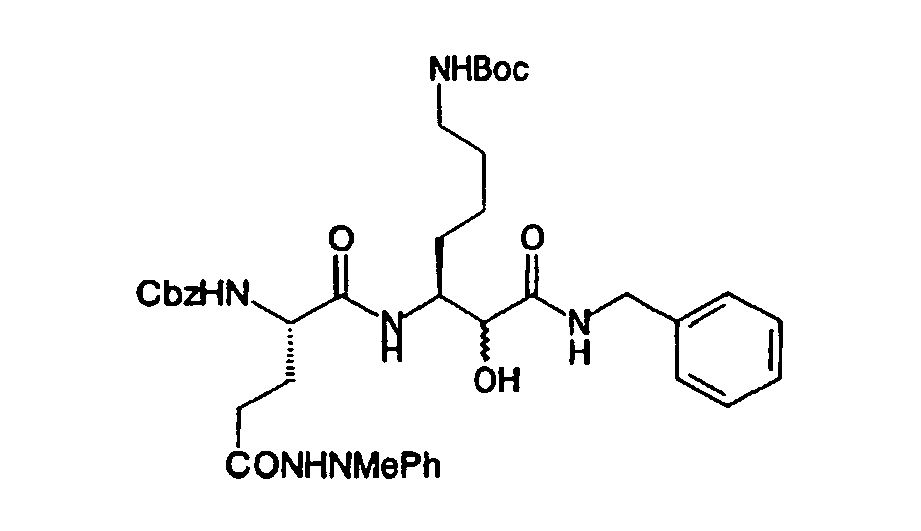
m.p.: 170-173°C. Mass(FAB(+)): m/z 771(M+K)+. - A compound of the following formula was synthesized.

- Dess-Martin reagent (83 mg, 0.195 mmols) was added to 3 ml of a methylene chloride solution of 100 mg (0.130 mmols) of the compound obtained in Example 3, followed by stirring at room temperature for 15 minutes. After completion of the reaction, a 20% aqueous solution of sodium hydrogen sulfite was added. The mixture was stirred for 5 minutes and subjected to extraction with ethyl acetate. The ethyl acetate layer was washed sequentially with a saturated saline solution, a 5% aqueous sodium hydrogen carbonate solution and a saturated saline solution, and then dried over anhydrous sodium sulfate. After filtration, the solvent was distilled off, and the residue was separated and purified by silica gel column chromatography (hexane: ethyl acetate = 2:3), giving 56 mg of the above compound as a white powder (yield: 56%). The following are the properties of the compound.
1H-NMR (DMSO-d6) δ: 8.79 (1H, d, J=8.5 Hz), 8.18 (1H, d, J=6.8 Hz), 7.39 (1H, d, J=8.3 Hz), 7.36-7.17 (10H, m), 6.78 (1H, t, J=5.6 Hz), 5.01 (2H, ABq, J=12.4 Hz), 4.94 (1H, dt, J=7.0, 8.3 Hz), 4.85 (1H, m), 4.05 (1H, m), 2.98 (1H, dd, J=5.6, 13.8 Hz), 3.33 (3H, s), 2.93 (3H, s), 2.91 (1H, dd, J=9.0, 13.7 Hz), 2.88-2.74 (2H, m), 2.25 (2H, t, J=8.0 Hz), 1.91-1.64 (2H, m), 1.39 (9H, s), 1.37 (9H, s), 1.34-1.15 (6H, m).
m.p.: 102-104°C. Mass(FAB(+)): m/z 768(M+H)+, 806(M+K)+. - In the following Examples 19 to 33, compounds shown therein were synthesized by following the procedure of Example 18.
-

m.p.: 119-122°C. Mass(FAB(+)): m/z 734(M+H)+, 756(M+Na)+. -

m.p.: 127-130°C. Mass(FAB(+)): m/z 806(M+H)+, 828(M+Na)+. -

m.p.: 122-124°C. Mass(FAB(+)): m/z 735(M+H)+, 757(M+Na)+. -

m.p.: 152-155°C. Mass(FAB(+)): m/z 849(M+H)+. -

m.p.: 131-133°C. Mass(FAB(+)): m/z 673(M+K)+. -
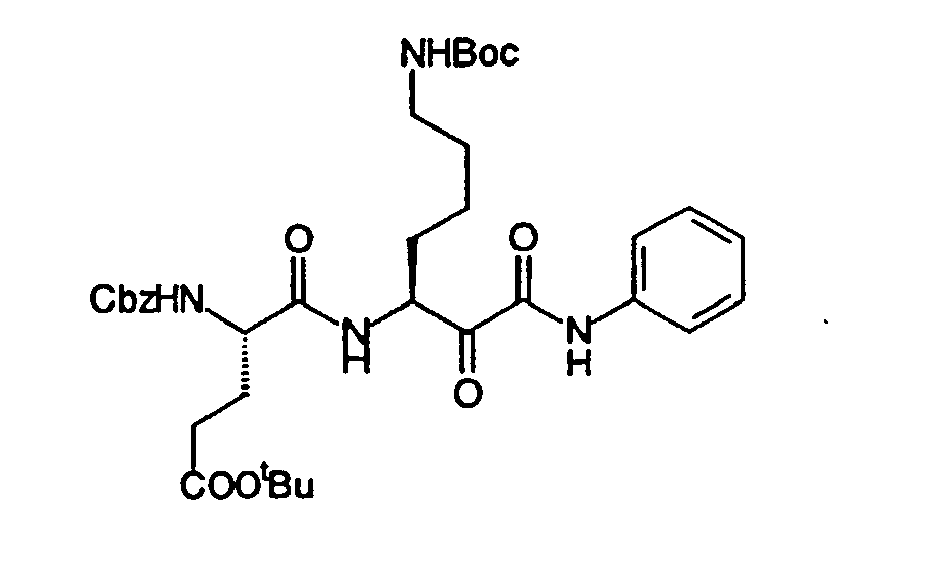
m.p.: 134-136°C. -

m.p.: 130-132°C. Mass(FAB(+)): m/z 705(M+Na)+. -

m.p.: 148-150°C. Mass(FAB(+)): m/z 697(M+H)+. -

m.p.: 193-195°C. Mass(FAB(+)):m/z 664(M+K)+. -

m.p.: 189-192°C. Mass(FAB(+)): m/z 640(M+H)+. -

m.p.: 98-101°C. -

m.p.: 157-159°C. Mass(FAB(+)): m/z 769(M+H)+, 791(M+Na)+. -

m.p.: 60-65°C. -

State: foamed material. -
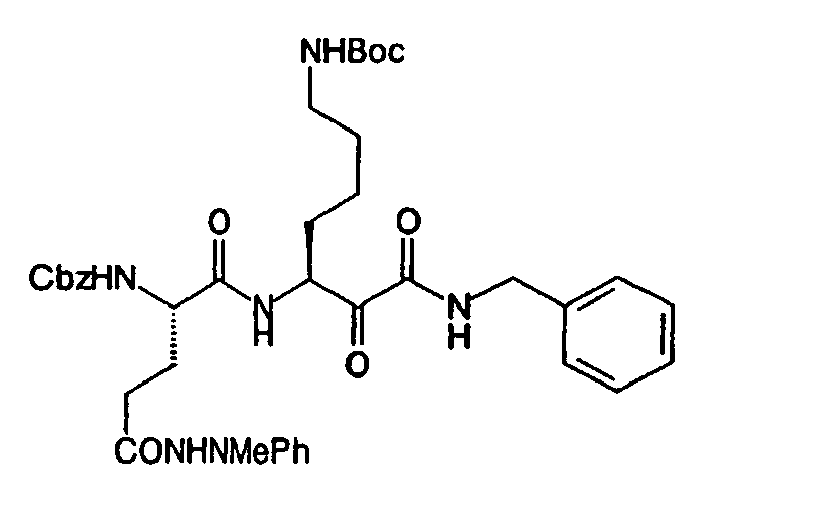
m.p.: 147-150°C. Mass(FAB(+)): m/z 731(M+H)+, 753(M+Na)+. - A compound of the following formula was synthesized.

- A 4N hydrochloric acid-ethyl acetate solution (2 ml) was added to 40 mg (0.052 mmols) of the compound obtained in Example 18, followed by stirring at room temperature for 2 hours. Anhydrous ether (20 ml) was added to the reaction mixture, and the resulting white precipitates were collected by filtration and washed with anhydrous ether, giving 23 mg of the above compound as a white powder (yield: 65%). The following are the properties of the compound.
1H-NMR (DMSO-d6) δ: 12.12 (1H, brs), 8.84 (1H, d, J=8.6 Hz), 8.25 (1H, t, J=6.0 Hz), 7.73 (3H, m), 7.47 (1H, d, J=7.6 Hz), 7.45-7.15 (10H, m), 5.00 (2H, ABq, J=12.5 Hz), 4.95-4.90 (2H, m), 4.05 (1H, dt, J=7.3, 7.6 Hz), 2.96 (2H, dq, J=3.6, 13.9 Hz), 2.92 (3H, s), 2.81 (3H, s), 2.65 (2H, m), 2.27 (2H, m), 1.91-1.64 (2H, m), 1.60-1.07 (6H, m).
m.p.: 130-132°C. Mass(FAB(+)): m/z 612(M+H)+. - In the following Examples 35 to 49, compounds shown therein were synthesized by following the procedure of Example 34 and using the corresponding compounds obtained in Examples 19 to 33.
-

Mass(FAB(+)): m/z 578(M+H)+.
State: foamed material. -

Mass(FAB(+)): m/z 594(M+H)+.
State: foamed material -

Mass(FAB(+)):m/z 579(M+H)+.
State: foamed material -

Mass(FAB(+)):m/z 593(M+H)+.
State: foamed material -

m.p.: 173-175°C (decomp.). Mass(FAB(+)): m/z 479(M+H)+. -

m.p.: 172-175°C (decomp.). -

m.p.: 172-174°C. Mass(FAB(+)): m/z 527(M+H)+. -

m.p.: 148-151°C (decomp.). Mass(FAB(+)): m/z 541(M+H)+. -

m.p.: 183-185°C (decomp.). Mass(FAB(+)): m/z 526(M+H)+. -

m.p.: 157-159°C (decomp.). Mass(FAB(+)): m/z 540(M+H)+. -

m.p.: 137-140°C (decomp.). Mass(FAB(+)): m/z 554(M+H)+. -

m.p.: 180-185°C (decomp.). Mass(FAB(+)):m/z 569(M+H)+. Example 47
m.p.: 168-171°C (decomp.). Mass(FAB(+)):m/z 595(M+H)+. -

m.p.:131-133°C. Mass(FAB(+)):m/z 569(M+H)+. -

m.p.: 153-155°C. Mass(FAB(+)):m/z 631(M+H)+. -
Compound 1 of the invention obtained in Example 1 1.0 White petrolatum 10 Sodium polyacrylate 3.0 Liquid paraffin Balance Total 100.0(wt.%) - An oral ointment was prepared by a conventional process using the above ingredients.
-
Calcium secondary phosphate 42 Glycerin 19 Carrageenan 0.9 Sodium lauryl sulfate 1.2 Saccharin 1.0 Compound 12 of the invention obtained in Example 12 1.0 Butyl paraoxybenzoate 0.005 Flavor 1.0 Water Balance Total 100.0 (wt.%) - A dentifrice was prepared by a conventional process using the above ingredients.
-
Gum arabic 6.0 Glucose 72.0 Lactose 19.0 Compound 34 of the invention obtained in Example 34 1.5 Sodium monofluorate 0.7 Flavor 1. 0 Water Balance Total 100.0 (wt.%) - Troches were prepared by a conventional process using the above ingredients.
-
Polyvinyl acetate 20.0 Polyisobutylene 3.0 Calcium carbonate 2.0 Sorbitol 55.0 Mannitol 15.0 Compound 39 of the invention obtained in Example 39 4.0 Flavor 1.0 Total 100.0 (wt.%) - Chewing gum was prepared by a conventional process using the above ingredients.
-
Ethanol 20.0 Polyoxyethylene(60) hydrogenated castor oil 3.0 Polyethylene glycol 2.0 Glycerin 10.0 Sodium saccharin 0.02 Compound 43 of the invention obtained in Example 43 0.5 Flavor 0.2 Water Balance Total 100.0 (wt.%) - A gargle was prepared by a conventional process using the above ingredients.
-
Ethanol 30.0 Polyoxyethylene(20) sorbitan laurate 1.0 Polyoxyethylene(40) hydrogenated castor oil 0.5 Sodium hydroxide 0.05 Sodium saccharin 0.05 Compound 46 of the invention obtained in Example 46 0.5 Flavor 0.5 Water Balance Total 100.0 (wt.%) - A mouthwash was prepared by a conventional process using the above ingredients.
- The inhibitory activity against Lys-gingipain (KGP) was measured by the method described in Journal Biochemistry, Vol. 123, 305-312 (1998), using Z-His-Glu-Lys-MCA as a substrate. Specifically, the measurement was carried out in the following manner: 100 µl of 50 mM L-cystein, 200 µl of a 0.1 M sodium phosphate buffer solution (pH 7.5), 20 µl of 12.3 nM KGP solution containing 0.05% "Brij35" (a tradename of Aldrich, polyoxyethylene(23) lauryl ether), 80 µl of distilled water and 100 µl of a dimethyl sulfoxide solution of a compound according to the invention were mixed together, and preincubated at 37°C for 5 minutes. Thereafter, 500 µl of a 0.1% dimethyl sulfoxide solution containing 20 µM Z-His-Glu-Lys-MCA was added, followed by incubation at 40°C for 10 minutes. Then, an acetic acid buffer solution (pH 5.0) containing 10 mM iodoacetamide was added to stop the enzyme reaction, and the fluorescence intensity (F) at 460 nm excited at 380 nm was measured. As a control, 100 µl of a dimethyl sulfoxide solution that did not contain the compound according to the invention was used in place of the solution of the compound, and the fluorescence intensity (F0) was measured in a manner similar to the above. The enzyme inhibitory activity (%) was calculated by the following equation.

- The inhibitory activity against Arg-gingipain (hereinafter referred to as "RGP") was measured for comparison in a manner similar to the above, by the process described in Journal Biological Chemistry, Vol. 269, 21371-21378 (1994) using Z-Phe-Arg-MCA as a substrate.
- Table 1 shows the inhibitory activities of the compound of the invention against KGP and RGP.
Table 1 Compound (Ex.No.) Concentration (mol/l) Enzyme inhibitory activity (%) Compound (Ex.No.) Concentration (mol/l) Enzyme inhibitory activity (%) KGP RGP KGP RGP 34 10-6 99.7 5.7 43 10-6 100.0 9.0 10-9 40.6 - 10-9 93.8 - 35 10-6 99.9 3.7 44 10-6 100.0 1.9 10-9 50.6 - 10-9 97.3 - 36 10-6 98.6 0.0 45 10-6 100.0 0.0 10-9 38.4 - 10-9 93.7 - 37 10-6 99.9 8.5 46 10-6 99.9 0.5 10-9 59.6 - 10-9 99.9 - 39 10-6 99.6 0.0 47 10-6 100.0 6.4 10-9 71.9 - 10-9 98.5 - 40 10-6 99.6 0.0 48 10-6 100.0 4.1 10-9 71.3 - 10-9 98.2 - 41 10-6 99.7 4.0 49 10-6 100.0 0.0 10-9 81.8 - 10-9 99.0 - 42 10-6 98.0 7.7 10-9 67.0 - - Table 1 reveals that the compound of the invention specifically inhibits, with a high activity, the enzymatic activity of KGP.
- The compound of the invention is useful as, for example, a prophylactic or therapeutic agent for periodontal disease, because of its high and specific activity to inhibit the activity of Lys-gingipain (KGP) produced by Porphyromonas gingibvalis, which is a Gram-negative anaerobic bacterium.
Claims (22)
- A peptide derivative of formula (I)

-NR7R8 (wherein R7 and R8 may be the same or different and are hydrogen, optionally substituted C1-6 straight-chain or branched-chain alkyl, or amino optionally substituted with C1-4 straight-chain or branched-chain alkyl(s) or aryl(s)); R5 is a R-group side chain of an α-amino acid, which is hydrogen, methyl, isopropyl, n-butyl, isobutyl, 1-methylpropyl, hydroxymethyl, 1-hydroxyethyl, mercaptomethyl, 2-methylthioethyl, carbamoylmethyl, carboxymethyl, 2-carboxyethyl, 2-carbamoylethyl, 4-aminobutyl, benzyl or 4-hydroxybenzyl, wherein the amino group on the R-group side chain is optionally protected by C2-7 straight-chain or branched-chain alkyloxycarbonyl, and the carboxyl on the R-group side chain is optionally protected by C1-6 straight-chain or branched-chain alkyl; R6 is hydroxyl, C1-4 straight-chain or branched-chain alkoxy, or -NR9R10 (wherein R9 and R10 may be the same or different and are hydrogen, C1-6 straight-chain or
branched-chain alkyl, aryl or aralkyl); m is 0 or 1; and n is an integer of 2 to 6; or a pharmaceutically acceptable salt thereof. - The peptide derivative according to claim 1 wherein n is 4; or a pharmaceutically acceptable salt thereof.
- The peptide derivative according to claim 1 wherein X is -CO-; or a pharmaceutically acceptable salt thereof.
- The peptide derivative according to claim 1 wherein R1 and R2 may be the same or different and are hydrogen or C2-7 straight-chain or branched-chain alkyloxycarbonyl and R3 is optionally substituted aralkyloxycarbonyl; or a pharmaceutically acceptable salt thereof.
- The peptide derivative according to claim 4 wherein R4 is hydroxyl, C1-6 straight-chain or branched-chain alkoxy, piperazinyl optionally having C1-4 straight-chain or branched-chain alkyl as a substituent, or -NR7R8 (wherein R7 and R8 may be the same or different and are hydrogen, C1-6 straight-chain or branched-chain alkyl optionally having amino or C2-5 alkoxycarbonylamino as a substituent, or amino optionally substituted with C1-4 straight-chain or branched-chain alkyl(s) or phenyl(s)); R6 is hydroxyl, C1-4 straight-chain or branched-chain alkoxy or -NR9R10 (wherein R9 and R10 may be the same or different and are hydrogen, C1-6 straight-chain or branched-chain alkyl, phenyl, benzyl or phenethyl); and n is 4; or
a pharmaceutically acceptable salt thereof. - The peptide derivative according to claim 5 wherein m is 0 and R6 is hydroxyl or -NR9R10 (wherein R9 and R10 may be the same or different and are C1-6 straight-chain or branched-chain alkyl or phenethyl, or one of R9 and R10 is hydrogen and the other is phenethyl); or a pharmaceutically acceptable salt thereof.
- The peptide derivative according to claim 5 wherein m is 1, R5 is isobutyl, carbamoylmethyl optionally protected by a protective group, 2-carboxyethyl optionally protected by a protective group, 4-aminobutyl optionally protected by a protective group, or benzyl, and R6 is - NR9R10 (wherein R9 and R10 may be the same or different and are C1-6 straight-chain or branched-chain alkyl); or a pharmaceutically acceptable salt thereof.
- The peptide derivative according to claim 1 wherein X is -CO-, R1 and R2 are hydrogen, R3 is benzyloxycarbonyl, R4 is hydroxyl, R5 is isobutyl, carbamoylmethyl, 2-carboxyethyl, 4-aminobutyl or benzyl, R6 is -NR9R10 (wherein R9 and R10 are methyl), m is 1, and n is 4; or a pharmaceutically acceptable salt thereof.
- The peptide derivative according to claim 1 wherein X is -CO-, R1 and R2 are hydrogen, R3 is benzyloxycarbonyl, R4 is hydroxyl, amino, methylamino, dimethylamino, (2-aminoethyl)amino, piperazinyl, 1,1-dimethylhydrazino or 1-methyl-1-phenylhydrazino, R6 is n-propylamino, phenylamino, benzylamino or phenethylamino, m is 0, and n is 4; or a pharmaceutically acceptable salt thereof.
- A process for preparing a peptide derivative of formula (I)

-NR7R8 (wherein R7 and R8 may be the same or different and are hydrogen, optionally substituted C1-6 straight-chain or branched-chain alkyl, or amino optionally substituted with C1-4 straight-chain or branched-chain alkyl(s) or aryl(s)); R5 is a R-group side chain of an α-amino acid, which is hydrogen, methyl, isopropyl, n-butyl, isobutyl, 1-methylpropyl, hydroxymethyl, 1-hydroxyethyl, mercaptomethyl, 2-methylthioethyl, carbamoylmethyl, carboxymethyl, 2-carboxyethyl, 2-carbamoylethyl, 4-aminobutyl, benzyl or 4-hydroxybenzyl, wherein the amino group on the R-group side chain is optionally protected by C2-7 straight-chain or branched-chain alkyloxycarbonyl, and the carboxyl on the R-group side chain is optionally protected by C1-6 straight-chain or branched-chain alkyl; R6 is hydroxyl, C1-4 straight-chain or branched-chain alkoxy, or -NR9R10 (wherein R9 and R10 may be the same or different and are hydrogen, C1-6 straight-chain or branched-chain alkyl, aryl or aralkyl); m is 0 or 1; and n is an integer of 2 to 6, or a pharmaceutically acceptable salt thereof,
the process comprising the following step (i):(i) carrying out a condensation reaction between a compound of formula (II)
a compound of formula (III)
to produce a peptide derivative of formula (I-a)
- A process for preparing a peptide derivative of formula (I) or a pharmaceutically acceptable salt thereof, comprising the following step (ii):(ii) hydrolyzing a compound of formula (I-a) with a base to produce a peptide derivative of formula (I-b)

- A process for preparing a peptide derivative of formula (I) or a pharmaceutically acceptable salt thereof, comprising the following step (iii):(iii) carrying out a condensation reaction between a compound of formula (I-b) and a compound of formula (IV)
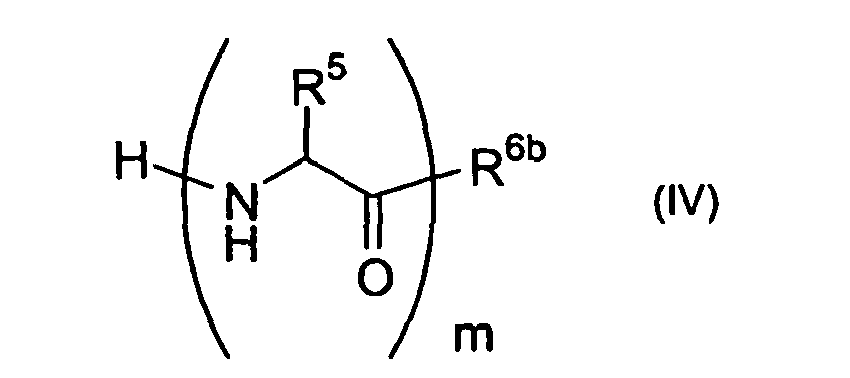

- A process for preparing a peptide derivative of formula (I) or a pharmaceutically acceptable salt thereof, comprising the following step (iv):(iv) oxidizing a compound of formula (I-a), (I-b) or (I-c) to produce a peptide derivative of formula (I-d)

- A process for preparing a peptide derivative of formula (I) or a pharmaceutically acceptable salt thereof, comprising the following step (v):(v) treating a compound of formula (I-a), (I-b), (I-c) or (I-d) with an acid to produce a peptide derivative of formula (I-e)

- A process for preparing a peptide derivative of formula (I) or a pharmaceutically acceptable salt thereof, comprising the following step (vi):(vi) carrying out a condensation reaction of a compound of formula (I-f)

with a C1-6 straight-chain or branched-chain alcohol, an optionally substituted piperazine or an amine represented by NHR7R8 (wherein R7 and R8 are as defined above) to produce a peptide derivative of formula (I-g)
- A process for preparing a peptide derivative of formula (I) or a pharmaceutically acceptable salt thereof, comprising the following step (vii):(vii) protecting an amino group of a compound of formula (I-h)wherein X, R3, R4, R5, R6, m and n are as defined above using a substituted oxycarbonyl-introducing reagent to produce a peptide derivative of formula (I-i)


- A Lys-gingipain inhibitor comprising the peptide derivative of formula (I) of claim 1 or a pharmaceutically acceptable salt thereof as an active ingredient.
- A pharmaceutical preparation for periodontal disease comprising the peptide derivative of formula (I) of claim 1 or a pharmaceutically acceptable salt thereof as an active ingredient.
- A composition for use in the oral cavity comprising the peptide derivative of formula (I) of claim 1 or a pharmaceutically acceptable salt thereof and a pharmaceutically acceptable carrier.
- Use of the peptide derivative of claim 1 or a pharmaceutically acceptable salt thereof for preparing the Lys-gingipain inhibitor of claim 17.
- Use of the peptide derivative of claim 1 or a pharmaceutically acceptable salt thereof for preparing the pharmaceutical preparation for periodontal disease of claim 18.
- Use of the peptide derivative of claim 1 or a pharmaceutically acceptable salt thereof for preparing the composition for oral cavity of claim 19.
Applications Claiming Priority (3)
| Application Number | Priority Date | Filing Date | Title |
|---|---|---|---|
| JP2000338192 | 2000-11-06 | ||
| JP2000338192 | 2000-11-06 | ||
| PCT/JP2001/009621 WO2002036551A1 (en) | 2000-11-06 | 2001-11-02 | Peptide derivatives and their pharmaceutically acceptable salts, processes for preparation of both, and use thereof |
Publications (3)
| Publication Number | Publication Date |
|---|---|
| EP1333024A1 EP1333024A1 (en) | 2003-08-06 |
| EP1333024A4 EP1333024A4 (en) | 2005-11-16 |
| EP1333024B1 true EP1333024B1 (en) | 2009-01-07 |
Family
ID=18813440
Family Applications (1)
| Application Number | Title | Priority Date | Filing Date |
|---|---|---|---|
| EP01980959A Expired - Lifetime EP1333024B1 (en) | 2000-11-06 | 2001-11-02 | Peptide derivatives and their pharmaceutically acceptable salts, processes for preparation of both, and use thereof |
Country Status (10)
| Country | Link |
|---|---|
| US (1) | US6951843B2 (en) |
| EP (1) | EP1333024B1 (en) |
| JP (1) | JP4601249B2 (en) |
| KR (1) | KR100559306B1 (en) |
| CN (1) | CN1194006C (en) |
| AT (1) | ATE420067T1 (en) |
| AU (1) | AU782470B2 (en) |
| CA (1) | CA2396678C (en) |
| DE (1) | DE60137352D1 (en) |
| WO (1) | WO2002036551A1 (en) |
Families Citing this family (4)
| Publication number | Priority date | Publication date | Assignee | Title |
|---|---|---|---|---|
| ATE338057T1 (en) | 2001-11-16 | 2006-09-15 | Taiho Pharmaceutical Co Ltd | PEPTIDE DERIVATIVE, PHARMACEUTICALLY ACCEPTABLE SALT THEREOF, METHOD FOR THE PRODUCTION AND USE THEREOF |
| CN100446522C (en) * | 2005-10-28 | 2008-12-24 | 环达电脑(上海)有限公司 | Method for Realizing Hands-Free Calling of Mobile Phone Based on Bluetooth Technology on PDA Device |
| JP5397851B2 (en) * | 2009-05-21 | 2014-01-22 | Nsマテリアルズ株式会社 | Method for producing peptide derivative or salt thereof |
| WO2017201322A1 (en) * | 2016-05-19 | 2017-11-23 | Cortexyme, Inc. | Treatment of osteoarthritis with gingipain blocking agents |
Family Cites Families (7)
| Publication number | Priority date | Publication date | Assignee | Title |
|---|---|---|---|---|
| ZA86746B (en) | 1985-02-04 | 1986-09-24 | Merrell Dow Pharma | Novel peptidase inhibitors |
| US5496927A (en) * | 1985-02-04 | 1996-03-05 | Merrell Pharmaceuticals Inc. | Peptidase inhibitors |
| JPH0597708A (en) | 1991-10-02 | 1993-04-20 | Lion Corp | Periodontal disease treatment agent |
| US6100380A (en) * | 1991-10-28 | 2000-08-08 | Cytran, Inc. | Immunomodulating peptides and methods of use |
| US6066622A (en) * | 1991-10-28 | 2000-05-23 | Cytran, Inc. | Immunomodulating peptides and methods of use |
| JP3873429B2 (en) * | 1998-02-20 | 2007-01-24 | 大鵬薬品工業株式会社 | Peptide derivative and pharmaceutically acceptable salt thereof, production method thereof and use thereof |
| AU2002211649A1 (en) * | 2000-10-11 | 2002-04-22 | Targesome, Inc. | Targeted therapeutic agents |
-
2001
- 2001-11-02 CN CNB018034748A patent/CN1194006C/en not_active Expired - Fee Related
- 2001-11-02 DE DE60137352T patent/DE60137352D1/en not_active Expired - Lifetime
- 2001-11-02 US US10/168,540 patent/US6951843B2/en not_active Expired - Fee Related
- 2001-11-02 KR KR1020027008680A patent/KR100559306B1/en not_active Expired - Fee Related
- 2001-11-02 AU AU12704/02A patent/AU782470B2/en not_active Ceased
- 2001-11-02 WO PCT/JP2001/009621 patent/WO2002036551A1/en not_active Ceased
- 2001-11-02 JP JP2002539311A patent/JP4601249B2/en not_active Expired - Fee Related
- 2001-11-02 EP EP01980959A patent/EP1333024B1/en not_active Expired - Lifetime
- 2001-11-02 CA CA002396678A patent/CA2396678C/en not_active Expired - Fee Related
- 2001-11-02 AT AT01980959T patent/ATE420067T1/en not_active IP Right Cessation
Also Published As
| Publication number | Publication date |
|---|---|
| US20030087828A1 (en) | 2003-05-08 |
| CN1194006C (en) | 2005-03-23 |
| DE60137352D1 (en) | 2009-02-26 |
| AU782470B2 (en) | 2005-08-04 |
| WO2002036551A1 (en) | 2002-05-10 |
| CA2396678A1 (en) | 2002-05-10 |
| US6951843B2 (en) | 2005-10-04 |
| KR100559306B1 (en) | 2006-03-15 |
| JP4601249B2 (en) | 2010-12-22 |
| EP1333024A1 (en) | 2003-08-06 |
| KR20020067597A (en) | 2002-08-22 |
| JPWO2002036551A1 (en) | 2004-03-11 |
| AU1270402A (en) | 2002-05-15 |
| ATE420067T1 (en) | 2009-01-15 |
| EP1333024A4 (en) | 2005-11-16 |
| CA2396678C (en) | 2009-01-20 |
| CN1394199A (en) | 2003-01-29 |
Similar Documents
| Publication | Publication Date | Title |
|---|---|---|
| AU600226B2 (en) | Novel peptidase inhibitors | |
| US4918105A (en) | Novel compounds with collagenase-inhibiting activity, a process for their preparation and pharmaceutical compositions in which these compounds are present | |
| US5849866A (en) | Peptidase inhibitors | |
| HU204847B (en) | Process for producing new peptidase inhibitors | |
| SK63194A3 (en) | Peptide derivatives | |
| US4643991A (en) | Peptide elastase inhibitors and methods | |
| AU733420B2 (en) | Peptidyl-2-amino-1-hydroxyalkanesulfonic acid cysteine protease inhibitors | |
| HUT68200A (en) | Process for producing peptides inhibiting il-1-beta release and pharmaceutical compositions containing them as active component | |
| JPH01113353A (en) | Alpha-aminoacyl beta-aminoacyl aminodiol as antihypertensive agent | |
| DeSolms et al. | Design and synthesis of HIV protease inhibitors. Variations of the carboxyterminus of the HIV protease inhibitor L-682,679 | |
| KR19980086989A (en) | Substituted 6- and 7-amino-tetrahydroisoquinoline carboxylic acids | |
| CA2212356A1 (en) | Novel 4-substituted-3-peptidyl-azetidin-2-one derivatives useful as cysteine proteinase inhibitor | |
| US6951843B2 (en) | Peptide derivatives and their pharmaceutically acceptable salts, thereof, processes for preparation of both and use thereof | |
| AU2002343783B2 (en) | Peptide derivative, pharmaceutically acceptable salt thereof, process for producing the same, and use thereof | |
| JP3873429B2 (en) | Peptide derivative and pharmaceutically acceptable salt thereof, production method thereof and use thereof | |
| CA2043603A1 (en) | Hiv protease inhibitors and processes for their preparation | |
| EP0356595A1 (en) | Novel peptidase inhibitors | |
| DE69905397T2 (en) | SELECTIVE INHIBITORS OF THE MMP-12 |
Legal Events
| Date | Code | Title | Description |
|---|---|---|---|
| PUAI | Public reference made under article 153(3) epc to a published international application that has entered the european phase |
Free format text: ORIGINAL CODE: 0009012 |
|
| 17P | Request for examination filed |
Effective date: 20020801 |
|
| AK | Designated contracting states |
Designated state(s): AT BE CH CY DE DK ES FI FR GB GR IE IT LI LU MC NL PT SE TR |
|
| AX | Request for extension of the european patent |
Extension state: AL LT LV MK RO SI |
|
| A4 | Supplementary search report drawn up and despatched |
Effective date: 20051004 |
|
| 17Q | First examination report despatched |
Effective date: 20061205 |
|
| REG | Reference to a national code |
Ref country code: SE Ref legal event code: TRGR |
|
| GRAP | Despatch of communication of intention to grant a patent |
Free format text: ORIGINAL CODE: EPIDOSNIGR1 |
|
| GRAS | Grant fee paid |
Free format text: ORIGINAL CODE: EPIDOSNIGR3 |
|
| RAP1 | Party data changed (applicant data changed or rights of an application transferred) |
Owner name: KYUSHU UNIVERSITY NATIONAL UNIVERSITY CORPORATION |
|
| GRAA | (expected) grant |
Free format text: ORIGINAL CODE: 0009210 |
|
| AK | Designated contracting states |
Kind code of ref document: B1 Designated state(s): AT BE CH CY DE DK ES FI FR GB GR IE IT LI LU MC NL PT SE TR |
|
| REG | Reference to a national code |
Ref country code: GB Ref legal event code: FG4D |
|
| REG | Reference to a national code |
Ref country code: CH Ref legal event code: EP Ref country code: CH Ref legal event code: NV Representative=s name: SERVOPATENT GMBH |
|
| REG | Reference to a national code |
Ref country code: IE Ref legal event code: FG4D |
|
| REF | Corresponds to: |
Ref document number: 60137352 Country of ref document: DE Date of ref document: 20090226 Kind code of ref document: P |
|
| PG25 | Lapsed in a contracting state [announced via postgrant information from national office to epo] |
Ref country code: FI Free format text: LAPSE BECAUSE OF FAILURE TO SUBMIT A TRANSLATION OF THE DESCRIPTION OR TO PAY THE FEE WITHIN THE PRESCRIBED TIME-LIMIT Effective date: 20090107 Ref country code: ES Free format text: LAPSE BECAUSE OF FAILURE TO SUBMIT A TRANSLATION OF THE DESCRIPTION OR TO PAY THE FEE WITHIN THE PRESCRIBED TIME-LIMIT Effective date: 20090418 |
|
| PG25 | Lapsed in a contracting state [announced via postgrant information from national office to epo] |
Ref country code: AT Free format text: LAPSE BECAUSE OF FAILURE TO SUBMIT A TRANSLATION OF THE DESCRIPTION OR TO PAY THE FEE WITHIN THE PRESCRIBED TIME-LIMIT Effective date: 20090107 Ref country code: PT Free format text: LAPSE BECAUSE OF FAILURE TO SUBMIT A TRANSLATION OF THE DESCRIPTION OR TO PAY THE FEE WITHIN THE PRESCRIBED TIME-LIMIT Effective date: 20090608 |
|
| PG25 | Lapsed in a contracting state [announced via postgrant information from national office to epo] |
Ref country code: BE Free format text: LAPSE BECAUSE OF FAILURE TO SUBMIT A TRANSLATION OF THE DESCRIPTION OR TO PAY THE FEE WITHIN THE PRESCRIBED TIME-LIMIT Effective date: 20090107 |
|
| PG25 | Lapsed in a contracting state [announced via postgrant information from national office to epo] |
Ref country code: DK Free format text: LAPSE BECAUSE OF FAILURE TO SUBMIT A TRANSLATION OF THE DESCRIPTION OR TO PAY THE FEE WITHIN THE PRESCRIBED TIME-LIMIT Effective date: 20090107 |
|
| PLBE | No opposition filed within time limit |
Free format text: ORIGINAL CODE: 0009261 |
|
| STAA | Information on the status of an ep patent application or granted ep patent |
Free format text: STATUS: NO OPPOSITION FILED WITHIN TIME LIMIT |
|
| 26N | No opposition filed |
Effective date: 20091008 |
|
| REG | Reference to a national code |
Ref country code: NL Ref legal event code: V1 Effective date: 20100601 |
|
| PG25 | Lapsed in a contracting state [announced via postgrant information from national office to epo] |
Ref country code: MC Free format text: LAPSE BECAUSE OF NON-PAYMENT OF DUE FEES Effective date: 20091130 |
|
| REG | Reference to a national code |
Ref country code: IE Ref legal event code: MM4A |
|
| PG25 | Lapsed in a contracting state [announced via postgrant information from national office to epo] |
Ref country code: GR Free format text: LAPSE BECAUSE OF FAILURE TO SUBMIT A TRANSLATION OF THE DESCRIPTION OR TO PAY THE FEE WITHIN THE PRESCRIBED TIME-LIMIT Effective date: 20090408 Ref country code: IE Free format text: LAPSE BECAUSE OF NON-PAYMENT OF DUE FEES Effective date: 20091102 Ref country code: NL Free format text: LAPSE BECAUSE OF NON-PAYMENT OF DUE FEES Effective date: 20100601 |
|
| PGFP | Annual fee paid to national office [announced via postgrant information from national office to epo] |
Ref country code: CH Payment date: 20101112 Year of fee payment: 10 Ref country code: DE Payment date: 20101027 Year of fee payment: 10 |
|
| PGFP | Annual fee paid to national office [announced via postgrant information from national office to epo] |
Ref country code: IT Payment date: 20101112 Year of fee payment: 10 Ref country code: GB Payment date: 20101027 Year of fee payment: 10 Ref country code: SE Payment date: 20101111 Year of fee payment: 10 |
|
| PG25 | Lapsed in a contracting state [announced via postgrant information from national office to epo] |
Ref country code: LU Free format text: LAPSE BECAUSE OF NON-PAYMENT OF DUE FEES Effective date: 20091102 |
|
| PG25 | Lapsed in a contracting state [announced via postgrant information from national office to epo] |
Ref country code: TR Free format text: LAPSE BECAUSE OF FAILURE TO SUBMIT A TRANSLATION OF THE DESCRIPTION OR TO PAY THE FEE WITHIN THE PRESCRIBED TIME-LIMIT Effective date: 20090107 |
|
| PG25 | Lapsed in a contracting state [announced via postgrant information from national office to epo] |
Ref country code: CY Free format text: LAPSE BECAUSE OF FAILURE TO SUBMIT A TRANSLATION OF THE DESCRIPTION OR TO PAY THE FEE WITHIN THE PRESCRIBED TIME-LIMIT Effective date: 20090107 |
|
| PGFP | Annual fee paid to national office [announced via postgrant information from national office to epo] |
Ref country code: FR Payment date: 20111118 Year of fee payment: 11 |
|
| REG | Reference to a national code |
Ref country code: CH Ref legal event code: PL |
|
| REG | Reference to a national code |
Ref country code: SE Ref legal event code: EUG |
|
| PG25 | Lapsed in a contracting state [announced via postgrant information from national office to epo] |
Ref country code: CH Free format text: LAPSE BECAUSE OF NON-PAYMENT OF DUE FEES Effective date: 20111130 Ref country code: LI Free format text: LAPSE BECAUSE OF NON-PAYMENT OF DUE FEES Effective date: 20111130 |
|
| PG25 | Lapsed in a contracting state [announced via postgrant information from national office to epo] |
Ref country code: IT Free format text: LAPSE BECAUSE OF NON-PAYMENT OF DUE FEES Effective date: 20111102 |
|
| PG25 | Lapsed in a contracting state [announced via postgrant information from national office to epo] |
Ref country code: SE Free format text: LAPSE BECAUSE OF NON-PAYMENT OF DUE FEES Effective date: 20111103 |
|
| GBPC | Gb: european patent ceased through non-payment of renewal fee |
Effective date: 20121102 |
|
| REG | Reference to a national code |
Ref country code: FR Ref legal event code: ST Effective date: 20130731 |
|
| REG | Reference to a national code |
Ref country code: DE Ref legal event code: R119 Ref document number: 60137352 Country of ref document: DE Effective date: 20130601 |
|
| PG25 | Lapsed in a contracting state [announced via postgrant information from national office to epo] |
Ref country code: DE Free format text: LAPSE BECAUSE OF NON-PAYMENT OF DUE FEES Effective date: 20130601 |
|
| PG25 | Lapsed in a contracting state [announced via postgrant information from national office to epo] |
Ref country code: GB Free format text: LAPSE BECAUSE OF NON-PAYMENT OF DUE FEES Effective date: 20121102 Ref country code: FR Free format text: LAPSE BECAUSE OF NON-PAYMENT OF DUE FEES Effective date: 20121130 |