EP1331683A2 - Cathode active material coated with a metal oxide for incorporation into a lithium electrochemical cell - Google Patents
Cathode active material coated with a metal oxide for incorporation into a lithium electrochemical cell Download PDFInfo
- Publication number
- EP1331683A2 EP1331683A2 EP03001616A EP03001616A EP1331683A2 EP 1331683 A2 EP1331683 A2 EP 1331683A2 EP 03001616 A EP03001616 A EP 03001616A EP 03001616 A EP03001616 A EP 03001616A EP 1331683 A2 EP1331683 A2 EP 1331683A2
- Authority
- EP
- European Patent Office
- Prior art keywords
- active material
- mixtures
- cathode active
- cathode
- group
- Prior art date
- Legal status (The legal status is an assumption and is not a legal conclusion. Google has not performed a legal analysis and makes no representation as to the accuracy of the status listed.)
- Withdrawn
Links
Images

Classifications
-
- H—ELECTRICITY
- H01—ELECTRIC ELEMENTS
- H01M—PROCESSES OR MEANS, e.g. BATTERIES, FOR THE DIRECT CONVERSION OF CHEMICAL ENERGY INTO ELECTRICAL ENERGY
- H01M4/00—Electrodes
- H01M4/02—Electrodes composed of, or comprising, active material
- H01M4/36—Selection of substances as active materials, active masses, active liquids
- H01M4/48—Selection of substances as active materials, active masses, active liquids of inorganic oxides or hydroxides
- H01M4/485—Selection of substances as active materials, active masses, active liquids of inorganic oxides or hydroxides of mixed oxides or hydroxides for inserting or intercalating light metals, e.g. LiTi2O4 or LiTi2OxFy
-
- H—ELECTRICITY
- H01—ELECTRIC ELEMENTS
- H01M—PROCESSES OR MEANS, e.g. BATTERIES, FOR THE DIRECT CONVERSION OF CHEMICAL ENERGY INTO ELECTRICAL ENERGY
- H01M4/00—Electrodes
- H01M4/02—Electrodes composed of, or comprising, active material
- H01M4/36—Selection of substances as active materials, active masses, active liquids
- H01M4/362—Composites
- H01M4/366—Composites as layered products
-
- H—ELECTRICITY
- H01—ELECTRIC ELEMENTS
- H01M—PROCESSES OR MEANS, e.g. BATTERIES, FOR THE DIRECT CONVERSION OF CHEMICAL ENERGY INTO ELECTRICAL ENERGY
- H01M4/00—Electrodes
- H01M4/02—Electrodes composed of, or comprising, active material
- H01M4/36—Selection of substances as active materials, active masses, active liquids
- H01M4/38—Selection of substances as active materials, active masses, active liquids of elements or alloys
- H01M4/381—Alkaline or alkaline earth metals elements
- H01M4/382—Lithium
-
- H—ELECTRICITY
- H01—ELECTRIC ELEMENTS
- H01M—PROCESSES OR MEANS, e.g. BATTERIES, FOR THE DIRECT CONVERSION OF CHEMICAL ENERGY INTO ELECTRICAL ENERGY
- H01M4/00—Electrodes
- H01M4/02—Electrodes composed of, or comprising, active material
- H01M4/36—Selection of substances as active materials, active masses, active liquids
- H01M4/48—Selection of substances as active materials, active masses, active liquids of inorganic oxides or hydroxides
-
- H—ELECTRICITY
- H01—ELECTRIC ELEMENTS
- H01M—PROCESSES OR MEANS, e.g. BATTERIES, FOR THE DIRECT CONVERSION OF CHEMICAL ENERGY INTO ELECTRICAL ENERGY
- H01M4/00—Electrodes
- H01M4/02—Electrodes composed of, or comprising, active material
- H01M4/36—Selection of substances as active materials, active masses, active liquids
- H01M4/48—Selection of substances as active materials, active masses, active liquids of inorganic oxides or hydroxides
- H01M4/54—Selection of substances as active materials, active masses, active liquids of inorganic oxides or hydroxides of silver
-
- H—ELECTRICITY
- H01—ELECTRIC ELEMENTS
- H01M—PROCESSES OR MEANS, e.g. BATTERIES, FOR THE DIRECT CONVERSION OF CHEMICAL ENERGY INTO ELECTRICAL ENERGY
- H01M6/00—Primary cells; Manufacture thereof
- H01M6/14—Cells with non-aqueous electrolyte
- H01M6/16—Cells with non-aqueous electrolyte with organic electrolyte
-
- A—HUMAN NECESSITIES
- A61—MEDICAL OR VETERINARY SCIENCE; HYGIENE
- A61N—ELECTROTHERAPY; MAGNETOTHERAPY; RADIATION THERAPY; ULTRASOUND THERAPY
- A61N1/00—Electrotherapy; Circuits therefor
- A61N1/02—Details
- A61N1/04—Electrodes
- A61N1/05—Electrodes for implantation or insertion into the body, e.g. heart electrode
-
- H—ELECTRICITY
- H01—ELECTRIC ELEMENTS
- H01M—PROCESSES OR MEANS, e.g. BATTERIES, FOR THE DIRECT CONVERSION OF CHEMICAL ENERGY INTO ELECTRICAL ENERGY
- H01M10/00—Secondary cells; Manufacture thereof
- H01M10/05—Accumulators with non-aqueous electrolyte
- H01M10/052—Li-accumulators
-
- H—ELECTRICITY
- H01—ELECTRIC ELEMENTS
- H01M—PROCESSES OR MEANS, e.g. BATTERIES, FOR THE DIRECT CONVERSION OF CHEMICAL ENERGY INTO ELECTRICAL ENERGY
- H01M4/00—Electrodes
- H01M4/02—Electrodes composed of, or comprising, active material
- H01M2004/026—Electrodes composed of, or comprising, active material characterised by the polarity
- H01M2004/028—Positive electrodes
-
- Y—GENERAL TAGGING OF NEW TECHNOLOGICAL DEVELOPMENTS; GENERAL TAGGING OF CROSS-SECTIONAL TECHNOLOGIES SPANNING OVER SEVERAL SECTIONS OF THE IPC; TECHNICAL SUBJECTS COVERED BY FORMER USPC CROSS-REFERENCE ART COLLECTIONS [XRACs] AND DIGESTS
- Y02—TECHNOLOGIES OR APPLICATIONS FOR MITIGATION OR ADAPTATION AGAINST CLIMATE CHANGE
- Y02E—REDUCTION OF GREENHOUSE GAS [GHG] EMISSIONS, RELATED TO ENERGY GENERATION, TRANSMISSION OR DISTRIBUTION
- Y02E60/00—Enabling technologies; Technologies with a potential or indirect contribution to GHG emissions mitigation
- Y02E60/10—Energy storage using batteries
Definitions
- This invention relates to the conversion of chemical energy to electrical energy.
- the present invention relates to preparation of an improved cathode material for lithium electrochemical cells containing silver vanadium oxide (SVO) or copper silver vanadium oxide (CSVO) coated with a protective layer of an inert metal oxide (M x O y ) or lithiated metal oxide (Li x M y O z ).
- the new active material contains a core of ⁇ -phase SVO providing the cell with relatively high capacity and rate capability.
- a protective coating of M x O y or Li x M y O z on the active material reduces particle reactivity with electrolyte and improves the long-term stability of the cathode.
- An exemplary application is having the cell power an implantable cardiac defibrillator, where the cell may run under a light load for extended periods of time interrupted by high rate pulse discharge.
- an implantable cardiac defibrillator is a device that requires a power source for a generally medium rate, constant resistance load component provided by circuits performing such functions as, for example, the heart sensing and pacing functions. From time-to-time, the cardiac defibrillator may require a generally high rate, pulse discharge load component that occurs, for example, during charging of a capacitor in the defibrillator for the purpose of delivering an electrical shock to the heart to treat tachyarrhythmias, the irregular, rapid heartbeats that can be fatal if left uncorrected.
- Silver vanadium oxide is preferred for cardiac defibrillators because of its relatively high rate capability.
- U.S. Patent No. 4,830,940 to Keister et al. discloses a primary cell containing silver vanadium oxide for delivering high current pulses with rapid recovery, high capacity and low self-discharge.
- the Keister et al. patent is assigned to the assignee of the present invention and incorporated herein by reference.
- U.S. Patent 6,296,972 B1 to Hong et al. discloses coating a NiO cathode used for a molten carbonate fuel cell with LiCoO 2 prepared by a sol-gel process.
- a sol is prepared using stoichiometric amounts of lithium and cobalt salts in a solvent with or without adding a chelating agent.
- the NiO electrode is impregnated with the sol and the electrode dried under vacuum and calcined.
- the heat treatment (calcining) temperature is not specified in this patent, however, LiCoO 2 materials are typically heat treated to about 700°C to about 1000°C to form this material.
- the present invention provides a process for preparing a composite SVO cathode material containing a SVO ( ⁇ -phase Ag 2 V 4 O 11 or ⁇ -phase Ag 0.8 V 2 O 5.4 ) or CSVO core coated with a protective metal oxide or lithiated metal oxide surface layer.
- the coating can include SnO 2 , SiO 2 , Al 2 O 3 , ZrO 2 , B 2 O 3 , MgO, LiCoO 2 , MnO 2 , LiMnO x , and mixtures thereof.
- These materials are preferably applied via a sol-gel process to provide a thin coating over the SVO or CSVO core. This results in a new composite material with improved performance over prior art cathode active materials. In particular, voltage delay and Rdc build-up during long-term cell discharge are reduced since the cathode active material is isolated from the electrolyte.
- pulse means a short burst of electrical current of significantly greater amplitude than that of a pre-pulse current immediately prior to the pulse.
- a pulse train consists of at least two pulses of electrical current delivered in relatively short succession with or without open circuit rest between the pulses.
- An exemplary pulse train may consist of four 10-second pulses (23.2 mA/cm 2 ) with a 15 second rest between each pulse.
- a typically used range of current densities for cells powering implantable medical devices is from about 15 mA/cm 2 to about 50 mA/cm 2 , and more preferably from about 18 mA/cm 2 to about 35 mA/cm 2 ,
- a 10 second pulse is suitable for medical implantable applications. However, it could be significantly shorter or longer depending on the specific cell design and chemistry.
- An electrochemical cell that possesses sufficient energy density and discharge capacity required to meet the vigorous requirements of implantable medical devices comprises an anode of a metal selected from Groups IA, IIA and IIIB of the Periodic Table of the Elements.
- Such anode active materials include lithium, sodium, potassium, etc., and their alloys and intermetallic compounds including, for example, Li-Si, Li-Al, Li-B and Li-Si-B alloys and intermetallic compounds.
- the preferred anode comprises lithium.
- An alternate anode comprises a lithium alloy such as a lithium-aluminum alloy. The greater the amounts of aluminum present by weight in the alloy, however, the lower the energy density of the cell.
- the form of the anode may vary, but preferably the anode is a thin metal sheet or foil of the anode metal, pressed or rolled on a metallic anode current collector, i.e., preferably comprising titanium, titanium alloy or nickel, to form an anode component. Copper, tungsten and tantalum are also suitable materials for the anode current collector.
- the anode component has an extended tab or lead of the same material as the anode current collector, i.e., preferably nickel or titanium, integrally formed therewith such as by welding and contacted by a weld to a cell case of conductive metal in a case-negative electrical configuration.
- the anode may be formed in some other geometry, such as a bobbin shape, cylinder or pellet to allow an alternate low surface cell design.
- the electrochemical cell of the present invention further comprises a cathode of electrically conductive material that serves as the other electrode of the cell.
- the cathode is preferably of solid materials comprising a metal element, a metal oxide, a mixed metal oxide and a metal sulfide, and combinations thereof.
- the cathode active material is formed by the chemical addition, reaction, or otherwise intimate contact of various metal oxides, metal sulfides and/or metal elements, preferably during thermal treatment, sol-gel formation, chemical vapor deposition or hydrothermal synthesis in mixed states.
- the active materials thereby produced contain metals, oxides and sulfides of Groups, IB, IIB, IIIB, IVB, VB, VIB, VIIB and VIII, which includes the noble metals and/or other oxide and sulfide compounds.
- a preferred cathode active material is a reaction product of at least silver and vanadium.
- One preferred mixed metal oxide has the general formula SM x V 2 O y where SM is a metal selected from Groups IB to VIIB and VIII of the Periodic Table of Elements, wherein x is about 0.30 to 2.0 and y is about 4.5 to 6.0 in the general formula.
- Another preferred composite metal oxide cathode material includes V 2 O z wherein z ⁇ 5 combined with Ag 2 O with silver in either the silver(II), silver(I) or silver(0) oxidation state and CuO with copper in either the copper(II), copper(I) or copper(0) oxidation state to provide the mixed metal oxide having the general formula Cu x Ag y V 2 O z , (CSVO).
- the composite cathode active material may be described as a metal oxide-metal oxide-metal oxide, a metal-metal oxide-metal oxide, or a metal-metal-metal oxide and the range of material compositions found for Cu x Ag y V 2 O z is preferably about 0.01 ⁇ z ⁇ 6.5.
- Typical forms of CSVO are Cu 0.16 Ag 0.67 V 2 O z with z being about 5.5 and Cu 0.5 Ag 0.5 V 2 O z with z being about 5.75.
- the oxygen content is designated by z since the exact stoichiometric proportion of oxygen in CSVO can vary depending on whether the cathode material is prepared in an oxidizing atmosphere such as air or oxygen, or in an inert atmosphere such as argon, nitrogen and helium.
- an oxidizing atmosphere such as air or oxygen
- an inert atmosphere such as argon, nitrogen and helium.
- V 2 O 5 In addition to silver vanadium oxide and copper silver vanadium oxide, V 2 O 5 , MnO 2 , LiCoO 2 , LiNiO 2 , LiMnO 2 , LiMn 2 O 4 , TiS 2 , Cu 2 S, FeS, FeS 2 , Ag 2 O, Ag 2 O 2 , CuF, Ag 2 CrO 4 , copper oxide, copper vanadium oxide, and mixtures thereof are useful as the cathode active material.
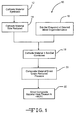
- Fig. 1 shows a flow chart that illustrates the process 10 used to form the metal oxide or lithiated metal oxide coated SVO or CSVO particles according to the present invention.
- the process begins with 12 of the cathode active material.
- the active material can be prepared according to any known synthesis method. These include the synthesis techniques described in U.S. Patent Nos.
- the particle size of the cathode active material is reduced in step 14. This increases the material's surface area, which is beneficial for improved discharge efficiency.
- Several means are contemplated for reducing the size of the active particles including using a mortar and pestle, a ball mill, jet-mill, or by attrition.
- the SVO or CSVO materials may be used directly without particle size reduction.
- a sol-gel solution 16 containing an organic derivative of the desired coating metal is prepared.
- the sol-gel solution can either be an aqueous or a non-aqueous based solution.
- Aqueous solutions include water and a minor amount of lithium hydroxide to bring the solution to a basic pH.
- Nonaqueous solutions are essentially alcohol based with methanol, ethanol, isopropyl and isobutyl being preferred.
- Useful metals for this purpose include aluminum, boron, cobalt, magnesium, manganese, silicon, tin, and zirconium. Lithium salts of these metals may also be added to the sol-gel solution 16 to produce a lithiated metal oxide coating.
- the solution contains, by weight, a ratio of coating material to active material in a range of about 1:3 to about 1:20, 1:5 being preferred.
- the resulting coated cathode active material is dried in step 20 under a reduced pressure in a range of about 20 inches of Hg. to about 50 inches of Hg., preferably about 30 inches of Hg., to remove the carrier solvent from the sol-gel.
- the dried coated material is heat-treated in step 22 to form a metal oxide or lithiated metal oxide coating on the SVO or CSVO particles.
- the heat treatment step is critical to controlling the composition of the product.
- the heating range is about 200°C to about 500°C for a time of about 10 minutes to about 6 hours. Longer heating are required for lower temperatures.
- the maximum heating temperature is preferably below about 500°C.
- the protective coatings have the general formula of M x O y or Li x M y O z wherein M is selected from the group consisting of Al, B, Mg, Mn, Si, Sn, and Zr.
- Exemplary coatings for SVO or CSVO include SnO 2 , SiO 2 , Al 2 O 3 , ZrO 2 , B 2 O 3 , MgO, MnO 2 , LiCoO 2 , LiMn x O y , and mixtures thereof.
- the cathode active material prepared as described above is preferably mixed with a binder material such as a powdered fluoro-polymer, more preferably powdered polytetrafluoroethylene or powdered polyvinylidene flouride present at about 1 to about 5 weight percent of the cathode mixture.
- a binder material such as a powdered fluoro-polymer, more preferably powdered polytetrafluoroethylene or powdered polyvinylidene flouride present at about 1 to about 5 weight percent of the cathode mixture.
- a conductive diluent is preferably added to the cathode mixture to improve conductivity.
- Suitable materials for this purpose include acetylene black, carbon black and/or graphite or a metallic powder such as powdered nickel, aluminum, titanium and stainless steel.
- the preferred cathode active mixture thus includes a powdered fluoro-polymer binder present at about 3 weight percent, a conductive dil
- Cathode components for incorporation into an electrochemical cell according to the present invention are prepared by rolling, spreading or pressing the cathode active material onto a suitable current collector selected from the group consisting of stainless steel, titanium, tantalum, platinum, aluminum, gold, nickel, and alloys thereof.
- the preferred current collector material is titanium, and most preferably the titanium cathode current collector has a thin layer of graphite/carbon paint applied thereto.
- Cathodes prepared as described above may be in the form of one or more plates operatively associated with at least one or more plates of anode material, or in the form of a strip wound with a corresponding strip of anode material in a structure similar to a "jellyroll".
- the cathode current collector is connected to a terminal insulated from the cell casing (not shown) by a suitable glass-to-metal seal.
- the cell can also be built in a case-positive design with the cathode current collector contacted to the casing and the anode current collector connected to a terminal lead insulated from the casing.
- the cell is built in a case-neutral configuration with both the anode and the cathode connected to respective terminal leads insulated from the casing.
- the cathode is separated from the Group IA, IIA or IIIB anode by a suitable separator material.
- the separator is of electrically insulative material, and the separator material also is chemically unreactive with the anode and cathode active materials and both chemically unreactive with and insoluble in the electrolyte.
- the separator material has a degree of porosity sufficient to allow flow there through of the electrolyte during the electrochemical reaction of the cell.
- Illustrative separator materials include fabrics woven from fluoropolymeric fibers including polyvinylidine fluoride, polyethylenetetrafluoroethylene, and polyethylenechlorotrifluoroethylene used either alone or laminated with a fluoropolymeric microporous film, non-woven glass, polypropylene, polyethylene, glass fiber materials, ceramics, polytetrafluoroethylene membrane commercially available under the designation ZITEX (Chemplast Inc.), polypropylene/polyethylene membrane commercially available under the designation CELGARD (Celanese Plastic Company, Inc.), a membrane commercially available under the designation DEXIGLAS (C.H. Dexter, Div., Dexter Corp.), and a polyethylene membrane commercially available from Tonen Chemical Corp.
- fluoropolymeric fibers including polyvinylidine fluoride, polyethylenetetrafluoroethylene, and polyethylenechlorotrifluoroethylene used either alone or laminated with a fluoropolymeric microporous
- the electrochemical cell of the present invention further includes a nonaqueous, ionically conductive electrolyte that serves as a medium for migration of ions between the anode and the cathode electrodes during the electrochemical reactions of the cell.
- the electrochemical reaction at the electrodes involves conversion of ions in atomic or molecular forms that migrate from the anode to the cathode.
- nonaqueous electrolytes suitable for the present invention are substantially inert to the anode and cathode materials, and they exhibit those physical properties necessary for ionic transport, namely, low viscosity, low surface tension and wettability.
- a suitable electrolyte has an inorganic, ionically conductive salt dissolved in a mixture of aprotic organic solvents comprising a low viscosity solvent and a high permittivity solvent.
- preferred lithium salts that are useful as a vehicle for transport of lithium ions from the anode to the cathode include LiPF 6 , LiBF 4 , LiAsF 6 , LiSbF 6 , LiClO 4 , LiO 2 , LiAlCl 4 , LiGaCl 4 , LiC(SO 2 CF 3 ) 3 , LiN(SO 2 CF 3 ) 2 , LiSCN, LiO 3 SCF 3 , LiC 6 F 5 SO 3 , LiO 2 CCF 3 , LiSO 6 F, LiB(C 6 H 5 ) 4 , LiCF 3 SO 3 , and mixtures thereof.
- Low viscosity solvents useful with the present invention include esters, linear and cyclic ethers and dialkyl carbonates such as tetrahydrofuran (THF), methyl acetate (MA), diglyme, trigylme, tetragylme, dimethyl carbonate (DMC), 1,2-dimethoxyethane (DME), 1,2-diethoxyethane (DEE), 1-ethoxy,2-methoxyethane (EME), ethyl methyl carbonate, methyl propyl carbonate, ethyl propyl carbonate, diethyl carbonate, dipropyl carbonate, and mixtures thereof, and high permittivity solvents include cyclic carbonates, cyclic esters and cyclic amides such as propylene carbonate (PC), ethylene carbonate (EC), butylene carbonate, acetonitrile, dimethyl sulfoxide, dimethyl formamide, dimethyl acetamide, ⁇ -valerolactone,
- the preferred anode is lithium metal and the preferred electrolyte is 0.8M to 1.5M LiAsF 6 or LiPF 6 dissolved in a 50:50 mixture, by volume, of propylene carbonate and 1,2-dimethoxyethane.
- the corrosion resistant glass used in the glass-to-metal seals has up to about 50% by weight silicon such as CABAL 12, TA 23, FUSITE 425 or FUSITE 435.
- the positive terminal leads preferably comprise molybdenum, although titanium, aluminum, nickel alloy, or stainless steel can also be used.
- the cell casing is an open container of a conductive material selected from nickel, aluminum, stainless steel, mild steel, tantalum and titanium.
- the casing is hermetically sealed with a lid, typically of a material similar to that of the casing.
- the coated-SVO and CSVO particles are particularly useful in electrochemical cells containing lithium anodes and non-aqueous electrolytes.
- the cathode consists of a mixture of, by weight, about 94% coated-SVO along with 3% PTFE, 2% graphite and 1% carbon black.
- the cathode is separated from the lithium anode by a layer of polypropylene separator.
- the cell is activated with 1 M LiAsF 6 in PC/DME (1:1) electrolyte.
- Pulse testing of the cell is accomplished by subjected it to high current pulses (-23 mA/cm 2 ) for 10 seconds in duration. The current pulses are applied in groups of four, with 15 seconds of rest between pulses.
- Time between application of the pulse groups ranges from several weeks to six months. Total discharge time for the cell is up to ten years. This makes the cell particularly well suited for powering an implantable medical device, such as a cardiac pacemaker, cardiac defibrillator, drug pump, neurostimulator, self-contained artificial heart, and the like.
- an implantable medical device such as a cardiac pacemaker, cardiac defibrillator, drug pump, neurostimulator, self-contained artificial heart, and the like.
- Figs. 2 and 3 show a patient P having a medical device 100, such as an implantable cardiac defibrillator, implanted inside the body.
- the enlarged schematic shows the medical device 100 comprising a housing 102 containing control circuitry 104 powered by an electrochemical cell 106 according to the present invention.
- the cell 106 is also connected to a capacitor 108.
- the control circuitry 104 is connected to at least one conductor 110 by a hermetic feedthrough 112, as is well known by those skilled in the art.
- the distal end of the conductor connects to the heart H for delivering a therapy thereto from the capacitor 108 charged by the cell 106.
- the patient will go to a medical facility, and the like, where the deliverable capacity determined by the control circuitry 104 is read to determine if the cell 106 has discharged to the point that it is approaching its end-of-life, typically at an open circuit voltage of about 2.0 volts. If so, this indicates that it is time for the physician to schedule the patient for surgery to replace the medical device with a new one.
Landscapes
- Chemical & Material Sciences (AREA)
- General Chemical & Material Sciences (AREA)
- Chemical Kinetics & Catalysis (AREA)
- Electrochemistry (AREA)
- Inorganic Chemistry (AREA)
- Composite Materials (AREA)
- Engineering & Computer Science (AREA)
- Materials Engineering (AREA)
- Manufacturing & Machinery (AREA)
- Battery Electrode And Active Subsutance (AREA)
- Secondary Cells (AREA)
- Electrotherapy Devices (AREA)
- Cell Electrode Carriers And Collectors (AREA)
- Primary Cells (AREA)
Abstract
Description
Claims (22)
- An electrochemical cell, which comprises:a) an anode of an alkali metal;b) a cathode of a cathode active material provided with a coating having the formula MxOy, wherein x = 1 or 2 and y = 1 to 3, or the formula LixMyOz wherein x = 1, y = 1 or 2 and z = 1 to 4, and mixtures thereof; andc) a nonaqueous electrolyte activating the anode and the cathode.
- The electrochemical cell of claim 1, wherein M in the coating formulas of MxOy and LixMyOz, is selected from the group consisting of Al, B, Mg, Mn, Si, Sn, Zr, and mixtures thereof.
- The electrochemical cell of claim 1 or claim 2, wherein the coating is selected from the group consisting of SnO2, SiO2, Al2O3, ZrO2, B2O3, MgO, MnO2, LiCoO2, LiMnxOy, and mixtures thereof .
- The electrochemical cell of any of claims 1 to 3, wherein the cathode active material is selected from the group consisting of SVO, CSVO, V2O5, MnO2, LiCoO2, LiNiO2, LiMnO2, LiMn2O4, CuO2, TiS2, Cu2S, FeS, FeS2, Ag2O, Ag2O2, CuF, Ag2CrO4, copper vanadium oxide, and mixtures thereof.
- The electrochemical cell of any of claims 1 to 4, wherein the cathode active material is contacted to a cathode current collector selected from the group consisting of stainless steel, titanium, tantalum, platinum, aluminum, gold, nickel, and alloys thereof, preferably wherein the cathode active material is contacted to a titanium cathode current collector having a graphite/carbon material coated thereon.
- The electrochemical cell of any of claims 1 to 5, wherein the anode is lithium and the cathode active material is SVO having its individual particles provided with a coating selected from the group consisting of SnO2, SiO2, Al2O3, ZrO2, B2O3, MgO, MnO2, LiCoO2, LiMnOx, and mixtures thereof.
- The electrochemical cell of any of claims 1 to 6, built in one of a case-negative design, a case-positive design and a case-neutral design.
- The electrochemical cell of claim 1 wherein the electrolyte has a first solvent selected from an ester, a linear ether, a cyclic ether, a dialkyl carbonate, and mixtures thereof, and a second solvent selected from a cyclic carbonate, a cyclic ester, a cyclic amide, and mixtures thereof, preferably wherein the first solvent is selected from the group consisting of tetrahydrofuran, methyl acetate, diglyme, triglyme, tetraglyme, dimethyl carbonate, 1,2-dimethoxyethane, 1,2-diethoxyethane, 1-ethoxy,2-methoxyethane, ethyl methyl carbonate, methyl propyl carbonate, ethyl propyl carbonate, diethyl carbonate, dipropyl carbonate, and mixtures thereof, and the second solvent is selected from the group consisting of propylene carbonate, ethylene carbonate, butylene carbonate, acetonitrile, dimethyl sulfoxide, dimethyl formamide, dimethyl acetamide, Y-valerolactone, Y-butyrolactone, N-methyl-2-pyrrolidone, and mixtures thereof.
- The electrochemical cell of any of claims 1 to 8, wherein the electrolyte includes a lithium salt selected from the group consisting of LiPF6, LiBF4, LiAsF6, LiSbF6, LiClO4, LiO2, LiAlCl4, LiGaCl4, LiC(SO2CF3)3, LiN(SO2CF3)2, LiSCN, LiO3SCF3, LiC6F5SO3, LiO2CCF3, LiSO6F, LiB (C6H5)4, LiCF3SO3, and mixtures thereof.
- An implantable medical device (100), which comprises:a) a device housing (102);b) control circuitry (104) contained inside the device housing (102);c) an electrochemical cell (106) housed inside the device housing (102) for powering the control circuitry (104), the cell (106) comprising:i) an anode comprising lithium;ii) a cathode of silver vanadium oxide provided with a coating having the formula MxOy, wherein x = 1 or 2 and y = 1 to 3 or the formula LixMyOz, wherein x = 1, y = 1 or and z = 1 to 4, and mixtures thereof; andiii) a nonaqueous electrolyte activating the anode and the cathode; andd) a lead connecting the device housing (102) to a body part intended to be assisted by the medical device (100), wherein the electrochemical cell (106) powers the control circuitry (104) both during a device monitoring mode to monitor the physiology of the body part and a device activation mode to provide the therapy to the body part.
- The implantable medical device (100) of claim 10, wherein M in the coating formulas of MxOy and LixMyOz is selected from the group consisting of Al, B, Mg, Mn, Si, Sn, Zr, and mixtures thereof.
- The implantable medical device (100) of claim 10 or claim 11, wherein the coating is selected from the group consisting of SnO2, SiO2, Al2O3, ZrO2, B2O3, MgO, MnO2, LiCoO2, LiMnxOy, and mixtures thereof.
- The implantable medical device (100) of any of claims 10 to 12, wherein the cathode active material is selected from the group consisting of SVO, CSVO, V2O5, MnO2, LiCoO2, LiNiO2, LiMnO2, LiMn2O4, CuO2, TiS2, Cu2S, FeS, FeS2, Ag2O, Ag2O2, CuF, Ag2CrO4, copper vanadium oxide, and mixtures thereof.
- The implantable medical device (100) of any of claims 10 to 13, wherein the cathode active material is contacted to a cathode current collector selected from the group consisting of stainless steel, titanium, tantalum, platinum, aluminum, gold, nickel, and alloys thereof, preferably wherein the cathode active material is contacted to a titanium cathode current collector having a graphite/carbon material coated thereon.
- The implantable medical device (100) of any of claims 10 to 14, wherein the anode is lithium and the cathode active material is SVO having its individual particles provided with a coating selected from the group consisting of SnO2, SiO2, Al2O3, ZrO2, B2O3, MgO, MnO2, LiCoO2, LiMnxOy, and mixtures thereof.
- A method for providing a cathode active material, comprising the steps of:a) providing the cathode active material is granular form;b) providing a sol-gel solution of an organic solvent having a coating metal selected from Al, B, Mg, Mn, Si, Sn, Zr, and mixtures thereof provided therein;c) mixing the cathode active material into the sol-gel solution;d) drying the resulting coated cathode active material to substantially remove the solvent material;e) heating the dried coated active material to convert the coating metal to a coating having the formula MxOy, wherein x = 1 or 2 and y = 1 to 3, or the formula LixMyOz wherein x = 1, y = 1 or and 2 = 1 to 4, and mixtures thereof.
- The method of claim 16, wherein the coating is selected from the group consisting of SnO2, SiO2, Al2O3, ZrO2, B2O3, MgO, MnO2, LiCoO2, LiMnxOy, and mixtures thereof.
- The method of claim 16 or claim 17, including selecting the cathode active material from the group consisting of SVO, CSVO, V2O5, MnO2, LiCoO2, LiNiO2, LiMnO2, LiMn2O4, CuO2, TiS2, Cu2S, FeS, FeS2, Ag2O, Ag2O2, CuF, Ag2CrO4, copper vanadium oxide, and mixtures thereof.
- The method of any of claims 16 to 18, including providing the sol-gel solution as either an aqueous or a nonaqueous solution.
- The method of any of claims 16 to 19, including mixing the coating metal with the active material in a range, by weight, of 1 : 3 to 1 : 20.
- The method of any of claims 16 to 20, including drying the coated cathode active material at a reduced pressure in a range of 675.6 mbar (20 inches of Hg) to 1689.1 mbar (50 inches of Hg).
- The method of any of claims 16 to 21, including drying the coated cathode active material at a temperature in a range of 200 °C to 500 °C and/or including drying the coated cathode active material for a time of 10 minutes to 6 hours.
Applications Claiming Priority (2)
| Application Number | Priority Date | Filing Date | Title |
|---|---|---|---|
| US35194702P | 2002-01-24 | 2002-01-24 | |
| US351947P | 2002-01-24 |
Publications (2)
| Publication Number | Publication Date |
|---|---|
| EP1331683A2 true EP1331683A2 (en) | 2003-07-30 |
| EP1331683A3 EP1331683A3 (en) | 2005-08-10 |
Family
ID=23383121
Family Applications (1)
| Application Number | Title | Priority Date | Filing Date |
|---|---|---|---|
| EP03001616A Withdrawn EP1331683A3 (en) | 2002-01-24 | 2003-01-24 | Cathode active material coated with a metal oxide for incorporation into a lithium electrochemical cell |
Country Status (4)
| Country | Link |
|---|---|
| US (1) | US20030138697A1 (en) |
| EP (1) | EP1331683A3 (en) |
| JP (1) | JP2004039620A (en) |
| CA (1) | CA2417080A1 (en) |
Cited By (10)
| Publication number | Priority date | Publication date | Assignee | Title |
|---|---|---|---|---|
| EP1388905A3 (en) * | 2002-08-06 | 2005-05-11 | Wilson Greatbatch Technologies, Inc. | Silver vanadium oxide provided with a metal oxide coating |
| US6920167B2 (en) | 1999-05-27 | 2005-07-19 | Sony Corporation | Semiconductor laser device and method for fabricating thereof |
| WO2007044355A1 (en) * | 2005-10-04 | 2007-04-19 | Medtronic, Inc. | Improvement of power capability of a cathode |
| US7378181B2 (en) | 2002-01-15 | 2008-05-27 | Quallion Llc | Electric storage battery construction and method of manufacture |
| US7416811B2 (en) | 2002-01-15 | 2008-08-26 | Quallion Llc | Electric storage battery construction and method of manufacture |
| US7807300B2 (en) | 2006-01-31 | 2010-10-05 | Medtronic, Inc. | Resistance-stabilizing additives for electrolyte |
| US7824805B2 (en) | 2006-01-17 | 2010-11-02 | Medtronic, Inc. | Implantable medical device battery |
| CN104332615A (en) * | 2014-09-09 | 2015-02-04 | 李梦思 | Li-Mn-Mg ternary composite battery positive material and its preparation method |
| CN111244413A (en) * | 2020-01-16 | 2020-06-05 | 河南工业大学 | LTO/CVO composite material and preparation method thereof |
| EP4307407A4 (en) * | 2021-03-10 | 2025-03-26 | Samsung SDI Co., Ltd. | Composite cathode active material, cathode and lithium battery employing same, and method for manufacturing same |
Families Citing this family (23)
| Publication number | Priority date | Publication date | Assignee | Title |
|---|---|---|---|---|
| US8524397B1 (en) | 2004-11-08 | 2013-09-03 | Quallion Llc | Battery having high rate and high capacity capabilities |
| US7052802B2 (en) * | 2002-10-15 | 2006-05-30 | Quallion Llc | Fluorinated carbon active material |
| US7632317B2 (en) * | 2002-11-04 | 2009-12-15 | Quallion Llc | Method for making a battery |
| WO2005091403A1 (en) * | 2003-01-15 | 2005-09-29 | Quallion Llc | Battery |
| US20040223906A1 (en) * | 2003-05-09 | 2004-11-11 | Chuanfu Wang | Lithium nickel cobalt oxides and their methods of fabrication |
| US7771875B2 (en) * | 2003-08-15 | 2010-08-10 | Byd Company Limited | Positive electrodes for rechargeable batteries |
| US8080329B1 (en) | 2004-03-25 | 2011-12-20 | Quallion Llc | Uniformly wound battery |
| US7381633B2 (en) * | 2005-01-27 | 2008-06-03 | Hewlett-Packard Development Company, L.P. | Method of making a patterned metal oxide film |
| JP5169094B2 (en) * | 2007-09-12 | 2013-03-27 | ソニー株式会社 | Positive electrode active material for lithium secondary battery and lithium secondary battery using the same |
| JP4612664B2 (en) * | 2007-09-25 | 2011-01-12 | セイコーエプソン株式会社 | All-solid secondary battery, method for producing all-solid secondary battery |
| US9172086B2 (en) * | 2008-12-05 | 2015-10-27 | Samsung Sdi Co., Ltd. | Cathode and lithium battery using the same |
| KR101975394B1 (en) * | 2012-09-12 | 2019-05-07 | 삼성에스디아이 주식회사 | Composite cathode active material, cathode and lithium battery containing the material and preparation method thereof |
| JP2014060050A (en) * | 2012-09-18 | 2014-04-03 | Honda Motor Co Ltd | Positive electrode active material for nonaqueous electrolyte secondary battery |
| CN103700834B (en) * | 2012-09-27 | 2016-11-02 | 清华大学 | The preparation method of anode composite material of lithium ion battery |
| CN103066261B (en) * | 2012-12-28 | 2015-07-29 | 龙能科技(苏州)有限公司 | The synthetic method of the nickelic multi-element metal oxide positive electrode of high power capacity |
| KR101785265B1 (en) | 2013-12-17 | 2017-10-16 | 삼성에스디아이 주식회사 | Composite cathode active material, cathode, lithium battery comprising the same, and preparation method thereof |
| JP6395064B2 (en) * | 2014-09-12 | 2018-09-26 | エルジー・ケム・リミテッド | Method for producing positive electrode material for lithium secondary battery |
| KR101940249B1 (en) * | 2015-12-24 | 2019-01-18 | 주식회사 엘지화학 | A anode active material with enhanced power property and an electrode comprising the same for an electrochemical device |
| KR101866105B1 (en) | 2016-12-30 | 2018-06-08 | 울산과학기술원 | Surface-treated active materials and method for surface-treatment thereof |
| KR101902467B1 (en) * | 2017-09-14 | 2018-09-28 | 연세대학교 산학협력단 | Surface coated anode active material for lithium secondary battery, preparation method thereof, and lithum secondary battery comprising the same |
| KR102633758B1 (en) * | 2020-06-01 | 2024-02-05 | 삼성에스디아이 주식회사 | Composite cathode active material, Cathode and Lithium battery containing composite cathode active material and Preparation method thereof |
| KR102633759B1 (en) * | 2020-06-01 | 2024-02-05 | 삼성에스디아이 주식회사 | Composite cathode active material, Cathode and Lithium battery containing composite cathode active material and Preparation method thereof |
| KR102873761B1 (en) * | 2022-12-14 | 2025-10-17 | 삼성에스디아이 주식회사 | Composite cathode active material, Cathode and Lithium battery containing composite cathode active material, and Preparation method of composite cathode active material |
Family Cites Families (26)
| Publication number | Priority date | Publication date | Assignee | Title |
|---|---|---|---|---|
| AU5942573A (en) * | 1972-08-25 | 1975-02-20 | Commw Scient Ind Res Org | Coating particulates |
| US4310609A (en) * | 1979-12-17 | 1982-01-12 | Wilson Greatbatch Ltd. | Metal oxide composite cathode material for high energy density batteries |
| US4830940A (en) * | 1986-01-14 | 1989-05-16 | Wilson Greatbatch Ltd. | Non-agueous lithium battery |
| US4911996A (en) * | 1988-03-11 | 1990-03-27 | Eic Laboratories, Inc. | Electrochemical cell |
| AU665575B2 (en) * | 1991-09-30 | 1996-01-11 | Wilson Greatbatch Ltd. | Autoclavable electrochemical cell |
| US5338625A (en) * | 1992-07-29 | 1994-08-16 | Martin Marietta Energy Systems, Inc. | Thin film battery and method for making same |
| GB9216393D0 (en) * | 1992-08-01 | 1992-09-16 | Atomic Energy Authority Uk | Electrochemical cell |
| US5558680A (en) * | 1992-11-23 | 1996-09-24 | Wilson Greatbatch Ltd. | Preparation of silver vanadium oxide cathodes utilizing sol-gel technology |
| US5460904A (en) * | 1993-08-23 | 1995-10-24 | Bell Communications Research, Inc. | Electrolyte activatable lithium-ion rechargeable battery cell |
| US5545497A (en) * | 1994-06-21 | 1996-08-13 | Wilson Greatbatch Ltd. | Cathode material for nonaqueous electrochemical cells |
| US5567538A (en) * | 1995-05-05 | 1996-10-22 | Rayovac Corporation | Metal-air cell having thin-walled anode and cathode cans |
| US5582935A (en) * | 1995-09-28 | 1996-12-10 | Dasgupta; Sankar | Composite electrode for a lithium battery |
| US5670276A (en) * | 1995-12-04 | 1997-09-23 | Wilson Greatbatch Ltd. | Alternate synthetic method for mixed metal oxide cathode materials |
| JPH09293512A (en) * | 1996-02-23 | 1997-11-11 | Fuji Photo Film Co Ltd | Lithium ion secondary battery and positive pole active material precursor |
| US5705291A (en) * | 1996-04-10 | 1998-01-06 | Bell Communications Research, Inc. | Rechargeable battery cell having surface-treated lithiated intercalation positive electrode |
| US5695892A (en) * | 1996-08-20 | 1997-12-09 | Wilson Greatbatch Ltd. | Preparation of silver vanadium oxide using nitric acid with oxide starting materials |
| US5776635A (en) * | 1996-09-16 | 1998-07-07 | Wilson Greatbatch Ltd. | Ternary solvent nonaqueous organic electrolyte for alkali metal electrochemical cells |
| US5955218A (en) * | 1996-12-18 | 1999-09-21 | Medtronic, Inc. | Heat-treated silver vanadium oxide for use in batteries for implantable medical devices |
| US5895733A (en) * | 1997-02-03 | 1999-04-20 | Medtronic, Inc. | Synthesis method for silver vanadium oxide |
| IL124007A (en) * | 1998-04-08 | 2001-08-26 | Univ Ramot | Long cycle-life alkali metal battery |
| US6296972B1 (en) * | 1998-04-24 | 2001-10-02 | Korea Institute Of Science And Technology | Method for preparing LICOO2-coated NiO cathodes for molten carbon fuel cell |
| JP4252641B2 (en) * | 1998-06-15 | 2009-04-08 | パナソニック株式会社 | Positive electrode for alkaline storage battery and positive electrode active material |
| US6413669B1 (en) * | 1999-06-03 | 2002-07-02 | Wilson Greatbatch Ltd. | Melt impregnation of mixed metal oxide |
| US6627337B2 (en) * | 2000-02-16 | 2003-09-30 | Wilson Greatbatch Ltd. | Conversion of low rate energy into high rate energy by parallel discharging |
| DE10014884A1 (en) * | 2000-03-24 | 2001-09-27 | Merck Patent Gmbh | Coated lithium mixed oxide particles and a process for their production |
| US6645670B2 (en) * | 2000-05-16 | 2003-11-11 | Wilson Greatbatch Ltd. | Efficient cell stack for cells with double current collectors sandwich cathodes |
-
2003
- 2003-01-23 US US10/350,384 patent/US20030138697A1/en not_active Abandoned
- 2003-01-24 CA CA002417080A patent/CA2417080A1/en not_active Abandoned
- 2003-01-24 JP JP2003054923A patent/JP2004039620A/en active Pending
- 2003-01-24 EP EP03001616A patent/EP1331683A3/en not_active Withdrawn
Cited By (17)
| Publication number | Priority date | Publication date | Assignee | Title |
|---|---|---|---|---|
| US6920167B2 (en) | 1999-05-27 | 2005-07-19 | Sony Corporation | Semiconductor laser device and method for fabricating thereof |
| US7569305B2 (en) | 2002-01-15 | 2009-08-04 | Quallion Llc | Electric storage battery construction and method of manufacture |
| US7632603B2 (en) | 2002-01-15 | 2009-12-15 | Quallion Llc | Electric storage battery construction and method of manufacture |
| US7601461B2 (en) | 2002-01-15 | 2009-10-13 | Qualllion LLC | Electric storage battery construction and method of manufacture |
| US7378181B2 (en) | 2002-01-15 | 2008-05-27 | Quallion Llc | Electric storage battery construction and method of manufacture |
| US7416811B2 (en) | 2002-01-15 | 2008-08-26 | Quallion Llc | Electric storage battery construction and method of manufacture |
| US7432012B2 (en) | 2002-01-15 | 2008-10-07 | Quallion Llc | Electric storage battery construction and method of manufacture |
| US7488553B2 (en) | 2002-01-15 | 2009-02-10 | Quallion Llc | Electric storage battery construction and method of manufacture |
| US7211349B2 (en) | 2002-08-06 | 2007-05-01 | Wilson Greatbatch Technologies, Inc. | Silver vanadium oxide provided with a metal oxide coating |
| EP1388905A3 (en) * | 2002-08-06 | 2005-05-11 | Wilson Greatbatch Technologies, Inc. | Silver vanadium oxide provided with a metal oxide coating |
| WO2007044355A1 (en) * | 2005-10-04 | 2007-04-19 | Medtronic, Inc. | Improvement of power capability of a cathode |
| US7824805B2 (en) | 2006-01-17 | 2010-11-02 | Medtronic, Inc. | Implantable medical device battery |
| US7807300B2 (en) | 2006-01-31 | 2010-10-05 | Medtronic, Inc. | Resistance-stabilizing additives for electrolyte |
| CN104332615A (en) * | 2014-09-09 | 2015-02-04 | 李梦思 | Li-Mn-Mg ternary composite battery positive material and its preparation method |
| CN111244413A (en) * | 2020-01-16 | 2020-06-05 | 河南工业大学 | LTO/CVO composite material and preparation method thereof |
| CN111244413B (en) * | 2020-01-16 | 2021-06-29 | 河南工业大学 | A kind of LTO/CVO composite material and preparation method thereof |
| EP4307407A4 (en) * | 2021-03-10 | 2025-03-26 | Samsung SDI Co., Ltd. | Composite cathode active material, cathode and lithium battery employing same, and method for manufacturing same |
Also Published As
| Publication number | Publication date |
|---|---|
| US20030138697A1 (en) | 2003-07-24 |
| EP1331683A3 (en) | 2005-08-10 |
| CA2417080A1 (en) | 2003-07-24 |
| JP2004039620A (en) | 2004-02-05 |
Similar Documents
| Publication | Publication Date | Title |
|---|---|---|
| US7211349B2 (en) | Silver vanadium oxide provided with a metal oxide coating | |
| EP1331683A2 (en) | Cathode active material coated with a metal oxide for incorporation into a lithium electrochemical cell | |
| EP1150366B1 (en) | Sandwich cathode design for alkali metal electrochemical cell with high discharge rate capability | |
| US7018743B2 (en) | Dual chemistry electrode design | |
| US6692871B2 (en) | Double current collector cathode design for alkali metal electrochemical cells having short circuit safety characteristics | |
| US6692865B2 (en) | Double current collector cathode design using mixtures of two active materials for alkali metal or ion electrochemical cells | |
| US6008625A (en) | Use of double cells to power an implantable medical device | |
| US6926991B2 (en) | SVO/CFx parallel cell design within the same casing | |
| US6936379B2 (en) | Method for electrode design for implantable device applications that require the elective replacement indicator (ERI) | |
| JP2002270162A (en) | Electrochemical cell constituted by alkaline metal battery or ion electrochemical battery containing double current collecting body cathode structure with usage of two kinds of active material mixtures | |
| US20030134188A1 (en) | Sandwich electrode design having relatively thin current collectors | |
| US7033707B2 (en) | Organic cyclic carbonate additives for nonaqueous electrolyte in alkali metal electrochemical cells | |
| US6673487B2 (en) | Double current collector cathode design using the same active material in varying thicknesses for alkali metal or ION electrochemical cells | |
| EP1768203B1 (en) | Battery electrodes | |
| US20100196765A1 (en) | Reducing DC Resistance In Electrochemical Cells By Increasing Cathode Basis Weight | |
| US20100185264A1 (en) | Method For Coating A Cathode Active Material With A Metal Oxide For Incorporation Into A Lithium Electrochemical Cell |
Legal Events
| Date | Code | Title | Description |
|---|---|---|---|
| PUAI | Public reference made under article 153(3) epc to a published international application that has entered the european phase |
Free format text: ORIGINAL CODE: 0009012 |
|
| AK | Designated contracting states |
Designated state(s): AT BE BG CH CY CZ DE DK EE ES FI FR GB GR HU IE IT LI LU MC NL PT SE SI SK TR |
|
| AX | Request for extension of the european patent |
Extension state: AL LT LV MK RO |
|
| PUAL | Search report despatched |
Free format text: ORIGINAL CODE: 0009013 |
|
| AK | Designated contracting states |
Kind code of ref document: A3 Designated state(s): AT BE BG CH CY CZ DE DK EE ES FI FR GB GR HU IE IT LI LU MC NL PT SE SI SK TR |
|
| AX | Request for extension of the european patent |
Extension state: AL LT LV MK RO |
|
| 17P | Request for examination filed |
Effective date: 20060109 |
|
| AKX | Designation fees paid |
Designated state(s): DE FR GB SE |
|
| RAP1 | Party data changed (applicant data changed or rights of an application transferred) |
Owner name: GREATBATCH LTD. |
|
| RAP1 | Party data changed (applicant data changed or rights of an application transferred) |
Owner name: GREATBATCH LTD. |
|
| STAA | Information on the status of an ep patent application or granted ep patent |
Free format text: STATUS: THE APPLICATION HAS BEEN WITHDRAWN |
|
| 18W | Application withdrawn |
Effective date: 20081110 |