EP1331573A1 - Apparatus control method and device - Google Patents
Apparatus control method and device Download PDFInfo
- Publication number
- EP1331573A1 EP1331573A1 EP01974881A EP01974881A EP1331573A1 EP 1331573 A1 EP1331573 A1 EP 1331573A1 EP 01974881 A EP01974881 A EP 01974881A EP 01974881 A EP01974881 A EP 01974881A EP 1331573 A1 EP1331573 A1 EP 1331573A1
- Authority
- EP
- European Patent Office
- Prior art keywords
- server
- browser
- frame
- page
- request
- Prior art date
- Legal status (The legal status is an assumption and is not a legal conclusion. Google has not performed a legal analysis and makes no representation as to the accuracy of the status listed.)
- Granted
Links
Images






Classifications
-
- G—PHYSICS
- G06—COMPUTING OR CALCULATING; COUNTING
- G06F—ELECTRIC DIGITAL DATA PROCESSING
- G06F15/00—Digital computers in general; Data processing equipment in general
-
- G—PHYSICS
- G06—COMPUTING OR CALCULATING; COUNTING
- G06F—ELECTRIC DIGITAL DATA PROCESSING
- G06F3/00—Input arrangements for transferring data to be processed into a form capable of being handled by the computer; Output arrangements for transferring data from processing unit to output unit, e.g. interface arrangements
- G06F3/14—Digital output to display device ; Cooperation and interconnection of the display device with other functional units
-
- G—PHYSICS
- G09—EDUCATION; CRYPTOGRAPHY; DISPLAY; ADVERTISING; SEALS
- G09G—ARRANGEMENTS OR CIRCUITS FOR CONTROL OF INDICATING DEVICES USING STATIC MEANS TO PRESENT VARIABLE INFORMATION
- G09G2370/00—Aspects of data communication
- G09G2370/02—Networking aspects
- G09G2370/027—Arrangements and methods specific for the display of internet documents
Definitions
- the present invention relates to a method and system for remote control of an apparatus via a network (communication network).
- the present invention relates to a method and system for controlling the operation of an apparatus, for example, a case of controlling the operation of a projector having a home server function by a client personal computer serving as a browser.
- the WWW World Wide Web
- the WWW service is established by transmitting information written by a language such as HTML (HyperText Markup Language) using a client/server type protocol (communication agreement) referred to as HTTP (HyperText Transfer Protocol) between a client usually using a personal computer (PC), that is, a Web browser, and a server.
- HTML HyperText Markup Language
- HTTP HyperText Transfer Protocol
- the Web browser carried in the client PC has as its main role to access a URL (Uniform Resource Locator) designated by a user and display the information.
- URL Uniform Resource Locator
- Microsoft's Internet Explorer and Netscape Communications' Netscape Navigator are famous.
- “HyperText” means a mechanism burying link information to another document in a certain character string in a document freely prepared by the user and enabling other information to be referred to by selecting that character string.
- the information can be freely comprised by freely extending the link from a local resource of the server to a resource on the network.
- CGI Common Gateway Interface
- API Application Programming Interface
- An application using CGI is prepared by a C language, Perl language (type of script language), etc. and operates to return some sort of answer with respect to a value transferred from the browser in cooperation with an application operating on the server.
- ISAPI Internet Server Application Programming Interface
- DLL Dynamic Link Library
- CGI and ISAPI are applications appearing to operate on a server.
- CGI and ISAPI a Web server having only the function of displaying HTML pages prepared in advance can be given more diverse functions.
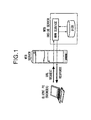
- FIG. 1 is a view illustrating the flow of processing when accessing a Web page placed inside a server and programmed by only HTML from a browser of a client personal computer (PC).
- PC personal computer
- the Web server when the browser sends a request to the Web server, the Web server reads the requested file and sends back a response to the browser of the client PC.
- the browser it is also possible for the browser to inquire about an IP address of a target Web server corresponding to the URL designated with respect to the DNS server via the Internet and send the request to the Web server by using the found IP address.
- FIG. 2 is a view illustrating the flow of the processing in the case of accessing a Web page containing a CGI or ISAPI application.
- the Web server starts up the application of ISAPI or CGI and performs the processing by the server application according to the data transferred from the client browser (client PC).
- the Web server sends back the processed result again to the client browser as a response.
- a Web server does not only extract information existing in the server. It is also possible to send information of a client PC to the Web server, process that information by ISAPI or CGI, and return it to the client PC. Due to this, the relationship between browsers and Web servers, which has been utilized as an information network called the Internet hitherto, is now being applied to other areas too.
- a remote control system and method for remote control of an apparatus such as a household electrical appliance.
- a Web server function explained by illustration in FIG. 1 and FIG. 2 is incorporated in an apparatus to be remote controlled and connected to a network, for example, the Internet.
- the browser on the client side corresponding to a remote controller such as a TV receiver remote controller and air conditioner remote controller sends a command corresponding to a command of the remote controller to the apparatus (Web server) via the network.
- a remote controller such as a TV receiver remote controller and air conditioner remote controller
- the Web server can perform an operation just like if it were operated by a remote controller in place of a command which can be understood for the inside of the apparatus by a server application (ISAPI, CGI).
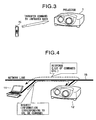
- FIG. 3 is a view of an outline of a remote control system in the case of using a projector as an apparatus controlled by a remote controller explained above.
- FIG. 3 illustrates a configuration for remote control of a projector 1 using a remote controller RC having a browser function.
- the projector 1 has the function of a Web browser.
- the Internet is not used as the network.
- a infrared ray is propagated through the space between the remote controller RC and projector 1.
- Recent projectors have personal computers built in the projectors per se and have liquid crystal display devices, polarizing means, etc. built in. They can directly receive video information from the personal computers, process that information, project images in colors. Therefore, it is easy to install servers in personal computers mounted in such projectors.
- the remote controller RC When controlling the projector proper by the remote controller RC in such a remote controlled system, the remote controller RC is operated within a range where infrared rays of the remote controller RC can reach and facing the projector proper. Then, the projector having the function of a server performs processing for control according to the instructions of the remote controller. The projector performs processing in accordance with the results.
- FIG. 4 is a view of the configuration wherein a projector 12 and a client PC (browser) 11 are connected via a network 15.
- the client PC 11 carries the browser function, while the projector 12 carries the Web server function.
- the projector 12 also has built into it, other than the personal computer having the function of a Web server, a liquid crystal display, polarizing means, etc. It is configured to be able to project images in color by using the personal computer of the server or using a built-in second personal computer for video display or image processing apparatus to directly receive and process video information from a personal computer outside of the projector 12.
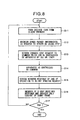
- FIG. 5 is a flow chart of the processing of a server in the projector 12 in FIG. 4.
- Step 1, 2 A screen of a remote controller RC showing a list of commands is first formed on the Web in advance.
- the URL of that screen is designated from the browser (client PC) 11 by using a network line 15.
- Step 3 The server carried in the projector 12 returns the screen information showing the list of commands to the browser (client PC) 11. Thereafter, by selecting a command corresponding to the desired remote control operation from the list at the browser 11, the command information is transferred to the server.
- Step 4 The server in the projector 12 controls the apparatus in place of commands inside the apparatus by the server application (CGI, ADAPI) based on that information.
- the server application CGI, ADAPI
- Step 5 The server in the projector 12 sends back a response of the end of operation to the browser (client PC) 11 which sent the request.
- Step 6 The client browser 11 receives that response and replies in accordance with that content.
- the method of reply is to make another request, terminate the operation, etc.
- Step 7 So long as there is a request from the client browser 11, the above processing is repeated.
- the explanation was given taking as an example a projector as the apparatus, but a problem similar to the above is encountered in the case of remote control of various other types of apparatuses as well. That is, the apparatus to be controlled is not limited to a projector. All apparatuses connected to for example a network can be covered as the network. That is, a similar problem to the above is also encountered in the case where a home server or the like is installed in the apparatus.
- An object of the present invention is to provide a method and system for control of an apparatus which is free from visual obstruction due to a response being returned from the server even when performing the above operation, free from a reduction in the response of the control operability, and enabling the operation to be accurately executed.
- a method for control of an apparatus which controls the operation of an apparatus based on a request from a browser and/or responds to the browser from a server relating to the state of the apparatus through a network using a predetermined communication protocol
- the method for control of an apparatus including having the server prepare by a frame structure a higher page forming a burial origin for a page of a desired layout to be displayed by the above browser programmed by a programming language of a Web page, having the server set a dummy frame of a region zero not containing content in the prepared frame, having the server set a desired page having a means for controlling the apparatus and/or making a request relating to the state of the apparatus to be displayed in a remaining region other than the dummy frame, having the server set a response frame for responding to a request from the browser and updating the frame in the dummy frame, and having the browser display processing results based on a response from the server to a request from the browser according to the setting in the
- a system for control of an apparatus comprising a server which controls the operation of an apparatus based on a request from a browser and/or responds to the browser from a server relating to the state of the apparatus through a network using a predetermined communication protocol
- the system for control of an apparatus comprising having the server prepare by a frame structure a higher page forming a burial origin for a page of a desired layout to be displayed by the above browser programmed by a programming language of a Web page, having the server set a dummy frame of a region zero not containing content in the prepared frame, having the server set a desired page having a means for controlling the apparatus and/or making a request relating to the state of the apparatus to be displayed in a remaining region other than the dummy frame, having the server set a response frame for responding to a request from the browser and updating the frame in the dummy frame, and having the browser display processing results based on a response from the server to a request from the browser
- an electronic apparatus provided with a server which responds to the browser based on a request from a browser through a network using a predetermined protocol and a control means for controlling the inside based on a command generated in the server by a request from the browser
- the electronic apparatus characterized in that the server prepares by a frame structure a higher page forming a burial origin for a page of a desired layout to be displayed by the above browser programmed by a programming language of a Web page, the server sets a dummy frame of a region zero not containing content in the prepared frame, the server sets a desired page having a means for making a request for control of the inside to be displayed in a remaining region other than the dummy frame, the server sets a response frame for responding to a request from the browser and updating the frame in the dummy frame, and the browser displays processing results based on a response from the server to a request from the browser according to the setting in the server and does not appear to update the inside of
- a method for control of an apparatus which controls the operation of an apparatus based on a request from a browser and/or responds to the browser from a server relating to the state of the apparatus through a network using a predetermined communication protocol
- the method for control of an apparatus comprising having the server divide by a frame structure a higher page forming a burial origin for a page of a desired layout to be displayed by the above browser programmed by a programming language of a Web page so as to surround only a variable page requiring a change of the content of the display based on a response to the server, having the server set a background color of the variable page to be standardized with the surface color, having the server set a response frame for responding to a request from the browser and updating the frame in the variable frame, and having the browser display processing results based on a response from the server according to the setting in the server and thereby change only the frame including the variable page in the frame and not change other frames.
- a system for control of an apparatus comprised of a server which controls the operation of an apparatus based on a request from a browser and/or responds to the browser from a server relating to the state of the apparatus through a network using a predetermined communication protocol
- the system for control of an apparatus including having the server divide by a frame structure a higher page forming a burial origin for a page of a desired layout to be displayed by the above browser programmed by a programming language of a Web page so as to surround only a variable page requiring a change of the content of the display based on a response to the server, having the server set a background color of the variable page to be standardized with the surface color, having the server set a response frame for responding to a request from the browser and updating the frame in the variable frame, and having the browser display processing results based on a response from the server according to the setting in the server and thereby change only the frame including the variable page in the frame and not change other frames.
- an electronic apparatus provided with a server which responds to the browser based on a request from a browser through a network using a predetermined communication protocol and control means for controlling the inside based on a command produced in the server due to a request from the browser, the electronic apparatus characterized in that the server divides by a frame structure a higher page forming a burial origin for a page of a desired layout to be displayed by the above browser programmed by a programming language of a Web page so as to surround only a variable page requiring a change of the content of the display based on a response to the server, the server sets a background color of the variable page to be standardized with the surface color, the server sets a response frame for responding to a request from the browser and updating the frame in the variable frame, and the browser displays processing results based on a response from the server according to the setting in the server and thereby changes only the frame including the variable page in the frame and not change other frames.
- a method for control of an apparatus which controls an apparatus using a server which controls the operation of an apparatus based on an instruction from a browser displayed on a display screen and/or reports to the browser relating to the state of the apparatus through a network using a predetermined communication protocol
- the method for control of an apparatus including the following steps, having the server prepare by a frame structure a higher page forming a burial origin for a page of a desired layout of the browser programmed by a predetermined programming language, having the server set a dummy frame page of a region zero not containing content in the frame, having the server set a desired page having a means for generating a control request of the apparatus to be displayed in a remaining region other than the dummy frame page, having the server set a frame line so as not to be displayed, having the server set a response frame for responding to the request from the browser and updating the frame in the dummy frame, and having the browser display processing results from the server generated based on instructions from the browser
- a system for control of an apparatus in which a browser and server are connected through a network the server is carried in an apparatus controlled by an instruction from the browser, and the operation of the apparatus in which the server is carried is controlled based on an instruction from the browser displayed on a display screen and/or a report made to the browser relating to a state of the apparatus between the browser and the server through a network using a predetermined communication protocol
- the system for control of an apparatus characterized in that the server (a) prepares by a frame structure a higher page forming a burial origin for a page of a desired layout of the browser programmed by a predetermined programming language, (b) sets a dummy frame page of a region zero not containing content in the frame, (c) sets a desired page having a means for generating a control request of the apparatus to be displayed in a remaining region other than the dummy frame page, (d) sets a frame line so as not to be displayed, and (e) sets a
- a method for control of an apparatus which controls an apparatus using a server, carried in the apparatus, which controls the operation of an apparatus based on an instruction from a browser displayed on a display screen and/or reports to the browser relating to the state of the apparatus through a network using a predetermined communication protocol
- the method for control of an apparatus including the following steps, having the server divide by a frame structure a page of a desired layout programmed by a predetermined programming language so as to surround only a portion requiring updating in the server, having the server set a frame line so as not to be displayed, having the server set frame positions and files of a predetermined text language displayed by the frames to give a desired layout, having the server standardize the background color of the page in a frame requiring updating of the display due to a response with a surface most color, having the server set a response frame for responding to a request from the browser and updating a frame only for frames requiring re-drawing due to a response, and having the browser display
- a system for control of an apparatus which controls an apparatus using a server, carried in the apparatus, which controls the operation of an apparatus based on an instruction from a browser displayed on a display screen and/or reports to the browser relating to the state of the apparatus through a network using a predetermined communication protocol
- the system for control of an apparatus characterized in that the server (a) divides by a frame structure a page of a desired layout programmed by a predetermined programming language so as to surround only a portion requiring updating in the server, (b) sets a frame line so as not to be displayed, (c) sets frame positions and files of a predetermined text language displayed by the frames to give a desired layout, (d) standardizes the background color of the page in a frame requiring updating of the display due to a response with a surface most color, and (e) sets a response frame for responding to a request from the browser and updating a frame only for frames requiring re-drawing due to a response and
- the first classification is the case where the re-drawn screen at the time of re-drawing is completely the same as the image before the re-drawing
- the second classification is the case where the re-drawn screen is different from the previous one conversely to the first classification.
- the re-drawing can be prevented by setting an HTTP status code of the response to 204 "No Content" at the server side.
- the "status code” means the status described in the first row of a response message which the Web server sends back and describes how the server processed the request message therein.
- the second classification that is, the case where the image to be displayed is different before and after the re-drawing, cannot be handled by just changing the settings of the HTTP status code etc.
- the inventors of the present application devised a method for reducing the visual obstacle by just changing the method of HTML programming according to the present invention.
- the case of remote control of the operation of a projector from a browser in the case of using the network system explained by referring to FIG. 4, that is, using a client personal computer (PC) as a browser and a projector having a built-in personal computer as an apparatus, where the browser and the projector are connected by a network line.
- PC personal computer
- FIG. 4 is a view of the configuration wherein the projector 12 and the client PC (browser) 11 are connected via a network 15.
- the client PC 11 carries the browser function, while the projector 12 carries the Web server function.
- the projector 12 has built into it, other than the personal computer having the Web server function, a liquid crystal display (liquid crystal panel), polarizing means, etc. Further, the projector 12 uses its personal computer for the server or uses a built-in second personal computer for video display or video processing apparatus to directly receive and process the video information from a personal computer outside of the projector 12 and thereby enable an image to be projected by color.
- the basics of the processing of the Web server is as explained by referring to FIG. 5.
- system of the present embodiment illustrated in FIG. 4 has a simple configuration of the projector 12 having the Web server and the client PC (browser) 11 connected via the network 15.
- FIG. 6 illustrates the configuration shown in FIG. 4 as a block diagram.
- the client PC 11 is comprised of the functions of a Web browsing means 21, display unit 22, and not shown mouse or other selecting means (pointing device).
- the Web browsing means 21 accesses the Web server and performs processing for forming and displaying the screen based on the sent data.
- the browser function is realized by an application operating on a client PC 11 comprised of a hard disk or semiconductor memory or other storage means and a CPU (central processing unit).
- the display unit 22 displays the data processed by the Web browsing means 21 on a screen.
- the projector 12 is comprised of an internal server 20, a control signal generator 27, a video signal processor 28, and an image projector 30.
- the internal server 20 is comprised of a CGI application 25 called up and executed by a request from a Web browser, a WWW service providing means 23 making a response to the Web browser corresponding to a request and including processing results of an ISAPI application 24, and a Web information storage means 26 for storing screen information to be displayed on the Web browser.
- a CGI application 25 called up and executed by a request from a Web browser
- a WWW service providing means 23 making a response to the Web browser corresponding to a request and including processing results of an ISAPI application 24
- a Web information storage means 26 for storing screen information to be displayed on the Web browser.
- the internal server 20 responds to a request from the client PC 11 and returns the data required to the client PC 11 and generates a command for control of the projector 12 by the ISAPI application 24 which it outputs to a system controller 27.
- the system controller 27 controls the system of the projector 12 based on a command output from the internal server 20.
- the control includes control signals not only for turning the power on and off, but also switching of input signals of video displayed by the projector 12 and adjustment of the video such as brightness, contrast, etc.
- the video signal processor 28 performs video signal processing such as conversion of the number of pixels and D/A conversion for display on a liquid crystal panel 32 for a video input signal P1 input from an outside personal computer and adjusts the level of the display signal based on a control signal supplied from the control signal generator 27.
- the processed signal is output to the panel 32 as a drive signal P2.
- the image projector 30 is comprised of a light source 29, an incidence side polarizing plate 31 and liquid crystal panel 32, an emission side polarizing plate 33, and a projection lens 34 and projects an image based on the drive signal P2.
- the light emitted from the light source 29 passes through the incidence side polarizing plate 31 in a predetermined polarization direction and strikes the liquid crystal panel 32.
- the emission side polarizing plate 33 detects the light of the predetermined polarization direction in the light output from the liquid crystal panel 32, outputs the video light in accordance with the drive signal P2 to the projection lens 34, and projects the image on the screen 35.
- FIG. 7 is a view of an example of the display screen of the browser of the client PC of FIG. 4 as an example of the first embodiment.
- the browser itself is inherently software realized in a computer, for example, the client PC 11 of the present embodiment, but in the specification of the present invention, there are a case where the browser is handled as software processing content and a case where the browser is handled as a function realizing means.
- FIG. 8 is a flow chart of the operation and the flow of the processing of the first embodiment.
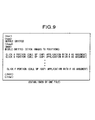
- FIG. 9 is a view illustrating the HTML (HyperText markup Language) comprising the screen illustrated in FIG. 7. Namely, FIG. 9 is a view of an example of HTML for controlling the projector of FIG. 4 on the screen illustrated in FIG. 7.
- HTML HyperText markup Language
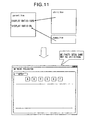
- FIG. 10 and FIG. 11 are views showing the relationship of the Web page "child.htm” and a higher Web page “parent.htm” containing "child.htm” as the link destination.
- the browser screen shown in FIG. 7 is a screen displaying switches from A to F like the operation part of a remote controller.
- the first embodiment of the present invention assumes a case where, when clicking any of icons from A to F from the top of the browser (FIG. 8, step 11), a command allocated to each is generated (FIG. 8, step 12, step 13), and the apparatus (projector of FIG. 4) is controlled (FIG. 8, step 14).
- FIG. 7 An example of the preparation of the HTML (HyperText Markup Language) comprising the screen illustrated in FIG. 7, that is, the HTML for controlling the projector of FIG. 4 on the screen illustrated in FIG. 7 will be described by referring to FIG. 9.
- HTML HyperText Markup Language
- HTML Preparation Routine 1 As the HTML describing the HTML (HyperText Markup Language) comprising the screen illustrated in FIG. 7, an HTML describing the link position for the arrangement of images etc. by a technique similar to the past is prepared.
- HTML HyperText Markup Language
- the mechanism transfers the data to the server application by using the ISAPI.
- the CGI in place of the ISAPI (FIG. 8, step 13).
- HTML Preparation Routine 2 In the embodiment of the present invention, next, when defining the Web page prepared by the routine 1 as "child.htm”, the higher Web page including "child.htm” as the link destination is newly prepared. If naming this higher page as “parent.htm”, a frame structure is formed inside “parent.htm”.
- This frame is structured burying "child.htm”, the dummy use Web page “dummy.htm”, and the "child.htm” prepared by routine 1.
- "dummy.htm” is a page not containing anything in terms of content.
- a frame name representing "child.htm” is named as “CHILD”
- a frame name representing "dummy.htm” is named as "DUMMY” in the frame settings in "parent.htm”.
- the frame of the frame structure may be divided either in the vertical direction or horizontal direction.
- the ratio of division is set as illustrated in FIG. 11 so that "child.htm” is 100% or * (meaning all) and "dummy.htm” is 0% or 0 (meaning nothing). Note that the system is set so there are no border lines of frames.
- FIG. 10 An example of the ratio in the case of using a frame structure is shown in FIG. 10.
- the frame structure by giving a frame comprising the screen, the layout can be freely set.
- a frame structure is used wherein the frame is divided 50% each in the lateral direction, that is, divided to right and left at the center of the screen.
- the interior of the frame shows "child.htm” on the left and shows "dummy.htm” on the left.
- HTML Preparation Routine 3 If clicking on the portion for generating a request of a command described in "child.htm", that is, the mouse (FIG. 8, step 11), the target frame is set to "DUMMY" in the portion calling up the ISAPI application (FIG. 8, step 13).
- the location displayed by the link destination can be designated as a frame designated as the target frame.
- the response message returning from the server corresponds to the link destination information.
- the response returning from the ISAPI application through the Web server re-draws only the target frame.
- the target frame "DUMMY" is the setting in the HTML preparation routine 2 and prepared so that there is no space, so it appears that no re-drawing is carried out.
- the first embodiment of the present invention solves this problem. That is, according to the first embodiment of the present invention, when there is no need to update the screen of the browser at all, it is possible to prevent the occurrence of the problem of flashing etc. without changing the settings of the server and just changing the method of programming of the HTML.
- the portion generally expressed by one HTML file is realized by preparing a plurality of files using the frame structure in the present invention.
- the case of remote control of the operation of a projector from a browser in the case of the network system explained by referring to FIG. 4 and FIG. 6, that is, using a client PC as a browser, using a projector having a built-in personal computer as the apparatus, and connecting the browser and projector by a network line, will be exemplified.
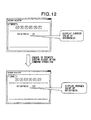
- FIG. 12 is a view of an example of the display screen of a browser of the client PC of FIG. 4 as an example of the second embodiment of the present invention.
- FIG. 12 shows an example of the screen in the case of a change in the screen before and after the re-drawing.
- FIG. 13 is a flow chart showing the operation and the flow of the processing of the second embodiment of the present invention.
- FIG. 14 is a view illustrating a method of dividing the frame of the screen of the browser in the second embodiment of the present invention.
- FIG. 15 is a view illustrating the positional relationship of frames of the Web page in the second embodiment.
- the browser screen shows the value of brightness of the setting information of the apparatus (FIG. 4, projector) as 99.
- a status value 100 of brightness is returned by the response after the server in the projector performs that command processing. Below, the explanation will be made taking the example where 100 is displayed as the value of brightness on the browser screen after the re-drawing.
- Processing 1 First, the user selects the region changing before and after the response for the desired browser screen. In this case, the portion of "Brightness: 100" at the center of the screen illustrated in FIG. 12 is selected considering also a case where also the displayed word "Brightness” changes.
- the HTML file is described by dividing one browser screen to five parts so as to cut out the portion divided by operation 1 and surround the same by a peripheral portion. That is, as shown in FIG. 14, originally one Web page is divided into five Web pages so as to surround the changing portion. At this time, the page of the uppermost portion of each is defined as “top.htm”, the lowermost portion is defined as “bottom.htm”, the right portion is defined as “right.htm”, the left portion is defined as “left.htm”, and the portion where the change occurs is defined as "center.htm”.
- Processing 3 The page forming the higher page among the five Web pages divided in processing 2 is prepared. As illustrated in FIG. 15, the five pages are combined to form the frame structure to give the original single page. That is, if defining the page indicating the higher frame as "parent.htm", the "parent.htm” is programmed for division of the frame into five pages. The five pages are linked so as to correspond to the divided frames and make the five pages appear to be a single page. At this time, the frame corresponding to the portion where there is a change on the screen is named as "CENTER". Note that it is desirable to set the system so that the border lines of the five frames are not displayed.
- Processing 6 The server in the projector returns the response to the browser (client PC (FIG. 13, step 25).
- Processing 7 The browser receives the response and draws the result thereof (FIG. 13, step 26). From the above processing, the only re-drawing due to the response from the server in the browser becomes the "CENTER" portion having motion.
- Processing 8 The above processing is repeated according to need (FIG. 13, step 27).
- applying the second embodiment of the present invention can similarly reduce the visual obstacle of the flashing.
- the visual obstacle can also be reduced by the amount of the smaller re-drawing region in comparison with the case where the whole screen is re-drawn.
- the flashing is a problem where the time difference of the drawing order of the background color and the surface color is sensed and appears like flashing, but in the present embodiment, the colors of the background color and the surface color are standardized for the portion to be re-drawn as well. This is very effective so long as the displayed object (color and size of the text etc.) does not change much.
- the example where the server function was provided inside the apparatus was explained, but in such a case, it is possible to control a plurality of apparatuses, for example, a plurality of projectors of FIG. 4 by one server. In such a case, a plurality of apparatuses can be controlled by one server and, in addition, an improvement of the response with respect to these requests can be achieved.
- the projector illustrated in FIG. 4 was exemplified as the apparatus to be controlled, but the apparatus to be controlled in the present invention is not limited to a projector.
- the apparatus to be controlled air-conditioners, television receivers, and various other apparatuses including built-in computers can be mentioned.
- HTML was used as the language for programming the Web page, but the language is not limited to the HTML and can be any programming language of a Web page such as XML (Extensible Markup Language) expanding the functions of HTML by making the structure of the document a document type definition file called a DTD (Document Type Definition).
- the communication protocol is not limited to HTTP. The present invention can be widely applied to any communication protocol used on the Internet.
- the apparatus to be controlled can cover all apparatuses connected to a network. That is, if there is a home server or the like, the present invention can be applied to the case where all household electrical appliances to be controlled by the home server are controlled.
- the problem that, when there is no change in the screen due to a response and when transmitting a request to a server installed in an apparatus to be controlled by using a browser at the client side, if the screen is comprised by the prior art, the re-drawing of the screen by the response covers the entire browser screen and the screen appears to flash creating a visual obstacle is overcome.
- the problem of flashing can be eliminated without changing the setting of the server and just changing the method of programming of the HTML.
- the visual obstacle of flashing when there is a change in the screen due to a response, the visual obstacle of flashing can be reduced.
- the visual obstacle can be reduced by the amount of the smaller re-drawing region in comparison with when the screen as a whole in the browser is re-drawn.
- the colors of the background color and the surface color for the portion to be re-drawn as well are standardized. This is very effective so far as the displayed object (color and size of text etc.) does not change much.
- the response becomes faster at the portion where re-drawing is not necessary and the operability in control of the apparatus is improved. Further, by eliminating or reducing the update range, since the non-cached portion or information changes each time, the amount of the received information in the case of a setting not enabling caching can be reduced and in turn the response can be improved and the operability improved.
- the present invention enables remote control of various types of apparatuses having server functions through a network (communication network).
Landscapes
- Engineering & Computer Science (AREA)
- Theoretical Computer Science (AREA)
- Physics & Mathematics (AREA)
- General Engineering & Computer Science (AREA)
- General Physics & Mathematics (AREA)
- Human Computer Interaction (AREA)
- Computer Hardware Design (AREA)
- Information Transfer Between Computers (AREA)
- User Interface Of Digital Computer (AREA)
- Computer And Data Communications (AREA)
Abstract
Description
Claims (27)
- A method for control of an apparatus which controls the operation of an apparatus based on a request from a browser and/or responds to the browser from a server relating to the state of the apparatus through a network using a predetermined communication protocol,
said method for control of an apparatus including:having said server prepare by a frame structure a higher page forming a burial origin for a page of a desired layout to be displayed by the above browser programmed by a programming language of a Web page,having said server set a dummy frame of a region zero not containing content in the prepared frame,having said server set a desired page having a means for controlling said apparatus and/or making a request relating to the state of the apparatus to be displayed in a remaining region other than the dummy frame,having said server set a response frame for responding to a request from said browser and updating the frame in said dummy frame, andhaving said browser display processing results based on a response from said server to a request from said browser according to the setting in the server and not appear to update the inside of the frame. - A method for control of an apparatus as set forth in claim 1, characterized in that said predetermined protocol comprises the HTTP (Hypertext Transfer Protocol) and the programming language on the Web page comprises the HTML (Hypertext Markup Language).
- A method for control of an apparatus as set forth in claim 1, characterized in that said server sets the frame prepared including the dummy frame so that the border lines of the frame are not displayed.
- A method for control of an apparatus as set forth in claim 1, characterized in that said apparatus carries said server and is controlled based on a command generated in said server due to a request from said browser.
- A method for control of an apparatus as set forth in claim 4, characterized in that said apparatus comprises a projector and in that said browser is realized by a client computer.
- A system for control of an apparatus comprising a server which controls the operation of an apparatus based on a request from a browser and/or responds to the browser from a server relating to the state of the apparatus through a network using a predetermined communication protocol,
said system for control of an apparatus comprising:having said server prepare by a frame structure a higher page forming a burial origin for a page of a desired layout to be displayed by the above browser programmed by a programming language of a Web page,having said server set a dummy frame of a region zero not containing content in the prepared frame,having said server set a desired page having a means for controlling said apparatus and/or making a request relating to the state of the apparatus to be displayed in a remaining region other than the dummy frame,having said server set a response frame for responding to a request from said browser and updating the frame in said dummy frame, andhaving said browser display processing results based on a response from said server to a request from said browser according to the setting in the server and not appear to update the inside of the frame. - A system for control of an apparatus as set forth in claim 6, characterized in that said predetermined communication protocol comprises the HTTP (Hypertext Transfer Protocol) and the programming language on the Web page comprises the HTML (Hypertext Markup Language).
- A system for control of an apparatus as set forth in claim 6, characterized in that said server sets the frame prepared including the dummy frame so that the border lines of the frame are not displayed.
- A system for control of an apparatus as set forth in claim 6, characterized in that said server is carried in said apparatus and controls said apparatus based on a command generated in said server due to a request from said browser.
- An electronic apparatus provided with a server which responds to the browser based on a request from a browser through a network using a predetermined protocol and a control means for controlling the inside based on a command generated in said server by a request from said browser,
said electronic apparatus characterized in that:said server prepares by a frame structure a higher page forming a burial origin for a page of a desired layout to be displayed by the above browser programmed by a programming language of a Web page,said server sets a dummy frame of a region zero not containing content in the prepared frame,said server sets a desired page having a means for making a request for control of the inside to be displayed in a remaining region other than the dummy frame,said server sets a response frame for responding to a request from said browser and updating the frame in said dummy frame, andsaid browser displays processing results based on a response from said server to a request from said browser according to the setting in the server and does not appear to update the inside of the frame. - An electronic apparatus as set forth in claim 10, characterized in that said predetermined communication protocol comprises the HTTP (Hypertext Transfer Protocol) and the programming language on the Web page comprises the HTML (Hypertext Markup Language).
- An electronic apparatus as set forth in claim 10, characterized in that said server sets the frame prepared including the dummy frame so that the border lines of the frame are not displayed.
- A method for control of an apparatus which controls the operation of an apparatus based on a request from a browser and/or responds to the browser from a server relating to the state of the apparatus through a network using a predetermined communication protocol,
said method for control of an apparatus comprises:having said server divide by a frame structure a higher page forming a burial origin for a page of a desired layout to be displayed by the above browser programmed by a programming language of a Web page so as to surround only a variable page requiring a change of the content of the display based on a response to said server,having said server set a background color of said variable page to be standardized with the surface color,having said server set a response frame for responding to a request from said browser and updating the frame in said variable frame, andhaving said browser display processing results based on a response from said server according to the setting in the server and thereby change only the frame including said variable page in said frame and not change other frames. - A method for control of an apparatus as set forth in claim 13, characterized in that said predetermined communication protocol comprises the HTTP (Hypertext Transfer Protocol) and the programming language on the Web page comprises the HTML (Hypertext Markup Language).
- A method for control of an apparatus as set forth in claim 13, characterized in that said server is set so that the border lines of the divided frame are not displayed.
- A method for control of an apparatus as set forth in claim 13, characterized in that said apparatus carries said server and is controlled based on a command generated in said server due to a request from said browser.
- A system for control of an apparatus comprised of a server which controls the operation of an apparatus based on a request from a browser and/or responds to the browser from a server relating to the state of the apparatus through a network using a predetermined communication protocol,
said system for control of an apparatus including:having said server divide by a frame structure a higher page forming a burial origin for a page of a desired layout to be displayed by the above browser programmed by a programming language of a Web page so as to surround only a variable page requiring a change of the content of the display based on a response to said server,having said server set a background color of said variable page to be standardized with the surface color,having said server set a response frame for responding to a request from said browser and updating the frame in said variable frame, andhaving said browser display processing results based on a response from said server according to the setting in the server and thereby change only the frame including said variable page in said frame and not change other frames. - A system for control of an apparatus as set forth in claim 17, characterized in that said predetermined communication protocol comprises the HTTP (Hypertext Transfer Protocol) and the programming language on the Web page comprises the HTML (Hypertext Markup Language).
- A system for control of an apparatus as set forth in claim 17, characterized in that said server is set so that the border lines of the divided frame are not displayed.
- A method for control of an apparatus as set forth in claim 17, characterized in that said server is carried in said apparatus and controls said apparatus based on a command generated in said server due to a request from said browser.
- An electronic apparatus provided with a server which responds to the browser based on a request from a browser through a network using a predetermined communication protocol and control means for controlling the inside based on a command produced in said server due to a request from said browser,
said electronic apparatus characterized in that:said server divides by a frame structure a higher page forming a burial origin for a page of a desired layout to be displayed by the above browser programmed by a programming language of a Web page so as to surround only a variable page requiring a change of the content of the display based on a response to said server,said server sets a background color of said variable page to be standardized with the surface color,said server sets a response frame for responding to a request from said browser and updating the frame in said variable frame, andsaid browser displays processing results based on a response from said server according to the setting in the server and thereby changes only the frame including said variable page in said frame and not change other frames. - An electronic apparatus as set forth in claim 21, characterized in that said predetermined communication protocol is the HTTP (Hypertext Transfer Protocol) and the programming language on the Web page is the HTML (Hypertext Markup Language).
- An electronic apparatus as set forth in claim 21, characterized in that said server is set so that the border lines of the divided frame are not displayed.
- A method for control of an apparatus which controls an apparatus using a server which controls the operation of an apparatus based on an instruction from a browser displayed on a display screen and/or reports to the browser relating to the state of the apparatus through a network using a predetermined communication protocol,
said method for control of an apparatus including the following steps:having said server prepare by a frame structure a higher page forming a burial origin for a page of a desired layout of said browser programmed by a predetermined programming language,having said server set a dummy frame page of a region zero not containing content in the frame,having said server set a desired page having a means for generating a control request of said apparatus to be displayed in a remaining region other than the dummy frame page,having said server set a frame line so as not to be displayed,having said server set a response frame for responding to said request from said browser and updating the frame in said dummy frame, andhaving said browser display processing results from said server generated based on instructions from said browser corresponding to said request. - A system for control of an apparatus in which a browser and server are connected through a network, said server is carried in an apparatus controlled by an instruction from said browser, and the operation of the apparatus in which the server is carried is controlled based on an instruction from the browser displayed on a display screen and/or a report made to said browser relating to a state of said apparatus between said browser and said server through a network using a predetermined communication protocol,
said system for control of an apparatus characterized in that
said server (a) prepares by a frame structure a higher page forming a burial origin for a page of a desired layout of said browser programmed by a predetermined programming language, (b) sets a dummy frame page of a region zero not containing content in the frame, (c) sets a desired page having a means for generating a control request of said apparatus to be displayed in a remaining region other than the dummy frame page, (d) sets a frame line so as not to be displayed, and (e) sets a response frame for responding to said request from said browser and updating the frame in said dummy frame, and
said browser displays processing results from said server generated based on instructions from said browser corresponding to said request. - A method for control of an apparatus which controls an apparatus using a server, carried in said apparatus, which controls the operation of an apparatus based on an instruction from a browser displayed on a display screen and/or reports to the browser relating to the state of the apparatus through a network using a predetermined communication protocol,
said method for control of an apparatus including following steps:having said server divide by a frame structure a page of a desired layout programmed by a predetermined programming language so as to surround only a portion requiring updating in said server,having said server set a frame line so as not to be displayed,having said server set frame positions and files of a predetermined text language displayed by the frames to give a desired layout,having said server standardize the background color of the page in a frame requiring updating of the display due to a response with a surface most color,having said server set a response frame for responding to a request from said browser and updating a frame only for frames requiring re-drawing due to a response, andhaving said browser display processing results from said server generated based on instructions from said browser corresponding to said request. - A system for control of an apparatus which controls an apparatus using a server, carried in said apparatus, which controls the operation of an apparatus based on an instruction from a browser displayed on a display screen and/or reports to the browser relating to the state of the apparatus through a network using a predetermined communication protocol,
said system for control of an apparatus characterized in that:said server (a) divides by a frame structure a page of a desired layout programmed by a predetermined programming language so as to surround only a portion requiring updating in said server, (b) sets a frame line so as not to be displayed, (c) sets frame positions and files of a predetermined text language displayed by the frames to give a desired layout, (d) standardizes the background color of the page in a frame requiring updating of the display due to a response with a surface most color, and (e) sets a response frame for responding to a request from said browser and updating a frame only for frames requiring re-drawing due to a response andsaid browser displays processing results from said server generated based on instructions from said browser corresponding to said request.
Applications Claiming Priority (3)
| Application Number | Priority Date | Filing Date | Title |
|---|---|---|---|
| JP2000315831A JP2002123488A (en) | 2000-10-16 | 2000-10-16 | Device control method and device |
| JP2000315831 | 2000-10-16 | ||
| PCT/JP2001/009079 WO2002033559A1 (en) | 2000-10-16 | 2001-10-16 | Apparatus control method and device |
Publications (3)
| Publication Number | Publication Date |
|---|---|
| EP1331573A1 true EP1331573A1 (en) | 2003-07-30 |
| EP1331573A4 EP1331573A4 (en) | 2006-05-03 |
| EP1331573B1 EP1331573B1 (en) | 2007-09-12 |
Family
ID=18794872
Family Applications (1)
| Application Number | Title | Priority Date | Filing Date |
|---|---|---|---|
| EP01974881A Expired - Lifetime EP1331573B1 (en) | 2000-10-16 | 2001-10-16 | Apparatus control method and device |
Country Status (6)
| Country | Link |
|---|---|
| US (1) | US7568159B2 (en) |
| EP (1) | EP1331573B1 (en) |
| JP (1) | JP2002123488A (en) |
| KR (1) | KR100843825B1 (en) |
| DE (1) | DE60130478T2 (en) |
| WO (1) | WO2002033559A1 (en) |
Families Citing this family (12)
| Publication number | Priority date | Publication date | Assignee | Title |
|---|---|---|---|---|
| CN100565327C (en) * | 2000-05-31 | 2009-12-02 | 精工爱普生株式会社 | Projector and its control method |
| WO2004110050A2 (en) * | 2003-06-02 | 2004-12-16 | Infocus Corporation | Image capture method, system and apparatus |
| US7464110B2 (en) * | 2004-06-30 | 2008-12-09 | Nokia Corporation | Automated grouping of image and other user data |
| US20060004834A1 (en) * | 2004-06-30 | 2006-01-05 | Nokia Corporation | Dynamic shortcuts |
| US7773552B2 (en) * | 2005-03-09 | 2010-08-10 | Yokogawa Electric Corporation | Mobile communication system and mobile communication method |
| WO2006120738A1 (en) * | 2005-05-11 | 2006-11-16 | Visionarts, Inc. | Menu bar providing method and information read screen configuration file creation program |
| US20080115064A1 (en) * | 2006-11-15 | 2008-05-15 | Roach William V | Systems, methods, and computer-readable media related to presentation software |
| USD709081S1 (en) * | 2012-06-04 | 2014-07-15 | Microsoft Corporation | Display screen with graphical user interface |
| USD709907S1 (en) * | 2012-06-04 | 2014-07-29 | Microsoft Corporation | Display screen with graphical user interface |
| JP6207165B2 (en) * | 2013-02-06 | 2017-10-04 | キヤノン株式会社 | Communication apparatus, control method, and program |
| CN103533317B (en) * | 2013-10-11 | 2016-06-22 | 中影数字巨幕(北京)有限公司 | Digital film projector system and method |
| CN105223823A (en) * | 2015-09-24 | 2016-01-06 | 广东瑞德智能科技股份有限公司 | A kind of simple home appliance describing method |
Family Cites Families (22)
| Publication number | Priority date | Publication date | Assignee | Title |
|---|---|---|---|---|
| US4070710A (en) * | 1976-01-19 | 1978-01-24 | Nugraphics, Inc. | Raster scan display apparatus for dynamically viewing image elements stored in a random access memory array |
| EP0312720A3 (en) * | 1987-10-20 | 1990-06-13 | Tektronix Inc. | Double buffered graphics design system |
| US5010401A (en) * | 1988-08-11 | 1991-04-23 | Mitsubishi Denki Kabushiki Kaisha | Picture coding and decoding apparatus using vector quantization |
| US5283864A (en) * | 1990-10-30 | 1994-02-01 | Wang Laboratories, Inc. | Computer apparatus and method for graphical flip book |
| US5430458A (en) * | 1991-09-06 | 1995-07-04 | Plasmaco, Inc. | System and method for eliminating flicker in displays addressed at low frame rates |
| US5426445A (en) * | 1994-02-24 | 1995-06-20 | Hewlett-Packard Company | Synchronous clear for CRT memory buffer |
| JP3428192B2 (en) * | 1994-12-27 | 2003-07-22 | 富士通株式会社 | Window display processing device |
| JPH08272344A (en) * | 1995-03-29 | 1996-10-18 | Hitachi Ltd | High speed screen display device and method |
| US6008836A (en) * | 1996-06-03 | 1999-12-28 | Webtv Networks, Inc. | Method and apparatus for adjusting television display control using a browser |
| US5822599A (en) * | 1996-12-17 | 1998-10-13 | Intel Corporation | Method and apparatus for selectively activating a computer display for power management |
| US6523022B1 (en) * | 1997-06-09 | 2003-02-18 | Allen Hobbs | Method and apparatus for selectively augmenting retrieved information from a network resource |
| JP3586369B2 (en) * | 1998-03-20 | 2004-11-10 | インターナショナル・ビジネス・マシーンズ・コーポレーション | Method and computer for reducing video clock frequency |
| JP3159174B2 (en) * | 1998-06-19 | 2001-04-23 | 日本電気株式会社 | Printer control device |
| JP2000207092A (en) * | 1999-01-19 | 2000-07-28 | Internatl Business Mach Corp <Ibm> | Method and device for preventing misoperation and storage medium with software product for misoperation prevention stored therein |
| JP2000259536A (en) * | 1999-03-10 | 2000-09-22 | Yaskawa Electric Corp | Control device data monitoring / setting method and device |
| US6369830B1 (en) * | 1999-05-10 | 2002-04-09 | Apple Computer, Inc. | Rendering translucent layers in a display system |
| US7020845B1 (en) * | 1999-11-15 | 2006-03-28 | Gottfurcht Elliot A | Navigating internet content on a television using a simplified interface and a remote control |
| US6735616B1 (en) * | 2000-06-07 | 2004-05-11 | Infocus Corporation | Method and apparatus for remote projector administration and control |
| US6734873B1 (en) * | 2000-07-21 | 2004-05-11 | Viewpoint Corporation | Method and system for displaying a composited image |
| US6961029B1 (en) * | 2000-11-08 | 2005-11-01 | Palm, Inc. | Pixel border for improved viewability of a display device |
| WO2007140322A2 (en) * | 2006-05-25 | 2007-12-06 | Quvis, Inc. | System for real-time processing changes between video content in disparate formats |
| TW200808064A (en) * | 2006-07-19 | 2008-02-01 | Benq Corp | Image data refreshing method and display system using the same |
-
2000
- 2000-10-16 JP JP2000315831A patent/JP2002123488A/en not_active Abandoned
-
2001
- 2001-10-16 WO PCT/JP2001/009079 patent/WO2002033559A1/en not_active Ceased
- 2001-10-16 US US10/149,870 patent/US7568159B2/en not_active Expired - Fee Related
- 2001-10-16 EP EP01974881A patent/EP1331573B1/en not_active Expired - Lifetime
- 2001-10-16 DE DE60130478T patent/DE60130478T2/en not_active Expired - Fee Related
- 2001-10-16 KR KR1020027007694A patent/KR100843825B1/en not_active Expired - Fee Related
Also Published As
| Publication number | Publication date |
|---|---|
| WO2002033559A1 (en) | 2002-04-25 |
| US20030093469A1 (en) | 2003-05-15 |
| DE60130478D1 (en) | 2007-10-25 |
| KR100843825B1 (en) | 2008-07-03 |
| EP1331573B1 (en) | 2007-09-12 |
| EP1331573A4 (en) | 2006-05-03 |
| JP2002123488A (en) | 2002-04-26 |
| US7568159B2 (en) | 2009-07-28 |
| KR20020063232A (en) | 2002-08-01 |
| DE60130478T2 (en) | 2008-06-12 |
Similar Documents
| Publication | Publication Date | Title |
|---|---|---|
| EP1927234B1 (en) | Apparatus and method for providing remote user interface | |
| US6978418B1 (en) | Dynamic-adaptive client-side image map | |
| US20060179118A1 (en) | Platform-specific application user interface remoting | |
| AU711869B2 (en) | System for transmission of embedded applications over a network | |
| US6121970A (en) | Method and system for HTML-driven interactive image client | |
| US7075536B1 (en) | Incremental plotting of network topologies and other graphs through use of markup language | |
| US6348936B1 (en) | Method and apparatus for graphical selection of data | |
| AU777335B2 (en) | Using one device to configure and emulate web site content to be displayed on another device | |
| CN103460670B (en) | Method and system for conducting a remote desktop session using an HTTP handler and a remote desktop client common interface | |
| US7568159B2 (en) | Apparatus control method and system | |
| US20110258563A1 (en) | Automatic Screen Zoom Level | |
| US20020174209A1 (en) | Device configuration in a distributed environment | |
| US20050223100A1 (en) | Rendering a first media type content on a browser | |
| EP2530947A2 (en) | Apparatus and method for performing web browsing using remote controller | |
| KR20040089600A (en) | Interacting with software applications displayed in a web page | |
| JPH0922339A (en) | Remote control device | |
| US7251774B2 (en) | System for describing markup language for mobile use, and information processing apparatus and program for generating display content | |
| JP2002502521A (en) | System and method for managing a connection between a server and a client node | |
| KR20030095868A (en) | Web-contents display apparatus and method in mobile communication terminal such as pda | |
| US6665090B1 (en) | System and method for creating and printing a creative expression | |
| JPH10254732A (en) | Monitoring system | |
| KR20130070599A (en) | So-called hd-web method for high-definition and all-screen compatible internet contents | |
| US11343583B2 (en) | Method for displaying GUI for providing menu items and display device | |
| CN118233683A (en) | A display device and a display method for application | |
| JP2008112339A (en) | Relay device and relay method |
Legal Events
| Date | Code | Title | Description |
|---|---|---|---|
| PUAI | Public reference made under article 153(3) epc to a published international application that has entered the european phase |
Free format text: ORIGINAL CODE: 0009012 |
|
| 17P | Request for examination filed |
Effective date: 20020617 |
|
| AK | Designated contracting states |
Designated state(s): AT BE CH CY DE DK ES FI FR GB GR IE IT LI LU MC NL PT SE TR |
|
| RBV | Designated contracting states (corrected) |
Designated state(s): DE FR GB |
|
| A4 | Supplementary search report drawn up and despatched |
Effective date: 20060320 |
|
| RIC1 | Information provided on ipc code assigned before grant |
Ipc: G06F 3/14 20060101ALI20020429BHEP Ipc: G06F 13/00 20060101ALI20020429BHEP Ipc: G06F 17/30 20060101AFI20060315BHEP |
|
| GRAP | Despatch of communication of intention to grant a patent |
Free format text: ORIGINAL CODE: EPIDOSNIGR1 |
|
| GRAS | Grant fee paid |
Free format text: ORIGINAL CODE: EPIDOSNIGR3 |
|
| GRAA | (expected) grant |
Free format text: ORIGINAL CODE: 0009210 |
|
| AK | Designated contracting states |
Kind code of ref document: B1 Designated state(s): DE FR GB |
|
| REG | Reference to a national code |
Ref country code: GB Ref legal event code: FG4D |
|
| REF | Corresponds to: |
Ref document number: 60130478 Country of ref document: DE Date of ref document: 20071025 Kind code of ref document: P |
|
| ET | Fr: translation filed | ||
| PLBE | No opposition filed within time limit |
Free format text: ORIGINAL CODE: 0009261 |
|
| STAA | Information on the status of an ep patent application or granted ep patent |
Free format text: STATUS: NO OPPOSITION FILED WITHIN TIME LIMIT |
|
| 26N | No opposition filed |
Effective date: 20080613 |
|
| PGFP | Annual fee paid to national office [announced via postgrant information from national office to epo] |
Ref country code: DE Payment date: 20081014 Year of fee payment: 8 |
|
| PGFP | Annual fee paid to national office [announced via postgrant information from national office to epo] |
Ref country code: FR Payment date: 20081014 Year of fee payment: 8 |
|
| PGFP | Annual fee paid to national office [announced via postgrant information from national office to epo] |
Ref country code: GB Payment date: 20081015 Year of fee payment: 8 |
|
| REG | Reference to a national code |
Ref country code: FR Ref legal event code: ST Effective date: 20100630 |
|
| PG25 | Lapsed in a contracting state [announced via postgrant information from national office to epo] |
Ref country code: FR Free format text: LAPSE BECAUSE OF NON-PAYMENT OF DUE FEES Effective date: 20091102 Ref country code: DE Free format text: LAPSE BECAUSE OF NON-PAYMENT OF DUE FEES Effective date: 20100501 |
|
| PG25 | Lapsed in a contracting state [announced via postgrant information from national office to epo] |
Ref country code: GB Free format text: LAPSE BECAUSE OF NON-PAYMENT OF DUE FEES Effective date: 20091016 |