EP1331255A1 - Water-based coating composition - Google Patents
Water-based coating composition Download PDFInfo
- Publication number
- EP1331255A1 EP1331255A1 EP01972660A EP01972660A EP1331255A1 EP 1331255 A1 EP1331255 A1 EP 1331255A1 EP 01972660 A EP01972660 A EP 01972660A EP 01972660 A EP01972660 A EP 01972660A EP 1331255 A1 EP1331255 A1 EP 1331255A1
- Authority
- EP
- European Patent Office
- Prior art keywords
- coating composition
- group
- compound
- water
- based coating
- Prior art date
- Legal status (The legal status is an assumption and is not a legal conclusion. Google has not performed a legal analysis and makes no representation as to the accuracy of the status listed.)
- Withdrawn
Links
Classifications
-
- C—CHEMISTRY; METALLURGY
- C09—DYES; PAINTS; POLISHES; NATURAL RESINS; ADHESIVES; COMPOSITIONS NOT OTHERWISE PROVIDED FOR; APPLICATIONS OF MATERIALS NOT OTHERWISE PROVIDED FOR
- C09D—COATING COMPOSITIONS, e.g. PAINTS, VARNISHES OR LACQUERS; FILLING PASTES; CHEMICAL PAINT OR INK REMOVERS; INKS; CORRECTING FLUIDS; WOODSTAINS; PASTES OR SOLIDS FOR COLOURING OR PRINTING; USE OF MATERIALS THEREFOR
- C09D155/00—Coating compositions based on homopolymers or copolymers, obtained by polymerisation reactions only involving carbon-to-carbon unsaturated bonds, not provided for in groups C09D123/00 - C09D153/00
- C09D155/005—Homopolymers or copolymers obtained by polymerisation of macromolecular compounds terminated by a carbon-to-carbon double bond
-
- C—CHEMISTRY; METALLURGY
- C08—ORGANIC MACROMOLECULAR COMPOUNDS; THEIR PREPARATION OR CHEMICAL WORKING-UP; COMPOSITIONS BASED THEREON
- C08F—MACROMOLECULAR COMPOUNDS OBTAINED BY REACTIONS ONLY INVOLVING CARBON-TO-CARBON UNSATURATED BONDS
- C08F290/00—Macromolecular compounds obtained by polymerising monomers on to polymers modified by introduction of aliphatic unsaturated end or side groups
- C08F290/02—Macromolecular compounds obtained by polymerising monomers on to polymers modified by introduction of aliphatic unsaturated end or side groups on to polymers modified by introduction of unsaturated end groups
- C08F290/04—Polymers provided for in subclasses C08C or C08F
-
- C—CHEMISTRY; METALLURGY
- C08—ORGANIC MACROMOLECULAR COMPOUNDS; THEIR PREPARATION OR CHEMICAL WORKING-UP; COMPOSITIONS BASED THEREON
- C08F—MACROMOLECULAR COMPOUNDS OBTAINED BY REACTIONS ONLY INVOLVING CARBON-TO-CARBON UNSATURATED BONDS
- C08F290/00—Macromolecular compounds obtained by polymerising monomers on to polymers modified by introduction of aliphatic unsaturated end or side groups
- C08F290/02—Macromolecular compounds obtained by polymerising monomers on to polymers modified by introduction of aliphatic unsaturated end or side groups on to polymers modified by introduction of unsaturated end groups
- C08F290/04—Polymers provided for in subclasses C08C or C08F
- C08F290/046—Polymers of unsaturated carboxylic acids or derivatives thereof
-
- C—CHEMISTRY; METALLURGY
- C08—ORGANIC MACROMOLECULAR COMPOUNDS; THEIR PREPARATION OR CHEMICAL WORKING-UP; COMPOSITIONS BASED THEREON
- C08F—MACROMOLECULAR COMPOUNDS OBTAINED BY REACTIONS ONLY INVOLVING CARBON-TO-CARBON UNSATURATED BONDS
- C08F293/00—Macromolecular compounds obtained by polymerisation on to a macromolecule having groups capable of inducing the formation of new polymer chains bound exclusively at one or both ends of the starting macromolecule
- C08F293/005—Macromolecular compounds obtained by polymerisation on to a macromolecule having groups capable of inducing the formation of new polymer chains bound exclusively at one or both ends of the starting macromolecule using free radical "living" or "controlled" polymerisation, e.g. using a complexing agent
-
- C—CHEMISTRY; METALLURGY
- C09—DYES; PAINTS; POLISHES; NATURAL RESINS; ADHESIVES; COMPOSITIONS NOT OTHERWISE PROVIDED FOR; APPLICATIONS OF MATERIALS NOT OTHERWISE PROVIDED FOR
- C09D—COATING COMPOSITIONS, e.g. PAINTS, VARNISHES OR LACQUERS; FILLING PASTES; CHEMICAL PAINT OR INK REMOVERS; INKS; CORRECTING FLUIDS; WOODSTAINS; PASTES OR SOLIDS FOR COLOURING OR PRINTING; USE OF MATERIALS THEREFOR
- C09D153/00—Coating compositions based on block copolymers containing at least one sequence of a polymer obtained by reactions only involving carbon-to-carbon unsaturated bonds; Coating compositions based on derivatives of such polymers
-
- C—CHEMISTRY; METALLURGY
- C09—DYES; PAINTS; POLISHES; NATURAL RESINS; ADHESIVES; COMPOSITIONS NOT OTHERWISE PROVIDED FOR; APPLICATIONS OF MATERIALS NOT OTHERWISE PROVIDED FOR
- C09D—COATING COMPOSITIONS, e.g. PAINTS, VARNISHES OR LACQUERS; FILLING PASTES; CHEMICAL PAINT OR INK REMOVERS; INKS; CORRECTING FLUIDS; WOODSTAINS; PASTES OR SOLIDS FOR COLOURING OR PRINTING; USE OF MATERIALS THEREFOR
- C09D153/00—Coating compositions based on block copolymers containing at least one sequence of a polymer obtained by reactions only involving carbon-to-carbon unsaturated bonds; Coating compositions based on derivatives of such polymers
- C09D153/02—Vinyl aromatic monomers and conjugated dienes
Definitions
- the present invention relates to a water based coating composition which is capable of having a low VOC (Volatile Organic Compounds) content and is capable of forming a coating film showing good properties in appearance, weather resistance, and which is useful, for example, in coating of an automobile body.
- VOC Volatile Organic Compounds
- a low VOC coating composition proposed in the art may include a powder coating composition, a powder slurry coating composition prepared by dispersing powder coating composition particles having a particle size of 1 to 10 ⁇ m into water, and a water based coating composition such as a water based emulsion coating composition, and the like.
- the powder coating composition is such that use of fine particles is effective on improvements in finishing, but may remarkably reduce a coating efficiency, resulting in making it difficult to use particles having a particle size of 5 ⁇ m or less, and that the use of the sole powder coating apparatus as the coating apparatus needs a huge plant investment.
- a water based coating composition having a particle size of 1 ⁇ m or less for example, a water based emulsion coating composition, is such that finish may be unsatisfactory, and that a water based coating apparatus in the art may be applicable, but bubbling in the coating. film may develop.
- the powder slurry coating composition has such advantages that fine particles can be used differently from the above powder coating composition, that a dense packing of particles on coating makes it possible to provide a good surface smoothness of the coating film, that the water based coating apparatus in the art can be used, and that a larger particle size compared with that in the water based coating composition makes it difficult to develop bubblings in the coating film, resulting in providing good finish.
- the powder slurry coating composition prepared by dispersing powder coating composition particles into water has such disadvantages that many preparation steps results disadvantages in economy and energy, that many disadvantages may result in safety and health, and that a method of simply obtaining a slurry type coating composition is demanded.
- the water dispersion type coating composition such as the powder slurry coating composition is such that coating is carried out by dispersing particles into water by use of a suspension stabilizer, followed by adding a thickening agent, and directly coating, resulting in that the suspension stabilizer remains in the coating film.
- Polyvinyl alcohol and polyethylene oxide as the suspension stabilizer show good properties in water dispersibility and storage stability, but show poor compatibility with the coating film component and do not included into the coating film component, resulting in producing such problems that the coating film becomes cloudy, and that coating film properties such as water resistance, acid resistance and the like are reduced.
- the present inventors made intensive studies for the purpose of solving the above problems to find out that the use of a water based coating composition prepared by a method which comprises dispersing a heat-curable coating composition into water by use of a block copolymer as a suspension stabilizer to obtain a water dispersion, followed by optionally removing an organic solvent to obtain a water dispersion having a mean particle size of 0.1 to 10 ⁇ m, wherein the block copolymer is prepared by subjecting a compound (a) represented by the following general formula (1) and a polymerizable unsaturated monomer (b) to a radical polymerization in the presence of a radical polymerization initiator to obtain a block copolymer compound (c), followed by neutralizing the compound (c), makes it possible to satisfy all of the low VOC content of the coating composition, and excellent coating film performances in acid resistance and water resistance, resulting in completing the present invention.
- the present invention provides a water based coating composition prepared by dispersing a heat-curable coating composition into water in the presence of a suspension stabilizer comprising a block copolymer to obtain a water dispersion, followed by optionally removing an organic solvent from the water dispersion to obtain a water based coating composition having a mean particle size of 0.1 to 10 ⁇ m, said block copolymer being a compound (c) prepared by subjecting a compound (a) represented by the following general formula (1): where Q and Y respectively represent H, R, O 2 CR, COOH, COOR, CONHR, CONR 2 , CN, CONH 2 , CONR, phenyl group or halogen, X represents H or R, Z represents H, SR, SOR, SOOR or R, R represents alkyl group, aryl group, aralkyl group, alkalyl group, organosilyl group or alkoxysilyl group, and can contain at least one group or atom selected from epoxy group,
- the compound (a) used in the present invention is a known compound per se, may preferably be prepared, for example, by a catalytic chain transfer polymerization method (CCTP method) and may include a compound obtained by subjecting a polymerizable unsaturated monomer to radical polymerization in the presence of an unsaturated compound disclosed in Japanese Patent Application Laid-Open Nos. 506392/95, 506393/7, 2954/95, etc.
- CCTP method catalytic chain transfer polymerization method
- the CCTP method is disclosed, for example, in Japanese Patent Publication Nos. 23209/94 and 35411/95, Japanese Patent Application Laid-Open Nos. 501457/97 and 176256/97, Macromolecules 1996, 29, 8083-8089, etc., and the compound (a) may be prepared, for example, by polymerizing a polymerizable unsaturated monomer in the presence of a metal complex as a catalytic chain transfer agent and a radical polymerization initiator by a solution polymerization in an organic solvent or by an emulsion polymerization in water according to the above descriptions.
- a metal complex as a catalytic chain transfer agent and a radical polymerization initiator
- a monomer used in the preparation of the compound (a) or the compound (c) obtained by subjecting the compound (a) and the polymerizable unsaturated monomer (b) to a radical reaction is required to have a radically polymerizable unsaturated group.
- These monomers may be used alone or in combination.
- the metal complex may include, for example, cobalt complex, iron complex, nickel complex, ruthenium complex, rhodium complex, palladium complex, rhenium complex, iridium complex and the like.
- cobalt complex is preferable as the chain transfer agent.
- the cobalt complex may include ones disclosed, for example, in Japanese Patent Publication Nos. 23209/94 and 35411/95, USP 4526945, USP 4694054, USP 4837326, USP 4886861, USP 5324879, WO95/17435 and the like, and may specifically include, for example, bis(borondifluorodimethyldioxyiminocyclohexane) Co (II), bis(1,2-dioxyiminoethane) Co (II), bis(borondifluorodimethylglyoximate) Co (II), bis(borondifluorodiphenyloximate) Co(II), cobalt (II) chelate of vicinaliminohydroxyimino compound, cobalt (II) chelate of tetraazatetraalkylcyclotetradodecatetraene, cobalt (II) chelate of N,N'-bis(salicylidene) ethylened
- radical cleavage-capable group may include, for example, alkyl group, aryl group, heterocyclic group and the like, and further may include substituted derivatives, which are homolytic fission-capable from a metal ion on irradiation of visible light or ultraviolet light, or on heating, halides, other ions, nitrile or ester bonded to the chelate metal ion respectively, aromatic group and substituted aromatic group substituted with carbon atom bonded to metal ion respectively, and the like.
- a mixing amount of the metal complex may not particularly be limited, but usually is in the range of 1 ⁇ 10 -6 to 1 (one) part by weight, preferably 1 ⁇ 10 -4 to 0.5 part by weight per 100 parts by weight of the monomer.
- the coordination compound may include, for example, a phosphorus compound such as triphenylphosphine, tributylphosphine and the like; an amine compound such as pyridine, tributylamine and the like, and the like.
- the radical polymerization initiator used in the preparation of the compound (a) and of the compound (c) according to the CCTP method may include, for example, peroxide polymerization initiators such as cyclohexanone peroxide, 3, 3, 5-trimethylcyclohexanone peroxide, methylcyclohexanone peroxide, 1,1-bis(tert-butylperoxy)-3,3,5-trimethylcyclohexane, 1,1-bis(tert-butylperoxy)cyclohexane, n-butyl-4,4-bis(tert-butylperoxy) valerate cumene hydroperoxide, 2,5-dimethylhexane-2,5-dihydroperoxide, 1,3-bis(tert-butylperoxy-m-isopropyl)benzene, 2,5-dimethyl-2,5-di(tert-butylperoxy)hexane, diisopropylbenzene peroxide,
- a mixed amount of the radical polymerization initiator may not particularly be limited, but usually is in the range of 0.1 to 20 parts by weight, preferably 0.5 to 10 parts by weight per 100 parts by weight of the monomer.
- the organic solvent used in the case where the radical polymerization is carried out in the organic solvent may include ones capable of dissolving or dispersing the monomer used in polymerization and the polymer obtained by polymerization without particular limitations, and specifically may include, for example, hydrocarbon solvent such as heptane, toluene, xylene, octane, mineral spirit and the like; ester solvent such as ethyl acetate, n-butyl acetate, isobutyl acetate, ethylene glycol monomethyl ether acetate, ethylene glycol monobutyl ether acetate and the like; ketone solvent such as methyl ethyl ketone, methyl isobutyl ketone, diisobutyl ketone, cyclohexanone and the like; alcohol solvent such as methanol, ethanol, isopropanol, n-butanol, sec-butanol, isobutanol and the like; ether solvent such
- the polymerizable unsaturated monomer used in the preparation of the compound (a) and the polymerizable unsaturated monomer (b) are a compound having at least one polymerizable unsaturated bond in one molecule respectively.
- the polymerizable unsaturated monomer may include, for example, C 1-24 alkyl or cycloalkyl (meth)acrylate such as methyl (meth)acrylate, ethyl (meth)acrylate, n-propyl (meth)acrylate, isopropyl (meth)acrylate, n-butyl (meth)acrylate, isobutyl (meth)acrylate, tert-butyl (meth)acrylate, 2-ethylhexyl (meth)acrylate, n-octyl (meth)acrylate, lauryl (meth)acrylate, tridecyl (meth)acrylate, stearyl (meth)acrylate, cyclohexyl (meth)acrylate, isobornyl (meth)acrylate, tricyclodecanyl (meth)acrylate and the like; carboxyl group-containing ethylenically unsaturated monomer such as acrylic acid, meth
- methacrylic acid, methacrylate, styrene and derivatives thereof, ⁇ -methylstyrene and derivatives thereof are particularly preferable, because the compound (a) and (c) can be obtained at high yield.
- polymerization is carried out by heating the polymerizable unsaturated monomer in the presence of the metal complex and the radical polymerization initiator in the organic solvent, wherein the following methods (1) and (2) may be carried out for the purpose of controlling a temperature increase due to heat of the polymerization reaction:
- the compound (a) may also be obtained by other known methods, for example, a method which comprises subjecting a polymerizable unsaturated monomer to a radical polymerization in the presence of an addition-cleavage type chain transfer agent.
- Japanese Patent Application Laid-Open No. 169531/00 discloses a method using 2,4-diphenyl-4-methyl-1-pentene as the addition-cleavage type chain transfer agent, which method makes it possible to obtain (a) without carrying out the steps in the CCTP method.
- the compound (a) used in the present invention is a compound is a compound having an addition-cleavage type chain transfer reactivity, and is such that a radical polymerization between the compound (a) and the polymerizable unsaturated monomer in the presence of the radical polymerization initiator makes it possible to take place a living radical polymerization reaction.to form the block copolymer as known in the art.
- the compound (a) is such that a radical polymerization of the compound (a) with a polymerizable unsaturated monomer (b-1) makes it possible to prepare an AB type diblock copolymer, and a following radical polymerization of the AB type diblock copolymer with a polymerizable unsaturated monomer (b-2) makes it possible to prepare an ABC type triblock copolymer.
- the above radical polymerization makes it possible to prepare a block copolymer having an optional molecular weight, block length and monomer composition, and makes it possible to optionally control distributions of functional groups in respective molecules of the acrylic resin.
- the block copolymer has a hydroxy value of 0 to 300 mgKOH/g, preferably 20 to 200 mgKOH/g.
- a hydroxy value more than 300 mgKOH/g of the block copolymer may reduce compatibility with the base resin, and may reduce finish of the coating film.
- hydroxyl group to the block copolymer may include, for example, C 2-8 hydroxyl alkyl ester of (meth)acrylic acid such as 2-hydroxyethyl (meth)acrylate, hydroxypropyl (meth)acrylate and the like, N-methylol acrylamide, allyl alcohol, ⁇ -caprolactone-modified acrylic monomer and the like. These may be used alone or in combination.
- the block copolymer has an acid value in the range of 1 to 300 mgKOH/g, preferably 3 to 200 mgKOH/g.
- An acid value less than 1 (one) mgKOH/g may reduce a dispersion stability of the water based coating composition.
- An acid value more than 300 mgKOH/g may reduce a compatibility of the block copolymer with the base resin, and may reduce a finish of the coating film.
- a method of imparting an acid value to the block copolymer may include the following methods (1) and (2):
- the acid group-containing monomer used in the method (1) may include, for example, (meth)acrylic acid, maleic acid, crotonic acid, itaconic acid, ⁇ -carboxyethyl acrylate, 2-acrylamide-2-methylpropane sulfonic acid, allyl sulfonic acid, sulfoethyl methacrylate and a phosphate group-containing monomer such as Light-Ester PM (trade name, marketed by Kyoeisha Chemical Co., Ltd.), and the like. These may be used alone or in combination.
- Light-Ester PM trade name, marketed by Kyoeisha Chemical Co., Ltd.
- the respective functional groups not containing the acid group in the method (2) may include any chemically reactable functional groups such as epoxy group, oxetane group, oxazoline group, hydroxyl group, amide group, organosilyl group, carbamate group, halogen and the like.
- the acid-group-containing compound may include any compounds, without particular limitations, capable of imparting an acid functional group such as carboxylic acid, phosphoric acid, sulfonic acid and the like to the block copolymer by addition to the block copolymer due to a chemical reaction with respective functional groups.
- the basic substance used as a neutralizing agent of these acids may include, for example, hydroxides of alkali metal, alkali earth metal such as sodium hydroxide, potassium hydroxide, lithium hydroxide, calcium hydroxide, barium hydroxide and the like; ammonia, a primary monoamine such as ethylamine, propylamine, butylamine, benzylamine, monoethanolamine, neopentanolamine, 2-aminopropanol and the like; a secondary monoamine such as diethylamine, diethanolamine, di-n- or di-iso-propanolamine, N-methylethanolamine, N-ethylethanolamine and the like; a tertiary monoamine such as trimethylamine, triethylamine, triisopropylamine, methyldiethanolamine, dimethylethanolamine and the like; a polyamine such as diethylenetriamine, hydroxyethylaminoethylamine, ethylaminoeth
- the block copolymer has a weight average molecular weight in the range of 500 to 50,000, particularly, 1,000 to 30,000. A molecular weight less than 500 may reduce a suspension stability. A molecular weight more than 50,000 may reduce compatibility of the block copolymer with the base resin, and a finish of the coating film may reduce.
- the block copolymer is in the range of 0.1 to 80 parts by weight, particularly 1 to 50 parts by weight per 100 parts by weight of a solid content of the film-forming component in the water based coating composition.
- An amount less than 0.1 part by weight may reduce a water dispersibility of particles.
- An amount more than 80 parts by weight may reduce a finish of coating film, acid resistance, weather resistance and the like.
- the heat-curable coating composition may include any heat-curable coating compositions known in the art without particular limitations, and specifically may include, for example, a separate type heat-curable coating composition prepared by mixing a heat-curable base resin obtained by introducing a functional group such as hydroxyl group, carboxyl group, epoxy group, unsaturated group, isocyanate group, carbamate group, alkoxysilyl group, oxetane group, oxazoline group and the like into a base resin such as acrylic resin, polyester resin, fluorocarbon resin, silicone resin, epoxy resin, amine-modified resin, phenol resin, urethane resin and the like, with a curing agent having a functional group capable of forming a crosslinked structure with the functional group introduced into the base resin, for example, a blocked isocyanate compound, polyisocyanate compound, polycarbamate compound, polyepoxide, polycarboxylic acid compound, amino resin, phenol resin, hydrazide compound, peroxides, iso
- respective functional groups and starting materials as exemplified in the base resin and curing agent may be used alone or in combination respectively.
- a solvent to be contained in the heat-curable coating composition or the block copolymer of the present invention may not particularly be limited, but preferably include ones having a boiling point of 160°C or lower, or capable of forming an azeotropic mixture with water so as to make desolution easy, for example, an aromatic solvent such as toluene, xylene and the like; alcohol solvent such as n-propyl alcohol, isopropyl alcohol, n-butanol, isobutanol, t-butanol and the like; ketone solvent such as methyl ethyl ketone, methyl isobutyl ketone and the like; ester solvent such as ethyl acetate, butyl acetate and the like.
- an aromatic solvent such as toluene, xylene and the like
- alcohol solvent such as n-propyl alcohol, isopropyl alcohol, n-butanol, isobutanol, t-butanol
- the heat-curable coating composition may optionally contain a color pigment, extender pigment, anti-corrosive pigment, surface controlling agent, viscosity controlling agent, curing promotor, ultraviolet light absorber, ultraviolet light stabilizer, bubbling inhibitor, and the like.
- a method of preparing a water dispersion by dispersing the heat-curable coating composition into water in the presence of the suspension stabilizer comprising the block copolymer may include a method which comprises dissolving the suspension stabilizer into water to form an aqueous solution, followed by adding the heat-curable coating composition to be dispersed, and a method which comprises mixing the heat-curable coating composition with the suspension stabilizer, followed by adding water to be dispersed.
- a concentration of the heat-curable coating composition may be in the range of 20 to 100% by weight.
- a viscosity of a suspension may be controlled by controlling a concentration of a resin solution.
- Dispersion into water may be carried out by use of a high speed shear agitator such as a homogenizer.
- the viscosity may be controlled by adding water and diluting.
- a solid content of the coating film-forming component in the water dispersion obtained by dispersing the heat-curable coating composition into water in the presence of the suspension stabilizer comprising the block copolymer may be controlled so as to be in the range of 25 to 80% by weight.
- a solid content less than 25% by weight of the water based coating composition may make a viscosity control of the water based coating composition difficult, resulting in developing bubbling and sagging.
- a solid content more than 80% by weight of the water based coating composition may cause to take place agglomeration of particles in the water-dispersed coating composition.
- a temperature, at which the organic solvent is optionally be distilled off and removed from the water dispersion, may easily be controlled under vacuum, so that the desolvation may be carried out at a temperature lower than a reaction temperature of the heat-curable coating composition.
- no organic solvent is contained in the water based coating composition from the standpoint of reduction in the VOC content, but optionally some organic solvent may be contained therein.
- an anti-foaming agent may be added prior to desolvation.
- the block copolymer may be used in combination with an additive such as a surface active agent.
- the surface active agent may include any surface active agents, without particular limitations, unless a compatibility with the heat-curable coating composition is remarkably reduced, for example, an anionic surface active agent such as a polyvalent carboxylate, nonylphenol sulfonate and the like; a nonionic surface active agent having an ethylene oxide linkage, an acetylene surface active agent, and the like.
- a thickening agent may be added to the water based coating composition, so that the viscosity may be controlled so as to make possible a spray coating.
- the thickening agent may not particularly be limited, unless a compatibility with the water based coating composition is reduced.
- the water based coating composition may optionally contain additives such as a surface controlling agent and the like, and a solvent.
- the resulting water based coating composition can be coated by use of a coating apparatus for the water based coating composition as it is. Further, the water based coating composition is a water-dispersed coating composition, so that foreign particles and spittings in the coating composition may easily be removed by filtration.
- the polymerizable unsaturated monomers and organic solvents were all subjected to deaeration by introducing nitrogen gas thereinto for at least one hour prior to use.
- a reactor equipped with a thermometer, thermostat, stirrer, reflux condenser and dropping apparatus was charged with 35 parts of propylene glycol monomethyl ether, followed by heating at 105°C while introducing nitrogen gas, dropping a mixture of 25 parts of 2-hydroxyethyl methacrylate as a polymerizable unsaturated monomer, 2 parts of methacrylic acid, 20 parts of methyl methacrylate, 53 parts of n-butyl methacrylate, 0.01 part of bis(borondifluorodimethyl glyoximate) Co (II) as a metal complex and 2 parts of 2,2'-azobis(2-methylbutylonitrile) over 3 hours, leaving to stand at 105°C for one hour, dropping 0.5 part of 2,2'-azobis(2-methylbutylonitrile) and 5 parts of propylene glycol monomethyl ether over one hour, leaving to stand at 105°C for one hour to obtain a 70% solid content solution of a compound.
- a reactor equipped with a thermometer, thermostat, stirrer, reflux condenser and dropping apparatus was charged with 25.9 parts of ethylene glycol monobutyl ether and 20 parts of 2,4-diphenyl-4-methyl-1-pentene, followed by heating at 160°C while introducing nitrogen gas.
- 20 parts of 2-hydroxyethyl methacrylate, 30 parts of methacrylic acid and 30 parts of methyl methacrylate was mixed to obtain a polymerizable unsaturated monomer mixture.
- 2 parts of Perhexyl D (trade name, marketed by NOF Corporation) and 15 parts of ethylene glycol monobutyl ether were mixed to obtain a polymerization initiator solution.
- Respective formulations and characteristic values of compound (a-1) to (a-4) are shown in Table 1.
- a-1 a-2 a-3 a-4 2-hydroxyethyl methacrylate 25 58 20 methacrylic acid 2 23 30 methyl methacrylate 20 4 30 30 n-butyl methacrylate 53 15 70 ⁇ -MSD 20 metal catalyst 0.01 0.03 0.005 polymerization initiator 2 2 2 weight average molecular weight 3,000 1,500 4,000 1,900 acid value 13 150 0 196 hydroxy value 108 250 0 86
- a reactor equipped with a thermometer, thermostat, stirrer, reflux condenser and dropping apparatus was charged with 29 parts (solid content 20 parts) of the compound (a-1) solution obtained as above, and 24 parts of propylene glycol monomethyl ether, followed by heating at 125°C while introducing nitrogen gas, dropping a mixture of 20 parts of methyl methacrylate, 60 parts of n-butyl methacrylate and 0.5 part of 2,2'-azobis(2-methylbutylonitrile) over 3 hours, leaving to stand at 125°C for one hour, dropping 0.5 part of 2,2'-azobis(2-methylbutylonitrile) and 10 parts of propylene glycol monomethyl ether over one hour, leaving to stand at 125°C for one hour to obtain a 70% solid content block copolymer (c-1) solution, neutralizing with dimethylethanolamine by 0.7 equivalent, and adding deionized water and diluting until a resin concentration becomes 30%.
- Block Copolymers (c-2) to (c-8) Preparation Examples of Block Copolymers (c-2) to (c-8) :
- Block copolymers (c-2) to (c-8) were prepared in the same manner as in the block copolymer (c-1) according to the formulations shown in Table 2, followed by neutralizing with dimethylethanolamine by 0.7 equivalent, and adding deionized water and diluting until a resin concentration becomes 30%.
- a reactor equipped with a thermometer, thermostat, stirrer, reflux condenser and dropping apparatus was charged with 29 parts (solid content 20 parts) of the compound (a-1) solution as above obtained and 24 parts of propylene glycol monomethyl ether, followed by heating at 125°C while introducing nitrogen gas, dropping a mixture of 0.8 part of 2-hydroxyethyl methacrylate, 1.9 parts of methacrylic acid, 7.3 parts of methyl methacrylate, 20 parts of n-butyl acrylate and 0.2 part of 2,2'-azobis(2-methylbutylonitrile), dropping a mixture of 50 parts of n-butyl acrylate and 0.3 part of 2,2'-azobis(2-methylbutylonitrile) over 2 hours, leaving to stand at 125°C for one hour, dropping 0.5 part of 2,2'-azobis(2-methylbutylonitrile) and 10 parts of propylene glycol monomethyl ether over one hour, leaving to stand at 125°C for one hour to obtain a 70% solid content block copo
- a reactor equipped with a thermometer, thermostat, stirrer, reflux condenser and dropping apparatus was charged with 65 parts of n-butanol, followed by heating at 110°C, dropping a mixture of 15 parts of 2-hydroxyethyl acrylate, 15 parts of acrylic acid, 35 parts of methyl methacrylate, 35 parts of n-butyl methacrylate and 2 parts of 2,2'-azobis(2-methylbutylonitrile) over 3 hours, leaving to stand at 110°C for one hour, dropping 0.5 part of 2,2'-azobis(2-methylbutylonitrile) and 10 parts of n-butanol over one hour, leaving to stand at 110°C for one hour to complete the reaction and to obtain a 57% solid content water-soluble acrylic resin (I), neutralizing with dimethylethanolamine by 0.7 equivalent, and adding deionized water and diluting until a resin concentration becomes 30%.
- I solid content water-soluble acrylic resin
- Water-soluble acrylic resins (II) and (III) were prepared in the same manner as in the water-soluble acrylic resin (I) according to the formulations shown in Table 3.
- RMA-450M means a trade name of polyethylene oxide (45 mer) methacrylate marketed by Nippon Newkazai Co., Ltd., and the polymerization initiator means 2,2'-azobis(2-methylbutylonitrile).
- a reactor equipped with a thermometer, thermostat, stirrer, reflux condenser and dropping apparatus was charged with 72 parts of n-butanol, followed by heating at 120°C, dropping a mixture of 35 parts of glycidyl methacrylate, 15 parts of styrene, 30 parts of methyl methacrylate, 20 parts of isobutyl methacrylate and 5 parts of 2,2'-azobis(2-methylbutylonitrile) over 3 hours, leaving to stand at 120°C for one hour, dropping 0.5 part of 2,2'-azobis(2-methylbutylonitrile) and 10 parts of xylene over one hour, leaving to stand at 120°C for one hour to complete the reaction, heating up to 160°C, distilling off xylene under 60 mmHg to obtain a solid base resin, dry blending 100 parts of the base resin and 25.3 parts of dodecane diacid in a Henschel mixer, melt-kneading in an extruder to obtain a coating composition, cooling
- a reactor equipped with a thermometer, thermostat, stirrer, reflux condenser and dropping apparatus was charged with 72 parts of xylene, followed by heating at 120°C, dropping a mixture of 25 parts of 2-hydroxyethyl methacrylate, 30 parts of styrene, 20 parts of n-butyl methacrylate, 25 parts of isobutyl methacrylate and 5 parts of 2,2'-azobis(2-methylbutylonitrile) over 3 hours, leaving to stand at 120°C for one hour, dropping 0.5 part of 2,2'-azobis(2-methylbutylonitrile) and 10 parts of xylene over one hour, leaving to stand for one hour to obtain a base resin solution, and adding 50 parts of a blocked isocyanate curing agent B-1530 (trade name, marketed by Daicel-Huls Co., Ltd., ⁇ -caprolactone blocked isophorone diisocyanate), 45 parts of xylene and 0.5 part of Neostann U-100 (trade name,
- a reactor equipped with a thermometer, thermostat, stirrer, reflux condenser and dropping apparatus was charged with 35.4 parts of Takenate D-170NH (trade name, marketed by Takeda Chemical Industries Ltd., hexamethylene diisocyanurate type), followed by heating at 60°C, dropping 24.6 parts of 2-ethylhexanol over one hour, heating up to 120°C, stirring until an urethane value becomes 1 (one) or less to complete the reaction, cooling down to room temperature, adding 40 parts of Cymel 303 (trade name, marketed by Mitsui Cytec Ltd., methyl ether type full ether melamine, solid content 100%) and one part of Nacure-5543 (trade name, marketed by King Industries Ltd., sulfonate acid catalyst solution, effective ingredient about 25%), and stirring to obtain a 99% non-volatile matter heat-curable coating composition (C).
- Takenate D-170NH trade name, marketed by Takeda Chemical Industries Ltd., hexamethylene di
- aqueous solutions respectively comprising 16.7 parts of 30% aqueous acrylic resin solutions as the suspension stabilizer and 74.2 parts of ion exchange water was added 181.8 parts of the heat-curable coating composition (B), followed by mixing by use of a homogenizer at 14,000 rpm to obtain a suspension, diluting with 25 parts of deionized water, introducing the resulting diluted suspension into a reactor equipped with a thermometer, thermostat, stirrer, reflux condenser and vacuum apparatus, heating up to 55°C, controlling at 120 mmHg, carrying out desolvation until a heating residue becomes 55%, and filtering with a 200 mesh silk cloth to obtain water based coating compositions respectively.
- B heat-curable coating composition
- aqueous solutions respectively comprising 66.7 parts of 30% aqueous acrylic resin solution as the suspension stabilizer and 51.5 parts of ion exchange water was added 181.8 parts of the heat-curable coating composition (B), followed by mixing by use of a homogenizer at 14,000 rpm to obtain a suspension, diluting with 25 parts of deionized water, introducing the diluted suspension into a reactor equipped with a thermometer, thermostat, stirrer, reflux condenser and vacuum apparatus, heating up to 55°C, controlling at 120 mmHg, carrying out desolvation until a heating residue becomes 55%, and filtering with a 200 mesh silk cloth to obtain water based coating compositions respectively.
- B heat-curable coating composition
- the present invention can provide a water based coating composition having good dispersion stability and capable of making possible low VOC content, and capable of forming a coating film showing good properties in appearance, weather resistance, acid resistance, water resistance and the like.
- the water based coating composition of the present invention is useful in coating of an automobile body and the like.
Landscapes
- Chemical & Material Sciences (AREA)
- Chemical Kinetics & Catalysis (AREA)
- Organic Chemistry (AREA)
- Life Sciences & Earth Sciences (AREA)
- Engineering & Computer Science (AREA)
- Materials Engineering (AREA)
- Wood Science & Technology (AREA)
- Health & Medical Sciences (AREA)
- Medicinal Chemistry (AREA)
- Polymers & Plastics (AREA)
- Paints Or Removers (AREA)
Abstract
A water based coating composition prepared by
dispersing a heat-curable coating composition into water in
the presence of a suspension stabilizer comprising a block
copolymer to obtain a water dispersion, followed by
optionally removing an organic solvent from the water
dispersion to obtain a water based coating composition having
a mean particle size of 0.1 to 10 µm, said block copolymer
being a compound (c) prepared by subjecting a compound (a)
represented by the following general formula (1):
Description
The present invention relates to a water based coating
composition which is capable of having a low VOC (Volatile
Organic Compounds) content and is capable of forming a
coating film showing good properties in appearance, weather
resistance, and which is useful, for example, in coating of
an automobile body.
In the field of the coating industry, particularly
coating of the automobile body, a coating composition having
a low VOC (Volatile Organic Compounds) content is highly
demanded from the standpoint of protection of global
environment. In addition, a coating film formed therefrom
showing high finish, high performances in weather resistance,
acid resistance, water resistance and the like is also
demanded. A low VOC coating composition proposed in the art
may include a powder coating composition, a powder slurry
coating composition prepared by dispersing powder coating
composition particles having a particle size of 1 to 10 µm
into water, and a water based coating composition such as a
water based emulsion coating composition, and the like.
However, the powder coating composition is such that
use of fine particles is effective on improvements in
finishing, but may remarkably reduce a coating efficiency,
resulting in making it difficult to use particles having a
particle size of 5 µm or less, and that the use of the sole
powder coating apparatus as the coating apparatus needs a
huge plant investment. A water based coating composition
having a particle size of 1 µm or less, for example, a water
based emulsion coating composition, is such that finish may
be unsatisfactory, and that a water based coating apparatus
in the art may be applicable, but bubbling in the coating.
film may develop.
On the other hand, the powder slurry coating
composition has such advantages that fine particles can be
used differently from the above powder coating composition,
that a dense packing of particles on coating makes it
possible to provide a good surface smoothness of the coating
film, that the water based coating apparatus in the art can
be used, and that a larger particle size compared with that
in the water based coating composition makes it difficult to
develop bubblings in the coating film, resulting in providing
good finish.
However, the powder slurry coating composition prepared
by dispersing powder coating composition particles into water
has such disadvantages that many preparation steps results
disadvantages in economy and energy, that many disadvantages
may result in safety and health, and that a method of simply
obtaining a slurry type coating composition is demanded.
The water dispersion type coating composition such as
the powder slurry coating composition is such that coating is
carried out by dispersing particles into water by use of a
suspension stabilizer, followed by adding a thickening agent,
and directly coating, resulting in that the suspension
stabilizer remains in the coating film. Polyvinyl alcohol
and polyethylene oxide as the suspension stabilizer show good
properties in water dispersibility and storage stability, but
show poor compatibility with the coating film component and
do not included into the coating film component, resulting in
producing such problems that the coating film becomes cloudy,
and that coating film properties such as water resistance,
acid resistance and the like are reduced.
Recently, studies on a water-soluble resin prepared by
neutralizing polyester resin and acrylic resin respectively
having a high acid value and a high hydroxy value have been
made. However, no water-dispersible coating composition
capable of satisfying all of the low VOC content, water
dispersibility and storage stability of the coating
composition, and the fine finish, water resistance and acid
resistance of the coating film is known in the art.
The present inventors made intensive studies for the
purpose of solving the above problems to find out that the
use of a water based coating composition prepared by a method
which comprises dispersing a heat-curable coating composition
into water by use of a block copolymer as a suspension
stabilizer to obtain a water dispersion, followed by
optionally removing an organic solvent to obtain a water
dispersion having a mean particle size of 0.1 to 10 µm,
wherein the block copolymer is prepared by subjecting a
compound (a) represented by the following general formula (1)
and a polymerizable unsaturated monomer (b) to a radical
polymerization in the presence of a radical polymerization
initiator to obtain a block copolymer compound (c), followed
by neutralizing the compound (c), makes it possible to
satisfy all of the low VOC content of the coating composition,
and excellent coating film performances in acid resistance
and water resistance, resulting in completing the present
invention.
That is, the present invention provides a water based
coating composition prepared by dispersing a heat-curable
coating composition into water in the presence of a
suspension stabilizer comprising a block copolymer to obtain
a water dispersion, followed by optionally removing an
organic solvent from the water dispersion to obtain a water
based coating composition having a mean particle size of 0.1
to 10 µm, said block copolymer being a compound (c) prepared
by subjecting a compound (a) represented by the following
general formula (1):
 where Q and Y respectively represent H, R, O2CR, COOH, COOR,
CONHR, CONR2, CN, CONH2, CONR, phenyl group or halogen, X
represents H or R, Z represents H, SR, SOR, SOOR or R, R
represents alkyl group, aryl group, aralkyl group, alkalyl
group, organosilyl group or alkoxysilyl group, and can
contain at least one group or atom selected from epoxy group,
oxetane, oxirane ring, hydroxyl group, alkoxy group, amino
group, oxazoline, halogen and halogenated alkyl group, being
same or different, n is an integer of 6 to 100; preferably 9
to 20; and a polymerizable unsaturated monomer (b) to radical
polymerization in the presence of a radical polymerization
initiator, and being neutralized with a basic substance.
where Q and Y respectively represent H, R, O2CR, COOH, COOR,
CONHR, CONR2, CN, CONH2, CONR, phenyl group or halogen, X
represents H or R, Z represents H, SR, SOR, SOOR or R, R
represents alkyl group, aryl group, aralkyl group, alkalyl
group, organosilyl group or alkoxysilyl group, and can
contain at least one group or atom selected from epoxy group,
oxetane, oxirane ring, hydroxyl group, alkoxy group, amino
group, oxazoline, halogen and halogenated alkyl group, being
same or different, n is an integer of 6 to 100; preferably 9
to 20; and a polymerizable unsaturated monomer (b) to radical
polymerization in the presence of a radical polymerization
initiator, and being neutralized with a basic substance.
The compound (a) used in the present invention is a
known compound per se, may preferably be prepared, for
example, by a catalytic chain transfer polymerization method
(CCTP method) and may include a compound obtained by
subjecting a polymerizable unsaturated monomer to radical
polymerization in the presence of an unsaturated compound
disclosed in Japanese Patent Application Laid-Open Nos.
506392/95, 506393/7, 2954/95, etc.
The CCTP method is disclosed, for example, in Japanese
Patent Publication Nos. 23209/94 and 35411/95, Japanese
Patent Application Laid-Open Nos. 501457/97 and 176256/97,
Macromolecules 1996, 29, 8083-8089, etc., and the compound
(a) may be prepared, for example, by polymerizing a
polymerizable unsaturated monomer in the presence of a metal
complex as a catalytic chain transfer agent and a radical
polymerization initiator by a solution polymerization in an
organic solvent or by an emulsion polymerization in water
according to the above descriptions.
A monomer used in the preparation of the compound (a)
or the compound (c) obtained by subjecting the compound (a)
and the polymerizable unsaturated monomer (b) to a radical
reaction is required to have a radically polymerizable
unsaturated group. These monomers may be used alone or in
combination.
The metal complex may include, for example, cobalt
complex, iron complex, nickel complex, ruthenium complex,
rhodium complex, palladium complex, rhenium complex, iridium
complex and the like. Of these, the cobalt complex is
preferable as the chain transfer agent.
The cobalt complex may include ones disclosed, for
example, in Japanese Patent Publication Nos. 23209/94 and
35411/95, USP 4526945, USP 4694054, USP 4837326, USP 4886861,
USP 5324879, WO95/17435 and the like, and may specifically
include, for example,
bis(borondifluorodimethyldioxyiminocyclohexane) Co (II), bis(1,2-dioxyiminoethane) Co (II),
bis(borondifluorodimethylglyoximate) Co (II), bis(borondifluorodiphenyloximate) Co(II), cobalt (II) chelate of vicinaliminohydroxyimino compound, cobalt (II) chelate of tetraazatetraalkylcyclotetradodecatetraene, cobalt (II) chelate of N,N'-bis(salicylidene) ethylenediamine, cobalt (II) chelate of dialkyldiazadioxodialkyldodecadiene, cobalt (II) chelate of dialkyldiazadioxodialkyltridecadiene, cobalt. (II) porphyrin complex and the like. Of these, bis(borondifluorodimethylglyoximate) Co (II), and bis(borondifluorodiphenylglyoximate) Co (II) are easily available and preferable.
bis(borondifluorodimethyldioxyiminocyclohexane) Co (II), bis(1,2-dioxyiminoethane) Co (II),
bis(borondifluorodimethylglyoximate) Co (II), bis(borondifluorodiphenyloximate) Co(II), cobalt (II) chelate of vicinaliminohydroxyimino compound, cobalt (II) chelate of tetraazatetraalkylcyclotetradodecatetraene, cobalt (II) chelate of N,N'-bis(salicylidene) ethylenediamine, cobalt (II) chelate of dialkyldiazadioxodialkyldodecadiene, cobalt (II) chelate of dialkyldiazadioxodialkyltridecadiene, cobalt. (II) porphyrin complex and the like. Of these, bis(borondifluorodimethylglyoximate) Co (II), and bis(borondifluorodiphenylglyoximate) Co (II) are easily available and preferable.
Such a complex that a radical cleavage-capable group is
bonded directly to a metal may also be used in place of the
above metal complex. The radical cleavage-capable group may
include, for example, alkyl group, aryl group, heterocyclic
group and the like, and further may include substituted
derivatives, which are homolytic fission-capable from a metal
ion on irradiation of visible light or ultraviolet light, or
on heating, halides, other ions, nitrile or ester bonded to
the chelate metal ion respectively, aromatic group and
substituted aromatic group substituted with carbon atom
bonded to metal ion respectively, and the like.
A mixing amount of the metal complex may not
particularly be limited, but usually is in the range of 1 ×
10-6 to 1 (one) part by weight, preferably 1 × 10⁻⁴ to 0.5
part by weight per 100 parts by weight of the monomer.
For the purpose of controlling a reactivity of the
metal complex and of improving a solubility of the metal
complex, a known coordination compound may optionally be
added. The coordination compound may include, for example, a
phosphorus compound such as triphenylphosphine,
tributylphosphine and the like; an amine compound such as
pyridine, tributylamine and the like, and the like.
The radical polymerization initiator used in the
preparation of the compound (a) and of the compound (c)
according to the CCTP method may include, for example,
peroxide polymerization initiators such as cyclohexanone
peroxide, 3, 3, 5-trimethylcyclohexanone peroxide,
methylcyclohexanone peroxide, 1,1-bis(tert-butylperoxy)-3,3,5-trimethylcyclohexane,
1,1-bis(tert-butylperoxy)cyclohexane,
n-butyl-4,4-bis(tert-butylperoxy)
valerate cumene hydroperoxide, 2,5-dimethylhexane-2,5-dihydroperoxide,
1,3-bis(tert-butylperoxy-m-isopropyl)benzene,
2,5-dimethyl-2,5-di(tert-butylperoxy)hexane,
diisopropylbenzene peroxide, tert-butylcumyl peroxide,
decanoyl peroxide, lauroyl peroxide, benzoyl peroxide, 2,4-dichlorobenzoyl
peroxide, bis(tert-butylcyclohexyl)peroxydicarbonate,
tert-butylperoxybenzoate,
2,5-dimethyl-2,5-di(benzoylperoxy)hexane and the like;
azoinitiators such as 2,2'-azobis(isobutylonitrile), 1,1-azobis(cyclohexane-1-carbonitrile),
azocumene, 2,2'-azobismethylvaleronitrile,
4,4'-azobis(4-cyanovaleric acid),
2-(tert-butylazo)-2-cyanopropane, 2,2'-azobis(2,4,4-trimethylpentane),
2,2'-azobis(2-methylpropane), dimethyl-2,2'-azobis(2-methylpropionate)
and the like, and the like.
A mixed amount of the radical polymerization initiator
may not particularly be limited, but usually is in the range
of 0.1 to 20 parts by weight, preferably 0.5 to 10 parts by
weight per 100 parts by weight of the monomer.
The organic solvent used in the case where the radical
polymerization is carried out in the organic solvent may
include ones capable of dissolving or dispersing the monomer
used in polymerization and the polymer obtained by
polymerization without particular limitations, and
specifically may include, for example, hydrocarbon solvent
such as heptane, toluene, xylene, octane, mineral spirit and
the like; ester solvent such as ethyl acetate, n-butyl
acetate, isobutyl acetate, ethylene glycol monomethyl ether
acetate, ethylene glycol monobutyl ether acetate and the
like; ketone solvent such as methyl ethyl ketone, methyl
isobutyl ketone, diisobutyl ketone, cyclohexanone and the
like; alcohol solvent such as methanol, ethanol, isopropanol,
n-butanol, sec-butanol, isobutanol and the like; ether
solvent such as n-butyl ether, dioxane, ethylene glycol
monomethyl ether, ethylene glycol monoethyl ether and the
like; aromatic petroleum solvent such as Swasol 310 (trade
name, marketed by Cosmo Oil Co., Ltd.), Swasol 1000 (trade
name as above), Swasol 1500 (trade name as above), and the
like. These organic solvents may be used alone or in
combination. On copolymerization, the organic solvent is in
the range of 400% by weight or less based on a total weight
of the monomer component.
The polymerizable unsaturated monomer used in the
preparation of the compound (a) and the polymerizable
unsaturated monomer (b) are a compound having at least one
polymerizable unsaturated bond in one molecule respectively.
The polymerizable unsaturated monomer may include, for
example, C1-24 alkyl or cycloalkyl (meth)acrylate such as
methyl (meth)acrylate, ethyl (meth)acrylate, n-propyl
(meth)acrylate, isopropyl (meth)acrylate, n-butyl
(meth)acrylate, isobutyl (meth)acrylate, tert-butyl
(meth)acrylate, 2-ethylhexyl (meth)acrylate, n-octyl
(meth)acrylate, lauryl (meth)acrylate, tridecyl
(meth)acrylate, stearyl (meth)acrylate, cyclohexyl
(meth)acrylate, isobornyl (meth)acrylate, tricyclodecanyl
(meth)acrylate and the like; carboxyl group-containing
ethylenically unsaturated monomer such as acrylic acid,
methacrylic acid, maieic anhydride and the like; hydroxyl
group-containing ethylenically unsaturated monomer such as 2-hydroxyethyl
(meth)acrylate, hydroxypropyl (meth)acrylate, 4-hydroxybutyl
(meth)acrylate and the like; epoxy group-containing
ethylenically unsaturated monomer such as glycidyl
(meth)acrylate, 3,4-epoxycyclohexyl (meth)acrylate and the
like; (meth)acrylamide or derivatives thereof such as N,N-dimethylaminoethyl
(meth)acrylamide, N,N-diethylaminoethyl
(meth)acrylamide, N,N-dimethylaminopropyl (meth)acrylamide,
N-methylol acrylamide methyl ether, N-methylol acrylamide
butyl ether and the like; oxetane ring-containing
ethylenically unsaturated monomer such as 3-ethyl-3-methacryloyloxymethyl
oxetane, 3-methyl-3-methacryloyloxymethyl
oxetane, 3-butyl-3-methacryloyloxymethyl
oxetane and the like; acrylonitrile,
(meth)acrylonitrile, styrene, vinyl acetate, piperidinyl-containing
(meth)acrylate such as FA-711MM (trade name,
marketed by Hitachi Chemical Co., Ltd.), FA-712HM (trade name,
marketed by Hitachi Chemical Co., Ltd.) and the like,
fluorine-containing alkyl (meth)acrylate, siloxane-containing
(meth)acrylate, isocyanate group-containing (meth)acrylate,
alkoxysilyl group-containing (meth)acrylate and the like.
These monomers may be used alone or in combination.
Of these polymerizable unsaturated monomers,
methacrylic acid, methacrylate, styrene and derivatives
thereof, α-methylstyrene and derivatives thereof are
particularly preferable, because the compound (a) and (c) can
be obtained at high yield.
In the preparation of the compound (a) according to the
CCTP method, polymerization is carried out by heating the
polymerizable unsaturated monomer in the presence of the
metal complex and the radical polymerization initiator in the
organic solvent, wherein the following methods (1) and (2)
may be carried out for the purpose of controlling a
temperature increase due to heat of the polymerization
reaction:
The compound (a) may also be obtained by other known
methods, for example, a method which comprises subjecting a
polymerizable unsaturated monomer to a radical polymerization
in the presence of an addition-cleavage type chain transfer
agent. Japanese Patent Application Laid-Open No. 169531/00
discloses a method using 2,4-diphenyl-4-methyl-1-pentene as
the addition-cleavage type chain transfer agent, which method
makes it possible to obtain (a) without carrying out the
steps in the CCTP method.
The compound (a) used in the present invention is a
compound is a compound having an addition-cleavage type chain
transfer reactivity, and is such that a radical
polymerization between the compound (a) and the polymerizable
unsaturated monomer in the presence of the radical
polymerization initiator makes it possible to take place a
living radical polymerization reaction.to form the block
copolymer as known in the art.
That is, the compound (a) is such that a radical
polymerization of the compound (a) with a polymerizable
unsaturated monomer (b-1) makes it possible to prepare an AB
type diblock copolymer, and a following radical
polymerization of the AB type diblock copolymer with a
polymerizable unsaturated monomer (b-2) makes it possible to
prepare an ABC type triblock copolymer.
The above radical polymerization makes it possible to
prepare a block copolymer having an optional molecular weight,
block length and monomer composition, and makes it possible
to optionally control distributions of functional groups in
respective molecules of the acrylic resin.
The block copolymer has a hydroxy value of 0 to 300
mgKOH/g, preferably 20 to 200 mgKOH/g. A hydroxy value more
than 300 mgKOH/g of the block copolymer may reduce
compatibility with the base resin, and may reduce finish of
the coating film.
A hydroxyl group-containing monomer to be copolymerized
for the purpose of imparting.hydroxyl group to the block
copolymer may include, for example, C2-8 hydroxyl alkyl ester
of (meth)acrylic acid such as 2-hydroxyethyl (meth)acrylate,
hydroxypropyl (meth)acrylate and the like, N-methylol
acrylamide, allyl alcohol, ε-caprolactone-modified acrylic
monomer and the like. These may be used alone or in
combination.
The block copolymer has an acid value in the range of 1
to 300 mgKOH/g, preferably 3 to 200 mgKOH/g. An acid value
less than 1 (one) mgKOH/g may reduce a dispersion stability
of the water based coating composition. An acid value more
than 300 mgKOH/g may reduce a compatibility of the block
copolymer with the base resin, and may reduce a finish of the
coating film.
A method of imparting an acid value to the block
copolymer may include the following methods (1) and (2):
The acid group-containing monomer used in the method
(1) may include, for example, (meth)acrylic acid, maleic acid,
crotonic acid, itaconic acid, β-carboxyethyl acrylate, 2-acrylamide-2-methylpropane
sulfonic acid, allyl sulfonic acid,
sulfoethyl methacrylate and a phosphate group-containing
monomer such as Light-Ester PM (trade name, marketed by
Kyoeisha Chemical Co., Ltd.), and the like. These may be
used alone or in combination.
The respective functional groups not containing the
acid group in the method (2) may include any chemically
reactable functional groups such as epoxy group, oxetane
group, oxazoline group, hydroxyl group, amide group,
organosilyl group, carbamate group, halogen and the like.
The acid-group-containing compound may include any compounds,
without particular limitations, capable of imparting an acid
functional group such as carboxylic acid, phosphoric acid,
sulfonic acid and the like to the block copolymer by addition
to the block copolymer due to a chemical reaction with
respective functional groups.
The basic substance used as a neutralizing agent of
these acids may include, for example, hydroxides of alkali
metal, alkali earth metal such as sodium hydroxide, potassium
hydroxide, lithium hydroxide, calcium hydroxide, barium
hydroxide and the like; ammonia, a primary monoamine such as
ethylamine, propylamine, butylamine, benzylamine,
monoethanolamine, neopentanolamine, 2-aminopropanol and the
like; a secondary monoamine such as diethylamine,
diethanolamine, di-n- or di-iso-propanolamine, N-methylethanolamine,
N-ethylethanolamine and the like; a
tertiary monoamine such as trimethylamine, triethylamine,
triisopropylamine, methyldiethanolamine, dimethylethanolamine
and the like; a polyamine such as diethylenetriamine,
hydroxyethylaminoethylamine, ethylaminoethylamine,
methylaminopropylamine and the like. Of these, the tertiary
amine is particularly preferable.
The block copolymer has a weight average molecular
weight in the range of 500 to 50,000, particularly, 1,000 to
30,000. A molecular weight less than 500 may reduce a
suspension stability. A molecular weight more than 50,000
may reduce compatibility of the block copolymer with the base
resin, and a finish of the coating film may reduce.
The block copolymer is in the range of 0.1 to 80 parts
by weight, particularly 1 to 50 parts by weight per 100 parts
by weight of a solid content of the film-forming component in
the water based coating composition. An amount less than 0.1
part by weight may reduce a water dispersibility of particles.
An amount more than 80 parts by weight may reduce a finish of
coating film, acid resistance, weather resistance and the
like.
The heat-curable coating composition may include any
heat-curable coating compositions known in the art without
particular limitations, and specifically may include, for
example, a separate type heat-curable coating composition
prepared by mixing a heat-curable base resin obtained by
introducing a functional group such as hydroxyl group,
carboxyl group, epoxy group, unsaturated group, isocyanate
group, carbamate group, alkoxysilyl group, oxetane group,
oxazoline group and the like into a base resin such as
acrylic resin, polyester resin, fluorocarbon resin, silicone
resin, epoxy resin, amine-modified resin, phenol resin,
urethane resin and the like, with a curing agent having a
functional group capable of forming a crosslinked structure
with the functional group introduced into the base resin, for
example, a blocked isocyanate compound, polyisocyanate
compound, polycarbamate compound, polyepoxide, polycarboxylic
acid compound, amino resin, phenol resin, hydrazide compound,
peroxides, isocyanurate compound, polyamide, polyaziridine
compound and the like; and a self-curable type heat-curable
coating composition, in which a crosslinked structure may be
formed only by the functional groups introduced into the
heat-curable base resin.
In the case of both separate type and self-curable type
heat-curable coating compositions, respective functional
groups and starting materials as exemplified in the base
resin and curing agent may be used alone or in combination
respectively.
A solvent to be contained in the heat-curable coating
composition or the block copolymer of the present invention
may not particularly be limited, but preferably include ones
having a boiling point of 160°C or lower, or capable of
forming an azeotropic mixture with water so as to make
desolution easy, for example, an aromatic solvent such as
toluene, xylene and the like; alcohol solvent such as n-propyl
alcohol, isopropyl alcohol, n-butanol, isobutanol, t-butanol
and the like; ketone solvent such as methyl ethyl
ketone, methyl isobutyl ketone and the like; ester solvent
such as ethyl acetate, butyl acetate and the like.
The heat-curable coating composition may optionally
contain a color pigment, extender pigment, anti-corrosive
pigment, surface controlling agent, viscosity controlling
agent, curing promotor, ultraviolet light absorber,
ultraviolet light stabilizer, bubbling inhibitor, and the
like.
A method of preparing a water dispersion by dispersing
the heat-curable coating composition into water in the
presence of the suspension stabilizer comprising the block
copolymer may include a method which comprises dissolving the
suspension stabilizer into water to form an aqueous solution,
followed by adding the heat-curable coating composition to be
dispersed, and a method which comprises mixing the heat-curable
coating composition with the suspension stabilizer,
followed by adding water to be dispersed.
A concentration of the heat-curable coating composition
may be in the range of 20 to 100% by weight. A viscosity of
a suspension may be controlled by controlling a concentration
of a resin solution.
Dispersion into water may be carried out by use of a
high speed shear agitator such as a homogenizer.
In the case where a viscosity of an aqueous solution of
the heat-curable coating composition and the block copolymer
is too high, the viscosity may be controlled by adding water
and diluting.
A solid content of the coating film-forming component
in the water dispersion obtained by dispersing the heat-curable
coating composition into water in the presence of the
suspension stabilizer comprising the block copolymer may be
controlled so as to be in the range of 25 to 80% by weight.
A solid content less than 25% by weight of the water based
coating composition may make a viscosity control of the water
based coating composition difficult, resulting in developing
bubbling and sagging. A solid content more than 80% by
weight of the water based coating composition may cause to
take place agglomeration of particles in the water-dispersed
coating composition.
A temperature, at which the organic solvent is
optionally be distilled off and removed from the water
dispersion, may easily be controlled under vacuum, so that
the desolvation may be carried out at a temperature lower
than a reaction temperature of the heat-curable coating
composition. Preferably, no organic solvent is contained in
the water based coating composition from the standpoint of
reduction in the VOC content, but optionally some organic
solvent may be contained therein.
In the case where bubbling due to boiling is violent in
the desolvation under vacuum, an anti-foaming agent may be
added prior to desolvation.
For the purpose of improving the water-dispersibility
of particles, the block copolymer may be used in combination
with an additive such as a surface active agent. The surface
active agent may include any surface active agents, without
particular limitations, unless a compatibility with the heat-curable
coating composition is remarkably reduced, for
example, an anionic surface active agent such as a polyvalent
carboxylate, nonylphenol sulfonate and the like; a nonionic
surface active agent having an ethylene oxide linkage, an
acetylene surface active agent, and the like.
A thickening agent may be added to the water based
coating composition, so that the viscosity may be controlled
so as to make possible a spray coating. The thickening agent
may not particularly be limited, unless a compatibility with
the water based coating composition is reduced. The water
based coating composition may optionally contain additives
such as a surface controlling agent and the like, and a
solvent. The resulting water based coating composition can
be coated by use of a coating apparatus for the water based
coating composition as it is. Further, the water based
coating composition is a water-dispersed coating composition,
so that foreign particles and spittings in the coating
composition may easily be removed by filtration.
The present invention is explained more in detail by
the following Examples and Comparative Examples, in which
"part" and "%" represent "part by weight" and "% by weight"
respectively. The present invention is not limited to the
Examples.
The polymerizable unsaturated monomers and organic
solvents were all subjected to deaeration by introducing
nitrogen gas thereinto for at least one hour prior to use.
A reactor equipped with a thermometer, thermostat,
stirrer, reflux condenser and dropping apparatus was charged
with 35 parts of propylene glycol monomethyl ether, followed
by heating at 105°C while introducing nitrogen gas, dropping
a mixture of 25 parts of 2-hydroxyethyl methacrylate as a
polymerizable unsaturated monomer, 2 parts of methacrylic
acid, 20 parts of methyl methacrylate, 53 parts of n-butyl
methacrylate, 0.01 part of bis(borondifluorodimethyl
glyoximate) Co (II) as a metal complex and 2 parts of 2,2'-azobis(2-methylbutylonitrile)
over 3 hours, leaving to stand
at 105°C for one hour, dropping 0.5 part of 2,2'-azobis(2-methylbutylonitrile)
and 5 parts of propylene glycol
monomethyl ether over one hour, leaving to stand at 105°C for
one hour to obtain a 70% solid content solution of a compound.
(a-1) (X=CH3, Y=Q=COOR or COOH, R=hydroxyethyl group, methyl
group or n-butyl group, Z=H, n=about 15, in above general
formula (1) respectively).
Respective 70% solid content solutions of compounds (a-2)
to (a-3) were obtained in the same manner as in compound
(a-1) according to the formulation shown in Table 1.
A reactor equipped with a thermometer, thermostat,
stirrer, reflux condenser and dropping apparatus was charged
with 25.9 parts of ethylene glycol monobutyl ether and 20
parts of 2,4-diphenyl-4-methyl-1-pentene, followed by heating
at 160°C while introducing nitrogen gas. Separately, 20
parts of 2-hydroxyethyl methacrylate, 30 parts of methacrylic
acid and 30 parts of methyl methacrylate was mixed to obtain
a polymerizable unsaturated monomer mixture. Separately, 2
parts of Perhexyl D (trade name, marketed by NOF Corporation)
and 15 parts of ethylene glycol monobutyl ether were mixed to
obtain a polymerization initiator solution.
Following the above heating at 160°C, the polymerizable
unsaturated monomer mixture was dropped over 3 hours, and
simultaneously the polymerization initiator solution was
dropped over 4 hours. After the completion of dropping of
the polymerization initiator solution, stirring was carried
out for one hour to obtain a 70% solid content solution of a .
compound (a-4) (X=CH3, Y=COOR or COOH, Q=phenyl, Z=initiator
residue segment or diphenyl methyl group, n = about 9) in the
above general formula (1)).
Respective formulations and characteristic values of
compound (a-1) to (a-4) are shown in Table 1.
| a-1 | a-2 | a-3 | a-4 | |
| 2-hydroxyethyl methacrylate | 25 | 58 | 20 | |
| methacrylic acid | 2 | 23 | 30 | |
| methyl methacrylate | 20 | 4 | 30 | 30 |
| n-butyl methacrylate | 53 | 15 | 70 | |
| α-MSD | 20 | |||
| metal catalyst | 0.01 | 0.03 | 0.005 | |
| polymerization initiator | 2 | 2 | 2 | 2 |
| weight average molecular weight | 3,000 | 1,500 | 4,000 | 1,900 |
| acid value | 13 | 150 | 0 | 196 |
| hydroxy value | 108 | 250 | 0 | 86 |
A reactor equipped with a thermometer, thermostat,
stirrer, reflux condenser and dropping apparatus was charged
with 29 parts (solid content 20 parts) of the compound (a-1)
solution obtained as above, and 24 parts of propylene glycol
monomethyl ether, followed by heating at 125°C while
introducing nitrogen gas, dropping a mixture of 20 parts of
methyl methacrylate, 60 parts of n-butyl methacrylate and 0.5
part of 2,2'-azobis(2-methylbutylonitrile) over 3 hours,
leaving to stand at 125°C for one hour, dropping 0.5 part of
2,2'-azobis(2-methylbutylonitrile) and 10 parts of propylene
glycol monomethyl ether over one hour, leaving to stand at
125°C for one hour to obtain a 70% solid content block
copolymer (c-1) solution, neutralizing with
dimethylethanolamine by 0.7 equivalent, and adding deionized
water and diluting until a resin concentration becomes 30%.
Block copolymers (c-2) to (c-8) were prepared in the
same manner as in the block copolymer (c-1) according to the
formulations shown in Table 2, followed by neutralizing with
dimethylethanolamine by 0.7 equivalent, and adding deionized
water and diluting until a resin concentration becomes 30%.
A reactor equipped with a thermometer, thermostat,
stirrer, reflux condenser and dropping apparatus was charged
with 29 parts (solid content 20 parts) of the compound (a-1)
solution as above obtained and 24 parts of propylene glycol
monomethyl ether, followed by heating at 125°C while
introducing nitrogen gas, dropping a mixture of 0.8 part of
2-hydroxyethyl methacrylate, 1.9 parts of methacrylic acid,
7.3 parts of methyl methacrylate, 20 parts of n-butyl
acrylate and 0.2 part of 2,2'-azobis(2-methylbutylonitrile),
dropping a mixture of 50 parts of n-butyl acrylate and 0.3
part of 2,2'-azobis(2-methylbutylonitrile) over 2 hours,
leaving to stand at 125°C for one hour, dropping 0.5 part of
2,2'-azobis(2-methylbutylonitrile) and 10 parts of propylene
glycol monomethyl ether over one hour, leaving to stand at
125°C for one hour to obtain a 70% solid content block
copolymer (c-9) solution, neutralizing with.
dimethylethanolamine by 0.7 equivalent, and adding deionized
water and diluting until a resin concentration becomes 30%.
Formulations and characteristic values of compounds (c-1)
to (c-9) are shown in Table 2.

A reactor equipped with a thermometer, thermostat,
stirrer, reflux condenser and dropping apparatus was charged
with 65 parts of n-butanol, followed by heating at 110°C,
dropping a mixture of 15 parts of 2-hydroxyethyl acrylate, 15
parts of acrylic acid, 35 parts of methyl methacrylate, 35
parts of n-butyl methacrylate and 2 parts of 2,2'-azobis(2-methylbutylonitrile)
over 3 hours, leaving to stand at 110°C
for one hour, dropping 0.5 part of 2,2'-azobis(2-methylbutylonitrile)
and 10 parts of n-butanol over one hour,
leaving to stand at 110°C for one hour to complete the
reaction and to obtain a 57% solid content water-soluble
acrylic resin (I), neutralizing with dimethylethanolamine by
0.7 equivalent, and adding deionized water and diluting until
a resin concentration becomes 30%.
Water-soluble acrylic resins (II) and (III) were
prepared in the same manner as in the water-soluble acrylic
resin (I) according to the formulations shown in Table 3.
Formulations and characteristic values of acrylic
resins (I) to (III) are shown in Table 3.
| I | II | III | |
| RMA-450M | 20 | 20 | |
| 2-hydroxyethyl acrylate | 15 | 1.5 | 15 |
| acrylic acid | 15 | 32 | 15 |
| methyl methacrylate | 35 | 26.5 | 30 |
| n-butyl methacrylate | 35 | 25 | 20 |
| polymerization initiator | 2 | 2 | 1 |
| weight average molecular weight | 20,000 | 20,000 | 40,000 |
| acid value | 117 | 250 | 117 |
| hydroxy value | 73 | 8 | 73 |
In Table 3, "RMA-450M" means a trade name of
polyethylene oxide (45 mer) methacrylate marketed by Nippon
Newkazai Co., Ltd., and the polymerization initiator means
2,2'-azobis(2-methylbutylonitrile).
A reactor equipped with a thermometer, thermostat,
stirrer, reflux condenser and dropping apparatus was charged
with 72 parts of n-butanol, followed by heating at 120°C,
dropping a mixture of 35 parts of glycidyl methacrylate, 15
parts of styrene, 30 parts of methyl methacrylate, 20 parts
of isobutyl methacrylate and 5 parts of 2,2'-azobis(2-methylbutylonitrile)
over 3 hours, leaving to stand at 120°C
for one hour, dropping 0.5 part of 2,2'-azobis(2-methylbutylonitrile)
and 10 parts of xylene over one hour,
leaving to stand at 120°C for one hour to complete the
reaction, heating up to 160°C, distilling off xylene under 60
mmHg to obtain a solid base resin, dry blending 100 parts of
the base resin and 25.3 parts of dodecane diacid in a
Henschel mixer, melt-kneading in an extruder to obtain a
coating composition, cooling down and grinding to the form of
a flake, and pulverizing in a jet mill to a mean particle
size of 4.5 µm to obtain a 100% solid content heat-curable
coating composition (A).
A reactor equipped with a thermometer, thermostat,
stirrer, reflux condenser and dropping apparatus was charged
with 72 parts of xylene, followed by heating at 120°C,
dropping a mixture of 25 parts of 2-hydroxyethyl methacrylate,
30 parts of styrene, 20 parts of n-butyl methacrylate, 25
parts of isobutyl methacrylate and 5 parts of 2,2'-azobis(2-methylbutylonitrile)
over 3 hours, leaving to stand at 120°C
for one hour, dropping 0.5 part of 2,2'-azobis(2-methylbutylonitrile)
and 10 parts of xylene over one hour,
leaving to stand for one hour to obtain a base resin solution,
and adding 50 parts of a blocked isocyanate curing agent
B-1530 (trade name, marketed by Daicel-Huls Co., Ltd., ε-caprolactone
blocked isophorone diisocyanate), 45 parts of
xylene and 0.5 part of Neostann U-100 (trade name, marketed
by Nittokasei Co., Ltd., dibutyltindilaurate) to obtain a 55%
solid content heat-curable coating composition (B)..
A reactor equipped with a thermometer, thermostat,
stirrer, reflux condenser and dropping apparatus was charged
with 35.4 parts of Takenate D-170NH (trade name, marketed by
Takeda Chemical Industries Ltd., hexamethylene diisocyanurate
type), followed by heating at 60°C, dropping 24.6 parts of 2-ethylhexanol
over one hour, heating up to 120°C, stirring
until an urethane value becomes 1 (one) or less to complete
the reaction, cooling down to room temperature, adding 40
parts of Cymel 303 (trade name, marketed by Mitsui Cytec Ltd.,
methyl ether type full ether melamine, solid content 100%)
and one part of Nacure-5543 (trade name, marketed by King
Industries Ltd., sulfonate acid catalyst solution, effective
ingredient about 25%), and stirring to obtain a 99% non-volatile
matter heat-curable coating composition (C).
Combinations of suspension stabilizers with heat--curable
coating compositions constituting water based coating
compositions in Examples and Comparative Examples are shown
in Table 4.
Into macromolecule aqueous solutions respectively
comprising 16.7 parts of 30% aqueous acrylic resin solutions
as the suspension stabilizer and 74.2 parts of ion exchange
water was added 100 parts of the heat-curable.coating
composition (A), followed by mixing by use of a homogenizer
at 14,000 rpm to obtain water based coating compositions
respectively.
Into macromolecule aqueous solutions respectively
comprising 66.7 parts of 30% aqueous acrylic resin solution
as the suspension stabilizer and 51.5 parts of ion exchange
water was added 100 parts of the heat-curable coating
composition (A), followed by mixing by use of a homogenizer
at 14,000 rpm to obtain a water based coating composition.
Into macromolecule aqueous solutions respectively
comprising 16.7 parts of 30% aqueous acrylic resin solutions
as the suspension stabilizer and 74.2 parts of ion exchange
water was added 181.8 parts of the heat-curable coating
composition (B), followed by mixing by use of a homogenizer
at 14,000 rpm to obtain a suspension, diluting with 25 parts
of deionized water, introducing the resulting diluted
suspension into a reactor equipped with a thermometer,
thermostat, stirrer, reflux condenser and vacuum apparatus,
heating up to 55°C, controlling at 120 mmHg, carrying out
desolvation until a heating residue becomes 55%, and
filtering with a 200 mesh silk cloth to obtain water based
coating compositions respectively.
Into macromolecule aqueous solutions respectively
comprising 66.7 parts of 30% aqueous acrylic resin solution
as the suspension stabilizer and 51.5 parts of ion exchange
water was added 181.8 parts of the heat-curable coating
composition (B), followed by mixing by use of a homogenizer
at 14,000 rpm to obtain a suspension, diluting with 25 parts
of deionized water, introducing the diluted suspension into a
reactor equipped with a thermometer, thermostat, stirrer,
reflux condenser and vacuum apparatus, heating up to 55°C,
controlling at 120 mmHg, carrying out desolvation until a
heating residue becomes 55%, and filtering with a 200 mesh
silk cloth to obtain water based coating compositions
respectively.
Into macromolecule aqueous solutions respectively
comprising 16.7 parts of 30% aqueous acrylic resin solutions
and 74.2 parts of ion exchange water was added 100 parts of
the heat-curable coating composition (C), followed by mixing
by use of a homogenizer at 14,000 rpm to obtain water based
coating compositions respectively.
Into macromolecule aqueous solutions respectively
comprising 66.7 parts of 30% aqueous acrylic resin solution
and 51.5 parts of ion exchange water was added 100 parts of
the heat-curable coating composition (C), followed by mixing
by use of a homogenizer at 14,000 rpm to obtain water based
coating compositions respectively.
Respective water based coating compositions obtained in
the above Examples and Comparative Examples were subjected
the following tests and test results are shown in Tables 4
and 5.
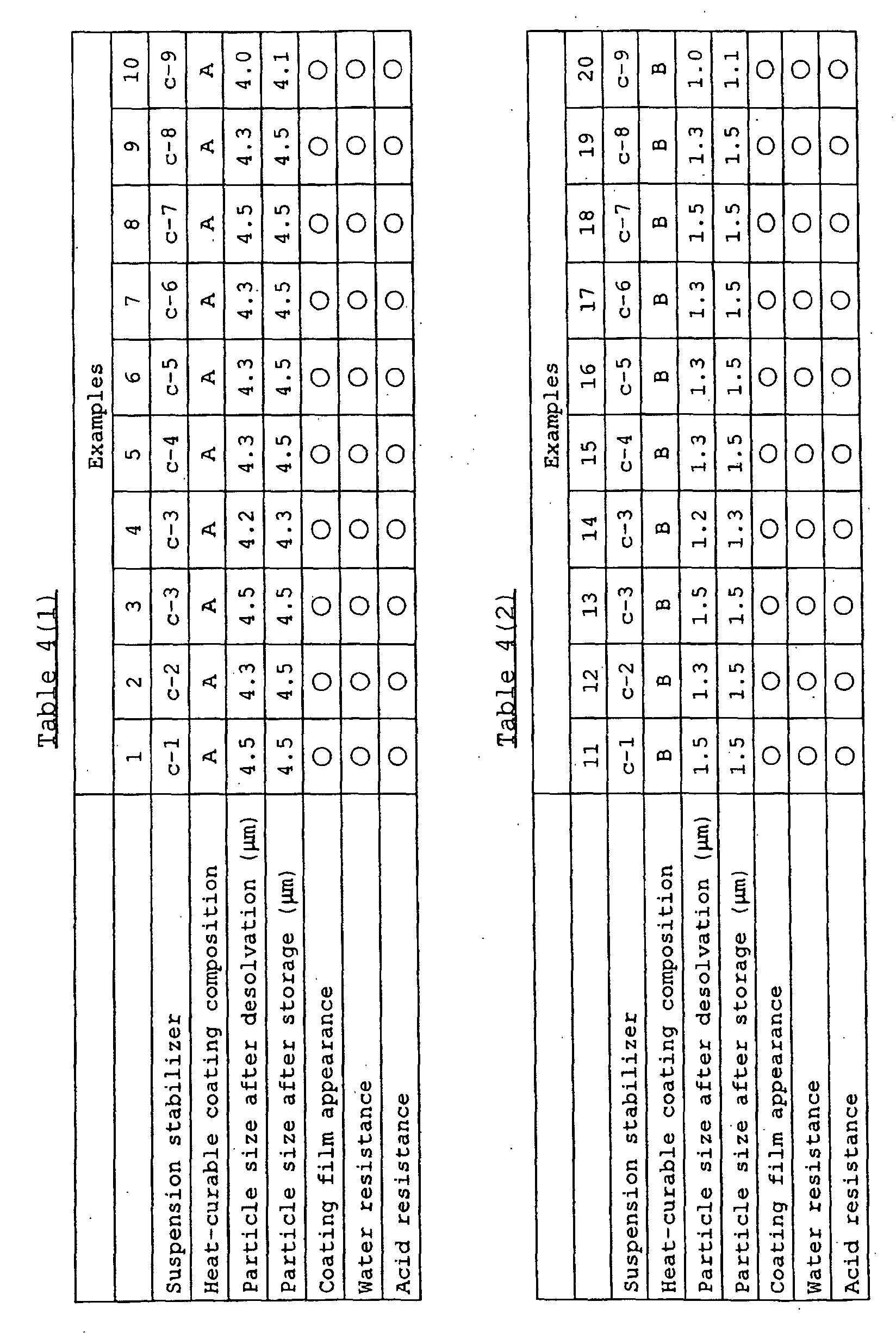

The present invention can provide a water based coating
composition having good dispersion stability and capable of
making possible low VOC content, and capable of forming a
coating film showing good properties in appearance, weather
resistance, acid resistance, water resistance and the like.
The water based coating composition of the present
invention is useful in coating of an automobile body and the
like.
Claims (7)
- A water based coating composition prepared by dispersing a heat-curable coating composition into water in the presence of a suspension stabilizer comprising a block copolymer to obtain a water dispersion, followed by optionally removing an organic solvent from the water dispersion to obtain a water based coating composition having a mean particle size of 0.1 to 10 µm, said block copolymer being a compound (c) prepared by subjecting a compound (a) represented by the following general formula (1):where Q and Y respectively represent H, R, O2CR, COOH, COOR, CONHR, CONR2, CN, CONH2, CONR, phenyl group or halogen, X represents H or R, Z represents H, SR, SOR, SOOR or R, R represents alkyl group, aryl group, aralkyl group, alkalyl group, organosilyl group or alkoxysilyl group, and can contain at least one group or atom selected from epoxy group, oxetane, oxirane ring, hydroxyl group, alkoxy group, amino group, oxazoline, halogen and halogenated alkyl group, being same or different, n is an integer of 6 to 100 ; and a polymerizable unsaturated monomer (b) to radical polymerization in the presence of a radical polymerization initiator, and being neutralized with a basic substance.
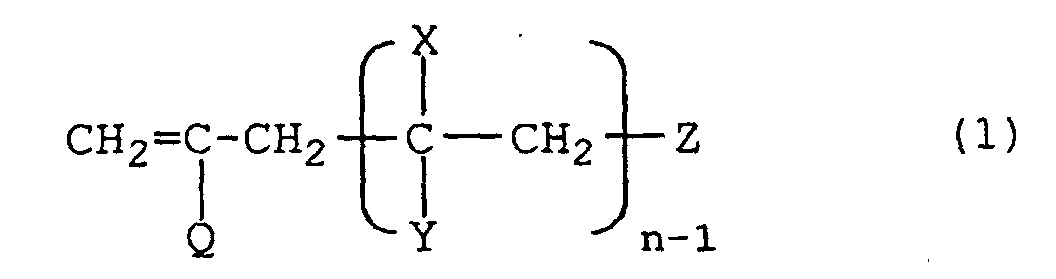
- A water based coating composition as claimed in claim 1, wherein the compound (a) is a compound obtained by subjecting a polymerizable unsaturated monomer to a radical polymerization in the presence of a metal complex as a catalytic chain transfer agent and a radical polymerization initiator.
- A water based coating composition as claimed in claim 1 or 2, wherein the block copolymer has an acid value of 1 to 300 mgKOH/g and a hydroxy value of 0 to 300 mgKOH/g.
- A water based coating composition as claimed in any one of claims 1 to 3, wherein the block copolymer has a weight average molecular weight in the range of 500 to 50,000.
- A water based coating composition as claimed in any one of claims 1 to 4, wherein the suspension stabilizer is in the range of 0.1 to 80 parts by weight per 100 parts by weight of a solid content of the coating film-forming component in the water based coating composition.
- A water based coating composition as claimed in any one of claims 1 to 5, wherein the compound (a) is a compound obtained by a radical polymerization with a polymerizable unsaturated monomer in the presence of 2,4-diphenyl-4-methyl-1-pentene and a radical polymerization initiator.
- A water based coating composition as claimed in any one of claims 1 to 6, wherein the block copolymer is a block copolymer obtained by a method which comprises subjecting the compound (a) and a polymerizable unsaturated monomer (b) to a radical polymerization, the polymerizable unsaturated monomer (b) being divided into at least two components having a composition different from each other so that respective components of the monomer (b) can be successively polymerized with the compound (a).
Applications Claiming Priority (5)
| Application Number | Priority Date | Filing Date | Title |
|---|---|---|---|
| JP2000304766 | 2000-10-04 | ||
| JP2000304766 | 2000-10-04 | ||
| JP2000334311A JP2002179990A (en) | 2000-10-04 | 2000-11-01 | Water-based coating material composition |
| JP2000334311 | 2000-11-01 | ||
| PCT/JP2001/008686 WO2002028976A1 (en) | 2000-10-04 | 2001-10-02 | Water-based coating composition |
Publications (2)
| Publication Number | Publication Date |
|---|---|
| EP1331255A1 true EP1331255A1 (en) | 2003-07-30 |
| EP1331255A4 EP1331255A4 (en) | 2004-12-29 |
Family
ID=26601519
Family Applications (1)
| Application Number | Title | Priority Date | Filing Date |
|---|---|---|---|
| EP01972660A Withdrawn EP1331255A4 (en) | 2000-10-04 | 2001-10-02 | Water-based coating composition |
Country Status (5)
| Country | Link |
|---|---|
| US (1) | US20040087713A1 (en) |
| EP (1) | EP1331255A4 (en) |
| JP (1) | JP2002179990A (en) |
| CA (1) | CA2424544A1 (en) |
| WO (1) | WO2002028976A1 (en) |
Cited By (2)
| Publication number | Priority date | Publication date | Assignee | Title |
|---|---|---|---|---|
| EP1524305A3 (en) * | 2003-10-15 | 2005-06-15 | Kansai Paint Co., Ltd. | Coating composition for automobile body |
| CN112111224A (en) * | 2020-09-24 | 2020-12-22 | 国网山东省电力公司临沂供电公司 | A kind of medium-voltage distribution cabinet anti-corrosion coating and preparation method thereof |
Families Citing this family (3)
| Publication number | Priority date | Publication date | Assignee | Title |
|---|---|---|---|---|
| JP4254292B2 (en) * | 2003-03-24 | 2009-04-15 | 星光Pmc株式会社 | Aqueous pigment dispersant and method for producing the same |
| MX2012007272A (en) | 2012-06-21 | 2013-12-23 | Mexicano Inst Petrol | Process for the synthesis of a polymeric resin based on water doped with titanium dioxide nanotubes applied as anticorrosive coating. |
| US12338332B2 (en) * | 2019-02-15 | 2025-06-24 | Avery Dennison Corporation | Polyurethane synthesis |
Family Cites Families (22)
| Publication number | Priority date | Publication date | Assignee | Title |
|---|---|---|---|---|
| JPS54123141A (en) * | 1978-03-17 | 1979-09-25 | Toyo Ink Mfg Co Ltd | Thermosetting water-based coating compositon |
| US4526945A (en) * | 1984-03-21 | 1985-07-02 | Scm Corporation | Low molecular weight polymers and copolymers |
| US4694054A (en) * | 1985-03-01 | 1987-09-15 | E. I. Du Pont De Nemours And Company | Cobalt(II) chelates as chain transfer agents in free radical polymerizations |
| US4886861A (en) * | 1985-04-23 | 1989-12-12 | E. I. Dupont De Nemours And Company | Molecular weight control in free radical polymerizations |
| JPS6210125A (en) * | 1985-07-09 | 1987-01-19 | Nippon Oil & Fats Co Ltd | Block copolymer composition |
| US5324879A (en) * | 1985-12-03 | 1994-06-28 | Commonwealth Scientific And Industrial Research Organisation | Oligomerization process |
| GB8530025D0 (en) * | 1985-12-05 | 1986-01-15 | Ici Plc | Coating compositions |
| US4837326A (en) * | 1986-05-21 | 1989-06-06 | The Glidden Company | Cobalt (II) complex catalyst for polymerization of monomers |
| JP2512757B2 (en) * | 1987-07-28 | 1996-07-03 | 関西ペイント株式会社 | Dispersion of reactive polymer particles |
| JP3243876B2 (en) * | 1992-03-30 | 2002-01-07 | 大日本インキ化学工業株式会社 | Water-based coating composition and coating method using the same |
| JP3216908B2 (en) * | 1992-04-28 | 2001-10-09 | 株式会社クラレ | Aqueous dispersion of ethylene-vinyl alcohol copolymer |
| US5264530A (en) * | 1992-05-01 | 1993-11-23 | E. I. Du Pont De Nemours And Company | Process of polymerization in an aqueous system |
| EP0638097B1 (en) * | 1992-05-01 | 2007-03-14 | E.I. Du Pont De Nemours And Company | Preparing crosslinkable polymers employing macromonomer chain transfer agents |
| US5773534A (en) * | 1992-05-22 | 1998-06-30 | E. I. Du Pont De Nemours And Company | Preparing crosslinkable polymers employing macromonomer chain transfer agents |
| US5721330A (en) * | 1995-12-15 | 1998-02-24 | E. I. Du Pont De Nemours And Company | Macromonomers with high acid content and their method of preparation |
| JPH09194680A (en) * | 1996-01-17 | 1997-07-29 | Nippon Oil & Fats Co Ltd | Aqueous polymer dispersion |
| JPH09279087A (en) * | 1996-04-15 | 1997-10-28 | Nof Corp | Water-dispersed water-base coating composition |
| US5770646A (en) * | 1996-10-29 | 1998-06-23 | E. I. Du Pont De Nemours And Company | Aqueous branched polymer dispersant for hydrophobic materials |
| US5854331A (en) * | 1997-11-04 | 1998-12-29 | E. I. Du Pont De Nemours And Company | Block copolymers of oxazolines and oxazines as pigment dispersants and their use in ink jet inks |
| US6174953B1 (en) * | 1998-02-19 | 2001-01-16 | E. I. Du Pont De Nemours And Company | Low molecular weight (meth) acrylate copolymer emulsions |
| JP2000169531A (en) * | 1998-12-03 | 2000-06-20 | Kansai Paint Co Ltd | Production of block copolymer |
| US6503975B1 (en) * | 2000-03-29 | 2003-01-07 | E. I Du Pont De Nemours And Company | Surfactant free aqueous emulsions |
-
2000
- 2000-11-01 JP JP2000334311A patent/JP2002179990A/en active Pending
-
2001
- 2001-10-02 EP EP01972660A patent/EP1331255A4/en not_active Withdrawn
- 2001-10-02 CA CA002424544A patent/CA2424544A1/en not_active Abandoned
- 2001-10-02 WO PCT/JP2001/008686 patent/WO2002028976A1/en not_active Ceased
- 2001-10-02 US US10/398,233 patent/US20040087713A1/en not_active Abandoned
Cited By (3)
| Publication number | Priority date | Publication date | Assignee | Title |
|---|---|---|---|---|
| EP1524305A3 (en) * | 2003-10-15 | 2005-06-15 | Kansai Paint Co., Ltd. | Coating composition for automobile body |
| US7357962B2 (en) | 2003-10-15 | 2008-04-15 | Kansai Paint Co., Ltd. | Automobile body-used light-colored water based coating composition |
| CN112111224A (en) * | 2020-09-24 | 2020-12-22 | 国网山东省电力公司临沂供电公司 | A kind of medium-voltage distribution cabinet anti-corrosion coating and preparation method thereof |
Also Published As
| Publication number | Publication date |
|---|---|
| WO2002028976A1 (en) | 2002-04-11 |
| US20040087713A1 (en) | 2004-05-06 |
| JP2002179990A (en) | 2002-06-26 |
| CA2424544A1 (en) | 2003-04-02 |
| EP1331255A4 (en) | 2004-12-29 |
Similar Documents
| Publication | Publication Date | Title |
|---|---|---|
| US11084953B2 (en) | Waterborne coating composition | |
| US8871856B2 (en) | Wetting agents and dispersants based on mixtures of structure copolymers | |
| EP0996652B1 (en) | Two-package waterborne urethane coatings | |
| AU685269B2 (en) | Production of aqueous polymer compositions | |
| JP3884065B2 (en) | Paint containing self-stabilizing latex prepared in aqueous carrier | |
| JP2002194037A (en) | Pigment dispersion resin and aqueous pigment dispersion containing the same | |
| JP2002504575A (en) | Low molecular weight (meth) acrylate copolymer emulsion | |
| EP1115750A1 (en) | Aqueous composition | |
| EP0458479A2 (en) | Pigment dispersing agent | |
| CN110612335B (en) | Waterborne epoxy coating composition | |
| EP1112298B1 (en) | Thermosetting compositions containing epoxy-functional polymers prepared using atom transfer radical polymerization | |
| JP4126570B2 (en) | Cationic electrodeposition coating composition having excellent repellency resistance | |
| JPH10306236A (en) | Aqueous coating composition and coating by using the same | |
| US20040087713A1 (en) | Water-based coating composition | |
| JP4000573B2 (en) | Cationic electrodeposition coating composition having excellent repellency resistance | |
| JP2002012811A (en) | Method for producing pigment-dispersed resin and water- based pigment dispersion containing the same | |
| JP4235476B2 (en) | Pigment dispersion resin and aqueous pigment dispersion containing the same | |
| US8512465B2 (en) | Use of copolymers as adhesion promoters in lacquers | |
| JP2002206013A (en) | Pigment-dispersed resin and water-based pigment dispersion including the same | |
| JP2002053628A (en) | Method for producing pigment dispersion resin and aqueous pigment dispersing element containing the resin | |
| EP1193279A2 (en) | Coating composition for undercoat and coating method for repair employing the same | |
| EP1966335A2 (en) | Pigment dispersions containing aminated acrylic macromonomer dispersant | |
| JP2003286450A (en) | Aqueous coating composition and method for forming multilayer coating film | |
| JP2001131472A (en) | Resin composition for cationic electrodeposition coating | |
| EP1928926A1 (en) | Aqueous vinyl graft copolymer compositions |
Legal Events
| Date | Code | Title | Description |
|---|---|---|---|
| PUAI | Public reference made under article 153(3) epc to a published international application that has entered the european phase |
Free format text: ORIGINAL CODE: 0009012 |
|
| 17P | Request for examination filed |
Effective date: 20030425 |
|
| AK | Designated contracting states |
Designated state(s): AT BE CH CY DE DK ES FI FR GB GR IE IT LI LU MC NL PT SE TR |
|
| RBV | Designated contracting states (corrected) |
Designated state(s): DE FR GB |
|
| A4 | Supplementary search report drawn up and despatched |
Effective date: 20041117 |
|
| RIC1 | Information provided on ipc code assigned before grant |
Ipc: 7C 09D 5/02 B Ipc: 7C 09D 153/00 A |
|
| STAA | Information on the status of an ep patent application or granted ep patent |
Free format text: STATUS: THE APPLICATION IS DEEMED TO BE WITHDRAWN |
|
| 18D | Application deemed to be withdrawn |
Effective date: 20060503 |