EP1331246A1 - Polycarbonate resin compositions - Google Patents
Polycarbonate resin compositions Download PDFInfo
- Publication number
- EP1331246A1 EP1331246A1 EP01980909A EP01980909A EP1331246A1 EP 1331246 A1 EP1331246 A1 EP 1331246A1 EP 01980909 A EP01980909 A EP 01980909A EP 01980909 A EP01980909 A EP 01980909A EP 1331246 A1 EP1331246 A1 EP 1331246A1
- Authority
- EP
- European Patent Office
- Prior art keywords
- weight
- polycarbonate
- polycarbonate resin
- resin composition
- parts
- Prior art date
- Legal status (The legal status is an assumption and is not a legal conclusion. Google has not performed a legal analysis and makes no representation as to the accuracy of the status listed.)
- Withdrawn
Links
Images
Classifications
-
- C—CHEMISTRY; METALLURGY
- C08—ORGANIC MACROMOLECULAR COMPOUNDS; THEIR PREPARATION OR CHEMICAL WORKING-UP; COMPOSITIONS BASED THEREON
- C08L—COMPOSITIONS OF MACROMOLECULAR COMPOUNDS
- C08L69/00—Compositions of polycarbonates; Compositions of derivatives of polycarbonates
-
- C—CHEMISTRY; METALLURGY
- C08—ORGANIC MACROMOLECULAR COMPOUNDS; THEIR PREPARATION OR CHEMICAL WORKING-UP; COMPOSITIONS BASED THEREON
- C08G—MACROMOLECULAR COMPOUNDS OBTAINED OTHERWISE THAN BY REACTIONS ONLY INVOLVING UNSATURATED CARBON-TO-CARBON BONDS
- C08G64/00—Macromolecular compounds obtained by reactions forming a carbonic ester link in the main chain of the macromolecule
- C08G64/04—Aromatic polycarbonates
- C08G64/06—Aromatic polycarbonates not containing aliphatic unsaturation
- C08G64/14—Aromatic polycarbonates not containing aliphatic unsaturation containing a chain-terminating or -crosslinking agent
-
- C—CHEMISTRY; METALLURGY
- C08—ORGANIC MACROMOLECULAR COMPOUNDS; THEIR PREPARATION OR CHEMICAL WORKING-UP; COMPOSITIONS BASED THEREON
- C08K—Use of inorganic or non-macromolecular organic substances as compounding ingredients
- C08K7/00—Use of ingredients characterised by shape
- C08K7/02—Fibres or whiskers
- C08K7/04—Fibres or whiskers inorganic
- C08K7/14—Glass
-
- C—CHEMISTRY; METALLURGY
- C08—ORGANIC MACROMOLECULAR COMPOUNDS; THEIR PREPARATION OR CHEMICAL WORKING-UP; COMPOSITIONS BASED THEREON
- C08L—COMPOSITIONS OF MACROMOLECULAR COMPOUNDS
- C08L27/00—Compositions of homopolymers or copolymers of compounds having one or more unsaturated aliphatic radicals, each having only one carbon-to-carbon double bond, and at least one being terminated by a halogen; Compositions of derivatives of such polymers
- C08L27/02—Compositions of homopolymers or copolymers of compounds having one or more unsaturated aliphatic radicals, each having only one carbon-to-carbon double bond, and at least one being terminated by a halogen; Compositions of derivatives of such polymers not modified by chemical after-treatment
- C08L27/12—Compositions of homopolymers or copolymers of compounds having one or more unsaturated aliphatic radicals, each having only one carbon-to-carbon double bond, and at least one being terminated by a halogen; Compositions of derivatives of such polymers not modified by chemical after-treatment containing fluorine atoms
-
- C—CHEMISTRY; METALLURGY
- C08—ORGANIC MACROMOLECULAR COMPOUNDS; THEIR PREPARATION OR CHEMICAL WORKING-UP; COMPOSITIONS BASED THEREON
- C08L—COMPOSITIONS OF MACROMOLECULAR COMPOUNDS
- C08L51/00—Compositions of graft polymers in which the grafted component is obtained by reactions only involving carbon-to-carbon unsaturated bonds; Compositions of derivatives of such polymers
- C08L51/04—Compositions of graft polymers in which the grafted component is obtained by reactions only involving carbon-to-carbon unsaturated bonds; Compositions of derivatives of such polymers grafted on to rubbers
-
- C—CHEMISTRY; METALLURGY
- C08—ORGANIC MACROMOLECULAR COMPOUNDS; THEIR PREPARATION OR CHEMICAL WORKING-UP; COMPOSITIONS BASED THEREON
- C08L—COMPOSITIONS OF MACROMOLECULAR COMPOUNDS
- C08L83/00—Compositions of macromolecular compounds obtained by reactions forming in the main chain of the macromolecule a linkage containing silicon with or without sulfur, nitrogen, oxygen or carbon only; Compositions of derivatives of such polymers
- C08L83/04—Polysiloxanes
Definitions
- the present invention includes first to third aspects all relating to a polycarbonate resin composition.
- the first aspect of the invention relates to a colored polycarbonate resin composition of good flowability and impact resistance, of which the injection moldings are especially glossy;
- the second aspect thereof relates to a polycarbonate resin composition of good impact resistance, moldability (melt flowability) and flame retardancy, not containing a halogen or phosphorus-containing flame retardant, and to its moldings;
- the third aspect of the invention relates to a polycarbonate resin composition of good flowability, impact resistance and flame retardancy.
- polycarbonate resins serve as engineering plastics and have many applications in various fields of, for example, electric and electronic appliances and automobile parts. Above all, colored polycarbonates are used, for example, for parts of electric and electronic appliances, parts of electrically-powered tools and parts of cameras. Glass fibers serving as an inorganic filler are added to such polycarbonate resins for improving the stiffness and dimensional stability of the resin articles, and they are known as glass fiber-reinforced polycarbonate resins.
- Such glass fiber-reinforced polycarbonate resins are used for thin-wall moldings these days, and it is desired to increase the flowability of the resins. Lowering the molecular weight of polycarbonate is effective for increasing the resin flowability, which, however, greatly lowers the impact resistance of the resin articles.
- compositions that comprises a glass fiber-reinforced polycarbonate resin and an organosiloxane (Japanese Patent Publication No. 35929/1984, International Patent Publication No. 501860/1982) and a polycarbonate-polyorganosiloxane copolymer reinforced with glass fibers (Japanese Patent Laid-Open No. 173061/1990).
- the techniques proposed are to improve the balance of the resin flowability and the impact resistance of the resin articles, but are still unsatisfactory.
- Another problem with colored polycarbonate compositions is that the glossiness of their injection moldings is not good when ordinary polycarbonate is used in the compositions.
- the first aspect of the invention has been made in consideration of the situation as above, and its object is to provide a colored polycarbonate resin composition of which the advantages are that its flowability is improved not detracting from the impact resistance of the resin moldings, and especially the glossiness of the injection moldings of the resin composition is extremely good.
- polycarbonate resins are self-extinguishable.
- polycarbonate resins of more improved flame retardancy are added to polycarbonate resins to meet the requirement.
- halogen-containing flame retardants such as bisphenol A halides and halogenated polycarbonate oligomers have been used along with a flame retardation promoter such as antimony oxide, as their flame-retarding ability is good.
- non-halogen flame retardants phosphorus-containing organic flame retardants, especially organic phosphate compounds may be added to polycarbonate resin compositions, for which various methods have been proposed.
- Such flame retardants, organic phosphate compounds serve also as a plasticizer, and polycarbonate resin compositions containing them exhibit excellent flame retardancy.
- phosphate compounds Another problem with phosphate compounds is that, when the moldings containing them are left under heat or in high-temperature and high-humidity conditions, the compounds lower the impact strength of the moldings and yellow the moldings.
- polycarbonate resin compositions containing phosphate compounds are not stable under heat, and therefore do not meet the recent requirement for recycling resin products. This is still another problem with phosphate compounds.
- the flame retardancy level of the products in (1) is high in some degree, but the impact resistance thereof is often low.
- the technology of (2) differs from that of (1) in that the silicones used in (2) do not act as a flame retardant by themselves, but are for improving the dropping resistance of resins, and some examples of silicones for that purpose are mentioned. Anyhow, in (2), the resins indispensably require an additional flame retardant of, for example, phosphate compounds or metal salts of Group 2 of the Periodic Table.
- Another problem with the flame-retardant polycarbonate resin compositions in (2) is that the flame retardant added thereto worsens the moldability and even the physical properties of the resin compositions and their moldings.
- a flame-retardant polycarbonate resin composition that comprises a polycarbonate-polyorganosiloxane copolymer-containing resin (this is one type of polycarbonate resin) and contains a fibril-forming polytetrafluoroethylene (Japanese Patent Laid-Open No. 81620/1996). Even though its polyorganosiloxane content is low, falling within a specifically defined range, the composition exhibits good flame retardancy. However, the composition is problematic in that its impact resistance characteristic of polycarbonate resin is often not good though its flame retardancy is good.
- the second aspect of the invention has been made in consideration of the situation as above, and its object is to provide a polycarbonate resin composition of which the advantages are that its moldability, or that is, melt flowability is improved not detracting from the impact resistance thereof characteristic of polycarbonate resin, its flame retardancy, heat resistance and recyclability are all good, and it can be molded into thin-walled moldings that are lightweight and save natural resources, and to provide such moldings of the composition.
- thermoplastic resins polycarbonate resins have a high oxidation index and are therefore self-extinguishable.
- the flame retardancy level needed in the field of OA appliances and other electric and electronic appliances is high, concretely, V-0 as the UL94 Standard.
- flame retardant and flame retardation promoter are added thereto.
- the additives lower the impact resistance and the heat resistance of the appliances.
- flame-retardant materials of good flowability are desired these days for large-sized and thin-walled moldings for housings of copiers and printers.
- the flowability of polycarbonate-polyorganosiloxane copolymers could be increased by reducing the molecular weight thereof according to the technology mentioned above, but this is problematic in that the impact resistance of the copolymers is low.
- the flowability of polycarbonate resins could also be increased by reducing the molecular weight thereof, but this is also problematic in that the flame retardancy and the impact resistance of the resins are low
- the third aspect of the invention has been made in consideration of the situation as above, and its object is to provide a polycarbonate resin composition of good flowability, impact resistance and flame retardancy.
- the second aspect of the invention provides the following:
- a polycarbonate resin composition comprising ⁇ 1> an aromatic polycarbonate resin that contains an aromatic polycarbonate-polyorganosiloxane copolymer having an ordinary terminal group and an aromatic polycarbonate having a specific terminal group or ⁇ 2> an aromatic polycarbonate resin that contains an aromatic polycarbonate-polyorganosiloxane copolymer having a specific terminal group, and a specific polytetrafluoroethylene added thereto.
- the component (A) of the polycarbonate resin composition of the first aspect of the invention (in this section, the "first aspect of the invention” will be simply referred to as “the invention") is an aromatic polycarbonate having a terminal group of formula (I-1) mentioned above.
- R 1 represents an alkyl group having from 10 to 35 carbon atoms, and it may be linear or branched.
- the aromatic polycarbonate may be produced in any known method of generally reacting a biphenol with a polycarbonate precursor such as phosgene or a carbonate compound.
- a polycarbonate precursor such as phosgene or a carbonate compound.
- it may be produced by reacting a diphenol with a polycarbonate precursor such as phosgene or by interesterifying a carbonate precursor such as diphenyl carbonate with a diphenol, in a solvent such as methylene chloride in the presence of a known acid receptor and a long-chain alkylphenol serving as a terminal stopper of the following formula (I-3): wherein R 1 has the same meaning as above, optionally with adding a branching agent to the reaction system.
- bisphenol A 2,2-bis(4-hydroxyphenyl)propane
- bisphenol A 2,2-bis(4-hydroxyphenyl)propane
- other diphenols usable herein are, for example, bis(hydroxyaryl)alkanes such as bis(4-hydroxyphenyl)methane, 1,1-bis(4-hydroxyphenyl)ethane, 2,2-bis(4-hydroxyphenyl)butane, 2,2-bis(4-hydroxyphenyl)octane, 2,2-bis(4-hydroxy-1-methylphenyl)propane, 1,1-bis(4-hydroxy-tert-butylphenyl)propane, 2,2-bis(4-hydroxy-3-bromophenyl)propane, 2,2-bis(4-hydroxy-3,5-tetramethylphenyl)propane, 2,2-bis(4-hydroxy-3-chlorophenyl)propane, 2,2-bis(4-hydroxy-3 ,5-tetrachloroph
- the carbonate compound includes, for example, diaryl carbonates such as diphenyl carbonate; and dialkyl carbonates such as dimethyl carbonate, diethyl carbonate.
- R 1 represents an alkyl group having from 10 to 35 carbon atoms, and it may be linear or branched but is preferably branched.
- R 1 is preferably an alkyl group having from 12 to 24 carbon atoms.
- the number of carbon atoms constituting the alkyl group is 9 or less, it is unfavorable since the flowability of the aromatic polycarbonate resin is low; but if 36 or more, it is also unfavorable since the heat resistance of the resin composition gradually lowers.
- the long-chain monoalkylphenols may be used herein.
- the long-chain monoalkylphenol may be combined with any other alkylphenol of which the alkyl group has at most 9 carbon atoms.
- the hydroxyl group of the diphenol may remain in the polycarbonate not completely terminated in the manner specifically defined herein, and the terminal fraction may be at least about 60 %.
- the optional branching agent for example, usable is a compound having at least three functional groups such as 1,1,1-tris(4-hydroxyphenyl)ethane, ⁇ , ⁇ ' ⁇ "-tris(4-hydroxyphenyl)-1,3,5-triisopropylbenzene, 1-[ ⁇ -methyl- ⁇ -(4'-hydroxyphenyl)ethyl]-4-[ ⁇ ', ⁇ '-bis(4"-hydroxyphenyl)ethyl]benzene, phloroglucine, trimellitic acid, isatin-bis(o-cresol).
- functional groups such as 1,1,1-tris(4-hydroxyphenyl)ethane, ⁇ , ⁇ ' ⁇ "-tris(4-hydroxyphenyl)-1,3,5-triisopropylbenzene, 1-[ ⁇ -methyl- ⁇ -(4'-hydroxyphenyl)ethyl]-4-[ ⁇ ', ⁇ '-bis(4"-hydroxyphenyl)ethyl]benzene, p
- the component (B) of the polycarbonate resin composition of the first aspect of the invention is an aromatic polycarbonate having a terminal group of formula (I-2).
- the aromatic polycarbonate is not specifically defined, and it may be readily produced by reacting a diphenol with phosgene or a carbonate compound.
- it may be produced by reacting a diphenol with a carbonate precursor such as phosgene or by interesterifying a carbonate precursor such as diphenyl carbonate with a diphenol, in a solvent such as methylene chloride in the presence of a catalyst such as triethylamine and a terminal stopper.
- a carbonate precursor such as phosgene
- a carbonate precursor such as diphenyl carbonate
- a solvent such as methylene chloride
- a catalyst such as triethylamine and a terminal stopper.
- the diphenol may be the same as or different from that mentioned hereinabove.
- the polycarbonate may be a homopolymer for which one and the same diphenol is used, or a copolymer for which two or more different types of diphenols are used. Further, it may also be a thermoplastic random-branched polycarbonate for which the diphenol is combined with a polyfunctional aromatic compound.
- dicarbonate compound examples include diaryl carbonates such as diphenyl carbonate, and dialkyl carbonates such as dimethyl carbonate or diethyl carbonate.
- a monophenol compound of the following general formula (I-4) is a monophenol compound of the following general formula (I-4): wherein R 2 and a have the same meanings as above.
- R 2 and a have the same meanings as above.
- it is a para-substituted monophenol.
- it includes, for example, phenol, p-cresol, p-tert-butylphenol, p-tert-octylphenol, p-cumylphenol, p-nonylphenol, p-tert-amylphenol.
- the polycarbonate resin to be in the polycarbonate resin composition of the invention comprises the components (A) and (B). Regarding their blend ratio, the amount of the component (A) is from 10 to 100 % by weight, and that of the component (B) is from 0 to 90 % by weight. If the amount of the component (A) is smaller than 10 % by weight, it is unfavorable since the flowability of the resin composition of the invention is low and the moldings of the composition are not glossy.
- the viscosity-average molecular weight (Mv) of the polycarbonate resin preferably falls between 10,000 and 40,000, more preferably between 12,000 and 30,000, even more preferably between 15,000 and 25,000. If the molecular weight of the resin is too low, the impact resistance of the resin moldings will be low; but if too high, the resin composition will be difficult to mold.
- inorganic fillers are known for the component (C) to be added to the polycarbonate resin in the invention, and they are for increasing the mechanical strength and improving the dimensional stability of the polycarbonate resin composition or for increasing the amount of the resin composition.
- the inorganic filler includes, for example, potassium titanate whiskers, mineral fibers (e.g., rock wool), glass fibers, carbon fibers, metal fibers (e.g., stainless steel fibers), aluminium borate whiskers, silicon nitride whiskers, boron fibers, tetrapod zinc oxide whiskers, talc, clay, mica, pearl mica, aluminium leaf, alumina, glass flakes, glass beads, glass balloons, carbon black, graphite, calcium carbonate, calcium sulfate, calcium silicate, titanium oxide, zinc oxide, silica, asbestos, and quarts powder. These inorganic fillers may be previously surface-treated or may not.
- mineral fibers e.g., rock wool
- glass fibers e.g., carbon fibers
- metal fibers e.g., stainless steel fibers
- aluminium borate whiskers silicon nitride whiskers
- silicon nitride whiskers boron fibers
- tetrapod zinc oxide whiskers
- the surface-treating agent includes, for example, silane coupling agents, higher fatty acids, metal salts of fatty acids, unsaturated organic acids, organic titanates, resin acids, and polyethylene glycols.
- the inorganic fillers may be chemically or physically surface-treated.
- inorganic fillers preferred for use herein are glass fibers and carbon fibers.
- any of alkali glass, low-alkali glass or non-alkali glass is preferred.
- the length of the glass fibers preferably falls between 0.1 and 8 mm, more preferably between 0.3 and 6 mm. Their diameter may fall between 0.1 and 30 ⁇ m, but preferably between 0.5 and 25 ⁇ m.
- the glass fibers are not specifically defined in point of their morphology, and they may be in any form of rovings, milled fibers or chopped fibers. Singly or as combined, one or more different types of such glass fibers may be used herein.
- the glass fibers are treated with a surface-treating agent and then processed with a suitable sizing agent for enhancing the adhesiveness thereof to polycarbonate resin.
- the surface-treating agent includes, for example, silane coupling agents such as aminosilanes, epoxysilanes, vinylsilanes, acrylic silanes; titanate coupling agents, and aluminium, chromium, zirconium or boron-containing coupling agents.
- silane coupling agents such as aminosilanes, epoxysilanes, vinylsilanes, acrylic silanes
- titanate coupling agents and aluminium, chromium, zirconium or boron-containing coupling agents.
- silane coupling agents and titanate coupling agents are preferred for treating the glass fibers with such a surface-treating agent.
- the method is not specifically defined and may be any conventional one.
- employable are an aqueous solution method, an organic solvent method and a spraying method.
- the sizing agent includes, for example, urethane compounds, acrylic compounds, acrylonitrile-styrene copolymers and epoxy compounds, any of which are usable herein.
- the method is not specifically defined and may be any conventional one.
- employable is any method of dipping, roller-coating, blasting, casting or spraying.
- the carbon fibers for use herein may be produced from cellulose fibers, acrylic fibers, lignin, or petroleum or coal-type special pitch generally by firing them.
- Various types of such carbon fibers are known, including, for example, flame-retardant, carbonaceous or graphitic ones.
- the length of the carbon fibers generally falls between 0.01 and 10 mm, and the diameter thereof may fall between 5 and 15 ⁇ m.
- the morphology of the carbon fibers is not specifically defined, including, for example, rovings, milled fibers and chopped strands.
- the carbon fibers may be surface-treated with epoxy resin or urethane resin for enhancing their affinity for polycarbonate resin.
- the amount of the inorganic filler to be in the resin composition of the invention is from 5 to 150 parts by weight, but preferably from 10 to 80 parts by weight, relative to 100 parts by weight of the polycarbonate resin therein. If it is smaller than 5 parts by weight, the stiffness of the resin composition is low and the dimensional stability thereof is also low. If larger than 150 parts by weight, it is unfavorable since the resin composition is difficult or impossible to knead. Within the preferred range, the inorganic filler is effective for more enhancing the impact resistance of the resin moldings.
- the polycarbonate resin composition may contain from 100 to 5,000 ppm of a colorant, further optionally other additives and other synthetic resins or elastomers.
- the additives are, for example, antioxidants such as hindered phenols, phosphorus-containing compounds (e.g., phosphites, phosphates), amines; UV absorbents such as benzotriazoles, benzophenones; optical stabilizers such as hindered amines; internal lubricants such as aliphatic carboxylates, paraffins, silicone oil, polyethylene wax; and mold release agents, flame retardants, flame retardation promoters, antistatic agents, colorants.
- antioxidants such as hindered phenols, phosphorus-containing compounds (e.g., phosphites, phosphates), amines
- UV absorbents such as benzotriazoles, benzophenones
- optical stabilizers such as hindered amines
- internal lubricants such as aliphatic carboxylates, paraffins, silicone oil, polyethylene wax
- mold release agents flame retardants, flame retardation promoters, antistatic agents, colorants.
- the additional synthetic resins are, for example, polyethylene resins, polypropylene resins, polystyrene resins, AS resins (acrylonitrile-styrene copolymers), ABS resins (acrylonitrile-butadiene-styrene copolymers), polymethyl methacrylate resins.
- the elastomers are, for example, isobutylene-isoprene rubber, styrene-butadiene rubber, ethylene-propylene rubber, acrylic elastomers.
- the components mentioned above may be formulated and kneaded in any ordinary method.
- usable are any of ribbon blenders, drum tumblers, Henschel mixers, Banbury mixers, single-screw extruders, double-screw extruders, cokneaders, and multi-screw extruders. While kneaded, they may be heated generally at 240 to 320°C.
- the thus-obtained, colored polycarbonate resin composition may be molded in any known method.
- it may be molded in any mode of injection molding, blow molding, extrusion molding, compression molding, calender molding or spin molding to give colored moldings such as parts of electric and electronic appliances, parts of electrically-powered tools and parts of cameras.
- alkylphenol (b) In the same manner as in preparing the alkylphenol (a), an alkylphenol (b) was prepared for which, however, the olefin used was 1-docosene, its amount was 110 parts by weight, the molar ratio of phenol/olefin was 9/1 and the amount of the catalyst used was 11 parts by weight.
- the alkyl group In the alkylphenol (b), the alkyl group had 22 carbon atoms and was branched.
- the aqueous solution of bisphenol A in sodium hydroxide kept at room temperature was fed into a tubular reactor having an inner diameter of 10 mm and a length of 10 m, at a flow rate of 138 liters/hr via an orifice plate of the reactor, along with methylene chloride thereinto via the plate at a flow rate of 69 liters/hr, while, at the same time, phosgene was also thereinto at a flow rate of 10.7 kg/hr, and they were continuously reacted for 3 hours.
- the tubular reactor used herein is a jacketed tube, in which cooling water was circulated through the jacket so as to keep the reaction mixture discharge at 25°C. The pH of the discharge was controlled to fall between 10 and 11.
- reaction mixture was kept static for phase separation. Its aqueous phase was removed, and its methylene chloride phase (220 liters) was collected to obtain a polycarbonate oligomer (concentration, 317 g/liter). The degree of polymerization of the polycarbonate oligomer fell between 2 and 4, and the chloroformate concentration thereof was 0.7 normalities.
- the system was mixed with a solution of bisphenol A in sodium hydroxide (bisphenol A 720 g, sodium hydroxide 412 g, water 5.5 liters), 8 liters of methylene chloride was added thereto, and these were reacted by stirring at 500 rpm for 1 hour. After the reaction, 7 liters of methylene chloride and 5 liters of water were added to the system, and stirred at 500 rpm for 10 minutes. After stirring it was stopped, the system was kept static for phase separation into an organic phase and an aqueous phase.
- bisphenol A in sodium hydroxide bisphenol A 720 g, sodium hydroxide 412 g, water 5.5 liters
- the resulting organic phase was washed with 5 liters of an alkali (0.03-N NaOH), 5 liters of an acid (0.2-N HCl) and 5 liters of water (twice) in that order.
- methylene chloride was evaporated away to obtain a flaky polymer (polycarbonate A 1 ).
- the alkylphenoxy terminal fraction of the polymer was 99.5 %, and the viscosity-average molecular weight thereof was 20,000.
- a polycarbonate A 2 was produced, for which, however, 202 g of the alkylphenol (a) was used in place of p-dodecylphenol.
- the alkylphenoxy terminal fraction of the polymer was 99.0 %, and the viscosity-average molecular weight thereof was 20,000.
- a polycarbonate A 3 was produced, for which, however, 209 g of the alkylphenol (b) was used in place of p-dodecylphenol.
- the alkylphenoxy terminal fraction of the polymer was 99.0 %, and the viscosity-average molecular weight thereof was 20,000.
- a polycarbonate B 1 was produced, for which, however, 77.6 g of p-tert-butylphenol was used in place of p-dodecylphenol.
- the p-tert-butylphenoxy terminal fraction of the polymer was 99.5 %, and the viscosity-average molecular weight thereof was 20,000.
- the viscosity of the polycarbonate in methylene chloride at 20°C was measured with an Ubbelohde's viscometer, and the intrinsic viscosity [ ⁇ ] thereof was derived from it.
- the spiral flow length (SFL) of the pellets was measured.
- SFL spiral flow length
- the pellets are injection-molded to give a melt flow of 10 mm wide and 3 mm thick.
- the injection pressure is 80 kg/cm 2 (7.84 MPa)
- the resin temperature is 300°C
- the mold temperature is 80°C.
- the 60-degree mirror-face gloss of each test piece is measured according to JIS K 7105.
- the polycarbonate resin composition of the second aspect of the invention (in this section, the "second aspect of the invention” will be simply referred to as “the invention") comprises 100 parts by weight of a polycarbonate-based resin (A) that contains a polycarbonate resin terminated with a phenoxy group having an alkyl group with from 21 to 35 carbon atoms, from 0.1 to 10 parts by weight of a functional group-having silicone compound (B), and from 0.2 to 10 parts by weight of a core/shell-type, grafted rubber-like elastomer (C).
- A polycarbonate-based resin
- B a functional group-having silicone compound
- C grafted rubber-like elastomer
- the polycarbonate resin composition of the invention is characterized in that its constituent component (A) is a polycarbonate-based resin that contains a polycarbonate resin terminated with a phenoxy group having an alkyl group with from 21 to 35 carbon atoms (this will be hereinafter referred to as a terminal-modified PC).
- constituent component (A) is a polycarbonate-based resin that contains a polycarbonate resin terminated with a phenoxy group having an alkyl group with from 21 to 35 carbon atoms (this will be hereinafter referred to as a terminal-modified PC).
- the polycarbonate resin terminated with a phenoxy group having an alkyl group with from 21 to 35 carbon atoms can be obtained by using an alkylphenol having an alkyl group with from 21 to 35 carbon atoms as the terminal stopper in producing it.
- the alkylphenol is not specifically defined, including, for example, docosylphenol, tetracosylphenol, hexacosylphenol, octacosylphenol, triacontylphenol, dotriacontylphenol and tetratriacontylphenol. Singly or as combined, one or more of these phenols may be used herein. Not interfering with the effect of the invention, the alkylphenol may be combined with any other phenol such as an alkylphenol having at most 20 carbon atoms.
- the alkyl group in the alkylphenol may be at any of o-, m- or p-position relative to the hydroxyl group therein, but is preferably at p-position.
- the alkyl group may be linear or branched.
- the specific terminal-modified PC may be prepared, for example, through reaction of a diphenol with phosgene or a carbonate compound using the alkylphenol as the terminal stopper for controlling the molecular weight of the resulting polymer.
- the phenol having an alkyl group with from 21 to 35 carbon atoms terminates to modify one or both terminals of the polycarbonate resin.
- the terminal modification in the polycarbonate resin is at least 20 %, preferably at least 50 % of all the terminals of the resin. Accordingly, the other terminal not specifically modified in the polycarbonate resin is a hydroxyl terminal group or a group terminated with any other terminal stopper mentioned below.
- the other terminal stoppers are phenols generally used in polycarbonate resin production, including, for example, phenol, p-tert-butylphenol, p-tert-octylphenol and p-cumylphenol. However, if such phenols only are used, it is impossible to obtain the resin composition of the invention having both good moldability and good impact resistance.
- the viscosity-average molecular weight of the terminal-modified PC in the component (A) of the polycarbonate resin composition of the invention generally falls between 10,000 and 40,000, but preferably between 12,000 and 30,000.
- the component (A) of the polycarbonate resin composition of the invention contains the specific terminal-modified PC, polycarbonate resin terminated with a phenoxy group having an alkyl group with from 21 to 35 carbon atoms.
- the specific terminal-modified PC may be alone or may be combined with any other ordinary polycarbonate resin.
- the specific terminal-modified PC content of the component is not specifically defined, generally at least 20 % by weight, but preferably at least 50 % by weight, more preferably at least 70 % by weight in consideration of all the terminals of the polycarbonate-based resin of the component (A) for better moldability (melt flowability) of the resin composition.
- the content may be suitably determined, depending on the ratio of the phenoxy group having an alkyl group with from 21 to 35 carbon atoms in the terminal-modified PC, the type of the other terminal of the modified PC, the type of the terminal of the other polycarbonate resin combined with the modified PC, and the melt flowability of the resin composition containing the modified PC.
- polycarbonate resins to constitute the component (A) of the polycarbonate resin composition of the invention are not specifically defined, including those known in the art.
- aromatic polycarbonates to be produced from diphenols and carbonate precursors are used.
- diphenols are usable, typically including 2,2-bis(4-hydroxyphenyl)propane [bisphenol A], bis(4-hydroxyphenyl)methane, 1,1-bis(4-hydroxyphenyl)ethane, 2,2-bis(4-hydroxy-3,5-dimethylphenyl)propane, 4,4'-dihydroxydiphenyl, bis(4-hydroxyphenyl)cycloalkanes, bis(4-hydroxyphenyl) oxide, bis(4-hydroxyphenyl) sulfide, bis(4-hydroxyphenyl) sulfone, bis(4-hydroxyphenyl) sulfoxide, bis(4-hydroxyphenyl) ether, and bis(4-hydroxyphenyl) ketone.
- bisphenol A 2,2-bis(4-hydroxyphenyl)propane
- bis(4-hydroxyphenyl)methane 1,1-bis(4-hydroxyphenyl)ethane
- diphenols for use herein preferred are bis(hydroxyphenyl)alkanes, especially those consisting essentially of bisphenol A.
- the carbonate precursors for use in the invention include, for example, carbonyl halides, carbonyl esters, and haloformates, concretely, phosgene, diphenol dihaloformates, diphenyl carbonate, dimethyl carbonate, and diethyl carbonate.
- Other diphenols such as hydroquinone, resorcinol, and catechol are also usable in the invention.
- the diphenols mentioned herein may be used either singly or as combined.
- the polycarbonate resin may have a branched structure, for which the branching agent includes, for example, 1,1,1-tris(4-hydroxyphenyl)ethane, ⁇ , ⁇ ', ⁇ "-tris(4-hyroxyphenyl)-1,3,5-triisopropylbenzene, phloroglucine, trimellitic acid, and isatin-bis(o-cresol).
- the branching agent includes, for example, 1,1,1-tris(4-hydroxyphenyl)ethane, ⁇ , ⁇ ', ⁇ "-tris(4-hyroxyphenyl)-1,3,5-triisopropylbenzene, phloroglucine, trimellitic acid, and isatin-bis(o-cresol).
- the branching agent includes, for example, 1,1,1-tris(4-hydroxyphenyl)ethane, ⁇ , ⁇ ', ⁇ "-tris(4-hyroxyphenyl)-1,3,5-triis
- the polycarbonate resin composition of the invention is characterized in that it contains the terminal-modified PC which is terminated at least with the molecular weight-controlling agent, alkylphenol having an alkyl group with from 21 to 35 carbon atoms.
- the polycarbonate resin and the terminal-modified PC for use in the invention may be polyester-polycarbonate copolymers to be produced through polymerization of polycarbonates in the presence of an ester precursor, such as a difunctional carboxylic acid (e.g., terephthalic acid, polymethylenedicarboxylic acid) or its ester-forming derivative, or may also be mixtures of different types of polycarbonate resins.
- an ester precursor such as a difunctional carboxylic acid (e.g., terephthalic acid, polymethylenedicarboxylic acid) or its ester-forming derivative, or may also be mixtures of different types of polycarbonate resins.
- PC-PDMS copolymer a polycarbonate-polyorganosiloxane copolymer
- the PC-PDMS copolymer comprises a polycarbonate moiety and a polyorganosiloxane moiety.
- this may be prepared by dissolving a polycarbonate oligomer and a polyorganosiloxane having a reactive group at its terminal (this is to form the polyorganosiloxane moiety in the copolymer, and includes, for example, polydimethylsiloxane, polydiethylsiloxane, polymethylphenylsiloxane) in a solvent of, for example, methylene chloride, adding thereto an aqueous solution of bisphenol A containing sodium hydroxide, and reacting them in a mode of interfacial polycondensation in the presence of a catalyst of, for example, triethylamine.
- the PC-PDMS copolymer is disclosed in, for example, Japanese Patent Laid-Open Nos. 292359/1991, 202465/1992, 81620/1996, 302178/1996 and 7897/1998.
- the degree of polymerization of the polycarbonate moiety preferably falls between 3 and 100 or so, and the degree of polymerization of the polydimethylsiloxane moiety preferably falls between 2 and 500 or so.
- the polydimethylsiloxane content of the PC-PDMS copolymer may generally fall between 0.2 and 30 % by weight, but preferably between 0.3 and 20 % by weight.
- the viscosity-average molecular weight of the polycarbonate resin and the polycarbonate copolymer such as PC-PDMS copolymer for use in the invention may fall generally between 10,000 and 100,000, but preferably between 11,000 and 40,000, more preferably between 12,000 and 30,000.
- the viscosity of the resin or the copolymer in methylene chloride at 20°C is measured with an Ubbelohde's viscometer, and the intrinsic viscosity [ ⁇ ] thereof is derived from it.
- the component (A) of the polycarbonate resin composition of the invention may be a mixed resin of the above-mentioned, specific terminal-modified polycarbonate resin, PC-PDMS copolymer and bisphenol A polycarbonate.
- the polydimethylsiloxane content of the component (A) of this case is defined to fall between 0.1 and 10 % by weight, preferably between 0.3 and 5 % by weight of the mixed resin to be the polycarbonate-based resin for the component (A).
- the functional group-having silicone compound for the component (B) of the polycarbonate resin composition of the second aspect of the invention is a functional group-having (poly)organosiloxane.
- it is a polymer or copolymer having a basic structure of a formula: R 1 a R 2 b SiO (4-a-b)/2 wherein R 1 represents a functional group, R 2 represents a hydrocarbon residue having from 1 to 12 carbon atoms, and 0 ⁇ a ⁇ 3, 0 ⁇ b ⁇ 3, and 0 ⁇ a + b ⁇ 3.
- the functional group includes, for example, an alkoxy group, an aryloxy group, a polyoxyalkylene group, a hydride residue, a hydroxyl group, a carboxyl group, a silanol group, an amino group, a mercapto group, an epoxy group.
- the silicone compound may have different functional groups; or silicone compounds each having a different functional group may be combined for the component (B).
- the ratio of functional group (R 1 )/hydrocarbon residue (R 2 ) generally falls between 0.1 and 3 or so, but preferably between 0.3 and 2 or so.
- the silicone compound is liquid or powdery, but is preferably well dispersible in the other constituent components while they are kneaded in melt.
- One example of the compound is liquid and has a kinematic viscosity at room temperature of from 10 to 500,000 mm 2 /sec or so.
- the polycarbonate resin composition of the invention is characterized in that the silicone compound uniformly disperses therein even when it is liquid, and bleeds little out of the composition being molded and out of the moldings of the composition.
- the resin composition may contain from 0.1 to 10 parts by weight, preferably from 0.2 to 5 parts by weight of the functional group-having silicone compound, relative to 100 parts by weight of the polycarbonate-based resin (A) therein. If the amount of the silicone compound therein is smaller than 0.1 parts by weight, the resin composition could not be resistant to flames; but even if larger than 10 parts by weight, the silicone compound could no more augment its effect.
- the functional group-having silicone compound content of the resin composition may be suitably determined in consideration of the overall silicone content of the resin composition.
- the functional group-having silicone compound content of the resin composition may be reduced. Another advantage of the case is that the level of the flame retardancy of the resin composition is kept high even when the overall silicone content of the resin composition is lowered.
- non-functional silicone compounds with ordinary alkyl groups such as dimethylsilicone are used in place of the functional group-having silicone compound for the component (B), they are ineffective for improving the flame retardancy of the resin composition as in Comparative Examples mentioned below.
- the core/shell-type, grafted rubber-like elastomer has a two-layered structure composed of a core and a shell, in which the core is of a flexible rubber material and the shell that covers the core is of a hard resin material.
- the elastomer itself is powdery or granular.
- the core/shell-type, grafted rubber-like elastomer of that type mostly keeps its original powdery or granular condition.
- the grafted rubber-like elastomer mostly keeps its original powdery or granular condition after having been blended with the resin melt, it uniformly disperses in the resin composition and is effective for preventing the moldings of the resin composition from being troubled by surface layer peeling.
- elastomers that are usable herein.
- Commercially-available products of such elastomers include, for example, Hiblen B621 (from Nippon Zeon), KM-330 (from Rohm & Haas), Metablen W529, Metablen S2001, Metablen C223, Metablen B621 (all from Mitsubishi Rayon).
- the alkyl acrylates and acryl methacrylates preferably has from 2 to 10 carbon atoms.
- the acrylates and methacrylates include, for example, ethyl acrylate, butyl acrylate, 2-ethylhexyl acrylate, and n-octyl methacrylate.
- One example of the rubber-like polymers that are obtained from monomers of essentially those alkyl (meth)acrylates is a polymer to be prepared through reaction of at least 70 % by weight of an alkyl acrylate with at most 30 % by weight of any other copolymerizable vinylic monomer such as methyl methacrylate, acrylonitrile, vinyl acetate, styrene.
- a polyfunctional monomer serving as a crosslinking agent such as divinylbenzene, ethylene dimethacrylate, triallyl cyanurate or triallyl isocyanurate, may be suitably added to the polymerization system.
- the vinylic monomers to be polymerized in the presence of such a rubber-like polymer include, for example, aromatic vinyl compounds such as styrene, ⁇ -methylstyrene; acrylates such as methyl acrylate, ethyl acrylate; and methacrylates such as methyl methacrylate, ethyl methacrylate.
- One or more these monomers may be (co)polymerized, as combined, or may be copolymerized with any other vinylic monomers such as vinyl cyanides (e.g., acrylonitrile, methacrylonitrile), and vinyl esters (e.g., vinyl acetate, vinyl propionate).
- the (co)polymerization may be effected in any known method of, for example, bulk polymerization, suspension polymerization, or emulsion polymerization. Especially preferred is emulsion polymerization.
- the core/shell-type, grafted rubber-like elastomers thus produced in the manner mentioned above contain at least 20 % by weight of the rubber-like polymer moiety.
- Typical examples of the core/shell-type, grafted rubber-like elastomers are MAS resin elastomers such as graft copolymers of styrene and methyl methacrylate with from 60 to 80 % by weight of n-butyl acrylate.
- composite rubber grafted copolymers to be prepared through graft copolymerization of a composite rubber with at least one vinylic monomer, in which the composite rubber comprises from 5 to 95 % by weight of a polysiloxane rubber component and from 5 to 95 % by weight of a polyacryl(meth)acrylate rubber component as so entangled that they are not separated from each other, and has a mean particle size of from 0.01 to 1 ⁇ m or so.
- the composite rubber grafted copolymers are better than single rubber grafted copolymers, as their effect of improving the impact resistance of resin moldings is higher than that of the latter, single rubber grafted copolymers.
- Commercial products of such composite rubber grafted copolymers are available, for example, Metablen S-2001 from Mitsubishi Rayon.
- the amount of the component (C), core/shell-type, grafted rubber-like elastomer in the resin composition falls between 0.2 and 10 parts by weight, preferably between 0.5 and 5 parts by weight, relative to 100 parts by weight of the component (A), polycarbonate-based resin therein. If the grafted rubber-like elastomer content of the resin composition is smaller than 0.2 parts by weight, the impact resistance of the resin composition will be low; but if larger than 10 parts by weight, the flame retardancy, the heat resistance and the stiffness of the resin composition will be low. In general, 10 parts by weight of the elastomer is enough for the resin composition.
- the advantages of the polycarbonate resin composition of the invention are remarkable. If any other graft copolymer is used in place of the core/shell-type, grafted rubber-like elastomer therein, the impact strength of the resin composition could be improved in some degree but the flame retardancy thereof could not reach the desired level.
- the three components of the polycarbonate resin composition of the invention well attain the object of the invention to improve the moldability (melt flowability), the impact resistance and the flame retardancy of the resin composition.
- any known melt drip inhibitor may be added to the resin composition for further improving the melt drip resistance of the composition in fire, for example, in combustion tests for flame retardancy of resin.
- Polyfluoro-olefin resin (D) is preferred for the melt drip inhibitor.
- the polyfluoro-olefin resin is a polymer or copolymer having an ordinary fluoroethylene structure.
- it includes difluoroethylene polymer, tetrafluoroethylene polymer, tetrafluoroethylene-hexafluoropropylene copolymer, and copolymer of tetrafluoroethylene with an ethylenic monomer not containing fluorine.
- Preferred is polytetrafluoroethylene (PTFE), and its mean molecular weight is preferably at least 500,000, more preferably from 500,000 to 10,000,000. Any and every type of polytetrafluoroethylene known in the art is usable herein.
- Polytetrafluoroethylene having the ability to form fibrils is more preferred, as it ensures higher melt drip inhibition.
- the fibril-forming polytetrafluoroethylene (PTFE) is not specifically defined, but preferred is PTFE of Type 3 stipulated in the ASTM Standard. Specific examples of PTFE of Type 3 include Teflon 6-J (from Mitsui-DuPont Fluorochemical), Polyflon D-1, Polyflon F-103, Polyflon F201 (from Daikin Industry), and CD076 (from Asahi ICI Fluoropolymers).
- PTFE polytetrafluoroethylenes
- the fibril-forming polytetrafluoroethylene (PTFE) as above may be obtained, for example, by polymerizing tetrafluoroethylene in an aqueous solvent in the presence of sodium, potassium or ammonium peroxydisulfide, under a pressure falling between 0.01 and 1 MPa, at a temperature falling between 0 and 200°C, preferably between 20 and 100°C.
- the amount of the polyfluoro-olefin resin that may be in the resin composition preferably falls between 0.02 and 5 parts by weight, more preferably between 0.05 and 2 parts by weight relative to 100 parts by weight of the component (A), polycarbonate-based resin therein. If the amount therein is smaller than 0.02 parts by weight, the melt drip-inhibiting ability of the composition will be not enough for the intended flame retardancy of the composition. However, even if its amount is larger than 5 parts by weight, the effect of the polyfluoro-olefin resin added could not be augmented any more, and such a large amount of the polyfluoro-olefin resin, if added to the composition, will have some negative influences on the impact resistance and the outward appearance of the moldings of the composition.
- the amount of the polyfluoro-olefin resin to be added to the composition may be suitably determined, depending on the necessary flame retardancy of the moldings of the composition, for example, based on V-0, V-1 or V-2 in UL-94, and depending on the amount of the other constituent components of the composition.
- the polycarbonate resin composition of the invention may contain, if desired, an inorganic filler which is for enhancing the stiffness of the resin moldings and for further enhancing the flame retardancy thereof.
- the inorganic filler includes, for example, talc, mica, kaolin, diatomaceous earth, calcium carbonate, calcium sulfate, barium sulfate, glass fibers, carbon fibers, and potassium titanate fibers.
- Talc is a magnesium silicate hydrate, and this is available on the market.
- the inorganic filler such as talc for use herein may have a mean particle size of from 0.1 to 50 ⁇ m, but preferably from 0.2 to 20 ⁇ m.
- the inorganic filler, especially talc in the resin composition is effective for further enhancing the stiffness of the moldings of the composition, and, as the case may be, it will be able to reduce the amount of the silicone compound to be in the composition.
- the amount of the inorganic filler content that may be in the resin composition preferably falls between 1 and 100 parts by weight, more preferably between 2 and 50 parts by weight relative to 100 parts by weight of the component (A), polycarbonate-based resin therein. If its amount is smaller than 1 part by weight, the inorganic filler added could not satisfactorily exhibit its effect of enhancing the stiffness and the flame retardancy of the resin composition; but if larger than 100 parts by weight, the impact resistance and the melt flowability of the resin composition will lower.
- the amount of the inorganic filler to be in the resin composition may be suitably determined, depending on the necessary properties of the resin moldings and the moldability of the composition, especially on the thickness of the moldings and the spiral flow length of the composition.
- the second aspect of the invention also provides a polycarbonate resin composition, which comprises 100 parts by weight of a resin mixture of from 1 to 99 % by weight of a polycarbonate-based resin (A) that contains a polycarbonate resin terminated with a phenoxy group having an alkyl group with from 21 to 35 carbon atoms, and from 1 to 99 % by weight of a styrenic resin (E), and from 0.01 to 5 parts by weight of a polyfluoro-olefin resin (D).
- A polycarbonate-based resin
- E styrenic resin
- D polyfluoro-olefin resin
- polycarbonate resin composition of the second aspect of the invention is characterized in that its constituent component (A), polycarbonate-based resin contains a polycarbonate resin terminated with a phenoxy group having an alkyl group with from 21 to 35 carbon atoms (this will be hereinafter referred to as a terminal-modified PC).
- the terminal-modified PC may be the same as that mentioned hereinabove to be in the component (A).
- styrenic resin for the constituent component (E) of the polycarbonate resin composition of the second aspect of the invention, usable are polymers that are prepared through polymerization of a monomer or monomer mixture of from 20 to 100 % by weight of a monovinylic aromatic monomer such as styrene or ⁇ -methylstyrene, from 0 to 60 % by weight of a vinyl cyanide-type monomer such as acrylonitrile or methacrylonitrile, and from 0 to 50 % by weight of any other vinylic monomer copolymerizable with those monomers, such as maleimide or methyl (meth)acrylate.
- the polymers include, for example, polystyrenes (GPPS), acrylonitrile-styrene copolymers (AS resins).
- the styrenic resin also preferably used herein are rubber-modified styrenic resins.
- the rubber-modified styrenic resins are preferably high-impact styrenic resins that are produced through grafting polymerization of rubber with at least styrenic monomers.
- the rubber-modified styrenic resins include, for example, high-impact polystyrenes (HIPS) produced through polymerization of rubber such as polybutadiene with styrene; ABS resins produced through polymerization of polybutadiene with acrylonitrile and styrene; MBS resins produced through polymerization of polybutadiene with methyl methacrylate and styrene.
- HIPS high-impact polystyrenes
- ABS resins produced through polymerization of polybutadiene with acrylonitrile and styrene
- MBS resins produced through polymerization of polybutadiene with
- the amount of rubber to modify them may fall, for example, between 2 and 50 % by weight, but preferably between 5 and 30 % by weight, more preferably between 5 and 15 % by weight. If the rubber content is smaller than 2 % by weight, the impact resistance of the resin moldings will be poor. If, on the other hand, it is larger than 50 % by weight, the thermal stability of the resin composition will be lowered, and the melt flowability thereof will be also lowered. If so, in addition, the resin composition will be unfavorably gelled or yellowed.
- rubber for use herein examples include polybutadiene, acrylate and/or methacrylate-having rubber-like polymers, styrene-butadiene-styrene rubber (SBS), styrene-butadiene rubber (SBR), butadiene-acrylic rubber, isoprene rubber, isoprene-styrene rubber, isoprene-acrylic rubber, and ethylene-propylene rubber. Of those, especially preferred is polybutadiene.
- the polybutadiene usable herein may be any of low-cis polybutadiene (for example, having from 1 to 30 mol% of 1,2-vinyl bonds and from 30 to 42 mol% of 1,4-cis bonds) or high-cis polybutadiene (for example, having at most 20 mol% of 1,2-vinyl bonds and at least 78 mol% of 1,4-cis bonds), and even their mixtures.
- the blend ratio of the two resins to give the resin mixture is as follows:
- the amount of the component (A), polycarbonate-based resin is from 1 to 99 % by weight, preferably from 50 to 98 % by weight, more preferably from 70 to 95 % by weight; and that of the styrenic resin (E) is from 1 to 99 % by weight, preferably from 2 to 50 % by weight, more preferably from 5 to 30 % by weight.
- the amount of the component (A), polycarbonate-based resin is smaller than 1 % by weight, the heat resistance and the strength of the resin moldings will be low; and if the amount of the component (E), styrenic resin is smaller than 1 % by weight, the moldability of the resin composition will be poor.
- the styrenic resin (E) preferred are rubber-modified styrenic resins such as those mentioned hereinabove.
- the blend ratio of the two resins is preferably as follows:
- the amount of the component (A), polycarbonate-based resin is from 70 to 98 % by weight, and that of the rubber-modified polystyrene resin (E) is from 2 to 30 % by weight.
- the resin blend ratio may be suitably determined, depending on the terminal-modified polycarbonate resin, the molecular weight of other polycarbonate resin, the type of styrenic resin, the melt flow rate of the resin composition, the rubber content of the resin composition, and on the use of the resin moldings, especially the size and the thickness thereof.
- the amount of the polyfluoro-olefin resin in the resin composition is from 0.01 to 5 parts by weight, preferably from 0.05 to 2 parts by weight relative to 100 parts by weight of the resin mixture of the components (A) and (E) therein.
- the amount of the polyfluoro-olefin resin therein is smaller than 0.01 parts by weight, the melt drip-inhibiting ability of the composition will be not enough for the intended flame retardancy of the composition. However, even if its amount is larger than 5 parts by weight, the effect of the polyfluoro-olefin resin added could not be augmented any more. Therefore, the amount of the polyfluoro-olefin resin to be added to the composition may be suitably determined, depending on the necessary flame retardancy of the moldings of the composition, for example, based on V-0, V-1 or V-2 in UL-94, and depending on the amount of the other constituent components of the composition.
- the resin composition preferably contains a functional group-having silicone compound, which may be the same as that mentioned hereinabove for the component (B).
- the amount of the functional group-having silicone compound that may be in the resin composition is preferably from 0.1 to 10 parts by weight, more preferably from 0.2 to 5 parts by weight relative to 100 parts by weight of the resin mixture of the components (A) and (E) therein. If the amount of the silicone compound therein is smaller than 0.1 parts by weight, the resin composition could not be resistant to flames; but even if larger than 10 parts by weight, the silicone compound could no more augment its effect. In case where the polycarbonate-based resin in the resin composition contains PC-PDMS copolymer, the functional group-having silicone compound content of the resin composition may be suitably determined in consideration of the overall silicone content of the resin composition.
- the functional group-having silicone compound content of the resin composition may be reduced. Another advantage of the case is that the level of the flame retardancy of the resin composition is kept high even when the overall silicone content of the resin composition is lowered.
- the polycarbonate resin composition of the second aspect of the invention may contain an inorganic filler for enhancing the stiffness of the resin moldings.
- the inorganic filler may be the same as that mentioned hereinabove.
- the amount of the inorganic filler that may be in the resin composition is preferably from 1 to 100 parts by weight, more preferably from 2 to 50 parts by weight relative to 100 parts by weight of the resin mixture of the components (A) and (E) therein. If its amount is smaller than 1 part by weight, the inorganic filler added could not satisfactorily exhibit its effect of enhancing the stiffness and the flame retardancy of the resin composition; but if larger than 100 parts by weight, the impact resistance and the melt flowability of the resin composition will lower.
- the amount of the inorganic filler to be in the resin composition may be suitably determined, depending on the necessary properties of the resin moldings and the moldability of the composition, especially on the thickness of the moldings and the spiral flow length of the composition.
- the polycarbonate resin composition of the invention may contain any other additives which are generally added to ordinary thermoplastic resins such as polyester resins and polyamide resins, if desired.
- the additives are for further improving the moldability of the composition and for further improving the impact resistance, the outward appearances, the weather resistance and the stiffness of the moldings of the composition.
- the amount of the optional additives that may be in the polycarbonate resin composition of the invention is preferably so defined that they do not interfere with the properties of the composition.
- the resin composition may be produced by mixing and kneading the indispensable components and the optional components in a predetermined ratio as above.
- Formulating and mixing the constituent components into the intended resin composition may be effected in any known manner, for example, by premixing them in an ordinary device, such as a ribbon blender or a drum tumbler, followed by further kneading the resulting pre-mix in a Banbury mixer, a single-screw extruder, a double-screw extruder, a multi-screw extruder or a cokneader.
- the temperature at which the components are mixed and kneaded generally falls between 240 and 300°C.
- an extrusion molding machine more preferably a vented extruder.
- Other constituent components than polycarbonate resin may be previously mixed with polycarbonate resin or with any other thermoplastic resin to prepare a master batch.
- the polycarbonate resin composition of the invention may be molded into various moldings in the melt-molding devices as above, or, after it is pelletized, the resulting pellets may be molded into various moldings through injection molding, injection compression molding, extrusion molding, blow molding, pressing, vacuum forming or foaming.
- the composition is pelletized in the melt-kneading manner as above, and the resulting pellets are molded into moldings through injection molding or injection compression molding.
- employable is a gas-assisted molding method which is effective for preventing the moldings from having sinking marks on their surfaces and for reducing the weight of the moldings.
- Moldings of the polycarbonate resin composition of the invention are usable for various housings and parts of electric and electronic appliances, such as copiers, facsimiles, televisions, radios, tape recorders, video decks, personal computers, printers, telephones, information terminals, refrigerators, and microwave ovens.
- the moldings have still other applications, and are usable, for example, as automobile parts.
- the aqueous solution of bisphenol A in sodium hydroxide kept at room temperature was fed into a tubular reactor having an inner diameter of 10 mm and a length of 10 m, at a flow rate of 138 liters/hr via an orifice plate of the reactor, along with methylene chloride thereinto via the plate at a flow rate of 69 liters/hr, while, at the same time, phosgene was also thereinto at a flow rate of 10.7 kg/hr, and they were continuously reacted for 3 hours.
- the tubular reactor used herein is a jacketed tube, in which cooling water was circulated through the jacket so as to keep the reaction mixture discharge at 25°C. The pH of the discharge was controlled to fall between 10 and 11.
- the thus-obtained reaction mixture was kept static for phase separation. Its aqueous phase was removed, and its methylene chloride phase (220 liters) was collected to obtain a PC oligomer (concentration, 317 g/liter). The degree of polymerization of the PC oligomer fell between 2 and 4, and the chloroformate concentration thereof was 0.7 normalities.
- the viscosity-average molecular weight and the PDMS content were measured as follows:
- a terminal-modified PC-PDMS copolymer was produced in the same manner as in producing the PC-PDMS copolymer, for which, however, 257 g of the alkylphenol (a) was used in place of 96 g of p-tert-butylphenol.
- the thus-obtained, terminal-modified PC-PDMS copolymer was dried in vacuum at 120°C for 24 hours. Its viscosity-average molecular weight was 17,000, and its PDMS content was 4.0 % by weight.
- the components shown in Table II-1 were blended in different ratios as therein [the amount of the component (A) is in terms of % by weight, and that of the other components is in terms of parts by weight relative to 100 parts by weight of the component (A)], fed into a vented double-screw extruder (TEM35 from Toshiba Kikai), melted and kneaded therein at 280°C, and then pelletized.
- TEM35 vented double-screw extruder
- melted and kneaded therein at 280°C and then pelletized.
- Example II-1 is simply designated as “Example 1", and the same shall apply to Comparative Examples.
- the IZOD impact strength of the recycled test pieces is measured.
- the color change of the recycled test pieces is measured. Concretely, the color (L, a, b) of the original test pieces and that of the recycled test pieces are measured with a colorimeter, according to JIS H 7103 (test method for yellowing). From the data, obtained is the color difference, ⁇ E between the original test pieces and the recycled test pieces.
- the components shown in Table II-2 were blended in different ratios as therein [the amount of the component (A) and the component (E) is in terms of % by weight, and that of the other components is in terms of parts by weight relative to 100 parts by weight of the resin mixture of the components (A) and (E)], fed into a vented double-screw extruder (TEM35 from Toshiba Kikai), melted and kneaded therein at 280°C, and then pelletized.
- TEM35 vented double-screw extruder
- melted and kneaded therein at 280°C and then pelletized.
- Example II-5" is simply designated as “Example 5", and the same shall apply to Comparative Examples.
- test methods are the same as those mentioned hereinabove.
- the component (A) of the resin composition of the third aspect of the invention is an aromatic polycarbonate-polyorganosiloxane copolymer having a terminal group of formula (III-1) mentioned above (this is hereinafter abbreviated as PC-PDMS copolymer).
- PC-PDMS copolymer includes copolymers disclosed in Japanese Patent Laid-Open Nos. 29695/1975, 292359/1991, 202465/1992, 81620/1996, 302178/1996 and 7897/1998.
- preferred are copolymers having an aromatic polycarbonate moiety of structural units of the following structural formula (III-3) and a polyorganosiloxane moiety of structural units of the following structural formula (III-4) in the molecule.
- R 3 and R 4 each represent an alkyl group having from 1 to 6 carbon atoms, or a phenyl group, and they may be the same or different.
- R 5 to R 8 each represent an alkyl group having from 1 to 6 carbon atoms, or a phenyl group, preferably a methyl group. R 5 to R 8 may be the same or different.
- R 9 represents an aliphatic or aromatic organic residue, preferably an o-allylphenol residue, a p-hydroxystyrene residue or a eugenol residue.
- Z represents a single bond, an alkylene group having from 1 to 20 carbon atoms, an alkylidene group having from 1 to 20 carbon atoms, a cycloalkylene group having from 5 to 20 carbon atoms, or a cycloalkylidene group having from 5 to 20 carbon atoms, or a bond of -SO 2 -, -SO-, -S-, -O- or -CO-.
- it is an isopropylidene group.
- b and c each indicate an integer of from 0 to 4, preferably 0.
- n indicates an integer of from 1 to 500, preferably from 5 to 100.
- the PC-PDMS copolymer may be produced, for example, by dissolving a previously-prepared aromatic polycarbonate oligomer (hereinafter abbreviated as PC oligomer), which is to form the aromatic polycarbonate moiety of the copolymer, and a previously-prepared polyorganosiloxane terminated with a reactive group such as an o-allylphenol, p-hydroxystyrene or eugenol residue (reactive PDMS), which is to form the polyorganosiloxane moiety of the copolymer, in a solvent such as methylene chloride, chlorobenzene or chloroform, then adding thereto an aqueous alkali hydroxide solution of a diphenol, and reacting them in a mode of interfacial polycondensation in the presence of a tertiary amine (e.g., triethylamine) or a quaternary ammonium salt (e.g., trimethylbenzylam
- the terminal stopper includes phenol, p-cresol, p-tert-butylphenol, p-tert-octylphenol, p-cumylphenol, p-nonylphenol, p-tert-amylphenol, bromophenol, tribromophenol, pentabromophenol.
- phenol p-cresol
- p-tert-butylphenol p-tert-octylphenol
- p-cumylphenol p-nonylphenol
- p-tert-amylphenol bromophenol, tribromophenol, pentabromophenol.
- bromophenol tribromophenol
- pentabromophenol pentabromophenol
- the PC oligomer to be used in producing the PC-PDMS copolymer is readily prepared, for example, by reacting a diphenol of the following general formula (III-6): wherein R 3 , R 4 , Z, b and c have the same meanings as above, with a carbonate precursor such as phosgene or a carbonate compound, in a solvent such as methylene chloride.
- it may be prepared through reaction of a diphenol with a carbonate precursor such as phosgene or through interesterification of a carbonate precursor such as diphenyl carbonate with a diphenol, in a solvent such as methylene chloride.
- a carbonate precursor such as phosgene
- a solvent such as methylene chloride.
- the diphenol of formula (III-6) includes, for example, 4,4'-dihydroxydiphenyl; bis(4-hydroxyphenyl)alkanes such as 1,1-bis(4-hydroxyphenyl)methane, 1,1-bis(4-hydroxyphenyl)ethane, 2,2-bis(4-hydroxyphenyl)propane; bis(4-hydroxyphenyl) oxide; bis(4-hydroxyphenyl) sulfide; bis(4-hydroxyphenyl) sulfone; bis(4-hydroxyphenyl) sulfoxide; bis(4-hydroxyphenyl) ether; and bis(4-hydroxyphenyl) ketone.
- 2,2-bis(4-hydroxyphenyl)propane bisphenol A
- one or more of these diphenols may be used for the reaction.
- the carbonate compound includes, for example, diaryl carbonates such as diphenyl carbonate; and dialkyl carbonates such as dimethyl carbonate, diethyl carbonate.
- the PC oligomer for use in producing the PC-PDMS copolymer may be a homopolymer or copolymer with one or more diphenols mentioned above.
- it may also be a thermoplastic random branched polycarbonate prepared by combining the diphenol with a polyfunctional aromatic compound.
- the branching agent includes, for example, 1,1,1-tris(4-hydroxyphenyl)ethane, ⁇ , ⁇ ' ⁇ "-tris(4-hydroxyphenyl)-1,3,5-triisopropylbenzene, 1-[ ⁇ -methyl- ⁇ -(4'-hydroxyphenyl)ethyl]-4-[ ⁇ ', ⁇ '-bis(4"-hydroxyphenyl)ethyl]benzene,phloroglucine,trimellitic acid, isatin-bis(o-cresol).
- the component (A) may be produced in the manner as above, but in general, it contains a by-product of aromatic polycarbonate. Accordingly, the component (A) produced in the manner as above is an aromatic polycarbonate resin that contains PC-PDMS copolymer, and its viscosity-average molecular weight preferably falls between 10,000 and 40,000 as a whole, more preferably between 12,000 and 30,000. Also preferably, the polyorganosiloxane content of the component (A) is from 0.5 to 10 % by weight of the total polycarbonate resin that contains the component (A).
- the polymer produced according to the method mentioned above is terminated by the group of formula (III-1) substantially at one or both ends of the molecule.
- the component (B) of the resin composition of the invention is an aromatic polycarbonate having a terminal group of formula (III-2) mentioned above (this is hereinafter abbreviated as terminal-modified polycarbonate), and its viscosity-average molecular weight preferably falls between 10,000 and 40,000, more preferably between 12,000 and 30,000.
- R 2 is an alkyl group having from 21 to 35 carbon atoms, and it may be linear or branched.
- the alkyl group may be at any of p-, m- or o-position, but is preferably at p-position.
- the terminal-modified polycarbonate may be readily prepared by reacting a diphenol with phosgene or a carbonate compound.
- the diphenol may be the same as the compound of formula (III-6), or may differ from it.
- the terminal-modified polycarbonate may be a homopolymer or copolymer with one or more diphenols mentioned above. In addition, it may also be a thermoplastic random branched polycarbonate prepared by combining the diphenol with a polyfunctional aromatic compound.
- Examples of the carbonate compound are diaryl carbonates such as diphenyl carbonate, and dialkyl carbonates such as dimethyl carbonate, diethyl carbonate.
- used are phenol compounds of the following general formula (III-7) in which R 2 has the same meaning as above.
- alkylphenols examples include docosylphenol, tetracosylphenol, hexacosylphenol, octacosylphenol, triacontylphenol, dotriacontylphenol and tetratriacontylphenol. Singly or as combined, one or more of these alkylphenols may be used herein. Not interfering with the effect of the invention, the alkylphenol may be combined with any other phenol such as an alkylphenol having at most 20 carbon atoms.
- the aromatic polycarbonate produced according to the method mentioned above is terminated by the group of formula (III-2) substantially at one or both ends of the molecule.
- the aromatic polycarbonate resin containing the components (A) and (B) is prepared by mixing the aromatic polycarbonate resin containing the component (A) with the component (B). If desired, it may contain any other ordinary aromatic polycarbonate resin. Preferably, however, the viscosity-average molecular weight of the additional aromatic polycarbonate resin falls between 10,000 and 40,000, more preferably between 12,000 and 30,000.
- the aromatic polycarbonate resin may be prepared in the same manner as that for preparing the component (B), using, as the terminal stopper, the ordinary phenol compound of formula (III-5).
- the diphenol for it may be the same as or different from the diphenol of formula (III-6) to be used in producing the component (A) as well as the diphenol used in producing the component (B).
- the viscosity-average molecular weight of the total aromatic polycarbonate resin that contains the components (A) and (B) falls between 10,000 and 40,000, more preferably between 12,000 and 30,000, even more preferably between 14,000 and 26,000. If its molecular weight is too low, the mechanical strength of the resin composition of the invention will be low; but if too high, the flowability of the resin composition of the invention will be poor.
- the polyorganosiloxane content of the component (A) preferably falls between 0.1 and 2 % by weight of the total aromatic polycarbonate resin that contains the components (A) and (B) for better flame retardancy of the resin composition of the invention. More preferably, it falls between 0.2 and 1.5 % by weight, even more preferably between 0.5 and 1.3 % by weight.
- the amount of the component (B), polycarbonate is at least 10 % by weight of the total aromatic polycarbonate resin that contains the components (A) and (B), more preferably between 30 and 90 % by weight, even more preferably between 40 and 80 % by weight. If the amount of the component (B) is smaller than 10 % by weight, the flowability of the composition of the invention could not be increased.
- the component (C), fibril-forming polytetrafluoroethylene having a mean molecular weight of at least 500,000 (hereinafter this is abbreviated as PTFE) to be in the resin composition of the invention is for enhancing the ability of the resin composition not to drip in melt, and it therefore enhances the flame retardancy of the composition.
- Its mean molecular weight must be at least 500,000, and is preferably from 500,000 to 10,000,000, more preferably from 1,000,000 to 10,000,000.
- the amount of the component (C) in the resin composition is from 0.05 to 1 part by weight, preferably from 0.1 to 0.5 parts by weight relative to 100 parts by weight of the aromatic polycarbonate resin therein that contains the components (A) and (B). If the amount is larger than 1 part by weight, it is unfavorable since too much PTFE will have negative influences on the impact resistance and the appearance of the resin moldings and, in addition, the resin strands containing too much PTFE will meander when the resin composition is kneaded and extruded out, and if so, it is impossible to stably produce resin pellets . On the other hand, if its amount is smaller than 0.05 parts by weight, the component (C) will be ineffective for melt drip inhibition. Within the preferred range, the component (C) is more effective for melt drip inhibition and enhances the flame retardancy of the resin composition.
- the fibril-forming PTFE for the component (C) is not specifically defined, including, for example, Teflon 6-J (trade name from Mitsui-DuPont Fluorochemical), Polyflon D-1 and Polyflon F-103 (trade names from Daikin Industry), Argoflon F5 (trade name from Montefluos), Polyflon MPA, FA-100 (trade names from Daikin Industry).
- Teflon 6-J trade name from Mitsui-DuPont Fluorochemical
- Polyflon D-1 and Polyflon F-103 trade names from Daikin Industry
- Argoflon F5 trade name from Montefluos
- Polyflon MPA trade names from Daikin Industry
- FA-100 trade names from Daikin Industry
- the fibril-forming polytetrafluoroethylene (PTFE) as above may be obtained, for example, by polymerizing tetrafluoroethylene in an aqueous solvent in the presence of sodium, potassium or ammonium peroxydisulfide, under a pressure falling between 7 and 700 kPa, at a temperature falling between 0 and 200°C, preferably between 20 and 100°C.
- the component (D) of the resin composition of the invention is an aromatic polycarbonate-polyorganosiloxane copolymer having a terminal group of formula (III-2') mentioned above (this is hereinafter abbreviated as terminal-modified PC-PDMS copolymer).
- R 2' is an alkyl group having from 21 to 35 carbon atoms, which is the same as R 2 mentioned above.
- the terminal-modified PC-PDMS copolymer is a copolymer that comprises an aromatic polycarbonate moiety and a polysiloxane moiety, and its skeleton except the terminal group is the same as that of PC-PDMS in the first aspect of the invention.
- copolymers having an aromatic polycarbonate moiety of structural units of the above-mentioned structural formula (III-3) and a polyorganosiloxane moiety of structural units of the above-mentioned structural formula (III-4) in the molecule.
- the terminal-modified PC-PDMS copolymer may be produced, for example, by dissolving a previously-prepared aromatic polycarbonate oligomer (hereinafter abbreviated as PC oligomer) , which is to form the aromatic polycarbonate moiety of the copolymer, and a previously-prepared polyorganosiloxane terminated with a reactive group such as an o-allylphenol, p-hydroxystyrene or eugenol residue (reactive PDMS), which is to form the polyorganosiloxane moiety of the copolymer, in a solvent such as methylene chloride, chlorobenzene or chloroform, then adding thereto an aqueous alkali hydroxide solution of a diphenol, and reacting them in a mode of interfacial polycondensation in the presence of a tertiary amine (e.g., triethylamine) or a quaternary amine (e.g., trie
- R 2' has the same meaning as R 2 mentioned above.
- the PC oligomer to be used in producing the terminal-modified PC-PDMS copolymer is readily prepared, for example, by reacting a diphenol of formula (III-6) with a carbonate precursor such as phosgene or a carbonate compound in a solvent such as methylene chloride.
- it may be prepared through reaction of a diphenol with a carbonate precursor such as phosgene or through interesterification of a carbonate precursor such as diphenyl carbonate with a diphenol, in a solvent such as methylene chloride.
- a carbonate precursor such as phosgene
- a solvent such as methylene chloride.
- the carbonate compound includes, for example, diaryl carbonates such as diphenyl carbonate; and dialkyl carbonates such as dimethyl carbonate, diethyl carbonate.
- the PC oligomer for use in producing the terminal-modified PC-PDMS copolymer may be a homopolymer or copolymer with one or more diphenols mentioned above.
- it may also be a thermoplastic random branched polycarbonate prepared by combining the diphenol with a polyfunctional aromatic compound.
- the branching agent includes, for example, 1,1,1-tris(4-hydroxyphenyl)ethane, ⁇ , ⁇ ' ⁇ "-tris(4-hydroxyphenyl)-1,3,5-triisopropylbenzene, 1-[ ⁇ -methyl- ⁇ -(4'-hydroxyphenyl)ethyl]-4-[ ⁇ ', ⁇ '-bis(4"-hydroxyphenyl)ethyl]benzene, phloroglucine, trimellitic acid, isatin-bis(o-cresol).
- the component (D) may be produced in the manner as above, but in general, it contains a by-product of aromatic polycarbonate having a terminal group of formula (III-2') (this is hereinafter abbreviated as terminal-modified polycarbonate). Accordingly, the component (D) produced in the manner as above is an aromatic polycarbonate resin that contains the terminal-modified PC-PDMS copolymer, and its viscosity-average molecular weight preferably falls between 10,000 and 40,000 as a whole, more preferably between 12,000 and 30,000.
- the polyorganosiloxane content of the component (D) is from 0.5 to 10 % by weight of the total aromatic polycarbonate resin that contains the component (D).
- the polymer produced according to the method mentioned above is terminated by the group of formula (III-2') substantially at one or both ends of the molecule.
- the aromatic polycarbonate resin containing the component (D), which is produced according to the method mentioned above, may be directly used as it is. If desired, however, it may be combined with any other ordinary aromatic polycarbonate resin or an additional terminal-modified aromatic polycarbonate resin produced separately from it.
- the sum of the amount of the terminal-modified PC-PDMS copolymer for the component (D) and the amount of the terminal-modified polycarbonate is preferably at least 10 % by weight of the total aromatic polycarbonate resin that contains the component (D), more preferably at least 30 % by weight, even more preferably at least 50 % by weight. If it is smaller than 10 % by weight, the flowability of the composition of the invention could not be improved.
- the additional aromatic polycarbonate resin has a viscosity-average molecular weight of from 10,000 to 40,000, more preferably from 12,000 to 30,000.
- the aromatic polycarbonate resin is not specifically defined, and may be readily produced by reacting a diphenol with phosgene or a carbonate compound.
- it may be produced by reacting a diphenol with a carbonate precursor such as phosgene or by interesterifying a carbonate precursor such as diphenyl carbonate with a diphenol, in a solvent such as methylene chloride in the presence of a catalyst such as triethylamine and a terminal stopper.
- a carbonate precursor such as phosgene
- a carbonate precursor such as diphenyl carbonate
- a solvent such as methylene chloride
- a catalyst such as triethylamine and a terminal stopper.
- the diphenol may be the same as or different from the compound of formula (III-6) used in producing the component (D).
- the polycarbonate may be a homopolymer for which one and the same diphenol is used, or a copolymer for which two or more different types of diphenols are used. Further, it may also be a thermoplastic random-branched polycarbonate for which the diphenol is combined with a polyfunctional aromatic compound.
- dicarbonate compound examples include diaryl carbonates such as diphenyl carbonate, and dialkyl carbonates such as dimethyl carbonate or diethyl carbonate.
- the terminal stopper for ordinary aromatic polycarbonate resin includes, for example, phenol, p-tert-butylphenol, p-tert-octylphenol, p-cumylphenol, p-nonylphenol, p-tert-amylphenol, bromophenol, tribromophenol, pentabromophenol.
- the phenol compound of formula (III-7') is used for the terminal stopper.
- the viscosity-average molecular weight of the total aromatic polycarbonate resin that contains the component (D) falls between 10,000 and 40,000, more preferably between 12,000 and 30,000, even more preferably between 14,000 and 26,000. If its molecular weight is too low, the mechanical strength of the resin composition of the invention will be low; but if too high, the flowability of the resin composition of the invention will be poor.
- the polyorganosiloxane content of the component (D) preferably falls between 0.1 and 2 % by weight of the total aromatic polycarbonate resin that contains the component (D) for better flame retardancy of the resin composition of the invention. More preferably, it falls between 0.2 and 1.5 % by weight, even more preferably between 0.5 and 1.3 % by weight.
- the component (C), fibril-forming polytetrafluoroethylene having a mean molecular weight of at least 500,000 (hereinafter this is abbreviated as PTFE) to be in the resin composition of the invention is for enhancing the ability of the resin composition not to drip in melt, and it therefore enhances the flame retardancy of the composition.
- Its mean molecular weight must be at least 500,000, and is preferably from 500,000 to 10,000,000, more preferably from 1,000,000 to 10,000,000.
- the amount of the component (C) in the resin composition is from 0.05 to 1 part by weight, preferably from 0.1 to 0.5 parts by weight relative to 100 parts by weight of the aromatic polycarbonate resin therein that contains the component (D). If the amount is larger than 1 part by weight, it is unfavorable since too much PTFE will have negative influences on the impact resistance and the appearance of the resin moldings and, in addition, the resin strands containing too much PTFE will meander when the resin composition is kneaded and extruded out, and if so, it is impossible to stably produce resin pellets. On the other hand, if its amount is smaller than 0.05 parts by weight, the component (C) will be ineffective for melt drip inhibition. Within the preferred range, the component (C) is more effective for melt drip inhibition and enhances the flame retardancy of the resin composition.
- the fibril-forming PTFE for the component (C) is not specifically defined, including those mentioned hereinabove for the first aspect of the invention, and it may be produced in the same manner as hereinabove.
- the resin composition of the invention may contain various types of inorganic fillers, additives, other synthetic resins and elastomers not interfering with the object of the invention [these are hereinafter abbreviated as component (E)].
- the inorganic filler may be in the polycarbonate resin composition for enhancing the mechanical strength and the durability of the composition and for increasing the amount of the composition. It includes, for example, glass fibers (GF), carbon fibers, glass beads, glass flakes, carbon black, calcium sulfate, calcium carbonate, calcium silicate, titanium oxide, alumina, silica, asbestos, talc, clay, mica, quartz powder.
- GF glass fibers
- carbon fibers glass beads, glass flakes, carbon black, calcium sulfate, calcium carbonate, calcium silicate, titanium oxide, alumina, silica, asbestos, talc, clay, mica, quartz powder.
- the additives are, for example, antioxidants such as hindered phenol compounds, phosphorus-containing compounds (e.g., phosphites, phosphates), amine compounds; UV absorbents such as benzotriazole compounds, benzophenone compounds; lubricants such as aliphatic carboxylates, paraffin, silicone oil, polyethylene wax; mold release agents, antistatic agents and colorants.
- antioxidants such as hindered phenol compounds, phosphorus-containing compounds (e.g., phosphites, phosphates), amine compounds
- UV absorbents such as benzotriazole compounds, benzophenone compounds
- lubricants such as aliphatic carboxylates, paraffin, silicone oil, polyethylene wax
- mold release agents such as aliphatic carboxylates, paraffin, silicone oil, polyethylene wax.
- Additional synthetic resins that may be in the resin composition of the invention are, for example, polyethylene, polypropylene, polystyrene, AS resin (acrylonitrile-styrene copolymer), ABS resin (acrylonitrile-butadiene-styrene copolymer), and polymethyl methacrylate.
- the elastomers are, for example, isobutylene-isoprene rubber, styrene-butadiene rubber, ethylene-propylene rubber, and acrylic elastomers.
- the resin composition of the invention may be produced by mixing and kneading the above-mentioned components optionally with (E).
- Formulating and mixing the constituent components into the intended resin composition may be effected in any known manner, for example, using a ribbon blender, a drum tumbler, a Henschel mixer, a Banbury mixer, a single-screw extruder, a double-screw extruder, a cokneader or a multi-screw extruder.
- the temperature at which the components are mixed and kneaded generally falls between 240 and 320°C.
- the polycarbonate resin composition of the invention may be molded in various molding methods of, for example, injection molding, blow molding, extrusion molding, compression molding, calendering, spin molding.
- the resulting moldings are favorable to housings and parts of electric and electronic appliances that are required to be resistant to flames.
- the aqueous solution of bisphenol A in sodium hydroxide kept at room temperature was fed into a tubular reactor having an inner diameter of 10 mm and a length of 10 m, at a flow rate of 138 liters/hr via an orifice plate of the reactor, along with methylene chloride thereinto via the plate at a flow rate of 69 liters/hr, while, at the same time, phosgene was also thereinto at a flow rate of 10.7 kg/hr, and they were continuously reacted for 3 hours.
- the tubular reactor used herein is a jacketed tube, in which cooling water was circulated through the jacket so as to keep the reaction mixture discharge at 25°C. The pH of the discharge was controlled to fall between 10 and 11.
- the thus-obtained reaction mixture was kept static for phase separation. Its aqueous phase was removed, and its methylene chloride phase (220 liters) was collected to obtain a PC oligomer (concentration, 317 g/liter). The degree of polymerization of the PC oligomer fell between 2 and 4, and the chloroformate concentration thereof was 0.7 normalities.
- the phenol-terminated PDMS obtained herein was found to have 30 repetitive dimethylsilanoxy units.
- the phenol-terminated PDMS obtained herein was found to have 150 repetitive dimethylsilanoxy units.
- a flaky PC-PDMS copolymer A 2 was obtained in the same manner as in Production Example III-4-1, for which, however, 91 g of the reactive PDMS-B was used in place of 138 g of the reactive PDMS-A and 136 g of p-cumylphenol was used in place of 96 g of p-tert-butylphenol. Its viscosity-average molecular weight was 16,800, and its PDMS content was 2.0 % by weight.
- a flaky PC-PDMS copolymer A 3 was obtained in the same manner as in Production Example III-4-1, for which, however, the reactive PDMS-C was used in place of the reactive PDMS-A. Its viscosity-average molecular weight was 17,200, and its PDMS content was 3.0 % by weight.
- the system was mixed with a solution of bisphenol A in sodium hydroxide (bisphenol A 720 g, sodium hydroxide 412 g, water 5.5 liters), 8 liters of methylene chloride was added thereto, and these were reacted by stirring at 500 rpm for 1 hour. After the reaction, 7 liters of methylene chloride and 5 liters of water were added to the system, and stirred at 500 rpm for 10 minutes. After stirring was stopped, the system was kept static for phase separation into an organic phase and an aqueous phase.
- bisphenol A in sodium hydroxide bisphenol A 720 g, sodium hydroxide 412 g, water 5.5 liters
- a flaky polymer was obtained in the same manner as in Production Example III-5-1, for which, however, 136 g of p-n-nonylphenol was used in place of the alkylphenol (a). Its viscosity-average molecular weight was 17,400.
- a flaky terminal-modified PC-PDMS copolymer A 5 was obtained in the same manner as in Production Example III-6-1, for which, however, 91 g of the reactive PDMS-B was used in place of the reactive PDMS-A. Its viscosity-average molecular weight was 17,000, and its PDMS content was 2.0 % by weight.
- a flaky terminal-modified PC-PDMS copolymer A 6 was obtained in the same manner as in Production Example III-6-1, for which, however, 138 g of the reactive PDMS-B was used in place of the reactive PDMS-A. Its viscosity-average molecular weight was 17,000, and its PDMS content was 3.0 % by weight.
- a flaky terminal-modified PC-PDMS copolymer A 7 was obtained in the same manner as in Production Example III-6-1, for which, however, the reactive PDMS-B was used in place of the reactive PDMS-A. Its viscosity-average molecular weight was 17,100, and its PDMS content was 1.0 % by weight.
- a flaky terminal-modified PC-PDMS copolymer A 8 was obtained in the same manner as in Production Example III-6-1, for which, however, the reactive PDMS-C was used in place of the reactive PDMS-A. Its viscosity-average molecular weight was 17,200, and its PDMS content was 1.0 % by weight.
- a flaky PC-PDMS copolymer A 9 was obtained in the same manner as in Production Example III-6-1, for which, however, 96 g of p-tert-butylphenol was used in place of the alkylphenol (a) prepared in Production Example III-1. Its viscosity-average molecular weight was 17,000, and its PDMS content was 1.0 % by weight.
- a flaky PC-PDMS copolymer A 10 was obtained in the same manner as in Production Example III-6-1, for which, however, 141 g of p-nonylphenol was used in place of the alkylphenol (a) prepared in Production Example III-1. Its viscosity-average molecular weight was 17,000, and its PDMS content was 1.0 % by weight.
- PC-PDMS copolymers A 1 to A 3 and the terminal-modified polycarbonates B 1 and B 2 that had been prepared in Production Examples, and commercially-available polycarbonate and PTFE were blended in different ratios as in Table III-1 (in this Table and also in the following Tables III-2, III-3 and III-4, "Example III-1" is simply designated as “Example 1" and the same shall apply to Comparative Examples), fed into a vented double-screw extruder (TEM-35B from Toshiba Kikai), kneaded therein at 280°C, and then pelletized.
- the commercially-available polycarbonate is Idemitsu Petrochemical's Toughlon FN1700A (having a viscosity-average molecular weight of 17,200); and PTFE is Montefluos' Argoflon F5.
- Example III-1 To the compositions of Example III-1 and Comparative Example III-1, added was 0.05 parts by weight of an antioxidant, Asahi Denka Industry's PEP36 [bis(2,6-di-tert-butyl-4-methylphenyl)pentaerythritol diphosphite].
- an antioxidant Asahi Denka Industry's PEP36 [bis(2,6-di-tert-butyl-4-methylphenyl)pentaerythritol diphosphite].
- the resulting pellets were dried in hot air at 120°C for 5 hours. Using Toshiba Kikai's IS100EN (injection-molding machine), the pellets were molded at 280°C into test pieces. The mold temperature was 80°C. These test pieces were tested for their combustibility, Izod impact strength and spiral flow length (SFL) according to the test methods mentioned below. The test results are given in Table III-2.
- terminal-modified PC-PDMS copolymers A 4 to A 8 and the PC-PDMS copolymers A 9 , A 10 that had been prepared in Production Examples, and commercially-available polycarbonate and PTFE were blended in different ratios as in Table III-3, fed into a vented double-screw extruder (TEM-35B from Toshiba Kikai), kneaded therein at 280°C, and then pelletized.
- the commercially-available polycarbonate is Idemitsu Petrochemical's Toughlon FN1700A (having a viscosity-average molecular weight of 17,200); and PTFE is Montefluos' Argoflon F5.
- Example III-4 and Comparative Example III-5 To the compositions of Example III-4 and Comparative Example III-5, added was 0.05 parts by weight of an antioxidant, Asahi Denka Industry's PEP36 [bis(2,6-di-tert-butyl-4-methylphenyl)pentaerythritol diphosphite].
- an antioxidant Asahi Denka Industry's PEP36 [bis(2,6-di-tert-butyl-4-methylphenyl)pentaerythritol diphosphite].
- the resulting pellets were dried in hot air at 120°C for 5 hours. Using Toshiba Kikai's IS100EN (injection-molding machine), the pellets were molded at 280°C into test pieces. The mold temperature was 80°C. These test pieces were tested for their combustibility, Izod impact strength and spiral flow length (SFL) according to the test methods mentioned above. The test results are given in Table III-4.
- the invention provides a colored polycarbonate resin composition of which the advantages are that its flowability is improved not detracting from the impact resistance of the resin moldings, and especially the glossiness of the injection moldings of the resin composition is extremely good. Therefore, the polycarbonate resin composition of the first aspect of the invention is favorable, for example, to colored parts of electric and electronic appliances, electrically-powered tools and cameras.
- the invention provides a polycarbonate resin composition which does not contain a halogen or phosphorus-containing flame retardant but contains only minor additives.
- the impact resistance, the melt flowability and the flame retardancy of the resin composition and its moldings are all good.
- the resin composition and its moldings are well recyclable because of their good recyclability, and the resin composition can be molded into thin-walled and large-sized moldings because of its good moldability.
- the invention of this aspect therefore contributes towards solving various environmental problems with plastics and saving natural resources. Accordingly, the invention will expand the applicability of polycarbonate resin to electric and electronic appliances including those for household use, OA appliances and information appliances and to automobile parts.
- the invention provides a polycarbonate resin composition of good flowability, impact resistance and flame retardancy. Accordingly, the resin composition of the third aspect of the invention is favorable, for example, to the field of electric and electronic appliances (housings, parts).
Landscapes
- Chemical & Material Sciences (AREA)
- Health & Medical Sciences (AREA)
- Chemical Kinetics & Catalysis (AREA)
- Medicinal Chemistry (AREA)
- Polymers & Plastics (AREA)
- Organic Chemistry (AREA)
- Compositions Of Macromolecular Compounds (AREA)
Abstract
The invention relates to a polycarbonate resin
composition, including (1) a colored composition that comprises
two types of specifically-terminated aromatic polycarbonates
along with an inorganic filler added thereto, (2) a composition
that comprises a polycarbonate resin terminated with a specific
phenoxy group, a functional group-having silicone compound and
a core/shell-type grafted rubber-like elastomer, and (3) a
composition that comprises a specifically-terminated aromatic
polycarbonate-polyorganosiloxane copolymer, a specifically-terminated
aromatic polycarbonate and a fibril-forming
polytetrafluoroethylene.
Description
The present invention includes first to third aspects all
relating to a polycarbonate resin composition. Precisely, the
first aspect of the invention relates to a colored polycarbonate
resin composition of good flowability and impact resistance, of
which the injection moldings are especially glossy; the second
aspect thereof relates to a polycarbonate resin composition of
good impact resistance, moldability (melt flowability) and flame
retardancy, not containing a halogen or phosphorus-containing
flame retardant, and to its moldings; and the third aspect of
the invention relates to a polycarbonate resin composition of
good flowability, impact resistance and flame retardancy.
Having the advantages of mechanical strength (impact
resistance), heat resistance and good electric properties,
polycarbonate resins serve as engineering plastics and have many
applications in various fields of, for example, electric and
electronic appliances and automobile parts. Above all, colored
polycarbonates are used, for example, for parts of electric and
electronic appliances, parts of electrically-powered tools and
parts of cameras. Glass fibers serving as an inorganic filler
are added to such polycarbonate resins for improving the
stiffness and dimensional stability of the resin articles, and
they are known as glass fiber-reinforced polycarbonate resins.
Such glass fiber-reinforced polycarbonate resins are
used for thin-wall moldings these days, and it is desired to
increase the flowability of the resins. Lowering the molecular
weight of polycarbonate is effective for increasing the resin
flowability, which, however, greatly lowers the impact
resistance of the resin articles.
To solve the problem, proposed are a composition that
comprises a glass fiber-reinforced polycarbonate resin and an
organosiloxane (Japanese Patent Publication No. 35929/1984,
International Patent Publication No. 501860/1982) and a
polycarbonate-polyorganosiloxane copolymer reinforced with
glass fibers (Japanese Patent Laid-Open No. 173061/1990). The
techniques proposed are to improve the balance of the resin
flowability and the impact resistance of the resin articles, but
are still unsatisfactory. Another problem with colored
polycarbonate compositions is that the glossiness of their
injection moldings is not good when ordinary polycarbonate is
used in the compositions.
The first aspect of the invention has been made in
consideration of the situation as above, and its object is to
provide a colored polycarbonate resin composition of which the
advantages are that its flowability is improved not detracting
from the impact resistance of the resin moldings, and especially
the glossiness of the injection moldings of the resin composition
is extremely good.
As a rule, polycarbonate resins are self-extinguishable.
However, in some fields of typically OA appliances, information
and communication appliances, and other electric and electronic
appliances for household use, required are polycarbonate resins
of more improved flame retardancy. For these, various flame
retardants are added to polycarbonate resins to meet the
requirement.
For improving the flame retardancy of polycarbonate
resins, halogen-containing flame retardants such as bisphenol
A halides and halogenated polycarbonate oligomers have been used
along with a flame retardation promoter such as antimony oxide,
as their flame-retarding ability is good.
However, with the recent tendency toward safety living
and environmental protection from discarded and incinerated
wastes, the market requires flame retardation with non-halogen
flame retardants. As non-halogen flame retardants,
phosphorus-containing organic flame retardants, especially
organic phosphate compounds may be added to polycarbonate resin
compositions, for which various methods have been proposed.
Such flame retardants, organic phosphate compounds serve also
as a plasticizer, and polycarbonate resin compositions
containing them exhibit excellent flame retardancy.
However, in order to make polycarbonate resins have good
flame retardancy by adding thereto a phosphate compound, a
relatively large amount of the compound must be added to the
resins. In general, polycarbonate resins require relatively
high molding temperatures, and their melt viscosity is high.
Therefore, for molding them into thin-walled and large-sized
moldings, the molding temperature will have to be higher. For
these reasons, phosphate compounds often cause some problems
when added to such polycarbonate resins, though their flame-retarding
ability is good. For example, phosphate compounds
often corrode molds used for molding resins containing them, and
generate gas to have some unfavorable influences on the working
environments and even on the appearance of the moldings. Another
problem with phosphate compounds is that, when the moldings
containing them are left under heat or in high-temperature and
high-humidity conditions, the compounds lower the impact
strength of the moldings and yellow the moldings. In addition,
polycarbonate resin compositions containing phosphate compounds
are not stable under heat, and therefore do not meet the recent
requirement for recycling resin products. This is still another
problem with phosphate compounds.
Apart from the above, proposed is another technique of
adding silicone compounds to polycarbonate resins to make the
resins have flame retardancy. In this, silicone compounds added
to the resins do not give toxic gas when fired. For example,
(1) Japanese Patent Laid-Open No. 139964/1998 discloses a flame
retardant that comprises a silicone resin having a specific
structure and a specific molecular weight.
(2) Japanese Patent Laid-Open Nos. 45160/1976,
318069/1989, 306265/1994, 12868/1996, 295796/1996, and Japanese
Patent Publication No. 48947/1991 disclose silicone-containing,
flame-retardant polycarbonate resin compositions.
The flame retardancy level of the products in (1) is high
in some degree, but the impact resistance thereof is often low.
The technology of (2) differs from that of (1) in that the
silicones used in (2) do not act as a flame retardant by themselves,
but are for improving the dropping resistance of resins, and some
examples of silicones for that purpose are mentioned. Anyhow,
in (2), the resins indispensably require an additional flame
retardant of, for example, phosphate compounds or metal salts
of Group 2 of the Periodic Table. Another problem with the
flame-retardant polycarbonate resin compositions in (2) is that
the flame retardant added thereto worsens the moldability and
even the physical properties of the resin compositions and their
moldings.
Also known is a flame-retardant polycarbonate resin
composition that comprises a polycarbonate-polyorganosiloxane
copolymer-containing resin (this is one type of polycarbonate
resin) and contains a fibril-forming polytetrafluoroethylene
(Japanese Patent Laid-Open No. 81620/1996). Even though its
polyorganosiloxane content is low, falling within a specifically
defined range, the composition exhibits good flame retardancy.
However, the composition is problematic in that its impact
resistance characteristic of polycarbonate resin is often not
good though its flame retardancy is good.
The second aspect of the invention has been made in
consideration of the situation as above, and its object is to
provide a polycarbonate resin composition of which the
advantages are that its moldability, or that is, melt flowability
is improved not detracting from the impact resistance thereof
characteristic of polycarbonate resin, its flame retardancy,
heat resistance and recyclability are all good, and it can be
molded into thin-walled moldings that are lightweight and save
natural resources, and to provide such moldings of the
composition.
Of various thermoplastic resins, polycarbonate resins
have a high oxidation index and are therefore self-extinguishable.
In general, however, the flame retardancy
level needed in the field of OA appliances and other electric
and electronic appliances is high, concretely, V-0 as the UL94
Standard. For making those appliances resistant to flames to
the desired level, therefore, flame retardant and flame
retardation promoter are added thereto. However, the additives
lower the impact resistance and the heat resistance of the
appliances.
In particular, flame-retardant materials of good
flowability are desired these days for large-sized and thin-walled
moldings for housings of copiers and printers. The
flowability of polycarbonate-polyorganosiloxane copolymers
could be increased by reducing the molecular weight thereof
according to the technology mentioned above, but this is
problematic in that the impact resistance of the copolymers is
low. On the other hand, the flowability of polycarbonate resins
could also be increased by reducing the molecular weight thereof,
but this is also problematic in that the flame retardancy and
the impact resistance of the resins are low
The third aspect of the invention has been made in
consideration of the situation as above, and its object is to
provide a polycarbonate resin composition of good flowability,
impact resistance and flame retardancy.
We, the present inventors have assiduously studied, and,
as a result, have found that the object of the invention mentioned
above can be attained by using an aromatic polycarbonate resin
having a specific terminal group. On the basis of this finding,
we have completed the first aspect of the invention.
Specifically, the first aspect of the invention is
summarized as follows:

and from 0 to 90 % by weight of an aromatic polycarbonate (B) having a terminal group of the following general formula (I-2):

and from 5 to 150 parts by weight of an inorganic filler (C).
wherein the inorganic filler (C) is glass fibers.
wherein R1 in formula (I-1) is a branched alkyl group having from 10 to 35 carbon atoms.
We, the inventors have further studied how to improve the
impact resistance, the heat resistance, the recyclability and
the moldability of polycarbonate resin in making the resin
resistant to flames by the silicone compound.
As a result, we have found that, when a specific
polycarbonate resin is combined selectively with <1> a specific
minor silicon compound and a specific rubber-like elastomer or
with <2> a styrenic resin and a specific fluororesin in preparing
a polycarbonate resin composition, then the moldability and the
flame retardancy of the resin composition are significantly
improved not detracting from the impact resistance thereof. On
the basis of these findings, we have completed the second aspect
of the invention.
Specifically, the second aspect of the invention provides
the following:
wherein the polycarbonate-based resin (A) contains at least a polycarbonate-polyorganosiloxane copolymer and the polyorganosiloxane content of the polycarbonate-based resin is from 0.1 to 10 % by weight.
wherein the polycarbonate-based resin (A) contains at least a polycarbonate-polyorganosiloxane copolymer and the polyorganosiloxane content of the polycarbonate-based resin is from 0.1 to 10 % by weight.
wherein the resin mixture comprises from 70 to 98 % by weight of the polycarbonate-based resin (A) and from 2 to 30 % by weight of a rubber-modified styrenic resin as the component (E).
We, the inventors have still further studied, and as a
result, we have found that the object of the invention mentioned
above can be attained by a polycarbonate resin composition
comprising <1> an aromatic polycarbonate resin that contains an
aromatic polycarbonate-polyorganosiloxane copolymer having an
ordinary terminal group and an aromatic polycarbonate having a
specific terminal group or <2> an aromatic polycarbonate resin
that contains an aromatic polycarbonate-polyorganosiloxane
copolymer having a specific terminal group, and a specific
polytetrafluoroethylene added thereto. On the basis of these
findings, we have completed the third aspect of the invention.
Specifically, the third aspect of the invention is
summarized as follows:

and an aromatic polycarbonate (B) having a terminal group of the following general formula (III-2):

and from 0.05 to 1 part by weight of a fibril-forming polytetrafluoroethylene (C) having a mean molecular weight of at least 500,000.
wherein the aromatic polycarbonate resin that contains the components (A) and (B) has a viscosity-average molecular weight of from 10,000 to 40,000.
wherein the polyorganosiloxane content of the component (A) is from 0.1 to 2 % by weight of the aromatic polycarbonate resin that contains the components (A) and (B).

and from 0.05 to 1 part by weight of a fibril-forming polytetrafluoroethylene (C) having a mean molecular weight of at least 500,000.
wherein the aromatic polycarbonate resin that contains the component (D) has a viscosity-average molecular weight of from 10,000 to 40,000.
wherein the polyorganosiloxane content of the component (D) is from 0.1 to 2 % by weight of the aromatic polycarbonate resin that contains the component (D).
The invention is described in detail hereinunder.
The component (A) of the polycarbonate resin composition
of the first aspect of the invention (in this section, the "first
aspect of the invention" will be simply referred to as "the
invention") is an aromatic polycarbonate having a terminal group
of formula (I-1) mentioned above. In formula (I-1), R1
represents an alkyl group having from 10 to 35 carbon atoms, and
it may be linear or branched.
The aromatic polycarbonate may be produced in any known
method of generally reacting a biphenol with a polycarbonate
precursor such as phosgene or a carbonate compound. Concretely,
for example, it may be produced by reacting a diphenol with a
polycarbonate precursor such as phosgene or by interesterifying
a carbonate precursor such as diphenyl carbonate with a diphenol,
in a solvent such as methylene chloride in the presence of a known
acid receptor and a long-chain alkylphenol serving as a terminal
stopper of the following formula (I-3):
 wherein R1 has the same meaning as above,
optionally with adding a branching agent to the reaction system.
optionally with adding a branching agent to the reaction system.
Various types of diphenols are known, and 2,2-bis(4-hydroxyphenyl)propane
(generally referred to as bisphenol A) is
favorable to the invention. Except bisphenol A, other diphenols
usable herein are, for example, bis(hydroxyaryl)alkanes such as
bis(4-hydroxyphenyl)methane, 1,1-bis(4-hydroxyphenyl)ethane,
2,2-bis(4-hydroxyphenyl)butane, 2,2-bis(4-hydroxyphenyl)octane,
2,2-bis(4-hydroxy-1-methylphenyl)propane,
1,1-bis(4-hydroxy-tert-butylphenyl)propane,
2,2-bis(4-hydroxy-3-bromophenyl)propane,
2,2-bis(4-hydroxy-3,5-tetramethylphenyl)propane, 2,2-bis(4-hydroxy-3-chlorophenyl)propane,
2,2-bis(4-hydroxy-3 ,5-tetrachlorophenyl)propane,
2,2-bis(4-hydroxy-3 ,5-tetrabromophenyl)propane;
bis(hydroxyaryl)arylalkanes such as
2,2-bis(4-hydroxyphenyl)phenylmethane, bis(4-hydroxyphenyl)naphthylmethane;
bis(hydroxyaryl)cycloalkanes
such as 1,1-bis(4-hydroxyphenyl)cyclopentane, 1,1-bis(4-hydroxyphenyl)cyclohexane,
1,1-bis(4-hydroxyphenyl)-3,5,5-trimethylcyclohexane;
dihydroxyaryl ethers such as 4,4'-dihydroxyphenyl
ether, 4,4'-dihydroxy-3,3'-dimethylphenyl
ether; dihydroxydiaryl sulfides such as 4,4'-dihydroxydiphenyl
sulfide, 4,4'-dihydroxy-3,3'-dimethyldiphenyl sulfide;
dihydroxydiaryl sulfoxides such as 4,4'-dihydoxydiphenyl
sulfoxide, 4,4'-dihydroxy-3,3'-dimethyldiphenyl sulfoxide;
dihydroxydiaryl sulfones such as 4,4'-dihydoxydiphenyl sulfone,
4,4'-dihydroxy-3,3'-dimethyldiphenyl sulfone; and
dihydroxydiphenyls such as 4,4'-dihydroxydiphenyl. Singly or
as combined, one or more of these diphenols may be used for the
reaction.
The carbonate compound includes, for example, diaryl
carbonates such as diphenyl carbonate; and dialkyl carbonates
such as dimethyl carbonate, diethyl carbonate.
For the terminal stopper, used are long-chain
monoalkylphenols of formula (I-3), of which p-alkylphenols are
especially preferred for use herein. In the formula, R1
represents an alkyl group having from 10 to 35 carbon atoms, and
it may be linear or branched but is preferably branched. R1 is
preferably an alkyl group having from 12 to 24 carbon atoms.
If the number of carbon atoms constituting the alkyl group
is 9 or less, it is unfavorable since the flowability of the
aromatic polycarbonate resin is low; but if 36 or more, it is
also unfavorable since the heat resistance of the resin
composition gradually lowers.
Singly or as combined, one or more of the long-chain
monoalkylphenols may be used herein. Not interfering with the
effect of the invention, the long-chain monoalkylphenol may be
combined with any other alkylphenol of which the alkyl group has
at most 9 carbon atoms.
As the case may be, the hydroxyl group of the diphenol
may remain in the polycarbonate not completely terminated in the
manner specifically defined herein, and the terminal fraction
may be at least about 60 %.
For the optional branching agent, for example, usable is
a compound having at least three functional groups such as
1,1,1-tris(4-hydroxyphenyl)ethane, α,α'α"-tris(4-hydroxyphenyl)-1,3,5-triisopropylbenzene,
1-[α-methyl-α-(4'-hydroxyphenyl)ethyl]-4-[α',α'-bis(4"-hydroxyphenyl)ethyl]benzene,
phloroglucine, trimellitic acid,
isatin-bis(o-cresol).
The component (B) of the polycarbonate resin composition
of the first aspect of the invention is an aromatic polycarbonate
having a terminal group of formula (I-2). The aromatic
polycarbonate is not specifically defined, and it may be readily
produced by reacting a diphenol with phosgene or a carbonate
compound.
Concretely, for example, it may be produced by reacting
a diphenol with a carbonate precursor such as phosgene or by
interesterifying a carbonate precursor such as diphenyl
carbonate with a diphenol, in a solvent such as methylene
chloride in the presence of a catalyst such as triethylamine and
a terminal stopper.
The diphenol may be the same as or different from that
mentioned hereinabove. The polycarbonate may be a homopolymer
for which one and the same diphenol is used, or a copolymer for
which two or more different types of diphenols are used. Further,
it may also be a thermoplastic random-branched polycarbonate for
which the diphenol is combined with a polyfunctional aromatic
compound.
Examples of the dicarbonate compound are diaryl
carbonates such as diphenyl carbonate, and dialkyl carbonates
such as dimethyl carbonate or diethyl carbonate.
For the terminal stopper, used is a monophenol compound
of the following general formula (I-4):
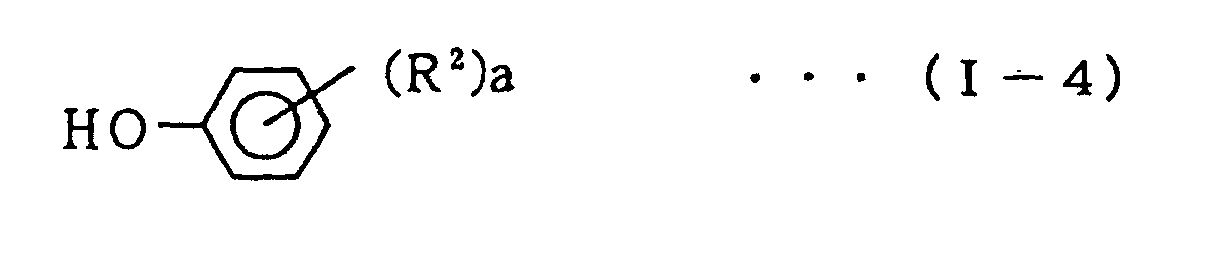 wherein R2 and a have the same meanings as above. Preferably,
it is a para-substituted monophenol. Concretely, it includes,
for example, phenol, p-cresol, p-tert-butylphenol, p-tert-octylphenol,
p-cumylphenol, p-nonylphenol, p-tert-amylphenol.
wherein R2 and a have the same meanings as above. Preferably,
it is a para-substituted monophenol. Concretely, it includes,
for example, phenol, p-cresol, p-tert-butylphenol, p-tert-octylphenol,
p-cumylphenol, p-nonylphenol, p-tert-amylphenol.
The polycarbonate resin to be in the polycarbonate resin
composition of the invention comprises the components (A) and
(B). Regarding their blend ratio, the amount of the component
(A) is from 10 to 100 % by weight, and that of the component (B)
is from 0 to 90 % by weight. If the amount of the component (A)
is smaller than 10 % by weight, it is unfavorable since the
flowability of the resin composition of the invention is low and
the moldings of the composition are not glossy.
The viscosity-average molecular weight (Mv) of the
polycarbonate resin preferably falls between 10,000 and 40,000,
more preferably between 12,000 and 30,000, even more preferably
between 15,000 and 25,000. If the molecular weight of the resin
is too low, the impact resistance of the resin moldings will be
low; but if too high, the resin composition will be difficult
to mold.
Various types of inorganic fillers are known for the
component (C) to be added to the polycarbonate resin in the
invention, and they are for increasing the mechanical strength
and improving the dimensional stability of the polycarbonate
resin composition or for increasing the amount of the resin
composition.
The inorganic filler includes, for example, potassium
titanate whiskers, mineral fibers (e.g., rock wool), glass
fibers, carbon fibers, metal fibers (e.g., stainless steel
fibers), aluminium borate whiskers, silicon nitride whiskers,
boron fibers, tetrapod zinc oxide whiskers, talc, clay, mica,
pearl mica, aluminium leaf, alumina, glass flakes, glass beads,
glass balloons, carbon black, graphite, calcium carbonate,
calcium sulfate, calcium silicate, titanium oxide, zinc oxide,
silica, asbestos, and quarts powder. These inorganic fillers
may be previously surface-treated or may not. The surface-treating
agent includes, for example, silane coupling agents,
higher fatty acids, metal salts of fatty acids, unsaturated
organic acids, organic titanates, resin acids, and polyethylene
glycols. With any of these, the inorganic fillers may be
chemically or physically surface-treated.
Of the inorganic fillers mentioned above, preferred for
use herein are glass fibers and carbon fibers.
For the glass fibers for use herein, any of alkali glass,
low-alkali glass or non-alkali glass is preferred. The length
of the glass fibers preferably falls between 0.1 and 8 mm, more
preferably between 0.3 and 6 mm. Their diameter may fall between
0.1 and 30 µm, but preferably between 0.5 and 25 µm. The glass
fibers are not specifically defined in point of their morphology,
and they may be in any form of rovings, milled fibers or chopped
fibers. Singly or as combined, one or more different types of
such glass fibers may be used herein. Preferably, the glass
fibers are treated with a surface-treating agent and then
processed with a suitable sizing agent for enhancing the
adhesiveness thereof to polycarbonate resin. The surface-treating
agent includes, for example, silane coupling agents
such as aminosilanes, epoxysilanes, vinylsilanes, acrylic
silanes; titanate coupling agents, and aluminium, chromium,
zirconium or boron-containing coupling agents. Of those,
preferred for use herein are silane coupling agents and titanate
coupling agents, and more preferred are silane coupling agents.
For treating the glass fibers with such a surface-treating agent,
the method is not specifically defined and may be any
conventional one. For example, employable are an aqueous
solution method, an organic solvent method and a spraying method.
The sizing agent includes, for example, urethane compounds,
acrylic compounds, acrylonitrile-styrene copolymers and epoxy
compounds, any of which are usable herein. For processing the
glass fibers with such a sizing agent, the method is not
specifically defined and may be any conventional one. For
example, employable is any method of dipping, roller-coating,
blasting, casting or spraying.
The carbon fibers for use herein may be produced from
cellulose fibers, acrylic fibers, lignin, or petroleum or
coal-type special pitch generally by firing them. Various types
of such carbon fibers are known, including, for example,
flame-retardant, carbonaceous or graphitic ones. The length of
the carbon fibers generally falls between 0.01 and 10 mm, and
the diameter thereof may fall between 5 and 15 µm. The morphology
of the carbon fibers is not specifically defined, including, for
example, rovings, milled fibers and chopped strands. The carbon
fibers may be surface-treated with epoxy resin or urethane resin
for enhancing their affinity for polycarbonate resin.
The amount of the inorganic filler to be in the resin
composition of the invention is from 5 to 150 parts by weight,
but preferably from 10 to 80 parts by weight, relative to 100
parts by weight of the polycarbonate resin therein. If it is
smaller than 5 parts by weight, the stiffness of the resin
composition is low and the dimensional stability thereof is also
low. If larger than 150 parts by weight, it is unfavorable since
the resin composition is difficult or impossible to knead.
Within the preferred range, the inorganic filler is effective
for more enhancing the impact resistance of the resin moldings.
Not interfering with the object of the invention, the
polycarbonate resin composition may contain from 100 to 5,000
ppm of a colorant, further optionally other additives and other
synthetic resins or elastomers.
The additives are, for example, antioxidants such as
hindered phenols, phosphorus-containing compounds (e.g.,
phosphites, phosphates), amines; UV absorbents such as
benzotriazoles, benzophenones; optical stabilizers such as
hindered amines; internal lubricants such as aliphatic
carboxylates, paraffins, silicone oil, polyethylene wax; and
mold release agents, flame retardants, flame retardation
promoters, antistatic agents, colorants.
The additional synthetic resins are, for example,
polyethylene resins, polypropylene resins, polystyrene resins,
AS resins (acrylonitrile-styrene copolymers), ABS resins
(acrylonitrile-butadiene-styrene copolymers), polymethyl
methacrylate resins. The elastomers are, for example,
isobutylene-isoprene rubber, styrene-butadiene rubber,
ethylene-propylene rubber, acrylic elastomers.
The components mentioned above may be formulated and
kneaded in any ordinary method. For it, example, usable are any
of ribbon blenders, drum tumblers, Henschel mixers, Banbury
mixers, single-screw extruders, double-screw extruders,
cokneaders, and multi-screw extruders. While kneaded, they may
be heated generally at 240 to 320°C.
The thus-obtained, colored polycarbonate resin
composition may be molded in any known method. For example, it
may be molded in any mode of injection molding, blow molding,
extrusion molding, compression molding, calender molding or spin
molding to give colored moldings such as parts of electric and
electronic appliances, parts of electrically-powered tools and
parts of cameras.
The first aspect of the invention is described more
concretely with reference to its Production Examples, Examples
and Comparative Examples, which, however, are not intended to
restrict the scope of the first aspect of the invention.
Starting compounds, 300 parts by weight of phenol and 105
parts by weight of 1-eicosene/1-docosene/1-tetracosene
(composition ratio, 53.3/40.2/6.5 by mol%) in a molar ratio of
phenol/olefin = 9/1, and 10.5 parts by weight of a catalyst,
strong-acid polystyrenic sulfonate cation resin (Amberlyst 15
from Rohm and Haas) were put into a reactor equipped with a baffle
and a stirring blade, and reacted at 120°C with stirring for 3
hours. After the reaction, the mixture was purified through
distillation under reduced pressure to obtain an alkylphenol (a).
In the resulting alkylphenol (a), the alkyl group had 21 carbon
atoms on average and was branched.
In the same manner as in preparing the alkylphenol (a),
an alkylphenol (b) was prepared for which, however, the olefin
used was 1-docosene, its amount was 110 parts by weight, the molar
ratio of phenol/olefin was 9/1 and the amount of the catalyst
used was 11 parts by weight. In the alkylphenol (b), the alkyl
group had 22 carbon atoms and was branched.
60 kg of bisphenol A was dissolved in 400 liters of aqueous
5 wt.% sodium hydroxide solution to prepare an aqueous solution
of bisphenol A in sodium hydroxide.
Next, the aqueous solution of bisphenol A in sodium
hydroxide kept at room temperature was fed into a tubular reactor
having an inner diameter of 10 mm and a length of 10 m, at a flow
rate of 138 liters/hr via an orifice plate of the reactor, along
with methylene chloride thereinto via the plate at a flow rate
of 69 liters/hr, while, at the same time, phosgene was also
thereinto at a flow rate of 10.7 kg/hr, and they were continuously
reacted for 3 hours. The tubular reactor used herein is a
jacketed tube, in which cooling water was circulated through the
jacket so as to keep the reaction mixture discharge at 25°C. The
pH of the discharge was controlled to fall between 10 and 11.
The thus-obtained reaction mixture was kept static for
phase separation. Its aqueous phase was removed, and its
methylene chloride phase (220 liters) was collected to obtain
a polycarbonate oligomer (concentration, 317 g/liter). The
degree of polymerization of the polycarbonate oligomer fell
between 2 and 4, and the chloroformate concentration thereof was
0.7 normalities.
10 liters of the polycarbonate oligomer obtained in the
above was put into a 50-liter reactor equipped with a stirrer,
and 136 g of p-dodecylphenol (from Yuka Schenectady, branched)
was dissolved therein. Next, aqueous sodium hydroxide solution
(sodium hydroxide 53 g, water 1 liter) and 5.8 ml of triethylamine
were added thereto and reacted by stirring at 300 rpm for 1 hour.
Then, the system was mixed with a solution of bisphenol A in sodium
hydroxide (bisphenol A 720 g, sodium hydroxide 412 g, water 5.5
liters), 8 liters of methylene chloride was added thereto, and
these were reacted by stirring at 500 rpm for 1 hour. After the
reaction, 7 liters of methylene chloride and 5 liters of water
were added to the system, and stirred at 500 rpm for 10 minutes.
After stirring it was stopped, the system was kept static for
phase separation into an organic phase and an aqueous phase. The
resulting organic phase was washed with 5 liters of an alkali
(0.03-N NaOH), 5 liters of an acid (0.2-N HCl) and 5 liters of
water (twice) in that order. Next, methylene chloride was
evaporated away to obtain a flaky polymer (polycarbonate A1).
The alkylphenoxy terminal fraction of the polymer was 99.5 %,
and the viscosity-average molecular weight thereof was 20,000.
In the same manner as in producing the polycarbonate A1,
a polycarbonate A2 was produced, for which, however, 202 g of
the alkylphenol (a) was used in place of p-dodecylphenol. The
alkylphenoxy terminal fraction of the polymer was 99.0 %, and
the viscosity-average molecular weight thereof was 20,000.
In the same manner as in producing the polycarbonate A1,
a polycarbonate A3 was produced, for which, however, 209 g of
the alkylphenol (b) was used in place of p-dodecylphenol. The
alkylphenoxy terminal fraction of the polymer was 99.0 %, and
the viscosity-average molecular weight thereof was 20,000.
In the same manner as in producing the polycarbonate A1,
a polycarbonate B1 was produced, for which, however, 77.6 g of
p-tert-butylphenol was used in place of p-dodecylphenol. The
p-tert-butylphenoxy terminal fraction of the polymer was 99.5 %,
and the viscosity-average molecular weight thereof was 20,000.
The viscosity of the polycarbonate in methylene chloride
at 20°C was measured with an Ubbelohde's viscometer, and the
intrinsic viscosity [η] thereof was derived from it. The
viscosity-average molecular weight (Mv) of the polycarbonate was
calculated according to the following equation:
[η] = 1.23 × 10⁻⁵ Mv0.83 .
2,000 ppm of a colorant, carbon black (Mitsubishi Carbon
Sharp 1000 from Mitsubishi Chemical) was added to the
polycarbonate obtained in the above-mentioned Production
Example, and glass fibers (MA-409C from Asahi Fiber Glass) were
added thereto in different ratios as in Table I-1. This was
kneaded in a vented double-screw extruder (TEM-35B from Toshiba
Kikai) at 300°C, and pelletized through it. In Examples I-2,
3, 6, 7, 10, 11 and Comparative Examples I-2, 3, 200 ppm of an
antioxidant (phosphorus-containing antioxidant PEP36 fromAsahi
Denka Kogyo) was added to the composition. In Examples I-2, 6,
10 and Comparative Example I-3, 2,000 ppm of a lubricant (SH200
from Toray Dow-Corning) was added to the composition.
According to the method mentioned below, the spiral flow
length (SFL) of the pellets was measured. At a cylinder
temperature of 300°C and at a mold temperature of 80°C, the pellets
were molded into test pieces, and their gloss and Izod impact
strength were measured. The data are given in Table I-1. In
the Table, "Example I-1" is simply designated as "Example 1",
and the same shall apply to Comparative Examples.
The pellets are injection-molded to give a melt flow of
10 mm wide and 3 mm thick. The injection pressure is 80 kg/cm2
(7.84 MPa), the resin temperature is 300°C, and the mold
temperature is 80°C.
The 60-degree mirror-face gloss of each test piece is
measured according to JIS K 7105.
Measured according to JIS K 7110. Five samples of the
same resin composition are tested in the same manner and their
data are averaged.

From Table I-1, it is understood that the flowability
and the gloss of the samples of Examples are both better than
those of the samples of Comparative Examples though the impact
resistance of the former does not differ from that of the
latter.
The polycarbonate resin composition of the second
aspect of the invention (in this section, the "second aspect
of the invention" will be simply referred to as "the
invention") comprises 100 parts by weight of a
polycarbonate-based resin (A) that contains a polycarbonate
resin terminated with a phenoxy group having an alkyl group
with from 21 to 35 carbon atoms, from 0.1 to 10 parts by weight
of a functional group-having silicone compound (B), and from
0.2 to 10 parts by weight of a core/shell-type, grafted
rubber-like elastomer (C).
The polycarbonate resin composition of the invention
is characterized in that its constituent component (A) is a
polycarbonate-based resin that contains a polycarbonate
resin terminated with a phenoxy group having an alkyl group
with from 21 to 35 carbon atoms (this will be hereinafter
referred to as a terminal-modified PC).
The polycarbonate resin terminated with a phenoxy
group having an alkyl group with from 21 to 35 carbon atoms
can be obtained by using an alkylphenol having an alkyl group
with from 21 to 35 carbon atoms as the terminal stopper in
producing it. The alkylphenol is not specifically defined,
including, for example, docosylphenol, tetracosylphenol,
hexacosylphenol, octacosylphenol, triacontylphenol,
dotriacontylphenol and tetratriacontylphenol. Singly or as
combined, one or more of these phenols may be used herein.
Not interfering with the effect of the invention, the
alkylphenol may be combined with any other phenol such as an
alkylphenol having at most 20 carbon atoms.
The alkyl group in the alkylphenol may be at any of
o-, m- or p-position relative to the hydroxyl group therein,
but is preferably at p-position. The alkyl group may be
linear or branched.
In any of the polycarbonate-based resin mentioned
below, the specific terminal-modified PC may be prepared, for
example, through reaction of a diphenol with phosgene or a
carbonate compound using the alkylphenol as the terminal
stopper for controlling the molecular weight of the resulting
polymer.
For example, it is prepared by reacting a diphenol with
phosgene or a polycarbonate oligomer in a methylene chloride
solvent in the presence of a triethylamine catalyst and a
phenol having an alkyl group with from 21 to 35 carbon atoms.
In this, the phenol having an alkyl group with from 21 to 35
carbon atoms terminates to modify one or both terminals of
the polycarbonate resin. The terminal modification in the
polycarbonate resin is at least 20 %, preferably at least 50 %
of all the terminals of the resin. Accordingly, the other
terminal not specifically modified in the polycarbonate resin
is a hydroxyl terminal group or a group terminated with any
other terminal stopper mentioned below.
The other terminal stoppers are phenols generally used
in polycarbonate resin production, including, for example,
phenol, p-tert-butylphenol, p-tert-octylphenol and p-cumylphenol.
However, if such phenols only are used, it is
impossible to obtain the resin composition of the invention
having both good moldability and good impact resistance.
The viscosity-average molecular weight of the
terminal-modified PC in the component (A) of the
polycarbonate resin composition of the invention generally
falls between 10,000 and 40,000, but preferably between
12,000 and 30,000.
The component (A) of the polycarbonate resin
composition of the invention contains the specific
terminal-modified PC, polycarbonate resin terminated with a
phenoxy group having an alkyl group with from 21 to 35 carbon
atoms. In this, the specific terminal-modified PC may be
alone or may be combined with any other ordinary polycarbonate
resin. The specific terminal-modified PC content of the
component is not specifically defined, generally at least 20 %
by weight, but preferably at least 50 % by weight, more
preferably at least 70 % by weight in consideration of all
the terminals of the polycarbonate-based resin of the
component (A) for better moldability (melt flowability) of
the resin composition. The content may be suitably
determined, depending on the ratio of the phenoxy group having
an alkyl group with from 21 to 35 carbon atoms in the
terminal-modified PC, the type of the other terminal of the
modified PC, the type of the terminal of the other
polycarbonate resin combined with the modified PC, and the
melt flowability of the resin composition containing the
modified PC.
The polycarbonate resins to constitute the component
(A) of the polycarbonate resin composition of the invention
are not specifically defined, including those known in the
art. Generally used herein are aromatic polycarbonates to
be produced from diphenols and carbonate precursors. For
example, herein used are polycarbonates as produced by
reacting a diphenol with a carbonate precursor in a solution
method or in a melt method, such as those produced through
reaction of a diphenol with phosgene or through
interesterification of diphenyl carbonate with a diphenol.
Various diphenols are usable, typically including
2,2-bis(4-hydroxyphenyl)propane [bisphenol A], bis(4-hydroxyphenyl)methane,
1,1-bis(4-hydroxyphenyl)ethane,
2,2-bis(4-hydroxy-3,5-dimethylphenyl)propane, 4,4'-dihydroxydiphenyl,
bis(4-hydroxyphenyl)cycloalkanes,
bis(4-hydroxyphenyl) oxide, bis(4-hydroxyphenyl) sulfide,
bis(4-hydroxyphenyl) sulfone, bis(4-hydroxyphenyl)
sulfoxide, bis(4-hydroxyphenyl) ether, and bis(4-hydroxyphenyl)
ketone.
As the diphenols for use herein, preferred are
bis(hydroxyphenyl)alkanes, especially those consisting
essentially of bisphenol A. The carbonate precursors for use
in the invention include, for example, carbonyl halides,
carbonyl esters, and haloformates, concretely, phosgene,
diphenol dihaloformates, diphenyl carbonate, dimethyl
carbonate, and diethyl carbonate. Other diphenols such as
hydroquinone, resorcinol, and catechol are also usable in the
invention. The diphenols mentioned herein may be used either
singly or as combined.
The polycarbonate resin may have a branched structure,
for which the branching agent includes, for example,
1,1,1-tris(4-hydroxyphenyl)ethane, α,α',α"-tris(4-hyroxyphenyl)-1,3,5-triisopropylbenzene,
phloroglucine,
trimellitic acid, and isatin-bis(o-cresol). For
controlling the molecular weight of the polycarbonate resin,
for example, employable are phenol, p-t-butylphenol, p-t-octylphenol,
p-cumylphenol, and alkylphenols having an alkyl
group with from 21 to 35 carbon atoms such as those mentioned
above.
The polycarbonate resin composition of the invention
is characterized in that it contains the terminal-modified
PC which is terminated at least with the molecular
weight-controlling agent, alkylphenol having an alkyl group
with from 21 to 35 carbon atoms.
The polycarbonate resin and the terminal-modified PC
for use in the invention may be polyester-polycarbonate
copolymers to be produced through polymerization of
polycarbonates in the presence of an ester precursor, such
as a difunctional carboxylic acid (e.g., terephthalic acid,
polymethylenedicarboxylic acid) or its ester-forming
derivative, or may also be mixtures of different types of
polycarbonate resins.
One typical example of other polycarbonate copolymers
also usable herein is a polycarbonate-polyorganosiloxane
copolymer (hereinafter abbreviated as PC-PDMS copolymer).
The PC-PDMS copolymer comprises a polycarbonate moiety and
a polyorganosiloxane moiety. For example, this may be
prepared by dissolving a polycarbonate oligomer and a
polyorganosiloxane having a reactive group at its terminal
(this is to form the polyorganosiloxane moiety in the
copolymer, and includes, for example, polydimethylsiloxane,
polydiethylsiloxane, polymethylphenylsiloxane) in a solvent
of, for example, methylene chloride, adding thereto an
aqueous solution of bisphenol A containing sodium hydroxide,
and reacting them in a mode of interfacial polycondensation
in the presence of a catalyst of, for example, triethylamine.
The PC-PDMS copolymer is disclosed in, for example, Japanese
Patent Laid-Open Nos. 292359/1991, 202465/1992, 81620/1996,
302178/1996 and 7897/1998.
In the PC-PDMS copolymer, the degree of polymerization
of the polycarbonate moiety preferably falls between 3 and
100 or so, and the degree of polymerization of the
polydimethylsiloxane moiety preferably falls between 2 and
500 or so. The polydimethylsiloxane content of the PC-PDMS
copolymer (including its by-product, bisphenol A
polycarbonate) may generally fall between 0.2 and 30 % by
weight, but preferably between 0.3 and 20 % by weight. The
viscosity-average molecular weight of the polycarbonate
resin and the polycarbonate copolymer such as PC-PDMS
copolymer for use in the invention may fall generally between
10,000 and 100,000, but preferably between 11,000 and 40,000,
more preferably between 12,000 and 30,000. The viscosity of
the resin or the copolymer in methylene chloride at 20°C is
measured with an Ubbelohde's viscometer, and the intrinsic
viscosity [η] thereof is derived from it. The viscosity-average
molecular weight (Mv) of the resin or the copolymer
is calculated according to the following equation:
[η] = 1.23 × 10⁻⁵ Mv0.83 .
The component (A) of the polycarbonate resin
composition of the invention may be a mixed resin of the
above-mentioned, specific terminal-modified polycarbonate
resin, PC-PDMS copolymer and bisphenol A polycarbonate. The
polydimethylsiloxane content of the component (A) of this
case is defined to fall between 0.1 and 10 % by weight,
preferably between 0.3 and 5 % by weight of the mixed resin
to be the polycarbonate-based resin for the component (A).
The functional group-having silicone compound for the
component (B) of the polycarbonate resin composition of the
second aspect of the invention is a functional group-having
(poly)organosiloxane. Preferably, it is a polymer or
copolymer having a basic structure of a formula:
R1 a R2 b SiO(4-a-b)/2
wherein R1 represents a functional group, R2 represents a
hydrocarbon residue having from 1 to 12 carbon atoms, and 0
< a ≤ 3, 0 ≤ b < 3, and 0 < a + b ≤ 3. The functional group
includes, for example, an alkoxy group, an aryloxy group, a
polyoxyalkylene group, a hydride residue, a hydroxyl group,
a carboxyl group, a silanol group, an amino group, a mercapto
group, an epoxy group.
The silicone compound may have different functional
groups; or silicone compounds each having a different
functional group may be combined for the component (B). In
the basic structure of the functional group-having silicone
compound, the ratio of functional group (R1)/hydrocarbon
residue (R2) generally falls between 0.1 and 3 or so, but
preferably between 0.3 and 2 or so.
The silicone compound is liquid or powdery, but is
preferably well dispersible in the other constituent
components while they are kneaded in melt. One example of
the compound is liquid and has a kinematic viscosity at room
temperature of from 10 to 500,000 mm2/sec or so. The
polycarbonate resin composition of the invention is
characterized in that the silicone compound uniformly
disperses therein even when it is liquid, and bleeds little
out of the composition being molded and out of the moldings
of the composition.
The resin composition may contain from 0.1 to 10 parts
by weight, preferably from 0.2 to 5 parts by weight of the
functional group-having silicone compound, relative to 100
parts by weight of the polycarbonate-based resin (A) therein.
If the amount of the silicone compound therein is smaller than
0.1 parts by weight, the resin composition could not be
resistant to flames; but even if larger than 10 parts by weight,
the silicone compound could no more augment its effect. In
case where the polycarbonate-based resin in the resin
composition contains PC-PDMS copolymer, the functional
group-having silicone compound content of the resin
composition may be suitably determined in consideration of
the overall silicone content of the resin composition. In
that case, since the resin composition contains some silicone
in addition to the functional group-having silicone compound,
the functional group-having silicone compound content of the
resin composition may be reduced. Another advantage of the
case is that the level of the flame retardancy of the resin
composition is kept high even when the overall silicone
content of the resin composition is lowered.
If non-functional silicone compounds with ordinary
alkyl groups such as dimethylsilicone are used in place of
the functional group-having silicone compound for the
component (B), they are ineffective for improving the flame
retardancy of the resin composition as in Comparative
Examples mentioned below.
For the component (C) of the polycarbonate resin
composition of the invention, the core/shell-type, grafted
rubber-like elastomer has a two-layered structure composed
of a core and a shell, in which the core is of a flexible rubber
material and the shell that covers the core is of a hard resin
material. As a whole, the elastomer itself is powdery or
granular. After blended with polycarbonate resin in melt,
the core/shell-type, grafted rubber-like elastomer of that
type mostly keeps its original powdery or granular condition.
Since the grafted rubber-like elastomer mostly keeps its
original powdery or granular condition after having been
blended with the resin melt, it uniformly disperses in the
resin composition and is effective for preventing the
moldings of the resin composition from being troubled by
surface layer peeling.
Known are various core/shell-type, grafted rubber-like
elastomers that are usable herein. Commercially-available
products of such elastomers include, for example,
Hiblen B621 (from Nippon Zeon), KM-330 (from Rohm & Haas),
Metablen W529, Metablen S2001, Metablen C223, Metablen B621
(all from Mitsubishi Rayon).
Above all, for example, preferred are those to be
produced through polymerization of one or more vinylic
monomers in the presence of a rubber-like polymer obtained
from monomers of essentially alkyl acrylates or alkyl
methacrylates with dimethylsiloxane. In the alkyl acrylates
and acryl methacrylates, the alkyl group preferably has from
2 to 10 carbon atoms. Concretely, the acrylates and
methacrylates include, for example, ethyl acrylate, butyl
acrylate, 2-ethylhexyl acrylate, and n-octyl methacrylate.
One example of the rubber-like polymers that are obtained from
monomers of essentially those alkyl (meth)acrylates is a
polymer to be prepared through reaction of at least 70 % by
weight of an alkyl acrylate with at most 30 % by weight of
any other copolymerizable vinylic monomer such as methyl
methacrylate, acrylonitrile, vinyl acetate, styrene. To
prepare the polymer, a polyfunctional monomer serving as a
crosslinking agent, such as divinylbenzene, ethylene
dimethacrylate, triallyl cyanurate or triallyl isocyanurate,
may be suitably added to the polymerization system.
The vinylic monomers to be polymerized in the presence
of such a rubber-like polymer include, for example, aromatic
vinyl compounds such as styrene, α-methylstyrene; acrylates
such as methyl acrylate, ethyl acrylate; and methacrylates
such as methyl methacrylate, ethyl methacrylate. One or more
these monomers may be (co)polymerized, as combined, or may
be copolymerized with any other vinylic monomers such as vinyl
cyanides (e.g., acrylonitrile, methacrylonitrile), and
vinyl esters (e.g., vinyl acetate, vinyl propionate). The
(co)polymerization may be effected in any known method of,
for example, bulk polymerization, suspension polymerization,
or emulsion polymerization. Especially preferred is
emulsion polymerization.
It is desirable that the core/shell-type, grafted
rubber-like elastomers thus produced in the manner mentioned
above contain at least 20 % by weight of the rubber-like
polymer moiety. Typical examples of the core/shell-type,
grafted rubber-like elastomers are MAS resin elastomers such
as graft copolymers of styrene and methyl methacrylate with
from 60 to 80 % by weight of n-butyl acrylate. Other examples
are composite rubber grafted copolymers to be prepared
through graft copolymerization of a composite rubber with at
least one vinylic monomer, in which the composite rubber
comprises from 5 to 95 % by weight of a polysiloxane rubber
component and from 5 to 95 % by weight of a
polyacryl(meth)acrylate rubber component as so entangled
that they are not separated from each other, and has a mean
particle size of from 0.01 to 1 µm or so. The composite rubber
grafted copolymers are better than single rubber grafted
copolymers, as their effect of improving the impact
resistance of resin moldings is higher than that of the latter,
single rubber grafted copolymers. Commercial products of
such composite rubber grafted copolymers are available, for
example, Metablen S-2001 from Mitsubishi Rayon.
The amount of the component (C), core/shell-type,
grafted rubber-like elastomer in the resin composition falls
between 0.2 and 10 parts by weight, preferably between 0.5
and 5 parts by weight, relative to 100 parts by weight of the
component (A), polycarbonate-based resin therein. If the
grafted rubber-like elastomer content of the resin
composition is smaller than 0.2 parts by weight, the impact
resistance of the resin composition will be low; but if larger
than 10 parts by weight, the flame retardancy, the heat
resistance and the stiffness of the resin composition will
be low. In general, 10 parts by weight of the elastomer is
enough for the resin composition. Containing such a
relatively small amount of the component (C), core/shell-type
grafted rubber-like elastomer combined with a relatively
small amount of the component (B), functional group-having
silicone compound, the advantages of the polycarbonate resin
composition of the invention are remarkable. If any other
graft copolymer is used in place of the core/shell-type,
grafted rubber-like elastomer therein, the impact strength
of the resin composition could be improved in some degree but
the flame retardancy thereof could not reach the desired
level.
The three components of the polycarbonate resin
composition of the invention well attain the object of the
invention to improve the moldability (melt flowability), the
impact resistance and the flame retardancy of the resin
composition. If desired, however, any known melt drip
inhibitor may be added to the resin composition for further
improving the melt drip resistance of the composition in fire,
for example, in combustion tests for flame retardancy of
resin.
Polyfluoro-olefin resin (D) is preferred for the melt
drip inhibitor. The polyfluoro-olefin resin is a polymer or
copolymer having an ordinary fluoroethylene structure. For
example, it includes difluoroethylene polymer,
tetrafluoroethylene polymer, tetrafluoroethylene-hexafluoropropylene
copolymer, and copolymer of
tetrafluoroethylene with an ethylenic monomer not containing
fluorine. Preferred is polytetrafluoroethylene (PTFE), and
its mean molecular weight is preferably at least 500,000, more
preferably from 500,000 to 10,000,000. Any and every type
of polytetrafluoroethylene known in the art is usable herein.
Polytetrafluoroethylene having the ability to form
fibrils is more preferred, as it ensures higher melt drip
inhibition. The fibril-forming polytetrafluoroethylene
(PTFE) is not specifically defined, but preferred is PTFE of
Type 3 stipulated in the ASTM Standard. Specific examples
of PTFE of Type 3 include Teflon 6-J (from Mitsui-DuPont
Fluorochemical), Polyflon D-1, Polyflon F-103, Polyflon F201
(from Daikin Industry), and CD076 (from Asahi ICI
Fluoropolymers).
Others except PTFE of Type 3 are also employable herein,
including, for example, Argoflon F5 (from Montefluos),
Polyflon MPA and Polyflon FA-100 (from Daikin Industry).
These polytetrafluoroethylenes (PTFE) may be used either
singly or as combined. The fibril-forming
polytetrafluoroethylene (PTFE) as above may be obtained, for
example, by polymerizing tetrafluoroethylene in an aqueous
solvent in the presence of sodium, potassium or ammonium
peroxydisulfide, under a pressure falling between 0.01 and
1 MPa, at a temperature falling between 0 and 200°C, preferably
between 20 and 100°C.
The amount of the polyfluoro-olefin resin that may be
in the resin composition preferably falls between 0.02 and
5 parts by weight, more preferably between 0.05 and 2 parts
by weight relative to 100 parts by weight of the component
(A), polycarbonate-based resin therein. If the amount
therein is smaller than 0.02 parts by weight, the melt
drip-inhibiting ability of the composition will be not enough
for the intended flame retardancy of the composition.
However, even if its amount is larger than 5 parts by weight,
the effect of the polyfluoro-olefin resin added could not be
augmented any more, and such a large amount of the
polyfluoro-olefin resin, if added to the composition, will
have some negative influences on the impact resistance and
the outward appearance of the moldings of the composition.
Therefore, the amount of the polyfluoro-olefin resin to be
added to the composition may be suitably determined,
depending on the necessary flame retardancy of the moldings
of the composition, for example, based on V-0, V-1 or V-2 in
UL-94, and depending on the amount of the other constituent
components of the composition.
The polycarbonate resin composition of the invention
may contain, if desired, an inorganic filler which is for
enhancing the stiffness of the resin moldings and for further
enhancing the flame retardancy thereof. The inorganic
filler includes, for example, talc, mica, kaolin,
diatomaceous earth, calcium carbonate, calcium sulfate,
barium sulfate, glass fibers, carbon fibers, and potassium
titanate fibers. Especially preferred for use herein are
tabular fillers of, for example, talc and mica, and fibrous
fillers such as glass fibers and carbon fibers. Talc is a
magnesium silicate hydrate, and this is available on the
market. The inorganic filler such as talc for use herein may
have a mean particle size of from 0.1 to 50 µm, but preferably
from 0.2 to 20 µm. The inorganic filler, especially talc in
the resin composition is effective for further enhancing the
stiffness of the moldings of the composition, and, as the case
may be, it will be able to reduce the amount of the silicone
compound to be in the composition.
The amount of the inorganic filler content that may
be in the resin composition preferably falls between 1 and
100 parts by weight, more preferably between 2 and 50 parts
by weight relative to 100 parts by weight of the component
(A), polycarbonate-based resin therein. If its amount is
smaller than 1 part by weight, the inorganic filler added
could not satisfactorily exhibit its effect of enhancing the
stiffness and the flame retardancy of the resin composition;
but if larger than 100 parts by weight, the impact resistance
and the melt flowability of the resin composition will lower.
The amount of the inorganic filler to be in the resin
composition may be suitably determined, depending on the
necessary properties of the resin moldings and the
moldability of the composition, especially on the thickness
of the moldings and the spiral flow length of the composition.
The second aspect of the invention also provides a
polycarbonate resin composition, which comprises 100 parts
by weight of a resin mixture of from 1 to 99 % by weight of
a polycarbonate-based resin (A) that contains a polycarbonate
resin terminated with a phenoxy group having an alkyl group
with from 21 to 35 carbon atoms, and from 1 to 99 % by weight
of a styrenic resin (E), and from 0.01 to 5 parts by weight
of a polyfluoro-olefin resin (D).
The polycarbonate resin composition of the second
aspect of the invention is characterized in that its
constituent component (A), polycarbonate-based resin
contains a polycarbonate resin terminated with a phenoxy
group having an alkyl group with from 21 to 35 carbon atoms
(this will be hereinafter referred to as a terminal-modified
PC). In this, the terminal-modified PC may be the same as
that mentioned hereinabove to be in the component (A).
For the styrenic resin for the constituent component
(E) of the polycarbonate resin composition of the second
aspect of the invention, usable are polymers that are prepared
through polymerization of a monomer or monomer mixture of from
20 to 100 % by weight of a monovinylic aromatic monomer such
as styrene or α-methylstyrene, from 0 to 60 % by weight of
a vinyl cyanide-type monomer such as acrylonitrile or
methacrylonitrile, and from 0 to 50 % by weight of any other
vinylic monomer copolymerizable with those monomers, such as
maleimide or methyl (meth)acrylate. The polymers include,
for example, polystyrenes (GPPS), acrylonitrile-styrene
copolymers (AS resins).
For the styrenic resin, also preferably used herein
are rubber-modified styrenic resins. The rubber-modified
styrenic resins are preferably high-impact styrenic resins
that are produced through grafting polymerization of rubber
with at least styrenic monomers. The rubber-modified
styrenic resins include, for example, high-impact
polystyrenes (HIPS) produced through polymerization of
rubber such as polybutadiene with styrene; ABS resins
produced through polymerization of polybutadiene with
acrylonitrile and styrene; MBS resins produced through
polymerization of polybutadiene with methyl methacrylate and
styrene. These rubber-modified styrenic resins may be
combined, or may be mixed with other styrenic resins not
modified with rubber such as those mentioned above, and the
resin mixtures may be used in the invention.
In the rubber-modified styrenic resins, the amount of
rubber to modify them may fall, for example, between 2 and
50 % by weight, but preferably between 5 and 30 % by weight,
more preferably between 5 and 15 % by weight. If the rubber
content is smaller than 2 % by weight, the impact resistance
of the resin moldings will be poor. If, on the other hand,
it is larger than 50 % by weight, the thermal stability of
the resin composition will be lowered, and the melt
flowability thereof will be also lowered. If so, in addition,
the resin composition will be unfavorably gelled or yellowed.
Specific examples of rubber for use herein include
polybutadiene, acrylate and/or methacrylate-having
rubber-like polymers, styrene-butadiene-styrene rubber
(SBS), styrene-butadiene rubber (SBR), butadiene-acrylic
rubber, isoprene rubber, isoprene-styrene rubber,
isoprene-acrylic rubber, and ethylene-propylene rubber. Of
those, especially preferred is polybutadiene. The
polybutadiene usable herein may be any of low-cis
polybutadiene (for example, having from 1 to 30 mol% of
1,2-vinyl bonds and from 30 to 42 mol% of 1,4-cis bonds) or
high-cis polybutadiene (for example, having at most 20 mol%
of 1,2-vinyl bonds and at least 78 mol% of 1,4-cis bonds),
and even their mixtures.
Containing the resin mixture of polycarbonate resin
and styrenic resin, the melt flowability of the polycarbonate
resin composition of the invention is high. The blend ratio
of the two resins to give the resin mixture is as follows:
The amount of the component (A), polycarbonate-based resin
is from 1 to 99 % by weight, preferably from 50 to 98 % by
weight, more preferably from 70 to 95 % by weight; and that
of the styrenic resin (E) is from 1 to 99 % by weight,
preferably from 2 to 50 % by weight, more preferably from 5
to 30 % by weight. If the amount of the component (A),
polycarbonate-based resin is smaller than 1 % by weight, the
heat resistance and the strength of the resin moldings will
be low; and if the amount of the component (E), styrenic resin
is smaller than 1 % by weight, the moldability of the resin
composition will be poor. For the styrenic resin (E),
preferred are rubber-modified styrenic resins such as those
mentioned hereinabove. In case where the rubber-modified
polystyrene resin is used for the component (E), the blend
ratio of the two resins is preferably as follows: The amount
of the component (A), polycarbonate-based resin is from 70
to 98 % by weight, and that of the rubber-modified polystyrene
resin (E) is from 2 to 30 % by weight.
The resin blend ratio may be suitably determined,
depending on the terminal-modified polycarbonate resin, the
molecular weight of other polycarbonate resin, the type of
styrenic resin, the melt flow rate of the resin composition,
the rubber content of the resin composition, and on the use
of the resin moldings, especially the size and the thickness
thereof.
This may be the same as that for the component (D)
mentioned hereinabove.
The amount of the polyfluoro-olefin resin in the resin
composition is from 0.01 to 5 parts by weight, preferably from
0.05 to 2 parts by weight relative to 100 parts by weight of
the resin mixture of the components (A) and (E) therein.
If the amount of the polyfluoro-olefin resin therein
is smaller than 0.01 parts by weight, the melt drip-inhibiting
ability of the composition will be not enough for the intended
flame retardancy of the composition. However, even if its
amount is larger than 5 parts by weight, the effect of the
polyfluoro-olefin resin added could not be augmented any more.
Therefore, the amount of the polyfluoro-olefin resin to be
added to the composition may be suitably determined,
depending on the necessary flame retardancy of the moldings
of the composition, for example, based on V-0, V-1 or V-2 in
UL-94, and depending on the amount of the other constituent
components of the composition.
For further enhancing its flame retardancy, the resin
composition preferably contains a functional group-having
silicone compound, which may be the same as that mentioned
hereinabove for the component (B).
The amount of the functional group-having silicone
compound that may be in the resin composition is preferably
from 0.1 to 10 parts by weight, more preferably from 0.2 to
5 parts by weight relative to 100 parts by weight of the resin
mixture of the components (A) and (E) therein. If the amount
of the silicone compound therein is smaller than 0.1 parts
by weight, the resin composition could not be resistant to
flames; but even if larger than 10 parts by weight, the
silicone compound could no more augment its effect. In case
where the polycarbonate-based resin in the resin composition
contains PC-PDMS copolymer, the functional group-having
silicone compound content of the resin composition may be
suitably determined in consideration of the overall silicone
content of the resin composition. In that case, since the
resin composition contains some silicone in addition to the
functional group-having silicone compound, the functional
group-having silicone compound content of the resin
composition may be reduced. Another advantage of the case
is that the level of the flame retardancy of the resin
composition is kept high even when the overall silicone
content of the resin composition is lowered.
The polycarbonate resin composition of the second
aspect of the invention may contain an inorganic filler for
enhancing the stiffness of the resin moldings. The inorganic
filler may be the same as that mentioned hereinabove.
The amount of the inorganic filler that may be in the
resin composition is preferably from 1 to 100 parts by weight,
more preferably from 2 to 50 parts by weight relative to 100
parts by weight of the resin mixture of the components (A)
and (E) therein. If its amount is smaller than 1 part by
weight, the inorganic filler added could not satisfactorily
exhibit its effect of enhancing the stiffness and the flame
retardancy of the resin composition; but if larger than 100
parts by weight, the impact resistance and the melt
flowability of the resin composition will lower. The amount
of the inorganic filler to be in the resin composition may
be suitably determined, depending on the necessary properties
of the resin moldings and the moldability of the composition,
especially on the thickness of the moldings and the spiral
flow length of the composition.
In addition to the indispensable components (A), (B)
and (C) and the optional components (D) and inorganic filler,
or in addition to the indispensable components (A), (E) and
(D) and the optional components (B) and (F), the polycarbonate
resin composition of the invention may contain any other
additives which are generally added to ordinary thermoplastic
resins such as polyester resins and polyamide resins, if
desired. The additives are for further improving the
moldability of the composition and for further improving the
impact resistance, the outward appearances, the weather
resistance and the stiffness of the moldings of the
composition. They include, for example, phenolic,
phosphorus-containing or sulfur-containing antioxidants,
antistatic agents, polyamide-polyether block copolymers
(for permanent static electrification resistance),
benzotriazole-type or benzophenone-type UV absorbents,
hindered amine-type light stabilizers (weather-proofing
agents), plasticizers, microbicides, compatibilizers, and
colorants (dyes, pigments). The amount of the optional
additives that may be in the polycarbonate resin composition
of the invention is preferably so defined that they do not
interfere with the properties of the composition.
Methods for producing the polycarbonate resin
composition of the invention are described. The resin
composition may be produced by mixing and kneading the
indispensable components and the optional components in a
predetermined ratio as above. Formulating and mixing the
constituent components into the intended resin composition
may be effected in any known manner, for example, by premixing
them in an ordinary device, such as a ribbon blender
or a drum tumbler, followed by further kneading the resulting
pre-mix in a Banbury mixer, a single-screw extruder, a
double-screw extruder, a multi-screw extruder or a cokneader.
The temperature at which the components are mixed and kneaded
generally falls between 240 and 300°C. For molding the melt
mixture, preferably used is an extrusion molding machine,
more preferably a vented extruder. Other constituent
components than polycarbonate resin may be previously mixed
with polycarbonate resin or with any other thermoplastic
resin to prepare a master batch.
Having been prepared in the manner as above, the
polycarbonate resin composition of the invention may be
molded into various moldings in the melt-molding devices as
above, or, after it is pelletized, the resulting pellets may
be molded into various moldings through injection molding,
injection compression molding, extrusion molding, blow
molding, pressing, vacuum forming or foaming. Especially
preferably, the composition is pelletized in the melt-kneading
manner as above, and the resulting pellets are molded
into moldings through injection molding or injection
compression molding. For injection molding of the
composition, employable is a gas-assisted molding method
which is effective for preventing the moldings from having
sinking marks on their surfaces and for reducing the weight
of the moldings.
Moldings of the polycarbonate resin composition of the
invention are usable for various housings and parts of
electric and electronic appliances, such as copiers,
facsimiles, televisions, radios, tape recorders, video decks,
personal computers, printers, telephones, information
terminals, refrigerators, and microwave ovens. The moldings
have still other applications, and are usable, for example,
as automobile parts.
The second aspect of the invention is described more
concretely with reference to its Production Examples,
Examples and Comparative Examples, which, however, are not
intended to restrict the scope of the invention.
Starting compounds, 300 parts by weight of phenol and
110 parts by weight of 1-docosene in a molar ratio of
phenol/olefin = 9/1, and 11 parts by weight of a catalyst,
strong-acid polystyrenic sulfonate cation resin (Amberlyst
15 from Rohm and Haas) were put into a reactor equipped with
a baffle and a stirring blade, and reacted at 120°C with
stirring for 3 hours. After the reaction, the mixture was
purified through distillation under reduced pressure to
obtain an alkylphenol (a). In the resulting alkylphenol (a),
the alkyl group had 22 carbon atoms.
60 kg of bisphenol A was dissolved in 400 liters of
aqueous 5 wt.% sodium hydroxide solution to prepare an aqueous
solution of bisphenol A in sodium hydroxide.
Next, the aqueous solution of bisphenol A in sodium
hydroxide kept at room temperature was fed into a tubular
reactor having an inner diameter of 10 mm and a length of 10
m, at a flow rate of 138 liters/hr via an orifice plate of
the reactor, along with methylene chloride thereinto via the
plate at a flow rate of 69 liters/hr, while, at the same time,
phosgene was also thereinto at a flow rate of 10.7 kg/hr, and
they were continuously reacted for 3 hours. The tubular
reactor used herein is a jacketed tube, in which cooling water
was circulated through the jacket so as to keep the reaction
mixture discharge at 25°C. The pH of the discharge was
controlled to fall between 10 and 11.
The thus-obtained reaction mixture was kept static for
phase separation. Its aqueous phase was removed, and its
methylene chloride phase (220 liters) was collected to obtain
a PC oligomer (concentration, 317 g/liter). The degree of
polymerization of the PC oligomer fell between 2 and 4, and
the chloroformate concentration thereof was 0.7 normalities.
10 liters of the PC oligomer obtained in above
Production Example was put into a 50-liter reactor equipped
with a stirrer, and 247 g of the alkylphenol (a) was dissolved
therein. Next, aqueous sodium hydroxide solution (sodium
hydroxide 53 g, water 1 liter) and 5.8 cc of triethylamine
were added thereto and reacted by stirring at 300 rpm for 1
hour. Then, the system was mixed with a solution of bisphenol
A in sodium hydroxide (bisphenol A 720 g, sodium hydroxide
412 g, water 5.5 liters), 8 liters of methylene chloride was
added thereto, and these were reacted by stirring at 500 rpm
for 1 hour. After the reaction, 7 liters of methylene
chloride and 5 liters of water were added to the system, and
stirred at 500 rpm for 10 minutes. After stirring was stopped,
the system was kept static for phase separation into an
organic phase and an aqueous phase. The resulting organic
phase was washed with 5 liters of an alkali (0.03-N NaOH),
5 liters of an acid (0.2-N HCl) and 5 liters of water (twice)
in that order. Next, methylene chloride was evaporated away
to obtain a flaky polymer. Its viscosity-average molecular
weight was 17,500.
1483 g of octamethylcyclotetrasiloxane, 96 g of
1,1,3,3-tetramethyldisiloxane and 35 g of 86 % sulfuric acid
were mixed and stirred at room temperature for 17 hours. The
resulting oily phase was separated, and 25 g of sodium
hydrogencarbonate was added thereto and stirred for 1 hour.
After filtered, this was distilled in vacuum of 3 Torr (4 ×
102 Pa) at 150°C to remove the low-boiling fraction, and the
residual oil was collected.
To a mixture of 60 g of 2-allylphenol and 0.0014 g of
a platinum compound, platinum chloride-alcoholate complex,
added was 294 g of the oil at 90°c. While kept at 90 to 115°C,
the resulting mixture was stirred for 3 hours. The resulting
product was extracted with methylene chloride and washed
three times with aqueous 80 % methanol to remove the excess
2-allylphenol. This was dried with anhydrous sodium sulfate
and then heated in vacuum at 115°C to remove the solvent.
Through its NMR, the thus-obtained, phenol-terminated
PDMS was found to have 30 repetitive dimethylsilanoxy units.
182 g of the reactive PDMS obtained in the above was
dissolved in 2 liters of methylene chloride, and this was
mixed with 10 liters of the PC oligomer obtained in above
Production Example. To this were added a solution of 26 g
of sodium hydroxide in 1 liter of water and 5.7 cc of
triethylamine, and these were reacted by stirring at 500 rpm
at room temperature for 1 hour.
To the resulting reaction system, added were a solution
of 600 g of bisphenol A dissolved in 5 liters of aqueous 5.2
wt.% sodium hydroxide, 8 liters of methylene chloride, and
96 g of p-tert-butylphenol, and these were reacted by stirring
at 500 rpm at room temperature for 2 hours.
5 liters of methylene chloride was added to the
resulting reaction system, which was then washed with 5 liters
of water, 5 liters of an alkali, 0.03-N sodium hydroxide, 5
liters of an acid, 0.2-N hydrochloric acid, and 5 liters of
water (two times) in that order. Finally, methylene chloride
was removed from this, and a flaky PC-PDMS copolymer was
obtained. This was dried in vacuum at 120°C for 24 hours.
Its viscosity-average molecular weight was 17,000, and its
PDMS content was 4.0 % by weight.
The viscosity-average molecular weight and the PDMS
content were measured as follows:
A terminal-modified PC-PDMS copolymer was produced in
the same manner as in producing the PC-PDMS copolymer, for
which, however, 257 g of the alkylphenol (a) was used in place
of 96 g of p-tert-butylphenol. The thus-obtained,
terminal-modified PC-PDMS copolymer was dried in vacuum at
120°C for 24 hours. Its viscosity-average molecular weight
was 17,000, and its PDMS content was 4.0 % by weight.
The components shown in Table II-1 were blended in
different ratios as therein [the amount of the component (A)
is in terms of % by weight, and that of the other components
is in terms of parts by weight relative to 100 parts by weight
of the component (A)], fed into a vented double-screw extruder
(TEM35 from Toshiba Kikai), melted and kneaded therein at
280°C, and then pelletized. To all compositions of Examples
and Comparative Examples, added were 0.2 parts by weight of
Irganox 1076 (from Ciba Specialty Chemicals) and 0.1 parts
by weight of Adekastab C (from Asahi Denka Industry) both
serving as an antioxidant. The resulting pellets were dried
at 120°C for 12 hours, and then molded into test pieces in
a mode of injection molding at 270°C. The mold temperature
was 80°C. These test pieces were tested for their properties
in various test methods, and their data obtained are given
in Table II-1. In the Table, "Example II-1" is simply
designated as "Example 1", and the same shall apply to
Comparative Examples.
The materials used for producing the test samples, and
the methods for testing the samples are mentioned below.
The IZOD impact strength of the recycled test pieces
is measured.
The color change of the recycled test pieces is
measured. Concretely, the color (L, a, b) of the original
test pieces and that of the recycled test pieces are measured
with a colorimeter, according to JIS H 7103 (test method for
yellowing). From the data, obtained is the color difference,
ΔE between the original test pieces and the recycled test
pieces.


The components shown in Table II-2 were blended in
different ratios as therein [the amount of the component (A)
and the component (E) is in terms of % by weight, and that of
the other components is in terms of parts by weight relative
to 100 parts by weight of the resin mixture of the components
(A) and (E)], fed into a vented double-screw extruder (TEM35
from Toshiba Kikai), melted and kneaded therein at 280°C, and
then pelletized. To all compositions of Examples and
Comparative Examples, added were 0.2 parts by weight of Irganox
1076 (from Ciba Specialty Chemicals) and 0.1 parts by weight
of Adekastab C (from Asahi Denka Industry) both serving as an
antioxidant. The resulting pellets were dried at 120°C for 12
hours, and then molded into test pieces in a mode of injection
molding at 270°C. The mold temperature was 80°C. These test
pieces were tested for their properties in various test methods,
and their data obtained are given in Table II-2. In the Table,
"Example II-5" is simply designated as "Example 5", and the same
shall apply to Comparative Examples.
The materials used for producing the test samples, and
the methods for testing the samples are mentioned below.
This is a bisphenol A polycarbonate resin having an MFR of 19 g/10 min (measured at 300°C under a load of 11.77 N according to JIS K 7210) and a viscosity-average molecular weight of 19,000, and terminated with p-tert-butylphenoxy group.
This is the bisphenol A-polydimethylsiloxane (PDMS) copolymer obtained in the above, having a PDMS content of 4.0 % by weight and a viscosity-average molecular weight of 17,100, and terminated with p-docosylphenoxy group.
This is methoxy group-having dimethylsilicone, having a
kinematic viscosity of 20 mm2/sec.
The test methods are the same as those mentioned
hereinabove.


From the data in Tables II-1 and II-2, it is obvious that
the moldability (melt flowability) of the polycarbonate resin
composition of the invention is good and the moldings of the
composition have high impact strength. In addition, the resin
moldings are resistant to grease and are recyclable.
The component (A) of the resin composition of the third
aspect of the invention (in this section, the "third aspect of
the invention" will be simply referred to as "the invention")
is an aromatic polycarbonate-polyorganosiloxane copolymer
having a terminal group of formula (III-1) mentioned above (this
is hereinafter abbreviated as PC-PDMS copolymer). For example,
it includes copolymers disclosed in Japanese Patent Laid-Open
Nos. 29695/1975, 292359/1991, 202465/1992, 81620/1996,
302178/1996 and 7897/1998. For it, preferred are copolymers
having an aromatic polycarbonate moiety of structural units of
the following structural formula (III-3) and a
polyorganosiloxane moiety of structural units of the following
structural formula (III-4) in the molecule.


In these, R3 and R4 each represent an alkyl group having
from 1 to 6 carbon atoms, or a phenyl group, and they may be
the same or different. R5 to R8 each represent an alkyl group
having from 1 to 6 carbon atoms, or a phenyl group, preferably
a methyl group. R5 to R8 may be the same or different.
R9 represents an aliphatic or aromatic organic residue,
preferably an o-allylphenol residue, a p-hydroxystyrene
residue or a eugenol residue.
Z represents a single bond, an alkylene group having from
1 to 20 carbon atoms, an alkylidene group having from 1 to 20
carbon atoms, a cycloalkylene group having from 5 to 20 carbon
atoms, or a cycloalkylidene group having from 5 to 20 carbon
atoms, or a bond of -SO2-, -SO-, -S-, -O- or -CO-. Preferably,
it is an isopropylidene group.
b and c each indicate an integer of from 0 to 4, preferably
0. n indicates an integer of from 1 to 500, preferably from
5 to 100.
The PC-PDMS copolymer may be produced, for example, by
dissolving a previously-prepared aromatic polycarbonate
oligomer (hereinafter abbreviated as PC oligomer), which is to
form the aromatic polycarbonate moiety of the copolymer, and
a previously-prepared polyorganosiloxane terminated with a
reactive group such as an o-allylphenol, p-hydroxystyrene or
eugenol residue (reactive PDMS), which is to form the
polyorganosiloxane moiety of the copolymer, in a solvent such
as methylene chloride, chlorobenzene or chloroform, then adding
thereto an aqueous alkali hydroxide solution of a diphenol, and
reacting them in a mode of interfacial polycondensation in the
presence of a tertiary amine (e.g., triethylamine) or a
quaternary ammonium salt (e.g., trimethylbenzylammonium
chloride) serving as a catalyst and in the presence of an
ordinary terminal stopper of a phenol compound of the following
general formula (III-5):
 wherein R1 and a have the same meanings as above.
Concretely, for example, the terminal stopper includes
phenol, p-cresol, p-tert-butylphenol, p-tert-octylphenol,
p-cumylphenol, p-nonylphenol, p-tert-amylphenol, bromophenol,
tribromophenol, pentabromophenol. For it, preferred are
non-halogen compounds for protecting the environment.
The PC oligomer to be used in producing the PC-PDMS
copolymer is readily prepared, for example, by reacting a
diphenol of the following general formula (III-6):
 wherein R3, R4, Z, b and c have the same meanings as above,
with a carbonate precursor such as phosgene or a carbonate
compound, in a solvent such as methylene chloride.
wherein R3, R4, Z, b and c have the same meanings as above,
with a carbonate precursor such as phosgene or a carbonate
compound, in a solvent such as methylene chloride.
Concretely, for example, it may be prepared through
reaction of a diphenol with a carbonate precursor such as
phosgene or through interesterification of a carbonate
precursor such as diphenyl carbonate with a diphenol, in a
solvent such as methylene chloride.
The diphenol of formula (III-6) includes, for example,
4,4'-dihydroxydiphenyl; bis(4-hydroxyphenyl)alkanes such as
1,1-bis(4-hydroxyphenyl)methane, 1,1-bis(4-hydroxyphenyl)ethane,
2,2-bis(4-hydroxyphenyl)propane;
bis(4-hydroxyphenyl) oxide; bis(4-hydroxyphenyl) sulfide;
bis(4-hydroxyphenyl) sulfone; bis(4-hydroxyphenyl)
sulfoxide; bis(4-hydroxyphenyl) ether; and bis(4-hydroxyphenyl)
ketone. Of those, preferred is 2,2-bis(4-hydroxyphenyl)propane
(bisphenol A). Singly or as combined,
one or more of these diphenols may be used for the reaction.
The carbonate compound includes, for example, diaryl
carbonates such as diphenyl carbonate; and dialkyl carbonates
such as dimethyl carbonate, diethyl carbonate.
In the invention, the PC oligomer for use in producing
the PC-PDMS copolymer may be a homopolymer or copolymer with
one or more diphenols mentioned above. In addition, it may also
be a thermoplastic random branched polycarbonate prepared by
combining the diphenol with a polyfunctional aromatic compound.
For it, the branching agent (polyfunctional aromatic compound)
includes, for example, 1,1,1-tris(4-hydroxyphenyl)ethane,
α,α'α"-tris(4-hydroxyphenyl)-1,3,5-triisopropylbenzene, 1-[α-methyl-α-(4'-hydroxyphenyl)ethyl]-4-[α',α'-bis(4"-hydroxyphenyl)ethyl]benzene,phloroglucine,trimellitic
acid,
isatin-bis(o-cresol).
The component (A) may be produced in the manner as above,
but in general, it contains a by-product of aromatic
polycarbonate. Accordingly, the component (A) produced in the
manner as above is an aromatic polycarbonate resin that contains
PC-PDMS copolymer, and its viscosity-average molecular weight
preferably falls between 10,000 and 40,000 as a whole, more
preferably between 12,000 and 30,000. Also preferably, the
polyorganosiloxane content of the component (A) is from 0.5 to
10 % by weight of the total polycarbonate resin that contains
the component (A).
The polymer produced according to the method mentioned
above is terminated by the group of formula (III-1)
substantially at one or both ends of the molecule.
The component (B) of the resin composition of the
invention is an aromatic polycarbonate having a terminal group
of formula (III-2) mentioned above (this is hereinafter
abbreviated as terminal-modified polycarbonate), and its
viscosity-average molecular weight preferably falls between
10,000 and 40,000, more preferably between 12,000 and 30,000.
In formula (III-2), R2 is an alkyl group having from 21
to 35 carbon atoms, and it may be linear or branched.
In this, the alkyl group may be at any of p-, m- or
o-position, but is preferably at p-position.
The terminal-modified polycarbonate may be readily
prepared by reacting a diphenol with phosgene or a carbonate
compound.
Concretely, for example, it is prepared through reaction
of a diphenol with a carbonate precursor such as phosgene or
through interesterification of a carbonate precursor such as
diphenyl carbonate with a diphenol, in a solvent such as
methylene chloride in the presence of a catalyst such as
triethylamine and a specific terminal stopper.
The diphenol may be the same as the compound of formula
(III-6), or may differ from it. The terminal-modified
polycarbonate may be a homopolymer or copolymer with one or more
diphenols mentioned above. In addition, it may also be a
thermoplastic random branched polycarbonate prepared by
combining the diphenol with a polyfunctional aromatic compound.
Examples of the carbonate compound are diaryl carbonates
such as diphenyl carbonate, and dialkyl carbonates such as
dimethyl carbonate, diethyl carbonate.
For the terminal stopper, used are phenol compounds
capable of forming a terminal group of formula (III-2). For
example, used are phenol compounds of the following general
formula (III-7) in which R2 has the same meaning as above.

Examples of such alkylphenols are docosylphenol,
tetracosylphenol, hexacosylphenol, octacosylphenol,
triacontylphenol, dotriacontylphenol and
tetratriacontylphenol. Singly or as combined, one or more of
these alkylphenols may be used herein. Not interfering with
the effect of the invention, the alkylphenol may be combined
with any other phenol such as an alkylphenol having at most 20
carbon atoms.
The aromatic polycarbonate produced according to the
method mentioned above is terminated by the group of formula
(III-2) substantially at one or both ends of the molecule.
The aromatic polycarbonate resin containing the
components (A) and (B) is prepared by mixing the aromatic
polycarbonate resin containing the component (A) with the
component (B). If desired, it may contain any other ordinary
aromatic polycarbonate resin. Preferably, however, the
viscosity-average molecular weight of the additional aromatic
polycarbonate resin falls between 10,000 and 40,000, more
preferably between 12,000 and 30,000. The aromatic
polycarbonate resin may be prepared in the same manner as that
for preparing the component (B), using, as the terminal stopper,
the ordinary phenol compound of formula (III-5). The diphenol
for it may be the same as or different from the diphenol of
formula (III-6) to be used in producing the component (A) as
well as the diphenol used in producing the component (B).
Preferably, the viscosity-average molecular weight of
the total aromatic polycarbonate resin that contains the
components (A) and (B) falls between 10,000 and 40,000, more
preferably between 12,000 and 30,000, even more preferably
between 14,000 and 26,000. If its molecular weight is too low,
the mechanical strength of the resin composition of the
invention will be low; but if too high, the flowability of the
resin composition of the invention will be poor.
The polyorganosiloxane content of the component (A)
preferably falls between 0.1 and 2 % by weight of the total
aromatic polycarbonate resin that contains the components (A)
and (B) for better flame retardancy of the resin composition
of the invention. More preferably, it falls between 0.2 and
1.5 % by weight, even more preferably between 0.5 and 1.3 % by
weight.
Also preferably, the amount of the component (B),
polycarbonate is at least 10 % by weight of the total aromatic
polycarbonate resin that contains the components (A) and (B),
more preferably between 30 and 90 % by weight, even more
preferably between 40 and 80 % by weight. If the amount of the
component (B) is smaller than 10 % by weight, the flowability
of the composition of the invention could not be increased.
The component (C), fibril-forming
polytetrafluoroethylene having a mean molecular weight of at
least 500,000 (hereinafter this is abbreviated as PTFE) to be
in the resin composition of the invention is for enhancing the
ability of the resin composition not to drip in melt, and it
therefore enhances the flame retardancy of the composition.
Its mean molecular weight must be at least 500,000, and is
preferably from 500,000 to 10,000,000, more preferably from
1,000,000 to 10,000,000.
The amount of the component (C) in the resin composition
is from 0.05 to 1 part by weight, preferably from 0.1 to 0.5
parts by weight relative to 100 parts by weight of the aromatic
polycarbonate resin therein that contains the components (A)
and (B). If the amount is larger than 1 part by weight, it is
unfavorable since too much PTFE will have negative influences
on the impact resistance and the appearance of the resin
moldings and, in addition, the resin strands containing too much
PTFE will meander when the resin composition is kneaded and
extruded out, and if so, it is impossible to stably produce resin
pellets . On the other hand, if its amount is smaller than 0.05
parts by weight, the component (C) will be ineffective for melt
drip inhibition. Within the preferred range, the component (C)
is more effective for melt drip inhibition and enhances the
flame retardancy of the resin composition.
The fibril-forming PTFE for the component (C) is not
specifically defined, including, for example, Teflon 6-J (trade
name from Mitsui-DuPont Fluorochemical), Polyflon D-1 and
Polyflon F-103 (trade names from Daikin Industry), Argoflon F5
(trade name from Montefluos), Polyflon MPA, FA-100 (trade names
from Daikin Industry). These polytetrafluoroethylenes (PTFE)
may be used either singly or as combined.
The fibril-forming polytetrafluoroethylene (PTFE) as
above may be obtained, for example, by polymerizing
tetrafluoroethylene in an aqueous solvent in the presence of
sodium, potassium or ammonium peroxydisulfide, under a pressure
falling between 7 and 700 kPa, at a temperature falling between
0 and 200°C, preferably between 20 and 100°C.
The component (D) of the resin composition of the
invention is an aromatic polycarbonate-polyorganosiloxane
copolymer having a terminal group of formula (III-2') mentioned
above (this is hereinafter abbreviated as terminal-modified
PC-PDMS copolymer).
In formula (III-2'), R2' is an alkyl group having from
21 to 35 carbon atoms, which is the same as R2 mentioned above.
The terminal-modified PC-PDMS copolymer is a copolymer
that comprises an aromatic polycarbonate moiety and a
polysiloxane moiety, and its skeleton except the terminal group
is the same as that of PC-PDMS in the first aspect of the
invention. For it, preferred are copolymers having an aromatic
polycarbonate moiety of structural units of the above-mentioned
structural formula (III-3) and a polyorganosiloxane moiety of
structural units of the above-mentioned structural formula
(III-4) in the molecule.
Like the PC-PDMS copolymer mentioned above, the
terminal-modified PC-PDMS copolymer may be produced, for
example, by dissolving a previously-prepared aromatic
polycarbonate oligomer (hereinafter abbreviated as PC
oligomer) , which is to form the aromatic polycarbonate moiety
of the copolymer, and a previously-prepared polyorganosiloxane
terminated with a reactive group such as an o-allylphenol,
p-hydroxystyrene or eugenol residue (reactive PDMS), which is
to form the polyorganosiloxane moiety of the copolymer, in a
solvent such as methylene chloride, chlorobenzene or chloroform,
then adding thereto an aqueous alkali hydroxide solution of a
diphenol, and reacting them in a mode of interfacial
polycondensation in the presence of a tertiary amine (e.g.,
triethylamine) or a quaternary ammonium salt (e.g.,
trimethylbenzylammonium chloride) serving as a catalyst and in
the presence of a terminal stopper of a phenol compound of the
following general formula (III-7'):
 wherein R2' has the same meaning as above.
In formula (III-7'), R2' has the same meaning as R2
mentioned above..
The PC oligomer to be used in producing the
terminal-modified PC-PDMS copolymer is readily prepared, for
example, by reacting a diphenol of formula (III-6) with a
carbonate precursor such as phosgene or a carbonate compound
in a solvent such as methylene chloride.
Concretely, for example, it may be prepared through
reaction of a diphenol with a carbonate precursor such as
phosgene or through interesterification of a carbonate
precursor such as diphenyl carbonate with a diphenol, in a
solvent such as methylene chloride.
The carbonate compound includes, for example, diaryl
carbonates such as diphenyl carbonate; and dialkyl carbonates
such as dimethyl carbonate, diethyl carbonate.
In the invention, the PC oligomer for use in producing
the terminal-modified PC-PDMS copolymer may be a homopolymer
or copolymer with one or more diphenols mentioned above. In
addition, it may also be a thermoplastic random branched
polycarbonate prepared by combining the diphenol with a
polyfunctional aromatic compound. For it, the branching agent
(polyfunctional aromatic compound) includes, for example,
1,1,1-tris(4-hydroxyphenyl)ethane, α,α'α"-tris(4-hydroxyphenyl)-1,3,5-triisopropylbenzene,
1-[α-methyl-α-(4'-hydroxyphenyl)ethyl]-4-[α',α'-bis(4"-hydroxyphenyl)ethyl]benzene,
phloroglucine, trimellitic acid,
isatin-bis(o-cresol).
The component (D) may be produced in the manner as above,
but in general, it contains a by-product of aromatic
polycarbonate having a terminal group of formula (III-2') (this
is hereinafter abbreviated as terminal-modified
polycarbonate). Accordingly, the component (D) produced in
the manner as above is an aromatic polycarbonate resin that
contains the terminal-modified PC-PDMS copolymer, and its
viscosity-average molecular weight preferably falls between
10,000 and 40,000 as a whole, more preferably between 12,000
and 30,000.
Also preferably, the polyorganosiloxane content of the
component (D) is from 0.5 to 10 % by weight of the total aromatic
polycarbonate resin that contains the component (D).
The polymer produced according to the method mentioned
above is terminated by the group of formula (III-2')
substantially at one or both ends of the molecule.
In the invention, the aromatic polycarbonate resin
containing the component (D), which is produced according to
the method mentioned above, may be directly used as it is. If
desired, however, it may be combined with any other ordinary
aromatic polycarbonate resin or an additional terminal-modified
aromatic polycarbonate resin produced separately from
it. In that case, the sum of the amount of the terminal-modified
PC-PDMS copolymer for the component (D) and the amount of the
terminal-modified polycarbonate is preferably at least 10 % by
weight of the total aromatic polycarbonate resin that contains
the component (D), more preferably at least 30 % by weight, even
more preferably at least 50 % by weight. If it is smaller than
10 % by weight, the flowability of the composition of the
invention could not be improved. Also preferably, the
additional aromatic polycarbonate resin has a viscosity-average
molecular weight of from 10,000 to 40,000, more
preferably from 12,000 to 30,000.
The aromatic polycarbonate resin is not specifically
defined, and may be readily produced by reacting a diphenol with
phosgene or a carbonate compound.
Concretely, for example, it may be produced by reacting
a diphenol with a carbonate precursor such as phosgene or by
interesterifying a carbonate precursor such as diphenyl
carbonate with a diphenol, in a solvent such as methylene
chloride in the presence of a catalyst such as triethylamine
and a terminal stopper.
The diphenol may be the same as or different from the
compound of formula (III-6) used in producing the component (D).
The polycarbonate may be a homopolymer for which one and the
same diphenol is used, or a copolymer for which two or more
different types of diphenols are used. Further, it may also
be a thermoplastic random-branched polycarbonate for which the
diphenol is combined with a polyfunctional aromatic compound.
Examples of the dicarbonate compound are diaryl
carbonates such as diphenyl carbonate, and dialkyl carbonates
such as dimethyl carbonate or diethyl carbonate.
The terminal stopper for ordinary aromatic
polycarbonate resin includes, for example, phenol, p-tert-butylphenol,
p-tert-octylphenol, p-cumylphenol, p-nonylphenol,
p-tert-amylphenol, bromophenol, tribromophenol,
pentabromophenol. For the terminal-modified aromatic
polycarbonate resin, the phenol compound of formula (III-7')
is used for the terminal stopper.
Preferably, the viscosity-average molecular weight of
the total aromatic polycarbonate resin that contains the
component (D) falls between 10,000 and 40,000, more preferably
between 12,000 and 30,000, even more preferably between 14,000
and 26,000. If its molecular weight is too low, the mechanical
strength of the resin composition of the invention will be low;
but if too high, the flowability of the resin composition of
the invention will be poor.
The polyorganosiloxane content of the component (D)
preferably falls between 0.1 and 2 % by weight of the total
aromatic polycarbonate resin that contains the component (D)
for better flame retardancy of the resin composition of the
invention. More preferably, it falls between 0.2 and 1.5 % by
weight, even more preferably between 0.5 and 1.3 % by weight.
The component (C), fibril-forming
polytetrafluoroethylene having a mean molecular weight of at
least 500,000 (hereinafter this is abbreviated as PTFE) to be
in the resin composition of the invention is for enhancing the
ability of the resin composition not to drip in melt, and it
therefore enhances the flame retardancy of the composition.
Its mean molecular weight must be at least 500,000, and is
preferably from 500,000 to 10,000,000, more preferably from
1,000,000 to 10,000,000.
The amount of the component (C) in the resin composition
is from 0.05 to 1 part by weight, preferably from 0.1 to 0.5
parts by weight relative to 100 parts by weight of the aromatic
polycarbonate resin therein that contains the component (D).
If the amount is larger than 1 part by weight, it is unfavorable
since too much PTFE will have negative influences on the impact
resistance and the appearance of the resin moldings and, in
addition, the resin strands containing too much PTFE will
meander when the resin composition is kneaded and extruded out,
and if so, it is impossible to stably produce resin pellets.
On the other hand, if its amount is smaller than 0.05 parts by
weight, the component (C) will be ineffective for melt drip
inhibition. Within the preferred range, the component (C) is
more effective for melt drip inhibition and enhances the flame
retardancy of the resin composition.
The fibril-forming PTFE for the component (C) is not
specifically defined, including those mentioned hereinabove
for the first aspect of the invention, and it may be produced
in the same manner as hereinabove.
Further if desired, the resin composition of the
invention may contain various types of inorganic fillers,
additives, other synthetic resins and elastomers not
interfering with the object of the invention [these are
hereinafter abbreviated as component (E)].
The inorganic filler may be in the polycarbonate resin
composition for enhancing the mechanical strength and the
durability of the composition and for increasing the amount of
the composition. It includes, for example, glass fibers (GF),
carbon fibers, glass beads, glass flakes, carbon black, calcium
sulfate, calcium carbonate, calcium silicate, titanium oxide,
alumina, silica, asbestos, talc, clay, mica, quartz powder.
The additives are, for example, antioxidants such as hindered
phenol compounds, phosphorus-containing compounds (e.g.,
phosphites, phosphates), amine compounds; UV absorbents such
as benzotriazole compounds, benzophenone compounds;
lubricants such as aliphatic carboxylates, paraffin, silicone
oil, polyethylene wax; mold release agents, antistatic agents
and colorants.
Additional synthetic resins that may be in the resin
composition of the invention are, for example, polyethylene,
polypropylene, polystyrene, AS resin (acrylonitrile-styrene
copolymer), ABS resin (acrylonitrile-butadiene-styrene
copolymer), and polymethyl methacrylate. The elastomers are,
for example, isobutylene-isoprene rubber, styrene-butadiene
rubber, ethylene-propylene rubber, and acrylic elastomers.
The resin composition of the invention may be produced
by mixing and kneading the above-mentioned components
optionally with (E).
Formulating and mixing the constituent components into
the intended resin composition may be effected in any known
manner, for example, using a ribbon blender, a drum tumbler,
a Henschel mixer, a Banbury mixer, a single-screw extruder, a
double-screw extruder, a cokneader or a multi-screw extruder.
The temperature at which the components are mixed and kneaded
generally falls between 240 and 320°C.
Having been prepared in the manner as above, the
polycarbonate resin composition of the invention may be molded
in various molding methods of, for example, injection molding,
blow molding, extrusion molding, compression molding,
calendering, spin molding. The resulting moldings are
favorable to housings and parts of electric and electronic
appliances that are required to be resistant to flames.
The invention is described more concretely with
reference to its Production Examples, Examples and Comparative
Examples, which, however, are not intended to restrict the scope
of the invention.
Starting compounds, 300 parts by weight of phenol and
110 parts by weight of 1-docosene in a molar ratio of
phenol/olefin = 9/1, and 11 parts by weight of a catalyst,
strong-acid polystyrenic sulfonate cation resin (Amberlyst 15
from Rohm and Haas) were put into a reactor equipped with a baffle
and a stirring blade, and reacted at 120°C with stirring for
3 hours. After the reaction, the mixture was purified through
distillation under reduced pressure to obtain an alkylphenol
(a). In the resulting alkylphenol (a), the alkyl group had 22
carbon atoms.
60 kg of bisphenol A was dissolved in 400 liters of
aqueous 5 wt.% sodium hydroxide solution to prepare an aqueous
solution of bisphenol A in sodium hydroxide.
Next, the aqueous solution of bisphenol A in sodium
hydroxide kept at room temperature was fed into a tubular
reactor having an inner diameter of 10 mm and a length of 10
m, at a flow rate of 138 liters/hr via an orifice plate of the
reactor, along with methylene chloride thereinto via the plate
at a flow rate of 69 liters/hr, while, at the same time, phosgene
was also thereinto at a flow rate of 10.7 kg/hr, and they were
continuously reacted for 3 hours. The tubular reactor used
herein is a jacketed tube, in which cooling water was circulated
through the jacket so as to keep the reaction mixture discharge
at 25°C. The pH of the discharge was controlled to fall between
10 and 11.
The thus-obtained reaction mixture was kept static for
phase separation. Its aqueous phase was removed, and its
methylene chloride phase (220 liters) was collected to obtain
a PC oligomer (concentration, 317 g/liter). The degree of
polymerization of the PC oligomer fell between 2 and 4, and the
chloroformate concentration thereof was 0.7 normalities.
1483 g of octamethylcyclotetrasiloxane, 96 g of
1,1,3,3-tetramethyldisiloxane and 35 g of 86 % sulfuric acid
were mixed and stirred at room temperature for 17 hours. The
resulting oily phase was separated, and 25 g of sodium
hydrogencarbonate was added thereto and stirred for 1 hour.
After filtered, this was distilled in vacuum of 3 Torr (4 × 10²
Pa) at 150°C to remove the low-boiling fraction, and the residual
oil was collected.
To a mixture of 60 g of 2-allylphenol and 0.0014 g of
a platinum compound, platinum chloride-alcoholate complex,
added was 294 g of the oil at 90°c. While kept at 90 to 115°C,
the resulting mixture was stirred for 3 hours. The resulting
product was extracted with methylene chloride and washed three
times with aqueous 80 % methanol to remove the excess 2-allylphenol.
This was dried with anhydrous sodium sulfate and
then heated in vacuum at 115°C to remove the solvent.
Through its NMR, the thus-obtained, phenol-terminated
PDMS was found to have 30 repetitive dimethylsilanoxy units.
This is the same as in Production Example III-3-1, in
which, however, 73.4 g of eugenol was used in place of 60 g of
2-allylphenol.
Through its NMR, the phenol-terminated PDMS obtained
herein was found to have 30 repetitive dimethylsilanoxy units.
This is the same as in Production Example III-3-1, in
which, however, 18.1 g of 1,1,3,3-tetramethyldisiloxane was
used.
Through its NMR, the phenol-terminated PDMS obtained
herein was found to have 150 repetitive dimethylsilanoxy units.
138 g of the reactive PDMS-A obtained in Production
Example III-3-1 was dissolved in 2 liters of methylene chloride,
and this was mixed with 10 liters of the PC oligomer obtained
in the above. To this were added a solution of 26 g of sodium
hydroxide in 1 liter of water and 5.7 cc of triethylamine, and
these were reacted by stirring at 500 rpm at room temperature
for 1 hour.
To the resulting reaction system, added were a solution
of 600 g of bisphenol A dissolved in 5 liters of aqueous 5.2
wt.% sodium hydroxide, 8 liters of methylene chloride, and 96
g of p-tert-butylphenol, and these were reacted by stirring at
500 rpm at room temperature for 2 hours.
5 liters of methylene chloride was added to the resulting
reaction system, which was then washed with 5 liters of water,
5 liters of an alkali, 0.03-N sodium hydroxide, 5 liters of an
acid, 0.2-N hydrochloric acid, and 5 liters of water (two times)
in that order. Finally, methylene chloride was removed from
this, and a flaky PC-PDMS copolymer A1 was obtained. The
thus-obtained PC-PDMS copolymer A1 was dried in vacuum at 120°C
for 24 hours. Its viscosity-average molecular weight was
17,000, and its PDMS content was 3.0 % by weight. The
viscosity-average molecular weight and the PDMS content were
measured as follows:
A flaky PC-PDMS copolymer A2 was obtained in the same
manner as in Production Example III-4-1, for which, however,
91 g of the reactive PDMS-B was used in place of 138 g of the
reactive PDMS-A and 136 g of p-cumylphenol was used in place
of 96 g of p-tert-butylphenol. Its viscosity-average
molecular weight was 16,800, and its PDMS content was 2.0 % by
weight.
A flaky PC-PDMS copolymer A3 was obtained in the same
manner as in Production Example III-4-1, for which, however,
the reactive PDMS-C was used in place of the reactive PDMS-A.
Its viscosity-average molecular weight was 17,200, and its
PDMS content was 3.0 % by weight.
10 liters of the PC oligomer obtained in Production
Example III-2 was put into a 50-liter reactor equipped with a
stirrer, and 249 g of the alkylphenol (a) prepared in Production
Example III-1 was dissolved therein. Next, aqueous sodium
hydroxide solution (sodium hydroxide 53 g, water 1 liter) and
5.8 cc of triethylamine were added thereto and reacted by
stirring at 300 rpm for 1 hour. Then, the system was mixed with
a solution of bisphenol A in sodium hydroxide (bisphenol A 720
g, sodium hydroxide 412 g, water 5.5 liters), 8 liters of
methylene chloride was added thereto, and these were reacted
by stirring at 500 rpm for 1 hour. After the reaction, 7 liters
of methylene chloride and 5 liters of water were added to the
system, and stirred at 500 rpm for 10 minutes. After stirring
was stopped, the system was kept static for phase separation
into an organic phase and an aqueous phase. The resulting
organic phase was washed with 5 liters of an alkali (0.03-N NaOH),
5 liters of an acid (0.2-N HCl) and 5 liters of water (twice)
in that order. Next, methylene chloride was evaporated away
to obtain a flaky polymer. Its viscosity-average molecular
weight was 17,500.
A flaky polymer was obtained in the same manner as in
Production Example III-5-1, for which, however, 136 g of p-n-nonylphenol
was used in place of the alkylphenol (a). Its
viscosity-average molecular weight was 17,400.
46 g of the reactive PDMS-A obtained in Production
Example III-3-1 was dissolved in 2 liters of methylene chloride,
and this was mixed with 10 liters of the PC oligomer obtained
in Production Example III-2. To this were added a solution of
26 g of sodium hydroxide in 1 liter of water and 5.7 cc of
triethylamine, and these were reacted by stirring at 500 rpm
at room temperature for 1 hour.
To the resulting reaction system, added were a solution
of 600 g of bisphenol A dissolved in 5 liters of aqueous 5.2
wt.% sodium hydroxide, 8 liters of methylene chloride, and 249
g of the alkylphenol (a), and these were reacted by stirring
at 500 rpm at room temperature for 2 hours.
5 liters of methylene chloride was added to the resulting
reaction system, which was then washed with 5 liters of water,
5 liters of an alkali, 0.03-N sodium hydroxide, 5 liters of an
acid, 0.2-N hydrochloric acid, and 5 liters of water (two times)
in that order. Finally, methylene chloride was removed from
this, and a flaky terminal-modified PC-PDMS copolymer A4 was
obtained. This was dried in vacuum at 120°C for 24 hours. Its
viscosity-average molecular weight was 17,500, and its PDMS
content was 1.0 % by weight.
A flaky terminal-modified PC-PDMS copolymer A5 was
obtained in the same manner as in Production Example III-6-1,
for which, however, 91 g of the reactive PDMS-B was used in
place of the reactive PDMS-A. Its viscosity-average molecular
weight was 17,000, and its PDMS content was 2.0 % by weight.
A flaky terminal-modified PC-PDMS copolymer A6 was
obtained in the same manner as in Production Example III-6-1,
for which, however, 138 g of the reactive PDMS-B was used
in place of the reactive PDMS-A. Its viscosity-average
molecular weight was 17,000, and its PDMS content was 3.0 % by
weight.
A flaky terminal-modified PC-PDMS copolymer A7 was
obtained in the same manner as in Production Example III-6-1,
for which, however, the reactive PDMS-B was used in place
of the reactive PDMS-A. Its viscosity-average molecular
weight was 17,100, and its PDMS content was 1.0 % by weight.
A flaky terminal-modified PC-PDMS copolymer A8 was
obtained in the same manner as in Production Example III-6-1,
for which, however, the reactive PDMS-C was used in place
of the reactive PDMS-A. Its viscosity-average molecular
weight was 17,200, and its PDMS content was 1.0 % by weight.
A flaky PC-PDMS copolymer A9 was obtained in the same
manner as in Production Example III-6-1, for which, however,
96 g of p-tert-butylphenol was used in place of the alkylphenol
(a) prepared in Production Example III-1. Its viscosity-average
molecular weight was 17,000, and its PDMS content was
1.0 % by weight.
A flaky PC-PDMS copolymer A10 was obtained in the same
manner as in Production Example III-6-1, for which, however,
141 g of p-nonylphenol was used in place of the alkylphenol (a)
prepared in Production Example III-1. Its viscosity-average
molecular weight was 17,000, and its PDMS content was 1.0 % by
weight.
The PC-PDMS copolymers A1 to A3 and the terminal-modified
polycarbonates B1 and B2 that had been prepared in Production
Examples, and commercially-available polycarbonate and PTFE
were blended in different ratios as in Table III-1 (in this Table
and also in the following Tables III-2, III-3 and III-4,
"Example III-1" is simply designated as "Example 1" and the same
shall apply to Comparative Examples), fed into a vented
double-screw extruder (TEM-35B from Toshiba Kikai), kneaded
therein at 280°C, and then pelletized. The commercially-available
polycarbonate is Idemitsu Petrochemical's Toughlon
FN1700A (having a viscosity-average molecular weight of
17,200); and PTFE is Montefluos' Argoflon F5.
To the compositions of Example III-1 and Comparative
Example III-1, added was 0.05 parts by weight of an antioxidant,
Asahi Denka Industry's PEP36 [bis(2,6-di-tert-butyl-4-methylphenyl)pentaerythritol
diphosphite].
The resulting pellets were dried in hot air at 120°C for
5 hours. Using Toshiba Kikai's IS100EN (injection-molding
machine), the pellets were molded at 280°C into test pieces.
The mold temperature was 80°C. These test pieces were tested
for their combustibility, Izod impact strength and spiral flow
length (SFL) according to the test methods mentioned below. The
test results are given in Table III-2.

The terminal-modified PC-PDMS copolymers A4 to A8 and the
PC-PDMS copolymers A9, A10 that had been prepared in Production
Examples, and commercially-available polycarbonate and PTFE
were blended in different ratios as in Table III-3, fed into
a vented double-screw extruder (TEM-35B from Toshiba Kikai),
kneaded therein at 280°C, and then pelletized. The
commercially-available polycarbonate is Idemitsu
Petrochemical's Toughlon FN1700A (having a viscosity-average
molecular weight of 17,200); and PTFE is Montefluos' Argoflon
F5.
To the compositions of Example III-4 and Comparative
Example III-5, added was 0.05 parts by weight of an antioxidant,
Asahi Denka Industry's PEP36 [bis(2,6-di-tert-butyl-4-methylphenyl)pentaerythritol
diphosphite].
The resulting pellets were dried in hot air at 120°C for
5 hours. Using Toshiba Kikai's IS100EN (injection-molding
machine), the pellets were molded at 280°C into test pieces.
The mold temperature was 80°C. These test pieces were tested
for their combustibility, Izod impact strength and spiral flow
length (SFL) according to the test methods mentioned above. The
test results are given in Table III-4.

From Tables III-2 and III-4, it is understood that the
samples of Examples are better than those of Comparative
Examples in point of the flowability and the impact resistance.
In its first aspect, the invention provides a colored
polycarbonate resin composition of which the advantages are
that its flowability is improved not detracting from the impact
resistance of the resin moldings, and especially the glossiness
of the injection moldings of the resin composition is extremely
good. Therefore, the polycarbonate resin composition of the
first aspect of the invention is favorable, for example, to
colored parts of electric and electronic appliances,
electrically-powered tools and cameras.
In its second aspect, the invention provides a
polycarbonate resin composition which does not contain a
halogen or phosphorus-containing flame retardant but contains
only minor additives. The impact resistance, the melt
flowability and the flame retardancy of the resin composition
and its moldings are all good. In addition, the resin
composition and its moldings are well recyclable because of
their good recyclability, and the resin composition can be
molded into thin-walled and large-sized moldings because of its
good moldability. The invention of this aspect therefore
contributes towards solving various environmental problems
with plastics and saving natural resources. Accordingly, the
invention will expand the applicability of polycarbonate resin
to electric and electronic appliances including those for
household use, OA appliances and information appliances and to
automobile parts.
In its third aspect, the invention provides a
polycarbonate resin composition of good flowability, impact
resistance and flame retardancy. Accordingly, the resin
composition of the third aspect of the invention is favorable,
for example, to the field of electric and electronic appliances
(housings, parts).
Claims (23)
- A colored polycarbonate resin composition, which comprises 100 parts by weight of a polycarbonate resin comprising from 10 to 100 % by weight of an aromatic polycarbonate (A) having a terminal group of the following general formula (I-1):wherein R1 represents an alkyl group having from 10 to 35 carbon atoms,

and from 0 to 90 % by weight of an aromatic polycarbonate (B) having a terminal group of the following general formula (I-2):wherein R2 represents an alkyl group having from 1 to 9 carbon atoms, an aryl group having from 6 to 20 carbon atoms, or a halogen atom, and a indicates an integer of from 0 to 5,
and from 5 to 150 parts by weight of an inorganic filler (C). - The polycarbonate resin composition as claimed in claim 1, wherein the inorganic filler (C) is glass fibers.
- The polycarbonate resin composition as claimed in claim 1 or 2, wherein R1 in formula (I-1) is a branched alkyl group having from 10 to 35 carbon atoms.
- The polycarbonate resin composition as claimed in any of claims 1 to 3, wherein the polycarbonate resin has a viscosity-average molecular weight of from 10,000 to 40,000.
- Parts of electric and electronic appliances, parts of electrically-powered tools and parts of cameras, for which is used the polycarbonate resin composition of any of claims 1 to 4.
- A polycarbonate resin composition, which comprises 100 parts by weight of a polycarbonate-based resin (A) that contains a polycarbonate resin terminated with a phenoxy group having an alkyl group with from 21 to 35 carbon atoms, from 0.1 to 10 parts by weight of a functional group-having silicone compound (B), and from 0.2 to 10 parts by weight of a core/shell-type, grafted rubber-like elastomer (C).
- The polycarbonate resin composition as claimed in claim 6, wherein the polycarbonate-based resin (A) contains at least a polycarbonate-polyorganosiloxane copolymer and the polyorganosiloxane content of the polycarbonate-based resin is from 0.1 to 10 % by weight.
- The polycarbonate resin composition as claimed in claim 6 or 7, which further contains from 0.02 to 5 parts by weight, relative to 100 parts by weight of the polycarbonate-based resin (A) therein, a polyfluoro-olefin resin (D).
- A polycarbonate resin composition, which comprises 100 parts by weight of a resin mixture of from 1 to 99 % by weight of a polycarbonate-based resin (A) that contains a polycarbonate resin terminated with an alkylphenol of which the alkyl group has from 21 to 35 carbon atoms, and from 1 to 99 % by weight of a styrenic resin (E), and from 0.01 to 5 parts by weight of a polyfluoro-olefin resin (D).
- The polycarbonate resin composition as claimed in claim 9, wherein the polycarbonate-based resin (A) contains at least a polycarbonate-polyorganosiloxane copolymer and the polyorganosiloxane content of the polycarbonate-based resin is from 0.1 to 10 % by weight.
- The polycarbonate resin composition as claimed in claim 9 or 10, wherein the resin mixture comprises from 70 to 98 % by weight of the polycarbonate-based resin (A) and from 2 to 30 % by weight of a rubber-modified styrenic resin as the component (E).
- The polycarbonate resin composition as claimed in any of claims 9 to 11, which further contains from 0.1 to 10 parts by weight, relative to 100 parts by weight of the resin mixture of (A) and (E) therein, a functional group-having silicone compound (B).
- The polycarbonate resin composition as claimed in any of claims 9 to 12, which further contains from 1 to 100 parts by weight, relative to 100 parts by weight of the resin mixture of (A) and (E) therein, an inorganic filler (F).
- Moldings of the polycarbonate resin composition of any of claims 6 to 13.
- Housings or parts of electric and electronic appliances, for which is used the polycarbonate resin composition of any of claims 6 to 13.
- A polycarbonate resin composition, which comprises 100 parts by weight of an aromatic polycarbonate resin that contains an aromatic polycarbonate-polyorganosiloxane copolymer (A) having a terminal group of the following general formula (III-1):wherein R1 represents an alkyl group having from 1 to 9 carbon atoms, an aryl group having from 6 to 20 carbon atoms, or a halogen atom, and a indicates an integer of from 0 to 5,

and an aromatic polycarbonate (B) having a terminal group of the following general formula (III-2):wherein R2 represents an alkyl group having from 21 to 35 carbon atoms,
and from 0.05 to 1 part by weight of a fibril-forming polytetrafluoroethylene (C) having a mean molecular weight of at least 500,000. - The polycarbonate resin composition as claimed in claim 16, wherein the aromatic polycarbonate resin that contains the components (A) and (B) has a viscosity-average molecular weight of from 10,000 to 40,000.
- The polycarbonate resin composition as claimed in claim 16 or 17, wherein the polyorganosiloxane content of the component (A) is from 0.1 to 2 % by weight of the aromatic polycarbonate resin that contains the components (A) and (B).
- The polycarbonate resin composition as claimed in any of claims 16 to 18, wherein the ratio of the component (B) is at least 10 % by weight of the aromatic polycarbonate resin that contains the components (A) and (B).
- A polycarbonate resin composition, which comprises 100 parts by weight of an aromatic polycarbonate resin that contains an aromatic polycarbonate-polyorganosiloxane copolymer (D) having a terminal group of the following general formula (III-2'):wherein R2' represents an alkyl group having from 21 to 35 carbon atoms,

and from 0.05 to 1 part by weight of a fibril-forming polytetrafluoroethylene (C) having a mean molecular weight of at least 500,000. - The polycarbonate resin composition as claimed in claim 20, wherein the aromatic polycarbonate resin that contains the component (D) has a viscosity-average molecular weight of from 10,000 to 40,000.
- The polycarbonate resin composition as claimed in claim 20 or 21, wherein the polyorganosiloxane content of the component (D) is from 0.1 to 2 % by weight of the aromatic polycarbonate resin that contains the component (D).
- Housings or parts of electric and electronic appliances, for which is used the polycarbonate resin composition of any of claims 16 to 22.
Applications Claiming Priority (7)
| Application Number | Priority Date | Filing Date | Title |
|---|---|---|---|
| JP2000334123 | 2000-11-01 | ||
| JP2000334123A JP2002138190A (en) | 2000-11-01 | 2000-11-01 | Polycarbonate resin composition |
| JP2000349455 | 2000-11-16 | ||
| JP2000349454A JP2002146173A (en) | 2000-11-16 | 2000-11-16 | Polycarbonate resin composition and molded product |
| JP2000349455A JP4629856B2 (en) | 2000-11-16 | 2000-11-16 | Polycarbonate resin composition |
| JP2000349454 | 2000-11-16 | ||
| PCT/JP2001/009393 WO2002036687A1 (en) | 2000-11-01 | 2001-10-25 | Polycarbonate resin compositions |
Publications (2)
| Publication Number | Publication Date |
|---|---|
| EP1331246A1 true EP1331246A1 (en) | 2003-07-30 |
| EP1331246A4 EP1331246A4 (en) | 2005-07-13 |
Family
ID=27345087
Family Applications (1)
| Application Number | Title | Priority Date | Filing Date |
|---|---|---|---|
| EP01980909A Withdrawn EP1331246A4 (en) | 2000-11-01 | 2001-10-25 | POLYCARBONATE RESIN COMPOSITIONS |
Country Status (3)
| Country | Link |
|---|---|
| US (1) | US6987141B2 (en) |
| EP (1) | EP1331246A4 (en) |
| WO (1) | WO2002036687A1 (en) |
Cited By (10)
| Publication number | Priority date | Publication date | Assignee | Title |
|---|---|---|---|---|
| WO2005075549A1 (en) * | 2004-02-03 | 2005-08-18 | General Electric Company | Polycarbonate composition with enhanced flex-fold properties |
| WO2006096438A1 (en) * | 2005-03-03 | 2006-09-14 | General Electric Company | Thermoplastic polycarbonate compositions, articles made therefrom and method of manufacture |
| WO2007008634A2 (en) | 2005-07-08 | 2007-01-18 | General Electric Company | Low gloss thermoplastic composition, method of making, and articles formed therefrom |
| US7232854B2 (en) | 2004-02-03 | 2007-06-19 | General Electric Company | Polycarbonate compositions with thin-wall flame retardance |
| US7365125B2 (en) | 2004-08-16 | 2008-04-29 | General Electric Company | Polycarbonate compositions, articles, and method of manufacture |
| EP3081584A4 (en) * | 2013-12-10 | 2017-07-12 | Idemitsu Kosan Co., Ltd | Polycarbonate-polyorganosiloxane copolymer and method for producing same |
| EP3127940A4 (en) * | 2014-03-31 | 2017-08-30 | Idemitsu Kosan Co., Ltd | Polyorganosiloxane, polycarbonate-polyorganosiloxane copolymer, and production method therefor |
| EP3312240A4 (en) * | 2015-06-17 | 2019-01-16 | Idemitsu Kosan Co.,Ltd. | PROCESS FOR THE PREPARATION OF POLYCARBONATE RESIN COMPOSITION |
| DE112007002384B4 (en) | 2006-10-16 | 2019-05-23 | Asahi Fiber Glass Co. Ltd. | A flame retardant polycarbonate resin composition, a polycarbonate resin molded article, and a process for producing the polycarbonate resin molded article |
| EP1757634B2 (en) † | 2004-05-20 | 2022-05-25 | Idemitsu Kosan Co., Ltd. | Polycarbonate resin and electrophotographic photosensitive member using same |
Families Citing this family (20)
| Publication number | Priority date | Publication date | Assignee | Title |
|---|---|---|---|---|
| US8554187B2 (en) * | 2002-07-15 | 2013-10-08 | At&T Intellectual Property I, L.P. | Apparatus and method for routing communications between networks and devices |
| JP4170706B2 (en) * | 2002-08-30 | 2008-10-22 | 出光興産株式会社 | Polycarbonate resin composition and molded body thereof |
| JP4746842B2 (en) * | 2004-03-09 | 2011-08-10 | 出光興産株式会社 | Polycarbonate resin composition and molded product thereof |
| US7649032B2 (en) * | 2004-05-21 | 2010-01-19 | Sabic Innovative Plastics Ip B.V. | Highly ductile polycarbonate composition having a metallic-flake appearance |
| US7432327B2 (en) | 2004-12-30 | 2008-10-07 | Sabic Innovative Plastics Ip B.V. | Transparent polymeric compositions comprising polysiloxane-polycarbonate copolymer, articles made therefrom and methods of making same |
| JP2006199743A (en) * | 2005-01-18 | 2006-08-03 | Idemitsu Kosan Co Ltd | Thermoplastic resin composition and molded body |
| KR20090053778A (en) * | 2006-09-26 | 2009-05-27 | 테이진 카세이 가부시키가이샤 | Polycarbonate and its manufacturing method |
| WO2008047672A1 (en) * | 2006-10-16 | 2008-04-24 | Idemitsu Kosan Co., Ltd. | Flame-retardant polycarbonate resin composition, polycarbonate resin molded article, and method for producing the polycarbonate resin molded article |
| US8222350B2 (en) * | 2007-02-12 | 2012-07-17 | Sabic Innovative Plastics Ip B.V. | Low gloss polycarbonate compositions |
| US8222351B2 (en) * | 2007-02-12 | 2012-07-17 | Sabic Innovative Plastics Ip B.V. | Low gloss polycarbonate compositions |
| US7723428B2 (en) * | 2007-07-31 | 2010-05-25 | Sabic Innovative Plastics Ip B.V. | Polycarbonate compositions with improved molding capability |
| KR20100059877A (en) * | 2007-09-21 | 2010-06-04 | 이데미쓰 고산 가부시키가이샤 | Thermoplastic resin composition and molded body obtained from the same |
| US20090088514A1 (en) * | 2007-09-27 | 2009-04-02 | Sabic Innovative Plastics Ip Bv | Polycarbonate composition having improved impact, flammability and surface appearance, method of making, and articles prepared therefrom |
| CN101205358B (en) * | 2007-09-30 | 2011-04-27 | 佛山市顺德区瑞能科技有限公司 | A kind of high reflective polycarbonate composition and its application |
| US8440753B2 (en) * | 2008-03-20 | 2013-05-14 | Sabic Innovative Plastics Ip B.V. | Polycarbonate compositions, methods of manufacture thereof and articles comprising the same |
| KR101447272B1 (en) * | 2010-12-31 | 2014-10-08 | 제일모직주식회사 | Polycarbonate resin composition and an article comprising the polycarbonate resin composition |
| WO2016144309A1 (en) | 2015-03-09 | 2016-09-15 | Sabic Global Technologies B.V. | Compositions and articles of manufacture containing branched polycarbonate |
| CN110499010B (en) * | 2019-08-30 | 2021-11-05 | 金发科技股份有限公司 | A kind of glass fiber reinforced polycarbonate composite material and its preparation method and application |
| CN115551943B (en) * | 2020-06-30 | 2025-11-25 | 出光兴产株式会社 | Resin compositions, molded articles, and methods for improving the properties of resin compositions |
| EP4194479A1 (en) * | 2021-12-07 | 2023-06-14 | Covestro Deutschland AG | High impact strength with mechanically recycled polycarbonate |
Family Cites Families (16)
| Publication number | Priority date | Publication date | Assignee | Title |
|---|---|---|---|---|
| US3507951A (en) * | 1966-07-19 | 1970-04-21 | Mobay Chemical Corp | Colored polycarbonates and process for preparing the same |
| JPH0725871B2 (en) * | 1984-03-28 | 1995-03-22 | 三菱瓦斯化学株式会社 | Polycarbonate resin optical molded product |
| US4631334A (en) * | 1984-04-10 | 1986-12-23 | Mitsubishi Gas Chemical Company, Inc. | Optical articles of branched polycarbonate resin |
| DE3506472A1 (en) * | 1985-02-23 | 1986-08-28 | Bayer Ag, 5090 Leverkusen | NEW POLYDIORGANOSILOXANE POLYCARBONATE BLOCK COPOLYMERS |
| US4931503A (en) | 1988-12-28 | 1990-06-05 | General Electric Company | Composition |
| US5055523A (en) | 1989-03-20 | 1991-10-08 | Ce Plastics Japan Limited | Aromatic polycarbonate resin composition |
| JP2830186B2 (en) * | 1989-10-18 | 1998-12-02 | 三菱瓦斯化学株式会社 | Polycarbonate resin composition |
| JP2547645B2 (en) | 1989-12-26 | 1996-10-23 | 日本ジーイープラスチックス株式会社 | Aromatic polycarbonate resin composition |
| JP2888656B2 (en) * | 1991-03-04 | 1999-05-10 | ポリプラスチックス株式会社 | Colored thermoplastic resin composition |
| EP0522751B1 (en) | 1991-07-01 | 1998-04-01 | General Electric Company | Polycarbonate-polysiloxane block copolymers |
| US5451632A (en) * | 1992-10-26 | 1995-09-19 | Idemitsu Petrochemical Co., Ltd. | Polycarbonate-polyorganosiloxane copolymer and a resin composition |
| DE69528121T2 (en) * | 1994-07-15 | 2003-10-02 | Idemitsu Petrochemical Co., Ltd. | Polycarbonate resin composition |
| DE19514770A1 (en) * | 1995-04-21 | 1996-10-24 | Bayer Ag | Short glass fiber reinforced polycarbonates |
| DE19620993A1 (en) | 1996-05-24 | 1997-11-27 | Bayer Ag | Laser-inscribable polymer molding compounds |
| US6294641B1 (en) * | 1998-01-19 | 2001-09-25 | Mitsubishi Chemical Corporation | Polycarbonate resin, optical-information recording medium substrate made of the same, and optical-information recording medium |
| JP2001214048A (en) | 2000-02-01 | 2001-08-07 | Idemitsu Petrochem Co Ltd | Polycarbonate resin composition |
-
2001
- 2001-10-25 EP EP01980909A patent/EP1331246A4/en not_active Withdrawn
- 2001-10-25 WO PCT/JP2001/009393 patent/WO2002036687A1/en not_active Ceased
- 2001-10-25 US US10/415,108 patent/US6987141B2/en not_active Expired - Fee Related
Cited By (15)
| Publication number | Priority date | Publication date | Assignee | Title |
|---|---|---|---|---|
| WO2005075549A1 (en) * | 2004-02-03 | 2005-08-18 | General Electric Company | Polycarbonate composition with enhanced flex-fold properties |
| US7232854B2 (en) | 2004-02-03 | 2007-06-19 | General Electric Company | Polycarbonate compositions with thin-wall flame retardance |
| EP1757634B2 (en) † | 2004-05-20 | 2022-05-25 | Idemitsu Kosan Co., Ltd. | Polycarbonate resin and electrophotographic photosensitive member using same |
| US7365125B2 (en) | 2004-08-16 | 2008-04-29 | General Electric Company | Polycarbonate compositions, articles, and method of manufacture |
| WO2006096438A1 (en) * | 2005-03-03 | 2006-09-14 | General Electric Company | Thermoplastic polycarbonate compositions, articles made therefrom and method of manufacture |
| US7498401B2 (en) | 2005-03-03 | 2009-03-03 | Sabic Innovative Plastics Ip B.V. | Thermoplastic polycarbonate compositions, articles made therefrom and method of manufacture |
| US7498383B2 (en) | 2005-07-08 | 2009-03-03 | Sabic Innovative Plastics Ip B.V. | Low gloss thermoplastic composition, method of making, and articles formed therefrom |
| WO2007008634A3 (en) * | 2005-07-08 | 2007-03-08 | Gen Electric | Low gloss thermoplastic composition, method of making, and articles formed therefrom |
| WO2007008634A2 (en) | 2005-07-08 | 2007-01-18 | General Electric Company | Low gloss thermoplastic composition, method of making, and articles formed therefrom |
| DE112007002384B4 (en) | 2006-10-16 | 2019-05-23 | Asahi Fiber Glass Co. Ltd. | A flame retardant polycarbonate resin composition, a polycarbonate resin molded article, and a process for producing the polycarbonate resin molded article |
| EP3081584A4 (en) * | 2013-12-10 | 2017-07-12 | Idemitsu Kosan Co., Ltd | Polycarbonate-polyorganosiloxane copolymer and method for producing same |
| EP3127940A4 (en) * | 2014-03-31 | 2017-08-30 | Idemitsu Kosan Co., Ltd | Polyorganosiloxane, polycarbonate-polyorganosiloxane copolymer, and production method therefor |
| US10189942B2 (en) | 2014-03-31 | 2019-01-29 | Idemitsu Kosan Co., Ltd. | Polyorganosiloxane, polycarbonate-polyorganosiloxane copolymer, and production method therefor |
| US10934392B2 (en) | 2014-03-31 | 2021-03-02 | Idemitsu Kosan Co., Ltd. | Polyorganosiloxane, polycarbonate-polyorganosiloxane copolymer, and production method therefor |
| EP3312240A4 (en) * | 2015-06-17 | 2019-01-16 | Idemitsu Kosan Co.,Ltd. | PROCESS FOR THE PREPARATION OF POLYCARBONATE RESIN COMPOSITION |
Also Published As
| Publication number | Publication date |
|---|---|
| US20040030044A1 (en) | 2004-02-12 |
| EP1331246A4 (en) | 2005-07-13 |
| WO2002036687A1 (en) | 2002-05-10 |
| US6987141B2 (en) | 2006-01-17 |
Similar Documents
| Publication | Publication Date | Title |
|---|---|---|
| US6987141B2 (en) | Polycarbonate resin composition | |
| EP1162235B1 (en) | Frame-retardant polycarbonate resin composition and formed article | |
| EP0959103B1 (en) | Polycarbonate resin composition, and instrument housing made of it | |
| US7851529B2 (en) | Polycarbonate resin composition and molded article | |
| EP1201715B1 (en) | Polycarbonate resin composition | |
| EP0980896B1 (en) | Flame-retardant polycarbonate resin composition and its blow mouldings | |
| US6423766B1 (en) | Flame-retardant polycarbonate resin composition and electrical and electronic components made by molding the same | |
| US6348527B1 (en) | Thermoplastic resin composition based on a combination of polycarbonate and styrenic resins | |
| EP0994155B1 (en) | Flame-retardant polycarbonate resin composition and its injection moldings | |
| EP0979840A2 (en) | Flame-retardant polycarbonate resin composition and its injection moldings | |
| US6727312B1 (en) | Polycarbonate resin composition | |
| US6827882B1 (en) | Flame-retardant polycarbonate resin composition and molded articles | |
| JP2004143410A (en) | Polycarbonate resin composition and molded article | |
| US20020177648A1 (en) | Flame-retardant polycarbonate resin composition and molded article | |
| EP1167448A2 (en) | Polycarbonate resin composition and shaped article | |
| US6384114B1 (en) | Flame-retardant polycarbonate resin composition and its moldings | |
| US7217757B2 (en) | Thermoplastic resin and formed product | |
| US20030027928A1 (en) | Polycarbonate resin composition | |
| JP3623117B2 (en) | Flame retardant polycarbonate resin composition and molded article | |
| EP1167449A1 (en) | Polycarbonate resin composition and shaped article | |
| JP5463255B2 (en) | Polycarbonate resin composition | |
| KR20070018801A (en) | Lightly colored polycarbonate composition and preparation method thereof |
Legal Events
| Date | Code | Title | Description |
|---|---|---|---|
| PUAI | Public reference made under article 153(3) epc to a published international application that has entered the european phase |
Free format text: ORIGINAL CODE: 0009012 |
|
| 17P | Request for examination filed |
Effective date: 20030411 |
|
| AK | Designated contracting states |
Designated state(s): AT BE CH CY DE DK ES FI FR GB GR IE IT LI LU MC NL PT SE TR |
|
| RBV | Designated contracting states (corrected) |
Designated state(s): AT DE |
|
| RAP1 | Party data changed (applicant data changed or rights of an application transferred) |
Owner name: IDEMITSU KOSAN CO., LTD. |
|
| A4 | Supplementary search report drawn up and despatched |
Effective date: 20050525 |
|
| 17Q | First examination report despatched |
Effective date: 20080131 |
|
| STAA | Information on the status of an ep patent application or granted ep patent |
Free format text: STATUS: THE APPLICATION IS DEEMED TO BE WITHDRAWN |
|
| 18D | Application deemed to be withdrawn |
Effective date: 20080611 |