EP1331222A1 - Environment friendly reagents and process for halogenoalkylsulfinylation of organic compounds - Google Patents
Environment friendly reagents and process for halogenoalkylsulfinylation of organic compounds Download PDFInfo
- Publication number
- EP1331222A1 EP1331222A1 EP02290184A EP02290184A EP1331222A1 EP 1331222 A1 EP1331222 A1 EP 1331222A1 EP 02290184 A EP02290184 A EP 02290184A EP 02290184 A EP02290184 A EP 02290184A EP 1331222 A1 EP1331222 A1 EP 1331222A1
- Authority
- EP
- European Patent Office
- Prior art keywords
- group
- chosen
- compound
- aminopyrazole
- general formula
- Prior art date
- Legal status (The legal status is an assumption and is not a legal conclusion. Google has not performed a legal analysis and makes no representation as to the accuracy of the status listed.)
- Withdrawn
Links
- 238000000034 method Methods 0.000 title claims abstract description 38
- 230000008569 process Effects 0.000 title claims abstract description 12
- 239000003153 chemical reaction reagent Substances 0.000 title description 15
- 150000002894 organic compounds Chemical class 0.000 title description 5
- 150000001875 compounds Chemical class 0.000 claims abstract description 43
- 125000005843 halogen group Chemical group 0.000 claims abstract description 11
- 150000001336 alkenes Chemical class 0.000 claims abstract description 10
- 150000001345 alkine derivatives Chemical class 0.000 claims abstract description 10
- 150000001335 aliphatic alkanes Chemical class 0.000 claims abstract description 7
- 238000002360 preparation method Methods 0.000 claims abstract description 6
- 125000000217 alkyl group Chemical group 0.000 claims abstract description 5
- 125000004432 carbon atom Chemical group C* 0.000 claims abstract description 4
- 125000001997 phenyl group Chemical group [H]C1=C([H])C([H])=C(*)C([H])=C1[H] 0.000 claims abstract description 4
- 150000001924 cycloalkanes Chemical class 0.000 claims abstract description 3
- 229910052760 oxygen Inorganic materials 0.000 claims abstract description 3
- 239000001301 oxygen Substances 0.000 claims abstract description 3
- 229910052717 sulfur Inorganic materials 0.000 claims abstract description 3
- 239000011593 sulfur Substances 0.000 claims abstract description 3
- -1 succinimidyl Chemical group 0.000 claims description 44
- 239000000758 substrate Substances 0.000 claims description 20
- 238000006243 chemical reaction Methods 0.000 claims description 14
- LDKNQFUYJUGGBH-UHFFFAOYSA-N 1-(trifluoromethylsulfinyl)pyrrolidine-2,5-dione Chemical compound FC(F)(F)S(=O)N1C(=O)CCC1=O LDKNQFUYJUGGBH-UHFFFAOYSA-N 0.000 claims description 13
- 125000002023 trifluoromethyl group Chemical group FC(F)(F)* 0.000 claims description 11
- 230000000269 nucleophilic effect Effects 0.000 claims description 9
- 150000007530 organic bases Chemical class 0.000 claims description 8
- 125000001188 haloalkyl group Chemical group 0.000 claims description 7
- 150000001412 amines Chemical class 0.000 claims description 6
- 125000004429 atom Chemical group 0.000 claims description 6
- 239000002904 solvent Substances 0.000 claims description 6
- 229910052744 lithium Inorganic materials 0.000 claims description 5
- 229910052751 metal Inorganic materials 0.000 claims description 5
- 239000002184 metal Substances 0.000 claims description 5
- 125000000008 (C1-C10) alkyl group Chemical group 0.000 claims description 4
- FMKMKBLHMONXJM-UHFFFAOYSA-N 5-methyl-2-phenylpyrazol-3-amine Chemical compound N1=C(C)C=C(N)N1C1=CC=CC=C1 FMKMKBLHMONXJM-UHFFFAOYSA-N 0.000 claims description 4
- ROSDSFDQCJNGOL-UHFFFAOYSA-N Dimethylamine Chemical compound CNC ROSDSFDQCJNGOL-UHFFFAOYSA-N 0.000 claims description 4
- 150000001298 alcohols Chemical class 0.000 claims description 4
- 150000002391 heterocyclic compounds Chemical class 0.000 claims description 4
- 239000003960 organic solvent Substances 0.000 claims description 4
- 229910052709 silver Inorganic materials 0.000 claims description 4
- 239000011734 sodium Substances 0.000 claims description 4
- OXHNLMTVIGZXSG-UHFFFAOYSA-N 1-Methylpyrrole Chemical compound CN1C=CC=C1 OXHNLMTVIGZXSG-UHFFFAOYSA-N 0.000 claims description 3
- QPZYPAMYHBOUTC-UHFFFAOYSA-N 5-amino-1-[2,6-dichloro-4-(trifluoromethyl)phenyl]pyrazole-3-carbonitrile Chemical compound NC1=CC(C#N)=NN1C1=C(Cl)C=C(C(F)(F)F)C=C1Cl QPZYPAMYHBOUTC-UHFFFAOYSA-N 0.000 claims description 3
- DGAQECJNVWCQMB-PUAWFVPOSA-M Ilexoside XXIX Chemical compound C[C@@H]1CC[C@@]2(CC[C@@]3(C(=CC[C@H]4[C@]3(CC[C@@H]5[C@@]4(CC[C@@H](C5(C)C)OS(=O)(=O)[O-])C)C)[C@@H]2[C@]1(C)O)C)C(=O)O[C@H]6[C@@H]([C@H]([C@@H]([C@H](O6)CO)O)O)O.[Na+] DGAQECJNVWCQMB-PUAWFVPOSA-M 0.000 claims description 3
- ZLMJMSJWJFRBEC-UHFFFAOYSA-N Potassium Chemical compound [K] ZLMJMSJWJFRBEC-UHFFFAOYSA-N 0.000 claims description 3
- 125000003118 aryl group Chemical group 0.000 claims description 3
- 125000000623 heterocyclic group Chemical group 0.000 claims description 3
- 150000002989 phenols Chemical class 0.000 claims description 3
- 229910052700 potassium Inorganic materials 0.000 claims description 3
- 239000011591 potassium Substances 0.000 claims description 3
- 150000003217 pyrazoles Chemical class 0.000 claims description 3
- 229910052708 sodium Inorganic materials 0.000 claims description 3
- NCUQXZXCDFFNQW-UHFFFAOYSA-N 2-(trifluoromethylsulfinyl)isoindole-1,3-dione Chemical compound C1=CC=C2C(=O)N(S(=O)C(F)(F)F)C(=O)C2=C1 NCUQXZXCDFFNQW-UHFFFAOYSA-N 0.000 claims description 2
- BLVVVQJTVRUIPV-UHFFFAOYSA-N 2-[2,6-dichloro-4-(trifluoromethoxy)phenyl]pyrazol-3-amine Chemical compound NC1=CC=NN1C1=C(Cl)C=C(OC(F)(F)F)C=C1Cl BLVVVQJTVRUIPV-UHFFFAOYSA-N 0.000 claims description 2
- XOYSJSLJTBHLGJ-UHFFFAOYSA-N 2-[2,6-dichloro-4-(trifluoromethyl)phenyl]-5-(trifluoromethyl)pyrazol-3-amine Chemical compound NC1=CC(C(F)(F)F)=NN1C1=C(Cl)C=C(C(F)(F)F)C=C1Cl XOYSJSLJTBHLGJ-UHFFFAOYSA-N 0.000 claims description 2
- GWOZMKGWAZAHGX-UHFFFAOYSA-N 2-[2-bromo-6-chloro-4-(trifluoromethyl)phenyl]pyrazol-3-amine Chemical compound NC1=CC=NN1C1=C(Cl)C=C(C(F)(F)F)C=C1Br GWOZMKGWAZAHGX-UHFFFAOYSA-N 0.000 claims description 2
- TWFXVFOUZAWZEU-UHFFFAOYSA-N 2-[2-chloro-4-(trifluoromethyl)phenyl]pyrazol-3-amine Chemical compound NC1=CC=NN1C1=CC=C(C(F)(F)F)C=C1Cl TWFXVFOUZAWZEU-UHFFFAOYSA-N 0.000 claims description 2
- DPNYDPGDDCJOOR-UHFFFAOYSA-N 5-amino-1-(2,4,6-trichlorophenyl)pyrazole-3-carbonitrile Chemical compound NC1=CC(C#N)=NN1C1=C(Cl)C=C(Cl)C=C1Cl DPNYDPGDDCJOOR-UHFFFAOYSA-N 0.000 claims description 2
- RYGMFSIKBFXOCR-UHFFFAOYSA-N Copper Chemical compound [Cu] RYGMFSIKBFXOCR-UHFFFAOYSA-N 0.000 claims description 2
- WHXSMMKQMYFTQS-UHFFFAOYSA-N Lithium Chemical compound [Li] WHXSMMKQMYFTQS-UHFFFAOYSA-N 0.000 claims description 2
- FYYHWMGAXLPEAU-UHFFFAOYSA-N Magnesium Chemical compound [Mg] FYYHWMGAXLPEAU-UHFFFAOYSA-N 0.000 claims description 2
- 150000008280 chlorinated hydrocarbons Chemical class 0.000 claims description 2
- 150000002460 imidazoles Chemical class 0.000 claims description 2
- 150000003854 isothiazoles Chemical class 0.000 claims description 2
- 150000002545 isoxazoles Chemical class 0.000 claims description 2
- 229910052749 magnesium Inorganic materials 0.000 claims description 2
- 239000011777 magnesium Substances 0.000 claims description 2
- 150000002825 nitriles Chemical class 0.000 claims description 2
- 150000002916 oxazoles Chemical class 0.000 claims description 2
- 125000005545 phthalimidyl group Chemical group 0.000 claims description 2
- 150000003233 pyrroles Chemical class 0.000 claims description 2
- 150000003557 thiazoles Chemical class 0.000 claims description 2
- 150000003852 triazoles Chemical class 0.000 claims description 2
- 150000003254 radicals Chemical class 0.000 claims 4
- AFBPFSWMIHJQDM-UHFFFAOYSA-N N-methylaniline Chemical compound CNC1=CC=CC=C1 AFBPFSWMIHJQDM-UHFFFAOYSA-N 0.000 claims 2
- SSJXIUAHEKJCMH-WDSKDSINSA-N (1s,2s)-cyclohexane-1,2-diamine Chemical compound N[C@H]1CCCC[C@@H]1N SSJXIUAHEKJCMH-WDSKDSINSA-N 0.000 claims 1
- WLLGXSLBOPFWQV-UHFFFAOYSA-N MGK 264 Chemical compound C1=CC2CC1C1C2C(=O)N(CC(CC)CCCC)C1=O WLLGXSLBOPFWQV-UHFFFAOYSA-N 0.000 claims 1
- 229910052802 copper Inorganic materials 0.000 claims 1
- 239000010949 copper Substances 0.000 claims 1
- 125000004122 cyclic group Chemical group 0.000 claims 1
- 150000008282 halocarbons Chemical class 0.000 claims 1
- 150000003378 silver Chemical group 0.000 claims 1
- 239000003795 chemical substances by application Substances 0.000 abstract description 2
- UHOVQNZJYSORNB-MZWXYZOWSA-N benzene-d6 Chemical compound [2H]C1=C([2H])C([2H])=C([2H])C([2H])=C1[2H] UHOVQNZJYSORNB-MZWXYZOWSA-N 0.000 description 30
- ZMANZCXQSJIPKH-UHFFFAOYSA-N Triethylamine Chemical compound CCN(CC)CC ZMANZCXQSJIPKH-UHFFFAOYSA-N 0.000 description 24
- YXFVVABEGXRONW-UHFFFAOYSA-N Toluene Chemical compound CC1=CC=CC=C1 YXFVVABEGXRONW-UHFFFAOYSA-N 0.000 description 21
- MVPPADPHJFYWMZ-UHFFFAOYSA-N chlorobenzene Chemical compound ClC1=CC=CC=C1 MVPPADPHJFYWMZ-UHFFFAOYSA-N 0.000 description 16
- 238000004293 19F NMR spectroscopy Methods 0.000 description 13
- YMWUJEATGCHHMB-UHFFFAOYSA-N Dichloromethane Chemical compound ClCCl YMWUJEATGCHHMB-UHFFFAOYSA-N 0.000 description 12
- 238000005160 1H NMR spectroscopy Methods 0.000 description 11
- 239000000047 product Substances 0.000 description 10
- 230000015572 biosynthetic process Effects 0.000 description 7
- 239000000203 mixture Substances 0.000 description 7
- 238000012546 transfer Methods 0.000 description 7
- HEDRZPFGACZZDS-MICDWDOJSA-N Trichloro(2H)methane Chemical compound [2H]C(Cl)(Cl)Cl HEDRZPFGACZZDS-MICDWDOJSA-N 0.000 description 6
- 238000003786 synthesis reaction Methods 0.000 description 6
- CSCPPACGZOOCGX-WFGJKAKNSA-N acetone d6 Chemical compound [2H]C([2H])([2H])C(=O)C([2H])([2H])[2H] CSCPPACGZOOCGX-WFGJKAKNSA-N 0.000 description 5
- 230000008901 benefit Effects 0.000 description 5
- KZNICNPSHKQLFF-UHFFFAOYSA-N succinimide Chemical class O=C1CCC(=O)N1 KZNICNPSHKQLFF-UHFFFAOYSA-N 0.000 description 5
- HEDRZPFGACZZDS-UHFFFAOYSA-N Chloroform Chemical compound ClC(Cl)Cl HEDRZPFGACZZDS-UHFFFAOYSA-N 0.000 description 4
- RTZKZFJDLAIYFH-UHFFFAOYSA-N Diethyl ether Chemical compound CCOCC RTZKZFJDLAIYFH-UHFFFAOYSA-N 0.000 description 4
- VEXZGXHMUGYJMC-UHFFFAOYSA-N Hydrochloric acid Chemical compound Cl VEXZGXHMUGYJMC-UHFFFAOYSA-N 0.000 description 4
- OFBQJSOFQDEBGM-UHFFFAOYSA-N Pentane Chemical compound CCCCC OFBQJSOFQDEBGM-UHFFFAOYSA-N 0.000 description 4
- 238000003818 flash chromatography Methods 0.000 description 4
- 238000000746 purification Methods 0.000 description 4
- 239000011541 reaction mixture Substances 0.000 description 4
- JMRAHKDQXYONCK-UHFFFAOYSA-N 1,1,1-trifluoro-n-pyrazol-1-ylmethanesulfinamide Chemical compound FC(F)(F)S(=O)NN1C=CC=N1 JMRAHKDQXYONCK-UHFFFAOYSA-N 0.000 description 3
- ZOCSXAVNDGMNBV-UHFFFAOYSA-N 5-amino-1-[2,6-dichloro-4-(trifluoromethyl)phenyl]-4-[(trifluoromethyl)sulfinyl]-1H-pyrazole-3-carbonitrile Chemical compound NC1=C(S(=O)C(F)(F)F)C(C#N)=NN1C1=C(Cl)C=C(C(F)(F)F)C=C1Cl ZOCSXAVNDGMNBV-UHFFFAOYSA-N 0.000 description 3
- 239000007832 Na2SO4 Substances 0.000 description 3
- PMZURENOXWZQFD-UHFFFAOYSA-L Sodium Sulfate Chemical compound [Na+].[Na+].[O-]S([O-])(=O)=O PMZURENOXWZQFD-UHFFFAOYSA-L 0.000 description 3
- 238000001704 evaporation Methods 0.000 description 3
- 230000008020 evaporation Effects 0.000 description 3
- 150000004820 halides Chemical class 0.000 description 3
- 239000005457 ice water Substances 0.000 description 3
- 239000012074 organic phase Substances 0.000 description 3
- 239000004332 silver Substances 0.000 description 3
- 229910052938 sodium sulfate Inorganic materials 0.000 description 3
- FYSNRJHAOHDILO-UHFFFAOYSA-N thionyl chloride Chemical compound ClS(Cl)=O FYSNRJHAOHDILO-UHFFFAOYSA-N 0.000 description 3
- GWBNYWVYPASUBM-UHFFFAOYSA-N trifluoromethanesulfinyl chloride Chemical compound FC(F)(F)S(Cl)=O GWBNYWVYPASUBM-UHFFFAOYSA-N 0.000 description 3
- DTGKSKDOIYIVQL-WEDXCCLWSA-N (+)-borneol Chemical compound C1C[C@@]2(C)[C@@H](O)C[C@@H]1C2(C)C DTGKSKDOIYIVQL-WEDXCCLWSA-N 0.000 description 2
- REPVLJRCJUVQFA-UHFFFAOYSA-N (-)-isopinocampheol Natural products C1C(O)C(C)C2C(C)(C)C1C2 REPVLJRCJUVQFA-UHFFFAOYSA-N 0.000 description 2
- 238000001644 13C nuclear magnetic resonance spectroscopy Methods 0.000 description 2
- XKRFYHLGVUSROY-UHFFFAOYSA-N Argon Chemical compound [Ar] XKRFYHLGVUSROY-UHFFFAOYSA-N 0.000 description 2
- IJGRMHOSHXDMSA-UHFFFAOYSA-N Atomic nitrogen Chemical compound N#N IJGRMHOSHXDMSA-UHFFFAOYSA-N 0.000 description 2
- 238000005481 NMR spectroscopy Methods 0.000 description 2
- JUJWROOIHBZHMG-UHFFFAOYSA-N Pyridine Chemical compound C1=CC=NC=C1 JUJWROOIHBZHMG-UHFFFAOYSA-N 0.000 description 2
- BQCADISMDOOEFD-UHFFFAOYSA-N Silver Chemical compound [Ag] BQCADISMDOOEFD-UHFFFAOYSA-N 0.000 description 2
- 150000001408 amides Chemical class 0.000 description 2
- 238000004458 analytical method Methods 0.000 description 2
- 238000013459 approach Methods 0.000 description 2
- 239000011230 binding agent Substances 0.000 description 2
- 238000009835 boiling Methods 0.000 description 2
- 229940116229 borneol Drugs 0.000 description 2
- CKDOCTFBFTVPSN-UHFFFAOYSA-N borneol Natural products C1CC2(C)C(C)CC1C2(C)C CKDOCTFBFTVPSN-UHFFFAOYSA-N 0.000 description 2
- 125000003917 carbamoyl group Chemical group [H]N([H])C(*)=O 0.000 description 2
- 125000002915 carbonyl group Chemical group [*:2]C([*:1])=O 0.000 description 2
- 229910052801 chlorine Inorganic materials 0.000 description 2
- 239000012230 colorless oil Substances 0.000 description 2
- 238000000354 decomposition reaction Methods 0.000 description 2
- 238000011161 development Methods 0.000 description 2
- 230000018109 developmental process Effects 0.000 description 2
- DTGKSKDOIYIVQL-UHFFFAOYSA-N dl-isoborneol Natural products C1CC2(C)C(O)CC1C2(C)C DTGKSKDOIYIVQL-UHFFFAOYSA-N 0.000 description 2
- 230000000694 effects Effects 0.000 description 2
- 239000003480 eluent Substances 0.000 description 2
- 150000002148 esters Chemical class 0.000 description 2
- 229910052731 fluorine Inorganic materials 0.000 description 2
- BTCSSZJGUNDROE-UHFFFAOYSA-N gamma-aminobutyric acid Chemical compound NCCCC(O)=O BTCSSZJGUNDROE-UHFFFAOYSA-N 0.000 description 2
- 150000003949 imides Chemical class 0.000 description 2
- 238000011065 in-situ storage Methods 0.000 description 2
- 239000002917 insecticide Substances 0.000 description 2
- 150000002632 lipids Chemical class 0.000 description 2
- 229910052757 nitrogen Inorganic materials 0.000 description 2
- 239000012038 nucleophile Substances 0.000 description 2
- 238000010534 nucleophilic substitution reaction Methods 0.000 description 2
- 238000007254 oxidation reaction Methods 0.000 description 2
- XHXFXVLFKHQFAL-UHFFFAOYSA-N phosphoryl trichloride Chemical compound ClP(Cl)(Cl)=O XHXFXVLFKHQFAL-UHFFFAOYSA-N 0.000 description 2
- 239000007787 solid Substances 0.000 description 2
- 238000003756 stirring Methods 0.000 description 2
- 238000003860 storage Methods 0.000 description 2
- 125000001424 substituent group Chemical class 0.000 description 2
- 229960002317 succinimide Drugs 0.000 description 2
- 150000003462 sulfoxides Chemical class 0.000 description 2
- 150000003568 thioethers Chemical class 0.000 description 2
- 231100000331 toxic Toxicity 0.000 description 2
- 230000002588 toxic effect Effects 0.000 description 2
- OGNSCSPNOLGXSM-UHFFFAOYSA-N (+/-)-DABA Natural products NCCC(N)C(O)=O OGNSCSPNOLGXSM-UHFFFAOYSA-N 0.000 description 1
- QULMJNOWBLIQHN-UHFFFAOYSA-N 1,1,1-trifluoro-n,n-dimethylmethanesulfinamide Chemical compound CN(C)S(=O)C(F)(F)F QULMJNOWBLIQHN-UHFFFAOYSA-N 0.000 description 1
- BLRTYLGGTMBGQF-UHFFFAOYSA-N 1,1,1-trifluoro-n-methyl-n-phenylmethanesulfinamide Chemical compound FC(F)(F)S(=O)N(C)C1=CC=CC=C1 BLRTYLGGTMBGQF-UHFFFAOYSA-N 0.000 description 1
- WSLDOOZREJYCGB-UHFFFAOYSA-N 1,2-Dichloroethane Chemical compound ClCCCl WSLDOOZREJYCGB-UHFFFAOYSA-N 0.000 description 1
- WXSOSXIOFQEDLF-UHFFFAOYSA-N 1-(trifluoromethyl)pyrrolidine-2,5-dione Chemical compound FC(F)(F)N1C(=O)CCC1=O WXSOSXIOFQEDLF-UHFFFAOYSA-N 0.000 description 1
- DJPCBQKVTQULCP-UHFFFAOYSA-N 1-benzylsulfinylpyrrolidine-2,5-dione Chemical class O=C1CCC(=O)N1S(=O)CC1=CC=CC=C1 DJPCBQKVTQULCP-UHFFFAOYSA-N 0.000 description 1
- QZWRKIYVFCDIOY-UHFFFAOYSA-N 1-methyl-2-(trifluoromethylsulfinyl)pyrrole Chemical compound CN1C=CC=C1S(=O)C(F)(F)F QZWRKIYVFCDIOY-UHFFFAOYSA-N 0.000 description 1
- ZAHQEFZUCUBOKT-UHFFFAOYSA-N 2-[2,6-dichloro-4-(trifluoromethoxy)phenyl]-4-(trifluoromethylsulfinyl)pyrazol-3-amine Chemical compound NC1=C(S(=O)C(F)(F)F)C=NN1C1=C(Cl)C=C(OC(F)(F)F)C=C1Cl ZAHQEFZUCUBOKT-UHFFFAOYSA-N 0.000 description 1
- GXCFRPLFIGUZEF-UHFFFAOYSA-N 2-[2,6-dichloro-4-(trifluoromethyl)phenyl]-5-(trifluoromethyl)-4-(trifluoromethylsulfinyl)pyrazol-3-amine Chemical compound NC1=C(S(=O)C(F)(F)F)C(C(F)(F)F)=NN1C1=C(Cl)C=C(C(F)(F)F)C=C1Cl GXCFRPLFIGUZEF-UHFFFAOYSA-N 0.000 description 1
- SQKWNGCMVJIGIJ-UHFFFAOYSA-N 2-[2-bromo-6-chloro-4-(trifluoromethyl)phenyl]-4-(trifluoromethylsulfinyl)pyrazol-3-amine Chemical compound NC1=C(S(=O)C(F)(F)F)C=NN1C1=C(Cl)C=C(C(F)(F)F)C=C1Br SQKWNGCMVJIGIJ-UHFFFAOYSA-N 0.000 description 1
- IMCXWZYSLQVBPE-UHFFFAOYSA-N 2-[2-chloro-4-(trifluoromethyl)phenyl]-4-(trifluoromethylsulfinyl)pyrazol-3-amine Chemical compound NC1=C(S(=O)C(F)(F)F)C=NN1C1=CC=C(C(F)(F)F)C=C1Cl IMCXWZYSLQVBPE-UHFFFAOYSA-N 0.000 description 1
- IIIUUFQFTMVBEY-UHFFFAOYSA-N 3-(trifluoromethylsulfinyl)-1h-pyrrole Chemical class FC(F)(F)S(=O)C=1C=CNC=1 IIIUUFQFTMVBEY-UHFFFAOYSA-N 0.000 description 1
- FHOOKWVAGUAXJT-UHFFFAOYSA-N 5-amino-1-(2,4,6-trichlorophenyl)-4-(trifluoromethylsulfinyl)pyrazole-3-carbonitrile Chemical compound NC1=C(S(=O)C(F)(F)F)C(C#N)=NN1C1=C(Cl)C=C(Cl)C=C1Cl FHOOKWVAGUAXJT-UHFFFAOYSA-N 0.000 description 1
- KTVJKTWXHMJPGX-UHFFFAOYSA-N 5-methyl-2-phenyl-4-(trifluoromethylsulfinyl)pyrazol-3-amine Chemical compound NC1=C(S(=O)C(F)(F)F)C(C)=NN1C1=CC=CC=C1 KTVJKTWXHMJPGX-UHFFFAOYSA-N 0.000 description 1
- CPELXLSAUQHCOX-UHFFFAOYSA-M Bromide Chemical compound [Br-] CPELXLSAUQHCOX-UHFFFAOYSA-M 0.000 description 1
- 0 CCC1S=C(CC[N+](*([N+](*)[O-])N=O)[O-])C1 Chemical compound CCC1S=C(CC[N+](*([N+](*)[O-])N=O)[O-])C1 0.000 description 1
- 108010062745 Chloride Channels Proteins 0.000 description 1
- 102000011045 Chloride Channels Human genes 0.000 description 1
- VEXZGXHMUGYJMC-UHFFFAOYSA-M Chloride anion Chemical compound [Cl-] VEXZGXHMUGYJMC-UHFFFAOYSA-M 0.000 description 1
- RWSOTUBLDIXVET-UHFFFAOYSA-N Dihydrogen sulfide Chemical group S RWSOTUBLDIXVET-UHFFFAOYSA-N 0.000 description 1
- 239000005899 Fipronil Substances 0.000 description 1
- 238000005618 Fries rearrangement reaction Methods 0.000 description 1
- KVYGFXRYVZDOPC-UHFFFAOYSA-N O=C(CCCCCC1=O)N1S(C(F)(F)F)=O Chemical compound O=C(CCCCCC1=O)N1S(C(F)(F)F)=O KVYGFXRYVZDOPC-UHFFFAOYSA-N 0.000 description 1
- YGYAWVDWMABLBF-UHFFFAOYSA-N Phosgene Chemical compound ClC(Cl)=O YGYAWVDWMABLBF-UHFFFAOYSA-N 0.000 description 1
- 230000003213 activating effect Effects 0.000 description 1
- 239000003905 agrochemical Substances 0.000 description 1
- 125000005360 alkyl sulfoxide group Chemical group 0.000 description 1
- 125000000129 anionic group Chemical group 0.000 description 1
- 229910052786 argon Inorganic materials 0.000 description 1
- 125000005361 aryl sulfoxide group Chemical group 0.000 description 1
- 229910052794 bromium Inorganic materials 0.000 description 1
- 244000309464 bull Species 0.000 description 1
- 239000006227 byproduct Substances 0.000 description 1
- 229910002091 carbon monoxide Inorganic materials 0.000 description 1
- 239000007795 chemical reaction product Substances 0.000 description 1
- 238000004587 chromatography analysis Methods 0.000 description 1
- 238000002425 crystallisation Methods 0.000 description 1
- 230000008025 crystallization Effects 0.000 description 1
- 238000013461 design Methods 0.000 description 1
- 238000004821 distillation Methods 0.000 description 1
- 238000007336 electrophilic substitution reaction Methods 0.000 description 1
- 230000007613 environmental effect Effects 0.000 description 1
- 238000000605 extraction Methods 0.000 description 1
- 239000000706 filtrate Substances 0.000 description 1
- 238000001914 filtration Methods 0.000 description 1
- 229940013764 fipronil Drugs 0.000 description 1
- 125000000524 functional group Chemical group 0.000 description 1
- 229960003692 gamma aminobutyric acid Drugs 0.000 description 1
- 238000007429 general method Methods 0.000 description 1
- 229930195733 hydrocarbon Natural products 0.000 description 1
- 150000002430 hydrocarbons Chemical class 0.000 description 1
- 150000003840 hydrochlorides Chemical class 0.000 description 1
- 229910052739 hydrogen Inorganic materials 0.000 description 1
- XMBWDFGMSWQBCA-UHFFFAOYSA-N hydrogen iodide Chemical compound I XMBWDFGMSWQBCA-UHFFFAOYSA-N 0.000 description 1
- DOUHZFSGSXMPIE-UHFFFAOYSA-N hydroxidooxidosulfur(.) Chemical class [O]SO DOUHZFSGSXMPIE-UHFFFAOYSA-N 0.000 description 1
- 239000003112 inhibitor Substances 0.000 description 1
- 229910052740 iodine Inorganic materials 0.000 description 1
- 238000002955 isolation Methods 0.000 description 1
- 239000012528 membrane Substances 0.000 description 1
- 229910001510 metal chloride Inorganic materials 0.000 description 1
- 238000002156 mixing Methods 0.000 description 1
- 238000012986 modification Methods 0.000 description 1
- 230000004048 modification Effects 0.000 description 1
- TVXYDNRPCYCOAP-UHFFFAOYSA-N n-[3-(trifluoromethylsulfanyl)phenyl]acetamide Chemical compound CC(=O)NC1=CC=CC(SC(F)(F)F)=C1 TVXYDNRPCYCOAP-UHFFFAOYSA-N 0.000 description 1
- HPMWVOUNVNVOGV-UHFFFAOYSA-N n-[5-cyano-2-[2,6-dichloro-4-(trifluoromethyl)phenyl]pyrazol-3-yl]-1,1,1-trifluoromethanesulfinamide Chemical compound ClC1=CC(C(F)(F)F)=CC(Cl)=C1N1C(NS(=O)C(F)(F)F)=CC(C#N)=N1 HPMWVOUNVNVOGV-UHFFFAOYSA-N 0.000 description 1
- 125000004433 nitrogen atom Chemical group N* 0.000 description 1
- 238000000655 nuclear magnetic resonance spectrum Methods 0.000 description 1
- 239000003921 oil Substances 0.000 description 1
- 150000004967 organic peroxy acids Chemical class 0.000 description 1
- 230000003647 oxidation Effects 0.000 description 1
- XKJCHHZQLQNZHY-UHFFFAOYSA-N phthalimide Chemical compound C1=CC=C2C(=O)NC(=O)C2=C1 XKJCHHZQLQNZHY-UHFFFAOYSA-N 0.000 description 1
- 230000001766 physiological effect Effects 0.000 description 1
- 239000002798 polar solvent Substances 0.000 description 1
- 230000003389 potentiating effect Effects 0.000 description 1
- 239000002243 precursor Substances 0.000 description 1
- UMJSCPRVCHMLSP-UHFFFAOYSA-N pyridine Natural products COC1=CC=CN=C1 UMJSCPRVCHMLSP-UHFFFAOYSA-N 0.000 description 1
- 230000008707 rearrangement Effects 0.000 description 1
- 238000001953 recrystallisation Methods 0.000 description 1
- 238000011160 research Methods 0.000 description 1
- 230000000717 retained effect Effects 0.000 description 1
- 150000003839 salts Chemical class 0.000 description 1
- 238000000926 separation method Methods 0.000 description 1
- 238000006467 substitution reaction Methods 0.000 description 1
- 125000000475 sulfinyl group Chemical group [*:2]S([*:1])=O 0.000 description 1
- 150000003457 sulfones Chemical class 0.000 description 1
- 125000000472 sulfonyl group Chemical group *S(*)(=O)=O 0.000 description 1
- 239000000725 suspension Substances 0.000 description 1
- JOXIMZWYDAKGHI-UHFFFAOYSA-M toluene-4-sulfonate Chemical compound CC1=CC=C(S([O-])(=O)=O)C=C1 JOXIMZWYDAKGHI-UHFFFAOYSA-M 0.000 description 1
- JOXIMZWYDAKGHI-UHFFFAOYSA-N toluene-4-sulfonic acid Chemical class CC1=CC=C(S(O)(=O)=O)C=C1 JOXIMZWYDAKGHI-UHFFFAOYSA-N 0.000 description 1
- 230000009466 transformation Effects 0.000 description 1
- ITMCEJHCFYSIIV-UHFFFAOYSA-N triflic acid Chemical compound OS(=O)(=O)C(F)(F)F ITMCEJHCFYSIIV-UHFFFAOYSA-N 0.000 description 1
- OCOTWWSGPAHHQW-UHFFFAOYSA-N trifluoro(trifluoromethylsulfinyl)methane Chemical compound FC(F)(F)S(=O)C(F)(F)F OCOTWWSGPAHHQW-UHFFFAOYSA-N 0.000 description 1
- DLAUFOGMVZDAFU-UHFFFAOYSA-N trifluoromethanesulfinamide Chemical class NS(=O)C(F)(F)F DLAUFOGMVZDAFU-UHFFFAOYSA-N 0.000 description 1
- OVRZXQJRDBWYNI-UHFFFAOYSA-N trifluoromethanesulfinyl fluoride Chemical compound FS(=O)C(F)(F)F OVRZXQJRDBWYNI-UHFFFAOYSA-N 0.000 description 1
- GRGCWBWNLSTIEN-UHFFFAOYSA-N trifluoromethanesulfonyl chloride Chemical compound FC(F)(F)S(Cl)(=O)=O GRGCWBWNLSTIEN-UHFFFAOYSA-N 0.000 description 1
- RQYLOOVORNJDQX-UHFFFAOYSA-N trifluoromethyl thiohypochlorite Chemical compound FC(F)(F)SCl RQYLOOVORNJDQX-UHFFFAOYSA-N 0.000 description 1
- 238000005406 washing Methods 0.000 description 1
- XLYOFNOQVPJJNP-UHFFFAOYSA-N water Substances O XLYOFNOQVPJJNP-UHFFFAOYSA-N 0.000 description 1
- 238000010626 work up procedure Methods 0.000 description 1
Classifications
-
- C—CHEMISTRY; METALLURGY
- C07—ORGANIC CHEMISTRY
- C07D—HETEROCYCLIC COMPOUNDS
- C07D209/00—Heterocyclic compounds containing five-membered rings, condensed with other rings, with one nitrogen atom as the only ring hetero atom
- C07D209/02—Heterocyclic compounds containing five-membered rings, condensed with other rings, with one nitrogen atom as the only ring hetero atom condensed with one carbocyclic ring
- C07D209/44—Iso-indoles; Hydrogenated iso-indoles
- C07D209/48—Iso-indoles; Hydrogenated iso-indoles with oxygen atoms in positions 1 and 3, e.g. phthalimide
-
- C—CHEMISTRY; METALLURGY
- C07—ORGANIC CHEMISTRY
- C07D—HETEROCYCLIC COMPOUNDS
- C07D207/00—Heterocyclic compounds containing five-membered rings not condensed with other rings, with one nitrogen atom as the only ring hetero atom
- C07D207/02—Heterocyclic compounds containing five-membered rings not condensed with other rings, with one nitrogen atom as the only ring hetero atom with only hydrogen or carbon atoms directly attached to the ring nitrogen atom
- C07D207/30—Heterocyclic compounds containing five-membered rings not condensed with other rings, with one nitrogen atom as the only ring hetero atom with only hydrogen or carbon atoms directly attached to the ring nitrogen atom having two double bonds between ring members or between ring members and non-ring members
- C07D207/34—Heterocyclic compounds containing five-membered rings not condensed with other rings, with one nitrogen atom as the only ring hetero atom with only hydrogen or carbon atoms directly attached to the ring nitrogen atom having two double bonds between ring members or between ring members and non-ring members with hetero atoms or with carbon atoms having three bonds to hetero atoms with at the most one bond to halogen, e.g. ester or nitrile radicals, directly attached to ring carbon atoms
-
- C—CHEMISTRY; METALLURGY
- C07—ORGANIC CHEMISTRY
- C07D—HETEROCYCLIC COMPOUNDS
- C07D207/00—Heterocyclic compounds containing five-membered rings not condensed with other rings, with one nitrogen atom as the only ring hetero atom
- C07D207/46—Heterocyclic compounds containing five-membered rings not condensed with other rings, with one nitrogen atom as the only ring hetero atom with hetero atoms directly attached to the ring nitrogen atom
- C07D207/48—Sulfur atoms
-
- C—CHEMISTRY; METALLURGY
- C07—ORGANIC CHEMISTRY
- C07D—HETEROCYCLIC COMPOUNDS
- C07D231/00—Heterocyclic compounds containing 1,2-diazole or hydrogenated 1,2-diazole rings
- C07D231/02—Heterocyclic compounds containing 1,2-diazole or hydrogenated 1,2-diazole rings not condensed with other rings
- C07D231/10—Heterocyclic compounds containing 1,2-diazole or hydrogenated 1,2-diazole rings not condensed with other rings having two or three double bonds between ring members or between ring members and non-ring members
- C07D231/14—Heterocyclic compounds containing 1,2-diazole or hydrogenated 1,2-diazole rings not condensed with other rings having two or three double bonds between ring members or between ring members and non-ring members with hetero atoms or with carbon atoms having three bonds to hetero atoms with at the most one bond to halogen, e.g. ester or nitrile radicals, directly attached to ring carbon atoms
- C07D231/44—Oxygen and nitrogen or sulfur and nitrogen atoms
Definitions
- This invention relates to new environment friendly reagents and process for electrophilic halogenoalkylsulfinylation, and especially to reagents and process for trifluoromethylsulfinylation, of organic compounds.
- the trifluoromethylsulfinyl group is present in the structure of the second-generation N-arylpyrazole insecticides which are nanomolar inhibitors of the gamma-aminobutyric acid gated chloride channel such as potent insecticide FIPRONIL (EP 0 295 117 A1; US Patent 5,232,940) and its several analogues (IP WO 98/28279; EP 0 201 852 B1; EP 0 216 102 A1; DE 196 50 197 A1; DE 198 53 560 A1).
- FIPRONIL potent insecticide FIPRONIL
- trifluoromethylsulfinyl derivatives are generally not trivial task : Existing routes to trifluoromethylsulfinyl-functionalized compounds are not numerous and usually employ multistep procedures and highly toxic non-commercial reagents. Purification of the products is difficult at best, and yields vary widely, depending on the nature of the substrate.
- the oxidation reaction leads not only to the desired sulfoxides, but also the corresponding sulfones and sulfides and, in a number of instances, the separation of the trifluoromethylsulfoxide from the reaction mixture has been difficult.
- Equation 1 A comparison of different synthetic approaches to trifluoromethylsulfinyl derivatives shows that a nucleophilic substitution at three-coordinate S(IV) atom as illustrated in Equation 1 (Eq. 1) has significant advantages with regards to versatility and scope of application. Therefore the search for a new synthetic auxiliary that can conveniently play the role of halogenoalkylsulfinyl group transfer, and especially CF 3 S(O) group transfer, as well as a new method for electrophilic halogenoalkyl sulfinylation and especially trifluoromethylsulfinylation of organic compounds is the essence of the present invention.
- Rhone-Poulenc patent (EP 0 668 269 A1) claims that compounds with general formula RS(O)NR 1 R 2 , wherein R 1 and R 2 represent alkyl or haloalkyl groups containing from 1 to 4 carbon atoms, and R represents a halogenoalkyl group, possess halogenoalkylsulfinilating activity.
- R 1 and R 2 represent alkyl or haloalkyl groups containing from 1 to 4 carbon atoms, and R represents a halogenoalkyl group, possess halogenoalkylsulfinilating activity.
- the latter are not reactive toward most of organic nucleophiles due to the essential contribution of resonance form B in which the positive nature of the S(IV) atom is not retained.
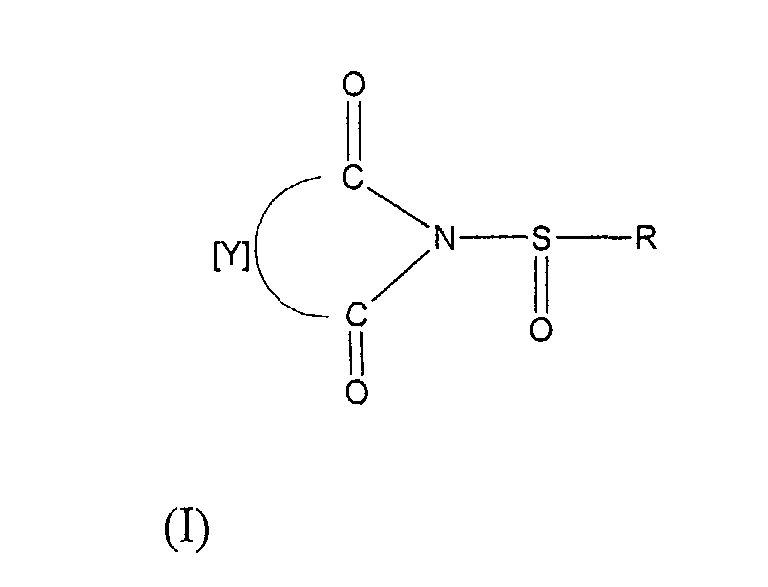
- the first object of the present invention is the compounds corresponding to formula (I) wherein :
- said alkane, alkene or alkyne chain Y can bear two or more di-radicals according to formula (II) : wherein R has the same meaning as above.
- the resultant molecule has the property of being able to transfer two or more halogenoalkylsulfinyl groups to the substrate. Said molecule (I) will then be introduced in half or less molar proportion with regard to the substrate to be treated.
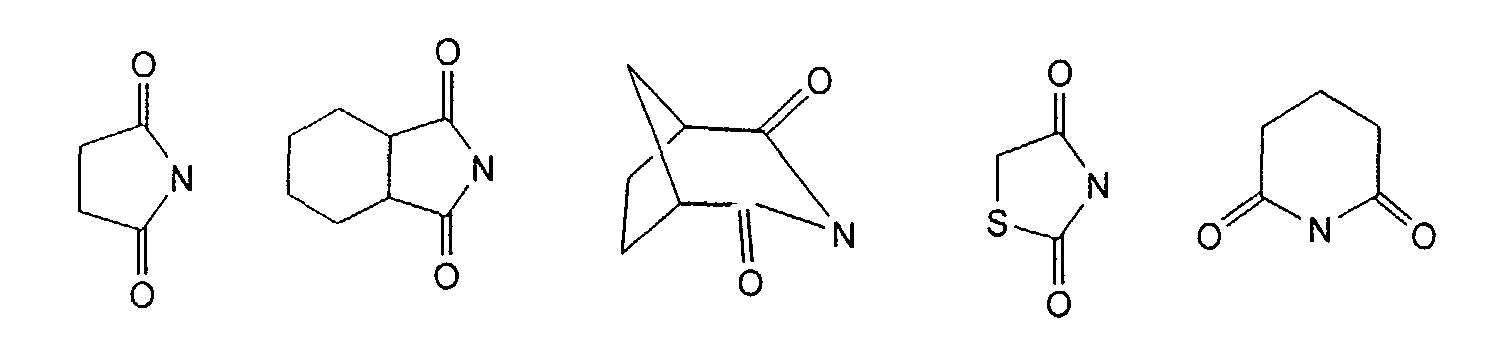
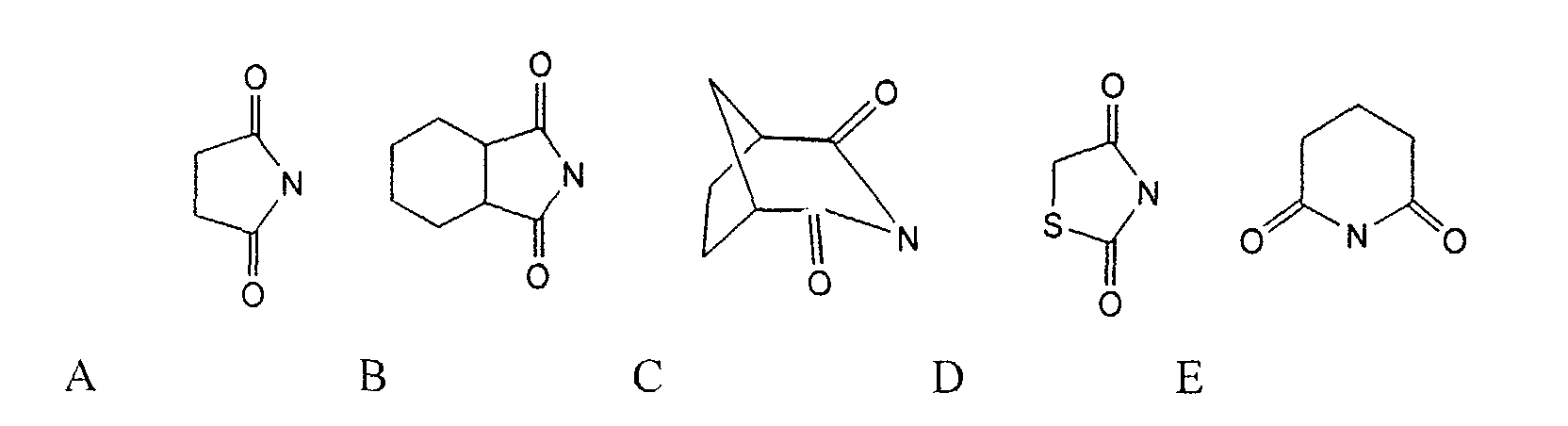
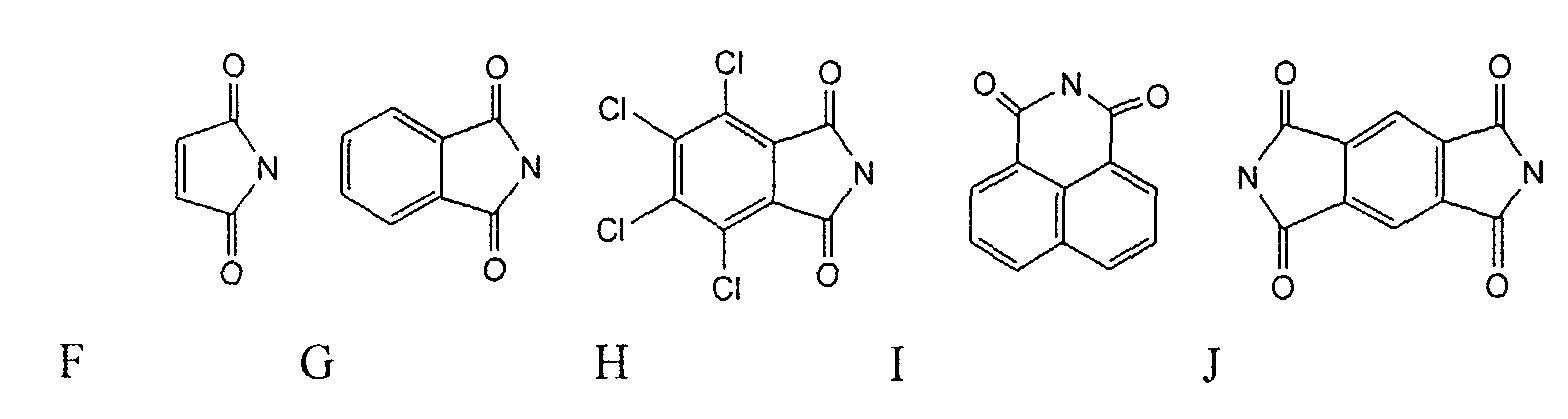
- Preferred compounds of general formula (I) are those in which Y is chosen so that the radical of formula (III) : is corresponding to different 5- or 6-membered cyclic dicarboximide derivatives such as succinimidyl (A), tetrahydrophthalimidyl (B), endo-5-norbornene-3,3-dicarboximidyl (C), 2,4-thiazolidenedion-3-yl (D), glutarimidyl (E), maleinimidyl (F), phtalimidyl (G), tetrachlorophthalimidyl (H), 1,8-naphthalimidyl (I), pyrromellitic diimidyl (J):
- R represents trifluoromethyl
- the compounds of general formula (I) can be easily prepared from the corresponding N-metal substituted cyclic imides and halogenoalkylsulfinylchloride as represented in Reaction 1 : wherein M represents a metal atom, like, for example a lithium, sodium, potassium, magnesium, silver, copper atom, and Y and R have the same meaning as above.
- the reaction is generally made in a halogenocarbonated solvent.
- N-lithium phthalimide readily reacts with CF 3 S(O)Cl in chlorobenzene at room temperature, giving the stable N-trifluoromethylsulfinylphtalimide in 76 % yield.
- N-lithium and N-silver substituted succinimides reacts with CF 3 S(O)Cl to form the corresponding N-trifluoromethylsuccinimide in high yield (Example 1). Both compounds are white solids and stable on storage.
- the N-metal substituted cyclic imides that are especially interesting for the synthesis of the compounds with general formula (I) are commercial products (Aldrich Co.) or can be prepared by methods described in the literature (see, for example, K. Soal and co-workers, Bull. Chem. Soc. Jpn., 1982, vol. 55, p. 1671-1672).
- the electron-withdrawing nature of the imide cycle in the compounds according to formula (I) is responsible for their tendency to act as effective CF 3 S(O) + transfer reagents.
- CF 3 S(O)NR 1 R 2 wherein R 1 and R 2 represent alkyl or aryl group
- the contribution from resonance form (B) in compounds (I) is weak due to delocalisation of the nitrogen lone pair with participation of the neighbouring carbonyl groups.
- the imidic substituent exerts activating influence on CF 3 S(O) group in electrophilic substitution reactions as can be seen from strong deshielding the 19F NMR signal in N-trifluoromethylsulfinylsuccinimide as compared to those of the corresponding amides, esters and triflinate salts
- the present invention also discloses a novel and convenient method for the introduction of halogenoalkylsulfinyl groups, and especially CF 3 S(O) group into organic compounds.
- reaction of a compound of general formula (I) with organic substrates noted NuH containing N-H, O-H and activated C-H bonds may be used as a general method for the synthesis of trifluoromethylsulfinylated derivatives (Examples 2-4).
- the process can be represented by the following equation:
- nucleophilic substrate is preferentially chosen from : alcohols, phenols, amines and heterocyclic compounds.
- heterocyclic compounds favorites are : pyrroles, pyrazoles, imidazoles, oxazoles, isoxazoles, isothiazoles, thiazoles, triazoles, said heterocycles being possibly substituted by one or more atom or groups chosen from : a halogen atom, -NH 2 , a C 1 -C 10 mono- or di-alkylamine, a nitrile, one or more C 1 -C 10 alkyl or C 1 -C 10 halogenoalkyl group, an aryle group, said aryle group being possibly substituted by one or more halogen atom, one or more C 1 -C 10 alkyl or C 1 -C 10 halogenoalkyl group.
- Suitable solvents are chlorinated hydrocarbons, such as dichloromethane, chloroform or 1,2-dichloroethane, or aromatic, optionally halogenated, hydrocarbons such as, for example, toluene and chlorobenzene.
- the solution of compound (I) in organic solvent is added at temperature between 0 °C and 90 °C to a nucleophilic substrate in the absence or in the presence of an organic base such as triethylamine or pyridine. After stirring for 1-3 h the reaction product is worked up and isolated by generally customary methods. The yields are good to excellent and the workup is easy.
- the succinimide and related cyclic imides forming as by-product are sparingly soluble in organic solvents and can be collected by filtration or separated from the desired product by washing with water.
- the resulting crude trifluoromethylsulfinyl derivatives are almost pure and show NMR spectra very close to those of purified compounds.
- the cyclic imide can be conveniently regenerated and reconverted into compound (I).
- Trifluoromethylsulfinyl chloride (20 mmol) was added dropwise during 5 min under argon to an ice-cooled suspension of N-lithium (sodium, potassium or silver) imide in 30 ml of dry toluene or chlorobenzene. The reaction mixture was stirred at 20 °C for 24 h and filtered. If necessary, additional toluene was added to dissolve the the N-trifluoromethylsulfinylimide and thereby separate it from the insoluble metal chloride. The filtrate was then evaporated in vacuum. By repeated recrystallization from toluene, analytically pure samples were obtained in 65-90 % yield.
- N-Methylpyrrole (10 mmol) and N-trifluoromethylsulfinylsuccinimide (12 mmol) were dissolved in 15 ml chlorobenzene and the mixture was heated at 70 °C during 5 h and then poured onto 75 ml of ice-water. The organic phase was separated and dried (Na 2 SO 4 ).
- 19 F NMR analysis revealed the mixture of 2- and 3-trifluoromethylsulfinylpyrroles (87/13). Flash chromatography with pentane/ether as eluent gives 1-methyl-2-trifluoromethylsulfinylpyrrole as major product. Yellow oil. Yield 67 %.
- the organic phase was dried (Na 2 SO 4 ) and evaporated.
- the crude N-Trifluoromethylsulfinylaminopyrazole can be without further purification transformed via "Thia-Fries Rearrangement" into 1-(2,6-dichloro-4-trifluoromethylphenyl)-3-cyano-4-trifluoromethylsulfinyl-5-aminopyrazole in conditions known for rearrangement of sulfinylanilides into sulfoxides, for example, at 35-55 °C in the presence of 1 equivalent of hydrochloric acid (see, K.K. Andersen and O. Malver, J. Org. Chem., 1983, vol. 48, p. 4803; O.
Landscapes
- Chemical & Material Sciences (AREA)
- Organic Chemistry (AREA)
- Plural Heterocyclic Compounds (AREA)
- Organic Low-Molecular-Weight Compounds And Preparation Thereof (AREA)
- Indole Compounds (AREA)
Abstract
The invention concerns compounds corresponding to formula (I) :
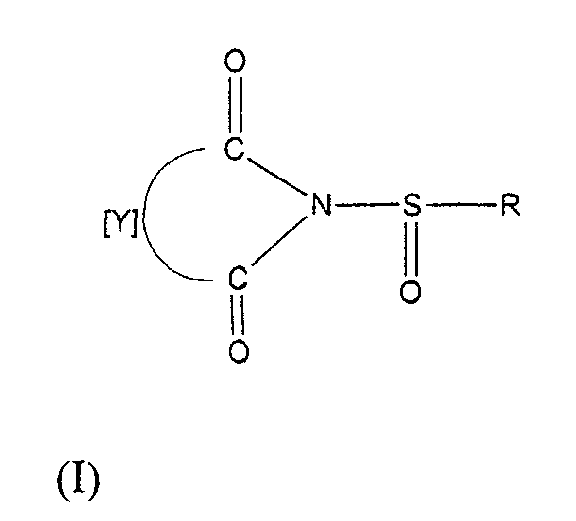 wherein:
- Y represents a group chosen from : a C1-C20, linear, branched or cyclic alkane di-yl, or alkene di-yl, or alkyne di-yl radical, wherein said alkane, alkene or alkyne chain can be substituted by one or more groups chosen from : a phenyl ring or a halogen atom, and said alkane, alkene or alkyne chain can comprise a sulfur bridge or an oxygen bridge ;
- R represents an alkyl group, linear or branched, comprising one to
four carbon atoms and substituted by one or more, identical or different, halogen
atoms ;
- a process for their preparation and their use as halogenoalkylsulfinylating agents.
Description
- This invention relates to new environment friendly reagents and process for electrophilic halogenoalkylsulfinylation, and especially to reagents and process for trifluoromethylsulfinylation, of organic compounds.
- The introduction of CF3S(O)-group into organic molecules (trifluoromethylsulfinylation reaction) has become an important method in organic chemistry since the biological importance of many products bearing this substituent has been discovered. As one of the most lipophilic structural moiety known at the moment, the CF3S(O) group is currently widely involved in the design of biologically-active compounds, both in pharmaceutical and agrochemical fields. For example, the trifluoromethylsulfinyl group is present in the structure of the second-generation N-arylpyrazole insecticides which are nanomolar inhibitors of the gamma-aminobutyric acid gated chloride channel such as potent insecticide FIPRONIL (EP 0 295 117 A1; US Patent 5,232,940) and its several analogues (IP WO 98/28279; EP 0 201 852 B1; EP 0 216 102 A1; DE 196 50 197 A1; DE 198 53 560 A1). In fact, the substitution of a proton by CF3S(O) increases lipid solubility of a given molecule, and this increases the rate of transport of a biologically active molecule across lipid membranes. As a consequence, the introduction of CF3S(O) group into organic molecules often increases or changes their physiological activity.
- The synthesis of trifluoromethylsulfinyl derivatives is generally not trivial task : Existing routes to trifluoromethylsulfinyl-functionalized compounds are not numerous and usually employ multistep procedures and highly toxic non-commercial reagents. Purification of the products is difficult at best, and yields vary widely, depending on the nature of the substrate.
- The more often practised preparative method for the synthesis of sulfinyl compounds is based on nucleophilic substitution at tricoordinate sulfur(IV) atom as is represented in equation 1 (Eq.1):
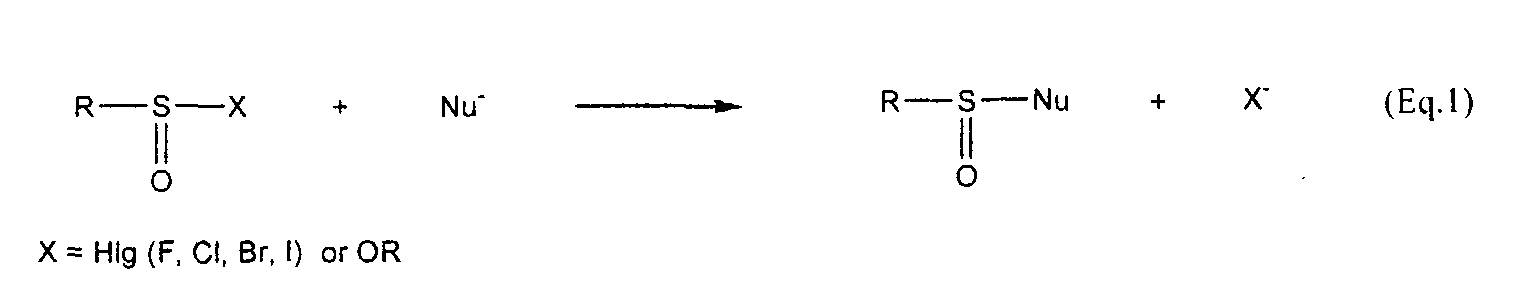
- Application of this approach for the preparation of halogenoalkylsulfinyl derivatives and especially trifluoromethylsulfinyl derivatives (Eq.1, R = CF3) has been well documented in the literature (Shreeve and co-workers, J. Am. Chem. Soc., 1968, vol. 90, p. 5403-5408; Inorg. Chem., 1971, vol. 10, p. 358-362; ibid, 1977, vol. 16, p. 1039-1042; ibid, 1985, vol. 24, p.2126-2129 ). It has been found that trifluoromethylsulfinyl halides (X = F, Cl) and some trifluoromethylsulfinyl esters (X = OR) react with different organic nucleophiles including amines, alcohols and N-heterocyclic compounds to form the corresponding trifluoromethylsulfinyl derivatives. However, specific difficulties and limitations are associated with this method due to numerous drawbacks of the above mentioned compounds as sulfinylating reagents :
- (i) sulfinyl halides with general formula CF3S(O)Hlg, wherein H1g represents a halogen atom, have low stability : trifluoromethylsulfinyl fluoride is a light sensitive compound, the corresponding chloride tends to decompose to the respective sulfonyl and sulfenyl halides (CF3SO2Cl and CF3SCl) at room temperature and can be stored only for a short time in a freezer ; bromide and iodide are unstable and have not been isolated in pure state ;
- (ii) trifluoromethylsulfinyl halides are highly volatile and physiologically dangerous: CF3S(O)F is a gaz having a boiling point of approximately - 9 °C ; CF3S(O)Cl has a boiling point around 41 °C ;
- (iii) because of the low thermal stability of CF3S(O)Cl, the utility of the compound for the introduction of CF3S(O) moiety into organic molecules is limited to low-temperature conditions ;
- (iv) trifluoromethylsulfinyl chloride is highly air-sensitive ; in a polar media and in the presence of moisture or organic bases, usually used as HCl-binding agents, the rate of decomposition of the compound grows rapidly;
- (v) the isolation and purification of products is difficult as the solubilities of trifluoromethylsulfinyl-derivatives and hydrochloride salts of organic bases are similar;
- (vi) although trifluoromethylsulfinyl esters display higher stability and are less volatile in comparison with the corresponding halides, they are not reactive enough toward most organic substrates.
-
- In order to avoid the decomposition of trifluoromethylsulfinyl chloride in carrying out the process, a special technique was developed such as mixing an organic base and the substrate prior to the addition of the reagent (Shreeve and co-workers, Inorg. Chem., 1985, vol. 24, p. 2126-2129), generation of CF3S(O)Cl in situ from the corresponding sulfinate salts and phosgene or thionyl chloride just before subsequent reactions, as well as the use of low basic HCl-binding agent, for example, anhydrous dimethylamine para-toluenesulfonate (EP 0668 269 A1). In addition, methods for generating reactive species behaving like trifluoromethylsulfinating reagents in situ, by treatment of CF3SO2Na with phosphoryl chloride or trifluoromethanesulfonic acid have recently been proposed (Langlois and co-workers, Tetrahedron, 1999, vol.35, p.7243-7250 ; Wakselman and co-workers, Synlett, 2001, No 4, p. 550-552). Unfortunately, these developments do not get rid of the drawbacks peculiar to CF3S(O)Cl. Moreover, difficulties can arise from the fact that these highly reactive species are not compatible with many organic functional groups.
- Anionic route to trifluoromethylsulfinyl compounds has recently been proposed (Yagupolskii and co-workers, J. Fluor. Chem., 1995, vol.70, p. 255-257) and is illustrated in Equation 2 (Eq. 2). However, although the trifluoromethyl anion is easily generated from readily available precursors, this method has very limited applicability since functionalised sulfinyl chlorides are largely inaccessible.

- An alternative method for the preparation of trifluoromethylsulfinyl derivatives utilizes the oxidation of the corresponding sulfides with organic peracids (Eq. 3):

- This type of reactions has been applied extensively to the preparation of many alkyl- and aryl-sulfoxides (Umemoto and Ishihara, J. Am. Chem. Soc., 1993, vol. 115, p. 2156-216; Shreeve and co-workers, J. Org. Chem., 1998, vol. 63, p. 2656-2660). However, in contrast to easily available non-fluorinated organic substrates, trifluoromethyl-substituted sulfide is difficult to prepare. Synthesis of the latter requires the use of highly toxic non commercial trifluoromethylsulfenyl chloride (CF3SCl). In addition, the oxidation reaction leads not only to the desired sulfoxides, but also the corresponding sulfones and sulfides and, in a number of instances, the separation of the trifluoromethylsulfoxide from the reaction mixture has been difficult.
- Obviously, the development of new, efficient, environment friendly reagents and practical method for high-yielding trifluoromethylsulfinylation of organic compounds is of considerable economic and scientific interest.
- A comparison of different synthetic approaches to trifluoromethylsulfinyl derivatives shows that a nucleophilic substitution at three-coordinate S(IV) atom as illustrated in Equation 1 (Eq. 1) has significant advantages with regards to versatility and scope of application. Therefore the search for a new synthetic auxiliary that can conveniently play the role of halogenoalkylsulfinyl group transfer, and especially CF3S(O) group transfer, as well as a new method for electrophilic halogenoalkyl sulfinylation and especially trifluoromethylsulfinylation of organic compounds is the essence of the present invention.
- As was mentioned above, among the three classes of trifluoromethylsulfinyl derivatives - halides, esters and amides - only trifluoromethylsulfinyl halides are efficient electrophilic sulfinating reagents. Rhone-Poulenc patent (EP 0 668 269 A1) claims that compounds with general formula RS(O)NR1R2, wherein R1 and R2 represent alkyl or haloalkyl groups containing from 1 to 4 carbon atoms, and R represents a halogenoalkyl group, possess halogenoalkylsulfinilating activity. However, the latter are not reactive toward most of organic nucleophiles due to the essential contribution of resonance form B in which the positive nature of the S(IV) atom is not retained.

- It has now been found after extensive research that the compounds of the general formula (I) depicted hereinafter, in which two carbonyl groups are linked to the nitrogen atom are powerful halogenoalkylsulfinyl- transfer reagents, and especially CF3S(O)-transfer reagents. Moreover, they have significant advantages with respect to halogenoalkylsulfinyl halides, and especially trifluoromethylsulfinyl halides as is made clear in the following description.
- The first object of the present invention is the compounds corresponding to formula (I) wherein :

- Y represents a group chosen from : a C1-C20, linear, branched or cyclic alkane di-yl, or alkene di-yl, or alkyne di-yl radical, wherein said alkane, alkene or alkyne chain can be substituted by one or more groups chosen from : a phenyl ring or a halogen atom, like for example F, Cl, Br, I, wherein said alkane, alkene or alkyne chain can comprise a sulfur bridge or an oxygen bridge ;
- R represents an alkyl group, linear or branched comprising one to four carbon atoms and substituted by one or more, identical or different, halogen atoms.
- According to a variant of the invention, said alkane, alkene or alkyne chain Y can bear two or more di-radicals according to formula (II) :wherein R has the same meaning as above. The resultant molecule has the property of being able to transfer two or more halogenoalkylsulfinyl groups to the substrate. Said molecule (I) will then be introduced in half or less molar proportion with regard to the substrate to be treated.

- Preferred compounds of general formula (I) are those in which Y is chosen so that the radical of formula (III) :is corresponding to different 5- or 6-membered cyclic dicarboximide derivatives such as succinimidyl (A), tetrahydrophthalimidyl (B), endo-5-norbornene-3,3-dicarboximidyl (C), 2,4-thiazolidenedion-3-yl (D), glutarimidyl (E), maleinimidyl (F), phtalimidyl (G), tetrachlorophthalimidyl (H), 1,8-naphthalimidyl (I), pyrromellitic diimidyl (J):


- Compounds of general formula (I) wherein the heterocyclic moiety (III) represents a group chosen from: succinimidyl (A), phthalimidyl (G) and tetrachlorophthalimidyl (H) are especially preferred.
- Preferentially R represents trifluoromethyl.
- None of the foregoing publications describes or even suggests that compounds of general formula (I) are stable and possess or would be expected to possess the powerful halogenoalkylsulfinylating, and particularly, trifluoromethylsulfinylating activity, toward a wide range of nucleophilic substrates. Moreover, it has been reported that non-halogenated analogues of the compounds (I) - N-(phenylsulfinyl)- and N-(benzylsulfinyl)-succinimides - were not isolable in pure state and could only be stored in solution at 0 °C for a short period of time (J. Org. Chem., 1980, vol. 45, p. 5336).
- According to the present invention, the compounds of general formula (I) can be easily prepared from the corresponding N-metal substituted cyclic imides and halogenoalkylsulfinylchloride as represented in Reaction 1 :wherein M represents a metal atom, like, for example a lithium, sodium, potassium, magnesium, silver, copper atom, and Y and R have the same meaning as above. The reaction is generally made in a halogenocarbonated solvent. Thus, N-lithium phthalimide readily reacts with CF3S(O)Cl in chlorobenzene at room temperature, giving the stable N-trifluoromethylsulfinylphtalimide in 76 % yield. Similarly, N-lithium and N-silver substituted succinimides reacts with CF3S(O)Cl to form the corresponding N-trifluoromethylsuccinimide in high yield (Example 1). Both compounds are white solids and stable on storage. The N-metal substituted cyclic imides that are especially interesting for the synthesis of the compounds with general formula (I) are commercial products (Aldrich Co.) or can be prepared by methods described in the literature (see, for example, K. Soal and co-workers, Bull. Chem. Soc. Jpn., 1982, vol. 55, p. 1671-1672).

- The electron-withdrawing nature of the imide cycle in the compounds according to formula (I) is responsible for their tendency to act as effective CF3S(O)+ transfer reagents. Unlike trifluoromethylsulfinyl amides of formula CF3S(O)NR1R2, wherein R1 and R2 represent alkyl or aryl group, the contribution from resonance form (B) in compounds (I) is weak due to delocalisation of the nitrogen lone pair with participation of the neighbouring carbonyl groups. Moreover, the imidic substituent exerts activating influence on CF3S(O) group in electrophilic substitution reactions as can be seen from strong deshielding the 19F NMR signal in N-trifluoromethylsulfinylsuccinimide as compared to those of the corresponding amides, esters and triflinate salts

- The present invention also discloses a novel and convenient method for the introduction of halogenoalkylsulfinyl groups, and especially CF3S(O) group into organic compounds. We have found that reaction of a compound of general formula (I) with organic substrates noted NuH containing N-H, O-H and activated C-H bonds may be used as a general method for the synthesis of trifluoromethylsulfinylated derivatives (Examples 2-4). The process can be represented by the following equation:

- For carrying out the process, 1.0 to 1.2 moles of a compound of the general formula (I) are employed per mole of nucleophilic substrate. The nucleophilic substrate is preferentially chosen from : alcohols, phenols, amines and heterocyclic compounds. Among heterocyclic compounds, favorites are : pyrroles, pyrazoles, imidazoles, oxazoles, isoxazoles, isothiazoles, thiazoles, triazoles, said heterocycles being possibly substituted by one or more atom or groups chosen from : a halogen atom, -NH2, a C1-C10 mono- or di-alkylamine, a nitrile, one or more C1-C10 alkyl or C1-C10 halogenoalkyl group, an aryle group, said aryle group being possibly substituted by one or more halogen atom, one or more C1-C10 alkyl or C1-C10 halogenoalkyl group. Suitable solvents are chlorinated hydrocarbons, such as dichloromethane, chloroform or 1,2-dichloroethane, or aromatic, optionally halogenated, hydrocarbons such as, for example, toluene and chlorobenzene. In a preferred procedure, the solution of compound (I) in organic solvent is added at temperature between 0 °C and 90 °C to a nucleophilic substrate in the absence or in the presence of an organic base such as triethylamine or pyridine. After stirring for 1-3 h the reaction product is worked up and isolated by generally customary methods. The yields are good to excellent and the workup is easy. The succinimide and related cyclic imides forming as by-product are sparingly soluble in organic solvents and can be collected by filtration or separated from the desired product by washing with water. The resulting crude trifluoromethylsulfinyl derivatives are almost pure and show NMR spectra very close to those of purified compounds. The cyclic imide can be conveniently regenerated and reconverted into compound (I).
- The use of a compound of general formula (I) as defined according to the present invention, is of particularly remarquable advantage in the reaction with low-nucleophilic organic substrates since the stability of (I) toward organic bases, such as triethylamine, as well as their thermal stability, permits to avoid the employment of special costly and time-consuming manipulations of large excess of highly air-sensitive p-toluenesulfonate salts Thus, 5-amino-3-methyl-1-phenylpyrazol smoothly reacts with N-trifluoromethylsulfinylsuccinimide at 80 °C to form the corresponding 4-trifluoromethylsulfinylated derivative in almost quantitative yield (Example 5). 5-Amino-3-cyano-4-trifluoromethylsulfinyl-1-(2,6-dichloro-4-trifluoromethyl-phenyl)pyrazole could not be obtained in similar conditions. However, the corresponding 4-unsubstituted pyrazole has been easily trifluoromethylsulfinylated in the presence of 1 equivalent of triethylamine at room temperature (Example 6). Thus. the following advantages of the compounds of general formula (I) as trifluoromethylsulfinylating reagents should be pointed out:
- (i) The compounds of the general formula (I) are powerful trifluoromethylsulfinylating agents: alcohols, phenols, amines and heterocyclic compounds can be easily converted into the corresponding trifluoromethylsulfinyl derivative. Electrophilic CF3S(O)+ group transfer capacity of the compound of general formula (I) is equivalent to or exceeds that of trifluoromethylsulfinyl halides ;
- (ii) Many types of trifluoromethylsulfinyl derivatives are easily synthesized by reacting a compound of general formula (I) with a nucleophilic substrate in the absence of any additionnal reagents ;
- (iii) In preparating trifluoromethylsulfinyl derivatives starting from low-nucleophilic substrates, the use of polar solvents, organic bases such as triethylamine or high-temperature conditions becomes possible ;
- (iv) The only co-product of the reaction : the cyclic imide, is sparingly soluble in organic solvents and can be removed from the product very easily. It is an added advantage that it can be recovered and used again ;
- (v) The yields with which the products are obtained are in most cases excellent and the product's purity is also very satisfactory ;
- (vi) The above mentioned compounds are solid, non-volatile, stable on storage and much more easily handled than their halide analogues ;
- (vii) Both the new reagents and the process of their use meet many economical and environmental requirements.
-
- The following examples illustrate the synthesis of the compounds according to the invention and their use for electrophilic halogenoalkylsulfinylation of organic substrates. It will appreciated that the instant specification is set forth by way of illustration and not limitation, and that various modifications and changes may be made without departing from the spirit and scope of the present invention.
-
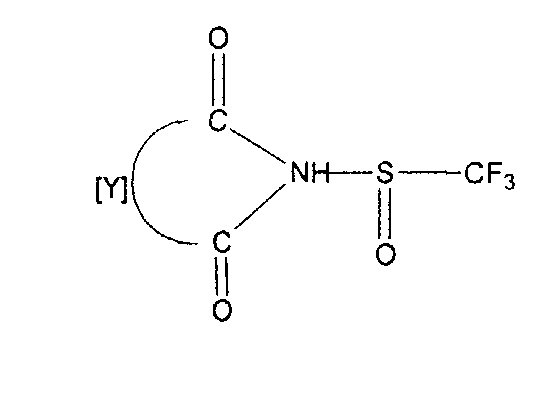
- Trifluoromethylsulfinyl chloride (20 mmol) was added dropwise during 5 min under argon to an ice-cooled suspension of N-lithium (sodium, potassium or silver) imide in 30 ml of dry toluene or chlorobenzene. The reaction mixture was stirred at 20 °C for 24 h and filtered. If necessary, additional toluene was added to dissolve the the N-trifluoromethylsulfinylimide and thereby separate it from the insoluble metal chloride. The filtrate was then evaporated in vacuum. By repeated recrystallization from toluene, analytically pure samples were obtained in 65-90 % yield.
- M.p. 76-78 °C. 1H NMR (C6D6): δ1.58 (s); 19F NMR (C6D6): δ 7.0; 13C NMR: δ 28.8 (s, CH2), 124.3 (q, 1JCF = 340 Hz, CF3), 172.8 (s, CO).

MS (I/E): m/z = 215 (M+); calculated for C5H4F3NO3S: 215 - M.p. 126-129 °C. 1H NMR(C6D6): δ □6,8-7,1m); 19F NMR (C6D6): δ 6.5;

MS (I/E): m/z = 263 (M+); calculated for C9H4F3NO3S: 263 - The amine (10 mmol) was dissolved in 8 ml of toluene and the solution was cooled to O °C. A solution of 10 mmol N-trifluoromethylsulfinylsuccinimide in 5 ml of toluene was added dropwise during 5 min. The reaction mixture was stirred at 20 °C for 30 min and then filtered. Residue after evaporation of solvent on a rotary evaporator can be purified by distillation or flash chromatography. Yield 85-97 %.
- B.p. 42-45 °C (15 mm Hg).

1H NMR (C6D6): δ 2.25 (br. s); 19F NMR (C6D6): δ 0.5; 13C NMR: δ 34.6 (s, CH3), 124.5 (q, 1JCF = 345 Hz, CF3).
MS (I/E): m/z = 161; calculated for C3H6F3NOS: 161 - 1H NMR (C6D6): δ 3.25 (q, 5JHF = 1.5 Hz, CH3), 7.2-7.4 (m, Harom); 19F NMR (C6D6): δ 2.1.

MS: m/z = 223 (M+). Calculated for C9H8F3NOS: 223. -
- (a). In the absence of organic base.
To a solution of borneol (5 mmol) in 4 ml of chlorobenzene a solution of 6 mmol N-trifluoromethylsulfinylsuccinimide in 5 ml of chlorobenzene was added dropwise during 5 min. The reaction mixture was stirred at 80 °C for 3 h and then filtered. Colorless oil after evaporation of solvent in vacuum was purified by flash chromatography. Yield 89 %. - (b). In the presence of triethylamine.
To a solution of borneol (5 mmol) and N-trifluoromethylsulfinylsuccinimide (5 mmol) in 10 ml chlorobenzene was added at room temperature 5 mmol of triethylamine. The resulting mixture was stirred for 30 min then deposited on chromatography column and eluted with a mixture of pentane and ether (4/1). Colorless oil. Yield 92 %.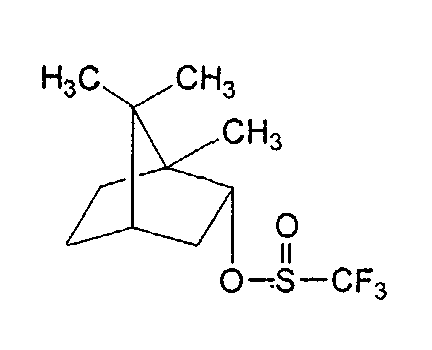 (mixture of diastereoisomer, 50/50)
 -
- N-Methylpyrrole (10 mmol) and N-trifluoromethylsulfinylsuccinimide (12 mmol) were dissolved in 15 ml chlorobenzene and the mixture was heated at 70 °C during 5 h and then poured onto 75 ml of ice-water. The organic phase was separated and dried (Na2SO4). 19F NMR analysis revealed the mixture of 2- and 3-trifluoromethylsulfinylpyrroles (87/13). Flash chromatography with pentane/ether as eluent gives 1-methyl-2-trifluoromethylsulfinylpyrrole as major product. Yellow oil. Yield 67 %.1H NMR (C6D6): δ 3.64 (s, CH3), 6.22 (dd, 3JHH = 4.1 Hz, 3JHH = 2.6 Hz, H4), 6.81 (dd, 3JHH = 4.1 Hz, 4JHH = 1.7 Hz, H3), 6.90 (dd, 4JHH =1.7 Hz, 3JHH = 2.6 Hz, H5).
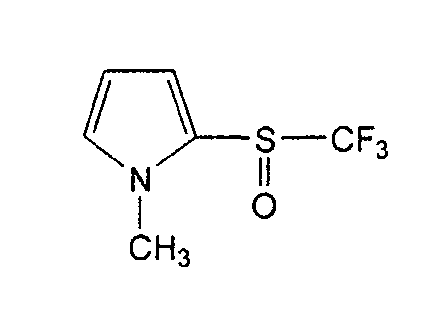
19F NMR (C6D6): δ 2.9.
MS: m/z = 197. Calculated for C6H6F3NOS: 197. - 1-Phenyl-3-methyl-5-aminopyrazole (10 mmol) and N-trifluoromethylsulfinyl-succinimide (12 mmol) were dissolved in 15 ml chlorobenzene and the mixture was heated at 70 °C during 3 h and then poured onto 75 ml of ice-water. The organic phase was separated and dried (Na2SO4). Flash chromatography with chloroform as eluent gives 1-Phenyl-3-methyl-4-trifluoromethylsulfinyl-5-aminopyrazole. Yield 82 %.M.p. 90-93 °C.
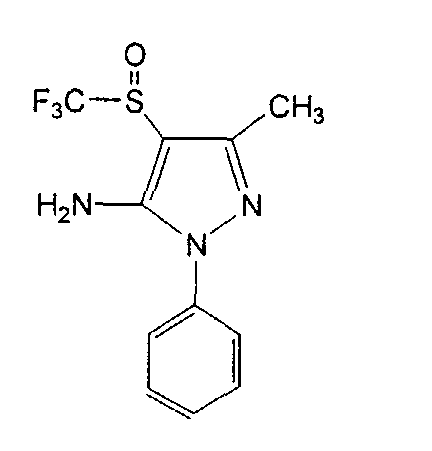
1H NMR (C6D6): d 1.97 (s, 3H, CH3), 4.53 (s, 2H, NH2), 6.88-7.23 (m, 5H, C6H5). 19F NMR (C6D6): d -0.38 (CF3)).
MS: m/z 289 (M+), calculated for C11H10F3N3OS: 289 - To a solution of 3 mmol of 1-(2,6-dichloro-4-trifluoromethylphenyl)-3-cyano-5-aminopyrazole in 15 ml dichloromethane was added 3.1 mmol triethylamine. This mixture was stirred for 15 min. A solution of N-trifluoromethylsulfinylsuccinimide (3.1 mmol) in 7 ml dichloromethane was then added during 10 min at 10 °C . After stirring 3 h at room temperature 19F NMR analysis revealed the quantitative formation of N-trifluoromethylsulfinylaminopyrazole. Succinimide and triethylamine were removed by fast extraction with ice-water. The organic phase was dried (Na2SO4) and evaporated. The crude N-Trifluoromethylsulfinylaminopyrazole can be without further purification transformed via "Thia-Fries Rearrangement" into 1-(2,6-dichloro-4-trifluoromethylphenyl)-3-cyano-4-trifluoromethylsulfinyl-5-aminopyrazole in conditions known for rearrangement of sulfinylanilides into sulfoxides, for example, at 35-55 °C in the presence of 1 equivalent of hydrochloric acid (see, K.K. Andersen and O. Malver, J. Org. Chem., 1983, vol. 48, p. 4803; O. Cameron et al., J.Org. Chem., 1980, vol. 45, p. 5336). Yield 70%M.p. 206-208 °C. 1H NMR (CDCl3): δ 5.15 (s, 2H, NH2), 7.83 (s, 2H, Harom). 19F NMR (CDCl3): d 0.21 (s, CF3SO), 11.73 (s, CF3-Ar).

- In the transformation above-mentionned , it can be pointed out that the crude N-trifluoromethylsulfinylaminopyrazole can be isolated and purified . The purification of the residue after dichloromethane evaporation by crystallization from toluene gives 1-(2,6-dichloro-4-trifluoromethylphenyl)-3-cyano-5-trifluoromethylsulfinylaminopyrazoleM.p. 125-128 °
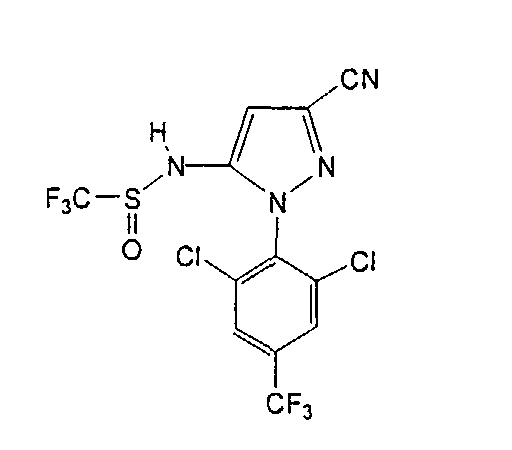
1H NMR (d6-acetone): δ 7.0 (s, 1H), 8.1 (s, 2H). 19 F NMR (C6D6): δ - 2.5;
MS (IE): m/z 436 (M+), calculated for C12H4Cl2F6N4OS: 436. - In a similar manner , the following compounds hereafter known as examples 7 to 12 were prepared :
- -From N trifluoromethylsulfinylsuccinimide and 1-( 2,6-dichloro-4-trifluoromethylphenyl) -3-trifluoromethyl -5-aminopyrazole , we obtained 1-(2,6-dichloro-4-trifluoromethylphenyl)-3-trifluoromethyl-4-trifluoromethylsulfinyl-5-aminopyrazole.
M.p.:107-112°C ; 1H NMR ( d6 acetone) : 6.76 ( s, 2H , NH2) , 8,13 ( s , 2H , H arom ). 19F NMR ( d6 acetone ): 0.18 ( s, CF3SO ), 12,33 ( s , CF3 arom ) , 13,79 ( s, 3-CF3 ) - From N-trifluoromethylsulfinylsuccinimide and 1-(2,4,6-trichlorophenyl)-3-cyano-5-aminopyrazole , we obtained 1-(2,4,6-trichlorophenyl)-3-cyano-4-trifluoromethylsulfinyl-5-aminopyrazole
M.p.: 186-189°C ; 1H NMR ( CDCl3 ) : 5,20 ( s , 2H , NH2 ), 7,50 ( s, 2H arom ) - From N-trifluoromethylsulfinylsuccinimide and 1-( 2,6-dichloro-4-trifluoromethylphenyl)-3-carboxamido-5-aminopyrazole, we obtained 1-(2,6-dichloro-4-trifluoromethylphenyl)-3-carboxamido-4-trifluoromethylsulfinyl-5-aminopyrazole
M.p.: 231-233°C ; 1-H NMR ( d6 acetone ) : 6.39 (s, 2H , NH2 ), 6.87 ( s , 1H, CONH2 ), 7.25 ( s , 1H, CONH2 ), 8.11 ( s, 2H, H arom ) ; 19F NMR ( d6 acetone ): 0.10 ( s, CF3SO ), 12.43 ( s, CF3 arom ) - From N-trifluoromethylsulfinylsuccimide and 1-(2-bromo-4-trifluoromethyl-6-chlorophenyl)-5-aminopyrazole we obtained 1-(2-bromo -4-trifluoromethyl-6-chlorophenyl)-4-trifluoromethylsulfinyl-5-aminopyrazole
M. p. : 82-86°C - From N-trifluoromethylsulfinylphtalimide and 1-(2,6-dichloro-4-trifluoromethoxyphenyl)-5-aminopyrazole , we obtained 1-(2,6-dichloro-4trifluoromethoxyphenyl)-4-trifluoromethylsulfinyl-5-aminopyrazole
M p. : 55-57°C - From N-trifluoromethylsulfinylphtalimide and 1-(2-chloro-4-trifluoromethylphenyl)-5-aminopyrazole , we obtained 1-(2-chloro-4-trifluoromethylphenyl)-4-trifluoromethylsulfinyl-5-aminopyrazole
M.p. : 132-134°C
1H NMR (C6D6): δ 0.59 (s, 6H, CH3), 0.66 (s, 6H, CH3), 0.69 (s, 3H, CH3), 0.78 (s, 3H, CH3), 1.0-2.3 m (8H, CH2, CH). 19F NMR (C6D6): δ -4.25, -4.90.
MS: m/z = 255 (M-CH3)+. Calculated for C11H17F3O2S: 270.
Claims (20)
- A compound corresponding to formula (I) :wherein :
 Y represents a group chosen from : a C1-C20, linear, branched or cyclic alkane di-yl, or alkene di-yl, or alkyne di-yl radical, wherein said alkane, alkene or alkyne chain can be substituted by one or more groups chosen from : a phenyl ring or a halogen atom, and said alkane, alkene or alkyne chain can comprise a sulfur bridge or an oxygen bridge ;R represents an alkyl group, linear or branched, comprising one to four carbon atoms and substituted by one or more, identical or different, halogen atoms.
 - Compound of general formula (I) according to claim 1, wherein Y is chosen so that the radical of formula (III):is a 5- or 6-membered cyclic dicarboximide.

- Compound of general formula (I) according to claim 1 or claim 2, wherein Y is chosen so that the radical of formula (III) :is one of the following group : succinimidyl (A), tetrahydrophthalimidyl (B), endo-5-norbornene-3,3-dicarboximidyl (C), 2,4-thiazolidenedion-3-yl (D), glutarimidyl (E), maleinimidyl (F), phtalimidyl (G), tetrachlorophthalimidyl (H), 1,8-naphthalimidyl (I), pyrromellitic diimidyl (J):

- Compound of general formula (I) according to any one of claim 1 to claim 3, wherein Y is chosen so that the radical of formula (III) :represents a group chosen from: succinimidyl (A), phthalimidyl (G) and tetrachlorophthalimidyl (H).

- Compound of general formula (I) according to any one of claim 1 to claim 4, wherein R represents trifluoromethyl.
- Process for the preparation of a compound according to any one of claim 1 to 5, characterised in that the corresponding N-metal substituted cyclic imide and halogenoalkylsulfinylchloride are reacted together as represented in Reaction 1 :wherein M represents a metal atom and Y and R have the same meaning as in claim 1 to 5.

- Process according to claim 6, characterised in that R is trifluoromethyl.
- Process according to claim 6 or claim 7 characterised in that M represents a lithium, sodium, potassium, magnesium, copper or silver atom.
- Process according to any one of claim 6 to 8, characterized in that the reaction is made in a halogenocarbonated solvent.
- Method for the introduction of a halogenoalkylsulfinyl group into an organic substrate noted NuH characterised in that a compound of general formula (I) according to any one of claim 1 to 5, wherein Y and R have the same signification as in claim 1 to 5, is reacted with NuH (Reaction 2):

- Method according to claim 10, characterised in that 1.0 to 1.2 moles of a compound of the general formula (I) are employed per mole of nucleophilic substrate.
- Method according to claim 10 or claim 11, characterised in that the nucleophilic substrate is chosen from : alcohols, phenols, amines and heterocyclic compounds.
- Method according to any one of claim 10 to claim 12, characterised in that the nucleophilic substrate is chosen from : pyrroles, pyrazoles, imidazoles, oxazoles, isoxazoles, isothiazoles, thiazoles, triazoles, said heterocycles being possibly substituted by one or more atom or groups chosen from : a halogen atom, -NH2, a C1-C10 mono- or di-alkylamine, a nitrile, one or more C1-C10 alkyl or C1-C10 halogenoalkyl group, an aryle group, said aryle group being possibly substituted by one or more halogen atom, one or more C1-C10 alkyl or C1-C10 halogenoalkyl group.
- Method according to any one of claim 10 to claim 13, characterised in that the reaction is made in a solvent chosen from the group consisting of chlorinated hydrocarbons and aromatic, optionally halogenated hydrocarbons.
- Method according to any one of claim 10 to claim 14, characterised in that the solution of compound (I) in an organic solvent is added at temperature between 0 °C and 90 °C to the nucleophilic substrate NuH.
- Method according to any one of claim 10 to claim 15, characterised in that in the reaction is done in the presence of an organic base.
- Method according to any one of claim 10 to claim 16, characterised in that in the cyclic imide resulting from reaction 2 is regenerated and reconverted into compound (I).
- Method according to any one of claim 10 to claim 17, characterised in that R is CF3.
- Method according to any one of claim 10 to claim 18, characterised in that compound (I) is chosen from the group consisting of: N-trifluoromethylsulfinylsuccinimide and N-trifluoromethylsulfinylphthalimide.
- Method according to any one of claim 10 to claim 19, characterised in that Nu is chosen from the group consisting of: dimethylamine, N-methylaniline, (1S)-endo-(-)-borneol, N-methylpyrrole, 1-phenyl-3-methyl-5-aminopyrazole, 1-( 2,6-dichloro-4-trifluoromethylphenyl) -3-trifluoromethyl -5-aminopyrazole, 1-(2,4,6-trichlorophenyl)-3-cyano-5-aminopyrazole, 1-( 2,6-dichloro-4-trifluoromethylphenyl)-3-carboxamido-5-aminopyrazole , 1-(2-bromo-4-trifluoromethyl-6-chlorophenyl)-5-aminopyrazole, 1-(2,6-dichloro-4-trifluoromethoxyphenyl)-5-aminopyrazole, 1-(2-chloro-4-trifluoromethylphenyl)-5-aminopyrazole, 1-(2,6-dichloro-4-trifluoromethylphenyl)-3-cyano-5-aminopyrazole.
Priority Applications (3)
| Application Number | Priority Date | Filing Date | Title |
|---|---|---|---|
| EP02290184A EP1331222A1 (en) | 2002-01-28 | 2002-01-28 | Environment friendly reagents and process for halogenoalkylsulfinylation of organic compounds |
| AU2003210277A AU2003210277A1 (en) | 2002-01-28 | 2003-01-28 | Environment friendly reagents and process for trifluoromethylsulfinylation of organic compounds |
| PCT/EP2003/001515 WO2003064384A2 (en) | 2002-01-28 | 2003-01-28 | Environment friendly reagents and process for trifluoromethylsulfinylation of organic compounds |
Applications Claiming Priority (1)
| Application Number | Priority Date | Filing Date | Title |
|---|---|---|---|
| EP02290184A EP1331222A1 (en) | 2002-01-28 | 2002-01-28 | Environment friendly reagents and process for halogenoalkylsulfinylation of organic compounds |
Publications (1)
| Publication Number | Publication Date |
|---|---|
| EP1331222A1 true EP1331222A1 (en) | 2003-07-30 |
Family
ID=8185709
Family Applications (1)
| Application Number | Title | Priority Date | Filing Date |
|---|---|---|---|
| EP02290184A Withdrawn EP1331222A1 (en) | 2002-01-28 | 2002-01-28 | Environment friendly reagents and process for halogenoalkylsulfinylation of organic compounds |
Country Status (3)
| Country | Link |
|---|---|
| EP (1) | EP1331222A1 (en) |
| AU (1) | AU2003210277A1 (en) |
| WO (1) | WO2003064384A2 (en) |
Cited By (12)
| Publication number | Priority date | Publication date | Assignee | Title |
|---|---|---|---|---|
| WO2008055881A1 (en) | 2006-11-10 | 2008-05-15 | Basf Se | Crystalline modification of fipronil |
| WO2008055883A1 (en) | 2006-11-10 | 2008-05-15 | Basf Se | Crystalline modification of fipronil |
| WO2008055882A1 (en) | 2006-11-10 | 2008-05-15 | Basf Se | Crystalline modification of fipronil |
| WO2008055877A1 (en) | 2006-11-10 | 2008-05-15 | Basf Se | Process for the sulfinylation of a pyrazole derivative |
| WO2008055884A1 (en) | 2006-11-10 | 2008-05-15 | Basf Se | Crystalline modification of fipronil |
| US8354007B2 (en) | 2008-10-02 | 2013-01-15 | Basf Se | Method for producing and purifying trifluoromethanesulfinic acid |
| US8440709B2 (en) | 2005-12-14 | 2013-05-14 | Makhteshim Chemical Works Ltd. | Polymorphs and amorphous forms of 5-amino-1-[2,6-dichloro-4-(trifluoromethyl)phenyl]-4-[(trifluoromethyl)sulfinyl]-1H-pyrazole-3-carbonitrile |
| US8629287B2 (en) | 2006-11-10 | 2014-01-14 | Basf Se | Process for the sulfinylation of a pyrazole derivative |
| CN104557713A (en) * | 2013-10-22 | 2015-04-29 | 江苏托球农化有限公司 | Preparation method of high-purity fipronil |
| CN104926729A (en) * | 2014-03-18 | 2015-09-23 | 上海泰禾化工有限公司 | Method for synthesis of high-purity fipronil |
| US9198421B2 (en) | 2011-01-14 | 2015-12-01 | Keki Hormusji Gharda | Polymorphism in 5-amino-1-(2,6-dichloro-4-trifluoromethylphenyl)-3-cyano-4-trifluoro methyl sulfinyl pyrazole |
| CN116836104A (en) * | 2023-05-29 | 2023-10-03 | 湖南大学 | A method for blue light-induced hydrogen trifluoromethylation of alkynyl compounds |
Families Citing this family (2)
| Publication number | Priority date | Publication date | Assignee | Title |
|---|---|---|---|---|
| ES2422297T3 (en) * | 2006-11-10 | 2013-09-10 | Basf Se | Process for sulfinylation of a pyrazole derivative |
| CN114957086B (en) * | 2022-06-30 | 2023-06-02 | 杭州师范大学 | Synthesis method and application of N-trifluoromethylsulfonyl phthalimide |
Citations (1)
| Publication number | Priority date | Publication date | Assignee | Title |
|---|---|---|---|---|
| EP0668269A1 (en) * | 1994-02-22 | 1995-08-23 | Rhone-Poulenc Agrochimie | Process for the sulfinylation of heterocyclic compounds |
-
2002
- 2002-01-28 EP EP02290184A patent/EP1331222A1/en not_active Withdrawn
-
2003
- 2003-01-28 WO PCT/EP2003/001515 patent/WO2003064384A2/en not_active Ceased
- 2003-01-28 AU AU2003210277A patent/AU2003210277A1/en not_active Abandoned
Patent Citations (1)
| Publication number | Priority date | Publication date | Assignee | Title |
|---|---|---|---|---|
| EP0668269A1 (en) * | 1994-02-22 | 1995-08-23 | Rhone-Poulenc Agrochimie | Process for the sulfinylation of heterocyclic compounds |
Non-Patent Citations (3)
| Title |
|---|
| BILLARD T ET AL: "A New Equivalent of the CF3S(O)Cation. Synthesis of Trifluoromethanesulfinates and Trifluoromethanesulfinamides", TETRAHEDRON, ELSEVIER SCIENCE PUBLISHERS, AMSTERDAM, NL, vol. 55, no. 23, 4 June 1999 (1999-06-04), pages 7243 - 7250, XP004167095, ISSN: 0040-4020 * |
| CARMONA O ET AL: "SYNTHESIS AND REARRANGEMENT OF 2-(ARYLSULFINYL)-AND 2-(ALKYLSULFINYL)PYRROLES", JOURNAL OF ORGANIC CHEMISTRY, AMERICAN CHEMICAL SOCIETY. EASTON, US, vol. 45, no. 26, 19 December 1980 (1980-12-19), pages 5336 - 5339, XP000562839, ISSN: 0022-3263 * |
| HARPP D N ET AL: "THE PREPARATION OF N-(ALKYL AND ARYLSULFINYL)-PHTHALIMIDES. A NEW CLASS OF SULFINYL-TRANSFER REAGENTS", TETRAHEDRON LETTERS, ELSEVIER SCIENCE PUBLISHERS, AMSTERDAM, NL, no. 52, 1 December 1972 (1972-12-01), pages 5313 - 5316, XP000644578, ISSN: 0040-4039 * |
Cited By (26)
| Publication number | Priority date | Publication date | Assignee | Title |
|---|---|---|---|---|
| US9215873B2 (en) | 2005-12-14 | 2015-12-22 | Adama Makhteshim Ltd. | Polymorphs and amorphous forms of 5-amino-1-[2,6-dichloro-4-(trifluoromethyl)phenyl]-4-[(trifluoromethyl)sulfinyl]-1H-pyrazole-3-carbonitrile |
| US8440709B2 (en) | 2005-12-14 | 2013-05-14 | Makhteshim Chemical Works Ltd. | Polymorphs and amorphous forms of 5-amino-1-[2,6-dichloro-4-(trifluoromethyl)phenyl]-4-[(trifluoromethyl)sulfinyl]-1H-pyrazole-3-carbonitrile |
| US9822079B2 (en) | 2005-12-14 | 2017-11-21 | Adama Makhteshim Ltd. | Polymorphs and amorphous forms of 5-amino-1-[2,6-dichloro-4-(trifluoromethyl)phenyl]-4-[(trifluoromethyl)sulfinyl]-1H-pyrazole-3-carbonitrile |
| US9580389B2 (en) | 2005-12-14 | 2017-02-28 | Adama Makhteshim Ltd. | Polymorphs and amorphous forms of 5-amino-1-[2,6-dichloro-4-(trifluoromethyl)phenyl]-4-[(trifluoromethyl)sulfinyl]-1H-pyrazole-3-carbonitrile |
| US8691862B2 (en) | 2005-12-14 | 2014-04-08 | Makhteshim Chemical Works Ltd. | Polymorphs and amorphous forms of 5-amino-1-[2,6-dichloro-4-(trifluoromethyl)phenyl]-4-[(trifluoromethyl)sulfinyl]-1H-pyrazole-3-carbonitrile |
| US9023884B2 (en) | 2005-12-14 | 2015-05-05 | Adama Makhteshim Ltd. | Polymorphs and amorphous forms of 5-amino-1-[2,6-dichloro-4-(trifluoromethyl)phenyl]-4-[(trifluoromethyl)sulfinyl]-1H-pyrazole-3-carbonitrile |
| US9451772B2 (en) | 2006-11-10 | 2016-09-27 | Basf Se | Crystalline modification of fipronil |
| US8063092B2 (en) | 2006-11-10 | 2011-11-22 | Basf Se | Crystalline modification of fipronil |
| US9913473B2 (en) | 2006-11-10 | 2018-03-13 | Basf Se | Crystalline modification of fipronil |
| US8383664B2 (en) | 2006-11-10 | 2013-02-26 | Basf Se | Crystalline modification of fipronil |
| US8188136B2 (en) | 2006-11-10 | 2012-05-29 | Basf Se | Crystalline modification of fipronil |
| US8629287B2 (en) | 2006-11-10 | 2014-01-14 | Basf Se | Process for the sulfinylation of a pyrazole derivative |
| WO2008055883A1 (en) | 2006-11-10 | 2008-05-15 | Basf Se | Crystalline modification of fipronil |
| US8791046B2 (en) | 2006-11-10 | 2014-07-29 | Basf Se | Crystalline modification of fipronil |
| WO2008055881A1 (en) | 2006-11-10 | 2008-05-15 | Basf Se | Crystalline modification of fipronil |
| US8263783B2 (en) | 2006-11-10 | 2012-09-11 | Basf Se | Process for the sulfinylation of a pyrazole derivative |
| WO2008055882A1 (en) | 2006-11-10 | 2008-05-15 | Basf Se | Crystalline modification of fipronil |
| WO2008055877A1 (en) | 2006-11-10 | 2008-05-15 | Basf Se | Process for the sulfinylation of a pyrazole derivative |
| WO2008055884A1 (en) | 2006-11-10 | 2008-05-15 | Basf Se | Crystalline modification of fipronil |
| US8354007B2 (en) | 2008-10-02 | 2013-01-15 | Basf Se | Method for producing and purifying trifluoromethanesulfinic acid |
| US9198421B2 (en) | 2011-01-14 | 2015-12-01 | Keki Hormusji Gharda | Polymorphism in 5-amino-1-(2,6-dichloro-4-trifluoromethylphenyl)-3-cyano-4-trifluoro methyl sulfinyl pyrazole |
| CN104557713A (en) * | 2013-10-22 | 2015-04-29 | 江苏托球农化有限公司 | Preparation method of high-purity fipronil |
| CN104557713B (en) * | 2013-10-22 | 2018-08-21 | 江苏托球农化股份有限公司 | High-purity ethiprole preparation method |
| CN104926729A (en) * | 2014-03-18 | 2015-09-23 | 上海泰禾化工有限公司 | Method for synthesis of high-purity fipronil |
| CN104926729B (en) * | 2014-03-18 | 2018-01-19 | 上海泰禾国际贸易有限公司 | A kind of method for synthesizing ethiprole |
| CN116836104A (en) * | 2023-05-29 | 2023-10-03 | 湖南大学 | A method for blue light-induced hydrogen trifluoromethylation of alkynyl compounds |
Also Published As
| Publication number | Publication date |
|---|---|
| AU2003210277A1 (en) | 2003-09-02 |
| WO2003064384A2 (en) | 2003-08-07 |
| WO2003064384A3 (en) | 2003-12-24 |
Similar Documents
| Publication | Publication Date | Title |
|---|---|---|
| AU2023200095B2 (en) | Sulfur(VI) fluoride compounds and methods for the preparation thereof | |
| RU2136665C1 (en) | Method of sulfination of heterocyclic compounds, method for preparing 4-sulfinylpyrazole, and sulfinamide compounds | |
| WO2003064384A2 (en) | Environment friendly reagents and process for trifluoromethylsulfinylation of organic compounds | |
| KR102500024B1 (en) | Aromatic fluorination method | |
| CN107540586B (en) | A kind of preparation method of difluoromethyl substituted thioaryl sulfonate | |
| Zhao et al. | Cu-mediated oxidative trifluoromethylthiolation of arylboronic acids with (bpy) CuSCF3 | |
| KR20050114693A (en) | Preparation and use of 2-substituted-5-oxo-3-ryrazolidinecarboxylates | |
| EP3180324A1 (en) | Hypervalent iodine cf2cf2x reagents and their use | |
| CZ242693A3 (en) | Process for preparing chlorinated pyrrole compounds | |
| EA007106B1 (en) | Method for producing 2-halogen-ptridine-carboxylic acid amines | |
| EP0548680B1 (en) | Beta-oxo-beta-benzenepropanethioamide derivatives | |
| CZ20012770A3 (en) | Novel process for preparing pesticidal intermediates | |
| US20180186753A1 (en) | Processes for the preparation of pesticidal compounds | |
| CN105985280B (en) | Difluoromethylthiolation reagent, preparation method and application thereof | |
| CN101583602A (en) | Process for the sulfinylation of pyrazole derivatives | |
| KR20120016123A (en) | Process for the preparation of auxindol and ortho-substituted aniline and its use as synthetic intermediate | |
| Menczinger et al. | Synthesis of aryl 2, 2, 2-trifluoroethyl sulfides | |
| KR100519420B1 (en) | Process for preparing heteroarylcarboxyamides and esters | |
| US5942640A (en) | Process for the manufacture of N-(1-cyanoalkyl)-2-phenoxypropionamide derivatives | |
| JPS6087251A (en) | Manufacture of substituted benzamide derivative | |
| JP3505241B2 (en) | 1H-1,2,4-triazole derivatives and 1H-pyrrolo- [1,2-b] [1,2,4] triazole derivatives | |
| JPH0136612B2 (en) | ||
| KR20030083007A (en) | Process for producing 5-substituted oxazole compounds and 5-substituted imidazole compounds | |
| RU2128164C1 (en) | N-carbonitrileanilines and method of preparing thereof | |
| JP2002326989A (en) | Method for producing phthalisoimide derivative |
Legal Events
| Date | Code | Title | Description |
|---|---|---|---|
| PUAI | Public reference made under article 153(3) epc to a published international application that has entered the european phase |
Free format text: ORIGINAL CODE: 0009012 |
|
| AK | Designated contracting states |
Designated state(s): AT BE CH CY DE DK ES FI FR GB GR IE IT LI LU MC NL PT SE TR |
|
| AX | Request for extension of the european patent |
Extension state: AL LT LV MK RO SI |
|
| AKX | Designation fees paid | ||
| REG | Reference to a national code |
Ref country code: DE Ref legal event code: 8566 |
|
| STAA | Information on the status of an ep patent application or granted ep patent |
Free format text: STATUS: THE APPLICATION IS DEEMED TO BE WITHDRAWN |
|
| 18D | Application deemed to be withdrawn |
Effective date: 20040131 |