This invention relates to a direct view silver halide photographic
element containing a particular green record that contains a coupler or couplers
that provide an improved flesh tone reproduction.
In a silver halide photographic element, a color image is formed
when the element is exposed to light and then subjected to color development with
a primary aromatic amine developer. Color development results in imagewise
reduction of silver halide and production of oxidized developer. Oxidized
developer then reacts with one or more incorporated dye-forming couplers to form
an imagewise distribution of dye.
In any polychromatic chromogenic photographic element designed
for direct view, it is desirable to accurately reproduce the hue of flesh tones of
different densities. Direct view elements are more fully defined hereinafter to
include reproductions intended for human viewing such as prints, projection
images and transparencies such as back-lit signs. These photographic elements
are distinguished from the so-called image capture elements that are used only as
an intermediate to produce direct view elements via optical or digital printing
methods.
It is also desirable to accurately reproduce neutral backgrounds in
scenes when the photographic material is balanced to a pleasing flesh tone. This
is especially true for wedding portraits and similar images where the blacks and
whites must be accurately reproduced.
Finally, besides providing images with desirable flesh hue and
neutrals, it is also desirable to provide images with satisfactory image stability.
Images that fade quickly upon exposure to light and/or the environment are
undesirable. It is a therefore a desire to provide the foregoing flesh and neutral
benefits without sacrificing image stability.
It has been suggested to employ pyrazolotriazole magenta dye-forming
couplers in the green record of direct view elements. It has also been
suggested to employ certain so-called 2,5-diacylamino cyan couplers in the red
record of direct view elements. See for example U.S. Patents 5,925,503;
5,972,574; and 5,962,198.
It is a problem to be solved to provide a direct view multicolor
element that provides improved flesh tone reproduction.
The invention provides a silver halide direct view multicolor
photographic element comprising a green record containing a green light
sensitized silver halide emulsion and comprising either (a) a magenta dye-forming
coupler and a cyan dye-forming coupler in an amount of at least 0.1 mole % of the
couplers present in the green record, or (b) a green record having a coupler or
couplers sufficient to provide upon development a Status A red density greater
than 0.23 as measured using a green light separation exposure at a Status A green
density of 1.0.
Embodiments of the invention provide direct view elements that
have an improved flesh tone reproduction.
The invention is generally as described above. The multicolor
elements of the invention comprise a blue record sensitized for maximum
sensitivity in the range of 400-500nm, a green record sensitized for maximum
sensitivity in the range of 500-600nm, and a red record sensitized for maximum
sensitivity in the range of 600-700nm. The present invention provides for the
selection of the dye forming couplers in the green record to enable an improved
flesh tone reproduction.
In the invention, the green record contains one or more couplers
capable of forming a dye upon development so that the element exhibits a Status
A red density greater than 0.23 at a green density of 1.0, as measured using a
green light separation exposure. In one embodiment, the green record contains a
light sensitive magenta dye-forming coupler and a cyan dye-forming coupler in an
amount of at least 0.1 mole %, suitably at least 0.3 mole % or at least 0.5 mole %
of the couplers of the couplers present in the record.
The cyan dye-forming coupler to be included in the magenta record
is a phenolic, naphtholic or pyrroloazole coupler. A useful phenolic coupler is a
2-acylamino-5-alkyl phenol, a 2,5-diacylamino phenol, or a 2-ureido-5-acylamino
phenol. In one embodiment, the useful cyan coupler is a so-called NB coupler as
more fully defined hereinafter.
The magenta dye-forming coupler in the magenta record is suitably
an azole coupler. One type of suitable coupler is a pyrazolotrazole coupler,
particularly one with a tetramethylethyl link. Examples include a 1H-pyrazolo
(5,1-c) [1,2,4] triazole or a 1H-pyrazolo (1,5-b) [1,2,4] triazole compound.
In another embodiment of the invention, the green record contains
a magenta dye-forming coupler such that the element exhibits a Status A red
density greater than 0.23 at a green density of 1.0, as measured using a green light
separation exposure. Desirably, the red density is greater than 0.24 or 0.25 and is
less than 0.40. The green record of such an element may also contain the cyan
coupler as above described.
A direct view multicolor photographic element of the invention
comprises a green record containing a light sensitive magenta dye-forming
coupler exhibiting a Status A red density sufficiently greater than 0.23 to improve
the flesh tone reproduction of the element, compared to the same element
containing a magenta dye-forming coupler exhibiting a red density of less than
0.23, as measured using a green light separation exposure at a green density of
1.0.
It is important to closely match the coupler reactivity when
blending couplers. Mis-matched blended coupler reaction rates with oxidized
color developer will result in color shifts through the neutral density scale.
Reactivity mismatches can also result in unacceptable color reproduction
performance. Ideally the coupler blends would react to form one blended dye
spectra that forms the same blended dye spectra up and down the density scale. In
practice some deviation from one blended dye spectra can occur. If the dye spectra
deviation is not too large the tone scale neutrality and color reproduction
properties will be acceptable.
Embodiments of the invention may provide a combination of
improved flesh tone reproduction and image stability. In such cases, the use of an
NB 2,5-diacylamino phenolic coupler and the pyrazolotriazole coupler with a
tetramethylethyl link is preferred.
A useful embodiment of the invention incorporates a block
copolymer of polyoxypropylene and polyoxyethylene in one of the layers such as
in the overcoat. Examples of such materials are described in U.S. Patent No.
5,491,052 and include Pluronic L44 of BASF Corp.
An "NB coupler" is a narrow bandwidth coupler having
substituents so that there is a reduction in left bandwidth in spin-coating form vs.
solution form of at least 5 nm. In accordance with the procedure, a dye is formed
by combining the coupler and the developer 4-amino-3-methyl-N-ethyl-N-(2-methanesulfonamidoethyl)
aniline sesquisulfate hydrate. If the left bandwidth
(LBW) of its absorption spectra upon "spin coating" of a 3% w/v solution of the
dye in di-n-butyl sebacate solvent is at least 5 nm. less than the LBW for a
solution of the same dye in acetonitrile, then the coupler is an "NB Coupler". The
LBW of the spectral curve for a dye is the distance between the left side of the
spectral curve and the wavelength of maximum absorption measured at a density
of half the maximum.
The "spin coating" sample is prepared by first preparing a solution
of the dye in di-n-butyl sebacate solvent (3% w/v). If the dye is insoluble,
dissolution is achieved by the addition of methylene chloride. The solution is
filtered and 0.1 - 0.2 ml is applied to a clear polyethylene terephthalate support
(approximately 4 cm x 4 cm) and spun at 4,000 RPM using the Spin Coating
equipment, Model No. EC101, available from Headway Research Inc., Garland
TX. The transmission spectra of the so prepared dye samples are then recorded.
Preferred "NB couplers" form a dye which, in n-butyl sebacate, has
a LBW of the absorption spectra upon "spin coating" which is at least 15 nm,
preferably at least 25 nm, less than that of the same dye in acetonitrile solution.
Unless otherwise specifically stated, use of the term "group",
"substituted" or "substituent" means any group or atom other than hydrogen.
Additionally, when reference is made in this application to a compound or group
that contains a subsututable hydrogen, it is also intended to encompass not only
the unsubstituted form, but also its form further substituted with any substituent
group or groups as herein mentioned, so long as the substituent does not destroy
properties necessary for the intended utility. Suitably, a substituent group may be
halogen or may be bonded to the remainder of the molecule by an atom of carbon,
silicon, oxygen, nitrogen, phosphorous, or sulfur. The substituent may be, for
example, halogen, such as chlorine, bromine or fluorine; nitro; hydroxyl; cyano;
carboxyl; or groups which may be further substituted, such as alkyl, including
straight or branched chain or cyclic alkyl, such as methyl, trifluoromethyl, ethyl, t-butyl,
3-(2,4-di-t-pentylphenoxy) propyl, cyclohexyl, and tetradecyl; alkenyl, such
as ethylene, 2-butene; alkoxy, such as methoxy, ethoxy, propoxy, butoxy, 2-methoxyethoxy,
sec-butoxy, hexyloxy, 2-ethylhexyloxy, tetradecyloxy, 2-(2,4-di-t-pentylphenoxy)ethoxy,
and 2-dodecyloxyethoxy; aryl such as phenyl, 4-t-butylphenyl,
2,4,6-trimethylphenyl, naphthyl; aryloxy, such as phenoxy, 2-methylphenoxy,
alpha- or beta-naphthyloxy, and 4-tolyloxy; carbonamido, such as
acetamido, benzamido, butyramido, tetradecanamido, alpha-(2,4-di-t-pentylphenoxy)acetamido,
alpha-(2,4-di-t-pentylphenoxy)butyramido, alpha-(3-pentadecylphenoxy)-hexanamido,
alpha-(4-hydroxy-3-t-butylphenoxy)-tetradecanamido,
2-oxo-pyrrolidin-1-yl, 2-oxo-5-tetradecylpyrrolin-1-yl, N-methyltetradecanamido,
N-succinimido, N-phthalimido, 2,5-dioxo-1-oxazolidinyl,
3-dodecyl-2,5-dioxo-1-imidazolyl, and N-acetyl-N-dodecylamino,
ethoxycarbonylamino, phenoxycarbonylamino, benzyloxycarbonylamino,
hexadecyloxycarbonylamino, 2,4-di-t-butylphenoxycarbonylamino,
phenylcarbonylamino, 2,5-(di-t-pentylphenyl)carbonylamino, p-dodecylphenylcarbonylamino,
p-tolylcarbonylamino, N-methylureido, N,N-dimethylureido,
N-methyl-N-dodecylureido, N-hexadecylureido, N,N-dioctadecylureido,
N,N-dioctyl-N'-ethylureido, N-phenylureido, N,N-diphenylureido,
N-phenyl-N-p-tolylureido, N-(m-hexadecylphenyl)ureido, N,N-(2,5-di-t-pentylphenyl)-N'-ethylureido,
and t-butylcarbonamido; sulfonamido,
such as methylsulfonamido, benzenesulfonamido, p-tolylsulfonamido, p-dodecylbenzenesulfonamido,
N-methyltetradecylsulfonamido, N,N-dipropylsulfamoylamino,
and hexadecylsulfonamido; sulfamoyl, such as N-methylsulfamoyl,
N-ethylsulfamoyl, N,N-dipropylsulfamoyl, N-hexadecylsulfamoyl,
N,N-dimethylsulfamoyl; N-[3-(dodecyloxy)propyl]sulfamoyl,
N-[4-(2,4-di-t-pentylphenoxy)butyl]sulfamoyl, N-methyl-N-tetradecylsulfamoyl,
and N-dodecylsulfamoyl; carbamoyl, such as N-methylcarbamoyl,
N,N-dibutylcarbamoyl, N-octadecylcarbamoyl, N-[4-(2,4-di-t-pentylphenoxy)butyl]carbamoyl,
N-methyl-N-tetradecylcarbamoyl, and N,N-dioctylcarbamoyl;
acyl, such as acetyl, (2,4-di-t-amylphenoxy)acetyl,
phenoxycarbonyl, p-dodecyloxyphenoxycarbonyl methoxycarbonyl,
butoxycarbonyl, tetradecyloxycarbonyl, ethoxycarbonyl, benzyloxycarbonyl, 3-pentadecyloxycarbonyl,
and dodecyloxycarbonyl; sulfonyl, such as
methoxysulfonyl, octyloxysulfonyl, tetradecyloxysulfonyl, 2-ethylhexyloxysulfonyl,
phenoxysulfonyl, 2,4-di-t-pentylphenoxysulfonyl,
methylsulfonyl, octylsulfonyl, 2-ethylhexylsulfonyl, dodecylsulfonyl,
hexadecylsulfonyl, phenylsulfonyl, 4-nonylphenylsulfonyl, and p-tolylsulfonyl;
sulfonyloxy, such as dodecylsulfonyloxy, and hexadecylsulfonyloxy; sulfinyl,
such as methylsulfinyl, octylsulfinyl, 2-ethylhexylsulfinyl, dodecylsulfinyl,
hexadecylsulfinyl, phenylsulfinyl, 4-nonylphenylsulfinyl, and p-tolylsulfinyl; thio,
such as ethylthio, octylthio, benzylthio, tetradecylthio, 2-(2;4-di-t-pentylphenoxy)ethylthio,
phenylthio, 2-butoxy-5-t-octylphenylthio, and p-tolylthio;
acyloxy, such as acetyloxy, benzoyloxy, octadecanoyloxy, p-dodecylamidobenzoyloxy,
N-phenylcarbamoyloxy, N-ethylcarbamoyloxy, and
cyclohexylcarbonyloxy; amine, such as phenylanilino, 2-chloroanilino,
diethylamine, dodecylamine; imino, such as 1 (N-phenylimido)ethyl, N-succinimido
or 3-benzylhydantoinyl; phosphate, such as dimethylphosphate and
ethylbutylphosphate; phosphite, such as diethyl and dihexylphosphite; a
heterocyclic group, a heterocyclic oxy group or a heterocyclic thio group, each of
which may be substituted and which contain a 3 to 7 membered heterocyclic ring
composed of carbon atoms and at least one hetero atom selected from the group
consisting of oxygen, nitrogen and sulfur, such as 2-furyl, 2-thienyl, 2-benzimidazolyloxy
or 2-benzothiazolyl; quaternary ammonium, such as
triethylammonium; and silyloxy, such as trimethylsilyloxy.
If desired, the substituents may themselves be further substituted
one or more times with the described substituent groups. The particular
substituents used may be selected by those skilled in the art to attain the desired
desirable properties for a specific application and can include, for example,
hydrophobic groups, solubilizing groups, blocking groups, and releasing or
releasable groups. When a molecule may have two or more substituents, the
substituents may be joined together to form a ring such as a fused ring unless
otherwise provided. Generally, the above groups and substituents thereof may
include those having up to 48 carbon atoms, typically 1 to 36 carbon atoms and
usually less than 24 carbon atoms, but greater numbers are possible depending on
the particular substituents selected.
The materials useful in the invention can be used in any of the
ways and in any of the combinations known in the art. Typically, the invention
materials are incorporated in a melt and coated as a layer described herein on a
support to form part of a photographic element. When the term "associated" is
employed, it signifies that a reactive compound is in or adjacent to a specified
layer where, during processing, it is capable of reacting with other components.
To control the migration of various components, it may be
desirable to include a high molecular weight hydrophobe or "ballast" group in
coupler molecules. Representative ballast groups include substituted or
unsubstituted alkyl or aryl groups containing 8 to 48 carbon atoms.
Representative substituents on such groups include alkyl, aryl, alkoxy, aryloxy,
alkylthio, hydroxy, halogen, alkoxycarbonyl, aryloxcarbonyl, carboxy, acyl,
acyloxy, amino, anilino, carbonamido, carbamoyl, alkylsulfonyl, arylsulfonyl,
sulfonamido, and sulfamoyl groups wherein the substituents typically contain 1 to
42 carbon atoms. Such substituents can also be further substituted.
The photographic elements can be single color elements or
multicolor elements. Multicolor elements contain image dye-forming units
sensitive to each of the three primary regions of the spectrum. Each unit can
comprise a single emulsion layer or multiple emulsion layers sensitive to a given
region of the spectrum. The layers of the element, including the layers of the
image-forming units, can be arranged in various orders as known in the art. In an
alternative format, the emulsions sensitive to each of the three primary regions of
the spectrum can be disposed as a single segmented layer.
A typical multicolor photographic element comprises a support
bearing a cyan dye image-forming unit comprised of at least one red-sensitive
silver halide emulsion layer having associated therewith at least one cyan dye-forming
coupler, a magenta dye image-forming unit comprising at least one green-sensitive
silver halide emulsion layer having associated therewith at least one
magenta dye-forming coupler, and a yellow dye image-forming unit comprising at
least one blue-sensitive silver halide emulsion layer having associated therewith at
least one yellow dye-forming coupler. The element can contain additional layers,
such as filter layers, interlayers, overcoat layers, and subbing layers.
If desired, the photographic element can be used in conjunction
with an applied magnetic layer as described in Research Disclosure, November
1992, Item 34390 published by Kenneth Mason Publications, Ltd., Dudley Annex,
12a North Street, Emsworth, Hampshire P010 7DQ, ENGLAND, and as described
in Hatsumi Kyoukai Koukai Gihou No. 94-6023, published March 15, 1994,
available from the Japanese Patent Office. When it is desired to employ the
inventive materials in a small format film, Research Disclosure, June 1994, Item
36230, provides suitable embodiments.
In the following discussion of suitable materials for use in the
emulsions and elements of this invention, reference will be made to Research
Disclosure, September 1996, Item 38957, available as described above, which is
referred to herein by the term "Research Disclosure". The Sections hereinafter
referred to are Sections of the Research Disclosure.
Except as provided, the silver halide emulsion containing elements
employed in this invention can be either negative-working or positive-working as
indicated by the type of processing instructions (i.e. color negative, reversal, or
direct positive processing) provided with the element. Suitable emulsions and
their preparation as well as methods of chemical and spectral sensitization are
described in Sections I through V. Various additives such as UV dyes,
brighteners, antifoggants, stabilizers, light absorbing and scattering materials, and
physical property modifying addenda such as hardeners, coating aids, plasticizers,
lubricants and matting agents are described, for example, in Sections II and VI
through VIII. Color materials are described in Sections X through XIII. Suitable
methods for incorporating couplers and dyes, including dispersions in organic
solvents, are described in Section X(E). Scan facilitating is described in Section
XIV. Supports, exposure, development systems, and processing methods and
agents are described in Sections XV to XX. The information contained in the
September 1994 Research Disclosure, Item No. 36544 referenced above, is
updated in the September 1996 Research Disclosure, Item No. 38957. Certain
desirable photographic elements and processing steps, including those useful in
conjunction with color reflective prints, are described in Research Disclosure,
Item 37038, February 1995.
Coupling-off groups are well known in the art. Such groups can
determine the chemical equivalency of a coupler, i.e., whether it is a 2-equivalent
or a 4-equivalent coupler, or modify the reactivity of the coupler. Such groups
can advantageously affect the layer in which the coupler is coated, or other layers
in the photographic recording material, by performing, after release from the
coupler, functions such as dye formation, dye hue adjustment, development
acceleration or inhibition, bleach acceleration or inhibition, electron transfer
facilitation, and color correction.
The presence of hydrogen at the coupling site provides a 4-equivalent
coupler, and the presence of another coupling-off group usually
provides a 2-equivalent coupler. Representative classes of such coupling-off
groups include, for example, chloro, alkoxy, aryloxy, hetero-oxy, sulfonyloxy,
acyloxy, acyl, heterocyclyl, sulfonamido, mercaptotetrazole, benzothiazole,
mercaptopropionic acid, phosphonyloxy, arylthio, and arylazo. These coupling-off
groups are described in the art, for example, in U.S. Pat. Nos. 2,455,169,
3,227,551, 3,432,521, 3,476,563, 3,617,291, 3,880,661, 4,052,212 and 4,134,766;
and in UK. Patents and published application Nos. 1,466,728, 1,531,927,
1,533,039, 2,006,755A and 2,017,704A.
Image dye-forming couplers may be included in the element such
as couplers that form cyan dyes upon reaction with oxidized color developing
agents which are described in such representative patents and publications as:
"Farbkuppler-eine Literature Ubersicht," published in Agfa Mitteilungen, Band
III, pp. 156-175 (1961) as well as in U.S. Patent Nos. 2,367,531; 2,423,730;
2,474,293; 2,772,162; 2,895,826; 3,002,836; 3,034,892; 3,041,236; 4,333,999;
4,746,602; 4,753,871; 4,770,988; 4,775,616; 4,818,667; 4,818,672; 4,822,729;
4,839,267; 4,840,883; 4,849,328; 4,865,961; 4,873,183; 4,883,746; 4,900,656;
4,904,575; 4,916,051; 4,921,783; 4,923,791; 4,950,585; 4,971,898; 4,990,436;
4,996,139; 5,008,180; 5,015,565; 5,011,765; 5,011,766; 5,017,467; 5,045,442;
5,051,347; 5,061,613; 5,071,737; 5,075,207; 5,091,297; 5,094,938; 5,104,783;
5,178,993; 5,813,729; 5,187,057; 5,192,651; 5,200,305 5,202,224; 5,206,130;
5,208,141; 5,210,011; 5,215,871; 5,223,386; 5,227,287; 5,256,526; 5,258,270;
5,272,051; 5,306,610; 5,326,682; 5,366,856; 5,378,596; 5,380,638; 5,382,502;
5,384,236; 5,397,691; 5,415,990; 5,434,034; 5,441,863; EPO 0 246 616;
EPO 0 250 201; EPO 0 271 323; EPO 0 295 632; EPO 0 307 927; EPO 0 333 185;
EPO 0 378 898; EPO 0 389 817; EPO 0 487 111; EPO 0 488 248; EPO 0 539 034;
EPO 0 545 300; EPO 0 556 700; EPO 0 556 777; EPO 0 556 858; EPO 0 569 979;
EPO 0 608 133; EPO 0 636 936; EPO 0 651 286; EPO 0 690 344; German OLS
4,026,903; German OLS 3,624,777. and German OLS 3,823,049. Typically such
couplers are phenols, naphthols, or pyrazoloazoles.
Couplers that form magenta dyes upon reaction with oxidized color
developing agent are described in such representative patents and publications as:
"Farbkuppler-eine Literature Ubersicht," published in Agfa Mitteilungen, Band
III, pp. 126-156 (1961) as well as U.S. Patents 2,311,082 and 2,369,489;
2,343,701; 2,600,788; 2,908,573; 3,062,653; 3,152,896; 3,519,429; 3,758,309;
3,935,015; 4,540,654; 4,745,052; 4,762,775; 4,791,052; 4,812,576; 4,835,094;
4,840,877; 4,845,022; 4,853,319; 4,868,099; 4,865,960; 4,871,652; 4,876,182;
4,892,805; 4,900,657; 4,910,124; 4,914,013; 4,921,968; 4,929,540; 4,933,465;
4,942,116; 4,942,117; 4,942,118; U.S. Patent 4,959,480; 4,968,594; 4,988,614;
4,992,361; 5,002,864; 5,021,325; 5,066,575; 5,068,171; 5,071,739; 5,100,772;
5,110,942; 5,116,990; 5,118,812; 5,134,059; 5,155,016; 5,183,728; 5,234,805;
5,235,058; 5,250,400; 5,254,446; 5,262,292; 5,300,407; 5,302,496; 5,336,593;
5,350,667; 5,395,968; 5,354,826; 5,358,829; 5,368,998; 5,378,587; 5,409,808;
5,411,841; 5,418,123; 5,424,179; EPO 0 257 854; EPO 0 284 240; EPO
0 341 204; EPO 347,235; EPO 365,252; EPO 0 422 595; EPO 0 428 899; EPO
0 428 902; EPO 0 459 331; EPO 0 467 327; EPO 0 476 949; EPO 0 487 081;
EPO 0 489 333; EPO 0 512 304; EPO 0 515 128; EPO 0 534 703; EPO 0 554 778;
EPO 0 558 145; EPO 0 571 959; EPO 0 583 832; EPO 0 583 834; EPO 0 584 793;
EPO 0 602 748; EPO 0 602 749; EPO 0 605 918; EPO 0 622 672; EPO 0 622 673;
EPO 0 629 912; EPO 0 646 841, EPO 0 656 561; EPO 0 660 177; EPO 0 686 872;
WO 90/10253; WO 92/09010; WO 92/10788; WO 92/12464; WO 93/01523; WO
93/02392; WO 93/02393; WO 93/07534; UK Application 2,244,053; Japanese
Application 03192-350; German OLS 3,624,103; German OLS 3,912,265; and
German OLS 40 08 067. Typically such couplers are pyrazolones,
pyrazoloazoles, or pyrazolobenzimidazoles that form magenta dyes upon reaction
with oxidized color developing agents.
Couplers that form yellow dyes upon reaction with oxidized color
developing agent are described in such representative patents and publications as:
"Farbkuppler-eine Literature Ubersicht," published in Agfa Mitteilungen; Band
III; pp. 112-126 (1961); as well as U.S. Patent 2,298,443; 2,407,210; 2,875,057;
3,048,194; 3,265,506; 3,447,928; 4,022,620; 4,443,536; 4,758,501; 4,791,050;
4,824,771; 4,824,773; 4,855,222; 4,978,605; 4,992,360; 4,994,361; 5,021,333;
5,053,325; 5,066,574; 5,066,576; 5,100,773; 5,118,599; 5,143,823; 5,187,055;
5,190,848; 5,213,958; 5,215,877; 5,215,878; 5,217,857; 5,219,716; 5,238,803;
5,283,166; 5,294,531; 5,306,609; 5,328,818; 5,336,591; 5,338,654; 5,358,835;
5,358,838; 5,360,713; 5,362,617; 5,382,506; 5,389,504; 5,399,474; 5,405,737;
5,411,848; 5,427,898; EPO 0 327 976; EPO 0 296 793; EPO 0 365 282;
EPO 0 379 309; EPO 0 415 375; EPO 0 437 818; EPO 0 447 969; EPO 0 542 463;
EPO 0 568 037; EPO 0 568 196; EPO 0 568 777; EPO 0 570 006; EPO 0 573 761;
EPO 0 608 956; EPO 0 608 957; and EPO 0 628 865. Such couplers are typically
open chain ketomethylene compounds.
Couplers that form colorless products upon reaction with oxidized
color developing agent are described in such representative patents as:
UK. 861,138; U.S. Pat. Nos. 3,632,345; 3,928,041; 3,958,993 and 3,961,959.
Typically such couplers are cyclic carbonyl containing compounds that form
colorless products on reaction with an oxidized color developing agent.
Couplers that form black dyes upon reaction with oxidized color
developing agent are described in such representative patents as U.S. Patent Nos.
1,939,231; 2,181,944; 2,333,106; and 4,126,461; German OLS No. 2,644,194 and
German OLS No. 2,650,764. Typically, such couplers are resorcinols or
m-aminophenols that form black or neutral products on reaction with oxidized
color developing agent.
In addition to the foregoing, so-called "universal" or "washout"
couplers may be employed. These couplers do not contribute to image dye-formation.
Thus, for example, a naphthol having an unsubstituted carbamoyl or
one substituted with a low molecular weight substituent at the 2- or 3- position
may be employed. Couplers of this type are described, for example, in U.S.
Patent Nos. 5,026,628, 5,151,343, and 5,234,800.
It may be useful to use a combination of couplers any of which
may contain known ballasts or coupling-off groups such as those described in U.S.
Patent 4,301,235; U.S. Patent 4,853,319 and U.S. Patent 4,351,897. The coupler
may contain solubilizing groups such as described in U.S. Patent 4,482,629. The
coupler may also be used in association with "wrong" colored couplers (e.g. to
adjust levels of interlayer correction) and, in color negative applications, with
masking couplers such as those described in EP 213.490; Japanese Published
Application 58-172,647; U.S. Patent Nos. 2,983,608; 4,070,191; and 4,273,861;
German Applications DE 2,706,117 and DE 2,643,965; UK. Patent 1,530,272;
and Japanese Application 58-113935. The masking couplers maybe shifted or
blocked, if desired.
Typically, couplers are incorporated in a silver halide emulsion
layer in a mole ratio to silver of 0.05 to 1.0 and generally 0.1 to 0.5. Usually the
couplers are dispersed in a high-boiling organic solvent in a weight ratio of
solvent to coupler of 0.1 to 10.0 and typically 0.1 to 2.0 although dispersions
using no permanent coupler solvent are sometimes employed.
It is contemplated that the present invention may be employed to
obtain reflection color prints as described in Research Disclosure, November
1979, Item 18716, available from Kenneth Mason Publications, Ltd, Dudley
Annex, 12a North Street, Emsworth, Hampshire P0101 7DQ, England. Materials
useful in the invention may be coated on pH adjusted support as described in U.S.
4,917,994; on a support with reduced oxygen permeability (EP 553,339); with
epoxy solvents (EP 164,961); with nickel complex stabilizers (U.S. 4,346,165;
U.S. 4,540,653 and U.S. 4,906,559 for example); with ballasted chelating agents
such as those in U.S. 4,994,359 to reduce sensitivity to polyvalent cations such as
calcium; and with stain reducing compounds such as described in U.S. 5,068,171.
Other compounds useful in combination with the invention are disclosed in
Japanese Published Applications described in Derwent Abstracts having accession
numbers as follows: 90-072,629, 90-072,630; 90-072,631; 90-072,632; 90-072,633;
90-072,634; 90-077,822; 90-078,229; 90-078,230; 90-079,336; 90-079,337;
90-079,338; 90-079,690; 90-079,691; 90-080,487; 90-080,488; 90-080,489;
90-080,490; 90-080,491; 90-080,492; 90-080,494; 90-085,928; 90-086,669;
90-086,670; 90-087,360; 90-087,361; 90-087,362; 90-087,363; 90-087,364;
90-088,097; 90-093,662; 90-093,663; 90-093,664; 90-093,665; 90-093,666;
90-093,668; 90-094,055; 90-094,056; 90-103,409; 83-62,586; 83-09,959.
Conventional radiation-sensitive silver halide emulsions can be
employed in the practice of this invention. Such emulsions are illustrated by
Research Disclosure, Item 38755, September 1996, I. Emulsion grains and their
preparation.
Photographic elements can be exposed to actinic radiation,
typically in the visible region of the spectrum, to form a latent image and can then
be processed to form a visible dye image. Processing to form a visible dye image
includes the step of contacting the element with a color-developing agent to
reduce developable silver halide and oxidize the color-developing agent.
Oxidized color developing agent in turn reacts with the coupler to yield a dye. If
desired "Redox Amplification" as described in Research Disclosure XVIIIB(5)
may be used.
A "color negative element" utilizes negative-working silver halide
and provides a negative image upon processing. A first type of such element is a
capture element, which is a color negative film that is designed for capturing an
image in negative form rather than for viewing an image. A second type of such
an element is a direct-view element that is designed, at least in part, for providing
a positive image viewable by humans.
In the capture element, speed (the sensitivity of the element to low
light conditions) is usually critical to obtaining sufficient image in such elements.
Such elements are typically silver bromoiodide emulsions coated on a transparent
support and are sold packaged with instructions to process in known color
negative processes such as the Kodak C-41 process as described in The British
Journal of Photography Annual of 1988, pages 191-198. If a color negative film
element is to be subsequently employed to generate a viewable projection print as
for a motion picture, a process such as the Kodak ECN-2 process described in the
H-24 Manual available from Eastman Kodak Co. may be employed to provide the
color negative image on a transparent support. Color negative development times
are typically 3' 15" or less and desirably 90 or even 60 seconds or less.
A direct-view photographic element is one which yields a color
image that is designed for human viewing (1) by reflected light, such as a
photographic paper print, (2) by transmitted light, such as a display transparency,
or (3) by projection, such as a color slide or a motion picture print. These direct-view
elements may be exposed and processed in a variety of ways. For example,
paper prints, display transparencies, and motion picture prints are typically
produced by digitally printing or by optically printing an image from a color
negative onto the direct-viewing element and processing though an appropriate
negative-working photographic process to give a positive color image. The
element may be sold packaged with instructions for digital printing or for
processing using a color negative optical printing process, for example the Kodak
RA-4 process, as generally described in PCT WO 87/04534 or U.S. 4,975,357, to
form a positive image. Color projection prints may be processed, for example, in
accordance with the Kodak ECP-2 process as described in the H-24 Manual.
Color print development times are typically 90 seconds or less and desirably 45 or
even 30 seconds or less. Color slides may be produced in a similar manner but are
more typically produced by exposing the film directly in a camera and processing
through a reversal color process or a direct positive process to give a positive
color image. The foregoing images may also be produced by alternative processes
such as digital printing.
Each of these types of photographic elements has its own particular
requirements for dye hue, but in general they all require cyan dyes whose
absorption bands are less deeply absorbing (that is, shifted away from the red end
of the spectrum) than color negative films. This is because dyes in direct-view
elements are selected to have the best appearance when viewed by human eyes,
whereas the dyes in image capture materials are designed to best match the needs
of the printing process.
A reversal element is capable of forming a positive image without
optical printing. To provide a positive (or reversal) image, the color development
step is preceded by development with a non-chromogenic developing agent to
develop exposed silver halide, but not form dye, and followed by uniformly
fogging the element to render unexposed silver halide developable. Such reversal
elements are typically sold packaged with instructions to process using a color
reversal process such as the Kodak E-6 process as described in The British Journal
of Photography Annual of 1988, page 194. Alternatively, a direct positive
emulsion can be employed to obtain a positive image.
The above elements are typically sold with instructions to process
using the appropriate method such as the mentioned color negative (Kodak C-41),
color print (Kodak RA-4), or reversal (Kodak E-6) process.
The photographic element of the invention can be incorporated into
exposure structures intended for repeated use or exposure structures intended for
limited use, variously referred to by names such as "single use cameras", "lens
with film", or "photosensitive material package units".
Preferred color developing agents are
p-phenylenediamines such
as:
Development is usually followed by the conventional steps of
bleaching, fixing, or bleach-fixing, to remove silver or silver halide, washing, and
drying.
EXAMPLES
The structures of magenta, cyan, and yellow couplers used in the
example are shown below:
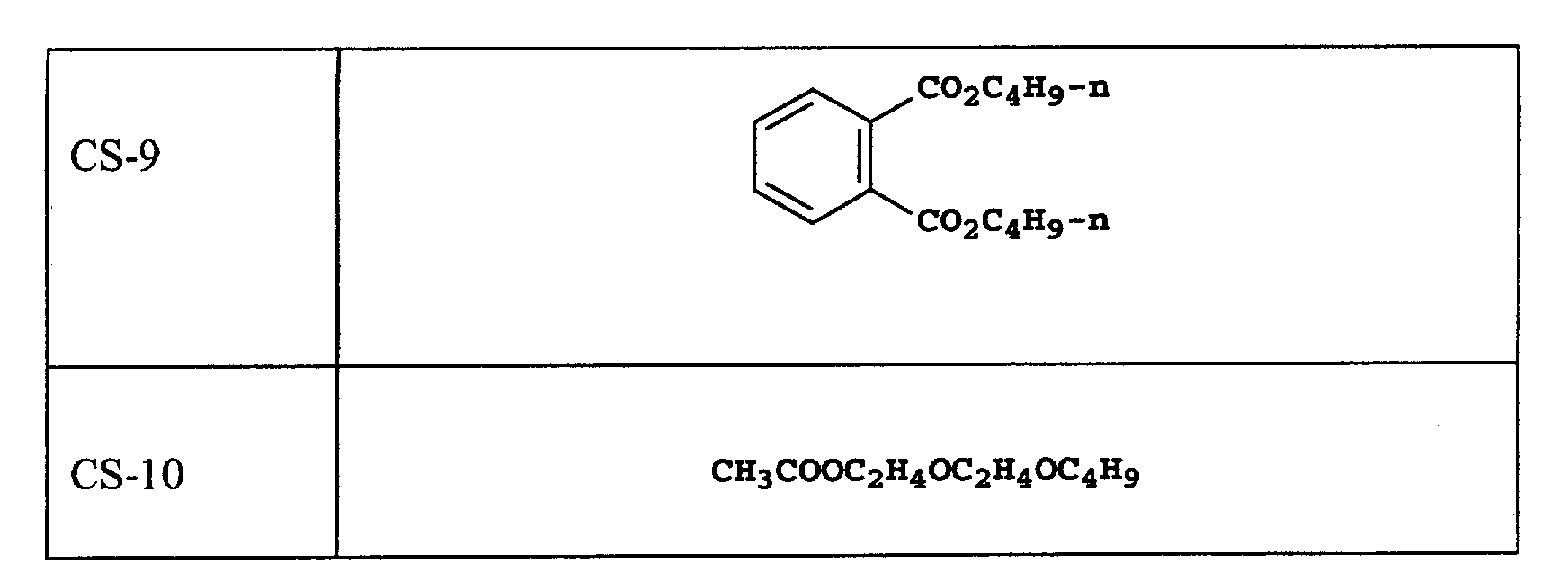
Conventional coupler solvents used in the examples are the following:
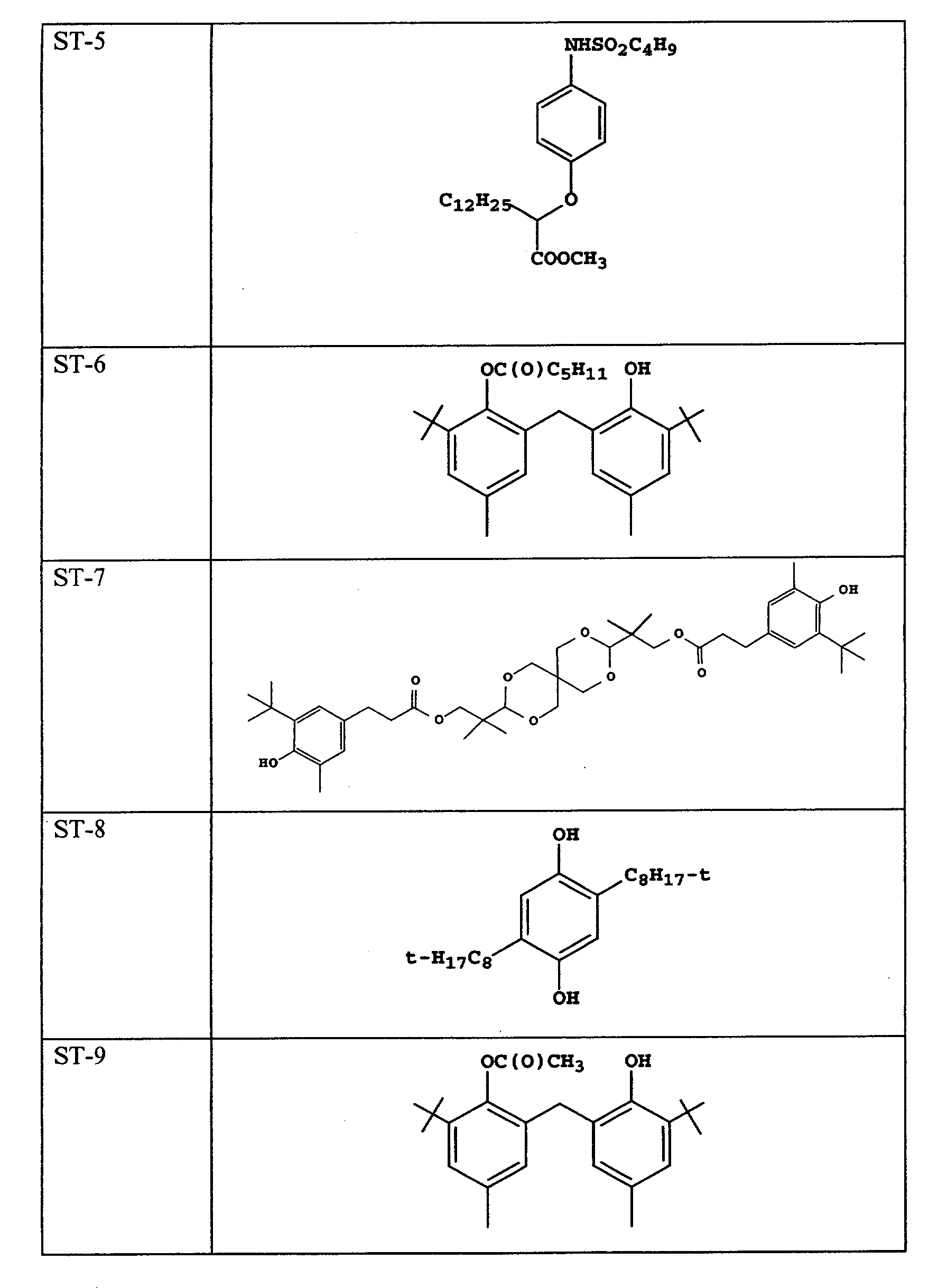
Coupler stabilizers shown in the examples are the following:
Dispersions were prepared for coating examples 101 through 405 per the
following:
Ultraviolet absorber dispersion UV-1 was prepared by dissolving
110.9g of UV-1, 19.6g of UV-2 and 35.7g of ST-8 in 43.5g of CS-6 and heating
to 116° C.. This oil phase was added to an aqueous gelatin solution containing
87.0g of a deionized bone gelatin, 70.0g of a 10% aqueous solution of surfactant
Alkanol-XC (Dupont), 7.2g of a 10% sodium propionate solution, 9.3g of 2N
propionic acid and 616.8g of water, while held at 80°C. The resulting mixture was
subjected to a Brinkmann rotor-stator mixer, set at 8000 rpm for 2 minutes. This
mixture was then homogenized by passing once through a multiple orifice device
at 352 kg/cm2, at a temperature of 80°C.
Interlayer scavenger dispersion IL-1 was prepared by dissolving
80.08g of ST-8 and 12.1g of ST-1 in 121.2g of CS-5 and heating to 110° C. This
oil phase was added to an aqueous gelatin solution containing 85.6g of a deionized
bone gelatin, 62.5g of a 10% aqueous solution of surfactant Alkanol-XC
(Dupont), 10.3g of 2N propionic acid and 627.8 of water, while held at 80°C. The
resulting mixture was subjected to a Brinkmann rotor-stator mixer, set at 8000
rpm for 2 minutes. This mixture was then homogenized by passing once through a
multiple orifice device at 352 kg/cm2, at a temperature of 80°C.
Coupler dispersion YD-1 was prepared by dissolving 15.8g of
coupler YC2, 2.20g of stabilizer ST-2, 0.55g of ST-6 and 3.86g of ST-9 in 6.04g
of solvent CS-1 at 110°C. An aqueous gelatin solution of 10.51 g gelatin, 68.68g
water, 1.21 g propionic acid (2N), and 14.8g of a 10% aqueous solution of ionic
surfactant (Alkanol-XC) was prepared at 80°C. The hot oil phase was mixed with
the aqueous gelatin solution for 2 minutes at 8000 rpm using a Brinkmann rotor-stator
mixer. This mixture was then homogenized by twice passing it through a
Microfluidics Microfluidizer at 563 kg/cm2, at a temperature of 75°C.
Coupler dispersion YD-2 was prepared by dissolving 15.8g of
coupler YC2, 2.19g of stabilizer ST-2, 2.19g of ST-7 and 2.19g of ST-9 in 6.04g
of solvent CS-1 at 110°C. An aqueous gelatin solution of 10.51g gelatin, 68.68g
water, 1.21g propionic acid (2N), and 14.8g of a 10% aqueous solution of
surfactant Alkanol-XC was prepared at 80°C. The hot oil phase was mixed with
the aqueous gelatin solution for 2 minutes at 8000 rpm using a Brinkmann rotor-stator
mixer. This mixture was then homogenized by twice passing it through a
Microfluidics Microfluidizer at 563 kg/cm2, at a temperature of 75°C.
ST-9 may be prepared as follows:
To 82.6g (0.24mol) 2,2'-methylenebis(4-methyl-6-tert-butylphenol) in 50ml of
heptane containing 10g (0.10mol) potassium acetate at 50°C is slowly added
30.9g (0.30mol) acetic anhydride with stirring. The temperature is raised to
105°C and the reaction continues for 5 hours. After water washes the reaction is
cooled to 12°C. The product is collected by filtration, washed with chilled
methanol and then with a chilled mixture of methanol and water. After drying at
40°C under vacuum, 77.1g (83.4%) of 2-((2-(acetyloxy)-3-(1,1-dimethylethyl)-5-methylphenyl)methyl)-6-(1,1-dimethylethyl)-4-methylphenol
is collected. Other
bisphenolic compounds can be reacted in a similar way.
Magenta coupler dispersion MD-1 was prepared by dissolving
27.73g of coupler MC-1, 8.98g of stabilizer ST-2 and 23.19g of stabilizer ST3 in a
mixture of 17.02g of CS-2 and 33.05g CS-8, at 135°C. This oil phase was added
to an aqueous gelatin solution containing 39.50g of a deionized bone gelatin,
31.25g of a 10% aqueous solution of surfactant Alkanol-XC and 319.2g of water,
while held at 80°C. The resulting mixture was subjected to a Brinkmann rotor-stator
mixer, set at 8000 rpm for 2 minutes. This mixture was then homogenized
by twice passing through a Microfluidics Microfluidizer at 563 kg/cm2, at a
temperature of 75°C.
Magenta dispersions MD-2 through MD-9 were prepared in a
similar manner to dispersion MD-1. The formula details for dispersions MD-1
through MD-9 are summarized in Table MD.
| Table MD: Summary of Magenta Dispersion Formulas MD-1 through MD-9. |
| Compound | MD-1 | MD-2 | MD-3 | MD-4 | MD-5 | MD-6 | MD-7 | MD-8 | MD-9 |
| MC-1 | 27.73 | 29.12 | 29.01 | 0.00 | 32.38 | 32.25 | 32.12 | 31.86 | 31.60 |
| MC-2 | 0.00 | 0.00 | 0.00 | 30.19 | 0.00 | 0.00 | 0.00 | 0.00 | 0.00 |
| CC-4 | 0.00 | 0.00 | 0.41 | 0.00 | 0.00 | 0.45 | 0.90 | 1.78 | 2.65 |
| ST-1 | 0.00 | 0.00 | 0.00 | 3.10 | 0.00 | 0.00 | 0.00 | 0.00 | 0.00 |
| ST-2 | 8.98 | 9.43 | 9.40 | 11.78 | 7.12 | 7.10 | 7.07 | 7.01 | 6.95 |
| ST-3 | 23.19 | 18.86 | 18.80 | 0.00 | 18.39 | 18.32 | 18.24 | 18.10 | 17.95 |
| ST-4 | 0.00 | 0.00 | 0.00 | 11.78 | 0.00 | 0.00 | 0.00 | 0.00 | 0.00 |
| ST-5 | 0.00 | 0.00 | 0.00 | 20.23 | 0.00 | 0.00 | 0.00 | 0.00 | 0.00 |
| CS-2 | 17.02 | 17.87 | 17.80 | 0.00 | 13.50 | 13.44 | 13.39 | 13.28 | 13.17 |
| CS-8 | 33.05 | 34.71 | 34.58 | 0.00 | 38.59 | 38.44 | 38.29 | 37.97 | 37.66 |
| CS-9 | 0.00 | 0.00 | 0.00 | 27.09 | 0.00 | 0.00 | 0.00 | 0.00 | 0.00 |
| Oil Temp °C | 135 | 135 | 145 | 120 | 145 | 145 | 145 | 145 | 145 |
| Gelatin | 39.50 | 39.50 | 39.50 | 38.74 | 39.50 | 39.50 | 39.50 | 39.50 | 39.50 |
| 10% Alkanol XC | 31.25 | 31.25 | 31.25 | 42.17 | 31.25 | 31.25 | 31.25 | 31.25 | 31.25 |
| Water | 319.2 | 319.2 | 319.2 | 313.8 | 319.2 | 319.2 | 319.2 | 319.2 | 319.2 |
The coupler dispersion CD-1 was prepared by dissolving 23.05g of
coupler CC-1, 2.56g of coupler CC-2, and 35.22g of UV-1 in 29.36g and 9.81g of
solvents CS-7 and CS-6, respectively, at 145°C. This oil phase was added to an
aqueous gelatin solution containing 40.00g of gelatin, 45.00g of a 10% aqueous
solution of surfactant Alkanol-XC and 315.0g of water, while held at 80°C. The
resulting mixture was subjected to a Brinkmann rotor-stator mixer, set at
8000 rpm for 2 minutes. This mixture was then homogenized by twice passing
through a Microfluidics Microfluidizer at 563 kg/cm2 (8000psi), at a temperature
of 75°C.
Cyan dispersions CD-2 through CD-5 were prepared in a similar
manner to dispersion CD-1. The formula details for dispersions CD-1 through
CD-5 are summarized in Table CD.
| Table CD: Summary of Cyan Dispersion Formulas CD-1 through CD-5. |
| Compound | CD-1 | CD-2 | CD-3 | CD-4 | CD-5 |
| CC-1 | 23.05 | 29.11 | 21.11 | 15.42 | 0.00 |
| CC-2 | 2.56 | 3.23 | 0.00 | 0.00 | 0.00 |
| CC-3 | 0.00 | 0.00 | 10.96 | 8.01 | 0.00 |
| CC-4 | 0.00 | 0.00 | 0.00 | 0.00 | 41.29 |
| UV-1 | 35.22 | 32.02 | 32.15 | 36.25 | 26.59 |
| ST-8 | 0.00 | 0.00 | 0.00 | 0.00 | 0.34 |
| CS-7 | 29.36 | 26.70 | 26.81 | 30.23 | 0.00 |
| CS-6 | 9.81 | 8.93 | 8.96 | 10.10 | 0.00 |
| CS-9 | 0.00 | 0.00 | 0.00 | 0.00 | 40.46 |
| CS-10 | 0.00 | 0.00 | 0.00 | 0.00 | 3.39 |
| Oil Temp °C | 145 | 145 | 145 | 145 | 141 |
| Gelatin | 40.00 | 40.00 | 40.00 | 40.00 | 41.29 |
| 10% Alkanol XC | 45.00 | 45.00 | 45.00 | 45.00 | 48.64 |
| Water | 315.0 | 315.0 | 315.0 | 315.0 | 297.9 |
| propionic acid (2N) | 0.00 | 0.00 | 0.00 | 0.00 | 5.51 |
| 10% sodium propionate | 0.00 | 0.00 | 0.00 | 0.00 | 3.34 |
The coating structure for coating example 101 is shown below.
This same basic coating structure was used for coating examples 101 - 405. The
layer 2, layer 4, layer 6 and layer 7 formulations were the same for all coating
examples 101 through 405. Coating 103 omitted the presence of the Pluronic L44.
There were some small blue sensitive layer #1 differences in coating examples
101-405 as outlined in Table #1. The green sensitive layer 3 and red sensitive
layer 5 formulations are summarized in Table #3 and Table #4.
Each of these cyan, magenta and yellow coupler dispersions was
diluted further with aqueous gelatin and mixed with a chemically and spectrally
sensitized cubic silver chloride photographic emulsion. The mixing of the already
molten components within each imaging layer was carried out immediately prior
to coating. The red and green sensitive emulsions had an average edge length of
0.38µm. During the chemical and spectral sensitization process 1.6 mole %
bromide was added to the red sensitive emulsion and 1.2 mole % bromide was
added to the green sensitive emulsion. The blue sensitive layer 1 emulsion was a
cubic mono dispersed silver chloro-iodide emulsion with 99.8 mole % chloride
and 0.20 mole% iodide with an average edge length 0.61µm. During the chemical
and spectral sensitization process a small amount of bromide was added to the
blue sensitive emulsion.
Within each group of coatings the silver was adjusted in the cyan,
magenta and yellow imaging layers so that each coating reproduced a neutral scale
that visually matched the other coatings within the group. Individual coupler
coverages in the red and green photosensitive layers for the various coatings are
reported Table 2 and Table 3. Solvent and stabilizer coverages for the green and
red sensitive layers are defined by the dispersion identity and composition shown
in Table MD and Table CD.
Example 1
|
Coating structure
,
Coating Example101
|
| Layer 7 (Supercoat) |
| Colloidal silica |
0.1614 g.m-2 |
| Gel |
0.6456 g.m-2 |
| Nonionic Surfactant as Pluoronic L44 |
0.1183 g.m-2 |
| Layer 6 (UV Layer) |
| UV-1 |
0.130 g.m-2 |
| UV-2 |
0.023 g.m-2 |
| ST-8 |
0.042 g.m-2 |
| CS-6 |
0.051 g.m-2 |
| Gel |
0.527 g.m-2 |
| Layer 5 (Red-sensitive Layer) |
| Ag |
0.256 g.m-2 |
| Coupler CC-1 |
0.387 g.m-2 |
| Coupler CC-2 |
0.043 g.m-2 |
| UV-1 |
0.591 g.m-2 |
| CS-6 |
0.165 g.m-2 |
| CS-7 |
0.493 g.m-2 |
| Gel |
2.303 g.m-2 |
| Layer 4 (Interlayer B) |
| ST-8 |
0.086 g.m-2 |
| CS-5 |
0.129 g.m-2 |
| ST-1 |
0.013 g.m-2 |
| Gel |
0.753 g.m-2 |
| Layer 3 (Green-sensitive Layer) |
| Ag |
0.141 g.m-2 |
| Coupler MC-1 |
0.269 g.m-2 |
| ST-2 |
0.087 g.m-2 |
| ST-3 |
0.224 g.m-2 |
| CS-8 |
0.321 g.m-2 |
| CS-2 |
0.165 g.m-2 |
| Gel |
1.441 g.m-2 |
| Layer 2 (Interlayer A) |
| ST-8 |
0.086 g.m-2 |
| CS-5 |
0.129 g.m-2 |
| ST-1 |
0.013 g.m-2 |
| Gel |
0.753 g.m-2 |
| Layer 1 (Blue-sensitive Layer) |
| Ag |
0.249 g.m-2 |
| Coupler YC-2 |
0.570 g.m-2 |
| ST-2 |
0.0795 g.m-2 |
| ST-6 |
0.0199 g.m-2 |
| ST-9 |
0.1391 g.m-2 |
| CS-1 |
0.218 g.m-2 |
| HQ-K |
0.0009 g.m-2 |
| MHR |
0.0064 g.m-2 |
| Gel |
1.345 g.m-2 |
| Hardener |
0.151 g.m-2 |
| Support |
Coating surfactants were added to facilitate coating as is
conventional in the art.
| Blue Sensitive "Layer 1" Formula for Examples 101 through Example 405: |
| Coating ID | Layer 1 Yellow Dispersion | Layer 1 YC2 g/m2 | Layer 1 Gelatin g/m2 | Layer 1 Silver g/m2 |
| 101 | YD-1 | 0.570 | 1.335 | 0.250 |
| 102 | YD-1 | 0.570 | 1.335 | 0.250 |
| 103 | YD-1 | 0.570 | 1.335 | 0.250 |
| 104 | YD-1 | 0.570 | 1.335 | 0.250 |
| 201 | YD-2 | 0.570 | 1.397 | 0.270 |
| 202 | YD-2 | 0.570 | 1.397 | 0.270 |
| 203 | YD-2 | 0.570 | 1.397 | 0.270 |
| 301 | YD-2 | 0.570 | 1.242 | 0.254 |
| 302 | YD-2 | 0.570 | 1.242 | 0.254 |
| 303 | YD-2 | 0.570 | 1.242 | 0.254 |
| 304 | YD-2 | 0.570 | 1.242 | 0.254 |
| 401 | YD-2 | 0.570 | 1.379 | 0.264 |
| 402 | YD-2 | 0.570 | 1.379 | 0.264 |
| 403 | YD-2 | 0.570 | 1.379 | 0.264 |
| 404 | YD-2 | 0.570 | 1.379 | 0.264 |
| 405 | YD-2 | 0.570 | 1.379 | 0.264 |
| Green Sensitive "Layer 3" Formula for Examples 101 through Example 405: |
| Coating ID | Layer 3 Primary Magenta Dispersion | Layer 3 Primary Magenta Coupler | Layer 3 Primary Magenta Coupler g/m2 | Layer 3 Secondary Dispersion | Layer 3 Coupler from Secondary Dispersion g/m2 | Layer 3 Gelatin g/m2 | Layer 3 Silver g/m2 |
| 101 | MD-1 | MC-1 | 0.269 | None | 0 | 1.441 | 0.141 |
| 102 | MD-1 | MC-1 | 0.269 | CD-1 | 0.00165 | 1.428 | 0.138 |
| 103 | MD-1 | MC-1 | 0.269 | None | 0 | 1.376 | 0.126 |
| 104 | MD-1 | MC-1 | 0.269 | CD-1 | 0.00165 | 1.376 | 0.126 |
| 201 | MD-2 | MC-1 | 0.269 | None | 0 | 1.435 | 0.140 |
| 202 | MD-3 | MC-1 | 0.269 | None | 0 | 1.435 | 0.140 |
| 203 | MD-3 | MC-1 | 0.269 | None | 0 | 1.378 | 0.127 |
| 301 | MD-4 | MC-2 | 0.261 | None | 0 | 1.284 | 0.137 |
| 302 | MD-1 | MC-1 | 0.269 | None | 0 | 1.350 | 0.120 |
| 303 | MD-1 | MC-1 | 0.269 | CD-1 | 0.00165 | 1.360 | 0.122 |
| 304 | MD-1 | MC-1 | 0.269 | None | 0.00330 | 1.368 | 0.124 |
| 401 | MD-5 | MC-1 | 0.269 | None | 0 | 1.356 | 0.122 |
| 402 | MD-6 | MC-1 | 0.269 | None | 0 | 1.366 | 0.124 |
| 403 | MD-7 | MC-1 | 0.269 | None | 0 | 1.385 | 0.128 |
| 404 | MD-8 | MC-1 | 0.269 | None | 0 | 1.394 | 0.130 |
| 405 | MD-9 | MC-1 | 0.269 | None | 0 | 1.413 | 0.135 |
| Red Sensitive "Layer 5" Formula for Examples 101 through Example 405: |
| Coating ID | Layer 5 Cyan Dispersion | Layer 5 Primary Cyan Coupler | Layer 5 Primary Cyan Coupler m/m2 | Layer 5 Gelatin mg/m2 | Layer 5 Silver m/m2 |
| 101 | CD-1 | CC-1 | 0.387 | 2.303 | 0.256 |
| 102 | CD-1 | CC-1 | 0.387 | 2.303 | 0.256 |
| 103 | CD-5 | CC-4 | 0.423 | 1.619 | 0.340 |
| 104 | CD-5 | CC-4 | 0.423 | 1.619 | 0.340 |
| 201 | CD-2 | CC-1 | 0.387 | 1.803 | 0.235 |
| 202 | CD-2 | CC-1 | 0.387 | 1.803 | 0.235 |
| 203 | CD-3 | CC-1 | 0.279 | 1.785 | 0.227 |
| 301 | CD-4 | CC-1 | 0.279 | 2.335 | 0.256 |
| 302 | CD-4 | CC-1 | 0.279 | 2.335 | 0.256 |
| 303 | CD-4 | CC-1 | 0.279 | 2.335 | 0.256 |
| 304 | CD-4 | CC-1 | 0.279 | 2.335 | 0.256 |
| 401 | CD-3 | CC-1 | 0.279 | 1.901 | 0.277 |
| 402 | CD-3 | CC-1 | 0.279 | 1.901 | 0.277 |
| 403 | CD-3 | CC-1 | 0.279 | 1.901 | 0.277 |
| 404 | CD-3 | CC-1 | 0.279 | 1.901 | 0.277 |
| 405 | CD-3 | CC-1 | 0.279 | 1.901 | 0.277 |
Sample strips of the coatings were exposed to blue, green and red light through a
separation exposure step tablet (density range 0 - 3, 0.15 increments) and
developed in standard Kodak RA4 processing solutions before washing and
drying. The resulting cyan, magenta, and yellow tracks were each read for
reflection status A red, green and blue densities. Results are reported in Table 7.
Flesh to Neutral Assessment
Prints were made from each coating using a Kodak Professional Portra NC film
negative with a portrait scene with a Macbeth bar chart in the foreground and
neutral background. The prints were colorimetrically balanced at a 0.70 status
A neutral step in the Macbeth chart. See Mees and James, The Theory of the
Photographic Process, 4th Ed., Macmillan & Co (1977), for further information on
colorimetry. The six flesh patches on the Macbeth bar chart were read on a
colorimeter and the average flesh patch colorimetric difference (ΔE) between the
print and the original Macbeth chart was calculated and is reported in Table M7.
The Caucasian 65 flesh patch ΔE is also reported separately. Each table represents
a separate experiment and a separate matched printing event. The results of the
flesh patch ΔE vary from printing event to printing event because the bar chart
print matching was only done within an experiment. Another negative containing
a bride and groom portrait with a neutral background was evaluated where the
prints were balanced to a visual match on the bride's check (close to the
Caucasian 65 flesh position). The lighting for bride and groom scene produced a
print where the groom's face includes flesh highlights to shadows ranging in
lightness (L*) from 36 to 77. The flesh reproduction from highlight to shadows
along with the neutrality of the background were subjectively evaluated. The
results are reported as example 1 through example 4.
Image Stability
The image dye light stability was assessed using simulated daylight fading
equipment incorporating a Xenon arc source, delivering an exposure intensity of
50 Klux at the sample plane. At the end of these tests, the densities of the sample
strips were re-measured and compared with the initial reading. Status "A" green
density changes from an initial density value of 1.0 after 3 weeks of treatment are
recorded in the example 1 through example 4 tables.
| Example 1 Results. |
| Sample | Layer 5 (cyan) Disp. | Layer 3 (magenta) Secondary Disp. | Layer 3 (magenta) mole% cyan coupler | Red Density | Macbeth Caucasian patch 65 | Macbeth Average flesh ΔE | 3 Wk 50Klux Density Loss | Comments |
| 101 | CD-1 | -- | 0.00% | 0.178 | 4.19 | 9.83 | -.13 | Comparison |
| 102 | CD-1 | CD-1 | 0.57% | 0.198 | 2.38 | 7.98 | -.14 | Inv |
| 103 | CD-5 | -- | 0.00% | 0.170 | 2.96 | 7.94 | -.15 | Comparison |
| 104 | CD-5 | CD-1 | 0.57% | 0.193 | 3.00 | 7.78 | -.16 | Inv |
Coating element 102 shows an improvement in flesh color reproduction
versus coating 101, as measured by patch 65 and ΔE, through the addition of
dispersions of cyan couplers CC-1 and CC-2 to the magenta dye-forming layer.
Both coatings show excellent resistance to dye fade when exposed to light.
Coating elements 104 vs 103 shows a similar desired flesh to neutral
improvement. In the flesh tone balanced bride and groom scene the background is
too cyan-green for coating element 101 and more neutral in sample 102. The
groom's flesh saturation is reduced on coating element 104 compared to coating
103.
| Example 2 Results. |
| Sample | Layer 5 (cyan) Disp. | Layer 3 (magenta) Primary Disp | Layer 3 (magenta) mole% cyan coupler | Red Density | Macbeth Caucasian patch 65 | Macbeth Average flesh ΔE | 3 Wk 50Klux Density Loss | Comments |
| 201 | CD-2 | MD-2 | 0.00% | 0.172 | 3.34 | 7.54 | -.13 | Comparison |
| 202 | CD-2 | MD-3 | 1.71% | 0.245 | 1.90 | 6.89 | -.13 | Inv |
| 203 | CD-3 | MD-3 | 1.71% | 0.243 | 1.14 | 6.13 | -.12 | Inv. |
Coatings 201, 202, and 203 all have excellent resistance to light
induced dye fade. Invention examples 202 and 203 have improved flesh to neutral
performance as measured by the diminished value of the Macbeth chart flesh
patch 65 and average ΔE. In the bride and groom scene coating elements 202 and
203 have improved background neutrality when balanced on flesh compared to
coating element 201. Coating element 203 shows less flesh saturation across the
grrom's face compared to coating elements 201 and 202. Invention example 203
has the best flesh to neutral and flesh tone reproduction performance.
| Example 3 Details |
| Sample | Layer 5 (cyan) Description | Layer 3 (magenta) Primary Disp | Layer 3 (magenta) Secondary Disp | Layer 3 (magenta) mole% cyan coupler |
| 301 | CD-4 | MD-4 | -- | 0.00% |
| 302 | CD-4 | MD-1 | -- | 0.00% |
| 303 | CD-4 | MD-1 | CD-1 | 0.57% |
| 304 | CD-4 | MD-1 | CD-1 | 1.14% |
| Example 3 Results. |
| Sample | Layer 3 (magenta) mole% cyan coupler | Red Density | Macbeth Caucasian patch 65 | Macbeth Average flesh ΔE | 3 Wk 50Klux Density Loss | Comments |
| 301 | 0.00% | 0.201 | 2.06 | 7.70 | -.42 | Comparison |
| 302 | 0.00% | 0.184 | 2.77 | 7.76 | -.14 | Comparison |
| 303 | 0.57% | 0.204 | 1.55 | 6.98 | -.14 | Inv |
| 304 | 1.14% | 0.225 | 2.29 | 7.09 | -.14 | Inv |
Coating 301 represents use of the prior art magenta coupler which
yields good color reproduction, but exhibits poor light stability. Coating 302
shows improved light stability when using coupler M-1, but the flesh color
reproduction is degraded. Employing the invention by adding the cyan coupler
useful in the invention to sample 302 to obtain samples 303 and 304 results in
improved flesh reproduction vs. sample 302 while maintaining the improved light
stability. In the bride and groom scene the groom's flesh saturation and the
background neutrality is improved in coating elements 303 and 304 compared to
coating element 302.
| Example 4 Details |
| Sample | Layer 5 (cyan) Coupler | Layer 3 (magenta) Primary Coupler | Layer 3 (magenta) mole% cyan coupler |
| 401 | CD-3 | MD-5 | 0.00% |
| 402 | CD-3 | MD-6 | 1.71% |
| 403 | CD-3 | MD-7 | 3.43% |
| 404 | CD-3 | MD-8 | 6.86% |
| 405 | CD-3 | MD-9 | 10.30% |
| Example 4 Results |
| Sample | Layer 3 (magenta) mole% cyan coupler | Red Density | Macbeth Caucasian patch 65 | Macbeth Average flesh ΔE | 3 Wk 50Klux Density Loss | Comments |
| 401 | 0.00% | 0.183 | 2.36 | 8.07 | -.13 | Comparison |
| 402 | 1.71% | 0.258 | 1.33 | 7.15 | -.13 | Inv |
| 403 | 3.43% | 0.333 | 2.44 | 6.64 | -.12 | Inv. |
| 404 | 6.86% | 0.414 | 5.50 | 7.58 | -.12 | Comparison |
| 405 | 10.30% | 0.498 | 7.97 | 7.86 | -.11 | Comparison |
Coatings 402 and 403 show improved flesh color reproduction over
coating 401 by adding a cyan coupler to the magenta layer. However, coatings
404 and 405 demonstrate that there can be an upper limit to how much cyan
coupler can be added to the magenta layer before the lighter Caucasian 65 flesh
color reproduction is degraded, that is, the Caucasian 65 patch ΔE increases to
higher than that of comparison coating 401. In the flesh balanced bride and
groom scene, the background neutrality of sample 403 is slightly improved vs.
sample 402, but both samples 402 and 403 are improved compared to sample 401.
The flesh saturation across the groom's face is improved in samples 402 and 403
compared to sample 401. The bride and groom scene neutral backgrounds in
samples 404 and 405 are shifted significantly off neutral in the red direction and
both samples are worse than coating 401 for background neutrality.
The invention also includes embodiments wherein: