EP1329507A1 - Artificial protein having potentiated immunogenicity of epitope - Google Patents
Artificial protein having potentiated immunogenicity of epitope Download PDFInfo
- Publication number
- EP1329507A1 EP1329507A1 EP01974763A EP01974763A EP1329507A1 EP 1329507 A1 EP1329507 A1 EP 1329507A1 EP 01974763 A EP01974763 A EP 01974763A EP 01974763 A EP01974763 A EP 01974763A EP 1329507 A1 EP1329507 A1 EP 1329507A1
- Authority
- EP
- European Patent Office
- Prior art keywords
- epitope
- artificial protein
- amino acid
- potentiated
- acid sequence
- Prior art date
- Legal status (The legal status is an assumption and is not a legal conclusion. Google has not performed a legal analysis and makes no representation as to the accuracy of the status listed.)
- Withdrawn
Links
Images


Classifications
-
- C—CHEMISTRY; METALLURGY
- C07—ORGANIC CHEMISTRY
- C07K—PEPTIDES
- C07K16/00—Immunoglobulins [IG], e.g. monoclonal or polyclonal antibodies
- C07K16/08—Immunoglobulins [IG], e.g. monoclonal or polyclonal antibodies against material from viruses
- C07K16/10—RNA viruses
- C07K16/112—Retroviridae (F), e.g. leukemia viruses
- C07K16/114—Lentivirus (G), e.g. human immunodeficiency virus [HIV], feline immunodeficiency virus [FIV] or simian immunodeficiency virus [SIV]
- C07K16/1145—Env proteins, e.g. gp41, gp110/120, gp160, V3, principal neutralising domain [PND] or CD4-binding site
-
- A—HUMAN NECESSITIES
- A61—MEDICAL OR VETERINARY SCIENCE; HYGIENE
- A61P—SPECIFIC THERAPEUTIC ACTIVITY OF CHEMICAL COMPOUNDS OR MEDICINAL PREPARATIONS
- A61P37/00—Drugs for immunological or allergic disorders
- A61P37/02—Immunomodulators
-
- C—CHEMISTRY; METALLURGY
- C07—ORGANIC CHEMISTRY
- C07K—PEPTIDES
- C07K14/00—Peptides having more than 20 amino acids; Gastrins; Somatostatins; Melanotropins; Derivatives thereof
- C07K14/435—Peptides having more than 20 amino acids; Gastrins; Somatostatins; Melanotropins; Derivatives thereof from animals; from humans
- C07K14/46—Peptides having more than 20 amino acids; Gastrins; Somatostatins; Melanotropins; Derivatives thereof from animals; from humans from vertebrates
- C07K14/47—Peptides having more than 20 amino acids; Gastrins; Somatostatins; Melanotropins; Derivatives thereof from animals; from humans from vertebrates from mammals
-
- C—CHEMISTRY; METALLURGY
- C07—ORGANIC CHEMISTRY
- C07K—PEPTIDES
- C07K16/00—Immunoglobulins [IG], e.g. monoclonal or polyclonal antibodies
- C07K16/08—Immunoglobulins [IG], e.g. monoclonal or polyclonal antibodies against material from viruses
- C07K16/10—RNA viruses
- C07K16/112—Retroviridae (F), e.g. leukemia viruses
- C07K16/114—Lentivirus (G), e.g. human immunodeficiency virus [HIV], feline immunodeficiency virus [FIV] or simian immunodeficiency virus [SIV]
-
- A—HUMAN NECESSITIES
- A61—MEDICAL OR VETERINARY SCIENCE; HYGIENE
- A61K—PREPARATIONS FOR MEDICAL, DENTAL OR TOILETRY PURPOSES
- A61K39/00—Medicinal preparations containing antigens or antibodies
- A61K2039/505—Medicinal preparations containing antigens or antibodies comprising antibodies
-
- A—HUMAN NECESSITIES
- A61—MEDICAL OR VETERINARY SCIENCE; HYGIENE
- A61K—PREPARATIONS FOR MEDICAL, DENTAL OR TOILETRY PURPOSES
- A61K38/00—Medicinal preparations containing peptides
-
- A—HUMAN NECESSITIES
- A61—MEDICAL OR VETERINARY SCIENCE; HYGIENE
- A61K—PREPARATIONS FOR MEDICAL, DENTAL OR TOILETRY PURPOSES
- A61K39/00—Medicinal preparations containing antigens or antibodies
Definitions
- the present invention relates to an artificial protein having epitope with potentiated immunogenicity, a derivative agent for immunoresponse comprising said artificial protein, a method for producing an antibody that uses said artificial protein as an antigen, a functional food comprising said artificial protein as an active ingredient, an agent inducing desensitive and immunologically tolerant state comprised of enterobacteria that express said artificial protein, a DNA vaccine for inducing immunoresponse comprising a DNA that encodes said artificial protein, or the like.
- molecular evolution engineering proteins or genetic DNAs that encode them, which form the essential part of bioreaction, are being created artificially in the laboratories. This technology has made it possible to produce enzymes and proteins having novel activities that do not exist in nature, and proteins having structures that greatly differ from that of natural proteins, and their various applications to the medical and engineering fields are expected.
- molecular evolution engineering a method is conducted wherein a molecule having the activity of the interest is selected from a random pool of polymers with block units of amino acids or nucleotides that construct proteins or genes that encode them. For example, the group of Szostak et al.
- RNA molecules that bind specifically to a specific pigment were selected from the RNA group, and reported which RNA molecule having which sequence structure satisfies the given function (Nature, 346: 818-822, 1990).
- the group of Szostak et al. have further succeeded in creating an RNA molecule having a more complex activity such as ligase activity (Science, 261: 1411-1418, 1993).
- the present inventors propose a microgene polymerization method (Japanese Laid-Open Patent Publication No. 09-322775), characterized in that polymerization reaction is conducted by action of DNA polymerase to oligonucleotide A and oligonucleotide B wherein at least part of the sequence is complementary to each other.
- a DNA that encodes an amino acid polymers having repeating units similar to those of natural proteins such as silk protein, elastin and the like Japanese Laid-Open Patent Publication No. 10-14586
- a gene cassette that encodes an artificial protein having a repetitive amino acid sequence U.S. Patent No. 5089406
- a synthesized repeated DNA for constructing a large polypeptide having repetitive sequences of amino acids U.S. Patent No. 56416408
- a DNA sequence that encodes peptides having repetitive units of amino acids U.S. Patent No. 5770697
- a synthesized repeated DNA for constructing large polypeptides that include repetitive sequences of amino acids U.S. Patent No. 5830713
- An object of the present invention is to provide a method to impart the ability to induce a strong immunoresponse, even to a peptidic epitope that cannot obtain sufficient immunoresponsive induction activity by the use of conventional methods. More specifically, the object is to provide an artificial protein having epitope with potentiated immunogenicity, a derivative agent for immunoresponse comprising said artificial protein, a method for producing an antibody that uses said artificial protein as an antigen, a functional food comprising said artificial protein as an active ingredient, an agent inducing desensitive and immunologically tolerant state comprised of enterobacteria that express said artificial protein, a DNA vaccine for inducing immunoresponse comprising a DNA that encodes said artificial protein, or the like.
- a peptidic epitope In order for a peptidic epitope to have sufficient antigenicity, there is a need for the peptidic epitope to be incorporated into an immunocompetent cell, and after having been processed, to be presented efficiently to B cells and T cells by MHC molecules. In order for these "incorporation”, “processing” and “presentation by MHC” reactions to proceed efficiently, it is considered that the peptidic epitope should exist in the proximal context to natural proteins. Based on such idea, "an artificial protein having a property similar to a natural protein that has at least one copy of a peptidic epitope" was designed and constructed, and an experiment to examine the immunogenicity of this artificial protein was first implemented.
- the region called loop 3 of the gp120 protein that AIDS virus has is known as a neutralizing epitope, and some of the antibodies against this epitope have a neutralizing activity which, for example, suppresses the proliferation of virus, and becomes an important antibody that can be used for AIDS therapy. It is known that AIDS virus changes the amino acid sequence of the loop 3 region by rapidly changing its gene arrangement, and avoids the attack from this neutralizing antibody. From the viewpoint of the clinical use of neutralizing antibodies, a rapid construction of a new neutralizing antibody against the AIDS virus variants that newly emerge in this way, will be necessary.
- an artificial protein was constructed which has at least one copy of a loop 3 peptide sequence on its structure while having a "property similar to a natural protein as a whole", and an efficient immune induction method by using this protein was attempted (Figure 1).
- Figure 1 For the construction of an artificial protein, methods described in "multifunctional base sequence and artificial gene including the same” (Japanese Patent Application No. 2000-180997) and “method of polymerizing microgene” (Japanese Laid-Open Patent Publication No. 09-322775) were used.
- a microgene that encodes a loop 3 peptide "RKSIRIQRGPGRTFVTIGKI” known as a neutralizing antigen of AIDS virus, into one of the open reading frames was designed.
- 6 codons, “CGT”, “CGC”, “CGA”, “CGG”, “AGA” and “AGG” correspond to the first R (arginine), and a specific codon was selected from among these.
- Two codons, "AAA” and “AAG” correspond to the next K (lysine), and a specific codon was selected from among these.
- base sequences that encode the above-mentioned neutralizing antigen peptide into one of the open reading frames will be as many as approximately 1651 ⁇ 10 8 variants from codon degeneracy.
- a single microgene has 3 each of open reading frames in the plus strand and minus strand, it can encode 6 types of different peptides. For example, in 2 different open reading frames in the same direction, 2 peptides that are completely different from the above-mentioned neutralizing antigen peptide will be encoded.
- Sun Enterprise250 of Sun Microsystems, Inc. was used as the calculator, and it was found out to be impossible to simultaneously calculate all of the approximately 1651 ⁇ 10 8 variants of base sequences. Therefore, calculation was performed for a peptide comprising 13 amino acids, "IRIQRGPGRTFVT", wherein both ends of the above-mentioned neutralizing antigen peptide had been deleted. All the base sequences having the possibility to encode this peptide in one open reading frame was written out in the calculator, and approximately 5 ⁇ 10 8 variants of base sequences were constructed.
- microgene "design-25” was obtained from these results.
- This microgene "design-25” encodes a neutralizing antigen sequence in one of its open reading frames, does not have a stop codon in the other 2 open reading frames, and further, encodes a peptide having a property to easily form an ⁇ helix in one of the other 2 open reading frames. It can be said that it is a microgene wherein the 2 biological function structures, "AIDS virus neutralizing antigenicity" and "ability of structure formation", are cryptgenic.
- microgene "design-25” was polymerized by using the aforementioned method for polymerizing microgene (Japanese Laid-Open Patent Publication No. 09-322775) of the present inventor, and artificial gene libraries comprised of various artificial genes, wherein "neutralizing antigen sequence” and "sequence that easily forms an ⁇ helix” are combined intricately, were constructed.
- Various artificial proteins were expressed in Escherichia coli by using these artificial gene libraries, and among them, artificial proteins having in some parts AIDS virus neutralizing antigen sequences, while supported by ⁇ helix structure as a whole, were obtained.
- mice were immunized by using said artificial proteins, and it was confirmed that antiserum against the loop 3 region of gp120 protein can be constructed efficiently and that no significant immune induction occurs by immunization using a synthesized peptide that corresponds to the loop 3 region as a control experiment. Thus, the present invention had been completed.
- the present invention relates to: an artificial protein having epitope with potentiated immunogenicity, wherein said artificial protein is comprised of an amino acid sequence containing whole or part of an amino acid sequence of a peptidic epitope (claim 1); the artificial protein having epitope with potentiated immunogenicity according to claim 1, wherein said artificial protein is comprised of an amino acid sequence containing whole or part of an amino acid sequence of a peptidic epitope and having a property imparted thereto of assisting the formation of the high-order structure of protein (claim 2); the artificial protein having epitope with potentiated immunogenicity according to claim 1, wherein said artificial protein is comprised of an amino acid sequence containing whole or part of an amino acid sequence of peptidic epitope and having a property imparted thereto of assisting the antigen presentation treatment caused by an immunocompetent cell (claim 3); the artificial protein having epitope with potentiated immunogenicity according to any of claims 1 to 3, wherein a peptide tag or a marker protein is fuse
- the present invention relates to: an agent for inducing immunoresponse wherein said agent comprises the artificial protein having epitope with potentiated immunogenicity according to any of claims 1 to 7 (claim 8); the agent for inducing immunoresponse according to claim 8, wherein said immunoresponse is humoral immunity (claim 9); the agent for inducing immmunoresponse according to claim 8, wherein said immunoresponse is cellular immunity (claim 10); a method for producing antibody, wherein the artificial protein having epitope with potentiated immunogenicity according to any of claims 1 to 7 is used as an antigen (claim 11); the method for producing antibody according to claim 11, wherein said antibody is a monoclonal antibody (claim 12); an antibody that can be obtained by the method for producing antibody according to claim 11 or 12 (claim 13); a cell that produces the antibody according to claim 13 (claim 14); a host cell comprised of an expression system that is capable of expressing the artificial protein having epitope with potentiated immunogenicity according
- the present invention relates to: a DNA that encodes the artificial protein having epitope with potentiated immunogenicity according to any of claims 1 to 7 (claim 18); the DNA according to claim 18, wherein when open reading frames of a base sequence is different, a peptidic epitope is encoded in at least one open reading frame of said base sequence, and a peptide capable of imparting a property of increasing the antigenicity of said peptidic epitope is encoded in other open reading frame (claim 19); a DNA vaccine for immunoresponsive induction, wherein said vaccine is comprised of the DNA according to claim 18 or 19 (claim 20); the DNA vaccine for immunoresponsive induction according to claim 20, wherein said immunoresponse is humoral immunity (claim 21); the DNA vaccine for immunoresponsive induction according to claim 20, wherein said immunoresponse is cellular immunity (claim 22); a functional food comprising the artificial protein having epitope with potentiated immunogenicity according to any of claims 1 to 7 as an active ingredient (claim 23); and the functional food according to
- the artificial protein having epitope with potentiated immunogenicity in the present invention, as long as it is a protein or peptide comprised of an amino acid sequence containing whole or part of an amino acid sequence of a peptidic epitope.
- the artificial protein is a protein or peptide that does not exist in nature.
- tandem polymers of known peptidic epitopes such as the cointegrate of a tandem polymer of the gp120 loop 3 peptide of HIV and a carrier protein, described in the aforementioned literature (Vaccine 17: 2392-2399, 1999), and a fusion protein and a fusion peptide of a known peptidic epitope or a tandem polymer of known peptidic epitopes and known carrier proteins.
- an artificial protein comprised of an amino acid sequence containing whole or part of an amino acid sequence of a peptidic epitope and having a property imparted thereto of assisting the formation of the high-order structure of protein; and an artificial protein comprised of an amino acid sequence containing whole or part of an amino acid sequence of a peptidic epitope and having a property imparted thereto of assisting the antigen presentation treatment caused by immunocompetent cells.
- Examples of the property of assisting the formation of the high-order structure of the above-mentioned protein are properties regarding the ability to form an ⁇ helix, the ability to form a secondary structure and the ability to improve hydrophobicity. Further, an example of the property of assisting the antigen presentation treatment caused by immunocompetent cells is a property regarding the ability to improve affinity with the MHC molecules of class I and class II. Other various properties that are made similar to natural proteins can also be imparted. An amino acid sequence having these useful properties can be prepared by adjusting the repeatability of amino acid composition and sequence, or by referring to the known sequences that retain said properties.
- a peptide sequence having an additional signal of sugar for example, can be used, aside from the peptide sequence that may impart a property of assisting the formation of the high-order structure of the above-mentioned protein and from the peptide sequence that may impart a property of assisting the antigen presentation treatment caused by immunocompetent cell.
- the synthesized natural protein is glycosylated, and can be used as a hybrid artificial protein of protein-sugar.
- an amino acid sequence containing whole or part of the peptidic epitope loop 3, which can impart strong immunogenicity to gp120 loop 3 of HIV, a peptidic epitope with very weak immunogenicity can be given.
- An example is an artificial peptide or artificial protein that is comprised of an amino acid sequence shown in any one of Seq. ID Nos. 24 to 47.
- the artificial protein having epitope with potentiated immunogenicity in the present invention can be used as a derivative (drug) agent for immunoresponse to induce immunoresponses such as humoral immunity, cellular immunity and the like in vivo.
- Examples of a DNA that encodes the artificial protein having epitope with potentiated immunogenicity in the present invention are: when open reading frames of a base sequence is different, DNA encoding a peptidic epitope in at least one open reading frame of said base sequence and encoding a peptide which can impart a property of increasing the antigenicity of said peptidic epitope in other open reading frames; and DNA encoding a peptidic epitope and a peptide which can impart a property of increasing the antigenicity of said peptidic epitope in the same open reading frame.
- an expression vector incorporated with said DNA can be used as a DNA vaccine for immunoresponsive induction such as humoral immunity, cellular immunity and the like.
- the present invention relates to the host cell comprised of an expression system that is capable of expressing the artificial protein having epitope with potentiated immunogenicity in the above-mentioned present invention
- host cells are: bacterial prokaryotic cells such as Salmonella, Escherichia coli, streptomyces, Bacillus subtilis, Streptococcus, Staphylococcus and the like; fungus cells such as yeast, Aspergillus and the like; insect cells such as drosophila S2, Spodoptera Sf9 and the like; animal cells such as L cell, CHO cell, COS cell, HeLa cell, C127 cell, BALB/c3T3 cell (including variants deficient in dihydrofolate reductase, thymidine kinase and the like), BHK21 cell, HEK293 cell and the like; plant cell and the like.
- enterobacteria such as Salmonella and the like can be favorably exemplified. Since the state of desensitization and immunological tolerance can be induced by administrating the enterobacteria that expresses said artificial protein to the living organism, these enterobacteria can be expected to be used as a agent inducing desensitive and immunologically tolerant state.
- the expression system may be any kind of expression system as long as it can express the above-mentioned artificial protein having epitope with potentiated immunogenicity in the present invention in the host cell.
- the expression system are expression system derived from chromosome, episome and virus, such as bacterial plasmid-derived, yeast plasmid-derived, papovavirus such as SV40, vaccinia virus, adenovirus, fowlpox virus, pseudorabies virus, retrovirus-derived vector, bacteriophage-derived, transposon-derived and vectors derived from a combination of these, for example, those derived from genetic factors of plasmid and bacteriophage, such as cosmid and phagemid.
- This expression system may include a regulatory sequence that not only induces expression but also controls the expression.
- an expression vector series that shifts the open reading frame and translates can also be used effectively.
- the DNA that encodes the artificial protein in the present invention and the expression system incorporated with said DNA that encodes the artificial protein can be introduced into a host cell by the methods described in many of the standard laboratory manuals, such as Davis et al. (BASIC METHODS IN MOLECULAR BIOLOGY, 1986) and Sambrook et al. (MOLECULAR CLONING: A LABORATORY MANUAL, 2nd Ed., Cold Spring Harbor Laboratory Press, Cold Spring Harbor, N.Y., 1989). Examples of the method are calcium phosphate transfection, DEAE-dextran-mediated transfection, transvection, microinjection, cationic lipid-mediated transfection, electroporation, transduction, scrape loading, ballistic introduction, infection or the like.
- the method of producing the artificial protein in the present invention is a method of producing a protein that is conventionally known.
- it can be obtained by incorporating a DNA that encodes said artificial protein into an expression vector and transforming the host cell, followed by cultivation of said transformed cell, or by method of peptide synthesis.
- the DNA that encodes the artificial protein mentioned above can be constructed, for example, by using the method of microgene polymerization as described in the Example.
- the property of the artificial protein that is imparted to the base sequence that encodes an epitope may exist in the same open reading frame of the microgene or in a different open reading frame, however, the method of constructing a DNA that encodes artificial protein is not limited to these.
- a peptide tag for separation and purification such as polyhistidine residue and the like can be made to exist in a part of the amino acid sequence of said artificial protein, for example, by making a base sequence encoding a polyhistidine residue exist at the coding region derived from the above-mentioned expression vector.
- the artificial protein in the present invention may be used as a fusion protein and fusion peptide ligated with a marker protein and/or peptide tag.
- a marker protein there is no particular limitation to the marker protein, as long as it is a marker protein conventionally known.
- the marker protein are alkaline phosphatase, Fc region of an antibody, HRP, GFP and the like.
- Specific exemplifications of the peptide tag are those that are conventionally known, such as Myc tag, His tag, FLAG tag, GST tag and the like.
- Said fusion protein and fusion peptide can be constructed by an ordinary method, and are useful for the purification of the artificial protein in the present invention using the affinity of Ni-NTA and His tag, the detection of proteins having a T cell induction activity, the quantification of antibodies against the artificial protein in the present invention, a diagnostic marker of immunodeficiency syndrome or the like, and also as a laboratory reagent of this field.
- an antibody in the present invention there is no particular limitation to the method for producing an antibody in the present invention as long as it is a method that uses the artificial protein having epitope with potentiated immunogenicity as an antigen.
- specific examples of the types of said antibody are immunospecific antibodies such as monoclonal antibody, polyclonal antibody, chimeric antibody, single stranded antibody, humanized antibody and the like. These antibodies can be constructed by ordinary methods with the use of the artificial protein having epitope with potentiated immunogenicity in the present invention or a part of it as an antigen. From the point of its specificity, a monoclonal antibody is favorable among them, and particularly, the monoclonal antibody having a neutralizing activity against the proliferation of AIDS virus is more preferable.
- the antibodies such as said monoclonal antibody and the like are useful, for example, not only for the therapy of immunodeficiency syndrome or the like such as AIDS, but also for the elucidation of the onset mechanism of immunodeficiency syndrome, such as AIDS and the like.
- the antibody of the present invention can be produced by administrating the artificial protein having epitope with potentiated immunogenicity in the present invention or a part of it, or a cell expressing a complex comprised of a part of said artificial protein and MHC on the membrane surface, to an animal (preferably non-human), by using the common protocol.
- an animal preferably non-human
- arbitrary methods that generate an antibody produced by the culture of continuous cell line such as hybridoma method (Nature 256, 495-497, 1975), trioma method, human B cell hybridoma method (Immunology Today 4, 72, 1983) and EBV-hybridoma method (MONOCLONAL ANTIBODIES AND CANCER THERAPY, pp. 77-96, Alan R. Liss, Inc., 1985) can be used.
- the method for preparing a single stranded antibody (U.S. Patent No. 4,946,778) can be applied to generate a single stranded antibody against the above-mentioned artificial protein in the present invention.
- a transgenic mouse or other mammals and the like can be used to express a humanized antibody
- a clone that expresses the artificial protein having epitope with potentiated immunogenicity in the present invention can be isolated and identified by the use of the above-mentioned antibody, and its polypeptide can be purified by affinity chromatography.
- the antibody against a peptide containing the artificial protein having epitope with potentiated immunogenicity in the present invention and its antigenic epitope can be used for diagnosis and therapy of immunodeficiency syndromes such as AIDS and the like.
- an established cultured cell is preferable as the cell that produces the above-mentioned antibody in the present invention.
- monoclonal antibody-producing hybridoma, B cell line or the like can be exemplified.
- the functional food in the present invention may be any kind of food as long as it comprises the artificial protein having epitope with potentiated immunogenicity in the present invention as an active ingredient.
- Said food can be obtained by using said artificial protein as a part of the food and drink material, or by adding or admixing it during the manufacturing process or after being manufactured.
- said functional food there is no particular limitation to said functional food, and specific examples are: baked goods such as cookie, bread, cake, rice cracker and the like; tablet candy such as lemon pop candy and the like; Japanese confectionery such as a sweet jellied adzuki-bean paste and the like; cold confectionery such as pudding, jelly, ice cream and the like; sweets such as chewing gum, candy and the like; snacks such as cracker, chips and the like; noodles such as wheat noodle, buckwheat noodle and the like; fish cake such as steamed fish paste, ham, fish sausage and the like; dairy product such as cheese, butter and the like; seasoning such as soybean paste, soy sauce, dressing, mayonnaise, sweetener and the like; daily dish such as bean curd, alimentary yam paste, fish boiled in soy sauce, Chinese dumpling, croquette, salad, soup, stew and the like; various beverages such as yogurt, yogurt drink, juice, cow milk, soy milk, alcoholic beverage, coffee, tea, natural leaf tea,
- a microgene wherein a base sequence that encodes a peptide comprising an amino acid sequence shown in Seq. ID No. 1, which is a partial sequence of gp120 protein that the subspecies of a group of HIV virus have, was made to be one of the open reading frames, and wherein the microgene can encode a peptide comprising an amino acid sequence that can easily form a secondary structure in at least either of the other 2 open reading frames in the same direction, a microgene was assembled according to the flow chart shown in Figure 2. Considering the throughput of the calculator, the 20 amino acid residues shown in Seq. ID No.
- the total amino acid sequences of approximately 227 ⁇ 10 5 variants, which are encoded by the other 2 open reading frames in the same direction with the open reading frame 1 of these selected base sequences were constructed in the calculator. From among the peptide group comprised of these amino acid sequences, duplicating sequences having the same amino acid sequence were eliminated, and approximately 1506 ⁇ 10 4 variants of peptide groups each having a different sequence were selected. For each peptide group, its ability to form a secondary structure of ⁇ helix and ⁇ sheet was determined by a score using the aforementioned secondary structure prediction program. From among the peptides expected to have a high ability of forming a secondary structure, a peptide comprised of an amino acid sequence shown in Seq. ID No. 5 was selected. This peptide is an amino acid sequence encoded in the second open reading frame of the base sequence shown in Seq. ID No. 6, and was the sequence which was expected to easily form an ⁇ helix structure.
- a peptide comprising the amino acid sequence shown by Seq. ID No. 9 was selected, which encodes a peptide comprising an amino acid sequence shown by Seq. ID No. 4 in the first open reading frame, and a peptide with high possibility of forming ⁇ helix in the second open reading frame where the sequence of 1 to 3 amino acids of the peptide is identical with the sequence of 11 to 13 amino acids in the amino acid sequence shown by Seq. ID No. 5.
- This peptide is an amino acid sequence that is encoded in the second open reading frame of the base sequence shown in Seq. ID No. 10.
- a microgene polymer library was constructed by using the above-mentioned designed microgene "design-25" as a starting material, and by using the technique of the construction method of a macromolecular microgene polymer described in the aforementioned Japanese Laid-Open Patent Publication No.09-322775.
- KY-1197 comprised of the base sequence shown in Seq. ID No. 12 was used as oligonucleotide A which is to become the base of polymerization
- KY-1198 comprised of the base sequence shown in Seq. ID No. 13 was used as oligonucleotide B, both after having been synthesized.
- oligonucleotide A comprised of 34 nucleotides and the 10 residues on the 3' side of oligonucleotide B comprised of 36 nucleotides were structured as a complementary sequence to each other, except for the 3' ends.
- the condition for polymerization reaction by using the above-mentioned oligonucleotide A and oligonucleotide B in a reaction capacity of 50 ⁇ L was as follows: KY-1197 20 pmol KY-1198 20 pmol KCl 10 mM (NH 4 ) 2 SO 4 10 mM Tris-HCl (pH 8.8) 10 mM MgSO 4 2 mM TritonX-100 0.1% 2.5 mM dNTP 7 ⁇ L
- Polymerization reaction was conducted by using the GeneAmp 2400 PCR System of Perkin-Elmer Corporation. As the reaction condition, a repetition of 55 cycles was carried out, wherein the cycle was a thermal denaturation for 10 seconds at 94.degree. C., followed by annealing and stretch reaction for 60 seconds at 66.degree. C., and the last stretch reaction was conducted for 7 minutes at 66.degree. C.
- the artificial gene in the present invention which was obtained as a polymerization reaction product was cloned in a plasmid vector pTZ19R (Protein Eng., 1:67-74, 1986), and the base sequence of its inserted DNA fragment was determined by using a sequencer (Perkin-Elmer Corporation).
- the 10 DNA fragments that had been cloned that is, pTH127, pTH133, pTH136, pTH142, pTH143, pTH145, pTH155, pTH167, pTH171 and pTH176 are shown in Figures 4 and 5.
- the inserted fragment of pTH133, pTH142, pTH143 and pTH167 were long, and since they have a property of repetitive sequence, their base sequence of the total length could not be determined, so that their partial sequences are shown in Figures 4 and 5.
- Each of the inserted base sequences shown in these Figures 4 and 5, are shown in Seq. ID Nos. 14 to 23, respectively.
- the 10 inserted DNA fragments that had been cloned in the plasmid vector pTZ19R were excised, and with consideration to such as the direction and open reading frame, they were cloned again in either one of the expression plasmid vector series pKS600-pKS605, which can be expressed by selecting the direction and open reading frame, thereby expressing the artificial gene, that is the above-mentioned microgene polymer, in the Escherichia coli.
- pKS600 to pKS605 are modifications of the cloning sites of pQE-9, pQE-10 and pQE-11, which are expression vector series wherein the open reading frames are dislocated one by one, and are sold by Qiagen K. K. These were constructed so that any one of the 6 open reading frames, which are total of 3 open reading frames each of the minus strand and plus strand, can largely express the translation products in the Escherichia coli.
- the 24 types of expression plasmid vectors pTH177 to pTH200, wherein the artificial genes had been inserted that is, pTH177 wherein the inserted sequence of pTH127 is transferred to pKS601, pTH178 wherein the inserted sequence of pTH133 is transferred to pKS601, pTH179 wherein the inserted sequence of pTH136 is transferred to pKS600, pTH180 wherein the inserted sequence of pTH143 is transferred to pKS600, pTH181 wherein the inserted sequence of pTH145 is transferred to pKS601, pTH182 wherein the inserted sequence of pTH155 is transferred to pKS601, pTH183 wherein the inserted sequence of pTH167 is transferred to pKS601, pTH184 wherein the inserted sequence of pTH171 is transferred to pKS601, pTH185 wherein the inserted sequence of pTH176 is transferred to pKS601, pTH186 wherein the inserted sequence of
- Figures 6 to 9 show the amino acid sequences of the 24 types of artificial proteins that are the translation products of the above-mentioned pTH177 to pTH200, wherein an expression plasmid-derived peptide sequence is fused in their N terminal and C terminal.
- the inserted peptide sequence of pTH177 shown in Figures 6 to 9 is shown in Seq. ID No. 24, the inserted peptide sequence of pTH178 is shown in Seq. ID No. 25, the inserted peptide sequence of pTH179 is shown in Seq. ID No. 26, the inserted peptide sequence of pTH180 is shown in Seq.
- the inserted peptide sequence of pTH181 is shown in Seq. ID No. 28
- the inserted peptide sequence of pTH182 is shown in Seq. ID No. 29
- the inserted peptide sequence of pTH183 is shown in Seq. ID No. 30
- the inserted peptide sequence of pTH184 is shown in Seq. ID No. 31
- the inserted peptide sequence of pTH185 is shown in Seq. ID No. 32
- the inserted peptide sequence of pTH186 is shown in Seq. ID No. 33
- the inserted peptide sequence of pTH187 is shown in Seq. ID No. 34
- the inserted peptide sequence of pTH188 is shown in Seq. ID No.
- the inserted peptide sequence of pTH189 is shown in Seq. ID No. 36
- the inserted peptide sequence of pTH190 is shown in Seq. ID No. 37
- the inserted peptide sequence of pTH191 is shown in Seq. ID No. 38
- the inserted peptide sequence of pTH192 is shown in Seq. ID No. 39
- the inserted peptide sequence of pTH193 is shown in Seq. ID No. 40
- the inserted peptide sequence of pTH194 is shown in Seq. ID No. 41
- the inserted peptide sequence of pTH195 is shown in Seq. ID No. 42
- the inserted peptide sequence of pTH196 is shown in Seq. ID No.
- the inserted peptide sequence of pTH197 is shown in Seq. ID No. 44
- the inserted peptide sequence of pTH198 is shown in Seq. ID No. 45
- the inserted peptide sequence of pTH199 is shown in Seq. ID No. 46
- the inserted peptide sequence of pTH200 is shown in Seq. ID No. 47.
- each of the artificial proteins with large amount of expression that is, pTH177, pTH178, pTH180, pTH181, pTH183, pTH184, pTH185, pTH186, pTH187, pTH188, pTH189, pTH190, pTH192, pTH194, pTH195, pTH196, pTH197, pTH198, pTH199 and pTH200, were purified in the following manner by using a polyhistidine residue of an N terminal derived from an expression vector.
- bacteriolysis buffer 50 mM NaH 2 PO 4 (pH 8.0), 10 mM Tris-HCl (pH 8.0), 6 M guanidine hydrochloride, 100 mM NaCl and 1 mM PMSF
- bacteriolysis buffer 50 mM NaH 2 PO 4 (pH 8.0), 10 mM Tris-HCl (pH 8.0), 6 M guanidine hydrochloride, 100 mM NaCl and 1 mM PMSF
- bacteriolysis buffer 50 mM NaH 2 PO 4 (pH 7.0), 8 M urea, 100 mM NaCl, 15 mM imidazole
- the purified protein that ligated with TALON resin was eluted using an elution buffer (50 mM NaH 2 PO 4 (pH 5.0), 20 mM MES (pH 5.0), 8 M urea, 100 mM NaCl, 250 mM imidazole).
- the eluted fraction containing purified protein was dialized (Pierce Biotechnology, Inc., molecular cutoff 10000) with 50 mM Tris-acetic acid, pH 4.0, 100 mM NaCl, 1 mM EDTA, concentrated with ultrafilter (Amicon Inc., centrip, molecular cutoff 10000), followed by determination of concentration to make a purified sample.
- mice Twenty to 25 ⁇ g of the 20 types of purified proteins were injected every 3 weeks for 3 times, into the spleen of a total of 100 mice, that is, 5 mice (BALB/c) for each protein, and were immunized. Five days after final immunization, blood was collected from the retinal blood vessel of the mice. Further, the blood collected from 5 mice (BALB/c) immunized in the same manner using a synthesized peptide of 40 mer including the HIV gp120 loop 3 region, INCTRPNNNTRKSIRIQRGPGRTFNTIGKIGNMRQAHCNI (Seq. ID No. 48), was used as a control (V3).
- ELISA experiment was conducted with the use of the synthesized peptide of 40 mer including the HIV gp120 loop 3 region by a conventional method, and the ability of immune induction was determined.
- ELISA was conducted in the following manner. After the above-mentioned synthesized peptide (Seq. ID No. 48) was solid-phased in a 96 well plate (Falcon, 3539), mouse serum was adsorbed as a primary antibody, and after washing, peroxidase conjugated sheep anti-mouse IgG antibody (Amersham Pharmacia Biotech) was added as a secondary antibody. After washing, OPD (o-Phenylenediamine) was colored as a substrate, and the absorbance at wavelength 492 nm was determined.
- OPD o-Phenylenediamine
- Sera obtained from each of the 5 immunized mice were diluted to 1/2500, in an immunity experiment wherein the purified protein obtained from pTH177, pTH178, pTH180, pTH181, pTH184, pTH185, pTH186, pTH188, pTH190 and pTH192, and the synthesized peptide of 40 mer containing the HIV gp120 loop 3 region as a control, were used as immunogens, and ELISA was conducted.
- the results are shown in Figure 10.
- the results shown in Figure 10 indicate that these artificial proteins are recognized as foreign substance in the body of the mice, and induce immunoreaction. Further, from the control experiment wherein mice were immunized with synthesized peptide of 40 mer containing the HIV gp120 loop 3 region, expected results could not be obtained for the antiserum against said synthesized peptide.
- Figure 11 shows the results of ELISA experiment, wherein the same sample used in the experiment in Figure 10 was mixed in the 5 mice having the same antigen, and after treating with different dilutions, the synthesized peptide having a sequence of 40 mer containing the HIV gp120 loop 3 region was made an antigen. This result reveals that an antibody against the part that corresponds to the gp120 loop 3 sequence of the artificial protein is generated in many of the mice.
- Figure 12 shows the results of ELISA, wherein the sera obtained from each of the 5 immunized mice in an immunity experiment using purified proteins obtained from pTH194, pTH195, pTH196, pTH198 and pTH199, were separately diluted to 1/4000, and the synthesized peptide of 40 mer containing the HIV gp120 loop 3 region was made an antigen. This result reveals that an antibody against the part that corresponds to the gp120 loop 3 sequence of the artificial protein is generated in many of the mice.
- Figure 13 shows the results of ELISA, wherein the sera obtained from each of the 5 immunized mice in an immunity experiment using purified proteins obtained from pTH183, pTH187, pTH189, pTH197 and pTH200, were diluted to 1/5000, and the synthesized peptide of 40 mer containing the HIV gp120 loop 3 region was made an antigen.
- Humoral immunity in vivo can be induced by using the artificial protein having epitope with potentiated immunogenicity in the present invention. Further, an antibody against said epitope can be produced easily and efficiently, by immunizing mice and other animals with said artificial protein. The antibody obtained can be used for therapy and diagnosis that use antibodies.
- Cellular immunity in vivo can be induced by using the DNA that encodes said artificial protein as a DNA vaccine. It is revealed that the induction of these humoral immunity and cellular immunity can be used as a vaccine against wide range of antigens such as malaria.
- enterobacteria or the like that express artificial protein can be used for the induction of desensitization and immunological tolerance, and can also be used as a method for inducing immuinoreaction to proteins in a state of immunotolerance in vivo (cancer antigen, fetal antigen or the like).
Landscapes
- Chemical & Material Sciences (AREA)
- Health & Medical Sciences (AREA)
- Life Sciences & Earth Sciences (AREA)
- Organic Chemistry (AREA)
- Virology (AREA)
- Medicinal Chemistry (AREA)
- General Health & Medical Sciences (AREA)
- Proteomics, Peptides & Aminoacids (AREA)
- Biophysics (AREA)
- Genetics & Genomics (AREA)
- Biochemistry (AREA)
- Molecular Biology (AREA)
- Immunology (AREA)
- Toxicology (AREA)
- Zoology (AREA)
- Gastroenterology & Hepatology (AREA)
- Chemical Kinetics & Catalysis (AREA)
- Bioinformatics & Cheminformatics (AREA)
- Veterinary Medicine (AREA)
- Pharmacology & Pharmacy (AREA)
- Nuclear Medicine, Radiotherapy & Molecular Imaging (AREA)
- General Chemical & Material Sciences (AREA)
- Public Health (AREA)
- Animal Behavior & Ethology (AREA)
- Engineering & Computer Science (AREA)
- Preparation Of Compounds By Using Micro-Organisms (AREA)
- Peptides Or Proteins (AREA)
- Micro-Organisms Or Cultivation Processes Thereof (AREA)
- Medicines That Contain Protein Lipid Enzymes And Other Medicines (AREA)
- Medicines Containing Antibodies Or Antigens For Use As Internal Diagnostic Agents (AREA)
- Pharmaceuticals Containing Other Organic And Inorganic Compounds (AREA)
- Coloring Foods And Improving Nutritive Qualities (AREA)
Abstract
The present invention provides a method for efficiently
constructing a specific antibody having a neutralizing activity
for AIDS or the like, by imparting an ability to induce a strong
immunoresponse to peptidic epitope such as the gp120 loop 3 of
HIV or the like, from which sufficient immunoresponsive
induction activity cannot be obtained by the conventional
methods. An artificial protein having epitope with
potentiated immunogenicity, comprised of an amino acid sequence
containing whole or part of an amino acid sequence of a peptidic
epitope and having a property imparted thereto of assisting the
formation of the high-order structure of protein, and an amino
acid sequence having a property imparted thereto of assisting
the antigen presentation treatment caused by immunocompetent
cell, is prepared. Subsequently, an antibody against the
above-mentioned peptidic epitope is efficiently constructed by
a conventional method with the use of said artificial protein.
Description
The present invention relates to an artificial protein
having epitope with potentiated immunogenicity, a derivative
agent for immunoresponse comprising said artificial protein,
a method for producing an antibody that uses said artificial
protein as an antigen, a functional food comprising said
artificial protein as an active ingredient, an agent inducing
desensitive and immunologically tolerant state comprised of
enterobacteria that express said artificial protein, a DNA
vaccine for inducing immunoresponse comprising a DNA that
encodes said artificial protein, or the like.
With the emergence of molecular evolution engineering,
proteins or genetic DNAs that encode them, which form the
essential part of bioreaction, are being created artificially
in the laboratories. This technology has made it possible to
produce enzymes and proteins having novel activities that do
not exist in nature, and proteins having structures that greatly
differ from that of natural proteins, and their various
applications to the medical and engineering fields are expected.
In molecular evolution engineering, a method is conducted
wherein a molecule having the activity of the interest is
selected from a random pool of polymers with block units of amino
acids or nucleotides that construct proteins or genes that
encode them. For example, the group of Szostak et al.
constructed a DNA group having a random 'sequence with a length
of 100 basis by using a DNA synthesizer, the DNA group was
transcribed into RNA in vitro, an RNA group with a diversity
of 1013 was prepared, RNA molecules that bind specifically to
a specific pigment were selected from the RNA group, and
reported which RNA molecule having which sequence structure
satisfies the given function (Nature, 346: 818-822, 1990).
With the use of the same approach, the group of Szostak et al.
have further succeeded in creating an RNA molecule having a more
complex activity such as ligase activity (Science, 261:
1411-1418, 1993).
Meanwhile, there is a hypothesis that genes might have
been born by repetitive polymerization of small genes (Proc.
Natl. Acad. Sci. USA, 80: 3391-3395, 1983), and it is considered
that a polypeptide abundant in repetitive structure easily form
a stable high-order structure. Therefore, in molecular
evolution engineering, which covers large proteins and genes,
a technique to repeatedly polymerize short structure units to
synthesize a macromolecule is demanded (Nature, 367: 323-324,
1994). A rolling circle synthesis method has been reported
(Proc. Natl. Acad. Sci. USA, 92: 4641-4645, 1995) as a method
to obtain repetitive polymers with short DNA units. However,
the reaction system in this method is complex, since many steps
such as phosphorylation reaction, ligation reaction,
polymerization reaction, double strand formation reaction or
the like, have to be carried out.
In this connection, as a method for constructing a
repetitive polymer of microgenes efficiently and simply, the
present inventors propose a microgene polymerization method
(Japanese Laid-Open Patent Publication No. 09-322775),
characterized in that polymerization reaction is conducted by
action of DNA polymerase to oligonucleotide A and
oligonucleotide B wherein at least part of the sequence is
complementary to each other.
Further, a DNA that encodes an amino acid polymers having
repeating units similar to those of natural proteins such as
silk protein, elastin and the like (Japanese Laid-Open Patent
Publication No. 10-14586), a gene cassette that encodes an
artificial protein having a repetitive amino acid sequence (U.S.
Patent No. 5089406), a synthesized repeated DNA for
constructing a large polypeptide having repetitive sequences
of amino acids (U.S. Patent No. 5641648), a DNA sequence that
encodes peptides having repetitive units of amino acids (U.S.
Patent No. 5770697) and a synthesized repeated DNA for
constructing large polypeptides that include repetitive
sequences of amino acids (U.S. Patent No. 5830713), are known.
In addition, when a DNA fragment wherein one of the 6 open reading
frames easily forms an α helix structure is designed, it has
been reported that the library constructed therefrom encodes
stable proteins at a high frequency, and in the same manner,
that a DNA fragment wherein one of the 6 open reading frames
easily forms a β strand structure is designed (Proc. Natl. Acad.
Sci. USA, 94: 3805-3810, 1997).
Heretofore, as a method for potentiating the antigenicity
of peptidic epitope, the method wherein many peptidic epitopes
are tandemly ligated, and the tandem polymer consisting of the
various peptidic epitopes obtained is used as an immunogen (J.
Immunol. 153: 5634-5642, 1994), is known. For example, the
description of U.S. Patent No. 5,951,986 discloses the use of
a peptide with a polyvalent HIV epitope as an immunogen.
Further, a method of constructing a macromolecule that links
ramosely and has a polyvalent epitope (U.S. Patent No. 5,229,490,
Published Japanese Translation of a PCT Application No. 08-511007)
and a method of using a phage that presents a peptidic
epitope as an immunogen (Nature Biotechnology, 18: 873-876,
2000) are also known.
The method for tandemly polymerizing peptidic epitopes
as mentioned above is easy, however, it does not always function
effectively in all epitopes (Mol. Immunol. 34: 599-608, 1997).
For example, in a gp120 loop 3 peptide of HIV, the type which
is tandemly polymerized and further fused with a carrier protein
shows improvement in the reaction to induce immunity in mice,
but in a condition where there is no fusion with carrier proteins,
no significant difference with immunity using peptide alone is
found (Vaccine 17: 2392-2399, 1999). For such peptidic epitope
with extremely weak immunogenicity, the development of a new
method that imparts strong immunogenicity has been desired. An
object of the present invention is to provide a method to impart
the ability to induce a strong immunoresponse, even to a
peptidic epitope that cannot obtain sufficient
immunoresponsive induction activity by the use of conventional
methods. More specifically, the object is to provide an
artificial protein having epitope with potentiated
immunogenicity, a derivative agent for immunoresponse
comprising said artificial protein, a method for producing an
antibody that uses said artificial protein as an antigen, a
functional food comprising said artificial protein as an active
ingredient, an agent inducing desensitive and immunologically
tolerant state comprised of enterobacteria that express said
artificial protein, a DNA vaccine for inducing immunoresponse
comprising a DNA that encodes said artificial protein, or the
like.
In order for a peptidic epitope to have sufficient
antigenicity, there is a need for the peptidic epitope to be
incorporated into an immunocompetent cell, and after having
been processed, to be presented efficiently to B cells and T
cells by MHC molecules. In order for these "incorporation",
"processing" and "presentation by MHC" reactions to proceed
efficiently, it is considered that the peptidic epitope should
exist in the proximal context to natural proteins. Based on
such idea, "an artificial protein having a property similar to
a natural protein that has at least one copy of a peptidic
epitope" was designed and constructed, and an experiment to
examine the immunogenicity of this artificial protein was first
implemented.
The region called loop 3 of the gp120 protein that AIDS
virus has, is known as a neutralizing epitope, and some of the
antibodies against this epitope have a neutralizing activity
which, for example, suppresses the proliferation of virus, and
becomes an important antibody that can be used for AIDS therapy.
It is known that AIDS virus changes the amino acid sequence of
the loop 3 region by rapidly changing its gene arrangement, and
avoids the attack from this neutralizing antibody. From the
viewpoint of the clinical use of neutralizing antibodies, a
rapid construction of a new neutralizing antibody against the
AIDS virus variants that newly emerge in this way, will be
necessary. However, it is also known that it does not lead to
a sufficient immune induction even when the gp120 protein itself
is used as an immunogen, or when a peptide corresponding to the
loop 3 region is used as an immunogen. Currently, enormous
amount of time and effort is needed to construct a new
neutralizing antibody (Nature 376: 115, 1995). It has been
reported that a sufficient immunity against the loop 3 peptide
sequence cannot be induced, even with the use of a tandem polymer
having an epitope sequence that is conventionally used as an
antigen (Vaccine 17: 2392-2399, 1999). The reason why an
antibody against the loop 3 region is not generated even with
the use of gp120 protein itself as an antigen, is thought to
be because the loop 3 peptide is buried in the inner side of
gp120 protein. It is considered that the reason why the peptide
corresponding to the loop 3 region only has a weak
immunogenicity is because the "incorporation", "processing"
and "presentation by MHC" reactions caused by immunocompetent
cells does not proceed efficiently in this peptide.
Consequently, an artificial protein was constructed
which has at least one copy of a loop 3 peptide sequence on its
structure while having a "property similar to a natural protein
as a whole", and an efficient immune induction method by using
this protein was attempted (Figure 1). For the construction
of an artificial protein, methods described in "multifunctional
base sequence and artificial gene including the same" (Japanese
Patent Application No. 2000-180997) and "method of polymerizing
microgene" (Japanese Laid-Open Patent Publication No. 09-322775)
were used.
First, a microgene that encodes a loop 3 peptide
"RKSIRIQRGPGRTFVTIGKI" known as a neutralizing antigen of AIDS
virus, into one of the open reading frames was designed. For
example, 6 codons, "CGT", "CGC", "CGA", "CGG", "AGA" and "AGG",
correspond to the first R (arginine), and a specific codon was
selected from among these. Two codons, "AAA" and "AAG",
correspond to the next K (lysine), and a specific codon was
selected from among these. When a microgene is designed by
sequentially selecting a specific codon by repeating the same
procedure, base sequences that encode the above-mentioned
neutralizing antigen peptide into one of the open reading frames,
will be as many as approximately 1651×108 variants from codon
degeneracy. Further, since a single microgene has 3 each of
open reading frames in the plus strand and minus strand, it can
encode 6 types of different peptides. For example, in 2
different open reading frames in the same direction, 2 peptides
that are completely different from the above-mentioned
neutralizing antigen peptide will be encoded. A base sequence
that encodes a peptide having a property to "easily form a
secondary structure" in either of the 2 other open reading
frames in the same direction, was searched from among the
above-mentioned approximately 1651×108 variants of base
sequences by using a calculator.
Sun Enterprise250 of Sun Microsystems, Inc. was used as
the calculator, and it was found out to be impossible to
simultaneously calculate all of the approximately 1651×108
variants of base sequences. Therefore, calculation was
performed for a peptide comprising 13 amino acids,
"IRIQRGPGRTFVT", wherein both ends of the above-mentioned
neutralizing antigen peptide had been deleted. All the base
sequences having the possibility to encode this peptide in one
open reading frame was written out in the calculator, and
approximately 5×10⁸ variants of base sequences were constructed.
The other 2 open reading frames in the same direction of these
5×10⁸ variants of base sequences were translated, and a group
of approximately 1506×104 variants of peptide sequences were
constructed in the calculator, except for those wherein the
translation stopped in the middle due to the emergence of stop
codon and the duplicating peptide sequences. Next, peptides
having a property to "easily form a secondary structure" were
individually calculated from among these approximately
1506×104 variants of peptides, by using a secondary structure
prediction program, and were scored. It took more than a week
to complete this calculation, but when the results obtained were
sorted in descending order of the scores,
"ATACGCATTCAGAGAGGCCCTGGCCGCACTTTTGTTACT" was selected as the
base sequence that very easily form an α helix at the second
open reading frame.
Since the above-mentioned calculation was performed to
the 13 amino acid residues in the center portion of 20 amino
acid residues of the AIDS virus neutralizing antigen peptide,
the same calculation was performed also to both ends that were
not calculated. Microgene "design-25" was obtained from these
results. This microgene "design-25" encodes a neutralizing
antigen sequence in one of its open reading frames, does not
have a stop codon in the other 2 open reading frames, and further,
encodes a peptide having a property to easily form an α helix
in one of the other 2 open reading frames. It can be said that
it is a microgene wherein the 2 biological function structures,
"AIDS virus neutralizing antigenicity" and "ability of
structure formation", are cryptgenic. Next, said microgene
"design-25" was polymerized by using the aforementioned method
for polymerizing microgene (Japanese Laid-Open Patent
Publication No. 09-322775) of the present inventor, and
artificial gene libraries comprised of various artificial genes,
wherein "neutralizing antigen sequence" and "sequence that
easily forms an α helix" are combined intricately, were
constructed. Various artificial proteins were expressed in
Escherichia coli by using these artificial gene libraries, and
among them, artificial proteins having in some parts AIDS virus
neutralizing antigen sequences, while supported by α helix
structure as a whole, were obtained. Mice were immunized by
using said artificial proteins, and it was confirmed that
antiserum against the loop 3 region of gp120 protein can be
constructed efficiently and that no significant immune
induction occurs by immunization using a synthesized peptide
that corresponds to the loop 3 region as a control experiment.
Thus, the present invention had been completed.
The present invention relates to: an artificial protein
having epitope with potentiated immunogenicity, wherein said
artificial protein is comprised of an amino acid sequence
containing whole or part of an amino acid sequence of a peptidic
epitope (claim 1); the artificial protein having epitope with
potentiated immunogenicity according to claim 1, wherein said
artificial protein is comprised of an amino acid sequence
containing whole or part of an amino acid sequence of a peptidic
epitope and having a property imparted thereto of assisting the
formation of the high-order structure of protein (claim 2); the
artificial protein having epitope with potentiated
immunogenicity according to claim 1, wherein said artificial
protein is comprised of an amino acid sequence containing whole
or part of an amino acid sequence of peptidic epitope and having
a property imparted thereto of assisting the antigen
presentation treatment caused by an immunocompetent cell (claim
3); the artificial protein having epitope with potentiated
immunogenicity according to any of claims 1 to 3, wherein a
peptide tag or a marker protein is fused (claim 4); the
artificial protein having epitope with potentiated
immunogenicity according to claim 4, wherein said peptide tag
is a polyhistidine residue (claim 5); the artificial protein
having epitope with potentiated immunogenicity according to any
of claims 1 to 3, wherein the amino acid sequence of peptidic
epitope is an amino acid sequence shown in Seq. ID No. 1 (claim
6); and the artificial protein having epitope with potentiated
immunogenicity according to any of claims 1 to 4, wherein the
amino acid sequence containing whole or part of an amino acid
sequence of peptidic epitope is an amino acid sequence shown
in any one of Seq. ID Nos. 24 to 47 (claim 7).
Further, the present invention relates to: an agent for
inducing immunoresponse wherein said agent comprises the
artificial protein having epitope with potentiated
immunogenicity according to any of claims 1 to 7 (claim 8); the
agent for inducing immunoresponse according to claim 8, wherein
said immunoresponse is humoral immunity (claim 9); the agent
for inducing immmunoresponse according to claim 8, wherein said
immunoresponse is cellular immunity (claim 10); a method for
producing antibody, wherein the artificial protein having
epitope with potentiated immunogenicity according to any of
claims 1 to 7 is used as an antigen (claim 11); the method for
producing antibody according to claim 11, wherein said antibody
is a monoclonal antibody (claim 12); an antibody that can be
obtained by the method for producing antibody according to claim
11 or 12 (claim 13); a cell that produces the antibody according
to claim 13 (claim 14); a host cell comprised of an expression
system that is capable of expressing the artificial protein
having epitope with potentiated immunogenicity according to any
of claims 1 to 7 (claim 15); the host cell according to claim
15, wherein said cell is enterobacteria (claim 16); and an agent
for inducing desensitive and immunologically tolerant state,
wherein said agent is comprised of the enterobacteria according
to claim 16 (claim 17).
Still further, the present invention relates to: a DNA
that encodes the artificial protein having epitope with
potentiated immunogenicity according to any of claims 1 to 7
(claim 18); the DNA according to claim 18, wherein when open
reading frames of a base sequence is different, a peptidic
epitope is encoded in at least one open reading frame of said
base sequence, and a peptide capable of imparting a property
of increasing the antigenicity of said peptidic epitope is
encoded in other open reading frame (claim 19); a DNA vaccine
for immunoresponsive induction, wherein said vaccine is
comprised of the DNA according to claim 18 or 19 (claim 20);
the DNA vaccine for immunoresponsive induction according to
claim 20, wherein said immunoresponse is humoral immunity
(claim 21); the DNA vaccine for immunoresponsive induction
according to claim 20, wherein said immunoresponse is cellular
immunity (claim 22); a functional food comprising the
artificial protein having epitope with potentiated
immunogenicity according to any of claims 1 to 7 as an active
ingredient (claim 23); and the functional food according to
claim 23, wherein said food is capable of inducing a desensitive
and immunologically tolerant state (claim 24).
There is no particular limitation to the artificial
protein having epitope with potentiated immunogenicity in the
present invention, as long as it is a protein or peptide
comprised of an amino acid sequence containing whole or part
of an amino acid sequence of a peptidic epitope. Here, the
artificial protein is a protein or peptide that does not exist
in nature. It does not include, for example, tandem polymers
of known peptidic epitopes such as the cointegrate of a tandem
polymer of the gp120 loop 3 peptide of HIV and a carrier protein,
described in the aforementioned literature (Vaccine 17:
2392-2399, 1999), and a fusion protein and a fusion peptide of
a known peptidic epitope or a tandem polymer of known peptidic
epitopes and known carrier proteins. Preferred
exemplifications of said artificial protein having epitope with
potentiated immunogenicity are: an artificial protein
comprised of an amino acid sequence containing whole or part
of an amino acid sequence of a peptidic epitope and having a
property imparted thereto of assisting the formation of the
high-order structure of protein; and an artificial protein
comprised of an amino acid sequence containing whole or part
of an amino acid sequence of a peptidic epitope and having a
property imparted thereto of assisting the antigen presentation
treatment caused by immunocompetent cells.
Examples of the property of assisting the formation of
the high-order structure of the above-mentioned protein are
properties regarding the ability to form an α helix, the
ability to form a secondary structure and the ability to improve
hydrophobicity. Further, an example of the property of
assisting the antigen presentation treatment caused by
immunocompetent cells is a property regarding the ability to
improve affinity with the MHC molecules of class I and class
II. Other various properties that are made similar to natural
proteins can also be imparted. An amino acid sequence having
these useful properties can be prepared by adjusting the
repeatability of amino acid composition and sequence, or by
referring to the known sequences that retain said properties.
As an amino acid sequence other than the amino acid sequence
derived from the amino acid sequence of the epitope according
to the artificial protein having epitope with potentiated
immunogenicity in the present invention, a peptide sequence
having an additional signal of sugar, for example, can be used,
aside from the peptide sequence that may impart a property of
assisting the formation of the high-order structure of the
above-mentioned protein and from the peptide sequence that may
impart a property of assisting the antigen presentation
treatment caused by immunocompetent cell. With the addition
of said peptide sequence, the synthesized natural protein is
glycosylated, and can be used as a hybrid artificial protein
of protein-sugar.
Specifically, as the artificial protein in the present
invention, an amino acid sequence containing whole or part of
the peptidic epitope loop 3, which can impart strong
immunogenicity to gp120 loop 3 of HIV, a peptidic epitope with
very weak immunogenicity, can be given. An example is an
artificial peptide or artificial protein that is comprised of
an amino acid sequence shown in any one of Seq. ID Nos. 24 to
47. Including said artificial peptides or artificial proteins,
the artificial protein having epitope with potentiated
immunogenicity in the present invention can be used as a
derivative (drug) agent for immunoresponse to induce
immunoresponses such as humoral immunity, cellular immunity and
the like in vivo.
Examples of a DNA that encodes the artificial protein
having epitope with potentiated immunogenicity in the present
invention are: when open reading frames of a base sequence is
different, DNA encoding a peptidic epitope in at least one open
reading frame of said base sequence and encoding a peptide which
can impart a property of increasing the antigenicity of said
peptidic epitope in other open reading frames; and DNA encoding
a peptidic epitope and a peptide which can impart a property
of increasing the antigenicity of said peptidic epitope in the
same open reading frame. For example, an expression vector
incorporated with said DNA can be used as a DNA vaccine for
immunoresponsive induction such as humoral immunity, cellular
immunity and the like.
Moreover, the present invention relates to the host cell
comprised of an expression system that is capable of expressing
the artificial protein having epitope with potentiated
immunogenicity in the above-mentioned present invention,
examples of host cells are: bacterial prokaryotic cells such
as Salmonella, Escherichia coli, streptomyces, Bacillus
subtilis, Streptococcus, Staphylococcus and the like; fungus
cells such as yeast, Aspergillus and the like; insect cells such
as drosophila S2, Spodoptera Sf9 and the like; animal cells such
as L cell, CHO cell, COS cell, HeLa cell, C127 cell, BALB/c3T3
cell (including variants deficient in dihydrofolate reductase,
thymidine kinase and the like), BHK21 cell, HEK293 cell and the
like; plant cell and the like. However, enterobacteria such
as Salmonella and the like can be favorably exemplified. Since
the state of desensitization and immunological tolerance can
be induced by administrating the enterobacteria that expresses
said artificial protein to the living organism, these
enterobacteria can be expected to be used as a agent inducing
desensitive and immunologically tolerant state.
Further, the expression system may be any kind of
expression system as long as it can express the above-mentioned
artificial protein having epitope with potentiated
immunogenicity in the present invention in the host cell.
Examples of the expression system are expression system derived
from chromosome, episome and virus, such as bacterial
plasmid-derived, yeast plasmid-derived, papovavirus such as
SV40, vaccinia virus, adenovirus, fowlpox virus, pseudorabies
virus, retrovirus-derived vector, bacteriophage-derived,
transposon-derived and vectors derived from a combination of
these, for example, those derived from genetic factors of
plasmid and bacteriophage, such as cosmid and phagemid. This
expression system may include a regulatory sequence that not
only induces expression but also controls the expression. In
addition, an expression vector series that shifts the open
reading frame and translates can also be used effectively. The
DNA that encodes the artificial protein in the present invention
and the expression system incorporated with said DNA that
encodes the artificial protein can be introduced into a host
cell by the methods described in many of the standard laboratory
manuals, such as Davis et al. (BASIC METHODS IN MOLECULAR
BIOLOGY, 1986) and Sambrook et al. (MOLECULAR CLONING: A
LABORATORY MANUAL, 2nd Ed., Cold Spring Harbor Laboratory Press,
Cold Spring Harbor, N.Y., 1989). Examples of the method are
calcium phosphate transfection, DEAE-dextran-mediated
transfection, transvection, microinjection, cationic lipid-mediated
transfection, electroporation, transduction, scrape
loading, ballistic introduction, infection or the like.
There is no particular limitation to the method of
producing the artificial protein in the present invention, as
long as it is a method of producing a protein that is
conventionally known. For example, it can be obtained by
incorporating a DNA that encodes said artificial protein into
an expression vector and transforming the host cell, followed
by cultivation of said transformed cell, or by method of peptide
synthesis. The DNA that encodes the artificial protein
mentioned above can be constructed, for example, by using the
method of microgene polymerization as described in the Example.
The property of the artificial protein that is imparted to the
base sequence that encodes an epitope may exist in the same open
reading frame of the microgene or in a different open reading
frame, however, the method of constructing a DNA that encodes
artificial protein is not limited to these. In addition, a
peptide tag for separation and purification such as
polyhistidine residue and the like can be made to exist in a
part of the amino acid sequence of said artificial protein, for
example, by making a base sequence encoding a polyhistidine
residue exist at the coding region derived from the above-mentioned
expression vector.
Further, the artificial protein in the present invention
may be used as a fusion protein and fusion peptide ligated with
a marker protein and/or peptide tag. There is no particular
limitation to the marker protein, as long as it is a marker
protein conventionally known. Specific examples of the marker
protein are alkaline phosphatase, Fc region of an antibody, HRP,
GFP and the like. Specific exemplifications of the peptide tag
are those that are conventionally known, such as Myc tag, His
tag, FLAG tag, GST tag and the like. Said fusion protein and
fusion peptide can be constructed by an ordinary method, and
are useful for the purification of the artificial protein in
the present invention using the affinity of Ni-NTA and His tag,
the detection of proteins having a T cell induction activity,
the quantification of antibodies against the artificial protein
in the present invention, a diagnostic marker of
immunodeficiency syndrome or the like, and also as a laboratory
reagent of this field.
There is no particular limitation to the method for
producing an antibody in the present invention as long as it
is a method that uses the artificial protein having epitope with
potentiated immunogenicity as an antigen. Specific examples
of the types of said antibody are immunospecific antibodies such
as monoclonal antibody, polyclonal antibody, chimeric antibody,
single stranded antibody, humanized antibody and the like.
These antibodies can be constructed by ordinary methods with
the use of the artificial protein having epitope with
potentiated immunogenicity in the present invention or a part
of it as an antigen. From the point of its specificity, a
monoclonal antibody is favorable among them, and particularly,
the monoclonal antibody having a neutralizing activity against
the proliferation of AIDS virus is more preferable. The
antibodies such as said monoclonal antibody and the like are
useful, for example, not only for the therapy of
immunodeficiency syndrome or the like such as AIDS, but also
for the elucidation of the onset mechanism of immunodeficiency
syndrome, such as AIDS and the like.
Further, the antibody of the present invention can be
produced by administrating the artificial protein having
epitope with potentiated immunogenicity in the present
invention or a part of it, or a cell expressing a complex
comprised of a part of said artificial protein and MHC on the
membrane surface, to an animal (preferably non-human), by using
the common protocol. For example, in the preparation of a
monoclonal antibody, arbitrary methods that generate an
antibody produced by the culture of continuous cell line, such
as hybridoma method (Nature 256, 495-497, 1975), trioma method,
human B cell hybridoma method (Immunology Today 4, 72, 1983)
and EBV-hybridoma method (MONOCLONAL ANTIBODIES AND CANCER
THERAPY, pp. 77-96, Alan R. Liss, Inc., 1985) can be used.
The method for preparing a single stranded antibody (U.S.
Patent No. 4,946,778) can be applied to generate a single
stranded antibody against the above-mentioned artificial
protein in the present invention. Further, a transgenic mouse
or other mammals and the like can be used to express a humanized
antibody, a clone that expresses the artificial protein having
epitope with potentiated immunogenicity in the present
invention can be isolated and identified by the use of the
above-mentioned antibody, and its polypeptide can be purified
by affinity chromatography. There is a possibility that the
antibody against a peptide containing the artificial protein
having epitope with potentiated immunogenicity in the present
invention and its antigenic epitope, can be used for diagnosis
and therapy of immunodeficiency syndromes such as AIDS and the
like. Further, an established cultured cell is preferable as
the cell that produces the above-mentioned antibody in the
present invention. For example, monoclonal antibody-producing
hybridoma, B cell line or the like can be exemplified.
The functional food in the present invention may be any
kind of food as long as it comprises the artificial protein
having epitope with potentiated immunogenicity in the present
invention as an active ingredient. Said food can be obtained
by using said artificial protein as a part of the food and drink
material, or by adding or admixing it during the manufacturing
process or after being manufactured. There is no particular
limitation to said functional food, and specific examples are:
baked goods such as cookie, bread, cake, rice cracker and the
like; tablet candy such as lemon pop candy and the like; Japanese
confectionery such as a sweet jellied adzuki-bean paste and the
like; cold confectionery such as pudding, jelly, ice cream and
the like; sweets such as chewing gum, candy and the like; snacks
such as cracker, chips and the like; noodles such as wheat noodle,
buckwheat noodle and the like; fish cake such as steamed fish
paste, ham, fish sausage and the like; dairy product such as
cheese, butter and the like; seasoning such as soybean paste,
soy sauce, dressing, mayonnaise, sweetener and the like; daily
dish such as bean curd, alimentary yam paste, fish boiled in
soy sauce, Chinese dumpling, croquette, salad, soup, stew and
the like; various beverages such as yogurt, yogurt drink, juice,
cow milk, soy milk, alcoholic beverage, coffee, tea, natural
leaf tea, oolong tea, sports drink and the like.
The present invention will be explained further and more
specifically hereinafter, with reference to Examples, however,
the scope of the present invention is not limited to these
examples.
In order to design a microgene wherein a base sequence
that encodes a peptide comprising an amino acid sequence shown
in Seq. ID No. 1, which is a partial sequence of gp120 protein
that the subspecies of a group of HIV virus have, was made to
be one of the open reading frames, and wherein the microgene
can encode a peptide comprising an amino acid sequence that can
easily form a secondary structure in at least either of the other
2 open reading frames in the same direction, a microgene was
assembled according to the flow chart shown in Figure 2.
Considering the throughput of the calculator, the 20 amino acid
residues shown in Seq. ID No. 1 were divided into peptides
comprised of 3 amino acid sequences that are partial sequences
partly overlapping to each other, that is, 3 amino acid
sequences shown in Seq. ID No. 2, Seq. ID No. 3 and Seq. ID No.
4, respectively, and calculation was conducted to each of them.
In the case of a base sequence that encodes a peptide
comprised of an amino acid sequence shown in Seq. ID No. 3,
approximately 5×10⁸ variants of base sequences, which is the
total base sequences (base length 13×3=39) capable of encoding
the peptide comprised of the amino acid sequence shown in Seq.
ID No. 3 in one of the open reading frames, was constructed in
the calculator. From among this sequence group, approximately
1135×104 variants of base sequences that do not have a stop codon
at the other 2 open reading frames in the same direction were
selected in the calculator. Next, the total amino acid
sequences of approximately 227×105 variants, which are encoded
by the other 2 open reading frames in the same direction with
the open reading frame 1 of these selected base sequences were
constructed in the calculator. From among the peptide group
comprised of these amino acid sequences, duplicating sequences
having the same amino acid sequence were eliminated, and
approximately 1506×104 variants of peptide groups each having
a different sequence were selected. For each peptide group,
its ability to form a secondary structure of α helix and β sheet
was determined by a score using the aforementioned secondary
structure prediction program. From among the peptides
expected to have a high ability of forming a secondary structure,
a peptide comprised of an amino acid sequence shown in Seq. ID
No. 5 was selected. This peptide is an amino acid sequence
encoded in the second open reading frame of the base sequence
shown in Seq. ID No. 6, and was the sequence which was expected
to easily form an α helix structure.
Calculation in the same manner as described above was
conducted also to the base sequences that encode the peptide
comprising the amino acid sequence shown in Seq. ID No. 2. A
peptide comprising the amino acid sequence shown by Seq. ID No.
7 was selected, which encodes a peptide comprising an amino acid
sequence shown by Seq. ID No. 2 in the first open reading frame,
and a peptide with high possibility of forming α helix in the
second open reading frame where the sequence of 4 to 6 amino
acids of the peptide is identical with the sequence of 1 to 3
amino acids in the amino acid sequence shown by Seq. ID No. 5.
This peptide is an amino acid sequence that is encoded in the
second open reading frame of the base sequence shown in Seq.
ID No. 8.
Calculation in the same manner as described above was
conducted also to Seq. ID No. 4. A peptide comprising the amino
acid sequence shown by Seq. ID No. 9 was selected, which encodes
a peptide comprising an amino acid sequence shown by Seq. ID
No. 4 in the first open reading frame, and a peptide with high
possibility of forming α helix in the second open reading frame
where the sequence of 1 to 3 amino acids of the peptide is
identical with the sequence of 11 to 13 amino acids in the amino
acid sequence shown by Seq. ID No. 5. This peptide is an amino
acid sequence that is encoded in the second open reading frame
of the base sequence shown in Seq. ID No. 10.
The base sequences shown in each of Seq. ID No. 6, Seq.
ID No. 8 and Seq. ID No. 10 that were obtained by the
above-mentioned operation, were ligated in consideration of
duplication, and a microgene "design-25" having a base sequence
shown in Seq. ID No. 11 was obtained. As shown in Figure 3,
this designed microgene encodes the partial sequence of gp120
protein, that the subspecies of a group of HIV virus has, in
the first open reading frame, and encodes the sequence of a
peptide that easily forms α helix structure in the second open
reading frame. In the case of microgene design-25, no
limitation such as the avoidance of the emergence of a stop codon
has been put to the minus strand of the microgene (complementary
sequence against the base sequence shown in Seq. ID No. 11).
A microgene polymer library was constructed by using the
above-mentioned designed microgene "design-25" as a starting
material, and by using the technique of the construction method
of a macromolecular microgene polymer described in the
aforementioned Japanese Laid-Open Patent Publication No.09-322775.
KY-1197 comprised of the base sequence shown in Seq.
ID No. 12 was used as oligonucleotide A which is to become the
base of polymerization, and KY-1198 comprised of the base
sequence shown in Seq. ID No. 13 was used as oligonucleotide
B, both after having been synthesized. The 10 resudues on the
3' side of oligonucleotide A comprised of 34 nucleotides and
the 10 residues on the 3' side of oligonucleotide B comprised
of 36 nucleotides were structured as a complementary sequence
to each other, except for the 3' ends.
The condition for polymerization reaction by using the
above-mentioned oligonucleotide A and oligonucleotide B in a
reaction capacity of 50 µL was as follows:
| KY-1197 | 20 pmol |
| KY-1198 | 20 |
| KCl | |
| 10 mM | |
| (NH4)2SO4 | 10 mM |
| Tris-HCl (pH 8.8) | 10 mM |
| MgSO4 | 2 mM |
| TritonX-100 | 0.1% |
| 2.5 mM dNTP | 7 µL |
After treating the above-mentioned reactant solution for
10 minutes at 94.degree. C., 5.2 units of DNA polymerase (New
England Biolabs, Inc., "VentR") was added.
Polymerization reaction was conducted by using the
GeneAmp 2400 PCR System of Perkin-Elmer Corporation. As the
reaction condition, a repetition of 55 cycles was carried out,
wherein the cycle was a thermal denaturation for 10 seconds at
94.degree. C., followed by annealing and stretch reaction for
60 seconds at 66.degree. C., and the last stretch reaction was
conducted for 7 minutes at 66.degree. C. The artificial gene
in the present invention which was obtained as a polymerization
reaction product was cloned in a plasmid vector pTZ19R (Protein
Eng., 1:67-74, 1986), and the base sequence of its inserted DNA
fragment was determined by using a sequencer (Perkin-Elmer
Corporation). The 10 DNA fragments that had been cloned, that
is, pTH127, pTH133, pTH136, pTH142, pTH143, pTH145, pTH155,
pTH167, pTH171 and pTH176 are shown in Figures 4 and 5. Among
these, the inserted fragment of pTH133, pTH142, pTH143 and
pTH167 were long, and since they have a property of repetitive
sequence, their base sequence of the total length could not be
determined, so that their partial sequences are shown in Figures
4 and 5. Each of the inserted base sequences shown in these
Figures 4 and 5, are shown in Seq. ID Nos. 14 to 23, respectively.
The 10 inserted DNA fragments that had been cloned in the
plasmid vector pTZ19R were excised, and with consideration to
such as the direction and open reading frame, they were cloned
again in either one of the expression plasmid vector series
pKS600-pKS605, which can be expressed by selecting the
direction and open reading frame, thereby expressing the
artificial gene, that is the above-mentioned microgene polymer,
in the Escherichia coli. These 6 types of expression plasmid
vectors, pKS600 to pKS605, are modifications of the cloning
sites of pQE-9, pQE-10 and pQE-11, which are expression vector
series wherein the open reading frames are dislocated one by
one, and are sold by Qiagen K. K. These were constructed so
that any one of the 6 open reading frames, which are total of
3 open reading frames each of the minus strand and plus strand,
can largely express the translation products in the Escherichia
coli.
The 24 types of expression plasmid vectors pTH177 to
pTH200, wherein the artificial genes had been inserted, that
is, pTH177 wherein the inserted sequence of pTH127 is
transferred to pKS601, pTH178 wherein the inserted sequence of
pTH133 is transferred to pKS601, pTH179 wherein the inserted
sequence of pTH136 is transferred to pKS600, pTH180 wherein the
inserted sequence of pTH143 is transferred to pKS600, pTH181
wherein the inserted sequence of pTH145 is transferred to pKS601,
pTH182 wherein the inserted sequence of pTH155 is transferred
to pKS601, pTH183 wherein the inserted sequence of pTH167 is
transferred to pKS601, pTH184 wherein the inserted sequence of
pTH171 is transferred to pKS601, pTH185 wherein the inserted
sequence of pTH176 is transferred to pKS601, pTH186 wherein the
inserted sequence of pTH127 is transferred to pKS603, pTH187
wherein the inserted sequence of pTH133 is transferred to pKS603,
pTH188 wherein the inserted sequence of pTH142 is transferred
to pKS602, pTH189 wherein the inserted sequence of pTH143 is
transferred to pKS602, pTH190 wherein the inserted sequence of
pTH155 is transferred to pKS603, pTH191 wherein the inserted
sequence of pTH167 is transferred to pKS603, pTH192 wherein the
inserted sequence of pTH171 is transferred to pKS603, pTH193
wherein the inserted sequence of pTH176 is transferred to pKS603,
pTH194 wherein the inserted sequence of pTH127 is transferred
to pKS605, pTH195 wherein the inserted sequence of pTH133 is
transferred to pKS605, pTH196 wherein the inserted sequence of
pTH143 is transferred to pKS604, pTH197 wherein the inserted
sequence of pTH155 is transferred to pKS605, pTH198 wherein the
inserted sequence of pTH167 is transferred to pKS605, pTH199
wherein the inserted sequence of pTH171 is transferred to pKS605
and pTH200 wherein the inserted sequence of pTH176 is
transferred to pKS605, were introduced into an Escherichia coli
XL1Blue line, and it was cultured in the presence of IPTG, which
is an expression inducing agent, and an artificial protein
having whole or part of the loop 3 peptide sequence of HIV gp120
was obtained.
Figures 6 to 9 show the amino acid sequences of the 24
types of artificial proteins that are the translation products
of the above-mentioned pTH177 to pTH200, wherein an expression
plasmid-derived peptide sequence is fused in their N terminal
and C terminal. In Figures 6 to 9, only the peptide sequence
of the N terminal region is shown to those where only the partial
sequence of the polymer base sequence is known. The inserted
peptide sequence of pTH177 shown in Figures 6 to 9 is shown in
Seq. ID No. 24, the inserted peptide sequence of pTH178 is shown
in Seq. ID No. 25, the inserted peptide sequence of pTH179 is
shown in Seq. ID No. 26, the inserted peptide sequence of pTH180
is shown in Seq. ID No. 27, the inserted peptide sequence of
pTH181 is shown in Seq. ID No. 28, the inserted peptide sequence
of pTH182 is shown in Seq. ID No. 29, the inserted peptide
sequence of pTH183 is shown in Seq. ID No. 30, the inserted
peptide sequence of pTH184 is shown in Seq. ID No. 31, the
inserted peptide sequence of pTH185 is shown in Seq. ID No. 32,
the inserted peptide sequence of pTH186 is shown in Seq. ID No.
33, the inserted peptide sequence of pTH187 is shown in Seq.
ID No. 34, the inserted peptide sequence of pTH188 is shown in
Seq. ID No. 35, the inserted peptide sequence of pTH189 is shown
in Seq. ID No. 36, the inserted peptide sequence of pTH190 is
shown in Seq. ID No. 37, the inserted peptide sequence of pTH191
is shown in Seq. ID No. 38, the inserted peptide sequence of
pTH192 is shown in Seq. ID No. 39, the inserted peptide sequence
of pTH193 is shown in Seq. ID No. 40, the inserted peptide
sequence of pTH194 is shown in Seq. ID No. 41, the inserted
peptide sequence of pTH195 is shown in Seq. ID No. 42, the
inserted peptide sequence of pTH196 is shown in Seq. ID No. 43,
the inserted peptide sequence of pTH197 is shown in Seq. ID No.
44, the inserted peptide sequence of pTH198 is shown in Seq.
ID No. 45, the inserted peptide sequence of pTH199 is shown in
Seq. ID No. 46, and the inserted peptide sequence of pTH200 is
shown in Seq. ID No. 47.
Among the translation products of the expression vectors
pTH177 to pTH200 wherein the above-mentioned 24 types of
artificial genes have been inserted, each of the artificial
proteins with large amount of expression, that is, pTH177,
pTH178, pTH180, pTH181, pTH183, pTH184, pTH185, pTH186, pTH187,
pTH188, pTH189, pTH190, pTH192, pTH194, pTH195, pTH196, pTH197,
pTH198, pTH199 and pTH200, were purified in the following manner
by using a polyhistidine residue of an N terminal derived from
an expression vector. Cultivation at 500 ml scale of
Escherichia coli XL1Blue line having each of the expression
plasmids was started at 37.degree. C. When the OD660 of the
culture solution reached 0.2, IPTG which is an expression
inducing agent was added to make it 0.24 g/l, and was further
cultured for 3 hours, the culture solution was centrifuged for
10 minutes at 3,000 g, and the fungus was collected.
The above-mentioned fungus body that had been collected
was suspended in 40 ml bacteriolysis buffer (50 mM NaH2PO4 (pH
8.0), 10 mM Tris-HCl (pH 8.0), 6 M guanidine hydrochloride, 100
mM NaCl and 1 mM PMSF), incubated for 1 hour at 37.degree. C.,
and the supernatant obtained by centrifuging at 7,000 g×30
minutes, was mixed with 4 ml of 50% TALON resin (BD Biosciences
Clontech) solution which had been pre-treated with
bacteriolysis buffer to equilibrate, stirred gently at room
temperature for 20 minutes, and then centrifuged at 700 g×5
minutes. Next, the supernatant was thrown away, the
precipitate was washed with 20 ml bacteriolysis buffer, stirred
gently at room temperature for 10 minutes, centrifuged at 700
g×5 minutes to throw away the supernatant, and washing with the
use of bacteriolysis buffer was repeated. Then, 2 ml of
bacteriolysis buffer was added therein, suspended with voltex,
filled in a column, and after washing with 6 ml washing buffer
(50 mM NaH2PO4 (pH 7.0), 8 M urea, 100 mM NaCl, 15 mM imidazole),
the purified protein that ligated with TALON resin was eluted
using an elution buffer (50 mM NaH2PO4 (pH 5.0), 20 mM MES (pH
5.0), 8 M urea, 100 mM NaCl, 250 mM imidazole). The eluted
fraction containing purified protein was dialized (Pierce
Biotechnology, Inc., molecular cutoff 10000) with 50 mM
Tris-acetic acid, pH 4.0, 100 mM NaCl, 1 mM EDTA, concentrated
with ultrafilter (Amicon Inc., centrip, molecular cutoff 10000),
followed by determination of concentration to make a purified
sample.
Twenty to 25 µg of the 20 types of purified proteins were
injected every 3 weeks for 3 times, into the spleen of a total
of 100 mice, that is, 5 mice (BALB/c) for each protein, and were
immunized. Five days after final immunization, blood was
collected from the retinal blood vessel of the mice. Further,
the blood collected from 5 mice (BALB/c) immunized in the same
manner using a synthesized peptide of 40 mer including the HIV
gp120 loop 3 region, INCTRPNNNTRKSIRIQRGPGRTFNTIGKIGNMRQAHCNI
(Seq. ID No. 48), was used as a control (V3). Next, ELISA
experiment was conducted with the use of the synthesized peptide
of 40 mer including the HIV gp120 loop 3 region by a conventional
method, and the ability of immune induction was determined.
ELISA was conducted in the following manner. After the
above-mentioned synthesized peptide (Seq. ID No. 48) was
solid-phased in a 96 well plate (Falcon, 3539), mouse serum was
adsorbed as a primary antibody, and after washing, peroxidase
conjugated sheep anti-mouse IgG antibody (Amersham Pharmacia
Biotech) was added as a secondary antibody. After washing, OPD
(o-Phenylenediamine) was colored as a substrate, and the
absorbance at wavelength 492 nm was determined.
Sera obtained from each of the 5 immunized mice were
diluted to 1/2500, in an immunity experiment wherein the
purified protein obtained from pTH177, pTH178, pTH180, pTH181,
pTH184, pTH185, pTH186, pTH188, pTH190 and pTH192, and the
synthesized peptide of 40 mer containing the HIV gp120 loop 3
region as a control, were used as immunogens, and ELISA was
conducted. The results are shown in Figure 10. The results
shown in Figure 10 indicate that these artificial proteins are
recognized as foreign substance in the body of the mice, and
induce immunoreaction. Further, from the control experiment
wherein mice were immunized with synthesized peptide of 40 mer
containing the HIV gp120 loop 3 region, expected results could
not be obtained for the antiserum against said synthesized
peptide.
Figure 11 shows the results of ELISA experiment, wherein
the same sample used in the experiment in Figure 10 was mixed
in the 5 mice having the same antigen, and after treating with
different dilutions, the synthesized peptide having a sequence
of 40 mer containing the HIV gp120 loop 3 region was made an
antigen. This result reveals that an antibody against the part
that corresponds to the gp120 loop 3 sequence of the artificial
protein is generated in many of the mice.
Figure 12 shows the results of ELISA, wherein the sera
obtained from each of the 5 immunized mice in an immunity
experiment using purified proteins obtained from pTH194, pTH195,
pTH196, pTH198 and pTH199, were separately diluted to 1/4000,
and the synthesized peptide of 40 mer containing the HIV gp120
loop 3 region was made an antigen. This result reveals that
an antibody against the part that corresponds to the gp120 loop
3 sequence of the artificial protein is generated in many of
the mice.
Figure 13 shows the results of ELISA, wherein the sera
obtained from each of the 5 immunized mice in an immunity
experiment using purified proteins obtained from pTH183, pTH187,
pTH189, pTH197 and pTH200, were diluted to 1/5000, and the
synthesized peptide of 40 mer containing the HIV gp120 loop 3
region was made an antigen.
Humoral immunity in vivo can be induced by using the
artificial protein having epitope with potentiated
immunogenicity in the present invention. Further, an antibody
against said epitope can be produced easily and efficiently,
by immunizing mice and other animals with said artificial
protein. The antibody obtained can be used for therapy and
diagnosis that use antibodies. Cellular immunity in vivo can
be induced by using the DNA that encodes said artificial protein
as a DNA vaccine. It is revealed that the induction of these
humoral immunity and cellular immunity can be used as a vaccine
against wide range of antigens such as malaria. Further,
enterobacteria or the like that express artificial protein can
be used for the induction of desensitization and immunological
tolerance, and can also be used as a method for inducing
immuinoreaction to proteins in a state of immunotolerance in
vivo (cancer antigen, fetal antigen or the like).

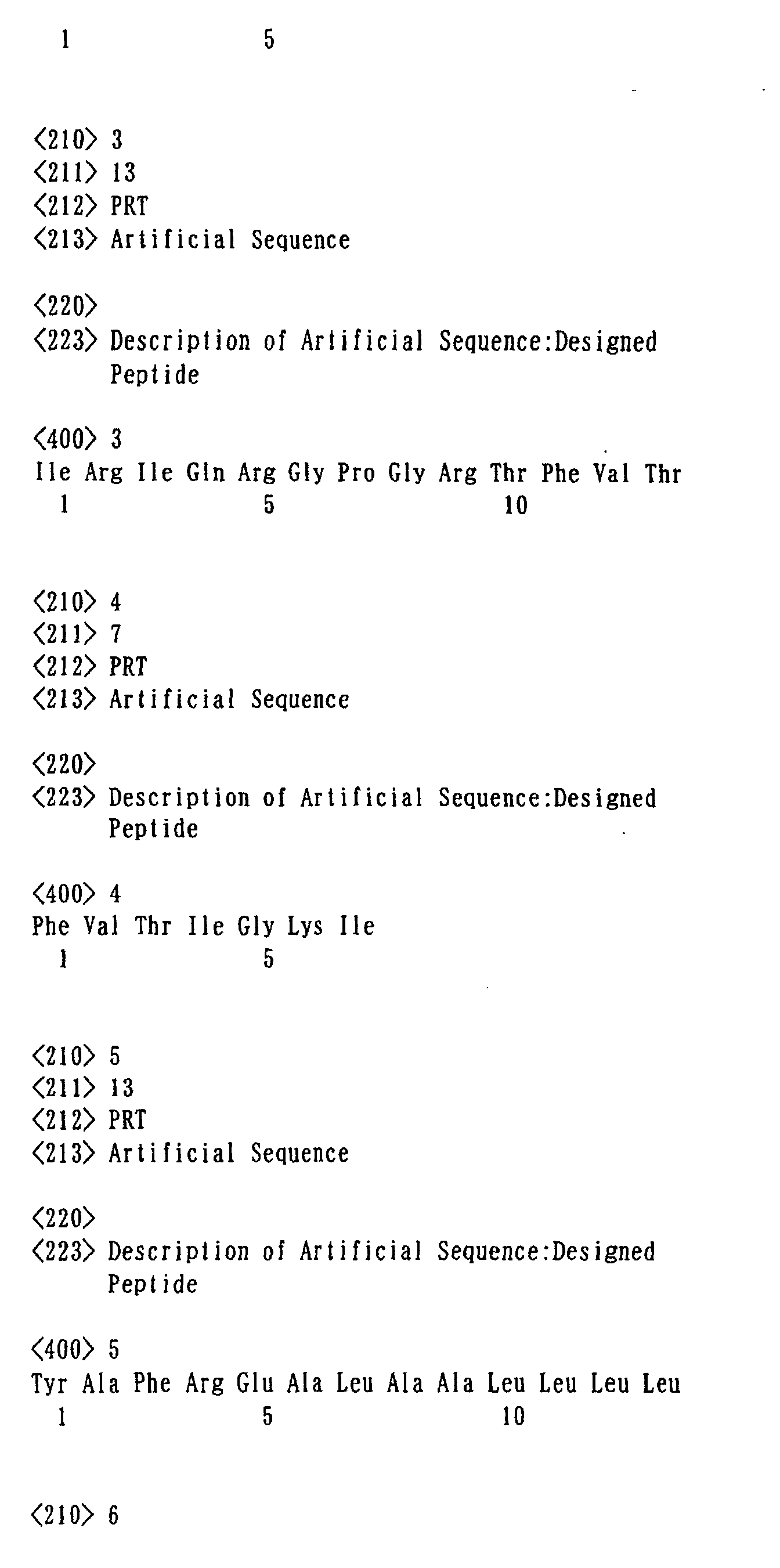
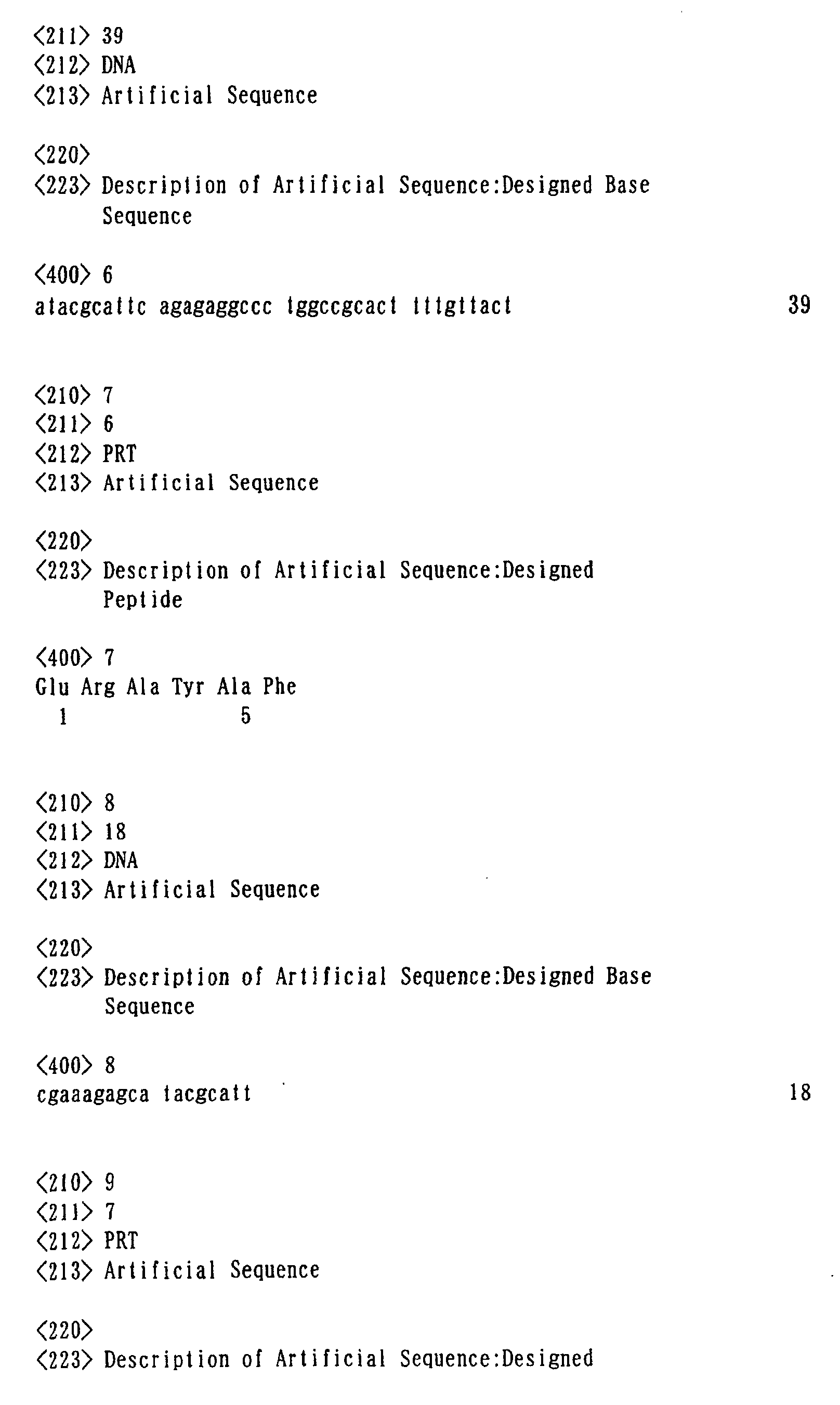
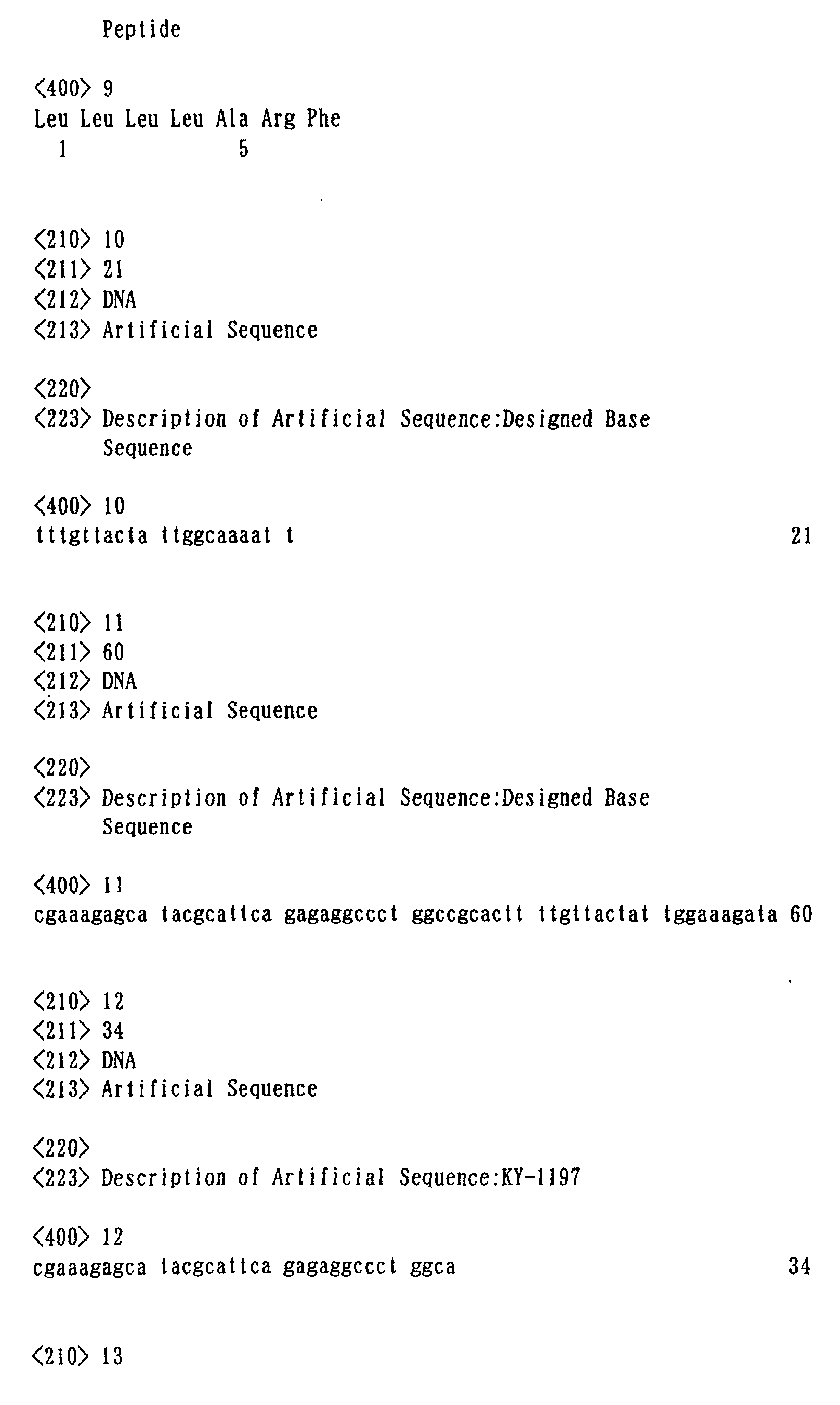


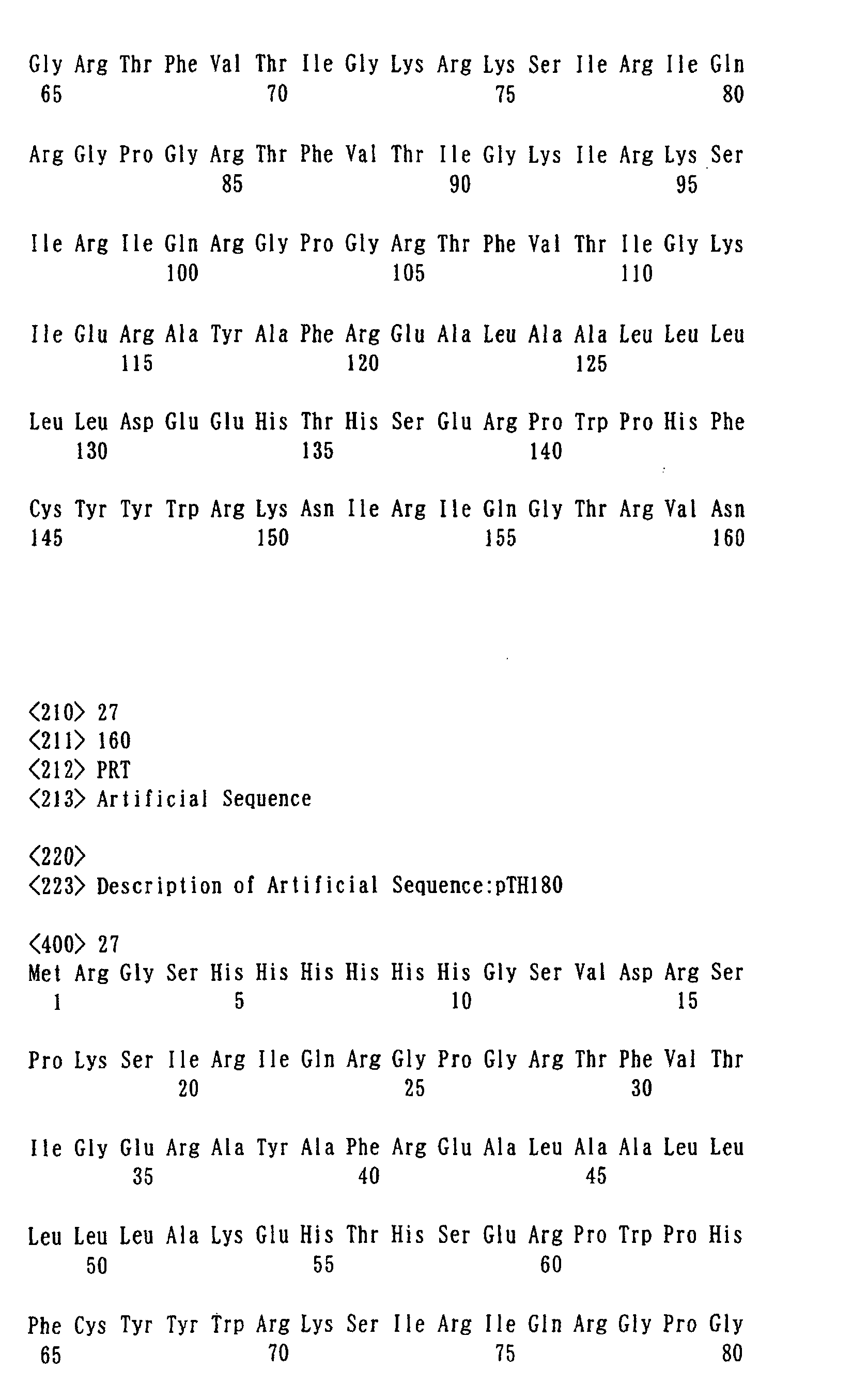
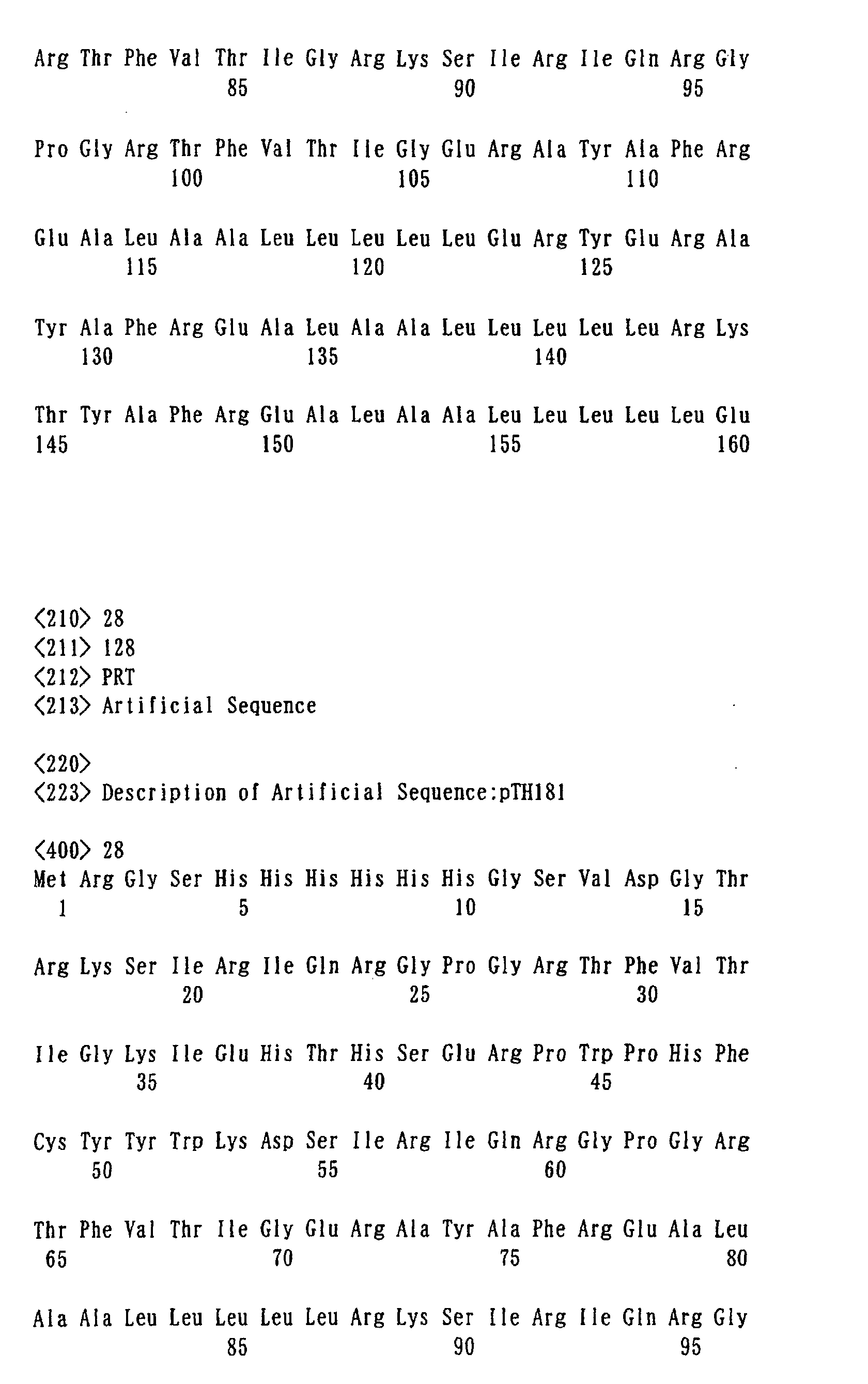


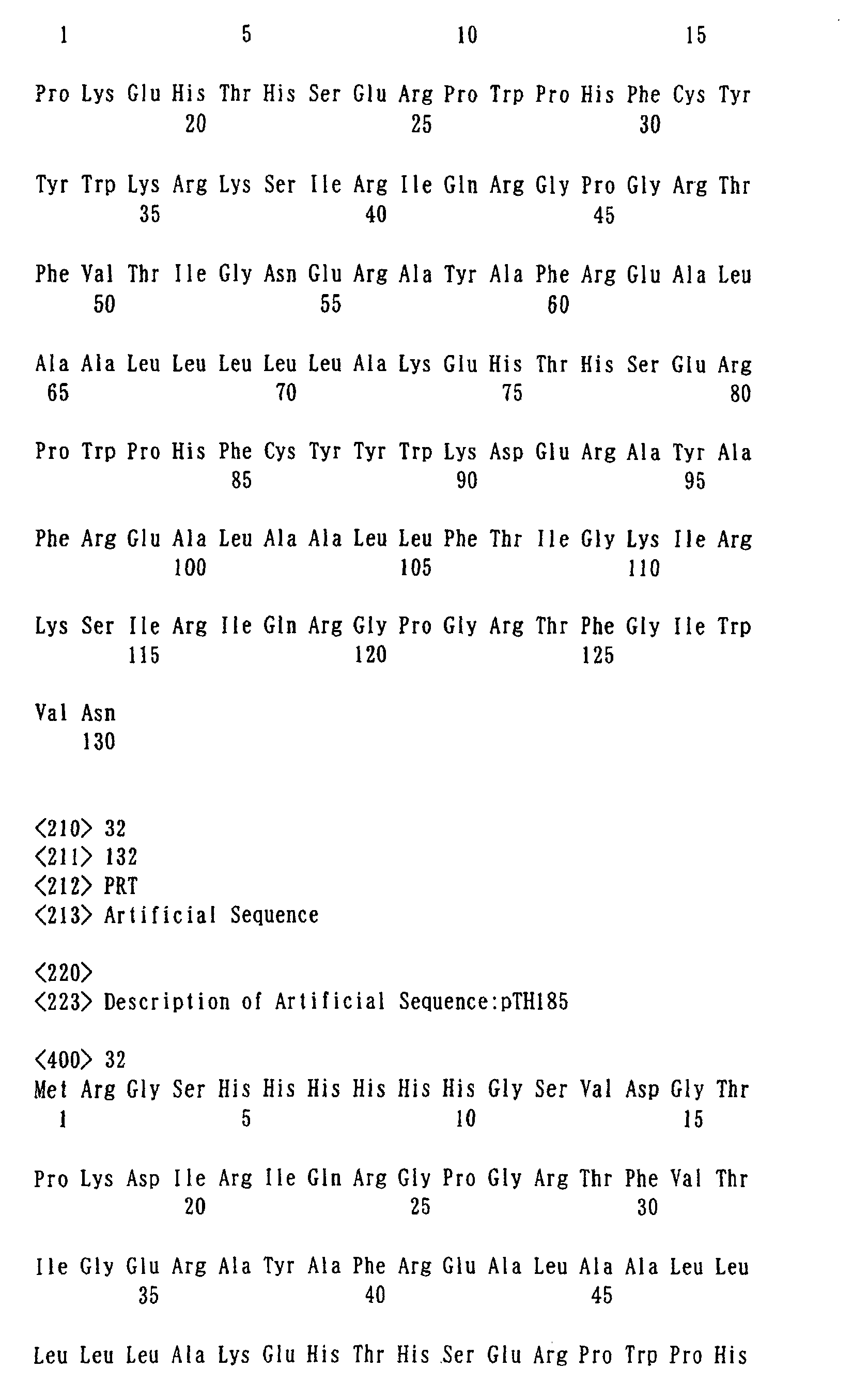


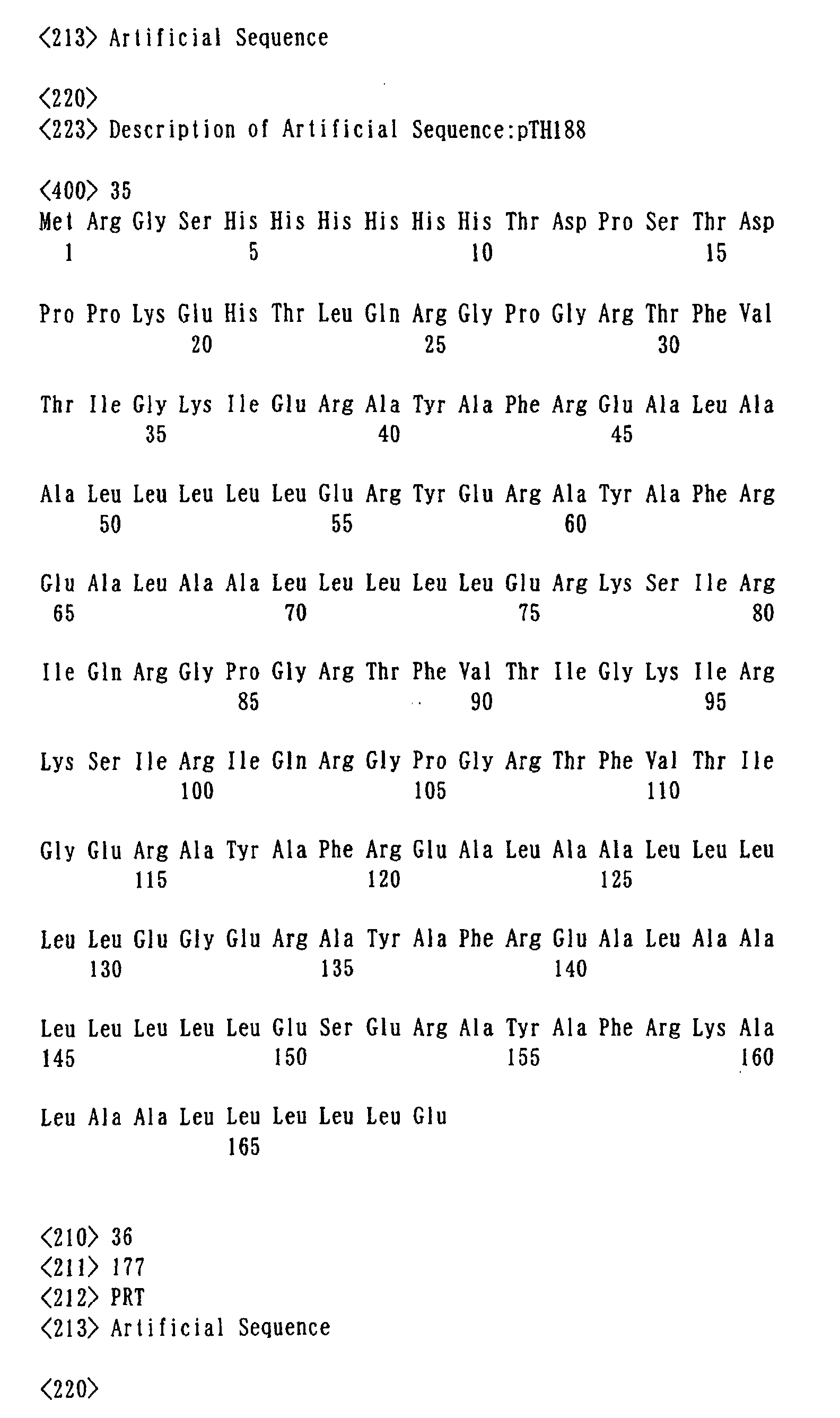
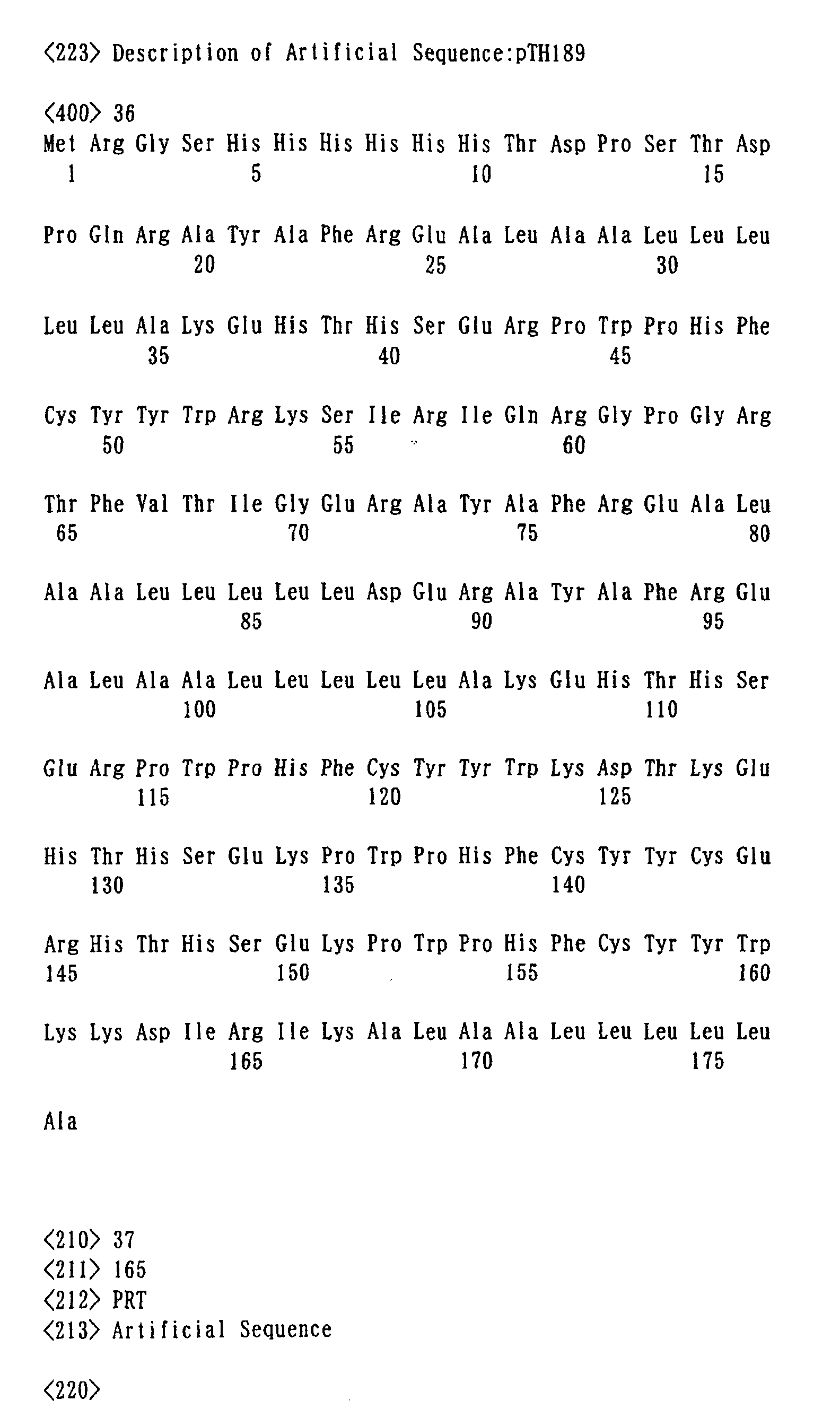


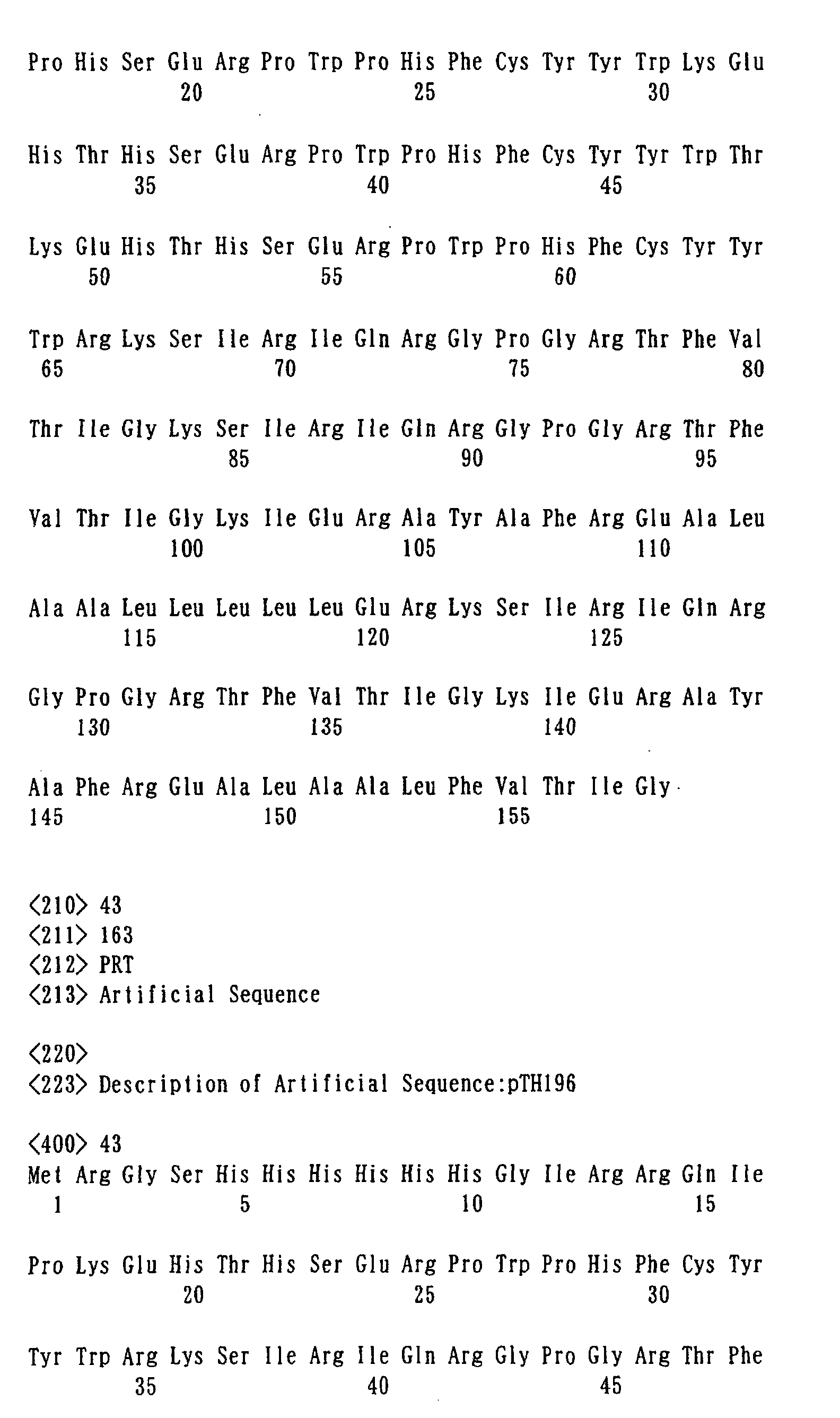

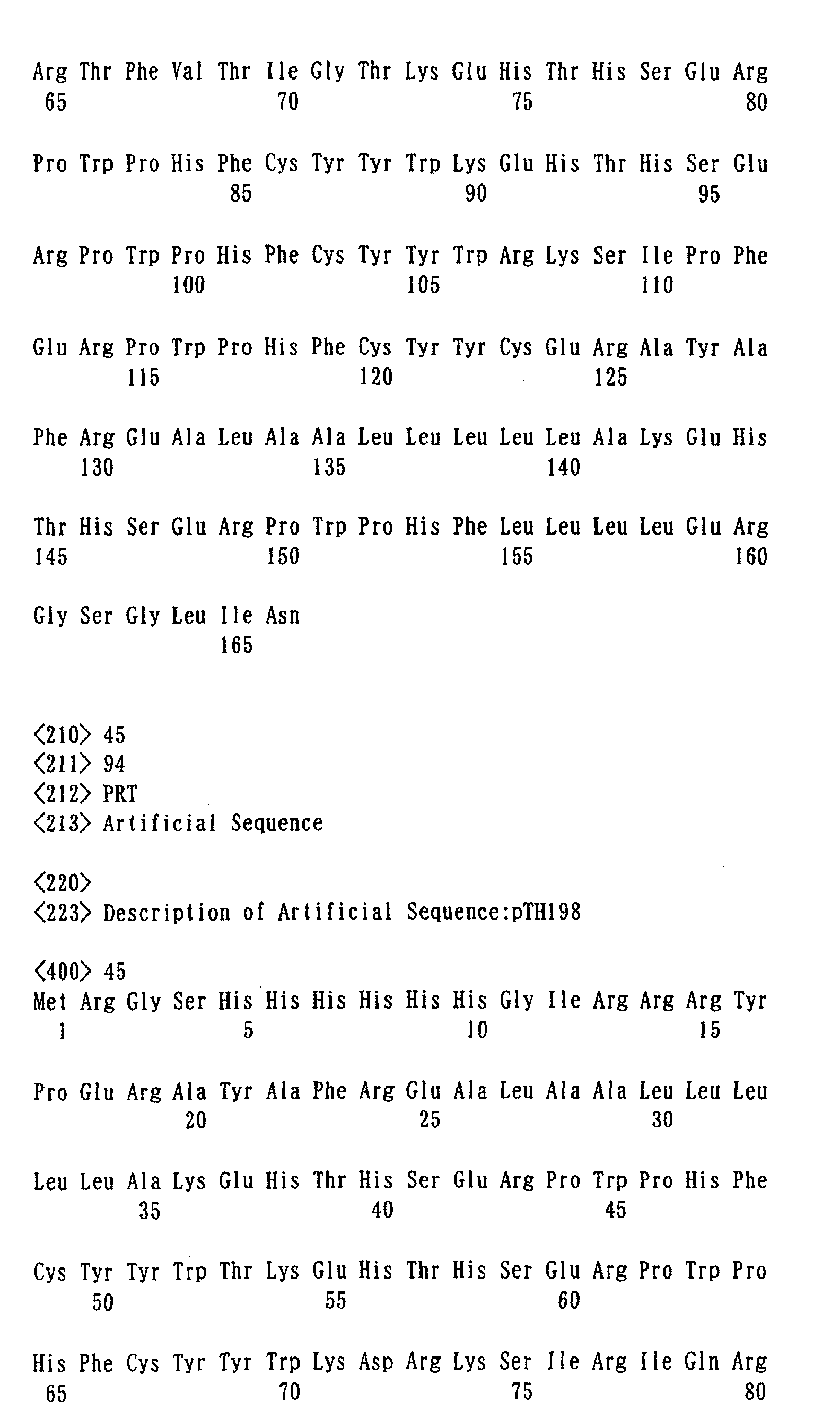

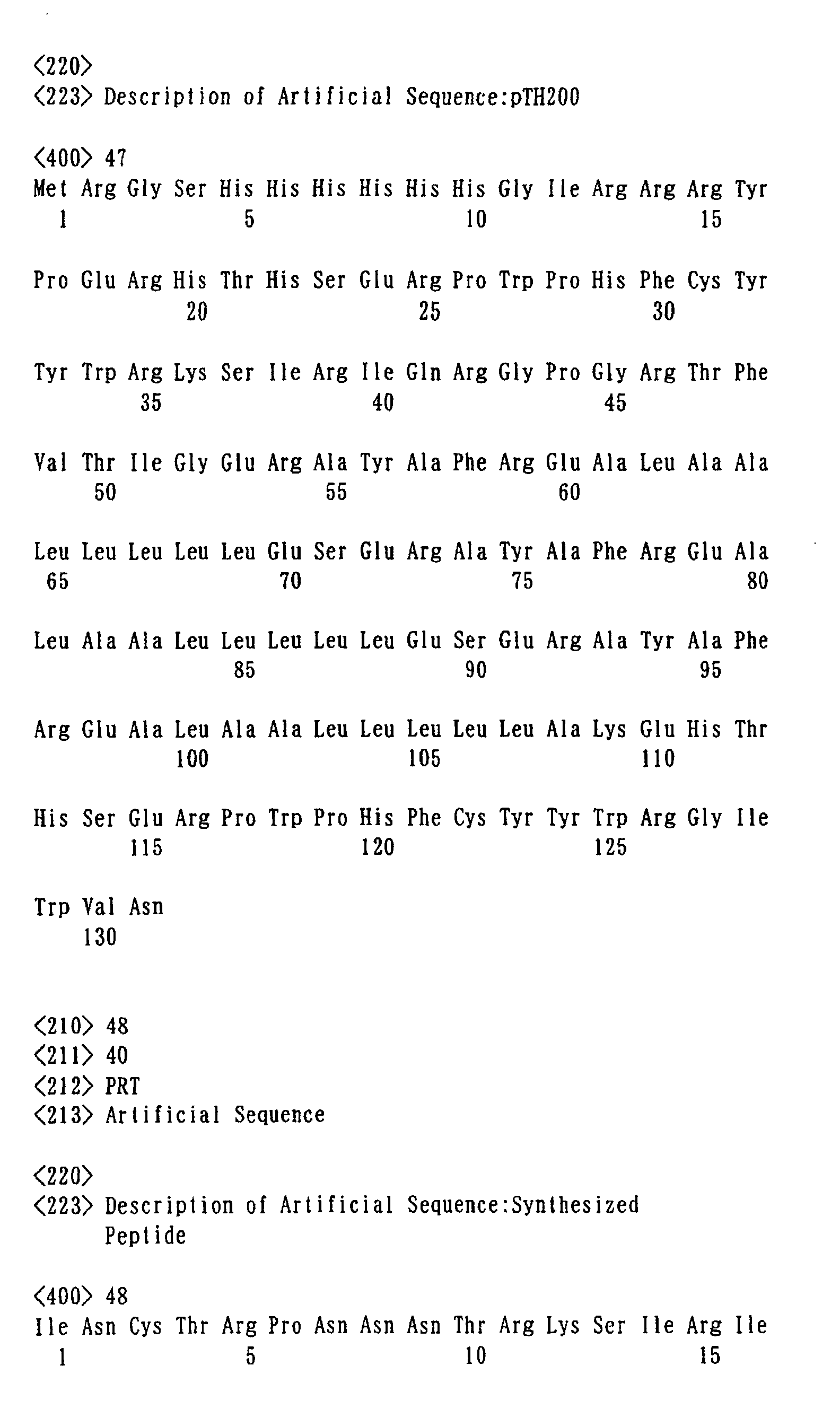
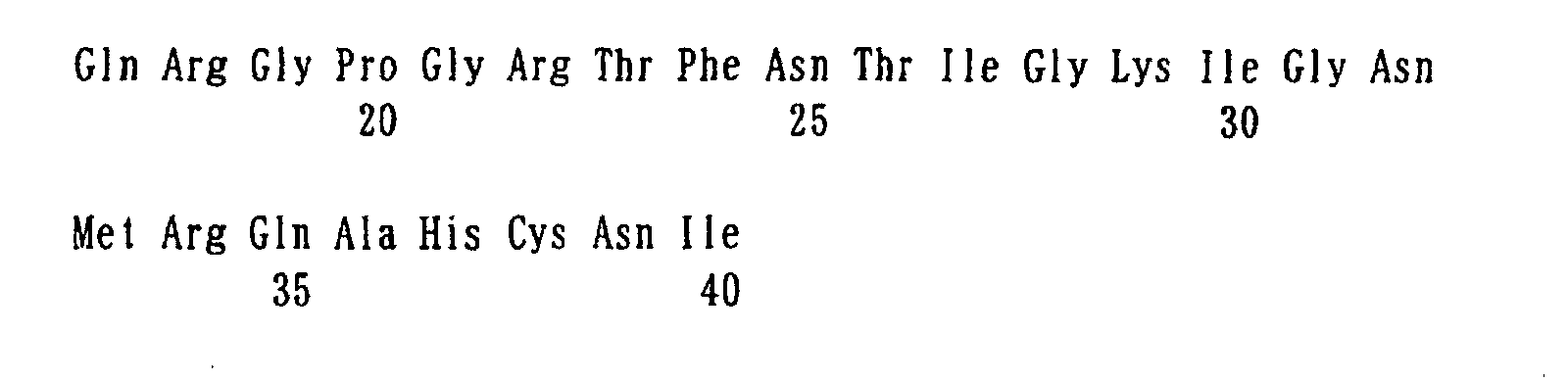
Claims (24)
- An artificial protein having epitope with potentiated immunogenicity, wherein said artificial protein is comprised of an amino acid sequence containing whole or part of an amino acid sequence of a peptidic epitope.
- The artificial protein having epitope with potentiated immunogenicity according to claim 1, wherein said artificial protein is comprised of an amino acid sequence containing whole or part of an amino acid sequence of a peptidic epitope and having a property imparted thereto of assisting the formation of the high-order structure of protein.
- The artificial protein having epitope with potentiated immunogenicity according to claim 1, wherein said artificial protein is comprised of an amino acid sequence containing whole or part of an amino acid sequence of peptidic epitope and having a property imparted thereto of assisting the antigen presentation treatment caused by an immunocompetent cell.
- The artificial protein having epitope with potentiated immunogenicity according to any of claims 1 to 3, wherein a peptide tag or a marker protein is fused.
- The artificial protein having epitope with potentiated immunogenicity according to claim 4, wherein the peptide tag is a polyhistidine residue.
- The artificial protein having epitope with potentiated immunogenicity according to any of claims 1 to 3, wherein the amino acid sequence of peptidic epitope is an amino acid sequence shown in Seq. ID No. 1.
- The artificial protein having epitope with potentiated immunogenicity according to any of claims 1 to 4, wherein the amino acid sequence containing whole or part of an amino acid sequence of peptidic epitope is an amino acid sequence shown in any one of Seq. ID Nos. 24 to 47.
- An agent for inducing immunoresponse wherein said agent comprises the artificial protein having epitope with potentiated immunogenicity according to any of claims 1 to 7.
- The agent for inducing immunoresponse according to claim 8, wherein said immunoresponse is humoral immunity.
- The agent for inducing immmunoresponse according to claim 8, wherein said immunoresponse is cellular immunity.
- A method for producing antibody, wherein the artificial protein having epitope with potentiated immunogenicity according to any of claims 1 to 7 is used as an antigen.
- The method for producing antibody according to claim 11, wherein said antibody is a monoclonal antibody.
- An antibody that can be obtained by the method for producing antibody according to claim 11 or 12.
- A cell that produces the antibody according to claim 13.
- A host cell comprised of an expression system that is capable of expressing the artificial protein having epitope with potentiated immunogenicity according to any of claims 1 to 7.
- The host cell according to claim 15, wherein said cell is enterobacteria.
- An agent for inducing desensitive and immunologically tolerant state, wherein said agent is comprised of the enterobacteria according to claim 16.
- A DNA that encodes the artificial protein having epitope with potentiated immunogenicity according to any of claims 1 to 7.
- The DNA according to claim 18, wherein when open reading frames of a base sequence is different, a peptidic epitope is encoded in at least one open reading frame of said base sequence, and a peptide capable of imparting a property of increasing the antigenicity of said peptidic epitope is encoded in other open reading frame.
- A DNA vaccine for immunoresponsive induction, wherein said vaccine is comprised of the DNA according to claim 18 or 19.
- The DNA vaccine for immunoresponsive induction according to claim 20, wherein said immunoresponse is humoral immunity.
- The DNA vaccine for immunoresponsive induction according to claim 20, wherein said immunoresponse is cellular immunity.
- A functional food comprising the artificial protein having epitope with potentiated immunogenicity according to any of claims 1 to 7 as an active ingredient.
- The functional food according to claim 23, wherein said food is capable of inducing a desensitive and immunologically tolerant state.
Applications Claiming Priority (3)
| Application Number | Priority Date | Filing Date | Title |
|---|---|---|---|
| JP2000314288 | 2000-10-13 | ||
| JP2000314288A JP4007477B2 (en) | 2000-10-13 | 2000-10-13 | Artificial proteins with enhanced epitope immunogenicity |
| PCT/JP2001/008893 WO2002033074A1 (en) | 2000-10-13 | 2001-10-10 | Artificial protein having potentiated immunogenicity of epitope |
Publications (2)
| Publication Number | Publication Date |
|---|---|
| EP1329507A1 true EP1329507A1 (en) | 2003-07-23 |
| EP1329507A4 EP1329507A4 (en) | 2006-01-04 |
Family
ID=18793574
Family Applications (1)
| Application Number | Title | Priority Date | Filing Date |
|---|---|---|---|
| EP01974763A Withdrawn EP1329507A4 (en) | 2000-10-13 | 2001-10-10 | ARTIFICIAL PROTEIN WITH IMMUNOGENICITY OF POTENTIALIZED EPITOPE |
Country Status (4)
| Country | Link |
|---|---|
| US (1) | US20040171803A1 (en) |
| EP (1) | EP1329507A4 (en) |
| JP (1) | JP4007477B2 (en) |
| WO (1) | WO2002033074A1 (en) |
Families Citing this family (4)
| Publication number | Priority date | Publication date | Assignee | Title |
|---|---|---|---|---|
| CA2583361C (en) | 2004-10-15 | 2015-08-04 | Sekisui Chemical Co., Ltd. | Gene immunization using an antigen-chaperonin fusion |
| WO2010141320A1 (en) * | 2009-06-01 | 2010-12-09 | Mariposa Biotechnology, Inc. | Device for removing cumulus from oocytes |
| JP6406647B2 (en) * | 2013-07-02 | 2018-10-17 | 公益財団法人がん研究会 | Cellular immunity induction vaccine |
| US12516096B2 (en) | 2019-08-08 | 2026-01-06 | Navrogen, Inc. | Composition and use of humoral immune suppressor antagonists for the treatment of humoral immune suppressed diseases |
Family Cites Families (5)
| Publication number | Priority date | Publication date | Assignee | Title |
|---|---|---|---|---|
| US5914109A (en) * | 1990-06-15 | 1999-06-22 | New York University | Heterohybridomas producing human monoclonal antibodies to HIV-1 |
| US5637481A (en) * | 1993-02-01 | 1997-06-10 | Bristol-Myers Squibb Company | Expression vectors encoding bispecific fusion proteins and methods of producing biologically active bispecific fusion proteins in a mammalian cell |
| US5683695A (en) * | 1993-02-10 | 1997-11-04 | United Biomedical, Inc. | Production of recombinant proteins containing multiple antigenic determinants linked by flexible hinge domains |
| EP1244807A1 (en) * | 1999-12-09 | 2002-10-02 | Human Genome Sciences, Inc. | Il-6 like polynucleotide |
| JP2001352990A (en) * | 2000-06-16 | 2001-12-25 | Japan Science & Technology Corp | Multifunctional nucleotide sequence and artificial gene containing the same |
-
2000
- 2000-10-13 JP JP2000314288A patent/JP4007477B2/en not_active Expired - Fee Related
-
2001
- 2001-10-10 US US10/398,932 patent/US20040171803A1/en not_active Abandoned
- 2001-10-10 EP EP01974763A patent/EP1329507A4/en not_active Withdrawn
- 2001-10-10 WO PCT/JP2001/008893 patent/WO2002033074A1/en not_active Ceased
Also Published As
| Publication number | Publication date |
|---|---|
| US20040171803A1 (en) | 2004-09-02 |
| EP1329507A4 (en) | 2006-01-04 |
| WO2002033074A1 (en) | 2002-04-25 |
| JP4007477B2 (en) | 2007-11-14 |
| JP2002119286A (en) | 2002-04-23 |
Similar Documents
| Publication | Publication Date | Title |
|---|---|---|
| KR101020256B1 (en) | Hepatitis E virus monoclonal antibody or binding fragment thereof, and use thereof | |
| CN102512670A (en) | Streptococcus pyogenes antigens | |
| JPH08510922A (en) | Anti-EGFR single chain Fv and anti-EGFR antibody | |
| EP4588942A1 (en) | Truncated respiratory syncytial virus f protein and use thereof | |
| JPH09509835A (en) | In vitro antibody affinity maturation by alanine scanning mutagenesis | |
| US6737521B1 (en) | Delivery and expression of a hybrid surface protein on the surface of gram positive bacteria | |
| CN111057145A (en) | Porcine reproductive and respiratory syndrome virus Nsp2 protein nano antibody and application thereof | |
| WO2002055668A2 (en) | Nucleotide sequences encoding variable regions of heavy and light chains of monoclonal antibody 1f7 | |
| CN117586358A (en) | Respiratory Syncytial Virus (RSV) polypeptides having immunogenicity | |
| KR20150074016A (en) | Vaccine for preventing porcine edema disease | |
| JP2002508156A (en) | Streptococcus heat shock proteins of the Hsp60 family | |
| US20040171803A1 (en) | Artificial protein having potentiated immunogenicity of epitope | |
| CN113896805B (en) | VEGF-CRM197 recombinant fusion protein vaccine and preparation method and application thereof | |
| WO1999022008A1 (en) | Inducer for production of antigen-specific antibody, expression vector containing gene therefor, and method of inducing production of antigen-specific antibody | |
| KR102332725B1 (en) | Pentamer-based recombinant protein vaccine platform and expressing system there of | |
| JP7784412B2 (en) | Fusion protein comprising IGE FC receptor alpha subunit extracellular domain and anti-IL-4 antibody, and use of the fusion protein | |
| KR101215780B1 (en) | Method of immunizing animal, composition for immunization, method of producing antibody, method of producing hybridoma and method of producing monoclonal antibody | |
| KR101613347B1 (en) | Monoclonal Antibody Specifically Binding to Vibrio vulnificus RtxA1 protein and Its Use | |
| KR20230111815A (en) | Manufacturing method of single domain vhh antibody for preventing or treating early mortality syndrome | |
| CN100374464C (en) | Anti-SARS monoclonal antibody, encoding sequence and application thereof | |
| Stenkova et al. | Engineering of chimeric protein based on E protein domain III of tick-borne encephalitis virus and OmpF porin of Yersinia pseudotuberculosis | |
| CN110041410A (en) | Transmissible gastro-enteritis virus novel gene engineering subunit vaccine | |
| US11427620B2 (en) | Malaria transmission blocking vaccine | |
| KR20230150518A (en) | Anti-SNAP 25 B6 antibodies for preventing and improving skin wrinkle and use thereof | |
| HK40073047B (en) | A recombinant protein-based covid-19 vaccine as well as its preparation method and application thereof |
Legal Events
| Date | Code | Title | Description |
|---|---|---|---|
| PUAI | Public reference made under article 153(3) epc to a published international application that has entered the european phase |
Free format text: ORIGINAL CODE: 0009012 |
|
| 17P | Request for examination filed |
Effective date: 20030430 |
|
| AK | Designated contracting states |
Designated state(s): CH DE FR GB LI |
|
| RAP1 | Party data changed (applicant data changed or rights of an application transferred) |
Owner name: JAPAN SCIENCE AND TECHNOLOGY AGENCY |
|
| A4 | Supplementary search report drawn up and despatched |
Effective date: 20051123 |
|
| STAA | Information on the status of an ep patent application or granted ep patent |
Free format text: STATUS: THE APPLICATION IS DEEMED TO BE WITHDRAWN |
|
| 18D | Application deemed to be withdrawn |
Effective date: 20080109 |