EP1329487A1 - Aqueous ink-jet inks for printing on commercial offset coated media - Google Patents
Aqueous ink-jet inks for printing on commercial offset coated media Download PDFInfo
- Publication number
- EP1329487A1 EP1329487A1 EP03250094A EP03250094A EP1329487A1 EP 1329487 A1 EP1329487 A1 EP 1329487A1 EP 03250094 A EP03250094 A EP 03250094A EP 03250094 A EP03250094 A EP 03250094A EP 1329487 A1 EP1329487 A1 EP 1329487A1
- Authority
- EP
- European Patent Office
- Prior art keywords
- ink
- aprotic polar
- polar solvent
- jet
- aqueous ink
- Prior art date
- Legal status (The legal status is an assumption and is not a legal conclusion. Google has not performed a legal analysis and makes no representation as to the accuracy of the status listed.)
- Granted
Links
- 238000007639 printing Methods 0.000 title claims abstract description 21
- 239000000976 ink Substances 0.000 title abstract description 78
- 239000000203 mixture Substances 0.000 claims abstract description 23
- 239000002798 polar solvent Substances 0.000 claims abstract description 22
- 239000002904 solvent Substances 0.000 claims abstract description 15
- 239000004094 surface-active agent Substances 0.000 claims abstract description 14
- 239000003086 colorant Substances 0.000 claims abstract description 12
- WEVYAHXRMPXWCK-UHFFFAOYSA-N Acetonitrile Chemical compound CC#N WEVYAHXRMPXWCK-UHFFFAOYSA-N 0.000 claims description 15
- PMDCZENCAXMSOU-UHFFFAOYSA-N N-ethylacetamide Chemical compound CCNC(C)=O PMDCZENCAXMSOU-UHFFFAOYSA-N 0.000 claims description 8
- ZMXDDKWLCZADIW-UHFFFAOYSA-N N,N-Dimethylformamide Chemical compound CN(C)C=O ZMXDDKWLCZADIW-UHFFFAOYSA-N 0.000 claims description 6
- IAZDPXIOMUYVGZ-UHFFFAOYSA-N Dimethylsulphoxide Chemical compound CS(C)=O IAZDPXIOMUYVGZ-UHFFFAOYSA-N 0.000 claims description 4
- WYURNTSHIVDZCO-UHFFFAOYSA-N Tetrahydrofuran Chemical compound C1CCOC1 WYURNTSHIVDZCO-UHFFFAOYSA-N 0.000 claims description 4
- 229920001577 copolymer Polymers 0.000 claims description 4
- JHIVVAPYMSGYDF-UHFFFAOYSA-N cyclohexanone Chemical compound O=C1CCCCC1 JHIVVAPYMSGYDF-UHFFFAOYSA-N 0.000 claims description 4
- BGTOWKSIORTVQH-UHFFFAOYSA-N cyclopentanone Chemical compound O=C1CCCC1 BGTOWKSIORTVQH-UHFFFAOYSA-N 0.000 claims description 4
- -1 polydimethylsiloxanes Polymers 0.000 claims description 4
- HXJUTPCZVOIRIF-UHFFFAOYSA-N sulfolane Chemical compound O=S1(=O)CCCC1 HXJUTPCZVOIRIF-UHFFFAOYSA-N 0.000 claims description 4
- 150000001408 amides Chemical group 0.000 claims description 3
- 235000019441 ethanol Nutrition 0.000 claims description 3
- MBHINSULENHCMF-UHFFFAOYSA-N n,n-dimethylpropanamide Chemical compound CCC(=O)N(C)C MBHINSULENHCMF-UHFFFAOYSA-N 0.000 claims description 3
- AVQQQNCBBIEMEU-UHFFFAOYSA-N 1,1,3,3-tetramethylurea Chemical compound CN(C)C(=O)N(C)C AVQQQNCBBIEMEU-UHFFFAOYSA-N 0.000 claims description 2
- CYSGHNMQYZDMIA-UHFFFAOYSA-N 1,3-Dimethyl-2-imidazolidinon Chemical compound CN1CCN(C)C1=O CYSGHNMQYZDMIA-UHFFFAOYSA-N 0.000 claims description 2
- AGGCEDYMGLPKNS-UHFFFAOYSA-N 5,5,6-trimethylundec-3-yne-2,2-diol Chemical class CCCCCC(C)C(C)(C)C#CC(C)(O)O AGGCEDYMGLPKNS-UHFFFAOYSA-N 0.000 claims description 2
- MWRSABPHNREIIX-UHFFFAOYSA-N 9,9-dimethyldecan-1-ol Chemical class CC(C)(C)CCCCCCCCO MWRSABPHNREIIX-UHFFFAOYSA-N 0.000 claims description 2
- IAYPIBMASNFSPL-UHFFFAOYSA-N Ethylene oxide Chemical compound C1CO1 IAYPIBMASNFSPL-UHFFFAOYSA-N 0.000 claims description 2
- FXHOOIRPVKKKFG-UHFFFAOYSA-N N,N-Dimethylacetamide Chemical compound CN(C)C(C)=O FXHOOIRPVKKKFG-UHFFFAOYSA-N 0.000 claims description 2
- PVCJKHHOXFKFRP-UHFFFAOYSA-N N-acetylethanolamine Chemical compound CC(=O)NCCO PVCJKHHOXFKFRP-UHFFFAOYSA-N 0.000 claims description 2
- OHLUUHNLEMFGTQ-UHFFFAOYSA-N N-methylacetamide Chemical compound CNC(C)=O OHLUUHNLEMFGTQ-UHFFFAOYSA-N 0.000 claims description 2
- ATHHXGZTWNVVOU-UHFFFAOYSA-N N-methylformamide Chemical class CNC=O ATHHXGZTWNVVOU-UHFFFAOYSA-N 0.000 claims description 2
- 125000000217 alkyl group Chemical group 0.000 claims description 2
- 235000013870 dimethyl polysiloxane Nutrition 0.000 claims description 2
- 229940113088 dimethylacetamide Drugs 0.000 claims description 2
- LYCAIKOWRPUZTN-UHFFFAOYSA-N ethylene glycol Natural products OCCO LYCAIKOWRPUZTN-UHFFFAOYSA-N 0.000 claims description 2
- 150000003948 formamides Chemical class 0.000 claims description 2
- WGCNASOHLSPBMP-UHFFFAOYSA-N hydroxyacetaldehyde Natural products OCC=O WGCNASOHLSPBMP-UHFFFAOYSA-N 0.000 claims description 2
- NZMAJUHVSZBJHL-UHFFFAOYSA-N n,n-dibutylformamide Chemical compound CCCCN(C=O)CCCC NZMAJUHVSZBJHL-UHFFFAOYSA-N 0.000 claims description 2
- YKOQQFDCCBKROY-UHFFFAOYSA-N n,n-diethylpropanamide Chemical compound CCN(CC)C(=O)CC YKOQQFDCCBKROY-UHFFFAOYSA-N 0.000 claims description 2
- QJGWNDLRYDTKEI-UHFFFAOYSA-N n-butylbutanamide Chemical compound CCCCNC(=O)CCC QJGWNDLRYDTKEI-UHFFFAOYSA-N 0.000 claims description 2
- DHCJWWQFOMHARO-UHFFFAOYSA-N n-ethylbutanamide Chemical compound CCCC(=O)NCC DHCJWWQFOMHARO-UHFFFAOYSA-N 0.000 claims description 2
- ABMDIECEEGFXNC-UHFFFAOYSA-N n-ethylpropanamide Chemical compound CCNC(=O)CC ABMDIECEEGFXNC-UHFFFAOYSA-N 0.000 claims description 2
- QJQAMHYHNCADNR-UHFFFAOYSA-N n-methylpropanamide Chemical compound CCC(=O)NC QJQAMHYHNCADNR-UHFFFAOYSA-N 0.000 claims description 2
- PDUSWJORWQPNRP-UHFFFAOYSA-N n-propan-2-ylacetamide Chemical compound CC(C)NC(C)=O PDUSWJORWQPNRP-UHFFFAOYSA-N 0.000 claims description 2
- KVTGAKFJRLBHLU-UHFFFAOYSA-N n-propan-2-ylformamide Chemical compound CC(C)NC=O KVTGAKFJRLBHLU-UHFFFAOYSA-N 0.000 claims description 2
- KYKDOARTYFGHPC-UHFFFAOYSA-N n-propan-2-ylpropanamide Chemical compound CCC(=O)NC(C)C KYKDOARTYFGHPC-UHFFFAOYSA-N 0.000 claims description 2
- TUDFZSGUEDLTJC-UHFFFAOYSA-N n-propylbutanamide Chemical compound CCCNC(=O)CCC TUDFZSGUEDLTJC-UHFFFAOYSA-N 0.000 claims description 2
- 229920000435 poly(dimethylsiloxane) Polymers 0.000 claims description 2
- 229920001281 polyalkylene Polymers 0.000 claims description 2
- 229920000056 polyoxyethylene ether Polymers 0.000 claims description 2
- 229920001296 polysiloxane Polymers 0.000 claims description 2
- QLNJFJADRCOGBJ-UHFFFAOYSA-N propionamide Chemical class CCC(N)=O QLNJFJADRCOGBJ-UHFFFAOYSA-N 0.000 claims description 2
- FVSKHRXBFJPNKK-UHFFFAOYSA-N propionitrile Chemical compound CCC#N FVSKHRXBFJPNKK-UHFFFAOYSA-N 0.000 claims description 2
- 150000003333 secondary alcohols Chemical class 0.000 claims description 2
- YLQBMQCUIZJEEH-UHFFFAOYSA-N tetrahydrofuran Natural products C=1C=COC=1 YLQBMQCUIZJEEH-UHFFFAOYSA-N 0.000 claims description 2
- XLYOFNOQVPJJNP-UHFFFAOYSA-N water Substances O XLYOFNOQVPJJNP-UHFFFAOYSA-N 0.000 description 17
- 238000000576 coating method Methods 0.000 description 8
- 239000000049 pigment Substances 0.000 description 8
- 238000009472 formulation Methods 0.000 description 7
- 239000012038 nucleophile Substances 0.000 description 7
- 150000001450 anions Chemical class 0.000 description 5
- 238000004581 coalescence Methods 0.000 description 5
- 125000005843 halogen group Chemical group 0.000 description 5
- 238000007641 inkjet printing Methods 0.000 description 5
- 238000000034 method Methods 0.000 description 5
- 238000002156 mixing Methods 0.000 description 5
- 238000009736 wetting Methods 0.000 description 5
- 239000000010 aprotic solvent Substances 0.000 description 4
- 150000001768 cations Chemical class 0.000 description 4
- 238000001035 drying Methods 0.000 description 4
- 239000000975 dye Substances 0.000 description 4
- 239000012530 fluid Substances 0.000 description 4
- 239000003880 polar aprotic solvent Substances 0.000 description 4
- ZWEHNKRNPOVVGH-UHFFFAOYSA-N 2-Butanone Chemical compound CCC(C)=O ZWEHNKRNPOVVGH-UHFFFAOYSA-N 0.000 description 3
- 239000011248 coating agent Substances 0.000 description 3
- SZXQTJUDPRGNJN-UHFFFAOYSA-N dipropylene glycol Chemical compound OCCCOCCCO SZXQTJUDPRGNJN-UHFFFAOYSA-N 0.000 description 3
- 230000002209 hydrophobic effect Effects 0.000 description 3
- 230000006872 improvement Effects 0.000 description 3
- 230000035515 penetration Effects 0.000 description 3
- 239000012453 solvate Substances 0.000 description 3
- 230000007480 spreading Effects 0.000 description 3
- 238000003892 spreading Methods 0.000 description 3
- 239000000758 substrate Substances 0.000 description 3
- 238000012360 testing method Methods 0.000 description 3
- 238000012546 transfer Methods 0.000 description 3
- IJGRMHOSHXDMSA-UHFFFAOYSA-N Atomic nitrogen Chemical compound N#N IJGRMHOSHXDMSA-UHFFFAOYSA-N 0.000 description 2
- HMEKVHWROSNWPD-UHFFFAOYSA-N Erioglaucine A Chemical compound [NH4+].[NH4+].C=1C=C(C(=C2C=CC(C=C2)=[N+](CC)CC=2C=C(C=CC=2)S([O-])(=O)=O)C=2C(=CC=CC=2)S([O-])(=O)=O)C=CC=1N(CC)CC1=CC=CC(S([O-])(=O)=O)=C1 HMEKVHWROSNWPD-UHFFFAOYSA-N 0.000 description 2
- LFQSCWFLJHTTHZ-UHFFFAOYSA-N Ethanol Chemical compound CCO LFQSCWFLJHTTHZ-UHFFFAOYSA-N 0.000 description 2
- 125000004429 atom Chemical group 0.000 description 2
- 235000012745 brilliant blue FCF Nutrition 0.000 description 2
- 239000004161 brilliant blue FCF Substances 0.000 description 2
- 239000008367 deionised water Substances 0.000 description 2
- 229910021641 deionized water Inorganic materials 0.000 description 2
- 150000002334 glycols Chemical class 0.000 description 2
- 239000001257 hydrogen Substances 0.000 description 2
- 229910052739 hydrogen Inorganic materials 0.000 description 2
- 239000004615 ingredient Substances 0.000 description 2
- 230000003993 interaction Effects 0.000 description 2
- 230000007774 longterm Effects 0.000 description 2
- 239000000463 material Substances 0.000 description 2
- 238000005259 measurement Methods 0.000 description 2
- 230000004048 modification Effects 0.000 description 2
- 238000012986 modification Methods 0.000 description 2
- 239000002736 nonionic surfactant Substances 0.000 description 2
- 239000002245 particle Substances 0.000 description 2
- 229920000728 polyester Polymers 0.000 description 2
- 229920000642 polymer Polymers 0.000 description 2
- 230000004044 response Effects 0.000 description 2
- RPACBEVZENYWOL-XFULWGLBSA-M sodium;(2r)-2-[6-(4-chlorophenoxy)hexyl]oxirane-2-carboxylate Chemical group [Na+].C=1C=C(Cl)C=CC=1OCCCCCC[C@]1(C(=O)[O-])CO1 RPACBEVZENYWOL-XFULWGLBSA-M 0.000 description 2
- 239000007787 solid Substances 0.000 description 2
- QGZKDVFQNNGYKY-UHFFFAOYSA-O Ammonium Chemical compound [NH4+] QGZKDVFQNNGYKY-UHFFFAOYSA-O 0.000 description 1
- 229910019142 PO4 Inorganic materials 0.000 description 1
- 239000005062 Polybutadiene Substances 0.000 description 1
- 239000004698 Polyethylene Substances 0.000 description 1
- 239000004743 Polypropylene Substances 0.000 description 1
- 239000004793 Polystyrene Substances 0.000 description 1
- 239000004372 Polyvinyl alcohol Substances 0.000 description 1
- 239000002174 Styrene-butadiene Substances 0.000 description 1
- 238000010521 absorption reaction Methods 0.000 description 1
- 230000002378 acidificating effect Effects 0.000 description 1
- 230000004913 activation Effects 0.000 description 1
- 238000013459 approach Methods 0.000 description 1
- QVGXLLKOCUKJST-UHFFFAOYSA-N atomic oxygen Chemical compound [O] QVGXLLKOCUKJST-UHFFFAOYSA-N 0.000 description 1
- 230000004888 barrier function Effects 0.000 description 1
- 239000000981 basic dye Substances 0.000 description 1
- 230000008901 benefit Effects 0.000 description 1
- 239000011230 binding agent Substances 0.000 description 1
- 230000015572 biosynthetic process Effects 0.000 description 1
- MTAZNLWOLGHBHU-UHFFFAOYSA-N butadiene-styrene rubber Chemical compound C=CC=C.C=CC1=CC=CC=C1 MTAZNLWOLGHBHU-UHFFFAOYSA-N 0.000 description 1
- 150000007942 carboxylates Chemical class 0.000 description 1
- 125000002091 cationic group Chemical group 0.000 description 1
- 150000001875 compounds Chemical class 0.000 description 1
- 230000007797 corrosion Effects 0.000 description 1
- 238000005260 corrosion Methods 0.000 description 1
- 230000007547 defect Effects 0.000 description 1
- 150000002009 diols Chemical class 0.000 description 1
- 238000009826 distribution Methods 0.000 description 1
- 239000001041 dye based ink Substances 0.000 description 1
- 238000007786 electrostatic charging Methods 0.000 description 1
- 230000009881 electrostatic interaction Effects 0.000 description 1
- 230000001804 emulsifying effect Effects 0.000 description 1
- 238000005516 engineering process Methods 0.000 description 1
- 238000001704 evaporation Methods 0.000 description 1
- 230000008020 evaporation Effects 0.000 description 1
- 238000005187 foaming Methods 0.000 description 1
- 125000004435 hydrogen atom Chemical group [H]* 0.000 description 1
- 150000008040 ionic compounds Chemical class 0.000 description 1
- 239000002563 ionic surfactant Substances 0.000 description 1
- 239000004816 latex Substances 0.000 description 1
- 229920000126 latex Polymers 0.000 description 1
- 230000001050 lubricating effect Effects 0.000 description 1
- 230000007935 neutral effect Effects 0.000 description 1
- 150000002825 nitriles Chemical class 0.000 description 1
- 229910052757 nitrogen Inorganic materials 0.000 description 1
- 230000003287 optical effect Effects 0.000 description 1
- 239000001301 oxygen Substances 0.000 description 1
- 229910052760 oxygen Inorganic materials 0.000 description 1
- NBIIXXVUZAFLBC-UHFFFAOYSA-K phosphate Chemical compound [O-]P([O-])([O-])=O NBIIXXVUZAFLBC-UHFFFAOYSA-K 0.000 description 1
- 239000010452 phosphate Substances 0.000 description 1
- 125000005496 phosphonium group Chemical group 0.000 description 1
- 239000001042 pigment based ink Substances 0.000 description 1
- 229920000141 poly(maleic anhydride) Polymers 0.000 description 1
- 229920000058 polyacrylate Polymers 0.000 description 1
- 229920002857 polybutadiene Polymers 0.000 description 1
- 229920000573 polyethylene Polymers 0.000 description 1
- 229920000193 polymethacrylate Polymers 0.000 description 1
- 229920000098 polyolefin Polymers 0.000 description 1
- 229920001155 polypropylene Polymers 0.000 description 1
- 229920002223 polystyrene Polymers 0.000 description 1
- 229920002451 polyvinyl alcohol Polymers 0.000 description 1
- 125000001453 quaternary ammonium group Chemical group 0.000 description 1
- 238000009991 scouring Methods 0.000 description 1
- 238000007614 solvation Methods 0.000 description 1
- 238000001179 sorption measurement Methods 0.000 description 1
- 238000003860 storage Methods 0.000 description 1
- 239000011115 styrene butadiene Substances 0.000 description 1
- 229920003048 styrene butadiene rubber Polymers 0.000 description 1
- 239000000126 substance Substances 0.000 description 1
- 238000006467 substitution reaction Methods 0.000 description 1
- 125000001273 sulfonato group Chemical group [O-]S(*)(=O)=O 0.000 description 1
- 150000003462 sulfoxides Chemical class 0.000 description 1
- UJMBCXLDXJUMFB-GLCFPVLVSA-K tartrazine Chemical compound [Na+].[Na+].[Na+].[O-]C(=O)C1=NN(C=2C=CC(=CC=2)S([O-])(=O)=O)C(=O)C1\N=N\C1=CC=C(S([O-])(=O)=O)C=C1 UJMBCXLDXJUMFB-GLCFPVLVSA-K 0.000 description 1
- 235000012756 tartrazine Nutrition 0.000 description 1
- 239000004149 tartrazine Substances 0.000 description 1
- 230000007704 transition Effects 0.000 description 1
- 229920003169 water-soluble polymer Polymers 0.000 description 1
Classifications
-
- C—CHEMISTRY; METALLURGY
- C09—DYES; PAINTS; POLISHES; NATURAL RESINS; ADHESIVES; COMPOSITIONS NOT OTHERWISE PROVIDED FOR; APPLICATIONS OF MATERIALS NOT OTHERWISE PROVIDED FOR
- C09D—COATING COMPOSITIONS, e.g. PAINTS, VARNISHES OR LACQUERS; FILLING PASTES; CHEMICAL PAINT OR INK REMOVERS; INKS; CORRECTING FLUIDS; WOODSTAINS; PASTES OR SOLIDS FOR COLOURING OR PRINTING; USE OF MATERIALS THEREFOR
- C09D11/00—Inks
- C09D11/30—Inkjet printing inks
- C09D11/36—Inkjet printing inks based on non-aqueous solvents
Definitions
- the present invention is directed to aqueous ink-jet compositions for printing on commercial offset coated media.
- inks used are typically based on solvents such as methyl ethyl ketone and ethanol.
- continuous printing systems function as a stream of ink droplets are ejected and directed by printer nozzle.
- the ink droplets are directed additionally with the assistance of an electrostatic charging device in close proximity to the nozzle. If the ink is not used on the desired printing surface, the ink is recycled for later use.
- the ink-jet inks are typically based upon water and glycols. Essentially, with these systems, ink droplets are propelled from a nozzle by heat or by a pressure wave. Additionally, all of the ink droplets are used to form the printed image and are ejected when needed.
- ink-jet printing has become a popular way of recording images on various media, particularly paper. Some of these reasons include low noise, capability of high speed recording, and multi-color recording. Additionally, these advantages can be obtained at a relatively low price to consumers. However, though there has been great improvement in ink-jet printing, accompanying this improvement are increased demands on ink-jet printing, e.g., higher speed, higher resolution, full color image formation, etc.
- Such characteristics include (a) edge acuity and optical density of the image on the surface, (b) dry time of the ink on the substrate, (c) adhesion to the substrate, (d) lack of deviation of ink droplets, (e) presence of all dots, (f) resistance of the ink after drying to water and other solvents, (g) long-term storage stability, and (h) long-term reliability without corrosion or nozzle clogging, to name a few.
- edge acuity and optical density of the image on the surface includes (a) edge acuity and optical density of the image on the surface, (b) dry time of the ink on the substrate, (c) adhesion to the substrate, (d) lack of deviation of ink droplets, (e) presence of all dots, (f) resistance of the ink after drying to water and other solvents, (g) long-term storage stability, and (h) long-term reliability without corrosion or nozzle clogging, to name a few.
- the above list of characteristics provides a worthy goal to achieve
- Papers used for ink-jet printing have typically included high-quality or wood-free papers designed to have a high ink absorptivity. These papers are functionally good for ink-jet printing in some respects because the ink-jet inks may be absorbed readily and dry quickly. However, such papers often do not allow for a crisp or sharp image.
- specialty media has been developed to work with aqueous inks. For example, various coating techniques are currently being used which employ sol-gel and multi-layer coating systems, producing papers that are designed for use with aqueous ink-jet inks.
- a nonporous smooth surface can provide a good printing surface for a crisp image.
- commercial offset coated papers are significantly different than office plain papers and photo or glossy papers specifically designed for ink-jet media.
- the smooth non-porous surface is formed by a coating which requires more time for fluids to penetrate. Because of this, more drying time is required. This is due in part to the diffusion-type adsorption typically required to occur for aqueous inks to dry (as opposed to the capillary-type absorption available for ink penetration of office papers and some ink-jet papers).
- offset coatings contain polymers that are more hydrophobic, e.g., styrene-butadiene based, than paper coatings specifically designed for ink-jet ink, e.g., water-soluble polymers such as polyvinyl alcohol.
- paper coatings specifically designed for ink-jet ink e.g., water-soluble polymers such as polyvinyl alcohol.
- offset coatings are typically hydrophobic, have poor penetration properties, and are smooth/non-porous, offset coatings tend to interact poorly with water-based inks.
- classic ink-jet solvents such as glycols and diols tend to perform poorly on these coatings, showing long drytimes and poor spreading characteristics.
- polymers used in offset media include latex binders, polystyrenes, polyolefins (polypropylene, polyethylene, polybutadiene), polyesters (PET), polyacrylates, polymethacrylates, and/or poly (maleic anhydride).
- An aqueous ink-jet ink composition for printing on offset media comprising an ink colorant, an effective amount of at least one surfactant, and an effective amount of at least one aprotic polar solvent wherein the solvent is comprised of molecules having a molecular weight from 40 to 1500.
- the ink-jet ink compositions described herein can further comprise an effective amount of a non-aprotic polar solvent.
- the aprotic polar solvent(s) and the optional non-aprotic polar solvents used can independently have a polarity from 5 to 20 Debye (D).
- aprotic solvent is used to describe those solvents that do not yield or accept a proton.
- aprotic solvents comprise molecules that do not have a hydrogen atom attached to an atom of a strongly electronegative element, e.g., nitrogen and oxygen. Thus, no hydrogen bonding interactions can take place between molecules.
- a “surfactant” is a compound that contains a hydrophilic and a hydrophobic segment. Thus, when a surfactant is added to water or some other solvent, the surface tension of the system can be reduced.
- surfactants can be used for several purposes including wetting, emulsifying, dispersing, foaming, scouring, or lubricating a system.
- “Polar” shall include any molecule having a chemical grouping in which the distribution of electrons is uneven or non-symmetrical enabling it to take part in electrostatic interactions. Molecules having high dipole movement greater than water are preferred. More preferred are molecules having a polar value from 5 Debye to 20 Debye.
- low molecular weight is intended to include individual molecules in a solvent having molecular weights from 40 to 1500.
- Ink colorant shall include both dyes and pigments.
- MMC or “macro-molecular chromophore” refers to pigment particles that have been modified to impart water solubility. After modification, the resulting surface of the MMC consists of carboxylate, phosphate, and/or sulfonate functionalities for anion chromophores, and ammonium, quaternary ammonium, or phosphonium functionalities for cationic chromophores. Thus, the resulting MMC (or pigment particles) that are preferred for use with the present invention, have similar solubility to water soluble acidic and basic dyes.
- Aqueous ink-jet inks can be formulated to perform on offset media to an acceptable degree, provided that at least one of a particular class of solvents, and optionally, at least one of a group of surfacants, are combined with the water-based ink-jet ink to be used.
- many standard black and/or color ink-jet inks can be modified to perform in an acceptable manner on offset media, particularly on many commercial offset printer papers.
- Such inks provide excellent print quality, black-to-color and color-to-color bleed control without significant halo, and no significant coalescence.
- inks can dry in a matter of minutes after printing. This is in contrast to typical ink-jet inks that have required hours to dry.
- an aqueous ink-jet ink composition for printing on offset media comprising an ink colorant, an effective amount of at least one surfactant, and an effective amount of at least one aprotic polar solvent wherein the solvent is comprised of molecules having a molecular weight from 40 to 1500.
- the composition can further be comprised of an effective amount of a non-aprotic polar solvent. If a non-aprotic polar solvent is added, any functional solvent at any functional amount can be used. For example, from 1% to 40% of a non-aprotic polar solvent can be used such as dipropylene glycol.
- the aprotic polar solvent can be any polar aprotic solvent that is functional.
- polar aprotic solvents dissolve ionic compounds as well as solvate cations. They solvate cations by orienting their negative ends around the cation and by donating unshared electron pairs to vacant orbitals of the cation.
- aprotic solvents cannot form hydrogen bonds and because their positive centers are well shielded from any interaction with anions, aprotic solvents do not solvate anions to any appreciable extent.
- anions are unencumbered by a layer of solvent molecules and they are therefore poorly stabilized by solvation. These naked anions are highly reactive both as bases and nucleophiles.
- nucleophility has to do with how well the nucleophile approaches the organic molecule. If the nucleophile is strong, then its ability to minimize any electron repulsion that inevitably takes place will be enhanced. This has a tendency to lower the free energy of activation of the transition state which will make it easier for the product to be formed since the energy barrier is not as great. Strong nucleophiles will react more rapidly than nucleophiles that are described as poor or weak. Negative charged nucleophiles tend to be stronger than the neutral nucleophiles with the same central atom.
- Preferred aprotic solvents include amides, sulfoxides, and nitriles, to name a few.
- Specific preferred aprotic polar solvents include members selected from the group consisting of formamides, methylformamides, methylacetamides, acetonitrile, dimethyl sulfoxide, sulfolane, dimethyl formamide, isopropyl formamide, dibutyl formamide, methyl acetamide, dimethyl acetamide, ethylacetamide, isopropyl acetamide, propanenitrile, dimethyl imidazolidin-2-one, tetramethylurea, cyclohexanone, cyclopentanone, tetrahydrofuran, fluorad, acetyl ethanolamine, methyl propionamide, dimethyl propionamide, isopropyl propionamide, ethyl propionamide, diethyl propionamide, ethyl butanamide, propy
- a surfactant from 1% to 10% by weight is preferred.
- ionic or non-ionic surfactants can be used, though the use of at least one non-ionic surfactant and a second co-surfactant can provide exceptional results. These surfactants are added to wet the offset paper or other media as well as to improve drytime and spreading.
- Preferred surfactants that can be used include ethoxylated octylphenols, alkyl phenoxypoly(ethleneoxy)ethanols, silicone glycol copolymers, polyalkylene oxide-modified polydimethylsiloxanes, ethoxlyated tetramethyl decyndiols, secondary alcohol ethoxylates, ethoxylated trimethylnonanols, polyoxyethylene ethers, ethylene oxide/propylene oxide copolymers, fluorosurfactants, and combinations thereof.
- an aprotic polar solvent When selecting an aprotic polar solvent, it is preferred that the solvent exhibit high dipole movement, or dipole movement greater than that of water. From 5 to 20 Debye (D) is preferred. Additionally, when selecting an ink colorant, either dyes or pigments may be used in effective amounts. If a pigment is used, then macromolecular chromophores (MMCs) are preferred. However, the use of from 2% to 6% by weight of total ink colorant is preferred. This range can be a single colorant or a combination of colorants, e.g., multiple dyes or multiple pigments.
- MMCs macromolecular chromophores
- a pipette which creates 10:L drops was used to place various aprotic polar amides onto an offset coated paper surface. After the drop was placed on the paper, the initial wetting/spreading and dry time were measured visually (See Table 1). Additionally, the initial dot size and the final dot size were also measured visually (See Table 2). With regard to the dry time, this was determined by measuring the amount of time required from when the drop was placed onto the media to when all the fluid was visibly gone from the media surface, i.e., by penetration and/or evaporation.
- the three offset coated papers used were Lustro Laser Gloss (from S.D. Warren), Kromecote (from Champion papers), and Utopia Dull (from Appleton papers). All measurements were conducted at ambient conditions. Below, “poor” defines unacceptable wetting, “marg” defines marginally acceptable wetting, and "good” defines acceptable wetting.
- An ink-jet ink formulation is prepared by mixing about 2.5% of pigment red 122, 7.5% sulfolane, 5% acetonitrile, and 5% TergitolTM 15-s-12, and 80% water, each by weight. Such a formulation results in a red ink-jet ink that prints on commercial offset printer paper with excellent print quality, no halo, insignificant coalescence, and relatively quick dry time.
- An ink-jet ink formulation is prepared by mixing about 6% of pigment violet 19, 1% sulfolane, 5% acetonitrile, and 1% TergitolTM 15-s-9, and 87% water, each by weight. Such a formulation results in an ink-jet ink that prints on various commercial offset printer paper with good print quality, insignificant halo and coalescence, and relatively quick dry time.
- An ink-jet ink formulation is prepared by mixing about 3% of acid blue 9, 5% acetonitrile, 10% TergitolTM 15-s-5, and 82% water, each by weight. Such a formulation results in a blue ink-jet ink that prints on various brands of commercial offset printer paper with good print quality, no halo, insignificant coalescence, and relatively quick dry time.
- An ink-jet ink was prepared by mixing the following ingredients by weight: 25% N-ethyl acetamide, 10% dipropylene glycol, 5% TergitolTM 15-s-5, 1.7% ProjetTM cyan (Na salt form), 0.6% acid blue 9 (Na salt form) and the balance in deionized water.
- An ink-jet ink was prepared by mixing the following ingredients by weight: 25% N-ethyl acetamide, 10% dipropylene glycol, 5% TergitolTM 15-s-5, 2.5% Projet yellow 1G, 0.9% acid yellow 23 (TMA salt form), and the balance in deionized water.
- Inks from examples 4-6 were jetted from an HP2000C printer onto various offset coated papers. Specifically, LUSTROTM Laser gloss (from S.D. Warren), PRODUCTOLITHTM (from Consolidated Papers), MAGNOTM (from SAPPI), UTOPIATM Dull (from Appleton Papers), and HP Brochure and Flyer paper, two-sided gloss (p/n# C6817A) were used. Drytime measurements were conducted at ambient conditions.
- both the control ink and the inks of Examples 4-6 were printed on Weyshauser Recycled Laser Copy office paper using the "Plain Paper - Normal" print mode. Both inks showed good print quality and similar edge acuity.
Landscapes
- Chemical & Material Sciences (AREA)
- Life Sciences & Earth Sciences (AREA)
- Engineering & Computer Science (AREA)
- Materials Engineering (AREA)
- Wood Science & Technology (AREA)
- Organic Chemistry (AREA)
- Inks, Pencil-Leads, Or Crayons (AREA)
- Ink Jet Recording Methods And Recording Media Thereof (AREA)
- Ink Jet (AREA)
Abstract
Description
- The present invention is directed to aqueous ink-jet compositions for printing on commercial offset coated media.
- In recent years, computer printer technology has evolved to a point where very high resolution images can be transferred to various media. One particular type of printing involves the placement of small drops of a fluid ink onto a surface in response to a digital signal. Typically, the fluid ink is placed or jetted onto the surface without physical contact between the printing device and the surface. The method that the ink is deposited onto the printing surface varies from system to system. However, two major systems include continuous ink deposit and drop-on-demand ink deposit.
- With regard to continuous printing systems, inks used are typically based on solvents such as methyl ethyl ketone and ethanol. Essentially, continuous printing systems function as a stream of ink droplets are ejected and directed by printer nozzle. The ink droplets are directed additionally with the assistance of an electrostatic charging device in close proximity to the nozzle. If the ink is not used on the desired printing surface, the ink is recycled for later use. Regarding drop-on-demand printing systems, the ink-jet inks are typically based upon water and glycols. Essentially, with these systems, ink droplets are propelled from a nozzle by heat or by a pressure wave. Additionally, all of the ink droplets are used to form the printed image and are ejected when needed.
- There are several reasons that ink-jet printing has become a popular way of recording images on various media, particularly paper. Some of these reasons include low noise, capability of high speed recording, and multi-color recording. Additionally, these advantages can be obtained at a relatively low price to consumers. However, though there has been great improvement in ink-jet printing, accompanying this improvement are increased demands on ink-jet printing, e.g., higher speed, higher resolution, full color image formation, etc.
- There are several characteristics to consider when evaluating a printer ink in conjunction with a printing surface or substrate. Such characteristics include (a) edge acuity and optical density of the image on the surface, (b) dry time of the ink on the substrate, (c) adhesion to the substrate, (d) lack of deviation of ink droplets, (e) presence of all dots, (f) resistance of the ink after drying to water and other solvents, (g) long-term storage stability, and (h) long-term reliability without corrosion or nozzle clogging, to name a few. Though the above list of characteristics provides a worthy goal to achieve, there are difficulties associated with satisfying all of the above characteristics. Often, the inclusion of an ink component meant to satisfy one of the above characteristics can prevent another characteristic from being met. Thus, most commercial inks for use in ink-jet printers represent a compromise in an attempt to achieve at least an adequate response in meeting all of the above listed requirements.
- Papers used for ink-jet printing have typically included high-quality or wood-free papers designed to have a high ink absorptivity. These papers are functionally good for ink-jet printing in some respects because the ink-jet inks may be absorbed readily and dry quickly. However, such papers often do not allow for a crisp or sharp image. In order to attain enhanced print quality and image quality such as is present in a photograph, specialty media has been developed to work with aqueous inks. For example, various coating techniques are currently being used which employ sol-gel and multi-layer coating systems, producing papers that are designed for use with aqueous ink-jet inks.
- Conversely, with commercial offset paper, a nonporous smooth surface can provide a good printing surface for a crisp image. However, commercial offset coated papers are significantly different than office plain papers and photo or glossy papers specifically designed for ink-jet media. Typically, with commercial offset media, the smooth non-porous surface is formed by a coating which requires more time for fluids to penetrate. Because of this, more drying time is required. This is due in part to the diffusion-type adsorption typically required to occur for aqueous inks to dry (as opposed to the capillary-type absorption available for ink penetration of office papers and some ink-jet papers). In many instances, offset coatings contain polymers that are more hydrophobic, e.g., styrene-butadiene based, than paper coatings specifically designed for ink-jet ink, e.g., water-soluble polymers such as polyvinyl alcohol. Thus, because offset coatings are typically hydrophobic, have poor penetration properties, and are smooth/non-porous, offset coatings tend to interact poorly with water-based inks. Further, classic ink-jet solvents such as glycols and diols tend to perform poorly on these coatings, showing long drytimes and poor spreading characteristics. Examples of polymers used in offset media include latex binders, polystyrenes, polyolefins (polypropylene, polyethylene, polybutadiene), polyesters (PET), polyacrylates, polymethacrylates, and/or poly (maleic anhydride).
- When using standard aqueous based ink-jet inks, as stated, poor performance on commercial offset media is typically encountered. For example, some dye based color inks penetrate deeply into offset paper and provide poor print quality as well as dull colors (low chroma). Other water-based inks tend to "bloom" or migrate horizontally over long periods of time. Additionally, many pigmented inks tend to dry very slowly, some taking more than 24 hours. In some instances, after 24 hours, the dried print samples remain tacky. Numerous other printing defects can also be present including coalescence, poor black-to-color, color-to-color bleed control, and halo. As a result, many known water-based ink-jet inks are unacceptable when used in conjunction with offset media such as commercial offset paper.
- An aqueous ink-jet ink composition for printing on offset media is disclosed comprising an ink colorant, an effective amount of at least one surfactant, and an effective amount of at least one aprotic polar solvent wherein the solvent is comprised of molecules having a molecular weight from 40 to 1500. Optionally, the ink-jet ink compositions described herein can further comprise an effective amount of a non-aprotic polar solvent. The aprotic polar solvent(s) and the optional non-aprotic polar solvents used can independently have a polarity from 5 to 20 Debye (D).
- Before the present invention is disclosed and described, it is to be understood that this invention is not limited to the particular process steps and materials disclosed herein because such process steps and materials may vary somewhat. It is also to be understood that the terminology used herein is used for the purpose of describing particular embodiments only. The terms are not intended to be limiting because the scope of the present invention is intended to be limited only by the appended claims and equivalents thereof.
- It must be noted that, as used in this specification and the appended claims, the singular forms "a," "an," and "the" include plural referents unless the content clearly dictates otherwise.
- "Aprotic" is used to describe those solvents that do not yield or accept a proton. Typically, aprotic solvents comprise molecules that do not have a hydrogen atom attached to an atom of a strongly electronegative element, e.g., nitrogen and oxygen. Thus, no hydrogen bonding interactions can take place between molecules.
- A "surfactant" is a compound that contains a hydrophilic and a hydrophobic segment. Thus, when a surfactant is added to water or some other solvent, the surface tension of the system can be reduced. In general, surfactants can be used for several purposes including wetting, emulsifying, dispersing, foaming, scouring, or lubricating a system. "Polar" shall include any molecule having a chemical grouping in which the distribution of electrons is uneven or non-symmetrical enabling it to take part in electrostatic interactions. Molecules having high dipole movement greater than water are preferred. More preferred are molecules having a polar value from 5 Debye to 20 Debye.
- For purposes of the present invention, "low molecular weight" is intended to include individual molecules in a solvent having molecular weights from 40 to 1500.
- "Ink colorant" shall include both dyes and pigments.
- "MMC" or "macro-molecular chromophore" refers to pigment particles that have been modified to impart water solubility. After modification, the resulting surface of the MMC consists of carboxylate, phosphate, and/or sulfonate functionalities for anion chromophores, and ammonium, quaternary ammonium, or phosphonium functionalities for cationic chromophores. Thus, the resulting MMC (or pigment particles) that are preferred for use with the present invention, have similar solubility to water soluble acidic and basic dyes.
- Aqueous ink-jet inks can be formulated to perform on offset media to an acceptable degree, provided that at least one of a particular class of solvents, and optionally, at least one of a group of surfacants, are combined with the water-based ink-jet ink to be used. Specifically, many standard black and/or color ink-jet inks can be modified to perform in an acceptable manner on offset media, particularly on many commercial offset printer papers. Such inks provide excellent print quality, black-to-color and color-to-color bleed control without significant halo, and no significant coalescence.
- Further, such inks can dry in a matter of minutes after printing. This is in contrast to typical ink-jet inks that have required hours to dry.
- Specifically, in one embodiment, an aqueous ink-jet ink composition for printing on offset media is disclosed comprising an ink colorant, an effective amount of at least one surfactant, and an effective amount of at least one aprotic polar solvent wherein the solvent is comprised of molecules having a molecular weight from 40 to 1500. Optionally, the composition can further be comprised of an effective amount of a non-aprotic polar solvent. If a non-aprotic polar solvent is added, any functional solvent at any functional amount can be used. For example, from 1% to 40% of a non-aprotic polar solvent can be used such as dipropylene glycol.
- The aprotic polar solvent can be any polar aprotic solvent that is functional. Generally, polar aprotic solvents dissolve ionic compounds as well as solvate cations. They solvate cations by orienting their negative ends around the cation and by donating unshared electron pairs to vacant orbitals of the cation. Because aprotic solvents cannot form hydrogen bonds and because their positive centers are well shielded from any interaction with anions, aprotic solvents do not solvate anions to any appreciable extent. Thus, with these solvents, anions are unencumbered by a layer of solvent molecules and they are therefore poorly stabilized by solvation. These naked anions are highly reactive both as bases and nucleophiles.
- Nucleophility has to do with how well the nucleophile approaches the organic molecule. If the nucleophile is strong, then its ability to minimize any electron repulsion that inevitably takes place will be enhanced. This has a tendency to lower the free energy of activation of the transition state which will make it easier for the product to be formed since the energy barrier is not as great. Strong nucleophiles will react more rapidly than nucleophiles that are described as poor or weak. Negative charged nucleophiles tend to be stronger than the neutral nucleophiles with the same central atom.
- Preferred aprotic solvents include amides, sulfoxides, and nitriles, to name a few. Specific preferred aprotic polar solvents include members selected from the group consisting of formamides, methylformamides, methylacetamides, acetonitrile, dimethyl sulfoxide, sulfolane, dimethyl formamide, isopropyl formamide, dibutyl formamide, methyl acetamide, dimethyl acetamide, ethylacetamide, isopropyl acetamide, propanenitrile, dimethyl imidazolidin-2-one, tetramethylurea, cyclohexanone, cyclopentanone, tetrahydrofuran, fluorad, acetyl ethanolamine, methyl propionamide, dimethyl propionamide, isopropyl propionamide, ethyl propionamide, diethyl propionamide, ethyl butanamide, propyl butanamide, butyl butanamide, and combinations thereof. No matter what aprotic polar solvent is used (or combination of polar aprotic solvents), the total amount present is preferably from 5% to 40% by weight.
- Though the present invention only requires an effective amount of a surfactant, from 1% to 10% by weight is preferred. Either ionic or non-ionic surfactants can be used, though the use of at least one non-ionic surfactant and a second co-surfactant can provide exceptional results. These surfactants are added to wet the offset paper or other media as well as to improve drytime and spreading. Preferred surfactants that can be used include ethoxylated octylphenols, alkyl phenoxypoly(ethleneoxy)ethanols, silicone glycol copolymers, polyalkylene oxide-modified polydimethylsiloxanes, ethoxlyated tetramethyl decyndiols, secondary alcohol ethoxylates, ethoxylated trimethylnonanols, polyoxyethylene ethers, ethylene oxide/propylene oxide copolymers, fluorosurfactants, and combinations thereof.
- When selecting an aprotic polar solvent, it is preferred that the solvent exhibit high dipole movement, or dipole movement greater than that of water. From 5 to 20 Debye (D) is preferred. Additionally, when selecting an ink colorant, either dyes or pigments may be used in effective amounts. If a pigment is used, then macromolecular chromophores (MMCs) are preferred. However, the use of from 2% to 6% by weight of total ink colorant is preferred. This range can be a single colorant or a combination of colorants, e.g., multiple dyes or multiple pigments.
- The following examples illustrate the preferred embodiments of the invention that are presently best known. However, other embodiments can be practiced that are also within the scope of the present invention.
- A pipette which creates 10:L drops was used to place various aprotic polar amides onto an offset coated paper surface. After the drop was placed on the paper, the initial wetting/spreading and dry time were measured visually (See Table 1). Additionally, the initial dot size and the final dot size were also measured visually (See Table 2). With regard to the dry time, this was determined by measuring the amount of time required from when the drop was placed onto the media to when all the fluid was visibly gone from the media surface, i.e., by penetration and/or evaporation. The three offset coated papers used were Lustro Laser Gloss (from S.D. Warren), Kromecote (from Champion papers), and Utopia Dull (from Appleton papers). All measurements were conducted at ambient conditions. Below, "poor" defines unacceptable wetting, "marg" defines marginally acceptable wetting, and "good" defines acceptable wetting.

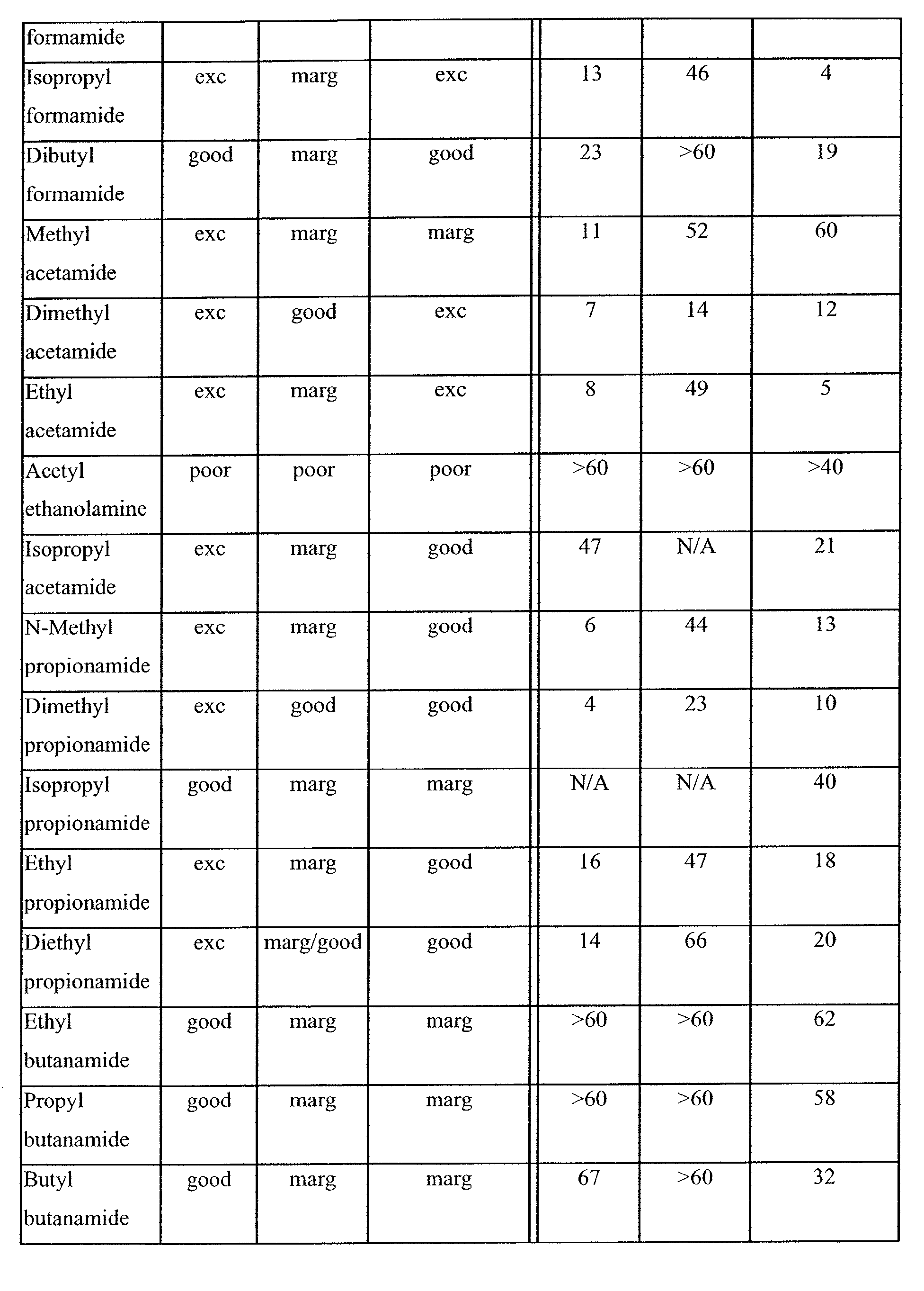

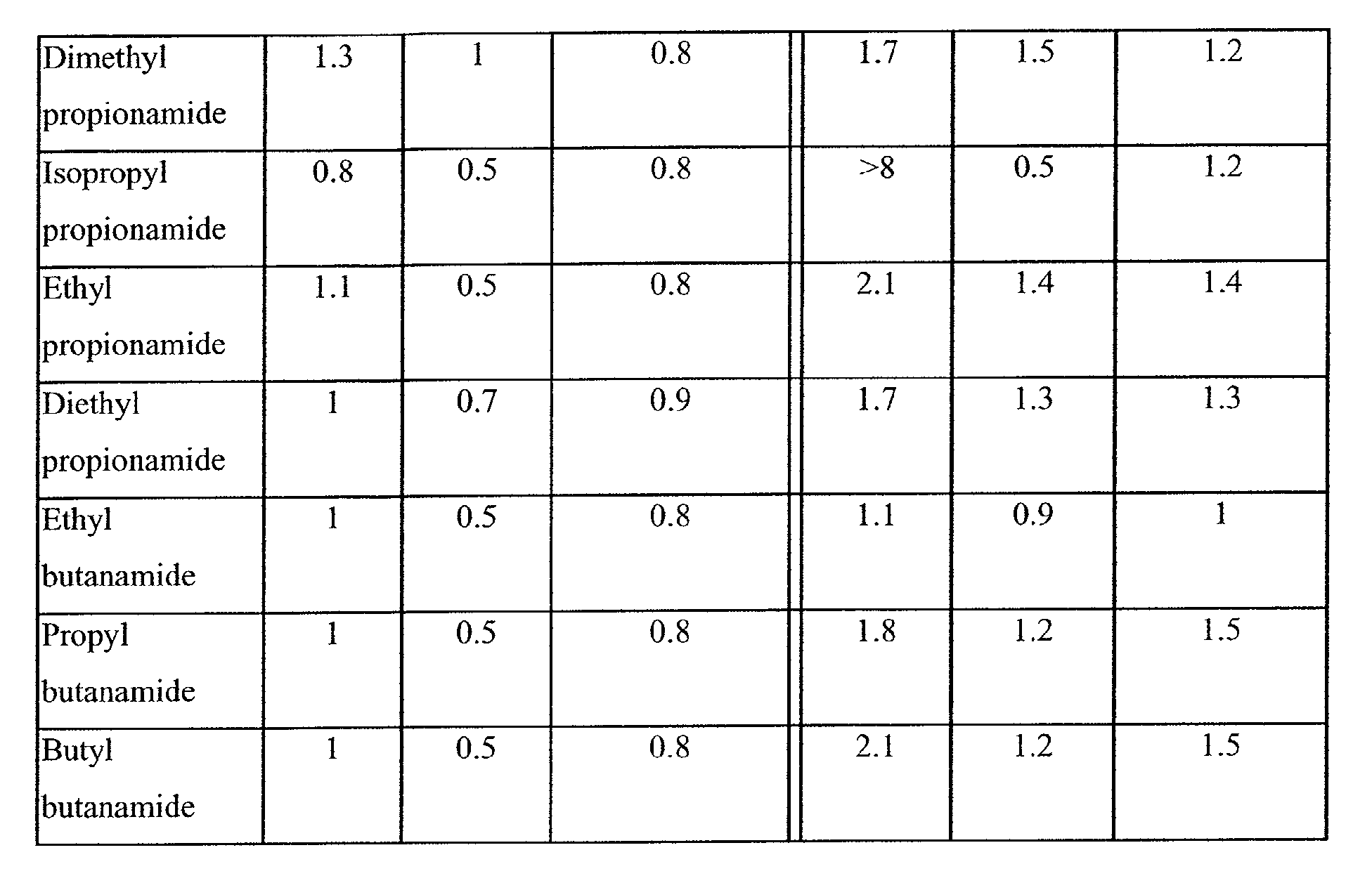
- Using this data, several ink-jet ink formulations have been made that are functional for printing on commercial offset coated media. Specifically, with the use of low molecular weight polar aprotic solvents, several water soluble dye- and pigment-based inks have been prepared which perform well on offset media as disclosed in Examples 2 to 7.
- An ink-jet ink formulation is prepared by mixing about 2.5% of pigment red 122, 7.5% sulfolane, 5% acetonitrile, and 5% Tergitol™ 15-s-12, and 80% water, each by weight. Such a formulation results in a red ink-jet ink that prints on commercial offset printer paper with excellent print quality, no halo, insignificant coalescence, and relatively quick dry time.
- An ink-jet ink formulation is prepared by mixing about 6% of pigment violet 19, 1% sulfolane, 5% acetonitrile, and 1% Tergitol™ 15-s-9, and 87% water, each by weight. Such a formulation results in an ink-jet ink that prints on various commercial offset printer paper with good print quality, insignificant halo and coalescence, and relatively quick dry time.
- An ink-jet ink formulation is prepared by mixing about 3% of acid blue 9, 5% acetonitrile, 10% Tergitol™ 15-s-5, and 82% water, each by weight. Such a formulation results in a blue ink-jet ink that prints on various brands of commercial offset printer paper with good print quality, no halo, insignificant coalescence, and relatively quick dry time.
- An ink-jet ink was prepared by mixing the following ingredients by weight: 25% N-ethyl acetamide, 10% dipropylene glycol, 5% Tergitol™ 15-s-5, 1.7% Projet™ cyan (Na salt form), 0.6% acid blue 9 (Na salt form) and the balance in deionized water.
- An ink-jet ink was prepared by mixing the following ingredients by weight: 25% N-ethyl acetamide, 10% dipropylene glycol, 5% Tergitol™ 15-s-5, 2.5% Projet yellow 1G, 0.9% acid yellow 23 (TMA salt form), and the balance in deionized water.
- Inks from examples 4-6 were jetted from an HP2000C printer onto various offset coated papers. Specifically, LUSTRO™ Laser gloss (from S.D. Warren), PRODUCTOLITH™ (from Consolidated Papers), MAGNO™ (from SAPPI), UTOPIA™ Dull (from Appleton Papers), and HP Brochure and Flyer paper, two-sided gloss (p/n# C6817A) were used. Drytime measurements were conducted at ambient conditions.
- The procedures followed in the dry time testing were as follows: first, solid bar patterns were printed on each paper sample using the inks from Examples 4-6. The approximate size of each bar was about 0.25 inches by X 8 inches for each color. A standard ink-jet ink typically used in an HP2000C printer was also tested as a comparison for the dry time test. The black ink was not evaluated for this test. Each plot was printed using the "Premium Ink-jet Media - Normal" print mode, which prints the plot within approximately 45 seconds (for this pattern, the ink density is approximately 128 picoliters/300 dots/inch pixel for the red, green, & blue bars). After the plot was completed, 10 sheets of the same type of coated media were placed upon the solid bar pattern immediately after printing. After a few minutes, the blanks sheets were removed and the sheet that was in contact with the print bars was examined for color ink transfer. Less ink transfer indicates faster drying of the ink. The table below summarizes the amount of ink transfer that occurred with respect to each ink tested. The value in percentage (%) indicates the approximate amount of area fill transferred to the blotted sheet.
MEDIA CONTROL INKS (standard HP2000C inks) INKS FROM EXAMPLES 7-9 HP Brochure media Very small (1%) Very small (1%) Lustro Very significant (40%) Very small (1%) Utopia Very significant (40%) Small (5%) Magno Very significant (40%) Noticeable (20%) Productolith Significant (30%) Very small (1%) - As shown in Table 3 above, the inks from Examples 4-6 show significant improvement for drying performance than the control inks.
- To illustrate that the ink-jet inks of the present invention are particularly good with respect to use with commercial offset papers, both the control ink and the inks of Examples 4-6 were printed on Weyshauser Recycled Laser Copy office paper using the "Plain Paper - Normal" print mode. Both inks showed good print quality and similar edge acuity.
- While the invention has been described with reference to certain preferred embodiments, those skilled in the art will appreciate that various modifications, changes, omissions, and substitutions can be made without departing from the spirit of the invention. It is therefore intended that the invention be limited only by the scope of the appended claims.
Claims (10)
- An aqueous ink-jet ink composition for printing on offset media comprising:a) an ink colorant;b) an effective amount of at least one surfactant; andc) an effective amount of at least one aprotic polar solvent wherein the solvent is comprised of molecules having a molecular weight from 40 to 1500.
- An aqueous ink-jet ink composition for printing on offset media comprising:a) from 2% to 6% of an ink colorant by weight;b) from 1% to 10% of surfactant;c) from 5% to 40% of aprotic polar solvent comprised of molecules having molecular weights from 40 to 1500; andd) from 1% to 40% of non-aprotic polar solvent comprised of molecules having molecular weights from 40 to 1500.
- An aqueous ink-jet ink composition as in claim 1 further comprising an effective amount of a non-aprotic polar solvent.
- An aqueous ink-jet ink composition as in claims 2 or 3 wherein the non-aprotic polar solvent is selected from the group consisting of N-ethyl acetamide, dimethyl propionamide, and combinations thereof.
- An aqueous ink-jet ink composition as in claims 1 or 2 wherein the aprotic polar solvent is an amide.
- An aqueous ink-jet ink composition as in claims 1 or 2 wherein the aprotic polar solvent is selected from the group consisting of formamides, methylformamides, methylacetamides, acetonitrile, dimethyl sulfoxide, sulfolane, dimethyl formamide, isopropyl formamide, dibutyl formamide, methyl acetamide, dimethyl acetamide, ethylacetamide, isopropyl acetamide, propanenitrile, dimethyl imidazolidin-2-one, tetramethylurea, cyclohexanone, cyclopentanone, tetrahydrofuran, fluorad, acetyl ethanolamine, methyl propionamide, dimethyl propionamide, isopropyl propionamide, ethyl propionamide, diethyl propionamide, ethyl butanamide, propyl butanamide, butyl butanamide, and combinations thereof.
- An aqueous ink-jet ink composition as in claims 1 or 2 wherein the surfactant is selected from the group consisting of ethoxylated octylphenols, alkyl phenoxypoly(ethleneoxy)ethanols, silicone glycol copolymers, polyalkylene oxide-modified polydimethylsiloxanes, ethoxlyated tetramethyl decyndiols, secondary alcohol ethoxylates, ethoxylated trimethylnonanols, polyoxyethylene ethers, ethylene oxide/propylene oxide copolymers, fluorosurfactants, and combinations thereof.
- An aqueous ink-jet ink composition as in claims 1 or 2 further comprising an effective amount of a second co-surfactant.
- An aqueous ink-jet ink composition as in claims 1 or 2 wherein the aprotic polar solvent is from 5 to 20 Debye (D).
- An aqueous ink-jet ink composition as in claims 1 or 2 wherein the ink colorant is one or more macro-molecular chromophore.
Applications Claiming Priority (2)
| Application Number | Priority Date | Filing Date | Title |
|---|---|---|---|
| US56556 | 1993-04-30 | ||
| US10/056,556 US6786957B2 (en) | 2002-01-22 | 2002-01-22 | Aqueous ink-jet inks for printing on commercial offset coated media |
Publications (2)
| Publication Number | Publication Date |
|---|---|
| EP1329487A1 true EP1329487A1 (en) | 2003-07-23 |
| EP1329487B1 EP1329487B1 (en) | 2006-11-22 |
Family
ID=22005177
Family Applications (1)
| Application Number | Title | Priority Date | Filing Date |
|---|---|---|---|
| EP03250094A Expired - Lifetime EP1329487B1 (en) | 2002-01-22 | 2003-01-08 | Use of aqueous ink-jet inks for printing on commercial offset coated media |
Country Status (4)
| Country | Link |
|---|---|
| US (1) | US6786957B2 (en) |
| EP (1) | EP1329487B1 (en) |
| JP (1) | JP4039953B2 (en) |
| DE (1) | DE60309753T2 (en) |
Cited By (1)
| Publication number | Priority date | Publication date | Assignee | Title |
|---|---|---|---|---|
| CN103241024A (en) * | 2012-02-01 | 2013-08-14 | 株式会社理光 | Inkjet recording method |
Families Citing this family (15)
| Publication number | Priority date | Publication date | Assignee | Title |
|---|---|---|---|---|
| TWI251614B (en) * | 2002-07-23 | 2006-03-21 | Benq Corp | Pigment-type blank ink |
| WO2006004006A1 (en) * | 2004-07-01 | 2006-01-12 | General Company Limited | Inkjet ink and printing method using same |
| US10072168B2 (en) * | 2005-10-13 | 2018-09-11 | Hewlett-Packard Development Company L.P. | Marking fluids for vinyl substrates |
| JP2007175693A (en) * | 2005-12-02 | 2007-07-12 | Tokyo Univ Of Agriculture & Technology | Separation method using amide compound |
| US7503969B2 (en) | 2006-10-12 | 2009-03-17 | E.I. Du Pont De Nemours & Company | Inkjet ink |
| WO2008055244A2 (en) | 2006-10-31 | 2008-05-08 | Sensient Colors Inc. | Modified pigments and methods for making and using the same |
| JP5085973B2 (en) * | 2007-04-26 | 2012-11-28 | ゼネラル株式会社 | Inkjet ink |
| EP3483222A3 (en) | 2007-08-23 | 2019-08-07 | Sensient Colors LLC | Self-dispersed pigments and methods for making and using the same |
| US11359103B2 (en) | 2008-11-07 | 2022-06-14 | Viscot Medical, Llc | Scrub-resistant ink and methods and apparatus for fabrication and use thereof |
| JP5568863B2 (en) * | 2009-01-21 | 2014-08-13 | 東洋インキScホールディングス株式会社 | Water-based ink composition using β-alkoxypropionamides |
| EP2417202A2 (en) | 2009-04-07 | 2012-02-15 | Sensient Colors LLC | Self-dispersing particles and methods for making and using the same |
| JP5851679B2 (en) * | 2010-08-27 | 2016-02-03 | ゼネラル株式会社 | Inkjet ink |
| JP5655645B2 (en) * | 2011-03-10 | 2015-01-21 | 株式会社リコー | Ink set for ink jet recording, ink cartridge, ink jet recording method, ink jet recording apparatus, and ink recorded matter |
| JP7784515B1 (en) * | 2024-12-23 | 2025-12-11 | artience株式会社 | Water-based inkjet inks and printed materials |
| JP7784514B1 (en) * | 2024-12-23 | 2025-12-11 | artience株式会社 | Water-based inkjet inks and printed materials |
Citations (6)
| Publication number | Priority date | Publication date | Assignee | Title |
|---|---|---|---|---|
| US5389133A (en) * | 1992-12-17 | 1995-02-14 | Xerox Corporation | Ink compositions for ink jet printing |
| US5554213A (en) * | 1992-12-17 | 1996-09-10 | Xerox Corporation | Ink compositions for ink jet printing |
| US5786410A (en) * | 1997-03-31 | 1998-07-28 | Xerox Corporation | Polyurethane dye based inks |
| US5973026A (en) * | 1998-02-02 | 1999-10-26 | Xerox Corporation | Ink jet inks |
| EP1103585A1 (en) * | 1999-11-29 | 2001-05-30 | Xerox Corporation | Ink compositions containing 1,3,5-trioxane or tetraethylene glycol dimethyl ether |
| US6310115B1 (en) * | 1998-10-29 | 2001-10-30 | Agfa-Gevaert | Ink compositions for ink jet printing |
Family Cites Families (16)
| Publication number | Priority date | Publication date | Assignee | Title |
|---|---|---|---|---|
| US4767466A (en) | 1986-09-16 | 1988-08-30 | Engelhard Corporation | Bulking pigments |
| US5221334A (en) | 1990-04-11 | 1993-06-22 | E. I. Du Pont De Nemours And Company | Aqueous pigmented inks for ink jet printers |
| JP2602404B2 (en) | 1992-09-08 | 1997-04-23 | イー・アイ・デュポン・ドウ・ヌムール・アンド・カンパニー | Aqueous ink composition |
| US5395431A (en) | 1993-06-22 | 1995-03-07 | Videojet Systems International, Inc. | Aqueous based jet ink |
| JP3542425B2 (en) | 1994-11-17 | 2004-07-14 | キヤノン株式会社 | Aqueous dispersion ink for inkjet recording, inkjet recording method using the same, ink cartridge, recording unit, and recording apparatus |
| GB9508791D0 (en) | 1995-04-29 | 1995-06-21 | Zeneca Ltd | Compositions of matter |
| DE69632168T2 (en) * | 1995-05-12 | 2004-08-12 | Ciba Specialty Chemicals Holding Inc. | Process for coloring high-molecular organic plastics in bulk with soluble phthalocyanine precursors |
| JP2964930B2 (en) | 1995-10-18 | 1999-10-18 | 富士ゼロックス株式会社 | Ink jet recording ink and ink jet recording method |
| JP3049592B2 (en) | 1995-12-07 | 2000-06-05 | 富士ゼロックス株式会社 | Ink jet recording ink and ink jet recording method |
| US5709737A (en) | 1996-02-20 | 1998-01-20 | Xerox Corporation | Ink jet inks and printing processes |
| JP3550687B2 (en) | 1997-03-25 | 2004-08-04 | セイコーエプソン株式会社 | Ink for inkjet recording |
| US5852075A (en) | 1997-06-02 | 1998-12-22 | E. I. Du Pont De Nemours And Company | Surfactant system for ink jet inks for printing on hydrophobic surfaces |
| US6329446B1 (en) | 1997-06-05 | 2001-12-11 | Xerox Corporation | Ink composition |
| US6087416A (en) | 1998-07-22 | 2000-07-11 | E.I. Du Pont De Nemours And Company | Aqueous pigmented ink jet inks for printing on vinyls |
| US6379443B1 (en) * | 1999-03-12 | 2002-04-30 | Seiko Epson Corporation | Ink jet recording method and ink composition for use in said method |
| US6602335B2 (en) * | 2001-05-08 | 2003-08-05 | Hewlett-Packard Development Company, L.P. | Pigment solubilization via treatment with strong base and substitution |
-
2002
- 2002-01-22 US US10/056,556 patent/US6786957B2/en not_active Expired - Lifetime
-
2003
- 2003-01-08 EP EP03250094A patent/EP1329487B1/en not_active Expired - Lifetime
- 2003-01-08 DE DE60309753T patent/DE60309753T2/en not_active Expired - Lifetime
- 2003-01-22 JP JP2003013072A patent/JP4039953B2/en not_active Expired - Fee Related
Patent Citations (6)
| Publication number | Priority date | Publication date | Assignee | Title |
|---|---|---|---|---|
| US5389133A (en) * | 1992-12-17 | 1995-02-14 | Xerox Corporation | Ink compositions for ink jet printing |
| US5554213A (en) * | 1992-12-17 | 1996-09-10 | Xerox Corporation | Ink compositions for ink jet printing |
| US5786410A (en) * | 1997-03-31 | 1998-07-28 | Xerox Corporation | Polyurethane dye based inks |
| US5973026A (en) * | 1998-02-02 | 1999-10-26 | Xerox Corporation | Ink jet inks |
| US6310115B1 (en) * | 1998-10-29 | 2001-10-30 | Agfa-Gevaert | Ink compositions for ink jet printing |
| EP1103585A1 (en) * | 1999-11-29 | 2001-05-30 | Xerox Corporation | Ink compositions containing 1,3,5-trioxane or tetraethylene glycol dimethyl ether |
Cited By (3)
| Publication number | Priority date | Publication date | Assignee | Title |
|---|---|---|---|---|
| CN103241024A (en) * | 2012-02-01 | 2013-08-14 | 株式会社理光 | Inkjet recording method |
| US8888269B2 (en) | 2012-02-01 | 2014-11-18 | Ricoh Company, Ltd. | Inkjet recording method |
| CN103241024B (en) * | 2012-02-01 | 2015-10-28 | 株式会社理光 | Ink jet recording method |
Also Published As
| Publication number | Publication date |
|---|---|
| JP4039953B2 (en) | 2008-01-30 |
| EP1329487B1 (en) | 2006-11-22 |
| JP2003268279A (en) | 2003-09-25 |
| US20030150355A1 (en) | 2003-08-14 |
| DE60309753D1 (en) | 2007-01-04 |
| HK1055985A1 (en) | 2004-01-30 |
| DE60309753T2 (en) | 2007-09-13 |
| US6786957B2 (en) | 2004-09-07 |
Similar Documents
| Publication | Publication Date | Title |
|---|---|---|
| EP1426193B1 (en) | Method for improving print quality | |
| US6786957B2 (en) | Aqueous ink-jet inks for printing on commercial offset coated media | |
| JP3683946B2 (en) | Aqueous pigment ink set for ink jet, recording unit, ink cartridge, and ink jet recording apparatus | |
| EP1764397B1 (en) | Cyan ink and ink set | |
| CN102781677B (en) | Inkjet treatment liquid, inkjet recording apparatus, inkjet recording method and image formation | |
| EP1446292A1 (en) | Ink jet printing with uniform gloss | |
| US7018459B2 (en) | Ink set for ink-jet recording, ink-jet recording method and ink-jet recording apparatus | |
| US6461418B1 (en) | Aqueous ink jet inks for use with commercial offset media and offset ink | |
| JP4111104B2 (en) | Reaction liquid, ink set, and ink jet recording method | |
| EP1254029B1 (en) | Waterfast ink receptive coatings for ink jet printing materials and coating methods therewith | |
| JPH11228890A (en) | Liquid composition for inkjet, ink set for image formation and image formation | |
| JPH08224955A (en) | Liquid composition, ink set, image forming method and image forming apparatus using the same | |
| EP1320574B1 (en) | Aqueous ink jet inks for use with commercial offset media and offset ink | |
| US7328990B2 (en) | Ink-jet ink set, ink-jet recording method, and ink-jet recording apparatus | |
| JPH08142500A (en) | Image forming method | |
| US20060293411A1 (en) | Ink set, ink jet recording method and droplet ejecting apparatus | |
| EP0841185B1 (en) | Back-print recording medium for ink-jet printing | |
| JPH10211763A (en) | Ink jet recording method for back print recording medium | |
| JPH0880664A (en) | Liquid composition, ink set, and image forming method and apparatus using the same | |
| JPH11314449A (en) | Image forming method | |
| HK1055985B (en) | Use of aqueous ink-jet inks for printing on commercial offset coated media | |
| US20090308281A1 (en) | Aqueous inkjet ink comprising a bleed control agent | |
| JPH11129610A (en) | Ink jet recording sheet and ink jet printing method using the same | |
| JPH10338831A (en) | Method for forming image | |
| JP2007283623A (en) | Inkjet printing method |
Legal Events
| Date | Code | Title | Description |
|---|---|---|---|
| PUAI | Public reference made under article 153(3) epc to a published international application that has entered the european phase |
Free format text: ORIGINAL CODE: 0009012 |
|
| AK | Designated contracting states |
Designated state(s): AT BE BG CH CY CZ DE DK EE ES FI FR GB GR HU IE IT LI LU MC NL PT SE SI SK TR |
|
| AX | Request for extension of the european patent |
Extension state: AL LT LV MK RO |
|
| 17P | Request for examination filed |
Effective date: 20040108 |
|
| AKX | Designation fees paid |
Designated state(s): DE FR GB NL |
|
| 17Q | First examination report despatched |
Effective date: 20040921 |
|
| GRAP | Despatch of communication of intention to grant a patent |
Free format text: ORIGINAL CODE: EPIDOSNIGR1 |
|
| RTI1 | Title (correction) |
Free format text: USE OF AQUEOUS INK-JET INKS FOR PRINTING ON COMMERCIAL OFFSET COATED MEDIA |
|
| GRAS | Grant fee paid |
Free format text: ORIGINAL CODE: EPIDOSNIGR3 |
|
| GRAA | (expected) grant |
Free format text: ORIGINAL CODE: 0009210 |
|
| AK | Designated contracting states |
Kind code of ref document: B1 Designated state(s): DE FR GB NL |
|
| REG | Reference to a national code |
Ref country code: GB Ref legal event code: FG4D |
|
| REF | Corresponds to: |
Ref document number: 60309753 Country of ref document: DE Date of ref document: 20070104 Kind code of ref document: P |
|
| REG | Reference to a national code |
Ref country code: HK Ref legal event code: GR Ref document number: 1055985 Country of ref document: HK |
|
| EN | Fr: translation not filed | ||
| REG | Reference to a national code |
Ref country code: FR Ref legal event code: RN |
|
| REG | Reference to a national code |
Ref country code: FR Ref legal event code: RN |
|
| PLBE | No opposition filed within time limit |
Free format text: ORIGINAL CODE: 0009261 |
|
| STAA | Information on the status of an ep patent application or granted ep patent |
Free format text: STATUS: NO OPPOSITION FILED WITHIN TIME LIMIT |
|
| 26N | No opposition filed |
Effective date: 20070823 |
|
| REG | Reference to a national code |
Ref country code: FR Ref legal event code: FC |
|
| ET | Fr: translation filed | ||
| PG25 | Lapsed in a contracting state [announced via postgrant information from national office to epo] |
Ref country code: FR Free format text: LAPSE BECAUSE OF FAILURE TO SUBMIT A TRANSLATION OF THE DESCRIPTION OR TO PAY THE FEE WITHIN THE PRESCRIBED TIME-LIMIT Effective date: 20070713 |
|
| REG | Reference to a national code |
Ref country code: GB Ref legal event code: 732E Free format text: REGISTERED BETWEEN 20120329 AND 20120404 |
|
| REG | Reference to a national code |
Ref country code: NL Ref legal event code: SD Effective date: 20120731 |
|
| REG | Reference to a national code |
Ref country code: FR Ref legal event code: PLFP Year of fee payment: 13 |
|
| PGFP | Annual fee paid to national office [announced via postgrant information from national office to epo] |
Ref country code: GB Payment date: 20141219 Year of fee payment: 13 |
|
| PGFP | Annual fee paid to national office [announced via postgrant information from national office to epo] |
Ref country code: NL Payment date: 20141217 Year of fee payment: 13 |
|
| PGFP | Annual fee paid to national office [announced via postgrant information from national office to epo] |
Ref country code: DE Payment date: 20141218 Year of fee payment: 13 |
|
| PGFP | Annual fee paid to national office [announced via postgrant information from national office to epo] |
Ref country code: FR Payment date: 20150121 Year of fee payment: 13 |
|
| REG | Reference to a national code |
Ref country code: DE Ref legal event code: R119 Ref document number: 60309753 Country of ref document: DE |
|
| GBPC | Gb: european patent ceased through non-payment of renewal fee |
Effective date: 20160108 |
|
| REG | Reference to a national code |
Ref country code: NL Ref legal event code: MM Effective date: 20160201 |
|
| REG | Reference to a national code |
Ref country code: FR Ref legal event code: ST Effective date: 20160930 |
|
| PG25 | Lapsed in a contracting state [announced via postgrant information from national office to epo] |
Ref country code: GB Free format text: LAPSE BECAUSE OF NON-PAYMENT OF DUE FEES Effective date: 20160108 Ref country code: DE Free format text: LAPSE BECAUSE OF NON-PAYMENT OF DUE FEES Effective date: 20160802 |
|
| PG25 | Lapsed in a contracting state [announced via postgrant information from national office to epo] |
Ref country code: FR Free format text: LAPSE BECAUSE OF FAILURE TO SUBMIT A TRANSLATION OF THE DESCRIPTION OR TO PAY THE FEE WITHIN THE PRESCRIBED TIME-LIMIT Effective date: 20160201 Ref country code: NL Free format text: LAPSE BECAUSE OF NON-PAYMENT OF DUE FEES Effective date: 20160201 |