EP1328669B1 - Textile fibers made from strengthened polypropylene - Google Patents
Textile fibers made from strengthened polypropylene Download PDFInfo
- Publication number
- EP1328669B1 EP1328669B1 EP01994152A EP01994152A EP1328669B1 EP 1328669 B1 EP1328669 B1 EP 1328669B1 EP 01994152 A EP01994152 A EP 01994152A EP 01994152 A EP01994152 A EP 01994152A EP 1328669 B1 EP1328669 B1 EP 1328669B1
- Authority
- EP
- European Patent Office
- Prior art keywords
- fibers
- polypropylene
- ave
- fiber
- data
- Prior art date
- Legal status (The legal status is an assumption and is not a legal conclusion. Google has not performed a legal analysis and makes no representation as to the accuracy of the status listed.)
- Expired - Lifetime
Links
Images


Classifications
-
- D—TEXTILES; PAPER
- D01—NATURAL OR MAN-MADE THREADS OR FIBRES; SPINNING
- D01F—CHEMICAL FEATURES IN THE MANUFACTURE OF ARTIFICIAL FILAMENTS, THREADS, FIBRES, BRISTLES OR RIBBONS; APPARATUS SPECIALLY ADAPTED FOR THE MANUFACTURE OF CARBON FILAMENTS
- D01F6/00—Monocomponent artificial filaments or the like of synthetic polymers; Manufacture thereof
- D01F6/44—Monocomponent artificial filaments or the like of synthetic polymers; Manufacture thereof from mixtures of polymers obtained by reactions only involving carbon-to-carbon unsaturated bonds as major constituent with other polymers or low-molecular-weight compounds
- D01F6/46—Monocomponent artificial filaments or the like of synthetic polymers; Manufacture thereof from mixtures of polymers obtained by reactions only involving carbon-to-carbon unsaturated bonds as major constituent with other polymers or low-molecular-weight compounds of polyolefins
-
- D—TEXTILES; PAPER
- D04—BRAIDING; LACE-MAKING; KNITTING; TRIMMINGS; NON-WOVEN FABRICS
- D04H—MAKING TEXTILE FABRICS, e.g. FROM FIBRES OR FILAMENTARY MATERIAL; FABRICS MADE BY SUCH PROCESSES OR APPARATUS, e.g. FELTS, NON-WOVEN FABRICS; COTTON-WOOL; WADDING ; NON-WOVEN FABRICS FROM STAPLE FIBRES, FILAMENTS OR YARNS, BONDED WITH AT LEAST ONE WEB-LIKE MATERIAL DURING THEIR CONSOLIDATION
- D04H1/00—Non-woven fabrics formed wholly or mainly of staple fibres or like relatively short fibres
- D04H1/40—Non-woven fabrics formed wholly or mainly of staple fibres or like relatively short fibres from fleeces or layers composed of fibres without existing or potential cohesive properties
- D04H1/42—Non-woven fabrics formed wholly or mainly of staple fibres or like relatively short fibres from fleeces or layers composed of fibres without existing or potential cohesive properties characterised by the use of certain kinds of fibres insofar as this use has no preponderant influence on the consolidation of the fleece
- D04H1/4282—Addition polymers
- D04H1/4291—Olefin series
Definitions
- This invention is directed to textile fibers including polypropylene and an impact modifier.
- Textile fibers include a wide range of fibers that can be integrated into an even wider range of fabrics.
- textile fibers can include spunbond fibers and staple fibers, and can be integrated into multi-fiber yarns, knits, woven fabrics, and nonwoven fabrics, to name a few. Small fiber size and high tensile strength are desirable properties of textile fibers.
- the European Patent Application EP 0 552 681 A1 discloses a polyolefin mass isotactic polyoelfins without polymer chains as well as natural rubber, e.g., EPM or EPDM.
- the polyolefin mass is characterized by a high impact strength and strength even a low temperatures.
- US 4,663,220 discloses an elastomeric composition comprising a copolymer with a thermoplastic end blocks and an elastomeric midblock including poly(ethylene-butylene). The document also describes the manufacture of fibrous non-woven elastomeric webs from the extrudable composition.
- the European Patent Application EP 0 277 710 A2 discloses a nonwoven web prepared from a polymeric blend comprising one elastomer and one thermoplastic resin. Differen kinds of rubber, including ethylene-propylene rubber and ethylene ⁇ -olefins rubber, might be chosen for the elastomer.
- roping occurs during the process of blending copolymer/polypropylene blends wherein the blends possess melt elasticity. More particularly, roping refers to fiber breakage below the pack snap back toward the pack, thereby entangling additional fibers.
- the present invention is directed to textile fibers made from strengthened polypropylene.
- the polypropylene is strengthened with an impact modifier.
- the invention provides a strengthened polypropylene textile fiber, wherein the polypropylene is selected from the group consisting of propylene homopolymers, copolymers containing up to 10% by weight ethylene, and C 4 -C 20 alpha-olefin comonomers, and wherein the polypropylene textile fiber is strengthened by a 1-25 % by weight impact modifier of ethylene-propylene-diene-monomer that has elastomeric properties such that it can be elongated by at least 50 % of its relaxed length by an applied force and that it will recover upon release of the applied force at least 40 % of its elongation.
- the fibers of this invention lack melt elasticity compared to other polypropylene/impact modifier blends, thereby avoiding any "roping" during the manufacturing process.
- the impact modifier used in this invention creates a plasticizing effect that allows the polypropylene chains to slip more easily.
- Another attribute of the fibers of this invention is improved fabric softness resulting from the addition of the impact modifier.
- Elastomeric refers to a material or composite which can be elongated by at least 50 percent of its relaxed length and which will recover, upon release of the applied force, at least 40 percent of its elongation. It is generally preferred that the elastomeric material or composite be capable of being elongated by at least 100 percent, more preferably by at least 300 percent, of its relaxed length and recover, upon release of an applied force, at least 50 percent of its elongation.
- Meltblown fiber means fibers formed by extruding a molten thermoplastic material through a plurality of fine, usually circular, die capillaries as molten threads or filaments into converging high velocity heated gas (e.g., air) streams which attenuate the filaments of molten thermoplastic material to reduce their diameter, which may be to microfiber diameter. Thereafter, the meltblown fibers are carried by the high velocity gas stream and are deposited on a collecting surface to form a web of randomly dispersed meltblown fibers.
- heated gas e.g., air
- Meltblown fibers are microfibers which may be continuous or discontinuous, are generally smaller than about 0.6 denier, and are generally self bonding when deposited onto a collecting surface.
- Meltblown fibers used in the present invention are preferably substantially continuous in length.
- Polymers include, but are not limited to, homopolymers, copolymers, such as for example, block, graft, random and alternating copolymers, terpolymers, etc. and blends and modifications thereof. Furthermore, unless otherwise specifically limited, the term “polymer” shall include all possible geometrical configurations of the material. These configurations include, but are not limited to isotactic, syndiotactic and atactic symmetries.
- spunbonded fiber refers to small diameter fibers which are formed by extruding molten thermoplastic material as filaments from a plurality of fine capillaries of a spinnerette having a circular or other configuration, with the diameter of the extruded filaments then being rapidly reduced as by, for example, in U.S. Patent 4,340,563 to Appel et al., and U.S. Patent 3,692,618 to Dorschner et al., U.S. Patent 3,802,817 to Matsuki et al., U.S. Patents 3,338,992 and 3,341,394 to Kinney, U.S. Patent 3,502,763 to Hartmann, U.S. Patent 3,502,538 to Petersen, and U.S.
- Spunbond fibers are quenched and generally not tacky when they are deposited onto a collecting surface. Spunbond fibers are generally continuous and often have average deniers larger than about 0.3, more particularly, between about 0.6 and 10.
- Thermoplastic describes a material that softens when exposed to heat and which substantially returns to a nonsoftened condition when cooled to room temperature.
- the textile fibers of the invention include strengthened polypropylene.
- Polypropylene refers to propylene homopolymers as well as copolymers containing up to about 10% by weight ethylene or a C 4 -C 20 alpha-olefin comonomer.
- the polypropylene is strengthened by the addition of an impact modifier.
- the impact modifier constitutes about 1-25% by weight of the composite fibers, suitably about 2-15% by weight of the composite fibers, more suitably about 3-10% by weight of the composite fibers.
- impact modifier refers to a synthetic material having elastomeric properties.
- the impact modifier is partially compatible with polypropylene. More particularly, the impact modifier disperses extremely well in propylene without dissolving.
- suitable impact modifiers include ethylene-propylene-diene-monomer (EPDM), styrene/ethylene-co-butadiene/styrene (SEBS), and styrene-poly(ethylene-propylene)-styrene-poly(ethylene-propylene) (SEPSEP).
- diblock, triblock, tetrablock or other multi-block elastomeric copolymers such as olefinic copolymers, including styrene-isoprene-styrene, styrenebutadiene-styrene, or styrene-ethylene/propylene-styrene, which may be obtained from the Shell Chemical Company, under the trade designation KRATON ® elastomeric resin; polyurethanes, including those available from E. I.
- Du Pont de Nemours Co. under the trade name LYCRA ® polyurethane; polyamides, including polyether block amides available from Ato Chemical Company, under the trade name PEBAX ® polyether block amide; polyesters, such as those available from E. I. Du Pont de Nemours Co., under the trade name HYTREL ® polyester; single-site or metallocene-catalyzed polyolefins having density less than about 0.89 grams/cc, available from Dow Chemical Co. under the trade name AFFINITY ® ; and ethylene/styrene also available from Dow Chemical Co.
- block copolymers can be used to prepare the impact modifiers useful in this invention.
- Such block copolymers generally comprise an elastomeric midblock portion B and a thermoplastic endblock portion A.
- the block copolymers may also be thermoplastic in the sense that they can be melted, formed, and resolidified several times with little or no change in physical properties (assuming a minimum of oxidative degradation).
- Endblock portion A may comprise a poly(vinylarene), such as polystyrene.
- Midblock portion B may comprise a substantially amorphous polyolefin such as polyisoprene, ethylene/propylene polymers, ethylene/butylene polymers, polybutadiene, and the like, or mixtures thereof.
- Suitable block copolymers useful in this invention include at least two substantially polystyrene endblock portions and at least one substantially ethylene/butylene mid-block portion.
- Commercially available examples of such a linear block copolymer includes the SEBS block copolymer, available from the Shell Chemical Company, under the trade designations KRATON ® G1657, G1652, and G2760 elastomeric resins.
- KRATON ® G1657 elastomeric resin Typical properties of KRATON ® G1657 elastomeric resin are reported to include a tensile strength of 3400 pounds per square inch (2x10 6 kilograms per square meter), a 300 percent modulus of 350 pounds per square inch (1.4x10 5 kilograms per square meter), an elongation of 750 percent at break, a Shore A hardness of 65, and a Brookfield viscosity, when at a concentration of 25 weight percent in a toluene solution, of about 4200 centipoise at room temperature.
- Another suitable elastomer, KRATON ® G2746 is a styrene butadiene block copolymer blended with tackifier and low density polyethylene.
- the polypropylene may be blended with the impact modifier using any suitable process, including processes presently used for forming polypropylene fibers.
- U.S. Patent 5,534,335, issued to Everhart, et al. describes a process for making fibers from thermoplastic polymers, such as polypropylene.
- the fibers are produced by meltblowing or spunbonding processes which are well known in the art. These processes generally use an extruder to supply melted polymer to a spinnerette, or meltblowing die, where the polymer is fiberized.
- the fibers can then be drawn, usually pneumatically, and deposited on a foraminous mat or belt to form a nonwoven fabric, for example.
- Fibers produced in the spunbond and meltblown processes are generally in the range of from about 1 to about 50 microns in diameter, depending on process conditions and the desired end use for the fabrics to be produced from such fibers.
- an exemplary apparatus for forming textile fibers with strengthened polypropylene is generally represented by reference numeral 10.
- the fibers can be drawn either mechanically (Fig. 1) or pneumatically (Fig. 2). The pneumatic drawing method is explained below.
- polymer pellets 12 are accurately weighed and dry-mixed, thereby ensuring that a homogeneous mixture is fed to an extruder 14.
- the extruder 14 is heated to about 180 degrees Celsius, and when all zones within the extruder 14 reach about 180 degrees Celsius, a 10-minute soak time is observed to insure that all polymer contained within the extruder 14 and die 16 from a previous run is completely melted.
- the extruder 14 is then purged with polypropylene at about 32 RPM to remove any polymer remaining from the previous run.
- tracer pellets Prior to feeding the dry-mixed blend, tracer pellets are fed into the extruder 14.
- the dry-blended polymers are compounded immediately following the tracer pellets.
- the extrudate 20 is the desired composition.
- the RPM of the extruder 14 is maintained at about 32 RPM.
- a feed hopper 18 is maintained with sufficient polymer such that a constant feed rate is maintained, as determined by the size of the materials fed.
- the fibers are then produced.
- the motor speed is adjusted to about 5 RPM.
- the extrudate 20 is quenched and threaded according to the desired configuration, and attached to a wind-up roll 22.
- the extruder 14 is shut off and the fibers are drawn from the die 16 continuously.
- fibers are cut from the roll 22 and measured using a microscope equipped with an eyepiece reticle. Adjustments in take-off speed are made to produce the desired size fibers empirically. Once the correct speed is determined, fibers can be produced in two-minute intervals.
- the extruder 14 is operated at about 32 RPM for a period of about two minutes to insure that fibers produced do not have significant phase separation as a function of collection time.
- Four processing conditions can be employed to impart varying properties in the fibers, including combinations of two quenching and two threading conditions. Schematics of these four processing conditions are given in Figs. 3-6.
- Air-quenching is a process where the fibers 30 are quenched in air without the aid of any fluid stream.
- the fibers 30 are quenched in ambient air.
- Water quenching is achieved by threading the fiber 30 through a water bath 24. The process of water quenching provides a much faster quench than air due to the greater thermal energy flux present.
- a direct threaded system 26 (Figs. 3 and 5) and a threaded wind-up system 28 (Figs. 4 and 6).
- a direct threaded system 26 fibers 30 are drawn from the extruder die 32, through whichever quenching medium is used, and wound directly around the wind-up roll 34, which provides the RPM necessary to maintain the desired fiber diameter.
- the threaded wind-up system 28 the fiber 30 is once again drawn from the extruder die 32 through the quenching medium. At this point the fiber 30 is threaded around several support rolls 36 in a take-off unit before being wound on the wind-up roll 34.
- the materials 38 to be blended are dry-mixed at the desired ratio. These materials 38 are added to a feed hopper 40 with variable feed rate control, maintained at about 2.5 ⁇ 10 -3 kg/s (20 lb/hr).
- a co-rotating 27 mm twin screw extruder with a length/diameter ratio of 40:1 at 200 RPM is an example of a suitable extruder 42 that can be used, with a flat temperature profile at about 210 degrees Celsius.
- a venting port 44 can be used to remove volatile gases.
- the melt blended materials 46 are transported to a plate 48 with multiple orifices 50 through which fibers 52 are drawn.
- the plate 48 or "spin pack" and surrounding materials are maintained at desired temperatures ranging between about 210 and 250 degrees Celsius.
- a suitable spin pack includes a spin pack having 310 holes at a density of 50 holes/(2.5 cm) 2 (holes/inch 2 ). The holes are suitably about 1.5 cm (0.6 inches) in diameter and have a length/diameter ratio of about 6:1.
- the fibers 52 can be drawn using high velocity air at pressures ranging from 13.8 - 138 kPa (2-20 (psi)) using a Fiber Drawing Unit (FDU) 54.
- FDU Fiber Drawing Unit
- quench boxes 56 can be used to cool the polymer more rapidly at velocity rates between 0 and 84 cm/min (0 and 280 (ft/min)).
- the textile fibers have improved fabric softness, increased strength, and/or elongation at break at identical throughput levels compared to polypropylene homopolymer fibers, as shown in the Example below.
- Stabilized textile fibers were prepared from Escorene 3155 polypropylene (obtained from Exxon).
- a second set of stabilized textile fibers was prepared from 3% Buna 2070 EPDM (obtained from Bayer) blended with 97% Escorene 3155 polypropylene.
- the EPDM and polypropylene were combined and drawn using the preferred process described above with respect to Fig. 1. Both sets of fibers were successfully drawn between 0.4 grams/hole/minute and 0.6 grams/hole/minute at a range of temperature from 230 degrees Celsius to 250 degrees Celsius, although there is no apparent restriction on throughput or temperature for the fibers of the invention.
- the drawing pressure used in the fiber drawing unit allowed fibers to be drawn at pressures up to and above 103 kPa (15 psi).
- Table 1 Polypropylene Fibers Versus Polypropylene Fibers Blended With EPDM Sample Composition Temp (°C) Draw Pressure (psi) Quench Tensile Strength (Mpa) Elongation at Break (%) Diameter (microns) 1a 100% PP 230 8 Off 135.38 212.79 20.51 1b 100% PP 230 8 0.4 in H 2 O 128.34 289.80 25.71 2a 100% PP 230 15 Off 123.86 180.80 16.85 2b 100% PP 230 15 0.4 in H 2 O 130.65 196.10 14.93 3a 100% PP 250 8 Off 198.42 179.86 13.70 3b 100% PP 250 8 0.4 in H 2 O 124.29 165.87 17.16 4a 100% PP 250 15 Off 192.35 146.05 12.71 4b 100% PP 250 15 0.4 in H 2 O 237.42 109.03 11.78 5a 97% PP / 3% Buna 2070 250 8 Off 159.96 209.66 15.91
- the composite EPDM/PP fibers had an average increase in strength of 19% and decrease in size of 6% observed across the entire range of variables tested.
- Comparisons of individual treatments comparing 3% Buna in polypropylene to polypropylene homopolymer at identical processing conditions show as much as a 63% increase in strength, a 32% increase in elongation at break, and a reduction in size of 35%.
- More textile fibers of Escorene 3155 polypropylene and combinations of polypropylene and Buna 2070 EPDM were formed and tested under various conditions, as shown in Table 2. Included in Table 2 is comparison data showing the differences between the polypropylene fibers and the blended fibers.
- Cup crush load data and cup crush energy data were obtained according to the procedure described below.
- Drape data was obtained according to the procedure in ASTM D1388.
- Elmendorf tear data was obtained according to the procedure in ASTM D1424-83. Denier data was obtained by measuring the fiber diameter and calculating cross-sectional area, then using the density of the fiber, the mass in grams/8.2 km (grams/9000 yards) of filament was calculated.
- Trap tear data was obtained according to the procedure in ASTM D1117-14.
- Each of the four types of textile fibers shown in Table 2 were also tested for tensile strength, according to the procedure in ASTM D3822, in both the cross direction (CD) and the machine direction (MD). Tensile strength at various points of elongation in the CD is shown in Table 3 and tensile strength at the same points of elongation in the MD is shown in Table 4.
- Table 3 CD Tensile Strength of Polypropylene Fibers and Blended Polypropylene Fibers As a Function of Elongation (lb/oz) EPDM (%) 1% Elongation 3% Elongation 5% Elongation 10% Elongation 20% Elongation 50% Elongation 100% Elongation 0.0 0.0965 0.3446 0.7816 1.5965 3.1959 8.0493 6.9713 1.0 0.0542 0.2943 0.6973 1.3788 2.7596 7.1054 7.2831 3.0 0.054 0.2197 0.5435 1.1916 2.4955 6.8867 8.7574 5.0 0.0611 0.2777 0.6473 1.2945 2.5423 6.7066 10.3377
- Table 4 MD Tensile Strength of Polypropylene Fibers and Blended Polypropylene Fibers As a Function of Elongation (lb/oz) EPDM (%) 1% Elongation 3% Elongation 5% Elongation 10% Elongation 20% Elongation 50% Elongation 100% Elongation 0.0 0.3794 1.6074 2.3712 3.
- cup crush load data obtained using the same procedure mentioned above with various levels of EPDM and various melt temperatures, is shown in Table 6.
- Table 6 Cup Crush Load Data of Polypropylene Fibers and Blended Polypropylene Fibers EPDM (%) Melt Temp (°F) Cup Crush Load ave (g/oz) std deviation % change 0.00 (control) 460 149 19.09 -- 0.59 446 138 9.41 -7.6% 0.59 474 146 7.98 -1.9% 2.00 480 133 12.91 -10.5% 2.00 460 122 15.53 -18.3% 2.00 440 134 9.20 -10.3% 3.41 446 112 7.86 -24.7% 3.41 474 104 14.95 -30.0% 4.00 460 115 13.25 -22.6% 2.00 460 104 11.88 -30.1%
- Table 9 CD Trap Tear Data of Polypropylene Fibers and Blended Polypropylene Fibers EPDM (%) Melt Temp (°F) Trap Tear (CD) ave (lb/oz) std deviation % change 0.00 (control) 460 4.88 0.36 -- 0.59 446 5.13 0.33 5.2% 0.59 474 4.52 0.61 -7.3% 2.00 480 4.80 0.52 -1.7% 2.00 460 4.59 0.44 -6.0% 2.00 440 5.74 0.75 17.6% 3.41 446 5.24 0.41 7.4% 3.41 474 5.20 0.60 6.5% 4.00 460 5.02 0.38 3.0% 2.00 460 4.22 0.46 -13.4% Table 10: MD Trap Tear Data of Polypropylene Fibers and Blended Polypropylene Fibers EPDM (%) Melt Temp (
- Table 11 CD Grab Load Data of Polypropylene Fibers and Blended Polypropylene Fibers EPDM (%) Melt Temp (°F) Grab Load (CD) ave (lb/oz) std deviation % change 0.00 (control) 460 11.35 0.67 -- 0.59 446 10.70 0.45 -5.8% 0.59 474 10.52 0.62 -7.3% 2.00 480 10.61 1.09 -6.5% 2.00 460 10.49 1.02 -7.6% 2.00 440 11.68 0.72 2.9% 3.41 446 11.39 0.87 0.3% 3.41 474 10.63 1.54 -6.4% 4.00 460 11.23 0.61 -1.1% 2.00 460 10.40 0.69 -8.4%
- Table 12 MD Grab Load Data of Polypropylene Fibers and Blended Polypropylene Fibers EPDM (%) Melt Temp (°F) Grab Load (CD) ave (lb/oz) std deviation % change 0.00 (control) 460 11.35 0.67 --
- Table 13 CD Grab Strain Data of Polypropylene Fibers and Blended Polypropylene Fibers EPDM (%) Melt Temp (°F) Grab Strain (CD) ave (%) std deviation % change 0.00 (control) 460 73.4 7.77 -- 0.59 446 79.1 7.40 7.7% 0.59 474 74.3 7.82 1.3% 2.00 480 82.7 9.21 12.6% 2.00 460 79.3 8.15 8.0% 2.00 440 89.0 10.08 21.2% 3.41 446 102.4 10.83 39.5% 3.41 474 94.3 12.44 28.4% 4.00 460 96.7 8.53 31.8% 2.00 460 95.3 9.39 29.8% Table 14: MD Grab Strain Data of Polypropylene Fibers and Blended Polypropylene Fibers EPDM (%) Melt Temp (°F) Grab Strain (CD) ave (%) std deviation % change 0.00 (control) 460 73.4 7.77 -- 0.59 446 79.1 7.40 7.7% 0.59 474 74.3
- Table 17 Denier Data of Polypropylene Fibers and Blended Polypropylene Fibers EPDM (%) Melt Temp (°F) average std deviation % change 0.00 (control) 460 2.67 0.40 -- 0.59 446 2.85 0.25 6.7% 0.59 474 2.66 0.28 -0.5% 2.00 480 2.60 0.39 -2.5% 2.00 460 2.44 0.18 -8.4% 2.00 440 2.65 0.22 -0.7% 3.41 446 2.61 0.22 -2.3% 3.41 474 2.79 0.51 4.4% 4.00 460 2.41 0.22 -9.9% 2.00 460 2.30 0.21 -13.8%
- Additional stabilized textile fibers were prepared from Escorene 3155 polypropylene, and from a combination of KRATON ® 2760 blended with Escorene 3155 polypropylene.
- the KRATON ® 2760 and polypropylene were combined using the preferred process described above with respect to Fig. 1. Both the polypropylene fibers and the blended fibers were successfully drawn between 0.4 grams/hole/minute and 0.6 grams/hole/minute at a range of temperature from 230 degrees Celsius to 250 degrees Celsius, although there is no apparent restriction on throughput or temperature for the fibers of the invention.
- the drawing pressure used in the fiber drawing unit allowed fibers to be drawn at pressures up to and above 103 kPa (15 psi).
- Table 18 Composition of Polypropylene Fibers and Blended Polypropylene Fibers Tested Sample Composition Bond Temp (°F) Basis Weight (oz/yd 2 ) 1a 100% PP 285 0.479 2a 99% PP / 1% KRATON ® 2760 284 0.469 3a 98% PP / 2% KRATON ® 2760 284 0.449 1b 100% PP 303 0.504 2b 99% PP / 1% KRATON ® 2760 296 0.483 3b 98% PP / 2% KRATON ® 2760 302 0.442 1c 100% PP 280 1.029 2c 99% PP / 1% KRATON ® 2760 284 0.987 3c 98% PP / 2% KRATON ® 2760 280 0.911 1d 100% PP 300 1.047 2d 99% PP / 1% KRATON ® 2760 296 1.014 3d 98% PP / 2% KRATON ® 27
- the textile fibers of the invention can be incorporated into disposable absorbent articles.
- suitable articles include diapers, training pants, feminine hygiene products, incontinence products, other personal care or health care garments, including medical garments, or the like.
- the cup crush test is used to measure the softness of a material by using the peak load and energy units from a constant-rate-of-extension tensile testing machine. The lower the peak load value, the softer the material.
- the steel ring was placed over the forming cylinder and a 9-inch by 9-inch (22.9-cm by 22.9-cm) sample was centered over the forming cylinder.
- the forming cup was slid over the forming cylinder until the sample was pinched between the forming cylinder and the steel ring all the way around the steel ring.
- the forming cup was placed on top of the base plate of the load cell and firmly seated over the ridge of the base plate.
- the foot was mechanically lowered into the forming cup with the crosshead speed set at 400 millimeters/minute, crushing the sample while the constant-rate-of-extension tensile testing machine measured the peak load in grams and the energy in gram-mm needed to crush the sample.
Landscapes
- Engineering & Computer Science (AREA)
- Textile Engineering (AREA)
- Chemical & Material Sciences (AREA)
- Chemical Kinetics & Catalysis (AREA)
- General Chemical & Material Sciences (AREA)
- Artificial Filaments (AREA)
- Nonwoven Fabrics (AREA)
- Compositions Of Macromolecular Compounds (AREA)
- Woven Fabrics (AREA)
- Reinforced Plastic Materials (AREA)
- Knitting Of Fabric (AREA)
Description
- This invention is directed to textile fibers including polypropylene and an impact modifier.
- Textile fibers include a wide range of fibers that can be integrated into an even wider range of fabrics. For example, textile fibers can include spunbond fibers and staple fibers, and can be integrated into multi-fiber yarns, knits, woven fabrics, and nonwoven fabrics, to name a few. Small fiber size and high tensile strength are desirable properties of textile fibers.
- The European Patent Application EP 0 552 681 A1 discloses a polyolefin mass isotactic polyoelfins without polymer chains as well as natural rubber, e.g., EPM or EPDM. The polyolefin mass is characterized by a high impact strength and strength even a low temperatures.
- US 4,663,220 discloses an elastomeric composition comprising a copolymer with a thermoplastic end blocks and an elastomeric midblock including poly(ethylene-butylene). The document also describes the manufacture of fibrous non-woven elastomeric webs from the extrudable composition.
- The European Patent Application EP 0 277 710 A2 discloses a nonwoven web prepared from a polymeric blend comprising one elastomer and one thermoplastic resin. Differen kinds of rubber, including ethylene-propylene rubber and ethylene α-olefins rubber, might be chosen for the elastomer.
- A common problem that arises during the process of making typical polypropylene textile fibers is a phenomena commonly referred to as "roping." Roping occurs during the process of blending copolymer/polypropylene blends wherein the blends possess melt elasticity. More particularly, roping refers to fiber breakage below the pack snap back toward the pack, thereby entangling additional fibers.
- Not only are polypropylene textile fibers difficult to manufacture, the fibers themselves can be difficult to work with. Impact modifiers are typically added to the polypropylene to provide increased toughness and impact strength. However, such impact modifiers typically weaken the tensile strength of the fibers.
- There is a need or desire in the textile fiber industry for fibers having high tensile strength. There is also a need or desire for textile fibers that are easy to manufacture.
- The present invention is directed to textile fibers made from strengthened polypropylene. The polypropylene is strengthened with an impact modifier.
- The invention provides a strengthened polypropylene textile fiber, wherein the polypropylene is selected from the group consisting of propylene homopolymers, copolymers containing up to 10% by weight ethylene, and C4-C20 alpha-olefin comonomers, and wherein the polypropylene textile fiber is strengthened by a 1-25 % by weight impact modifier of ethylene-propylene-diene-monomer that has elastomeric properties such that it can be elongated by at least 50 % of its relaxed length by an applied force and that it will recover upon release of the applied force at least 40 % of its elongation.
- The fibers of this invention lack melt elasticity compared to other polypropylene/impact modifier blends, thereby avoiding any "roping" during the manufacturing process. The impact modifier used in this invention creates a plasticizing effect that allows the polypropylene chains to slip more easily. Another attribute of the fibers of this invention is improved fabric softness resulting from the addition of the impact modifier.
- With the foregoing in mind, it is a feature and advantage of the invention to provide textile fibers having high tensile strength.
- It is another feature and advantage of the invention to provide textile fibers that are easy to manufacture.
-
- Fig. 1 is an illustration of a mechanical drawing process for making textile fibers including polypropylene and an impact modifier;
- Fig. 2 is an illustration of a pneumatic drawing process for making textile fibers including polypropylene and an impact modifier;
- Fig. 3 is an illustration of an air-quenched, direct threaded configuration of the process of the invention;
- Fig. 4 is an illustration of an air-quenched, threaded wind-up configuration of the process of the invention;
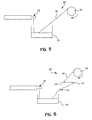
- Fig. 5 is an illustration of a water-quenched, direct threaded configuration of the process of the invention; and
- Fig. 6 is an illustration of a water-quenched, threaded wind-up configuration of the process of the invention.
- Within the context of this specification, each term or phrase below will include the following meaning or meanings.
- " Elastomeric" refers to a material or composite which can be elongated by at least 50 percent of its relaxed length and which will recover, upon release of the applied force, at least 40 percent of its elongation. It is generally preferred that the elastomeric material or composite be capable of being elongated by at least 100 percent, more preferably by at least 300 percent, of its relaxed length and recover, upon release of an applied force, at least 50 percent of its elongation.
- "Meltblown fiber" means fibers formed by extruding a molten thermoplastic material through a plurality of fine, usually circular, die capillaries as molten threads or filaments into converging high velocity heated gas (e.g., air) streams which attenuate the filaments of molten thermoplastic material to reduce their diameter, which may be to microfiber diameter. Thereafter, the meltblown fibers are carried by the high velocity gas stream and are deposited on a collecting surface to form a web of randomly dispersed meltblown fibers. Such a process is disclosed for example, in U.S. Patent 3,849,241 to Butin et al. Meltblown fibers are microfibers which may be continuous or discontinuous, are generally smaller than about 0.6 denier, and are generally self bonding when deposited onto a collecting surface. Meltblown fibers used in the present invention are preferably substantially continuous in length.
- "Polymers" include, but are not limited to, homopolymers, copolymers, such as for example, block, graft, random and alternating copolymers, terpolymers, etc. and blends and modifications thereof. Furthermore, unless otherwise specifically limited, the term "polymer" shall include all possible geometrical configurations of the material. These configurations include, but are not limited to isotactic, syndiotactic and atactic symmetries.
- "Spunbonded fiber" refers to small diameter fibers which are formed by extruding molten thermoplastic material as filaments from a plurality of fine capillaries of a spinnerette having a circular or other configuration, with the diameter of the extruded filaments then being rapidly reduced as by, for example, in U.S. Patent 4,340,563 to Appel et al., and U.S. Patent 3,692,618 to Dorschner et al., U.S. Patent 3,802,817 to Matsuki et al., U.S. Patents 3,338,992 and 3,341,394 to Kinney, U.S. Patent 3,502,763 to Hartmann, U.S. Patent 3,502,538 to Petersen, and U.S. Patent 3,542,615 to Dobo et al.. Spunbond fibers are quenched and generally not tacky when they are deposited onto a collecting surface. Spunbond fibers are generally continuous and often have average deniers larger than about 0.3, more particularly, between about 0.6 and 10.
- "Thermoplastic" describes a material that softens when exposed to heat and which substantially returns to a nonsoftened condition when cooled to room temperature.
- These terms may be defined with additional language in the remaining portions of the specification.
- The textile fibers of the invention include strengthened polypropylene. "Polypropylene" refers to propylene homopolymers as well as copolymers containing up to about 10% by weight ethylene or a C4-C20 alpha-olefin comonomer. The polypropylene is strengthened by the addition of an impact modifier. The impact modifier constitutes about 1-25% by weight of the composite fibers, suitably about 2-15% by weight of the composite fibers, more suitably about 3-10% by weight of the composite fibers.
- As used herein, the term "impact modifier" refers to a synthetic material having elastomeric properties. The impact modifier is partially compatible with polypropylene. More particularly, the impact modifier disperses extremely well in propylene without dissolving. Examples of suitable impact modifiers include ethylene-propylene-diene-monomer (EPDM), styrene/ethylene-co-butadiene/styrene (SEBS), and styrene-poly(ethylene-propylene)-styrene-poly(ethylene-propylene) (SEPSEP). Other examples include diblock, triblock, tetrablock or other multi-block elastomeric copolymers such as olefinic copolymers, including styrene-isoprene-styrene, styrenebutadiene-styrene, or styrene-ethylene/propylene-styrene, which may be obtained from the Shell Chemical Company, under the trade designation KRATON® elastomeric resin; polyurethanes, including those available from E. I. Du Pont de Nemours Co., under the trade name LYCRA® polyurethane; polyamides, including polyether block amides available from Ato Chemical Company, under the trade name PEBAX® polyether block amide; polyesters, such as those available from E. I. Du Pont de Nemours Co., under the trade name HYTREL® polyester; single-site or metallocene-catalyzed polyolefins having density less than about 0.89 grams/cc, available from Dow Chemical Co. under the trade name AFFINITY®; and ethylene/styrene also available from Dow Chemical Co.
- A number of block copolymers can be used to prepare the impact modifiers useful in this invention. Such block copolymers generally comprise an elastomeric midblock portion B and a thermoplastic endblock portion A. The block copolymers may also be thermoplastic in the sense that they can be melted, formed, and resolidified several times with little or no change in physical properties (assuming a minimum of oxidative degradation).
- Endblock portion A may comprise a poly(vinylarene), such as polystyrene. Midblock portion B may comprise a substantially amorphous polyolefin such as polyisoprene, ethylene/propylene polymers, ethylene/butylene polymers, polybutadiene, and the like, or mixtures thereof.
- Suitable block copolymers useful in this invention include at least two substantially polystyrene endblock portions and at least one substantially ethylene/butylene mid-block portion. Commercially available examples of such a linear block copolymer includes the SEBS block copolymer, available from the Shell Chemical Company, under the trade designations KRATON® G1657, G1652, and G2760 elastomeric resins. Typical properties of KRATON® G1657 elastomeric resin are reported to include a tensile strength of 3400 pounds per square inch (2x10⁶ kilograms per square meter), a 300 percent modulus of 350 pounds per square inch (1.4x10⁵ kilograms per square meter), an elongation of 750 percent at break, a Shore A hardness of 65, and a Brookfield viscosity, when at a concentration of 25 weight percent in a toluene solution, of about 4200 centipoise at room temperature. Another suitable elastomer, KRATON® G2746, is a styrene butadiene block copolymer blended with tackifier and low density polyethylene.
- The polypropylene may be blended with the impact modifier using any suitable process, including processes presently used for forming polypropylene fibers. For instance, U.S. Patent 5,534,335, issued to Everhart, et al., describes a process for making fibers from thermoplastic polymers, such as polypropylene. In that process, the fibers are produced by meltblowing or spunbonding processes which are well known in the art. These processes generally use an extruder to supply melted polymer to a spinnerette, or meltblowing die, where the polymer is fiberized. The fibers can then be drawn, usually pneumatically, and deposited on a foraminous mat or belt to form a nonwoven fabric, for example. Fibers produced in the spunbond and meltblown processes are generally in the range of from about 1 to about 50 microns in diameter, depending on process conditions and the desired end use for the fabrics to be produced from such fibers.
- Referring to Figs. 1 and 2, an exemplary apparatus for forming textile fibers with strengthened polypropylene is generally represented by
reference numeral 10. In forming the fibers of the present invention, the fibers can be drawn either mechanically (Fig. 1) or pneumatically (Fig. 2). The pneumatic drawing method is explained below. - First of all, in the mechanical drawing method illustrated in Fig. 1,
polymer pellets 12 are accurately weighed and dry-mixed, thereby ensuring that a homogeneous mixture is fed to anextruder 14. Theextruder 14 is heated to about 180 degrees Celsius, and when all zones within theextruder 14 reach about 180 degrees Celsius, a 10-minute soak time is observed to insure that all polymer contained within theextruder 14 and die 16 from a previous run is completely melted. Theextruder 14 is then purged with polypropylene at about 32 RPM to remove any polymer remaining from the previous run. Prior to feeding the dry-mixed blend, tracer pellets are fed into theextruder 14. The dry-blended polymers are compounded immediately following the tracer pellets. When the color of the tracer appears and fades from theextrudate 20, additional tracer pellets are fed. When the second addition of tracer has faded, it is presumed that theextrudate 20 is the desired composition. During compounding, the RPM of theextruder 14 is maintained at about 32 RPM. In cases where gravimetric feed is used, afeed hopper 18 is maintained with sufficient polymer such that a constant feed rate is maintained, as determined by the size of the materials fed. - Once the polymer pellets are blended, the fibers are then produced. First, the motor speed is adjusted to about 5 RPM. Then, the
extrudate 20 is quenched and threaded according to the desired configuration, and attached to a wind-up roll 22. At this point, theextruder 14 is shut off and the fibers are drawn from the die 16 continuously. In order to produce fibers of the desired size, fibers are cut from theroll 22 and measured using a microscope equipped with an eyepiece reticle. Adjustments in take-off speed are made to produce the desired size fibers empirically. Once the correct speed is determined, fibers can be produced in two-minute intervals. Between intervals, theextruder 14 is operated at about 32 RPM for a period of about two minutes to insure that fibers produced do not have significant phase separation as a function of collection time. Four processing conditions can be employed to impart varying properties in the fibers, including combinations of two quenching and two threading conditions. Schematics of these four processing conditions are given in Figs. 3-6. - Two types of quenching are employed in this work, namely air-quenching (Figs. 3 and 4) and water-quenching (Figs. 5 and 6). Air-quenching is a process where the
fibers 30 are quenched in air without the aid of any fluid stream. Thefibers 30 are quenched in ambient air. Water quenching is achieved by threading thefiber 30 through awater bath 24. The process of water quenching provides a much faster quench than air due to the greater thermal energy flux present. - Two types of threading conditions are employed in this work, namely a direct threaded system 26 (Figs. 3 and 5) and a threaded wind-up system 28 (Figs. 4 and 6). In the direct threaded
system 26,fibers 30 are drawn from the extruder die 32, through whichever quenching medium is used, and wound directly around the wind-up roll 34, which provides the RPM necessary to maintain the desired fiber diameter. In the threaded wind-up system 28, thefiber 30 is once again drawn from the extruder die 32 through the quenching medium. At this point thefiber 30 is threaded around several support rolls 36 in a take-off unit before being wound on the wind-up roll 34. - In the pneumatic drawing method, illustrated in Fig. 2, the
materials 38 to be blended are dry-mixed at the desired ratio. Thesematerials 38 are added to afeed hopper 40 with variable feed rate control, maintained at about 2.5·10-3 kg/s (20 lb/hr). A co-rotating 27 mm twin screw extruder with a length/diameter ratio of 40:1 at 200 RPM is an example of asuitable extruder 42 that can be used, with a flat temperature profile at about 210 degrees Celsius. A ventingport 44 can be used to remove volatile gases. - Following compounding, the melt blended
materials 46 are transported to aplate 48 withmultiple orifices 50 through whichfibers 52 are drawn. Theplate 48 or "spin pack" and surrounding materials are maintained at desired temperatures ranging between about 210 and 250 degrees Celsius. One example of a suitable spin pack includes a spin pack having 310 holes at a density of 50 holes/(2.5 cm)2 (holes/inch2). The holes are suitably about 1.5 cm (0.6 inches) in diameter and have a length/diameter ratio of about 6:1. Thefibers 52 can be drawn using high velocity air at pressures ranging from 13.8 - 138 kPa (2-20 (psi)) using a Fiber Drawing Unit (FDU) 54. Between thespin pack 48 andFDU 54, a length of about 1.2 m (48 inches) can exist. In the upper portions of the spin length, quenchboxes 56 can be used to cool the polymer more rapidly at velocity rates between 0 and 84 cm/min (0 and 280 (ft/min)). - As a result of combining the impact modifier with the polypropylene, the textile fibers have improved fabric softness, increased strength, and/or elongation at break at identical throughput levels compared to polypropylene homopolymer fibers, as shown in the Example below.
- Stabilized textile fibers were prepared from Escorene 3155 polypropylene (obtained from Exxon). A second set of stabilized textile fibers was prepared from 3% Buna 2070 EPDM (obtained from Bayer) blended with 97% Escorene 3155 polypropylene. The EPDM and polypropylene were combined and drawn using the preferred process described above with respect to Fig. 1. Both sets of fibers were successfully drawn between 0.4 grams/hole/minute and 0.6 grams/hole/minute at a range of temperature from 230 degrees Celsius to 250 degrees Celsius, although there is no apparent restriction on throughput or temperature for the fibers of the invention. The drawing pressure used in the fiber drawing unit allowed fibers to be drawn at pressures up to and above 103 kPa (15 psi). Other specifics include the use of a 310 hole pack at 128 holes/2.5 cm (holes/inch) with hole diameters of 0.6 mm. Both of the sets of fibers were tested for tensile strength, elongation at break, and diameter under varying temperatures, draw pressures, and quenching conditions. The data extracted from these tests are shown in Table 1 below.
Table 1: Polypropylene Fibers Versus Polypropylene Fibers Blended With EPDM Sample Composition Temp (°C) Draw Pressure (psi) Quench Tensile Strength (Mpa) Elongation at Break (%) Diameter (microns) 1a 100% PP 230 8 Off 135.38 212.79 20.51 1b 100% PP 230 8 0.4 in H2O 128.34 289.80 25.71 2a 100% PP 230 15 Off 123.86 180.80 16.85 2b 100% PP 230 15 0.4 in H2O 130.65 196.10 14.93 3a 100% PP 250 8 Off 198.42 179.86 13.70 3b 100% PP 250 8 0.4 in H2O 124.29 165.87 17.16 4a 100% PP 250 15 Off 192.35 146.05 12.71 4b 100% PP 250 15 0.4 in H2O 237.42 109.03 11.78 5a 97% PP / 3% Buna 2070 250 8 Off 159.96 209.66 15.91 5b 97% PP/ 3% Buna 2070 250 8 0.4 in H2O 219.80 136.13 15.06 6a 97% PP/ 3% Buna 2070 250 15 Off 219.54 119.39 13.94 6b 97% PP/ 3% Buna 2070 250 15 0.4 in H2O 274.86 143.68 11.03 7a 97% PP/ 3% Buna 2070 230 8 Off 221.30 181.17 13.24 7b 97% PP/ 3% Buna 2070 230 8 0.4 in H2O 132.79 288.16 18.58 8a 97% PP/ 3% Buna 2070 230 15 Off 141.08 220.36 19.66 8b 97% PP/ 3% Buna 2070 230 15 0.4 in H2O 140.95 152.08 18.39 - As can be seen in Table 1, the composite EPDM/PP fibers had an average increase in strength of 19% and decrease in size of 6% observed across the entire range of variables tested. Comparisons of individual treatments comparing 3% Buna in polypropylene to polypropylene homopolymer at identical processing conditions show as much as a 63% increase in strength, a 32% increase in elongation at break, and a reduction in size of 35%. In addition, it is possible to simultaneously improve all three responses at certain treatment combinations.
- More textile fibers of Escorene 3155 polypropylene and combinations of polypropylene and Buna 2070 EPDM were formed and tested under various conditions, as shown in Table 2. Included in Table 2 is comparison data showing the differences between the polypropylene fibers and the blended fibers. Cup crush load data and cup crush energy data were obtained according to the procedure described below. Drape data was obtained according to the procedure in ASTM D1388. Elmendorf tear data was obtained according to the procedure in ASTM D1424-83. Denier data was obtained by measuring the fiber diameter and calculating cross-sectional area, then using the density of the fiber, the mass in grams/8.2 km (grams/9000 yards) of filament was calculated. Trap tear data was obtained according to the procedure in ASTM D1117-14. Grab data was obtained according to the procedure in ASTM D5034-90.
Table 2: Polypropylene Fibers Versus Polypropylene Fibers Blended With EPDM Testing Info 100% PP @ 285°C (Control) 99% PP, 1% EPDM @ 285°C vs. Control 97% PP, 3% EPDM @ 286°C vs. Control 95% PP, 5% EPDM @ 285°C vs. Control Basis Weight (oz/yard2) ave 0.99 0.93 1.02 1.00 stdev 0.04 0.04 0.02 0.03 Cup Crush Load (g/oz) ave 109.94 100.66 -8% 82.71 -25% 89.21 -19% stdev 1.69 3.20 3.38 3.46 Cup Crush Energy (g/mm/ oz) ave 2147.47 1954.23 -9% 1579.08 -26% 1642.65 -24% stdev 144.50 243.80 107.60 184.11 Drape CD (cm/oz) ave 3.00 2.92 -3% 2.39 -20% 2.92 -3% stdev 0.46 0.35 0.31 0.32 Drape MD (cm/oz) ave 3.81 4.18 10% 3.63 -5% 3.67 -4% stdev 0.35 0.78 0.41 0.22 Elmendorf Tear CD (cN/oz) ave 732.22 839.34 15% 684.28 -7% 769.36 5% stdev 92.60 133.36 95:25 210.80 Elmendorf Tear MD (cN/oz) ave 802.83 840.20 5% 835.84 4% 700.27 -13% stdev 93.50 79.78 205.90 121.40 Size (microns) ave 20.60 20.86 1% 21.30 3% 20.55 0% stdev 0.90 1.69 1.94 1.30 Denier ave 2.70 2.79 3% 2.92 8% 2.70 0% stdev 0.24 0.44 0.52 0.35 Trap Tear MD (lb/oz) ave 5.60 6.68 19% 6.26 12% 6.76 21% stdev 0.38 0.66 1.06 0.40 Trap Tear CD (lb/oz) ave 3.83 3.65 -5% 3.97 4% 4.19 9% stdev 0.45 0.45 0.50 0.54 Grab Load MD (lb/oz) ave 11.75 14.66 25% 12.58 7% 13.83 18% stdev 0.76 0.98 1.70 0.99 Grab Strain MD (%) ave 50.60 51.22 1% 62.89 24% 69.66 38% stdev 7.13 3.71 8.47 6.20 Grab Energy MD (in-lb/oz) ave 11.24 13.47 20% 14.24 27% 17.29 54% stdev 2.14 1.42 3.78 2.77 Grab Load CD (lb/oz) ave 9.37 9.57 2% 9.56 2% 10.65 14% stdev 0.78 1.50 0.88 0.94 Grab Strain CD (%) ave 71.40 76.22 7% 84.37 18% 94.94 33% stdev 6.17 9.81 10.74 9.48 Grab Energy ave 11.87 12.87 8% 13.80 16% 17.27 45% CD (in-lb/oz) stdev 1.69 3.20 3.38 3.46 - Each of the four types of textile fibers shown in Table 2 were also tested for tensile strength, according to the procedure in ASTM D3822, in both the cross direction (CD) and the machine direction (MD). Tensile strength at various points of elongation in the CD is shown in Table 3 and tensile strength at the same points of elongation in the MD is shown in Table 4.
Table 3: CD Tensile Strength of Polypropylene Fibers and Blended Polypropylene Fibers As a Function of Elongation (lb/oz) EPDM (%) 1% Elongation 3% Elongation 5 % Elongation 10 % Elongation 20 % Elongation 50% Elongation 100% Elongation 0.0 0.0965 0.3446 0.7816 1.5965 3.1959 8.0493 6.9713 1.0 0.0542 0.2943 0.6973 1.3788 2.7596 7.1054 7.2831 3.0 0.054 0.2197 0.5435 1.1916 2.4955 6.8867 8.7574 5.0 0.0611 0.2777 0.6473 1.2945 2.5423 6.7066 10.3377 Table 4: MD Tensile Strength of Polypropylene Fibers and Blended Polypropylene Fibers As a Function of Elongation (lb/oz) EPDM (%) 1% Elongation 3% Elongation 5 % Elongation 10 % Elongation 20 % Elongation 50% Elongation 100% Elongation 0.0 0.3794 1.6074 2.3712 3.8674 6.5002 11.2802 6.3924 1.0 0.2184 1.528 2.4407 4.134 7.0292 13.2559 7.3538 3.0 0.0959 0.8212 1.8397 3.2335 5.4818 11.2843 8.5314 5.0 0.1145 0.8881 1.95 3.3787 5.6081 11.4179 9.1861 - In addition to the data shown in Table 2, further cup crush energy data, obtained using the same procedure mentioned above with various levels of EPDM and various melt temperatures, is shown in Table 5.
Table 5: Cup Crush Energy Data of Polypropylene Fibers and Blended Polypropylene Fibers EPDM (%) Melt Temp (°F) Cup Crush Energy ave (g/mm/oz) std deviation % change 0.00 (control) 460 2603 345.74 -- 0.59 446 2630 191.55 1.0% 0.59 474 2830 180.32 8.7% 2.00 480 2451 186.45 -5.9% 2.00 460 2281 283.83 -12.4% 2.00 440 2549 139.02 -2.1 % 3.41 446 2007 163.59 -22.9% 3.41 474 1825 283.15 -29.9% 4.00 460 2080 126.59 -20.1% 2.00 460 1927 237.93 -26.0% - In addition to the data shown in Table 2, further cup crush load data, obtained using the same procedure mentioned above with various levels of EPDM and various melt temperatures, is shown in Table 6.
Table 6: Cup Crush Load Data of Polypropylene Fibers and Blended Polypropylene Fibers EPDM (%) Melt Temp (°F) Cup Crush Load ave (g/oz) std deviation % change 0.00 (control) 460 149 19.09 -- 0.59 446 138 9.41 -7.6% 0.59 474 146 7.98 -1.9% 2.00 480 133 12.91 -10.5% 2.00 460 122 15.53 -18.3% 2.00 440 134 9.20 -10.3% 3.41 446 112 7.86 -24.7% 3.41 474 104 14.95 -30.0% 4.00 460 115 13.25 -22.6% 2.00 460 104 11.88 -30.1% - In addition to the data shown in Table 2, further Elmendorf tear data, obtained using the same procedure mentioned above with various levels of EPDM and various melt temperatures, is shown in Table 7 (MD) and in Table 8 (CD).
Table 7: MD Elmendorf Tear Data of Polypropylene Fibers and Blended Polypropylene Fibers EPDM (%) Melt Temp (°F) Elmendorf Tear (MD) ave (cN/oz) std deviation % change 0.00 (control) 460 633 146.45 -- 0.59 446 554 76.20 -12.5% 0.59 474 532 121.58 -16.0% 2.00 480 667 138.50 5.3% 2.00 460 510 101.36 -19.4% 2.00 440 570 131.78 -10.0% 3.41 446 628 49.34 -0.7% 3.41 474 712 115.28 12.5% 4.00 460 654 83.00 3.3% 2.00 460 519 110.93 -18.1% Table 8: CD Elmendorf Tear Data of Polypropylene Fibers and Blended Polypropylene Fibers EPDM(%) Melt Temp (°F) Elmendorf Tear (CD) ave (cN/oz) std deviation % change 0.00 (control) 460 743 219.34 -- 0.59 446 696 191.64 -6.3% 0.59 474 589 73.28 -20.8% 2.00 480 557 95.33 -25.1 % 2.00 460 734 262.82 -1.2% 2.00 440 691 245.94 -7.0% 3.41 446 728 238.83 -2.1% 3.41 474 782 5.2% 4.00 460 662 244.59 -11.0% 2.00 460 624 166.05 -16.0% - In addition to the data shown in Table 2, further trap tear data, obtained using the same procedure mentioned above with various levels of EPDM and various melt temperatures, is shown in Table 9 (CD) and in Table 10 (MD).
Table 9: CD Trap Tear Data of Polypropylene Fibers and Blended Polypropylene Fibers EPDM (%) Melt Temp (°F) Trap Tear (CD) ave (lb/oz) std deviation % change 0.00 (control) 460 4.88 0.36 -- 0.59 446 5.13 0.33 5.2% 0.59 474 4.52 0.61 -7.3% 2.00 480 4.80 0.52 -1.7% 2.00 460 4.59 0.44 -6.0% 2.00 440 5.74 0.75 17.6% 3.41 446 5.24 0.41 7.4% 3.41 474 5.20 0.60 6.5% 4.00 460 5.02 0.38 3.0% 2.00 460 4.22 0.46 -13.4% Table 10: MD Trap Tear Data of Polypropylene Fibers and Blended Polypropylene Fibers EPDM (%) Melt Temp (°F) Trap Tear (MD) ave (lb/oz) std deviation % change 0.00 (control) 460 6.98 0.36 -- 0.59 446 6.75 0.68 -3.4% 0.59 474 7.41 0.79 6.1 % 2.00 480 7.99 0.74 14.5% 2.00 460 7.96 1.01 14.0% 2.00 440 8.64 0.87 23.7% 3.41 446 8.78 0.92 25.7% 3.41 474 7.44 1.22 6.6% 4.00 460 8.31 1.46 19.0% 2.00 460 7.18 0.69 2.9% - In addition to the data shown in Table 2, further grab load data, obtained using the same procedure mentioned above with various levels of EPDM and various melt temperatures, is shown in Table 11 (CD) and in Table 12 (MD).
Table 11: CD Grab Load Data of Polypropylene Fibers and Blended Polypropylene Fibers EPDM (%) Melt Temp (°F) Grab Load (CD) ave (lb/oz) std deviation % change 0.00 (control) 460 11.35 0.67 -- 0.59 446 10.70 0.45 -5.8% 0.59 474 10.52 0.62 -7.3% 2.00 480 10.61 1.09 -6.5% 2.00 460 10.49 1.02 -7.6% 2.00 440 11.68 0.72 2.9% 3.41 446 11.39 0.87 0.3% 3.41 474 10.63 1.54 -6.4% 4.00 460 11.23 0.61 -1.1% 2.00 460 10.40 0.69 -8.4% Table 12: MD Grab Load Data of Polypropylene Fibers and Blended Polypropylene Fibers EPDM (%) Melt Temp (°F) Grab Load (MD) ave (lb/oz) std deviation % change 0.00 (control) 460 17.58 0.93 -- 0.59 446 15.76 0.97 -10.3% 0.59 474 16.69 1.21 -5.1% 2.00 480 17.67 1.32 0.5% 2.00 460 17.28 1.56 -1.7% 2.00 440 17.71 1.08 0.8% 3.41 446 17.35 0.93 -1.3% 3.41 474 16.81 1.27 -4.4% 4.00 460 16.76 1.17 -4.7% 2.00 460 15.17 1.58 -13.7% - In addition to the data shown in Table 2, further grab strain data, obtained using the same procedure mentioned above with various levels of EPDM and various melt temperatures, is shown in Table 13 (CD) and in Table 14 (MD).
Table 13: CD Grab Strain Data of Polypropylene Fibers and Blended Polypropylene Fibers EPDM (%) Melt Temp (°F) Grab Strain (CD) ave (%) std deviation % change 0.00 (control) 460 73.4 7.77 -- 0.59 446 79.1 7.40 7.7% 0.59 474 74.3 7.82 1.3% 2.00 480 82.7 9.21 12.6% 2.00 460 79.3 8.15 8.0% 2.00 440 89.0 10.08 21.2% 3.41 446 102.4 10.83 39.5% 3.41 474 94.3 12.44 28.4% 4.00 460 96.7 8.53 31.8% 2.00 460 95.3 9.39 29.8% Table 14: MD Grab Strain Data of Polypropylene Fibers and Blended Polypropylene Fibers EPDM (%) Melt Temp (°F) Grab Strain (MD) ave (%) std deviation % change 0.00 (control) 460 55.57 3.87 -- 0.59 446 54.68 4.42 -1.6% 0.59 474 50.38 6.48 -9.3% 2.00 480 57.10 5.35 2.8% 2.00 460 58.21 3.29 4.8% 2.00 440 61.06 5.40 9.9% 3.41 446 66.51 7.09 19.7% 3.41 474 66.37 6.33 19.4% 4.00 460 61.26 3.04 10.2% 2.00 460 58.83 3.60 5.9% - In addition to the data shown in Table 2, further grab energy data, obtained using the same procedure mentioned above with various levels of EPDM and various melt temperatures, is shown in Table 15 (CD) and in Table 16 (MD).
Table 15: CD Grab Energy Data of Polypropylene Fibers and Blended Polypropylene Fibers EPDM (%) Melt Temp (°F) Grab Energy (CD) ave (in-lb/oz) std deviation % change 0.00 (control) 460 14.67 2.19 -- 0.59 446 14.58 2.33 -0.6% 0.59 474 13.87 2.13 -5.4% 2.00 480 15.20 2.88 3.6% 2.00 460 14.11 3.13 -3.8% 2.00 440 17.98 3.54 22.5% 3.41 446 20.38 3.87 38.9% 3.41 474 17.19 4.81 17.2% 4.00 460 18.30 2.04 24.8% 2.00 460 17.04 3.15 16.2% Table 16: MD Grab Energy Data of Polypropylene Fibers and Blended Polypropylene Fibers EPDM (%) Melt Temp (°F) Grab Energy (MD) ave (in-lb/oz) std deviation % change 0.00 (control) 460 18.46 1.99 -- 0.59 446 16.08 1.93 -12.9% 0.59 474 16.04 3.24 -13.1% 2.00 480 18.97 2.54 2.8% 2.00 460 18.76 1.40 1.6% 2.00 440 20.40 2.82 10.5% 3.41 446 21.03 3.03 13.9% 3.41 474 20.31 3.25 10.0% 4.00 460 18.89 2.09 2.3% 2.00 460 16.36 2.49 -11.4% - In addition to the data shown in Table 2, further denier data, obtained using the same procedure mentioned above with various levels of EPDM and various melt temperatures, is shown in Table 17.
Table 17: Denier Data of Polypropylene Fibers and Blended Polypropylene Fibers EPDM (%) Melt Temp (°F) average std deviation % change 0.00 (control) 460 2.67 0.40 -- 0.59 446 2.85 0.25 6.7% 0.59 474 2.66 0.28 -0.5% 2.00 480 2.60 0.39 -2.5% 2.00 460 2.44 0.18 -8.4% 2.00 440 2.65 0.22 -0.7% 3.41 446 2.61 0.22 -2.3% 3.41 474 2.79 0.51 4.4% 4.00 460 2.41 0.22 -9.9% 2.00 460 2.30 0.21 -13.8% - The processability of this particular blend is quite good relative to other copolymer/polypropylene blends previously tested, due to a lack of melt elasticity in the EPDM/PP fibers. The presence of melt elasticity leads to a phenomena commonly referred to as "roping" wherein fiber breaks below the pack snap back toward the pack, thereby entangling additional fibers. The lack of "roping" allows these EPDM/PP fibers to be processed in existing equipment. The EPDM/PP fibers achieve a plasticizing effect that allows the polypropylene chains to slip more easily. The result is a more highly aligned structure that hinders the kinetic driving force toward chain entanglement at the molecular level.
- Additional stabilized textile fibers were prepared from Escorene 3155 polypropylene, and from a combination of KRATON® 2760 blended with Escorene 3155 polypropylene. The KRATON® 2760 and polypropylene were combined using the preferred process described above with respect to Fig. 1. Both the polypropylene fibers and the blended fibers were successfully drawn between 0.4 grams/hole/minute and 0.6 grams/hole/minute at a range of temperature from 230 degrees Celsius to 250 degrees Celsius, although there is no apparent restriction on throughput or temperature for the fibers of the invention. The drawing pressure used in the fiber drawing unit allowed fibers to be drawn at pressures up to and above 103 kPa (15 psi). Other specifics include the use of a 310 hole pack at 128 holes/2.5 cm (28 holes/inch) with hole diameters of 0.6 mm. Each of the fibers were tested for tear strength, peak load, energy, and strain, according to the procedures referenced above. The compositions of the fibers tested are shown in Table 18. The data extracted from these tests is shown in Table 19.
Table 18: Composition of Polypropylene Fibers and Blended Polypropylene Fibers Tested Sample Composition Bond Temp (°F) Basis Weight (oz/yd2) 1a 100% PP 285 0.479 2a 99% PP / 1% KRATON® 2760 284 0.469 3a 98% PP / 2% KRATON® 2760 284 0.449 1b 100% PP 303 0.504 2b 99% PP / 1% KRATON® 2760 296 0.483 3b 98% PP / 2% KRATON® 2760 302 0.442 1c 100% PP 280 1.029 2c 99% PP / 1% KRATON® 2760 284 0.987 3c 98% PP / 2% KRATON® 2760 280 0.911 1d 100% PP 300 1.047 2d 99% PP / 1% KRATON® 2760 296 1.014 3d 98% PP / 2% KRATON® 2760 300 0.978 Table 19: Polypropylene Fibers Versus Polypropylene Fibers Blended With KRATON® 2760 Sample Tear CD (lb/oz) Tear MD (lb/oz) Peak Load CD (lb/oz) Peak Load MD (lb/oz) Energy CD (in-lb/oz) Energy MD (in-lb/oz) Strain CD (%) Strain MD (%) 1a 849.5 1003 3.9 8.39 3.20 7.89 3.90 78.97 2a 1317.2 1332 2.48 6.33 1.02 3.11 2.48 50.96 3a 779.8 890 3.97 7.17 3.36 6.09 3.97 81.29 1b 440.7 701 4.86 10.14 4.43 9.51 4.86 79.29 2b 469.5 817 5.83 9.76 5.24 8.90 5.43 84.91 3b 401.2 469 4.59 7.09 3.54 4.42 4.59 59.96 1c 543.9 848 3.68 7.65 2.36 4.90 3.68 31.62 2c 1021.8 1135 3.85 6.10 2.77 3.02 3.85 29.04 3c 520.8 600 5.63 8.88 6.23 10.73 5.63 58.11 1d 538.6 642 5.75 9.65 6.60 9.19 5.75 43.64 2d 633.4 827 5.66 10.57 5.97 10.36 5.66 44.48 3d 341.9 542 6.14 8.56 7.30 9.97 6.14 54.38 - In addition to the data shown in Table 19, Elmendorf tear data, obtained using the same procedure mentioned above with various levels of KRATON® 2760 and various bond temperatures, is shown in Table 20.
Table 20: Elmendorf Tear Data of Polypropylene Fibers and Blended Polypropylene Fibers KRATON® 2760 (%) Bond Temp (°F) Elmendorf Tear CD ave (cN/oz) std deviation MD ave (cN/oz) std deviation 0.0 302 320 56.629 692.8 58.62 0.74 315 287.6 48.7 401 27.6 0.74 304 440.2 75.75 721 80.98 0.74 283 509.9 74.44 739.1 37.1 1.11 307 336.4 40.66 521.4 30.21 1.11 293 393.5 38.88 600.3 133.19 1.11 281 445.2 55.33 741.1 23.5 1.48 283 352.7 57.28 654.5 110.6 - In addition to the data shown in Table 19, Grab tensile data, obtained using the same procedures mentioned above with various levels of KRATON® 2760 and various bond temperatures, is shown in Table 21 (MD) and in Table 22 (CD).
Table 21: MD Grab Tensile Data of Polypropylene Fibers and Blended Polypropylene Fibers KRATON® 2760(%) Bond Temp (°F) MD Peak Load MD Peak Strain MD Peak Energy ave (lb/oz) std deviation ave (%) std deviation ave (in-lb/oz) std deviation 0 302 19.44 1.44 46.78 4.84 16.75 2.89 10 315 19.17 2.16 42.52 5.88 15.3 3.52 10 304 21.47 2.17 53.2 5.89 20.82 3.99 10 283 17.63 0.98 46.4 2.62 14.46 1.43 15 307 20.41 1.92 46.67 4.5 17.44 2.99 15 293 19.76 1.63 47.77 3.77 17.03 2.71 15 281 18.65 1.08 48.55 3.83 16.31 2.09 20 283 20.23 0.92 53.04 3.68 19.14 2.18 Table 22: CD Grab Tensile Data of Polypropylene Fibers and Blended Polypropylene Fibers KRATON® 2760 (%) Bond Temp (°F) CD Peak Load CD Peak Strain CD Peak Energy ave (lb/oz) std deviation ave (%) std deviation ave (in-lb/oz) std deviation 0 302 14.74 2.17 58.2 11.61 14.46 4.58 10 315 16.04 1.96 58.37 9.54 15.97 4.6 10 304 16.85 1.22 62.9 3.88 17.67 2.13 10 283 14.01 0.89 60.88 5.51 14.19 2.14 15 307 17.1 1.75 69.78 7.18 20.31 4.22 15 293 15.46 1.64 62.15 8.32 16.1 4.04 15 281 14.33 1.12 62.98 5.7 15.19 2.31 20 283 14.19 2.39 63.24 9.83 15.18 4.46 - In addition to the data shown in Table 19, grab tensile data, obtained using the procedure in ASTM D5034-95 with various levels of KRATON® 2760 and various bond temperatures, is shown in Table 23 (MD) and in Table 24 (CD).
Table 23: MD Grab Tensile Data of Polypropylene Fibers and Blended Polypropylene Fibers KRATON® 2760 (%) Bond Temp (°F) MD Peak Load MD Peak Strain MD Peak Energy ave (lb/oz) std deviation ave (%) std deviation ave (in-lb/oz) std deviation 0 302 8.1 0.49 54.56 6.01 9.27 1.38 10 315 8.11 0.89 48.97 10.77 8.55 2.78 10 304 8.33 0.48 65.85 7.88 11.69 2.01 10 283 7.99 0.37 55.82 4.37 9.18 1.14 15 307 8.4 0.73 50.9 4.37 8.96 1.46 15 293 8.92 0.6 61.83 5.43 11.44 1.57 15 281 8.27 0.36 59.88 5.01 10.23 1.45 20 283 8.19 0.67 64.07 9.32 11.08 2.23 Table 24: CD Grab Tensile Data of Polypropylene Fibers and Blended Polypropylene Fibers KRATON® 2760 (%) Bond Temp (°F) CD Peak Load CD Peak Strain CD Peak Energy ave (lb/oz) std deviation ave (%) std deviation ave (in-lb/oz) std deviation 0 302 4.94 0.63 57.25 13.48 5.59 2.08 10 315 5.1 0.73 52.55 8.47 5.26 1.73 10 304 5.68 0.55 65.76 8.85 7.24 1.65 10 283 4.66 0.37 57.29 7 5.15 1.06 15 307 5.13 0.76 51.94 9.4 5.3 1.66 15 293 4.89 0.83 61.29 9.59 5.82 1.75 15 281 4.54 0.49 54.93 8.29 4.81 1.16 20 283 4.95 0.72 61.08 7.6 5.9 1.55 - The textile fibers of the invention can be incorporated into disposable absorbent articles. Examples of such suitable articles include diapers, training pants, feminine hygiene products, incontinence products, other personal care or health care garments, including medical garments, or the like.
- The cup crush test is used to measure the softness of a material by using the peak load and energy units from a constant-rate-of-extension tensile testing machine. The lower the peak load value, the softer the material.
- This test procedure was conducted in a controlled environment wherein the temperature was about 73 °F and the relative humidity was about 50%. Samples were tested using a Sintech System 2 Computer Integrated Testing System available from Sintech Corp., having offices in Cary, N.C., and a Cup Crush Test Stand available from Kimberly-Clark Corporation Quality Assurance Department in Neenah, Wisocinsin, which included a model 11 foot, a model 31 steel ring, a base plate, a model 41 cup assembly, and a calibration set.
- The steel ring was placed over the forming cylinder and a 9-inch by 9-inch (22.9-cm by 22.9-cm) sample was centered over the forming cylinder. The forming cup was slid over the forming cylinder until the sample was pinched between the forming cylinder and the steel ring all the way around the steel ring. The forming cup was placed on top of the base plate of the load cell and firmly seated over the ridge of the base plate. The foot was mechanically lowered into the forming cup with the crosshead speed set at 400 millimeters/minute, crushing the sample while the constant-rate-of-extension tensile testing machine measured the peak load in grams and the energy in gram-mm needed to crush the sample.
- It will be appreciated that details of the foregoing embodiments, given for purposes of illustration, are not to be construed as limiting the scope of this invention. Although only a few exemplary embodiments of this invention have been described in detail above, those skilled in the art will readily appreciate that many modifications are possible in the exemplary embodiments without materially departing from the novel teachings and advantages of this invention. Accordingly, all such modifications are intended to be included within the scope of this invention, which is defined in the following claims and all equivalents thereto. Further, it is recognized that many embodiments may be conceived that do not achieve all of the advantages of some embodiments, particularly of the preferred embodiments, yet the absence of a particular advantage shall not be construed to necessarily mean that such an embodiment is outside the scope of the present invention.
Claims (9)
- A strengthened polypropylene textile fiber, wherein the polypropylene is selected from the group consisting of propylene homopolymers, copolymers containing up to 10% by weight ethylene, and C4-C20 alpha-olefin comonomers, and wherein the polypropylene textile fiber is strengthened by a 1-25 % by weight impact modifier of ethylene-propylene-diene-monomer that has elastomeric properties such that it can be elongated by at least 50 % of its relaxed length by an applied force and that it will recover upon release of the applied force at least 40 % of its elongation.
- A spunbond fiber comprising the textile fiber of claim 1.
- A staple fiber comprising the textile fiber of claim 1.
- A multi-fiber yam comprising the textile fiber of claim 1.
- A knit fabric comprising the textile fiber of claim 1.
- A woven fabric comprising the textile fiber of claim 1.
- A nonwoven fabric comprising the textile fiber of claim 1.
- An absorbent article comprising the nonwoven fabric of claim 7.
- The textile fiber of claim 1, wherein the propylene textile fiber is strengthened by 2 - 15 % by weight of the impact modifier.
Applications Claiming Priority (5)
| Application Number | Priority Date | Filing Date | Title |
|---|---|---|---|
| US24365600P | 2000-10-27 | 2000-10-27 | |
| US243656P | 2000-10-27 | ||
| US09/967,218 US20020099107A1 (en) | 2000-10-27 | 2001-09-28 | Textile fibers made from strengthened polypropylene |
| US967218 | 2001-09-28 | ||
| PCT/US2001/046341 WO2002057522A1 (en) | 2000-10-27 | 2001-10-26 | Textile fibers made from strengthened polypropylene |
Publications (2)
| Publication Number | Publication Date |
|---|---|
| EP1328669A1 EP1328669A1 (en) | 2003-07-23 |
| EP1328669B1 true EP1328669B1 (en) | 2007-01-24 |
Family
ID=26935995
Family Applications (1)
| Application Number | Title | Priority Date | Filing Date |
|---|---|---|---|
| EP01994152A Expired - Lifetime EP1328669B1 (en) | 2000-10-27 | 2001-10-26 | Textile fibers made from strengthened polypropylene |
Country Status (11)
| Country | Link |
|---|---|
| US (1) | US20020099107A1 (en) |
| EP (1) | EP1328669B1 (en) |
| JP (1) | JP2004518035A (en) |
| KR (1) | KR20030061380A (en) |
| CN (1) | CN1245540C (en) |
| AR (1) | AR031054A1 (en) |
| AU (1) | AU2002246579B2 (en) |
| BR (1) | BR0114947A (en) |
| DE (1) | DE60126304T2 (en) |
| MX (1) | MXPA03003154A (en) |
| WO (1) | WO2002057522A1 (en) |
Families Citing this family (11)
| Publication number | Priority date | Publication date | Assignee | Title |
|---|---|---|---|---|
| US7271209B2 (en) | 2002-08-12 | 2007-09-18 | Exxonmobil Chemical Patents Inc. | Fibers and nonwovens from plasticized polyolefin compositions |
| US8389615B2 (en) * | 2004-12-17 | 2013-03-05 | Exxonmobil Chemical Patents Inc. | Elastomeric compositions comprising vinylaromatic block copolymer, polypropylene, plastomer, and low molecular weight polyolefin |
| WO2009076990A1 (en) * | 2007-12-14 | 2009-06-25 | Balta Industries Nv | Process for the preparation of synthetic fibres for yarns with increased dyeability |
| US9481962B2 (en) * | 2008-02-11 | 2016-11-01 | Veyance Technologies, Inc. | Method for treating textile material for use in reinforced elastomeric articles |
| EP2807293A1 (en) * | 2013-01-22 | 2014-12-03 | Total Research & Technology Feluy | High-tenacity drawn fibers of a polypropylene composition with improved elongational properties and nonwovens |
| MX340158B (en) * | 2013-05-02 | 2016-06-28 | Gabriel C Damian | Sanitary towels for women and urinary incontinence, gauze/bandages and surgical dressings for treating wounds, based on tourmaline. |
| CN103510270A (en) * | 2013-10-23 | 2014-01-15 | 吴江市万盟纺织有限公司 | Corrosion-resistant polypropylene fiber fabric |
| WO2017143167A1 (en) | 2016-02-19 | 2017-08-24 | Teknor Apex Company | Fiber forming compositions, fibers and methods for production |
| JP7082580B2 (en) * | 2016-06-30 | 2022-06-08 | クレイトン・ポリマーズ・ユー・エス・エル・エル・シー | High-performance vinyl block copolymer composition with improved performance and its use |
| CN114703558A (en) * | 2022-04-26 | 2022-07-05 | 宁波中聚新材料有限公司 | A kind of impact energy absorbing fiber and its preparation method and application |
| WO2025177860A1 (en) * | 2024-02-19 | 2025-08-28 | 東レ株式会社 | Nonwoven fabric and method for manufacturing same |
Family Cites Families (36)
| Publication number | Priority date | Publication date | Assignee | Title |
|---|---|---|---|---|
| US3338992A (en) * | 1959-12-15 | 1967-08-29 | Du Pont | Process for forming non-woven filamentary structures from fiber-forming synthetic organic polymers |
| US3502763A (en) * | 1962-02-03 | 1970-03-24 | Freudenberg Carl Kg | Process of producing non-woven fabric fleece |
| US3502538A (en) * | 1964-08-17 | 1970-03-24 | Du Pont | Bonded nonwoven sheets with a defined distribution of bond strengths |
| US3341394A (en) * | 1966-12-21 | 1967-09-12 | Du Pont | Sheets of randomly distributed continuous filaments |
| US3542615A (en) * | 1967-06-16 | 1970-11-24 | Monsanto Co | Process for producing a nylon non-woven fabric |
| US3849241A (en) * | 1968-12-23 | 1974-11-19 | Exxon Research Engineering Co | Non-woven mats by melt blowing |
| DE2048006B2 (en) * | 1969-10-01 | 1980-10-30 | Asahi Kasei Kogyo K.K., Osaka (Japan) | Method and device for producing a wide nonwoven web |
| DE1950669C3 (en) * | 1969-10-08 | 1982-05-13 | Metallgesellschaft Ag, 6000 Frankfurt | Process for the manufacture of nonwovens |
| US3868433A (en) * | 1972-04-03 | 1975-02-25 | Exxon Research Engineering Co | Thermoplastic adhesive compositions |
| US4340563A (en) * | 1980-05-05 | 1982-07-20 | Kimberly-Clark Corporation | Method for forming nonwoven webs |
| US4584347A (en) * | 1982-09-30 | 1986-04-22 | Allied Corporation | Modified polyolefin fiber |
| US4455273A (en) * | 1982-09-30 | 1984-06-19 | Allied Corporation | Producing modified high performance polyolefin fiber |
| US4857409A (en) * | 1985-02-08 | 1989-08-15 | Exxon Chemical Patents Inc. | Clear barrier composites containing polyisobutylene/polyolefin alloy components |
| US4663220A (en) * | 1985-07-30 | 1987-05-05 | Kimberly-Clark Corporation | Polyolefin-containing extrudable compositions and methods for their formation into elastomeric products including microfibers |
| JPS62115048A (en) * | 1985-11-13 | 1987-05-26 | Idemitsu Petrochem Co Ltd | Polyolefin resin composition |
| US4804577A (en) * | 1987-01-27 | 1989-02-14 | Exxon Chemical Patents Inc. | Melt blown nonwoven web from fiber comprising an elastomer |
| US5308695A (en) * | 1988-10-18 | 1994-05-03 | Nitto Denko Corporation | Adhesive tapes for medical or sanitary use |
| US5260126A (en) * | 1990-01-10 | 1993-11-09 | Kimberly-Clark Corporation | Low stress relaxation elastomeric nonwoven webs and fibers |
| US5079283A (en) * | 1990-03-26 | 1992-01-07 | Ferro Corporation | Free-radical modified fire-retardant polypropylenes |
| US5252659A (en) * | 1990-04-26 | 1993-10-12 | Toyoda Gosei Co., Ltd. | Molded polypropylene-α-olefin product having low coefficient of linear expansion |
| US5286776A (en) * | 1990-11-08 | 1994-02-15 | Kanesi Corporation | Reinforced polypropylene resin composition containing glass fiber, mica and copolymer additives |
| CA2069668A1 (en) * | 1991-06-12 | 1992-12-13 | Raymond T. Friel | End capped fibrous filters |
| US5206294A (en) * | 1991-11-06 | 1993-04-27 | E. I. Du Pont De Nemours And Company | Thermoplastic polymer alloy composition |
| TW259804B (en) * | 1992-01-18 | 1995-10-11 | Hoechst Ag | |
| US5346756A (en) * | 1992-10-30 | 1994-09-13 | Himont Incorporated | Nonwoven textile material from blends of propylene polymer material and olefin polymer compositions |
| EP0614935B1 (en) * | 1993-02-02 | 1998-12-23 | Ticona GmbH | Thermo-formable, fibre-reinforced composite material, process for its production and use thereof |
| ES2106414T3 (en) * | 1993-06-21 | 1997-11-01 | Alkor Gmbh | SHEET SUITABLE FOR DEEP STUFFING, PROCEDURE FOR ITS MANUFACTURE AND USE OF THE SAME. |
| DE4332114A1 (en) * | 1993-09-22 | 1995-03-23 | Hoechst Ag | Polypropylene molding compound with improved surface properties |
| CA2111172A1 (en) * | 1993-09-23 | 1995-03-24 | Dennis S. Everhart | Nonwoven fabric formed from alloy fibers |
| US5721314A (en) * | 1993-12-07 | 1998-02-24 | E. I. Du Pont De Nemours And Company | Thermoformable thermoplastic polymer alloy compositions |
| DE19539127A1 (en) * | 1995-10-20 | 1997-04-24 | Huels Chemische Werke Ag | Process for the production of composite articles from polyesters and elastomers |
| DE19724317C1 (en) * | 1997-06-10 | 1998-08-27 | Pcd Polymere Ag | Segmented polyolefin with high strength and toughness |
| US6015861A (en) * | 1997-12-17 | 2000-01-18 | The Standard Products Company | Method for manufacture of elastomeric alloys using recycled rubbers |
| US6100307A (en) * | 1998-03-17 | 2000-08-08 | Shell Oil Company | Compositions of polycondensed branched polyester polymers and aromatic polycarbonates, and the closed cell polymer foams made therefrom |
| US6300405B2 (en) * | 1998-06-30 | 2001-10-09 | General Electric Company | Polyester molding composition |
| US6638636B2 (en) * | 2001-08-28 | 2003-10-28 | Kimberly-Clark Worldwide, Inc. | Breathable multilayer films with breakable skin layers |
-
2001
- 2001-09-28 US US09/967,218 patent/US20020099107A1/en not_active Abandoned
- 2001-10-26 WO PCT/US2001/046341 patent/WO2002057522A1/en not_active Ceased
- 2001-10-26 KR KR10-2003-7005744A patent/KR20030061380A/en not_active Ceased
- 2001-10-26 MX MXPA03003154A patent/MXPA03003154A/en not_active Application Discontinuation
- 2001-10-26 AR ARP010105030A patent/AR031054A1/en unknown
- 2001-10-26 CN CNB018180256A patent/CN1245540C/en not_active Expired - Fee Related
- 2001-10-26 BR BR0114947-4A patent/BR0114947A/en not_active Application Discontinuation
- 2001-10-26 DE DE60126304T patent/DE60126304T2/en not_active Expired - Fee Related
- 2001-10-26 JP JP2002558569A patent/JP2004518035A/en active Pending
- 2001-10-26 AU AU2002246579A patent/AU2002246579B2/en not_active Ceased
- 2001-10-26 EP EP01994152A patent/EP1328669B1/en not_active Expired - Lifetime
Also Published As
| Publication number | Publication date |
|---|---|
| AR031054A1 (en) | 2003-09-03 |
| JP2004518035A (en) | 2004-06-17 |
| MXPA03003154A (en) | 2003-07-14 |
| WO2002057522A1 (en) | 2002-07-25 |
| KR20030061380A (en) | 2003-07-18 |
| BR0114947A (en) | 2006-01-31 |
| CN1533452A (en) | 2004-09-29 |
| EP1328669A1 (en) | 2003-07-23 |
| DE60126304T2 (en) | 2007-06-06 |
| AU2002246579B2 (en) | 2006-05-25 |
| CN1245540C (en) | 2006-03-15 |
| DE60126304D1 (en) | 2007-03-15 |
| US20020099107A1 (en) | 2002-07-25 |
Similar Documents
| Publication | Publication Date | Title |
|---|---|---|
| US5733822A (en) | Composite nonwoven fabrics | |
| EP0740714B1 (en) | Extensible composite nonwoven fabrics | |
| US7319122B2 (en) | Polypropylene resin suitable for fibers and nonwovens | |
| EP1264017B1 (en) | Multicomponent fibers and fabrics made using the same | |
| EP0586937B2 (en) | Nonwoven fabric made with multicomponent polymeric strands including a blend of polyolefin and elastomeric thermoplastic material | |
| EP1264016B1 (en) | Multicomponent fibers and fabrics made using the same | |
| US6506698B1 (en) | Extensible composite nonwoven fabrics | |
| EP1641853B1 (en) | Fibers made from block copolymer | |
| US7476447B2 (en) | Elastomeric materials | |
| US20140378017A1 (en) | Method for Making Polypropylene Nonwoven Fibers and Fabrics | |
| WO2014086614A1 (en) | Polypropylene fibers and fabrics | |
| JP2556719B2 (en) | Melt blown nonwoven webs from fibers containing elastomers | |
| MX2011003290A (en) | Extensible nonwoven facing layer for elastic multilayer fabrics. | |
| AU2002246579B2 (en) | Textile fibers made from strengthened polypropylene | |
| AU2002246579A1 (en) | Textile fibers made from strengthened polypropylene | |
| KR100361596B1 (en) | Nonwoven Fabric from Blends of Isotactic and Atactic Polyolefins | |
| JP5133604B2 (en) | Elastic nonwoven fabric | |
| US20220049389A1 (en) | Bi-Component Fibers and Nonwoven Materials Produced Therefrom | |
| ZA200302545B (en) | Textile fibers made from strengthened polypropylene. | |
| CN117120681A (en) | Spunbond nonwovens and hygiene materials | |
| JP2021161564A (en) | Spunbonded nonwoven fabrics, sanitary materials, and method for drawing of spunbonded nonwoven fabric | |
| WO2020060747A1 (en) | Bi-component fibers and nonwoven materials produced therefrom | |
| JPH11117165A (en) | Elastic melt blow nonwoven fabric |
Legal Events
| Date | Code | Title | Description |
|---|---|---|---|
| PUAI | Public reference made under article 153(3) epc to a published international application that has entered the european phase |
Free format text: ORIGINAL CODE: 0009012 |
|
| 17P | Request for examination filed |
Effective date: 20030415 |
|
| AK | Designated contracting states |
Designated state(s): AT BE CH CY DE DK ES FI FR GB GR IE IT LI LU MC NL PT SE TR |
|
| AX | Request for extension of the european patent |
Extension state: AL LT LV MK RO SI |
|
| RBV | Designated contracting states (corrected) |
Designated state(s): AT BE CH DE FR GB LI |
|
| GRAP | Despatch of communication of intention to grant a patent |
Free format text: ORIGINAL CODE: EPIDOSNIGR1 |
|
| RBV | Designated contracting states (corrected) |
Designated state(s): DE FR GB |
|
| GRAS | Grant fee paid |
Free format text: ORIGINAL CODE: EPIDOSNIGR3 |
|
| GRAA | (expected) grant |
Free format text: ORIGINAL CODE: 0009210 |
|
| AK | Designated contracting states |
Kind code of ref document: B1 Designated state(s): DE FR GB |
|
| REG | Reference to a national code |
Ref country code: GB Ref legal event code: FG4D |
|
| REF | Corresponds to: |
Ref document number: 60126304 Country of ref document: DE Date of ref document: 20070315 Kind code of ref document: P |
|
| ET | Fr: translation filed | ||
| PLBE | No opposition filed within time limit |
Free format text: ORIGINAL CODE: 0009261 |
|
| STAA | Information on the status of an ep patent application or granted ep patent |
Free format text: STATUS: NO OPPOSITION FILED WITHIN TIME LIMIT |
|
| 26N | No opposition filed |
Effective date: 20071025 |
|
| PGFP | Annual fee paid to national office [announced via postgrant information from national office to epo] |
Ref country code: DE Payment date: 20070309 Year of fee payment: 7 |
|
| PGFP | Annual fee paid to national office [announced via postgrant information from national office to epo] |
Ref country code: FR Payment date: 20070125 Year of fee payment: 7 |
|
| GBPC | Gb: european patent ceased through non-payment of renewal fee |
Effective date: 20071026 |
|
| PG25 | Lapsed in a contracting state [announced via postgrant information from national office to epo] |
Ref country code: GB Free format text: LAPSE BECAUSE OF NON-PAYMENT OF DUE FEES Effective date: 20071026 |
|
| REG | Reference to a national code |
Ref country code: FR Ref legal event code: ST Effective date: 20090630 |
|
| PG25 | Lapsed in a contracting state [announced via postgrant information from national office to epo] |
Ref country code: DE Free format text: LAPSE BECAUSE OF NON-PAYMENT OF DUE FEES Effective date: 20090501 |
|
| PG25 | Lapsed in a contracting state [announced via postgrant information from national office to epo] |
Ref country code: FR Free format text: LAPSE BECAUSE OF NON-PAYMENT OF DUE FEES Effective date: 20081031 |