EP1328194B1 - Apparatus for cpap using a neural network - Google Patents
Apparatus for cpap using a neural network Download PDFInfo
- Publication number
- EP1328194B1 EP1328194B1 EP01970474A EP01970474A EP1328194B1 EP 1328194 B1 EP1328194 B1 EP 1328194B1 EP 01970474 A EP01970474 A EP 01970474A EP 01970474 A EP01970474 A EP 01970474A EP 1328194 B1 EP1328194 B1 EP 1328194B1
- Authority
- EP
- European Patent Office
- Prior art keywords
- ann
- breathing
- map
- cpap
- sleep
- Prior art date
- Legal status (The legal status is an assumption and is not a legal conclusion. Google has not performed a legal analysis and makes no representation as to the accuracy of the status listed.)
- Expired - Lifetime
Links
- 238000013528 artificial neural network Methods 0.000 title claims abstract description 45
- 230000029058 respiratory gaseous exchange Effects 0.000 claims abstract description 50
- 230000004044 response Effects 0.000 claims abstract description 25
- 238000001514 detection method Methods 0.000 claims abstract description 6
- 230000000241 respiratory effect Effects 0.000 claims abstract description 4
- 238000012549 training Methods 0.000 claims description 23
- 238000004458 analytical method Methods 0.000 claims description 20
- 239000000523 sample Substances 0.000 claims description 15
- 208000008784 apnea Diseases 0.000 claims description 10
- 238000004891 communication Methods 0.000 claims description 4
- 238000005070 sampling Methods 0.000 claims description 4
- 230000008667 sleep stage Effects 0.000 claims description 3
- LFQSCWFLJHTTHZ-UHFFFAOYSA-N Ethanol Chemical compound CCO LFQSCWFLJHTTHZ-UHFFFAOYSA-N 0.000 claims description 2
- 239000003814 drug Substances 0.000 claims description 2
- 229940079593 drug Drugs 0.000 claims description 2
- 230000000284 resting effect Effects 0.000 claims 1
- 238000000034 method Methods 0.000 abstract description 7
- 239000013598 vector Substances 0.000 description 34
- 230000006870 function Effects 0.000 description 16
- 208000019116 sleep disease Diseases 0.000 description 7
- 238000000137 annealing Methods 0.000 description 6
- 238000004364 calculation method Methods 0.000 description 6
- 239000007789 gas Substances 0.000 description 6
- 238000005259 measurement Methods 0.000 description 6
- 230000033228 biological regulation Effects 0.000 description 3
- 208000020685 sleep-wake disease Diseases 0.000 description 3
- 208000029618 autoimmune pulmonary alveolar proteinosis Diseases 0.000 description 2
- 230000003247 decreasing effect Effects 0.000 description 2
- 238000013461 design Methods 0.000 description 2
- 238000000605 extraction Methods 0.000 description 2
- 238000002360 preparation method Methods 0.000 description 2
- 238000013139 quantization Methods 0.000 description 2
- 238000004448 titration Methods 0.000 description 2
- 230000009466 transformation Effects 0.000 description 2
- RZVAJINKPMORJF-UHFFFAOYSA-N Acetaminophen Chemical compound CC(=O)NC1=CC=C(O)C=C1 RZVAJINKPMORJF-UHFFFAOYSA-N 0.000 description 1
- 206010011224 Cough Diseases 0.000 description 1
- 241001282135 Poromitra oscitans Species 0.000 description 1
- 206010041235 Snoring Diseases 0.000 description 1
- 206010048232 Yawning Diseases 0.000 description 1
- 230000037007 arousal Effects 0.000 description 1
- QVGXLLKOCUKJST-UHFFFAOYSA-N atomic oxygen Chemical compound [O] QVGXLLKOCUKJST-UHFFFAOYSA-N 0.000 description 1
- 230000003190 augmentative effect Effects 0.000 description 1
- 230000008901 benefit Effects 0.000 description 1
- 230000015572 biosynthetic process Effects 0.000 description 1
- 230000037396 body weight Effects 0.000 description 1
- 238000007405 data analysis Methods 0.000 description 1
- 230000006866 deterioration Effects 0.000 description 1
- 238000010586 diagram Methods 0.000 description 1
- 238000011156 evaluation Methods 0.000 description 1
- 238000002474 experimental method Methods 0.000 description 1
- 238000002372 labelling Methods 0.000 description 1
- 230000007774 longterm Effects 0.000 description 1
- 239000011159 matrix material Substances 0.000 description 1
- 230000000414 obstructive effect Effects 0.000 description 1
- 229910052760 oxygen Inorganic materials 0.000 description 1
- 239000001301 oxygen Substances 0.000 description 1
- 238000007781 pre-processing Methods 0.000 description 1
- 230000008569 process Effects 0.000 description 1
- 238000012545 processing Methods 0.000 description 1
- 230000000750 progressive effect Effects 0.000 description 1
- 201000002859 sleep apnea Diseases 0.000 description 1
- 208000022925 sleep disturbance Diseases 0.000 description 1
- 238000001228 spectrum Methods 0.000 description 1
- 238000012731 temporal analysis Methods 0.000 description 1
- 238000012360 testing method Methods 0.000 description 1
- 238000000700 time series analysis Methods 0.000 description 1
Images


Classifications
-
- A—HUMAN NECESSITIES
- A61—MEDICAL OR VETERINARY SCIENCE; HYGIENE
- A61M—DEVICES FOR INTRODUCING MEDIA INTO, OR ONTO, THE BODY; DEVICES FOR TRANSDUCING BODY MEDIA OR FOR TAKING MEDIA FROM THE BODY; DEVICES FOR PRODUCING OR ENDING SLEEP OR STUPOR
- A61M16/00—Devices for influencing the respiratory system of patients by gas treatment, e.g. ventilators; Tracheal tubes
- A61M16/0051—Devices for influencing the respiratory system of patients by gas treatment, e.g. ventilators; Tracheal tubes with alarm devices
-
- A—HUMAN NECESSITIES
- A61—MEDICAL OR VETERINARY SCIENCE; HYGIENE
- A61B—DIAGNOSIS; SURGERY; IDENTIFICATION
- A61B5/00—Measuring for diagnostic purposes; Identification of persons
- A61B5/08—Measuring devices for evaluating the respiratory organs
- A61B5/087—Measuring breath flow
-
- A—HUMAN NECESSITIES
- A61—MEDICAL OR VETERINARY SCIENCE; HYGIENE
- A61B—DIAGNOSIS; SURGERY; IDENTIFICATION
- A61B5/00—Measuring for diagnostic purposes; Identification of persons
- A61B5/72—Signal processing specially adapted for physiological signals or for diagnostic purposes
- A61B5/7235—Details of waveform analysis
- A61B5/7264—Classification of physiological signals or data, e.g. using neural networks, statistical classifiers, expert systems or fuzzy systems
- A61B5/7267—Classification of physiological signals or data, e.g. using neural networks, statistical classifiers, expert systems or fuzzy systems involving training the classification device
-
- A—HUMAN NECESSITIES
- A61—MEDICAL OR VETERINARY SCIENCE; HYGIENE
- A61M—DEVICES FOR INTRODUCING MEDIA INTO, OR ONTO, THE BODY; DEVICES FOR TRANSDUCING BODY MEDIA OR FOR TAKING MEDIA FROM THE BODY; DEVICES FOR PRODUCING OR ENDING SLEEP OR STUPOR
- A61M16/00—Devices for influencing the respiratory system of patients by gas treatment, e.g. ventilators; Tracheal tubes
- A61M16/021—Devices for influencing the respiratory system of patients by gas treatment, e.g. ventilators; Tracheal tubes operated by electrical means
- A61M16/022—Control means therefor
- A61M16/024—Control means therefor including calculation means, e.g. using a processor
- A61M16/026—Control means therefor including calculation means, e.g. using a processor specially adapted for predicting, e.g. for determining an information representative of a flow limitation during a ventilation cycle by using a root square technique or a regression analysis
-
- A—HUMAN NECESSITIES
- A61—MEDICAL OR VETERINARY SCIENCE; HYGIENE
- A61M—DEVICES FOR INTRODUCING MEDIA INTO, OR ONTO, THE BODY; DEVICES FOR TRANSDUCING BODY MEDIA OR FOR TAKING MEDIA FROM THE BODY; DEVICES FOR PRODUCING OR ENDING SLEEP OR STUPOR
- A61M16/00—Devices for influencing the respiratory system of patients by gas treatment, e.g. ventilators; Tracheal tubes
- A61M16/0003—Accessories therefor, e.g. sensors, vibrators, negative pressure
- A61M2016/0015—Accessories therefor, e.g. sensors, vibrators, negative pressure inhalation detectors
- A61M2016/0018—Accessories therefor, e.g. sensors, vibrators, negative pressure inhalation detectors electrical
- A61M2016/0021—Accessories therefor, e.g. sensors, vibrators, negative pressure inhalation detectors electrical with a proportional output signal, e.g. from a thermistor
-
- A—HUMAN NECESSITIES
- A61—MEDICAL OR VETERINARY SCIENCE; HYGIENE
- A61M—DEVICES FOR INTRODUCING MEDIA INTO, OR ONTO, THE BODY; DEVICES FOR TRANSDUCING BODY MEDIA OR FOR TAKING MEDIA FROM THE BODY; DEVICES FOR PRODUCING OR ENDING SLEEP OR STUPOR
- A61M2230/00—Measuring parameters of the user
- A61M2230/08—Other bio-electrical signals
- A61M2230/10—Electroencephalographic signals
-
- A—HUMAN NECESSITIES
- A61—MEDICAL OR VETERINARY SCIENCE; HYGIENE
- A61M—DEVICES FOR INTRODUCING MEDIA INTO, OR ONTO, THE BODY; DEVICES FOR TRANSDUCING BODY MEDIA OR FOR TAKING MEDIA FROM THE BODY; DEVICES FOR PRODUCING OR ENDING SLEEP OR STUPOR
- A61M2230/00—Measuring parameters of the user
- A61M2230/18—Rapid eye-movements [REM]
-
- A—HUMAN NECESSITIES
- A61—MEDICAL OR VETERINARY SCIENCE; HYGIENE
- A61M—DEVICES FOR INTRODUCING MEDIA INTO, OR ONTO, THE BODY; DEVICES FOR TRANSDUCING BODY MEDIA OR FOR TAKING MEDIA FROM THE BODY; DEVICES FOR PRODUCING OR ENDING SLEEP OR STUPOR
- A61M2230/00—Measuring parameters of the user
- A61M2230/20—Blood composition characteristics
- A61M2230/205—Blood composition characteristics partial oxygen pressure (P-O2)
-
- A—HUMAN NECESSITIES
- A61—MEDICAL OR VETERINARY SCIENCE; HYGIENE
- A61M—DEVICES FOR INTRODUCING MEDIA INTO, OR ONTO, THE BODY; DEVICES FOR TRANSDUCING BODY MEDIA OR FOR TAKING MEDIA FROM THE BODY; DEVICES FOR PRODUCING OR ENDING SLEEP OR STUPOR
- A61M2230/00—Measuring parameters of the user
- A61M2230/60—Muscle strain, i.e. measured on the user
-
- A—HUMAN NECESSITIES
- A61—MEDICAL OR VETERINARY SCIENCE; HYGIENE
- A61M—DEVICES FOR INTRODUCING MEDIA INTO, OR ONTO, THE BODY; DEVICES FOR TRANSDUCING BODY MEDIA OR FOR TAKING MEDIA FROM THE BODY; DEVICES FOR PRODUCING OR ENDING SLEEP OR STUPOR
- A61M2230/00—Measuring parameters of the user
- A61M2230/62—Posture
-
- G—PHYSICS
- G16—INFORMATION AND COMMUNICATION TECHNOLOGY [ICT] SPECIALLY ADAPTED FOR SPECIFIC APPLICATION FIELDS
- G16H—HEALTHCARE INFORMATICS, i.e. INFORMATION AND COMMUNICATION TECHNOLOGY [ICT] SPECIALLY ADAPTED FOR THE HANDLING OR PROCESSING OF MEDICAL OR HEALTHCARE DATA
- G16H50/00—ICT specially adapted for medical diagnosis, medical simulation or medical data mining; ICT specially adapted for detecting, monitoring or modelling epidemics or pandemics
- G16H50/70—ICT specially adapted for medical diagnosis, medical simulation or medical data mining; ICT specially adapted for detecting, monitoring or modelling epidemics or pandemics for mining of medical data, e.g. analysing previous cases of other patients
Definitions
- the present invention relates to an apparatus for the detection and treatment of disordered breathing during sleep, in particular to an apparatus employing an artificial neural network map.
- U. S. Patent No. 5,953,713 discloses a method for treating sleep disordered breathing comprising measuring a respiration-related variable at an interface placed over a patient's airway coupled to a pressurized gas, feeding frequency data obtained from the respiration related variable (s) into an artificial neural network trained to recognize patterns characterizing sleep disordered breathing; supplying pressurized gas to the patients airway in response to recognition of the artificial neural network of sleep disordered breathing.
- the sampling frequency of the pressure transducer's output disclosed in the preferred embodiment is 512 Hz.
- a Fourier transform is calculated everyl/16 second using a 32 sample values window.
- Another aspect of frequency analysis is that, on the one hand, the precision is proportional to the number of input data but that, on the other hand, the response time is correspondingly increased. While high precision is welcome since rather small changes in breath pattern can be detected, a slower response increases the risk of progressive deterioration of the airway aperture, and thereby more severe respiratory disturbance before the patient is aroused. Other methods of detecting sleep disorder are based on breath-by-breath analysis
- ACPAP automatic continuous positive airways pressure apparatus
- the present invention is based on the insight that a direct analysis of the flow signal is more specific than an analysis of disordered breath, in particular flow limited breath, based on frequency analysis.
- an automatic continuous positive airways pressure apparatus in which the air flow from a CPAP or other system providing positive air pressure to a patient is measured for calculation of a number of parameters specific to the signal.
- the set of parameters comprises cepstrum coefficients and energy content, and is selected to indicate an apneic event of breathing during sleep, such as apnea, hypoapnea, and flow limitation.
- Data for these parameters collected from a large number of patients were used to train an artificial neural network to teach the system the variation ranges of the parameters for subsets of patients under a number of circumstances.
- the result from the artificial neural network is obtained as a low-dimensional grid of nodes in which each respiration type is represented by trajectory or a subsets of nodes. A trajectory for a normal breath looks very different from that of a breath during disturbed sleep.
- CPAP pressure is increased. In contrast, CPAP pressure is reduced in a normal condition.
- an apparatus for the detection and treatment of disordered breathing during sleep for use with a CPAP including a probe for sampling breathing air flow rate data, in particular on inhalation, and an artificial neural network map for analyzing, directly or indirectly, said data to control breathing air pressure.
- the apparatus according to the present invention is arranged to:
- the artificial neural network is trained with data collected from a large number of patients.
- the data will have been collected from patients differing in many aspects: sex, age, body weight, breath pattern, etc.
- variants of sleep disordered breathing such as those occurring preferentially in the back position, those occurring during particular stages of sleep, and those occurring under the influence of drugs or alcohol need to be addressed.
- Such data are advantageously collected in sleep laboratories in which the state of sleep is followed as well as the type and severity of the breathing disturbance is monitored by use of a polysomnography system.
- the collected data form a primary database.
- the data is quantified under formation of a small secondary dedicated database which can be stored in a ACPAP.
- a dedicated secondary database obtained from a primary database comprising data collected from a large number of persons is stored in the ACPAP.
- the ANN comprises a number of nodes representing sets of training data. Each note reflects a state or an incident (feature). Neighboring nodes represent incidents of small geometric distance. In the same way as in training an incident vector is extracted for each flow data sample. The Euclidean distance from the incident vector to each node is calculated. The node in closest proximity to the vector is associated with it. Sequences of incident vectors are followed as sequences of nodes in the artificial neural network. It can be said that a sequence of nodes is the response of the network. Thus a trajectory in the geometric structure of the network (response) is followed rather than in the parameter space. The fact that the dimension of the network most often is smaller than the parameter space is of advantage since calculation thereby is simplified. The response from the network forms the basis for distinguishing between apnea, hypoapnea and a normal breathing state and thus, for CPAP pressure control.
- the invention thus is based on the use of an artificial neural network (ANN) of Kohonen-map type (associative memory; T. Kohonen, Self-Organization and Associative Memory, 2 nd Ed., Springer Verl., Berlin 1987) for detecting apnea or apnea-like episodes.
- ANN artificial neural network
- the ANN is trained with data obtained from a number of patients in a sleep laboratory.
- the readily trained ANN forms a global (universal) structure of data stored in a non-volatile memory in an ACPAP.
- traces trajectories
- a normal breathing cycle forms a closed trajectory.
- a trajectory deviating from normal is indicative of a breath disturbance.
- the ANN is structured in way so as to make certain areas represent initial stages of apnea.
- the passage of a trajectory through such an area or touching its border indicates that the amount of air provided to the patient should be increased so as to re-establish normal breathing.
- Once breathing has been normalized the adduced amount of air is reduced to normal, i.e., to the preestablished base value.
- the artificial neural network is trained in two phases described in P. Brauer and P. Knagenhjelm, Infrastructure in Kohonen Maps, Proc. IEEE ICASSP, Glasgow 1989.
- the purpose of the analysis is to extract, from the series of air flow rate measurements, values of the parameters chosen to classify and detect apneic and hypoapneic states.
- the parameters are made to form an incident or feature vector on which all training and decision-making is based. All sample values are individually analyzed in preparation for a quick response to changes in flow which are typical forewarnings of an apneic or hypoapneic state.
- linear predictive coding is used to analyze the parameter values fed to the neural network.
- a linear predictive coding analysis comprising four parameters is carried out for all samples.
- the so-called A-parameters from the analysis are converted to cepstrum parameters for optimal correlation between parameter distance and conceptual distance, that is, so-called associativity.
- the prediction error in calculating linear predictive coding is used as a basis for the parameter next in line.
- the error is filtered to counteract short-term variations and normalized with the total energy of the analytical window.
- a larger window than for the linear predictive coding analysis is used.
- the energy of the latest windows can be used to calculate a line the inclination which describes a trend.
- the difference in trend is used as a further parameter.
- the inclination of a trend line calculated from measurements and is used as a parameter.
- PRIMARY DATA ANALYSIS The purpose of the analysis is to extract, from the series of air flow rate measurements, values of the parameters chosen to classify and detect apneic and hypoapneic states. In each single analysis the parameters are made to form an incident or feature vector on which all training and decision-making is based. All sample values are individually analyzed in preparation for a quick response to changes in flow which are typical forewarnings of an apneic or hypoapneic state.
- Incident vector parameters LPC-Cepstrum.
- LPC Linear Predictive Coding
- A-parameters from the analysis are converted to cepstrum parameters for optimal correlation between parameter distance and conceptual distance, that is, associativity.
- cepstrum introduced by Bogert et al. in connection with echo time series analysis designates the inverse Fourier transform of the logarithm of the power spectrum of a signal. The transformation of a signal into its cepstrum is a homo-morphic transformation, see A.V. Oppenheim and R.W. Schafer, Discrete-Time Signal Processing, Prentice Hall, Englewood Cliffs, NJ, 1989. Residual.
- the error of prediction in calculating LPC is used as a basis for the following parameter.
- the error is filtered to oppose short-term variations, and is normalized with the total energy for the analytical window.
- Energy slope For calculations of energy larger windows are used than for LPC analysis. The energy at the most recent windows is used to calculate a line the slope of which describes a trend. Difference in trend. The difference in trend is used as a further parameter.
- PARAMETERS To detect an apneic event (i.e. central/obstructive apnea, hypoapnea, and flow limitations) a model is used to characterize typical qualities and features of the flow-signal during the event.
- the parameters of the model is chosen with the aim to be as distinct, unambiguous, and informative as possible.
- the set of parameters shall respond to typical apneic events that are readily detected by physicians.
- the values of the parameters are compiled to form a vector, below named the Feature Vector.
- the values of the Feature Vector are extracted. This means that if the flow signal is measured f s times per second, and N parameter values are needed in the model, the data rate is increased from f s to N ⁇ f s samples per second.
- the flow signal Prior to the extraction of parameter values, the flow signal is differentiated (high-pass filtered) to avoid the influence of the mean signal value.
- the mean will vary with patients and/or hardware and do not contribute in the classification of apneic events, and is therefore removed.
- Each N- dimensional Feature Vector can be regarded as one point in a N- dimensional signal space.
- An Artificial Neural Network is iteratively trained to organize groups or clusters of Feature Vectors with similar properties.
- the self organizing process known as Kohonen's Self-Organizing Feature Map [1-2] has shown great capability of performing this task.
- the number of clusters is defined prior to the training and is determined by the required resolution of the ANN.
- the training is initiated by a set of M clusters, randomly positioned in the N-dimensional signal space.
- the database used for training is formed by compiling the Feature Vectors from a large number of patients with various sleep disorders and at all stages of sleep. During the training, each input Feature Vector is compared to each cluster to find the one with best resemblance to the input vector.
- This cluster is voted winner, and is adjusted towards the input vector.
- all other clusters within a neighborhood to the winner in another domain the so-called map-space are adjusted towards the input vector.
- the map-space is usually of low dimension containing one node for each cluster in the signal-space.
- the nodes are arranged in hexagonal or a square lattice, and the Euclidian distance between them defines their internal relation.
- a node's neighborhood is usually defined by a neighborhood function and contains the set all nodes in the beginning of the training whereas only a few (or none) are considered neighbors at the end. The further away a node is to the winner in the map-space, the less the corresponding cluster in the signal-space is adjusted towards the input vector.
- all adjustments are done in the signal space, while the rules of adjustments are defined in the map-space.
- the training time is predetermined, and an annealing function is used to "freeze” down the system causing only small adjustments at the end of the training.
- the neighborhood function creates correlation between the signal-space distance and the map-space distance allowing classification to be performed in the (low dimensional) map-space, rather than in the more complicated signal-space.
- the method described above is known as "unsupervised learning", i.e. there is no need to use classified data in the training procedure described above. Classification of data into various apneic events is a tedious task.
- the clusters will represent M features of the input flow signal including normal breathing, hypoapnea, flow-limitations, and apnea (provided these features are represented in the database used for training).
- the response of the ANN is proportional to the signal distance between the input signal and all the clusters. See figure 2. Often this output is of less interest in the case of classification. The output is instead used to find the node with best resemblance to a classified input, such as normal breathing and apneic events. This is known as the labeling phase in the design of the ANN. Classified Feature Vectors are presented for the ANN, the output is observed, and the node giving the highest output is labeled with the presented feature. The actual output thereafter is the label rather than the response value.
- the set of clusters are now stored in the memory of the APAP to be used in runtime mode.
- Patient flow-data is analyzed exactly the same way as done in the training phase to extract the values of the parameters used in the model i.e. the Feature Vector.
- the vector is then presented to the network that will produce the output label (classification) which is used by the flow-control logic.
- the signal should pass a device to remove the signal mean. Any kind of steep edge high pass filter can be employed, thus the ideal differentiator is used for simplicity.
- the cepstrum coefficients have shown to well model the frequency content of the signal using only a few parameters (low order model). In addition, the dynamics of the cepstrum coefficients facilitate quantization of the parameters. Often the parameters are weighted to produce parameters with similar variances.
- the cepstrum coefficients are derivatives of the so called A-polynomial calculated by standard Linear Predictive Coding (LPC).
- the cepstrum coefficients used do not hold information about the signal energy, the cepstrum will be augmented with a parameter to account for the long term (say 10 seconds) energy variations. This parameter shall be insensitive to the absolute level of the flow signal and only reflect the relative fluctuations.
- cepstrum coefficients c 1 ,K , c P are used as the P first coefficients in the Feature Vector.
- PET Parameter of Energy Trend
- the nodes are arranged in a square (2-dimensional) grid.
- Feature Vector representing sample x k be denoted y k .
- ANNEALING FUNCTION The task of the annealing function is to obtain an equilibrium at the end of the training. The principle is that large adjustments are allowed in the beginning of the training whereas only small (or zero) adjustments are allowed at the end. How the decrease incorporated is not critical. Linear, exponential, and even pulsating [4] decay schedules are proposed in the literature.
- the iterative algorithm adjust all clusters after each input Feature Vector, y k , presented.
- the direction of the adjustment is towards y k , and how much is determined partly by the annealing function, partly by the neighborhood function.
- Various suitable functions are discussed in [3].
- map nodes be arranged in an 8x8 square grid and numbered 0 to 63 from the top left to the low right corner.
- a large database is recorded containing flow-measures from several patients during all phases of sleep. The recordings are performed at 20 Hz and stored on a memory disk. The database will contain normal sleep breathing, flow limitations, snoring, yawning, coughing, various apneic events, but also mask leakage and other artifacts.
- the database is analyzed sample for sample.
- the 20Hz flow-signal is first passed through an ideal differentiator.
- a rectangular window of 180 samples is used to form basis for extracting 4 cepstrum coefficients ( c 1 ,K, c 4 ) and the PET parameter.
- the Feature Vector is a 5-dimensional vector with values extracted every 50ms.
- Samples are collected from the database in a random manner as long as the training proceed.
- the number of iterations, T is determined by the size of the database, but as a rule of thumb, 10-30 iterations per sample may be an adequate number.
- the neighborhood function will allow all clusters to be adjusted at all times (i.e. the size of neighborhood is not decreased in time), but will penalize clusters far away from the winner y l .
- g t e - 2 ⁇ D kJ , ⁇ t
- Regions with high response for normal breathing are labeled as normal regions; regions reacting for flow-limitations are labeled as flow-limitation area and so forth.
- the map nodes are given a number 0, 2, 5, or 10 as labels to indicate the seriousness of the classification result.
- the number is passed on. If for instance 0 reflects normal regions and 10 reflects apnea, the numbers can be integrated to form an overall breathing status classification. If the level is very high, rapid increases in pressure is allowed, low levels allow for a pressure decrease, and intermediate levels result in a slow increase of the pressure.
- the LPC calculation can be decimated by a factor two or four. The number of samples within the analysis window must then be reduced so that the time span of the window is still about two breathing cycles. The resolution of the map response will not suffer from this.
- the pressure control system will increase the pressure one step of 0.125 mbar if the ANN response is positive for 50 samples in one sequence.
- the pressure will decrease with one step of 0.125 mbar if the ANN response is negative for 300 samples in one sequence.
- the pressure will not be changed if the ANN response is changed during those sequences.
- a sample of the flow signal is analyzed as described above (i.e. extracting the Feature Vector), and presented to the map, now stored in a memory bank in the APAP-unit. There is no need to calculate the exponent in the expression for map response, as the function is monotonic.
- the PC Via the CPAP communication interface the PC was connected to the CPAP.
- the PC software can read air flow values from the CPAP and set new pressure set points on the CPAP by the communication interface. The information was exchanged at a rate of about 20 Hz.
- the PC program feeds the flow values into the artificial neural network (ANN).
- the output from the ANN is entered into a pressure regulation algorithm (PRA).
- PRA pressure regulation algorithm
- the pressure regulation algorithm calculates a new pressure set point and activates the new value in the CPAP.
- the output from the artificial neural network and the pressure setpoint is read by the PSG system. Evaluation.
- a normal CPAP titration singleep disorder analysis
- the CPAP pressure is adjusted during the night so as to put the patient in a state with no indications of sleep disorders. This pressure is the one used in the CPAP treatment.
- the patient's need for various CPAP pressures can be seen with the PSG system breath-by-breath.
- the required CPAP pressure varies depending on sleep stage, body position, etc..
- the data from the auto CPAP test was evaluated in the PSG system in the same manner as for CPAP titration by a physician used to evaluate patients receiving CPAP treatment. Thereby the correlation between the detection of sleep disorder by the ANN and the analysis in the PSG system could be determined. The good correlation obtained indicated that the AFN reacted correctly.
Landscapes
- Health & Medical Sciences (AREA)
- Life Sciences & Earth Sciences (AREA)
- Engineering & Computer Science (AREA)
- Veterinary Medicine (AREA)
- General Health & Medical Sciences (AREA)
- Biomedical Technology (AREA)
- Heart & Thoracic Surgery (AREA)
- Public Health (AREA)
- Animal Behavior & Ethology (AREA)
- Physics & Mathematics (AREA)
- Pulmonology (AREA)
- Artificial Intelligence (AREA)
- Molecular Biology (AREA)
- Physiology (AREA)
- Surgery (AREA)
- Biophysics (AREA)
- Pathology (AREA)
- Medical Informatics (AREA)
- Hematology (AREA)
- Anesthesiology (AREA)
- Emergency Medicine (AREA)
- Evolutionary Computation (AREA)
- Fuzzy Systems (AREA)
- Mathematical Physics (AREA)
- Computer Vision & Pattern Recognition (AREA)
- Psychiatry (AREA)
- Signal Processing (AREA)
- Measurement Of The Respiration, Hearing Ability, Form, And Blood Characteristics Of Living Organisms (AREA)
- Electrotherapy Devices (AREA)
- Feedback Control In General (AREA)
- Color Image Communication Systems (AREA)
Abstract
Description
- The present invention relates to an apparatus for the detection and treatment of disordered breathing during sleep, in particular to an apparatus employing an artificial neural network map.
- U. S. Patent No. 5,953,713 (Behbehani et al.) discloses a method for treating sleep disordered breathing comprising measuring a respiration-related variable at an interface placed over a patient's airway coupled to a pressurized gas, feeding frequency data obtained from the respiration related variable (s) into an artificial neural network trained to recognize patterns characterizing sleep disordered breathing; supplying pressurized gas to the patients airway in response to recognition of the artificial neural network of sleep disordered breathing. The sampling frequency of the pressure transducer's output disclosed in the preferred embodiment is 512 Hz. A Fourier transform is calculated everyl/16 second using a 32 sample values window.
- Another aspect of frequency analysis is that, on the one hand, the precision is proportional to the number of input data but that, on the other hand, the response time is correspondingly increased. While high precision is welcome since rather small changes in breath pattern can be detected, a slower response increases the risk of progressive deterioration of the airway aperture, and thereby more severe respiratory disturbance before the patient is aroused. Other methods of detecting sleep disorder are based on breath-by-breath analysis
- Alternatively, if adequate treatment is not installed, the patient will be aroused in a more extended time perspective.
- It is another object of the present invention to provide an automatic continuous positive airways pressure apparatus (ACPAP) which lacks at least some of the drawbacks of state-of-the-art apparatus.
- Additional objects of the invention are evident from the following short description of the invention, the attached drawings illustrating a preferred embodiment, the detailed description thereof, and the appended claims.
- The present invention is based on the insight that a direct analysis of the flow signal is more specific than an analysis of disordered breath, in particular flow limited breath, based on frequency analysis.
- According to the present invention is provided an automatic continuous positive airways pressure apparatus (ACPAP) in which the air flow from a CPAP or other system providing positive air pressure to a patient is measured for calculation of a number of parameters specific to the signal.
- The set of parameters comprises cepstrum coefficients and energy content, and is selected to indicate an apneic event of breathing during sleep, such as apnea, hypoapnea, and flow limitation. Data for these parameters collected from a large number of patients were used to train an artificial neural network to teach the system the variation ranges of the parameters for subsets of patients under a number of circumstances. The result from the artificial neural network is obtained as a low-dimensional grid of nodes in which each respiration type is represented by trajectory or a subsets of nodes. A trajectory for a normal breath looks very different from that of a breath during disturbed sleep.
- If breathes symptomatic of a condition of disturbed sleep are detected the CPAP pressure is increased. In contrast, CPAP pressure is reduced in a normal condition.
- According to the present invention is disclosed an apparatus for the detection and treatment of disordered breathing during sleep for use with a CPAP, the apparatus including a probe for sampling breathing air flow rate data, in particular on inhalation, and an artificial neural network map for analyzing, directly or indirectly, said data to control breathing air pressure.
- Specifically, the apparatus according to the present invention is arranged to:
- periodically receive samples of gas flow rate data in a respiratory circuit comprising a mask with a tube placable over a patient's airway, the mask being in communication with a source of a pressurized breathing gas controlled by a CPAP;
- periodically calculate values for one or several parameters distinctive of a breathing pattern;
- periodically feed said parameter values to an artificial neural network map trained to recognize breathing patterns characteristic of sleep disordered breathing;
- analyze said parameter values in the artificial neural network map;
- control pressurized breathing gas supply in response to the output from said neural network map.
- It is preferred to feed said parameter values to the network at a frequency of from 2 Hz to 30 Hz, preferably of about 20 Hz.
- It is preferred for said parameters to comprise cepstrum coefficients and energy slope.
According to a first preferred aspect of the invention the artificial neural network is trained with data collected from a large number of patients. The data will have been collected from patients differing in many aspects: sex, age, body weight, breath pattern, etc. In addition, variants of sleep disordered breathing such as those occurring preferentially in the back position, those occurring during particular stages of sleep, and those occurring under the influence of drugs or alcohol need to be addressed. - Such data are advantageously collected in sleep laboratories in which the state of sleep is followed as well as the type and severity of the breathing disturbance is monitored by use of a polysomnography system. The collected data form a primary database. During the training of the artificial neural network the data is quantified under formation of a small secondary dedicated database which can be stored in a ACPAP. Thus, according to the present invention, a dedicated secondary database obtained from a primary database comprising data collected from a large number of persons is stored in the ACPAP.
- According to a second aspect of the invention it is preferred to periodically sample the gas flow during breathing.
- The ANN comprises a number of nodes representing sets of training data. Each note reflects a state or an incident (feature). Neighboring nodes represent incidents of small geometric distance. In the same way as in training an incident vector is extracted for each flow data sample. The Euclidean distance from the incident vector to each node is calculated. The node in closest proximity to the vector is associated with it. Sequences of incident vectors are followed as sequences of nodes in the artificial neural network. It can be said that a sequence of nodes is the response of the network. Thus a trajectory in the geometric structure of the network (response) is followed rather than in the parameter space. The fact that the dimension of the network most often is smaller than the parameter space is of advantage since calculation thereby is simplified. The response from the network forms the basis for distinguishing between apnea, hypoapnea and a normal breathing state and thus, for CPAP pressure control.
- The invention thus is based on the use of an artificial neural network (ANN) of Kohonen-map type (associative memory; T. Kohonen, Self-Organization and Associative Memory, 2nd Ed., Springer Verl., Berlin 1987) for detecting apnea or apnea-like episodes. The ANN is trained with data obtained from a number of patients in a sleep laboratory. The readily trained ANN forms a global (universal) structure of data stored in a non-volatile memory in an ACPAP. In use the breathing pattern of a patient forms trajectories (traces) in the ANN. A normal breathing cycle forms a closed trajectory. A trajectory deviating from normal is indicative of a breath disturbance. The ANN is structured in way so as to make certain areas represent initial stages of apnea. The passage of a trajectory through such an area or touching its border indicates that the amount of air provided to the patient should be increased so as to re-establish normal breathing. Once breathing has been normalized the adduced amount of air is reduced to normal, i.e., to the preestablished base value.
- The artificial neural network is trained in two phases described in P. Brauer and P. Knagenhjelm, Infrastructure in Kohonen Maps, Proc. IEEE ICASSP, Glasgow 1989.
- The purpose of the analysis is to extract, from the series of air flow rate measurements, values of the parameters chosen to classify and detect apneic and hypoapneic states. In each single analysis the parameters are made to form an incident or feature vector on which all training and decision-making is based. All sample values are individually analyzed in preparation for a quick response to changes in flow which are typical forewarnings of an apneic or hypoapneic state.
- According to a third preferred aspect of the invention linear predictive coding is used to analyze the parameter values fed to the neural network. A linear predictive coding analysis comprising four parameters is carried out for all samples. In particular, the so-called A-parameters from the analysis are converted to cepstrum parameters for optimal correlation between parameter distance and conceptual distance, that is, so-called associativity.
- According to a fourth preferred aspect of the invention the prediction error in calculating linear predictive coding is used as a basis for the parameter next in line. The error is filtered to counteract short-term variations and normalized with the total energy of the analytical window.
- For calculations of energy a larger window than for the linear predictive coding analysis is used. The energy of the latest windows can be used to calculate a line the inclination which describes a trend. The difference in trend is used as a further parameter. Thus, according to a fifth preferred aspect of the invention, the inclination of a trend line calculated from measurements and is used as a parameter.
- Further variations of the present invention are disclosed in the following detailed description of a preferred embodiment thereof illustrated in a drawing.
- The invention is illustrated by a drawing comprising several figures, showing:
- Fig. 1
- a block diagram regarding parameter extraction ;
- Fig. 2
- a feature map response in regard of example 3;
- Fig. 3
- a feature vector;
- Fig. 4
- a feature map response in regard of example 4.
- PRIMARY DATA ANALYSIS. The purpose of the analysis is to extract, from the series of air flow rate measurements, values of the parameters chosen to classify and detect apneic and hypoapneic states. In each single analysis the parameters are made to form an incident or feature vector on which all training and decision-making is based. All sample values are individually analyzed in preparation for a quick response to changes in flow which are typical forewarnings of an apneic or hypoapneic state.
- Incident vector parameters. LPC-Cepstrum. For each sample a Linear Predictive Coding (LPC) four-parameter analysis is carried out. The so-called A-parameters from the analysis are converted to cepstrum parameters for optimal correlation between parameter distance and conceptual distance, that is, associativity. The term cepstrum introduced by Bogert et al. in connection with echo time series analysis designates the inverse Fourier transform of the logarithm of the power spectrum of a signal. The transformation of a signal into its cepstrum is a homo-morphic transformation, see A.V. Oppenheim and R.W. Schafer, Discrete-Time Signal Processing, Prentice Hall, Englewood Cliffs, NJ, 1989. Residual. The error of prediction in calculating LPC is used as a basis for the following parameter. The error is filtered to oppose short-term variations, and is normalized with the total energy for the analytical window. Energy slope. For calculations of energy larger windows are used than for LPC analysis. The energy at the most recent windows is used to calculate a line the slope of which describes a trend. Difference in trend. The difference in trend is used as a further parameter.
- PARAMETERS. To detect an apneic event (i.e. central/obstructive apnea, hypoapnea, and flow limitations) a model is used to characterize typical qualities and features of the flow-signal during the event. The parameters of the model is chosen with the aim to be as distinct, unambiguous, and informative as possible. The set of parameters shall respond to typical apneic events that are readily detected by physicians. In addition to be sensitive to apneic events, it is important that the parameters shall be insensitive to features irrelevant to the task of detecting apneic events.
- THE FEATURE VECTOR. The values of the parameters are compiled to form a vector, below named the Feature Vector. Each time the flow-signal is measured (sampled), the values of the Feature Vector are extracted. This means that if the flow signal is measured fs times per second, and N parameter values are needed in the model, the data rate is increased from fs to N · fs samples per second.
- Prior to the extraction of parameter values, the flow signal is differentiated (high-pass filtered) to avoid the influence of the mean signal value. The mean will vary with patients and/or hardware and do not contribute in the classification of apneic events, and is therefore removed. Each N-dimensional Feature Vector can be regarded as one point in a N-dimensional signal space.
- TRAINING THE NETWORK. An Artificial Neural Network (ANN) is iteratively trained to organize groups or clusters of Feature Vectors with similar properties. The self organizing process known as Kohonen's Self-Organizing Feature Map [1-2] has shown great capability of performing this task.
The number of clusters is defined prior to the training and is determined by the required resolution of the ANN. The training is initiated by a set of M clusters, randomly positioned in the N-dimensional signal space.
The database used for training is formed by compiling the Feature Vectors from a large number of patients with various sleep disorders and at all stages of sleep. During the training, each input Feature Vector is compared to each cluster to find the one with best resemblance to the input vector. This cluster is voted winner, and is adjusted towards the input vector. In addition, all other clusters within a neighborhood to the winner in another domain, the so-called map-space are adjusted towards the input vector. The map-space is usually of low dimension containing one node for each cluster in the signal-space. The nodes are arranged in hexagonal or a square lattice, and the Euclidian distance between them defines their internal relation. A node's neighborhood is usually defined by a neighborhood function and contains the set all nodes in the beginning of the training whereas only a few (or none) are considered neighbors at the end. The further away a node is to the winner in the map-space, the less the corresponding cluster in the signal-space is adjusted towards the input vector. Thus all adjustments are done in the signal space, while the rules of adjustments are defined in the map-space. - The training time is predetermined, and an annealing function is used to "freeze" down the system causing only small adjustments at the end of the training. The neighborhood function creates correlation between the signal-space distance and the map-space distance allowing classification to be performed in the (low dimensional) map-space, rather than in the more complicated signal-space. The method described above is known as "unsupervised learning", i.e. there is no need to use classified data in the training procedure described above. Classification of data into various apneic events is a tedious task.
- When the ANN is readily trained, the clusters will represent M features of the input flow signal including normal breathing, hypoapnea, flow-limitations, and apnea (provided these features are represented in the database used for training). The response of the ANN is proportional to the signal distance between the input signal and all the clusters. See figure 2. Often this output is of less interest in the case of classification. The output is instead used to find the node with best resemblance to a classified input, such as normal breathing and apneic events. This is known as the labeling phase in the design of the ANN. Classified Feature Vectors are presented for the ANN, the output is observed, and the node giving the highest output is labeled with the presented feature. The actual output thereafter is the label rather than the response value.
- The set of clusters are now stored in the memory of the APAP to be used in runtime mode. Patient flow-data is analyzed exactly the same way as done in the training phase to extract the values of the parameters used in the model i.e. the Feature Vector. The vector is then presented to the network that will produce the output label (classification) which is used by the flow-control logic.
- Let the flow signal be a digitized version of the analog flow-signal sampled at fs samples/second, giving a sequence of samples

where xi is short for x(i·T) i.e. the sample at time instant i·T and T =1/fs. - PREPROCESSING. To reduce the influence of individual patient variations and to facilitate classification stability, the signal should pass a device to remove the signal mean. Any kind of steep edge high pass filter can be employed, thus the ideal differentiator is used for simplicity. The output from the differentiator, d, (and the input to the parameter extractor) will then be

- PARAMETERS. The cepstrum coefficients have shown to well model the frequency content of the signal using only a few parameters (low order model). In addition, the dynamics of the cepstrum coefficients facilitate quantization of the parameters. Often the parameters are weighted to produce parameters with similar variances. The cepstrum coefficients are derivatives of the so called A-polynomial calculated by standard Linear Predictive Coding (LPC).
- As the cepstrum coefficients used do not hold information about the signal energy, the cepstrum will be augmented with a parameter to account for the long term (say 10 seconds) energy variations. This parameter shall be insensitive to the absolute level of the flow signal and only reflect the relative fluctuations.
- Cepstrum. To calculate P model parameters at time k, the last Wz input samples are used (windowing). The sample, dk, is predicted to be

- Thus the prediction error signal is

- The task is to find the set, a, which minimizes the energy of the prediction error signal (i.e. finding the values of a = [a 1,Λ,aP ] to make d̃k as similar to dk as possible) over all samples within the window. The optimal solution is found solving the matrix equation

known as the Yule-Walker or normal equation, using for instance the Cholesky algorithm.
The vector a constitutes the so called A-polynomial which is transformed into a set of cepstrum coefficients c using the following algorithm :


- The cepstrum coefficients c 1,K ,cP are used as the P first coefficients in the Feature Vector.
- Parameter of Energy Trend (PET). The energy from a number of windows are used to calculate a trend for the energy values. If the trend indicates increasing energy levels, PET is set to zero. If the trend is decreasing, the point where the trend is crossing the time-axis is calculated. A non-linear transform of this value form the PET coefficient. HBK figure
The PET is added to the Feature Vector. The complete Feature Vector is thus composed according to Figure 3. - FEATURE MAP GEOMETRY AND DEFINITIONS. Let the M map nodes be denoted

- Most often the nodes are arranged in a square (2-dimensional) grid. The distance between two map nodes i and j, is denoted Di,j and defined as the squared Euclidian distance (L 2 norm) between them
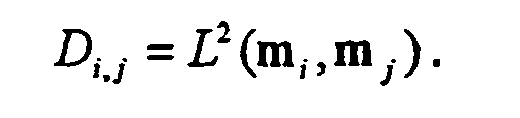
- Let the input Feature Vector representing sample xk be denoted yk . The map response in node i for feature k, Sik, is defined as:

where the signal spacedistance 

and wl is some suitable weight function. - ANNEALING FUNCTION. The task of the annealing function is to obtain an equilibrium at the end of the training. The principle is that large adjustments are allowed in the beginning of the training whereas only small (or zero) adjustments are allowed at the end. How the decrease incorporated is not critical. Linear, exponential, and even pulsating [4] decay schedules are proposed in the literature.
- INITIALIZATION. Traditionally, all data driven clustering schemes, including ANNs, employ random positioning of the clusters in the signal space, by assigning (small) random numbers to the parameters. The actual values are not important as long as they are not identical. The ordering of the clusters is also at random.
- TRAINING. The iterative algorithm adjust all clusters after each input Feature Vector, y k , presented. The direction of the adjustment is towards y k , and how much is determined partly by the annealing function, partly by the neighborhood function. The adjustment formulae for cluster y k at time instant t+1 is:

where
and f(t) is the annealing function and g(t) is the neighborhood function.
Various suitable functions are discussed in [3]. - Let 64 map nodes be arranged in an 8x8 square grid and numbered 0 to 63 from the top left to the low right corner. Thus for example the map distance D 0,1 = 1, D 0,2 = 4 and D 0,9 = 2.
A large database is recorded containing flow-measures from several patients during all phases of sleep. The recordings are performed at 20 Hz and stored on a memory disk. The database will contain normal sleep breathing, flow limitations, snoring, yawning, coughing, various apneic events, but also mask leakage and other artifacts. - The database is analyzed sample for sample. The 20Hz flow-signal is first passed through an ideal differentiator. A rectangular window of 180 samples is used to form basis for extracting 4 cepstrum coefficients (c 1,K,c 4) and the PET parameter. Thus the Feature Vector is a 5-dimensional vector with values extracted every 50ms.
- Samples are collected from the database in a random manner as long as the training proceed. The number of iterations, T, is determined by the size of the database, but as a rule of thumb, 10-30 iterations per sample may be an adequate number.
- The Euclidian distance to all clusters y i i = 0,K, M - 1 are calculated and the cluster closest to the Feature Vector is voted winner and is denoted y l . In calculating the distance, the following weight function is employed:

- The neighborhood function will allow all clusters to be adjusted at all times (i.e. the size of neighborhood is not decreased in time), but will penalize clusters far away from the winner y l .

- The annealing function, f(t), follows a linear decay schedule

- After the training phase, the map is presented with known features such as normal breathing, flow limitation signals etc. For each event the response, S, in each node of the map is calculated (see, Fig. 2).

- Regions with high response for normal breathing are labeled as normal regions; regions reacting for flow-limitations are labeled as flow-limitation area and so forth.
- It is then decided which nodes that shall represent events needed to respond to; i.e. an alarm signal is passed to the pressure control system. In Fig. 2, the map response to an input corresponding to flow limitations is depicted. In this case, nodes X,Y,Z will probably be labeled as a flow limitation region.
- This example is similar to the one described in example 1, but here a Hamming window of 180 samples is used instead of the rectangular. Furthermore the cepstrum coefficients are weighted to have approximately the same variances, whereas the PET parameter is given twice the variance of the cepstrum. This will give the PET parameter a little more importance than the rest of the parameters. The following weight function is employed:

- The training is carried out exactly ass before, and the map response for a typical flow-limitation signal is shown in Fig. 4. In this case, nodes X,Y,Z will probably be labeled as a flow limitation region.
- In this example, the map nodes are given a
number instance 0 reflects normal regions and 10 reflects apnea, the numbers can be integrated to form an overall breathing status classification. If the level is very high, rapid increases in pressure is allowed, low levels allow for a pressure decrease, and intermediate levels result in a slow increase of the pressure. - If the capacity of the processor do not allow for all calculations described above, the LPC calculation can be decimated by a factor two or four. The number of samples within the analysis window must then be reduced so that the time span of the window is still about two breathing cycles. The resolution of the map response will not suffer from this.
- The pressure control system will increase the pressure one step of 0.125 mbar if the ANN response is positive for 50 samples in one sequence. The pressure will decrease with one step of 0.125 mbar if the ANN response is negative for 300 samples in one sequence. The pressure will not be changed if the ANN response is changed during those sequences.
- In a runtime mode, a sample of the flow signal is analyzed as described above (i.e. extracting the Feature Vector), and presented to the map, now stored in a memory bank in the APAP-unit. There is no need to calculate the exponent in the expression for map response, as the function is monotonic.
-


- Equipment. Breas CPAP pv10 prototype (Breas AB, Mölndal, Sweden) with internal flow measurement; PSG system, EMBLA™ Polysomnography (Embla hf, Reykjavik, Iceland); PC with artificial neural network software for sleep disturbance detection.
Patients. 6 males aged from 31 to 60 years, suffering from sleep disorders of various kind.
Measurement. The patient was set up with all sensors from the PSG system: EEG, EOG, EMG, oxygen saturation, pulse, nasal flow thermistor measurement, body position. With this setup it is possible to determine sleep stages, arousals, sleep apnea, sleep hypoapnea, and other sleep related events. The CPAP provides air through a tube via a nasal mask to the patient. Via the CPAP communication interface the PC was connected to the CPAP. The PC software can read air flow values from the CPAP and set new pressure set points on the CPAP by the communication interface. The information was exchanged at a rate of about 20 Hz. The PC program feeds the flow values into the artificial neural network (ANN). The output from the ANN is entered into a pressure regulation algorithm (PRA). The pressure regulation algorithm calculates a new pressure set point and activates the new value in the CPAP. The output from the artificial neural network and the pressure setpoint is read by the PSG system.
Evaluation. In a normal CPAP titration (sleep disorder analysis) a CPAP is connected to a patient during sleep. The CPAP pressure is adjusted during the night so as to put the patient in a state with no indications of sleep disorders. This pressure is the one used in the CPAP treatment. The patient's need for various CPAP pressures can be seen with the PSG system breath-by-breath. The required CPAP pressure varies depending on sleep stage, body position, etc.. The data from the auto CPAP test was evaluated in the PSG system in the same manner as for CPAP titration by a physician used to evaluate patients receiving CPAP treatment. Thereby the correlation between the detection of sleep disorder by the ANN and the analysis in the PSG system could be determined. The good correlation obtained indicated that the AFN reacted correctly. -
- [1] T. Kohonen, T. Torkkola, M. Shozakai, O. Ventä "Phonetic typewriter for Finnish and Japanese", Proc IEEE ICASSP, New York, New York, 1988
- [2] H.C. Leung, V.W. Zue "Some Phonetic Recognition Experiments using Artificial Neural Nets". , Proc IEEE ICASSP, New York, New York, 1988
- [3] P.Brauer "Infrastructure in Kohonen maps", Proc. IEEE ICASSP, Glasgow, Scotland, 1989.
- [4] P. Knagenhjelm "A Recursive Design Method for Robust Vector Quantization", Proc. ICSPAT, Boston, Massachusetts, 1992.
Claims (21)
- An apparatus for the detection and treatment of disordered breathing during sleep for use with a CPAP, i.e. Continuous Positive Airway Pressure, characterized in that the apparatus comprises a probe for sampling breathing air flow rate data, in particular on inhalation, and an artificial neural network, i.e. ANN, map for analyzing, directly or indirectly, said data to control breathing air pressure.
- The apparatus according to claim 1, arranged to:- periodically receive samples of gas flow rate data in a respiratory circuit comprising a mask with a tube placable over a patient's airway, the mask being in communication with a source of a pressurized breathing gas controlled by a continuous positive airway pressure system;- periodically calculate values for one or several parameters distinctive of various breathing patterns;- periodically feed said parameter values to said ANN map trained to recognize breathing patterns characteristic of sleep disordered breathing;- analyze said parameter values in the neural network; and- control pressurized breathing gas supply in response to the output from said ANN map.
- The apparatus of claim 2, wherein said parameter values are feedable to the network at a frequency of from 2 Hz to 30 Hz.
- The apparatus of claim 3, wherein said parameter values are feedable to the network at a frequency of about 20 Hz.
- The apparatus of claim 2, wherein said parameters comprise cepstrum coefficients, energy slope, difference in trend.
- The apparatus of any one of claims 1-5, wherein the ANN map has been trained with data collected from a large number of patients.
- The apparatus of claim 2, wherein the ANN map has been trained with data collected from patients during a particular stage of sleep.
- The apparatus of claim 2, wherein the ANN map has been trained with data collected from patients resting in a particular body position during sleep.
- The apparatus of claim 2, wherein the ANN map has been trained with data collected from patients being under influence of drugs including alcohol during sleep.
- The apparatus of claim 2, wherein the ANN map has been trained with data collected from patients by use of a polysomnography system.
- The apparatus of claim 2, wherein the ANN comprises a number of nodes representing sets of training data.
- The apparatus of claim 2, wherein the ANN map is a Kohonen-map type ANN.
- The apparatus of claim 12, comprising a structure of data stored in a non-volatile memory.
- The apparatus of claim 13, wherein the non-volatile memory is adapted for an auto CPAP.
- The apparatus of claim 12, wherein the ANN map comprises areas representing initial stages of apnea.
- The apparatus of claim 15, adapted such that a closed trajectory characteristic of the breathing pattern of the patient is made to pass through the ANN and is analyzed in regard of its geometric relationship to said areas representing initial stages of apnea, the passage of said trajectory through such area or touching such area being indicative of a disturbed breathing pattern and being used to control an auto CPAP, i.e. ACPAP, so as to increase the amount of air provided to the patient to restore normal breathing.
- The apparatus of claim 16, adapted such that the additional amount of air adduced to restore normal breathing is reduced upon a normal pattern having been reestablished.
- The apparatus of claim 12, adapted for the use of linear predictive coding to analyze the parameter values fed to the ANN map.
- The apparatus of claim 18, adapted such that, in said linear predictive coding analysis, so called A-parameters from the analysis are converted to cepstrum parameters for optimal correlation between parameter distance and conceptual distance.
- The apparatus of claim 12, adapted such that the prediction error in calculating linear predictive coding is used as a basis for determining the parameter value next in line.
- The apparatus of claim 20, adapted such that said prediction error is filtered to counteract short-term variations, and is normalized with the total energy of the analytical window.
Applications Claiming Priority (3)
| Application Number | Priority Date | Filing Date | Title |
|---|---|---|---|
| SE0003531 | 2000-10-02 | ||
| SE0003531A SE0003531D0 (en) | 2000-10-02 | 2000-10-02 | Auto CPAP |
| PCT/SE2001/002085 WO2002028281A1 (en) | 2000-10-02 | 2001-09-28 | Method and apparatus for cpap using a neural network |
Publications (2)
| Publication Number | Publication Date |
|---|---|
| EP1328194A1 EP1328194A1 (en) | 2003-07-23 |
| EP1328194B1 true EP1328194B1 (en) | 2007-02-28 |
Family
ID=20281252
Family Applications (1)
| Application Number | Title | Priority Date | Filing Date |
|---|---|---|---|
| EP01970474A Expired - Lifetime EP1328194B1 (en) | 2000-10-02 | 2001-09-28 | Apparatus for cpap using a neural network |
Country Status (12)
| Country | Link |
|---|---|
| US (1) | US6889691B2 (en) |
| EP (1) | EP1328194B1 (en) |
| JP (1) | JP2004533270A (en) |
| KR (1) | KR20030066632A (en) |
| CN (1) | CN1468077A (en) |
| AT (1) | ATE355011T1 (en) |
| AU (2) | AU9047401A (en) |
| CA (1) | CA2423637A1 (en) |
| DE (1) | DE60126971T2 (en) |
| SE (1) | SE0003531D0 (en) |
| WO (1) | WO2002028281A1 (en) |
| ZA (1) | ZA200302527B (en) |
Cited By (1)
| Publication number | Priority date | Publication date | Assignee | Title |
|---|---|---|---|---|
| TWI768577B (en) * | 2020-12-03 | 2022-06-21 | 國立中興大學 | Method for rapid estimation of the optimal continuous positive airway pressure using body mass index and waist circumference |
Families Citing this family (64)
| Publication number | Priority date | Publication date | Assignee | Title |
|---|---|---|---|---|
| US7425201B2 (en) * | 2002-08-30 | 2008-09-16 | University Of Florida Research Foundation, Inc. | Method and apparatus for predicting work of breathing |
| US8672858B2 (en) | 2002-08-30 | 2014-03-18 | University Of Florida Research Foundation, Inc. | Method and apparatus for predicting work of breathing |
| US20050211249A1 (en) * | 2002-11-19 | 2005-09-29 | Mirko Wagner | Ventilator method, ventilator and memory medium |
| US8020555B2 (en) * | 2003-06-18 | 2011-09-20 | New York University | System and method for improved treatment of sleeping disorders using therapeutic positive airway pressure |
| US6988994B2 (en) * | 2003-08-14 | 2006-01-24 | New York University | Positive airway pressure system and method for treatment of sleeping disorder in patient |
| US7896812B2 (en) * | 2003-08-14 | 2011-03-01 | New York University | System and method for diagnosis and treatment of a breathing pattern of a patient |
| WO2007040988A2 (en) * | 2003-08-14 | 2007-04-12 | New York University | System and method for diagnosis and treatment of a breathing pattern of a patient |
| US7115097B2 (en) * | 2003-10-09 | 2006-10-03 | Johnson Joseph L | Positive airway pressure notification system for treatment of breathing disorders during sleep |
| US7524279B2 (en) * | 2003-12-31 | 2009-04-28 | Raphael Auphan | Sleep and environment control method and system |
| SE0401208D0 (en) * | 2004-05-10 | 2004-05-10 | Breas Medical Ab | Multilevel fan |
| US7276031B2 (en) * | 2004-05-12 | 2007-10-02 | New York University | System and method for classifying patient's breathing using artificial neural network |
| US20050268912A1 (en) * | 2004-06-04 | 2005-12-08 | Norman Robert G | System and method for automated titration of continuous positive airway pressure |
| EP1778325B1 (en) * | 2004-07-08 | 2010-07-28 | Breas Medical AB | Delta flow pressure regulator |
| WO2006005433A1 (en) * | 2004-07-08 | 2006-01-19 | Breas Medical Ab | Energy trigger |
| US7882834B2 (en) * | 2004-08-06 | 2011-02-08 | Fisher & Paykel Healthcare Limited | Autotitrating method and apparatus |
| DE102004040659A1 (en) * | 2004-08-20 | 2006-02-23 | Weinmann Geräte für Medizin GmbH + Co. KG | Apparatus for ventilation and method for controlling a ventilator |
| US8578937B2 (en) | 2004-09-21 | 2013-11-12 | Medtronic Xomed, Inc. | Smart mandibular repositioning system |
| US20060096596A1 (en) * | 2004-11-05 | 2006-05-11 | Occhialini James M | Wearable system for positive airway pressure therapy |
| CN101309716B (en) * | 2005-09-30 | 2013-03-20 | 纽约大学 | Systems and methods for diagnosing and treating breathing patterns of a patient |
| US7942824B1 (en) * | 2005-11-04 | 2011-05-17 | Cleveland Medical Devices Inc. | Integrated sleep diagnostic and therapeutic system and method |
| US8545416B1 (en) * | 2005-11-04 | 2013-10-01 | Cleveland Medical Devices Inc. | Integrated diagnostic and therapeutic system and method for improving treatment of subject with complex and central sleep apnea |
| US8172766B1 (en) * | 2005-11-04 | 2012-05-08 | Cleveland Medical Devices Inc. | Integrated sleep diagnosis and treatment device and method |
| NZ607280A (en) | 2006-03-06 | 2014-06-27 | Resmed Ltd | Method and apparatus for improved flow limitation detection of obstructive sleep apnea |
| DE102006017278A1 (en) * | 2006-04-12 | 2007-10-18 | Fraunhofer-Gesellschaft zur Förderung der angewandten Forschung e.V. | Proof of onset of apnea |
| WO2008022337A2 (en) * | 2006-08-17 | 2008-02-21 | The Research Foundation Of State University Of New York | Predicting continuous positive airway pressure titration using an artificial neural network |
| US9743841B2 (en) * | 2007-09-25 | 2017-08-29 | Ric Investments, Llc | Automated sleep phenotyping |
| EP2217141B1 (en) * | 2007-11-13 | 2021-03-31 | Oridion Medical 1987 Ltd. | Medical apparatus |
| WO2009098627A1 (en) * | 2008-02-07 | 2009-08-13 | Koninklijke Philips Electronics N.V. | Apparatus for measuring and predicting patients' respiratory stability |
| US8251876B2 (en) | 2008-04-22 | 2012-08-28 | Hill-Rom Services, Inc. | Breathing exercise apparatus |
| US8517017B2 (en) | 2009-01-08 | 2013-08-27 | Hancock Medical, Inc. | Self-contained, intermittent positive airway pressure systems and methods for treating sleep apnea, snoring, and other respiratory disorders |
| NZ707067A (en) * | 2009-02-11 | 2016-11-25 | Resmed Ltd | Acoustic detection for respiratory treatment apparatus |
| CN101564302B (en) * | 2009-05-25 | 2011-06-29 | 重庆科技学院 | Infant sleep restlessness monitoring method and detection system based on multi-source information fusion |
| WO2011006199A1 (en) | 2009-07-16 | 2011-01-20 | Resmed Ltd | Detection of sleep condition |
| EP2545475A1 (en) * | 2010-03-08 | 2013-01-16 | Koninklijke Philips Electronics N.V. | System and method for obtaining an objective measure of dyspnea |
| US8991392B1 (en) | 2010-12-21 | 2015-03-31 | Fisher & Paykel Healthcare Limited | Pressure adjustment method for CPAP machine |
| US8327846B2 (en) | 2011-02-08 | 2012-12-11 | Hancock Medical, Inc. | Positive airway pressure system with head position control |
| US8620987B2 (en) * | 2011-09-10 | 2013-12-31 | Hewlett-Packard Development Company, L.P. | Multi-regime detection in streaming data |
| US9180271B2 (en) | 2012-03-05 | 2015-11-10 | Hill-Rom Services Pte. Ltd. | Respiratory therapy device having standard and oscillatory PEP with nebulizer |
| US10314989B2 (en) | 2013-01-28 | 2019-06-11 | Hancock Medical, Inc. | Position control devices and methods for use with positive airway pressure systems |
| US10165966B2 (en) | 2013-03-14 | 2019-01-01 | University Of Florida Research Foundation, Incorporated | Methods and systems for monitoring resistance and work of breathing for ventilator-dependent patients |
| WO2016028525A1 (en) | 2014-08-18 | 2016-02-25 | Hancock Medical, Inc. | Portable pap device with humidification |
| TW201612845A (en) * | 2014-08-28 | 2016-04-01 | Resmed Ltd | Method, system and apparatus for diagnosis, monitoring and treatment of respiratory disorders |
| USD776802S1 (en) | 2015-03-06 | 2017-01-17 | Hancock Medical, Inc. | Positive airway pressure system console |
| CN104689444B (en) * | 2015-03-26 | 2018-08-24 | 北京怡和嘉业医疗科技股份有限公司 | The pressure method of adjustment and system of positive airway pressure machine |
| JP6480598B2 (en) | 2015-04-02 | 2019-03-13 | ヒル−ロム サービシーズ プライヴェート リミテッド | Respirator manifold |
| US11298074B2 (en) | 2015-12-08 | 2022-04-12 | Fisher & Paykel Healthcare Limited | Flow-based sleep stage determination |
| EP3457926A4 (en) | 2016-05-19 | 2020-09-09 | Hancock Medical, Inc. | SYSTEM FOR DETECTING POSITIONAL OBSTRUCTIVE SLEEP APNEA |
| CN106039510B (en) * | 2016-07-29 | 2018-12-25 | 湖南明康中锦医疗科技发展有限公司 | Method, ventilator and the cloud platform of ventilator security control |
| CA3040975C (en) | 2016-10-21 | 2023-09-05 | Novaresp Technologies Inc. | Method and apparatus for breathing assistance |
| EP3537961B1 (en) | 2016-11-10 | 2025-06-25 | The Research Foundation for The State University of New York | System, method and biomarkers for airway obstruction |
| BR102016029897A2 (en) * | 2016-12-19 | 2018-07-17 | Soc Beneficente Israelita Brasileira Hospital Albert Einstein | machine learning-based intelligent control system and method for modulating end-tidal concentration levels by adjusting the volume and concentration of a real-time incoming breathing gas stream |
| EP3562401B1 (en) * | 2016-12-28 | 2021-06-16 | Koninklijke Philips N.V. | Method of characterizing sleep disordered breathing |
| CN108619597B (en) * | 2017-03-17 | 2021-03-05 | 深圳市大雅医疗技术有限公司 | Pressure compensation method for flow channel of breathing machine |
| US10229092B2 (en) | 2017-08-14 | 2019-03-12 | City University Of Hong Kong | Systems and methods for robust low-rank matrix approximation |
| KR102076759B1 (en) | 2018-03-20 | 2020-02-12 | 한양대학교 산학협력단 | Multi-sensor based noncontact sleep monitoring method and apparatus using ensemble of deep neural network and random forest |
| US11633560B2 (en) | 2018-11-10 | 2023-04-25 | Novaresp Technologies Inc. | Method and apparatus for continuous management of airway pressure for detection and/or prediction of respiratory failure |
| CN109498952B (en) * | 2018-11-30 | 2020-08-28 | 深圳市科曼医疗设备有限公司 | Ventilator proportional valve flow control method, device and computer equipment |
| CN110032758B (en) * | 2019-02-28 | 2023-06-06 | 苏州瑞派宁科技有限公司 | Method, device and computer storage medium for calculating energy of electric signal |
| CN109893732B (en) * | 2019-02-28 | 2021-04-06 | 杭州智瑞思科技有限公司 | Mechanical ventilation man-machine asynchrony detection method based on recurrent neural network |
| US20220265207A1 (en) * | 2019-07-31 | 2022-08-25 | ResMed Pty Ltd | Systems and methods for tailoring therapy provided by respiratory systems based on sleep stage |
| CN112870503A (en) * | 2019-11-29 | 2021-06-01 | 深圳市大雅医疗技术有限公司 | Pressure adjusting method and device, breathing machine and server |
| JP7471437B2 (en) | 2020-02-26 | 2024-04-19 | ノバレスプ テクノロジーズ インコーポレイテッド | Method and apparatus for determining and/or predicting sleep and respiratory behavior for airway pressure management - Patents.com |
| US11837106B2 (en) * | 2020-07-20 | 2023-12-05 | Koninklijke Philips N.V. | System and method to monitor and titrate treatment for high altitude-induced central sleep apnea (CSA) |
| JP2023548463A (en) * | 2020-11-06 | 2023-11-17 | ベンテック ライフ システムズ, インコーポレイテッド | Respiratory therapy data management systems, devices, and methods |
Family Cites Families (16)
| Publication number | Priority date | Publication date | Assignee | Title |
|---|---|---|---|---|
| US3850168A (en) | 1971-09-21 | 1974-11-26 | Puritan Bennett Corp | Oxygen mask apparatus |
| US5092343A (en) | 1988-02-17 | 1992-03-03 | Wayne State University | Waveform analysis apparatus and method using neural network techniques |
| US5134995A (en) | 1989-05-19 | 1992-08-04 | Puritan-Bennett Corporation | Inspiratory airway pressure system with admittance determining apparatus and method |
| US5058600A (en) | 1990-01-08 | 1991-10-22 | Center For Innovative Technology | Graphical readout of laryngotracheal spectra and airway monitor |
| US5251626A (en) | 1990-07-03 | 1993-10-12 | Telectronics Pacing Systems, Inc. | Apparatus and method for the detection and treatment of arrhythmias using a neural network |
| US5146918A (en) | 1991-03-19 | 1992-09-15 | Medtronic, Inc. | Demand apnea control of central and obstructive sleep apnea |
| US5458137A (en) | 1991-06-14 | 1995-10-17 | Respironics, Inc. | Method and apparatus for controlling sleep disorder breathing |
| US5309921A (en) * | 1992-02-11 | 1994-05-10 | Spectrum Medical Technologies | Apparatus and method for respiratory monitoring |
| FI98338C (en) | 1993-03-26 | 1997-06-10 | Instrumentarium Oy | Method for detecting and identifying risk elements present in an anesthetic system by means of a self-organizing map |
| US5503161A (en) | 1993-10-25 | 1996-04-02 | Van Den Heuvel; Raymond C. | Universal medical instrument based on spectrum analysis |
| US5666466A (en) * | 1994-12-27 | 1997-09-09 | Rutgers, The State University Of New Jersey | Method and apparatus for speaker recognition using selected spectral information |
| US5953713A (en) | 1995-10-26 | 1999-09-14 | Board Of Regents, The University Of Texas System | Method and apparatus for treatment of sleep disorder breathing employing artificial neural network |
| GB9522872D0 (en) * | 1995-11-08 | 1996-01-10 | Oxford Medical Ltd | Improvements relating to physiological monitoring |
| AUPO247496A0 (en) | 1996-09-23 | 1996-10-17 | Resmed Limited | Assisted ventilation to match patient respiratory need |
| US6290654B1 (en) * | 1998-10-08 | 2001-09-18 | Sleep Solutions, Inc. | Obstructive sleep apnea detection apparatus and method using pattern recognition |
| DE60020842T2 (en) | 1999-06-30 | 2006-05-18 | University of Florida Research Foundation, Inc., Gainesville | MONITORING SYSTEM FOR VENTILATOR |
-
2000
- 2000-10-02 SE SE0003531A patent/SE0003531D0/en unknown
-
2001
- 2001-09-27 US US09/965,681 patent/US6889691B2/en not_active Expired - Lifetime
- 2001-09-28 JP JP2002531912A patent/JP2004533270A/en active Pending
- 2001-09-28 AU AU9047401A patent/AU9047401A/en active Pending
- 2001-09-28 CN CNA018167071A patent/CN1468077A/en active Pending
- 2001-09-28 KR KR10-2003-7004690A patent/KR20030066632A/en not_active Withdrawn
- 2001-09-28 AT AT01970474T patent/ATE355011T1/en not_active IP Right Cessation
- 2001-09-28 CA CA002423637A patent/CA2423637A1/en not_active Abandoned
- 2001-09-28 EP EP01970474A patent/EP1328194B1/en not_active Expired - Lifetime
- 2001-09-28 WO PCT/SE2001/002085 patent/WO2002028281A1/en not_active Ceased
- 2001-09-28 AU AU2001290474A patent/AU2001290474B2/en not_active Expired
- 2001-09-28 DE DE60126971T patent/DE60126971T2/en not_active Expired - Lifetime
-
2003
- 2003-03-31 ZA ZA200302527A patent/ZA200302527B/en unknown
Cited By (1)
| Publication number | Priority date | Publication date | Assignee | Title |
|---|---|---|---|---|
| TWI768577B (en) * | 2020-12-03 | 2022-06-21 | 國立中興大學 | Method for rapid estimation of the optimal continuous positive airway pressure using body mass index and waist circumference |
Also Published As
| Publication number | Publication date |
|---|---|
| AU2001290474B2 (en) | 2006-07-20 |
| KR20030066632A (en) | 2003-08-09 |
| DE60126971D1 (en) | 2007-04-12 |
| CA2423637A1 (en) | 2002-04-11 |
| US20030000528A1 (en) | 2003-01-02 |
| AU9047401A (en) | 2002-04-15 |
| EP1328194A1 (en) | 2003-07-23 |
| US6889691B2 (en) | 2005-05-10 |
| SE0003531D0 (en) | 2000-10-02 |
| CN1468077A (en) | 2004-01-14 |
| ATE355011T1 (en) | 2006-03-15 |
| DE60126971T2 (en) | 2007-11-22 |
| ZA200302527B (en) | 2004-06-30 |
| JP2004533270A (en) | 2004-11-04 |
| WO2002028281A1 (en) | 2002-04-11 |
Similar Documents
| Publication | Publication Date | Title |
|---|---|---|
| US6889691B2 (en) | Auto CPAP | |
| AU2001290474A1 (en) | Method and apparatus for CPAP using a neural network | |
| CN102172328B (en) | Method for detecting and disciminatng breathing patterns from respiratory signals | |
| US12023149B2 (en) | Sensing system and method for monitoring time-dependent processes | |
| US10278639B2 (en) | Method and system for sleep detection | |
| US7276031B2 (en) | System and method for classifying patient's breathing using artificial neural network | |
| US20220313155A1 (en) | Flow-based sleep stage determination | |
| US20240127078A1 (en) | Transferring learning in classifier-based sensing systems | |
| US20130184538A1 (en) | Method and device for swallowing impairment detection | |
| CN102458245A (en) | Distinguishing Tidal Breathing Patterns Using SpO2 Signals | |
| EP3581098B1 (en) | Method of generating respiratory status classifier and method of determining respiratory status | |
| US20030153817A1 (en) | Pattern analysis system and method | |
| JP7216408B2 (en) | Device for determining sleep apnea syndrome, method for determining sleep apnea syndrome, and program for determining sleep apnea syndrome | |
| Foroughi et al. | Deep convolutional architecture‐based hybrid learning for sleep arousal events detection through single‐lead EEG signals | |
| Eni et al. | Cough detection using a non-contact microphone: A nocturnal cough study | |
| CN116842445B (en) | Automatic awakening identification method and system based on multimodal spatiotemporal spectral fusion | |
| Snider et al. | Automatic classification of breathing sounds during sleep | |
| CN119606356B (en) | Method and system for continuously estimating static compliance and airway resistance of respiratory system of mechanically ventilated patient based on signal quality evaluation | |
| EP1323377A2 (en) | Pattern analysis system and method | |
| Unger | Analysis of Respiratory Time Series Data for Breathing Discomfort Detection Prior to Sleep Onset During APAP Therapy | |
| Hermawan et al. | AI-Based Multi-Sensor Fusion for High-Precision Obstructive Sleep Apnea Diagnosis Using Sleep Center PSG3 Secondary Data | |
| CN121051588A (en) | A method for EEG sleep stage classification oriented towards open set recognition | |
| CN121439091A (en) | Nursing adjustment system for dynamic tracking of respiratory rehabilitation training effects | |
| CN121570194A (en) | A method and system for controlling the inhalation of gaseous drugs for special patients |
Legal Events
| Date | Code | Title | Description |
|---|---|---|---|
| PUAI | Public reference made under article 153(3) epc to a published international application that has entered the european phase |
Free format text: ORIGINAL CODE: 0009012 |
|
| 17P | Request for examination filed |
Effective date: 20030416 |
|
| AK | Designated contracting states |
Designated state(s): AT BE CH CY DE DK ES FI FR GB GR IE IT LI LU MC NL PT SE TR |
|
| AX | Request for extension of the european patent |
Extension state: AL LT LV MK RO SI |
|
| 17Q | First examination report despatched |
Effective date: 20050317 |
|
| RTI1 | Title (correction) |
Free format text: APPARATUS FOR CPAP USING A NEURAL NETWORK |
|
| GRAP | Despatch of communication of intention to grant a patent |
Free format text: ORIGINAL CODE: EPIDOSNIGR1 |
|
| GRAS | Grant fee paid |
Free format text: ORIGINAL CODE: EPIDOSNIGR3 |
|
| GRAA | (expected) grant |
Free format text: ORIGINAL CODE: 0009210 |
|
| AK | Designated contracting states |
Kind code of ref document: B1 Designated state(s): AT BE CH CY DE DK ES FI FR GB GR IE IT LI LU MC NL PT SE TR |
|
| PG25 | Lapsed in a contracting state [announced via postgrant information from national office to epo] |
Ref country code: NL Free format text: LAPSE BECAUSE OF FAILURE TO SUBMIT A TRANSLATION OF THE DESCRIPTION OR TO PAY THE FEE WITHIN THE PRESCRIBED TIME-LIMIT Effective date: 20070228 Ref country code: LI Free format text: LAPSE BECAUSE OF FAILURE TO SUBMIT A TRANSLATION OF THE DESCRIPTION OR TO PAY THE FEE WITHIN THE PRESCRIBED TIME-LIMIT Effective date: 20070228 Ref country code: FI Free format text: LAPSE BECAUSE OF FAILURE TO SUBMIT A TRANSLATION OF THE DESCRIPTION OR TO PAY THE FEE WITHIN THE PRESCRIBED TIME-LIMIT Effective date: 20070228 Ref country code: DK Free format text: LAPSE BECAUSE OF FAILURE TO SUBMIT A TRANSLATION OF THE DESCRIPTION OR TO PAY THE FEE WITHIN THE PRESCRIBED TIME-LIMIT Effective date: 20070228 Ref country code: CH Free format text: LAPSE BECAUSE OF FAILURE TO SUBMIT A TRANSLATION OF THE DESCRIPTION OR TO PAY THE FEE WITHIN THE PRESCRIBED TIME-LIMIT Effective date: 20070228 Ref country code: BE Free format text: LAPSE BECAUSE OF FAILURE TO SUBMIT A TRANSLATION OF THE DESCRIPTION OR TO PAY THE FEE WITHIN THE PRESCRIBED TIME-LIMIT Effective date: 20070228 Ref country code: AT Free format text: LAPSE BECAUSE OF FAILURE TO SUBMIT A TRANSLATION OF THE DESCRIPTION OR TO PAY THE FEE WITHIN THE PRESCRIBED TIME-LIMIT Effective date: 20070228 |
|
| REG | Reference to a national code |
Ref country code: GB Ref legal event code: FG4D |
|
| REG | Reference to a national code |
Ref country code: CH Ref legal event code: EP |
|
| REF | Corresponds to: |
Ref document number: 60126971 Country of ref document: DE Date of ref document: 20070412 Kind code of ref document: P |
|
| REG | Reference to a national code |
Ref country code: IE Ref legal event code: FG4D |
|
| PG25 | Lapsed in a contracting state [announced via postgrant information from national office to epo] |
Ref country code: SE Free format text: LAPSE BECAUSE OF FAILURE TO SUBMIT A TRANSLATION OF THE DESCRIPTION OR TO PAY THE FEE WITHIN THE PRESCRIBED TIME-LIMIT Effective date: 20070531 |
|
| PG25 | Lapsed in a contracting state [announced via postgrant information from national office to epo] |
Ref country code: ES Free format text: LAPSE BECAUSE OF FAILURE TO SUBMIT A TRANSLATION OF THE DESCRIPTION OR TO PAY THE FEE WITHIN THE PRESCRIBED TIME-LIMIT Effective date: 20070608 |
|
| PG25 | Lapsed in a contracting state [announced via postgrant information from national office to epo] |
Ref country code: PT Free format text: LAPSE BECAUSE OF FAILURE TO SUBMIT A TRANSLATION OF THE DESCRIPTION OR TO PAY THE FEE WITHIN THE PRESCRIBED TIME-LIMIT Effective date: 20070730 |
|
| NLV1 | Nl: lapsed or annulled due to failure to fulfill the requirements of art. 29p and 29m of the patents act | ||
| REG | Reference to a national code |
Ref country code: CH Ref legal event code: PL |
|
| EN | Fr: translation not filed | ||
| PLBE | No opposition filed within time limit |
Free format text: ORIGINAL CODE: 0009261 |
|
| STAA | Information on the status of an ep patent application or granted ep patent |
Free format text: STATUS: NO OPPOSITION FILED WITHIN TIME LIMIT |
|
| 26N | No opposition filed |
Effective date: 20071129 |
|
| PG25 | Lapsed in a contracting state [announced via postgrant information from national office to epo] |
Ref country code: MC Free format text: LAPSE BECAUSE OF NON-PAYMENT OF DUE FEES Effective date: 20070930 Ref country code: IT Free format text: LAPSE BECAUSE OF FAILURE TO SUBMIT A TRANSLATION OF THE DESCRIPTION OR TO PAY THE FEE WITHIN THE PRESCRIBED TIME-LIMIT Effective date: 20070228 Ref country code: GR Free format text: LAPSE BECAUSE OF FAILURE TO SUBMIT A TRANSLATION OF THE DESCRIPTION OR TO PAY THE FEE WITHIN THE PRESCRIBED TIME-LIMIT Effective date: 20070529 Ref country code: FR Free format text: LAPSE BECAUSE OF FAILURE TO SUBMIT A TRANSLATION OF THE DESCRIPTION OR TO PAY THE FEE WITHIN THE PRESCRIBED TIME-LIMIT Effective date: 20071019 |
|
| PG25 | Lapsed in a contracting state [announced via postgrant information from national office to epo] |
Ref country code: IE Free format text: LAPSE BECAUSE OF NON-PAYMENT OF DUE FEES Effective date: 20070928 |
|
| PG25 | Lapsed in a contracting state [announced via postgrant information from national office to epo] |
Ref country code: FR Free format text: LAPSE BECAUSE OF FAILURE TO SUBMIT A TRANSLATION OF THE DESCRIPTION OR TO PAY THE FEE WITHIN THE PRESCRIBED TIME-LIMIT Effective date: 20070228 |
|
| PG25 | Lapsed in a contracting state [announced via postgrant information from national office to epo] |
Ref country code: CY Free format text: LAPSE BECAUSE OF FAILURE TO SUBMIT A TRANSLATION OF THE DESCRIPTION OR TO PAY THE FEE WITHIN THE PRESCRIBED TIME-LIMIT Effective date: 20070228 |
|
| PG25 | Lapsed in a contracting state [announced via postgrant information from national office to epo] |
Ref country code: LU Free format text: LAPSE BECAUSE OF NON-PAYMENT OF DUE FEES Effective date: 20070928 |
|
| PG25 | Lapsed in a contracting state [announced via postgrant information from national office to epo] |
Ref country code: TR Free format text: LAPSE BECAUSE OF FAILURE TO SUBMIT A TRANSLATION OF THE DESCRIPTION OR TO PAY THE FEE WITHIN THE PRESCRIBED TIME-LIMIT Effective date: 20070228 |
|
| REG | Reference to a national code |
Ref country code: GB Ref legal event code: 732E Free format text: REGISTERED BETWEEN 20100128 AND 20100203 |
|
| REG | Reference to a national code |
Ref country code: GB Ref legal event code: 732E Free format text: REGISTERED BETWEEN 20140206 AND 20140212 |
|
| PGFP | Annual fee paid to national office [announced via postgrant information from national office to epo] |
Ref country code: GB Payment date: 20200916 Year of fee payment: 20 Ref country code: DE Payment date: 20200916 Year of fee payment: 20 |
|
| REG | Reference to a national code |
Ref country code: DE Ref legal event code: R071 Ref document number: 60126971 Country of ref document: DE |
|
| REG | Reference to a national code |
Ref country code: GB Ref legal event code: PE20 Expiry date: 20210927 |
|
| PG25 | Lapsed in a contracting state [announced via postgrant information from national office to epo] |
Ref country code: GB Free format text: LAPSE BECAUSE OF EXPIRATION OF PROTECTION Effective date: 20210927 |