EP1328122A1 - Method and modules for transmitting and receiving compressed data - Google Patents
Method and modules for transmitting and receiving compressed data Download PDFInfo
- Publication number
- EP1328122A1 EP1328122A1 EP02360026A EP02360026A EP1328122A1 EP 1328122 A1 EP1328122 A1 EP 1328122A1 EP 02360026 A EP02360026 A EP 02360026A EP 02360026 A EP02360026 A EP 02360026A EP 1328122 A1 EP1328122 A1 EP 1328122A1
- Authority
- EP
- European Patent Office
- Prior art keywords
- frames
- frame
- state information
- communication device
- message
- Prior art date
- Legal status (The legal status is an assumption and is not a legal conclusion. Google has not performed a legal analysis and makes no representation as to the accuracy of the status listed.)
- Ceased
Links
- 238000000034 method Methods 0.000 title claims abstract description 21
- 238000004891 communication Methods 0.000 claims abstract description 57
- 230000005540 biological transmission Effects 0.000 claims description 9
- 230000006835 compression Effects 0.000 description 12
- 238000007906 compression Methods 0.000 description 12
- 230000006837 decompression Effects 0.000 description 7
- 230000006870 function Effects 0.000 description 6
- 238000012986 modification Methods 0.000 description 5
- 230000004048 modification Effects 0.000 description 5
- 230000008901 benefit Effects 0.000 description 3
- 238000010586 diagram Methods 0.000 description 3
- 230000000694 effects Effects 0.000 description 3
- 101000608734 Helianthus annuus 11 kDa late embryogenesis abundant protein Proteins 0.000 description 2
- 238000011156 evaluation Methods 0.000 description 2
- 230000002452 interceptive effect Effects 0.000 description 2
- 238000003491 array Methods 0.000 description 1
- 230000008859 change Effects 0.000 description 1
- 230000001419 dependent effect Effects 0.000 description 1
- 238000013461 design Methods 0.000 description 1
- 239000000284 extract Substances 0.000 description 1
- 239000004973 liquid crystal related substance Substances 0.000 description 1
- 238000010295 mobile communication Methods 0.000 description 1
- 238000012856 packing Methods 0.000 description 1
- 230000008569 process Effects 0.000 description 1
Images


Classifications
-
- H—ELECTRICITY
- H04—ELECTRIC COMMUNICATION TECHNIQUE
- H04N—PICTORIAL COMMUNICATION, e.g. TELEVISION
- H04N21/00—Selective content distribution, e.g. interactive television or video on demand [VOD]
- H04N21/60—Network structure or processes for video distribution between server and client or between remote clients; Control signalling between clients, server and network components; Transmission of management data between server and client, e.g. sending from server to client commands for recording incoming content stream; Communication details between server and client
- H04N21/63—Control signaling related to video distribution between client, server and network components; Network processes for video distribution between server and clients or between remote clients, e.g. transmitting basic layer and enhancement layers over different transmission paths, setting up a peer-to-peer communication via Internet between remote STB's; Communication protocols; Addressing
- H04N21/643—Communication protocols
- H04N21/6437—Real-time Transport Protocol [RTP]
-
- H—ELECTRICITY
- H04—ELECTRIC COMMUNICATION TECHNIQUE
- H04L—TRANSMISSION OF DIGITAL INFORMATION, e.g. TELEGRAPHIC COMMUNICATION
- H04L69/00—Network arrangements, protocols or services independent of the application payload and not provided for in the other groups of this subclass
- H04L69/04—Protocols for data compression, e.g. ROHC
-
- H—ELECTRICITY
- H04—ELECTRIC COMMUNICATION TECHNIQUE
- H04N—PICTORIAL COMMUNICATION, e.g. TELEVISION
- H04N19/00—Methods or arrangements for coding, decoding, compressing or decompressing digital video signals
- H04N19/70—Methods or arrangements for coding, decoding, compressing or decompressing digital video signals characterised by syntax aspects related to video coding, e.g. related to compression standards
-
- H—ELECTRICITY
- H04—ELECTRIC COMMUNICATION TECHNIQUE
- H04N—PICTORIAL COMMUNICATION, e.g. TELEVISION
- H04N19/00—Methods or arrangements for coding, decoding, compressing or decompressing digital video signals
- H04N19/85—Methods or arrangements for coding, decoding, compressing or decompressing digital video signals using pre-processing or post-processing specially adapted for video compression
- H04N19/89—Methods or arrangements for coding, decoding, compressing or decompressing digital video signals using pre-processing or post-processing specially adapted for video compression involving methods or arrangements for detection of transmission errors at the decoder
Definitions
- the present invention relates to a method for transmitting digital audio and/or video data.
- the invention furthermore relates to a first and a second communication device therefor, a first program module for a first communication device therefor and a second program module for a second communication device therefor.
- Codec is an abbreviation for compression/decompression.
- a codec can be either a software application or a hardware device that processes audio/video data through complex algorithms, which compress the data at the sending side and decompress the data at the receiving side for playback.
- the compression and decompression may be performed sample by sample (“sample-based”) or, e.g., frame by frame (“frame-based”).
- Sample-based sample-based
- frame-based frame by frame
- Each frame is a data block containing a predetermined amount of audio and/or video data, that is encoded into another block or frame containing compressed data.
- the frame-based compression/decompression may be performed "state-based/stateful” or “stateless”.
- Stateless means that each frame is encoded independently and may be consequently decoded independently as well.
- the encoded frames may be transmitted from a first to a second communication device via a network, for example from a voice terminal to a Personal Computer via the Internet.
- a real time protocol e.g. the RTP (Real-time Transport Protocol) as recommended by the IETF (Internet Engineering Task Force)
- RTP Real-time Transport Protocol
- IETF Internet Engineering Task Force
- State-based/stateful means that each frame is encoded using information derived from previous frames. This method of compression may look for information that is not necessary for continuity to the human ear or eye. For example a change of frame in comparison with a preceding frame is evaluated for the compression.
- One advantage of state-based/stateful compression is its better compression quality and/or efficiency. However, if such state-based/stateful encoded frames are transmitted during a real time communication, the quality requirements are relatively high. If for example an RTP-packet containing encoded frames is lost, the frames being contained in the RTP-packets following the lost RTP-packet cannot be decoded or can only be decoded with significant loss. There is an undesirable propagation effect that deteriorates substantially the quality of the real time communication.
- one object of the invention is to provide a method, devices and modules capable of an improved transmission of frames containing state-based/stateful compressed video and/or audio data.
- one principle of the invention is that digital audio and/or video data of a first data stream is divided into first frames.
- the digital audio data contains, e.g., voice data, music data (for example for an interactive karaoke) and the like.
- the first frames are encoded frame-by-frame into second frames.
- the second frames contain the data of the first frames as compressed data. It has to be noted, that one second frame may contain compressed data of two or more first frames or of a fraction of first frame.
- the second frames are packed into messages of a real time protocol, thereby generating a flow of messages.
- Each of these messages contains at least one frame of the second frames. Furthermore, each of these messages or at least a majority of the messages contain a state information needed to decode the at least one frame contained in the respective message.
- the state information is derived from at least one second frame of the second frames - provided that it is available.
- the at least one second frame of the second frames is a frame preceding the at least one frame to be decoded and is contained in a message preceding the message containing the at least one frame to be decoded. Even if it is preferred, that all messages contain a state information, it may be sufficient that only the 'majority of the messages' contains a state information. For example the first message of the stream may not comprise a state information.
- a message according to the invention contains the second ('compressed') frames and the state information.
- the state information S i may at least partly be used to decode also one or more of the frames V i+2 , V i+3 , V i+4 .
- the message may contain more or less frames than the frames V i+1 , V i+2 , V i+3 , V i+4 .
- the second communication device decodes, e.g., by means of a program module according to the invention, the second frames contained in the received messages. Thereby the second communication device evaluates the respective state information contained in respective message to decompress the respective at least one first frame that is contained in the respective message.
- the respective state information is at least in such case evaluated, if one or more preceding messages and the frames contained therein are lost.
- D is the decoding operation on a second frame V i evaluating the state information S i , thereby generating a decoded version F' i of the original first frame F i .
- V i+2 , V i+3 , V i+4 are accordingly decoded.
- the respective state information contained in one of the messages is used to decode only the first frame of the message.
- a frame following the first frame may be decoded by a state information derived from the first frame and/or decoded data determined by means of the first frame, e.g., the decoded first frame.
- a state information may be contained in the messages but also additional information, e.g., about a type of a encoding scheme and/or about a type of the state information and/or about the respective length of the state information and/or about the number of frames contained in the respective message
- the state information is preferentially comprised in a header preceding the first frame of a respective message.
- This header may also at least partly contain the additional information mentioned above.
- the additional information may also be comprised in an additional further header.
- a suitable embodiment of the invention provides that the state information S i is a complete state information needed to decode at least the first frame V i of the message. 'Complete state information' in a sense, that the frame V i may be decoded without loss or nearly without loss by means of the state information S i .
- the decoding (receiving) device may evaluate also at least one frame preceding the frame V i , e.g., frames V i-1 , V i-2 , if the message containing the preceding frames V i-1 , V i-2 is available (and not lost).
- the first frame V i may also be decoded only by a state information that the decoding device gains from the preceding frames V i-1 , V i-2 .
- the decoding device may additionally evaluate the state information S i being contained in the respective message containing the first frame V i to be decoded.
- the first frames or at least nearly each of the first frames to be encoded contain at least two samples of digital audio and/or video data.
- a first frame contains a plurality of samples.
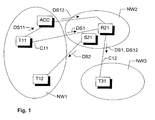
- FIG. 1 shows a very diagrammatically presented arrangement by way of example, with which the invention may be put into practice.
- Networks NW1 and NW3 are interconnected via a network NW2.
- the networks NW1 - NW3 are routed and/or switched networks.
- the network NW1 is for example an integrated services digital network (ISDN) and/or an access network, the network NW2 a mobile radio network providing data transmission, e.g. via Wireless Application Protocol (WAP), or a local area network (LAN), e.g., an Ethernet based LAN.
- the intermediate network NW2 is, e.g., the Internet.
- the networks NW1-NW3 support real time communication based on a real time protocol, e.g., the RTP (Real-time Transport Protocol) according to the definitions of the IETF (Internet Engineering Task Force).
- RTP Real-time Transport Protocol
- the network NW1 comprises inter alia terminals T11, T12 and an access server ACC, the network NW3 a terminal T31.
- the network NW2 comprises a router R21 and a server S21.
- the networks NW1-NW3 may comprise further communication devices not shown in the drawing, e.g., further routers, terminals, hubs, switching centers and the like.
- the terminals T11, T12 T31 may be for example personal computers or mobile telephone terminals.
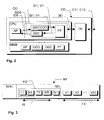
- FIG. 2 shows, e.g., a block diagram for a communication device CD that may be the terminal T11, T12 T31, the router R21 or the server S21.
- the communication device CD possesses connecting means TR for the transmission and reception of data, e.g., via connections C11, C12 described below.
- the connecting means TR for example may comprise Ethernet boards, modems, ISDN (integrated services digital network) adapters or wireless interface modules.
- the communication device CD possesses control means CPU and memory means MEM which are connected with each other and with the connecting means TR by connections, which are not illustrated.
- the control means CPU are for example processors or processor arrays with which a program code of program modules may be executed, which are stored in memory means MEM, for example program code of an application program module AP, a coding module COD, a decoding module DEC and a message generator and evaluator module PT.
- the memory means MEM are for instance in the form of hard disks or RAM modules.
- the communication device CD may have display means as for example LCD's (liquid crystal displays) and input means, for example a keyboard and/or a computer mouse. Further components which are not illustrated are speakers and microphones for voice input and output.
- the communication device CD is run by an operating system as for instance Unix, Windows NT or preferably by a real time operating system.
- the communication device CD represents both a first and a second communication device according to the invention.
- the communication device CD comprises a first and a second program module (COD, DEC) according to the invention.
- the first and second program modules are represented by a module CO, that comprises the program modules COD, DEC and PT.
- the application program module AP is for example a data base providing video and/or audio data or an audio and/or video player application, a karaoke player, a telephone conference application for providing a voice and/or video conference service or the like.
- the terminal T11 establishes a connection C11, C12 to the terminal T31 via the network NW2, i.e., via the router R21.
- the terminals T11, T31 communicate audio data, e.g. voice data or music.
- the communication may be interactive.
- the example shows a message flow DS1 containing this audio data.
- the terminal T11 sends the message flow DS1 to the terminal T31 using a real time protocol, e.g., the RTP (Real-time Transport Protocol) according to the IETF.
- a real time protocol e.g., the RTP (Real-time Transport Protocol) according to the IETF.
- the message flow DS1 is based on a first digital data stream IDS of audio data that is generated by the application program AP of the terminal T11.
- the application program AP forwards the data stream IDS to the module COD.
- a division function DIV that is presently a part of the module COD divides the digital audio data of the first data stream IDS into first frames F1 to F5 and possibly further frames not shown.
- the frames F1 to F5 contain audio samples.
- the frame F1 contains samples S1 and S2 and further samples which are not denominated in particular.
- the division function DIV might also be separate module or a part of a module separate from the module COD, e.g., part of the application program AP.
- the module COD is equipped to only receive the first frames F1 to F5 that contain already divided digital audio data.
- the module COD encodes the first frames F1 to F5 and possibly further first frames not shown into second frames V1 P- V3P; V1 to V20 and possibly further second frames not shown.
- the module COD performs frame-based encoding of the data stream IDS contained in the first frames F1 to F5.
- the second frames V1P- V3P; V1 to V20 contain compressed data of the data stream IDS.
- the module COD encodes the first frames F1 to F3 into the second frames V1 P- V3P and the first frames F4, F5 as well as further first frames not shown into the second frames V1 to V20 and further second frames not shown.
- the module COD forwards the second frames V1 P- V3P to the message generator and evaluator module PT.
- the module PT packs the frames V1 P - V3P into a message M1P that is not shown in detail.
- the module PT forwards the message M1P to the connecting means TR.
- the connecting means TR in turn transmit the message M1P via the connection C11, C12 to the terminal T31.
- the message M1P may be the first message of the message flow DS1.
- the module COD encodes the frame F4 into the frame V1. To this end, the module COD evaluates the preceding second frames V1 P - V3P, thereby determining a state information SI1. The module COD uses the state information SI1 to encode the frame F4 into the frame V1.
- the module COD encodes the frame F5 into the frame V2 based on a state information SI2 that is derived from frames V2P, V3P and V1.
- the further second frames V3 to V20 may be generated accordingly.
- state information SI1, SI2 and further state information not shown may also be derived from only one preceding frame or from more than two or three preceding frames.
- the state information SI1 might for example be derived from the frame V3P or from a part of frame V3P.
- one first frame F1-F5 is encoded in one second frame V1P-V2. It may also be the case that a second frame is based on more than one first frames or that one first frame is encoded into more than one second frames.
- the module COD provides the second frames V1 to V20 and the state information SI1 for the module PT.
- the module PT generates a message M1 comprising the state information SI1 and the second frames V1 to V20.
- the state information SI1 will be needed to decode the first frame V1 of the second frames V1 to V20.
- the module PT forwards the message M1 to the connecting means TR which transmit the message M1 via the connection C11, C12 to the terminal T31.
- the message M1 is the second message of the message flow DS1. Accordingly, the terminal T11 may send further messages within the message flow DS1.
- the message M1 contains a state information in contrast to the message M1 P, which is the first message of the message flow DS1 and which contains no state information, because there is no frame preceding the frame V1 P available. It may however be the case that also the first message of a message flow contains a state information.
- the message M1 P may contain a copy of the frame V1P as a state information.
- RTP Real-time Transport Protocol
- the payload RPL contains a header HD and a frame payload FX with the second frames V1 to V20.
- the header HD comprises the state information SI1 and in the present embodiment additional information Al.
- the additional information Al may contain various information that is helpful and/or mandatory to decode the frame payload FX.
- the additional information Al comprises presently a type of a encoding scheme ES.
- the encoding scheme ES indicates the method of encoding used by the module COD.
- the additional information Al contains a type information TY about the type of the state information SI1 and a length information LI indicating the length of the state information SI1.
- a state information may have a variable length.
- the additional information Al comprises also a number information NR about the number of the frames contained in the frame payload FX.
- the values of the number information NR of the messages M1P, M1 are for example 3 and 20 respectively.
- the terminal T31 decodes the frames V1P-V3P; V1 - V20 contained in the messages M1P, M1 respectively.
- the terminal T31 is equipped with the decoder/decoding module DEC that is a second program module according to the invention.
- the decoding module DEC is in the present embodiment a part of the module CO that contains also the modules COD and PT. It has however to be noted that the modules COD and DEC may also be separate modules.
- the module PT serves as a message evaluator module.
- the module PT might also be a component of the module DEC or module separate from the module CO.
- the terminal T31 receives the messages M1P, M1 and possibly further messages of the message flow DS1 with the aid of the connecting means TR.
- the connecting means TR convey the messages M1P, M1 to the module PT that evaluates the messages M1 P, M1.
- the module PT forwards for example the frames V1P - V3P; V1 - V20 frame-by-frame to the module DEC.
- the module DEC decodes/decompresses the frames V1P - V3P; V1 - V20 of the messages M1P, M1, thereby generating decoded frames DF1 - DF5 and further frames not shown.
- the decoded frames DF1 - DF5 are very similar to the original first frames F1 - F5. But since coding/decoding causes typically certain loss, the module DEC cannot recover the original first frames F1 - F5.
- the module DEC forwards the data of the decoded frames DF1 - DF5 as a data stream DDS to the application program module AP that is for example in the case of the terminal T31 an audio player.
- the decoding operation on the frames V1 P - V3P is not explained in detail. Instead, the decoding operation on the second frames V1 - V2 is explained.
- the module DEC may decode the frame V1 based on the frames V1P - V3P, e.g. based on a state information ESI1 derived from the frames V1P - V3P.
- the module DEC evaluates the state information SI1 to decode/decompress the frame V1 thereby generating the frame DF4.
- the module DEC decodes the frame V2 thereby generating the frame DF5. To decode the frame V2 the module DEC evaluates the frame V1. Additionally, the module DEC may also evaluate the state information SI1. The evaluation of the frame V1 and/or the state information SI1 produces an estimated state information ESI2 that is similar to the state information SI2. The estimated state information ESI2 is only similar because the frames V2P, V3P are in the present example not available to recover the original state information SI2.
- Figure 6 shows a modification of the encoding example of figure 4.
- a state information SI12 is generated based on the first frames F1 to F3 and a state information SI22 is generated based on the first frames F2 to F4.
- the state information SI12, S22 correlate to the state information SI1, SI2 respectively.
- the state information SI12 may be packed into a message M12 similar to the message M1 that comprises the state information SI1.
- the frame V1 may be decoded using the state information SI12 as shown in figure 7. Subsequently, for decoding the frame V2, the module DEC determines an estimated state information ESI22 based on the state information SI12 and/or the decoded frame DF4 that is derived from the encoded frame V1. The state information ESI22 may be also based on the frame V1.
- the encoding of frames and the generation of RTP messages containing a state information according to the invention may be performed by various devices.
- the router R21 may provide the encoding of frames and/or the packing of the encoded frames into RTP messages that also contain a state information according to the invention. If for example the terminal T11 would have not been capable of the inventive encoding operation explained above the router R21 could serve as an encoder according to the invention.
- the decoding operation may be performed by the router R21 or any other device not shown. If for example the terminal T31 would have not been capable of the inventive decoding operation explained above the router R21 could serve as a decoder according to the invention.
- the terminal T11 establishes the connection to the terminal T31 via the access server ACC.
- the access server ACC provides access to the network NW2 for communication devices of the network NW1.
- the access server ACC is a coder/decoder according to the invention providing coder/decoder services for, e.g., the terminal T11.
- the terminal T11 sends for example a digital data stream DS11 to the access server ACC which in turn divides the data stream DS11 into first frames, encodes the first frames into second frames, packs the second frames into RTP messages containing additionally a state information as explained above.
- the access server ACC forwards the RTP messages in a flow DS12 to the router R21 which transmits the RTP messages to the terminal T31.
- the access server ACC may decode messages sent by the terminal T31 to the terminal T11.
- the messages may also contain encoded frames and a state information needed to decode at least the first encoded frame of a respective message as explained above.
- the server S21 is a video server providing real time video data.
- the video data may be stored as digital data files which the server S21 encodes case-by-case.
- the server S21 divides the digital video data into first frames, encodes the first frames into second frames and packs the second frames into RTP messages containing additionally a state information. Subsequently, the server S21 forwards the RTP messages within a message flow, e.g., a message flow DS2, to a device requesting the video data, e.g. to the terminal T12.
- the terminal T12 extracts the second frames and the state information from the messages and decodes the second frames as explained above.
- the server S21 may also store video data as already encoded second frames in combination with state information in a data base, e.g., represented by the module AP. In such a scenario there is no encoding operation necessary.
- the server S21 just packs the encoded second frames together with an additional a state information as explained above into RTP messages.
- a message according to the invention may carry 'difference frames' instead of encoded second frames.
- Each difference frame represents the difference value of two subsequent second frames.
- the state information contained in a respective message is, e.g., the original encoded second frame that is used to determine the first difference frame of the respective message.
Landscapes
- Engineering & Computer Science (AREA)
- Signal Processing (AREA)
- Multimedia (AREA)
- Computer Security & Cryptography (AREA)
- Computer Networks & Wireless Communication (AREA)
- Mobile Radio Communication Systems (AREA)
Abstract
The present invention relates to a method for transmitting digital audio and/or video data. The invention furthermore relates to a first and a second communication device and a first and a second program module therefor. The method comprises the steps of: Dividing of digital audio and/or video data (S1, S2) of a first data stream (IDS) into first frames (F1-F5). Frame-based encoding of the first frames (F1-F5) into second frames (V1P-V3P; V1-V20 containing compressed data of the first data stream (IDS). Generating a flow of messages of a real time protocol, a majority of the messages containing at least one first frame (V1) of the second frames and a state information (SI1) needed to decode the first frame (V1). The state information (SI1) is derivable from a second frame (V1P-V3P) provided that it is available. The second frame (V1P-V3P) precedes the first frame (V1) and is contained in a message preceding the message containing the first frame (V1) to be decoded. Transmitting the messages from a first (CD; T11; S21; ACC) to a second communication device (CD; T31; T12). Decoding the second frames (V1P-V3P; V1-V20), thereby evaluating the respective state information (SI1) contained in a respective message to decompress the respective first frame (V1) being contained in the respective message (M1). <IMAGE>
Description
The present invention relates to a method for transmitting digital audio and/or video
data. The invention furthermore relates to a first and a second communication device
therefor, a first program module for a first communication device therefor and a
second program module for a second communication device therefor.
Digital audio and/or video data is usually compressed prior its transmission in order to
save transmission capacity. The compression is especially of advantage when real
time transmission is required. To this end so-called codecs are used. Codec is an
abbreviation for compression/decompression. A codec can be either a software
application or a hardware device that processes audio/video data through complex
algorithms, which compress the data at the sending side and decompress the data at
the receiving side for playback.
The compression and decompression may be performed sample by sample ("sample-based")
or, e.g., frame by frame ("frame-based"). Each frame is a data block
containing a predetermined amount of audio and/or video data, that is encoded into
another block or frame containing compressed data. A GSM codec, e.g., performs
frame-based compression/decompression (GSM = Global System for Mobile
communication).
The frame-based compression/decompression may be performed "state-based/stateful"
or "stateless".
"Stateless" means that each frame is encoded independently and may be
consequently decoded independently as well. The encoded frames may be
transmitted from a first to a second communication device via a network, for example
from a voice terminal to a Personal Computer via the Internet. If real time
transmission is requested, a real time protocol, e.g. the RTP (Real-time Transport
Protocol) as recommended by the IETF (Internet Engineering Task Force), is typically
used. Even if an RTP-packet containing one or more encoded frames out of stream of
RTP-packets is lost, the frames following the lost frames can basically be decoded
without loss or nearly without loss. There is no loss propagation effect caused by the
lost frames. There is only loss caused by the compression / decompression operation
and, of course, the lost data of the lost frame(s).
"State-based/stateful" means that each frame is encoded using information derived
from previous frames. This method of compression may look for information that is
not necessary for continuity to the human ear or eye. For example a change of frame
in comparison with a preceding frame is evaluated for the compression. One
advantage of state-based/stateful compression is its better compression quality and/or
efficiency. However, if such state-based/stateful encoded frames are transmitted
during a real time communication, the quality requirements are relatively high. If for
example an RTP-packet containing encoded frames is lost, the frames being
contained in the RTP-packets following the lost RTP-packet cannot be decoded or can
only be decoded with significant loss. There is an undesirable propagation effect that
deteriorates substantially the quality of the real time communication.
In this context it has to be noted, that during a non-real time communication, for
example download of video data from a server, basically a lost packet may, no doubt,
be re-requested by the receiving side and re-transmitted by the sending side.
However, the re-transmission causes considerable load at all sides involved, i.e., the
re-requesting receiver, the re-transmitting sender, and network connecting the sender
and the receiver.
Accordingly one object of the invention is to provide a method, devices and modules
capable of an improved transmission of frames containing state-based/stateful
compressed video and/or audio data.
This object is to be attained by methods in accordance with the technical principle of
claim 1, a first and a second communication device therefor, a first program module
for a first communication device therefor and a second program module for a second
communication device therefore, said communication devices and program modules
being in accordance with technical principles of further independent claims.
In this respect one principle of the invention is that digital audio and/or video data of a
first data stream is divided into first frames. The digital audio data contains, e.g., voice
data, music data (for example for an interactive karaoke) and the like. Subsequently,
the first frames are encoded frame-by-frame into second frames. The second frames
contain the data of the first frames as compressed data. It has to be noted, that one
second frame may contain compressed data of two or more first frames or of a
fraction of first frame. The second frames are packed into messages of a real time
protocol, thereby generating a flow of messages.
Each of these messages contains at least one frame of the second frames. Furthermore,
each of these messages or at least a majority of the messages contain a state
information needed to decode the at least one frame contained in the respective
message. The state information is derived from at least one second frame of the
second frames - provided that it is available. The at least one second frame of the
second frames is a frame preceding the at least one frame to be decoded and is
contained in a message preceding the message containing the at least one frame to
be decoded. Even if it is preferred, that all messages contain a state information, it
may be sufficient that only the 'majority of the messages' contains a state information.
For example the first message of the stream may not comprise a state information.
The first frames, the 'original' frames, are for example encoded according to the
formula
Vi = E(Fi , Si )
whereby Vi is the second frame generated by an encoding operation E. Fi is the (first)
frame to be encoded and Si is a state information derived from previous frames, e.g.
from 3 preceding frames Fi-1, Fi-2, Fi-3 according to, e.g., the formula
Si = S(Fi-1 , Fi-2 , Fi-3 )
whereby S is the state information evaluation operation evaluating the frames Fi-1,
Fi-2, Fi-3. A message according to the invention contains the second ('compressed')
frames and the state information. The message is transmitted from a first to a second
communication device and may have, e.g., a payload like:
[Si , Vi , Vi+1 , Vi+2 , Vi+3 , Vi+4 ]
whereby Vi, Vi+1, Vi+2, Vi+3, Vi+4 are subsequent second (= encoded) frames and Si is a
state information needed to decode the first frame Vi of the message. It is clear, that
the state information Si may at least partly be used to decode also one or more of the
frames Vi+2, Vi+3, Vi+4. Furthermore, the message may contain more or less frames
than the frames Vi+1, Vi+2, Vi+3, Vi+4.
The second communication device decodes, e.g., by means of a program module
according to the invention, the second frames contained in the received messages.
Thereby the second communication device evaluates the respective state information
contained in respective message to decompress the respective at least one first frame
that is contained in the respective message.
The respective state information is at least in such case evaluated, if one or more
preceding messages and the frames contained therein are lost. In such a scenario the
receiving second communication device decodes the first frame Vi of the message for
example according to the formula:
F'i = D(Vi , Si )
whereby D is the decoding operation on a second frame Vi evaluating the state
information Si, thereby generating a decoded version F'i of the original first frame Fi. It
has to be noted, that usually compression/decompression implies certain loss and/or
the state information Si is to some extend insufficient. Thus, the original first frame Fi
cannot completely be recovered but a decoded version F'i that is to some extend
different from the original frame Fi.
If however there were no loss during compression/decompression, the above formula
would be
Fi = D(Vi ; Si )
The subsequent second (= encoded) frame Vi+1 may be decoded to a frame F'i+1, e.g.,
according to the formula:
F'i+1 = D(Vi+1 ; S'i+1 )
Whereby S'i+1 is an estimate of a state info based on, e.g., the available previous
encoded frame Vi and/or further previous frames, e.g., Vi-1, Vi-2, and/or the available
already decoded frame F'i, and/or further previous decoded frames, e.g., F'i-1, F'i-2, for
example:
S'i+1 = ESa (Vi )
or
S'i+1 = ESa (Vi , Vi-1 , Vi-2 )
or
S'i+1 = ESa (Vi , F'i )
or
S'i+1 = ESa (F'i )
or
S'i+1 = ESa (F'i , F'i-1 , F'i-2 )
whereby ESa is an estimate function evaluating the encoded frames Vi, Vi-1, Vi-2
and/or the already decoded frames F'i, F'i-1, F'i-2 thereby determining the state
information S'i+1. The estimate function may optionally also evaluate the state
information Si for example:
S'i+1 = ES'a (F'i ; Si )
The further subsequent second (= encoded) frames Vi+2, Vi+3 may be decoded
accordingly, whereby a further estimate function ESb may evaluate more preceding
frames, for example:
S'i+2 = ESb (F'i ; F'i+1 )
The further frames Vi+2, Vi+3, Vi+4 are accordingly decoded.
Advantageous further effects of the invention will be seen from the dependent claims
and the specification.
Preferably the respective state information contained in one of the messages is used
to decode only the first frame of the message. A frame following the first frame may
be decoded by a state information derived from the first frame and/or decoded data
determined by means of the first frame, e.g., the decoded first frame.
Not only a state information may be contained in the messages but also additional
information, e.g., about a type of a encoding scheme and/or about a type of the state
information and/or about the respective length of the state information and/or about
the number of frames contained in the respective message
The state information is preferentially comprised in a header preceding the first frame
of a respective message. This header may also at least partly contain the additional
information mentioned above. The additional information may also be comprised in an
additional further header.
A suitable embodiment of the invention provides that the state information Si is a
complete state information needed to decode at least the first frame Vi of the
message. 'Complete state information' in a sense, that the frame Vi may be decoded
without loss or nearly without loss by means of the state information Si.
However, it may be the case, that the first frame Vi (and/or one or more of the further
frames Vi+1, Vi+2, Vi+3, Vi+4) may be decoded based on the state information Si not with
best but with satisfactory quality. To obtain the best quality, the decoding (receiving)
device may evaluate also at least one frame preceding the frame Vi, e.g., frames Vi-1,
Vi-2, if the message containing the preceding frames Vi-1, Vi-2 is available (and not
lost).
If the message containing the preceding frames Vi-1, Vi-2 was available the first frame
Vi may also be decoded only by a state information that the decoding device gains
from the preceding frames Vi-1, Vi-2. The decoding device may additionally evaluate
the state information Si being contained in the respective message containing the first
frame Vi to be decoded.
The first frames or at least nearly each of the first frames to be encoded contain at
least two samples of digital audio and/or video data. Preferably a first frame contains a
plurality of samples.
The following description will serve to explain the advantages of the invention on the
basis of working examples as illustrated in the accompanying drawings.
- Figure 1
- shows an arrangement for the performance of the method in accordance with the invention using networks NW1, NW2, NW3.
- Figure 2
- shows a block diagram for a communication device CD in accordance with the invention, the communication device CD being a communication device of the networks NW1, NW2, NW3 according to figure 1.
- Figure 3
- shows a message M1 in accordance with the invention, the message M1 being for example generated by the communication device CD according to figure 2.
- Figure 4
- shows very diagrammatically an encoding procedure in accordance with the invention.
- Figure 5
- shows very diagrammatically a decoding procedure in accordance with the invention.
- Figure 6
- shows a modification of the encoding procedure according to figure 4.
- Figure 7
- shows a modification of the decoding procedure according to figure 5.
Reference will now be made in detail to the present preferred embodiments of the
invention as illustrated in the accompanying drawings. In describing the preferred
embodiments and applications of the present invention, specific terminology is
employed for the sake of clarity. However, the invention is not intended to be limited to
the specific terminology so selected, and it is understood that each specific element
includes all technical equivalents which operate in a similar manner to accomplish a
similar purpose.
Figure 1 shows a very diagrammatically presented arrangement by way of example,
with which the invention may be put into practice. Networks NW1 and NW3 are
interconnected via a network NW2. The networks NW1 - NW3 are routed and/or
switched networks. The network NW1 is for example an integrated services digital
network (ISDN) and/or an access network, the network NW2 a mobile radio network
providing data transmission, e.g. via Wireless Application Protocol (WAP), or a local
area network (LAN), e.g., an Ethernet based LAN. The intermediate network NW2 is,
e.g., the Internet. The networks NW1-NW3 support real time communication based on
a real time protocol, e.g., the RTP (Real-time Transport Protocol) according to the
definitions of the IETF (Internet Engineering Task Force).
The network NW1 comprises inter alia terminals T11, T12 and an access server ACC,
the network NW3 a terminal T31. The network NW2 comprises a router R21 and a
server S21. The networks NW1-NW3 may comprise further communication devices
not shown in the drawing, e.g., further routers, terminals, hubs, switching centers and
the like. The terminals T11, T12 T31 may be for example personal computers or
mobile telephone terminals.
For simplification the terminals T11, T12 T31, the access server ACC, the router R21
and the server S21 are of similar design and only diagrammatically depicted as block
diagrams of functions. Figure 2 shows, e.g., a block diagram for a communication
device CD that may be the terminal T11, T12 T31, the router R21 or the server S21.
The communication device CD possesses connecting means TR for the transmission
and reception of data, e.g., via connections C11, C12 described below. The
connecting means TR for example may comprise Ethernet boards, modems, ISDN
(integrated services digital network) adapters or wireless interface modules.
Furthermore the communication device CD possesses control means CPU and
memory means MEM which are connected with each other and with the connecting
means TR by connections, which are not illustrated. The control means CPU are for
example processors or processor arrays with which a program code of program
modules may be executed, which are stored in memory means MEM, for example
program code of an application program module AP, a coding module COD, a
decoding module DEC and a message generator and evaluator module PT. The
memory means MEM are for instance in the form of hard disks or RAM modules.
Furthermore the communication device CD may have display means as for example
LCD's (liquid crystal displays) and input means, for example a keyboard and/or a
computer mouse. Further components which are not illustrated are speakers and
microphones for voice input and output. The communication device CD is run by an
operating system as for instance Unix, Windows NT or preferably by a real time
operating system.
The communication device CD represents both a first and a second communication
device according to the invention. To this end, the communication device CD
comprises a first and a second program module (COD, DEC) according to the
invention. In the present embodiment the first and second program modules are
represented by a module CO, that comprises the program modules COD, DEC and
PT.
The application program module AP is for example a data base providing video and/or
audio data or an audio and/or video player application, a karaoke player, a telephone
conference application for providing a voice and/or video conference service or the
like.
In a first example the terminal T11 establishes a connection C11, C12 to the terminal
T31 via the network NW2, i.e., via the router R21. The terminals T11, T31
communicate audio data, e.g. voice data or music. The communication may be
interactive. The example shows a message flow DS1 containing this audio data. The
terminal T11 sends the message flow DS1 to the terminal T31 using a real time
protocol, e.g., the RTP (Real-time Transport Protocol) according to the IETF.
The message flow DS1 is based on a first digital data stream IDS of audio data that is
generated by the application program AP of the terminal T11. The application program
AP forwards the data stream IDS to the module COD. A division function DIV that is
presently a part of the module COD divides the digital audio data of the first data
stream IDS into first frames F1 to F5 and possibly further frames not shown. The
frames F1 to F5 contain audio samples. For example the frame F1 contains samples
S1 and S2 and further samples which are not denominated in particular.
The division function DIV might also be separate module or a part of a module
separate from the module COD, e.g., part of the application program AP. In this
scenario, the module COD is equipped to only receive the first frames F1 to F5 that
contain already divided digital audio data.
The module COD encodes the first frames F1 to F5 and possibly further first frames
not shown into second frames V1 P- V3P; V1 to V20 and possibly further second
frames not shown. The module COD performs frame-based encoding of the data
stream IDS contained in the first frames F1 to F5. The second frames V1P- V3P; V1
to V20 contain compressed data of the data stream IDS.
The module COD encodes the first frames F1 to F3 into the second frames V1 P- V3P
and the first frames F4, F5 as well as further first frames not shown into the second
frames V1 to V20 and further second frames not shown.
The module COD forwards the second frames V1 P- V3P to the message generator
and evaluator module PT. The module PT packs the frames V1 P - V3P into a
message M1P that is not shown in detail. The module PT forwards the message M1P
to the connecting means TR. The connecting means TR in turn transmit the message
M1P via the connection C11, C12 to the terminal T31. The message M1P may be the
first message of the message flow DS1.
The encoding of the frames F4 and F5 is explained in more detail. The module COD
encodes the frame F4 into the frame V1. To this end, the module COD evaluates the
preceding second frames V1 P - V3P, thereby determining a state information SI1.
The module COD uses the state information SI1 to encode the frame F4 into the
frame V1.
Accordingly, the module COD encodes the frame F5 into the frame V2 based on a
state information SI2 that is derived from frames V2P, V3P and V1. The further
second frames V3 to V20 may be generated accordingly.
It has to be noted that the state information SI1, SI2 and further state information not
shown may also be derived from only one preceding frame or from more than two or
three preceding frames. The state information SI1 might for example be derived from
the frame V3P or from a part of frame V3P.
It is furthermore not mandatory that one first frame F1-F5 is encoded in one second
frame V1P-V2. It may also be the case that a second frame is based on more than
one first frames or that one first frame is encoded into more than one second frames.
The module COD provides the second frames V1 to V20 and the state information SI1
for the module PT. The module PT generates a message M1 comprising the state
information SI1 and the second frames V1 to V20. The state information SI1 will be
needed to decode the first frame V1 of the second frames V1 to V20. The module PT
forwards the message M1 to the connecting means TR which transmit the message
M1 via the connection C11, C12 to the terminal T31. The message M1 is the second
message of the message flow DS1. Accordingly, the terminal T11 may send further
messages within the message flow DS1.
It has to be noted that in the present embodiment the message M1 contains a state
information in contrast to the message M1 P, which is the first message of the
message flow DS1 and which contains no state information, because there is no
frame preceding the frame V1 P available. It may however be the case that also the
first message of a message flow contains a state information. For example the
message M1 P may contain a copy of the frame V1P as a state information.
The message M1 is a RTP message (RTP = Real-time Transport Protocol) with a
RTP header RPH and a RTP payload RPL. The payload RPL contains a header HD
and a frame payload FX with the second frames V1 to V20. The header HD comprises
the state information SI1 and in the present embodiment additional information Al.
The additional information Al may contain various information that is helpful and/or
mandatory to decode the frame payload FX. The additional information Al comprises
presently a type of a encoding scheme ES. The encoding scheme ES indicates the
method of encoding used by the module COD. Furthermore, the additional information
Al contains a type information TY about the type of the state information SI1 and a
length information LI indicating the length of the state information SI1. Thus, a state
information may have a variable length. The additional information Al comprises also
a number information NR about the number of the frames contained in the frame
payload FX. The values of the number information NR of the messages M1P, M1 are
for example 3 and 20 respectively.
The terminal T31 decodes the frames V1P-V3P; V1 - V20 contained in the messages
M1P, M1 respectively. To this end the terminal T31 is equipped with the
decoder/decoding module DEC that is a second program module according to the
invention. The decoding module DEC is in the present embodiment a part of the
module CO that contains also the modules COD and PT. It has however to be noted
that the modules COD and DEC may also be separate modules. In cooperation with
the decoding module DEC the module PT serves as a message evaluator module.
The module PT might also be a component of the module DEC or module separate
from the module CO.
The terminal T31 receives the messages M1P, M1 and possibly further messages of
the message flow DS1 with the aid of the connecting means TR. The connecting
means TR convey the messages M1P, M1 to the module PT that evaluates the
messages M1 P, M1. The module PT forwards for example the frames V1P - V3P; V1
- V20 frame-by-frame to the module DEC.
The module DEC decodes/decompresses the frames V1P - V3P; V1 - V20 of the
messages M1P, M1, thereby generating decoded frames DF1 - DF5 and further
frames not shown. The decoded frames DF1 - DF5 are very similar to the original first
frames F1 - F5. But since coding/decoding causes typically certain loss, the module
DEC cannot recover the original first frames F1 - F5. The module DEC forwards the
data of the decoded frames DF1 - DF5 as a data stream DDS to the application
program module AP that is for example in the case of the terminal T31 an audio
player.
The decoding operation on the frames V1 P - V3P is not explained in detail. Instead,
the decoding operation on the second frames V1 - V2 is explained. Provided the
message M1 P is available the module DEC may decode the frame V1 based on the
frames V1P - V3P, e.g. based on a state information ESI1 derived from the frames
V1P - V3P.
If however the message M1P is lost, e.g., due to a transmission error, the frames
V1 P - V3P are not available. In such a scenario the decoded frames DF1 - DF3 may
not be recovered due to the missing frames V1P - V3P. The frames DF4, DF4 may
however be recovered. To this end, the module DEC evaluates the state information
SI1 to decode/decompress the frame V1 thereby generating the frame DF4.
Subsequently, the module DEC decodes the frame V2 thereby generating the frame
DF5. To decode the frame V2 the module DEC evaluates the frame V1. Additionally,
the module DEC may also evaluate the state information SI1. The evaluation of the
frame V1 and/or the state information SI1 produces an estimated state information
ESI2 that is similar to the state information SI2. The estimated state information ESI2
is only similar because the frames V2P, V3P are in the present example not available
to recover the original state information SI2.
If however only one preceding frame or only a part of a preceding frame is needed to
recover a state information, not only the estimated state information ESI2 but the
original state information could be recovered SI2. In a modification of the example of
figure 5 only the frame V1 (and not the frames V2P, V3P) could be for example
sufficient to recover the original state information SI2.
Figure 6 shows a modification of the encoding example of figure 4. In this embodiment
a state information SI12 is generated based on the first frames F1 to F3 and a state
information SI22 is generated based on the first frames F2 to F4. The state
information SI12, S22 correlate to the state information SI1, SI2 respectively. The
state information SI12 may be packed into a message M12 similar to the message M1
that comprises the state information SI1.
Accordingly, the frame V1 may be decoded using the state information SI12 as shown
in figure 7. Subsequently, for decoding the frame V2, the module DEC determines an
estimated state information ESI22 based on the state information SI12 and/or the
decoded frame DF4 that is derived from the encoded frame V1. The state information
ESI22 may be also based on the frame V1.
The encoding of frames and the generation of RTP messages containing a state
information according to the invention may be performed by various devices.
Instead of the terminal T11 for example the router R21 or any other device not shown
may provide the encoding of frames and/or the packing of the encoded frames into
RTP messages that also contain a state information according to the invention. If for
example the terminal T11 would have not been capable of the inventive encoding
operation explained above the router R21 could serve as an encoder according to the
invention.
Also the decoding operation may be performed by the router R21 or any other device
not shown. If for example the terminal T31 would have not been capable of the
inventive decoding operation explained above the router R21 could serve as a
decoder according to the invention.
In a further embodiment of the invention the terminal T11 establishes the connection
to the terminal T31 via the access server ACC. The access server ACC provides
access to the network NW2 for communication devices of the network NW1.
Furthermore, the access server ACC is a coder/decoder according to the invention
providing coder/decoder services for, e.g., the terminal T11.
The terminal T11 sends for example a digital data stream DS11 to the access server
ACC which in turn divides the data stream DS11 into first frames, encodes the first
frames into second frames, packs the second frames into RTP messages containing
additionally a state information as explained above. The access server ACC forwards
the RTP messages in a flow DS12 to the router R21 which transmits the RTP
messages to the terminal T31.
In the opposite direction the access server ACC may decode messages sent by the
terminal T31 to the terminal T11. The messages may also contain encoded frames
and a state information needed to decode at least the first encoded frame of a
respective message as explained above.
The server S21 is a video server providing real time video data. The video data may
be stored as digital data files which the server S21 encodes case-by-case. The server
S21 divides the digital video data into first frames, encodes the first frames into
second frames and packs the second frames into RTP messages containing
additionally a state information. Subsequently, the server S21 forwards the RTP
messages within a message flow, e.g., a message flow DS2, to a device requesting
the video data, e.g. to the terminal T12. The terminal T12 extracts the second frames
and the state information from the messages and decodes the second frames as
explained above.
The server S21 may also store video data as already encoded second frames in
combination with state information in a data base, e.g., represented by the module
AP. In such a scenario there is no encoding operation necessary. The server S21 just
packs the encoded second frames together with an additional a state information as
explained above into RTP messages.
Although the foregoing invention has been described in some detail for purposes of
clarity of understanding, it will be apparent that certain changes and modifications may
be practiced within the scope of the invention.
For example a message according to the invention may carry 'difference frames'
instead of encoded second frames. Each difference frame represents the difference
value of two subsequent second frames. In such a scenario the state information
contained in a respective message is, e.g., the original encoded second frame that is
used to determine the first difference frame of the respective message.
Claims (12)
- A method for transmitting digital audio and/or video data, the method comprising the steps of:dividing of digital audio and/or video data (S1, S2) of a first data stream (IDS) into first frames (F1-F5),frame-based encoding of data of said first frames (F1-F5) into second frames (V1P-V3P; V1-V20), said second frames (V1P-V3P; V1-V20) containing compressed data of said first data stream (IDS),generating a flow (DS1; DS12; DS2) of messages (M1P, M1) of a real time protocol, a majority of said messages (M1P, M1) containing at least one first frame (V1, V2-V20) of said second frames (V1P-V3P; V1-V20) and a state information (SI1) needed to decode said at least one first frame (V1, V2-V20) of said second frames (V1P-V3P; V1-V20), said state information (SI1) being derivable from at least one second frame (V1P-V3P) of said second frames (V1P-V3P; V1-V20) provided that said at least one second frame (V1P-V3P) of said second frames (V1P-V3P; V1-V20) is available, said at least one second frame (V1P-V3P) of said second frames (V1P-V3P; V1-V20) preceding said at least one first frame (V1, V2-V20) of said second frames (V1P-V3P; V1-V20) and being contained in a respective message preceding (M1P) a respective message (M1) containing said at least one first frame (V1, V2-V20) of said second frames (V1P-V3P; V1-V20) and said state information (SI1),transmitting said messages (M1P, M1) from a first communication device (CD; T11; S21; ACC) to a second communication device (CD; T31; T12), anddecoding said second frames (V1P-V3P; V1-V20) contained in said messages (M1P, M1), thereby evaluating said respective state information (SI1) contained in a respective message (M1) to decompress said respective at least one first frame (V1, V2-V20) of said second frames (V1P-V3P; V1-V20) being contained in said respective message (M1).
- The method as claimed in claim 1, characterized in that a respective state information (SI1) contained in one of said messages (M1P, M1) is used to decode said first frame (V1) of said message (M1P, M1), and in that a further frame (V2) following said first frame (V1) and being also contained in said message (M1P, M1) is decoded by a state information (ESI2) derived from said first frame (V1) and/or from said state information (SI1) of said message (M1) and/or from a decoded frame (DF4) being derived from said first frame (V1).
- The method as claimed in claim 1, characterized in that said second communication device (CD; T31; T12) determines a state information (ESI1) needed to decompress a respective at least one first frame (V1, V2-V20) of said second frames (V1P-V3P; V1-V20) being contained in a respective message (M1) by means of at least one second frame (V1P-V3P) of said second frames (V1 P-V3P; V1-V20) being contained in a message (M1P) preceding said respective message (M1) if said preceding message (M1P) is available, and in that said second communication device (CD; T31; T12) decompresses said at least one first frame (V1) of said second frames (V1P-V3P; V1-V20) by means of said self-determined state information (ESI1) and/or by means of said state information (SI1) being contained in said respective message (M1).
- The method as claimed in claim 1, characterized in that said messages (M1P, M1) further contain additional information (AI) about a type of a encoding scheme (ES) and/or about a type (TY) of said state information (SI1) and/or about the respective length (LI) of said state information (SI1) and/or about the number of frames (NR) contained in the respective message (M1P, M1).
- The method as claimed in claim 1 and/or claim 4, characterized in that said additional information (Al) and/or said state information (SI1) is comprised in a header (HD) preceding the first frame (V1P; V1) of a respective message (M1P, M1).
- The method as claimed in claim 1, characterized in that each of said first frames (F1-F5) or at least nearly each of said first frames (F1-F5) contain at least two samples (S1, S2) of said digital audio and/or video data.
- A first communication device for transmitting digital audio and/or video data (S1, S2), said first communication device (CD, TR11, ACC, S21) comprising means (CPU, MEM, TR, CO) for carrying out the steps of:frame-based encoding of data of first frames (F1-F5) into second frames (V1 P-V3P; V1-V20), said first frames (F1-F5) comprising digital audio and/or video data (S1, S2) of a first data stream (IDS) and said second frames (V1P-V3P; V1-V20) containing compressed data of said first data stream (IDS),generating a flow (DS1; DS12; DS2) of messages (M1P, M1) of a real time protocol, a majority of said messages (M1P, M1) containing at least one first frame (V1, V2-V20) of said second frames (V1P-V3P; V1-V20) and a state information (SI1) needed to decode said at least one first frame (V1, V2-V20) of said second frames (V1P-V3P; V1-V20), said state information (SI1) being derivable from at least one second frame (V1P-V3P) of said second frames (V1P-V3P; V1-V20) provided that said at least one second frame (V1P-V3P) of said second frames (V1P-V3P; V1-V20) is available, said at least one second frame (V1P-V3P) of said second frames (V1P-V3P; V1-V20) preceding said at least one first frame (V1, V2-V20) of said second frames (V1P-V3P; V1-V20) and being contained in a respective message (M1P, M1) preceding a respective message (M1P, M1) containing said at least one first frame (V1, V2-V20) of said second frames (V1P-V3P; V1-V20) and said state information (SI1), andtransmitting said messages (M1P, M1) to a second communication device (CD; T31;T12).
- A first communication device as claimed in claim 8, characterized in that it comprises means (DIV) for dividing of said digital audio and/or video data (S1, S2) of said first data stream (IDS) into said first frames (F1-F5).
- A second communication device for receiving digital audio and/or video data (S1, S2), said second communication device (CD; T31; T12) being designed to cooperate with a first communication device (CD; T11; S21; ACC) according to claim 7 or 8, said second communication device (CD; T31; T12) comprising means (CPU, MEM, TR, CO) for carrying out the steps of:receiving messages (M1P, M1) sent by a first communication device (CD; T11; S21; ACC), anddecoding said second frames (V1P-V3P; V1-V20) contained in said messages (M1P, M1), thereby evaluating said respective state information (SI1) contained in a respective message (M1P, M1) to decompress said respective at least one first frame (V1, V2-V20) of said second frames (V1P-V3P; V1-V20) being contained in said respective message (M1P, M1).
- A first program module for a first communication device (CD; T11; S21; ACC), said first program module (CO; COD, PT) containing program code able to be executed by a control means (CPU) of said first communication device (CD; T11; S21; ACC) and said first program module making said first communication device (CD; T11; S21; ACC) carrying out the steps of:frame-based encoding of data of first frames (F1-F5) into second frames (V1 P-V3P; V1-V20), said first frames (F1-F5) comprising digital audio and/or video data (S1, S2) of a first data stream (IDS) and said second frames (V1P-V3P; V1-V20) containing compressed data of said first data stream (IDS),generating a flow (DS1; DS12; DS2) of messages (M1P, M1) of a real time protocol, a majority of said messages (M1P, M1) containing at least one first frame (V1, V2-V20) of said second frames (V1P-V3P; V1-V20) and a state information (SI1) needed to decode said at least one first frame (V1, V2-V20) of said second frames (V1P-V3P; V1-V20), said state information (SI1) being derivable from at least one second frame (V1P-V3P) (V1P-V3P; V1-V20) of said second frames (V1P-V3P; V1-V20) provided that said at least one second frame (V1P-V3P) of said second frames (V1P-V3P; V1-V20) is available, said at least one second frame (V1P-V3P) of said second frames (V1P-V3P; V1-V20) preceding said at least one first frame (V1, V2-V20) of said second frames (V1P-V3P; V1-V20) and being contained in a respective message (M1P, M1) preceding a respective message (M1P, M1) containing said at least one first frame (V1, V2-V20) of said second frames (V1P-V3P; V1-V20) and said state information (SI1), andproviding said messages (M1P, M1) for the transmission to a second communication device (CD; T31; T12).
- A second program module for a second communication device (CD; T31; T12), said second communication device (CD; T31; T12) being designed to cooperate with a first communication device (CD; T11; S21; ACC) according to claim 7 or 8 and/or a first communication equipped with a first program module according to claim 10, said second program module (CO; DEC, PT) containing program code able to be executed by a control means (CPU) of said second communication device (CD; T31; T12) and said second program module making said second communication device (CD; T31; T12) carrying out the steps of:receiving messages (M1P, M1) sent by said first communication device (CD; T11; S21; ACC), anddecoding said second frames (V1P-V3P; V1-V20) contained in said messages (M1P, M1), thereby evaluating said respective state information (SI1) contained in a respective message (M1P, M1) to decompress said respective at least one first frame (V1, V2-V20) of said second frames (V1P-V3P; V1-V20) being contained in said respective message (M1P, M1).
- A program storage device, in particular a computer diskette, a digital versatile disc or a hard disk, having a first program module as claimed in claim 10 recorded thereon and/or having a second program module as claimed in claim 11 recorded thereon.
Priority Applications (1)
| Application Number | Priority Date | Filing Date | Title |
|---|---|---|---|
| EP02360026A EP1328122A1 (en) | 2002-01-11 | 2002-01-11 | Method and modules for transmitting and receiving compressed data |
Applications Claiming Priority (1)
| Application Number | Priority Date | Filing Date | Title |
|---|---|---|---|
| EP02360026A EP1328122A1 (en) | 2002-01-11 | 2002-01-11 | Method and modules for transmitting and receiving compressed data |
Publications (1)
| Publication Number | Publication Date |
|---|---|
| EP1328122A1 true EP1328122A1 (en) | 2003-07-16 |
Family
ID=8185752
Family Applications (1)
| Application Number | Title | Priority Date | Filing Date |
|---|---|---|---|
| EP02360026A Ceased EP1328122A1 (en) | 2002-01-11 | 2002-01-11 | Method and modules for transmitting and receiving compressed data |
Country Status (1)
| Country | Link |
|---|---|
| EP (1) | EP1328122A1 (en) |
Cited By (5)
| Publication number | Priority date | Publication date | Assignee | Title |
|---|---|---|---|---|
| WO2005043856A1 (en) * | 2003-10-30 | 2005-05-12 | Utstarcom (China) Co. Ltd. | A device and method on real time ip packet wireless transfer using compress header technique |
| WO2008030032A3 (en) * | 2006-09-05 | 2009-09-24 | Lg Electronics Inc. | Method of transmitting link-adaptive transmission of data stream in a mobile communication system |
| CN105302645A (en) * | 2015-10-29 | 2016-02-03 | 无锡天脉聚源传媒科技有限公司 | Task distribution method and apparatus |
| CN105354080A (en) * | 2015-10-29 | 2016-02-24 | 无锡天脉聚源传媒科技有限公司 | Task processing method and apparatus |
| CN103605709B (en) * | 2013-11-12 | 2017-10-24 | 天脉聚源(北京)传媒科技有限公司 | A kind of distributed tones video process apparatus and processing method |
Citations (2)
| Publication number | Priority date | Publication date | Assignee | Title |
|---|---|---|---|---|
| EP1035735A2 (en) * | 1999-03-12 | 2000-09-13 | Kabushiki Kaisha Toshiba | Moving image coding and decoding apparatus optimised for the application of the Real Time Protocol (RTP) |
| US6201834B1 (en) * | 1996-12-20 | 2001-03-13 | Intel Corporation | Method and apparatus for packet loss recovery with standard-based packet video |
-
2002
- 2002-01-11 EP EP02360026A patent/EP1328122A1/en not_active Ceased
Patent Citations (2)
| Publication number | Priority date | Publication date | Assignee | Title |
|---|---|---|---|---|
| US6201834B1 (en) * | 1996-12-20 | 2001-03-13 | Intel Corporation | Method and apparatus for packet loss recovery with standard-based packet video |
| EP1035735A2 (en) * | 1999-03-12 | 2000-09-13 | Kabushiki Kaisha Toshiba | Moving image coding and decoding apparatus optimised for the application of the Real Time Protocol (RTP) |
Non-Patent Citations (6)
| Title |
|---|
| BASSO A ET AL: "Real-time MPEG-2 delivery based on RTP: Implementation issues", SIGNAL PROCESSING. IMAGE COMMUNICATION, ELSEVIER SCIENCE PUBLISHERS, AMSTERDAM, NL, vol. 15, no. 1-2, September 1999 (1999-09-01), pages 165 - 178, XP004180643, ISSN: 0923-5965 * |
| CARLE G ET AL: "SURVEY OF ERROR RECOVERY TECHNIQUES FOR IP-BASED AUDIO-VISUAL MULTICAST APPLICATIONS", IEEE NETWORK, IEEE INC. NEW YORK, US, vol. 11, no. 6, 1 November 1997 (1997-11-01), pages 24 - 36, XP000737463, ISSN: 0890-8044 * |
| CHUNG-HOW J T H ET AL: "Loss resilient H.263+video over the Internet", SIGNAL PROCESSING. IMAGE COMMUNICATION, ELSEVIER SCIENCE PUBLISHERS, AMSTERDAM, NL, vol. 16, no. 9, June 2001 (2001-06-01), pages 891 - 908, XP004245274, ISSN: 0923-5965 * |
| DANSKIN J M ET AL: "FAST LOSSY INTERNET IMAGE TRANSMISSION", PROCEEDINGS OF ACM MULTIMEDIA '95 SAN FRANCISCO, NOV. 5 - 9, 1995, NEW YORK, ACM, US, 5 November 1995 (1995-11-05), pages 321 - 332, XP000599041, ISBN: 0-201-87774-0 * |
| HOFFMAN D. ET AL: "RFC 2250 - RTP Payload Format for MPEG1/MPEG2 Video", REQUEST FOR COMMENTS, January 1998 (1998-01-01) * |
| ISO/IEC JTC 1/SC29: "Information Technology - Coding of Moving Pictures and Associated Audio for Digital Storage Media", FINAL TEXT FOR DIS 11172-1, 20 April 1992 (1992-04-20), TOKYO, JA, pages 189 - 207, XP002083108 * |
Cited By (9)
| Publication number | Priority date | Publication date | Assignee | Title |
|---|---|---|---|---|
| WO2005043856A1 (en) * | 2003-10-30 | 2005-05-12 | Utstarcom (China) Co. Ltd. | A device and method on real time ip packet wireless transfer using compress header technique |
| CN100505729C (en) * | 2003-10-30 | 2009-06-24 | Ut斯达康(中国)有限公司 | Real-time IP packet wireless transmission apparatus and method applying head-compression technique |
| US7839852B2 (en) | 2003-10-30 | 2010-11-23 | Utstarcom (China) Co. Ltd. | Apparatus and method for radio transmission of real-time IP packets using header compression technique |
| WO2008030032A3 (en) * | 2006-09-05 | 2009-09-24 | Lg Electronics Inc. | Method of transmitting link-adaptive transmission of data stream in a mobile communication system |
| CN103605709B (en) * | 2013-11-12 | 2017-10-24 | 天脉聚源(北京)传媒科技有限公司 | A kind of distributed tones video process apparatus and processing method |
| CN105302645A (en) * | 2015-10-29 | 2016-02-03 | 无锡天脉聚源传媒科技有限公司 | Task distribution method and apparatus |
| CN105354080A (en) * | 2015-10-29 | 2016-02-24 | 无锡天脉聚源传媒科技有限公司 | Task processing method and apparatus |
| CN105302645B (en) * | 2015-10-29 | 2018-10-26 | 无锡天脉聚源传媒科技有限公司 | A kind of task distribution method and device |
| CN105354080B (en) * | 2015-10-29 | 2018-11-20 | 无锡天脉聚源传媒科技有限公司 | A kind of task processing method and device |
Similar Documents
| Publication | Publication Date | Title |
|---|---|---|
| US7020263B2 (en) | Method and apparatus for dynamically allocating bandwidth utilization in a packet telephony system | |
| US7412541B1 (en) | Tokenized compression of session initiation protocol data | |
| RU2415482C2 (en) | System and method of controlling redundancy | |
| US20030013431A1 (en) | Apparatus and method for implementing text based compression using cache and blank approach | |
| CN115460186B (en) | A method and device for generating recording files of capability platform based on AMR-WB coding | |
| Yeadon et al. | Continuous media filters for heterogeneous internetworking | |
| EP1328122A1 (en) | Method and modules for transmitting and receiving compressed data | |
| EP1614220A1 (en) | State-mediated data signaling used for compression in telecommunication services | |
| JP2005512476A (en) | System and method for using codecs in mobile phones | |
| AU2004316014B2 (en) | Method and arrangement for state memory management | |
| WO2021073155A1 (en) | Video conference method, apparatus and device, and storage medium | |
| US20060095590A1 (en) | Exchange of encoded data packets | |
| Tömösközi et al. | Performance evaluation and implementation of IP and robust header compression schemes for TCP and UDP traffic in static and dynamic wireless contexts | |
| CN116866676A (en) | A cross-network screencasting method and system | |
| CN102197635A (en) | Communication system and communication device | |
| CN113098829B (en) | Communication method between wide and narrow networks, terminal, server and storage medium | |
| CN114448588B (en) | Audio transmission method, device, electronic equipment and computer readable storage medium | |
| CN117640606A (en) | Media data communication method, system, equipment and storage medium | |
| CN119420735A (en) | Call transmission method, device, storage medium and electronic device | |
| KR100927289B1 (en) | Mobile communication system and method for transmitting and receiving voice packet | |
| US20070127433A1 (en) | Method and apparatus for generating sndcp header in gprs communication system | |
| CN116567599A (en) | Audio transmission method, device, equipment, system and storage medium | |
| US20070234347A1 (en) | Apparatus and method to receive media processing component | |
| CN120954426A (en) | A method and device for processing the interoperability media plane of broadband and narrowband trunking communication systems. | |
| CN115835170A (en) | An audio transmission method, device, system and related equipment |
Legal Events
| Date | Code | Title | Description |
|---|---|---|---|
| PUAI | Public reference made under article 153(3) epc to a published international application that has entered the european phase |
Free format text: ORIGINAL CODE: 0009012 |
|
| 17P | Request for examination filed |
Effective date: 20020805 |
|
| AK | Designated contracting states |
Designated state(s): AT BE CH CY DE DK ES FI FR GB GR IE IT LI LU MC NL PT SE TR |
|
| AX | Request for extension of the european patent |
Extension state: AL LT LV MK RO SI |
|
| AKX | Designation fees paid |
Designated state(s): AT BE CH CY DE DK ES FI FR GB GR IE IT LI LU MC NL PT SE TR |
|
| STAA | Information on the status of an ep patent application or granted ep patent |
Free format text: STATUS: THE APPLICATION HAS BEEN REFUSED |
|
| 18R | Application refused |
Effective date: 20040604 |