EP1328109A2 - Method and apparatus for establishing and maintaining voice communication among a community of interest - Google Patents
Method and apparatus for establishing and maintaining voice communication among a community of interest Download PDFInfo
- Publication number
- EP1328109A2 EP1328109A2 EP03250228A EP03250228A EP1328109A2 EP 1328109 A2 EP1328109 A2 EP 1328109A2 EP 03250228 A EP03250228 A EP 03250228A EP 03250228 A EP03250228 A EP 03250228A EP 1328109 A2 EP1328109 A2 EP 1328109A2
- Authority
- EP
- European Patent Office
- Prior art keywords
- user
- communication
- users
- voice message
- interest
- Prior art date
- Legal status (The legal status is an assumption and is not a legal conclusion. Google has not performed a legal analysis and makes no representation as to the accuracy of the status listed.)
- Granted
Links
Images


Classifications
-
- H—ELECTRICITY
- H04—ELECTRIC COMMUNICATION TECHNIQUE
- H04M—TELEPHONIC COMMUNICATION
- H04M3/00—Automatic or semi-automatic exchanges
- H04M3/42—Systems providing special services or facilities to subscribers
- H04M3/42314—Systems providing special services or facilities to subscribers in private branch exchanges
-
- G—PHYSICS
- G06—COMPUTING OR CALCULATING; COUNTING
- G06F—ELECTRIC DIGITAL DATA PROCESSING
- G06F8/00—Arrangements for software engineering
- G06F8/30—Creation or generation of source code
- G06F8/31—Programming languages or programming paradigms
- G06F8/314—Parallel programming languages
-
- H—ELECTRICITY
- H04—ELECTRIC COMMUNICATION TECHNIQUE
- H04M—TELEPHONIC COMMUNICATION
- H04M2201/00—Electronic components, circuits, software, systems or apparatus used in telephone systems
- H04M2201/38—Displays
-
- H—ELECTRICITY
- H04—ELECTRIC COMMUNICATION TECHNIQUE
- H04M—TELEPHONIC COMMUNICATION
- H04M2203/00—Aspects of automatic or semi-automatic exchanges
- H04M2203/20—Aspects of automatic or semi-automatic exchanges related to features of supplementary services
- H04M2203/2044—Group features, e.g. closed user group
-
- H—ELECTRICITY
- H04—ELECTRIC COMMUNICATION TECHNIQUE
- H04M—TELEPHONIC COMMUNICATION
- H04M2203/00—Aspects of automatic or semi-automatic exchanges
- H04M2203/65—Aspects of automatic or semi-automatic exchanges related to applications where calls are combined with other types of communication
- H04M2203/651—Text message transmission triggered by call
-
- H—ELECTRICITY
- H04—ELECTRIC COMMUNICATION TECHNIQUE
- H04M—TELEPHONIC COMMUNICATION
- H04M2203/00—Aspects of automatic or semi-automatic exchanges
- H04M2203/65—Aspects of automatic or semi-automatic exchanges related to applications where calls are combined with other types of communication
- H04M2203/652—Call initiation triggered by text message
-
- H—ELECTRICITY
- H04—ELECTRIC COMMUNICATION TECHNIQUE
- H04M—TELEPHONIC COMMUNICATION
- H04M3/00—Automatic or semi-automatic exchanges
- H04M3/42—Systems providing special services or facilities to subscribers
- H04M3/42025—Calling or Called party identification service
- H04M3/42085—Called party identification service
- H04M3/42093—Notifying the calling party of information on the called or connected party
-
- H—ELECTRICITY
- H04—ELECTRIC COMMUNICATION TECHNIQUE
- H04M—TELEPHONIC COMMUNICATION
- H04M3/00—Automatic or semi-automatic exchanges
- H04M3/42—Systems providing special services or facilities to subscribers
- H04M3/42365—Presence services providing information on the willingness to communicate or the ability to communicate in terms of media capability or network connectivity
-
- H—ELECTRICITY
- H04—ELECTRIC COMMUNICATION TECHNIQUE
- H04M—TELEPHONIC COMMUNICATION
- H04M3/00—Automatic or semi-automatic exchanges
- H04M3/42—Systems providing special services or facilities to subscribers
- H04M3/42382—Text-based messaging services in telephone networks such as PSTN/ISDN, e.g. User-to-User Signalling or Short Message Service for fixed networks
-
- H—ELECTRICITY
- H04—ELECTRIC COMMUNICATION TECHNIQUE
- H04M—TELEPHONIC COMMUNICATION
- H04M3/00—Automatic or semi-automatic exchanges
- H04M3/42—Systems providing special services or facilities to subscribers
- H04M3/50—Centralised arrangements for answering calls; Centralised arrangements for recording messages for absent or busy subscribers ; Centralised arrangements for recording messages
- H04M3/53—Centralised arrangements for recording incoming messages, i.e. mailbox systems
- H04M3/533—Voice mail systems
- H04M3/53308—Message originator indirectly connected to the message centre, e.g. after detection of busy or absent state of a called party
-
- H—ELECTRICITY
- H04—ELECTRIC COMMUNICATION TECHNIQUE
- H04M—TELEPHONIC COMMUNICATION
- H04M3/00—Automatic or semi-automatic exchanges
- H04M3/42—Systems providing special services or facilities to subscribers
- H04M3/50—Centralised arrangements for answering calls; Centralised arrangements for recording messages for absent or busy subscribers ; Centralised arrangements for recording messages
- H04M3/53—Centralised arrangements for recording incoming messages, i.e. mailbox systems
- H04M3/533—Voice mail systems
- H04M3/53316—Messaging centre selected by message originator
-
- H—ELECTRICITY
- H04—ELECTRIC COMMUNICATION TECHNIQUE
- H04M—TELEPHONIC COMMUNICATION
- H04M3/00—Automatic or semi-automatic exchanges
- H04M3/42—Systems providing special services or facilities to subscribers
- H04M3/50—Centralised arrangements for answering calls; Centralised arrangements for recording messages for absent or busy subscribers ; Centralised arrangements for recording messages
- H04M3/53—Centralised arrangements for recording incoming messages, i.e. mailbox systems
- H04M3/537—Arrangements for indicating the presence of a recorded message, whereby the presence information might include a preview or summary of the message
-
- H—ELECTRICITY
- H04—ELECTRIC COMMUNICATION TECHNIQUE
- H04M—TELEPHONIC COMMUNICATION
- H04M3/00—Automatic or semi-automatic exchanges
- H04M3/42—Systems providing special services or facilities to subscribers
- H04M3/56—Arrangements for connecting several subscribers to a common circuit, i.e. affording conference facilities
Definitions
- This invention relates generally to communication systems such as PBXs, and more particularly to a method and apparatus for establishing and maintaining voice communication among a community of interest in a communication system.
- Typical communication in a workplace is performed for the most part in an ad hoc manner. For example, one person may encounter another person in a hallway and make a passing comment on a topic of mutual interest, or drop by a person's desk to ask a question, etc. As a result of workplace proximity, communities of interest are established and informal communications proceed among members of such communities of interest.
- the originator of the call is normally provided with an option of leaving a voicemail message for the destination party. Once a voicemail message has been left, then the destination party normally receives a form of audio or visual indication (e.g. flashing message light, etc.). Once the destination party is available, he/she may call into the voicemail system, determine who called and what was the message.
- a form of audio or visual indication e.g. flashing message light, etc.
- Busy lamp fields are also in telephone systems for providing attendants with an indication of communication availability status in the form of busy/idle indicators for the telephones in the system.
- BLFs are expensive and so are normally only used at specialized attendant positions. They also indicate only the busy status of the users' telephones and not actual availability. Furthermore, BLFs show all users and the display is not in any way limited to those persons of current interest to a particular user.
- a transient message store provides a seamless transition between user presence, one-way message drop-off, and two-way communications. More particularly, the transient message store is used for holding messages between users such that the originator may initiate audio transfer without requiring any action from the destination. This transient message store may be used in the course of communications whenever the two parties are not directly connected to each other. Through the constant re-insertion of the transient store, a user may interact with any number of members in a multi-tasking manner.
- the user can create a group which lists the people with whom the user is closely collaborating and with whom the user may wish to consult on a quick ad hoc basis on issues that arise out of work in progress.
- the system creates a display on the user's telephone or PC of the current availability of members of the group.
- the user is not required to make a series of provisional calls to find someone that he/she can quickly consult with.
- the system provides immediate communication with available ones of his/her collaborators and simplified messaging when a collaborator is unavailable. This improves group activities and so improves enterprise efficiency. Improved communication is thereby facilitated within the enterprise, which encourages the forms of trust (competence, integrity and interpersonal) that are needed to allow people to cooperate in an enterprise. It has been demonstrated in sociological research that the encouragement of such trust in an organization improves both execution and innovation.
- a tuple space is a set of type/value ordered pairs called ingles. Each ingle consists of a type (e.g. Name) and a value (e.g. John Doe).
- a tuple which describes an employee for a company could, for example, be: ⁇ :name John Doe :age 37 :employee_number 12345 :start_date 810126 :position T12 ⁇
- the tuple space enables coordination by allowing queries based on the matching of tuples by anti-tuples.
- An anti tuple is a tuple that can be used as a query in the tuple space. In form, it is identical to a tuple except that the value of any or all fields may be replaced by a '?' which indicates a 'don't care' condition. Tuple spaces are set up to match tuples with anti-tuples which agree in all fields except for the one(s) indicated by the ? query, which acts as a "wild card".
- the anti tuple ⁇ :name ? :age 37 :employee_number ? :start_date ? :position T12 ⁇ would return the tuples for all employees of position T12 who are 37 years old.
- Operations on the tuple space include:
- Duration may be specified for how long the tuple should remain in the space. This may be any period up to indefinite.
- Peek - query the tuple space with an anti-tuple This query may be specified to last for any period up to indefinite. Copies of matching tuples are returned through the interface and the tuples remain in the tuple space.
- Cancel - with a specified anti-tuple All matching anti-tuples are removed from the tuple space. Tuples themselves may be removed directly by an appropriate pick request.
- Figure 1 shows a display generated by the system according to the present invention, which can be implemented as a window in a PC display or as buttons and LCDs on a physical telephone.
- This display indicates the availability of members of a group that a user may be interested in having quick consultation with, and provides a button (soft or hard) by which the user is able to initiate communication.
- the boxes to the left of each name indicate availability, connectivity and message status. Thus, any given user may be unavailable (i.e. not logged on to system), or available but busy (i.e. talking to another user, leaving a message for another user, or listening to a message from another user).
- the boxes to the left of the user names are representative of LCDs on a telephone or buttons on a PC GUI display to indicate: '*' if intended recipient user is available, '*>' when leaving a message for another user, ' ⁇ *' when a message is waiting from another user, and ' ⁇ *>' when a two-way conversation has been established.
- Figure 1 which shows the community of interest displayed on the phone or PC of a given user, the user has established two-way communication with Janet Bell, Doris Leafloor has left a message for the user, while Judy Wierich, Nick Tsiakas and B. Mcconnell are available.
- a block diagram is provided of the functional components of the system according to the present invention.
- a plurality of user software agents 1 is provided representing each user in the system, as is well known in the art.
- a plurality of device agents 3 are provided for controlling operation of various devices 5 (e.g. telephones, PCs, PC phones, etc.) capable of providing communication between users and displaying user availability.
- a presence server 7 is implemented as a tuple space for monitoring the availability of each user and communicating same to other users by means of exchanging tuples and anti-tuples, as described in greater detail below.
- a communication switch 9 typically a PBX
- each of the user agents 1 places a tuple in the tuple space to indicate the user's current availability (e.g. the user may directly communicate user availability to his/her agent or the agent may gather information from the user's current work status, calendar entries, location, etc.)
- the method of gathering this information is outside of the scope of the present invention but would be well understood to a person of ordinary skill in the art (e.g. see the Presence and Availability Management (PAM) Forum for additional information regarding collection of this information (www.pamforum.org)).
- PAM Presence and Availability Management
- the tuple is preferably of the form:
- PFGs Pro-active Feature Groups'
- Each PFG may be identified by a Group_Name, Project_ID and a list of unique user names.
- the file consists of a unique name for the group, ⁇ Group_Name>, a field to indicate which project this group is associated with, ⁇ Project_ID> and unique names for the users whose availability is to be monitored ⁇ User>.
- an Email address format is used for the unique user name, although other formats may be used.
- the exact protocol for establishing communities of interest is outside of the scope off the present application.
- a person of skill in the art will understand that a model that is similar to the existing Instant Messenger paradigm may be used. In such a model, if a first party wishes to add a second party to his/her community list, the first party must first seek and obtain permission from the second party.
- the user agent 1 can then communicate with his/her user agent 1 to indicate which group of the programmed multiple groups he/she wishes to work with.
- the user agent 1 can suggest a group to the user based on information derived from other sources. For example, the user agent 1 may determine what project a user is working on by noting his/her physical location, the computer files he/she is using, information in his/her electronic calendar or by other pertinent information. This information can be used to relate the user's activities to a group via information contained in the ⁇ Project_ID> field of the PFG. The user agent 1 uses this information to determine which group the user wishes to communicate with.
- the user agent 1 initially determines the current status of each of the members of the group by peeking anti-tuples into the tuple space 7, where each anti-tuple is of the form:
- the user agent 1 is then provided with information on availability of all users whose agents have registered their availability in the tuple space 7. Any user agent 1 who has not registered its user's availability is therefore deemed to be unavailable.
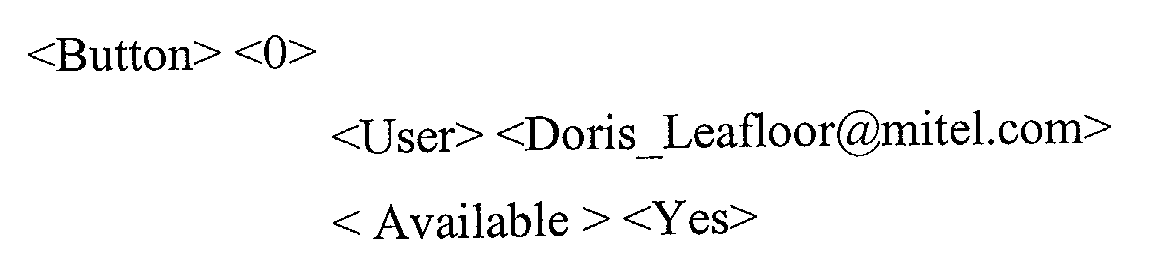
- the user agent 1 then conveys the user availability information to the user in an appropriate format (e.g. the format of Figure 1 which includes call buttons for the user to initiate ad hoc communication), such as:
- the associated device agent 3 uses this information to properly update the user's communication device 5 in order to display the necessary information, as shown in Figure 1.
- the user agent periodically issues further anti-tuples to the tuple space 7 for detecting any changes in availability.
- a subsequent anti-tuple will return a value which indicates her unavailability.
- users become available, their user agents post tuples with the ingle ⁇ Available> ⁇ Yes>, such that subsequent anti-tuples from user agents inquiring as to availability will result in such users being available on the display of Figure 1.
- a user wishes to communicate with a member on his/her community list, the user indicates the member to which communication is to be directed, by pressing the button next to the member's name (i.e. button/indicator to the left of member's name in Figure 1).
- the device agent 3 and user agent 1 collaborate to connect the user's device 5 to the transient message store 8.
- the display at the user's device 5 is then altered to indicate that the user should proceed with recording of a message. For example, the display may change to "*>" with the arrow blinking. As well, an audible tone can be generated to reinforce the indication for the user to record a voicemail message.
- the destination user's agent 1 is notified that a message has been sent from a member in his/her community list.
- the recipient's user agent 1 then communicates with the associated device agent 3 to alter the display on the recipient user's device in order to indicate that a message has been left (e.g. a " ⁇ *" symbol set, with the arrow blinking).
- An audible tone may also be generated to notify the user that a message has been left.
- the recipient user may then indicate that he/she wishes to listen to the message by pressing the button adjacent to the sending member's name on his/her device.
- the associated device agent 3 and user agent 1 collaborate such that the destination device 5 is connected to the transient message store 8, and the message is played.
- the user agent 1 for the recipient is informed in response to which it communicates with the user agent 1 for the originator of the message and determines if the originator is available for a direct connection. If the originator is available (e.g. he/she has not moved on to another member on his/her list), the destination user agent 1 requests that the associated device agent 3 establish a direct connection between the two parties via PBX 9.
- Each of the user agents 1 ie. originator and destination
- the method of displaying status information on the sets may be altered if more complex display technologies are available, the method of tracking user availability may be altered as standards evolve, or the transient message store may occur on the end devices as their capabilities increase. All such alternative embodiments are believed to fall within the sphere and scope of the invention as defined by the appended claims.
Landscapes
- Engineering & Computer Science (AREA)
- Software Systems (AREA)
- Computing Systems (AREA)
- General Engineering & Computer Science (AREA)
- Theoretical Computer Science (AREA)
- Signal Processing (AREA)
- Physics & Mathematics (AREA)
- General Physics & Mathematics (AREA)
- Information Transfer Between Computers (AREA)
- Telephonic Communication Services (AREA)
Abstract
Description
{ :name John Doe :age 37 :employee_number 12345 :start_date 810126 :position T12 }
{ :name ? :age 37 :employee_number ? :start_date ? :position T12 }
would return the tuples for all employees of position T12 who are 37 years old.


Claims (10)
- Apparatus for establishing and maintaining communication among a community of interest, comprising:whereby in response to said second user listening to said voice message and provided that said first use is available for communication a voice path is created in said communication switch between said first user and said second user, and in the event said first user is no longer available for communication said second user stores a voice message for said first user via said transient message store.a plurality of communication devices for voice communication between users of said community of interest, each of said communication devices including a display for indicating communication availability of said users;a plurality of device agents for controlling respective ones of said communication devices in establishing said voice communication and updating each said display;a plurality of user agents for maintaining user preferences, said user preferences including a list of said users of said community of interest;a tuple space for exchanging tuples and anti-tuples between said user agents to monitor said communication availability, in response to which respective ones of said device agents update each respective display;a transient voice store for receiving and storing a voice message from a first one of said users to a second one of said users with whom said first user is desirous of communicating and who is indicated on the display of said first user as being available for communication, whereupon the display of said second user is updated to indicate receipt of said voice message, and for playing said voice message to said second user; anda communication switch for establishing two-way communication between said users;
- The apparatus of claim 1, wherein said display further includes a button associated with each of said users for initiating communication therebetween.
- The apparatus of claim 2, wherein said button is illuminated so as to indicate said availability and status.
- The apparatus of claim 3, wherein said button is illuminated with '*' to indicate user availability, '*>' to indicate leaving a message for another user, '<*' to indicate message waiting, and '<*>' to indicate two-way communication having been established between users.
- The apparatus of claim 2, wherein said button is an LCD.
- The apparatus of claim 2, wherein said button is an icon on a PC.
- The apparatus of claim1, wherein at least one of said plurality of communication devices is a phone.
- The apparatus of claim1, wherein at least one of said plurality of communication devices is a PC.
- A method for establishing and maintaining communication among a community of interest, comprising:a) monitoring communication availability of each user in said community of interest;b) indicating to each user the communication availability of each other user in said community of interest;c) receiving and storing a voice message from a first one of said users to a second one of said users with whom said first user is desirous of communicating and who is indicated to said first user as being available for communication;d) playing said voice message to said second user;e) in the event said first user is available for communication establishing two-way communication between said users, and otherwise receiving and storing a voice message from said second one of said users to said first one of said users; andf) playing said voice message to said first user.
- The method of claim 9, further comprising:g) in the event said second user is available for communication establishing two-way communication between said users, and otherwise receiving and storing a voice message from said first one of said users to said second one of said users; andh) playing said voice message to said second user.
Applications Claiming Priority (2)
| Application Number | Priority Date | Filing Date | Title |
|---|---|---|---|
| GBGB0200746.6A GB0200746D0 (en) | 2002-01-14 | 2002-01-14 | Method and apparatus for establishing and maintaining voice communication among a community of interest |
| GB0200746 | 2002-01-14 |
Publications (3)
| Publication Number | Publication Date |
|---|---|
| EP1328109A2 true EP1328109A2 (en) | 2003-07-16 |
| EP1328109A3 EP1328109A3 (en) | 2006-12-27 |
| EP1328109B1 EP1328109B1 (en) | 2010-06-30 |
Family
ID=9929032
Family Applications (1)
| Application Number | Title | Priority Date | Filing Date |
|---|---|---|---|
| EP03250228A Expired - Lifetime EP1328109B1 (en) | 2002-01-14 | 2003-01-14 | Method and apparatus for establishing and maintaining voice communication among a community of interest |
Country Status (5)
| Country | Link |
|---|---|
| US (1) | US7127047B2 (en) |
| EP (1) | EP1328109B1 (en) |
| CA (1) | CA2415798C (en) |
| DE (1) | DE60333139D1 (en) |
| GB (1) | GB0200746D0 (en) |
Cited By (4)
| Publication number | Priority date | Publication date | Assignee | Title |
|---|---|---|---|---|
| EP1661378A4 (en) * | 2003-09-02 | 2007-07-18 | Xynk Pty Ltd | Call management system |
| WO2007087456A2 (en) | 2006-01-25 | 2007-08-02 | Cisco Technology, Inc. | Class-based call request routing |
| US8325906B2 (en) | 2003-07-14 | 2012-12-04 | Cisco Technology, Inc. | Class-based call request routing |
| EP2307978A4 (en) * | 2008-06-18 | 2014-01-15 | Qualcomm Inc | Persistent personal messaging in a distributed system |
Families Citing this family (8)
| Publication number | Priority date | Publication date | Assignee | Title |
|---|---|---|---|---|
| GB0200747D0 (en) * | 2002-01-14 | 2002-02-27 | Mitel Knowledge Corp | Hardware-assisted tuple space |
| WO2007037018A1 (en) * | 2005-09-29 | 2007-04-05 | Fujitsu Limited | Presence communication system |
| US20090077480A1 (en) * | 2007-06-19 | 2009-03-19 | Caunter Mark Leslie | Apparatus and method of managing electronic communities of users |
| US20090063423A1 (en) * | 2007-06-19 | 2009-03-05 | Jackson Bruce Kelly | User interfaces for service object located in a distributed system |
| US8340265B2 (en) | 2007-07-31 | 2012-12-25 | At&T Intellectual Property I, L.P. | System for processing recorded messages |
| US20090320097A1 (en) * | 2008-06-18 | 2009-12-24 | Jackson Bruce Kelly | Method for carrying out a distributed search |
| US20090319385A1 (en) * | 2008-06-18 | 2009-12-24 | Jackson Bruce Kelly | Monetizing and prioritizing results of a distributed search |
| CN105072018A (en) * | 2015-07-10 | 2015-11-18 | 阿里巴巴集团控股有限公司 | Working state prompt method and device |
Family Cites Families (11)
| Publication number | Priority date | Publication date | Assignee | Title |
|---|---|---|---|---|
| GB2082420B (en) | 1980-08-06 | 1984-05-16 | Gen Electric Co Ltd | Telephone systems |
| JPH06188995A (en) | 1992-08-31 | 1994-07-08 | American Teleph & Telegr Co <Att> | Call routing transmission device and method |
| US5920621A (en) | 1996-04-15 | 1999-07-06 | Mci Communications Corporation | System and method for distributing calls to customer service operators based on automatic determination of operator availability |
| FI974259A7 (en) * | 1997-11-17 | 1999-05-18 | Nokia Corp | Data transmission during call setup |
| US6301609B1 (en) * | 1999-07-07 | 2001-10-09 | Lucent Technologies Inc. | Assignable associate priorities for user-definable instant messaging buddy groups |
| GB2351870B (en) * | 1999-07-09 | 2001-09-19 | Mitel Corp | Feature interaction resolution using fuzzy rules |
| KR20010021111A (en) * | 1999-07-23 | 2001-03-15 | 스테븐 디.피터스 | Messaging and status indication for wireless communication devices |
| WO2001011824A2 (en) | 1999-08-06 | 2001-02-15 | Ecall Inc. | Method and system for recording and forwarding voice messages |
| CA2403520C (en) | 2000-03-17 | 2008-06-03 | America Online, Inc. | Voice instant messaging |
| US6990180B2 (en) * | 2001-04-05 | 2006-01-24 | Nokia Mobile Phones Limited | Short voice message (SVM) service method, apparatus and system |
| US6934912B2 (en) * | 2001-06-04 | 2005-08-23 | Hewlett-Packard Development Company, L.P. | System and method for providing a history list of existing imaging compositions |
-
2002
- 2002-01-14 GB GBGB0200746.6A patent/GB0200746D0/en not_active Ceased
-
2003
- 2003-01-08 CA CA002415798A patent/CA2415798C/en not_active Expired - Lifetime
- 2003-01-10 US US10/339,996 patent/US7127047B2/en not_active Expired - Lifetime
- 2003-01-14 DE DE60333139T patent/DE60333139D1/en not_active Expired - Lifetime
- 2003-01-14 EP EP03250228A patent/EP1328109B1/en not_active Expired - Lifetime
Cited By (6)
| Publication number | Priority date | Publication date | Assignee | Title |
|---|---|---|---|---|
| US8325906B2 (en) | 2003-07-14 | 2012-12-04 | Cisco Technology, Inc. | Class-based call request routing |
| EP1661378A4 (en) * | 2003-09-02 | 2007-07-18 | Xynk Pty Ltd | Call management system |
| WO2007087456A2 (en) | 2006-01-25 | 2007-08-02 | Cisco Technology, Inc. | Class-based call request routing |
| EP1977586A4 (en) * | 2006-01-25 | 2010-12-15 | Cisco Tech Inc | Class-based call request routing |
| EP2307978A4 (en) * | 2008-06-18 | 2014-01-15 | Qualcomm Inc | Persistent personal messaging in a distributed system |
| US8930531B2 (en) | 2008-06-18 | 2015-01-06 | Qualcomm Incorporated | Persistent personal messaging in a distributed system |
Also Published As
| Publication number | Publication date |
|---|---|
| CA2415798A1 (en) | 2003-07-14 |
| CA2415798C (en) | 2007-01-09 |
| US20030133544A1 (en) | 2003-07-17 |
| DE60333139D1 (en) | 2010-08-12 |
| EP1328109A3 (en) | 2006-12-27 |
| US7127047B2 (en) | 2006-10-24 |
| GB0200746D0 (en) | 2002-02-27 |
| EP1328109B1 (en) | 2010-06-30 |
Similar Documents
| Publication | Publication Date | Title |
|---|---|---|
| US11595520B2 (en) | Conference calls and meetings via electronic messaging interface | |
| US7974391B2 (en) | Conversation-based user interface | |
| US6526274B1 (en) | Method, system, and computer program product for extending the functionality of a personal information manager to telephone system interactions | |
| US7076043B2 (en) | System and method of using presence information to delay dialing phone calls initiated by a caller to a callee | |
| EP1672881B1 (en) | System and method for providing customization of a graphical user interface of a communications device based on an active communications session | |
| US7471782B2 (en) | Pro-active features for telephony | |
| US8041020B2 (en) | System and method for active mobile collaboration | |
| US7007085B1 (en) | Message log for wireline, voice mail, email, fax, pager, instant messages and chat | |
| EP1480422B1 (en) | Enhanced telephony computer user interface allowing user interaction and control of a telephone using a personal computer | |
| US7272633B2 (en) | Methods and systems for a communications and information resource manager | |
| US20020076015A1 (en) | Comprehensive message communication system | |
| US20050076338A1 (en) | Communications and information resource manager | |
| US20060031470A1 (en) | Method to update status on multiple voice and text systems from a single device | |
| EP1328109B1 (en) | Method and apparatus for establishing and maintaining voice communication among a community of interest | |
| US7688953B2 (en) | Rate control in communications systems | |
| US7822189B2 (en) | Searching multiple directories and generating a sorted integrated directory | |
| US20070041571A1 (en) | Directory integration in mobile systems | |
| CN103780772A (en) | Advanced calling | |
| US20180331838A1 (en) | Synchronization method, representation therefor and associated subscriber directory | |
| Wullert II et al. | Presence management in next generation networks | |
| JP6361774B1 (en) | Schedule management system and schedule management method |
Legal Events
| Date | Code | Title | Description |
|---|---|---|---|
| PUAI | Public reference made under article 153(3) epc to a published international application that has entered the european phase |
Free format text: ORIGINAL CODE: 0009012 |
|
| AK | Designated contracting states |
Designated state(s): AT BE BG CH CY CZ DE DK EE ES FI FR GB GR HU IE IT LI LU MC NL PT SE SI SK TR |
|
| AX | Request for extension of the european patent |
Extension state: AL LT LV MK RO |
|
| PUAL | Search report despatched |
Free format text: ORIGINAL CODE: 0009013 |
|
| AK | Designated contracting states |
Kind code of ref document: A3 Designated state(s): AT BE BG CH CY CZ DE DK EE ES FI FR GB GR HU IE IT LI LU MC NL PT SE SI SK TR |
|
| AX | Request for extension of the european patent |
Extension state: AL LT LV MK RO |
|
| RIC1 | Information provided on ipc code assigned before grant |
Ipc: H04M 3/533 20060101ALI20061122BHEP Ipc: H04M 3/42 20060101AFI20030317BHEP |
|
| 17P | Request for examination filed |
Effective date: 20070627 |
|
| AKX | Designation fees paid |
Designated state(s): DE FR GB |
|
| RAP1 | Party data changed (applicant data changed or rights of an application transferred) |
Owner name: MITEL NETWORKS CORPORATION |
|
| 17Q | First examination report despatched |
Effective date: 20090119 |
|
| GRAP | Despatch of communication of intention to grant a patent |
Free format text: ORIGINAL CODE: EPIDOSNIGR1 |
|
| GRAS | Grant fee paid |
Free format text: ORIGINAL CODE: EPIDOSNIGR3 |
|
| GRAA | (expected) grant |
Free format text: ORIGINAL CODE: 0009210 |
|
| AK | Designated contracting states |
Kind code of ref document: B1 Designated state(s): DE FR GB |
|
| REG | Reference to a national code |
Ref country code: GB Ref legal event code: FG4D |
|
| REF | Corresponds to: |
Ref document number: 60333139 Country of ref document: DE Date of ref document: 20100812 Kind code of ref document: P |
|
| PLBE | No opposition filed within time limit |
Free format text: ORIGINAL CODE: 0009261 |
|
| STAA | Information on the status of an ep patent application or granted ep patent |
Free format text: STATUS: NO OPPOSITION FILED WITHIN TIME LIMIT |
|
| 26N | No opposition filed |
Effective date: 20110331 |
|
| REG | Reference to a national code |
Ref country code: DE Ref legal event code: R097 Ref document number: 60333139 Country of ref document: DE Effective date: 20110330 |
|
| REG | Reference to a national code |
Ref country code: FR Ref legal event code: PLFP Year of fee payment: 14 |
|
| REG | Reference to a national code |
Ref country code: FR Ref legal event code: PLFP Year of fee payment: 15 |
|
| REG | Reference to a national code |
Ref country code: FR Ref legal event code: PLFP Year of fee payment: 16 |
|
| PGFP | Annual fee paid to national office [announced via postgrant information from national office to epo] |
Ref country code: FR Payment date: 20211216 Year of fee payment: 20 Ref country code: GB Payment date: 20211203 Year of fee payment: 20 |
|
| PGFP | Annual fee paid to national office [announced via postgrant information from national office to epo] |
Ref country code: DE Payment date: 20211130 Year of fee payment: 20 |
|
| REG | Reference to a national code |
Ref country code: DE Ref legal event code: R071 Ref document number: 60333139 Country of ref document: DE |
|
| REG | Reference to a national code |
Ref country code: GB Ref legal event code: PE20 Expiry date: 20230113 |
|
| PG25 | Lapsed in a contracting state [announced via postgrant information from national office to epo] |
Ref country code: GB Free format text: LAPSE BECAUSE OF EXPIRATION OF PROTECTION Effective date: 20230113 |