EP1327932A1 - Encryption apparatus and method with side-channel attack resistance - Google Patents
Encryption apparatus and method with side-channel attack resistance Download PDFInfo
- Publication number
- EP1327932A1 EP1327932A1 EP02257439A EP02257439A EP1327932A1 EP 1327932 A1 EP1327932 A1 EP 1327932A1 EP 02257439 A EP02257439 A EP 02257439A EP 02257439 A EP02257439 A EP 02257439A EP 1327932 A1 EP1327932 A1 EP 1327932A1
- Authority
- EP
- European Patent Office
- Prior art keywords
- remainder
- storing
- expression
- modular exponentiation
- ciphertext
- Prior art date
- Legal status (The legal status is an assumption and is not a legal conclusion. Google has not performed a legal analysis and makes no representation as to the accuracy of the status listed.)
- Granted
Links
Images


Classifications
-
- G—PHYSICS
- G06—COMPUTING OR CALCULATING; COUNTING
- G06F—ELECTRIC DIGITAL DATA PROCESSING
- G06F7/00—Methods or arrangements for processing data by operating upon the order or content of the data handled
- G06F7/60—Methods or arrangements for performing computations using a digital non-denominational number representation, i.e. number representation without radix; Computing devices using combinations of denominational and non-denominational quantity representations, e.g. using difunction pulse trains, STEELE computers, phase computers
- G06F7/72—Methods or arrangements for performing computations using a digital non-denominational number representation, i.e. number representation without radix; Computing devices using combinations of denominational and non-denominational quantity representations, e.g. using difunction pulse trains, STEELE computers, phase computers using residue arithmetic
- G06F7/723—Modular exponentiation
-
- G—PHYSICS
- G06—COMPUTING OR CALCULATING; COUNTING
- G06F—ELECTRIC DIGITAL DATA PROCESSING
- G06F7/00—Methods or arrangements for processing data by operating upon the order or content of the data handled
- G06F7/60—Methods or arrangements for performing computations using a digital non-denominational number representation, i.e. number representation without radix; Computing devices using combinations of denominational and non-denominational quantity representations, e.g. using difunction pulse trains, STEELE computers, phase computers
- G06F7/72—Methods or arrangements for performing computations using a digital non-denominational number representation, i.e. number representation without radix; Computing devices using combinations of denominational and non-denominational quantity representations, e.g. using difunction pulse trains, STEELE computers, phase computers using residue arithmetic
- G06F7/728—Methods or arrangements for performing computations using a digital non-denominational number representation, i.e. number representation without radix; Computing devices using combinations of denominational and non-denominational quantity representations, e.g. using difunction pulse trains, STEELE computers, phase computers using residue arithmetic using Montgomery reduction
-
- G—PHYSICS
- G06—COMPUTING OR CALCULATING; COUNTING
- G06F—ELECTRIC DIGITAL DATA PROCESSING
- G06F2207/00—Indexing scheme relating to methods or arrangements for processing data by operating upon the order or content of the data handled
- G06F2207/72—Indexing scheme relating to groups G06F7/72 - G06F7/729
- G06F2207/7219—Countermeasures against side channel or fault attacks
- G06F2207/7223—Randomisation as countermeasure against side channel attacks
- G06F2207/7233—Masking, e.g. (A**e)+r mod n
- G06F2207/7238—Operand masking, i.e. message blinding, e.g. (A+r)**e mod n; k.(P+R)
Definitions
- the present invention relates to an encryption operating apparatus and method having side-channel attack resistance, which is secure with respect to analysis of a secret key in an encryption processor using side-channel attack and is capable of conducting operation processing with respect to decoding processing at a high speed.
- an encryption technology or an electronic signature generation technique is considered as one of indispensable techniques in a computer network environment.
- side-channel attack is an attack method for measuring a processing time and a power consumption of an encryption processor, and analyzing a secret key of a code based on the features of the measured processing time and power consumption.
- timing attack or SPA Simple Power Analysis
- timing attack or SPA is used for an encryption scheme containing a remainder operation
- the relationship in magnitude between an input value and a remainder value can be determined, so that it is possible to know the remainder value (i.e., the value of a secret key) by conducting a binary search while manipulating the input value.
- the third party can reveal the remainder value that is unknown to the third party by repeating a binary search while manipulating an input value. This implies that the third party can know a remainder value that is a secret key, for example, in the case where RSA with Chinese remainder theorem is used, which is considered to be fatal to the security in the encryption technology.
- the attack method as described above is also applicable to generation processing of an electronic signature. More specifically, if key information at a time of generation of an electronic signature is analyzed by a third party, the third party can generate the electronic signature arbitrarily, which enables the third party other than a user to easily pretend to be the user. Thus, this fact is considered to be fatal to the security introducing an electronic signature.
- the relationship in magnitude between X and p is determined based on the length of an operation time. That is, in the case where X (X ⁇ p) is input, a remainder operation is conducted, so that the operation time becomes long. On the other hand, in the case where X (X ⁇ p) is input, a remainder operation is not conducted, so that the operation time becomes short.
- the relationship in magnitude between X and p is determined based on the difference in waveform of a power consumption obtained by an operation. More specifically, as shown in FIGS. 1A-1C, assuming that a waveform of a power consumption by an operation A that does not involve a remainder operation is shown in FIG. 1A, and a waveform of a power consumption by an operation B that involves a remainder operation is shown in FIG. 1B, it can be determined from a waveform shown in FIG. 1C of a measured power consumption whether or not the operation B involving a remainder operation has been conducted.
- the input value X matched with the remainder value q can be obtained by using the attack method as described above to the secret key q in a similar manner. Therefore, it is also possible for the third party to know the secret key q .
- a typical method is to conduct a remainder operation after multiplying input data by a random number. Because of this, whether or not a remainder operation is conducted does not depend upon only the relationship in magnitude between the input data and the remainder value, and whether or not a remainder operation is conducted is determined randomly based on the magnitude of a random value. Therefore, irrespective of whether the timing attack is used or the SPA is used, the remainder value q or p (i.e., a secret key) cannot be revealed.
- an encryption operating apparatus having side-channel attack resistance of the present invention includes a modular exponentiation operating part for conducting at least a modular exponentiation operation with respect to ciphertext X that can be decrypted with secret keys p, q and d , wherein plaintext Y before being encrypted is calculated by providing a correction operating part for conducting the modular exponentiation operation after multiplying the ciphertext X by an arbitrary constant having a value larger than the secret keys p and q , and finally conducting a correction operation based on the constant.
- the encryption operating apparatus having side-channel attack resistance of the present invention includes a modular exponentiation operating part for conducting at least a modular exponentiation operation with respect to ciphertext X that can be decrypted with secret keys p , q and d , wherein plaintext Y before being encrypted is calculated by multiplying the ciphertext X , using a Montgomery parameter having a value larger than the secret keys p and q , as a constant, and conducting the modular exponentiation operation.
- the above-mentioned encryption operating apparatus having side-channel attack resistance is characterized in that, in a case where a function MONT _ EXP for executing a Montgomery modular exponentiation operation is defined by Expression 7, the apparatus includes: a ciphertext input part for inputting ciphertext X that can be decrypted with secret keys p , q and d; a Montgomery parameter multiplying part for multiplying the ciphertext X by a Montgomery parameter R; a multiplication result storing part for storing an operation result by the multiplication; a remainder operating part for conducting a remainder operation represented by Expression 8 using the secret key p or q as a remainder value with respect to the operation result by the multiplication stored in the multiplication result storing part; a remainder operation result storing part for storing operation results X p ' and X q ' by the remainder operation; a Montgomery modular exponentiation operating part for conducting a Montgomery modular exponentiation operation represented by Expression 9 with respect to the operation results X
- an encryption operating apparatus having side-channel attack resistance of the present invention having a modular exponentiation operating part for conducting at least a modular exponentiation operation with respect to ciphertext X that can be decrypted with secret keys p, q and d includes a Montgomery parameter remainder operating part for conducting a remainder operation to the secret keys p and q with respect to a Montgomery parameter having a value larger than the secret keys p and q , wherein plaintext Y before being encrypted is calculated by multiplying the ciphertext X by an operation result in the remainder operating part, and conducting the modular exponentiation operation.
- the above-mentioned encryption operating apparatus having side-channel attack resistance is characterized in that, in a case where a function MONT _ EXP for executing a Montgomery modular exponentiation operation is defined by Expression 11, the apparatus includes: a ciphertext input part for inputting ciphertext X that can be decrypted with secret keys p, q and d; a Montgomery parameter remainder operation result storing part for storing a result obtained by conducting a remainder operation to a remainder value p or q as represented by Expression 12 with respect to a Montgomery parameter R; a remainder value multiplying part for multiplying the input ciphertext X by an operation result R p ' or R q ' by the remainder operation stored in the Montgomery parameter remainder operation result storing part as represented by Expression 13; a multiplication result storing part for storing operation results X p ' and X q ' by the multiplication; a remainder operating part for successively conducting a remainder operation represented by Expression 14 using the secret keys p and q
- the present invention is characterized by a recording medium storing a computer-executable program for implementing an encryption operating method having side-channel attack resistance and processes thereof, wherein, in a case where a function MONT_EXP for executing a Montgomery modular exponentiation operation is defined by Expression 21, the program including: inputting ciphertext X that can be decrypted with secret keys p, q and d; multiplying the ciphertext X by a Montgomery parameter R; storing an operation result by the multiplication; conducting a remainder operation represented by Expression 22 using the secret key p or q as a remainder value with respect to the stored operation result by the multiplication; storing operation results X p ' and X q ' by the remainder operation; conducting a Montgomery modular exponentiation operation represented by Expression 23 with respect to the stored operation results X p ' and X q ' by the remainder operation; storing operation results Y p and Y q by the Montgomery modular exponentiation operation; and calculating plaintext
- the present invention is characterized by a recording medium storing a computer-executable program for implementing an encryption operating method having side-channel attack resistance, wherein, in a case where a function MONT _ EXP for executing a Montgomery modular exponentiation operation is defined by Expression 25, the program including: inputting ciphertext X that can be decrypted with secret keys p , q and d; storing a result obtained by conducting a remainder operation to a remainder value p or q as represented by Expression 26 with respect to a Montgomery parameter R; multiplying the input ciphertext X by a stored operation result Rp' or R q ' by the remainder operation as represented by Expression 27; storing operation results X p ' and X q ' by the multiplication; successively conducting a remainder operation represented by Expression 28 using the secret keys p and q as remainder values with respect to the stored operation results X p ' and X q ' by the multiplication; storing operation results X p and
- FIGS. 1A to 1C illustrate waveforms of a power consumption.
- FIG. 2 shows a configuration of an encryption operating apparatus having side-channel attack resistance in Embodiment 1 according to the present invention.
- FIG. 3 is a flow chart illustrating processing in the encryption operating apparatus having side-channel attack resistance in Embodiment 1 according to the present invention.
- FIG. 4 is a flow chart illustrating processing in the encryption operating apparatus having side-channel attack resistance in Embodiment 1 according to the present invention.
- FIG. 5 shows a configuration of the encryption operating apparatus having side-channel attack resistance in Embodiment 2 according to the present invention.
- FIG. 6 is a flow chart illustrating processing in the encryption operating apparatus having side-channel attack resistance in Embodiment 2 according to the present invention.
- FIG. 7 is a flow chart illustrating processing in the encryption operating apparatus having side-channel attack resistance in Embodiment 2 according to the present invention.
- FIG. 8 shows a configuration of the encryption operating apparatus having side-channel attack resistance in Embodiment 3 according to the present invention.
- FIG. 9 is a flow chart illustrating processing in the encryption operating apparatus having side channel attack resistance in Embodiment 3 according to the present invention.
- FIG. 10 is a flow chart illustrating processing in the encryption operating apparatus having side-channel attack resistance in Embodiment 3 according to the present invention.
- FIG. 11 illustrates a computer environment
- Embodiment 1 is characterized in that an input X is multiplied by a constant C that is larger than secret keys p and q , instead of being multiplied by a random number r .
- the input X is multiplied by the constant C that is larger than the secret keys p and q , so that X*C takes a value larger than p and q .
- the encryption operating apparatus can be effectively protected from side-channel attack such as timing attack and SPA, and operation processing can be conducted at a high speed without increasing an operation processing overhead.
- FIG. 2 shows a specific configuration of the encryption operating apparatus having side-channel attack resistance in Embodiment 1 according to the present invention.
- Embodiment 1 the case will be described in which decoding in RSA processing with Chinese remainder theorem will be described.
- reference numeral 1 denotes a ciphertext input part for inputting ciphertext X for decoding.
- a third party that conducts timing attack or SPA also inputs dummy ciphertext Xd for revealing secret keys through the ciphertext input part 1.
- the ciphertext X or Xd thus input is transferred to a constant multiplying part 6.
- Reference numeral 2 denotes a constant input part for inputting a constant X for multiplying the ciphertext X or the dummy ciphertext Xd input through the ciphertext input part 1. It is assumed that a constant C satisfies the relationships C> p and C> q with respect to secret keys p and q .
- the input constant C is stored in a constant storing part 3.
- the constant input part 2 is not provided. That is, the constant C satisfying the relationships C> p and C> q with respect to the secret keys p and q is previously stored in the constant storing part 3 during implementation, whereby a user is not required to input the constant C . This is because it is considered that the constant C is previously determined during implementation.
- Reference 4 denotes a correction value operating part for obtaining correction values C -dp and C -dq required for finally obtaining plaintext.
- C is a constant, so that the correction values C -dp and C -dq required for obtaining plaintext finally are also constant values.
- the calculated correction values C -dp and C -dq are stored in a correction value storing part 5.
- the correction value operating part 4 is not provided. That is, the correction values C -dp and C -dq are previously calculated based on the constant value C stored in the constant storing part 3 and stored in the correction value storing part 5. Because of this, it can be expected to reduce an operation processing overhead.
- Reference numeral 8 denotes a remainder operating part for conducting remainder operations using the secret keys p and q as remainder values with respect to multiplication results stored in the multiplication result storing part 7.
- X*C> p and X*C> q always hold from the relationships C> p and C> q . Therefore, the remainder operating part 8 conducts remainder operations even if any input is conducted through the ciphertext input part 1.
- Embodiment 1 can be expressed by Expression 32.
- X p ' and X q ' that are results of remainder operations calculated by Expression 32 are stored in a remainder operation result storing part 9.
- Reference numeral 10 denotes a Chinese remainder RSA processing part for conducting a modular exponentiation operation based on a Chinese remainder theorem with respect to the results of the remainder operations stored in the remainder operation result storing part 9.
- a modular exponentiation operation as expressed by Expression 33 is conducted.
- Operation results Y p and Y q of the modular exponentiation operation expressed by Operation 32 are stored in a modular exponentiation operation result storing part 11.
- Reference numeral 12 denotes a correction processing part for conducting modular exponentiation operations with respect to the input values X and Y, using the previously calculated correction values C -dp and C -dq stored in the correction value storing part 5.
- the correction operations are expressed by Expression 34. Since C is a constant, the correction values C -dp and C -dq are also constants. It only needs to conduct operation processing for obtaining correction values C -dp and C -dq once.
- the correction operation values Y p ' and Y q ' are stored in a correction result storing part 13.
- Reference numeral 14 denotes a plaintext output part for calculating plaintext Y before being encrypted as represented by Expression 35 with respect to the correction operation values Y p ' and Y q ' corrected in the correction processing part 12 and stored in the correction result storing part 13.
- an input value is the dummy ciphertext Xd
- an erroneous calculated value is output; however, there is no problem in a calculated value with respect to side-channel attack.
- FIG. 3 is a flow chart illustrating the processing of a program for realizing the encryption operating apparatus having side-channel attack resistance of Embodiment 1 according to the present invention.
- ciphertext X is input (Operation 301). This also applies to the case where an attacker attempting to conduct timing attack or SPA inputs dummy ciphertext Xd for analyzing secret keys.
- a constant Cfor multiplying the input ciphertext X or dummy ciphertext Xd is also input (Operation 302).
- the constant C is assumed to have the relationships C>p and C> q with respect to secret keys p and q .
- correction values C -dp and C -dq required for finally obtaining plaintext are calculated (Operation 303).
- C represents a constant
- the correction values C -dp and C -dq required for finally obtaining plaintext are also constant values.
- the ciphertext X or the dummy ciphertext Xd is multiplied by the input constant C (Operation 304). Then, remainder operations are conducted using the secret keys p and q as represented by Expression 36 (Operation 305).
- correction values are also constants. Unlike the case using a random number, it is not required to calculate correction values every time a value to be multiplied is varied. Therefore, operation processing can be conducted at a high speed without complicating operation processing of decoding.
- constants C p and C q satisfying the relationships C p > p and C q > q may be determined with respect to p and q . More specifically, since the input X is always multiplied by the constant C p larger than the secret key p and the constant C q larger than the secret key q , X * C p always takes a value larger than p , and X* C q always takes a value larger than q . Thus, a remainder operation using a remainder value p or q is always conducted, so that the input value X cannot be compared with the remainder value p or q in terms of magnitude, irrespective of whether timing attack is used or SPA is used.
- operation processing can be conducted at a high speed without increasing an operation processing overhead while effectively preventing side-channel attack such as timing attack and SPA.
- the configuration of an encryption operating apparatus having side-channel attack resistance in this case is the same as that shown in FIG. 2. More specifically, in FIG. 2, the constants C P and C q having the relationships C p > p and C q > q with respect to the secret keys p and q are input from the constant input part 2. The input constants C p and C q are stored in the constant storing part 3.
- the configuration without the constant input part 2 is also considered. That is, the constants C p and C q having the relationships C p > p and C q > q with respect to the secret keys p and q are previously stored in the constant storing part 3 during mounting so that a user is not required to input the constants C p and C q . It is also considered that the constants C p and C q are previously determined during mounting.
- the correction values C p -dp and C q C -dq required for finally obtaining plaintext are obtained.
- C p and C q are constants. Therefore, the correction values C p -dp and C q -dq required for finally obtaining plaintext are also constant values.
- the calculated correction values C p -dp and C q -dq are stored in the correction value storing part 5.
- the configuration without the correction value operating part 4 is also considered in the same way as in the constant input part 2. That is, the correction values C p -dp and C q -dq are previously calculated based on the constants C p and C q stored in the constant storing part 3 and stored in the correction value storing part 5. Because of this, it can be expected that an operation processing overhead is reduced.
- the ciphertext X or the dummy ciphertext Xd input from the ciphertext input part 1 is multiplied by the constants C p and C q stored in the constant storing part 3.
- Multiplication with respect to the ciphertext X is as represented by Expression 40.
- Results X p and X q obtained by multiplications of Expression 40 are stored in the multiplication result storing part 7.
- the input values X or Xd are corrected to operation results in the case where a modular exponentiation operation is conducted by using the previously calculated correction values C p -dp and C q -dq stored in the correction value storing part 5 in accordance with Expression 43.
- C p and C q are constants, so that the correction values C p -dp and C q -dq are also constants.
- the operation processing for obtaining correction values C -dp and C -dq need to be conducted only once.
- the correction operation values Y p ' and Y q ' are stored in the correction result storing part 13.
- plaintext Y before being encrypted is calculated as represented by Expression 44, based on the correction operation values Y p ' and Y q ' corrected in the correction processing part 12 and stored in the correction result storing part 13.
- FIG. 4 is a flow chart illustrating the processing of a program for realizing the encryption operating apparatus having side-channel attack resistance of Embodiment 1 using the constants C p and C q .
- ciphertext X is input (Operation 401). This also applies to the case where an attacker attempting to conduct timing attack or SPA inputs dummy ciphertext Xd for analyzing secret keys.
- Constants C p and C q for multiplying the input ciphertext X or dummy ciphertext Xd are input (Operation 402).
- the constants C p and C q are assumed to have relationships C p > p and C q > q with respect to the secret keys p and q .
- correction values C p -dp and C q -dq required for finally obtaining plaintext are calculated (Operation 403).
- C p and C q are constants, so that the correction values C p -dp and C q -dq required for finally obtaining plaintext are also constant values.
- the ciphertext X or the dummy ciphertext Xd is multiplied by the input constants C p and C q (Operation 404). Then, remainder operations using the secret keys p and q as remainder values, as represented by Expression 45, are conducted with respect to the multiplication results.
- correction values are also constants. Unlike the case using a random number, it is not required to calculate correction values every time a value to be multiplied is varied. Therefore, operation processing can be conducted at a high speed without complicating operation processing of decoding.
- Embodiment 1 The operating apparatus and method of Embodiment 1 are applicable to all the systems for conducting a modular exponentiation operation, using secret information such as EPOC and e-sign for a remainder, as well as ciphertext of a RSA system, and the effects obtained therefrom are the same.
- Embodiment 1 by loading the above-mentioned program onto a computer for execution, even in the case where any input is made, a remainder operation is always conducted. Therefore, the relationship in magnitude between the input value and the secret key p or q based on the difference in operation processing time and wavelength of a power consumption cannot be derived, and a decoding operating method having high security with respect to side-channel attack can be provided.
- a correction value is calculated based on a constant. Therefore, the first one operation is enough for obtaining a correction value, and hence, it can be expected that an operation processing overhead is further reduced as a whole.
- Embodiment 2 An encryption operating apparatus having side-channel attack resistance of Embodiment 2 according to the present invention will be described with reference to the drawings.
- Montgomery modular exponentiation operation is applied to a modular exponentiation operation, and a Montgomery parameter R is used in place of a constant C in Embodiment 1.
- the Montgomery parameter R is always larger than any of secret keys p and q , so that X* R always takes a value larger than p or q .
- X* R always takes a value larger than p or q .
- Embodiment 2 a correction operation is not required in Embodiment 2. That is, in Embodiment 2, a function MONT _ EXP is determined as represented by Expression 50 as a modular exponentiation operation to be conducted after the remainder operation.
- operation processing can be conducted at a high speed without increasing an operation processing overhead while effectively preventing side-channel attack such as timing attack and SPA.
- Representative examples of the Montgomery parameter R include 2 512 , 2 1024 or the like.
- FIG. 5 shows a specific configuration.
- FIG. 5 is a view showing a configuration of an encryption operating apparatus having side-channel attack resistance of Embodiment 2 according to the present invention.
- Embodiment 2 the case where decoding processing in RSA processing with Chinese remainder theorem is conducted will be described.
- reference numeral 1 denotes a ciphertext input part in the same way as in Embodiment 1, which is used for inputting ciphertext X for decoding.
- a third party conducting timing attack or SPA also inputs dummy ciphertext Xd for analyzing secret keys through the ciphertext input part 1.
- the input ciphertext X or Xd is given to a Montgomery parameter multiplying part 21.
- Reference numeral 8 denotes a remainder operating part for respectively conducting remainder operations using the secret keys p and q as remainder values with respect to the multiplication result stored in the multiplication result storing part 22.
- X * R > p and X* R > q always hold from the relationships R > p and R > q .
- the remainder operations in Embodiment 2 can be expressed by Expression 53.
- Results X p ' and X q ' of the remainder operations calculated by Expression 53 are stored in a remainder operation result storing part 9.
- reference numeral 23 denotes a Montgomery modular exponentiation operating part for conducting Montgomery modular exponentiation operations represented by Expression 54 with respect to the results of the remainder operations stored in the remainder operation result storing part 9.
- Operation results Y p and Y q of the Montgomery modular exponentiation operations represented by Expression 54 are stored in a Montgomery modular exponentiation operation result storing part 24.
- a function MONT_EXP for conducting the Montgomery modular exponentiation operations is defined by Expression 55.
- reference numeral 14 denotes a plaintext output part for calculating plaintext Y before being encrypted as presented by Expression 57, based on the operation values Y p ' and Y q ' calculated in the Montgomery modular exponentiation operating part 23 and stored in the Montgomery modular exponentiation operation result storing part 24.
- an input value is the dummy ciphertext Xd
- an erroneous calculated value is output.
- side-channel attack there is no problem in the calculated value.
- FIG.6 is a flow chart illustrating the processing of a program for realizing the encryption operating apparatus having side-channel attack resistance of Embodiment 2 according to the present invention.
- ciphertext X is input (Operation 601) and is multiplied by a Montgomery parameter R (Operation 602). Due to the precondition of the Montgomery modular exponentiation operations, the Montgomery parameter R has relationships R> p and R > q with respect to the secret keys p and q . Thus, in Embodiment 2, X* R > p and X* R> q always hold in the same way as in Embodiment 1. The same processing is also conducted in the case where a third party conducting timing attack or SPA inputs the dummy ciphertext Xd for analyzing the secret keys.
- Montgomery modular exponentiation operations represented by Expression 59 are conducted using the operation results of the remainder operations (Operation 604).
- Afunction MONT _ EXP used for the Montgomery modular exponentiation operations are defined by Expression 60.
- plaintext Y before being encrypted is calculated as presented by Expression 62, based on the operation values Y p and Y q calculated by the Montgomery modular exponentiation operations (Operation 605).
- the configuration of the encryption operating apparatus having side-channel attack resistance in this case is the same as that shown in FIG. 5.
- the Montgomery parameter multiplying part 21 the ciphertext X or the dummy ciphertext Xd input from the ciphertext input part 1 is multiplied by the Montgomery parameter R p or R q . Due to the precondition of the Montgomery modular exponentiation operations, the Montgomery parameter R has relationships R p > p and R q > q with respect to secret keys p and q . Therefore, in Embodiment 2, X* R p > p and X* R q > q always hold in the same way as in Embodiment 1. Multiplication with respect to the ciphertext X is as represented by Expression 63. Results X p and X q obtained by multiplication of Expression 63 is stored in a multiplication result storing part 22.
- the remainder operations in Embodiment 2 can be expressed by Expression 64.
- Results X p ' and X q ' of the remainder operations calculated by Expression 64 are stored in the remainder operation result storing part 9.
- Montgomery modular exponentiation operations represented by Expression 65 are conducted with respect to the results of the remainder operations stored in the remainder operation result storing part 9. Operation results Y p and Y q of the Montgomery modular exponentiation operations represented by Expression 65 are stored in the Montgomery modular exponentiation operation result storing part 24.
- a function MONT_EXP for conducting the Montgomery modular exponentiation operations is defined by Expression 66.
- plaintext Y before being encrypted as presented by Expression 68 is calculated, based on the operation values Y p ' and Y q ' calculated in the Montgomery modular exponentiation operating part 23 and stored in the Montgomery modular exponentiation operation result storing part 24.
- FIG. 7 is a flow chart illustrating the processing of a program for realizing the encryption operating apparatus having side-channel attack resistance of the present example.
- ciphertext X is input (Operation 701) and is multiplied by a Montgomery parameter R p or R q (Operation 702). Due to the precondition of the Montgomery modular exponentiation operations, the Montgomery parameters R p and R q have relationships R p > p and R q > q with respect to the secret keys p and q . Thus, in the present example, X * R p > p and X * R q > q always hold. The same processing is also conducted in the case where a third party conducting timing attack or SPA inputs the dummy ciphertext Xd for analyzing the secret keys.
- Montgomery modular exponentiation operations represented by Expression 70 are conducted using the operation results of the remainder operations (Operation 704).
- a function MONT _ EXP used for the Montgomery modular exponentiation operations are defined by Expression 71.
- plaintext Y before being encrypted is calculated as presented by Expression 73, based on the operation values Y p and Y q calculated by the Montgomery modular exponentiation operations (Operation 705).
- Embodiment 2 The operating apparatus and method of Embodiment 2 are applicable to all the systems for conducting a modular exponentiation operation, using secret information such as EPOC and e-sign for a remainder, as well as ciphertext of a general RSA system, and the effects obtained therefrom are the same.
- Embodiment 2 even in the case where any input is made, a remainder operation is always conducted. Therefore, the relationship in magnitude between the input value and the secret key p or q based on the difference in operation processing time and wavelength of a power consumption cannot be derived, and a decoding operating method having high security with respect to side-channel attack can be provided.
- Embodiment 3 An encryption operating apparatus having side-channel attack resistance of Embodiment 3 according to the present invention will be described with reference to the drawings.
- the Montgomery parameter R is always larger than either secret key p or q .
- R p ' or R q ' does not always take a value larger than p or q . Therefore, whether or not the remainder operation using the remainder value p or q is conducted is determined based on the magnitude of R p ' or R q ' .
- R p ' or R q ' is a number unknown to an attacker. Therefore, the attacker cannot reveal the remainder value p or q . More specifically, irrespective of whether timing attack is used or SPA is used, the attacker cannot reveal the remainder value p or q .
- Embodiment 3 a correction operation can be made unnecessary in the same way as in Embodiment 2. More specifically, first in Embodiment 3, a function MONT _ EXP is determined as represented by Expression 75 as a modular exponentiation operation to be conducted after the remainder operation.
- any of calculation methods of a binary method for calculating a remainder based on the value of each bit of an exponent and a window method for calculating a remainder by preparing a previous calculation table of K-bit are applicable.
- operation processing can be conducted at a high speed without increasing an operation processing overhead while effectively preventing side-channel attack such as timing attack and SPA.
- Representative examples of the Montgomery parameter R include 2 512 , 2 1024 or the like.
- FIG. 8 shows a specific configuration.
- FIG. 8 is a view showing a configuration of an encryption operating apparatus having side-channel attack resistance of Embodiment 3 according to the present invention.
- Embodiment 3 the case where decoding processing in RSA with Chinese remainder theorem is conducted will be described.
- reference numeral 1 denotes a ciphertext input part in the same way as in Embodiments 1 and 2, which is used for inputting ciphertext X for decoding.
- a third party conducting timing attack or SPA also inputs dummy ciphertext Xd for analyzing secret keys through the ciphertext input part 1.
- the input ciphertext X or Xd is given to a Montgomery parameter remainder operating part 31.
- reference numeral 31 denotes a Montgomery parameter remainder operating part for conducting a remainder operation to the remainder value p or q with respect to the Montgomery parameter R .
- Such a remainder operation is as represented by Expression 77.
- a result X' obtained by Expression 77 is stored in the Montgomery parameter remainder operation result storing part 32.
- reference numeral 33 denotes a remainder value multiplying part for multiplying the remainder operation values obtained in the Montgomery parameter remainder operating part 31 by the ciphertext X or the dummy ciphertext Xd input from the ciphertext input part 1.
- Multiplication with respect to the ciphertext X is as represented by Expression 78.
- Results X p ' and X q ' obtained by Expression 78 are stored in a multiplication result storing part 34.
- Reference numeral 8 denotes a remainder operating part for respectively conducting remainder operations using the secret keys p and q as remainder values with respect to the multiplication results stored in the multiplication result storing part 34.
- X * R > p and X * R > q always hold from the relationships R > p and R > q. However, this does not apply to Embodiment 3. It depends upon the magnitude of R p ' or R q ' whether or not a remainder operation is conducted.
- the remainder operation in Embodiment 3 can be expressed by Expression 79.
- Results X p and X q of the remainder operations calculated by Expression 79 are stored in a remainder operation result storing part 9.
- reference numeral 23 denotes a Montgomery operating part for conducting Montgomery operations represented by Expression 80 with respect to the results of the remainder operations stored in the remainder operation result storing part 9.
- Montgomery modular exponentiation operations as represented by Expression 80 are conducted.
- Operation results Y p and Y q of the Montgomery modular exponentiation operations represented by Expression 80 are stored in a Montgomery modular exponentiation operation result storing part 24.
- reference numeral 14 denotes a plaintext output part for calculating plaintext Y before being encrypted as presented by Expression 82, based on the operation values Y p and Y q calculated in the Montgomery modular exponentiation operating part 23 and stored in the Montgomery modular exponentiation operation result storing part 24.
- an input value is the dummy ciphertext Xd
- an erroneous calculated value is output.
- side-channel attack there is no problem in the calculated value.
- FIG. 9 is a flow chart illustrating the processing of a program for realizing the encryption operating apparatus having side-channel attack resistance of Embodiment 3 according to the present invention.
- ciphertext X is input (Operation 901). This also applies to the case where a third party conducting timing attack or SPA inputs dummy ciphertext Xd for analyzing secret keys.
- a remainder operation for a remainder value p or q is conducted with respect to a Montgomery parameter R (Operation 902), and the result of the remainder operation is multiplied by the input ciphertext X as represented by Expression 83.
- Montgomery modular exponentiation operations represented by Expression 85 are conducted (Operation 905).
- a function MONT_EXP used for the Montgomery modular exponentiation operations is defined by Expression 86.
- plaintext Y before being encrypted as presented by Expression 88 is calculated, based on the operation values Y p and Y q calculated by the Montgomery modular exponentiation operations (Operation 906).
- R p ' or R q ' is a number unknown to an outside attacker. Therefore, the attacker cannot reveal the remainder value p or q . More specifically, irrespective of whether timing attack is used or SPA is used, the attacker cannot reveal the remainder value p or q .
- a correction operation can be made unnecessary in the same way as in the case using the Montgomery parameter R. More specifically, a function MONT _ EXP is determined as represented by Expression 89 as a modular exponentiation operation to be conducted after the remainder operation.
- any of calculation methods of a binary method for calculating a remainder based on the value of each bit of an exponent and a window method for calculating a remainder by preparing a previous calculation table of K-bit are applicable.
- operation processing can be conducted at a high speed without increasing an operation processing overhead while effectively preventing side-channel attack such as timing attack and SPA.
- Representative examples of the Montgomery parameter R p and R q include 2 512 , 2 1024 or the like.
- the configuration of the encryption operating apparatus having side-channel attack resistance in the above-mentioned case is the same as that shown in FIG. 8. More specifically, in the Montgomery parameter remainder operating part 31 shown in FIG. 8, a remainder operation to the remainder value p or q is conducted with respect to the Montgomery parameter R p or R q , as represented by Expression 91. Results R p ' and R q ' obtained by Expression 91 are stored in the Montgomery parameter remainder operation result storing part 32.
- the remainder operation values obtained in the Montgomery parameter remainder operating part 31 are multiplied by the ciphertext X or the dummy ciphertext Xd input from the ciphertext input part 1, as represented by Expression 92.
- Results X p ' and X q ' obtained by Expression 92 are stored in the multiplication result storing part 34.
- Montgomery modular exponentiation operations represented by Expression 94 are conducted with respect to the results of the remainder operations stored in the remainder operation result storing part 9. Operation results Y p and Y q of the Montgomery modular exponentiation operations represented by Expression 94 are stored in a Montgomery modular exponentiation operation result storing part 24.
- plaintext Y before being encrypted as presented by Expression 96 is calculated based on the operation values Y p and Y q calculated in the Montgomery modular exponentiation operating part 23 and stored in the Montgomery modular exponentiation operation result storing part 24.
- FIG. 10 is a flow chart illustrating the processing of a program for realizing the encryption operating apparatus having side-channel attack resistance of the present example.
- ciphertext X is input (Operation 1001). This also applies to the case where a third party conducting timing attack or SPA inputs dummy ciphertext Xd for analyzing secret keys.
- a remainder operation for a remainder value p or q is conducted with respect to a Montgomery parameter R p or R q (Operation 1002), and the result of the remainder operation is multiplied by the input ciphertext X as represented by Expression 97.
- Montgomery modular exponentiation operations represented by Expression 99 are conducted (Operation 1005).
- a function MONT_EXP used for the Montgomery modular exponentiation operations is defined by Expression 100.
- plaintext Ybefore being encrypted as expressed by Expression 102 is calculated, based on the operation values Y p and Y q calculated by the Montgomery modular exponentiation operations (Operation 1006).
- Embodiment 3 whether or not the remainder operation is conducted is determined based on the magnitude of the product between the input value and the remainder operation value of the Montgomery parameter R. Therefore, the relationship in magnitude between the input value and the secret key p or q cannot be derived only based on the difference in operation processing time, waveform of power consumption, and the like. Thus, a decoding operating method having high security with respect to side-channel attack can be provided.
- Embodiment 3 are applicable to all the systems for conducting a modular exponentiation operation, using secret information such as EPOC and e-sign for a remainder, as well as ciphertext of a RSA system, and the effects obtained therefrom are the same.
- Embodiments 1, 2, and 3 the decoding processing has been described.
- the same effects can also be expected when an electronic signature is generated. More specifically, data targeted for generating an electronic signature is input in place of ciphertext X , and plaintext Y to be decrypted corresponds to the electronic signature to be generated. Even in this case, security can be kept high with respect to side channel attack, and a correction operation only needs to be conducted once. Alternatively, a correction operation is not required to be conducted depending upon the condition, so that it can be expected that an operation processing overhead is further reduced as a whole.
- the program for realizing an encryption operating apparatus having side-channel attack resistance of the present embodiment according to the present invention may be stored not only in a portable recording medium 112 such as a CD-ROM 112-1, a flexible disk 112-2, and a ROM card (smart media, smart card) 112-3, but also in another storage apparatus 111 provided at the end of a communication line, a recording medium 114 such as a hard disk and a RAM of a computer 113, as shown in FIG. 11.
- a portable recording medium 112 such as a CD-ROM 112-1, a flexible disk 112-2, and a ROM card (smart media, smart card) 112-3, but also in another storage apparatus 111 provided at the end of a communication line, a recording medium 114 such as a hard disk and a RAM of a computer 113, as shown in FIG. 11.
- the program is loaded and executed on a main memory.
- correction data and the like generated by an encryption operating apparatus having side-channel attack resistance of the embodiments according to the present invention may also be stored not only in a portable recording medium 112 such as a CD-ROM 112-1, a flexible disk 112-2, and a ROM card (smart media, smart card) 112-3, but also in another storage apparatus 111 provided at the end of a communication line, a recording medium 114 such as a hard disk and a RAM of a computer 113, as shown in FIG. 11.
- a portable recording medium 112 such as a CD-ROM 112-1, a flexible disk 112-2, and a ROM card (smart media, smart card) 112-3, but also in another storage apparatus 111 provided at the end of a communication line, a recording medium 114 such as a hard disk and a RAM of a computer 113, as shown in FIG. 11.
- Such correction data is read by the computer 113 when the encryption operating apparatus having side channel attack resistance according to the present invention is used.
- a correction operation only needs to be conducted once.
- a correction operation is not required to be conducted depending upon the condition, so that it can be expected that an operation processing overhead is further reduced as a whole.
Landscapes
- Physics & Mathematics (AREA)
- General Physics & Mathematics (AREA)
- Engineering & Computer Science (AREA)
- Computational Mathematics (AREA)
- Mathematical Analysis (AREA)
- Mathematical Optimization (AREA)
- Pure & Applied Mathematics (AREA)
- Theoretical Computer Science (AREA)
- Computing Systems (AREA)
- Mathematical Physics (AREA)
- General Engineering & Computer Science (AREA)
- Storage Device Security (AREA)
Abstract
Description
- The present invention relates to an encryption operating apparatus and method having side-channel attack resistance, which is secure with respect to analysis of a secret key in an encryption processor using side-channel attack and is capable of conducting operation processing with respect to decoding processing at a high speed.
- Due to the recent development of a computer network, chances of searching for a database and transmitting/receiving electronized information such as electronic mail and electronic news via a network are increasing rapidly. Furthermore, service such as on-line shopping is being provided using the network.
- However, as service involving transfer of money is increased, a new problem such as an increase in so-called network crime (tapping and tampering of electronized data on a network, enjoying service by pretending to be another person, etc.) has been pointed out. Particularly in a wireless network environment, it is easy to intercept communication, so that there is a great demand for measures for preventing such an act in particular.
- In order to solve the above-mentioned problem, encrypted electronic mail using an encryption technology, a user authentication system using an electronic signature, etc. have been proposed and are being introduced into various networks. In view of this, an encryption technology or an electronic signature generation technique is considered as one of indispensable techniques in a computer network environment.
- Along with the advancement of such an encryption technology or an electronic signature generation technique, a method for attacking it is also being advanced rapidly. For example, side-channel attack is an attack method for measuring a processing time and a power consumption of an encryption processor, and analyzing a secret key of a code based on the features of the measured processing time and power consumption. Typically, timing attack or SPA (Simple Power Analysis) are known.
- If the timing attack or SPA is used for an encryption scheme containing a remainder operation, the relationship in magnitude between an input value and a remainder value can be determined, so that it is possible to know the remainder value (i.e., the value of a secret key) by conducting a binary search while manipulating the input value.
- More specifically, it is determined based on an input value whether or not a remainder operation is conducted, and there is a large difference in processing time and power consumption between the case where a remainder operation is conducted and the case where a remainder operation is not conducted. Therefore, it is possible to determined the relationship in magnitude between the input value and the remainder value by conducting timing attack paying attention to the difference in processing time and SPA paying attention to the difference in power consumption required for an operation.
- Therefore, if an attacker (malicious third party) uses the above-mentioned attack method, the third party can reveal the remainder value that is unknown to the third party by repeating a binary search while manipulating an input value. This implies that the third party can know a remainder value that is a secret key, for example, in the case where RSA with Chinese remainder theorem is used, which is considered to be fatal to the security in the encryption technology.
- The attack method as described above is also applicable to generation processing of an electronic signature. More specifically, if key information at a time of generation of an electronic signature is analyzed by a third party, the third party can generate the electronic signature arbitrarily, which enables the third party other than a user to easily pretend to be the user. Thus, this fact is considered to be fatal to the security introducing an electronic signature.
- Hereinafter, decoding of a code will be exemplified specifically by using numerical expressions. First, the processing of RSA decoding using a general Chinese remainder theorem can be expressed as follows:

- In
Expression 1, d, p, and q represent secret keys, and plaintext Y corresponding to ciphertext X is obtained by Y= Xd mod N (N= pq). By using modular exponentiation operations Yp and Yq as inExpression 1, the processing time can be shortened to about 1/4 compared with the method of directly obtaining Xd mod N. - When the remainder value p is paid attention to, and an arbitrary input X is input to the first expression Xp = X mod p in
Expression 1, it is determined whether or not a remainder operation is conducted based on the relationship in magnitude between X and p. More specifically, in the case of X≥p, a remainder operation of X mod p is conducted, and in the case of X<p, a remainder operation is not conducted. - Thus, in the case of using the timing attack, the relationship in magnitude between X and p is determined based on the length of an operation time. That is, in the case where X (X ≥ p) is input, a remainder operation is conducted, so that the operation time becomes long. On the other hand, in the case where X (X < p) is input, a remainder operation is not conducted, so that the operation time becomes short.
- In the case where the operation time is long, a value smaller than X (which has been input) is input, and in the case where the operation time is short, a value larger than X is input. Then, an operation time is measured again. By repeating such processing, an input value X matched with the remainder value p can be obtained finally, which makes it possible to reveal the secret key p.
- In the case of using the SPA, the relationship in magnitude between X and p is determined based on the difference in waveform of a power consumption obtained by an operation. More specifically, as shown in FIGS. 1A-1C, assuming that a waveform of a power consumption by an operation A that does not involve a remainder operation is shown in FIG. 1A, and a waveform of a power consumption by an operation B that involves a remainder operation is shown in FIG. 1B, it can be determined from a waveform shown in FIG. 1C of a measured power consumption whether or not the operation B involving a remainder operation has been conducted.
- Accordingly, as shown in FIG. 1C, in the case where a waveform of a power consumption by the operation B involving a remainder operation is contained, it can be determined that the input X satisfies X≥p, and in the case where a waveform of a power consumption by the operation B involving a remainder operation is not contained, it can be determined that the input X satisfies X<p. Thus, in the same way as in the timing attack, in the case where a waveform of a power consumption by the operation B involving a remainder operation is contained, a value smaller than X (which has been input) is input, and in the case where a waveform of a power consumption by the operation B involving a remainder operation, a value larger than X is input. Then, a waveform of a power consumption is observed again. By repeating such processing, an input value X matched with the remainder value p can be obtained finally, which enables the secret key p to be revealed.
- The input value X matched with the remainder value q can be obtained by using the attack method as described above to the secret key q in a similar manner. Therefore, it is also possible for the third party to know the secret key q.
- Various techniques can be considered regarding a method for preventing these attacks. A typical method is to conduct a remainder operation after multiplying input data by a random number. Because of this, whether or not a remainder operation is conducted does not depend upon only the relationship in magnitude between the input data and the remainder value, and whether or not a remainder operation is conducted is determined randomly based on the magnitude of a random value. Therefore, irrespective of whether the timing attack is used or the SPA is used, the remainder value q or p (i.e., a secret key) cannot be revealed.
- However, according to the above-mentioned method merely using multiplication of a random number, a considerable time is required for an operation of correction. More specifically, in order to conduct correction processing with respect to multiplication of a random number, it is required to derive an appropriate correction value. However, since a random number is used, it is required to derive a correction value every time a random number is multiplied. Because of this, an operation of deriving a correction value must be conducted every time, which results in a considerable time for operation processing.
- For example, in the same way as in
Expression 1, the processing of decoding ciphertext into plaintext with RSA using Chinese remainder theorem in the case of using a random number rcan be expressed byExpression 2.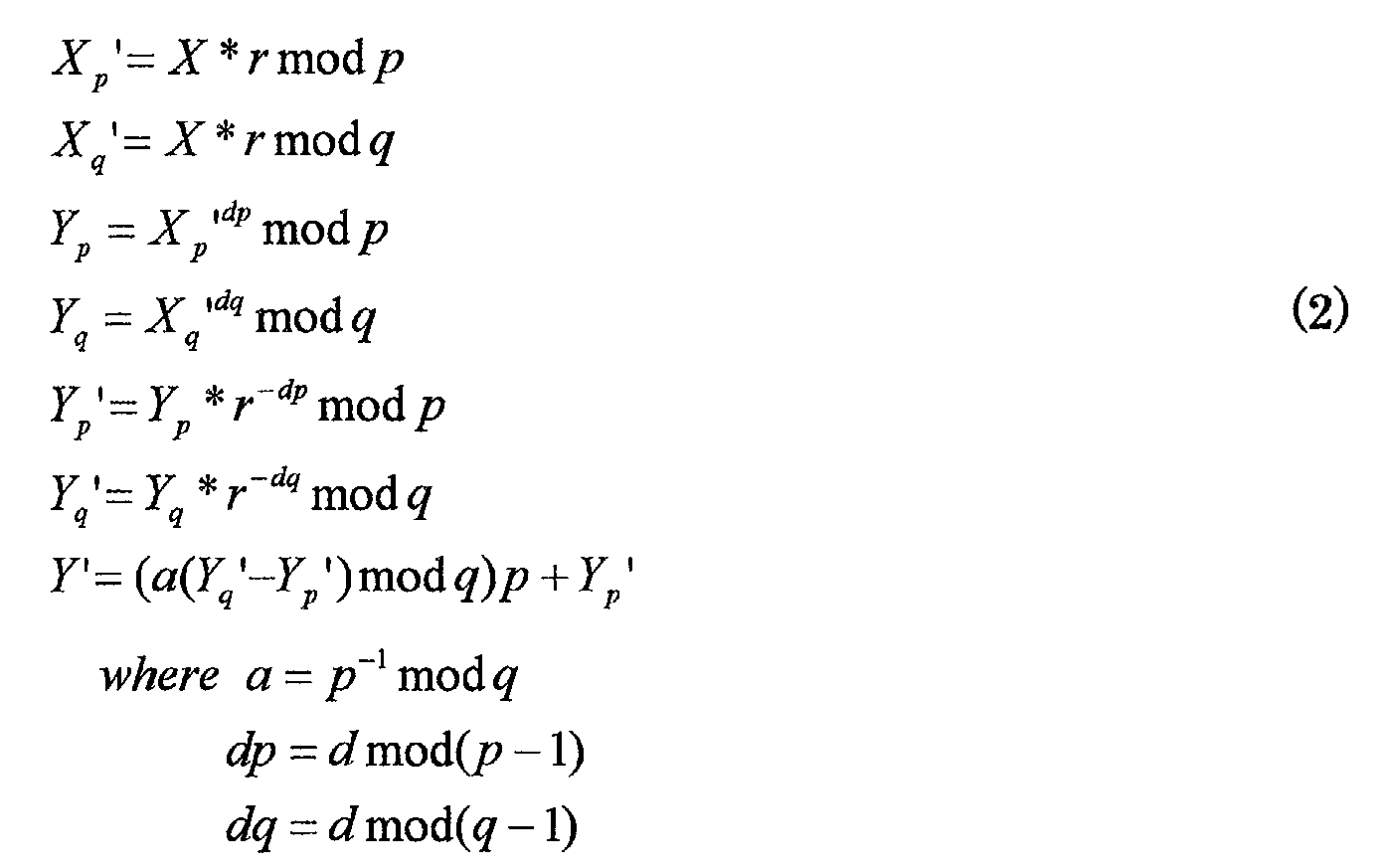
- In
Expression 2, d, p, and q represent secret keys, and plaintext Y corresponding to ciphertext X is obtained by Y = Xd mod N (N = pq). By previously multiplying the input X by the random number r as inExpression 2, whether or not a remainder operation is conducted does not depend upon the relationship in magnitude between the input value X and the remainder value p or q. UnlikeExpression 1, it is required to multiply the value of a remainder operation by a correction value r-dp mod p or r-dqmod q corresponding to each multiplied random number r. This results in an increase in number of operation processing by the time Xd mod N to be obtained finally is reached. - Therefore, with the foregoing in mind, it is an object of the present invention to provide an encryption operating apparatus and method having side-channel attack resistance, which is safe to the attack using side-channel attack such as timing attack and SPA, and can conduct an operation at a high speed.
- In order to achieve the above-mentioned object, an encryption operating apparatus having side-channel attack resistance of the present invention includes a modular exponentiation operating part for conducting at least a modular exponentiation operation with respect to ciphertext X that can be decrypted with secret keys p, q and d, wherein plaintext Y before being encrypted is calculated by providing a correction operating part for conducting the modular exponentiation operation after multiplying the ciphertext X by an arbitrary constant having a value larger than the secret keys p and q, and finally conducting a correction operation based on the constant.
- More specifically, the encryption operating apparatus includes: a ciphertext input part for inputting ciphertext Xthat can be decrypted with secret keys p, q and d; a constant storing part for storing a constant C having relationships C> p and C> q with respect to the secret keys p and q; a correction value storing part for storing correction values C-dp and C-dq (dp = d mod(p-1), dq = d mod (q-1)) calculated based on the constant; a constant multiplying part for multiplying the ciphertext X by the constant Cstored in the constant storing part; a multiplication result storing part for storing an operation result by the multiplication; a remainder operating part for conducting a remainder operation represented by
Expression 3 using the secret key p or q as a remainder value with respect to the operation result by the multiplication stored in the multiplication result storing part; a remainder operation result storing part for storing operation results Xp' and Xq' by the remainder operation; a Chinese remainder RSA processing part for conducting a modular exponentiation operation based on a Chinese remainder theorem represented by Expression 4 with respect to the operation results Xp' and Xq' by the remainder operation stored in the remainder operation result storing part; a modular exponentiation operation result storing part for storing operation results Yp and Yq by the modular exponentiation operation; a correction processing part for conducting a correction operation represented byExpression 5 by using the correction value C-dp or C-dq stored in the correction value storing part with respect to the operation results Yp and Yq by the modular exponentiation operation stored in the modular exponentiation operation result storing part; a correction result storing part for storing operation results Yp ' and Yq' by the correction operation; and a plaintext output part for calculating plaintext Y before being encrypted as expressed byExpression 6 based on the operation results Yp' and Yq' by the correction operation stored in the correction result storing part, wherein, even in a case where any of the ciphertext X is input, the secret keys p and q cannot be revealed.



- Because of the above configuration, even in the case where any input is made, a remainder operation is always conducted. Therefore, the relationship in magnitude between the input value and the secret key p or q cannot be derived based on the difference in operation processing time, a wavelength of a power consumption, and the like, which enables a decoding operating method with high security against side-channel attack to be provided. Furthermore, since a correction value is calculated based on a constant C, an operation for obtaining a correction value only needs to be conducted once, and it can be expected that an operation processing overhead is reduced as a whole.
- Next, in order to achieve the above-mentioned object, the encryption operating apparatus having side-channel attack resistance of the present invention includes a modular exponentiation operating part for conducting at least a modular exponentiation operation with respect to ciphertext X that can be decrypted with secret keys p, q and d, wherein plaintext Y before being encrypted is calculated by multiplying the ciphertext X, using a Montgomery parameter having a value larger than the secret keys p and q, as a constant, and conducting the modular exponentiation operation.
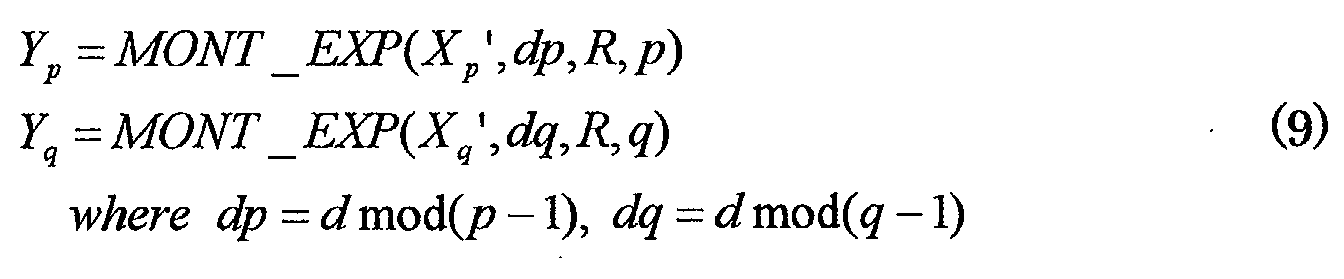
- More specifically, the above-mentioned encryption operating apparatus having side-channel attack resistance is characterized in that, in a case where a function MONT_EXP for executing a Montgomery modular exponentiation operation is defined by Expression 7, the apparatus includes: a ciphertext input part for inputting ciphertext X that can be decrypted with secret keys p, q and d; a Montgomery parameter multiplying part for multiplying the ciphertext X by a Montgomery parameter R; a multiplication result storing part for storing an operation result by the multiplication; a remainder operating part for conducting a remainder operation represented by
Expression 8 using the secret key p or q as a remainder value with respect to the operation result by the multiplication stored in the multiplication result storing part; a remainder operation result storing part for storing operation results Xp' and Xq' by the remainder operation; a Montgomery modular exponentiation operating part for conducting a Montgomery modular exponentiation operation represented byExpression 9 with respect to the operation results Xp' and Xq' by the remainder operation stored in the remainder operation result storing part; a Montgomery modular exponentiation operation result storing part for storing operation results Yp and Yq by the Montgomery modular exponentiation operation; and a plaintext output part for calculating plaintext Ybefore being encrypted as expressed byExpression 10 based on the operation results Yp and Yq by the Montgomery modular exponentiation operation stored in the Montgomery modular exponentiation operation result storing part, wherein, even in a case where any of the ciphertext X is input, the secret keys p and q cannot be revealed.


- Because of the above configuration, even in the case where any input is made, a remainder operation is always conducted. Therefore, the relationship in magnitude between the input value and the secret key p or q cannot be revealed based on the difference in operation processing time, a wavelength of a power consumption, and the like, which enables a decoding operating method with high security against side-channel attack to be provided. Furthermore, since it is not required to conduct a correction operation, it can be expected that an operation processing overhead is reduced as a whole.
- Next, in order to achieve the above-mentioned object, an encryption operating apparatus having side-channel attack resistance of the present invention having a modular exponentiation operating part for conducting at least a modular exponentiation operation with respect to ciphertext X that can be decrypted with secret keys p, q and d includes a Montgomery parameter remainder operating part for conducting a remainder operation to the secret keys p and q with respect to a Montgomery parameter having a value larger than the secret keys p and q, wherein plaintext Y before being encrypted is calculated by multiplying the ciphertext X by an operation result in the remainder operating part, and conducting the modular exponentiation operation.
- More specifically, the above-mentioned encryption operating apparatus having side-channel attack resistance is characterized in that, in a case where a function MONT_EXP for executing a Montgomery modular exponentiation operation is defined by Expression 11, the apparatus includes: a ciphertext input part for inputting ciphertext X that can be decrypted with secret keys p, q and d; a Montgomery parameter remainder operation result storing part for storing a result obtained by conducting a remainder operation to a remainder value p or q as represented by Expression 12 with respect to a Montgomery parameter R; a remainder value multiplying part for multiplying the input ciphertext X by an operation result Rp' or Rq' by the remainder operation stored in the Montgomery parameter remainder operation result storing part as represented by Expression 13; a multiplication result storing part for storing operation results Xp' and Xq' by the multiplication; a remainder operating part for successively conducting a remainder operation represented by Expression 14 using the secret keys p and q as remainder values with respect to the operation results Xp' and Xq' by the multiplication stored in the multiplication result storing part; a remainder operation result storing part for storing operation results Xp and Xq by the remainder operation; a Montgomery modular exponentiation operating part for conducting a Montgomery modular exponentiation operation represented by Expression 15 with respect to the operation results Xp and Xq by the remainder operation stored in the remainder operation result storing part; a Montgomery modular exponentiation operation result storing part for storing operation results Yp and Yq by the Montgomery modular exponentiation operation; and a plaintext output part for calculating plaintext Y before being encrypted as expressed by Expression 16 based on the operation results Yp and Yq by the Montgomery modular exponentiation operation stored in the Montgomery modular exponentiation operation result storing part, wherein, even in a case where any of the ciphertext X is input, the secret keys p and q cannot be revealed.





- Because of the above configuration, whether or not a remainder operation is conducted is determined based on the magnitude of the product between the input value and the Montgomery parameter remainder operation result Rp' or Rq'. Therefore, the relationship in magnitude between the input value and the secret key p or q cannot be derived based on the difference in operation processing time, a wavelength of a power consumption, and the like, which enables a decoding operating method with high security against side-channel attack to be provided. Furthermore, since it is not required to conduct a correction operation, it can be expected that an operation processing overhead is reduced as a whole.
- Furthermore, the present invention is characterized by a recording medium storing a computer-executable program for implementing an encryption operating method having side-channel attack resistance and the processes thereof, the program including: inputting ciphertext X that can be decrypted with secret keys p, q and d; storing a constant C having relationships C> p and C> q with respect to the secret keys p and q; storing correction values C-dp and C-dq (dp= d mod(p-1), dq= d mod (q-1)) calculated based on the constant; multiplying the ciphertext X by the stored constant C; storing an operation result by the multiplication; conducting a remainder operation represented by Expression 17 using the secret key p or q as a remainder value with respect to the stored operation result by the multiplication; storing operation results Xp' and Xq' by the remainder operation; conducting a modular exponentiation operation based on a Chinese remainder theorem represented by Expression 18 with respect to the stored operation results Xp' and Xq' by the remainder operation; storing operation results Yp and Yq by the modular exponentiation operation; conducting a correction operation represented by Expression 19 by using the stored correction value C-dp or C-dq with respect to the stored operation results Yp and Yq by the modular exponentiation operation; storing operation results Yp' and Yq' by the correction operation; and calculating plaintext Y before being encrypted as expressed by Expression 20 based on the stored operation results Yp' and Yq' by the correction operation, wherein, even in a case where any of the ciphertext X is input, the secret keys p and q cannot be revealed.




- Because of the above configuration, by loading the program onto a computer for execution, even in the case where any input is made, a remainder operation is always conducted. Therefore, the relationship in magnitude between the input value and the secret key p or q cannot be derived based on the difference in operation processing time, a wavelength of a power consumption, and the like, which enables a decoding operating method with high security against side-channel attack to be provided. Furthermore, a correction value is calculated based on a constant C, so that an operation for obtaining a correction value needs to be conducted once, and an encryption operating apparatus having side-channel attack resistance can be realized in which an operation processing overhead is expected to be reduced as a whole.
- Furthermore, the present invention is characterized by a recording medium storing a computer-executable program for implementing an encryption operating method having side-channel attack resistance and processes thereof, wherein, in a case where a function MONT_EXP for executing a Montgomery modular exponentiation operation is defined by
Expression 21, the program including: inputting ciphertext X that can be decrypted with secret keys p, q and d; multiplying the ciphertext X by a Montgomery parameter R; storing an operation result by the multiplication; conducting a remainder operation represented byExpression 22 using the secret key p or q as a remainder value with respect to the stored operation result by the multiplication; storing operation results Xp' and Xq' by the remainder operation; conducting a Montgomery modular exponentiation operation represented byExpression 23 with respect to the stored operation results Xp' and Xq' by the remainder operation; storing operation results Yp and Yq by the Montgomery modular exponentiation operation; and calculating plaintext Y before being encrypted as expressed byExpression 24 based on the stored operation results Yp and Yq by the Montgomery modular exponentiation operation, wherein, even in a case where any of the ciphertext X is input, the secret keys p and q cannot be revealed.



- Because of the above configuration, by loading the program onto a computer for execution, even in the case where any input is made, a remainder operation is always conducted. Therefore, the relationship in magnitude between the input value and the secret key p or q cannot be derived based on the difference in operation processing time, a wavelength of a power consumption, and the like, which enables a decoding operating method with high security against side-channel attack to be provided. Furthermore, since it is not required to conduct a correction operation, an encryption operating apparatus having side-channel attack resistance can be realized in which an operation processing overhead is expected to be reduced as a whole.
- Furthermore, the present invention is characterized by a recording medium storing a computer-executable program for implementing an encryption operating method having side-channel attack resistance, wherein, in a case where a function MONT_EXP for executing a Montgomery modular exponentiation operation is defined by Expression 25, the program including: inputting ciphertext X that can be decrypted with secret keys p, q and d; storing a result obtained by conducting a remainder operation to a remainder value p or q as represented by Expression 26 with respect to a Montgomery parameter R; multiplying the input ciphertext X by a stored operation result Rp' or Rq' by the remainder operation as represented by Expression 27; storing operation results Xp' and Xq' by the multiplication; successively conducting a remainder operation represented by Expression 28 using the secret keys p and q as remainder values with respect to the stored operation results Xp' and Xq' by the multiplication; storing operation results Xp and Xq by the remainder operation; conducting a Montgomery modular exponentiation operation represented by Expression 29 with respect to the stored operation results Xp and Xq by the remainder operation; storing operation results Yp and Yq by the Montgomery modular exponentiation operation; and calculating plaintext Ybefore being encrypted as expressed by Expression 30 based on the stored operation results Yp and Yq by the Montgomery modular exponentiation operation, wherein, even in a case where any of the ciphertext X is input, the secret keys p and q cannot be revealed.






- Because of the above configuration, by loading the program onto a computer for execution, whether or not a remainder operation is conducted is determined based on the magnitude of the product between the input value and the Montgomery parameter remainder operation result Rp' or Rq'. Therefore, the relationship in magnitude between the input value and the secret key p or q cannot be derived based on the difference in operation processing time, a wavelength of a power consumption, and the like, which enables a decoding operating method with high security against side-channel attack to be provided. Furthermore, since it is not required to conduct a correction operation, an encryption operating apparatus having side-channel attack resistance can be realized in which an operation processing overhead is expected to be reduced as a whole.
- These and other advantages of the present invention will become apparent to those skilled in the art upon reading and understanding the following detailed description with reference to the accompanying figures.
- FIGS. 1A to 1C illustrate waveforms of a power consumption.
- FIG. 2 shows a configuration of an encryption operating apparatus having side-channel attack resistance in
Embodiment 1 according to the present invention. - FIG. 3 is a flow chart illustrating processing in the encryption operating apparatus having side-channel attack resistance in
Embodiment 1 according to the present invention. - FIG. 4 is a flow chart illustrating processing in the encryption operating apparatus having side-channel attack resistance in
Embodiment 1 according to the present invention. - FIG. 5 shows a configuration of the encryption operating apparatus having side-channel attack resistance in
Embodiment 2 according to the present invention. - FIG. 6 is a flow chart illustrating processing in the encryption operating apparatus having side-channel attack resistance in
Embodiment 2 according to the present invention. - FIG. 7 is a flow chart illustrating processing in the encryption operating apparatus having side-channel attack resistance in
Embodiment 2 according to the present invention. - FIG. 8 shows a configuration of the encryption operating apparatus having side-channel attack resistance in
Embodiment 3 according to the present invention. - FIG. 9 is a flow chart illustrating processing in the encryption operating apparatus having side channel attack resistance in
Embodiment 3 according to the present invention. - FIG. 10 is a flow chart illustrating processing in the encryption operating apparatus having side-channel attack resistance in
Embodiment 3 according to the present invention. - FIG. 11 illustrates a computer environment.
- Hereinafter, an encryption operating apparatus having side-channel attack resistance in
Embodiment 1 according to the present invention will be described with reference to the drawings.Embodiment 1 is characterized in that an input X is multiplied by a constant C that is larger than secret keys p and q, instead of being multiplied by a random number r. - More specifically, the input X is multiplied by the constant C that is larger than the secret keys p and q, so that X*C takes a value larger than p and q. This means that a remainder operation with the remainder value p or q is conducted without fail. Therefore, irrespective of whether timing attack or SPA is used, comparison in magnitude between the input value X and the remainder value p or q cannot be conducted.
- On the other hand, since C is a constant, it only needs to calculate correction values C-dp and C-dq once. Thus, it is not required to derive a correction value every time a remainder operation is conducted, which can reduce the load of operation processing as a whole.
- Because of the above, the encryption operating apparatus can be effectively protected from side-channel attack such as timing attack and SPA, and operation processing can be conducted at a high speed without increasing an operation processing overhead.
- FIG. 2 shows a specific configuration of the encryption operating apparatus having side-channel attack resistance in
Embodiment 1 according to the present invention. InEmbodiment 1, the case will be described in which decoding in RSA processing with Chinese remainder theorem will be described. - In FIG. 2,
reference numeral 1 denotes a ciphertext input part for inputting ciphertext X for decoding. A third party that conducts timing attack or SPA also inputs dummy ciphertext Xd for revealing secret keys through theciphertext input part 1. The ciphertext X or Xd thus input is transferred to a constant multiplyingpart 6. -
Reference numeral 2 denotes a constant input part for inputting a constant X for multiplying the ciphertext X or the dummy ciphertext Xd input through theciphertext input part 1. It is assumed that a constant C satisfies the relationships C> p and C> q with respect to secret keys p and q. The input constant C is stored in aconstant storing part 3. - It is also considered that the
constant input part 2 is not provided. That is, the constant C satisfying the relationships C> p and C> q with respect to the secret keys p and q is previously stored in theconstant storing part 3 during implementation, whereby a user is not required to input the constant C. This is because it is considered that the constant C is previously determined during implementation. - Reference 4 denotes a correction value operating part for obtaining correction values C-dp and C-dq required for finally obtaining plaintext. Herein, dp = d mod (p - 1) and dq = d mod (q-1), and C is a constant, so that the correction values C-dp and C-dq required for obtaining plaintext finally are also constant values. The calculated correction values C-dp and C-dq are stored in a correction
value storing part 5. - Like the
constant input part 2, it is also considered that the correction value operating part 4 is not provided. That is, the correction values C-dp and C-dq are previously calculated based on the constant value Cstored in theconstant storing part 3 and stored in the correctionvalue storing part 5. Because of this, it can be expected to reduce an operation processing overhead. -
Reference numeral 6 denotes a constant multiplying part for multiplying the ciphertext X or the dummy ciphertext Xd input through theencrypted input part 1 by the constant C stored in theconstant storing part 3. Multiplication of the ciphertext X is conducted as expressed byExpression 31. A result X' obtained by multiplication inExpression 31 is stored in a multiplication result storing part 7. -
Reference numeral 8 denotes a remainder operating part for conducting remainder operations using the secret keys p and q as remainder values with respect to multiplication results stored in the multiplication result storing part 7. InEmbodiment 1, X*C> p and X*C> q always hold from the relationships C> p and C> q. Therefore, theremainder operating part 8 conducts remainder operations even if any input is conducted through theciphertext input part 1. - The remainder operations in
Embodiment 1 can be expressed byExpression 32. Xp' and Xq' that are results of remainder operations calculated byExpression 32 are stored in a remainder operationresult storing part 9.
-
Reference numeral 10 denotes a Chinese remainder RSA processing part for conducting a modular exponentiation operation based on a Chinese remainder theorem with respect to the results of the remainder operations stored in the remainder operationresult storing part 9. Herein, a modular exponentiation operation as expressed byExpression 33 is conducted. Operation results Yp and Yq of the modular exponentiation operation expressed byOperation 32 are stored in a modular exponentiation operationresult storing part 11.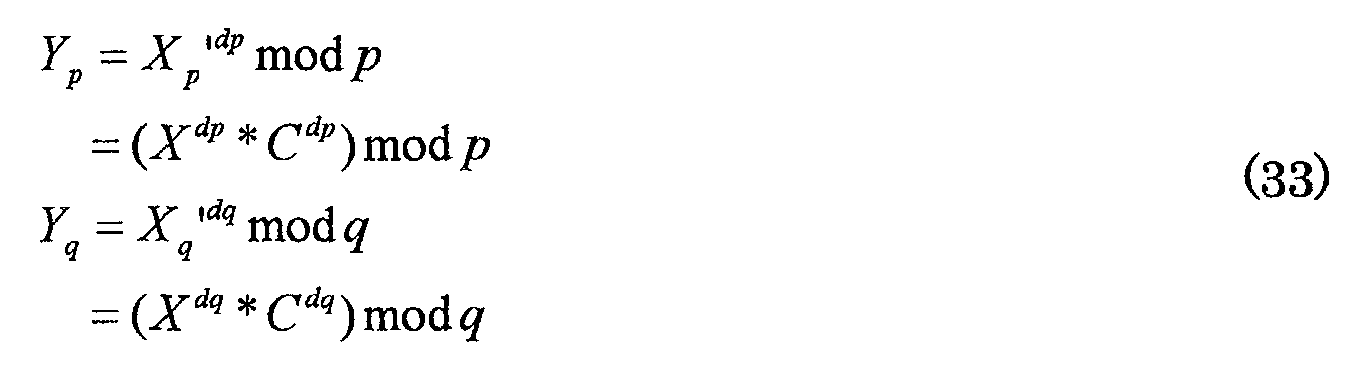
-
Reference numeral 12 denotes a correction processing part for conducting modular exponentiation operations with respect to the input values X and Y, using the previously calculated correction values C-dp and C-dq stored in the correctionvalue storing part 5. The correction operations are expressed byExpression 34. Since C is a constant, the correction values C-dp and C-dq are also constants. It only needs to conduct operation processing for obtaining correction values C-dp and C-dq once. The correction operation values Yp' and Yq' are stored in a correctionresult storing part 13.
-
Reference numeral 14 denotes a plaintext output part for calculating plaintext Y before being encrypted as represented by Expression 35 with respect to the correction operation values Yp' and Yq' corrected in thecorrection processing part 12 and stored in the correctionresult storing part 13. In the case where an input value is the dummy ciphertext Xd, an erroneous calculated value is output; however, there is no problem in a calculated value with respect to side-channel attack.
- Because of the above configuration, an authorized user who knows the secret keys p and q can obtain plaintext Ywith an operation processing overhead that is substantially the same as that of ordinary operation processing. On the other hand, an attacker who attempts to analyze without authorization cannot obtain the secret keys by side-channel attack.
- Next, the processing flow of a program for realizing the encryption operating apparatus having side-channel attack resistance of
Embodiment 1 according to the present invention will be described. FIG. 3 is a flow chart illustrating the processing of a program for realizing the encryption operating apparatus having side-channel attack resistance ofEmbodiment 1 according to the present invention. - In FIG. 3, ciphertext X is input (Operation 301). This also applies to the case where an attacker attempting to conduct timing attack or SPA inputs dummy ciphertext Xd for analyzing secret keys. A constant Cfor multiplying the input ciphertext X or dummy ciphertext Xd is also input (Operation 302). The constant C is assumed to have the relationships C>p and C> q with respect to secret keys p and q.
- Furthermore, correction values C-dp and C-dq required for finally obtaining plaintext are calculated (Operation 303). Herein, since dp = d mod (p-1) and dq= d mod (q-1), and C represents a constant, the correction values C-dp and C-dq required for finally obtaining plaintext are also constant values.
- First, the ciphertext X or the dummy ciphertext Xd is multiplied by the input constant C (Operation 304). Then, remainder operations are conducted using the secret keys p and q as represented by Expression 36 (Operation 305).

- In
Embodiment 1, X* C> p and X* C> q always hold from the relationships C> p and C> q. Therefore, even in the case where any ciphertext X or dummy ciphertext Xdis input, the remainder operations are conducted. - Next, a modular exponentiation operation based on a Chinese remainder theorem as represented by Expression 37 is conducted with respect to the results of the above remainder operations (Operation 306). Correction operations as represented by Expression 38 are conducted using the previously calculated correction values C-dp and C-dq (Operation 307).


- Finally, the plaintext Y before being encrypted is calculated by Expression 39, based on the correction operation values Yp' and Yq' (Operation 308).

- Thus, remainder operations and modular exponentiation operations are conducted with respect to the operation results obtained by multiplying the input ciphertext X by the constant C(where C> p and C> q), and thereafter, correction is made, whereby remainder operations are always conducted even in the case where any input is made. Therefore, the relationship in magnitude between the input value and the secret keys p and q cannot be obtained based on the difference in operation processing time and the difference in waveform of a power consumption. Accordingly, an operating apparatus strong to side-channel attack such as timing attack and SPA can be provided.
- Furthermore, since C represents a constant, correction values are also constants. Unlike the case using a random number, it is not required to calculate correction values every time a value to be multiplied is varied. Therefore, operation processing can be conducted at a high speed without complicating operation processing of decoding.
- Since the relationships C> p and C> q only need to be satisfied, constants Cp and Cq satisfying the relationships Cp > p and Cq > q may be determined with respect to p and q. More specifically, since the input X is always multiplied by the constant Cp larger than the secret key p and the constant Cq larger than the secret key q, X* Cp always takes a value larger than p, and X* C q always takes a value larger than q. Thus, a remainder operation using a remainder value p or q is always conducted, so that the input value X cannot be compared with the remainder value p or q in terms of magnitude, irrespective of whether timing attack is used or SPA is used.
- On the other hand, since Cp and Cq are constants, correction values Cp -dp and Cq -dq only need to be calculated once. Therefore, it is not required to derive correction values every time a remainder operation is conducted, which can reduce an operation processing overhead as a whole.
- Because of the above, operation processing can be conducted at a high speed without increasing an operation processing overhead while effectively preventing side-channel attack such as timing attack and SPA.
- The configuration of an encryption operating apparatus having side-channel attack resistance in this case is the same as that shown in FIG. 2. More specifically, in FIG. 2, the constants CP and Cq having the relationships Cp > p and Cq > q with respect to the secret keys p and q are input from the
constant input part 2. The input constants Cp and Cq are stored in theconstant storing part 3. - The configuration without the
constant input part 2 is also considered. That is, the constants Cp and Cq having the relationships Cp > p and Cq > q with respect to the secret keys p and q are previously stored in theconstant storing part 3 during mounting so that a user is not required to input the constants Cp and Cq . It is also considered that the constants Cp and Cq are previously determined during mounting. - Furthermore, in the correction value calculating part 4, the correction values Cp -dp and CqC-dq required for finally obtaining plaintext are obtained. Herein, dp = d mod (p-1) and dq = d mod (q-1), and Cp and Cq are constants. Therefore, the correction values Cp -dp and Cq -dq required for finally obtaining plaintext are also constant values. The calculated correction values Cp -dp and Cq -dq are stored in the correction
value storing part 5. - The configuration without the correction value operating part 4 is also considered in the same way as in the
constant input part 2. That is, the correction values Cp -dp and Cq -dq are previously calculated based on the constants Cp and Cq stored in theconstant storing part 3 and stored in the correctionvalue storing part 5. Because of this, it can be expected that an operation processing overhead is reduced. - In the constant multiplying
part 6, the ciphertext X or the dummy ciphertext Xd input from theciphertext input part 1 is multiplied by the constants Cp and Cq stored in theconstant storing part 3. Multiplication with respect to the ciphertext X is as represented by Expression 40. Results Xp and Xq obtained by multiplications of Expression 40 are stored in the multiplication result storing part 7.
- Next, in the
remainder operating part 8, a remainder operation using the secret keys p and q as remainder values as represented by Expression 41 is conducted with respect to the multiplication results stored in the multiplication result storing part 7. Herein, X* Cp > p and X* Cq > q always hold from the relationships Cp > p and Cq > q. Thus, in theremainder operating part 8, even in the case where any input is made in theciphertext inputting part 1, remainder operations are conducted. Results Xp' and Xq' of the remainder operations calculated by Expression 41 are stored in the remainder operationresult storing part 9.
- Then, in the Chinese remainder
RSA processing part 10, a modular exponentiation operation based on a Chinese remainder theorem as represented by Expression 42 is conducted with respect to the results of a remainder operation stored in the remainder operationresult storing part 9. Operation results Yp and Yq of modular exponentiation operations as represented by Expression 42 are stored in the modular exponentiation operationresult storing part 11.
- In the
correction processing part 12, the input values X or Xd are corrected to operation results in the case where a modular exponentiation operation is conducted by using the previously calculated correction values Cp -dp and Cq -dq stored in the correctionvalue storing part 5 in accordance with Expression 43. Cp and Cq are constants, so that the correction values Cp -dp and Cq -dq are also constants. The operation processing for obtaining correction values C-dp and C-dq need to be conducted only once. The correction operation values Yp' and Yq' are stored in the correctionresult storing part 13.
- Finally, in the
plaintext outputting part 14, plaintext Y before being encrypted is calculated as represented by Expression 44, based on the correction operation values Yp' and Yq' corrected in thecorrection processing part 12 and stored in the correctionresult storing part 13.
- Because of the above configuration, an authorized user who knows the secret keys p and q can obtain the plaintext Y with an operation processing overhead comparable to the ordinary operation processing overhead, in the same way as in multiplication of the constant C. On the other hand, an attacker attempting to analyze without authorization cannot obtain the secret keys by side-channel attack.
- Next, the processing flow of a program for realizing the encryption operating apparatus having side-channel attack resistance in the above-mentioned case will be described. FIG. 4 is a flow chart illustrating the processing of a program for realizing the encryption operating apparatus having side-channel attack resistance of
Embodiment 1 using the constants Cp and Cq . - In FIG. 4, first, ciphertext X is input (Operation 401). This also applies to the case where an attacker attempting to conduct timing attack or SPA inputs dummy ciphertext Xd for analyzing secret keys. Constants Cp and Cq for multiplying the input ciphertext X or dummy ciphertext Xd are input (Operation 402). The constants Cp and Cq are assumed to have relationships Cp > p and Cq > q with respect to the secret keys p and q.
- Furthermore, correction values Cp -dp and Cq -dq required for finally obtaining plaintext are calculated (Operation 403). Herein, dp = d mod (p-1) and dq = d mod (q-1), and Cp and Cq are constants, so that the correction values Cp -dp and Cq -dq required for finally obtaining plaintext are also constant values.
- First, the ciphertext X or the dummy ciphertext Xd is multiplied by the input constants Cp and Cq (Operation 404). Then, remainder operations using the secret keys p and q as remainder values, as represented by Expression 45, are conducted with respect to the multiplication results.

- In the present example, X* Cp > p and X * Cq > q always hold from the relationships Cp > p and Cq > q. Therefore, even in the case where any ciphertext X or dummy ciphertext Xd is input, the above remainder operations are conducted.
- Next, modular exponentiation operations based on a Chinese remainder theorem as represented by Expression 46 are conducted with respect to the results of the above remainder operations (Operation 406). Correction operations as represented by Expression 47 are conducted using the previously calculated correction values Cp -dp and Cq -dq (Operation 407).


- Finally, plaintext before being encrypted is calculated based on the correction operation values Yp' and Yq' in accordance with Expression 48 (Operation 408).

- Thus, remainder operations and modular exponentiation operations are conducted with respect to the operation results obtained by multiplying the input ciphertext X by the constants Cp and Cq (where Cp > p and Cq > q), and thereafter, correction is made, whereby remainder operations are always conducted even in the case where any input is made. Therefore, the relationship in magnitude between the input value and the secret keys p and q cannot be obtained based on the difference in operation processing time and the difference in waveform of a power consumption. Accordingly, an operating apparatus strong to side-channel attack such as timing attack and SPA can be provided.
- Furthermore, since Cp and Cq represent constants, correction values are also constants. Unlike the case using a random number, it is not required to calculate correction values every time a value to be multiplied is varied. Therefore, operation processing can be conducted at a high speed without complicating operation processing of decoding.
- Hitherto, in
Embodiment 1, the case where N is represented by multiplication of two numbers which are relatively prime numbers (i.e., N=p * q) has been described. However, the Chinese remainder theorem also holds even in the case where Nis represented by multiplication of a plurality of numbers which are relatively prime numbers as represented by Expression 49.
- Thus, the relationships similar to the above-mentioned operations hold even by extending the Chinese remainder theorem to a plurality of numbers which are relatively prime numbers, and an operating apparatus strong to side-channel attack such as timing attack and SPA can be provided.
- Furthermore, in the case where a modular exponentiation operation is conducted based on the Chinese remainder theorem as represented by
Expression 33, a binary method for calculation based on the value of each bit of an exponent and a window method for conducting processing by preparing a previous calculation table of a K-bit are well-known. InEmbodiment 1, either calculation method is applicable. - The operating apparatus and method of
Embodiment 1 are applicable to all the systems for conducting a modular exponentiation operation, using secret information such as EPOC and e-sign for a remainder, as well as ciphertext of a RSA system, and the effects obtained therefrom are the same. - As described above, in
Embodiment 1, by loading the above-mentioned program onto a computer for execution, even in the case where any input is made, a remainder operation is always conducted. Therefore, the relationship in magnitude between the input value and the secret key p or q based on the difference in operation processing time and wavelength of a power consumption cannot be derived, and a decoding operating method having high security with respect to side-channel attack can be provided. - Furthermore, a correction value is calculated based on a constant. Therefore, the first one operation is enough for obtaining a correction value, and hence, it can be expected that an operation processing overhead is further reduced as a whole.
- An encryption operating apparatus having side-channel attack resistance of
Embodiment 2 according to the present invention will be described with reference to the drawings. InEmbodiment 2, Montgomery modular exponentiation operation is applied to a modular exponentiation operation, and a Montgomery parameter R is used in place of a constant C inEmbodiment 1. - More specifically, due to the precondition for conducting a Montgomery modular exponentiation operation, the Montgomery parameter R is always larger than any of secret keys p and q, so that X* R always takes a value larger than p or q. Thus, even in the case where any input X is made, a remainder operation using a remainder value p or q is always conducted. Even in the case where timing attack is used or SPA is used, the comparison between the input X and the remainder value p or q cannot be made.
- On the other hand, unlike
Embodiment 1, a correction operation is not required inEmbodiment 2. That is, inEmbodiment 2, a function MONT_EXP is determined as represented by Expression 50 as a modular exponentiation operation to be conducted after the remainder operation.
- In Expression 50, assuming that the input X is XR mod p, the exponent is d, and the remainder is the secret key p, a modular exponentiation operation value Xd mod p can be obtained directly as represented by Expression 51.

- The same calculation can be conducted with respect to the other secret key q, so that a modular exponentiation operation value can be obtained directly without conducting a correction operation. This makes it unnecessary to derive a correction value and conduct a correction operation using the correction value, so that an operation processing overhead can be reduced as a whole.
- Furthermore, in the case where a Montgomery modular exponentiation operation is conducted, a binary method for calculating a remainder based on the value of each bit of an exponent and a window method for calculating a remainder by preparing a previous calculation table of K-bit are well-known. In
Embodiment 2, any of the calculation methods are applicable. - By using the above-mentioned operating method, operation processing can be conducted at a high speed without increasing an operation processing overhead while effectively preventing side-channel attack such as timing attack and SPA. Representative examples of the Montgomery parameter R include 2512, 21024 or the like.
- FIG. 5 shows a specific configuration. FIG. 5 is a view showing a configuration of an encryption operating apparatus having side-channel attack resistance of
Embodiment 2 according to the present invention. InEmbodiment 2, the case where decoding processing in RSA processing with Chinese remainder theorem is conducted will be described. - In FIG. 5,
reference numeral 1 denotes a ciphertext input part in the same way as inEmbodiment 1, which is used for inputting ciphertext X for decoding. A third party conducting timing attack or SPA also inputs dummy ciphertext Xd for analyzing secret keys through theciphertext input part 1. The input ciphertext X or Xd is given to a Montgomeryparameter multiplying part 21. - Next,
reference numeral 21 denotes a Montgomery parameter multiplying part for multiplying the ciphertext X or the dummy ciphertext Xd input from theciphertext input part 1 by the Montgomery parameter R. Due to the precondition of the Montgomery modular exponentiation operation, the Montgomery parameter R has relationships R>p and R>q with respect to secret keys p and q. Therefore, inEmbodiment 2, X* R>p and X* R>q always hold in the same way as inEmbodiment 1. Multiplication with respect to the ciphertext X is as represented by Expression 52. A result X' obtained by multiplication of Expression 52 is stored in a multiplicationresult storing part 22. -
Reference numeral 8 denotes a remainder operating part for respectively conducting remainder operations using the secret keys p and q as remainder values with respect to the multiplication result stored in the multiplicationresult storing part 22. As described above, inEmbodiment 2, X* R> p and X* R> q always hold from the relationships R > p and R > q. Thus, in theremainder operating part 8, even in the case where any input is made in theciphertext input part 1, remainder operations are conducted. - The remainder operations in
Embodiment 2 can be expressed by Expression 53. Results Xp' and Xq' of the remainder operations calculated by Expression 53 are stored in a remainder operationresult storing part 9.
- Furthermore,
reference numeral 23 denotes a Montgomery modular exponentiation operating part for conducting Montgomery modular exponentiation operations represented by Expression 54 with respect to the results of the remainder operations stored in the remainder operationresult storing part 9. Operation results Yp and Yq of the Montgomery modular exponentiation operations represented by Expression 54 are stored in a Montgomery modular exponentiation operationresult storing part 24.
- A function MONT_EXP for conducting the Montgomery modular exponentiation operations is defined by Expression 55.

- Yp and Yq in Expression 54 become identical with the results obtained by conducting modular exponentiation operations directly, using Chinese remainder theorem, as represented by Expression 56, which makes it unnecessary to conduct a correction operation.

- Finally,
reference numeral 14 denotes a plaintext output part for calculating plaintext Y before being encrypted as presented by Expression 57, based on the operation values Yp' and Yq' calculated in the Montgomery modularexponentiation operating part 23 and stored in the Montgomery modular exponentiation operationresult storing part 24. In the case where an input value is the dummy ciphertext Xd, an erroneous calculated value is output. In side-channel attack, there is no problem in the calculated value.
- Because of the above configuration, an authorized user who knows the secret keys p and q can obtain plaintext Y with an operation processing overhead comparable to the ordinary operation processing overhead. On the other hand, an attacker who attempts to analyze without authorization cannot obtain the secret keys by side-channel attack.
- Next, the processing flow of a program for realizing the encryption operating apparatus having side-channel attack resistance of
Embodiment 2 according to the present invention will be described. FIG.6 is a flow chart illustrating the processing of a program for realizing the encryption operating apparatus having side-channel attack resistance ofEmbodiment 2 according to the present invention. - In FIG. 6, ciphertext X is input (Operation 601) and is multiplied by a Montgomery parameter R (Operation 602). Due to the precondition of the Montgomery modular exponentiation operations, the Montgomery parameter R has relationships R> p and R> q with respect to the secret keys p and q. Thus, in
Embodiment 2, X* R > p and X* R> q always hold in the same way as inEmbodiment 1. The same processing is also conducted in the case where a third party conducting timing attack or SPA inputs the dummy ciphertext Xd for analyzing the secret keys. - Next, remainder operations using the secret keys p and q as remainder values are respectively conducted as presented by Expression 58 with respect to the multiplication results of the ciphertext X and the Montgomery parameter R (Operation 603). In
Embodiment 2, X* R> p and X* R> q always hold, so that even in the case where any ciphertext X is input, remainder operations are conducted.
- Then, Montgomery modular exponentiation operations represented by Expression 59 are conducted using the operation results of the remainder operations (Operation 604). Afunction MONT_EXP used for the Montgomery modular exponentiation operations are defined by Expression 60.


- Yp and Yq in Expression 59 become identical with the results obtained by conducting modular exponentiation operations directly, using Chinese remainder theorem, as represented by Expression 61, which makes it unnecessary to conduct a correction operation.

- Finally, plaintext Y before being encrypted is calculated as presented by Expression 62, based on the operation values Yp and Yq calculated by the Montgomery modular exponentiation operations (Operation 605).

- Because of the above processing, an authorized user who knows the secret keys p and q can obtain plaintext Y with an operation processing overhead comparable to the ordinary operation processing overhead. On the other hand, an attacker who attempts to analyze without authorization cannot obtain the secret keys by side-channel attack.
- Furthermore, since the relationships R> p and R> q only need to be satisfied, Montgomery parameters Rp and Rq satisfying the relationships Rp > p and Rq> q may be used with respect to p and q. More specifically, since the input X is always multiplied by the Montgomery parameter Rp larger than the secret key p and the Montgomery parameter Rq larger than the secret key q, X* R p always takes a value larger than p, and X* Rq always takes a value larger than q. Thus, a remainder operation using a remainder value p or q is always conducted, so that the input value X cannot be compared with the remainder value p or q in terms of magnitude, irrespective of whether timing attack is used or SPA is used.
- The configuration of the encryption operating apparatus having side-channel attack resistance in this case is the same as that shown in FIG. 5. In FIG. 5, in the Montgomery
parameter multiplying part 21, the ciphertext X or the dummy ciphertext Xd input from theciphertext input part 1 is multiplied by the Montgomery parameter Rp or Rq . Due to the precondition of the Montgomery modular exponentiation operations, the Montgomery parameter R has relationships Rp > p and Rq > q with respect to secret keys p and q. Therefore, inEmbodiment 2, X* Rp > p and X* Rq > q always hold in the same way as inEmbodiment 1. Multiplication with respect to the ciphertext X is as represented by Expression 63. Results Xp and Xq obtained by multiplication of Expression 63 is stored in a multiplicationresult storing part 22.
- In the
remainder operating part 8, remainder operations using the secret keys p and q as remainder values are conducted with respect to the multiplication results stored in the multiplicationresult storing part 22. As described above, inEmbodiment 2, X* Rp > p and X* Rq > q always hold from the relationships Rp > p and Rq > q. Thus, in theremainder operating part 8, even in the case where any input is made in theciphertext input part 1, remainder operations are conducted. - The remainder operations in
Embodiment 2 can be expressed by Expression 64. Results Xp' and Xq' of the remainder operations calculated by Expression 64 are stored in the remainder operationresult storing part 9.
- In the Montgomery modular
exponentiation operating part 23, Montgomery modular exponentiation operations represented by Expression 65 are conducted with respect to the results of the remainder operations stored in the remainder operationresult storing part 9. Operation results Yp and Yq of the Montgomery modular exponentiation operations represented by Expression 65 are stored in the Montgomery modular exponentiation operationresult storing part 24.
- A function MONT_EXP for conducting the Montgomery modular exponentiation operations is defined by Expression 66.

- Yp and Yq in Expression 65 become identical with the results obtained by conducting modular exponentiation operations directly, using Chinese remainder theorem, as represented by Expression 67, which makes it unnecessary to conduct a correction operation.

- Finally, in the
plaintext output part 14, plaintext Y before being encrypted as presented by Expression 68 is calculated, based on the operation values Yp' and Yq' calculated in the Montgomery modularexponentiation operating part 23 and stored in the Montgomery modular exponentiation operationresult storing part 24.
- Because of the above configuration, an authorized user who knows the secret keys p and q can obtain plaintext Y with an operation processing overhead comparable to the ordinary operation processing overhead. On the other hand, an attacker who attempts to analyze without authorization cannot obtain the secret keys by side-channel attack.
- Next, the processing flow of a program for realizing the encryption operating apparatus having side-channel attack resistance of
Embodiment 2 using the Montgomery parameters Rp and Rq will be described. FIG. 7 is a flow chart illustrating the processing of a program for realizing the encryption operating apparatus having side-channel attack resistance of the present example. - In FIG. 7, ciphertext X is input (Operation 701) and is multiplied by a Montgomery parameter Rp or Rq (Operation 702). Due to the precondition of the Montgomery modular exponentiation operations, the Montgomery parameters Rp and Rq have relationships Rp > p and Rq > q with respect to the secret keys p and q. Thus, in the present example, X * R p > p and X * Rq > q always hold. The same processing is also conducted in the case where a third party conducting timing attack or SPA inputs the dummy ciphertext Xd for analyzing the secret keys.
- Next, remainder operations using the secret keys p and q as remainder values are respectively conducted as presented by Expression 69 with respect to the multiplication results of the ciphertext X and the Montgomery parameter R (Operation 703). In
Embodiment 2, X* Rp>p and X * Rq>q always hold, so that even in the case where any ciphertext X is input, remainder operations are conducted.
- Then, Montgomery modular exponentiation operations represented by Expression 70 are conducted using the operation results of the remainder operations (Operation 704). A function MONT_EXP used for the Montgomery modular exponentiation operations are defined by Expression 71.


- Yp and Yq in Expression 70 become identical with the results obtained by conducting modular exponentiation operations directly, using Chinese remainder theorem, as represented by Expression 72, which makes it unnecessary to conduct a correction operation.

- Finally, plaintext Y before being encrypted is calculated as presented by Expression 73, based on the operation values Yp and Yq calculated by the Montgomery modular exponentiation operations (Operation 705).

- Hitherto, in
Embodiment 2, the case where N is represented by multiplication of two numbers which are relatively prime numbers (i.e., N=p * q) has been described. However, the Chinese remainder theorem also holds even in the case where Nis represented by multiplication of a plurality of numbers which are relatively prime numbers as represented by Expression 74.
- Thus, the relationships similar to the above-mentioned operations hold even by extending the Chinese remainder theorem to a plurality of numbers which are relatively prime numbers, and an operating apparatus strong to side-channel attack such as timing attack and SPA can be provided.
- Furthermore, in the case where the Montgomery modular exponentiation operations as represented by Expression 70 are conducted, a binary method for calculation based on the value of each bit of an exponent and a window method for conducting processing by preparing a previous calculation table of a K-bit are well-known. In
Embodiment 2, either calculation method is applicable. - The operating apparatus and method of
Embodiment 2 are applicable to all the systems for conducting a modular exponentiation operation, using secret information such as EPOC and e-sign for a remainder, as well as ciphertext of a general RSA system, and the effects obtained therefrom are the same. - As described above, in
Embodiment 2, even in the case where any input is made, a remainder operation is always conducted. Therefore, the relationship in magnitude between the input value and the secret key p or q based on the difference in operation processing time and wavelength of a power consumption cannot be derived, and a decoding operating method having high security with respect to side-channel attack can be provided. - Furthermore, it is not required to conduct a correction operation, so that it can be expected that an operation processing overhead is further reduced as a whole.
- An encryption operating apparatus having side-channel attack resistance of
Embodiment 3 according to the present invention will be described with reference to the drawings. InEmbodiment 3, a Montgomery modular exponentiation operation is applied to a modular exponentiation operation, and remainder operation values Rp'= R mod p and Rq'= R mod q with respect to a remainder value p or q of a Montgomery parameter R are used in place of the constant C inEmbodiment 1 and the Montgomery parameter R inEmbodiment 2. - More specifically, due to the precondition for conducting a Montgomery modular exponentiation operation, the Montgomery parameter R is always larger than either secret key p or q. However, Rp' or Rq' does not always take a value larger than p or q. Therefore, whether or not the remainder operation using the remainder value p or q is conducted is determined based on the magnitude of Rp' or Rq'.
- Herein, Rp' or Rq' is a number unknown to an attacker. Therefore, the attacker cannot reveal the remainder value p or q. More specifically, irrespective of whether timing attack is used or SPA is used, the attacker cannot reveal the remainder value p or q.
- On the other hand, in
Embodiment 3, a correction operation can be made unnecessary in the same way as inEmbodiment 2. More specifically, first inEmbodiment 3, a function MONT_EXP is determined as represented by Expression 75 as a modular exponentiation operation to be conducted after the remainder operation.
- In Expression 75, assuming that the input X is (XRp') mod p, the exponent is d, and the remainder is the secret key p, a modular exponentiation operation value Xd mod p can be obtained directly as represented by Expression 76.
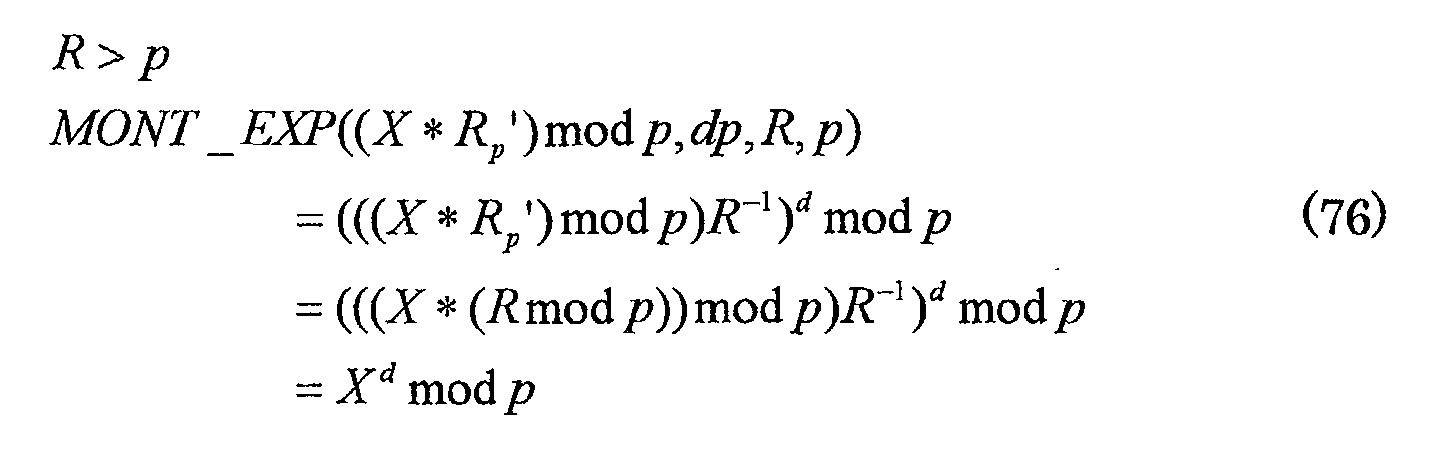
- The same calculation can be conducted with respect to the other secret key q, so that a modular exponentiation operation value can be obtained directly without conducting a correction operation. This makes it unnecessary to derive a correction value and conduct a correction operation using the correction value, so that an operation processing overhead can be reduced as a whole.
- Furthermore, in the same way as in
Embodiment 2, any of calculation methods of a binary method for calculating a remainder based on the value of each bit of an exponent and a window method for calculating a remainder by preparing a previous calculation table of K-bit are applicable. - By using the above-mentioned operating method, operation processing can be conducted at a high speed without increasing an operation processing overhead while effectively preventing side-channel attack such as timing attack and SPA. Representative examples of the Montgomery parameter R include 2512, 21024 or the like.
- FIG. 8 shows a specific configuration. FIG. 8 is a view showing a configuration of an encryption operating apparatus having side-channel attack resistance of
Embodiment 3 according to the present invention. InEmbodiment 3, the case where decoding processing in RSA with Chinese remainder theorem is conducted will be described. - In FIG. 8,
reference numeral 1 denotes a ciphertext input part in the same way as inEmbodiments ciphertext input part 1. The input ciphertext X or Xd is given to a Montgomery parameterremainder operating part 31. - Next,
reference numeral 31 denotes a Montgomery parameter remainder operating part for conducting a remainder operation to the remainder value p or q with respect to the Montgomery parameter R. Such a remainder operation is as represented by Expression 77. A result X' obtained by Expression 77 is stored in the Montgomery parameter remainder operationresult storing part 32.
- Next,
reference numeral 33 denotes a remainder value multiplying part for multiplying the remainder operation values obtained in the Montgomery parameterremainder operating part 31 by the ciphertext X or the dummy ciphertext Xd input from theciphertext input part 1. Multiplication with respect to the ciphertext X is as represented by Expression 78. Results Xp' and Xq' obtained by Expression 78 are stored in a multiplicationresult storing part 34.
-
Reference numeral 8 denotes a remainder operating part for respectively conducting remainder operations using the secret keys p and q as remainder values with respect to the multiplication results stored in the multiplicationresult storing part 34. As described above, inEmbodiment 2, X * R> p and X * R> q always hold from the relationships R > p and R > q. However, this does not apply toEmbodiment 3. It depends upon the magnitude of Rp' or Rq' whether or not a remainder operation is conducted. - The remainder operation in
Embodiment 3 can be expressed by Expression 79. Results Xp and Xq of the remainder operations calculated by Expression 79 are stored in a remainder operationresult storing part 9.
- Furthermore,
reference numeral 23 denotes a Montgomery operating part for conducting Montgomery operations represented by Expression 80 with respect to the results of the remainder operations stored in the remainder operationresult storing part 9. Herein, Montgomery modular exponentiation operations as represented by Expression 80 are conducted. Operation results Yp and Yq of the Montgomery modular exponentiation operations represented by Expression 80 are stored in a Montgomery modular exponentiation operationresult storing part 24.
- Yp and Yq in Expression 80 become identical with the results obtained by conducting modular exponentiation operations directly, using Chinese remainder theorem, as represented by Expression 81, which makes it unnecessary to conduct a correction operation.

- Finally,
reference numeral 14 denotes a plaintext output part for calculating plaintext Y before being encrypted as presented by Expression 82, based on the operation values Yp and Yq calculated in the Montgomery modularexponentiation operating part 23 and stored in the Montgomery modular exponentiation operationresult storing part 24. In the case where an input value is the dummy ciphertext Xd, an erroneous calculated value is output. In side-channel attack, there is no problem in the calculated value.
- Because of the above configuration, an authorized user who knows the secret keys p and q can obtain plaintext Y with an operation processing overhead comparable to the ordinary operation processing overhead. On the other hand, an attacker who attempts to analyze without authorization cannot obtain the secret keys by side-channel attack.
- Next, the processing flow of a program for realizing the encryption operating apparatus having side-channel attack resistance of
Embodiment 3 according to the present invention will be described. FIG. 9 is a flow chart illustrating the processing of a program for realizing the encryption operating apparatus having side-channel attack resistance ofEmbodiment 3 according to the present invention. - In FIG. 9, ciphertext X is input (Operation 901). This also applies to the case where a third party conducting timing attack or SPA inputs dummy ciphertext Xd for analyzing secret keys.
- A remainder operation for a remainder value p or q is conducted with respect to a Montgomery parameter R (Operation 902), and the result of the remainder operation is multiplied by the input ciphertext X as represented by Expression 83.

- Next, remainder operations using the secret keys p and q as remainder values are respectively conducted with respect to multiplication results Xp' and Xq' of the ciphertext X and the remainder operation values, as represented by Expression 84.

- Using the operation results of the remainder operations, Montgomery modular exponentiation operations represented by Expression 85 are conducted (Operation 905). A function MONT_EXP used for the Montgomery modular exponentiation operations is defined by Expression 86.


- Yp and Yq in Expression 85 become identical with the results obtained by conducting modular exponentiation operations directly, using Chinese remainder theorem, as represented by Expression 87, which makes it unnecessary to conduct a correction operation.

- Finally, plaintext Y before being encrypted as presented by Expression 88 is calculated, based on the operation values Yp and Yq calculated by the Montgomery modular exponentiation operations (Operation 906).

- Because of the above processing, an authorized user who knows the secret keys p and q can obtain plaintext Y with an operation processing overhead comparable to the ordinary operation processing overhead. On the other hand, an attacker who attempts to analyze without authorization cannot obtain the secret keys by side-channel attack.
- Furthermore, in the same way as in
Embodiment 2, Montgomery parameters Rp and Rq satisfying the relationships Rp > p and Rq > q may be used with respect to the secret keys p and q. In this case, the remainder value Rp'= Rp mod p or Rq'= Rq mod q does not always become larger than p or q. Therefore, whether or not the remainder operation using the remainder value p or q is conducted is determined based on the magnitude of Rp' or Rq'. - Herein, Rp' or Rq' is a number unknown to an outside attacker. Therefore, the attacker cannot reveal the remainder value p or q. More specifically, irrespective of whether timing attack is used or SPA is used, the attacker cannot reveal the remainder value p or q.
- On the other hand, in the present example, a correction operation can be made unnecessary in the same way as in the case using the Montgomery parameter R. More specifically, a function MONT_EXP is determined as represented by Expression 89 as a modular exponentiation operation to be conducted after the remainder operation.

- In Expression 89, assuming that the input X is (X*Rp')d mod p, the exponent is d, and the remainder is the secret key p, a modular exponentiation operation value Xd mod p can be obtained directly as represented by Expression 90.

- The same calculation can be conducted with respect to the other secret key q, so that a modular exponentiation operation value can be obtained directly without conducting a correction operation. This makes it unnecessary to derive a correction value and conduct a correction operation using the correction value, so that an operation processing overhead can be reduced as a whole.
- Furthermore, in the same way as in
Embodiment 2, any of calculation methods of a binary method for calculating a remainder based on the value of each bit of an exponent and a window method for calculating a remainder by preparing a previous calculation table of K-bit are applicable. - By using the above-mentioned operating method, operation processing can be conducted at a high speed without increasing an operation processing overhead while effectively preventing side-channel attack such as timing attack and SPA. Representative examples of the Montgomery parameter Rp and Rq include 2512, 21024 or the like.
- The configuration of the encryption operating apparatus having side-channel attack resistance in the above-mentioned case is the same as that shown in FIG. 8. More specifically, in the Montgomery parameter
remainder operating part 31 shown in FIG. 8, a remainder operation to the remainder value p or q is conducted with respect to the Montgomery parameter Rp or Rq , as represented by Expression 91. Results Rp ' and Rq' obtained by Expression 91 are stored in the Montgomery parameter remainder operationresult storing part 32.
- Next, in the remainder
value multiplying part 33, the remainder operation values obtained in the Montgomery parameterremainder operating part 31 are multiplied by the ciphertext X or the dummy ciphertext Xd input from theciphertext input part 1, as represented by Expression 92. Results Xp' and Xq' obtained by Expression 92 are stored in the multiplicationresult storing part 34.
- In the
remainder operating part 8, remainder operations represented by Expression 93 using the secret keys p and q as remainder values are conducted with respect to the multiplication results stored in the multiplicationresult storing part 34. As described above, inEmbodiment 3, it depends upon the magnitude of Rp' or Rp' whether or not a remainder operation is conducted. Results Xp and Xq of the remainder operations calculated by Expression 93 are stored in the remainder operationresult storing part 9.
- Next, in the Montgomery modular
exponentiation operating part 23, Montgomery modular exponentiation operations represented by Expression 94 are conducted with respect to the results of the remainder operations stored in the remainder operationresult storing part 9. Operation results Yp and Yq of the Montgomery modular exponentiation operations represented by Expression 94 are stored in a Montgomery modular exponentiation operationresult storing part 24.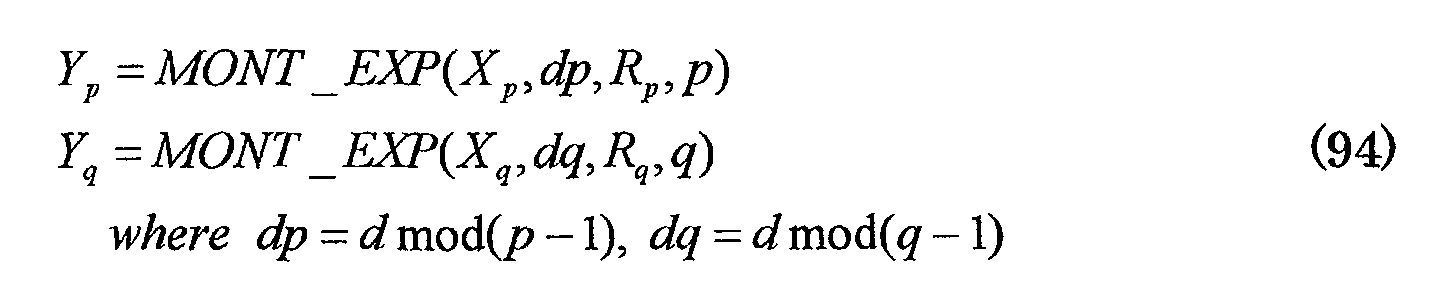
- Yp and Yq in Expression 94 become identical with the results obtained by conducting modular exponentiation operations directly, using Chinese remainder theorem, as represented by Expression 95, which makes it unnecessary to conduct a correction operation.

- Finally, in the
plaintext output part 14, plaintext Y before being encrypted as presented by Expression 96 is calculated based on the operation values Yp and Yq calculated in the Montgomery modularexponentiation operating part 23 and stored in the Montgomery modular exponentiation operationresult storing part 24.
- Because of the above configuration, an authorized user who knows the secret keys p and q can obtain plaintext Y with an operation processing overhead comparable to the ordinary operation processing overhead even in the case where the Montgomery parameters are varied with respect to the secret keys p and q. On the other hand, an attacker who attempts to analyze without authorization cannot obtain the secret keys by side-channel attack.
- Next, the processing flow of a program for realizing the encryption operating apparatus having side-channel attack resistance of the present example will be described. FIG. 10 is a flow chart illustrating the processing of a program for realizing the encryption operating apparatus having side-channel attack resistance of the present example.
- In FIG. 10, ciphertext X is input (Operation 1001). This also applies to the case where a third party conducting timing attack or SPA inputs dummy ciphertext Xd for analyzing secret keys.
- A remainder operation for a remainder value p or q is conducted with respect to a Montgomery parameter Rp or Rq (Operation 1002), and the result of the remainder operation is multiplied by the input ciphertext X as represented by Expression 97.

- Next, remainder operations using the secret keys p and q as remainder values are respectively conducted with respect to multiplication results Xp' and Xq' of the ciphertext X and the remainder operation values, as represented by Expression 98.

- Using the operation results of the remainder operations, Montgomery modular exponentiation operations represented by Expression 99 are conducted (Operation 1005). A function MONT_EXP used for the Montgomery modular exponentiation operations is defined by Expression 100.
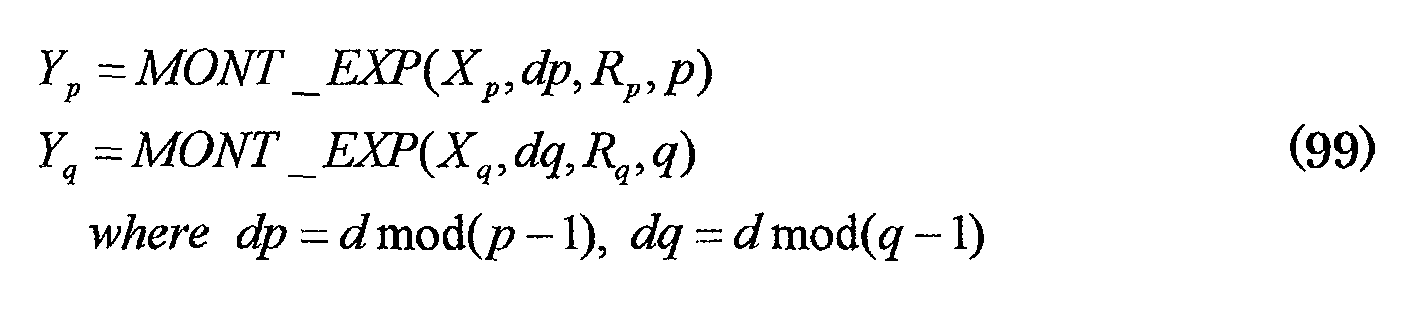

- Yp and Yq in Expression 99 become identical with the results obtained by conducting modular exponentiation operations directly, using Chinese remainder theorem, as represented by Expression 101, which makes it unnecessary to conduct a correction operation.

- Finally, plaintext Ybefore being encrypted as expressed by Expression 102 is calculated, based on the operation values Yp and Yq calculated by the Montgomery modular exponentiation operations (Operation 1006).

- As described above, in
Embodiment 3, whether or not the remainder operation is conducted is determined based on the magnitude of the product between the input value and the remainder operation value of the Montgomery parameter R. Therefore, the relationship in magnitude between the input value and the secret key p or q cannot be derived only based on the difference in operation processing time, waveform of power consumption, and the like. Thus, a decoding operating method having high security with respect to side-channel attack can be provided. - Furthermore, it is not required to conduct a correction operation, so that it can be expected that an operation processing overhead is further reduced as a whole.
- Hitherto, in
Embodiment 3, the case where N is represented by multiplication of two numbers which are relatively prime numbers (i.e., N= p * q) has been described. However, the Chinese remainder theorem also holds even in the case where Nis represented by multiplication of a plurality of numbers which are relatively prime numbers as represented by Expression 103.
- Thus, the relationships similar to the above-mentioned operations hold even by extending the Chinese remainder theorem to a plurality of numbers which are relatively prime numbers, and an operating apparatus strong to side-channel attack such as timing attack and SPA can be provided.
- Furthermore, in the case where a Montgomery modular exponentiation operation as represented by Expression 80 is conducted, a binary method for calculation based on the value of each bit of an exponent and a window method for conducting processing by preparing a previous calculation table of a K-bit are well-known. In
Embodiment 1, either calculation method is applicable. - The operating apparatus and method of
Embodiment 3 are applicable to all the systems for conducting a modular exponentiation operation, using secret information such as EPOC and e-sign for a remainder, as well as ciphertext of a RSA system, and the effects obtained therefrom are the same. - Thus, in
Embodiments - The program for realizing an encryption operating apparatus having side-channel attack resistance of the present embodiment according to the present invention may be stored not only in a
portable recording medium 112 such as a CD-ROM 112-1, a flexible disk 112-2, and a ROM card (smart media, smart card) 112-3, but also in anotherstorage apparatus 111 provided at the end of a communication line, arecording medium 114 such as a hard disk and a RAM of acomputer 113, as shown in FIG. 11. In execution, the program is loaded and executed on a main memory. - Furthermore, correction data and the like generated by an encryption operating apparatus having side-channel attack resistance of the embodiments according to the present invention may also be stored not only in a
portable recording medium 112 such as a CD-ROM 112-1, a flexible disk 112-2, and a ROM card (smart media, smart card) 112-3, but also in anotherstorage apparatus 111 provided at the end of a communication line, arecording medium 114 such as a hard disk and a RAM of acomputer 113, as shown in FIG. 11. Such correction data is read by thecomputer 113 when the encryption operating apparatus having side channel attack resistance according to the present invention is used. - As described above, in the encryption operating apparatus having side-channel attack resistance of the present invention, even in the case where any input is made, a remainder operation is always conducted. Alternatively, whether or not a remainder operation is conducted is determined based on the magnitude of numbers which are unknown to the third party. Therefore, the relationship in magnitude between the input value and the secret key p or q cannot be derived only based on the difference in operation processing time, waveform of power consumption, and the like. Thus, a decoding operating method having high security with respect to side-channel attack can be provided.
- Furthermore, in the encryption operating apparatus having side-channel attack resistance of the present invention, a correction operation only needs to be conducted once. Alternatively, a correction operation is not required to be conducted depending upon the condition, so that it can be expected that an operation processing overhead is further reduced as a whole.
Claims (35)
- An encryption operating apparatus having side-channel attack resistance comprising a modular exponentiation operating part for conducting at least a modular exponentiation operation with respect to ciphertext X that can be decrypted with secret keys p, q and d,
wherein plaintext Ybefore being encrypted is calculated by providing a correction operating part for conducting the modular exponentiation operation after multiplying the ciphertext X by an arbitrary constant having a value larger than the secret keys p and q, and finally conducting a correction operation based on the constant. - An encryption operating apparatus having side-channel attack resistance, comprising:wherein, even in a case where any of the ciphertext X is input, the secret keys p and q cannot be revealed.a ciphertext input part for inputting ciphertext X that can be decrypted with secret keys p, q and d;a constant storing part for storing a constant C having relationships C> p and C > q with respect to the secret keys p and q;a correction value storing part for storing correction values C-dp and C-dq (dp = d mod (p-1), dq = d mod (q-1)) calculated based on the constant;a constant multiplying part for multiplying the ciphertext X by the constant C stored in the constant storing part;a multiplication result storing part for storing an operation result by the multiplication;a remainder operating part for conducting a remainder operation represented by Expression 104 using the secret key p or q as a remainder value with respect to the operation result by the multiplication stored in the multiplication result storing part;
 a remainder operation result storing part for storing operation results Xp' and Xq' by the remainder operation;a Chinese remainder RSA processing part for conducting a modular exponentiation operation based on a Chinese remainder theorem represented by Expression 105 with respect to the operation results Xp' and Xq' by the remainder operation stored in the remainder operation result storing part;
 a modular exponentiation operation result storing part for storing operation results Yp and Yq by the modular exponentiation operation;a correction processing part for conducting a correction operation represented by Expression 106 by using the correction value C-dp or C-dq stored in the correction value storing part with respect to the operation results Yp and Yq by the modular exponentiation operation stored in the modular exponentiation operation result storing part;
 a correction result storing part for storing operation results Yp' and Yq' by the correction operation; anda plaintext output part for calculating plaintext Y before being encrypted as expressed by Expression 107 based on the operation results Yp' and Yq' by the correction operation stored in the correction result storing part,
- An encryption operating apparatus having side-channel attack resistance according to claim 2, further comprising a constant input part for inputting the constant C.
- An encryption operating apparatus having side-channel attack resistance according to claim 2, further comprising a correction value operating part for obtaining the correction values C-dp and C-dq (dp = d mod (p-1), dq = d mod (q-1)) based on the constant C.
- An encryption operating apparatus having side-channel attack resistance according to claim 3, further comprising a correction value operating part for obtaining the correction values C-dp and C-dq (dp = d mod (p-1), dq = d mod (q-1)) based on the constant C.
- An encryption operating apparatus having side-channel attack resistance, comprising:wherein, even in a case where any of the ciphertext X is input, the secret keys p and q cannot be revealed.a ciphertext input part for inputting ciphertext X that can be decrypted with secret keys p, q and d;a constant storing part for storing constants Cp and Cq having relationships Cp > p and Cq > q with respect to the secret keys p and q;a correction value storing part for storing correction values Cp -dp and Cq -dq (dp = d mod (p-1), dq = d mod (q-1)) calculated based on the constants;a constant multiplying part for multiplying the ciphertext X by the constants Cp and Cq stored in the constant storing part;a multiplication result storing part for storing an operation result by the multiplication;a remainder operating part for conducting a remainder operation represented by Expression 108 using the secret key p or q as a remainder value with respect to the operation result by the multiplication stored in the multiplication result storing part;
 a remainder operation result storing part for storing operation results Xp' and Xq' by the remainder operation;a Chinese remainder RSA processing part for conducting a modular exponentiation operation based on a Chinese remainder theorem represented by Expression 109 with respect to the operation results Xp' and Xq' by the remainder operation stored in the remainder operation result storing part;
 a modular exponentiation operation result storing part for storing operation results Yp and Yq by the modular exponentiation operation;a correction processing part for conducting a correction operation represented by Expression 110 by using the correction value Cp -dp or Cq -dq stored in the correction value storing part with respect to the operation results Yp and Yq by the modular exponentiation operation stored in the modular exponentiation operation result storing part;
 a correction result storing part for storing operation results Yp' and Yq' by the correction operation; anda plaintext output part for calculating plaintext Y before being encrypted as expressed by Expression 111 based on the operation results Yp' and Yq' by the correction operation stored in the correction result storing part,
- An encryption operating apparatus having side-channel attack resistance according to claim 6, further comprising a constant input part for inputting the constants Cp and Cq .
- An encryption operating apparatus having side-channel attack resistance according to claim 6, further comprising a correction value operating part for obtaining the correction values Cp -dp and Cq -dq (dp = d mod (p-1), dq = d mod (q-1)) based on the constants Cp and Cq .
- An encryption operating apparatus having side-channel attack resistance according to claim 7, further comprising a correction value operating part for obtaining the correction values Cp -dp and Cq -dq (dp = d mod (p-1), dq = d mod (q-1)) based on the constants Cp and Cq .
- An encryption operating apparatus having side-channel attack resistance comprising a modular exponentiation operating part for conducting at least a modular exponentiation operation with respect to ciphertext Xthat can be decrypted with secret keys p, q and d,
wherein plaintext Y before being encrypted is calculated by multiplying the ciphertext X, using a Montgomery parameter having a value larger than the secret keys p and q, as a constant, and conducting the modular exponentiation operation. - An encryption operating apparatus having side-channel attack resistance,
wherein, in a case where a function MONT_EXP for executing a Montgomery modular exponentiation operation is defined by Expression 112:the apparatus comprising: wherein, even in a case where any of the ciphertext X is input, the secret keys p and q cannot be revealed.a ciphertext input part for inputting ciphertext X that can be decrypted with secret keys p, q and d;a Montgomery parameter multiplying part for multiplying the ciphertext X by a Montgomery parameter R;a multiplication result storing part for storing an operation result by the multiplication;a remainder operating part for conducting a remainder operation represented by Expression 113 using the secret key p or q as a remainder value with respect to the operation result by the multiplication stored in the multiplication result storing part;
 a remainder operation result storing part for storing operation results Xp' and Xq' by the remainder operation;a Montgomery modular exponentiation operating part for conducting a Montgomery modular exponentiation operation represented by Expression 114 with respect to the operation results Xp' and Xq' by the remainder operation stored in the remainder operation result storing part;
 a Montgomery modular exponentiation operation result storing part for storing operation results Yp and Yq by the Montgomery modular exponentiation operation; anda plaintext output part for calculating plaintext Y before being encrypted as expressed by Expression 115 based on the operation results Yp and Yq by the Montgomery modular exponentiation operation stored in the Montgomery modular exponentiation operation result storing part,
- An encryption operating apparatus having side-channel attack resistance, wherein, in a case where a function MONT_EXP for executing a Montgomery modular exponentiation operation is defined by Expression 116:the apparatus comprising:
 wherein, even in a case where any of the ciphertext X is input, the secret keys p and q cannot be revealed.a ciphertext input part for inputting ciphertext X that can be decrypted with secret keys p, q and d;a Montgomery parameter multiplying part for multiplying the ciphertext X by a Montgomery parameter Rp or Rq having relationships Rp > p and Rq > q with respect to the secret keys p and q;a multiplication result storing part for storing an operation result by the multiplication;a remainder operating part for conducting a remainder operation represented by Expression 117 using the secret key p or q as a remainder value with respect to the operation result by the multiplication stored in the multiplication result storing part;
 a remainder operation result storing part for storing operation results Xp' and Xq' by the remainder operation;a Montgomery modular exponentiation operating part for conducting a Montgomery modular exponentiation operation represented by Expression 118 with respect to the operation results Xp' and Xq' by the remainder operation stored in the remainder operation result storing part;
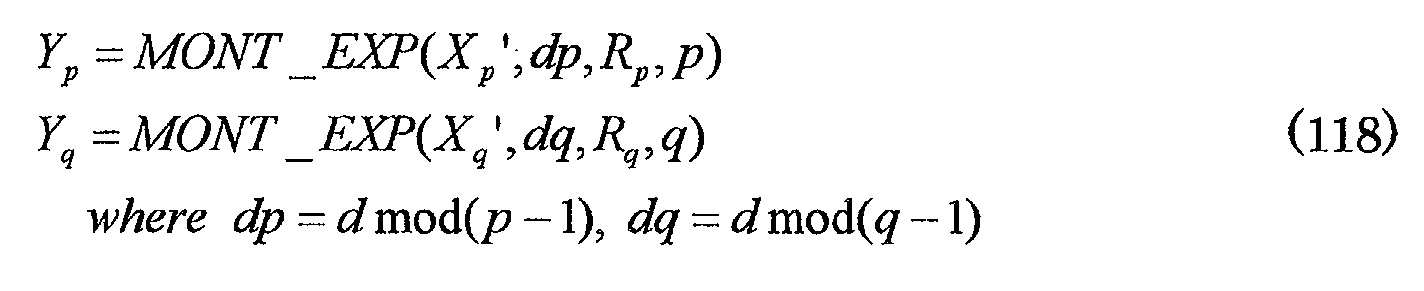 a Montgomery modular exponentiation operation result storing part for storing operation results Yp and Yq by the Montgomery modular exponentiation operation; anda plaintext output part for calculating plaintext Y before being encrypted as expressed by Expression 119 based on the operation results Yp and Yq by the Montgomery modular exponentiation operation stored in the Montgomery modular exponentiation operation result storing part,
- An encryption operating apparatus having side-channel attack resistance including a modular exponentiation operating part for conducting at least a modular exponentiation operation with respect to ciphertext X that can be decrypted with secret keys p, q and d,
the apparatus comprising a Montgomery parameter remainder operating part for conducting a remainder operation to the secret keys p and q with respect to a Montgomery parameter having a value larger than the secret keys p and q,
wherein plaintext Y before being encrypted is calculated by multiplying the ciphertext X by an operation result in the Montgomery parameter remainder operating part, and conducting the modular exponentiation operation. - An encryption operating apparatus having side-channel attack resistance, wherein, in a case where a function MONT_EXP for executing a Montgomery modular exponentiation operation is defined by Expression 120:the apparatus comprising:
 wherein, even in a case where any of the ciphertext X is input, the secret keys p and q cannot be revealed.a ciphertext input part for inputting ciphertext X that can be decrypted with secret keys p, q and d;a Montgomery parameter remainder operation result storing part for storing a result obtained by conducting a remainder operation to a remainder value p or q as represented by Expression 121 with respect to a Montgomery parameter R;
 a remainder value multiplying part for multiplying the input ciphertext X by an operation result Rp' or Rq' by the remainder operation stored in the Montgomery parameter remainder operation result storing part as represented by Expression 122;
 a multiplication result storing part for storing operation results Xp' and Xq' by the multiplication;a remainder operating part for successively conducting a remainder operation represented by Expression 123 using the secret keys p and q as remainder values with respect to the operation results Xp' and Xq' by the multiplication stored in the multiplication result storing part;
 a remainder operation result storing part for storing operation results Xp and Xq by the remainder operation;a Montgomery modular exponentiation operating part for conducting a Montgomery modular exponentiation operation represented by Expression 124 with respect to the operation results Xp and Xq by the remainder operation stored in the remainder operation result storing part;
 a Montgomery modular exponentiation operation result storing part for storing operation results Yp and Yq by the Montgomery modular exponentiation operation; anda plaintext output part for calculating plaintext Ybefore being encrypted as expressed by Expression 125 based on the operation results Yp and Yq by the Montgomery modular exponentiation operation stored in the Montgomery modular exponentiation operation result storing part,
- An encryption operating apparatus having side-channel attack resistance according to claim 14, further comprising a Montgomery parameter remainder operating part for conducting a remainder operation to the remainder value p or q as represented by Expression 126 with respect to the Montgomery parameter R.

- An encryption operating apparatus having side-channel attack resistance, wherein, in a case where a function MONT_EXP for executing a Montgomery modular exponentiation operation is defined by Expression 127:the apparatus comprising:
 wherein, even in a case where any of the ciphertext X is input, the secret keys p and q cannot be revealed.a ciphertext input part for inputting ciphertext X that can be decrypted with secret keys p, q and d;a Montgomery parameter remainder operation result storing part for storing a result obtained by conducting a remainder operation to a remainder value p or q as represented by Expression 128 with respect to a Montgomery parameter Rp or Rq having relationships Rp > p and Rq > q with respect to the secret keys p and q;
 a remainder value multiplying part for multiplying the input ciphertext X by an operation result Rp' or Rq' by the remainder operation stored in the Montgomery parameter remainder operation result storing part as represented by Expression 129;
 a multiplication result storing part for storing operation results Xp' and X'q by the multiplication;a remainder operating part for successively conducting a remainder operation represented by Expression 130 using the secret keys p and q as remainder values with respect to the operation results Xp' and Xq' by the multiplication stored in the multiplication result storing part;
 a remainder operation result storing part for storing operation results Xp and Xq by the remainder operation;a Montgomery modular exponentiation operating part for conducting a Montgomery modular exponentiation operation represented by Expression 131 with respect to the operation results Xp and Xq by the remainder operation stored in the remainder operation result storing part;
 a Montgomery modular exponentiation operation result storing part for storing operation results Yp and Yq by the Montgomery modular exponentiation operation; anda plaintext output part for calculating plaintext Y before being encrypted as expressed by Expression 132 based on the operation results Yp and Yq by the Montgomery modular exponentiation operation stored in the Montgomery modular exponentiation operation result storing part,
- An encryption operating apparatus having side-channel attack resistance according to claim 16, further comprising a Montgomery parameter remainder operating part for conducting a remainder operation to the remainder value p or q as represented by Expression 133 with respect to the Montgomery parameters Rp and Rq .

- An encryption operating method having side-channel attack resistance comprising at least a modular exponentiation operation with respect to ciphertext X that can be decrypted with secret keys p, q and d,
wherein plaintext Ybefore being encrypted is calculated by conducting the modular exponentiation operation after multiplying the ciphertext X by an arbitrary constant having a value larger than the secret keys p and q, and finally conducting a correction operation based on the constant. - An encryption operating method having side-channel attack resistance, comprising:wherein, even in a case where any of the ciphertext X is input, the secret keys p and q cannot be revealed.inputting ciphertext Xthat can be decrypted with secret keys p, q and d;storing a constant Chaving relationships C> p and C> q with respect to the secret keys p and q;storing correction values C-dp and C-dq (dp = d mod (p-1), dq = d mod (q-1)) calculated based on the constant;multiplying the ciphertext X by the stored constant C;storing an operation result by the multiplication;conducting a remainder operation represented by Expression 134 using the secret key p or q as a remainder value with respect to the stored operation result by the multiplication;
 storing operation results Xp' and Xq' by the remainder operation;conducting a modular exponentiation operation based on a Chinese remainder theorem represented by Expression 135 with respect to the stored operation results Xp' and Xq' by the remainder operation;
 storing operation results Yp and Yq by the modular exponentiation operation;conducting a correction operation represented by Expression 136 by using the stored correction value C-dp or C-dq with respect to the stored operation results Yp and Yq by the modular exponentiation operation;
 storing operation results Yp' and Yq' by the correction operation; andcalculating plaintext Y before being encrypted as expressed by Expression 137 based on the stored operation results Yp' and Yq' by the correction operation,
- An encryption operating method having side-channel attack resistance, comprising:wherein, even in a case where any of the ciphertext X is input, the secret keys p and q cannot be revealed.inputting ciphertext Xthat can be decrypted with secret keys p, q and d;storing constants Cp and Cq having relationships Cp > p and Cq > q with respect to the secret keys p and q;storing correction values Cp -dp and Cq -dq (dp = d mod (p-1), dq = d mod (q-1)) calculated based on the constants;multiplying the ciphertext X by the stored constant Cp or Cq ;storing an operation result by the multiplication;conducting a remainder operation represented by Expression 138 using the secret key p or q as a remainder value with respect to the stored operation result by the multiplication;
 storing operation results Xp' and Xq' by the remainder operation;conducting a modular exponentiation operation based on a Chinese remainder theorem represented by Expression 139 with respect to the stored operation results Xp' and Xq' by the remainder operation;
 storing operation results Yp and Yq by the modular exponentiation operation;conducting a correction operation represented by Expression 140 by using the stored correction value Cp -dp or Cq -dq with respect to the stored operation results Yp and Yq by the modular exponentiation operation;
 storing operation results Yp' and Yq' by the correction operation; andcalculating plaintext Ybefore being encrypted as expressed by Expression 141 based on the stored operation results Yp' and Yq' by the correction operation,
- An encryption operating method having side-channel attack resistance comprising at least a modular exponentiation operation with respect to ciphertext X that can be decrypted with secret keys p, q and d,
wherein plaintext Y before being encrypted is calculated by multiplying the ciphertext X, using a Montgomery parameter having a value larger than the secret keys p and q, as a constant, and conducting the modular exponentiation operation. - An encryption operating method having side-channel attack resistance, wherein, in a case where a function MONT_EXP for executing a Montgomery modular exponentiation operation is defined by Expression 142:the method comprising:
 wherein, even in a case where any of the ciphertext X is input, the secret keys p and q cannot be revealed.inputting ciphertext X that can be decrypted with secret keys p, q and d;multiplying the ciphertext X by a Montgomery parameter R;storing an operation result by the multiplication;conducting a remainder operation represented by Expression 143 using the secret key p or q as a remainder value with respect to the stored operation result by the multiplication;
 storing operation results Xp' and Xq' by the remainder operation;conducting a Montgomery modular exponentiation operation represented by Expression 144 with respect to the stored operation results Xp' and Xq' by the remainder operation;
 storing operation results Yp and Yq by the Montgomery modular exponentiation operation; andcalculating plaintext Y before being encrypted as expressed by Expression 145 based on the stored operation results Yp and Yq by the Montgomery modular exponentiation operation,
- An encryption operating method having side-channel attack resistance, wherein, in a case where a function MONT_EXP for executing a Montgomery modular exponentiation operation is defined by Expression 146:the method comprising:
 wherein, even in a case where any of the ciphertext X is input, the secret keys p and q cannot be revealed.inputting ciphertext X that can be decrypted with secret keys p, q and d;multiplying the ciphertext X by a Montgomery parameter Rp or Rq having relationships Rp > p and Rq > q with respect to the secret keys p and q;storing an operation result by the multiplication;conducting a remainder operation represented by Expression 147 using the secret key p or q as a remainder value with respect to the stored operation result by the multiplication;
 storing operation results Xp' and Xq' by the remainder operation;conducting a Montgomery modular exponentiation operation represented by Expression 148 with respect to the stored operation results Xp' and Xq' by the remainder operation;
 storing operation results Yp and Yq by the Montgomery modular exponentiation operation; andcalculating plaintext Ybefore being encrypted as expressed by Expression 149 based on the stored operation results Yp and Yq by the Montgomery modular exponentiation operation,
- An encryption operating method having side-channel attack resistance including at least a modular exponentiation operation with respect to ciphertext X that can be decrypted with secret keys p, q and d,
the method comprising conducting a remainder operation to the secret keys p and q with respect to a Montgomery parameter having a value larger than the secret keys p and q,
wherein plaintext Y before being encrypted is calculated by multiplying the ciphertext X by an operation result in the remainder operation, and conducting the modular exponentiation operation. - An encryption operating method having side-channel attack resistance, wherein, in a case where a function MONT EXP for executing a Montgomery modular exponentiation operation is defined by Expression 150:the method comprising:
 wherein, even in a case where any of the ciphertext X is input, the secret keys p and q cannot be revealed.inputting ciphertext X that can be decrypted with secret keys p, q and d;storing a result obtained by conducting a remainder operation to a remainder value p or q as represented by Expression 151 with respect to a Montgomery parameter R;
 multiplying the input ciphertext X by a stored operation result Rp' or Rq' by the remainder operation as represented by Expression 152;
 storing operation results Xp' and X'q by the multiplication;successively conducting a remainder operation represented by Expression 153 using the secret keys p and q as remainder values with respect to the stored operation results Xp' and Xq' by the multiplication;
 storing operation results Xp and Xq by the remainder operation;conducting a Montgomery modular exponentiation operation represented by Expression 154 with respect to the stored operation results Xp and Xq by the remainder operation;
 storing operation results Yp and Yq by the Montgomery modular exponentiation operation; andcalculating plaintext Ybefore being encrypted as expressed by Expression 155 based on the stored operation results Yp and Yq by the Montgomery modular exponentiation operation,
- An encryption operating method having side-channel attack resistance, wherein, in a case where a function MONT_EXP for executing a Montgomery modular exponentiation operation is defined by Expression 156:the method comprising:
 wherein, even in a case where any of the ciphertext X is input, the secret keys p and q cannot be revealed.inputting ciphertext X that can be decrypted with secret keys p, q and d;storing a result obtained by conducting a remainder operation to the remainder value p or q as represented by Expression 157 with respect to a Montgomery parameter Rp or Rq having relationships Rp > p and Rq > q with respect to the secret keys p and q;
 multiplying the input ciphertext X by a stored operation result Rp' or Rq' by the remainder operation as represented by Expression 158;
 storing operation results Xp' and Xq' by the multiplication;successively conducting a remainder operation represented by Expression 159 using the secret keys p and q as remainder values with respect to the stored operation results Xp' and Xq' by the multiplication;
 storing operation results Xp and Xq by the remainder operation;conducting a Montgomery modular exponentiation operation represented by Expression 160 with respect to the stored operation results Xp and Xq by the remainder operation;
 storing operation results Yp and Yq by the Montgomery modular exponentiation operation; andcalculating plaintext Ybefore being encrypted as expressed by Expression 161 based on the stored operation results Yp and Yq by the Montgomery modular exponentiation operation,
- A recording medium storing a computer-executable program for implementing an encryption operating method having side-channel attack resistance comprising at least a modular exponentiation operation with respect to ciphertext X that can be decrypted with secret keys p, q and d,
wherein plaintext Y before being encrypted is calculated by conducting the modular exponentiation operation after multiplying the ciphertext X by an arbitrary constant having a value larger than the secret keys p and q, and finally conducting a correction operation based on the constant. - A recording medium storing a computer-executable program for implementing an encryption operating method having side-channel attack resistance, the program comprising:wherein, even in a case where any of the ciphertext X is input, the secret keys p and q cannot be revealed.inputting ciphertext X that can be decrypted with secret keys p, q and d;storing a constant C having relationships C> p and C> q with respect to the secret keys p and q;storing correction values C-dp and C-dq (dp = d mod(p-1), dq = d mod (q-1)) calculated based on the constant;multiplying the ciphertext X by the stored constant C;storing an operation result by the multiplication;conducting a remainder operation represented by Expression 162 using the secret key p or q as a remainder value with respect to the stored operation result by the multiplication;
 storing operation results Xp' and Xq' by the remainder operation;conducting a modular exponentiation operation based on a Chinese remainder theorem represented by Expression 163 with respect to the stored operation results Xp' and Xq' by the remainder operation;
 storing operation results Yp and Yq by the modular exponentiation operation;conducting a correction operation represented by Expression 164 by using the stored correction value C-dp or C-dq with respect to the stored operation results Yp and Yq by the modular exponentiation operation;
 storing operation results Yp' and Yq' by the correction operation; andcalculating plaintext Ybefore being encrypted as expressed by Expression 165 based on the stored operation results Yp' and Yq' by the correction operation,
- A recording medium storing a computer-executable program for implementing an encryption operating method having side-channel attack resistance, the program comprising:wherein, even in a case where any of the ciphertext X is input, the secret keys p and q cannot be revealed.inputting ciphertext X that can be decrypted with secret keys p, q and d;storing constants Cp and Cq having relationships Cp > p and Cq > q with respect to the secret keys p and q;storing correction values Cp -dp and Cq -dq (dp = d mod (p-1), dq = d mod (q-1)) calculated based on the constants;multiplying the ciphertext X by the stored constant Cp or Cq;storing an operation result by the multiplication;conducting a remainder operation represented by Expression 166 using the secret key p or q as a remainder value with respect to the stored operation result by the multiplication;
 storing operation results Xp' and Xq' by the remainder operation;conducting a modular exponentiation operation based on a Chinese remainder theorem represented by Expression 167 with respect to the stored operation results Xp' and Xq' by the remainder operation;
 storing operation results Yp and Yq by the modular exponentiation operation;conducting a correction operation represented by Expression 168 by using the stored correction value Cp -dp or Cq -dq with respect to the stored operation results Yp and Yq by the modular exponentiation operation;
 storing operation results Yp' and Yq' by the correction operation; andcalculating plaintext Y before being encrypted as expressed by Expression 169 based on the stored operation results Yp' and Yq' by the correction operation,
- A recording medium storing a computer-executable program for implementing an encryption operating method having side-channel attack resistance comprising at least a modular exponentiation operation with respect to ciphertext X that can be decrypted with secret keys p, q and d,
wherein plaintext Y before being encrypted is calculated by multiplying the ciphertext X, using a Montgomery parameter having a value larger than the secret keys p and q, as a constant, and conducting the modular exponentiation operation. - A recording medium storing a computer-executable program for implementing an encryption operating method having side-channel attack resistance, wherein, in a case where a function MONT_EXP for executing a Montgomery modular exponentiation operation is defined by Expression 170:the program comprising:
 wherein, even in a case where any of the ciphertext X is input, the secret keys p and q cannot be revealed.inputting ciphertext X that can be decrypted with secret keys p, q and d;multiplying the ciphertext X by a Montgomery parameter R;storing an operation result by the multiplication;conducting a remainder operation represented by Expression 171 using the secret key p or q as a remainder value with respect to the stored operation result by the multiplication;
 storing operation results Xp' and Xq' by the remainder operation;conducting a Montgomery modular exponentiation operation represented by Expression 172 with respect to the stored operation results Xp' and Xq' by the remainder operation;
 storing operation results Yp and Yq by the Montgomery modular exponentiation operation; andcalculating plaintext Y before being encrypted as expressed by Expression 173 based on the stored operation results Yp and Yq by the Montgomery modular exponentiation operation,
- A recording medium storing a computer-executable program for implementing an encryption operating method having side-channel attack resistance, wherein, in a case where a function MONT_EXP fox executing a Montgomery modular exponentiation operation is defined by Expression 174:the program comprising:
 wherein, even in a case where any of the ciphertext X is input, the secret keys p and q cannot be revealed.inputting ciphertext X that can be decrypted with secret keys p, q and d;multiplying the ciphertext X by a Montgomery parameter Rp or Rq having relationships Rp > p and Rq > q with respect to the secret keys p and q;storing an operation result by the multiplication;conducting a remainder operation represented by Expression 175 using the secret key p or q as a remainder value with respect to the stored operation result by the multiplication;
 storing operation results Xp' and Xq'by the remainder operation;conducting a Montgomery modular exponentiation operation represented by Expression 176 with respect to the stored operation results Xp' and Xq' by the remainder operation;
 storing operation results Yp and Yq by the Montgomery modular exponentiation operation; andcalculating plaintext Y before being encrypted as expressed by Expression 177 based on the stored operation results Yp and Yq by the Montgomery modular exponentiation operation,
- A recording medium storing a computer-executable program for implementing an encryption operating method having side-channel attack resistance including at least a modular exponentiation operation with respect to ciphertext X that can be decrypted with secret keys p, q and d,
the program comprising conducting a remainder operation to the secret keys p and q with respect to a Montgomery parameter having a value larger than the secret keys p and q,
wherein plaintext Y before being encrypted is calculated by multiplying the ciphertext X by an operation result in the remainder operation, and conducting the modular exponentiation operation. - A recording medium storing a computer-executable program for implementing an encryption operating method having side-channel attack resistance, wherein, in a case where a function MONT_EXP for executing a Montgomery modular exponentiation operation is defined by Expression 178:the program comprising:
 wherein, even in a case where any of the ciphertext X is input, the secret keys p and q cannot be revealed.inputting ciphertext X that can be decrypted with secret keys p, q and d;storing a result obtained by conducting a remainder operation to a remainder value p or q as represented by Expression 179 with respect to a Montgomery parameter R;
 multiplying the input ciphertext X by a stored operation result Rp' or Rq' by the remainder operation as represented by Expression 180;
 storing operation results Xp' and X'q by the multiplication;successively conducting a remainder operation represented by Expression 181 using the secret keys p and q as remainder values with respect to the stored operation results Xp' and Xq' by the multiplication;
 storing operation results Xp and Xq by the remainder operation;conducting a Montgomery modular exponentiation operation represented by Expression 182 with respect to the stored operation results Xp and Xq by the remainder operation;
 storing operation results Yp and Yq by the Montgomery modular exponentiation operation; andcalculating plaintext Y before being encrypted as expressed by Expression 183 based on the stored operation results Yp and Yq by the Montgomery modular exponentiation operation,
- A recording medium storing a computer-executable program for implementing an encryption operating method having side-channel attack resistance, wherein, in a case where a function MONT_EXP for executing a Montgomery modular exponentiation operation is defined by Expression 184:the program comprising:
 wherein, even in a case where any of the ciphertext X is input, the secret keys p and q cannot be revealed.inputting ciphertext X that can be decrypted with secret keys p, q and d;storing a result obtained by conducting a remainder operation to the remainder value p or q as represented by Expression 185 with respect to a Montgomery parameter Rp or Rq having relationships Rp > p and Rq > q with respect to the secret keys p and q;
 multiplying the input ciphertext X by a stored operation result Rp' or Rq' by the remainder operation as represented by Expression 186;
 storing operation results Xp' and X'q by the multiplication;successively conducting a remainder operation represented by Expression 187 using the secret keys p and q as remainder values with respect to the stored operation results Xp' and Xq' by the multiplication;
 storing operation results Xp and Xq by the remainder operation;conducting a Montgomery modular exponentiation operation represented by Expression 188 with respect to the stored operation results Xp and Xq by the remainder operation;
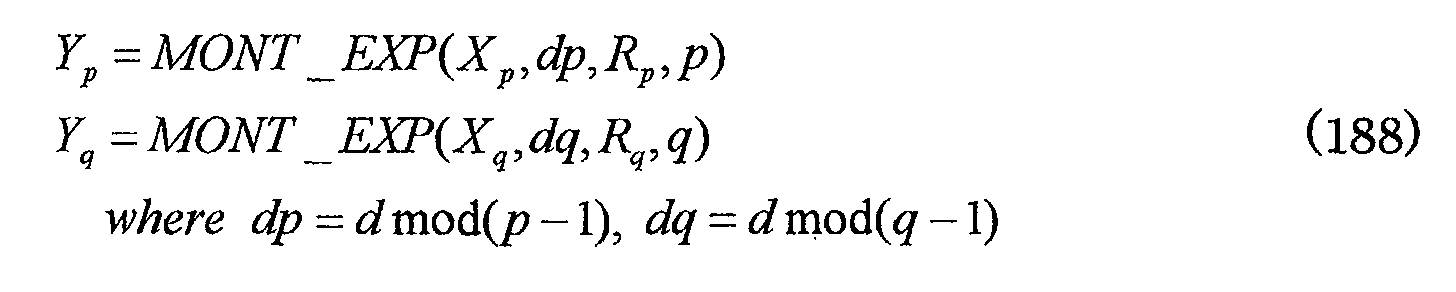 storing operation results Yp and Yq by the Montgomery modular exponentiation operation; andcalculating plaintext Y before being encrypted as expressed by Expression 189 based on the stored operation results Yp and Yq by the Montgomery modular exponentiation operation,
Applications Claiming Priority (2)
| Application Number | Priority Date | Filing Date | Title |
|---|---|---|---|
| JP2002006404 | 2002-01-15 | ||
| JP2002006404A JP4086503B2 (en) | 2002-01-15 | 2002-01-15 | Cryptographic operation apparatus and method, and program |
Publications (2)
| Publication Number | Publication Date |
|---|---|
| EP1327932A1 true EP1327932A1 (en) | 2003-07-16 |
| EP1327932B1 EP1327932B1 (en) | 2011-03-23 |
Family
ID=19191221
Family Applications (1)
| Application Number | Title | Priority Date | Filing Date |
|---|---|---|---|
| EP02257439A Expired - Lifetime EP1327932B1 (en) | 2002-01-15 | 2002-10-25 | Encryption apparatus and method with side-channel attack resistance |
Country Status (4)
| Country | Link |
|---|---|
| US (1) | US7065788B2 (en) |
| EP (1) | EP1327932B1 (en) |
| JP (1) | JP4086503B2 (en) |
| DE (1) | DE60239520D1 (en) |
Cited By (3)
| Publication number | Priority date | Publication date | Assignee | Title |
|---|---|---|---|---|
| FR2895609A1 (en) * | 2005-12-26 | 2007-06-29 | Gemplus Sa | Cryptographic method for forming modular exponentiation, involves masking operand with random number, and forming modular exponentiation of operand masked by exponent using Montgomery multiplier |
| CN103814370A (en) * | 2011-09-22 | 2014-05-21 | 英特尔公司 | Modular exponentiation with partitioning and decentralized storage of Montgomery multiplication results |
| CN106982114A (en) * | 2017-03-12 | 2017-07-25 | 成都信息工程大学 | A kind of method of side Multiple Channel Analysis attack for SM3 cryptographic algorithm extension of message |
Families Citing this family (22)
| Publication number | Priority date | Publication date | Assignee | Title |
|---|---|---|---|---|
| JP4284867B2 (en) * | 2001-01-18 | 2009-06-24 | 株式会社日立製作所 | A public-key cryptography method that is secure against adaptive choice ciphertext attacks on a standard model |
| FR2838210B1 (en) * | 2002-04-03 | 2005-11-04 | Gemplus Card Int | CRYPTOGRAPHIC METHOD PROTECTED FROM CACHE-CHANNEL TYPE ATTACKS |
| US7529471B2 (en) * | 2002-06-25 | 2009-05-05 | International Business Machines Corporation | Personal video recording with storage space loans |
| JP4626148B2 (en) * | 2004-01-07 | 2011-02-02 | 株式会社日立製作所 | Calculation method of power-residue calculation in decryption or signature creation |
| US7477741B1 (en) | 2004-10-01 | 2009-01-13 | The United States Of America As Represented By The Administrator Of The National Aeronautics And Space Administration | Analysis resistant cipher method and apparatus |
| KR100855958B1 (en) | 2004-11-24 | 2008-09-02 | 삼성전자주식회사 | Secure encryption system and method against side channel attack using hamming distance |
| US7610628B2 (en) * | 2005-03-01 | 2009-10-27 | Infineon Technologies Ag | Apparatus and method for calculating a representation of a result operand |
| KR100708162B1 (en) * | 2005-04-25 | 2007-04-16 | 삼성전자주식회사 | Method for managing a domain and apparatus therefor |
| EP2015171A1 (en) * | 2007-06-29 | 2009-01-14 | Gemplus | Cryptographic method comprising secure modular exponentiation against hidden-channel attacks without the knowledge of the public exponent, cryptoprocessor for implementing the method and associated chip card |
| JP5564434B2 (en) * | 2008-01-11 | 2014-07-30 | オランジュ | Methods and entities for probabilistic symmetric encryption |
| FR2926652B1 (en) * | 2008-01-23 | 2010-06-18 | Inside Contactless | COUNTER-MEASUREMENT METHOD AND DEVICES FOR ASYMMETRIC CRYPTOGRAPHY WITH SIGNATURE SCHEMA |
| US8776191B2 (en) * | 2008-01-25 | 2014-07-08 | Novell Intellectual Property Holdings, Inc. | Techniques for reducing storage space and detecting corruption in hash-based application |
| JP5182364B2 (en) * | 2008-03-28 | 2013-04-17 | 富士通株式会社 | Cryptographic processing method with tamper resistance against side channel attack |
| JP2010008883A (en) * | 2008-06-30 | 2010-01-14 | Toshiba Corp | Arithmetic device for cipher, arithmetic method for cipher, and program |
| JP5407352B2 (en) | 2009-01-19 | 2014-02-05 | 富士通株式会社 | Decoding processing device, decoding processing program, and decoding processing method |
| US8527766B2 (en) * | 2009-12-30 | 2013-09-03 | Microsoft Corporation | Reducing leakage of information from cryptographic systems |
| KR101105384B1 (en) | 2010-03-04 | 2012-01-16 | 부산대학교 산학협력단 | Secure Key Management Method for Side Channel Attack with Key Encryption and Shuffling |
| EP2437160A1 (en) * | 2010-10-04 | 2012-04-04 | Nagravision S.A. | Blinding of modular exponentiation |
| WO2012090289A1 (en) * | 2010-12-27 | 2012-07-05 | 富士通株式会社 | Encryption processing device and method |
| US9887833B2 (en) | 2012-03-07 | 2018-02-06 | The Trustees Of Columbia University In The City Of New York | Systems and methods to counter side channel attacks |
| JP6262085B2 (en) * | 2014-06-25 | 2018-01-17 | ルネサスエレクトロニクス株式会社 | Data processing apparatus and decryption processing method |
| EP3208788B1 (en) * | 2016-02-22 | 2020-06-03 | Eshard | Method of protecting a circuit against a side-channel analysis |
Family Cites Families (4)
| Publication number | Priority date | Publication date | Assignee | Title |
|---|---|---|---|---|
| US4723284A (en) * | 1983-02-14 | 1988-02-02 | Prime Computer, Inc. | Authentication system |
| US4979832A (en) * | 1989-11-01 | 1990-12-25 | Ritter Terry F | Dynamic substitution combiner and extractor |
| US5048086A (en) * | 1990-07-16 | 1991-09-10 | Hughes Aircraft Company | Encryption system based on chaos theory |
| US5142577A (en) * | 1990-12-17 | 1992-08-25 | Jose Pastor | Method and apparatus for authenticating messages |
-
2002
- 2002-01-15 JP JP2002006404A patent/JP4086503B2/en not_active Expired - Fee Related
- 2002-10-24 US US10/278,838 patent/US7065788B2/en not_active Expired - Lifetime
- 2002-10-25 DE DE60239520T patent/DE60239520D1/en not_active Expired - Lifetime
- 2002-10-25 EP EP02257439A patent/EP1327932B1/en not_active Expired - Lifetime
Non-Patent Citations (3)
| Title |
|---|
| KOCHER P C: "TIMING ATTACKS ON IMPLEMENTATIONS OF DIFFIE-HELLMAN, RSA, DSS, AND OTHER SYSTEMS", ADVANCES IN CRYPTOLOGY - CRYPTO '96. 16TH. ANNUAL INTERNATIONAL CRYPTOLOGY CONFERENCE. SANTA BARBARA, AUG. 18 - 22, 1996. PROCEEDINGS, PROCEEDINGS OF THE ANNUAL INTERNATIONAL CRYPTOLOGY CONFERENCE (CRYPTO), BERLIN, SPRINGER, DE, vol. CONF. 16, 18 August 1996 (1996-08-18), pages 104 - 113, XP000626590, ISBN: 3-540-61512-1 * |
| SCHINDLER W: "A TIMING ATTACK AGAINST RSA WITH THE CHINESE REMAINDER THEOREM", CRYPTOGRAPHIC HARDWARE AND EMBEDDED SYSTEMS. 2ND INTERNATIONAL WORKSHOP, CHES 2000, WORCHESTER, MA, AUG. 17 - 18, 2000 PROCEEDINGS, LECTURE NOTES IN COMPUTER SCIENCE, BERLIN: SPRINGER, DE, vol. 1965, 17 August 2000 (2000-08-17), pages 109 - 124, XP001049131, ISBN: 3-540-41455-X * |
| WALTER C D: "Montgomery exponentiation needs no final subtractions", ELECTRONICS LETTERS, IEE STEVENAGE, GB, vol. 35, no. 21, 14 October 1999 (1999-10-14), XP006012810, ISSN: 0013-5194 * |
Cited By (8)
| Publication number | Priority date | Publication date | Assignee | Title |
|---|---|---|---|---|
| FR2895609A1 (en) * | 2005-12-26 | 2007-06-29 | Gemplus Sa | Cryptographic method for forming modular exponentiation, involves masking operand with random number, and forming modular exponentiation of operand masked by exponent using Montgomery multiplier |
| WO2007074149A1 (en) * | 2005-12-26 | 2007-07-05 | Gemplus | Cryptographic method comprising a modular exponentiation secured against hidden-channel attacks, cryptoprocessor for implementing the method and associated chip card |
| US8265266B2 (en) | 2005-12-26 | 2012-09-11 | Gemalto Sa | Cryptographic method comprising secure modular exponentiation against hidden-channel attacks, cryptoprocessor for implementing the method and associated chip card |
| CN103814370A (en) * | 2011-09-22 | 2014-05-21 | 英特尔公司 | Modular exponentiation with partitioning and decentralized storage of Montgomery multiplication results |
| EP2758893A4 (en) * | 2011-09-22 | 2015-05-27 | Intel Corp | Modular exponentiation with partitioned and scattered storage of montgomery multiplication results |
| CN103814370B (en) * | 2011-09-22 | 2017-01-18 | 英特尔公司 | Modular exponentiation with partitioning and decentralized storage of Montgomery multiplication results |
| CN106982114A (en) * | 2017-03-12 | 2017-07-25 | 成都信息工程大学 | A kind of method of side Multiple Channel Analysis attack for SM3 cryptographic algorithm extension of message |
| CN106982114B (en) * | 2017-03-12 | 2020-11-27 | 成都信息工程大学 | A Method of Side-Channel Analysis Attacks Against Message Expansion of SM3 Cipher Algorithm |
Also Published As
| Publication number | Publication date |
|---|---|
| EP1327932B1 (en) | 2011-03-23 |
| JP2003208097A (en) | 2003-07-25 |
| DE60239520D1 (en) | 2011-05-05 |
| JP4086503B2 (en) | 2008-05-14 |
| US20030133567A1 (en) | 2003-07-17 |
| US7065788B2 (en) | 2006-06-20 |
Similar Documents
| Publication | Publication Date | Title |
|---|---|---|
| EP1327932A1 (en) | Encryption apparatus and method with side-channel attack resistance | |
| US10361854B2 (en) | Modular multiplication device and method | |
| US8139763B2 (en) | Randomized RSA-based cryptographic exponentiation resistant to side channel and fault attacks | |
| EP1050133B2 (en) | Leak-resistant cryptographic method and apparatus | |
| US8670557B2 (en) | Cryptographic system with modular randomization of exponentiation | |
| EP2031792A1 (en) | Secure modular exponentiation with leak minimization for smartcards and other cryptosystems | |
| KR100891323B1 (en) | Encryption method and apparatus for increasing complexity of power decryption using random point representation in binary field ECC | |
| EP2005291A2 (en) | Decryption method | |
| Walter | Simple power analysis of unified code for ECC double and add | |
| RU2579990C2 (en) | Protection from passive sniffing | |
| US7227947B2 (en) | Cryptographic method and cryptographic device | |
| KR100652377B1 (en) | Modular Exponential Algorithms, Record Media and Systems | |
| JP2004304800A (en) | Prevention of side channel attacks in data processing equipment | |
| EP1443699A1 (en) | Information processing means and IC card | |
| EP2996033A1 (en) | System and method for one-time Chinese-remainder-theorem exponentiation for cryptographic algorithms | |
| WO2011061263A1 (en) | Countermeasures against power attacks for the randomization of the exponent | |
| EP4297330A1 (en) | Method and system for protecting cryptographic operations against side-channel attacks | |
| US7454625B2 (en) | Method and apparatus for protecting a calculation in a cryptographic algorithm | |
| KR100954844B1 (en) | Digital Signature Method Using the Crt-Rss Modular Exponential Algorithm Secure Against Error Injection Attacks, Apparatus and Recording Media Recording the Same | |
| CN101107807B (en) | Method and apparatus for performing cryptographic calculations | |
| EP1691501A1 (en) | Leak-resistant cryptography method an apparatus | |
| KR100953716B1 (en) | Digital signature method using crt-rsa based bit operation, apparatus and recording medium recording the same | |
| FR2818846A1 (en) | Method for protecting electronic component executing cryptographic algorithm against current measurement attack, comprises factorization of exponential in algorithm and permutation of the factors | |
| Walter | Longer randomly blinded RSA keys may be weaker than shorter ones | |
| Devi et al. | A Review on Different Types of Attacks on RSA and ECC |
Legal Events
| Date | Code | Title | Description |
|---|---|---|---|
| PUAI | Public reference made under article 153(3) epc to a published international application that has entered the european phase |
Free format text: ORIGINAL CODE: 0009012 |
|
| AK | Designated contracting states |
Designated state(s): AT BE BG CH CY CZ DE DK EE ES FI FR GB GR IE IT LI LU MC NL PT SE SK TR |
|
| AX | Request for extension of the european patent |
Extension state: AL LT LV MK RO SI |
|
| 17P | Request for examination filed |
Effective date: 20040114 |
|
| AKX | Designation fees paid |
Designated state(s): DE FR GB |
|
| 17Q | First examination report despatched |
Effective date: 20040507 |
|
| GRAP | Despatch of communication of intention to grant a patent |
Free format text: ORIGINAL CODE: EPIDOSNIGR1 |
|
| GRAS | Grant fee paid |
Free format text: ORIGINAL CODE: EPIDOSNIGR3 |
|
| GRAA | (expected) grant |
Free format text: ORIGINAL CODE: 0009210 |
|
| AK | Designated contracting states |
Kind code of ref document: B1 Designated state(s): DE FR GB |
|
| REG | Reference to a national code |
Ref country code: GB Ref legal event code: FG4D |
|
| REF | Corresponds to: |
Ref document number: 60239520 Country of ref document: DE Date of ref document: 20110505 Kind code of ref document: P |
|
| REG | Reference to a national code |
Ref country code: DE Ref legal event code: R096 Ref document number: 60239520 Country of ref document: DE Effective date: 20110505 |
|
| PLBE | No opposition filed within time limit |
Free format text: ORIGINAL CODE: 0009261 |
|
| STAA | Information on the status of an ep patent application or granted ep patent |
Free format text: STATUS: NO OPPOSITION FILED WITHIN TIME LIMIT |
|
| 26N | No opposition filed |
Effective date: 20111227 |
|
| REG | Reference to a national code |
Ref country code: DE Ref legal event code: R097 Ref document number: 60239520 Country of ref document: DE Effective date: 20111227 |
|
| REG | Reference to a national code |
Ref country code: FR Ref legal event code: PLFP Year of fee payment: 15 |
|
| REG | Reference to a national code |
Ref country code: FR Ref legal event code: PLFP Year of fee payment: 16 |
|
| PGFP | Annual fee paid to national office [announced via postgrant information from national office to epo] |
Ref country code: FR Payment date: 20170918 Year of fee payment: 16 |
|
| PGFP | Annual fee paid to national office [announced via postgrant information from national office to epo] |
Ref country code: DE Payment date: 20171018 Year of fee payment: 16 |
|
| PGFP | Annual fee paid to national office [announced via postgrant information from national office to epo] |
Ref country code: GB Payment date: 20171025 Year of fee payment: 16 |
|
| REG | Reference to a national code |
Ref country code: DE Ref legal event code: R119 Ref document number: 60239520 Country of ref document: DE |
|
| GBPC | Gb: european patent ceased through non-payment of renewal fee |
Effective date: 20181025 |
|
| PG25 | Lapsed in a contracting state [announced via postgrant information from national office to epo] |
Ref country code: DE Free format text: LAPSE BECAUSE OF NON-PAYMENT OF DUE FEES Effective date: 20190501 |
|
| PG25 | Lapsed in a contracting state [announced via postgrant information from national office to epo] |
Ref country code: FR Free format text: LAPSE BECAUSE OF NON-PAYMENT OF DUE FEES Effective date: 20181031 |
|
| PG25 | Lapsed in a contracting state [announced via postgrant information from national office to epo] |
Ref country code: GB Free format text: LAPSE BECAUSE OF NON-PAYMENT OF DUE FEES Effective date: 20181025 |