EP1327632A1 - Method for producing trimer of indole derivative, and trimer of indole derivative and laminated structure thereof - Google Patents
Method for producing trimer of indole derivative, and trimer of indole derivative and laminated structure thereof Download PDFInfo
- Publication number
- EP1327632A1 EP1327632A1 EP01972535A EP01972535A EP1327632A1 EP 1327632 A1 EP1327632 A1 EP 1327632A1 EP 01972535 A EP01972535 A EP 01972535A EP 01972535 A EP01972535 A EP 01972535A EP 1327632 A1 EP1327632 A1 EP 1327632A1
- Authority
- EP
- European Patent Office
- Prior art keywords
- ion
- group
- linear
- carbon atoms
- branched
- Prior art date
- Legal status (The legal status is an assumption and is not a legal conclusion. Google has not performed a legal analysis and makes no representation as to the accuracy of the status listed.)
- Granted
Links
- 239000013638 trimer Substances 0.000 title claims abstract description 335
- 150000002475 indoles Chemical class 0.000 title claims abstract description 121
- 238000004519 manufacturing process Methods 0.000 title abstract description 12
- 238000000034 method Methods 0.000 claims abstract description 87
- 238000006243 chemical reaction Methods 0.000 claims abstract description 74
- 230000001590 oxidative effect Effects 0.000 claims abstract description 44
- 239000003960 organic solvent Substances 0.000 claims abstract description 18
- 125000004432 carbon atom Chemical group C* 0.000 claims description 327
- -1 methane sulfonate ion Chemical class 0.000 claims description 290
- 150000001450 anions Chemical class 0.000 claims description 144
- 150000002500 ions Chemical class 0.000 claims description 143
- 239000000243 solution Substances 0.000 claims description 84
- VEXZGXHMUGYJMC-UHFFFAOYSA-M Chloride anion Chemical compound [Cl-] VEXZGXHMUGYJMC-UHFFFAOYSA-M 0.000 claims description 76
- QAOWNCQODCNURD-UHFFFAOYSA-L Sulfate Chemical compound [O-]S([O-])(=O)=O QAOWNCQODCNURD-UHFFFAOYSA-L 0.000 claims description 73
- 125000001424 substituent group Chemical group 0.000 claims description 73
- 125000004093 cyano group Chemical group *C#N 0.000 claims description 72
- 125000003178 carboxy group Chemical group [H]OC(*)=O 0.000 claims description 71
- 229910052739 hydrogen Inorganic materials 0.000 claims description 70
- 239000001257 hydrogen Substances 0.000 claims description 70
- QTBSBXVTEAMEQO-UHFFFAOYSA-M Acetate Chemical compound CC([O-])=O QTBSBXVTEAMEQO-UHFFFAOYSA-M 0.000 claims description 69
- CPELXLSAUQHCOX-UHFFFAOYSA-M Bromide Chemical compound [Br-] CPELXLSAUQHCOX-UHFFFAOYSA-M 0.000 claims description 69
- KRHYYFGTRYWZRS-UHFFFAOYSA-M Fluoride anion Chemical compound [F-] KRHYYFGTRYWZRS-UHFFFAOYSA-M 0.000 claims description 69
- NHNBFGGVMKEFGY-UHFFFAOYSA-N Nitrate Chemical compound [O-][N+]([O-])=O NHNBFGGVMKEFGY-UHFFFAOYSA-N 0.000 claims description 69
- XBDQKXXYIPTUBI-UHFFFAOYSA-M Propionate Chemical compound CCC([O-])=O XBDQKXXYIPTUBI-UHFFFAOYSA-M 0.000 claims description 69
- ZMZDMBWJUHKJPS-UHFFFAOYSA-M Thiocyanate anion Chemical compound [S-]C#N ZMZDMBWJUHKJPS-UHFFFAOYSA-M 0.000 claims description 69
- QAOWNCQODCNURD-UHFFFAOYSA-M hydrogensulfate Chemical compound OS([O-])(=O)=O QAOWNCQODCNURD-UHFFFAOYSA-M 0.000 claims description 69
- XMBWDFGMSWQBCA-UHFFFAOYSA-M iodide Chemical compound [I-] XMBWDFGMSWQBCA-UHFFFAOYSA-M 0.000 claims description 69
- VLTRZXGMWDSKGL-UHFFFAOYSA-M perchlorate Chemical compound [O-]Cl(=O)(=O)=O VLTRZXGMWDSKGL-UHFFFAOYSA-M 0.000 claims description 69
- NBIIXXVUZAFLBC-UHFFFAOYSA-K phosphate Chemical compound [O-]P([O-])([O-])=O NBIIXXVUZAFLBC-UHFFFAOYSA-K 0.000 claims description 69
- 229940085991 phosphate ion Drugs 0.000 claims description 69
- 125000002252 acyl group Chemical group 0.000 claims description 68
- 125000000449 nitro group Chemical group [O-][N+](*)=O 0.000 claims description 68
- 125000003545 alkoxy group Chemical group 0.000 claims description 67
- 125000000217 alkyl group Chemical group 0.000 claims description 67
- 125000002887 hydroxy group Chemical group [H]O* 0.000 claims description 67
- 125000003172 aldehyde group Chemical group 0.000 claims description 66
- 125000003368 amide group Chemical group 0.000 claims description 66
- 125000003277 amino group Chemical group 0.000 claims description 66
- 150000001733 carboxylic acid esters Chemical group 0.000 claims description 66
- 125000004185 ester group Chemical group 0.000 claims description 66
- 125000005843 halogen group Chemical group 0.000 claims description 65
- WEVYAHXRMPXWCK-UHFFFAOYSA-N Acetonitrile Chemical compound CC#N WEVYAHXRMPXWCK-UHFFFAOYSA-N 0.000 claims description 51
- 239000007800 oxidant agent Substances 0.000 claims description 42
- SIKJAQJRHWYJAI-UHFFFAOYSA-N Indole Chemical compound C1=CC=C2NC=CC2=C1 SIKJAQJRHWYJAI-UHFFFAOYSA-N 0.000 claims description 35
- XLYOFNOQVPJJNP-UHFFFAOYSA-N water Substances O XLYOFNOQVPJJNP-UHFFFAOYSA-N 0.000 claims description 26
- YHYLDEVWYOFIJK-UHFFFAOYSA-N 1h-indole-5-carbonitrile Chemical compound N#CC1=CC=C2NC=CC2=C1 YHYLDEVWYOFIJK-UHFFFAOYSA-N 0.000 claims description 25
- ODFFPRGJZRXNHZ-UHFFFAOYSA-N 5-fluoroindole Chemical compound FC1=CC=C2NC=CC2=C1 ODFFPRGJZRXNHZ-UHFFFAOYSA-N 0.000 claims description 24
- PZOUSPYUWWUPPK-UHFFFAOYSA-N indole Natural products CC1=CC=CC2=C1C=CN2 PZOUSPYUWWUPPK-UHFFFAOYSA-N 0.000 claims description 22
- RKJUIXBNRJVNHR-UHFFFAOYSA-N indolenine Natural products C1=CC=C2CC=NC2=C1 RKJUIXBNRJVNHR-UHFFFAOYSA-N 0.000 claims description 19
- ROOXNKNUYICQNP-UHFFFAOYSA-N ammonium persulfate Chemical compound [NH4+].[NH4+].[O-]S(=O)(=O)OOS([O-])(=O)=O ROOXNKNUYICQNP-UHFFFAOYSA-N 0.000 claims description 16
- ORTQZVOHEJQUHG-UHFFFAOYSA-L copper(II) chloride Chemical compound Cl[Cu]Cl ORTQZVOHEJQUHG-UHFFFAOYSA-L 0.000 claims description 16
- IENZCGNHSIMFJE-UHFFFAOYSA-N indole-5-carboxylic acid Chemical compound OC(=O)C1=CC=C2NC=CC2=C1 IENZCGNHSIMFJE-UHFFFAOYSA-N 0.000 claims description 14
- XQVZDADGTFJAFM-UHFFFAOYSA-N Indole-7-carboxaldehyde Chemical compound O=CC1=CC=CC2=C1NC=C2 XQVZDADGTFJAFM-UHFFFAOYSA-N 0.000 claims description 13
- MVLKLQSCKJWWLP-UHFFFAOYSA-N 1-(1h-indol-6-yl)ethanone Chemical compound CC(=O)C1=CC=C2C=CNC2=C1 MVLKLQSCKJWWLP-UHFFFAOYSA-N 0.000 claims description 12
- 229910021578 Iron(III) chloride Inorganic materials 0.000 claims description 11
- 229940032296 ferric chloride Drugs 0.000 claims description 11
- RBTARNINKXHZNM-UHFFFAOYSA-K iron trichloride Chemical compound Cl[Fe](Cl)Cl RBTARNINKXHZNM-UHFFFAOYSA-K 0.000 claims description 11
- RUTXIHLAWFEWGM-UHFFFAOYSA-H iron(3+) sulfate Chemical compound [Fe+3].[Fe+3].[O-]S([O-])(=O)=O.[O-]S([O-])(=O)=O.[O-]S([O-])(=O)=O RUTXIHLAWFEWGM-UHFFFAOYSA-H 0.000 claims description 11
- 229910000360 iron(III) sulfate Inorganic materials 0.000 claims description 11
- ADZUEEUKBYCSEY-UHFFFAOYSA-N 1h-indole-5-carbaldehyde Chemical compound O=CC1=CC=C2NC=CC2=C1 ADZUEEUKBYCSEY-UHFFFAOYSA-N 0.000 claims description 9
- YYFFEPUCAKVRJX-UHFFFAOYSA-N 6-fluoro-1h-indole Chemical compound FC1=CC=C2C=CNC2=C1 YYFFEPUCAKVRJX-UHFFFAOYSA-N 0.000 claims description 9
- 239000002245 particle Substances 0.000 claims description 9
- SZSZDBFJCQKTRG-UHFFFAOYSA-N 1h-indole-6-carbonitrile Chemical compound N#CC1=CC=C2C=CNC2=C1 SZSZDBFJCQKTRG-UHFFFAOYSA-N 0.000 claims description 8
- LAVZKLJDKGRZJG-UHFFFAOYSA-N 4-nitro-1h-indole Chemical compound [O-][N+](=O)C1=CC=CC2=C1C=CN2 LAVZKLJDKGRZJG-UHFFFAOYSA-N 0.000 claims description 8
- PSWCIARYGITEOY-UHFFFAOYSA-N 6-nitro-1h-indole Chemical compound [O-][N+](=O)C1=CC=C2C=CNC2=C1 PSWCIARYGITEOY-UHFFFAOYSA-N 0.000 claims description 8
- CBENFWSGALASAD-UHFFFAOYSA-N Ozone Chemical compound [O-][O+]=O CBENFWSGALASAD-UHFFFAOYSA-N 0.000 claims description 8
- 229910001870 ammonium persulfate Inorganic materials 0.000 claims description 8
- 229960003280 cupric chloride Drugs 0.000 claims description 8
- RUBNGGWBJUGNNA-UHFFFAOYSA-N 1-(1h-indol-4-yl)ethanone Chemical compound CC(=O)C1=CC=CC2=C1C=CN2 RUBNGGWBJUGNNA-UHFFFAOYSA-N 0.000 claims description 7
- GOFIUEUUROFVMA-UHFFFAOYSA-N 1-(1h-indol-5-yl)ethanone Chemical compound CC(=O)C1=CC=C2NC=CC2=C1 GOFIUEUUROFVMA-UHFFFAOYSA-N 0.000 claims description 7
- BJFCCDMOVSQLQF-UHFFFAOYSA-N 1-(1h-indol-7-yl)ethanone Chemical compound CC(=O)C1=CC=CC2=C1NC=C2 BJFCCDMOVSQLQF-UHFFFAOYSA-N 0.000 claims description 7
- CEUFGDDOMXCXFW-UHFFFAOYSA-N 1h-indole-4-carbonitrile Chemical compound N#CC1=CC=CC2=C1C=CN2 CEUFGDDOMXCXFW-UHFFFAOYSA-N 0.000 claims description 7
- ACRGIRLCXXEJCS-UHFFFAOYSA-N 1h-indole-4-carboxamide Chemical compound NC(=O)C1=CC=CC2=C1C=CN2 ACRGIRLCXXEJCS-UHFFFAOYSA-N 0.000 claims description 7
- KJLFFCRGGGXQKE-UHFFFAOYSA-N 1h-indole-6-carboxamide Chemical compound NC(=O)C1=CC=C2C=CNC2=C1 KJLFFCRGGGXQKE-UHFFFAOYSA-N 0.000 claims description 7
- NTUHBYLZRBVHRS-UHFFFAOYSA-N 1h-indole-7-carbonitrile Chemical compound N#CC1=CC=CC2=C1NC=C2 NTUHBYLZRBVHRS-UHFFFAOYSA-N 0.000 claims description 7
- OXCXIABGNNQZOF-UHFFFAOYSA-N 1h-indole-7-carboxamide Chemical compound NC(=O)C1=CC=CC2=C1NC=C2 OXCXIABGNNQZOF-UHFFFAOYSA-N 0.000 claims description 7
- IPDOBVFESNNYEE-UHFFFAOYSA-N 1h-indole-7-carboxylic acid Chemical compound OC(=O)C1=CC=CC2=C1NC=C2 IPDOBVFESNNYEE-UHFFFAOYSA-N 0.000 claims description 7
- ZWKIJOPJWWZLDI-UHFFFAOYSA-N 4-fluoro-1h-indole Chemical compound FC1=CC=CC2=C1C=CN2 ZWKIJOPJWWZLDI-UHFFFAOYSA-N 0.000 claims description 7
- RDSVSEFWZUWZHW-UHFFFAOYSA-N 7-bromo-1h-indole Chemical compound BrC1=CC=CC2=C1NC=C2 RDSVSEFWZUWZHW-UHFFFAOYSA-N 0.000 claims description 7
- LZJGQIVWUKFTRD-UHFFFAOYSA-N 7-nitro-1h-indole Chemical compound [O-][N+](=O)C1=CC=CC2=C1NC=C2 LZJGQIVWUKFTRD-UHFFFAOYSA-N 0.000 claims description 7
- 229940044631 ferric chloride hexahydrate Drugs 0.000 claims description 7
- NQXWGWZJXJUMQB-UHFFFAOYSA-K iron trichloride hexahydrate Chemical compound O.O.O.O.O.O.[Cl-].Cl[Fe+]Cl NQXWGWZJXJUMQB-UHFFFAOYSA-K 0.000 claims description 7
- ROGHUJUFCRFUSO-UHFFFAOYSA-N 1h-indole-4-carboxylic acid Chemical compound OC(=O)C1=CC=CC2=C1C=CN2 ROGHUJUFCRFUSO-UHFFFAOYSA-N 0.000 claims description 6
- GHTDODSYDCPOCW-UHFFFAOYSA-N 1h-indole-6-carboxylic acid Chemical compound OC(=O)C1=CC=C2C=CNC2=C1 GHTDODSYDCPOCW-UHFFFAOYSA-N 0.000 claims description 6
- GRJZJFUBQYULKL-UHFFFAOYSA-N 4-bromo-1h-indole Chemical compound BrC1=CC=CC2=C1C=CN2 GRJZJFUBQYULKL-UHFFFAOYSA-N 0.000 claims description 6
- MAWGHOPSCKCTPA-UHFFFAOYSA-N 6-bromo-1h-indole Chemical compound BrC1=CC=C2C=CNC2=C1 MAWGHOPSCKCTPA-UHFFFAOYSA-N 0.000 claims description 6
- XONKJZDHGCMRRF-UHFFFAOYSA-N 7-fluoro-1h-indole Chemical compound FC1=CC=CC2=C1NC=C2 XONKJZDHGCMRRF-UHFFFAOYSA-N 0.000 claims description 6
- LHOWRPZTCLUDOI-UHFFFAOYSA-K iron(3+);triperchlorate Chemical compound [Fe+3].[O-]Cl(=O)(=O)=O.[O-]Cl(=O)(=O)=O.[O-]Cl(=O)(=O)=O LHOWRPZTCLUDOI-UHFFFAOYSA-K 0.000 claims description 6
- GQMYQEAXTITUAE-UHFFFAOYSA-N 1H-indole-5-carboxamide Chemical compound NC(=O)C1=CC=C2NC=CC2=C1 GQMYQEAXTITUAE-UHFFFAOYSA-N 0.000 claims description 5
- VSPBWOAEHQDXRD-UHFFFAOYSA-N 1h-indole-6-carbaldehyde Chemical compound O=CC1=CC=C2C=CNC2=C1 VSPBWOAEHQDXRD-UHFFFAOYSA-N 0.000 claims description 5
- JFDDFGLNZWNJTK-UHFFFAOYSA-N indole-4-carbaldehyde Chemical compound O=CC1=CC=CC2=C1C=CN2 JFDDFGLNZWNJTK-UHFFFAOYSA-N 0.000 claims description 5
- UFHFLCQGNIYNRP-UHFFFAOYSA-N Hydrogen Chemical compound [H][H] UFHFLCQGNIYNRP-UHFFFAOYSA-N 0.000 claims description 4
- 239000003929 acidic solution Substances 0.000 claims description 4
- 239000011541 reaction mixture Substances 0.000 claims description 3
- NAWXUBYGYWOOIX-SFHVURJKSA-N (2s)-2-[[4-[2-(2,4-diaminoquinazolin-6-yl)ethyl]benzoyl]amino]-4-methylidenepentanedioic acid Chemical compound C1=CC2=NC(N)=NC(N)=C2C=C1CCC1=CC=C(C(=O)N[C@@H](CC(=C)C(O)=O)C(O)=O)C=C1 NAWXUBYGYWOOIX-SFHVURJKSA-N 0.000 claims description 2
- 125000004429 atom Chemical group 0.000 claims description 2
- HVENHVMWDAPFTH-UHFFFAOYSA-N iron(3+) trinitrate hexahydrate Chemical compound O.O.O.O.O.O.[Fe+3].[O-][N+]([O-])=O.[O-][N+]([O-])=O.[O-][N+]([O-])=O HVENHVMWDAPFTH-UHFFFAOYSA-N 0.000 claims description 2
- 125000004435 hydrogen atom Chemical class [H]* 0.000 claims 33
- 125000001041 indolyl group Chemical group 0.000 claims 1
- BDHFUVZGWQCTTF-UHFFFAOYSA-M sulfonate Chemical compound [O-]S(=O)=O BDHFUVZGWQCTTF-UHFFFAOYSA-M 0.000 claims 1
- 230000033116 oxidation-reduction process Effects 0.000 abstract description 13
- 238000000921 elemental analysis Methods 0.000 description 41
- 238000000465 moulding Methods 0.000 description 40
- 239000000460 chlorine Substances 0.000 description 38
- OKKJLVBELUTLKV-UHFFFAOYSA-N Methanol Chemical compound OC OKKJLVBELUTLKV-UHFFFAOYSA-N 0.000 description 33
- 150000002431 hydrogen Chemical class 0.000 description 33
- 238000006116 polymerization reaction Methods 0.000 description 32
- UJOBWOGCFQCDNV-UHFFFAOYSA-N 9H-carbazole Chemical compound C1=CC=C2C3=CC=CC=C3NC2=C1 UJOBWOGCFQCDNV-UHFFFAOYSA-N 0.000 description 18
- CSCPPACGZOOCGX-UHFFFAOYSA-N Acetone Chemical compound CC(C)=O CSCPPACGZOOCGX-UHFFFAOYSA-N 0.000 description 17
- ZMXDDKWLCZADIW-UHFFFAOYSA-N N,N-Dimethylformamide Chemical compound CN(C)C=O ZMXDDKWLCZADIW-UHFFFAOYSA-N 0.000 description 15
- VCJMYUPGQJHHFU-UHFFFAOYSA-N iron(3+);trinitrate Chemical compound [Fe+3].[O-][N+]([O-])=O.[O-][N+]([O-])=O.[O-][N+]([O-])=O VCJMYUPGQJHHFU-UHFFFAOYSA-N 0.000 description 14
- 239000002019 doping agent Substances 0.000 description 13
- 239000011369 resultant mixture Substances 0.000 description 11
- 239000000203 mixture Substances 0.000 description 10
- 239000012295 chemical reaction liquid Substances 0.000 description 9
- HEDRZPFGACZZDS-UHFFFAOYSA-N Chloroform Chemical compound ClC(Cl)Cl HEDRZPFGACZZDS-UHFFFAOYSA-N 0.000 description 8
- 239000002253 acid Substances 0.000 description 8
- 239000000706 filtrate Substances 0.000 description 8
- 230000020169 heat generation Effects 0.000 description 8
- MHAJPDPJQMAIIY-UHFFFAOYSA-N Hydrogen peroxide Chemical compound OO MHAJPDPJQMAIIY-UHFFFAOYSA-N 0.000 description 7
- 238000002441 X-ray diffraction Methods 0.000 description 7
- 239000013078 crystal Substances 0.000 description 7
- HEMHJVSKTPXQMS-UHFFFAOYSA-M Sodium hydroxide Chemical compound [OH-].[Na+] HEMHJVSKTPXQMS-UHFFFAOYSA-M 0.000 description 6
- 238000002360 preparation method Methods 0.000 description 6
- 239000000725 suspension Substances 0.000 description 6
- 0 Cc1c2[n]c3c(c4c(C=O)c(*)c(*)c(*)c4[n]4)c4c4[n]c5c(*)c(*)c(*)c(C=O)c5c4c3c2c(C=O)c(*)c1* Chemical compound Cc1c2[n]c3c(c4c(C=O)c(*)c(*)c(*)c4[n]4)c4c4[n]c5c(*)c(*)c(*)c(C=O)c5c4c3c2c(C=O)c(*)c1* 0.000 description 5
- 238000004458 analytical method Methods 0.000 description 5
- 230000015572 biosynthetic process Effects 0.000 description 5
- 229920000642 polymer Polymers 0.000 description 5
- 239000000047 product Substances 0.000 description 5
- JPUZBDXXIDTBEW-UHFFFAOYSA-N 6,11-dihydro-5h-diindolo [2,3-a:2', 3'-c] carbazole-2, 9, 14-tricarboxylic acid Chemical compound OC(=O)C1=CC=C2NC3=C(C=4C(=CC=C(C=4)C(=O)O)N4)C4=C(NC=4C5=CC(=CC=4)C(O)=O)C5=C3C2=C1 JPUZBDXXIDTBEW-UHFFFAOYSA-N 0.000 description 4
- VEXZGXHMUGYJMC-UHFFFAOYSA-N Hydrochloric acid Chemical compound Cl VEXZGXHMUGYJMC-UHFFFAOYSA-N 0.000 description 4
- 238000005481 NMR spectroscopy Methods 0.000 description 4
- QAOWNCQODCNURD-UHFFFAOYSA-N Sulfuric acid Chemical compound OS(O)(=O)=O QAOWNCQODCNURD-UHFFFAOYSA-N 0.000 description 4
- 150000007513 acids Chemical class 0.000 description 4
- 238000007254 oxidation reaction Methods 0.000 description 4
- BASFCYQUMIYNBI-UHFFFAOYSA-N platinum Chemical compound [Pt] BASFCYQUMIYNBI-UHFFFAOYSA-N 0.000 description 4
- 229920000767 polyaniline Polymers 0.000 description 4
- 238000003786 synthesis reaction Methods 0.000 description 4
- JOXIMZWYDAKGHI-UHFFFAOYSA-N toluene-4-sulfonic acid Chemical compound CC1=CC=C(S(O)(=O)=O)C=C1 JOXIMZWYDAKGHI-UHFFFAOYSA-N 0.000 description 4
- ZWEHNKRNPOVVGH-UHFFFAOYSA-N 2-Butanone Chemical compound CCC(C)=O ZWEHNKRNPOVVGH-UHFFFAOYSA-N 0.000 description 3
- WYXDEAJXIIVVTL-UHFFFAOYSA-N 6, 11-dihydro-5h-diindolo [2,3-a:2',3'-c] carbazole-2,9,14-tricarbonitrile Chemical compound N#CC1=CC=C2NC3=C(C=4C(=CC=C(C=4)C#N)N4)C4=C(NC=4C5=CC(=CC=4)C#N)C5=C3C2=C1 WYXDEAJXIIVVTL-UHFFFAOYSA-N 0.000 description 3
- ONYNOPPOVKYGRS-UHFFFAOYSA-N 6-methylindole Natural products CC1=CC=C2C=CNC2=C1 ONYNOPPOVKYGRS-UHFFFAOYSA-N 0.000 description 3
- UHOVQNZJYSORNB-UHFFFAOYSA-N Benzene Chemical compound C1=CC=CC=C1 UHOVQNZJYSORNB-UHFFFAOYSA-N 0.000 description 3
- LSNNMFCWUKXFEE-UHFFFAOYSA-M Bisulfite Chemical compound OS([O-])=O LSNNMFCWUKXFEE-UHFFFAOYSA-M 0.000 description 3
- YMWUJEATGCHHMB-UHFFFAOYSA-N Dichloromethane Chemical compound ClCCl YMWUJEATGCHHMB-UHFFFAOYSA-N 0.000 description 3
- LFQSCWFLJHTTHZ-UHFFFAOYSA-N Ethanol Chemical compound CCO LFQSCWFLJHTTHZ-UHFFFAOYSA-N 0.000 description 3
- YXFVVABEGXRONW-UHFFFAOYSA-N Toluene Chemical compound CC1=CC=CC=C1 YXFVVABEGXRONW-UHFFFAOYSA-N 0.000 description 3
- 239000007864 aqueous solution Substances 0.000 description 3
- 239000003990 capacitor Substances 0.000 description 3
- 230000015556 catabolic process Effects 0.000 description 3
- 230000000052 comparative effect Effects 0.000 description 3
- ARUVKPQLZAKDPS-UHFFFAOYSA-L copper(II) sulfate Chemical compound [Cu+2].[O-][S+2]([O-])([O-])[O-] ARUVKPQLZAKDPS-UHFFFAOYSA-L 0.000 description 3
- 229910000366 copper(II) sulfate Inorganic materials 0.000 description 3
- 125000004122 cyclic group Chemical group 0.000 description 3
- 238000006731 degradation reaction Methods 0.000 description 3
- 238000009826 distribution Methods 0.000 description 3
- 238000005516 engineering process Methods 0.000 description 3
- 239000000463 material Substances 0.000 description 3
- 238000007747 plating Methods 0.000 description 3
- 238000010298 pulverizing process Methods 0.000 description 3
- 239000002904 solvent Substances 0.000 description 3
- 239000000126 substance Substances 0.000 description 3
- 238000012360 testing method Methods 0.000 description 3
- 239000010409 thin film Substances 0.000 description 3
- 229920002554 vinyl polymer Polymers 0.000 description 3
- MLIWQXBKMZNZNF-KUHOPJCQSA-N (2e)-2,6-bis[(4-azidophenyl)methylidene]-4-methylcyclohexan-1-one Chemical compound O=C1\C(=C\C=2C=CC(=CC=2)N=[N+]=[N-])CC(C)CC1=CC1=CC=C(N=[N+]=[N-])C=C1 MLIWQXBKMZNZNF-KUHOPJCQSA-N 0.000 description 2
- RYHBNJHYFVUHQT-UHFFFAOYSA-N 1,4-Dioxane Chemical compound C1COCCO1 RYHBNJHYFVUHQT-UHFFFAOYSA-N 0.000 description 2
- LCPVQAHEFVXVKT-UHFFFAOYSA-N 2-(2,4-difluorophenoxy)pyridin-3-amine Chemical compound NC1=CC=CN=C1OC1=CC=C(F)C=C1F LCPVQAHEFVXVKT-UHFFFAOYSA-N 0.000 description 2
- KAPSUXNEAIGDMT-UHFFFAOYSA-N 3,8,13-triacetyl-6,11-dihydro-5h-diindolo [2,3-a:2',3'-c] carbazole Chemical compound C1=C(C(C)=O)C=C2NC3=C4C5=CC=C(C(=O)C)C=C5NC4=C(NC=4C5=CC=C(C=4)C(C)=O)C5=C3C2=C1 KAPSUXNEAIGDMT-UHFFFAOYSA-N 0.000 description 2
- OZFPSOBLQZPIAV-UHFFFAOYSA-N 5-nitro-1h-indole Chemical compound [O-][N+](=O)C1=CC=C2NC=CC2=C1 OZFPSOBLQZPIAV-UHFFFAOYSA-N 0.000 description 2
- DDONBIWNTHHVDC-UHFFFAOYSA-N 9,18,21-triazaheptacyclo[18.7.0.02,10.03,8.011,19.012,17.022,27]heptacosa-1,3,5,7,10,12,14,16,19,22,24,26-dodecaene Chemical compound C1=CC=C2NC3=C4C5=CC=CC=C5NC4=C(NC=4C5=CC=CC=4)C5=C3C2=C1 DDONBIWNTHHVDC-UHFFFAOYSA-N 0.000 description 2
- IAZDPXIOMUYVGZ-UHFFFAOYSA-N Dimethylsulphoxide Chemical compound CS(C)=O IAZDPXIOMUYVGZ-UHFFFAOYSA-N 0.000 description 2
- KFZMGEQAYNKOFK-UHFFFAOYSA-N Isopropanol Chemical compound CC(C)O KFZMGEQAYNKOFK-UHFFFAOYSA-N 0.000 description 2
- WYURNTSHIVDZCO-UHFFFAOYSA-N Tetrahydrofuran Chemical compound C1CCOC1 WYURNTSHIVDZCO-UHFFFAOYSA-N 0.000 description 2
- 239000000853 adhesive Substances 0.000 description 2
- 230000001070 adhesive effect Effects 0.000 description 2
- 239000013556 antirust agent Substances 0.000 description 2
- WPYMKLBDIGXBTP-UHFFFAOYSA-N benzoic acid Chemical compound OC(=O)C1=CC=CC=C1 WPYMKLBDIGXBTP-UHFFFAOYSA-N 0.000 description 2
- 229920001940 conductive polymer Polymers 0.000 description 2
- 238000011161 development Methods 0.000 description 2
- 230000000694 effects Effects 0.000 description 2
- 238000002848 electrochemical method Methods 0.000 description 2
- 229910052736 halogen Inorganic materials 0.000 description 2
- 150000002367 halogens Chemical class 0.000 description 2
- 238000009776 industrial production Methods 0.000 description 2
- 238000005259 measurement Methods 0.000 description 2
- VNWKTOKETHGBQD-UHFFFAOYSA-N methane Chemical compound C VNWKTOKETHGBQD-UHFFFAOYSA-N 0.000 description 2
- 150000007522 mineralic acids Chemical class 0.000 description 2
- 150000007524 organic acids Chemical class 0.000 description 2
- 230000003647 oxidation Effects 0.000 description 2
- 239000003973 paint Substances 0.000 description 2
- 230000000704 physical effect Effects 0.000 description 2
- 229910052697 platinum Inorganic materials 0.000 description 2
- USHAGKDGDHPEEY-UHFFFAOYSA-L potassium persulfate Chemical compound [K+].[K+].[O-]S(=O)(=O)OOS([O-])(=O)=O USHAGKDGDHPEEY-UHFFFAOYSA-L 0.000 description 2
- 239000002994 raw material Substances 0.000 description 2
- 235000011121 sodium hydroxide Nutrition 0.000 description 2
- CHQMHPLRPQMAMX-UHFFFAOYSA-L sodium persulfate Substances [Na+].[Na+].[O-]S(=O)(=O)OOS([O-])(=O)=O CHQMHPLRPQMAMX-UHFFFAOYSA-L 0.000 description 2
- HHVIBTZHLRERCL-UHFFFAOYSA-N sulfonyldimethane Chemical compound CS(C)(=O)=O HHVIBTZHLRERCL-UHFFFAOYSA-N 0.000 description 2
- 239000004753 textile Substances 0.000 description 2
- 238000012546 transfer Methods 0.000 description 2
- CFQZKFWQLAHGSL-FNTYJUCDSA-N (3e,5e,7e,9e,11e,13e,15e,17e)-18-[(3e,5e,7e,9e,11e,13e,15e,17e)-18-[(3e,5e,7e,9e,11e,13e,15e)-octadeca-3,5,7,9,11,13,15,17-octaenoyl]oxyoctadeca-3,5,7,9,11,13,15,17-octaenoyl]oxyoctadeca-3,5,7,9,11,13,15,17-octaenoic acid Chemical compound OC(=O)C\C=C\C=C\C=C\C=C\C=C\C=C\C=C\C=C\OC(=O)C\C=C\C=C\C=C\C=C\C=C\C=C\C=C\C=C\OC(=O)C\C=C\C=C\C=C\C=C\C=C\C=C\C=C\C=C CFQZKFWQLAHGSL-FNTYJUCDSA-N 0.000 description 1
- MIOPJNTWMNEORI-GMSGAONNSA-N (S)-camphorsulfonic acid Chemical compound C1C[C@@]2(CS(O)(=O)=O)C(=O)C[C@@H]1C2(C)C MIOPJNTWMNEORI-GMSGAONNSA-N 0.000 description 1
- SCYULBFZEHDVBN-UHFFFAOYSA-N 1,1-Dichloroethane Chemical compound CC(Cl)Cl SCYULBFZEHDVBN-UHFFFAOYSA-N 0.000 description 1
- RFJTYWGBOGOTCV-UHFFFAOYSA-N 1-(14,25-diacetyl-9,18,21-triazaheptacyclo[18.7.0.02,10.03,8.011,19.012,17.022,27]heptacosa-1,3(8),4,6,10,12(17),13,15,19,22(27),23,25-dodecaen-5-yl)ethanone Chemical compound CC(=O)C1=CC=C2NC3=C(C=4C(=CC=C(C=4)C(=O)C)N4)C4=C(NC=4C5=CC(=CC=4)C(C)=O)C5=C3C2=C1 RFJTYWGBOGOTCV-UHFFFAOYSA-N 0.000 description 1
- SSZZRKUKGLMDJU-UHFFFAOYSA-N 1-(16,23-diacetyl-9,18,21-triazaheptacyclo[18.7.0.02,10.03,8.011,19.012,17.022,27]heptacosa-1,3(8),4,6,10,12(17),13,15,19,22(27),23,25-dodecaen-7-yl)ethanone Chemical compound N1C2=C3NC4=C(C(C)=O)C=CC=C4C3=C3C4=CC=CC(C(C)=O)=C4NC3=C2C2=C1C(C(=O)C)=CC=C2 SSZZRKUKGLMDJU-UHFFFAOYSA-N 0.000 description 1
- ZCBIFHNDZBSCEP-UHFFFAOYSA-N 1H-indol-5-amine Chemical compound NC1=CC=C2NC=CC2=C1 ZCBIFHNDZBSCEP-UHFFFAOYSA-N 0.000 description 1
- WTFWZOSMUGZKNZ-UHFFFAOYSA-N 1H-indol-7-amine Chemical compound NC1=CC=CC2=C1NC=C2 WTFWZOSMUGZKNZ-UHFFFAOYSA-N 0.000 description 1
- MIMYTSWNVBMNRH-UHFFFAOYSA-N 1h-indol-6-amine Chemical compound NC1=CC=C2C=CNC2=C1 MIMYTSWNVBMNRH-UHFFFAOYSA-N 0.000 description 1
- XAWPKHNOFIWWNZ-UHFFFAOYSA-N 1h-indol-6-ol Chemical compound OC1=CC=C2C=CNC2=C1 XAWPKHNOFIWWNZ-UHFFFAOYSA-N 0.000 description 1
- ORVPXPKEZLTMNW-UHFFFAOYSA-N 1h-indol-7-ol Chemical compound OC1=CC=CC2=C1NC=C2 ORVPXPKEZLTMNW-UHFFFAOYSA-N 0.000 description 1
- WRBMSRKAUBTBMA-UHFFFAOYSA-N 1h-indole-4-sulfonic acid Chemical compound OS(=O)(=O)C1=CC=CC2=C1C=CN2 WRBMSRKAUBTBMA-UHFFFAOYSA-N 0.000 description 1
- LCSFMUUKLRKBGA-UHFFFAOYSA-N 1h-indole-5-sulfonic acid Chemical compound OS(=O)(=O)C1=CC=C2NC=CC2=C1 LCSFMUUKLRKBGA-UHFFFAOYSA-N 0.000 description 1
- JZORKEHWOCNGAY-UHFFFAOYSA-N 1h-indole-6-sulfonic acid Chemical compound OS(=O)(=O)C1=CC=C2C=CNC2=C1 JZORKEHWOCNGAY-UHFFFAOYSA-N 0.000 description 1
- PBYLZDGPBMZOSA-UHFFFAOYSA-N 1h-indole-7-sulfonic acid Chemical compound OS(=O)(=O)C1=CC=CC2=C1NC=C2 PBYLZDGPBMZOSA-UHFFFAOYSA-N 0.000 description 1
- JKAYVFUIOVFEHV-UHFFFAOYSA-N 2,9,14-trifluoro-6,11-dihydro-5h-diindolo [2,3-a:2',3'-c] carbazole Chemical compound FC1=CC=C2NC3=C(C=4C(=CC=C(C=4)F)N4)C4=C(NC=4C5=CC(F)=CC=4)C5=C3C2=C1 JKAYVFUIOVFEHV-UHFFFAOYSA-N 0.000 description 1
- FPFSGDXIBUDDKZ-UHFFFAOYSA-N 3-decyl-2-hydroxycyclopent-2-en-1-one Chemical compound CCCCCCCCCCC1=C(O)C(=O)CC1 FPFSGDXIBUDDKZ-UHFFFAOYSA-N 0.000 description 1
- LUNUNJFSHKSXGQ-UHFFFAOYSA-N 4-Aminoindole Chemical compound NC1=CC=CC2=C1C=CN2 LUNUNJFSHKSXGQ-UHFFFAOYSA-N 0.000 description 1
- XSPVFDOCDBZDNS-UHFFFAOYSA-N 4-[(2-methylpropan-2-yl)oxy]-1h-indole Chemical compound CC(C)(C)OC1=CC=CC2=C1C=CN2 XSPVFDOCDBZDNS-UHFFFAOYSA-N 0.000 description 1
- QAFLWZYZEGLCAP-UHFFFAOYSA-N 4-butan-2-yl-1h-indole Chemical compound CCC(C)C1=CC=CC2=C1C=CN2 QAFLWZYZEGLCAP-UHFFFAOYSA-N 0.000 description 1
- JTZXUPXXEDSNBB-UHFFFAOYSA-N 4-butan-2-yloxy-1h-indole Chemical compound CCC(C)OC1=CC=CC2=C1C=CN2 JTZXUPXXEDSNBB-UHFFFAOYSA-N 0.000 description 1
- DYTMZXCPGWUTGC-UHFFFAOYSA-N 4-butoxy-1h-indole Chemical compound CCCCOC1=CC=CC2=C1C=CN2 DYTMZXCPGWUTGC-UHFFFAOYSA-N 0.000 description 1
- CUAQKWNKLKYIKN-UHFFFAOYSA-N 4-butyl-1h-indole Chemical compound CCCCC1=CC=CC2=C1C=CN2 CUAQKWNKLKYIKN-UHFFFAOYSA-N 0.000 description 1
- SVLZRCRXNHITBY-UHFFFAOYSA-N 4-chloro-1h-indole Chemical compound ClC1=CC=CC2=C1C=CN2 SVLZRCRXNHITBY-UHFFFAOYSA-N 0.000 description 1
- ADTHBTGXERXZTF-UHFFFAOYSA-N 4-ethoxy-1h-indole Chemical compound CCOC1=CC=CC2=C1C=CN2 ADTHBTGXERXZTF-UHFFFAOYSA-N 0.000 description 1
- DYRCVOZYYPHAKM-UHFFFAOYSA-N 4-ethyl-1h-indole Chemical compound CCC1=CC=CC2=C1C=CN2 DYRCVOZYYPHAKM-UHFFFAOYSA-N 0.000 description 1
- NLMQHXUGJIAKTH-UHFFFAOYSA-N 4-hydroxyindole Chemical compound OC1=CC=CC2=C1C=CN2 NLMQHXUGJIAKTH-UHFFFAOYSA-N 0.000 description 1
- XVRDITINKCASST-UHFFFAOYSA-N 4-iodo-1h-indole Chemical compound IC1=CC=CC2=C1C=CN2 XVRDITINKCASST-UHFFFAOYSA-N 0.000 description 1
- LUNOXNMCFPFPMO-UHFFFAOYSA-N 4-methoxy-1h-indole Chemical compound COC1=CC=CC2=C1C=CN2 LUNOXNMCFPFPMO-UHFFFAOYSA-N 0.000 description 1
- QUCKCRZJAZWQIM-UHFFFAOYSA-N 4-propan-2-yl-1h-indole Chemical compound CC(C)C1=CC=CC2=C1C=CN2 QUCKCRZJAZWQIM-UHFFFAOYSA-N 0.000 description 1
- UHMAVDPQZZWJEE-UHFFFAOYSA-N 4-propan-2-yloxy-1h-indole Chemical compound CC(C)OC1=CC=CC2=C1C=CN2 UHMAVDPQZZWJEE-UHFFFAOYSA-N 0.000 description 1
- SITYZQQEGUIZTH-UHFFFAOYSA-N 4-propoxy-1h-indole Chemical compound CCCOC1=CC=CC2=C1C=CN2 SITYZQQEGUIZTH-UHFFFAOYSA-N 0.000 description 1
- XLRPSVMVNWZMEW-UHFFFAOYSA-N 4-propyl-1h-indole Chemical compound CCCC1=CC=CC2=C1C=CN2 XLRPSVMVNWZMEW-UHFFFAOYSA-N 0.000 description 1
- OBBCMVCKBXTOSQ-UHFFFAOYSA-N 4-tert-butyl-1h-indole Chemical compound CC(C)(C)C1=CC=CC2=C1C=CN2 OBBCMVCKBXTOSQ-UHFFFAOYSA-N 0.000 description 1
- IBEOCMFZSGTMQJ-UHFFFAOYSA-N 5-[(2-methylpropan-2-yl)oxy]-1h-indole Chemical compound CC(C)(C)OC1=CC=C2NC=CC2=C1 IBEOCMFZSGTMQJ-UHFFFAOYSA-N 0.000 description 1
- VXWVFZFZYXOBTA-UHFFFAOYSA-N 5-bromo-1h-indole Chemical compound BrC1=CC=C2NC=CC2=C1 VXWVFZFZYXOBTA-UHFFFAOYSA-N 0.000 description 1
- YXFJPPJKFXDSFJ-UHFFFAOYSA-N 5-butan-2-yl-1h-indole Chemical compound CCC(C)C1=CC=C2NC=CC2=C1 YXFJPPJKFXDSFJ-UHFFFAOYSA-N 0.000 description 1
- JMJUUVTZWWHDFA-UHFFFAOYSA-N 5-butan-2-yloxy-1h-indole Chemical compound CCC(C)OC1=CC=C2NC=CC2=C1 JMJUUVTZWWHDFA-UHFFFAOYSA-N 0.000 description 1
- YJIAJQPZIRQRRG-UHFFFAOYSA-N 5-butoxy-1h-indole Chemical compound CCCCOC1=CC=C2NC=CC2=C1 YJIAJQPZIRQRRG-UHFFFAOYSA-N 0.000 description 1
- STXMJHGFWZIZBO-UHFFFAOYSA-N 5-butyl-1h-indole Chemical compound CCCCC1=CC=C2NC=CC2=C1 STXMJHGFWZIZBO-UHFFFAOYSA-N 0.000 description 1
- MYTGFBZJLDLWQG-UHFFFAOYSA-N 5-chloro-1h-indole Chemical compound ClC1=CC=C2NC=CC2=C1 MYTGFBZJLDLWQG-UHFFFAOYSA-N 0.000 description 1
- IEKPDICCMASELW-UHFFFAOYSA-N 5-ethoxy-1h-indole Chemical compound CCOC1=CC=C2NC=CC2=C1 IEKPDICCMASELW-UHFFFAOYSA-N 0.000 description 1
- OLOBSRWDALLNKY-UHFFFAOYSA-N 5-ethyl-1h-indole Chemical compound CCC1=CC=C2NC=CC2=C1 OLOBSRWDALLNKY-UHFFFAOYSA-N 0.000 description 1
- LMIQERWZRIFWNZ-UHFFFAOYSA-N 5-hydroxyindole Chemical compound OC1=CC=C2NC=CC2=C1 LMIQERWZRIFWNZ-UHFFFAOYSA-N 0.000 description 1
- TVQLYTUWUQMGMP-UHFFFAOYSA-N 5-iodo-1h-indole Chemical compound IC1=CC=C2NC=CC2=C1 TVQLYTUWUQMGMP-UHFFFAOYSA-N 0.000 description 1
- DWAQDRSOVMLGRQ-UHFFFAOYSA-N 5-methoxyindole Chemical compound COC1=CC=C2NC=CC2=C1 DWAQDRSOVMLGRQ-UHFFFAOYSA-N 0.000 description 1
- YPKBCLZFIYBSHK-UHFFFAOYSA-N 5-methylindole Chemical compound CC1=CC=C2NC=CC2=C1 YPKBCLZFIYBSHK-UHFFFAOYSA-N 0.000 description 1
- LBVLQBYXKBTHJA-UHFFFAOYSA-N 5-propan-2-yl-1h-indole Chemical compound CC(C)C1=CC=C2NC=CC2=C1 LBVLQBYXKBTHJA-UHFFFAOYSA-N 0.000 description 1
- VKHXUUUFVWIWHH-UHFFFAOYSA-N 5-propan-2-yloxy-1h-indole Chemical compound CC(C)OC1=CC=C2NC=CC2=C1 VKHXUUUFVWIWHH-UHFFFAOYSA-N 0.000 description 1
- ZDJYYIGOESXISA-UHFFFAOYSA-N 5-propoxy-1h-indole Chemical compound CCCOC1=CC=C2NC=CC2=C1 ZDJYYIGOESXISA-UHFFFAOYSA-N 0.000 description 1
- ROTCKGNZAMJDQC-UHFFFAOYSA-N 5-propyl-1h-indole Chemical compound CCCC1=CC=C2NC=CC2=C1 ROTCKGNZAMJDQC-UHFFFAOYSA-N 0.000 description 1
- QXJXPMHKYYMECP-UHFFFAOYSA-N 5-tert-butyl-1h-indole Chemical compound CC(C)(C)C1=CC=C2NC=CC2=C1 QXJXPMHKYYMECP-UHFFFAOYSA-N 0.000 description 1
- AAYOGGMHZGDCKF-UHFFFAOYSA-N 6,15,24-tribromo-9,18,21-triazaheptacyclo[18.7.0.02,10.03,8.011,19.012,17.022,27]heptacosa-1,3(8),4,6,10,12(17),13,15,19,22(27),23,25-dodecaene Chemical compound C1=C(Br)C=C2NC3=C4C5=CC=C(Br)C=C5NC4=C(NC=4C5=CC=C(Br)C=4)C5=C3C2=C1 AAYOGGMHZGDCKF-UHFFFAOYSA-N 0.000 description 1
- WQYOJGSHRZFDGO-UHFFFAOYSA-N 6,15,24-trinitro-9,18,21-triazaheptacyclo[18.7.0.02,10.03,8.011,19.012,17.022,27]heptacosa-1,3(8),4,6,10,12(17),13,15,19,22(27),23,25-dodecaene Chemical compound C1=C([N+]([O-])=O)C=C2NC3=C4C5=CC=C([N+](=O)[O-])C=C5NC4=C(NC=4C5=CC=C(C=4)[N+]([O-])=O)C5=C3C2=C1 WQYOJGSHRZFDGO-UHFFFAOYSA-N 0.000 description 1
- YTYIMDRWPTUAHP-UHFFFAOYSA-N 6-Chloroindole Chemical compound ClC1=CC=C2C=CNC2=C1 YTYIMDRWPTUAHP-UHFFFAOYSA-N 0.000 description 1
- YUWYZSJPXBQCNQ-UHFFFAOYSA-N 6-[(2-methylpropan-2-yl)oxy]-1h-indole Chemical compound CC(C)(C)OC1=CC=C2C=CNC2=C1 YUWYZSJPXBQCNQ-UHFFFAOYSA-N 0.000 description 1
- WUKFDFYSDLBHDM-UHFFFAOYSA-N 6-butan-2-yl-1h-indole Chemical compound CCC(C)C1=CC=C2C=CNC2=C1 WUKFDFYSDLBHDM-UHFFFAOYSA-N 0.000 description 1
- FAUDTHIKCGFZST-UHFFFAOYSA-N 6-butan-2-yloxy-1h-indole Chemical compound CCC(C)OC1=CC=C2C=CNC2=C1 FAUDTHIKCGFZST-UHFFFAOYSA-N 0.000 description 1
- ODCZOLHQEBEYKH-UHFFFAOYSA-N 6-butoxy-1h-indole Chemical compound CCCCOC1=CC=C2C=CNC2=C1 ODCZOLHQEBEYKH-UHFFFAOYSA-N 0.000 description 1
- HOMIYTJJTZQNMS-UHFFFAOYSA-N 6-butyl-1h-indole Chemical compound CCCCC1=CC=C2C=CNC2=C1 HOMIYTJJTZQNMS-UHFFFAOYSA-N 0.000 description 1
- RPMWEGXHQSEPPH-UHFFFAOYSA-N 6-ethoxy-1h-indole Chemical compound CCOC1=CC=C2C=CNC2=C1 RPMWEGXHQSEPPH-UHFFFAOYSA-N 0.000 description 1
- NLAHUZMFMIIFDE-UHFFFAOYSA-N 6-ethyl-1h-indole Chemical compound CCC1=CC=C2C=CNC2=C1 NLAHUZMFMIIFDE-UHFFFAOYSA-N 0.000 description 1
- UYFYWUXBZHYQRM-UHFFFAOYSA-N 6-iodo-1h-indole Chemical compound IC1=CC=C2C=CNC2=C1 UYFYWUXBZHYQRM-UHFFFAOYSA-N 0.000 description 1
- QJRWYBIKLXNYLF-UHFFFAOYSA-N 6-methoxy-1h-indole Chemical compound COC1=CC=C2C=CNC2=C1 QJRWYBIKLXNYLF-UHFFFAOYSA-N 0.000 description 1
- UUNKRAWCQSWCJE-UHFFFAOYSA-N 6-propan-2-yl-1h-indole Chemical compound CC(C)C1=CC=C2C=CNC2=C1 UUNKRAWCQSWCJE-UHFFFAOYSA-N 0.000 description 1
- VYUAYKJMJXXCLP-UHFFFAOYSA-N 6-propan-2-yloxy-1h-indole Chemical compound CC(C)OC1=CC=C2C=CNC2=C1 VYUAYKJMJXXCLP-UHFFFAOYSA-N 0.000 description 1
- JDVBDXYYRDRFRP-UHFFFAOYSA-N 6-propoxy-1h-indole Chemical compound CCCOC1=CC=C2C=CNC2=C1 JDVBDXYYRDRFRP-UHFFFAOYSA-N 0.000 description 1
- OGSMWGKOLRZVOK-UHFFFAOYSA-N 6-propyl-1h-indole Chemical compound CCCC1=CC=C2C=CNC2=C1 OGSMWGKOLRZVOK-UHFFFAOYSA-N 0.000 description 1
- VNMQJWPTYZPZDM-UHFFFAOYSA-N 6-tert-butyl-1h-indole Chemical compound CC(C)(C)C1=CC=C2C=CNC2=C1 VNMQJWPTYZPZDM-UHFFFAOYSA-N 0.000 description 1
- ZQIWIEGCQKAKLL-UHFFFAOYSA-N 7,16,23-tribromo-9,18,21-triazaheptacyclo[18.7.0.02,10.03,8.011,19.012,17.022,27]heptacosa-1,3(8),4,6,10,12(17),13,15,19,22(27),23,25-dodecaene Chemical compound N1C2=C3NC4=C(Br)C=CC=C4C3=C3C4=CC=CC(Br)=C4NC3=C2C2=C1C(Br)=CC=C2 ZQIWIEGCQKAKLL-UHFFFAOYSA-N 0.000 description 1
- OHDWQZKNGAFAHD-UHFFFAOYSA-N 7,16,23-trinitro-9,18,21-triazaheptacyclo[18.7.0.02,10.03,8.011,19.012,17.022,27]heptacosa-1,3(8),4,6,10,12(17),13,15,19,22(27),23,25-dodecaene Chemical compound N1C2=C3NC4=C([N+]([O-])=O)C=CC=C4C3=C3C4=CC=CC([N+]([O-])=O)=C4NC3=C2C2=C1C([N+](=O)[O-])=CC=C2 OHDWQZKNGAFAHD-UHFFFAOYSA-N 0.000 description 1
- AMCPRVLADIBTIE-UHFFFAOYSA-N 7-[(2-methylpropan-2-yl)oxy]-1h-indole Chemical compound CC(C)(C)OC1=CC=CC2=C1NC=C2 AMCPRVLADIBTIE-UHFFFAOYSA-N 0.000 description 1
- PZUOGCBFPWWEFD-UHFFFAOYSA-N 7-butan-2-yl-1h-indole Chemical compound CCC(C)C1=CC=CC2=C1NC=C2 PZUOGCBFPWWEFD-UHFFFAOYSA-N 0.000 description 1
- KOJAMEPPJCFDDJ-UHFFFAOYSA-N 7-butan-2-yloxy-1h-indole Chemical compound CCC(C)OC1=CC=CC2=C1NC=C2 KOJAMEPPJCFDDJ-UHFFFAOYSA-N 0.000 description 1
- PIKPCGWVCJWTPD-UHFFFAOYSA-N 7-butoxy-1h-indole Chemical compound CCCCOC1=CC=CC2=C1NC=C2 PIKPCGWVCJWTPD-UHFFFAOYSA-N 0.000 description 1
- CHYVVZVESWDBBZ-UHFFFAOYSA-N 7-butyl-1h-indole Chemical compound CCCCC1=CC=CC2=C1NC=C2 CHYVVZVESWDBBZ-UHFFFAOYSA-N 0.000 description 1
- WMYQAKANKREQLM-UHFFFAOYSA-N 7-chloro-1h-indole Chemical compound ClC1=CC=CC2=C1NC=C2 WMYQAKANKREQLM-UHFFFAOYSA-N 0.000 description 1
- UOFKEBQFRTULGS-UHFFFAOYSA-N 7-ethoxy-1h-indole Chemical compound CCOC1=CC=CC2=C1NC=C2 UOFKEBQFRTULGS-UHFFFAOYSA-N 0.000 description 1
- PIIZLMYXLGYWTN-UHFFFAOYSA-N 7-ethyl-1h-indole Chemical compound CCC1=CC=CC2=C1NC=C2 PIIZLMYXLGYWTN-UHFFFAOYSA-N 0.000 description 1
- VBKAPLYISDSUCE-UHFFFAOYSA-N 7-iodo-1h-indole Chemical compound IC1=CC=CC2=C1NC=C2 VBKAPLYISDSUCE-UHFFFAOYSA-N 0.000 description 1
- FSOPPXYMWZOKRM-UHFFFAOYSA-N 7-methoxy-1h-indole Chemical compound COC1=CC=CC2=C1NC=C2 FSOPPXYMWZOKRM-UHFFFAOYSA-N 0.000 description 1
- KGWPHCDTOLQQEP-UHFFFAOYSA-N 7-methylindole Chemical compound CC1=CC=CC2=C1NC=C2 KGWPHCDTOLQQEP-UHFFFAOYSA-N 0.000 description 1
- PRBCLRPANHSTBW-UHFFFAOYSA-N 7-propan-2-yl-1h-indole Chemical compound CC(C)C1=CC=CC2=C1NC=C2 PRBCLRPANHSTBW-UHFFFAOYSA-N 0.000 description 1
- IPCZBFINAQCRKS-UHFFFAOYSA-N 7-propan-2-yloxy-1h-indole Chemical compound CC(C)OC1=CC=CC2=C1NC=C2 IPCZBFINAQCRKS-UHFFFAOYSA-N 0.000 description 1
- CDFNHOSTJXHPGV-UHFFFAOYSA-N 7-propoxy-1h-indole Chemical compound CCCOC1=CC=CC2=C1NC=C2 CDFNHOSTJXHPGV-UHFFFAOYSA-N 0.000 description 1
- GMQANWPMNZVLDH-UHFFFAOYSA-N 7-propyl-1h-indole Chemical compound CCCC1=CC=CC2=C1NC=C2 GMQANWPMNZVLDH-UHFFFAOYSA-N 0.000 description 1
- NZZQQDKASZDKJQ-UHFFFAOYSA-N 7-tert-butyl-1h-indole Chemical compound CC(C)(C)C1=CC=CC2=C1NC=C2 NZZQQDKASZDKJQ-UHFFFAOYSA-N 0.000 description 1
- ZCYVEMRRCGMTRW-UHFFFAOYSA-N 7553-56-2 Chemical compound [I] ZCYVEMRRCGMTRW-UHFFFAOYSA-N 0.000 description 1
- IJYAEXGLCJNUMH-UHFFFAOYSA-N 9,18,21-triazaheptacyclo[18.7.0.02,10.03,8.011,19.012,17.022,27]heptacosa-1,3(8),4,6,10,12(17),13,15,19,22(27),23,25-dodecaene-5,14,25-tricarbaldehyde Chemical compound O=CC1=CC=C2NC3=C(C=4C(=CC=C(C=4)C=O)N4)C4=C(NC=4C5=CC(C=O)=CC=4)C5=C3C2=C1 IJYAEXGLCJNUMH-UHFFFAOYSA-N 0.000 description 1
- BDZKZUHJSSSQAP-UHFFFAOYSA-N 9,18,21-triazaheptacyclo[18.7.0.02,10.03,8.011,19.012,17.022,27]heptacosa-1,3(8),4,6,10,12(17),13,15,19,22(27),23,25-dodecaene-6,15,24-tricarbonitrile Chemical compound C1=C(C#N)C=C2NC3=C4C5=CC=C(C#N)C=C5NC4=C(NC=4C5=CC=C(C=4)C#N)C5=C3C2=C1 BDZKZUHJSSSQAP-UHFFFAOYSA-N 0.000 description 1
- DGNCHVJDYYBKBL-UHFFFAOYSA-N 9,18,21-triazaheptacyclo[18.7.0.02,10.03,8.011,19.012,17.022,27]heptacosa-1,3(8),4,6,10,12(17),13,15,19,22(27),23,25-dodecaene-7,16,23-tricarboxylic acid Chemical compound N1C2=C3NC4=C(C(O)=O)C=CC=C4C3=C3C4=CC=CC(C(O)=O)=C4NC3=C2C2=C1C(C(=O)O)=CC=C2 DGNCHVJDYYBKBL-UHFFFAOYSA-N 0.000 description 1
- TYABISRXPMVFEB-UHFFFAOYSA-N 9,18,21-triazaheptacyclo[18.7.0.02,10.03,8.011,19.012,17.022,27]heptacosa-1,3,5,7,10,12,14,16,19,22,24,26-dodecaene-7,16,23-tricarbaldehyde Chemical compound N1C2=C3NC4=C(C=O)C=CC=C4C3=C3C4=CC=CC(C=O)=C4NC3=C2C2=C1C(C=O)=CC=C2 TYABISRXPMVFEB-UHFFFAOYSA-N 0.000 description 1
- RUSNSTFJJMUUTM-UHFFFAOYSA-N 9,18,21-triazaheptacyclo[18.7.0.02,10.03,8.011,19.012,17.022,27]heptacosa-1,3,5,7,10,12,14,16,19,22,24,26-dodecaene-7,16,23-tricarbonitrile Chemical compound N1C2=C3NC4=C(C#N)C=CC=C4C3=C3C4=CC=CC(C#N)=C4NC3=C2C2=C1C(C#N)=CC=C2 RUSNSTFJJMUUTM-UHFFFAOYSA-N 0.000 description 1
- VHUUQVKOLVNVRT-UHFFFAOYSA-N Ammonium hydroxide Chemical compound [NH4+].[OH-] VHUUQVKOLVNVRT-UHFFFAOYSA-N 0.000 description 1
- 239000005711 Benzoic acid Substances 0.000 description 1
- WKBOTKDWSSQWDR-UHFFFAOYSA-N Bromine atom Chemical compound [Br] WKBOTKDWSSQWDR-UHFFFAOYSA-N 0.000 description 1
- MOWSZMUZMPUYSM-UHFFFAOYSA-N C1=C(F)C=C2NC3=C4C5=CC=C(F)C=C5NC4=C(NC=4C5=CC=C(F)C=4)C5=C3C2=C1 Chemical compound C1=C(F)C=C2NC3=C4C5=CC=C(F)C=C5NC4=C(NC=4C5=CC=C(F)C=4)C5=C3C2=C1 MOWSZMUZMPUYSM-UHFFFAOYSA-N 0.000 description 1
- OKTJSMMVPCPJKN-UHFFFAOYSA-N Carbon Chemical compound [C] OKTJSMMVPCPJKN-UHFFFAOYSA-N 0.000 description 1
- 239000002841 Lewis acid Substances 0.000 description 1
- NTIZESTWPVYFNL-UHFFFAOYSA-N Methyl isobutyl ketone Chemical compound CC(C)CC(C)=O NTIZESTWPVYFNL-UHFFFAOYSA-N 0.000 description 1
- UIHCLUNTQKBZGK-UHFFFAOYSA-N Methyl isobutyl ketone Natural products CCC(C)C(C)=O UIHCLUNTQKBZGK-UHFFFAOYSA-N 0.000 description 1
- SECXISVLQFMRJM-UHFFFAOYSA-N N-Methylpyrrolidone Chemical compound CN1CCCC1=O SECXISVLQFMRJM-UHFFFAOYSA-N 0.000 description 1
- OHLUUHNLEMFGTQ-UHFFFAOYSA-N N-methylacetamide Chemical compound CNC(C)=O OHLUUHNLEMFGTQ-UHFFFAOYSA-N 0.000 description 1
- GRYLNZFGIOXLOG-UHFFFAOYSA-N Nitric acid Chemical compound O[N+]([O-])=O GRYLNZFGIOXLOG-UHFFFAOYSA-N 0.000 description 1
- CTQNGGLPUBDAKN-UHFFFAOYSA-N O-Xylene Chemical compound CC1=CC=CC=C1C CTQNGGLPUBDAKN-UHFFFAOYSA-N 0.000 description 1
- VYPSYNLAJGMNEJ-UHFFFAOYSA-N Silicium dioxide Chemical compound O=[Si]=O VYPSYNLAJGMNEJ-UHFFFAOYSA-N 0.000 description 1
- 229910010062 TiCl3 Inorganic materials 0.000 description 1
- DTQVDTLACAAQTR-UHFFFAOYSA-M Trifluoroacetate Chemical compound [O-]C(=O)C(F)(F)F DTQVDTLACAAQTR-UHFFFAOYSA-M 0.000 description 1
- 230000002378 acidificating effect Effects 0.000 description 1
- 239000000654 additive Substances 0.000 description 1
- 230000000996 additive effect Effects 0.000 description 1
- 230000002411 adverse Effects 0.000 description 1
- 150000001299 aldehydes Chemical class 0.000 description 1
- 239000012670 alkaline solution Substances 0.000 description 1
- 150000001408 amides Chemical class 0.000 description 1
- 235000011114 ammonium hydroxide Nutrition 0.000 description 1
- 229940054051 antipsychotic indole derivative Drugs 0.000 description 1
- 235000010233 benzoic acid Nutrition 0.000 description 1
- 239000011230 binding agent Substances 0.000 description 1
- GDTBXPJZTBHREO-UHFFFAOYSA-N bromine Substances BrBr GDTBXPJZTBHREO-UHFFFAOYSA-N 0.000 description 1
- 229910052794 bromium Inorganic materials 0.000 description 1
- 244000309464 bull Species 0.000 description 1
- 239000006227 byproduct Substances 0.000 description 1
- 229910052799 carbon Inorganic materials 0.000 description 1
- VZDYWEUILIUIDF-UHFFFAOYSA-J cerium(4+);disulfate Chemical compound [Ce+4].[O-]S([O-])(=O)=O.[O-]S([O-])(=O)=O VZDYWEUILIUIDF-UHFFFAOYSA-J 0.000 description 1
- 229910000355 cerium(IV) sulfate Inorganic materials 0.000 description 1
- 239000003795 chemical substances by application Substances 0.000 description 1
- 238000004140 cleaning Methods 0.000 description 1
- 239000011248 coating agent Substances 0.000 description 1
- 238000000576 coating method Methods 0.000 description 1
- 239000008119 colloidal silica Substances 0.000 description 1
- 150000001875 compounds Chemical class 0.000 description 1
- 238000002484 cyclic voltammetry Methods 0.000 description 1
- 238000004070 electrodeposition Methods 0.000 description 1
- 239000003792 electrolyte Substances 0.000 description 1
- 150000002148 esters Chemical group 0.000 description 1
- 125000001153 fluoro group Chemical group F* 0.000 description 1
- 125000000623 heterocyclic group Chemical group 0.000 description 1
- 239000012535 impurity Substances 0.000 description 1
- 238000002329 infrared spectrum Methods 0.000 description 1
- 239000011229 interlayer Substances 0.000 description 1
- 229910052740 iodine Inorganic materials 0.000 description 1
- 239000011630 iodine Substances 0.000 description 1
- 150000007517 lewis acids Chemical class 0.000 description 1
- MHCFAGZWMAWTNR-UHFFFAOYSA-M lithium perchlorate Chemical compound [Li+].[O-]Cl(=O)(=O)=O MHCFAGZWMAWTNR-UHFFFAOYSA-M 0.000 description 1
- 229910001486 lithium perchlorate Inorganic materials 0.000 description 1
- GLXDVVHUTZTUQK-UHFFFAOYSA-M lithium;hydroxide;hydrate Chemical compound [Li+].O.[OH-] GLXDVVHUTZTUQK-UHFFFAOYSA-M 0.000 description 1
- 239000002075 main ingredient Substances 0.000 description 1
- 229910052751 metal Inorganic materials 0.000 description 1
- 239000002184 metal Substances 0.000 description 1
- 150000002739 metals Chemical class 0.000 description 1
- WCYAALZQFZMMOM-UHFFFAOYSA-N methanol;sulfuric acid Chemical compound OC.OS(O)(=O)=O WCYAALZQFZMMOM-UHFFFAOYSA-N 0.000 description 1
- WEAXQUBYRSEBJD-UHFFFAOYSA-N methyl 1h-indole-4-carboxylate Chemical compound COC(=O)C1=CC=CC2=C1C=CN2 WEAXQUBYRSEBJD-UHFFFAOYSA-N 0.000 description 1
- OCKQSIVIBDYXQT-UHFFFAOYSA-N methyl 1h-indole-4-sulfonate Chemical compound COS(=O)(=O)C1=CC=CC2=C1C=CN2 OCKQSIVIBDYXQT-UHFFFAOYSA-N 0.000 description 1
- DRYBMFJLYYEOBZ-UHFFFAOYSA-N methyl 1h-indole-5-carboxylate Chemical compound COC(=O)C1=CC=C2NC=CC2=C1 DRYBMFJLYYEOBZ-UHFFFAOYSA-N 0.000 description 1
- FZWVZCKDJKHRKX-UHFFFAOYSA-N methyl 1h-indole-5-sulfonate Chemical compound COS(=O)(=O)C1=CC=C2NC=CC2=C1 FZWVZCKDJKHRKX-UHFFFAOYSA-N 0.000 description 1
- AYYOZKHMSABVRP-UHFFFAOYSA-N methyl 1h-indole-6-carboxylate Chemical compound COC(=O)C1=CC=C2C=CNC2=C1 AYYOZKHMSABVRP-UHFFFAOYSA-N 0.000 description 1
- TYNSOJFBMNTZRJ-UHFFFAOYSA-N methyl 1h-indole-6-sulfonate Chemical compound COS(=O)(=O)C1=CC=C2C=CNC2=C1 TYNSOJFBMNTZRJ-UHFFFAOYSA-N 0.000 description 1
- FTLOEULOTNVCGF-UHFFFAOYSA-N methyl 1h-indole-7-carboxylate Chemical compound COC(=O)C1=CC=CC2=C1NC=C2 FTLOEULOTNVCGF-UHFFFAOYSA-N 0.000 description 1
- YUOBJKWUEZVBPA-UHFFFAOYSA-N methyl 1h-indole-7-sulfonate Chemical compound COS(=O)(=O)C1=CC=CC2=C1NC=C2 YUOBJKWUEZVBPA-UHFFFAOYSA-N 0.000 description 1
- 239000004570 mortar (masonry) Substances 0.000 description 1
- 229910017604 nitric acid Inorganic materials 0.000 description 1
- LYGJENNIWJXYER-UHFFFAOYSA-N nitromethane Chemical compound C[N+]([O-])=O LYGJENNIWJXYER-UHFFFAOYSA-N 0.000 description 1
- 235000005985 organic acids Nutrition 0.000 description 1
- 238000007243 oxidative cyclization reaction Methods 0.000 description 1
- 238000010422 painting Methods 0.000 description 1
- 239000008188 pellet Substances 0.000 description 1
- 229920000172 poly(styrenesulfonic acid) Polymers 0.000 description 1
- 230000000379 polymerizing effect Effects 0.000 description 1
- 229940005642 polystyrene sulfonic acid Drugs 0.000 description 1
- 239000000843 powder Substances 0.000 description 1
- 230000002265 prevention Effects 0.000 description 1
- 125000002924 primary amino group Chemical group [H]N([H])* 0.000 description 1
- 238000012545 processing Methods 0.000 description 1
- FVSKHRXBFJPNKK-UHFFFAOYSA-N propionitrile Chemical compound CCC#N FVSKHRXBFJPNKK-UHFFFAOYSA-N 0.000 description 1
- RUOJZAUFBMNUDX-UHFFFAOYSA-N propylene carbonate Chemical compound CC1COC(=O)O1 RUOJZAUFBMNUDX-UHFFFAOYSA-N 0.000 description 1
- 230000009257 reactivity Effects 0.000 description 1
- 238000007363 ring formation reaction Methods 0.000 description 1
- 239000002002 slurry Substances 0.000 description 1
- 238000001694 spray drying Methods 0.000 description 1
- HXJUTPCZVOIRIF-UHFFFAOYSA-N sulfolane Chemical compound O=S1(=O)CCCC1 HXJUTPCZVOIRIF-UHFFFAOYSA-N 0.000 description 1
- YLQBMQCUIZJEEH-UHFFFAOYSA-N tetrahydrofuran Natural products C=1C=COC=1 YLQBMQCUIZJEEH-UHFFFAOYSA-N 0.000 description 1
- AWDBHOZBRXWRKS-UHFFFAOYSA-N tetrapotassium;iron(6+);hexacyanide Chemical compound [K+].[K+].[K+].[K+].[Fe+6].N#[C-].N#[C-].N#[C-].N#[C-].N#[C-].N#[C-] AWDBHOZBRXWRKS-UHFFFAOYSA-N 0.000 description 1
- YONPGGFAJWQGJC-UHFFFAOYSA-K titanium(iii) chloride Chemical compound Cl[Ti](Cl)Cl YONPGGFAJWQGJC-UHFFFAOYSA-K 0.000 description 1
- 239000008096 xylene Substances 0.000 description 1
Images



Classifications
-
- C—CHEMISTRY; METALLURGY
- C07—ORGANIC CHEMISTRY
- C07D—HETEROCYCLIC COMPOUNDS
- C07D487/00—Heterocyclic compounds containing nitrogen atoms as the only ring hetero atoms in the condensed system, not provided for by groups C07D451/00 - C07D477/00
- C07D487/12—Heterocyclic compounds containing nitrogen atoms as the only ring hetero atoms in the condensed system, not provided for by groups C07D451/00 - C07D477/00 in which the condensed system contains three hetero rings
- C07D487/14—Ortho-condensed systems
Definitions
- the present invention relates to a method of producing indole derivative trimers as well as to novel indole derivative trimers obtainable by the method.
- the compositions containing any of the trimers as a main ingredient are applicable for various types of prevention of electrification, electrostatic shielding, capacitors, cells, EMI shielding agents, chemical sensors, display elements, organic EL materials, nonlinear materials, antirust agents, adhesives, textiles, antistatic paints, electrodeposition painting, plating primers, conductive primers for electroostatic coating, electrolytic protection.
- JP-A-5-148320 proposes a method including the step of dripping an indole solution into an oxidant solution. This method assumes only the case where indole containing no substituent is used as the raw material. There is no mention of an indole derivative containing a substituent.
- the product is a polymer containing indole as a repeating unit, and the publication does not include any description concerning formation of trimer.
- the unsubstituted and substituted indole trimers produced by the conventional technology have the insufficient cycle characteristics and low adaptability to industrial production. Therefore, the development of indole derivative trimers having a high oxidation - reduction potential, a high oxidation - reduction capacity, and excellent cycle characteristics, as well as the development of a method of industrially producing the indole derivative trimers have been very important problems to be solved in the art.
- a first aspect of the present invention relates to a method of producing indole derivative trimer of the following formula (2): , wherein R 1 to R 12 are substituents each independently selected from the group consisting of hydrogen, linear or branched alkyl group having 1 to 24 carbon atoms, linear or branched alkoxy group having 1 to 24 carbon atoms, linear or branched acyl group having 2 to 24 carbon atoms, aldehyde group, carboxyl group, linear or branched carboxylic ester group having 2 to 24 carbon atoms, sulfonic group, linear or branched sulfonic ester group having 1 to 24 carbon atoms, cyano group, hydroxyl group, nitro group, amino group, amide group, and halogen group;
- X a- is at least one anion selected from the group of monovalent to tervalent anions consisting of chlorine ion, bromine ion, iodine ion, fluorine ion, nitrate
- a second aspect of the present invention relates to a method of producing the indole derivative trimer of formula (2) above, comprising:
- a third aspect of the present invention relates to the method of producing an indole derivative trimer according to the first or second aspect of the present invention as described above, wherein the oxidant (B) is at least one type of oxidant selected from the group consisting of ferric chloride anhydrate, ferric chloride hexahydrate, ferric nitrate hexahydrate, ferric sulfate n-hydrate, ferric sulfate ammonium dodecahydrate, ferric perchlorate n-hydrate, cupric chloride, cupric tetrafluoroborate, ozone, and ammonium persulfate.
- the oxidant (B) is at least one type of oxidant selected from the group consisting of ferric chloride anhydrate, ferric chloride hexahydrate, ferric nitrate hexahydrate, ferric sulfate n-hydrate, ferric sulfate ammonium dodecahydrate, ferric perchlorate n-hydrate, cupric chlor
- a fourth aspect of the present invention relates to the method of producing an indole derivative trimer according to any of the first to third aspects of the present invention, wherein the organic solvent (C) is acetonitrile.
- a fifth aspect of the present invention relates to the method of producing an indole derivative trimer according to any of the first to fourth aspects of the present invention, further comprising:
- a sixth aspect of the present invention relates to an indole derivative trimer of following formula (3): , wherein R 1 to R 12 are substituents each independently selected from the group consisting of hydrogen, linear or branched alkyl group having 1 to 24 carbon atoms, linear or branched alkoxy group having 1 to 24 carbon atoms, linear or branched acyl group having 2 to 24 carbon atoms, aldehyde group, carboxyl group, a linear or branched carboxylic ester group having 2 to 24 carbon atoms, sulfonic group, linear or branched sulfonic ester group having 1 to 24 carbon atoms, cyano group, hydroxyl group, ,nitro group, amino group, amide group, and'halogen group, providing that the cases where all of R 1 to R 12 are hydrogen and where all of R 2 , R 6 and R 10 are the same and the rest of the substituents are all hydrogen are excluded; X a- is at least one anion selected from the group of monovalent
- a seventh aspect of the present invention relates to a 4-nitroindole trimer derivative of the following formula (4): , wherein R 2 to R 4 , R 6 to R 8 , and R 10 to R 12 are substituents each independently selected from the group consisting of hydrogen, linear or branched alkyl group having 1 to 24 carbon atoms, linear or branched alkoxy group having 1 to 24 carbon atoms, linear or branched acyl group having 2 to 24 carbon atoms, aldehyde group, carboxyl group, linear or branched carboxylic ester group having 2 to 24 carbon atoms, sulfonic group, linear or branched sulfonic ester group having 1 to 24 carbon atoms, cyano group, hydroxyl group, nitro group, amino group, amide group, and halogen group;
- X a- is at least one anion selected from the group of monovalent to tervalent anions consisting of chlorine ion, bromine ion, iodine
- An eighth aspect of the present invention relates to a 6-nitroindole trimer derivative of following formula (5): , wherein R 1 , R 2 , R 4 to R 6 , R 8 to R 10 and R 12 are substituents each independently selected from the group consisting of hydrogen, linear or branched alkyl group having 1 to 24 carbon atoms, linear or branched alkoxy group having 1 to 24 carbon atoms, linear or branched acyl group having 2 to 24 carbon atoms, aldehyde group, carboxyl group, linear or branched carboxylic ester group having 2 to 24 carbon atoms, sulfonic group, linear or branched sulfonic ester group having 1 to 24 carbon atoms, cyano group, hydroxyl group, nitro group, amino group, amide group, and halogen group; X a- is at least one anion selected from the group of monovalent to tervalent anions consisting of chlorine ion, bromine ion, iodine
- a ninth aspect of the present invention relates to a 7-nitroindole trimer derivative of the following formula (6): , wherein R 1 to R 3 , R 5 to R 7 , and R 9 to R 11 are substituents each independently selected from the group consisting of hydrogen, linear or branched alkyl group having 1 to 24 carbon atoms, linear or branched alkoxy group having 1 to 24 carbon atoms, linear or branched acyl group having 2 to 24 carbon atoms, aldehyde group, carboxyl group, linear or branched carboxylic ester group having 2 to 24 carbon atoms, sulfonic group, linear or branched sulfonic ester group having 1 to 24 carbon atoms, cyano group, hydroxyl group, nitro group, amino group, amide group, and halogen group;
- X a- is at least one anion selected from the group of monovalent to tervalent anions consisting of chlorine ion, bromine ion, iod
- a tenth aspect of the present invention relates to an indole-4-carbonitrile trimer derivative expressed by the following formula (7): , wherein R 2 to R 4 , R 6 to R 8 , and R 10 to R 12 are substituents each independently selected from the group consisting of hydrogen, linear or branched alkyl group having 1 to 24 carbon atoms, linear or branched alkoxy group having 1 to 24 carbon atoms, linear or branched acyl group having 2 to 24 carbon atoms, aldehyde group, carboxyl group, linear or branched carboxylic ester group having 2 to 24 carbon atoms, sulfonic group, linear or branched sulfonic ester group having 1 to 24 carbon atoms, cyano group, hydroxyl group, nitro group, amino group, amide group, and halogen group;
- X a- is at least one anion selected from the group of monovalent to tervalent anions consisting of chlorine ion, bromine ion,
- An 11-th aspect of the present invention relates to an indole-6-carbonitrile trimer derivative of the following formula (8): , wherein R 1 , R 2 , R 4 to R 6 , R 8 to R 10 , and R 12 are substituents each independently selected from the group consisting of hydrogen, linear or branched alkyl group having 1 to 24 carbon atoms, linear or branched alkoxy group having 1 to 24 carbon atoms, linear or branched acyl group having 2 to 24 carbon atoms, aldehyde group, carboxyl group, linear or branched carboxylic ester group having 2 to 24 carbon atoms, sulfonic group, linear or branched sulfonic ester group having 1 to 24 carbon atoms, cyano group, hydroxyl group, nitro group, amino group, amide group, and halogen group; X a- is at least one anion selected from the group of monovalent to tervalent anions consisting of chlorine ion, bromine i
- a 12-th aspect of the present invention relates td an indole-7-carbonitrile trimer derivative of the following formula (9): , wherein R 1 to R 3 , R 5 to R 7 , and R 9 to R 11 , are substituents each independently selected from the group consisting of hydrogen, linear or branched alkyl group having 1 to 24 carbon atoms, linear or branched alkoxy group having 1 to 24 carbon atoms, linear or branched acyl group having 2 to 24 carbon atoms, aldehyde group, carboxyl group, linear or branched carboxylic ester group having 2 to 24 carbon atoms, sulfonic group, linear or branched sulfonic ester group having 1 to 24 carbon atoms, cyano group, hydroxyl group, nitro group, amino group, amide group, and halogen group;
- X a- is at least one anion selected from the, group of monovalent to tervalent anions consisting of chlorine ion, bromine
- a 13-th aspect of the present invention relates to an indole-4-carboxylic acid trimer derivate of formula (10): , wherein R 2 to R 4 , R 6 to R 8 , and R 10 to R 12 are substituents each independently selected from the group consisting of hydrogen, linear or branched alkyl group having 1 to 24 carbon atoms, linear or branched alkoxy group having 1 to 24 carbon atoms, linear or branched acyl group having 2 to 24 carbon atoms, aldehyde group, carboxyl group, linear or branched carboxylic ester group having 2 to 24 carbon atoms, sulfonic group, linear or branched sulfonic ester group having 1 to 24 carbon atoms, cyano group, hydroxyl group, nitro group, amino group, amide group, and halogen 'group;
- X a- is at least one anion selected from the group of monovalent to tervalent anions consisting of chlorine ion, bromine
- a 14-th aspect of the present invention relates to an indole-6-carboxylic acid trimer derivative of following formula (11): , wherein R 1 , R 2 , R 4 to R 6 , R 8 to R 10 , and R 12 are substituents each independently selected from the group consisting of hydrogen, linear or branched alkyl group having 1 to 24 carbon atoms, linear or branched alkoxy group having 1 to 24 carbon atoms, linear or branched acyl group having 2 to 24 carbon atoms, aldehyde group, carboxyl group, linear or branched carboxylic ester group having 2 to 24 carbon atoms, sulfonic group, linear or branched sulfonic ester group having 1 to 24 carbon atoms, cyano group, hydroxyl group, nitro group, amino group, amide group, and halogen group;
- X a- is at least one anion selected from the group of monovalent to tervalent anions consisting of chlorine ion, bro
- a 15-th aspect of the present invention relates to an indole-7-carboxylic acid trimer derivative of formula (12): , wherein R 1 to R 3 , R 5 to R 7 , and R 9 to R 11 are substituents each independently selected from the group consisting of hydrogen, linear or branched alkyl group having 1 to 24 carbon atoms, linear or branched alkoxy group having 1 to 24 carbon atoms, linear or branched acyl group having 2 to 24 carbon atoms, aldehyde group, carboxyl group, linear or branched carboxylic ester group having 2 to 24 carbon atoms, sulfonic group, linear or branched sulfonic ester group having 1 to 24 carbon atoms, cyano group, hydroxyl group, nitro group, amino group, amide group, and halogen group;
- X a- is at least one anion selected from the group of monovalent to tervalent anions consisting of chlorine ion, bromine ion,
- a 16-th aspect of the present invention relates to an indole-4-carbaldehyde trimer derivate of following formula (13): , wherein R 2 to R 4 , R 6 to R 8 , and R 10 to R 12 are substituents each independently selected from the group consisting of hydrogen, linear or branched alkyl group having 1 to 24 carbon atoms, linear or branched alkoxy group having 1 to 24 carbon atoms, linear or branched acyl group having 2 to 24 carbon atoms, aldehyde group, carboxyl group, linear or branched carboxylic ester group having 2 to 24 carbon atoms, sulfonic group, linear or branched sulfonic ester group having 1 to 24 carbon atoms, cyano group, hydroxyl group, nitro group, amino group, amide group, and halogen group;
- X a- is at least one anion selected from the group of monovalent to tervalent anions consisting of chlorine ion, bromine
- a 17-th aspect of the present invention relates to an indole-5-carbaldehyde trimer derivative of following formula (14), , wherein R 1 , R 3 to R 5 , R 7 to R 9 , R 11 , and R 12 are substituents each independently selected from the group consisting of hydrogen, linear or branched alkyl group having 1 to 24 carbon atoms, linear or branched alkoxy group having 1 to 24 carbon atoms, linear or branched acyl group having 2 to 24 carbon atoms, aldehyde group, carboxyl group, linear or branched carboxylic ester group having 2 to 24 carbon atoms, sulfonic group, linear or branched sulfonic ester group having 1 to 24 carbon atoms, cyano group, hydroxyl group, nitro group, amino group, amide group, and halogen group;
- X a- is at least one anion selected from the group of monovalent to tervalent anions consisting of chlorine ion,
- An 18-th aspect of the present invention relates to an indole-6-carbaldehyde trimer derivative of formula (15): , wherein R 1 , R 2 , R 4 to R 6 , R 8 to R 10 , and R 12 are substituents each independently selected from the group consisting of hydrogen, linear or branched alkyl group having 1 to 24 carbon atoms, linear or branched alkoxy group having 1 to 24 carbon atoms, linear or branched acyl group having 2 to 24 carbon atoms, aldehyde group, carboxyl group, linear or branched carboxylic ester group having 2 to 24 carbon atoms, sulfonic group, linear or branched sulfonic ester group having 1 to 24 carbon atoms, cyano group, hydroxyl group, nitro group, amino group, amide group, and halogen group;
- X a- is at least one anion selected from the group of monovalent to tervalent anions consisting of chlorine ion, bro
- a 19-th aspect of the present invention relates to an indole-7-carbaldehyde trimer derivative of following formula (16): , wherein R 1 to R 3 , R 5 to R 7 , and R 9 to R 11 are substituents each independently selected from the group consisting of hydrogen, linear or branched alkyl group having 1 to 24 carbon atoms, linear or branched alkoxy group having 1 to 24 carbon atoms, linear or branched acyl group having 2 to 24 carbon atoms, aldehyde group, carboxyl group, linear or branched carboxylic ester group having 2 to 24 carbon atoms, sulfonic group, linear or branched sulfonic ester group having 1 to 24 carbon atoms, cyano group, hydroxyl group, nitro group, amino group, amide group, and halogen group;
- X a- is at least one anion selected from the group of monovalent to tervalent anions consisting of chlorine ion, bromine ion
- a 20-th aspect of the present invention relates to 4-bromoindole trimer derivative expressed by following formula (17): , wherein R 2 to R 4 , R 6 to R 8 , and R 10 to R 12 are substituents each independently selected from the group consisting of hydrogen, linear or branched alkyl group having 1 to 24 carbon atoms, linear or branched alkoxy group having 1 to 24 carbon atoms, linear or branched acyl group having 2 to 24 carbon atoms, aldehyde group, carboxyl group, linear or branched carboxylic ester group having 2 to 24 carbon atoms, sulfonic group, linear or branched sulfonic ester group having 1 to 24 carbon atoms, cyano group, hydroxyl group, nitro group, amino group, amide group, and halogen group;
- X a- is at least one anion selected from the group of monovalent to tervalent anions consisting of chlorine ion, bromine ion, iodine
- a 21-st aspect of the present invention relates to a 6-bromoindole trimer derivative of following formula (18): , wherein R 1 , R 2 , R 4 to R 6 , R 8 to R 10 , and R 12 are substituents each independently selected from the group consisting of hydrogen, linear or branched alkyl group having 1 to 24 carbon atoms, linear or branched alkoxy group having 1 to 24 carbon atoms, linear or branched acyl group having 2 to 24 carbon atoms, aldehyde group, carboxyl group, linear or branched carboxylic ester group having 2 to 24 carbon atoms, sulfonic group, linear or branched sulfonic ester group having 1 to 24 carbon atoms, cyano group, hydroxyl group, nitro group, amino group, amide group, and halogen group;
- X a- is at least one anion selected from the group of monovalent to tervalent anions consisting of chlorine ion, bromine i
- a 22-nd aspect of the aspect of the present invention relates to a 7-bromoindole trimer derivative of following formula (19): , wherein all of R 1 to R 3 , R 5 to R 7 , and R 9 to R 11 are substituents each independently selected from the group consisting of hydrogen, linear or branched alkyl group having 1 to 24 carbon atoms, linear or branched alkoxy group having 1 to 24 carbon atoms, linear or branched acyl group having 2 to 24 carbon atoms, aldehyde group, carboxyl group, linear or branched carboxylic ester group having 2 to 24 carbon atoms, sulfonic group, linear or branched sulfonic ester group having 1 to 24 carbon atoms, cyano group, hydroxyl group, nitro group, amino group, ,amide group, and halogen group;
- X a- is at least one anion selected from the group of monovalent to tervalent anions consisting of chlorine ion, bromine
- a 23-rd aspect of the present invention relates to a 4-fluoroindole trimer derivative of following formula (20): , wherein R 2 to R 4 , R 6 to R 8 , and R 10 to R 12 are substituents each independently selected from the group consisting of hydrogen, linear or branched alkyl group having 1 to 24 carbon atoms, linear or branched alkoxy group having 1 to 24 carbon atoms, linear or branched acyl group having 2 to 24 carbon atoms, aldehyde group, carboxyl group, linear or branched carboxylic ester group having 2 to 24 carbon atoms, sulfonic group, linear or branched sulfonic ester group having 1 to 24 carbon atoms, cyano group, hydroxyl group, nitro group, amino group, amide group, and halogen group;
- X a- is at least one anion selected from the group of monovalent to tervalent anions consisting of chlorine ion, bromine ion,
- a 24-th aspect of the present invention relates to a 5-fluoroindole trimer derivative of following formula (21): , wherein R 1 , R 3 to R 5 , R 7 to R 9 , R 11 and R 12 are substituents each independently selected from the group consisting of hydrogen, linear or branched alkyl group having 1 to 24 carbon atoms, linear or branched alkoxy group having 1 to 24 carbon atoms, linear or branched acyl group having 2 to 24 carbon atoms, aldehyde group, carboxyl group, linear or branched carboxylic ester group having 2 to 24 carbon atoms, sulfonic group, linear or branched sulfonic ester group having 1 to 24 carbon atoms, cyano group, hydroxyl group, nitro group, amino group, amide group, and halogen group;
- X a- is at least one anion selected from the group of monovalent to tervalent anions consisting of chlorine ion, bromine ion,
- a 25-th aspect of the present invention relates to a 6-fluoroindole trimer derivative of following formula (22): , wherein R 1 , R 2 , R 4 to R 6 , R 8 to R 10 and R 12 are substituents each independently selected from the group consisting of hydrogen, linear or branched alkyl group having 1 to 24 carbon atoms, linear or branched alkoxy group having 1 to 24 carbon atoms, linear or branched acyl group having 2 to 24 carbon atoms, aldehyde group, carboxyl group, linear or branched carboxylic ester group having 2 to 24 carbon atoms, sulfonic group, linear or branched sulfonic ester group having 1 to 24 carbon atoms, cyano group, hydroxyl group, nitro group, amino group, amide group, and halogen group;
- X a- is at least one anion selected from the group of monovalent to tervalent anions consisting of chlorine ion, bromine ion
- a 26-th aspect of the present invention relates to a 7-fluoroindole trimer derivative of following formula (23): , wherein R 1 to R 3 , R 5 to R 7 , and R 9 to R 11 are substituents each independently selected from the group consisting of hydrogen, linear or branched alkyl group having 1 to 24 carbon atoms, linear or branched alkoxy group having 1 to 24 carbon atoms, linear or branched acyl group having 2 to 24 carbon atoms, aldehyde group, carboxyl group, linear or branched carboxylic ester group having 2 to 24 carbon atoms, sulfonic group, linear or branched sulfonic ester group having 1 to 24 carbon atoms, cyano group, hydroxyl group, nitro group, amino group, amide group, and halogen group;
- X a- is at least one anion selected from the group of monovalent to tervalent anions consisting of chlorine ion, bromine ion,
- a 27-th aspect of the present invention relates to a 4-acetylindole trimer derivative of following formula (24): , wherein R 2 to R 4 , R 6 to R 8 , and R 10 to R 12 are substituents each independently selected from the group consisting of hydrogen, linear or branched alkyl group having 1 to 24 carbon atoms, linear or branched alkoxy group having 1 to 24 carbon atoms, linear or branched acyl group having 2 to 24 carbon atoms, aldehyde group, carboxyl group, linear or branched carboxylic ester group having 2 to 24 carbon atoms, sulfonic group, linear or branched sulfonic ester group having 1 to 24 carbon atoms, cyano group, hydroxyl group, nitro group, amino group, amide group, and halogen group;
- X a- is at least one anion selected from the group of monovalent to tervalent anions consisting of chlorine ion, bromine ion, io
- a 28-th embodiment of the present invention relates to a 5-acetylindole trimer derivative of following formula (25): , wherein R 1 , R 3 to R 5 , R 7 to R 9 , R 11 and R 12 are substituents each independently selected from the group consisting of hydrogen, linear or branched alkyl group having 1 to 24 carbon atoms, linear or branched alkoxy group having 1 to 24 carbon atoms, linear or branched acyl group having 2 to 24 carbon atoms, aldehyde group, carboxyl group, linear or branched carboxylic ester group having 2 to 24 carbon atoms, sulfonic group, linear or branched sulfonic ester group having 1 to 24 carbon atoms, cyano group, hydroxyl group, nitro group, amino group, amide group, and halogen group;
- X a- is at least one anion selected from the group of monovalent to tervalent anions consisting of chlorine ion, bromine ion, iodine ion, fluorine ion, nitrate ion, sulfate ion, hydrogen sulfate ion, phosphate ion, fluoroborate ion, perchlorate ion, thiocyanate ion, acetate ion, propionate ion, methane sulfonate ion, p-toluene sulfonate ion, trifluoroacetate ion, and trifluoeomethane sulfonate ion; a is an integral number in the range from to 3 representing the ionic valence of the ion X; an m is a number in the range from 0 to 0.5.
- a 29-th aspect of the present invention relates to a 6-acetylindole trimer derivative of following formula (26): , wherein R 1 , R 2 , R 4 to R 6 , R 8 to R 10 , and R 12 are substituents each independently selected from the group consisting of hydrogen, linear or branched alkyl group having 1 to 24 carbon atoms, linear or branched alkoxy group having 1 to 24 carbon atoms, linear or branched acyl group having 2 to 24 carbon atoms, aldehyde group, carboxyl group, linear or branched carboxylic ester group having 2 to 24 carbon atoms, sulfonic group, linear or branched sulfonic ester group having 1 to 24 carbon atoms, cyano group, hydroxyl group, nitro group, amino group, amide group, and halogen group;
- X a- is at least one anion selected from the group of monovalent to tervalent anions consisting of chlorine ion, bromine i
- a 30-th aspect of the present invention relates to a 7-acetylindole trimer derivative of following formula (27): , wherein R 1 to R 3 , R 5 to R 7 , and R 9 to R 11 are substituents each independently selected from the group consisting of hydrogen, linear or branched alkyl group having 1 to 24 carbon atoms, linear or branched alkoxy group having 1 to 24 carbon atoms, linear or branched acyl group having 2 to 24 carbon atoms, aldehyde group, carboxyl group, linear or branched carboxylic ester group having 2 to 24 carbon atoms, sulfonic group, linear or branched sulfonic ester group having 1 to 24 carbon atoms, cyano group, hydroxyl group, nitro group, amino group, amide group, and halogen group;
- X a- is at least one anion selected from the group of monovalent to tervalent anions consisting of chlorine ion, bromine ion, io
- a 31-st aspect of the present invention relates to a 4-carbamoylindole trimer derivative of following formula (28): , wherein R 2 to R 4 , R 6 to R 8 , and R 10 to R 12 are substituents each independently selected from the group consisting of hydrogen, linear or branched alkyl group having 1 to 24 carbon atoms, linear or branched alkoxy group having 1 to 24 carbon atoms, linear or branched acyl group having 2 to 24 carbon atoms, aldehyde group, carboxyl group, linear or branched carboxylic ester group having 2 to 24 carbon atoms, sulfonic group, linear or branched sulfonic ester group having 1 to 24 carbon atoms, cyano group, hydroxyl group, nitro group, amino group, amide group, and halogen group;
- X a- is at least one anion selected from the group of monovalent to tervalent anions consisting of chlorine ion, bromine ion,
- a 32-nd aspect of the present invention relates to a 5-carbamoylindole trimer derivative of following formula (29): , wherein R 1 , R 3 to R 5 , R 7 to R 9 , R 11 , and R 12 are substituents each independently selected from the group consisting of hydrogen, linear or branched alkyl group having 1 to 24 carbon atoms, linear or branched alkoxy group having 1 to 24 carbon atoms, linear or branched acyl group having 2 to 24 carbon atoms, aldehyde group, carboxyl group, linear or branched carboxylic ester group having 2 to 24 carbon atoms, sulfonic group, linear or branched sulfonic ester group having 1 to 24 carbon atoms, cyano group, hydroxyl group, nitro group, amino group, amide group, and halogen group;
- X a- is at least one anion selected from the group of monovalent to tervalent anions consisting of chlorine ion, bromine
- a 33-rd aspect of the present invention relates to a 6-carbamoylindole trimer derivative of following formula (30): , wherein R 1 , R 2 , R 4 to R 6 , R 8 to R 10 , and R 12 are substituents each independently selected from the group consisting of hydrogen, linear or branched alkyl group having 1 to 24 carbon atoms, linear or branched alkoxy group having 1 to 24 carbon atoms, linear or branched acyl group having 2 to 24 carbon atoms, aldehyde group, carboxyl group, linear or branched carboxylic ester group having 2 to 24 carbon atoms, sulfonic group, linear or branched sulfonic ester group having 1 to 24 carbon atoms, cyano group, hydroxyl group, nitro group, amino group, amide group, and halogen group;
- X a- is at least one anion selected from the group of monovalent to tervalent anions consisting of chlorine ion, bro
- a 34-th aspect of the invention relates to a 7-carbamoylindole trimer derivative of formula (31): , wherein R 1 to R 3 , R 5 to R 7 , and R 9 to R 11 are substituents each independently selected from the group consisting of hydrogen, linear or branched alkyl group having 1 to 24 carbon atoms, linear or branched alkoxy group having 1 to 24 carbon atoms, linear or branched acyl group having 2 to 24 carbon atoms, aldehyde group, carboxyl group, linear or branched carboxylic ester group having 2 to 24 carbon atoms, sulfonic group, linear or branched sulfonic ester group having 1 to 24 carbon atoms, cyano group, hydroxyl group, nitro group, amino group, amide group, and halogen group;
- X a- is at least one anion selected from the group of monovalent to tervalent anions consisting of chlorine ion, bromine ion, i
- a 35-th aspect of the present invention relates to the indole derivative trimer according to any of the aspects 6 through 34, wherein X a- is at least one member selected from the group consisting of chlorine ion, sulfate ion, and fluoroborate ion.
- a 38-th aspect of the present invention relates to an indole derivative trimer of following formula (2) in the form of particles having a particle diameter of 0.1 to 50 ⁇ m: , wherein R 1 to R 12 are substituents each independently selected from the group consisting of hydrogen, linear or branched alkyl group having 1 to 24 carbon atoms, linear or branched alkoxy group having 1 to 24 carbon atoms, linear or branched acyl group having 2 to 24 carbon atoms, aldehyde group, carboxyl group, linear or branched carboxylic ester group having 2 to 24 carbon atoms, sulfonic group, linear or branched sulfonic ester group having 1 to 24 carbon atoms, cyano group, hydroxyl group, nitro group, amino group, amide group, and halogen group;
- X a- is at least one anion selected from the group of monovalent to tervalent anions consisting of chlorine ion, bromine ion, iodine
- An 39-th aspect of the present invention relates to the indole derivative trimer according to claim 38, wherein the indole derivative trimer is obtainable by the method according to any of the aspects 1 to 5.
- a 40-th aspect of the present invention relates to the indole derivative trimer according to the aspect 38, wherein the indole derivative trimer is the indole derivative trimer of any one of claims 6 to 37.
- a 41-st aspect of the present invention relates to the indole derivative trimer according to the aspect 38 or 39, wherein the indole derivative trimer is indole-5-carbonitrile trimer or an indole-5-carboxylic acid trimer of following formula (32): , wherein R 2 , R 6 , and R 10 are substituted by cyano group or carboxyl group;
- X a- is at least one anion selected from the group of monovalent to tervalent anions consisting of chlorine ion, bromine ion, iodine ion, fluorine ion, nitrate ion, sulfate ion, hydrogen sulfate ion, phosphate ion, fluoroborate ion, perchlorate ion, thiocyanate ion, acetate ion, propionate ion, methane sulfonate ion, p-toluene sul
- a 42-nd aspect of the present invention relates to a laminated structure of indole derivative trimer of following formula (2), having an interlaminar spacing of 0.1 - 0.6 nm: , wherein R 1 to R 12 are substituents each independently selected from the group consisting of hydrogen, linear or branched alkyl group having 1 to 24 carbon atoms, linear or branched alkoxy group having 1 to 24 carbon atoms, linear or branched acyl group having 2 to 24 carbon atoms, aldehyde group, carboxyl group, linear or branched carboxylic ester group having 2 to 24 carbon atoms, sulfonic group, linear or branched sulfonic ester group having 1 to 24 carbon atoms, cyano group, hydroxyl group, nitro group, amino group, amide group, and halogen group;
- X a- is at least one anion selected from the group of monovalent to tervalent anions consisting of chlorine ion, bromine ion,
- a 43-rd aspect of the present invention relates to the laminated structure of indole derivative trimer according to the aspect 42, wherein the indole derivative trimer is obtainable by the method according to any of the aspects 1 to 5.
- a 44-th aspect of the present invention relates to the laminated structure of indole derivative trimer according to the aspect 42, wherein the indole derivative trimer is the indole derivative trimer of any of the aspects 6 to 37.
- a 45-th aspect of the present invention relates to the laminated structure of the indole derivate trimer according to the aspects 42 or 43, wherein the indole derivative trimer is indole-5-carbonitrile trimer or indole-5-carboxylic acid trimer of following formula (32): , wherein R 2 , R 6 , and R 10 are substituted by cyano group or carboxyl group;
- X a- is at least one anion selected from the group of monovalent to tervalent anions group consisting of chlorine ion, bromine ion, iodine ion, fluorine ion, nitrate ion, sulfate ion, hydrogen sulfate ion, phosphate ion, fluoroborate ion, perchlorate ion, thiocyanate ion, acetate ion, propionate ion, methane sulfonate ion, p-tol
- the indole derivatives (a) of formula (1) used in the methods of the present invention include, for instance, indole; alkyl group-substituted indoles, such as 4-methyl indole, 5-methylindole, 6-methylindole, 7-methylindole, 4-ethylindole, 5-ethylindole, 6-ethylindole, 7-ethylindole, 4-n-propylindole, 5-n-propylindole, 6-n-propylindole, 7-n-propylindole, 4-iso-propylindole, 5-iso-propylindole, 6-iso-propylindole, 7-iso-propylindole, 4-n-butylindole, 5-n-butylindole, 6-n-butylindole, 7-n-butylindole, 4-sec-butylindole, 5-sec-butylindole, 6-sec-butylindole, 7-
- the acyl group-substituted indoles, carboxylic group-substituted indoles, cyano group-substituted indoles, nitro group substituted indoles, fluoro group-substituted indoles are preferable in actual use.
- the oxidants (B) used in the present invention include, but not limited to, for instance, ferric chloride hexahydrate, ferric chloride andydrate, ferric nitrate enneahydrate, ferric sulfate n-hydrate, ferric sulfate ammonium dodecahydrate, ferric perchlorate n-hydrate, ferric tetrafluoroborate, cupric chloride, ferric nitrate, cupric sulfate, cupric tetrafluoroborate, nitrosonium tetrafluoroborate, ammonium persulfate, sodium persulfate, potassium persulfate, potassium periodate, ozone, potassium hexacyano ferrate, tetra-ammonium cerium (IV) sulfate dehydrate, ferric chloride hexahydrate, bromine, and iodine.
- ferric chloride hexahydrate ferric chloride andydrate
- the oxidant (B) is selected from the group consisting of ferric chloride hexahydrate, ferric chloride anhydrate, ferric nitrate enneahydrate, ferric sulfate n-hydrate, ferric ammonium sulfate dodecahydrate, ferric perchlorate n-hydrate, ferric tetrafluoroborate, cupric chloride, ferric nitrate, cupric sulfate, cupric tetrafluoroborate, nitrosonium tetrafluoroborate, ammonium persulfate, sodium persulfate, potassium persulfate, potassium periodate, hydrogen peroxide, and ozone.
- the oxidant (B) is elected from the group consisting of ferric chloride hexahydrate, ferric chloride anhydrate, ferric nitrate enneahydrate, ferric sulfate n-hydrate, ferric sulfate ammonium dodecahydrate, ferric perchlorate n-hydrate, ferric tetrafluoroborate, cupric chloride, ferric nitrate, cupric sulfate, cupric tetrafluoroborate, ammonium persulfate, and ozone, and of these, ferric chloride hexahydrate, ferric chloride anhydrate, ferric nitrate enneahydrate, ferric sulfate n-hydrate, ferric sulfate ammonium dodecahydrate, ferric perchlorate n-hydrate, ferric tetrafluoroborate, ammonium persulfate, and ozone are most preferable in actual use. It should be noted that any of these oxidants may
- a molar ratio of the indole derivative (A) to oxidant (B) [(A):(B)] employed in the present invention is in the range of 1: 0.5 to 1 : 100, and preferably in the range from 1 : 1 to 1 : 50.
- a percentage of the oxidant is low, the reactivity becomes lower and the raw material may remain, and on the contrary, when the percentage is too high, the produced trimer is overoxidized, which may in turn cause degradation of the product.
- the organic solvents (C) used in the present invention include, but not limited to, methanol, ethanol, isopropanol, acetone, acetonitrile, propionitrile, tetrahydrofuran, 1,4-dioxane, methyl isobutyl ketone, methyl ethyl ketone, ⁇ -butyl lactone, propylene carbonate, sulfolane, nitromethane, N,N-dimethyl formamide, N-methyl acetamide, dimethyl sulfoxide, dimethyl sulfone, N-methyl pyrrolidone, benzene, toluene, xylene, methylene chloride, chloroform, and dichloroethane.
- Each of these solvents may be used singly or in combination with one or more other solvents.
- these solvents acetone, acetonitrile, 1,4-dioxane, ⁇ -butyl lactone, and N,N-dimethyl formamide are preferable, and especially acetonitrile is practically the most preferable.
- a concentration of the indole derivative (A) against during the reaction is more than 0.01% by weight, preferably in the range from 0.1 to 50% by weight, and more preferably in the range from 1 to 30% by weight, in the organic solvent (C).
- the reaction is preferably performed in the state where water and the organic solvent (C) coexist.
- the preferable molar ratio in use of the indole derivative (A) to water [(A): water] is in the range from 1 : 1000 to 1000 : 1, and more preferably in the range from 1 : 100 to 100 : 1.
- the oxidant contains crystal water
- the crystal water is weighed as a portion of the water content.
- the reaction may go out of control and the trimer may be overoxidized to cause degradation of the structure, and, at the same time, X a- acting as a dopant for the trimer may not be efficiently doped to lower its conductivity.
- the oxidation reaction may not proceed well to lower the reaction yield.
- the reaction temperature in the production method according to the present invention is preferably in the range from -20 to 120 °C, and more preferably in the range from 0 to 100 °C.
- the reaction temperature is -20 °C or lower, the oxidative becomes extremely slow, and the X a- acting as a dopant for the trimer may not be efficiently doped to lower its conductivity.
- the reaction temperature is 120 °C or higher, the structure of the trimer degrades to lower its conductivity.
- the method of adding a solution of the oxidant (B) and water or a solution of the oxidant (B), water, and the organic solvent (C) into a solution of the indole derivative (A) and the organic solvent (C) is preferably employed.
- the oxidant (B), water, and/or the organic solvent (C) may be added either as in admixture or separately.
- the time is 15 minutes or more, preferably in the range from 30 to 720 minutes, and more preferably in the range from 30 to 180 minutes.
- the reaction is preferably performed under the acidic condition, at a pH lower than 7, more preferably at a pH of 2 or lower, and most preferably at a pH lower than pH. If the reaction is performed at a pH higher than 7, the oxidative reaction becomes slow to lower the yield, and, at the same time, the X a- acting as a dopant for the trimer may not be efficiently doped and, thus the conductivity of the obtained trimer tends to be lowered.
- the X a- in the indole derivative trimer obtained by the production method according to the present invention is a dopant, which is an anion of protonic acid originated from the oxidant in the polymerization. More specifically, the X a- is a monovalent to trivalent anion, such as chlorine ion, bromine ion, iodine ion, fluorine ion, nitrate ion, sulfate ion, hydrogen sulfate ion, phosphate ion, fluoroborate ion, perchlorate ion, thiocyanate ion, acetate ion, propionate ion, p-toluene sulfonate ion, trifluoroacetate ion, and trifluoromethane sulfonate ion, and is preferably a monovalent or bivalent anion, such as chlorine ion, sulfate ion, and fluorobo
- the X a- is a monovalent anion, such as chlorine ion.
- the dopant X a- in the indole derivative trimer is chlorine ion
- the dopant X a- is trifluoroacetate ion.
- the indole derivative trimer obtained by the production method according to the present invention is a doped type-indole derivative trimer except when hydrogen peroxide or ozone is used as an oxidant, and a molar ratio of the dopant X a- to the trimer unit, m (dope ratio) is in the range from 0.001 to 0.5.
- m dope ratio
- the indole derivative trimer according to the present invention When the indole derivative trimer according to the present invention is used as an electric pole of a cell, a capacitor, or the like, it is indispensable that the cycle characteristic is excellent. Whether the cycle characteristic is excellent or not depends on a type of the dopant X a- .
- the dopant X a- giving the indole derivative with the excellent cycle characteristic is a monovalent to trivalent anion, preferably a monovalent to bivalent anion, and most preferably a chlorine ion which is a monovalent anion, or a sulfate ion which is a bivalent anion.
- the undoped type-indole derivative trimer (namely indole derivative trimer with the dope ratio m of 0 (zero)) can be readily formed by the method known as a process for undoping various conductive polymers or charge transfer complex, namely by the method in which the dopant X a- is removed by suspending a conductive polymer or a charge transfer complex in an alkaline solution, such as ammonia water, sodium hydrate, and lithium hydrate.
- the undoped type-indole derivative trimer can easily be transformed to a doped type-indole derivative trimer with a desired dope ratio for a given dopant by treating it with a required quantity of a required type of doping agent.
- the doped type-indole derivative trimer polymerized with an oxidant having a counter ion other than a chlorine ion can be transformed a chlorine-doped type-indole derivative trimer by dedoping the indole derivative trimer as polymerized with a sodium hydrate solution to obtain a undoped type-indole derivative trimer and then re-suspending the resultant undoped type-indole derivative trimer in aqueous hydrochloric acid solution.
- 4-nitroindole derivative trimer 6-nitroindole derivative trimer, 7-nitroindole derivative trimer, indole-4-carbonitrile derivative trimer, indole-6-carbonitrile derivative trimer, indole-7-carbonitrile derivative trimer, indole-4-carboxylic acid derivative trimer, indole-6-carboxylic acid derivative trimer, indole-7-carboxylic acid derivative trimer, indole-4-carbaldehyde derivative trimer, indole-5-carbaldehyde derivative trimer, indole-6-carbaldehyde derivative trimer, indole-7-carbaldehyde derivative trimer, 4-carbamoyl indole derivative trimer, 5-carbamoyl indole derivative trimer, 6-carbamoyl indole derivative trimer, 7-carbamoyl indole derivative trimer, 4-bromoindole derivative trimer, 6-bromoi
- these novel indole derivative trimers obtained by the production method according to the present invention are doped type with the dope ratio m in the range from 0.001 to 0.5, they can easily be transformed to the corresponding undoped type-indole derivative trimers [(with the dope ratio of 0 (zero)] by the undoping method described above, and further by selecting a desired dopant and a desired dope ratio in re-doping, doped type-indole derivative trimer having the desired characteristics can be prepared.
- the dope ratio and conductivity can be improved, by performing a doping treatment to the resultant indole derivative trimer after the end of the reaction using an acidic solution.
- the acidic solution is, for instance, an aqueous solution comprising an inorganic acid such as hydrochloric acid, sulfuric acid, and nitric acid; an organic acid such as p-toluene sulfonic acid, camphorsulfonic acid, benzoic acid, or derivatives having the framework of these acids; or polymer acids such as polystyrene sulfonic acid, polyvinyl sulfonic acid, poly(2-acrylamide-2-methyl propane) sulfonic acid, polyvinyl sulfuric acid or derivatives having the framework of the acids above; or a mixture solution of water and an organic solvent comprising the same.
- these inorganic or organic acids, and polymer acids may be used singly or with any one or more of the others.
- the indole derivative trimers obtained by the method according to the present invention may be used as conductive compositions consisting of indole derivative trimers themselves or as conductive compositions comprising the indole derivative trimer kneaded in or conjugated to various types of carbon as coadjuvants for improving the conductivity, or to colloidal silica, or various types of binders as an additive.
- conductive compounds obtained by using indole derivative trimer particles having a diameter in the range from 0.1 to 50 ⁇ m are especially preferable.
- a method of adjusting the particle diameter is not particularly limited, typically the adjustment is carried out by spray drying after slurry cleaning, or pulverizing dried powder of the compositions in a mortar or by a ball mill or a blender, or by the supersonic vibration processing.
- the conductive compositions above are molded by using the indole derivative trimers with the particle diameter of over 50 ⁇ m, the mechanical strength of the molded products is apt to be lower.
- the indole derivative trimer according to the present invention has a laminated structure, it shows the conductive property.
- the indole derivative trimer preferably has the laminated structure with an interlaminar spacing in the range from 0.1 to 0.6 nm, and more preferably in the range from 0.35 to 0.60 nm.
- an interlaminar spacing in the range from 0.1 to 0.6 nm, and more preferably in the range from 0.35 to 0.60 nm.
- compositions having a ultra-fine laminated structure have excellent physical properties, such as solidity, strength, and heat resistance.
- the interlaminar spacing is less than 0.1 nm, the laminated structure is apt to be unstable.
- the interlaminar spacing is more than 0.6 nm, the electron hopping conduction among the trimers is adversely affected, to lower the conductivity.
- the NMR measurement was performed with the JNX GX-270 produced by NIHON DENSHI K.K., while the IR spectrum was measured by the KB ⁇ method with a device (Model 1600) produced by Perkin Elmer Co.
- the elemental analysis was performed with the EA1110 produced by Thermo Quest Co.
- the conductivity was measured (by the four terminal method) with the resitivity meter Loresta EP Model MCP-T350 produced by MITSUBISHI KAGAKU k.k.
- the electrochemical measurement was performed with the potentiostat/galvanostat NP-G-1051EH as well as with the potential scanner ES-512A.
- X-ray diffraction analysis was performed with the RINT-1100 (tube ball: CuK ⁇ X-ray) produced by RIGAKU DENKI k.k., and the particle diameter distribution was measured with the LS130 produced by the COULTER Corp.
- the reaction solution was suction-filtered with a perforated funnel, washed with acetonitrile and then methanol, and the filtrate was dried to obtain 1.01 g of 6, 11-dihydro-5H-diindolo[2,3-a:2', 3'-c] carbazole-3,8,13-tricarbonitrile (indole-6-carbonitrile trimer) with a green color (yield: 71%).
- the resultant trimer was pressure-molded with a tablet molding machine. The mold was cut into a piece with the diameter of 10 mm and thickness of 1 mm. A conductivity thereof was then measured by the four terminal method, and found to be 0.95 S/cm. The result of elemental analysis was: ⁇ C 9.00 H 4.04 N 1.98 Cl 0.15 > 3 .
- the reaction solution was suction-filtered with a perforated funnel, and the filtrate was washed with acetonitrile and then methanol, and then dried to obtain 1.22 g of 6, 11-dihydro-5H-diindolo[2,3-a:2', 3'-c] carbazole-2,9,14-tricarbonitrile (indole-5-carbonitrile trimer) with a green color (yield: 86%).
- the resultant trimer was pressure-molded with a tablet molding machine and the mold was cut into a piece with the diameter of 10 mm and thickness of 1 mm. A conductivity thereof was measured by the four terminal method and found to be 0.50 S/cm.
- the result of elemental analysis was: ⁇ C 9.00 H 4.03 N 1.97 Cl 0.10 > 3 . Further the result of X-ray diffraction crystal analysis indicated that the interlaminar spacing was 0.44 nm.
- the reaction liquid was suction-filtered with a perforated funnel, and the filtrate was washed with acetone and then methanol and dried to obtain 1.04 g of 2,9,14-trifluoro-6,11-dihidro-5H-diindolo [2,3,-a:2', 3'-c] carbazole (5-fluoroindole trimer) (yield: 64%).
- the resultant trimer was pressure-molded with a tablet molding machine and the mold was cut into a piece with the diameter of 10 mm and thickness of 1 mm. A conductivity thereof was measured by the four terminal method and found to be 0.88 S/cm.
- the result of elemental analysis was: ⁇ C 8.00 H 3.95 N 1.10 F 0.96 Cl 0.10 > 3 .
- the reaction solution was suction-filtered with a Perforated funnel, and the filtrate was washed with dimethylformamide and then with methanol and dried to obtain 1.26 g of 6,11-dihydro-5H-diindolo [2,3-a:2', 3'-c] carbazole (indole trimer) with a blue-green color (yield: 96%).
- the resultant trimer was pressure-molded with a tablet molding machine and the mold was cut into a piece with the diameter of 10 mm and thickness of 1 mm. A conductivity thereof was measured by the four terminal method and found to be 0.40 S/cm. The result of elemental analysis was: ⁇ C 8.00 H 4.91 N 0.98 (SO 4 ) 0.07 > 3 .
- the reaction solution was suction-filtered with a Perforated funnel, and the filtrate was washed with acetone and then methanol, and was dried to obtain 0.86 g of 2,9,14-trifluoro-6,11-dihydro-5H-diindolo [2,3-a:2', 3'-c] carbazole (5-fluoroindole trimer) (yield: 64%).
- the resultant trimer was pressure-molded with a tablet molding machine and the mold was cut into a piece with the diameter of 10 mm and thickness of 1 mm. A conductivity thereof was measured by the four terminal method and to be 0.88 S/cm.
- the result of elemental analysis was: ⁇ C 8.00 H 3.95 N 1.10 Cl 0.10 > 3 .
- Example 11 Polymerization was performed in the same way as that employed in Example 11 except that indole-5-carboxylic acid was used in place of 5-fluoroindole used in Example 11. pH of the reaction liquid was less than 1. 1.07 g of 6,11-dihydro-5H-diindolo [2,3-a:2',3'-c] carbazole-2,9,14-tricarboxylic acid (indole-5-carboxylic acid trimer) was obtained (yield: 79%). The resultant trimer was pressure-molded with a tablet molding machine and the mold was cut into a piece with the diameter of 10 mm and thickness of 1 mm. A conductivity thereof was measured by the four terminal method and found to be 0.41 S/cm. The'result of elemental analysis was: ⁇ C 9.00 H 4.90 N 1.09 O 1.98 Cl 0.11 > 3 . Further the result of X-ray diffraction crystal analysis indicated that the interlaminar spacing was 0.48 nm
- the reaction solution was suction-filtered with a Perforated funnel, and the filtrate was washed with chloroform and then methanol, and was dried to obtain 1.04 g of 6,11-dihydro-5H-diindolo [2,3-a:2',3'-c] carbazole (indole trimer) (yield: 96%).
- the resultant trimer was pressure-molded with a tablet molding machine and the mold was cut into a piece with the diameter of 10 mm and thickness of 1 mm. A conductivity thereof was measured by the four terminal method and found to be 0.40 S/cm.
- the result of elemental analysis was: ⁇ C 8.00 H 4.91 N 0.98 (SO 4 ) 0.07 > 3 . Further the result of X-ray diffraction crystal analysis indicated that the interlaminar spacing was 0.37 nm.
- the reaction liquid was suction-filtered with a perforated funnel, and the filtrate was washed with acetonitrile and then methanol, and was dried to obtain 1.11 g of 3,8,13-triacetyl-6,11-dihydro-5H-diindolo [2,3-a:2',3'-c] carbazole (6-acetyl indole trimer) with a blue-green color (yield: 70%).
- the resultant trimer was pressure-molded with a tablet molding machine and the mold was cut into a piece with the diameter of 10 mm and thickness of 1 mm. A conductivity thereof was measured by the four terminal method and found to be 0.90 S/cm.
- the result of elemental analysis was: ⁇ C 10.00 H 6.99 N 0.98 O 1.98 Cl 0.10 > 3 .
- the resultant trimer was pressure-molded with a tablet molding machine and the mold was cut into a piece with the diameter of 10 mm and thickness of 1 mm. A conductivity thereof was measured by the four terminal method and found to be 0.55 S/cm. The result of elemental analysis was: ⁇ C 9.00 H 4.90 N 1.09 O 1.98 Cl 0.03 (SO 4 ) 0.12 > 3 .
- Example 13 0.96 g of the indole-7-carbaldehyde trimer synthesized in Example 13 was suspended in 50 ml of 5% p-toluene sulfonic acid (described as pTs hereinafter), and the suspension was agitated for 2 at under the temperature of 25 °C. The suspension was suction-filtered with a Perforated funnel, and was washed with methanol, and was dried to obtain 0.90 g of 6,11-dihydro-5H-diindoio [2,3-a:2',3'-c] carbazole-4,7,12-tricarbardehyde (indole-7-carbaldehyde trimer) with a light green color.
- pTs 5% p-toluene sulfonic acid
- the resultant trimer was pressure-molded with a tablet molding machine and the mold was cut into a piece with the diameter of 10 mm and thickness of 1 mm. A conductivity thereof was measured by the four terminal method and found to be 0.95 S/cm. The result of elemental analysis indicated was: ⁇ C 9.00 H 4.90 N 1.09 O 0.98 Cl 0.02 (pTS ) 0.10 > 3 .
- the resultant trimer was pressure-molded with a tablet molding machine and the mold was cut into a piece with the diameter of 10 mm and thickness of 1 mm. A conductivity thereof was measured by the four terminal method and found to be 0.88 S/cm. The result of elemental analysis was: ⁇ C 10.00 H 6.99 N 0.98 O 0.98 Cl 0.02 (PVs) 0.14 > 3 .
- Polymerization was performed in the same way as that employed in Example 16 except that 4-acetylindole was used in place of 6-acetyl indole. pH of the reaction solution was less than 1. 1.30 g of 1,10,15-triacetyl-6,11-dihydro-5H-diindolo [2,3-a:2',3'-c] carbazole (4-acetylindole trimer) with a blue-green color was thus-obtained (yield: 82%). The resultant trimer was pressure-molded with a tablet molding machine and the mold was cut into a piece with the diameter of 10 mm and thickness of 1 mm. A conductivity thereof was measured by the four terminal method and found to be 0.80 S/cm. The result of elemental analysis was: ⁇ C 10.00 H 6.99 N 0.99 O 0.97 Cl 0.12 > 3 .
- the three representative indole derivative trimers among those described above were compared to polyaniline (J. Polymer Sci., Plymer Chem. Ed., 26, 1531 (1988)) as well as to polydithiodianiline (JP-A-10-265567) by means of the electrochemical measurement (cyclic voltammetry). More specifically, 500 mg of each of the three indole derivative trimers, polyaniline, and polydithiodianiline was suspended in 100 ml of 1M-NaOH aqueous solution for 2 hours at the temperature of 20 °C, then separated with a perforated funnel, washed with water and dried.
- the cycle test was performed for each of the thin film electrodes under the voltage in the range from -0.3 to 1.2 V (against the SCE), and the obtained cyclic voltamgram and recorded oxidation - reduction potential E o and the total reduction capacity were measured.
- the cycle characteristic as used herein indicates a percentage of the reduction capacity at the 10000-th cycle, assuming that the reduction capacity at the first cycle is 100.
- Example 2 Each of the indole derivative trimers described in Examples 2, 4, and 12 was pulverized by a blender (Model HGB-SS produced by WARING COMMERCIAL CORP.) at a rotational speed of 11,000 rpm for 3 minutes respectively. Comparative data on particle diameter distribution of the trimers before and after the pulverization and the mechanical strength of pellets for IR measurement thereof are as shown in Table 2. Pulverizing process Diameter distribution ( ⁇ m) Mechanical strength Example 2 No 4.0 ⁇ 450 Yes 3.0 ⁇ 40 Example 4 No 20 ⁇ 800 Yes 0.15 ⁇ 25 Example 12 No 5.0 ⁇ 750 Yes 0.20 ⁇ 50
- the present invention it was possible to provide a method of producing conductive indole derivative trimers with the excellent oxidation - reduction capacity and also with the excellent cycle characteristic in an industrial scale.
- the chemical oxidization method according to the present invention enables mass production of a large quantity of the indole derivative trimers, so that the method is very suitable for industrial production.
- the mass production could hardly be achieved because of peculiarity of the apparatus used therein.
- the final cyclization reaction in the chemical reaction is an oxidative cyclization reaction by Lewis acid under mild conditions, and therefore trimers with excellent conductivity containing little impurities can be obtained without excessively oxidizing the trimers themselves.
- indole derivative trimers obtained by the method of the present invention 4-nitroindole derivative trimer, 6-nitroindole derivative trimer, 7-nitroindole derivative trimer, indole-4-carbonitrile derivative trimer, indole-6-carbonitrile derivative trimer, indole-7-carbonitrile derivative trimer, indole-4-carboxylic acid derivative trimer, indole-6-carboxylic acid derivative trimer, indole-7-carboxylic acid derivative trimer, indole-4-carbaldehyde derivative trimer, indole-5-carbardehyde derivative trimer, indole-6-carbardehyde derivative trimer, indole-7-carbardehhyde derivative trimer, 4-bormoindole derivative trimer , 6-bormoindole derivative trimer, 7-bromoindole derivative trimer, 4-fluoroindole derivative trimer, 5-fluoroindole derivative trimer,
- indole derivative trimers can be used for preventing electrifications, electrostatic shielding, capacitors, batteries, EMI shielding, chemical sensors, display devices, nonlinear materials, anti-rust agents, adhesives, textiles, antistatic paints, primers for plating, underground for electrostatic plating, and electrolytic protection and the like.
Landscapes
- Chemical & Material Sciences (AREA)
- Organic Chemistry (AREA)
- Nitrogen Condensed Heterocyclic Rings (AREA)
- Cosmetics (AREA)
- Indole Compounds (AREA)
Abstract
Description
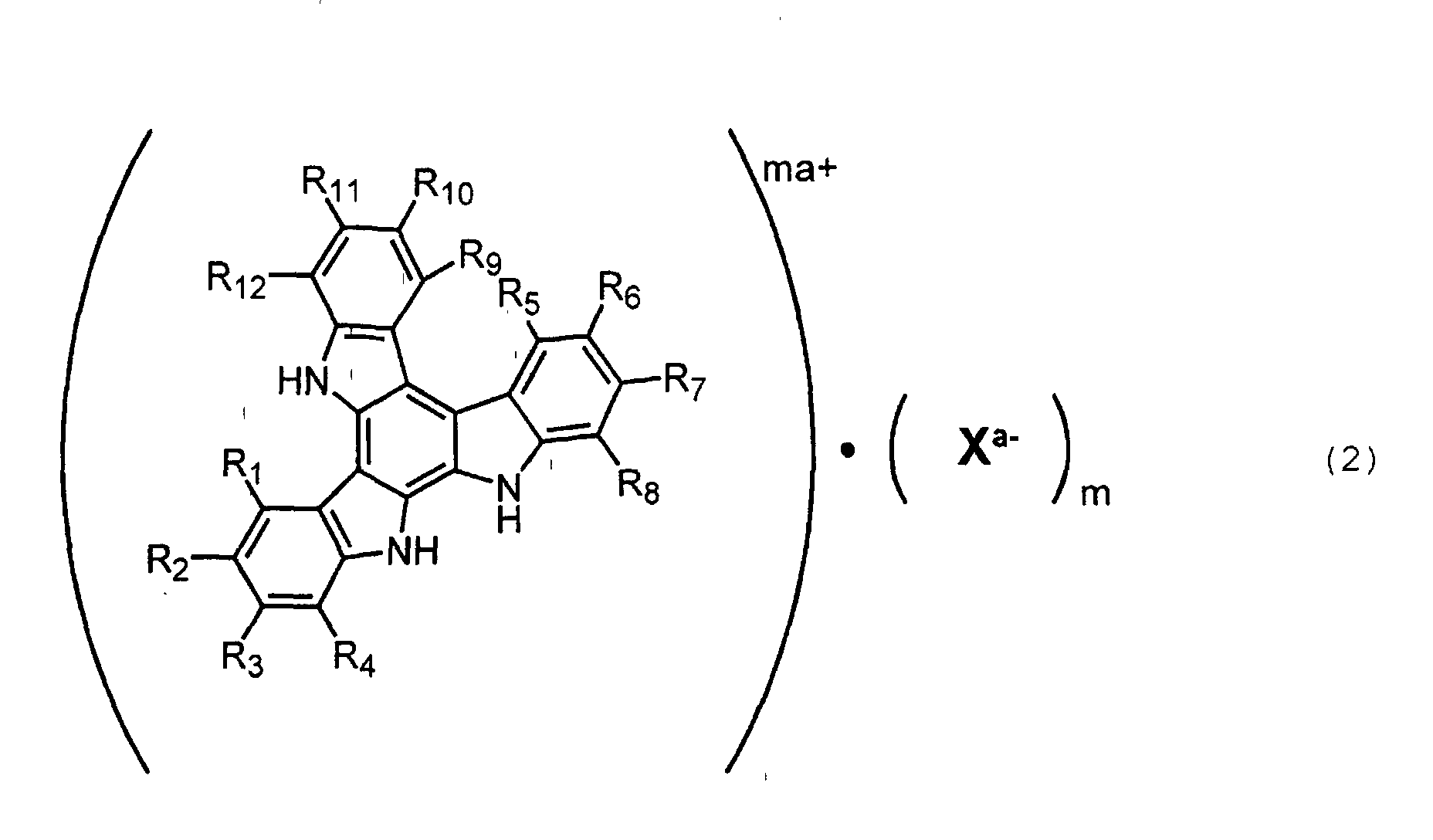
Xa- is at least one anion selected from the group of monovalent to tervalent anions consisting of chlorine ion, bromine ion, iodine ion, fluorine ion, nitrate ion, sulfate ion, hydrogen sulfate ion, phosphate ion, fluoroborate ion, perchlorate ion, thiocyanate ion, acetate ion, propionate ion, methane sulfonate ion, p-toluene sulfonate ion, trifluoroacetate ion, and trifluoeomethane sulfonate ion;
a is an integral number in the range from 1 to 3 representing the ionic valence of the ion X; and
m is a number in the range from 0 to 0.5, comprising:

in a reaction mixture containing at least one oxidant (B) and at least one organic solvent (C).

Xa- is at least one anion selected from the group of monovalent to tervalent anions consisting of chlorine ion, bromine ion, iodine ion, fluorine ion, nitrate ion, sulfate ion, hydrogen sulfate ion, phosphate ion, fluoroborate ion, perchlorate ion, thiocyanate ion, acetate ion, propionate ion, methane sulfonate ion, p-toluene sulfonate ion, trifluoroacetate ion, and trifluoeomethane sulfonate ion;
a is an integral number in the range from 1 to 3 representing the ionic valence of the ion X; and
m is a number in the range from 0 to 0.5.
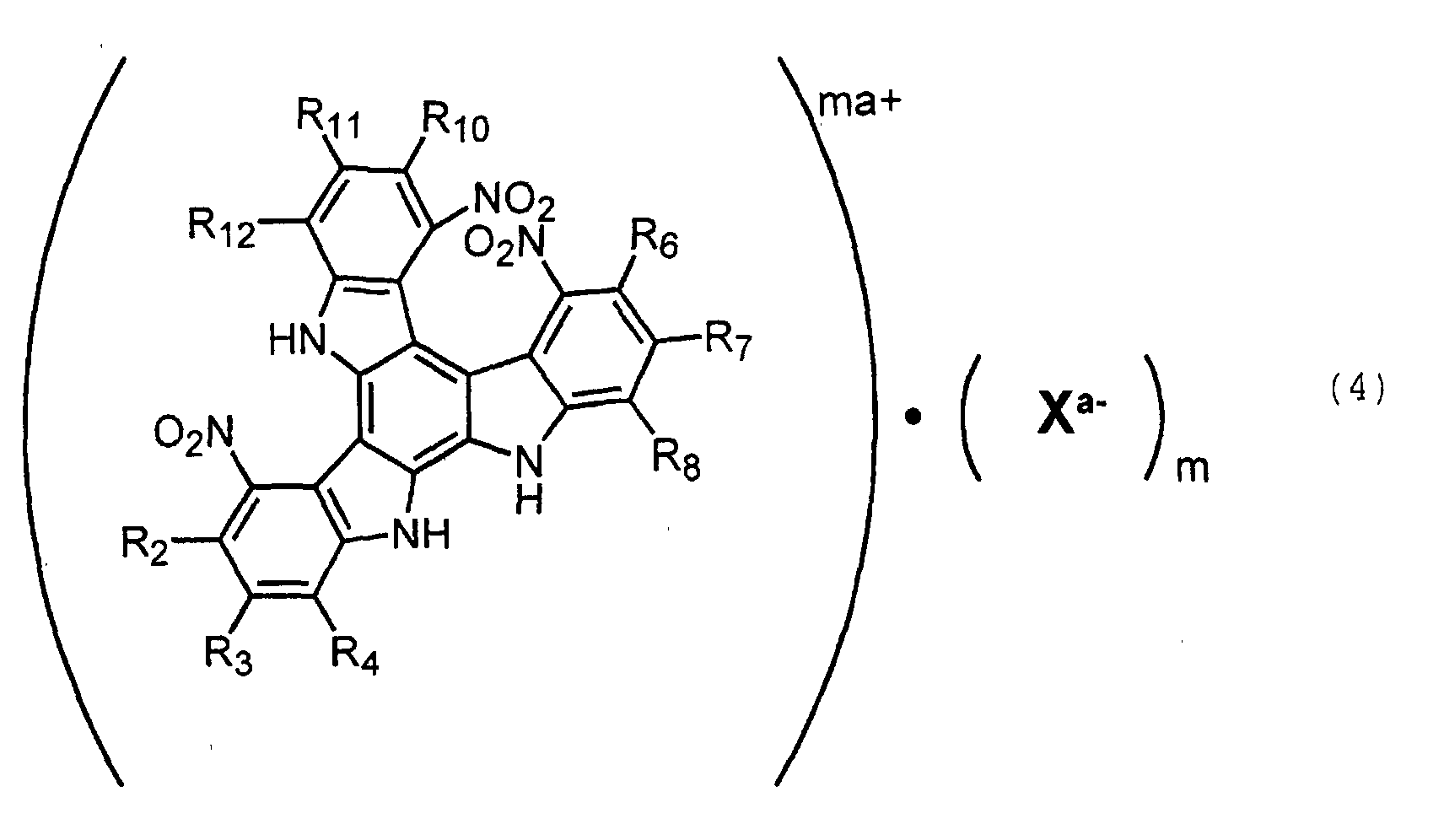
linear or branched sulfonic ester group having 1 to 24 carbon atoms, cyano group, hydroxyl group, nitro group, amino group, amide group, and halogen group;
Xa- is at least one anion selected from the group of monovalent to tervalent anions consisting of chlorine ion, bromine ion, iodine ion, fluorine ion, nitrate ion, sulfate ion, hydrogen sulfate ion, phosphate ion, fluoroborate ion, perchlorate ion, thiocyanate ion, acetate ion, propionate ion, methane sulfqnate ion, p-toluene sulfonate ion, trifluoroacetate ion, and trifluoeomethane sulfonate ion;
a is an integral number in the range from 1 to 3 representing the ionic valence of the ion X; and
m is a number in the range from 0 to 0.5.
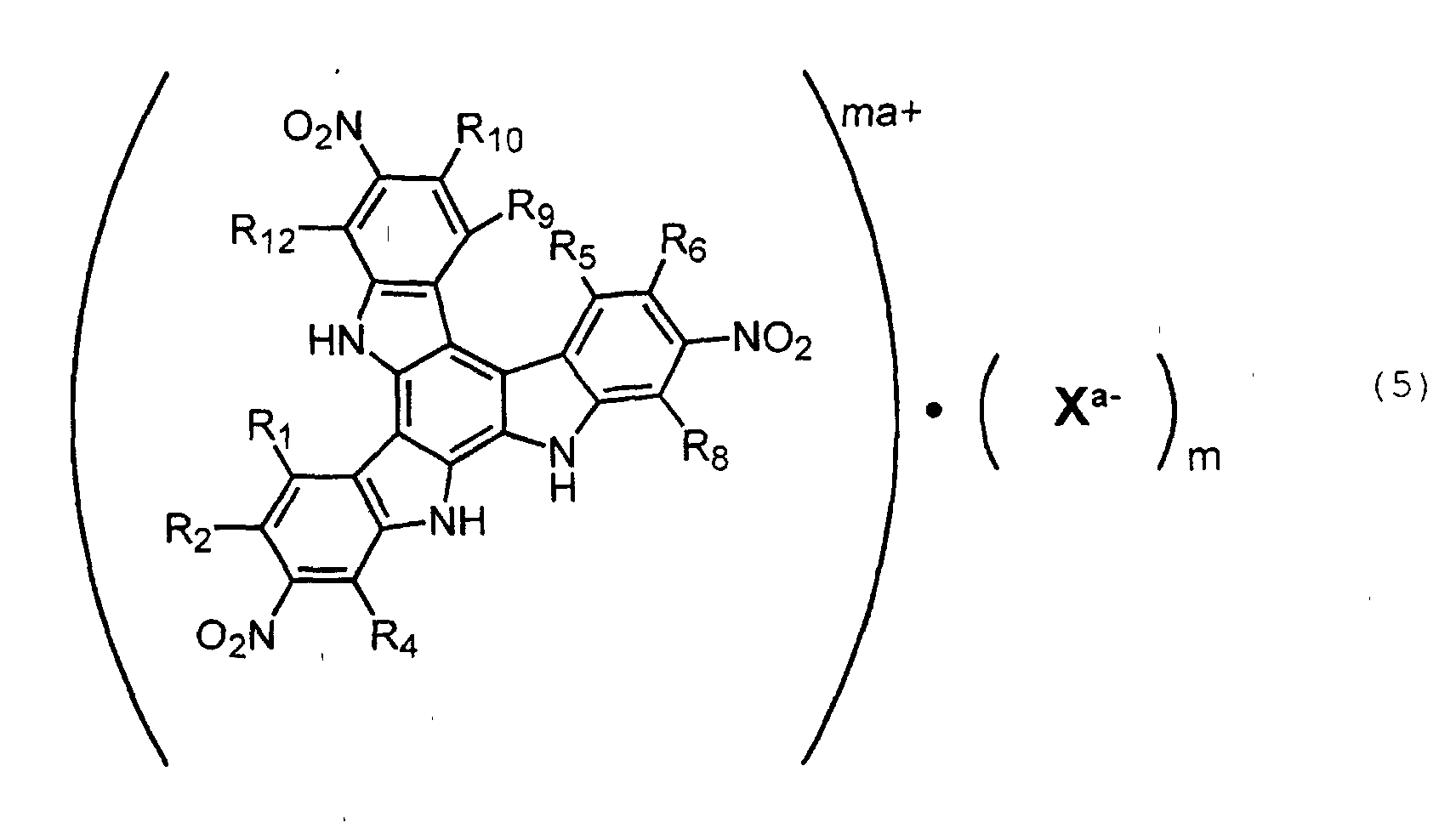
Xa- is at least one anion selected from the group of monovalent to tervalent anions consisting of chlorine ion, bromine ion, iodine ion, fluorine ion, nitrate ion, sulfate ion, hydrogen sulfate ion, phosphate ion, fluoroborate ion, perchlorate ion, thiocyanate ion, acetate ion, propionate ion, methane sulfonate ion, p-toluene sulfonate ion, trifluoroacetate ion, and trifluoeomethane sulfonate ion;
a is an integral number in the range from 1 to 3 representing the ionic valence of the ion X; and
m is a number in the range from 0 to 0.5.

linear or branched sulfonic ester group having 1 to 24 carbon atoms, cyano group, hydroxyl group, nitro group, amino group, amide group, and halogen group;
Xa- is at least one anion selected from the group of monovalent to tervalent anions consisting of chlorine ion, bromine ion, iodine ion, fluorine ion, nitrate ion, sulfate ion, hydrogen sulfate ion, phosphate ion, fluoroborate ion, perchlorate ion, thiocyanate ion, acetate ion, propionate ion, methane sulfonate ion, p-toluene sulfonate ion, trifluoroacetate ion, and trifluoeomethane sulfonate ion;
a is an integral number in the range from 1 to 3 representing the ionic valence of the ion X; and
m is a number in the range from 0 to 0.5.

Xa- is at least one anion selected from the group of monovalent to tervalent anions consisting of chlorine ion, bromine ion, iodine ion, fluorine ion, nitrate ion, sulfate ion, hydrogen sulfate ion, phosphate ion, fluoroborate ion, perchlorate ion, thiocyanate ion, acetate ion, propionate ion, methane sulfonate ion, p-toluene sulfonate ion, trifluoroacetate ion, and trifluoeomethane sulfonate ion;
a is an integral number in the range from 1 to 3 representing the ionic valence of the ion X; and
m is a number in the range from 0 to 0.5.

Xa- is at least one anion selected from the group of monovalent to tervalent anions consisting of chlorine ion, bromine ion, iodine ion, fluorine ion, nitrate ion, sulfate ion, hydrogen sulfate ion, phosphate ion, fluoroborate ion, perchlorate ion, thiocyanate ion, acetate ion, propionate ion, methane sulfonate ion, p-toluene sulfonate ion, trifluoroacetate ion, and trifluoeomethane sulfonate ion;
a is an integral number in the range from 1 to 3 representing the ionic valence of the ion X; and
m is a number in the range from 0 to 0.5.
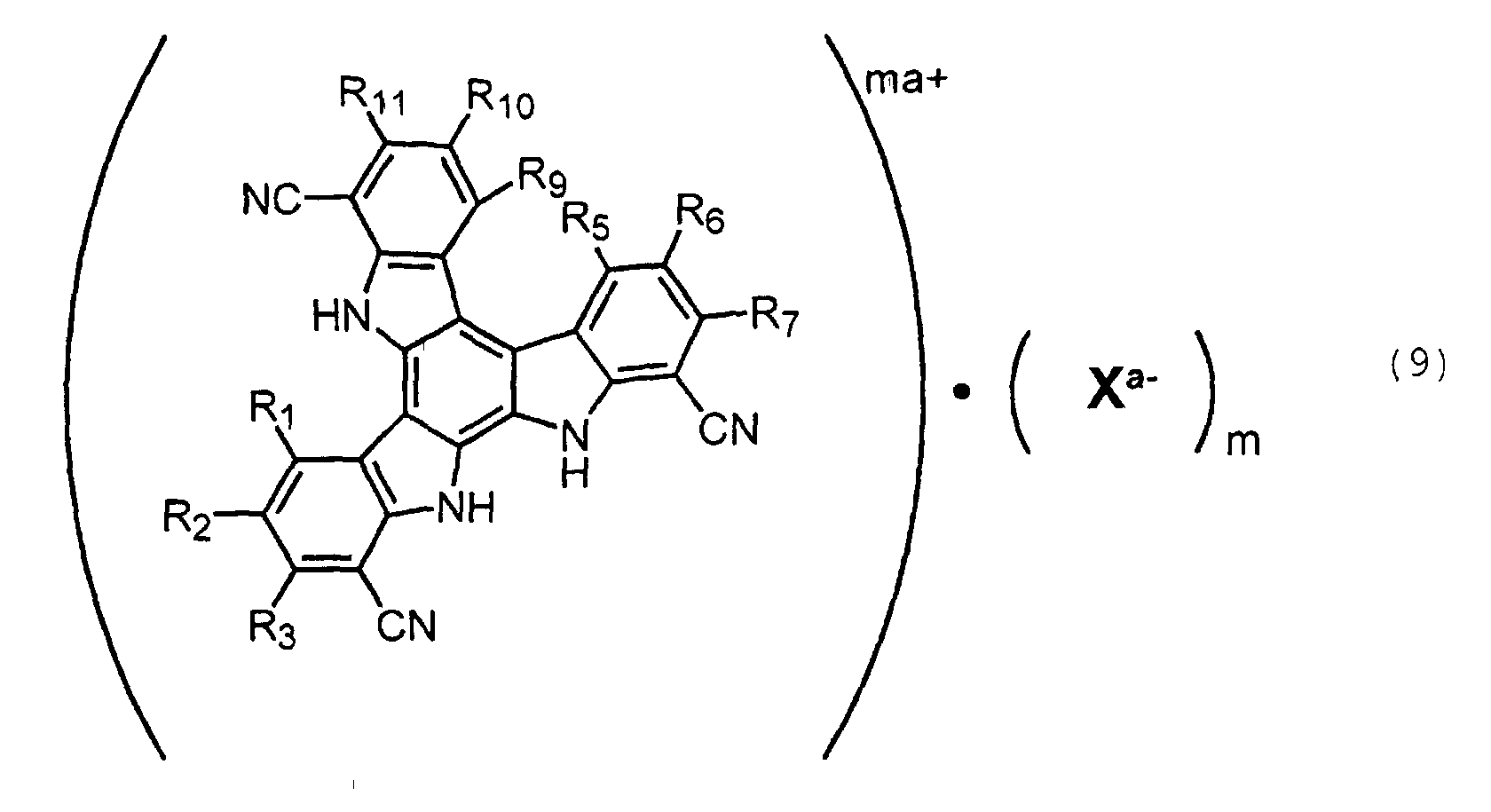
Xa- is at least one anion selected from the, group of monovalent to tervalent anions consisting of chlorine ion, bromine ion, iodine ion, fluorine ion, nitrate ion, sulfate ion, hydrogen sulfate ion, phosphate ion, fluoroborate ion, perchlorate ion, thiocyanate ion, acetate ion, propionate ion, methane sulfonate ion, p-toluene sulfonate ion, trifluoroacetate ion, and trifluoeomethane sulfonate ion;
a is an integral number in the range from 1 to 3 representing the ionic valence of the ion X; and
m is a number in the range from 0 to 0.5.

Xa- is at least one anion selected from the group of monovalent to tervalent anions consisting of chlorine ion, bromine ion, iodine ion, fluorine ion, nitrate ion, sulfate ion, hydrogen sulfate ion, phosphate ion, fluoroborate ion, perchlorate ion, thiocyanate ion, acetate ion, propionate ion, methane sulfonate ion, p-toluene sulfonate ion, trifluoroacetate ion, and trifluoeomethane sulfonate ion;
a is an integral number in the range from 1 to 3 representing the ionic valence of the ion X; and
m is a number in the range from 0 to 0.5.

Xa- is at least one anion selected from the group of monovalent to tervalent anions consisting of chlorine ion, bromine ion, iodine ion, fluorine ion, nitrate ion, sulfate ion, hydrogen sulfate ion, phosphate ion, fluoroborate ion, perchlorate ion, thiocyanate ion, acetate ion, propionate ion, methane sulfonate ion, p-toluene sulfonate ion, trifluoroacetate ion, and trifluoeomethane sulfonate ion;
a is an integral number in the range from 1 to 3 representing the ionic valence of the ion X; and
m is a number in the range from 0 to 0.5.

Xa- is at least one anion selected from the group of monovalent to tervalent anions consisting of chlorine ion, bromine ion, iodine ion, fluorine ion, nitrate ion, sulfate ion, hydrogen sulfate ion, phosphate ion, fluoroborate ion, perchlorate ion, thiocyanate ion, acetate ion, propionate ion, methane sulfonate ion, p-toluene sulfonate ion, trifluoroacetate ion, and trifluoeomethane sulfonate ion;
a is an integral number in the range from 1 to 3 representing the ionic valence of the ion X; and
m is a number in the range from 0 to 0.5.

Xa- is at least one anion selected from the group of monovalent to tervalent anions consisting of chlorine ion, bromine ion, iodine ion, fluorine ion, nitrate ion, sulfate ion, hydrogen sulfate ion, phosphate ion, fluoroborate ion, perchlorate ion, thiocyanate ion, acetate ion, propionate ion, methane sulfonate ion, p-toluene sulfonate ion, trifluoroacetate ion, and trifluoeomethane sulfonate ion;
a is an integral number in the range from 1 to 3 representing the ionic valence of the ion X; and
m is a number in the range from 0 to 0.5.
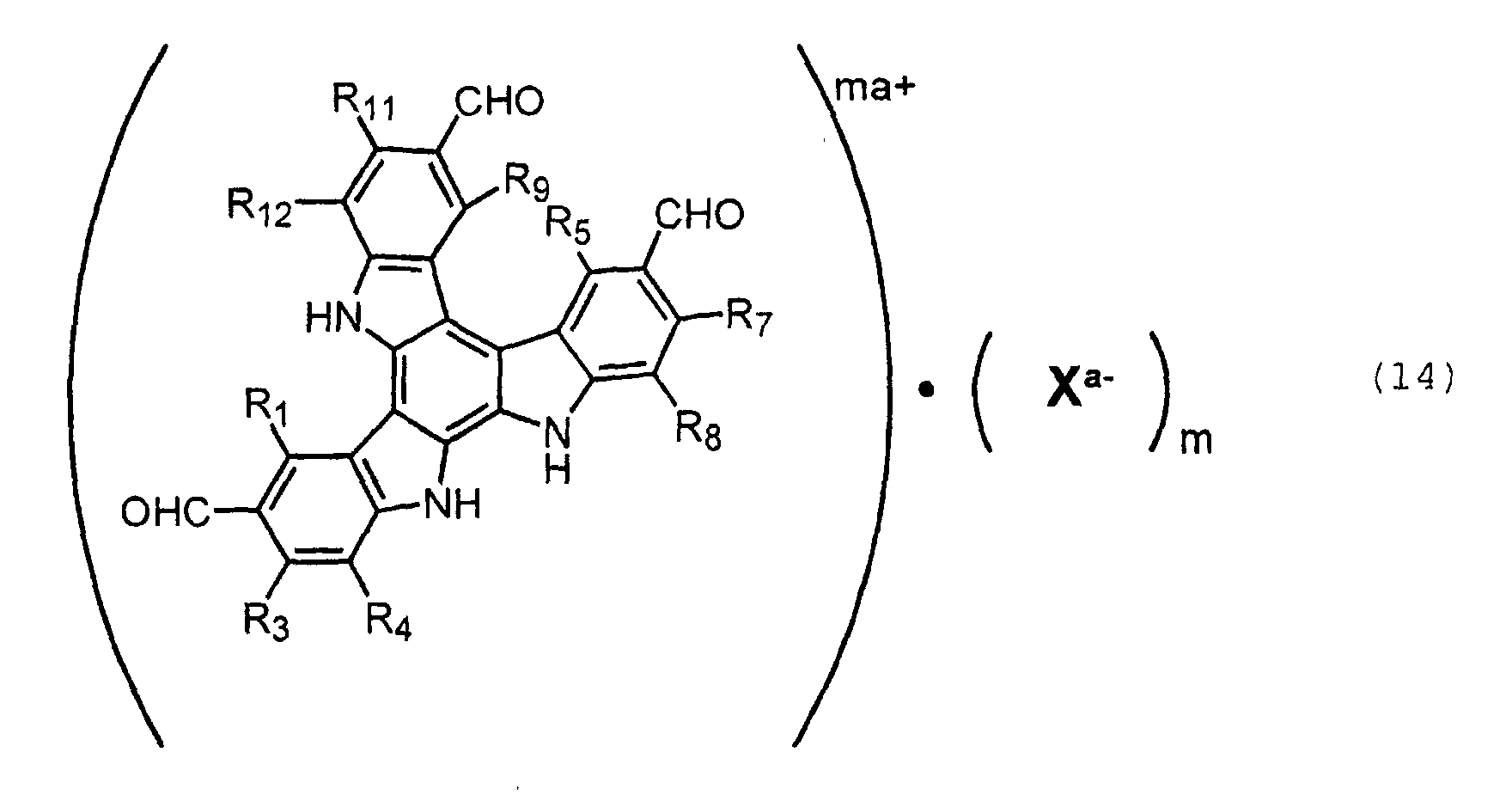
linear or branched sulfonic ester group having 1 to 24 carbon atoms, cyano group, hydroxyl group, nitro group, amino group, amide group, and halogen group;
Xa- is at least one anion selected from the group of monovalent to tervalent anions consisting of chlorine ion, bromine ion, iodine ion, fluorine ion, nitrate ion, sulfate ion, hydrogen sulfate ion, phosphate ion, fluoroborate ion, perchlorate ion, thiocyanate ion, acetate ion, propionate ion, methane sulfonate ion, p-toluene sulfonate ion, trifluoroacetate ion, and trifluoeomethane sulfonate ion;
a is an integral number in the range from 1 to 3 representing the ionic valence of the ion X; and
m is a number in the range from 0 to 0.5.

Xa- is at least one anion selected from the group of monovalent to tervalent anions consisting of chlorine ion, bromine ion, iodine ion, fluorine ion, nitrate ion, sulfate ion, hydrogen sulfate ion, phosphate ion, fluoroborate ion, perchlorate ion, thiocyanate ion, acetate ion, propionate ion, methane sulfonate ion, p-toluene sulfonate ion, trifluoroacetate ion, and trifluoeomethane sulfonate ion;
a is an integral number in the range from 1 to 3 representing the ionic valence of the ion X; and
m is a number in the range from 0 to 0.5.
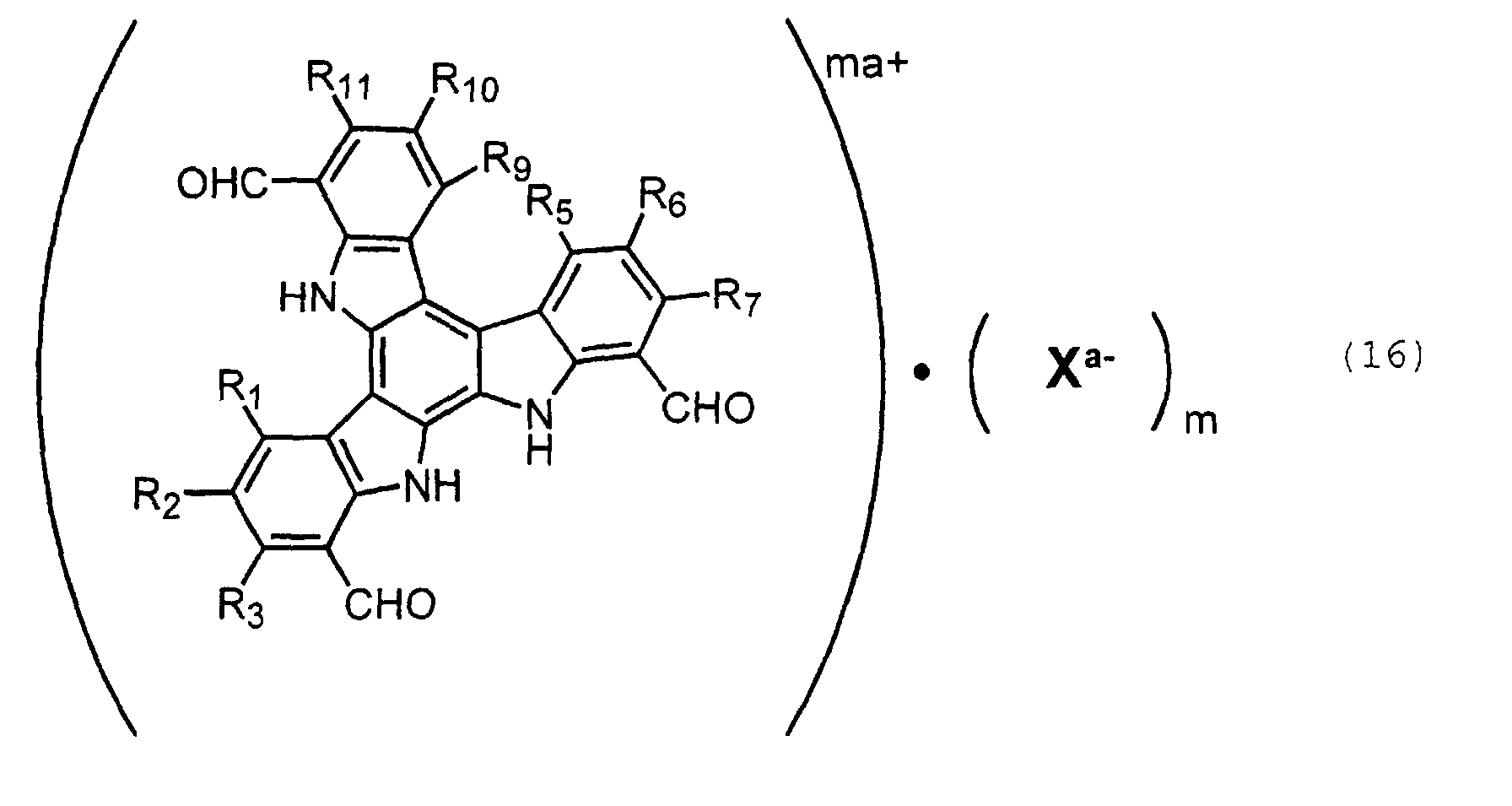
Xa- is at least one anion selected from the group of monovalent to tervalent anions consisting of chlorine ion, bromine ion, iodine ion, fluorine ion, nitrate ion, sulfate ion, hydrogen sulfate ion, phosphate ion, fluoroborate ion, perchlorate ion, thiocyanate ion, acetate ion, propionate ion, methane sulfonate ion, p-toluene sulfonate ion, trifluoroacetate ion, and trifluoeomethane sulfonate ion;
a is an integral number in the range from 1 to 3 representing the ionic valence of the ion X; and
m is a number in the range from 0 to 0.5.

Xa- is at least one anion selected from the group of monovalent to tervalent anions consisting of chlorine ion, bromine ion, iodine ion, fluorine ion, nitrate ion, sulfate ion, hydrogen sulfate ion, phosphate ion, fluoroborate ion, perchlorate ion, thiocyanate ion, acetate ion, propionate ion, methane sulfonate ion, p-toluene sulfonate ion, trifluoroacetate ion, and trifluoeomethane sulfonate ion;
a is an integral number in the range from 1 to 3 representing the ionic valence of the ion X; and
m is a number in the range from 0 to 0.5.
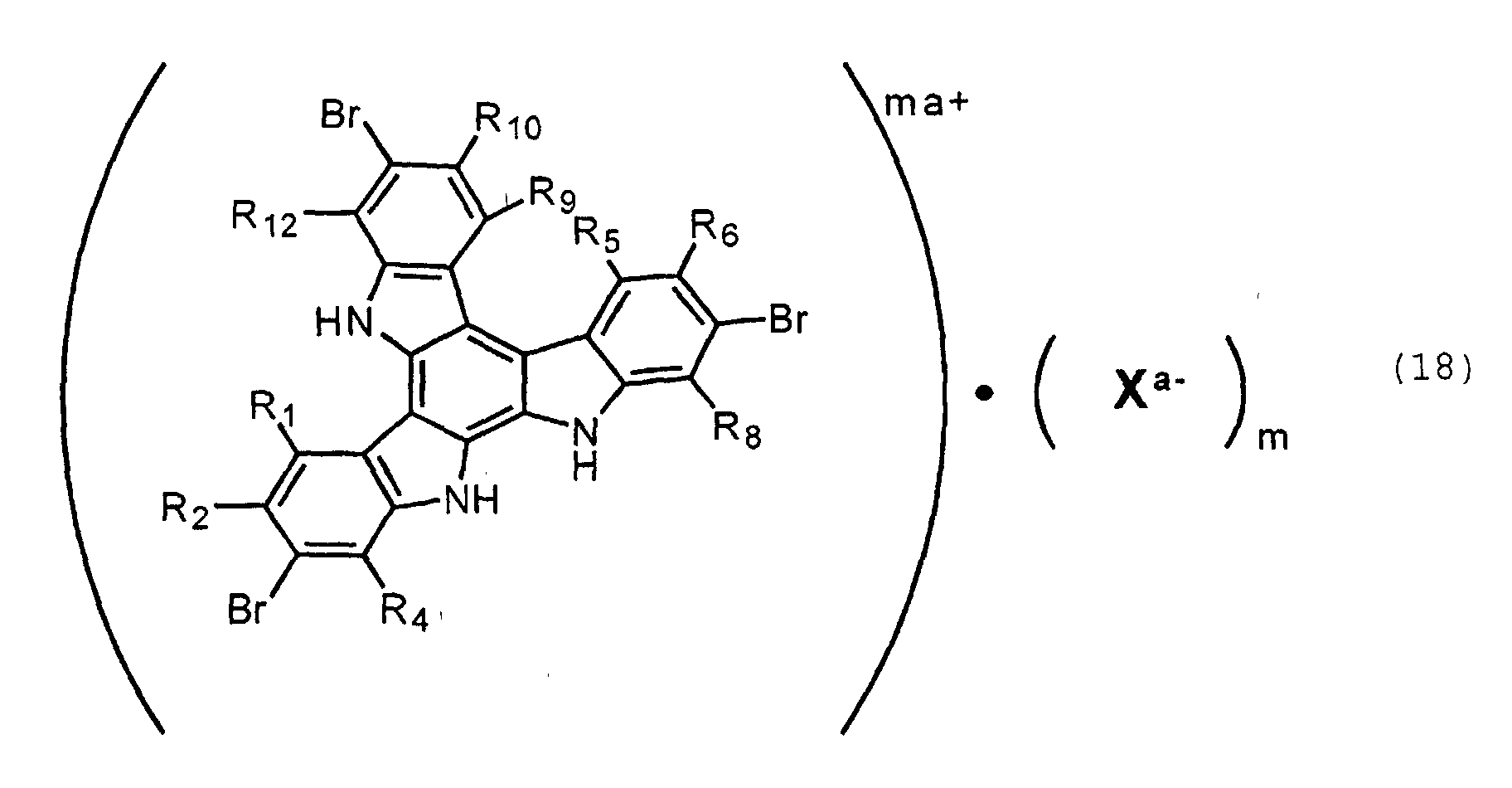
Xa- is at least one anion selected from the group of monovalent to tervalent anions consisting of chlorine ion, bromine ion, iodine ion, fluorine ion, nitrate ion, sulfate ion, hydrogen sulfate ion, phosphate ion, fluoroborate ion, perchlorate ion, thiocyanate ion, acetate ion, propionate ion, methane sulfonate ion, p-toluene sulfonate ion, trifluoroacetate ion, and trifluoeomethane sulfonate ion;
a is an integral number in the range from 1 to 3 representing the ionic valence of the ion X; and
m is a number in the range from 0 to 0.5.
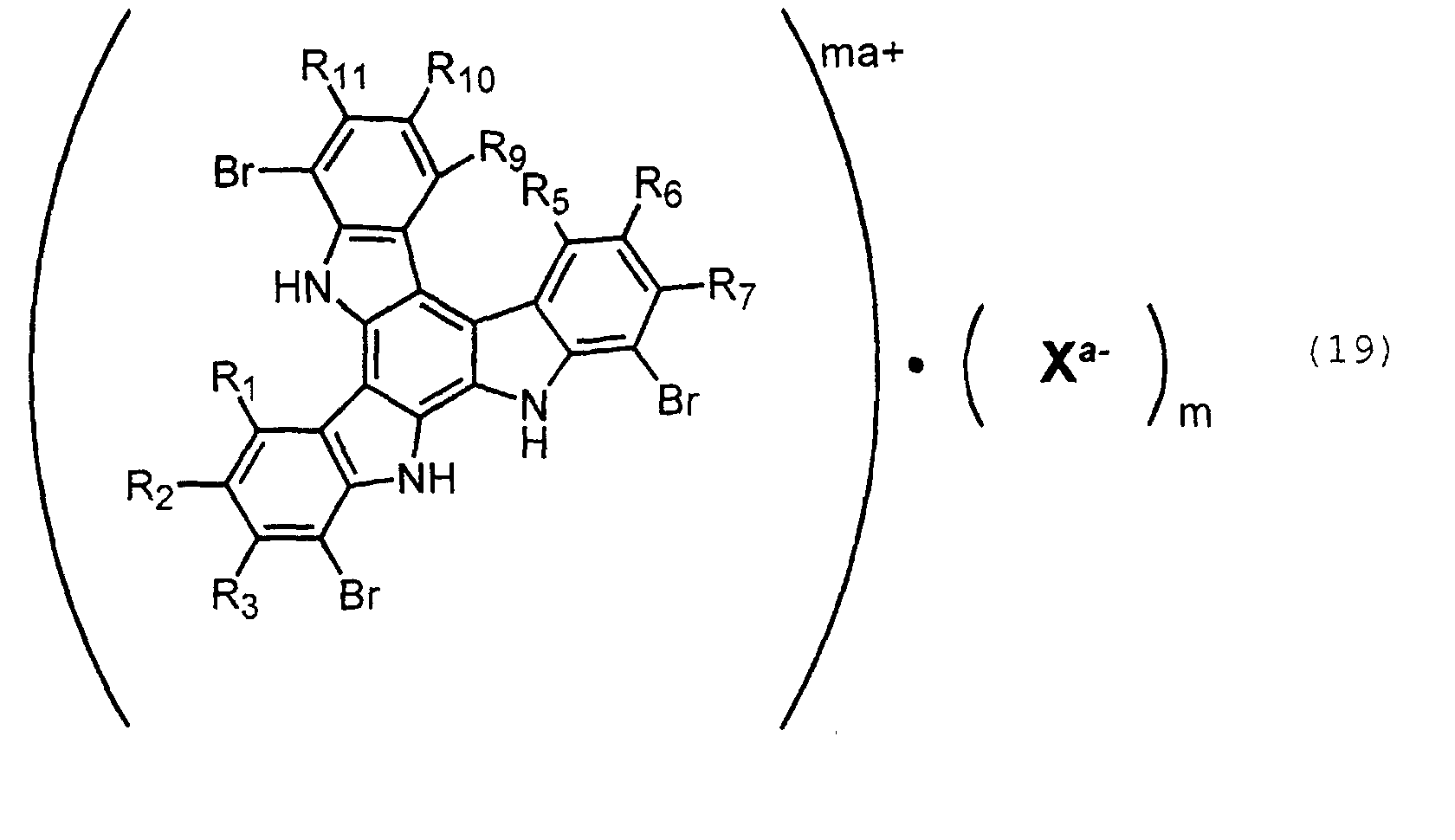
Xa- is at least one anion selected from the group of monovalent to tervalent anions consisting of chlorine ion, bromine ion, iodine ion, fluorine ion, nitrate ion, sulfate ion, hydrogen sulfate ion, phosphate ion, fluoroborate ion, perchlorate ion, thiocyanate ion, acetate ion, propionate ion, methane sulfonate ion, p-toluene sulfonate ion, trifluoroacetate ion, and trifluoeomethane sulfonate ion;
a is an integral number in the range from 1 to 3 representing the ionic valence of the ion X; and
m is a number in the range from 0 to 0.5.
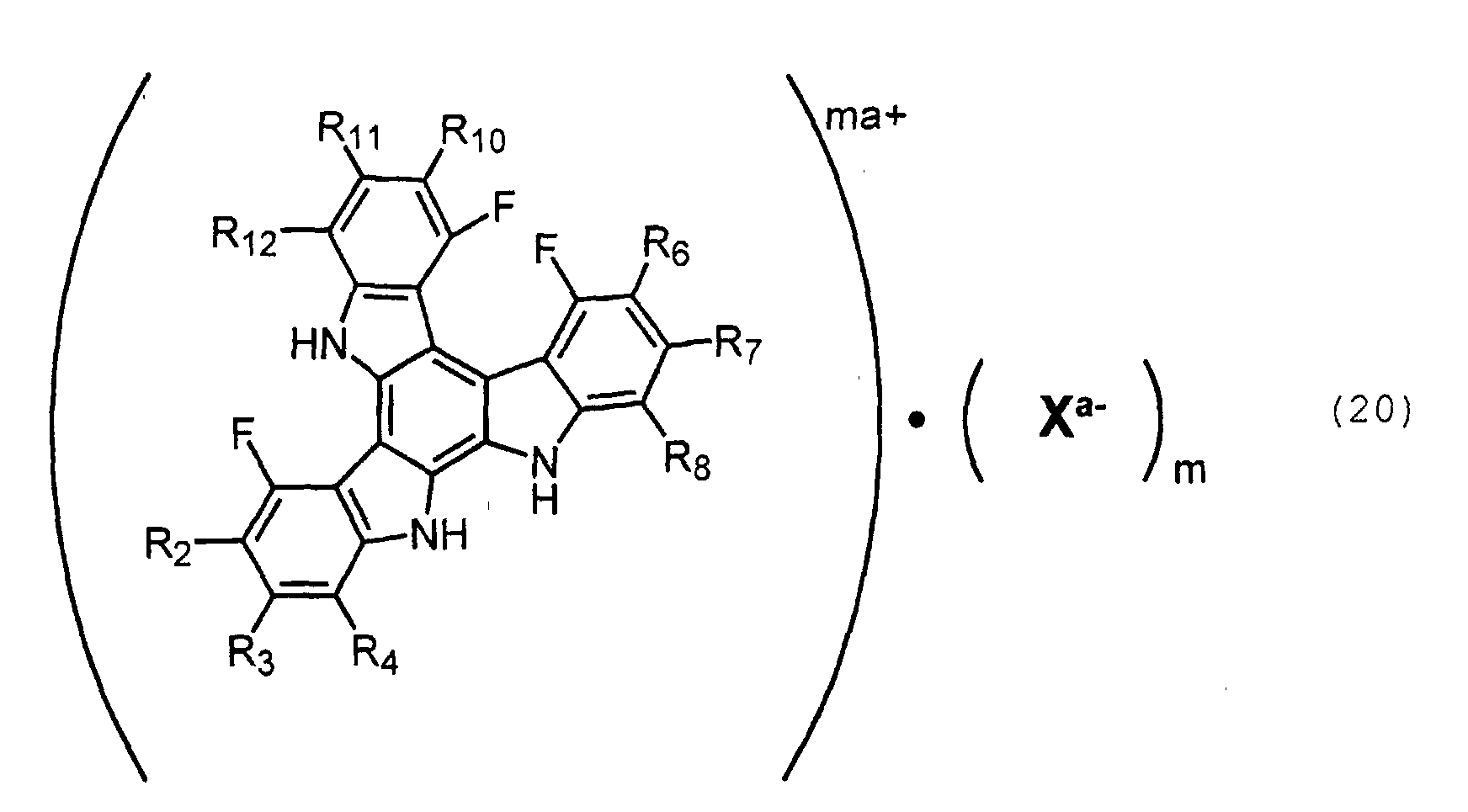
Xa- is at least one anion selected from the group of monovalent to tervalent anions consisting of chlorine ion, bromine ion, iodine ion, fluorine ion, nitrate ion, sulfate ion, hydrogen sulfate ion, phosphate ion, fluoroborate ion, perchlorate ion, thiocyanate ion, acetate ion, propionate ion, methane sulfonate ion, p-toluene sulfonate ion, trifluoroacetate ion, and trifluoeomethane sulfonate ion;
a is an integral number in the range from 1 to 3 representing the ionic valence of the ion X; and
m is a number in the range from 0 to 0.5.
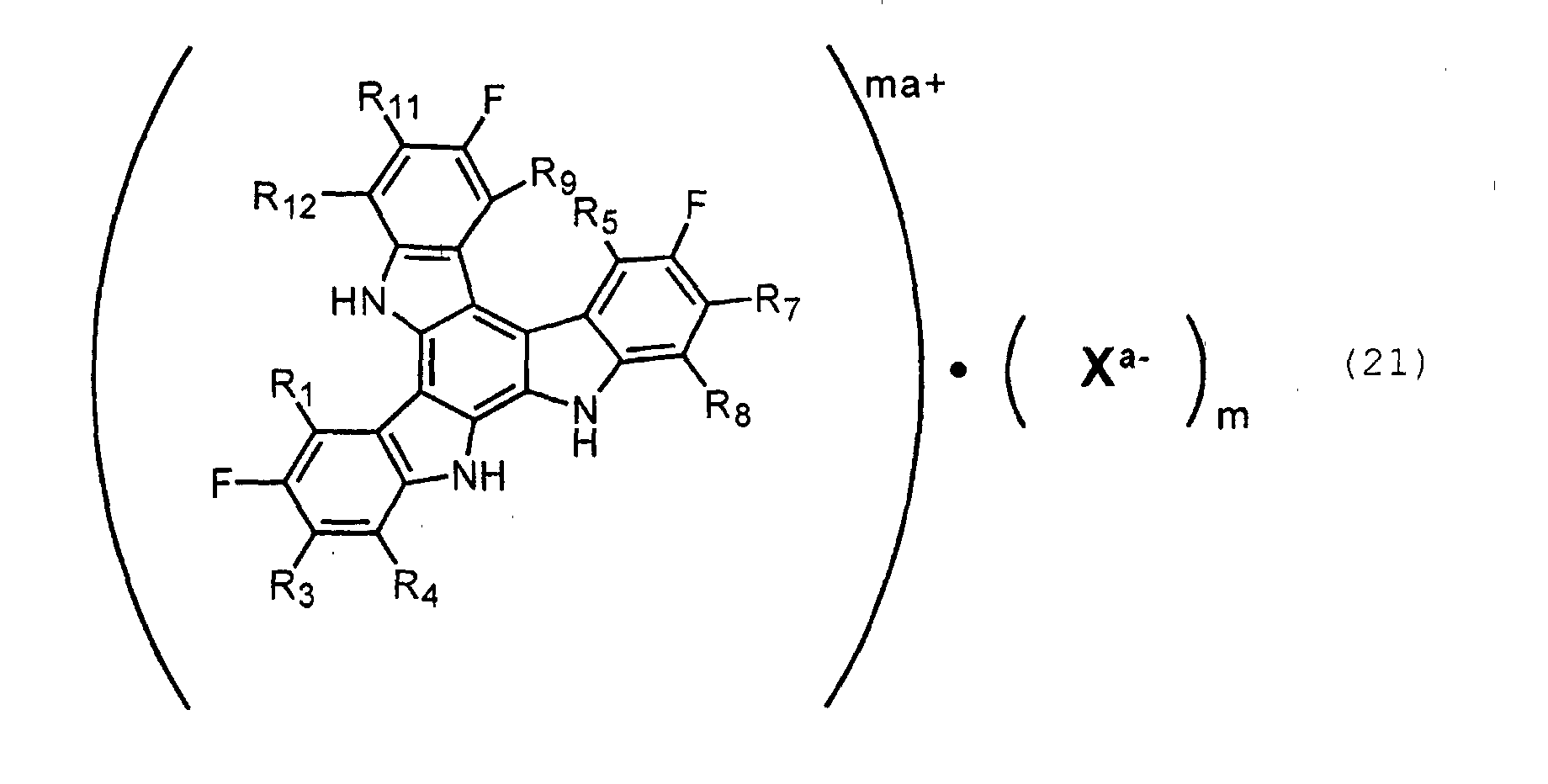
Xa- is at least one anion selected from the group of monovalent to tervalent anions consisting of chlorine ion, bromine ion, iodine ion, fluorine ion, nitrate ion, sulfate ion, hydrogen sulfate ion, phosphate ion, fluoroborate ion, perchlorate ion, thiocyanate ion, acetate ion, propionate ion, methane sulfonate ion, p-toluene sulfonate ion, trifluoroacetate ion, and trifluoeomethane sulfonate ion;
a is an integral number in the range from 1 to 3 representing the ionic valence of the ion X; and
m is a number in the range from 0 to 0.5.
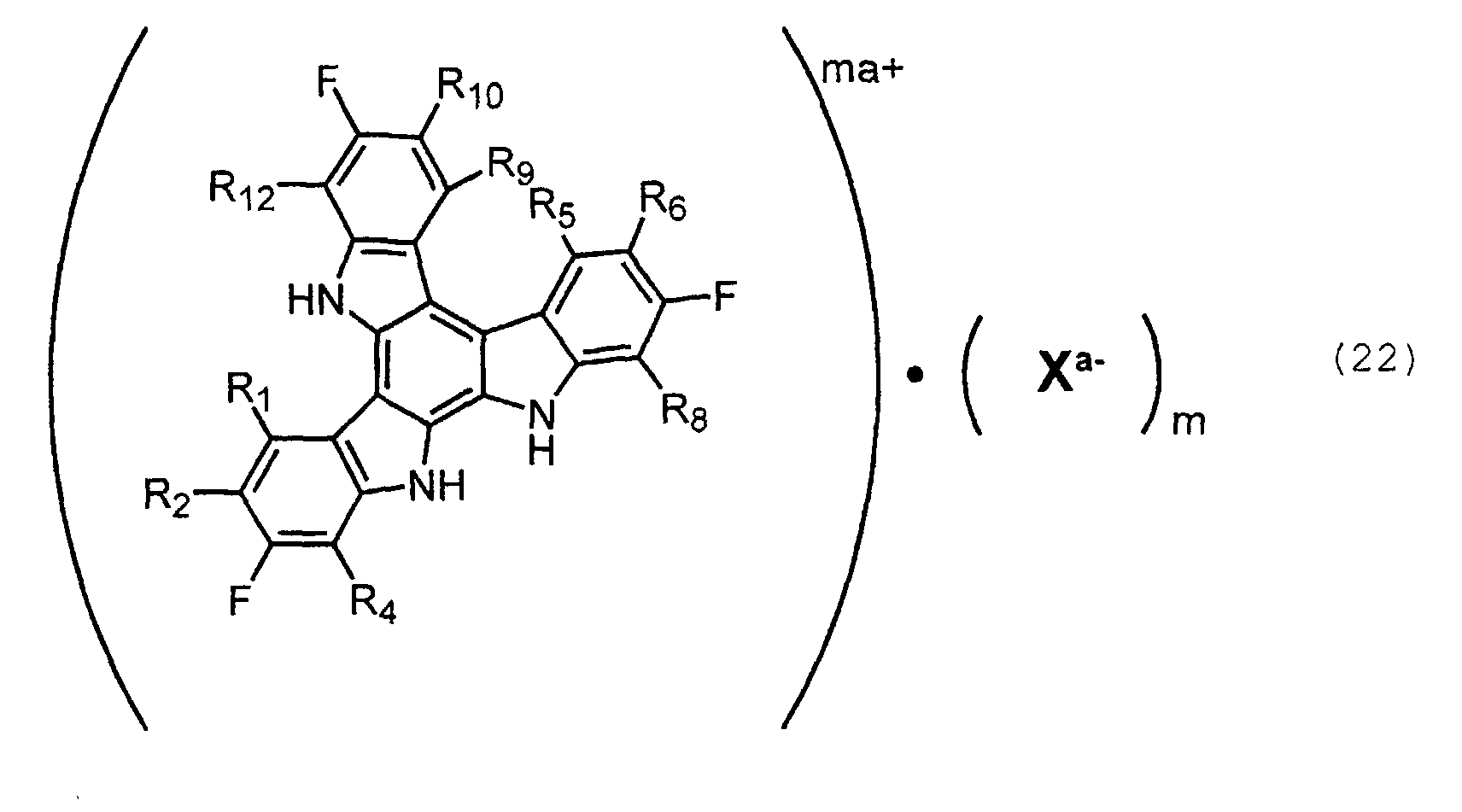
Xa- is at least one anion selected from the group of monovalent to tervalent anions consisting of chlorine ion, bromine ion, iodine ion, fluorine ion, nitrate ion, sulfate ion, hydrogen sulfate ion, phosphate ion, fluoroborate ion, perchlorate ion, thiocyanate ion, acetate ion, propionate ion, methane sulfonate ion, p-toluene sulfonate ion, trifluoroacetate ion, and trifluoeomethane sulfonate ion;
a is an integral number in the range from 1 to 3 representing the ionic valence of the ion X; and
m is a number in the range from 0 to 0.5.

Xa- is at least one anion selected from the group of monovalent to tervalent anions consisting of chlorine ion, bromine ion, iodine ion, fluorine ion, nitrate ion, sulfate ion, hydrogen sulfate ion, phosphate ion, fluoroborate ion, perchlorate ion, thiocyanate ion, acetate ion, propionate ion, methane sulfonate ion, p-toluene sulfonate ion, trifluoroacetate ion, and trifluoeomethane sulfonate ion;
a is an integral number in the range from 1 to 3 representing the ionic valence of the ion X; and
m is a number in the range from 0 to 0.5.

Xa- is at least one anion selected from the group of monovalent to tervalent anions consisting of chlorine ion, bromine ion, iodine ion, fluorine ion, nitrate ion, sulfate ion, hydrogen sulfate ion, phosphate ion, fluoroborate ion, perchlorate ion, thiocyanate ion, acetate ion, propionate ion, methane sulfonate ion, p-toluene sulfonate ion, trifluoroacetate ion, and trifluoeomethane sulfonate ion;
a is an integral number in the range from 1 to 3 representing the ionic valence of the ion X; and
m is a number in the range from 0 to 0.5.

a is an integral number in the range from to 3 representing the ionic valence of the ion X; an
m is a number in the range from 0 to 0.5.
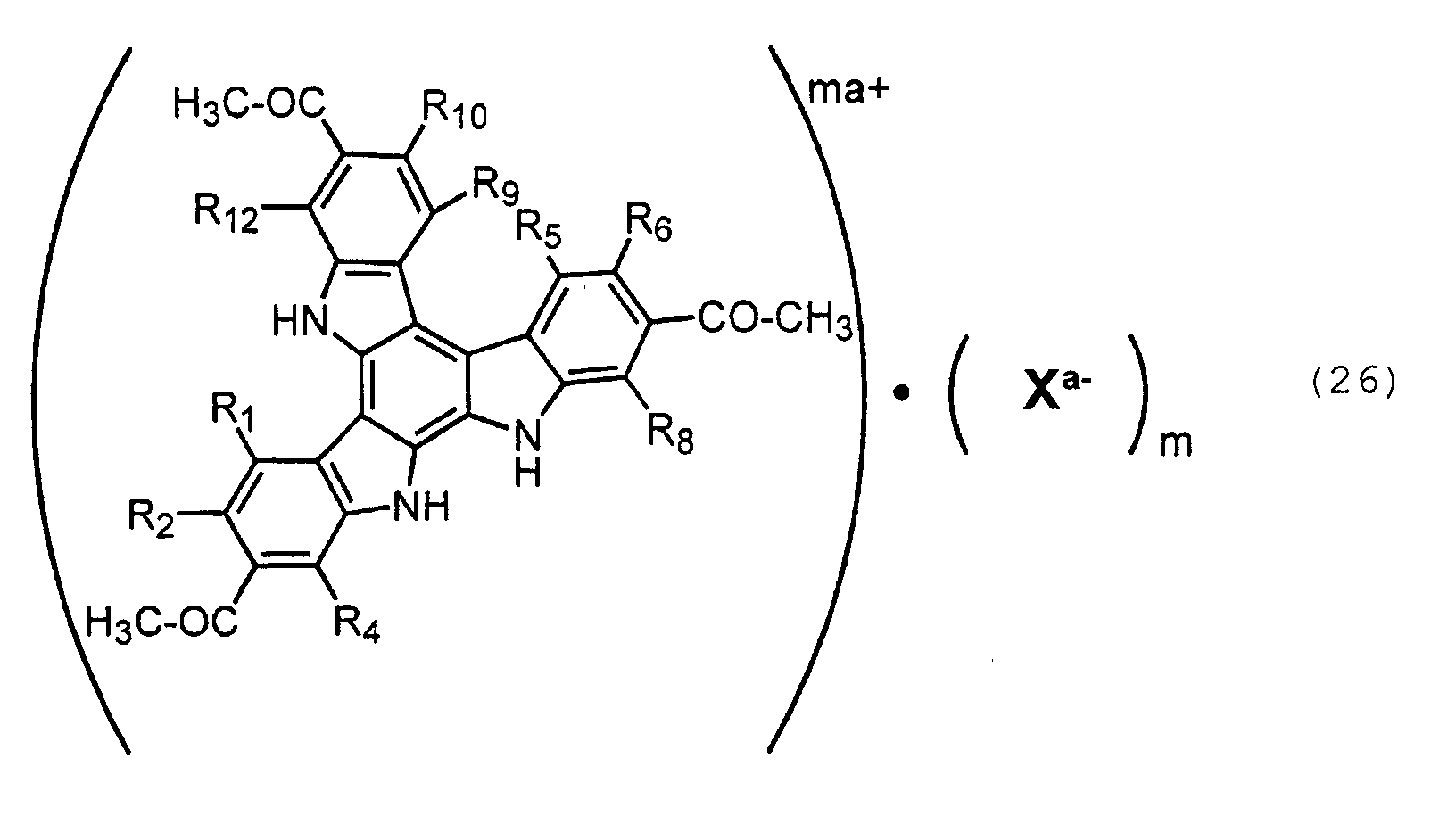
Xa- is at least one anion selected from the group of monovalent to tervalent anions consisting of chlorine ion, bromine ion, iodine ion, fluorine ion, nitrate ion, sulfate ion, hydrogen sulfate ion, phosphate ion, fluoroborate ion, perchlorate ion, thiocyanate ion, acetate ion, propionate ion, methane sulfonate ion, p-toluene sulfonate ion, trifluoroacetate ion, and trifluoeomethane sulfonate ion;
a is an integral number in the range from 1 to 3 representing the ionic valence of the ion X; and
m is a number in the range from 0 to 0.5.

Xa- is at least one anion selected from the group of monovalent to tervalent anions consisting of chlorine ion, bromine ion, iodine ion, fluorine ion, nitrate ion, sulfate ion, hydrogen sulfate ion, phosphate ion, fluoroborate ion, perchlorate ion, thiocyanate ion, acetate ion, propionate ion, methane sulfonate ion, p-toluene sulfonate ion, trifluoroacetate ion, and trifluoeomethane sulfonate ion;
a is an integral number in the range from 1 to 3 representing the ionic valence of the ion X; and
m is a number in the range from 0 to 0.5.
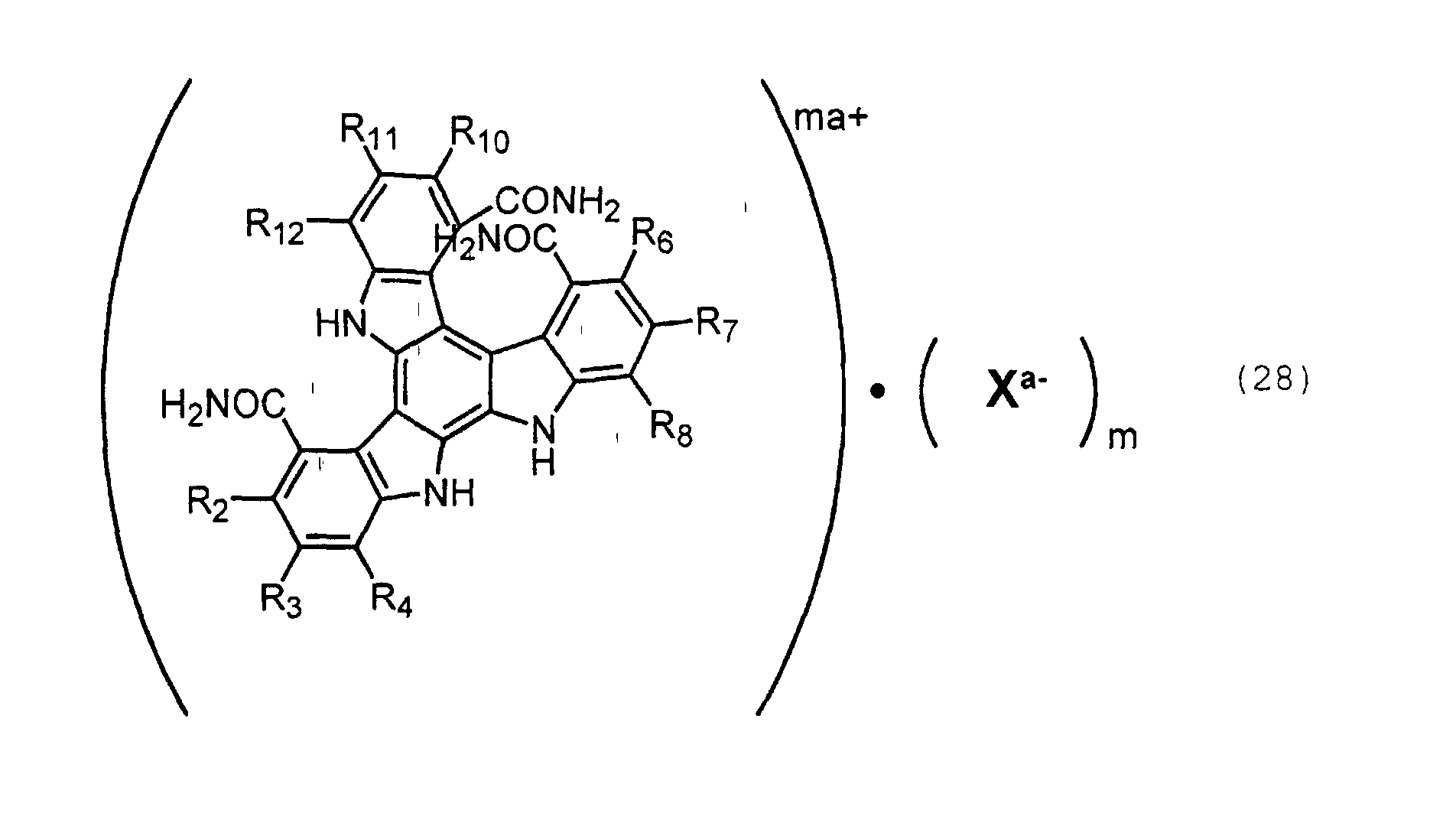
Xa- is at least one anion selected from the group of monovalent to tervalent anions consisting of chlorine ion, bromine ion, iodine ion, fluorine ion, nitrate ion, sulfate ion, hydrogen sulfate ion, phosphate ion, fluoroborate ion, perchlorate ion, thiocyanate ion, acetate ion, propionate ion, methane sulfonate ion, p-toluene sulfonate ion, trifluoroacetate ion, and trifluoeomethane sulfonate ion;
a is an integral number in the range from 1 to 3 representing the ionic valence of the ion X; and
m is a number in the range from 0 to 0.5.

Xa- is at least one anion selected from the group of monovalent to tervalent anions consisting of chlorine ion, bromine ion, iodine ion, fluorine ion, nitrate ion, sulfate ion, hydrogen sulfate ion, phosphate ion, fluoroborate ion, perchlorate ion, thiocyanate ion, acetate ion, propionate ion, methane sulfonate ion, p-toluene sulfonate ion, trifluoroacetate ion, and trifluoeomethane sulfonate ion;
a is an integral number in the range from 1 to 3 representing the ionic valence of the ion X; and
m is a number in the range from 0 to 0.5.
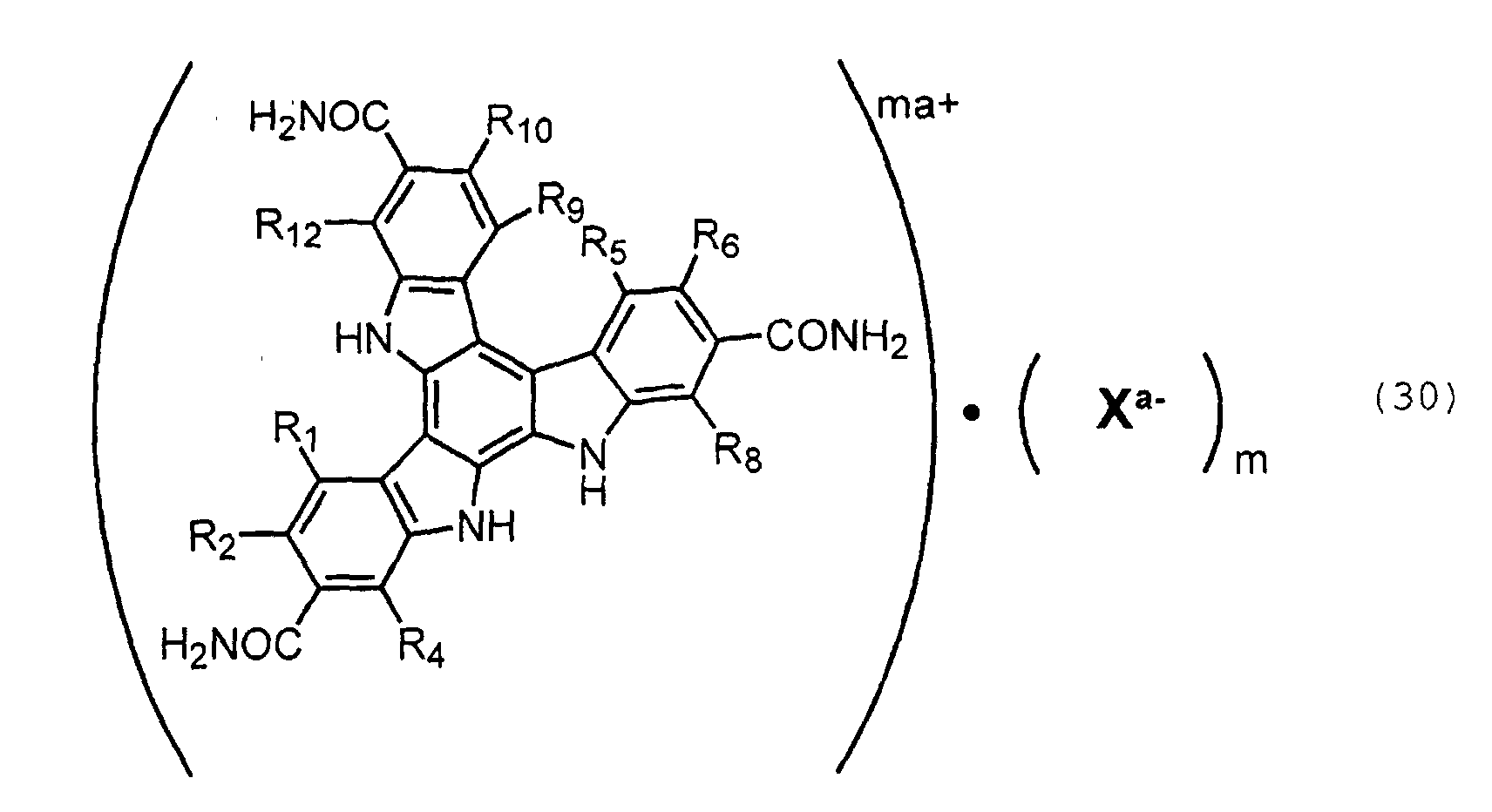
Xa- is at least one anion selected from the group of monovalent to tervalent anions consisting of chlorine ion, bromine ion, iodine ion, fluorine ion, nitrate ion, sulfate ion, hydrogen sulfate ion, phosphate ion, fluoroborate ion, perchlorate ion, thiocyanate ion, acetate ion, propionate ion, methane sulfonate ion, p-toluene sulfonate ion, trifluoroacetate ion, and trifluoeomethane sulfonate ion;
a is an integral number in the range from 1 to 3 representing the ionic valence of the ion X; and
m is a number in the range from 0 to 0.5.
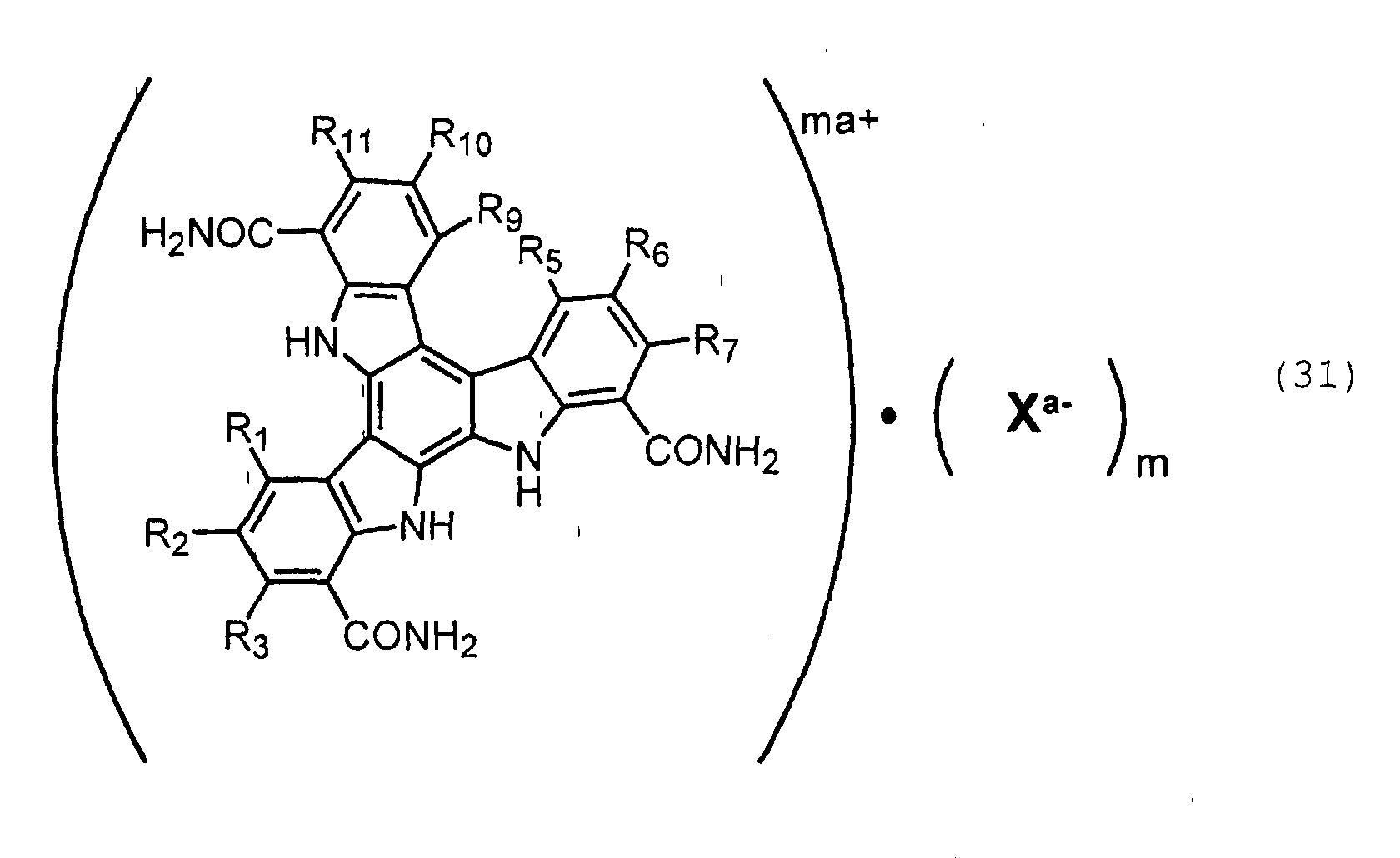
Xa- is at least one anion selected from the group of monovalent to tervalent anions consisting of chlorine ion, bromine ion, iodine ion, fluorine ion, nitrate ion, sulfate ion, hydrogen sulfate ion, phosphate ion, fluoroborate ion, perchlorate ion, thiocyanate ion, acetate ion, propionate ion, methane sulfonate ion, p-toluene sulfonate ion, trifluoroacetate ion, and trifluoeomethane sulfonate ion;
a is an integral number in the range from 1 to 3 representing the ionic valence of the ion X; and
m is a number in the range from 0 to 0.5.

Xa- is at least one anion selected from the group of monovalent to tervalent anions consisting of chlorine ion, bromine ion, iodine ion, fluorine ion, nitrate ion, sulfate ion, hydrogen sulfate ion, phosphate ion, fluoroborate ion, perchlorate ion, thiocyanate ion, acetate ion, propionate ion, methane sulfonate ion, p-toluene sulfonate ion, trifluoroacetate ion, and trifluoeomethane sulfonate ion;
a is an integral number in the range from 1 to 3 representing the ionic valence of the ion X; and
m is a number in the range from 0 to 0.5.
wherein the indole derivative trimer is indole-5-carbonitrile trimer or an indole-5-carboxylic acid trimer of following formula (32):
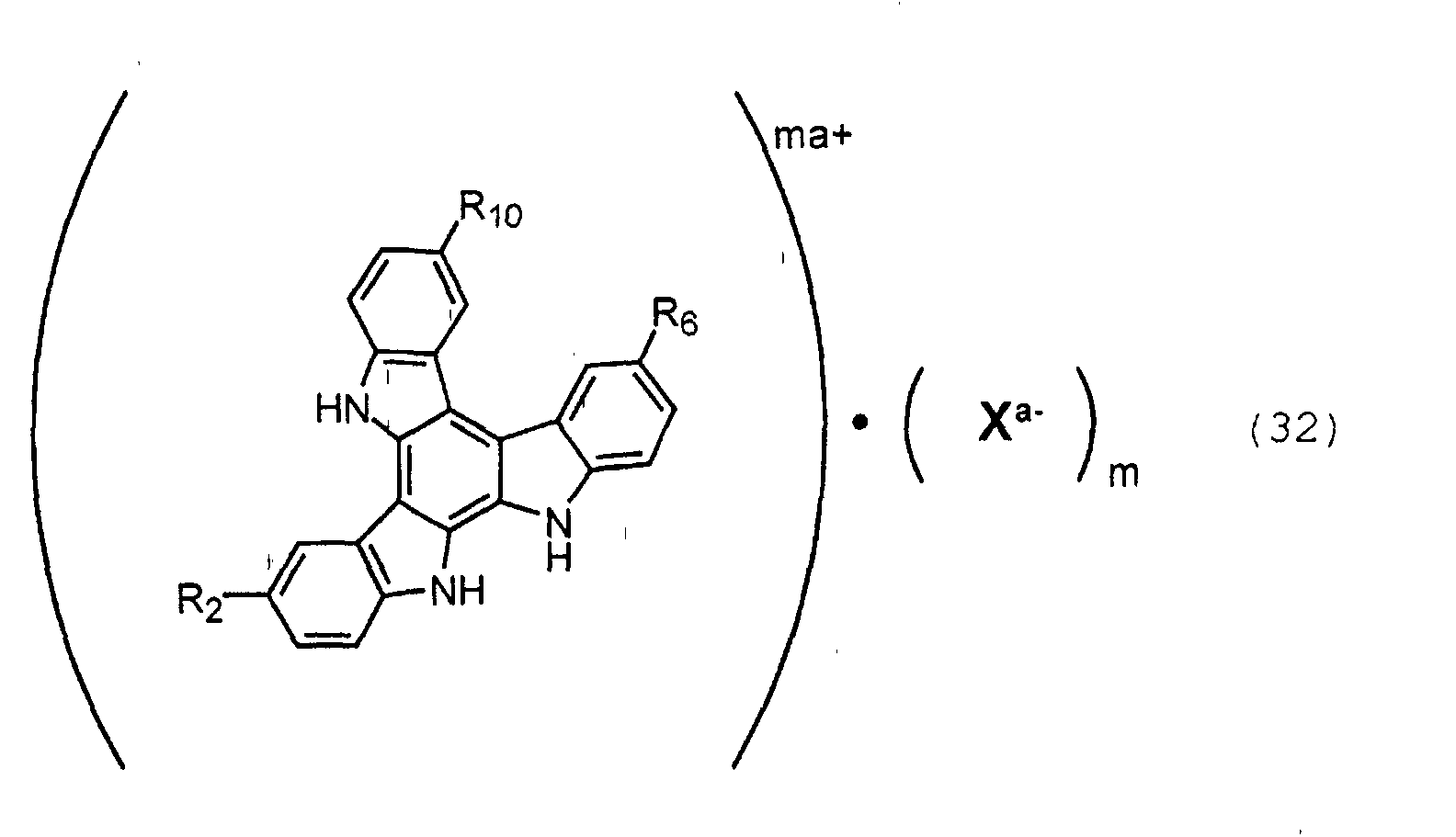
Xa- is at least one anion selected from the group of monovalent to tervalent anions consisting of chlorine ion, bromine ion, iodine ion, fluorine ion, nitrate ion, sulfate ion, hydrogen sulfate ion, phosphate ion, fluoroborate ion, perchlorate ion, thiocyanate ion, acetate ion, propionate ion, methane sulfonate ion, p-toluene sulfonate ion, trifluoroacetate ion, and a trifluoromethane sulfonate ion;
a is an integral number in the range from 1 to 3 indicating the ionic valence of the ion X; and
m is a number in the range from 0 to 0.5.
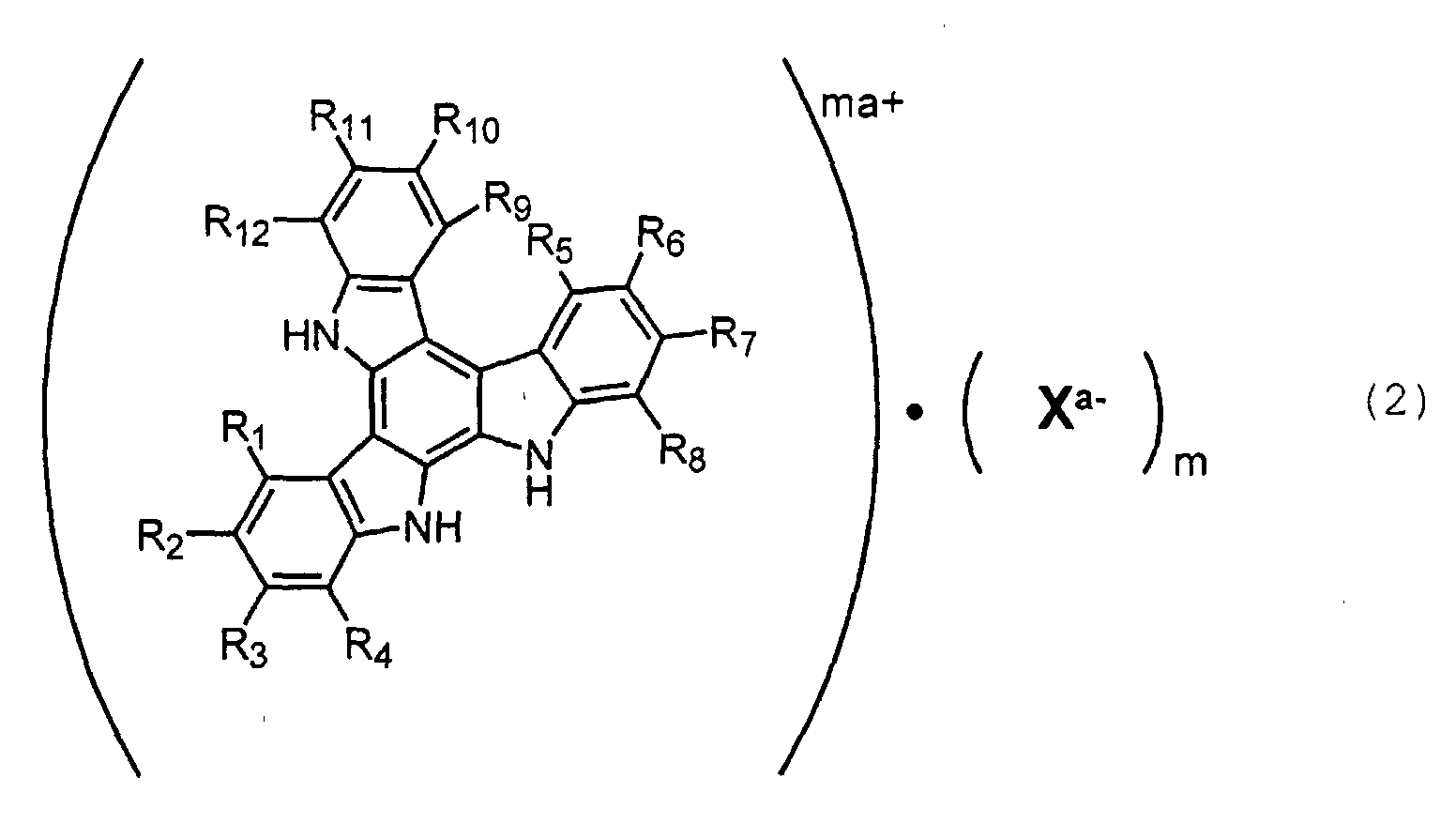
Xa- is at least one anion selected from the group of monovalent to tervalent anions consisting of chlorine ion, bromine ion, iodine ion, fluorine ion, nitrate ion, sulfate ion, hydrogen sulfate ion, phosphate ion, fluoroborate ion, perchlorate ion, thiocyanate ion, acetate ion, propionate ion, methane sulfonate ion, p-toluene sulfonate ion, trifluoroacetate ion, and trifluoeomethane sulfonate ion;
a is an integral number in the range from 1 to 3 indicating the ionic valence of the ion X; and
m is a number in the range from 0 to 0.5.

Xa- is at least one anion selected from the group of monovalent to tervalent anions group consisting of chlorine ion, bromine ion, iodine ion, fluorine ion, nitrate ion, sulfate ion, hydrogen sulfate ion, phosphate ion, fluoroborate ion, perchlorate ion, thiocyanate ion, acetate ion, propionate ion, methane sulfonate ion, p-toluene sulfonate ion, trifluoroacetate ion, and trifluoeomethane sulfonate ion;
a is an integral number in the range from 1 to 3 indicating the ionic valence of the ion X; and
m is a number in the range from 0 to 0.5.
indole; alkyl group-substituted indoles, such as 4-methyl indole, 5-methylindole, 6-methylindole, 7-methylindole, 4-ethylindole, 5-ethylindole, 6-ethylindole, 7-ethylindole, 4-n-propylindole, 5-n-propylindole, 6-n-propylindole, 7-n-propylindole, 4-iso-propylindole, 5-iso-propylindole, 6-iso-propylindole, 7-iso-propylindole, 4-n-butylindole, 5-n-butylindole, 6-n-butylindole, 7-n-butylindole, 4-sec-butylindole, 5-sec-butylindole, 6-sec-butylindole, 7-sec-butylindole, 4-t-butylindole, 5-t-butylindole, 6-t-butylindole, 7-t-butylindole; alkoxy group substituted indoles, such as 4-methoxyindole, 5-methoxyindole, 6-methoxyindole, 7-methoxyindole, 4-ethoxyindole, 5-ethoxyindole, 6-ethoxyindole, 7-ethoxyindole, 4-n-propoxyindole, 5-n-propoxyindole, 6-n-propoxyindole, 7-n-propoxyindole, 4-iso-propoxyindole, 5-iso-propoxyindole, 6-iso-propoxyindole, 7-iso-propoxyindole, 4-n-butoxyindole, 5-n-butoxyindole, 6-n-butoxyindole, 7-n-butoxyindole, 4-sec-butoxyindole, 5-sec-butoxyindole, 6-sec-butoxyindole, 7-sec-butoxyindole, 4-t-butoxyindole, 5-t-butoxyindole, 6-t-butoxyindole, 7-t-butoxyindole; acyl group-substituted indoles, such as 4-acetylindole, 5-acetylindole, 6-acetylindole, and 7-acetylindole; aldehyde group-substituted indoles, such as indole-4-carbaldehide, indole-5-carbaldehide, indole-6-carbaldehide, and indole-7-carbaldehide; carboxyl group-substituted indoles, such as indole-4-carboxylic acid, indole-5-carboxylic acid, indole-6-carboxylic acid, and indole-7-carboxylic acid; carboxylic ester group-substituted indoles, such as methyl indole-4-carboxylate, methyl indole-5-carboxylate, methyl indole-6-carboxylate, and methyl indole-7-carboxylate; sulfonic group-substituted indoles, such as indole-4-sulfonic acid, indole-5-sulfonic acid, indole-6-sulfonic acid, and indole-7-sulfonic acid; sulfonic ester group-substituted indoles, such as methyl indole-4-sulfonate, methyl indole-5-sulfonate, methyl indole-6-sulfonate, methyl indole-7-sulfonate; cyano group-substituted indoles, such as indole-4-carbonitrile, indole-5-carbonitrile, indole-6-carbonitrile, and indole-7-carbonitrile; hydroxy group-substituted indoles, such as 4-hydroxyindole, 5-hydroxyindole, 6-hydroxyindole, and 7-hydroxyindole; nitro group-substituted indoles, such as 4-nitroindole, 5-nitroindole, 6-nitroindole, 7-nitroindole; amino group-substituted indoles, such as 4-aminoindole, 5-aminoindole, 6-aminoindole, and 7-aminoindole; amide group-substituted indoles, such as 4-carbamoylindole, 5-carbamoylindole, 6-carbamoylindole, and 7-carbamoylindole; and halogen group-substituted indoles such as 4-fluoroindole, 5-fluoroindole, 6-fluoroindole, 7-fluoroindole, 4-chloroindole, 5-chloroindole, 6-chloroindole, 7-chloroindole, 4-bromoindole, 5-bromoindole, 6-bromoindole, 7-bromoindole, 4-iodoindole, 5-iodoindole, 6-iodoindole, and 7-iodoindole.
Especially the indole derivative trimer preferably has the laminated structure with an interlaminar spacing in the range from 0.1 to 0.6 nm, and more preferably in the range from 0.35 to 0.60 nm. Generally, compositions having a ultra-fine laminated structure have excellent physical properties, such as solidity, strength, and heat resistance. When the interlaminar spacing is less than 0.1 nm, the laminated structure is apt to be unstable. When the interlaminar spacing is more than 0.6 nm, the electron hopping conduction among the trimers is adversely affected, to lower the conductivity.
| Sample | Oxidation-Reduction Potential Eo(V) | Total Reduction Capacity (C/g) | Cycle Characteristic (%) |
| Example 2 | 1.00 | 330 | 85 |
| Example 3 | 1.10 | 320 | 97 |
| Example 4 | 0.95 | 350 | 93 |
| Example 9 | 0.98 | 335 | 93 |
| Example 12 | 1.05 | 315 | 88 |
| Example 13 | 0.95 | 298 | 90 |
| Polyaniline | 0.52 | 235 | 38 |
| Polydithiodianiline | 0.60 | 260 | 50 |
| Pulverizing process | Diameter distribution (µm) | Mechanical strength | |
| Example 2 | No | 4.0 ∼ 450 | |
| Yes | 3.0 ∼ 40 | ||
| Example 4 | No | 20 ∼ 800 | |
| Yes | 0.15 ∼ 25 | ||
| Example 12 | No | 5.0 ∼ 750 | |
| Yes | 0.20 ∼ 50 |
Claims (45)
- A method of producing indole derivative trimer of following formula (2):, wherein R1 to R12 are substituents each independently selected from the group consisting of hydrogen, linear or branched alkyl group having 1 to 24 carbon atoms, linear or branched alkoxy group having 1 to 24 carbon atoms, linear or branched acyl group, having 2 to 24 carbon atoms, aldehyde group, carboxyl group, linear or branched carboxylate ester group having 2 to 24 carbon atoms, sulfonic group, linear or branched sulfonic ester group having 1 to 24 carbon atoms, cyano group, hydroxyl group, nitro group, amino group, amide group, and halogen group;
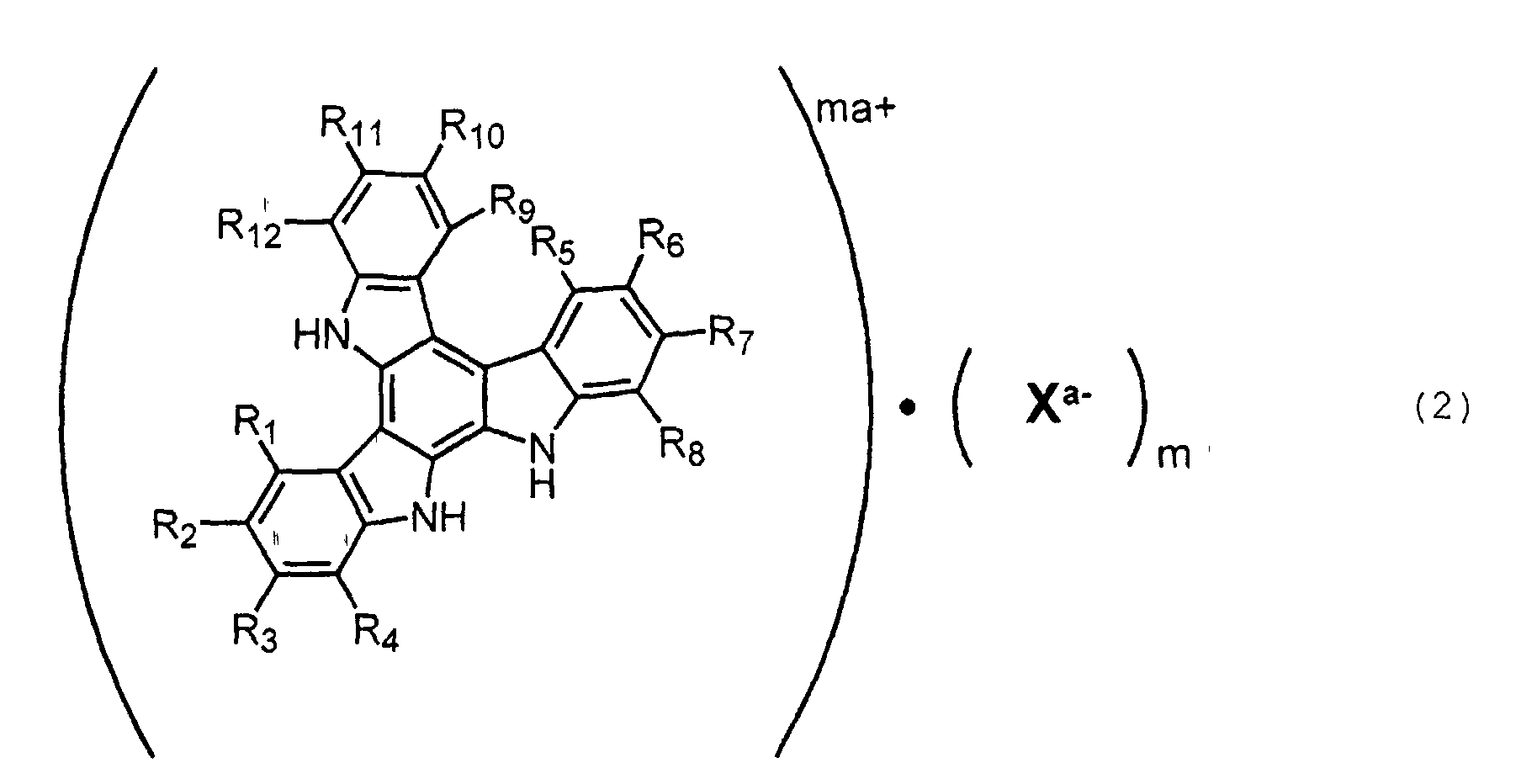
Xa- is at least one anion selected from the group of monovalent to tervalent anions consisting of chlorine ion, bromine ion, iodine ion, fluorine ion, nitrate ion, sulfate ion, hydrogen sulfate ion, phosphate ion, fluoroborate ion, perchlorate ion, thiocyanate ion, acetate ion, propionate ion, methane sulfonate ion, p-toluene sulfonate ion, trifluoroacetate ion, and trifluoeomethane sulfonate ion;
a is an integral number in the range from 1 to 3 indicating the ionic valence of the ion X; and
m is a number in the range from 0 to 0.5, comprising:reacting at least one indole derivative (A) of following formula (1):, wherein R1 to R4 are substituents each independently selected from the group of consisting of hydrogen, linear or branched alkyl group having 1 to 24 carbon atoms, linear or branched alkoxy group having 1 to 24 carbon atoms, linear or branched acyl group having 2 to 24 atoms, aldehyde group, carboxyl group, linear or branched carboxylic ester group, sulfonic group, linear or branched sulfonic ester group having 1 to 24 carbon atoms, cyano group, hydroxyl group, nitro group, amino group, amide group, and halogen group in a reaction mixture containing at least one oxidant (B) and at least one organic solvent (C).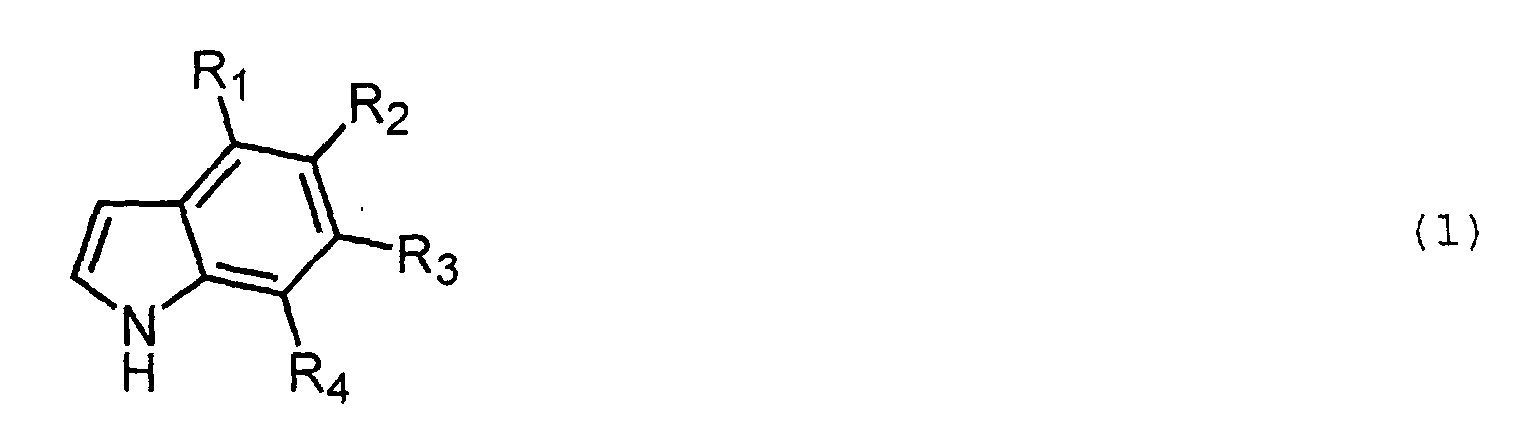
- A method of producing an indole derivative trimer of formula (2) above, comprising:carrying out a reaction by dripping a solution containing at least one oxidant (B), at least one organic solvent (C) and water into a solution containing at least one indole derivative (A) of formula (1) and at least one organic solvent (C).
- The method of producing indole derivative trimer according to claim 1 or 2; wherein the oxidant (B) is at least one member selected from the group consisting of ferric chloride anhydrate, ferric chloride hexahydrate, ferric nitrate hexahydrate, ferric sulfate n-hydrate, ferric sulfate ammonium dodecahydrate, ferric perchlorate n-hydrate, cupric chloride, cupric tetrafluoroborate, ozone, and ammonium persulfate.
- The method of producing indole derivative trimer according to any of claims 1 to 3, wherein the organic solvent (C) is acetonitrile.
- The method of producing indole derivative trimer according to any of claims 1 to 4, further comprising:performing a doping treatment with an acidic solution after the end of the reaction.
- An indole derivative trimer of following formula (3):, wherein R1 to R12 are substituents each independently selected from the group consisting of hydrogen, linear or branched alkyl group having 1 to 24 carbon atoms, linear or branched alkoxy group having 1 to 24 carbon atoms, linear or branched acyl group having 2 to 24 carbon atoms, aldehyde group, carboxyl group, linear or branched carboxylic ester group having 2 to 24 carbon atoms, sulfonic group, linear or branched sulfonic ester group having 1 to 24 carbon atoms, cyano group, hydroxyl group, nitro group, amino group, amide group, and halogen group, providing that the cases where all of R1 to R12 are hydrogen and where all of R2, R6 and R10 are substituted by the same substituent and the rest of the substituents are all hydrogen are excluded;
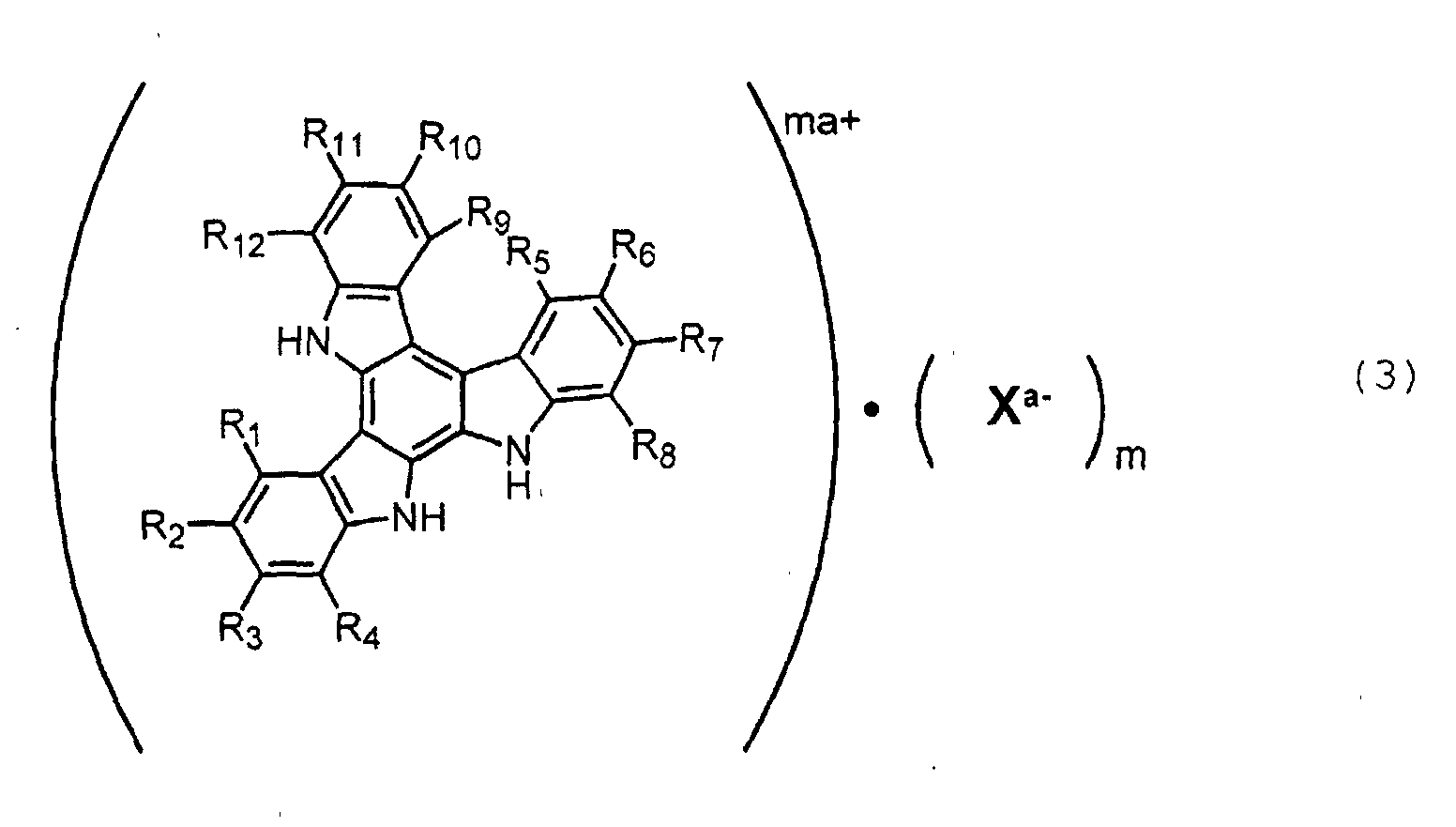
Xa- is at least one anion selected from the group of monovalent to tervalent anions consisting of chlorine ion, bromine ion, iodine ion, fluorine ion, nitrate ion, sulfate ion, hydrogen sulfate ion, phosphate ion, fluoroborate ion, perchlorate ion, thiocyanate ion, acetate ion, propionate ion, methane sulfonate ion, p-toluene sulfonate ion, trifluoroacetate ion, and trifluoeomethane sulfonate ion;
a is an integral number in the range from 1 to 3 indicating the ionic valence of the ion X; and
m is a number in the range from 0 to 0.5. - A 4-nitroindole trimer derivative of following formula (4):, wherein R2 to R4, R6 to R8, and R10 to R12 are substituents each independently selected from the group consisting of hydrogen, linear or branched alkyl group having 1 to 24 carbon atoms, linear or branched alkoxy group having 1 to 24 carbon atoms, linear or branched acyl group having 2 to 24 carbon atoms, aldehyde group, carboxyl group, linear or branched carboxylic ester group having 2 to 24 carbon atoms, sulfonic group, linear or branched sulfonic ester group having 1 to 24 carbon atoms, cyano group, hydroxyl group, nitro group, amino group, amide group, and halogen group;
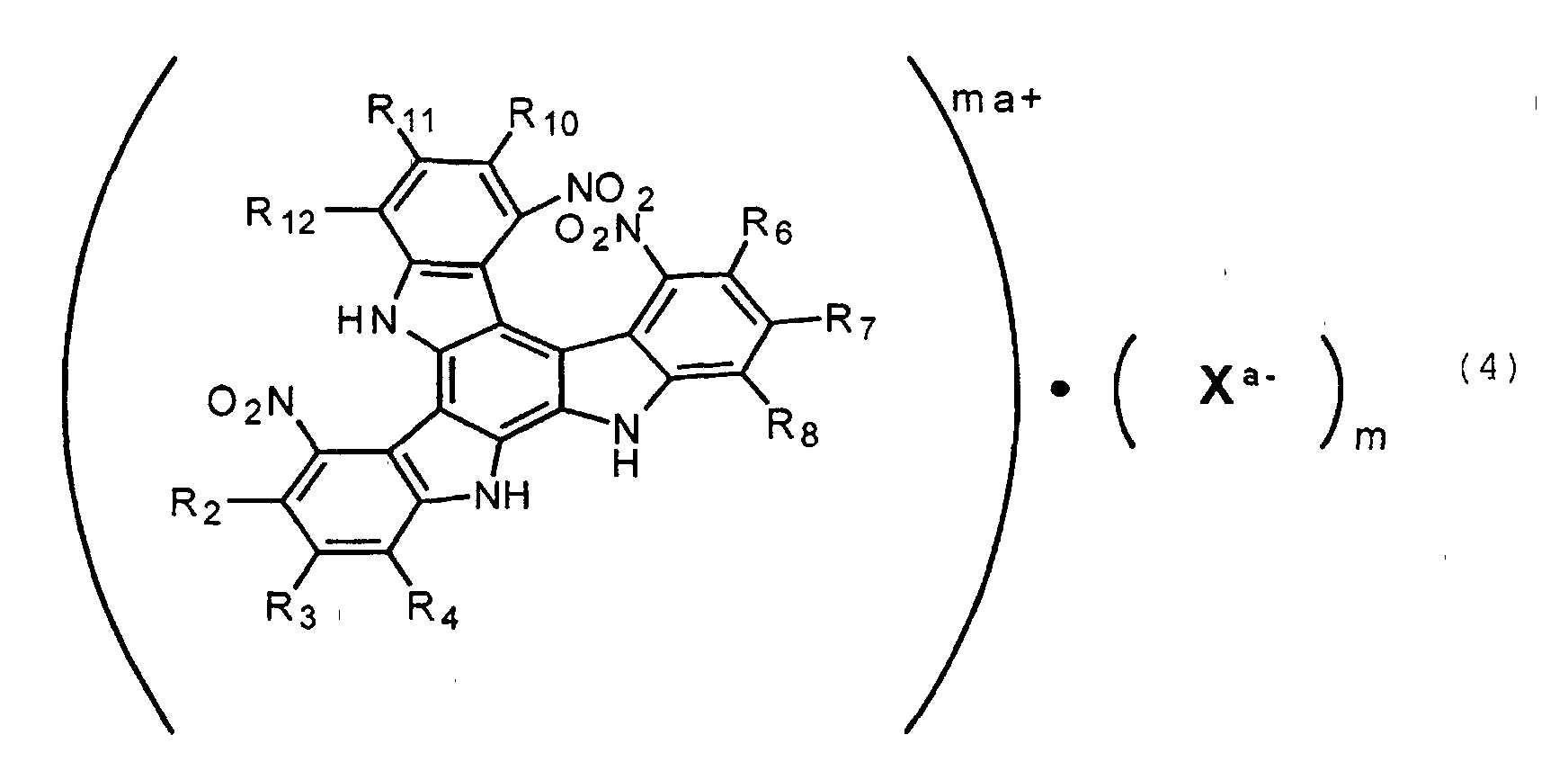
Xa- is at least one anion selected from the group of monovalent to tervalent anions consisting of chlorine ion, bromine ion, iodine ion, fluorine ion, nitrate ion, sulfate ion, hydrogen sulfate ion, phosphate ion, fluoroborate ion, perchlorate ion, thiocyanate ion, acetate ion, propionate ion, methane sulfonate ion, p-toluene sulfonate ion, trifluoroacetate ion, and trifluoromethane sulfonate ion;
a is an integral number in the range from 1 to 3 representing the ionic valence of the ion X; and
m is a number in the range from 0 to 0.5. - A 6-nitroindole trimer derivative of following formula (5):, wherein R1, R2, R4 to R6, and R9 to R10 are substituents each independently selected from the group consisting of hydrogen, linear or branched alkyl group having 1 to 24 carbon atoms, linear or branched alkoxy group having 1 to 24 carbon atoms, linear or branched acyl group having 2 to 24 carbon atoms, aldehyde group, carboxyl group, linear or branched carboxylic ester group having 2 to 24 carbon atoms, sulfonic group, linear or branched sulfonic ester group having 1 to 24 carbon atoms, cyano group, hydroxyl group, nitro group, amino group, amide group, and halogen group;

Xa- is at least one anion selected from the group of monovalent to tervalent anions consisting of chlorine ion, bromine ion, iodine ion, fluorine ion, nitrate ion, sulfate ion, hydrogen sulfate ion, phosphate ion, fluoroborate ion, perchlorate ion, thiocyanate ion, acetate ion, propionate ion, methane sulfonate ion, p-toluene sulfonate ion, trifluoroacetate ion, and trifluoeomethane sulfonate ion;
a is an integral number in the range from 1 to 3 representing the ionic valence of the ion X; and
m is a number in the range from 0 to 0.5. - A 7-nitroindole trimer derivative of following formula (6):, wherein R1 to R3, R5 to R7, and R9 to R11 are substituents each independently selected from the group consisting of hydrogen, linear or branched alkyl group having 1 to 24 carbon atoms, linear or branched alkoxy group having 1 to 24 carbon atoms, linear or branched acyl group having 2 to 24 carbon atoms, aldehyde group, carboxyl group, linear or branched carboxylic ester group having 2 to 24 carbon atoms, sulfonic group, linear or branched sulfonic ester group having 1 to 24 carbon atoms, cyano group, hydroxyl group, nitro group, amino group, amide group, and halogen group;

Xa- is at least one anion selected from the group of monovalent to tervalent anions consisting of chlorine ion, bromine ion, iodine ion, fluorine ion, nitrate ion, sulfate ion, hydrogen sulfate ion, phosphate ion, fluoroborate ion, perchlorate ion, thiocyanate ion, acetate ion, propionate ion, methane sulfonate ion, p-toluene sulfonate ion, trifluoroacetate ion, and trifluoeomethane sulfonate ion;
a is an integral number in the range from 1 to 3 representing the ionic valence of the ion X; and
m is a number in the range from 0 to 0.5. - An indole-4-carbonitrile trimer derivative of following formula (7):, wherein R2 to R4, R6 to R8, and R10 to R12 are substituents each independently selected from the group consisting of hydrogen, linear or branched alkyl group having 1 to 24 carbon atoms, linear or branched alkoxy group having 1 to 24 carbon atoms, linear or branched acyl group having 2 to 24 carbon atoms, aldehyde group, carboxyl group, linear or branched carboxylic ester group having 2 to 24 carbon atoms, sulfonic group, linear or branched sulfonic ester group having 1 to 24 carbon atoms, cyano group, hydroxyl group, nitro group, amino group, amide group, and halogen group;
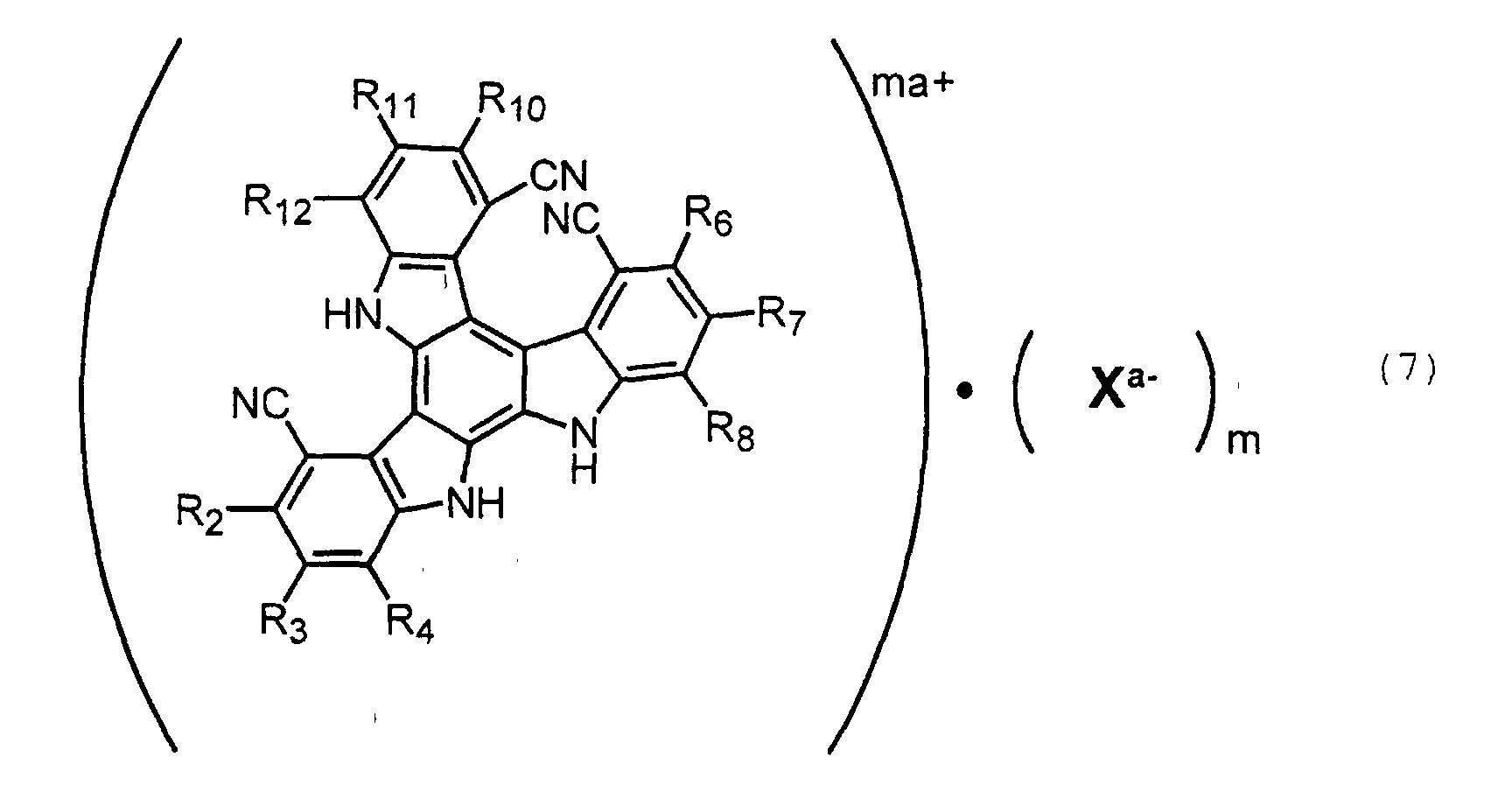
Xa- is at least one anion selected from the group of monovalent to tervalent anions consisting of chlorine ion, bromine ion, iodine ion, fluorine ion, nitrate ion, sulfate ion, hydrogen sulfate ion, phosphate ion, fluoroborate ion, perchlorate ion, thiocyanate ion, acetate ion, propionate ion, methane sulfonate ion, p-toluene sulfonate ion, trifluoroacetate ion, and trifluoeomethane sulfonate ion;
a is an integral number in the range from 1 to 3 representing the ionic valence of the ion X; and
m is a number in the range from 0 to 0.5. - An indole-6-carbonitrile trimer derivative of following formula (8):, wherein R1, R2, R4 to R6, R8 to R10, and R12 are substituents each independently selected from the group consisting of hydrogen, linear or branched alkyl group having 1 to 24 carbon atoms, linear or branched alkoxy group having 1 to 24 carbon atoms, linear or branched acyl group having 2 to 24 carbon atoms, aldehyde group, carboxyl group, linear or branched carboxylic ester group having 2 to 24 carbon atoms, sulfonic group, linear or branched sulfonic ester group having 1 to 24 carbon atoms, cyano group, hydroxyl group, nitro group, amino group, amide group, and halogen group;

Xa- is at least one anion selected from the group of monovalent to tervalent anions consisting of chlorine ion, bromine ion, iodine ion, fluorine ion, nitrate ion, sulfate ion, hydrogen sulfate ion, phosphate ion, fluoroborate ion, perchlorate ion, thiocyanate ion, acetate ion, propionate ion, methane sulfonate ion, p-toluene sulfonate ion, trifluoroacetate ion, and trifluoeomethane sulfonate ion;
a is an integral number in the range from 1 to 3 representing the ionic valence of the ion X; and
m is a number in the range from 0 to 0.5. - An indole-7-carbonitrile trimer derivative of following formula (9):, wherein R1 to R3, R5 to R7, and R9 to R11, are substituents each independently selected from the group consisting of hydrogen, linear or branched alkyl group having 1 to 24 carbon atoms, linear or branched alkoxy group having 1 to 24 carbon atoms, linear or branched acyl group having 2 to 24 carbon atoms, aldehyde group, carboxyl group, linear or branched carboxylic ester group having 2 to 24 carbon atoms, sulfonic group, linear or branched sulfonic ester group having 1 to 24 carbon atoms, cyano group, hydroxyl group, nitro group, amino group, amide group, and halogen group;
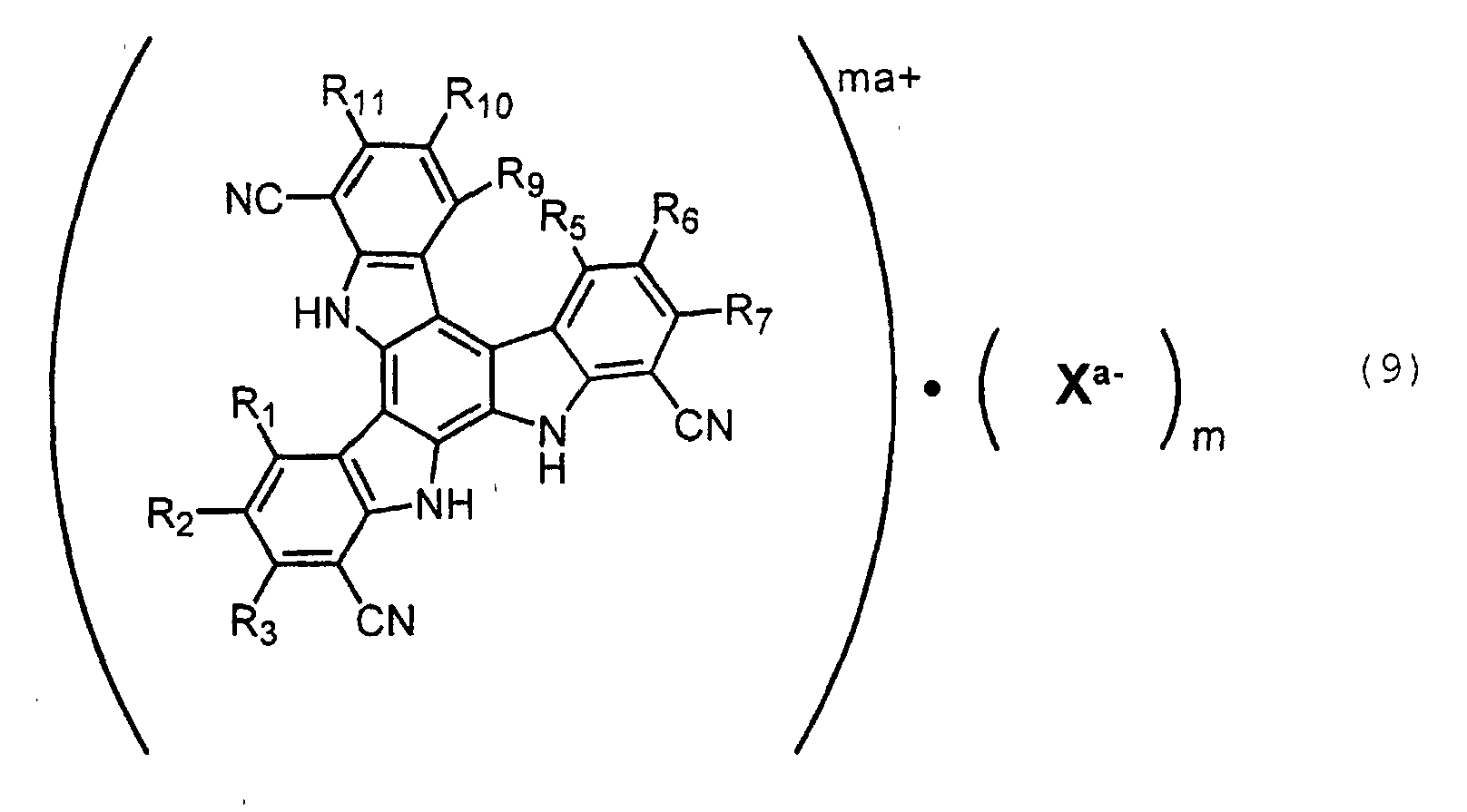
Xa- is at least one anion selected from the group of monovalent to tervalent anions consisting of chlorine ion, bromine ion, iodine ion, fluorine ion, nitrate ion, sulfate ion, hydrogen sulfate ion, phosphate ion, fluoroborate ion, perchlorate ion, thiocyanate ion, acetate ion, propionate ion, methane sulfonate ion, p-toluene sulfonate ion, trifluoroacetate ion, and trifluoeomethane sulfonate ion;
a is an integral number in the range from 1 to 3 representing the ionic valence of the ion X; and
m is a number in the range from 0 to 0.5. - An indole-4-carboxylic acid trimer derivate of formula (10),, wherein R2 to R4, R6 to R8, and R10 to R12 are substituents each independently selected from the group consisting of hydrogen, linear or branched alkyl group having 1 to 24 carbon atoms, linear or branched alkoxy group having 1 to 24 carbon atoms, linear or branched acyl group having 2 to 24 carbon atoms, aldehyde group, carboxyl group, linear or branched carboxylic ester group having 2 to 24 carbon atoms, sulfonic group, linear or branched sulfonic ester group having 1 to 24 carbon atoms, cyano group, hydroxyl group, nitro group, amino group, amide group, and halogen group;

Xa- is at least one anion selected from the group of monovalent to tervalent anions consisting of chlorine ion, bromine ion, iodine ion, fluorine ion, nitrate ion, sulfate ion, hydrogen sulfate ion, phosphate ion, fluoroborate ion, perchlorate ion, thiocyanate ion, acetate ion, propionate ion, methane sulfonate ion, p-toluene sulfonate ion, trifluoroacetate ion, and trifluoeomethane sulfonate ion;
a is an integral number in the range from 1 to 3 representing the ionic valence of the ion X; and
m is a number in the range from 0 to 0.5. - An indole-6-carboxylic acid trimer derivative expressed by the following formula (11):, wherein R1, R2, R4 to R6, R8 to R10, and R12 are substituents each independently selected from the group consisting of hydrogen, linear or branched alkyl group having 1 to 24 carbon atoms, linear or branched alkoxy group having 1 to 24 carbon atoms, linear or branched acyl group having 2 to 24 carbon atoms, aldehyde group, carboxyl group, linear or branched carboxylic ester group having 2 to 24 carbon atoms, sulfonic group, linear or branched sulfonic ester group having 1 to 24 carbon atoms, cyano group, hydroxyl group, nitro group, amino group, amide group, and halogen group;

Xa- is at least one anion selected from the group of monovalent to tervalent anions consisting of chlorine ion, bromine ion, iodine ion, fluorine ion, nitrate ion, sulfate ion, hydrogen sulfate ion, phosphate ion, fluoroborate ion, perchlorate ion, thiocyanate ion, acetate ion, propionate ion, methane sulfonate ion, p-toluene sulfonate ion, trifluoroacetate ion, and trifluoeomethane sulfonate ion;
a is an integral number in the range from 1 to 3 representing the ionic valence of the ion X; and
m is a number in the range from 0 to 0.5. - An indole-7-carboxylic acid trimer derivative of formula (12):, wherein R1 to R3, R5 to R7, and R9 to R11 are substituents each independently selected from the group consisting of hydrogen, linear or branched alkyl group having 1 to 24 carbon atoms, linear or branched alkoxy group having 1 to 24 carbon atoms, linear or branched acyl group having 2 to 24 carbon atoms, aldehyde group, carboxyl group, linear or branched carboxylic ester group having 2 to 24 carbon atoms, sulfonic group, linear or branched sulfonic ester group having 1 to 24 carbon atoms, cyano group, hydroxyl group, nitro group, amino group, amide group, and halogen group;

Xa- is at least one anion selected from the group of monovalent to tervalent anions consisting of chlorine ion, bromine ion, iodine ion, fluorine ion, nitrate ion, sulfate ion, hydrogen sulfate ion, phosphate ion, fluoroborate ion, perchlorate ion, thiocyanate ion, acetate ion, propionate ion, methane sulfonate ion, p-toluene sulfonate ion, trifluoroacetate ion, and trifluoeomethane sulfonate ion;
a is an integral number in the range from 1 to 3 representing the ionic valence of the ion X; and
m is a number in the range from 0 to 0.5. - An indole-4-carbaldehyde trimer derivate of following formula (13):, wherein R2 to R4, R6 to R8, and R10 to R12 are substituents each independently selected from the group consisting of hydrogen, linear or branched alkyl group having 1 to 24 carbon atoms, linear or branched alkoxy group having 1 to 24 carbon atoms, linear or branched acyl group having 2 to 24 carbon atoms, aldehyde group, carboxyl group, linear or branched carboxylic ester group having 2 to 24 carbon atoms, sulfonic group, linear or branched sulfonic ester group having 1 to 24 carbon atoms, cyano group, hydroxyl group, nitro group, amino group, amide group, and halogen group;
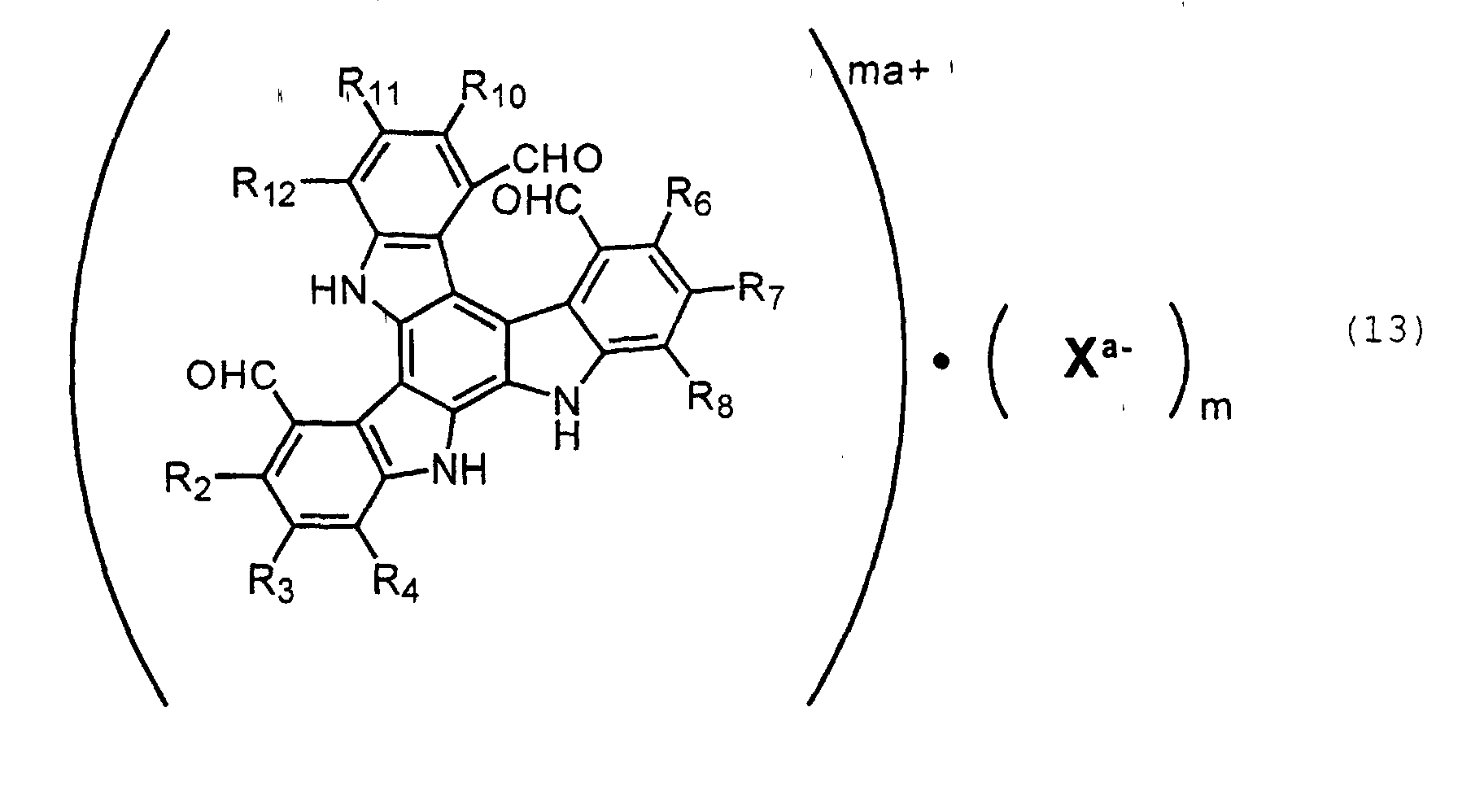
Xa- is at least one anion selected from the group of monovalent to tervalent anions consisting of chlorine ion, bromine ion, iodine ion, fluorine ion, nitrate ion, sulfate ion, hydrogen sulfate ion, phosphate ion, fluoroborate ion, perchlorate ion, thiocyanate ion, acetate ion, propionate ion, methane sulfonate ion, p-toluene sulfonate ion, trifluoroacetate ion, and trifluoeomethane sulfonate ion;
a is an integral number in the range from 1 to 3 representing the ionic valence of the ion X; and
m is a number in the range from 0 to 0.5. - An indole-5-carbaldehyde trimer derivative of following formula (14):, wherein R1, R3 to R5, R7 to R9, R11, and R12 are substituents each independently selected from the group consisting of hydrogen, linear or branched alkyl group having 1 to 24 carbon atoms, 'linear or branched alkoxy group having 1 to 24 carbon atoms, linear or branched acyl group having 2 to 24 carbon atoms, aldehyde group, carboxyl group, linear or branched carboxylic ester group having 2 to 24 carbon atoms, sulfonic group, linear or branched sulfonic ester group having 1 to 24 carbon atoms, cyano group, hydroxyl group, nitro group, amino group, amide group, and halogen group;

Xa- is at least one anion selected from the group of monovalent to tervalent anions consisting of chlorine ion, bromine ion, iodine ion, fluorine ion, nitrate ion, sulfate ion, hydrogen sulfate ion, phosphate ion, fluoroborate ion, perchlorate ion, thiocyanate ion, acetate ion, propionate ion, methane sulfonate ion, p-toluene sulfonate ion, trifluoroacetate ion, and trifluoeomethane sulfonate ion;
a is an integral number in the range from 1 to 3 representing the ionic valence of the ion X; and
m is a number in the range from 0 to 0.5. - An indole-6-carbaldehyde trimer derivative of formula (15):, wherein R1, R2, R4 to R6, R8 to R10, and R12 are substituents each independently selected from the group consisting of hydrogen, linear or branched alkyl group having 1 to 24 carbon atoms, linear or branched alkoxy group having 1 to 24 carbon atoms, linear or branched acyl group having 2 to 24 carbon atoms, aldehyde group, carboxyl group, linear or branched carboxylic ester group having 2 to 24 carbon atoms, sulfonic group, linear or branched sulfonic ester group having 1 to 24 carbon atoms, cyano group, hydroxyl group, nitro group, amino group, amide group, and halogen group;

Xa- is at least one anion selected from the group of monovalent to tervalent anions consisting of chlorine ion, bromine ion, iodine ion, fluorine ion, nitrate ion, sulfate ion, hydrogen sulfate ion, phosphate ion, fluoroborate ion, perchlorate ion, thiocyanate ion, acetate ion, propionate ion, methane sulfonate ion, p-toluene sulfonate ion, trifluoroacetate ion, and trifluoeomethane sulfonate ion;
a is an integral number in the range from 1 to 3 representing the ionic valence of the ion X; and
m is a number in the range from 0 to 0.5. - An indole-7-carbaldehyde trimer derivative of following formula (16):, wherein R1 to R3, R5 to R7, and R9 to R11 are substituents each independently selected from the group consisting of hydrogen, linear or branched alkyl group having 1 to 24 carbon atoms, linear or branched alkoxy group having 1 to 24 carbon atoms, linear or branched acyl group having 2 to 24 carbon atoms, aldehyde group, carboxyl group, linear or branched carboxylic ester group having 2 to 24 carbon atoms, sulfonic group, linear or branched sulfonic ester group having 1 to 24 carbon atoms, cyano group, hydroxyl group, nitro group, amino group, amide group, and halogen group;

Xa- is at least one anion selected from the group of monovalent to tervalent anions consisting of chlorine ion, bromine ion, iodine ion, fluorine ion, nitrate ion, sulfate ion, hydrogen sulfate ion, phosphate ion, fluoroborate ion, perchlorate ion, thiocyanate ion, acetate ion, propionate ion, methane sulfonate ion, p-toluene sulfonate ion, trifluoroacetate ion, and trifluoeomethane sulfonate ion;
a is an integral number in the range from 1 to 3 representing the ionic valence of the ion X; and
m is a number in the range from 0 to 0.5. - A 4-bromoindole trimer derivative of formula (17):, wherein R2 to R4, R6 to R8, and R10 to R12 are substituents each independently selected from the group consisting of hydrogen, linear or branched alkyl group having 1 to 24 carbon atoms, linear or branched alkoxy group having 1 to 24 carbon atoms, linear or branched acyl group having 2 to 24 carbon atoms, aldehyde group, carboxyl group, linear or branched carboxylic ester group having 2 to 24 carbon atoms, sulfonic group, linear or branched sulfonic ester group having 1 to 24 carbon atoms, cyano group, hydroxyl group, nitro group, amino group, amide group, and halogen group;

Xa- is at least one anion selected from the group of monovalent to tervalent anions consisting of chlorine ion, bromine ion, iodine ion, fluorine ion, nitrate ion, sulfate ion, hydrogen sulfate ion, phosphate ion, fluoroborate ion, perchlorate ion, thiocyanate ion, acetate ion, propionate ion, methane sulfonate ion, p-toluene sulfonate ion, trifluoroacetate ion, and trifluoeomethane sulfonate ion;
a is an integral number in the range from 1 to 3 representing the ionic valence of the ion X; and
m is a number in the range from 0 to 0.5. - A 6-bromoindole trimer derivative of following formula (18):, wherein R1, R2, R4 to R6, R8 to R10, and R12 are substituents each independently selected from the group consisting of hydrogen, linear or branched alkyl group having 1 to 24 carbon atoms, linear or branched alkoxy group having 1 to 24 carbon atoms, linear or branched acyl group having 2 to 24 carbon atoms, aldehyde group, carboxyl group, linear or branched carboxylic ester group having 2 to 24 carbon atoms, sulfonic group, linear or branched sulfonic ester group having 1 to 24 carbon atoms, cyano group, hydroxyl group, nitro group, amino group, amide group, and halogen group;

Xa- is at least one anion selected from the group of monovalent to tervalent anions consisting of chlorine ion, bromine ion, iodine ion, fluorine ion, nitrate ion, sulfate ion, hydrogen sulfate ion, phosphate ion, fluoroborate ion, perchlorate ion, thiocyanate ion, acetate ion, propionate ion, methane sulfonate ion, p-toluene sulfonate ion, trifluoroacetate ion, and trifluoeomethane sulfonate ion;
a is an integral number in the range from 1 to 3 representing the ionic valence of the ion X; and
m is a number in the range from 0 to 0.5. - A 7-bromoindole trimer derivative of following formula (19):, wherein R1 to R3, R5 to R7, and R9 to R11 are substituents each independently selected from the group consisting of hydrogen, linear or branched alkyl group having 1 to 24 carbon atoms, linear or branched alkoxy group having 1 to 24 carbon atoms, linear or branched acyl group having 2 to 24 carbon atoms, aldehyde group, carboxyl group, linear or branched carboxylic ester group having 2 to 24 carbon atoms, sulfonic group, linear or branched sulfonic ester group having 1 to 24 carbon atoms, cyano group, hydroxyl group, nitro group, amino group, amide group, and halogen group;
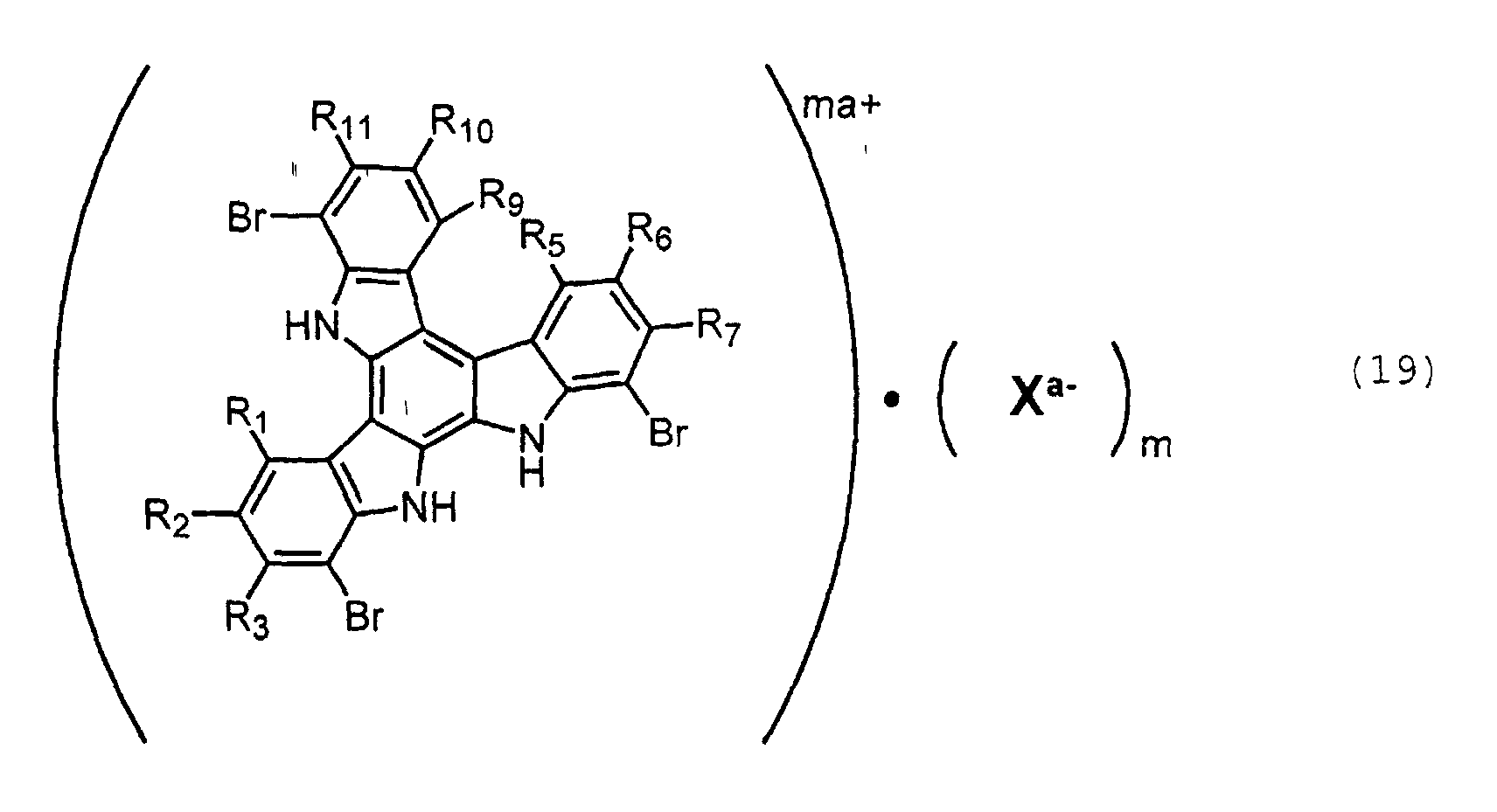
Xa- is at least one anion selected from the group of monovalent to tervalent anions consisting of chlorine ion, bromine ion, iodine ion, fluorine ion, nitrate ion, sulfate ion, hydrogen sulfate ion, phosphate ion, fluoroborate ion, perchlorate ion, thiocyanate ion, acetate ion, propionate ion, methane sulfonate ion, p-toluene sulfonate ion, trifluoroacetate ion, and trifluoeomethane sulfonate ion;
a is an integral number in the range from 1 to 3 representing the ionic valence of the ion X; and
m is a number in the range from 0 to 0.5. - A 4-fluoroindole trimer derivative of following formula (20):, wherein R2 to R4, R6 to R8, and R10 to R12 are substituents each independently selected from the group consisting of hydrogen, linear or branched alkyl group having 1 to 24 carbon atoms, linear or branched alkoxy group having 1 to 24 carbon atoms, linear or branched acyl group having 2 to 24 carbon atoms, aldehyde group, carboxyl group, linear or branched carboxylic ester group having 2 to 24 carbon atoms, sulfonic group, linear or branched sulfonic ester group having 1 to 24 carbon atoms, cyano group, hydroxyl group, nitro group, amino group, amide group, and halogen group;

Xa- is at least one anion selected from the group of monovalent to tervalent anions consisting of chlorine ion, bromine ion, iodine ion, fluorine ion, nitrate ion, sulfate ion, hydrogen sulfate ion, phosphate ion, fluoroborate ion, perchlorate ion, thiocyanate ion, acetate ion, propionate ion, methane sulfonate ion, p-toluene sulfonate ion, trifluoroacetate ion, and trifluoeomethane sulfonate ion; a is an integral number in the range from 1 to 3 representing the ionic valence of the ion X; and
m is number in the range from 0 to 0.5. - A 5-fluoroindole trimer derivative of formula (21):, wherein R1, R3 to R5, R7 to R9, R11 and R12 are substituents each independently selected from the group consisting of hydrogen, linear or branched alkyl group having 1 to 24 carbon atoms, linear or branched alkoxy group having 1 to 24 carbon atoms, linear or branched acyl group having 2 to 24 carbon atoms, aldehyde group, carboxyl group, linear or branched carboxylic ester group having 2 to 24 carbon atoms, sulfonic group, linear or branched sulfonic ester group having 1 to 24 carbon atoms, cyano group, hydroxyl group, nitro group, amino group, amide group, and halogen group;
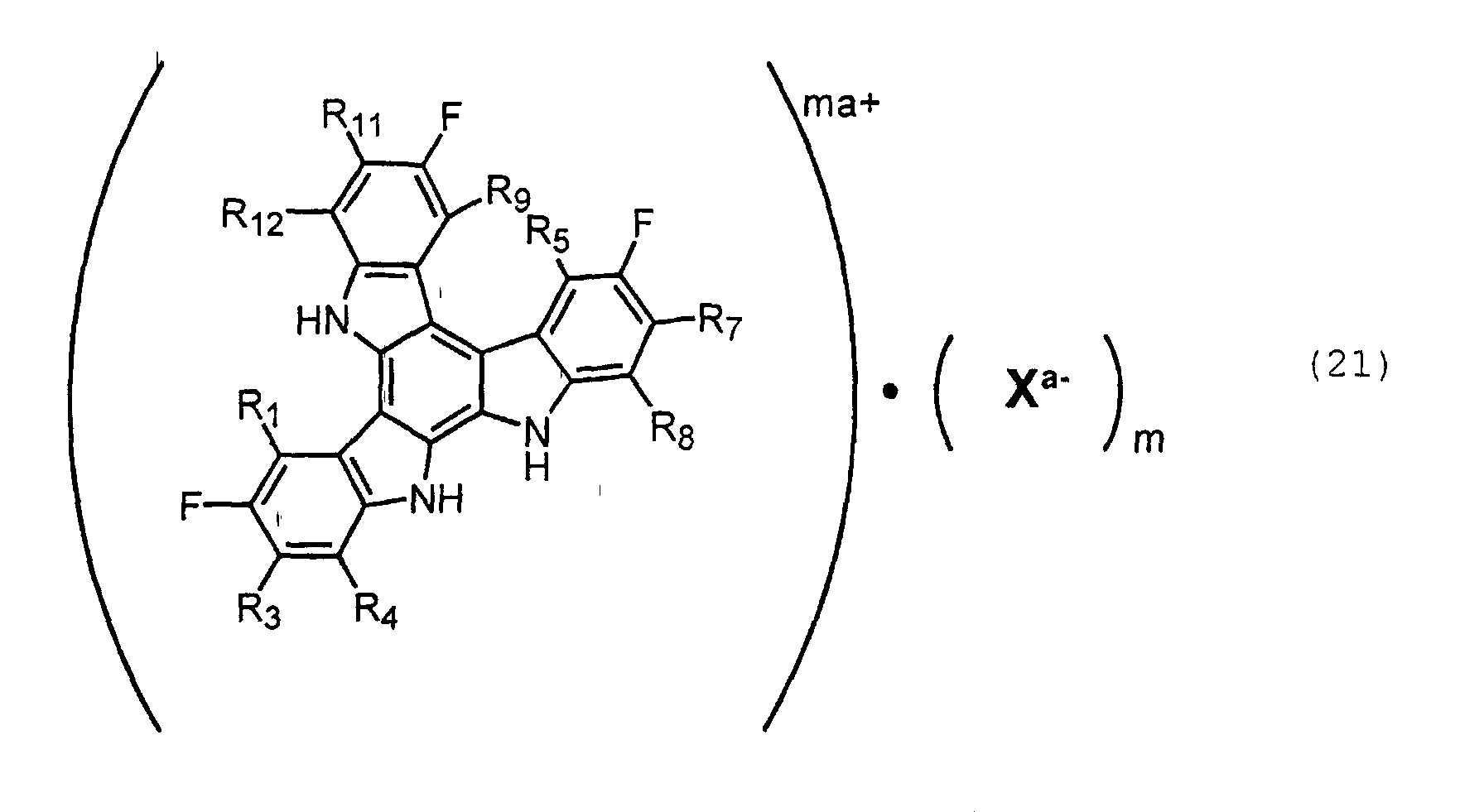
Xa- is at least one anion selected from the group of monovalent to tervalent anions consisting of chlorine ion, bromine ion, iodine ion, fluorine ion, nitrate ion, sulfate ion, hydrogen sulfate ion, phosphate ion, fluoroborate ion, perchlorate ion, thiocyanate ion, acetate ion, propionate ion, methane sulfonate ion, p-toluene sulfonate ion, trifluoroacetate ion, and trifluoeomethane sulfonate ion;
a is an integral number in the range from 1 to 3 representing the ionic valence of the ion X; and
m is a number in the range from 0 to 0.5. - A 6-fluoroindole trimer derivative of formula (22):, wherein R1, R2, R4 to R6, R8 to R10 and R12 are substituents each independently selected from the group consisting of hydrogen, linear or branched alkyl group having 1 to 24 carbon atoms, linear or branched alkoxy group having 1 to 24 carbon atoms, linear or branched acyl group having 2 to 24 carbon atoms, aldehyde group, carboxyl group, linear or branched carboxylic ester group having 2 to 24 carbon atoms, sulfonic group, linear or branched sulfonic ester group having 1 to 24 carbon atoms, cyano group, hydroxyl group, nitro group, amino group, amide group, and halogen group;

Xa- is at least one anion selected from the group of monovalent to tervalent anions consisting of chlorine ion, bromine ion, iodine ion, fluorine ion, nitrate ion, sulfate ion, hydrogen sulfate ion, phosphate ion, fluoroborate ion, perchlorate ion, thiocyanate ion, acetate ion, propionate ion, methane sulfonate ion, p-toluene sulfonate ion, trifluoroacetate ion, and trifluoeomethane sulfonate ion;
a is an integral number in the range from 1 to 3 representing the ionic valence of the ion X; and
m is a number in the range from 0 to 0.5. - A 7-fluoroindole trimer derivative of formula (23):, wherein R1 to R3, R5 to R7, and R9 to R11 are substituents each independently selected from the group consisting of hydrogen, linear or branched alkyl group having 1 to 24 carbon atoms, linear or branched alkoxy group having 1 to 24 carbon atoms, linear or branched acyl group having 2 to 24 carbon atoms, aldehyde group, carboxyl group, linear or branched carboxylic ester group having 2 to 24 carbon atoms, sulfonic group, linear or branched sulfonic ester group having 1 to 24 carbon atoms, cyano group, hydroxyl group, nitro group, amino group, amide group, and halogen group;

Xa- is at least one anion selected from the group of monovalent to tervalent anions consisting of chlorine ion, bromine ion, iodine ion, fluorine ion, nitrate ion, sulfate ion, hydrogen sulfate ion, phosphate ion, fluoroborate ion, perchlorate ion, thiocyanate ion, acetate ion, propionate ion, methane sulfonate ion, p-toluene sulfonate ion, trifluoroacetate ion, and trifluoeomethane sulfonate ion;
a is an integral number in the range from 1 to 3 representing the ionic valence of the ion X; and
m is a number in the range from 0 to 0.5. - A 4-acetylindole trimer derivative of following formula (24):, wherein R2 to R4, R6 to R8, and R10 to R12 are substituents each independently selected from the group consisting of hydrogen, linear or branched alkyl group having 1 to 24 carbon atoms, linear or branched alkoxy group having 1 to 24 carbon atoms, linear or branched acyl group having 2 to 24 carbon atoms, aldehyde group, carboxyl group, linear or branched carboxylic ester group having 2 to 24 carbon atoms, sulfonic group, linear or branched sulfonic ester group having 1 to 24 carbon atoms, cyano group, hydroxyl group, nitro group, amino group, amide group, and halogen group;

Xa- is at least one anion selected from the group of monovalent to tervalent anions consisting of chlorine ion, bromine ion, iodine ion, fluorine ion, nitrate ion, sulfate ion, hydrogen sulfate ion, phosphate ion, fluoroborate ion, perchlorate ion, thiocyanate ion, acetate ion, propionate ion, methane sulfonate ion, p-toluene sulfonate ion, trifluoroacetate ion, and trifluoeomethane sulfonate ion;
a is an integral number in the range from 1 to 3 representing the ionic valence of the ion X; and
m is a number in the range from 0 to 0.5. - A 5-acetylindole trimer derivative of following formula (25):, wherein R1, R3 to R5, R7 to R9, R11 and R12 are substituents each independently selected from the group consisting of hydrogen, linear or branched alkyl group having 1 to 24 carbon atoms, linear or branched alkoxy group having 1 to 24 carbon atoms, linear or branched acyl group having 2 to 24 carbon atoms, aldehyde group, carboxyl group, linear or branched carboxylic ester group having 2 to 24 carbon atoms, sulfonic group, linear or branched sulfonic ester group having 1 to 24 carbon atoms, cyano group, hydroxyl group, nitro group, amino group, amide group, and halogen group;

Xa- is at least one anion selected from the group of monovalent to tervalent anions consisting of chlorine ion, bromine ion, iodine ion, fluorine ion, nitrate ion, sulfate ion, hydrogen sulfate ion, phosphate ion, fluoroborate ion, perchlorate ion, thiocyanate ion, acetate ion, propionate ion, methane sulfonate ion, p-toluene sulfonate ion, trifluoroacetate ion, and trifluoeomethane sulfonate ion;
a is an integral number in the range from 1 to 3 representing the ionic valence of the ion X; and
m is a number in the range from 0 to 0.5. - A 6-acetylindole trimer derivative of following formula (26):, wherein R1, R2, R4 to R6, R8 to R10, and R12 are substituents each independently selected from the group consisting of hydrogen, linear or branched alkyl group having 1 to 24 carbon atoms, linear or branched alkoxy group having 1 to 24 carbon atoms, linear or branched acyl group having 2 to 24 carbon atoms, aldehyde group, carboxyl group, linear or branched carboxylic ester group having 2 to 24 carbon atoms, sulfonic group, linear or branched sulfonic ester group having 1 to 24 carbon atoms, cyano group, hydroxyl group, nitro group, amino group, amide group, and halogen group;

Xa- is at least one anion selected from the group of monovalent to tervalent anions consisting of chlorine ion, bromine ion, iodine ion, fluorine ion, nitrate ion, sulfate ion, hydrogen sulfate ion, phosphate ion, fluoroborate ion, perchlorate ion, thiocyanate ion, acetate ion, propionate ion, methane sulfonate ion, p-toluene sulfonate ion, trifluoroacetate ion, and trifluoeomethane sulfonate ion;
a is an integral number in the range from 1 to 3 representing the ionic valence of the ion X; and
m is a number in the range from 0 to 0.5. - A 7-acetylindole trimer derivative of following formula (27):, wherein R1 to R3, R5 to R7, and R9 to R11 are substituents each independently selected from the group consisting of hydrogen, linear or branched alkyl group having 1 to 24 carbon atoms, linear or branched alkoxy group having 1 to 24 carbon atoms, linear or branched acyl group having 2 to 24 carbon atoms, aldehyde group, carboxyl group, linear or branched carboxylic ester group having 2 to 24 carbon atoms, sulfonic group, linear or branched sulfonic ester group having 1 to 24 carbon atoms, cyano group, hydroxyl group, nitro group, amino group, amide group, and halogen group;

Xa- is at least one anion selected from the group of monovalent to tervalent anions consisting of chlorine ion, bromine ion, iodine ion, fluorine ion, nitrate ion, sulfate ion, hydrogen sulfate ion, phosphate ion, fluoroborate ion, perchlorate ion, thiocyanate ion, acetate ion, propionate ion, methane sulfonate ion, p-toluene sulfonate ion, trifluoroacetate ion, and trifluoeomethane sulfonate ion;
a is an integral number in the range from 1 to 3 representing the ionic valence of the ion X; and
m is a number in the range from 0 to 0.5. - A 4-carbamoylindole trimer derivative of following formula (28):, wherein R2 to R4, R6 to R8, and R10 to R12 are substituents each independently selected from the group consisting of hydrogen, linear or branched alkyl group having 1 to 24 carbon atoms, linear or branched alkoxy group having 1 to 24 carbon atoms, linear or branched acyl group having 2 to 24 carbon atoms, aldehyde group, carboxyl group, linear or branched carboxylic ester group having 2 to 24 carbon atoms, sulfonic group, linear or branched sulfonic ester group having 1 to 24 carbon atoms, cyano group, hydroxyl group, nitro group, amino group, amide group, and halogen group;

Xa- is at least one anion selected from the group of monovalent to tervalent anions consisting of chlorine ion, bromine ion, iodine ion, fluorine ion, nitrate ion, sulfate ion, hydrogen sulfate ion, phosphate ion, fluoroborate ion, perchlorate ion, thiocyanate ion, acetate ion, propionate ion, methane sulfonate ion, p-toluene sulfonate ion, trifluoroacetate ion, and trifluoeomethane sulfonate ion;
a is an integral number in the range from 1 to 3 representing the ionic valence of the ion X; and
m is a number in the range from 0 to 0.5. - A 5-carbamoylindole trimer derivative of following formula (29):, wherein R1, R3 to R5, R7 to R9, R11, and R12 are substituents each independently selected from the group consisting of hydrogen, linear or branched alkyl group having 1 to 24 carbon atoms, linear or branched alkoxy group having 1 to 24 carbon atoms, linear or branched acyl group having 2 to 24 carbon atoms, aldehyde group, carboxyl group, linear or branched carboxylic ester group having 2 to 24 carbon atoms, sulfonic group, linear or branched sulfonic ester group having 1 to 24 carbon atoms, cyano group, hydroxyl group, nitro group, amino group, amide group, and halogen group;
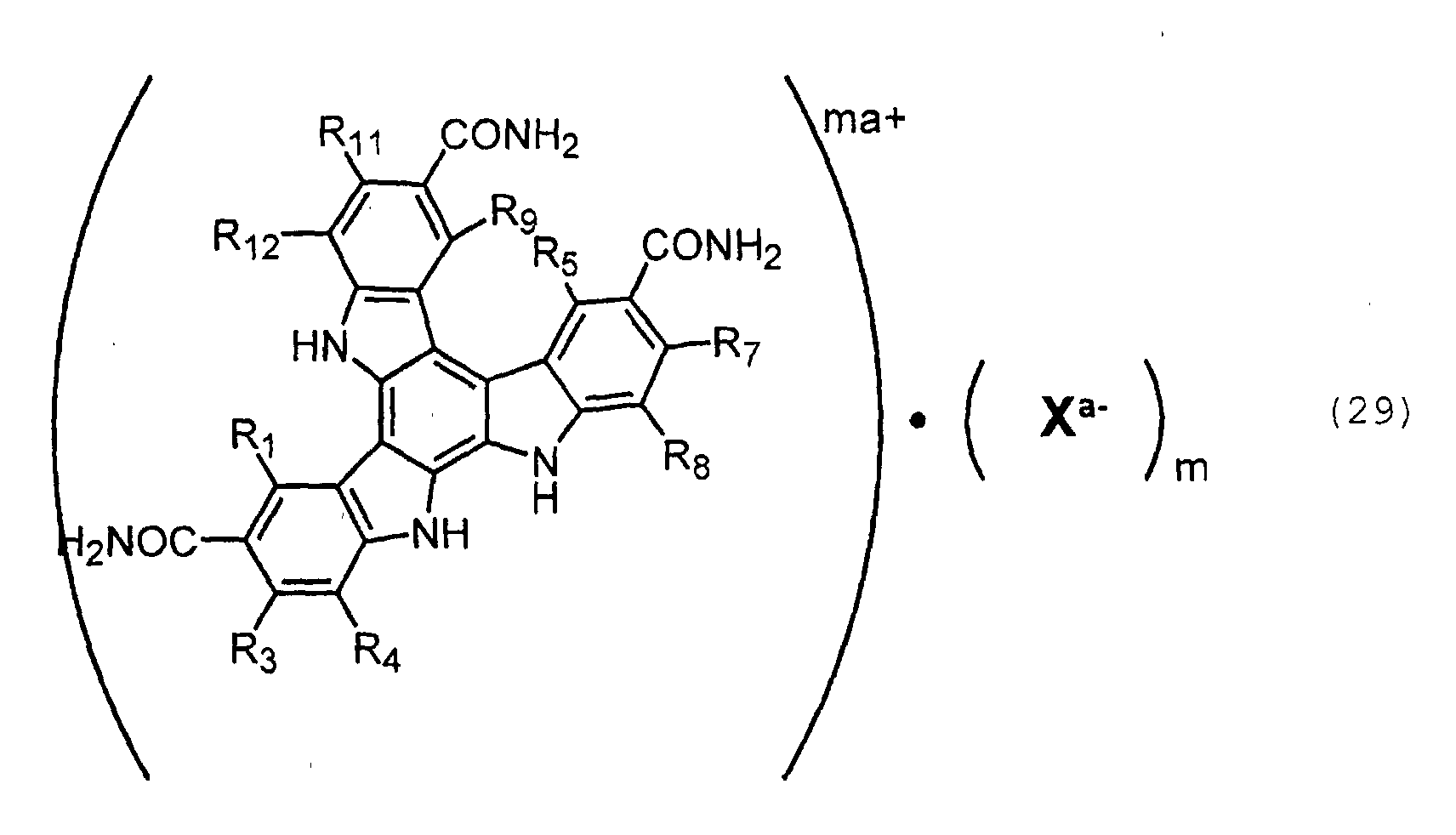
Xa- is at least one anion selected from the group of monovalent to tervalent anions consisting of chlorine ion, bromine ion, iodine ion, fluorine ion, nitrate ion, sulfate ion, hydrogen sulfate ion, phosphate ion, fluoroborate ion, perchlorate ion, thiocyanate ion, acetate ion, propionate ion, methane sulfonate ion, p-toluene sulfonate ion, trifluoroacetate ion, and trifluoeomethane sulfonate ion;
a is an integral number in the range from 1 to 3 representing the ionic valence of the ion X; and
m is a number in the range from 0 to 0.5. - A 6-carbamoylindole trimer derivative of following formula (30):, wherein R1, R2, R4 to R6 R8 to R10, and R12 are substituents each independently selected from the group consisting of hydrogen, linear or branched alkyl group having 1 to 24 carbon atoms, linear or branched alkoxy group having 1 to 24 carbon atoms, linear or branched acyl group having 2 to 24 carbon atoms, aldehyde group, carboxyl group, linear or branched carboxylic ester group having 2 to 24 carbon atoms, sulfonic group, linear or branched sulfonic ester group having 1 to 24 carbon atoms, cyano group, hydroxyl group, nitro group, amino group, amide group, and halogen group;
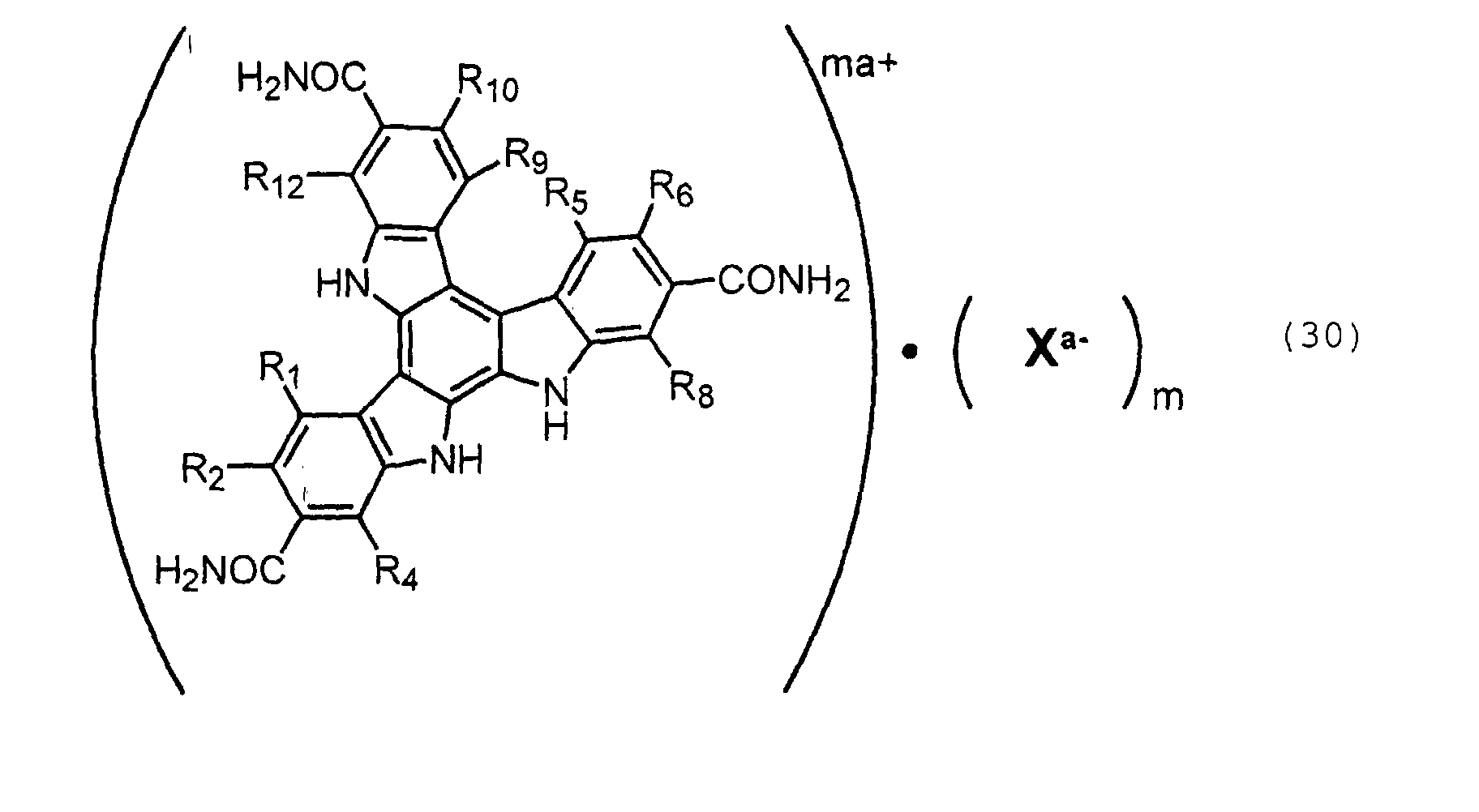
Xa- is at least one anion selected from the group of monovalent to tervalent anions consisting of chlorine ion, bromine ion, iodine ion, fluorine ion, nitrate ion, sulfate ion, hydrogen sulfate ion, phosphate ion, fluoroborate ion, perchlorate ion, thiocyanate ion, acetate ion, propionate ion, methane sulfonate ion, p-toluene sulfonate ion, trifluoroacetate ion, and trifluoeomethane sulfonate ion;
a is an integral number in the range from 1 to 3 representing the ionic valence of the ion X; and
m is a number in the range from 0 to 0.5. - A 7-carbamoylindole trimer derivative of following formula (31):, wherein R1 to R3, R5 to R7, and R9 to R11 are substituents each independently selected from the group consisting of hydrogen, linear or branched alkyl group having 1 to 24 carbon atoms, linear or branched alkoxy group having 1 to 24 carbon atoms, linear or branched acyl group having 2 to 24 carbon atoms, aldehyde group, carboxyl group, linear or branched carboxylic ester group having 2 to 24 carbon atoms, sulfonic group, linear or branched sulfonic ester group having 1 to 24 carbon atoms, cyano group, hydroxyl group, nitro group, amino group, amide group, and halogen group;
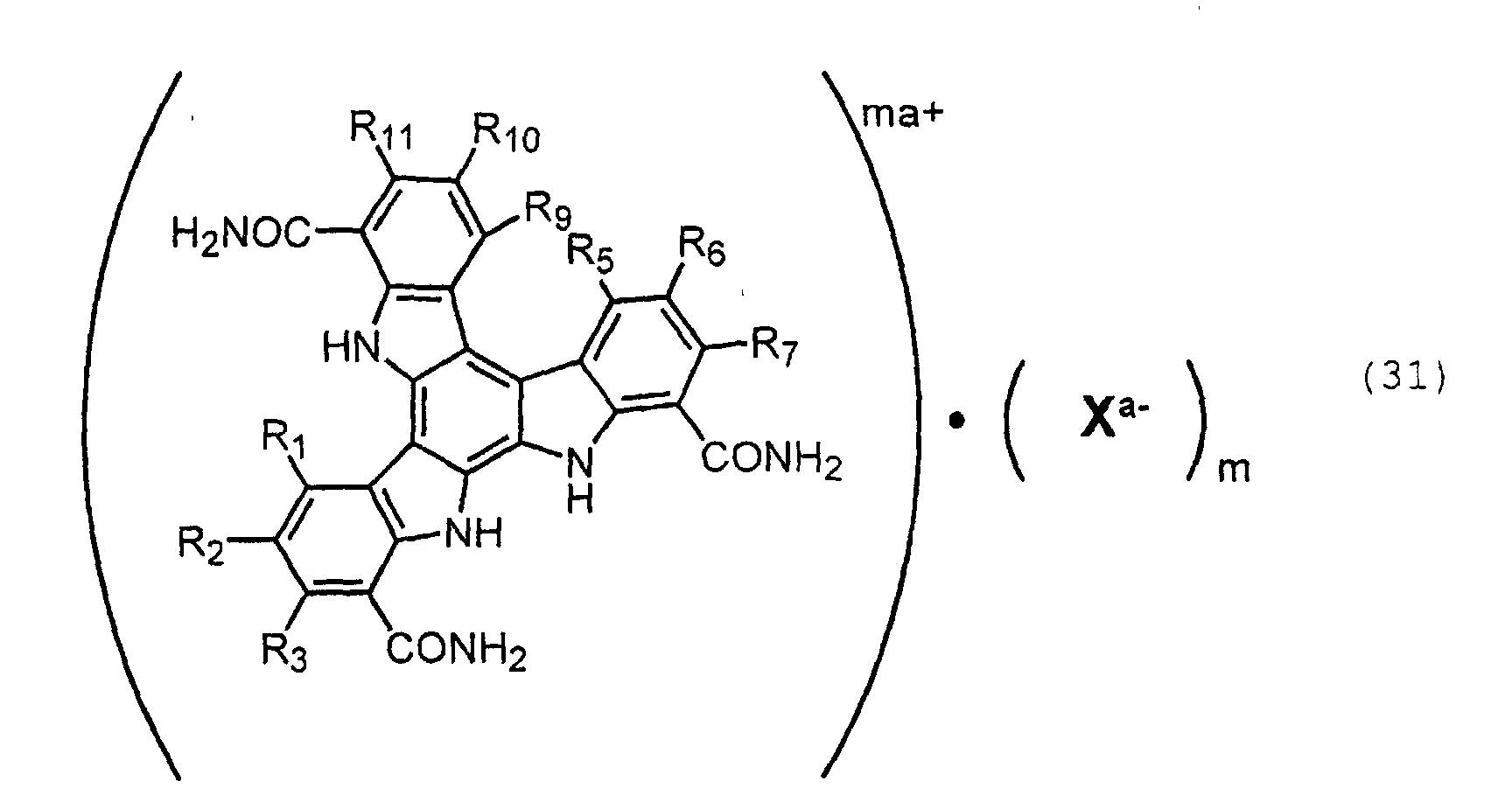
Xa- is at least one anion selected from the group of monovalent to tervalent anions consisting of chlorine ion, bromine ion, iodine ion, fluorine ion, nitrate ion, sulfate ion, hydrogen sulfate ion, phosphate ion, fluoroborate ion, perchlorate ion, thiocyanate ion, acetate ion, propionate ion, methane sulfonate ion, p-toluene sulfonate ion, trifluoroacetate ion, and trifluoeomethane sulfonate ion;
a is an integral number in the range from 1 to 3 representing the ionic valence of the ion X; and
m is a number in the range from 0 to 0.5. - The indole derivative trimer according to any of claims 6 to 34, wherein Xa- is at least one member selected from the group consisting of chlorine ion, sulfate ion, and fluoroborate ion.
- The indole derivative trimer according to any of claims 6 to 35, the indole derivative trimer is of doped type with m = 0.001 - 0.5.
- The indole derivative trimer according to any of claims 6 to 35, wherein the indole derivative trimer is of undoped type with m = 0.
- An indole derivative trimer of following formula (2) in the form of particles having a particle diameter of 0.1 to 50 µm:, wherein R1 to R12 are substituents each independently selected from the group consisting of hydrogen, linear or branched alkyl group having 1 to 24 carbon atoms, linear or branched alkoxy group having 1 to 24 carbon atoms, linear or branched acyl group having 2 to 24 carbon atoms, aldehyde group, carboxyl group, linear or branched carboxylic ester group having 2 to 24 carbon atoms, sulfonic group, linear or branched sulfonic ester group having 1 to 24 carbon atoms, cyano group, hydroxyl group, nitro group, amino group, amide group, and halogen group;

Xa- is at least one anion selected from the group of monovalent to tervalent anions consisting of chlorine ion, bromine ion, iodine ion, fluorine ion, nitrate ion, sulfate ion, hydrogen sulfate ion, phosphate ion, fluoroborate ion, perchlorate ion, thiocyanate ion, acetate ion, propionate ion, methane sulfonate ion, p-toluene sulfonate ion, trifluoroacetate ion, and trifluoeomethane sulfonate ion;
a is an integral number in the range from 1 to 3 representing the ionic valence of the ion X; and
m is a number in the range from 0 to 0.5. - The indole derivative trimer according to claim 38, wherein the indole derivative trimer is obtainable by the method according to any of claims 1 to 5.
- The indole derivative trimer according to claim 38, wherein the indole derivative trimer is the indole derivative trimer of any one of claims 6 to 37.
- The indole derivative trimer according to claim 38 or 39, wherein the indole derivative trimer is an indole-5-carbonitrile trimer or an indole-5-carboxylic acid trimer of following formula (32):, wherein R2, R6, and R10 are substituted by cyano group or carboxyl group;

Xa- is at least one anion selected from the group of monovalent to tervalent anions consisting of chlorine ion, bromine ion, iodine ion, fluorine ion, nitrate ion, sulfate ion, hydrogen sulfate ion, phosphate ion, fluoroborate ion, perchlorate ion, thiocyanate ion, acetate ion, propionate ion, methane sulfonate ion, p-toluene sulfonate ion, trifluoroacetate ion, and trifluoeomethane sulfonate ion;
a is an integral number in the range from 1 to 3 representing the ionic valence of the ion X; and
m is a number in the range from 0 to 0.5. - A laminated structure of the indole derivative trimer of following formula (2), having an interlaminar spacing of 0.1 - 0.6 nm:, wherein R1 to R12 are substituents each independently selected from the group consisting of hydrogen, linear or branched alkyl group having 1 to 24 carbon atoms, linear or branched alkoxy group having 1 to 24 carbon atoms, linear or branched acyl group having 2 to 24 carbon atoms, aldehyde group, carboxyl group, linear or branched carboxylic ester group having 2 to 24 carbon atoms, sulfonic group, linear or branched sulfonic ester group having 1 to 24 carbon atoms, cyano group, hydroxyl group, nitro group, amino group, amide group, and halogen group;
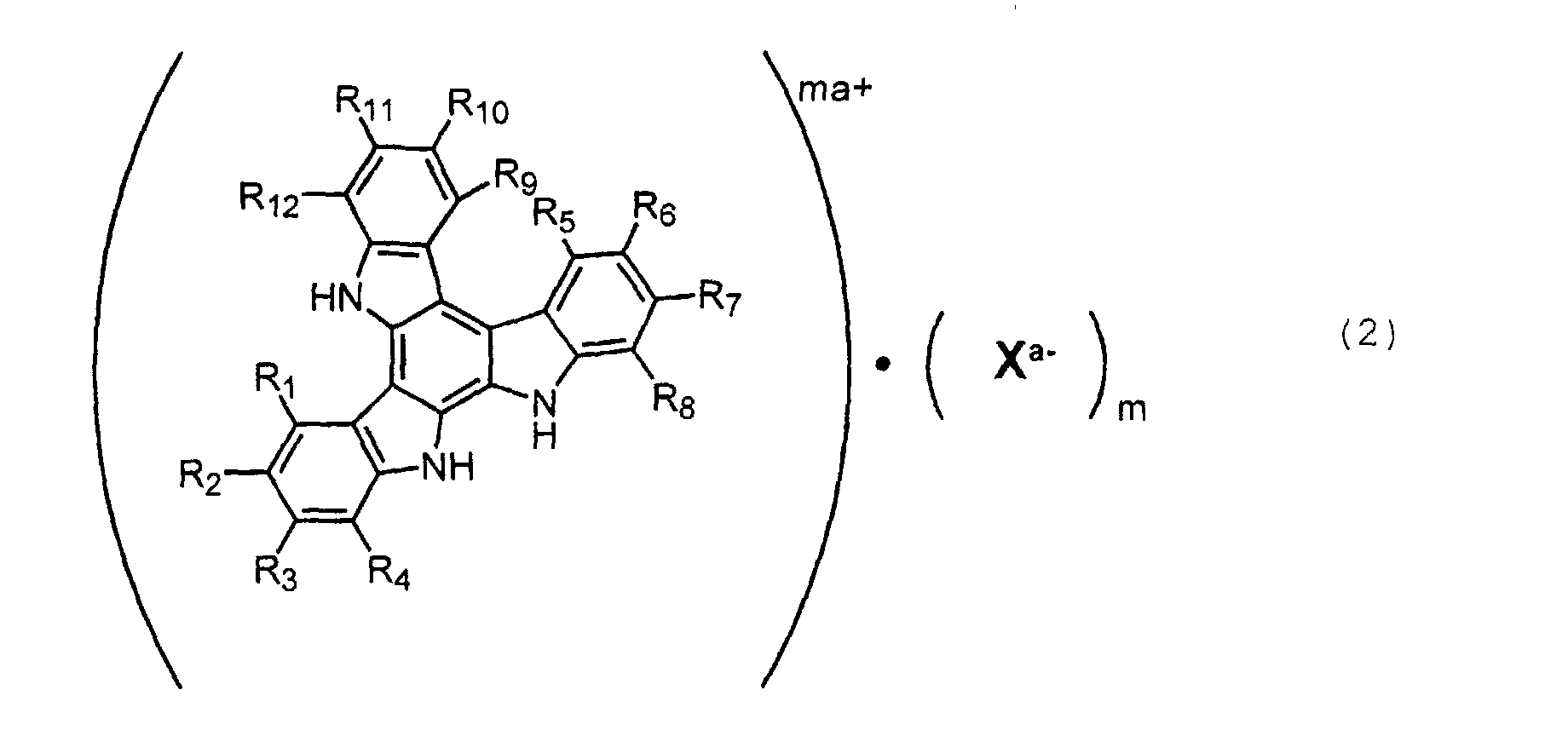
Xa- is at least one anion selected from the group of monovalent to tervalent anions consisting of chlorine ion, bromine ion, iodine ion, fluorine ion, nitrate ion, sulfate ion, hydrogen sulfate ion, phosphate ion, fluoroborate ion, perchlorate ion, thiocyanate ion, acetate ion, propionate ion, methane sulfonate ion, p-toluene sulfonate ion, trifluoroacetate ion, and trifluoeomethane sulfonate ion;
a is an integral number in the range from 1 to 3 representing the ionic valence of the ion X; and
m is a number in the range from 0 to 0.5. - The laminated structure of the indole derivative trimer according to claim 42, wherein the indole derivative trimer is obtainable by the method according to any one of claims 1 to 5.
- The lamianted structure of the indole derivate trimer according to claim 42, wherein the indole derivative trimer is the indole derivative trimer of any one of claims 6 to 37.
- The laminated structure of the indole derivate trimer according to claim 42 or 43, wherein the indole derivative trimer is an indole-5-carbonitrile trimer or an indole-5-carboxylic acid trimer of following formula (32):, wherein R2, R6, and R10 are substituted by cyano group or carboxyl group; Xa- is at least anion selected from the group of monovalent to tervalent anions consisting of chlorine ion, bromine ion, iodine ion, fluorine ion, nitrate ion, sulfate ion, hydrogen sulfate ion, phosphate ion, fluoroborate ion, perchlorate ion, thiocyanate ion, acetate ion, propionate ion, methane sulfonate ion, p-toluene sulfonate ion, trifluoroacetate ion, and trifluoeomethane sulfonate ion;

a is an integral number in the range from 1 to 3 representing the ionic valence of the ion X; and
m is a number in the range from 0 to 0.5.
Applications Claiming Priority (5)
| Application Number | Priority Date | Filing Date | Title |
|---|---|---|---|
| JP2000317045 | 2000-10-17 | ||
| JP2000317045 | 2000-10-17 | ||
| JP2001159604 | 2001-05-28 | ||
| JP2001159604 | 2001-05-28 | ||
| PCT/JP2001/008442 WO2002032903A1 (en) | 2000-10-17 | 2001-09-27 | Method for producing trimer of indole derivative, and trimer of indole derivative and laminated structure thereof |
Publications (3)
| Publication Number | Publication Date |
|---|---|
| EP1327632A1 true EP1327632A1 (en) | 2003-07-16 |
| EP1327632A4 EP1327632A4 (en) | 2005-03-02 |
| EP1327632B1 EP1327632B1 (en) | 2008-12-03 |
Family
ID=26602256
Family Applications (1)
| Application Number | Title | Priority Date | Filing Date |
|---|---|---|---|
| EP01972535A Expired - Lifetime EP1327632B1 (en) | 2000-10-17 | 2001-09-27 | Method for producing trimer of indole derivative, and trimer of indole derivative and laminated structure thereof |
Country Status (5)
| Country | Link |
|---|---|
| US (2) | US7115751B2 (en) |
| EP (1) | EP1327632B1 (en) |
| JP (1) | JP4112973B2 (en) |
| DE (1) | DE60136837D1 (en) |
| WO (1) | WO2002032903A1 (en) |
Families Citing this family (9)
| Publication number | Priority date | Publication date | Assignee | Title |
|---|---|---|---|---|
| WO2004039893A1 (en) | 2002-11-01 | 2004-05-13 | Mitsubishi Rayon Co., Ltd. | Composition containing carbon nanotubes, composite having coating thereof and process for producing them |
| JP2005187393A (en) * | 2003-12-25 | 2005-07-14 | Ihara Chem Ind Co Ltd | Indole carboxylic acid ester trimer and electrochemical cell using the same |
| JP2007119386A (en) * | 2005-10-27 | 2007-05-17 | Nec Tokin Corp | Method for purifying indole derivative trimer, electrode active substance containing formed trimer, method for producing electrode active substance and electrochemical cell using the same |
| US8512824B2 (en) | 2008-08-19 | 2013-08-20 | Crysoptix Kk | Composition of organic compounds, optical film and method of production thereof |
| US20110067173A1 (en) * | 2009-09-23 | 2011-03-24 | Nicholas Fasola | Gate tube toilet water saver |
| US8865313B2 (en) | 2010-07-16 | 2014-10-21 | Crysoptix K.K. | Optical retardation film and method of production thereof |
| US9887367B2 (en) | 2013-03-29 | 2018-02-06 | Idemitsu Kosan Co., Ltd. | Heterocyclic compound, material for organic electroluminescent elements using same, organic electroluminescent element using same, and electronic device |
| CN111349237A (en) * | 2020-03-09 | 2020-06-30 | 江西科技师范大学 | Polyfluoro functional polybenzazole electrode material applied to supercapacitor and preparation method thereof |
| CN114014865B (en) * | 2021-12-02 | 2023-05-16 | 云南大学 | Asymmetric trimerization indole compound and preparation method thereof |
Family Cites Families (1)
| Publication number | Priority date | Publication date | Assignee | Title |
|---|---|---|---|---|
| BE1004725A3 (en) | 1991-04-16 | 1993-01-19 | Solvay | PROCESS FOR THE PREPARATION OF polyindoles, COMPOSITIONS AND DEVICES CONTAINING ELECTRICALLY AND USES OF polyindoles. |
-
2001
- 2001-09-27 EP EP01972535A patent/EP1327632B1/en not_active Expired - Lifetime
- 2001-09-27 US US10/399,449 patent/US7115751B2/en not_active Expired - Lifetime
- 2001-09-27 DE DE60136837T patent/DE60136837D1/en not_active Expired - Lifetime
- 2001-09-27 WO PCT/JP2001/008442 patent/WO2002032903A1/en not_active Ceased
- 2001-09-27 JP JP2002529649A patent/JP4112973B2/en not_active Expired - Fee Related
-
2006
- 2006-05-22 US US11/437,581 patent/US7585981B2/en not_active Expired - Fee Related
Non-Patent Citations (2)
| Title |
|---|
| No further relevant documents disclosed * |
| See also references of WO0232903A1 * |
Also Published As
| Publication number | Publication date |
|---|---|
| JPWO2002032903A1 (en) | 2004-02-26 |
| US7115751B2 (en) | 2006-10-03 |
| WO2002032903A1 (en) | 2002-04-25 |
| JP4112973B2 (en) | 2008-07-02 |
| EP1327632A4 (en) | 2005-03-02 |
| EP1327632B1 (en) | 2008-12-03 |
| US20040019097A1 (en) | 2004-01-29 |
| DE60136837D1 (en) | 2009-01-15 |
| US20060211793A1 (en) | 2006-09-21 |
| US7585981B2 (en) | 2009-09-08 |
Similar Documents
| Publication | Publication Date | Title |
|---|---|---|
| US7645400B2 (en) | Composition containing carbon nanotubes having a coating | |
| JP4266752B2 (en) | Carbon nanotube-containing composition and method for preparing the same, composite using the same, and method for producing the same | |
| TWI300419B (en) | Process for the preparation of neutral polyethylenedioxythiophene, and corresponding polyethlenedioxythiophenes | |
| EP1327632B1 (en) | Method for producing trimer of indole derivative, and trimer of indole derivative and laminated structure thereof | |
| Eder et al. | Squarephaneic Tetraanhydride: A Conjugated Square‐Shaped Cyclophane for the Synthesis of Porous Organic Materials | |
| Karri et al. | Synthesis of novel fluorescent molecule and its polymeric form with aniline as fluorescent and supercapacitor electrode materials | |
| JP2003300980A (en) | Trimer of electron-withdrawing group-substituted N-alkylindole derivative and method for producing the same | |
| JP2001342242A (en) | Method for producing polyindole derivative and polyindole derivative obtained thereby | |
| JP4163890B2 (en) | Method for obtaining indole derivative trimer with suppressed aggregation | |
| JP4663271B2 (en) | Color conductive primer composition, method for forming color conductive primer, and electrostatic coating method | |
| EP1361244B1 (en) | Poly(5-aminoquinoxalines); preparation and use thereof | |
| JP4091765B2 (en) | Method for producing indole derivative trimer composite conductor | |
| JP3747167B2 (en) | Conductive composition, conductor and method for forming the same | |
| KR20010112574A (en) | Method for preparation of Polypyrrole having a solubility in various organic solvents and various molecular weight | |
| JP3860003B2 (en) | Anticorrosion composition containing indole derivative trimer and anticorrosion method | |
| Cameron | Enhanced rates of electron transport in conjugated-redox polymer hybrids | |
| JP2003302363A (en) | Gas sensor using indole derivative trimer | |
| JP2004210747A (en) | Highly crystallized trimer of indole derivative and method for obtaining it | |
| JP2003272865A (en) | Organic electroluminescent device | |
| JP2003300981A (en) | Method for producing trimer of heterocyclic compound having acidic group | |
| CN1036019A (en) | Conductive polymers with improved solubility properties | |
| KR19990073157A (en) | Method for Preparation of the Conductive Polypyrrole having a high Solubility in Alcohol and Various Organic Solvents | |
| JP2004224773A (en) | Novel indole derivative, trimer thereof, and method for producing the same | |
| Berlin et al. | Methyl labeling as a tool for investigating the regiochemistry of the electrochemical oxidative polymerization of 1H, 8H‐pyrrolo [3, 2‐g] indole | |
| JP2003123532A (en) | Conductive composition, conductor and method of forming the same |
Legal Events
| Date | Code | Title | Description |
|---|---|---|---|
| PUAI | Public reference made under article 153(3) epc to a published international application that has entered the european phase |
Free format text: ORIGINAL CODE: 0009012 |
|
| 17P | Request for examination filed |
Effective date: 20030403 |
|
| AK | Designated contracting states |
Designated state(s): AT BE CH CY DE DK ES FI FR GB GR IE IT LI LU MC NL PT SE TR |
|
| RBV | Designated contracting states (corrected) |
Designated state(s): AT BE CH DE FR GB LI |
|
| A4 | Supplementary search report drawn up and despatched |
Effective date: 20050114 |
|
| RBV | Designated contracting states (corrected) |
Designated state(s): DE FR GB |
|
| 17Q | First examination report despatched |
Effective date: 20070831 |
|
| GRAP | Despatch of communication of intention to grant a patent |
Free format text: ORIGINAL CODE: EPIDOSNIGR1 |
|
| RIC1 | Information provided on ipc code assigned before grant |
Ipc: C07D 487/14 20060101AFI20080425BHEP |
|
| GRAS | Grant fee paid |
Free format text: ORIGINAL CODE: EPIDOSNIGR3 |
|
| GRAA | (expected) grant |
Free format text: ORIGINAL CODE: 0009210 |
|
| AK | Designated contracting states |
Kind code of ref document: B1 Designated state(s): DE FR GB |
|
| REG | Reference to a national code |
Ref country code: GB Ref legal event code: FG4D |
|
| REF | Corresponds to: |
Ref document number: 60136837 Country of ref document: DE Date of ref document: 20090115 Kind code of ref document: P |
|
| PLBE | No opposition filed within time limit |
Free format text: ORIGINAL CODE: 0009261 |
|
| STAA | Information on the status of an ep patent application or granted ep patent |
Free format text: STATUS: NO OPPOSITION FILED WITHIN TIME LIMIT |
|
| 26N | No opposition filed |
Effective date: 20090904 |
|
| REG | Reference to a national code |
Ref country code: FR Ref legal event code: PLFP Year of fee payment: 15 |
|
| PGFP | Annual fee paid to national office [announced via postgrant information from national office to epo] |
Ref country code: GB Payment date: 20150923 Year of fee payment: 15 Ref country code: DE Payment date: 20150922 Year of fee payment: 15 |
|
| PGFP | Annual fee paid to national office [announced via postgrant information from national office to epo] |
Ref country code: FR Payment date: 20150811 Year of fee payment: 15 |
|
| REG | Reference to a national code |
Ref country code: DE Ref legal event code: R119 Ref document number: 60136837 Country of ref document: DE |
|
| GBPC | Gb: european patent ceased through non-payment of renewal fee |
Effective date: 20160927 |
|
| REG | Reference to a national code |
Ref country code: FR Ref legal event code: ST Effective date: 20170531 |
|
| PG25 | Lapsed in a contracting state [announced via postgrant information from national office to epo] |
Ref country code: GB Free format text: LAPSE BECAUSE OF NON-PAYMENT OF DUE FEES Effective date: 20160927 Ref country code: FR Free format text: LAPSE BECAUSE OF NON-PAYMENT OF DUE FEES Effective date: 20160930 Ref country code: DE Free format text: LAPSE BECAUSE OF NON-PAYMENT OF DUE FEES Effective date: 20170401 |