EP1327009B1 - Process and alloy for decorative galvanizing of steel - Google Patents
Process and alloy for decorative galvanizing of steel Download PDFInfo
- Publication number
- EP1327009B1 EP1327009B1 EP01980075A EP01980075A EP1327009B1 EP 1327009 B1 EP1327009 B1 EP 1327009B1 EP 01980075 A EP01980075 A EP 01980075A EP 01980075 A EP01980075 A EP 01980075A EP 1327009 B1 EP1327009 B1 EP 1327009B1
- Authority
- EP
- European Patent Office
- Prior art keywords
- alloy
- steel
- tin
- aluminum
- zinc
- Prior art date
- Legal status (The legal status is an assumption and is not a legal conclusion. Google has not performed a legal analysis and makes no representation as to the accuracy of the status listed.)
- Expired - Lifetime
Links
- 229910000831 Steel Inorganic materials 0.000 title claims abstract description 78
- 239000010959 steel Substances 0.000 title claims abstract description 78
- 229910045601 alloy Inorganic materials 0.000 title claims abstract description 39
- 239000000956 alloy Substances 0.000 title claims abstract description 39
- 238000000034 method Methods 0.000 title claims abstract description 36
- 238000005246 galvanizing Methods 0.000 title claims abstract description 34
- PXHVJJICTQNCMI-UHFFFAOYSA-N Nickel Chemical compound [Ni] PXHVJJICTQNCMI-UHFFFAOYSA-N 0.000 claims abstract description 59
- 239000011701 zinc Substances 0.000 claims abstract description 51
- 229910052718 tin Inorganic materials 0.000 claims abstract description 47
- 238000000576 coating method Methods 0.000 claims abstract description 44
- ATJFFYVFTNAWJD-UHFFFAOYSA-N Tin Chemical compound [Sn] ATJFFYVFTNAWJD-UHFFFAOYSA-N 0.000 claims abstract description 42
- HCHKCACWOHOZIP-UHFFFAOYSA-N Zinc Chemical compound [Zn] HCHKCACWOHOZIP-UHFFFAOYSA-N 0.000 claims abstract description 42
- 229910052725 zinc Inorganic materials 0.000 claims abstract description 42
- 229910052782 aluminium Inorganic materials 0.000 claims abstract description 40
- XAGFODPZIPBFFR-UHFFFAOYSA-N aluminium Chemical compound [Al] XAGFODPZIPBFFR-UHFFFAOYSA-N 0.000 claims abstract description 40
- 229910052797 bismuth Inorganic materials 0.000 claims abstract description 38
- JCXGWMGPZLAOME-UHFFFAOYSA-N bismuth atom Chemical compound [Bi] JCXGWMGPZLAOME-UHFFFAOYSA-N 0.000 claims abstract description 34
- 239000011248 coating agent Substances 0.000 claims abstract description 33
- 229910052759 nickel Inorganic materials 0.000 claims abstract description 29
- XUIMIQQOPSSXEZ-UHFFFAOYSA-N Silicon Chemical compound [Si] XUIMIQQOPSSXEZ-UHFFFAOYSA-N 0.000 claims description 26
- 229910052710 silicon Inorganic materials 0.000 claims description 26
- 239000010703 silicon Substances 0.000 claims description 26
- 229910001297 Zn alloy Inorganic materials 0.000 claims description 14
- 229910001335 Galvanized steel Inorganic materials 0.000 description 13
- 239000008397 galvanized steel Substances 0.000 description 13
- 238000007792 addition Methods 0.000 description 12
- 230000009257 reactivity Effects 0.000 description 11
- RTAQQCXQSZGOHL-UHFFFAOYSA-N Titanium Chemical compound [Ti] RTAQQCXQSZGOHL-UHFFFAOYSA-N 0.000 description 9
- 229910052719 titanium Inorganic materials 0.000 description 9
- 239000010936 titanium Substances 0.000 description 9
- 229910052720 vanadium Inorganic materials 0.000 description 9
- LEONUFNNVUYDNQ-UHFFFAOYSA-N vanadium atom Chemical compound [V] LEONUFNNVUYDNQ-UHFFFAOYSA-N 0.000 description 9
- FYYHWMGAXLPEAU-UHFFFAOYSA-N Magnesium Chemical compound [Mg] FYYHWMGAXLPEAU-UHFFFAOYSA-N 0.000 description 6
- 229910052749 magnesium Inorganic materials 0.000 description 6
- 239000011777 magnesium Substances 0.000 description 6
- 238000007654 immersion Methods 0.000 description 5
- 239000000203 mixture Substances 0.000 description 5
- 229910052751 metal Inorganic materials 0.000 description 4
- 239000002184 metal Substances 0.000 description 4
- QELJHCBNGDEXLD-UHFFFAOYSA-N nickel zinc Chemical compound [Ni].[Zn] QELJHCBNGDEXLD-UHFFFAOYSA-N 0.000 description 3
- OYPRJOBELJOOCE-UHFFFAOYSA-N Calcium Chemical compound [Ca] OYPRJOBELJOOCE-UHFFFAOYSA-N 0.000 description 2
- OAICVXFJPJFONN-UHFFFAOYSA-N Phosphorus Chemical compound [P] OAICVXFJPJFONN-UHFFFAOYSA-N 0.000 description 2
- 238000005275 alloying Methods 0.000 description 2
- 230000015572 biosynthetic process Effects 0.000 description 2
- 229910052791 calcium Inorganic materials 0.000 description 2
- 239000011575 calcium Substances 0.000 description 2
- 150000002739 metals Chemical class 0.000 description 2
- 239000011574 phosphorus Substances 0.000 description 2
- 229910052698 phosphorus Inorganic materials 0.000 description 2
- 229910001204 A36 steel Inorganic materials 0.000 description 1
- VYZAMTAEIAYCRO-UHFFFAOYSA-N Chromium Chemical compound [Cr] VYZAMTAEIAYCRO-UHFFFAOYSA-N 0.000 description 1
- PWHULOQIROXLJO-UHFFFAOYSA-N Manganese Chemical compound [Mn] PWHULOQIROXLJO-UHFFFAOYSA-N 0.000 description 1
- 229910000767 Tm alloy Inorganic materials 0.000 description 1
- 229910052804 chromium Inorganic materials 0.000 description 1
- 239000011651 chromium Substances 0.000 description 1
- 238000009749 continuous casting Methods 0.000 description 1
- 230000002950 deficient Effects 0.000 description 1
- 210000001787 dendrite Anatomy 0.000 description 1
- 238000007598 dipping method Methods 0.000 description 1
- 230000004907 flux Effects 0.000 description 1
- 238000009434 installation Methods 0.000 description 1
- JQJCSZOEVBFDKO-UHFFFAOYSA-N lead zinc Chemical compound [Zn].[Pb] JQJCSZOEVBFDKO-UHFFFAOYSA-N 0.000 description 1
- 239000007788 liquid Substances 0.000 description 1
- 229910052748 manganese Inorganic materials 0.000 description 1
- 239000011572 manganese Substances 0.000 description 1
- WPBNNNQJVZRUHP-UHFFFAOYSA-L manganese(2+);methyl n-[[2-(methoxycarbonylcarbamothioylamino)phenyl]carbamothioyl]carbamate;n-[2-(sulfidocarbothioylamino)ethyl]carbamodithioate Chemical compound [Mn+2].[S-]C(=S)NCCNC([S-])=S.COC(=O)NC(=S)NC1=CC=CC=C1NC(=S)NC(=O)OC WPBNNNQJVZRUHP-UHFFFAOYSA-L 0.000 description 1
- 238000004519 manufacturing process Methods 0.000 description 1
- 238000002310 reflectometry Methods 0.000 description 1
- 230000002195 synergetic effect Effects 0.000 description 1
Images





Classifications
-
- C—CHEMISTRY; METALLURGY
- C22—METALLURGY; FERROUS OR NON-FERROUS ALLOYS; TREATMENT OF ALLOYS OR NON-FERROUS METALS
- C22C—ALLOYS
- C22C18/00—Alloys based on zinc
-
- C—CHEMISTRY; METALLURGY
- C23—COATING METALLIC MATERIAL; COATING MATERIAL WITH METALLIC MATERIAL; CHEMICAL SURFACE TREATMENT; DIFFUSION TREATMENT OF METALLIC MATERIAL; COATING BY VACUUM EVAPORATION, BY SPUTTERING, BY ION IMPLANTATION OR BY CHEMICAL VAPOUR DEPOSITION, IN GENERAL; INHIBITING CORROSION OF METALLIC MATERIAL OR INCRUSTATION IN GENERAL
- C23C—COATING METALLIC MATERIAL; COATING MATERIAL WITH METALLIC MATERIAL; SURFACE TREATMENT OF METALLIC MATERIAL BY DIFFUSION INTO THE SURFACE, BY CHEMICAL CONVERSION OR SUBSTITUTION; COATING BY VACUUM EVAPORATION, BY SPUTTERING, BY ION IMPLANTATION OR BY CHEMICAL VAPOUR DEPOSITION, IN GENERAL
- C23C2/00—Hot-dipping or immersion processes for applying the coating material in the molten state without affecting the shape; Apparatus therefor
- C23C2/04—Hot-dipping or immersion processes for applying the coating material in the molten state without affecting the shape; Apparatus therefor characterised by the coating material
- C23C2/06—Zinc or cadmium or alloys based thereon
-
- Y—GENERAL TAGGING OF NEW TECHNOLOGICAL DEVELOPMENTS; GENERAL TAGGING OF CROSS-SECTIONAL TECHNOLOGIES SPANNING OVER SEVERAL SECTIONS OF THE IPC; TECHNICAL SUBJECTS COVERED BY FORMER USPC CROSS-REFERENCE ART COLLECTIONS [XRACs] AND DIGESTS
- Y10—TECHNICAL SUBJECTS COVERED BY FORMER USPC
- Y10T—TECHNICAL SUBJECTS COVERED BY FORMER US CLASSIFICATION
- Y10T428/00—Stock material or miscellaneous articles
- Y10T428/12—All metal or with adjacent metals
- Y10T428/12493—Composite; i.e., plural, adjacent, spatially distinct metal components [e.g., layers, joint, etc.]
- Y10T428/12771—Transition metal-base component
- Y10T428/12785—Group IIB metal-base component
- Y10T428/12792—Zn-base component
- Y10T428/12799—Next to Fe-base component [e.g., galvanized]
Definitions
- This invention relates to a galvanizing alloy and process and, more particularly, relates to a galvanizing alloy and an immersion galvanizing process for providing a decorative coating to non-reactive and to moderately reactive or mixed reactive steels.
- Phosphorus in the steel also affects reactivity having an accepted measure of reactivity that is approximately 2.5 times that of silicon.
- the silicon content plus 2.5 times the phosphorus content is known as the effective silicon content of the steel.
- Steels with silicon levels between 0.05 to 0.15 may also develop a ⁇ mixed' reactivity coating.
- This coating is characterized by a combination of reactive and non-reactive areas on the same steel which is believed to be due to differences in localized silicon levels on the surface of the steel.
- Silicon released from the steel during galvanizing is insoluble in the intermetallic layer known as the zeta layer.
- This creates an instability in the zeta layer and produces thick, porous intermetallic layers.
- the microstructure is characterized by a very thin and uneven delta layer overlaid by a very thick and porous zeta layer.
- the porous intermetallic layer allows liquid bath metal to.react near the steel interface during the entire immersion period. The result is linear growth mode with immersion time that allows the formation of excessively thick coatings. These coatings are generally very rough, undesirably thick, brittle and dull in appearance.
- the galvanize know the reactivity of the steel beforehand and adjust galvanizing conditions accordingly, both of which are difficult to accomplish in practice. Under some conditions, this process also produces dross that tends to float in the bath and be drawn out on the workpiece, producing unacceptable coatings.
- the alloy comprises zinc of commercial purity containing by weight 0.1 to 1.5% lead, 0.01 to 0.05% aluminum, 0.03 to 2.0% tin, and 0.001 to 2.0% magnesium.
- the alloys presented include variations of the Polygalva TM alloy components of lead, aluminum, magnesium and tin in zinc.
- a process known as the Supergalva TM process includes an alloy of zinc containing 5 wt% aluminum. The process requires aspecial flux and double dipping not generally accepted by commercial galvanizers.
- U.S. Patent No 6,280,795 filed February 22, 2000 describes a new alloy and process for controlling reactivity in steels in silicon contents up to 1 wt% in which the alloy comprises, by weight, aluminum in the amount of at least 0.001 %, tin in the amount of at least 0.5% to a maximum of 2%, preferably at least 0.8%, and one of an element selected from the group consisting of vanadium in the amount of at least 0.02%, preferably 0.05% to 0.12%, titanium in the amount of at least 0.03%, preferably 0.06% to 0.10%, and both vanadium and titanium together in the amount of at least 0.02% vanadium and at least 0.01% titanium for a total of at least 0.03%, preferably 0.05 wt% to 0.15%, of vanadium and titanium, the balance zinc.
- EP 1003921 discloses a zinc alloy for galvanizing reactive steel comprising 1 to 5 wt% tin + bismuth, 0 to saturation of lead, 0.025 to 0.2 wt% of at least one of nickel, chromium or manganese, 0 to 0.03 wt% of at least one of aluminum, calcium and magnesium, the balance zinc.
- PCT Application No. EP 0956380 discloses a zinc alloy for galvanizing reactive steel comprising either 3 to 15 wt% tin or I to 5 wt% tin and 0.01 to 0.1 wt% nickel, lead up to saturation, and 0.06 wt% of at least one of aluminum, calcium and magnesium, the balance zinc.
- the above prior art is directed at highly reactive steels.
- the tin contents of these alloy baths is high and, in that tin and bismuth are relatively expensive metals, it is economically desirable to provide an alloy for decorative galvanized coatings for non-reactive and mixed and moderately reactive steels having reduced amounts of tin and bismuth.
- WO 98/55664 describes an alloy and a process for the galvanizing of steels containing silicon by an immersion galvanization process, the alloy comprising a zinc alloy of commercial purity having, by weight, aluminum in the amount of at least 0.001 %, tin in the amount of about 0.5 % to about 2 %, and one of vanadium in the amount of at least 0.02 %, preferably 0.05 % to 0.12 %, titanium in the amount of at least 0.03 %, preferably 0.06 % to 0.1 %, or vanadium with titanium in the amount of at least 0.02 % of vanadium and at least 0.01 % of titanium, for at least 0.03 %, preferably 0.05 % to 0.15 %, of vanadium and titanium collectively, the balance zinc containing up to 1.3 % lead.
- the process of the invention for galvanizing steel containing up to 0.25 wt% silicon comprises immersing the steel in a molten bath of an alloy consisting of 0.1 to less than 0.8 wt% tin, 0.05 to 0.2 wt% bismuth, 0.001 to 0.008 wt% aluminum and 0 to 0.10 wt% nickel, the balance zinc of commercial purity.
- the steel preferably is immersed in the molten bath for about 2 to 20 minutes at a bath temperature in the range of about 440 to 460°C.
- the zinc alloy preferably consists of 0.4 to less than 0.8 wt% tin, 0.05 to 0.15 wt% bismuth and 0.001 to 0.005 wt% aluminum, more preferably about 0.5 wt% tin, about 0.1 wt% bismuth and about 0.003 to 0.005 wt% aluminum, the balance zinc of commercial purity.
- the zinc alloy preferably consists of 0.4 to less than 0.8 wt% tin, 0.05 to 0.15 wt% bismuth, 0.001 to 0.005 wt% aluminum and 0.04 to 0.09 wt% nickel, more preferably about 0.5 wt% tin, about 0.1 wt% bismuth, about 0.003 to 0.005 wt% aluminum, and about 0.04 to 0.06 wt% nickel, the balance zinc of commercial purity.
- the non-reactive steel of the invention has a zinc alloy coating with a decorative spangle consisting of 0.1 to less than 0.8 wt% tin, 0.05 to 0.2 wt% bismuth, 0.001 to 0.008 wt% aluminum and 0 to 0.10 wt% nickel, the balance zinc of commercial purity.
- the mixed or moderately reactive steel of the invention containing up to 0.25 wt% silicon has a zinc alloy coating with a decorative spangle consisting of 0.1 to less than 0.8 wt% tin, 0.05 to 0.2 wt% bismuth, 0.001 to 0.008 wt% aluminum and 0.04 to 0.10 wt% nickel, the balance zinc of commercial purity.
- the process and the alloyofthe invention for hot-dip galvanizing of non-reactive steel and for mixed or moderately reactive steel having up to 0.25 wt% silicon produces decorative coatings having a distinctive spangle and brightness to enhance the appearance of galvanized steel.
- the alloy will not produce a spangled, bright coating on highly reactive steels having a silicon level in excess of 0.25 wt%.
- the alloy is produced by adding low amounts of tin, bismuth and aluminum, and optionally nickel, to a molten zinc bath at a conventional bath temperature in the range of about 440 to 460°C.
- the alloying metals are added by the introduction of a master alloy bar having effective amounts of the tin, bismuth and aluminum, and optionally nickel, to a molten zinc bath to produce a galvanizing bath containing 0.1 to less than 0.8 wt% tin, 0.05 to 0.2 wt% bismuth, 0.001 to 0.008 wt% aluminum and 0 to 0.1 wt% nickel.
- the preferred composition comprises 0.4 to less than 0.8 wt% tin, 0.05 to 0.15 wt% bismuth and 0.001 to 0.005 wt% aluminum, more preferably about 0.5 wt% tin, about 0.1 wt% bismuth and about 0.003 to 0.005 wt% aluminum, the balance zinc of commercial purity.
- the zinc alloy preferably comprises 0.4 to less than 0.8 wt% tin, 0.05 to 0.15 wt% bismuth, 0.001 to 0.005 wt% aluminum and 0.04 to 0.09 wt% nickel, more preferably about 0.5 wt% tin, about 0.1 wt% bismuth, about 0.003 to 0.005 wt% aluminum, and about 0.04 to 0.06 wt% nickel, the balance zinc of commercial purity.
- the zinc of "commercial purity” referred to herein will be understood to include conventional Prime Western (PW) zinc, which contains up to 1.3 wt% lead, typically about 1.0 wt% lead, and Special High Grade (SHG) zinc.
- PW Prime Western
- SHG Special High Grade
- Galvanizing baths were prepared by the introduction of tin, bismuth, aluminum and optionally nickel to molten SHG zinc and PW zinc for the 24 immersion tests conducted on moderately reactive steel (ASTM A36). The bath was maintained at 450°C and steel coupons were immersed for two minutes.
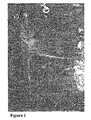
- a steel sample was dipped in a Zn (SHG) bath containing 30 ppm A1 as a coating brightner.
- the typical coating appearance produced on the steel was devoid of any discernable spangle, as typified in Figure 1 .
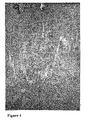
- Test 9 produced a satin-like coating appearance with a very faint, non-distinctive spangle, as shown in Figure 4 .
- Test 10 produced a visible spangle of 0.635 cm [1 ⁇ 4 in.] to 2.54 cm [1 in.], which contained some columnar dendrites at the outer edges of the sample.
- Tests 11, 12 and 13 produced very distinctive feather-like, dendritic spangles that varied in reflectivity from mirror like shiny to frosty or hazy, giving a decorative appearance to the galvanized coating.
- Spangle sizes varied from 0.635 cm [3 ⁇ 4 in.] to as much as 5.08 cm [2 in.], becoming more equixed on bath 13. Since there is not a very significant difference between the spangles, bath 1 containing 0.5 Sn and 0.1 Bi is the preferred composition that produces the desired decorative coating appearance with the least amount of Sn + Bi, an example of which is shown in Figure 5 .
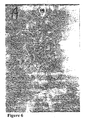
- a steel sample was dipped in a bath of Zn + Pb (PW zinc) with 30 ppm Al additions.
- the leaded zinc coating had a very faint spangle that was not readily visible and was masked by the coating surface oxide layer, as shown in Figure 6 .
- a steel sample was dipped in a Zn (SHG) bath with 30 ppm A1 addition and 0.5% Ni addition.
- the Ni addition did not produce a visible spangle in the coating, as shown in Figure 8 .
Landscapes
- Chemical & Material Sciences (AREA)
- Engineering & Computer Science (AREA)
- Materials Engineering (AREA)
- Mechanical Engineering (AREA)
- Metallurgy (AREA)
- Organic Chemistry (AREA)
- Chemical Kinetics & Catalysis (AREA)
- Coating With Molten Metal (AREA)
- Treatment Of Steel In Its Molten State (AREA)
Abstract
Description
- This invention relates to a galvanizing alloy and process and, more particularly, relates to a galvanizing alloy and an immersion galvanizing process for providing a decorative coating to non-reactive and to moderately reactive or mixed reactive steels.
- It is necessary, in the manufacture of low-alloy high-strength steels by the continuous casting process, to add elements that 'kill' or deoxidize the steel i.e. prevent gaseous products which produce porosity. Silicon is commonly employed for this purpose. These steels, as a result, generally contain between 0.01% to 0.3%, by weight, silicon but may include up to or more than about 0.5 wt% silicon and are known as 'reactive steels' or silicon steels.
- Phosphorus in the steel also affects reactivity having an accepted measure of reactivity that is approximately 2.5 times that of silicon. Thus, the silicon content plus 2.5 times the phosphorus content is known as the effective silicon content of the steel.
- Steels with silicon levels between 0.05 to 0.15 (i.e. around the first "Sandelin Peak" area), may also develop a `mixed' reactivity coating. This coating is characterized by a combination of reactive and non-reactive areas on the same steel which is believed to be due to differences in localized silicon levels on the surface of the steel.
- Silicon steels that have high reactivity pose problems to the galvanizing process, producing thick, brittle and uneven coatings, poor adherence and/or a dull or marbled appearance. These coatings are known as 'reactive' coatings. The high reactivity of the silicon steels also causes excessive zinc consumption and excessive dross formation.
- Silicon released from the steel during galvanizing is insoluble in the intermetallic layer known as the zeta layer. This creates an instability in the zeta layer and produces thick, porous intermetallic layers. The microstructure is characterized by a very thin and uneven delta layer overlaid by a very thick and porous zeta layer. The porous intermetallic layer allows liquid bath metal to.react near the steel interface during the entire immersion period. The result is linear growth mode with immersion time that allows the formation of excessively thick coatings. These coatings are generally very rough, undesirably thick, brittle and dull in appearance.
- It is known to control steel reactivity by adding alloying elements to the zinc galvanizing bath. One such addition is nickel in a process known as the Technigalva™ (or Nickel-Zinc) process. A nickel content of about 0.05 to 0.10% by weight in the zinc bath effectively controls reactive steels having up to about 0.25% by weight silicon content. For steels having silicon levels above approximately 0.25 wt%, this nickel-zinc process is not effective and thus it is only a partial solution to the reactive steel galvanizing problem. Low reactivity (normal) steels, when galvanized by the nickel-zinc process, pose the same difficulty as seen in low temperature galvanizing in that coating thickness may be unacceptably thin. With this process, it is thus preferred that the galvanize know the reactivity of the steel beforehand and adjust galvanizing conditions accordingly, both of which are difficult to accomplish in practice. Under some conditions, this process also produces dross that tends to float in the bath and be drawn out on the workpiece, producing unacceptable coatings.
- Another alloy used to control reactivity is that disclosed in French Patent No.
2,366,376, granted October 27, 1980 -
US Patent No. 4,439,397, granted March 27, 1984 , discusses the accelerated rate at which the magnesium and aluminum are consumed or lost in this Polygalva™* process for galvanizing steel. Procedures are presented to overcome the inherent difficulty in replenishing deficient aluminum or magnesium in the zinc alloy galvanizing bath. The process has serious limitations in that the steel has to be meticulouslydegreased, pickled, pre-fluxed and oven-dried to obtain good quality product free of bare spots. Thus, in most cases, new high-quality installations are usually required. -
US Patent No. 4,168,972, issued September 25, 1979 , andUS Patent No. 4,238,532, issued December 9, 1980 , also disclose alloys for galvanizing reactive steels. The alloys presented include variations of the Polygalva™ alloy components of lead, aluminum, magnesium and tin in zinc. - It is known in the prior art that aluminum included in the galvanizing bath reduces the reactivity of the high silicon steels. A process known as the Supergalva™ process includes an alloy of zinc containing 5 wt% aluminum. The process requires aspecial flux and double dipping not generally accepted by commercial galvanizers.
-
U.S. Patent No 6,280,795 filed February 22, 2000 , describes a new alloy and process for controlling reactivity in steels in silicon contents up to 1 wt% in which the alloy comprises, by weight, aluminum in the amount of at least 0.001 %, tin in the amount of at least 0.5% to a maximum of 2%, preferably at least 0.8%, and one of an element selected from the group consisting of vanadium in the amount of at least 0.02%, preferably 0.05% to 0.12%, titanium in the amount of at least 0.03%, preferably 0.06% to 0.10%, and both vanadium and titanium together in the amount of at least 0.02% vanadium and at least 0.01% titanium for a total of at least 0.03%, preferably 0.05 wt% to 0.15%, of vanadium and titanium, the balance zinc. -
EP 1003921 discloses a zinc alloy for galvanizing reactive steel comprising 1 to 5 wt% tin + bismuth, 0 to saturation of lead, 0.025 to 0.2 wt% of at least one of nickel, chromium or manganese, 0 to 0.03 wt% of at least one of aluminum, calcium and magnesium, the balance zinc.PCT Application No. EP 0956380 discloses a zinc alloy for galvanizing reactive steel comprising either 3 to 15 wt% tin or I to 5 wt% tin and 0.01 to 0.1 wt% nickel, lead up to saturation, and 0.06 wt% of at least one of aluminum, calcium and magnesium, the balance zinc. - The above prior art is directed at highly reactive steels. The tin contents of these alloy baths is high and, in that tin and bismuth are relatively expensive metals, it is economically desirable to provide an alloy for decorative galvanized coatings for non-reactive and mixed and moderately reactive steels having reduced amounts of tin and bismuth.
- It is known in the prior art to produce coloured zinc coatings on metal and non-metallic surfaces.
U.S. Patent No. 3,530,013, issued September 22, 1970 , discloses a galvanizing zinc coating having minor amounts of an oxygen-avid element such as titanium, manganese or vanadium which is oxidized under controlled time and temperature conditions for provision of a surface film of an oxide of the oxygen-avid element having light interference colour characteristics. -
WO 98/55664 - It is a principal object of the present invention therefore to provide a process and an inexpensive alloy for galvanizing non-reactive and mixed or moderately reactive steels to enhance drainage and fluidity of the galvanizing coating while producing decorative coating.
- In its broad aspect, the process of the invention for galvanizing steel containing up to 0.25 wt% silicon comprises immersing the steel in a molten bath of an alloy consisting of 0.1 to less than 0.8 wt% tin, 0.05 to 0.2 wt% bismuth, 0.001 to 0.008 wt% aluminum and 0 to 0.10 wt% nickel, the balance zinc of commercial purity. The steel preferably is immersed in the molten bath for about 2 to 20 minutes at a bath temperature in the range of about 440 to 460°C.
- For non-reactive steel, the zinc alloy preferably consists of 0.4 to less than 0.8 wt% tin, 0.05 to 0.15 wt% bismuth and 0.001 to 0.005 wt% aluminum, more preferably about 0.5 wt% tin, about 0.1 wt% bismuth and about 0.003 to 0.005 wt% aluminum, the balance zinc of commercial purity.
- For mixed or moderately reactive steel, the zinc alloy preferably consists of 0.4 to less than 0.8 wt% tin, 0.05 to 0.15 wt% bismuth, 0.001 to 0.005 wt% aluminum and 0.04 to 0.09 wt% nickel, more preferably about 0.5 wt% tin, about 0.1 wt% bismuth, about 0.003 to 0.005 wt% aluminum, and about 0.04 to 0.06 wt% nickel, the balance zinc of commercial purity.
- The non-reactive steel of the invention has a zinc alloy coating with a decorative spangle consisting of 0.1 to less than 0.8 wt% tin, 0.05 to 0.2 wt% bismuth, 0.001 to 0.008 wt% aluminum and 0 to 0.10 wt% nickel, the balance zinc of commercial purity.
- The mixed or moderately reactive steel of the invention containing up to 0.25 wt% silicon has a zinc alloy coating with a decorative spangle consisting of 0.1 to less than 0.8 wt% tin, 0.05 to 0.2 wt% bismuth, 0.001 to 0.008 wt% aluminum and 0.04 to 0.10 wt% nickel, the balance zinc of commercial purity.
- The process and alloys of the invention will be described with reference to the accompanying drawings, in which:
- Figure 1
- is a photograph ofahot-dipped galvanized steel sample according to Test No. 1;
- Figure 2
- is a photograph ofahot-dipped galvanized steel sample according to Test No. 3;
- Figure 3
- is photograph of a hot-dipped galvanized steel sample according to Test No. 7;
- Figure 4
- is a photograph of a hot-dipped galvanized steel sample according to Test No. 9;
- Figure 5
- is a photograph of a hot-dipped galvanized steel sample according to Test Nos. 11;
- Figure 6
- is a photograph of a hot-dipped galvanized steel sample according to Test No. 14;
- Figure 7
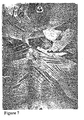
- is a photograph of a hot-dipped galvanized steel sample according to Test No. 16;
- Figure 8
- is a photograph of a hot-dipped galvanized steel sample according to Test No. 19;
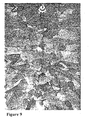
- Figure 9
- is a photograph ofa hot-dipped galvanized steel sample according to Test No. 20;
- Figure 10
- is aphotographofahot-dipped galvanized steel sample according to Test No. 22; and
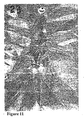
- Figure 11
- is a photograph ofahot-dipped galvanized steel sample according to Test No. 23.
- The process and the alloyofthe invention for hot-dip galvanizing of non-reactive steel and for mixed or moderately reactive steel having up to 0.25 wt% silicon produces decorative coatings having a distinctive spangle and brightness to enhance the appearance of galvanized steel. The alloy will not produce a spangled, bright coating on highly reactive steels having a silicon level in excess of 0.25 wt%. The alloy is produced by adding low amounts of tin, bismuth and aluminum, and optionally nickel, to a molten zinc bath at a conventional bath temperature in the range of about 440 to 460°C.
- The alloying metals are added by the introduction of a master alloy bar having effective amounts of the tin, bismuth and aluminum, and optionally nickel, to a molten zinc bath to produce a galvanizing bath containing 0.1 to less than 0.8 wt% tin, 0.05 to 0.2 wt% bismuth, 0.001 to 0.008 wt% aluminum and 0 to 0.1 wt% nickel. For non-reactive steel, the preferred composition comprises 0.4 to less than 0.8 wt% tin, 0.05 to 0.15 wt% bismuth and 0.001 to 0.005 wt% aluminum, more preferably about 0.5 wt% tin, about 0.1 wt% bismuth and about 0.003 to 0.005 wt% aluminum, the balance zinc of commercial purity. For mixed or moderately reactive steel, the zinc alloy preferably comprises 0.4 to less than 0.8 wt% tin, 0.05 to 0.15 wt% bismuth, 0.001 to 0.005 wt% aluminum and 0.04 to 0.09 wt% nickel, more preferably about 0.5 wt% tin, about 0.1 wt% bismuth, about 0.003 to 0.005 wt% aluminum, and about 0.04 to 0.06 wt% nickel, the balance zinc of commercial purity.
- Although tin at levels of above 0.8 wt% produced a decorative coating, it was found surprisingly that bright decorative galvanized coatings with a finely-grained spangle can be produced economically with tin contents of less than 0.8 wt%. More importantly, it was found that the combination of relatively low amounts of tin at less than 0.8 wt% with relatively low amounts of bismuth at less than 0.2 wt% produced a synergistic effect resulting in large dendritic or feather-like spangles. Aluminum is added as a brightener and the preferred range is about 0.003 to 0.005 wt% for both non-reactive and mixed or moderately reactive steels.
- The zinc of "commercial purity" referred to herein will be understood to include conventional Prime Western (PW) zinc, which contains up to 1.3 wt% lead, typically about 1.0 wt% lead, and Special High Grade (SHG) zinc.
- The process and galvanizing alloys of the invention will be described with reference to the following non-limitative examples.
- Galvanizing baths were prepared by the introduction of tin, bismuth, aluminum and optionally nickel to molten SHG zinc and PW zinc for the 24 immersion tests conducted on moderately reactive steel (ASTM A36). The bath was maintained at 450°C and steel coupons were immersed for two minutes.
- The results of the tests are as follows:
- A steel sample was dipped in a Zn (SHG) bath containing 30 ppm A1 as a coating brightner. The typical coating appearance produced on the steel was devoid of any discernable spangle, as typified in
Figure 1 . - Steel samples were dipped in Zn baths with 30 ppm Alto which amounts of 0.1%, 0.5% and 1% Sn were added. The typical coating appearance produced on the galvanized steel samples showed a very fine, equixed grain or spangle, which increased progressively from less than 0.3175 cm [⅛ in.] to about 0.635 cm [¼ in.] as the amount of Sn addition increased from 0.1% to 1%, respectively, as shown in
Figure 2 for Test No. 3. At a level of 0.5% Sn the spangles were a mixture of very shiny or reflective grains and dull or frosty grains, giving a distinctive decorative appearance to the galvanized coating. - Steel samples were dipped in Zn baths with 30 ppm A1 to which amounts of 0.05%, 0.1%, 0.2% and 0.5% Bi were added. The galvanized coatings produced had a faintly visible equixed spangle of about 0.635 cm [¼ in.] to 1.27 cm [½ in.] which did not vary significantly between the 0.05, 0.1 and 0.2 Bi additions.
Figure 3 shows the coating appearance of Test No. 7 containing 0.2 wt% bismuth addition. The 0.5 Bi addition produced a large dendritic spangle, with long columnar grains of 1.905 cm [¾ in.] to more than 5.08 cm [2 in.] in length. - Steel samples were dipped in Zn baths with 30 ppm Al to which both Sn and Bi were added, in amounts of 0.1 Sn and 0.05 Bi, 0.1 Sn and 0.1 Bi, 0.5 Sn and 0.1 Bi, 0.5 and 0.2 Bi and, 0.8 Sn and 0.2 Bi, respectively. Test 9 produced a satin-like coating appearance with a very faint, non-distinctive spangle, as shown in
Figure 4 .
Test 10 produced a visible spangle of 0.635 cm [¼ in.] to 2.54 cm [1 in.], which contained some columnar dendrites at the outer edges of the sample. Tests 11, 12 and 13 produced very distinctive feather-like, dendritic spangles that varied in reflectivity from mirror like shiny to frosty or hazy, giving a decorative appearance to the galvanized coating. Spangle sizes varied from 0.635 cm [¾ in.] to as much as 5.08 cm [2 in.], becoming more equixed on bath 13. Since there is not a very significant difference between the spangles, bath 1 containing 0.5 Sn and 0.1 Bi is the preferred composition that produces the desired decorative coating appearance with the least amount of Sn + Bi, an example of which is shown inFigure 5 . - A steel sample was dipped in a bath of Zn + Pb (PW zinc) with 30 ppm Al additions. The leaded zinc coating had a very faint spangle that was not readily visible and was masked by the coating surface oxide layer, as shown in
Figure 6 . - Steel samples were dipped in Zn + Pb baths with 30 ppm Al to which Sn and Bi were added in amounts of 0.1 Sn and 0.1 Bi, 0.5 Sn and 0.1 Bi, 0.8 Sn and 0.1 Bi and, 0.8 Sn and 0.2 Bi, respectively. As was the case with the Zn (SHG) Tests Nos. 9 - 13, the addition of 0.5 Sn + 0.1 Bi was the preferred composition that gave the galvanized coating the distinctive decorative appearance, as shown in
Figure 7 . - A steel sample was dipped in a Zn (SHG) bath with 30 ppm A1 addition and 0.5% Ni addition. The Ni addition did not produce a visible spangle in the coating, as shown in
Figure 8 . - Steel samples were dipped in a Zn bath with 30 ppm A1 and 0.05 Ni to which 0.5 Sn and 0.1 Bi were added in Tests No. 20, while in TestNo. 21 0.5 Sn and 0.1 Bi were added to a bath containing 0.09% Ni. The Ni additions did not significantly alter the characteristic spangle obtained by the additions of Sn and Bi, as shown in
Figure 9 for Test Bath No. 20. - These tests were equivalent tests to Tests Nos. 19,20 and 21 but with Zn-Pb or PW zinc. The coating appearances were similar.
Figure 10 shows the coating appearance for Test No. 22 (zinc lead plus 0.5 wt% nickel), whileFigure 11 shows the coating appearance for Test No. 23 (after 0.5 Sn and 0.1 Bi were added to the bath composition of Test No. 22).
Claims (17)
- A process for galvanizing steel containing up to 0.25% silicon for providing a decorative coating thereto comprising forming a molten bath of an alloy consisting of 0.1 to less than 0.8 wt% tin, 0.05 to 0.2 wt% bismuth, 0.001 to 0.008 wt% aluminum and to 0.10 wt% nickel, the balance zinc of commercial purity, and immersing the steel in said bath.
- A process as claimed in claim 1, in which the steel is immersed in the molten bath for about 2 to 20 minutes at a bath temperature in the range of about 440 to 460°C.
- A process as claimed in claim 2 for galvanizing a non-reactive steel, in which the alloy consists of 0.4 to less than 0.8 wt% tin, 0.05 to 0.15 wt% bismuth, 0.001 to 0.005 wt% aluminum, the balance zinc of commercial purity.
- A process as claimed in claim 2, in which the alloy consists of about 0.5 wt% tin, about 0.1 w% bismuth, about 0.003 to 0.005 wt% aluminum, the balance zinc of commercial purity.
- A process for galvanizing mixed or moderately reactive steel according to claim 1 containing up to 0.25 wt% silicon for providing a decorative coating thereto comprising forming a molten bath of an alloy consisting of 0.4 to less than 0.8 wt% tin, 0.05 to 0.15 wt% bismuth, 0.001 to 0.005 wt% aluminum and 0.04 to 0.09 wt% nickel, the balance zinc of commercial purity and immersing the steel in said bath.
- A process as claimed in claim 5, in which the steel is immersed in the molten bath for about 2 to 20 minutes at a bath temperature in the range of about 440 to 460°C.
- A process as claimed in claim 6, in which the alloy consists of about 0.5 wt% tin, about 0.1 wt% bismuth, about 0.003 to 0,005 wt% aluminum, and about 0.04 to 0.06 wt% nickel, the balance zinc of commercial purity.
- An alloy for a galvanization bath consisting of 0.1 to less than 0.8 wt.-% tin, 0,05 to 0.2 wt.-% bismuth, 0.001 to 0.008 wt.-% aluminum and 0 to 0.10 wt.-% nickel, the balance zinc of commercial purity.
- An alloy for a galvanizing bath according to claim 8 for providing a decorative spangle to non-reactive steel coated with said alloy consisting of 0.1 to less than 0.8 wt% tin, 0.05 to 0.2 wt% bismuth, 0.001 to 0.008 wt% aluminum and 0 to 0.10 wt% nickel, the balance zinc of commercial purity.
- An alloy for a galvanizing bath for providing a decorative spangle to non-reactive steel coated with said alloy as claimed in claim 9 consisting of about 0.5 wt% tin, about 0.1 wt% bismuth, about 0.003 to 0.005 wt% aluminum, the balance zinc of commercial purity.
- An alloy for a galvanizing bath according to claim 8 for providing a decorative coating to mixed or moderately reactive steel containing up to 0.25 wt% silicon coated with said alloy consisting of 0.4 to less than 0.8 wt% tin, 0.05 to 0.15 wt% bismuth, 0.001 to 0.005 wt% aluminum and 0.04 to 0.09 wt% nickel, the balance zinc of commercial purity.
- An alloy for a galvanizing bath for providing a decorative coating to mixed moderately reactive steel containing up to 0.25 wt% silicon coated with said alloy as claimed in claim 11 consisting of about 0.5 wt% tin, about 0.1 wt% bismuth, about 0.03 to 0,005 wt% aluminum and 0.04 to 0.06 wt% nickel, the balance zinc of commercial purity.
- A steel having a zinc alloy coating with a decorative spangle, said zinc alloy consisting of 0.1 to less than 0.8 wt% tin, 0.05 to 0.2 wt% bismuth, 0.001 to 0.008 wt% aluminum and 0 to 0.10 wt% nickel, the balance zinc of commercial purity.
- A steel according to claim 13 which is a mixed or moderately reactive steel containing up to 0.25 wt% silicon having a zinc alloy coating with a decorative spangle, said zinc alloy consisting of 0.1 to less than 0.8 wt% tin, 0.05 to 0.15 wt% bismuth, 0.001 to 0.005 wt% aluminum and 0.04 to 0.09 wt% nickel the balance zinc of commercial purity.
- A steel according to claim 13, wherein said steel is producible by the process of claim 2.
- A steel according to claim 14, wherein the steel is producible by the process of claim 6.
- A master alloy bar consisting of tin, bismuth and aluminum, and optionally nickel, for introduction to a bath of molten zinc of commercial purity, in amounts effective to provide an alloy as claimed in claim 9.
Applications Claiming Priority (3)
| Application Number | Priority Date | Filing Date | Title |
|---|---|---|---|
| US688115 | 1991-03-12 | ||
| US09/688,115 US6569268B1 (en) | 2000-10-16 | 2000-10-16 | Process and alloy for decorative galvanizing of steel |
| PCT/CA2001/001456 WO2002033140A2 (en) | 2000-10-16 | 2001-10-16 | Process and alloy for decorative galvanizing of steel |
Publications (2)
| Publication Number | Publication Date |
|---|---|
| EP1327009A2 EP1327009A2 (en) | 2003-07-16 |
| EP1327009B1 true EP1327009B1 (en) | 2008-09-17 |
Family
ID=24763177
Family Applications (1)
| Application Number | Title | Priority Date | Filing Date |
|---|---|---|---|
| EP01980075A Expired - Lifetime EP1327009B1 (en) | 2000-10-16 | 2001-10-16 | Process and alloy for decorative galvanizing of steel |
Country Status (8)
| Country | Link |
|---|---|
| US (2) | US6569268B1 (en) |
| EP (1) | EP1327009B1 (en) |
| AT (1) | ATE408719T1 (en) |
| AU (1) | AU2002212009A1 (en) |
| CA (1) | CA2425680C (en) |
| DE (1) | DE60135863D1 (en) |
| ES (1) | ES2313988T3 (en) |
| WO (1) | WO2002033140A2 (en) |
Families Citing this family (6)
| Publication number | Priority date | Publication date | Assignee | Title |
|---|---|---|---|---|
| US20050158136A1 (en) * | 2004-01-15 | 2005-07-21 | Nitto Denko Corporation | Cutting method and cutting apparatus for layered sheet, layered sheet, optical element and image display |
| FR2894255B1 (en) * | 2005-12-01 | 2008-04-04 | Electro Rech Sarl | HOT GALVANIZATION BATH OF WORKPIECES IN ANY NUANCE OF ANY STEEL |
| AU2007352218B2 (en) * | 2007-04-27 | 2011-06-09 | Shine Metal Hot-Galvanization Enterprise | A method for hot dip galvanizing and the product obtained therefrom |
| WO2011048558A2 (en) * | 2009-10-21 | 2011-04-28 | Illinois Tool Works Inc. | Weld wire, the usage of the weld wire and a method of manufacturing electricity power tower |
| CN103597073B (en) * | 2011-03-06 | 2019-06-07 | 默克雪兰诺有限公司 | Low-fucose cell line and its application |
| JP2013227594A (en) * | 2012-04-24 | 2013-11-07 | Nippon Steel & Sumitomo Metal Corp | Hot dip galvanized steel tube and method for manufacturing the hot dip galvanized steel tube |
Family Cites Families (11)
| Publication number | Priority date | Publication date | Assignee | Title |
|---|---|---|---|---|
| CA850045A (en) | 1966-07-11 | 1970-08-25 | Cominco Ltd. | Process for the production of coloured coatings |
| FR2366376A1 (en) | 1976-10-01 | 1978-04-28 | Dreulle Noel | ALLOY INTENDED FOR THE QUENCH GALVANIZATION OF STEELS, INCLUDING STEELS CONTAINING SILICON, AND GALVANIZATION PROCESS SUITABLE FOR THIS ALLOY |
| FR2502641B1 (en) | 1981-03-25 | 1986-05-23 | Dreulle Noel | PROCESS FOR ADJUSTING THE COMPOSITION OF A ZINC ALLOY FOR QUENCHING GALVANIZATION, BY ADDING CONCENTRATED METAL COMPOSITIONS AS AN ALLOY ADDITIVE, AND ADDITION COMPOSITIONS |
| JPH02282435A (en) | 1989-04-21 | 1990-11-20 | Sumitomo Metal Mining Co Ltd | Manufacture of zinc master alloy containing nickel |
| US5049453A (en) | 1990-02-22 | 1991-09-17 | Nippon Steel Corporation | Galvannealed steel sheet with distinguished anti-powdering and anti-flaking properties and process for producing the same |
| JP2918434B2 (en) | 1993-11-30 | 1999-07-12 | 富士電気化学株式会社 | Battery negative electrode zinc can |
| JP3498466B2 (en) | 1996-01-25 | 2004-02-16 | Jfeスチール株式会社 | High workability alloyed hot-dip coated steel sheet and method for producing the same |
| ZA971076B (en) | 1996-02-23 | 1997-08-25 | Union Miniere Sa | Hot-dip galvanizing bath and process. |
| TR199902825T2 (en) | 1997-05-23 | 2000-05-22 | N.V. Union Miniere S.A | Alloy and process for galvanizing steel. |
| EP0996763B1 (en) * | 1997-06-06 | 2004-04-07 | Teck Cominco Metals Ltd. | Galvanizing of reactive steels |
| US6280795B1 (en) * | 1998-05-22 | 2001-08-28 | Cominco, Ltd. | Galvanizing of reactive steels |
-
2000
- 2000-10-16 US US09/688,115 patent/US6569268B1/en not_active Expired - Lifetime
-
2001
- 2001-10-16 AU AU2002212009A patent/AU2002212009A1/en not_active Abandoned
- 2001-10-16 AT AT01980075T patent/ATE408719T1/en not_active IP Right Cessation
- 2001-10-16 ES ES01980075T patent/ES2313988T3/en not_active Expired - Lifetime
- 2001-10-16 CA CA002425680A patent/CA2425680C/en not_active Expired - Lifetime
- 2001-10-16 WO PCT/CA2001/001456 patent/WO2002033140A2/en not_active Ceased
- 2001-10-16 DE DE60135863T patent/DE60135863D1/en not_active Expired - Lifetime
- 2001-10-16 EP EP01980075A patent/EP1327009B1/en not_active Expired - Lifetime
-
2002
- 2002-12-26 US US10/328,036 patent/US6863748B2/en not_active Expired - Fee Related
Also Published As
| Publication number | Publication date |
|---|---|
| AU2002212009A1 (en) | 2002-04-29 |
| WO2002033140A3 (en) | 2002-09-19 |
| CA2425680C (en) | 2007-08-28 |
| CA2425680A1 (en) | 2002-04-25 |
| US6863748B2 (en) | 2005-03-08 |
| WO2002033140A2 (en) | 2002-04-25 |
| EP1327009A2 (en) | 2003-07-16 |
| ES2313988T3 (en) | 2009-03-16 |
| ATE408719T1 (en) | 2008-10-15 |
| DE60135863D1 (en) | 2008-10-30 |
| US20030124380A1 (en) | 2003-07-03 |
| US6569268B1 (en) | 2003-05-27 |
Similar Documents
| Publication | Publication Date | Title |
|---|---|---|
| KR880000458B1 (en) | Ferrous product having an alloy coating thereon of al-zn-mg-si alloy,and method | |
| KR102297298B1 (en) | Galvanizing steel sheet having excelent bendability and corrosion resistance, and manufacturing method thereof | |
| CA2358442A1 (en) | Plated steel wire with high corrosion resistance and excellent workability, and process for its manufacture | |
| EP0038904A1 (en) | Process for producing a hot dip galvanized steel strip | |
| US4128676A (en) | Method of hot-dip coating a ferrous substrate with a zinc-aluminum alloy resistant to intergranular corrosion | |
| US5491035A (en) | Coated metal strip | |
| JP3357471B2 (en) | Zn-Mg-Al-based hot-dip galvanized steel excellent in corrosion resistance and method for producing the same | |
| JP2022539130A (en) | Plated steel wire and its manufacturing method | |
| JPS6223976A (en) | Steel sheet coated with zn-al alloy by hot dipping and having superior paintability | |
| US6569268B1 (en) | Process and alloy for decorative galvanizing of steel | |
| US11093670B2 (en) | Hot-dip coating equipment including cooling rate determining device, and information processing program | |
| US6153314A (en) | Hot-dip galvanizing bath and process | |
| CA1303916C (en) | Zn-al hot-dip galvanized steel sheet having improved resistance against secular peeling and method for producing the same | |
| JP2002371343A (en) | Hot-dip galvanized steel wire with high corrosion resistance and excellent workability | |
| KR20190078330A (en) | Plated steel wire and manufacturing method for the same | |
| US6280795B1 (en) | Galvanizing of reactive steels | |
| CA2293495C (en) | Galvanizing of reactive steels | |
| JPS648069B2 (en) | ||
| JP3045264B2 (en) | Manufacturing method of alloyed hot-dip galvanized steel sheet | |
| JPH06256925A (en) | Zinc-iron hot dip galvannealed steel excellent in press formability | |
| JP2964678B2 (en) | Zn-Al alloy plating method | |
| WO1997015696A1 (en) | Galvanizing alloy and process for reactive steels | |
| JPH08333664A (en) | Concentration adjusting device for plating bath components | |
| CN119301292A (en) | Zn-Al-Mg hot dip steel sheet | |
| MXPA99011270A (en) | Galvanizing of reactive steels |
Legal Events
| Date | Code | Title | Description |
|---|---|---|---|
| PUAI | Public reference made under article 153(3) epc to a published international application that has entered the european phase |
Free format text: ORIGINAL CODE: 0009012 |
|
| 17P | Request for examination filed |
Effective date: 20030412 |
|
| AK | Designated contracting states |
Designated state(s): AT BE CH CY DE DK ES FI FR GB GR IE IT LI LU MC NL PT SE TR |
|
| AX | Request for extension of the european patent |
Extension state: AL LT LV MK RO SI |
|
| 17Q | First examination report despatched |
Effective date: 20060606 |
|
| GRAP | Despatch of communication of intention to grant a patent |
Free format text: ORIGINAL CODE: EPIDOSNIGR1 |
|
| GRAS | Grant fee paid |
Free format text: ORIGINAL CODE: EPIDOSNIGR3 |
|
| GRAA | (expected) grant |
Free format text: ORIGINAL CODE: 0009210 |
|
| AK | Designated contracting states |
Kind code of ref document: B1 Designated state(s): AT BE CH CY DE DK ES FI FR GB GR IE IT LI LU MC NL PT SE TR |
|
| REG | Reference to a national code |
Ref country code: GB Ref legal event code: FG4D |
|
| REG | Reference to a national code |
Ref country code: CH Ref legal event code: EP |
|
| REG | Reference to a national code |
Ref country code: IE Ref legal event code: FG4D |
|
| REF | Corresponds to: |
Ref document number: 60135863 Country of ref document: DE Date of ref document: 20081030 Kind code of ref document: P |
|
| RAP2 | Party data changed (patent owner data changed or rights of a patent transferred) |
Owner name: TECK COMINCO METALS LTD. |
|
| PG25 | Lapsed in a contracting state [announced via postgrant information from national office to epo] |
Ref country code: AT Free format text: LAPSE BECAUSE OF FAILURE TO SUBMIT A TRANSLATION OF THE DESCRIPTION OR TO PAY THE FEE WITHIN THE PRESCRIBED TIME-LIMIT Effective date: 20080917 Ref country code: FI Free format text: LAPSE BECAUSE OF FAILURE TO SUBMIT A TRANSLATION OF THE DESCRIPTION OR TO PAY THE FEE WITHIN THE PRESCRIBED TIME-LIMIT Effective date: 20080917 |
|
| NLT2 | Nl: modifications (of names), taken from the european patent patent bulletin |
Owner name: TECK COMINCO METALS LTD. Effective date: 20090107 |
|
| NLV1 | Nl: lapsed or annulled due to failure to fulfill the requirements of art. 29p and 29m of the patents act | ||
| REG | Reference to a national code |
Ref country code: ES Ref legal event code: FG2A Ref document number: 2313988 Country of ref document: ES Kind code of ref document: T3 |
|
| PG25 | Lapsed in a contracting state [announced via postgrant information from national office to epo] |
Ref country code: PT Free format text: LAPSE BECAUSE OF FAILURE TO SUBMIT A TRANSLATION OF THE DESCRIPTION OR TO PAY THE FEE WITHIN THE PRESCRIBED TIME-LIMIT Effective date: 20090217 Ref country code: MC Free format text: LAPSE BECAUSE OF NON-PAYMENT OF DUE FEES Effective date: 20081031 Ref country code: NL Free format text: LAPSE BECAUSE OF FAILURE TO SUBMIT A TRANSLATION OF THE DESCRIPTION OR TO PAY THE FEE WITHIN THE PRESCRIBED TIME-LIMIT Effective date: 20080917 |
|
| REG | Reference to a national code |
Ref country code: CH Ref legal event code: PL |
|
| REG | Reference to a national code |
Ref country code: IE Ref legal event code: MM4A |
|
| PLBE | No opposition filed within time limit |
Free format text: ORIGINAL CODE: 0009261 |
|
| STAA | Information on the status of an ep patent application or granted ep patent |
Free format text: STATUS: NO OPPOSITION FILED WITHIN TIME LIMIT |
|
| PG25 | Lapsed in a contracting state [announced via postgrant information from national office to epo] |
Ref country code: DK Free format text: LAPSE BECAUSE OF FAILURE TO SUBMIT A TRANSLATION OF THE DESCRIPTION OR TO PAY THE FEE WITHIN THE PRESCRIBED TIME-LIMIT Effective date: 20080917 |
|
| 26N | No opposition filed |
Effective date: 20090618 |
|
| PG25 | Lapsed in a contracting state [announced via postgrant information from national office to epo] |
Ref country code: CH Free format text: LAPSE BECAUSE OF NON-PAYMENT OF DUE FEES Effective date: 20081031 Ref country code: IE Free format text: LAPSE BECAUSE OF NON-PAYMENT OF DUE FEES Effective date: 20081016 Ref country code: LI Free format text: LAPSE BECAUSE OF NON-PAYMENT OF DUE FEES Effective date: 20081031 |
|
| PG25 | Lapsed in a contracting state [announced via postgrant information from national office to epo] |
Ref country code: SE Free format text: LAPSE BECAUSE OF FAILURE TO SUBMIT A TRANSLATION OF THE DESCRIPTION OR TO PAY THE FEE WITHIN THE PRESCRIBED TIME-LIMIT Effective date: 20081217 |
|
| REG | Reference to a national code |
Ref country code: FR Ref legal event code: CD Ref country code: FR Ref legal event code: CA |
|
| PG25 | Lapsed in a contracting state [announced via postgrant information from national office to epo] |
Ref country code: LU Free format text: LAPSE BECAUSE OF NON-PAYMENT OF DUE FEES Effective date: 20081016 Ref country code: CY Free format text: LAPSE BECAUSE OF FAILURE TO SUBMIT A TRANSLATION OF THE DESCRIPTION OR TO PAY THE FEE WITHIN THE PRESCRIBED TIME-LIMIT Effective date: 20080917 |
|
| PG25 | Lapsed in a contracting state [announced via postgrant information from national office to epo] |
Ref country code: TR Free format text: LAPSE BECAUSE OF FAILURE TO SUBMIT A TRANSLATION OF THE DESCRIPTION OR TO PAY THE FEE WITHIN THE PRESCRIBED TIME-LIMIT Effective date: 20080917 |
|
| PG25 | Lapsed in a contracting state [announced via postgrant information from national office to epo] |
Ref country code: GR Free format text: LAPSE BECAUSE OF FAILURE TO SUBMIT A TRANSLATION OF THE DESCRIPTION OR TO PAY THE FEE WITHIN THE PRESCRIBED TIME-LIMIT Effective date: 20081218 |
|
| REG | Reference to a national code |
Ref country code: FR Ref legal event code: PLFP Year of fee payment: 15 |
|
| PGFP | Annual fee paid to national office [announced via postgrant information from national office to epo] |
Ref country code: DE Payment date: 20151022 Year of fee payment: 15 Ref country code: IT Payment date: 20151028 Year of fee payment: 15 Ref country code: GB Payment date: 20151021 Year of fee payment: 15 |
|
| PGFP | Annual fee paid to national office [announced via postgrant information from national office to epo] |
Ref country code: BE Payment date: 20151019 Year of fee payment: 15 Ref country code: FR Payment date: 20151023 Year of fee payment: 15 Ref country code: ES Payment date: 20151028 Year of fee payment: 15 |
|
| PG25 | Lapsed in a contracting state [announced via postgrant information from national office to epo] |
Ref country code: BE Free format text: LAPSE BECAUSE OF NON-PAYMENT OF DUE FEES Effective date: 20161031 |
|
| REG | Reference to a national code |
Ref country code: DE Ref legal event code: R119 Ref document number: 60135863 Country of ref document: DE |
|
| GBPC | Gb: european patent ceased through non-payment of renewal fee |
Effective date: 20161016 |
|
| REG | Reference to a national code |
Ref country code: FR Ref legal event code: ST Effective date: 20170630 |
|
| PG25 | Lapsed in a contracting state [announced via postgrant information from national office to epo] |
Ref country code: DE Free format text: LAPSE BECAUSE OF NON-PAYMENT OF DUE FEES Effective date: 20170503 Ref country code: GB Free format text: LAPSE BECAUSE OF NON-PAYMENT OF DUE FEES Effective date: 20161016 Ref country code: FR Free format text: LAPSE BECAUSE OF NON-PAYMENT OF DUE FEES Effective date: 20161102 |
|
| PG25 | Lapsed in a contracting state [announced via postgrant information from national office to epo] |
Ref country code: IT Free format text: LAPSE BECAUSE OF NON-PAYMENT OF DUE FEES Effective date: 20161016 |
|
| REG | Reference to a national code |
Ref country code: BE Ref legal event code: MM Effective date: 20161031 |
|
| PG25 | Lapsed in a contracting state [announced via postgrant information from national office to epo] |
Ref country code: ES Free format text: LAPSE BECAUSE OF NON-PAYMENT OF DUE FEES Effective date: 20161017 |
|
| REG | Reference to a national code |
Ref country code: ES Ref legal event code: FD2A Effective date: 20181121 |