EP1326202A2 - Sende- und Empfangseinrichtung für eine kontaktlose Datenübertragung - Google Patents
Sende- und Empfangseinrichtung für eine kontaktlose Datenübertragung Download PDFInfo
- Publication number
- EP1326202A2 EP1326202A2 EP02026665A EP02026665A EP1326202A2 EP 1326202 A2 EP1326202 A2 EP 1326202A2 EP 02026665 A EP02026665 A EP 02026665A EP 02026665 A EP02026665 A EP 02026665A EP 1326202 A2 EP1326202 A2 EP 1326202A2
- Authority
- EP
- European Patent Office
- Prior art keywords
- receiving device
- transmitting
- signal
- integrated circuit
- supply voltage
- Prior art date
- Legal status (The legal status is an assumption and is not a legal conclusion. Google has not performed a legal analysis and makes no representation as to the accuracy of the status listed.)
- Withdrawn
Links
Images

Classifications
-
- B—PERFORMING OPERATIONS; TRANSPORTING
- B60—VEHICLES IN GENERAL
- B60C—VEHICLE TYRES; TYRE INFLATION; TYRE CHANGING; CONNECTING VALVES TO INFLATABLE ELASTIC BODIES IN GENERAL; DEVICES OR ARRANGEMENTS RELATED TO TYRES
- B60C23/00—Devices for measuring, signalling, controlling, or distributing tyre pressure or temperature, specially adapted for mounting on vehicles; Arrangement of tyre inflating devices on vehicles, e.g. of pumps or of tanks; Tyre cooling arrangements
- B60C23/02—Signalling devices actuated by tyre pressure
- B60C23/04—Signalling devices actuated by tyre pressure mounted on the wheel or tyre
- B60C23/0408—Signalling devices actuated by tyre pressure mounted on the wheel or tyre transmitting the signals by non-mechanical means from the wheel or tyre to a vehicle body mounted receiver
- B60C23/041—Means for supplying power to the signal- transmitting means on the wheel
-
- B—PERFORMING OPERATIONS; TRANSPORTING
- B60—VEHICLES IN GENERAL
- B60C—VEHICLE TYRES; TYRE INFLATION; TYRE CHANGING; CONNECTING VALVES TO INFLATABLE ELASTIC BODIES IN GENERAL; DEVICES OR ARRANGEMENTS RELATED TO TYRES
- B60C23/00—Devices for measuring, signalling, controlling, or distributing tyre pressure or temperature, specially adapted for mounting on vehicles; Arrangement of tyre inflating devices on vehicles, e.g. of pumps or of tanks; Tyre cooling arrangements
- B60C23/02—Signalling devices actuated by tyre pressure
- B60C23/04—Signalling devices actuated by tyre pressure mounted on the wheel or tyre
- B60C23/0408—Signalling devices actuated by tyre pressure mounted on the wheel or tyre transmitting the signals by non-mechanical means from the wheel or tyre to a vehicle body mounted receiver
- B60C23/041—Means for supplying power to the signal- transmitting means on the wheel
- B60C23/0413—Wireless charging of active radio frequency circuits
-
- B—PERFORMING OPERATIONS; TRANSPORTING
- B60—VEHICLES IN GENERAL
- B60C—VEHICLE TYRES; TYRE INFLATION; TYRE CHANGING; CONNECTING VALVES TO INFLATABLE ELASTIC BODIES IN GENERAL; DEVICES OR ARRANGEMENTS RELATED TO TYRES
- B60C23/00—Devices for measuring, signalling, controlling, or distributing tyre pressure or temperature, specially adapted for mounting on vehicles; Arrangement of tyre inflating devices on vehicles, e.g. of pumps or of tanks; Tyre cooling arrangements
- B60C23/02—Signalling devices actuated by tyre pressure
- B60C23/04—Signalling devices actuated by tyre pressure mounted on the wheel or tyre
- B60C23/0408—Signalling devices actuated by tyre pressure mounted on the wheel or tyre transmitting the signals by non-mechanical means from the wheel or tyre to a vehicle body mounted receiver
- B60C23/0422—Signalling devices actuated by tyre pressure mounted on the wheel or tyre transmitting the signals by non-mechanical means from the wheel or tyre to a vehicle body mounted receiver characterised by the type of signal transmission means
- B60C23/0433—Radio signals
-
- G—PHYSICS
- G01—MEASURING; TESTING
- G01S—RADIO DIRECTION-FINDING; RADIO NAVIGATION; DETERMINING DISTANCE OR VELOCITY BY USE OF RADIO WAVES; LOCATING OR PRESENCE-DETECTING BY USE OF THE REFLECTION OR RERADIATION OF RADIO WAVES; ANALOGOUS ARRANGEMENTS USING OTHER WAVES
- G01S13/00—Systems using the reflection or reradiation of radio waves, e.g. radar systems; Analogous systems using reflection or reradiation of waves whose nature or wavelength is irrelevant or unspecified
- G01S13/74—Systems using reradiation of radio waves, e.g. secondary radar systems; Analogous systems
- G01S13/75—Systems using reradiation of radio waves, e.g. secondary radar systems; Analogous systems using transponders powered from received waves, e.g. using passive transponders, or using passive reflectors
- G01S13/751—Systems using reradiation of radio waves, e.g. secondary radar systems; Analogous systems using transponders powered from received waves, e.g. using passive transponders, or using passive reflectors wherein the responder or reflector radiates a coded signal
- G01S13/756—Systems using reradiation of radio waves, e.g. secondary radar systems; Analogous systems using transponders powered from received waves, e.g. using passive transponders, or using passive reflectors wherein the responder or reflector radiates a coded signal using a signal generator for modifying the reflectivity of the reflector
-
- G—PHYSICS
- G01—MEASURING; TESTING
- G01S—RADIO DIRECTION-FINDING; RADIO NAVIGATION; DETERMINING DISTANCE OR VELOCITY BY USE OF RADIO WAVES; LOCATING OR PRESENCE-DETECTING BY USE OF THE REFLECTION OR RERADIATION OF RADIO WAVES; ANALOGOUS ARRANGEMENTS USING OTHER WAVES
- G01S13/00—Systems using the reflection or reradiation of radio waves, e.g. radar systems; Analogous systems using reflection or reradiation of waves whose nature or wavelength is irrelevant or unspecified
- G01S13/74—Systems using reradiation of radio waves, e.g. secondary radar systems; Analogous systems
- G01S13/75—Systems using reradiation of radio waves, e.g. secondary radar systems; Analogous systems using transponders powered from received waves, e.g. using passive transponders, or using passive reflectors
- G01S13/751—Systems using reradiation of radio waves, e.g. secondary radar systems; Analogous systems using transponders powered from received waves, e.g. using passive transponders, or using passive reflectors wherein the responder or reflector radiates a coded signal
- G01S13/758—Systems using reradiation of radio waves, e.g. secondary radar systems; Analogous systems using transponders powered from received waves, e.g. using passive transponders, or using passive reflectors wherein the responder or reflector radiates a coded signal using a signal generator powered by the interrogation signal
-
- G—PHYSICS
- G06—COMPUTING OR CALCULATING; COUNTING
- G06K—GRAPHICAL DATA READING; PRESENTATION OF DATA; RECORD CARRIERS; HANDLING RECORD CARRIERS
- G06K19/00—Record carriers for use with machines and with at least a part designed to carry digital markings
- G06K19/06—Record carriers for use with machines and with at least a part designed to carry digital markings characterised by the kind of the digital marking, e.g. shape, nature, code
- G06K19/067—Record carriers with conductive marks, printed circuits or semiconductor circuit elements, e.g. credit or identity cards also with resonating or responding marks without active components
- G06K19/07—Record carriers with conductive marks, printed circuits or semiconductor circuit elements, e.g. credit or identity cards also with resonating or responding marks without active components with integrated circuit chips
- G06K19/0716—Record carriers with conductive marks, printed circuits or semiconductor circuit elements, e.g. credit or identity cards also with resonating or responding marks without active components with integrated circuit chips at least one of the integrated circuit chips comprising a sensor or an interface to a sensor
-
- G—PHYSICS
- G06—COMPUTING OR CALCULATING; COUNTING
- G06K—GRAPHICAL DATA READING; PRESENTATION OF DATA; RECORD CARRIERS; HANDLING RECORD CARRIERS
- G06K19/00—Record carriers for use with machines and with at least a part designed to carry digital markings
- G06K19/06—Record carriers for use with machines and with at least a part designed to carry digital markings characterised by the kind of the digital marking, e.g. shape, nature, code
- G06K19/067—Record carriers with conductive marks, printed circuits or semiconductor circuit elements, e.g. credit or identity cards also with resonating or responding marks without active components
- G06K19/07—Record carriers with conductive marks, printed circuits or semiconductor circuit elements, e.g. credit or identity cards also with resonating or responding marks without active components with integrated circuit chips
- G06K19/0723—Record carriers with conductive marks, printed circuits or semiconductor circuit elements, e.g. credit or identity cards also with resonating or responding marks without active components with integrated circuit chips the record carrier comprising an arrangement for non-contact communication, e.g. wireless communication circuits on transponder cards, non-contact smart cards or RFIDs
-
- G—PHYSICS
- G06—COMPUTING OR CALCULATING; COUNTING
- G06K—GRAPHICAL DATA READING; PRESENTATION OF DATA; RECORD CARRIERS; HANDLING RECORD CARRIERS
- G06K19/00—Record carriers for use with machines and with at least a part designed to carry digital markings
- G06K19/06—Record carriers for use with machines and with at least a part designed to carry digital markings characterised by the kind of the digital marking, e.g. shape, nature, code
- G06K19/067—Record carriers with conductive marks, printed circuits or semiconductor circuit elements, e.g. credit or identity cards also with resonating or responding marks without active components
- G06K19/07—Record carriers with conductive marks, printed circuits or semiconductor circuit elements, e.g. credit or identity cards also with resonating or responding marks without active components with integrated circuit chips
- G06K19/077—Constructional details, e.g. mounting of circuits in the carrier
- G06K19/07749—Constructional details, e.g. mounting of circuits in the carrier the record carrier being capable of non-contact communication, e.g. constructional details of the antenna of a non-contact smart card
-
- G—PHYSICS
- G06—COMPUTING OR CALCULATING; COUNTING
- G06K—GRAPHICAL DATA READING; PRESENTATION OF DATA; RECORD CARRIERS; HANDLING RECORD CARRIERS
- G06K19/00—Record carriers for use with machines and with at least a part designed to carry digital markings
- G06K19/06—Record carriers for use with machines and with at least a part designed to carry digital markings characterised by the kind of the digital marking, e.g. shape, nature, code
- G06K19/067—Record carriers with conductive marks, printed circuits or semiconductor circuit elements, e.g. credit or identity cards also with resonating or responding marks without active components
- G06K19/07—Record carriers with conductive marks, printed circuits or semiconductor circuit elements, e.g. credit or identity cards also with resonating or responding marks without active components with integrated circuit chips
- G06K19/077—Constructional details, e.g. mounting of circuits in the carrier
- G06K19/07749—Constructional details, e.g. mounting of circuits in the carrier the record carrier being capable of non-contact communication, e.g. constructional details of the antenna of a non-contact smart card
- G06K19/07758—Constructional details, e.g. mounting of circuits in the carrier the record carrier being capable of non-contact communication, e.g. constructional details of the antenna of a non-contact smart card arrangements for adhering the record carrier to further objects or living beings, functioning as an identification tag
- G06K19/07764—Constructional details, e.g. mounting of circuits in the carrier the record carrier being capable of non-contact communication, e.g. constructional details of the antenna of a non-contact smart card arrangements for adhering the record carrier to further objects or living beings, functioning as an identification tag the adhering arrangement making the record carrier attachable to a tyre
Definitions
- the present invention relates to a transmitting and receiving device for a contactless Data transmission, according to the preamble of claim 1.
- Such a transmitting and receiving device is known from EP 599 143 A2.
- a voltage-controlled capacitance of a so-called “varactor” generates a phase modulation with which one emitted by a first interrogator Query signal is backscattered by a responder.
- the disadvantage is that the disclosed Sending and receiving device has a low efficiency and thereby the communication range is significantly restricted. It is also disadvantageous that the production of the transmitting and receiving device is very cost-intensive due to the discrete structure is.
- the object of the present invention is to provide a transmitting and receiving device for a to specify contactless data transmission which is highly efficient and which is easy and inexpensive to manufacture.
- the essence of the invention is that of a transmitting and receiving device the input antenna impedance is changed with little loss.
- the transmitting and receiving device scatters back a question signal modulated as a response signal
- the transmitting and receiving device having an integrated circuit arrangement contains at least two contact surfaces for connecting an antenna and the integrated Circuit arrangement for controlling the backscattered portion of the question signal between the contact areas a series connection of a first, a second and a third Contains capacity, and here the second capacity is a varactor. It is also advantageous if the second capacitance is a MOS varactor.
- An advantage of the new transmitting and receiving device is that the impedance or the backscattering power can be changed particularly effectively in the case of data transmission in the high-frequency range, for example at 868 MHz, by suppressing the losses caused by parasites.
- Investigations by the applicant have shown that the quality of the antenna resonant circuit is significantly increased by means of the MOS varactor. This increases the communication range.
- the first and third capacitors suppress an influence on the antenna circuit when a modulation voltage is applied to the varactor, since the frequency of the modulation voltage is significantly lower than the frequency of the carrier signal.
- the costs of assembling the transmitting and receiving device are considerably reduced by integrating the capacities into the integrated circuit.
- the integrated circuit arrangement for generating an impedance change of the MOS varactor contains a controllable voltage source. This allows the backscattering power to be changed particularly advantageously, the backscattered interrogation signal containing a phase modulation component. This is advantageous since data transmission by means of phase modulation is less sensitive to interference than data transmission by means of load or amplitude modulation. Investigations by the applicant have shown that reliable data transmission and a high data rate result if the imaginary phase modulation component is symmetrical with respect to the real part axis. Furthermore, the transmitting and receiving device contains a rectifier unit, which generates a supply voltage for the integrated circuit arrangement by means of absorption of the received carrier signal.
- the transmitting and receiving device can, for example, advantageously be used as a so-called passive transponder.
- the rectifier unit in connection with the control unit, the received query signal can be demodulated and the data transmitted with the query signal extracted.
- the transmitting and receiving device contains a supply voltage unit for generating a supply voltage.
- the supply voltage can be generated particularly advantageously by means of batteries, in particular in a foil design.
- the supply voltage can also be generated using other chemical and physical voltage sources.
- the transmitting and receiving device contains a signal detector unit which is designed, for example, as a so-called RSSI (received signal strict indicator).
- RSSI received signal strict indicator
- the strength of the received carrier signal can be determined and used in particular as a measure for the security of communication or for controlling the level of the modulation stroke, ie the level of the modulation voltage.
- the signal detector unit in connection with the control unit, the received query signal can be demodulated and the transmitted data extracted.
- the transmitting and receiving device contains one or more sensors in order to determine environmental data by means of the sensors. If necessary, the sensors can be supplied with voltage by means of the supply voltage unit. An evaluation of the determined environmental data, for example temperature or pressure, can be carried out by the control unit within the integrated circuit and then transmitted to a further transceiver. Furthermore, it is also advantageous to transmit the environmental data determined by the sensors directly, ie without further evaluation within the transmitting and receiving device, for example as a so-called semi-passive transponder, to a further transmitting and receiving device, for example a base station. The transmission of the environmental data can, for example, only be carried out after a request by means of a query signal from the base station.
- inexpensive communication systems can be set up which, for example, measure the tire pressure in a motor vehicle and transmit the measured values to the base station.
- Semiconductor diodes can advantageously be used as sensors for determining the ambient temperature. Such diodes can be easily and inexpensively integrated into the integrated circuit. It is also advantageous to integrate a memory unit which is designed as volatile or non-volatile memory. In this way, several environmental data and or their temporal course can be determined and stored in the storage unit. The transmission of the environmental data can hereby be carried out at a later time.
- the first and the third capacitance each contain three superimposed conductive layers which are applied to a semiconductor carrier, and a dielectric layer between the first and the second conductive layer and between the second and the third conductive layer has an insulation layer. It is also advantageous to connect the third conductive layer to a reference potential with low resistance. Furthermore, it is advantageous that the areal extension of the third conductive layer is larger than the first or the second conductive layer. It is also advantageous that the first and the second capacitance have a common third conductive layer. This increases the quality of the serial capacity arrangement and increases the communication range.
- the specified transmitting and receiving device can be used in a particularly advantageous manner to set up a communication device consisting of the transmitting and receiving device, for example a transponder, for backscattering an interrogation signal transmitted by a first transmitting and receiving device, for example a base station.
- a communication device consisting of the transmitting and receiving device, for example a transponder
- the series connection of the capacities in connection with their high quality can increase the communication range to several meters.
- a further increase in communication range can be achieved with a semi-passive transponder version. No energy from the HF field is required to supply the other units, such as the control unit. Investigations by the applicant have shown that, in particular in the case of a semi-passive transponder design using a piezo element for generating the supply voltage, an inexpensive and environmentally friendly way of checking the tire pressure in motor vehicles can be produced.
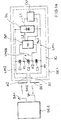
- FIG. 1a is a radio frequency communication device for a bidirectional, contactless Data transmission consisting of a transmitting and receiving device SE2, for example a base station, and a transmitting and receiving device SE1, for example a passive transponder.
- the sending and receiving device SE2 sent a question signal by means of a transmission antenna SA1, which is from the Transmitting and receiving device SE1 is modulated as a response signal and backscattered.
- the backscattered signal is transmitted from the transmitting and receiving device SE2 by means of a Antenna SA2 received.
- the structure of the transmitting and receiving device is described below SE1 explained.
- the transmitting and receiving device SE1 has a dipole antenna DI1 and an integrated circuit IC.
- the dipole antenna DI1 is connected to the integrated circuit IC by means of the two contacts A1 and A2.
- the contact A1 is connected to a reference potential by means of the line LM1, and the contact A2 is connected to the line LM2.
- the line LM1 and the line LM2 are a series circuit comprising a first capacitor C1, a MOS varactor C2 and a capacitor C3.
- the series connection between the capacitance C1 and the capacitance C2 has the node K1 and between the capacitance C2 and the capacitance C3 the node K2.
- a controllable voltage source SP is connected to the nodes K1 and K2 and applies a voltage VMOD to the varactor C2. Furthermore, a rectifier GL is connected to line LM1 and line LM2. The rectifier GL is connected to a control unit CU by a line L1. Furthermore, the rectifier GL is connected to the voltage source SP. The control unit CU is connected to the line LM2. Furthermore, the control unit CU is connected to the controllable voltage source SP by a line SL1.
- the mode of operation of the transmitting and receiving device SE1 is explained below.
- the HF signal transmitted by the transmitting and receiving device SE2 is received by the transponder by means of the dipole antenna DI1.
- the rectifier unit GL also contains a signal detector (RSSI).
- the output of the signal detector of the control unit CU is fed via the line L1, which is designed as a bus line. If the supply voltage is sufficient, the control unit CU uses the voltage source SP to apply the voltage VMOD to the MOS varactor C2. The capacity of the MOS varactor C2 is changed with the voltage VMOD. This changes the impedance of the entire circuit parts connected to line LM1 and line LM2. The proportion of the absorbed or backscattered signal is changed by means of the change in impedance.
- the change in the backscattered portion produces a phase modulation of the backscattered signal.
- the frequency of the voltage VMOD is small compared to the frequency of the received RF signal.
- the capacitances C1 and C3 can be used to suppress an influence on the RF signal lying on the lines LM1 and LM2.
- capacitors with a high quality ie with a low real part and a high imaginary part, are preferably used in the series connection of the capacitors C1 to C3. This ensures that an effective phase modulation is generated by the voltage VMOD.
- the range for data transmission is increased, since the signal absorption takes place essentially through the rectifier GL and not in the series connection of the capacitors.
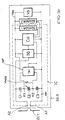
- FIG. 1b shows a transmitting and receiving device SE3, for example a semi-passive one Transponder shown.
- the transmitting and receiving device SE2 Question signal sent out by the transmitting and receiving device SE3 as a response signal is modulated and backscattered. From the transmitting and receiving device SE2 the backscattered signal is received.
- the structure of the broadcast and Receiving device SE3 explains, insofar as this relates to the structure of the transmitting and receiving device SE1 deviates.
- the contact A1 is by means of a reference potential line
- the contact A2 is connected to the capacitor C1 and to a signal detector unit SD.
- the signal detector unit SD is connected to the supply voltage line to which a supply voltage unit VS applies the supply voltage VDD.
- the voltage source SP is connected to the supply voltage line.
- the control unit CU with the supply voltage line and with the Signal detector unit SD interconnected.
- the control unit CU has a first Sensor SENSOR1 and a second sensor SENSOR2 connected. These two sensors SENSOR1 and SENSOR2 are also connected to the supply voltage line and the reference potential line connected.
- the sensor is SNESOR2 and the supply voltage unit VS not arranged within the integrated circuit IC.
- the mode of operation of the transmitting and receiving device SE3 is explained below.
- the dipole antenna DI1 is used to transmit that from the transmitting and receiving device SE2 Receive RF signal from the transponder.
- transceiver SE1 only a very small part of the signal is absorbed because of the supply voltage VDD from the supply voltage unit VS, which is designed, for example, as a foil battery is generated.
- For the transmission of data from the transmitting and receiving device SE3 to the transmitting and receiving device SE2 is achieved by varying the voltage VMOD generates an impedance change in the antenna circuit and the phase of the backscattered Signal changed (PSK modulation).
- the Frequency of the voltage VMOD small compared to the frequency of the received RF signal.
- the field strength of the incoming Carrier from the signal detector unit SD which is implemented, for example, as an RSSI circuit is determined and the control unit CU, for example as a state machine or as Microprocessor is executed, communicated.
- the signal detector unit SD in Connection to the control unit CU extracts the data of the query signal.
- the environmental data determined by the sensors SENSOR1 and SENSOR2 by means of the control unit CU and by means of the voltage source SP to the backscattered Modulate carrier wave.
- the range of data transmission is different to the transmitting and receiving device SE2 significantly increased since no signal absorption done by the rectifier GL.
- FIG. 2a shows a sequence of semiconductor layers for the capacitances C1 and C3, by means of high quality capacitors within a standard CMOS process have it made.
- the sequence of the layers is explained below.
- a semiconductor carrier HL becomes a conductive layer L3, for example by doping or metallization, generated.
- This preferably very low-resistance layer L3 becomes with the reference potential connected.
- an insulating layer for example by a CVD deposition or oxidation produces, the thickness of which is preferably above one micron lies.
- a low-resistance conductive layer L2 for example, is made from doped polysilicon by means of a deposition process or made of metal.
- Layer L2 either with node K1, when used as capacitance C1 or with the line LM1 interconnected when used as capacitance C3.
- a thin dielectric Layer for example made of nitride using a CVD process.
- the fat the layer is preferably in the range of a few tenths of a micron.
- one layer L1 as low as possible for example made of polysilicon or metal, which is interconnected with the node K2 or with the line LM2.
- connection Layer L3 which is connected to the reference potential with as low an impedance as possible
- the quality of the capacitance C1 or C3 is significantly increased, i.e. the real part is greatly reduced.
- the area of layer L3 becomes larger than the area of the layers L2, L1 selected.
- both capacitances C1 and C3 have a common layer L3 areal extension of layer L3 is greater than the sum of the areas of the layer L1C1 and the layer L1C3 is selected.
- An advantage of the common layer L3 is that very low impedance connection to the reference potential and a low space consumption in the integrated circuit IC.
- the integrated circuit arrangement is used in a transponder by others Functional units expanded.
- the control unit demodulates of the received signal and an evaluation of the data carried out, such as it is necessary for an identification process as part of an authentication.
Landscapes
- Engineering & Computer Science (AREA)
- Radar, Positioning & Navigation (AREA)
- Remote Sensing (AREA)
- Physics & Mathematics (AREA)
- General Physics & Mathematics (AREA)
- Computer Hardware Design (AREA)
- Microelectronics & Electronic Packaging (AREA)
- Theoretical Computer Science (AREA)
- Computer Networks & Wireless Communication (AREA)
- Mechanical Engineering (AREA)
- Near-Field Transmission Systems (AREA)
- Arrangements For Transmission Of Measured Signals (AREA)
- Semiconductor Integrated Circuits (AREA)
Abstract
Description
In einer Weiterbildung der Sende- und Empfangseinrichtung enthält die integrierte Schaltungsanordnung zur Erzeugung einer Impedanzänderung des MOS-Varaktors eine steuerbare Spannungsquelle. Hierdurch läßt sich besonders vorteilhaft die Rückstreuleistung verändern, wobei das rückgestreute Fragesignal eine Phasenmodulationskomponente enthält. Dies ist vorteilhaft, da eine Datenübertragung mittels einer Phasenmodulation störunempfindlicher ist, als eine Datenübertragung durch eine Last- oder Amplitudenmodulation. Untersuchungen der Anmelderin haben gezeigt, daß sich eine zuverlässige Datenübertagung und eine hohe Datenrate ergibt, sofern die imaginäre Phasenmodulationskomponente symmetrisch bezüglich der Realteilachse liegt. Ferner enthält die Sende- und Empfangseinrichtung eine Gleichrichtereinheit, die mittels Absorption des empfangenen Trägersignals eine Versorgungsspannung für die integrierte Schaltungsanordnung erzeugt. Hierdurch erübrigt sich eine Versorgungsspannungseinheit und die Sende- und Empfangseinrichtung lässt sich beispielsweise vorteilhaft als sogenannter passiver Transponder verwenden. Des Weiteren lässt sich mittels der Gleichrichtereinheit in Verbindung mit der Steuereinheit das empfangene Fragesignal demodulieren und die mit dem Fragesignal übertragenen Daten extrahieren. Ferner ist es vorteilhaft ein oder mehrere Sensoren zum Messen von Umgebungsdaten, wie beispielsweise Druck, Temperatur, Beschleunigung usw. zu integrieren. Hierdurch lässt sich nach dem Empfang eines Trägersignals die von der Transpondereinheit ermittelten Umgebungsdaten an eine das Trägersignal aussendende Basisstation übermitteln.
In einer anderen Weiterbildung ist es vorteilhaft, enthält die Sende- und Empfangseinrichtung einen oder mehrere Sensoren, um mittels den Sensoren Umgebungsdaten zu ermitteln. Sofern notwendig lässt sich die Spannungsversorgung der Sensoren mittels der Versorgungsspannungseinheit durchführen. Eine Auswertung der ermittelten Umgebungsdaten, beispielsweise Temperatur oder Druck, lässt sich durch die Kontrolleinheit innerhalb der integrierten Schaltung durchführen und anschließend an eine weitere Sende- Empfangseinrichtung übermitteln. Ferner ist es auch vorteilhaft, die durch die Sensoren ermittelten Umgebungsdaten direkt, d.h. ohne weitere Auswertung innerhalb der Sende- und Empfangseinrichtung, beispielsweise als sogenannter semi-passiver Transponder, an eine weitere Sendeund Empfangseinrichtung, beispielsweise einer Basisstation, zu übertragen. Die Übertragung der Umgebungsdaten lässt sich beispielsweise erst nach einer der Aufforderung mittels eines Fragesignals der Basisstation durchführen. Hiermit lassen sich kostengünstige Kommunikationssysteme aufbauen die beispielsweise den Reifendruck an einem Kraftfahrzeug messen und die gemessenen Werte an die Basisstation übertragen. Als Sensoren zur Bestimmung der Umgebungstemperatur lassen sich in vorteilhafter Weise Halbleiterdioden verwenden.. Derartige Dioden sind einfach und kostengünstig in die integrierte Schaltung zu integrieren. Weiterhin vorteilhaft ist eine Speichereinheit, die als flüchtiger oder nichtflüchtiger Speicher ausgeführt ist, zu integrieren. Hierdurch lassen sich mehrere Umgebungsdaten und oder deren zeitlichen Verlauf ermitteln und in der Speichereinheit ablegen. Das Übertragen der Umgebungsdaten lässt sich hierdurch zu einem späteren Zeitpunkt durchführen.
Die angegebene Sende- und Empfangseinrichtung läßt sich in besonders vorteilhafter Weise zum Aufbau einer Kommunikationseinrichtung bestehend aus der Sende-und Empfangseinrichtung, beispielsweise ein Transponder, zum Rückstreuen eines von einer ersten Sende- und Empfangseinrichtung, beispielsweise eine Basisstation, ausgesendeten Fragesignals verwenden. Insbesondere bei Verwendung von passiven Transpondern, d.h. Transpondern, die die Energie zur Versorgung der integrierten Schaltung aus dem elektromagnetischen Feld der Basisstation beziehen, läßt sich mit der Serienschaltung der Kapazitäten in Verbindung mit deren hohen Güten, eine Erhöhung der Kommunikationsreichweite auf mehrere Meter erzielen. Eine weitere Erhöhung der Kommunikationsreichweite lässt sich mittels einer semi-passiven Transponderausführung erzielen. Hierbei wird keine Energie aus dem HF-Feld zur Versorgung der anderen Einheiten, wie beispielsweise der Steuereinheit, benötigt. Untersuchungen der Anmelderin haben gezeigt, dass sich insbesondere bei einer semi-passiven Transponderausführung mittels eines Piezoelementes zur Erzeugung der Versorgungsspannung, eine kostengünstige und umweltschonende Möglichkeit zur Kontrolle des Reifendruckes bei Kraftfahrzeugen herstellen lässt.
- Fig. 1a
- eine Sende- und Empfangseinrichtung mit einer Serienschaltung von Kapazitäten am Antenneneingang der integrierten Schaltung, und
- Fig. 1b
- eine Sende- und Empfangseinrichtung und mit einer Serienschaltung von Kapazitäten und einer Versorgungsspannungseinheit, und
- Fig. 2a
- ein Querschnitt der Schichtabfolge der Kapazität der integrierten Schaltungsanordnung, und
- Fig. 2b
- eine Draufsicht auf die layouteten Kapazitäten.
Im Folgenden wird die Funktionsweise der Sende- und Empfangseinrichtung SE1 erläutert. Mittels der Dipolantenne DI1 wird das von der Sende- und Empfangseinrichtung SE2 ausgesendete HF-Signal von dem Transponder empfangen. Hierbei wird ein Teil des Signals absorbiert und mittels des Gleichrichter GL eine Versorgungsspannung für die integrierte Schaltungsanordnung IC erzeugt. Ein anderer Teil des empfangenen Signal wird zurückgestreut. Ferner enthält die Gleichrichtereinheit GL einen Signaldetektor (RSSI). Wobei der Ausgang des Signaldedektors der Steuereinheit CU über die Leitung L1, die als Busleitung ausgebildet ist, zugeführt. Bei einer ausreichenden Versorgungsspannung wird von der Steuereinheit CU mittels der Spannungsquelle SP die Spannung VMOD an den MOS-Varaktor C2 angelegt. Mit Höhe der Spannung VMOD wird die Kapazität des MOS-Varaktors C2 geändert. Hierdurch wird die Impedanz der gesamten mit der Leitung LM1 und der Leitung LM2 verbunden Schaltungsteile geändert. Mittels der Impedanzänderung wird der Anteil der absorbierten bzw. rückgestreuten Signals geändert. Die Änderung des rückgestreuten Anteils erzeugt eine Phasenmodulation des zurückgestreuten Signals. Hierbei ist die Frequenz der Spannung VMOD klein gegenüber der Frequenz des empfangenen HF-Signals. Hierdurch läßt sich mittels den Kapazitäten C1 und C3 eine Beeinflußung des auf den Leitungen LM1 und LM2 liegenden HF-Signals unterdrücken. Um die Verluste der Anordnung zu verringern, werden in der Serienschaltung der Kapazitäten C1 bis C3 vorzugsweise Kondensatoren mit einer hohen Güte, d.h. mit einen geringen Realteil und hohem Imaginärteil, eingesetzt. Hierdurch wird erreicht, daß eine wirkungsvolle Phasenmodulation durch die Spannung VMOD erzeugt wird. Ferner wird die Reichweite für die Datenübertragung erhöht, da die Signalabsorption im Wesentlichen durch den Gleichrichter GL und nicht in der Serienschaltung der Kondensatoren erfolgt.
Claims (17)
- Sende- und Empfangseinrichtung (SE1, SE3) für eine kontaktlose Datenübertragung die ein Fragesignal als Antwortsignal moduliert zurückstreut, und die Sende- und Empfangseinrichtung (SE1, SE3) eine integrierte Schaltungsanordnung (IC) mit wenigstens zwei Kontaktflächen (A1, A2) zum Anschluß einer Antenne (DI1) enthält,
dadurch gekennzeichnet, daß
die integrierte Schaltungsanordnung (IC) zur Steuerung des rückgestreuten Anteils des Fragesignals zwischen den Kontaktflächen (A1, A2) eine Serienschaltung aus einer ersten, einer zweiten und einer dritten Kapazität (C1, C2, C3) enthält, und die zweite Kapazität (C2) ein Varaktor ist. - Sende- und Empfangseinrichtung nach Anspruch 1, dadurch gekennzeichnet, daß die zweite Kapazität ein MOS-Varaktor (C2) ist.
- Sende- und Empfangseinrichtung (SE1, SE3) nach Anspruch 2, dadurch gekennzeichnet, daß die integrierte Schaltungsanordnung (IC) zur Erzeugung einer Impedanzänderung des MOS-Varaktors (C2) eine steuerbare Spannungsquelle (SP) enthält.
- Sende- und Empfangseinrichtung (SE1, SE3) nach einem der Ansprüche 1 bis 3, dadurch gekennzeichnet, daß der rückgestreute Anteil der Fragesignals eine Phasenmodulationskomponente enthält.
- Sende- und Empfangseinrichtung (SE1, SE3) nach Anspruch 4, dadurch gekennzeichnet, daß die Phasenmodulationskomponente symmetrisch bezüglich der Realteilachse liegt.
- Sende- und Empfangseinrichtung (SE1, SE3) nach einem der Ansprüche 1 bis 5, dadurch gekennzeichnet, daß die integrierte Schaltungsanordnung (IC) zur Erzeugung einer Versorgungsspannung eine Gleichrichtereinheit (GL) enthält.
- Sende- und Empfangseinrichtung (SE1, SE3) nach einem der Ansprüche 1 bis 5, dadurch gekennzeichnet, daß die Sende- und Empfangseinrichtung (SE1, SE3) zur Erzeugung einer Versorgungsspannung (VDD) eine Versorgungsspannungseinheit (VS), insbesondere eine Batterie, enthält.
- Sende- und Empfangseinrichtung (SE1, SE3) nach Anspruch 7, dadurch gekennzeichnet, daß die integrierte Schaltungsanordnung (IC) zur Ermittlung der Signalstärke eine Signaldetektoreinheit (SD) enthält.
- Sende- und Empfangseinrichtung (SE1, SE3) nach Anspruch 7 oder Anspruch 8, dadurch gekennzeichnet, daß die Sende- und Empfangseinrichtung (SE1, SE3) zur Ermittlung von Umgebungsgrößen wenigstens einen Sensor (SENSOR1, SENSOR2) enthält.
- Sende- und Empfangseinrichtung (SE1, SE3) nach Anspruch 7 oder Anspruch 8, dadurch gekennzeichnet, daß die integrierte Schaltungsanordnung (IC) eine Speichereinheit enthält.
- Sende- und Empfangseinrichtung (SE1, SE3) nach einem der Ansprüche 1 bis 10, dadurch gekennzeichnet, daß die erste und die dritte Kapazität (C1,C3) jeweils drei übereinanderliegende leitfähigen Schichten (L1, L2 ,L3), die auf einem Halbleiterträger (HL) aufgebracht sind, enthält, und zwischen der ersten und der zweiten leitfähigen Schicht (L1, L2) eine dielektrische Schicht (Dl), und zwischen der zweiten und der dritten leitfähigen Schicht (L2, L3) eine Isolationsschicht (ISO) eingezogen ist.
- Sende- und Empfangseinrichtung (SE1, SE3) nach Anspruch 11, dadurch gekennzeichnet, daß die dritte leitfähige Schicht (L3) einen niederohmigen Anschluß an ein Bezugspotential enthält und von ihrer flächenhaften Ausdehnung größer als die erste oder die zweite leitfähige Schicht (L1,L2) ist.
- Sende- und Empfangseinrichtung (SE1, SE3) nach Anspruch 12, dadurch gekennzeichnet, daß die erste und die zweite Kapazität (C1, C2) eine gemeinsame dritte leitfähige Schicht (L3) enthält.
- Verwendung der Sende- und Empfangseinrichtung (SE1, SE3) nach einem der vorangegangenen Ansprüchen zum Aufbau einer Kommunikationseinrichtung, bestehend aus der Sende- und Empfangseinrichtung (SE1, SE3) zum Rückstreuen eines von einer Sende- und Empfangseinrichtung (SE2) ausgesendeten Fragesignals.
- Verwendung der Sende- und Empfangseinrichtung (SE1, SE3) nach Anspruch 14 zum Aufbau einer Kommunikationseinrichtung, bestehend aus einer passiven Sende- und Empfangseinrichtung (SE1, SE3).
- Verwendung der Sende- und Empfangseinrichtung (SE1, SE3) nach Anspruch 14 zum Aufbau einer Kommunikationseinrichtung, bestehend aus einer semi-passiven Sendeund Empfangseinrichtung (SE1, SE3).
- Verwendung der Sende- und Empfangseinrichtung (SE1, SE3) nach Anspruch 16 zur Kontrolle des Reifendruckes, wobei die Versorgungsspannung mittels eines piezoelektrischen Elementes erzeugt wird.
Applications Claiming Priority (4)
| Application Number | Priority Date | Filing Date | Title |
|---|---|---|---|
| DE2001158442 DE10158442B4 (de) | 2001-12-01 | 2001-12-01 | Sende- und Empfangseinrichtung für eine kontaktlose Datenübertragung |
| DE10158442 | 2001-12-01 | ||
| DE2002156099 DE10256099A1 (de) | 2001-12-01 | 2002-11-29 | Sende- und Empfangseinrichtung für eine kontaktlose Datenübertragung |
| DE10256099 | 2002-11-29 |
Publications (2)
| Publication Number | Publication Date |
|---|---|
| EP1326202A2 true EP1326202A2 (de) | 2003-07-09 |
| EP1326202A3 EP1326202A3 (de) | 2006-01-11 |
Family
ID=26010676
Family Applications (1)
| Application Number | Title | Priority Date | Filing Date |
|---|---|---|---|
| EP02026665A Withdrawn EP1326202A3 (de) | 2001-12-01 | 2002-11-29 | Sende- und Empfangseinrichtung für eine kontaktlose Datenübertragung |
Country Status (2)
| Country | Link |
|---|---|
| EP (1) | EP1326202A3 (de) |
| DE (2) | DE10158442B4 (de) |
Cited By (7)
| Publication number | Priority date | Publication date | Assignee | Title |
|---|---|---|---|---|
| EP1437816A3 (de) * | 2003-01-10 | 2004-10-06 | ATMEL Germany GmbH | Schaltungsanordnung zur Bereitstellung elektrischer Leistung aus einem elektromagnetischen Feld |
| WO2005109329A1 (en) * | 2004-05-04 | 2005-11-17 | Battelle Memorial Institute | Semi-passive radio frequency identification (rfid) tag with active beacon |
| EP1499034A3 (de) * | 2003-05-28 | 2006-01-11 | ATMEL Germany GmbH | Schaltungsanordnung und Verfahren zur Phasenmodulation für rückstreubasierte Transponder |
| US7151436B2 (en) | 2003-01-10 | 2006-12-19 | Atmel Germany Gmbh | Receiving/backscattering arrangement and method with two modulation modes for wireless data transmission as well as modulation arrangement therefor |
| EP1742166A1 (de) * | 2005-07-07 | 2007-01-10 | ATMEL Germany GmbH | Verfahren zur Zugriffssteuerung auf einen Transponder |
| US7317382B2 (en) | 2004-12-13 | 2008-01-08 | Battelle Memorial Institute | Remote communications devices, wireless communications systems, and wireless communications methods |
| US20250108669A1 (en) * | 2023-10-02 | 2025-04-03 | The Goodyear Tire & Rubber Company | Pcb impedance tuning to achieve wideband and high acceptance of coil antenna length variation |
Families Citing this family (12)
| Publication number | Priority date | Publication date | Assignee | Title |
|---|---|---|---|---|
| DE10158442B4 (de) * | 2001-12-01 | 2004-11-25 | Atmel Germany Gmbh | Sende- und Empfangseinrichtung für eine kontaktlose Datenübertragung |
| DE10325399A1 (de) * | 2003-05-28 | 2004-12-30 | Atmel Germany Gmbh | Schaltungsanordnung zur Phasenmodulation für rückstreubasierte Transporder |
| DE102004013837B4 (de) | 2004-03-16 | 2009-03-19 | Atmel Germany Gmbh | Verfahren zur drahtlosen Datenübertragung |
| EP1769422B1 (de) | 2004-07-12 | 2009-01-21 | ATMEL Germany GmbH | Modulator und modulationsverfahren für eine einrichtung zur drahtlosen datenübertragung |
| DE102004062132A1 (de) * | 2004-12-23 | 2006-07-13 | Atmel Germany Gmbh | Backscatter Transponder |
| DE102005037582A1 (de) * | 2005-08-09 | 2007-02-22 | Siemens Ag | Lokalisierbarer und energieautarker Backscatter-Transponder zur Erfassung von Messgrößen |
| DE102006044015A1 (de) * | 2006-09-15 | 2008-03-27 | Fraunhofer-Gesellschaft zur Förderung der angewandten Forschung e.V. | Hochfrequenzsender sowie Verfahren zu dessen Betrieb |
| EP2269317A4 (de) * | 2008-03-31 | 2011-06-29 | Michelin Rech Tech | In reifen eingebetteter selbstbestromter halbpassiver rfid-transponder |
| DE102008026901B4 (de) * | 2008-06-05 | 2010-06-02 | Cellpack Gmbh | Datenübertragungssystem mit Ortungs-, Identifikations- und Messfunktion sowie ein Verfahren hierzu |
| WO2013118116A2 (en) * | 2012-02-09 | 2013-08-15 | Humavox Ltd. | Energy harvesting system |
| ITUB20160273A1 (it) * | 2016-01-21 | 2017-07-21 | Idee & Progetti S R L | Unità di racimolazione energia elettrica per cavo a media o alta tensione, dispositivo di rilevazione e sistema |
| DE102024200553A1 (de) * | 2024-01-22 | 2025-07-24 | Fraunhofer-Gesellschaft zur Förderung der angewandten Forschung eingetragener Verein | Modulationsschaltung |
Family Cites Families (11)
| Publication number | Priority date | Publication date | Assignee | Title |
|---|---|---|---|---|
| US4388524A (en) * | 1981-09-16 | 1983-06-14 | Walton Charles A | Electronic identification and recognition system with code changeable reactance |
| GB2202415A (en) * | 1987-03-17 | 1988-09-21 | Ferranti Plc | Object identification system |
| DE3810702A1 (de) * | 1988-03-25 | 1989-10-12 | Angewandte Digital Elektronik | Phasenstabilisierter, -gekoppelter schwingkreis |
| US5206639A (en) * | 1990-10-25 | 1993-04-27 | Timex Corporation | Single antenna dual frequency transponder |
| DE4239065A1 (de) * | 1992-11-20 | 1994-05-26 | Diehl Gmbh & Co | Hochfrequenz-Kommunikationseinrichtung |
| DE19614455A1 (de) * | 1996-04-12 | 1997-10-16 | Philips Patentverwaltung | Verfahren zum Betrieb eines Systems aus einer Basisstation und einem damit kontaktlos gekoppelten Transponders sowie dafür geeignetes System |
| DE19652324A1 (de) * | 1996-12-16 | 1998-06-25 | Siemens Ag | Transponder mit einer Mikrowellen-Empfangsantenne |
| US6054925A (en) * | 1997-08-27 | 2000-04-25 | Data Investments Limited | High impedance transponder with improved backscatter modulator for electronic identification system |
| JP2000151480A (ja) * | 1998-11-11 | 2000-05-30 | Mitsubishi Materials Corp | 重畳タグの識別方式 |
| DE10002501B4 (de) * | 2000-01-21 | 2006-04-27 | Atmel Germany Gmbh | Integrierte Schaltungsanordnung zur NF-Signalgewinnung bei kontaktloser Datenübertragung |
| DE10158442B4 (de) * | 2001-12-01 | 2004-11-25 | Atmel Germany Gmbh | Sende- und Empfangseinrichtung für eine kontaktlose Datenübertragung |
-
2001
- 2001-12-01 DE DE2001158442 patent/DE10158442B4/de not_active Expired - Fee Related
-
2002
- 2002-11-29 DE DE2002156099 patent/DE10256099A1/de not_active Ceased
- 2002-11-29 EP EP02026665A patent/EP1326202A3/de not_active Withdrawn
Cited By (13)
| Publication number | Priority date | Publication date | Assignee | Title |
|---|---|---|---|---|
| US6940467B2 (en) | 2003-01-10 | 2005-09-06 | Atmel Germany Gmbh | Circuit arrangement and method for deriving electrical power from an electromagnetic field |
| US7151436B2 (en) | 2003-01-10 | 2006-12-19 | Atmel Germany Gmbh | Receiving/backscattering arrangement and method with two modulation modes for wireless data transmission as well as modulation arrangement therefor |
| EP1437816A3 (de) * | 2003-01-10 | 2004-10-06 | ATMEL Germany GmbH | Schaltungsanordnung zur Bereitstellung elektrischer Leistung aus einem elektromagnetischen Feld |
| EP1499034A3 (de) * | 2003-05-28 | 2006-01-11 | ATMEL Germany GmbH | Schaltungsanordnung und Verfahren zur Phasenmodulation für rückstreubasierte Transponder |
| US7158010B2 (en) | 2003-05-28 | 2007-01-02 | Atmel Germany Gmbh | Circuit arrangement and method for phase modulation in a backscattering transponder |
| US7348875B2 (en) | 2004-05-04 | 2008-03-25 | Battelle Memorial Institute | Semi-passive radio frequency identification (RFID) tag with active beacon |
| WO2005109329A1 (en) * | 2004-05-04 | 2005-11-17 | Battelle Memorial Institute | Semi-passive radio frequency identification (rfid) tag with active beacon |
| US7317382B2 (en) | 2004-12-13 | 2008-01-08 | Battelle Memorial Institute | Remote communications devices, wireless communications systems, and wireless communications methods |
| EP1742166A1 (de) * | 2005-07-07 | 2007-01-10 | ATMEL Germany GmbH | Verfahren zur Zugriffssteuerung auf einen Transponder |
| US7872567B2 (en) | 2005-07-07 | 2011-01-18 | Atmel Automotive Gmbh | Method for transponder access control |
| US20250108669A1 (en) * | 2023-10-02 | 2025-04-03 | The Goodyear Tire & Rubber Company | Pcb impedance tuning to achieve wideband and high acceptance of coil antenna length variation |
| EP4534301A1 (de) * | 2023-10-02 | 2025-04-09 | The Goodyear Tire & Rubber Company | Reifenüberwachungsvorrichtung und -system |
| US12565066B2 (en) * | 2023-10-02 | 2026-03-03 | The Goodyear Tire & Rubber Company | PCB impedance tuning to achieve wideband and high acceptance of coil antenna length variation |
Also Published As
| Publication number | Publication date |
|---|---|
| DE10158442B4 (de) | 2004-11-25 |
| DE10158442A1 (de) | 2003-06-26 |
| EP1326202A3 (de) | 2006-01-11 |
| DE10256099A1 (de) | 2004-06-17 |
Similar Documents
| Publication | Publication Date | Title |
|---|---|---|
| EP1326202A2 (de) | Sende- und Empfangseinrichtung für eine kontaktlose Datenübertragung | |
| DE60310957T2 (de) | Rfid-reifengürtelantennensystem und verfahren | |
| DE60306073T2 (de) | Verfahren zur Anpassung der elektromagnetischen Kopplungscharakteristik in einem kontaktlosen Energieversorgungssystem, sowie ein kontaktloses Energieversorgungssystem | |
| EP2284773B2 (de) | Chipkarte | |
| EP1163632B1 (de) | Oberflächen-wellen-wandler-einrichtung sowie identifikationssystem hiermit | |
| EP1482647B1 (de) | Schaltungsanordnung zur Phasenmodulation für rückstreubasierte Transponder | |
| EP1675041B1 (de) | Backscatter transponder | |
| EP1261501B1 (de) | Erzeugnis mit einem sensor und einem oberflächenwellenelement sowie verfahren und anordnung zur bestimmung einer einem reaktiven widerstand entsprechenden messgrösse eines sensors | |
| EP2348455B1 (de) | Tragbarer Datenträger mit aktiver Kontaktlosschnittstelle | |
| DE69812339T2 (de) | Datenkommunikationsvorrichtung, datenkommunikationssystem und datenkommunikationsverfahren | |
| WO1989011701A1 (fr) | Appareil d'interrogation et de telecommande; procede de fonctionnement et d'utilisation dudit appareil | |
| EP1499034B1 (de) | Schaltungsanordnung und Verfahren zur Phasenmodulation für rückstreubasierte Transponder | |
| DE102005059226A1 (de) | Selbsttätig abgleichendes Übertragungssystem für Fahrzeuge | |
| DE102004034768B4 (de) | Identifikations-Datenträger | |
| DE19602316C1 (de) | Vorrichtung zum Übertragen von Daten oder Energie | |
| EP1258830B1 (de) | Verfahren zum Abgleich eines Antennenschwingkreises eines passiven Transponders | |
| WO2018041515A1 (de) | Positionserfassungssensor und -system | |
| EP2115704B1 (de) | Güteanpassung eines empfangsschaltkreises | |
| DE69104690T2 (de) | Elektromagnetische Wellen nutzendes Datenaustauschsystem. | |
| DE69915270T2 (de) | Vorrichtung zur Kontrolle der auf die Antenne zurückgeführten Impedanz eines elektronischen Etiketts | |
| DE69127674T2 (de) | Vorrichtung für Telekommunikationen durch elektromagnetische Wellen | |
| EP1966742A1 (de) | Vorrichtung und verfahren zur prüfung und drahtlosen übermittlung des zustands eines signalgebers | |
| DE102005028396B4 (de) | Transpondervorrichtung und Reifendrucküberwachungssystem mit Transpondervorrichtung | |
| EP3972136B1 (de) | Verfahren sowie einrichtung zur bestimmung der antennenanpassung | |
| EP3198731B1 (de) | Verfahren und sicherheitsmodul zum empfang von zwei signalen |
Legal Events
| Date | Code | Title | Description |
|---|---|---|---|
| PUAI | Public reference made under article 153(3) epc to a published international application that has entered the european phase |
Free format text: ORIGINAL CODE: 0009012 |
|
| AK | Designated contracting states |
Designated state(s): AT BE BG CH CY CZ DE DK EE ES FI FR GB GR IE IT LI LU MC NL PT SE SK TR |
|
| AX | Request for extension of the european patent |
Extension state: AL LT LV MK RO SI |
|
| PUAL | Search report despatched |
Free format text: ORIGINAL CODE: 0009013 |
|
| AK | Designated contracting states |
Kind code of ref document: A3 Designated state(s): AT BE BG CH CY CZ DE DK EE ES FI FR GB GR IE IT LI LU MC NL PT SE SK TR |
|
| AX | Request for extension of the european patent |
Extension state: AL LT LV MK RO SI |
|
| 17P | Request for examination filed |
Effective date: 20051215 |
|
| AKX | Designation fees paid |
Designated state(s): DE FR |
|
| RAP1 | Party data changed (applicant data changed or rights of an application transferred) |
Owner name: ATMEL AUTOMOTIVE GMBH |
|
| STAA | Information on the status of an ep patent application or granted ep patent |
Free format text: STATUS: THE APPLICATION HAS BEEN WITHDRAWN |
|
| 18W | Application withdrawn |
Effective date: 20090811 |