EP1325928A1 - Process for the preparation of pregnane derivatives - Google Patents
Process for the preparation of pregnane derivatives Download PDFInfo
- Publication number
- EP1325928A1 EP1325928A1 EP01961343A EP01961343A EP1325928A1 EP 1325928 A1 EP1325928 A1 EP 1325928A1 EP 01961343 A EP01961343 A EP 01961343A EP 01961343 A EP01961343 A EP 01961343A EP 1325928 A1 EP1325928 A1 EP 1325928A1
- Authority
- EP
- European Patent Office
- Prior art keywords
- group
- substituted
- derivative
- oxopregnane
- hydroxy
- Prior art date
- Legal status (The legal status is an assumption and is not a legal conclusion. Google has not performed a legal analysis and makes no representation as to the accuracy of the status listed.)
- Withdrawn
Links
Classifications
-
- C—CHEMISTRY; METALLURGY
- C07—ORGANIC CHEMISTRY
- C07J—STEROIDS
- C07J41/00—Normal steroids containing one or more nitrogen atoms not belonging to a hetero ring
- C07J41/0005—Normal steroids containing one or more nitrogen atoms not belonging to a hetero ring the nitrogen atom being directly linked to the cyclopenta(a)hydro phenanthrene skeleton
-
- C—CHEMISTRY; METALLURGY
- C07—ORGANIC CHEMISTRY
- C07J—STEROIDS
- C07J21/00—Normal steroids containing carbon, hydrogen, halogen or oxygen having an oxygen-containing hetero ring spiro-condensed with the cyclopenta(a)hydrophenanthrene skeleton
- C07J21/005—Ketals
- C07J21/006—Ketals at position 3
-
- C—CHEMISTRY; METALLURGY
- C07—ORGANIC CHEMISTRY
- C07J—STEROIDS
- C07J5/00—Normal steroids containing carbon, hydrogen, halogen or oxygen, substituted in position 17 beta by a chain of two carbon atoms, e.g. pregnane and substituted in position 21 by only one singly bound oxygen atom, i.e. only one oxygen bound to position 21 by a single bond
-
- C—CHEMISTRY; METALLURGY
- C07—ORGANIC CHEMISTRY
- C07J—STEROIDS
- C07J9/00—Normal steroids containing carbon, hydrogen, halogen or oxygen substituted in position 17 beta by a chain of more than two carbon atoms, e.g. cholane, cholestane, coprostane
Definitions
- the present invention relates to processes for preparing pregnane derivatives.
- the pregnane derivatives obtained by the processes of the present invention are useful, for example, as intermediates for synthesis of squalamine represented by the following formula.
- Squalamine has been extracted from the livers of dogfish sharks at such a low extraction efficiency of 0.001 to 0.002% by weight that its chemical synthesis has been investigated.
- Known processes of chemical synthesis of squalamine include 1) a process which comprises using 3 ⁇ -acetoxy-5-cholenic acid as a starting material [see Tetrahedron Lett., 35 , 8103(1994)]; 2) a process which comprises using 3 ⁇ -hydroxy-5-cholenic acid as a starting material [see J. Org. Chem.
- the above process 4 using a starting material of stigmasterol available at a low cost, requires 20 steps to synthesize squalamine. Moreover, the process has the drawbacks of using an expensive silver carbonate in a step of selectively oxidizing the 3-position hydroxy group and, further, of comprising an ozone-oxidation step under a low temperature, which requires a special reaction equipment. This process cannot necessarily be said to be commercially advantageous.
- an object of the present invention is to provide a process for preparing pregnane derivatives from a readily available starting material and efficiently in short steps.
- Any protecting group can be used as the protecting group for hydroxy group represented by each of R 1 and R 2 , as long as it can act as such.
- the protecting group are alkyl groups, e.g. tert-butyl and tert-amyl; aralkyl groups, e.g. benzyl, o-methylbenzyl, m-methylbenzyl, p-methylbenzyl, p-nitrobenzyl, p-methoxybenzyl, p-phenylbenzyl, diphenylmethyl and triphenylmethyl; acyl groups; e.g.
- acetyl chloroacetyl, dichloroacetyl, trichloroacetyl, trifluoroacetyl, methoxyacetyl, triphenylmethoxyacetyl, phenoxyacetyl, p-chlorophenoxyacetyl, phenylacetyl, diphenylacetyl, propionyl, butyryl, valeryl, 4-pentenoyl, pivaloyl, crotonoyl, benzoyl, o-methylbenzoyl, m-methylbenzoyl, p-methylbenzoyl, 2,3-dimethylbenzoyl, 2,4-dimethylbenzoyl, 2,5-dimethylbenzoyl, 2,6-dimethylbenzoyl, 2,4,6-trimethylbenzoyl, and p-phenylbenzoyl; alkoxycarbonyl groups, e.g.
- alkyl groups that have 1 to 6 carbon atoms are preferably used as the alkyl group which may be represented by each of R 3 and R 4 .
- alkyl groups are methyl, ethyl, n-propyl, isopropyl, n-butyl, 1-methylpropyl, 2-methylpropyl, n-pentyl, 1-methylbutyl, 1,1-dimethylpropyl, 1,2-dimethylpropyl, 2,2-dimethylpropyl, 1-ethylpropyl and n-hexyl.
- These alkyl groups may be substituted.
- the subatituting groups for this purpose are hydroxy group; halogen atoms, e.g. fluorine, chlorine, bromine and iodine; alkoxy groups, e.g. methoxy, ethoxy, propoxy and butoxy; and aralkyloxy groups, e.g. benzyloxy.
- alkenyl groups that have 3 to 6 carbon atoms are preferably used as the the alkenyl group which may be represented by each of R 3 and R 4 .
- alkenyl groups are 2-propenyl, 2-butenyl, 3-butenyl, 1-methyl-2-propenyl, 2-methyl-2-propenyl, 2-pentenyl, 3-pentenyl, 4-pentenyl, 1-methyl-2-butenyl, 1-methyl-3-butenyl, 2-methyl-2-butenyl, 2-methyl-3-butenyl, 3-methyl-2-butenyl, 3-methyl-3-butenyl, 1-ethyl-2-propenyl and 1-hexenyl.
- alkoxy groups e.g. methoxy, ethoxy, propoxy and butoxy
- aralkyloxy groups e.g. benzyloxy.
- Example of the amine usable for the above purpose are methylamine, dimethylamine, trimethylamine, ethylamine, diethylamine, triethylamine, ethyldimethylamine, diethylmethylamine, isopropylamine, diisopropylamine, triisopropylamine, isopropyldimethylamine, diisopropylethylamine, tributylamine and tripentylamine.
- the amount of the ammonia or amine is desirably 1 to 200 times by weight based on the weight of compound (I) used.
- alkali metal usable for the above purpose examples include lithium, sodium, potassium and rubidium; and those of the alkali earth metals are calcium, strontium and barium. These alkali metals or alkali earth metals may be used desirably in an amount of at least 2 gram atoms based on 1 mole of the compound (I), more preferably in a range of 2 to 20 gram atoms on the same basis.
- metal amide or metal hydride of the above alkali metal or alkali earth metal is desirable to permit a metal amide or metal hydride of the above alkali metal or alkali earth metal to be present in combination in the reaction zone.
- the metal amide are lithium amide, lithium diisopropylamide, sodium amide, sodium diisopropylamide, potassium diisopropylamide, lithium dicyclohexylamide, sodium dicyclohexylamide, potassium dicyclohexylamide, lithium bis(trimethylsilyl)amide, sodium bis(trimethylsilyl)amide and potassium bis(trimethylsilyl)amide.
- the metal hydride are lithium hydride, sodium hydride, potassium hydride, magnesium hydride and calcium hydride. These metal amide or metal hydride of the alkali metal or alkali earth metal are, when used in combination therewith, used desirably in an amount of not more than 20 moles based on 1 mole of the compound (I).
- the reaction zone may further contain an ammonium salt, the hydroxide of the above alkali metal or alkali earth metal, or a salt of the above alkali metal or alkali earth metal.
- ammonium salt are ammonium chloride, ammonium bromide, ammonium iodide and ammonium carbonate.
- hydroxide of the alkali metal or alkali earth metal are lithium hydroxide, sodium hydroxide, potassium hydroxide and calcium hydroxide.
- the salt of the alkali metal or alkali earth metal are metal halides, e.g.
- the reaction can be carried out either in the presence or absence of a solvent.
- Any solvent can be used for this purpose with no specific restrictions, as long as it does not influence the reaction badly.
- examples of usable solvents are alcohols, e.g. methanol, ethanol, n-propanol and isopropanol; ethers, e.g. tetrahydrofuran, diethyl ether and dimethoxyethane; hydrocarbons, e.g. pentane, hexane, heptane, octane, petroleum ether, benzene and toluene; and mixtures of the foregoing.
- the amount of its use is not particularly limited but, generally, the amount is desirably in a range of 1 to 100 times by weight based on the weight of the compound (I) used.
- the reaction temperature is desirably in a range of -100 to 200°C , more preferably in a range of -80 to 30°C.
- reaction for example by adding an alkali metal or an alkali earth metal, under an atmosphere of an inert gas such as nitrogen, or argon, to ammonia or an amine, and further, as necessary, adding a solvent to suspend or dissolve, to prepare a mixture, and adding to the mixture compound (I) or a liquid obtained by suspending or dissolving the compound (I) in an amine or a solvent.
- an ammonium salt, hydroxide or salt of an alkali metal or alkali earth metal, or a metal amide or metal hydride is permitted to be present in combination in the reaction zone, it may be added either at the start of the reaction or during the reaction.
- the thus obtained compound (II) or compound (II-1) that is an embodiment of the compound (II) can be isolated and purified according to any one of the usual processes for isolating and purifying organic compounds.
- the reaction is terminated by adding an alcohol such as methanol or ethanol, or an ammonium salt such as ammonium chloride or ammonium bromide, the reaction mixture is poured into salt water or water, and the obtained mixture is subjected to extraction with an organic solvent such as diethyl ether, ethyl acetate or methylene chloride.
- the extract is, as necessary, washed with saturated aqueous sodium hydrogencarbonate solution or the like to remove acidic substances and then washed with dilute hydrochloric acid, water or salt water to remove basic substances and water-soluble substances.
- the washed product is then dried over anhydrous magnesium sulfate, anhydrous sodium sulfate or the like and condensed, to yield a crude product, which is as necessary further purified by distillation, chromatography, recrystallization or like processes.
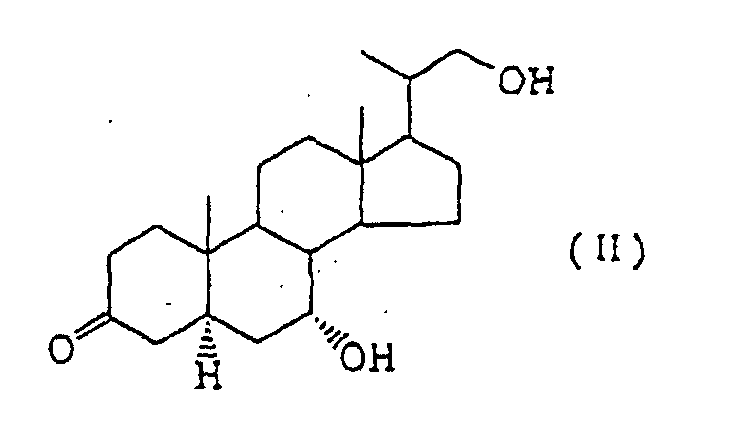
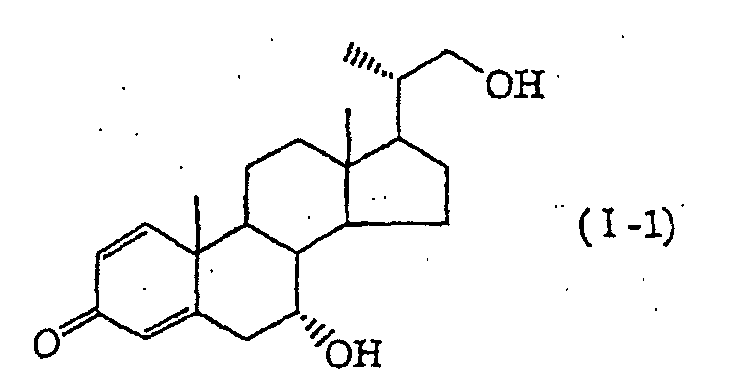
- compound (II), i.e. 7 ⁇ ,21-dihydroxy-20-methyl-5 ⁇ -pregna-3-one, as well as compound (II-1), i.e. (20S)-7 ⁇ ,21-dihydroxy-20-methyl-5 ⁇ -pregna-3-one which is an embodiment of the compound (II), is a novel compound.
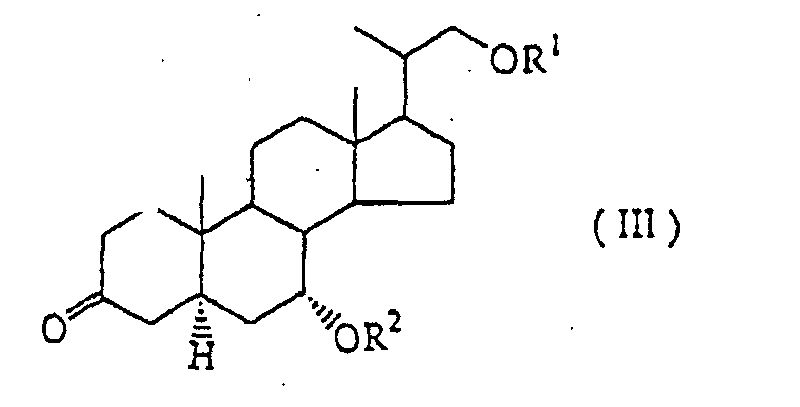
- the process which comprises protecting the hydroxy groups of compound (II) or compound (II-1) which is an embodiment of the compound (II), to obtain 3-oxopregnane derivative (III) or 3-oxopregnane derivative (III-1) which is an embodiment of the 3-oxopregnane derivative (III).
- the protection of the hydroxy groups, i.e. the 7-position and 22-position hydroxy groups, of compound (II) or compound (II-1) which is an embodiment of the compound (II) can be carried out by any one of processes usually employed for protecting hydroxy group.
- reaction is carried out by reacting compound (II) or compound (II-1) which is an embodiment of the compound (II), with an alkyl halide, e.g. tert-butyl chloride and tert-amyl chloride; or an aralkyl halide, e.g.
- benzyl chloride benzyl bromide, o-methylbenzyl chloride, m-methylbenzyl chloride, p-methylbenzyl chloride, p-nitrobenzyl chloride, p-methoxybenzyl chloride, p-phenylbenzyl chloride, diphenylmethyl chloride and triphenylmethyl chloride, in the presence of a base, such as a metal hydride, e.g. lithium hydride, sodium hydride, potassium hydride and calcium hydride; an alkali metal, e.g. lithium, sodium and potassium; or an alkali earth metal, e.g. magnesium and calcium.
- the amount of the base used is desirably at least 1 mole based on 1 mole of the alkyl halide or aralkyl halide used, more preferably in a range of 1 to 10 moles on the same basis.
- reaction is carried out by reacting compound (II) or compound (II-1) which is an embodiment of the compound (II), with an acid halide, e.g.
- acetic anhydride chloroacetic anhydride, dichloroacetic anhydride, trichloroacetic anhydride, trifluoroacetic anhydride, methoxyacetic anhydride, triphenylmethoxyacetic anhydride, phenoxyacetic anhydride, p-chlorophenoxyacetic anhydride, phenylacetic anhydride, diphenylacetic anhydride, 4-pentenic anhydride, pivalic anhydride, crotonic anhydride, benzoic anhydride and p-phenylbenzoic anhydride, in the presence of a base, such as a metal hydride, e.g.
- a base such as a metal hydride, e.g.
- the amount of the base used is desirably at least 1 mole based on 1 mole of the acid halide or acid anhydride used, more preferably in a range of 1 to 10 moles on the same basis.
- reaction is carried out by reacting compound (II) or compound (II-1) which is an embodiment of the compound (II), with an alkoxycarbonyl halide, e.g.
- methyl chloroformate ethyl chloroformate, 2,2,2-trichloroethyl chloroformate, 9-fluorenylmethyl chloroformate, 1,1-dimethyl-2,2,2-trichloroethyl chloroformate and 2-(trimethylsilyl)ethyl chloroformate; an alkenyloxycarbonyl halide, e.g. vinyl chloroformate and allyl chloroformate; an aryloxycarbonyl halide, e.g. phenyl chloroformate and p-nitrophenyl chloroformate; or an aralkyloxycarbonyl halide, e.g.
- benzyl chloroformate p-methoxybenzyl chloroformate, 3,4-dimethoxybenzyl chloroformate, o-nitrobenzyl chloroformate, p-nitrobenzyl chloroformate, 2-(4-nitrophenyl)ethyl chloroformate and 2-(2,4-dinitrophenyl)ethyl chloroformate, in the presence of a base, such as an amine, e.g. trimethylamine, triethylamine, diisopropylethylamine, pyridine, N,N-dimethylaminopyridine, N,N-dimethylaniline and N,N-diethylaniline.
- a base such as an amine, e.g. trimethylamine, triethylamine, diisopropylethylamine, pyridine, N,N-dimethylaminopyridine, N,N-dimethylaniline and N,N-diethylaniline
- the amount of the base used is desirably at least 1 mole based on 1 mole of the alkoxycarbonyl halide, alkenyloxycarbonyl halide, aryloxycarbonyl halide or aralkyloxycarbonyl halide used, more preferably in a range of 1 to 10 moles on the same basis.
- reaction is carried out by reacting compound (II) or compound (II-1) which is an embodiment of the compound (II), with an alkoxyalkyl halide, e.g.
- a base such as a metal hydride, e.g. lithium hydride, sodium hydride, potassium hydride and calcium hydride; an alkali metal, e.g. lithium, sodium and potassium; an alkali earth metal, e.g.
- the amount of the base used is desirably at least 1 mole based on 1 mole of the alkoxyalkyl halide used, more preferably in a range of 1 to 10 moles on the same basis.
- the reaction is carried out by reacting compound (II) or compound (II-1) which is an embodiment of the compound (II), with an oxacycloalkene, e.g. 2,3-dihydrofuran and 2,3-dihydropyrane, in the presence of an acid.
- an oxacycloalkene e.g. 2,3-dihydrofuran and 2,3-dihydropyrane
- the acid are sulfonic acids, e.g. methanesulfonic acid, ethanesulfonic acid, propanesulfonic acid, benzenesulfonic acid and p-toluenesulfonic acid; and mineral acids, e.g. hydrochloric acid and sulfuric acid.
- the amount of the acid used is desirably at least 0.0001 mole based on 1 mole of the oxacycloalkene used, more preferably in a range of 0.001 to 1 mole on
- reaction is carried out by reacting compound (II) or compound (II-1) which is an embodiment of the compound (II), with a trisubstituted silyl halide, e.g.
- trimethylsilyl chloride trimethylsilyl bromide, ethyldimethylsilyl chloride, isopropyldimethylsilyl chloride, tert-butyldimethylsilyl chloride, triethylsilyl chloride, tert-butyldiphenylsilyl chloride and triphenylsilyl chloride; or a trisubstituted silyl trifluoromethanesulfonate, e.g.
- trimethylsilyl trifluoromethanesulfonate ethyldimethylsilyl trifluoromethanesulfonate, isopropyldimethylsilyl trifluoromethanesulfonate, tert-butyldimethylsilyl trifluoromethanesulfonate, triethylsilyl trifluoromethanesulfonate, tert-butyldiphenylsilyl trifluoromethanesulfonate and triphenylsilyl trifluoromethanesulfonate in the presence of a base, such as a metal hydride, e.g.
- the amount of the base used is desirably at least 1 mole based on 1 mole of the trisubstituted silyl halide or trisubstituted silyl trifluoromethanesulfonate used, more preferably in a range of 1 to 10 moles on the same basis.
- the reaction for protecting the hydroxy groups of the compound (II) or the compound (II-1) which is an embodiment of the compound (II) can be carried out either in the presence or absence of a solvent.
- Any solvent can be used for this purpose with no specific restrictions, as long as it influences the reaction badly.
- usable solvents are halogenated hydrocarbons, e.g. dichloromethane, dichloroethane, chlorobenzene and dichlorobenzene; ethers, e.g. tetrahydrofuran, diethyl ether and dimethoxyethane; hydrocarbons, e.g.
- the amount of its use is not particularly limited but, generally, desirably in a range of 1 to 100 times by weight based on the weight of the compound (II) or compound (II-1) which is an embodiment of the compound (II), used.
- the reaction temperature is desirably in a range of -80 to 200°C, more preferably in a range of -20 to 180°C.
- the 7-position hydroxy group and 22-position hydroxy group of the compound (II) or compound (II-1) which is an embodiment of the compound (II) may be protected either with the same protecting group for hydroxy group or each with a different protecting group for hydroxy group.
- 3-oxopregnane derivative (III) or 3-oxopregnane derivative (III-1) which is an embodiment of the 3-oxopregnane derivative (III) can be isolated and purified according to any one of the usual processes for isolating and purifying organic compounds.
- the reaction mixture is poured into salt water or water, and the obtained mixture is subjected to extraction with an organic solvent such as diethyl ether, ethyl acetate or methylene chloride.
- the extract is, as necessary, washed with saturated aqueous sodium hydrogencarbonate solution or the like to remove acidic substances and then washed with dilute hydrochloric acid, water or salt water to remove basic substances and water-soluble substances.
- the washed product is then dried over anhydrous magnesium sulfate, anhydrous sodium sulfate or the like and condensed, to yield a crude product, which is as necessary further purified by distillation, chromatography, recrystallization or like processes.
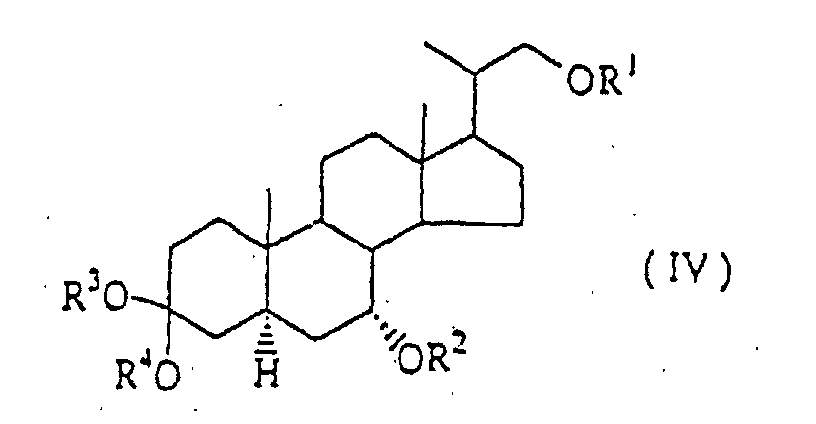
- 3. The process which comprises protecting the 3-position carbonyl group of 3-oxopregnane derivative (III) or 3-oxopregnane derivative (III-1) which is an embodiment of the 3-oxopregnane derivative (III), to obtain pregnane derivative (IV) or pregnane derivative (IV-1) which is an embodiment of the pregnane derivative (IV).
- the reaction for the protection of the 3-position carbonyl group of 3-oxopregnane derivative (III) or 3-oxopregnane derivative (III-1) which is an embodiment of the 3-oxopregnane derivative (III), to obtain pregnane derivative (IV) or pregnane derivative (IV-1) which is an embodiment of the pregnane derivative (IV), can be carried out by any one of processes usually employed for protecting carbonyl group.
- a process which comprises reacting 3-oxopregnane derivative (III) or 3-oxopregnane derivative (III-1) which is an embodiment of the 3-oxopregnane derivative (III), with an alcohol in the presence of an acid.
- Examples of the alcohol are monohydric alcohols, e.g. methanol, ethanol, n-propanol, isopropanol, n-butanol, 2-butanol, 2-methyl-1-propanol, n-pentanol, 2-pentanol, 3-methyl-2-butanol, 2,2-dimethyl-1-propanol, 3-pentanol, n-hexanol, allyl alcohol, 2-buten-1-ol, 3-buten-1-ol, 3-buten-2-ol, 2-penten-1-ol, 3-penten-1-ol, 4-penten-1-ol, 3-penten-2-ol, 4-penten-2-ol, 2-methyl-3-buten-1-ol, 3-methyl-3-buten-1-ol, 3-methyl-3-buten-2-ol, propargyl alcohol, 2-butyn-1-ol, 3-butyn-1-ol, 3-butyn-2-ol, 2-pentyn
- the amount of the alcohol used is not particularly limited but, generally, desirably at least 1 mole based on 1 mole of the 3-oxopregnane derivative (III) or 3-oxopregnane derivative (III-1) which is an embodiment of the 3-oxopregnane derivative (III), used.
- a monohydric alcohol is used as the alcohol, its amount is more preferably in a range of 2 to 20 moles; and where a polyhydric alcohol is used, its amount is more preferably in a range of 1 to 20 moles both on the above basis.
- sulfonic acids e.g. methanesulfonic acid, ethanesulfonic acid, propanesulfonic acid, benzenesulfonic acid and p-toluenesulfonic acid
- mineral acids e.g. hydrochloric acid and sulfuric acid.
- these acids may be used in any amount with no particular restrictions, but, generally, the amount used is desirably in a range of 0.0001 to 1 mole based on 1 mole of the 3-oxopregnane derivative (III) or the 3-oxopregnane derivative (III-1), which is an embodiment of the 3-oxopregnane derivative (III), used, more preferably in a range of 0.001 to 0.5 mole on the same basis.
- the reaction can be carried out either in the presence or absence of a solvent.
- Any solvent can be used for this purpose with no specific restrictions, as long as it does not influence the reaction badly.
- usable solvents are ethers, e.g. tetrahydrofuran, diethyl ether and dimethoxyethane; hydrocarbons, e.g. pentane, hexane, heptane, octane, petroleum ether, benzene and toluene; halogenated hydrocarbons, e.g.
- the amount of its use is not particularly limited but, generally, desirably in a range of 1 to 200 times by weight based on the weight of the 3-oxopregnane derivative (III) or the 3-oxopregnane derivative (III-1) which is an embodiment of the 3-oxopregnane derivative (III), used.
- the reaction temperature is desirably in a range of -100 to 200°C, more preferably in a range of -30 to 180°C.
- the reaction is desirably effected by mixing an acid, 3-oxopregnane derivative (III) or 3-oxopregnane derivative (III-1) which is an embodiment of the 3-oxopregnane derivative (III), an alcohol and, as necessary, a solvent, and then stirring the mixture at a prescribed temperature.
- pregnane derivative (IV) or pregnane derivative (IV-1) which is an embodiment of the pregnane derivative (IV) can be isolated and purified according to any one of the usual processes for isolating and purifying organic compounds.
- the reaction mixture is poured into salt water or water, and the obtained mixture is subjected to extraction with an organic solvent such as diethyl ether, ethyl acetate or methylene chloride.
- the extract is, as necessary, washed with saturated aqueous sodium hydrogencarbonate solution or the like to remove acidic substances and then washed with dilute hydrochloric acid, water or salt water to remove basic substances and water-soluble substances.
- the washed product is then dried over anhydrous magnesium sulfate, anhydrous sodium sulfate or the like and condensed, to yield a crude product, which is as necessary further purified by distillation, chromatography, recrystallization or like processes. 4.
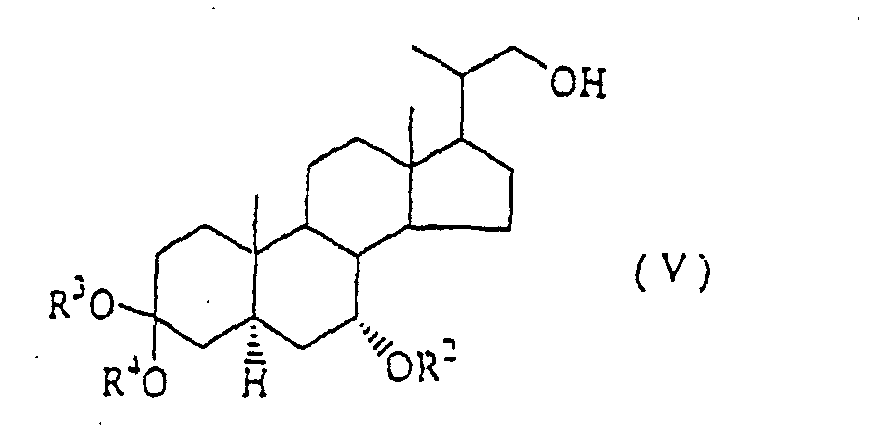
- the process which comprises subjecting pregnane derivative (IV) or pregnane derivative (IV-1) which is an embodiment of the pregnane derivative (IV) to solvolysis, to obtain 21-hydroxypregnane derivative (V) or 21-hydroxypregnane derivative (V-1) which is an embodiment of the 21-hydroxypregnane derivative (V).
- the solvolysis of pregnane derivative (IV) or pregnane derivative (IV-1) which is an embodiment of the pregnane derivative (IV) is desirably carried out in the presence of an alcohol as exemplified in the above process 3, or of water.
- an alcohol as exemplified in the above process 3, or of water.
- Methanol, ethanol or isopropanol are particularly preferred as the alcohol used.
- the alcohol or water can be used in any amount with no particular limitation but, generally, the amount used is preferably in a range of 1 to 200 times by weight based on the weight of the pregnane derivative (IV) or the pregnane derivative (IV-1) which is an embodiment of the pregnane derivative (IV), used.
- a base or acid On effecting the reaction, it is particularly desirable to permit a base or acid to be present in combination in the reaction zone.
- the base are metal hydroxides, e.g. sodium hydroxide, potassium hydroxide, lithium hydroxide and barium hydroxide; metal alkoxides, e.g. lithium tert-butoxide, sodium tert-butoxide and potassium tert-butoxide; metal carbonates, e.g. lithium carbonate, sodium carbonate, potassium carbonate and calcium carbonate; and metal hydrogencarbonates, e.g. lithium hydrogencarbonate, sodium hydrogencarbonate, potassium hydrogencarbonate and calcium hydrogencarbonate.
- the acid are sulfonic acids, e.g.
- methanesulfonic acid ethanesulfonic acid, propanesulfonic acid, benzenesulfonic acid and p-toluenesulfonic acid
- mineral acids e.g. hydrochloric acid and sulfuric acid
- Lewis acids e.g. boron trifluoride, boron trifluoride-diethyl ether complex, aluminum trichloride, titanium trichloride, titanium tetrachloride and zinc bromide; and trifluoroacetic acid.
- the amount of its use is not particularly limited but, generally, desirably at least 1 mole based on 1 mole of the pregnane derivative (IV) or the pregnane derivative (IV-1) which is an embodiment of the pregnane derivative (IV), used, more preferably in a range of 1 to 10 moles on the same basis.
- the amount of its use is not particularly limited but, generally, desirably at least 0.001 mole based on 1 mole of the pregnane derivative (IV) or the pregnane derivative (IV-1) which is an embodiment of the pregnane derivative (IV), used, more preferably in a range of 0.01 to 1 mole on the same basis.
- the reaction can be carried out either in the presence or absence of a solvent.
- Any solvent can be used for this purpose with no specific restrictions, as long as it does not influence the reaction badly.
- usable solvents are ethers, e.g. tetrahydrofuran, diethyl ether and dimethoxyethane; hydrocarbons, e.g. toluene, pentane, hexane, heptane, octane and petroleum ether; halogenated hydrocarbons, e.g.
- the amount of its use is not particularly limited but, generally, the amount is desirably in a range of 1 to 200 times by weight based on the weight of the pregnane derivative (IV) or the pregnane derivative (IV-1), which is an embodiment of the pregnane derivative (IV), used.
- the reaction temperature is desirably in a range of -100 to 200°C, more preferably in a range of -30 to 180°C.
- the reaction is desirably effected by mixing pregnane derivative (IV) or pregnane derivative (IV-1) which is an embodiment of the pregnane derivative (IV), an alcohol or water and, as necessary, a base or an acid and a solvent, and then stirring the mixture at a prescribed temperature.
- 21-hydroxypregnane derivative (V) or 21-hydroxypregnane derivative (V-1) which is an embodiment of the 21-hydroxypregnane derivative (V) can be isolated and purified according to any one of the usual processes for isolating and purifying organic compounds.
- the reaction mixture is poured into salt water or water, and the obtained mixture is subjected to extraction with an organic solvent such as diethyl ether, ethyl acetate or methylene chloride.
- the extract is, as necessary, washed with saturated aqueous sodium hydrogencarbonate solution or the like to remove acidic substances and then washed with dilute hydrochloric acid, water or salt water to remove basic substances and water-soluble substances.
- the washed product is then dried over anhydrous magnesium sulfate, anhydrous sodium sulfate or the like and condensed, to yield a crude product, which is as necessary further purified by distillation, chromatography, recrystallization or like processes. 5.
- the process which comprises subjecting 3-oxopregnane derivative (III) or 3-oxopregnane derivative (III-1) which is an embodiment of the pregnane derivative (III) to solvolysis, to obtain 21-hydroxy-3-oxopregnane derivative (VI) or 21-hydroxy-3-oxopregnane derivative (VI-1) which is an embodiment of the 21-hydroxy-3-oxopregnane derivative (VI).
- the solvolysis of 3-oxopregnane derivative (III) or 3-oxopregnane derivative (III-1) which is an embodiment of the 3-oxopregnane derivative (III) is desirably carried out in the presence of an alcohol as exemplified in the above process 3, or of water.
- Methanol, ethanol or isopropanol is particularly preferred as the alcohol used.
- the alcohol or water can be used in any amount with no particular limitation but, generally, the amount used is preferably in a range of 1 to 200 times by weight based on the weight of the 3-oxopregnane derivative (III) or the 3-oxopregnane derivative (III-1) which is an embodiment of the 3-oxopregnane derivative (III).
- a base or an acid On effecting the reaction, it is particularly desirable to permit a base or an acid to be present in combination in the reaction zone.
- the base are metal hydroxides, e.g. sodium hydroxide, potassium hydroxide, lithium hydroxide and barium hydroxide; metal alkoxides, e.g. lithium tert-butoxide, sodium tert-butoxide and potassium tert-butoxide; metal carbonates, e.g. lithium carbonate, sodium carbonate, potassium carbonate and calcium carbonate; and metal hydrogencarbonates, e.g. lithium hydrogencarbonate, sodium hydrogencarbonate, potassium hydrogencarbonate and calcium hydrogencarbonate.
- the acid are sulfonic acids, e.g.
- methanesulfonic acid ethanesulfonic acid, propanesulfonic acid, benzenesulfonic acid and p-toluenesulfonic acid
- mineral acids e.g. hydrochloric acid and sulfuric acid
- Lewis acids e.g. boron trifluoride, boron trifluoride-diethyl ether complex, aluminum trichloride, titanium trichloride, titanium tetrachloride and zinc bromide; and trifluoroacetic acid.
- the amount of its use is not particularly limited but, generally, the amount is desirably at least 1 mole based on 1 mole of the 3-oxopregnane derivative (III) or the 3-oxopregnane derivative (III-1) which is an embodiment of the pregnane derivative (III), used, more preferably in a range of 1 to 10 moles on the same basis.
- the amount of its use is not particularly limited but, generally, the amount is desirably at least 0.001 mole based on 1 mole of the 3-oxopregnane derivative (III) or the 3-oxopregnane derivative (III-1) which is an embodiment of the 3-oxopregnane derivative (III), used, more preferably in a range of 0.01 to 1 mole on the same basis.
- the reaction can be carried out either in the presence or absence of a solvent.
- Any solvent can be used for this purpose with no specific restrictions, as long as it does not influence the reaction badly.
- usable solvents are ethers, e.g. tetrahydrofuran, diethyl ether and dimethoxyethane; hydrocarbons, e.g. toluene, pentane, hexane, heptane, octane and petroleum ether; halogenated hydrocarbons, e.g.
- the amount of its use is not particularly limited but, generally, the amount is desirably in a range of 1 to 200 times by weight based on the weight of the 3-oxopregnane derivative (III) or the 3-oxopregnane derivative (III-1), which is an embodiment of the 3-oxopregnane derivative (III), used.
- the reaction temperature is desirably in a range of -100 to 200°C, more preferably in a range of -30 to 180°C.
- the reaction is desirably effected by mixing 3-oxopregnane derivative (III) or 3-oxopregnane derivative (III-1) which is an embodiment of the 3-oxopregnane derivative (III), an alcohol or water and, as necessary, a base or an acid and a solvent, and then stirring the mixture at a prescribed temperature.
- 21-hydroxy-3-oxopregnane derivative (VI) or 21-hydroxy-3-oxopregnane derivative (VI-1) which is an embodiment of the 21-hydroxy-3-oxopregnane derivative (VI) can be isolated and purified according to any one of the usual processes for isolating and purifying organic compounds.
- the reaction mixture is poured into salt water or water, and the obtained mixture is subjected to extraction with an organic solvent such as diethyl ether, ethyl acetate or methylene chloride.
- the extract is, as necessary, washed with saturated aqueous sodium hydrogencarbonate solution or the like to remove acidic substances and then washed with dilute hydrochloric acid, water or salt water to remove basic substances and water-soluble substances.
- the washed product is then dried over anhydrous magnesium sulfate, anhydrous sodium sulfate or the like and condensed, to yield a crude product, which is as necessary further purified by distillation, chromatography, recrystallization or like processes. 6.
- the process which comprises protecting the 3-position carbonyl group of 21-hydroxy-3-oxopregnane derivative (VI) or 21-hydroxy-3-oxopregnane derivative (VI-1) which is an embodiment of the 21-hydroxy-3-oxopregnane derivative (VI), to obtain 21-hydroxypregnane derivative (V) or 21-hydroxypregnane derivative (V-1) which is an embodiment of the 21-hydroxypregnane derivative (V).
- the protection of the 3-position carbonyl group of 21-hydroxy-3-oxopregnane derivative (VI) or 21-hydroxy-3-oxopregnane derivative (VI-1) which is an embodiment of the 21-hydroxy-3-oxopregnane derivative (VI) can be carried out by any one of processes usually employed for protecting carbonyl group.
- a process which comprises reacting 21-hydroxy-3-oxopregnane derivative (VI) or 21-hydroxy-3-oxopregnane derivative (VI-1) which is an embodiment of the 21-hydroxy-3-oxopregnane derivative (VI), with an alcohol in the presence of an acid.
- the amount of the alcohol used is not particularly limited but, generally, desirably at least 1 mole based on 1 mole of the 21-hydroxy-3-oxopregnane derivative (VI) or 21-hydroxy-3-oxopregnane derivative (VI-1) which is an embodiment of the 21-hydroxy-3-oxopregnane derivative (VI), used.
- a monohydric alcohol is used as the alcohol, its amount is more preferably in a range of 2 to 20 moles; and where a polyhydric alcohol is used, its amount is more preferably in a range of 1 to 20 moles, both on the above basis.
- sulfonic acids e.g. methanesulfonic acid, ethanesulfonic acid, propanesulfonic acid, benzenesulfonic acid and p-toluenesulfonic acid
- mineral acids e.g. hydrochloric acid and sulfuric acid.
- these acids may be used in any amount with no particular restrictions, but, generally, the amount used is desirably in a range of 0.0001 to 1 mole based on 1 mole of the 21-hydroxy-3-oxopregnane derivative (VI) or the 21-hydroxy-3-oxopregnane derivative (VI-1) which is an embodiment of the 21-hydroxy-3-oxopregnane derivative (VI), used, more preferably in a range of 0.001 to 0.5 mole on the same basis.
- the reaction can be carried out either in the presence or absence of a solvent.
- Any solvent can be used for this purpose with no specific restrictions, as long as it does not influence the reaction badly.
- usable solvents are ethers, e.g. tetrahydrofuran, diethyl ether and dimethoxyethane; hydrocarbons, e.g. pentane, hexane, heptane, octane, petroleum ether, benzene and toluene; halogenated hydrocarbons, e.g.
- the amount of its use is not particularly limited but, generally, the amount is desirably in a range of 1 to 200 times by weight based on the weight of the 21-hydroxy-3-oxopregnane derivative (VI) or the 21-hydroxy-3-oxopregnane derivative (VI-1) which is an embodiment of the 21-hydroxy-3-oxopregnane derivative (VI), used.
- the reaction temperature is desirably in a range of -100 to 200°C, more preferably in a range of -30 to 180°C .
- the reaction is desirably effected by mixing an acid, 21-hydroxy-3-oxopregnane derivative (VI) or 21-hydroxy-3-oxopregnane derivative (VI-1) which is an embodiment of the 21-hydroxy-3-oxopregnane derivative (VI), an alcohol and, as necessary, a solvent, and then stirring the mixture at a prescribed temperature.
- 21-hydroxypregnane derivative (V) or 21-hydroxypregnane derivative (V-1) which is an embodiment of the 21-hydroxypregnane derivative (V) can be isolated and purified according to any one of the usual processes for isolating and purifying organic compounds.
- the reaction mixture is poured into salt water or water, and the obtained mixture is subjected to extraction with an organic solvent such as diethyl ether, ethyl acetate or methylene chloride.
- the extract is, as necessary, washed with saturated aqueous sodium hydrogencarbonate solution or the like to remove acidic substances and then washed with dilute hydrochloric acid, water or salt water to remove basic substances and water-soluble substances.
- the washed product is then dried over anhydrous magnesium sulfate, anhydrous sodium sulfate or the like and condensed, to yield a crude product, which is as necessary further purified by distillation, chromatography, recrystallization or like processes.
- the 21-hydroxypregnane derivative (V-1), which is an embodiment of 21-hydroxypregnane derivative (V), includes, for example, (20S)-21-hydroxy-3-(spiro-2'-(1',3'-dioxolane))-20-methyl-5 ⁇ -pregna- 7 ⁇ -ol benzoate. This compound derives, on oxidation of its 22 position, (20S)-20-formyl-3-(spiro-2'-(1',3'-dioxolane))-5 ⁇ -pregna-7 ⁇ -ol benzoate (see Reference Example 2).
- the derived compound further derives, by reaction with diethylphosphono-3-methyl-2-butanone, (22E)-24-oxo-3-(spiro-2'-(1',3'-dioxolane))-5 ⁇ -cholest-22-en-7 ⁇ -ol benzoate, which is further converted, by the processes described in J. Org. Chem. 63 , 3786(1998) and J. Org. Chem. 63 , 8599(1998), into squalamine (see the scheme below).
- the thus obtained compound was identified to be a 5 ⁇ isomer by the following method. That is, the 1 H-NMR spectrum of the compound was compared with that of (20S)-7 ⁇ ,21-dihydroxy-20-methyl-5 ⁇ -pregna-3-one, which had been synthesized according to the process described in EP 0 018 515 A2, to reveal that the peak positions based on the 18-position and 19-position methyl groups differed from each other.
- a 50-ml flask was, under an atmosphere of nitrogen, charged with 294 mg (0.84 mmole) of the (20S)-7 ⁇ ,21-dihydroxy-20-methyl-5 ⁇ -pregna-3-one obtained by the process described in Example 1, 101 mg (0.84 mmole) of 4-dimethylaminopyridine, 0.953 ml of pyridine and 5 ml of dichloromethane.
- the mixture was dissolved with stirring and then ice-cooled.
- 888 mg (6.32 mmoles) of benzoyl chloride was gradually added dropwise. After completion of the addition, the mixture was stirred for 15 minutes under ice-cooling, then allowed to be warmed up to room temperature, and further stirred for 12 hours.
- reaction mixture was poured into 70 ml of saturated aqueous sodium hydrogencarbonate solution, and the resulting organic layer was separated from the aqueous layer.
- the organic layer was washed with 70 ml of saturated aqueous sodium hydrogencarbonate solution and then with 50 ml of 1N hydrochloric acid.
- the washed product was dried over anhydrous magnesium sulfate and condensed, to give 420 mg of crude (20S)-3-oxo-20-methyl-5 ⁇ -pregna-7 ⁇ ,21-diol bisbenzoate having the following properties (crude yield: 90%).
- reaction liquid was washed twice each time with saturated aqueous sodium hydrogencarbonate solution, then dried over anhydrous magnesium sulfate and condensed, to give 1.41 g of crude (20S)-20-methyl-3-(spiro-2'-(1',3'-dioxolane))-5 ⁇ -pregna-7 ⁇ ,21-diol bisbenzoate having the following properties (crude yield: 97%).
- an aqueous solution prepared by adding sodium hydrogencarbonate (1.0 g) to an aqueous sodium hypochlorite solution (2.64% by weight, 108 ml, 40 mmoles) was added dropwise under ice-cooling. After completion of the addition, the mixture was allowed to react for 2 hours under ice-cooling. After completion of the reaction, the resulting aqueous layer was separated from the organic layer. The aqueous layer was extracted with dichloromethane (30 ml x 2). The extracts were combined with the organic layer, and the layer was washed with water (50 ml x 2) and then with saturated salt water (20 ml).
- the washed product was dried over anhydrous magnesium sulfate and then condensed, to give a crude product.
- pregnane derivatives useful as synthesis intermediates for squalamine can be prepared from readily available starting materials and efficiently in short steps.
Landscapes
- Chemical & Material Sciences (AREA)
- Organic Chemistry (AREA)
- Health & Medical Sciences (AREA)
- General Health & Medical Sciences (AREA)
- Organic Low-Molecular-Weight Compounds And Preparation Thereof (AREA)
- Steroid Compounds (AREA)
Abstract
A process for preparing pregnane derivatives represented by
the formula (V),
 which comprises the steps of:
Description
The present invention relates to processes for preparing
pregnane derivatives. The pregnane derivatives obtained by the
processes of the present invention are useful, for example, as
intermediates for synthesis of squalamine represented by the
following formula.

Squalamine has been reported to exhibit potent antimicrobial
activity against Gram-positive bacteria, Gram-negative bacteria
and fungi, as well as an anti-carcinogenic activity and has been
attracting much attention as a new antibiotic [see, for example, J.
Org. Chem. 63, 3786(1998); J. Org. Chem. 63, 8599(1998); and WO
98/24800].
Squalamine has been extracted from the livers of dogfish
sharks at such a low extraction efficiency of 0.001 to 0.002% by
weight that its chemical synthesis has been investigated. Known
processes of chemical synthesis of squalamine include 1) a process
which comprises using 3 β -acetoxy-5-cholenic acid as a starting
material [see Tetrahedron Lett., 35, 8103(1994)]; 2) a process
which comprises using 3 β -hydroxy-5-cholenic acid as a starting
material [see J. Org. Chem. 60, 5121(1995) and WO 94/19366]; 3) a
process which comprises using 21-hydroxy-20-methyl-pregna-4-en-3-one
as a starting material [see WO 98/24800]; and 4) a process
which comprises using stigmasterol as a starting material [see J.
Org. Chem. 63, 3786(1998), J. Org. Chem. 63, 8599(1998), and WO
98/24800].
The 3 β -acetoxy-5-cholenic acid, 3 β -hydroxy-5-cholenic acid
and 21-hydroxy-20-methyl-pregna-4-en-3-one used in the above
processes 1), 2) and 3), respectively, are all expensive. Moreover,
the above processes 1), 2) and 3) include complex reaction
operations, requiring 17 steps, 19 steps and 15 steps, respectively,
to obtain squalamine. Accordingly, these processes can hardly be
said to be suitable for commercial production.
The above process 4), using a starting material of stigmasterol
available at a low cost, requires 20 steps to synthesize squalamine.
Moreover, the process has the drawbacks of using an expensive
silver carbonate in a step of selectively oxidizing the 3-position
hydroxy group and, further, of comprising an ozone-oxidation step
under a low temperature, which requires a special reaction
equipment. This process cannot necessarily be said to be
commercially advantageous.
Accordingly, an object of the present invention is to provide a
process for preparing pregnane derivatives from a readily available
starting material and efficiently in short steps.
In order to achieve the above object, the present inventors
have made an intensive study, while selecting as a starting
material 7 α -hydroxy-3-oxo-pregna-1,4-dime-20-carbaldehyde
which is readily obtainable by microbiologically transforming 3 α ,7
α -dihydroxy-5 β -cholenic acid and/or derivatives thereof (see
Japanese Patent No. 2525049).
Synthesis of 7 α -hydroxy-3-oxo-5 α -cholic acid by reacting
metallic lithium with 7 α -hydroxy-3-oxo-1,4-choladienic acid in the
presence of ammonia is known [see Chemical and Pharmaceutical
Bulletin 41, 763(1993)]. The present inventors applied this
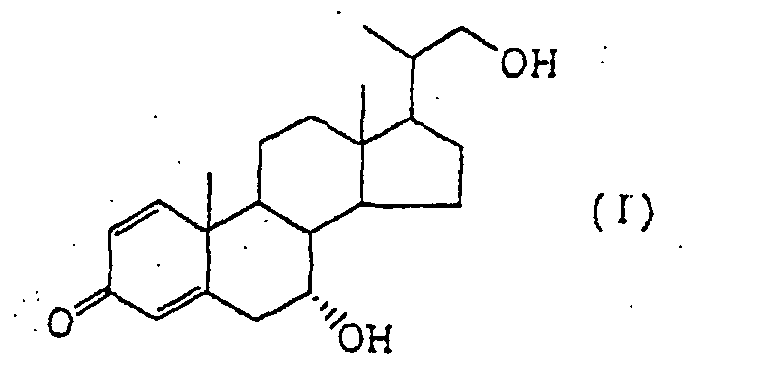
reaction to 7 α ,21-dihydroxy-20-methyl-pregna-1,4-dien-3-one (see
Reference Example 1) which is obtainable by reduction of the 20-position
aldehyde of 7 α -hydroxy-3-oxo-pregna-1,4-diene-20-carbaldehyde.
As a result, the present inventors found that 7
α ,21-dihydroxy-20-methyl-5 α -pregna-3-one was obtained at a
good yield. This 7 α ,21-dihydroxy-20-methyl-5 α -pregna-3-one is
a novel compound, although 7 α ,21-dihydroxy-20-methyl-5 β-pregna-3-one
is known as an intermediate for synthesis of
chenodeoxycholic acid from 3-keto-bisnorcholenol (see EP 0 018 515
A2).
Thus, the present invention provides:


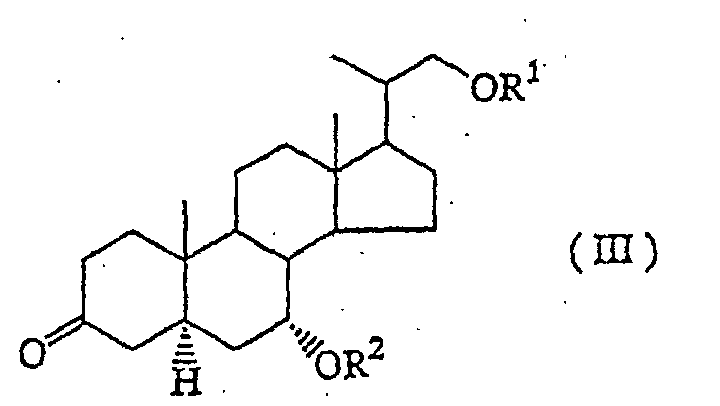
protecting the 3-position carbonyl group of the obtained 3-oxop-regnane derivative (III), to obtain a pregnane derivative represented by the general formula (IV) (hereinafter referred to as "pregnane derivative (IV)")

subjecting the obtained pregnane derivative (IV) to solvolysis;

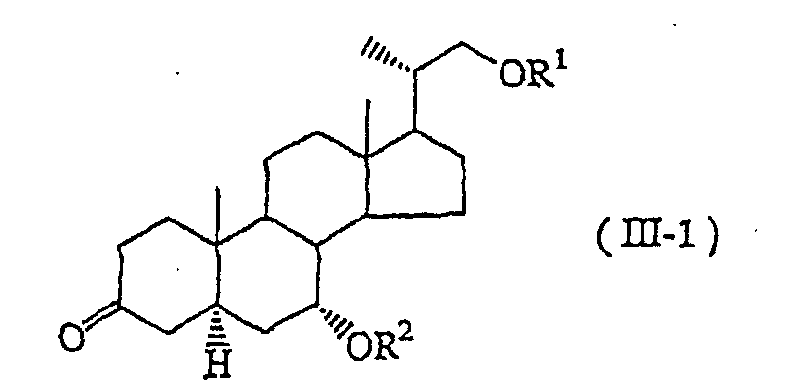
protecting the 3-position carbonyl group of the obtained 3-oxopregnane derivative (III-1), to obtain a pregnane derivative represented by the general formula (IV-1) (hereinafter referred to as "pregnane derivative (IV-1)")
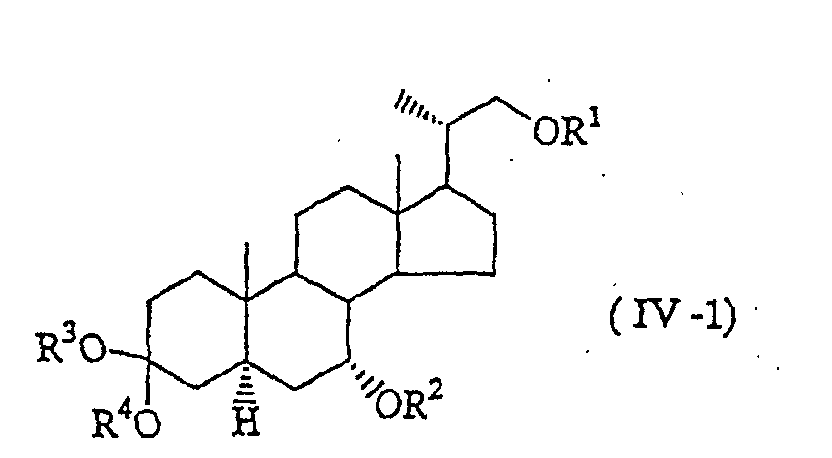
subjecting the obtained pregnane derivative (IV-1) to solvolysis, to obtain a 21-hydroxypregnane derivative represented by the general formula (V-1) (hereinafter referred to as "21-hydroxypregnane derivative (V-1)")


and protecting the 3-position carbonyl group of the obtained 21-hydroxy-3-oxopregnane derivative (VI); and

and protecting the 3-position carbonyl group of the obtained 21-hydroxy-3-oxopregnane derivative (VI-1), to obtain 21-hydroxypregnane derivative (V-1).
Any protecting group can be used as the protecting group for
hydroxy group represented by each of R1 and R2, as long as it can
act as such. Examples of the protecting group are alkyl groups,
e.g. tert-butyl and tert-amyl; aralkyl groups, e.g. benzyl, o-methylbenzyl,
m-methylbenzyl, p-methylbenzyl, p-nitrobenzyl, p-methoxybenzyl,
p-phenylbenzyl, diphenylmethyl and triphenylmethyl;
acyl groups; e.g. acetyl, chloroacetyl, dichloroacetyl, trichloroacetyl,
trifluoroacetyl, methoxyacetyl, triphenylmethoxyacetyl,
phenoxyacetyl, p-chlorophenoxyacetyl, phenylacetyl, diphenylacetyl,
propionyl, butyryl, valeryl, 4-pentenoyl, pivaloyl,
crotonoyl, benzoyl, o-methylbenzoyl, m-methylbenzoyl, p-methylbenzoyl,
2,3-dimethylbenzoyl, 2,4-dimethylbenzoyl, 2,5-dimethylbenzoyl,
2,6-dimethylbenzoyl, 2,4,6-trimethylbenzoyl, and p-phenylbenzoyl;
alkoxycarbonyl groups, e.g. methoxycarbonyl, 9-fluorenylmethoxycarbonyl,
ethoxycarbonyl, 2,2,2-trichloroethoxycarbonyl,
1,1-dimethyl-2,2,2-trichloroethoxycarbonyl and 2-(trimethylsilyl)ethoxycarbonyl;
alkenyloxycarbonyl groups, e.g.
vinyloxycarbonyl and allyloxycarbonyl; aryloxycarbonyl groups,
e.g. phenoxycarbonyl and p-nitrophenoxycarbonyl; aralkyloxycarbonyl
groups, e.g. benzyloxycarbonyl, p-methoxybenzyloxycarbonyl,
3,4-dimethoxybenzyloxycarbonyl, o-nitrobenzyloxycarbonyl,
p-nitrobenzyloxycarbonyl, 2-(4-nitrophenyl)ethoxycarbonyl
and 2-(2,4-dinitrophenyl)ethoxycarbonyl; alkoxyalkyl
groups, e.g. methoxymethyl, benzyloxymethyl, p-methoxybenzyloxymethyl,
p-nitrobenzylmethoxymethyl, o-nitrobenzylmethoxymethyl,
(4-methoxyphenoxy)methyl, text-butoxymethyl, 2-methoxyethoxymethyl
and 2-(trimethylsilyl)ethoxymethyl;
oxacycloalkyl groups, e.g. tetrahydro-2-furanyl and tetrahydro-2-pyranyl;
and trisubstituted silyl groups, e.g. trimethylsilyl, ethyldimethylsilyl,
isopropyldimethylsilyl, tert-butyldimethylsilyl, triethylsilyl,
tert-butyldiphenylsilyl and triphenylsilyl.
Those alkyl groups that have 1 to 6 carbon atoms are
preferably used as the alkyl group which may be represented by
each of R3 and R4. Examples of such alkyl groups are methyl, ethyl,
n-propyl, isopropyl, n-butyl, 1-methylpropyl, 2-methylpropyl, n-pentyl,
1-methylbutyl, 1,1-dimethylpropyl, 1,2-dimethylpropyl,
2,2-dimethylpropyl, 1-ethylpropyl and n-hexyl. These alkyl
groups may be substituted. Examples of the subatituting groups
for this purpose are hydroxy group; halogen atoms, e.g. fluorine,
chlorine, bromine and iodine; alkoxy groups, e.g. methoxy, ethoxy,
propoxy and butoxy; and aralkyloxy groups, e.g. benzyloxy.
Those alkenyl groups that have 3 to 6 carbon atoms are
preferably used as the the alkenyl group which may be represented
by each of R3 and R4. Examples of such alkenyl groups are 2-propenyl,
2-butenyl, 3-butenyl, 1-methyl-2-propenyl, 2-methyl-2-propenyl,
2-pentenyl, 3-pentenyl, 4-pentenyl, 1-methyl-2-butenyl,
1-methyl-3-butenyl, 2-methyl-2-butenyl, 2-methyl-3-butenyl, 3-methyl-2-butenyl,
3-methyl-3-butenyl, 1-ethyl-2-propenyl and 1-hexenyl.
Those alkynyl groups that have 3 to 6 carbon atoms are
preferably used as the alkynyl group which may be represented by
each of R3 and R4. Examples of such alkynyl groups are 2-propynyl,
2-butynyl, 3-butynyl, 2-pentynyl, 3-pentynyl, 4-pentynyl, 1-methyl-3-butynyl,
2-methyl-3-butynyl and 2-hexynyl. These
alkenyl groups and alkynyl groups may be substituted. Examples
of the substituting groups for this purpose are hydroxy group;
halogen atoms, e.g. fluorine, chlorine, bromine and iodine; alkoxy
groups, e.g. methoxy, ethoxy, propoxy and butoxy; and aralkyloxy
groups, e.g. benzyloxy.
Those aralkyl groups that consist of an alkyl part of alkyl
group having 1 to 6 carbon atoms and an aryl part of aryl group
having 6 to 10 carbon atoms are preferably used as the aralkyl
group which may be represented by each of R3 and R4. Examples of
such aralkyl groups are benzyl, 1-phenylethyl and naphthylmethyl.
These aralkyl groups may be substituted. Examples of the
substituting groups for this purpose are hydroxy group; halogen
atoms, e.g. fluorine, chlorine, bromine and iodine; alkyl groups, e.g.
methyl, ethyl, n-propyl, isopropyl, n-butyl, isobutyl, sec-butyl and
tert-butyl; alkoxy groups, e.g. methoxy, ethoxy, propoxy and
butoxy; and aralkyloxy groups, e.g. benzyloxy.
Those alkylene groups that have 1 to 6 carbon atoms are
preferably used as the alkylene group which may be represented by
combination of R3 and R4 and may be substituted. Examples of
such alkylene groups are methylene, ethylene, methylethylene,
1,2-dimethylethylene, trimethylene, 1-methyltrimethylene, 2-methyltrimethylene,
2,2-dimethyltrimethylene, tetramethylene,
pentamethylene and hexamethylene.
The process steps are now each described.
1. The process which comprises reacting an alkali metal or an alkali earth metal with compound (I) or compound (I-1) which is an embodiment of the compound (I), in the presence of ammonia or an amine, to obtain compound (II) or compound (II-1) which is an embodiment of compound (II).
1. The process which comprises reacting an alkali metal or an alkali earth metal with compound (I) or compound (I-1) which is an embodiment of the compound (I), in the presence of ammonia or an amine, to obtain compound (II) or compound (II-1) which is an embodiment of compound (II).
Example of the amine usable for the above purpose are
methylamine, dimethylamine, trimethylamine, ethylamine, diethylamine,
triethylamine, ethyldimethylamine, diethylmethylamine,
isopropylamine, diisopropylamine, triisopropylamine,
isopropyldimethylamine, diisopropylethylamine, tributylamine
and tripentylamine. There is no particular limitation to the
amount of the ammonia or amine, but, generally, the amount is
desirably 1 to 200 times by weight based on the weight of compound
(I) used.
Examples of the alkali metal usable for the above purpose are
lithium, sodium, potassium and rubidium; and those of the alkali
earth metals are calcium, strontium and barium. These alkali
metals or alkali earth metals may be used desirably in an amount
of at least 2 gram atoms based on 1 mole of the compound (I), more
preferably in a range of 2 to 20 gram atoms on the same basis.
It is desirable to permit a metal amide or metal hydride of the
above alkali metal or alkali earth metal to be present in combination
in the reaction zone. Examples of the metal amide are
lithium amide, lithium diisopropylamide, sodium amide, sodium
diisopropylamide, potassium diisopropylamide, lithium dicyclohexylamide,
sodium dicyclohexylamide, potassium dicyclohexylamide,
lithium bis(trimethylsilyl)amide, sodium bis(trimethylsilyl)amide
and potassium bis(trimethylsilyl)amide. Examples of
the metal hydride are lithium hydride, sodium hydride, potassium
hydride, magnesium hydride and calcium hydride. These metal
amide or metal hydride of the alkali metal or alkali earth metal are,
when used in combination therewith, used desirably in an amount
of not more than 20 moles based on 1 mole of the compound (I).
The reaction zone may further contain an ammonium salt, the
hydroxide of the above alkali metal or alkali earth metal, or a salt
of the above alkali metal or alkali earth metal. Examples of the
ammonium salt are ammonium chloride, ammonium bromide,
ammonium iodide and ammonium carbonate. Examples of the
hydroxide of the alkali metal or alkali earth metal are lithium
hydroxide, sodium hydroxide, potassium hydroxide and calcium
hydroxide. Examples of the salt of the alkali metal or alkali earth
metal are metal halides, e.g. lithium chloride, lithium bromide,
lithium iodide, sodium chloride, sodium bromide, sodium iodide,
potassium chloride, potassium bromide, potassium iodide, calcium
chloride, calcium bromide and calcium iodide; metal carbonates,
e.g. lithium carbonate, sodium carbonate, potassium carbonate and
calcium carbonate; and metal hydrogencarbonates, e.g. lithium
hydrogencarbonate, sodium hydrogencarbonate, potassium hydrogencarbonate
and calcium hydrogencarbonate.
The reaction can be carried out either in the presence or
absence of a solvent. Any solvent can be used for this purpose
with no specific restrictions, as long as it does not influence the
reaction badly. Examples of usable solvents are alcohols, e.g.
methanol, ethanol, n-propanol and isopropanol; ethers, e.g. tetrahydrofuran,
diethyl ether and dimethoxyethane; hydrocarbons, e.g.
pentane, hexane, heptane, octane, petroleum ether, benzene and
toluene; and mixtures of the foregoing. Where an solvent is used,
the amount of its use is not particularly limited but, generally, the
amount is desirably in a range of 1 to 100 times by weight based on
the weight of the compound (I) used.
The reaction temperature is desirably in a range of -100 to
200°C , more preferably in a range of -80 to 30°C.
It is desirable to effect the reaction, for example by adding an
alkali metal or an alkali earth metal, under an atmosphere of an
inert gas such as nitrogen, or argon, to ammonia or an amine, and
further, as necessary, adding a solvent to suspend or dissolve, to
prepare a mixture, and adding to the mixture compound (I) or a
liquid obtained by suspending or dissolving the compound (I) in
an amine or a solvent. Where an ammonium salt, hydroxide or salt
of an alkali metal or alkali earth metal, or a metal amide or metal
hydride is permitted to be present in combination in the reaction
zone, it may be added either at the start of the reaction or during
the reaction.
The thus obtained compound (II) or compound (II-1) that is an
embodiment of the compound (II) can be isolated and purified
according to any one of the usual processes for isolating and
purifying organic compounds. For example, the reaction is
terminated by adding an alcohol such as methanol or ethanol, or an
ammonium salt such as ammonium chloride or ammonium bromide,
the reaction mixture is poured into salt water or water, and the
obtained mixture is subjected to extraction with an organic solvent
such as diethyl ether, ethyl acetate or methylene chloride. The
extract is, as necessary, washed with saturated aqueous sodium
hydrogencarbonate solution or the like to remove acidic substances
and then washed with dilute hydrochloric acid, water or salt water
to remove basic substances and water-soluble substances. The
washed product is then dried over anhydrous magnesium sulfate,
anhydrous sodium sulfate or the like and condensed, to yield a
crude product, which is as necessary further purified by
distillation, chromatography, recrystallization or like processes.
The thus obtained compound (II), i.e. 7 α ,21-dihydroxy-20-methyl-5
α -pregna-3-one, as well as compound (II-1), i.e. (20S)-7
α ,21-dihydroxy-20-methyl-5 α -pregna-3-one which is an
embodiment of the compound (II), is a novel compound.
2. The process which comprises protecting the hydroxy groups of compound (II) or compound (II-1) which is an embodiment of the compound (II), to obtain 3-oxopregnane derivative (III) or 3-oxopregnane derivative (III-1) which is an embodiment of the 3-oxopregnane derivative (III).
2. The process which comprises protecting the hydroxy groups of compound (II) or compound (II-1) which is an embodiment of the compound (II), to obtain 3-oxopregnane derivative (III) or 3-oxopregnane derivative (III-1) which is an embodiment of the 3-oxopregnane derivative (III).
The protection of the hydroxy groups, i.e. the 7-position and
22-position hydroxy groups, of compound (II) or compound (II-1)
which is an embodiment of the compound (II) can be carried out by
any one of processes usually employed for protecting hydroxy
group.
For example, where any one of the above-described alkyl
groups or aralkyl groups is used for the protection, the reaction is
carried out by reacting compound (II) or compound (II-1) which is
an embodiment of the compound (II), with an alkyl halide, e.g.
tert-butyl chloride and tert-amyl chloride; or an aralkyl halide, e.g.
benzyl chloride, benzyl bromide, o-methylbenzyl chloride, m-methylbenzyl
chloride, p-methylbenzyl chloride, p-nitrobenzyl
chloride, p-methoxybenzyl chloride, p-phenylbenzyl chloride, diphenylmethyl
chloride and triphenylmethyl chloride, in the
presence of a base, such as a metal hydride, e.g. lithium hydride,
sodium hydride, potassium hydride and calcium hydride; an alkali
metal, e.g. lithium, sodium and potassium; or an alkali earth metal,
e.g. magnesium and calcium. The amount of the base used is
desirably at least 1 mole based on 1 mole of the alkyl halide or
aralkyl halide used, more preferably in a range of 1 to 10 moles on
the same basis.
Where any one of the above acyl groups is used for the
protection of the hydroxy groups, the reaction is carried out by
reacting compound (II) or compound (II-1) which is an embodiment
of the compound (II), with an acid halide, e.g. acetyl chloride,
acetyl bromide, chloroacetyl chloride, dichloroacetyl chloride,
trichloroacetyl chloride, trifluoroacetyl chloride, methoxyacetyl
chloride, triphenylmethoxyacetyl chloride, triphenylmethoxyacetyl
bromide, phenoxyacetyl chloride, p-chlorophenoxyacetyl chloride,
phenylacetyl chloride, phenylacetyl bromide, diphenylacetyl
chloride, propionyl chloride, butyryl chloride, valeryl chloride, 4-pentenoyl
chloride, pivaloyl chloride, crotonoyl chloride, benzoyl
chloride, benzoyl bromide, o-methylbenzoyl chloride, m-methylbenzoyl
chloride, p-methylbenzoyl chloride, 2,3-dimethylbenzoyl
chloride, 2,4-dimethylbenzoyl chloride, 2,5-dimethylbenzoyl
chloride, 2,6-dimethylbenzoyl chloride, 2,4,6-trimethylbenzoyl
chloride and p-phenylbenzoyl chloride; or an acid anhydride, e.g.
acetic anhydride, chloroacetic anhydride, dichloroacetic anhydride,
trichloroacetic anhydride, trifluoroacetic anhydride, methoxyacetic
anhydride, triphenylmethoxyacetic anhydride, phenoxyacetic
anhydride, p-chlorophenoxyacetic anhydride, phenylacetic
anhydride, diphenylacetic anhydride, 4-pentenic anhydride,
pivalic anhydride, crotonic anhydride, benzoic anhydride and p-phenylbenzoic
anhydride, in the presence of a base, such as a metal
hydride, e.g. lithium hydride, sodium hydride, potassium hydride
and calcium hydride; an alkali metal, e.g. lithium, sodium and
potassium; an alkali earth metal, e.g. magnesium and calcium; or
an amine, e.g. trimethylamine, triethylamine, diisopropylethylamine,
pyridine, N,N-dimethylaminopyridine, N,N-dimethylaniline
and N,N-diethylaniline. The amount of the base used is
desirably at least 1 mole based on 1 mole of the acid halide or acid
anhydride used, more preferably in a range of 1 to 10 moles on the
same basis.
Where any one of the above alkoxycarboxyl groups, alkenyloxycarbonyl
groups, aryloxycarbonyl groups and aralkyloxycarbonyl
groups is used for the protection of the hydroxy groups,
the reaction is carried out by reacting compound (II) or compound
(II-1) which is an embodiment of the compound (II), with an
alkoxycarbonyl halide, e.g. methyl chloroformate, ethyl chloroformate,
2,2,2-trichloroethyl chloroformate, 9-fluorenylmethyl
chloroformate, 1,1-dimethyl-2,2,2-trichloroethyl chloroformate
and 2-(trimethylsilyl)ethyl chloroformate; an alkenyloxycarbonyl
halide, e.g. vinyl chloroformate and allyl chloroformate; an
aryloxycarbonyl halide, e.g. phenyl chloroformate and p-nitrophenyl
chloroformate; or an aralkyloxycarbonyl halide, e.g. benzyl
chloroformate, p-methoxybenzyl chloroformate, 3,4-dimethoxybenzyl
chloroformate, o-nitrobenzyl chloroformate, p-nitrobenzyl
chloroformate, 2-(4-nitrophenyl)ethyl chloroformate and 2-(2,4-dinitrophenyl)ethyl
chloroformate, in the presence of a base, such
as an amine, e.g. trimethylamine, triethylamine, diisopropylethylamine,
pyridine, N,N-dimethylaminopyridine, N,N-dimethylaniline
and N,N-diethylaniline. The amount of the base used is
desirably at least 1 mole based on 1 mole of the alkoxycarbonyl
halide, alkenyloxycarbonyl halide, aryloxycarbonyl halide or
aralkyloxycarbonyl halide used, more preferably in a range of 1 to
10 moles on the same basis.
Where any one of the above alkoxyalkyl groups is used for the
protection of the hydroxy groups, the reaction is carried out by
reacting compound (II) or compound (II-1) which is an embodiment
of the compound (II), with an alkoxyalkyl halide, e.g. 1-methoxymethyl
chloride, 1-methoxymethyl bromide, benzyloxymethyl
chloride, p-methoxybenzyloxymethyl chloride, p-nitrobenzylmethoxymethyl
chloride, o-nitrobenzylmethoxymethyl
chloride, (4-methoxyphenoxy)methyl chloride, tert-butoxymethyl
chloride, 2-methoxyethoxymethyl chloride and 2-(trimethylsilyl)-ethoxymethyl
chloride, in the presence of a base, such as a metal
hydride, e.g. lithium hydride, sodium hydride, potassium hydride
and calcium hydride; an alkali metal, e.g. lithium, sodium and
potassium; an alkali earth metal, e.g. magnesium and calcium; or
an amine, e.g. trimethylamine, triethylamine, diisopropylethylamine,
pyridine, N,N-dimethylaminopyridine, N,N-dimethylaniline
and N,N-diethylaniline. The amount of the base used is
desirably at least 1 mole based on 1 mole of the alkoxyalkyl halide
used, more preferably in a range of 1 to 10 moles on the same basis.
Where any one of the above oxacycloalkyl groups is used for
the protection of the hydroxy groups, the reaction is carried out by
reacting compound (II) or compound (II-1) which is an embodiment
of the compound (II), with an oxacycloalkene, e.g. 2,3-dihydrofuran
and 2,3-dihydropyrane, in the presence of an acid. Examples of
the acid are sulfonic acids, e.g. methanesulfonic acid, ethanesulfonic
acid, propanesulfonic acid, benzenesulfonic acid and p-toluenesulfonic
acid; and mineral acids, e.g. hydrochloric acid and
sulfuric acid. The amount of the acid used is desirably at least
0.0001 mole based on 1 mole of the oxacycloalkene used, more
preferably in a range of 0.001 to 1 mole on the same basis.
Where any one of the above trisubstituted silyl groups is used
for the protection of the hydroxy groups, the reaction is carried out
by reacting compound (II) or compound (II-1) which is an
embodiment of the compound (II), with a trisubstituted silyl halide,
e.g. trimethylsilyl chloride, trimethylsilyl bromide, ethyldimethylsilyl
chloride, isopropyldimethylsilyl chloride, tert-butyldimethylsilyl
chloride, triethylsilyl chloride, tert-butyldiphenylsilyl
chloride and triphenylsilyl chloride; or a trisubstituted
silyl trifluoromethanesulfonate, e.g. trimethylsilyl trifluoromethanesulfonate,
ethyldimethylsilyl trifluoromethanesulfonate,
isopropyldimethylsilyl trifluoromethanesulfonate, tert-butyldimethylsilyl
trifluoromethanesulfonate, triethylsilyl trifluoromethanesulfonate,
tert-butyldiphenylsilyl trifluoromethanesulfonate
and triphenylsilyl trifluoromethanesulfonate in the
presence of a base, such as a metal hydride, e.g. sodium hydride
and potassium hydride; or an amine, e.g. triethylamine, N,N-dimethylaminopyridine,
N,N-diethylaminopyridine, imidazole and
2,6-lutidine. The amount of the base used is desirably at least 1
mole based on 1 mole of the trisubstituted silyl halide or
trisubstituted silyl trifluoromethanesulfonate used, more
preferably in a range of 1 to 10 moles on the same basis.
The reaction for protecting the hydroxy groups of the
compound (II) or the compound (II-1) which is an embodiment of the
compound (II) can be carried out either in the presence or absence
of a solvent. Any solvent can be used for this purpose with no
specific restrictions, as long as it influences the reaction badly.
Examples of usable solvents are halogenated hydrocarbons, e.g.
dichloromethane, dichloroethane, chlorobenzene and dichlorobenzene;
ethers, e.g. tetrahydrofuran, diethyl ether and
dimethoxyethane; hydrocarbons, e.g. pentane, hexane, heptane,
octane, petroleum ether, benzene and toluene; and mixtures of the
foregoing. Where an solvent is used, the amount of its use is not
particularly limited but, generally, desirably in a range of 1 to 100
times by weight based on the weight of the compound (II) or
compound (II-1) which is an embodiment of the compound (II),
used.
The reaction temperature is desirably in a range of -80 to
200°C, more preferably in a range of -20 to 180°C.
The 7-position hydroxy group and 22-position hydroxy group of
the compound (II) or compound (II-1) which is an embodiment of the
compound (II) may be protected either with the same protecting
group for hydroxy group or each with a different protecting group
for hydroxy group.
The thus obtained 3-oxopregnane derivative (III) or 3-oxopregnane
derivative (III-1) which is an embodiment of the 3-oxopregnane
derivative (III) can be isolated and purified according
to any one of the usual processes for isolating and purifying
organic compounds. For example, the reaction mixture is poured
into salt water or water, and the obtained mixture is subjected to
extraction with an organic solvent such as diethyl ether, ethyl
acetate or methylene chloride. The extract is, as necessary,
washed with saturated aqueous sodium hydrogencarbonate solution
or the like to remove acidic substances and then washed with dilute
hydrochloric acid, water or salt water to remove basic substances
and water-soluble substances. The washed product is then dried
over anhydrous magnesium sulfate, anhydrous sodium sulfate or
the like and condensed, to yield a crude product, which is as
necessary further purified by distillation, chromatography,
recrystallization or like processes.
3. The process which comprises protecting the 3-position carbonyl group of 3-oxopregnane derivative (III) or 3-oxopregnane derivative (III-1) which is an embodiment of the 3-oxopregnane derivative (III), to obtain pregnane derivative (IV) or pregnane derivative (IV-1) which is an embodiment of the pregnane derivative (IV).
3. The process which comprises protecting the 3-position carbonyl group of 3-oxopregnane derivative (III) or 3-oxopregnane derivative (III-1) which is an embodiment of the 3-oxopregnane derivative (III), to obtain pregnane derivative (IV) or pregnane derivative (IV-1) which is an embodiment of the pregnane derivative (IV).
The reaction for the protection of the 3-position carbonyl
group of 3-oxopregnane derivative (III) or 3-oxopregnane derivative
(III-1) which is an embodiment of the 3-oxopregnane derivative
(III), to obtain pregnane derivative (IV) or pregnane derivative
(IV-1) which is an embodiment of the pregnane derivative (IV),
can be carried out by any one of processes usually employed for
protecting carbonyl group. For example, there can be employed a
process which comprises reacting 3-oxopregnane derivative (III) or
3-oxopregnane derivative (III-1) which is an embodiment of the 3-oxopregnane
derivative (III), with an alcohol in the presence of an
acid.
Examples of the alcohol are monohydric alcohols, e.g.
methanol, ethanol, n-propanol, isopropanol, n-butanol, 2-butanol,
2-methyl-1-propanol, n-pentanol, 2-pentanol, 3-methyl-2-butanol,
2,2-dimethyl-1-propanol, 3-pentanol, n-hexanol, allyl alcohol, 2-buten-1-ol,
3-buten-1-ol, 3-buten-2-ol, 2-penten-1-ol, 3-penten-1-ol,
4-penten-1-ol, 3-penten-2-ol, 4-penten-2-ol, 2-methyl-3-buten-1-ol,
3-methyl-3-buten-1-ol, 3-methyl-3-buten-2-ol, propargyl alcohol,
2-butyn-1-ol, 3-butyn-1-ol, 3-butyn-2-ol, 2-pentyn-1-ol, 3-pentyn-1-ol,
3-pentyn-2-ol, 4-pentyn-1-ol, 2-methyl-3-butyn-1-ol, benzyl
alcohol, o-methylbenzyl alcohol, m-methylbenzyl alcohol, p-methylbenzyl
alcohol, (2,3-dimethylphenyl)methanol, (2,4-dimethylphenyl)methanol,
(2,5-dimethylphenyl)methanol, (2,6-dimethylphenyl)methanol,
(2,4,6-trimethylphenyl)methanol, 1-phenylethanol
and naphthylmethanol; and polyhydric alcohols, e.g.
ethylene glycol, 1,2-propanediol, 1,3-propanediol, 2,2-dimethyl-1,3-propanediol,
1,2-butanediol, 1,3-butanediol, 1,4-butanediol,
1,5-pentanediol and 1,6-hexanediol. The amount of the alcohol
used is not particularly limited but, generally, desirably at least 1
mole based on 1 mole of the 3-oxopregnane derivative (III) or 3-oxopregnane
derivative (III-1) which is an embodiment of the 3-oxopregnane
derivative (III), used. Where a monohydric alcohol is
used as the alcohol, its amount is more preferably in a range of 2 to
20 moles; and where a polyhydric alcohol is used, its amount is
more preferably in a range of 1 to 20 moles both on the above basis.
Examples of the acid are sulfonic acids, e.g. methanesulfonic
acid, ethanesulfonic acid, propanesulfonic acid, benzenesulfonic
acid and p-toluenesulfonic acid; and mineral acids, e.g. hydrochloric
acid and sulfuric acid. These acids may be used in any
amount with no particular restrictions, but, generally, the amount
used is desirably in a range of 0.0001 to 1 mole based on 1 mole of
the 3-oxopregnane derivative (III) or the 3-oxopregnane derivative
(III-1), which is an embodiment of the 3-oxopregnane derivative
(III), used, more preferably in a range of 0.001 to 0.5 mole on the
same basis.
The reaction can be carried out either in the presence or
absence of a solvent. Any solvent can be used for this purpose
with no specific restrictions, as long as it does not influence the
reaction badly. Examples of usable solvents are ethers, e.g. tetrahydrofuran,
diethyl ether and dimethoxyethane; hydrocarbons, e.g.
pentane, hexane, heptane, octane, petroleum ether, benzene and
toluene; halogenated hydrocarbons, e.g. dichloromethane, chloroform,
carbon tetrachloride, dichloroethane, tetrachloroethane,
chlorobenzene and o-dichlorobenzene; and mixtures of the
foregoing. Where a solvent is used, the amount of its use is not
particularly limited but, generally, desirably in a range of 1 to 200
times by weight based on the weight of the 3-oxopregnane derivative
(III) or the 3-oxopregnane derivative (III-1) which is an
embodiment of the 3-oxopregnane derivative (III), used.
The reaction temperature is desirably in a range of -100 to
200°C, more preferably in a range of -30 to 180°C.
The reaction is desirably effected by mixing an acid, 3-oxopregnane
derivative (III) or 3-oxopregnane derivative (III-1)
which is an embodiment of the 3-oxopregnane derivative (III), an
alcohol and, as necessary, a solvent, and then stirring the mixture
at a prescribed temperature.
The thus obtained pregnane derivative (IV) or pregnane
derivative (IV-1) which is an embodiment of the pregnane derivative
(IV) can be isolated and purified according to any one of the
usual processes for isolating and purifying organic compounds.
For example, the reaction mixture is poured into salt water or
water, and the obtained mixture is subjected to extraction with an
organic solvent such as diethyl ether, ethyl acetate or methylene
chloride. The extract is, as necessary, washed with saturated
aqueous sodium hydrogencarbonate solution or the like to remove
acidic substances and then washed with dilute hydrochloric acid,
water or salt water to remove basic substances and water-soluble
substances. The washed product is then dried over anhydrous
magnesium sulfate, anhydrous sodium sulfate or the like and
condensed, to yield a crude product, which is as necessary further
purified by distillation, chromatography, recrystallization or like
processes.
4. The process which comprises subjecting pregnane derivative (IV) or pregnane derivative (IV-1) which is an embodiment of the pregnane derivative (IV) to solvolysis, to obtain 21-hydroxypregnane derivative (V) or 21-hydroxypregnane derivative (V-1) which is an embodiment of the 21-hydroxypregnane derivative (V).
4. The process which comprises subjecting pregnane derivative (IV) or pregnane derivative (IV-1) which is an embodiment of the pregnane derivative (IV) to solvolysis, to obtain 21-hydroxypregnane derivative (V) or 21-hydroxypregnane derivative (V-1) which is an embodiment of the 21-hydroxypregnane derivative (V).
The solvolysis of pregnane derivative (IV) or pregnane derivative
(IV-1) which is an embodiment of the pregnane derivative (IV)
is desirably carried out in the presence of an alcohol as exemplified
in the above process 3, or of water. Methanol, ethanol or
isopropanol are particularly preferred as the alcohol used. The
alcohol or water can be used in any amount with no particular
limitation but, generally, the amount used is preferably in a range
of 1 to 200 times by weight based on the weight of the pregnane
derivative (IV) or the pregnane derivative (IV-1) which is an
embodiment of the pregnane derivative (IV), used.
On effecting the reaction, it is particularly desirable to permit
a base or acid to be present in combination in the reaction zone.
Examples of the base are metal hydroxides, e.g. sodium hydroxide,
potassium hydroxide, lithium hydroxide and barium hydroxide;
metal alkoxides, e.g. lithium tert-butoxide, sodium tert-butoxide
and potassium tert-butoxide; metal carbonates, e.g. lithium
carbonate, sodium carbonate, potassium carbonate and calcium
carbonate; and metal hydrogencarbonates, e.g. lithium hydrogencarbonate,
sodium hydrogencarbonate, potassium hydrogencarbonate
and calcium hydrogencarbonate. Examples of the acid
are sulfonic acids, e.g. methanesulfonic acid, ethanesulfonic acid,
propanesulfonic acid, benzenesulfonic acid and p-toluenesulfonic
acid; mineral acids, e.g. hydrochloric acid and sulfuric acid; Lewis
acids, e.g. boron trifluoride, boron trifluoride-diethyl ether
complex, aluminum trichloride, titanium trichloride, titanium
tetrachloride and zinc bromide; and trifluoroacetic acid. Where a
base is used in combination, the amount of its use is not
particularly limited but, generally, desirably at least 1 mole based
on 1 mole of the pregnane derivative (IV) or the pregnane derivative
(IV-1) which is an embodiment of the pregnane derivative (IV),
used, more preferably in a range of 1 to 10 moles on the same basis.
Where an acid is used in combination, the amount of its use is not
particularly limited but, generally, desirably at least 0.001 mole
based on 1 mole of the pregnane derivative (IV) or the pregnane
derivative (IV-1) which is an embodiment of the pregnane derivative
(IV), used, more preferably in a range of 0.01 to 1 mole on the
same basis.
The reaction can be carried out either in the presence or
absence of a solvent. Any solvent can be used for this purpose
with no specific restrictions, as long as it does not influence the
reaction badly. Examples of usable solvents are ethers, e.g. tetrahydrofuran,
diethyl ether and dimethoxyethane; hydrocarbons, e.g.
toluene, pentane, hexane, heptane, octane and petroleum ether;
halogenated hydrocarbons, e.g. dichloromethane, chloroform,
carbon tetrachloride, dichloroethane, tetrachloroethane, chlorobenzene
and o-dichlorobenzene; and mixtures of the foregoing.
Where a solvent is used, the amount of its use is not particularly
limited but, generally, the amount is desirably in a range of 1 to
200 times by weight based on the weight of the pregnane derivative
(IV) or the pregnane derivative (IV-1), which is an embodiment of
the pregnane derivative (IV), used.
The reaction temperature is desirably in a range of -100 to
200°C, more preferably in a range of -30 to 180°C.
The reaction is desirably effected by mixing pregnane derivative
(IV) or pregnane derivative (IV-1) which is an embodiment of
the pregnane derivative (IV), an alcohol or water and, as necessary,
a base or an acid and a solvent, and then stirring the mixture at a
prescribed temperature.
The thus obtained 21-hydroxypregnane derivative (V) or 21-hydroxypregnane
derivative (V-1) which is an embodiment of the
21-hydroxypregnane derivative (V) can be isolated and purified
according to any one of the usual processes for isolating and
purifying organic compounds. For example, the reaction mixture
is poured into salt water or water, and the obtained mixture is
subjected to extraction with an organic solvent such as diethyl
ether, ethyl acetate or methylene chloride. The extract is, as
necessary, washed with saturated aqueous sodium hydrogencarbonate
solution or the like to remove acidic substances and then
washed with dilute hydrochloric acid, water or salt water to remove
basic substances and water-soluble substances. The washed
product is then dried over anhydrous magnesium sulfate,
anhydrous sodium sulfate or the like and condensed, to yield a
crude product, which is as necessary further purified by distillation,
chromatography, recrystallization or like processes.
5. The process which comprises subjecting 3-oxopregnane derivative (III) or 3-oxopregnane derivative (III-1) which is an embodiment of the pregnane derivative (III) to solvolysis, to obtain 21-hydroxy-3-oxopregnane derivative (VI) or 21-hydroxy-3-oxopregnane derivative (VI-1) which is an embodiment of the 21-hydroxy-3-oxopregnane derivative (VI).
5. The process which comprises subjecting 3-oxopregnane derivative (III) or 3-oxopregnane derivative (III-1) which is an embodiment of the pregnane derivative (III) to solvolysis, to obtain 21-hydroxy-3-oxopregnane derivative (VI) or 21-hydroxy-3-oxopregnane derivative (VI-1) which is an embodiment of the 21-hydroxy-3-oxopregnane derivative (VI).
The solvolysis of 3-oxopregnane derivative (III) or 3-oxopregnane
derivative (III-1) which is an embodiment of the 3-oxopregnane
derivative (III) is desirably carried out in the
presence of an alcohol as exemplified in the above process 3, or of
water. Methanol, ethanol or isopropanol is particularly
preferred as the alcohol used. The alcohol or water can be used in
any amount with no particular limitation but, generally, the
amount used is preferably in a range of 1 to 200 times by weight
based on the weight of the 3-oxopregnane derivative (III) or the
3-oxopregnane derivative (III-1) which is an embodiment of the 3-oxopregnane
derivative (III).
On effecting the reaction, it is particularly desirable to permit
a base or an acid to be present in combination in the reaction zone.
Examples of the base are metal hydroxides, e.g. sodium hydroxide,
potassium hydroxide, lithium hydroxide and barium hydroxide;
metal alkoxides, e.g. lithium tert-butoxide, sodium tert-butoxide
and potassium tert-butoxide; metal carbonates, e.g. lithium
carbonate, sodium carbonate, potassium carbonate and calcium
carbonate; and metal hydrogencarbonates, e.g. lithium hydrogencarbonate,
sodium hydrogencarbonate, potassium hydrogencarbonate
and calcium hydrogencarbonate. Examples of the acid
are sulfonic acids, e.g. methanesulfonic acid, ethanesulfonic acid,
propanesulfonic acid, benzenesulfonic acid and p-toluenesulfonic
acid; mineral acids, e.g. hydrochloric acid and sulfuric acid; Lewis
acids, e.g. boron trifluoride, boron trifluoride-diethyl ether
complex, aluminum trichloride, titanium trichloride, titanium
tetrachloride and zinc bromide; and trifluoroacetic acid. Where a
base is used in combination, the amount of its use is not
particularly limited but, generally, the amount is desirably at least
1 mole based on 1 mole of the 3-oxopregnane derivative (III) or the
3-oxopregnane derivative (III-1) which is an embodiment of the
pregnane derivative (III), used, more preferably in a range of 1 to
10 moles on the same basis. Where an acid is used in combination,
the amount of its use is not particularly limited but, generally, the
amount is desirably at least 0.001 mole based on 1 mole of the 3-oxopregnane
derivative (III) or the 3-oxopregnane derivative
(III-1) which is an embodiment of the 3-oxopregnane derivative
(III), used, more preferably in a range of 0.01 to 1 mole on the same
basis.
The reaction can be carried out either in the presence or
absence of a solvent. Any solvent can be used for this purpose
with no specific restrictions, as long as it does not influence the
reaction badly. Examples of usable solvents are ethers, e.g. tetrahydrofuran,
diethyl ether and dimethoxyethane; hydrocarbons, e.g.
toluene, pentane, hexane, heptane, octane and petroleum ether;
halogenated hydrocarbons, e.g. dichloromethane, chloroform,
carbon tetrachloride, dichloroethane, tetrachloroethane, chlorobenzene
and o-dichlorobenzene; and mixtures of the foregoing.
Where a solvent is used, the amount of its use is not particularly
limited but, generally, the amount is desirably in a range of 1 to
200 times by weight based on the weight of the 3-oxopregnane
derivative (III) or the 3-oxopregnane derivative (III-1), which is an
embodiment of the 3-oxopregnane derivative (III), used.
The reaction temperature is desirably in a range of -100 to
200°C, more preferably in a range of -30 to 180°C.
The reaction is desirably effected by mixing 3-oxopregnane
derivative (III) or 3-oxopregnane derivative (III-1) which is an
embodiment of the 3-oxopregnane derivative (III), an alcohol or
water and, as necessary, a base or an acid and a solvent, and then
stirring the mixture at a prescribed temperature.
The thus obtained 21-hydroxy-3-oxopregnane derivative (VI)
or 21-hydroxy-3-oxopregnane derivative (VI-1) which is an
embodiment of the 21-hydroxy-3-oxopregnane derivative (VI) can
be isolated and purified according to any one of the usual processes
for isolating and purifying organic compounds. For example, the
reaction mixture is poured into salt water or water, and the
obtained mixture is subjected to extraction with an organic solvent
such as diethyl ether, ethyl acetate or methylene chloride. The
extract is, as necessary, washed with saturated aqueous sodium
hydrogencarbonate solution or the like to remove acidic substances
and then washed with dilute hydrochloric acid, water or salt water
to remove basic substances and water-soluble substances. The
washed product is then dried over anhydrous magnesium sulfate,
anhydrous sodium sulfate or the like and condensed, to yield a
crude product, which is as necessary further purified by distillation,
chromatography, recrystallization or like processes.
6. The process which comprises protecting the 3-position carbonyl group of 21-hydroxy-3-oxopregnane derivative (VI) or 21-hydroxy-3-oxopregnane derivative (VI-1) which is an embodiment of the 21-hydroxy-3-oxopregnane derivative (VI), to obtain 21-hydroxypregnane derivative (V) or 21-hydroxypregnane derivative (V-1) which is an embodiment of the 21-hydroxypregnane derivative (V).
6. The process which comprises protecting the 3-position carbonyl group of 21-hydroxy-3-oxopregnane derivative (VI) or 21-hydroxy-3-oxopregnane derivative (VI-1) which is an embodiment of the 21-hydroxy-3-oxopregnane derivative (VI), to obtain 21-hydroxypregnane derivative (V) or 21-hydroxypregnane derivative (V-1) which is an embodiment of the 21-hydroxypregnane derivative (V).
The protection of the 3-position carbonyl group of 21-hydroxy-3-oxopregnane
derivative (VI) or 21-hydroxy-3-oxopregnane
derivative (VI-1) which is an embodiment of the 21-hydroxy-3-oxopregnane
derivative (VI) can be carried out by any
one of processes usually employed for protecting carbonyl group.
For example, there can be employed a process which comprises
reacting 21-hydroxy-3-oxopregnane derivative (VI) or 21-hydroxy-3-oxopregnane
derivative (VI-1) which is an embodiment of the
21-hydroxy-3-oxopregnane derivative (VI), with an alcohol in the
presence of an acid.
Examples of the alcohol are monohydric alcohols, e.g.
methanol, ethanol, n-propanol, isopropanol, n-butanol, 2-butanol,
2-methyl-1-propanol, n-pentanol, 2-pentanol, 3-methyl-2-butanol,
2,2-dimethyl-1-propanol, 3-pentanol, n-hexanol, allyl alcohol, 2-buten-1-ol,
3-buten-1-ol, 3-buten-2-ol, 2-penten-1-ol, 3-penten-1-ol,
4-penten-1-ol, 3-penten-2-ol, 4-penten-2-ol, 2-methyl-3-buten-1-ol,
3-methyl-3-buten-1-ol, 3-methyl-3-buten-2-ol, propargyl alcohol,
2-butyn-1-ol, 3-butyn-1-ol, 3-butyn-2-ol, 2-pentyn-1-ol, 3-pentyn-1-ol,
3-pentyn-2-ol, 4-pentyn-1-ol, 2-methyl-3-butyn-1-ol, benzyl
alcohol, o-methylbenzyl alcohol, m-methylbenzyl alcohol, p-methylbenzyl
alcohol, (2,3-dimethylphenyl)methanol, (2,4-dimethylphenyl)methanol,
(2,5-dimethylphenyl)methanol, (2,6-dimethylphenyl)methanol,
(2,4,6-trimethylphenyl)methanol, 1-phenylethanol
and naphthylmethanol; and polyhydric alcohols, e.g.
ethylene glycol, 1,2-propanediol, 1,3-propanediol, 2,2-dimethyl-1,3-propanediol,
1,2-butanediol, 1,3-butanediol, 1,4-butanediol,
1,5-pentanediol and 1,6-hexanediol. The amount of the alcohol
used is not particularly limited but, generally, desirably at least 1
mole based on 1 mole of the 21-hydroxy-3-oxopregnane derivative
(VI) or 21-hydroxy-3-oxopregnane derivative (VI-1) which is an
embodiment of the 21-hydroxy-3-oxopregnane derivative (VI), used.
Where a monohydric alcohol is used as the alcohol, its amount is
more preferably in a range of 2 to 20 moles; and where a polyhydric
alcohol is used, its amount is more preferably in a range of 1 to 20
moles, both on the above basis.
Examples of the acid are sulfonic acids, e.g. methanesulfonic
acid, ethanesulfonic acid, propanesulfonic acid, benzenesulfonic
acid and p-toluenesulfonic acid; and mineral acids, e.g. hydrochloric
acid and sulfuric acid. These acids may be used in any
amount with no particular restrictions, but, generally, the amount
used is desirably in a range of 0.0001 to 1 mole based on 1 mole of
the 21-hydroxy-3-oxopregnane derivative (VI) or the 21-hydroxy-3-oxopregnane
derivative (VI-1) which is an embodiment of the
21-hydroxy-3-oxopregnane derivative (VI), used, more preferably
in a range of 0.001 to 0.5 mole on the same basis.
The reaction can be carried out either in the presence or
absence of a solvent. Any solvent can be used for this purpose
with no specific restrictions, as long as it does not influence the
reaction badly. Examples of usable solvents are ethers, e.g. tetrahydrofuran,
diethyl ether and dimethoxyethane; hydrocarbons, e.g.
pentane, hexane, heptane, octane, petroleum ether, benzene and
toluene; halogenated hydrocarbons, e.g. dichloromethane, chloroform,
carbon tetrachloride, dichloroethane, tetrachloroethane,
chlorobenzene and o-dichlorobenzene; and mixtures of the foregoing.
Where a solvent is used, the amount of its use is not
particularly limited but, generally, the amount is desirably in a
range of 1 to 200 times by weight based on the weight of the 21-hydroxy-3-oxopregnane
derivative (VI) or the 21-hydroxy-3-oxopregnane
derivative (VI-1) which is an embodiment of the 21-hydroxy-3-oxopregnane
derivative (VI), used.
The reaction temperature is desirably in a range of -100 to
200°C, more preferably in a range of -30 to 180°C .
The reaction is desirably effected by mixing an acid, 21-hydroxy-3-oxopregnane
derivative (VI) or 21-hydroxy-3-oxopregnane
derivative (VI-1) which is an embodiment of the 21-hydroxy-3-oxopregnane
derivative (VI), an alcohol and, as
necessary, a solvent, and then stirring the mixture at a prescribed
temperature.
The thus obtained 21-hydroxypregnane derivative (V) or 21-hydroxypregnane
derivative (V-1) which is an embodiment of the
21-hydroxypregnane derivative (V) can be isolated and purified
according to any one of the usual processes for isolating and
purifying organic compounds. For example, the reaction mixture
is poured into salt water or water, and the obtained mixture is
subjected to extraction with an organic solvent such as diethyl
ether, ethyl acetate or methylene chloride. The extract is, as
necessary, washed with saturated aqueous sodium hydrogencarbonate
solution or the like to remove acidic substances and then
washed with dilute hydrochloric acid, water or salt water to remove
basic substances and water-soluble substances. The washed
product is then dried over anhydrous magnesium sulfate,
anhydrous sodium sulfate or the like and condensed, to yield a
crude product, which is as necessary further purified by distillation,
chromatography, recrystallization or like processes.
The 21-hydroxypregnane derivative (V-1), which is an
embodiment of 21-hydroxypregnane derivative (V), includes,
for example, (20S)-21-hydroxy-3-(spiro-2'-(1',3'-dioxolane))-20-methyl-5
α -pregna- 7 α -ol benzoate. This compound derives, on
oxidation of its 22 position, (20S)-20-formyl-3-(spiro-2'-(1',3'-dioxolane))-5
α -pregna-7 α -ol benzoate (see Reference Example 2).
The derived compound further derives, by reaction with diethylphosphono-3-methyl-2-butanone,
(22E)-24-oxo-3-(spiro-2'-(1',3'-dioxolane))-5
α -cholest-22-en-7 α -ol benzoate, which is further
converted, by the processes described in J. Org. Chem. 63,
3786(1998) and J. Org. Chem. 63, 8599(1998), into squalamine (see
the scheme below).

Hereinbelow, the present invention is described with reference
to Examples, which are by no means limitative of the invention.
Synthesis of (20S)-7 α ,21-dihydroxy-20-methyl-pregna-1,4-dien-3-one
(compound (I))
To 20.0 g (54.8 mmoles) of (20S)-7 α -hydroxy-3-oxo-pregna-1,4-dien-20-carbaldehyde,
200 ml of ethanol was added, and the
mixture was ice-cooled with stirring. To the obtained solution,
0.61 g (16.1 mmoles) of sodium borohydride was added in several
portions. After completion of the addition, the mixture was
stirred for 1 hour under ice-cooling. The resulting reaction
mixture was neutralized by addition of 3% hydrochloric acid.
After further addition of 200 ml of water, ethanol was distilled off
under reduced pressure. The crude crystal that had formed in the
residue was recovered by filtration and washed with water.
Toluene was added to the obtained crude crystal and the mixture
was heated, so that water present in the crude crystal was removed
by azeotropy with toluene. Thereafter, toluene was distilled off
under reduced pressure, to obtain 18.8 g (yield: 93%) of (20S)-7
α ,21-dihydroxy-20-methyl-pregna-1,4-dien-3-one having the
following properties.
1H-NMR spectrum (270 MHz, CDCl3, TMS, ppm) δ : 0.765 (s, 3H), 1.048 (d, 3H, J=6.6 Hz), 1.238 (s, 3H), 2.490 (dd, 1H, J=3.3, 13.9 Hz), 2.737 (ddd, 1H, J=1.8, 3.3, 13.9 Hz), 3.366 (dd, 1H, J=6.9, 10.2 Hz), 3.635 (dd, 1H, J=3.3, 10.2 Hz), 4.041 (brs, 1H), 6.143 (m, 1H), 6.253 (dd, 1H, J=1.8, 10.1 Hz), 7.072 (d, 1H, J=10.1 Hz)
1H-NMR spectrum (270 MHz, CDCl3, TMS, ppm) δ : 0.765 (s, 3H), 1.048 (d, 3H, J=6.6 Hz), 1.238 (s, 3H), 2.490 (dd, 1H, J=3.3, 13.9 Hz), 2.737 (ddd, 1H, J=1.8, 3.3, 13.9 Hz), 3.366 (dd, 1H, J=6.9, 10.2 Hz), 3.635 (dd, 1H, J=3.3, 10.2 Hz), 4.041 (brs, 1H), 6.143 (m, 1H), 6.253 (dd, 1H, J=1.8, 10.1 Hz), 7.072 (d, 1H, J=10.1 Hz)
Synthesis of (205)-7 α ,21-dihydroxy-20-methyl-5 α -pregna-3-one
(compound (II))
A 200-ml three-necked flask was charged with liquid ammonia
(70 ml) under an atmosphere of nitrogen and at -78°C and, then,
gradually with 0.403 g (58.1 mmoles) of lithium metal while the
inside temperature was maintained at -78°C. After the lithium
metal had been dissolved completely, to the mixture there was
added dropwise gradually a liquid prepared by suspending 2.00 g
(5.81 mmoles) of the (20S)-7 α ,21-dihydroxy-20-methyl-pregna-1,4-dien-3-one
obtained by the process described in Reference
Example 1, in 50 ml of tetrahydrofuran. After completion of the
addition, the mixture was stirred for 2 hours at -78°C. To the
reaction mixture, 3.73 g (69.7 mmoles) of ammonium chloride was
added and, then, the obtained reaction liquid was stirred for 12
hours, while being allowed to be gradually warmed up to room
temperature, to remove ammonia. To the obtained white residue
50 ml of toluene and 100 ml of 3% hydrochloric acid were added to
dissolve it. After separation of an organic layer from an aqueous
layer, the organic layer was washed with saturated salt water and
dried over anhydrous magnesium sulfate and then condensed, to
give 2.09 g of a crude product. The crude product obtained was
purified by silica gel column chromatography (eluent: ethyl acetate
/hexane = 2/1 by volume) to yield 1.32 g of (20S)-7 α ,21-dihydroxy-20-methyl-5
α -pregna-3-one having the following properties (yield:
65%).
The thus obtained compound was identified to be a 5 α isomer
by the following method. That is, the 1H-NMR spectrum of the
compound was compared with that of (20S)-7 α ,21-dihydroxy-20-methyl-5
β -pregna-3-one, which had been synthesized according to
the process described in EP 0 018 515 A2, to reveal that the peak
positions based on the 18-position and 19-position methyl groups
differed from each other.
(20S)-7 α ,21-dihydroxy-20-methyl-5 α -pregna-3-one
1H-NMR spectrum (270 MHz, CDCl3, TMS, ppm) δ : 0.710 (s, 3H), 1.007 (s, 3H), 1.044 (d, 3H, J=6.9 Hz), 1.0-2.5 (m, 22H), 3.339 (dd, 1H, J=6.9, 10.9 Hz), 3.614 (dd, 1H, J=3.0, 10.9 Hz), 3.84-3.85 (brs, 1H).
(20S)-7 α ,21-dihydroxy-20-methyl-5 β -pregna-3-one
1H-NMR spectrum (270 MHz, CDCl3, TMS, ppm) δ : 0.729 (s, 3H), 1.014 (s, 3H), 1.070 (d, 3H, J=6.9 Hz), 1.0-2.3 (m, 21H), 2.414 (ddd, 1H, J=5.0, 13.9, 13.9 Hz), 3.30-3.51 (m, 1H), 3.60-3.80 (m, 1H), 3.932 (ddd, 1H, J=3.0, 3.0, 5.9 Hz).
(20S)-7 α ,21-dihydroxy-20-methyl-5 α -pregna-3-one
1H-NMR spectrum (270 MHz, CDCl3, TMS, ppm) δ : 0.710 (s, 3H), 1.007 (s, 3H), 1.044 (d, 3H, J=6.9 Hz), 1.0-2.5 (m, 22H), 3.339 (dd, 1H, J=6.9, 10.9 Hz), 3.614 (dd, 1H, J=3.0, 10.9 Hz), 3.84-3.85 (brs, 1H).
(20S)-7 α ,21-dihydroxy-20-methyl-5 β -pregna-3-one
1H-NMR spectrum (270 MHz, CDCl3, TMS, ppm) δ : 0.729 (s, 3H), 1.014 (s, 3H), 1.070 (d, 3H, J=6.9 Hz), 1.0-2.3 (m, 21H), 2.414 (ddd, 1H, J=5.0, 13.9, 13.9 Hz), 3.30-3.51 (m, 1H), 3.60-3.80 (m, 1H), 3.932 (ddd, 1H, J=3.0, 3.0, 5.9 Hz).
A 50-ml flask was, under an atmosphere of nitrogen, charged
with 294 mg (0.84 mmole) of the (20S)-7 α ,21-dihydroxy-20-methyl-5
α -pregna-3-one obtained by the process described in
Example 1, 101 mg (0.84 mmole) of 4-dimethylaminopyridine, 0.953
ml of pyridine and 5 ml of dichloromethane. The mixture was
dissolved with stirring and then ice-cooled. To the solution 888
mg (6.32 mmoles) of benzoyl chloride was gradually added dropwise.
After completion of the addition, the mixture was stirred for 15
minutes under ice-cooling, then allowed to be warmed up to room
temperature, and further stirred for 12 hours. After the reaction,
the reaction mixture was poured into 70 ml of saturated aqueous
sodium hydrogencarbonate solution, and the resulting organic
layer was separated from the aqueous layer. The organic layer
was washed with 70 ml of saturated aqueous sodium hydrogencarbonate
solution and then with 50 ml of 1N hydrochloric acid.
The washed product was dried over anhydrous magnesium sulfate
and condensed, to give 420 mg of crude (20S)-3-oxo-20-methyl-5 α
-pregna-7 α ,21-diol bisbenzoate having the following properties
(crude yield: 90%).
1H-NMR spectrum (270 MHz, CDCl3, TMS, ppm) δ : 0.769 (s, 3H), 1.091 (s, 3H), 1.112 (d, 3H, J=6.9 Hz), 1.20-2.50 (m, 22H), 3.983 (dd, 1H, J=7.9, 10.9 Hz), 4.293 (dd, 1H, J=4.0, 10.9 Hz), 5.210 (brd, 1H, J=2.0 Hz), 7.35-7.65 (m, 6H), 8.015 (d, 4H, J=7.9 Hz).
1H-NMR spectrum (270 MHz, CDCl3, TMS, ppm) δ : 0.769 (s, 3H), 1.091 (s, 3H), 1.112 (d, 3H, J=6.9 Hz), 1.20-2.50 (m, 22H), 3.983 (dd, 1H, J=7.9, 10.9 Hz), 4.293 (dd, 1H, J=4.0, 10.9 Hz), 5.210 (brd, 1H, J=2.0 Hz), 7.35-7.65 (m, 6H), 8.015 (d, 4H, J=7.9 Hz).
A 100-ml flask was charged with 1.34 g (2.41 mmoles) of the
crude (20S)-3-oxo-20-methyl-5 α -pregna-7 α ,21-diol bisbenzoate
obtained by the process given in Example 2 and 50 ml of toluene
and the mixture was dissolved. To the solution, 1.76 g (28.4
mmoles) of ethylene glycol and 80 mg (0.42 mmole) of p-toluenesulfonic
acid, and the mixture was refluxed for 2 hours.
The reaction liquid was washed twice each time with saturated
aqueous sodium hydrogencarbonate solution, then dried over
anhydrous magnesium sulfate and condensed, to give 1.41 g of
crude (20S)-20-methyl-3-(spiro-2'-(1',3'-dioxolane))-5 α -pregna-7
α ,21-diol bisbenzoate having the following properties (crude yield:
97%).
1H-NMR spectrum (270 MHz, CDCl3, TMS, ppm) δ : 0.736 (s, 3H), 0.889 (s, 3H), 1.107 (d, 3H, J=5.9 Hz), 1.10-2.10 (m, 22H), 3.80-3.95 (m, 4H), 3.965 (dd, 1H, J=7.9, 10.9 Hz), 4.286 (dd, 1H, J=3.0, 10.9 Hz), 5.174 (brd, 1H; J=2.0 Hz), 7.35-7.61 (m, 6H), 8.013 (d, 2H, J=6.9 Hz), 8.067 (d, 2H, J=6.9 Hz).
1H-NMR spectrum (270 MHz, CDCl3, TMS, ppm) δ : 0.736 (s, 3H), 0.889 (s, 3H), 1.107 (d, 3H, J=5.9 Hz), 1.10-2.10 (m, 22H), 3.80-3.95 (m, 4H), 3.965 (dd, 1H, J=7.9, 10.9 Hz), 4.286 (dd, 1H, J=3.0, 10.9 Hz), 5.174 (brd, 1H; J=2.0 Hz), 7.35-7.61 (m, 6H), 8.013 (d, 2H, J=6.9 Hz), 8.067 (d, 2H, J=6.9 Hz).
A 3-1 flask was charged with 32.3 g (53.76 mmoles) of the crude
(20S)-20-methyl-3-(spiro-2'-(1',3'-dioxolane))-5 α -pregna-7 α ,21-diol
bisbenzoate obtained by the process given in Example 3, 855
ml of methanol and 420 ml of tetrahydrofuran, and the mixture was
dissolved. To the solution, a solution of 21.5 g (537 mmoles) of
sodium hydroxide in 855 ml of methanol was added dropwise over 4
hours at room temperature. After completion of the addition, the
mixture was stirred for 7 hours at room temperature. The reaction
mixture was neutralized by addition of 3% hydrochloric acid and
then condensed. The residue was extracted with dichloromethane
(1 liter x 3). The extracts were combined and dried over
anhydrous magnesium sulfate and then condensed, to give a crude
product. The crude product obtained was purified by silica gel
column chromatography (eluent: ethyl acetate/hexane = 1/4 by
volume) to give 22.89 g of (20S)-21-hydroxy-20-methyl-3-(spiro-2'-(1',3'-dioxolane))-5
α -pregna-7 α -ol benzoate having the following
properties (yield: 86%).
1H-NMR spectrum (270 MHz, CDCl3, TMS, ppm) δ : 0.699 (s, 3H), 0.882 (s, 3H), 1.039 (d, 3H, J=6.9 Hz), 1.00-2.10 (m, 22H), 3.328 (dd, 1H, J=5.9, 9.9 Hz), 3.577 (dd, 1H, J=3.0, 9.9 Hz), 3.83-3.93 (m, 4H), 5.159 (brd, 1H, J=2.0 Hz), 7.48 (dd, 2H, J=6.9, 6.9 Hz), 7.59 (d, 1H, J=6.9 Hz), 8.056 (d, 2H, J=6.9 Hz).
1H-NMR spectrum (270 MHz, CDCl3, TMS, ppm) δ : 0.699 (s, 3H), 0.882 (s, 3H), 1.039 (d, 3H, J=6.9 Hz), 1.00-2.10 (m, 22H), 3.328 (dd, 1H, J=5.9, 9.9 Hz), 3.577 (dd, 1H, J=3.0, 9.9 Hz), 3.83-3.93 (m, 4H), 5.159 (brd, 1H, J=2.0 Hz), 7.48 (dd, 2H, J=6.9, 6.9 Hz), 7.59 (d, 1H, J=6.9 Hz), 8.056 (d, 2H, J=6.9 Hz).
A 300-ml three-necked flask was charged with 34.7 g (62.3
mmoles) of the (20S)-20-methyl-3-oxa-5 α -pregna-7 α ,21-diol bisbenzoate
obtained by the process given in Example 2 and then with
130 ml of tetrahydrofuran. To the obtained solution, 11.2 g (81.0
mmoles) of potassium carbonate, 13.6 g (340 mmoles) of sodium
hydroxide, 69 ml of water and 69 ml of methanol. The mixture was
then stirred for 4 hours at 40°C. After completion of the reaction,
the reaction mixture was condensed. To the condensed mixture,
200 ml of water and 300 ml of ethyl acetate were added, and the
mixture was stirred. The resulting aqueous layer was separated
and then extracted with 200 ml of ethyl acetate. The organic layer
was combined with the extract. The layer was then washed twice
each time with 100 ml of saturated aqueous sodium hydrogencarbonate
solution, then washed with 100 ml of water and dried
over anhydrous magnesium sulfate. After filtration, the product
was condensed, to give 19.5 g of crude (20S)-21-hydroxy-20-methyl-3-oxa-5
α -pregna-7 α -ol benzoate having the following
properties (crude yield: 69.5%).
1H-NMR spectrum (270 MHz, CDCl3, TMS, ppm) δ : 8.006 (2H, d, J=6.92 Hz), 7.557 (1H, dd, J=6.92, 7.94 Hz), 7.475 (2H, d, J=7.94 Hz), 5.192 (1H, bs), 3.587 (1H, dd, J=1.98, 9.90 Hz), 3.341 (1H, dd, J=5.94, 9.90 Hz), 0.9-2.5 (22H, m), 1.080 (3H, s), 1.044 (3H, d, J=5.94 Hz), 0.729 (3H, s).
1H-NMR spectrum (270 MHz, CDCl3, TMS, ppm) δ : 8.006 (2H, d, J=6.92 Hz), 7.557 (1H, dd, J=6.92, 7.94 Hz), 7.475 (2H, d, J=7.94 Hz), 5.192 (1H, bs), 3.587 (1H, dd, J=1.98, 9.90 Hz), 3.341 (1H, dd, J=5.94, 9.90 Hz), 0.9-2.5 (22H, m), 1.080 (3H, s), 1.044 (3H, d, J=5.94 Hz), 0.729 (3H, s).
In 166 ml of toluene, there was dissolved 16.59 g (36.65
mmoles) of the (20S)-21-hydroxy-20-methyl-3-oxa-5 α -pregna-7 α-ol
benzoate obtained by the process given in Example 5. To the
obtained solution, 16.0 g (258 mmoles) of ethylene glycol and 0.49 g
(2.6 mmoles) of p-toluenesulfonic acid monohydrate, and the
mixture was then stirred for 40 hours under reflux with heating.
After completion of the reaction, the reaction mixture was added to
100 ml of saturated aqueous sodium hydrogencarbonate solution,
and washed. After separation of the resulting aqueous layer, the
organic layer was washed with 100 ml of saturated salt water. The
organic layer was then dried over anhydrous sodium sulfate. After
filtration, the product was condensed to give 16.2 g of a crude
product. The crude product obtained was purified by silica gel
column chromatography (eluent: ethyl acetate/hexane = 1/6) to give
5.16 g of (20S)-21-hydroxy-20-methyl-3-(spiro-2'-(1',3'-dioxolane))-5
α -pregna-7 α -ol benzoate having the following properties (yield:
28%).
1H-NMR spectrum (270 MHz, CDCl3, TMS, ppm) δ : 0.699 (s, 3H), 0.882 (s, 3H), 1.039 (d, 3H, J=6.9 Hz), 1.00-2.10 (m, 22H), 3.328 (dd, 1H, J=5.9, 9.9 Hz), 3.577 (dd, 1H, J=3.0, 9.9 Hz), 3.83-3.93 (m, 4H), 5.159 (brd,1H, J=2.0 Hz), 7.48 (dd, 2H, J=6.9, 6.9 Hz), 7.59 (d, 1H, J=6.9 Hz), 8.056 (d, 2H, J=6.9 Hz).
1H-NMR spectrum (270 MHz, CDCl3, TMS, ppm) δ : 0.699 (s, 3H), 0.882 (s, 3H), 1.039 (d, 3H, J=6.9 Hz), 1.00-2.10 (m, 22H), 3.328 (dd, 1H, J=5.9, 9.9 Hz), 3.577 (dd, 1H, J=3.0, 9.9 Hz), 3.83-3.93 (m, 4H), 5.159 (brd,1H, J=2.0 Hz), 7.48 (dd, 2H, J=6.9, 6.9 Hz), 7.59 (d, 1H, J=6.9 Hz), 8.056 (d, 2H, J=6.9 Hz).
In 214 ml of dichloromethane, there were dissolved 21.4 g (43
mmoles) of the (20S)-21-hydroxy-20-methyl-3-(spiro-2'-(1',3'-dioxolane))-5
α -pregna-7 α -ol benzoate obtained by the process given
in Example 4 and 0.13 g (0.8 mmole) of 2,2,6,6-tetramethyl-1-piperidine
oxide, and the solution was ice-cooled. To the solution,
a solution of 0.51 g (4.3 mmoles) of potassium bromide in 21 ml of
water was added under ice-cooling, and the mixture was vigorously
stirred. To the mixture, an aqueous solution prepared by adding
sodium hydrogencarbonate (1.0 g) to an aqueous sodium
hypochlorite solution (2.64% by weight, 108 ml, 40 mmoles) was
added dropwise under ice-cooling. After completion of the
addition, the mixture was allowed to react for 2 hours under ice-cooling.
After completion of the reaction, the resulting aqueous
layer was separated from the organic layer. The aqueous layer
was extracted with dichloromethane (30 ml x 2). The extracts
were combined with the organic layer, and the layer was washed
with water (50 ml x 2) and then with saturated salt water (20 ml).
The washed product was dried over anhydrous magnesium sulfate
and then condensed, to give a crude product. The crude product
obtained was purified by silica gel column chromatography (eluent:
ethyl acetate/hexane = 1/4 by volume) to give 16.9 g of (20S)-20-formyl-3-(spiro-2'-(1',3'-dioxolane))-5
α -pregna-7 α -ol benzoate
having the following properties (yield: 79%).
1H-NMR spectrum (270 MHz, CDCl3, TMS, ppm) δ : 0.725 (s, 3H), 0.886 (s, 3H), 1.108 (d, 3H, J=6.9 Hz), 1.13-1.97 (m, 21H), 2.30-2.38 (m, 1H), 3.830-3.929 (m, 4H), 5.166 (m, 1H), 7.483 (dd, 2H, J=6.9, 6.9 Hz), 7.580 (ddd, 1H, J=2.0, 6.9, 6.9 Hz), 8.050 (dd, 2H, J=2.0, 6.9 Hz), 9.518 (d, 1H, J=3.0 Hz).
1H-NMR spectrum (270 MHz, CDCl3, TMS, ppm) δ : 0.725 (s, 3H), 0.886 (s, 3H), 1.108 (d, 3H, J=6.9 Hz), 1.13-1.97 (m, 21H), 2.30-2.38 (m, 1H), 3.830-3.929 (m, 4H), 5.166 (m, 1H), 7.483 (dd, 2H, J=6.9, 6.9 Hz), 7.580 (ddd, 1H, J=2.0, 6.9, 6.9 Hz), 8.050 (dd, 2H, J=2.0, 6.9 Hz), 9.518 (d, 1H, J=3.0 Hz).
According to the present invention, pregnane derivatives
useful as synthesis intermediates for squalamine can be prepared
from readily available starting materials and efficiently in short
steps.
Claims (12)
- A process for preparing 21-hydroxypregnane derivatives represented by the general formula (V)wherein R2 represents a protecting group for hydroxy group, and R3 and R4 each independently represents an alkyl group which may be substituted, an alkenyl group which may be substituted, an alkynyl group which may be substituted, or an aralkyl group which may be substituted, or R3 and R4 jointly represent an alkylene group which may be substituted, which comprises the steps of:
 wherein R1 represents a protecting group for hydroxy group and R2 is as defined above;reacting an alkali metal or an alkali earth metal with a compound represented by the formula (I)
 in the presence of ammonia or an amine, to obtain a compound represented by the formula (II);
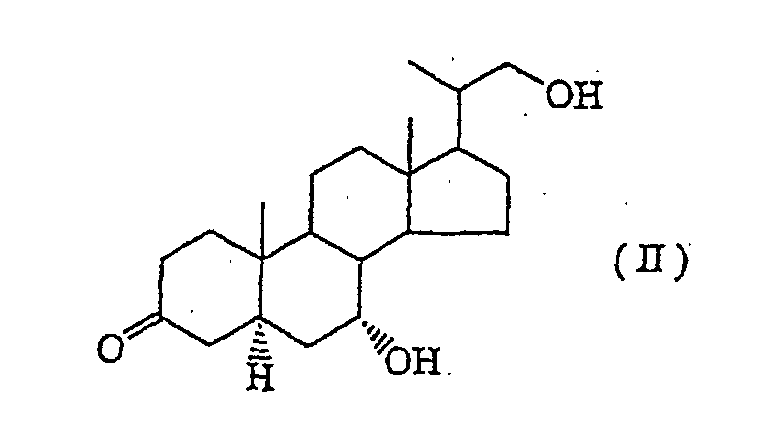 protecting the hydroxy groups of the obtained compound, to obtain a 3-oxopregnane derivative represented by the general formula (III)
protecting the 3-position carbonyl group of the obtained 3-oxopregnane derivative, to obtain a pregnane derivative represented by the general formula (IV)wherein R1, R2, R3 and R4 are as defined above; and
subjecting the obtained pregnane derivative to solvolysis. - The process according to claim 1, which comprises the steps of:wherein R1 and R2 each represents a protecting group for hydroxy group;reacting an alkali metal or an alkali earth metal with a compound represented by the formula (I-1)
 in the presence of ammonia or an amine, to obtain a compound represented by the formula (II-1);
 protecting the hydroxy groups of the obtained compound, to obtain a 3-oxopregnane derivative represented by the general formula (III-1)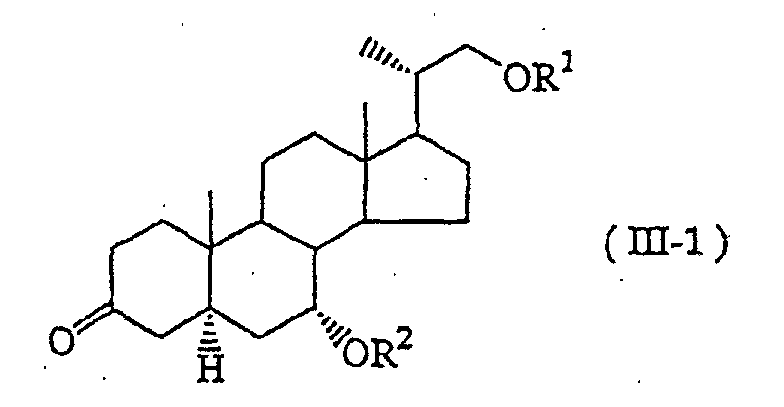
protecting the 3-position carbonyl group of the obtained 3-oxopregnane derivative, to obtain a pregnane derivative represented by the general formula (IV-1)wherein R1 and R2 are as defined above and R3 and R4 each independently represents an alkyl group which may be substituted, an alkenyl group which may be substituted, an alkynyl group which may be substituted, or an aralkyl group which may be substituted, or R3 and R4 jointly represent an alkylene group which may be substituted; and
subjecting the obtained pregnane derivative (IV-1) to solvolysis, to obtain a 21-hydroxypregnane derivative represented by the general formula (V-1)wherein R2, R3 and R4 are as defined above.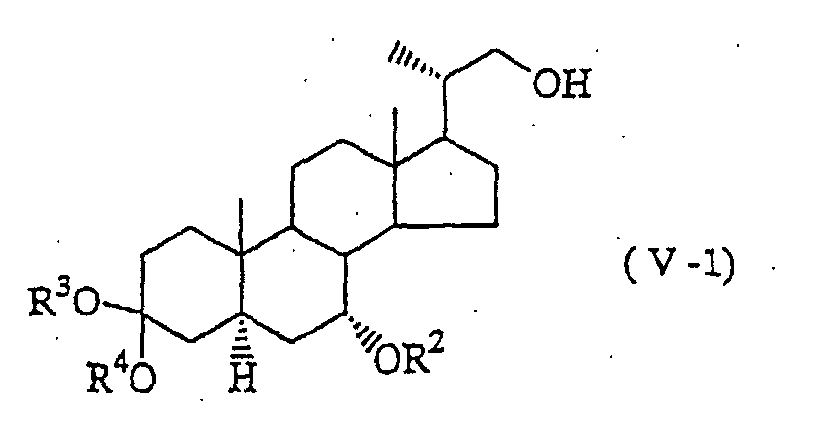
- A process for preparing compounds represented by the formula (II),which comprises reacting an alkall metal or an alkali earth metal with a compound represented by the formula (I),
 in the presence of ammonia or an amine.
- The process according to claim 3, which comprises reacting an alkali metal or an alkali earth metal with a compound represented by the formula (I-1),in the presence of ammonia or an amine, to obtain a compounc represented by the formula (II-1).


- A process for preparing pregnane derivatives represented by the general formula (IV)wherein R1 and R2 each represents a protecting group for hydroxy group, and R3 and R4 each independently represents an alkyl group which may be substituted, an alkenyl group which may be substituted, an alkynyl group which may be substituted, or an aralkyl group which may be substituted, or R3 and R4 jointly represent an alkylene group which may be substituted, which comprises protecting the hydroxy groups of a compound represented by the formula (II),
 to obtain a 3-oxopregnane derivative represented by the general formula (III)
 wherein R1 and R2 are as defined above, and protecting the 3-position carbonyl group of the obtained 3-oxopregnane derivative.
- The process according to claim 5, which comprises protecting the hydroxy groups of a compound represented by the formula (II-1),to obtain a 3-oxopregnane derivative represented by the general formula (III-1)
 wherein R1 and R2 each represents a protecting group for hydroxy group, and
protecting the 3-position carbonyl group of the obtained 3-oxopregnane derivative (III-1), to obtain a pregnane derivative represented by the general formula (IV-1)wherein R1 and R2 are as defined above, and R3 and R4 each independently represents an alkyl group which may be substituted, an alkenyl group which may be substituted, an alkynyl group which may be substituted, or an aralkyl group which may be substituted, or R3 and R4 jointly represent an alkylene group which may be substituted.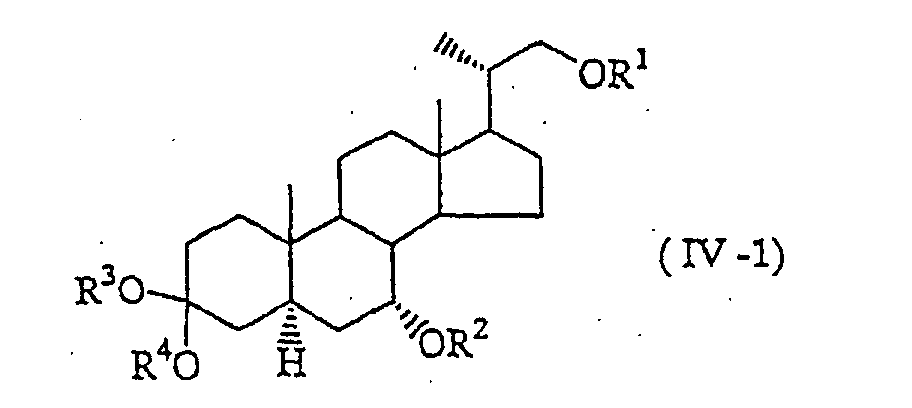
- A process for preparing 21-hydroxypregnane derivatives represented by the general formula (V)wherein R2 represents a protecting group for hydroxy group, and R3 and R4 each independently represents an alkyl group which may be substituted, an alkenyl group which may be substituted, an alkynyl group which may be substituted, or an aralkyl group which may be substituted, or R3 and R4 jointly represent an alkylene group which may be substituted,
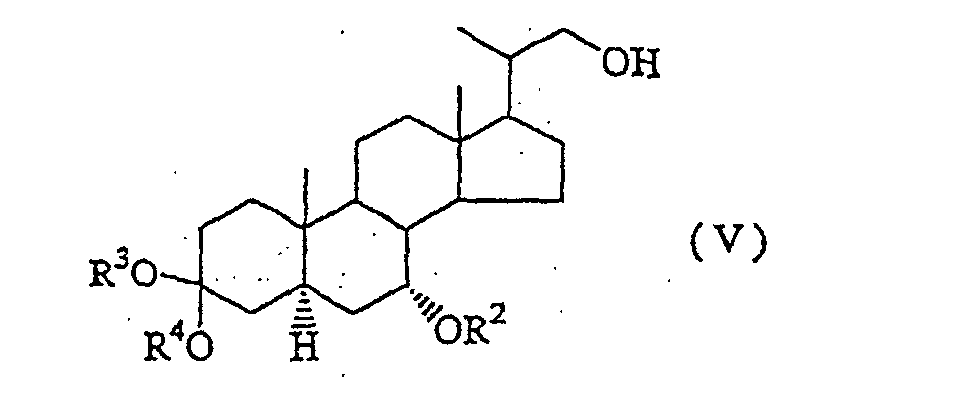
which comprises subjecting a pregnane derivative represented by the general formula (IV)wherein R1 represents a protecting group for hydroxy group, and R2 ,R3 and R4 are as defined above, to solvolysis.
- The process according to claim 7, which comprises subjecting a pregnane derivative represented by the general formula (IV-1)wherein R1 and R2 each represents a protecting group for hydroxy group, and R3 and R4 each independently represents an alkyl group which may be substituted, an alkenyl group which may be substituted, an alkynyl group which may be substituted, or an aralkyl group which may be substituted, or R3 and R4 jointly represent an alkylene group which may be substituted,

to solvolysis, to obtain a 21-hydroxypregnane derivative represented by the general formula (V-1)wherein R2, R3 and R4 are as defined above.
- 7 α ,21-dihydroxy-20-methyl-5 α -pregna-3-one represented by the formula (II).

- The compound according to claim 9, being (20S)-7 α ,21-dihydroxy-20-methyl-5 α -pregna-3-one represented by the formula (II-1).

- A process for preparing 21-hydroxypregnane derivatives represented by the general formula (V)wherein R2 represents a protecting group for hydroxy group, and R3 and R4 each independently represents an alkyl group which may be substituted, an alkenyl group which may be substituted, an alkynyl group which may be substituted, or an aralkyl group which may be substituted, or R3 and R4 jointly represent an alkylene group which may be substituted, which comprises subjecting a 3-oxopregnane derivative represented by the general formula (III)
 wherein R1 represents a protecting group for hydroxy group and R2 is as defined above, to solvolysis, to obtain a 21-hydroxy-3-oxopregnane derivative represented by the general formula (VI)
 wherein R2 is as defined above, and protecting the 3-position carbonyl group of the obtained 21-hydroxy-3-oxopregnane derivative.
- The process according to claim 11, which comprises subjecting a 3-oxopregnane derivative represented by the general formula (III-1)wherein R1 and R2 each represents a protecting group for hydroxy group, to solvolysis, to obtain a 21-hydroxy-3-oxopregnane derivative represented by the general formula (VI-1)
 wherein R2 is as defined above,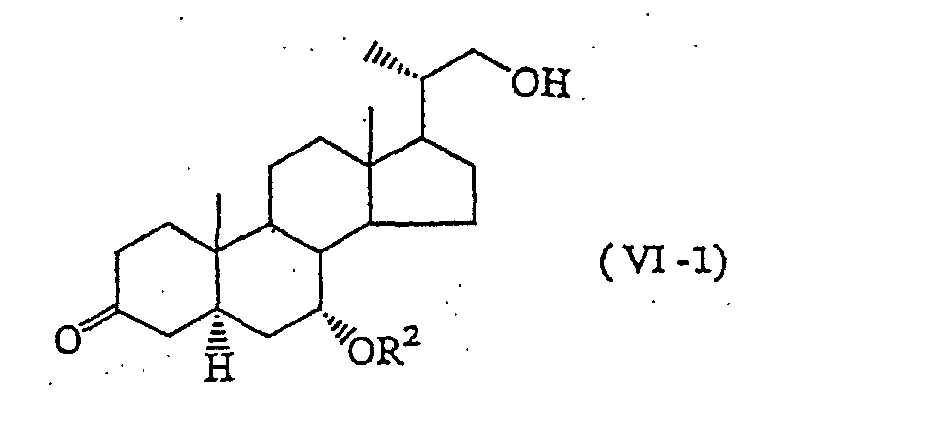
and protecting the 3-position carbonyl group of the obtained 21-hydroxy-3-oxopregnane derivative, to obtain a 21-hydroxypregnane derivative represented by the general formula (V-1)wherein R2 is as defined above, and R3 and R4 each independently represents an alkyl group which may be substituted, an alkenyl group which may be substituted, an alkynyl group which may be substituted, or an aralkyl group which may be substituted, or R3 and R4 jointly represent an alkylene group which may be substituted.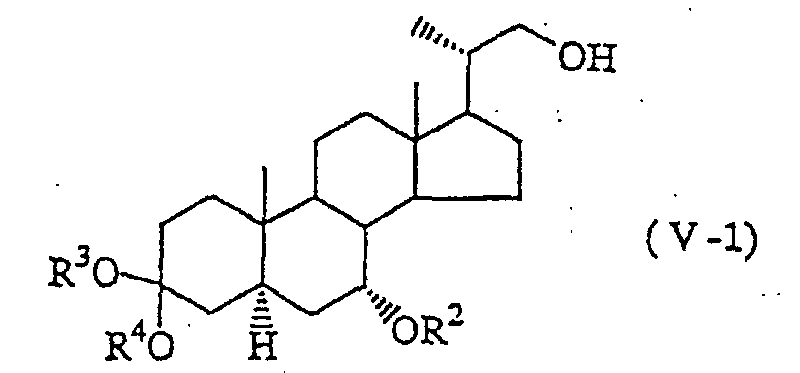
Applications Claiming Priority (3)
| Application Number | Priority Date | Filing Date | Title |
|---|---|---|---|
| JP2000273387 | 2000-09-08 | ||
| JP2000273387 | 2000-09-08 | ||
| PCT/JP2001/007639 WO2002020552A1 (en) | 2000-09-08 | 2001-09-04 | Process for the preparation of pregnane derivatives |
Publications (2)
| Publication Number | Publication Date |
|---|---|
| EP1325928A1 true EP1325928A1 (en) | 2003-07-09 |
| EP1325928A4 EP1325928A4 (en) | 2004-04-21 |
Family
ID=18759338
Family Applications (1)
| Application Number | Title | Priority Date | Filing Date |
|---|---|---|---|
| EP01961343A Withdrawn EP1325928A4 (en) | 2000-09-08 | 2001-09-04 | PROCESS FOR THE PREPARATION OF PREGNANE DERIVATIVES |
Country Status (4)
| Country | Link |
|---|---|
| US (1) | US20030181742A1 (en) |
| EP (1) | EP1325928A4 (en) |
| CA (1) | CA2416850A1 (en) |
| WO (1) | WO2002020552A1 (en) |
Cited By (3)
| Publication number | Priority date | Publication date | Assignee | Title |
|---|---|---|---|---|
| EP1767540A4 (en) * | 2004-03-31 | 2009-04-01 | Kuraray Co | METHOD OF PRODUCING THE PREGNANE-ALPHA DERIVATIVE |
| EP1743902A4 (en) * | 2004-03-31 | 2009-04-01 | Kuraray Co | PROCESS FOR PRODUCING A 5ALPHA-PREGNANE DERIVATIVE |
| EP1731526A4 (en) * | 2004-03-31 | 2009-04-01 | Kuraray Co | METHOD OF MAKING PREGNANE-ALPHA DERIVATIVE |
Families Citing this family (6)
| Publication number | Priority date | Publication date | Assignee | Title |
|---|---|---|---|---|
| EP1431395B1 (en) * | 2001-09-04 | 2008-12-10 | Kuraray Co., Ltd. | 7alpha-hydroxypregn-4-en-3-one-20-carbaldehyde, process for producing the same, and process for producing 7alpha,21-dihydroxy-20-methylpregn-4-en-3-one from the same |
| WO2003051904A1 (en) * | 2001-12-19 | 2003-06-26 | Kuraray Co., Ltd. | Process for producing pregnane derivative |
| JP2005289901A (en) * | 2004-03-31 | 2005-10-20 | Kuraray Co Ltd | Method for producing 5α-pregnane derivative |
| WO2005095433A1 (en) * | 2004-03-31 | 2005-10-13 | Kuraray Co., Ltd. | METHOD FOR PRODUCING 5α-PREGNANE DERIVATIVE |
| US20070203106A1 (en) * | 2005-03-31 | 2007-08-30 | Kuraray Co., Ltd. | Method for Producing 5Alpha-Pregnane Derivative |
| CN109680032B (en) * | 2018-12-20 | 2021-05-14 | 北京泛球生物科技有限公司 | Method for synthesizing 7, 21-dihydroxy-20-methylpregna-4-en-3-one by using microorganisms |
Family Cites Families (4)
| Publication number | Priority date | Publication date | Assignee | Title |
|---|---|---|---|---|
| US4230625A (en) * | 1979-04-12 | 1980-10-28 | Hoffmann-La Roche Inc. | Process for chenodeoxycholic acid and intermediates therefore |
| WO1994019366A1 (en) * | 1993-02-26 | 1994-09-01 | Magainin Pharmaceuticals Inc. | Chemical synthesis of squalamine |
| DE69412596T2 (en) * | 1993-03-10 | 1999-03-04 | Magainin Pharmaceuticals Inc., Plymouth Meeting, Pa. | STEROID DERIVATIVES, PHARMACEUTICAL COMPOSITIONS CONTAINING THEM AND THEIR USE AS ANTIBIOTIC OR DISINFECTANT |
| US6262283B1 (en) * | 1996-12-06 | 2001-07-17 | Magainin Pharmaceuticals Inc. | Stereoselective synthesis of 24-hydroxylated compounds useful for the preparation of aminosterols, vitamin D analogs, and other compounds |
-
2001
- 2001-09-04 WO PCT/JP2001/007639 patent/WO2002020552A1/en not_active Ceased
- 2001-09-04 CA CA002416850A patent/CA2416850A1/en not_active Abandoned
- 2001-09-04 EP EP01961343A patent/EP1325928A4/en not_active Withdrawn
- 2001-09-04 US US10/363,405 patent/US20030181742A1/en not_active Abandoned
Cited By (3)
| Publication number | Priority date | Publication date | Assignee | Title |
|---|---|---|---|---|
| EP1767540A4 (en) * | 2004-03-31 | 2009-04-01 | Kuraray Co | METHOD OF PRODUCING THE PREGNANE-ALPHA DERIVATIVE |
| EP1743902A4 (en) * | 2004-03-31 | 2009-04-01 | Kuraray Co | PROCESS FOR PRODUCING A 5ALPHA-PREGNANE DERIVATIVE |
| EP1731526A4 (en) * | 2004-03-31 | 2009-04-01 | Kuraray Co | METHOD OF MAKING PREGNANE-ALPHA DERIVATIVE |
Also Published As
| Publication number | Publication date |
|---|---|
| WO2002020552A1 (en) | 2002-03-14 |
| CA2416850A1 (en) | 2003-01-20 |
| US20030181742A1 (en) | 2003-09-25 |
| EP1325928A4 (en) | 2004-04-21 |
Similar Documents
| Publication | Publication Date | Title |
|---|---|---|
| US8524693B2 (en) | Process for obtaining 17-spirolactones in steroids | |
| US20030181742A1 (en) | Process for the preparation of pregnane derivatives | |
| CA2205745C (en) | Method for the preparation of baccatin iii and derivatives thereof from 10-deacetylbaccatin iii | |
| WO1996026181A1 (en) | Aminotetralone derivatives and process for producing the same | |
| EP0532562B1 (en) | PROCESS FOR PRODUCING 10$g(b)-H-STEROIDS | |
| WO2019170521A1 (en) | Synthesis of obeticholic acid and synthesis intermediate | |
| US4158012A (en) | Steroid synthesis process using mixed anhydride | |
| CN1060166C (en) | Process for producing DL-tocopherols and intermediates therefor | |
| US20220009899A1 (en) | Process and compounds for preparation of cannabinoids | |
| US20100317868A1 (en) | Method of preparing taxane derivatives and intermediates used therein | |
| US6130336A (en) | Process for preparing paclitaxel | |
| EP0349676A1 (en) | Tylosin derivatives and process for producing the same | |
| JP2002201199A (en) | Method for producing pregnane derivative | |
| US9012667B2 (en) | Process for introducing a double bond into position 15, 16 of a steroid | |
| CN100503629C (en) | Method for producing 5alpha-pregnane derivative | |
| JP5154546B2 (en) | Preparation of taxane derivatives | |
| JP2003246790A (en) | Method for producing pregnane derivative | |
| JPWO2006070671A1 (en) | 12-substituted mutilin derivatives | |
| JP3748933B2 (en) | Process for producing 1-substituted azetidinone derivatives | |
| WO2014060888A1 (en) | Novel process and intermediate for preparation of ulipristal | |
| WO2003051904A1 (en) | Process for producing pregnane derivative | |
| CN100509839C (en) | Method for producing 5 alpha-pregnane derivative | |
| JPS6156153A (en) | Preparation of cyclopentenone ester | |
| US9683010B2 (en) | Process for the production of 21-methoxy-11-beta-phenyl-19-nor-pregna-4,9-diene-3,20-dione derivatives | |
| JP2831549B2 (en) | Method for producing 24-oxocholesterols |
Legal Events
| Date | Code | Title | Description |
|---|---|---|---|
| PUAI | Public reference made under article 153(3) epc to a published international application that has entered the european phase |
Free format text: ORIGINAL CODE: 0009012 |
|
| 17P | Request for examination filed |
Effective date: 20030402 |
|
| AK | Designated contracting states |
Designated state(s): AT BE CH CY DE DK ES FI FR GB GR IE IT LI LU MC NL PT SE TR |
|
| A4 | Supplementary search report drawn up and despatched |
Effective date: 20040304 |
|
| 17Q | First examination report despatched |
Effective date: 20040506 |
|
| GRAP | Despatch of communication of intention to grant a patent |
Free format text: ORIGINAL CODE: EPIDOSNIGR1 |
|
| STAA | Information on the status of an ep patent application or granted ep patent |
Free format text: STATUS: THE APPLICATION IS DEEMED TO BE WITHDRAWN |
|
| 18D | Application deemed to be withdrawn |
Effective date: 20050903 |