EP1324682B1 - Oral devices - Google Patents
Oral devices Download PDFInfo
- Publication number
- EP1324682B1 EP1324682B1 EP01977507A EP01977507A EP1324682B1 EP 1324682 B1 EP1324682 B1 EP 1324682B1 EP 01977507 A EP01977507 A EP 01977507A EP 01977507 A EP01977507 A EP 01977507A EP 1324682 B1 EP1324682 B1 EP 1324682B1
- Authority
- EP
- European Patent Office
- Prior art keywords
- cleaning elements
- oral device
- opposed
- handle
- pairs
- Prior art date
- Legal status (The legal status is an assumption and is not a legal conclusion. Google has not performed a legal analysis and makes no representation as to the accuracy of the status listed.)
- Expired - Lifetime
Links
- 238000004140 cleaning Methods 0.000 claims description 113
- 210000003811 finger Anatomy 0.000 claims description 6
- 230000001154 acute effect Effects 0.000 claims description 5
- 238000000034 method Methods 0.000 claims description 5
- 210000003813 thumb Anatomy 0.000 claims description 5
- 230000035515 penetration Effects 0.000 description 11
- 241000628997 Flos Species 0.000 description 5
- 230000001680 brushing effect Effects 0.000 description 4
- 239000000463 material Substances 0.000 description 3
- -1 e.g. Substances 0.000 description 2
- 239000004677 Nylon Substances 0.000 description 1
- 239000004743 Polypropylene Substances 0.000 description 1
- 238000013459 approach Methods 0.000 description 1
- 208000024693 gingival disease Diseases 0.000 description 1
- 208000007565 gingivitis Diseases 0.000 description 1
- 210000004283 incisor Anatomy 0.000 description 1
- 238000003780 insertion Methods 0.000 description 1
- 230000037431 insertion Effects 0.000 description 1
- 230000003993 interaction Effects 0.000 description 1
- 229920001778 nylon Polymers 0.000 description 1
- 230000000149 penetrating effect Effects 0.000 description 1
- 229920000728 polyester Polymers 0.000 description 1
- 229920001155 polypropylene Polymers 0.000 description 1
Images





Classifications
-
- A—HUMAN NECESSITIES
- A46—BRUSHWARE
- A46B—BRUSHES
- A46B9/00—Arrangements of the bristles in the brush body
- A46B9/02—Position or arrangement of bristles in relation to surface of the brush body, e.g. inclined, in rows, in groups
- A46B9/04—Arranged like in or for toothbrushes
-
- A—HUMAN NECESSITIES
- A46—BRUSHWARE
- A46B—BRUSHES
- A46B5/00—Brush bodies; Handles integral with brushware
- A46B5/0004—Additional brush head
- A46B5/0012—Brushes with two or more heads on the same end of a handle for simultaneous use, e.g. cooperating with each-other
-
- A—HUMAN NECESSITIES
- A46—BRUSHWARE
- A46B—BRUSHES
- A46B2200/00—Brushes characterized by their functions, uses or applications
- A46B2200/10—For human or animal care
- A46B2200/1066—Toothbrush for cleaning the teeth or dentures
Definitions
- the present invention relates to oral devices, e. g., devices for cleaning the teeth, gums and interproximal regions.
- toothbrushes having tufts of bristles mounted on a head, are generally effective at removing plaque from the flat surfaces of teeth and the areas between teeth and along the gumline that can be accessed by the bristles during brushing.
- toothbrushes typically cannot clean interproximal and sub-gingival regions where tufts of bristles are generally unable to penetrate or reach. This is because the bristles tend to pass or flick over the gaps between the teeth and are usually physically impeded from reaching behind the interdental papillae and below the gumline. To clean the interproximal regions supra-and subgingivally, it is generally necessary to floss between the teeth with dental floss.
- the inventors have found that interproximal penetration appears to occur more often and be deeper when a slow brushing movement is used, slower than many people typically brush their teeth.
- the present invention features an oral device that is designed to be used with a slow, ratcheting motion, to allow the device to penetrate between the teeth on both sides of each tooth and "pry out" trapped food and debris that are lodged in the interproximal regions.
- Preferred oral devices of the invention provide deep interproximal penetration and effective removal of food and debris.
- the inventors have also discovered that there is a correlation between interproximal penetration and the angle of a bristle relative to a line drawn through the interproximal region ("the interproximal line"), substantially parallel to the opposed surfaces of the teeth. If the bristle is parallel to the interproximal line when the device is placed over the teeth (defined as a 0 degree angle), less interproximal penetration occurs than if the bristle is angled away from the interproximal line.
- the cleaning elements of the device e. g., bristles or fins
- an oral device comprising: a handle; a head, extending from said handle, having a pair of elongated arms that include opposed surfaces; a pair of opposed cleaning elements mounted on the opposed surfaces at an acute angle relative to a plane that is substantially perpendicular to the opposed surfaces and substantially parallel to the handle and a plurality of pairs of centering elements mounted on the opposed surfaces, wherein the centering elements are relatively shorter than the cleaning elements.
- a method of cleaning between the teeth of a human including: inserting into the mouth an oral device that includes (a) a handle having a first end constructed to be grasped by a user and a second, free end; (b) a head, positioned at the second end of the handle, having a pair of elongated arms, the arms being substantially parallel to each other and having opposed surfaces; and (c) pairs of opposed cleaning elements, mounted on the opposed surfaces, the pairs of cleaning elements being positioned along the opposed surfaces at predetermined intervals and each of the cleaning elements being mounted at an acute angle relative to an interproximal line, the distance between pairs corresponding substantially to the average spacing between human teeth; positioning the oral device by means of a plurality of pairs of centering elements mounted on said opposed surfaces and positioned to guide the oral device and center it around a tooth, said centering elements being relatively shorter than said cleaning elements, so that the opposed cleaning elements straddle a row of teeth; pushing the oral device toward the back of the mouth until each pair of
- the invention features an oral device that includes a handle, a head, extending from the handle and having a pair of elongated arms that include opposed surfaces; and a pair of opposed cleaning elements, mounted on the opposed surfaces, the cleaning elements being constructed and positioned to be inserted into the interproximal regions of a user's mouth when the oral device is moved back and forth.
- Each of the cleaning elements are positioned at an acute angle with respect to the interproximal line.
- the oral device includes one or more of the following features.
- the cleaning elements are positioned to be flexed towards the opposed arms during movement in a first direction, and then straighten out until they are substantially perpendicular to the opposed surfaces during movement in a second, opposite direction.
- the device includes a plurality of pairs of cleaning elements, and each of the cleaning elements extends at substantially the same angle, with respect to the interproximal line, as the other cleaning elements on the same surface.
- the angle is greater than 10 degrees, preferably greater than 15 degrees, more preferably from about 15 to 40 degrees and most preferably about 15 to 30 degrees.
- the opposed cleaning elements define a V shape.
- the device includes at least 2 pairs of cleaning elements, the pairs of cleaning elements being positioned along the opposed surfaces at predetermined intervals.
- the pairs of cleaning elements extend from the handle towards the opposite end of the head in a row.
- the cleaning elements are progressively shorter as the pairs are spaced further from the handle.
- the cleaning elements of each pair are from 2 to 20% shorter than the cleaning elements of an adjacent pair that is closer to the handle.
- the handle includes a gripping portion that is constructed to be grasped between the thumb and first two fingers of a user's hand.
- the handle includes a substantially disc-shaped gripping portion.
- the handle includes an elongated shaft, the head is mounted at a first end of the elongated shaft, and the gripping portion is mounted at a second end of the elongated shaft.
- the head further comprises a web extending from the handle, and the opposed arms extend outwardly from opposite sides of the web.
- the web defines a substantially U-shaped opening that faces away from the handle.
- the device includes a plurality of pairs of centering elements, positioned on the opposed surfaces between the cleaning elements and the web, for guiding the oral device.
- the centering elements are positioned so that, in use, at least two centering elements on each side are touching the teeth simultaneously.
- the centering elements comprise elastomeric elements and/or bristle tufts.
- the centering elements are mounted substantially parallel to the interproximal line. Adjacent pairs of cleaning elements are spaced from 0.5 to 6.0 mm apart along the length of the arms.
- the cleaning elements comprise bristle tufts and/or elastomeric fins. At least some of the cleaning elements comprise inner, relatively longer thin bristles and outer, relatively shorter and thicker supporting bristles.
- the bristles have a diameter of from about 0.003 inch (0.0762 mm) 0.009 inch (0.225 mm).
- the invention features an oral device that includes: (a) a handle that includes a gripping portion constructed to be grasped between the thumb and first two fingers of a user's hand; (b) a head, extending from the handle, having a pair of elongated arms that include opposed surfaces; and (c) pairs of opposed cleaning elements, mounted on the opposed surfaces, the pairs of cleaning elements being positioned along the opposed surfaces at predetermined intervals for insertion into the user's interproximal regions.
- the gripping portion is substantially disc-shaped.
- the gripping portion has a thickness of from about 0.5 to 20 mm.
- the gripping portion has a diameter of from about 2 to 7 cm.
- the invention features a method of cleaning between the teeth of a human, including: (i) inserting into the mouth an oral device that includes (a) a handle having a first end constructed to be grasped by a user and a second, free end; (b) a head, positioned at the second end of the handle, having a pair of elongated arms, the arms being substantially parallel to each other and having opposed surfaces; and (c) pairs of opposed cleaning elements, mounted on the opposed surfaces, the pairs of cleaning elements being positioned along the opposed surfaces at predetermined intervals, the distance between pairs corresponding substantially to the average spacing between human teeth; (ii) positioning the oral device so that the opposed cleaning elements straddle a row of teeth; (iii) pushing the oral device toward the back of the mouth until each pair of opposed cleaning elements is positioned between two adjacent teeth; and (iv) pulling the oral device toward the front of the mouth, causing the cleaning elements to wedge into the interproximal region between the adjacent teeth.
- the invention features an oral device that includes a handle, a head, extending from the handle, having a pair of elongated arms that include opposed surfaces, and pairs of opposed cleaning elements, mounted on the opposed surfaces, the pairs of cleaning elements being positioned along the opposed surfaces at predetermined intervals, the cleaning elements being constructed and positioned to be inserted into the user's interproximal regions when the oral device is moved back and forth with a ratcheting motion to index the device from one interproximal region to the next.
- oral device 10 includes a handle 12 and a head 14 mounted at one end of the handle.
- Handle 12 includes a shaft 16 and a grip 18.
- the grip 18 is disc-shaped, having relatively large top and bottom surfaces 19 and a relatively thin side surface 20, so that a user will tend to grasp the top and bottom surfaces 19 of the disc between the thumb and index finger, or thumb and first two fingers, rather than holding the grip encircled by the palm and fingers as a conventional elongated toothbrush handle is typically held.
- the shaft is generally from about 5 to 10 cm long, the diameter of the grip is from about 2 to 5 cm, and the thickness of the grip is from about 0.5 to 20 mm, more preferably 0.5 to 10 mm.
- Opposed arms 22,24 include facing surfaces 30,32, upon which pairs of opposed cleaning elements 34 are mounted.
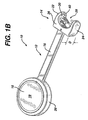
- the opposed arms 22,24 have a depth D (Fig. 1B) that is selected to allow the head to accommodate both the front and back teeth. Preferably, depth D is from about 5 to 15 mm.
- the oral device is shown in use in Figs. 4-4A. These figures show, from above, the oral device "straddling" some of the teeth. A portion of the shaft 16 and head 12 have been cut away (see broken lines) in order to show the interaction of cleaning elements 34 with teeth 42. As shown in Fig. 4, the oral device is first placed over the teeth so that the cleaning elements 34 of each pair are positioned on opposite sides of the teeth, and the oral device is then pushed toward the back of the mouth (arrow A) to index the cleaning elements with the spaces 43 between adjacent teeth. At this point, the cleaning elements are flexed towards the opposed surfaces 30,32 of arms 22,24. Then, as shown in Fig.
- the oral device is slowly pulled forward, towards the front of the mouth (arrow B), causing the cleaning elements 34 to relax towards their normal positions, and then move beyond their normal positions, straightening out to penetrate into the interproximal regions 44.
- the cleaning elements are forced out of the interproximal regions 44, dislodging debris as they exit.
- This series of movements is repeated over and over, with the user slowly “ratcheting" the oral device back and forth while advancing the device from tooth to tooth, until all of the teeth and interproximal regions of one jaw have been cleaned.
- the device is then positioned so that it straddles the teeth of the other jaw, and the process is repeated to clean between the teeth of the other jaw.
- the U-shaped opening enhances user comfort and provides clearance of the awbone in the rear of the mouth, thereby allowing better access to the furthest molars.
- the cleaning elements are mounted at an angle A (see Fig. 2A) so that the opposed elements define a V-shape, the base of the V pointing toward the grip 18.
- the cleaning elements are angled, with respect to a line drawn through the interproximal region substantially parallel to the opposed surfaces 35 of the teeth ("the Interproximal Line", IL, Fig. 2A) at an angle A, to enable the cleaning elements to penetrate the interproximal region during use.
- Angle A is preferably at least about 10 degrees, more preferably at least 15 degrees, and most preferably about 15 to 25 degrees. At smaller angles, the cleaning elements may not adequately penetrate the interproximal region, while at larger angles the cleaning elements may not engage between the teeth and will tend to bend over during use.
- the cleaning elements are also angled away from web 26.
- This angle B (see Fig. 3), is preferably at least 5 degrees, more preferably from about 10 to 20 degrees.
- the elements are angled in this direction to compensate for the tendency of the cleaning elements to bend toward web 26 when the device is placed over the teeth.
- the resultant angle of the cleaning elements, in use is typically 0-5 degrees. In some cases, if angle B is too small, the cleaning elements may bend towards the web (towards the top of the tooth) and may tend not to engage into the gap between the teeth. The penetration force is generally highest when the resultant angle is 0 degrees in both planes.
- the maximum penetration force is limited by the column strength of the angled elements.
- the cleaning elements As the cleaning elements are moved across the teeth, they engage the interproximal areas as shown in Fig. 4B. As angle A approaches 90 degrees, the driving forces F increase substantially. The cleaning elements are forced into the interproximal regions until the cleaning elements can travel no further and the column strength of the elements is exceeded. The cleaning elements then buckle (Fig. 4C), and the forces F are reduced. This procedure is repeated each time the cleaning elements are moved across the teeth. Because the penetration force that could be generated by the device is much higher than the column strength of the cleaning elements, the maximum penetration force is determined by the column strength of the cleaning elements.
- the stiffness and penetration of the cleaning elements can be varied to obtain desired device properties.
- the oral device can be provided in "soft”, “medium” and “hard” models to satisfy different user preferences.
- a single oral device can include cleaning elements of different column strengths. Generally, for a given material, longer, thinner cleaning elements will have lower column strength and thus less penetration than shorter, thicker cleaning elements.
- the free ends of the cleaning elements of each pair are spaced apart slightly, but are sufficiently close so that at least some pairs of cleaning elements will deeply penetrate the interproximal region between two teeth when the oral device is used in the manner discussed below.
- the free ends of the cleaning elements in the pairs that are closest to the grip are closest together, while the free ends of the cleaning elements in the pairs that are spaced further from the grip are further apart.
- the gap between the elements that are spaced further from the grip is larger so as to allow these elements to engage the large molars, while the spacing between the other elements is selected to allow these elements to engage the thinner teeth, e.g., incisors.
- the device is preferably offered in different sizes, e.g., small, medium and large, to accommodate small and large mouths.
- a suitable spacing is from about 0 to 4 mm for the pair that is closest to the grip, with the cleaning elements of each successive pair being spaced about 0.5 to 3 mm further apart than those of the previous pair.
- the cleaning elements 34 are progressively shorter as they are spaced further from grip 18.
- the cleaning elements of the pair that is closest to grip 18 are about 5 to 12 mm long
- the cleaning elements of the adjacent pair are about 5 to 12 mm long
- the cleaning elements of the pair that is furthest from the grip are about 5 to 9 mm long.
- the shorter cleaning elements be from about 2 to 20% shorter than the adjacent cleaning elements that are closer to the grip.
- cleaning elements 34 are bristle tufts, e.g., formed of nylon or polyester bristles. It is also preferred that the tufts that are closer to the grip include longer, inner bristles 36 that are surrounded by shorter, outer bristles 38 (see Fig. 1A). To penetrate the small gaps between the front teeth, the longer bristles 36 are relatively fine in diameter, e.g., about 0.004-0.006 inch (0.102-0.152 mm). As a result, the longer bristles 36 typically have relatively low column strength.
- the outer bristles 38 are provided to support the longer bristles 36 and prevent them from buckling
- the outer bristles 38 have a diameter of from about 0.007 (0.178 mm) to 0.010 inch (0.254 mm).
- a sleeve can be provided around the base of the longer bristles 36, instead of surrounding the longer bristles with shorter bristles.
- the head also includes pairs of opposed centering elements 40, positioned between the cleaning elements 34 and the web 26. Centering elements 40 guide the oral device and center it around a tooth. If the device is not sufficiently centered around the tooth, only one side of the pairs of cleaning elements may engage the teeth, reducing the force with which those cleaning elements penetrate the interproximal region.
- centering elements 40 are short, cylindrical bristle tufts having a relatively high stiffness.
- the centering elements are positioned so that, in use, at least two centering elements on each side are touching the teeth simultaneously.
- the head also includes a pair of angled centering elements 41. If desired, the centering elements may be elastomeric elements, e.g., knobs or fins, rather than bristle tufts, or a combination of tufts and elastomeric elements can be used.
- the handle and head are both formed from a rigid or semi-rigid material, e.g., polypropylene.
- the handle and head may be integrally molded, or may be formed separately and joined, e.g., if it is desired to make them from different materials.
- Oral device 100 includes an elongated handle, and, extending from the handle 102, a device head 104.
- Device head 104 includes a pair of opposed elongated arms 106. Arms 106 may be flexible or rigid, depending on the desired properties of the device.
- a plurality of cleaning elements are mounted on the opposed surfaces 108, 108A of the arms, defining a pair of opposed brush heads 110, 110A.
- Brush heads 110, 110A include cleaning elements 112, that are angled away from the handle, cleaning elements 114, that are angled towards the handle, and a pair of closely spaced cleaning elements 116 at the forward end of the device head 104.
- Cleaning elements 112 and 114 may be, e.g., tufts of bristles, individual bristles, or elastomeric fins. At least some pairs of the cleaning elements are mounted at an angle, with respect to the opposed surfaces, of preferably at least 15 degrees, more preferably from 15 to 25 degrees.
- Device 100 may be used with a horizontal brushing motion, like a toothbrush, or with a ratcheting motion as discussed above.
- the oral device can include fewer or more pairs of cleaning elements.
- the cleaning elements can be elastomeric fins.
- the handle can have a shape other than disc-shaped.
- the cleaning elements may be angled to form a V pointing in the direction opposite to that shown in the Figures, in which case the sequence of actions of the bristles on the forward and reverse strokes of the device would be opposite to that described above.
- the brush head may have any desired design, provided that at least some opposed pairs of cleaning elements are positioned and angled for interproximal penetration.
Landscapes
- Brushes (AREA)
- Dental Tools And Instruments Or Auxiliary Dental Instruments (AREA)
Description
- The present invention relates to oral devices, e. g., devices for cleaning the teeth, gums and interproximal regions.
- Conventional toothbrushes, having tufts of bristles mounted on a head, are generally effective at removing plaque from the flat surfaces of teeth and the areas between teeth and along the gumline that can be accessed by the bristles during brushing. However, such toothbrushes typically cannot clean interproximal and sub-gingival regions where tufts of bristles are generally unable to penetrate or reach. This is because the bristles tend to pass or flick over the gaps between the teeth and are usually physically impeded from reaching behind the interdental papillae and below the gumline. To clean the interproximal regions supra-and subgingivally, it is generally necessary to floss between the teeth with dental floss.
- While flossing effectively cleans the interproximal and sub-gingival regions, many people do not floss regularly, or do not floss at all. Failing to floss regularly may result in gingivitis, which can lead to more serious gum diseases. These problems can occur despite regular toothbrushing.
- The inventors have found that interproximal penetration appears to occur more often and be deeper when a slow brushing movement is used, slower than many people typically brush their teeth. The present invention features an oral device that is designed to be used with a slow, ratcheting motion, to allow the device to penetrate between the teeth on both sides of each tooth and "pry out" trapped food and debris that are lodged in the interproximal regions. Preferred oral devices of the invention provide deep interproximal penetration and effective removal of food and debris.
- The inventors have also discovered that there is a correlation between interproximal penetration and the angle of a bristle relative to a line drawn through the interproximal region ("the interproximal line"), substantially parallel to the opposed surfaces of the teeth. If the bristle is parallel to the interproximal line when the device is placed over the teeth (defined as a 0 degree angle), less interproximal penetration occurs than if the bristle is angled away from the interproximal line. In preferred oral devices, the cleaning elements of the device (e. g., bristles or fins) are angled away from the interproximal line, more preferably at least 10 degrees and most preferably at least 15 degrees.
- In accordance with the present invention, there is provided an oral device comprising: a handle; a head, extending from said handle, having a pair of elongated arms that include opposed surfaces; a pair of opposed cleaning elements mounted on the opposed surfaces at an acute angle relative to a plane that is substantially perpendicular to the opposed surfaces and substantially parallel to the handle and a plurality of pairs of centering elements mounted on the opposed surfaces, wherein the centering elements are relatively shorter than the cleaning elements.
- In accordance with the present invention, there is also provided a method of cleaning between the teeth of a human, including: inserting into the mouth an oral device that includes (a) a handle having a first end constructed to be grasped by a user and a second, free end; (b) a head, positioned at the second end of the handle, having a pair of elongated arms, the arms being substantially parallel to each other and having opposed surfaces; and (c) pairs of opposed cleaning elements, mounted on the opposed surfaces, the pairs of cleaning elements being positioned along the opposed surfaces at predetermined intervals and each of the cleaning elements being mounted at an acute angle relative to an interproximal line, the distance between pairs corresponding substantially to the average spacing between human teeth; positioning the oral device by means of a plurality of pairs of centering elements mounted on said opposed surfaces and positioned to guide the oral device and center it around a tooth, said centering elements being relatively shorter than said cleaning elements, so that the opposed cleaning elements straddle a row of teeth; pushing the oral device toward the back of the mouth until each pair of opposed cleaning elements is positioned between two adjacent teeth; and pulling the oral device toward the front of the mouth, causing the cleaning elements to wedge into the interproximal region between the adjacent teeth.
- In one aspect, the invention features an oral device that includes a handle, a head, extending from the handle and having a pair of elongated arms that include opposed surfaces; and a pair of opposed cleaning elements, mounted on the opposed surfaces, the cleaning elements being constructed and positioned to be inserted into the interproximal regions of a user's mouth when the oral device is moved back and forth. Each of the cleaning elements are positioned at an acute angle with respect to the interproximal line.
- In preferred embodiments, the oral device includes one or more of the following features. The cleaning elements are positioned to be flexed towards the opposed arms during movement in a first direction, and then straighten out until they are substantially perpendicular to the opposed surfaces during movement in a second, opposite direction. The device includes a plurality of pairs of cleaning elements, and each of the cleaning elements extends at substantially the same angle, with respect to the interproximal line, as the other cleaning elements on the same surface. The angle is greater than 10 degrees, preferably greater than 15 degrees, more preferably from about 15 to 40 degrees and most preferably about 15 to 30 degrees. The opposed cleaning elements define a V shape. The device includes at least 2 pairs of cleaning elements, the pairs of cleaning elements being positioned along the opposed surfaces at predetermined intervals. The pairs of cleaning elements extend from the handle towards the opposite end of the head in a row. The cleaning elements are progressively shorter as the pairs are spaced further from the handle. The cleaning elements of each pair are from 2 to 20% shorter than the cleaning elements of an adjacent pair that is closer to the handle. The handle includes a gripping portion that is constructed to be grasped between the thumb and first two fingers of a user's hand. The handle includes a substantially disc-shaped gripping portion. The handle includes an elongated shaft, the head is mounted at a first end of the elongated shaft, and the gripping portion is mounted at a second end of the elongated shaft. The head further comprises a web extending from the handle, and the opposed arms extend outwardly from opposite sides of the web. The web defines a substantially U-shaped opening that faces away from the handle. The device includes a plurality of pairs of centering elements, positioned on the opposed surfaces between the cleaning elements and the web, for guiding the oral device. The centering elements are positioned so that, in use, at least two centering elements on each side are touching the teeth simultaneously. The centering elements comprise elastomeric elements and/or bristle tufts. The centering elements are mounted substantially parallel to the interproximal line. Adjacent pairs of cleaning elements are spaced from 0.5 to 6.0 mm apart along the length of the arms. The cleaning elements comprise bristle tufts and/or elastomeric fins. At least some of the cleaning elements comprise inner, relatively longer thin bristles and outer, relatively shorter and thicker supporting bristles. The bristles have a diameter of from about 0.003 inch (0.0762 mm) 0.009 inch (0.225 mm).
- In another aspect, the invention features an oral device that includes: (a) a handle that includes a gripping portion constructed to be grasped between the thumb and first two fingers of a user's hand; (b) a head, extending from the handle, having a pair of elongated arms that include opposed surfaces; and (c) pairs of opposed cleaning elements, mounted on the opposed surfaces, the pairs of cleaning elements being positioned along the opposed surfaces at predetermined intervals for insertion into the user's interproximal regions.
- Preferred embodiments include one or more of the following features. The gripping portion is substantially disc-shaped. The gripping portion has a thickness of from about 0.5 to 20 mm. The gripping portion has a diameter of from about 2 to 7 cm.
- In a further aspect, the invention features a method of cleaning between the teeth of a human, including: (i) inserting into the mouth an oral device that includes (a) a handle having a first end constructed to be grasped by a user and a second, free end; (b) a head, positioned at the second end of the handle, having a pair of elongated arms, the arms being substantially parallel to each other and having opposed surfaces; and (c) pairs of opposed cleaning elements, mounted on the opposed surfaces, the pairs of cleaning elements being positioned along the opposed surfaces at predetermined intervals, the distance between pairs corresponding substantially to the average spacing between human teeth; (ii) positioning the oral device so that the opposed cleaning elements straddle a row of teeth; (iii) pushing the oral device toward the back of the mouth until each pair of opposed cleaning elements is positioned between two adjacent teeth; and (iv) pulling the oral device toward the front of the mouth, causing the cleaning elements to wedge into the interproximal region between the adjacent teeth. Preferably, steps (iii) and (iv) are performed with a motion that is slower than the user's normal toothbrushing speed.
- In yet another aspect, the invention features an oral device that includes a handle, a head, extending from the handle, having a pair of elongated arms that include opposed surfaces, and pairs of opposed cleaning elements, mounted on the opposed surfaces, the pairs of cleaning elements being positioned along the opposed surfaces at predetermined intervals, the cleaning elements being constructed and positioned to be inserted into the user's interproximal regions when the oral device is moved back and forth with a ratcheting motion to index the device from one interproximal region to the next.
- The term "opposed", as used herein, is not intended to require that the elements referred to have parallel surfaces, but merely to indicate that the elements generally face toward each other.
- Other features and advantages of the invention will be apparent from the following description of a presently preferred embodiment, and from the claims.
- Fig. 1 is a perspective view of an oral device according to one embodiment of the invention.
- Fig, 1A is an enlarged detail view of the head of the oral device of Fig. 1.
- Fig. 1B is a perspective view of the oral device of Fig. 1, taken from the opposite direction.
- Fig. 2 is a top view of the oral device of Fig. 1. Fig. 2A is an enlarged detail view of a pair of cleaning elements positioned relative to the interproximal line.
- Fig. 3 is an end view of the oral device of Fig. 1.
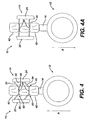
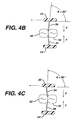
- Figs. 4 and 4A are schematic top views showing the oral device of Fig. 1 being used to clean between the teeth of a portion of the lower jaw. A portion of the oral device is cut-away (see broken lines) to show the underlying teeth. Figs. 4B and 4C are enlarged schematic top views showing a single pair of cleaning elements during use.
- Fig. 5 is a top plan view of an oral device according to an alternate embodiment of the invention.
- Fig. 5A is a partial enlarged view of the front portion of the device of Fig. 5.
- A preferred
oral device 10 is shown in Figs. 1-3. Referring to Fig. 1,oral device 10 includes ahandle 12 and ahead 14 mounted at one end of the handle.Handle 12 includes ashaft 16 and agrip 18. Thegrip 18 is disc-shaped, having relatively large top andbottom surfaces 19 and a relativelythin side surface 20, so that a user will tend to grasp the top andbottom surfaces 19 of the disc between the thumb and index finger, or thumb and first two fingers, rather than holding the grip encircled by the palm and fingers as a conventional elongated toothbrush handle is typically held. Thus thegrip 18 is held in a manner similar to the way a pen is usually held, giving the oral device the feel of a precision instrument and tending to cause the user to move the oral device slowly and deliberately, rather than with a rapid brushing motion. The shaft is generally from about 5 to 10 cm long, the diameter of the grip is from about 2 to 5 cm, and the thickness of the grip is from about 0.5 to 20 mm, more preferably 0.5 to 10 mm. - The
head 14, shown in more detail in Figs. 1A and 1B, includes a pair ofopposed arms web 26 that extends from theshaft 16. As shown in Fig. 1B, theweb 26 includes aU-shaped opening 28 that facilitates maneuvering of the oral device in the mouth, as will be discussed in further detail below.Opposed arms surfaces elements 34 are mounted. Theopposed arms - The oral device is shown in use in Figs. 4-4A. These figures show, from above, the oral device "straddling" some of the teeth. A portion of the
shaft 16 andhead 12 have been cut away (see broken lines) in order to show the interaction of cleaningelements 34 withteeth 42. As shown in Fig. 4, the oral device is first placed over the teeth so that thecleaning elements 34 of each pair are positioned on opposite sides of the teeth, and the oral device is then pushed toward the back of the mouth (arrow A) to index the cleaning elements with thespaces 43 between adjacent teeth. At this point, the cleaning elements are flexed towards the opposed surfaces 30,32 ofarms cleaning elements 34 to relax towards their normal positions, and then move beyond their normal positions, straightening out to penetrate into theinterproximal regions 44. When the device is then pushed forward again, in the direction of arrow A, the cleaning elements are forced out of theinterproximal regions 44, dislodging debris as they exit. This series of movements is repeated over and over, with the user slowly "ratcheting" the oral device back and forth while advancing the device from tooth to tooth, until all of the teeth and interproximal regions of one jaw have been cleaned. The device is then positioned so that it straddles the teeth of the other jaw, and the process is repeated to clean between the teeth of the other jaw. The U-shaped opening enhances user comfort and provides clearance of the awbone in the rear of the mouth, thereby allowing better access to the furthest molars. - The cleaning elements are mounted at an angle A (see Fig. 2A) so that the opposed elements define a V-shape, the base of the V pointing toward the
grip 18. Thus, the cleaning elements are angled, with respect to a line drawn through the interproximal region substantially parallel to the opposed surfaces 35 of the teeth ("the Interproximal Line", IL, Fig. 2A) at an angle A, to enable the cleaning elements to penetrate the interproximal region during use. Angle A is preferably at least about 10 degrees, more preferably at least 15 degrees, and most preferably about 15 to 25 degrees. At smaller angles, the cleaning elements may not adequately penetrate the interproximal region, while at larger angles the cleaning elements may not engage between the teeth and will tend to bend over during use. - The cleaning elements are also angled away from
web 26. This angle B (see Fig. 3), is preferably at least 5 degrees, more preferably from about 10 to 20 degrees. The elements are angled in this direction to compensate for the tendency of the cleaning elements to bend towardweb 26 when the device is placed over the teeth. The resultant angle of the cleaning elements, in use, is typically 0-5 degrees. In some cases, if angle B is too small, the cleaning elements may bend towards the web (towards the top of the tooth) and may tend not to engage into the gap between the teeth. The penetration force is generally highest when the resultant angle is 0 degrees in both planes. - The maximum penetration force is limited by the column strength of the angled elements. Referring to Figs. 4B and 4C, as the cleaning elements are moved across the teeth, they engage the interproximal areas as shown in Fig. 4B. As angle A approaches 90 degrees, the driving forces F increase substantially. The cleaning elements are forced into the interproximal regions until the cleaning elements can travel no further and the column strength of the elements is exceeded. The cleaning elements then buckle (Fig. 4C), and the forces F are reduced. This procedure is repeated each time the cleaning elements are moved across the teeth. Because the penetration force that could be generated by the device is much higher than the column strength of the cleaning elements, the maximum penetration force is determined by the column strength of the cleaning elements. Thus, by selecting the column strengths of the cleaning elements, the stiffness and penetration of the cleaning elements can be varied to obtain desired device properties. For example, the oral device can be provided in "soft", "medium" and "hard" models to satisfy different user preferences. Moreover, a single oral device can include cleaning elements of different column strengths. Generally, for a given material, longer, thinner cleaning elements will have lower column strength and thus less penetration than shorter, thicker cleaning elements.
- The free ends of the cleaning elements of each pair are spaced apart slightly, but are sufficiently close so that at least some pairs of cleaning elements will deeply penetrate the interproximal region between two teeth when the oral device is used in the manner discussed below. As shown in Fig. 2, the free ends of the cleaning elements in the pairs that are closest to the grip are closest together, while the free ends of the cleaning elements in the pairs that are spaced further from the grip are further apart. The gap between the elements that are spaced further from the grip is larger so as to allow these elements to engage the large molars, while the spacing between the other elements is selected to allow these elements to engage the thinner teeth, e.g., incisors. The device is preferably offered in different sizes, e.g., small, medium and large, to accommodate small and large mouths. A suitable spacing is from about 0 to 4 mm for the pair that is closest to the grip, with the cleaning elements of each successive pair being spaced about 0.5 to 3 mm further apart than those of the previous pair. Thus, the
cleaning elements 34 are progressively shorter as they are spaced further fromgrip 18. In some preferred oral devices, the cleaning elements of the pair that is closest to grip 18 are about 5 to 12 mm long, the cleaning elements of the adjacent pair are about 5 to 12 mm long, and the cleaning elements of the pair that is furthest from the grip are about 5 to 9 mm long. In general, it is preferred that the shorter cleaning elements be from about 2 to 20% shorter than the adjacent cleaning elements that are closer to the grip. - Suitable cleaning elements are constructed so that they are capable of penetrating the interproximal region as shown in Fig. 4A, and removing food and debris that are a trapped there. Preferably, cleaning
elements 34 are bristle tufts, e.g., formed of nylon or polyester bristles. It is also preferred that the tufts that are closer to the grip include longer,inner bristles 36 that are surrounded by shorter, outer bristles 38 (see Fig. 1A). To penetrate the small gaps between the front teeth, the longer bristles 36 are relatively fine in diameter, e.g., about 0.004-0.006 inch (0.102-0.152 mm). As a result, the longer bristles 36 typically have relatively low column strength. The outer bristles 38 are provided to support the longer bristles 36 and prevent them from buckling Preferably, the outer bristles 38 have a diameter of from about 0.007 (0.178 mm) to 0.010 inch (0.254 mm). If desired, a sleeve can be provided around the base of the longer bristles 36, instead of surrounding the longer bristles with shorter bristles. - The head also includes pairs of opposed centering
elements 40, positioned between the cleaningelements 34 and theweb 26. Centeringelements 40 guide the oral device and center it around a tooth. If the device is not sufficiently centered around the tooth, only one side of the pairs of cleaning elements may engage the teeth, reducing the force with which those cleaning elements penetrate the interproximal region. Preferably, centeringelements 40 are short, cylindrical bristle tufts having a relatively high stiffness. The centering elements are positioned so that, in use, at least two centering elements on each side are touching the teeth simultaneously. The head also includes a pair of angled centeringelements 41. If desired, the centering elements may be elastomeric elements, e.g., knobs or fins, rather than bristle tufts, or a combination of tufts and elastomeric elements can be used. - The handle and head are both formed from a rigid or semi-rigid material, e.g., polypropylene. The handle and head may be integrally molded, or may be formed separately and joined, e.g., if it is desired to make them from different materials.
- Another oral device is shown in Figs. 5-5A.
Oral device 100 includes an elongated handle, and, extending from thehandle 102, adevice head 104.Device head 104 includes a pair of opposedelongated arms 106.Arms 106 may be flexible or rigid, depending on the desired properties of the device. A plurality of cleaning elements are mounted on theopposed surfaces elements 112, that are angled away from the handle, cleaningelements 114, that are angled towards the handle, and a pair of closely spaced cleaningelements 116 at the forward end of thedevice head 104.Cleaning elements Device 100 may be used with a horizontal brushing motion, like a toothbrush, or with a ratcheting motion as discussed above. - Other embodiments are within the claims. For example, the oral device can include fewer or more pairs of cleaning elements. The cleaning elements can be elastomeric fins. The handle can have a shape other than disc-shaped. The cleaning elements may be angled to form a V pointing in the direction opposite to that shown in the Figures, in which case the sequence of actions of the bristles on the forward and reverse strokes of the device would be opposite to that described above. In devices that include opposed brush heads, the brush head may have any desired design, provided that at least some opposed pairs of cleaning elements are positioned and angled for interproximal penetration.
Claims (12)
- An oral device (10) comprising:a handle (12);a head (14), extending from said handle (12), having a pair of elongated arms (22,24) that include opposed surfaces (30,32);a pair of opposed cleaning elements (34) mounted on the opposed surfaces (30,32) at an acute angle relative to a plane that is substantially perpendicular to the opposed surfaces (30,32) and substantially parallel to the handle (12); anda plurality of pairs of centering elements (40) mounted on the opposed surfaces (30,32) wherein the centering elements (40) are relatively shorter than the cleaning elements (34).
- The oral device (10) according to claim 1, wherein at least some of said cleaning elements (34) are positioned to be flexed towards said opposed arms (22,24) during movement in a first direction, and then straighten out until they are substantially perpendicular to said opposed surfaces (30,32) during movement in a second, opposite direction.
- The oral device (10) according to claims 1 or 2, wherein the device includes a plurality of pairs of cleaning elements (34).
- The oral device (10) according to anyone of the preceding claims, wherein said angle is greater than 10 degrees.
- The oral device (10) according to anyone of the preceding claims, comprising at least 2 pairs of cleaning elements (34), said pairs of cleaning elements (34) being positioned along said opposed surfaces at predetermined intervals.
- The oral device (10) according to anyone of the preceding claims, wherein said opposed surfaces (30,32) have a predetermined depth selected to accommodate the front and back teeth of a user.
- The oral device (10) according to anyone of the preceding claims, wherein the handle (12) includes a gripping portion (18) that is constructed to be grasped between the thumb and first two fingers of a user's hand.
- The oral device (10) according to anyone of the preceding claims, wherein said handle includes a substantially disc-shaped gripping portion (18).
- The oral device (10) according to anyone of the preceding claims, wherein said head (14) further comprises a web (26) extending from said handle (12), and said elongated arms (22,24) arms extend the outwardly from opposite sides of said web (26).
- The oral device (10) according to anyone of the preceding claims, wherein said cleaning elements comprise bristle tufts.
- The oral device (10) according to anyone of the preceding claims 1-9, wherein said cleaning elements (34) comprise elastomeric fins.
- A method of cleaning between the teeth of a human, including:inserting into the mouth an oral device that includes (a) a handle (12) having a first end constructed to be grasped by a user and a second, free end; (b) a head (14), positioned at the second end of the handle (12), having a pair of elongated arms (22, 24), the arms being substantially parallel to each other and having opposed surfaces (30, 32); and (c) pairs of opposed cleaning elements (34), mounted on the opposed surfaces (30, 32), the pairs of cleaning elements (34) being positioned along the opposed surfaces (30, 32) at predetermined intervals and each of the cleaning elements (34) being mounted at an acute angle relative to an interproximal line, the distance between pairs corresponding substantially to the average spacing between human teeth;positioning the oral device by means of a plurality of pairs of centering elements (40) mounted on said opposed surfaces (30, 32) and positioned to guide the oral device and center it around a tooth, said centering elements (40) being relatively shorter than said cleaning elements (34), so that the opposed cleaning elements (34) straddle a row of teeth;pushing the oral device toward the back of the mouth until each pair of opposed cleaning elements (34) is positioned between two adjacent teeth; andpulling the oral device toward the front of the mouth, causing the cleaning elements (34) to wedge into the interproximal region between the adjacent teeth.
Applications Claiming Priority (3)
| Application Number | Priority Date | Filing Date | Title |
|---|---|---|---|
| US09/680,007 US6823554B1 (en) | 2000-10-05 | 2000-10-05 | Oral devices |
| US680007 | 2000-10-05 | ||
| PCT/US2001/031165 WO2002028221A1 (en) | 2000-10-05 | 2001-10-04 | Oral devices |
Publications (2)
| Publication Number | Publication Date |
|---|---|
| EP1324682A1 EP1324682A1 (en) | 2003-07-09 |
| EP1324682B1 true EP1324682B1 (en) | 2006-04-05 |
Family
ID=24729260
Family Applications (1)
| Application Number | Title | Priority Date | Filing Date |
|---|---|---|---|
| EP01977507A Expired - Lifetime EP1324682B1 (en) | 2000-10-05 | 2001-10-04 | Oral devices |
Country Status (8)
| Country | Link |
|---|---|
| US (1) | US6823554B1 (en) |
| EP (1) | EP1324682B1 (en) |
| CN (1) | CN100401941C (en) |
| AU (1) | AU2001296622A1 (en) |
| BR (1) | BR0114394A (en) |
| DE (1) | DE60118587T2 (en) |
| MX (1) | MXPA03002992A (en) |
| WO (1) | WO2002028221A1 (en) |
Families Citing this family (15)
| Publication number | Priority date | Publication date | Assignee | Title |
|---|---|---|---|---|
| WO2003086141A2 (en) * | 2002-04-08 | 2003-10-23 | Verifresh Ltd. | Gum massager device |
| US7137163B2 (en) | 2002-09-27 | 2006-11-21 | Colgate-Palmolive Company | Power toothbrush and power source |
| US7934284B2 (en) | 2003-02-11 | 2011-05-03 | Braun Gmbh | Toothbrushes |
| USD728118S1 (en) | 2003-03-17 | 2015-04-28 | Verifresh Ltd | Gum massager |
| CA2644300C (en) | 2003-04-23 | 2013-07-23 | John Geoffrey Chan | Electric toothbrushes |
| PY0626124A (en) * | 2005-09-09 | 2011-04-01 | Colgate Palmolive Co | TOOTHBRUSH |
| WO2008050172A1 (en) * | 2006-10-25 | 2008-05-02 | Alejandro Vidal Velasquez | Oral cleansing system and means |
| USD698156S1 (en) | 2008-06-13 | 2014-01-28 | Braum Gmbh | Toothbrush handle |
| US8517729B2 (en) | 2010-03-04 | 2013-08-27 | The University of Western Ontario and Trudell Medical International | Oral mouthpiece and method for the use thereof |
| EP2830548B1 (en) | 2012-03-29 | 2019-09-18 | Trudell Medical International | Oral device with bolus simulator and method of use thereof |
| US8951045B1 (en) * | 2013-01-02 | 2015-02-10 | Dennis J. White | Toothbrush bristle arrangement and method |
| US9339357B1 (en) | 2014-02-07 | 2016-05-17 | Maxim Babiner | Multi-headed toothbrush |
| CA3004237A1 (en) | 2015-12-09 | 2017-06-15 | Trudell Medical International | Oral device, assembly and method for use thereof |
| USD838368S1 (en) | 2015-12-09 | 2019-01-15 | Trudell Medical International | Oral device |
| US10278485B2 (en) * | 2016-09-01 | 2019-05-07 | Colgate-Palmolive Company | Oral care implement and filament therefor |
Family Cites Families (88)
| Publication number | Priority date | Publication date | Assignee | Title |
|---|---|---|---|---|
| US388620A (en) | 1888-08-28 | Dental matrix | ||
| US511619A (en) | 1893-12-26 | Teeth-separator | ||
| US486112A (en) | 1892-11-15 | Dental spacer | ||
| US1188134A (en) | 1915-09-27 | 1916-06-20 | Jose Arbat | Tool for cleaning teeth. |
| US1544404A (en) | 1924-07-24 | 1925-06-30 | William L Hummel | Toothbrush attachment |
| US1593763A (en) | 1925-02-24 | 1926-07-27 | William J Corbett | Rotary toothbrush |
| US1693229A (en) | 1927-08-18 | 1928-11-27 | Felmar Victor | Toothbrush |
| US1758632A (en) | 1929-08-26 | 1930-05-13 | Edwin R Wagner | Brush |
| US1908509A (en) * | 1930-11-08 | 1933-05-09 | Ruth J Pallasch | Toothbrush |
| US1967783A (en) | 1933-09-19 | 1934-07-24 | Rudof Morris | Method of making a toothbrush |
| US2066241A (en) * | 1935-06-17 | 1936-12-29 | Trattner | Tooth brush |
| US2077392A (en) | 1935-06-27 | 1937-04-20 | Noo Tooth Brush Inc | Tooth brush |
| US2093007A (en) | 1935-09-03 | 1937-09-14 | Hugo J Chott | Mechanical tooth brush |
| US2093383A (en) | 1935-10-15 | 1937-09-14 | Rudof | Tooth brush |
| US2175975A (en) | 1937-05-10 | 1939-10-10 | Steiner Lloyd | Tooth brush |
| US2220053A (en) | 1938-12-10 | 1940-10-29 | Ibbie L Pruner | Rotary toothbrush |
| US2246867A (en) | 1940-06-22 | 1941-06-24 | Arthur J Thomas | Toothbrush |
| US2655674A (en) | 1946-09-30 | 1953-10-20 | Donald P Grover | Multiple rotary toothbrush with lip guard |
| US2655676A (en) | 1946-10-24 | 1953-10-20 | Donald P Grover | Rotary toothbrush with lip guard |
| US2583886A (en) | 1947-10-17 | 1952-01-29 | Alvin J Schlegel | Power-driven toothbrush with demountably supported rotary brushes |
| US2628377A (en) | 1950-03-21 | 1953-02-17 | Floyd M Cockriel | Mechanical toothbrush |
| US2701380A (en) | 1950-07-14 | 1955-02-08 | Sophia T Ripper | Attachment for toothbrushes |
| US2771624A (en) * | 1955-02-23 | 1956-11-27 | Tri Dent Corp | Toothbrush |
| US2935755A (en) | 1955-10-14 | 1960-05-10 | Leira Alberto Ramon | Tooth-brushes and the like |
| US3082457A (en) | 1961-05-26 | 1963-03-26 | Florio R Lucibello | Self-adapting tufts for brushes |
| US3386118A (en) | 1966-03-18 | 1968-06-04 | Morioku Shigemi | Resilient brush unit |
| US3646628A (en) | 1970-01-21 | 1972-03-07 | Halbrand Inc | Combination toothbrush and pick |
| US3722020A (en) | 1971-01-04 | 1973-03-27 | J Hills | Toothbrush with concavity formed by bristle ends |
| US3683442A (en) | 1971-04-05 | 1972-08-15 | Hollymatic Corp | Toothbrush |
| US3903906A (en) | 1973-03-12 | 1975-09-09 | George C Collis | Method and apparatus for brushing teeth |
| US3984890A (en) | 1975-06-25 | 1976-10-12 | Collis George C | Electric tooth brush |
| US4449266A (en) * | 1976-03-02 | 1984-05-22 | Noerthemann Karl Heinz | Toothbrush with two segments of bristles |
| US4679273A (en) * | 1985-08-19 | 1987-07-14 | Seth Okin | Dental appliance for cleansing the gingival one third areas of the teeth as well as the sulcular and the embrasure regions thereof |
| IT1097220B (en) | 1978-07-13 | 1985-08-26 | Massetti Alessandro | TOOTH BRUSH STRUCTURE |
| IT8136121U1 (en) * | 1981-11-06 | 1983-05-06 | Avantgarde Spa | TOOTHBRUSH WITH BRISTLES OF DIFFERENT HEIGHTS. |
| US4428091A (en) | 1981-12-14 | 1984-01-31 | Janssen Thomas B | Toothbrush |
| US4449933A (en) | 1982-02-01 | 1984-05-22 | Forni William J | Interproximal dental stimulator and cleaning apparatus |
| US4454623A (en) * | 1982-09-08 | 1984-06-19 | Radius Corporation | Toothbrush |
| US4498209A (en) * | 1983-03-25 | 1985-02-12 | Leslie Weiss | Twin dental brush |
| CA1221507A (en) | 1983-04-29 | 1987-05-12 | Etienne D'argembeau | Device for cleaning the teeth proximal faces |
| US4534081A (en) | 1983-06-29 | 1985-08-13 | Spademan Richard George | Tooth cleaning bristle and holder |
| IL71065A (en) | 1984-02-27 | 1989-09-28 | Marta N Berl | Toothbrush |
| US4757570A (en) | 1985-06-18 | 1988-07-19 | Manfred Haeusser | Toothbrush for simultaneous cleaning of teeth on both sides |
| US4712266A (en) | 1985-08-09 | 1987-12-15 | Fan Out Co., Ltd. | Whisk pick |
| US4625357A (en) | 1985-08-30 | 1986-12-02 | Demartino John D | Toothbrush |
| DE3664718D1 (en) * | 1986-05-30 | 1989-09-07 | Rolf Barman | Process for producing a toothbrush and toothbrushes produced by the process |
| US5284168A (en) | 1988-01-19 | 1994-02-08 | Oral Logic, Inc. | Tooth cleaning device |
| US5497526A (en) | 1986-12-04 | 1996-03-12 | Oral Logic Inc. | Tooth brushing device |
| US4796325A (en) | 1987-10-29 | 1989-01-10 | Issar Bortman | Angularly adjustable double headed toothbrush |
| US4911187A (en) | 1989-01-19 | 1990-03-27 | Castillo David D | Dental pick brush apparatus |
| US4979256A (en) | 1989-06-06 | 1990-12-25 | Branford William G | Toothbrush with multiple rotary brush members |
| US5072481A (en) | 1989-11-13 | 1991-12-17 | Frank Weyer | Multi-surface toothbrush |
| US5032082A (en) | 1989-12-20 | 1991-07-16 | Herrera William R | Device for removing adhesive from the palate |
| US5177826A (en) | 1990-03-16 | 1993-01-12 | Hagemann International | Rotary toothbrush |
| US5027463A (en) | 1990-05-07 | 1991-07-02 | Daub Craig C | Toothbrush |
| DE4115943C2 (en) | 1991-05-16 | 1998-10-01 | Noerthemann Karl Heinz | Gum massage brush |
| US5109563A (en) | 1990-09-19 | 1992-05-05 | Professional Dental Technologies, Inc. | Soft brush gum stimulator |
| IL96413A0 (en) | 1990-11-20 | 1991-08-16 | Ohad Paz | Brush including spring-mounted bristle holders |
| US5186627A (en) | 1991-05-01 | 1993-02-16 | Noah Amit | Hand-actuated rotatable toothbrush |
| US5120225A (en) | 1991-05-01 | 1992-06-09 | Noah Amit | Method and apparatus for brushing teeth with cyclically rotating brush strokes |
| US5175901A (en) | 1991-05-01 | 1993-01-05 | Rabinowitz Gary A | Apparatus and method for brushing teeth |
| CA2056858C (en) * | 1991-11-07 | 2000-07-18 | Kenneth J. Hegemann | Self-adjusting three sided toothbrush and method of manufacture |
| US5351358A (en) | 1992-08-27 | 1994-10-04 | Larrimore Babatu | Toothbrush |
| KR950703881A (en) | 1992-10-31 | 1995-11-17 | 마사노리(Masanori Sato) 사토 | TOOTHBRUSH AND ELECTRIC TOOTHBRUSH |
| EP0688518B1 (en) | 1993-02-15 | 2001-06-06 | Euronica Corporation | Tooth-brushing machine |
| DE9313034U1 (en) | 1993-08-31 | 1993-10-28 | Georg Karl Geka-Brush Gmbh, 91572 Bechhofen | Cleaning device |
| US5609170A (en) | 1994-05-03 | 1997-03-11 | Roth; Edward S. | Interproximal toothbrush and method of use thereof |
| US5398369A (en) | 1994-07-07 | 1995-03-21 | Chesebrough-Pond's Usa Co., Division Of Conopco, Inc. | Toothbrush with pliable pressure pad |
| CN2206059Y (en) * | 1994-09-23 | 1995-08-30 | 萧国辉 | Toothbrush with tooth-cleaning-protective function |
| ATE207321T1 (en) * | 1994-12-01 | 2001-11-15 | Procter & Gamble | TOOTHBRUSH WITH EXTENDED BRISTLES |
| US5660546A (en) | 1995-01-17 | 1997-08-26 | Shafer; Joseph G. | Denture cleaning kit and process |
| US5537708A (en) | 1995-03-29 | 1996-07-23 | Luposello; Mark A. | Toothbrush for simultaneous cleaning of brace and tooth surfaces |
| US5647385A (en) | 1995-04-07 | 1997-07-15 | Dynaproducts Inc. | Automated dental cleaner |
| US5658148A (en) | 1995-04-26 | 1997-08-19 | Ceramoptec Industries, Inc. | Dental laser brushing or cleaning device |
| US5765254A (en) * | 1995-11-29 | 1998-06-16 | Radius Inc. | Toothbrush with flexible neck |
| GB9524580D0 (en) | 1995-12-01 | 1996-01-31 | Unilever Plc | A toothbrush with flexibly mounted bristles |
| US5546626A (en) | 1995-12-20 | 1996-08-20 | Chung; Chin-Fu | Toothbrush with movable bundles of bristles |
| US5775346A (en) | 1996-02-14 | 1998-07-07 | Advanced Implant Technologies Inc. | Interproximal dental appliances |
| US6065176A (en) * | 1996-02-29 | 2000-05-23 | Watanabe; Takayuki | Toothbrush |
| US5930860A (en) * | 1996-03-27 | 1999-08-03 | Shipp; Anthony D. | Prophy bristle toothbrush |
| US5758380A (en) | 1996-06-25 | 1998-06-02 | Devmark Ltd. | Device for comprehensive oral hygiene |
| JP2001504357A (en) * | 1996-07-19 | 2001-04-03 | チョル クォン,ヤング | toothbrush |
| EP0929244A1 (en) * | 1996-08-22 | 1999-07-21 | SmithKline Beecham Consumer Healthcare GmbH | Toothbrush |
| DE29700952U1 (en) * | 1997-01-21 | 1998-05-20 | Böhm, Bernd, Dr., 90453 Nürnberg | Tooth cleaning device |
| US5765249A (en) * | 1997-05-07 | 1998-06-16 | T.F.H. Publications, Inc. | Toothbrush for cleaning the teeth of a domestic animal |
| CN2361149Y (en) * | 1998-09-28 | 2000-02-02 | 吴金海 | Double-face rotating health toothbrush |
| CN2343877Y (en) * | 1998-12-08 | 1999-10-20 | 吕志东 | Three-face cleaning swivel tooth brush |
| US6397425B1 (en) * | 1999-08-31 | 2002-06-04 | Gillette Canada Company | Polypropylene brush body |
-
2000
- 2000-10-05 US US09/680,007 patent/US6823554B1/en not_active Expired - Fee Related
-
2001
- 2001-10-04 MX MXPA03002992A patent/MXPA03002992A/en active IP Right Grant
- 2001-10-04 DE DE60118587T patent/DE60118587T2/en not_active Expired - Lifetime
- 2001-10-04 EP EP01977507A patent/EP1324682B1/en not_active Expired - Lifetime
- 2001-10-04 WO PCT/US2001/031165 patent/WO2002028221A1/en not_active Ceased
- 2001-10-04 CN CNB018168795A patent/CN100401941C/en not_active Expired - Fee Related
- 2001-10-04 AU AU2001296622A patent/AU2001296622A1/en not_active Abandoned
- 2001-10-04 BR BR0114394-8A patent/BR0114394A/en not_active Application Discontinuation
Also Published As
| Publication number | Publication date |
|---|---|
| MXPA03002992A (en) | 2004-05-05 |
| DE60118587D1 (en) | 2006-05-18 |
| BR0114394A (en) | 2003-08-26 |
| WO2002028221A1 (en) | 2002-04-11 |
| US6823554B1 (en) | 2004-11-30 |
| CN1468071A (en) | 2004-01-14 |
| EP1324682A1 (en) | 2003-07-09 |
| CN100401941C (en) | 2008-07-16 |
| AU2001296622A1 (en) | 2002-04-15 |
| DE60118587T2 (en) | 2007-02-15 |
Similar Documents
| Publication | Publication Date | Title |
|---|---|---|
| US6823554B1 (en) | Oral devices | |
| US6178583B1 (en) | Toothbrush having bristles for interproximal cleaning | |
| US20040255416A1 (en) | Toothbrush with tongue cleaning member | |
| CN1248621C (en) | Improved brushhead for a toothbrush | |
| CN1105528C (en) | Toothbrush | |
| US4109339A (en) | Toothbrush with curved handle | |
| JP6509902B2 (en) | Head for oral care equipment | |
| US6546586B2 (en) | Toothbrush with flossing functionality | |
| US4913176A (en) | Dental pick | |
| US5459899A (en) | Interstitial flossing toothbrush | |
| WO2020050985A1 (en) | Head for an oral care implement and a kit comprising such head | |
| US5704379A (en) | Disposable flossing and debrider device | |
| JP2008540029A (en) | Oral hygiene | |
| CN101453960B (en) | Dental interproximal cleaner | |
| WO2003053190A1 (en) | Stepped diameter bristles for a toothbrush | |
| JP2007530131A (en) | toothbrush | |
| JP2001309819A (en) | toothbrush | |
| US11464323B2 (en) | Toothbrush | |
| JP2001346632A (en) | toothbrush | |
| JPH06141929A (en) | Toothbrush | |
| JP3059451U (en) | toothbrush | |
| JP7681168B1 (en) | toothbrush | |
| JPH07227318A (en) | toothbrush | |
| JP3116926U (en) | A toothbrush that fits easily between teeth | |
| EP4295727A1 (en) | Toothbrush with novel bristle configuration |
Legal Events
| Date | Code | Title | Description |
|---|---|---|---|
| PUAI | Public reference made under article 153(3) epc to a published international application that has entered the european phase |
Free format text: ORIGINAL CODE: 0009012 |
|
| 17P | Request for examination filed |
Effective date: 20030430 |
|
| AK | Designated contracting states |
Designated state(s): AT BE CH CY DE DK ES FI FR GB GR IE IT LI LU MC NL PT SE TR |
|
| AX | Request for extension of the european patent |
Extension state: AL LT LV MK RO SI |
|
| 17Q | First examination report despatched |
Effective date: 20031117 |
|
| RBV | Designated contracting states (corrected) |
Designated state(s): DE FR GB IT |
|
| GRAP | Despatch of communication of intention to grant a patent |
Free format text: ORIGINAL CODE: EPIDOSNIGR1 |
|
| GRAS | Grant fee paid |
Free format text: ORIGINAL CODE: EPIDOSNIGR3 |
|
| GRAA | (expected) grant |
Free format text: ORIGINAL CODE: 0009210 |
|
| AK | Designated contracting states |
Kind code of ref document: B1 Designated state(s): DE FR GB IT |
|
| PG25 | Lapsed in a contracting state [announced via postgrant information from national office to epo] |
Ref country code: IT Free format text: LAPSE BECAUSE OF FAILURE TO SUBMIT A TRANSLATION OF THE DESCRIPTION OR TO PAY THE FEE WITHIN THE PRESCRIBED TIME-LIMIT;WARNING: LAPSES OF ITALIAN PATENTS WITH EFFECTIVE DATE BEFORE 2007 MAY HAVE OCCURRED AT ANY TIME BEFORE 2007. THE CORRECT EFFECTIVE DATE MAY BE DIFFERENT FROM THE ONE RECORDED. Effective date: 20060405 |
|
| REG | Reference to a national code |
Ref country code: GB Ref legal event code: FG4D |
|
| REF | Corresponds to: |
Ref document number: 60118587 Country of ref document: DE Date of ref document: 20060518 Kind code of ref document: P |
|
| PLBE | No opposition filed within time limit |
Free format text: ORIGINAL CODE: 0009261 |
|
| STAA | Information on the status of an ep patent application or granted ep patent |
Free format text: STATUS: NO OPPOSITION FILED WITHIN TIME LIMIT |
|
| 26N | No opposition filed |
Effective date: 20070108 |
|
| EN | Fr: translation not filed | ||
| PG25 | Lapsed in a contracting state [announced via postgrant information from national office to epo] |
Ref country code: FR Free format text: LAPSE BECAUSE OF FAILURE TO SUBMIT A TRANSLATION OF THE DESCRIPTION OR TO PAY THE FEE WITHIN THE PRESCRIBED TIME-LIMIT Effective date: 20070309 |
|
| PG25 | Lapsed in a contracting state [announced via postgrant information from national office to epo] |
Ref country code: FR Free format text: LAPSE BECAUSE OF FAILURE TO SUBMIT A TRANSLATION OF THE DESCRIPTION OR TO PAY THE FEE WITHIN THE PRESCRIBED TIME-LIMIT Effective date: 20060405 |
|
| PGFP | Annual fee paid to national office [announced via postgrant information from national office to epo] |
Ref country code: GB Payment date: 20090914 Year of fee payment: 9 |
|
| GBPC | Gb: european patent ceased through non-payment of renewal fee |
Effective date: 20101004 |
|
| PG25 | Lapsed in a contracting state [announced via postgrant information from national office to epo] |
Ref country code: GB Free format text: LAPSE BECAUSE OF NON-PAYMENT OF DUE FEES Effective date: 20101004 |
|
| PGFP | Annual fee paid to national office [announced via postgrant information from national office to epo] |
Ref country code: DE Payment date: 20141028 Year of fee payment: 14 |
|
| REG | Reference to a national code |
Ref country code: DE Ref legal event code: R119 Ref document number: 60118587 Country of ref document: DE |
|
| PG25 | Lapsed in a contracting state [announced via postgrant information from national office to epo] |
Ref country code: DE Free format text: LAPSE BECAUSE OF NON-PAYMENT OF DUE FEES Effective date: 20160503 |