EP1324625A1 - Method and system for arranging a cell-reselection process - Google Patents
Method and system for arranging a cell-reselection process Download PDFInfo
- Publication number
- EP1324625A1 EP1324625A1 EP01403271A EP01403271A EP1324625A1 EP 1324625 A1 EP1324625 A1 EP 1324625A1 EP 01403271 A EP01403271 A EP 01403271A EP 01403271 A EP01403271 A EP 01403271A EP 1324625 A1 EP1324625 A1 EP 1324625A1
- Authority
- EP
- European Patent Office
- Prior art keywords
- base station
- mobile station
- time parameter
- averaging time
- cell
- Prior art date
- Legal status (The legal status is an assumption and is not a legal conclusion. Google has not performed a legal analysis and makes no representation as to the accuracy of the status listed.)
- Withdrawn
Links
- 238000000034 method Methods 0.000 title claims abstract description 16
- 238000012935 Averaging Methods 0.000 claims abstract description 30
- 238000005259 measurement Methods 0.000 claims abstract description 28
- 230000011664 signaling Effects 0.000 claims abstract description 10
- 230000010267 cellular communication Effects 0.000 claims abstract description 4
- 238000004364 calculation method Methods 0.000 description 5
- 238000012546 transfer Methods 0.000 description 5
- 239000000969 carrier Substances 0.000 description 2
- 238000004891 communication Methods 0.000 description 2
- 230000005540 biological transmission Effects 0.000 description 1
- 230000001413 cellular effect Effects 0.000 description 1
- 238000012512 characterization method Methods 0.000 description 1
- 238000010586 diagram Methods 0.000 description 1
- 238000011156 evaluation Methods 0.000 description 1
- 238000012545 processing Methods 0.000 description 1
Images
Classifications
-
- H—ELECTRICITY
- H04—ELECTRIC COMMUNICATION TECHNIQUE
- H04W—WIRELESS COMMUNICATION NETWORKS
- H04W48/00—Access restriction; Network selection; Access point selection
- H04W48/08—Access restriction or access information delivery, e.g. discovery data delivery
- H04W48/12—Access restriction or access information delivery, e.g. discovery data delivery using downlink control channel
-
- H—ELECTRICITY
- H04—ELECTRIC COMMUNICATION TECHNIQUE
- H04W—WIRELESS COMMUNICATION NETWORKS
- H04W36/00—Hand-off or reselection arrangements
- H04W36/08—Reselecting an access point
-
- H—ELECTRICITY
- H04—ELECTRIC COMMUNICATION TECHNIQUE
- H04W—WIRELESS COMMUNICATION NETWORKS
- H04W48/00—Access restriction; Network selection; Access point selection
- H04W48/20—Selecting an access point
Definitions
- the present invention relates to a method for sharing the necessary calculations for carrying out a cell re-selection in a General Packet Radio Service (GPRS) between both sides of a communication. That is, part of the cell reselection parameters is processed on the network side and another part thereof is processed on the remote unit side, namely, mobile station. When the mobile station involved has carried out its calculations it sends the result thereof to the network side.
- GPRS General Packet Radio Service
- the old cell, serving cell, and the new cell, neighbour cell supports GPRS, this means that the mobile station may perform packet access.
- ETSI TS 101 349 V8.11.0 (2001-09) Digital cellular telecommunications system; General Packet Radio Service (GPRS); Mobile Station (MS) - Base Station System (BSS) Interface; Radio Link Control/Medium Access Control (RLC/MAC) protocol (3GPP TS 04.60 version 8.11.0 Release 1999), it is known that control over some processes such as cell selection and re-selection is exercised at the network side when a mobile station is in ready state.
- GPRS General Packet Radio Service
- MS Mobile Station
- BSS Base Station System
- RLC/MAC Radio Link Control/Medium Access Control
- cell re-selection is associated with GPRS and corresponds to the term “handover” associated with circuit switching GSM services.
- a handover allows reserving radio resources in the target cell whereas the cell reselection does not.
- the mobile station shall acquire certain system information sent in broadcast control channel from the network side (e.g. base station) before making any access in the target cell.
- a cell reselection is therefore less efficient then an handover as there is a data transfer interruption during the cell reselection.
- the mobile station performs autonomous cell reselection, i.e. the mobile station is responsible of triggering its cell reselections (for instance when the radio received level falls below a given threshold) by computing a specified cell reselection algorithm.
- the network instructs the mobile to send signal measurement reports to the base station. Then, the mobile terminals select the next cell re-selection based on the cell identity information received from the network.
- the mobile station can suspend its own cell re-selection calculations.
- the network may implement. If it is supported and activated by the operator, then the network controls the mobile station cell reselections.
- the mobile station When in idle state, and the network controlled cell reselection is activate, the mobile station only monitors the serving and surrounding cells and reports its measurements to the network. The mobile station does not perform any cell re-selection algorithms.
- each mobile terminal sends measurement reports to the network, according to information requests provided in the control message. These measurements are then processed by the base station, which may decide to perform a cell re-selection.
- the mobile terminal monitors continuously all carriers and the broadcast control channel (BCCH carrier) of the serving cell.
- BCCH carrier broadcast control channel
- the mobile station For each carrier, the mobile station averages the received signal level measured during a reporting period. After each reporting period, the mobile terminal sends a measurement report to the base station. The reporting period is based on the radio-operating mode of the mobile terminal.
- a parameter e.g. NC_REPORTING_PERIOD_I
- That first parameter is rounded off to the nearest smaller integer multiple of the discontinuous reception period if the dedicated parameter is greater than the discontinuous reception period, otherwise the reporting period is the discontinuous reception period.
- the discontinuous reception period is the time that separates two successive paging blocks while the mobile station is in discontinuous reception mode.
- the mobile station listens its assigned radio resources.
- the reporting period is indicated in another parameter (e.g. NC_REPORTING_PERIOD_T).
- the mobile station takes at least one received signal level sample measurement on each control channel.
- the network has to average the measurements reported by the mobile station during a certain period in the order of several seconds. This computation leads first to additional processing at the network side. Secondly, this may result in an inaccurate average at the network side in packet idle mode as explained in the next paragraph.
- the mobile station may report the same sample measurements in consecutive measurement reports, resulting in an accurate average at the network side. As a consequence, the mobile station may perform cell reselection ordered by the network although it is not necessary.
- the present invention proposes a method for arranging a cell reselection process between mobile station and base station in a digital cellular communications system, where the mobile station location is known by a base station system at the cell level and the base station system controls the cell reselection.
- the base station system broadcasts, via the base station, a first averaging time parameter and a second averaging time parameter over a system information message associated to packet mode.
- the first averaging time parameter and the second averaging time parameter are fixed by the base station system. They are variable between a minimum value and a maximum value.
- the mobile station averages received signal level of the serving cell and receiving signal level of the neighbour cells over broadcast control channels as indicated by the first averaging time parameter and/or the second averaging time parameter, and sends independently of the packet mode, averaged measurements obtained over a dedicated signalling message.
- the base station system informs the mobile station of the period of time it has to carry out said measurements.
- the network side performs a series of calculations and the mobile station performs other calculations in order that the network side transmits the information relative to the new service cell for the mobile terminal involved in the cell re-selection process.
- the overall time employed for carrying out the call transfer is reduced.
- Another advantage is that the same measurement averaging process could be used in Cell Change Notification or network controlled cell reselection mode.
- the MS reports its measurements to the network, it provides averaged measurements which are different from that obtained in network controlled cell reselection mode.
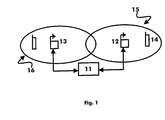
- a mobile terminal 14 moves into or near coverage areas 15, 16 that can be operating on the same set of radio network carrier frequencies, while sending and receiving their respective packet data traffic according to a standardised General Packet Radio Service GPRS that has been specified for use with a circuit switching system such as Global System for Mobile digital communication GSM.
- GPRS General Packet Radio Service
- Network can include one or more of a plurality of base stations 12, 13 for sending and receiving packet data traffic according to the standardised GPRS.
- the mobile station 14 is coupled via an air interface to the base station 12. Therefore, mobile terminal thereby functions to send and receive packet switched traffic.
- Mobile terminal 14 can represent one or more of a plurality of mobile terminals capable of handling packet data traffic.
- the network includes base station (no shown) for sending and receiving circuit switched traffic, for instance GSM. Therefore, the mobile station 14 is capable of handling circuit switched traffic.
- the mobile station 14 stays in the ready mode (GMM ready state). Therefore, a network entity as a base station system 11 controls the cell reselection process and the mobile station 14 sends measurement reports to the base station system 11. Note that in GMM ready state, a serving GPRS support node SGSN, namely, other network entity knows the mobile station 14 location at the cell level.
- the mobile station 14 informs the base station system 11 when has detected the need for cell reselection. So, the base station system 11 may order the mobile station 14 to perform a cell reselection towards a different cell, new serving cell 16. For example, according to Cell Change Notification (CCN) procedure.
- CCN Cell Change Notification
- the mobile station 14 sends a request to the base station system 11 via the base station 12 to perform a cell-reselection.
- the request is sent to the base station system 11 over a signalling control channel as a Packet Cell Change Notification message.
- the broadcast message can be a system information message such as Network Control Information that includes a network control information element, such as a Network Control Order.
- the mobile station 14 average its measurements with a window size given in the system information messages. In other word, the mobile station 14 averages its measurement during a period time predetermined by the base station system 11.
- the mobile station 14 measures the received signal level of the serving cell 15 and the received signal level of the neighbour cells 16 over a broadcast control channels BCCH carriers. After, the mobile station 14 sends its measurement reports to the base station system 11 in packet mode.
- the Network Control message sent from the base station system 11 contains Reporting Period information parameters such as, a first dedicated parameter, for example, NC_AVERAGING_TIME_I in packet idle mode, and a second dedicated parameter, for example, NC_AVERAGING_TIME_T in packet transfer mode.
- a first dedicated parameter for example, NC_AVERAGING_TIME_I in packet idle mode
- a second dedicated parameter for example, NC_AVERAGING_TIME_T in packet transfer mode.
- the mobile station 14 measures and calculates the average received level for each carrier over a period of time determined by first and second dedicated parameters.
- the first dedicated parameter determines the time during which the received signal level samples are averaged by a mobile terminal in packet idle mode.
- the second dedicated parameter determines the time during which the received signal level samples are averaged by a mobile terminal in packet transfer mode.
- the base station system 11 controls the duration of the averaging of the received signal level samples by broadcasting the first and second dedicated parameters.
- the mobile station 14 sends its average measurement reports to the base station system 11 in accordance with other additional information provided in the control message.
- the average measurement reports are sent in dedicated signalling messages such as Packet Measurement Order or Packet Cell Change Order message in GPRS.
- the mobile station 14 performs no cell re-selection evaluations on its own, but selects the next cell based on the cell identity information received from the base station system 11.
- the cell identity that the mobile station 14 is ordered to accept can be sent in a dedicated signalling message or packet transmission. So, the mobile station 14 selects then the new serving cell 16.
- the base station system 11 maintains the radio network control as long as a Network Control information signal is broadcast with a particular value.
- a device in the network can reset the Network Control information. Then, the mobile station 14 resumes control and the mobile station 14 can continue normal cell re-selection protocol and use its own radio network control protocols.
Landscapes
- Engineering & Computer Science (AREA)
- Computer Security & Cryptography (AREA)
- Computer Networks & Wireless Communication (AREA)
- Signal Processing (AREA)
- Mobile Radio Communication Systems (AREA)
Abstract
Description
- figure 1 shows, in block diagram form, the coverage area of a base station of a radiocommunication system according to the invention.
Claims (10)
- Method for arranging a cell reselection process between mobile station (14) and base station (12) in a digital cellular communications system, such as the mobile station (14) location is known by a base station system (11) at the cell level and the base station system (11) controls the cell reselection; characterised in that the method comprising the steps of,Broadcasting, from the base station (12), a first averaging time parameter and a second averaging time parameter over a system information message associated to packet mode,Averaging, at the mobile station (14), received signal level of the serving cell (15) and receiving signal level of the neighbour cells (16) over broadcast control channels as indicated by the first averaging time parameter and/or the second averaging time parameter,Sending independently of the packet mode, from the mobile station (14), averaged measurements obtained over a dedicated signalling message.
- System for arranging a cell reselection process between mobile station (14) and base station (12) in a digital cellular communications system, such as the mobile station (14) location is known by a base station system (11) at the cell level and the base station system (11) controls the cell reselection; characterised in that the system includesBroadcasting means broadcasts a first averaging time parameter and a second averaging time parameter over a system information message associated to packet mode,Averaging means averages received signal level of the serving cell (15) and receiving signal level of the neighbour cells (16) over broadcast control channels as indicated by the first averaging time parameter and/or the second averaging time parameter,Sending means sends independently of the packet mode, from the mobile station (14), averaged measurements obtained over a dedicated signalling message.
- Base station according to claim 2; characterised in that the base station (12) is adapted to broadcast to the mobile station (14), a first averaging time parameter and a second averaging time parameter over a system information message associated to packet mode.
- Base station according to claim 3; characterised in that the base station (12) is adapted to receive from the mobile station (14), averaged measurements obtained over a dedicated signalling message.
- Base station according to claim 4; characterised in that the base station (12) is adapted to communicate with the base station system (11).
- Base station system according to claim 2; characterised in that the base station system (11) is adapted to send, via the base station (12), a first averaging time parameter and a second averaging time parameter over a system information message associated to packet mode.
- Base station system according to claim 6; characterised in that the base station system (11) is adapted to receive, via the base station (12), averaged measurements obtained over a dedicated signalling message.
- Mobile station according to claim 2; characterised in that the mobile station (14) is adapted to receive the a first averaging time parameter and a second averaging time parameter over a system information message associated to packet mode.
- Mobile station according to claim 8; characterised in that the mobile station (14) is adapted to average received signal level of the serving cell (15) and receiving signal level of the neighbour cells (16) over broadcast control channels as indicated by the first averaging time parameter and/or the second averaging time parameter.
- Mobile station according to claim 9; characterised in that the mobile station (14) is adapted to send independently of the packet mode averaged measurements obtained over a dedicated signalling message.
Priority Applications (3)
| Application Number | Priority Date | Filing Date | Title |
|---|---|---|---|
| EP01403271A EP1324625A1 (en) | 2001-12-17 | 2001-12-17 | Method and system for arranging a cell-reselection process |
| US10/319,616 US20030125088A1 (en) | 2001-12-17 | 2002-12-16 | Method and system for arranging a cell-reselection process |
| CN02157147A CN1433229A (en) | 2001-12-17 | 2002-12-16 | Subzone re-selecting process and system |
Applications Claiming Priority (1)
| Application Number | Priority Date | Filing Date | Title |
|---|---|---|---|
| EP01403271A EP1324625A1 (en) | 2001-12-17 | 2001-12-17 | Method and system for arranging a cell-reselection process |
Publications (1)
| Publication Number | Publication Date |
|---|---|
| EP1324625A1 true EP1324625A1 (en) | 2003-07-02 |
Family
ID=8183027
Family Applications (1)
| Application Number | Title | Priority Date | Filing Date |
|---|---|---|---|
| EP01403271A Withdrawn EP1324625A1 (en) | 2001-12-17 | 2001-12-17 | Method and system for arranging a cell-reselection process |
Country Status (3)
| Country | Link |
|---|---|
| US (1) | US20030125088A1 (en) |
| EP (1) | EP1324625A1 (en) |
| CN (1) | CN1433229A (en) |
Cited By (7)
| Publication number | Priority date | Publication date | Assignee | Title |
|---|---|---|---|---|
| CN1322770C (en) * | 2003-07-30 | 2007-06-20 | 日本电气株式会社 | Mobile communication system, mobile communication method, and mobile station |
| CN100337509C (en) * | 2004-11-08 | 2007-09-12 | 华为技术有限公司 | Cell reselecting method during concentrate mobile station residing concentrate laminated network |
| CN100407857C (en) * | 2004-09-09 | 2008-07-30 | 明基电通股份有限公司 | Method for mobile unit to change service base station |
| CN100415040C (en) * | 2004-11-16 | 2008-08-27 | 华为技术有限公司 | A cell reselection method for realizing cluster mobile station preferred cluster overlay network cell |
| GB2454649A (en) * | 2007-10-26 | 2009-05-20 | Ubiquisys Ltd | Cellular basestation |
| CN101730162B (en) * | 2008-10-29 | 2013-03-20 | 中兴通讯股份有限公司 | Method for reselecting cell |
| CN102984750A (en) * | 2012-12-20 | 2013-03-20 | 北京北方烽火科技有限公司 | Drive test method and system in GSM mobile network |
Families Citing this family (12)
| Publication number | Priority date | Publication date | Assignee | Title |
|---|---|---|---|---|
| US20040176093A1 (en) * | 2002-08-09 | 2004-09-09 | Tushar Raval | Method and apparatus for detecting a cell reselection |
| US20040085923A1 (en) * | 2002-11-01 | 2004-05-06 | Motorola, Inc. | Method and apparatus for cell reselection within a communications system |
| US7639641B2 (en) * | 2003-10-16 | 2009-12-29 | Nokia Corporation | Method and apparatus providing performance improvement for GPRS neighbour cell measurement reporting when packet broadcast control channel is not available |
| US7257421B2 (en) | 2003-11-13 | 2007-08-14 | Motorola, Inc. | Method and apparatus for controlling a cell reselection mode |
| US20070129088A1 (en) * | 2005-12-05 | 2007-06-07 | Zhou Gao | Method and system for performing cell reselection during an information transfer |
| US20080102834A1 (en) * | 2006-10-31 | 2008-05-01 | Urs Peter Bernhard | Selecting a target cell for a blind handover |
| KR20080066561A (en) * | 2007-01-12 | 2008-07-16 | 한국전자통신연구원 | How to Report Measurement Information in Packet-based Communication Systems |
| DE602008003189D1 (en) * | 2008-02-15 | 2010-12-09 | Mitsubishi Electric Corp | Method and apparatus for deciding whether a base station can not use a terminal |
| CN101867989A (en) * | 2009-04-16 | 2010-10-20 | 中国移动通信集团公司 | A cell reselection method, base station, vehicle-mounted equipment and system |
| CN101754150B (en) * | 2009-12-22 | 2012-10-03 | 华为终端有限公司 | Method and device for receiving system information in neighboring area |
| CN103052122B (en) * | 2011-10-13 | 2016-03-30 | 华为技术有限公司 | The method of cell reselection, equipment and system |
| KR102091469B1 (en) * | 2012-04-26 | 2020-03-20 | 삼성전자주식회사 | Communication apparatus and method of user equipment in a wireless communicaion systeem supporting a circuit switched fallback |
Citations (2)
| Publication number | Priority date | Publication date | Assignee | Title |
|---|---|---|---|---|
| US5930241A (en) * | 1997-01-17 | 1999-07-27 | Telefonaktiebolaget L M Ericsson | Centralized radio control in a mobile communication system wherein an operator can select either the fixed network or the mobile to control the radio traffic therebetween |
| WO2000013377A1 (en) * | 1998-08-28 | 2000-03-09 | Nokia Mobile Phones Ltd. | Neighbour cell measurements for cell re-selection |
Family Cites Families (2)
| Publication number | Priority date | Publication date | Assignee | Title |
|---|---|---|---|---|
| FI97517C (en) * | 1993-09-06 | 1996-12-27 | Nokia Mobile Phones Ltd | Transmission of packet data in a digital cellular network |
| DE69941584D1 (en) * | 1999-08-31 | 2009-12-03 | Lucent Technologies Inc | System for a handover in a cellular mobile network |
-
2001
- 2001-12-17 EP EP01403271A patent/EP1324625A1/en not_active Withdrawn
-
2002
- 2002-12-16 US US10/319,616 patent/US20030125088A1/en not_active Abandoned
- 2002-12-16 CN CN02157147A patent/CN1433229A/en active Pending
Patent Citations (2)
| Publication number | Priority date | Publication date | Assignee | Title |
|---|---|---|---|---|
| US5930241A (en) * | 1997-01-17 | 1999-07-27 | Telefonaktiebolaget L M Ericsson | Centralized radio control in a mobile communication system wherein an operator can select either the fixed network or the mobile to control the radio traffic therebetween |
| WO2000013377A1 (en) * | 1998-08-28 | 2000-03-09 | Nokia Mobile Phones Ltd. | Neighbour cell measurements for cell re-selection |
Cited By (10)
| Publication number | Priority date | Publication date | Assignee | Title |
|---|---|---|---|---|
| CN1322770C (en) * | 2003-07-30 | 2007-06-20 | 日本电气株式会社 | Mobile communication system, mobile communication method, and mobile station |
| CN100407857C (en) * | 2004-09-09 | 2008-07-30 | 明基电通股份有限公司 | Method for mobile unit to change service base station |
| CN100337509C (en) * | 2004-11-08 | 2007-09-12 | 华为技术有限公司 | Cell reselecting method during concentrate mobile station residing concentrate laminated network |
| CN100415040C (en) * | 2004-11-16 | 2008-08-27 | 华为技术有限公司 | A cell reselection method for realizing cluster mobile station preferred cluster overlay network cell |
| GB2454649A (en) * | 2007-10-26 | 2009-05-20 | Ubiquisys Ltd | Cellular basestation |
| GB2454649B (en) * | 2007-10-26 | 2012-05-30 | Ubiquisys Ltd | Cellular basestation |
| US8611938B2 (en) | 2007-10-26 | 2013-12-17 | Ubiquisys Limited | Cellular basestation |
| CN101730162B (en) * | 2008-10-29 | 2013-03-20 | 中兴通讯股份有限公司 | Method for reselecting cell |
| CN102984750A (en) * | 2012-12-20 | 2013-03-20 | 北京北方烽火科技有限公司 | Drive test method and system in GSM mobile network |
| CN102984750B (en) * | 2012-12-20 | 2016-03-02 | 北京北方烽火科技有限公司 | Road measuring method in a kind of GSM mobile network and system |
Also Published As
| Publication number | Publication date |
|---|---|
| CN1433229A (en) | 2003-07-30 |
| US20030125088A1 (en) | 2003-07-03 |
Similar Documents
| Publication | Publication Date | Title |
|---|---|---|
| EP1324625A1 (en) | Method and system for arranging a cell-reselection process | |
| US6804212B1 (en) | Method and arrangement for establishing a connection between a base station and mobile station | |
| CN104703231B (en) | WTRU and the method implemented in WTRU | |
| US6223037B1 (en) | Cell selection during loss of service in a telecommunications system | |
| EP0872150B1 (en) | System and method for adaptive measurement collection and handoff queuing in a radio telecommunications network | |
| US7089008B1 (en) | Inter-system handover | |
| EP1887822B1 (en) | A method for acquiring system information by a mobile station | |
| EP0903053B1 (en) | Method and apparatus for performing idle handoff in a multiple access communication system | |
| US6490452B1 (en) | Group handover in a cellular communications network | |
| KR100489861B1 (en) | Method and system for control / pilot channel reselection between cells belonging to different registration areas | |
| US6185422B1 (en) | Method and apparatus for transitioning between control channels in a cellular system | |
| US7215962B2 (en) | Method for an intersystem connection handover | |
| EP1286560A2 (en) | Method and apparatus for location area updating in cellular communications | |
| US20100278146A1 (en) | Cell selection system, cell selection method, and mobile terminal | |
| US8135408B2 (en) | User equipment and method used in user equipment | |
| GB2381418A (en) | Multiple SIM mobile communications terminal | |
| RU98117837A (en) | WIRELESS TELECOMMUNICATIONS NETWORKS TOGETHER USING THE GLOBAL MOBILE COMMUNICATION SYSTEM AND MULTIPLE ACCESS WITH CODE DIVISION OF CHANNELS | |
| WO2006134027A1 (en) | Cell reselection for dual mode mobile stations in a common 2g/3g telecommunications network | |
| JP2002530962A (en) | GPRS mobile positioning using TOA methodology | |
| FI117783B (en) | Method of transmitting the connection responsibility for a remote device based on the airtime data initial time | |
| EP1292169B1 (en) | Method for handling an idle handoff between base stations supporting different services | |
| US7551934B2 (en) | Cell selection in a communications system | |
| EP1802158B1 (en) | Method for handling periodic PLMN search in RRC connected mode in UMTS system | |
| US20090170516A1 (en) | Method And Arrangements For Providing Information Regarding GAN Coverage In The Cellular Radio Communication Network | |
| WO2001019100A1 (en) | Communication unit and method for performing neighbor site measurements in a communication system |
Legal Events
| Date | Code | Title | Description |
|---|---|---|---|
| PUAI | Public reference made under article 153(3) epc to a published international application that has entered the european phase |
Free format text: ORIGINAL CODE: 0009012 |
|
| AK | Designated contracting states |
Designated state(s): AT BE CH CY DE DK ES FI FR GB GR IE IT LI LU MC NL PT SE TR |
|
| AX | Request for extension of the european patent |
Extension state: AL LT LV MK RO SI |
|
| AKX | Designation fees paid | ||
| REG | Reference to a national code |
Ref country code: DE Ref legal event code: 8566 |
|
| 17P | Request for examination filed |
Effective date: 20040312 |
|
| RBV | Designated contracting states (corrected) |
Designated state(s): AT BE CH CY DE DK ES FI FR GB GR IE IT LI LU MC NL PT SE TR |
|
| STAA | Information on the status of an ep patent application or granted ep patent |
Free format text: STATUS: THE APPLICATION IS DEEMED TO BE WITHDRAWN |
|
| 18D | Application deemed to be withdrawn |
Effective date: 20060701 |