EP1324333A1 - Data processing apparatus and data processing method - Google Patents
Data processing apparatus and data processing method Download PDFInfo
- Publication number
- EP1324333A1 EP1324333A1 EP02733406A EP02733406A EP1324333A1 EP 1324333 A1 EP1324333 A1 EP 1324333A1 EP 02733406 A EP02733406 A EP 02733406A EP 02733406 A EP02733406 A EP 02733406A EP 1324333 A1 EP1324333 A1 EP 1324333A1
- Authority
- EP
- European Patent Office
- Prior art keywords
- data
- sector
- frame information
- frame
- packet
- Prior art date
- Legal status (The legal status is an assumption and is not a legal conclusion. Google has not performed a legal analysis and makes no representation as to the accuracy of the status listed.)
- Withdrawn
Links
Images







Classifications
-
- G—PHYSICS
- G11—INFORMATION STORAGE
- G11B—INFORMATION STORAGE BASED ON RELATIVE MOVEMENT BETWEEN RECORD CARRIER AND TRANSDUCER
- G11B27/00—Editing; Indexing; Addressing; Timing or synchronising; Monitoring; Measuring tape travel
- G11B27/10—Indexing; Addressing; Timing or synchronising; Measuring tape travel
- G11B27/19—Indexing; Addressing; Timing or synchronising; Measuring tape travel by using information detectable on the record carrier
- G11B27/28—Indexing; Addressing; Timing or synchronising; Measuring tape travel by using information detectable on the record carrier by using information signals recorded by the same method as the main recording
- G11B27/32—Indexing; Addressing; Timing or synchronising; Measuring tape travel by using information detectable on the record carrier by using information signals recorded by the same method as the main recording on separate auxiliary tracks of the same or an auxiliary record carrier
- G11B27/327—Table of contents
- G11B27/329—Table of contents on a disc [VTOC]
-
- G—PHYSICS
- G11—INFORMATION STORAGE
- G11B—INFORMATION STORAGE BASED ON RELATIVE MOVEMENT BETWEEN RECORD CARRIER AND TRANSDUCER
- G11B20/00—Signal processing not specific to the method of recording or reproducing; Circuits therefor
- G11B20/10—Digital recording or reproducing
-
- G—PHYSICS
- G10—MUSICAL INSTRUMENTS; ACOUSTICS
- G10L—SPEECH ANALYSIS TECHNIQUES OR SPEECH SYNTHESIS; SPEECH RECOGNITION; SPEECH OR VOICE PROCESSING TECHNIQUES; SPEECH OR AUDIO CODING OR DECODING
- G10L99/00—Subject matter not provided for in other groups of this subclass
-
- G—PHYSICS
- G11—INFORMATION STORAGE
- G11B—INFORMATION STORAGE BASED ON RELATIVE MOVEMENT BETWEEN RECORD CARRIER AND TRANSDUCER
- G11B20/00—Signal processing not specific to the method of recording or reproducing; Circuits therefor
- G11B20/10—Digital recording or reproducing
- G11B20/10527—Audio or video recording; Data buffering arrangements
-
- G—PHYSICS
- G11—INFORMATION STORAGE
- G11B—INFORMATION STORAGE BASED ON RELATIVE MOVEMENT BETWEEN RECORD CARRIER AND TRANSDUCER
- G11B20/00—Signal processing not specific to the method of recording or reproducing; Circuits therefor
- G11B20/10—Digital recording or reproducing
- G11B20/12—Formatting, e.g. arrangement of data block or words on the record carriers
- G11B20/1217—Formatting, e.g. arrangement of data block or words on the record carriers on discs
- G11B20/1251—Formatting, e.g. arrangement of data block or words on the record carriers on discs for continuous data, e.g. digitised analog information signals, pulse code modulated [PCM] data
-
- G—PHYSICS
- G11—INFORMATION STORAGE
- G11B—INFORMATION STORAGE BASED ON RELATIVE MOVEMENT BETWEEN RECORD CARRIER AND TRANSDUCER
- G11B27/00—Editing; Indexing; Addressing; Timing or synchronising; Monitoring; Measuring tape travel
- G11B27/10—Indexing; Addressing; Timing or synchronising; Measuring tape travel
- G11B27/102—Programmed access in sequence to addressed parts of tracks of operating record carriers
- G11B27/105—Programmed access in sequence to addressed parts of tracks of operating record carriers of operating discs
-
- G—PHYSICS
- G11—INFORMATION STORAGE
- G11B—INFORMATION STORAGE BASED ON RELATIVE MOVEMENT BETWEEN RECORD CARRIER AND TRANSDUCER
- G11B20/00—Signal processing not specific to the method of recording or reproducing; Circuits therefor
- G11B20/10—Digital recording or reproducing
- G11B20/12—Formatting, e.g. arrangement of data block or words on the record carriers
- G11B20/1217—Formatting, e.g. arrangement of data block or words on the record carriers on discs
-
- G—PHYSICS
- G11—INFORMATION STORAGE
- G11B—INFORMATION STORAGE BASED ON RELATIVE MOVEMENT BETWEEN RECORD CARRIER AND TRANSDUCER
- G11B20/00—Signal processing not specific to the method of recording or reproducing; Circuits therefor
- G11B20/10—Digital recording or reproducing
- G11B20/10527—Audio or video recording; Data buffering arrangements
- G11B2020/10537—Audio or video recording
- G11B2020/10546—Audio or video recording specifically adapted for audio data
-
- G—PHYSICS
- G11—INFORMATION STORAGE
- G11B—INFORMATION STORAGE BASED ON RELATIVE MOVEMENT BETWEEN RECORD CARRIER AND TRANSDUCER
- G11B2220/00—Record carriers by type
- G11B2220/20—Disc-shaped record carriers
- G11B2220/25—Disc-shaped record carriers characterised in that the disc is based on a specific recording technology
- G11B2220/2537—Optical discs
- G11B2220/2545—CDs
Definitions
- This invention relates to a data processing device and a data processing method, and particularly to a data processing device and a data processing method for taking out necessary packet data from a sector in which a plurality of types of packet data exist in a mixed manner.
- compact discs have been broadly used on which digital audio data having a sampling frequency fs of approximately 44.1 kHz with each sample having 16 bits for each channel are recorded.
- super audio compact discs SACD generated by the DSD (direct stream digital) system have been proposed on which audio stream data of the 1-bit system having a very high sampling frequency, for example, a frequency which is 64 times the sampling frequency fs of an ordinary CD, are recorded.
- a 1-bit audio digital signal is obtained.
- decimation from a 1-bit signal to a multi-bit PCM code is carried out immediately after that, whereas on a SACD employing the DSD system, a 1-bit audio signal is directly recorded.
- This audio data reproducing device for reproducing a 1-bit audio signal from a SACD will now be described.
- This audio data reproducing device has a structure as shown in Fig.1.
- a 1-bit audio signal is directly recorded as described above.
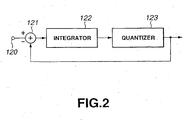
- the 1-bit audio signal recorded on the SACD 1 is generated by a ⁇ modulator based on the DSD system as shown in Fig.2.
- an adder 121 calculates a differential signal between the input signal as an audio signal inputted through an input terminal 120 and a 1-bit pulse string, and an integrator 122 integrates the differential signal.
- an audio band error is extracted.
- a process of converting this signal to a 1-bit pulse output by a quantizer 123 and feeding back the error again is repeated many times.
- a 1-bit audio signal is generated.
- the SACD 1, on which the 1-bit audio signal is recorded, is mounted on a disc table of the audio data reproducing device shown in Fig. I and is rotated, for example at a constant linear velocity by a spindle motor, not shown.
- the SACD 1, which is being rotated, is irradiated with a reproducing laser beam emitted from an optical pickup 102 and the 1-bit audio signal is read out from the SACD 1.
- the optical pickup 102 is moved between the inner and outer circles of the SACD 1 by a feed mechanism, not shown, and thus scans the signal recording area of the SACD 1 with the reproducing laser beam to read the 1-bit audio signal recorded on the SACD 1.
- the signal read out by the optical pickup 102 is supplied to an RF amplifier 103.
- An RF signal outputted from the RF amplifier 103 is supplied to a front-end processor unit 104.
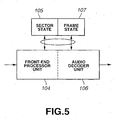
- the front-end processor unit 104 uses an external memory 105 as a buffer for data or as a work area during error correction processing.
- the front-end processor unit 104 performs demodulation and error correction processing on the RF signal to generate sector data with a fixed length of 2064 bytes and supplies the sector data toe an audio decoder unit 106 on the subsequent stage.
- the audio decoder unit 106 receives, by 1 byte each, the sector data of a fixed length of 2064 bytes supplied from the front-end processor unit 104.
- an audio header starting at, for example, the 13th byte from the leading part of each sector is analyzed by an audio header analyzer 111 and the data is recorded by frame into each block of an external memory 107, with each frame having 1/75 seconds.
- the data recorded by frame in each block of the external memory 107 is decoded by a compression decoder 112 inside the audio decoder unit 106. After that, fader processing is performed on the data by a fader 113, when necessary, and the data is then converted to an analog audio signal by a D/A converter 108.
- the analog audio signal is supplied to an external amplifier, a speaker and the like through an output terminal 109.
- each frame shown in Fig.4 data is recorded with frame information added thereto, the frame information consisting of error information and a time code.
- the error information indicates that a frame including data which could not be error-corrected by the front-end processor unit 104 is an error frame. Since the time code is incremented by frame, discontinuity of frames can be detected by comparing the preceding and subsequent time codes.
- the audio decoder unit 106 reads in advance the frame information IF recorded in the external memory 107 and therefore can send an error flag to the fader 113 before outputting a discontinuous point of frames due to an error frame, cue/review and tune selection, or the last data of the final frame in which recording is completed in the buffer, as a SDS signal. Therefore, the fader 113 can perform gradually attenuated fade-out processing on the DSD output, thus preventing occurrence of a strange sound.
- the front-end processor unit 104 and the audio decoder unit 106 need the external memory 105 and the external memory 107, respectively.
- the frame state will be buffered after buffering of the sector status, and therefore the number of accesses to the memory increases.
- the frequency of a block for generating a control signal of the memory must be raised or the circuit within the IC must operate at high speed.
- the priority control for the access right to the memory is complicated and the number of accesses to continuous addresses is reduced. Therefore, the advantage of the high-speed page mode cannot be fully utilized.
- a data processing device comprises: sector data generation means for performing predetermined signal processing on an input signal and thus generating fixed-length sector data for forming a variable-length frame; sector data storage means for storing the sector data generated by the sector data generation means; main packet extraction means for extracting main packet data from the sector data stored in the sector data storage means; and supplementary packet extraction means for extracting supplementary packet data from the sector data stored in the sector data storage means.
- main packet extraction means and supplementary packet extraction means are provided in parallel for extracting only specific types of packets, that is, main packet data and supplementary packet data, from data in which a plurality of types of packets exist in a mixed manner, and priority control of data request signals outputted from these packet extraction means is carried out.
- various packet data can be supplied to the subsequent block when necessary, without using a large-capacity data buffer.
- an error signal for error fading can be sent to fade processing means at appropriate timing.
- a data processing method comprises: a sector data generation step of performing predetermined signal processing on an input signal and thus generating fixed-length sector data for forming a variable-length frame; a main packet extraction step of extracting main packet data from sector data storage means in which the sector data generated by the sector data generation step is stored; a supplementary packet extraction step of extracting supplementary packet data from the sector data storage means; and a frame information extraction step of extracting frame information related to the variable-length frame from the sector data storage means; wherein an order of priority is set with respect to data request signals outputted from the main packet extraction step, the supplementary packet extraction step and the frame information extraction step, and respective packet data corresponding to the data request signals are outputted from the sector data storage means in accordance with the order of priority.
- the optical disc reproducing device to which the present invention is applied has a structure as shown in Fig.6 and carries out reproduction of data from a SACD-standard optical disc 1 on which a 1-bit audio signal generated by a ⁇ modulator based on the DSD system is directly recorded.
- the optical disc reproducing device has an optical pickup 2 for reading out a pit signal from the SACD-standard optical disc 1, an RF amplifier 3 for amplifying the pit signal read out by the optical pickup 2, a one-chip data processing device 4 including a front-end processor unit 4a and an audio decoder unit 4b, which will be described later, and a D/A converter 6 for converting audio data obtained by the data processing device 4 to an analog audio signal and supplying the analog audio signal to an output terminal 7, as shown in Fig.6.
- the front-end processor unit 4a constituting the one-chip data processing device 4 performs demodulation and error correction processing on the RF signal amplified by the RF amplifier 3 and thus generates sector data with a fixed length of 2064 bytes.
- the front-end processor unit 4a is connected with an external memory 5.
- the front-end processor unit 4a uses the external memory 5 for temporarily storing sector data and also uses the external memory 5 as a work area during the error correction processing.
- the audio decoder unit 4b constituting the one-chip data processing device 4 decodes the sector data with a fixed length of 2064 bytes supplied from the front-end processor unit 4a and supplies the decoded data to the D/A converter 6.
- the audio decoder unit 4b does not need an external memory for buffering the frame state which would be used in a conventional SACD audio decoder.
- the audio decoder unit 4b also avoids using a built-in SRAM of its IC as a buffer. Since one frame consists of 16 sectors at the maximum, even a buffer for one frame needs a capacity of approximately 32 kbytes and therefore the built-in SRAM of the IC cannot be used as a frame buffer.
- This optical disc 1 is sectioned into three areas, that is, a lead0in zone, a data zone, and a lead-out zone, sequentially from the inner circumferential side to the outer circumferential side. These areas are collectively referred to as an information zone.
- the optical disc 1 has a ROM structure so that data is recorded by sector in the data zone.
- Each sector has a physical address number (physical sector number) and a space for 2064 bytes per sector is prepared so that effective data of 2048 bytes can be recorded in each sector.
- the volume space is divided into five areas in accordance with the use of data, as shown in Fig.8.
- the five areas are a file system area, a master TOC area, a 2-channel stereo area, a multi-channel area, and an extra data area.
- the file system area is an area having a file system. recorded therein, which enables access in consideration of the use of the computer.
- a dual TOC structure is employed which is made up of a master TOC and an area TOC based on and developed from the idea of TOC in a CD.
- the master TOC area the same master TOC indicating album information and disc information is recorded three times, as shown in Fig.9. The area TOC will be described later.
- a multi-channel mode as well as 2-channel stereo mode is possible and two independent area are prepared, that is, the 2-channel stereo area and the multi-channel area.
- three types of modes are possible, that is, only the 2-channel stereo mode, only the multi-channel mode, and both the 2-channel stereo mode and the multi-channel mode.
- the DSD (direction stream digital) recording system is used as the coding system.
- the 2-channel stereo area and the multi-channel area have audio areas, respectively.
- a track area having recorded therein a music signal based on the DSD (direction stream digital) recording system is arranged, and an area TOC-1 and area TOC-2 having stored therein the same data related to area information and track information are arranged before and after the track area, as shown in Fig.9.
- a music signal based on the DSD recording system is recorded, as described above.
- audio data which will be described later, and supplementary data are independently recorded.
- the supplementary data is equivalent to a subcode in a CD (signal that can be read out synchronously with the music signal).
- An independent data area is secured for the supplementary data.
- the audio data is sampled constantly under the same conditions for the respective channels in order to maintain predetermined quality, whereas the data quantity of the supplementary data can be selected in a scalable manner depending on the use.
- the front-end processor unit 4a constituting the data processing device 4 shown in Fig.10 has a sector address continuity detection unit 41 to detect whether the addresses of sectors stored in the external memory are continuous or not. If frame data is jumped in accordance with a cue/review operation or a tune selection operation by a user, the sector address numbers become discontinuous.
- the sector address continuity detection unit 41 When continuity of the sector address cannot be detected by the sector address continuity detection unit 41, that is, when discontinuity of the sector address is detected, the result of detection is supplied to a frame information extraction unit 52, which will be described later, via a priority control unit 42.
- the audio decoder unit 4b has, in parallel, an audio packet extraction unit 43 for extraction an audio packet made up of audio data from a sector data input b from the external memory 5 connected to the front-end processor unit 4a, a supplementary packet extraction unit 48 for extracting a supplementary packet made up of supplementary data, and the frame information extraction unit 52.
- an audio header (Audio_Header) is stored.
- the audio packet extraction unit 43, the supplementary packet extraction unit 48 and the frame information extraction unit 52 independently. have header analyzers 43a, 48a and 52a, respectively.
- frame data is written over a plurality of sectors. Since the audio packet extraction unit 43, the supplementary packet extraction unit 48 and the frame information extraction unit 52 reads only necessary parts of data and operate independently, these extraction units do not necessarily process the same sector. Therefore, the audio header analyzers 43a, 48a and 52a are separately provided.
- the type and length of each packet included in that sector,. and information such as whether or not it is the leading packet of the frame are described, as shown in Fig.11. Particularly, N_Sectors indicating the number of sectors used in that frame is described in the frame information (Frame_Info), as shown in Fig.12.
- the header analyzers 43a, 48a and 52a analyze such audio headers.
- the audio packet extraction unit 43 is connected to an audio data FIFO register 44.
- the audio data FIFO register 44 is connected to a compression decoder 45, which is connected to a fader 46.
- the supplementary packet extraction unit 48 is connected to a supplementary FIFO register 49.
- the supplementary FIFO register 49 is connected to a supplementary data interface unit 50.
- the frame information extraction unit 52 is connected to the fader 46.
- the audio decoder unit 4b has the priority control unit 42 and gives an order of priority in accordance with data request signals d1, d2, d3 outputted from the audio packet extraction unit 43, the supplementary packet extraction unit 48 and the frame information extraction unit 52.
- the audio decoder unit 4b then select a sector number and a byte address c1, c2, c3 from one of the extraction units and outputs a memory read address a.
- Fig.3 shows sector-based data stored in the external memory 5.
- the audio packet extraction unit 43 reads only data of an audio packet from the external memory 5 while analyzing an audio header by using the header analyzer 43a. Specifically, from the contents of the audio header of the present target sector, the type and length of each packet included in that sector and information about whether or not it is the leading packet of the frame are analyzed, and a byte address indicating where the audio packet data is written in the sector is calculated.
- This byte address and the sector number of the present target sector are outputted, thus controlling the byte address to skip the other packets than the audio packet.
- the audio packet extraction unit 43 is on standby for the start of the next frame.
- the compression decoder 45 can receive the data of a necessary audio frame without having to wait even if there is no buffer memory for the frame state.
- the number of stages of the audio FIFO register 44 may be a number which is enough for supplying data to the compression decoder 45 while analyzing the audio header when the audio packet extraction unit 43 shifts the read target sector to a new sector. Since the number of times the audio header is analyzed in one frame is limited, the audio FIFO register 44 may have a minimum necessary number of stage in consideration of this.
- the supplementary packet extraction unit 48 reads out only data of a supplementary packet from the external memory 5 while analyzing an audio header by using the header analyzer 48a. Specifically, from the contents of the audio header of the present target sector, the supplementary extraction unit 48 detects the type and length of each packet included in that sector and whether it is the leading packet of the frame or not, and calculates a byte address indicating whether supplementary packet data is written in the sector. This byte address and the sector number of the present target sector are outputted, and the byte address is controlled to skip the other packets than the supplementary packet.
- the supplementary packet extraction unit 48 increments the sector number to use the next sector as a target sector. After analyzing the audio header of the new target sector, the supplementary packet extraction unit 48 continues reading the data of the supplementary packets. When reading of all the data of the supplementary packets existing before the leading packet of the next frame is completed, the supplementary packet extraction unit 48 is on standby for the start of the next frame.
- the supplementary data FIFO register 49 is not necessary.
- the frame information extraction unit 52 examines whether all the sectors constituting a frame Fn+1, which is next to a frame Fn currently processed by the audio packet extraction unit 43 and the supplementary packet extraction unit 48, are prepared in the external memory 5, and whether these sectors do not include error data, while analyzing the audio header by using the header analyzer 52a. Moreover, from the extracted frame information, the frame information extraction unit 52 determines whether or not the sector data stored in the external memory 5 is the last data of the final frame completed in recording in the external memory 5. The frame information extraction unit 52 receives a detection result to the effect that the sector addresses are discontinuous, from the address continuity detection unit 41 via the priority control unit 42.
- the frame information extraction unit 52 supplies an error signal e to the fader 46 and thus causes the fader 46 to perform fade processing on the DSD decode signal from the compression decoder.
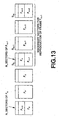
- the sector number m of a sector Sm including the last packet of the frame Fn+1 can be found from the contents of N_Sectors (in this case, 4), and it can be seen that all the sectors from the sector Sk to the sector Sm necessary for reproducing the frame Fn+1 have already been written in the external memory 5.
- the sector number m of a sector Sm including the last packet of the frame Fn+1 can be found from the contents of N_Sectors (in this case, 3), and it can be seen that all the sectors from the sector Sk+1 to the sector Sm necessary for reproducing the frame Fn+1 have already been written in the external memory 5.
- the frame information extraction unit 52 outputs an error signal e to the fader 46.
- the frame information extraction unit 52 outputs an error signal e to the fader 46.
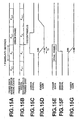
- an error signal e shown in Fig.15C need be outputted to the fader 46 Tf seconds before the start of the frame Fn+1, which is a time required for fade-out. Therefore, priority control is performed so that the processing by the frame information extraction unit 52 with respect to the frame Fn+1 ends within (1/75 - Tf) seconds from the start of the frame n.
- the error signal e can be outputted to the fader 46 at appropriate timing even without having a buffer for the frame state.
- the fader 46 attenuates the fader gain from 0 db to - ⁇ db to fade out the frame data based on the DSD system, as shown in Fig.15D.
- the fader 46 is notified of the absence of the error before the start of the frame Fn+2 and is caused to raise the fader gain from - ⁇ db to 0 db, thus fading in the frame data Fn+2.
- the frame information extraction unit 52 When there is a discontinuous point in the frame data, that is, when it is found that the frame Fn and the frame Fm are discontinuous as shown in Fig.15B from the result of detection by the sector address continuity detection unit 41, received by the frame information extraction unit 52 through the priority control unit 42, the frame information extraction unit 52 outputs the error signal e shown in Fig.15C to the fader 46 Tf seconds before the start of the frame n+1, which is a time required for fade-out.
- the fader 46 attenuates the fader gain shown in Fig. 15D from 0 db to - ⁇ db to fade out the frame data based on the DSD system.
- the sector number k of a sector Sk including the last packet of the frame Fn can be calculated from the contents of N_Sectors (in this case, 4), and it can be seen that the leading packet of the frame Fn+1 is included in the sector Sk. Therefore, as the audio header of the sector Sk is analyzed, the sector number m of a sector Sm including the last packet of the frame Fn+1 can be found from the contents of N_Sectors (also in this case, not less than 2). However, the next sector is not a sector Sk+1 but a sector Sj, and the sector numbers are discontinuous (j ⁇ k+1).
- an error signal e may be outputted to the fader 46 Tf seconds before the end point, which is a time required for fade-out.
- the fader 46 attenuates the fader gain from 0 db to - ⁇ db as shown in Fig. 15G in accordance with that timing and thus fades out the frame data based on the DSD system.
- the external memory 5 is externally connected to the one-chip data processing device 4.
- the external memory may be provided inside the data processing device.
- a buffer memory for the frame state is not necessary when collectively providing a front-end processor unit and a SACD decoder unit on one chip, external memories which would be conventionally connected to respective ICs can be provided as a single memory. Moreover, since the number of accesses to the memory is not largely different from the number of accesses to the memory which would be conventionally connected to the front-end processor unit, a high-speed clock need not be used.
Landscapes
- Engineering & Computer Science (AREA)
- Signal Processing (AREA)
- Multimedia (AREA)
- Health & Medical Sciences (AREA)
- Audiology, Speech & Language Pathology (AREA)
- Human Computer Interaction (AREA)
- Physics & Mathematics (AREA)
- Acoustics & Sound (AREA)
- Signal Processing For Digital Recording And Reproducing (AREA)
Abstract
Description
Claims (23)
- A data processing device comprising:sector data generation means for performing predetermined signal processing on an input signal and thus generating fixed-length sector data for forming a variable-length frame;sector data storage means for storing the sector data generated by the sector data generation means;main packet extraction means for extracting main packet data from the sector data stored in the sector data storage means; andsupplementary packet extraction means for extracting supplementary packet data from the sector data stored in the sector data storage means.
- The data processing device as claimed in claim 1, further comprising control means for giving an order of priority to data request signals outputted from the main packet extraction means and the supplementary packet extraction means and causing the sector data storage means to output respective packet data corresponding to the data request signals in accordance with the order of priority.
- The data processing device as claimed in claim 1, further comprising frame information extraction means for extracting frame information related to a frame with the fixed length from the sector data stored in the sector data storage means.
- The data processing device as claimed in claim 3, further comprising control means for giving an order of priority to data request signals outputted from the main packet extraction means, the supplementary packet extraction means and the frame information extraction means, and causing the sector data storage means to output respective packet data corresponding to the data request signals in accordance with the order of priority.
- The data processing device as claimed in claim 4, further comprising fade processing means for performing fade-out and/or fade-in processing on the main packet data extracted by the main packet extraction means.
- The data processing device as claimed in claim 5, wherein the frame information extraction means controls the fade processing means on the basis of the extracted frame information.
- The data processing device as claimed in claim 6, wherein the frame information extraction means detects the position of an error frame from the extracted frame information, thus controlling the fade processing means.
- The data processing device as claimed in claim 6, wherein the frame information extraction means determines the number of sector data stored in the sector data storage means, from the extracted frame information, thus controlling the fade processing means.
- The data processing device as claimed in claim 6, wherein the frame information extraction means determines whether or not the sector data stored in the sector data storage means is the last data of a final frame completed in recording within the sector data storage means, from the extracted frame information, thus controlling the fade processing means.
- The data processing device as claimed in claim 6, further comprising sector address continuity detection means for detecting continuity of addresses of the sector data stored in the sector data storage means, wherein the frame information extraction means controls the fade processing means in accordance with the result of detection from the sector address continuity detection means.
- The data processing device as claimed in claim 8, wherein the frame information extraction means determines whether or not there is a change in frame number within single sector data, from the extracted frame information.
- The data processing device as claimed in claim 8, wherein the frame information extraction means determines whether or not switching of continuous frame numbers is coincident with switching of sector numbers, from the extracted frame information.
- The data processing device as claimed in claim 10, wherein the sector data generation means has therein the sector address continuity detection means, and becomes a base for constituting a one-chip component together with the main packet extraction means, the supplementary packet extraction means, the control means, the frame information extraction means and the fade processing means.
- The data processing device as claimed in claim 13, wherein the sector data storage means is externally connected.
- A data processing method comprising:wherein an order of priority is set with respect to data request signals outputted from the main packet extraction step, the supplementary packet extraction step and the frame information extraction step, and respective packet data corresponding to the data request signals are outputted from the sector data storage means in accordance with the order of priority.a sector data generation step of performing predetermined signal processing on an input signal and thus generating fixed-length sector data for forming a variable-length frame;a main packet extraction step of extracting main packet data from sector data storage means in which the sector data generated by the sector data generation step is stored;a supplementary packet extraction step of extracting supplementary packet data from the. sector data storage means; anda frame information extraction step of extracting frame information related to the variable-length frame from the sector data storage means;
- The data processing method as claimed in claim 15, further comprising a fade processing step of performing fade-out and/or fade-in processing on the main packet data extracted at the main packet extraction step.
- The data processing method as claimed in claim 16, wherein at the frame information extraction step, the fade processing step is controlled on the basis of the extracted frame information.
- The data processing method as claimed in claim 17, wherein at the frame information extraction step, the position of an error frame is detected from the extracted frame information, thus controlling the fade processing step.
- The data processing method as claimed in claim 17, wherein at the frame information extraction step, the number of sector data stored in the sector data storage means is determined from the extracted frame information, thus controlling the fade processing step.
- The data processing method as claimed in claim 17, wherein at the frame information extraction step, whether or not the sector data stored in the sector data storage means is the last data of a final frame completed in recording within the sector data storage means is determined from the extracted frame information, thus controlling the fade processing step.
- The data processing method as claimed in claim 17, further comprising a sector address continuity detection step of detecting continuity of addresses of the sector data stored in the sector data storage means, wherein at the frame information extraction step, the fade processing step is controlled in accordance with the result of detection from the sector address continuity detection step.
- The data processing method as claimed in claim 19, wherein at the frame information extraction step, whether or not there is a change in frame number within single sector data is determined from the extracted frame information.
- The data processing method as claimed in claim 19, wherein at the frame information extraction step, whether or not switching of continuous frame numbers is coincident with switching of sector numbers is determined from the extracted frame information.
Applications Claiming Priority (3)
| Application Number | Priority Date | Filing Date | Title |
|---|---|---|---|
| JP2001176349 | 2001-06-11 | ||
| JP2001176349A JP3747806B2 (en) | 2001-06-11 | 2001-06-11 | Data processing apparatus and data processing method |
| PCT/JP2002/005683 WO2002101740A1 (en) | 2001-06-11 | 2002-06-07 | Data processing apparatus and data processing method |
Publications (2)
| Publication Number | Publication Date |
|---|---|
| EP1324333A1 true EP1324333A1 (en) | 2003-07-02 |
| EP1324333A4 EP1324333A4 (en) | 2007-10-17 |
Family
ID=19017353
Family Applications (1)
| Application Number | Title | Priority Date | Filing Date |
|---|---|---|---|
| EP02733406A Withdrawn EP1324333A4 (en) | 2001-06-11 | 2002-06-07 | APPARATUS AND METHOD FOR DATA PROCESSING |
Country Status (6)
| Country | Link |
|---|---|
| US (1) | US7028152B2 (en) |
| EP (1) | EP1324333A4 (en) |
| JP (1) | JP3747806B2 (en) |
| KR (1) | KR100895675B1 (en) |
| CN (1) | CN1316489C (en) |
| WO (1) | WO2002101740A1 (en) |
Families Citing this family (8)
| Publication number | Priority date | Publication date | Assignee | Title |
|---|---|---|---|---|
| JP3778290B2 (en) * | 2003-07-29 | 2006-05-24 | 船井電機株式会社 | Optical disk playback device |
| US20050083808A1 (en) * | 2003-09-18 | 2005-04-21 | Anderson Hans C. | Audio player with CD mechanism |
| US7991494B2 (en) * | 2006-02-23 | 2011-08-02 | Lg Electronics Inc. | Method and apparatus for processing an audio signal |
| JP4769665B2 (en) * | 2006-08-29 | 2011-09-07 | パナソニック株式会社 | Music playback device and music playback terminal |
| KR100917843B1 (en) | 2006-09-29 | 2009-09-18 | 한국전자통신연구원 | Apparatus and method for coding and decoding multi-object audio signal with various channel |
| CN105869647B (en) * | 2016-05-05 | 2019-10-08 | 西安睿芯微电子有限公司 | A kind of primary DSD audio-frequency decoding method of smart phone, system and smart phone |
| US10509624B2 (en) * | 2017-01-30 | 2019-12-17 | Cirrus Logic, Inc. | Single-bit volume control |
| CN114566172B (en) * | 2022-02-25 | 2025-06-13 | 北京砍石高科技有限公司 | Audio data processing method, device, storage medium and electronic device |
Family Cites Families (12)
| Publication number | Priority date | Publication date | Assignee | Title |
|---|---|---|---|---|
| JPH07272398A (en) * | 1994-03-28 | 1995-10-20 | Hitachi Ltd | Disk unit controller |
| KR100197847B1 (en) * | 1994-11-11 | 1999-06-15 | 니시무로 타이죠 | Packet data recorder and playback device |
| JP3577794B2 (en) * | 1995-07-18 | 2004-10-13 | ソニー株式会社 | Data decryption device |
| ID21786A (en) * | 1997-09-17 | 1999-07-22 | Matsushita Electric Industrial Co Ltd | VIDEO DATA EDITING EQUIPMENT, OPTICAL DISK FOR USE AS RECORDER MEDIA VIDEO DATA EDITING EQUIPMENT AND COMPUTER RECORDER MEDIA THAT CAN BE READED THAT SAVES THE EDITING PROGRAM |
| EP0917147A3 (en) * | 1997-11-11 | 1999-12-22 | Deutsche Thomson-Brandt Gmbh | Method and device for controlling a buffer memory |
| JP4092767B2 (en) * | 1998-04-10 | 2008-05-28 | ソニー株式会社 | Recording medium and reproducing apparatus |
| JP2000100076A (en) * | 1998-09-18 | 2000-04-07 | Victor Co Of Japan Ltd | Digital audio disk, encoding device, decoding device and transmission method |
| JP2000163888A (en) * | 1998-11-20 | 2000-06-16 | Sony Corp | Playback device |
| JP2000260116A (en) * | 1999-03-09 | 2000-09-22 | Rohm Co Ltd | Cd signal processor |
| JP2001006300A (en) * | 1999-06-16 | 2001-01-12 | Toshiba Corp | Disk playback device that performs high-speed reading |
| JP2001143394A (en) * | 1999-11-15 | 2001-05-25 | Sony Corp | Reproduction device and reproduction method |
| US6701065B1 (en) * | 2000-01-05 | 2004-03-02 | Genesis Microchip, Inc. | Methods and apparatus for buffering information prior to decoding |
-
2001
- 2001-06-11 JP JP2001176349A patent/JP3747806B2/en not_active Expired - Fee Related
-
2002
- 2002-06-07 WO PCT/JP2002/005683 patent/WO2002101740A1/en not_active Ceased
- 2002-06-07 US US10/343,569 patent/US7028152B2/en not_active Expired - Fee Related
- 2002-06-07 KR KR1020037001018A patent/KR100895675B1/en not_active Expired - Fee Related
- 2002-06-07 EP EP02733406A patent/EP1324333A4/en not_active Withdrawn
- 2002-06-07 CN CNB02802043XA patent/CN1316489C/en not_active Expired - Fee Related
Also Published As
| Publication number | Publication date |
|---|---|
| JP2002367288A (en) | 2002-12-20 |
| KR20030019606A (en) | 2003-03-06 |
| EP1324333A4 (en) | 2007-10-17 |
| US7028152B2 (en) | 2006-04-11 |
| CN1316489C (en) | 2007-05-16 |
| KR100895675B1 (en) | 2009-05-07 |
| JP3747806B2 (en) | 2006-02-22 |
| CN1463429A (en) | 2003-12-24 |
| WO2002101740A1 (en) | 2002-12-19 |
| US20030167370A1 (en) | 2003-09-04 |
Similar Documents
| Publication | Publication Date | Title |
|---|---|---|
| US6058091A (en) | Recording apparatus and method for recording information onto a recording medium having a plurality of areas | |
| US6076063A (en) | Audio player and recorder employing semiconductor memory as a recording medium | |
| US7027366B2 (en) | Recording method that records an identifier indicating that two kinds of audio data are recorded | |
| US6977877B2 (en) | Compressed audio data reproduction apparatus and compressed audio data reproducing method | |
| US5483619A (en) | Method and apparatus for editing an audio signal | |
| US7657335B2 (en) | Digital audio signal reproducing apparatus | |
| US7028152B2 (en) | Digital front end processor and audio decoder sharing a single external memory | |
| KR100617531B1 (en) | Reproduction method and reproduction apparatus | |
| JP3796802B2 (en) | Recording method on optical disc and optical disc apparatus | |
| US6874045B2 (en) | Digital signal processing apparatus and processing method, and digital signal reproduction/reception system | |
| US6621777B2 (en) | Complex optical disc player system reproducing optical discs having various formats | |
| CN1254925A (en) | Playback device and playback method | |
| US7113456B2 (en) | Method and apparatus for playing back a multisession disc | |
| KR100360407B1 (en) | Complex optical disc player system reproducing optical discs having various formats | |
| KR100532410B1 (en) | Portable CD-MP3 system and file decoding method for the same | |
| JPH09120645A (en) | Audio signal-compressing/recording apparatus and audio signal-compressing apparatus and optical recording medium | |
| CN1099077C (en) | Interface method and device in digital signal processing system | |
| JP2000347697A (en) | Voice record regenerating device and record medium | |
| JP2001143395A (en) | Data decoding device | |
| JP3490655B2 (en) | Audio signal decoder | |
| JP3829944B2 (en) | Playback device | |
| KR20140131735A (en) | Method for reproducing high-quality sound source on mini audio set | |
| JP2009020922A (en) | Reproducing device, program, and reproduction method | |
| JP2008300029A (en) | Information reproducing method and information reproducing device | |
| KR20030004820A (en) | Method for recording a compression audio data |
Legal Events
| Date | Code | Title | Description |
|---|---|---|---|
| PUAI | Public reference made under article 153(3) epc to a published international application that has entered the european phase |
Free format text: ORIGINAL CODE: 0009012 |
|
| 17P | Request for examination filed |
Effective date: 20030206 |
|
| AK | Designated contracting states |
Designated state(s): AT BE CH CY DE DK ES FI FR GB GR IE IT LI LU MC NL PT SE TR |
|
| A4 | Supplementary search report drawn up and despatched |
Effective date: 20070918 |
|
| RIC1 | Information provided on ipc code assigned before grant |
Ipc: G11B 27/32 20060101ALI20070912BHEP Ipc: G11B 27/10 20060101ALI20070912BHEP Ipc: G11B 20/12 20060101ALI20070912BHEP Ipc: G11B 20/10 20060101AFI20030103BHEP |
|
| 17Q | First examination report despatched |
Effective date: 20090826 |
|
| STAA | Information on the status of an ep patent application or granted ep patent |
Free format text: STATUS: THE APPLICATION IS DEEMED TO BE WITHDRAWN |
|
| 18D | Application deemed to be withdrawn |
Effective date: 20100109 |