EP1324182A2 - System and method for peripheral device virtual functionality overlay - Google Patents
System and method for peripheral device virtual functionality overlay Download PDFInfo
- Publication number
- EP1324182A2 EP1324182A2 EP02258774A EP02258774A EP1324182A2 EP 1324182 A2 EP1324182 A2 EP 1324182A2 EP 02258774 A EP02258774 A EP 02258774A EP 02258774 A EP02258774 A EP 02258774A EP 1324182 A2 EP1324182 A2 EP 1324182A2
- Authority
- EP
- European Patent Office
- Prior art keywords
- data transfer
- transfer element
- library
- command
- data
- Prior art date
- Legal status (The legal status is an assumption and is not a legal conclusion. Google has not performed a legal analysis and makes no representation as to the accuracy of the status listed.)
- Withdrawn
Links
Images

Classifications
-
- G—PHYSICS
- G11—INFORMATION STORAGE
- G11B—INFORMATION STORAGE BASED ON RELATIVE MOVEMENT BETWEEN RECORD CARRIER AND TRANSDUCER
- G11B27/00—Editing; Indexing; Addressing; Timing or synchronising; Monitoring; Measuring tape travel
- G11B27/002—Programmed access in sequence to a plurality of record carriers or indexed parts, e.g. tracks, thereof, e.g. for editing
-
- G—PHYSICS
- G06—COMPUTING OR CALCULATING; COUNTING
- G06F—ELECTRIC DIGITAL DATA PROCESSING
- G06F3/00—Input arrangements for transferring data to be processed into a form capable of being handled by the computer; Output arrangements for transferring data from processing unit to output unit, e.g. interface arrangements
- G06F3/06—Digital input from, or digital output to, record carriers, e.g. RAID, emulated record carriers or networked record carriers
- G06F3/0601—Interfaces specially adapted for storage systems
-
- G—PHYSICS
- G06—COMPUTING OR CALCULATING; COUNTING
- G06F—ELECTRIC DIGITAL DATA PROCESSING
- G06F3/00—Input arrangements for transferring data to be processed into a form capable of being handled by the computer; Output arrangements for transferring data from processing unit to output unit, e.g. interface arrangements
- G06F3/06—Digital input from, or digital output to, record carriers, e.g. RAID, emulated record carriers or networked record carriers
- G06F3/0601—Interfaces specially adapted for storage systems
- G06F3/0602—Interfaces specially adapted for storage systems specifically adapted to achieve a particular effect
- G06F3/062—Securing storage systems
- G06F3/0622—Securing storage systems in relation to access
-
- G—PHYSICS
- G06—COMPUTING OR CALCULATING; COUNTING
- G06F—ELECTRIC DIGITAL DATA PROCESSING
- G06F3/00—Input arrangements for transferring data to be processed into a form capable of being handled by the computer; Output arrangements for transferring data from processing unit to output unit, e.g. interface arrangements
- G06F3/06—Digital input from, or digital output to, record carriers, e.g. RAID, emulated record carriers or networked record carriers
- G06F3/0601—Interfaces specially adapted for storage systems
- G06F3/0628—Interfaces specially adapted for storage systems making use of a particular technique
- G06F3/0638—Organizing or formatting or addressing of data
- G06F3/0644—Management of space entities, e.g. partitions, extents, pools
-
- G—PHYSICS
- G06—COMPUTING OR CALCULATING; COUNTING
- G06F—ELECTRIC DIGITAL DATA PROCESSING
- G06F3/00—Input arrangements for transferring data to be processed into a form capable of being handled by the computer; Output arrangements for transferring data from processing unit to output unit, e.g. interface arrangements
- G06F3/06—Digital input from, or digital output to, record carriers, e.g. RAID, emulated record carriers or networked record carriers
- G06F3/0601—Interfaces specially adapted for storage systems
- G06F3/0628—Interfaces specially adapted for storage systems making use of a particular technique
- G06F3/0655—Vertical data movement, i.e. input-output transfer; data movement between one or more hosts and one or more storage devices
- G06F3/0659—Command handling arrangements, e.g. command buffers, queues, command scheduling
-
- G—PHYSICS
- G06—COMPUTING OR CALCULATING; COUNTING
- G06F—ELECTRIC DIGITAL DATA PROCESSING
- G06F3/00—Input arrangements for transferring data to be processed into a form capable of being handled by the computer; Output arrangements for transferring data from processing unit to output unit, e.g. interface arrangements
- G06F3/06—Digital input from, or digital output to, record carriers, e.g. RAID, emulated record carriers or networked record carriers
- G06F3/0601—Interfaces specially adapted for storage systems
- G06F3/0668—Interfaces specially adapted for storage systems adopting a particular infrastructure
- G06F3/067—Distributed or networked storage systems, e.g. storage area networks [SAN], network attached storage [NAS]
-
- G—PHYSICS
- G06—COMPUTING OR CALCULATING; COUNTING
- G06F—ELECTRIC DIGITAL DATA PROCESSING
- G06F3/00—Input arrangements for transferring data to be processed into a form capable of being handled by the computer; Output arrangements for transferring data from processing unit to output unit, e.g. interface arrangements
- G06F3/06—Digital input from, or digital output to, record carriers, e.g. RAID, emulated record carriers or networked record carriers
- G06F3/0601—Interfaces specially adapted for storage systems
- G06F3/0668—Interfaces specially adapted for storage systems adopting a particular infrastructure
- G06F3/0671—In-line storage system
- G06F3/0683—Plurality of storage devices
- G06F3/0686—Libraries, e.g. tape libraries, jukebox
-
- G—PHYSICS
- G11—INFORMATION STORAGE
- G11B—INFORMATION STORAGE BASED ON RELATIVE MOVEMENT BETWEEN RECORD CARRIER AND TRANSDUCER
- G11B2220/00—Record carriers by type
- G11B2220/40—Combinations of multiple record carriers
- G11B2220/41—Flat as opposed to hierarchical combination, e.g. library of tapes or discs, CD changer, or groups of record carriers that together store one title
Definitions
- the present invention relates to a method and system for providing a peripheral device virtual functionality overlay for a data library.
- serial number 10/034,691 entitled System and Method for Partitioning a Storage Area Network Associated Data Library, filed December 28, 2001
- serial number 10/033,009 entitled System and Method for Partitioning a Storage Area Network Associated Data Library Employing Element Addresses, filed December 28, 2001
- serial number 10/032,662 entitled System and Method for Managing Access To Multiple Devices in a Partitioned Data Library, filed December 28, 2001
- serial number 10/034,518 entitled System and Method for Securing Drive Access to Media Based On Medium Identification Numbers, filed December 28, 2001
- serial number 10/034,888 entitled System and Method for Securing Drive Access to Data Storage Media Based On Medium Identifiers, filed December 28, 2001
- serial number 10/033,010 entitled System and Method for Securing Fiber Channel Drive Access in a Partitioned Data Library, filed December 28, 2001
- serial number 10/033,003 entitled Method for Using Partitioning to Provide Capacity on Demand in Data Libraries, filed December 28, 2001
- serial number 10/033,003 entitled Method for Using Part
- the present invention generally relates to data storage, and specifically to a system and method for providing a peripheral device virtual functionality overlay.
- SANs storage area networks
- SCSI small computer systems interface
- a SAN may be fiber channel (FC)-based and may employ data mover functionality or similar direct read/write technology.
- FC-based devices are not available in SCSI-based storage devices, such as SCSI-based tape drives of the aforementioned SCSI data library. If a data mover is required to function based on a SCSI-extended third party copy command associated with each tape drive in a library this cannot be implemented on an existing parallel SCSI connected tape drive, as the tape drives cannot directly communicate with a data mover or a storage device such as a FC disk array from which data is being moved.
- data mover logical unit numbers may be created by the bridge firmware to act as virtual data mover devices.
- LUNs data mover logical unit numbers
- a system and method for partitioning a data library is disclosed in the aforementioned U.S. Patent Application Serial No. [30014512-1] entitled "System and Method for Managing Access To Multiple Devices in a Partitioned Data Library".
- SSPs storage service providers
- FC switches have the capability of configuring security zones that define which world wide names (WWNs) or FC ports of servers can see which WWNs or FC ports of devices.
- WWNs world wide names
- FC switch security zones do not extend to FC addresses or FC device LUNs. Therefore, it is currently only possible to secure at the FC port level using FC switches and switch zoning. Even were it possible to secure at the FC port level, in the case of SCSI tape libraries that are attached behind FC bridges, it would be very difficult for a user to define security zones particularly based on tape library partitions. To implement security using FC switch zoning, the user would have to map the data mover LUNs into the correct library partitions.
- a method for providing a peripheral device virtual functionality overlay for a data library comprises intercepting commands to a library data transfer element within a bridge disposed between a command initiator and the library, passing through commands that can be carried out by the data transfer element to the data transfer element, and executing, with the bridge, commands addressed to the data transfer element that cannot be carried out by the data transfer element.
- the present invention is directed to systems and methods that employ FC-to-SCSI bridges or similar devices to implement additional virtual functionality for peripherals attached to the bridge.
- Such functionality could, for example, include direct peripheral-to-peripheral data movement commands, such as a tape drive sourcing data from a disk drive directly without involvement of a host computer, or such as a disk drive transferring data directly onto a tape drive.
- functionality such as zero down-time backups (ZDBs) via data mover interconnectivity, may be advantageously employed by a SAN using peripheral devices heretofore unable to implement such functionality in a direct manner.
- Other functionality that embodiments of the present system and method may enable includes, but is not limited to, error recovery, caching, error logging, diagnostic logging, error management, diagnostic management, data compression, data encryption and provision of drive or media statistics.
- Additional or alternative functionality provided according to the present invention may include management and environmental monitoring commands.
- management or monitoring functionality is implemented by the peripheral(s).
- the intermediary bridge is preferably transparently overlaying the aforementioned functionality over the peripheral command set(s).
- tape drive-based data mover functionality such as ZDBs may be implemented in a FC-to-SCSI bridge that connects the tape drive to a FC attached SAN.
- FC-to-SCSI bridge If there are data movers in the FC-to-SCSI bridge, it is generally desirable to secure the device resources on the bridge so that only specific authorized servers connected to the SAN can access the data movers. Therefore, device-level security features in the bridges are preferably integrated with the present virtual overlay commands.
- the tape library can be partitioned with a subset of the tape drives, slots and a virtual medium changer device per partition.
- a partitioning method and system are disclosed in U.S. Patent application serial number [30014510-1] entitled "System and Method for Partitioning a Storage Area Network Associated Data Library".
- Each partition can be secured with a list of authorized unique host device identifiers such as FC world wide names (WWNs). Every host and device connection into a FC SAN has a unique WWN, which can be used to uniquely identify a device or host connection.
- WWN Fibre Channel SAN
- FC-to-SCSI bridges in the tape library including the present data mover functionality, may be secured to prevent unauthorized servers accessing data from the tape library via the data movers.
- SAN 100 is shown.
- first and second customer servers 101 and 102 are connected to SAN 100 via FC switch 103.
- redundant array of independent disks (RAID) 104 may be partitioned assigning first partition 105 to server 101 and second partition 106 to server 102 using existing FC LUN-based RAID partitioning methods.
- ZDBs may be performed in accordance with the present invention of the data each server has on the RAID-to-tape library 108, via ZDB interconnectivity 107 between RAID 104 and tape library 108. Such ZDBs are preferably carried out without impinging on the processor operations or LAN capacity of servers 101 and 102.
- Data tape library 108 is preferably partitioned into multiple virtual library partitions.
- Each library partition preferably has one or more physical tape drives, a unique subset of the library media slots, and a virtual dedicated library changer device LUN assigned to the partition, such partitioning system and method is disclosed in aforementioned copending application serial number [30014511-1] entitled “System and Method for Partitioning a Storage Area Network Associated Data Library Employing Element Addresses” and copending application serial number [30014510-1] entitled “System and Method for Partitioning a Storage Area Network Associated Data Library”.
- These systems and methods may be used to ensure that backup or archive data for server 101 is maintained in partition 109 separate from data for server 102, and that the backup or archive data of server 102 is maintained in partition 110 separate from data for server 101.
- Such partitioning ensures that the servers may not access each other's data even though it is maintained in the same physical library.
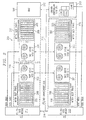
- Data tape library 200 employing a preferred embodiment of the present system and method is illustrated in FIGURE 2 as an example of a library that may be employed as library 108 of FIGURE 1. However, other library designs and/or capacities may embody the present system and method.
- Exemplar data tape library 200 has four data transfer elements in the form of tape drives 201-204, forty media storage element slots 205 that are shown organized into four trays 206-209 of ten slots each, two FC-to-SCSI bridges 210 and 211, a library management interface card or remote management card (RMC) 212 and library controller 213.
- RMC remote management card
- Tape drives 201-204, FC-to-SCSI bridges 210 and 211, RMC 212 and library controller 213 preferably communicate with each other using an inter-integrated circuit (I 2 C) serial management bus 214 and/or automated control interface (ACI) 214 or the like.
- I 2 C inter-integrated circuit
- ACI automated control interface
- tape drives 201-204 are SCSI-based devices.
- library media slots 205 and tape drives 201-204 should be assigned to each partition, and a virtual library controller may be addressable with respect to each partition.
- the slots may be assigned by trays or individually.
- the example partitioning shown in FIGURE 2 is indicated by boxes 215, 216 and 217 representing three partitions of the illustrated configuration.
- Import/export elements or mailslots may be assigned to each partition or configured for use by the entire library.
- easily accessible media storage slots may be configured as mailslots by the present invention.
- the library robotic arm used to move media from slots to drives is preferably shared among user servers. However, it should appear to each server that it is the owner of the arm.
- SCSI library controller 213 is preferably connected to one of the FC-to-SCSI bridges, such as FC-to-SCSI bridge 210. Controller 213 preferably presents a separate LUN to accessing hosts or devices for each library partition, for example LUN-0 for partition 215, LUN-1 for partition 216 and LUN-2 for partition 217. Control of FC LUN-based security for the partitions is preferably carried out via a library subsystem management interface of RMC 212, which is connected to FCto-SCSI bridges 210 and 211 via a private management network such as I 2 C bus 214. Users may configure security for each library partition via a library web management interface or the like, rather than separately configuring the security for each FC-to-SCSI bridge 210 and 211 attached to library 200, manually.
- a bridge can bridge heterogeneous buses, such as FC-to-host and SCSI-to-peripheral.
- a bridge may be contained either in an enclosure such as a tape/disk rack or tape library containing the peripherals as illustrated in FIGURE 2, each peripheral itself may contain a bridge, or a combination thereof may be present.
- enhanced FC-to-SCSI bridges 210 and 211 are preferably a part of tape library 108/200 and thus attached between FC SAN RAID 104 and SCSI-interfaced resources of tape library 108/200, such as tape drives 201-204, via FC switch 103.
- Bridges 210 and 211 preferably pass through all commands and data in the peripheral command sets as dictated by the partitions of library 108/200. Additional commands and data may also be employed by the present enhanced bridges, such as data mover SCSI commands. These commands, although addressed to the peripherals 201-204 of library 200, will preferably be intercepted by bridge 210 and 211 and not passed on to the peripherals.
- Each bridge will instead preferably implement functionality required by these additional command sets and respond back to the command initiator, whether it be servers 101 or 102 or a SAN component such as RAID 104, as though the bridge is the peripheral, thus providing the aforementioned transparency. Therefore, it appears to the host or other initiator that each peripheral has greater functionality than it actually has.
- a library may be partitioned and secured as discussed above.
- a security look-up table preferably held in nonvolatile m emory in bridges 210 and 211 is indexed by authorized WWNs for accessible SCSI Bus/ID/LUN objects to provide operating system (OS)-friendly mapping.
- Each row of the security look-up tables may represent the SCSI Bus/ID/LUN objects of active partitions that are available to a specified initiator WWN along with the partition number of each SCSI Bus/ID/LUN object.
- a "System and Method for Managing Access To Multiple Devices in a Partitioned Data Library” is disclosed in U.S. Patent Application Serial Number [30014512-1].
- the bridge when a SCSI data mover command is sent to a secured library drive behind the bridge, the bridge preferably uses the same security look-up table disclosed in the immediately aforementioned application. Accordingly, the command initiator's WWN or the like is preferably used to determine whether the virtual overlay command should be processed or rejected. Also, if the bridge security feature implements OS-friendly mapping, the security look-up table should be used to determine which device is being addressed by the data mover SCSI command.
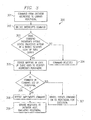
- a command may be issued from an initiator (e.g., RAID 104 or a SAN-connected host such as servers 101 or 102) at box 301, and is preferably intercepted by the bridge disposed between the SAN and the command's target library peripheral at box 302.
- a determination is made at 303 as to whether the command initiator's WWN or other unique host device identifier has an entry row in the bridge's security look-up table.
- the command is preferably rejected at box 304 as unauthorized, unless the command is directed to an unsecured peripheral. If an entry for the initiator's WWN is found, the device-mapping in the entry row of the look-up table associated with that entry may be used to determine the library peripheral to which the command is addressed at box 305. If it is determined at 306 that the command is included in the command set the target peripheral can execute, the bridge passes the command through to the peripheral at box 307. If at 306 it is determined that the command is outside the command set the target drive is enabled to carry out, the bridge may intercept and implement the command.
- the bridge may intercept commands the target peripheral is capable of carrying out, or carrying out in part, for the purpose to implementing the command in a different fashion.
- the bridge transparently implements intercepted commands at box 308 such that the initiator perceives the target peripheral as the device carrying out the command.
- the bridge may issue commands within the peripheral's command set to the peripheral.
- commands or requests may be issued by the bridge, while emulating a peripheral capable of carrying out the desired command, to SAN resources such as a RAID or FC switch or to servers connected to the SAN.
- the bridge reports back to the initiator, as if it were the peripheral to which the command was addressed, as a peripheral capable of carrying out the command would respond, thereby emulating an addressed peripheral with greater functionality than the actual library peripheral.
- the present invention may be used for other types of storage bridges, for example iSCSI-to-SCSI bridges
- iSCSI-to-SCSI bridges the iSCSI equivalent of FC-WWNs, such as iSCSI names, are preferably used to authenticate initiators onto secured partition LUNs.
Landscapes
- Engineering & Computer Science (AREA)
- Theoretical Computer Science (AREA)
- Human Computer Interaction (AREA)
- Physics & Mathematics (AREA)
- General Engineering & Computer Science (AREA)
- General Physics & Mathematics (AREA)
- Library & Information Science (AREA)
- Storage Device Security (AREA)
- Information Retrieval, Db Structures And Fs Structures Therefor (AREA)
- Memory System Of A Hierarchy Structure (AREA)
Abstract
Description
FC switches have the capability of configuring security zones that define which world wide names (WWNs) or FC ports of servers can see which WWNs or FC ports of devices. However, FC switch security zones do not extend to FC addresses or FC device LUNs. Therefore, it is currently only possible to secure at the FC port level using FC switches and switch zoning. Even were it possible to secure at the FC port level, in the case of SCSI tape libraries that are attached behind FC bridges, it would be very difficult for a user to define security zones particularly based on tape library partitions. To implement security using FC switch zoning, the user would have to map the data mover LUNs into the correct library partitions. It would be difficult for a user to correctly identify which FC ports and LUNs are associated together in the same security zone for a switch, and the user could easily make mistakes in such a manual process.
A method for providing a peripheral device virtual functionality overlay for a data library comprises intercepting commands to a library data transfer element within a bridge disposed between a command initiator and the library, passing through commands that can be carried out by the data transfer element to the data transfer element, and executing, with the bridge, commands addressed to the data transfer element that cannot be carried out by the data transfer element.
A number of preferred embodiments of the present invention will now be described with reference to the drawings in which:-
Claims (10)
- A method (300) for providing a peripheral device virtual functionality overlay for a data library (200), said method comprising:intercepting commands (302) to a library data transfer element (201-204) within a bridge (210,211) disposed between a command initiator and said library;passing through commands (307) that can be carried out by said data transfer element to said data transfer element; andexecuting, with said bridge, commands (308) addressed to said data transfer element that cannot be carried out by said data transfer element.
- A method as claimed in claim 1 wherein said data library is partitioned.
- A method as claimed in claims 1 or 2 further comprising:responding to said initiator (309) as a data transfer element capable of carrying out said command.
- A method as claimed in any preceding claim further comprising:comparing a command initiator's unique host device identifier to a list of unique host device identifiers authorized to issue commands to said data transfer element.
- A method as claimed in claim 4 further comprising:maintaining said list of unique host device identifiers in said bridge.
- A method as claimed in any preceding claim further comprising:determining which data transfer element in said library said command is directed to by using a look up table maintained on said bridge.
- A peripheral device virtual functionality overlay system for a partitioned data library (200), said overlay system comprising:a lookup table that indicates unique host device identifiers authorized to access each of said data transfer elements of said library; anda bridge (210,211) disposed between a storage area network (100) and said partitioned data library, wherein said bridge comprises firmware that uses said lookup table to determine whether a host initiating commands directed to a data transfer element (201-204) of said library is authorized to issue commands to said data transfer element, wherein said bridge firmware passes through to said data transfer element authorized commands that can be carried out by said data transfer element and wherein said bridge firmware intercepts and executes commands directed to said data transfer element that cannot be carried out by said data transfer element.
- A system as claimed in claim 7 wherein said bridge responds to a host initiating a command that cannot be carried out by said data transfer element as a data transfer element capable of carrying out last said command.
- A system as claimed in claims 7 or 8 wherein an identity of said data transfer element is determined from said lookup table at least in part based on said unique hose device identifier associated with said host.
- The system and method of claims 1, 2, 6 or 7 wherein said commands that cannot be carried out by said data transfer element include at least one command which is a data mover command, an error recovery command, a caching command, an error logging, diagnostic logging, error management, diagnostic management or data compression command, a data encryption command or provision of statistics.
Applications Claiming Priority (2)
| Application Number | Priority Date | Filing Date | Title |
|---|---|---|---|
| US10/032,923 US20030126225A1 (en) | 2001-12-28 | 2001-12-28 | System and method for peripheral device virtual functionality overlay |
| US32923 | 2001-12-28 |
Publications (2)
| Publication Number | Publication Date |
|---|---|
| EP1324182A2 true EP1324182A2 (en) | 2003-07-02 |
| EP1324182A3 EP1324182A3 (en) | 2005-11-09 |
Family
ID=21867595
Family Applications (1)
| Application Number | Title | Priority Date | Filing Date |
|---|---|---|---|
| EP02258774A Withdrawn EP1324182A3 (en) | 2001-12-28 | 2002-12-19 | System and method for peripheral device virtual functionality overlay |
Country Status (3)
| Country | Link |
|---|---|
| US (1) | US20030126225A1 (en) |
| EP (1) | EP1324182A3 (en) |
| JP (1) | JP2003263397A (en) |
Families Citing this family (63)
| Publication number | Priority date | Publication date | Assignee | Title |
|---|---|---|---|---|
| KR20040010837A (en) | 2001-07-06 | 2004-01-31 | 컴퓨터 어소시에이츠 싱크, 인코포레이티드 | Systems and methods of information backup |
| US8788611B2 (en) * | 2001-12-28 | 2014-07-22 | Hewlett-Packard Development Company, L.P. | Method for using partitioning to provide capacity on demand in data libraries |
| US9712613B2 (en) * | 2003-04-29 | 2017-07-18 | Brocade Communications Systems, Inc. | Fibre channel fabric copy service |
| US7359975B2 (en) * | 2003-05-22 | 2008-04-15 | International Business Machines Corporation | Method, system, and program for performing a data transfer operation with respect to source and target storage devices in a network |
| JP2005128781A (en) * | 2003-10-23 | 2005-05-19 | Hitachi Ltd | System switching method and information processing system |
| US9158467B2 (en) * | 2006-02-21 | 2015-10-13 | Spectra Logic Corporation | Optional data encryption by partition for a partitionable data storage library |
| US8831011B1 (en) | 2006-04-13 | 2014-09-09 | Xceedium, Inc. | Point to multi-point connections |
| US7681048B2 (en) * | 2006-04-27 | 2010-03-16 | Matthew Thomas Starr | Data encryption using a key and moniker for mobile storage media adapted for library storage |
| US7508609B2 (en) * | 2006-10-25 | 2009-03-24 | Spectra Logic Corporation | Formatted storage media providing space for encrypted text and dedicated space for clear text |
| US8250378B1 (en) * | 2008-02-04 | 2012-08-21 | Crossroads Systems, Inc. | System and method for enabling encryption |
| US8601258B2 (en) * | 2008-05-05 | 2013-12-03 | Kip Cr P1 Lp | Method for configuring centralized encryption policies for devices |
| US8989705B1 (en) | 2009-06-18 | 2015-03-24 | Sprint Communications Company L.P. | Secure placement of centralized media controller application in mobile access terminal |
| US8712407B1 (en) | 2012-04-05 | 2014-04-29 | Sprint Communications Company L.P. | Multiple secure elements in mobile electronic device with near field communication capability |
| US9027102B2 (en) | 2012-05-11 | 2015-05-05 | Sprint Communications Company L.P. | Web server bypass of backend process on near field communications and secure element chips |
| US8862181B1 (en) | 2012-05-29 | 2014-10-14 | Sprint Communications Company L.P. | Electronic purchase transaction trust infrastructure |
| US8898772B2 (en) * | 2012-06-04 | 2014-11-25 | Lsi Corporation | Methods and structure for implementing security in systems that utilize small computer system interface enclosure services |
| US9282898B2 (en) | 2012-06-25 | 2016-03-15 | Sprint Communications Company L.P. | End-to-end trusted communications infrastructure |
| US9066230B1 (en) | 2012-06-27 | 2015-06-23 | Sprint Communications Company L.P. | Trusted policy and charging enforcement function |
| US8649770B1 (en) | 2012-07-02 | 2014-02-11 | Sprint Communications Company, L.P. | Extended trusted security zone radio modem |
| US8667607B2 (en) * | 2012-07-24 | 2014-03-04 | Sprint Communications Company L.P. | Trusted security zone access to peripheral devices |
| US8863252B1 (en) | 2012-07-25 | 2014-10-14 | Sprint Communications Company L.P. | Trusted access to third party applications systems and methods |
| US9183412B2 (en) | 2012-08-10 | 2015-11-10 | Sprint Communications Company L.P. | Systems and methods for provisioning and using multiple trusted security zones on an electronic device |
| US9015068B1 (en) | 2012-08-25 | 2015-04-21 | Sprint Communications Company L.P. | Framework for real-time brokering of digital content delivery |
| US8954588B1 (en) | 2012-08-25 | 2015-02-10 | Sprint Communications Company L.P. | Reservations in real-time brokering of digital content delivery |
| US9215180B1 (en) | 2012-08-25 | 2015-12-15 | Sprint Communications Company L.P. | File retrieval in real-time brokering of digital content |
| US8752140B1 (en) | 2012-09-11 | 2014-06-10 | Sprint Communications Company L.P. | System and methods for trusted internet domain networking |
| US9161227B1 (en) | 2013-02-07 | 2015-10-13 | Sprint Communications Company L.P. | Trusted signaling in long term evolution (LTE) 4G wireless communication |
| US9578664B1 (en) | 2013-02-07 | 2017-02-21 | Sprint Communications Company L.P. | Trusted signaling in 3GPP interfaces in a network function virtualization wireless communication system |
| US9104840B1 (en) | 2013-03-05 | 2015-08-11 | Sprint Communications Company L.P. | Trusted security zone watermark |
| US8881977B1 (en) | 2013-03-13 | 2014-11-11 | Sprint Communications Company L.P. | Point-of-sale and automated teller machine transactions using trusted mobile access device |
| US9613208B1 (en) | 2013-03-13 | 2017-04-04 | Sprint Communications Company L.P. | Trusted security zone enhanced with trusted hardware drivers |
| US9049013B2 (en) | 2013-03-14 | 2015-06-02 | Sprint Communications Company L.P. | Trusted security zone containers for the protection and confidentiality of trusted service manager data |
| US9049186B1 (en) | 2013-03-14 | 2015-06-02 | Sprint Communications Company L.P. | Trusted security zone re-provisioning and re-use capability for refurbished mobile devices |
| US9191388B1 (en) | 2013-03-15 | 2015-11-17 | Sprint Communications Company L.P. | Trusted security zone communication addressing on an electronic device |
| US8984592B1 (en) | 2013-03-15 | 2015-03-17 | Sprint Communications Company L.P. | Enablement of a trusted security zone authentication for remote mobile device management systems and methods |
| US9021585B1 (en) | 2013-03-15 | 2015-04-28 | Sprint Communications Company L.P. | JTAG fuse vulnerability determination and protection using a trusted execution environment |
| US9374363B1 (en) | 2013-03-15 | 2016-06-21 | Sprint Communications Company L.P. | Restricting access of a portable communication device to confidential data or applications via a remote network based on event triggers generated by the portable communication device |
| US9171243B1 (en) | 2013-04-04 | 2015-10-27 | Sprint Communications Company L.P. | System for managing a digest of biographical information stored in a radio frequency identity chip coupled to a mobile communication device |
| US9324016B1 (en) | 2013-04-04 | 2016-04-26 | Sprint Communications Company L.P. | Digest of biographical information for an electronic device with static and dynamic portions |
| US9454723B1 (en) | 2013-04-04 | 2016-09-27 | Sprint Communications Company L.P. | Radio frequency identity (RFID) chip electrically and communicatively coupled to motherboard of mobile communication device |
| US9838869B1 (en) | 2013-04-10 | 2017-12-05 | Sprint Communications Company L.P. | Delivering digital content to a mobile device via a digital rights clearing house |
| US9443088B1 (en) | 2013-04-15 | 2016-09-13 | Sprint Communications Company L.P. | Protection for multimedia files pre-downloaded to a mobile device |
| US9069952B1 (en) | 2013-05-20 | 2015-06-30 | Sprint Communications Company L.P. | Method for enabling hardware assisted operating system region for safe execution of untrusted code using trusted transitional memory |
| US9560519B1 (en) | 2013-06-06 | 2017-01-31 | Sprint Communications Company L.P. | Mobile communication device profound identity brokering framework |
| US9183606B1 (en) | 2013-07-10 | 2015-11-10 | Sprint Communications Company L.P. | Trusted processing location within a graphics processing unit |
| US9208339B1 (en) | 2013-08-12 | 2015-12-08 | Sprint Communications Company L.P. | Verifying Applications in Virtual Environments Using a Trusted Security Zone |
| US9185626B1 (en) | 2013-10-29 | 2015-11-10 | Sprint Communications Company L.P. | Secure peer-to-peer call forking facilitated by trusted 3rd party voice server provisioning |
| US9191522B1 (en) | 2013-11-08 | 2015-11-17 | Sprint Communications Company L.P. | Billing varied service based on tier |
| US9161325B1 (en) | 2013-11-20 | 2015-10-13 | Sprint Communications Company L.P. | Subscriber identity module virtualization |
| US9118655B1 (en) | 2014-01-24 | 2015-08-25 | Sprint Communications Company L.P. | Trusted display and transmission of digital ticket documentation |
| US9226145B1 (en) | 2014-03-28 | 2015-12-29 | Sprint Communications Company L.P. | Verification of mobile device integrity during activation |
| US9230085B1 (en) | 2014-07-29 | 2016-01-05 | Sprint Communications Company L.P. | Network based temporary trust extension to a remote or mobile device enabled via specialized cloud services |
| US9933946B2 (en) | 2014-09-15 | 2018-04-03 | Hewlett Packard Enterprise Development Lp | Fibre channel storage array methods for port management |
| US9779232B1 (en) | 2015-01-14 | 2017-10-03 | Sprint Communications Company L.P. | Trusted code generation and verification to prevent fraud from maleficent external devices that capture data |
| US9838868B1 (en) | 2015-01-26 | 2017-12-05 | Sprint Communications Company L.P. | Mated universal serial bus (USB) wireless dongles configured with destination addresses |
| US9747180B1 (en) * | 2015-03-31 | 2017-08-29 | EMC IP Holding Company LLC | Controlling virtual endpoint failover during administrative SCSI target port disable/enable |
| US9473945B1 (en) | 2015-04-07 | 2016-10-18 | Sprint Communications Company L.P. | Infrastructure for secure short message transmission |
| US9819679B1 (en) | 2015-09-14 | 2017-11-14 | Sprint Communications Company L.P. | Hardware assisted provenance proof of named data networking associated to device data, addresses, services, and servers |
| US10282719B1 (en) | 2015-11-12 | 2019-05-07 | Sprint Communications Company L.P. | Secure and trusted device-based billing and charging process using privilege for network proxy authentication and audit |
| US9817992B1 (en) | 2015-11-20 | 2017-11-14 | Sprint Communications Company Lp. | System and method for secure USIM wireless network access |
| US10499249B1 (en) | 2017-07-11 | 2019-12-03 | Sprint Communications Company L.P. | Data link layer trust signaling in communication network |
| US11137913B2 (en) | 2019-10-04 | 2021-10-05 | Hewlett Packard Enterprise Development Lp | Generation of a packaged version of an IO request |
| US11310877B2 (en) * | 2020-02-21 | 2022-04-19 | Logitech Europe S.A. | System and method for function-based lighting output schemas for peripheral devices |
Family Cites Families (35)
| Publication number | Priority date | Publication date | Assignee | Title |
|---|---|---|---|---|
| CA1337132C (en) * | 1988-07-15 | 1995-09-26 | Robert Filepp | Reception system for an interactive computer network and method of operation |
| US5070404A (en) * | 1990-05-15 | 1991-12-03 | Bullock Communications, Inc. | Method and apparatus for contemporaneous delivery of data |
| US5164909A (en) * | 1990-11-21 | 1992-11-17 | Storage Technology Corporation | Virtual robot for a multimedia automated cartridge library system |
| US5416914A (en) * | 1991-08-09 | 1995-05-16 | Storage Technology Corporation | Management of removable media for multiple device types |
| US5367669A (en) * | 1993-03-23 | 1994-11-22 | Eclipse Technologies, Inc. | Fault tolerant hard disk array controller |
| JP3188071B2 (en) * | 1993-10-14 | 2001-07-16 | 富士通株式会社 | Disk cache device |
| US5802278A (en) * | 1995-05-10 | 1998-09-01 | 3Com Corporation | Bridge/router architecture for high performance scalable networking |
| US5615345A (en) * | 1995-06-08 | 1997-03-25 | Hewlett-Packard Company | System for interfacing an optical disk autochanger to a plurality of disk drives |
| US5867736A (en) * | 1996-03-29 | 1999-02-02 | Lsi Logic Corporation | Methods for simplified integration of host based storage array control functions using read and write operations on a storage array control port |
| US5890014A (en) * | 1996-08-05 | 1999-03-30 | Micronet Technology, Inc. | System for transparently identifying and matching an input/output profile to optimal input/output device parameters |
| US5805864A (en) * | 1996-09-10 | 1998-09-08 | International Business Machines Corporation | Virtual integrated cartridge loader for virtual tape storage system |
| US6335927B1 (en) * | 1996-11-18 | 2002-01-01 | Mci Communications Corporation | System and method for providing requested quality of service in a hybrid network |
| US6731625B1 (en) * | 1997-02-10 | 2004-05-04 | Mci Communications Corporation | System, method and article of manufacture for a call back architecture in a hybrid network with support for internet telephony |
| JP3998289B2 (en) * | 1997-02-14 | 2007-10-24 | 富士通株式会社 | Library control apparatus and method for logically dividing and controlling library apparatus |
| JP3228182B2 (en) * | 1997-05-29 | 2001-11-12 | 株式会社日立製作所 | Storage system and method for accessing storage system |
| US6044442A (en) * | 1997-11-21 | 2000-03-28 | International Business Machines Corporation | External partitioning of an automated data storage library into multiple virtual libraries for access by a plurality of hosts |
| US5970030A (en) * | 1997-12-02 | 1999-10-19 | International Business Machines Corporation | Automated data storage library component exchange using media accessor |
| JP3454700B2 (en) * | 1998-01-20 | 2003-10-06 | 富士通株式会社 | Information storage device and control method thereof |
| US6038490A (en) * | 1998-01-29 | 2000-03-14 | International Business Machines Corporation | Automated data storage library dual picker interference avoidance |
| US6170014B1 (en) * | 1998-03-25 | 2001-01-02 | Community Learning And Information Network | Computer architecture for managing courseware in a shared use operating environment |
| US6085123A (en) * | 1998-04-01 | 2000-07-04 | International Business Machines Corporation | Pass through and load/unload for automated data storage libraries |
| US6421711B1 (en) * | 1998-06-29 | 2002-07-16 | Emc Corporation | Virtual ports for data transferring of a data storage system |
| JP4694660B2 (en) * | 1998-08-04 | 2011-06-08 | ソニー株式会社 | Recording medium control method and recording medium compatible apparatus |
| EP0981091B1 (en) * | 1998-08-20 | 2008-03-19 | Hitachi, Ltd. | Data copying in storage systems |
| US6446141B1 (en) * | 1999-03-25 | 2002-09-03 | Dell Products, L.P. | Storage server system including ranking of data source |
| US6336172B1 (en) * | 1999-04-01 | 2002-01-01 | International Business Machines Corporation | Storing and tracking multiple copies of data in a data storage library system |
| US6295578B1 (en) * | 1999-04-09 | 2001-09-25 | Compaq Computer Corporation | Cascaded removable media data storage system |
| US6425059B1 (en) * | 1999-12-11 | 2002-07-23 | International Business Machines Corporation | Data storage library with library-local regulation of access to shared read/write drives among multiple hosts |
| US6742034B1 (en) * | 1999-12-16 | 2004-05-25 | Dell Products L.P. | Method for storage device masking in a storage area network and storage controller and storage subsystem for using such a method |
| JP4719957B2 (en) * | 2000-05-24 | 2011-07-06 | 株式会社日立製作所 | Storage control device, storage system, and storage system security setting method |
| US6842784B1 (en) * | 2000-06-27 | 2005-01-11 | Emc Corporation | Use of global logical volume identifiers to access logical volumes stored among a plurality of storage elements in a computer storage system |
| US6725394B1 (en) * | 2000-10-02 | 2004-04-20 | Quantum Corporation | Media library with failover capability |
| US6636958B2 (en) * | 2001-07-17 | 2003-10-21 | International Business Machines Corporation | Appliance server with a drive partitioning scheme that accommodates application growth in size |
| US6519678B1 (en) * | 2001-09-10 | 2003-02-11 | International Business Machines Corporation | Virtualization of data storage drives of an automated data storage library |
| US6813698B2 (en) * | 2001-10-05 | 2004-11-02 | International Business Machines Corporation | Concurrent configuration of drives of a data storage library |
-
2001
- 2001-12-28 US US10/032,923 patent/US20030126225A1/en not_active Abandoned
-
2002
- 2002-12-19 JP JP2002367582A patent/JP2003263397A/en not_active Withdrawn
- 2002-12-19 EP EP02258774A patent/EP1324182A3/en not_active Withdrawn
Also Published As
| Publication number | Publication date |
|---|---|
| EP1324182A3 (en) | 2005-11-09 |
| JP2003263397A (en) | 2003-09-19 |
| US20030126225A1 (en) | 2003-07-03 |
Similar Documents
| Publication | Publication Date | Title |
|---|---|---|
| EP1324182A2 (en) | System and method for peripheral device virtual functionality overlay | |
| US6999999B2 (en) | System and method for securing fiber channel drive access in a partitioned data library | |
| US6839824B2 (en) | System and method for partitioning a storage area network associated data library employing element addresses | |
| US6715031B2 (en) | System and method for partitioning a storage area network associated data library | |
| US6845431B2 (en) | System and method for intermediating communication with a moveable media library utilizing a plurality of partitions | |
| US7082497B2 (en) | System and method for managing a moveable media library with library partitions | |
| EP1510947B1 (en) | Apparatus and method for partitioning and managing storage subsystems | |
| US8422677B2 (en) | Storage virtualization apparatus comprising encryption functions | |
| US6216202B1 (en) | Method and apparatus for managing virtual storage devices in a storage system | |
| US20020029319A1 (en) | Logical unit mapping in a storage area network (SAN) environment | |
| US7062614B2 (en) | System and method for managing access to multiple devices in a partitioned data library | |
| US8972657B1 (en) | Managing active—active mapped logical volumes | |
| US8972656B1 (en) | Managing accesses to active-active mapped logical volumes | |
| US8065483B2 (en) | Storage apparatus and configuration setting method | |
| US7343464B2 (en) | Storage controller and storage system | |
| US8086768B2 (en) | Storage system and control method of storage system | |
| US20060031636A1 (en) | Method of managing storage system to be managed by multiple managers | |
| EP1720101B1 (en) | Storage control system and storage control method | |
| US6810396B1 (en) | Managed access of a backup storage system coupled to a network | |
| US20060053266A1 (en) | Storage device system |
Legal Events
| Date | Code | Title | Description |
|---|---|---|---|
| PUAI | Public reference made under article 153(3) epc to a published international application that has entered the european phase |
Free format text: ORIGINAL CODE: 0009012 |
|
| AK | Designated contracting states |
Designated state(s): AT BE BG CH CY CZ DE DK EE ES FI FR GB GR IE IT LI LU MC NL PT SE SI SK TR |
|
| AX | Request for extension of the european patent |
Extension state: AL LT LV MK RO |
|
| PUAL | Search report despatched |
Free format text: ORIGINAL CODE: 0009013 |
|
| AK | Designated contracting states |
Kind code of ref document: A3 Designated state(s): AT BE BG CH CY CZ DE DK EE ES FI FR GB GR IE IT LI LU MC NL PT SE SI SK TR |
|
| AX | Request for extension of the european patent |
Extension state: AL LT LV MK RO |
|
| 17P | Request for examination filed |
Effective date: 20060220 |
|
| AKX | Designation fees paid |
Designated state(s): DE FR GB |
|
| STAA | Information on the status of an ep patent application or granted ep patent |
Free format text: STATUS: THE APPLICATION HAS BEEN WITHDRAWN |
|
| 18W | Application withdrawn |
Effective date: 20070712 |