EP1324176A1 - Procédé et système de sauvegarde d'une horloge locale - Google Patents
Procédé et système de sauvegarde d'une horloge locale Download PDFInfo
- Publication number
- EP1324176A1 EP1324176A1 EP02292945A EP02292945A EP1324176A1 EP 1324176 A1 EP1324176 A1 EP 1324176A1 EP 02292945 A EP02292945 A EP 02292945A EP 02292945 A EP02292945 A EP 02292945A EP 1324176 A1 EP1324176 A1 EP 1324176A1
- Authority
- EP
- European Patent Office
- Prior art keywords
- perimeter
- computer
- clock
- activity
- operating
- Prior art date
- Legal status (The legal status is an assumption and is not a legal conclusion. Google has not performed a legal analysis and makes no representation as to the accuracy of the status listed.)
- Granted
Links
Images


Classifications
-
- G—PHYSICS
- G06—COMPUTING OR CALCULATING; COUNTING
- G06F—ELECTRIC DIGITAL DATA PROCESSING
- G06F1/00—Details not covered by groups G06F3/00 - G06F13/00 and G06F21/00
- G06F1/04—Generating or distributing clock signals or signals derived directly therefrom
- G06F1/10—Distribution of clock signals, e.g. skew
Definitions
- the invention relates to a method and a system for backing up the local clock of an IT perimeter, configured on a platform multicellular of IT resources.
- one of the axes of evolution of materials and / or IT systems concerns the implementation of maximum flexibility configurable IT resources for the benefit of a user, locally with significantly reduced IT resources.
- a multicellular platform PF of IT resources is used, which can be configured from an administration tool MT, by a user, according to a perimeter Computer pi formed by a given number of cells, each cell C kj comprising at least one central processing unit, working memories, and a local hardware component capable of delivering a local clock signal.
- Each IT perimeter is managed by a specific multiprocessor operating system and can, therefore, be configured by the user for the execution of an operating activity.
- an operating activity corresponds to an application requiring specific computing power depending on the type and volume of data processed by this application.
- the administration tool can advantageously be constituted by a microcomputer connected in local area network, extended to the multicellular platform.
- common resources such as peripheral elements, mass memory, such as system disk, can be associated with the platform cellular.
- Such systems correspond to systems or machines, usually designated partition machines, and normally allow to install and execute different operating activities in the different partitions of the platform.
- partition machines usually designated partition machines
- Such systems correspond to systems or machines, usually designated partition machines, and normally allow to install and execute different operating activities in the different partitions of the platform.
- partition machines normally allow to install and execute different operating activities in the different partitions of the platform.
- it is generally not possible to transfer an installation in another partition without reinstallation or physical manipulation while also retaining the context for carrying out the above-mentioned operating activity.
- the object of the present invention is to remedy all of the aforementioned drawbacks of the solutions proposed by the known prior art.
- an object of the present invention is the implementation work of a fully flexible partition machine, thanks to which a operating activity, installed and executed on a partition constituting a current IT perimeter configured on a multicellular platform, can be reloaded and restarted in another IT perimeter, everything by keeping the essential environmental parameters of this activity operating, in the absence of any physical intervention.
- an object of the present invention is the implementation reload and restart process for any activity operating from one IT perimeter to another IT perimeter of a multicellular platform, independently and transparently vis-à-vis of the operating system selected.
- an object of the present invention is the implementation of a method and a system for backing up the local clock an IT perimeter configured as a partition of a platform multicellular of IT resources, in order to allow conservation essential environmental parameters of any operating activity executed on this IT perimeter, then on any IT perimeter separate configured on this multicellular platform.
- the process of backing up the local clock of a perimeter IT configured on a multicellular resource platform IT as part of an operating activity applies to a platform in which each IT perimeter is managed by a system operating system that can be configured by a user from a administration tool, for the execution of the operating activity on the minus a current perimeter or on separate IT perimeters successive.
- each current IT perimeter configured on request of a user, with which is associated a current local clock making it possible to manage an operating activity from the operating system it consists of in addition to calculating and memorizing, for each current operating activity of execution on this current IT perimeter of the platform multicellular, a backup attribute containing, in addition to the parameters of time management of this operating activity, with reference to the local clock current, a time offset parameter of the management parameters of the time against the absolute reference clock.
- the process which is the subject of the present invention finds application in network computing, and, in particular, the implementation of servers computer supporting partitions usable simultaneously and successively by different farms or operations, as well as the implementation of very flexible computer servers and availability of use between computer servers, allowing transfer without difficulty or complex operation a server operating activity computer to another computer server.
- the platforms multicellular current can be constituted by platforms hardware compliant with the Intel IA-64 architecture for example.
- these multicellular platforms consist of cells denoted C kj , k and j varying from 1 to N for example.
- Such platforms in fact make it possible to configure separate IT perimeters P i , with each perimeter P j possibly being associated with an operating system OS i for example. Each operating system OS i then perceives its perimeter P i as a platform independent of the size of the perimeter P i .
- OS i operating systems can be different, their choice being made on the basis of technical requirements, depending on the operating activity considered, or on criteria formulated by the user.
- Each cell C kj has elementary computer resources such as in particular resources denoted R k j which can correspond to elements in memory, input / output elements or the like, as well as, of course, to a clock circuit denoted CK kj .
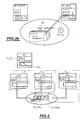
- a user is able to configure a perimeter P i for the execution of an application or operating activity denoted A i , this perimeter P i consisting of a plurality of cells as delimited for example in the figure 1a.
- the user is able to configure one or more perimeters simultaneously on the platform considered PF as shown in FIG. 1a, the perimeter P i + 1 allowing the execution for example of a operating activity A i + 1, for example distinct from operating activity A i .
- These configuration and partitioning operations of the multicellular platform can be executed by means of an administration tool denoted MT, itself provided with computer resources, and connected in network to the platform PF.
- each perimeter P i is associated with a local clock constituted by one of the clocks CK kj of the cells constituting the perimeter P i .
- the IT perimeters P i and P i + 1 are made to operate simultaneously, the aforementioned perimeters are separated.
- the local clock of the perimeter P consists of the clock and the clock circuits equipping cell C kj for example.
- the administration tool MT is constituted by a software assembly executed by a computer system comprising, for example, a central unit UC o , a working memory RAM and a clock CK o , the assembly being designated by Platform Administration and Maintainability Sofware or PAM, as mentioned in Figure 1a.
- each perimeter P i can be associated with an operating system OS i for the execution of an application A i .
- the aforementioned OS i operating systems make it possible to access the resources of the platform and in particular of the perimeter P i through standard interfaces, these interfaces generally using either direct access or via the BIOS software, for Basic Input Output Software, to the local hardware resources R kj previously mentioned.
- a perimeter P i has been shown allowing the execution of an operating activity A i by means of an operating system OS i , perimeter for which all of the resources of the perimeter is noted ⁇ kj R kj where this notation designates all the resources accessible via the operating system OS i for the perimeter considered P i , to this perimeter being also associated with a so-called local clock Ck i corresponding for example to one of the clocks of the constituent cells of the perimeter P i .
- the access interfaces to local resources are served either directly or through the BIOS, thanks to the implementation of the MT administration tool.
- the corresponding architecture makes it possible, as represented in FIG. 1b, to intercept the accesses of the operating systems to the resources of the platform PF, the different perimeters P i , P i + 1 , to P i + n being able to be implemented on separate parts of the platform from similar or different operating systems and noted, for this reason, OS i , OS i + 1 to OS i + n .
- each perimeter P i can also configure each perimeter P i so that the successive perimeters are overlapped, for example, each perimeter P i to P i + n can comprise, for example resources, that is to say common cells C kj , each perimeter then being used successively for the successive execution of the same application A i for example.
- the administration tool MT itself comprises computer resources and, of course, a clock denoted CK 0 in FIG. 1b.
- the object of the present invention is to allow direct passage from a perimeter P i to a distinct perimeter P i + 1 and successively to successive distinct perimeters for the execution of the same application A i by successive passes. from separate perimeters.
- the method which is the subject of the invention consists, in a step A, to establish for the assembly constituted by the tool administration and by all configurable IT perimeters on the multicellular platform, an absolute reference clock.
- step A consists in choosing, from among the set of local clocks which are present on the platform PF and, in particular, at the level of each cell C kj , as well as among the clock CK 0 of the administration tool, a so-called reference clock making it possible to deliver absolute reference clock signals.
- the absolute reference clock CK R makes it possible to deliver time information in the form of reference date D r and reference time H r , this reference time information being designated by D r / H r .
- the method which is the subject of the invention For each current computer perimeter, configured at the request of a user, with which is associated a current local clock making it possible to manage an operating activity from the operating system associated with this current perimeter, the method which is the subject of the invention. then consists, in step B, in calculating and memorizing, for each operating activity running on this current computer perimeter of the multicellular platform PF, a backup attribute containing, in addition to the management parameters of the time of the operating activity, and with reference to the current local clock delivering signals D i / H i corresponding to date and time signals with reference to the current local clock, a parameter of time shift noted ⁇ i , this parameter representing the shift of the time management parameters of the local clock with respect to the absolute reference clock.
- time shift parameter ⁇ i is an algebraic parameter early or late with respect to the absolute reference clock.
- the values of local date D i and absolute reference date D r can advantageously be expressed in the form of: years YY, months MM, and days DD.
- the local time parameters H; and of absolute reference time H r can advantageously be expressed in the form of: hours, minutes, seconds and hundredths of a second, if necessary.
- a separate local clock is, of course, necessarily associated with the following distinct perimeter P i + 1 , which, moreover, can be managed by an operating system OS i + 1 distinct from the previous operating system OS i .
- the process which is the subject of the present invention consists, in a step C, in recalculating the time management parameters of operating activity from the time shift parameter of time management parameters vis-à-vis the absolute reference clock.
- step C we denote by D i + 1 / H i + 1 the date parameters of the computer perimeter P i + 1 , the local clock CK i + 1 being the local clock associated with the computer perimeter following P i +1 .
- Step C is then followed by a step D consisting in updating the following local clock CK i + 1 associated with the following separate IT perimeter P i + 1 prior to the launch of the operating activity A i for further 'execution thereof.
- step D the update operation is represented by the relationship: (D i + 1 / H i + 1 ) at ⁇ D r / H r .
- step B it may consist, in step B, of an adjustment of the current local clock associated with the current perimeter P i so as to compensate for the time difference ⁇ i during the execution of the operating activity A i on the current IT perimeter P i .
- Sub-step B1 is then followed by a sub-step B2 consisting in performing a local update at the level of the perimeter P i of the form verifying a relation: D i / H i ⁇ D r / H r . this operation amounts to setting the local clock on the absolute reference clock.
- operation C can then be executed normally for the next separate IT perimeter P i + 1 and operation D then consists in performing an update on the basis of the only offset from the next distinct local clock, the value ⁇ i having been reduced to zero for the previous local clock of the current computer perimeter P i .
- the absolute reference clock can be constituted by a local hardware component of specific address belonging to the multicellular platform.
- the method which is the subject of the present invention may consist in reserving one of the cells of the multicellular platform PF of determined address so as to reserve the local hardware component of the aforementioned cell and to assign to it ci the absolute reference clock function.
- Such a choice is possible, but it has the disadvantage of particularizing one of the cells C kj of the platform PF and, ultimately, of imposing one or more inputs / outputs and exchanges of messages between the tool d administration MT and the platform PF to obtain the absolute clock information D r / H r .
- the absolute reference clock can advantageously be consisting of a local hardware component belonging to the tool of Directors.
- the local component is none other than the clock CK 0 equipping the hardware resources of the administration tool MT.
- Such date and / or time change operations are frequent and allow any user to use an arbitrary local time or, at the very least, likely to correspond to operational requirements specific.
- step D of FIG. 2a For the implementation of the method which is the subject of the present invention during a voluntary local modification of date or time by the user, it is considered that the updating of the next distinct local clock, associated with the following distinct computing perimeter P i + 1 , was carried out if necessary, in accordance with step D of FIG. 2a and in step B of this same figure or, where appropriate and preferably, in accordance with the implementation of step B according to Figure 2b.
- the process which is the subject of the present invention consists, as shown in FIG. 2c, in modifying the current local clock by a value corresponding to the modification introduced, this modification being denoted ⁇ i .
- Step E is then followed by a step F consisting in transmitting the value of the local modification of date and time ⁇ i to the administration tool MT.
- the modification is requested from the BIOS by the operating system OS i managing the execution of the operating activity A i .
- the BIOS notifies the request to the MT administration tool.
- the method which is the subject of the invention consists, in step G, in updating the time offset parameter of the time management parameters vis- against the absolute reference clock and the aforementioned backup attribute.
- This operation checks the relationship: (D i / H i ) at ⁇ D r / H r .
- This operation actually designates the compensation of the parameters of date and time and setting the corresponding values to the values of date and time of the reference clock, as previously mentioned in the description.
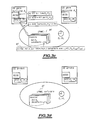
- FIG. 3a represents the operations carried out during the creation of the operating activity A i .
- This file can advantageously include, as shown in FIG. 3a, the name of the operating activity A i as well as a default time offset parameter ⁇ i established at the value zero with respect to the reference clock D r / H r .
- the administration tool MT can then collect a plurality of identity files or identity files corresponding to different activities.
- FIG. 3b represents the process of loading the operating activity A i on the perimeter P; user defined.
- the administration tool MT calculates the effective value of the time offset ⁇ i according to the relationship represented in step B of FIG. 2a or, if necessary, according to l step B1 of FIG. 2b.
- the administration tool MT transmits the information necessary for updating the local clock of the RTC clock component of the perimeter P i via the BIOS. This operation is then carried out according to step B2 of FIG. 2b.
- the BIOS software then performs the update according to the relation of step B2 of FIG. 2b before handing over to the operating system OS i under which the operating activity A i is executed.
- FIG. 3c represents the operations carried out during the introduction of a modification of date and / or time by the user of the operating activity A i as shown in FIG. 2c.
- the user of operating activity A requests the modification of the parameters for managing the current time D i / H i .
- the SetTime method of the BIOS EFI interface is then called with the parameters of the date and / or time modification request.
- the perimeter BIOS P i updates the local clock component CKi of the IT perimeter P i and transmits the parameters of the modification request to the administration tool MT.
- the MT administration tool and, in particular, the PAM software module thereof, then recalculate the difference corresponding to the modification ⁇ i and verifying the relationship: ⁇ i D j / H i - D r / H r enters the new date and time parameter resulting from the modification and the reference time and updates the date and time attribute of the identity object whose name corresponds to activity A i .
- FIG. 3d represents the operations executed during the stopping of the execution of an operating activity on a current IT perimeter P i previously executing an operating activity A i .
- Figure 3e represents the loading of the previous operating activity A i on a new IT perimeter P i + 1 .
- a system for backing up the local clock of a computer perimeter comprises, in particular, a reference clock circuit absolute denoted CK R , this circuit being able to be chosen from one of the clock circuits equipping the computer platform PF or, preferably, as represented in FIG. 4, the computer constituting the administration tool MT.
- the administration tool MT comprises, located in permanent memory of the computer, that is to say either in ROM memory or on the hard disk. of the latter, a module for calculating a backup attribute containing, in addition to the time management parameters of the operating activity A; with reference to the local clock CK i , a time shift parameter of the time management parameters with respect to the absolute reference clock CK R.
- the aforementioned calculation module can be constituted by a program stored in the form of a file on the hard disk or, if necessary, in ROM read only memory and loaded when the administration tool is initialized MT.
- This module therefore consists of a software module denoted F 1 in FIG. 4.
- a module for updating the local clock CK i of any partition P i is also provided, in accordance with the relationships previously given in the description for the implementation of the method which is the subject of the present invention.
- This module is represented by a file F 2 in FIG. 4, which is also loaded into the central memory of the computer upon initialization.
- the backup attribute consists of an Identity file comprising at least the name of the operating activity A i and the time value associated with this operating activity, for the IT perimeter P i considered .
Landscapes
- Engineering & Computer Science (AREA)
- Theoretical Computer Science (AREA)
- Physics & Mathematics (AREA)
- General Engineering & Computer Science (AREA)
- General Physics & Mathematics (AREA)
- Management, Administration, Business Operations System, And Electronic Commerce (AREA)
- Information Retrieval, Db Structures And Fs Structures Therefor (AREA)
Abstract
Description
- la figure 2a représente, à titre illustratif, un organigramme général de mise en oeuvre du procédé objet de la présente invention,
- la figure 2b représente, à titre illustratif, un détail de mise en oeuvre spécifique non limitatif d'une des étapes de mise en oeuvre du procédé objet de l'invention représenté en figure 2a,
- la figure 2c représente, à titre illustratif, un processus spécifique de mise en oeuvre du procédé objet de l'invention, lors d'une modification volontaire des paramètres de date et/ou d'heure par l'utilisateur,
- les figures 3a à 3e représentent, à titre illustratif, des modes de mise en oeuvre spécifiques des étapes du procédé objet de l'invention, tel que représenté en figure 2a, lors de l'introduction de modifications d'un périmètre informatique courant en périmètre informatique suivant distinct par un usager, au cours d'une opération d'exécution d'une activité d'exploitation par ce dernier,
- la figure 4 représente un système de sauvegarde de l'horloge locale d'un périmètre informatique, conforme à l'objet de la présente invention.
Claims (9)
- Procédé de sauvegarde de l'horloge locale d'un périmètre informatique configuré sur une plate-forme multicellulaire de ressources informatiques dans le cadre d'une activité d'exploitation, chaque périmètre informatique étant géré par un système d'exploitation spécifique et pouvant être configuré par un utilisateur à partir d'un outil d'administration (PAM) en vue de l'exécution de ladite activité d'exploitation sur au moins un périmètre informatique courant ou sur des périmètres informatiques distincts successifs, caractérisé en ce qu'il consiste :a) à établir, pour l'ensemble constitué par ledit outil d'administration et par tous les périmètres informatiques configurables sur ladite plate-forme multicellulaire, une horloge de référence absolue ; et, pour chaque périmètre informatique courant configuré à la requête d'un utilisateur auquel est associée une horloge locale courante permettant de gérer une activité d'exploitation à partir dudit système d'exploitation,b) à calculer et mémoriser, pour chaque activité d'exploitation en cours d'exécution sur ce périmètre informatique courant de ladite plate-forme multicellulaire, un attribut de sauvegarde contenant, outre les paramètres de gestion de l'heure de ladite activité d'exploitation, en référence à ladite horloge locale courante, un paramètre de décalage temporel desdits paramètres de gestion de l'heure vis-à-vis de ladite horloge de référence absolue; et, lors du rechargement de ladite activité d'exploitation pour poursuite d'exécution sur un périmètre informatique suivant distinct du périmètre informatique courant et auquel est associée une horloge locale suivante distincte de l'horloge locale courante associée au périmètre informatique courant,c) à recalculer les paramètre de gestion de l'heure de ladite activité d'exploitation à partir dudit paramètre de décalage temporel des paramètres de gestion de l'heure vis-à-vis de ladite horloge de référence absolue ; etd) à actualiser ladite horloge locale suivante distincte associée audit périmètre informatique suivant distinct, préalablement au lancement de ladite activité d'exploitation pour poursuite d'exécution.
- Procédé selon la revendication 1, caractérisé en ce que ladite horloge de référence absolue est constituée par un composant matériel local d'adresse spécifique appartenant à ladite plate-forme multicellulaire.
- Procédé selon la revendication 1, caractérisé en ce que ladite horloge de référence absolue est constituée par un composant matériel local appartenant audit outil d'administration.
- Procédé selon l'une des revendications 1 à 3, caractérisé en ce que, lors d'une modification des paramètres de gestion de l'heure de ladite activité d'exploitation par un utilisateur au cours d'une exécution, au moins partielle, de ladite activité d'exploitation sur ledit périmètre informatique courant, celui-ci consiste en outre :e) à actualiser l'horloge locale courante d'une valeur correspondant à ladite modification ;f) à transmettre conjointement ladite modification audit outil d'administration ; et, suite à cette transmission,g) à mettre à jour ledit paramètre de décalage temporel desdits paramètres de gestion de l'heure vis-à-vis de ladite horloge de référence absolue et ledit attribut de sauvegarde.
- Procédé selon l'une des revendications précédentes, caractérisé en ce que chaque attribut de sauvegarde comporte au moins :un identificateur de ladite activité d'exploitation ;un paramètre de décalage en date, heures, minutes, secondes, centièmes de seconde.
- Procédé selon l'une des revendications 1 à 5, caractérisé en ce que les opérations de mise à jour ou d'actualisation sont effectuées par l'intermédiaire du BIOS associé au système d'exploitation de chaque périmètre informatique.
- Système de sauvegarde de l'horloge locale d'un périmètre informatique, ledit périmètre informatique étant configuré pour l'exécution d'une activité d'exploitation en une partition d'une plate-forme multicellulaire à partir d'un outil d'administration interconnecté en réseau à ladite plate-forme informatique, chaque périmètre informatique comportant un circuit d'horloge local constitué par le circuit d'horloge d'une cellule informatique constitutive dudit périmètre informatique et ledit outil d'administration étant constitué par un ordinateur muni d'un circuit d'horloge spécifique, caractérisé en ce qu'il comprend :un circuit d'horloge de référence absolue, choisi parmi l'un des circuits d'horloge équipant ladite plate-forme informatique respectivement ledit ordinateur ; et en ce que ledit outil d'administration comporte, implanté en mémoire permanente dudit ordinateur,un mode de calcul d'un attribut de sauvegarde contenant, outre les paramètres de gestion de l'heure de ladite activité d'exploitation en référence à ladite horloge locale, un paramètre de décalage temporel de ces paramètres de gestion de l'heure vis-à-vis de ladite horloge de référence absolue ;un module de mise à jour de l'horloge locale de toute partition constitutive d'un périmètre informatique configurable sur ladite plate-forme informatique.
- Système selon la revendication 7, caractérisé en ce que ledit circuit d'horloge de référence absolue est le circuit d'horloge spécifique dudit ordinateur.
- Système selon l'une des revendications 7 ou 8, caractérisé en ce que ledit attribut de sauvegarde est constitué sous forme d'un fichier identité comportant au moins le nom de ladite activité d'exploitation et la valeur du décalage temporel associé à cette activité d'exploitation pour le périmètre informatique considéré.
Applications Claiming Priority (2)
| Application Number | Priority Date | Filing Date | Title |
|---|---|---|---|
| FR0116833A FR2834090B1 (fr) | 2001-12-24 | 2001-12-24 | Procede et systeme de sauvegarde de l'horloge locale d'un perimetre informatique |
| FR0116833 | 2001-12-24 |
Publications (2)
| Publication Number | Publication Date |
|---|---|
| EP1324176A1 true EP1324176A1 (fr) | 2003-07-02 |
| EP1324176B1 EP1324176B1 (fr) | 2011-07-13 |
Family
ID=8870962
Family Applications (1)
| Application Number | Title | Priority Date | Filing Date |
|---|---|---|---|
| EP02292945A Expired - Lifetime EP1324176B1 (fr) | 2001-12-24 | 2002-11-28 | Procédé et système de sauvegarde d'une horloge locale |
Country Status (3)
| Country | Link |
|---|---|
| US (1) | US6983390B2 (fr) |
| EP (1) | EP1324176B1 (fr) |
| FR (1) | FR2834090B1 (fr) |
Cited By (1)
| Publication number | Priority date | Publication date | Assignee | Title |
|---|---|---|---|---|
| US8103591B2 (en) | 2004-10-01 | 2012-01-24 | Bull S.A.S. | Flexible management process for multiple activities executed on partitionable platforms of a multiple processor system |
Citations (2)
| Publication number | Priority date | Publication date | Assignee | Title |
|---|---|---|---|---|
| FR2767935A1 (fr) * | 1997-09-04 | 1999-03-05 | Bull Sa | Procede pour synchroniser un systeme informatique et systeme informatique ainsi synchronise |
| US6223228B1 (en) * | 1998-09-17 | 2001-04-24 | Bull Hn Information Systems Inc. | Apparatus for synchronizing multiple processors in a data processing system |
Family Cites Families (5)
| Publication number | Priority date | Publication date | Assignee | Title |
|---|---|---|---|---|
| US5261118A (en) * | 1991-10-04 | 1993-11-09 | Motorola, Inc. | Simulcast synchronization and equalization system and method therefor |
| DE59108895D1 (de) * | 1991-12-18 | 1998-01-08 | Siemens Ag | Verfahren zur Uhrzeitführung in Computernetzen |
| US20020026321A1 (en) * | 1999-02-26 | 2002-02-28 | Sadeg M. Faris | Internet-based system and method for fairly and securely enabling timed-constrained competition using globally time-sychronized client subsystems and information servers having microsecond client-event resolution |
| US6535926B1 (en) * | 1999-09-30 | 2003-03-18 | Rockwell Automation Technologies, Inc. | Time synchronization system for industrial control network using global reference pulses |
| US6938045B2 (en) * | 2002-01-18 | 2005-08-30 | Seiko Epson Corporation | Image server synchronization |
-
2001
- 2001-12-24 FR FR0116833A patent/FR2834090B1/fr not_active Expired - Fee Related
-
2002
- 2002-11-28 EP EP02292945A patent/EP1324176B1/fr not_active Expired - Lifetime
- 2002-12-23 US US10/325,858 patent/US6983390B2/en not_active Expired - Lifetime
Patent Citations (2)
| Publication number | Priority date | Publication date | Assignee | Title |
|---|---|---|---|---|
| FR2767935A1 (fr) * | 1997-09-04 | 1999-03-05 | Bull Sa | Procede pour synchroniser un systeme informatique et systeme informatique ainsi synchronise |
| US6223228B1 (en) * | 1998-09-17 | 2001-04-24 | Bull Hn Information Systems Inc. | Apparatus for synchronizing multiple processors in a data processing system |
Cited By (1)
| Publication number | Priority date | Publication date | Assignee | Title |
|---|---|---|---|---|
| US8103591B2 (en) | 2004-10-01 | 2012-01-24 | Bull S.A.S. | Flexible management process for multiple activities executed on partitionable platforms of a multiple processor system |
Also Published As
| Publication number | Publication date |
|---|---|
| FR2834090B1 (fr) | 2004-02-20 |
| EP1324176B1 (fr) | 2011-07-13 |
| US20030135780A1 (en) | 2003-07-17 |
| US6983390B2 (en) | 2006-01-03 |
| FR2834090A1 (fr) | 2003-06-27 |
Similar Documents
| Publication | Publication Date | Title |
|---|---|---|
| CN111654531B (zh) | 一种基于容器的镜像更新发布方法及装置 | |
| US12627732B2 (en) | Hosted file sync with stateless sync nodes | |
| US9563413B2 (en) | Configurable application state synchronization | |
| US10425471B2 (en) | Multi-tasker | |
| US9112885B2 (en) | Interactive multi-tasker | |
| US20140095929A1 (en) | Interface for resolving synchronization conflicts of application states | |
| US7490111B2 (en) | Efficient handling of mostly read data in a computer server | |
| EP0063071B1 (fr) | Procédé et dispositif de transmission de données numériques | |
| EP1418501A1 (fr) | Méthode d'administration d'applications sur des machines virtuelles | |
| US20110060721A1 (en) | Offline downloader | |
| FR2936068A1 (fr) | Procede et dispositif d'encapsulation d'applications dans un systeme informatique pour aeronef. | |
| FR2946769A1 (fr) | Procede et dispositif de reconfiguration d'avionique. | |
| EP2876551A1 (fr) | Procédé, programme d'ordinateur et dispositif de configuration ou de maintenance d'un système informatique dans un cluster | |
| WO2011070284A1 (fr) | Procede de mise a disposition d'une application-cible | |
| FR2947644A1 (fr) | Procede de demarrage d'un dispositif informatique dans un reseau, serveur et reseau de dispositifs informatiques pour sa mise en oeuvre | |
| EP2559224A1 (fr) | Outil de gestion de ressources et d'infrastructures informatiques et de reseaux | |
| EP1643344B1 (fr) | Procédé de gestion des licenses des logiciels exécutées sur des plateformes partionnables d'un système à processeurs multiples | |
| KR101638689B1 (ko) | 클라이언트 단말에 대한 사용자 맞춤형 동기화 서비스 제공 방법 및 시스템 | |
| EP1324176B1 (fr) | Procédé et système de sauvegarde d'une horloge locale | |
| FR3003366A1 (fr) | Procede, dispositif et programme d'ordinateur pour l'installation ou la desinstallation automatique de modules logiciels dans des equipements embarques d'un aeronef | |
| FR2907623A1 (fr) | Gestion de droits numeriques basee sur les modifications apportees a l'environnement d'un dispositif. | |
| EP2530586B1 (fr) | Procédé de génération d'un logiciel | |
| EP4298766A1 (fr) | Procédé de contrôle d'une grappe de noeuds esclave par une grappe de noeuds maître, dispositifs et programmes d'ordinateurs correspondants | |
| EP3080706B1 (fr) | Procédé de sauvegarde de données stockées sur un terminal | |
| FR2990667B1 (fr) | Procede de gestion d'une installation electronique d'un vehicule automobile et installation electronique ainsi mise en oeuvre |
Legal Events
| Date | Code | Title | Description |
|---|---|---|---|
| PUAI | Public reference made under article 153(3) epc to a published international application that has entered the european phase |
Free format text: ORIGINAL CODE: 0009012 |
|
| AK | Designated contracting states |
Designated state(s): AT BE BG CH CY CZ DE DK EE ES FI FR GB GR IE IT LI LU MC NL PT SE SK TR |
|
| AX | Request for extension of the european patent |
Extension state: AL LT LV MK RO SI |
|
| 17P | Request for examination filed |
Effective date: 20031027 |
|
| AKX | Designation fees paid |
Designated state(s): DE FR GB IT |
|
| RAP1 | Party data changed (applicant data changed or rights of an application transferred) |
Owner name: BULL SAS |
|
| 17Q | First examination report despatched |
Effective date: 20100421 |
|
| GRAP | Despatch of communication of intention to grant a patent |
Free format text: ORIGINAL CODE: EPIDOSNIGR1 |
|
| GRAS | Grant fee paid |
Free format text: ORIGINAL CODE: EPIDOSNIGR3 |
|
| GRAA | (expected) grant |
Free format text: ORIGINAL CODE: 0009210 |
|
| AK | Designated contracting states |
Kind code of ref document: B1 Designated state(s): DE FR GB IT |
|
| REG | Reference to a national code |
Ref country code: GB Ref legal event code: FG4D Free format text: NOT ENGLISH |
|
| REG | Reference to a national code |
Ref country code: DE Ref legal event code: R096 Ref document number: 60240492 Country of ref document: DE Effective date: 20110901 |
|
| PLBE | No opposition filed within time limit |
Free format text: ORIGINAL CODE: 0009261 |
|
| STAA | Information on the status of an ep patent application or granted ep patent |
Free format text: STATUS: NO OPPOSITION FILED WITHIN TIME LIMIT |
|
| 26N | No opposition filed |
Effective date: 20120416 |
|
| REG | Reference to a national code |
Ref country code: DE Ref legal event code: R097 Ref document number: 60240492 Country of ref document: DE Effective date: 20120416 |
|
| REG | Reference to a national code |
Ref country code: FR Ref legal event code: PLFP Year of fee payment: 14 |
|
| REG | Reference to a national code |
Ref country code: FR Ref legal event code: PLFP Year of fee payment: 15 |
|
| REG | Reference to a national code |
Ref country code: FR Ref legal event code: PLFP Year of fee payment: 16 |
|
| PGFP | Annual fee paid to national office [announced via postgrant information from national office to epo] |
Ref country code: IT Payment date: 20191122 Year of fee payment: 18 |
|
| PG25 | Lapsed in a contracting state [announced via postgrant information from national office to epo] |
Ref country code: IT Free format text: LAPSE BECAUSE OF NON-PAYMENT OF DUE FEES Effective date: 20201128 |
|
| PGFP | Annual fee paid to national office [announced via postgrant information from national office to epo] |
Ref country code: FR Payment date: 20211126 Year of fee payment: 20 Ref country code: GB Payment date: 20211125 Year of fee payment: 20 |
|
| PGFP | Annual fee paid to national office [announced via postgrant information from national office to epo] |
Ref country code: DE Payment date: 20220127 Year of fee payment: 20 |
|
| REG | Reference to a national code |
Ref country code: DE Ref legal event code: R071 Ref document number: 60240492 Country of ref document: DE |
|
| REG | Reference to a national code |
Ref country code: GB Ref legal event code: PE20 Expiry date: 20221127 |
|
| PG25 | Lapsed in a contracting state [announced via postgrant information from national office to epo] |
Ref country code: GB Free format text: LAPSE BECAUSE OF EXPIRATION OF PROTECTION Effective date: 20221127 |