EP1324026A2 - Method of producing ion sensitive film for ion sensor - Google Patents

Method of producing ion sensitive film for ion sensor Download PDF

Info

Publication number
EP1324026A2
EP1324026A2 EP02258892A EP02258892A EP1324026A2 EP 1324026 A2 EP1324026 A2 EP 1324026A2 EP 02258892 A EP02258892 A EP 02258892A EP 02258892 A EP02258892 A EP 02258892A EP 1324026 A2 EP1324026 A2 EP 1324026A2
Authority
EP
European Patent Office
Prior art keywords
ions
electron beam
ion
group
monomer mixture
Prior art date
Legal status (The legal status is an assumption and is not a legal conclusion. Google has not performed a legal analysis and makes no representation as to the accuracy of the status listed.)
Withdrawn
Application number
EP02258892A
Other languages
German (de)
French (fr)
Other versions
EP1324026A3 (en
Inventor
Tadashi Kawai
Hirohisa Yoshida
Tokuo Mizuno
Atsuro Tonomura
Naoki Aota
Current Assignee (The listed assignees may be inaccurate. Google has not performed a legal analysis and makes no representation or warranty as to the accuracy of the list.)
Jeol Ltd
Jeol Engineering Co Ltd
Original Assignee
Jeol Ltd
Jeol Engineering Co Ltd
Priority date (The priority date is an assumption and is not a legal conclusion. Google has not performed a legal analysis and makes no representation as to the accuracy of the date listed.)
Filing date
Publication date
Application filed by Jeol Ltd, Jeol Engineering Co Ltd filed Critical Jeol Ltd
Publication of EP1324026A2 publication Critical patent/EP1324026A2/en
Publication of EP1324026A3 publication Critical patent/EP1324026A3/en
Withdrawn legal-status Critical Current

Links

Images

Classifications

    • GPHYSICS
    • G01MEASURING; TESTING
    • G01NINVESTIGATING OR ANALYSING MATERIALS BY DETERMINING THEIR CHEMICAL OR PHYSICAL PROPERTIES
    • G01N27/00Investigating or analysing materials by the use of electric, electrochemical, or magnetic means
    • G01N27/26Investigating or analysing materials by the use of electric, electrochemical, or magnetic means by investigating electrochemical variables; by using electrolysis or electrophoresis
    • G01N27/28Electrolytic cell components
    • G01N27/30Electrodes, e.g. test electrodes; Half-cells
    • G01N27/333Ion-selective electrodes or membranes
    • G01N27/3335Ion-selective electrodes or membranes the membrane containing at least one organic component

Definitions

  • the present invention relates to a method of producing an ion sensitive film for use in an ion sensor (especially, an ion selective film) that is employed to measure the activity of ions within a liquid solution.
  • ion sensors especially, ion selective electrodes
  • ions e.g., sodium, potassium, and chlorine ions
  • FIG. 1 An existing ion sensor is shown in Fig. 1 and comprises a sensor (electrode)body 1 and an ion sensitive film 4 fixed to the front-end surface of the body 1.
  • the inside of the body 1 is filled with an internal electrolyte 3.
  • An internal electrode 2 made of silver chloride is immersed in this internal electrolyte.
  • this ion sensor is immersed in a sample solution 6 together with a salt bridge 7.
  • a reference electrode 9 is immersed in aqueous solution 10 of saturated potassium chloride together with the salt bridge.
  • the potential difference between both electrodes is read by an electrometer 8.
  • the electromotive force is measured, and a calibration curve is created. The ion concentration of the sample under investigation is found by comparing the electromotive force produced by the sample against the calibration curve.
  • ion sensitive films used for ion sensors include (a) a film produced by preparing a film support material made of polyvinylchloride and mixing an ion sensitive material into the film support material together with a plasticizer, (b) an ion-exchange film, and (c) a "film-like substance" (disclosed in Japanese Patent No. 2504513) consisting of a polymer having a quaternary ammonium group having a certain structure.
  • the ion sensor using the ion sensitive film of the type (a) above has the disadvantage that the electrode life is short, because the ion sensitive material within the film gradually dissolves into the liquid solution.
  • the ion sensor using the ion sensitive film of the type (b) has a short life because ionic groups are introduced into a polymer by covalent bonding, the polymer forming a film. It has been pointed out, however, that the film is an ion-exchange film generally used for electrolytic purposes and so if the film is used as an ion sensitive film in an ion sensor, the film is affected greatly by interfering ions.
  • ion sensitive film of the type (c) as disclosed in the above-cited Japanese Patent No. 2504513 a straight-chain polymer is formed by polymerizing monomers having a quaternary ammonium group of a certain structure.
  • the film shows excellent response to chlorine ions and good waterproofness.
  • the ion selective electrode has a long life and can measure chlorine ions with high sensitivity stably.
  • the ion sensitive film of the type (c) is formed by normal heating radical solution polymerization using a radical polymerization starter and, therefore, limitations are placed on the degree of polymerization. In addition, molecular weights are broadly distributed. Therefore, it can be said that there remains room for improvements of durability and life. In addition, in such normal radical solution polymerization, it takes a long polymerization reaction time to increase the reaction rate. Furthermore, unreacted monomers remain. Additionally, it is laborious to refine the reaction mixtures.
  • the monomer mixture consists chiefly of monomer units including a functional group having an identification function and a second group of bonded atoms capable of becoming an active species that induces a polymerization reaction by being irradiated with an electron beam or radiation.
  • Monomer units used in the present invention have a functional group having a function of identifying a certain chemical substance. No limitations are imposed on this functional group, as long as the functional group can bond, directly or via a necessary connecting group, a second group such as vinyl group or allyl group that can become an active species inducing a polymerization or bridging reaction by being irradiated with an electron beam or radiation.
  • Examples of such a functional group include functional groups having crown ether structure, valinomycin structure, calixarene structure, porphyrin structure, organotin structure, organomercuric structure, and cyclic polyamine structure, anion-exchange groups such as quaternary ammonium salts, and cation-exchange groups such as sulfonic group and carboxyl group.
  • Examples of the certain chemical substance that can be identified by these functional groups include cations (such as sodium ions, potassium ions, lithium ions, calcium ions, magnesium ions, cesium ions, strontium ions, copper ions, cadmium ions, lead ions, thallium ions, and silver ions) and anions (such as fluorine ions, chlorine ions, iodine ions, thiocyanate ions, nitrite ions, monohydrogen phosphate ions, dihydrogen phosphate ions, perchlorate ions, nitrate ions, bromate ions, carbonate ions, acetate ions, and sulfate ions).
  • cations such as sodium ions, potassium ions, lithium ions, calcium ions, magnesium ions, cesium ions, strontium ions, copper ions, cadmium ions, lead ions, thallium ions, and silver ions
  • anions such as fluorine ions, chlorine ions
  • the monomers in an arrayed state are irradiated with an electron beam, thus inducing polymerization. This can enhance the selectivity with respect to a certain kind of ions.
  • the monomer units according to the invention can be oligomers if they contain unsaturated groups capable of becoming active species that induces a polymerization or bridging reaction when irradiated with an electron beam or radiation.
  • This electron beam-induced polymerization of monomers or monomer mixtures can take various forms such as bulk polymerization and solution polymerization. For ease of operability of later process steps, it is desired to irradiate a liquid spread like a film on a substrate with an electron beam. In the case of a liquid monomer, it is used intact. In the case of a solid monomer, it is necessary to liquefy it by adding a solvent or monomer necessary for the liquefaction or by heating. Preferably, the thickness of the liquid monomer or monomer mixture over the substrate is about 30 to 500 ⁇ m. No limitations are placed on the material of the substrate, as long as it can hold the monomer thereon. For example, the material of the substrate is glass, polyethylene, paraffin, or silicon. If possible, the monomer may be floated over water, oil, or the like.
  • An electron beam irradiation system is schematically shown in Fig. 3.
  • This system includes an electron gun 12 placed within a vacuum. Electrons extracted from the gun 12 as an electron beam 15 are accelerated by an accelerating tube 13 and penetrated through titanium foil 16. Then, the beam is shot at a target 17 placed within a vacuum or ambient of an inert gas such as nitrogen gas. Also shown are a high voltage terminal 11, a magnet 14 for scanning the electron beam and a substrate 18.
  • the electron beam is shot at a low accelerating voltage of less than 1000 kV, more preferably less than 300 kV.
  • the dose of the electron beam is preferably 50 to 500 kGy, although the value varies depending on the treated monomer.
  • the electron beam is shot at a relatively low energy for a long time in some cases and shot at a relatively high energy for a short time in other cases.
  • the former method is desirable to obtain large molecular weights of uniform molecular weight distribution.
  • the monomers are preferably kept cool even by forced cooling.
  • the monomers are kept below room temperature.
  • they may be heated mildly to promote the reaction. In this case, the heating temperature is preferably below 50°C.
  • the monomers or monomer mixture on the substrate must be placed within a vacuum or ambient of an inert gas such as nitrogen gas.
  • an inert gas such as nitrogen gas.
  • oxygen will produce a radical source, which is undesirable for the electron beam-induced polymerization of the present invention.
  • Substituted styrene monomers having pendant functional groups consisting of quaternary ammonium salts represented by Formulas 1 and 2, respectively, were synthesized by a known method.
  • each type of the synthesized liquid monomers was dripped onto the substrate by a micropipette.
  • the dripped monomer was spread to a thickness of about 100 ⁇ m on the substrate.
  • the monomer was irradiated with an electron beam by an electron beam irradiation system as shown in Fig. 3 in an ambient of nitrogen.
  • the energy conditions included an accelerating voltage of 150 kV and a filament current of 10 mA.
  • the electron-beam dose per exposure was 100 kGy.
  • the number of exposures was varied to vary the electron-beam dose to 100, 200, and 300 kGy. In this way, the state of each film formed on the substrate was examined.
  • the results are given in Table 1.
  • Monomer Formula 1 Formula 2 electron-beam dose (kgr) 100 200 300 100 200 300 substrate glass ⁇ ⁇ ⁇ ⁇ ⁇ ⁇ polyethylene ⁇ ⁇ ⁇ ⁇ ⁇ ⁇ Paraffin ⁇ ⁇ ⁇ ⁇ ⁇ n-paraffin ⁇ ⁇ ⁇ ⁇ ⁇ silicon grease ⁇ ⁇ ⁇ ⁇ ⁇ ⁇ ⁇
  • Films could be almost completely formed on every substrate with electron-beam dose greater than 300 kGy.
  • the total actual exposure time at electron-beam dose of 300 kGy was about 15 seconds.
  • the monomers represented by Formulas 1 and 2, respectively, were exposed on glass substrates with an electron beam at a dose of 300 kGy, producing solid polymer films P1 and P2, respectively.
  • the materials represented by Formulas 1 and 2 are monomers having a self-organizing function. Small-angle scattering measurements of synchrotron radiation were performed on the films P1 and P2. Diffraction peaks were observed. Thus, it can be seen that the monomers have an arrayed structure (see Figs. 4 and 5). The plane spacing of each of these polymers was calculated from these peaks. It has been found that each of these polymers consists of two orientations of molecules.
  • the solid polymer film P3 was attached to the front end of the electrode body, and potentiometric measurements were carried out. Aqueous solutions of sodium chloride of 10 -1 M and 10 -3 M, respectively, were used as sample liquids in the measurements. A potential gradient of about -55 mV/decade was observed. It is observed that the film also has a sufficient sensitivity for an ion sensor.
  • the present invention makes it possible to produce a long-lived ion sensitive film which is used in an ion sensor and has excellent durability, a high degree of polymerization, and a narrow range of molecular weights, by preparing a monomer mixture consisting chiefly of monomer units including a functional group having an identification function and a second group of bonded atoms capable of becoming an active species and by irradiating the monomer mixture with an electron beam or radiation in a low energy range to polymerize the monomer mixture.
  • the active species induces a polymerization or bridging reaction by being irradiated with the electron beam or radiation.
  • the invention provides an ion sensitive film which is used in an ion sensor and can be directly produced from a film-like monomer or mixture without requiring refining, the film-like monomer reaching a high reaction rate in a quite short reaction time.
  • the monomer in a monomer having a self-organizing function, can be polymerized in an arrayed state. This enhances the selectivity with respect to the ions to be identified.

Landscapes

  • Chemical & Material Sciences (AREA)
  • Life Sciences & Earth Sciences (AREA)
  • Health & Medical Sciences (AREA)
  • Biochemistry (AREA)
  • Chemical Kinetics & Catalysis (AREA)
  • Electrochemistry (AREA)
  • Physics & Mathematics (AREA)
  • Analytical Chemistry (AREA)
  • Molecular Biology (AREA)
  • General Health & Medical Sciences (AREA)
  • General Physics & Mathematics (AREA)
  • Immunology (AREA)
  • Pathology (AREA)
  • Addition Polymer Or Copolymer, Post-Treatments, Or Chemical Modifications (AREA)
  • Manufacture Of Macromolecular Shaped Articles (AREA)
  • Investigating Or Analyzing Materials By The Use Of Fluid Adsorption Or Reactions (AREA)

Abstract

There is disclosed a method of easily producing a long-lived ion sensitive film having excellent durability and used in an ion sensor. The method starts with preparing a monomer mixture consisting chiefly of monomer units including a functional group and a second group of bonded atoms. The functional group has a function of identifying a certain chemical substance. The second group can become an active species that induces a polymerization or bridging reaction by being irradiated with an electron beam or radiation. Then, the monomer mixture is irradiated with the electron beam or radiation in a low energy range. Thus, the monomer mixture is polymerized.

Description

BACKGROUND OF THE INVENTION 1. Field of the Invention
The present invention relates to a method of producing an ion sensitive film for use in an ion sensor (especially, an ion selective film) that is employed to measure the activity of ions within a liquid solution.
2. Description of the Related Art
In recent years, using ion sensors (especially, ion selective electrodes) in medical applications has been vigorously done to quantify ions (e.g., sodium, potassium, and chlorine ions) dissolved in a liquid within a living organism such as blood or urine.
An existing ion sensor is shown in Fig. 1 and comprises a sensor (electrode)body 1 and an ion sensitive film 4 fixed to the front-end surface of the body 1. The inside of the body 1 is filled with an internal electrolyte 3. An internal electrode 2 made of silver chloride is immersed in this internal electrolyte.
Referring next to Fig. 2, this ion sensor, indicated by numeral 5, is immersed in a sample solution 6 together with a salt bridge 7. On the other hand, a reference electrode 9 is immersed in aqueous solution 10 of saturated potassium chloride together with the salt bridge. The potential difference between both electrodes is read by an electrometer 8. Using a reference sample having a known concentration as an object to be measured, the electromotive force is measured, and a calibration curve is created. The ion concentration of the sample under investigation is found by comparing the electromotive force produced by the sample against the calibration curve.
The performance of such an ion sensor also depends on the performance of the used ion sensitive film. Known ion sensitive films used for ion sensors include (a) a film produced by preparing a film support material made of polyvinylchloride and mixing an ion sensitive material into the film support material together with a plasticizer, (b) an ion-exchange film, and (c) a "film-like substance" (disclosed in Japanese Patent No. 2504513) consisting of a polymer having a quaternary ammonium group having a certain structure.
However, the ion sensor using the ion sensitive film of the type (a) above has the disadvantage that the electrode life is short, because the ion sensitive material within the film gradually dissolves into the liquid solution.
The ion sensor using the ion sensitive film of the type (b) has a short life because ionic groups are introduced into a polymer by covalent bonding, the polymer forming a film. It has been pointed out, however, that the film is an ion-exchange film generally used for electrolytic purposes and so if the film is used as an ion sensitive film in an ion sensor, the film is affected greatly by interfering ions.
In the ion sensitive film of the type (c) as disclosed in the above-cited Japanese Patent No. 2504513, a straight-chain polymer is formed by polymerizing monomers having a quaternary ammonium group of a certain structure. Thus, the film shows excellent response to chlorine ions and good waterproofness. The ion selective electrode has a long life and can measure chlorine ions with high sensitivity stably.
The ion sensitive film of the type (c) is formed by normal heating radical solution polymerization using a radical polymerization starter and, therefore, limitations are placed on the degree of polymerization. In addition, molecular weights are broadly distributed. Therefore, it can be said that there remains room for improvements of durability and life. In addition, in such normal radical solution polymerization, it takes a long polymerization reaction time to increase the reaction rate. Furthermore, unreacted monomers remain. Additionally, it is laborious to refine the reaction mixtures.
SUMMARY OF THE INVENTION
We conducted numerous discussions in an attempt to develop an ion sensitive film that is for use in an ion sensor and free of the foregoing problems, and have found that a long-lived ion sensitive film having a high degree of polymerization, excellent durability, and a narrow range of molecular weights can be formed by preparing a monomer mixture and polymerizing the mixture by irradiating it with an electron beam or radiation in a low energy range. The monomer mixture consists chiefly of monomer units including a functional group having an identification function and a second group of bonded atoms capable of becoming an active species that induces a polymerization reaction by being irradiated with an electron beam or radiation. Furthermore, we have discovered that an ion sensitive film which is used in an ion sensor and which does not need to be refined can be obtained directly from a film-like monomer mixture, the monomer mixture reaching a high reaction rate in a quite short reaction time. In this way, the present invention has been completed.
BRIEF DESCRIPTION OF THE DRAWINGS
  • Fig. 1 is a cross-sectional view of a general ion sensor;
  • Fig. 2 is a schematic diagram of a general ion-measuring instrument;
  • Fig. 3 is a schematic diagram of an electron beam irradiation system used in Examples 1 and 2 of the present invention;
  • Fig. 4 is a chart illustrating the results of small-angle scattering measurements of synchrotron radiation emitted from a polymer film P1 produced in Example 1 of the invention; and
  • Fig. 5 is a chart illustrating the results of small-angle scattering measurements of synchrotron radiation emitted from a polymer film P2 produced in Example 1 of the invention.
  • DETAILED DESCRIPTION OF THE INVENTION
    Monomer units used in the present invention have a functional group having a function of identifying a certain chemical substance. No limitations are imposed on this functional group, as long as the functional group can bond, directly or via a necessary connecting group, a second group such as vinyl group or allyl group that can become an active species inducing a polymerization or bridging reaction by being irradiated with an electron beam or radiation.
    Examples of such a functional group include functional groups having crown ether structure, valinomycin structure, calixarene structure, porphyrin structure, organotin structure, organomercuric structure, and cyclic polyamine structure, anion-exchange groups such as quaternary ammonium salts, and cation-exchange groups such as sulfonic group and carboxyl group.
    Examples of the certain chemical substance that can be identified by these functional groups include cations (such as sodium ions, potassium ions, lithium ions, calcium ions, magnesium ions, cesium ions, strontium ions, copper ions, cadmium ions, lead ions, thallium ions, and silver ions) and anions (such as fluorine ions, chlorine ions, iodine ions, thiocyanate ions, nitrite ions, monohydrogen phosphate ions, dihydrogen phosphate ions, perchlorate ions, nitrate ions, bromate ions, carbonate ions, acetate ions, and sulfate ions).
    Where monomers having a self-organizing function are used, the monomers in an arrayed state are irradiated with an electron beam, thus inducing polymerization. This can enhance the selectivity with respect to a certain kind of ions. In order to enhance the orientation of a functional group, it may be necessary to insert a different monomer into the main chain of a polymer, for providing a distance at which a pendant functional group orients itself easily.
    The monomer units according to the invention can be oligomers if they contain unsaturated groups capable of becoming active species that induces a polymerization or bridging reaction when irradiated with an electron beam or radiation.
    This electron beam-induced polymerization of monomers or monomer mixtures can take various forms such as bulk polymerization and solution polymerization. For ease of operability of later process steps, it is desired to irradiate a liquid spread like a film on a substrate with an electron beam. In the case of a liquid monomer, it is used intact. In the case of a solid monomer, it is necessary to liquefy it by adding a solvent or monomer necessary for the liquefaction or by heating. Preferably, the thickness of the liquid monomer or monomer mixture over the substrate is about 30 to 500 µm. No limitations are placed on the material of the substrate, as long as it can hold the monomer thereon. For example, the material of the substrate is glass, polyethylene, paraffin, or silicon. If possible, the monomer may be floated over water, oil, or the like.
    An electron beam irradiation system is schematically shown in Fig. 3. This system includes an electron gun 12 placed within a vacuum. Electrons extracted from the gun 12 as an electron beam 15 are accelerated by an accelerating tube 13 and penetrated through titanium foil 16. Then, the beam is shot at a target 17 placed within a vacuum or ambient of an inert gas such as nitrogen gas. Also shown are a high voltage terminal 11, a magnet 14 for scanning the electron beam and a substrate 18.
    The electron beam is shot at a low accelerating voltage of less than 1000 kV, more preferably less than 300 kV. The dose of the electron beam is preferably 50 to 500 kGy, although the value varies depending on the treated monomer. With respect to the actual electron beam irradiation time, for the same dose of electron beam, the electron beam is shot at a relatively low energy for a long time in some cases and shot at a relatively high energy for a short time in other cases. To prevent production of excessive active species such as radicals, the former method is desirable to obtain large molecular weights of uniform molecular weight distribution.
    To polymerize monomers or monomer mixture on the substrate while preventing decomposition, the monomers are preferably kept cool even by forced cooling. Usually, the monomers are kept below room temperature. In the case of monomers giving rise to low reaction rates, they may be heated mildly to promote the reaction. In this case, the heating temperature is preferably below 50°C.
    The monomers or monomer mixture on the substrate must be placed within a vacuum or ambient of an inert gas such as nitrogen gas. The presence of oxygen will produce a radical source, which is undesirable for the electron beam-induced polymerization of the present invention.
    The following nonlimiting examples are provided to further illustrate the present invention.
    EXAMPLE 1
    Substituted styrene monomers having pendant functional groups consisting of quaternary ammonium salts represented by Formulas 1 and 2, respectively, were synthesized by a known method.
    Figure 00100001
    Figure 00100002
    Then, 50 µℓ of each type of the synthesized liquid monomers was dripped onto the substrate by a micropipette. The dripped monomer was spread to a thickness of about 100 µm on the substrate. The monomer was irradiated with an electron beam by an electron beam irradiation system as shown in Fig. 3 in an ambient of nitrogen.
    The energy conditions included an accelerating voltage of 150 kV and a filament current of 10 mA. The electron-beam dose per exposure was 100 kGy. The number of exposures was varied to vary the electron-beam dose to 100, 200, and 300 kGy. In this way, the state of each film formed on the substrate was examined. The results are given in Table 1.
    Monomer Formula 1 Formula 2
    electron-beam dose (kgr) 100 200 300 100 200 300
    substrate glass × ×
    polyethylene × × ×
    Paraffin × Δ × ×
    n-paraffin × × × Δ
    silicon grease × Δ × × Δ
    Films could be almost completely formed on every substrate with electron-beam dose greater than 300 kGy. The total actual exposure time at electron-beam dose of 300 kGy was about 15 seconds.
    The monomers represented by Formulas 1 and 2, respectively, were exposed on glass substrates with an electron beam at a dose of 300 kGy, producing solid polymer films P1 and P2, respectively.
    The obtained solid polymer films P1 and P2 were subjected to dissolution testing. That is, they were allowed to stand at room temperature for 4 days. The results are shown in Table 2.
    solvent P1 P2
    benzene Δ Δ
    toluene Δ Δ
    n-hexane × ×
    n-heptane × ×
    methanol × ×
    ethanol × ×
    acetone Δ Δ
    methyl ethyl ketone × ×
    diethyl ether × ×
    tetrahydrofuran Δ Δ
    dioxane × ×
    ethyl acetate × ×
    methylene chloride × ×
    chloroform × ×
    dimethyl formaldehyde Δ Δ
    dimethylacetamide Δ Δ
    dimethylsulfoxide Δ Δ
    carbon tetrachloride × ×
    acetonitrile × ×
    The results of the dissolution tests show that the films were insoluble to many solvents but the films swelled in some solvents. The films were dissolved in none of these solvents. It is estimated that the films are linear polymers which are either highly polymerized or considerably cross-linked.
    The materials represented by Formulas 1 and 2 are monomers having a self-organizing function. Small-angle scattering measurements of synchrotron radiation were performed on the films P1 and P2. Diffraction peaks were observed. Thus, it can be seen that the monomers have an arrayed structure (see Figs. 4 and 5). The plane spacing of each of these polymers was calculated from these peaks. It has been found that each of these polymers consists of two orientations of molecules.
    These solid polymer films P1 and P2 were attached to the front end of the electrode body shown in Fig. 1, and potentiometric measurements were performed with the measuring instrument shown in Fig. 2. Aqueous solutions of sodium chloride of 10-1 M and 10-3 M, respectively, were used as sample liquids in the measurements. A potential gradient of about -58 mV/decade was observed for both P1 and P2. This value agrees well with a calculated value of -59 mV/decade found from the Nernst equation. Consequently, it is seen that the ion sensitive film has a sufficient sensitivity for an ion sensor.
    EXAMPLE 2
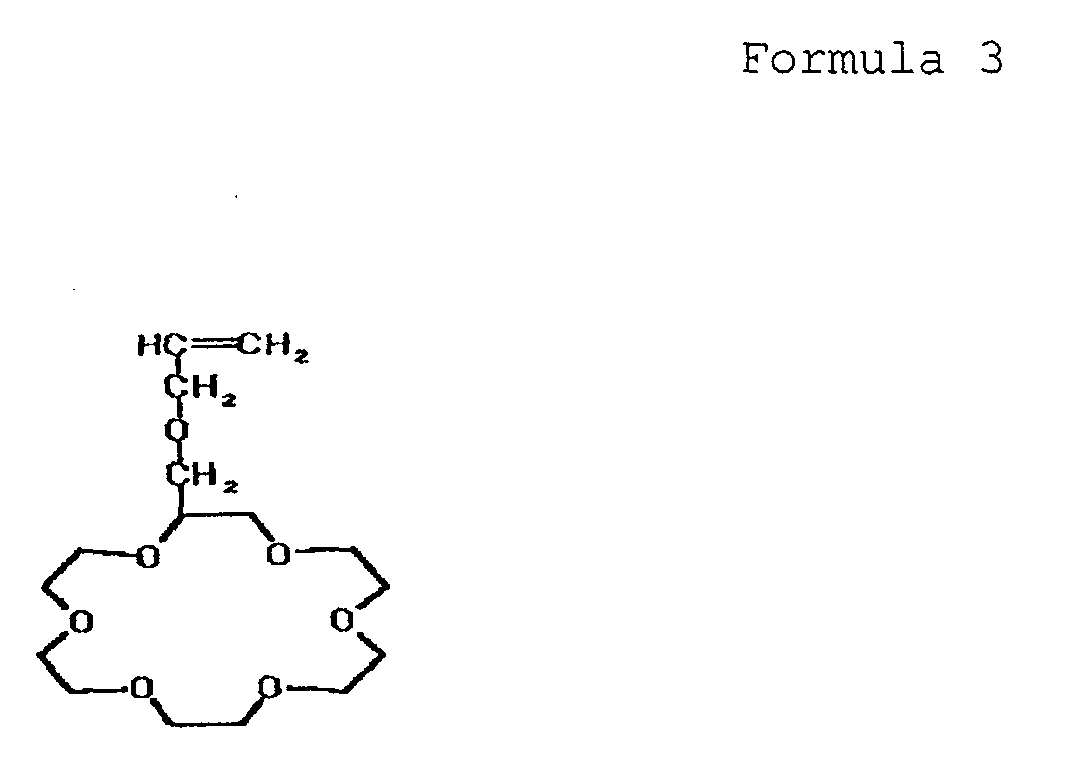
    Placed on a glass substrate was 2-allyloxymethyl-18-crown 6-ether (produced by Tokyo Kasei Kogyo Co., Ltd.) represented by Formula 3. This material was irradiated with an electron beam at an accelerating voltage of 150 kV, a filament current of 10 mA, and an electron-beam dose of 300 kGy, in the same way as in Example 1. In this manner, a solid polymer film P3 was prepared.
    Figure 00140001
    The obtained solid polymer film P3 was subjected to dissolution tests. That is, it was allowed to stand at room temperature for 4 days. The results are shown in Table 3.
    solvent P3
    benzene Δ
    toluene Δ
    n-hexane ×
    n-heptane ×
    methanol ×
    ethanol ×
    acetone Δ
    methyl ethyl ketone ×
    diethyl ether ×
    tetrahydrofuran Δ
    dioxane ×
    ethyl acetate ×
    methylene chloride ×
    chloroform ×
    dimethyl formaldehyde Δ
    dimethylacetamide Δ
    dimethylsulfoxide Δ
    carbon tetrachloride ×
    acetonitrile ×
    The results of dissolution tests show that the polymers exhibited dissolution behaviors in the presence of various - solvents, in exactly the same way as in Example 1. Again, it is estimated that the films are linear polymers which are either highly polymerized or considerably cross-linked.
    In the same way as in Example 1, the solid polymer film P3 was attached to the front end of the electrode body, and potentiometric measurements were carried out. Aqueous solutions of sodium chloride of 10-1 M and 10-3 M, respectively, were used as sample liquids in the measurements. A potential gradient of about -55 mV/decade was observed. It is observed that the film also has a sufficient sensitivity for an ion sensor.
    As described thus far, the present invention makes it possible to produce a long-lived ion sensitive film which is used in an ion sensor and has excellent durability, a high degree of polymerization, and a narrow range of molecular weights, by preparing a monomer mixture consisting chiefly of monomer units including a functional group having an identification function and a second group of bonded atoms capable of becoming an active species and by irradiating the monomer mixture with an electron beam or radiation in a low energy range to polymerize the monomer mixture. The active species induces a polymerization or bridging reaction by being irradiated with the electron beam or radiation.
    Furthermore, the invention provides an ion sensitive film which is used in an ion sensor and can be directly produced from a film-like monomer or mixture without requiring refining, the film-like monomer reaching a high reaction rate in a quite short reaction time.
    Additionally, in a monomer having a self-organizing function, the monomer can be polymerized in an arrayed state. This enhances the selectivity with respect to the ions to be identified.
    Claims (15)

    1. A method of producing an ion sensitive film for an ion sensor, said method comprising the steps of:
      preparing a monomer mixture consisting chiefly of monomer units including a functional group having a function of identifying a certain chemical substance and a second group of bonded atoms capable of becoming an active species that induces one of a polymerization reaction and a bridging reaction by being irradiated with an electron beam or radiation; and
      irradiating said monomer mixture by the electron beam or radiation to polymerize the monomer mixture.
    2. The method of claim 1, wherein said monomer units have a self-organizing function and induce a polymerization reaction by being irradiated with the electron beam, whereby the monomer units are polymerized.
    3. The method of any one of claims 1 and 2, wherein said monomer units are maintained at a low temperature.
    4. The method of claim 3, wherein said low temperature is below room temperature.
    5. The method of any one of claims 1 and 2, wherein said monomer units react slowly, and wherein said monomer units are heated to a given temperature.
    6. The method of claim 5, wherein said given temperature is below 50°C.
    7. The method of claim 1, wherein said functional group is one or more selected from the group consisting of functional groups having crown ether structure, valinomycin structure, calixarene structure, porphyrin structure, organotin structure, organomercuric structure, and cyclic polyamine structure, and ion-exchange groups.
    8. The method of claim 1, wherein said certain chemical substance is an ion species.
    9. The method of claim 8, wherein said ion species is one or more species selected from the group consisting of cations including sodium ions, potassium ions, lithium ions, calcium ions, magnesium ions, cesium ions, strontium ions, copper ions, cadmium ions, lead ions, thallium ions, and silver ions.
    10. The method of claim 8, wherein said ion species is one or more species selected from the group consisting of anions including fluorine ions, chlorine ions, iodine ions, thiocyanate ions, nitrite ions, monohydrogen phosphate ions, dihydrogen phosphate ions, perchlorate ions, nitrate ions, bromate ions, carbonate ions, acetate ions, and sulfate ions.
    11. The method of claim 1, wherein said electron beam or radiation is shot in a vacuum or ambient of an inert gas.
    12. The method of claim 1, wherein said monomer mixture is spread over a substrate and irradiated with said electron beam or radiation.
    13. The method of claim 12, wherein said monomer mixture spread over the substrate has a thickness in the range of from 30 to 500 µm.
    14. The method of claim 1, wherein said irradiating electron beam is accelerated by an accelerating voltage of less than 1000 kV.
    15. The method of claim 1, wherein the dose of said electron beam is in the range of from 50 to 500 kGy.
    EP02258892A 2001-12-28 2002-12-23 Method of producing ion sensitive film for ion sensor Withdrawn EP1324026A3 (en)

    Applications Claiming Priority (2)

    Application Number Priority Date Filing Date Title
    JP2001399793A JP3721328B2 (en) 2001-12-28 2001-12-28 Manufacturing method of sensitive film for ion sensor
    JP2001399793 2001-12-28

    Publications (2)

    Publication Number Publication Date
    EP1324026A2 true EP1324026A2 (en) 2003-07-02
    EP1324026A3 EP1324026A3 (en) 2006-05-10

    Family

    ID=19189525

    Family Applications (1)

    Application Number Title Priority Date Filing Date
    EP02258892A Withdrawn EP1324026A3 (en) 2001-12-28 2002-12-23 Method of producing ion sensitive film for ion sensor

    Country Status (3)

    Country Link
    US (1) US6855747B2 (en)
    EP (1) EP1324026A3 (en)
    JP (1) JP3721328B2 (en)

    Families Citing this family (3)

    * Cited by examiner, † Cited by third party
    Publication number Priority date Publication date Assignee Title
    DE102013114481A1 (en) * 2013-12-19 2015-06-25 Endress + Hauser Conducta Gesellschaft für Mess- und Regeltechnik mbH + Co. KG Sensor arrangement and method for determining an orthophosphate content of a liquid
    CN105837744A (en) * 2016-06-12 2016-08-10 江苏华昌织物有限公司 Preparation method of double sensitive polymer hydrogel based on crown ether
    CN114621373B (en) * 2021-06-10 2024-05-14 中国石油天然气集团有限公司 Flocculant for oil-based drilling fluid and preparation method and application thereof

    Family Cites Families (6)

    * Cited by examiner, † Cited by third party
    Publication number Priority date Publication date Assignee Title
    EP0186210B1 (en) * 1984-12-28 1992-04-22 TERUMO KABUSHIKI KAISHA trading as TERUMO CORPORATION Ion sensor
    EP0378563B1 (en) 1987-08-14 1992-10-14 The Upjohn Company Conversion of steroidal 17-cyanohydrins to corticoids
    JP2504513B2 (en) * 1988-03-11 1996-06-05 株式会社トクヤマ Ion sensitive membrane
    GB8909561D0 (en) * 1989-04-26 1989-06-14 Kodak Ltd Radiation-sensitive composition and use thereof in the preparation of electrochemical ion sensors
    US6232365B1 (en) * 1998-07-17 2001-05-15 3M Innovative Properties Company Low temperature electron beam polymerization
    US6410672B1 (en) * 1999-07-28 2002-06-25 Ionics, Incorporated Ion exchange and electrochemical methods and devices employing one-step quaternized and polymerized anion selective polymers

    Also Published As

    Publication number Publication date
    US20030166736A1 (en) 2003-09-04
    JP3721328B2 (en) 2005-11-30
    EP1324026A3 (en) 2006-05-10
    US6855747B2 (en) 2005-02-15
    JP2003194760A (en) 2003-07-09

    Similar Documents

    Publication Publication Date Title
    Kamata et al. Copper (II)-selective electrode using thiuram disulfide neutral carriers
    EP0186210B1 (en) Ion sensor
    JPS60235819A (en) Manufacture of electrophoretic gel material by radiation
    US12085532B2 (en) Enhanced chloride selective membrane
    JPH0560542B2 (en)
    Ghorbani et al. Detection of chloridazon in aqueous matrices using a nano-sized chloridazon-imprinted polymer-based voltammetric sensor
    Cattrall et al. Photocured polymers in ion-selective electrode membranes
    US6855747B2 (en) Method of producing ion sensitive film for ion sensor
    Alemu et al. Voltammetric determination of chloramphenicol at electrochemically pretreated glassy carbon electrode
    US5738774A (en) Eva containing ion selective membranes and methods of making same
    Abd Jaber et al. SYNTHESIS OF THE NEW NAPROXEN SELECTIVE ELECTRODE BASED ON IMPRINTED POLYMER USING DIFFERENT MONOMERS AND ITS DETERMINATION AT PHARMACEUTICAL PREPARATION: SYNTHESIS OF THE NEW NAPROXEN SELECTIVE ELECTRODE BASED ON IMPRINTED POLYMER USING DIFFERENT MONOMERS AND ITS DETERMINATION AT PHARMACEUTICAL PREPARATION
    EP1087225B1 (en) Polymeric compositions for ion-selective electrodes
    Khaliquzzaman et al. Trace element analysis in biological materials by external beam PIXE
    WO2005106444A1 (en) Ion-selective electrode sensors
    Yağcı et al. Electrochemical determination of norepinephrine at poly (p-aminobenzenesulfonic acid) modified sensor
    إسماعيل مفتاح عبدالعزيز Evaluation Screen Printed Carbon Electrode Modified With Poly (O-phenylenediamine) for Etodolac drug Detection
    Strasser Examination of ionic diffusion permeability of polyimide thin films
    Katsu et al. A new bretylium-selective electrode for monitoring the drug in blood serum
    ABDULLAH et al. Determination of Levofloxacin in Pure Forms and Pharmaceutical Preparations Used Molecularly Imprinted Polymers Membrane.
    JP2504513B2 (en) Ion sensitive membrane
    Petcu et al. In vivo tritium contamination effects on water exchange across the erythrocyte membranes: a nuclear magnetic resonance study
    LEDDY et al. PART xvnt. DETERMINATION OF HETEROGENEOUS ELECTRON TRANSFER KINETICS AT POLYMNYLFERROCENE) AND NAFION/Ru (bpy) § * POLYMER-MODIFIED ELECTRODES BY couvoumou VOLTAMMETRY
    JP3081376B2 (en) Ion sensor
    Pastor et al. New bromide‐selective membrane electrodes based on a methyl methacrylate matrix and their use in drug analysis
    de Namor et al. Calixpyrroles: From Fundamental Studies to the Development of Ion Selective Electrodes

    Legal Events

    Date Code Title Description
    PUAI Public reference made under article 153(3) epc to a published international application that has entered the european phase

    Free format text: ORIGINAL CODE: 0009012

    AK Designated contracting states

    Designated state(s): AT BE BG CH CY CZ DE DK EE ES FI FR GB GR IE IT LI LU MC NL PT SE SI SK TR

    AX Request for extension of the european patent

    Extension state: AL LT LV MK RO

    PUAL Search report despatched

    Free format text: ORIGINAL CODE: 0009013

    AK Designated contracting states

    Kind code of ref document: A3

    Designated state(s): AT BE BG CH CY CZ DE DK EE ES FI FR GB GR IE IT LI LU MC NL PT SE SI SK TR

    AX Request for extension of the european patent

    Extension state: AL LT LV MK RO

    AKX Designation fees paid
    REG Reference to a national code

    Ref country code: DE

    Ref legal event code: 8566

    STAA Information on the status of an ep patent application or granted ep patent

    Free format text: STATUS: THE APPLICATION IS DEEMED TO BE WITHDRAWN

    18D Application deemed to be withdrawn

    Effective date: 20061111