EP1323893A2 - A method of forming and installing a seal into a turbomachine - Google Patents
A method of forming and installing a seal into a turbomachine Download PDFInfo
- Publication number
- EP1323893A2 EP1323893A2 EP02258862A EP02258862A EP1323893A2 EP 1323893 A2 EP1323893 A2 EP 1323893A2 EP 02258862 A EP02258862 A EP 02258862A EP 02258862 A EP02258862 A EP 02258862A EP 1323893 A2 EP1323893 A2 EP 1323893A2
- Authority
- EP
- European Patent Office
- Prior art keywords
- seal
- sealing
- turbine
- adjacent surfaces
- condition
- Prior art date
- Legal status (The legal status is an assumption and is not a legal conclusion. Google has not performed a legal analysis and makes no representation as to the accuracy of the status listed.)
- Granted
Links
- 238000000034 method Methods 0.000 title claims description 33
- 238000007789 sealing Methods 0.000 claims abstract description 108
- 238000009434 installation Methods 0.000 claims description 32
- 239000000835 fiber Substances 0.000 claims description 17
- 230000036316 preload Effects 0.000 claims description 9
- 238000011065 in-situ storage Methods 0.000 claims description 8
- 230000004044 response Effects 0.000 claims description 5
- 230000006903 response to temperature Effects 0.000 claims description 2
- 239000004593 Epoxy Substances 0.000 abstract description 5
- 230000014759 maintenance of location Effects 0.000 abstract 1
- 239000007789 gas Substances 0.000 description 11
- 239000002184 metal Substances 0.000 description 5
- 230000006835 compression Effects 0.000 description 3
- 238000007906 compression Methods 0.000 description 3
- OKTJSMMVPCPJKN-UHFFFAOYSA-N Carbon Chemical compound [C] OKTJSMMVPCPJKN-UHFFFAOYSA-N 0.000 description 2
- 229920000271 Kevlar® Polymers 0.000 description 2
- 229920003368 Kevlar® 29 Polymers 0.000 description 2
- 229910052799 carbon Inorganic materials 0.000 description 2
- 238000002485 combustion reaction Methods 0.000 description 2
- 230000000694 effects Effects 0.000 description 2
- 239000000463 material Substances 0.000 description 2
- 230000013011 mating Effects 0.000 description 1
- 239000004033 plastic Substances 0.000 description 1
- 230000000452 restraining effect Effects 0.000 description 1
- 125000006850 spacer group Chemical group 0.000 description 1
- 230000000153 supplemental effect Effects 0.000 description 1
- 230000007704 transition Effects 0.000 description 1
- 238000003466 welding Methods 0.000 description 1
Images



Classifications
-
- F—MECHANICAL ENGINEERING; LIGHTING; HEATING; WEAPONS; BLASTING
- F01—MACHINES OR ENGINES IN GENERAL; ENGINE PLANTS IN GENERAL; STEAM ENGINES
- F01D—NON-POSITIVE DISPLACEMENT MACHINES OR ENGINES, e.g. STEAM TURBINES
- F01D11/00—Preventing or minimising internal leakage of working-fluid, e.g. between stages
-
- F—MECHANICAL ENGINEERING; LIGHTING; HEATING; WEAPONS; BLASTING
- F16—ENGINEERING ELEMENTS AND UNITS; GENERAL MEASURES FOR PRODUCING AND MAINTAINING EFFECTIVE FUNCTIONING OF MACHINES OR INSTALLATIONS; THERMAL INSULATION IN GENERAL
- F16J—PISTONS; CYLINDERS; SEALINGS
- F16J15/00—Sealings
- F16J15/02—Sealings between relatively-stationary surfaces
- F16J15/06—Sealings between relatively-stationary surfaces with solid packing compressed between sealing surfaces
- F16J15/08—Sealings between relatively-stationary surfaces with solid packing compressed between sealing surfaces with exclusively metal packing
- F16J15/0887—Sealings between relatively-stationary surfaces with solid packing compressed between sealing surfaces with exclusively metal packing the sealing effect being obtained by elastic deformation of the packing
-
- F—MECHANICAL ENGINEERING; LIGHTING; HEATING; WEAPONS; BLASTING
- F01—MACHINES OR ENGINES IN GENERAL; ENGINE PLANTS IN GENERAL; STEAM ENGINES
- F01D—NON-POSITIVE DISPLACEMENT MACHINES OR ENGINES, e.g. STEAM TURBINES
- F01D11/00—Preventing or minimising internal leakage of working-fluid, e.g. between stages
- F01D11/005—Sealing means between non relatively rotating elements
-
- F—MECHANICAL ENGINEERING; LIGHTING; HEATING; WEAPONS; BLASTING
- F02—COMBUSTION ENGINES; HOT-GAS OR COMBUSTION-PRODUCT ENGINE PLANTS
- F02C—GAS-TURBINE PLANTS; AIR INTAKES FOR JET-PROPULSION PLANTS; CONTROLLING FUEL SUPPLY IN AIR-BREATHING JET-PROPULSION PLANTS
- F02C7/00—Features, components parts, details or accessories, not provided for in, or of interest apart form groups F02C1/00 - F02C6/00; Air intakes for jet-propulsion plants
- F02C7/28—Arrangement of seals
-
- Y—GENERAL TAGGING OF NEW TECHNOLOGICAL DEVELOPMENTS; GENERAL TAGGING OF CROSS-SECTIONAL TECHNOLOGIES SPANNING OVER SEVERAL SECTIONS OF THE IPC; TECHNICAL SUBJECTS COVERED BY FORMER USPC CROSS-REFERENCE ART COLLECTIONS [XRACs] AND DIGESTS
- Y10—TECHNICAL SUBJECTS COVERED BY FORMER USPC
- Y10S—TECHNICAL SUBJECTS COVERED BY FORMER USPC CROSS-REFERENCE ART COLLECTIONS [XRACs] AND DIGESTS
- Y10S277/00—Seal for a joint or juncture
- Y10S277/931—Seal including temperature responsive feature
Definitions
- the present invention relates to resilient seals in turbines and particularly to methods of compressing a seal and retaining the compressed seal in a restrained condition as well as to methods for installing and releasing the seal in situ to seal against adjacent turbine parts.
- one of the disclosed seals may be used for sealing between the nozzle segments and a nozzle support ring to provide a seal supplemental to the chordal hinge seals sealing against leakage flow from the high pressure compressor discharge region into the lower pressure hot gas path.
- Another similar seal may be utilized for sealing between the nozzle retaining ring and shroud segments. Leakage paths or gaps sometimes appear between these sealing systems during turbine operations. In these and other sealing sites in a turbine, it is therefore desirable that seals be deployed between these sealing surfaces. Seal installation between these close-fitting sealing surfaces is difficult and it has been found desirable to compress the seals prior to and during installation to avoid damage to the seals and/or ancillary structure. Accordingly, there is a need for a seal which can be restrained in a compressed condition prior to and during installation and forms an effective seal under turbine operation conditions as well as for methods of installing and relieving the restrained seal for use.
- a resilient seal having sealing portions laterally spaced from one another and restrained in reduced lateral dimension prior to and during installation of the seal into the turbine. Subsequent to closure of the seal within sealing surfaces of the turbine parts, an operating condition of the turbine relieves or releases the restrained (compressed) seal, enabling the sealing surfaces to resiliently engage the adjacent sealing surfaces of the turbine parts to form the seal.
- the seal includes an elongated seal body having a generally U-shaped body portion in cross-section and a pair of reversely extending, generally U-shaped marginal portions in cross-section along opposite sides and at distal ends of the U-shaped body portion.
- the seal is formed of sheet metal, preferably a pair of complementary-shaped sheet metal plates secured to one another in back-to-back relation and formed into the aforementioned configuration.
- the seal Prior to installation, the seal is placed in a resiliently compressed or restrained state and maintained in that compressed state during installation. That is, the lateral sealing surfaces of the seal body are displaced toward one another and resiliently restrained in that condition prior to installation of the seal into the turbine to reduce the lateral extent of the seal.
- the seal can be installed into a seal cavity on one of the turbine parts without any portion of the seal projecting from the seal cavity, enabling the assembly of the turbine parts without interference between the seal and the turbine parts.
- the seal body is passed longitudinally between a pair of laterally spaced side-by-side rollers.
- the rollers displace the seal portions, e.g., the U-shaped marginal portions, toward one another to reduce the lateral extent of the seal.
- the compressed seal is then passed through a rotating bobbin holder ring which mounts a bobbin on its periphery for rotation about the elongated seal.
- the fiber from the bobbin is wrapped about the compressed seal, maintaining the seal in its compressed condition.
- the bobbin holder ring may be alternately rotated about the seal in opposite directions to provide alternate clockwise and counterclockwise wrapping of the fiber about the seal. By wrapping the fiber in opposite directions, torsional effects on the seal due to the compressed wrapping are nullified.
- the fibers are preferably formed of a material which will disintegrate at a turbine operating condition.
- the fibers may be formed of carbon or a Kevlar® material known as Kevlar® 29. These carbon or Kevlar® fibers will disintegrate as the turbine heats up, releasing the seal from its compressed installation condition to an operable condition with the marginal sealing surfaces expanding to engage against sealing surfaces of the turbine parts, forming an effective seal.
- the wrapped seal may be adhesively secured within the seal cavity to ensure that it resides completely within the cavity and does not fall out of the cavity during installation. At or below turbine operating temperatures, the epoxy and restraining fibers burn up and release the seal without leaving significant residue.
- a turbine having parts including a pair of adjacent surfaces and a flexible seal in sealing engagement with the adjacent surfaces, the seal having a pair of sealing portions preloaded to sealingly engage the pair of adjacent surfaces, respectively, upon installation of the seal into the turbine, a method of installing the flexible seal in the turbine, comprising the steps of locating the seal between the adjacent surfaces, maintaining the seal between the adjacent surfaces with the sealing portions thereof in a first position poised and biased for movement into sealing engagement with the adjacent surfaces and releasing the sealing portions of the seal in situ for movement from the first position into a second position in sealing engagement with the respective adjacent surfaces in response to a turbine operating condition.
- a turbine having parts including a pair of adjacent surfaces and a flexible seal for sealing between the adjacent surfaces, the seal having a generally U-shaped body portion and a pair of sealing surfaces laterally spaced from one another along opposite sides of the U-shaped body portion, a method of forming the flexible seal for installation of the seal in the turbine, comprising the steps of resiliently displacing the sealing surfaces of the seal toward one another in a generally lateral direction into a turbine installation condition to reduce lateral spacing between the sealing surfaces relative to one another and preload the sealing surfaces for movement away from one another into a sealing condition, retaining the sealing surfaces in the installation condition while installing the seal between the pair of adjacent turbine surfaces and enabling the sealing surfaces for resilient movement away from one another into the sealing condition engaging and sealing against the adjacent surfaces of the turbine subsequent to closure of the sealing surfaces about the seal.
- Turbine 10 receives hot gases of combustion from an annular array of combustors, not shown, which transmit the hot gases through a transition piece 12 for flow along an annular hot gas path 14.
- Turbine stages are disposed along the hot gas path 14.
- Each stage comprises a plurality of circumferentially spaced buckets mounted on and forming part of the turbine rotor and a plurality of circumferentially spaced stator vanes forming an annular array of nozzles.
- the first stage includes a plurality of circumferentially-spaced buckets 16 mounted on a first-stage rotor wheel 18 and a plurality of circumferentially-spaced stator vanes 20.
- the second stage includes a plurality of buckets 22 mounted on a rotor wheel 24 and a plurality of circumferentially-spaced stator vanes 26.
- Additional stages may be provided, for example, a third stage comprised of a plurality of circumferentially-spaced buckets 28 mounted on a third-stage rotor wheel 30 and a plurality of circumferentially-spaced stator vanes 32.
- the stator vanes 20, 26 and 32 are mounted on and fixed to a turbine casing, while the buckets 16, 22 and 28 and wheels 18, 24 and 30 form part of the turbine rotor.
- Between the rotor wheels are spacers 34 and 36 which also form part of the turbine rotor. It will be appreciated that compressor discharge air is located in a region 37 disposed radially inwardly of the first stage.
- the stator vanes 20 forming the first-stage nozzles are disposed between inner and outer bands 38 and 40, respectively, supported from the turbine casing.
- the nozzles of the first stage are formed of a plurality of nozzle segments 41, each mounting one, preferably two, stator vanes extending between inner and outer band portions and arranged in an annular array of segments.
- a nozzle retaining ring 42 connected to the turbine casing is coupled to the outer band and secures the first-stage nozzle.
- Shroud segments 43 arranged in an annular array thereof surround the rotatable buckets, e.g., the buckets 16 of the first stage.
- the shroud segments include an axial facing surface 46 (Figure 2) which lies in sealing engagement with a confronting axial facing surface 48 of the nozzle retaining ring 42.
- the nozzle retaining ring 42 and the shroud segments 43 may tend to form leakage gaps between the axially confronting sealing surfaces 46 and 48 whereby leakage flow may occur across such gaps.
- a seal for sealing between the nozzle retaining ring 42 and the shroud segments 43 is provided.
- a representative example of such seal generally designated 70 ( Figure 2), includes a seal body 71 having a first, generally U-shaped portion 72 in cross-section and a pair of reversely extending, generally U-shaped marginal sealing portions 74 in cross-section along opposite sides of the U-shaped portion 72.
- the seal body 71 is formed of sheet metal.
- a pair of sheet metal plates 76 and 78 are secured in back-to-back relation to one another, for example, by welding, to form the seal body 71.
- one of the sealing surfaces 46 and 48 of the shroud segments 43 and the nozzle retaining ring 44 is provided with a cavity 80 for housing the seal 70.
- the cavity 80 is formed in the shroud segments 43 with the cavity 80 opening generally axially through surface 46 and toward the axially opposite sealing surface 48 of the nozzle retaining ring 44.
- the cavity 80 includes a base 82 and radially opposed surfaces 84 and 86, respectively.
- the cavity 80 extends in an arcuate path about the axis of the turbine rotor and lies radially outwardly of the hot gas path 14.
- the seal 70 is provided preferably in arcuate lengths in excess of the arcuate length of the individual shroud segments, preferably in 90° or 180° lengths, and therefore spans the joints between the shroud segments. Consequently, the seal 70 is located to substantially preclude any leakage flow past the axially opposed surfaces 46 and 48.
- the laterally outer extremities of the marginal U-shaped portions 74 extend outwardly beyond the lateral extent of the main U-shaped portion 72.
- the marginal sealing portions 74 extend laterally in excess of the depth of cavity 80. This lateral dimension inhibits or precludes assembly of the turbine paths having the sealed surfaces, e.g., surfaces 46 and 48, due to potential interference of those parts with the protruding seal body 71.
- the projecting marginal portion 74 may snag on the retaining ring 42 or snap off entirely upon installation of the mating parts, e.g., surfaces 46 and 48. This, of course, could render the seal ineffective during turbine operation.
- marginal sealing portions 74 are biased or preloaded for sealing engagement against the respective base surface 82 of cavity 80 and the sealing surface 48 in use, and also to avoid interference between the seal and sealing parts during assembly of the seal, the seal 70 must first be compressed during installation. Otherwise, and with references to Figure 3,a marginal portion 74 will project from the cavity 80 when the seal body 71 is initially placed in the cavity.
- the body is first compressed to a configuration which, when inserted into the cavity 80, enables the seal body to lie wholly within the confines of the cavity 80 as illustrated in Figure 4. That is, the lateral dimension between the marginal sealing portions 74 is reduced ( Figure 4) to a dimension equal to or less than the lateral dimension between the marginal portions 74 in the natural state ( Figure 3) of seal body 72.
- Means are provided to maintain the seal body in such compressed state during installation.
- Such means may comprise a wrap 92 provided about the entire length or portions of the length of each seal segment. The wrap restrains the marginal seal portions 74 of the seal in the compressed condition of the seal with the lateral extent of the marginal seal portions 74 reduced.
- Such wrap may comprise Kevlar® 29 and may comprise a continuous wrap or a segmented wrap about sections of the seal.
- a high-strength plastic such as LexanTM or UltemTM clips may hold the seal 70 in a compressed state during assembly.
- the seal 70 is wrapped in a compressed state with a wrap 92 as indicated previously such that, upon assembly, the seal 70 may reside completely within the cavity 80.
- the elongated seal 70 is advanced through a pair of compression rollers 100, the spacing between which can be adjusted to adjust the degree of lateral compression of the seal.
- the rollers 100 thus induce a bias or preload on the seal in its compressed condition.
- the rollers 100 feed the elongated seal 70 through a wrapping mechanism by which the wrap 92 is wound about the seal 70 to maintain the seal under compression and reduced in lateral dimension.
- the wrapping mechanism includes a bobbin 102 mounted on a rotatable ring 104.
- the bobbin carries the wrap 92 and the ring is rotatable in opposite directions, one of the rotary directions being illustrated by the arrow 106 in Figure 7.
- the ring 104 is rotated by powered gears or friction rollers, not shown, which are equipped with a direction reversal mechanism. Consequently, as the seal 70 passes through the ring 104 and the ring is rotated, the fiber 92 is wrapped about the compressed seal 70 in one direction.
- the wrap may be disposed about the seal body 71 in a reverse direction. For example, alternate wraps in clockwise and counterclockwise directions may be provided.
- By providing for reversal of the wrap about the ring torsional effects due to the compressed wrapping are completely eliminated.
- the seal 70 thus emerges from the wrapping mechanism in a restrained compressed condition, as illustrated in Figure 8.
- the seal 70 wrapped as illustrated in Figure 8 and reduced in lateral dimension the seal can be located wholly within the sealing groove, for example, groove 80, of the shroud segments.
- Epoxy 83 ( Figure 4) may be applied to the margins of the seal to maintain the seal in the cavity during installation.
- the retaining means e.g., the wrap or wraps
- the seal body 71 locates surface portions 91 ( Figure 2) of the marginal portions 74 into engagement against the base 82 of the cavity 80 and the sealing surface 48 of the nozzle retaining ring 42.
- the marginal portions 74 of the seal remain biased or preloaded into sealing engagement with the opposed sealing surfaces notwithstanding relative movement of the surfaces 46 and 48 or the opening of one or more leakage gaps therebetween. It will be appreciated that a metal-to-metal line contact with good sealing performance is thus provided by the seal 70 to prevent any leakage flow past the confronting axial surfaces 46 and 48.
Landscapes
- Engineering & Computer Science (AREA)
- General Engineering & Computer Science (AREA)
- Mechanical Engineering (AREA)
- Chemical & Material Sciences (AREA)
- Combustion & Propulsion (AREA)
- Turbine Rotor Nozzle Sealing (AREA)
Abstract
Description
- The present invention relates to resilient seals in turbines and particularly to methods of compressing a seal and retaining the compressed seal in a restrained condition as well as to methods for installing and releasing the seal in situ to seal against adjacent turbine parts.
- In a gas turbine, hot gases of combustion flow from combustors through nozzles and buckets of the various turbine stages. Compressor discharge air is typically used to cool certain of the turbine elements. It will be appreciated that there is a need for seals at various locations in the turbine, as well as different types of seals. In co-pending U.S. patent application Serial No. 10/028,928, filed 28 December 2001 (Attorney Docket No. 839-1127) and Serial No. 10/029,003, filed 28 December 2001 (Attorney Docket No. 839-1124), there is disclosed a similar seal for use at two different locations within the turbine. For example, one of the disclosed seals may be used for sealing between the nozzle segments and a nozzle support ring to provide a seal supplemental to the chordal hinge seals sealing against leakage flow from the high pressure compressor discharge region into the lower pressure hot gas path. Another similar seal may be utilized for sealing between the nozzle retaining ring and shroud segments. Leakage paths or gaps sometimes appear between these sealing systems during turbine operations. In these and other sealing sites in a turbine, it is therefore desirable that seals be deployed between these sealing surfaces. Seal installation between these close-fitting sealing surfaces is difficult and it has been found desirable to compress the seals prior to and during installation to avoid damage to the seals and/or ancillary structure. Accordingly, there is a need for a seal which can be restrained in a compressed condition prior to and during installation and forms an effective seal under turbine operation conditions as well as for methods of installing and relieving the restrained seal for use.
- In accordance with a preferred embodiment of the present invention, there is provided a resilient seal having sealing portions laterally spaced from one another and restrained in reduced lateral dimension prior to and during installation of the seal into the turbine. Subsequent to closure of the seal within sealing surfaces of the turbine parts, an operating condition of the turbine relieves or releases the restrained (compressed) seal, enabling the sealing surfaces to resiliently engage the adjacent sealing surfaces of the turbine parts to form the seal. In a particular preferred embodiment, the seal includes an elongated seal body having a generally U-shaped body portion in cross-section and a pair of reversely extending, generally U-shaped marginal portions in cross-section along opposite sides and at distal ends of the U-shaped body portion. In a preferred form, the seal is formed of sheet metal, preferably a pair of complementary-shaped sheet metal plates secured to one another in back-to-back relation and formed into the aforementioned configuration. Prior to installation, the seal is placed in a resiliently compressed or restrained state and maintained in that compressed state during installation. That is, the lateral sealing surfaces of the seal body are displaced toward one another and resiliently restrained in that condition prior to installation of the seal into the turbine to reduce the lateral extent of the seal. In that manner, the seal can be installed into a seal cavity on one of the turbine parts without any portion of the seal projecting from the seal cavity, enabling the assembly of the turbine parts without interference between the seal and the turbine parts.
- To compress and maintain the seal in a compressed condition in accordance with a preferred embodiment hereof, the seal body is passed longitudinally between a pair of laterally spaced side-by-side rollers. The rollers displace the seal portions, e.g., the U-shaped marginal portions, toward one another to reduce the lateral extent of the seal. The compressed seal is then passed through a rotating bobbin holder ring which mounts a bobbin on its periphery for rotation about the elongated seal. As the compressed seal passes through the rotating bobbin holder ring, the fiber from the bobbin is wrapped about the compressed seal, maintaining the seal in its compressed condition. The bobbin holder ring may be alternately rotated about the seal in opposite directions to provide alternate clockwise and counterclockwise wrapping of the fiber about the seal. By wrapping the fiber in opposite directions, torsional effects on the seal due to the compressed wrapping are nullified.
- The fibers are preferably formed of a material which will disintegrate at a turbine operating condition. Specifically, the fibers may be formed of carbon or a Kevlar® material known as Kevlar® 29. These carbon or Kevlar® fibers will disintegrate as the turbine heats up, releasing the seal from its compressed installation condition to an operable condition with the marginal sealing surfaces expanding to engage against sealing surfaces of the turbine parts, forming an effective seal. Preferably, the wrapped seal may be adhesively secured within the seal cavity to ensure that it resides completely within the cavity and does not fall out of the cavity during installation. At or below turbine operating temperatures, the epoxy and restraining fibers burn up and release the seal without leaving significant residue.
- In a preferred embodiment according to the present invention, there is provided in a turbine having parts including a pair of adjacent surfaces and a flexible seal in sealing engagement with the adjacent surfaces, the seal having a pair of sealing portions preloaded to sealingly engage the pair of adjacent surfaces, respectively, upon installation of the seal into the turbine, a method of installing the flexible seal in the turbine, comprising the steps of locating the seal between the adjacent surfaces, maintaining the seal between the adjacent surfaces with the sealing portions thereof in a first position poised and biased for movement into sealing engagement with the adjacent surfaces and releasing the sealing portions of the seal in situ for movement from the first position into a second position in sealing engagement with the respective adjacent surfaces in response to a turbine operating condition.
- In a further preferred embodiment according to the present invention, there is provided for a turbine having parts including a pair of adjacent surfaces and a flexible seal for sealing between the adjacent surfaces, the seal having a generally U-shaped body portion and a pair of sealing surfaces laterally spaced from one another along opposite sides of the U-shaped body portion, a method of forming the flexible seal for installation of the seal in the turbine, comprising the steps of resiliently displacing the sealing surfaces of the seal toward one another in a generally lateral direction into a turbine installation condition to reduce lateral spacing between the sealing surfaces relative to one another and preload the sealing surfaces for movement away from one another into a sealing condition, retaining the sealing surfaces in the installation condition while installing the seal between the pair of adjacent turbine surfaces and enabling the sealing surfaces for resilient movement away from one another into the sealing condition engaging and sealing against the adjacent surfaces of the turbine subsequent to closure of the sealing surfaces about the seal.
- An embodiment of the invention will now be described, by way of example, with reference to the accompanying drawings, in which:
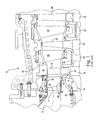
- FIGURE 1 is a fragmentary schematic side elevational view of a portion of a gas turbine in which seals constructed in accordance with a preferred embodiment hereof may be utilized;
- FIGURE 2 is a representative example of a seal constructed in accordance with a preferred embodiment of the present invention interposed between a nozzle segment retaining ring and a shroud segment;
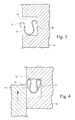
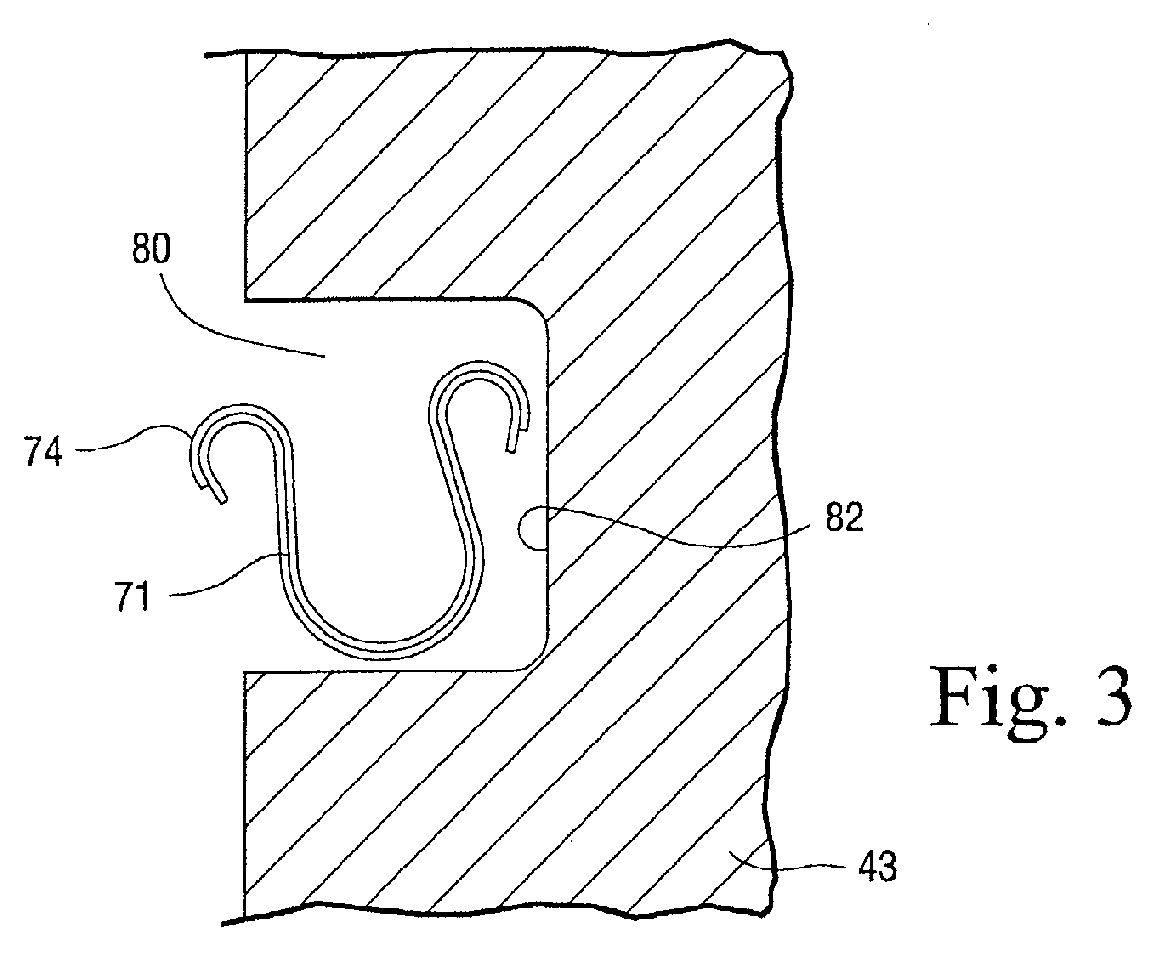
- FIGURE 3 is a schematic representation of the seal of Figure 2 in a natural state having a lateral dimension larger than the depth of the seal cavity, causing interference between adjacent sealing parts upon installation of the seal;
- FIGURE 4 is a schematic representation of a seal compressed for installation in accordance with the present invention;
- FIGURE 5 is an enlarged end view of the seal prior to installation and illustrating the process of compressing the seal between a pair of rollers;
- FIGURE 6 is a plan view of the compressed seal being wrapped by a fiber;
- FIGURE 7 is a schematic representation of a bobbin ring mounting a bobbin for wrapping the seal with fiber; and
- FIGURE 8 is a plan view of a wrapped seal with the fibers extending both clockwise and counterclockwise directions about the seal.
-
- Referring now to Figure 1, there is illustrated a representative example of a turbine section of a gas turbine, generally designated 10.
Turbine 10 receives hot gases of combustion from an annular array of combustors, not shown, which transmit the hot gases through atransition piece 12 for flow along an annularhot gas path 14. Turbine stages are disposed along thehot gas path 14. Each stage comprises a plurality of circumferentially spaced buckets mounted on and forming part of the turbine rotor and a plurality of circumferentially spaced stator vanes forming an annular array of nozzles. For example, the first stage includes a plurality of circumferentially-spacedbuckets 16 mounted on a first-stage rotor wheel 18 and a plurality of circumferentially-spacedstator vanes 20. Similarly, the second stage includes a plurality ofbuckets 22 mounted on arotor wheel 24 and a plurality of circumferentially-spacedstator vanes 26. Additional stages may be provided, for example, a third stage comprised of a plurality of circumferentially-spacedbuckets 28 mounted on a third-stage rotor wheel 30 and a plurality of circumferentially-spacedstator vanes 32. It will be appreciated that the stator vanes 20, 26 and 32 are mounted on and fixed to a turbine casing, while thebuckets wheels spacers region 37 disposed radially inwardly of the first stage. - Referring to the first stage of the turbine, the
stator vanes 20 forming the first-stage nozzles are disposed between inner andouter bands nozzle segments 41, each mounting one, preferably two, stator vanes extending between inner and outer band portions and arranged in an annular array of segments. Anozzle retaining ring 42 connected to the turbine casing is coupled to the outer band and secures the first-stage nozzle.Shroud segments 43 arranged in an annular array thereof surround the rotatable buckets, e.g., thebuckets 16 of the first stage. The shroud segments include an axial facing surface 46 (Figure 2) which lies in sealing engagement with a confronting axial facingsurface 48 of thenozzle retaining ring 42. A nozzle support ring 44 (Figure 1) radially inwardly of theinner band 38 of the first-stage nozzles engages theinner band 38, particularly theinner rail 52 thereof. - As noted previously, however, in turbine operation, the
nozzle retaining ring 42 and theshroud segments 43 may tend to form leakage gaps between the axially confrontingsealing surfaces hot gas path 14, and, as described and illustrated, in co-pending U.S. patent application Serial No. 10/028,928, filed 28 December 2001 (Attorney Docket 839-1127), there is provided a seal for sealing between thenozzle retaining ring 42 and theshroud segments 43. It will be appreciated that a similar seal may be employed to seal between various other parts of a turbine, e.g., theinner rail 52 and thenozzle supporting ring 44, e.g., as set forth in U.S. patent application Serial No. 10/029,003, filed 28 December 2001 (Attorney Docket No. 839-1124). A representative example of such seal, generally designated 70 (Figure 2), includes aseal body 71 having a first, generally U-shapedportion 72 in cross-section and a pair of reversely extending, generally U-shapedmarginal sealing portions 74 in cross-section along opposite sides of the U-shapedportion 72. Preferably, theseal body 71 is formed of sheet metal. In a particular embodiment hereof, a pair ofsheet metal plates seal body 71. - Still referring to Figure 2, one of the
sealing surfaces shroud segments 43 and thenozzle retaining ring 44 is provided with acavity 80 for housing theseal 70. Preferably, thecavity 80 is formed in theshroud segments 43 with thecavity 80 opening generally axially throughsurface 46 and toward the axiallyopposite sealing surface 48 of thenozzle retaining ring 44. Thecavity 80 includes abase 82 and radially opposedsurfaces cavity 80 extends in an arcuate path about the axis of the turbine rotor and lies radially outwardly of thehot gas path 14. It will also be appreciated that theseal 70 is provided preferably in arcuate lengths in excess of the arcuate length of the individual shroud segments, preferably in 90° or 180° lengths, and therefore spans the joints between the shroud segments. Consequently, theseal 70 is located to substantially preclude any leakage flow past the axially opposedsurfaces - In a natural state of the seal body as illustrated in Figure 3 and in its sealing state illustrated in Figure 2, the laterally outer extremities of the marginal
U-shaped portions 74 extend outwardly beyond the lateral extent of the mainU-shaped portion 72. Also, in the natural state ofseal body 71 illustrated in Figure 3, themarginal sealing portions 74 extend laterally in excess of the depth ofcavity 80. This lateral dimension inhibits or precludes assembly of the turbine paths having the sealed surfaces, e.g., surfaces 46 and 48, due to potential interference of those parts with the protrudingseal body 71. For example, the projectingmarginal portion 74 may snag on the retainingring 42 or snap off entirely upon installation of the mating parts, e.g., surfaces 46 and 48. This, of course, could render the seal ineffective during turbine operation. - Because the
marginal sealing portions 74 are biased or preloaded for sealing engagement against therespective base surface 82 ofcavity 80 and the sealingsurface 48 in use, and also to avoid interference between the seal and sealing parts during assembly of the seal, theseal 70 must first be compressed during installation. Otherwise, and with references to Figure 3,amarginal portion 74 will project from thecavity 80 when theseal body 71 is initially placed in the cavity. - To install the
seal body 71, the body is first compressed to a configuration which, when inserted into thecavity 80, enables the seal body to lie wholly within the confines of thecavity 80 as illustrated in Figure 4. That is, the lateral dimension between themarginal sealing portions 74 is reduced (Figure 4) to a dimension equal to or less than the lateral dimension between themarginal portions 74 in the natural state (Figure 3) ofseal body 72. Means are provided to maintain the seal body in such compressed state during installation. Such means, for example, may comprise awrap 92 provided about the entire length or portions of the length of each seal segment. The wrap restrains themarginal seal portions 74 of the seal in the compressed condition of the seal with the lateral extent of themarginal seal portions 74 reduced. Such wrap may comprise Kevlar® 29 and may comprise a continuous wrap or a segmented wrap about sections of the seal. Alternatively, a high-strength plastic such as Lexan™ or Ultem™ clips may hold theseal 70 in a compressed state during assembly. - Referring now to Figures 5-8, the
seal 70 is wrapped in a compressed state with awrap 92 as indicated previously such that, upon assembly, theseal 70 may reside completely within thecavity 80. To compress the seal, theelongated seal 70 is advanced through a pair ofcompression rollers 100, the spacing between which can be adjusted to adjust the degree of lateral compression of the seal. Thus, when theseal 70 passes through therollers 100, thelateral margins 74 ofseal 70 are displaced laterally toward one another, reducing the overall lateral dimension of the seal. Therollers 100 thus induce a bias or preload on the seal in its compressed condition. As illustrated in Figure 6, therollers 100 feed theelongated seal 70 through a wrapping mechanism by which thewrap 92 is wound about theseal 70 to maintain the seal under compression and reduced in lateral dimension. - Referring to Figure 7, the wrapping mechanism includes a
bobbin 102 mounted on arotatable ring 104. The bobbin carries thewrap 92 and the ring is rotatable in opposite directions, one of the rotary directions being illustrated by thearrow 106 in Figure 7. Thering 104 is rotated by powered gears or friction rollers, not shown, which are equipped with a direction reversal mechanism. Consequently, as theseal 70 passes through thering 104 and the ring is rotated, thefiber 92 is wrapped about thecompressed seal 70 in one direction. By reversing the rotational direction of thering 104, the wrap may be disposed about theseal body 71 in a reverse direction. For example, alternate wraps in clockwise and counterclockwise directions may be provided. By providing for reversal of the wrap about the ring, torsional effects due to the compressed wrapping are completely eliminated. Theseal 70 thus emerges from the wrapping mechanism in a restrained compressed condition, as illustrated in Figure 8. - With the
seal 70 wrapped as illustrated in Figure 8 and reduced in lateral dimension, the seal can be located wholly within the sealing groove, for example, groove 80, of the shroud segments. Epoxy 83 (Figure 4) may be applied to the margins of the seal to maintain the seal in the cavity during installation. - As the turbine reaches operating conditions, e.g., high operating temperatures, the retaining means, e.g., the wrap or wraps, release the seal from its compressed state, enabling the seal to expand under natural bias or preload in a lateral (axial) direction. Where epoxy is used to retain the compressed seal in the cavity, the operating conditions, e.g., high operating temperatures, similarly cause the epoxy to melt and release the seal. Such expansion of the
seal body 71 locates surface portions 91 (Figure 2) of themarginal portions 74 into engagement against thebase 82 of thecavity 80 and the sealingsurface 48 of thenozzle retaining ring 42. Consequently, themarginal portions 74 of the seal remain biased or preloaded into sealing engagement with the opposed sealing surfaces notwithstanding relative movement of thesurfaces seal 70 to prevent any leakage flow past the confrontingaxial surfaces - For completeness, various aspects of the invention are set out in the following numbered clauses:
- 1. In a turbine having parts including a pair of adjacent surfaces (46, 48)
and a flexible seal (70) in sealing engagement with said adjacent surfaces,
said seal having a pair of sealing portions (74) preloaded to sealingly engage
said pair of adjacent surfaces, respectively, upon installation of the seal into
the turbine, a method of installing the flexible seal in the turbine, comprising
the steps of:
- locating the seal (70) between said adjacent surfaces (46, 48);
- maintaining the seal (70) between said adjacent surfaces with said sealing portions (74) thereof in a first position poised and biased for movement into sealing engagement with said adjacent surfaces; and
- releasing the sealing portions of said seal in situ for movement from said first position into a second position in sealing engagement with said respective adjacent surfaces in response to a turbine operating condition.
- 2. A method according to Clause 1 wherein the sealing portions of the seal are released in response to temperature conditions at said seal between a turbine startup temperature and a turbine operating temperature.
- 3. A method according to Clause 1 including displacing the sealing portions of said seal in situ under the influence of the seal preload.
- 4. A method according to Clause 1 including wrapping the seal with a restraint (92) prior to locating the seal between the adjacent surfaces to maintain the sealing portions in said first position thereof, and causing disintegration of the restraint in situ at a turbine temperature between startup temperature and operating temperature to release the sealing portions for movement into sealing engagement with said adjacent surfaces.
- 5. A method according to Clause 1 including forming a cavity (80) in one of said surfaces (46) and locating the seal and the sealing portions thereof wholly within the cavity.
- 6. A method according to Clause 1 wherein the seal is elongated and including wrapping the seal with a fiber (92) along the length of the seal.
- 7. A method according to Clause 1 wherein the seal is elongated and including wrapping the seal with a fiber in alternate clockwise and counterclockwise directions about the seal at discrete longitudinal locations therealong.
- 8. A method according to Clause 1 wherein said seal includes a first generally U-shaped portion (76) with said pair of sealing portions including a pair of reversely extending, generally U-shaped marginal sealing portions (74) in cross-section along opposite edges of said U-shaped portion, and including wrapping the seal with a restraint (92) to reduce a lateral dimension between said marginal sealing portions and preload the seal.
- 9. For a turbine having parts including a pair of adjacent surfaces (46, 48)
and a flexible seal (70) for sealing between the adjacent surfaces, said seal
having a generally U-shaped body portion (71) and a pair of sealing surfaces
(74) laterally spaced from one another along opposite sides of the U-shaped
body portion, a method of forming said flexible seal for installation of the seal
in the turbine, comprising the steps of:
- resiliently displacing the sealing surfaces of the seal toward one another in a generally lateral direction into a turbine installation condition to reduce lateral spacing between said sealing surfaces (74) relative to one another and preload the sealing surfaces for movement away from one another into a sealing condition;
- retaining (92) said sealing surfaces in said installation condition while installing the seal between the pair of adjacent turbine surfaces; and
- enabling the sealing surfaces for resilient movement away from one another into the sealing condition engaging and sealing against the adjacent surfaces of the turbine subsequent to closure of the sealing surfaces about the seal.
- 10. A method according to Clause 9 including releasing the sealing surfaces (74) from said installation condition in response to a temperature condition within the turbine for movement into the sealing condition.
- 11. A method according to Clause 9 including wrapping the seal with a restraint (92) prior to installing the seal between the adjacent surfaces to retain the seal in said installation condition.
- 12. A method according to Clause 9 wherein the seal is elongated and including wrapping the seal with a fiber along the length of the seal.
- 13. A method according to Clause 9 wherein the seal is elongated and including wrapping the seal with a fiber in alternate clockwise and counterclockwise directions about the seal at discrete longitudinal locations therealong.
- 14. A method according to Clause 9 wherein said seal includes a first generally U-shaped portion with said pair of sealing portions including a pair of reversely extending, generally U-shaped marginal sealing portions in cross-section along opposite edges of said U-shaped portion, and including wrapping the seal with a restraint to reduce a lateral dimension between said marginal sealing portions and preload the seal.
-
Claims (10)
- A method of installing a flexible seal in a turbine, the turbine having parts including a pair of adjacent surfaces (46, 48) and a flexible seal (70) in sealing engagement with said adjacent surfaces, said seal having a pair of sealing portions (74) preloaded to sealingly engage said pair of adjacent surfaces, respectively, upon installation of the seal into the turbine, the method comprising the steps of:locating the seal (70) between said adjacent surfaces (46, 48);maintaining the seal (70) between said adjacent surfaces with said sealing portions (74) thereof in a first position poised and biased for movement into sealing engagement with said adjacent surfaces; andreleasing the sealing portions of said seal in situ for movement from said first position into a second position in sealing engagement with said respective adjacent surfaces in response to a turbine operating condition.
- A method according to Claim 1 wherein the sealing portions of the seal are released in response to temperature conditions at said seal between a turbine startup temperature and a turbine operating temperature.
- A method according to Claim 1 including displacing the sealing portions of said seal in situ under the influence of the seal preload.
- A method according to Claim 1 including wrapping the seal with a restraint (92) prior to locating the seal between the adjacent surfaces to maintain the sealing portions in said first position thereof, and causing disintegration of the restraint in situ at a turbine temperature between startup temperature and operating temperature to release the sealing portions for movement into sealing engagement with said adjacent surfaces.
- A method according to Claim 1 including forming a cavity (80) in one of said surfaces (46) and locating the seal and the sealing portions thereof wholly within the cavity.
- A method according to Claim 1 wherein the seal is elongated and including wrapping the seal with a fiber (92) along the length of the seal.
- A method of forming a flexible seal for installation of the seal in a turbine, the turbine having parts including a pair of adjacent surfaces (46, 48) and a flexible seal (70) for sealing between the adjacent surfaces, said seal having a generally U-shaped body portion (71) and a pair of sealing surfaces (74) laterally spaced from one another along opposite sides of the U-shaped body portion, the method comprising the steps of:resiliently displacing the sealing surfaces of the seal toward one another in a generally lateral direction into a turbine installation condition to reduce lateral spacing between said sealing surfaces (74) relative to one another and preload the sealing surfaces for movement away from one another into a sealing condition;retaining (92) said sealing surfaces in said installation condition while installing the seal between the pair of adjacent turbine surfaces; andenabling the sealing surfaces for resilient movement away from one another into the sealing condition engaging and sealing against the adjacent surfaces of the turbine subsequent to closure of the sealing surfaces about the seal.
- A method according to Claim 7 including releasing the sealing surfaces (74) from said installation condition in response to a temperature condition within the turbine for movement into the sealing condition.
- A method according to Claim 7 including wrapping the seal with a restraint (92) prior to installing the seal between the adjacent surfaces to retain the seal in said installation condition.
- A method according to Claim 7 wherein the seal is elongated and including wrapping the seal with a fiber along the length of the seal.
Applications Claiming Priority (2)
| Application Number | Priority Date | Filing Date | Title |
|---|---|---|---|
| US28927 | 2001-12-28 | ||
| US10/028,927 US6648333B2 (en) | 2001-12-28 | 2001-12-28 | Method of forming and installing a seal |
Publications (3)
| Publication Number | Publication Date |
|---|---|
| EP1323893A2 true EP1323893A2 (en) | 2003-07-02 |
| EP1323893A3 EP1323893A3 (en) | 2004-04-21 |
| EP1323893B1 EP1323893B1 (en) | 2008-06-11 |
Family
ID=21846269
Family Applications (1)
| Application Number | Title | Priority Date | Filing Date |
|---|---|---|---|
| EP02258862A Expired - Lifetime EP1323893B1 (en) | 2001-12-28 | 2002-12-23 | A method of installing a seal into a turbomachine and turbomachine with such a seal |
Country Status (5)
| Country | Link |
|---|---|
| US (1) | US6648333B2 (en) |
| EP (1) | EP1323893B1 (en) |
| JP (1) | JP4234419B2 (en) |
| KR (1) | KR100765603B1 (en) |
| DE (1) | DE60227039D1 (en) |
Cited By (2)
| Publication number | Priority date | Publication date | Assignee | Title |
|---|---|---|---|---|
| WO2015112239A1 (en) | 2014-01-24 | 2015-07-30 | United Technologies Corporation | Circumferential axial segmented trough seal |
| EP3101235A1 (en) * | 2015-05-22 | 2016-12-07 | United Technologies Corporation | Seal assembly for a gas turbine engine |
Families Citing this family (32)
| Publication number | Priority date | Publication date | Assignee | Title |
|---|---|---|---|---|
| US7080513B2 (en) * | 2001-08-04 | 2006-07-25 | Siemens Aktiengesellschaft | Seal element for sealing a gap and combustion turbine having a seal element |
| US6764081B2 (en) * | 2001-12-28 | 2004-07-20 | General Electric Company | Supplemental seal for the chordal hinge seals in a gas turbine and methods of installation |
| GB2391281B (en) * | 2002-07-26 | 2005-11-02 | Coflexip Stena Offshore Ltd | Seal assembly |
| EP1391641B1 (en) * | 2002-08-21 | 2011-11-30 | Alstom Technology Ltd | Bellows seal |
| ZA200500984B (en) * | 2004-02-12 | 2005-10-26 | Weir- Envirotech ( Pty) Ltd | Rotary pump |
| US7094026B2 (en) * | 2004-04-29 | 2006-08-22 | General Electric Company | System for sealing an inner retainer segment and support ring in a gas turbine and methods therefor |
| US7172388B2 (en) * | 2004-08-24 | 2007-02-06 | Pratt & Whitney Canada Corp. | Multi-point seal |
| US7207771B2 (en) | 2004-10-15 | 2007-04-24 | Pratt & Whitney Canada Corp. | Turbine shroud segment seal |
| US20060082074A1 (en) * | 2004-10-18 | 2006-04-20 | Pratt & Whitney Canada Corp. | Circumferential feather seal |
| US7338253B2 (en) * | 2005-09-15 | 2008-03-04 | General Electric Company | Resilient seal on trailing edge of turbine inner shroud and method for shroud post impingement cavity sealing |
| US20070134087A1 (en) * | 2005-12-08 | 2007-06-14 | General Electric Company | Methods and apparatus for assembling turbine engines |
| US8016297B2 (en) * | 2008-03-27 | 2011-09-13 | United Technologies Corporation | Gas turbine engine seals and engines incorporating such seals |
| FR2933160B1 (en) * | 2008-06-25 | 2010-09-10 | Commissariat Energie Atomique | ASSEMBLY COMPRISING AN INTERCAL SEAL SEAL BETWEEN TWO COMPONENTS OF DIFFERENT MEDIUM THERMAL EXPANSION COEFFICIENT, SEAL SEAL, APPLICATION TO THE SEALING OF EHT ELECTROLYSIS AND FUEL CELLS |
| US8491259B2 (en) * | 2009-08-26 | 2013-07-23 | Siemens Energy, Inc. | Seal system between transition duct exit section and turbine inlet in a gas turbine engine |
| JP5534214B2 (en) * | 2009-10-05 | 2014-06-25 | ベイバイオサイエンス株式会社 | Flow cytometer and flow cytometry method |
| US8511972B2 (en) * | 2009-12-16 | 2013-08-20 | Siemens Energy, Inc. | Seal member for use in a seal system between a transition duct exit section and a turbine inlet in a gas turbine engine |
| US8231128B2 (en) * | 2010-04-01 | 2012-07-31 | General Electric Company | Integral seal and sealant packaging |
| US8366113B2 (en) * | 2010-06-10 | 2013-02-05 | Eaton Corporation | Pre-compressed seal including removable pre-compression member |
| US20130074338A1 (en) | 2010-06-10 | 2013-03-28 | Jeffrey Eugene Swensen | Pre-compressed seal including removable pre-compression member |
| US8845272B2 (en) | 2011-02-25 | 2014-09-30 | General Electric Company | Turbine shroud and a method for manufacturing the turbine shroud |
| JP5717662B2 (en) * | 2012-01-27 | 2015-05-13 | 三菱電線工業株式会社 | Metal seal |
| US9611712B2 (en) * | 2012-02-09 | 2017-04-04 | Onesubsea Ip Uk Limited | Lip seal |
| US8789833B2 (en) * | 2012-03-28 | 2014-07-29 | General Electric Company | Turbine assembly and method for assembling a turbine |
| US9790863B2 (en) | 2013-04-05 | 2017-10-17 | Honeywell International Inc. | Fluid transfer seal assemblies, fluid transfer systems, and methods for transferring process fluid between stationary and rotating components using the same |
| WO2015076889A1 (en) * | 2013-09-13 | 2015-05-28 | United Technologies Corporation | System and apparatus for seal retention and protection |
| US9416675B2 (en) | 2014-01-27 | 2016-08-16 | General Electric Company | Sealing device for providing a seal in a turbomachine |
| EP2960439A1 (en) * | 2014-06-26 | 2015-12-30 | Siemens Aktiengesellschaft | Turbomachine with an outer sealing and use of the turbomachine |
| US10099290B2 (en) | 2014-12-18 | 2018-10-16 | General Electric Company | Hybrid additive manufacturing methods using hybrid additively manufactured features for hybrid components |
| US10280777B2 (en) | 2014-12-19 | 2019-05-07 | General Electric Company | System and method including a circumferential seal assembly to facilitate sealing in a turbine |
| US10443419B2 (en) | 2015-04-30 | 2019-10-15 | Rolls-Royce North American Technologies Inc. | Seal for a gas turbine engine assembly |
| EP3361127B1 (en) * | 2017-02-09 | 2020-04-15 | MANN+HUMMEL GmbH | Plug-in-connection between a connecting part and a plug-in-part |
| CN115614108B (en) * | 2022-11-02 | 2025-07-15 | 中国航发沈阳发动机研究所 | A sealing structure for a turbine baffle of an aircraft engine |
Citations (2)
| Publication number | Priority date | Publication date | Assignee | Title |
|---|---|---|---|---|
| US20030123979A1 (en) | 2001-12-28 | 2003-07-03 | Abdul-Azeez Mohammed-Fakir | Supplemental seal for the chordal hinge seals in a gas turbine |
| US20030122316A1 (en) | 2001-12-28 | 2003-07-03 | Aksit Mahmut Faruk | Supplemental seal for the chordal hinge seal in a gas turbine |
Family Cites Families (13)
| Publication number | Priority date | Publication date | Assignee | Title |
|---|---|---|---|---|
| US3893786A (en) * | 1973-06-07 | 1975-07-08 | Ford Motor Co | Air cooled shroud for a gas turbine engine |
| US4199151A (en) * | 1978-08-14 | 1980-04-22 | General Electric Company | Method and apparatus for retaining seals |
| US4336943A (en) * | 1980-11-14 | 1982-06-29 | United Technologies Corporation | Wedge-shaped seal for flanged joints |
| US4477086A (en) * | 1982-11-01 | 1984-10-16 | United Technologies Corporation | Seal ring with slidable inner element bridging circumferential gap |
| US4445694A (en) * | 1982-12-17 | 1984-05-01 | Westinghouse Electric Corp. | All-metal expandable ultra high vacuum seal |
| US4589666A (en) * | 1985-07-25 | 1986-05-20 | Pressure Science Incorporated | Slip joint assembly for a split ring seal |
| US4602795A (en) * | 1985-12-06 | 1986-07-29 | United Technologies Corporation | Thermally expansive slip joint for formed sheet metal seals |
| US5158305A (en) * | 1992-01-31 | 1992-10-27 | Eg&G Pressure Science, Inc. | Pressure-energized two-element seal |
| US5630593A (en) * | 1994-09-12 | 1997-05-20 | Eg&G Pressure Science, Inc. | Pressure-energized sealing rings |
| US5819854A (en) * | 1996-02-06 | 1998-10-13 | Baker Hughes Incorporated | Activation of downhole tools |
| US6237921B1 (en) * | 1998-09-02 | 2001-05-29 | General Electric Company | Nested bridge seal |
| US6164656A (en) * | 1999-01-29 | 2000-12-26 | General Electric Company | Turbine nozzle interface seal and methods |
| US6287091B1 (en) * | 2000-05-10 | 2001-09-11 | General Motors Corporation | Turbocharger with nozzle ring coupling |
-
2001
- 2001-12-28 US US10/028,927 patent/US6648333B2/en not_active Expired - Lifetime
-
2002
- 2002-12-23 DE DE60227039T patent/DE60227039D1/en not_active Expired - Lifetime
- 2002-12-23 EP EP02258862A patent/EP1323893B1/en not_active Expired - Lifetime
- 2002-12-27 KR KR1020020084923A patent/KR100765603B1/en not_active Expired - Fee Related
- 2002-12-27 JP JP2002379702A patent/JP4234419B2/en not_active Expired - Lifetime
Patent Citations (2)
| Publication number | Priority date | Publication date | Assignee | Title |
|---|---|---|---|---|
| US20030123979A1 (en) | 2001-12-28 | 2003-07-03 | Abdul-Azeez Mohammed-Fakir | Supplemental seal for the chordal hinge seals in a gas turbine |
| US20030122316A1 (en) | 2001-12-28 | 2003-07-03 | Aksit Mahmut Faruk | Supplemental seal for the chordal hinge seal in a gas turbine |
Cited By (5)
| Publication number | Priority date | Publication date | Assignee | Title |
|---|---|---|---|---|
| WO2015112239A1 (en) | 2014-01-24 | 2015-07-30 | United Technologies Corporation | Circumferential axial segmented trough seal |
| EP3102810A4 (en) * | 2014-01-24 | 2017-12-06 | United Technologies Corporation | Circumferential axial segmented trough seal |
| US10683768B2 (en) | 2014-01-24 | 2020-06-16 | Raytheon Technologies Corporation | Circumferential axial segmented trough seal |
| EP3101235A1 (en) * | 2015-05-22 | 2016-12-07 | United Technologies Corporation | Seal assembly for a gas turbine engine |
| US10385712B2 (en) | 2015-05-22 | 2019-08-20 | United Technologies Corporation | Support assembly for a gas turbine engine |
Also Published As
| Publication number | Publication date |
|---|---|
| KR20030057429A (en) | 2003-07-04 |
| DE60227039D1 (en) | 2008-07-24 |
| EP1323893B1 (en) | 2008-06-11 |
| US20030122311A1 (en) | 2003-07-03 |
| JP4234419B2 (en) | 2009-03-04 |
| JP2003227306A (en) | 2003-08-15 |
| KR100765603B1 (en) | 2007-10-09 |
| EP1323893A3 (en) | 2004-04-21 |
| US6648333B2 (en) | 2003-11-18 |
Similar Documents
| Publication | Publication Date | Title |
|---|---|---|
| US6648333B2 (en) | Method of forming and installing a seal | |
| EP1327748B1 (en) | Seal for gas turbine nozzle and shroud interface | |
| US6752592B2 (en) | Supplemental seal for the chordal hinge seals in a gas turbine | |
| JP4597749B2 (en) | Flexible seal assembly between gas turbine components and method of attaching the same | |
| JP4315320B2 (en) | Auxiliary seal for string hinge seal in gas turbine | |
| JP4130581B2 (en) | Auxiliary seal for string hinge seal in gas turbine | |
| EP1323898A2 (en) | Supplemental seal for the chordal hinge seal in a gas turbine | |
| KR100854193B1 (en) | Seal and steam gland | |
| WO2014158294A2 (en) | Seal assembly including a notched seal element for arranging between a stator and a rotor | |
| EP0911490A2 (en) | Double cross type seal device for stationary gas turbine blades | |
| JP4248868B2 (en) | Auxiliary seal for string hinge seal in gas turbine and its mounting method | |
| JP4248871B2 (en) | Auxiliary seal for string hinge seal in gas turbine | |
| JP4248870B2 (en) | Auxiliary seal for string hinge seal in gas turbine | |
| KR20030057412A (en) | Supplemental seal for the chordal hinge seals in a gas turbine |
Legal Events
| Date | Code | Title | Description |
|---|---|---|---|
| PUAI | Public reference made under article 153(3) epc to a published international application that has entered the european phase |
Free format text: ORIGINAL CODE: 0009012 |
|
| AK | Designated contracting states |
Designated state(s): AT BE BG CH CY CZ DE DK EE ES FI FR GB GR IE IT LI LU MC NL PT SE SI SK TR |
|
| AX | Request for extension of the european patent |
Extension state: AL LT LV MK RO |
|
| RIN1 | Information on inventor provided before grant (corrected) |
Inventor name: SAFI, AHMAD Inventor name: AKSIT, MAHMUT FARUK Inventor name: MOHAMMED-FAKIR, ABDUL-AZEEZ |
|
| PUAL | Search report despatched |
Free format text: ORIGINAL CODE: 0009013 |
|
| AK | Designated contracting states |
Kind code of ref document: A3 Designated state(s): AT BE BG CH CY CZ DE DK EE ES FI FR GB GR IE IT LI LU MC NL PT SE SI SK TR |
|
| AX | Request for extension of the european patent |
Extension state: AL LT LV MK RO |
|
| 17P | Request for examination filed |
Effective date: 20041021 |
|
| AKX | Designation fees paid |
Designated state(s): CH DE FR GB IT LI |
|
| 17Q | First examination report despatched |
Effective date: 20050310 |
|
| GRAP | Despatch of communication of intention to grant a patent |
Free format text: ORIGINAL CODE: EPIDOSNIGR1 |
|
| RTI1 | Title (correction) |
Free format text: A METHOD OF INSTALLING A SEAL INTO A TURBOMACHINE AND TURBOMACHINE WITH SUCH A SEAL |
|
| GRAS | Grant fee paid |
Free format text: ORIGINAL CODE: EPIDOSNIGR3 |
|
| GRAA | (expected) grant |
Free format text: ORIGINAL CODE: 0009210 |
|
| AK | Designated contracting states |
Kind code of ref document: B1 Designated state(s): CH DE FR GB IT LI |
|
| REG | Reference to a national code |
Ref country code: GB Ref legal event code: FG4D |
|
| REG | Reference to a national code |
Ref country code: CH Ref legal event code: EP |
|
| REF | Corresponds to: |
Ref document number: 60227039 Country of ref document: DE Date of ref document: 20080724 Kind code of ref document: P |
|
| REG | Reference to a national code |
Ref country code: CH Ref legal event code: NV Representative=s name: SERVOPATENT GMBH |
|
| PLBE | No opposition filed within time limit |
Free format text: ORIGINAL CODE: 0009261 |
|
| STAA | Information on the status of an ep patent application or granted ep patent |
Free format text: STATUS: NO OPPOSITION FILED WITHIN TIME LIMIT |
|
| 26N | No opposition filed |
Effective date: 20090312 |
|
| REG | Reference to a national code |
Ref country code: FR Ref legal event code: PLFP Year of fee payment: 14 |
|
| PGFP | Annual fee paid to national office [announced via postgrant information from national office to epo] |
Ref country code: GB Payment date: 20151229 Year of fee payment: 14 |
|
| PGFP | Annual fee paid to national office [announced via postgrant information from national office to epo] |
Ref country code: FR Payment date: 20151217 Year of fee payment: 14 |
|
| PG25 | Lapsed in a contracting state [announced via postgrant information from national office to epo] |
Ref country code: IT Free format text: LAPSE BECAUSE OF NON-PAYMENT OF DUE FEES Effective date: 20151223 |
|
| GBPC | Gb: european patent ceased through non-payment of renewal fee |
Effective date: 20161223 |
|
| PG25 | Lapsed in a contracting state [announced via postgrant information from national office to epo] |
Ref country code: IT Free format text: LAPSE BECAUSE OF NON-PAYMENT OF DUE FEES Effective date: 20151223 |
|
| PGRI | Patent reinstated in contracting state [announced from national office to epo] |
Ref country code: IT Effective date: 20170710 |
|
| REG | Reference to a national code |
Ref country code: FR Ref legal event code: ST Effective date: 20170831 |
|
| PG25 | Lapsed in a contracting state [announced via postgrant information from national office to epo] |
Ref country code: FR Free format text: LAPSE BECAUSE OF NON-PAYMENT OF DUE FEES Effective date: 20170102 |
|
| PG25 | Lapsed in a contracting state [announced via postgrant information from national office to epo] |
Ref country code: GB Free format text: LAPSE BECAUSE OF NON-PAYMENT OF DUE FEES Effective date: 20161223 |
|
| PGFP | Annual fee paid to national office [announced via postgrant information from national office to epo] |
Ref country code: CH Payment date: 20191121 Year of fee payment: 18 |
|
| REG | Reference to a national code |
Ref country code: CH Ref legal event code: PCAR Free format text: NEW ADDRESS: WANNERSTRASSE 9/1, 8045 ZUERICH (CH) |
|
| REG | Reference to a national code |
Ref country code: CH Ref legal event code: PL |
|
| PG25 | Lapsed in a contracting state [announced via postgrant information from national office to epo] |
Ref country code: LI Free format text: LAPSE BECAUSE OF NON-PAYMENT OF DUE FEES Effective date: 20201231 Ref country code: CH Free format text: LAPSE BECAUSE OF NON-PAYMENT OF DUE FEES Effective date: 20201231 |
|
| PGFP | Annual fee paid to national office [announced via postgrant information from national office to epo] |
Ref country code: DE Payment date: 20211117 Year of fee payment: 20 |
|
| PGFP | Annual fee paid to national office [announced via postgrant information from national office to epo] |
Ref country code: IT Payment date: 20211117 Year of fee payment: 20 |
|
| REG | Reference to a national code |
Ref country code: DE Ref legal event code: R071 Ref document number: 60227039 Country of ref document: DE |