EP1323796A2 - Silicone emulsion composition adherent to plastic film substrates and release film - Google Patents
Silicone emulsion composition adherent to plastic film substrates and release film Download PDFInfo
- Publication number
- EP1323796A2 EP1323796A2 EP02258809A EP02258809A EP1323796A2 EP 1323796 A2 EP1323796 A2 EP 1323796A2 EP 02258809 A EP02258809 A EP 02258809A EP 02258809 A EP02258809 A EP 02258809A EP 1323796 A2 EP1323796 A2 EP 1323796A2
- Authority
- EP
- European Patent Office
- Prior art keywords
- organopolysiloxane
- parts
- silicone emulsion
- weight
- emulsion composition
- Prior art date
- Legal status (The legal status is an assumption and is not a legal conclusion. Google has not performed a legal analysis and makes no representation as to the accuracy of the status listed.)
- Granted
Links
- 229920001296 polysiloxane Polymers 0.000 title claims abstract description 162
- 239000000839 emulsion Substances 0.000 title claims abstract description 87
- 239000000203 mixture Substances 0.000 title claims abstract description 73
- 239000000758 substrate Substances 0.000 title claims abstract description 38
- 239000002985 plastic film Substances 0.000 title claims abstract description 19
- 229920006255 plastic film Polymers 0.000 title claims abstract description 19
- 230000001464 adherent effect Effects 0.000 title description 5
- BASFCYQUMIYNBI-UHFFFAOYSA-N platinum Substances [Pt] BASFCYQUMIYNBI-UHFFFAOYSA-N 0.000 claims abstract description 39
- YXFVVABEGXRONW-UHFFFAOYSA-N Toluene Chemical compound CC1=CC=CC=C1 YXFVVABEGXRONW-UHFFFAOYSA-N 0.000 claims abstract description 30
- 229910052697 platinum Inorganic materials 0.000 claims abstract description 26
- 239000011248 coating agent Substances 0.000 claims abstract description 23
- 238000000576 coating method Methods 0.000 claims abstract description 23
- 239000003054 catalyst Substances 0.000 claims abstract description 20
- 229920006136 organohydrogenpolysiloxane Polymers 0.000 claims abstract description 14
- 229910052751 metal Inorganic materials 0.000 claims abstract description 13
- 239000002184 metal Substances 0.000 claims abstract description 13
- 239000004094 surface-active agent Substances 0.000 claims abstract description 12
- 238000007259 addition reaction Methods 0.000 claims abstract description 8
- XLYOFNOQVPJJNP-UHFFFAOYSA-N water Substances O XLYOFNOQVPJJNP-UHFFFAOYSA-N 0.000 claims description 25
- 125000000391 vinyl group Chemical group [H]C([*])=C([H])[H] 0.000 claims description 10
- 229920002554 vinyl polymer Polymers 0.000 claims description 10
- 239000004215 Carbon black (E152) Substances 0.000 claims description 9
- 229930195733 hydrocarbon Natural products 0.000 claims description 9
- 125000004435 hydrogen atom Chemical group [H]* 0.000 claims description 8
- XUIMIQQOPSSXEZ-UHFFFAOYSA-N Silicon Chemical group [Si] XUIMIQQOPSSXEZ-UHFFFAOYSA-N 0.000 claims description 4
- 229910052739 hydrogen Inorganic materials 0.000 claims description 4
- 239000001257 hydrogen Substances 0.000 claims description 4
- 230000003197 catalytic effect Effects 0.000 claims description 3
- 229910052710 silicon Inorganic materials 0.000 claims description 3
- 239000004820 Pressure-sensitive adhesive Substances 0.000 abstract description 4
- 238000009156 water cure Methods 0.000 abstract 1
- -1 alkenyl radicals Chemical class 0.000 description 73
- 239000010408 film Substances 0.000 description 17
- 238000001723 curing Methods 0.000 description 10
- 238000002360 preparation method Methods 0.000 description 10
- 238000002156 mixing Methods 0.000 description 9
- 239000002904 solvent Substances 0.000 description 9
- 230000000052 comparative effect Effects 0.000 description 8
- 238000000034 method Methods 0.000 description 7
- 150000003254 radicals Chemical class 0.000 description 7
- 125000003342 alkenyl group Chemical group 0.000 description 6
- 125000004432 carbon atom Chemical group C* 0.000 description 6
- 238000010998 test method Methods 0.000 description 6
- 238000004945 emulsification Methods 0.000 description 5
- 239000003995 emulsifying agent Substances 0.000 description 5
- LFQSCWFLJHTTHZ-UHFFFAOYSA-N Ethanol Chemical compound CCO LFQSCWFLJHTTHZ-UHFFFAOYSA-N 0.000 description 4
- 239000002253 acid Substances 0.000 description 4
- 125000001495 ethyl group Chemical group [H]C([H])([H])C([H])([H])* 0.000 description 4
- 125000002496 methyl group Chemical group [H]C([H])([H])* 0.000 description 4
- ORGHESHFQPYLAO-UHFFFAOYSA-N vinyl radical Chemical group C=[CH] ORGHESHFQPYLAO-UHFFFAOYSA-N 0.000 description 4
- 125000003903 2-propenyl group Chemical group [H]C([*])([H])C([H])=C([H])[H] 0.000 description 3
- 239000004372 Polyvinyl alcohol Substances 0.000 description 3
- 230000002411 adverse Effects 0.000 description 3
- 238000013019 agitation Methods 0.000 description 3
- 150000005840 aryl radicals Chemical class 0.000 description 3
- 125000004369 butenyl group Chemical group C(=CCC)* 0.000 description 3
- 239000003060 catalysis inhibitor Substances 0.000 description 3
- 239000004205 dimethyl polysiloxane Substances 0.000 description 3
- 235000013870 dimethyl polysiloxane Nutrition 0.000 description 3
- 239000005026 oriented polypropylene Substances 0.000 description 3
- 125000002255 pentenyl group Chemical group C(=CCCC)* 0.000 description 3
- 125000001997 phenyl group Chemical group [H]C1=C([H])C([H])=C(*)C([H])=C1[H] 0.000 description 3
- 229920000435 poly(dimethylsiloxane) Polymers 0.000 description 3
- 229920002451 polyvinyl alcohol Polymers 0.000 description 3
- 229920005989 resin Polymers 0.000 description 3
- 239000011347 resin Substances 0.000 description 3
- QYLFHLNFIHBCPR-UHFFFAOYSA-N 1-ethynylcyclohexan-1-ol Chemical compound C#CC1(O)CCCCC1 QYLFHLNFIHBCPR-UHFFFAOYSA-N 0.000 description 2
- AFCARXCZXQIEQB-UHFFFAOYSA-N N-[3-oxo-3-(2,4,6,7-tetrahydrotriazolo[4,5-c]pyridin-5-yl)propyl]-2-[[3-(trifluoromethoxy)phenyl]methylamino]pyrimidine-5-carboxamide Chemical compound O=C(CCNC(=O)C=1C=NC(=NC=1)NCC1=CC(=CC=C1)OC(F)(F)F)N1CC2=C(CC1)NN=N2 AFCARXCZXQIEQB-UHFFFAOYSA-N 0.000 description 2
- KDLHZDBZIXYQEI-UHFFFAOYSA-N Palladium Chemical compound [Pd] KDLHZDBZIXYQEI-UHFFFAOYSA-N 0.000 description 2
- VYPSYNLAJGMNEJ-UHFFFAOYSA-N Silicium dioxide Chemical compound O=[Si]=O VYPSYNLAJGMNEJ-UHFFFAOYSA-N 0.000 description 2
- 239000002585 base Substances 0.000 description 2
- 230000015572 biosynthetic process Effects 0.000 description 2
- 239000003085 diluting agent Substances 0.000 description 2
- 230000001804 emulsifying effect Effects 0.000 description 2
- 230000001771 impaired effect Effects 0.000 description 2
- 239000002736 nonionic surfactant Substances 0.000 description 2
- 150000003058 platinum compounds Chemical class 0.000 description 2
- 229920006267 polyester film Polymers 0.000 description 2
- 229920000259 polyoxyethylene lauryl ether Polymers 0.000 description 2
- 239000000047 product Substances 0.000 description 2
- 229910001220 stainless steel Inorganic materials 0.000 description 2
- 239000010935 stainless steel Substances 0.000 description 2
- 238000003786 synthesis reaction Methods 0.000 description 2
- 239000002562 thickening agent Substances 0.000 description 2
- 230000007704 transition Effects 0.000 description 2
- 239000004971 Cross linker Substances 0.000 description 1
- 229920006197 POE laurate Polymers 0.000 description 1
- 229920003171 Poly (ethylene oxide) Polymers 0.000 description 1
- 239000004698 Polyethylene Substances 0.000 description 1
- 229910020447 SiO2/2 Inorganic materials 0.000 description 1
- 229910020487 SiO3/2 Inorganic materials 0.000 description 1
- 229910000831 Steel Inorganic materials 0.000 description 1
- 238000005299 abrasion Methods 0.000 description 1
- 150000000475 acetylene derivatives Chemical class 0.000 description 1
- 239000003377 acid catalyst Substances 0.000 description 1
- NIXOWILDQLNWCW-UHFFFAOYSA-N acrylic acid group Chemical group C(C=C)(=O)O NIXOWILDQLNWCW-UHFFFAOYSA-N 0.000 description 1
- 239000000853 adhesive Substances 0.000 description 1
- 230000001070 adhesive effect Effects 0.000 description 1
- 125000001931 aliphatic group Chemical group 0.000 description 1
- 239000003513 alkali Substances 0.000 description 1
- 150000001336 alkenes Chemical class 0.000 description 1
- 125000003545 alkoxy group Chemical group 0.000 description 1
- 125000005907 alkyl ester group Chemical group 0.000 description 1
- 150000005215 alkyl ethers Chemical class 0.000 description 1
- 125000000129 anionic group Chemical group 0.000 description 1
- 239000003945 anionic surfactant Substances 0.000 description 1
- 239000007864 aqueous solution Substances 0.000 description 1
- 229920006378 biaxially oriented polypropylene Polymers 0.000 description 1
- 239000011127 biaxially oriented polypropylene Substances 0.000 description 1
- 239000006227 byproduct Substances 0.000 description 1
- 238000006555 catalytic reaction Methods 0.000 description 1
- 239000003093 cationic surfactant Substances 0.000 description 1
- 230000008859 change Effects 0.000 description 1
- 239000007809 chemical reaction catalyst Substances 0.000 description 1
- 239000007795 chemical reaction product Substances 0.000 description 1
- 239000003795 chemical substances by application Substances 0.000 description 1
- 150000001875 compounds Chemical class 0.000 description 1
- 229920001577 copolymer Polymers 0.000 description 1
- 230000001419 dependent effect Effects 0.000 description 1
- 238000010790 dilution Methods 0.000 description 1
- 239000012895 dilution Substances 0.000 description 1
- KPUWHANPEXNPJT-UHFFFAOYSA-N disiloxane Chemical class [SiH3]O[SiH3] KPUWHANPEXNPJT-UHFFFAOYSA-N 0.000 description 1
- 230000000694 effects Effects 0.000 description 1
- 238000007720 emulsion polymerization reaction Methods 0.000 description 1
- 238000003912 environmental pollution Methods 0.000 description 1
- 238000001704 evaporation Methods 0.000 description 1
- 230000008020 evaporation Effects 0.000 description 1
- 238000009501 film coating Methods 0.000 description 1
- 125000002485 formyl group Chemical class [H]C(*)=O 0.000 description 1
- 150000004820 halides Chemical class 0.000 description 1
- 230000036541 health Effects 0.000 description 1
- UQEAIHBTYFGYIE-UHFFFAOYSA-N hexamethyldisiloxane Chemical compound C[Si](C)(C)O[Si](C)(C)C UQEAIHBTYFGYIE-UHFFFAOYSA-N 0.000 description 1
- 238000006460 hydrolysis reaction Methods 0.000 description 1
- 125000002887 hydroxy group Chemical group [H]O* 0.000 description 1
- 239000012535 impurity Substances 0.000 description 1
- 239000004615 ingredient Substances 0.000 description 1
- 230000002401 inhibitory effect Effects 0.000 description 1
- 239000000463 material Substances 0.000 description 1
- 229920000609 methyl cellulose Polymers 0.000 description 1
- 239000001923 methylcellulose Substances 0.000 description 1
- 235000010981 methylcellulose Nutrition 0.000 description 1
- 238000012986 modification Methods 0.000 description 1
- 230000004048 modification Effects 0.000 description 1
- 230000003472 neutralizing effect Effects 0.000 description 1
- 239000012875 nonionic emulsifier Substances 0.000 description 1
- 229940049964 oleate Drugs 0.000 description 1
- ZQPPMHVWECSIRJ-KTKRTIGZSA-N oleic acid Chemical compound CCCCCCCC\C=C/CCCCCCCC(O)=O ZQPPMHVWECSIRJ-KTKRTIGZSA-N 0.000 description 1
- 150000002897 organic nitrogen compounds Chemical class 0.000 description 1
- 150000002903 organophosphorus compounds Chemical class 0.000 description 1
- 229920006137 organovinylpolysiloxane Polymers 0.000 description 1
- 229910052763 palladium Inorganic materials 0.000 description 1
- 230000000704 physical effect Effects 0.000 description 1
- 229920003023 plastic Polymers 0.000 description 1
- 239000004033 plastic Substances 0.000 description 1
- 230000000607 poisoning effect Effects 0.000 description 1
- 229920000728 polyester Polymers 0.000 description 1
- 229920000573 polyethylene Polymers 0.000 description 1
- 229920000098 polyolefin Polymers 0.000 description 1
- 125000001436 propyl group Chemical group [H]C([*])([H])C([H])([H])C([H])([H])[H] 0.000 description 1
- 230000005855 radiation Effects 0.000 description 1
- 239000000376 reactant Substances 0.000 description 1
- 229910052703 rhodium Inorganic materials 0.000 description 1
- 239000010948 rhodium Substances 0.000 description 1
- MHOVAHRLVXNVSD-UHFFFAOYSA-N rhodium atom Chemical compound [Rh] MHOVAHRLVXNVSD-UHFFFAOYSA-N 0.000 description 1
- 150000003839 salts Chemical class 0.000 description 1
- 239000000377 silicon dioxide Substances 0.000 description 1
- 229920005573 silicon-containing polymer Polymers 0.000 description 1
- 239000004447 silicone coating Substances 0.000 description 1
- 229920002050 silicone resin Polymers 0.000 description 1
- 239000007787 solid Substances 0.000 description 1
- 239000000243 solution Substances 0.000 description 1
- 239000010959 steel Substances 0.000 description 1
- 239000010409 thin film Substances 0.000 description 1
- 238000005406 washing Methods 0.000 description 1
- 229920003169 water-soluble polymer Polymers 0.000 description 1
Classifications
-
- C—CHEMISTRY; METALLURGY
- C09—DYES; PAINTS; POLISHES; NATURAL RESINS; ADHESIVES; COMPOSITIONS NOT OTHERWISE PROVIDED FOR; APPLICATIONS OF MATERIALS NOT OTHERWISE PROVIDED FOR
- C09D—COATING COMPOSITIONS, e.g. PAINTS, VARNISHES OR LACQUERS; FILLING PASTES; CHEMICAL PAINT OR INK REMOVERS; INKS; CORRECTING FLUIDS; WOODSTAINS; PASTES OR SOLIDS FOR COLOURING OR PRINTING; USE OF MATERIALS THEREFOR
- C09D183/00—Coating compositions based on macromolecular compounds obtained by reactions forming in the main chain of the macromolecule a linkage containing silicon, with or without sulfur, nitrogen, oxygen, or carbon only; Coating compositions based on derivatives of such polymers
- C09D183/04—Polysiloxanes
-
- Y—GENERAL TAGGING OF NEW TECHNOLOGICAL DEVELOPMENTS; GENERAL TAGGING OF CROSS-SECTIONAL TECHNOLOGIES SPANNING OVER SEVERAL SECTIONS OF THE IPC; TECHNICAL SUBJECTS COVERED BY FORMER USPC CROSS-REFERENCE ART COLLECTIONS [XRACs] AND DIGESTS
- Y10—TECHNICAL SUBJECTS COVERED BY FORMER USPC
- Y10T—TECHNICAL SUBJECTS COVERED BY FORMER US CLASSIFICATION
- Y10T428/00—Stock material or miscellaneous articles
- Y10T428/31504—Composite [nonstructural laminate]
- Y10T428/31652—Of asbestos
- Y10T428/31663—As siloxane, silicone or silane
Definitions
- This invention relates to a silicone emulsion composition, which is preferably adherent to plastic film substrates, and a release film using the same.
- silicone release compositions for use in preventing any sticking or adhesion between substrates of paper, plastics or the like and pressure-sensitive adhesives.
- solvent type silicone compositions have been widely used because of release properties and relatively loose substrate selectivity.
- emulsion type silicone compositions Silicone compositions of this type are known and used in the art.
- JP-B 57-53143 discloses a composition obtained by mixing an emulsion composed of an organovinylpolysiloxane, a platinum compound, an emulsifier and water with another emulsion composed of an organohydrogenpolysiloxane, an emulsifier and water.
- a silicone composition produced by emulsion polymerization see JP-A 54-52160
- a composition obtained by emulsifying an organovinylsiloxane and an organohydrogenpolysiloxane with a specific emulsifier and mixing the emulsion with an emulsion of a platinum compound see JP-A 63-314275.
- emulsion type silicone compositions have not enjoyed widespread use because of drawbacks associated with water as the dispersing medium.
- One drawback is that high temperature cure is necessary due to the latent heat of water for evaporation, indicating poor curability as compared with the solvent and solventless types.
- Another drawback is that wettability and adhesion to substrates are poor because of the surface tension of water.
- JP-A 6-57144 uses an organopolysiloxane having alkenyl radicals at molecular ends
- JP-A 11-222557 discloses blending of an emulsion of a non-silicone polymer. Most of these compositions are intended to apply to paper substrates, and fail to achieve satisfactory adhesion when applied to plastic film substrates.
- a preferred embodiment of the invention can provide a silicone emulsion composition capable of curing into a product effectively adherent to plastic film substrates, and a release film obtained by applying the silicone emulsion composition to a plastic film substrate and curing thereto.
- a silicone emulsion composition of the addition reaction curing type comprising an organopolysiloxane having at least two alkenyl radicals in a molecule, which contains at least 50% by weight of an organopolysiloxane (I) having the average compositional formula (1), shown below, may be effectively adherent to plastic film substrates.
- the invention provides a silicone emulsion composition of the addition reaction curing type comprising an organopolysiloxane having at least two alkenyl radicals in a molecule, the organopolysiloxane comprising at least 50% by weight of an organopolysiloxane (I) having the following average compositional formula (1).
- R 1 is an alkenyl radical
- R 2 is a monovalent hydrocarbon radical
- R 3 is hydrogen or an alkyl radical
- m and n are positive numbers and p is 0 or a positive number, satisfying 0.6 ⁇ (n+p)/m ⁇ 1.5, and 0 ⁇ p/(n+p) ⁇ 0.05
- m, n and p are such that the organopolysiloxane (I) has a viscosity of 5 to 100 mPa ⁇ s at 25°C.
- the silicone emulsion composition of the invention is of the type that it cures through addition reaction and contains as a major component an organopolysiloxane having at least two alkenyl radicals in a molecule. At least 50% by weight of the alkenyl-bearing organopolysiloxane is an organopolysiloxane (I) having the average compositional formula (1). If the organopolysiloxane (I) accounts for less than 50% by weight of the alkenyl-bearing organopolysiloxane, the composition is less adherent to plastic film substrates.
- R 1 is an alkenyl radical
- R 2 is a monovalent hydrocarbon radical
- R 3 is hydrogen or an alkyl radical
- m and n are positive numbers and p is 0 or a positive number, satisfying 0.6 ⁇ (n+p)/m ⁇ 1.5, and 0 ⁇ p/(n+p) ⁇ 0.05
- m, n and p are such that the organopolysiloxane (I) has a viscosity of 5 to 100 mPa ⁇ s at 25°C.
- R 1 is an alkenyl radical
- R 2 is a monovalent hydrocarbon radical
- R 3 is hydrogen or an alkyl radical.
- the alkenyl radicals represented by R 1 are preferably those of 2 to 8 carbon atoms, for example, vinyl, allyl, butenyl and pentenyl.
- the monovalent hydrocarbon radicals represented by R 2 are preferably those of 1 to 8 carbon atoms, for example, alkenyl radicals such as vinyl, allyl, butenyl and pentenyl, alkyl radicals such as methyl and ethyl, and aryl radicals such as phenyl.
- R 2 radicals may be different from each other.
- the alkyl radicals represented by R 3 are preferably those of 1 to 8 carbon atoms, more preferably 1 to 6 carbon atoms, for example, methyl and ethyl. From the industrial aspect, vinyl is the preferred alkenyl radical.
- m and n are positive numbers and p is 0 or a positive number, satisfying 0.6 ⁇ (n+p)/m ⁇ 1.5, preferably 0.7 ⁇ (n+p)/m ⁇ 1.4. If (n+p)/m is less than 0.6, then the effect of improving adhesion to plastic film is degraded.
- a (n+p)/m value of more than 1.5 indicates too large a proportion of R 2 SiO 3/2 and R 2 (R 3 O)SiO 2/2 , which makes difficult the synthesis of organopolysiloxane (I).
- n and p also satisfy 0 ⁇ p/(n+p) ⁇ 0.05, and preferably 0 ⁇ p/(n+p) ⁇ 0.04.
- a p/(n+p) value of more than 0.05 indicates too large a quantity of alkoxy or hydroxyl radicals, which adversely affects the cure of the silicone emulsion composition.
- trifunctional siloxane units constitute 35 to 60 mol% of the entire siloxane units
- alkenyl radicals constitute at least 20 mol%, more preferably 20 to 90 mol%, even more preferably 20 to 80 mol% of the entire organic radicals.
- a trifunctional siloxane unit content of less than 35 mol% may adversely affect the adhesion to plastic film substrates whereas an organopolysiloxane containing more than 60 mol% of trifunctional siloxane units may be difficult to emulsify, failing to form a stable emulsion.
- an alkenyl radical content of less than 20 mol% of the entire organic radicals may adversely affect the adhesion to plastic film substrates.
- organopolysiloxane (I) may contain alkenyl-free monofunctional siloxane units, difunctional siloxane units, and tetrafunctional siloxane units as long as the benefits of the invention are not impaired.
- the organopolysiloxane (I) should preferably have a viscosity of 5 to 100 mPa ⁇ s at 25°C, and more preferably 10 to 100 mPa ⁇ s at 25°C.
- a viscosity of less than 5 mPa ⁇ s leads to poor cure whereas a viscosity of more than 100 mPa ⁇ s leads to poor adhesion.
- m, n and p in formula (1) should be selected so as to give a viscosity within the above range.
- the organopolysiloxane (I) can be prepared by well-known methods.
- One exemplary method involves the steps of effecting co-hydrolysis of a trialkoxymethylsilane, a dialkenyltetramethyldisiloxane and hexamethyldisiloxane in an alcohol solvent in the presence of an acid catalyst, neutralizing the reaction product, removing the alcohol by-product, and washing the product with water for removing unreacted reactants, thereby obtaining the end organopolysiloxane.
- the alkenyl-bearing organopolysiloxane serving as the major component in the silicone emulsion composition of the invention must contain at least 50% by weight of organopolysiloxane (I) while the less than 50% by weight remainder may be any organopolysiloxane as long as it has at least two alkenyl radicals in a molecule and does not impede emulsification and the stability of the resulting emulsion.
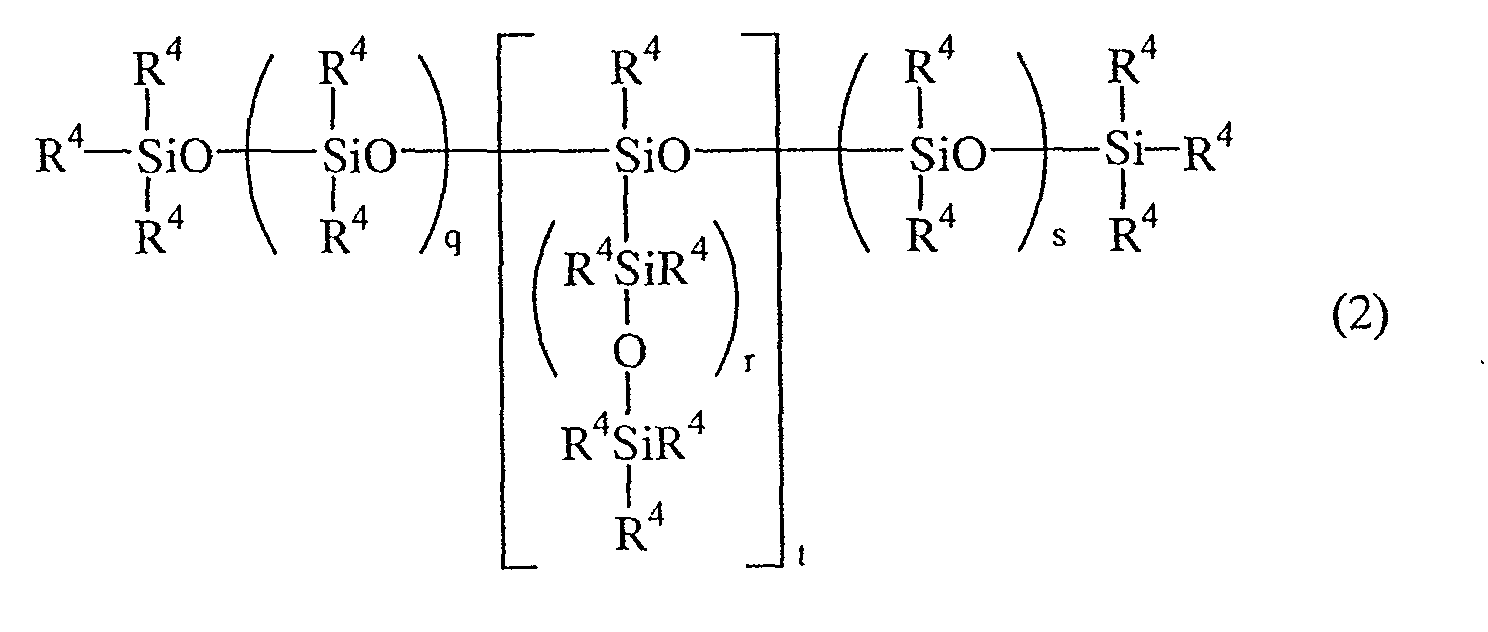
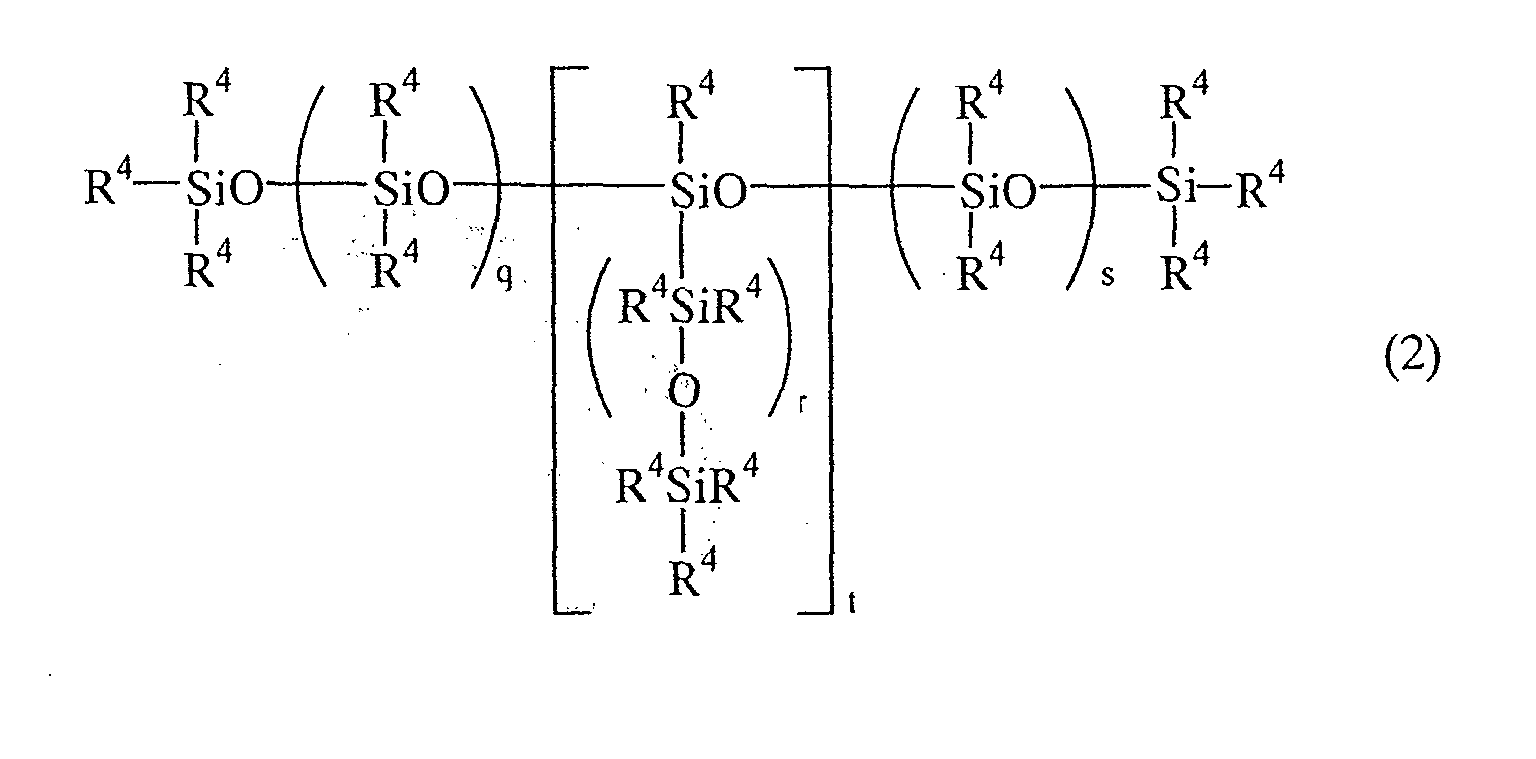
- organopolysiloxane (II) having the general formula (2), shown below, is used as the alkenyl-bearing organopolysiloxane component other than organopolysiloxane (I).
- R 4 is a monovalent hydrocarbon radical
- at least two of the R 4 radicals are alkenyl radicals
- t is a number of 0 to 15
- q, r, s and t are such numbers that the organopolysiloxane (II) has a viscosity from 100 mPa ⁇ s at 25°C to a 30% toluene diluted viscosity of 20,000 mPa ⁇ s at 25°C.
- R 4 is selected from monovalent hydrocarbon radicals, preferably having 1 to 8 carbon atoms, for example, alkenyl radicals such as vinyl, allyl, butenyl and pentenyl, alkyl radicals such as methyl and ethyl, and aryl radicals such as phenyl.
- R 4 radicals may be different from each other as long as at least two are alkenyl radicals.
- the other organopolysiloxane (II) has a viscosity at 25°C from 100 mPa ⁇ s to a 30% toluene diluted viscosity of 20,000 mPa ⁇ s, and preferably a 30% toluene diluted viscosity of from 1,000 to 10,000 mPa ⁇ s at 25°C.
- a viscosity of less than 100 mPa ⁇ s may render the silicone emulsion composition less stable during storage whereas a 30% toluene diluted viscosity in excess of 20,000 mPa ⁇ s may impede emulsification.
- the subscript t is in the range: 0 ⁇ t ⁇ 15.
- the remaining subscripts q, r and s are any numbers as long as the organopolysiloxane (II) has a viscosity in the above range. With t in excess of 15, the organopolysiloxane (II) can gel during synthesis.
- organopolysiloxane (I) 100 parts by weight of organopolysiloxane (I) is mixed with 10 to 100 parts by weight of organopolysiloxane (II).
- the cured coating may require an increased release or peeling force so that the release film becomes impractical whereas more than 100 parts by weight of organopolysiloxane (II) may detract from the adhesion to plastic film substrates.
- organopolysiloxane (II) is a dominant component to the release force of the composition.
- organopolysiloxane (II) is a dominant component to the release force of the composition.
- the organopolysiloxane (II) may be used alone or a mixture of two or more such organopolysiloxanes may be used as long as their average meets the requirements of the above average compositional formula (2). Better results of adhesion, release properties, and especially, abrasion resistance are obtained when 10 to 50% by weight of the organopolysiloxane (II) has a viscosity at 25°C of 1,000 to 10,000 mPa ⁇ s, when expressed in a 30% toluene diluted viscosity, and an alkenyl content of at least 0.02 mol/100 g.
- the silicone emulsion composition contains
- organohydrogenpolysiloxane should have at least two hydrogen atoms each directly attached to a silicon atom (i.e., SiH radicals) in a molecule. Since the SiH radicals undergo addition reaction with alkenyl radicals on organopolysiloxanes (I) and (II), the organohydrogenpolysiloxane serves as a crosslinker for forming a cured coating. Preferably it has the following average compositional formula (3). R 5 a H b SiO (4-a-b)/2
- R 5 is selected from substituted or unsubstituted monovalent hydrocarbon radicals, preferably those radicals having 1 to 8 carbon atoms and free of aliphatic unsaturation, for example, alkyl radicals such as methyl, ethyl and propyl, aryl radicals such as phenyl, and halo-substituted alkyl radicals such as 3,3,3-trifluoropropyl.
- alkyl radicals such as methyl, ethyl and propyl
- aryl radicals such as phenyl
- halo-substituted alkyl radicals such as 3,3,3-trifluoropropyl.
- the subscripts "a” and “b” are positive numbers satisfying a+b ⁇ 3.
- Preferably "a” and "b” are in the range: 1 ⁇ a+b ⁇ 3 and 0.1 ⁇ b ⁇ 2, especially 0.2 ⁇ b ⁇ 2.
- the amount of organohydrogenpolysiloxane (C) blended is dependent on the amount of alkenyl radicals in components (A) and (B), that is, organopolysiloxanes (I) and (II).
- 30 to 100 parts by weight of organohydrogenpolysiloxane (C) is preferably blended per 100 parts by weight of component (A) or organopolysiloxane (I). Less than 30 parts of the organohydrogenpolysiloxane may be insufficient for the composition to cure whereas more than 100 parts may increase the release force beyond the practical limit.
- Component (D) or surfactant is typically a nonionic surfactant. Included are alkyl ether type compounds such as polyoxyethylene lauryl ether and polyoxyethylene tridecyl ether, and alkyl ester type compounds such as polyoxyethylene oleate and polyoxyethylene laurate. These nonionic emulsifiers may be used alone or in admixture of two or more. Advantageously, a stable silicone emulsion composition is obtained when the nonionic emulsifier alone or a mixture thereof has an HLB of 10 to 15.
- Anionic and cationic surfactants are also useful, but they are preferably used in combination with the nonionic surfactant for forming a silicone emulsion which is stable and wettable to substrates.
- the amount of surfactant blended is a minimum amount enough to form a silicone emulsion which is stable and wettable to substrates.
- the amount is 0.1 to 20 parts by weight, especially 0.5 to 15 parts by weight, per 100 parts by weight of components (A), (B) and (C) combined. Less than 0.1 part of the surfactant may be insufficient to promote emulsification whereas more than 20 parts may prevent the silicone emulsion from effective curing.
- a water-soluble resin may be used along with the surfactant.
- Useful water-soluble resins include polyvinyl alcohol, and a choice is desirably made of one having a minimal poisoning action to the platinum radical metal catalyst.
- the amount of water-soluble resin blended is a minimum amount enough to assist in forming a silicone emulsion which is stable and wettable to substrates. Specifically, the amount is 1 to 10 parts by weight per 100 parts by weight of components (A), (B) and (C) combined.
- Component (E) or platinum radical metal catalyst serves to promote addition reaction and is selected from among addition reaction catalysts.
- Useful platinum radical metal catalysts include platinum, palladium and rhodium base catalysts, with the platinum base catalysts being especially preferred.
- platinum catalyst examples include chloroplatinic acid, alcohol and aldehyde solutions of chloroplatinic acid, and complexes of chloroplatinic acid with olefins or vinylsiloxanes.
- the platinum radical metal catalyst is added in a catalytic amount, and desirably from the standpoints of good cured coating and economy, an amount of 1 to 1,000 parts by weight of platinum radical metal per million parts by weight of components (A), (B) and (C) combined.
- the platinum radical metal catalyst be added after emulsification of components (A) to (D) and immediately before use of the emulsion rather than being emulsified simultaneously with the remaining components.
- the platinum radical metal catalyst is processed into a water dispersible form prior to its addition.
- the platinum radical metal catalyst may be previously mixed with the surfactant or formed into an emulsion.
- the silicone emulsion composition of the invention may be prepared by well-known methods, and preferably by mixing predetermined amounts of components (A) to (D) and part of water as component (F) in a high shear agitating apparatus such as a planetary mixer or combination mixer, emulsifying the mixture by phase transition, and adding the remainder of water for dilution.
- a high shear agitating apparatus such as a planetary mixer or combination mixer
- Each component may be used alone or in admixture of two or more.
- the amount of water may be adjusted so as to give the composition a viscosity for an applicator used in practice and provide a desired silicone coating weight on the substrate.
- the amount of water is preferably 100 to 10,000 parts by weight per 100 parts by weight of organopolysiloxane (I) as component (A). Less than 100 parts of water may be difficult to form O/W type emulsion whereas more than 10,000 parts may detract from stability.
- Water having an impurity concentration as in city water may be used. Use of water having strong acid, strong alkali, large amounts of alcohol or salts admixed therein should be avoided because such water can compromise the stability of emulsion.
- Suitable optional components include catalysis inhibitors for inhibiting the catalysis of platinum radical metal catalysts, such as organic nitrogen compounds, organic phosphorus compounds, acetylene derivatives, oxime compounds, and organic halides; silicone resins, silica or organopolysiloxanes devoid of hydrogen atoms or alkenyl radicals attached to silicon atoms, for controlling release properties; leveling agents such as fluorochemical surfactants; and thickeners such as water-soluble polymers, e.g., methyl cellulose and polyvinyl alcohol.
- These optional components may be added in conventional amounts insofar as the benefits of the invention are not impaired.
- plastic film substrates include polyolefin films such as biaxially oriented polypropylene films, polyethylene films, and ethylene-propylene copolymer films, and polyester films.
- the thickness of these film substrates is not critical, but is often in the range of about 5 to about 100 ⁇ m.
- a gravure coater In applying the silicone emulsion composition to substrates, a gravure coater, air knife coater, roll coater, wire bar or the like may be used.
- the coating weight is not critical, but is often in the range of about 0.1 to 2.0 g/m 2 of silicone solids.
- the coated substrate may be heated at a temperature of 80 to 160°C for about 3 minutes to about 5 seconds in a hot air circulation dryer, for example, for forming a cured coating of silicone on the substrate while imparting release or parting properties.
- Curing of the coating can also be conducted by irradiation of infrared or ultraviolet radiation. Combinations of these curing techniques will improve curing efficiency.
- a silicone emulsion composition immediately after its preparation, was applied to each film substrate in a coating weight of 0.4 g/m 2 and heated in a hot air dryer at 120°C for a predetermined time, forming a cured coating.
- the cured coating was rubbed several times with the finger, and visually observed whether or not it was smeared and rubbed (or crumbled) off. Curability is represented by the time (sec) required for curing.
- a silicone emulsion composition immediately after its preparation, was applied to each film substrate in a coating weight of 0.4 g/m 2 and heated in a hot air dryer at 120°C for a predetermined time, forming a cured coating.
- the cured coating was aged for one day at room temperature before it was rubbed several times with the finger, and visually observed whether or not it was smeared and rubbed (or crumbled) off. This is reported as initial adhesion.
- the cured coating was aged for 14 days in a thermostat tank at 50°C before it was rubbed several times with the finger, and visually observed whether or not it was smeared and rubbed off. This is reported as aged adhesion.
- a silicone emulsion composition immediately after its preparation, was cured to a substrate at 120°C for 30 seconds by the same procedure as the cure test.
- An acrylic pressure-sensitive adhesive BPS-5127 (Toyo Ink Co., Ltd.) was applied onto the cured coating and heat treated at 100°C for 3 minutes.
- an overlay film of the same material as the substrate was attached to the surface of the coated substrate on which the adhesive had been applied and treated.
- the laminate was cut into strips of 5 cm wide and aged one day at room temperature. Using a tensile tester, the overlay film was peeled from the sample at an angle of 180° and a pull rate of 0.3 m/min. The force (N/5 cm) required for peeling is reported as release force.
- a cured coating was formed on a substrate by curing a silicone emulsion composition thereto by the same procedure as the release force test.
- a polyester tape Nitto 31B (trade name, Nitto Denko Co., Ltd.) was attached to the surface of the cured coating, placed under a load of 1976 Pa, and heat treated at 70°C for 20 hours. Thereafter, the tape was removed and attached to a stainless steel plate again. Using a tensile tester, the force (N/2.5 cm) required to peel the treated tape from the steel plate was similarly measured. A percentage of the force for the treated tape relative to the force required to peel a fresh (untreated) tape from the stainless steel plate is reported as adhesion retentivity.
- the mixer used was a 5-liter combined emulsifier apparatus including an anchor mixer capable of agitation throughout the vessel and a rotatable disk having small tooth-like protrusions arranged alternately on upper and lower sides along the periphery (K.T. Combi Mix M model, Tokushu Kika Kogyo Co., Ltd.).
- the mixer was charged with 1,000 parts of a siloxane of the average compositional formula (4) having a viscosity of 27 mPa ⁇ s and a vinyl content of 0.58 mol/100 g as the organopolysiloxane (I), 260 parts of a terminal and pendant vinyl radical-bearing dimethylpolysiloxane having a 30% toluene diluted viscosity of 5,000 mPa ⁇ s and a vinyl content of 0.070 mol/100 g as the organopolysiloxane (II), 720 parts of methylhydrogenpolysiloxane as the organohydrogenpolysiloxane, 30 parts of polyoxyethylene lauryl ether having an HLB of 13.6 as the surfactant, 1,000 parts of a 10% polyvinyl alcohol aqueous solution as the thickener, and 20 parts of ethynyl cyclohexanol as the catalysis inhibitor.
- An O/W type Silicone Emulsion 2 having a silicone content of 10% was obtained as in the preparation of Silicone Emulsion 1, aside from omitting the component corresponding to the organopolysiloxane (I), and using 1,952 parts of a terminal vinyl radical-bearing dimethylpolysiloxane having a viscosity of 400 mPa ⁇ s and a vinyl content of 0.02 mol/100 g as the organopolysiloxane (II), 42 parts of methylhydrogenpolysiloxane as the organohydrogenpolysiloxane, 6 parts of ethynyl cyclohexanol as the catalysis inhibitor, and 16,710 parts of water as the water diluent.
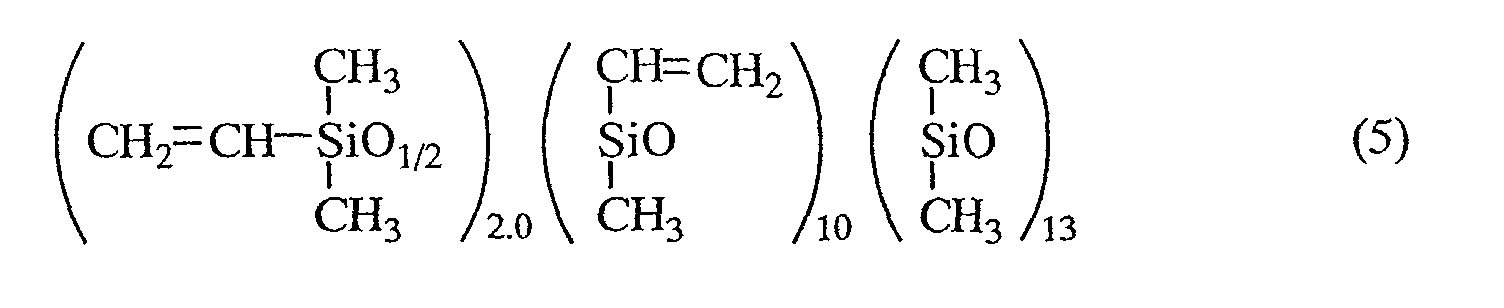
- An O/W type Silicone Emulsion 3 having a silicone content of 10% was obtained as in the preparation of Silicone Emulsion 1, aside from using 960 parts of a terminal and pendant vinyl radical-bearing polysiloxane of the average compositional formula (5) and having a viscosity of 35 mPa ⁇ s and a vinyl content of 0.60 mol/100 g as the component which satisfied the viscosity and alkenyl content of the organopolysiloxane (I), but were devoid of trifunctional siloxane units (T units), 240 parts of a terminal and pendant vinyl radical-bearing dimethylpolysiloxane having a 30% toluene diluted viscosity of 5,000 mPa ⁇ s and a vinyl content of 0.070 mol/100 g as the organopolysiloxane (II), 780 parts of methylhydrogenpolysiloxane as the organohydrogenpolysiloxane (C).
- a silicone emulsion composition was prepared by adding 1.5 parts (150 ppm of platinum based on the silicone) of a platinum catalyst emulsion CAT-PM-10A (Shin-Etsu Chemical Co., Ltd.) to 100 parts of Silicone Emulsion 1 and thoroughly mixing them.
- Table 1 reports the contents of components (A) to (F) in the silicone emulsion composition.
- the silicone emulsion composition was determined for cure, adhesion, release force and adhesion retentivity by the respective test methods. The results are shown in Table 2.
- a silicone emulsion composition was prepared by adding 1.5 parts (150 ppm of platinum based on the silicone) of a platinum catalyst emulsion CAT-PM-10A (Shin-Etsu Chemical Co., Ltd.) to 100 parts of a mixture of 75 parts Silicone Emulsion 1 and 25 parts Silicone Emulsion 2 and thoroughly mixing them.
- Table 1 reports the contents of components (A) to (F) in the silicone emulsion composition.
- the silicone emulsion composition was determined for cure, adhesion, release force and adhesion retentivity by the respective test methods. The results are shown in Table 2.
- a silicone emulsion composition was prepared by adding 1.5 parts (150 ppm of platinum based on the silicone) of a platinum catalyst emulsion CAT-PM-10A (Shin-Etsu Chemical Co., Ltd.) to 100 parts of a mixture of 75 parts Silicone Emulsion 3 and 25 parts Silicone Emulsion 2 and thoroughly mixing them.
- Table 1 reports the contents of components (A) to (F) and a polysiloxane component other than components (A) to (C) in the silicone emulsion composition.
- the silicone emulsion composition was determined for cure, adhesion, release force and adhesion retentivity by the respective test methods. The results are shown in Table 2.
- a silicone emulsion composition was prepared by adding 1.5 parts (150 ppm of platinum based on the silicone) of a platinum catalyst emulsion CAT-PM-10A (Shin-Etsu Chemical Co., Ltd.) to 100 parts of a mixture of 50 parts Silicone Emulsion 1 and 50 parts Silicone Emulsion 2 and thoroughly mixing them.
- Table 1 reports the contents of components (A) to (F) in the silicone emulsion composition.
- the silicone emulsion composition was determined for cure, adhesion, release force and adhesion retentivity by the respective test methods. The results are shown in Table 2.
- a silicone emulsion composition was prepared by adding 1.5 parts (150 ppm of platinum based on the silicone) of a platinum catalyst emulsion CAT-PM-10A (Shin-Etsu Chemical Co., Ltd.) to 100 parts of Silicone Emulsion 2 and thoroughly mixing them.
- Table 1 reports the contents of components (A) to (F) in the silicone emulsion composition.
- Table 2 indicates that the silicone emulsion compositions within the scope of the invention satisfactorily adhere to film substrates, and the release force can be adjusted by changing the amount and type of the organopolysiloxane (II), as demonstrated by Examples 1 and 2.
- a comparison of Example 1 with Comparative Example 1 reveals that the inclusion of T units in the organopolysiloxane (I) is essential for adhesion.
- a comparison of Examples 1 and 2 with Comparative Example 2 reveals that high adhesion may not be established unless the blend ratio of organopolysiloxane (I)/(II) falls in the preferred range disclosed herein.
- the preferred silicone emulsion composition of the invention cures into a coating that adheres well to plastic film substrates independent of the type of plastic film.
- the cured coating exhibits release properties to pressure-sensitive adhesives and can be utilized as release film.
Landscapes
- Chemical & Material Sciences (AREA)
- Chemical Kinetics & Catalysis (AREA)
- Life Sciences & Earth Sciences (AREA)
- Engineering & Computer Science (AREA)
- Materials Engineering (AREA)
- Wood Science & Technology (AREA)
- Organic Chemistry (AREA)
- Compositions Of Macromolecular Compounds (AREA)
- Paints Or Removers (AREA)
- Paper (AREA)
- Coating Of Shaped Articles Made Of Macromolecular Substances (AREA)
- Adhesives Or Adhesive Processes (AREA)
Abstract
Description



| Composition (pbw) | ||||||
| Component | Example | Comparative Example | ||||
| 1 | 2 | 1 | 2 | 3 | ||
| A | Organopolysiloxane (I) | 100 | 100 | - | 100 | - |
| Other polysiloxane | - | - | 100 | - | - | |
| B | Organopolysiloxane (II) | 26 | 91 | 93 | 221 | 100 |
| C | Organohydrogenpolysiloxane | 72 | 73 | 83 | 76 | 2 |
| D | Surfactant | 3 | 3 | 3 | 3 | 3 |
| E | Platinum radical metal catalyst | 150 | 150 | 150 | 150 | 150 |
| F | Water | 1767 | 2361 | 2460 | 3548 | 912 |
| Release properties | ||||||
| Properties | Substrate | Example | Comparative Example | |||
| 1 | 2 | 1 | 2 | 3 | ||
| Curability (sec) | OPP | 20 | 20 | 20 | 20 | 30 |
| Initial adhesion | ○ | ○ | ○ | ○ | × | |
| Aged adhesion | ○ | ○ | × | × | × | |
| Curability (sec) | PET | 30 | 30 | 30 | 30 | 40 |
| Initial adhesion | ○ | ○ | × | Δ | × | |
| Aged adhesion | ○ | ○ | × | × | × | |
| Release force (N/5 cm) | 0.70 | 0.25 | 0.20 | 0.18 | 0.15 | |
| Adhesion retentivity (%) | 96 | 96 | 97 | 97 | 96 | |
| Note: OPP: oriented polypropylene film PET: polyester film Adhesion is rated "O" for no rub-off and no smear, "Δ" for some smear, and "X" for rub-off. |
Claims (5)
- A silicone emulsion composition of the addition reaction curing type comprising an organopolysiloxane having at least two alkenyl radicals in a molecule, said organopolysiloxane comprising at least 50% by weight of an organopolysiloxane (I) having the following average compositional formula (1):wherein R1 is an alkenyl radical, R2 is a monovalent hydrocarbon radical, R3 is hydrogen or an alkyl radical, m and n are positive numbers and p is 0 or a positive number, satisfying 0.6 ≤ (n+p)/m ≤ 1.5, and 0 ≤ p/(n+p) ≤ 0.05, and m, n and p are such that the organopolysiloxane (I) has a viscosity of 5 to 100 mPa·s at 25°C.

- The silicone emulsion composition of claim 1 wherein said organopolysiloxane having at least two alkenyl radicals in a molecule is a mixture of 100 parts by weight of the organopolysiloxane (I) having the average compositional formula (1) and 10 to 100 parts by weight of an organopolysiloxane (II) having the following average compositional formula (2):wherein R4 is a monovalent hydrocarbon radical, at least two of the R4 radicals are alkenyl radicals, t is a number of 0 to 15, and q, r, s and t are such numbers that the organopolysiloxane (II) has a viscosity from 100 mPa·s at 25°C to a 30% toluene diluted viscosity of 20,000 mPa·s at 25°C.
- The silicone emulsion composition of claim 2, comprising(A) 100 parts by weight of the organopolysiloxane (I) having formula (1),(B) 10 to 100 parts by weight of the organopolysiloxane (II) having formula (2),(C) 30 to 100 parts by weight of an organohydrogenpolysiloxane having at least two hydrogen atoms each directly attached to a silicon atom in a molecule,(D) 0.1 to 20 parts by weight, per 100 parts by weight of components (A), (B) and (C) combined, of a surfactant,(E) a catalytic amount of a platinum radical metal catalyst, and(F) 100 to 10,000 parts by weight of water.
- The silicone emulsion composition of claim 2 wherein the organopolysiloxane (II) has a 30% toluene diluted viscosity of 1,000 to 10,000 mPa·s at 25°C and a vinyl value of at least 0.02 mol/100 g.
- A release film comprising a plastic film substrate and a cured coating of the silicone emulsion composition of any one of claims 1 to 4 formed thereon.
Applications Claiming Priority (2)
| Application Number | Priority Date | Filing Date | Title |
|---|---|---|---|
| JP2001393176A JP3824072B2 (en) | 2001-12-26 | 2001-12-26 | Silicone emulsion composition and release film having good adhesion to plastic film substrate |
| JP2001393176 | 2001-12-26 |
Publications (3)
| Publication Number | Publication Date |
|---|---|
| EP1323796A2 true EP1323796A2 (en) | 2003-07-02 |
| EP1323796A3 EP1323796A3 (en) | 2004-01-28 |
| EP1323796B1 EP1323796B1 (en) | 2006-03-29 |
Family
ID=19188753
Family Applications (1)
| Application Number | Title | Priority Date | Filing Date |
|---|---|---|---|
| EP02258809A Expired - Lifetime EP1323796B1 (en) | 2001-12-26 | 2002-12-20 | Silicone emulsion composition adherent to plastic film substrates and release film |
Country Status (4)
| Country | Link |
|---|---|
| US (1) | US6794444B2 (en) |
| EP (1) | EP1323796B1 (en) |
| JP (1) | JP3824072B2 (en) |
| DE (1) | DE60210233T2 (en) |
Cited By (7)
| Publication number | Priority date | Publication date | Assignee | Title |
|---|---|---|---|---|
| EP1557451A1 (en) * | 2004-01-23 | 2005-07-27 | Shin-Etsu Chemical Co., Ltd. | Release film |
| EP2112191A1 (en) * | 2008-04-24 | 2009-10-28 | Shin-Etsu Chemical Co., Ltd. | Silicone emulsion releasing composition and releasing substrate using the same |
| EP2444463A1 (en) * | 2010-10-25 | 2012-04-25 | Shin-Etsu Chemical Co., Ltd. | Silicone emulsion composition, release paper or film, and making method |
| EP2631277A1 (en) * | 2012-02-23 | 2013-08-28 | Shin-Etsu Chemical Co., Ltd. | Addition Curable Silicone Emulsion Release Composition and Release Film |
| EP2671933A1 (en) * | 2012-06-07 | 2013-12-11 | Shin-Etsu Chemical Co., Ltd. | Addition Cure Silicone Emulsion Composition and Release Film |
| CN104470494A (en) * | 2012-08-01 | 2015-03-25 | 道康宁公司 | Aqueous Silicone Dispersion and Its Preparation |
| US10155883B2 (en) | 2014-06-27 | 2018-12-18 | Dow Silicones Corporation | Silicone release coating composition and low release force emulsion silicone release coating for films and papers having cured release coating |
Families Citing this family (19)
| Publication number | Priority date | Publication date | Assignee | Title |
|---|---|---|---|---|
| JP4743757B2 (en) * | 2004-10-22 | 2011-08-10 | 信越化学工業株式会社 | Silicone paper treatment agent |
| JP4892922B2 (en) * | 2005-10-14 | 2012-03-07 | 信越化学工業株式会社 | Heavy release control agent and silicone composition for solventless release paper using the same |
| JP5138205B2 (en) * | 2005-11-22 | 2013-02-06 | 信越化学工業株式会社 | Silicone composition for solvent-free release paper |
| WO2009107326A1 (en) * | 2008-02-25 | 2009-09-03 | 三菱樹脂株式会社 | Release film |
| JP4994292B2 (en) | 2008-04-09 | 2012-08-08 | 信越化学工業株式会社 | Solvent-free silicone release agent composition for film and release film using the same |
| JP5495324B2 (en) * | 2010-08-19 | 2014-05-21 | 帝人デュポンフィルム株式会社 | Releasable polyester film |
| JP5423651B2 (en) * | 2010-10-25 | 2014-02-19 | 信越化学工業株式会社 | Undercoat silicone emulsion composition for release paper or release film, and treated paper or treated film |
| JP5840996B2 (en) * | 2012-03-30 | 2016-01-06 | 帝人デュポンフィルム株式会社 | Silicone release polyester film |
| US20150225574A1 (en) * | 2012-09-13 | 2015-08-13 | Shin-Etsu Polymer Co., Ltd. | Antistatic release agent and antistatic release film |
| JP5964718B2 (en) * | 2012-10-19 | 2016-08-03 | 帝人デュポンフィルム株式会社 | Silicone release polyester film |
| JP6077327B2 (en) * | 2013-02-18 | 2017-02-08 | 帝人フィルムソリューション株式会社 | Release coating composition and silicone release polyester film comprising the same |
| JP6387885B2 (en) * | 2015-04-06 | 2018-09-12 | 信越化学工業株式会社 | Organopolysiloxane emulsion composition for release paper or release film, method for producing the same, release paper and release film |
| US11352751B2 (en) * | 2017-03-30 | 2022-06-07 | Kuraray Co., Ltd. | Release-paper base paper and method for producing same, and release paper |
| JP6862334B2 (en) * | 2017-12-05 | 2021-04-21 | 信越化学工業株式会社 | Curable Silicone Release Agent Composition |
| JP7074642B2 (en) | 2018-10-29 | 2022-05-24 | 信越化学工業株式会社 | Silicone emulsion composition |
| KR102212025B1 (en) * | 2019-03-13 | 2021-02-04 | 주식회사 케이씨씨 | Silicone emulsion composition and manufacturing method thereof |
| CN112812738B (en) * | 2020-12-30 | 2021-11-09 | 广州市瑞合新材料科技有限公司 | Organic silicon pressure-sensitive adhesive and preparation method thereof |
| JP7809422B2 (en) * | 2021-09-06 | 2026-02-02 | モメンティブ・パフォーマンス・マテリアルズ・ジャパン合同会社 | Addition-type silicone composition |
| JP2024118254A (en) | 2023-02-20 | 2024-08-30 | 信越化学工業株式会社 | Silicone emulsion composition |
Family Cites Families (16)
| Publication number | Priority date | Publication date | Assignee | Title |
|---|---|---|---|---|
| JP4700158B2 (en) * | 1999-11-16 | 2011-06-15 | 東レ・ダウコーニング株式会社 | Method for producing emulsion and method for producing oil composition |
| US3900617A (en) * | 1973-11-27 | 1975-08-19 | Gen Electric | Method of rendering flexible sheet material non-adherent and article produced thereby |
| GB1599209A (en) | 1977-08-22 | 1981-09-30 | Gen Electric | Silicone compositions containing colloidal silica |
| JPS55110155A (en) * | 1979-02-16 | 1980-08-25 | Toray Silicone Co Ltd | Organopolysiloxane composition forming releasable film |
| JPS6327560A (en) * | 1986-07-21 | 1988-02-05 | Shin Etsu Chem Co Ltd | Releasing silicone composition |
| JPS63314275A (en) | 1987-04-22 | 1988-12-22 | Shin Etsu Chem Co Ltd | Silicone emulsion composition for release paper and its production |
| DE4143203A1 (en) * | 1991-12-30 | 1993-07-01 | Wacker Chemie Gmbh | ORGANO (POLY) SILOXANE WITH ALKENYL GROUPS |
| JPH0657144A (en) | 1992-07-14 | 1994-03-01 | Shin Etsu Chem Co Ltd | Peelable silicone emulsion composition |
| DE19531568A1 (en) * | 1995-08-28 | 1997-03-06 | Bayer Ag | Liquid organopolysiloxane resins, a process for their preparation, low-viscosity polydiorganosiloxane compositions containing liquid organopolysiloxane resins and their use |
| US5616672A (en) * | 1995-11-17 | 1997-04-01 | General Electric Company | Paper release compositions having improved release characteristics |
| US5698654A (en) * | 1996-07-30 | 1997-12-16 | General Electric Company | Process for preparing hydrogen siloxane copolymers |
| JP3635180B2 (en) * | 1997-02-24 | 2005-04-06 | ダウ コーニング アジア株式会社 | Silylated polymethylsilsesquioxane, process for producing the same, and composition using the same |
| JP3948807B2 (en) | 1998-02-06 | 2007-07-25 | 信越化学工業株式会社 | Release paper composition |
| JP3695516B2 (en) * | 1999-12-13 | 2005-09-14 | 信越化学工業株式会社 | Silicone rubber composition for air bag coating |
| JP3781105B2 (en) * | 2001-07-12 | 2006-05-31 | 信越化学工業株式会社 | Silicone composition and release film using the same |
| JP5753143B2 (en) | 2012-09-21 | 2015-07-22 | ポリプラスチックス株式会社 | Totally aromatic polyester and polyester resin composition, and polyester molded article |
-
2001
- 2001-12-26 JP JP2001393176A patent/JP3824072B2/en not_active Expired - Fee Related
-
2002
- 2002-12-20 DE DE60210233T patent/DE60210233T2/en not_active Expired - Lifetime
- 2002-12-20 EP EP02258809A patent/EP1323796B1/en not_active Expired - Lifetime
- 2002-12-26 US US10/327,887 patent/US6794444B2/en not_active Expired - Fee Related
Cited By (11)
| Publication number | Priority date | Publication date | Assignee | Title |
|---|---|---|---|---|
| EP1557451A1 (en) * | 2004-01-23 | 2005-07-27 | Shin-Etsu Chemical Co., Ltd. | Release film |
| US7374819B2 (en) | 2004-01-23 | 2008-05-20 | Shin-Etsu Chemical Co., Ltd. | Release film |
| EP2112191A1 (en) * | 2008-04-24 | 2009-10-28 | Shin-Etsu Chemical Co., Ltd. | Silicone emulsion releasing composition and releasing substrate using the same |
| EP2444463A1 (en) * | 2010-10-25 | 2012-04-25 | Shin-Etsu Chemical Co., Ltd. | Silicone emulsion composition, release paper or film, and making method |
| EP2631277A1 (en) * | 2012-02-23 | 2013-08-28 | Shin-Etsu Chemical Co., Ltd. | Addition Curable Silicone Emulsion Release Composition and Release Film |
| US9321936B2 (en) | 2012-02-23 | 2016-04-26 | Shin-Etsu Chemical Co., Ltd. | Addition curable silicone emulsion release composition and release film |
| EP2671933A1 (en) * | 2012-06-07 | 2013-12-11 | Shin-Etsu Chemical Co., Ltd. | Addition Cure Silicone Emulsion Composition and Release Film |
| CN103484017A (en) * | 2012-06-07 | 2014-01-01 | 信越化学工业株式会社 | Addition cure silicone emulsion composition and release film |
| CN104470494A (en) * | 2012-08-01 | 2015-03-25 | 道康宁公司 | Aqueous Silicone Dispersion and Its Preparation |
| CN104470494B (en) * | 2012-08-01 | 2018-04-10 | 道康宁公司 | Aqueous Silicone Dispersion and Its Preparation |
| US10155883B2 (en) | 2014-06-27 | 2018-12-18 | Dow Silicones Corporation | Silicone release coating composition and low release force emulsion silicone release coating for films and papers having cured release coating |
Also Published As
| Publication number | Publication date |
|---|---|
| US6794444B2 (en) | 2004-09-21 |
| JP3824072B2 (en) | 2006-09-20 |
| DE60210233T2 (en) | 2007-03-08 |
| DE60210233D1 (en) | 2006-05-18 |
| JP2003192896A (en) | 2003-07-09 |
| US20030134131A1 (en) | 2003-07-17 |
| EP1323796B1 (en) | 2006-03-29 |
| EP1323796A3 (en) | 2004-01-28 |
Similar Documents
| Publication | Publication Date | Title |
|---|---|---|
| US6794444B2 (en) | Silicone emulsion composition adherent to plastic film substrates and release film | |
| KR101593747B1 (en) | Addition cure silicone emulsion composition and release film | |
| EP3875542B1 (en) | Silicone emulsion composition | |
| US6696161B2 (en) | Silicone composition and release film | |
| EP2444463B1 (en) | Silicone emulsion composition, release paper or film, and making method | |
| TWI534213B (en) | Addition curable silicone emulsion release composition and release film | |
| JPH0797521A (en) | Silicone emulsion composition | |
| JPH0657144A (en) | Peelable silicone emulsion composition | |
| JP2009263467A (en) | Silicone emulsion composition for mold release and mold releasing substrate using the same | |
| JP3948807B2 (en) | Release paper composition | |
| JP2012092167A (en) | Undercoat silicone emulsion composition for release paper or release film, treated paper or treated film | |
| JP3481683B2 (en) | Surface treatment agent for plastic film | |
| JPH06145527A (en) | Peelable composition | |
| JPH08245887A (en) | Mold release silicone emulsion composition | |
| JP2846195B2 (en) | Curable silicone emulsion composition | |
| JP2025179421A (en) | Silicone emulsion composition and release film | |
| EP4671328A1 (en) | SILICONE EMULSION COMPOSITION | |
| JPH1060284A (en) | Peelable silicone emulsion composition |
Legal Events
| Date | Code | Title | Description |
|---|---|---|---|
| PUAI | Public reference made under article 153(3) epc to a published international application that has entered the european phase |
Free format text: ORIGINAL CODE: 0009012 |
|
| AK | Designated contracting states |
Designated state(s): AT BE BG CH CY CZ DE DK EE ES FI FR GB GR IE IT LI LU MC NL PT SE SI SK TR |
|
| AX | Request for extension of the european patent |
Extension state: AL LT LV MK RO |
|
| PUAL | Search report despatched |
Free format text: ORIGINAL CODE: 0009013 |
|
| AK | Designated contracting states |
Kind code of ref document: A3 Designated state(s): AT BE BG CH CY CZ DE DK EE ES FI FR GB GR IE IT LI LU MC NL PT SE SI SK TR |
|
| AX | Request for extension of the european patent |
Extension state: AL LT LV MK RO |
|
| RIC1 | Information provided on ipc code assigned before grant |
Ipc: 7C 09D 183/07 A Ipc: 7C 09J 183/04 B Ipc: 7C 08K 5/54 B |
|
| 17P | Request for examination filed |
Effective date: 20040413 |
|
| AKX | Designation fees paid |
Designated state(s): DE FR GB |
|
| GRAP | Despatch of communication of intention to grant a patent |
Free format text: ORIGINAL CODE: EPIDOSNIGR1 |
|
| GRAS | Grant fee paid |
Free format text: ORIGINAL CODE: EPIDOSNIGR3 |
|
| GRAA | (expected) grant |
Free format text: ORIGINAL CODE: 0009210 |
|
| AK | Designated contracting states |
Kind code of ref document: B1 Designated state(s): DE FR GB |
|
| REG | Reference to a national code |
Ref country code: GB Ref legal event code: FG4D |
|
| REF | Corresponds to: |
Ref document number: 60210233 Country of ref document: DE Date of ref document: 20060518 Kind code of ref document: P |
|
| ET | Fr: translation filed | ||
| PLBE | No opposition filed within time limit |
Free format text: ORIGINAL CODE: 0009261 |
|
| STAA | Information on the status of an ep patent application or granted ep patent |
Free format text: STATUS: NO OPPOSITION FILED WITHIN TIME LIMIT |
|
| 26N | No opposition filed |
Effective date: 20070102 |
|
| REG | Reference to a national code |
Ref country code: FR Ref legal event code: PLFP Year of fee payment: 14 |
|
| REG | Reference to a national code |
Ref country code: FR Ref legal event code: PLFP Year of fee payment: 15 |
|
| REG | Reference to a national code |
Ref country code: FR Ref legal event code: PLFP Year of fee payment: 16 |
|
| PGFP | Annual fee paid to national office [announced via postgrant information from national office to epo] |
Ref country code: DE Payment date: 20191210 Year of fee payment: 18 |
|
| PGFP | Annual fee paid to national office [announced via postgrant information from national office to epo] |
Ref country code: FR Payment date: 20191115 Year of fee payment: 18 |
|
| PGFP | Annual fee paid to national office [announced via postgrant information from national office to epo] |
Ref country code: GB Payment date: 20191219 Year of fee payment: 18 |
|
| REG | Reference to a national code |
Ref country code: DE Ref legal event code: R119 Ref document number: 60210233 Country of ref document: DE |
|
| GBPC | Gb: european patent ceased through non-payment of renewal fee |
Effective date: 20201220 |
|
| PG25 | Lapsed in a contracting state [announced via postgrant information from national office to epo] |
Ref country code: FR Free format text: LAPSE BECAUSE OF NON-PAYMENT OF DUE FEES Effective date: 20201231 |
|
| PG25 | Lapsed in a contracting state [announced via postgrant information from national office to epo] |
Ref country code: DE Free format text: LAPSE BECAUSE OF NON-PAYMENT OF DUE FEES Effective date: 20210701 Ref country code: GB Free format text: LAPSE BECAUSE OF NON-PAYMENT OF DUE FEES Effective date: 20201220 |