EP1323750A2 - Thermoprocessable copolymers of tetrafluorethene, dioxole and vinylether - Google Patents
Thermoprocessable copolymers of tetrafluorethene, dioxole and vinylether Download PDFInfo
- Publication number
- EP1323750A2 EP1323750A2 EP02028295A EP02028295A EP1323750A2 EP 1323750 A2 EP1323750 A2 EP 1323750A2 EP 02028295 A EP02028295 A EP 02028295A EP 02028295 A EP02028295 A EP 02028295A EP 1323750 A2 EP1323750 A2 EP 1323750A2
- Authority
- EP
- European Patent Office
- Prior art keywords
- weight
- fmve
- ttd
- tfe
- break
- Prior art date
- Legal status (The legal status is an assumption and is not a legal conclusion. Google has not performed a legal analysis and makes no representation as to the accuracy of the status listed.)
- Granted
Links
Classifications
-
- C—CHEMISTRY; METALLURGY
- C08—ORGANIC MACROMOLECULAR COMPOUNDS; THEIR PREPARATION OR CHEMICAL WORKING-UP; COMPOSITIONS BASED THEREON
- C08F—MACROMOLECULAR COMPOUNDS OBTAINED BY REACTIONS ONLY INVOLVING CARBON-TO-CARBON UNSATURATED BONDS
- C08F214/00—Copolymers of compounds having one or more unsaturated aliphatic radicals, each having only one carbon-to-carbon double bond, and at least one being terminated by a halogen
- C08F214/18—Monomers containing fluorine
- C08F214/26—Tetrafluoroethene
Definitions
- the present invention relates to thermoprocessable perfluorinated polymers for the preparation of manufactured articles used in the semicon industry, obtained for example by injection moulding and therefore characterized by the presence of welding lines.
- thermoprocessable copolymers of tetrafluoroethylene showing very low values of extractable F - on pellets, not higher than 1 ppm, to which very good hot mechanical and elastomeric properties at temperatures up to 250°C and elongation at break measured at 23°C along the welding lines ⁇ 130% are associated. Therefore said thermoprocessable polymers are particularly suitable to be used in the semicon industry in the preparation of fittings and tanks, wherein welding points or lines are present, used for the storage and the transportation of chemical products and ultrapure water.
- the thermoprocessble copolymers of tetrafluoroethylene (TFE) of the invention show very low values of extractable chlorides (Cl - ), lower than 0.2 ppm by weight with respect to the polymer weight.
- Said polymer compounds having a low F - release must have also good mechanical and flowing properties inside the mould, so as to guarantee a suitable mechanical resistance on the welding lines of the various fronts of the melted compound.
- An index of the suitable mechanical resistance on the welding lines is the elongation at break value on the welding lines which must be ⁇ 130%.
- the manufactured articles for the semicon industry are generally prepared with thermoprocessable copolymers of TFE and perfluoropropylvinylether (PPVE), belonging to the PFA class, wherein the PPVE is about 3.5-4.5% by weight.
- Said copolymers are preferably obtained by a polymerization process in aqueous emulsion which allows to obtain a high productivity and the formation of polymer structures having a high molecular weight, therefore characterized by good mechanical properties and good ductility.
- the so obtained TFE/PPVE copolymers contain a certain amount of chain end groups of ionic type -CF 2 COOH and -COF.
- said end groups -COF and -CF 2 COOH can decompose producing hydrofluoric acid.
- the formed hydrofluoric acid during the time is released by the manufactured article. Therefore the use of said manufactured articles in semicon manufacture plants can lead to corrosion phenomena of the silicon-based wafers.
- the prior art uses a fluorination process to transform the end groups into perfluorinated stable groups.
- thermoprocessable copolymers of TFE having very high chemical inertia and thermal stability is described in USP 5,463,006, wherein terpolymers formed by TFE/PPVE/PMVE (perfluoromethylvinylether) are described. Said polymers are commercially available under the name HYFLON®. Tests carried out by the Applicant, see the comparative Examples, show that with said terpolymers, F - release values lower than 1 ppm are not obtained on the polymer (pellet). Also in this case it is necessary to carry out one of the above post-treatments to reduce the values of extractable F - to the required levels.
- thermoprocessable copolymers of TFE of the prior art usable in the semicon industry show the following combination of properties: good mechanical properties at high and low temperature, release values of F - lower than 1 ppm.
- the drawback of said copolymers is that the combination of said properties is obtained with the proviso to subject them to a specific fluorination or conversion treatment of the end groups, as previously described.
- Patent publication EP 1,167,401 describes fluorinated polymers usable for applications in the semicon industry, in particular suitable to produce systems of pipes with low F - release.
- the process to obtain said fluorinated polymers with low F - release is such not to require any of the above additional steps.
- the injection moulding of the manufactured articles with the respective mechanical properties measured along the welding lines is not mentioned. In fact application examples on fittings are not reported. Tests carried out by the Applicant have shown that by operating with the composition indicated in said patent application it is not possible to obtain an optimal combination of good mechanical properties at high temperature with good mechanical properties at room temperature along the welding lines, in particular elongations at break ⁇ 130%.
- the plant for the semicon manufacture besides by the piping systems obtainable by extrusion, is formed also by valves, fittings and connectors, which are generally produced by injection moulding.
- the manufactured articles obtained by said process show one or more welding lines; said lines are the sites in the mould where different fronts of the same melted compound come into contact. They solidify in contact with the cooled mould wall. Said lines are weak points of the manufactured article if the different fronts of the melted material do not weld well each other, giving rise to low values of elongation at break, lower than 130%, measured along the welding lines, to which unsatisfactory mechanical properties are associated.
- thermoprocessable fluoropolymer capable to allow the preparation of manufactured articles, in particular fittings, having the following combination of properties:
- thermoprocessable copolymers of TFE as defined below.
- thermoprocessable copolymers of TFE consisting essentially of the following monomers in the indicated amounts:
- TTD 2,2,4-trifluoro-5-trifluoromethoxy-1,3-dioxole
- copolymers of the invention do not require any fluorination or transformation treatment of the end groups above described, to obtain extractable F - values on pellet not higher than 1 ppm.
- the copolymers of the present invention can have Melt Flow Index from 1 to 40 g/10' measured at 372°C with a load of 5 Kg; when the copolymers are used to obtain by moulding fittings, valves, connectors for pipes, etc. they have MFI preferably from 6 to 30 g/10'.
- the copolymers of the invention can be obtained by polymerizing the monomers by radical route both in aqueous and in organic medium.
- the polymerization in aqueous medium can be carried out in emulsion or in microemulsion in the presence of a radical inorganic initiator, such for example the ammonium and/or potassium and/or sodium persulphate, optionally in combination with ferrous, cupreous or silver salts.
- a radical inorganic initiator such for example the ammonium and/or potassium and/or sodium persulphate, optionally in combination with ferrous, cupreous or silver salts.
- the initiator feeding can be made in a continuous way or by a single addition at the polymerization starting, or by subsequent additions during the reaction.
- the last two modalities are preferable since they reduce the polymerization times, at equal content of the ionic end groups in the polymer. It has been found by the Applicant that the used initiator amount must be low. The initiator amount in fact depends on the conditions used in polymerization. For example by operating at a temperature of 75°C with a pressure of 21 absolute bar (21.10 5 Pa), when the fed initiator amount, for example potassium persulphate, is ⁇ 0.03 grams/litre water, allows to obtain the above number of ionic end groups.
- the perfluorodioxole monomer (b) be fed in a continuous way for the whole reaction.
- the polymerization temperature can range from 25°C to 120°C.
- a temperature range from 50°C to 95°C is preferred when the polymerization is carried out in emulsion or in aqueous microemulsion in the presence of persulphates.
- the polymerization can take place at pressures comprised between 10 bar (10 6 Pa) and 50 bar (5.10 6 Pa).
- the polymerization in aqueous medium requires the presence of a surfactant.
- Fluorinated surfactants such as perfluorooctanoate, or perfluorooctanoate, perfluorononanoate, perfluorodecanoate mixtures in the corresponding ammonium, potassium or sodium salts are particularly preferred. It results particularly suitable to carry out the polymerization in aqueous phase in the presence of perfluoropolyethers as surfactants.
- Said perfluoropolyethers can be added to the reaction medium under microemulsion form, as described in USP 4,864,006.
- chain transfer agents such as hydrogen, methane, ethane, propane, which give end groups of hydrogenated type, suitable therefore to the invention applications in the semicon industry. Chlorinated transfer agents are not used since they produce an unacceptable amounts of extractable Cl - .
- the polymerization latex is coagulated with a coagulating agent such as for example nitric acid; then the slurry washing and the subsequent drying of the wet polymer are carried out.
- the powder is then pelletized in a twin screw extruder equipped with two degassing zones.
- the skilled man in the field is capable to obtain the fluorinated invention copolymers having MFI in the desired range.
- thermoprocessable copolymers of the present invention can be used to produce fittings, valves, connectors for fittings.
- the manufactured articles formed by the invention polymers and obtained by injection moulding have optimal hot and cold mechanical properties, and unexpectedly good mechanical properties on the welding lines.
- thermoprocessable copolymers of TFE of the present invention have the following mechanical properties: elongation at break measured at 23°C on the welding lines ⁇ 130%, preferably from 150% to 300%; stress at break at 250°C ⁇ 2.5 MPa, preferably from 2.5 to 6 MPa; elongation at break at 250°C ⁇ 250%, preferably from 270 to 500%.
- the polymer shows low elongation at break values along the welding lines of the injection moulded articles, and therefore it is not suitable for applications in the semicon industry.
- thermoprocessable fluoropolymers of the present invention are usable to obtain manufactured articles produced by injection moulding.
- the autoclave is heated up to the reaction temperature of 75°C and then:
- the composition of the gaseous mixture present in the autoclave head space is analyzed by gas-chromatography. Before the reaction starts, the gas phase results to be constituted by the following component molar percentages: TFE 81.2%, FMVE 16.4%, TTD 0.7%, ethane 1.5%.
- the polymerization pressure is maintained constant by feeding the monomeric mixture having the above ratios.
- the reaction is stopped, the reactor is cooled to room temperature, the emulsion is discharged and coagulated with HNO 3 at 65%. Subsequently the polymer is washed and dried at 220°C.
- the polymer nominal composition in percentage by weight i.e. the composition determined on the basis of the fed monomer amounts, is the following: FMVE 5.6%, TTD 1.8%, TFE 92.6%.
- the autoclave is heated up to the reaction temperature of 75°C and then 0.485 bar (4.85.10 4 Pa) of ethane, 3 bar (3.10 5 Pa) of FMVE are fed.
- the composition of the gaseous mixture present in the autoclave head space is analyzed by gas-chromatography. Before the reaction starts, the gas phase results to be constituted by the following component molar percentages: TFE 79%, TTD 0.4%, FMVE 18.93% and ethane 1.6%.
- Example 1 The process described in Example 1 is followed until polymer drying.
- the polymer nominal composition in percentage by weight is the following: FMVE 6.3%, TTD 0.7%, TFE 93.0%. Said composition contains a FMVE amount lower than the limit in the case of composition A).
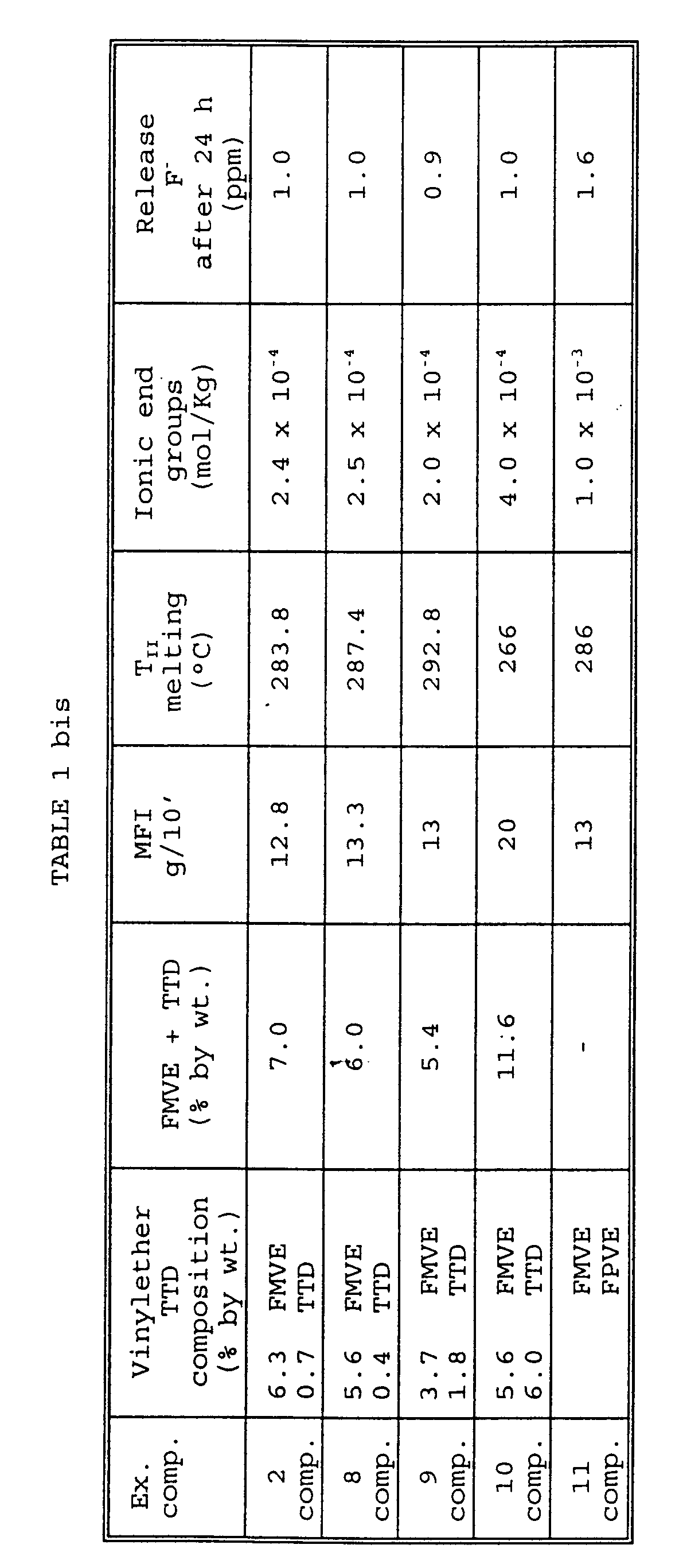
- Table 1bis The data relating to the comparative Examples are reported in Table 1bis, corresponding to Table 1 of the Examples of the invention.
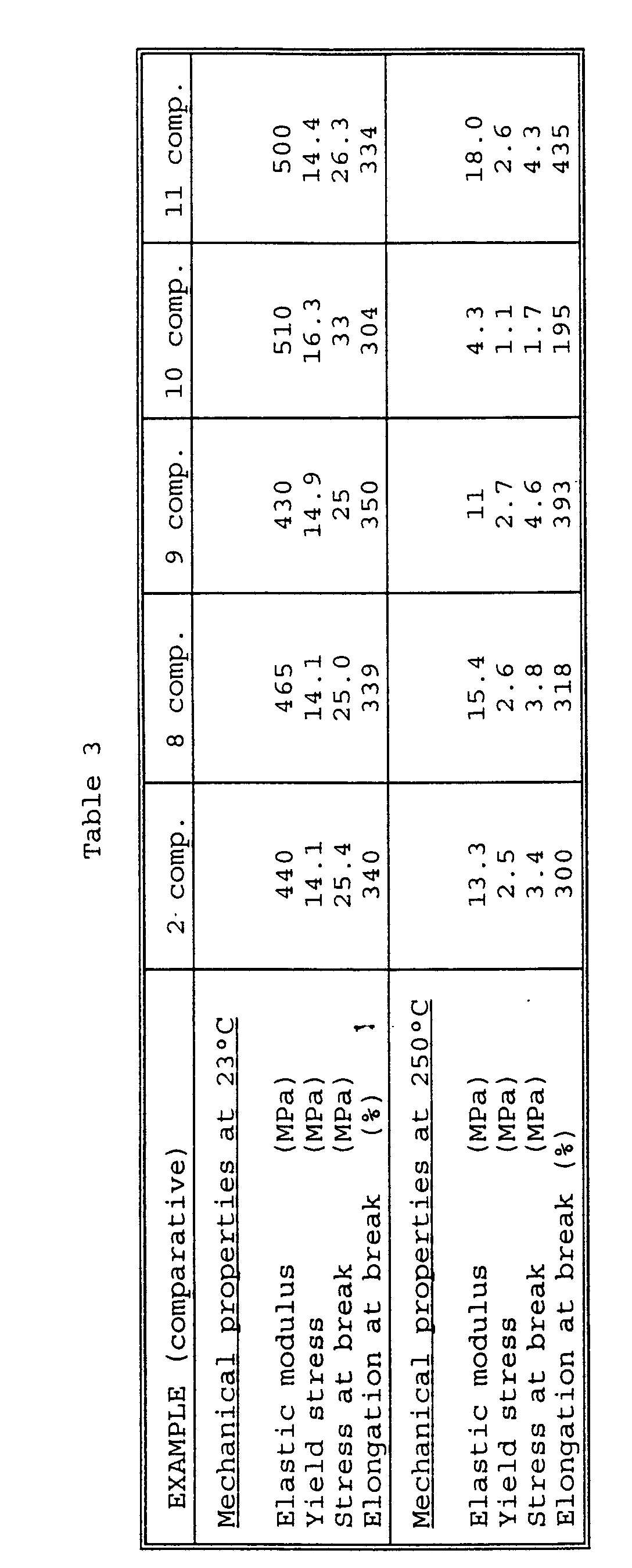
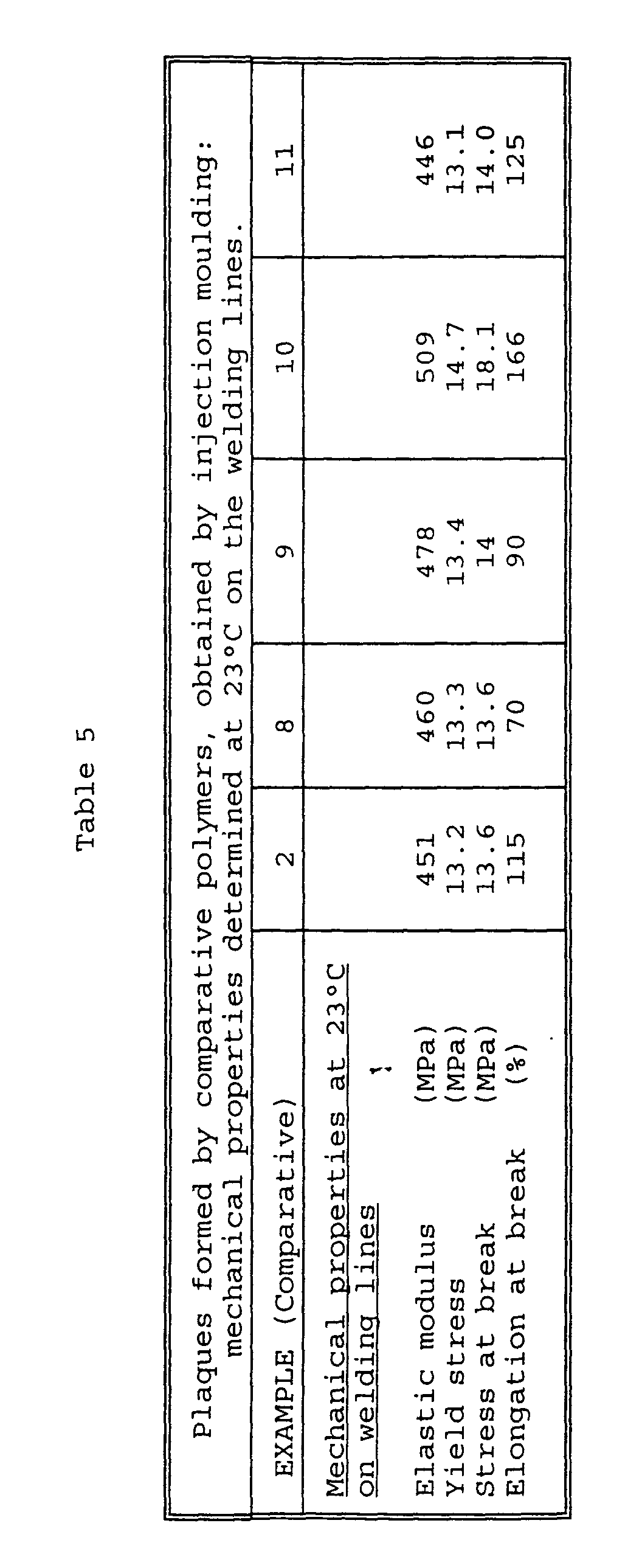
- Tables 3 and 5 correspond to Tables 2 and 4 of the Examples of the invention.
- the autoclave is heated up to the reaction temperature of 75°C and then 0.51 bar (5.1.10 4 Pa) of ethane and 2.86 bar (2.86.10 5 Pa) of FMVE are fed.
- the composition of the gaseous mixture present in the autoclave head space is analyzed by gas-chromatography. Before the reaction starts, the gas phase results to be constituted by the following component molar percentages: TFE 81%, TTD 0.8%, FMVE 16.5%, ethane 1.7%.
- Example 1 The process described in Example 1 is followed until polymer drying.
- the polymer nominal composition in percentage by weight is the following: FMVE 5.6%, TTD 2.0%, TFE 92.4%.
- the autoclave is heated up to the reaction temperature of 75°C and then 0.49 bar (4.9.10 4 Pa) of ethane and 2.86 bar (2.86.10 5 Pa) of FMVE are fed.
- the composition of the gaseous mixture present in the autoclave head space is analyzed by gas-chromatography. Before the reaction starts, the gas phase results to be constituted by the following component molar percentages: TFE 80.7%, TTD 1.4%, FMVE 16.3%, ethane 1.6%.
- Example 1 The process described in Example 1 is followed until polymer drying.
- the polymer nominal composition in percentage by weight is the following: FMVE 5.6%, TTD 3.0%, TFE 91.4%.
- Example 1 In the same autoclave used in Example 1, after vacuum having been made, 13.9 litres of demineralized water, 23.4 g of TTD and 160 g of the above microemulsion (Example 1) are fed in sequence.
- the autoclave is heated up to the reaction temperature of 75°C and then 0.49 absolute bar (4.9.10 4 Pa) of ethane and 2.86 absolute bar (2.86.10 5 Pa) of FMVE are fed.
- the composition of the gaseous mixture present in the autoclave head space is analyzed by gas-chromatography. Before the reaction starts, the gas phase results to be constituted by the following component molar percentages: TFE 79.5%, TTD 1.9%, FMVE 17% and ethane 1.6%.
- Example 1 The process described in Example 1 is followed until drying of the polymer.
- the polymer nominal composition in percentage by weight is the following: FMVE 5.6%, TTD 4.0%, TFE 90.4%.
- Example 1 In the same autoclave used in Example 1, after vacuum having been made, 13.9 litres of demineralized water, 9.5 g of TTD and 160 g of the above microemulsion (Example 1) are fed in sequence.
- the autoclave is heated up to the reaction temperature of 75°C and then 0.51 absolute bar (5.1.10 4 Pa) of ethane and 3.1 absolute bar (3.1.10 5 Pa) of FMVE are fed.
- the composition of the gaseous mixture present in the autoclave head space is analyzed by gas-chromatography. Before the reaction starts, the gas phase results to be constituted by the following component molar percentages: TFE 78.4%, TTD 0.81%, FMVE 18.8% and ethane 1.99%.
- Example 1 The process described in Example 1 is followed until drying of the polymer.
- the polymer nominal composition in percentage by weight is the following: FMVE 6.4%, TTD 1.7%, TFE 91.9%.
- Example 1 In the same autoclave used in Example 1, after vacuum having been made, 13.9 litres of demineralized water, 4.2 g of TTD and 160 g of the above microemulsion (Example 1) are fed in sequence.
- the autoclave is heated up to the reaction temperature of 75°C and then 0.46 absolute bar (4.6.10 4 Pa) of ethane and 4.14 absolute bar (4.14.10 5 Pa) of FMVE are fed.
- the composition of the gaseous mixture present in the autoclave head space is analyzed by gas-chromatography. Before the reaction starts, the gas phase results to be constituted by the following component molar percentages: TFE 72.6%, TTD 0.4%, FMVE 25.3% and ethane 1.7%.
- Example 1 The process described in Example 1 is followed until drying of the polymer.
- the polymer nominal composition in percentage by weight is the following: FMVE 8.8%; TTD 0.7%, TFE 90.5%.
- Example 1 In the same autoclave used in Example 1, after vacuum having been made, 13.9 litres of demineralized water, 2.92 g of TTD and 160 g of the above microemulsion (Example 1) are fed in sequence.
- the autoclave is heated up to the reaction temperature of 75°C and then 0.5 absolute bar (5.10 4 Pa) of ethane and 2.86 absolute bar (2.86.10 5 Pa) of FMVE are fed.
- the composition of the gaseous mixture present in the autoclave head space is analyzed by gas-chromatography. Before the reaction starts, the gas phase results to be constituted by the following component molar percentages: TFE 81.5%, TTD 0.4%, FMVE 16.7% and ethane 1.4%.
- Example 1 The process described in Example 1 is followed until drying of the polymer.
- the polymer nominal composition in percentage by weight is the following: FMVE 5.6%, TTD 0.4%, TFE 94%. Therefore the polymer contains a TTD amount lower than the limit in the case of composition B).
- Table 1bis The data relating to the comparative Examples are reported in Table 1bis, corresponding to Table 1 of the Examples of the invention.
- Tables 3 and 5 correspond to Tables 2 and 4 of the Examples of the invention.
- the autoclave is heated up to the reaction temperature of 75°C and then 0.59 absolute bar (5.9.10 4 Pa) of ethane and 1.89 absolute bar (1.89.10 5 Pa) of FMVE are introduced.
- the composition of the gaseous mixture present in the autoclave head space is analyzed by gas-chromatography. Before the reaction starts, the gas phase results to be constituted by the following component molar percentages: TFE 84.2%, TTD 0.9%, FMVE 12.5% and ethane 2.4%.
- Example 1 The process described in Example 1 is followed until drying of the polymer.
- the polymer nominal composition in percentage by weight is the following: FMVE 3.7%, TTD 1.8%, TFE 94.5%.
- the polymer contains a FMVE amount lower than the limit in the case of composition B).
- Table 1bis The data relating to the comparative Examples are reported in Table 1bis, corresponding to Table 1 of the Examples of the invention.
- Tables 3 and 5 correspond to Tables 2 and 4 of the Examples of the invention.
- the autoclave is heated up to the reaction temperature of 75°C and then 0.51 absolute bar (5.1.10 4 Pa) of ethane and 2.86 absolute bar (2.86.10 5 Pa) of FMVE are introduced.
- the composition of the gaseous mixture present in the autoclave head space is analyzed by gas-chromatography. Before the reaction starts, the gas phase results to be constituted by the following component molar percentages: TFE 76%, TTD 3.5%, FMVE 17% and ethane 1.5%.
- the polymerization pressure is maintained constant by feeding the monomeric mixture with the above defined ratios and when 5,000 g of the mixture have been fed, the reaction is stopped.
- the reactor is cooled to room temperature and one proceeds as described in Example 1 until drying of the polymer.
- the polymer nominal composition in percentage by weight is the following: FMVE 5.6%, TTD 6%, TFE 88.4%.
- the percentages by weight of the comonomers are comprised in the composition defined in B) but the sum of the comonomers FMVE + TTD is over the limit of 11% by weight.
- Table 1bis The data relating to the comparative Examples are reported in Table 1bis, corresponding to Table 1 of the Examples of the invention.
- Tables 3 and 5 correspond to Tables 2 and 4 of the Examples of the invention.
- Table 1bis The data relating to the comparative Examples are reported in Table 1bis, corresponding to Table 1 of the Examples of the invention.
- Tables 3 and 5 correspond to Tables 2 and 4 of the Examples of the invention.
Landscapes
- Chemical & Material Sciences (AREA)
- Health & Medical Sciences (AREA)
- Chemical Kinetics & Catalysis (AREA)
- Medicinal Chemistry (AREA)
- Polymers & Plastics (AREA)
- Organic Chemistry (AREA)
- Addition Polymer Or Copolymer, Post-Treatments, Or Chemical Modifications (AREA)
- Compositions Of Macromolecular Compounds (AREA)
- Manufacture Of Macromolecular Shaped Articles (AREA)
- Processes Of Treating Macromolecular Substances (AREA)
- Treatments For Attaching Organic Compounds To Fibrous Goods (AREA)
Abstract

Description
- good mechanical properties measured at room temperature (23°C) on the welding lines of injection moulded articles; in particular an elongation at break ≥130%;
- F- release values, on the polymer pellet not higher than 1 ppm by weight with respect to the polymer weight;
- extractable Cl- values lower than 0.2 ppm by weight with respect to the polymer weight;
- amount of ionic end groups not higher than 5.10-4 moles /Kg polymer;
- good hot mechanical properties up to temperatures of 250°C, in particular for a polymer which is processable by injection moulding, the stress at break must be higher than or equal to 2.5 MPa and the elongation at break higher than or equal to 250%.
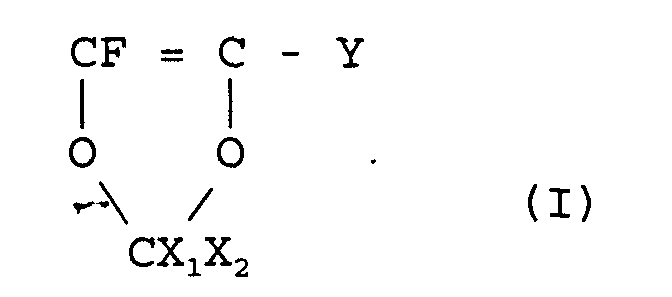
X1 and X2, equal to or different from each other, are -F or -CF3;
said copolymers having:
- an amount of ionic end groups of -COOH and -COF type, not higher than 5x10⁻⁴ moles/Kg of polymer;
- release values of F- ions, determined on the polymer in pellet, not higher than 1 ppm by weight with respect to the polymer weight;
- elongation at break ≥ 130% measured at 23°C along the welding lines of the injection moulded articles;
- stress at break ≥ 2.5 MPa and elongation at break ≥250%, measured at 250°C on compression moulded plaque.
wherein the comonomer (a) and (b) amounts are as above defined.
- MFI, determined with a load of 5 Kg at the temperature of 372°C according to the ASTM D 1238-52T method.
- Determination of the second melting temperature by DSC. A Perkin-Elmer mod. IV calorimeter has been used. About 10 mg of the specimen were heated starting from the room temperature up to 350°C by using a gradient of 10°C/min. The specimen was maintained at 350°C for 5 minutes, then cooled at room temperature using the same temperature gradient of the previous step. The specimen was lastly heated again from room temperature to 350°C with the same above modalities. During the last step the temperature corresponding to the maximum of the melting endothermy curve has been determined, which corresponds to the second melting temperature (melting T(II)).
- Tensile properties (stress and elongation at break, yield stress and Young modulus according to ASTM D 1708 method, both at room temperature (23°C) and at 250°C).
- Chain end group determination by IR analysis carried out on a specimen obtained from pellet by cold compression, as described in the publication "End-groups in Fluoropolymer" published on Journal of Fluorine Chemistry 95 (1999), pages 71-84.
- F- anions release determination on pellets at 85°C by
ionic chromatography. The specimen preparation is carried
out by using KaPak®/ Scotchpack vessels filled with
deionized water at 18 mΩ and an amount equal to 5 grams
of pellets. The vessels containing the polymer specimen
are closed and kept in a bath at 85°C for 24 hours. Then
the water contained in the vessels is analyzed by ionic
chromatography, according to the following conditions:
- column and precolumn AS4A+AG4A-Dionex;
- eluent: Na2B4O7 3.0 mM, flow 1 cc/min;
- detection: suppressed conductivity;
- To obtain specimens for the determination of the mechanical
properties (determined at the temperature of 23°C)
on the welding line the pellets have been injection
moulded using a Negri-Bossi® NB25 press with a
rectangular double injection mould on two opposite sides.
The obtained article (moulded plaque) weighs about 46 g.
The operating conditions are:- Temperature profile set up on the machine:
- barrel temperature zone 1: 325°C;
- barrel temperature zone 2 and zone 3: 340°C;
- die temperature: 360°C.
- Melted temperature: 365°C.
- Mould temperature: 210°C.
- Temperature profile set up on the machine:
- 0.51 absolute bar (5.1.104 Pa) of ethane;
- 2.86 absolute bar (2.86.105 Pa) of perfluoromethylvinylether (FMVE) are fed.
- the percentage by weight of FMVE in Examples 2 and 8 comp. is lower than the limits of the FMVE % in composition A);
- the percentages by weight of FMVE and of TTD in Examples 2 and 8 comp. are lower than the limits of the TTD % of composition B);
- the percentages by weight of FMVE and of TTD in Example 9 comp. are respectively lower and higher than the corresponding limits of composition A);
- the percentage by weight of FMVE in Example 9 comp. is
lower than the limits of the FMVE % in composition B);
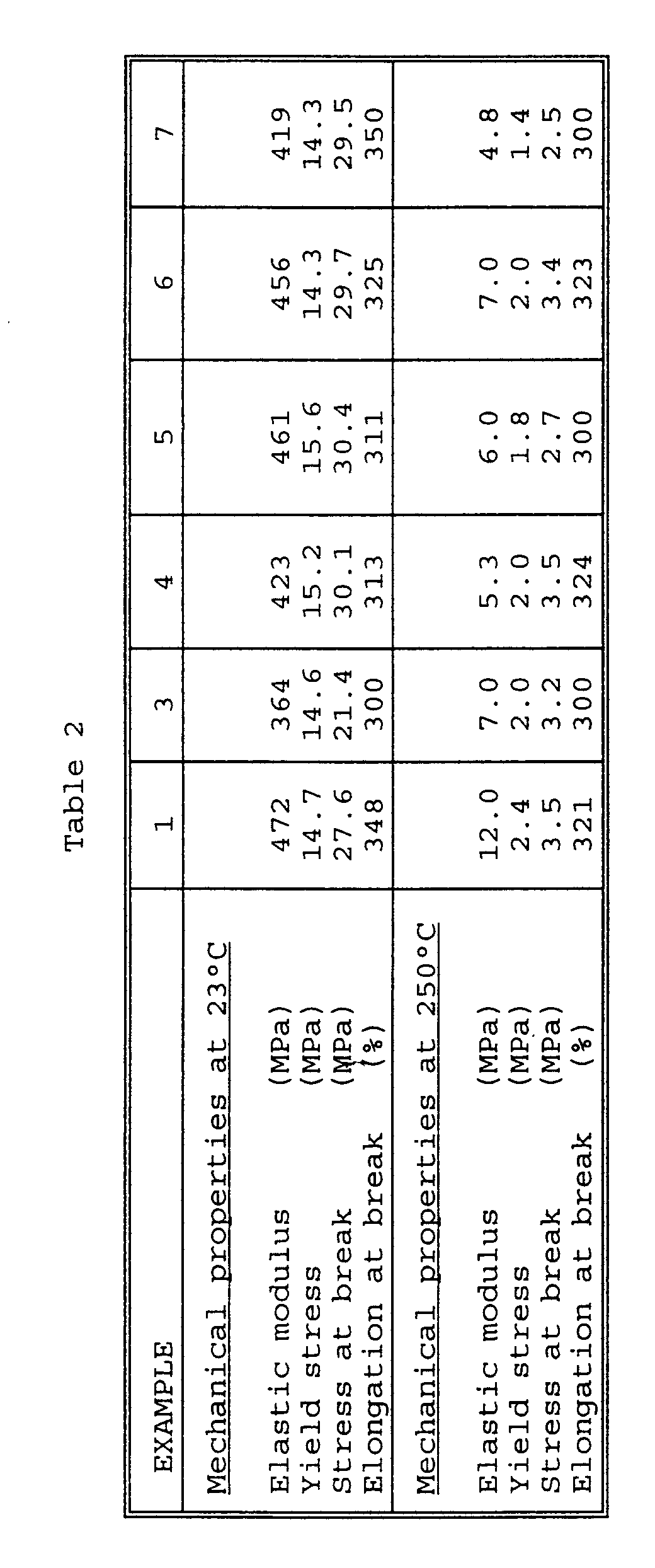
show elongations at break (23°C), measured along the welding
lines, lower than 130%. The specimens obtained according to
the present invention show elongations at break higher than
both those of comparative Examples 2, 8 and 9 and that of the
commercial specimen (comp. Example 11).


Claims (6)
- Thermoprocessable copolymers of TFE consisiting essentially of the following monomers in the indicated amounts:the complement to 100% by weight in compositions A) and B) being TFE;A)with the proviso that the sum of the percentages by weight of (a) + (b) is from 8.9 to 11% by weight; or(a) 8.6-9.8% by weight of perfluoromethylvinylether (FMVE);(b) 0.3-1.2% by weight of a perfluorodioxole of formula:wherein:
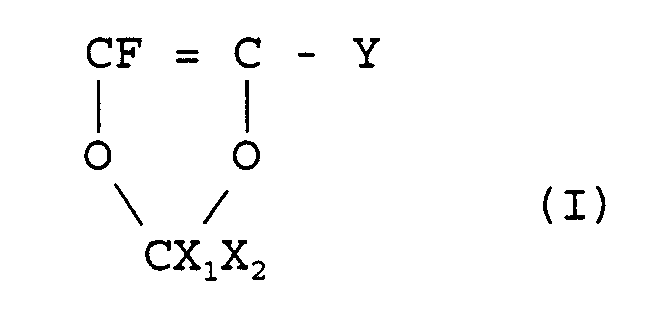
Y = F, ORf, Rf wherein Rf is a perfluoroalkyl having from 1 to 5 carbon atoms;
X1 and X2, equal to or different from each other, are -F or -CF3;B)with the proviso that the sum of the percentages by weight of (a) + (b) is from 6.2 to 11% by weight;(a) 4.5-8.5% by weight of perfluoromethylvinylether (FMVE);(b) 1.7-7.5% by weight of a perfluorodioxole as defined in A);
said copolymers having:wherein the manufactured articles obtained from the polymers having compositions A) or B) show the following mechanical properties:an amount of ionic end groups -COOH and -COF, not higher than 5x10⁻⁴ moles/Kg polymer;release values of F- ions, determined on the polymer in pellet, not higher than 1 ppm by weight with respect to the polymer weight;elongation at break ≥ 130% measured at 23°C along the welding lines of the injection moulded articles;stress at break ≥ 2.5 MPa and elongation at break ≥250%, measured at 250°C on compression moulded plaque. - Copolymers according to claim 1, wherein in formula (I) of comonomer (b) Y = ORf, Rf = -CF3; X1 = X2 = F.
- Copolymers according to claims 1-2, wherein the Melt Flow Index measured at 372°C with a load of 5 Kg is from 1 to 40 g/10', preferably from 6 to 30 g/10'.
- Manufactured articles obtainable by injection moulding of the thermoprocessable copolymers according to claims 1-3, having the following mechanical properties:elongation at break measured at 23°C on the welding lines from 150% to 300%;stress at break at 250°C from 2.5 to 6 MPa;elongation at break at 250°C from 270 to 500%.
- Manufactured articles according to claim 4 in the form of fittings.
- Use of the copolymers of claims 1-3 to obtain manufactured articles by injection moulding.
Applications Claiming Priority (2)
| Application Number | Priority Date | Filing Date | Title |
|---|---|---|---|
| IT2001MI002745A ITMI20012745A1 (en) | 2001-12-21 | 2001-12-21 | THERMOPROCESSABLE TFE COPOLYMERS |
| ITMI20012745 | 2001-12-21 |
Publications (3)
| Publication Number | Publication Date |
|---|---|
| EP1323750A2 true EP1323750A2 (en) | 2003-07-02 |
| EP1323750A3 EP1323750A3 (en) | 2003-10-22 |
| EP1323750B1 EP1323750B1 (en) | 2008-02-27 |
Family
ID=11448734
Family Applications (1)
| Application Number | Title | Priority Date | Filing Date |
|---|---|---|---|
| EP02028295A Expired - Lifetime EP1323750B1 (en) | 2001-12-21 | 2002-12-17 | Thermoprocessable copolymers of tetrafluorethene, dioxole and vinylether |
Country Status (6)
| Country | Link |
|---|---|
| US (1) | US6730761B2 (en) |
| EP (1) | EP1323750B1 (en) |
| JP (1) | JP4289877B2 (en) |
| KR (1) | KR100937250B1 (en) |
| DE (1) | DE60225234T2 (en) |
| IT (1) | ITMI20012745A1 (en) |
Cited By (3)
| Publication number | Priority date | Publication date | Assignee | Title |
|---|---|---|---|---|
| EP1621559A3 (en) * | 2004-07-30 | 2006-06-07 | Solvay Solexis S.p.A. | TFE-based thermoprocessable copolymers |
| WO2007057319A1 (en) * | 2005-11-15 | 2007-05-24 | Schaeffler Kg | Linear roller bearing |
| CN103694395A (en) * | 2013-12-09 | 2014-04-02 | 中昊晨光化工研究院有限公司 | Vinylidene fluoride copolymer and preparation method thereof |
Families Citing this family (3)
| Publication number | Priority date | Publication date | Assignee | Title |
|---|---|---|---|---|
| JP2010116573A (en) * | 2004-08-31 | 2010-05-27 | Sumitomo Chemical Co Ltd | Method for producing olefin polymer |
| US9988476B2 (en) | 2012-12-05 | 2018-06-05 | Solvay Specialty Polymers Italy S.P.A. | Melt-processable perfluoropolymers having improved thermal and mechanical properties after heating treatment |
| JP7335685B2 (en) | 2018-06-07 | 2023-08-30 | 三井・ケマーズ フロロプロダクツ株式会社 | Hot-melt fluororesin composition and injection-molded article made from the same |
Family Cites Families (7)
| Publication number | Priority date | Publication date | Assignee | Title |
|---|---|---|---|---|
| US3865845A (en) | 1971-02-24 | 1975-02-11 | Paul Raphael Resnick | Fluorinated dioxoles |
| US4743658A (en) * | 1985-10-21 | 1988-05-10 | E. I. Du Pont De Nemours And Company | Stable tetrafluoroethylene copolymers |
| IT1204903B (en) | 1986-06-26 | 1989-03-10 | Ausimont Spa | POLYMERIZATION PROCESS IN WATER DISPERSION OF FLORATED MONOMERS |
| US5093409A (en) * | 1988-05-27 | 1992-03-03 | E. I. Du Pont De Nemours And Company | Process for the stabilization of fluoropolymers |
| IT1264662B1 (en) * | 1993-07-05 | 1996-10-04 | Ausimont Spa | PERFLURODIOSSOLS THEIR HOMOPOLYMERS AND COPOLYMERS AND THEIR USE FOR THE COATING OF ELECTRIC CABLES |
| IT1264661B1 (en) | 1993-07-05 | 1996-10-04 | Ausimont Spa | THERMOPROCESSABILIN COPOLYMERS OF TETRAFLUOROETHYLENE |
| IT1318596B1 (en) * | 2000-06-23 | 2003-08-27 | Ausimont Spa | THERMOPROCESSABLE TFE COPOLYMERS. |
-
2001
- 2001-12-21 IT IT2001MI002745A patent/ITMI20012745A1/en unknown
-
2002
- 2002-12-16 JP JP2002363785A patent/JP4289877B2/en not_active Expired - Lifetime
- 2002-12-17 DE DE60225234T patent/DE60225234T2/en not_active Expired - Lifetime
- 2002-12-17 EP EP02028295A patent/EP1323750B1/en not_active Expired - Lifetime
- 2002-12-17 KR KR1020020080772A patent/KR100937250B1/en not_active Expired - Fee Related
- 2002-12-19 US US10/322,631 patent/US6730761B2/en not_active Expired - Lifetime
Cited By (6)
| Publication number | Priority date | Publication date | Assignee | Title |
|---|---|---|---|---|
| EP1621559A3 (en) * | 2004-07-30 | 2006-06-07 | Solvay Solexis S.p.A. | TFE-based thermoprocessable copolymers |
| US7544752B2 (en) | 2004-07-30 | 2009-06-09 | Solvay Solexis S.P.A. | TFE-based thermoprocessable copolymers |
| WO2007057319A1 (en) * | 2005-11-15 | 2007-05-24 | Schaeffler Kg | Linear roller bearing |
| US7891876B2 (en) | 2005-11-15 | 2011-02-22 | Schaeffler Kg | Linear roller bearing |
| CN103694395A (en) * | 2013-12-09 | 2014-04-02 | 中昊晨光化工研究院有限公司 | Vinylidene fluoride copolymer and preparation method thereof |
| CN103694395B (en) * | 2013-12-09 | 2016-04-13 | 中昊晨光化工研究院有限公司 | Vinylidene fluoride copolymers and preparation method thereof |
Also Published As
| Publication number | Publication date |
|---|---|
| EP1323750A3 (en) | 2003-10-22 |
| US20030158359A1 (en) | 2003-08-21 |
| KR100937250B1 (en) | 2010-01-15 |
| US6730761B2 (en) | 2004-05-04 |
| DE60225234D1 (en) | 2008-04-10 |
| JP4289877B2 (en) | 2009-07-01 |
| KR20030053002A (en) | 2003-06-27 |
| EP1323750B1 (en) | 2008-02-27 |
| ITMI20012745A1 (en) | 2003-06-21 |
| DE60225234T2 (en) | 2009-03-26 |
| JP2003238628A (en) | 2003-08-27 |
Similar Documents
| Publication | Publication Date | Title |
|---|---|---|
| JP7174306B2 (en) | Injection molded article and its manufacturing method | |
| JP7137111B2 (en) | Injection molded article and its manufacturing method | |
| EP2058341B1 (en) | Process for producing melt-moldable tetrafluoroethylene copolymer | |
| JP4357638B2 (en) | Process for producing fluoropolymers in carbon dioxide | |
| JP2001151825A (en) | Fluorinated copolymer and low chemical liquid permeable fluorinated resin composition | |
| EP2865691B1 (en) | Tetrafluoroethylene/perfluoro (alkyl vinyl ether) copolymer | |
| WO2003048214A1 (en) | Molding material for ozone-resistant articles and ozone-resistant injection-molded articles | |
| JP4341125B2 (en) | Chemical liquid permeation inhibitor, chemical liquid permeation inhibiting fluorine-containing resin composition comprising the inhibitor | |
| US7060772B2 (en) | Fluoropolymers from tetrafluoroethylene and perfluoro(alkoxyalkyl vinyl) ether | |
| JPWO2013005743A1 (en) | Fluorine resin pellet processing method | |
| EP1167401B1 (en) | Thermoprocessable copolymers of TFE | |
| EP1323750B1 (en) | Thermoprocessable copolymers of tetrafluorethene, dioxole and vinylether | |
| JP4882194B2 (en) | Low chemical liquid permeability fluorine-containing resin material | |
| JPWO2001040332A1 (en) | Low chemical permeability fluorine-containing resin material | |
| EP1328562B1 (en) | Fluoropolymer | |
| JP2007112916A (en) | Amorphous fluorine-containing copolymer |
Legal Events
| Date | Code | Title | Description |
|---|---|---|---|
| PUAI | Public reference made under article 153(3) epc to a published international application that has entered the european phase |
Free format text: ORIGINAL CODE: 0009012 |
|
| AK | Designated contracting states |
Designated state(s): AT BE BG CH CY CZ DE DK EE ES FI FR GB GR IE IT LI LU MC NL PT SE SI SK TR |
|
| AX | Request for extension of the european patent |
Extension state: AL LT LV MK RO |
|
| PUAL | Search report despatched |
Free format text: ORIGINAL CODE: 0009013 |
|
| AK | Designated contracting states |
Kind code of ref document: A3 Designated state(s): AT BE BG CH CY CZ DE DK EE ES FI FR GB GR IE IT LI LU MC NL PT SE SI SK TR |
|
| AX | Request for extension of the european patent |
Extension state: AL LT LV MK RO |
|
| 17P | Request for examination filed |
Effective date: 20040408 |
|
| AKX | Designation fees paid |
Designated state(s): CH DE FR GB IT LI |
|
| 17Q | First examination report despatched |
Effective date: 20040622 |
|
| GRAP | Despatch of communication of intention to grant a patent |
Free format text: ORIGINAL CODE: EPIDOSNIGR1 |
|
| RIC1 | Information provided on ipc code assigned before grant |
Ipc: C08F 214/26 20060101AFI20070622BHEP |
|
| GRAS | Grant fee paid |
Free format text: ORIGINAL CODE: EPIDOSNIGR3 |
|
| GRAA | (expected) grant |
Free format text: ORIGINAL CODE: 0009210 |
|
| AK | Designated contracting states |
Kind code of ref document: B1 Designated state(s): CH DE FR GB IT LI |
|
| REG | Reference to a national code |
Ref country code: GB Ref legal event code: FG4D |
|
| REG | Reference to a national code |
Ref country code: CH Ref legal event code: EP |
|
| REF | Corresponds to: |
Ref document number: 60225234 Country of ref document: DE Date of ref document: 20080410 Kind code of ref document: P |
|
| REG | Reference to a national code |
Ref country code: CH Ref legal event code: NV Representative=s name: E. BLUM & CO. AG PATENT- UND MARKENANWAELTE VSP |
|
| ET | Fr: translation filed | ||
| PLBE | No opposition filed within time limit |
Free format text: ORIGINAL CODE: 0009261 |
|
| STAA | Information on the status of an ep patent application or granted ep patent |
Free format text: STATUS: NO OPPOSITION FILED WITHIN TIME LIMIT |
|
| 26N | No opposition filed |
Effective date: 20081128 |
|
| PG25 | Lapsed in a contracting state [announced via postgrant information from national office to epo] |
Ref country code: IT Free format text: LAPSE BECAUSE OF FAILURE TO SUBMIT A TRANSLATION OF THE DESCRIPTION OR TO PAY THE FEE WITHIN THE PRESCRIBED TIME-LIMIT Effective date: 20080227 |
|
| PGFP | Annual fee paid to national office [announced via postgrant information from national office to epo] |
Ref country code: FR Payment date: 20111219 Year of fee payment: 10 |
|
| REG | Reference to a national code |
Ref country code: FR Ref legal event code: ST Effective date: 20130830 |
|
| PG25 | Lapsed in a contracting state [announced via postgrant information from national office to epo] |
Ref country code: FR Free format text: LAPSE BECAUSE OF NON-PAYMENT OF DUE FEES Effective date: 20130102 |
|
| PGFP | Annual fee paid to national office [announced via postgrant information from national office to epo] |
Ref country code: CH Payment date: 20151211 Year of fee payment: 14 |
|
| REG | Reference to a national code |
Ref country code: CH Ref legal event code: PL |
|
| PG25 | Lapsed in a contracting state [announced via postgrant information from national office to epo] |
Ref country code: LI Free format text: LAPSE BECAUSE OF NON-PAYMENT OF DUE FEES Effective date: 20161231 Ref country code: CH Free format text: LAPSE BECAUSE OF NON-PAYMENT OF DUE FEES Effective date: 20161231 |
|
| PGFP | Annual fee paid to national office [announced via postgrant information from national office to epo] |
Ref country code: DE Payment date: 20211102 Year of fee payment: 20 Ref country code: GB Payment date: 20211104 Year of fee payment: 20 |
|
| REG | Reference to a national code |
Ref country code: DE Ref legal event code: R071 Ref document number: 60225234 Country of ref document: DE |
|
| REG | Reference to a national code |
Ref country code: GB Ref legal event code: PE20 Expiry date: 20221216 |
|
| PG25 | Lapsed in a contracting state [announced via postgrant information from national office to epo] |
Ref country code: GB Free format text: LAPSE BECAUSE OF EXPIRATION OF PROTECTION Effective date: 20221216 |