EP1321811A2 - Photographic elements containing a de-aggregating compound, and dye-forming coupler - Google Patents
Photographic elements containing a de-aggregating compound, and dye-forming coupler Download PDFInfo
- Publication number
- EP1321811A2 EP1321811A2 EP02026764A EP02026764A EP1321811A2 EP 1321811 A2 EP1321811 A2 EP 1321811A2 EP 02026764 A EP02026764 A EP 02026764A EP 02026764 A EP02026764 A EP 02026764A EP 1321811 A2 EP1321811 A2 EP 1321811A2
- Authority
- EP
- European Patent Office
- Prior art keywords
- alkyl
- aryl
- group
- substituted
- unsubstituted
- Prior art date
- Legal status (The legal status is an assumption and is not a legal conclusion. Google has not performed a legal analysis and makes no representation as to the accuracy of the status listed.)
- Withdrawn
Links
- 150000001875 compounds Chemical class 0.000 title claims abstract description 67
- -1 silver halide Chemical class 0.000 claims abstract description 152
- 239000000839 emulsion Substances 0.000 claims abstract description 65
- 125000001424 substituent group Chemical group 0.000 claims abstract description 64
- 229910052709 silver Inorganic materials 0.000 claims abstract description 50
- 239000004332 silver Substances 0.000 claims abstract description 50
- 125000000623 heterocyclic group Chemical group 0.000 claims abstract description 48
- 125000005842 heteroatom Chemical group 0.000 claims abstract description 45
- 239000006185 dispersion Substances 0.000 claims abstract description 41
- IJGRMHOSHXDMSA-UHFFFAOYSA-N nitrogen Substances N#N IJGRMHOSHXDMSA-UHFFFAOYSA-N 0.000 claims abstract description 32
- 229910052757 nitrogen Inorganic materials 0.000 claims abstract description 31
- 239000003795 chemical substances by application Substances 0.000 claims abstract description 30
- 229910052739 hydrogen Inorganic materials 0.000 claims abstract description 29
- 239000001257 hydrogen Substances 0.000 claims abstract description 29
- NINIDFKCEFEMDL-UHFFFAOYSA-N Sulfur Chemical group [S] NINIDFKCEFEMDL-UHFFFAOYSA-N 0.000 claims abstract description 27
- 229910052717 sulfur Chemical group 0.000 claims abstract description 27
- 239000011593 sulfur Chemical group 0.000 claims abstract description 27
- QVGXLLKOCUKJST-UHFFFAOYSA-N atomic oxygen Chemical group [O] QVGXLLKOCUKJST-UHFFFAOYSA-N 0.000 claims abstract description 24
- 229910052760 oxygen Inorganic materials 0.000 claims abstract description 24
- 239000001301 oxygen Chemical group 0.000 claims abstract description 24
- 125000004432 carbon atom Chemical group C* 0.000 claims abstract description 22
- 125000004429 atom Chemical group 0.000 claims abstract description 21
- 125000004435 hydrogen atom Chemical group [H]* 0.000 claims abstract description 20
- QJGQUHMNIGDVPM-UHFFFAOYSA-N nitrogen group Chemical group [N] QJGQUHMNIGDVPM-UHFFFAOYSA-N 0.000 claims abstract description 18
- 229910052736 halogen Chemical group 0.000 claims abstract description 17
- 150000002367 halogens Chemical group 0.000 claims abstract description 17
- 238000006243 chemical reaction Methods 0.000 claims abstract description 16
- 125000004122 cyclic group Chemical group 0.000 claims abstract description 15
- 229910052799 carbon Inorganic materials 0.000 claims abstract description 13
- 125000005647 linker group Chemical group 0.000 claims abstract description 7
- 238000000034 method Methods 0.000 claims description 26
- 239000002904 solvent Substances 0.000 claims description 23
- 125000003545 alkoxy group Chemical group 0.000 claims description 22
- 125000000217 alkyl group Chemical group 0.000 claims description 21
- 125000003118 aryl group Chemical group 0.000 claims description 21
- 125000004433 nitrogen atom Chemical group N* 0.000 claims description 17
- 125000004390 alkyl sulfonyl group Chemical group 0.000 claims description 15
- 125000001997 phenyl group Chemical group [H]C1=C([H])C([H])=C(*)C([H])=C1[H] 0.000 claims description 15
- 230000008569 process Effects 0.000 claims description 15
- 125000004453 alkoxycarbonyl group Chemical group 0.000 claims description 12
- 125000004104 aryloxy group Chemical group 0.000 claims description 11
- 125000005422 alkyl sulfonamido group Chemical group 0.000 claims description 9
- 125000000547 substituted alkyl group Chemical group 0.000 claims description 9
- 125000000472 sulfonyl group Chemical group *S(*)(=O)=O 0.000 claims description 9
- 125000003342 alkenyl group Chemical group 0.000 claims description 8
- 125000005115 alkyl carbamoyl group Chemical group 0.000 claims description 8
- 125000002915 carbonyl group Chemical group [*:2]C([*:1])=O 0.000 claims description 8
- 125000004423 acyloxy group Chemical group 0.000 claims description 7
- 125000005116 aryl carbamoyl group Chemical group 0.000 claims description 7
- 125000005421 aryl sulfonamido group Chemical group 0.000 claims description 7
- 125000000475 sulfinyl group Chemical group [*:2]S([*:1])=O 0.000 claims description 7
- 125000004414 alkyl thio group Chemical group 0.000 claims description 6
- 125000005161 aryl oxy carbonyl group Chemical group 0.000 claims description 6
- 125000004391 aryl sulfonyl group Chemical group 0.000 claims description 6
- 125000005110 aryl thio group Chemical group 0.000 claims description 6
- 125000000449 nitro group Chemical group [O-][N+](*)=O 0.000 claims description 6
- UFHFLCQGNIYNRP-UHFFFAOYSA-N Hydrogen Chemical compound [H][H] UFHFLCQGNIYNRP-UHFFFAOYSA-N 0.000 claims description 5
- 125000003282 alkyl amino group Chemical group 0.000 claims description 5
- 125000001769 aryl amino group Chemical group 0.000 claims description 5
- 125000004466 alkoxycarbonylamino group Chemical group 0.000 claims description 4
- 125000004448 alkyl carbonyl group Chemical group 0.000 claims description 4
- 125000005278 alkyl sulfonyloxy group Chemical group 0.000 claims description 4
- 125000005360 alkyl sulfoxide group Chemical group 0.000 claims description 4
- 125000005129 aryl carbonyl group Chemical group 0.000 claims description 4
- 125000005162 aryl oxy carbonyl amino group Chemical group 0.000 claims description 4
- 125000005142 aryl oxy sulfonyl group Chemical group 0.000 claims description 4
- 125000005279 aryl sulfonyloxy group Chemical group 0.000 claims description 4
- 125000005361 aryl sulfoxide group Chemical group 0.000 claims description 4
- 125000003107 substituted aryl group Chemical group 0.000 claims description 4
- 125000002373 5 membered heterocyclic group Chemical group 0.000 claims description 3
- 125000003341 7 membered heterocyclic group Chemical group 0.000 claims description 3
- 229910003844 NSO2 Inorganic materials 0.000 claims description 3
- 125000005153 alkyl sulfamoyl group Chemical group 0.000 claims description 3
- 229920000642 polymer Polymers 0.000 claims description 3
- 229910052705 radium Inorganic materials 0.000 claims description 3
- 229910052701 rubidium Inorganic materials 0.000 claims description 3
- 229910052727 yttrium Inorganic materials 0.000 claims description 3
- 125000004070 6 membered heterocyclic group Chemical group 0.000 claims description 2
- 239000000539 dimer Substances 0.000 claims description 2
- 125000005298 iminyl group Chemical group 0.000 claims description 2
- 241000237519 Bivalvia Species 0.000 claims 1
- 235000020639 clam Nutrition 0.000 claims 1
- 239000000975 dye Substances 0.000 abstract description 84
- 238000001228 spectrum Methods 0.000 abstract description 27
- 230000009102 absorption Effects 0.000 abstract description 26
- 238000010521 absorption reaction Methods 0.000 abstract description 26
- 239000010410 layer Substances 0.000 description 52
- 239000000463 material Substances 0.000 description 40
- 108010010803 Gelatin Proteins 0.000 description 35
- 239000008273 gelatin Substances 0.000 description 35
- 229920000159 gelatin Polymers 0.000 description 35
- 235000019322 gelatine Nutrition 0.000 description 35
- 235000011852 gelatine desserts Nutrition 0.000 description 35
- 238000004220 aggregation Methods 0.000 description 24
- BQCADISMDOOEFD-UHFFFAOYSA-N Silver Chemical compound [Ag] BQCADISMDOOEFD-UHFFFAOYSA-N 0.000 description 21
- 239000000243 solution Substances 0.000 description 21
- 230000000694 effects Effects 0.000 description 14
- 239000000203 mixture Substances 0.000 description 14
- 238000000576 coating method Methods 0.000 description 13
- 239000002019 doping agent Substances 0.000 description 13
- 238000012545 processing Methods 0.000 description 13
- 239000003112 inhibitor Substances 0.000 description 12
- 230000002776 aggregation Effects 0.000 description 11
- 230000000052 comparative effect Effects 0.000 description 11
- 238000011161 development Methods 0.000 description 11
- 238000001556 precipitation Methods 0.000 description 11
- 239000000047 product Substances 0.000 description 10
- MCSKRVKAXABJLX-UHFFFAOYSA-N pyrazolo[3,4-d]triazole Chemical compound N1=NN=C2N=NC=C21 MCSKRVKAXABJLX-UHFFFAOYSA-N 0.000 description 10
- 239000004094 surface-active agent Substances 0.000 description 10
- 230000015572 biosynthetic process Effects 0.000 description 9
- 239000011248 coating agent Substances 0.000 description 9
- 238000011160 research Methods 0.000 description 9
- 239000006096 absorbing agent Substances 0.000 description 8
- JYEUMXHLPRZUAT-UHFFFAOYSA-N 1,2,3-triazine Chemical compound C1=CN=NN=C1 JYEUMXHLPRZUAT-UHFFFAOYSA-N 0.000 description 7
- 206010070834 Sensitisation Diseases 0.000 description 7
- 239000000460 chlorine Substances 0.000 description 7
- ISWSIDIOOBJBQZ-UHFFFAOYSA-N phenol group Chemical group C1(=CC=CC=C1)O ISWSIDIOOBJBQZ-UHFFFAOYSA-N 0.000 description 7
- 230000008313 sensitization Effects 0.000 description 7
- 230000003595 spectral effect Effects 0.000 description 7
- 239000003381 stabilizer Substances 0.000 description 7
- 239000000126 substance Substances 0.000 description 7
- XLYOFNOQVPJJNP-UHFFFAOYSA-N water Substances O XLYOFNOQVPJJNP-UHFFFAOYSA-N 0.000 description 7
- 206010063836 Atrioventricular septal defect Diseases 0.000 description 6
- 229910021639 Iridium tetrachloride Inorganic materials 0.000 description 6
- 150000001721 carbon Chemical group 0.000 description 6
- 238000001211 electron capture detection Methods 0.000 description 6
- 239000003446 ligand Substances 0.000 description 6
- 239000003960 organic solvent Substances 0.000 description 6
- 239000002245 particle Substances 0.000 description 6
- GZTPJDLYPMPRDF-UHFFFAOYSA-N pyrrolo[3,2-c]pyrazole Chemical compound N1=NC2=CC=NC2=C1 GZTPJDLYPMPRDF-UHFFFAOYSA-N 0.000 description 6
- GHMLBKRAJCXXBS-UHFFFAOYSA-N resorcinol Chemical compound OC1=CC=CC(O)=C1 GHMLBKRAJCXXBS-UHFFFAOYSA-N 0.000 description 6
- 239000010948 rhodium Substances 0.000 description 6
- JUJWROOIHBZHMG-UHFFFAOYSA-N Pyridine Chemical compound C1=CC=NC=C1 JUJWROOIHBZHMG-UHFFFAOYSA-N 0.000 description 5
- 238000010893 electron trap Methods 0.000 description 5
- 230000006870 function Effects 0.000 description 5
- 150000004820 halides Chemical class 0.000 description 5
- 125000002887 hydroxy group Chemical group [H]O* 0.000 description 5
- PTFYQSWHBLOXRZ-UHFFFAOYSA-N imidazo[4,5-e]indazole Chemical compound C1=CC2=NC=NC2=C2C=NN=C21 PTFYQSWHBLOXRZ-UHFFFAOYSA-N 0.000 description 5
- 238000002156 mixing Methods 0.000 description 5
- 230000035945 sensitivity Effects 0.000 description 5
- 125000005420 sulfonamido group Chemical group S(=O)(=O)(N*)* 0.000 description 5
- KYQCOXFCLRTKLS-UHFFFAOYSA-N Pyrazine Chemical compound C1=CN=CC=N1 KYQCOXFCLRTKLS-UHFFFAOYSA-N 0.000 description 4
- 229910021607 Silver chloride Inorganic materials 0.000 description 4
- FZWLAAWBMGSTSO-UHFFFAOYSA-N Thiazole Chemical compound C1=CSC=N1 FZWLAAWBMGSTSO-UHFFFAOYSA-N 0.000 description 4
- 239000002585 base Substances 0.000 description 4
- 238000009835 boiling Methods 0.000 description 4
- 125000003917 carbamoyl group Chemical group [H]N([H])C(*)=O 0.000 description 4
- 125000001309 chloro group Chemical group Cl* 0.000 description 4
- PCHJSUWPFVWCPO-UHFFFAOYSA-N gold Chemical compound [Au] PCHJSUWPFVWCPO-UHFFFAOYSA-N 0.000 description 4
- 229910052737 gold Inorganic materials 0.000 description 4
- 239000010931 gold Substances 0.000 description 4
- IVSZLXZYQVIEFR-UHFFFAOYSA-N m-xylene Chemical group CC1=CC=CC(C)=C1 IVSZLXZYQVIEFR-UHFFFAOYSA-N 0.000 description 4
- 239000002609 medium Substances 0.000 description 4
- 239000004848 polyfunctional curative Substances 0.000 description 4
- 238000002360 preparation method Methods 0.000 description 4
- 230000027756 respiratory electron transport chain Effects 0.000 description 4
- HKZLPVFGJNLROG-UHFFFAOYSA-M silver monochloride Chemical compound [Cl-].[Ag+] HKZLPVFGJNLROG-UHFFFAOYSA-M 0.000 description 4
- JAAIPIWKKXCNOC-UHFFFAOYSA-N 1h-tetrazol-1-ium-5-thiolate Chemical class SC1=NN=NN1 JAAIPIWKKXCNOC-UHFFFAOYSA-N 0.000 description 3
- JMTMSDXUXJISAY-UHFFFAOYSA-N 2H-benzotriazol-4-ol Chemical class OC1=CC=CC2=C1N=NN2 JMTMSDXUXJISAY-UHFFFAOYSA-N 0.000 description 3
- QTBSBXVTEAMEQO-UHFFFAOYSA-N Acetic acid Chemical compound CC(O)=O QTBSBXVTEAMEQO-UHFFFAOYSA-N 0.000 description 3
- 241001479434 Agfa Species 0.000 description 3
- XEKOWRVHYACXOJ-UHFFFAOYSA-N Ethyl acetate Chemical compound CCOC(C)=O XEKOWRVHYACXOJ-UHFFFAOYSA-N 0.000 description 3
- WSFSSNUMVMOOMR-UHFFFAOYSA-N Formaldehyde Chemical compound O=C WSFSSNUMVMOOMR-UHFFFAOYSA-N 0.000 description 3
- ZMXDDKWLCZADIW-UHFFFAOYSA-N N,N-Dimethylformamide Chemical compound CN(C)C=O ZMXDDKWLCZADIW-UHFFFAOYSA-N 0.000 description 3
- PXHVJJICTQNCMI-UHFFFAOYSA-N Nickel Chemical compound [Ni] PXHVJJICTQNCMI-UHFFFAOYSA-N 0.000 description 3
- 239000004698 Polyethylene Substances 0.000 description 3
- 125000002252 acyl group Chemical group 0.000 description 3
- 229910052783 alkali metal Inorganic materials 0.000 description 3
- 125000004397 aminosulfonyl group Chemical group NS(=O)(=O)* 0.000 description 3
- 239000008346 aqueous phase Substances 0.000 description 3
- 239000003638 chemical reducing agent Substances 0.000 description 3
- 229910052801 chlorine Inorganic materials 0.000 description 3
- 239000000084 colloidal system Substances 0.000 description 3
- 239000013078 crystal Substances 0.000 description 3
- 125000004093 cyano group Chemical group *C#N 0.000 description 3
- MGNCLNQXLYJVJD-UHFFFAOYSA-N cyanuric chloride Chemical compound ClC1=NC(Cl)=NC(Cl)=N1 MGNCLNQXLYJVJD-UHFFFAOYSA-N 0.000 description 3
- 150000002391 heterocyclic compounds Chemical class 0.000 description 3
- 230000002209 hydrophobic effect Effects 0.000 description 3
- 230000006872 improvement Effects 0.000 description 3
- 150000002500 ions Chemical class 0.000 description 3
- 229910052741 iridium Inorganic materials 0.000 description 3
- 229910021645 metal ion Inorganic materials 0.000 description 3
- 125000001624 naphthyl group Chemical group 0.000 description 3
- BASFCYQUMIYNBI-UHFFFAOYSA-N platinum Substances [Pt] BASFCYQUMIYNBI-UHFFFAOYSA-N 0.000 description 3
- 229920000573 polyethylene Polymers 0.000 description 3
- 230000002265 prevention Effects 0.000 description 3
- JEXVQSWXXUJEMA-UHFFFAOYSA-N pyrazol-3-one Chemical compound O=C1C=CN=N1 JEXVQSWXXUJEMA-UHFFFAOYSA-N 0.000 description 3
- 125000004076 pyridyl group Chemical group 0.000 description 3
- 230000009467 reduction Effects 0.000 description 3
- 238000003786 synthesis reaction Methods 0.000 description 3
- 150000003918 triazines Chemical class 0.000 description 3
- 125000002023 trifluoromethyl group Chemical group FC(F)(F)* 0.000 description 3
- 239000001043 yellow dye Substances 0.000 description 3
- BAXOFTOLAUCFNW-UHFFFAOYSA-N 1H-indazole Chemical compound C1=CC=C2C=NNC2=C1 BAXOFTOLAUCFNW-UHFFFAOYSA-N 0.000 description 2
- CIWBSHSKHKDKBQ-JLAZNSOCSA-N Ascorbic acid Chemical compound OC[C@H](O)[C@H]1OC(=O)C(O)=C1O CIWBSHSKHKDKBQ-JLAZNSOCSA-N 0.000 description 2
- CURLTUGMZLYLDI-UHFFFAOYSA-N Carbon dioxide Chemical compound O=C=O CURLTUGMZLYLDI-UHFFFAOYSA-N 0.000 description 2
- 238000005727 Friedel-Crafts reaction Methods 0.000 description 2
- BXUURYQQDJGIGA-UHFFFAOYSA-N N1C=NN2N=CC=C21 Chemical compound N1C=NN2N=CC=C21 BXUURYQQDJGIGA-UHFFFAOYSA-N 0.000 description 2
- UDFSJHJKINSRFV-UHFFFAOYSA-N N1N=CN2N=CC=C21 Chemical compound N1N=CN2N=CC=C21 UDFSJHJKINSRFV-UHFFFAOYSA-N 0.000 description 2
- MUBZPKHOEPUJKR-UHFFFAOYSA-N Oxalic acid Chemical class OC(=O)C(O)=O MUBZPKHOEPUJKR-UHFFFAOYSA-N 0.000 description 2
- PCNDJXKNXGMECE-UHFFFAOYSA-N Phenazine Natural products C1=CC=CC2=NC3=CC=CC=C3N=C21 PCNDJXKNXGMECE-UHFFFAOYSA-N 0.000 description 2
- ABLZXFCXXLZCGV-UHFFFAOYSA-N Phosphorous acid Chemical compound OP(O)=O ABLZXFCXXLZCGV-UHFFFAOYSA-N 0.000 description 2
- WCUXLLCKKVVCTQ-UHFFFAOYSA-M Potassium chloride Chemical compound [Cl-].[K+] WCUXLLCKKVVCTQ-UHFFFAOYSA-M 0.000 description 2
- CZPWVGJYEJSRLH-UHFFFAOYSA-N Pyrimidine Chemical compound C1=CN=CN=C1 CZPWVGJYEJSRLH-UHFFFAOYSA-N 0.000 description 2
- ZFOZVQLOBQUTQQ-UHFFFAOYSA-N Tributyl citrate Chemical compound CCCCOC(=O)CC(O)(C(=O)OCCCC)CC(=O)OCCCC ZFOZVQLOBQUTQQ-UHFFFAOYSA-N 0.000 description 2
- 230000001133 acceleration Effects 0.000 description 2
- 239000000654 additive Substances 0.000 description 2
- VSCWAEJMTAWNJL-UHFFFAOYSA-K aluminium trichloride Chemical compound Cl[Al](Cl)Cl VSCWAEJMTAWNJL-UHFFFAOYSA-K 0.000 description 2
- 150000001412 amines Chemical class 0.000 description 2
- 230000003321 amplification Effects 0.000 description 2
- 125000000129 anionic group Chemical group 0.000 description 2
- 239000012736 aqueous medium Substances 0.000 description 2
- 230000008901 benefit Effects 0.000 description 2
- 125000001164 benzothiazolyl group Chemical group S1C(=NC2=C1C=CC=C2)* 0.000 description 2
- 125000002619 bicyclic group Chemical group 0.000 description 2
- 238000004061 bleaching Methods 0.000 description 2
- 239000007844 bleaching agent Substances 0.000 description 2
- IAQRGUVFOMOMEM-UHFFFAOYSA-N but-2-ene Chemical compound CC=CC IAQRGUVFOMOMEM-UHFFFAOYSA-N 0.000 description 2
- 229910052791 calcium Inorganic materials 0.000 description 2
- 239000011575 calcium Substances 0.000 description 2
- 125000003178 carboxy group Chemical group [H]OC(*)=O 0.000 description 2
- 239000003054 catalyst Substances 0.000 description 2
- YCIMNLLNPGFGHC-UHFFFAOYSA-N catechol Chemical compound OC1=CC=CC=C1O YCIMNLLNPGFGHC-UHFFFAOYSA-N 0.000 description 2
- 238000003776 cleavage reaction Methods 0.000 description 2
- 229920001577 copolymer Polymers 0.000 description 2
- 238000012937 correction Methods 0.000 description 2
- 230000008878 coupling Effects 0.000 description 2
- 238000010168 coupling process Methods 0.000 description 2
- 238000005859 coupling reaction Methods 0.000 description 2
- 238000010790 dilution Methods 0.000 description 2
- 239000012895 dilution Substances 0.000 description 2
- 150000002019 disulfides Chemical class 0.000 description 2
- 230000007613 environmental effect Effects 0.000 description 2
- 238000010931 ester hydrolysis Methods 0.000 description 2
- 125000001495 ethyl group Chemical group [H]C([H])([H])C([H])([H])* 0.000 description 2
- LNTHITQWFMADLM-UHFFFAOYSA-N gallic acid Chemical compound OC(=O)C1=CC(O)=C(O)C(O)=C1 LNTHITQWFMADLM-UHFFFAOYSA-N 0.000 description 2
- 238000010438 heat treatment Methods 0.000 description 2
- BHEPBYXIRTUNPN-UHFFFAOYSA-N hydridophosphorus(.) (triplet) Chemical compound [PH] BHEPBYXIRTUNPN-UHFFFAOYSA-N 0.000 description 2
- NPZTUJOABDZTLV-UHFFFAOYSA-N hydroxybenzotriazole Substances O=C1C=CC=C2NNN=C12 NPZTUJOABDZTLV-UHFFFAOYSA-N 0.000 description 2
- 239000004615 ingredient Substances 0.000 description 2
- 230000005764 inhibitory process Effects 0.000 description 2
- 239000011229 interlayer Substances 0.000 description 2
- GKOZUEZYRPOHIO-UHFFFAOYSA-N iridium atom Chemical compound [Ir] GKOZUEZYRPOHIO-UHFFFAOYSA-N 0.000 description 2
- 239000004816 latex Substances 0.000 description 2
- 229920000126 latex Polymers 0.000 description 2
- 239000007788 liquid Substances 0.000 description 2
- 230000000873 masking effect Effects 0.000 description 2
- 238000005259 measurement Methods 0.000 description 2
- 229910052751 metal Inorganic materials 0.000 description 2
- 239000002184 metal Substances 0.000 description 2
- 125000001434 methanylylidene group Chemical group [H]C#[*] 0.000 description 2
- 125000000956 methoxy group Chemical group [H]C([H])([H])O* 0.000 description 2
- 229910052759 nickel Inorganic materials 0.000 description 2
- LQNUZADURLCDLV-UHFFFAOYSA-N nitrobenzene Chemical compound [O-][N+](=O)C1=CC=CC=C1 LQNUZADURLCDLV-UHFFFAOYSA-N 0.000 description 2
- 239000002667 nucleating agent Substances 0.000 description 2
- 238000003199 nucleic acid amplification method Methods 0.000 description 2
- 229910052762 osmium Inorganic materials 0.000 description 2
- 150000002989 phenols Chemical class 0.000 description 2
- 229920001467 poly(styrenesulfonates) Polymers 0.000 description 2
- IOLCXVTUBQKXJR-UHFFFAOYSA-M potassium bromide Chemical compound [K+].[Br-] IOLCXVTUBQKXJR-UHFFFAOYSA-M 0.000 description 2
- 125000003226 pyrazolyl group Chemical group 0.000 description 2
- UMJSCPRVCHMLSP-UHFFFAOYSA-N pyridine Natural products COC1=CC=CN=C1 UMJSCPRVCHMLSP-UHFFFAOYSA-N 0.000 description 2
- 230000005855 radiation Effects 0.000 description 2
- 230000009257 reactivity Effects 0.000 description 2
- 238000000985 reflectance spectrum Methods 0.000 description 2
- 229910052703 rhodium Inorganic materials 0.000 description 2
- 230000005070 ripening Effects 0.000 description 2
- 229910052707 ruthenium Inorganic materials 0.000 description 2
- 230000001235 sensitizing effect Effects 0.000 description 2
- ZUNKMNLKJXRCDM-UHFFFAOYSA-N silver bromoiodide Chemical compound [Ag].IBr ZUNKMNLKJXRCDM-UHFFFAOYSA-N 0.000 description 2
- 159000000000 sodium salts Chemical class 0.000 description 2
- 230000003381 solubilizing effect Effects 0.000 description 2
- DZZWHBIBMUVIIW-DTORHVGOSA-N sparfloxacin Chemical compound C1[C@@H](C)N[C@@H](C)CN1C1=C(F)C(N)=C2C(=O)C(C(O)=O)=CN(C3CC3)C2=C1F DZZWHBIBMUVIIW-DTORHVGOSA-N 0.000 description 2
- 238000006467 substitution reaction Methods 0.000 description 2
- 125000001544 thienyl group Chemical group 0.000 description 2
- 125000004149 thio group Chemical group *S* 0.000 description 2
- ZMZDMBWJUHKJPS-UHFFFAOYSA-N thiocyanic acid Chemical compound SC#N ZMZDMBWJUHKJPS-UHFFFAOYSA-N 0.000 description 2
- 229910052723 transition metal Inorganic materials 0.000 description 2
- 150000003624 transition metals Chemical class 0.000 description 2
- 150000003852 triazoles Chemical class 0.000 description 2
- GVEYRUKUJCHJSR-UHFFFAOYSA-N (4-azaniumyl-3-methylphenyl)-ethyl-(2-hydroxyethyl)azanium;sulfate Chemical compound OS(O)(=O)=O.OCCN(CC)C1=CC=C(N)C(C)=C1 GVEYRUKUJCHJSR-UHFFFAOYSA-N 0.000 description 1
- ILKZXYARHQNMEF-UHFFFAOYSA-N (4-azaniumyl-3-methylphenyl)-ethyl-(2-methoxyethyl)azanium;4-methylbenzenesulfonate Chemical compound CC1=CC=C(S(O)(=O)=O)C=C1.CC1=CC=C(S(O)(=O)=O)C=C1.COCCN(CC)C1=CC=C(N)C(C)=C1 ILKZXYARHQNMEF-UHFFFAOYSA-N 0.000 description 1
- UJTDKNZVLGVLFT-UHFFFAOYSA-N 1,2-Bis(methylthio)ethane Chemical compound CSCCSC UJTDKNZVLGVLFT-UHFFFAOYSA-N 0.000 description 1
- LRANPJDWHYRCER-UHFFFAOYSA-N 1,2-diazepine Chemical compound N1C=CC=CC=N1 LRANPJDWHYRCER-UHFFFAOYSA-N 0.000 description 1
- FVRXOULDGSWPPO-UHFFFAOYSA-N 1,2-dihydropyrazole-3-thione Chemical class SC1=CC=NN1 FVRXOULDGSWPPO-UHFFFAOYSA-N 0.000 description 1
- YXIWHUQXZSMYRE-UHFFFAOYSA-N 1,3-benzothiazole-2-thiol Chemical class C1=CC=C2SC(S)=NC2=C1 YXIWHUQXZSMYRE-UHFFFAOYSA-N 0.000 description 1
- YHMYGUUIMTVXNW-UHFFFAOYSA-N 1,3-dihydrobenzimidazole-2-thione Chemical class C1=CC=C2NC(S)=NC2=C1 YHMYGUUIMTVXNW-UHFFFAOYSA-N 0.000 description 1
- 150000005207 1,3-dihydroxybenzenes Chemical class 0.000 description 1
- OCJBOOLMMGQPQU-UHFFFAOYSA-N 1,4-dichlorobenzene Chemical compound ClC1=CC=C(Cl)C=C1 OCJBOOLMMGQPQU-UHFFFAOYSA-N 0.000 description 1
- 150000005208 1,4-dihydroxybenzenes Chemical class 0.000 description 1
- FLBAYUMRQUHISI-UHFFFAOYSA-N 1,8-naphthyridine Chemical group N1=CC=CC2=CC=CN=C21 FLBAYUMRQUHISI-UHFFFAOYSA-N 0.000 description 1
- GGZHVNZHFYCSEV-UHFFFAOYSA-N 1-Phenyl-5-mercaptotetrazole Chemical compound SC1=NN=NN1C1=CC=CC=C1 GGZHVNZHFYCSEV-UHFFFAOYSA-N 0.000 description 1
- BSNHVVCFZSILST-UHFFFAOYSA-N 1-methylpyrazin-1-ium Chemical compound C[N+]1=CC=NC=C1 BSNHVVCFZSILST-UHFFFAOYSA-N 0.000 description 1
- KJCVRFUGPWSIIH-UHFFFAOYSA-N 1-naphthol Chemical compound C1=CC=C2C(O)=CC=CC2=C1 KJCVRFUGPWSIIH-UHFFFAOYSA-N 0.000 description 1
- HYZJCKYKOHLVJF-UHFFFAOYSA-N 1H-benzimidazole Chemical compound C1=CC=C2NC=NC2=C1 HYZJCKYKOHLVJF-UHFFFAOYSA-N 0.000 description 1
- KJUGUADJHNHALS-UHFFFAOYSA-N 1H-tetrazole Substances C=1N=NNN=1 KJUGUADJHNHALS-UHFFFAOYSA-N 0.000 description 1
- LLCOQBODWBFTDD-UHFFFAOYSA-N 1h-triazol-1-ium-4-thiolate Chemical class SC1=CNN=N1 LLCOQBODWBFTDD-UHFFFAOYSA-N 0.000 description 1
- HTTGVORJOBRXRJ-UHFFFAOYSA-N 2-(triazin-4-yl)phenol Chemical compound OC1=CC=CC=C1C1=CC=NN=N1 HTTGVORJOBRXRJ-UHFFFAOYSA-N 0.000 description 1
- XNWFRZJHXBZDAG-UHFFFAOYSA-N 2-METHOXYETHANOL Chemical compound COCCO XNWFRZJHXBZDAG-UHFFFAOYSA-N 0.000 description 1
- NLSMNTONIKQCCK-UHFFFAOYSA-N 2-[[carboxymethyl(methyl)carbamothioyl]-methylamino]acetic acid Chemical compound OC(=O)CN(C)C(=S)N(C)CC(O)=O NLSMNTONIKQCCK-UHFFFAOYSA-N 0.000 description 1
- CDAWCLOXVUBKRW-UHFFFAOYSA-N 2-aminophenol Chemical class NC1=CC=CC=C1O CDAWCLOXVUBKRW-UHFFFAOYSA-N 0.000 description 1
- RXNZFHIEDZEUQM-UHFFFAOYSA-N 2-bromo-1,3-thiazole Chemical compound BrC1=NC=CS1 RXNZFHIEDZEUQM-UHFFFAOYSA-N 0.000 description 1
- GELVZYOEQVJIRR-UHFFFAOYSA-N 2-chloropyrazine Chemical compound ClC1=CN=CC=N1 GELVZYOEQVJIRR-UHFFFAOYSA-N 0.000 description 1
- WBIQQQGBSDOWNP-UHFFFAOYSA-N 2-dodecylbenzenesulfonic acid Chemical compound CCCCCCCCCCCCC1=CC=CC=C1S(O)(=O)=O WBIQQQGBSDOWNP-UHFFFAOYSA-N 0.000 description 1
- 125000002941 2-furyl group Chemical group O1C([*])=C([H])C([H])=C1[H] 0.000 description 1
- FLFWJIBUZQARMD-UHFFFAOYSA-N 2-mercapto-1,3-benzoxazole Chemical class C1=CC=C2OC(S)=NC2=C1 FLFWJIBUZQARMD-UHFFFAOYSA-N 0.000 description 1
- ZTFYJIXFKGPCHV-UHFFFAOYSA-N 2-propan-2-ylnaphthalene-1-sulfonic acid Chemical class C1=CC=CC2=C(S(O)(=O)=O)C(C(C)C)=CC=C21 ZTFYJIXFKGPCHV-UHFFFAOYSA-N 0.000 description 1
- 125000000175 2-thienyl group Chemical group S1C([*])=C([H])C([H])=C1[H] 0.000 description 1
- ZAWQXWZJKKICSZ-UHFFFAOYSA-N 3,3-dimethyl-2-methylidenebutanamide Chemical class CC(C)(C)C(=C)C(N)=O ZAWQXWZJKKICSZ-UHFFFAOYSA-N 0.000 description 1
- CWLKGDAVCFYWJK-UHFFFAOYSA-N 3-aminophenol Chemical class NC1=CC=CC(O)=C1 CWLKGDAVCFYWJK-UHFFFAOYSA-N 0.000 description 1
- CLEJZSNZYFJMKD-UHFFFAOYSA-N 3h-1,3-oxazole-2-thione Chemical class SC1=NC=CO1 CLEJZSNZYFJMKD-UHFFFAOYSA-N 0.000 description 1
- OCVLSHAVSIYKLI-UHFFFAOYSA-N 3h-1,3-thiazole-2-thione Chemical class SC1=NC=CS1 OCVLSHAVSIYKLI-UHFFFAOYSA-N 0.000 description 1
- KWIVRAVCZJXOQC-UHFFFAOYSA-N 3h-oxathiazole Chemical class N1SOC=C1 KWIVRAVCZJXOQC-UHFFFAOYSA-N 0.000 description 1
- LUWZTXZFAZCHMX-UHFFFAOYSA-N 3h-oxathiazole-4-thiol Chemical class SC1=COSN1 LUWZTXZFAZCHMX-UHFFFAOYSA-N 0.000 description 1
- MPOYBFYHRQBZPM-UHFFFAOYSA-N 3h-pyridin-4-one Chemical group O=C1CC=NC=C1 MPOYBFYHRQBZPM-UHFFFAOYSA-N 0.000 description 1
- CNBZKHZNCUOFGK-UHFFFAOYSA-N 4-(triazin-4-yl)benzene-1,2,3-triol Chemical compound Oc1ccc(c(O)c1O)-c1ccnnn1 CNBZKHZNCUOFGK-UHFFFAOYSA-N 0.000 description 1
- SGZWJGRZDJCDIM-UHFFFAOYSA-N 4-[4,6-bis(2,4-dihydroxyphenyl)-1,3,5-triazin-2-yl]benzene-1,3-diol Chemical compound OC1=CC(O)=CC=C1C1=NC(C=2C(=CC(O)=CC=2)O)=NC(C=2C(=CC(O)=CC=2)O)=N1 SGZWJGRZDJCDIM-UHFFFAOYSA-N 0.000 description 1
- XTBFKMDOQMQYPP-UHFFFAOYSA-N 4-n,4-n-diethylbenzene-1,4-diamine;hydron;chloride Chemical compound Cl.CCN(CC)C1=CC=C(N)C=C1 XTBFKMDOQMQYPP-UHFFFAOYSA-N 0.000 description 1
- RLYUNPNLXMSXAX-UHFFFAOYSA-N 5-methylthiazole Chemical compound CC1=CN=CS1 RLYUNPNLXMSXAX-UHFFFAOYSA-N 0.000 description 1
- LSNNMFCWUKXFEE-UHFFFAOYSA-M Bisulfite Chemical compound OS([O-])=O LSNNMFCWUKXFEE-UHFFFAOYSA-M 0.000 description 1
- WKBOTKDWSSQWDR-UHFFFAOYSA-N Bromine atom Chemical compound [Br] WKBOTKDWSSQWDR-UHFFFAOYSA-N 0.000 description 1
- 101100365548 Caenorhabditis elegans set-14 gene Proteins 0.000 description 1
- 101100477392 Caenorhabditis elegans set-17 gene Proteins 0.000 description 1
- 101100095642 Caenorhabditis elegans set-25 gene Proteins 0.000 description 1
- 101100095643 Caenorhabditis elegans set-26 gene Proteins 0.000 description 1
- 101100042371 Caenorhabditis elegans set-3 gene Proteins 0.000 description 1
- 101100421296 Caenorhabditis elegans set-6 gene Proteins 0.000 description 1
- 101100256732 Caenorhabditis elegans set-9 gene Proteins 0.000 description 1
- OYPRJOBELJOOCE-UHFFFAOYSA-N Calcium Chemical compound [Ca] OYPRJOBELJOOCE-UHFFFAOYSA-N 0.000 description 1
- OKTJSMMVPCPJKN-UHFFFAOYSA-N Carbon Chemical compound [C] OKTJSMMVPCPJKN-UHFFFAOYSA-N 0.000 description 1
- VEXZGXHMUGYJMC-UHFFFAOYSA-M Chloride anion Chemical compound [Cl-] VEXZGXHMUGYJMC-UHFFFAOYSA-M 0.000 description 1
- ZAMOUSCENKQFHK-UHFFFAOYSA-N Chlorine atom Chemical compound [Cl] ZAMOUSCENKQFHK-UHFFFAOYSA-N 0.000 description 1
- 229910017518 Cu Zn Inorganic materials 0.000 description 1
- PQUCIEFHOVEZAU-UHFFFAOYSA-N Diammonium sulfite Chemical compound [NH4+].[NH4+].[O-]S([O-])=O PQUCIEFHOVEZAU-UHFFFAOYSA-N 0.000 description 1
- 229920001174 Diethylhydroxylamine Polymers 0.000 description 1
- KKUKTXOBAWVSHC-UHFFFAOYSA-N Dimethylphosphate Chemical compound COP(O)(=O)OC KKUKTXOBAWVSHC-UHFFFAOYSA-N 0.000 description 1
- KCXVZYZYPLLWCC-UHFFFAOYSA-N EDTA Chemical compound OC(=O)CN(CC(O)=O)CCN(CC(O)=O)CC(O)=O KCXVZYZYPLLWCC-UHFFFAOYSA-N 0.000 description 1
- 239000004593 Epoxy Substances 0.000 description 1
- VGGSQFUCUMXWEO-UHFFFAOYSA-N Ethene Chemical compound C=C VGGSQFUCUMXWEO-UHFFFAOYSA-N 0.000 description 1
- 239000005977 Ethylene Substances 0.000 description 1
- PIICEJLVQHRZGT-UHFFFAOYSA-N Ethylenediamine Chemical compound NCCN PIICEJLVQHRZGT-UHFFFAOYSA-N 0.000 description 1
- PXGOKWXKJXAPGV-UHFFFAOYSA-N Fluorine Chemical compound FF PXGOKWXKJXAPGV-UHFFFAOYSA-N 0.000 description 1
- 229920000663 Hydroxyethyl cellulose Polymers 0.000 description 1
- 239000004354 Hydroxyethyl cellulose Substances 0.000 description 1
- DGAQECJNVWCQMB-PUAWFVPOSA-M Ilexoside XXIX Chemical compound C[C@@H]1CC[C@@]2(CC[C@@]3(C(=CC[C@H]4[C@]3(CC[C@@H]5[C@@]4(CC[C@@H](C5(C)C)OS(=O)(=O)[O-])C)C)[C@@H]2[C@]1(C)O)C)C(=O)O[C@H]6[C@@H]([C@H]([C@@H]([C@H](O6)CO)O)O)O.[Na+] DGAQECJNVWCQMB-PUAWFVPOSA-M 0.000 description 1
- WHXSMMKQMYFTQS-UHFFFAOYSA-N Lithium Chemical compound [Li] WHXSMMKQMYFTQS-UHFFFAOYSA-N 0.000 description 1
- MWUXSHHQAYIFBG-UHFFFAOYSA-N Nitric oxide Chemical group O=[N] MWUXSHHQAYIFBG-UHFFFAOYSA-N 0.000 description 1
- 229910019142 PO4 Inorganic materials 0.000 description 1
- 241000015864 Protobothrops flavoviridis Species 0.000 description 1
- WTKZEGDFNFYCGP-UHFFFAOYSA-N Pyrazole Chemical class C=1C=NNC=1 WTKZEGDFNFYCGP-UHFFFAOYSA-N 0.000 description 1
- KJTLSVCANCCWHF-UHFFFAOYSA-N Ruthenium Chemical compound [Ru] KJTLSVCANCCWHF-UHFFFAOYSA-N 0.000 description 1
- 101150055297 SET1 gene Proteins 0.000 description 1
- 101150104646 SET4 gene Proteins 0.000 description 1
- XUIMIQQOPSSXEZ-UHFFFAOYSA-N Silicon Chemical compound [Si] XUIMIQQOPSSXEZ-UHFFFAOYSA-N 0.000 description 1
- DBMJMQXJHONAFJ-UHFFFAOYSA-M Sodium laurylsulphate Chemical compound [Na+].CCCCCCCCCCCCOS([O-])(=O)=O DBMJMQXJHONAFJ-UHFFFAOYSA-M 0.000 description 1
- 229920002125 Sokalan® Polymers 0.000 description 1
- ZMZDMBWJUHKJPS-UHFFFAOYSA-M Thiocyanate anion Chemical compound [S-]C#N ZMZDMBWJUHKJPS-UHFFFAOYSA-M 0.000 description 1
- GSEJCLTVZPLZKY-UHFFFAOYSA-N Triethanolamine Chemical compound OCCN(CCO)CCO GSEJCLTVZPLZKY-UHFFFAOYSA-N 0.000 description 1
- 239000004904 UV filter Substances 0.000 description 1
- 229910052770 Uranium Inorganic materials 0.000 description 1
- 241000981595 Zoysia japonica Species 0.000 description 1
- MPLZNPZPPXERDA-UHFFFAOYSA-N [4-(diethylamino)-2-methylphenyl]azanium;chloride Chemical compound [Cl-].CC[NH+](CC)C1=CC=C(N)C(C)=C1 MPLZNPZPPXERDA-UHFFFAOYSA-N 0.000 description 1
- SJOOOZPMQAWAOP-UHFFFAOYSA-N [Ag].BrCl Chemical compound [Ag].BrCl SJOOOZPMQAWAOP-UHFFFAOYSA-N 0.000 description 1
- HOLVRJRSWZOAJU-UHFFFAOYSA-N [Ag].ICl Chemical compound [Ag].ICl HOLVRJRSWZOAJU-UHFFFAOYSA-N 0.000 description 1
- 125000002777 acetyl group Chemical group [H]C([H])([H])C(*)=O 0.000 description 1
- 239000002253 acid Substances 0.000 description 1
- 150000007513 acids Chemical class 0.000 description 1
- 230000000996 additive effect Effects 0.000 description 1
- 229910001854 alkali hydroxide Inorganic materials 0.000 description 1
- 229910000288 alkali metal carbonate Inorganic materials 0.000 description 1
- 150000008041 alkali metal carbonates Chemical class 0.000 description 1
- 150000001350 alkyl halides Chemical class 0.000 description 1
- 239000002168 alkylating agent Substances 0.000 description 1
- 229940100198 alkylating agent Drugs 0.000 description 1
- 229910052782 aluminium Inorganic materials 0.000 description 1
- XYXNTHIYBIDHGM-UHFFFAOYSA-N ammonium thiosulfate Chemical compound [NH4+].[NH4+].[O-]S([O-])(=O)=S XYXNTHIYBIDHGM-UHFFFAOYSA-N 0.000 description 1
- 229940051880 analgesics and antipyretics pyrazolones Drugs 0.000 description 1
- 125000002490 anilino group Chemical group [H]N(*)C1=C([H])C([H])=C([H])C([H])=C1[H] 0.000 description 1
- 239000003945 anionic surfactant Substances 0.000 description 1
- 229910052787 antimony Inorganic materials 0.000 description 1
- 238000013459 approach Methods 0.000 description 1
- 239000000010 aprotic solvent Substances 0.000 description 1
- 229910052785 arsenic Inorganic materials 0.000 description 1
- 125000003710 aryl alkyl group Chemical group 0.000 description 1
- 235000010323 ascorbic acid Nutrition 0.000 description 1
- 229960005070 ascorbic acid Drugs 0.000 description 1
- 239000011668 ascorbic acid Substances 0.000 description 1
- XNSQZBOCSSMHSZ-UHFFFAOYSA-K azane;2-[2-[bis(carboxylatomethyl)amino]ethyl-(carboxymethyl)amino]acetate;iron(3+) Chemical compound [NH4+].[Fe+3].[O-]C(=O)CN(CC([O-])=O)CCN(CC([O-])=O)CC([O-])=O XNSQZBOCSSMHSZ-UHFFFAOYSA-K 0.000 description 1
- 125000003943 azolyl group Chemical group 0.000 description 1
- 229910052788 barium Inorganic materials 0.000 description 1
- 150000001556 benzimidazoles Chemical class 0.000 description 1
- WPYMKLBDIGXBTP-UHFFFAOYSA-N benzoic acid Chemical class OC(=O)C1=CC=CC=C1 WPYMKLBDIGXBTP-UHFFFAOYSA-N 0.000 description 1
- 150000001565 benzotriazoles Chemical class 0.000 description 1
- 125000001797 benzyl group Chemical group [H]C1=C([H])C([H])=C(C([H])=C1[H])C([H])([H])* 0.000 description 1
- 125000001584 benzyloxycarbonyl group Chemical group C(=O)(OCC1=CC=CC=C1)* 0.000 description 1
- 230000000903 blocking effect Effects 0.000 description 1
- 239000001045 blue dye Substances 0.000 description 1
- GDTBXPJZTBHREO-UHFFFAOYSA-N bromine Substances BrBr GDTBXPJZTBHREO-UHFFFAOYSA-N 0.000 description 1
- 229910052794 bromium Inorganic materials 0.000 description 1
- 125000004744 butyloxycarbonyl group Chemical group 0.000 description 1
- 239000006227 byproduct Substances 0.000 description 1
- 229910052793 cadmium Inorganic materials 0.000 description 1
- 235000013877 carbamide Nutrition 0.000 description 1
- 125000001951 carbamoylamino group Chemical group C(N)(=O)N* 0.000 description 1
- 239000001569 carbon dioxide Substances 0.000 description 1
- 229910002092 carbon dioxide Inorganic materials 0.000 description 1
- 239000011203 carbon fibre reinforced carbon Substances 0.000 description 1
- 125000005521 carbonamide group Chemical group 0.000 description 1
- 125000006297 carbonyl amino group Chemical group [H]N([*:2])C([*:1])=O 0.000 description 1
- 125000002091 cationic group Chemical group 0.000 description 1
- 150000001768 cations Chemical class 0.000 description 1
- 239000002738 chelating agent Substances 0.000 description 1
- 229910052804 chromium Inorganic materials 0.000 description 1
- 229910017052 cobalt Inorganic materials 0.000 description 1
- 239000010941 cobalt Substances 0.000 description 1
- GUTLYIVDDKVIGB-UHFFFAOYSA-N cobalt atom Chemical compound [Co] GUTLYIVDDKVIGB-UHFFFAOYSA-N 0.000 description 1
- 239000003086 colorant Substances 0.000 description 1
- 230000021615 conjugation Effects 0.000 description 1
- 150000004696 coordination complex Chemical class 0.000 description 1
- 230000002596 correlated effect Effects 0.000 description 1
- 230000000875 corresponding effect Effects 0.000 description 1
- 125000000392 cycloalkenyl group Chemical group 0.000 description 1
- 238000000354 decomposition reaction Methods 0.000 description 1
- 230000003111 delayed effect Effects 0.000 description 1
- 230000002939 deleterious effect Effects 0.000 description 1
- 238000000586 desensitisation Methods 0.000 description 1
- 150000008050 dialkyl sulfates Chemical class 0.000 description 1
- 229940117389 dichlorobenzene Drugs 0.000 description 1
- 125000004177 diethyl group Chemical group [H]C([H])([H])C([H])([H])* 0.000 description 1
- FVCOIAYSJZGECG-UHFFFAOYSA-N diethylhydroxylamine Chemical compound CCN(O)CC FVCOIAYSJZGECG-UHFFFAOYSA-N 0.000 description 1
- SBZXBUIDTXKZTM-UHFFFAOYSA-N diglyme Chemical compound COCCOCCOC SBZXBUIDTXKZTM-UHFFFAOYSA-N 0.000 description 1
- XNMQEEKYCVKGBD-UHFFFAOYSA-N dimethylacetylene Natural products CC#CC XNMQEEKYCVKGBD-UHFFFAOYSA-N 0.000 description 1
- MKYGWYZZPOYPSW-UHFFFAOYSA-L disodium;2-[[carboxylatomethyl(methyl)carbamothioyl]-methylamino]acetate Chemical compound [Na+].[Na+].[O-]C(=O)CN(C)C(=S)N(C)CC([O-])=O MKYGWYZZPOYPSW-UHFFFAOYSA-L 0.000 description 1
- 229940060296 dodecylbenzenesulfonic acid Drugs 0.000 description 1
- 238000001035 drying Methods 0.000 description 1
- 239000012992 electron transfer agent Substances 0.000 description 1
- 150000002148 esters Chemical class 0.000 description 1
- 125000003754 ethoxycarbonyl group Chemical group C(=O)(OCC)* 0.000 description 1
- 239000011737 fluorine Substances 0.000 description 1
- 229910052731 fluorine Inorganic materials 0.000 description 1
- 238000009472 formulation Methods 0.000 description 1
- 238000004773 frontier orbital Methods 0.000 description 1
- 229940074391 gallic acid Drugs 0.000 description 1
- 235000004515 gallic acid Nutrition 0.000 description 1
- 229910052733 gallium Inorganic materials 0.000 description 1
- 125000005843 halogen group Chemical group 0.000 description 1
- 150000002373 hemiacetals Chemical class 0.000 description 1
- 125000005844 heterocyclyloxy group Chemical group 0.000 description 1
- 125000004468 heterocyclylthio group Chemical group 0.000 description 1
- 229940042795 hydrazides for tuberculosis treatment Drugs 0.000 description 1
- 150000002430 hydrocarbons Chemical group 0.000 description 1
- XMBWDFGMSWQBCA-UHFFFAOYSA-N hydrogen iodide Chemical compound I XMBWDFGMSWQBCA-UHFFFAOYSA-N 0.000 description 1
- 125000001165 hydrophobic group Chemical group 0.000 description 1
- XLYOFNOQVPJJNP-UHFFFAOYSA-M hydroxide Chemical compound [OH-] XLYOFNOQVPJJNP-UHFFFAOYSA-M 0.000 description 1
- 125000004356 hydroxy functional group Chemical group O* 0.000 description 1
- 235000019447 hydroxyethyl cellulose Nutrition 0.000 description 1
- 125000004464 hydroxyphenyl group Chemical group 0.000 description 1
- 125000001841 imino group Chemical group [H]N=* 0.000 description 1
- 238000010348 incorporation Methods 0.000 description 1
- 229910052738 indium Inorganic materials 0.000 description 1
- 150000002473 indoazoles Chemical class 0.000 description 1
- 239000012442 inert solvent Substances 0.000 description 1
- 150000007529 inorganic bases Chemical class 0.000 description 1
- 238000011835 investigation Methods 0.000 description 1
- 229910052742 iron Inorganic materials 0.000 description 1
- ZFSLODLOARCGLH-UHFFFAOYSA-N isocyanuric acid Chemical compound OC1=NC(O)=NC(O)=N1 ZFSLODLOARCGLH-UHFFFAOYSA-N 0.000 description 1
- 229910052746 lanthanum Inorganic materials 0.000 description 1
- CNQCVBJFEGMYDW-UHFFFAOYSA-N lawrencium atom Chemical compound [Lr] CNQCVBJFEGMYDW-UHFFFAOYSA-N 0.000 description 1
- 229910052745 lead Inorganic materials 0.000 description 1
- 239000004611 light stabiliser Substances 0.000 description 1
- 229910052744 lithium Inorganic materials 0.000 description 1
- INHCSSUBVCNVSK-UHFFFAOYSA-L lithium sulfate Inorganic materials [Li+].[Li+].[O-]S([O-])(=O)=O INHCSSUBVCNVSK-UHFFFAOYSA-L 0.000 description 1
- 239000000314 lubricant Substances 0.000 description 1
- 229910052749 magnesium Inorganic materials 0.000 description 1
- 229910052748 manganese Inorganic materials 0.000 description 1
- 238000004519 manufacturing process Methods 0.000 description 1
- 239000006224 matting agent Substances 0.000 description 1
- 230000007246 mechanism Effects 0.000 description 1
- 238000002844 melting Methods 0.000 description 1
- 230000008018 melting Effects 0.000 description 1
- 229910052753 mercury Inorganic materials 0.000 description 1
- 150000002739 metals Chemical class 0.000 description 1
- AFVFQIVMOAPDHO-UHFFFAOYSA-N methanesulfonic acid Substances CS(O)(=O)=O AFVFQIVMOAPDHO-UHFFFAOYSA-N 0.000 description 1
- 229940098779 methanesulfonic acid Drugs 0.000 description 1
- 125000001160 methoxycarbonyl group Chemical group [H]C([H])([H])OC(*)=O 0.000 description 1
- 125000002496 methyl group Chemical group [H]C([H])([H])* 0.000 description 1
- 125000006216 methylsulfinyl group Chemical group [H]C([H])([H])S(*)=O 0.000 description 1
- 125000004170 methylsulfonyl group Chemical group [H]C([H])([H])S(*)(=O)=O 0.000 description 1
- 238000012986 modification Methods 0.000 description 1
- 230000004048 modification Effects 0.000 description 1
- 229910052750 molybdenum Inorganic materials 0.000 description 1
- 239000000178 monomer Substances 0.000 description 1
- 125000001421 myristyl group Chemical group [H]C([*])([H])C([H])([H])C([H])([H])C([H])([H])C([H])([H])C([H])([H])C([H])([H])C([H])([H])C([H])([H])C([H])([H])C([H])([H])C([H])([H])C([H])([H])C([H])([H])[H] 0.000 description 1
- UJGGJTBWSJYBNW-UHFFFAOYSA-N n-(1-phenyl-5-sulfanylidenetetrazolidin-2-yl)acetamide Chemical compound CC(=O)NN1NNC(=S)N1C1=CC=CC=C1 UJGGJTBWSJYBNW-UHFFFAOYSA-N 0.000 description 1
- AJDUTMFFZHIJEM-UHFFFAOYSA-N n-(9,10-dioxoanthracen-1-yl)-4-[4-[[4-[4-[(9,10-dioxoanthracen-1-yl)carbamoyl]phenyl]phenyl]diazenyl]phenyl]benzamide Chemical compound O=C1C2=CC=CC=C2C(=O)C2=C1C=CC=C2NC(=O)C(C=C1)=CC=C1C(C=C1)=CC=C1N=NC(C=C1)=CC=C1C(C=C1)=CC=C1C(=O)NC1=CC=CC2=C1C(=O)C1=CC=CC=C1C2=O AJDUTMFFZHIJEM-UHFFFAOYSA-N 0.000 description 1
- KUWCVCMJPABJDI-UHFFFAOYSA-N n-[2-(4-amino-n-ethyl-3-methylanilino)ethyl]methanesulfonamide;sulfuric acid;dihydrate Chemical compound O.O.OS(O)(=O)=O.OS(O)(=O)=O.OS(O)(=O)=O.CS(=O)(=O)NCCN(CC)C1=CC=C(N)C(C)=C1.CS(=O)(=O)NCCN(CC)C1=CC=C(N)C(C)=C1 KUWCVCMJPABJDI-UHFFFAOYSA-N 0.000 description 1
- FECCTLUIZPFIRN-UHFFFAOYSA-N n-[2-[2-amino-5-(diethylamino)phenyl]ethyl]methanesulfonamide;hydrochloride Chemical compound Cl.CCN(CC)C1=CC=C(N)C(CCNS(C)(=O)=O)=C1 FECCTLUIZPFIRN-UHFFFAOYSA-N 0.000 description 1
- 150000004780 naphthols Chemical class 0.000 description 1
- 230000007935 neutral effect Effects 0.000 description 1
- 229910052758 niobium Inorganic materials 0.000 description 1
- ORQBXQOJMQIAOY-UHFFFAOYSA-N nobelium Chemical compound [No] ORQBXQOJMQIAOY-UHFFFAOYSA-N 0.000 description 1
- 238000010534 nucleophilic substitution reaction Methods 0.000 description 1
- 239000003921 oil Substances 0.000 description 1
- 239000013110 organic ligand Chemical class 0.000 description 1
- 239000012074 organic phase Substances 0.000 description 1
- SYQBFIAQOQZEGI-UHFFFAOYSA-N osmium atom Chemical compound [Os] SYQBFIAQOQZEGI-UHFFFAOYSA-N 0.000 description 1
- KPCHOCIEAXFUHZ-UHFFFAOYSA-N oxadiazole-4-thiol Chemical class SC1=CON=N1 KPCHOCIEAXFUHZ-UHFFFAOYSA-N 0.000 description 1
- 150000004866 oxadiazoles Chemical class 0.000 description 1
- 150000002916 oxazoles Chemical class 0.000 description 1
- 239000007800 oxidant agent Substances 0.000 description 1
- 230000001590 oxidative effect Effects 0.000 description 1
- 125000001820 oxy group Chemical group [*:1]O[*:2] 0.000 description 1
- 125000004430 oxygen atom Chemical group O* 0.000 description 1
- 150000004989 p-phenylenediamines Chemical class 0.000 description 1
- 229910052763 palladium Inorganic materials 0.000 description 1
- 230000035699 permeability Effects 0.000 description 1
- 239000012071 phase Substances 0.000 description 1
- 125000000951 phenoxy group Chemical group [H]C1=C([H])C([H])=C(O*)C([H])=C1[H] 0.000 description 1
- 125000006678 phenoxycarbonyl group Chemical group 0.000 description 1
- UYWQUFXKFGHYNT-UHFFFAOYSA-N phenylmethyl ester of formic acid Natural products O=COCC1=CC=CC=C1 UYWQUFXKFGHYNT-UHFFFAOYSA-N 0.000 description 1
- 125000003170 phenylsulfonyl group Chemical group C1(=CC=CC=C1)S(=O)(=O)* 0.000 description 1
- NBIIXXVUZAFLBC-UHFFFAOYSA-K phosphate Chemical compound [O-]P([O-])([O-])=O NBIIXXVUZAFLBC-UHFFFAOYSA-K 0.000 description 1
- 239000010452 phosphate Substances 0.000 description 1
- 150000003014 phosphoric acid esters Chemical class 0.000 description 1
- 230000000704 physical effect Effects 0.000 description 1
- 229920003023 plastic Polymers 0.000 description 1
- 239000004033 plastic Substances 0.000 description 1
- 239000004014 plasticizer Substances 0.000 description 1
- 229910052697 platinum Inorganic materials 0.000 description 1
- 229920002401 polyacrylamide Polymers 0.000 description 1
- 239000011970 polystyrene sulfonate Substances 0.000 description 1
- 229960002796 polystyrene sulfonate Drugs 0.000 description 1
- 229920002451 polyvinyl alcohol Polymers 0.000 description 1
- 235000020004 porter Nutrition 0.000 description 1
- 238000000247 postprecipitation Methods 0.000 description 1
- BWHMMNNQKKPAPP-UHFFFAOYSA-L potassium carbonate Chemical compound [K+].[K+].[O-]C([O-])=O BWHMMNNQKKPAPP-UHFFFAOYSA-L 0.000 description 1
- 239000001103 potassium chloride Substances 0.000 description 1
- 235000011164 potassium chloride Nutrition 0.000 description 1
- 239000002243 precursor Substances 0.000 description 1
- 238000002203 pretreatment Methods 0.000 description 1
- 125000002924 primary amino group Chemical group [H]N([H])* 0.000 description 1
- 238000003672 processing method Methods 0.000 description 1
- KOODSCBKXPPKHE-UHFFFAOYSA-N propanethioic s-acid Chemical class CCC(S)=O KOODSCBKXPPKHE-UHFFFAOYSA-N 0.000 description 1
- UBQKCCHYAOITMY-UHFFFAOYSA-N pyridin-2-ol Chemical compound OC1=CC=CC=N1 UBQKCCHYAOITMY-UHFFFAOYSA-N 0.000 description 1
- QEIQICVPDMCDHG-UHFFFAOYSA-N pyrrolo[2,3-d]triazole Chemical compound N1=NC2=CC=NC2=N1 QEIQICVPDMCDHG-UHFFFAOYSA-N 0.000 description 1
- 125000001453 quaternary ammonium group Chemical group 0.000 description 1
- 125000002943 quinolinyl group Chemical group N1=C(C=CC2=CC=CC=C12)* 0.000 description 1
- 150000003254 radicals Chemical class 0.000 description 1
- 239000001044 red dye Substances 0.000 description 1
- 230000004044 response Effects 0.000 description 1
- 239000000837 restrainer Substances 0.000 description 1
- 238000012552 review Methods 0.000 description 1
- 229910052702 rhenium Inorganic materials 0.000 description 1
- MHOVAHRLVXNVSD-UHFFFAOYSA-N rhodium atom Chemical compound [Rh] MHOVAHRLVXNVSD-UHFFFAOYSA-N 0.000 description 1
- 150000003839 salts Chemical class 0.000 description 1
- 229920006395 saturated elastomer Polymers 0.000 description 1
- 229910052706 scandium Inorganic materials 0.000 description 1
- 125000001824 selenocyanato group Chemical group *[Se]C#N 0.000 description 1
- 101150004276 set-23 gene Proteins 0.000 description 1
- 229910052710 silicon Inorganic materials 0.000 description 1
- 239000010703 silicon Substances 0.000 description 1
- 125000004469 siloxy group Chemical group [SiH3]O* 0.000 description 1
- ADZWSOLPGZMUMY-UHFFFAOYSA-M silver bromide Chemical compound [Ag]Br ADZWSOLPGZMUMY-UHFFFAOYSA-M 0.000 description 1
- 229910052708 sodium Inorganic materials 0.000 description 1
- 239000011734 sodium Substances 0.000 description 1
- HRZFUMHJMZEROT-UHFFFAOYSA-L sodium disulfite Chemical compound [Na+].[Na+].[O-]S(=O)S([O-])(=O)=O HRZFUMHJMZEROT-UHFFFAOYSA-L 0.000 description 1
- 229940001584 sodium metabisulfite Drugs 0.000 description 1
- 235000010262 sodium metabisulphite Nutrition 0.000 description 1
- 239000007787 solid Substances 0.000 description 1
- 241000894007 species Species 0.000 description 1
- 239000007858 starting material Substances 0.000 description 1
- 238000003860 storage Methods 0.000 description 1
- HXJUTPCZVOIRIF-UHFFFAOYSA-N sulfolane Chemical compound O=S1(=O)CCCC1 HXJUTPCZVOIRIF-UHFFFAOYSA-N 0.000 description 1
- 229940124530 sulfonamide Drugs 0.000 description 1
- 150000003456 sulfonamides Chemical class 0.000 description 1
- BDHFUVZGWQCTTF-UHFFFAOYSA-M sulfonate Chemical compound [O-]S(=O)=O BDHFUVZGWQCTTF-UHFFFAOYSA-M 0.000 description 1
- 150000003457 sulfones Chemical class 0.000 description 1
- 150000003462 sulfoxides Chemical class 0.000 description 1
- QAOWNCQODCNURD-UHFFFAOYSA-N sulfuric acid Substances OS(O)(=O)=O QAOWNCQODCNURD-UHFFFAOYSA-N 0.000 description 1
- DHCDFWKWKRSZHF-UHFFFAOYSA-N sulfurothioic S-acid Chemical compound OS(O)(=O)=S DHCDFWKWKRSZHF-UHFFFAOYSA-N 0.000 description 1
- 238000010189 synthetic method Methods 0.000 description 1
- RBTVSNLYYIMMKS-UHFFFAOYSA-N tert-butyl 3-aminoazetidine-1-carboxylate;hydrochloride Chemical compound Cl.CC(C)(C)OC(=O)N1CC(N)C1 RBTVSNLYYIMMKS-UHFFFAOYSA-N 0.000 description 1
- 125000000999 tert-butyl group Chemical group [H]C([H])([H])C(*)(C([H])([H])[H])C([H])([H])[H] 0.000 description 1
- 150000003536 tetrazoles Chemical class 0.000 description 1
- 229910052716 thallium Inorganic materials 0.000 description 1
- JJJPTTANZGDADF-UHFFFAOYSA-N thiadiazole-4-thiol Chemical class SC1=CSN=N1 JJJPTTANZGDADF-UHFFFAOYSA-N 0.000 description 1
- 150000004867 thiadiazoles Chemical class 0.000 description 1
- YGNGABUJMXJPIJ-UHFFFAOYSA-N thiatriazole Chemical class C1=NN=NS1 YGNGABUJMXJPIJ-UHFFFAOYSA-N 0.000 description 1
- 150000003557 thiazoles Chemical class 0.000 description 1
- 125000000335 thiazolyl group Chemical group 0.000 description 1
- 229910052718 tin Inorganic materials 0.000 description 1
- 229910052719 titanium Inorganic materials 0.000 description 1
- 238000006276 transfer reaction Methods 0.000 description 1
- ZMANZCXQSJIPKH-UHFFFAOYSA-O triethylammonium ion Chemical compound CC[NH+](CC)CC ZMANZCXQSJIPKH-UHFFFAOYSA-O 0.000 description 1
- 229910052721 tungsten Inorganic materials 0.000 description 1
- 229910052720 vanadium Inorganic materials 0.000 description 1
- 125000000391 vinyl group Chemical group [H]C([*])=C([H])[H] 0.000 description 1
- 229920002554 vinyl polymer Polymers 0.000 description 1
- 238000001429 visible spectrum Methods 0.000 description 1
- 238000005406 washing Methods 0.000 description 1
- 229920003169 water-soluble polymer Polymers 0.000 description 1
- 238000004383 yellowing Methods 0.000 description 1
- 229910052726 zirconium Inorganic materials 0.000 description 1
Images
Classifications
-
- G—PHYSICS
- G03—PHOTOGRAPHY; CINEMATOGRAPHY; ANALOGOUS TECHNIQUES USING WAVES OTHER THAN OPTICAL WAVES; ELECTROGRAPHY; HOLOGRAPHY
- G03C—PHOTOSENSITIVE MATERIALS FOR PHOTOGRAPHIC PURPOSES; PHOTOGRAPHIC PROCESSES, e.g. CINE, X-RAY, COLOUR, STEREO-PHOTOGRAPHIC PROCESSES; AUXILIARY PROCESSES IN PHOTOGRAPHY
- G03C7/00—Multicolour photographic processes or agents therefor; Regeneration of such processing agents; Photosensitive materials for multicolour processes
- G03C7/30—Colour processes using colour-coupling substances; Materials therefor; Preparing or processing such materials
- G03C7/3003—Materials characterised by the use of combinations of photographic compounds known as such, or by a particular location in the photographic element
- G03C7/3005—Combinations of couplers and photographic additives
- G03C7/3008—Combinations of couplers having the coupling site in rings of cyclic compounds and photographic additives
- G03C7/301—Combinations of couplers having the coupling site in pyrazoloazole rings and photographic additives
-
- G—PHYSICS
- G03—PHOTOGRAPHY; CINEMATOGRAPHY; ANALOGOUS TECHNIQUES USING WAVES OTHER THAN OPTICAL WAVES; ELECTROGRAPHY; HOLOGRAPHY
- G03C—PHOTOSENSITIVE MATERIALS FOR PHOTOGRAPHIC PURPOSES; PHOTOGRAPHIC PROCESSES, e.g. CINE, X-RAY, COLOUR, STEREO-PHOTOGRAPHIC PROCESSES; AUXILIARY PROCESSES IN PHOTOGRAPHY
- G03C7/00—Multicolour photographic processes or agents therefor; Regeneration of such processing agents; Photosensitive materials for multicolour processes
- G03C7/30—Colour processes using colour-coupling substances; Materials therefor; Preparing or processing such materials
- G03C7/3003—Materials characterised by the use of combinations of photographic compounds known as such, or by a particular location in the photographic element
- G03C7/3005—Combinations of couplers and photographic additives
-
- G—PHYSICS
- G03—PHOTOGRAPHY; CINEMATOGRAPHY; ANALOGOUS TECHNIQUES USING WAVES OTHER THAN OPTICAL WAVES; ELECTROGRAPHY; HOLOGRAPHY
- G03C—PHOTOSENSITIVE MATERIALS FOR PHOTOGRAPHIC PURPOSES; PHOTOGRAPHIC PROCESSES, e.g. CINE, X-RAY, COLOUR, STEREO-PHOTOGRAPHIC PROCESSES; AUXILIARY PROCESSES IN PHOTOGRAPHY
- G03C2200/00—Details
- G03C2200/33—Heterocyclic
-
- G—PHYSICS
- G03—PHOTOGRAPHY; CINEMATOGRAPHY; ANALOGOUS TECHNIQUES USING WAVES OTHER THAN OPTICAL WAVES; ELECTROGRAPHY; HOLOGRAPHY
- G03C—PHOTOSENSITIVE MATERIALS FOR PHOTOGRAPHIC PURPOSES; PHOTOGRAPHIC PROCESSES, e.g. CINE, X-RAY, COLOUR, STEREO-PHOTOGRAPHIC PROCESSES; AUXILIARY PROCESSES IN PHOTOGRAPHY
- G03C7/00—Multicolour photographic processes or agents therefor; Regeneration of such processing agents; Photosensitive materials for multicolour processes
- G03C7/30—Colour processes using colour-coupling substances; Materials therefor; Preparing or processing such materials
- G03C7/32—Colour coupling substances
- G03C7/3212—Couplers characterised by a group not in coupling site, e.g. ballast group, as far as the coupling rest is not specific
-
- G—PHYSICS
- G03—PHOTOGRAPHY; CINEMATOGRAPHY; ANALOGOUS TECHNIQUES USING WAVES OTHER THAN OPTICAL WAVES; ELECTROGRAPHY; HOLOGRAPHY
- G03C—PHOTOSENSITIVE MATERIALS FOR PHOTOGRAPHIC PURPOSES; PHOTOGRAPHIC PROCESSES, e.g. CINE, X-RAY, COLOUR, STEREO-PHOTOGRAPHIC PROCESSES; AUXILIARY PROCESSES IN PHOTOGRAPHY
- G03C7/00—Multicolour photographic processes or agents therefor; Regeneration of such processing agents; Photosensitive materials for multicolour processes
- G03C7/30—Colour processes using colour-coupling substances; Materials therefor; Preparing or processing such materials
- G03C7/32—Colour coupling substances
- G03C7/34—Couplers containing phenols
-
- G—PHYSICS
- G03—PHOTOGRAPHY; CINEMATOGRAPHY; ANALOGOUS TECHNIQUES USING WAVES OTHER THAN OPTICAL WAVES; ELECTROGRAPHY; HOLOGRAPHY
- G03C—PHOTOSENSITIVE MATERIALS FOR PHOTOGRAPHIC PURPOSES; PHOTOGRAPHIC PROCESSES, e.g. CINE, X-RAY, COLOUR, STEREO-PHOTOGRAPHIC PROCESSES; AUXILIARY PROCESSES IN PHOTOGRAPHY
- G03C7/00—Multicolour photographic processes or agents therefor; Regeneration of such processing agents; Photosensitive materials for multicolour processes
- G03C7/30—Colour processes using colour-coupling substances; Materials therefor; Preparing or processing such materials
- G03C7/32—Colour coupling substances
- G03C7/36—Couplers containing compounds with active methylene groups
- G03C7/38—Couplers containing compounds with active methylene groups in rings
-
- G—PHYSICS
- G03—PHOTOGRAPHY; CINEMATOGRAPHY; ANALOGOUS TECHNIQUES USING WAVES OTHER THAN OPTICAL WAVES; ELECTROGRAPHY; HOLOGRAPHY
- G03C—PHOTOSENSITIVE MATERIALS FOR PHOTOGRAPHIC PURPOSES; PHOTOGRAPHIC PROCESSES, e.g. CINE, X-RAY, COLOUR, STEREO-PHOTOGRAPHIC PROCESSES; AUXILIARY PROCESSES IN PHOTOGRAPHY
- G03C7/00—Multicolour photographic processes or agents therefor; Regeneration of such processing agents; Photosensitive materials for multicolour processes
- G03C7/30—Colour processes using colour-coupling substances; Materials therefor; Preparing or processing such materials
- G03C7/32—Colour coupling substances
- G03C7/36—Couplers containing compounds with active methylene groups
- G03C7/38—Couplers containing compounds with active methylene groups in rings
- G03C7/381—Heterocyclic compounds
- G03C7/382—Heterocyclic compounds with two heterocyclic rings
-
- G—PHYSICS
- G03—PHOTOGRAPHY; CINEMATOGRAPHY; ANALOGOUS TECHNIQUES USING WAVES OTHER THAN OPTICAL WAVES; ELECTROGRAPHY; HOLOGRAPHY
- G03C—PHOTOSENSITIVE MATERIALS FOR PHOTOGRAPHIC PURPOSES; PHOTOGRAPHIC PROCESSES, e.g. CINE, X-RAY, COLOUR, STEREO-PHOTOGRAPHIC PROCESSES; AUXILIARY PROCESSES IN PHOTOGRAPHY
- G03C7/00—Multicolour photographic processes or agents therefor; Regeneration of such processing agents; Photosensitive materials for multicolour processes
- G03C7/30—Colour processes using colour-coupling substances; Materials therefor; Preparing or processing such materials
- G03C7/32—Colour coupling substances
- G03C7/36—Couplers containing compounds with active methylene groups
- G03C7/38—Couplers containing compounds with active methylene groups in rings
- G03C7/381—Heterocyclic compounds
- G03C7/382—Heterocyclic compounds with two heterocyclic rings
- G03C7/3825—Heterocyclic compounds with two heterocyclic rings the nuclei containing only nitrogen as hetero atoms
-
- G—PHYSICS
- G03—PHOTOGRAPHY; CINEMATOGRAPHY; ANALOGOUS TECHNIQUES USING WAVES OTHER THAN OPTICAL WAVES; ELECTROGRAPHY; HOLOGRAPHY
- G03C—PHOTOSENSITIVE MATERIALS FOR PHOTOGRAPHIC PURPOSES; PHOTOGRAPHIC PROCESSES, e.g. CINE, X-RAY, COLOUR, STEREO-PHOTOGRAPHIC PROCESSES; AUXILIARY PROCESSES IN PHOTOGRAPHY
- G03C7/00—Multicolour photographic processes or agents therefor; Regeneration of such processing agents; Photosensitive materials for multicolour processes
- G03C7/30—Colour processes using colour-coupling substances; Materials therefor; Preparing or processing such materials
- G03C7/392—Additives
- G03C7/39208—Organic compounds
- G03C7/3924—Heterocyclic
- G03C7/39244—Heterocyclic the nucleus containing only nitrogen as hetero atoms
- G03C7/39256—Heterocyclic the nucleus containing only nitrogen as hetero atoms three nitrogen atoms
-
- Y—GENERAL TAGGING OF NEW TECHNOLOGICAL DEVELOPMENTS; GENERAL TAGGING OF CROSS-SECTIONAL TECHNOLOGIES SPANNING OVER SEVERAL SECTIONS OF THE IPC; TECHNICAL SUBJECTS COVERED BY FORMER USPC CROSS-REFERENCE ART COLLECTIONS [XRACs] AND DIGESTS
- Y10—TECHNICAL SUBJECTS COVERED BY FORMER USPC
- Y10S—TECHNICAL SUBJECTS COVERED BY FORMER USPC CROSS-REFERENCE ART COLLECTIONS [XRACs] AND DIGESTS
- Y10S430/00—Radiation imagery chemistry: process, composition, or product thereof
- Y10S430/132—Anti-ultraviolet fading
Definitions
- the present invention relates to a silver halide colour photographic element containing a heterocyclic dye-forming coupler and a de-aggregating compound, the element having improved colour reproducibility.
- This application is related to UK patent application no. 0130416.1 of even date herewith.
- any chromogenic photographic material it is desirable that the dyes formed should be bright in colour, absorbing light in the appropriate spectral region, with very little secondary absorption so that good colour reproducibility is obtained. While many of the desired characteristics are achieved by altering the molecular structure of the photographic dye-forming coupler, hereinafter coupler, much can be achieved by changing the environment of the coupler, and hence that of the azomethine dye which is formed during photographic processing.
- the spectral properties of the dyes can be altered using hue-shifting solvents, such as sulfonamides (EP-A-0 309 159, EP-A-0 264 083), carbonamides (e.g. US Patent Nos.
- Couplers derived from bicyclic or even tricyclic heterocyclic compounds are increasingly being utilised because they can form dyes with higher absorptivities than those that have been used for many years (such as pyrazolone magenta couplers and phenolic and naphtholic cyan couplers).
- these heterocyclic couplers can provide much higher dye densities from the same amounts of silver, so that it is possible to generate the same dye densities from lower laydowns of silver and coupler.
- heterocyclic couplers based on a pyrazole ring such as pyrazolotriazole and pyrazolobenzimidazole couplers, that are increasingly being used in photographic elements, form magenta or cyan (or almost cyan) dyes which are highly aggregated, that is they form a self-associating assembly of monomeric molecules.
- magenta pyrazoloazole couplers with bulky substituents provide dyes which are less aggregated and have better light stability than those with less bulky substituents
- de-aggregation is not the main cause of improved light stability.
- a de-aggregating compound is understood to act by intervention within the dispersed oil phase containing the aggregated dye and is necessarily a component of the coupler dispersion. Compounds which de-aggregate in this way may perform quite different functions if included in separate dispersions, e.g. as UV absorbers. We have found that de-aggregating compounds do not necessarily provide extra light stability unless another appropriate light stabilizer is present. Thus improved light stability is not correlated with de-aggregation.
- EP-A-0 886 179 suggests that liquid crystalline solvents can be used to improve colour reproducibility for a variety of heterocyclic coupler classes.
- EP-A-0 883 024 and US Patent No. 6,132,945 indicate that cyclic imide materials and phenyl carboxylic acid derivatives improve the colour reproduction of azomethine dyes produced by pyrrolotriazole couplers.
- US Patent No. 6,007,975 suggests that a phenolic coupler can be combined with various heterocyclic cyan couplers to improve colour reproduction.
- 2-hydroxyphenyltriazine materials are used as UV absorbers in plastics and in UV filter layers in photographic products (Swiss Patent Nos. 533853 and 557693); combined with magenta or yellow couplers to improve dye stability and D min yellowing (DE 4444258 A1 and US Patent No. 5,541,045), and used with phenolic and heterocyclic cyan couplers (other than pyrazolotriazoles) for dye stability improvements (DE 19538950 A1 and 19701869 A1).
- DE 19701719 teaches that distinct dispersions of stabilizer and coupler within the same layer can provide improved dark storage and light stability of the cyan image but additional dye hue improvements via de-aggregation of the dye are never mentioned.
- US Patent No. 6,242,169 discloses a colour photographic material, containing a pyrazoloazole cyan coupler and a phenolic solvent, substituted in the para position with a nitrogen- or sulfur-bound group, the material having improved light stability.
- a phenoxy stabilizer may optionally be present, preferably in the same layer, there is no working example of its inclusion, no teaching that it would be in the same dispersion as the coupler, nor that hydroxy substitution would be favoured over, for example, alkoxy substitution.
- the dyes formed from heterocyclic couplers based on a pyrazole ring structure are highly aggregated.
- the main spectral absorptions of these dyes are due to the monomeric species, but the secondary absorptions caused by the presence of aggregated dye have a deleterious effect on the quality of the image produced, so that the colours of a scene are represented less accurately than desired.
- Hue-shifting by solvents alone is of little use so that a compound that will de-aggregate the dyes formed is also required.
- heterocyclic compound including at least one group that can provide intramolecular hydrogen-bonding and which is partially or wholly conjugated with the heterocyclic ring system, such as, for example, a 2-hydroxyphenyltriazine compound
- a heterocyclic compound including at least one group that can provide intramolecular hydrogen-bonding and which is partially or wholly conjugated with the heterocyclic ring system such as, for example, a 2-hydroxyphenyltriazine compound
- a photographic element comprising at least one light-sensitive silver halide emulsion layer having associated therewith in the same dispersion a de-aggregating compound of formula (I) and at least one heterocyclic dye-forming coupler of formula (II), wherein the de-aggregating compound has the formula (I) wherein A is a hydrogen-bond-accepting hetero -atom or -group; Y is a hydrogen-bond-donating hetero -atom or -group; L is a linking group that is partially or wholly conjugated with A and linked to A by a carbon atom; n is 1, 2 or 3 hydrogen-bond-containing moieties; and (B) comprises the remaining atoms for completion of an unsubstituted or substituted heterocyclic ring or ring system containing the hydrogen bond-accepting hetero -atom or -group, which may contain one or more other heteroatoms selected from nitrogen, oxygen and sulfur; and wherein the heterocyclic dye-forming coupler has the formula (II):-
- a multi-colour photographic element comprising a support bearing yellow, magenta and cyan image-dye-forming units comprising at least one blue-, green- or red-sensitive silver halide emulsion layer having associated therewith at least one yellow, magenta or cyan dye-forming coupler respectively, wherein the element is as herein described.
- This invention provides an improvement in the colour quality of a photographic material having in at least one layer a bicyclic or tricyclic pyrazolo-based coupler, by the use in the same dispersion of a de-aggregating heterocyclic compound.
- the spectral bandwidths are narrowed significantly thereby, reducing unwanted absorptions.
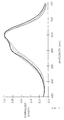
- Fig 1 shows the spectra obtained from the dyes generated in exposed and processed monochrome coatings of cyan coupler C-1 in solvent D with (or without) certain addenda.
- the thick solid line represents the spectrum from the coupler in solvent alone, i.e. with no additional addenda.
- the thin solid line represents the spectrum from the coupler with de-aggregating compound (I-1).
- the dotted line represents the spectrum from the coupler with an addendum (compound N) that is very similar in structure to a compound of formula (I), but without the intramolecular hydrogen-bonding.
- the dashed-dotted line represents the spectrum from the coupler with de-aggregating compound (I-3).
- the invention is described as in the Summary of the Invention and relates to the de-aggregation of dyes derived from certain pyrazolo-based heterocyclic couplers to provide a more accurate rendition of hues in photographic materials.
- alkyl refers to a saturated or unsaturated, straight or branched chain alkyl group including alkenyl and aralkyl, and includes cyclic groups, including cycloalkenyl, having 3-8 carbon atoms.
- aryl includes fused aryl.
- conjugated refers to a system where a sequence of three or more atoms exhibits delocalized bonding over three or more atoms. It is wholly conjugated if A is directly conjugated through L with Y. It is partially conjugated if both A and Y are individually conjugated to a third intermediate atom, or group, which forms part of L, but themselves are not directly conjugated with each other (see e.g. Chapter 2 "Cross Conjugation", p.33, J. March. Advanced Organic Chemistry: Reaction Mechanisms and Structure, Wiley Interscience, NY, NY (1992))."
- A is a hydrogen-bond-accepting hetero -atom or -group, such as a carbonyl, iminyl, sulfonyl, sulfinyl group or more preferably a nitrogen atom.
- (B) comprises the remaining atoms for completion of an unsubstituted or substituted heterocyclic ring, which is preferably a triazine, pyrimidine or pyridine, but which may also be, for example, a triazole or diazepine or a heterocyclic ring system such as a [5,5], [5,6] or [6,6] ring system, for example, a pyrazoloazole, azaindole or 1,8-diazanaphthalene ring system.
- an unsubstituted or substituted heterocyclic ring which is preferably a triazine, pyrimidine or pyridine, but which may also be, for example, a triazole or diazepine or a heterocyclic ring system such as a [5,5], [5,6] or [6,6] ring system, for example, a pyrazoloazole, azaindole or 1,8-diazanaphthalene ring system
- L is a linking group that is partially or wholly conjugated with A and linked to A by a carbon atom and may, for example, include a sulfonyl, sulfinyl or carbonyl group. More especially the linking group comprises one or more alkenyl groups which can complete an unsubstituted or substituted 5- to 10-membered ring system, which may contain one or more other heteroatoms selected from nitrogen, oxygen and sulfur, such as a phenyl, naphthyl, quinolinyl, pyridyl or benzimidazolyl ring system.
- Y is an atom or group that can provide intramolecular hydrogen-bonding with A and is selected, for example, from -O-, -NR, -NCOR, -NCONHR or -NSO 2 R, wherein R is an unsubstituted or substituted alkyl or aryl group, or -N-, wherein the nitrogen atom forms with L part of a 5- to 10-membered heterocyclic ring system, for example a benzimidazole or 2- or 4-pyridone ring.
- the de-aggregating compound has the formula (IA), wherein N is an aza nitrogen atom; L is selected from the class consisting of a sulfonyl, sulfinyl and carbonyl group and one or more alkenyl groups which form part of an unsubstituted or substituted 5- to 10-membered ring system, which may contain one or more other heteroatoms selected from nitrogen, oxygen and sulfur; (B) comprises the remaining atoms for completion of an unsubstituted or substituted 5- to 10-membered heterocyclic ring or ring system containing the hydrogen-bond-accepting hetero -atom or -group, which may contain one or more other heteroatoms selected from nitrogen, oxygen and sulfur; and Y and n are as defined for formula (I).
- N is an aza nitrogen atom
- L is selected from the class consisting of a sulfonyl, sulfinyl and carbonyl group and one or more alkenyl groups which form part of an unsubstit
- N completes the atoms of a 5-, 6- or 7-membered heterocyclic ring, more preferably a 6-membered ring.
- the de-aggregating compound has the formula (IB) wherein Z 1 to Z 4 are independently nitrogen atoms or unsubstituted or substituted carbon atoms, one or two adjacent pairs of which may each support an additional hydrogen-bond-containing moiety, each moiety being the same or different, such that n is 1, 2 or 3; provided that at least one of Z 1 to Z 4 is an unsubstituted or substituted carbon atom; L comprises one or more alkenyl groups which form part of an unsubstituted or substituted 5- to 10-membered ring system, which may contain one or more other heteroatoms selected from nitrogen, oxygen and sulfur; and Y is as defined for formula (I).
- Z 2 and Z 4 are unsubstituted or substituted carbon atoms and L is an optionally substituted phenyl group.
- the de-aggregating compound has the formula (IC) wherein R 1 and R 2 are independently hydrogen or a substituent; each R a is an independently selected substituent; m is 0 to 4; and Z 1 and Z 3 are independently nitrogen atoms or unsubstituted or substituted carbon atoms each of which together with an adjacent substituted carbon atom may support an additional hydrogen-bond-containing moiety, each moiety being the same or different, such that n is 1, 2 or 3; and Y is as defined for formula (I).
- IC wherein R 1 and R 2 are independently hydrogen or a substituent; each R a is an independently selected substituent; m is 0 to 4; and Z 1 and Z 3 are independently nitrogen atoms or unsubstituted or substituted carbon atoms each of which together with an adjacent substituted carbon atom may support an additional hydrogen-bond-containing moiety, each moiety being the same or different, such that n is 1, 2 or 3; and Y is as defined for formula (I).
- the hydrogen-bonding moieties may be the same or different.
- each Y may be different such that when, for example, n is 2 one of Y may be -O- and the other may be -NSO 2 R.
- each Y is -O-, Z 1 and Z 3 are both nitrogen atoms and n is 1 or 2, such that the de-aggregating compound has a formula (ID) or, more preferably (IE), wherein the hydrogen-bonding accepting capability of the de-aggregating compound is provided by the nitrogen atoms of a triazine nucleus and the hydroxyphenyl group(s) attached to one or two of the carbon atoms of the triazine moiety enable intramolecular hydrogen-bonding to occur.
- the presence of the two hydrogen bonds advantageously increases the planarity of the de-aggregating agents.
- R 1 , R 2 , R a and m are as defined for formula (IC); each R b is an independently selected substituent; and p is 0 to 4.
- substituents for R 1 , R 2 , each R a and each R b are independently selected from cyano, fluoro, chloro, bromo, iodo; or an unsubstituted or substituted alkyl, aryl, heterocyclyl, alkoxy, aryloxy, alkyl- or aryl-carbonyl, alkyl- or aryl-oxycarbonyl, acyloxy, carbdnamido, alkyl- or aryl-carbonamido, alkyl- or aryl-oxycarbonylamino, alkyl- or aryl-sulfonyl, alkyl- or aryl-sulfonyloxy, alkyl- or aryl-oxysulfonyl, alkyl- or aryl-sulfoxide, alkyl- or aryl-sulfamoyl, alkyl- or aryl-sulfamoyla
- an alkoxy group When one or more of the above groups is an alkoxy group it may suitably be substituted with, for example, one or more hydroxy and/or alkoxy groups, which may in turn be further substituted.
- An alkyl group may typically be substituted by halogen, or by a hydroxy, alkoxy, carbonamido or alkoxycarbonyl group.
- An aryl group may be, for example, a naphthyl group but more especially a phenyl ring and a heterocyclic group may be, for example, a pyridyl, thienyl, morpholino, imidazolyl or pyridazolyl ring.
- any of R 1 , R 2 and R a or R 1 , R a and R b may join to form a dimer or polymer.
- each R a and each R b is independently an unsubstituted or substituted alkyl, alkoxy, alkoxycarbonyl or alkylcarbamoyl group
- R 1 and R 2 are more preferably independently an alkyl group but more especially one of R 1 and R 2 is a phenyl group, optionally substituted for example with one or more halogen or alkoxy, alkyl, alkylsulfonamido or alkylsulfonyl groups, more preferably in the ortho and/or para positions, and these groups may be further substituted.
- m and p can be independently 0 to 4, preferably 0 to 2, more preferably 1 and, when present, is preferably para or more especially meta to Y.
- a compound of formula (I) is combined with a heterocyclic coupler of formula (II) having the structure: wherein R 1 is hydrogen or a substituent; R c is a substituent; q is 0 to 4; Z a represents the atoms necessary to complete an unsubstituted or substituted 5- to 10-membered heterocyclic ring system which may contain one or more other heteroatoms selected from nitrogen, oxygen and sulfur; providing that each R c is attached to a carbon atom of the ring; and X is selected from hydrogen or halogen or a group which is separable by the reaction of coupler with an oxidized colour developing agent.
- One embodiment of a compound of formula (II) has the formula (IIA) wherein R 1 and X are as defined for formula (II); Z 1 and Z 2 are independently -CH- groups, which may together form part of an unsubstituted or substituted phenyl ring, -CR- groups, wherein R is a substituent, or nitrogen atoms.
- Structures falling within formula (IIA) may, for example, be one of the following:- wherein each of R 1 to R 4 is hydrogen or an independently selected substituent; r is 0 to 4; and X is as defined for formula (II).
- the compound of formula (II) may have the structure (IIB) wherein one of Z 1 and Z 3 is a carbonyl or sulfonyl group and the other is a -CH- or -CR- group, wherein R is a substituent, or a nitrogen atom; Z 2 is a -CH- or -CR- group or a nitrogen atom; or Z 2 and the other of Z 1 and Z 3 may together form an unsubstituted or substituted aryl ring or a 5- to 10-membered heterocyclic ring which may contain one or more heteroatoms selected from nitrogen, oxygen and sulfur, which ring is unsubstituted or substituted.
- Structures falling within formula (IIB) may, for example, be one of the following:- wherein each of R 1 to R 3 is hydrogen or an independently selected substituent or R 2 and R 3 may join to form an unsubstituted or substituted aryl ring or a 5-to 10-membered heterocyclic ring which contains one or more heteroatoms selected from nitrogen, oxygen and sulfur, which ring is unsubstituted or substituted; and X is as defined for formula (II).
- a cyan coupler may have any of the above structures (a) to (j), with (a) being the preferred structure, but a magenta coupler will normally have either of the structures (b) or (d).
- a particular coupler is a cyan or magenta coupler is determined by the substituent groups present on the ring system, and in particular the R 1 substituent.
- the cyan and magenta couplers will have electron-withdrawing and electron-donating substituents respectively in the ring system. Appropriate combinations of R 1 to R 4 may result in dyes having a reddish or bluish colour.
- Substituents for R', R 2 , R 3 and R 4 may be independently selected from cyano, fluoro, chloro, bromo, iodo; or an unsubstituted or substituted alkyl, aryl, heterocyclyl, alkoxy, aryloxy, alkyl- or aryl-carbonyl, alkyl- or aryl-oxycarbonyl, acyloxy, carbonamido, alkyl- or aryl-carbonamido, alkyl- or aryl-oxycarbonylamino, alkyl- or aryl-sulfonyl, alkyl- or aryl-sulfonyloxy, alkyl- or aryl-oxysulfonyl, alkyl- or aryl-sulfoxide, alkyl- or aryl-sulfamoyl, alkyl- or aryl-sulfamoylamino, alkyl- or aryl-
- R 1 is selected from a cyano or an unsubstituted or substituted alkyl (including trifluoromethyl), aryl, alkyl- or aryl- sulfonyl, alkyl- or aryl-sulfonamido, alkyl- or aryl-carbonamido or alkyl- or aryl-amino group or R 1 may be a heterocyclyl group such as, for example, a pyridyl, thienyl, thiazolyl or benzothiazolyl group.
- R 1 is an alkyl- or aryl-carbonamido or an alkyl- or aryl-carbamoyl group substituted, for example, with an alkyl, alkoxy, aryl, or an aryloxy group, any of which may be further substituted.
- R 2 and R 3 are preferably independently selected from an alkyl, aryl, arylcarbamoyl, alkoxycarbonyl, alkylcarbonamido and trifluoromethyl group but one of R 2 and R 3 is more particularly a phenyl group optionally substituted, for example, with one or more halogen, alkyl, alkoxycarbonyl, alkylsulfamoyl, alkyl- or aryl-sulfonamido, alkylcarbonamido or alkylsulfonyl groups, any of which may be further substituted.
- R 2 and R 3 may join to form an unsubstituted or substituted phenyl ring and each R 4 may be independently, for example, a halogen or unsubstituted or substituted alkylsulfamoyl group.
- X is hydrogen or a coupling-off group, suitably a halogen atom or a group linked by an atom of sulfur, oxygen or nitrogen, such as an alkoxy, unsubstituted or substituted aryloxy, arylthio, azolyl, substituted mercaptotetrazole, or thiopropionic acid. Chloro groups are conveniently employed.
- Such groups determines the chemical equivalency of the coupler, i.e. whether it is a 2-equivalent or 4-equivalent coupler, and its particular identity can modify the reactivity of the coupler.
- Such groups can advantageously affect the layer in which the coupler is coated, or other layers in the photographic recording material, by performing, after release from the coupler, functions such as dye formation, dye hue adjustment, development acceleration or inhibition, bleach acceleration or inhibition, electron transfer facilitation and colour correction.
- coupling-off groups include, for example, halogen, alkoxy, aryloxy, heterocyclyloxy, sulfonyloxy, acyloxy, acyl, heterocyclyl, sulfonamido, heterocyclylthio, benzothiazolyl, phosophonyloxy, alkylthio, arylthio and arylazo.
- These coupling-off groups are described in the art, for example, in U.S. Patent Nos. 2,455,169, 3,227,551, 3,432,521, 3,467,563, 3,617,291, 3,880,661, 4,052,212 and 4,134,766; and in UK Patent Nos.
- the coupling-off group is a chlorine atom, hydrogen or a p-methoxyphenoxy group.
- substituent groups R 1 to R 4 , R c and X are selected so as to adequately ballast the coupler and the resulting dye in the organic solvent in which the coupler is dispersed.
- the ballasting may be accomplished by providing hydrophobic substituent groups in one or more of these substituent groups.
- a ballast group is an organic radical of such size and configuration as to confer on the coupler molecule sufficient bulk and aqueous insolubility as to render the coupler substantially nondiffusible from the layer in which it is coated in a photographic element.
- the combination of these substituent groups in the couplers for use in the invention are suitably chosen to meet these criteria.
- the ballast will usually contain at least 8 carbon atoms and typically contains 10 to 30 carbon atoms. Suitable ballasting may also be accomplished by providing a plurality of groups which in combination meet these criteria. Furthermore, even if the coupling-off group X contains a ballast it is often necessary to ballast the other substituents as well, since X is eliminated from the molecule upon coupling.
- substituent groups which may be substituted on molecules herein include any groups, whether substituted or unsubstituted, which do not destroy properties necessary for photographic utility.
- group When the term "group" is applied to the identification of a substituent containing a substitutable hydrogen, it is intended to encompass not only the substituent's unsubstituted form, but also its form further substituted with any group or groups as herein mentioned.
- the group may be halogen or may be bonded to the remainder of the molecule by an atom of carbon, silicon, oxygen, nitrogen, phosphorous or sulfur.
- the substituent may be, for example, halogen, such as chlorine, bromine or fluorine; nitro; hydroxyl; cyano; carboxyl; or groups which may be further substituted, such as alkyl, including straight or branched chain alkyl, such as methyl, trifluoromethyl, ethyl, t -butyl, 3-(2,4-di-t-pentylphenoxy) propyl and tetradecyl; alkenyl, such as ethylene, 2-butene; alkoxy, such as methoxy, ethoxy, propoxy, butoxy, 2-methoxyethoxy, sec -butoxy, hexyloxy, 2-ethylhexyloxy, tetradecyloxy, 2-(2,4-di- t -pentylphenoxy)ethoxy and 2-dodecyloxyethoxy; aryl such as phenyl, 4-t-butyl-phenyl, 2,4,
- substituents may themselves be further substituted one or more times with the described substituent groups.
- the particular substituents used may be selected by those skilled in the art to attain the desired photographic properties for a specific application and can include, for example, hydrophobic groups, solubilizing groups, blocking groups, releasing or releasable groups.
- the above groups and substituents thereof may include those having up to 48 carbon atoms, typically 1 to 36 carbon atoms and usually less than 24 carbon atoms, but greater numbers are possible depending on the particular substituents selected.
- ballast groups include alkyl, aryl, alkoxy, aryloxy, alkylthio, hydroxy, halogen, alkoxycarbonyl, aryloxycarbonyl, carboxy, acyl, acyloxy, amino, anilino, carbonamido, carbamoyl, alkylsulfonyl, arylsulfonyl, sulfonamido and sulfamoyl groups wherein the substituents typically contain 1 to 42 carbon atoms. Such substituents can also be further substituted.
- Embodiments of the invention exhibit reduction of low unwanted side-band absorption, providing a colour record having improved hue.
- the dispersion of the coupler(s), for use in the invention can be incorporated into the photographic element as emulsified photographic dispersions, prepared by dissolving the materials in one or more high-boiling permanent organic solvents, preferably, for example tributyl citrate, with or without a low-boiling or partially water-soluble auxiliary organic solvent.
- the solvent will be other than a phenol substituted at the para position with a nitrogen- or sulfur-bonded group.
- a blend of permanent solvents may be advantageous to optimise the desired features, such as solubility, dye hue, thermal or light stability or the coupling reactivity of the dispersions.
- the resulting organic solution may then be mixed with an aqueous gelatin solution and the mixture passed through a mechanical mixing device suitable for high-shear or turbulent mixing generally suitable for preparing photographic emulsified dispersions, as described in EP-A-1 037 103, incorporated herein by reference.
- the dispersion particles preferably have an average particle size of less than 2 ⁇ m, generally from about 0.02 to 2 ⁇ m, more preferably from about 0.02 to 0.5 ⁇ m, especially from about 0.02 to 0.3 ⁇ m.
- the aqueous phase of the coupler dispersion(s) for use in the invention preferably comprises gelatin as a hydrophilic colloid.
- gelatin may be gelatin or a modified gelatin such as acetylated gelatin, phthalated gelatin or oxidized gelatin.
- Gelatin may be base-processed, such as lime-processed gelatin, or may be acid-processed, such as acid-processed ossein gelatin.
- hydrophilic colloids may also be used, such as a water-soluble polymer or copolymer including, but not limited to poly(vinyl alcohol), partially hydrolyzed poly(vinyl acetate-co-vinyl alcohol), hydroxyethyl cellulose, poly(acrylic acid), poly(1-vinylpyrrolidone), poly(sodium styrene sulfonate), poly(2-acrylamido-2-methane sulfonic acid) and polyacrylamide. Copolymers of these polymers with hydrophobic monomers may also be used.
- a surfactant may be present in either the aqueous phase or the organic phase or the dispersions can be prepared without any surfactant present.
- Surfactants may be cationic, anionic, zwitterionic or non-ionic. Ratios of surfactant to liquid organic solution typically are in the range of 0.5 to 25wt.% for forming small particle photographic dispersions.
- an anionic surfactant is contained in the aqueous gelatin solution.
- Particularly preferred surfactants which are employed in the present invention include an alkali metal salt of an alkarylene sulfonic acid, such as the sodium salt of dodecyl benzene sulfonic acid or sodium salts of isopropylnaphthalene sulfonic acids, such as mixtures of di-isopropyl- and tri-isopropylnaphthalene sodium sulfonates; an alkali metal salt of an alkyl sulfuric acid, such as sodium dodecyl sulfate; or an alkali metal salt of an alkyl sulfosuccinate, such as sodium bis (2-ethylhexyl) succinic sulfonate.
- an alkali metal salt of an alkarylene sulfonic acid such as the sodium salt of dodecyl benzene sulfonic acid or sodium salts of isopropylnaphthalene sulfonic acids, such as mixtures of di
- Aqueous dispersions of high-boiling solvents can be prepared similarly to the coupler dispersion(s), e.g. by adding the solvent to an aqueous medium and subjecting such mixture to high shear or turbulent mixing as described above.
- the aqueous medium is preferably a gelatin solution, and surfactants may also be used as described above.
- a hydrophobic additive may be dissolved in the solvent to prevent particle growth as described in U.S. Patent No. 5,468,604, the disclosure of which is incorporated by reference.
- the mixture is then passed through a mechanical mixing device such as a colloid mill, homogenizer, microfluidizer, high-speed mixer or ultrasonic dispersing apparatus to form small particles of the organic solvent suspended in the aqueous phase.
- An aqueous coating solution in accordance with the present invention may then be prepared by combining the coupler dispersion(s) with the separate dispersion of the high-boiling organic solvent.
- Other ingredients may also be contained in this solution such as silver halide emulsions, dispersions or solutions of other photographically useful compounds, additional gelatin, or acids and bases to adjust the pH.
- These ingredients may then be mixed with a mechanical device at an elevated temperature (e.g. 30 to 50C) for a short period of time (e.g. 5 min to 4 h) prior to coating.
- the materials for use in the invention can be used in any of the ways and in any of the combinations known in the art.
- the materials are incorporated in a silver halide emulsion and the emulsion coated as a layer on a support to form part of a photographic element.
- they can be incorporated at a location adjacent to the silver halide emulsion layer where, during development, they will be in reactive association with development products such as oxidized colour developing agent.
- the term "associated" signifies that the compound is in the silver halide emulsion layer or in an adjacent location where, during processing, it is capable of reacting with silver halide development products.
- Suitable laydowns of total coupler are from about 0.05 mmol/m 2 to about 1.5 mmol/m 2 , preferably from about 0.15 mmol/m 2 to about 1 mmol/m 2 , more preferably from about 0.30 mmol/m 2 to about 1 mmol/m 2 .
- the molar ratio of de-aggregating compound of formula (I) to total coupler of formula (II) is from about 0.01:1 to about 4:1, preferably from about 0.25:1 to about 2:1, more preferably from about 0.4:1 to about 1.5:1.
- the ratio of solvent to total coupler (by weight) is from about 0.2:1 to about 5:1, preferably from about 0.5:1 to about 4:1, more preferably from about 0.5:1 to about 2:1.
- the photographic elements comprising coupler dispersion(s) for use in the invention can be single colour elements or multicolour elements.
- Multicolour elements contain image dye-forming units sensitive to each of the three primary regions of the spectrum. Each unit can comprise a single emulsion layer or multiple emulsion layers sensitive to a given region of the spectrum.
- the layers of the element, including the layers of the image-forming units, can be arranged in various orders as known in the art.
- the emulsions sensitive to each of the three primary regions of the spectrum can be disposed as a single segmented layer.
- a typical multicolour photographic element comprises a support bearing a cyan dye image-forming unit comprised of at least one red-sensitive silver halide emulsion layer having associated therewith at least one cyan dye-forming coupler, a magenta dye image-forming unit comprising at least one green-sensitive silver halide emulsion layer having associated therewith at least one magenta dye-forming coupler and a yellow dye image-forming unit comprising at least one blue-sensitive silver halide emulsion layer having associated therewith at least one yellow dye-forming coupler.
- the element can be employed with a reflective support, as described in U.S. Patent No. 5,866,282.
- the element can contain additional layers, such as filter layers, interlayers, overcoat layers and subbing layers.
- the photographic element can be used in conjunction with an applied magnetic layer as described in Research Disclosure, November 1992, Item 34390 published by Kenneth Mason Publications, Ltd., Dudley Annex, 12a North Street, Emsworth, Hampshire P010 7DQ, ENGLAND, and as described in Hatsumi Kyoukai Koukai Gihou No. 94-6023, published March 15, 1994, available from the Japanese Patent Office, the contents of which are incorporated herein by reference.
- Item 36230 provides suitable embodiments.
- the silver halide emulsion containing elements employed in this invention can be either negative-working or positive-working as indicated by the type of processing instructions (i.e. colour negative, reversal or direct positive processing) provided with the element.
- Suitable emulsions and their preparation as well as methods of chemical and spectral sensitization are described in Sections I through V.
- Various additives such as UV dyes, brighteners, antifoggants, stabilizers, light absorbing and scattering materials and physical property modifying addenda such as hardeners, coating aids, plasticizers, lubricants and matting agents are described, for example, in Sections II and VI through VIII. Colour materials are described in Sections X through XIII.
- Scan facilitating is described in Section XIV. Supports, exposure, development systems and processing methods and agents are described in Sections XV to XX. Certain desirable photographic elements and processing steps, particularly those useful in conjunction with colour reflective prints, are described in Research Disclosure, Item 37038, February 1995. US Patent No. 5,558,980 discloses loaded latex compositions, such as poly- and t-butyl-acrylamides which can be incorporated into any photographic coating in any layer to provide extra dye stability.
- Couplers that form cyan dyes upon reaction with oxidized colour developing agents are typically phenols, naphthols or pyrazoloazoles, described in such representative patents and publications as U.S. Patent Nos. 2,367,531, 2,423,730, 2,474,293, 2,772,162, 2,895,826, 3,002,836, 3,034,892, 3,041,236, 4,333,999 and 4,883,746, EP-A-0 544 322, EP-A-0 556 700, EP-A-0 556 777, EP-A- 0 565 096, EP-A-0 570 006 and EP-A-0 574 948 and "Farbkuppler-eine Literature litigation,” published in Agfa Mitanderen, Band III, pp. 156-175 (1961).
- Couplers that form magenta dyes upon reaction with oxidized colour developing agent are described in such representative patents and publications as: U.S. Patent Nos. 2,311,082, 2,343,703, 2,369,489, 2,600,788, 2,908,573, 3,062,653, 3,152,896, 3,519,429, 3,758,309, 4,540,654 and "Farbkuppler-eine Literature Ubersicht,” published in Agfa Mitannonen, Band III, pp. 126-156 (1961).
- couplers are pyrazolones, pyrazolotriazoles or pyrazolobenzimidazoles that form magenta dyes upon reaction with oxidized colour developing agents.
- Especially preferred couplers are 1H-pyrazolo [5,1-c]-1,2,4-triazole and 1H-pyrazolo [1,5-b]-1,2,4-triazole.
- Examples of 1H-pyrazolo [5,1-c]-1,2,4-triazole couplers are described in U.K. Patent Nos. 1,247,493, 1,252,418, 1,398,979, U.S. Patent Nos. 4,443,536, 4,514,490, 4,540,654, 4,590,153, 4,665,015, 4,822,730, 4,945,034, 5,017,465 and 5,023,170.
- Couplers that form yellow dyes upon reaction with oxidized colour developing agent are described in such representative patents and publications as: U.S. Patent Nos. 2,298,443, 2,407,210, 2,875,057, 3,048,194, 3,265,506, 3,447,928, 3,960,570, 4,022,620, 4,443,536, 4,910,126 and 5,340,703 and "Farbkuppler-eine Literature note", published in Agfa Mitannonen, Band III, pp. 112-126 (1961).
- Such couplers are typically open chain ketomethylene compounds.
- yellow couplers such as described in, for example, EP-A- 0 482 552, EP-A-0 510 535, EP-A-0 524 540, EP-A-0 543 367 and U.S. Patent No. 5,238,803.
- couplers which give yellow dyes that cut off sharply on the long wavelength side are particularly preferred (for example, see U.S. Patent No. 5,360,713).
- Typical preferred yellow couplers are represented by the following formulae: wherein R 1 , R 2 , Q 1 and Q 2 are each a substituent, X is hydrogen or a coupling-off group, Y is an aryl group or a heterocyclic group, Q 3 is an organic residue required to form a nitrogen-containing heterocyclic group together with the >N ⁇ , and Q 4 are nonmetallic atoms necessary to form a 3- to 5-membered hydrocarbon ring or a 3- to 5-membered heterocyclic ring which contains at least one hetero atom selected from nitrogen, oxygen, sulfur and phosphorous in the ring. Particularly preferred is when Q 1 and Q 2 are each an alkyl group, an aryl group or a heterocyclic group, and R 2 is an aryl or tertiary alkyl group.
- Preferred yellow couplers have the following structures:
- Couplers that form colourless products upon reaction with oxidized colour developing agent are described in such representative patents as: U.K. Patent No. 861,138, U.S. Patent Nos. 3,632,345, 3,928,041, 3,958,993 and 3,961,959.
- couplers are cyclic carbonyl-containing compounds that form colourless products on reaction with an oxidized colour developing agent.
- Couplers that form black dyes upon reaction with oxidized colour developing agent are described in such representative patents as U.S. Patent Nos. 1,939,231, 2,181,944, 2,333,106 and 4,126,461, German OLS No. 2,644,194 and German OLS No. 2,650,764.
- couplers are resorcinols or m-aminophenols that form black or neutral products on reaction with oxidized colour developing agent.
- Couplers of this type are described, for example, in U.S. Patent Nos. 5,026,628, 5,151,343 and 5,234,800.
- couplers any of which may contain known ballasts or coupling-off groups such as those described in U.S. Patent Nos. 4,301,235, 4,853,319 and 4,351,897.
- the coupler may contain solubilizing groups such as described in U.S. Patent No. 4,482,629.
- the coupler may also be used in association with "wrong" coloured couplers (e.g. to adjust levels of interlayer correction) and, in colour negative applications, with masking couplers such as those described in EP-A-0 213 490, Japanese Published Application 58-172,647, U.S. Patent Nos.
- the materials for use in the invention may be used in association with materials that accelerate or otherwise modify the processing steps e.g. of bleaching or fixing to improve the quality of the image.
- Bleach accelerator releasing couplers such as those described in EP-A-0 193 389; EP-A-0 301 477 and in U.S. Patent Nos. 4,163,669, 4,865,956 and 4,923,784, may be useful.
- Also contemplated is use of the compositions in association with nucleating agents, development accelerators or their precursors (UK Patent Nos. 2,097,140 and 2,131,188); electron transfer agents (U.S. Patent Nos.
- antifogging and anti colour-mixing agents such as derivatives of hydroquinones, aminophenols, amines, gallic acid; catechol; ascorbic acid; hydrazides; sulfonamidophenols and non colour-forming couplers.
- the materials for use in the invention may also be used in combination with filter dye layers comprising colloidal silver sol or yellow, cyan and/or magenta filter dyes, either as oil-in-water dispersions, latex dispersions or as solid particle dispersions. Additionally, they may be used with "smearing" couplers (e.g. as described in U.S. Patent Nos. 4,366,237, 4,420,556, 4,543,323 and in EP-A-0 096 570). Also, the compositions may be blocked or coated in protected form as described, for example, in Japanese Application 61/258,249 or U.S. Patent No. 5,019,492.
- the materials for use in the invention may further be used in combination with image-modifying compounds such as "Developer Inhibitor-Releasing” compounds (DIRs).
- DIRs useful in conjunction with the compositions of the invention are known in the art and examples are described in U.S. Patent Nos.
- DIR Couplers for Color Photography
- C.R. Barr J.R. Thirtle and P.W. Vittum in Photographic Science and Engineering, Vol.13, p.174 (1969)
- the developer inhibitor-releasing (DIR) couplers include a coupler moiety and an inhibitor coupling-off moiety (IN).
- the inhibitor-releasing couplers may be of the time-delayed type (DIAR couplers) which also include a timing moiety or chemical switch which produces a delayed release of inhibitor.
- inhibitor moieties are: oxazoles, thiazoles, diazoles, triazoles, oxadiazoles, thiadiazoles, oxathiazoles, thiatriazoles, benzotriazoles, tetrazoles, benzimidazoles, indazoles, isoindazoles, mercaptotetrazoles, selenotetrazoles, mercaptobenzothiazoles, selenobenzothiazoles, mercaptobenzoxazoles, selenobenzoxazoles, mercaptobenzimidazoles, selenobenzimidazoles, benzodiazoles, mercaptooxazoles, mercaptothiadiazoles, mercaptothiazoles, mercaptotriazoles, mercaptooxadiazoles, mercaptodiazoles, mercaptooxathiazoles, tellurotetrazoles or benzis
- the inhibitor moiety or group is selected from the following formulae: wherein R I is selected from the group consisting of straight and branched alkyl groups of from 1 to about 8 carbon atoms, benzyl, phenyl and alkoxy groups and such groups containing none, one or more than one such substituent, R II is selected from R I and -SR I , R III is a straight or branched alkyl group of from 1 to about 5 carbon atoms and m is from 1 to 3, and R IV is selected from the group consisting of hydrogen, halogens and alkoxy, phenyl and carbonamido groups, -COOR V and -NHCOOR V , wherein R V is selected from substituted and unsubstituted alkyl and aryl groups.
- the coupler moiety included in the developer inhibitor-releasing coupler forms an image dye corresponding to the layer in which it is located, it may also form a different colour as one associated with a different film layer. It may also be useful that the coupler moiety included in the developer inhibitor-releasing coupler forms colourless products and/or products that wash out of the photographic material during processing (so-called "universal" couplers).
- the developer inhibitor-releasing coupler may include a timing group, which produces the time-delayed release of the inhibitor group, such as groups using an intramolecular nucleophilic substitution reaction (U.S. Patent No. 4,248,962); groups utilizing an electron transfer reaction along a conjugated system (U.S. Patent Nos. 4,409,323, 4,421,845 and 4,861,701 and Japanese Applications 57-188035; 58-98728; 58-209736; 58-209738); groups utilizing ester hydrolysis (German Patent Application (OLS) No. 2,626,315); groups that function as a coupler or reducing agent after the coupler reaction (U.S. Patent Nos.
- a timing group which produces the time-delayed release of the inhibitor group, such as groups using an intramolecular nucleophilic substitution reaction (U.S. Patent No. 4,248,962); groups utilizing an electron transfer reaction along a conjugated system (U.S. Patent Nos. 4,409,323, 4,421,845
- timing group is of one of the formulae: wherein IN is the inhibitor moiety, Z is selected from the group consisting of nitro, cyano, alkylsulfonyl, sulfamoyl (-SO 2 NR 2 ) and sulfonamido (-NRSO 2 R) groups, n is 0 or 1, and R VI is selected from the group consisting of substituted and unsubstituted alkyl and phenyl groups.
- the oxygen atom of each timing group is bonded to the coupling-off position of the respective coupler moiety of the DIAR.
- the timing or linking groups may also function by electron transfer down an unconjugated chain.
- Linking groups are known in the art under various names. Often they have been referred to as groups capable of utilizing a hemiacetal or iminoketal cleavage reaction or as groups capable of utilizing a cleavage reaction due to ester hydrolysis such as U.S. Patent No. 4,546,073.
- This electron transfer down an unconjugated chain typically results in a relatively fast decomposition and the production of carbon dioxide, formaldehyde or other low molecular weight by-products.
- the groups are exemplified in EP-A-0 464 612, EP-A-0 523 451, U.S. Patent No. 4,146,396 and Japanese Kokai 60-249148 and 60-249149.
- Suitable developer inhibitor-releasing couplers that may be included in photographic light sensitive emulsion layer include, but are not limited to, the following:
- the concepts of the present invention may be employed to obtain reflection colour prints as described in Research Disclosure, November 1979, Item 18716, available from Kenneth Mason Publications, Ltd, Dudley Annex, 12a North Street, Emsworth, Hampshire P0101 7DQ, England, incorporated herein by reference.
- Materials of the invention may be coated on pH adjusted support as described in U.S. Patent No. 4,917,994, on a support with reduced oxygen permeability (EP-A-0 553 339), with epoxy solvents (EP-A-0 164 961), with nickel complex stabilizers (U.S. Patent Nos. 4,346,165, 4,540,653 and 4,906,559 for example), with ballasted chelating agents such as those in U.S.
- Other compounds useful in combination with the invention are disclosed in Japanese Published Applications described in Derwent Abstracts having accession numbers as follows: 90-072,629, 90-072,630, 90-072,631, 90-072,632, 90-072,633, 90-072,634, 90-077,822, 90-078,229, 90-078,230, 90-079,336, 90-079,337, 90-079,338, 90-079,690, 90-079,691, 90-080,487, 90-080,488, 90-080,489, 90-080,490, 90-080,491, 90-080,492, 90-080,494, 90-085,928, 90-086,669, 90-086,670, 90-087,360, 90-087,361, 90-087,362, 90-087,363, 90-087,36
- any silver halide combination can be used for the photographic element, such as silver chloride, silver chlorobromide, silver chlorobromoiodide, silver bromide, silver bromoiodide or silver chloroiodide.
- the minor component may be added in the crystal formation or after formation as part of the sensitization or melting.
- the shape of the silver halide emulsion grain can be cubic, pseudo-cubic, octahedral, tetradecahedral or tabular.
- the emulsions may be precipitated in any suitable environment such as a ripening environment, a reducing environment or an oxidizing environment.
- Emulsion precipitation is conducted in the presence of silver ions, halide ions and in an aqueous dispersing medium including, at least during grain growth, a peptizer. Grain structure and properties can be selected by control of precipitation temperatures, pH and the relative proportions of silver and halide ions in the dispersing medium. To avoid fog, precipitation is customarily conducted on the halide side of the equivalence point (the point at which silver and halide ion activities are equal). Manipulations of these basic parameters are illustrated by the citations including emulsion precipitation descriptions and are further illustrated by Matsuzaka et al U.S. Patent No. 4,497,895, Yagi et al U.S. Patent No.
- Reducing agents present in the dispersing medium during precipitation can be employed to increase the sensitivity of the grains, as illustrated by Takada et al U.S. Patent No. 5,061,614, Takada U.S. Patent No. 5,079,138 and EP-A-0 434 012, Inoue U.S. Patent No. 5,185,241, Yamashita et al EP-A-0 369 491, Ohashi et al EP-A- 0 371 338, Katsumi EP-A-0 435 270 and EP-A-0 435 355 and Shibayama EP-A-0 438 791.
- oxidizing agents may be present during precipitation, used as a pre-treatment of the dispersing medium (gelatin) or added to the emulsion after grain formation before or during sensitization, in order to improve the sensitivity/fog position of the silver halide emulsion or minimize residual ripening agent, as illustrated by Komatsu et al JP 56-167393 and JP 59-195232, Mifune et al EP-A-0 144 990 and EP-A-0 166 347.
- Chemically sensitized core grains can serve as hosts for the precipitation of shells, as illustrated by Porter et al U.S. Patent Nos. 3,206,313 and 3,327,322, Evans U.S. Patent No. 3,761,276, Atwell et al U.S. Patent No. 4,035,185 and Evans et al U.S. Patent No. 4,504,570.
- Periods 3-7 ions including Group VIII metal ions (Fe, Co, Ni and platinum metals (pm) Ru, Rh, Pd, Re, Os, Ir and Pt), Mg, Al, Ca, Sc, Ti, V, Cr, Mn, Cu Zn, Ga, As, Se, Sr, Y, Mo, Zr, Nb, Cd, In, Sn, Sb, Ba, La, W, Au, Hg, Tl, Pb, Bi, Ce and U can be introduced during precipitation.
- Group VIII metal ions Fe, Co, Ni and platinum metals (pm) Ru, Rh, Pd, Re, Os, Ir and Pt
- Mg Al, Ca, Sc, Ti, V, Cr, Mn, Cu Zn, Ga, As, Se, Sr, Y, Mo, Zr, Nb, Cd, In, Sn, Sb, Ba, La, W, Au, Hg, Tl, Pb, Bi, Ce and U can be introduced during precipitation.
- the dopants can be employed (a) to increase the sensitivity of either (a1) direct positive- or (a2) negative-working emulsions, (b) to reduce (b1) high or (b2) low intensity reciprocity failure, (c) to (c1) increase, (c2) decrease or (c3) reduce the variation of contrast, (d) to reduce pressure sensitivity, (e) to decrease dye desensitization, (f) to increase stability, (g) to reduce minimum density, (h) to increase maximum density, (i) to improve room light handling and (j) to enhance latent image formation in response to shorter wavelength (e.g. X-ray or gamma radiation) exposures.
- any polyvalent metal ion (pvmi) is effective.
- Dopants can be added in conjunction with addenda, antifoggants, dye and stabilizers either during precipitation of the grains or post precipitation, possibly with halide ion addition. These methods may result in dopant deposits near or in a slightly subsurface fashion, possibly with modified emulsion effects, as illustrated by Ihama et al U.S. Patent No. 4,693,965, Shiba et al U.S. Patent No. 3,790,390, Habu et al U.S. Patent No. 4,147,542, Hasebe et al EP-A-0 273 430, Ohshima et al EP-A-0 312 999 and Ogawa U.S. Statutory Invention Registration H760.
- Desensitizing, contrast increasing or reciprocity failure reducing ions or complexes are typically dopants which function to trap photogenerated holes or electrons by introducing additional energy levels deep within the bandgap of the host material.
- Examples include, but are not limited to, simple salts and complexes of Groups 8-10 transition metals (e.g. rhodium, iridium, cobalt, ruthenium, and osmium) and transition metal complexes containing nitrosyl or thionitrosyl ligands as described by McDugle et al U.S. Patent No. 4,933,272.
- K 3 RhCl 6 (NH 4 ) 2 Rh(Cl 5 )H 2 O, K 2 IrCl 6 , K 3 TiCl 6 , K 2 IrBr 6 , K 2 IrBr 6 , K 2 RuCl 6 , K 2 Ru(NO)Br 5 , K 2 Ru(NS)Br 5 , K 2 OsCl 6 , Cs 2 Os(NO)Cl 5 and K 2 Os(NS)Cl 5 .
- Amine, oxalate, and organic ligand complexes or ions of these or other metals as disclosed in Olm et al U.S. Patent Nos.
- M is filled frontier orbital polyvalent metal ion, preferably Fe +2 , Ru +2 , Os +2 , Co +3 , Rh +3 , Ir +3 , Pd +4 , Pt +4 ;
- L 6 represents six coordination complex ligands which can be independently selected, provided that least four of the ligands are anionic ligands and at least one (preferably at least 3 and optimally at least 4) of the ligands is more electro-negative than any halide ligand and n is -2, -3 or -4.
- the dopants are effective in conventional concentrations, where concentrations are based on the total silver, including both the silver in the grains and the silver in epitaxial protrusions.
- shallow electron trap forming dopants are contemplated to be incorporated in concentrations of at least 1x10 -8 mol per silver mol up to their solubility limit, typically up to about 10 -3 mol per silver mol.
- Preferred concentrations are in the range of from about 10 -6 to 10 -4 mol per silver mol.
- preferred concentrations of shallow electron traps may approach 10 -8 to 10 -7 mol per silver mol.
- Combinations of deep and shallow electron trapping dopants may be used to increase contrast as taught by MacIntyre and Bell in US Patent No. 5,597,686 and by Bell in U.S. Patent Nos. 5,252,451, 5,256,530, 5,385,817, 5,474,888, 5,480,771 and 5,500,335. It is, of course, possible to distribute the dopant so that a portion of it is incorporated in grains and the remainder is incorporated in the silver halide epitaxial protrusions.
- Emulsion addenda that adsorb to grain surfaces, such as antifoggants, stabilizers and dyes can also be added to the emulsions during precipitation.
- Precipitation in the presence of spectral sensitizing dyes is illustrated by Locker U.S. Patent 4,183,756, Locker et al U.S. Patent No. 4,225,666, Ihama et al U.S. Patent Nos. 4,683,193 and 4,828,972, Takagi et al U.S. Patent No. 4,912,017, Ishiguro et al U.S. Patent No. 4,983,508, Nakayama et al U.S. Patent No. 4,996,140, Steiger U.S. Patent No.
- Chemical sensitization of the materials in this photographic element is accomplished by any of a variety of known chemical sensitizers.
- the emulsions described herein may or may not have other addenda such as sensitizing dyes, supersensitizers, emulsion ripeners, gelatin or halide conversion restrainers present before, during or after the addition of chemical sensitization.
- Sulfur sensitizers may include thiosulfate, thiocyanate, N , N' -carbothioyl-bis ( N -methylglycine) or 1,3-dicarboxymethyl-1,3-dimethyl-2-thiourea sodium salt.
- Tetrazaindenes such as 4-hydroxy-6-methyl-(1,3,3a,7)-tetrazaindene, are commonly used as stabilizers.
- mercaptotetrazoles such as 1-phenyl-5-mercaptotetrazole or acetamido-1-phenyl-5-mercaptotetrazole.
- Arylthiosulfonates such as tolylthiosulfonate (optionally used with arylsulfinates such as tolylsulfinate) or esters thereof are especially useful (e.g. U.S. Patent No. 4,960,689).
- the use of water-soluble disulfides is illustrated in U.S. Patent No. 5,830,631.
- the average useful ECD of photographic emulsions can range up to about 10 micrometers, although in practice emulsion ECDs seldom exceed about 4 micrometers. Since both photographic speed and granularity increase with increasing ECDs, it is generally preferred to employ the smallest tabular grain ECDs compatible with achieving aim speed requirements.
- Emulsion tabularity increases markedly with reductions in tabular grain thickness. It is generally preferred that aim tabular grain projected areas be satisfied by thin (t ⁇ 0.2 micrometer) tabular grains. To achieve the lowest levels of granularity it is preferred that aim tabular grain projected areas be satisfied with ultrathin (t ⁇ 0.06 micrometer) tabular grains. Tabular grain thicknesses typically range down to about 0.02 micrometer. However, still lower tabular grain thicknesses are contemplated. For example, Daubendiek et al U.S. Patent No. 4,672,027 reports a 3 mol percent iodide tabular grain silver bromoiodide emulsion having a grain thickness of 0.017 micrometer. Ultrathin tabular grain high chloride emulsions are disclosed by Maskasky in U.S. Patent No. 5,217,858.
- tabular grains of less than the specified thickness account for at least 50 percent of the total grain projected area of the emulsion.
- tabular grains satisfying the stated thickness criterion account for the highest conveniently attainable percentage of the total grain projected area of the emulsion.
- tabular grains satisfying the stated thickness criteria above account for at least 70 percent of the total grain projected area.
- tabular grains satisfying the thickness criteria above account for at least 90 percent of total grain projected area.
- Suitable tabular grain emulsions can be selected from among a variety of conventional teachings, such as those of the following: Research Disclosure, Item 22534, January 1983, published by Kenneth Mason Publications, Ltd., Emsworth, Hampshire P010 7DD, England; U.S. Patent Nos.
- the emulsions can be surface-sensitive emulsions, i.e. emulsions that form latent images primarily on the surfaces of the silver halide grains, or the emulsions can form internal latent images predominantly in the interior of the silver halide grains.
- the emulsions can be negative-working emulsions, such as surface-sensitive emulsions or unfogged internal latent image-forming emulsions, or direct-positive emulsions of the unfogged, internal latent image-forming type, which are positive-working when development is conducted with uniform light exposure or in the presence of a nucleating agent.
- Photographic elements can be exposed to actinic radiation, typically in the visible region of the spectrum, to form a latent image and can then be processed to form a visible dye image.
- Processing to form a visible dye image includes the step of contacting the element with a colour developing agent to reduce developable silver halide and oxidize the colour developing agent. Oxidized colour developing agent in turn reacts with the coupler to yield a dye.
- the processing step described above provides a negative image.
- the described elements can be processed in the known Kodak C-41TM colour process as described in The British Journal of Photography Annual of 1988, pp 191-198. Where applicable, the element may be processed in accordance with colour print processes such as the RA-4TM process of Eastman Kodak Company as described in the British Journal of Photography Annual of 1988, pp 198-199.
- Such negative working emulsions are typically sold with instructions to process using a colour negative method such as the C-41TM or RA-4TM process.
- the colour development step can be preceded by development with a non-chromogenic developing agent to develop exposed silver halide, but not form dye, and followed by uniformly fogging the element to render unexposed silver halide developable.
- a non-chromogenic developing agent to develop exposed silver halide, but not form dye
- uniformly fogging the element to render unexposed silver halide developable Such reversal emulsions are typically sold with instructions to process using a colour reversal process such as E-6TM.
- a direct positive emulsion can be employed to obtain a positive image.
- the multicolour photographic elements of the invention may be processed alternatively in a developer solution that will provide reduced processing times of one minute or less (dry to dry), and particularly reduced colour development times of less than about 25 seconds, such that all colour records are fully developed with aim sensitometry.
- Preferred colour developing agents are p-phenylenediamines such as:
- Development is usually followed by the conventional steps of bleaching, fixing or bleach-fixing, to remove silver or silver halide, washing and drying.
- the coupler dispersions may be coated with emulsions to form photographic elements at very low levels of silver (less than 100 mg/m 2 ). Reasons for doing this include reducing cost, reducing the thickness of silver halide emulsion layers to gain sharpness advantages and reducing the environmental impact during and after processing.
- One class of low silver photographic material is colour material intended for redox amplification processes wherein the developed silver acts as a catalyst to the formation of the dye image.
- This process can take place in a low volume thin processor, such as a low volume thin tank (LVTT), for example, as disclosed in U.S. Patent No. 5,436,118.
- LVTT low volume thin tank
- Redox amplification processes have been described for example in GB Patent Nos. 1,268,126, 1,399,481, 1,403,418, 1,560,572 and U.S. Patent Nos. 3,748,138, 3,822,129 and 4,097,278.
- colour materials are developed to produce a silver image (which may contain only small amounts of silver) and are then treated with a redox amplifying solution (or a combined developer-amplifier) to form a dye image.
- the triazine compounds of formula (I) may be prepared by methods well documented in the chemical and patent literature. Particularly useful are the methods disclosed in Swiss Patent No. 484, 695, EP-A-0 165 608, EP-A-0 779 280, EP-A-0 941 989 and US Patent Nos. 6, 284,821 and 6, 297,378.
- the schemes in Examples 1 and 2 taken from these references outline general synthetic methods for the preparation of the triazine compounds from readily available starting materials, such as cyanuric chloride, resorcinol and m-xylene.
- the cyan couplers of formula (IIA) (a) and (b) may be prepared according to the methods described in EP-A-0 744 655 and EP-A-0 802 454.
- the magenta couplers of formula (IIA) (b) may be synthesised as described in EP-A-0 119 860 and US Patent No. 5,451,501, whilst the cyan and magenta couplers of formula (IIA) (d) may be prepared as described in US Patent Nos. 4,916,051 and 5,776,669 respectively.
- the cyan couplers of formula (IIA) (c) may be synthesised according to the method described in EP-A-0 269 436 whilst those of formula (IIB) (e), (f) and (i) may be prepared as described in US Patent No. 4,950,585.
- the cyan couplers of formula (IIB) (g) and (h) may be prepared according to the syntheses described in EP-A-0 398 664 and JP 04125557 respectively and those of formula (IIB) (j) as disclosed in US Patent No. 4,970,142.
- the key intermediate 2,4,6-tris(2,4-dihydroxyphenyl)-1,3,5-triazine is prepared by the method given in H. Brunetti and C.E. Luthi, Helv.Chim.Acta, 1972, 55 , 1566.
- Resorcinol is reacted with cyanuric chloride in the presence of a Friedel-Crafts catalyst such as aluminium (III) chloride in an aprotic solvent such as sulfolane or nitrobenzene.
- aprotic solvent such as sulfolane or nitrobenzene.
- the tris-hydroxyphenyl triazine intermediate is then alkylated to give a product with the desired number of free 2-hydroxyphenyl substituents on the triazine ring (i.e.
- Suitable alkylating agents are alkyl halides, dialkyl sulfates, alkyl toluenesulfonates or dialkylalkane phosphonates.
- the reaction is usually carried out in an organic solvent such as 2-methoxyethanol, diglyme or dimethylformamide in the presence of an inorganic base, such as an alkali metal carbonate or hydroxide.
- Cyanuric chloride undergoes a Friedel-Crafts reaction with two equivalents of m-xylene in the presence of aluminium (III) chloride in a suitable inert solvent such as dichlorobenzene.
- a suitable inert solvent such as dichlorobenzene.
- the remaining active chlorine atom of the triazine intermediate so obtained is then replaced by resorcinol and the resulting product alkylated in an analogous manner to the compounds described in Scheme A.
- a typical coupler solution was prepared by heating to 75C mixtures of a coupler of formula (II) and a solvent, added at a 1:1 ratio by weight, to which was added ethyl acetate (at a 3:1 ratio to coupler). Other addenda were also added at a 1:1 ratio to coupler.
- Gelatin solutions made from decalcified gelatin in demineralised water and a 10% solution of surfactant Alkanol XCTM were heated at 60C.
- a light-sensitive photographic multilayer coating was made to the following format shown in TABLE 1 below.
- the cyan dye-forming dispersions were incorporated in layer 1.
- Structure of Photographic Element Layer Component Coverage Layer 3 Gelatin 1.00 g/m 2 Layer 2 (UV light-absorbing layer) Gelatin 0.60 g/m 2 UV light-absorbing agents: (UV-A:UV-B 0.85:0.15) 0.24 g/m 2 Stain prevention agent, J 65.69 mg/m 2 Solvent for UV-absorbing agents, F 79.93 mg/m 2 Hardener, K 0.11 g/m 2 Layer 1 (Red-sensitive layer) Gelatin 1.62 g/m 2 Silver chloride emulsion 0.20 g Ag/m 2 Coupler(s) 0.83 mmol/m 2 Support Gelatin over polyethylene laminated paper base 3.00 g/m 2
- Processed samples were prepared by exposing the coatings through a step tablet (density range 0-3, 0.15inc.) and developed for 0.1s and processed through a Kodak Process RA-4TM as follows. Process Step Time(min.) Tem.(C) Developer 0.75 35.0 Bleach-Fix 0.75 35.0 Water wash 1.50 35.0
- the processing solutions used in the above process had the following compositions (amounts/litre solution): Developer Triethanolamine 12.41g Blankophor REUTM 2.30g Lithium polystyrene sulfonate 0.09g N,N-Diethylhydroxylamine 4.59g Lithium sulfate 2.70g Developing agent, Dev-1 5.00g 1-Hydroxyethyl-1,1-diphosphonic acid 0.49g Potassium carbonate, anhydrous 21.16g Potassium chloride 1.60g Potassium bromide pH adjusted to 10.4 at 26.7C 7.00mg Bleach-Fix Solution of ammonium thiosulfate 71.85g Ammonium sulfite 5.10g Sodium metabisulfite 10.00g Acetic acid 10.20g Ammonium ferric ethylenediaminetetraacetate 48.58g Ethylenediaminetetraacetic acid pH adjusted to 6.7 at 26.7C 3.86g
- the reflectance spectra of the image dyes of the exposed and processed samples were measured and normalised to a maximum absorption of 1.00. From these spectra the following parameters were recorded: the wavelength at maximum absorption, ⁇ max ; the half-bandwidth of each spectrum, HBW; the wavelength at the midpoint position of the half-bandwidth, ⁇ mid and unwanted green absorption in the normalised spectrum of each cyan dye, i.e. the density at 530nm (D 530 ). A lower value indicated less unwanted green absorption, which was preferable. A narrower half-bandwidth combined with a higher value for ⁇ mid indicated less aggregation in the dye. The spectral values for each coupler are shown in the Tables below.
- the comparative material used is a triazinetrione with many features similar to those of the materials of the invention but, like the hydroxybenzotriazole, this compound made aggregation worse.
- the comparative material is a fully-blocked triazine material closely related to the inventive compounds I-1 and I-3 but, because this material does not de-aggregate the dye, it in fact makes aggregation worse, when compared with Element 101.
- Example 4 This study was extended to other cyan couplers of similar structure to observe the de-aggregation effects of the compounds of the invention.
- the elements in Example 4 were made up in the same way as those described in Example 3.
- Example 5 This study was extended to 2-equivalent cyan pyrazolotriazoles to observe the de-aggregation effects of the compounds of the invention.
- the elements in Example 5 were made up in the same way as those described in Example 3, except that a silver laydown of 0.10 g/m 2 was used instead.
- a typical coupler solution was prepared by heating to 75C mixtures of a coupler of formula (III) and a solvent, added at the ratio (by weight) shown in TABLE 6, below. Other addenda were also added at a 1:1 ratio to coupler.
- Gelatin solutions made from decalcified gelatin in demineralised water and a 10% solution of surfactant Alkanol XCTM were heated at 60C.
- a light-sensitive photographic multilayer coating was made to the following format shown in TABLE 5. The magenta dye-forming dispersions were incorporated in layer 1. The coatings were exposed and processed as described in Example 3. Structure of Photographic Element Layer Component Coverage Layer 3 Gelatin 1.00 g/m 2 Layer 2 (UV light-absorbing layer) Gelatin 0.60 g/m 2 UV light-absorbing agents: (UV-A:UV-B 0.85:0.15) 0.24 g/m 2 Stain prevention agent, J 65.69 mg/m 2 Solvent for UV-absorbing agents, F 79.93 mg/m 2 Hardener, K 0.11 g/m 2 Layer 1 (Green-sensitive layer) Gelatin 1.62 g/m 2 Silver chloride emulsion 0.098 g Ag/m 2 Coupler(s) 0.43 mmol/m 2 Support Gelatin over polyethylene laminated paper base 3.00 g/m 2
- the reflectance spectra of the image dyes of the exposed and processed samples were measured and normalised to a maximum absorption of 1.00. From these spectra the following parameters were recorded: the wavelength at maximum absorption, ⁇ max ; the half-bandwidth of each spectrum, HBW; a measure of the unwanted blue absorption in the normalised spectrum of each magenta dye i.e. the density at 448nm (D 448 ).
- the azomethine dyes of this class of coupler typically show a shoulder in their spectra due to the aggregate at around 500nm, so the density values at 499nm (D 499 ) are a measure of the unwanted absorption due to the aggregate in the normalised spectrum of the magenta dye.
- the effect of the compounds used in the invention was observed on the dyes derived from pyrazolobenzimidazole couplers.
- This class of coupler form dyes whose spectra have very broad bandwidths, largely due to aggregation.
- Neither of the two couplers used in this example had perfect magenta dye hues, but the example illustrates the de-aggregating properties of the materials of the invention.
- a light-sensitive photographic multilayer coating was made to the following format shown in TABLE 7 below.
- the magenta dye-forming dispersions were incorporated in layer 1.
- Structure of Photographic Element Layer Component Coverage Layer 3 Gelatin 1.00 g/m 2 Layer 2 (UV light-absorbing layer) Gelatin 0.60 g/m 2 UV light-absorbing agents: (UV-A:UV-B 0.85:0.15) 0.24 g/m 2 Stain prevention agent, J 65.69 mg/m 2 Solvent for UV absorbing agents, F 79.93 mg/m 2 Hardener, K 0.11 g/m 2 Layer 1 (Green-sensitive layer) Gelatin 1.62 g/m 2 Silver chloride emulsion 0.180 g Ag/m 2 Coupler(s) 0.53 mol/m 2 Support Gelatin over polyethylene laminated paper base 3.00 g/m 2
- the coatings were exposed and processed as described in Example 3 and measurements were taken from normalised spectra as outlined above.
Landscapes
- Physics & Mathematics (AREA)
- General Physics & Mathematics (AREA)
- Nitrogen Condensed Heterocyclic Rings (AREA)
- Silver Salt Photography Or Processing Solution Therefor (AREA)
- Plural Heterocyclic Compounds (AREA)
Abstract
wherein
the de-aggregating compound has the formula (I)

A is a hydrogen-bond-accepting hetero -atom or -group;
Y is a hydrogen-bond-donating hetero -atom or -group;
L is a linking group that is partially or wholly conjugated with A and linked to A by a carbon atom;
n is 1, 2 or 3 hydrogen-bond-containing moieties; and
(B) comprises the remaining atoms for completion of an unsubstituted or substituted heterocyclic ring or ring system containing the hydrogen bond-accepting hetero -atom or -group, which may contain one or more other heteroatoms selected from nitrogen, oxygen and sulfur; and
wherein
the heterocyclic dye-forming coupler has the formula (II):-
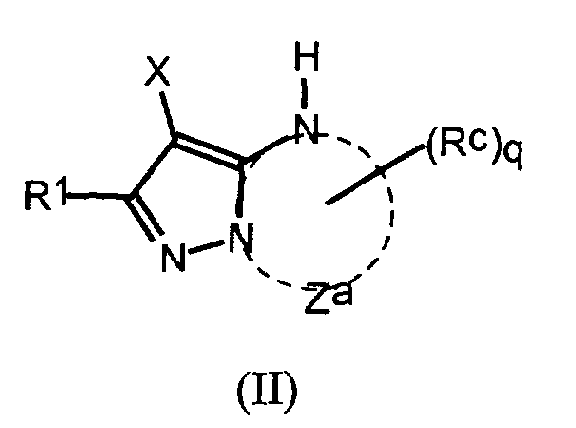
R1 is hydrogen or a substituent;
Rc is a substituent; and
q is0to 4;
Za represents the atoms necessary to complete an unsubstituted or substituted 5- to 10-membered heterocyclic ring system which may contain one or more other heteroatoms selected from nitrogen, oxygen and sulfur;
providing that each Rc is attached to a carbon atom of the ring; and
X is selected from hydrogen or halogen or a group which is separable by the reaction of coupler with an oxidized colour developing agent.
Description
wherein
the de-aggregating compound has the formula (I)

A is a hydrogen-bond-accepting hetero -atom or -group;
Y is a hydrogen-bond-donating hetero -atom or -group;
L is a linking group that is partially or wholly conjugated with A and linked to A by a carbon atom;
n is 1, 2 or 3 hydrogen-bond-containing moieties; and
(B) comprises the remaining atoms for completion of an unsubstituted or substituted heterocyclic ring or ring system containing the hydrogen bond-accepting hetero -atom or -group, which may contain one or more other heteroatoms selected from nitrogen, oxygen and sulfur; and
wherein
the heterocyclic dye-forming coupler has the formula (II):-

R1 is hydrogen or a substituent;
Rc is a substituent; and
q is 0 to 4;
Za represents the atoms necessary to complete an unsubstituted or substituted 5- to 10-membered heterocyclic ring system which may contain one or more other heteroatoms selected from nitrogen, oxygen and sulfur;
providing that each Rc is attached to a carbon atom of the ring; and
X is selected from hydrogen or halogen or a group which is separable by the reaction of coupler with an oxidized colour developing agent.

N is an aza nitrogen atom;
L is selected from the class consisting of a sulfonyl, sulfinyl and carbonyl group and one or more alkenyl groups which form part of an unsubstituted or substituted 5- to 10-membered ring system, which may contain one or more other heteroatoms selected from nitrogen, oxygen and sulfur;
(B) comprises the remaining atoms for completion of an unsubstituted or substituted 5- to 10-membered heterocyclic ring or ring system containing the hydrogen-bond-accepting hetero -atom or -group, which may contain one or more other heteroatoms selected from nitrogen, oxygen and sulfur; and
Y and n are as defined for formula (I).

Z1 to Z4 are independently nitrogen atoms or unsubstituted or substituted carbon atoms, one or two adjacent pairs of which may each support an additional hydrogen-bond-containing moiety, each moiety being the same or different, such that n is 1, 2 or 3;
provided that at least one of Z1 to Z4 is an unsubstituted or substituted carbon atom;
L comprises one or more alkenyl groups which form part of an unsubstituted or substituted 5- to 10-membered ring system, which may contain one or more other heteroatoms selected from nitrogen, oxygen and sulfur; and
Y is as defined for formula (I).
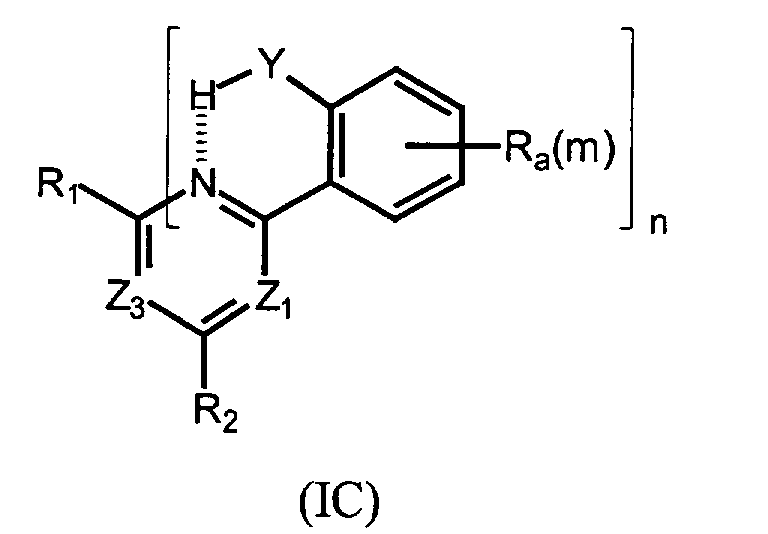
R1 and R2 are independently hydrogen or a substituent;
each Ra is an independently selected substituent;
m is 0 to 4; and
Z1 and Z3 are independently nitrogen atoms or unsubstituted or substituted carbon atoms each of which together with an adjacent substituted carbon atom may support an additional hydrogen-bond-containing moiety, each moiety being the same or different, such that n is 1, 2 or 3; and
Y is as defined for formula (I).
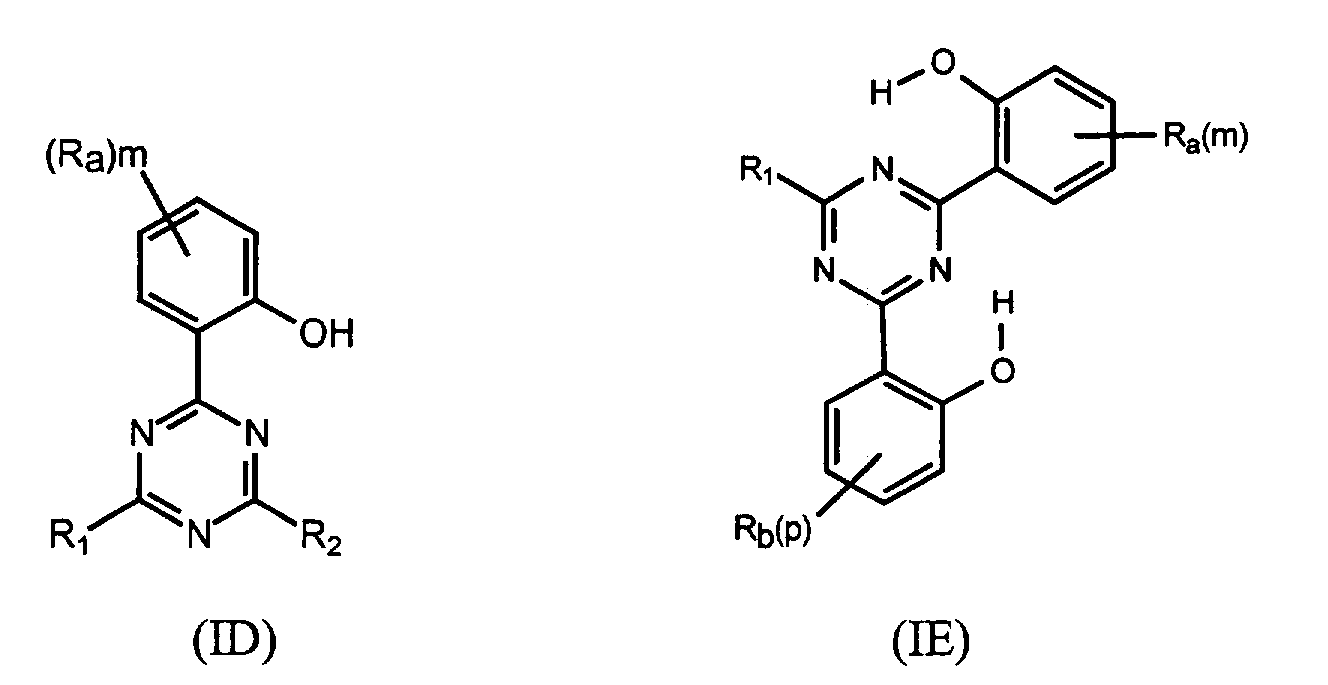
R1, R2, Ra and m are as defined for formula (IC);
each Rb is an independently selected substituent; and
p is 0 to 4.
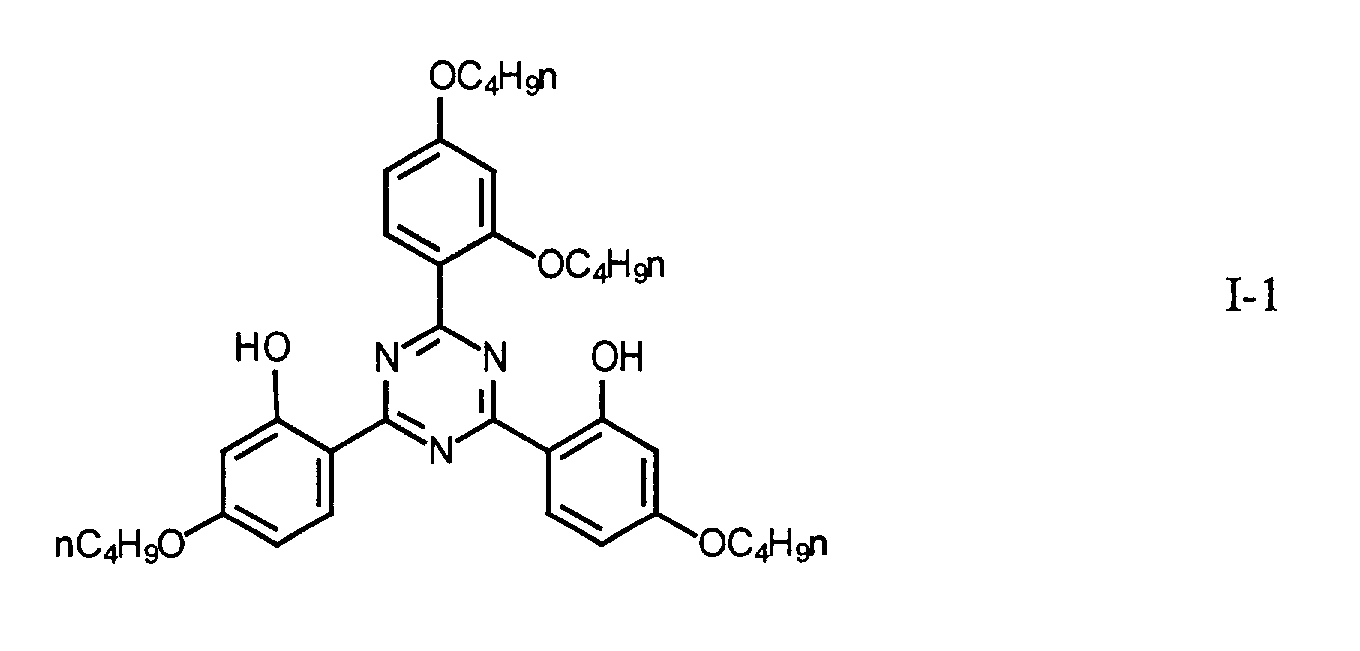
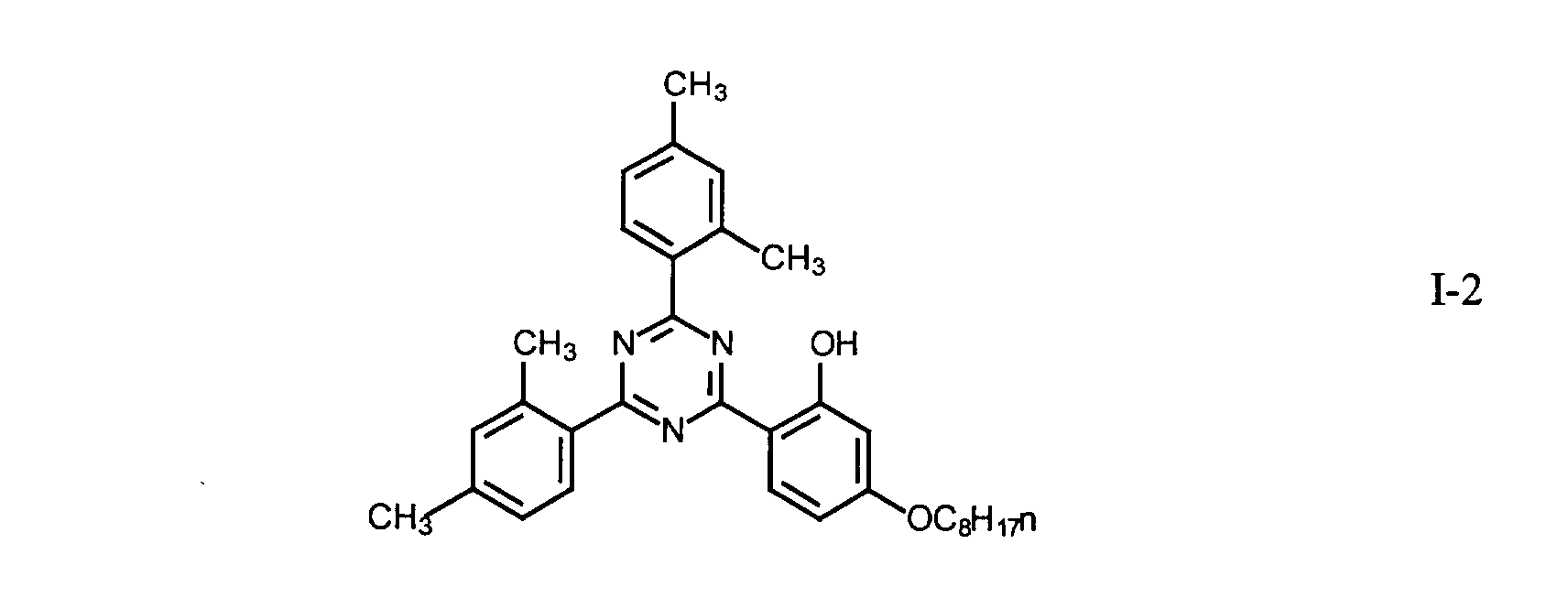


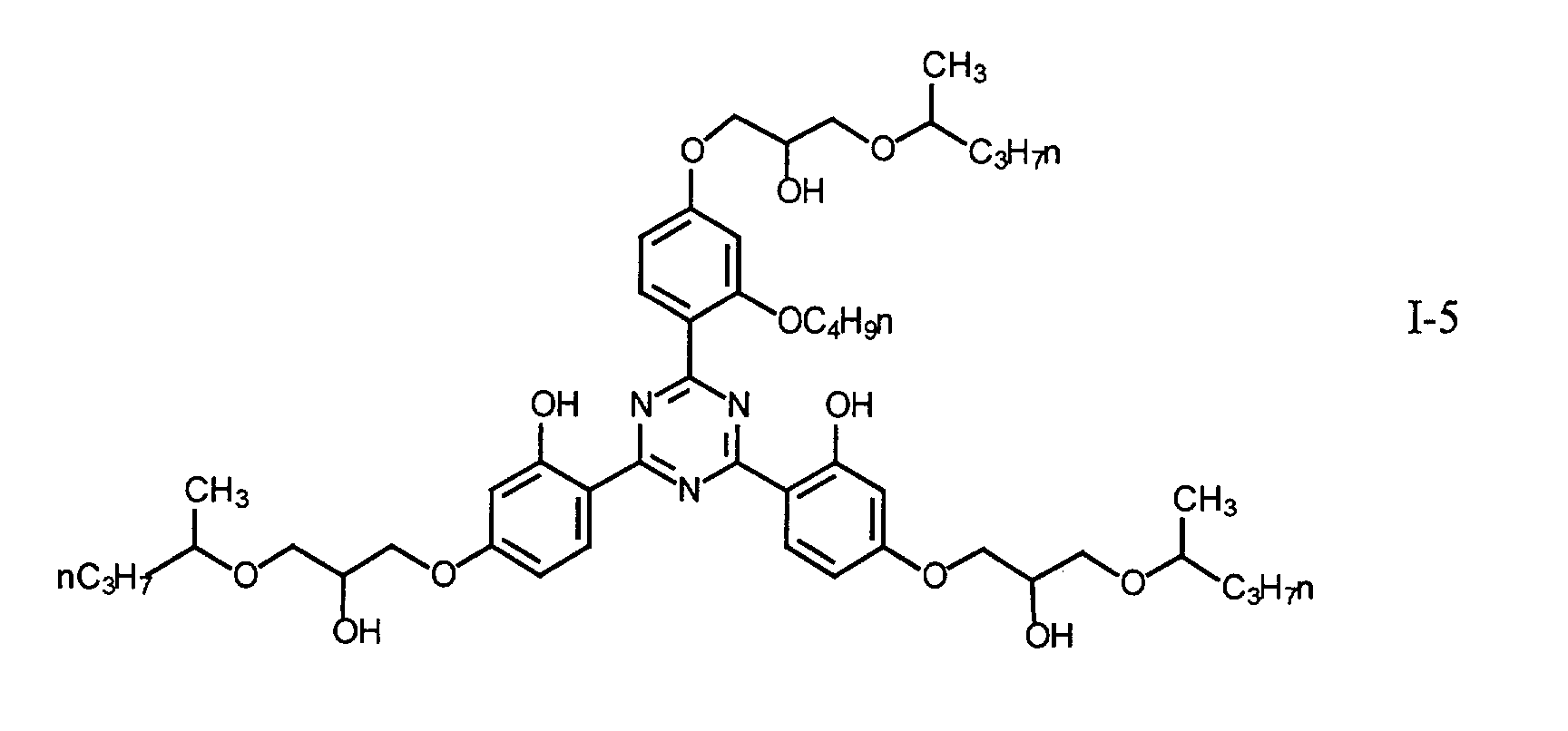

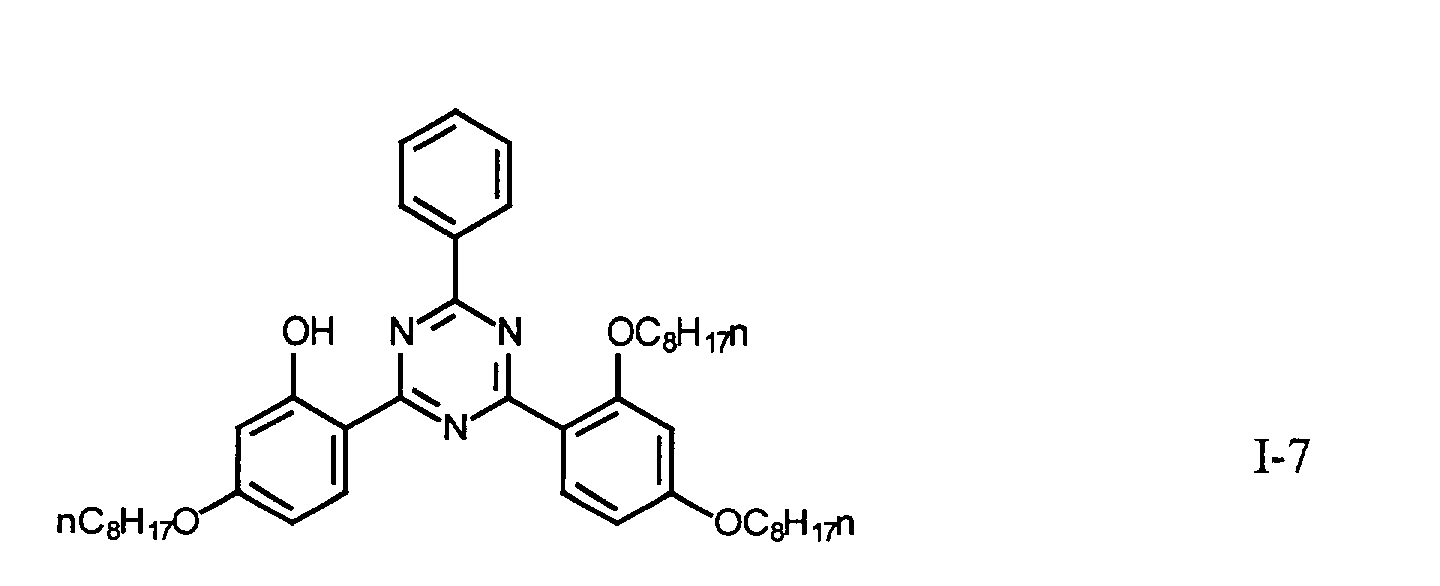


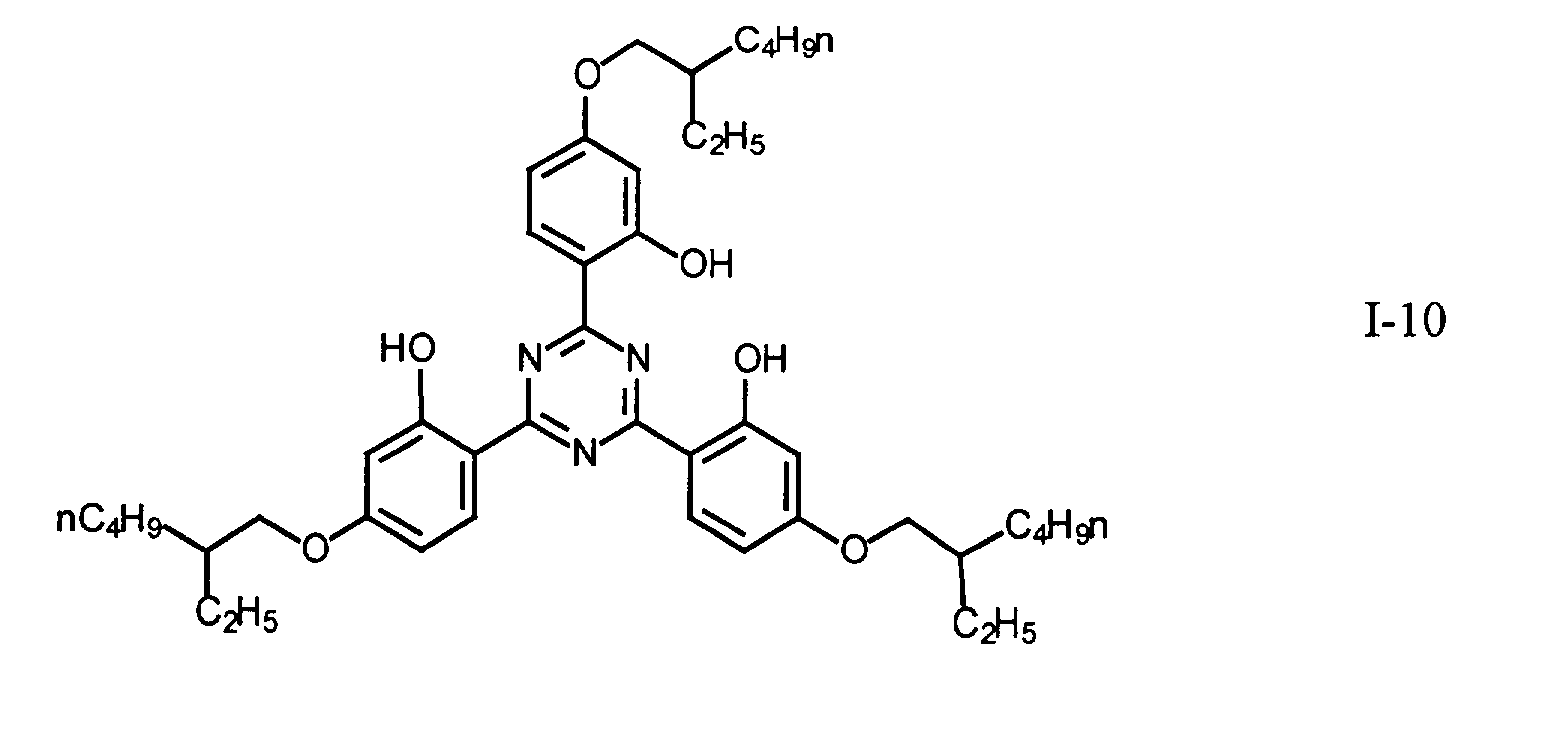


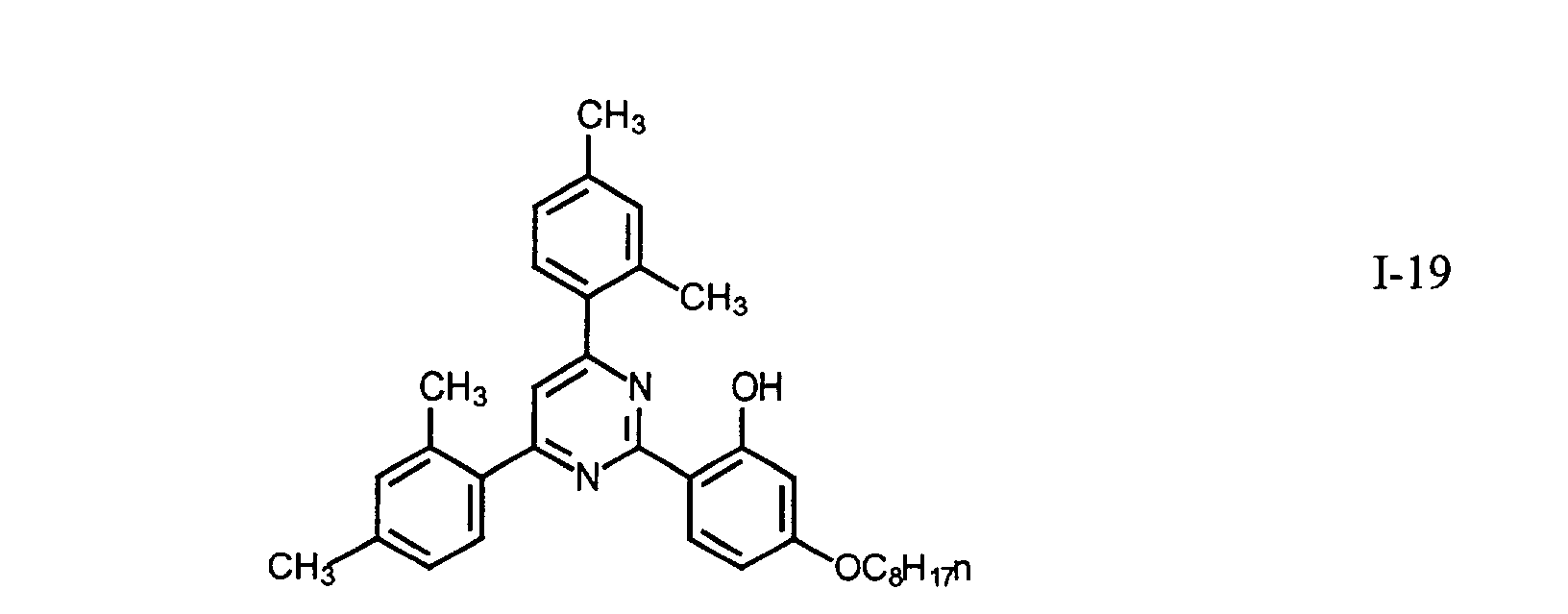


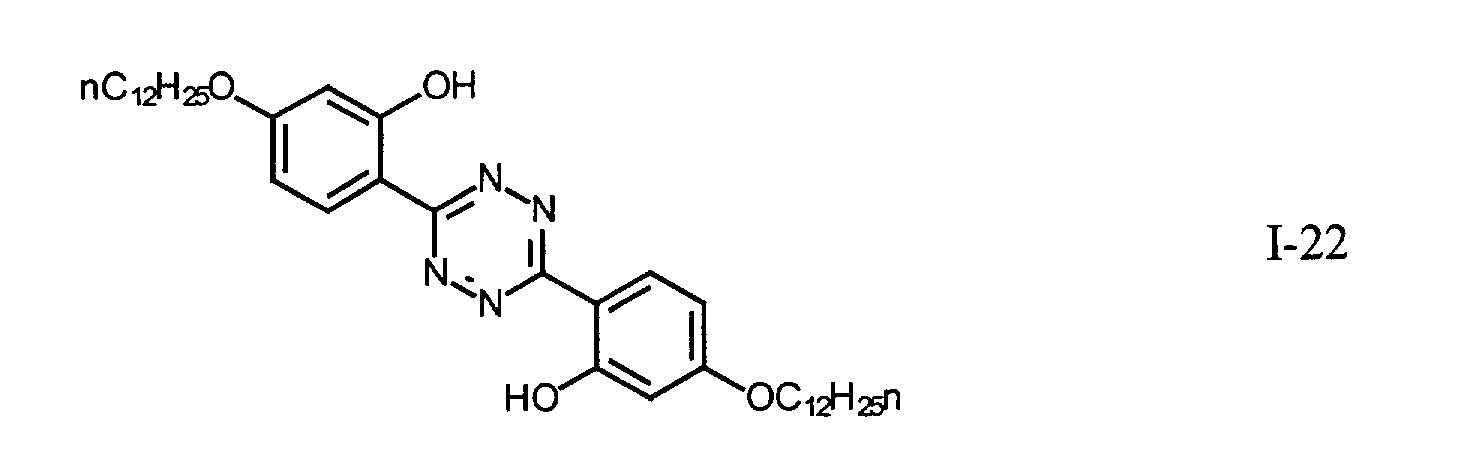
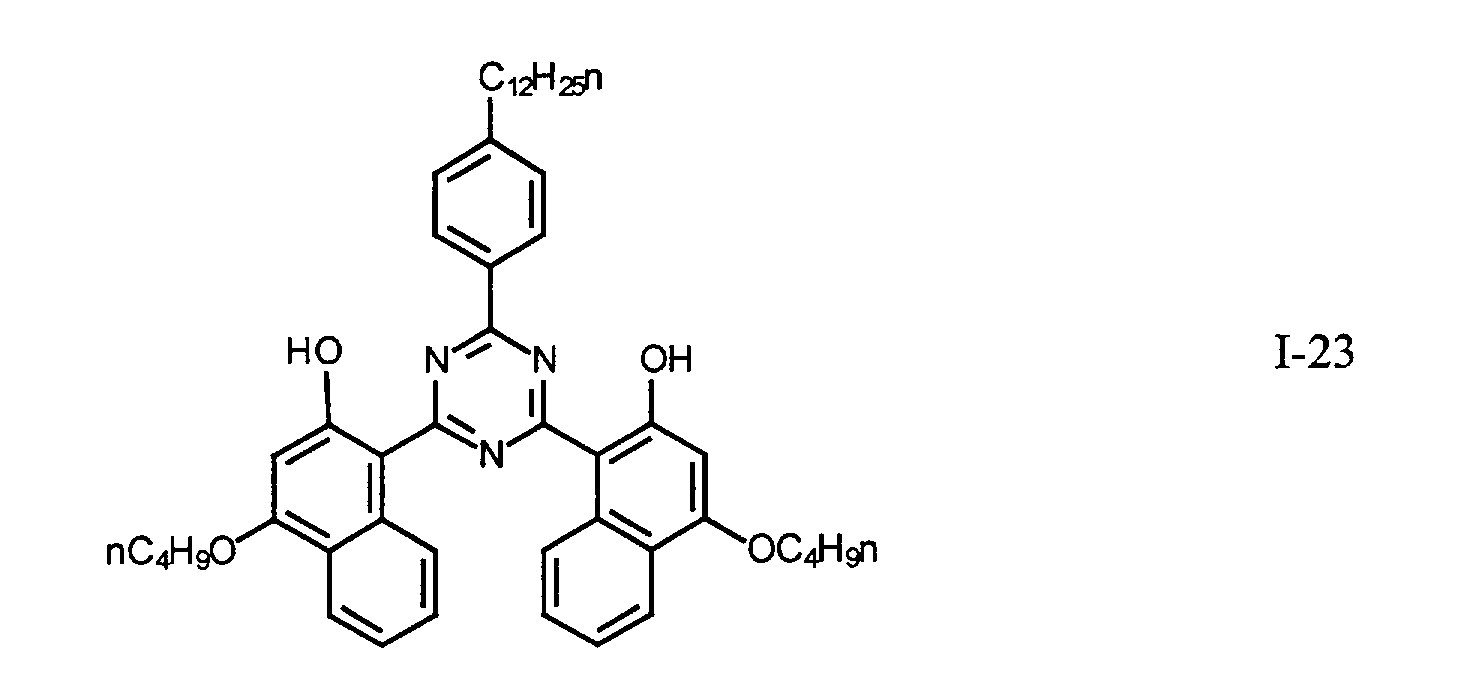


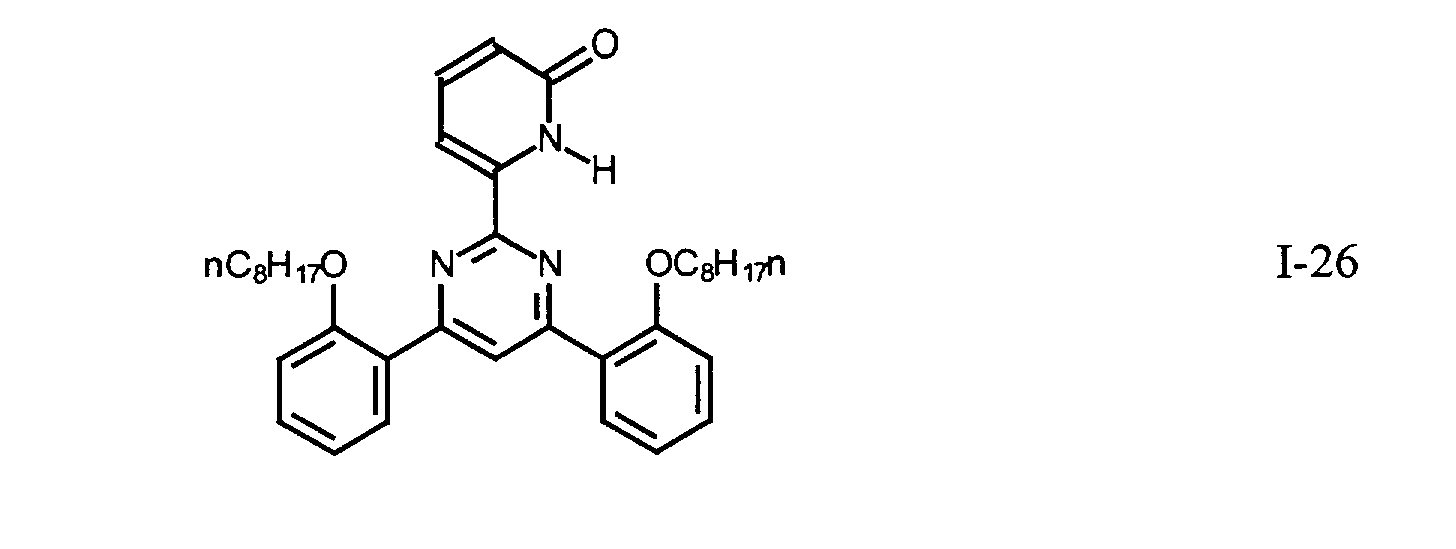


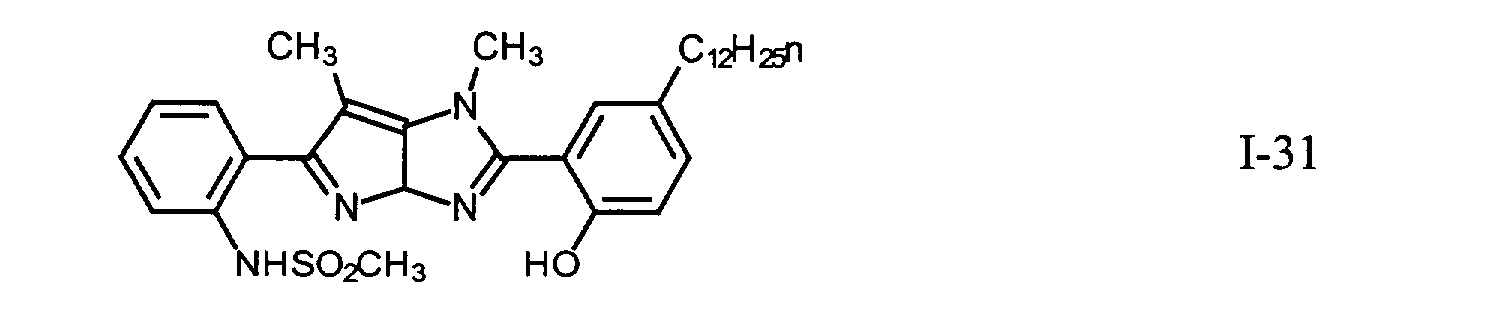

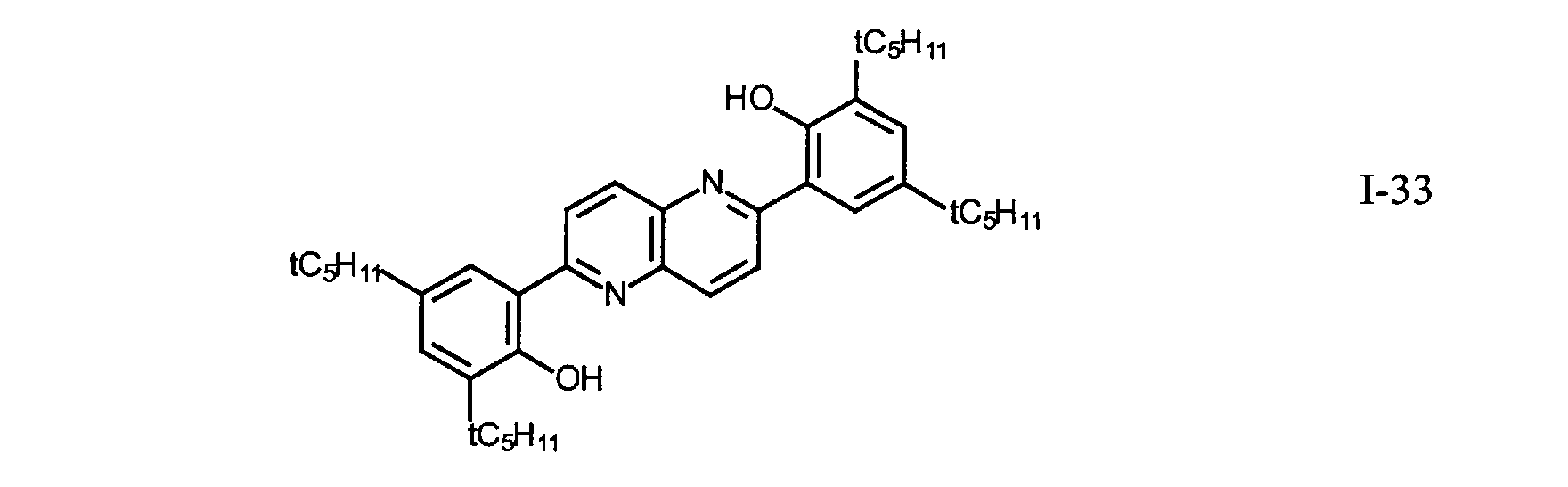


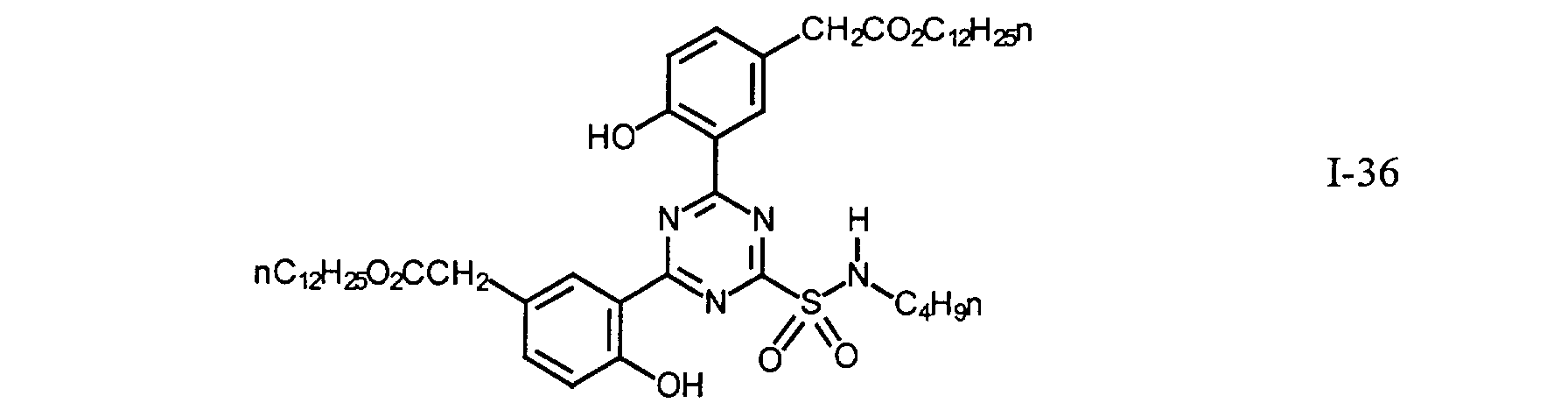
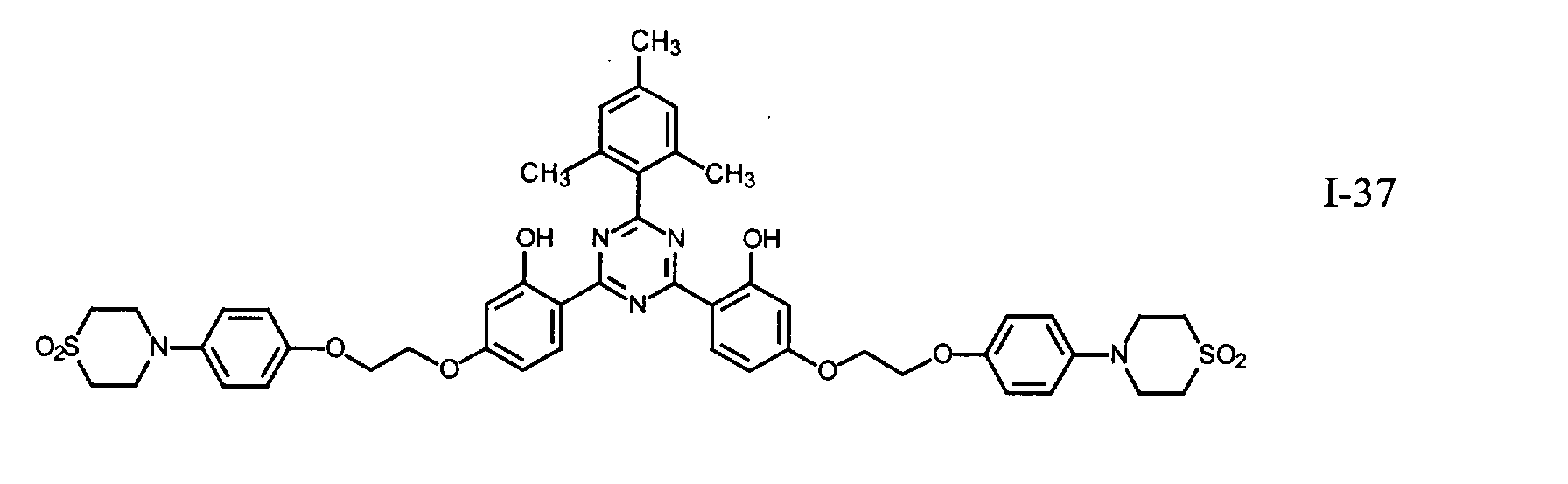
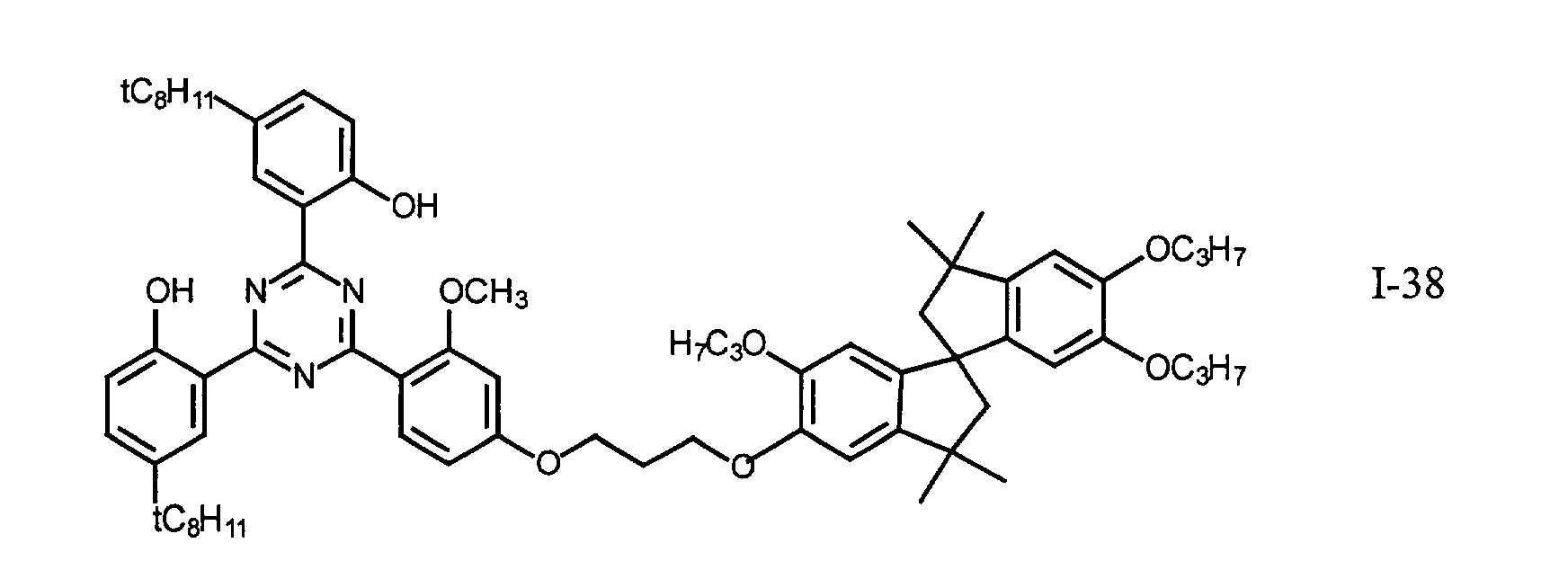
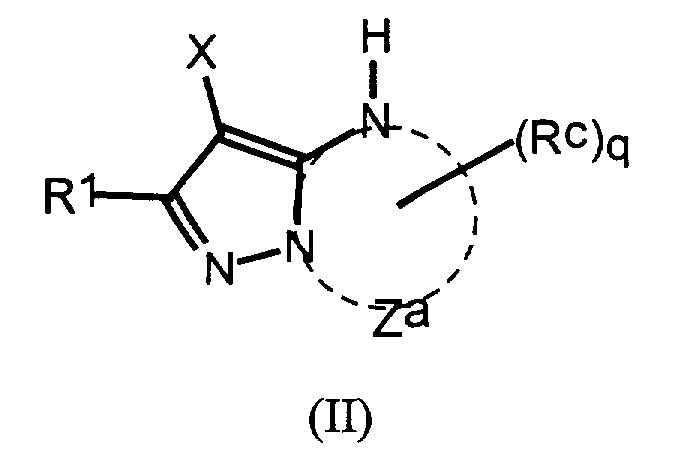
R1 is hydrogen or a substituent;
Rc is a substituent;
q is 0 to 4;
Za represents the atoms necessary to complete an unsubstituted or substituted 5- to 10-membered heterocyclic ring system which may contain one or more other heteroatoms selected from nitrogen, oxygen and sulfur;
providing that each Rc is attached to a carbon atom of the ring; and
X is selected from hydrogen or halogen or a group which is separable by the reaction of coupler with an oxidized colour developing agent.
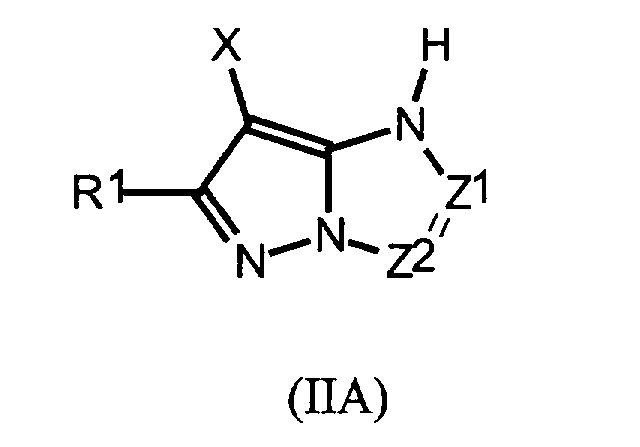
R1 and X are as defined for formula (II);
Z1 and Z2 are independently -CH- groups, which may together form part of an unsubstituted or substituted phenyl ring, -CR- groups, wherein R is a substituent, or nitrogen atoms.

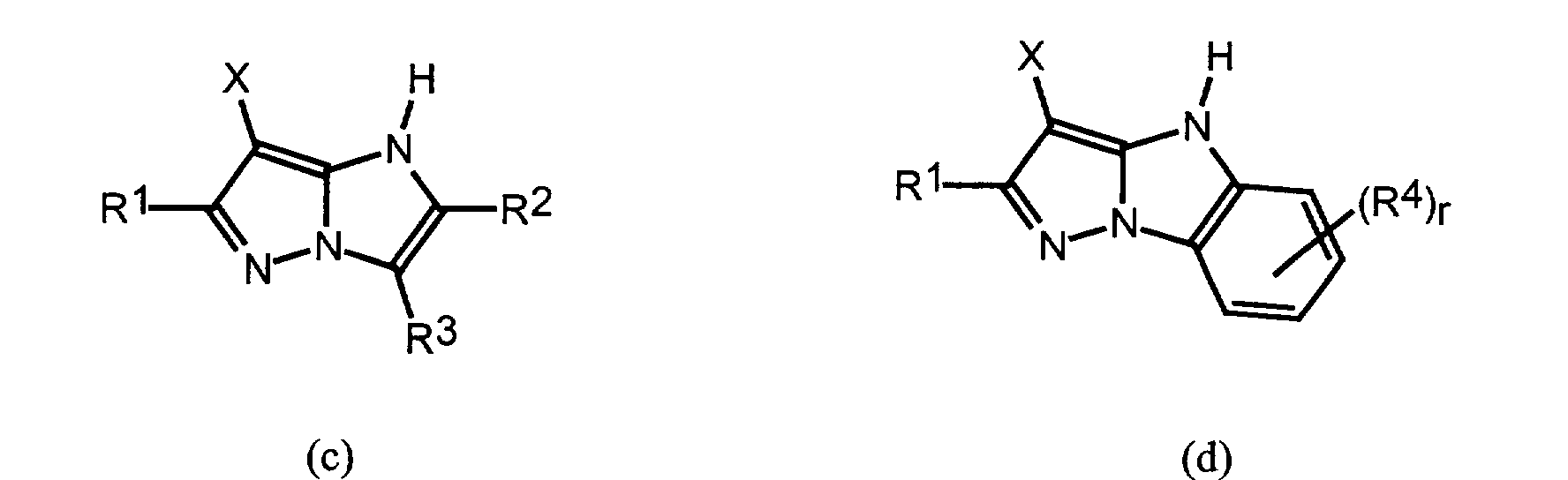
each of R1 to R4 is hydrogen or an independently selected substituent;
r is 0 to 4; and
X is as defined for formula (II).
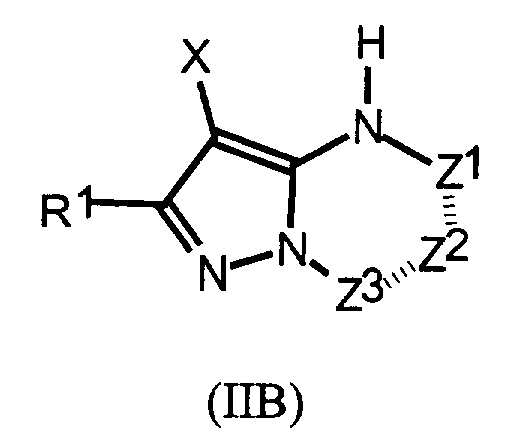
one of Z1 and Z3 is a carbonyl or sulfonyl group and the other is a -CH- or -CR- group, wherein R is a substituent, or a nitrogen atom;
Z2 is a -CH- or -CR- group or a nitrogen atom; or
Z2 and the other of Z1 and Z3 may together form an unsubstituted or substituted aryl ring or a 5- to 10-membered heterocyclic ring which may contain one or more heteroatoms selected from nitrogen, oxygen and sulfur, which ring is unsubstituted or substituted.
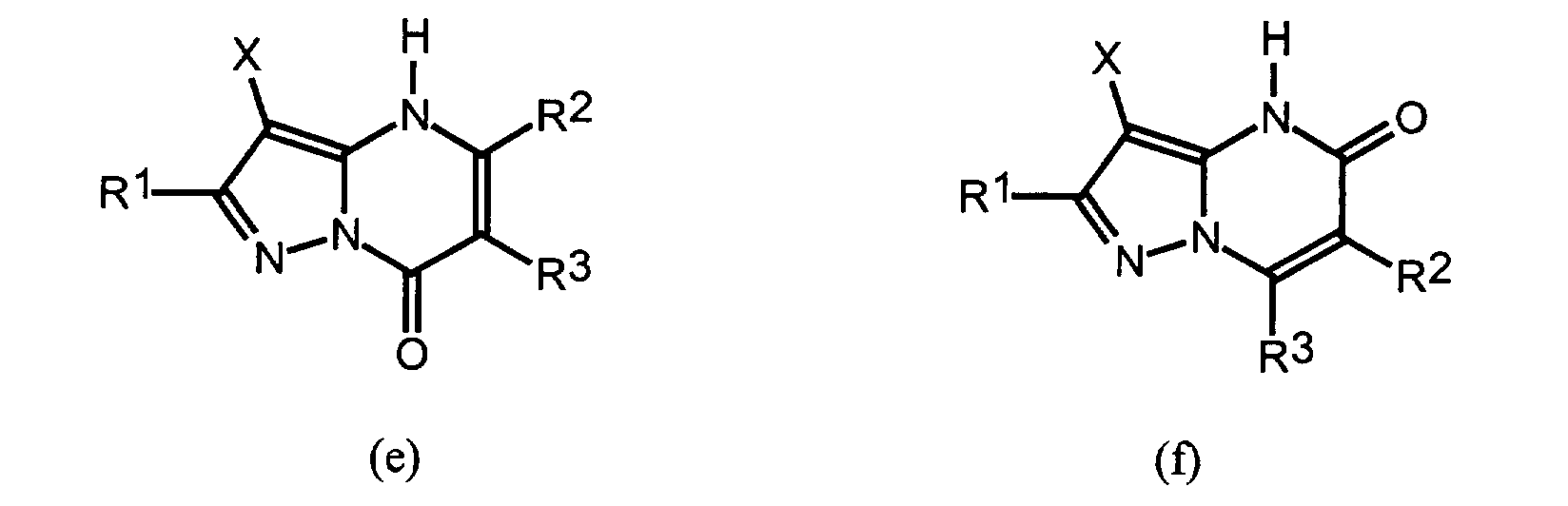
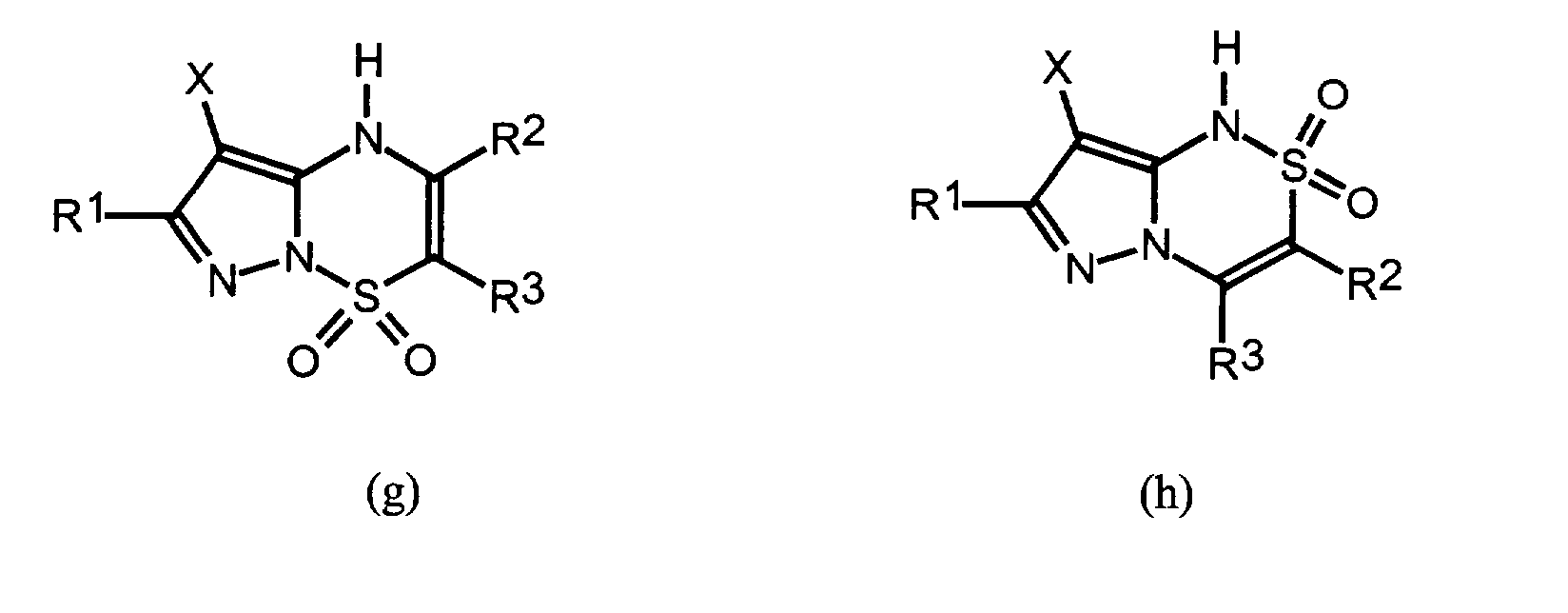

each of R1 to R3 is hydrogen or an independently selected substituent or R2 and R3 may join to form an unsubstituted or substituted aryl ring or a 5-to 10-membered heterocyclic ring which contains one or more heteroatoms selected from nitrogen, oxygen and sulfur, which ring is unsubstituted or substituted; and
X is as defined for formula (II).
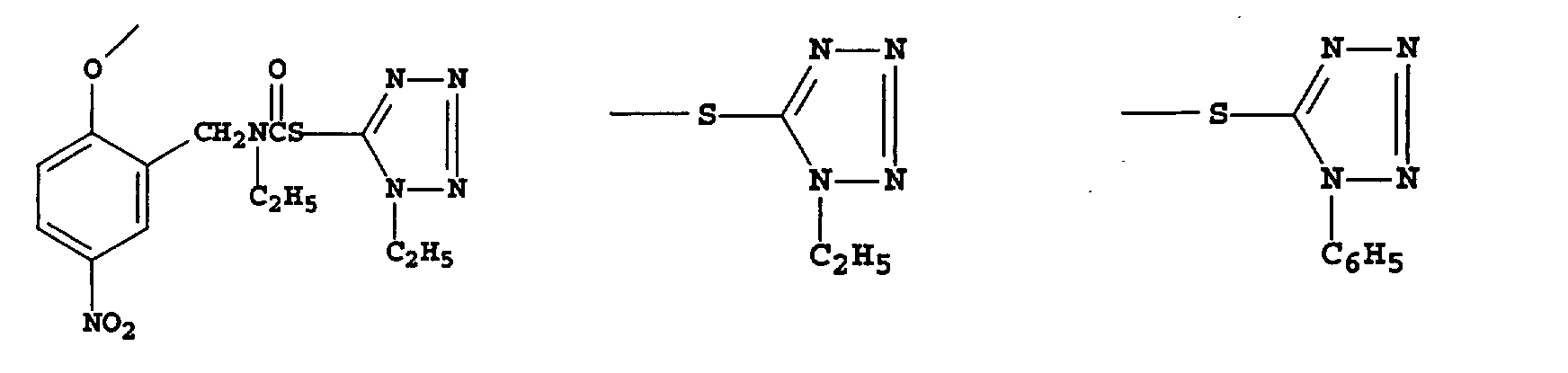


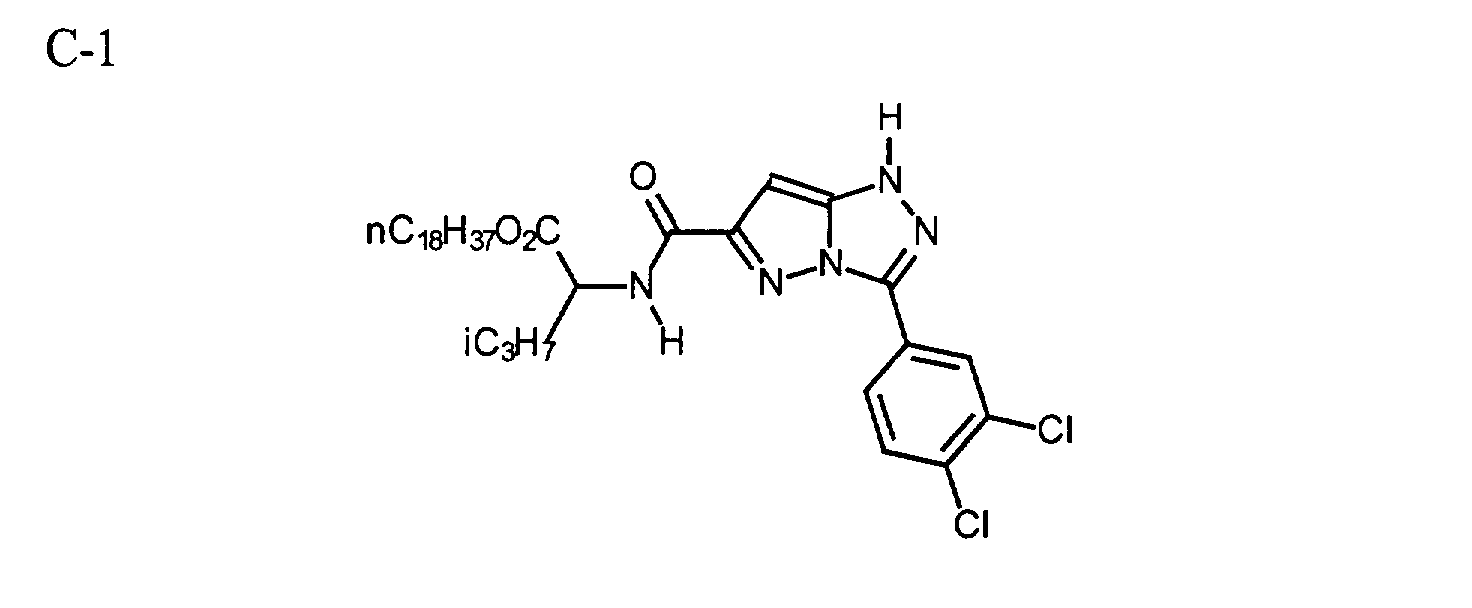
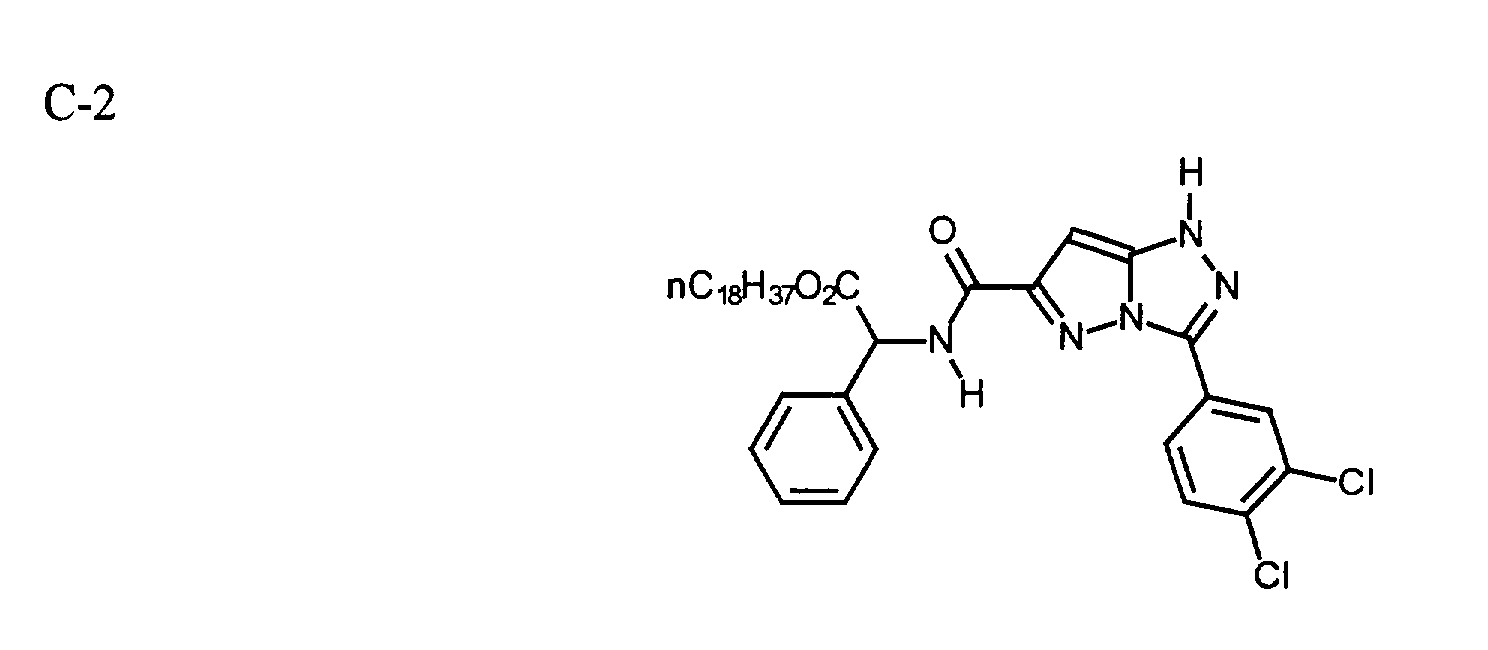

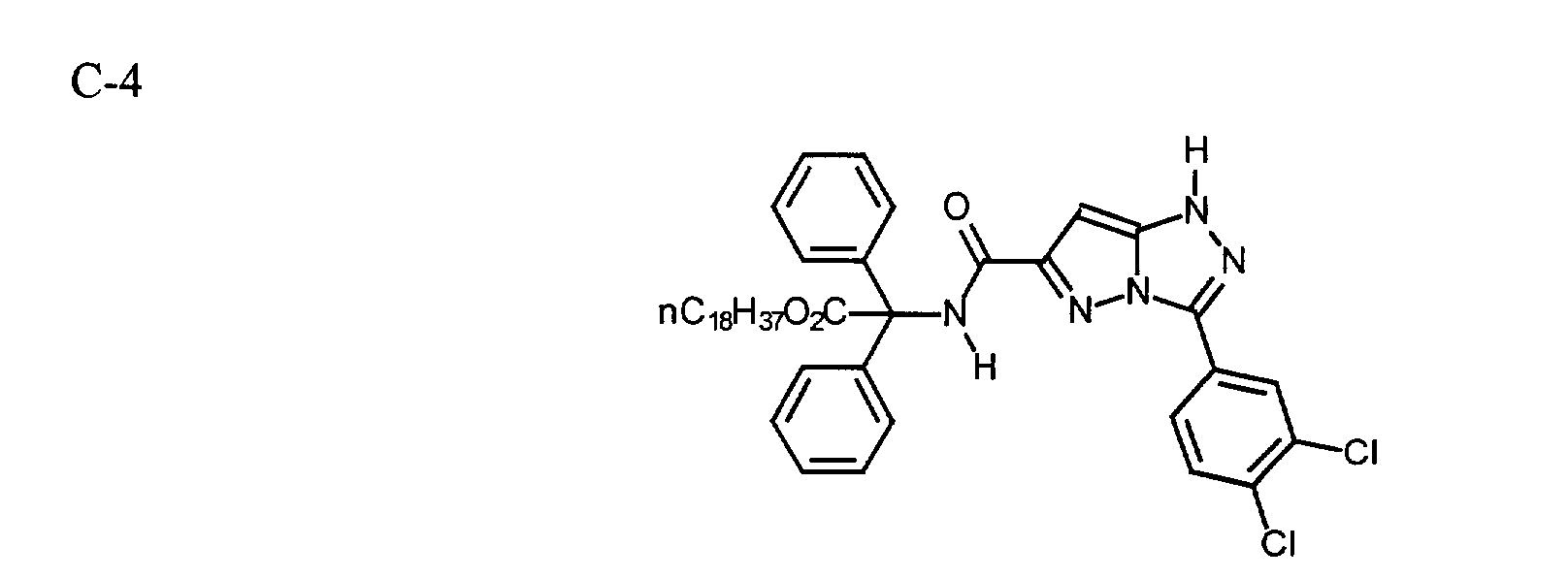
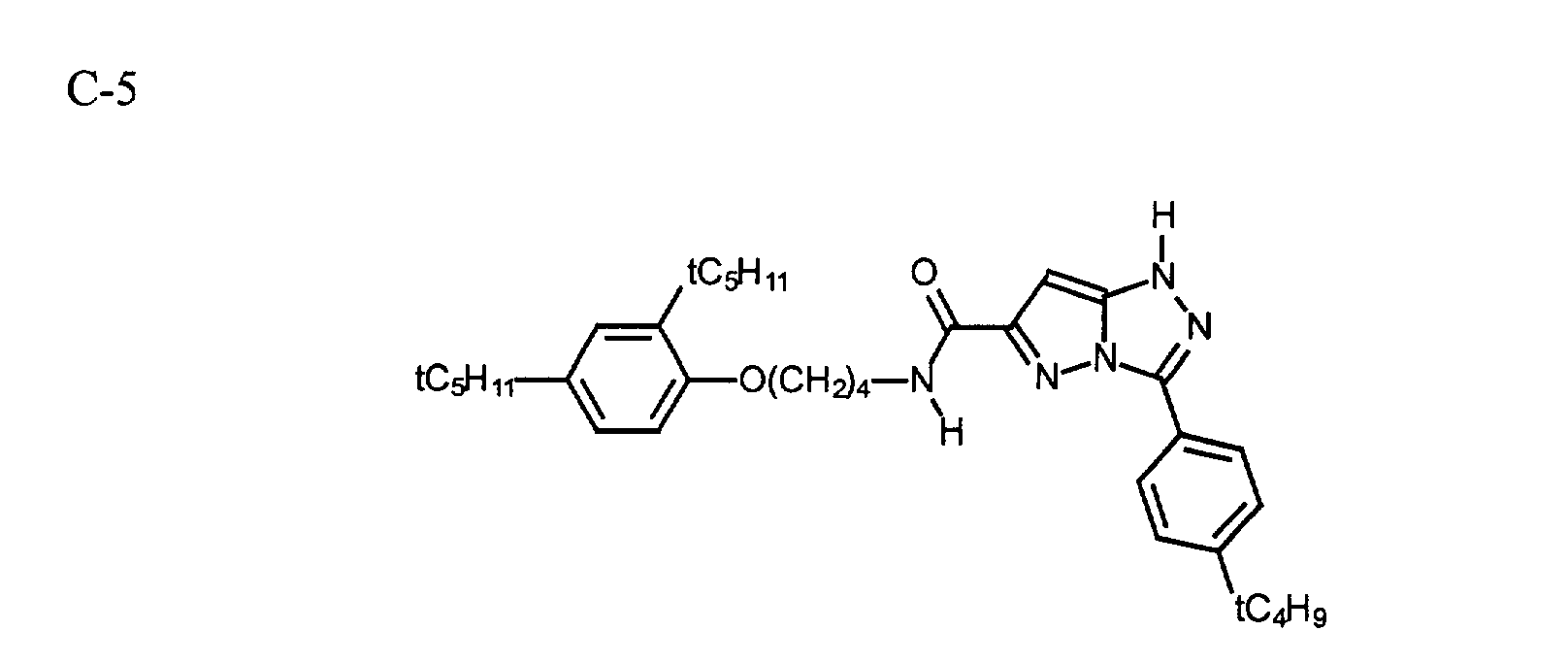
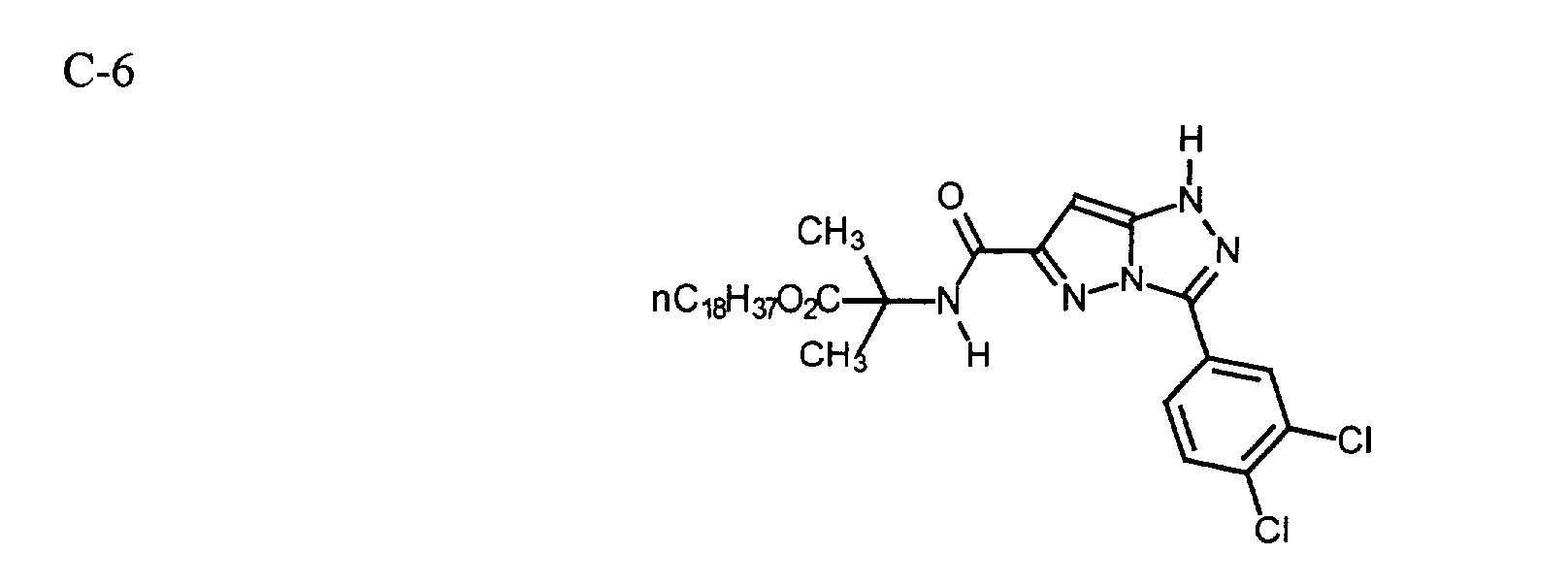
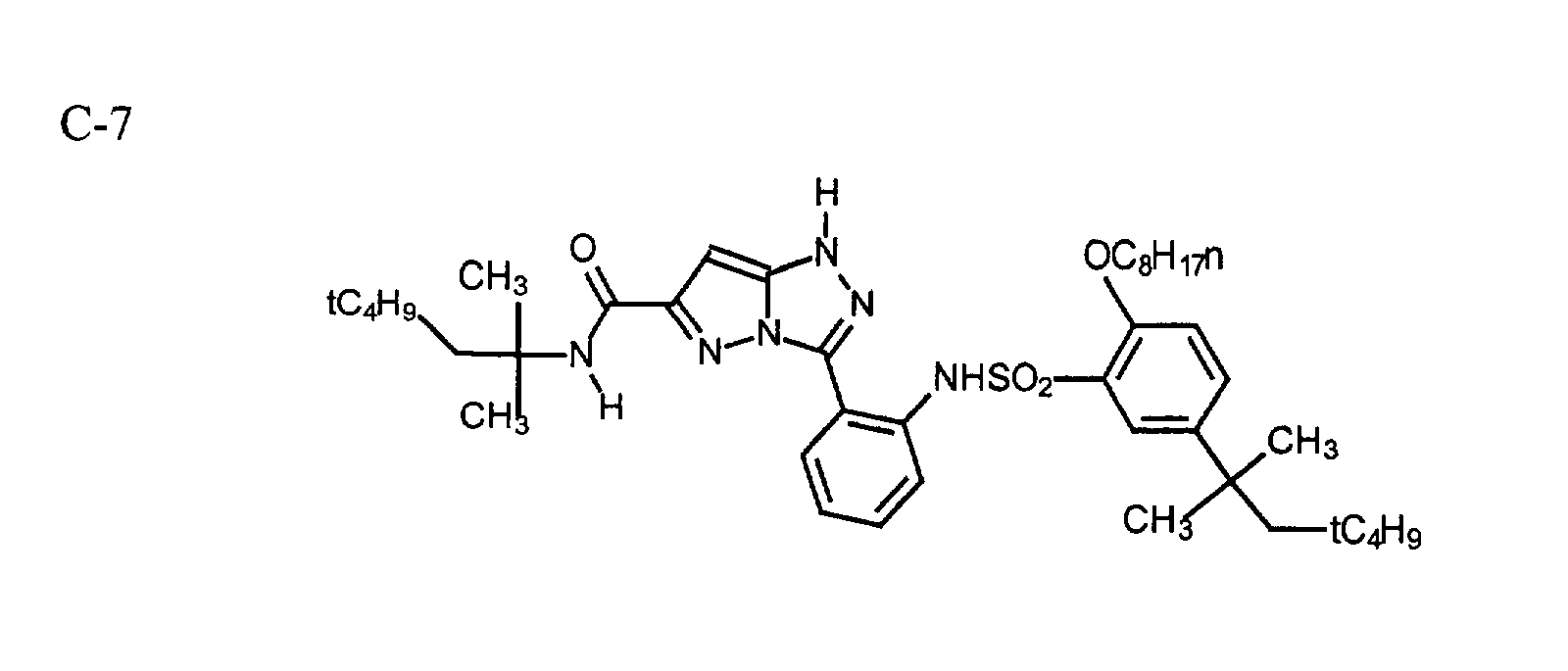

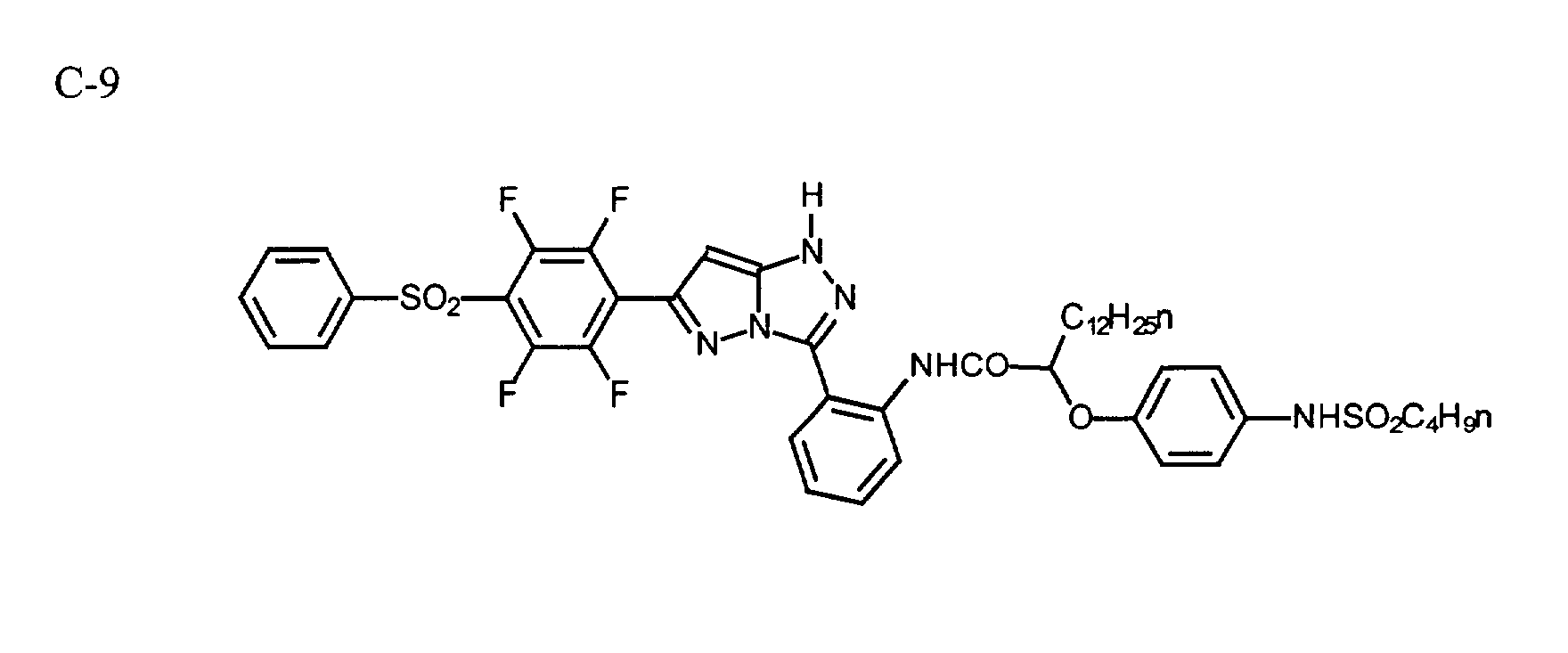

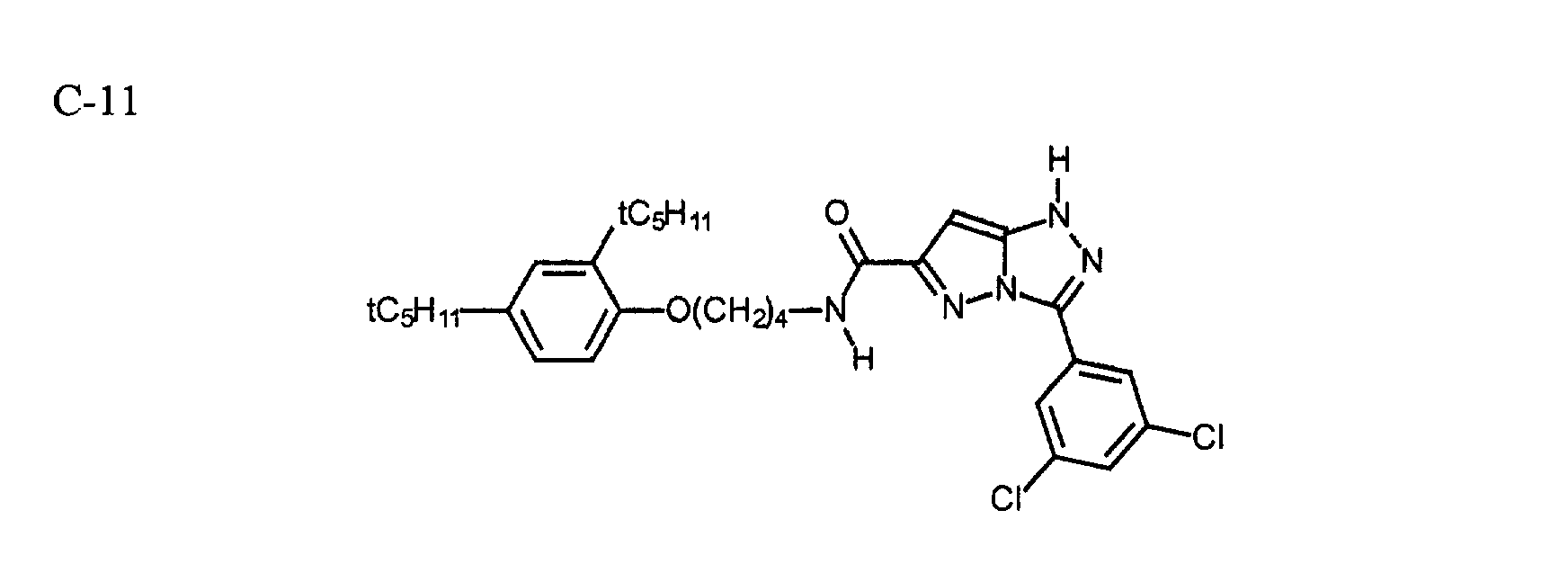


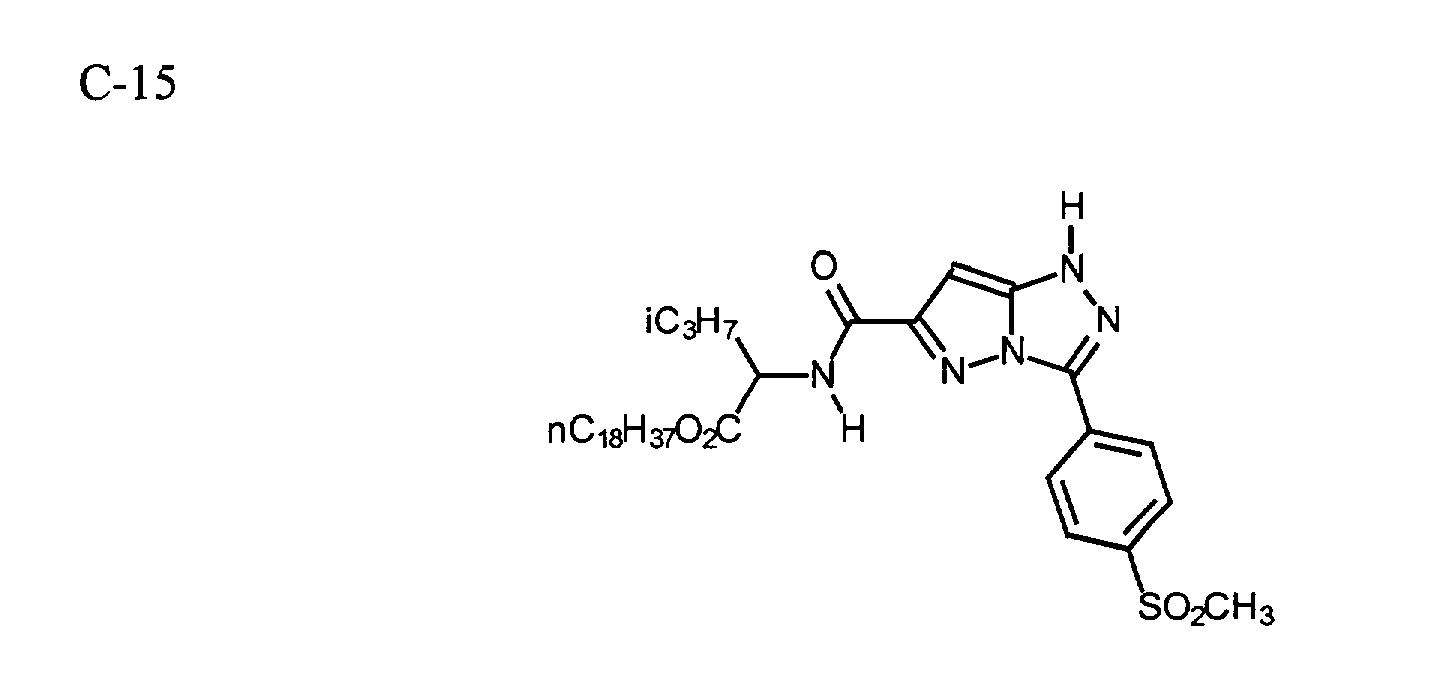

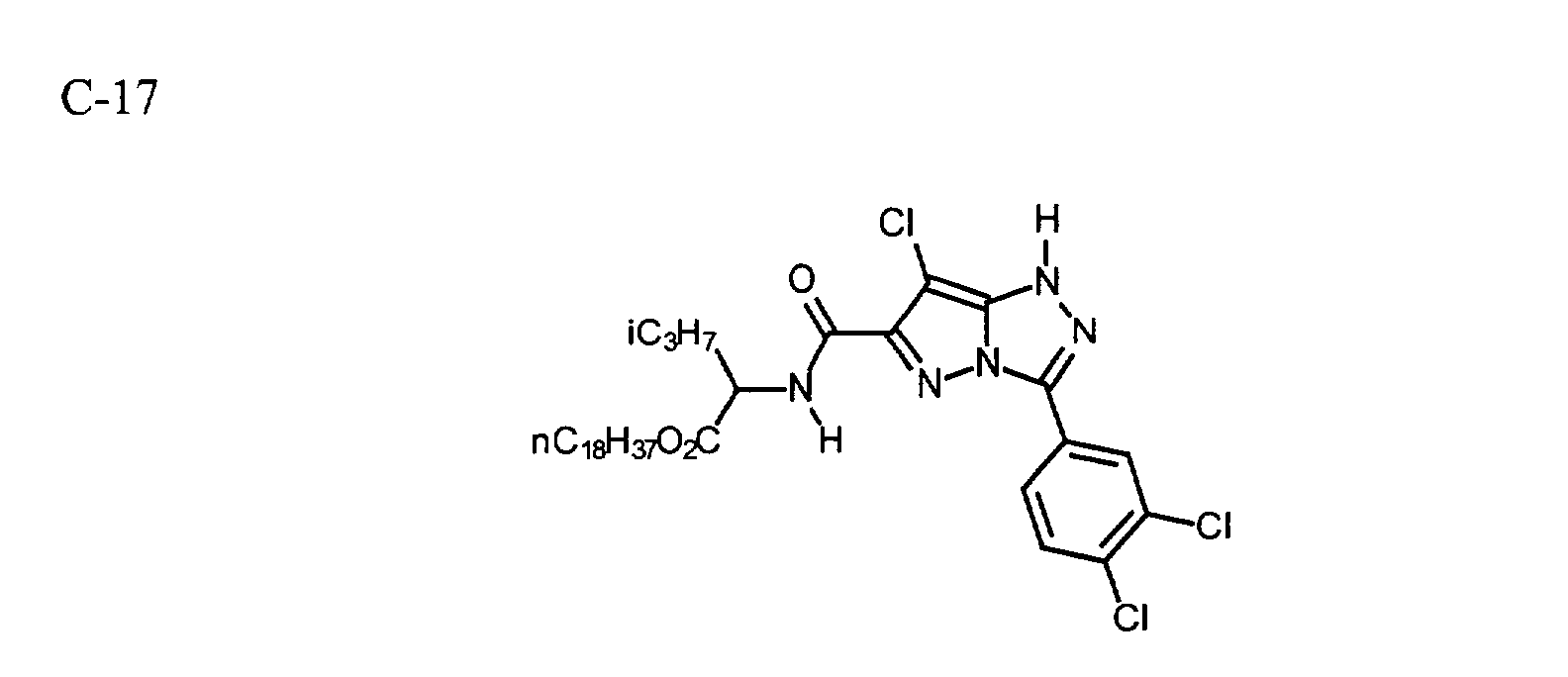


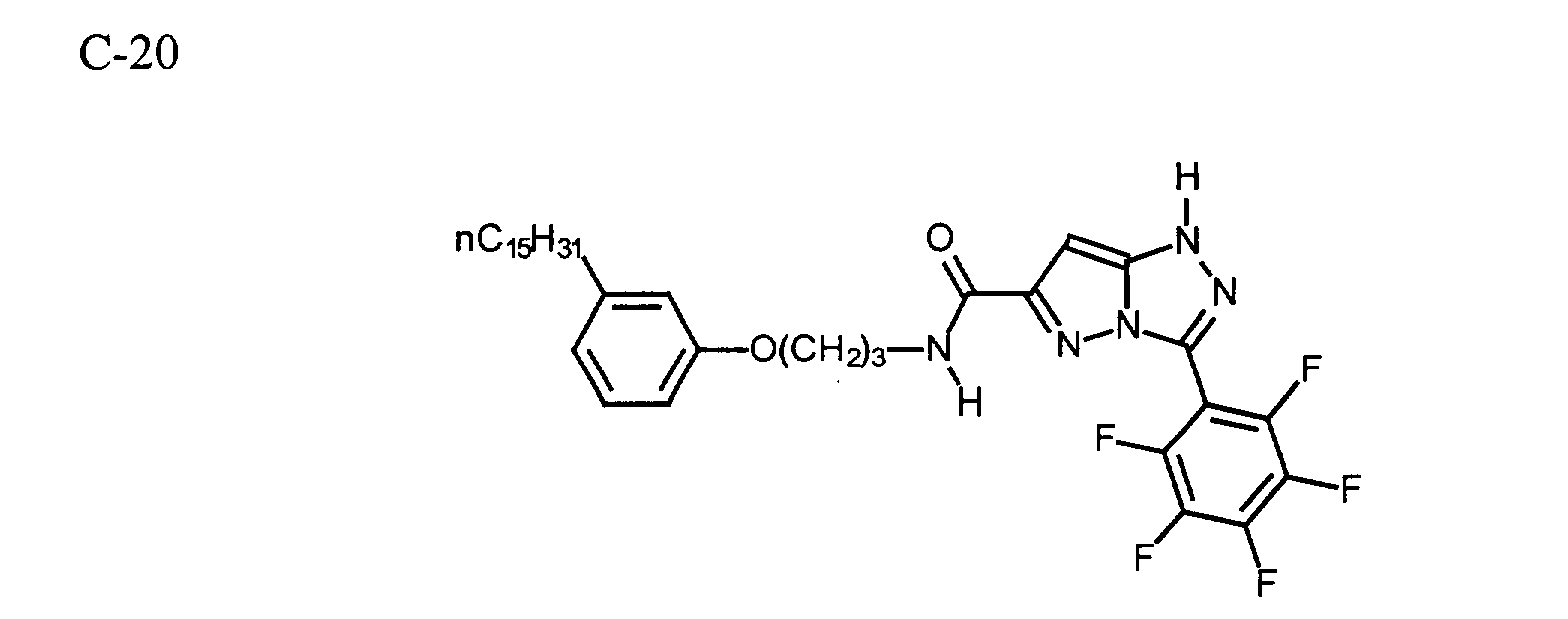
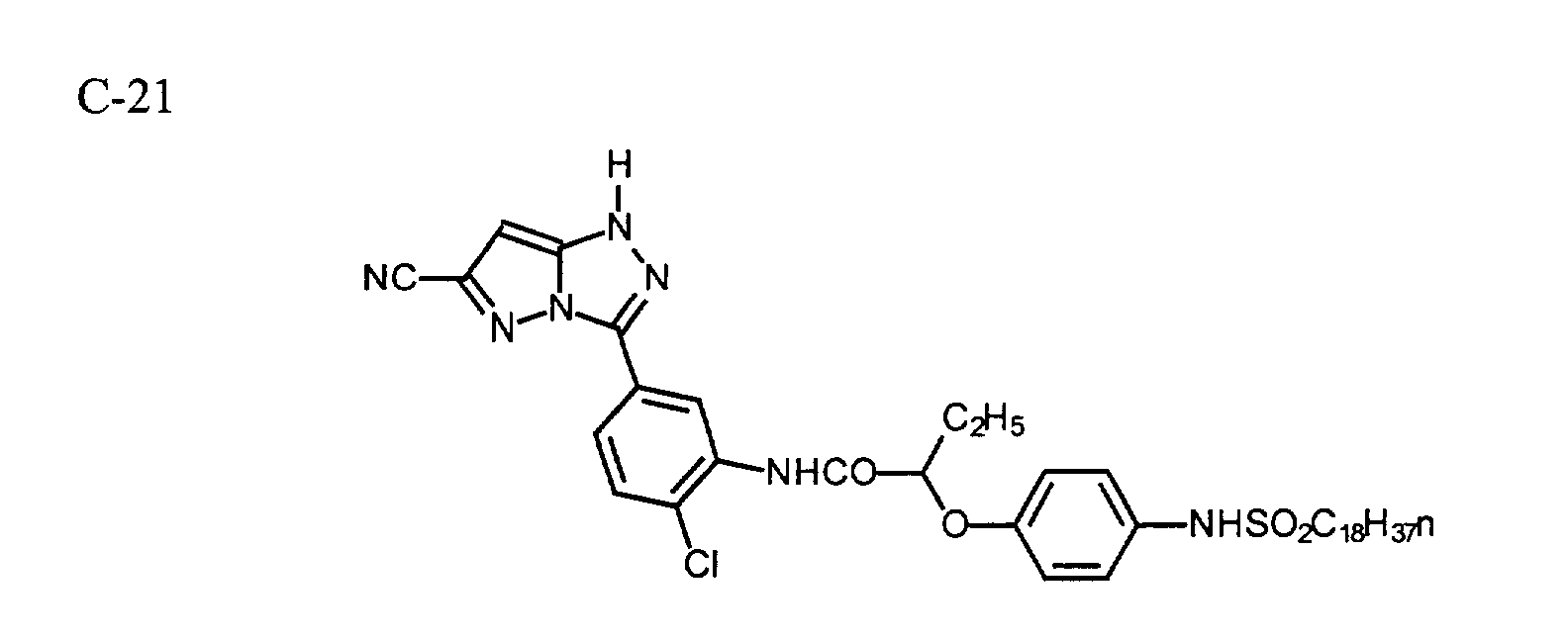
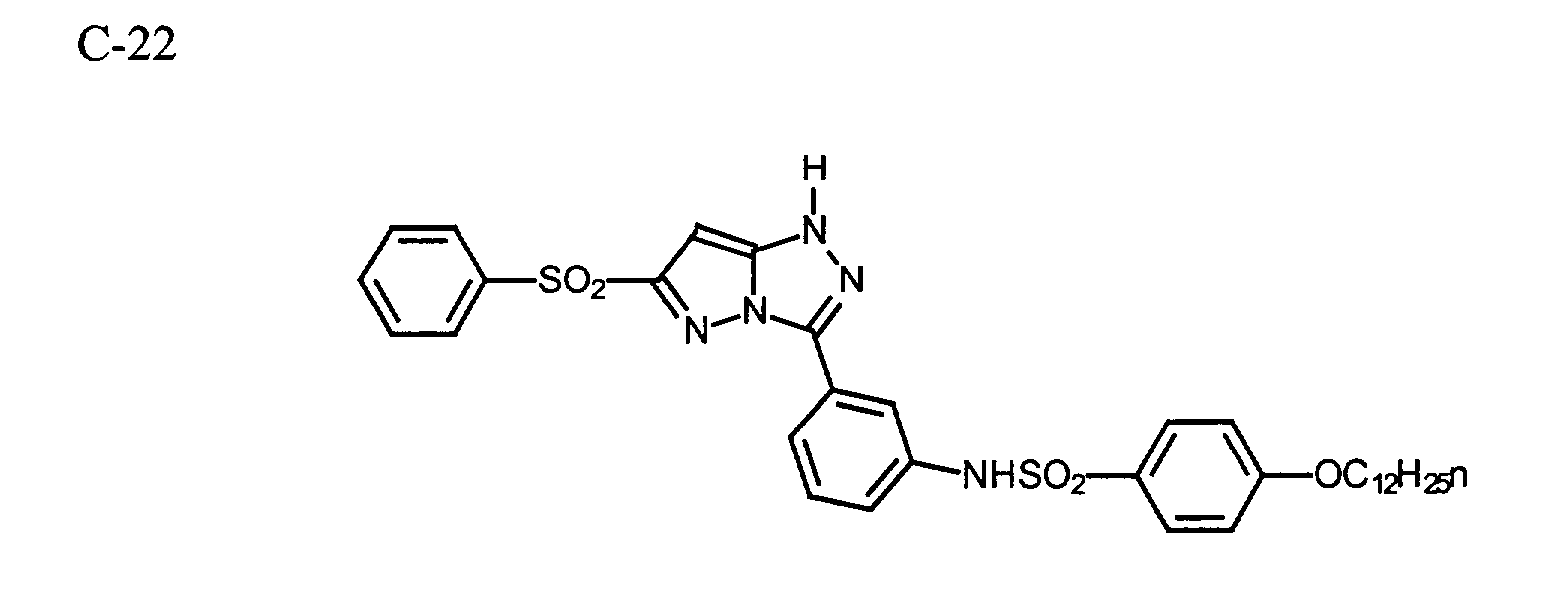


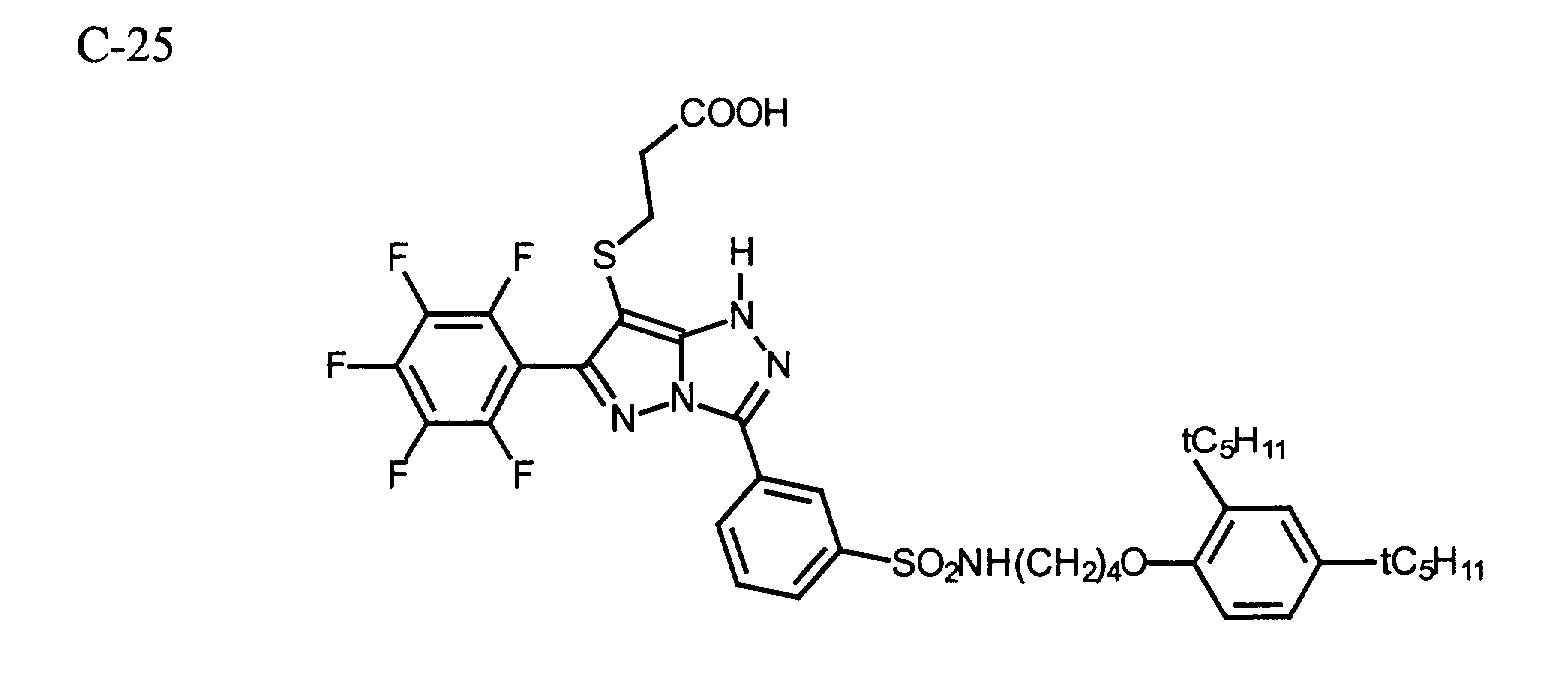

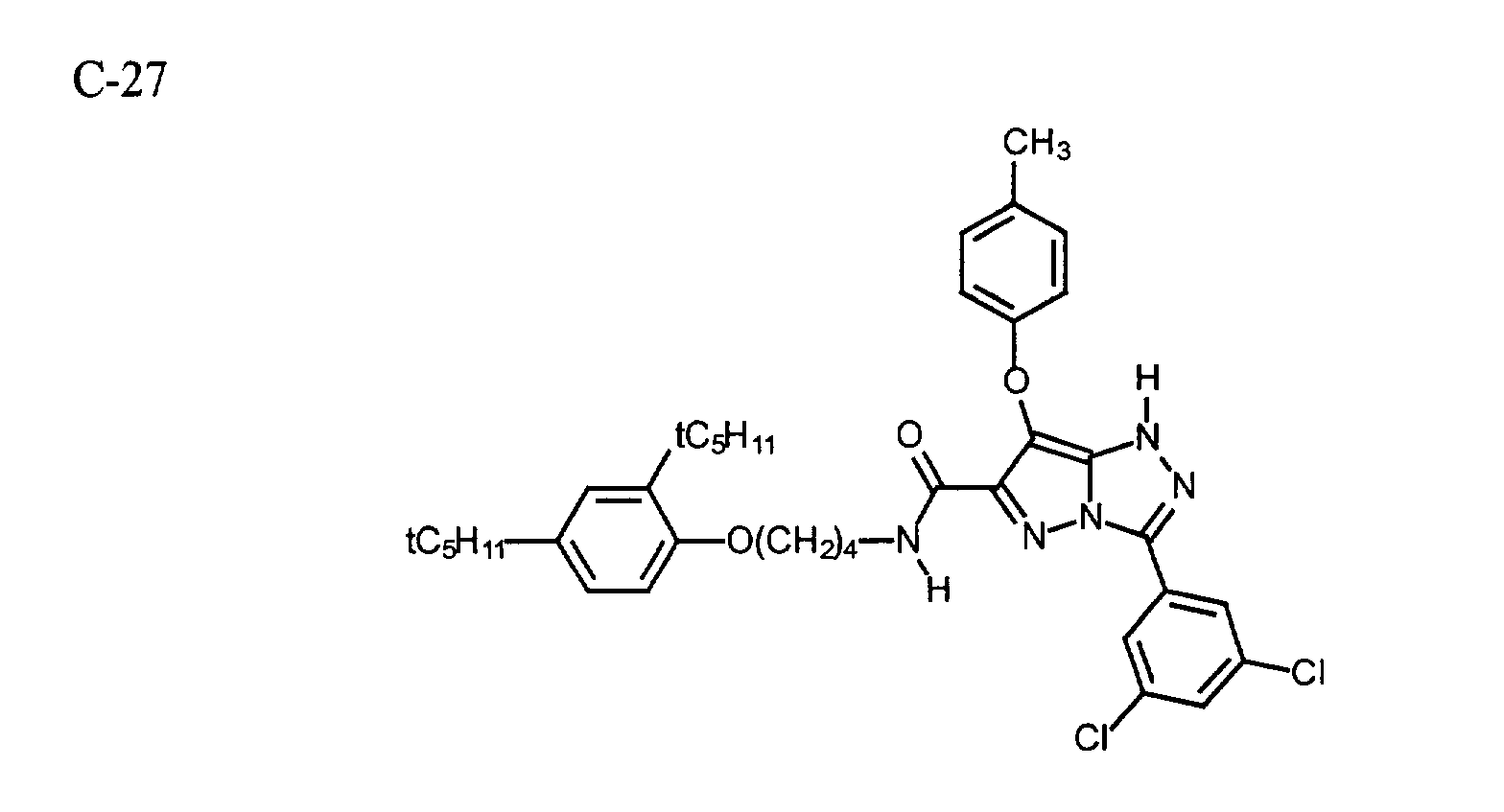
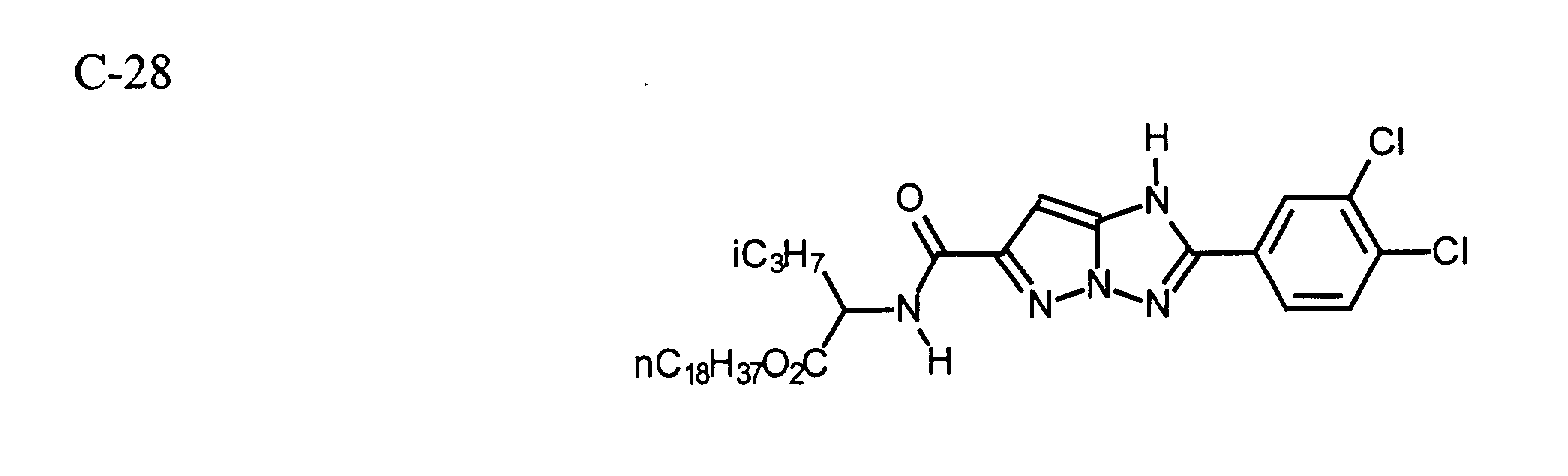
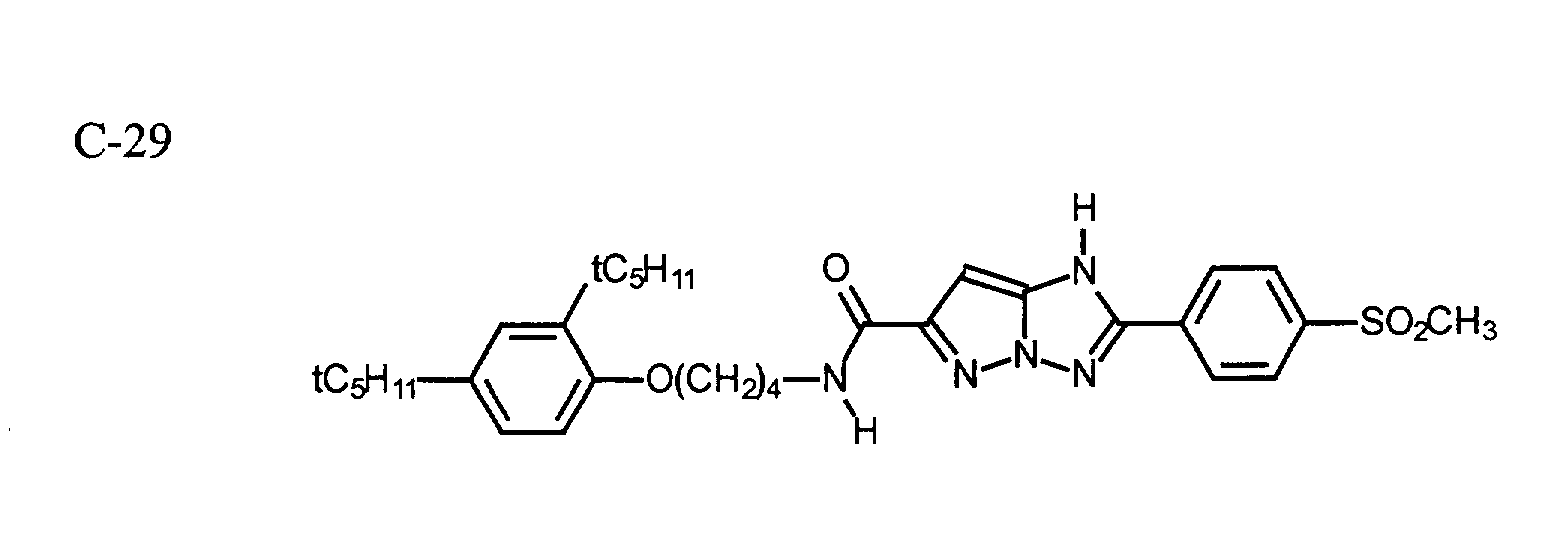


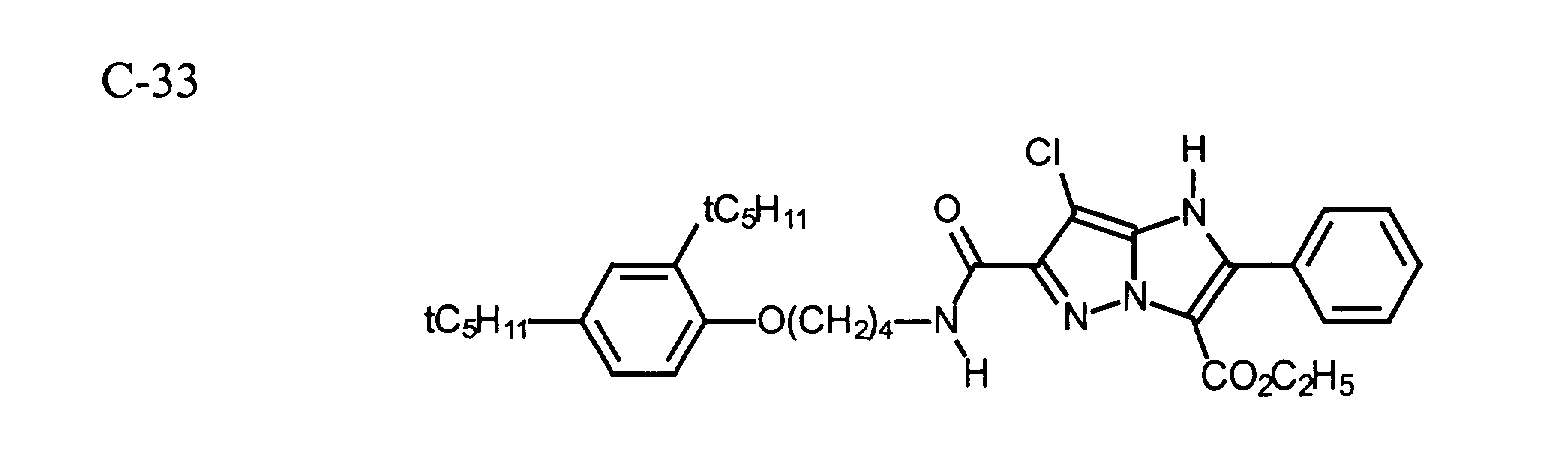


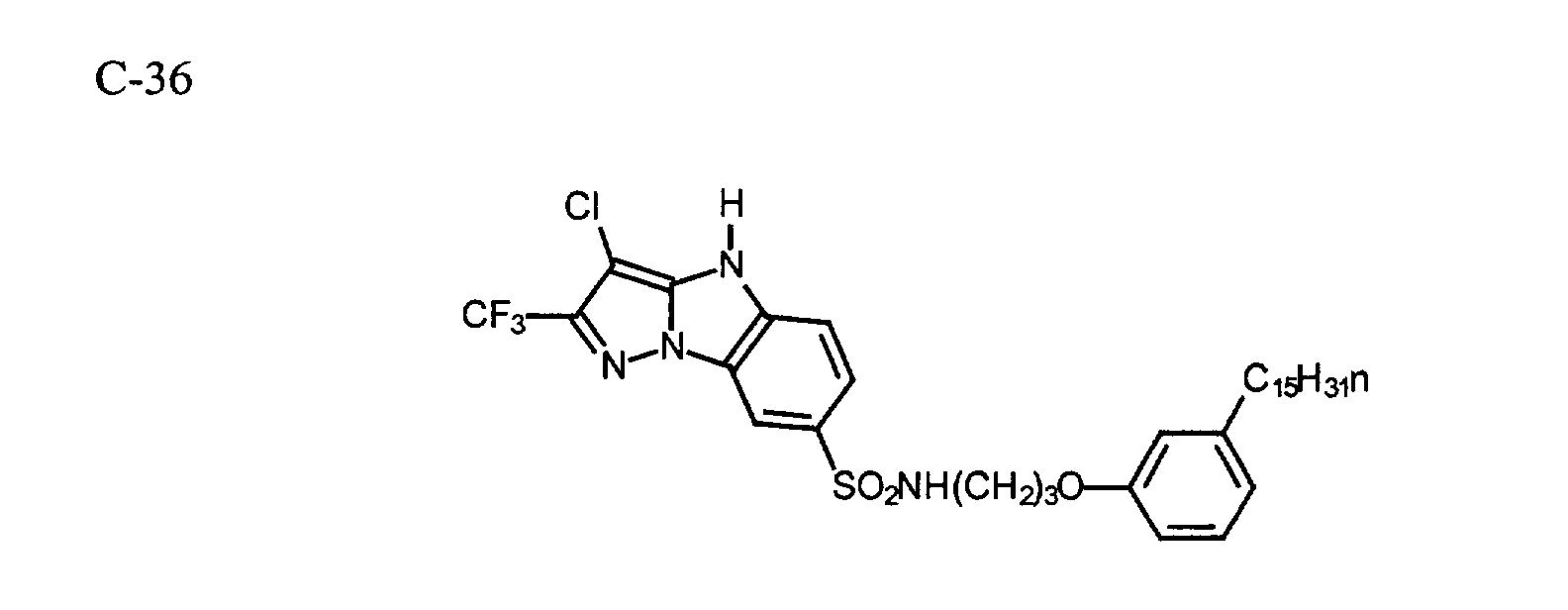


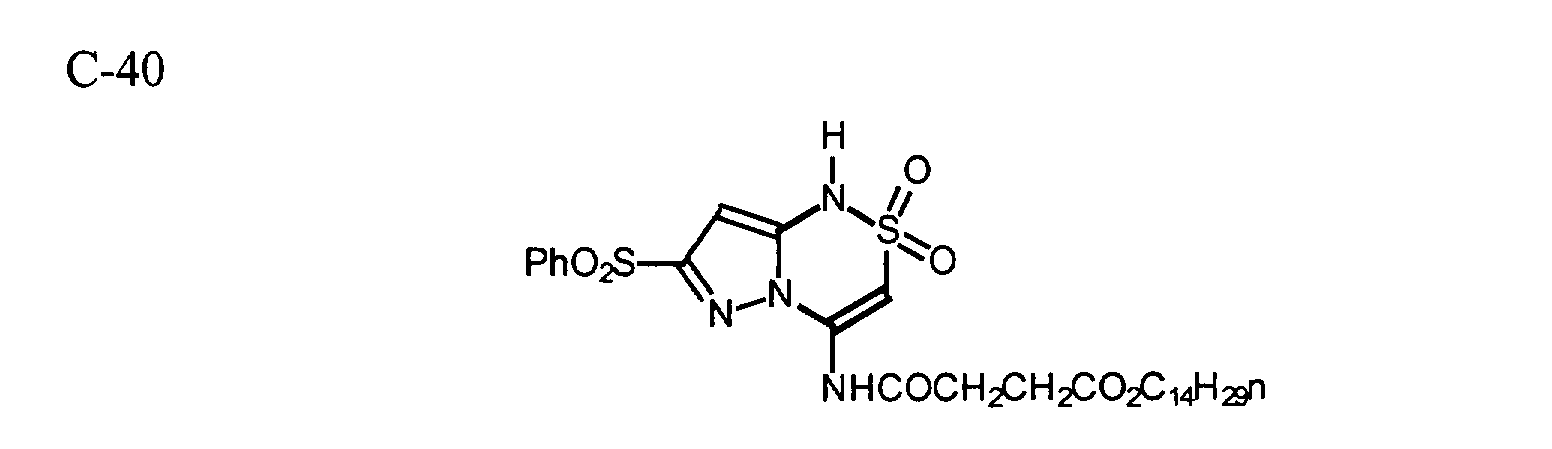
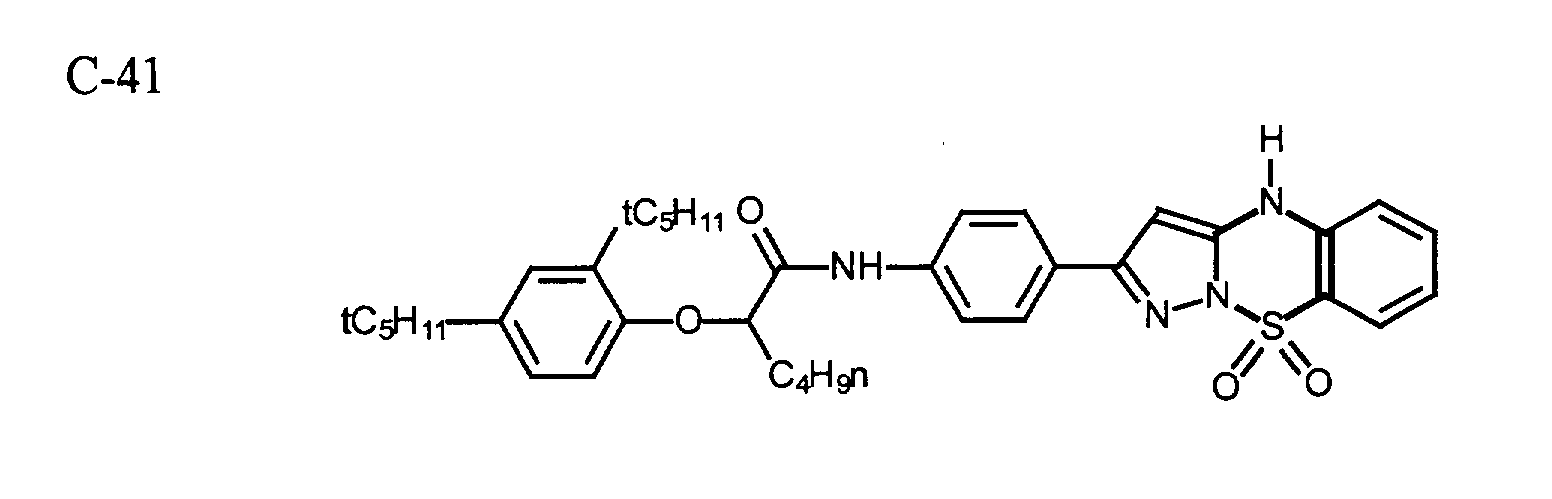

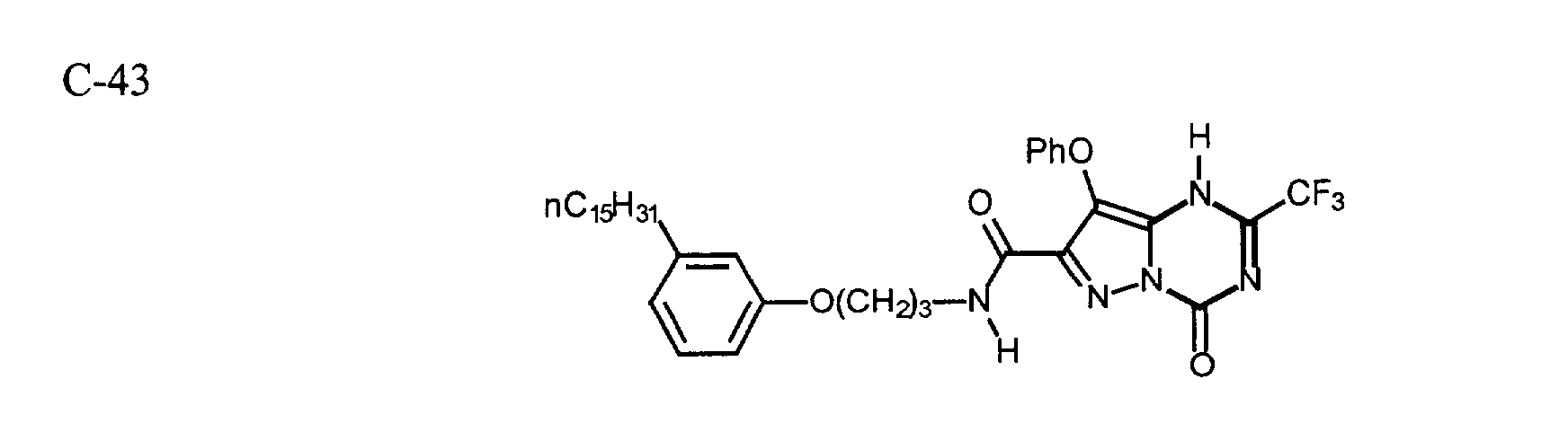
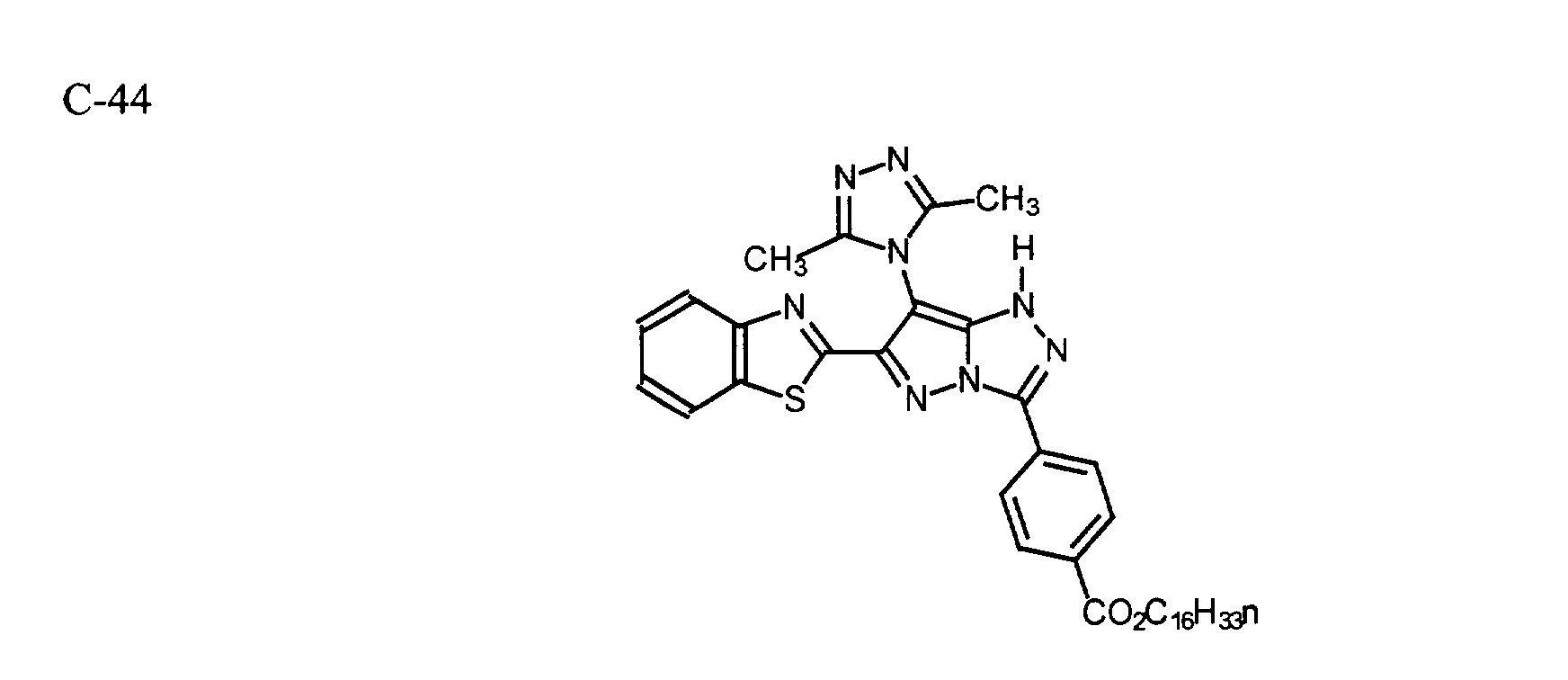


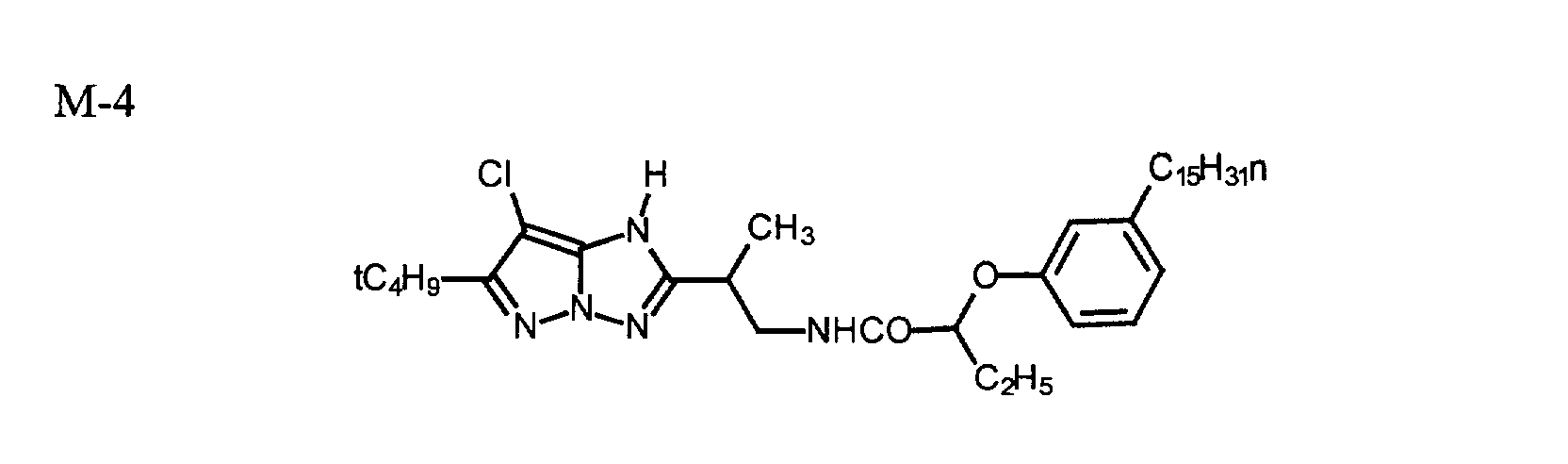
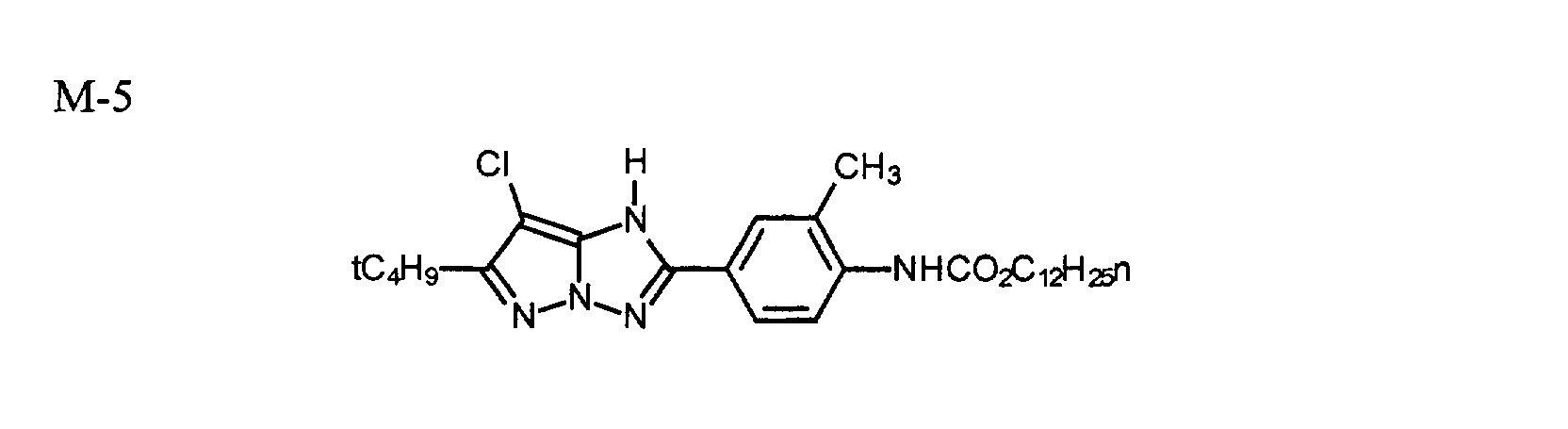


R1, R5 and R8 each represent a hydrogen or a substituent, R2 represents a substituent, R3, R4 and R7 each represent an electron attractive group having a Hammett's substituent constant spara of 0.2 or more and the sum of the spara values of R3 and R4 is 0.65 or more, R6 represents an electron attractive group having a Hammett's substituent constant spars of 0.35 or more, X represents a hydrogen or a coupling-off group, Z1 represents nonmetallic atoms necessary for forming a nitrogen-containing, six-membered, heterocyclic ring which has at least one dissociative group, Z2 represents ―C(R7)= and ―N= and Z3 and Z4 each represent ―C(R8)= and ―N=,
or by the formulae:-

R9 represents a substituent (preferably a carbamoyl, ureido, or carbonamido group), R10 represents a substituent (preferably individually selected from halogens, alkyl, and carbonamido groups), R11 represents ballast substituent; R12 represents a hydrogen or a substituent (preferably a carbonamido or sulfonamido group), X represents a hydrogen or a coupling-off group, and m is an integer from 1-3.

Ra and Rb are independently hydrogen or a substituent, Rc is a substituent (preferably an aryl group), Rd is a substituent (preferably an anilino, carbonamido, ureido, carbamoyl, alkoxy, aryloxycarbonyl, alkoxycarbonyl, or N-heterocyclic group), X is hydrogen or a coupling-off group, and Za, Zb, and Zc are independently a substituted methine group, =N―, =C― or ―NH―, provided that one of either the Za―Zb bond or the Zb―Zc bond is a double bond and the other is a single bond, and when the Zb―Zc bond is a carbon-carbon double bond, it may form part of an aromatic ring, and at least one of Za, Zb, and Zc is a methine group connected to the group Rb.




R1, R2, Q1 and Q2 are each a substituent, X is hydrogen or a coupling-off group, Y is an aryl group or a heterocyclic group, Q3 is an organic residue required to form a nitrogen-containing heterocyclic group together with the >N―, and Q4 are nonmetallic atoms necessary to form a 3- to 5-membered hydrocarbon ring or a 3- to 5-membered heterocyclic ring which contains at least one hetero atom selected from nitrogen, oxygen, sulfur and phosphorous in the ring. Particularly preferred is when Q1 and Q2 are each an alkyl group, an aryl group or a heterocyclic group, and R2 is an aryl or tertiary alkyl group.


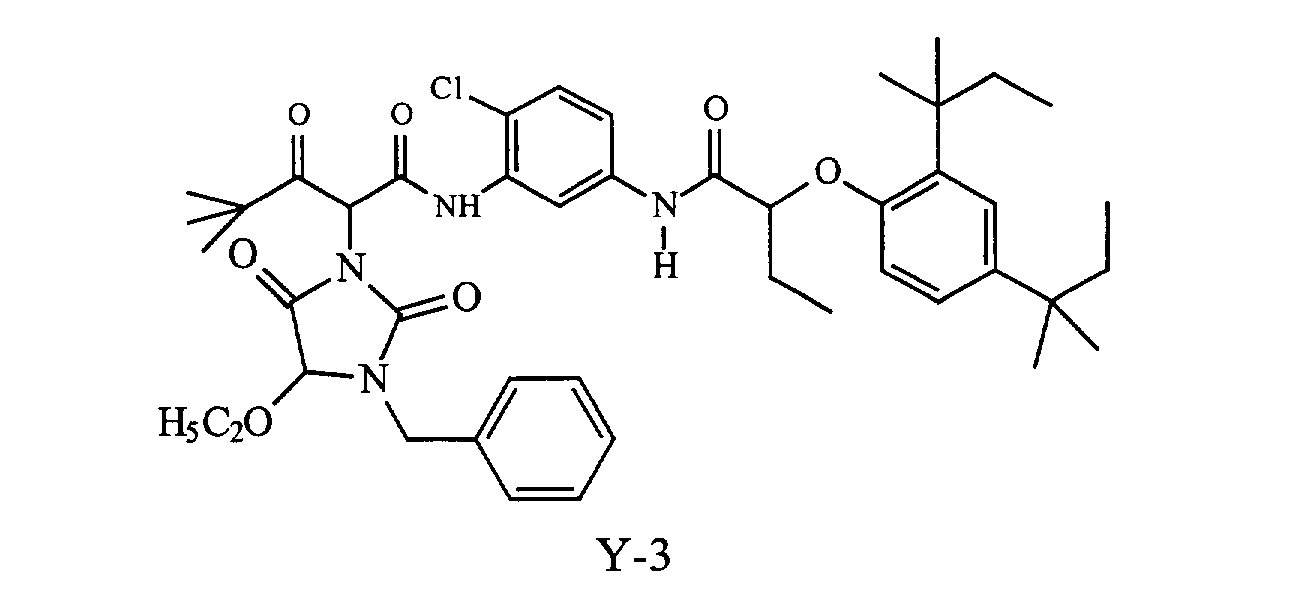

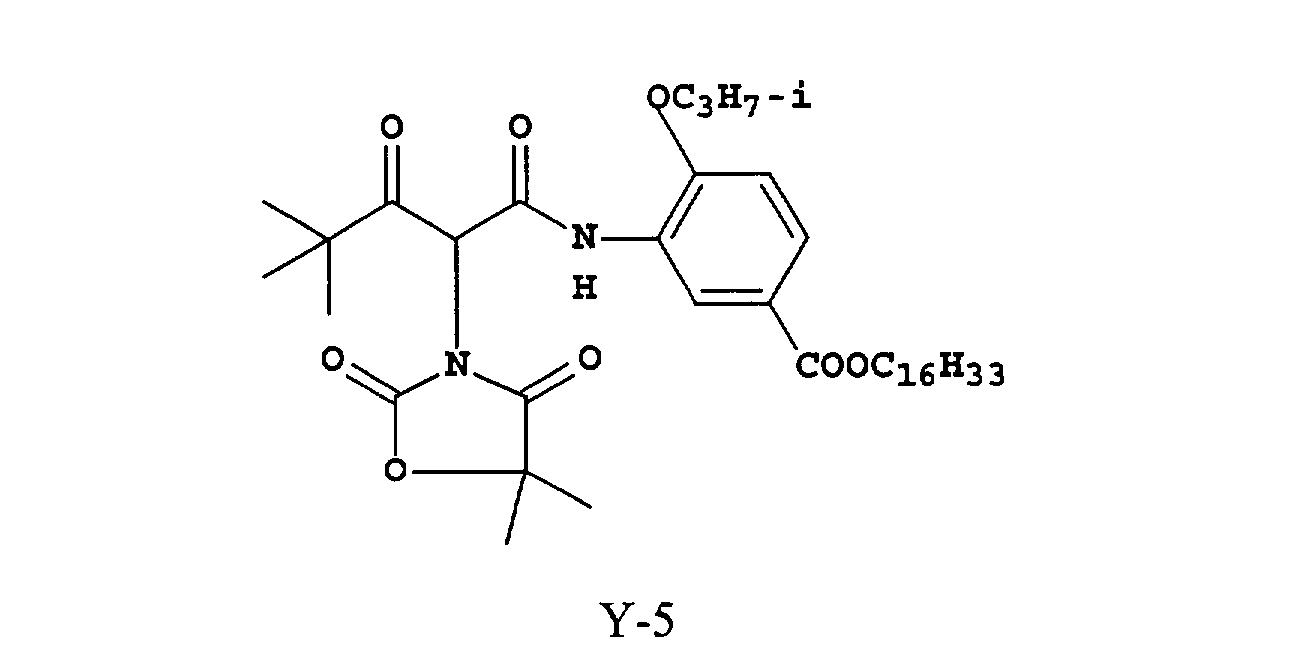
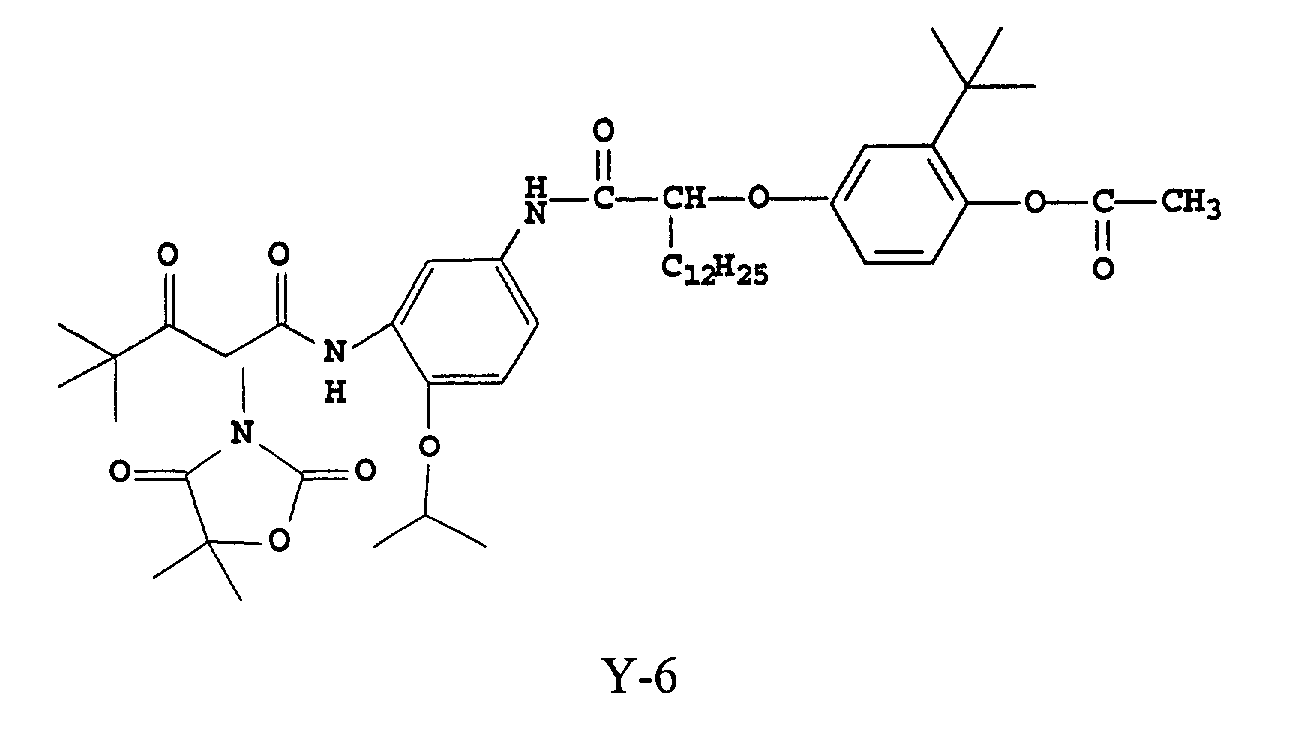
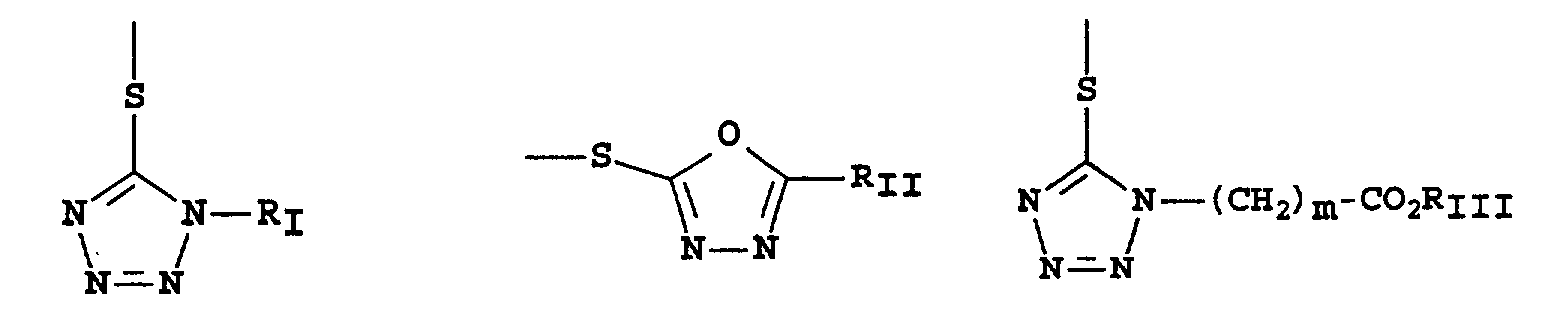

RI is selected from the group consisting of straight and branched alkyl groups of from 1 to about 8 carbon atoms, benzyl, phenyl and alkoxy groups and such groups containing none, one or more than one such substituent, RII is selected from RI and -SRI, RIII is a straight or branched alkyl group of from 1 to about 5 carbon atoms and m is from 1 to 3, and RIV is selected from the group consisting of hydrogen, halogens and alkoxy, phenyl and carbonamido groups, -COORV and -NHCOORV, wherein RV is selected from substituted and unsubstituted alkyl and aryl groups.
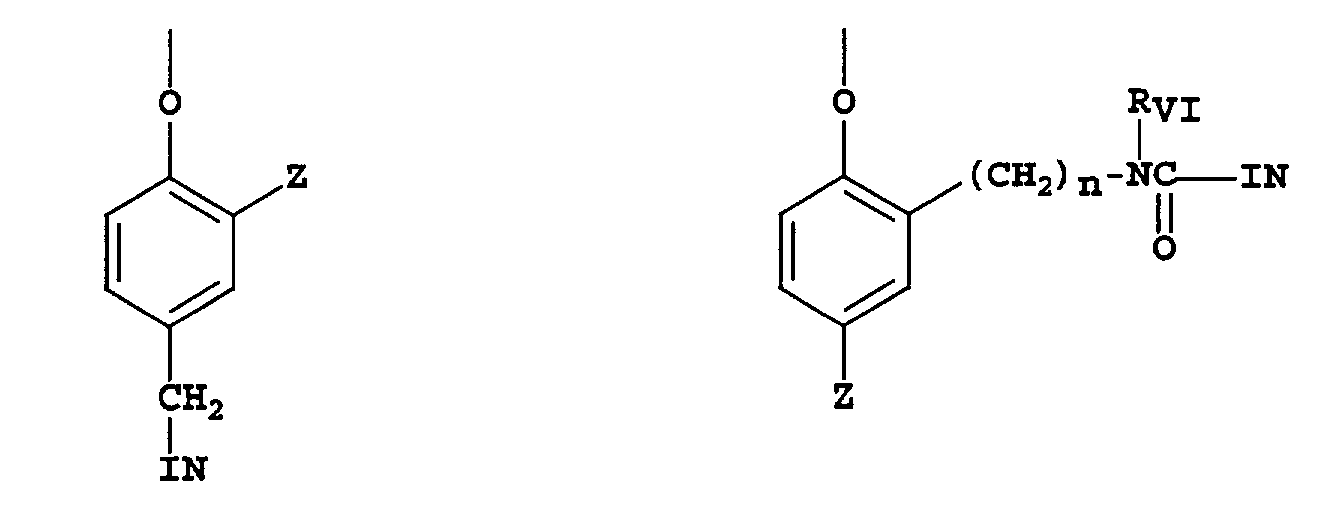
IN is the inhibitor moiety, Z is selected from the group consisting of nitro, cyano, alkylsulfonyl, sulfamoyl (-SO2NR2) and sulfonamido (-NRSO2R) groups, n is 0 or 1, and RVI is selected from the group consisting of substituted and unsubstituted alkyl and phenyl groups. The oxygen atom of each timing group is bonded to the coupling-off position of the respective coupler moiety of the DIAR.

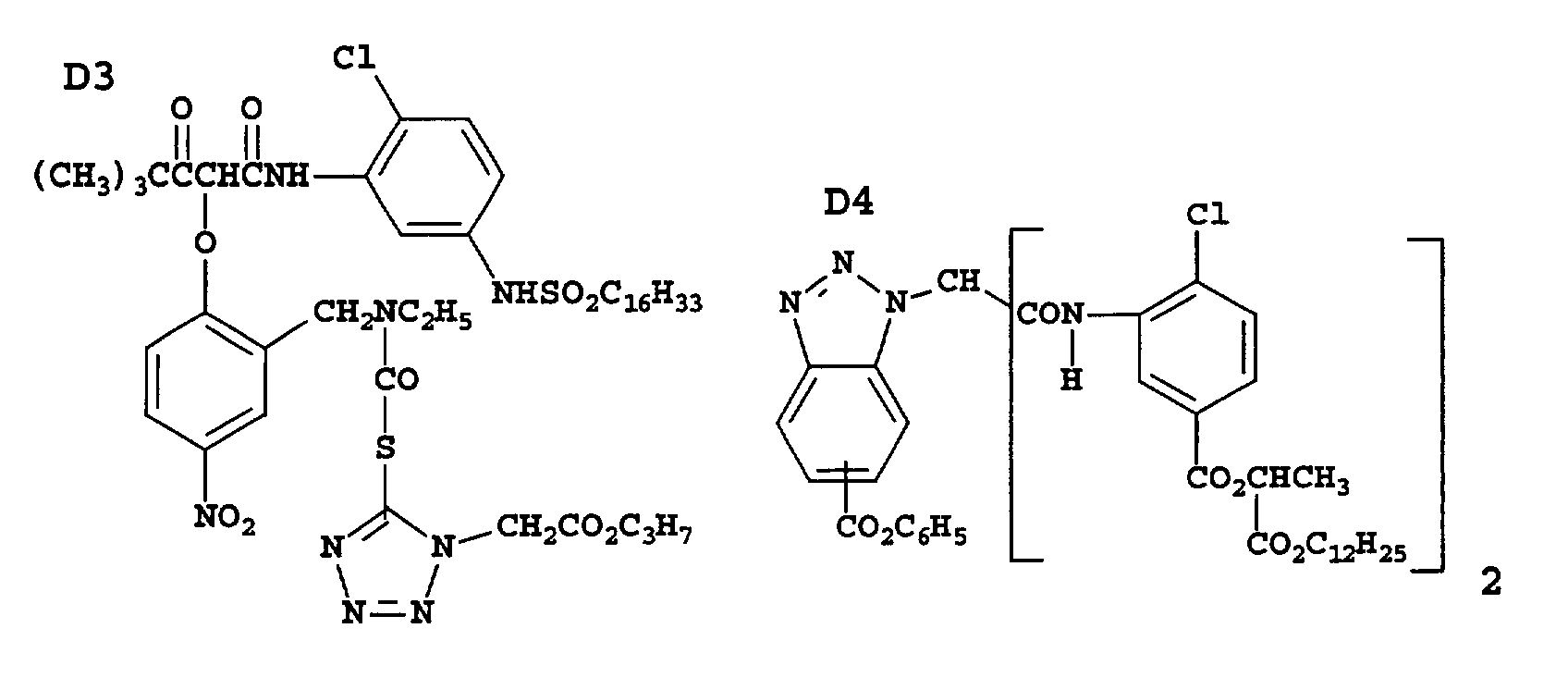

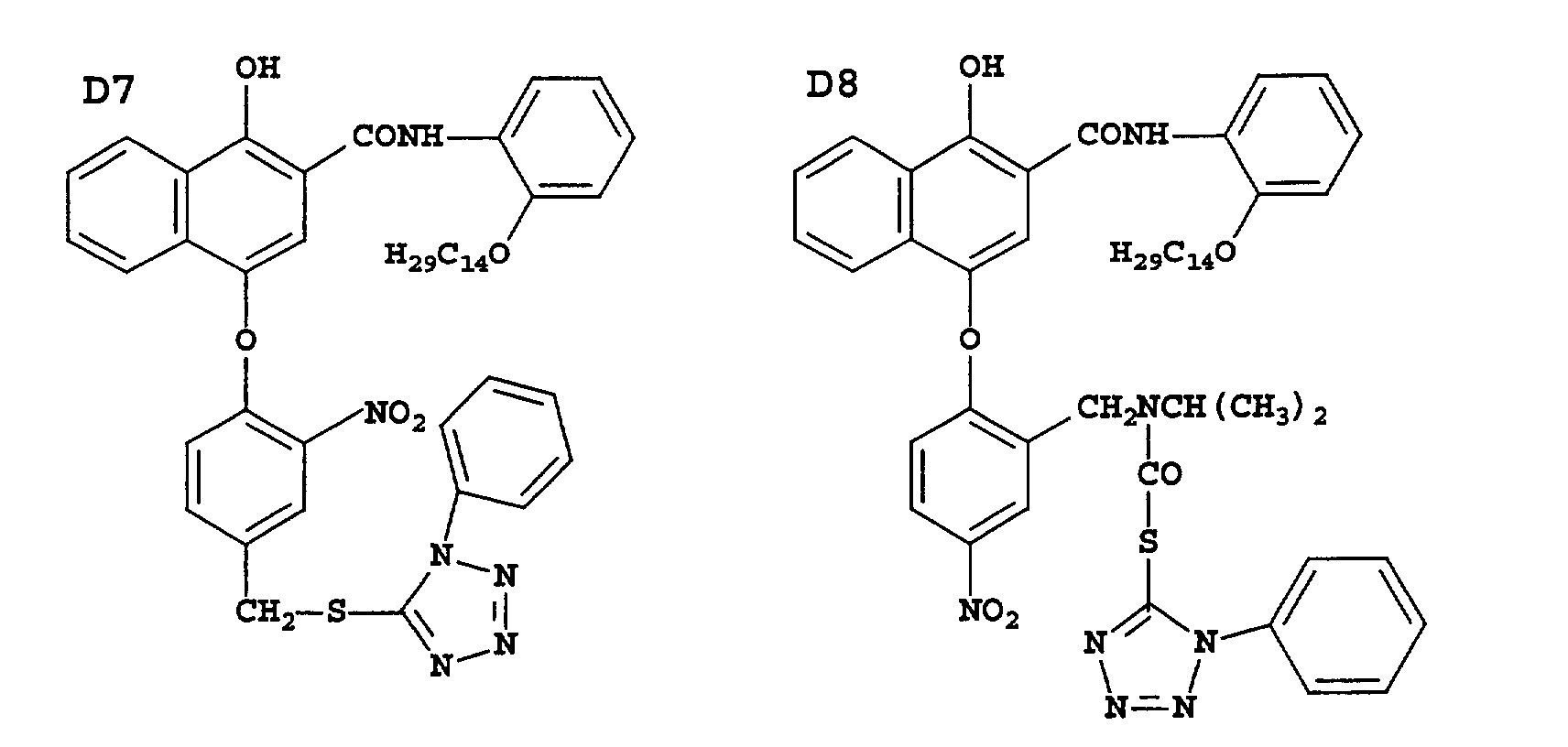

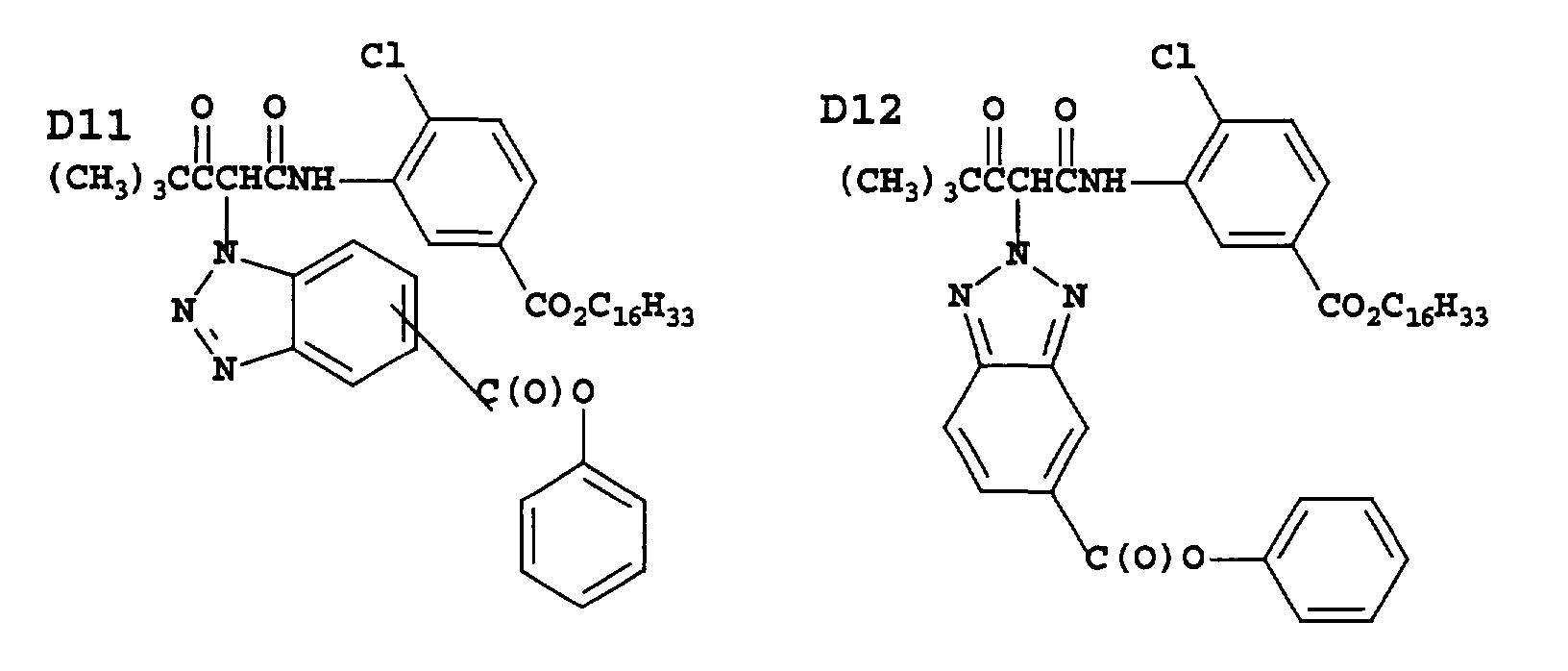
| [Fe(CN)6]-4 | SET-1 | [Ru(CN)6]-4 | SET-2 |
| [Os(CN)6]-4 | SET-3 | [Rh(CN)6]-3 | SET-4 |
| [Ir(CN)6]-3 | SET-5 | [Fe(pyrazine)(CN)5]-4 | SET-6 |
| [RuCl(CN)5]-4 | SET-7 | [OsBr(CN)5]-4 | SET-8 |
| [RhF(CN)5]-3 | SET-9 | [IrBr(CN)5]-3 | SET-10 |
| [FeCO(CN)5]-3 | SET-11 | [RuF2(CN)4]-4 | SET-12 |
| [OsCl2(CN)4]-4 | SET-13 | [RhI2(CN)4]-3 | SET-14 |
| [IrBr2(CN)4]-3 | SET-15 | [Ru(CN)5(OCN)]-4 | SET-16 |
| [Ru(CN)5(N3)]-4 | SET-17 | [Os(CN)5(SCN)]-4 | SET-18 |
| [Rh(CN)5(SeCN)]-3 | SET-19 | [Ir(CN)5(HOH)]-2 | SET-20 |
| [Fe(CN)3Cl3]-3 | SET-21 | [Ru(CO)2(CN)4]-1 | SET-22 |
| [Os(CN)Cl5]-4 | SET-23 | [Co(CN)6]-3 | SET-24 |
| [Ir(NCS)6]-3 | SET-25 | [In(NCS)6]-3 | SET-26 |
| [Ga(NCS)6]-3 | SET-27 |
ECD is the average equivalent circular diameter of the tabular grains in micrometers and
t is the average thickness in micrometers of the tabular grains.
Oxidized colour developing agent in turn reacts with the coupler to yield a dye.
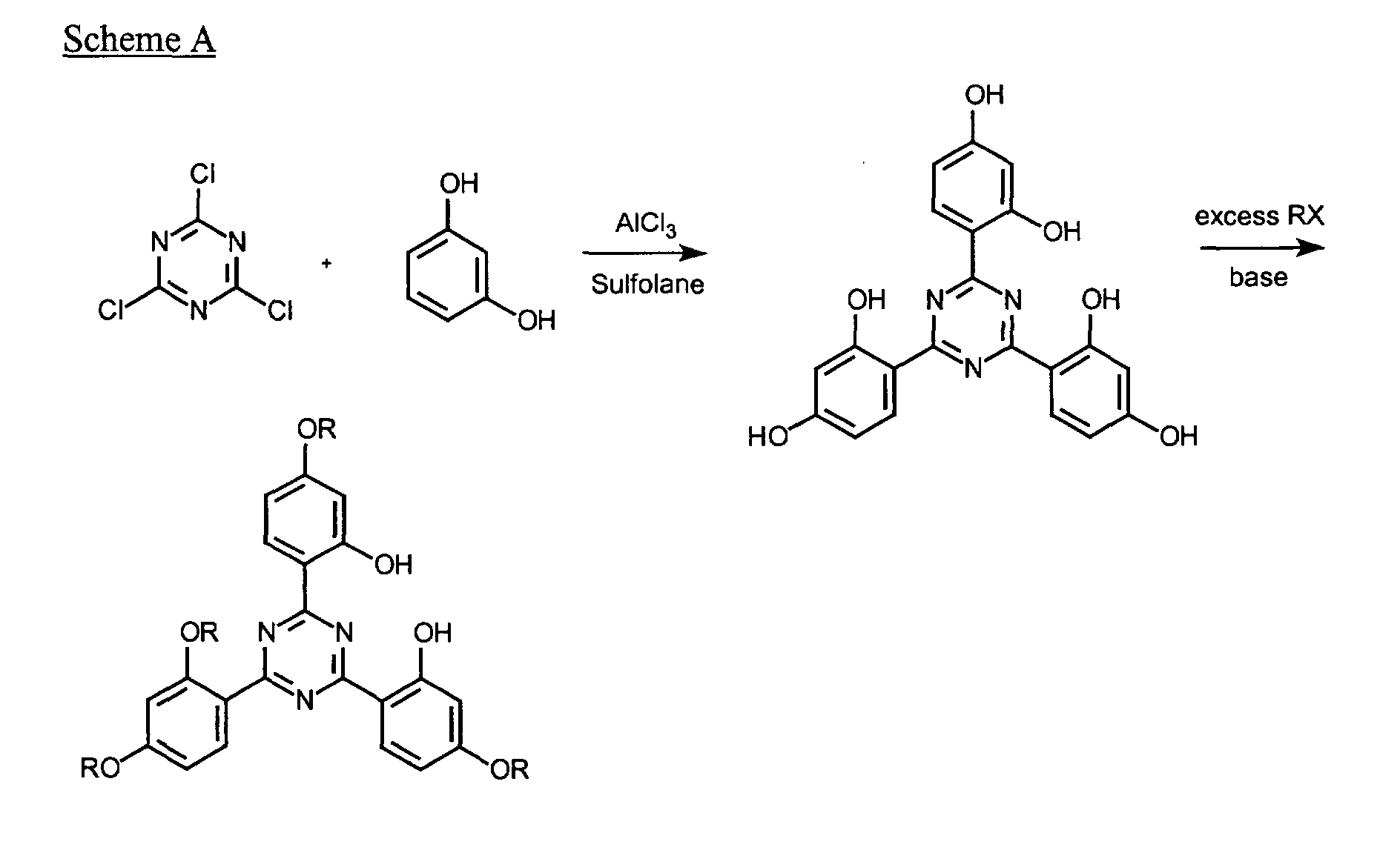
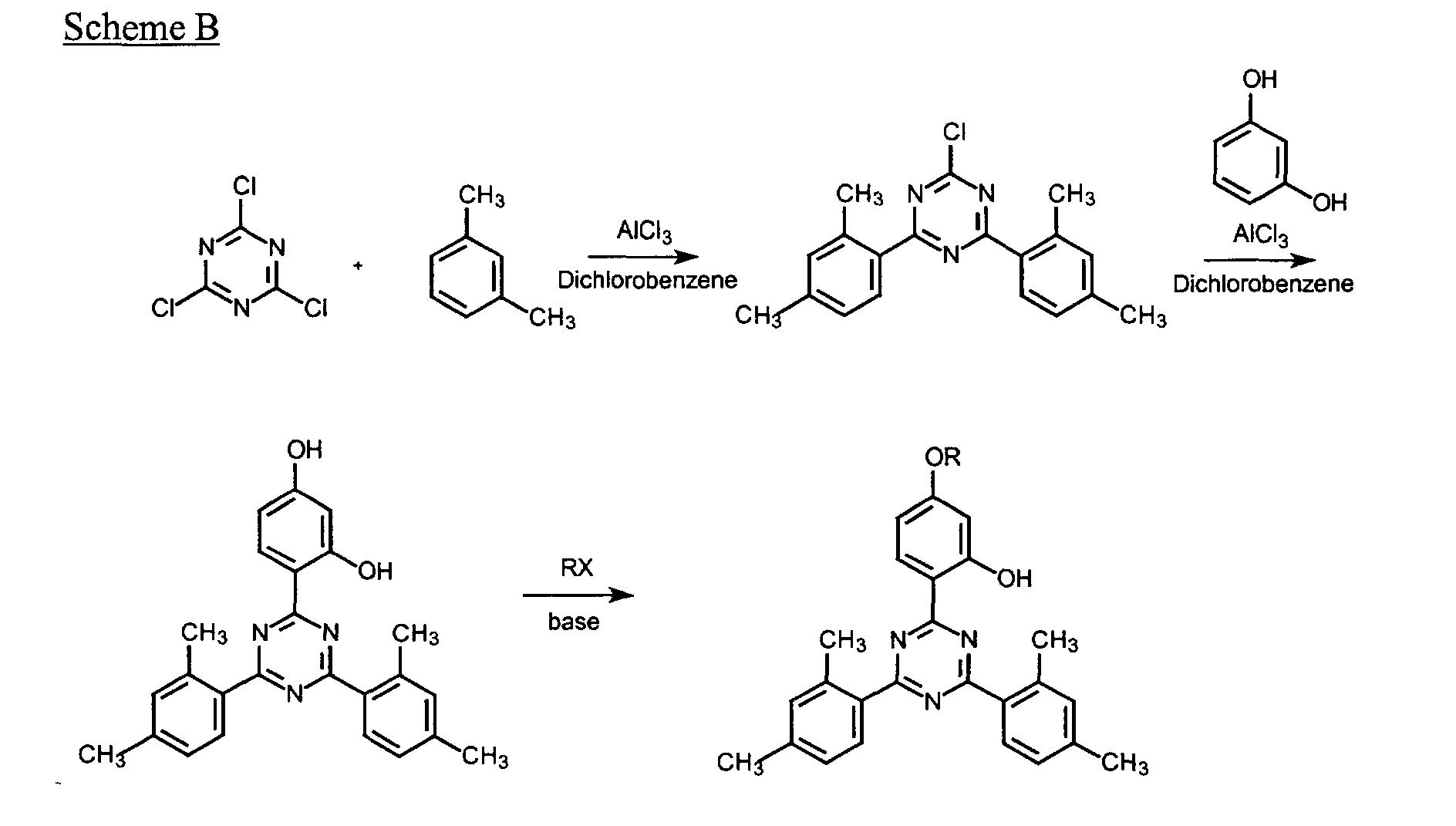
| Structure of Photographic Element | ||
| Layer | Component | Coverage |
| Layer 3 | Gelatin | 1.00 g/m2 |
| Layer 2 (UV light-absorbing layer) | Gelatin | 0.60 g/m2 |
| UV light-absorbing agents: | ||
| (UV-A:UV-B 0.85:0.15) | 0.24 g/m2 | |
| Stain prevention agent, J | 65.69 mg/m2 | |
| Solvent for UV-absorbing agents, F | 79.93 mg/m2 | |
| Hardener, K | 0.11 g/m2 | |
| Layer 1 (Red-sensitive layer) | Gelatin | 1.62 g/m2 |
| Silver chloride emulsion | 0.20 g Ag/m2 | |
| Coupler(s) | 0.83 mmol/m2 | |
| Support | Gelatin over polyethylene laminated paper base | 3.00 g/m2 |
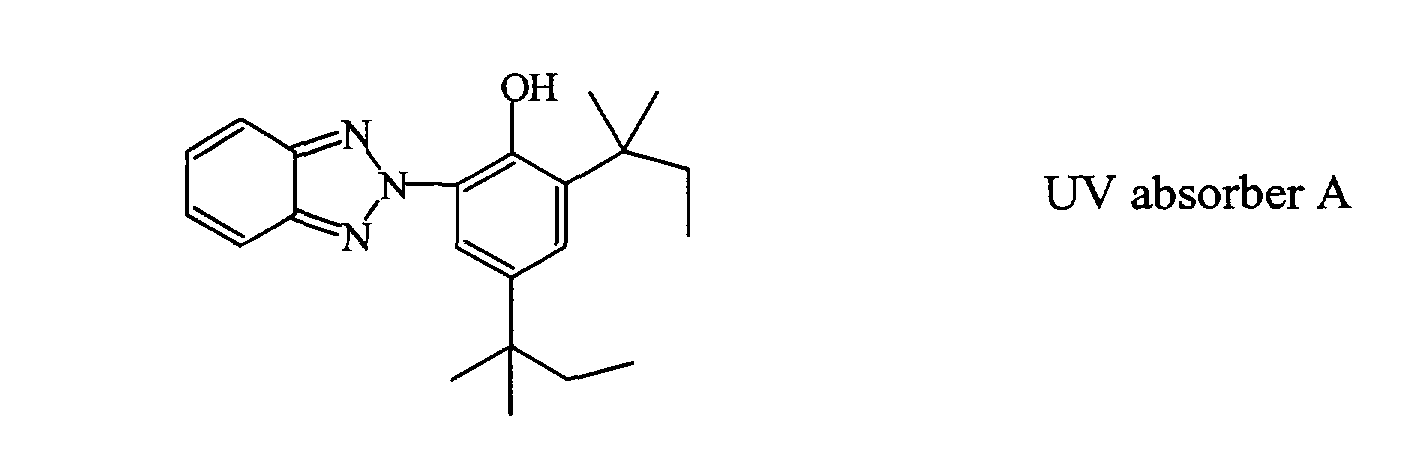
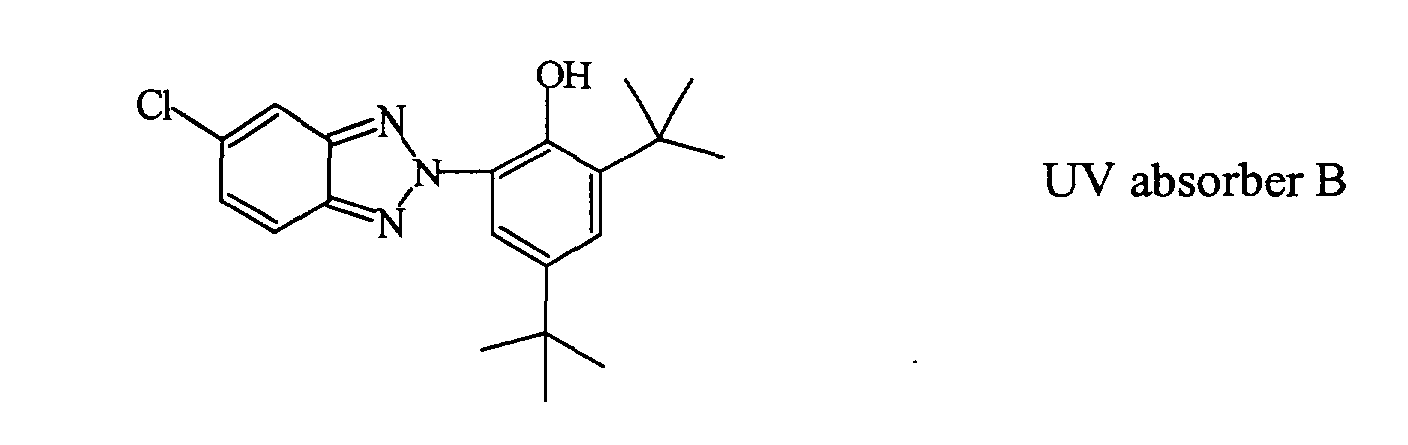
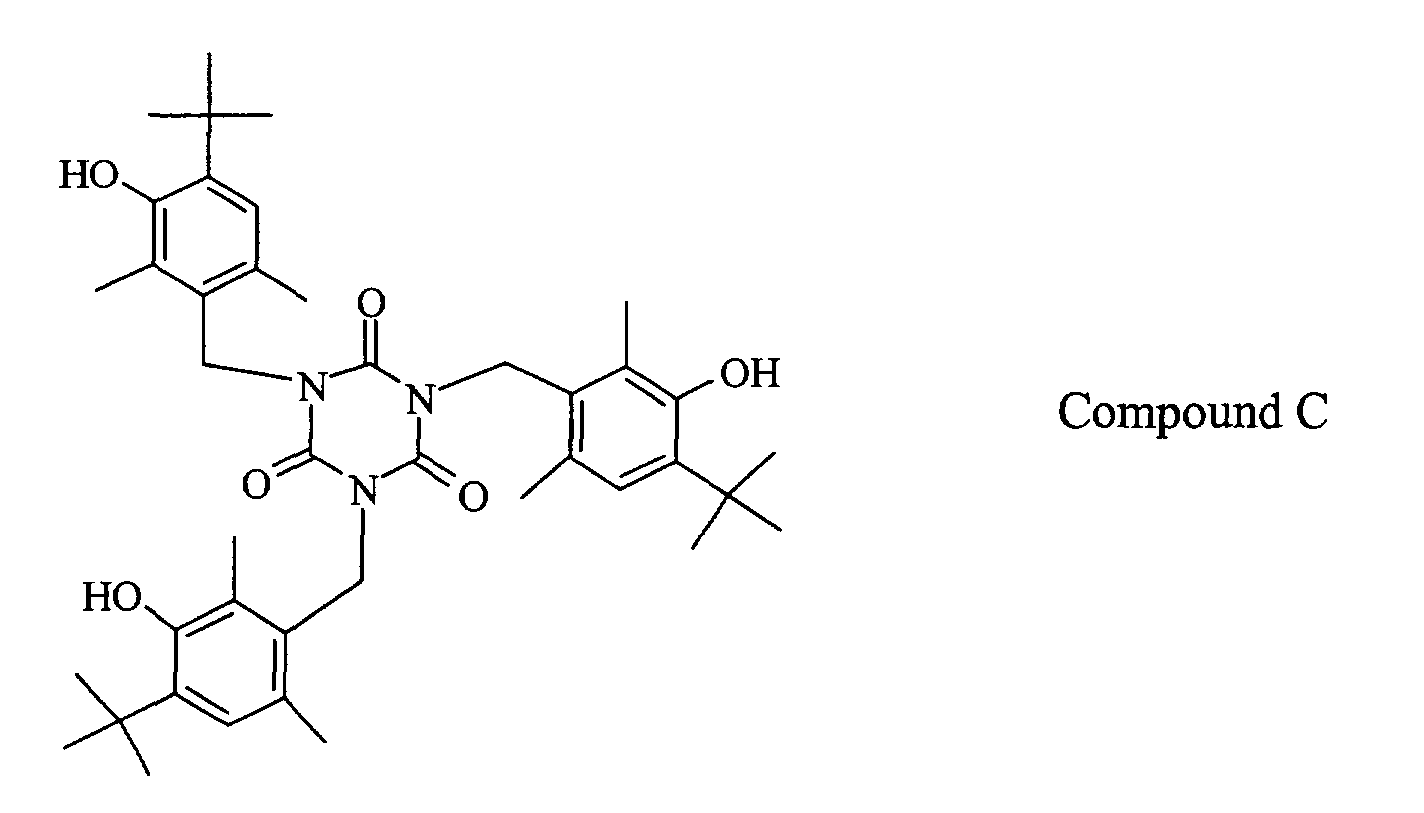

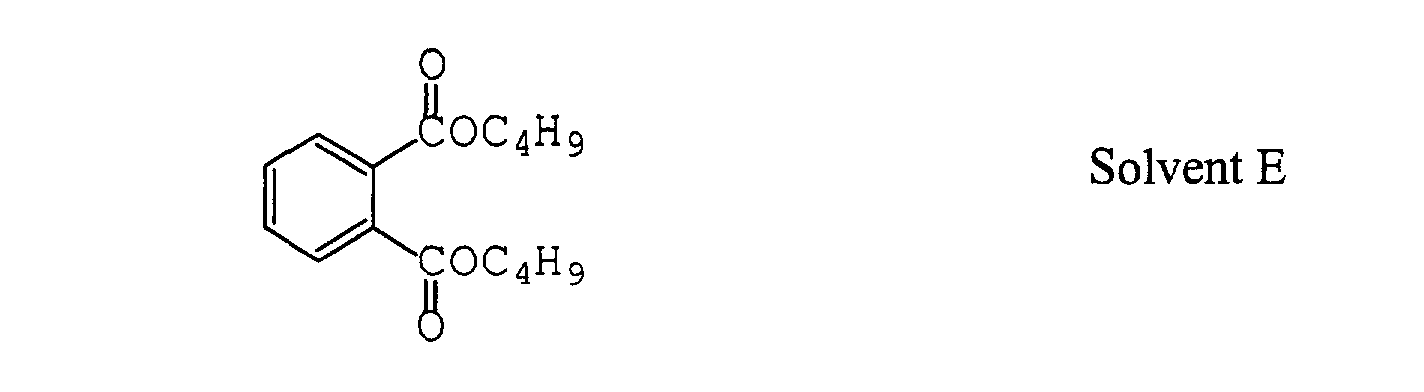

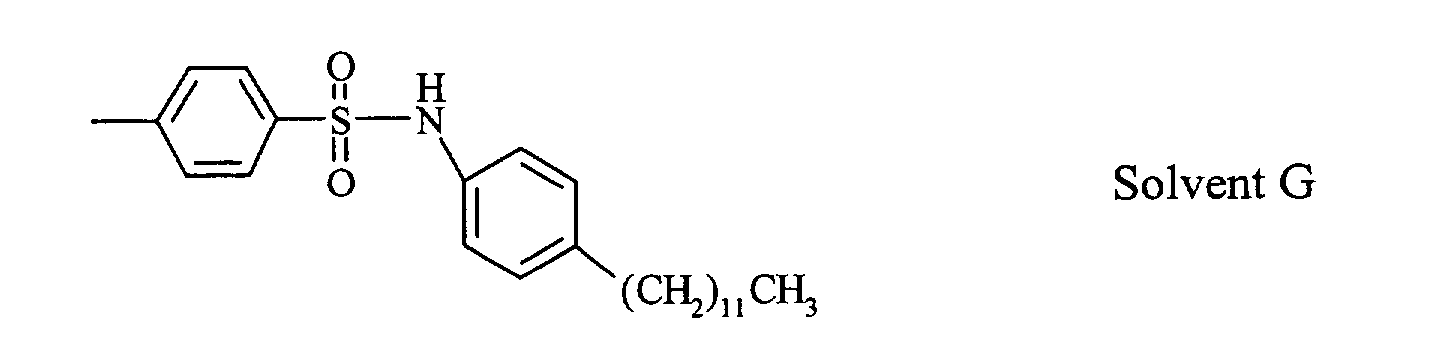


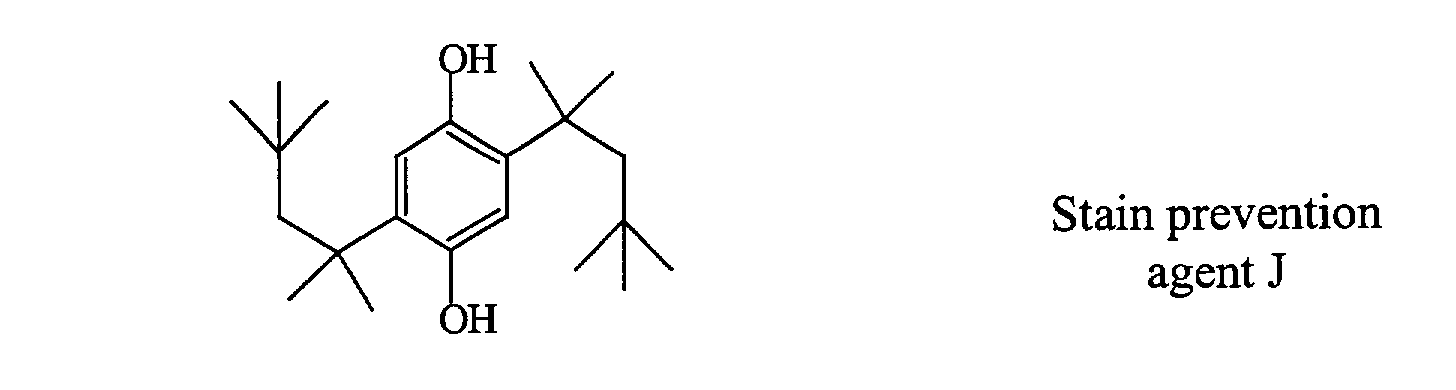


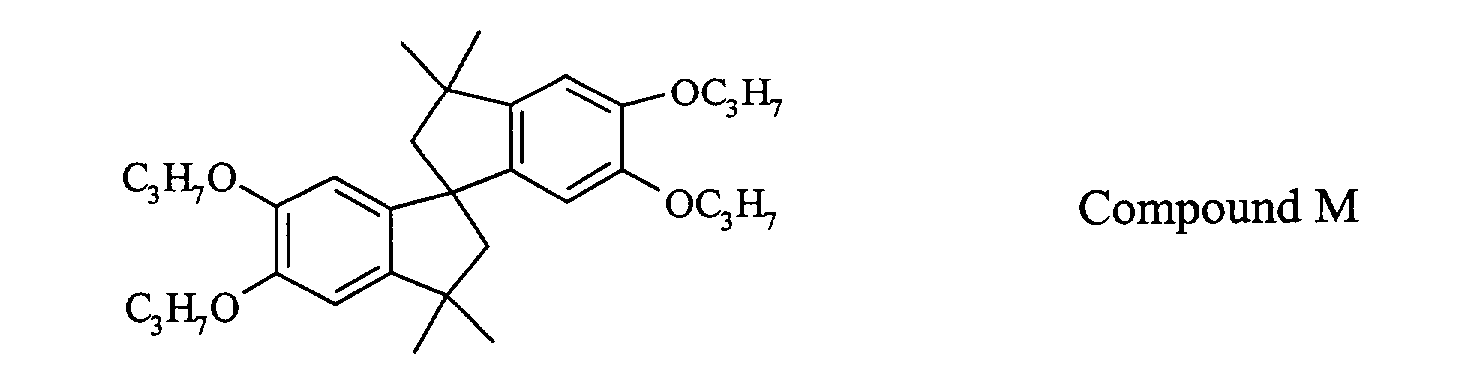

| Process Step | Time(min.) | Tem.(C) |
| Developer | 0.75 | 35.0 |
| Bleach-Fix | 0.75 | 35.0 |
| Water wash | 1.50 | 35.0 |
| Developer | |
| Triethanolamine | 12.41g |
| Blankophor REU™ | 2.30g |
| Lithium polystyrene sulfonate | 0.09g |
| N,N-Diethylhydroxylamine | 4.59g |
| Lithium sulfate | 2.70g |
| Developing agent, Dev-1 | 5.00g |
| 1-Hydroxyethyl-1,1-diphosphonic acid | 0.49g |
| Potassium carbonate, anhydrous | 21.16g |
| Potassium chloride | 1.60g |
| Potassium bromide pH adjusted to 10.4 at 26.7C | 7.00mg |
| Bleach-Fix | |
| Solution of ammonium thiosulfate | 71.85g |
| Ammonium sulfite | 5.10g |
| Sodium metabisulfite | 10.00g |
| Acetic acid | 10.20g |
| Ammonium ferric ethylenediaminetetraacetate | 48.58g |
| Ethylenediaminetetraacetic acid pH adjusted to 6.7 at 26.7C | 3.86g |
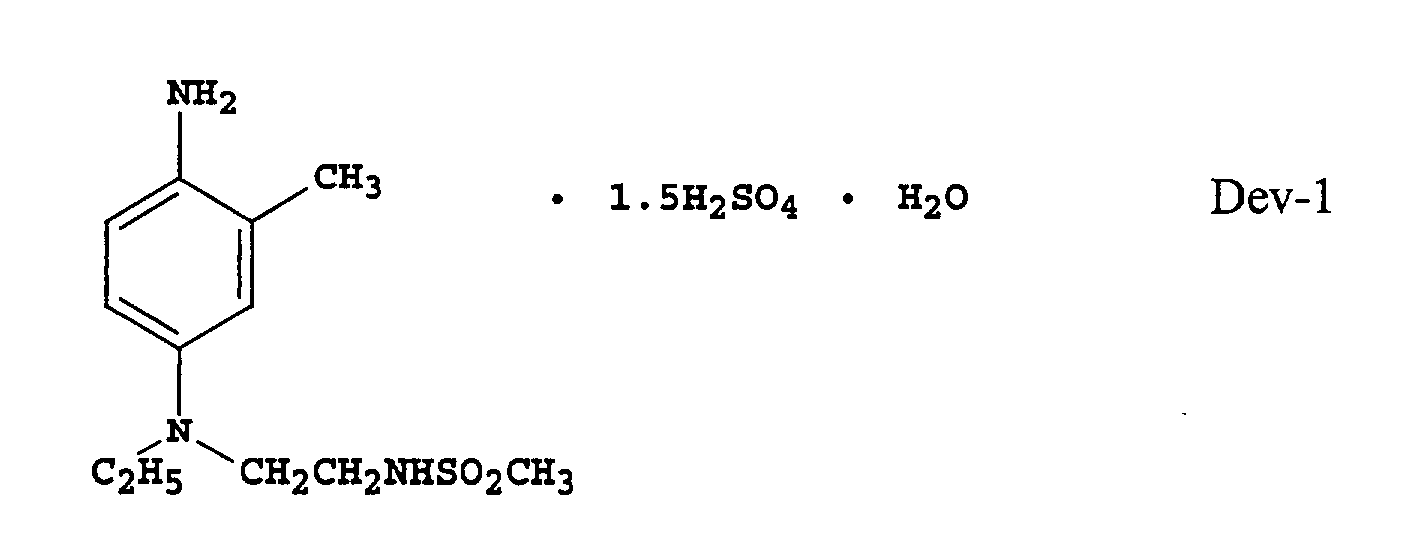
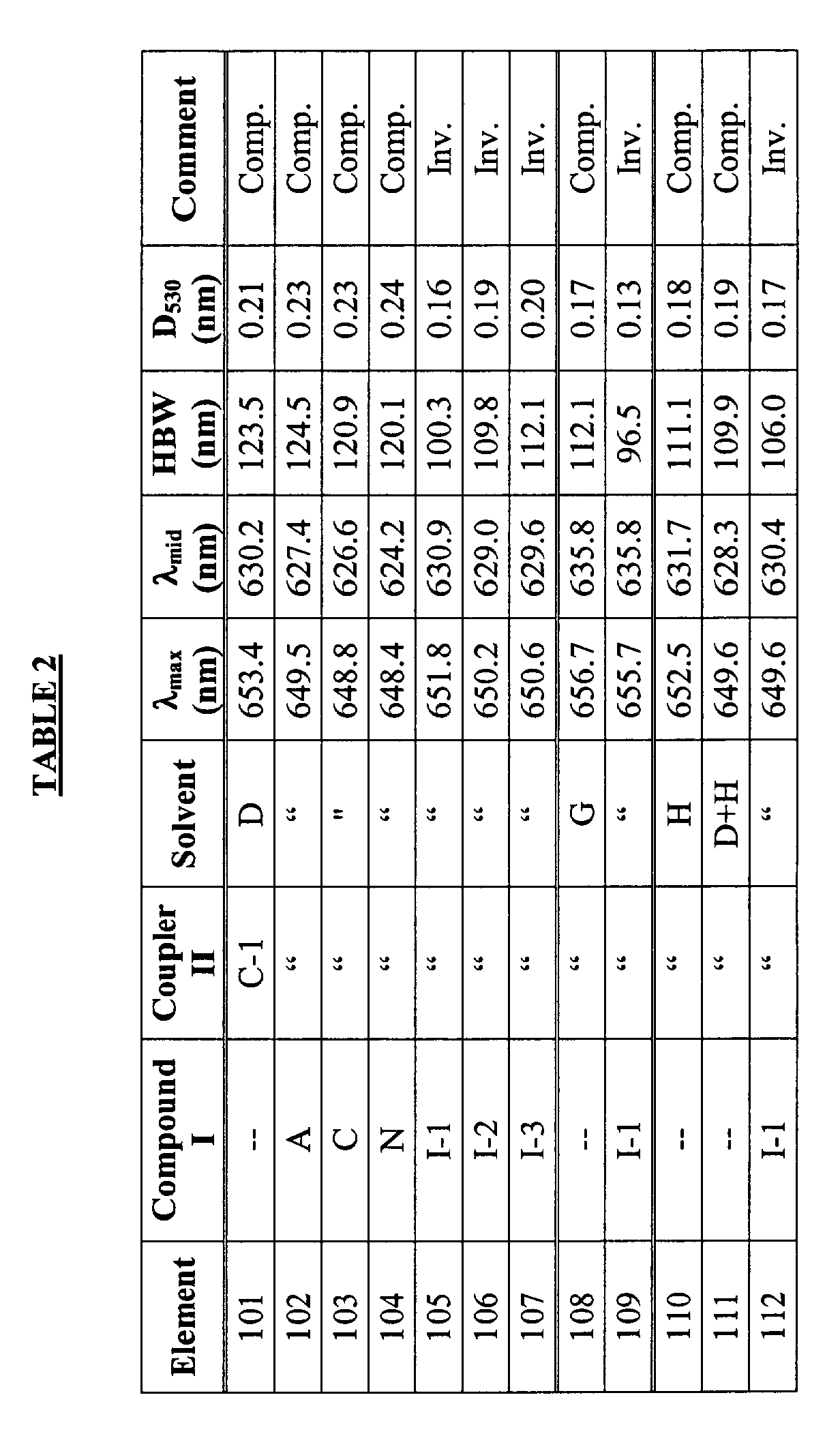

| Element | Compound (I) | Coupler (II) | Solvent | λmax (nm) | λmid (nm) | HBW (nm) | D530 (nm) | |
| 128 | -- | C-10 | D | 650.8 | 626.2 | 133.8 | 0.25 | C |
| 129 | I-1 | " | " | 651.9 | 632.4 | 108.9 | 0.17 | I |
| Structure of Photographic Element | ||
| Layer | Component | Coverage |
| Layer 3 | Gelatin | 1.00 g/m2 |
| Layer 2 (UV light-absorbing layer) | Gelatin | 0.60 g/m2 |
| UV light-absorbing agents: | ||
| (UV-A:UV-B 0.85:0.15) | 0.24 g/m2 | |
| Stain prevention agent, J | 65.69 mg/m2 | |
| Solvent for UV-absorbing agents, F | 79.93 mg/m2 | |
| Hardener, K | 0.11 g/m2 | |
| Layer 1 (Green-sensitive layer) | Gelatin | 1.62 g/m2 |
| Silver chloride emulsion | 0.098 g Ag/m2 | |
| Coupler(s) | 0.43 mmol/m2 | |
| Support | Gelatin over polyethylene laminated paper base | 3.00 g/m2 |

| Structure of Photographic Element | ||
| Layer | Component | Coverage |
| Layer 3 | Gelatin | 1.00 g/m2 |
| Layer 2 (UV light-absorbing layer) | Gelatin | 0.60 g/m2 |
| UV light-absorbing agents: | ||
| (UV-A:UV-B 0.85:0.15) | 0.24 g/m2 | |
| Stain prevention agent, J | 65.69 mg/m2 | |
| Solvent for UV absorbing agents, F | 79.93 mg/m2 | |
| Hardener, K | 0.11 g/m2 | |
| Layer 1 (Green-sensitive layer) | Gelatin | 1.62 g/m2 |
| Silver chloride emulsion | 0.180 g Ag/m2 | |
| Coupler(s) | 0.53 mol/m2 | |
| Support | Gelatin over polyethylene laminated paper base | 3.00 g/m2 |

Claims (28)
- A photographic element comprising at least one light-sensitive silver halide emulsion layer having associated therewith in the same dispersion a de-aggregating compound of formula (I) and at least one heterocyclic dye-forming coupler of formula (II),
wherein
the de-aggregating compound has the formula (I)wherein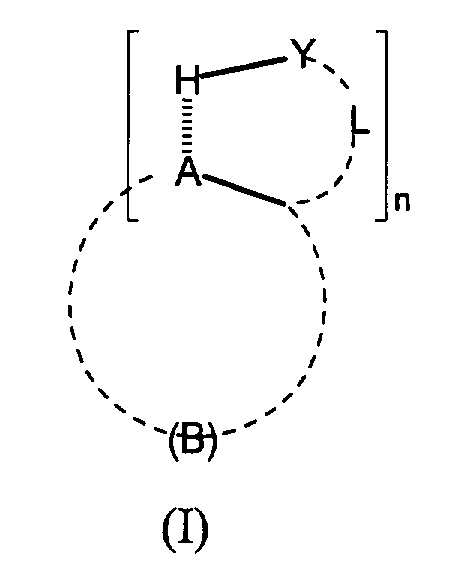
A is a hydrogen-bond-accepting hetero -atom or -group;
Y is a hydrogen-bond-donating hetero -atom or -group;
L is a linking group that is partially or wholly conjugated with A and linked to A by a carbon atom;
n is 1, 2 or 3 hydrogen-bond-containing moieties; and
(B) comprises the remaining atoms for completion of an unsubstituted or substituted heterocyclic ring or ring system containing the hydrogen bond-accepting hetero -atom or -group, which may contain one or more other heteroatoms selected from nitrogen, oxygen and sulfur; and
wherein
the heterocyclic dye-forming coupler has the formula (II):-wherein
R1 is hydrogen or a substituent;
Rc is a substituent; and
q is 0 to 4;
Za represents the atoms necessary to complete an unsubstituted or substituted 5- to 10-membered heterocyclic ring system which may contain one or more other heteroatoms selected from nitrogen, oxygen and sulfur;
providing that each Rc is attached to a carbon atom of the ring; and
X is selected from hydrogen or halogen or a group which is separable by the reaction of coupler with an oxidized colour developing agent. - An element according to claim 1 wherein A is a carbonyl, iminyl, sulfonyl or sulfinyl group or a nitrogen atom.
- An element according to either of the preceding claims wherein L is a sulfonyl, sulfinyl or carbonyl group or one or more alkenyl groups which can complete an unsubstituted or substituted 5- to 10-membered ring system, which may contain one or more other heteroatoms selected from nitrogen, oxygen and sulfur.
- An element according to any one of the preceding claims wherein Y is an atom or group that can provide intramolecular hydrogen- bonding with A selected from -O-, -NR, -NCOR, -NCONHR or -NSO2R, wherein R is an unsubstituted or substituted alkyl or aryl group, or -N-, wherein the nitrogen atom forms with L part of a 5- to 10-membered heterocyclic ring system.
- An element according to any one of the preceding claims wherein the de-aggregating compound has the formula (IA):-wherein
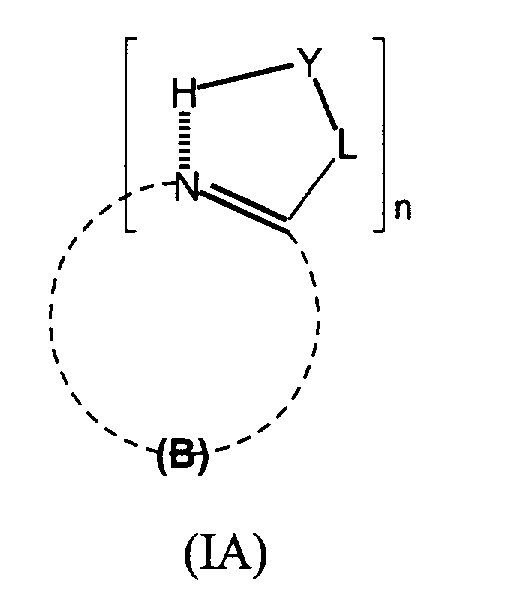
N is an aza nitrogen;
L is selected from the class consisting of a sulfonyl, sulfinyl and carbonyl group and one or more alkenyl groups which form part of an unsubstituted or substituted 5- to 10-membered ring system, which may contain one or more other heteroatoms selected from nitrogen, oxygen and sulfur;
(B) comprises the remaining atoms for completion of an unsubstituted or substituted 5- to 10-membered heterocyclic ring or ring system containing the hydrogen-bond-accepting hetero -atom or -group, which may contain one or more other heteroatoms selected from nitrogen, oxygen and sulfur;
and
Y and n are as defined in claim 1. - An element according to claim 5 wherein (B) with N= completes the atoms of a 5-, 6- or 7-membered heterocyclic ring.
- An element according to any one of the preceding claims wherein the de-aggregating compound has the formula (IB):-wherein
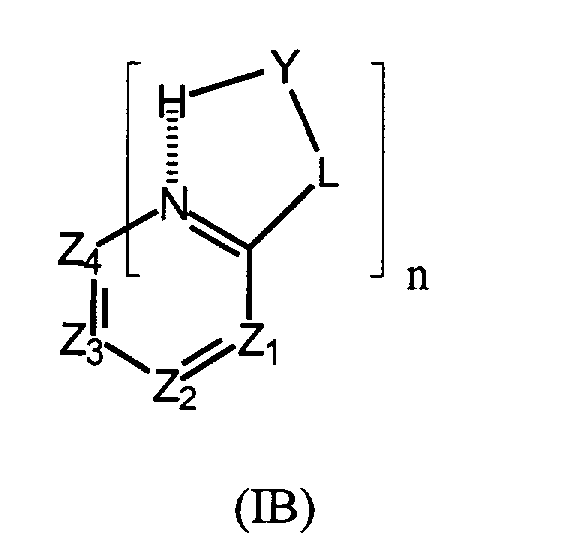
Z1 to Z4 are independently nitrogen atoms or unsubstituted or substituted carbon atoms, one or two adjacent pairs of which may each support an additional hydrogen-bond-containing moiety, each moiety being the same or different, such that n is 1, 2 or 3;
provided that at least one of Z1 to Z4 is an unsubstituted or substituted carbon atom;
L comprises one or more alkenyl groups which form part of an unsubstituted or substituted 5-10-membered ring system, which may contain one or more other heteroatoms selected from nitrogen, oxygen and sulfur; and
Y is as defined in claim 1. - An element according to any one of the preceding claims wherein the de-aggregating compound has the formula (IC):-wherein
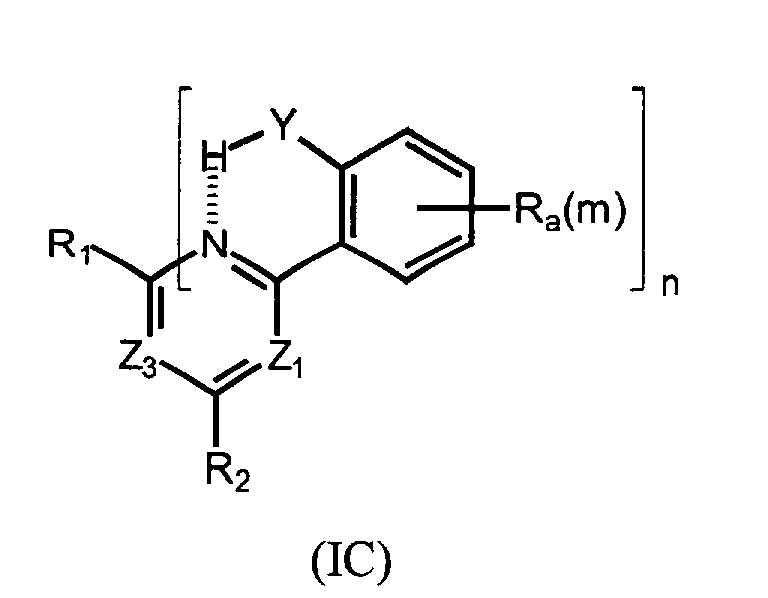
R1 and R2 are independently hydrogen or a substituent;
each Ra is an independently selected substituent;
m is 0 to 4; and
Z1 and Z3 are independently nitrogen atoms or unsubstituted or
substituted carbon atoms each of which together with an adjacent substituted carbon atom may support an additional hydrogen-bond-containing moiety, each moiety being the same or different, such that n is 1, 2 or 3; and
Y is as defined in claim 1. - An element according to claim 8 wherein each Y is -O- and Z1 and Z3 are both nitrogen atoms.
- An element according to any one of the preceding claims wherein n is 1 or 2.
- An element according to any one of the preceding claims wherein the de-aggregating compound has the formula (ID) or (IE):-wherein
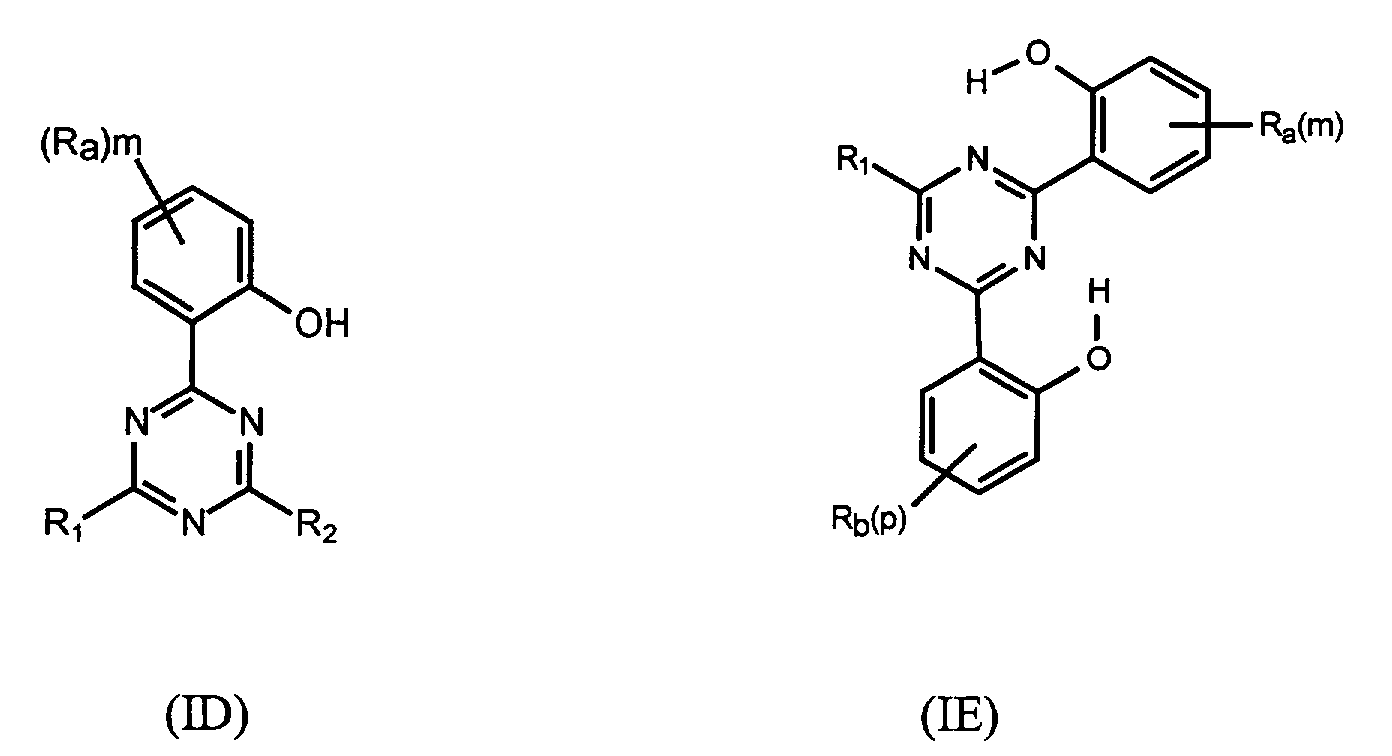
R1, R2, Ra and m are as defined in claim 8;
each Rb is an independently selected substituent; and
p is 0 to 4. - An element according to any one of claims 8 to 11 wherein substituents for R1, R2, each Ra and each Rb are independently selected from cyano, fluoro, chloro, bromo, iodo; or an unsubstituted or substituted alkyl, aryl, heterocyclyl, alkoxy, aryloxy, alkyl- or aryl-carbonyl, alkyl- or aryl-oxycarbonyl, acyloxy, carbonamido, alkyl- or aryl-carbonamido, alkyl- or aryl-oxycarbonylamino, alkyl- or aryl-sulfonyl, alkyl- or aryl-sulfonyloxy, alkyl- or aryl-oxysulfonyl, alkyl- or aryl-sulfoxide, alkyl- or aryl-sulfamoyl, alkyl- or aryl-sulfamoylamino, alkyl- or aryl-sulfonamido, alkyl- or aryl-thio, alkyl- or aryl-phosphonate, nitro, alkyl- or aryl-amino, alkyl- or aryl-ureido or alkyl- or aryl-carbamoyl group, any of which may be further substituted, or any of R1, R2 and Ra or R1, Ra and Rb may join to form a dimer or polymer.
- An element according to claim 12 wherein each Ra and each Rb is independently an unsubstituted or substituted alkyl, alkoxy, alkoxycarbonyl or alkylcarbamoyl group.
- An element according to either of claims 12 and 13 wherein one of R1 and R2 is a phenyl group, which is unsubstituted or substituted with one or more halogen or alkoxy, alkyl, alkylsulfonamido or alkylsulfonyl groups.
- An element according to any one of claims 8 to 14 wherein m and p are 1 and meta to Y.
- An element according to any one of the preceding claims wherein the compound of formula (II) has the formula (IIA):-wherein
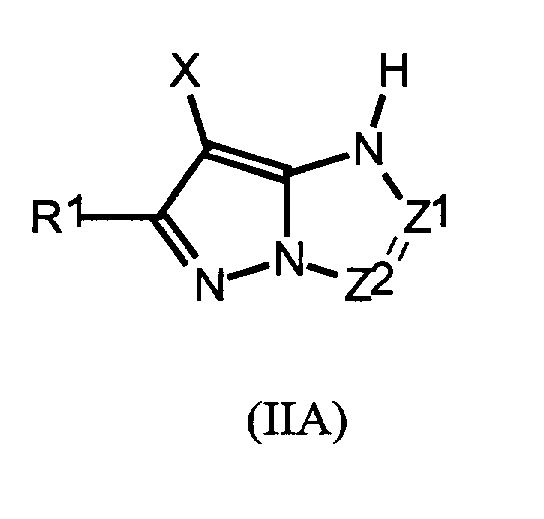
Z1 and Z2 are independently -CH- groups, which may together form part of an unsubstituted or substituted phenyl ring, -CR- groups, wherein R is a substituent, or nitrogen atoms; and
R1 and X are as defined in claim 1. - An element according to claim 16 wherein the compound of formula (IIA) has one of the structures:-
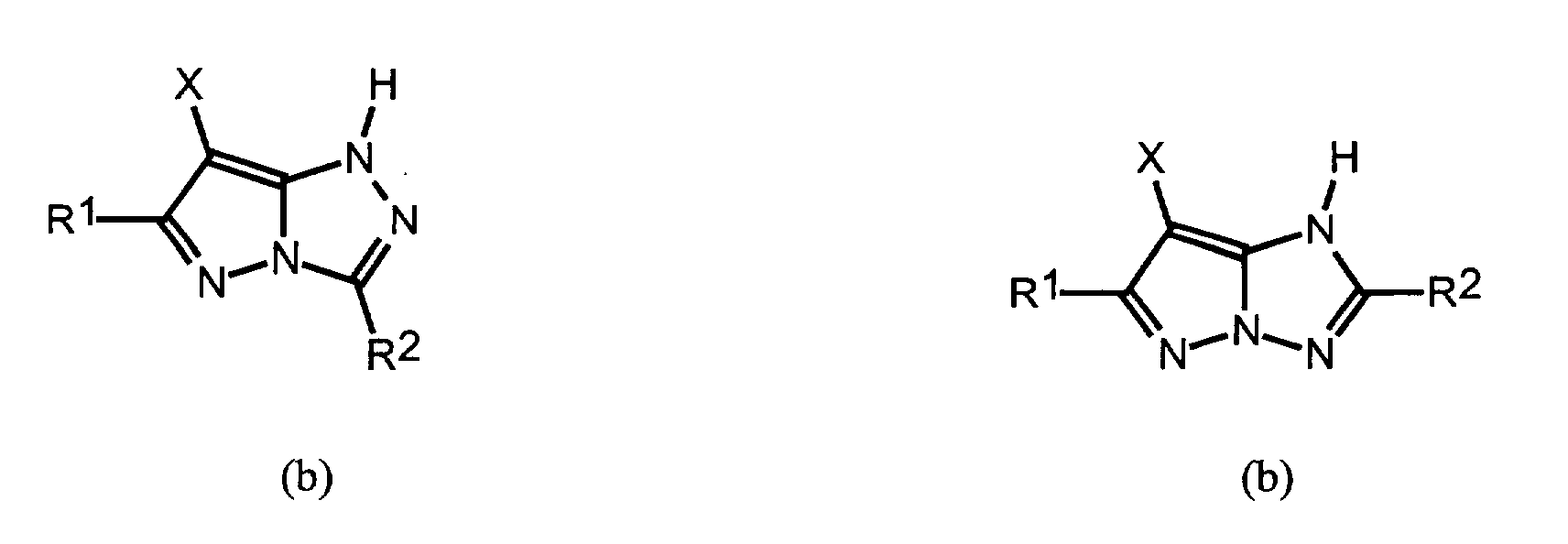 wherein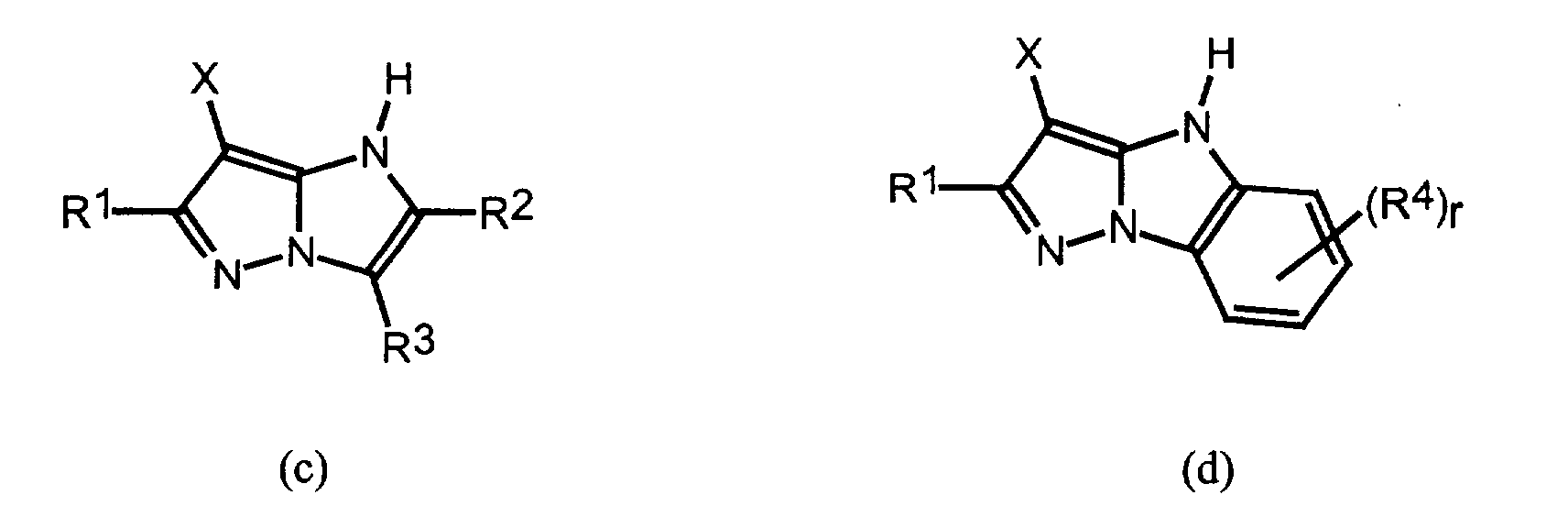
each of R1 to R4 is hydrogen or an independently selected substituent;
r is 0 to 4; and
X is as defined in claim 1. - An element according to any one of claims 1 to 15 wherein the compound of formula (II) has the structure (IIB):-wherein

one of Z1 and Z3 is a carbonyl or sulfonyl group and the other is a -CH- or -CR- group, wherein R is a substituent, or a nitrogen atom;
Z2 is a -CH- or -CR- group or a nitrogen atom; or
Z2 and the other of Z1 and Z3 may together form an unsubstituted or substituted aryl ring or a 5- to 10-membered heterocyclic ring which may contain one or more heteroatoms selected from nitrogen, oxygen and sulfur, which ring is unsubstituted or substituted; and
R1 and X are as defined in claim 1. - An element according to claim 18 wherein the compound of formula (IIB) has one of the structures:-

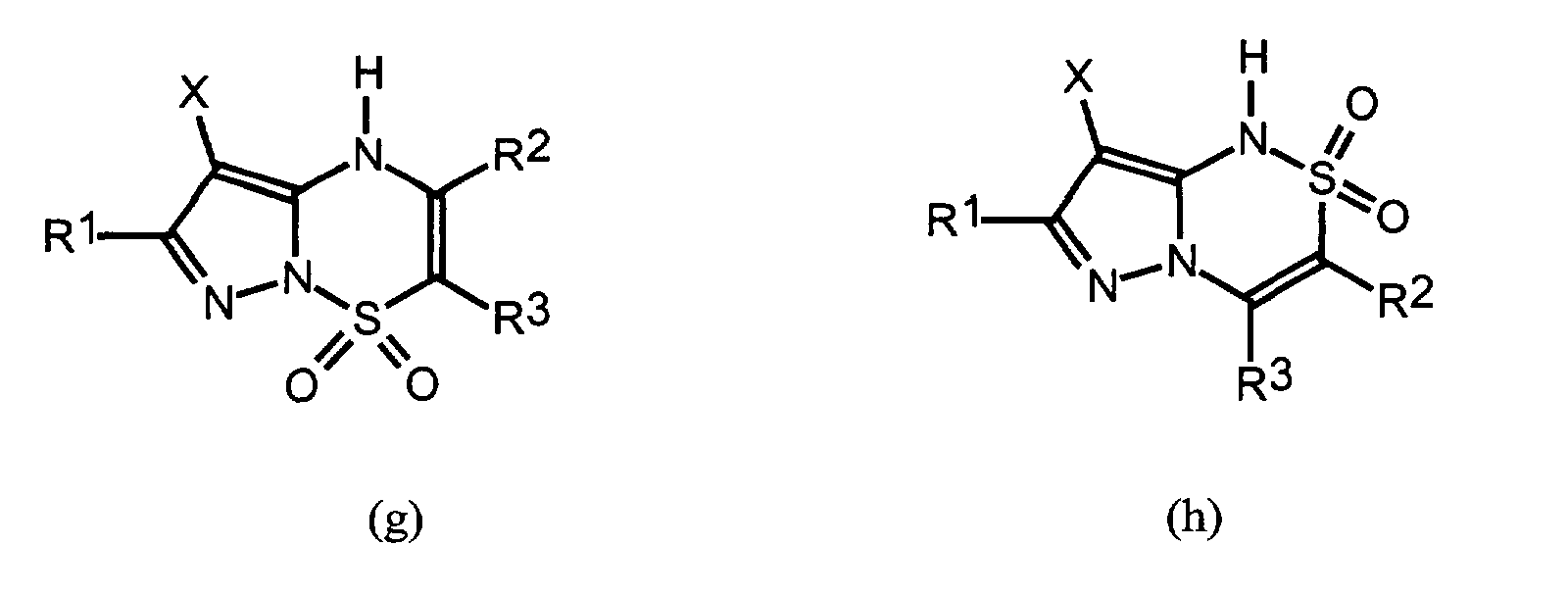 wherein
each of R1 to R3 is hydrogen or an independently selected substituent or R2 and R3 may join to form an unsubstituted or substituted aryl ring or a 5-to 10-membered heterocyclic ring which contains one or more heteroatoms selected from nitrogen, oxygen and sulfur, which ring is unsubstituted or substituted; and
X is as defined in claim 1. - An element according to any one of the preceding clams wherein substituents for R1, R2, R3 and R4 may be independently selected from cyano, fluoro, chloro, bromo, iodo; or an unsubstituted or substituted alkyl, aryl, heterocyclyl, alkoxy, aryloxy, alkyl- or aryl-carbonyl, alkyl- or aryl-oxycarbonyl, acyloxy, carbonamido, alkyl- or aryl-carbonamido, alkyl- or aryl-oxycarbonylamino, alkyl- or aryl-sulfonyl, alkyl- or aryl-sulfonyloxy, alkyl- or aryl-oxysulfonyl, alkyl- or aryl-sulfoxide, alkyl- or aryl-sulfamoyl, alkyl- or aryl-sulfamoylamino, alkyl- or aryl-sulfonamido, alkyl- or aryl-thio, alkyl- or aryl-phosphonate, nitro, alkyl- or aryl-amino, alkyl- or aryl-ureido or alkyl- or aryl-carbamoyl group, any of which may be further substituted.
- An element according to claim 20 wherein R1 is an alkyl- or aryl-carbonamido or an alkyl- or aryl-carbamoyl group substituted with an alkyl, alkoxy, aryl, or an aryloxy group, any of which may be further substituted.
- An element according to either of claims 20 and 21 wherein one of R2 and R3 is a phenyl group substituted with one or more halogen, alkyl, alkoxycarbonyl, alkylsulfamoyl, alkyl- or aryl-sulfonamido, alkylcarbonamido or alkylsulfonyl groups, any of which may be further substituted.
- An element according to either of claims 20 and 21 wherein R2 and R3 join to form an unsubstituted or substituted phenyl ring.
- An element according to any one of the preceding claims wherein the laydown of total coupler is from about 0.05 mmol/m2 to about 1.5 mmol/m2.
- An element according to any one of the preceding claims wherein the molar ratio of de-aggregating compound of formula (I) to total coupler of formula (II) is from about 0.01:1 to about 4:1.
- An element according to any one of the preceding claims wherein the ratio of solvent to total coupler (by weight) is from about 0.2:1 to about 5:1.
- A multi-colour photographic element comprising a support bearing yellow, magenta and cyan image-dye-forming units comprising at least one blue-, green- or red-sensitive silver halide emulsion layer having associated therewith at least one yellow, magenta or cyan dye-forming coupler respectively, wherein the element is as defined in any one of the preceding claims.
- A process of forming an image in a photographic element as hereinbefore defined after the element has been imagewise exposed to light, comprising contacting the element, as defined in any one of the preceding claims, with a colour developing agent.
Applications Claiming Priority (2)
| Application Number | Priority Date | Filing Date | Title |
|---|---|---|---|
| GBGB0130418.7A GB0130418D0 (en) | 2001-12-20 | 2001-12-20 | Photographic elements containing a deaggregating compound and dye forming coupler |
| GB0130418 | 2001-12-20 |
Publications (2)
| Publication Number | Publication Date |
|---|---|
| EP1321811A2 true EP1321811A2 (en) | 2003-06-25 |
| EP1321811A3 EP1321811A3 (en) | 2004-02-25 |
Family
ID=9927980
Family Applications (1)
| Application Number | Title | Priority Date | Filing Date |
|---|---|---|---|
| EP02026764A Withdrawn EP1321811A3 (en) | 2001-12-20 | 2002-12-02 | Photographic elements containing a de-aggregating compound, and dye-forming coupler |
Country Status (4)
| Country | Link |
|---|---|
| US (1) | US6841344B2 (en) |
| EP (1) | EP1321811A3 (en) |
| JP (1) | JP2003202652A (en) |
| GB (1) | GB0130418D0 (en) |
Cited By (5)
| Publication number | Priority date | Publication date | Assignee | Title |
|---|---|---|---|---|
| US8460723B2 (en) | 1995-06-07 | 2013-06-11 | Dupont Nutrition Biosciences Aps | Method of improving the properties of a flour dough, a flour dough improving composition and improved food products |
| CN107935952A (en) * | 2017-12-01 | 2018-04-20 | 北京天罡助剂有限责任公司 | A kind of preparation method of triazine 5 |
| CN109369550A (en) * | 2018-12-13 | 2019-02-22 | 利安隆(中卫)新材料有限公司 | A kind of preparation method of triazine-based ultraviolet absorbent |
| US20240102236A1 (en) * | 2018-10-03 | 2024-03-28 | Huntsman Advanced Materials (Switzerland) Gmbh | New Pyridine And Pyrimidine Substituted Triazine UV Absorbers |
| US12503439B2 (en) | 2022-04-22 | 2025-12-23 | Vertex Pharmaceuticals Incorporated | Heteroaryl compounds for the treatment of pain |
Families Citing this family (4)
| Publication number | Priority date | Publication date | Assignee | Title |
|---|---|---|---|---|
| US7122299B2 (en) * | 2002-11-06 | 2006-10-17 | Fuji Photo Film Co., Ltd. | Silver halide photographic light-sensitive material |
| JP5350013B2 (en) * | 2009-02-27 | 2013-11-27 | ケミプロ化成株式会社 | Novel triazine-based compound, process for producing the same, ultraviolet absorber comprising the same, and polymer composition containing the same |
| JP6832430B2 (en) | 2016-08-31 | 2021-02-24 | アジオス ファーマシューティカルズ, インコーポレイテッド | Inhibitors of cell metabolism |
| CN113968825B (en) * | 2021-10-27 | 2022-09-13 | 江苏富比亚化学品有限公司 | Synthesis method of s-triazine ultraviolet absorbent UV-1164 |
Family Cites Families (11)
| Publication number | Priority date | Publication date | Assignee | Title |
|---|---|---|---|---|
| CH533853A (en) | 1970-03-23 | 1973-02-15 | Ciba Geigy Ag | Use of 2'-hydroxyphenyl-1,3,5-triazines as stabilizers against ultraviolet radiation in photographic material |
| CH557693A (en) | 1971-06-23 | 1975-01-15 | Ciba Geigy Ag | PROCESS FOR PROTECTING ORGANIC MATERIALS AGAINST ULTRAVIOLET RADIATION. |
| JPH02100048A (en) | 1988-10-07 | 1990-04-12 | Fuji Photo Film Co Ltd | Silver halide color photographic sensitive material |
| JP3026244B2 (en) * | 1993-10-19 | 2000-03-27 | 富士写真フイルム株式会社 | Silver halide color photographic materials |
| EP0706083A1 (en) * | 1994-10-04 | 1996-04-10 | Ciba-Geigy Ag | Photographic recording material containing an UV-absorber |
| AU703967B2 (en) * | 1994-10-10 | 1999-04-01 | Ciba Specialty Chemicals Holding Inc. | Bisresorcinyltriazines |
| DE4444258A1 (en) * | 1994-12-13 | 1995-11-23 | Agfa Gevaert Ag | Colour photographic material contg. image-stabilising UV absorber |
| GB2319523B (en) | 1996-11-20 | 2000-11-08 | Ciba Sc Holding Ag | Hydroxyphenyltriazines |
| JPH10198010A (en) | 1997-01-14 | 1998-07-31 | Konica Corp | Silver halide color photographic sensitive material |
| US6010809A (en) | 1997-06-16 | 2000-01-04 | Konica Corporation | Silver halide light-sensitive color photographic material |
| DE19843057A1 (en) | 1998-09-19 | 2000-03-23 | Agfa Gevaert Ag | Color photographic material |
-
2001
- 2001-12-20 GB GBGB0130418.7A patent/GB0130418D0/en not_active Ceased
-
2002
- 2002-12-02 EP EP02026764A patent/EP1321811A3/en not_active Withdrawn
- 2002-12-04 US US10/309,474 patent/US6841344B2/en not_active Expired - Fee Related
- 2002-12-20 JP JP2002370239A patent/JP2003202652A/en active Pending
Cited By (8)
| Publication number | Priority date | Publication date | Assignee | Title |
|---|---|---|---|---|
| US8460723B2 (en) | 1995-06-07 | 2013-06-11 | Dupont Nutrition Biosciences Aps | Method of improving the properties of a flour dough, a flour dough improving composition and improved food products |
| CN107935952A (en) * | 2017-12-01 | 2018-04-20 | 北京天罡助剂有限责任公司 | A kind of preparation method of triazine 5 |
| CN107935952B (en) * | 2017-12-01 | 2019-11-15 | 北京天罡助剂有限责任公司 | A kind of preparation method of triazine -5 |
| US20240102236A1 (en) * | 2018-10-03 | 2024-03-28 | Huntsman Advanced Materials (Switzerland) Gmbh | New Pyridine And Pyrimidine Substituted Triazine UV Absorbers |
| US12227898B2 (en) * | 2018-10-03 | 2025-02-18 | Archroma (Switzerland) Gmbh | Pyridine and pyrimidine substituted triazine UV absorbers |
| CN109369550A (en) * | 2018-12-13 | 2019-02-22 | 利安隆(中卫)新材料有限公司 | A kind of preparation method of triazine-based ultraviolet absorbent |
| CN109369550B (en) * | 2018-12-13 | 2022-09-20 | 利安隆(中卫)新材料有限公司 | Preparation method of triazine ultraviolet absorbent |
| US12503439B2 (en) | 2022-04-22 | 2025-12-23 | Vertex Pharmaceuticals Incorporated | Heteroaryl compounds for the treatment of pain |
Also Published As
| Publication number | Publication date |
|---|---|
| JP2003202652A (en) | 2003-07-18 |
| US20030186177A1 (en) | 2003-10-02 |
| GB0130418D0 (en) | 2002-02-06 |
| EP1321811A3 (en) | 2004-02-25 |
| US6841344B2 (en) | 2005-01-11 |
Similar Documents
| Publication | Publication Date | Title |
|---|---|---|
| US5681690A (en) | Photographic dye-forming coupler, emulsion layer, element, and process | |
| US6261755B1 (en) | Photographic elements containing blend of cyan dye-forming couplers | |
| US6841344B2 (en) | Photographic elements containing a de-aggregating compound and dye-forming coupler | |
| US6900006B2 (en) | Photographic elements containing a de-aggregating compound, dye-forming coupler and stabilizer | |
| US6548234B2 (en) | Photographic elements containing a cyan dye-forming coupler, stabilizer and solvent | |
| US6197489B1 (en) | Photographic element for color imaging | |
| EP1116996A2 (en) | Photographic element for color imaging | |
| EP0779543B1 (en) | Photographic element containing an improved pyrazolotriazole coupler | |
| EP0779544B1 (en) | Photographic element containing an improved pyrazolotriazole coupler | |
| US6143485A (en) | Pyrazolotriazle dye-forming photographic coupler | |
| US6756189B2 (en) | Photographic elements containing cyan coupler UV absorber and stabilizer | |
| US6444412B1 (en) | Photographic element with dye-forming coupler and stabilizing compound | |
| WO2005001568A1 (en) | Photographic elements containing a de-aggregating compound, dye-forming coupler, stabilizer and solvent | |
| EP0813111B1 (en) | Color negative photographic film containing a particular cyan coupler bearing a sulfonyl containing ballast | |
| EP0718687B1 (en) | Photographic element containing a novel cyan dye forming a coupler and process for its use | |
| US6730465B2 (en) | Color photographic element containing a heterocyclic dye-forming coupler | |
| US5654132A (en) | Photographic materials and process comprising ureido naphtholic cyan couplers | |
| US6787294B1 (en) | Photographic material comprising a bicyclic pyrazolotriazole coupler with improved hue | |
| EP0718689B1 (en) | Photographic element containing a novel cyan dye forming coupler and process for its use | |
| EP0718688B1 (en) | Photographic element containing a novel cyan dye forming coupler and process for its use | |
| EP0969320A1 (en) | Photographic elements containing high-boiling diester solvents | |
| EP0969321A1 (en) | Photographic elements containing high-boiling esters | |
| EP1014187A1 (en) | Silver halide photographic element containing improved yellow dye-forming coupler | |
| EP1215534A1 (en) | Reduced fog in photographic coatings containing a monosubstituted quinone | |
| EP1217434A2 (en) | Silver halide photographic element |
Legal Events
| Date | Code | Title | Description |
|---|---|---|---|
| PUAI | Public reference made under article 153(3) epc to a published international application that has entered the european phase |
Free format text: ORIGINAL CODE: 0009012 |
|
| AK | Designated contracting states |
Designated state(s): AT BE BG CH CY CZ DE DK EE ES FI FR GB GR IE IT LI LU MC NL PT SE SI SK TR |
|
| AX | Request for extension of the european patent |
Extension state: AL LT LV MK RO |
|
| PUAL | Search report despatched |
Free format text: ORIGINAL CODE: 0009013 |
|
| AK | Designated contracting states |
Kind code of ref document: A3 Designated state(s): AT BE BG CH CY CZ DE DK EE ES FI FR GB GR IE IT LI LU MC NL PT SE SI SK TR |
|
| AX | Request for extension of the european patent |
Extension state: AL LT LV MK RO |
|
| AKX | Designation fees paid | ||
| REG | Reference to a national code |
Ref country code: DE Ref legal event code: 8566 |
|
| STAA | Information on the status of an ep patent application or granted ep patent |
Free format text: STATUS: THE APPLICATION IS DEEMED TO BE WITHDRAWN |
|
| 18D | Application deemed to be withdrawn |
Effective date: 20040826 |