EP1321808A2 - A photographic film base comprising a poly(ethylene terephthalate)-based material - Google Patents
A photographic film base comprising a poly(ethylene terephthalate)-based material Download PDFInfo
- Publication number
- EP1321808A2 EP1321808A2 EP02080100A EP02080100A EP1321808A2 EP 1321808 A2 EP1321808 A2 EP 1321808A2 EP 02080100 A EP02080100 A EP 02080100A EP 02080100 A EP02080100 A EP 02080100A EP 1321808 A2 EP1321808 A2 EP 1321808A2
- Authority
- EP
- European Patent Office
- Prior art keywords
- polyester
- pet
- mol
- film base
- chdm
- Prior art date
- Legal status (The legal status is an assumption and is not a legal conclusion. Google has not performed a legal analysis and makes no representation as to the accuracy of the status listed.)
- Withdrawn
Links
Classifications
-
- G—PHYSICS
- G03—PHOTOGRAPHY; CINEMATOGRAPHY; ANALOGOUS TECHNIQUES USING WAVES OTHER THAN OPTICAL WAVES; ELECTROGRAPHY; HOLOGRAPHY
- G03C—PHOTOSENSITIVE MATERIALS FOR PHOTOGRAPHIC PURPOSES; PHOTOGRAPHIC PROCESSES, e.g. CINE, X-RAY, COLOUR, STEREO-PHOTOGRAPHIC PROCESSES; AUXILIARY PROCESSES IN PHOTOGRAPHY
- G03C1/00—Photosensitive materials
- G03C1/76—Photosensitive materials characterised by the base or auxiliary layers
- G03C1/795—Photosensitive materials characterised by the base or auxiliary layers the base being of macromolecular substances
- G03C1/7954—Polyesters
-
- B—PERFORMING OPERATIONS; TRANSPORTING
- B41—PRINTING; LINING MACHINES; TYPEWRITERS; STAMPS
- B41M—PRINTING, DUPLICATING, MARKING, OR COPYING PROCESSES; COLOUR PRINTING
- B41M5/00—Duplicating or marking methods; Sheet materials for use therein
- B41M5/26—Thermography ; Marking by high energetic means, e.g. laser otherwise than by burning, and characterised by the material used
- B41M5/40—Thermography ; Marking by high energetic means, e.g. laser otherwise than by burning, and characterised by the material used characterised by the base backcoat, intermediate, or covering layers, e.g. for thermal transfer dye-donor or dye-receiver sheets; Heat, radiation filtering or absorbing means or layers; combined with other image registration layers or compositions; Special originals for reproduction by thermography
- B41M5/41—Base layers supports or substrates
Definitions
- This invention relates to a polyester photographic film base having improved properties and to a method of preparing the same. More particularly, the invention relates to a poly(ethylene terephthalate)-based photographic film base having improved properties with regard to slitting, perforating and other finishing or cutting operations.
- the film base comprises a material in which a specified amount of monomeric units derived from 1,4-cyclohexane dimethanol (CHDM), such that the film base has a specified cutting-related property.
- CHDM 1,4-cyclohexane dimethanol
- Silver-halide photographic elements comprise one or more light-sensitive layers coated on a support.
- the support comprises a sheet of a transparent or translucent film, commonly referred to as a film base.
- Other layers, such as backing or subbing layers, may be laminated onto either side of the film base.
- Common film-base materials for photographic elements are cellulose triacetate (CTA) and poly(ethylene terephthalate) (PET). More recently it has been proposed to use poly(ethylene naphthalate) (PEN) as a film base for photographic elements which are intended to be used in a cartridge of reduced diameter which requires rolling the film more tightly than previously.
- CTA has generally a good mix of physical properties for various types of photographic films.
- its manufacturing process involves high levels of gaseous emissions, and it is relatively costly.
- the manufacturing process for PET is environmentally benign.
- PET Poly(ethylene terephthalate) (PET) films exhibit excellent properties for use as photographic film base with regard to transparency, dimensional stability, mechanical strength, resistance to thermal deformation.
- PET films are extremely tough and, therefore, not well suited for finishing operations, i.e., slitting, chopping and/or perforating processes, which are required in the manufacture or preparation of photographic films.
- such films are difficult to cut in various steps of the photofinishing process such as splicing, notching, and sleeving.
- PET materials have been considered unusable as a film base in certain consumer photographic film applications, such as 35 mm film, especially consumer films requiring non-centralized external processing or mini-lab processing where finishing must be easily handled.
- PET materials are presently used in photographic films in which less decentralized processing is not required, for example, X-ray films, motion picture films, and graphic arts films. With respect to the latter types of films, adjustments to processing can be more easily made to handle cutting and the like.
- PET film Another general problem with PET film is its tendency to take up high levels of curl during storage in cartridges at high temperatures and its inability to sufficiently lower this curl during photoprocessing as commonly exhibited by CTA-based photographic films.
- a solution to the latter problem was proposed in US Patent No. 5,556,739 to Nakanishi et al., US Patent No. 5,387,501 to Yajima et al., and US Patent No. 5,288,601 to Greener et al. in which multilayered supports comprise polyesters modified by sulfonate and other hydrophilic moieties that facilitate, in wet processing, recovery of curl imposed on the film during storage in a cartridge.
- Another general approach to lowering the tendency of a polyester film base to take up curl (core-set) during storage is through annealing at elevated temperature and/or by raising the glass transition temperature (Tg) of the polyester.
- US Patent No. 3,326,689 to Murayama discloses glow discharge treatment for improved curl of a film base made from a polyester material, preferably a PEN material.
- the polyester material comprises a PET-type material in which 25 mol % of the glycol component repeat units are derived from CHDM.
- US Patent No. 5,294, 473 to Kawamoto similarly discloses a PET polyester film base in which 25 mol % of the glycol component repeat units are derived from CHDM, with improved (reduced) curl.
- US Patent No. 5,925,507 to Massa et al. discloses a PET film-base material having less tendency to core set, comprising polyester containing at least 30 weight % 1,4-cyclohexane dimethanol (CHDM), which polyester is blended with a polycarbonate that contains bisphenol.
- US Patent No. 4,141,735 to Schrader et al. discloses a polyester film base having improved core-set curl, involving the use of heat tempering, in one example using poly(1,4-cyclohexylene dimethylene terephthalate).
- this polymer crystallizes rapidly, therefore the making of its oriented film is difficult. Also, the polymer becomes opaque or hazy and useless for photographic applications where transparency is required.
- PEN-based polyester films The blending or copolymerizing of conventional polyester with other polyester constituents (polymers or comonomers), in order to improve the cutting performance of a film, has also been proposed for PEN-based polyester films, as disclosed in US Patent No. 6,232,054 B1 to Okutu et al.
- PEN is generally considerably more costly and more difficult to manufacture than PET, so a clear need exists for improving the cuttability of PET-based polyester supports.
- PET poly(ethylene terephthalate)
- PEN poly(ethylene naphthalate)
- the toughness and cutting difficulty of PET and similar polyesters is generally attributed to the crystal structure and molecular orientation of the film. It is known that changes in these factors, driven either by formulary changes or by modified process conditions, can be used to lower the toughness and improve the cutting performance of PET. Generally, the crystallinity of PET can be lowered or altogether eliminated by adding suitable crystallization modifiers. Crystallization modifiers like isophthalic acid (IPA) and 1,4-cyclohexane dimethanol (CHDM) are often copolymerized into PET and PEN polyesters to form copolyesters that have better processing properties. Modest levels of IPA slow down crystallization and raise the oxygen barrier properties.
- IPA isophthalic acid
- CHDM 1,4-cyclohexane dimethanol
- Amorphous copolyesters are generally defined as copolyesters that do not show a substantial melting point by differential scanning calorimetry. These copolyesters are typically based on terephthalic acid, isophthalic acid, ethylene glycol, neopentyl glycol and 1,4-cyclohexane dimethanol. It is known that amorphous copolyesters possess a combination of desirable properties, such as excellent clarity and color, toughness, chemical resistance and ease of processing. Accordingly, such copolyesters are known to be useful for the manufacture of extruded sheets, packaging materials, and parts for medical devices. For example. US Patent Nos. 5,385,773 and 5,340,907 to Yau et al.
- polyesters of 1,4-cyclohexane dimethanol in which the diol is present in an amount of 10-95 mol % of the glycol component, and a process for producing such copolymers by esterification.
- US Patent No. 6,183,848 B1 to Turner et al. disclose an amorphous copolyester comprising various amounts of comonomers derived from 1,4-cyclohexane dimethanol which, because of improved gas barrier properties, are useful for packaging perishable goods.
- the copolyester is disclosed as a biaxially oriented sheet. Film and sheet made from various amorphous PET polyesters comprising repeat units from CHDM are sold by Eastman Chemical Company under the trademark EASTAPAK and EASTAR copolyesters.
- PET film base with improved physical properties.
- This invention relates to an imaging element having improved cutting performance. More specifically, the invention relates to a photographic film having a polyester film base, particularly as a replacement to a CTA film base, with an improved cutting property. It has been found that the presence of a certain amount of monomeric units derived from 1,4-cyclohexane dimethanol (CHDM), also referred to as “CHDM repeat units” or “CHDM-comonomer units,” in a PET-based material, significantly improves the cutting performance of the film base. This can be accomplished either by the physical blending of polyester polymers containing CHDM monomeric units into a PET-based material and/or the incorporation by synthesis of CHDM-comonomer units into a modified PET polymer backbone at appropriate levels.
- CHDM 1,4-cyclohexane dimethanol
- Photographic film requires a strict control of the thickness uniformity and surface flatness.
- One method of control is through stretching of a polymer sheet into a semicrystalline state.
- CHDM-modified polyester only when the concentration of CHDM-comonomer units relative to total glycol/diol content is less than about 30 mol % or greater than about 65 mol % is the resulting polyester crystalline.
- the material does not become sufficiently crystalline for dimensional stability and thickness uniformity until the concentration of CHDM comonomer relative to total diol content is less than 25 mol %.
- Amorphous polyester film or insufficiently crystalline film presents dimensional stability and thickness uniformity problems, and it possesses relatively low stiffness.
- this invention provides an improved poly(ethylene terephthalate) (PET) film base for photographic film or other elements, having excellent dimensional stability, optical clarity and mechanical strength while also possessing an improved cuttability.
- PET poly(ethylene terephthalate)
- a PET resin is blended using a suitable compounding method with a polyester containing CHDM comonomer at a sufficient level, and this blend is then used to prepare a biaxially stretched and heat-set film or sheet material under conditions similar to those used for preparing conventional PET film.
- a modified-PET resin comprising CHDM comonomer at a sufficient level is used to prepare a biaxially stretched and heat-set film or sheet material under conditions similar to those used for preparing conventional PET film.
- a further embodiment of the invention is directed towards a photographic element comprising at least one light sensitive silver halide-containing emulsion layer and a PET film base produced in accordance with the above embodiments.
- the film base of the present invention has desirable properties for use in photographic elements. These include good stiffness, low tear strength and improved cuttability.
- terephthalic acid suitable synthetic equivalents, such as dimethyl terephthalate, are included.
- dicarboxylic acids includes the corresponding acid anhydrides, esters and acid chlorides for these acids.
- the mol percentages referred to herein equal a total of 100 mol %.
- PET polymer refers to a polyester comprising at least 98 mol % terephthalic-acid comonomer units, based on the total acid component, and comprising at least 98 mol % of ethylene-glycol comonomer units, based on the total glycol component.
- PET resins consisting essentially of about 100 mol % terephthalic-acid comonomer units, based on the total acid component, and consisting essentially of about 100 mol % of ethylene-glycol comonomer units, based on the total glycol component.
- modified PET polymer is a polyester comprising at least 70 mol % terephthalic-acid comonomer units, based on the total acid component, that has been modified so that either the acid component is less than 98 mol % of terephthalic-acid ("TA”) comonomer units or the glycol component is less than 98 mol % of ethylene-glycol (“EG”) comonomer units, or both the TA and EG comonomer units are in an amount less than 98 mol %.
- TA terephthalic-acid
- EG ethylene-glycol
- the modified PET polymer is modified with, or copolymerized with, one or more comonomers other than terephthalic-acid comonomers and/or ethylene-glycol comonomers in an amount of greater than 2 mol % (including greater than 5 mol %), of either the acid component and/or the glycol component, for example, to improve the cuttability of a film base or otherwise change the properties of the film base in which it is used.
- the "modified PET resin” does not necessarily need to contain any ethylene-glycol comonomer units, and it does not necessarily need to contain any acid component other than terephthalic-acid comonomer units.
- the "modified PET polymer” is a polyester comprising at least 80 mol % terephthalic-acid comonomer units, based on the total acid component, and at least 60 mol % ethylene-glycol (EG) comonomer units, further modified with or copolymerized with one or more additional types of comonomers, preferably in the amount of greater than 5 mol % of the acid component and/or glycol component.
- EG ethylene-glycol
- CHDM-modified PET or "CHDM-modified-PET polyester” refers to a modified-PET polymer modified by the inclusion of at least 2 (including at least 3.5%) CHDM-comonomer units.
- CHDM-modified polyester refers to a polyester comprising at least 2 mol % (including at least 3.5 mol %) CHDM-comonomer units, based on total glycol component, but not necessarily comprising any specific amount of terephthalic acid component.
- PET-based polyester material is a semicrystalline material comprising one or more polymers wherein at least 70 % by weight of the material is one or more polymers that are either a PET polymer or modified PET polymer.
- the material optionally may also include addenda such as silica beads, plasticizers, and the like.
- a film base is made using a PET-based polyester material in the present invention.
- Preferably greater than 80 % by weight, more preferably greater than 90 % by weight, of the PET-based polyester material used in this invention is one or more polymers that are either a PET polymer or modified PET polymer.
- the photographic film base according to the present invention is made from a PET-based polyester material comprising one or more polyester resins, in which material the level of repeat units derived from 1,4-cyclohexane dimethanol (CHDM) is between 3.5 and 25 mol %, based on total glycol component in the material, such that the cutting index (as defined in Equations 1 and 2 below) of said film base is less than 4.6.
- the film base comprises a material in which the level of repeat units derived from 1,4-cyclohexane dimethanol is between 5 and 22 mol %, based on total glycol component in the material, and the cutting index of said film base is less than 3.5.
- less than 25 mol % of the total glycol component are aromatic, more preferably less than 10 mol %, most preferably essentially zero mol %.
- the film base of the present invention comprises a polyester material comprising at least two polyesters, a first polyester that is a PET polymer or a modified-PET polymer that is blended with a second polyester, the second polyester comprising repeat units derived from 1,4-cyclohexane dimethanol such that the total repeat units derived from 1,4-cyclohexane dimethanol in the polyester materials is at a level between 3.5 and 25 mol % based on total glycol component in the polyester materials.
- the first polyester may have no repeat units from 1,4-cyclohexane dimethanol and/or the second polyester may be a modified-PET polyester.
- the second polyester may have no repeat units derived from terephthalic acid or its ester.
- the film base comprising the PET-based polyester material has a cutting index of less than 3.5, more preferably less than 3.0.
- the repeat units derived from 1,4-cyclohexane dimethanol in the material are at a level of 20 mol % or less based on total glycol component in the polyester.
- the film base is useful in a photographic element comprising at least one silver-halide imaging layer over a support comprising a film base.
- a photographic element can be a photographic film or a photothermographic film.
- the support can further comprise one or more photographically acceptable subbing layers, backing layers, tie layers, magnetic layers and the like.
- Subbing layers are used for the purpose of providing an adhesive force between the polyester support and an overlying photographic emulsion comprising a binder such as gelatin, because a polyester film is of a very strongly hydrophobic nature and the emulsion is a hydrophilic colloid. If the adhesion between the photographic layers and the support is insufficient, several practical problems arise such as delamination of the photographic layers from the support at the cut edges of the photographic material, which can generate many small fragments of chipped-off emulsion layers which then cause spot defects in the imaging areas of the photographic material.
- a photographic support may be initially treated with an adhesion promoting agent such as, for example, one containing at least one of resorcinol, catechol, pyrogallol, 1-naphthol, 2,4-dinitrophenol, 2,4,6-trinitrophenol, 4-chlororesorcinol, 2,4-dihydroxy toluene, 1,3-naphthalenediol, 1,6-naphthalenediol, acrylic acid, sodium salt of 1-naphthol-4-sulfonic acid, benzyl alcohol, trichloroacetic acid, dichloroacetic acid, o-hydroxybenzotrifluoride, m-hydroxybenzotrifluoride, o-fluorophenol, m-fluorophenol, p-fluorophenol, chloralhydrate, and p-chloro-m-cre
- an adhesion promoting agent such as, for example, one containing at least one of resorcinol, catechol, pyrogallol
- Polymers are also known and used in what is referred to as a subbing layer for promoting adhesion between a support and an emulsion layer.
- suitable polymers for this purpose are disclosed in US Patent Nos. 2,627,088; 2,968,241; 2,764,520; 2,864,755; 2,864,756; 2,972,534; 3,057,792; 3,071,466; 3,072,483; 3,143,421; 3,145,105; 3,145,242; 3,360,448; 3,376,208; 3,462,335; 3,475,193; 3,501,301; 3,944,699; 4,087,574; 4,098,952; 4,363,872; 4,394,442; 4,689,359; 4,857,396; British Patent Nos.
- Additional examples are polymers of, for example, acrylic acid esters such as ethyl acrylate or butyl acrylate, methacrylic acid esters such as methyl methacrylate or ethyl methacrylate or copolymers of these monomers with other vinylic monomers; or copolymers of polycarboxylic acids such as itaconic acid, itaconic anhydride, maleic acid or maleic anhydride with vinylic monomers such as styrene, vinyl chloride, vinylidene chloride or butadiene, or trimers of these monomers with other ethylenically unsaturated monomers.
- Materials used in adhesion-promoting layers often comprise a copolymer containing a chloride group such as vinylidene chloride.
- composition of the PET-based polyester material comprising the film base of the present invention can be made by conventional processes.
- polyesters comprise the reaction product of at least one dicarboxylic acid and at least one glycol component.
- the dicarboxylic acid component can typically comprise residues of terephthalic acid, isophthalic acid, 1,4-cyclohexanedicarboxylic acid, 2,6-naphthalenedicarboxylic acid, and/or mixtures thereof.
- cis, trans, or cis/trans mixtures of 1,4-cyclohexanedicarboxylic acid may be employed.
- suitable naphthalene dicarboxylic acid isomers include 1,4-naphthalenedicarboxylic acid, 2-6-naphthalenedicarboxylic acid, 2,7-naphthalenedicarboxylic acid or mixtures thereof.
- the CHDM-modified-PET polyesters used in making the articles of this invention preferably have about 100 mol % of a dicarboxylic acid portion and about 100 mol % of a glycol portion. Less than about 30 mol %, preferably not more than about 20 mol % of the dicarboxylic acid repeat units may be from other conventional acids such as those selected from succinic, glutaric, adipic, azaleic, sebacic, fumaric, maleic, itaconic, 1,4-cyclohexane-dicarboxylic, phthalic, isophthalic, and naphthalene dicarboxylic acid.
- the glycol component of the CHDM-modified-PET polyesters contain repeat units from between 3.5 and 50 mol % of 1,4-cyclohexane-dimethanol and about 96.5 to 50 mol % of ethylene glycol.
- the glycol component may optionally include less than 35 mol %, preferably not more than about 10 mol % of other conventional glycols such as propylene glycol, 1,3-propanediol; 2,4-dimethyl-2-ethylhexane-1,3-diol, 2,2-dimethyl-1,3-propanediol, 2-ethyl-2-butyl-1,3-propanediol, 2-ethyl-2-isobutyl-1,3-propanediol, 1,3-butanediol, 1,4-butanediol, neopentyl glycol, 1,5-pentanediol, 1,6-hexanedi
- the CHDM-modified-PET polyesters used in the film base comprise copolyesters having a dicarboxylic acid component and a glycol component, the dicarboxylic acid component comprising repeat units from at least 80 mol % terephthalic acid (or its ester) and the glycol component comprising less than 25 mol %, preferably between about 3.5 and 25 mol %, of repeat units from 1,4-cyclohexane dimethanol and about 96.5 to 75 mol % from another glycol, preferably from ethylene glycol.
- a blend comprising at least two polyesters, wherein at least one PET polymer and/or a modified-PET polymer is blended with a CHDM-modified polyester, preferably a CHDM-modified PET polyester, such that the level of the CHDM-comonomer units in the total blend is between 3.5 and 25 mol %, preferably less than 22 mol %, more preferably less than 20 mol %.
- a CHDM-modified polyester any of the above-mentioned acid components may be used and any of the above-mentioned glycol components may be used in addition to the CHDM component.
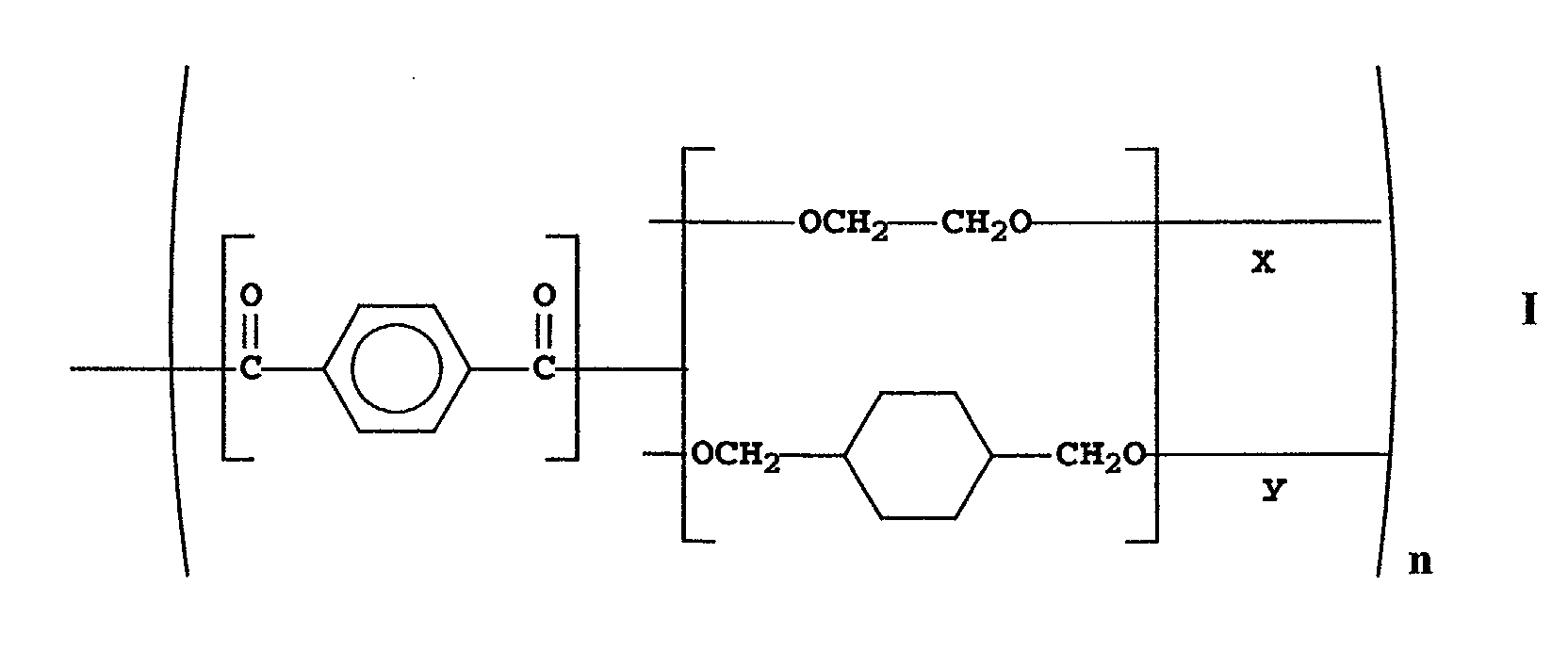
- a preferred CHDM-modified PET for use in the present invention is represented by the following structure:
- x and y represent the mol %, based on the total glycol component of the comonomer.
- x is 75 to 96.5 mol % and y is between 3.5 and 25 mol %.
- Other acid or glycol monomers may be substituted to the extent described above.
- a blend comprises a PET polymer and a CHDM-modified polymer in the ratio of 95:5 to 5:95 more preferably 85:15 to 10:90.
- the mol % of the CHDM-comonomer units relative to the total glycol component in the CHDM-modified polymer is 3.5% to 35 mol %.
- the acid component in the CHDM-modified polymer is 80% to 100% of terephthalic acid component.
- the polyester polymers used in the present invention can be prepared by a process comprising reacting the dicarboxylic acid component and the glycol component at temperatures sufficient to effect esterification or ester exchange and polycondensing the reaction product under an absolute pressure of less than 10 mm Hg for a time of less than about 2 hours in the presence of a catalyst and inhibitor system.
- An example of a preferred catalyst and inhibitor system is about 0-75 ppm Mn, about 50-150 ppm Zn, about 5-200 ppm Ge, about 5-20 ppm Ti and about 10-80 ppm P, all parts by weight based on the weight of the copolyester.
- terephthalic acid component, monomer, repeat unit, or portion is meant to include either the acid or ester form.
- glycols CHDM and ethylene glycol are also commercially available. Either the cis or trans isomer of CHDM, or mixture thereof, may be used in accordance with the present invention.
- the copolyesters may be produced using conventional polyesterification procedures described, for example, in US Patent Nos. 3,305,604 and 2,901,460.
- the amorphous or semi-crystalline copolyesters according to the invention are prepared by conventional polymerization processes known in the art, such as disclosed by US Patent Nos. 4,093,603 and 5,681,918.
- Examples of polycondensation processes useful in making the PET material of the present invention include melt phase processes conducted with the introduction of an inert gas stream, such as nitrogen, to shift the equilibrium and advance to high molecular weight or the more conventional vacuum melt phase polycondensations, at temperatures ranging from about 240°C to about 300°C or higher which are practiced commercially.
- conventional additives may be added to the copolyester materials of the invention in typical amounts. Such additives include pigments, colorants, stabilizers, antioxidants, extrusion aids, slip agents, carbon black, flame retardants and mixtures thereof.
- modified-PET polyesters comprising repeat units from CHDM, which can be used in the present invention, are commercially available from Eastman Chemical Company (Kingsport, Tenn.) under the trademark EASTAPAK and EASTAR copolyester, as described at http://www.eastman.com.
- Photographic elements of this invention can have the structures and components shown in Research Disclosure Item 37038 [cite] and can be imagewise exposed and processed using known techniques and compositions, including those described in the Research Disclosure Item 37038 cited above.
- the film base may be manufactured by a process of casting, biaxial stretching and heat-setting.
- the process for making PET film base typically comprises the steps of casting a molten PET resin onto a casting surface along the machine direction to form a continuous sheet, drafting the sheet by stretching in the machine direction, tentering the sheet by stretching in the transverse direction, heat-setting the drafted and tentered sheet, and cooling the heat-set sheet to form a stretched, heat-set PET film, such as described in, e.g., US Patent No. 4,141,735 to Schrader et al.
- the stretching of the film in the machine and transverse directions can be performed simultaneously using appropriate machinery.
- the film base is heat treated at temperatures from Tg - 50°C up to Tg for times ranging from 1 hr to 1000 hrs, where Tg is the glass transition temperature of the PET-based polyester material.
- the process for preparing films from the resin compositions of this invention comprises the following steps:
- Modulus and tensile toughness can be determined using a tensile test such as that described in ASTM D882.
- a tensile test consists of pulling a sample of material with a tensile load at a specified rate until it breaks. The test sample used may have a circular or a rectangular cross section. From the load and elongation history, a stress-strain curve is obtained with the strain being plotted on the x-axis and stress on the y-axis.
- the modulus is defined as the slope of the initial linear portion of the stress-strain curve.
- the modulus is a measure of the stiffness of the material.
- the tensile toughness is defined as the area under the entire stress-strain curve up to the fracture point. The tensile toughness is a measure of the ability of a material to absorb energy in a tensile deformation. Both modulus and tensile toughness are fundamental mechanical properties of the material.
- Tear Strength The resistance to tear can be determined using a tear test such as that described in ASTM D1938. The test measures the force to propagate tearing in a fracture mode III. The test sample used has a rectangular shape and a sharp long cut in the middle. The separated two arms are then fixed in a conventional testing machine such as Instron®. The fixtures move at constant speed to prolong the preexisting cut and the steady state force of tearing is recorded.
- tensile toughness represents the energy required to initiate a crack
- fracture toughness determines the energy needed to further propagate the crack.
- a quantity of cuttability can be defined based on these two fundamental material quantities.
- Tensile toughness can be evaluated through tensile testing.
- C The cutting indices of commonly used film base materials such as PET, PEN and CTA correspond well to their practical cutting performance. Generally, it is desirable for C to be close to 1 (CTA value).
- polyester films having the properties set forth above and prepared by the process described above are less likely to fail and more likely to produce cleaner cut surfaces in various cutting operations.
- the films prepared in accordance with this invention compare favorably with CTA, which has been the film base of choice for a long time in the photographic industry because of its special physical characteristics.
- poly(ethylene terephthalate)-based films in the following examples were prepared using the following materials.
- the poly(ethylene terephthalate)-type polymers listed above were processed into film by first drying the pellets of said materials under suitable conditions. The pellets were then melted at 530°F using a single screw extruder, and cast onto an electrostatically charged casting drum at 110°F to prepare a cast sheet.
- the cast sheet obtained was subjected to biaxial stretching, either simultaneously or sequentially, by 3 to 4 times in each direction.
- the stretched film had a final thickness of 3 to 5 mils.
- Poly(ethylene terephthalate) (sold as EASTAPAK PET 7352 by Eastman Chemical Company, USA) was extruded through a sheeting die and cast on a chill roll. The cast sheets were stretched biaxially at a ratio of 3X3 to form the comparative 3.6 mil thick film sample C-1.
- Example C-2 The resulting films were evaluated for tensile and tear properties. The results are reported in Table I below together with the corresponding properties for the CTA (Sample C-2) are also listed in Table 1.
- Property Sample number C-1 Sample number C-2 Thickness mil ⁇ m 3.6 92 4.9 124 Break elongation % 105.8 24.4 Young's modulus 10 3 psi GPa 657.2 4.5 553 3.8 Break strength 10 3 psi MPa 29.9 206.2 13.9 95.7 Yield strength 10 3 psi MPa 13.7 94.4 10.5 72.6
- Material EASTAR 20285 a copolyester comprising 12 mol % of CHDM-comonomer units (of total glycol units), was extruded through a sheeting die and cast on a chill roll. The cast sheets were stretched biaxially at 85°C at a ratio of 3.4X3.4 to form a 4.0 mil thick film (Sample No. 5).
- Material PETG-15 comprising 15 mol % CHDM-comonomer units (of total glycol units in blend), was extruded through a sheeting die and cast on a chill roll. The cast sheets were stretched biaxially at 92°C at a ratio of 3.4X3.4 to form a 2.7 mil thick film (Sample No. 6).
- EASTAR GP001 a copolyester comprising 20 mol % CHDM-comonomer units (of total glycol units), was extruded through a sheeting die and cast on a chill roll. The cast sheets were stretched biaxially at 85 °C at a ratio of 3.4X3.4 to form a 3.7 mil thick film (Sample No. 7).
Landscapes
- Physics & Mathematics (AREA)
- Spectroscopy & Molecular Physics (AREA)
- Chemical & Material Sciences (AREA)
- Engineering & Computer Science (AREA)
- Materials Engineering (AREA)
- General Physics & Mathematics (AREA)
- Optics & Photonics (AREA)
- Manufacture Of Macromolecular Shaped Articles (AREA)
Abstract
Description
| Property | Sample number C-1 | Sample number C-2 | |
| Thickness | mil µm | 3.6 92 | 4.9 124 |
| Break elongation | % | 105.8 | 24.4 |
| Young's modulus | 103psi GPa | 657.2 4.5 | 553 3.8 |
| Break strength | 103psi MPa | 29.9 206.2 | 13.9 95.7 |
| Yield strength | 103psi MPa | 13.7 94.4 | 10.5 72.6 |
| Tensile toughness | ft*lbf/in3 MPa | 1659.6 137.3 | 230 19 |
| Tear strength | g/mil g/100µm | 21.2 83.3 | 5.7 22.4 |
| Cutting index | 5.5 | 1 |
| Property | Sample Number 1 | Comparative Sample C-1 | |
| Thickness | Mil µm | 5.0 126 | 3.6 92 |
| Break elongation | % | 115.4 | 105.8 |
| Young's modulus | 103psi Gpa | 475.4 3.3 | 657.2 4.5 |
| Break strength | 103psi MPa | 16.8 115.6 | 29.9 206.2 |
| Yield strength | 103psi MPa | 10.5 72.4 | 13.7 94.4 |
| Tensile toughness | ft*lbf/in3 MPa | 1162.8 96.2 | 1659.6 137.3 |
| Tear strength | g/mil g/100µm | 21.4 84.4 | 21.2 83.3 |
| Cutting index | 4.4 | 5.5 |
| Property | Sample Number 2 | Comparative Sample C-1 | |
| Thickness | mil µm | 3.0 77 | 3.6 92 |
| Break elongation | % | 115.6 | 105.8 |
| Young's modulus | 103psi GPa | 545.5 3.8 | 657.2 4.5 |
| Break strength | 103psi MPa | 24.4 168.2 | 29.9 206.2 |
| Yield strength | 103psi MPa | 11.3 77.7 | 13.7 94.4 |
| Tensile toughness | ft*lbf/in3 MPa | 1494.2 123.6 | 1659.6 137.3 |
| Tear strength | g/mil g/100µm | 15.2 60.0 | 21.2 83.3 |
| Cutting index | 4.6 | 5.5 |
| Property | Sample Number 3 | Comparative Sample C-1 | |
| Thickness | mil µm | 3.1 79 | 3.6 92 |
| Break elongation | % | 90.2 | 105.8 |
| Young's modulus | 103psi GPa | 485.0 3.3 | 657.2 4.5 |
| Break strength | 103psi MPa | 18.0 124.1 | 29.9 206.2 |
| Yield strength | 103psi MPa | 10.0 68.9 | 13.7 94.4 |
| Tensile toughness | ft*lbf/in3 MPa | 967.0 80.0 | 1659.6 137.3 |
| Tear strength | g/mil g/100µm | 16.2 63.7 | 21.2 83.3 |
| Cutting index | 3.5 | 5.5 |
| Property | Sample Number 4 | Comparative Sample C-1 | |
| Thickness | mil µm | 3.7 94 | 3.6 92 |
| Break elongation | % | 91.7 | 105.8 |
| Young's modulus | 103psi GPa | 593.8 4.1 | 657.2 4.5 |
| Break strength | 103psi MPa | 28.4 195.5 | 29.9 206.2 |
| Yield strength | 103psi MPa | 12.2 84.0 | 13.7 94.4 |
| Tensile toughness, | ft*lbf/in3 MPa | 1326.0 109.7 | 1659.6 137.3 |
| Tear strength | g/mil g/100µm | 12.1 47.6 | 21.2 83.3 |
| Cutting index | 3.9 | 5.5 |
| Property | Sample Number 5 | Comparative Sample C-1 | |
| Thickness | mil µm | 4.0 102 | 3.6 92 |
| Break elongation | % | 71.6 | 105.8 |
| Young's modulus | 103psi GPa | 631.8 4.4 | 657.2 4.5 |
| Break strength | 103psi MPa | 26.0 179.4 | 29.9 206.2 |
| Yield strength | 103psi Mpa | 12.5 86.3 | 13.7 94.4 |
| Tensile toughness | ft*lbf/in3 Mpa | 1021.6 84.5 | 1659.6 137.3 |
| Tear strength | g/mil g/100µm | 9.7 38.1 | 21.2 83.3 |
| Cutting index | 3.1 | 5.5 |
| Property | Sample Number 6 | Comparative Sample C-1 | |
| Thickness | mil µm | 2.7 69 | 3.6 92 |
| Break elongation | % | 75.9 | 105.8 |
| Young's modulus | 103psi GPa | 571.3 3.9 | 657.2 4.5 |
| Break strength | 103psi MPa | 27.0 186.0 | 29.9 206.2 |
| Yield strength | 103psi MPa | 12.5 86.3 | 13.7 94.4 |
| Tensile toughness | ft*lbf/in3 MPa | 1109.5 91.8 | 1659.6 137.3 |
| Tear strength | g/mil g/100µm | 9.2 36.0 | 21.2 83.3 |
| Cutting index | 3.2 | 5.5 |
| Property | Sample Number 7 | Comparative Sample C-1 | |
| Thickness | Mil µm | 3.7 93 | 3.6 92 |
| Break elongation | % | 76.3 | 105.8 |
| Young's modulus | 103psi GPa | 584.7 4.0 | 657.2 4.5 |
| Break strength | 103psi MPa | 24.0 165.6 | 29.9 206.2 |
| Yield strength | 103psi MPa | 9.9 68.2 | 13.7 94.4 |
| Tensile toughness | ft*lbf/in3 MPa | 918.6 76.0 | 1659.6 137.3 |
| Tear strength | g/mil g/100 µm | 9.0 35.5 | 21.2 83.3 |
| Cutting index | 2.8 | 5.5 |
| Property | Sample Number 8 | Comparative Sample C-1 | |
| Thickness | mil µm | 2.9 73 | 3.6 92 |
| Break elongation | % | 98.8 | 105.8 |
| Young's modulus | 103psi GPa | 403.5 2.8 | 657.2 4.5 |
| Break strength | 103psi MPa | 16.3 112.3 | 29.9 206.2 |
| Yield strength | 103psi MPa | 7.8 53.8 | 13.7 94.4 |
| Tensile toughness | ft*lbf/in3 MPa | 888.7 73.5 | 1659.6 137.3 |
| Tear strength | g/mil g/100µm | 11.6 45.7 | 21.2 83.3 |
| Cutting index | 3.0 | 5.5 |
Claims (10)
- An imaging element comprising at least one light-sensitive or thermally sensitive imaging layer over a support comprising a biaxially stretched, semicrystalline film base of a PET-based polyester material comprising one or more polyester resins, in which material the level of repeat units derived from 1,4-cyclohexane dimethanol is between 3.5 and 25 mol %, based on total glycol component in the material, wherein the cutting index of said film base is less than 4.6.
- The imaging element of claim 1 in which the level of repeat units derived from 1,4-cyclohexane dimethanol in the PET-based polyester material is 5 to 22 mol %, based on total glycol component in the material, and the cutting index of said film base is less than 4.0.
- The imaging element of claim 1 wherein the PET-based polyester material consists of a single polyester that is a CHDM-modified PET polyester.
- The imaging element of claim 1 wherein the PET-based polyester material is a blend of at least two polyesters, a first polyester that is a PET polymer or a modified-PET polymer and a second polyester, the second polyester comprising repeat units derived from 1,4-cyclohexane dimethanol such that the total repeat units derived from 1,4-cyclohexane dimethanol in the polyester material is at a level between 3.5 to 25 mol % based on total glycol component in the polyester material.
- The imaging element of claim 4 in which the level of repeat units derived from 1,4-cyclohexane dimethanol in the PET-based polyester material is 5 to 22 mol %, based on total glycol component in the material, and the cutting index of said film base is less than 4.0.
- The imaging element of claims 1 or 4 wherein the repeat units derived from 1,4-cyclohexane dimethanol in the PET-based polyester material is at a level of 10 to 20 mol % based on total glycol component in the polyester.
- The imaging element of claims 1 or 4 wherein the film base is manufactured by a process of melt extrusion, casting, biaxial stretching, and heat-setting.
- The imaging element of claims 1 or 4 wherein the imaging layer comprises a silver-halide emulsion.
- The imaging element of claims 1 or 5 wherein the PET-based polyester material comprises at least 80 mol % of terephthalic-acid comonomer, based on the total acid component in the material.
- An imaging element comprising at least one light-sensitive or thermally sensitive imaging layer over a support comprising a biaxially stretched, semicrystalline film base of a PET-based polyester material comprising one or more polyester resins, in which material the level of repeat units derived from 1,4-cyclohexane dimethanol is 3.5 to 20 mol %, based on total glycol component in the material, wherein the cutting index of said film base is less than 4.6, wherein the PET-based polyester material is a blend of at least two polyesters, a first polyester that is a PET polymer or a modified-PET polymer and a second polyester, the second polyester comprising repeat units derived from 1,4-cyclohexane dimethanol such that the total repeat units derived from 1,4-cyclohexane dimethanol in the polyester material is at a level between 3.5 to 25 mol % based on total glycol component in the polyester.
Applications Claiming Priority (2)
| Application Number | Priority Date | Filing Date | Title |
|---|---|---|---|
| US10/027,023 US6555303B1 (en) | 2001-12-21 | 2001-12-21 | Photographic film base comprising a poly(ethylene terephthalate)-based material |
| US27023 | 2001-12-21 |
Publications (2)
| Publication Number | Publication Date |
|---|---|
| EP1321808A2 true EP1321808A2 (en) | 2003-06-25 |
| EP1321808A3 EP1321808A3 (en) | 2003-12-17 |
Family
ID=21835205
Family Applications (1)
| Application Number | Title | Priority Date | Filing Date |
|---|---|---|---|
| EP02080100A Withdrawn EP1321808A3 (en) | 2001-12-21 | 2002-12-09 | A photographic film base comprising a poly(ethylene terephthalate)-based material |
Country Status (3)
| Country | Link |
|---|---|
| US (1) | US6555303B1 (en) |
| EP (1) | EP1321808A3 (en) |
| JP (1) | JP2003195452A (en) |
Families Citing this family (4)
| Publication number | Priority date | Publication date | Assignee | Title |
|---|---|---|---|---|
| US6670110B1 (en) * | 2002-12-20 | 2003-12-30 | Eastman Kodak Company | Photographic multilayer film base comprising 1,4-cyclohexane dimethanol |
| US6727052B1 (en) * | 2002-12-20 | 2004-04-27 | Eastman Kodak Company | Multilayer photographic film and an imaging element made of said base |
| US6797458B2 (en) * | 2002-12-20 | 2004-09-28 | Eastman Kodak Company | Photographic multi-layer film base comprising 1,4-cyclohexane dimethanol |
| EP1602683A4 (en) * | 2003-03-11 | 2006-04-19 | Mitsubishi Polyester Film Corp | BIAXIALLY ORIENTATED POLYESTER FILM AND DEMOLITION FILM |
Family Cites Families (15)
| Publication number | Priority date | Publication date | Assignee | Title |
|---|---|---|---|---|
| US3326689A (en) | 1964-01-20 | 1967-06-20 | Eastman Kodak Co | Photographic direct-print silver halide emulsions |
| US4141735A (en) | 1975-03-31 | 1979-02-27 | Eastman Kodak Company | Process for reducing core-set curling tendency and core-set curl of polymeric film elements |
| JP2519066B2 (en) * | 1987-08-31 | 1996-07-31 | 富士写真フイルム株式会社 | Magnetic recording media |
| US5034263A (en) | 1989-11-27 | 1991-07-23 | Eastman Kodak Company | Film laminate |
| JPH05170890A (en) * | 1991-12-18 | 1993-07-09 | Fuji Photo Film Co Ltd | Manufacture of photographic support |
| EP0568268A2 (en) | 1992-04-27 | 1993-11-03 | Konica Corporation | Support for photographic material |
| JP2543809B2 (en) | 1992-08-18 | 1996-10-16 | 富士写真フイルム株式会社 | Polyester photographic support |
| JP3082120B2 (en) * | 1992-08-20 | 2000-08-28 | 富士写真フイルム株式会社 | Silver halide photographic material |
| US5462824A (en) * | 1992-12-03 | 1995-10-31 | Fuji Photo Film Co., Ltd. | Silver halide photographic material |
| JP3337518B2 (en) | 1993-03-30 | 2002-10-21 | コニカ株式会社 | Photographic support |
| US5288601A (en) | 1993-07-21 | 1994-02-22 | Eastman Kodak Company | Light sensitive silver halide element having photographic film base with improved curl stability |
| JPH07168309A (en) * | 1993-12-16 | 1995-07-04 | Fuji Photo Film Co Ltd | Silver halide photographic sensitive material |
| US5925507A (en) | 1998-01-14 | 1999-07-20 | Eastman Kodak Company | Photographic film base and photographic elements |
| US6183848B1 (en) | 1999-06-03 | 2001-02-06 | Eastman Chemical Company | Low melt viscosity amorphous copolyesters with enhanced glass transition temperatures having improved gas barrier properties |
| US6232054B1 (en) | 1999-09-19 | 2001-05-15 | Fuji Photo Film Co., Ltd. | Polyester support and silver halide photographic light-sensitive material |
-
2001
- 2001-12-21 US US10/027,023 patent/US6555303B1/en not_active Expired - Fee Related
-
2002
- 2002-12-09 EP EP02080100A patent/EP1321808A3/en not_active Withdrawn
- 2002-12-24 JP JP2002371937A patent/JP2003195452A/en active Pending
Also Published As
| Publication number | Publication date |
|---|---|
| US6555303B1 (en) | 2003-04-29 |
| JP2003195452A (en) | 2003-07-09 |
| EP1321808A3 (en) | 2003-12-17 |
Similar Documents
| Publication | Publication Date | Title |
|---|---|---|
| US6342281B2 (en) | Heat-shrinkable polyester films | |
| EP0349960A2 (en) | Shrinkable polyester film | |
| US6558884B1 (en) | Photographic film base comprising a poly(ethylene terephthalate)-based material | |
| JP4232004B2 (en) | Biaxially oriented polyester film | |
| US6737226B1 (en) | Process for making polyester photographic film base and photographic element comprising said base | |
| JP2023104955A (en) | Recycled resources-derived polyester film and method for producing the same | |
| JP2002103547A (en) | Transparent biaxially stretched polyester film and method for producing the same | |
| JPH08244114A (en) | Polyester shrink film | |
| US6555303B1 (en) | Photographic film base comprising a poly(ethylene terephthalate)-based material | |
| KR102794888B1 (en) | Polyester film and preparation method thereof | |
| US6727052B1 (en) | Multilayer photographic film and an imaging element made of said base | |
| US6797458B2 (en) | Photographic multi-layer film base comprising 1,4-cyclohexane dimethanol | |
| JP2848725B2 (en) | Polyester shrink film | |
| KR20060048528A (en) | Polyester film containing poly (m-xyleneadipamide) | |
| US6670110B1 (en) | Photographic multilayer film base comprising 1,4-cyclohexane dimethanol | |
| JP2000063538A (en) | Polyester film and method for producing the same | |
| JP3960741B2 (en) | Heat-shrinkable polyester multilayer film | |
| JP2000063537A (en) | Polyester film | |
| US6942831B2 (en) | Process for rapid annealing of a polyester film base to control film curl | |
| KR100688347B1 (en) | Heat-shrinkable film with excellent fusion resistance and manufacturing method | |
| JP2006233091A (en) | Polyester resin composition, polyester heat-shrinkable film, heat-shrinkable label, and container equipped with the label | |
| WO1998050456A1 (en) | Biaxially oriented polyethylene naphthalate copolymer film | |
| KR100591070B1 (en) | Heat-shrinkable polyester resin composition and heat-shrinkable polyester film prepared therefrom | |
| JPH0691831A (en) | Polyester film and photographic light-sensitive material | |
| JPH0748443A (en) | Polyester heat shrinkable film |
Legal Events
| Date | Code | Title | Description |
|---|---|---|---|
| PUAI | Public reference made under article 153(3) epc to a published international application that has entered the european phase |
Free format text: ORIGINAL CODE: 0009012 |
|
| AK | Designated contracting states |
Designated state(s): AT BE BG CH CY CZ DE DK EE ES FI FR GB GR IE IT LI LU MC NL PT SE SI SK TR |
|
| AX | Request for extension of the european patent |
Extension state: AL LT LV MK RO |
|
| PUAL | Search report despatched |
Free format text: ORIGINAL CODE: 0009013 |
|
| AK | Designated contracting states |
Kind code of ref document: A3 Designated state(s): AT BE BG CH CY CZ DE DK EE ES FI FR GB GR IE IT LI LU MC NL PT SE SI SK TR |
|
| AX | Request for extension of the european patent |
Extension state: AL LT LV MK RO |
|
| AKX | Designation fees paid | ||
| REG | Reference to a national code |
Ref country code: DE Ref legal event code: 8566 |
|
| STAA | Information on the status of an ep patent application or granted ep patent |
Free format text: STATUS: THE APPLICATION IS DEEMED TO BE WITHDRAWN |
|
| 18D | Application deemed to be withdrawn |
Effective date: 20040618 |