EP1321665A2 - An engine injector tester - Google Patents
An engine injector tester Download PDFInfo
- Publication number
- EP1321665A2 EP1321665A2 EP02258708A EP02258708A EP1321665A2 EP 1321665 A2 EP1321665 A2 EP 1321665A2 EP 02258708 A EP02258708 A EP 02258708A EP 02258708 A EP02258708 A EP 02258708A EP 1321665 A2 EP1321665 A2 EP 1321665A2
- Authority
- EP
- European Patent Office
- Prior art keywords
- pressure
- injector
- fluid
- piston
- tester
- Prior art date
- Legal status (The legal status is an assumption and is not a legal conclusion. Google has not performed a legal analysis and makes no representation as to the accuracy of the status listed.)
- Withdrawn
Links
Images


Classifications
-
- F—MECHANICAL ENGINEERING; LIGHTING; HEATING; WEAPONS; BLASTING
- F02—COMBUSTION ENGINES; HOT-GAS OR COMBUSTION-PRODUCT ENGINE PLANTS
- F02M—SUPPLYING COMBUSTION ENGINES IN GENERAL WITH COMBUSTIBLE MIXTURES OR CONSTITUENTS THEREOF
- F02M65/00—Testing fuel-injection apparatus, e.g. testing injection timing ; Cleaning of fuel-injection apparatus
- F02M65/001—Measuring fuel delivery of a fuel injector
Definitions
- the present invention relates to an engine injector tester, especially but not exclusively for testing a two-stage diesel engine injector.
- a gear wheel pump feeds test fluid to such an injector at steadily increasing pressures.
- Flow rate means are provided downstream of the injector to provide successive measures of the flow rate of test fluid at these successive pressures.
- a graph is plotted of the flow rate versus pressure. The pressure at which flow rate commences is indicative of the first stage of opening of the injector (commonly abbreviated to "NOP1”), and a steep rise in the gradient of the plot of flow rate against pressure indicates the pressure at which the second stage of the injector opens (commonly abbreviated to "NOP2").
- An aim of the present invention is to obviate this disadvantage.
- the present invention is directed to an engine injector tester comprising a source of fluid pressure, an injector mount for receiving an injector to be tested and connected to receive fluid from the tester, pressure transmission means to transmit fluid pressure from the said source to the injector mount, pressure adjustment means of the tester which serve to enable selection of a given pressure of fluid to be communicated to the injector mount via the said pressure transmission means, and fluid flow measurement means of the tester connected to provide a measure of flow rate of the fluid through the injector when the tester is in use, characterised in that the tester further comprises pressure burst means to enable pressure to be transmitted from the said source to the injector mount as a burst.
- burst means comprises a quick-exhaust valve.
- the latter may be connected in series with a fluid reservoir.
- the pressure transmission means may comprise a piston and cylinder arrangement in which the said source is connected to enable the pressure of fluid from the said source to be applied to one side of a piston, and fluid on the other side of the piston to be put in communication with the injector mount.
- the quick-exhaust valve would then be arranged upstream of the piston and cylinder arrangement, although it could be arranged downstream thereof.
- the piston and cylinder arrangement is part of a pressure intensifier.
- the pressure intensifier may comprise movable means which communicate a force applied by the pressure of fluid in a first cavity of the pressure intensifier to fluid in a second cavity of the intensifier, the component of the area of the movable means to which the pressure of the fluid in the first cavity is applied to urge the movable means to move towards the second cavity being substantially greater than the component of the area of the movable means which applies a force to the fluid in the second cavity so that pressure of fluid in the second cavity created as a result of the force applied to the movable means by the pressure of fluid in the first cavity is substantially greater than the latter pressure, the said movable means comprising the piston of the said piston and cylinder arrangement and the second cavity being defined by the cylinder of the said piston and cylinder arrangement.
- the pressure intensifier may be inexpensively and readily embodied by a standard hydraulic amplifier of pressure, such as is used in hydraulic brake systems of motor vehicles, for example.
- the fluid flow measurement means may comprise displacement measuring means arranged to measure displacement of the piston, coupled with timing means to measure the time taken for a given displacement of the piston to occur.
- the said burst means may, instead of a quick-exhaust valve, comprise a clamp on the piston enabling the pressure to build up before piston movement is allowed by a sudden release of the clamp.
- the tester may be further provided with control means to cause a succession of bursts to occur at respective different pressures.
- Detection means may be provided to detect the pressure at which a steep rise in the flow rate occurs in the flow rate as a function of pressure, to indicate NOP2 in a two-stage injector.
- the present invention extends to a method of testing an engine injector comprising transmitting fluid pressure from a pressure source to an injector under test, adjusting that pressure to a desired value, and measuring the flow of fluid which flows through the injector as a result, characterised in that the pressure is transmitted from the source to the injector as burst.
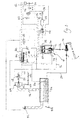
- the engine injector tester shown in Figure 1 is especially but not exclusively adapted to test a two-stage diesel engine fuel injector. It comprises an intensifier 10 having an output 12 connected to an hydraulic hand pump 14. The latter is also connected to a line 16 which connects the said output 12 of the intensifier 10 to an injector 18 under test held in an injector head or mount 20.
- a non-return valve 22 is connected between the pump 14 and the line 16 to inhibit the return of hydraulic fluid from the line 16 to the pump 14.
- a line 24 connects an hydraulic fluid reservoir 26 to the pump 14, and a non-return valve 28 in the line 24 prevents fluid in the line 24 returning from the pump 14 to the reservoir 26.
- An air pressure source 30 is connected to an input 32 of the pressure intensifier 10 via a pressure regulator 34, a pressure gauge 36, an air reservoir 38, and a quick-exhaust valve 40 connected in series in that order from the pressure source 30 to the intensifier 10.
- the pressure source 30 is also connected to an air outlet end 42 of the reservoir 26 via a water trap filter 44, a further pressure regulator 46, a further pressure gauge 48, and an air mover control valve 50 connected in series in that order from the air pressure source 30 to the air outlet end 42.
- the air pressure source 30 is provided with pressure adjustment means 52 to adjust the pressure of air provided by the source 30.
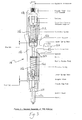
- the pressure intensifier 10 comprises a low inertia, low friction vehicle brake actuator. It comprises a frame 54, at one end of which is mounted a diaphragm cylinder 56 across which extends a diaphragm 58, on an outer side of which is defined a first cavity 60.
- the cylinder 56 is provided with a port 62 (constituting the input 32 to the intensifier 10) on that side of the cylinder 58 to enable pressurised air to be passed into the said first cavity 60 (and also to enable air to flow out from that cavity).
- the diaphragm 58 is in contact with a flange 64 at an outer end of a plunger rod 66.
- That rod 66 is received in a piston 68 abutting but not necessarily connected to a plunger 70 which is received within a cylindrical hollow of a cylinder block 72 defining a second cavity 74 therewithin.
- the latter is connected to a port 76 (constituting the outlet 12 of the intensifier 10 although it should be appreciated that fluid may flow into as well as out of the cavity 74 through that port 76).
- the effective diameter of the diaphragm 58 is approximately 150mm.
- the diameter of the plunger 70 is about 12mm and the cylindrical block 72 accommodates a travel for the plunger 70 of about 10mm.
- the pressure intensifier 10 therefore has an intensifying ratio of approximately 150:1.
- Any linear axial movement of the piston 68 is detectable by a magnet and inductor coil sensor 78, the magnet part of which is fixed to the piston 68 by a connector 80. This enables measurement of the rate of displacement of the piston 68.
- the voltage induced in the coil is proportional to the velocity of plunger movement, which in turn is directly proportional to the flow rate of fluid from the said second cavity 74.
- the plunger 70 can be moved its full distance of travel in approximately 0.03 seconds, providing a flow rate of approximately 2.2 litres per minute.
- a control processor 82 has an LCD display 84.
- the processor 82 is connected to receive signals from a thermometer 86 in the reservoir 26, the rate of displacement transducer 78 and an injected-pressure sensor 88.
- a further capability of the processor 82 is to control the tester to perform pre-set automatic test cycles. To this end it is connected to operate at least the pressure adjustment means 52 (which may be adjusted manually also) and the quick-exhaust valve 40.
- a tool tray 100 is connected to receive test fluid from a spray collector 102 via a tool tray drain 104.
- a conduit 106 directs spray collected from the injector 54 and returns it to the reservoir 26.
- the air mover 42 and a reservoir drain 108 are connected to the reservoir 26.
- a light bulb 109 is positioned adjacent to the spray collector 102 to facilitate assessment of the spray pattern.
- Figure 3 shows in greater detail an example of an injector 18 under test. It comprises a main body 150 defining a nozzle outlet 152 at its intended lower end and provided with a body cap 154 at its other end.
- the body 150 is formed with a shaped interior cavity 156 extending axially along its length. Its shape is such as to house, as a close-fitting, a valve needle 158 at the nozzle end, a primary spring 160 and, further from the needle 158 than the primary spring 160, a secondary spring 162.
- the valve needle 158 is attached to an injector spindle 164 an upper end of which is spaced, when the needle 158 is closing the nozzle 152, by a pre-lift gap from a seat 166 of the secondary spring 162.
- the body 150 is provided with an inlet connection 168 provided with a passageway 170 extending from that inlet connection 168 through the injector body 150, to the interior of the nozzle 152.
- valve needle 158 rises by a first displacement, against the resilience of the primary spring 160, equal to the pre-lift spacing whereupon the spindle 164 contacts the seat 166, whereupon the valve needle 158 continues displacement to full lift against the resilience of the secondary spring 162.
- NOP1 The pressure required to initiate displacement for the pre-lift is referred to as NOP1
- NOP2 the pressure required to initiate displacement of the needle 158 against the resilience of the secondary spring 162
- NOP2 being the second normal opening pressure
- fluid from the hand pump 14 is applied to the said second cavity 74, as well as to the injector 18 under test. This ensures that the piston 68 is in its fully retracted position as shown in Figure 2 and that the hydraulic fluid in the line 16 is under pressure. During this time, the hand pump 14 is operated to ensure such a pressure.
- the quick-exhaust valve 40 is in a first condition in which air can be vented from the said first cavity 60, again to enable the piston 68 to return to its start position as shown in Figure 2.
- the quick-exhaust valve 40 is now switched to open the pressure of air from the source 30 and the reservoir 38, to the said first cavity 60, as a result of which pressure in that cavity is rapidly built-up by virtue of the high flow rate of the quick-exhaust valve 40 and the capacity of the air reservoir 38.
- the quick-exhaust valve 40 acts as pressure burst means to enable pressure to be transmitted from the pressure source 30 to the injector 18 as a burst.
- the force of pressure in the said first cavity 60 works to build up very rapidly the pressure in the said second cavity 74 and thence to the injector 18 under test.
- a signal from the processor 82 may be applied to the injector 18 in the event that the latter is electrically operated, via the line 110 to enable an injection of the test fluid through the injector 18.
- the rate of increase of injected pressure is sufficiently great, because of the high flow through the quick-exhaust valve 40 and the capacity of the air reservoir 38 that the injector 18 which as shown in Figure 3 is not operated electrically can be readily opened and tested.
- the instantaneous pressures as measured by the pressure sensor 88 are recorded in the processor 82.
- a check is also made on the flow rate as determined by the processor 82 from the signal it receives from the rate of displacement transducer 78 and the instantaneous rate data is recorded.
- the transducer 78 is coupled with timing means 200 of the processor 82 to enable flow rate to be determined from displacement.
- the test fluid passes back through the conduit 106 to the reservoir 26.
- the foregoing cycle is repeated until sufficient data has been obtained, which may be stored in a memory 210 within the processor 82.
- the illustrated pressure intensifier is capable of providing high-pressure fluid (in excess of 700 bar). For example, an air pressure of about 5.0 bar applied to the diaphragm 58 generates an injected pressure of about 750 bar. A high flow rate of the order 2 litres per minute can be achieved.
- the data recorded in the processor 82 may be processed in a number of ways to determine the opening pressures of the injector 18.
- the tester will automatically cycle to collect data and determine pressure and flow conditions for the injector 18 being tested. To determine the NOP2 pressure, it does this by measuring the pressure and flow rate at which the secondary spring 162 is activated.
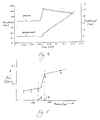
- Figure 4 shows a graph of pressure (as measured by the pressure sensor 88) and displacement (of plunger 70) as a function of time.
- the pressure scale is illustrated in bar, the displacement in mm, and the time in ms.
- the quick-exhaust valve 40 is opened so that the pressure rises very rapidly, to create a burst or pulse of pressure and a shot or injection of fluid through the injector 18, and the plunger 70 accelerates rapidly.
- a reasonably steady state is achieved at a pressure of roundabout 270bar in Figure 4 with a displacement of approximately 1mm for every 0.01ms, which given the dimensions of the various components of the system, corresponds to a flow of something of the order of 1 litre per minute.
- the system will perform tests and obtain pressure and flow results for the two selected test pressures.
- An algorithm pre-loaded by the manufacturer or held in a separate processor or computer will determine further test pressures. These test pressures are selected dependant on the flow results of the first test sequence and on the basis of progressively selecting pressures and related flows that will more closely bracket the actual NOP2 and corresponding flow rate. Thus, referring again to Figure 5, subsequent tests would be carried out at the pressures for position 3 and then 4, and lastly at position 5.
- These fit the illustrated curve of flow rate as a function of pressure and indicate a value for NOP2 between pressure values a and b in that Figure, which may be of sufficient accuracy to avoid the need for additional tests to be made. In this way by repeated testing a map of results is obtained and stored in the memory 210 and the software algorithm can then determine the actual NOP2 value.
- Alternative test sequences may also be used to determine the second stage opening pressure using the system, for example by repeat testing from a low pressure setting to a higher pressure setting a complete record by selected intervals of pressure and flow may be mapped to obtain the graph shown in Figure 6, and from that the actual NOP2 value can be ascertained.
- a single shot of the system and the record of instantaneous pressure and flow, varying continuously until the plunger 70 bottoms out, may be analysed to determine the NOP2 value.
- the curves of pressure and displacement as a function of time as in this case may be as shown in Figure 7, in which the time at which the elbow in the displacement curve occurs would indicate the NOP2 value from the pressure curve.
- the system may also be used to determine intermediate points of flow and pressure that are indicative of whether the injector is performing correctly. Injectors with rate shaping nozzles may also be tested by this system.
- the fuel injector illustrated in Figure 3 may instead be a multi-stage diesel injector.
- the magnet and inductor coil 78 may be replaced by a diffraction grating device, for example.
- the quick-exhaust valve 40 may be a Bosch Rexroth part, No. 573-503-0010.
Landscapes
- Engineering & Computer Science (AREA)
- Chemical & Material Sciences (AREA)
- Combustion & Propulsion (AREA)
- Mechanical Engineering (AREA)
- General Engineering & Computer Science (AREA)
- Testing Of Engines (AREA)
- Fuel-Injection Apparatus (AREA)
Abstract
Description
- Figure 1
- is a pneumatic/hydraulic circuit diagram of an engine injector tester embodying the present invention;
- Figure 2
- is an axial sectional view through a part of the tester shown in Figure 1;
- Figure 3
- shows an axial sectional view of an example of an injector which can be tested by the tester shown in Figure 1; and
- Figures 4 to 7
- show respective explanatory graphs.
Claims (14)
- An engine injector tester comprising a source (30) of fluid pressure, an injector mount (20) for receiving an injector (18) to be tested and connected to receive fluid from the tester, pressure transmission means (40, 74) to transmit fluid pressure from the said source (30) to the injector mount (20), pressure adjustment means (52) of the tester which serve to enable selection of a given pressure of fluid to be communicated to the injector mount (20) via the said pressure transmission means (40, 74), and fluid flow measurement means (78) of the tester connected to provide a measure of flow rate of the fluid through the injector (18) when the tester is in use, characterised in that the tester further comprises pressure burst means (40) to enable pressure to be transmitted from the said source (30) to the injector mount (20) as a burst.
- An engine injector tester according to claim 1, characterised in that the burst means (40) comprises a quick-exhaust valve (40).
- An engine injector tester according to claim 2, characterised in that the quick-exhaust valve (40) is connected in series with a fluid reservoir (38).
- An engine injector tester according to any preceding claim, characterised in that the pressure transmission means (40, 74) comprise a piston and cylinder arrangement (68, 72) in which the said source (30) is connected to enable the pressure of fluid from the said source to be applied to one side of a piston (68), and fluid on the other side of the piston (68) to be put in communication with the injector mount (20).
- An engine injector tester according to claim 4 read as appended to claim 2, characterised in that the quick-exhaust valve (40) is arranged upstream of the piston and cylinder arrangement (68, 72).
- An engine injector tester according to claim 4 read as appended to claim 2, characterised in that the quick exhaust valve (40) is arranged downstream of the piston and cylinder arrangement (68, 72).
- An engine injector tester according to any one of claims 4 to 6, characterised in that the piston and cylinder arrangement (68, 72) is part of a pressure intensifier.
- An engine injector tester according to claim 7, characterised in that the pressure intensifier comprises movable means (58, 66, 68, 70) which communicate a force applied by the pressure of fluid in a first cavity (60) of the pressure intensifier to fluid in a second cavity (74) of the intensifier, the component of the area of the movable means to which the pressure of the fluid in the first cavity (60) is applied to urge the movable means (58, 66, 68, 70) to move towards the second cavity (74) being substantially greater than the component of the area of the movable means (58, 66, 68, 70) which applies a force to the fluid in the second cavity (74) so that pressure of fluid in the second cavity created as a result of the force applied to the movable means (58, 66, 68, 70) by the pressure of fluid in the first cavity (60) is substantially greater than the latter pressure, the said movable means (58, 66, 68, 70) comprising the piston (68) of the said piston and cylinder arrangement (68, 72) and the second cavity (74) being defined by the cylinder (72) of the said piston and cylinder arrangement (68, 72).
- An engine injector tester according to claim 8, characterised in that the pressure intensifier comprises a standard hydraulic amplifier of pressure such as is used in hydraulic brake systems of motor vehicles.
- An engine injector tester according to claim 1 or any one of claims 4 to 9 read as appended to claim 1, characterised in that the said burst means comprise a clamp on the piston (68) enabling the pressure to build up before piston movement is allowed by a sudden release of the clamp.
- An engine injector tester according to any preceding claim, characterised in that the fluid flow measurement means (78) comprise displacement measuring means arranged to measure displacement of the piston, coupled with timing means to measure the time taken for a given displacement of the piston to occur.
- An engine injector tester according to any preceding claim, characterised in that the tester is further provided with control means (82) to cause a succession of bursts to occur at respective different pressures.
- An engine injector tester according to any preceding claim, characterised in that detection means (82) are provided to detect the pressure at which a steep rise in the flow rate occurs in the flow rate as a function of pressure, to indicate NOP2 in a two-stage injector (18).
- A method of testing an engine injector (18) comprising transmitting fluid pressure from a pressure source (30) to an injector (18) under test, adjusting that pressure to a desired value, and measuring the flow of fluid which flows through the injector (18) as a result, characterised in that the pressure is transmitted from the source to the injector as a burst.
Applications Claiming Priority (2)
| Application Number | Priority Date | Filing Date | Title |
|---|---|---|---|
| GB0130676 | 2001-12-21 | ||
| GB0130676A GB0130676D0 (en) | 2001-12-21 | 2001-12-21 | An engine injector tester |
Publications (2)
| Publication Number | Publication Date |
|---|---|
| EP1321665A2 true EP1321665A2 (en) | 2003-06-25 |
| EP1321665A3 EP1321665A3 (en) | 2003-10-01 |
Family
ID=9928186
Family Applications (1)
| Application Number | Title | Priority Date | Filing Date |
|---|---|---|---|
| EP02258708A Withdrawn EP1321665A3 (en) | 2001-12-21 | 2002-12-18 | An engine injector tester |
Country Status (2)
| Country | Link |
|---|---|
| EP (1) | EP1321665A3 (en) |
| GB (1) | GB0130676D0 (en) |
Cited By (2)
| Publication number | Priority date | Publication date | Assignee | Title |
|---|---|---|---|---|
| EP1882846A1 (en) * | 2006-07-26 | 2008-01-30 | Lincoln Industrial Corporation | Apparatus and Method for Testing Fuel Flow |
| CN111927667A (en) * | 2020-09-07 | 2020-11-13 | 思达耐精密机电(常熟)有限公司 | High-pressure common rail pump high-pressure leakage test system and application |
Family Cites Families (9)
| Publication number | Priority date | Publication date | Assignee | Title |
|---|---|---|---|---|
| US4599983A (en) * | 1981-11-09 | 1986-07-15 | Kabushiki Kaisha Komatsu Seisakusho | Method and apparatus for injecting fuel for a diesel engine |
| JPS58217761A (en) * | 1982-06-09 | 1983-12-17 | Fuji Shoten:Kk | Testing device for fuel injection valve |
| DE3315503C1 (en) * | 1983-04-28 | 1984-05-03 | Daimler-Benz Ag, 7000 Stuttgart | Test arrangement for high-pressure injection valves |
| GB8329399D0 (en) * | 1983-11-03 | 1983-12-07 | Churchill V L Ltd | Diesel engine injector tester |
| JPS60101270A (en) * | 1983-11-05 | 1985-06-05 | Fuji Techno Kogyo Kk | Fuel valve injection test device |
| US4788858A (en) * | 1987-08-04 | 1988-12-06 | Tif Instruments, Inc. | Fuel injector testing device and method |
| WO1993013309A1 (en) * | 1991-12-23 | 1993-07-08 | Caterpillar Inc. | Method for metering the amount of fuel ejected from a fuel injector |
| DE19801640C1 (en) * | 1998-01-17 | 1999-04-22 | Wtz Motoren & Maschforsch Gmbh | Test rig for fuel injection valve |
| US6234128B1 (en) * | 2000-03-13 | 2001-05-22 | General Motors Corporation | Fuel accumulator with pressure on demand |
-
2001
- 2001-12-21 GB GB0130676A patent/GB0130676D0/en not_active Ceased
-
2002
- 2002-12-18 EP EP02258708A patent/EP1321665A3/en not_active Withdrawn
Cited By (3)
| Publication number | Priority date | Publication date | Assignee | Title |
|---|---|---|---|---|
| EP1882846A1 (en) * | 2006-07-26 | 2008-01-30 | Lincoln Industrial Corporation | Apparatus and Method for Testing Fuel Flow |
| CN111927667A (en) * | 2020-09-07 | 2020-11-13 | 思达耐精密机电(常熟)有限公司 | High-pressure common rail pump high-pressure leakage test system and application |
| CN111927667B (en) * | 2020-09-07 | 2023-12-05 | 思达耐精密机电(常熟)有限公司 | High-pressure leakage test system for high-pressure common rail pump and application |
Also Published As
| Publication number | Publication date |
|---|---|
| GB0130676D0 (en) | 2002-02-06 |
| EP1321665A3 (en) | 2003-10-01 |
Similar Documents
| Publication | Publication Date | Title |
|---|---|---|
| CA1129677A (en) | Test apparatus and method for an engine mounted fuel pump | |
| US20060201244A1 (en) | Device for measuring time-resolved volumetric throughflow processes | |
| US7197918B2 (en) | Apparatus and method for evaluating fuel injectors | |
| GB2086984A (en) | Apparatus for testing injection nozzles | |
| US8444060B2 (en) | Fuel injector with deterioration detection | |
| WO2010027535A1 (en) | A method and system for testing a fuel injector | |
| GB2076162A (en) | A flowmeter | |
| JPH0261692B2 (en) | ||
| US5895844A (en) | Precise fuel flow measurement with modified fluid control valve | |
| JP2004526894A (en) | Detection of end point of valve movement of spool control valve | |
| US6311553B1 (en) | Method and device for examining and/or adjusting valves | |
| EP1321665A2 (en) | An engine injector tester | |
| US3782168A (en) | Method and apparatus for calibrating and testing pressure responsive apparatus | |
| EP1148327A1 (en) | ( Injector valve ) monitoring equipment with pressure measuring time selection | |
| US6567755B1 (en) | Metering equipment | |
| US7000450B2 (en) | Method, computer program and device for measuring the injection quantity of injection nozzles, especially for motor vehicles | |
| RU2370745C1 (en) | Device for diagnostics of diesel engine systems | |
| EP1167150B1 (en) | A pressure intensifier | |
| JPS5841318A (en) | Fuel amount detection device | |
| US5650575A (en) | Method for determining the spring force of a closing spring upon the opening of a valve of a fuel injection valve and an apparatus for carrying out the method | |
| GB1604709A (en) | Method of and apparatus for testing the fluid tightness of test pieces | |
| EP0300833A1 (en) | Differential pressure indication in fluid flow units | |
| RU2293206C2 (en) | Device for diagnosing condition of fuel devices of diesel engines | |
| CN100468027C (en) | Device and method for monitoring cylinder pressure and large two-stroke diesel engine | |
| JPH07318401A (en) | Method and device for testing expansion |
Legal Events
| Date | Code | Title | Description |
|---|---|---|---|
| PUAI | Public reference made under article 153(3) epc to a published international application that has entered the european phase |
Free format text: ORIGINAL CODE: 0009012 |
|
| AK | Designated contracting states |
Designated state(s): AT BE BG CH CY CZ DE DK EE ES FI FR GB GR IE IT LI LU MC NL PT SE SI SK TR |
|
| AX | Request for extension of the european patent |
Extension state: AL LT LV MK RO |
|
| PUAL | Search report despatched |
Free format text: ORIGINAL CODE: 0009013 |
|
| AK | Designated contracting states |
Kind code of ref document: A3 Designated state(s): AT BE BG CH CY CZ DE DK EE ES FI FR GB GR IE IT LI LU MC NL PT SE SI SK TR |
|
| AX | Request for extension of the european patent |
Extension state: AL LT LV MK RO |
|
| RIC1 | Information provided on ipc code assigned before grant |
Ipc: 7F 02M 59/18 B Ipc: 7F 02M 65/00 A |
|
| 17P | Request for examination filed |
Effective date: 20040401 |
|
| AKX | Designation fees paid |
Designated state(s): AT BE BG CH CY CZ DE DK EE ES FI FR GB GR IE IT LI LU MC NL PT SE SI SK TR |
|
| 17Q | First examination report despatched |
Effective date: 20040706 |
|
| STAA | Information on the status of an ep patent application or granted ep patent |
Free format text: STATUS: THE APPLICATION IS DEEMED TO BE WITHDRAWN |
|
| 18D | Application deemed to be withdrawn |
Effective date: 20041117 |